Medication Errors Improving Practices and Patient Safety
Medication Error A  preventable  event that leads to inappropriate medication use or patient harm.
Causes of Medication Errors NOT   the result of poor-quality staff! Error-prone processes involved in the   medication use system   contribute to medication errors Excellent, experienced practitioners make mistakes
Medication Errors Most medication errors do not result in patient harm Some medication errors result in catastrophic harm or death High risk with   High Alert Drugs  —  highly toxic drugs or drugs with a narrow therapeutic range have a high risk of causing devastating injury or death; see  Davis’s Drug Guide for Nurses  for a list of high alert drugs
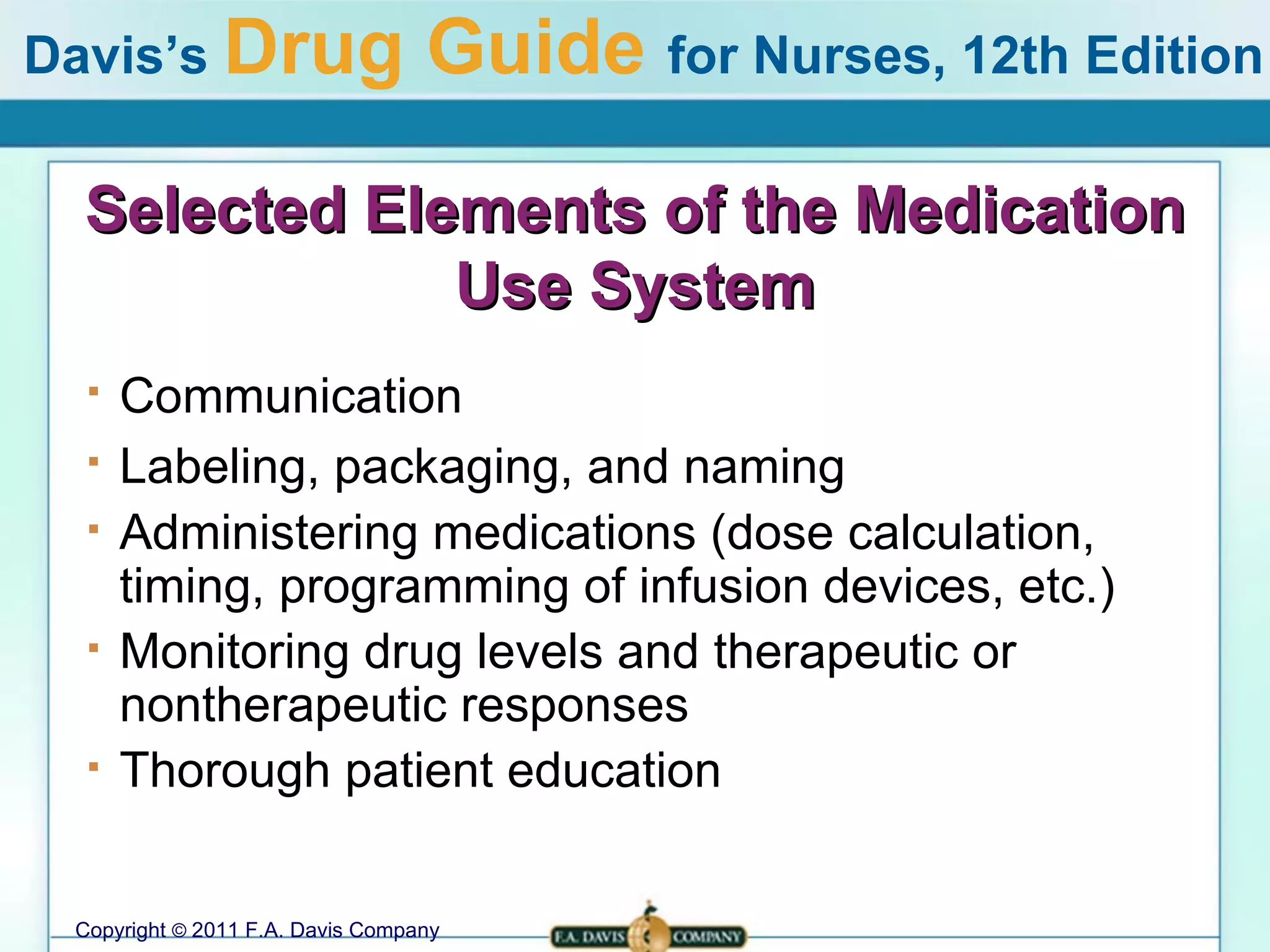
Selected Elements of the Medication Use System Communication   Labeling, packaging, and naming   Administering medications (dose calculation, timing, programming of infusion devices, etc.)  Monitoring drug levels and therapeutic or nontherapeutic responses Thorough patient education
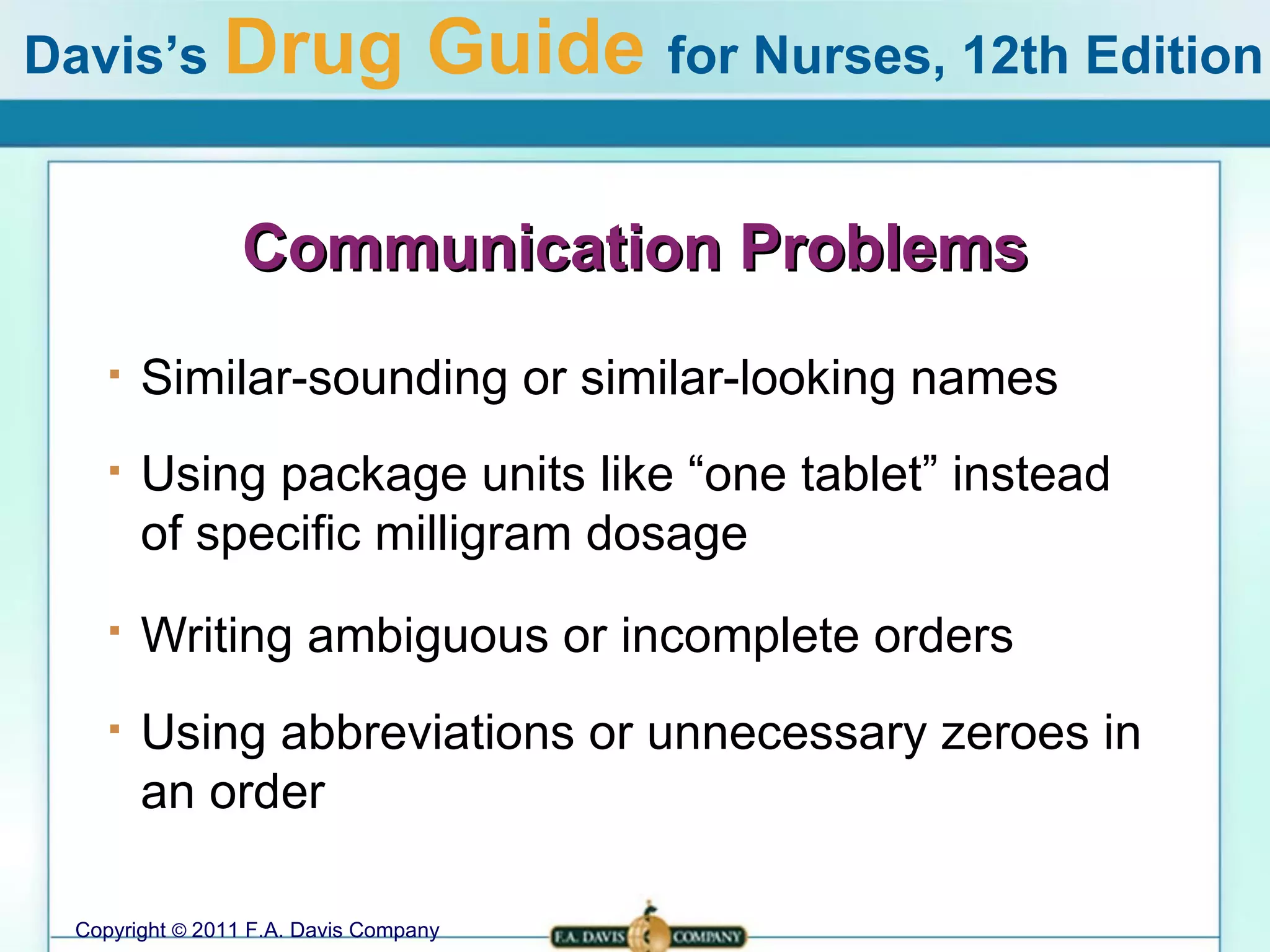
Communication Problems Similar-sounding or similar-looking names Using package units like “one tablet” instead of specific milligram dosage Writing ambiguous or incomplete orders   Using abbreviations or unnecessary zeroes in an order
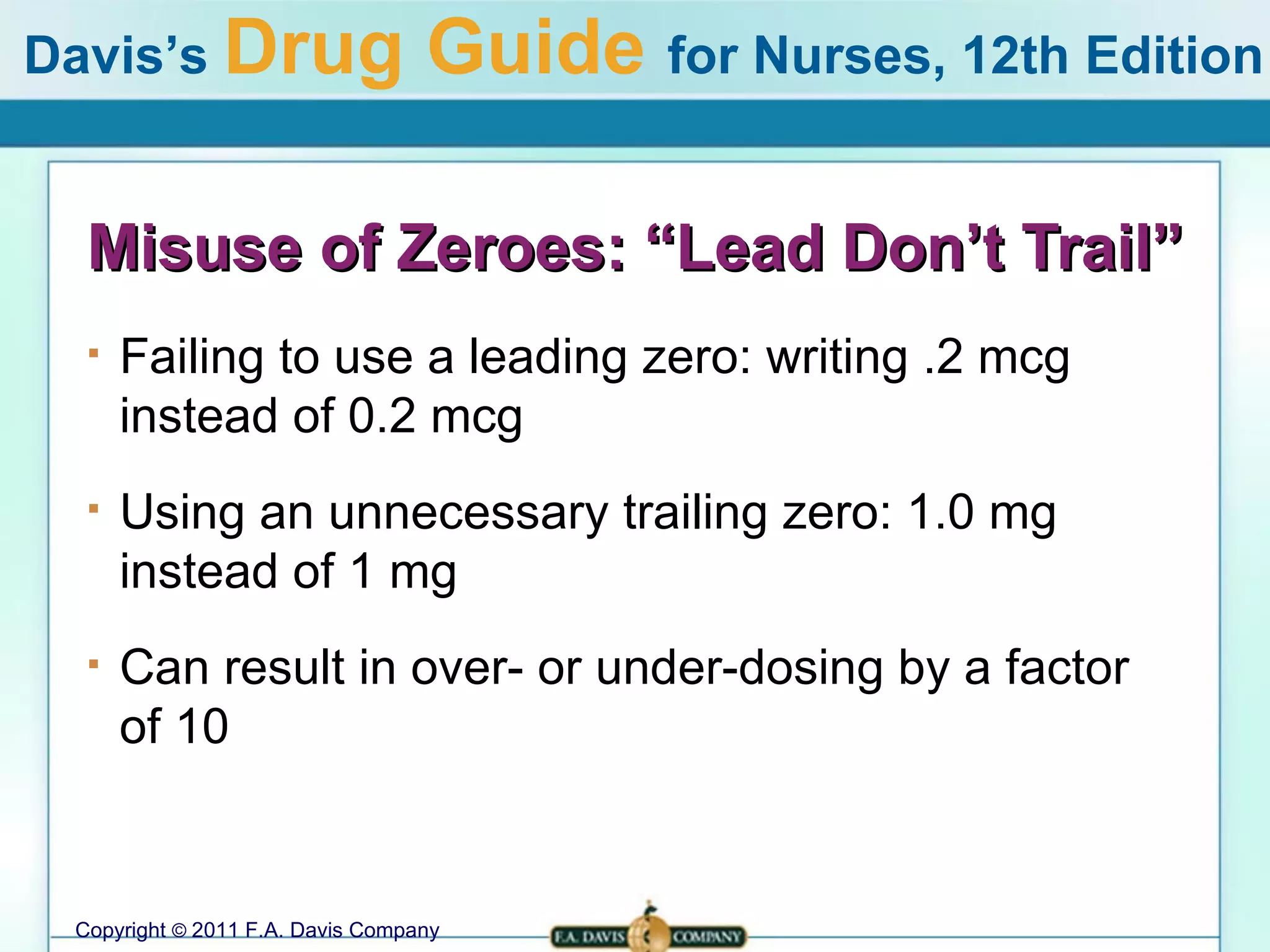
Misuse of Zeroes: “Lead Don’t Trail” Failing to use a leading zero: writing .2 mcg instead of 0.2 mcg Using an unnecessary trailing zero: 1.0 mg instead of 1 mg Can result in over- or under-dosing by a factor of 10
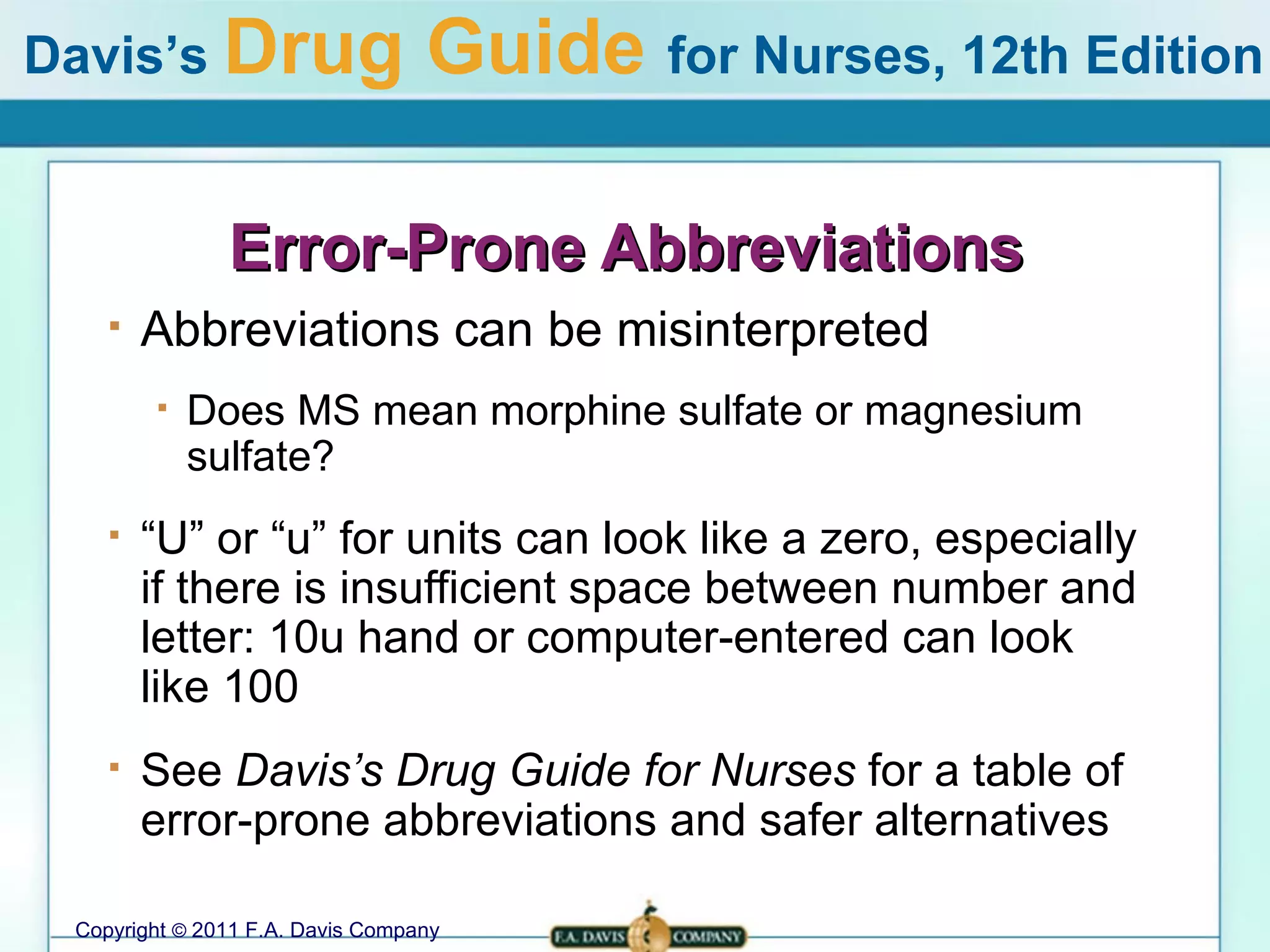
Error-Prone Abbreviations  Abbreviations can be misinterpreted Does MS mean morphine sulfate or magnesium sulfate? “ U” or “u” for units can look like a zero, especially if there is insufficient space between number and letter: 10u hand or computer-entered can look like 100 See  Davis’s Drug Guide for Nurses  for a table of error-prone abbreviations and safer alternatives
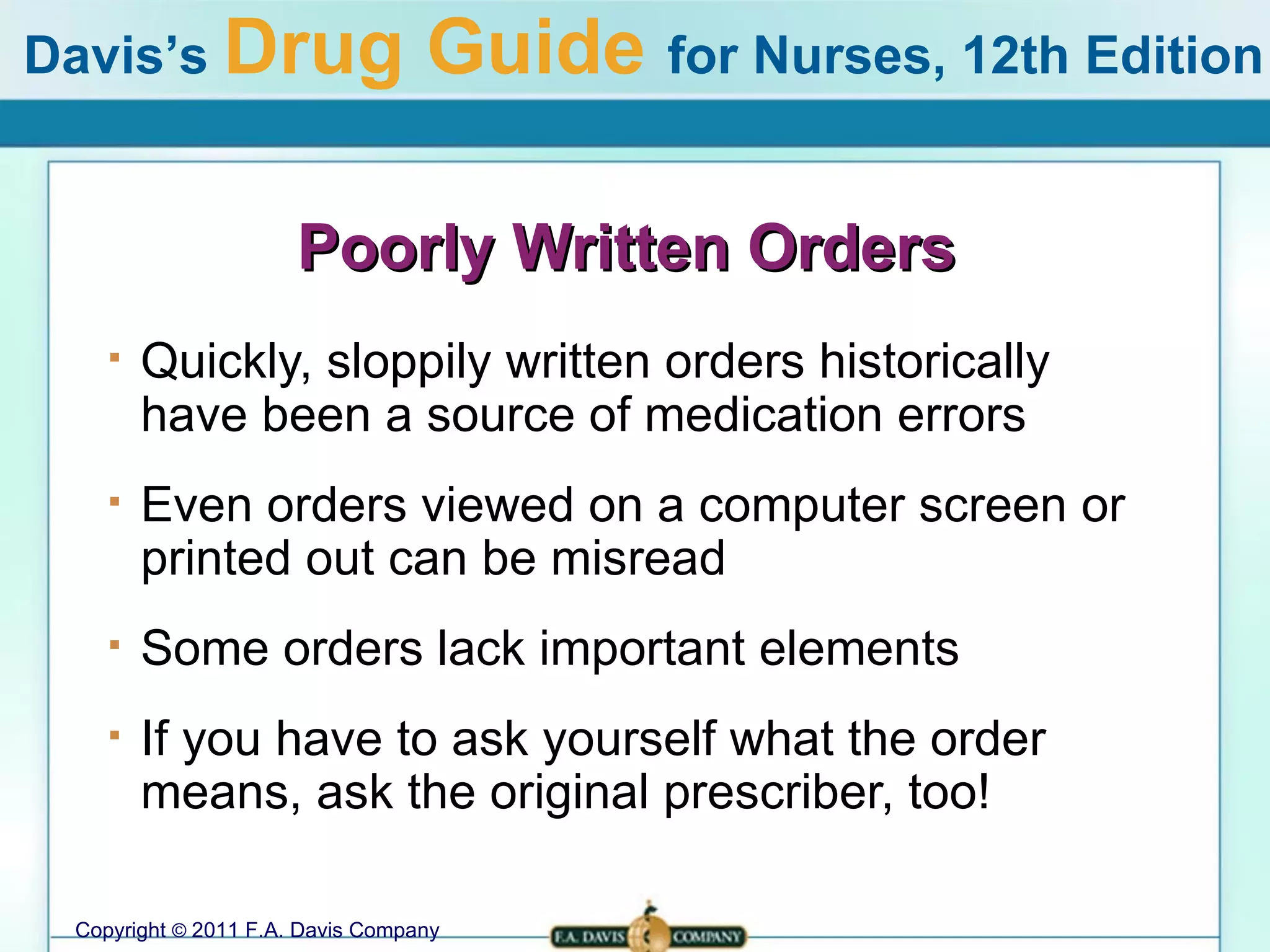
Poorly Written Orders  Quickly, sloppily written orders historically have been a source of medication errors Even orders viewed on a computer screen or  printed out can be misread Some orders lack important elements If you have to ask yourself what the order means, ask the original prescriber, too!
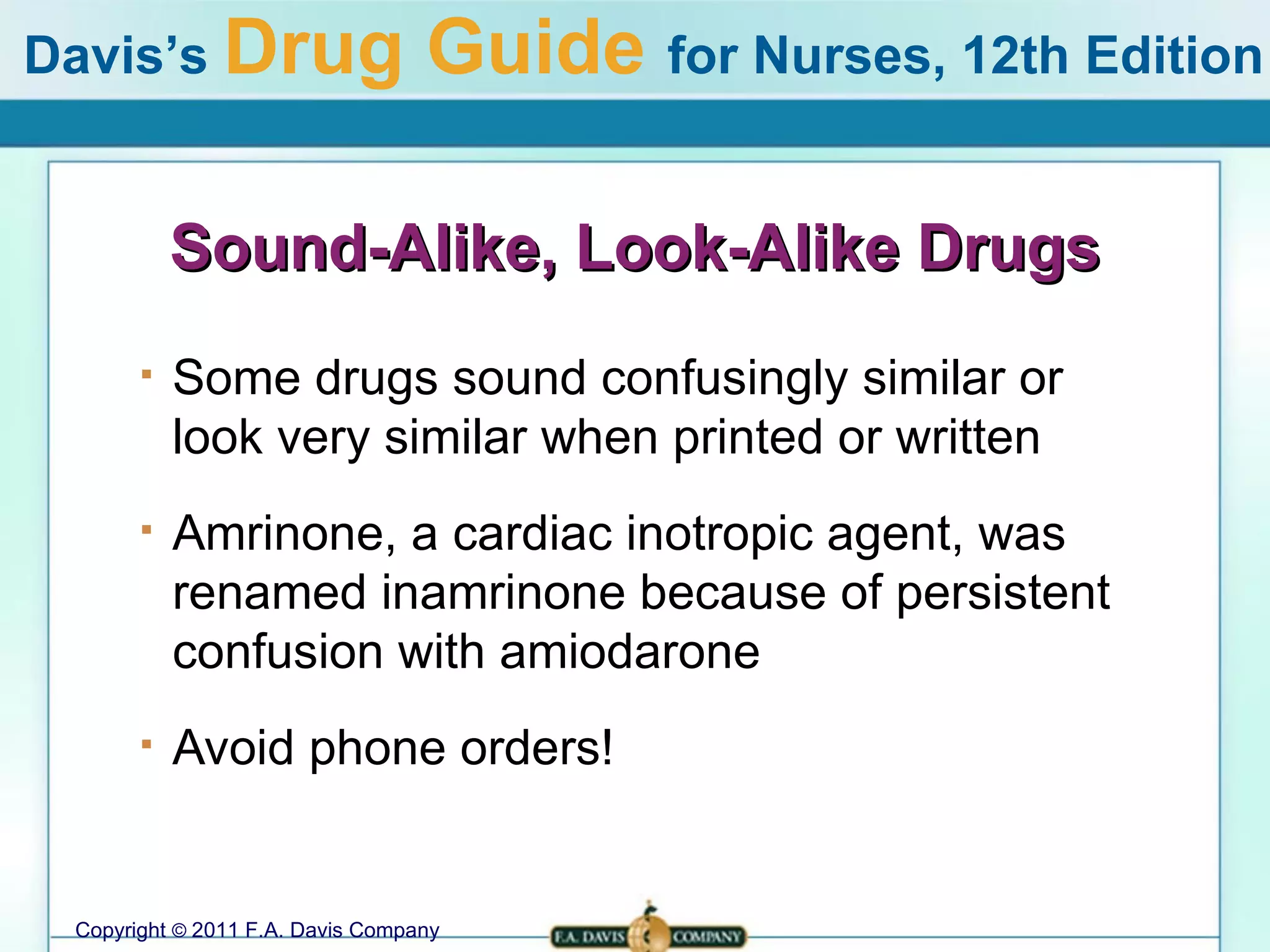
Sound-Alike, Look-Alike Drugs Some drugs sound confusingly similar or look very similar when printed or written Amrinone, a cardiac inotropic agent, was renamed inamrinone because of persistent confusion with amiodarone Avoid phone orders!
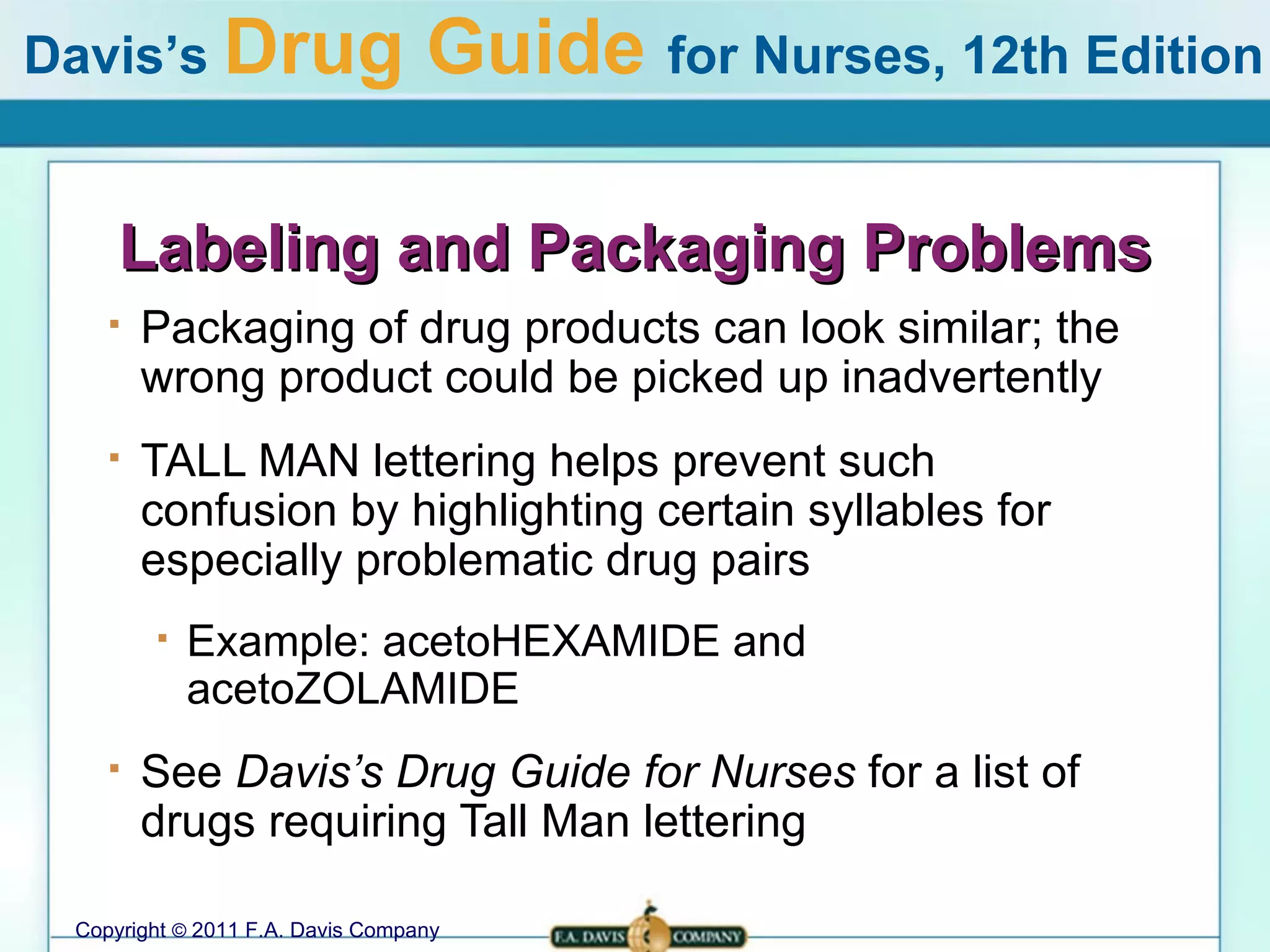
Labeling and Packaging Problems Packaging of drug products can look similar; the wrong product could be picked up inadvertently TALL MAN lettering helps prevent such confusion by highlighting certain syllables for especially problematic drug pairs Example: acetoHEXAMIDE and acetoZOLAMIDE  See  Davis’s Drug Guide for Nurses  for a list of drugs requiring Tall Man lettering
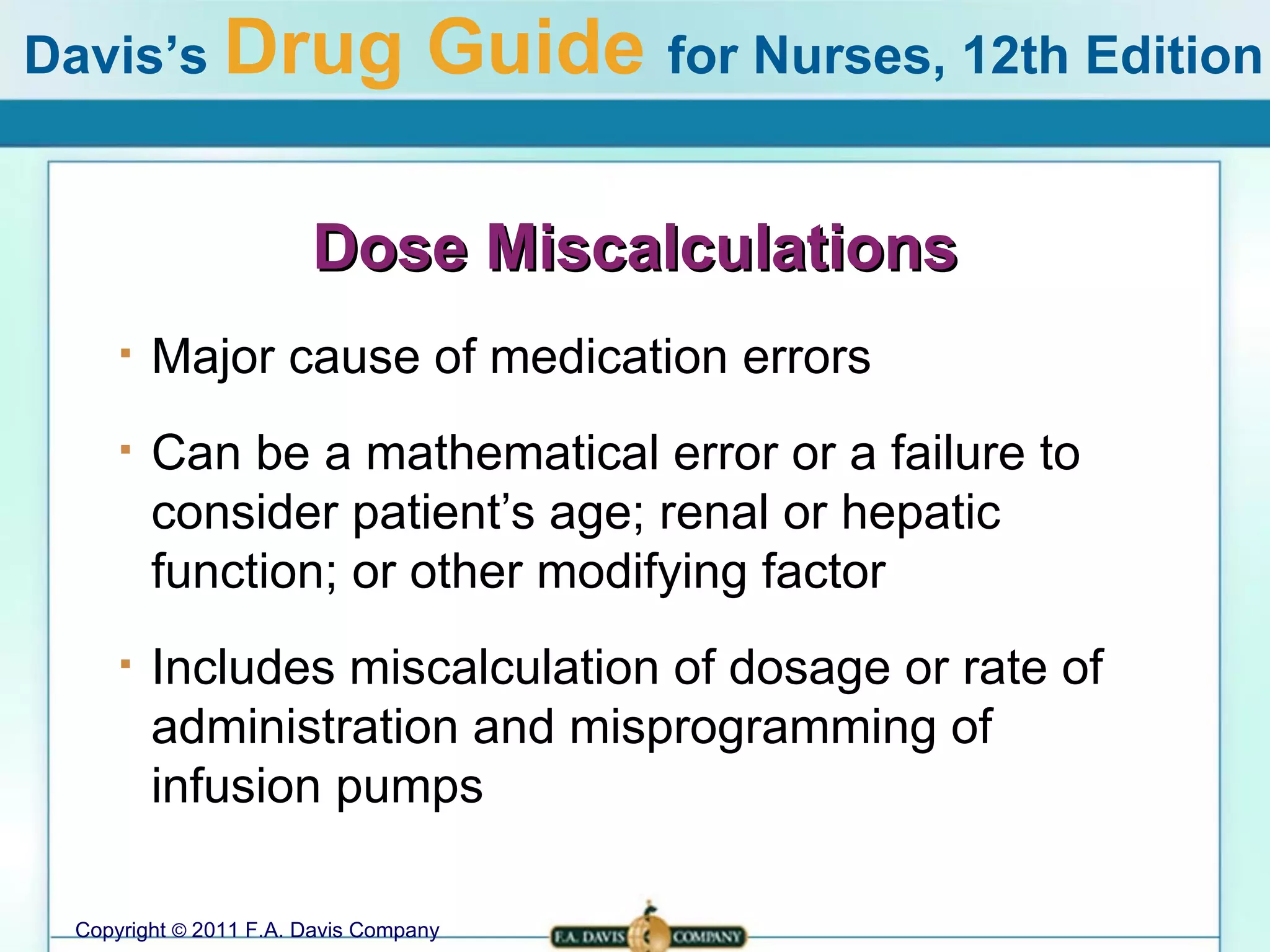
Dose Miscalculations Major cause of medication errors Can be a mathematical error or a failure to consider patient’s age; renal or hepatic function; or other modifying factor Includes miscalculation of dosage or rate of administration and misprogramming of infusion pumps
Incorrect Drug Administration Don’t forget the 5 Rights Right drug Right patient   Right dose Right route Right time
Human and Environmental Factors That Influence Errors Distractions Poor staffing Culture of perfection Questioning physicians is tacitly discouraged Punitive response to error (“shame and blame”)
Prevention Strategies for Nurses Clarify any order that is not obviously and clearly legible Do not accept orders with the abbreviation “u,” “U,” or   “IU”   for units Clarify abbreviated drug names or dosing frequencies
Prevention Strategies for Nurses (Cont’d) If dose requires >3 or <1/2 of a dosing unit (e.g.,   ampoules or tablet), have another   healthcare provider check the original order and recalculate dose ALWAYS   confirm unusual dosages with the provider Refer to a third source, such as your  Davis’s Drug Guide  or a pharmacist
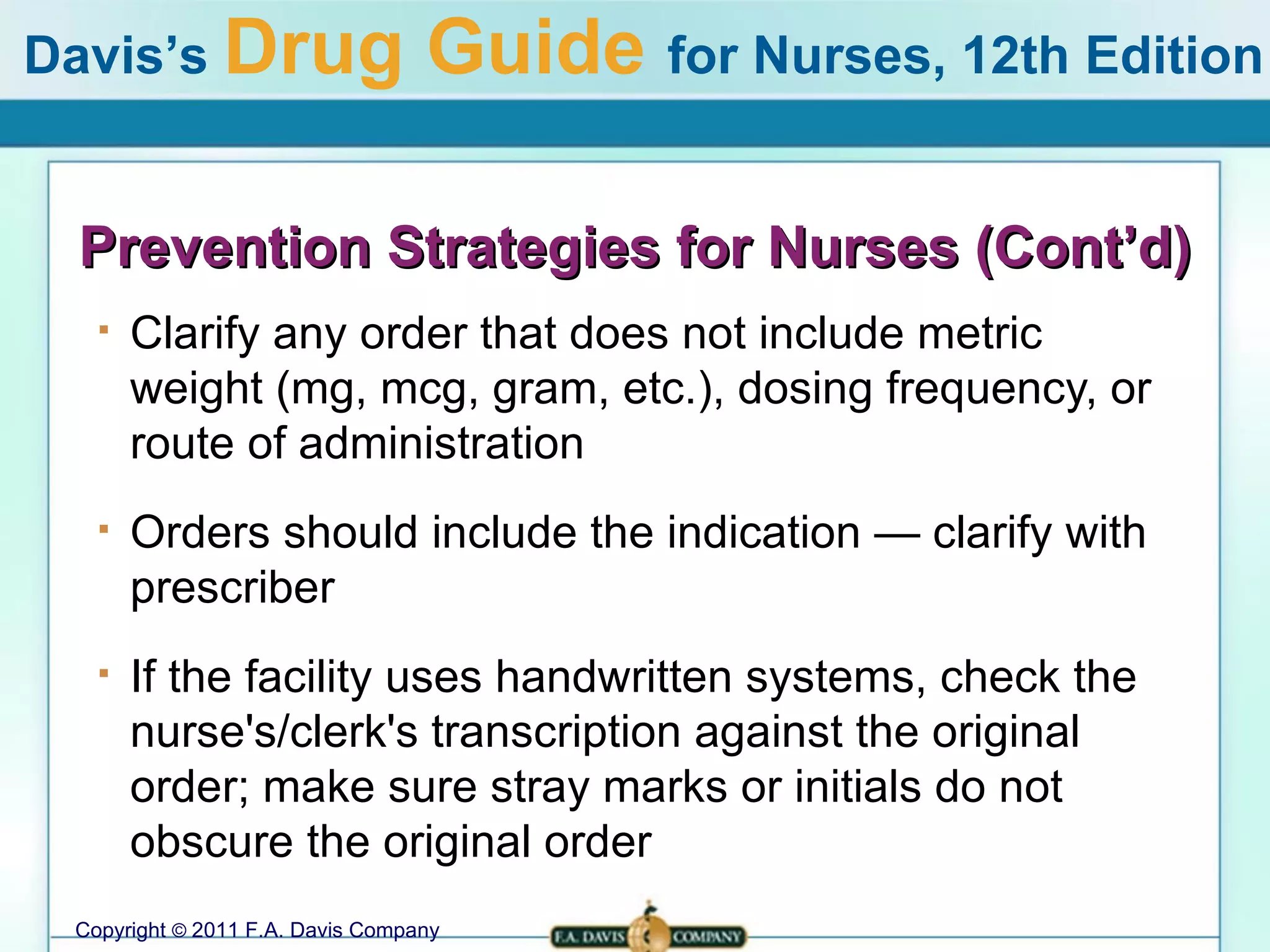
Prevention Strategies for Nurses (Cont’d) Clarify any order that does not include metric weight (mg, mcg, gram, etc.), dosing frequency, or route of administration Orders should include the indication — clarify with prescriber If the facility uses handwritten systems, check the nurse's/clerk's transcription against the original order; make sure stray marks or initials do not obscure the original order
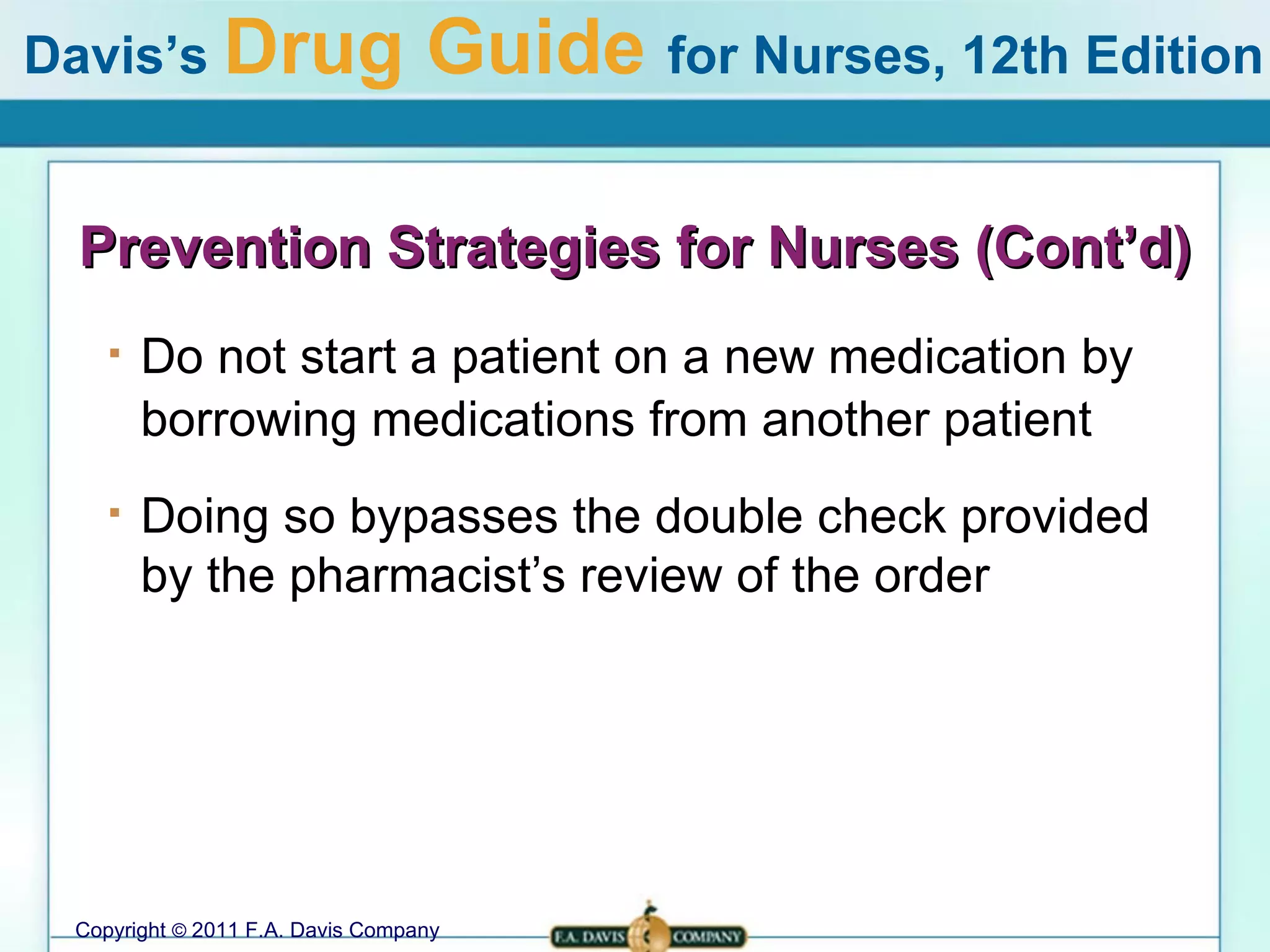
Prevention Strategies for Nurses (Cont’d) Do not start a patient on a new medication by borrowing medications from another patient   Doing so bypasses the double check provided by the pharmacist’s review of the order
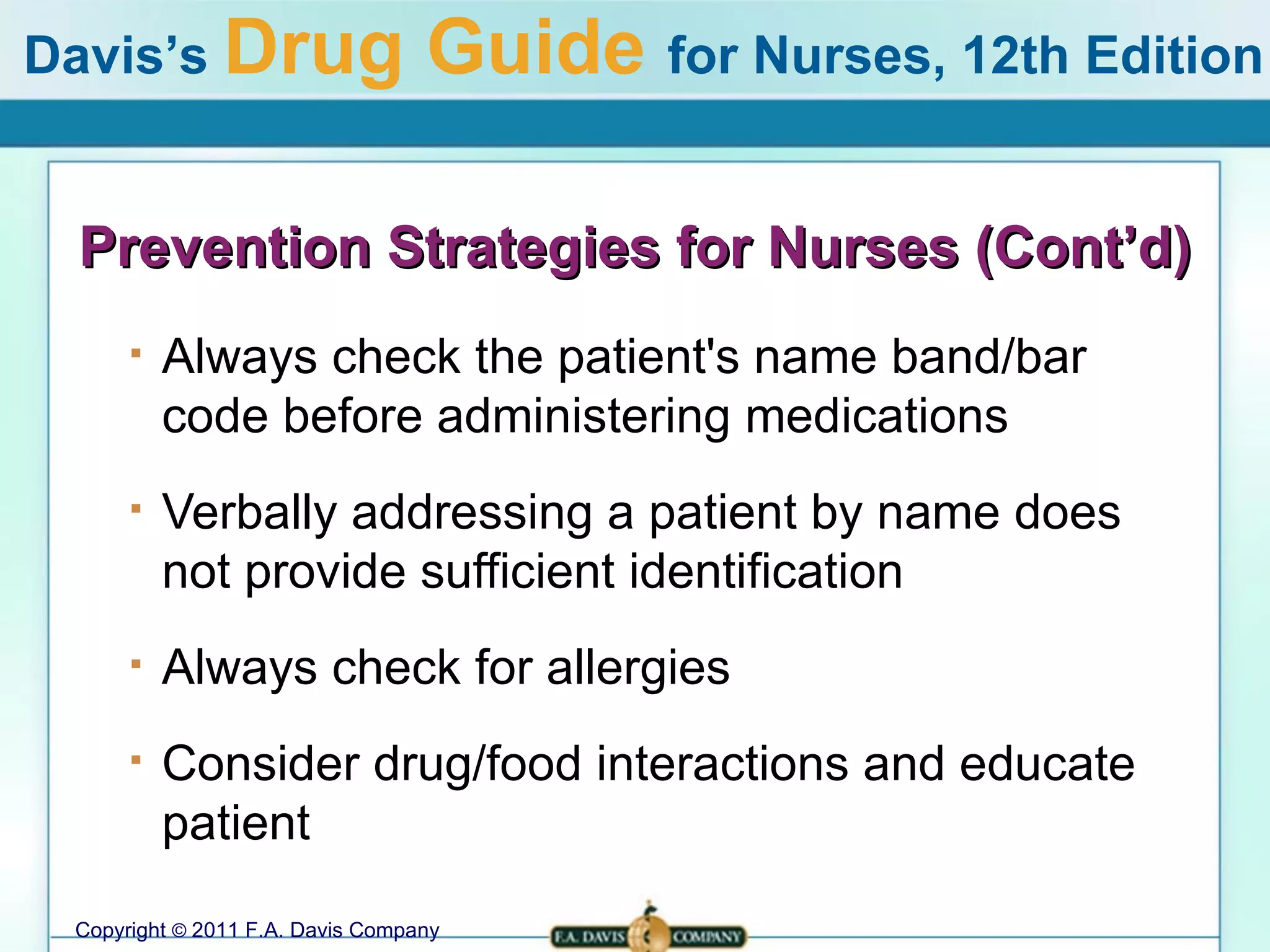
Prevention Strategies for Nurses (Cont’d) Always check the patient's name band/bar code before administering medications Verbally addressing a patient by name does not provide sufficient identification Always check for allergies Consider drug/food interactions and educate patient
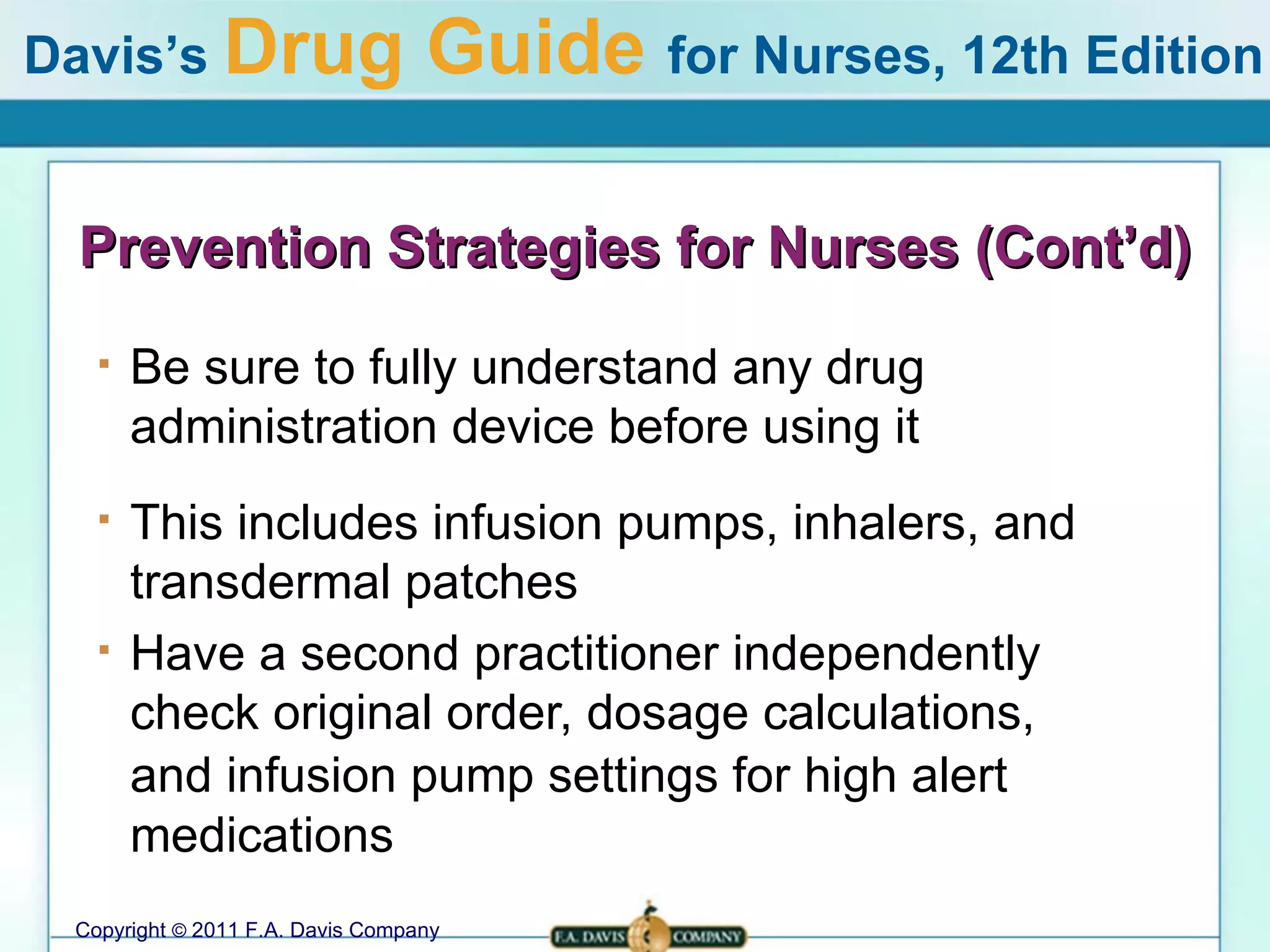
Prevention Strategies for Nurses (Cont’d) Be sure to fully understand any drug administration device before using it This includes infusion pumps, inhalers, and transdermal patches Have a second practitioner independently check original order, dosage calculations, and infusion pump settings for high alert   medications
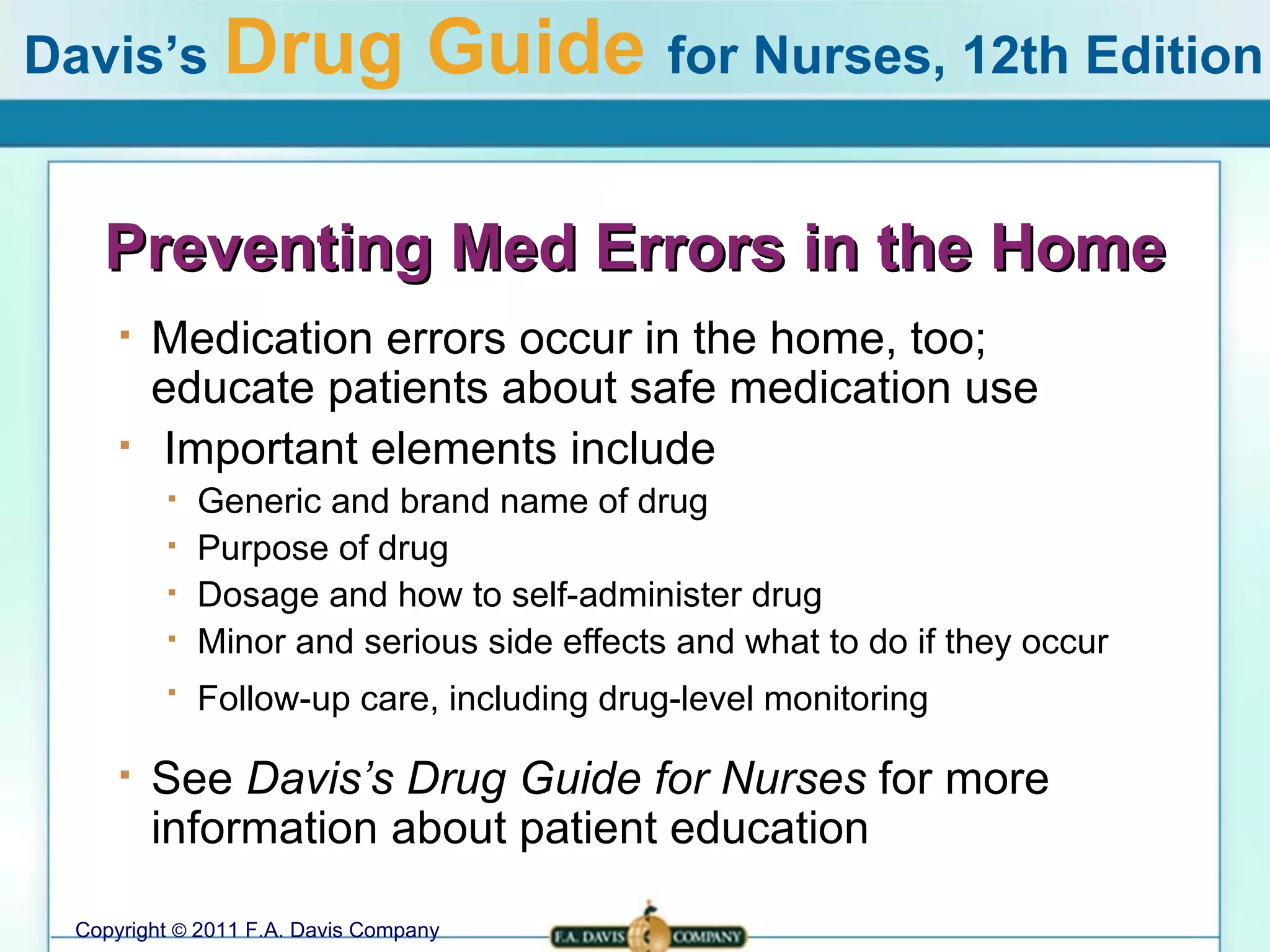
Preventing Med Errors in the Home Medication errors occur in the home, too; educate patients about safe medication use Important elements include Generic and brand name of drug Purpose of drug Dosage and how to self-administer drug Minor and serious side effects and what to do if they occur Follow-up care, including drug-level monitoring   See  Davis’s Drug Guide for Nurses  for more information about patient education
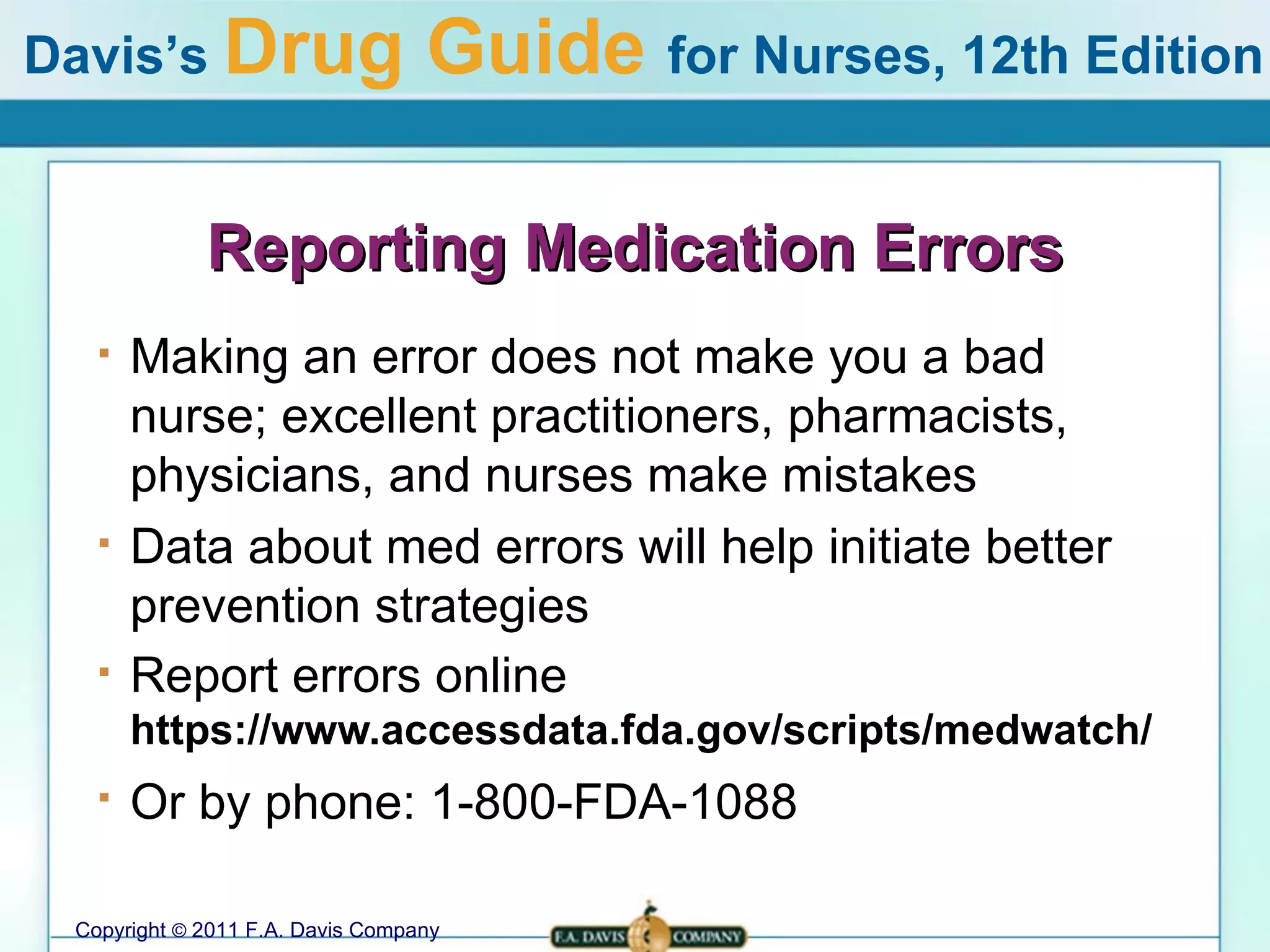
Reporting Medication Errors Making an error does not make you a bad nurse; excellent practitioners, pharmacists, physicians, and nurses make mistakes Data about med errors will help initiate better prevention strategies Report errors online  https://www.accessdata.fda.gov/scripts/medwatch/   Or by phone: 1-800-FDA-1088

Medication errors

  • 1.
    Medication Errors ImprovingPractices and Patient Safety
  • 2.
    Medication Error A preventable event that leads to inappropriate medication use or patient harm.
  • 3.
    Causes of MedicationErrors NOT the result of poor-quality staff! Error-prone processes involved in the medication use system contribute to medication errors Excellent, experienced practitioners make mistakes
  • 4.
    Medication Errors Mostmedication errors do not result in patient harm Some medication errors result in catastrophic harm or death High risk with High Alert Drugs — highly toxic drugs or drugs with a narrow therapeutic range have a high risk of causing devastating injury or death; see Davis’s Drug Guide for Nurses for a list of high alert drugs
  • 5.
    Selected Elements ofthe Medication Use System Communication Labeling, packaging, and naming Administering medications (dose calculation, timing, programming of infusion devices, etc.) Monitoring drug levels and therapeutic or nontherapeutic responses Thorough patient education
  • 6.
    Communication Problems Similar-soundingor similar-looking names Using package units like “one tablet” instead of specific milligram dosage Writing ambiguous or incomplete orders Using abbreviations or unnecessary zeroes in an order
  • 7.
    Misuse of Zeroes:“Lead Don’t Trail” Failing to use a leading zero: writing .2 mcg instead of 0.2 mcg Using an unnecessary trailing zero: 1.0 mg instead of 1 mg Can result in over- or under-dosing by a factor of 10
  • 8.
    Error-Prone Abbreviations Abbreviations can be misinterpreted Does MS mean morphine sulfate or magnesium sulfate? “ U” or “u” for units can look like a zero, especially if there is insufficient space between number and letter: 10u hand or computer-entered can look like 100 See Davis’s Drug Guide for Nurses for a table of error-prone abbreviations and safer alternatives
  • 9.
    Poorly Written Orders Quickly, sloppily written orders historically have been a source of medication errors Even orders viewed on a computer screen or printed out can be misread Some orders lack important elements If you have to ask yourself what the order means, ask the original prescriber, too!
  • 10.
    Sound-Alike, Look-Alike DrugsSome drugs sound confusingly similar or look very similar when printed or written Amrinone, a cardiac inotropic agent, was renamed inamrinone because of persistent confusion with amiodarone Avoid phone orders!
  • 11.
    Labeling and PackagingProblems Packaging of drug products can look similar; the wrong product could be picked up inadvertently TALL MAN lettering helps prevent such confusion by highlighting certain syllables for especially problematic drug pairs Example: acetoHEXAMIDE and acetoZOLAMIDE See Davis’s Drug Guide for Nurses for a list of drugs requiring Tall Man lettering
  • 12.
    Dose Miscalculations Majorcause of medication errors Can be a mathematical error or a failure to consider patient’s age; renal or hepatic function; or other modifying factor Includes miscalculation of dosage or rate of administration and misprogramming of infusion pumps
  • 13.
    Incorrect Drug AdministrationDon’t forget the 5 Rights Right drug Right patient Right dose Right route Right time
  • 14.
    Human and EnvironmentalFactors That Influence Errors Distractions Poor staffing Culture of perfection Questioning physicians is tacitly discouraged Punitive response to error (“shame and blame”)
  • 15.
    Prevention Strategies forNurses Clarify any order that is not obviously and clearly legible Do not accept orders with the abbreviation “u,” “U,” or “IU” for units Clarify abbreviated drug names or dosing frequencies
  • 16.
    Prevention Strategies forNurses (Cont’d) If dose requires >3 or <1/2 of a dosing unit (e.g., ampoules or tablet), have another healthcare provider check the original order and recalculate dose ALWAYS confirm unusual dosages with the provider Refer to a third source, such as your Davis’s Drug Guide or a pharmacist
  • 17.
    Prevention Strategies forNurses (Cont’d) Clarify any order that does not include metric weight (mg, mcg, gram, etc.), dosing frequency, or route of administration Orders should include the indication — clarify with prescriber If the facility uses handwritten systems, check the nurse's/clerk's transcription against the original order; make sure stray marks or initials do not obscure the original order
  • 18.
    Prevention Strategies forNurses (Cont’d) Do not start a patient on a new medication by borrowing medications from another patient Doing so bypasses the double check provided by the pharmacist’s review of the order
  • 19.
    Prevention Strategies forNurses (Cont’d) Always check the patient's name band/bar code before administering medications Verbally addressing a patient by name does not provide sufficient identification Always check for allergies Consider drug/food interactions and educate patient
  • 20.
    Prevention Strategies forNurses (Cont’d) Be sure to fully understand any drug administration device before using it This includes infusion pumps, inhalers, and transdermal patches Have a second practitioner independently check original order, dosage calculations, and infusion pump settings for high alert medications
  • 21.
    Preventing Med Errorsin the Home Medication errors occur in the home, too; educate patients about safe medication use Important elements include Generic and brand name of drug Purpose of drug Dosage and how to self-administer drug Minor and serious side effects and what to do if they occur Follow-up care, including drug-level monitoring See Davis’s Drug Guide for Nurses for more information about patient education
  • 22.
    Reporting Medication ErrorsMaking an error does not make you a bad nurse; excellent practitioners, pharmacists, physicians, and nurses make mistakes Data about med errors will help initiate better prevention strategies Report errors online https://www.accessdata.fda.gov/scripts/medwatch/ Or by phone: 1-800-FDA-1088