Quality
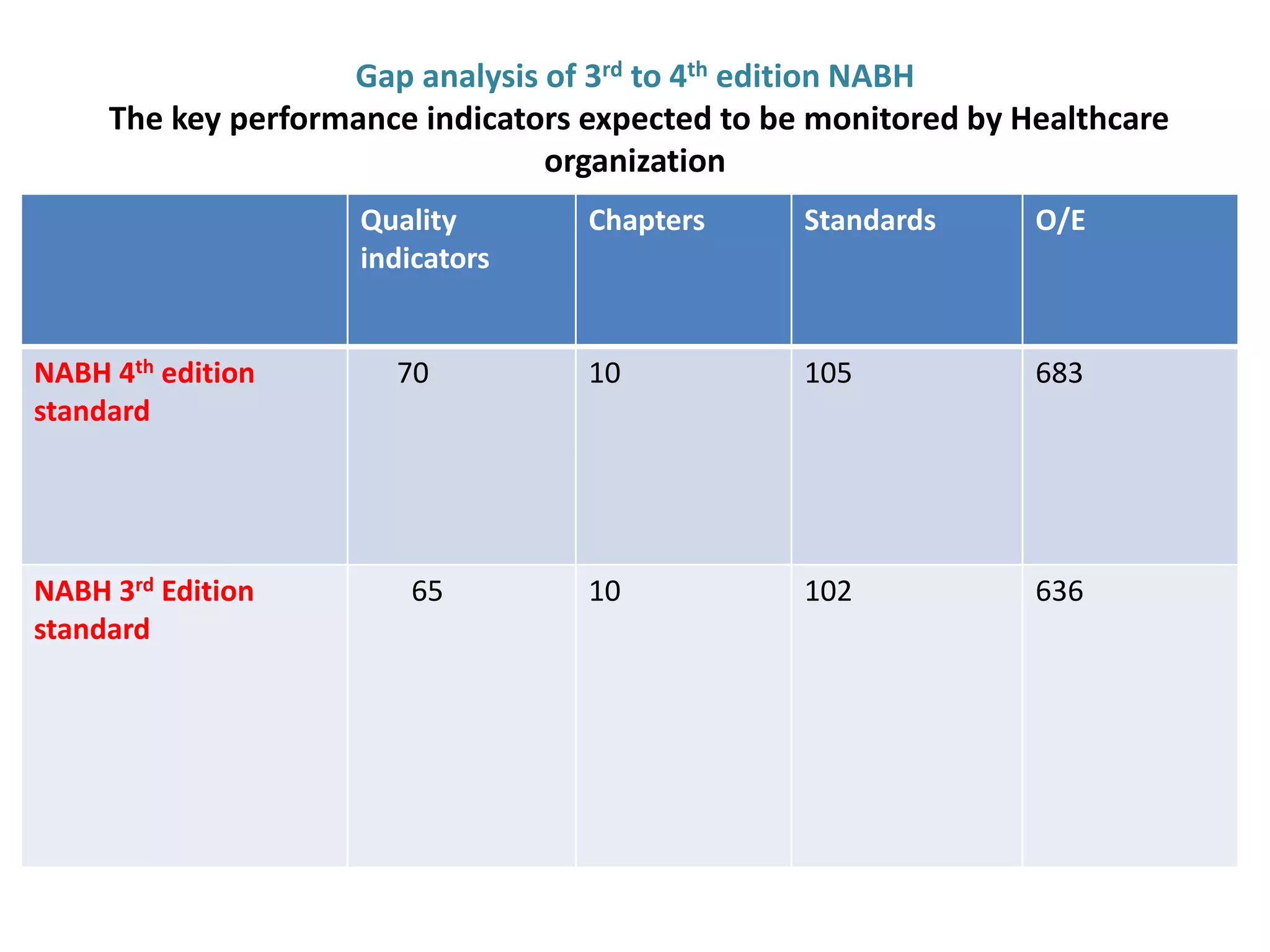
indicators
Chapters Standards O/E
NABH 4th edition
standard
70 10 105 683
NABH 3rd Edition
standard
65 10 102 636
Gap analysis of 3rd to 4th edition NABH
The key performance indicators expected to be monitored by Healthcare
organization
4th edition 3rd edition
Access, Assessment and
Continuity of Care (AAC)
•Standard
•observation elements
14
96
•Standard
•O/E
14
86
Care of patients ( COP) •Standard
•O/E
22
151
•Standard
•O/E
20
136
Management of
medication (MOM)
•Standard
•O/E
13
76
•Standard
•O/E
13
73
Patients rights and
education (PRE)
•Standard
•O/E
8
54
•Standard
•O/E
7
46
Hospital Infection Control
(HIC)
•Standard
•O/E
9
54
•Standard
•O/E
9
51
4th edition 3rd edition
Continuous Quality
Improvement (CQI)
•Standard
•O/E
9
59
•Standard
•O/E
8
57
Responsibilities of
Management (ROM)
•Standard
•O/E
6
39
•Standard
•O/E
6
38
Facility Management &
Safety (FMS)
•Standard
•O/E
7
56
•Standard
•O/E
8
54
Human Resource
Management (HRM)
•Standard
•O/E
10
53
•Standard
•O/E
10
52
Information
Management Systems
(IMS)
•Standard
•O/E
7
45
•Standard
•O/E
7
43
Continuous Quality
Improvement
(CQI) 3(a)
4th edition 3rd edition
Standard a .Time for initial assessment of indoor
patients.
b. Time taken for initial assessment of patients
attending emergency services
a. Time for initial assessment of indoor and
emergency patients
Definition a. The time shall begin from the time that
the patient has arrived at the bed of the
ward till the time that the initial
assessment has been completed by a
doctor
b. In case of emergency the time shall begin
from the time the patient’s arrival at the
emergency till the time that the initial
assessment is completed by a doctor.
a. The time shall begin from the time that
the patient has arrived at the bed of the
ward till the time that the initial
assessment has been completed by a
doctor.
Formula Sum of time taken for the assessment.
Total number of patients in indoor /emergency
Sum of time taken
Total number of patients (sample size)
Frequency Periodic- At least monthly •NOT MENTIONED
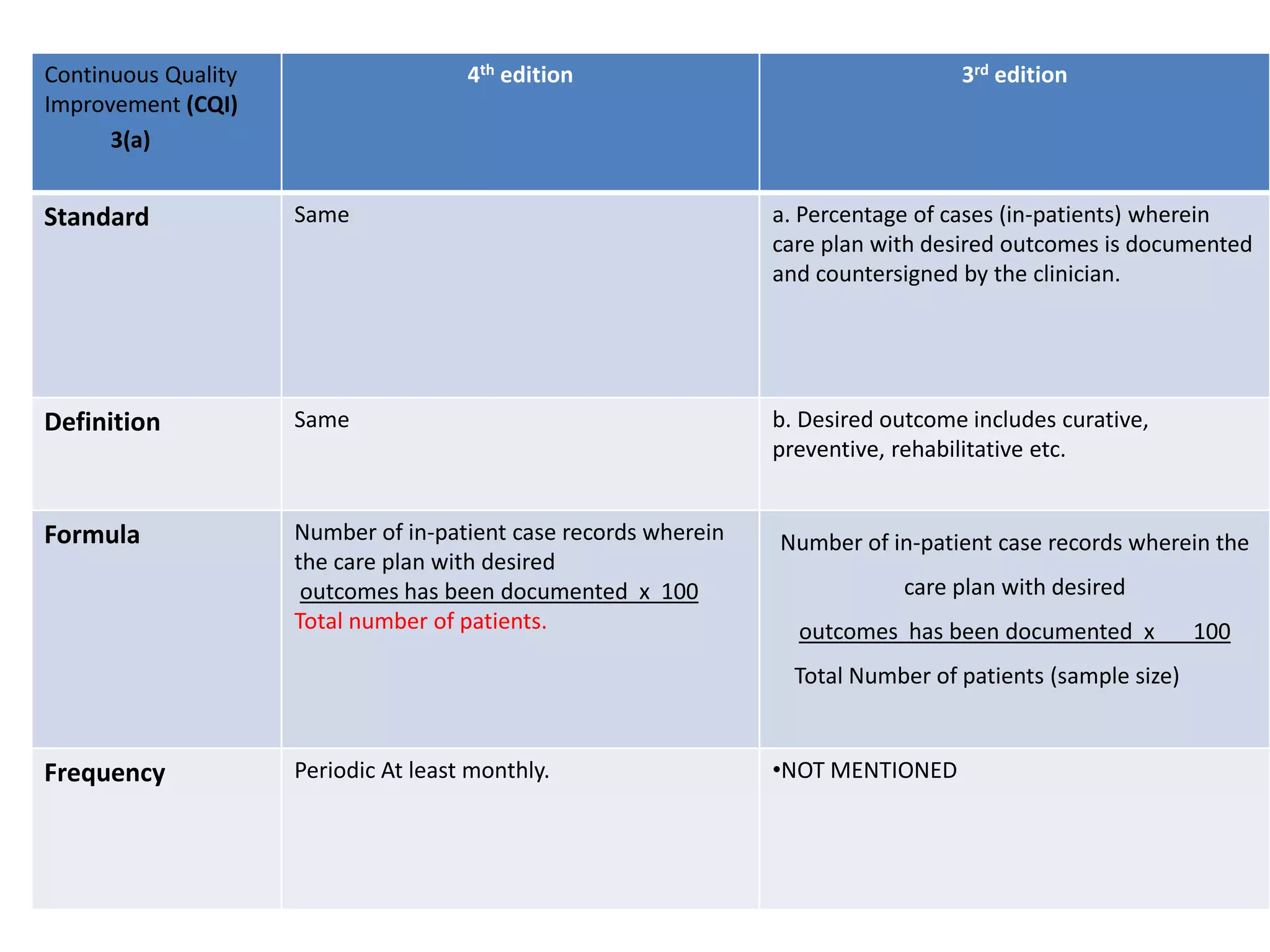
Continuous Quality
Improvement (CQI)
3(a)
4th edition 3rd edition
Standard Same a. Percentage of cases (in-patients) wherein
care plan with desired outcomes is documented
and countersigned by the clinician.
Definition Same b. Desired outcome includes curative,
preventive, rehabilitative etc.
Formula Number of in-patient case records wherein
the care plan with desired
outcomes has been documented x 100
Total number of patients.
Number of in-patient case records wherein the
care plan with desired
outcomes has been documented x 100
Total Number of patients (sample size)
Frequency Periodic At least monthly. •NOT MENTIONED
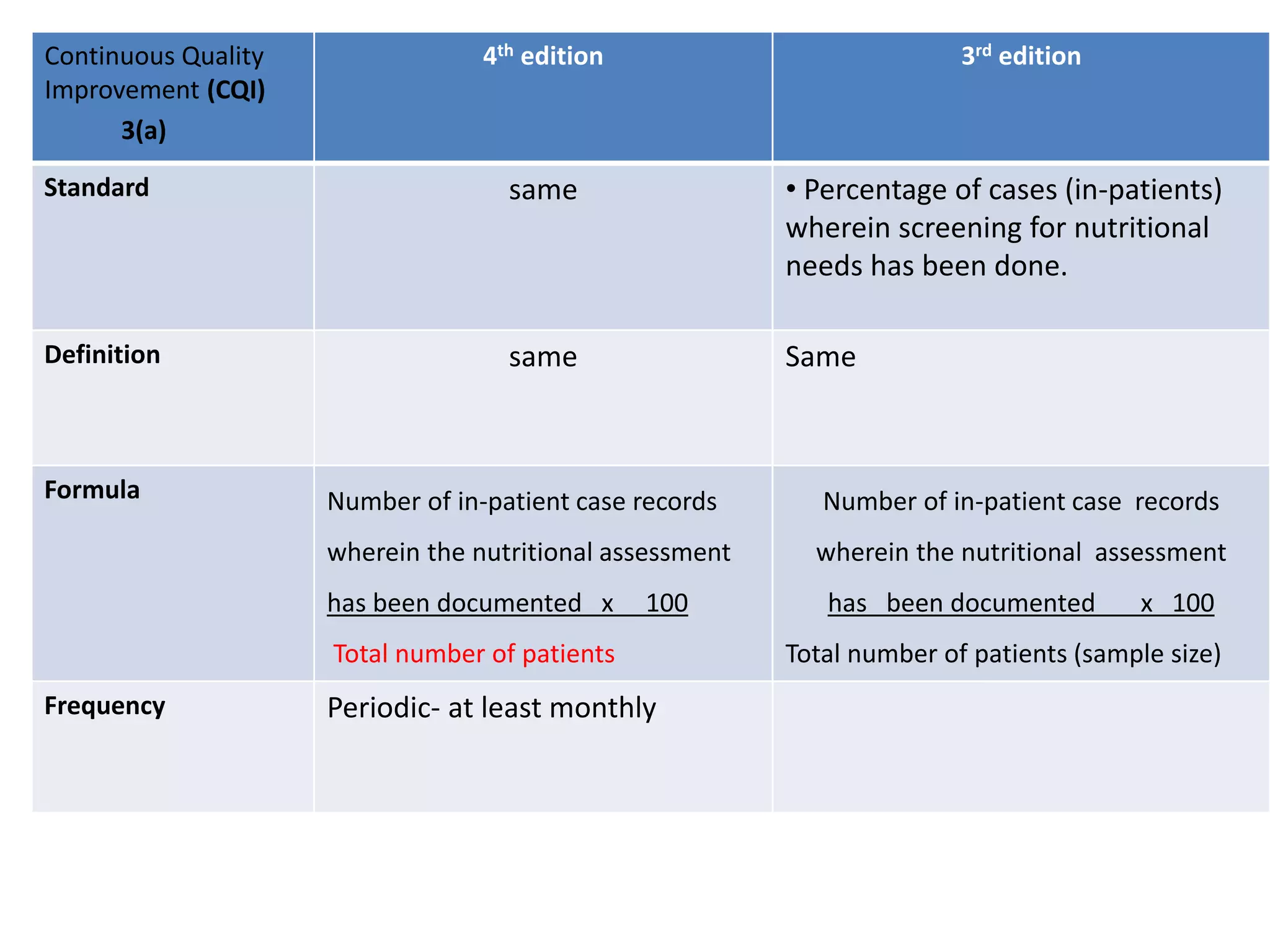
Continuous Quality
Improvement (CQI)
3(a)
4th edition 3rd edition
Standard same • Percentage of cases (in-patients)
wherein screening for nutritional
needs has been done.
Definition same Same
Formula Number of in-patient case records
wherein the nutritional assessment
has been documented x 100
Total number of patients
Number of in-patient case records
wherein the nutritional assessment
has been documented x 100
Total number of patients (sample size)
Frequency Periodic- at least monthly
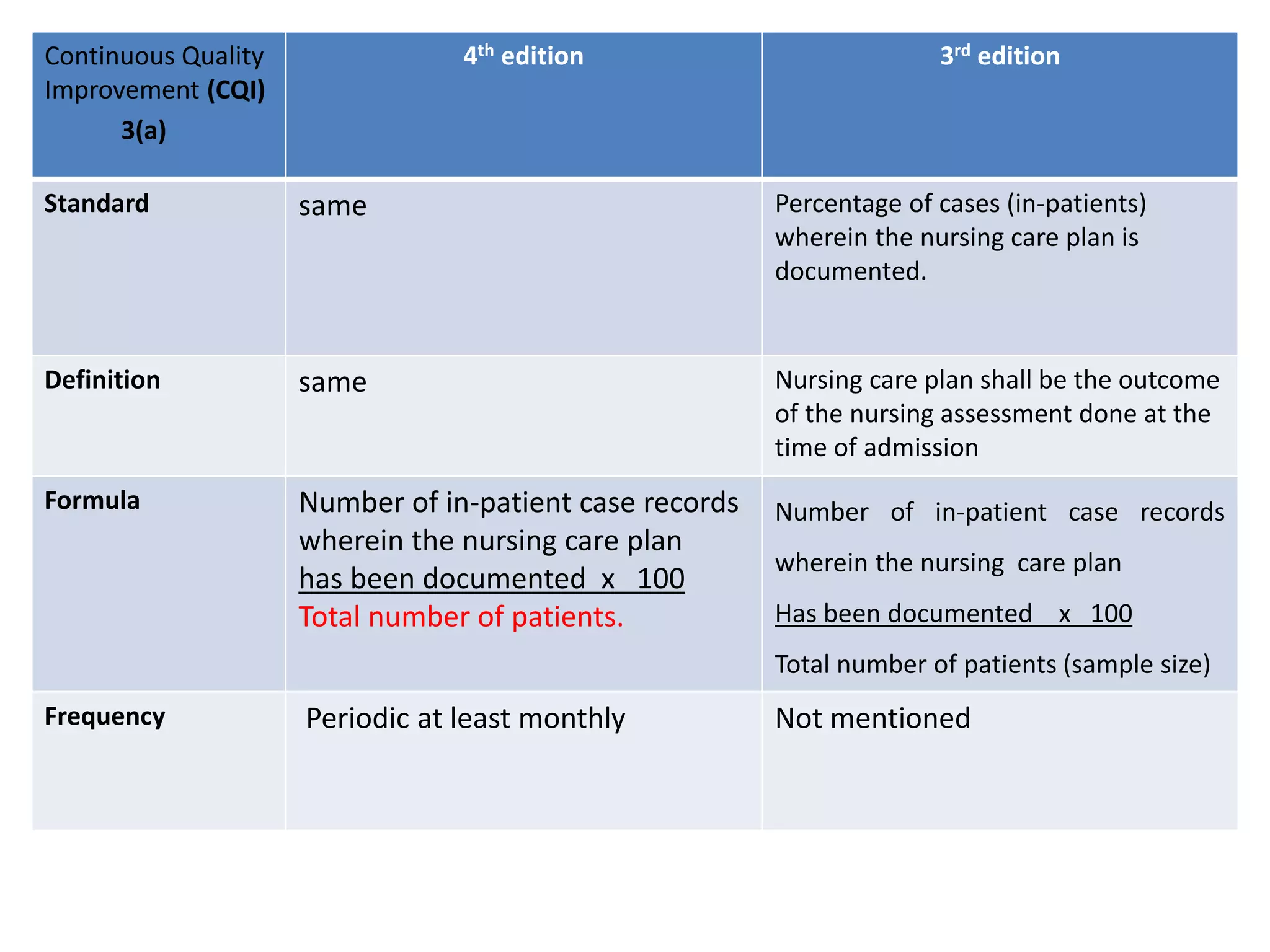
Continuous Quality
Improvement (CQI)
3(a)
4th edition 3rd edition
Standard same Percentage of cases (in-patients)
wherein the nursing care plan is
documented.
Definition same Nursing care plan shall be the outcome
of the nursing assessment done at the
time of admission
Formula Number of in-patient case records
wherein the nursing care plan
has been documented x 100
Total number of patients.
Number of in-patient case records
wherein the nursing care plan
Has been documented x 100
Total number of patients (sample size)
Frequency Periodic at least monthly Not mentioned
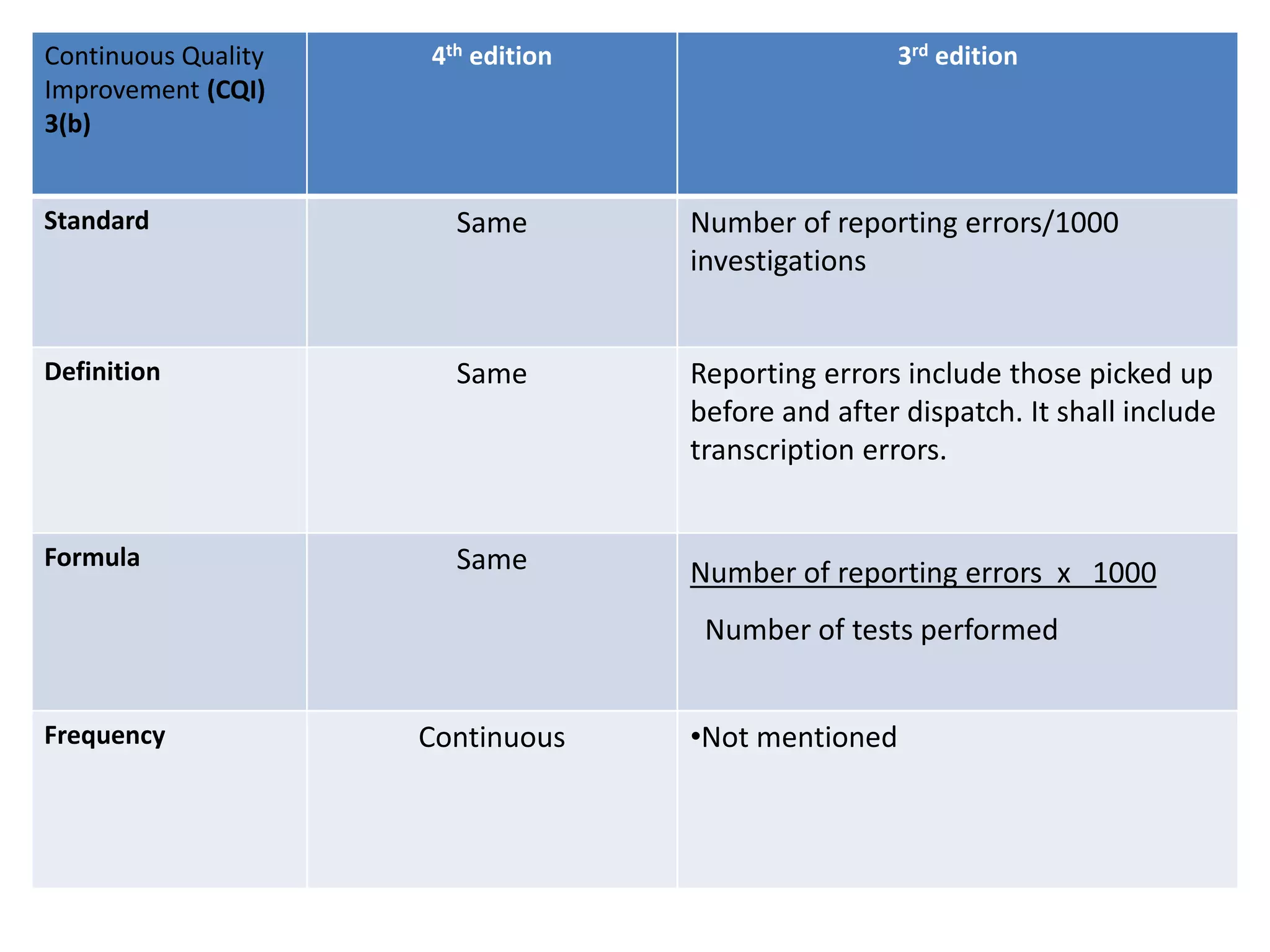
Continuous Quality
Improvement (CQI)
3(b)
4th edition 3rd edition
Standard Same Number of reporting errors/1000
investigations
Definition Same Reporting errors include those picked up
before and after dispatch. It shall include
transcription errors.
Formula Same Number of reporting errors x 1000
Number of tests performed
Frequency Continuous •Not mentioned
Continuous Quality
Improvement (CQI) 3(b)
4th edition 3rd edition
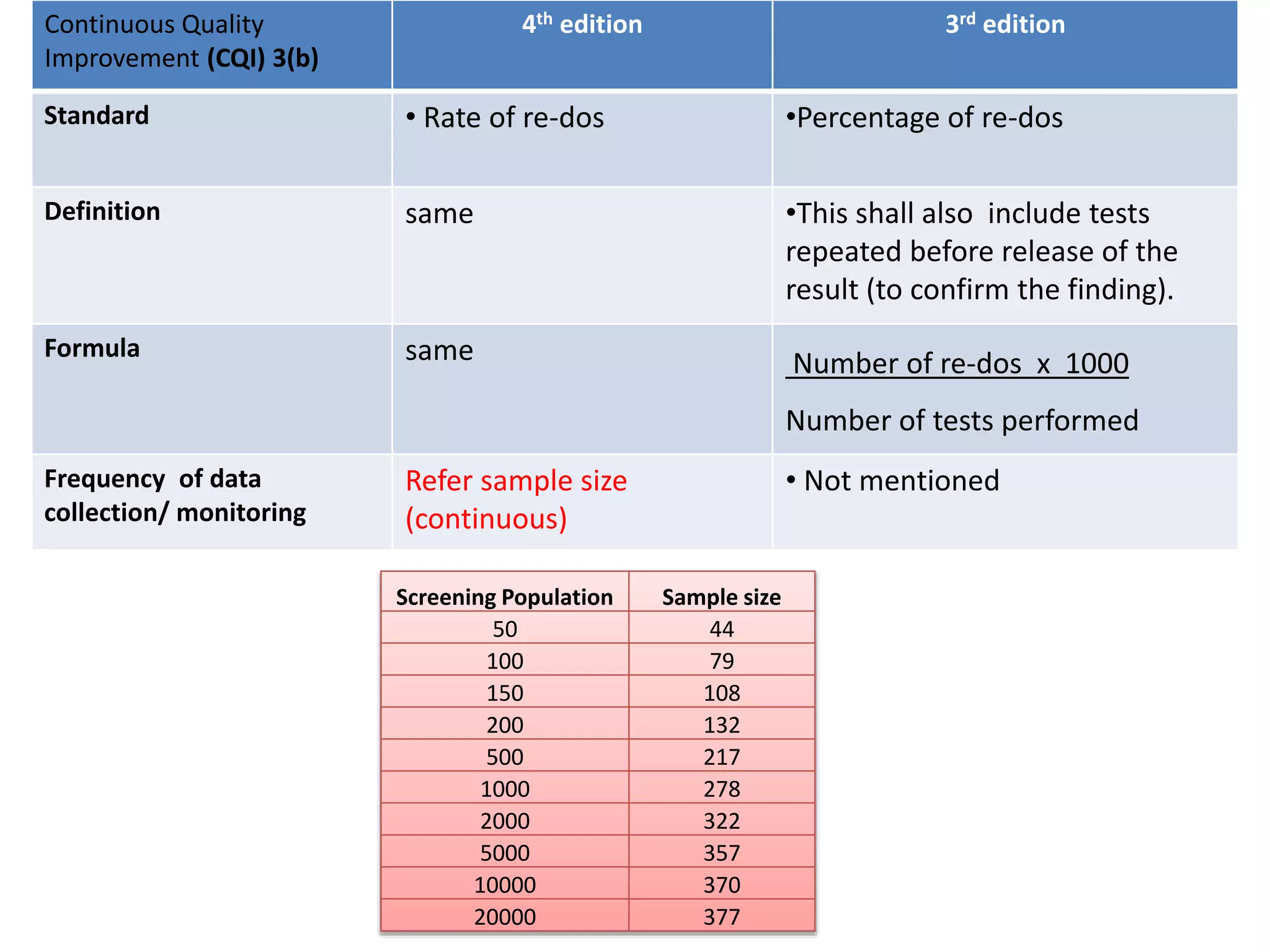
Standard • Rate of re-dos •Percentage of re-dos
Definition same •This shall also include tests
repeated before release of the
result (to confirm the finding).
Formula same Number of re-dos x 1000
Number of tests performed
Frequency of data
collection/ monitoring
Refer sample size
(continuous)
• Not mentioned
Screening Population Sample size
50 44
100 79
150 108
200 132
500 217
1000 278
2000 322
5000 357
10000 370
20000 377
Continuous Quality
Improvement (CQI) 3(b)
4th edition 3rd edition
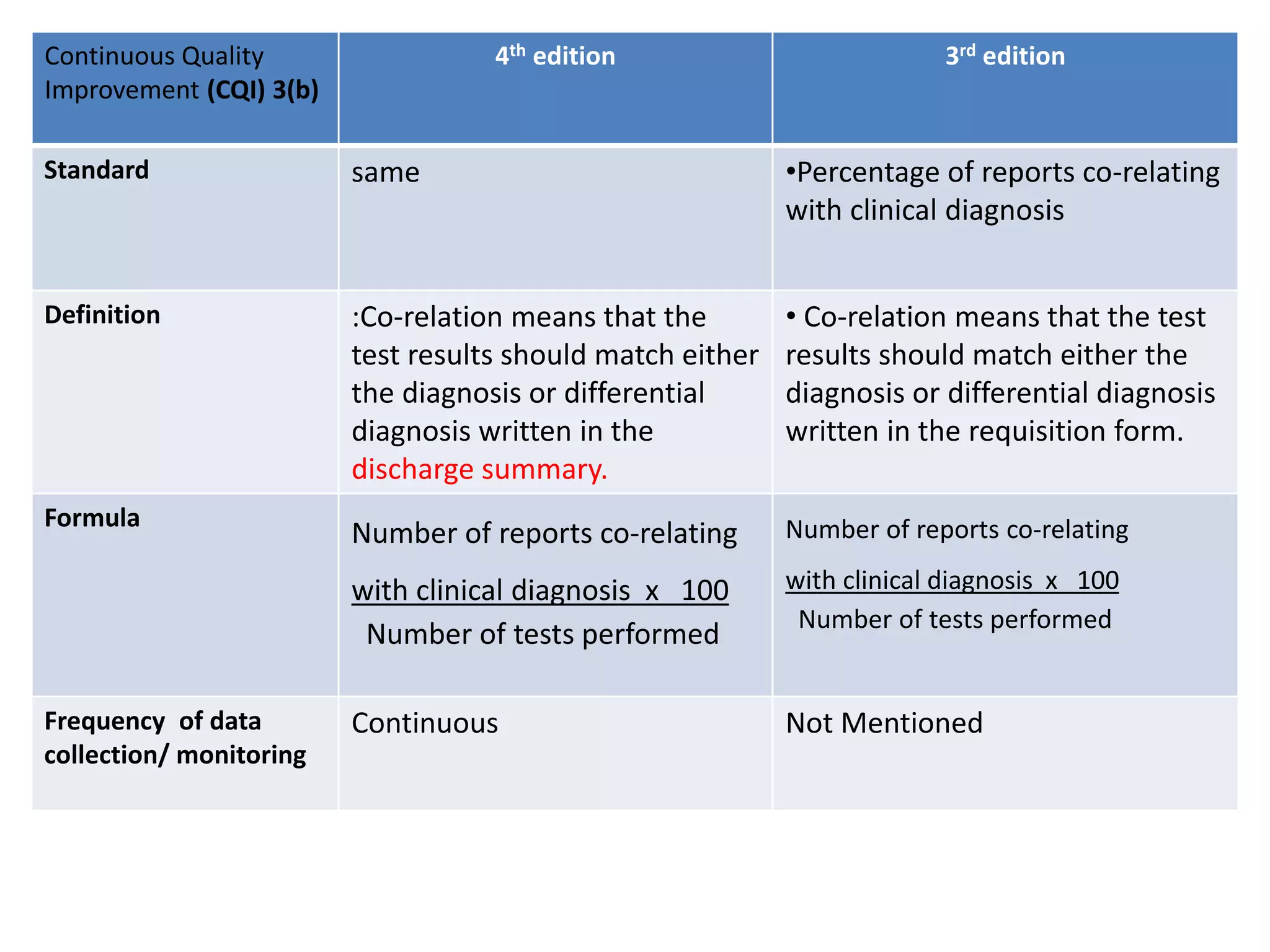
Standard same •Percentage of reports co-relating
with clinical diagnosis
Definition :Co-relation means that the
test results should match either
the diagnosis or differential
diagnosis written in the
discharge summary.
• Co-relation means that the test
results should match either the
diagnosis or differential diagnosis
written in the requisition form.
Formula
Number of reports co-relating
with clinical diagnosis x 100
Number of tests performed
Number of reports co-relating
with clinical diagnosis x 100
Number of tests performed
Frequency of data
collection/ monitoring
Continuous Not Mentioned
Continuous Quality
Improvement (CQI) 3(b)
4th edition 3rd edition
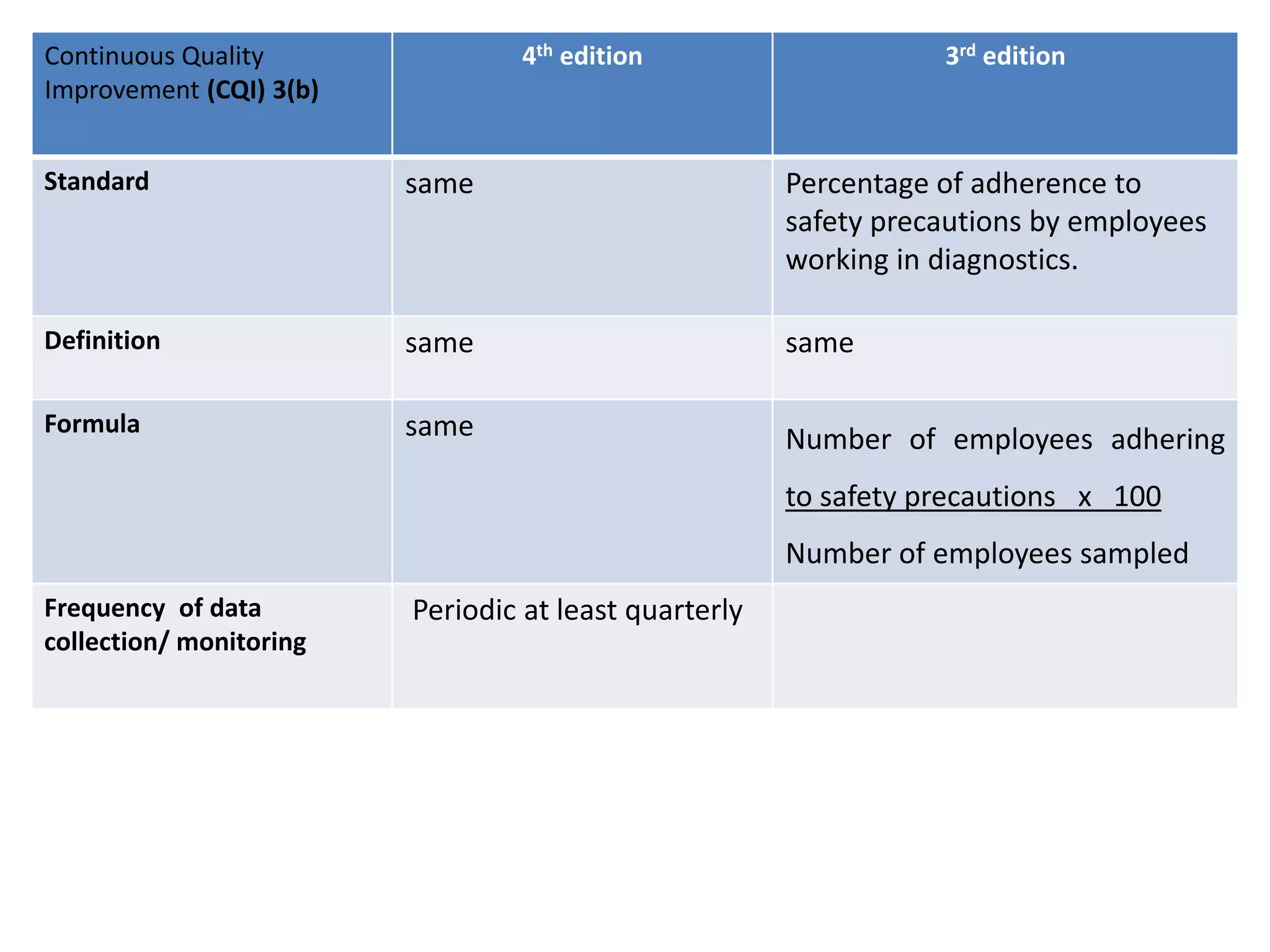
Standard same Percentage of adherence to
safety precautions by employees
working in diagnostics.
Definition same same
Formula same Number of employees adhering
to safety precautions x 100
Number of employees sampled
Frequency of data
collection/ monitoring
Periodic at least quarterly
Continuous Quality
Improvement (CQI)
3(c)
4th edition 3rd edition
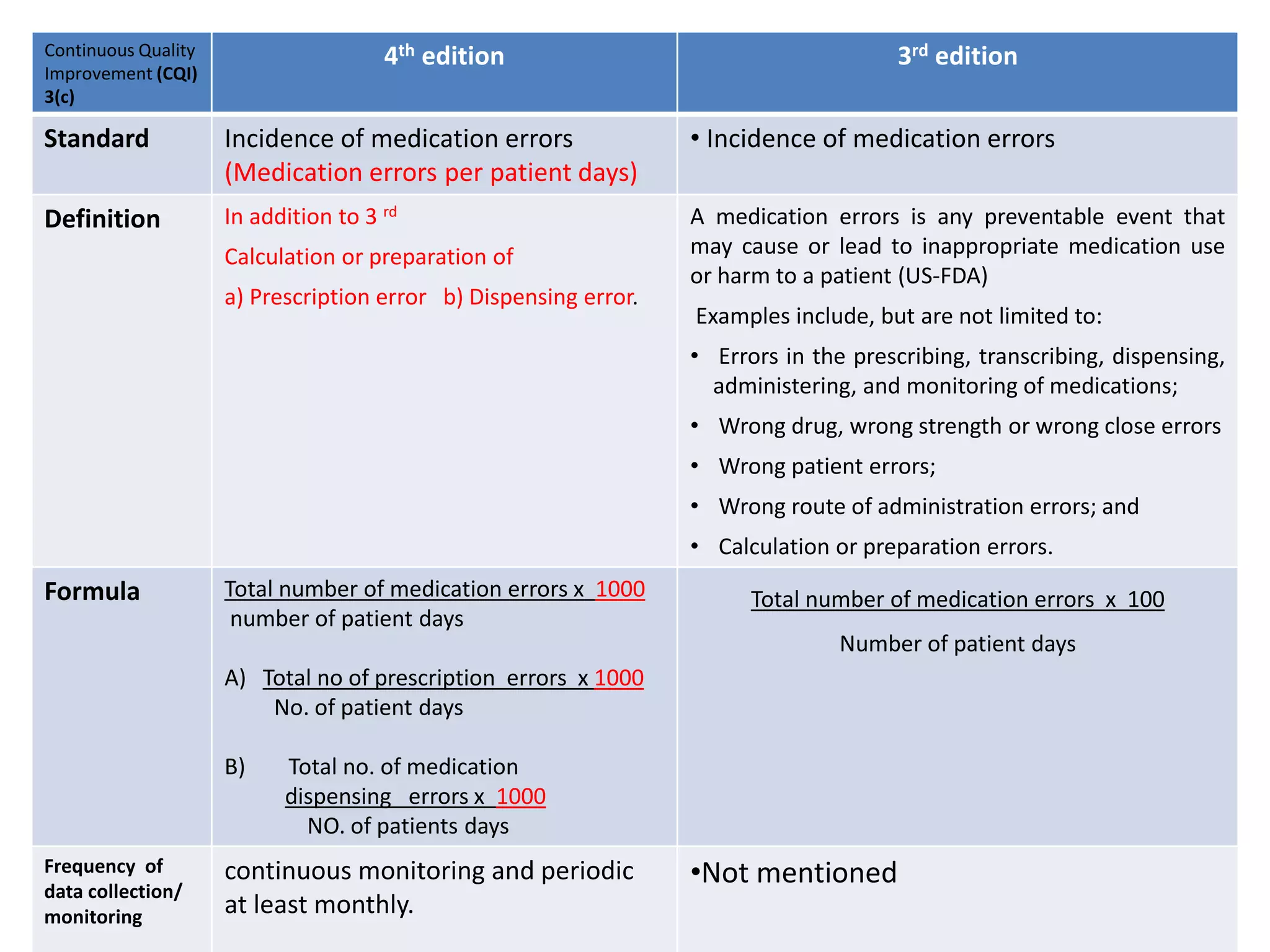
Standard Incidence of medication errors
(Medication errors per patient days)
• Incidence of medication errors
Definition In addition to 3 rd
Calculation or preparation of
a) Prescription error b) Dispensing error.
A medication errors is any preventable event that
may cause or lead to inappropriate medication use
or harm to a patient (US-FDA)
Examples include, but are not limited to:
• Errors in the prescribing, transcribing, dispensing,
administering, and monitoring of medications;
• Wrong drug, wrong strength or wrong close errors
• Wrong patient errors;
• Wrong route of administration errors; and
• Calculation or preparation errors.
Formula Total number of medication errors x 1000
number of patient days
A) Total no of prescription errors x 1000
No. of patient days
B) Total no. of medication
dispensing errors x 1000
NO. of patients days
Total number of medication errors x 100
Number of patient days
Frequency of
data collection/
monitoring
continuous monitoring and periodic
at least monthly.
•Not mentioned
Continuous Quality
Improvement (CQI) 3(c)
4th edition 3rd edition
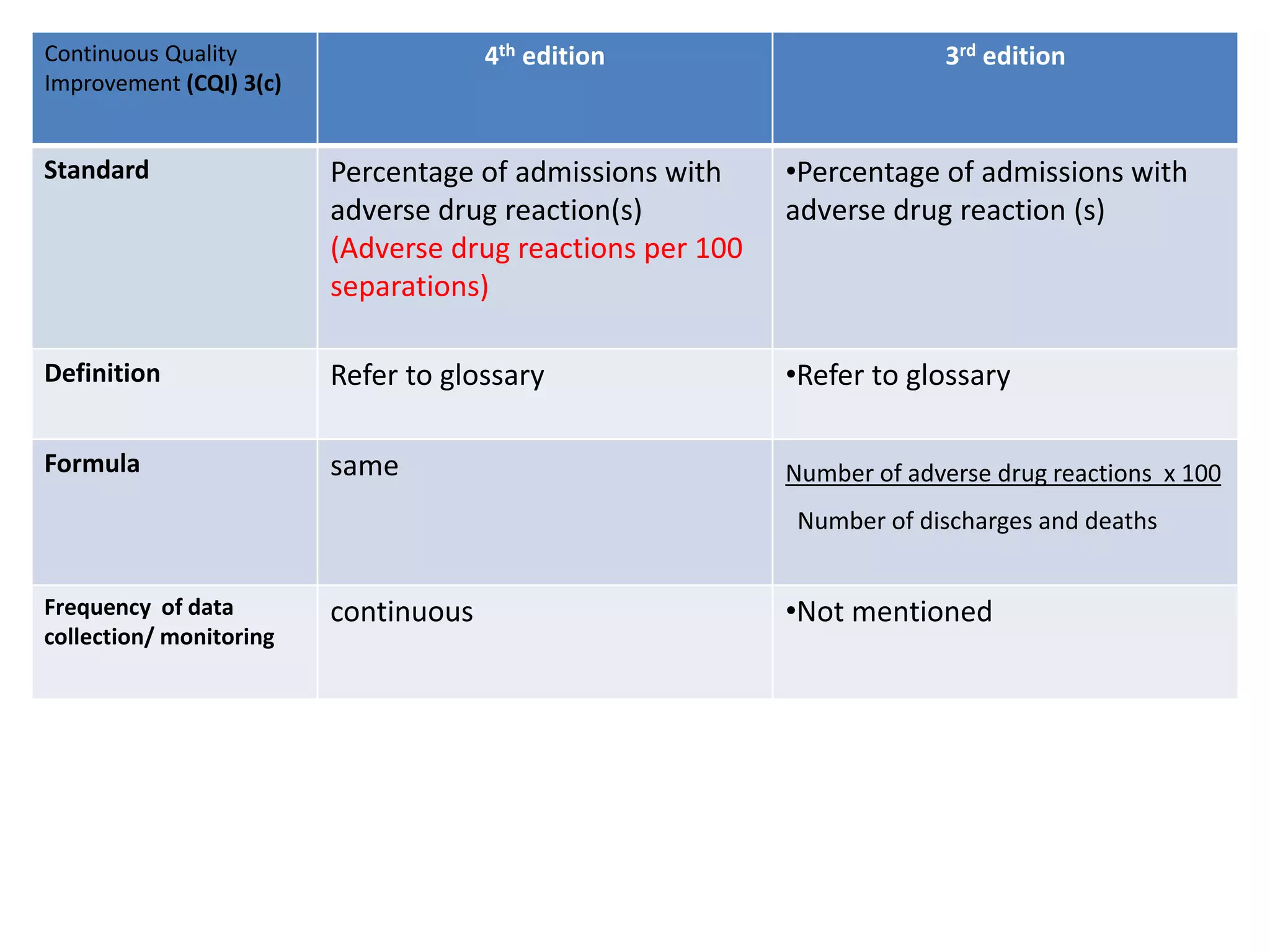
Standard Percentage of admissions with
adverse drug reaction(s)
(Adverse drug reactions per 100
separations)
•Percentage of admissions with
adverse drug reaction (s)
Definition Refer to glossary •Refer to glossary
Formula same Number of adverse drug reactions x 100
Number of discharges and deaths
Frequency of data
collection/ monitoring
continuous •Not mentioned
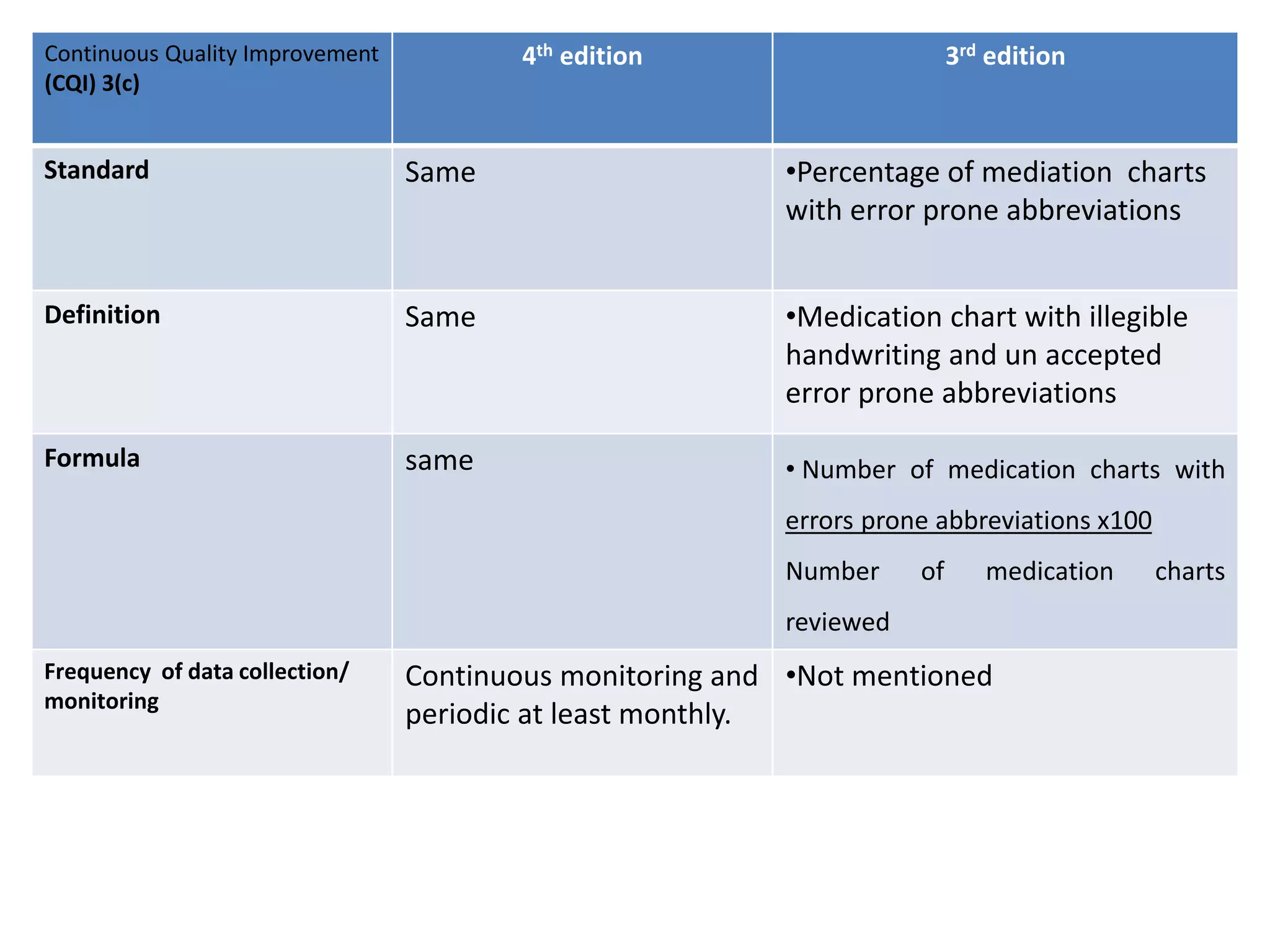
Continuous Quality Improvement
(CQI) 3(c)
4th edition 3rd edition
Standard Same •Percentage of mediation charts
with error prone abbreviations
Definition Same •Medication chart with illegible
handwriting and un accepted
error prone abbreviations
Formula same • Number of medication charts with
errors prone abbreviations x100
Number of medication charts
reviewed
Frequency of data collection/
monitoring
Continuous monitoring and
periodic at least monthly.
•Not mentioned
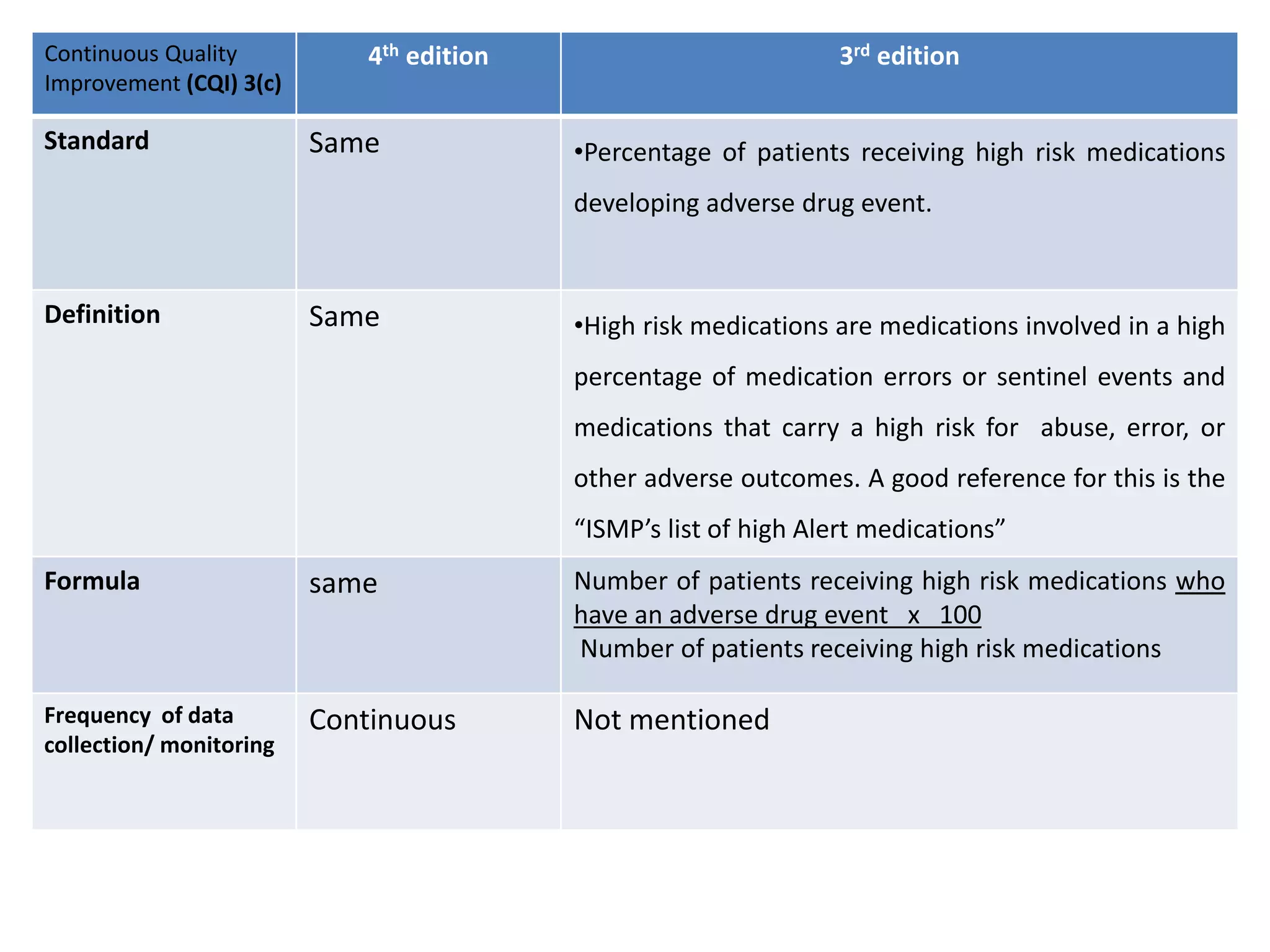
Continuous Quality
Improvement (CQI) 3(c)
4th edition 3rd edition
Standard Same •Percentage of patients receiving high risk medications
developing adverse drug event.
Definition Same •High risk medications are medications involved in a high
percentage of medication errors or sentinel events and
medications that carry a high risk for abuse, error, or
other adverse outcomes. A good reference for this is the
“ISMP’s list of high Alert medications”
Formula same Number of patients receiving high risk medications who
have an adverse drug event x 100
Number of patients receiving high risk medications
Frequency of data
collection/ monitoring
Continuous Not mentioned
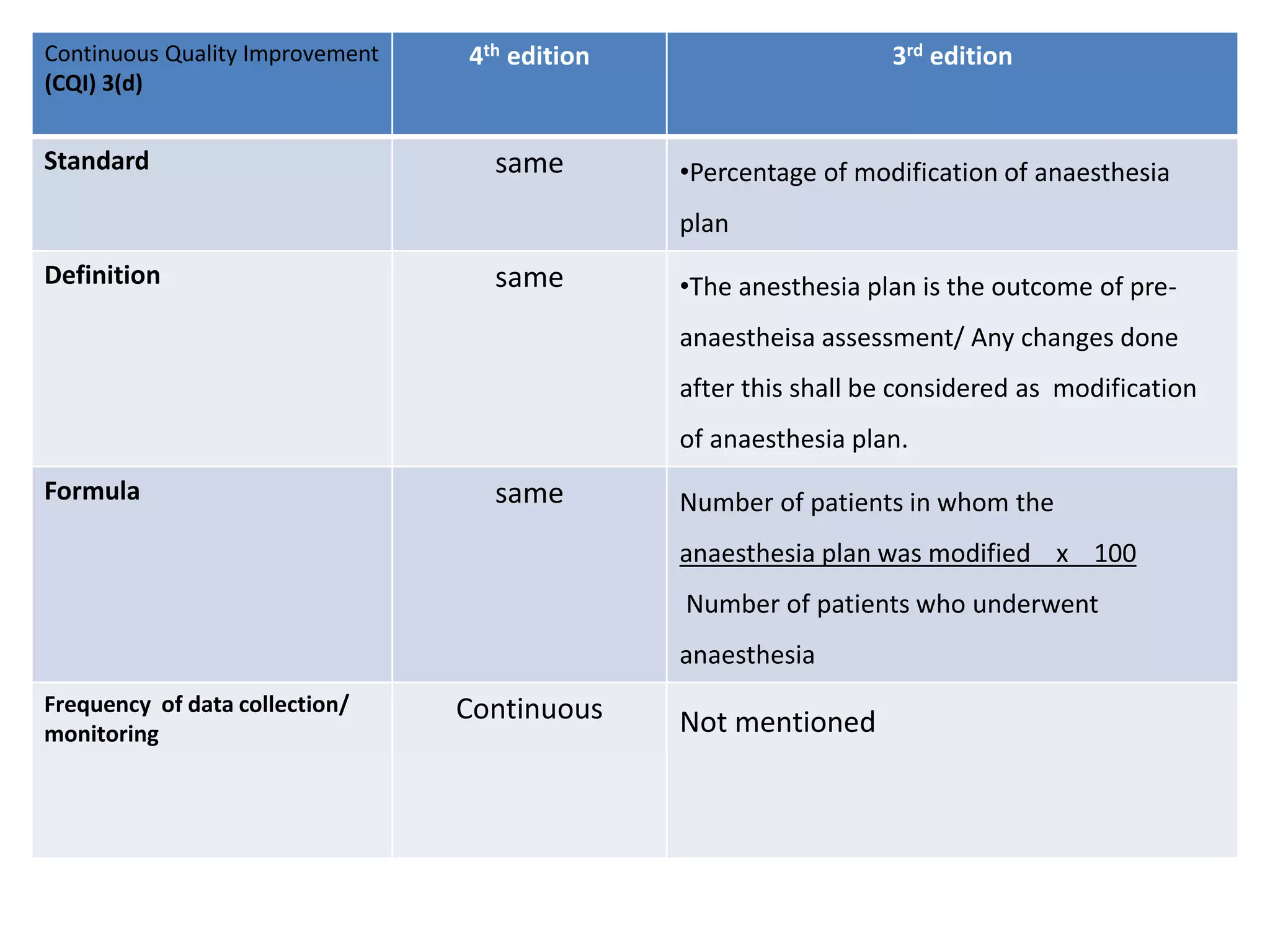
Continuous Quality Improvement
(CQI) 3(d)
4th edition 3rd edition
Standard same •Percentage of modification of anaesthesia
plan
Definition same •The anesthesia plan is the outcome of pre-
anaestheisa assessment/ Any changes done
after this shall be considered as modification
of anaesthesia plan.
Formula same Number of patients in whom the
anaesthesia plan was modified x 100
Number of patients who underwent
anaesthesia
Frequency of data collection/
monitoring
Continuous Not mentioned
Continuous Quality Improvement
(CQI) 3(d)
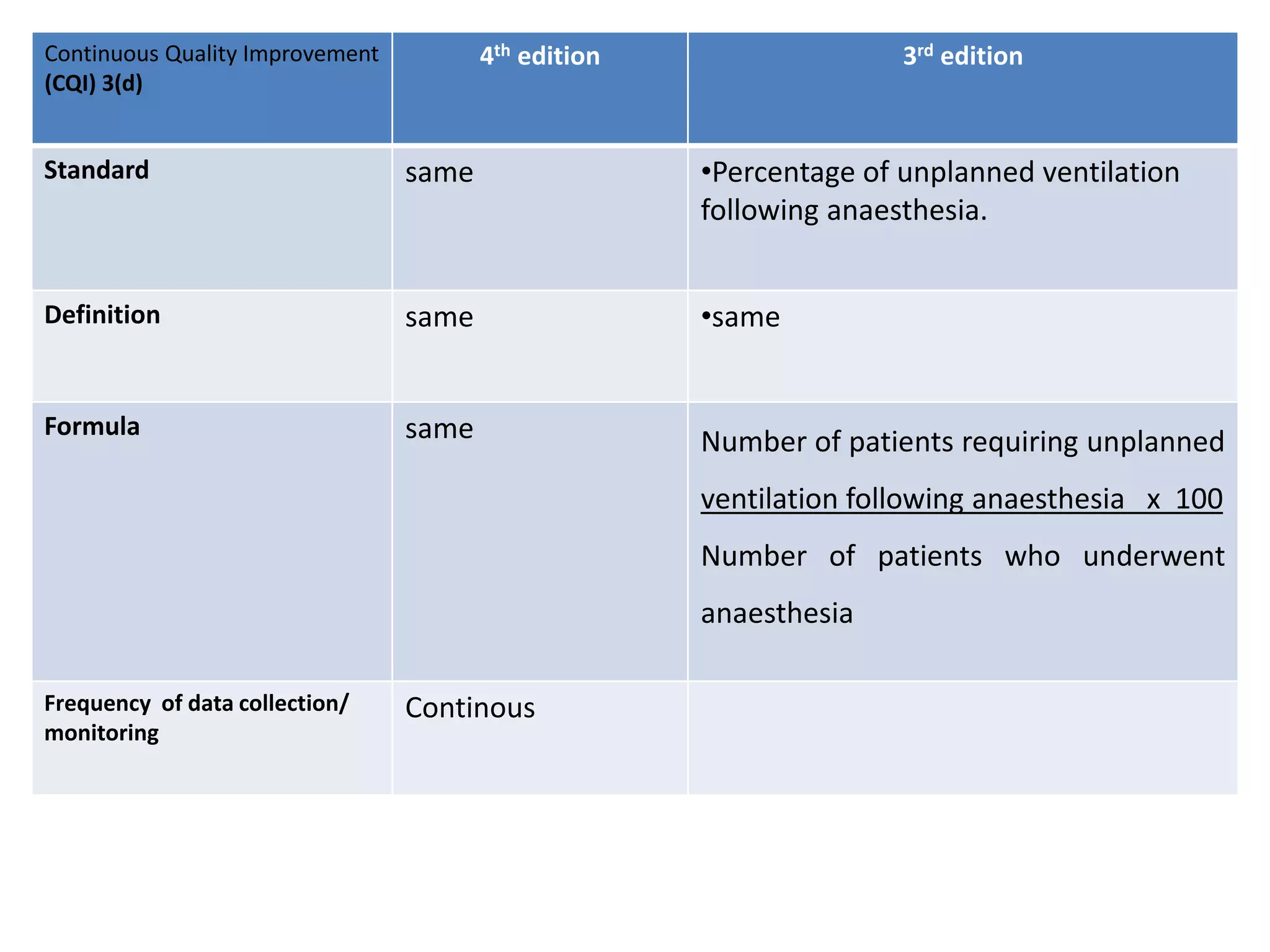
4th edition 3rd edition
Standard same •Percentage of unplanned ventilation
following anaesthesia.
Definition same •same
Formula same Number of patients requiring unplanned
ventilation following anaesthesia x 100
Number of patients who underwent
anaesthesia
Frequency of data collection/
monitoring
Continous
Continuous Quality Improvement
(CQI) 3(d)
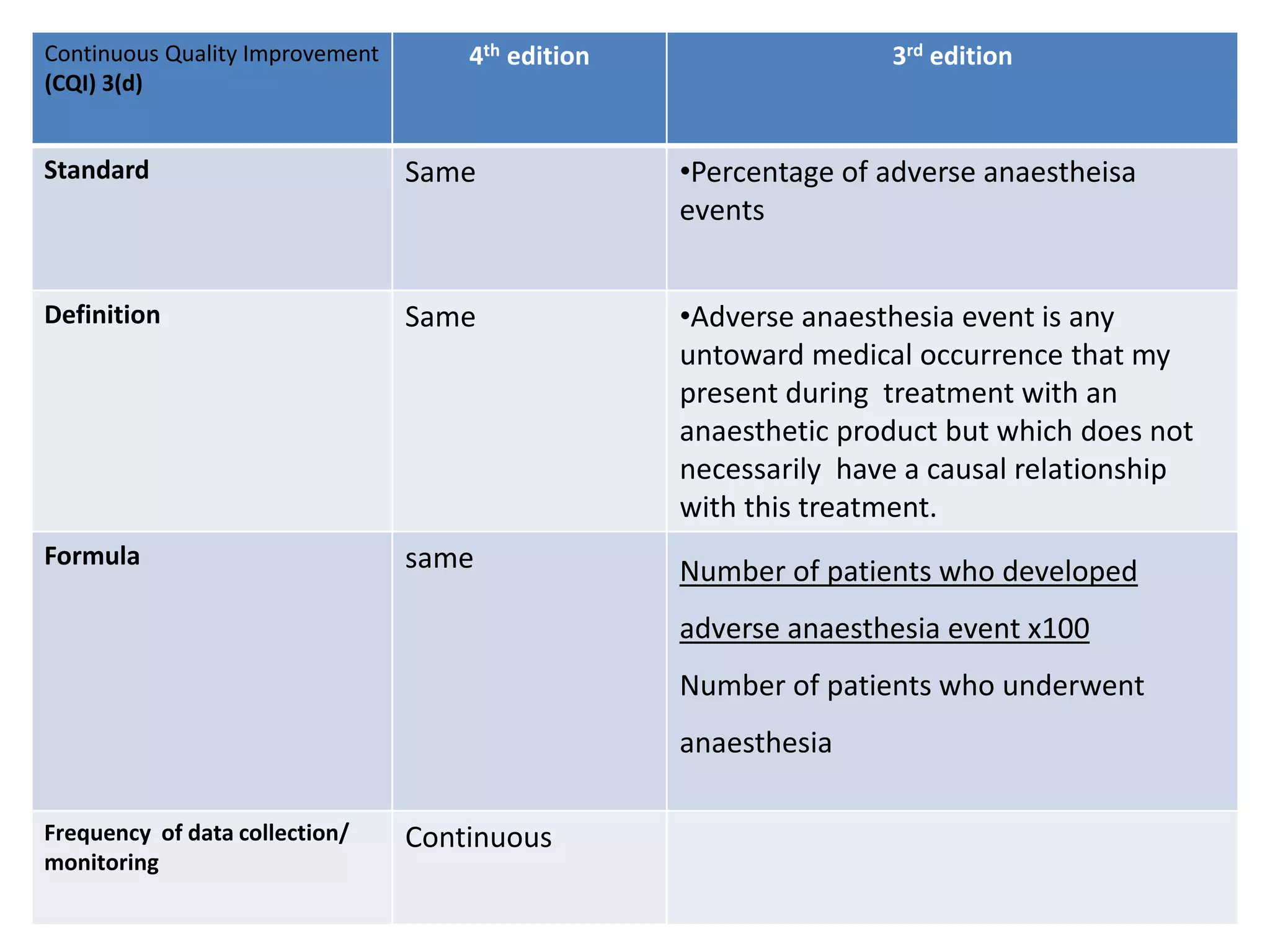
4th edition 3rd edition
Standard Same •Percentage of adverse anaestheisa
events
Definition Same •Adverse anaesthesia event is any
untoward medical occurrence that my
present during treatment with an
anaesthetic product but which does not
necessarily have a causal relationship
with this treatment.
Formula same Number of patients who developed
adverse anaesthesia event x100
Number of patients who underwent
anaesthesia
Frequency of data collection/
monitoring
Continuous
Continuous Quality Improvement
(CQI) 3(d)
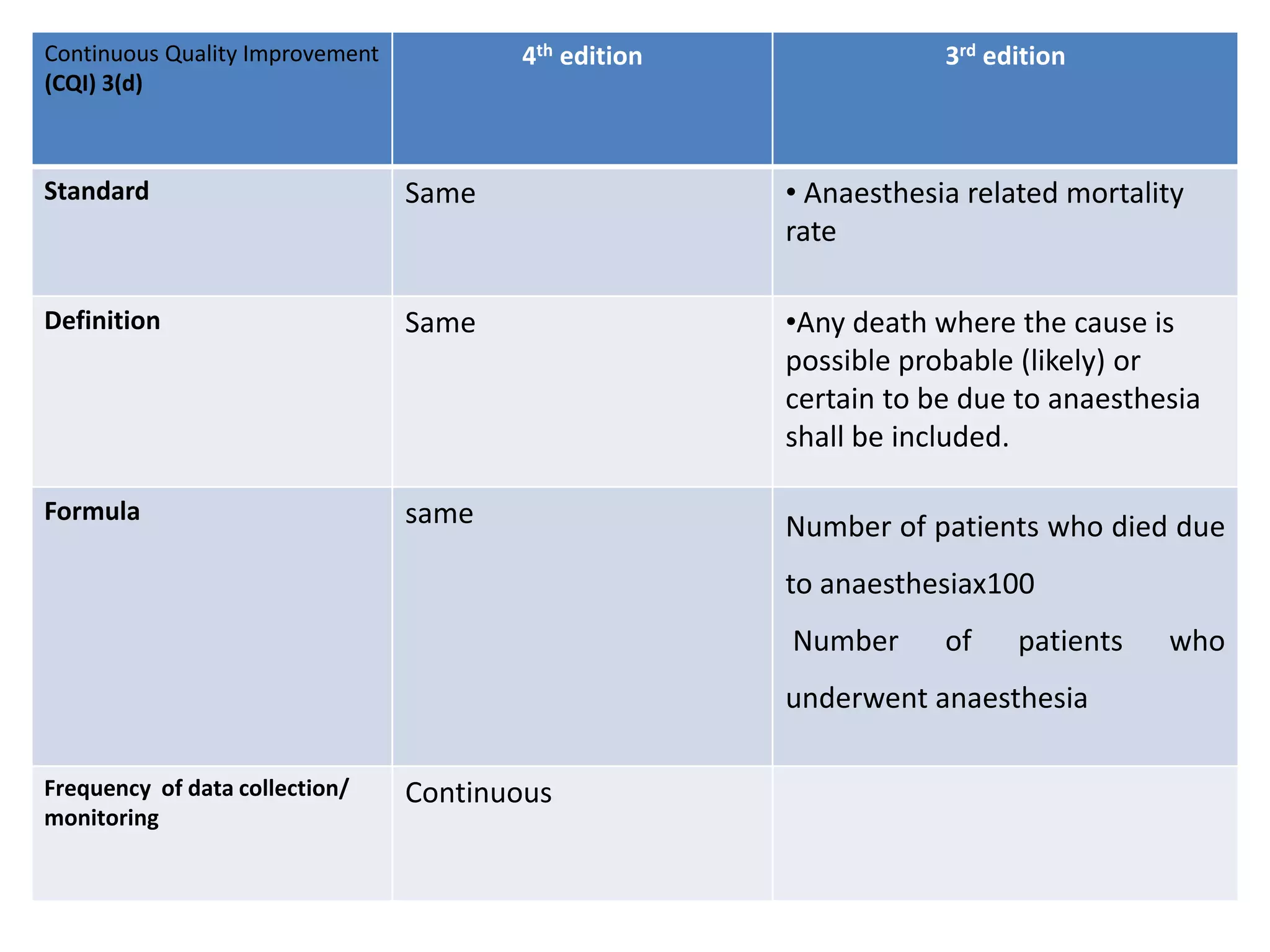
4th edition 3rd edition
Standard Same • Anaesthesia related mortality
rate
Definition Same •Any death where the cause is
possible probable (likely) or
certain to be due to anaesthesia
shall be included.
Formula same Number of patients who died due
to anaesthesiax100
Number of patients who
underwent anaesthesia
Frequency of data collection/
monitoring
Continuous
Continuous Quality Improvement
(CQI) 3(e)
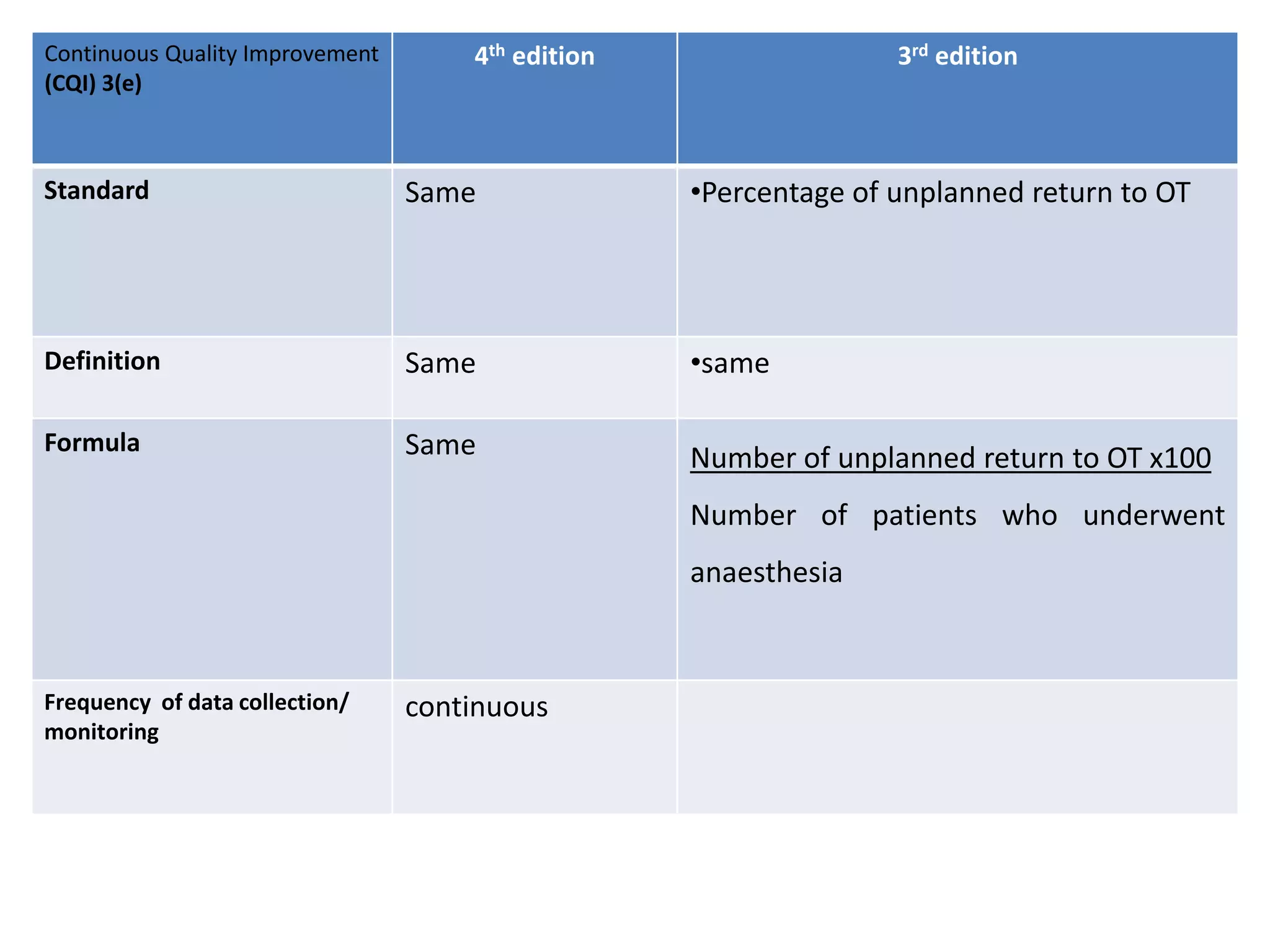
4th edition 3rd edition
Standard Same •Percentage of unplanned return to OT
Definition Same •same
Formula Same Number of unplanned return to OT x100
Number of patients who underwent
anaesthesia
Frequency of data collection/
monitoring
continuous
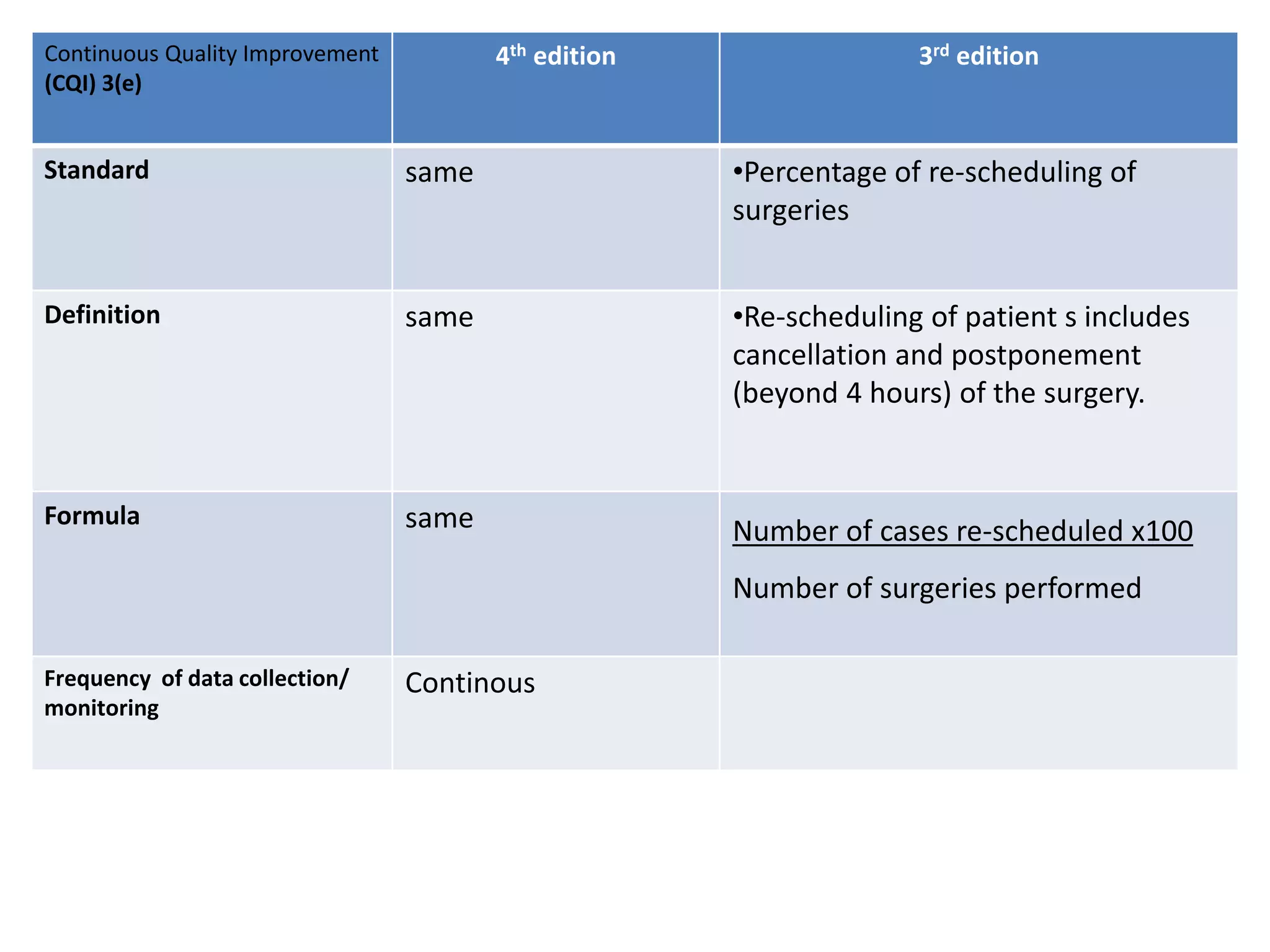
Continuous Quality Improvement
(CQI) 3(e)
4th edition 3rd edition
Standard same •Percentage of re-scheduling of
surgeries
Definition same •Re-scheduling of patient s includes
cancellation and postponement
(beyond 4 hours) of the surgery.
Formula same Number of cases re-scheduled x100
Number of surgeries performed
Frequency of data collection/
monitoring
Continous
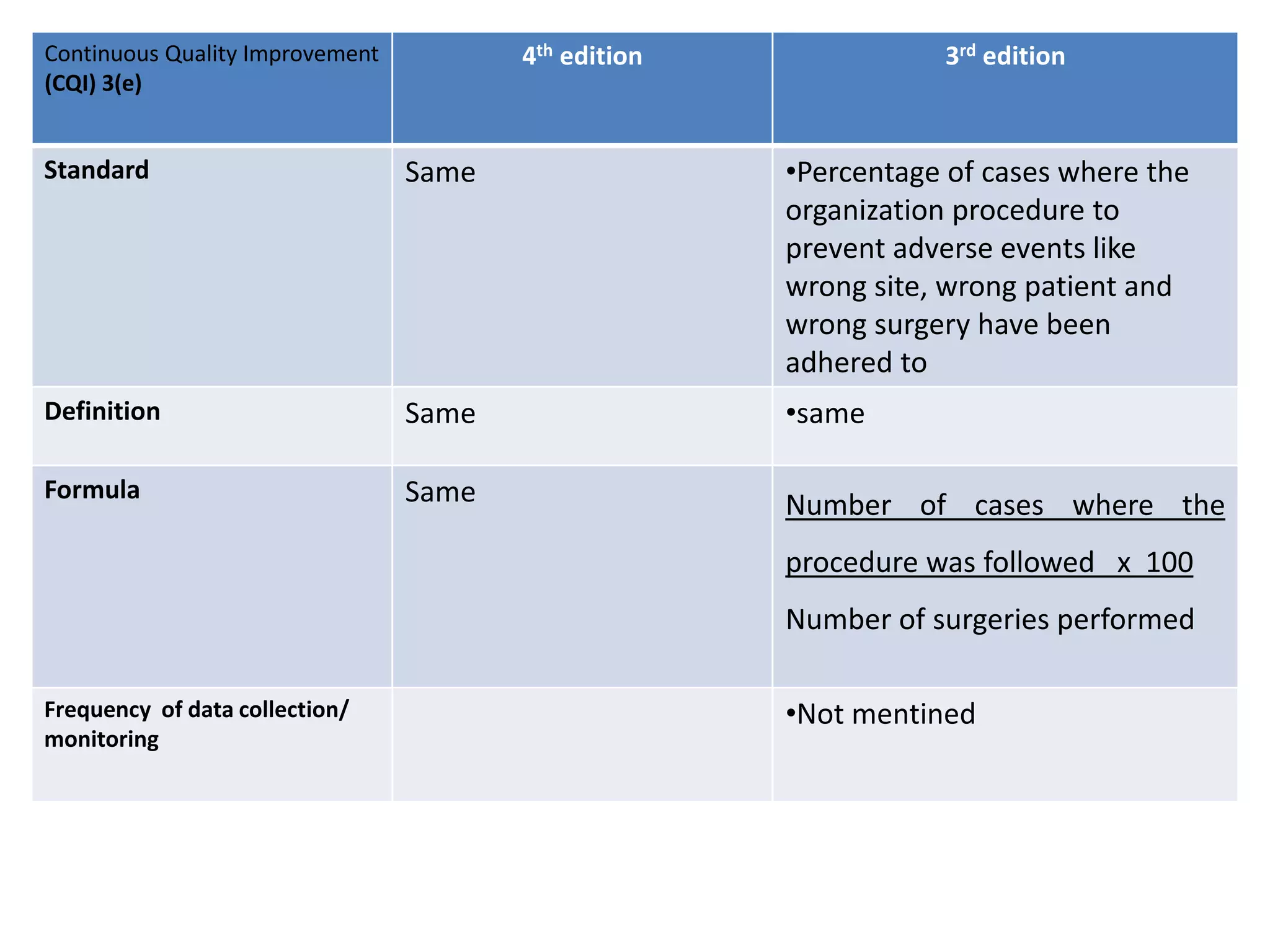
Continuous Quality Improvement
(CQI) 3(e)
4th edition 3rd edition
Standard Same •Percentage of cases where the
organization procedure to
prevent adverse events like
wrong site, wrong patient and
wrong surgery have been
adhered to
Definition Same •same
Formula Same Number of cases where the
procedure was followed x 100
Number of surgeries performed
Frequency of data collection/
monitoring
•Not mentined
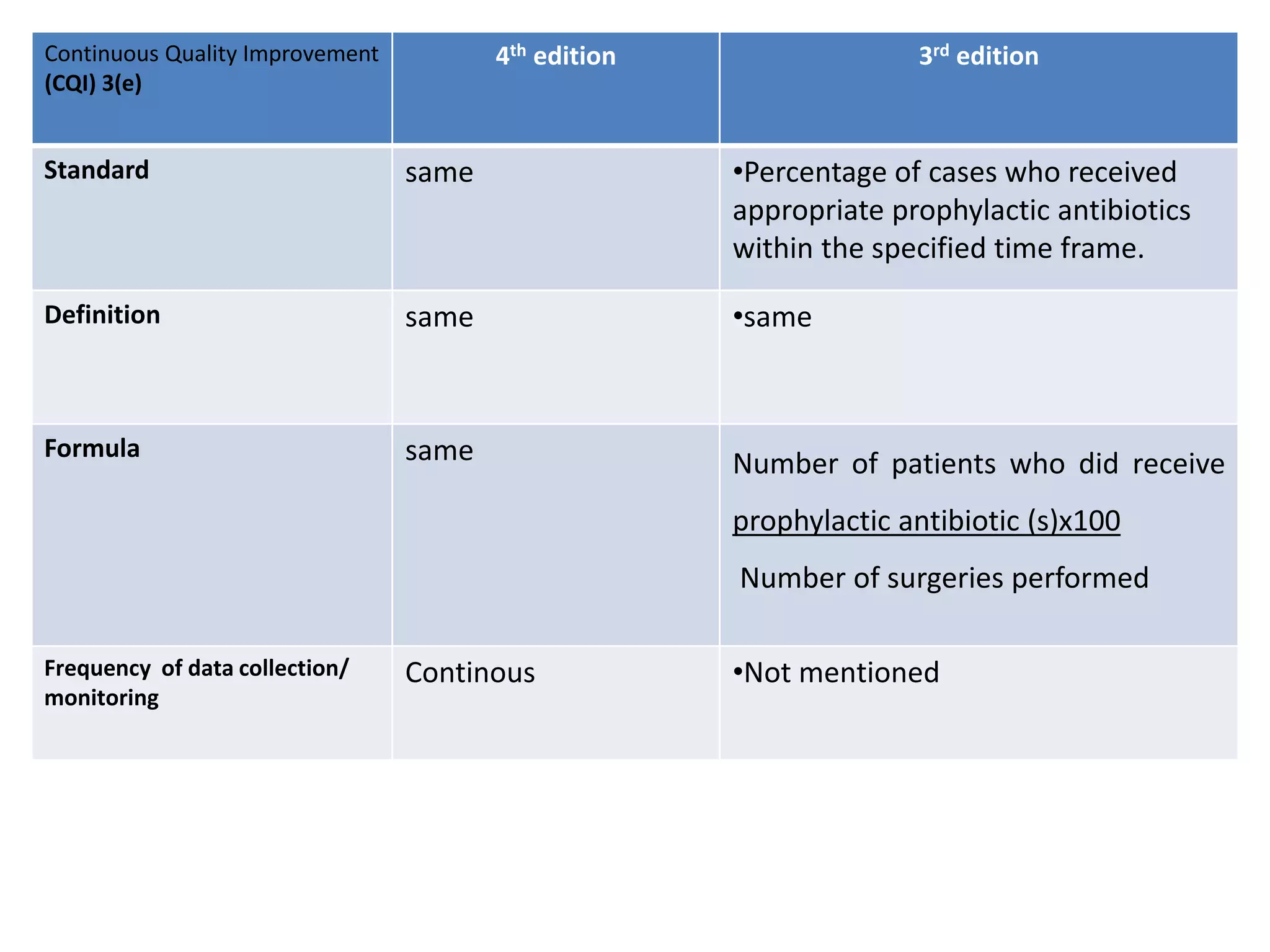
Continuous Quality Improvement
(CQI) 3(e)
4th edition 3rd edition
Standard same •Percentage of cases who received
appropriate prophylactic antibiotics
within the specified time frame.
Definition same •same
Formula same Number of patients who did receive
prophylactic antibiotic (s)x100
Number of surgeries performed
Frequency of data collection/
monitoring
Continous •Not mentioned
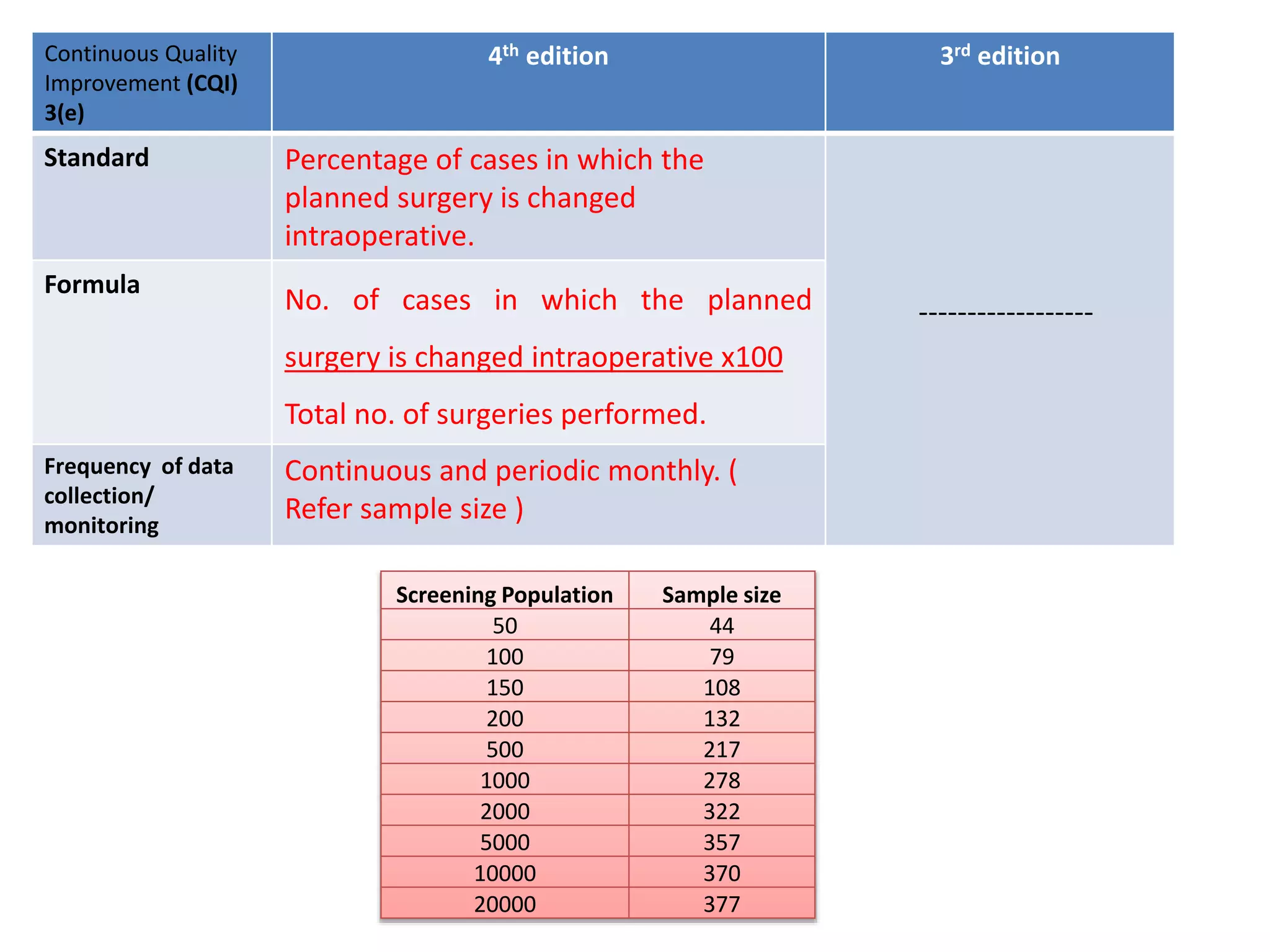
Continuous Quality
Improvement (CQI)
3(e)
4th edition 3rd edition
Standard Percentage of cases in which the
planned surgery is changed
intraoperative.
------------------
Formula
No. of cases in which the planned
surgery is changed intraoperative x100
Total no. of surgeries performed.
Frequency of data
collection/
monitoring
Continuous and periodic monthly. (
Refer sample size )
Screening Population Sample size
50 44
100 79
150 108
200 132
500 217
1000 278
2000 322
5000 357
10000 370
20000 377
Continuous Quality Improvement
(CQI) 3(e)
4th edition 3rd edition
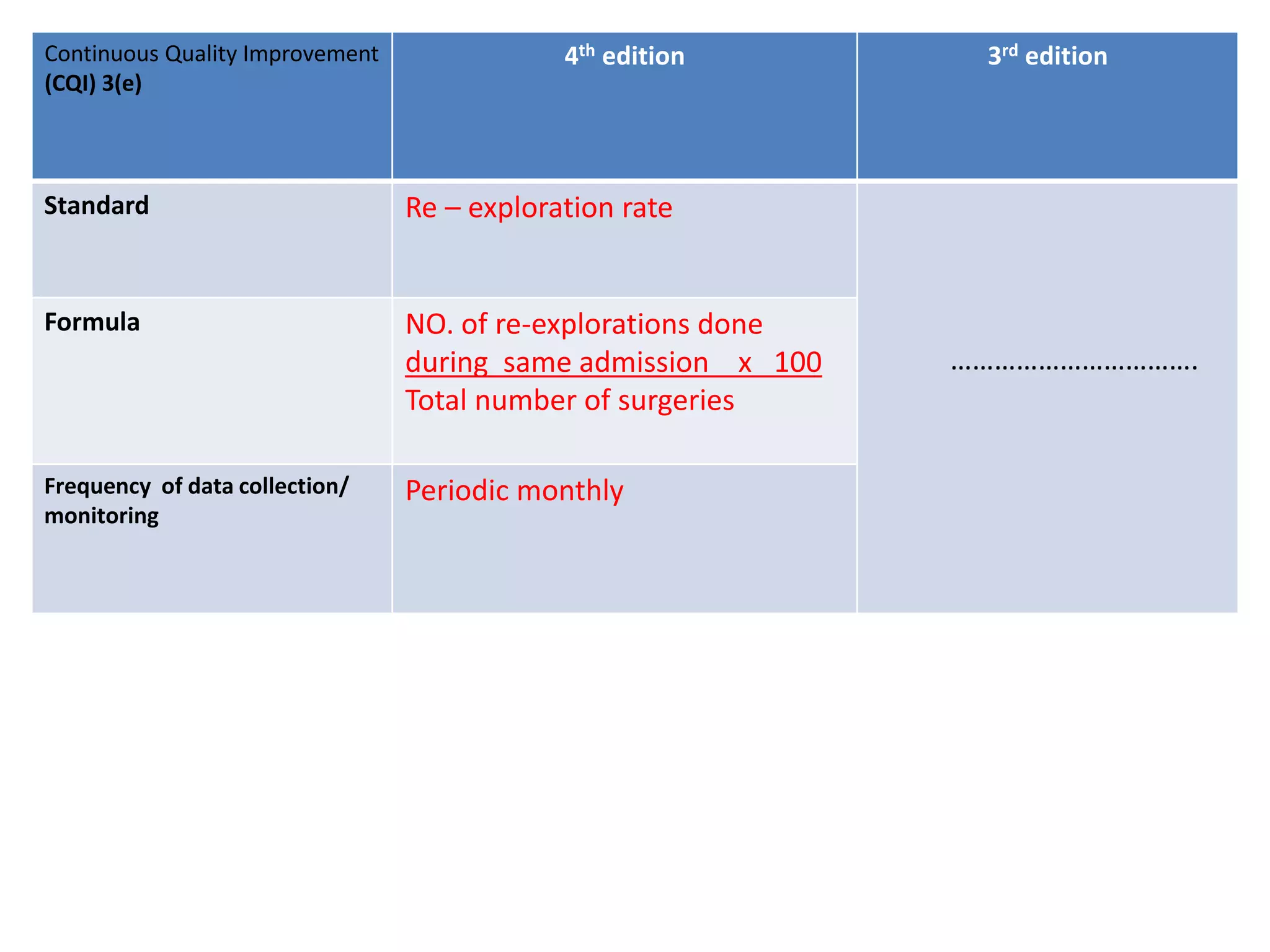
Standard Re – exploration rate
…………………………….
Formula NO. of re-explorations done
during same admission x 100
Total number of surgeries
Frequency of data collection/
monitoring
Periodic monthly
Continuous Quality
Improvement (CQI) 3(f)
4th edition 3rd edition
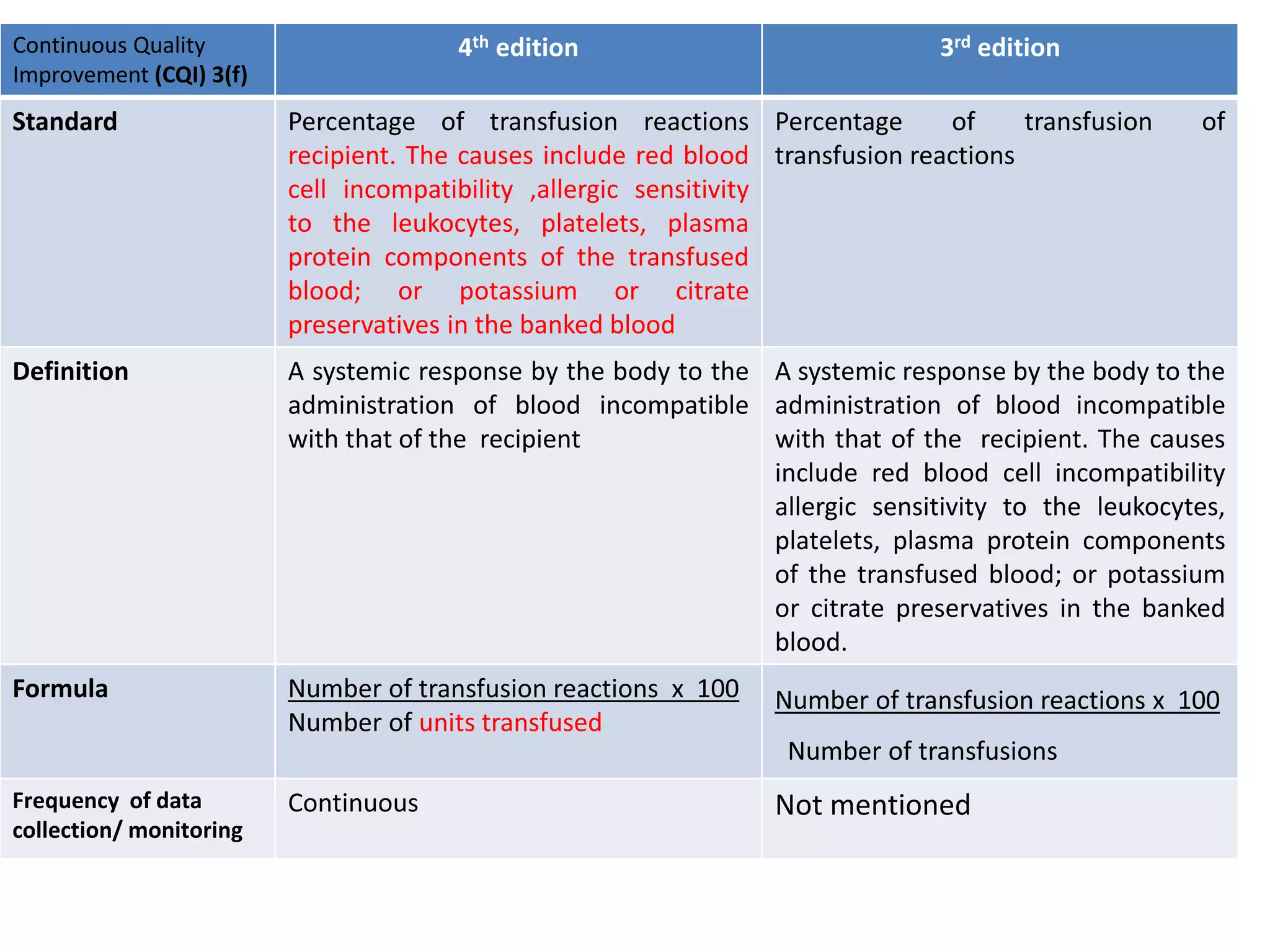
Standard Percentage of transfusion reactions
recipient. The causes include red blood
cell incompatibility ,allergic sensitivity
to the leukocytes, platelets, plasma
protein components of the transfused
blood; or potassium or citrate
preservatives in the banked blood
Percentage of transfusion of
transfusion reactions
Definition A systemic response by the body to the
administration of blood incompatible
with that of the recipient
A systemic response by the body to the
administration of blood incompatible
with that of the recipient. The causes
include red blood cell incompatibility
allergic sensitivity to the leukocytes,
platelets, plasma protein components
of the transfused blood; or potassium
or citrate preservatives in the banked
blood.
Formula Number of transfusion reactions x 100
Number of units transfused
Number of transfusion reactions x 100
Number of transfusions
Frequency of data
collection/ monitoring
Continuous Not mentioned
Continuous Quality
Improvement (CQI)
3(f)
4th edition 3rd edition
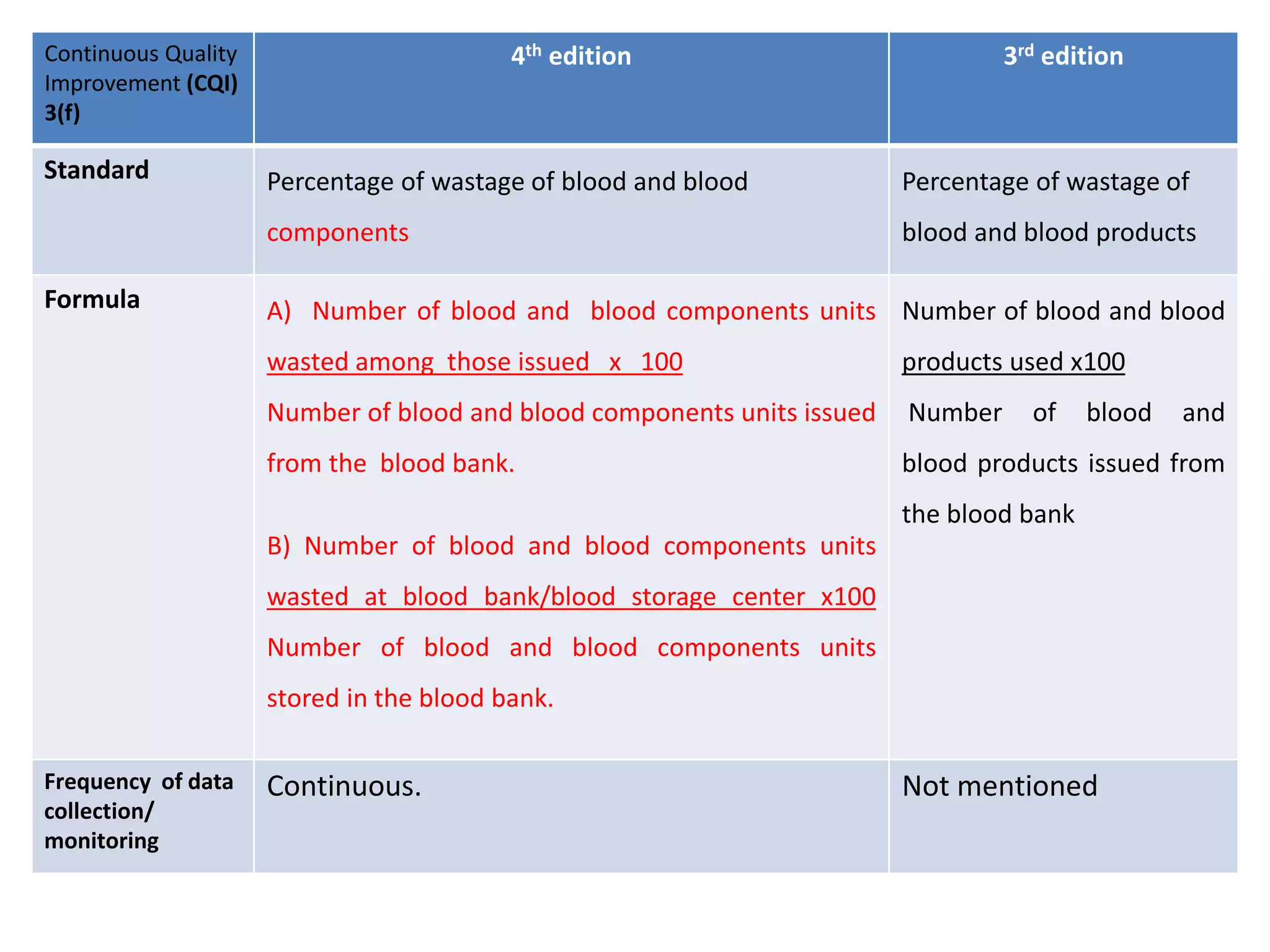
Standard Percentage of wastage of blood and blood
components
Percentage of wastage of
blood and blood products
Formula A) Number of blood and blood components units
wasted among those issued x 100
Number of blood and blood components units issued
from the blood bank.
B) Number of blood and blood components units
wasted at blood bank/blood storage center x100
Number of blood and blood components units
stored in the blood bank.
Number of blood and blood
products used x100
Number of blood and
blood products issued from
the blood bank
Frequency of data
collection/
monitoring
Continuous. Not mentioned
Continuous Quality
Improvement (CQI) 3(f)
4th edition 3rd edition
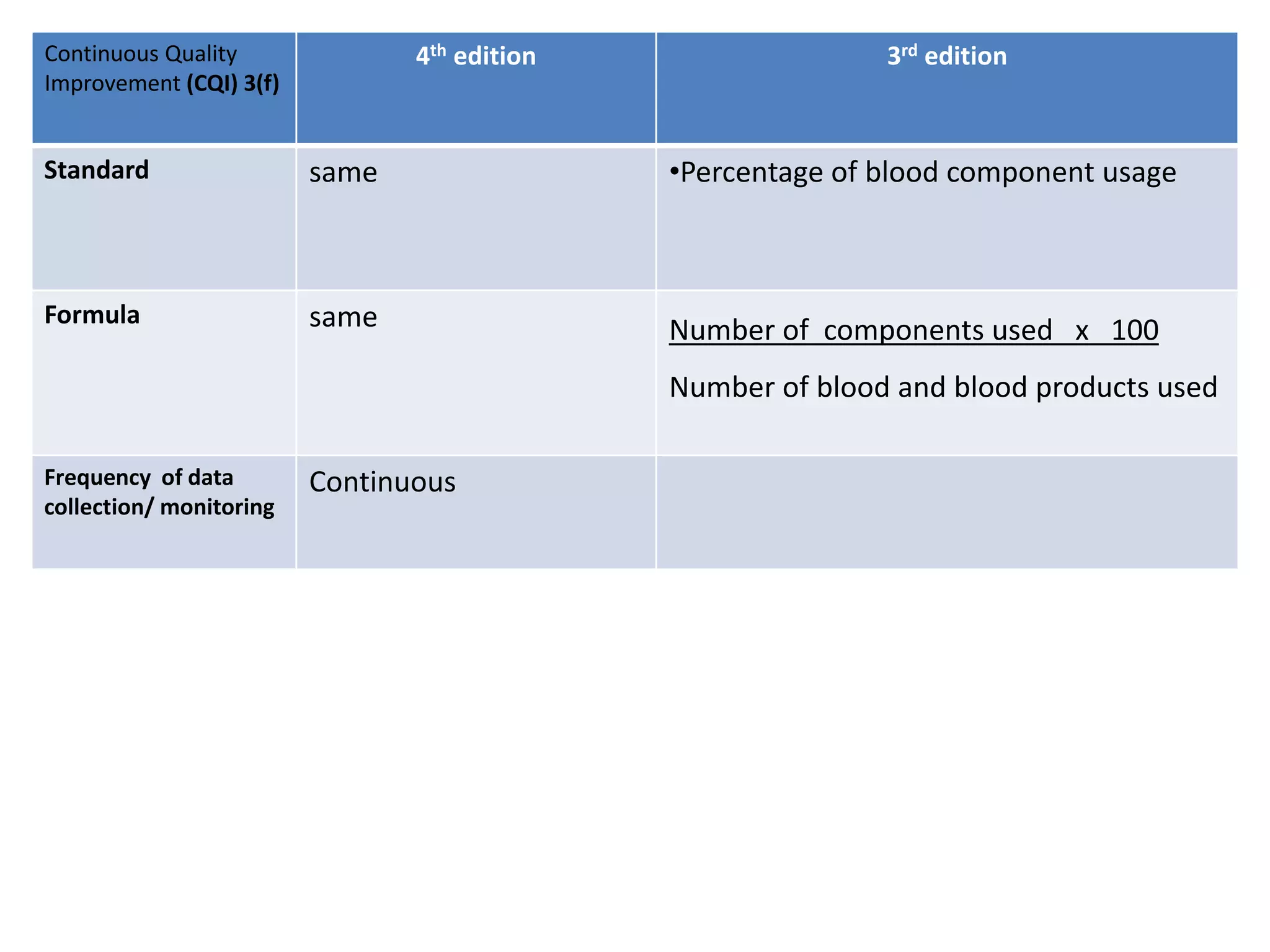
Standard same •Percentage of blood component usage
Formula same Number of components used x 100
Number of blood and blood products used
Frequency of data
collection/ monitoring
Continuous
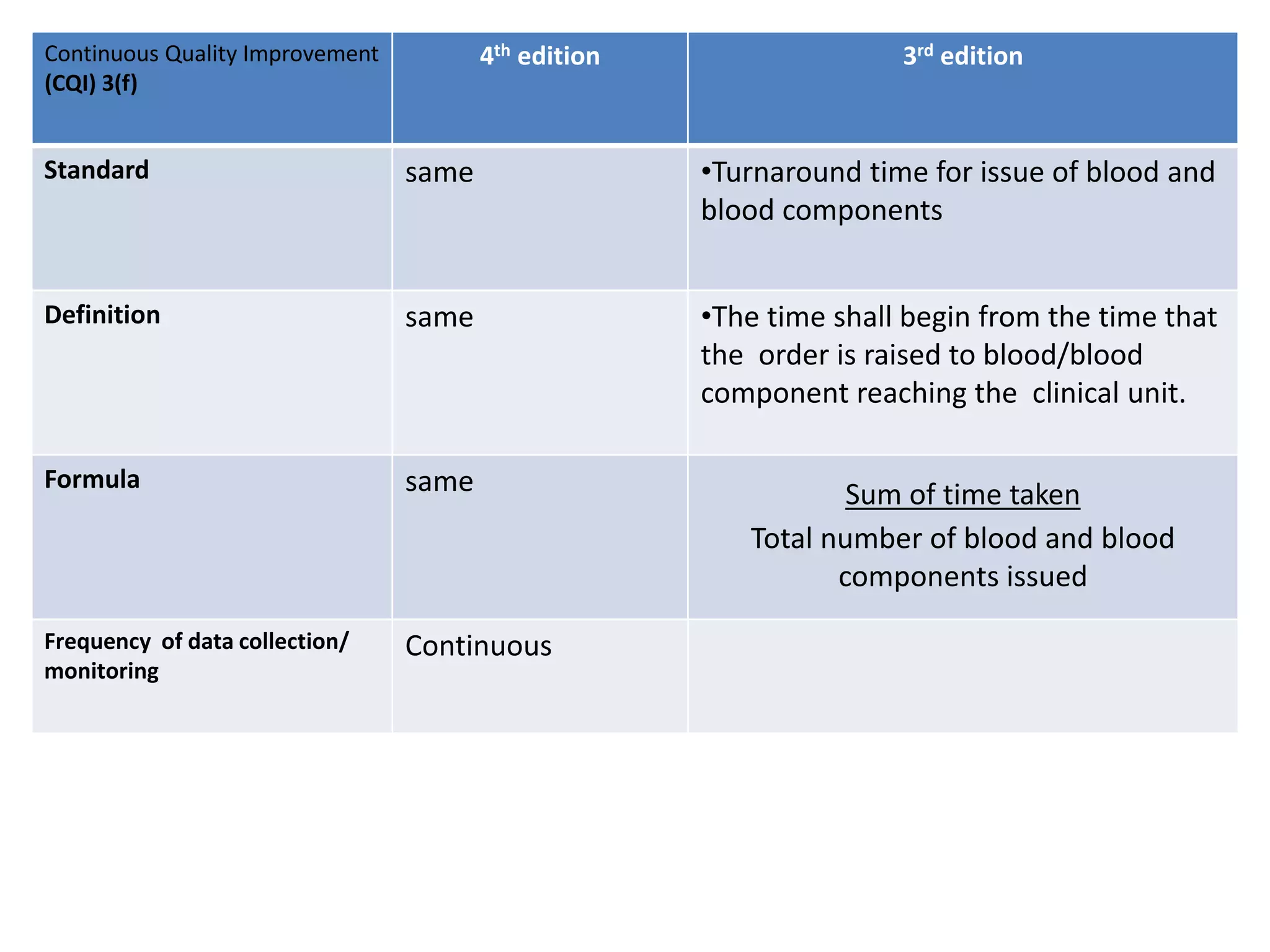
Continuous Quality Improvement
(CQI) 3(f)
4th edition 3rd edition
Standard same •Turnaround time for issue of blood and
blood components
Definition same •The time shall begin from the time that
the order is raised to blood/blood
component reaching the clinical unit.
Formula same Sum of time taken
Total number of blood and blood
components issued
Frequency of data collection/
monitoring
Continuous
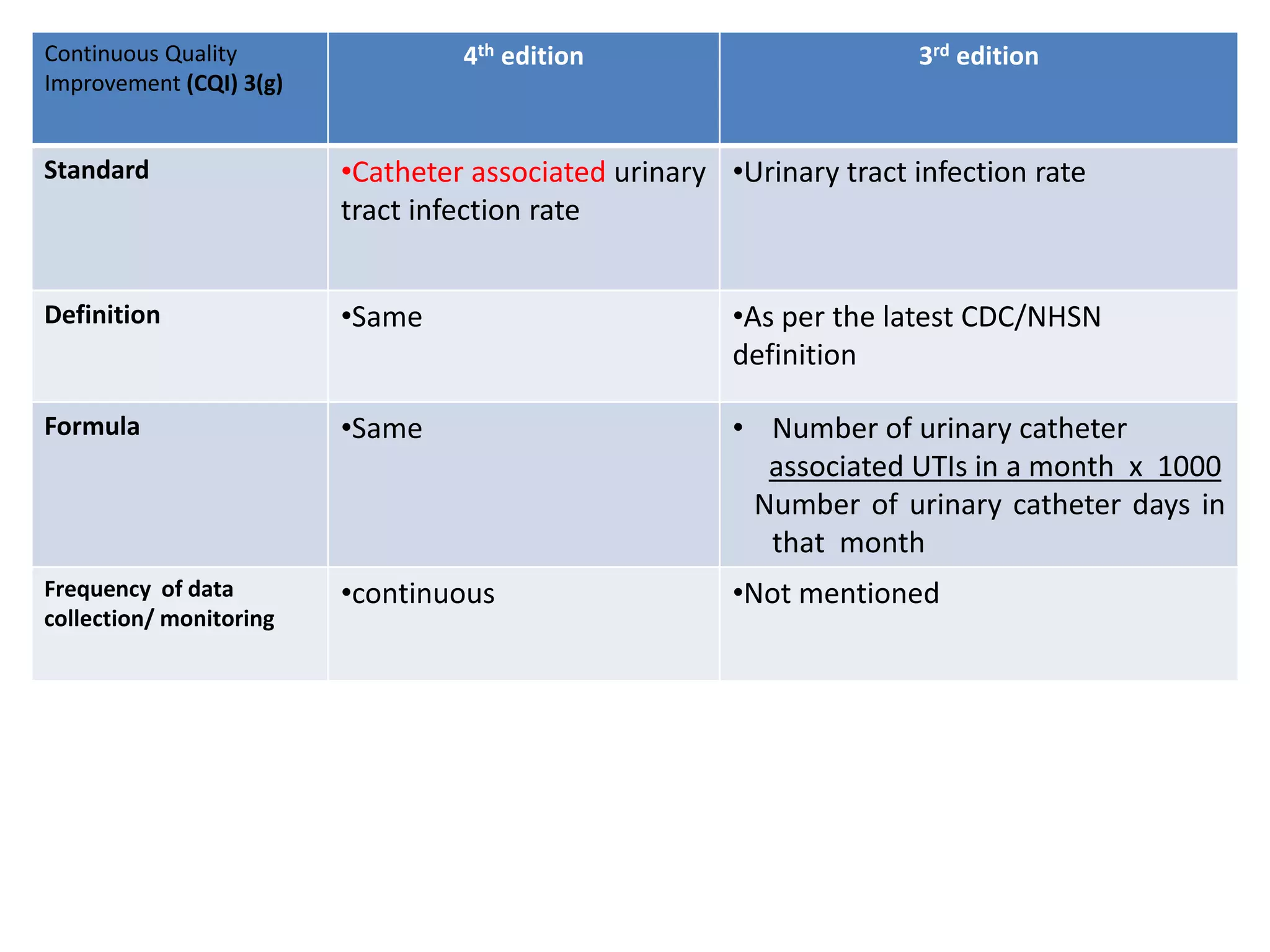
Continuous Quality
Improvement (CQI) 3(g)
4th edition 3rd edition
Standard •Catheter associated urinary
tract infection rate
•Urinary tract infection rate
Definition •Same •As per the latest CDC/NHSN
definition
Formula •Same • Number of urinary catheter
associated UTIs in a month x 1000
Number of urinary catheter days in
that month
Frequency of data
collection/ monitoring
•continuous •Not mentioned
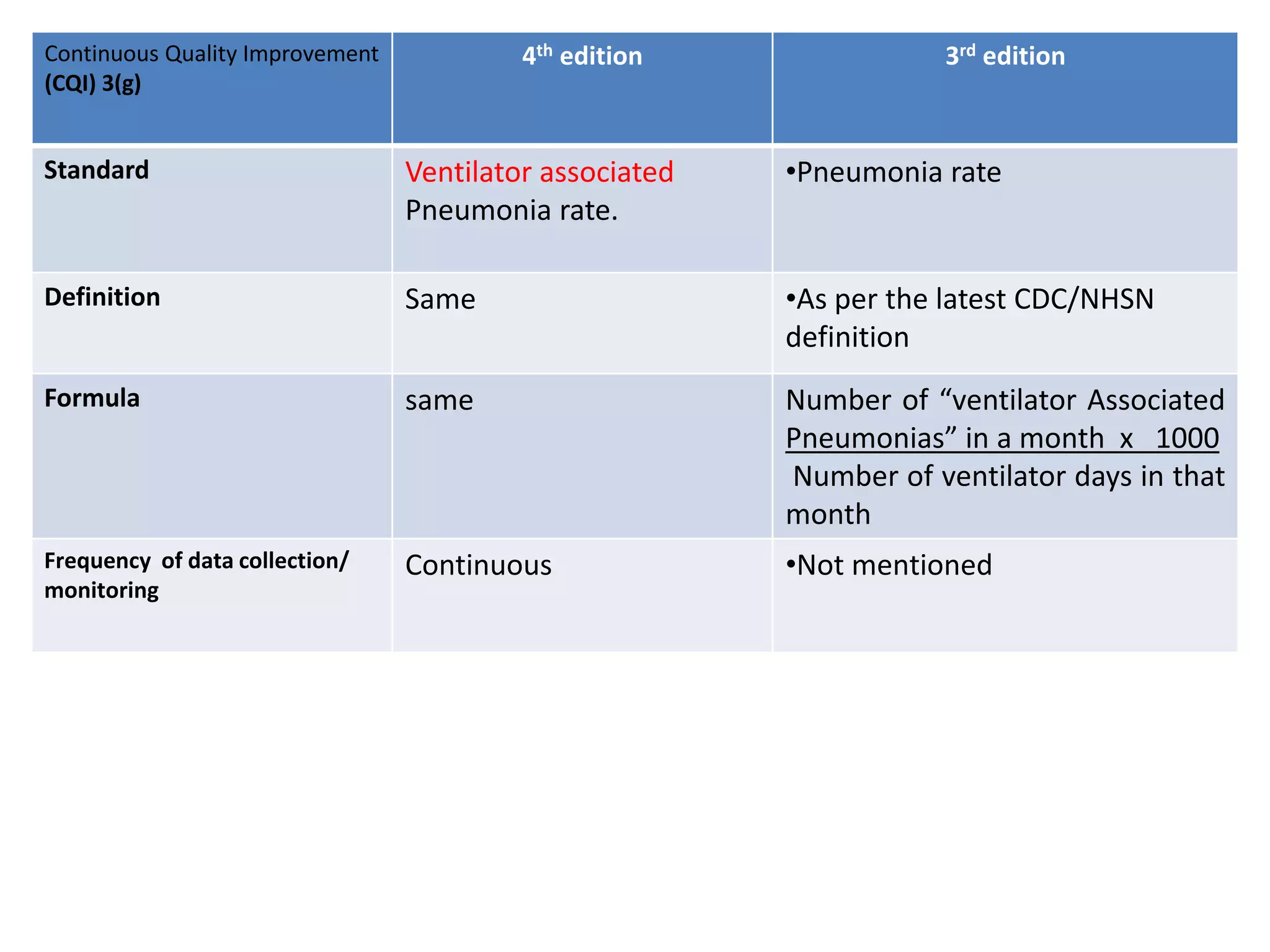
Continuous Quality Improvement
(CQI) 3(g)
4th edition 3rd edition
Standard Ventilator associated
Pneumonia rate.
•Pneumonia rate
Definition Same •As per the latest CDC/NHSN
definition
Formula same Number of “ventilator Associated
Pneumonias” in a month x 1000
Number of ventilator days in that
month
Frequency of data collection/
monitoring
Continuous •Not mentioned
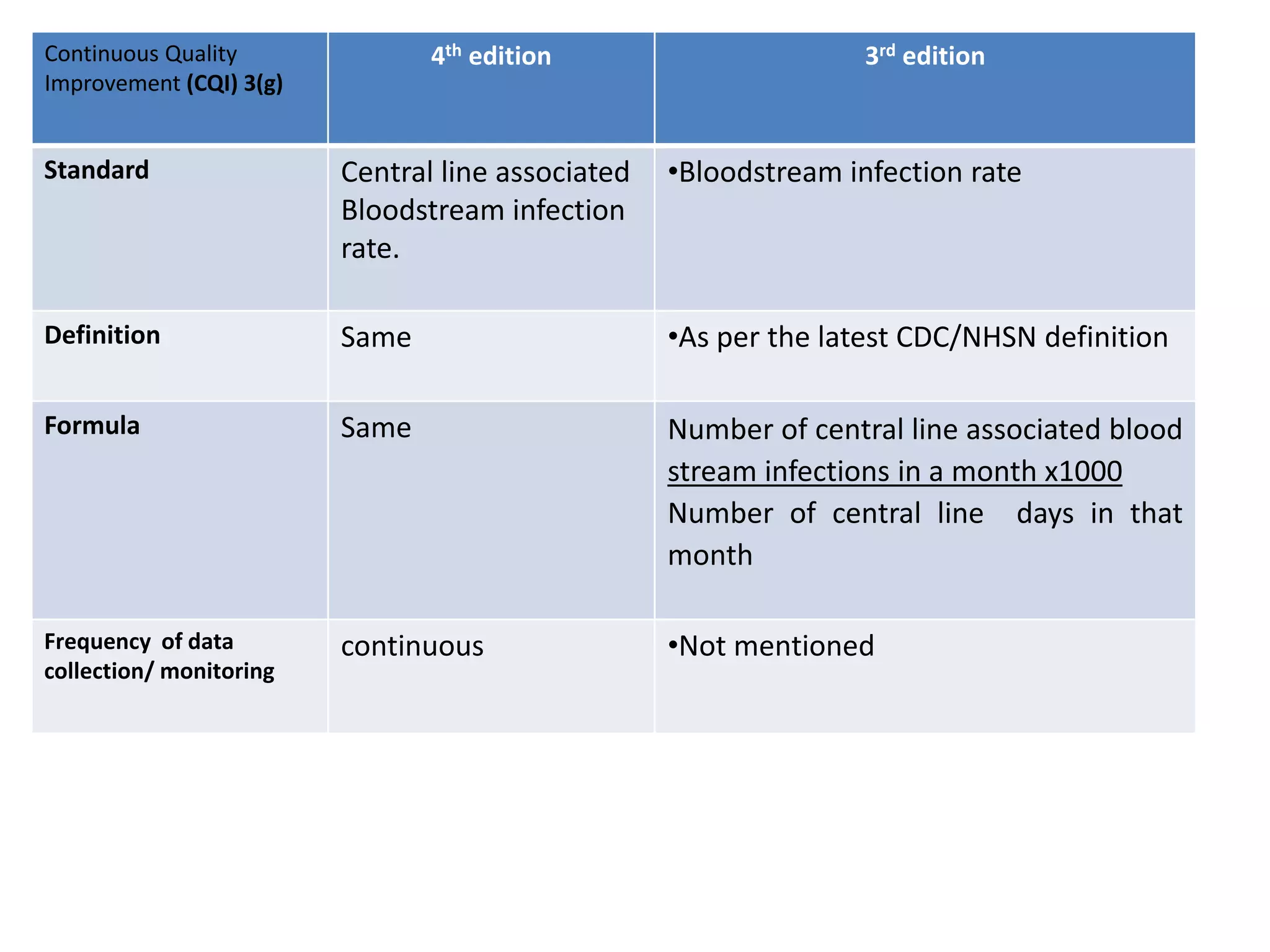
Continuous Quality
Improvement (CQI) 3(g)
4th edition 3rd edition
Standard Central line associated
Bloodstream infection
rate.
•Bloodstream infection rate
Definition Same •As per the latest CDC/NHSN definition
Formula Same Number of central line associated blood
stream infections in a month x1000
Number of central line days in that
month
Frequency of data
collection/ monitoring
continuous •Not mentioned
Continuous Quality
Improvement (CQI) 3(g)
4th edition 3rd edition
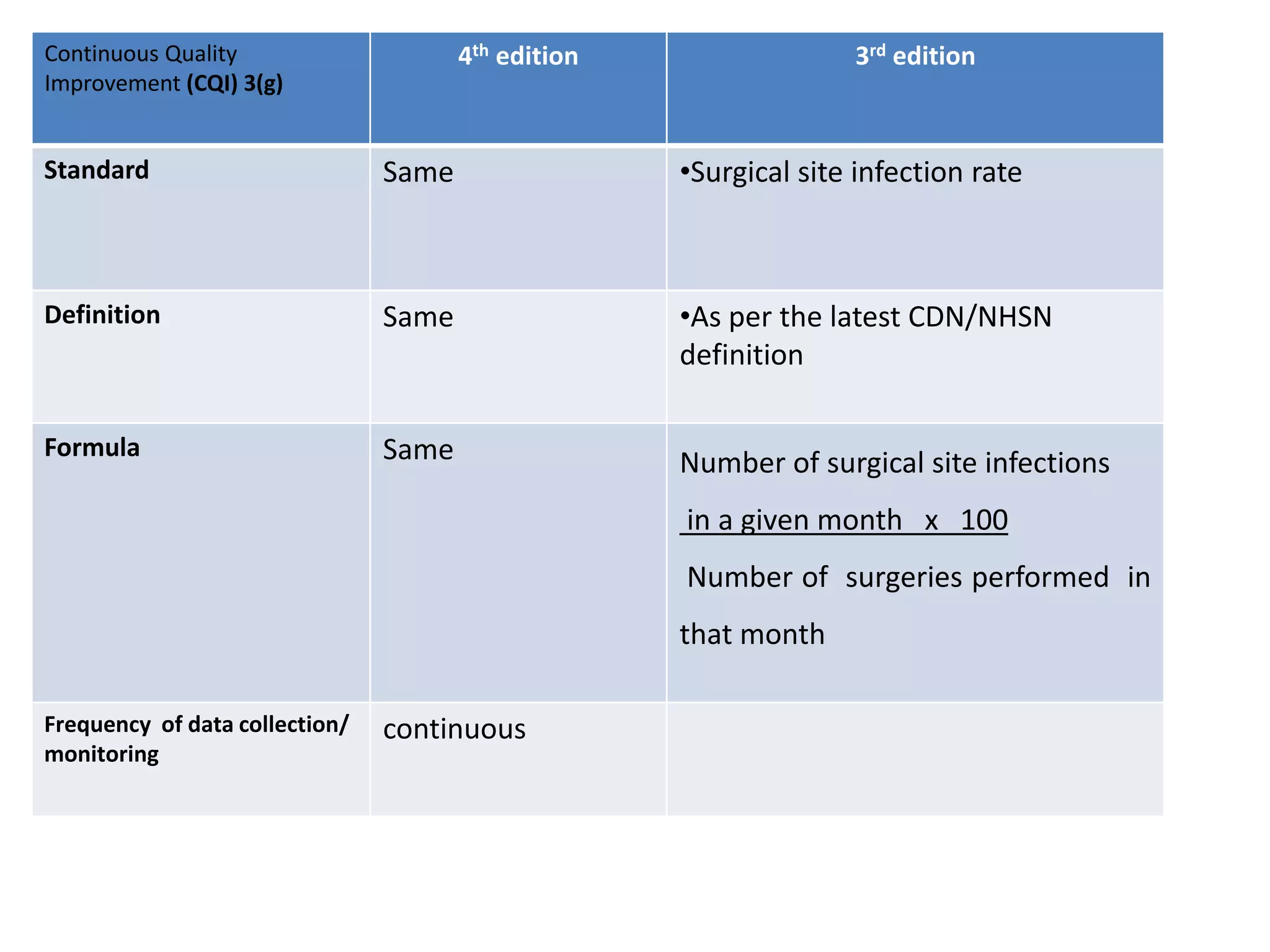
Standard Same •Surgical site infection rate
Definition Same •As per the latest CDN/NHSN
definition
Formula Same Number of surgical site infections
in a given month x 100
Number of surgeries performed in
that month
Frequency of data collection/
monitoring
continuous
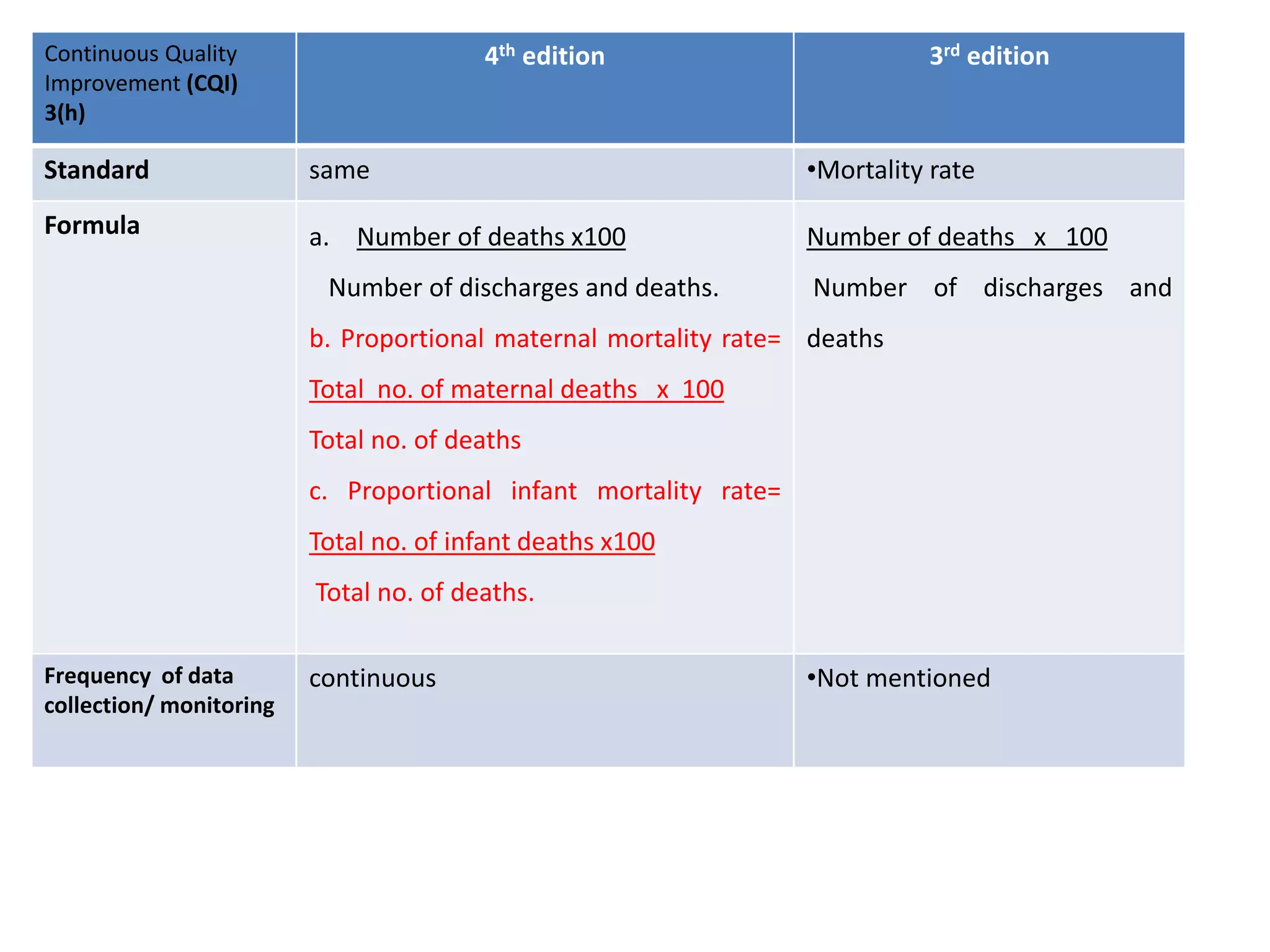
Continuous Quality
Improvement (CQI)
3(h)
4th edition 3rd edition
Standard same •Mortality rate
Formula a. Number of deaths x100
Number of discharges and deaths.
b. Proportional maternal mortality rate=
Total no. of maternal deaths x 100
Total no. of deaths
c. Proportional infant mortality rate=
Total no. of infant deaths x100
Total no. of deaths.
Number of deaths x 100
Number of discharges and
deaths
Frequency of data
collection/ monitoring
continuous •Not mentioned
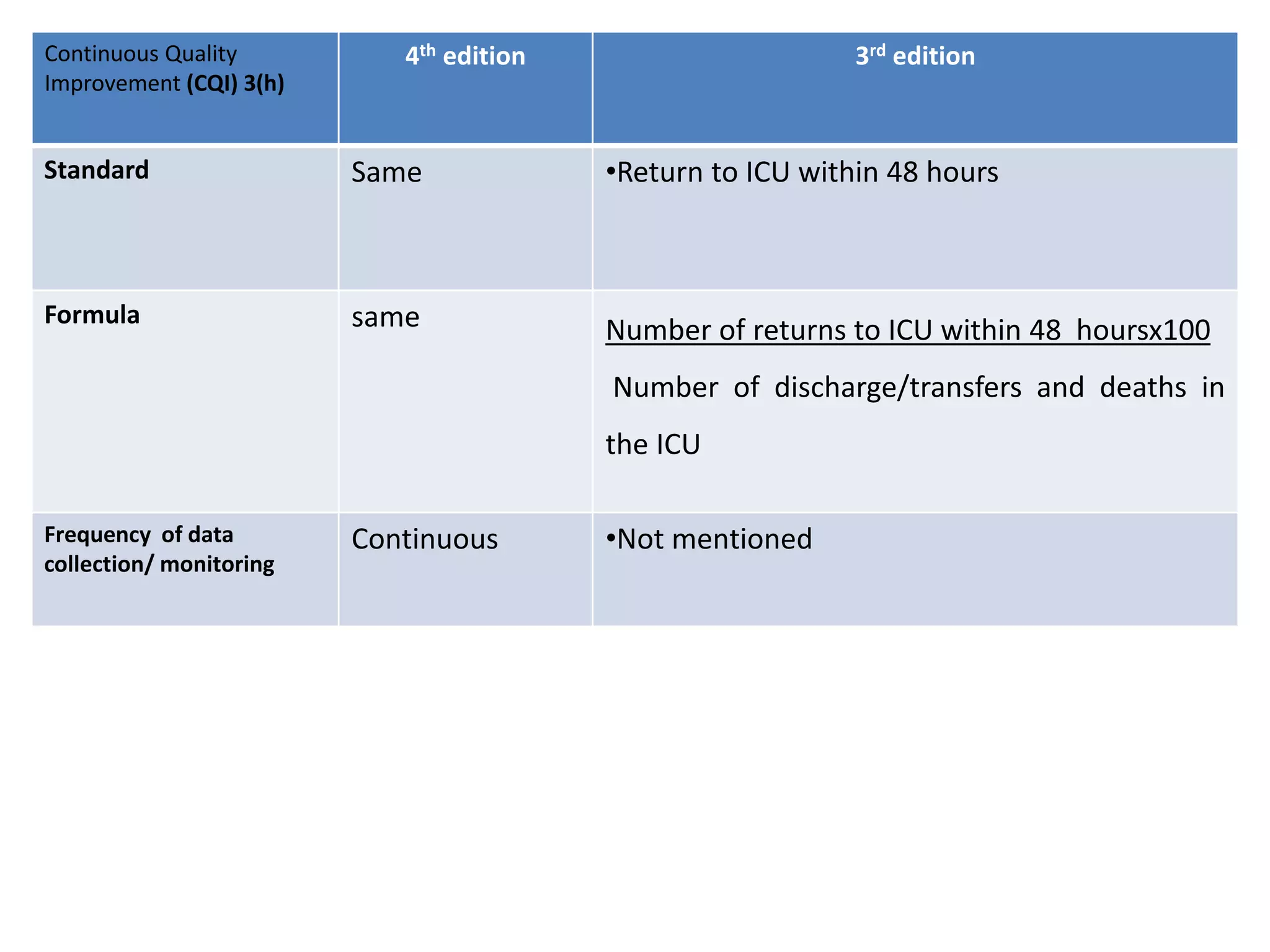
Continuous Quality
Improvement (CQI) 3(h)
4th edition 3rd edition
Standard Same •Return to ICU within 48 hours
Formula same Number of returns to ICU within 48 hoursx100
Number of discharge/transfers and deaths in
the ICU
Frequency of data
collection/ monitoring
Continuous •Not mentioned
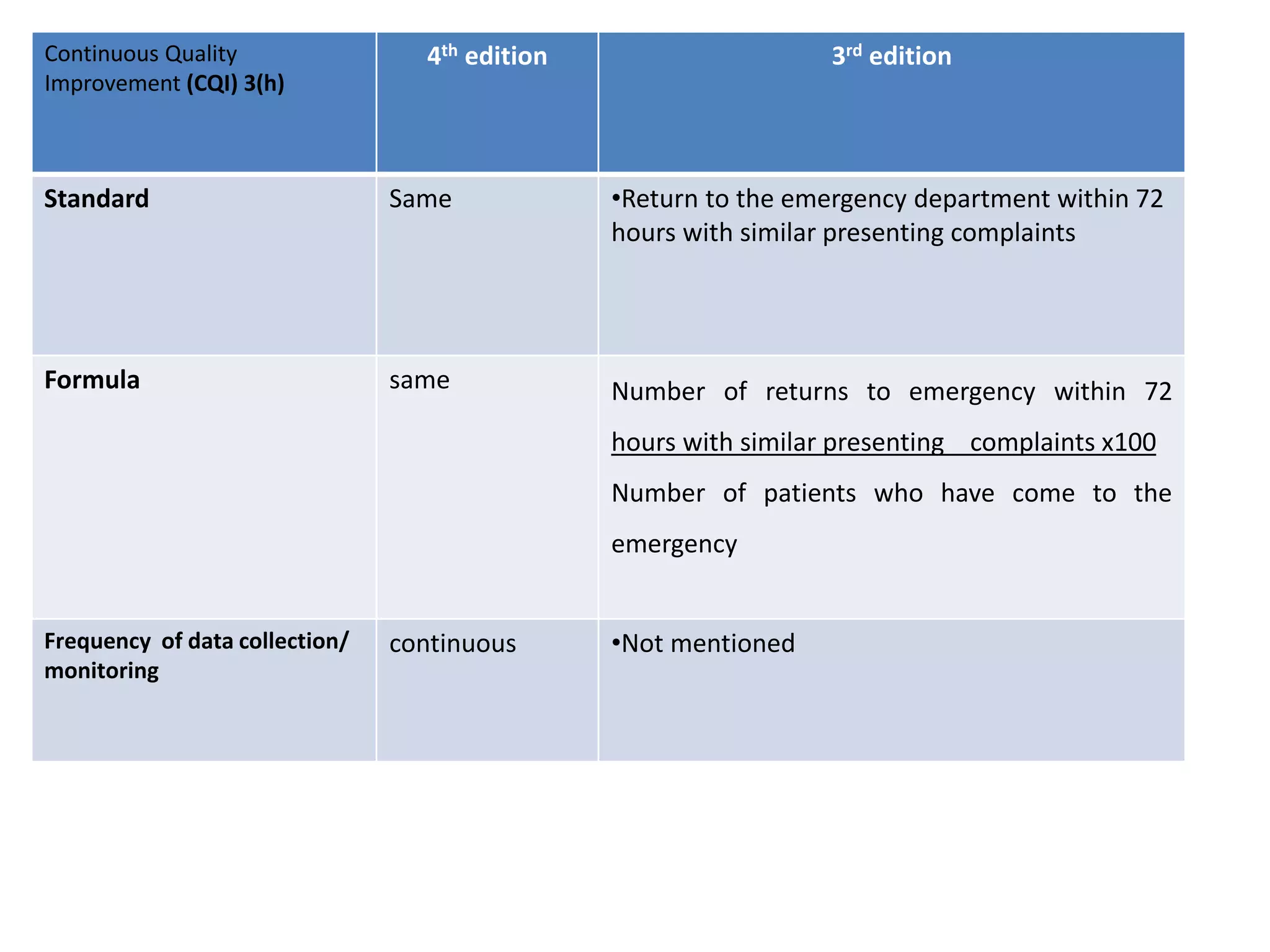
Continuous Quality
Improvement (CQI) 3(h)
4th edition 3rd edition
Standard Same •Return to the emergency department within 72
hours with similar presenting complaints
Formula same Number of returns to emergency within 72
hours with similar presenting complaints x100
Number of patients who have come to the
emergency
Frequency of data collection/
monitoring
continuous •Not mentioned
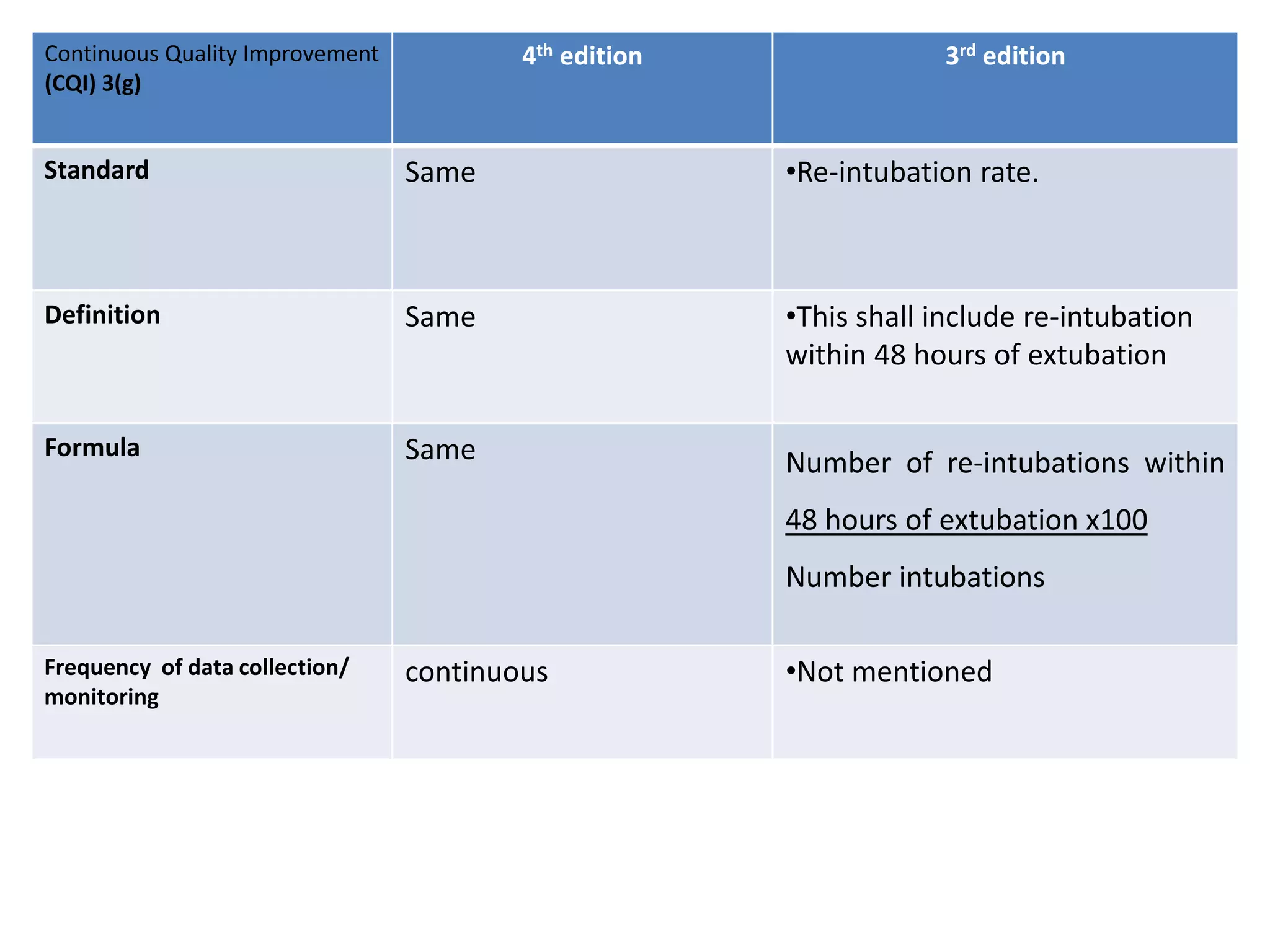
Continuous Quality Improvement
(CQI) 3(g)
4th edition 3rd edition
Standard Same •Re-intubation rate.
Definition Same •This shall include re-intubation
within 48 hours of extubation
Formula Same Number of re-intubations within
48 hours of extubation x100
Number intubations
Frequency of data collection/
monitoring
continuous •Not mentioned
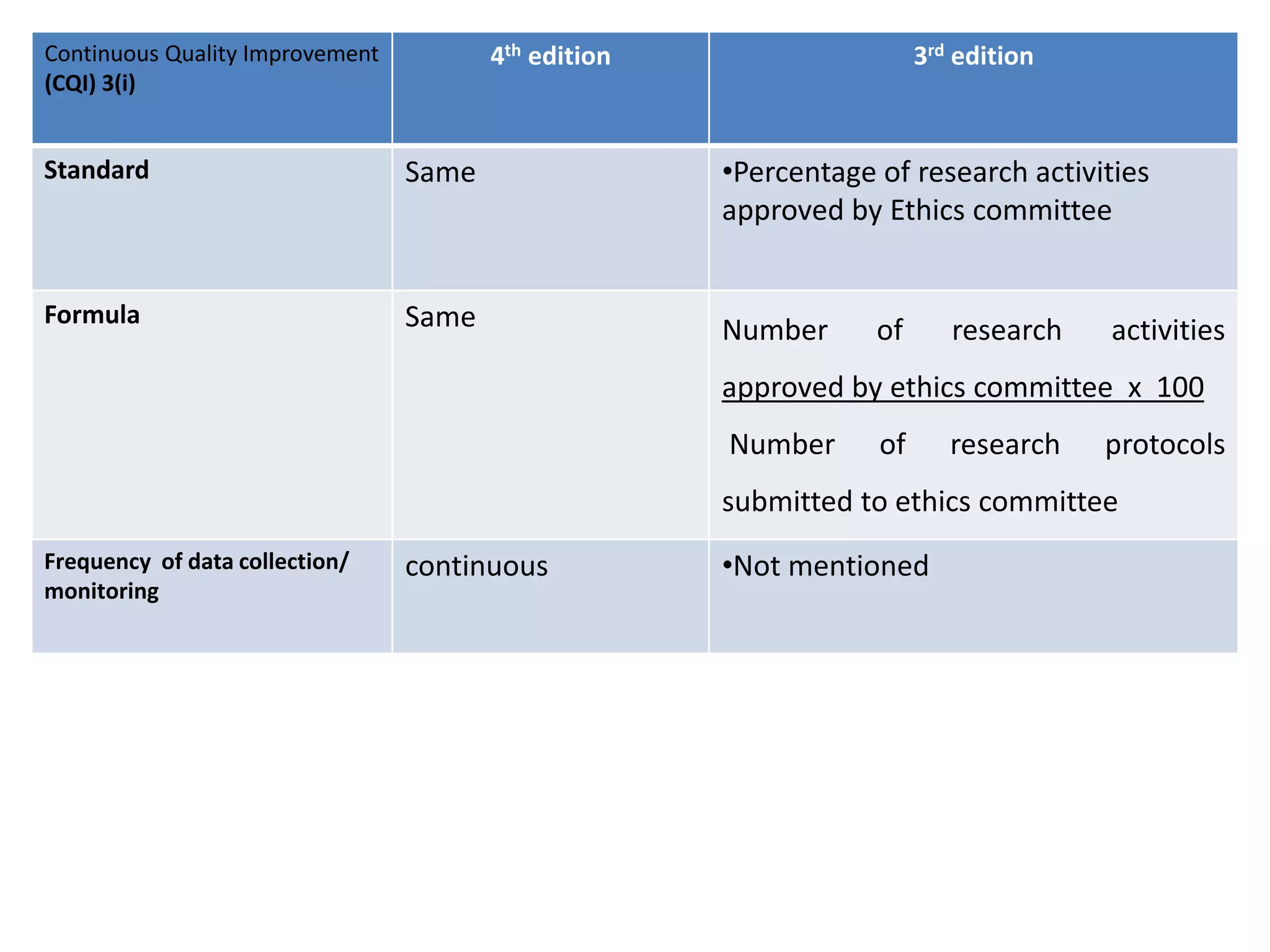
Continuous Quality Improvement
(CQI) 3(i)
4th edition 3rd edition
Standard Same •Percentage of research activities
approved by Ethics committee
Formula Same Number of research activities
approved by ethics committee x 100
Number of research protocols
submitted to ethics committee
Frequency of data collection/
monitoring
continuous •Not mentioned
Continuous Quality
Improvement (CQI) 3(i)
4th edition 3rd edition
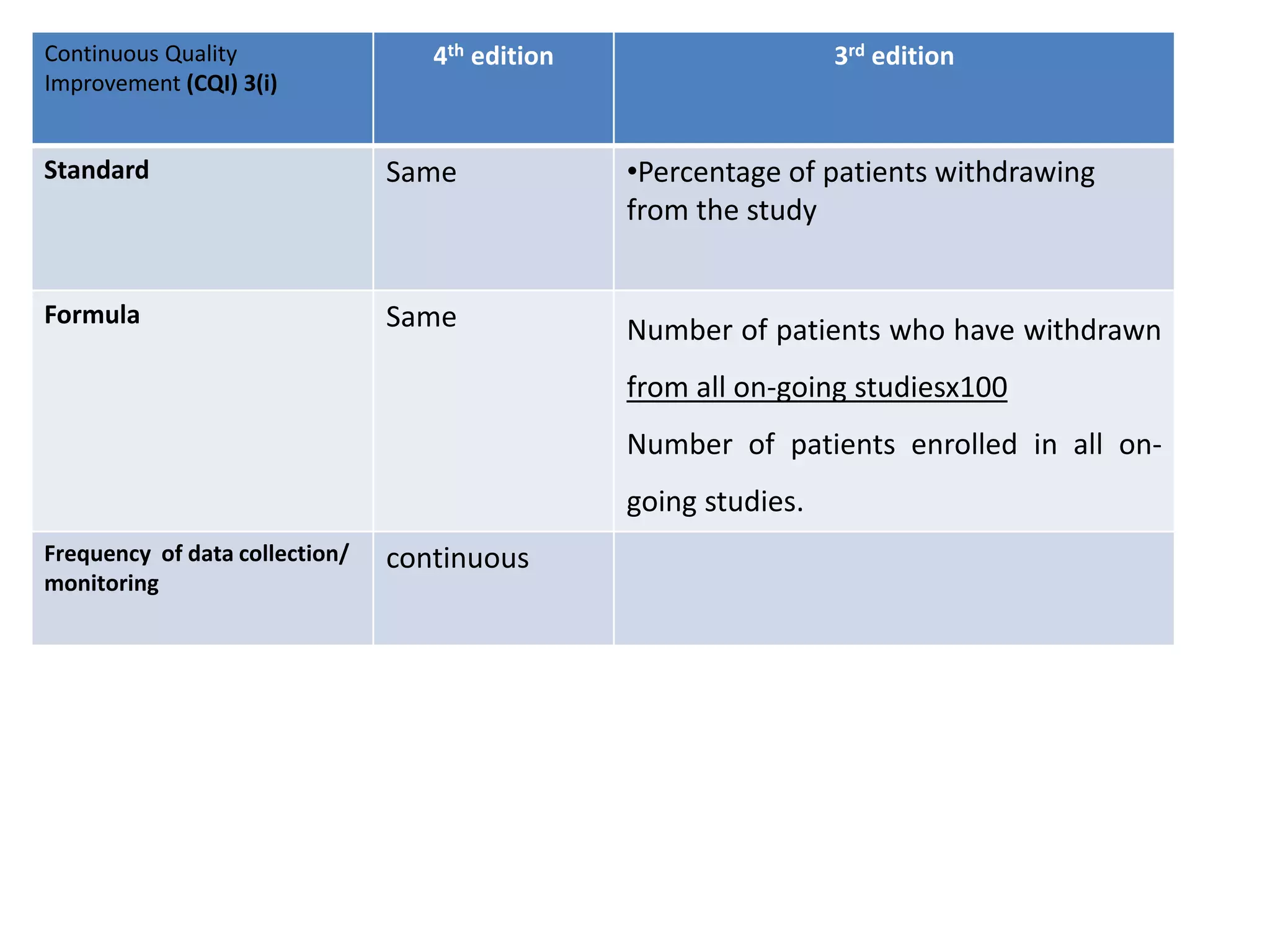
Standard Same •Percentage of patients withdrawing
from the study
Formula Same Number of patients who have withdrawn
from all on-going studiesx100
Number of patients enrolled in all on-
going studies.
Frequency of data collection/
monitoring
continuous
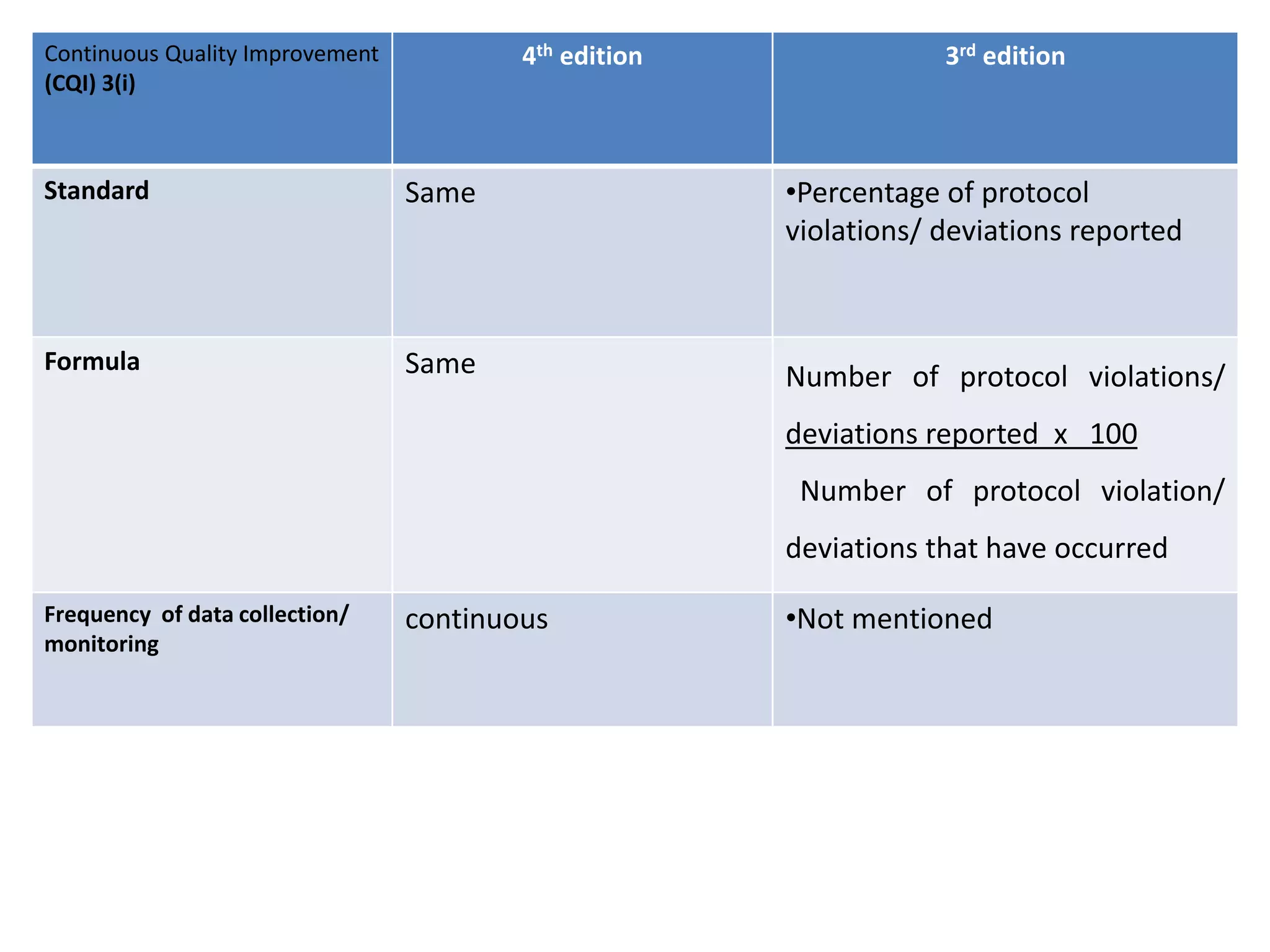
Continuous Quality Improvement
(CQI) 3(i)
4th edition 3rd edition
Standard Same •Percentage of protocol
violations/ deviations reported
Formula Same Number of protocol violations/
deviations reported x 100
Number of protocol violation/
deviations that have occurred
Frequency of data collection/
monitoring
continuous •Not mentioned
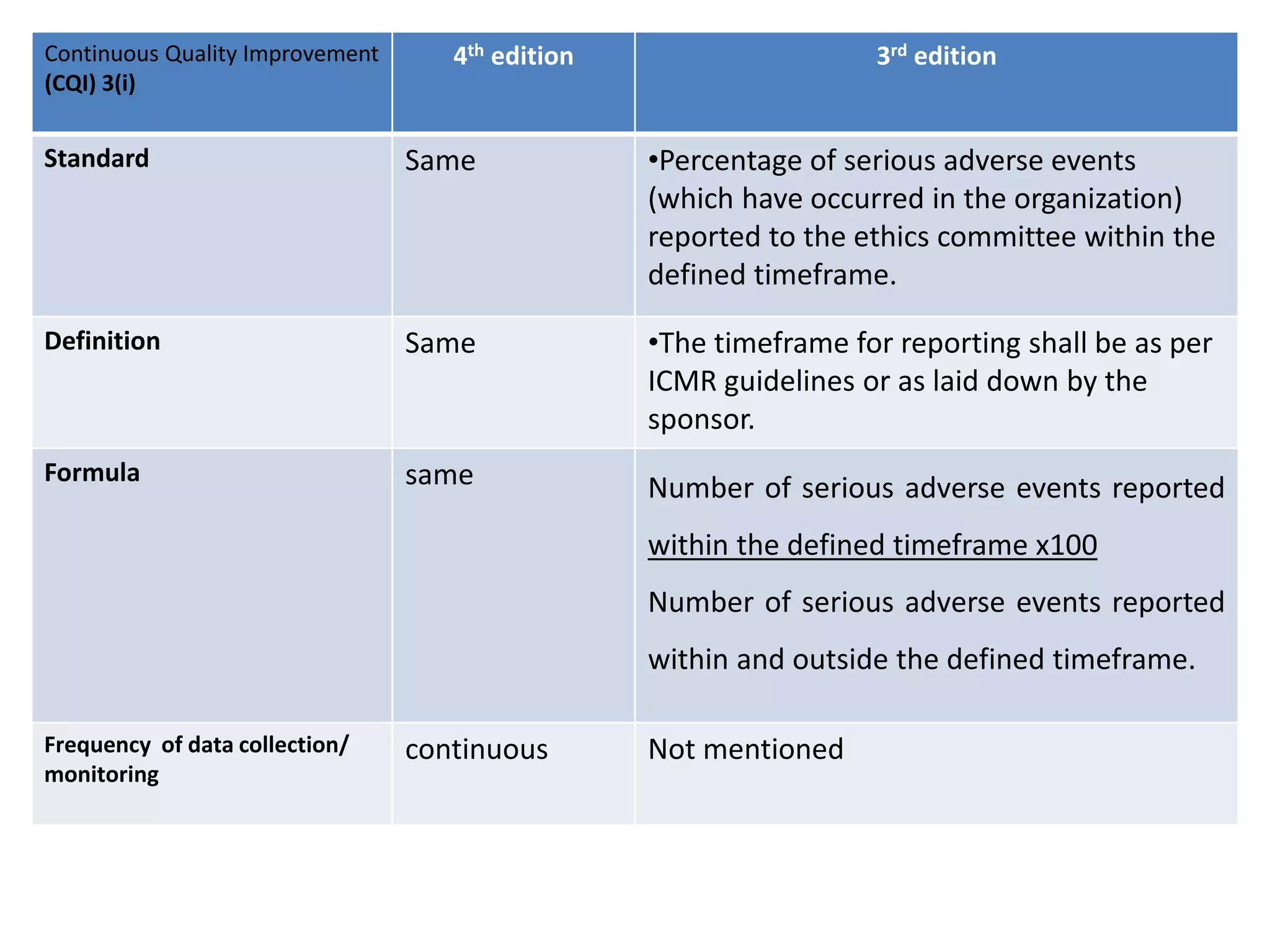
Continuous Quality Improvement
(CQI) 3(i)
4th edition 3rd edition
Standard Same •Percentage of serious adverse events
(which have occurred in the organization)
reported to the ethics committee within the
defined timeframe.
Definition Same •The timeframe for reporting shall be as per
ICMR guidelines or as laid down by the
sponsor.
Formula same Number of serious adverse events reported
within the defined timeframe x100
Number of serious adverse events reported
within and outside the defined timeframe.
Frequency of data collection/
monitoring
continuous Not mentioned
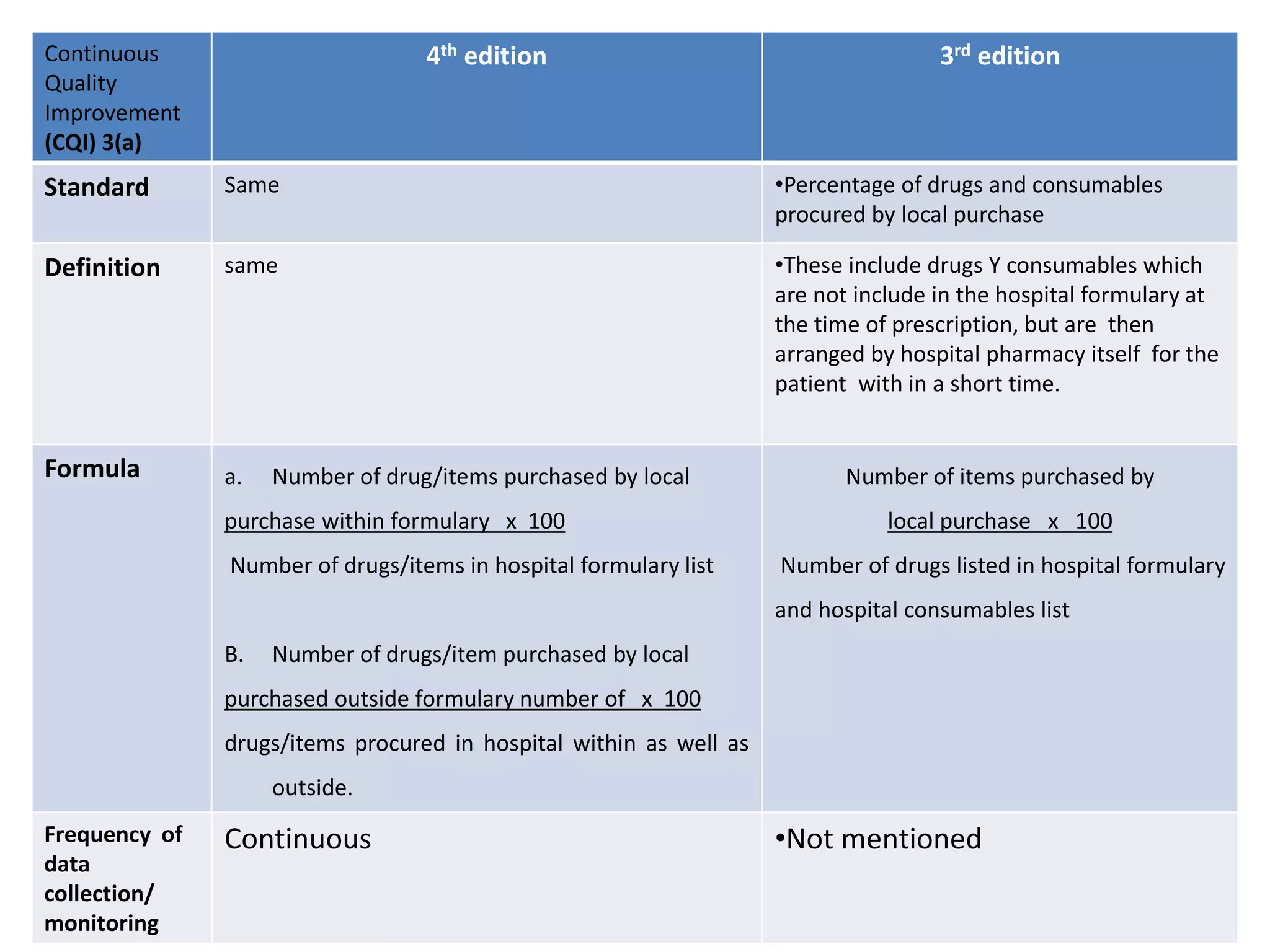
Continuous
Quality
Improvement
(CQI) 3(a)
4th edition 3rd edition
Standard Same •Percentage of drugs and consumables
procured by local purchase
Definition same •These include drugs Y consumables which
are not include in the hospital formulary at
the time of prescription, but are then
arranged by hospital pharmacy itself for the
patient with in a short time.
Formula a. Number of drug/items purchased by local
purchase within formulary x 100
Number of drugs/items in hospital formulary list
B. Number of drugs/item purchased by local
purchased outside formulary number of x 100
drugs/items procured in hospital within as well as
outside.
Number of items purchased by
local purchase x 100
Number of drugs listed in hospital formulary
and hospital consumables list
Frequency of
data
collection/
monitoring
Continuous •Not mentioned
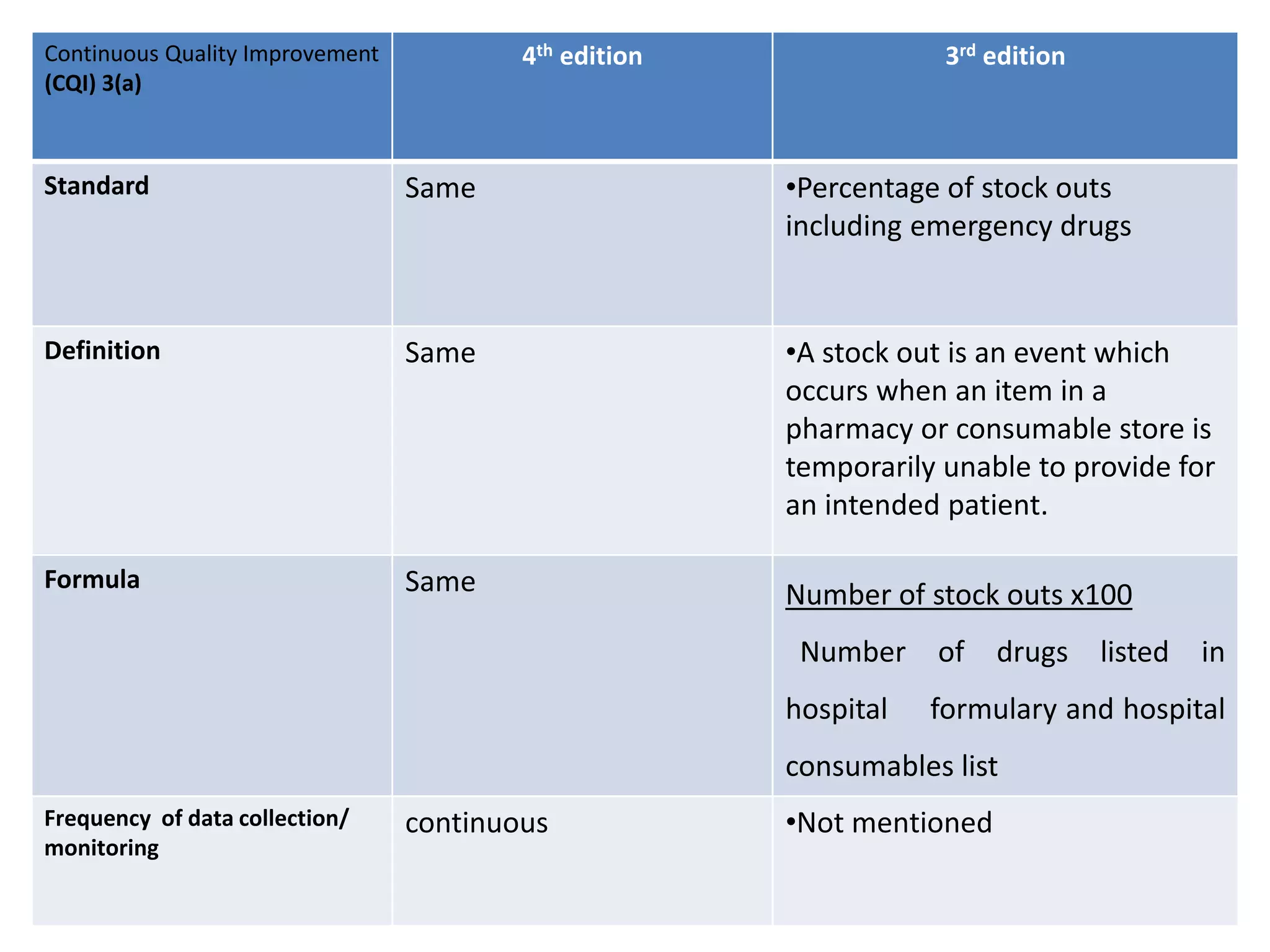
Continuous Quality Improvement
(CQI) 3(a)
4th edition 3rd edition
Standard Same •Percentage of stock outs
including emergency drugs
Definition Same •A stock out is an event which
occurs when an item in a
pharmacy or consumable store is
temporarily unable to provide for
an intended patient.
Formula Same Number of stock outs x100
Number of drugs listed in
hospital formulary and hospital
consumables list
Frequency of data collection/
monitoring
continuous •Not mentioned
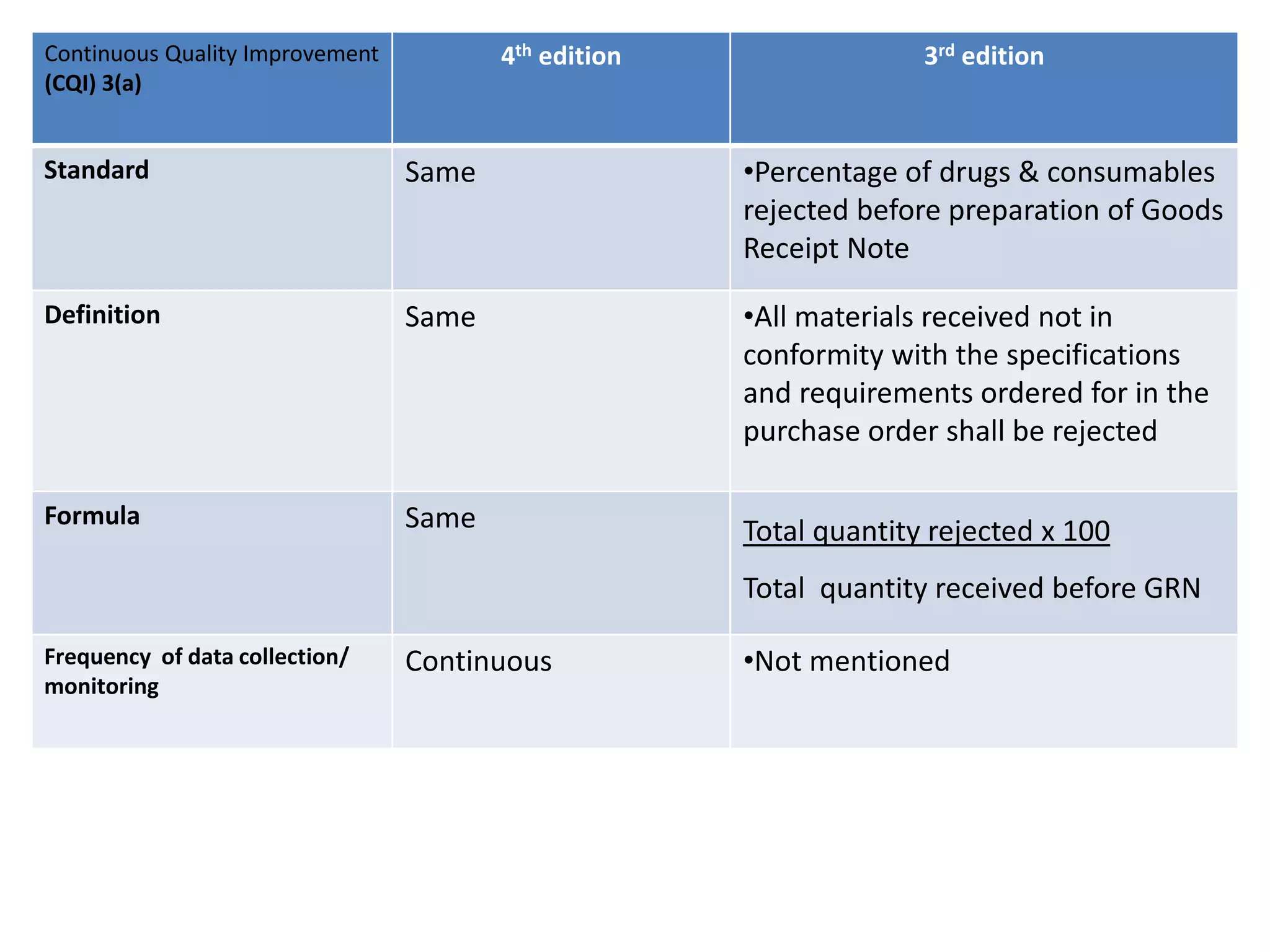
Continuous Quality Improvement
(CQI) 3(a)
4th edition 3rd edition
Standard Same •Percentage of drugs & consumables
rejected before preparation of Goods
Receipt Note
Definition Same •All materials received not in
conformity with the specifications
and requirements ordered for in the
purchase order shall be rejected
Formula Same Total quantity rejected x 100
Total quantity received before GRN
Frequency of data collection/
monitoring
Continuous •Not mentioned
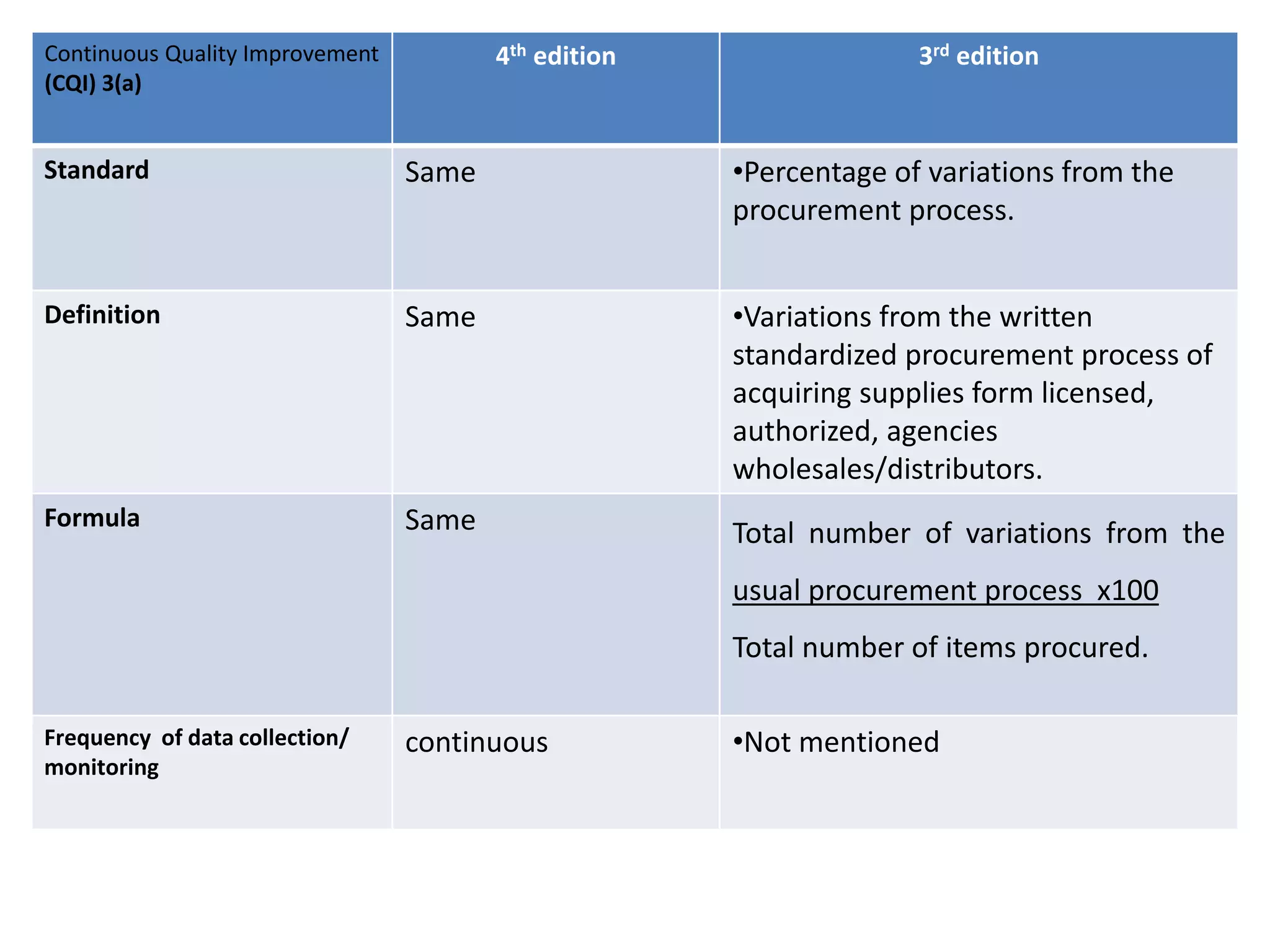
Continuous Quality Improvement
(CQI) 3(a)
4th edition 3rd edition
Standard Same •Percentage of variations from the
procurement process.
Definition Same •Variations from the written
standardized procurement process of
acquiring supplies form licensed,
authorized, agencies
wholesales/distributors.
Formula Same Total number of variations from the
usual procurement process x100
Total number of items procured.
Frequency of data collection/
monitoring
continuous •Not mentioned
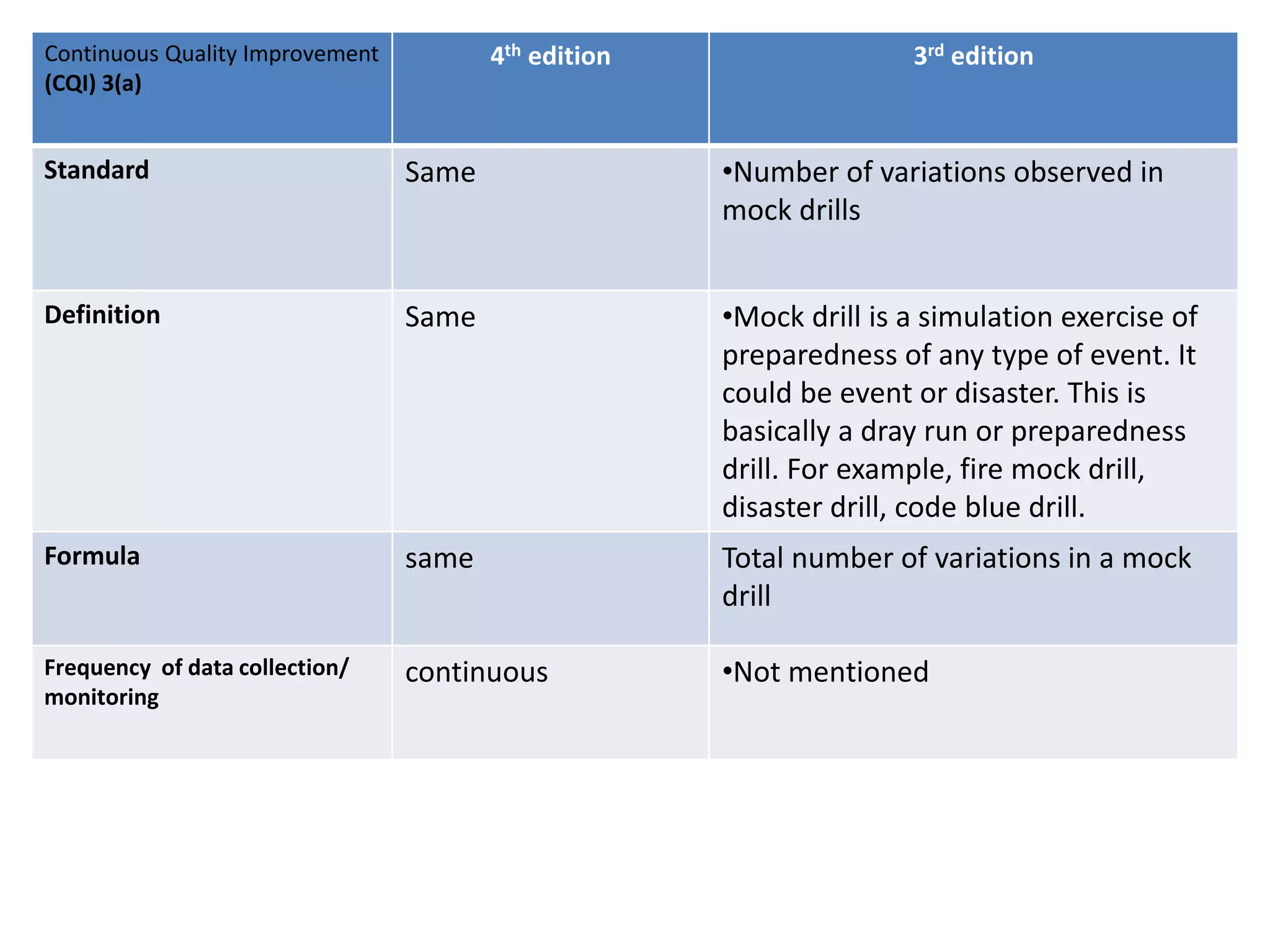
Continuous Quality Improvement
(CQI) 3(a)
4th edition 3rd edition
Standard Same •Number of variations observed in
mock drills
Definition Same •Mock drill is a simulation exercise of
preparedness of any type of event. It
could be event or disaster. This is
basically a dray run or preparedness
drill. For example, fire mock drill,
disaster drill, code blue drill.
Formula same Total number of variations in a mock
drill
Frequency of data collection/
monitoring
continuous •Not mentioned
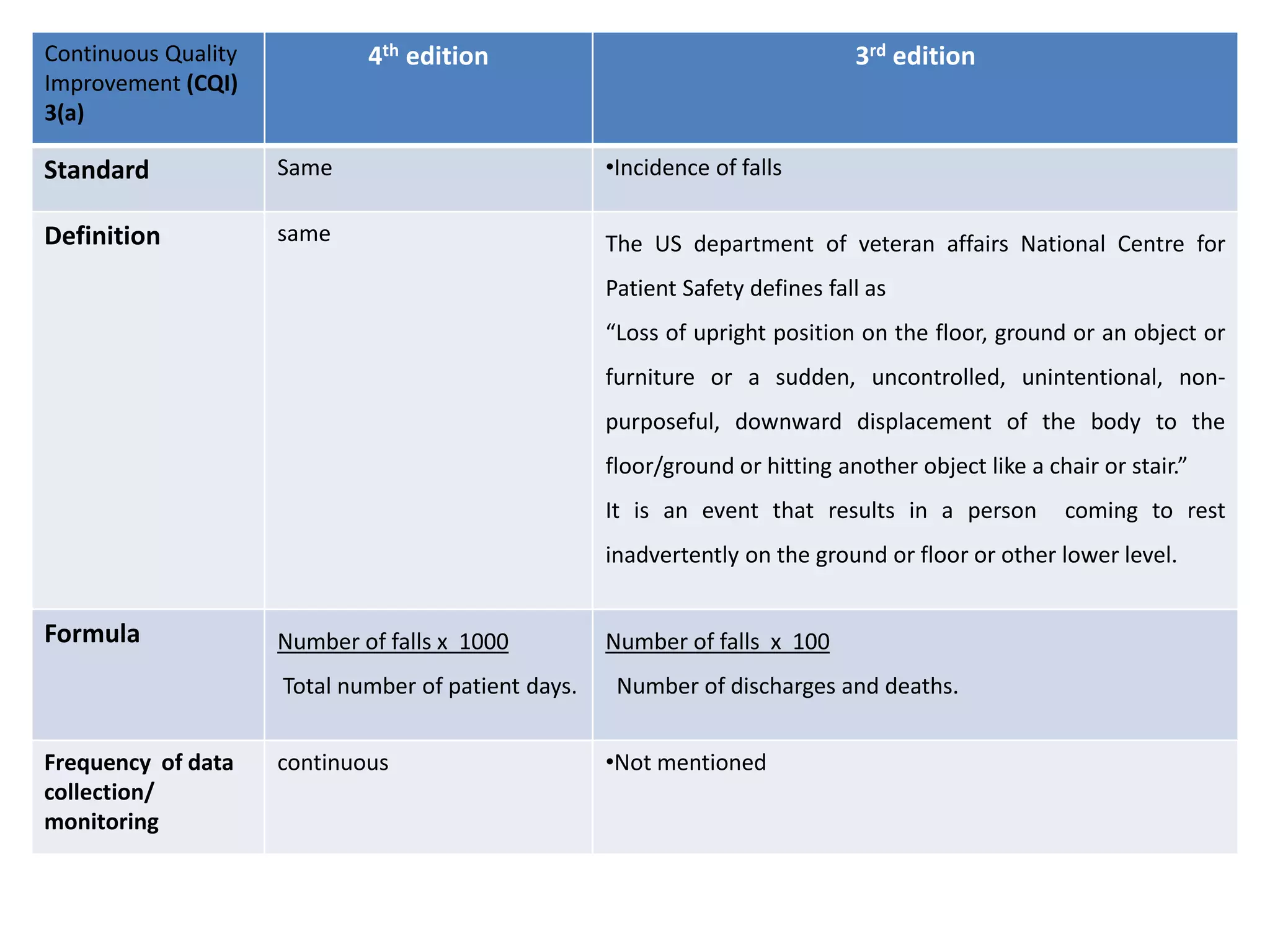
Continuous Quality
Improvement (CQI)
3(a)
4th edition 3rd edition
Standard Same •Incidence of falls
Definition same The US department of veteran affairs National Centre for
Patient Safety defines fall as
“Loss of upright position on the floor, ground or an object or
furniture or a sudden, uncontrolled, unintentional, non-
purposeful, downward displacement of the body to the
floor/ground or hitting another object like a chair or stair.”
It is an event that results in a person coming to rest
inadvertently on the ground or floor or other lower level.
Formula Number of falls x 1000
Total number of patient days.
Number of falls x 100
Number of discharges and deaths.
Frequency of data
collection/
monitoring
continuous •Not mentioned
Continuous Quality
Improvement (CQI)
3(a)
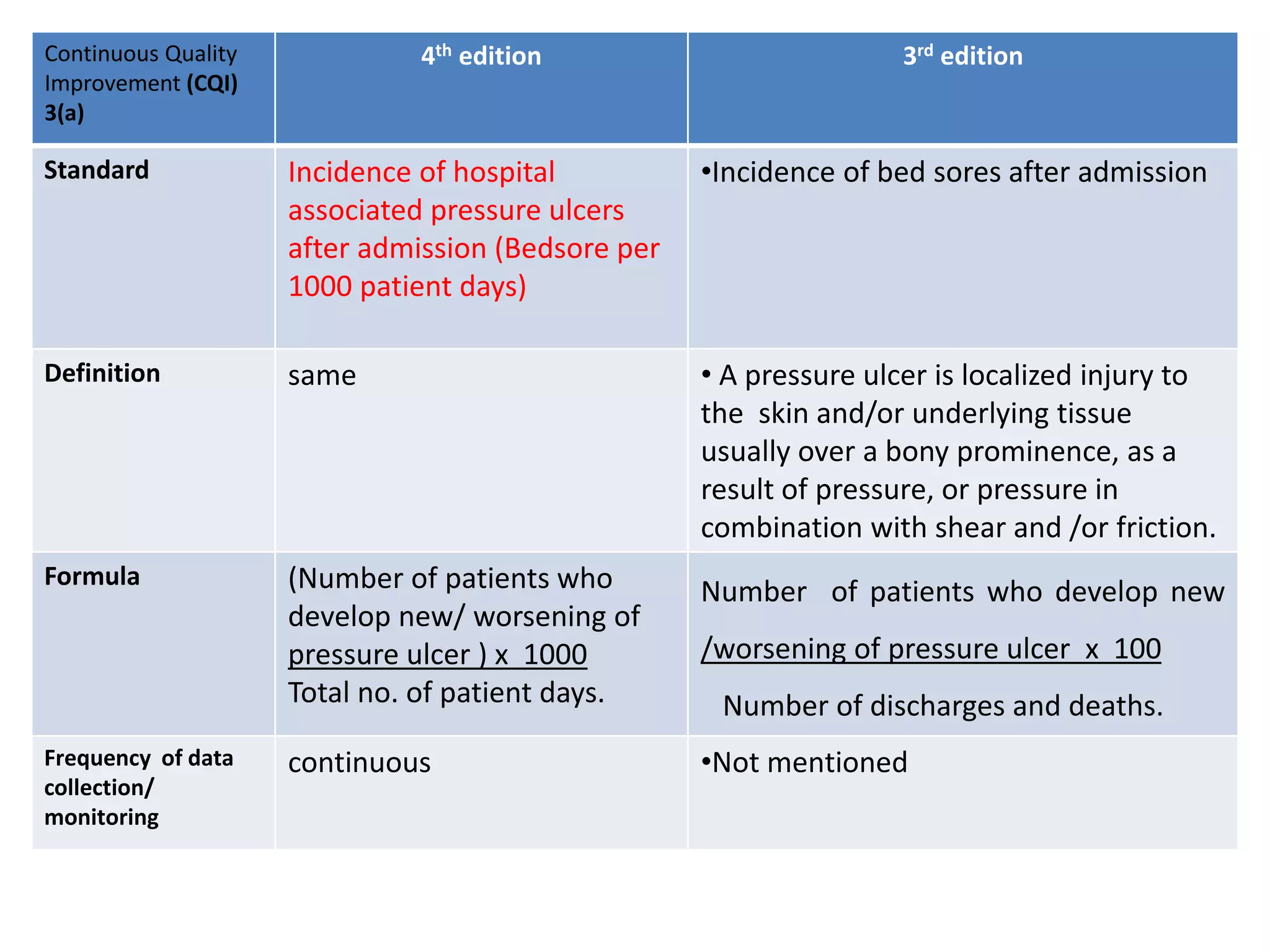
4th edition 3rd edition
Standard Incidence of hospital
associated pressure ulcers
after admission (Bedsore per
1000 patient days)
•Incidence of bed sores after admission
Definition same • A pressure ulcer is localized injury to
the skin and/or underlying tissue
usually over a bony prominence, as a
result of pressure, or pressure in
combination with shear and /or friction.
Formula (Number of patients who
develop new/ worsening of
pressure ulcer ) x 1000
Total no. of patient days.
Number of patients who develop new
/worsening of pressure ulcer x 100
Number of discharges and deaths.
Frequency of data
collection/
monitoring
continuous •Not mentioned
Continuous Quality
Improvement (CQI)
3(a)
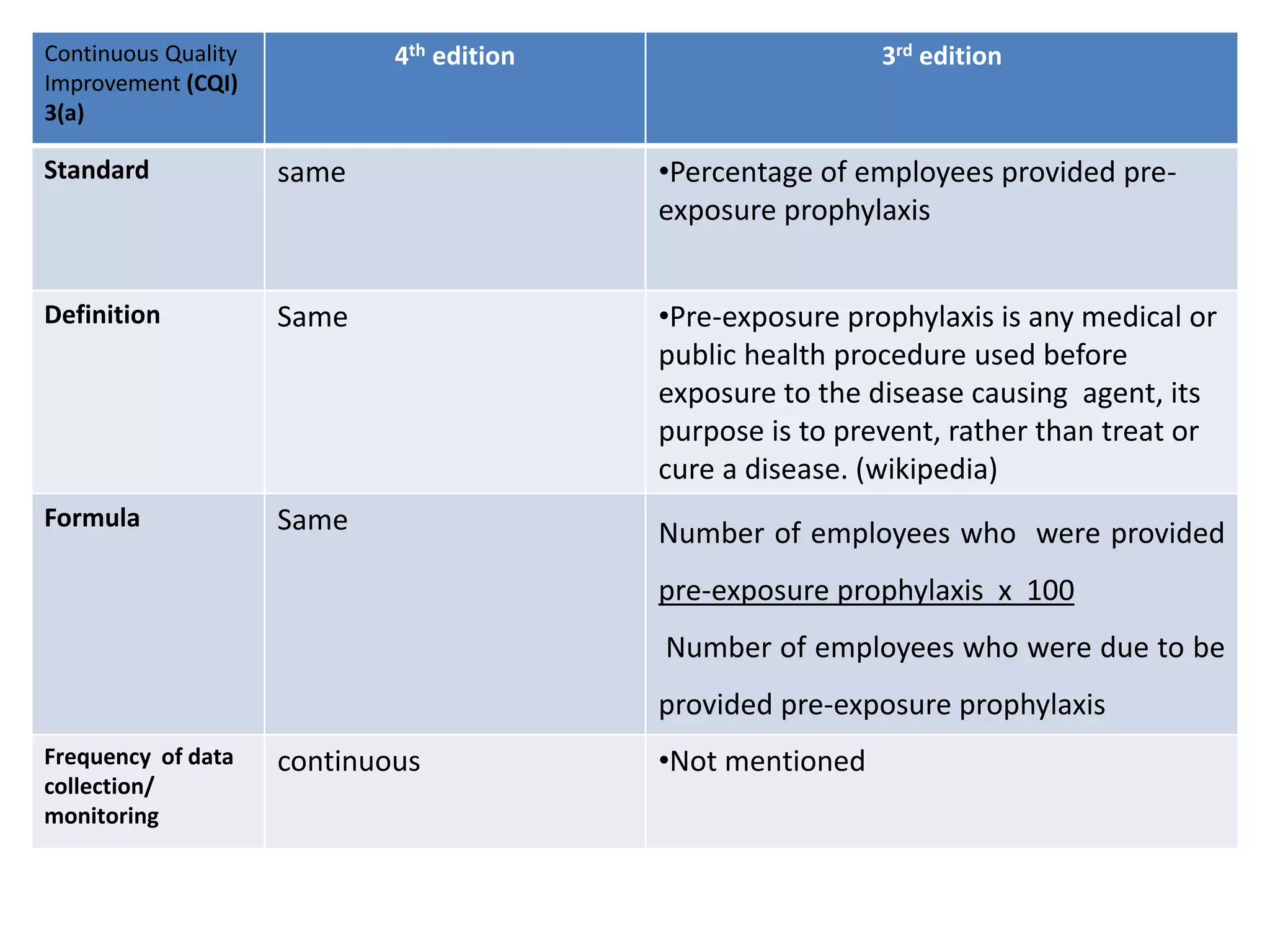
4th edition 3rd edition
Standard same •Percentage of employees provided pre-
exposure prophylaxis
Definition Same •Pre-exposure prophylaxis is any medical or
public health procedure used before
exposure to the disease causing agent, its
purpose is to prevent, rather than treat or
cure a disease. (wikipedia)
Formula Same Number of employees who were provided
pre-exposure prophylaxis x 100
Number of employees who were due to be
provided pre-exposure prophylaxis
Frequency of data
collection/
monitoring
continuous •Not mentioned
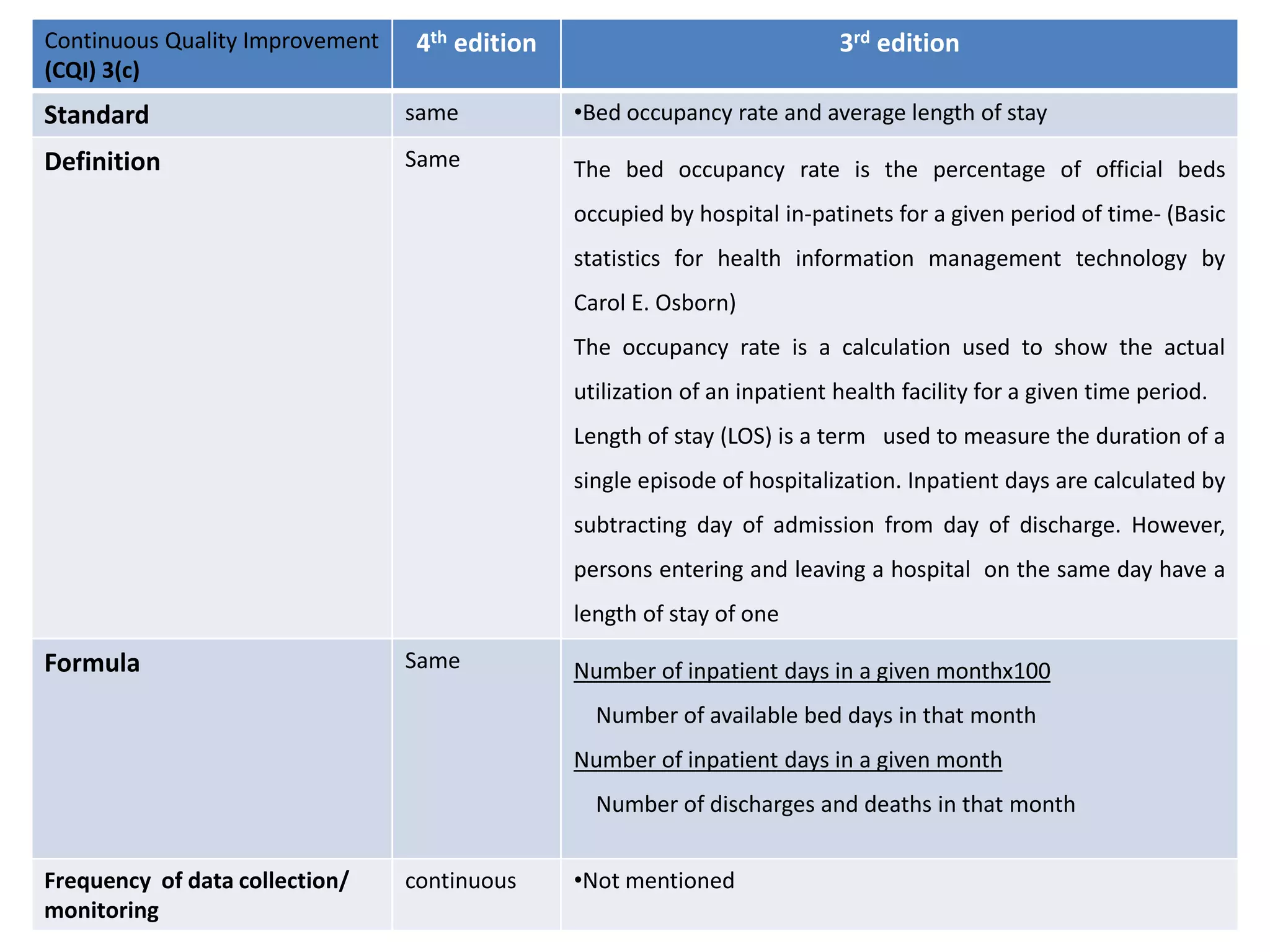
Continuous Quality Improvement
(CQI) 3(c)
4th edition 3rd edition
Standard same •Bed occupancy rate and average length of stay
Definition Same The bed occupancy rate is the percentage of official beds
occupied by hospital in-patinets for a given period of time- (Basic
statistics for health information management technology by
Carol E. Osborn)
The occupancy rate is a calculation used to show the actual
utilization of an inpatient health facility for a given time period.
Length of stay (LOS) is a term used to measure the duration of a
single episode of hospitalization. Inpatient days are calculated by
subtracting day of admission from day of discharge. However,
persons entering and leaving a hospital on the same day have a
length of stay of one
Formula Same Number of inpatient days in a given monthx100
Number of available bed days in that month
Number of inpatient days in a given month
Number of discharges and deaths in that month
Frequency of data collection/
monitoring
continuous •Not mentioned
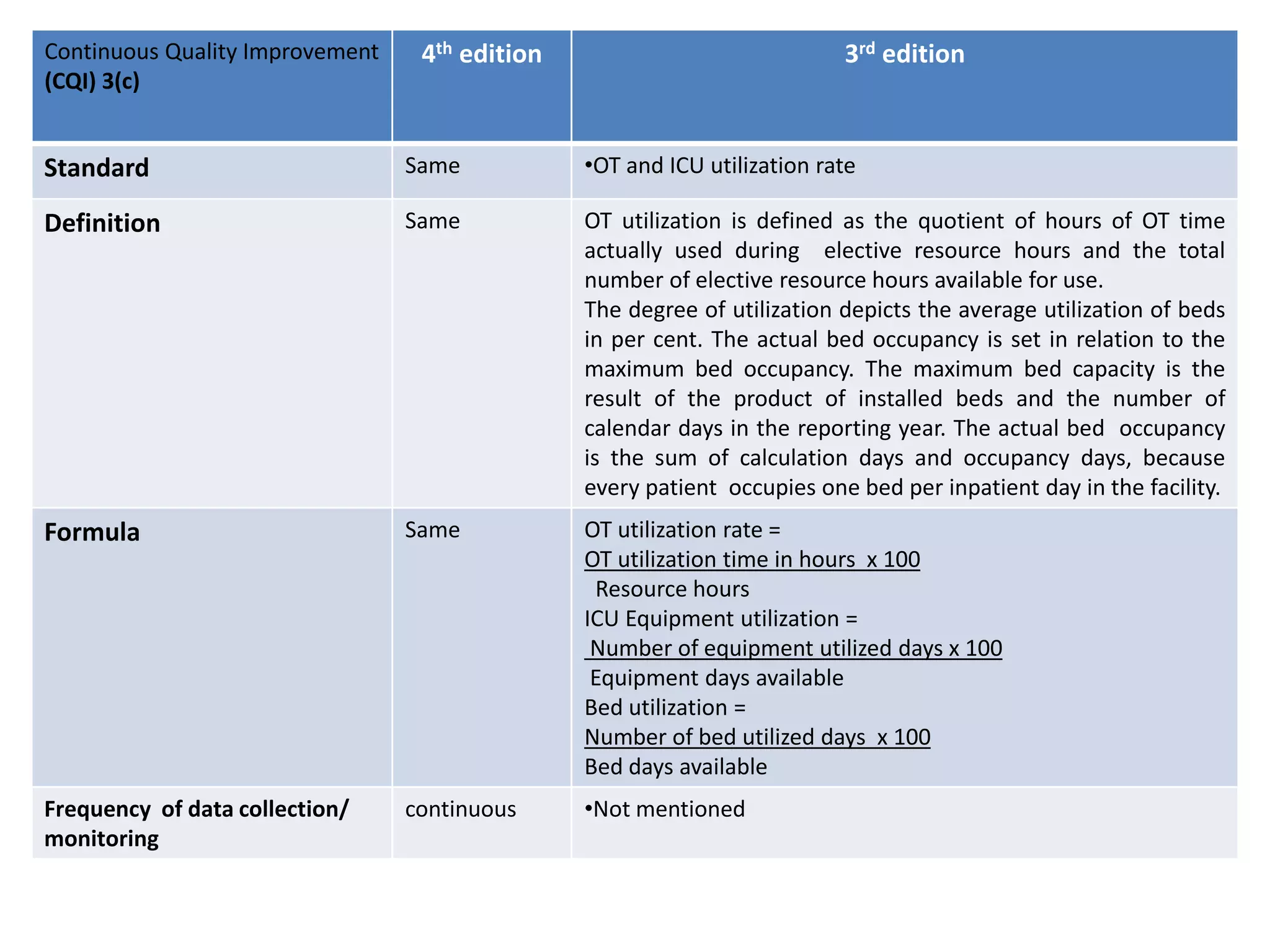
Continuous Quality Improvement
(CQI) 3(c)
4th edition 3rd edition
Standard Same •OT and ICU utilization rate
Definition Same OT utilization is defined as the quotient of hours of OT time
actually used during elective resource hours and the total
number of elective resource hours available for use.
The degree of utilization depicts the average utilization of beds
in per cent. The actual bed occupancy is set in relation to the
maximum bed occupancy. The maximum bed capacity is the
result of the product of installed beds and the number of
calendar days in the reporting year. The actual bed occupancy
is the sum of calculation days and occupancy days, because
every patient occupies one bed per inpatient day in the facility.
Formula Same OT utilization rate =
OT utilization time in hours x 100
Resource hours
ICU Equipment utilization =
Number of equipment utilized days x 100
Equipment days available
Bed utilization =
Number of bed utilized days x 100
Bed days available
Frequency of data collection/
monitoring
continuous •Not mentioned
Continuous Quality Improvement
(CQI) 3(c)
4th edition 3rd edition
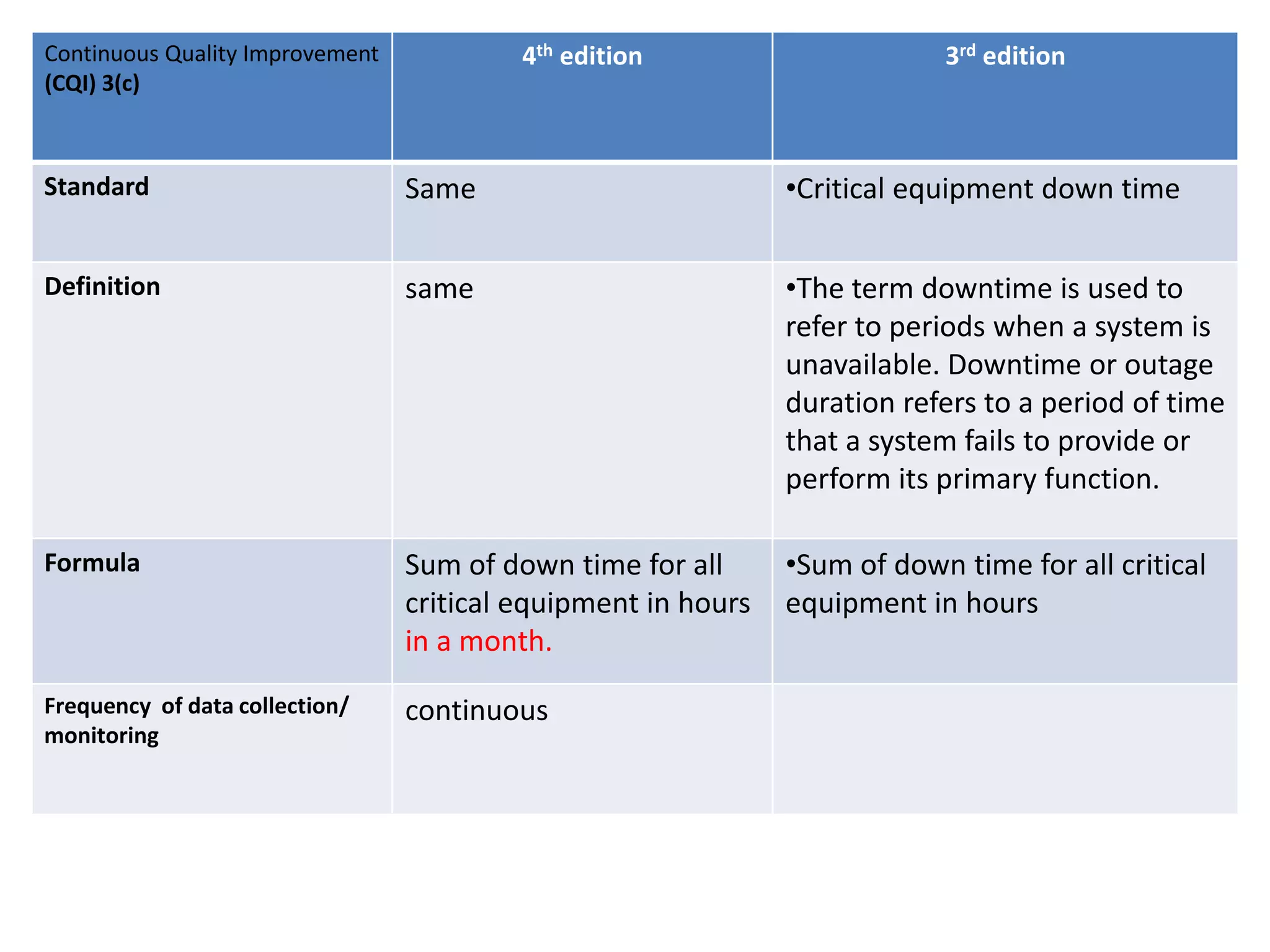
Standard Same •Critical equipment down time
Definition same •The term downtime is used to
refer to periods when a system is
unavailable. Downtime or outage
duration refers to a period of time
that a system fails to provide or
perform its primary function.
Formula Sum of down time for all
critical equipment in hours
in a month.
•Sum of down time for all critical
equipment in hours
Frequency of data collection/
monitoring
continuous
Continuous Quality Improvement
(CQI) 3(c)
4th edition 3rd edition
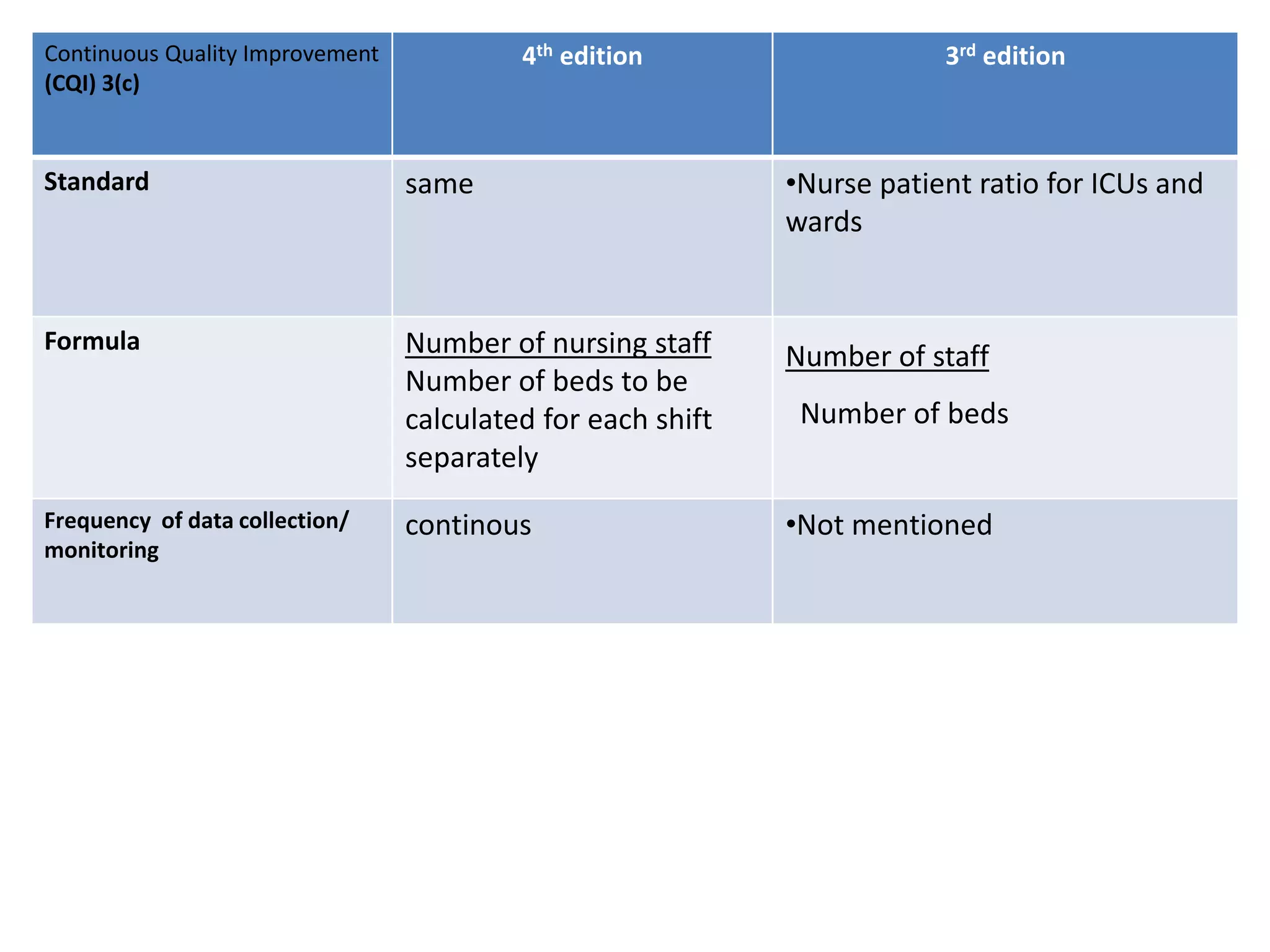
Standard same •Nurse patient ratio for ICUs and
wards
Formula Number of nursing staff
Number of beds to be
calculated for each shift
separately
Number of staff
Number of beds
Frequency of data collection/
monitoring
continous •Not mentioned
Continuous Quality
Improvement (CQI)
3(d)
4th edition 3rd edition
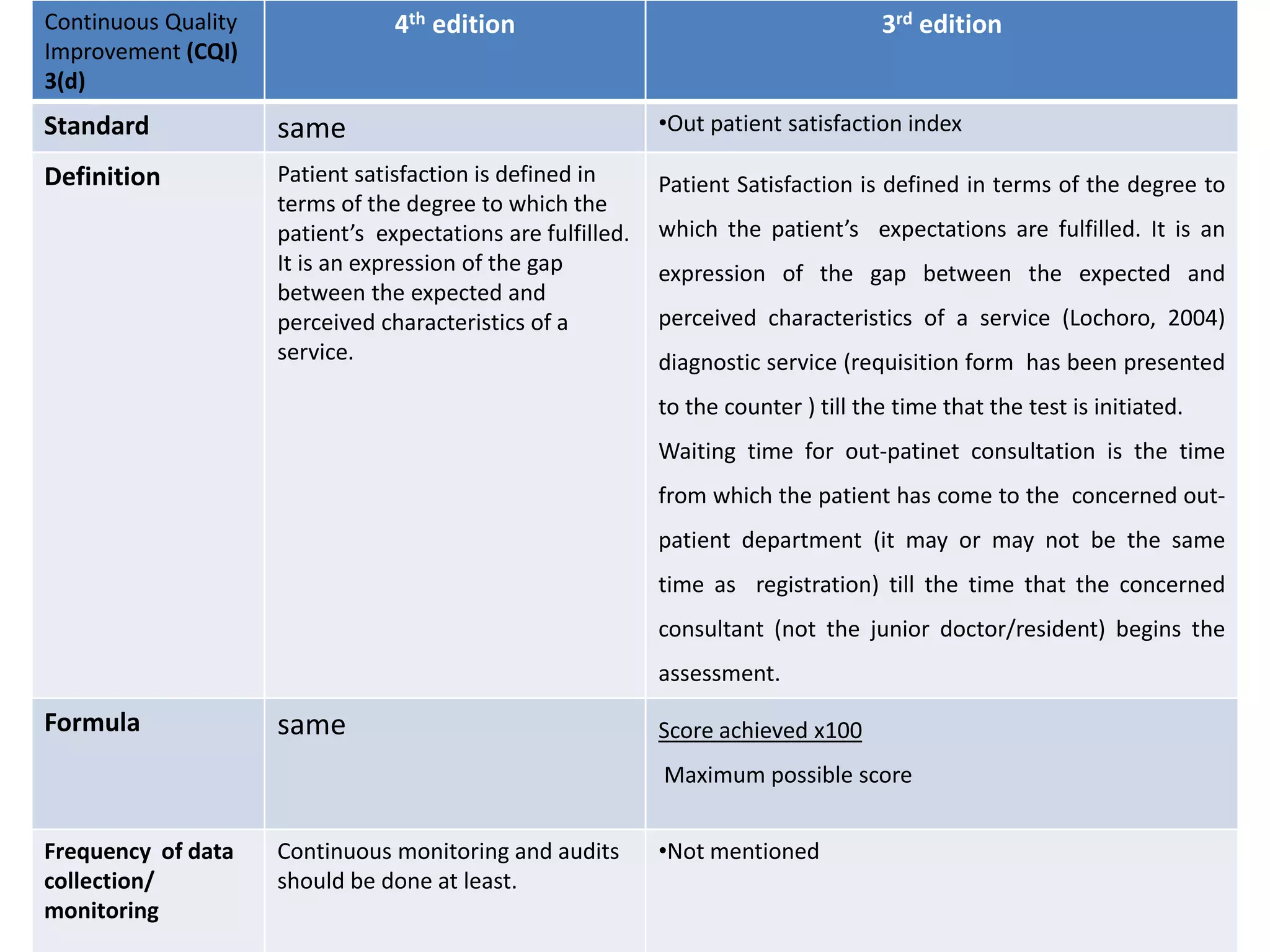
Standard same •Out patient satisfaction index
Definition Patient satisfaction is defined in
terms of the degree to which the
patient’s expectations are fulfilled.
It is an expression of the gap
between the expected and
perceived characteristics of a
service.
Patient Satisfaction is defined in terms of the degree to
which the patient’s expectations are fulfilled. It is an
expression of the gap between the expected and
perceived characteristics of a service (Lochoro, 2004)
diagnostic service (requisition form has been presented
to the counter ) till the time that the test is initiated.
Waiting time for out-patinet consultation is the time
from which the patient has come to the concerned out-
patient department (it may or may not be the same
time as registration) till the time that the concerned
consultant (not the junior doctor/resident) begins the
assessment.
Formula same Score achieved x100
Maximum possible score
Frequency of data
collection/
monitoring
Continuous monitoring and audits
should be done at least.
•Not mentioned
Continuous Quality Improvement
(CQI) 3(d)
4th edition 3rd edition
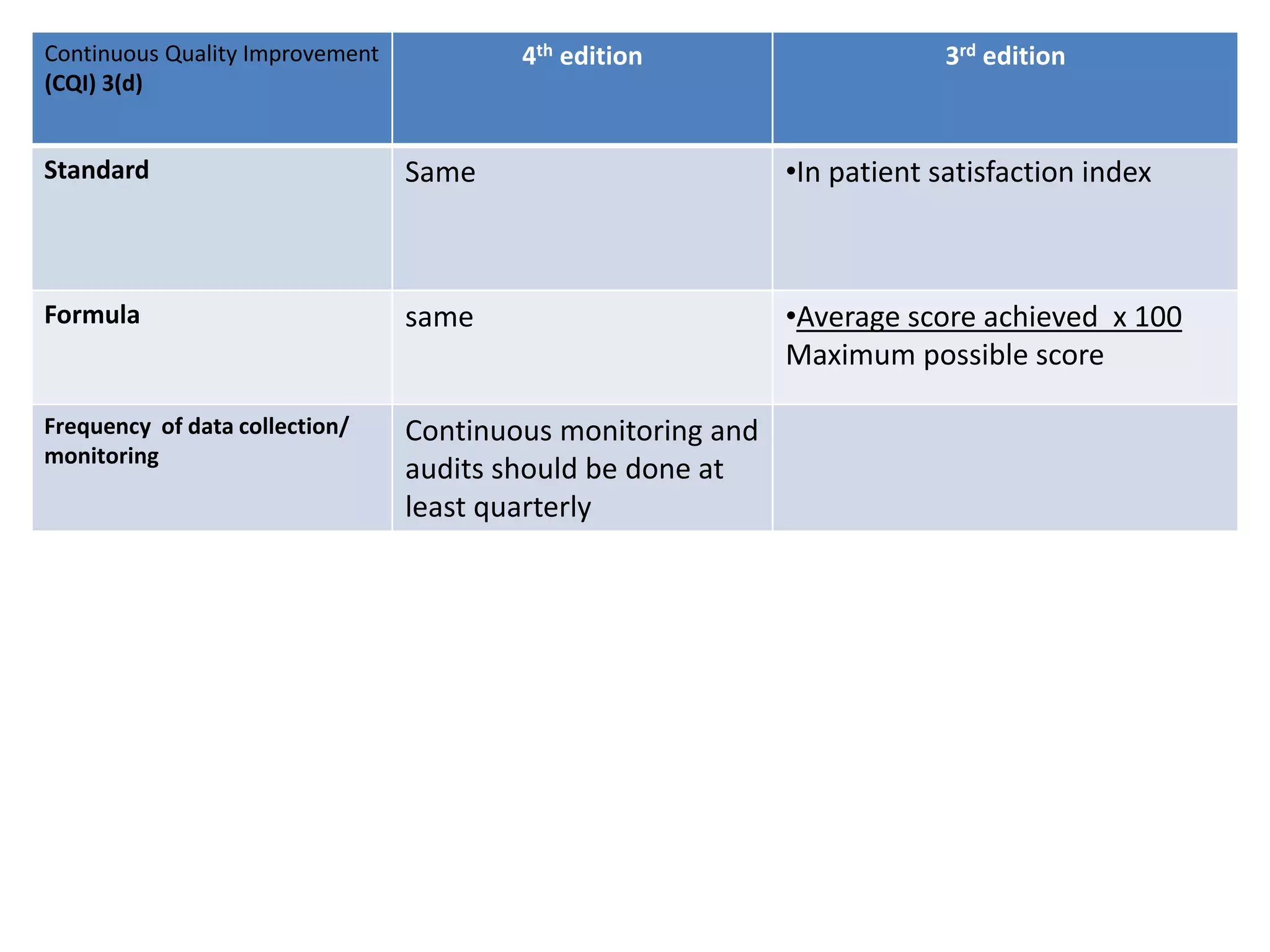
Standard Same •In patient satisfaction index
Formula same •Average score achieved x 100
Maximum possible score
Frequency of data collection/
monitoring
Continuous monitoring and
audits should be done at
least quarterly
Continuous Quality
Improvement (CQI)
3(a)
4th edition 3rd edition
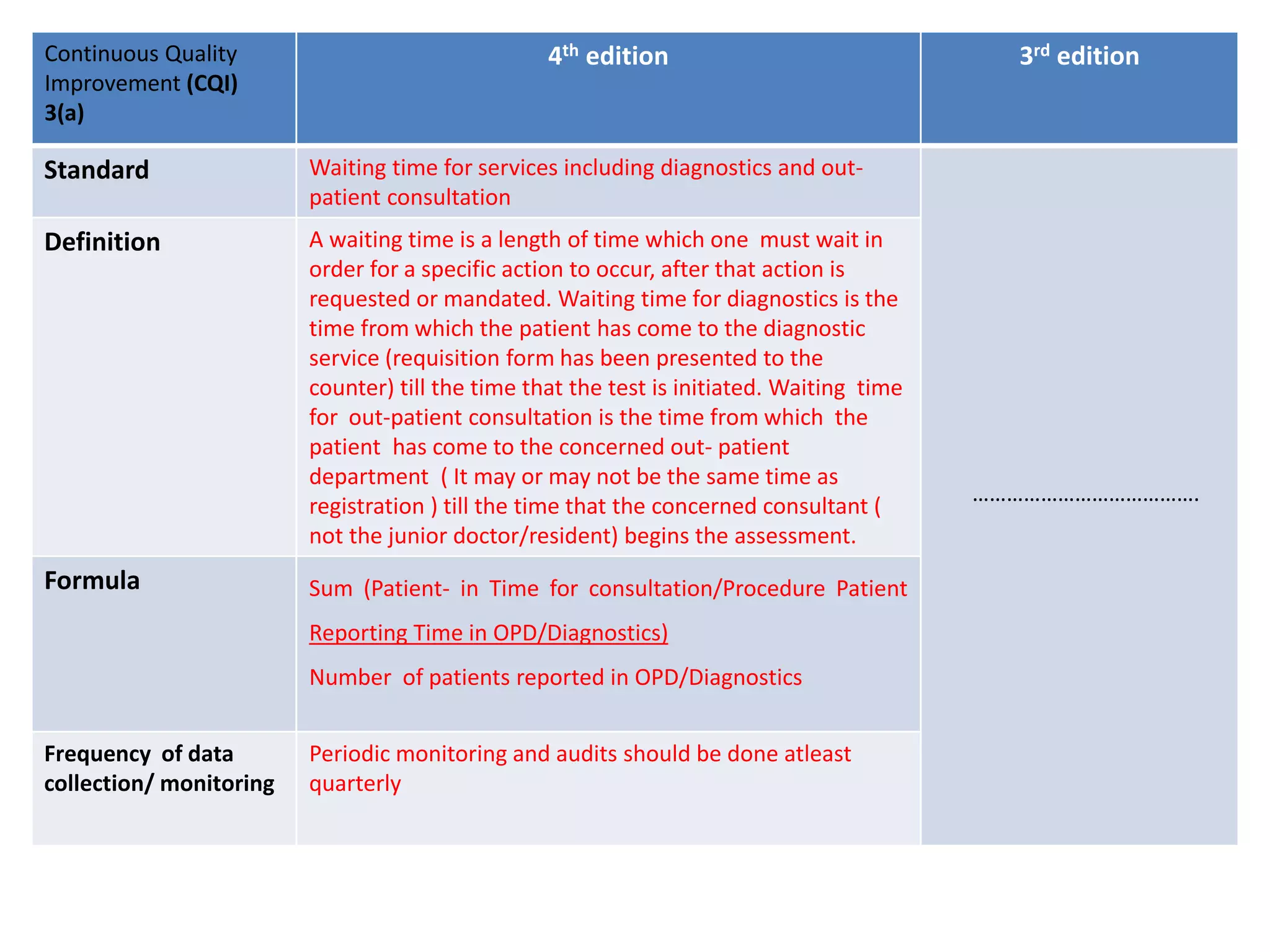
Standard Waiting time for services including diagnostics and out-
patient consultation
………………………………….
Definition A waiting time is a length of time which one must wait in
order for a specific action to occur, after that action is
requested or mandated. Waiting time for diagnostics is the
time from which the patient has come to the diagnostic
service (requisition form has been presented to the
counter) till the time that the test is initiated. Waiting time
for out-patient consultation is the time from which the
patient has come to the concerned out- patient
department ( It may or may not be the same time as
registration ) till the time that the concerned consultant (
not the junior doctor/resident) begins the assessment.
Formula Sum (Patient- in Time for consultation/Procedure Patient
Reporting Time in OPD/Diagnostics)
Number of patients reported in OPD/Diagnostics
Frequency of data
collection/ monitoring
Periodic monitoring and audits should be done atleast
quarterly
Continuous Quality
Improvement (CQI) 3(d)
4th edition 3rd edition
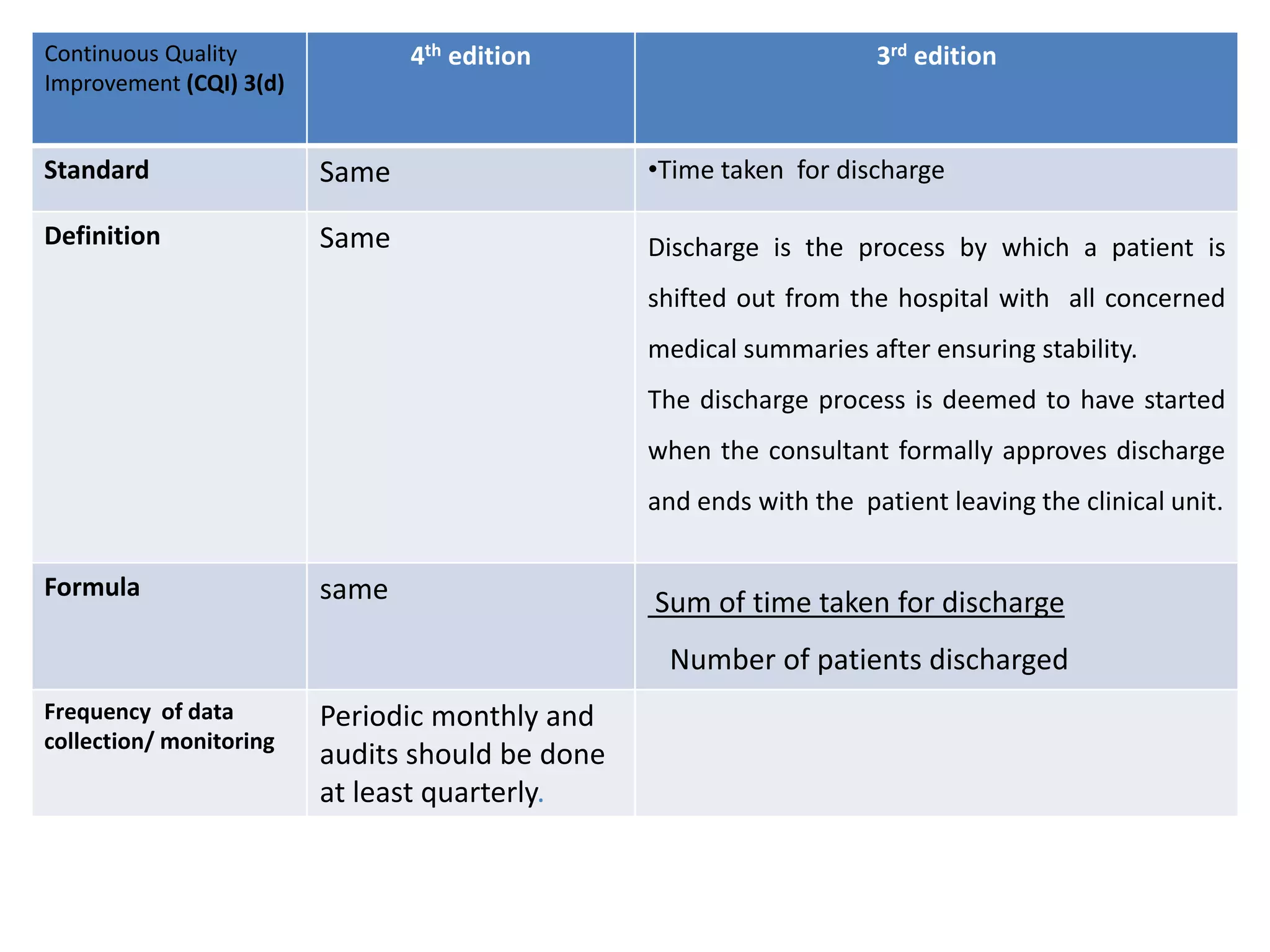
Standard Same •Time taken for discharge
Definition Same Discharge is the process by which a patient is
shifted out from the hospital with all concerned
medical summaries after ensuring stability.
The discharge process is deemed to have started
when the consultant formally approves discharge
and ends with the patient leaving the clinical unit.
Formula same Sum of time taken for discharge
Number of patients discharged
Frequency of data
collection/ monitoring
Periodic monthly and
audits should be done
at least quarterly.
Continuous Quality Improvement
(CQI) 3(a)
4th edition 3rd edition
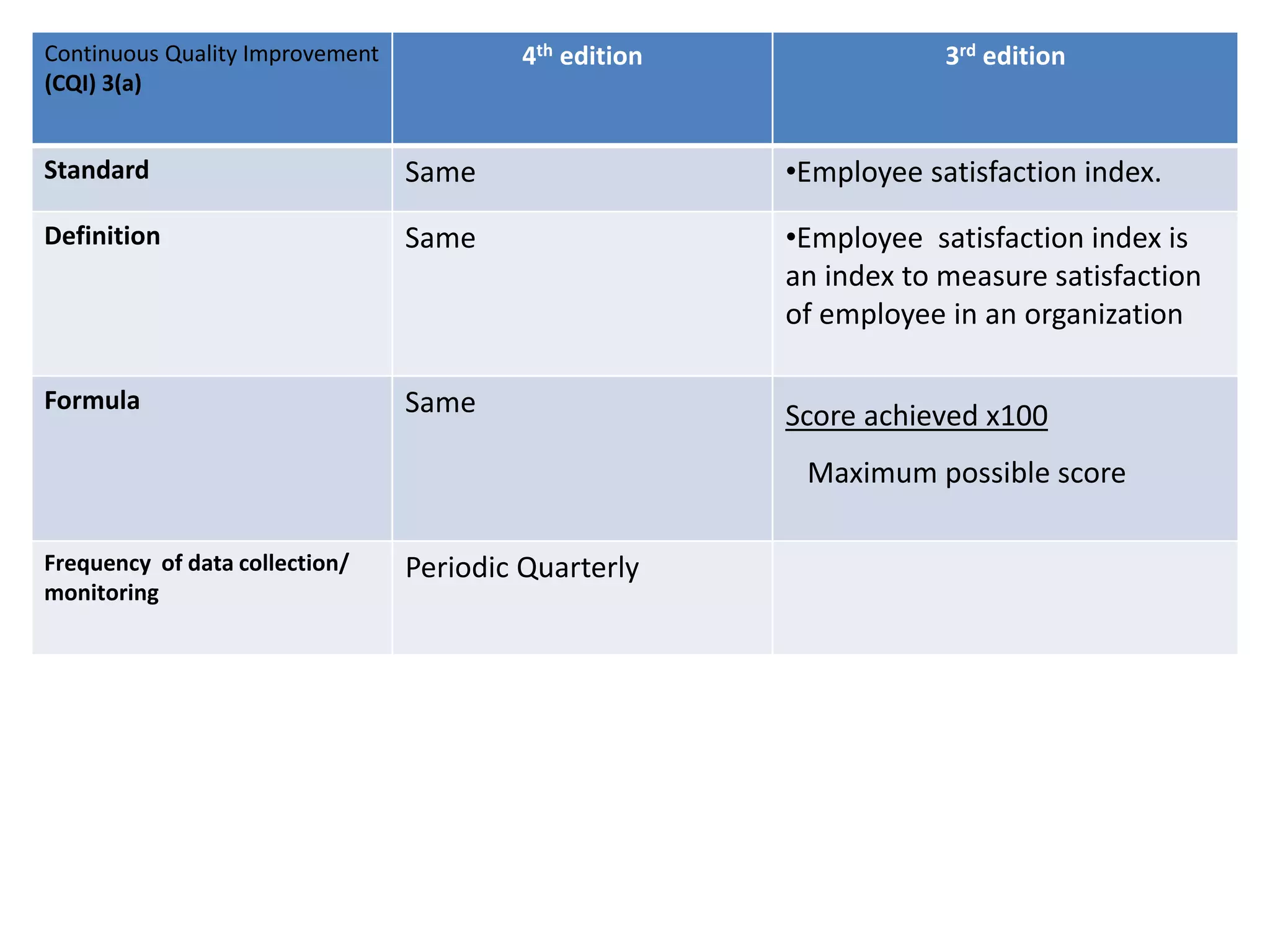
Standard Same •Employee satisfaction index.
Definition Same •Employee satisfaction index is
an index to measure satisfaction
of employee in an organization
Formula Same Score achieved x100
Maximum possible score
Frequency of data collection/
monitoring
Periodic Quarterly
Continuous Quality
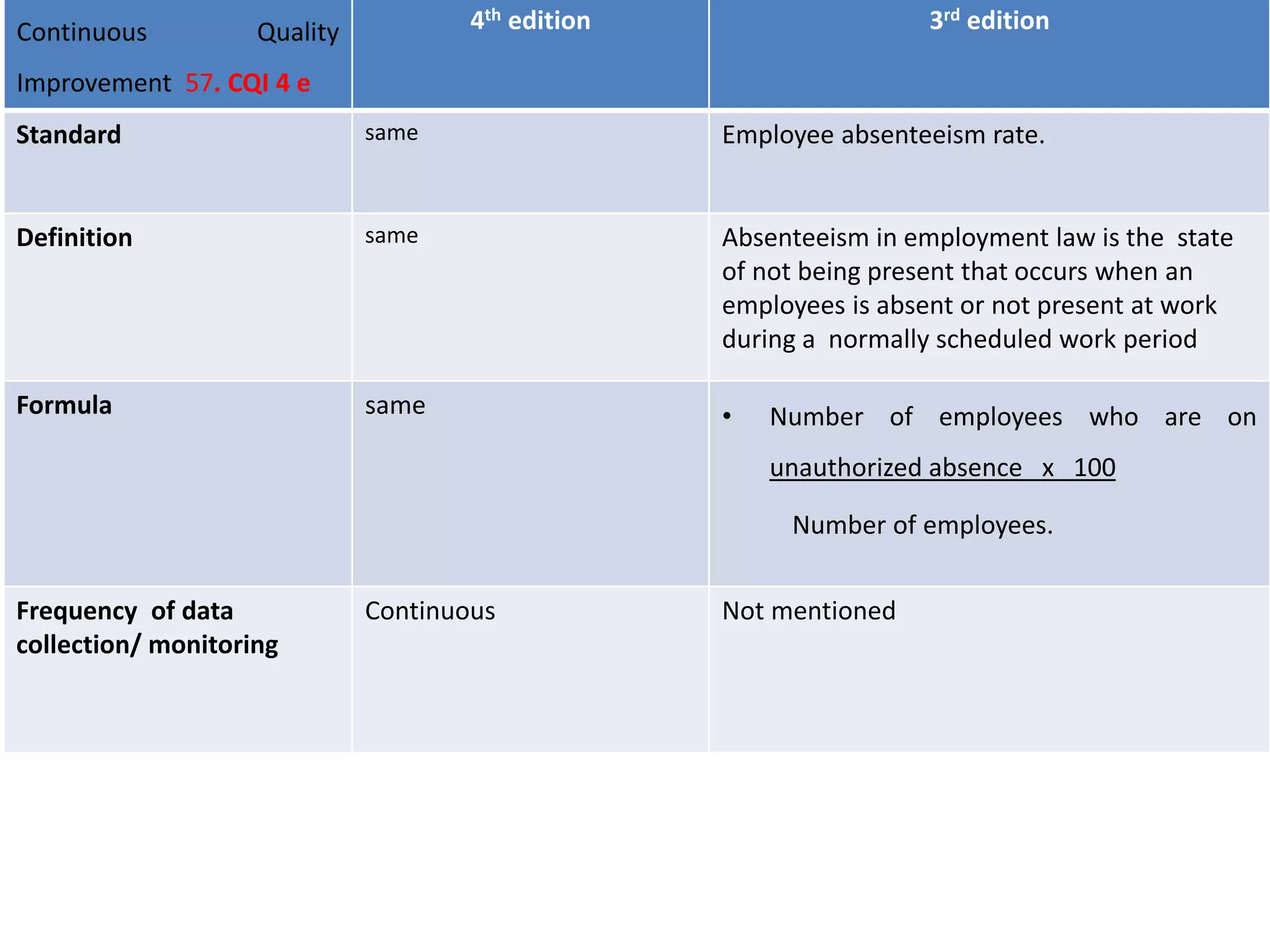
Improvement 57. CQI 4 e
4th edition 3rd edition
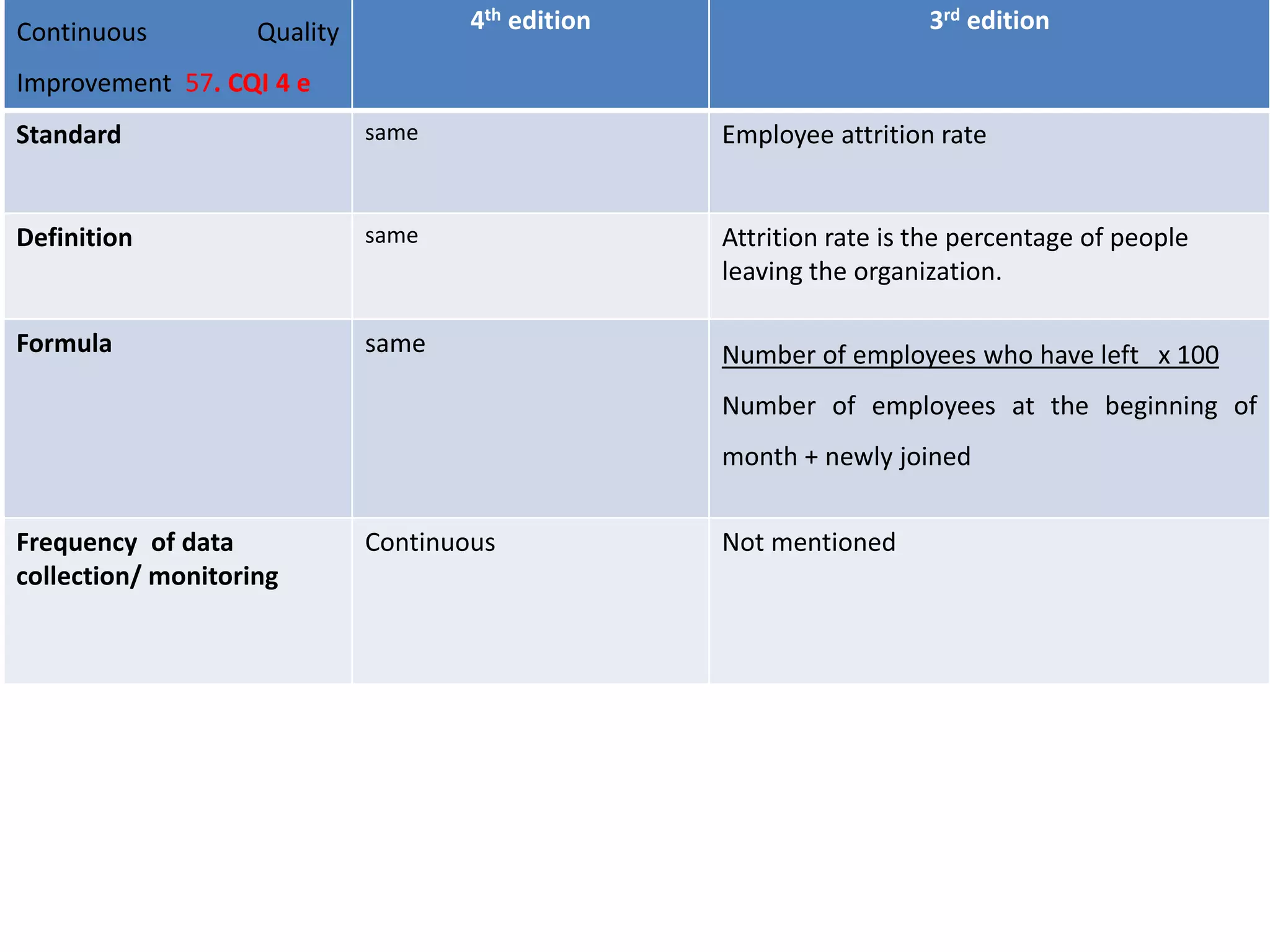
Standard same Employee attrition rate
Definition same Attrition rate is the percentage of people
leaving the organization.
Formula same Number of employees who have left x 100
Number of employees at the beginning of
month + newly joined
Frequency of data
collection/ monitoring
Continuous Not mentioned
Continuous Quality
Improvement 57. CQI 4 e
4th edition 3rd edition
Standard same Employee absenteeism rate.
Definition same Absenteeism in employment law is the state
of not being present that occurs when an
employees is absent or not present at work
during a normally scheduled work period
Formula same • Number of employees who are on
unauthorized absence x 100
Number of employees.
Frequency of data
collection/ monitoring
Continuous Not mentioned
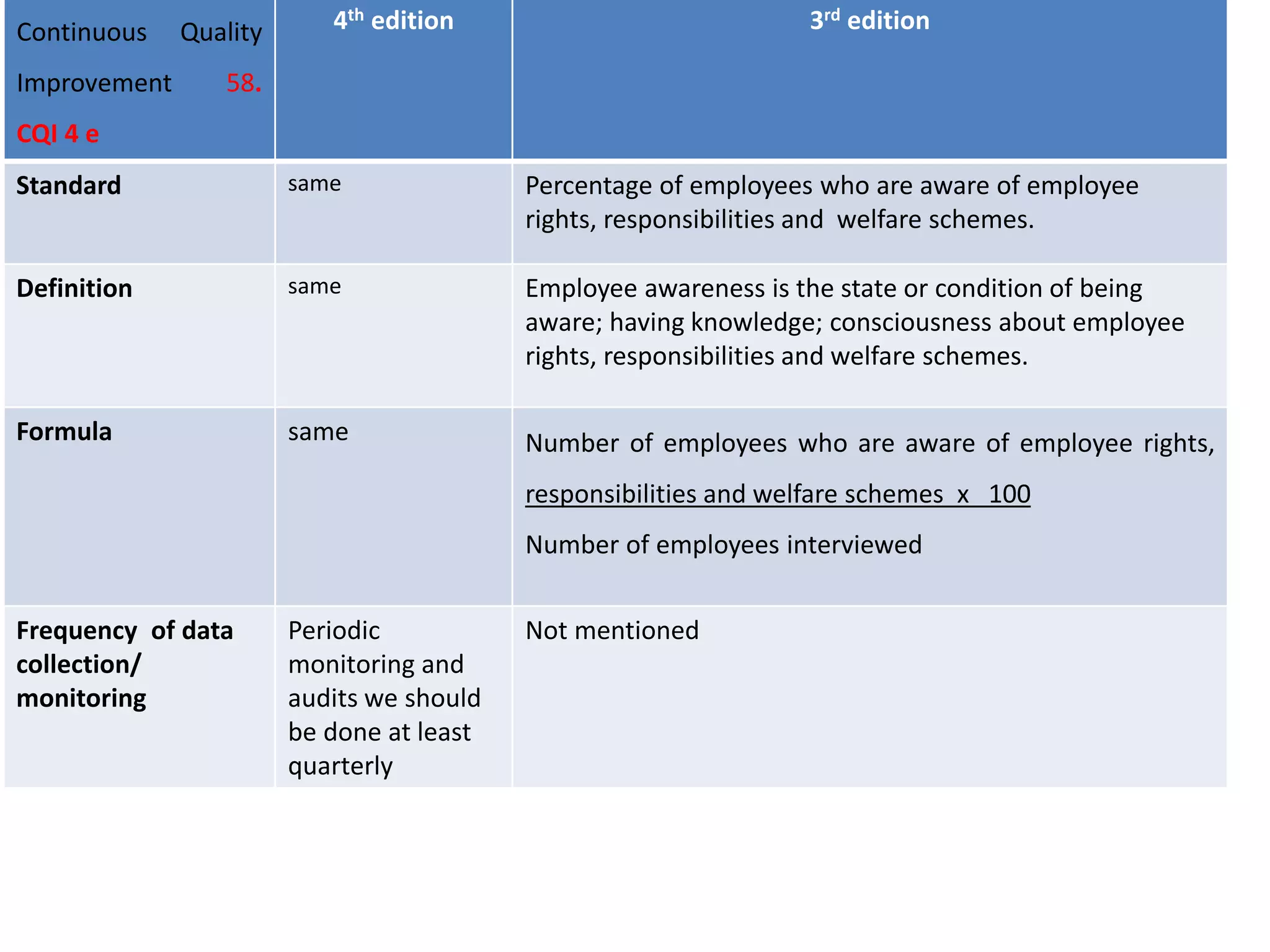
Continuous Quality
Improvement 58.
CQI 4 e
4th edition 3rd edition
Standard same Percentage of employees who are aware of employee
rights, responsibilities and welfare schemes.
Definition same Employee awareness is the state or condition of being
aware; having knowledge; consciousness about employee
rights, responsibilities and welfare schemes.
Formula same Number of employees who are aware of employee rights,
responsibilities and welfare schemes x 100
Number of employees interviewed
Frequency of data
collection/
monitoring
Periodic
monitoring and
audits we should
be done at least
quarterly
Not mentioned
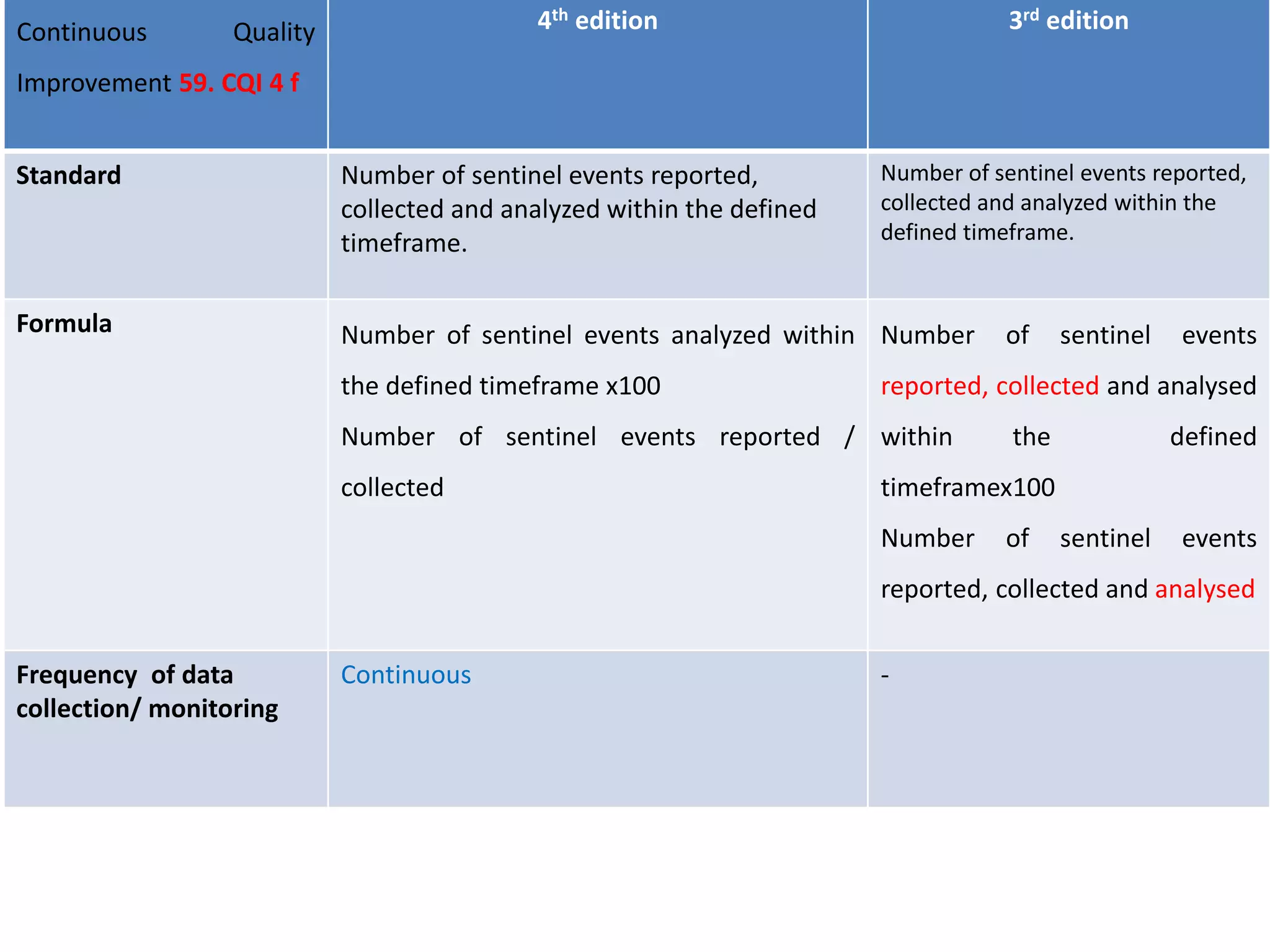
Continuous Quality
Improvement 59. CQI 4 f
4th edition 3rd edition
Standard Number of sentinel events reported,
collected and analyzed within the defined
timeframe.
Number of sentinel events reported,
collected and analyzed within the
defined timeframe.
Formula Number of sentinel events analyzed within
the defined timeframe x100
Number of sentinel events reported /
collected
Number of sentinel events
reported, collected and analysed
within the defined
timeframex100
Number of sentinel events
reported, collected and analysed
Frequency of data
collection/ monitoring
Continuous -
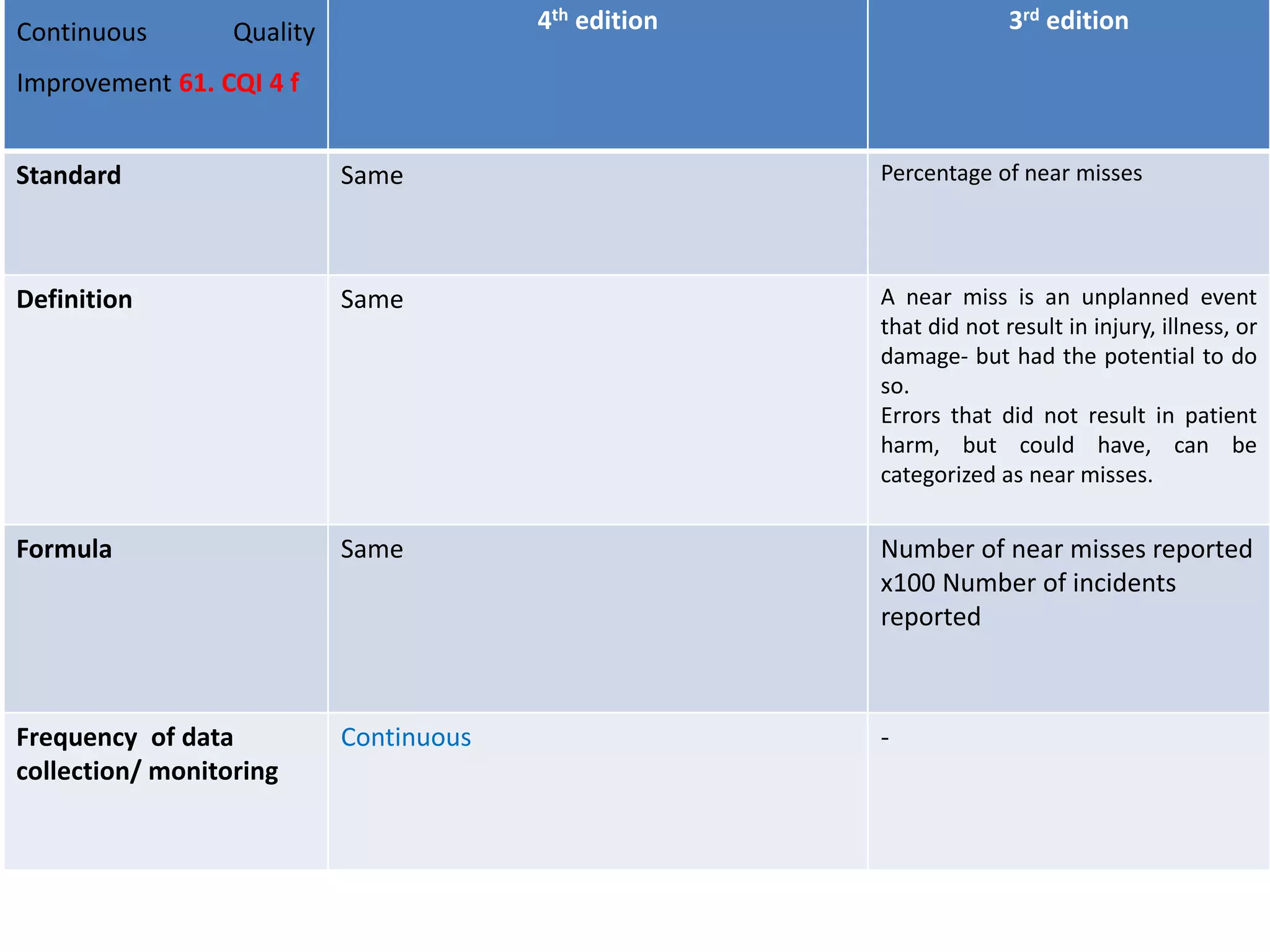
Continuous Quality
Improvement 61. CQI 4 f
4th edition 3rd edition
Standard Same Percentage of near misses
Definition Same A near miss is an unplanned event
that did not result in injury, illness, or
damage- but had the potential to do
so.
Errors that did not result in patient
harm, but could have, can be
categorized as near misses.
Formula Same Number of near misses reported
x100 Number of incidents
reported
Frequency of data
collection/ monitoring
Continuous -
Continuous Quality
Improvement 61. CQI 4 f
4th edition 3rd edition
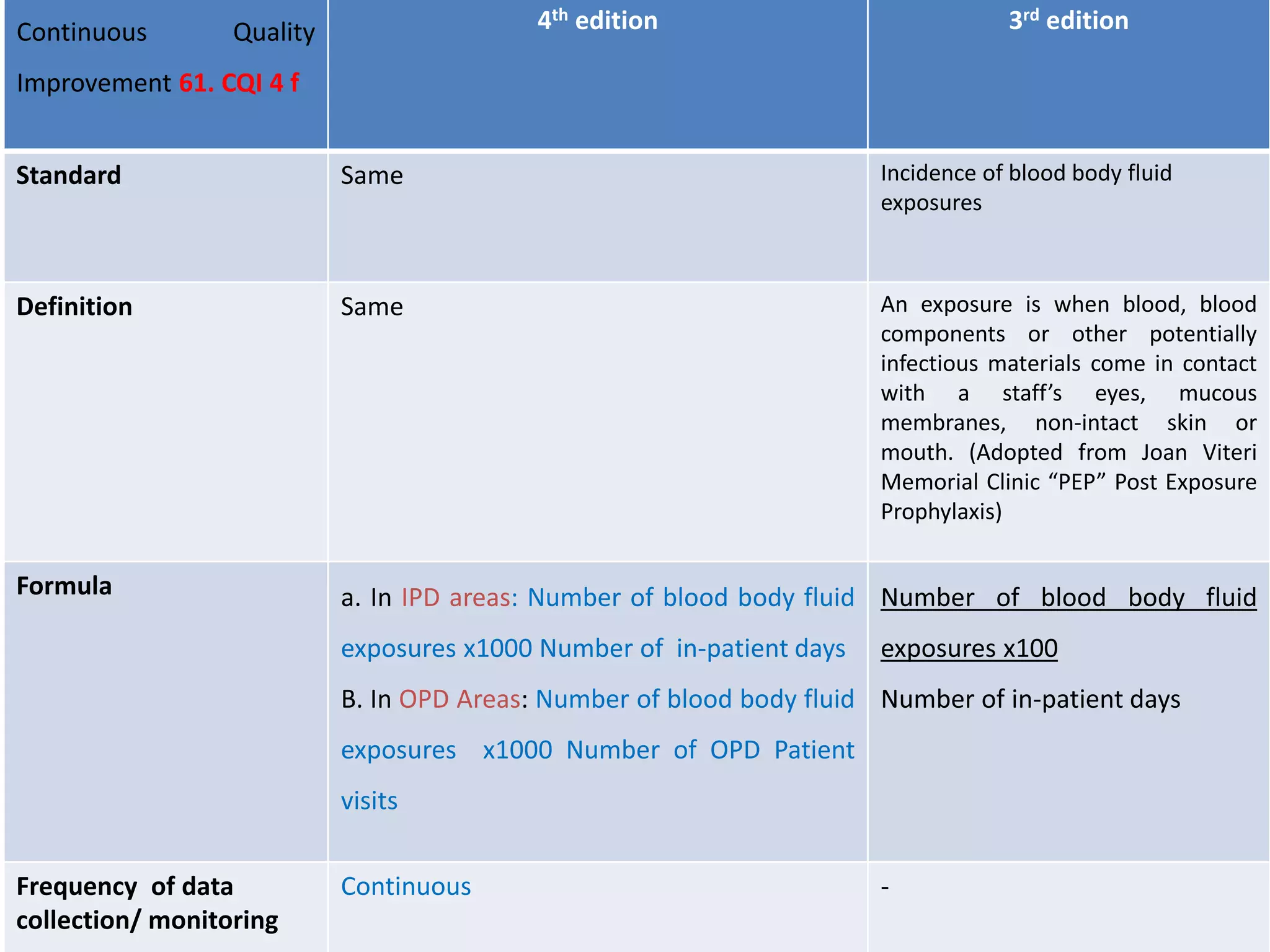
Standard Same Incidence of blood body fluid
exposures
Definition Same An exposure is when blood, blood
components or other potentially
infectious materials come in contact
with a staff’s eyes, mucous
membranes, non-intact skin or
mouth. (Adopted from Joan Viteri
Memorial Clinic “PEP” Post Exposure
Prophylaxis)
Formula a. In IPD areas: Number of blood body fluid
exposures x1000 Number of in-patient days
B. In OPD Areas: Number of blood body fluid
exposures x1000 Number of OPD Patient
visits
Number of blood body fluid
exposures x100
Number of in-patient days
Frequency of data
collection/ monitoring
Continuous -
Continuous Quality
Improvement 64. CQI 4 g
4th edition 3rd edition
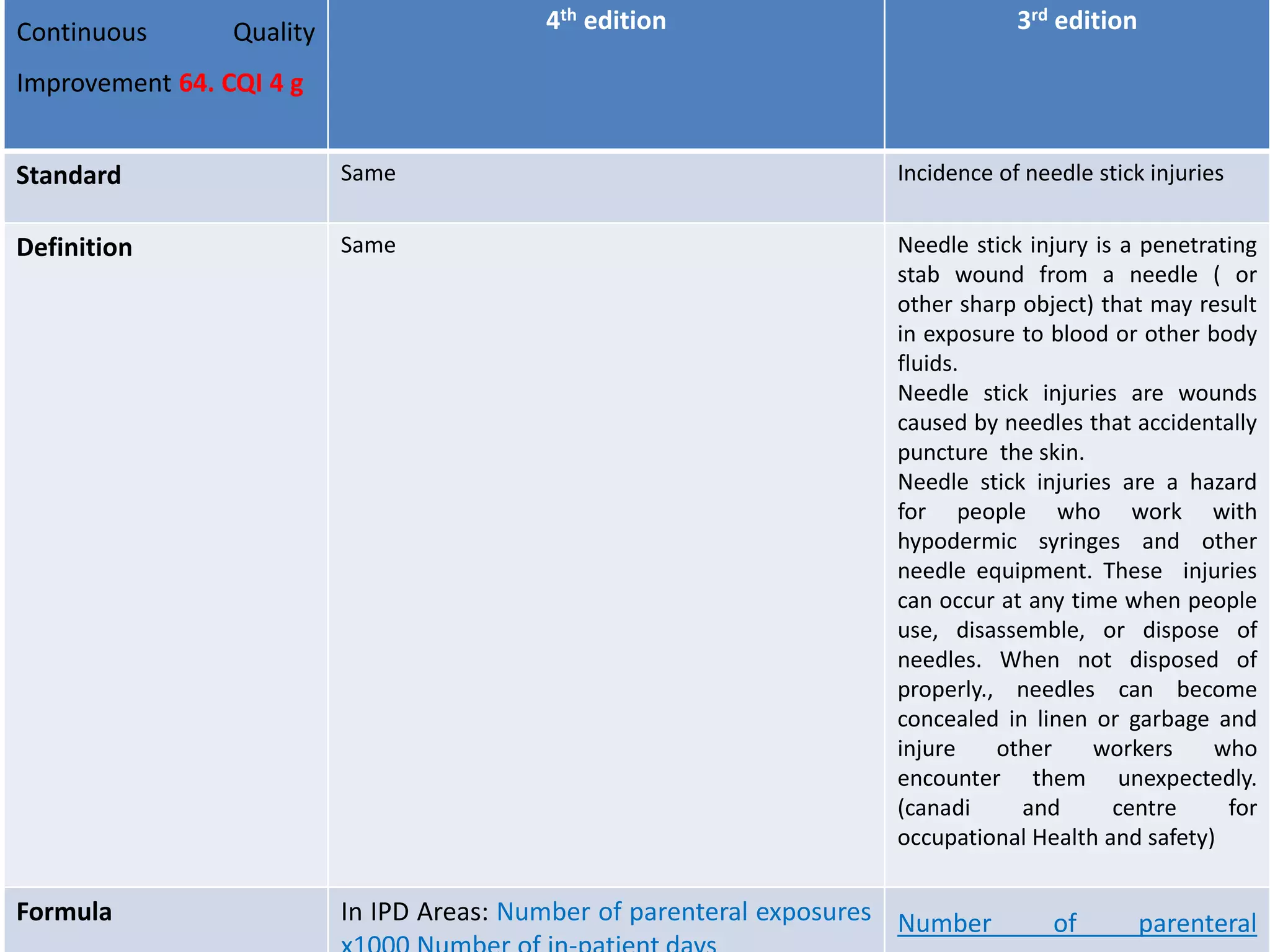
Standard Same Incidence of needle stick injuries
Definition Same Needle stick injury is a penetrating
stab wound from a needle ( or
other sharp object) that may result
in exposure to blood or other body
fluids.
Needle stick injuries are wounds
caused by needles that accidentally
puncture the skin.
Needle stick injuries are a hazard
for people who work with
hypodermic syringes and other
needle equipment. These injuries
can occur at any time when people
use, disassemble, or dispose of
needles. When not disposed of
properly., needles can become
concealed in linen or garbage and
injure other workers who
encounter them unexpectedly.
(canadi and centre for
occupational Health and safety)
Formula In IPD Areas: Number of parenteral exposures Number of parenteral
Continuous Quality
Improvement 64. CQI 4 g
4th edition 3rd edition
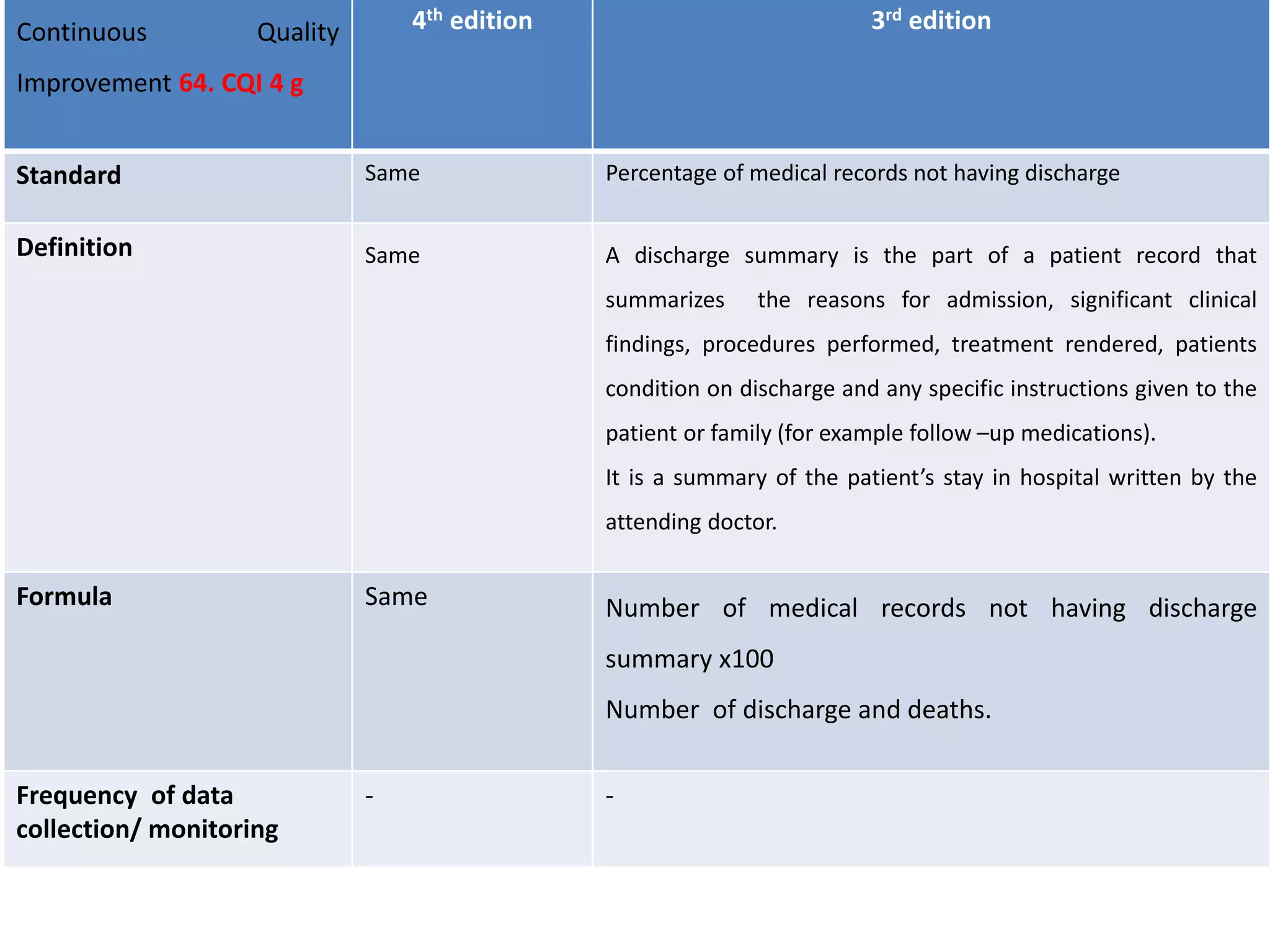
Standard Same Percentage of medical records not having discharge
Definition Same A discharge summary is the part of a patient record that
summarizes the reasons for admission, significant clinical
findings, procedures performed, treatment rendered, patients
condition on discharge and any specific instructions given to the
patient or family (for example follow –up medications).
It is a summary of the patient’s stay in hospital written by the
attending doctor.
Formula Same Number of medical records not having discharge
summary x100
Number of discharge and deaths.
Frequency of data
collection/ monitoring
- -
Continuous Quality
Improvement 64. CQI 4 g
4th edition 3rd edition
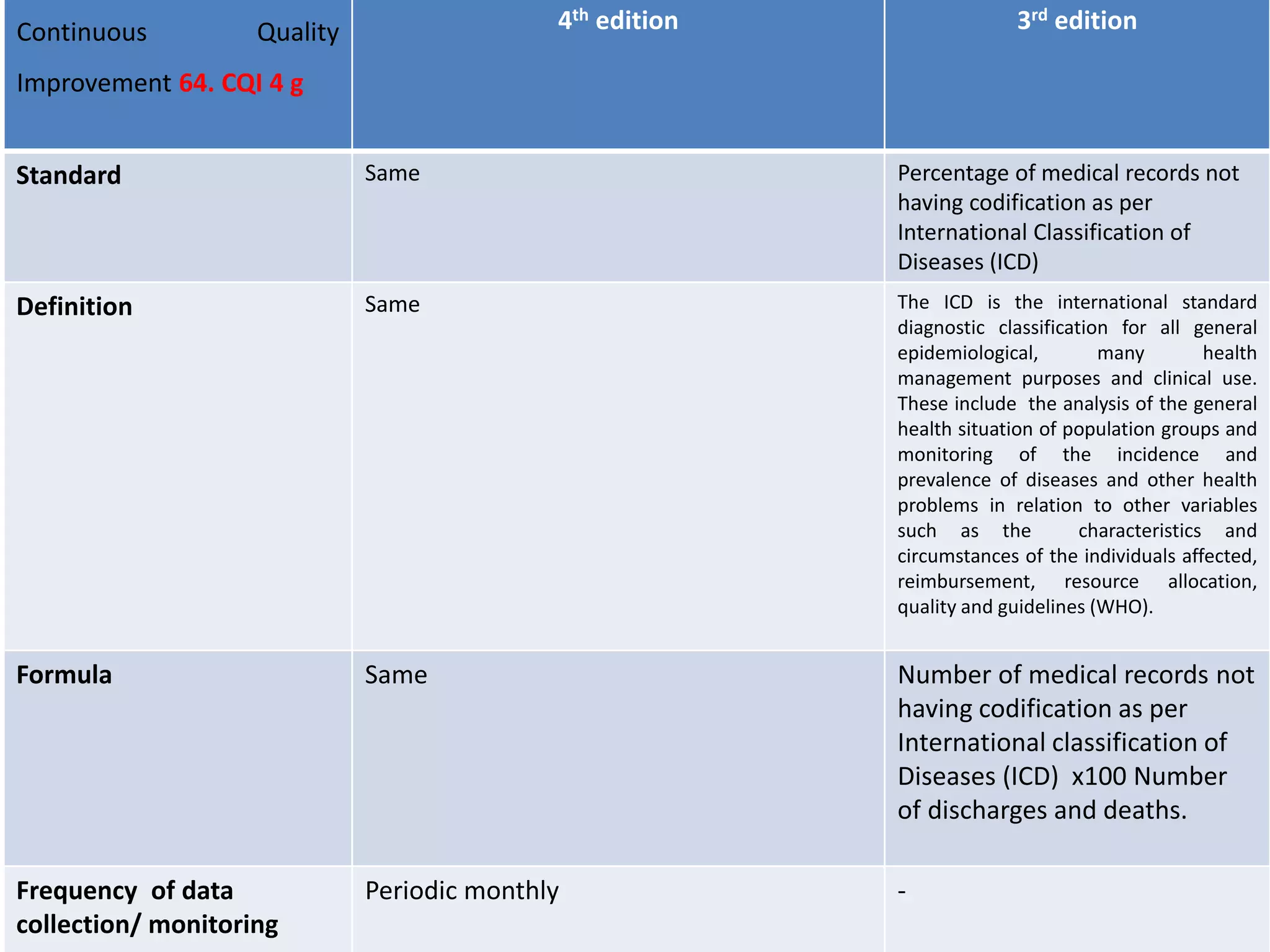
Standard Same Percentage of medical records not
having codification as per
International Classification of
Diseases (ICD)
Definition Same The ICD is the international standard
diagnostic classification for all general
epidemiological, many health
management purposes and clinical use.
These include the analysis of the general
health situation of population groups and
monitoring of the incidence and
prevalence of diseases and other health
problems in relation to other variables
such as the characteristics and
circumstances of the individuals affected,
reimbursement, resource allocation,
quality and guidelines (WHO).
Formula Same Number of medical records not
having codification as per
International classification of
Diseases (ICD) x100 Number
of discharges and deaths.
Frequency of data
collection/ monitoring
Periodic monthly -
Continuous Quality
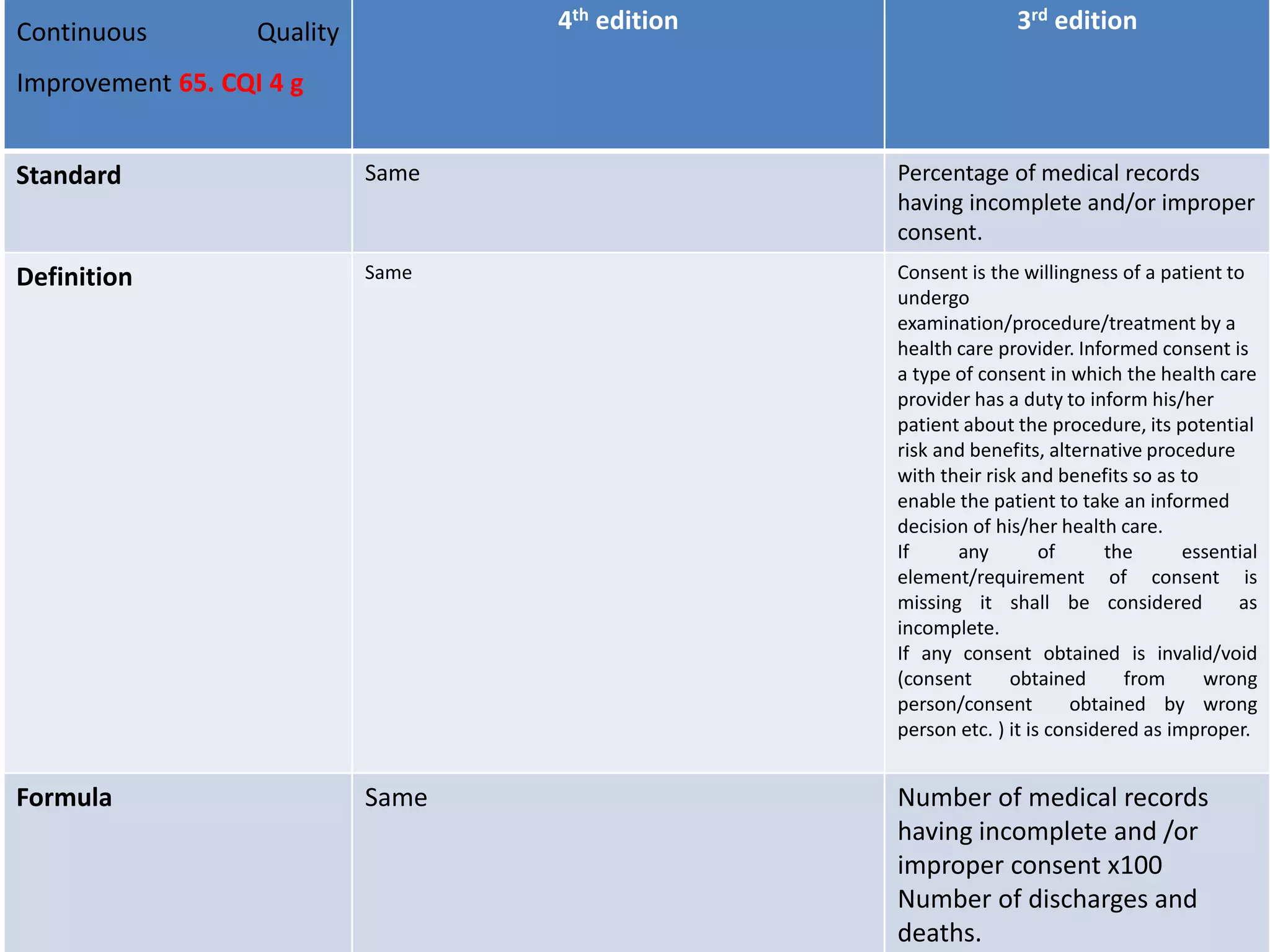
Improvement 65. CQI 4 g
4th edition 3rd edition
Standard Same Percentage of medical records
having incomplete and/or improper
consent.
Definition Same Consent is the willingness of a patient to
undergo
examination/procedure/treatment by a
health care provider. Informed consent is
a type of consent in which the health care
provider has a duty to inform his/her
patient about the procedure, its potential
risk and benefits, alternative procedure
with their risk and benefits so as to
enable the patient to take an informed
decision of his/her health care.
If any of the essential
element/requirement of consent is
missing it shall be considered as
incomplete.
If any consent obtained is invalid/void
(consent obtained from wrong
person/consent obtained by wrong
person etc. ) it is considered as improper.
Formula Same Number of medical records
having incomplete and /or
improper consent x100
Number of discharges and
deaths.
Continuous Quality
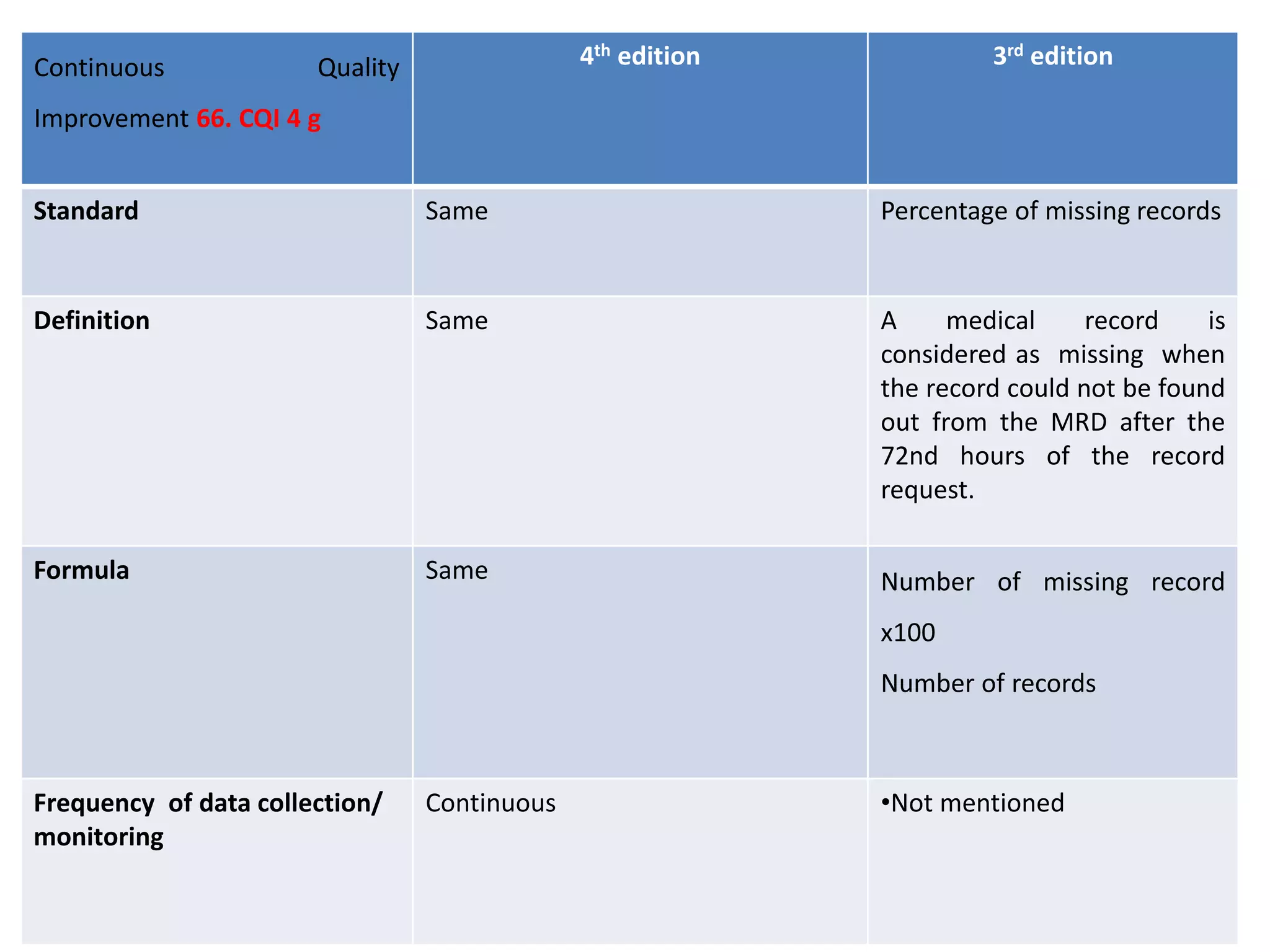
Improvement 66. CQI 4 g
4th edition 3rd edition
Standard Same Percentage of missing records
Definition Same A medical record is
considered as missing when
the record could not be found
out from the MRD after the
72nd hours of the record
request.
Formula Same Number of missing record
x100
Number of records
Frequency of data collection/
monitoring
Continuous •Not mentioned
Continuous Quality
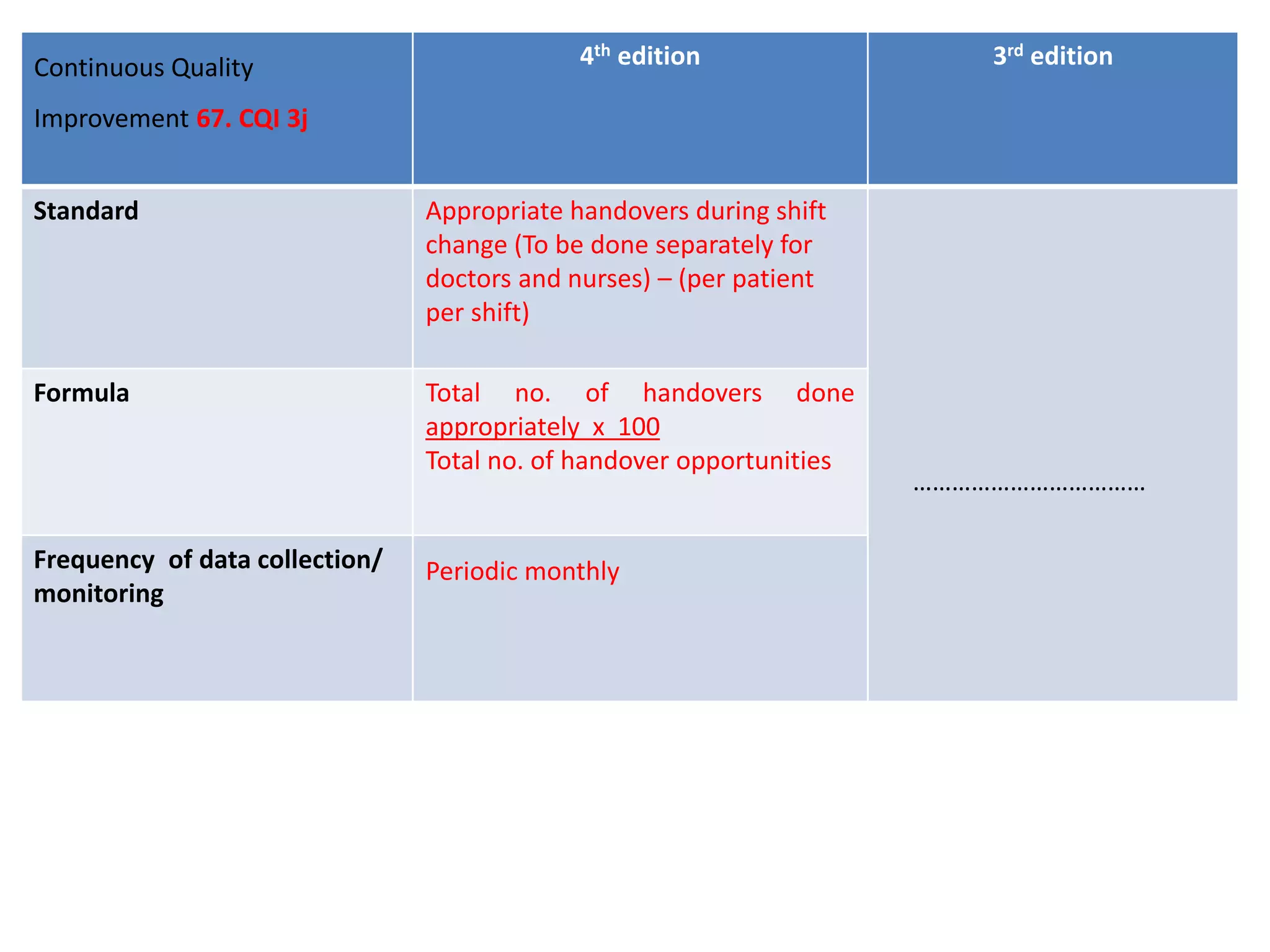
Improvement 67. CQI 3j
4th edition 3rd edition
Standard Appropriate handovers during shift
change (To be done separately for
doctors and nurses) – (per patient
per shift)
………………………………
Formula Total no. of handovers done
appropriately x 100
Total no. of handover opportunities
Frequency of data collection/
monitoring
Periodic monthly
Continuous Quality
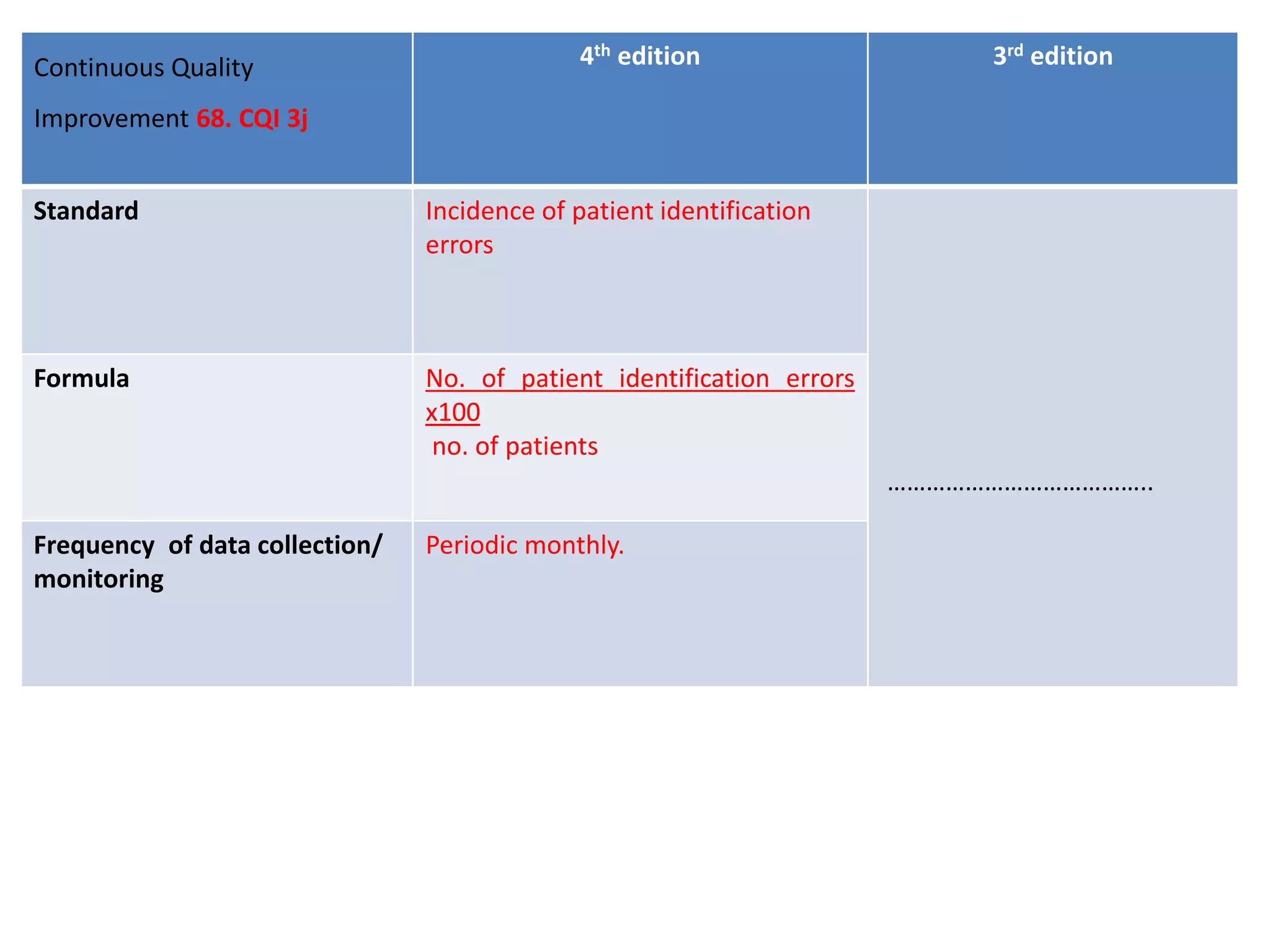
Improvement 68. CQI 3j
4th edition 3rd edition
Standard Incidence of patient identification
errors
…………………………………..
Formula No. of patient identification errors
x100
no. of patients
Frequency of data collection/
monitoring
Periodic monthly.
Continuous Quality
Improvement 69. CQI 3j
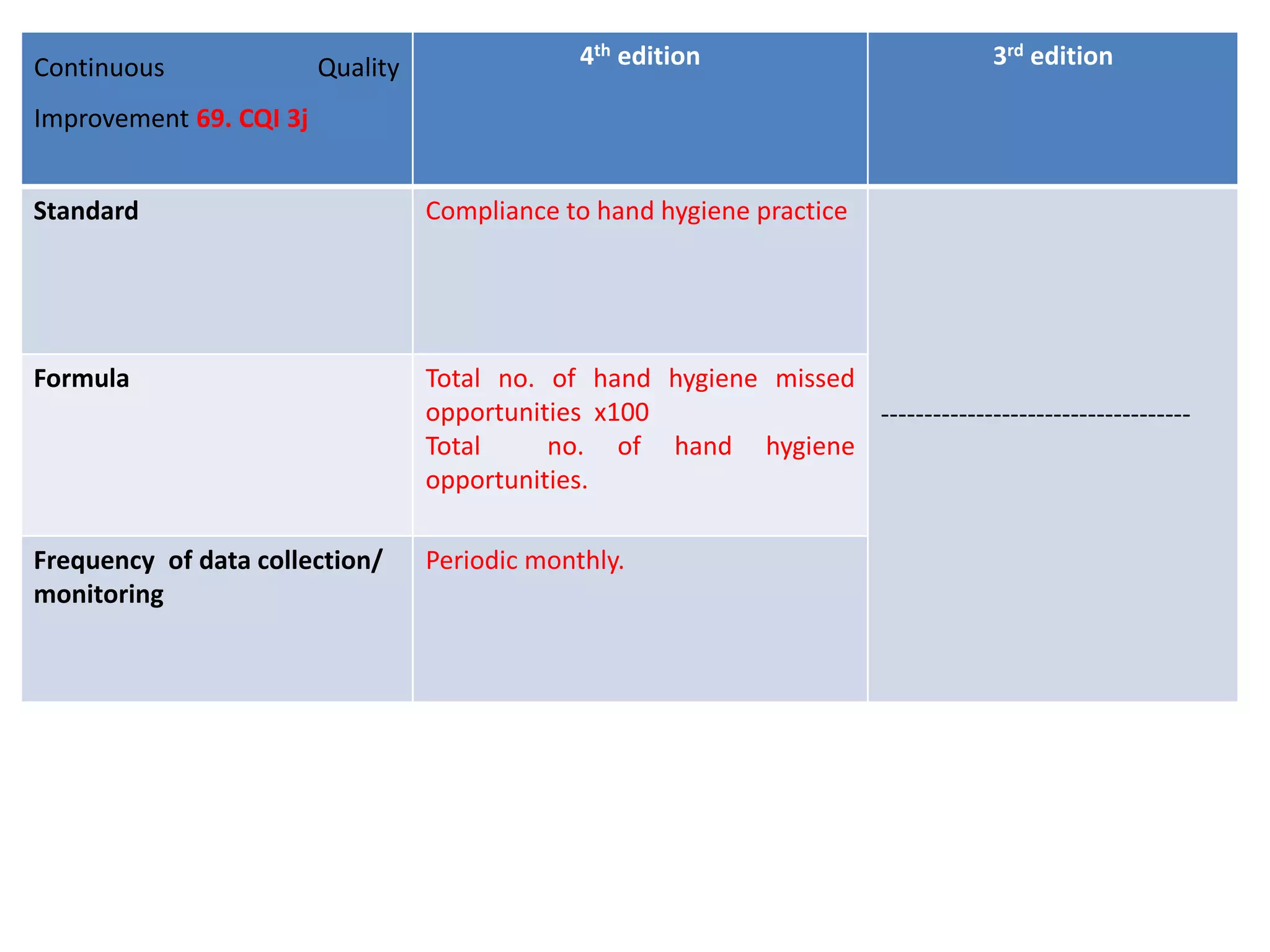
4th edition 3rd edition
Standard Compliance to hand hygiene practice
------------------------------------
Formula Total no. of hand hygiene missed
opportunities x100
Total no. of hand hygiene
opportunities.
Frequency of data collection/
monitoring
Periodic monthly.
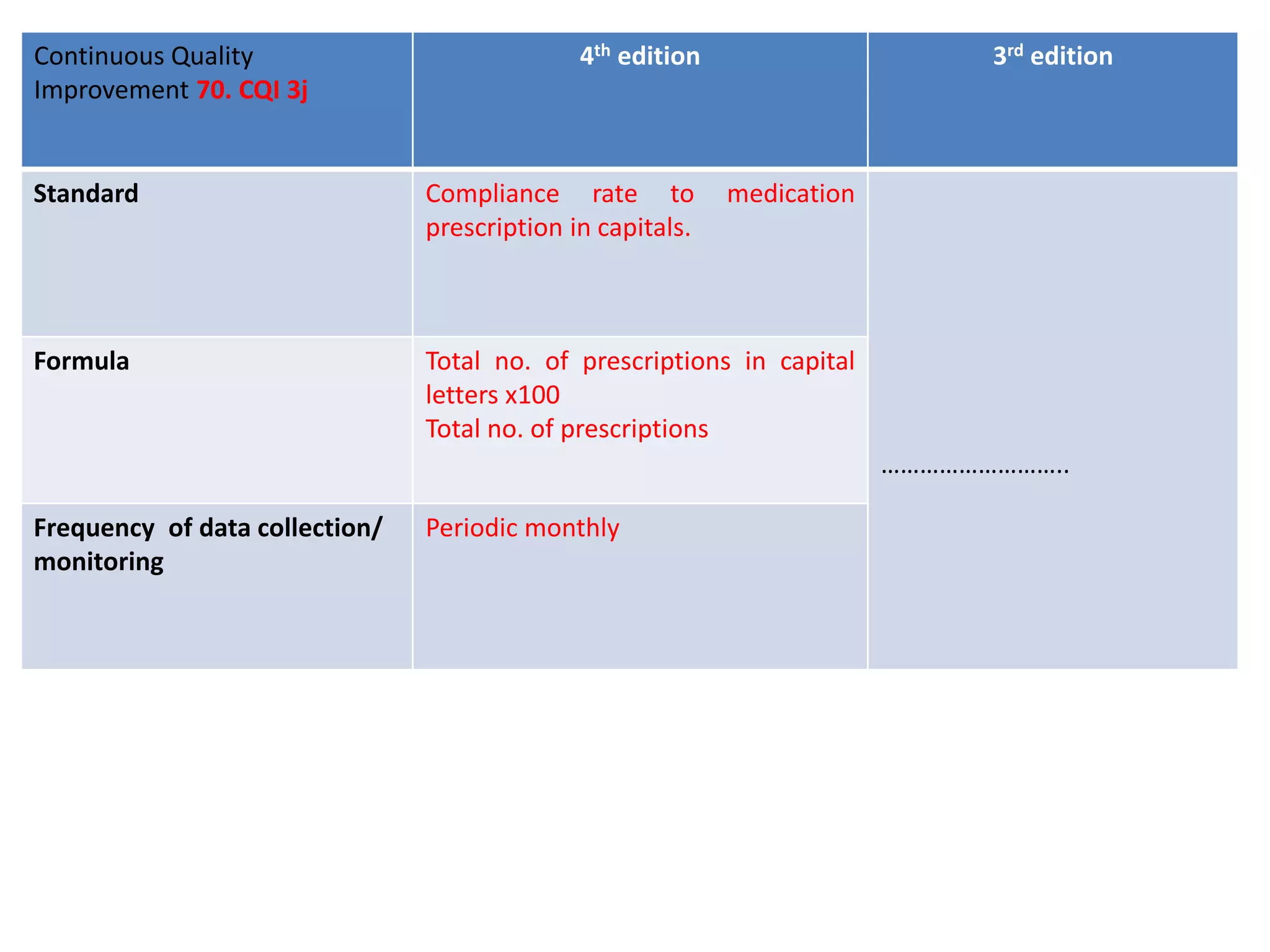
Continuous Quality
Improvement 70. CQI 3j
4th edition 3rd edition
Standard Compliance rate to medication
prescription in capitals.
………………………..
Formula Total no. of prescriptions in capital
letters x100
Total no. of prescriptions
Frequency of data collection/
monitoring
Periodic monthly

Gap analysis of NABH 3rd and 4th Edition

  • 1.
    Quality indicators Chapters Standards O/E NABH4th edition standard 70 10 105 683 NABH 3rd Edition standard 65 10 102 636 Gap analysis of 3rd to 4th edition NABH The key performance indicators expected to be monitored by Healthcare organization
  • 2.
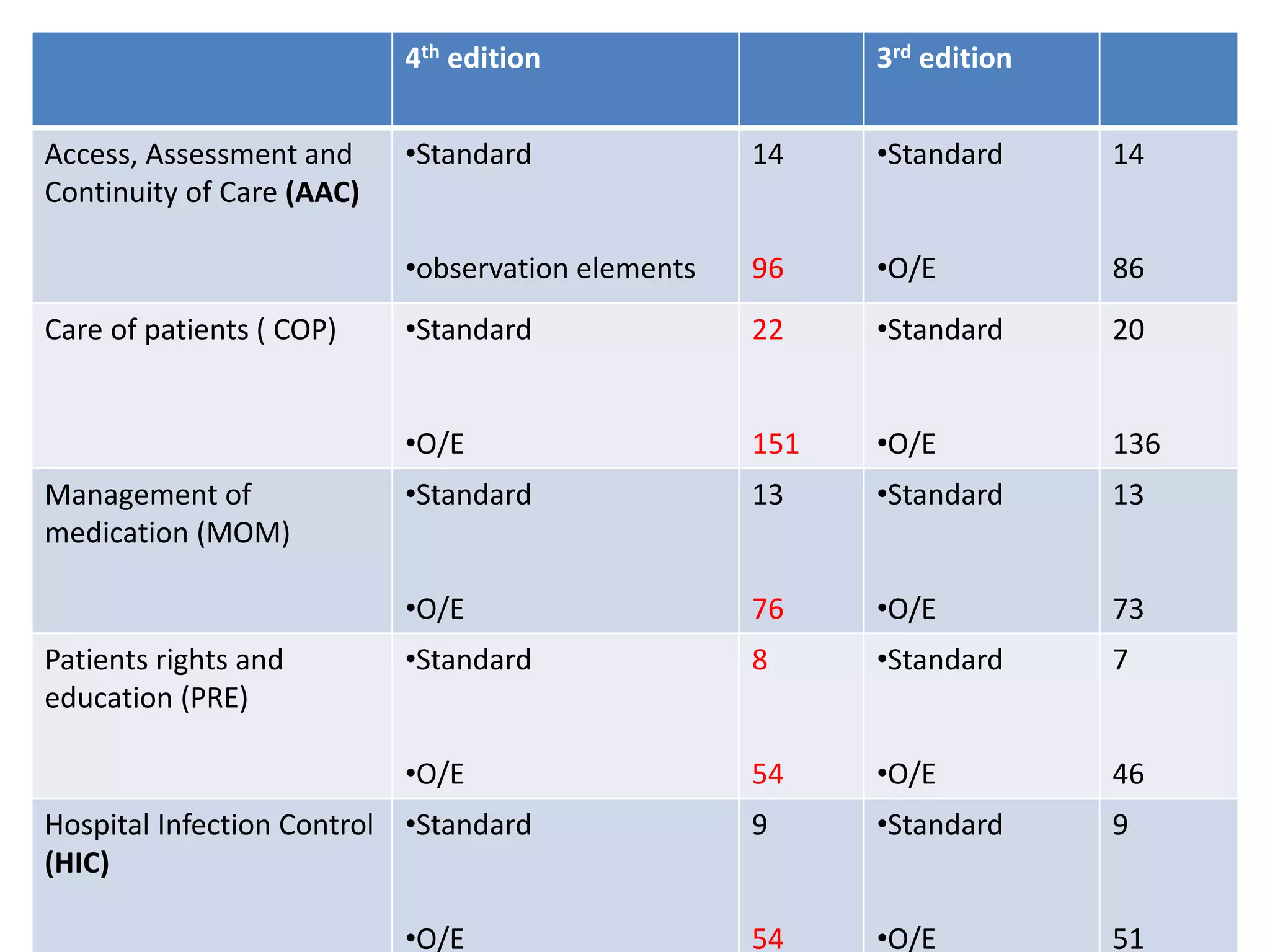
    4th edition 3rdedition Access, Assessment and Continuity of Care (AAC) •Standard •observation elements 14 96 •Standard •O/E 14 86 Care of patients ( COP) •Standard •O/E 22 151 •Standard •O/E 20 136 Management of medication (MOM) •Standard •O/E 13 76 •Standard •O/E 13 73 Patients rights and education (PRE) •Standard •O/E 8 54 •Standard •O/E 7 46 Hospital Infection Control (HIC) •Standard •O/E 9 54 •Standard •O/E 9 51
  • 3.
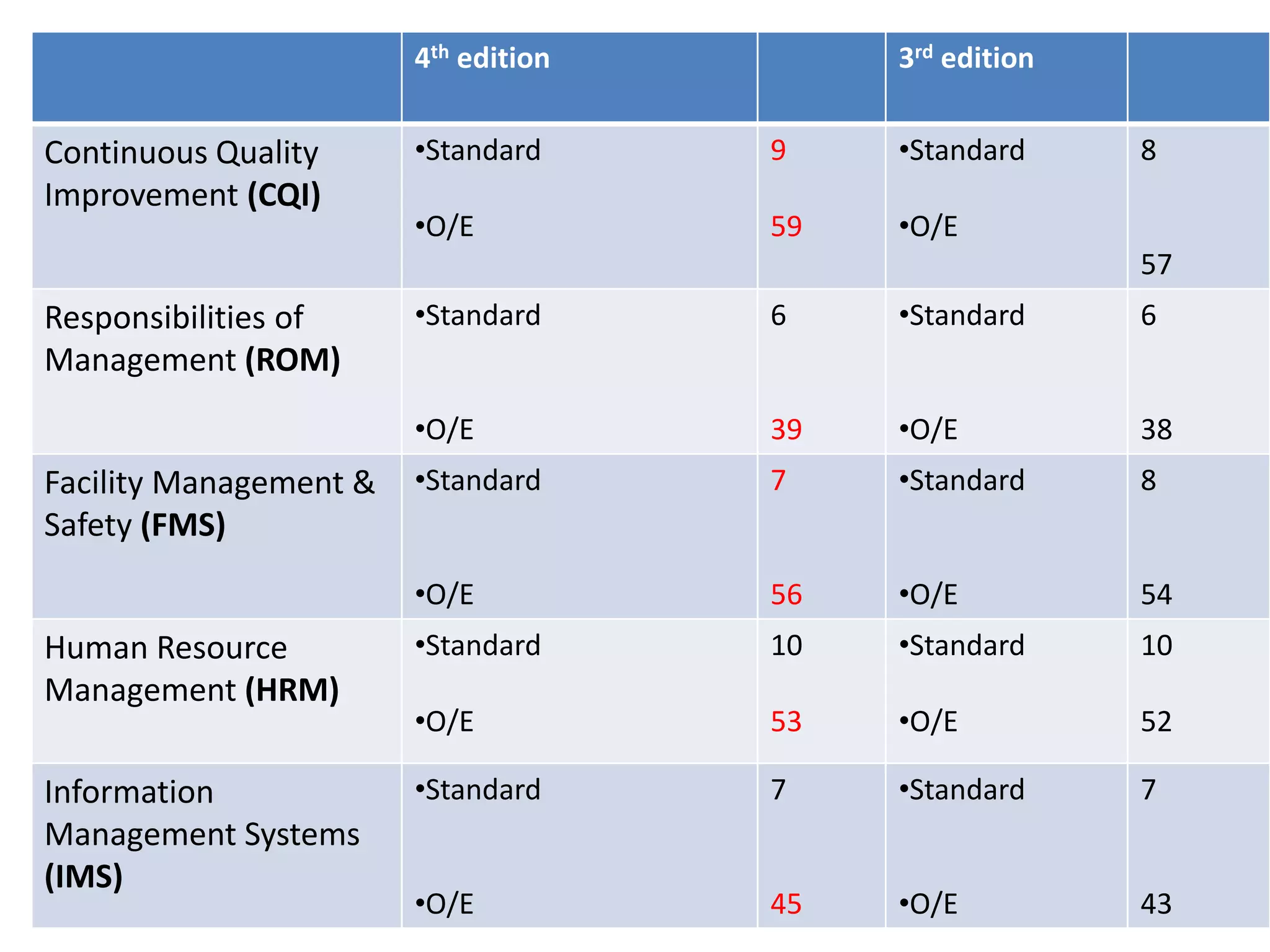
    4th edition 3rdedition Continuous Quality Improvement (CQI) •Standard •O/E 9 59 •Standard •O/E 8 57 Responsibilities of Management (ROM) •Standard •O/E 6 39 •Standard •O/E 6 38 Facility Management & Safety (FMS) •Standard •O/E 7 56 •Standard •O/E 8 54 Human Resource Management (HRM) •Standard •O/E 10 53 •Standard •O/E 10 52 Information Management Systems (IMS) •Standard •O/E 7 45 •Standard •O/E 7 43
  • 4.
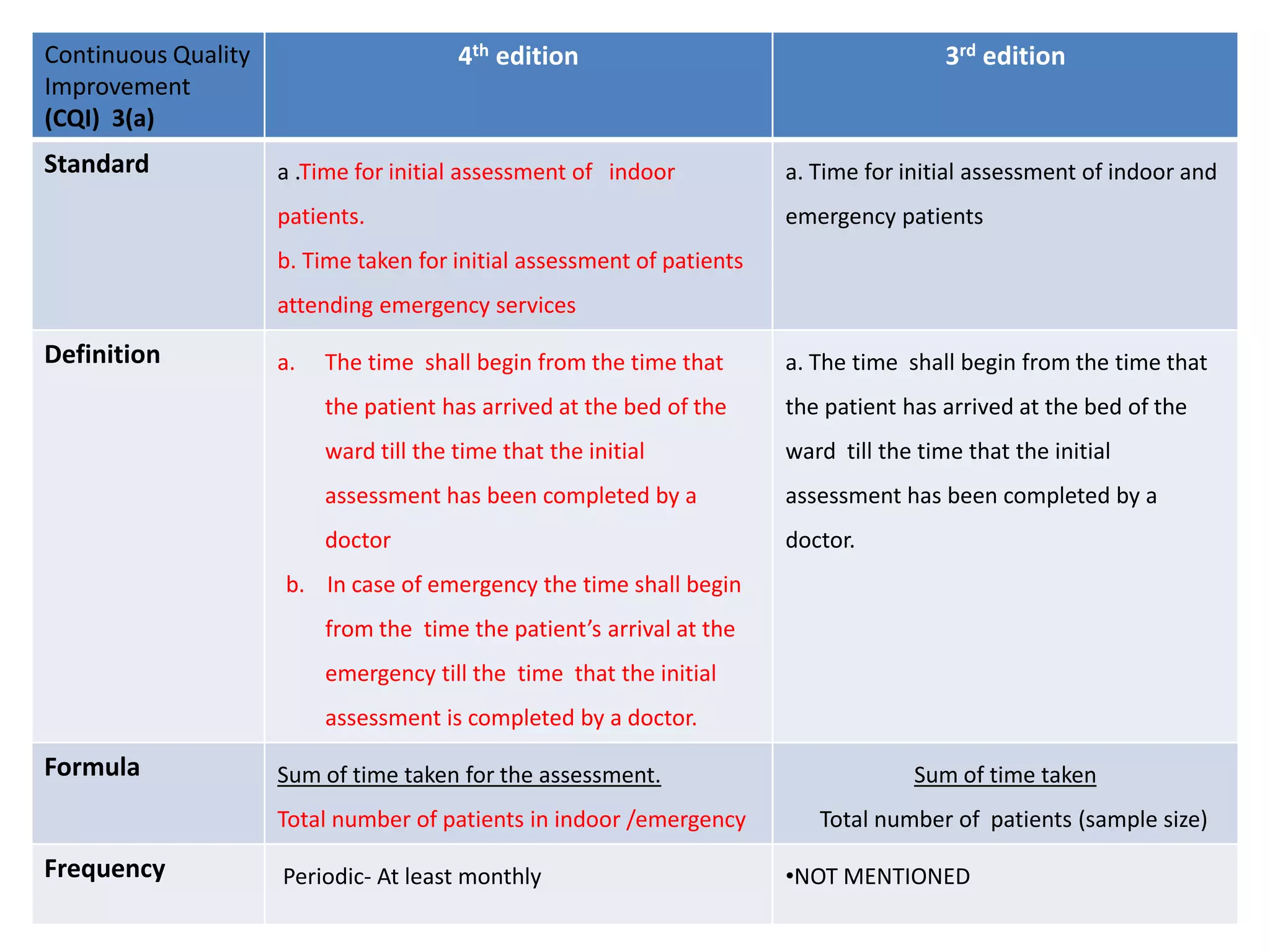
    Continuous Quality Improvement (CQI) 3(a) 4thedition 3rd edition Standard a .Time for initial assessment of indoor patients. b. Time taken for initial assessment of patients attending emergency services a. Time for initial assessment of indoor and emergency patients Definition a. The time shall begin from the time that the patient has arrived at the bed of the ward till the time that the initial assessment has been completed by a doctor b. In case of emergency the time shall begin from the time the patient’s arrival at the emergency till the time that the initial assessment is completed by a doctor. a. The time shall begin from the time that the patient has arrived at the bed of the ward till the time that the initial assessment has been completed by a doctor. Formula Sum of time taken for the assessment. Total number of patients in indoor /emergency Sum of time taken Total number of patients (sample size) Frequency Periodic- At least monthly •NOT MENTIONED
  • 5.
    Continuous Quality Improvement (CQI) 3(a) 4thedition 3rd edition Standard Same a. Percentage of cases (in-patients) wherein care plan with desired outcomes is documented and countersigned by the clinician. Definition Same b. Desired outcome includes curative, preventive, rehabilitative etc. Formula Number of in-patient case records wherein the care plan with desired outcomes has been documented x 100 Total number of patients. Number of in-patient case records wherein the care plan with desired outcomes has been documented x 100 Total Number of patients (sample size) Frequency Periodic At least monthly. •NOT MENTIONED
  • 6.
    Continuous Quality Improvement (CQI) 3(a) 4thedition 3rd edition Standard same • Percentage of cases (in-patients) wherein screening for nutritional needs has been done. Definition same Same Formula Number of in-patient case records wherein the nutritional assessment has been documented x 100 Total number of patients Number of in-patient case records wherein the nutritional assessment has been documented x 100 Total number of patients (sample size) Frequency Periodic- at least monthly
  • 7.
    Continuous Quality Improvement (CQI) 3(a) 4thedition 3rd edition Standard same Percentage of cases (in-patients) wherein the nursing care plan is documented. Definition same Nursing care plan shall be the outcome of the nursing assessment done at the time of admission Formula Number of in-patient case records wherein the nursing care plan has been documented x 100 Total number of patients. Number of in-patient case records wherein the nursing care plan Has been documented x 100 Total number of patients (sample size) Frequency Periodic at least monthly Not mentioned
  • 8.
    Continuous Quality Improvement (CQI) 3(b) 4thedition 3rd edition Standard Same Number of reporting errors/1000 investigations Definition Same Reporting errors include those picked up before and after dispatch. It shall include transcription errors. Formula Same Number of reporting errors x 1000 Number of tests performed Frequency Continuous •Not mentioned
  • 9.
    Continuous Quality Improvement (CQI)3(b) 4th edition 3rd edition Standard • Rate of re-dos •Percentage of re-dos Definition same •This shall also include tests repeated before release of the result (to confirm the finding). Formula same Number of re-dos x 1000 Number of tests performed Frequency of data collection/ monitoring Refer sample size (continuous) • Not mentioned Screening Population Sample size 50 44 100 79 150 108 200 132 500 217 1000 278 2000 322 5000 357 10000 370 20000 377
  • 10.
    Continuous Quality Improvement (CQI)3(b) 4th edition 3rd edition Standard same •Percentage of reports co-relating with clinical diagnosis Definition :Co-relation means that the test results should match either the diagnosis or differential diagnosis written in the discharge summary. • Co-relation means that the test results should match either the diagnosis or differential diagnosis written in the requisition form. Formula Number of reports co-relating with clinical diagnosis x 100 Number of tests performed Number of reports co-relating with clinical diagnosis x 100 Number of tests performed Frequency of data collection/ monitoring Continuous Not Mentioned
  • 11.
    Continuous Quality Improvement (CQI)3(b) 4th edition 3rd edition Standard same Percentage of adherence to safety precautions by employees working in diagnostics. Definition same same Formula same Number of employees adhering to safety precautions x 100 Number of employees sampled Frequency of data collection/ monitoring Periodic at least quarterly
  • 12.
    Continuous Quality Improvement (CQI) 3(c) 4thedition 3rd edition Standard Incidence of medication errors (Medication errors per patient days) • Incidence of medication errors Definition In addition to 3 rd Calculation or preparation of a) Prescription error b) Dispensing error. A medication errors is any preventable event that may cause or lead to inappropriate medication use or harm to a patient (US-FDA) Examples include, but are not limited to: • Errors in the prescribing, transcribing, dispensing, administering, and monitoring of medications; • Wrong drug, wrong strength or wrong close errors • Wrong patient errors; • Wrong route of administration errors; and • Calculation or preparation errors. Formula Total number of medication errors x 1000 number of patient days A) Total no of prescription errors x 1000 No. of patient days B) Total no. of medication dispensing errors x 1000 NO. of patients days Total number of medication errors x 100 Number of patient days Frequency of data collection/ monitoring continuous monitoring and periodic at least monthly. •Not mentioned
  • 13.
    Continuous Quality Improvement (CQI)3(c) 4th edition 3rd edition Standard Percentage of admissions with adverse drug reaction(s) (Adverse drug reactions per 100 separations) •Percentage of admissions with adverse drug reaction (s) Definition Refer to glossary •Refer to glossary Formula same Number of adverse drug reactions x 100 Number of discharges and deaths Frequency of data collection/ monitoring continuous •Not mentioned
  • 14.
    Continuous Quality Improvement (CQI)3(c) 4th edition 3rd edition Standard Same •Percentage of mediation charts with error prone abbreviations Definition Same •Medication chart with illegible handwriting and un accepted error prone abbreviations Formula same • Number of medication charts with errors prone abbreviations x100 Number of medication charts reviewed Frequency of data collection/ monitoring Continuous monitoring and periodic at least monthly. •Not mentioned
  • 15.
    Continuous Quality Improvement (CQI)3(c) 4th edition 3rd edition Standard Same •Percentage of patients receiving high risk medications developing adverse drug event. Definition Same •High risk medications are medications involved in a high percentage of medication errors or sentinel events and medications that carry a high risk for abuse, error, or other adverse outcomes. A good reference for this is the “ISMP’s list of high Alert medications” Formula same Number of patients receiving high risk medications who have an adverse drug event x 100 Number of patients receiving high risk medications Frequency of data collection/ monitoring Continuous Not mentioned
  • 16.
    Continuous Quality Improvement (CQI)3(d) 4th edition 3rd edition Standard same •Percentage of modification of anaesthesia plan Definition same •The anesthesia plan is the outcome of pre- anaestheisa assessment/ Any changes done after this shall be considered as modification of anaesthesia plan. Formula same Number of patients in whom the anaesthesia plan was modified x 100 Number of patients who underwent anaesthesia Frequency of data collection/ monitoring Continuous Not mentioned
  • 17.
    Continuous Quality Improvement (CQI)3(d) 4th edition 3rd edition Standard same •Percentage of unplanned ventilation following anaesthesia. Definition same •same Formula same Number of patients requiring unplanned ventilation following anaesthesia x 100 Number of patients who underwent anaesthesia Frequency of data collection/ monitoring Continous
  • 18.
    Continuous Quality Improvement (CQI)3(d) 4th edition 3rd edition Standard Same •Percentage of adverse anaestheisa events Definition Same •Adverse anaesthesia event is any untoward medical occurrence that my present during treatment with an anaesthetic product but which does not necessarily have a causal relationship with this treatment. Formula same Number of patients who developed adverse anaesthesia event x100 Number of patients who underwent anaesthesia Frequency of data collection/ monitoring Continuous
  • 19.
    Continuous Quality Improvement (CQI)3(d) 4th edition 3rd edition Standard Same • Anaesthesia related mortality rate Definition Same •Any death where the cause is possible probable (likely) or certain to be due to anaesthesia shall be included. Formula same Number of patients who died due to anaesthesiax100 Number of patients who underwent anaesthesia Frequency of data collection/ monitoring Continuous
  • 20.
    Continuous Quality Improvement (CQI)3(e) 4th edition 3rd edition Standard Same •Percentage of unplanned return to OT Definition Same •same Formula Same Number of unplanned return to OT x100 Number of patients who underwent anaesthesia Frequency of data collection/ monitoring continuous
  • 21.
    Continuous Quality Improvement (CQI)3(e) 4th edition 3rd edition Standard same •Percentage of re-scheduling of surgeries Definition same •Re-scheduling of patient s includes cancellation and postponement (beyond 4 hours) of the surgery. Formula same Number of cases re-scheduled x100 Number of surgeries performed Frequency of data collection/ monitoring Continous
  • 22.
    Continuous Quality Improvement (CQI)3(e) 4th edition 3rd edition Standard Same •Percentage of cases where the organization procedure to prevent adverse events like wrong site, wrong patient and wrong surgery have been adhered to Definition Same •same Formula Same Number of cases where the procedure was followed x 100 Number of surgeries performed Frequency of data collection/ monitoring •Not mentined
  • 23.
    Continuous Quality Improvement (CQI)3(e) 4th edition 3rd edition Standard same •Percentage of cases who received appropriate prophylactic antibiotics within the specified time frame. Definition same •same Formula same Number of patients who did receive prophylactic antibiotic (s)x100 Number of surgeries performed Frequency of data collection/ monitoring Continous •Not mentioned
  • 24.
    Continuous Quality Improvement (CQI) 3(e) 4thedition 3rd edition Standard Percentage of cases in which the planned surgery is changed intraoperative. ------------------ Formula No. of cases in which the planned surgery is changed intraoperative x100 Total no. of surgeries performed. Frequency of data collection/ monitoring Continuous and periodic monthly. ( Refer sample size ) Screening Population Sample size 50 44 100 79 150 108 200 132 500 217 1000 278 2000 322 5000 357 10000 370 20000 377
  • 25.
    Continuous Quality Improvement (CQI)3(e) 4th edition 3rd edition Standard Re – exploration rate ……………………………. Formula NO. of re-explorations done during same admission x 100 Total number of surgeries Frequency of data collection/ monitoring Periodic monthly
  • 26.
    Continuous Quality Improvement (CQI)3(f) 4th edition 3rd edition Standard Percentage of transfusion reactions recipient. The causes include red blood cell incompatibility ,allergic sensitivity to the leukocytes, platelets, plasma protein components of the transfused blood; or potassium or citrate preservatives in the banked blood Percentage of transfusion of transfusion reactions Definition A systemic response by the body to the administration of blood incompatible with that of the recipient A systemic response by the body to the administration of blood incompatible with that of the recipient. The causes include red blood cell incompatibility allergic sensitivity to the leukocytes, platelets, plasma protein components of the transfused blood; or potassium or citrate preservatives in the banked blood. Formula Number of transfusion reactions x 100 Number of units transfused Number of transfusion reactions x 100 Number of transfusions Frequency of data collection/ monitoring Continuous Not mentioned
  • 27.
    Continuous Quality Improvement (CQI) 3(f) 4thedition 3rd edition Standard Percentage of wastage of blood and blood components Percentage of wastage of blood and blood products Formula A) Number of blood and blood components units wasted among those issued x 100 Number of blood and blood components units issued from the blood bank. B) Number of blood and blood components units wasted at blood bank/blood storage center x100 Number of blood and blood components units stored in the blood bank. Number of blood and blood products used x100 Number of blood and blood products issued from the blood bank Frequency of data collection/ monitoring Continuous. Not mentioned
  • 28.
    Continuous Quality Improvement (CQI)3(f) 4th edition 3rd edition Standard same •Percentage of blood component usage Formula same Number of components used x 100 Number of blood and blood products used Frequency of data collection/ monitoring Continuous
  • 29.
    Continuous Quality Improvement (CQI)3(f) 4th edition 3rd edition Standard same •Turnaround time for issue of blood and blood components Definition same •The time shall begin from the time that the order is raised to blood/blood component reaching the clinical unit. Formula same Sum of time taken Total number of blood and blood components issued Frequency of data collection/ monitoring Continuous
  • 30.
    Continuous Quality Improvement (CQI)3(g) 4th edition 3rd edition Standard •Catheter associated urinary tract infection rate •Urinary tract infection rate Definition •Same •As per the latest CDC/NHSN definition Formula •Same • Number of urinary catheter associated UTIs in a month x 1000 Number of urinary catheter days in that month Frequency of data collection/ monitoring •continuous •Not mentioned
  • 31.
    Continuous Quality Improvement (CQI)3(g) 4th edition 3rd edition Standard Ventilator associated Pneumonia rate. •Pneumonia rate Definition Same •As per the latest CDC/NHSN definition Formula same Number of “ventilator Associated Pneumonias” in a month x 1000 Number of ventilator days in that month Frequency of data collection/ monitoring Continuous •Not mentioned
  • 32.
    Continuous Quality Improvement (CQI)3(g) 4th edition 3rd edition Standard Central line associated Bloodstream infection rate. •Bloodstream infection rate Definition Same •As per the latest CDC/NHSN definition Formula Same Number of central line associated blood stream infections in a month x1000 Number of central line days in that month Frequency of data collection/ monitoring continuous •Not mentioned
  • 33.
    Continuous Quality Improvement (CQI)3(g) 4th edition 3rd edition Standard Same •Surgical site infection rate Definition Same •As per the latest CDN/NHSN definition Formula Same Number of surgical site infections in a given month x 100 Number of surgeries performed in that month Frequency of data collection/ monitoring continuous
  • 34.
    Continuous Quality Improvement (CQI) 3(h) 4thedition 3rd edition Standard same •Mortality rate Formula a. Number of deaths x100 Number of discharges and deaths. b. Proportional maternal mortality rate= Total no. of maternal deaths x 100 Total no. of deaths c. Proportional infant mortality rate= Total no. of infant deaths x100 Total no. of deaths. Number of deaths x 100 Number of discharges and deaths Frequency of data collection/ monitoring continuous •Not mentioned
  • 35.
    Continuous Quality Improvement (CQI)3(h) 4th edition 3rd edition Standard Same •Return to ICU within 48 hours Formula same Number of returns to ICU within 48 hoursx100 Number of discharge/transfers and deaths in the ICU Frequency of data collection/ monitoring Continuous •Not mentioned
  • 36.
    Continuous Quality Improvement (CQI)3(h) 4th edition 3rd edition Standard Same •Return to the emergency department within 72 hours with similar presenting complaints Formula same Number of returns to emergency within 72 hours with similar presenting complaints x100 Number of patients who have come to the emergency Frequency of data collection/ monitoring continuous •Not mentioned
  • 37.
    Continuous Quality Improvement (CQI)3(g) 4th edition 3rd edition Standard Same •Re-intubation rate. Definition Same •This shall include re-intubation within 48 hours of extubation Formula Same Number of re-intubations within 48 hours of extubation x100 Number intubations Frequency of data collection/ monitoring continuous •Not mentioned
  • 38.
    Continuous Quality Improvement (CQI)3(i) 4th edition 3rd edition Standard Same •Percentage of research activities approved by Ethics committee Formula Same Number of research activities approved by ethics committee x 100 Number of research protocols submitted to ethics committee Frequency of data collection/ monitoring continuous •Not mentioned
  • 39.
    Continuous Quality Improvement (CQI)3(i) 4th edition 3rd edition Standard Same •Percentage of patients withdrawing from the study Formula Same Number of patients who have withdrawn from all on-going studiesx100 Number of patients enrolled in all on- going studies. Frequency of data collection/ monitoring continuous
  • 40.
    Continuous Quality Improvement (CQI)3(i) 4th edition 3rd edition Standard Same •Percentage of protocol violations/ deviations reported Formula Same Number of protocol violations/ deviations reported x 100 Number of protocol violation/ deviations that have occurred Frequency of data collection/ monitoring continuous •Not mentioned
  • 41.
    Continuous Quality Improvement (CQI)3(i) 4th edition 3rd edition Standard Same •Percentage of serious adverse events (which have occurred in the organization) reported to the ethics committee within the defined timeframe. Definition Same •The timeframe for reporting shall be as per ICMR guidelines or as laid down by the sponsor. Formula same Number of serious adverse events reported within the defined timeframe x100 Number of serious adverse events reported within and outside the defined timeframe. Frequency of data collection/ monitoring continuous Not mentioned
  • 42.
    Continuous Quality Improvement (CQI) 3(a) 4th edition3rd edition Standard Same •Percentage of drugs and consumables procured by local purchase Definition same •These include drugs Y consumables which are not include in the hospital formulary at the time of prescription, but are then arranged by hospital pharmacy itself for the patient with in a short time. Formula a. Number of drug/items purchased by local purchase within formulary x 100 Number of drugs/items in hospital formulary list B. Number of drugs/item purchased by local purchased outside formulary number of x 100 drugs/items procured in hospital within as well as outside. Number of items purchased by local purchase x 100 Number of drugs listed in hospital formulary and hospital consumables list Frequency of data collection/ monitoring Continuous •Not mentioned
  • 43.
    Continuous Quality Improvement (CQI)3(a) 4th edition 3rd edition Standard Same •Percentage of stock outs including emergency drugs Definition Same •A stock out is an event which occurs when an item in a pharmacy or consumable store is temporarily unable to provide for an intended patient. Formula Same Number of stock outs x100 Number of drugs listed in hospital formulary and hospital consumables list Frequency of data collection/ monitoring continuous •Not mentioned
  • 44.
    Continuous Quality Improvement (CQI)3(a) 4th edition 3rd edition Standard Same •Percentage of drugs & consumables rejected before preparation of Goods Receipt Note Definition Same •All materials received not in conformity with the specifications and requirements ordered for in the purchase order shall be rejected Formula Same Total quantity rejected x 100 Total quantity received before GRN Frequency of data collection/ monitoring Continuous •Not mentioned
  • 45.
    Continuous Quality Improvement (CQI)3(a) 4th edition 3rd edition Standard Same •Percentage of variations from the procurement process. Definition Same •Variations from the written standardized procurement process of acquiring supplies form licensed, authorized, agencies wholesales/distributors. Formula Same Total number of variations from the usual procurement process x100 Total number of items procured. Frequency of data collection/ monitoring continuous •Not mentioned
  • 46.
    Continuous Quality Improvement (CQI)3(a) 4th edition 3rd edition Standard Same •Number of variations observed in mock drills Definition Same •Mock drill is a simulation exercise of preparedness of any type of event. It could be event or disaster. This is basically a dray run or preparedness drill. For example, fire mock drill, disaster drill, code blue drill. Formula same Total number of variations in a mock drill Frequency of data collection/ monitoring continuous •Not mentioned
  • 47.
    Continuous Quality Improvement (CQI) 3(a) 4thedition 3rd edition Standard Same •Incidence of falls Definition same The US department of veteran affairs National Centre for Patient Safety defines fall as “Loss of upright position on the floor, ground or an object or furniture or a sudden, uncontrolled, unintentional, non- purposeful, downward displacement of the body to the floor/ground or hitting another object like a chair or stair.” It is an event that results in a person coming to rest inadvertently on the ground or floor or other lower level. Formula Number of falls x 1000 Total number of patient days. Number of falls x 100 Number of discharges and deaths. Frequency of data collection/ monitoring continuous •Not mentioned
  • 48.
    Continuous Quality Improvement (CQI) 3(a) 4thedition 3rd edition Standard Incidence of hospital associated pressure ulcers after admission (Bedsore per 1000 patient days) •Incidence of bed sores after admission Definition same • A pressure ulcer is localized injury to the skin and/or underlying tissue usually over a bony prominence, as a result of pressure, or pressure in combination with shear and /or friction. Formula (Number of patients who develop new/ worsening of pressure ulcer ) x 1000 Total no. of patient days. Number of patients who develop new /worsening of pressure ulcer x 100 Number of discharges and deaths. Frequency of data collection/ monitoring continuous •Not mentioned
  • 49.
    Continuous Quality Improvement (CQI) 3(a) 4thedition 3rd edition Standard same •Percentage of employees provided pre- exposure prophylaxis Definition Same •Pre-exposure prophylaxis is any medical or public health procedure used before exposure to the disease causing agent, its purpose is to prevent, rather than treat or cure a disease. (wikipedia) Formula Same Number of employees who were provided pre-exposure prophylaxis x 100 Number of employees who were due to be provided pre-exposure prophylaxis Frequency of data collection/ monitoring continuous •Not mentioned
  • 50.
    Continuous Quality Improvement (CQI)3(c) 4th edition 3rd edition Standard same •Bed occupancy rate and average length of stay Definition Same The bed occupancy rate is the percentage of official beds occupied by hospital in-patinets for a given period of time- (Basic statistics for health information management technology by Carol E. Osborn) The occupancy rate is a calculation used to show the actual utilization of an inpatient health facility for a given time period. Length of stay (LOS) is a term used to measure the duration of a single episode of hospitalization. Inpatient days are calculated by subtracting day of admission from day of discharge. However, persons entering and leaving a hospital on the same day have a length of stay of one Formula Same Number of inpatient days in a given monthx100 Number of available bed days in that month Number of inpatient days in a given month Number of discharges and deaths in that month Frequency of data collection/ monitoring continuous •Not mentioned
  • 51.
    Continuous Quality Improvement (CQI)3(c) 4th edition 3rd edition Standard Same •OT and ICU utilization rate Definition Same OT utilization is defined as the quotient of hours of OT time actually used during elective resource hours and the total number of elective resource hours available for use. The degree of utilization depicts the average utilization of beds in per cent. The actual bed occupancy is set in relation to the maximum bed occupancy. The maximum bed capacity is the result of the product of installed beds and the number of calendar days in the reporting year. The actual bed occupancy is the sum of calculation days and occupancy days, because every patient occupies one bed per inpatient day in the facility. Formula Same OT utilization rate = OT utilization time in hours x 100 Resource hours ICU Equipment utilization = Number of equipment utilized days x 100 Equipment days available Bed utilization = Number of bed utilized days x 100 Bed days available Frequency of data collection/ monitoring continuous •Not mentioned
  • 52.
    Continuous Quality Improvement (CQI)3(c) 4th edition 3rd edition Standard Same •Critical equipment down time Definition same •The term downtime is used to refer to periods when a system is unavailable. Downtime or outage duration refers to a period of time that a system fails to provide or perform its primary function. Formula Sum of down time for all critical equipment in hours in a month. •Sum of down time for all critical equipment in hours Frequency of data collection/ monitoring continuous
  • 53.
    Continuous Quality Improvement (CQI)3(c) 4th edition 3rd edition Standard same •Nurse patient ratio for ICUs and wards Formula Number of nursing staff Number of beds to be calculated for each shift separately Number of staff Number of beds Frequency of data collection/ monitoring continous •Not mentioned
  • 54.
    Continuous Quality Improvement (CQI) 3(d) 4thedition 3rd edition Standard same •Out patient satisfaction index Definition Patient satisfaction is defined in terms of the degree to which the patient’s expectations are fulfilled. It is an expression of the gap between the expected and perceived characteristics of a service. Patient Satisfaction is defined in terms of the degree to which the patient’s expectations are fulfilled. It is an expression of the gap between the expected and perceived characteristics of a service (Lochoro, 2004) diagnostic service (requisition form has been presented to the counter ) till the time that the test is initiated. Waiting time for out-patinet consultation is the time from which the patient has come to the concerned out- patient department (it may or may not be the same time as registration) till the time that the concerned consultant (not the junior doctor/resident) begins the assessment. Formula same Score achieved x100 Maximum possible score Frequency of data collection/ monitoring Continuous monitoring and audits should be done at least. •Not mentioned
  • 55.
    Continuous Quality Improvement (CQI)3(d) 4th edition 3rd edition Standard Same •In patient satisfaction index Formula same •Average score achieved x 100 Maximum possible score Frequency of data collection/ monitoring Continuous monitoring and audits should be done at least quarterly
  • 56.
    Continuous Quality Improvement (CQI) 3(a) 4thedition 3rd edition Standard Waiting time for services including diagnostics and out- patient consultation …………………………………. Definition A waiting time is a length of time which one must wait in order for a specific action to occur, after that action is requested or mandated. Waiting time for diagnostics is the time from which the patient has come to the diagnostic service (requisition form has been presented to the counter) till the time that the test is initiated. Waiting time for out-patient consultation is the time from which the patient has come to the concerned out- patient department ( It may or may not be the same time as registration ) till the time that the concerned consultant ( not the junior doctor/resident) begins the assessment. Formula Sum (Patient- in Time for consultation/Procedure Patient Reporting Time in OPD/Diagnostics) Number of patients reported in OPD/Diagnostics Frequency of data collection/ monitoring Periodic monitoring and audits should be done atleast quarterly
  • 57.
    Continuous Quality Improvement (CQI)3(d) 4th edition 3rd edition Standard Same •Time taken for discharge Definition Same Discharge is the process by which a patient is shifted out from the hospital with all concerned medical summaries after ensuring stability. The discharge process is deemed to have started when the consultant formally approves discharge and ends with the patient leaving the clinical unit. Formula same Sum of time taken for discharge Number of patients discharged Frequency of data collection/ monitoring Periodic monthly and audits should be done at least quarterly.
  • 58.
    Continuous Quality Improvement (CQI)3(a) 4th edition 3rd edition Standard Same •Employee satisfaction index. Definition Same •Employee satisfaction index is an index to measure satisfaction of employee in an organization Formula Same Score achieved x100 Maximum possible score Frequency of data collection/ monitoring Periodic Quarterly
  • 59.
    Continuous Quality Improvement 57.CQI 4 e 4th edition 3rd edition Standard same Employee attrition rate Definition same Attrition rate is the percentage of people leaving the organization. Formula same Number of employees who have left x 100 Number of employees at the beginning of month + newly joined Frequency of data collection/ monitoring Continuous Not mentioned
  • 60.
    Continuous Quality Improvement 57.CQI 4 e 4th edition 3rd edition Standard same Employee absenteeism rate. Definition same Absenteeism in employment law is the state of not being present that occurs when an employees is absent or not present at work during a normally scheduled work period Formula same • Number of employees who are on unauthorized absence x 100 Number of employees. Frequency of data collection/ monitoring Continuous Not mentioned
  • 61.
    Continuous Quality Improvement 58. CQI4 e 4th edition 3rd edition Standard same Percentage of employees who are aware of employee rights, responsibilities and welfare schemes. Definition same Employee awareness is the state or condition of being aware; having knowledge; consciousness about employee rights, responsibilities and welfare schemes. Formula same Number of employees who are aware of employee rights, responsibilities and welfare schemes x 100 Number of employees interviewed Frequency of data collection/ monitoring Periodic monitoring and audits we should be done at least quarterly Not mentioned
  • 62.
    Continuous Quality Improvement 59.CQI 4 f 4th edition 3rd edition Standard Number of sentinel events reported, collected and analyzed within the defined timeframe. Number of sentinel events reported, collected and analyzed within the defined timeframe. Formula Number of sentinel events analyzed within the defined timeframe x100 Number of sentinel events reported / collected Number of sentinel events reported, collected and analysed within the defined timeframex100 Number of sentinel events reported, collected and analysed Frequency of data collection/ monitoring Continuous -
  • 63.
    Continuous Quality Improvement 61.CQI 4 f 4th edition 3rd edition Standard Same Percentage of near misses Definition Same A near miss is an unplanned event that did not result in injury, illness, or damage- but had the potential to do so. Errors that did not result in patient harm, but could have, can be categorized as near misses. Formula Same Number of near misses reported x100 Number of incidents reported Frequency of data collection/ monitoring Continuous -
  • 64.
    Continuous Quality Improvement 61.CQI 4 f 4th edition 3rd edition Standard Same Incidence of blood body fluid exposures Definition Same An exposure is when blood, blood components or other potentially infectious materials come in contact with a staff’s eyes, mucous membranes, non-intact skin or mouth. (Adopted from Joan Viteri Memorial Clinic “PEP” Post Exposure Prophylaxis) Formula a. In IPD areas: Number of blood body fluid exposures x1000 Number of in-patient days B. In OPD Areas: Number of blood body fluid exposures x1000 Number of OPD Patient visits Number of blood body fluid exposures x100 Number of in-patient days Frequency of data collection/ monitoring Continuous -
  • 65.
    Continuous Quality Improvement 64.CQI 4 g 4th edition 3rd edition Standard Same Incidence of needle stick injuries Definition Same Needle stick injury is a penetrating stab wound from a needle ( or other sharp object) that may result in exposure to blood or other body fluids. Needle stick injuries are wounds caused by needles that accidentally puncture the skin. Needle stick injuries are a hazard for people who work with hypodermic syringes and other needle equipment. These injuries can occur at any time when people use, disassemble, or dispose of needles. When not disposed of properly., needles can become concealed in linen or garbage and injure other workers who encounter them unexpectedly. (canadi and centre for occupational Health and safety) Formula In IPD Areas: Number of parenteral exposures Number of parenteral
  • 66.
    Continuous Quality Improvement 64.CQI 4 g 4th edition 3rd edition Standard Same Percentage of medical records not having discharge Definition Same A discharge summary is the part of a patient record that summarizes the reasons for admission, significant clinical findings, procedures performed, treatment rendered, patients condition on discharge and any specific instructions given to the patient or family (for example follow –up medications). It is a summary of the patient’s stay in hospital written by the attending doctor. Formula Same Number of medical records not having discharge summary x100 Number of discharge and deaths. Frequency of data collection/ monitoring - -
  • 67.
    Continuous Quality Improvement 64.CQI 4 g 4th edition 3rd edition Standard Same Percentage of medical records not having codification as per International Classification of Diseases (ICD) Definition Same The ICD is the international standard diagnostic classification for all general epidemiological, many health management purposes and clinical use. These include the analysis of the general health situation of population groups and monitoring of the incidence and prevalence of diseases and other health problems in relation to other variables such as the characteristics and circumstances of the individuals affected, reimbursement, resource allocation, quality and guidelines (WHO). Formula Same Number of medical records not having codification as per International classification of Diseases (ICD) x100 Number of discharges and deaths. Frequency of data collection/ monitoring Periodic monthly -
  • 68.
    Continuous Quality Improvement 65.CQI 4 g 4th edition 3rd edition Standard Same Percentage of medical records having incomplete and/or improper consent. Definition Same Consent is the willingness of a patient to undergo examination/procedure/treatment by a health care provider. Informed consent is a type of consent in which the health care provider has a duty to inform his/her patient about the procedure, its potential risk and benefits, alternative procedure with their risk and benefits so as to enable the patient to take an informed decision of his/her health care. If any of the essential element/requirement of consent is missing it shall be considered as incomplete. If any consent obtained is invalid/void (consent obtained from wrong person/consent obtained by wrong person etc. ) it is considered as improper. Formula Same Number of medical records having incomplete and /or improper consent x100 Number of discharges and deaths.
  • 69.
    Continuous Quality Improvement 66.CQI 4 g 4th edition 3rd edition Standard Same Percentage of missing records Definition Same A medical record is considered as missing when the record could not be found out from the MRD after the 72nd hours of the record request. Formula Same Number of missing record x100 Number of records Frequency of data collection/ monitoring Continuous •Not mentioned
  • 70.
    Continuous Quality Improvement 67.CQI 3j 4th edition 3rd edition Standard Appropriate handovers during shift change (To be done separately for doctors and nurses) – (per patient per shift) ……………………………… Formula Total no. of handovers done appropriately x 100 Total no. of handover opportunities Frequency of data collection/ monitoring Periodic monthly
  • 71.
    Continuous Quality Improvement 68.CQI 3j 4th edition 3rd edition Standard Incidence of patient identification errors ………………………………….. Formula No. of patient identification errors x100 no. of patients Frequency of data collection/ monitoring Periodic monthly.
  • 72.
    Continuous Quality Improvement 69.CQI 3j 4th edition 3rd edition Standard Compliance to hand hygiene practice ------------------------------------ Formula Total no. of hand hygiene missed opportunities x100 Total no. of hand hygiene opportunities. Frequency of data collection/ monitoring Periodic monthly.
  • 73.
    Continuous Quality Improvement 70.CQI 3j 4th edition 3rd edition Standard Compliance rate to medication prescription in capitals. ……………………….. Formula Total no. of prescriptions in capital letters x100 Total no. of prescriptions Frequency of data collection/ monitoring Periodic monthly