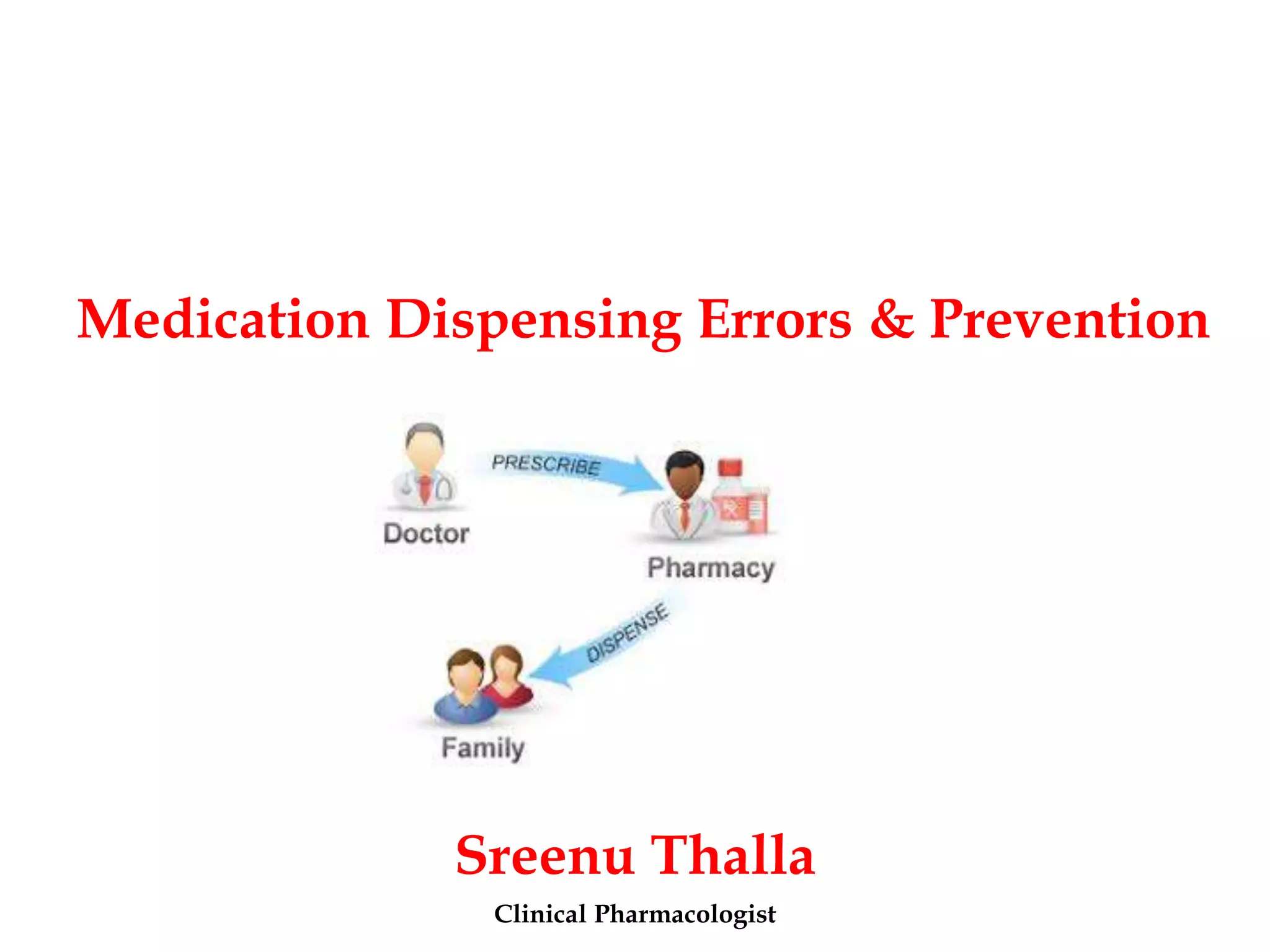
Medication Dispensing Errors & Prevention
Sreenu Thalla
Clinical Pharmacologist
• Medication Errors can occur at many steps in patient care, from
ordering the medication to the time when the patient is administered
the drug.
• In general, medication errors usually occur at one of these points
 Ordering/Prescribing
 Documenting
 Transcribing
 Dispensing
 Administering
 Monitoring
Issues of Concern
• Deteriorated drug error from compromised storage
• Drug utilization process error from the administration,
dispensing or monitoring
• Prescribing errors
Common medication Error types
• Incorrect patient
• Incorrect medication or error of commission
The most common system failures include
• Inaccurate order transcription
• Drug knowledge dissemination
• Failing to obtain allergy history
• Incomplete order checking
• Mistakes the tracking of the medication orders
• Poor professional communication
• Unavailability or inaccurate patient information
Types of Medication Errors
• Prescribing
• Omission
• Wrong time
• Unauthorized drug
• Improper dose
• Wrong dose prescription/wrong dose preparation
• The incorrect route of administration, giving the drug to the
wrong patient, extra dose or wrong rate
• Failing to take into account patient liver and renal function,
failing to document allergy or potential for drug interaction
• Not following protocol or rules established for dispensing and
prescribing medications
Causes of Medication Errors
 Expired Product
 Incorrect Duration
 Incorrect Preparation
 Incorrect Strength
 Incorrect Rate
 Incorrect Timing
 Incorrect Dose
 Incorrect Dosage Form
 Incorrect Patient Action
 Known Allergen
 Known Contraindication
 Pharmacist
 Distractions
 Distortions – Poor hand writing
 Illegible Writing
 Approach every prescription with caution
 Write down the precise dosage
 Use metric measures
 Consider patient age
 Liver and kidney function
 Provide directions
 Use of Abbreviations
 Duration of treatment
 Remain alert for high-risk medications
• Always specify the indication for the drug
• Choose the appropriate drug for the patient population
• Add supplemental instructions
• Adopt a reporting system
• Discuss the patient's preferences
• Write your contact number
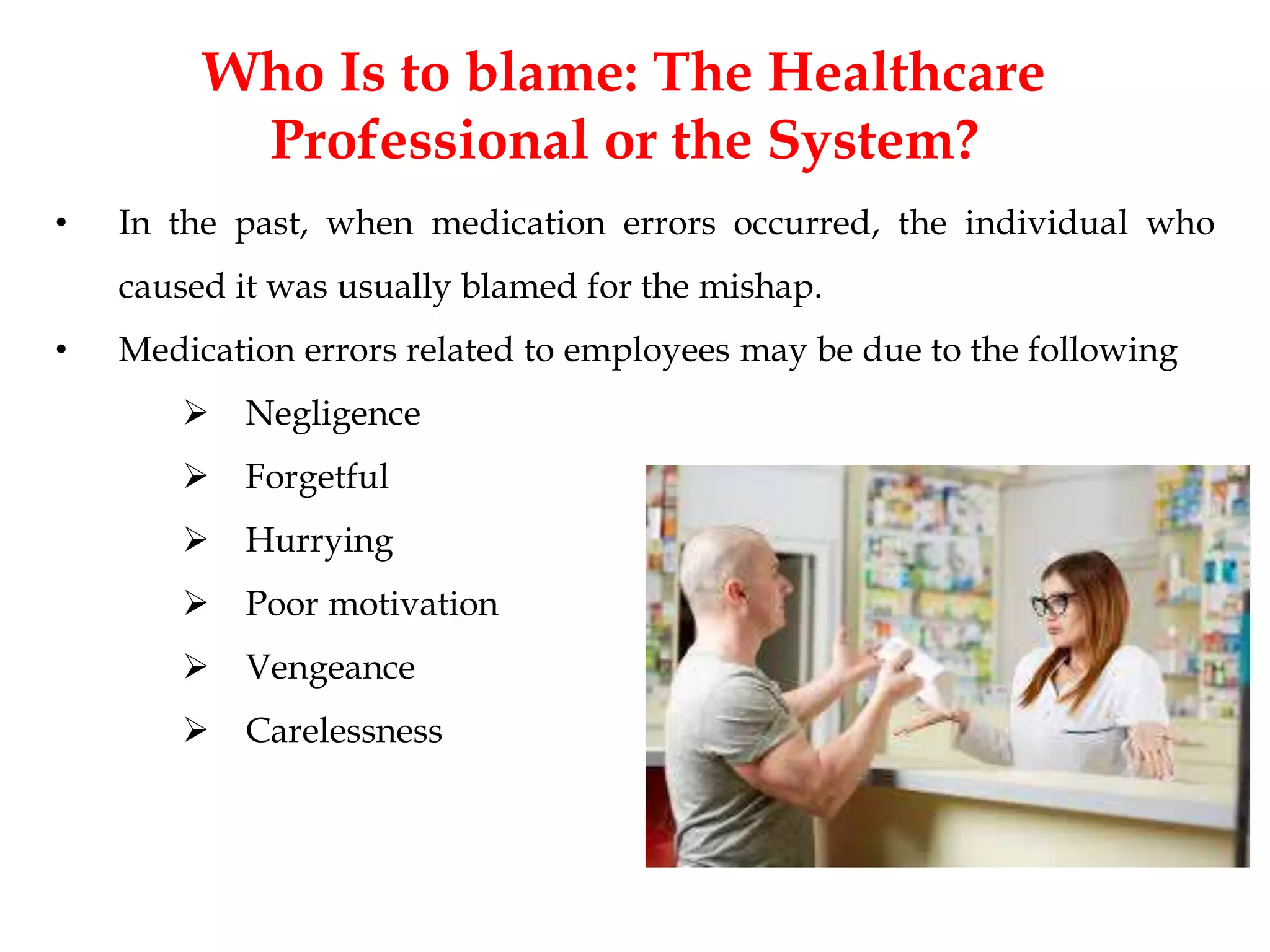
Who Is to blame: The Healthcare
Professional or the System?
• In the past, when medication errors occurred, the individual who
caused it was usually blamed for the mishap.
• Medication errors related to employees may be due to the following
 Negligence
 Forgetful
 Hurrying
 Poor motivation
 Vengeance
 Carelessness
In such situations, disciplinary actions may include
 Blame and shame
 Loss of privileges
 A threat of a medical malpractice lawsuit
 Relief from certain duties
 Transfer to another department
Medication Error Risk Factors
 High volume
 Poor handwriting
 Inexperienced staff
 Challenging patient populations
 Lack of follow-up
 Lack of appropriate monitoring
 Lack of policy enforcement
 Medically complex patients
 Medications requiring calculations
 Interpersonal factors such as external stress
 Environmental factors
 Poor communication
 Shift work
 Workplace culture
 Verbal orders
Pharmacy Error Prevention
• Many adverse drug events are preventable, as they are often due to
human error.
• Common causes of error related to the pharmacists include failure to
 Deliver the correct dosage
 Identify contraindication to drug therapy.
 Identify a drug allergy.
 Monitor drugs with narrow therapeutic indexes
 Recognize drug interaction
 Recognize knowledge deficits
Systems-Based Drug Safety
• In the past, practitioners have borne the blame for medication errors.
• This has resulted in underreporting and an environment that fails to
promote safety improvement.
• The reality is that many errors are due to poor system design and
over expectation of human performance.
• Improving patient safety starts with developing a cultural focus on
safety improvement.
• The team must work together and when an error is identified, the
goal is to prevent it from happening again rather than blame the
individual
Clinical Significance
• Medication errors are a common issue in healthcare and cost billions
of dollars nationwide while inflicting significant morbidity and
mortality.
• While national attention has been paid to errors in medication
dispensing issues, it remains a widespread problem.
• The best method to enhance patient safety is to develop a multi-
faceted strategy for education and prevention.
• Emphasis should be put on healthcare providers working as a team
and communicating as well as encouraging patients to be more
informed about their medications.
• With a culture of safety, dispensing medication errors can be reduced
Other Strategies to Reduce Medication Errors
• Over the years, hospitals have developed strategies to prevent
medication errors.
• Some of these strategies include the following
 Double-check the dosing and frequency of all high-alert medications.
 The Institute of Safe Medication Practices provides a list of high alert
medications.
 If unsure about the drug or the dose, speak to the pharmacist.
 If the writing is illegible, do not give the medication believing that
you think you know what it is.
 Call the healthcare provider to confirm the drug or dose.
 Recheck the calculation to ensure that the patient will get the right
therapeutic dose.
 Ask another clinician to recheck your calculations
Preventing Medication Errors
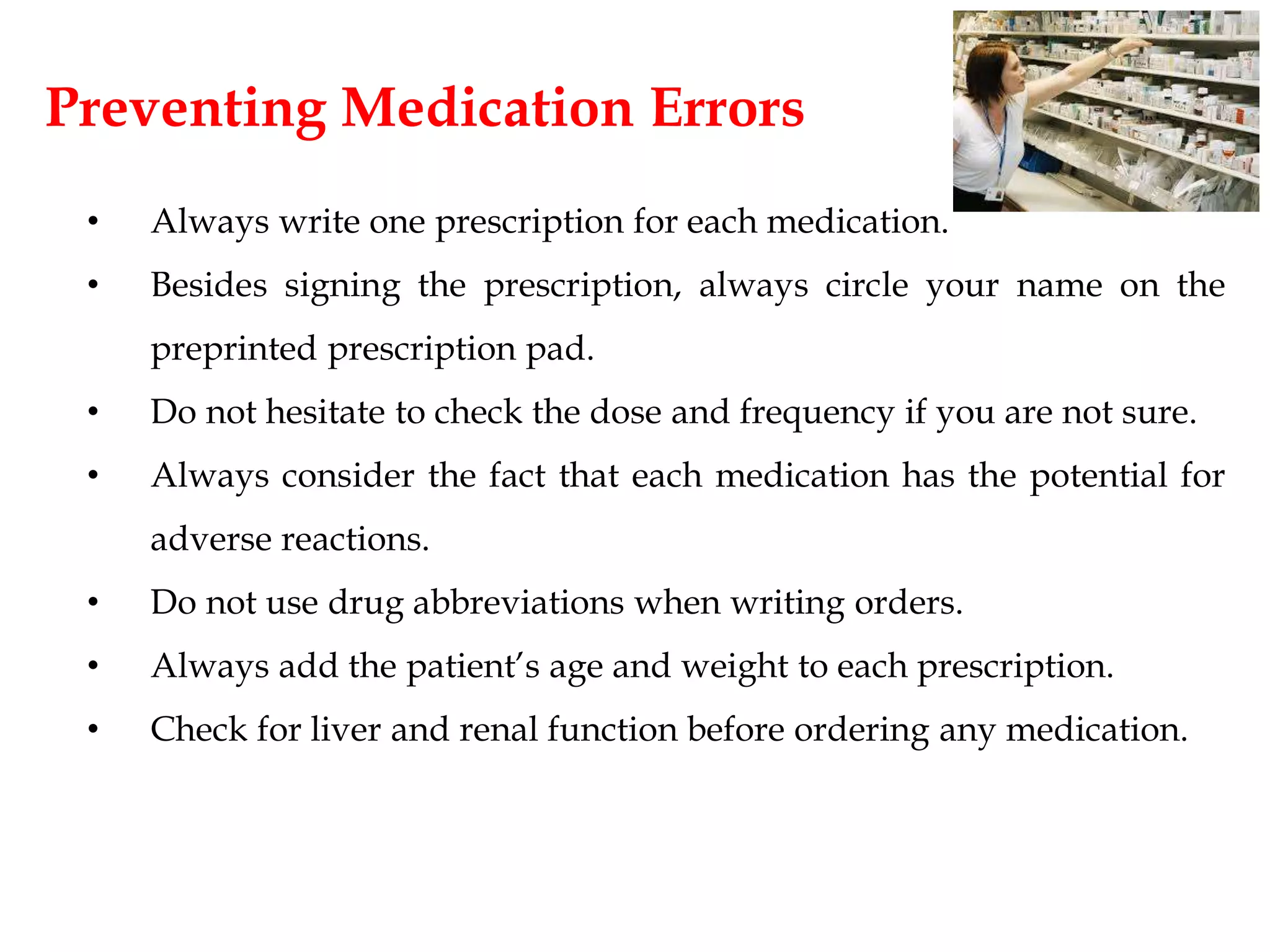
• Always write one prescription for each medication.
• Besides signing the prescription, always circle your name on the
preprinted prescription pad.
• Do not hesitate to check the dose and frequency if you are not sure.
• Always consider the fact that each medication has the potential for
adverse reactions.
• Do not use drug abbreviations when writing orders.
• Always add the patient’s age and weight to each prescription.
• Check for liver and renal function before ordering any medication.
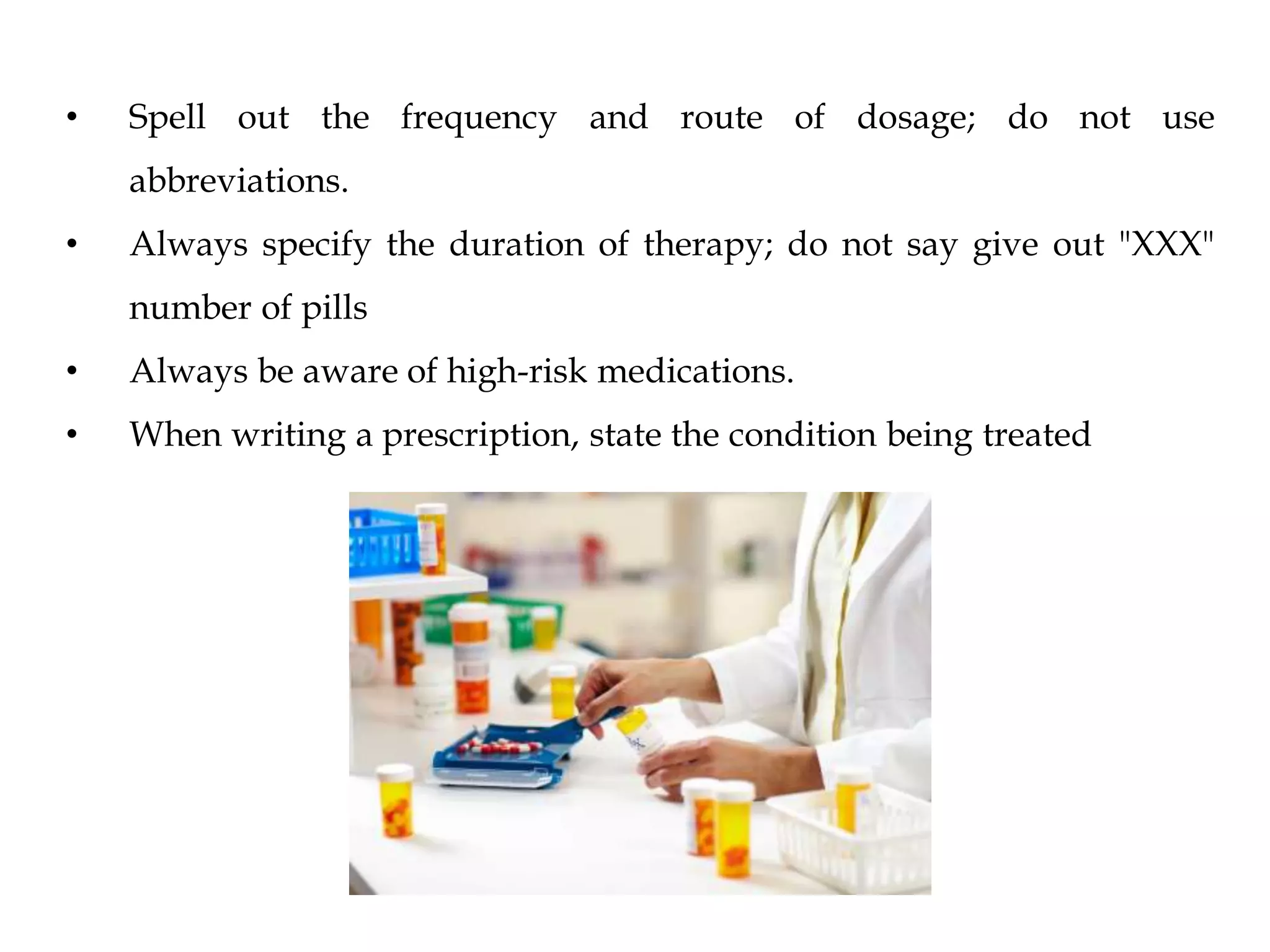
• Spell out the frequency and route of dosage; do not use
abbreviations.
• Always specify the duration of therapy; do not say give out "XXX"
number of pills
• Always be aware of high-risk medications.
• When writing a prescription, state the condition being treated
Enhancing Healthcare Team Outcomes
• Writing prescriptions and medication orders is an everyday job duty
for many healthcare workers, including nurse practitioners.
• The increased demands to see more patients who require many
medications often become monotonous and one can become careless.
• The majority of healthcare workers never anticipate an adverse drug
event and consequently, rarely check back with the pharmacists for
drug interactions.
• With a high number of medication-related errors, healthcare workers
are under great scrutiny to change their work habits and adopt a
culture of safety when writing drug orders and prescriptions.
• Better patient education on their medication offers a check and balance
on the health professionals and increases safety compliance.
Communication
• When pharmacists communicate with prescribers and nurses
• The pharmacist should
 Outline the problem and then provide details
 Offer possible solutions, including substitute medications.
 Repeat back the order or order changes
 Confirm understanding
 Document conversation and decision
Thank You

Dispensing medication errors

  • 1.
    Medication Dispensing Errors& Prevention Sreenu Thalla Clinical Pharmacologist
  • 2.
    • Medication Errorscan occur at many steps in patient care, from ordering the medication to the time when the patient is administered the drug. • In general, medication errors usually occur at one of these points  Ordering/Prescribing  Documenting  Transcribing  Dispensing  Administering  Monitoring
  • 3.
    Issues of Concern •Deteriorated drug error from compromised storage • Drug utilization process error from the administration, dispensing or monitoring • Prescribing errors Common medication Error types • Incorrect patient • Incorrect medication or error of commission
  • 4.
    The most commonsystem failures include • Inaccurate order transcription • Drug knowledge dissemination • Failing to obtain allergy history • Incomplete order checking • Mistakes the tracking of the medication orders • Poor professional communication • Unavailability or inaccurate patient information
  • 5.
    Types of MedicationErrors • Prescribing • Omission • Wrong time • Unauthorized drug • Improper dose • Wrong dose prescription/wrong dose preparation • The incorrect route of administration, giving the drug to the wrong patient, extra dose or wrong rate • Failing to take into account patient liver and renal function, failing to document allergy or potential for drug interaction • Not following protocol or rules established for dispensing and prescribing medications
  • 6.
    Causes of MedicationErrors  Expired Product  Incorrect Duration  Incorrect Preparation  Incorrect Strength  Incorrect Rate  Incorrect Timing  Incorrect Dose  Incorrect Dosage Form  Incorrect Patient Action  Known Allergen  Known Contraindication
  • 7.
     Pharmacist  Distractions Distortions – Poor hand writing  Illegible Writing  Approach every prescription with caution  Write down the precise dosage  Use metric measures  Consider patient age  Liver and kidney function  Provide directions  Use of Abbreviations  Duration of treatment  Remain alert for high-risk medications
  • 8.
    • Always specifythe indication for the drug • Choose the appropriate drug for the patient population • Add supplemental instructions • Adopt a reporting system • Discuss the patient's preferences • Write your contact number
  • 9.
    Who Is toblame: The Healthcare Professional or the System? • In the past, when medication errors occurred, the individual who caused it was usually blamed for the mishap. • Medication errors related to employees may be due to the following  Negligence  Forgetful  Hurrying  Poor motivation  Vengeance  Carelessness
  • 10.
    In such situations,disciplinary actions may include  Blame and shame  Loss of privileges  A threat of a medical malpractice lawsuit  Relief from certain duties  Transfer to another department
  • 11.
    Medication Error RiskFactors  High volume  Poor handwriting  Inexperienced staff  Challenging patient populations  Lack of follow-up  Lack of appropriate monitoring  Lack of policy enforcement  Medically complex patients  Medications requiring calculations  Interpersonal factors such as external stress  Environmental factors  Poor communication  Shift work  Workplace culture  Verbal orders
  • 12.
    Pharmacy Error Prevention •Many adverse drug events are preventable, as they are often due to human error. • Common causes of error related to the pharmacists include failure to  Deliver the correct dosage  Identify contraindication to drug therapy.  Identify a drug allergy.  Monitor drugs with narrow therapeutic indexes  Recognize drug interaction  Recognize knowledge deficits
  • 13.
    Systems-Based Drug Safety •In the past, practitioners have borne the blame for medication errors. • This has resulted in underreporting and an environment that fails to promote safety improvement. • The reality is that many errors are due to poor system design and over expectation of human performance. • Improving patient safety starts with developing a cultural focus on safety improvement. • The team must work together and when an error is identified, the goal is to prevent it from happening again rather than blame the individual
  • 14.
    Clinical Significance • Medicationerrors are a common issue in healthcare and cost billions of dollars nationwide while inflicting significant morbidity and mortality. • While national attention has been paid to errors in medication dispensing issues, it remains a widespread problem. • The best method to enhance patient safety is to develop a multi- faceted strategy for education and prevention. • Emphasis should be put on healthcare providers working as a team and communicating as well as encouraging patients to be more informed about their medications. • With a culture of safety, dispensing medication errors can be reduced
  • 15.
    Other Strategies toReduce Medication Errors • Over the years, hospitals have developed strategies to prevent medication errors. • Some of these strategies include the following  Double-check the dosing and frequency of all high-alert medications.  The Institute of Safe Medication Practices provides a list of high alert medications.  If unsure about the drug or the dose, speak to the pharmacist.  If the writing is illegible, do not give the medication believing that you think you know what it is.  Call the healthcare provider to confirm the drug or dose.  Recheck the calculation to ensure that the patient will get the right therapeutic dose.  Ask another clinician to recheck your calculations
  • 16.
    Preventing Medication Errors •Always write one prescription for each medication. • Besides signing the prescription, always circle your name on the preprinted prescription pad. • Do not hesitate to check the dose and frequency if you are not sure. • Always consider the fact that each medication has the potential for adverse reactions. • Do not use drug abbreviations when writing orders. • Always add the patient’s age and weight to each prescription. • Check for liver and renal function before ordering any medication.
  • 17.
    • Spell outthe frequency and route of dosage; do not use abbreviations. • Always specify the duration of therapy; do not say give out "XXX" number of pills • Always be aware of high-risk medications. • When writing a prescription, state the condition being treated
  • 18.
    Enhancing Healthcare TeamOutcomes • Writing prescriptions and medication orders is an everyday job duty for many healthcare workers, including nurse practitioners. • The increased demands to see more patients who require many medications often become monotonous and one can become careless. • The majority of healthcare workers never anticipate an adverse drug event and consequently, rarely check back with the pharmacists for drug interactions. • With a high number of medication-related errors, healthcare workers are under great scrutiny to change their work habits and adopt a culture of safety when writing drug orders and prescriptions. • Better patient education on their medication offers a check and balance on the health professionals and increases safety compliance.
  • 19.
    Communication • When pharmacistscommunicate with prescribers and nurses • The pharmacist should  Outline the problem and then provide details  Offer possible solutions, including substitute medications.  Repeat back the order or order changes  Confirm understanding  Document conversation and decision
  • 20.