Medical ethics?arbsurgeon@gmail.com
And if anyone saved a life, it would be as if he saved the life of the whole people." (Al Quran 5:32)"No soul can die except by Allah's permission." (Al Quran 3:185)
Medical  ethicsMedical ethics is primarily a field of applied ethics, the study of moral values and judgments as they apply to medicine.
A noble professionMedical profession is the guardian of human life and is responsible for defending living beings from the miseries and death from disease.
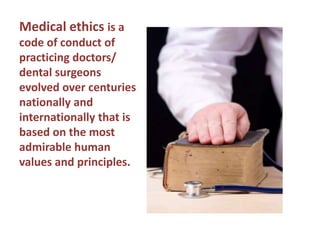
Medical ethics is a code of conduct of practicing doctors/ dental surgeons evolved over centuries nationally and internationally that is based on the most admirable human values and principles.
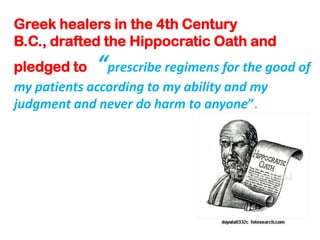
Greek healers in the 4th Century B.C., drafted the Hippocratic Oath and pledged to “prescribe regimens for the good of my patients according to my ability and my judgment and never do harm to anyone”.
intellectual contribute a lot in medical ethicsJewish thinkers such as Maimonides, Roman Catholic scholastic thinkers such as Thomas Aquinas,
Muslim physiciansIshaq bin Ali Rahawi(who wrote the Conduct of a Physician, the first book dedicated to medical ethics) Muhammad ibnZakariyaar-Razi(known as Rhazes in the West)
Muslim physiciansIshaq bin Ali Rahawi,   Who wrote the Adab al-Tabib (Conduct of a Physician), the first treatise dedicated to medical ethics. He regarded physicians as "guardians of souls and bodies", and wrote twenty chapters on various topics related to medical ethics.
Peer reviewEthics of the Physician written by Ishaq bin Ali al-Rahwi (854–931) of al-Raha, Syria, who describes the first medical peer review process state that a visiting physician must always make duplicate notes of a patient's condition on every visit. When the patient was cured or had died, the notes of the physician were examined by a local medical council of other physicians, who would review the practising physician's notes to decide whether his/her performance have met the required standards of medical care. If their reviews were negative, the practicing physician could face a lawsuit from a maltreated patient
Muhammad ibnZakariyaar-Razi( Rhazes) "The doctor's aim is to do good, even to our enemies, so much more to our friends, and my profession forbids us to do harm to our kindred, as it is instituted for the benefit and welfare of the human race, and God imposed on physicians the oath not to compose mortiferous remediesRazi advised practitioners to keep up with advanced knowledge by continually studying medical books and exposing themselves to new information.
There are seven principles of Medical EthicsA Moral Code and moral justification; The Doctor-Patient Relationship; Patient Autonomy; Beneficence (the Good Samaritan); Do No Harm (or Nonmalificence);  Justice;  Physician's moral integrity and virtuous       character.
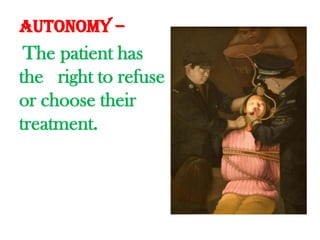
Autonomy –The patient has the   right to refuse or choose their treatment.
Beneficence –A practitioner should act in the best interest of the patient.
Non-maleficence - "first, do no harm"We have been given the gift of life, for goodness sakes. Protect it!!! Respect it!!!
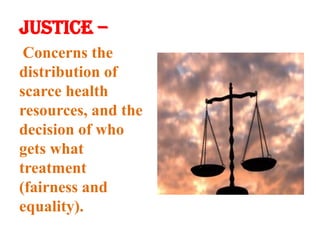
Justice –Concerns the distribution of scarce health resources, and the decision of who gets what treatment (fairness and equality).
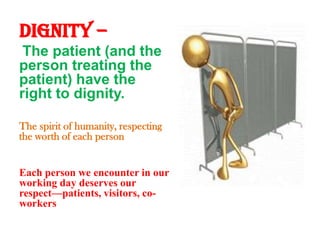
Dignity –The patient (and the person treating the patient) have the right to dignity.The spirit of humanity, respecting the worth of each personEach person we encounter in our working day deserves our respect—patients, visitors, co-workers
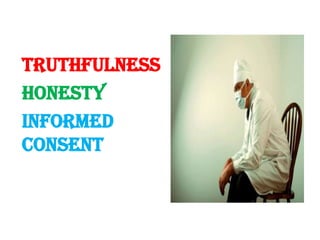
TruthfulnessHonesty  Informed consent
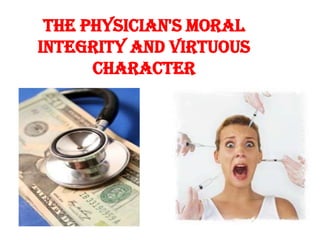
The Physician's moral integrity and virtuous character
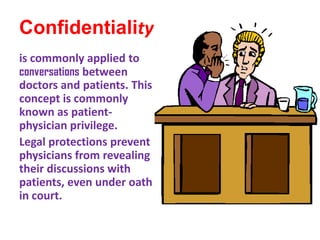
Confidentialityis commonly applied to conversations between doctors and patients. This concept is commonly known as patient-physician privilege.Legal protections prevent physicians from revealing their discussions with patients, even under oath in court.

Bad doctorAll doctors know that it is unethical, at a minimum, to have a sex relationship with a patient.
Thanks

Medical ethics

  • 1.
  • 2.
    And if anyonesaved a life, it would be as if he saved the life of the whole people." (Al Quran 5:32)"No soul can die except by Allah's permission." (Al Quran 3:185)
  • 3.
    Medical ethicsMedicalethics is primarily a field of applied ethics, the study of moral values and judgments as they apply to medicine.
  • 4.
    A noble professionMedicalprofession is the guardian of human life and is responsible for defending living beings from the miseries and death from disease.
  • 5.
    Medical ethics isa code of conduct of practicing doctors/ dental surgeons evolved over centuries nationally and internationally that is based on the most admirable human values and principles.
  • 6.
    Greek healers inthe 4th Century B.C., drafted the Hippocratic Oath and pledged to “prescribe regimens for the good of my patients according to my ability and my judgment and never do harm to anyone”.
  • 7.
    intellectual contribute alot in medical ethicsJewish thinkers such as Maimonides, Roman Catholic scholastic thinkers such as Thomas Aquinas,
  • 8.
    Muslim physiciansIshaq binAli Rahawi(who wrote the Conduct of a Physician, the first book dedicated to medical ethics) Muhammad ibnZakariyaar-Razi(known as Rhazes in the West)
  • 9.
    Muslim physiciansIshaq binAli Rahawi, Who wrote the Adab al-Tabib (Conduct of a Physician), the first treatise dedicated to medical ethics. He regarded physicians as "guardians of souls and bodies", and wrote twenty chapters on various topics related to medical ethics.
  • 10.
    Peer reviewEthics ofthe Physician written by Ishaq bin Ali al-Rahwi (854–931) of al-Raha, Syria, who describes the first medical peer review process state that a visiting physician must always make duplicate notes of a patient's condition on every visit. When the patient was cured or had died, the notes of the physician were examined by a local medical council of other physicians, who would review the practising physician's notes to decide whether his/her performance have met the required standards of medical care. If their reviews were negative, the practicing physician could face a lawsuit from a maltreated patient
  • 11.
    Muhammad ibnZakariyaar-Razi( Rhazes)"The doctor's aim is to do good, even to our enemies, so much more to our friends, and my profession forbids us to do harm to our kindred, as it is instituted for the benefit and welfare of the human race, and God imposed on physicians the oath not to compose mortiferous remediesRazi advised practitioners to keep up with advanced knowledge by continually studying medical books and exposing themselves to new information.
  • 12.
    There are sevenprinciples of Medical EthicsA Moral Code and moral justification; The Doctor-Patient Relationship; Patient Autonomy; Beneficence (the Good Samaritan); Do No Harm (or Nonmalificence); Justice; Physician's moral integrity and virtuous character.
  • 13.
    Autonomy –The patienthas the right to refuse or choose their treatment.
  • 14.
    Beneficence –A practitionershould act in the best interest of the patient.
  • 15.
    Non-maleficence - "first,do no harm"We have been given the gift of life, for goodness sakes. Protect it!!! Respect it!!!
  • 16.
    Justice –Concerns thedistribution of scarce health resources, and the decision of who gets what treatment (fairness and equality).
  • 17.
    Dignity –The patient(and the person treating the patient) have the right to dignity.The spirit of humanity, respecting the worth of each personEach person we encounter in our working day deserves our respect—patients, visitors, co-workers
  • 18.
  • 19.
    The Physician's moralintegrity and virtuous character
  • 20.
    Confidentialityis commonly appliedto conversations between doctors and patients. This concept is commonly known as patient-physician privilege.Legal protections prevent physicians from revealing their discussions with patients, even under oath in court.
  • 21.
    Bad doctorAll doctorsknow that it is unethical, at a minimum, to have a sex relationship with a patient.
  • 22.