A LOOK AT MEDIATION Submitted in partial fulfillment of the course: ADMS632 –Administration and Supervision of Special Education. Presenter: Leroy N. Rowe Lecturer: Robert B. Whytal October 17,2008
MEDIATION IN SPECIAL EDUCATION Mediate……. …… before it’s too late.
MEDIATION DEFINED In Special Education this is an informal process in which an  impartial ,  neutral  third person (mediator) helps parents and school staff negotiate issues affecting a child with special needs. These issues are often related, but not limited to, the level of services offered. Important Words often used in mediation definition :  Informal  Confidential   Voluntary .
FUNCTIONS  of  MEDIATION  Makes talk productive Clarifies issues Helps to bridge the gap Gets results
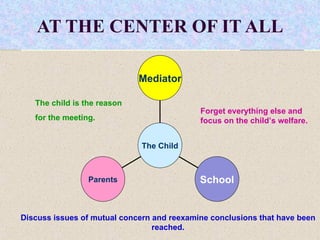
AT THE CENTER OF IT ALL Forget everything else and focus on the child’s welfare. The child is the reason  for the meeting. Discuss issues of mutual concern and reexamine conclusions that have been reached. Parents School Mediator The Child
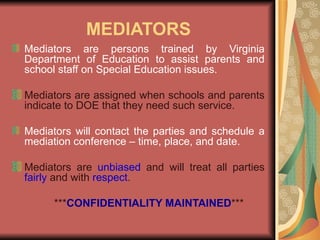
MEDIATORS Mediators are persons trained by Virginia Department of Education to assist parents and school staff on Special Education issues. Mediators are assigned when schools and parents indicate to DOE that they need such service. Mediators will contact the parties and schedule a mediation conference – time, place, and date. Mediators are  unbiased  and will treat all parties  fairly  and with  respect . *** CONFIDENTIALITY MAINTAINED ***
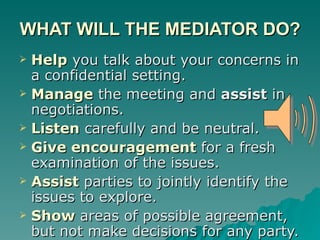
WHAT WILL THE MEDIATOR DO? Help   you talk about your concerns in a confidential setting. Manage  the meeting and  assist  in negotiations. Listen  carefully and be neutral. Give encouragement  for a fresh examination of the issues. Assist  parties to jointly identify the issues to explore. Show   areas of possible agreement, but not make decisions for any party.
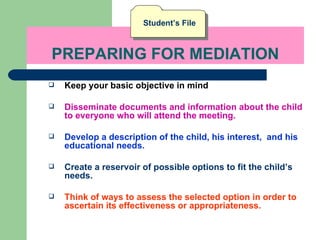
PREPARING FOR MEDIATION Keep your basic objective in mind Disseminate documents and information about the child to everyone who will attend the meeting. Develop a description of the child, his interest,  and his educational needs. Create a reservoir of possible options to fit the child’s needs. Think of ways to assess the selected option in order to ascertain its effectiveness or appropriateness.   Student’s File
APPROACH MEDIATION WITH AN OPEN MIND Look at the issue afresh. Focus on child’s needs and effects on  his education. Share your conclusions, observations and concerns. Be open to new information that does not match yours. Consider new options not considered before.
ATTENDEES SCHOOL Anyone who: has direct experience with the child. (Reg.Ed.) has knowledge of available programs in areas of the child’s needs. (Sped) can commit the school to offers made. (Admin) PARENTS Anyone who: will help to make them comfortable at the meeting. has direct experience with child or his evaluation. is a staff member and has particular insight into the child’s needs.
MEDIATION MEETING AGENDA INTRODUCTION  – format, roles, goals outlined. DEFINITION  – chief concerns, definition of the child.  PROCESSING  – asking questions to expand thinking and assess conclusions. EXPLORING  – examine possible outcomes. CLOSURE   – assessment of options that reveal agreement or honest disagreement.
WHO DECIDES? Expect the mediator to make  no  decision. It is your role to shape, choose, and consent to any settlement made. Decisions will be  voluntary agreement  between parents and school staff. Mediators are paid by Virginia Department of Education so it costs parents  only  a small fraction of their time. HOW MUCH DOES MEDIATION COST?
The Greatest Benefit of Mediation Mediation seeks to maintain or reestablish productive working relationships among people in order to create circumstances where joint planning is possible.  It provides timely and effective intervention for people with conflicting views on a child’s special needs.
More Benefits of Mediation Mediation:- Uncovers unexplored options. Provides a forum in which people communicate with each other differently. Allows people to explore reasons behind their conclusions. Fosters a structured problem-solving approach that is easily understood.
WHAT ARE THE OTHER OPTIONS IF MEDIATION FAILS? CONTINUE NEGOTIATIONS FILE A COMPLAINT REQUEST DUE PROCESS
Available Resources   Telephone contacts Virginia Department of Education  804.786.0711  0r  804.225.2980 Web resources http://www.doe.virginia.gov/VDOE/Instruction/ssems.html http://www.doe.virginia.gov/VDOE/Instruction/mediators.html
COMMENTS I shared this with  Ms. L  and  Ms. E  so here is their feedback: Be more specific in terms of who should attend Tone of the presentation is to light hearted for such a serious topic Most schools are required to participate in some form of mediation before more formal actions are taken.   While mediation is less formal than legal proceedings, it is also very structured.  Saying it is informal is taking it too far I would choose another word
Comments again…. I don’t know if it is appropriate for your assignment to make comments as they relate specifically to Henrico County, but on the list of attendees, it is typical for there to be a building administrator and a representative from central office (either the educational specialist or the consulting teacher).
Comments cont…… This is mine  (P.L.G) Slide 9:  ….information…DOES Slide 10:  “your” role:  Who is you?  I disagree that YOU shapes the decision.  I never want to put myself in that position.  I always try to be the recorder in that situation where I am reflecting the consensus of the group or their lack of consensus.  Try to eliminate the You as it is never defined.  I’m also not sure who the intended audience is when you is used.
Most of what we do delineates who must attend to have a valid meeting.  To say “those who are interested etc.” does not reflect PL 94-142.  In our situation, the county usually gives in before litigation starts.  Much of the time when things are tense our county attorney attends the iep meetings as does the ed. specialist.  We (as case managers) tend not to make a move without the approval of the attorney and the specialist and we simply follow their directives. In these situations, we simply record the information on whatever document we’re using whether it’s an iep, reassessment, bip or manifestation.  I have never seen us use a mediator even though I’ve been privy to information on some tense situations. Good use of color and graphic organizers.  Everything is clear.  Some of this becomes confusing because there is a difference between what is actually taught in a textbook and what is the accepted practice down in the trenches.

Mediation In Special Education

  • 1.
    A LOOK ATMEDIATION Submitted in partial fulfillment of the course: ADMS632 –Administration and Supervision of Special Education. Presenter: Leroy N. Rowe Lecturer: Robert B. Whytal October 17,2008
  • 2.
    MEDIATION IN SPECIALEDUCATION Mediate……. …… before it’s too late.
  • 3.
    MEDIATION DEFINED InSpecial Education this is an informal process in which an impartial , neutral third person (mediator) helps parents and school staff negotiate issues affecting a child with special needs. These issues are often related, but not limited to, the level of services offered. Important Words often used in mediation definition : Informal Confidential Voluntary .
  • 4.
    FUNCTIONS of MEDIATION Makes talk productive Clarifies issues Helps to bridge the gap Gets results
  • 5.
    AT THE CENTEROF IT ALL Forget everything else and focus on the child’s welfare. The child is the reason for the meeting. Discuss issues of mutual concern and reexamine conclusions that have been reached. Parents School Mediator The Child
  • 6.
    MEDIATORS Mediators arepersons trained by Virginia Department of Education to assist parents and school staff on Special Education issues. Mediators are assigned when schools and parents indicate to DOE that they need such service. Mediators will contact the parties and schedule a mediation conference – time, place, and date. Mediators are unbiased and will treat all parties fairly and with respect . *** CONFIDENTIALITY MAINTAINED ***
  • 7.
    WHAT WILL THEMEDIATOR DO? Help you talk about your concerns in a confidential setting. Manage the meeting and assist in negotiations. Listen carefully and be neutral. Give encouragement for a fresh examination of the issues. Assist parties to jointly identify the issues to explore. Show areas of possible agreement, but not make decisions for any party.
  • 8.
    PREPARING FOR MEDIATIONKeep your basic objective in mind Disseminate documents and information about the child to everyone who will attend the meeting. Develop a description of the child, his interest, and his educational needs. Create a reservoir of possible options to fit the child’s needs. Think of ways to assess the selected option in order to ascertain its effectiveness or appropriateness. Student’s File
  • 9.
    APPROACH MEDIATION WITHAN OPEN MIND Look at the issue afresh. Focus on child’s needs and effects on his education. Share your conclusions, observations and concerns. Be open to new information that does not match yours. Consider new options not considered before.
  • 10.
    ATTENDEES SCHOOL Anyonewho: has direct experience with the child. (Reg.Ed.) has knowledge of available programs in areas of the child’s needs. (Sped) can commit the school to offers made. (Admin) PARENTS Anyone who: will help to make them comfortable at the meeting. has direct experience with child or his evaluation. is a staff member and has particular insight into the child’s needs.
  • 11.
    MEDIATION MEETING AGENDAINTRODUCTION – format, roles, goals outlined. DEFINITION – chief concerns, definition of the child. PROCESSING – asking questions to expand thinking and assess conclusions. EXPLORING – examine possible outcomes. CLOSURE – assessment of options that reveal agreement or honest disagreement.
  • 12.
    WHO DECIDES? Expectthe mediator to make no decision. It is your role to shape, choose, and consent to any settlement made. Decisions will be voluntary agreement between parents and school staff. Mediators are paid by Virginia Department of Education so it costs parents only a small fraction of their time. HOW MUCH DOES MEDIATION COST?
  • 13.
    The Greatest Benefitof Mediation Mediation seeks to maintain or reestablish productive working relationships among people in order to create circumstances where joint planning is possible. It provides timely and effective intervention for people with conflicting views on a child’s special needs.
  • 14.
    More Benefits ofMediation Mediation:- Uncovers unexplored options. Provides a forum in which people communicate with each other differently. Allows people to explore reasons behind their conclusions. Fosters a structured problem-solving approach that is easily understood.
  • 15.
    WHAT ARE THEOTHER OPTIONS IF MEDIATION FAILS? CONTINUE NEGOTIATIONS FILE A COMPLAINT REQUEST DUE PROCESS
  • 16.
    Available Resources Telephone contacts Virginia Department of Education 804.786.0711 0r 804.225.2980 Web resources http://www.doe.virginia.gov/VDOE/Instruction/ssems.html http://www.doe.virginia.gov/VDOE/Instruction/mediators.html
  • 17.
    COMMENTS I sharedthis with Ms. L and Ms. E so here is their feedback: Be more specific in terms of who should attend Tone of the presentation is to light hearted for such a serious topic Most schools are required to participate in some form of mediation before more formal actions are taken.  While mediation is less formal than legal proceedings, it is also very structured.  Saying it is informal is taking it too far I would choose another word
  • 18.
    Comments again…. Idon’t know if it is appropriate for your assignment to make comments as they relate specifically to Henrico County, but on the list of attendees, it is typical for there to be a building administrator and a representative from central office (either the educational specialist or the consulting teacher).
  • 19.
    Comments cont…… Thisis mine (P.L.G) Slide 9:  ….information…DOES Slide 10:  “your” role:  Who is you?  I disagree that YOU shapes the decision.  I never want to put myself in that position.  I always try to be the recorder in that situation where I am reflecting the consensus of the group or their lack of consensus.  Try to eliminate the You as it is never defined.  I’m also not sure who the intended audience is when you is used.
  • 20.
    Most of whatwe do delineates who must attend to have a valid meeting.  To say “those who are interested etc.” does not reflect PL 94-142.  In our situation, the county usually gives in before litigation starts.  Much of the time when things are tense our county attorney attends the iep meetings as does the ed. specialist.  We (as case managers) tend not to make a move without the approval of the attorney and the specialist and we simply follow their directives. In these situations, we simply record the information on whatever document we’re using whether it’s an iep, reassessment, bip or manifestation.  I have never seen us use a mediator even though I’ve been privy to information on some tense situations. Good use of color and graphic organizers.  Everything is clear.  Some of this becomes confusing because there is a difference between what is actually taught in a textbook and what is the accepted practice down in the trenches.