INTRO TO
DIGITAL
MEDIA
CULTURES
#MED122
ROBERT.JEWITT@SUNDERLAND.AC.UK
MODULE OVERVIEW
Module leader: Rob Jewitt
• robert.jewitt@sunderland.ac.uk
• @rob_jewitt
• 0191 515 3431
• MC205
• Office hour: Monday 11-12noon
CONTENT SYNOPSIS
This module provides an introduction to the study of digital
media culture (also known as Internet Studies) and
historically referred to as the study of cyber culture or ‘new
media’. As a theoretical and critical module, participating
students will encounter a historical overview of pertinent
technological developments ranging from the origins of the
internet, the personal computer, video games and mobile
media devices. These will be set against a context in which
issues of such as interactivity, immersion, participation,
digitalisation and remediation are investigated. The module
will be supported via the examination of case studies
addressing various digital media phenomena drawing upon,
but not restricted to, cybercrime, piracy, digital publishing,
online gaming and social networking.
CONTENT SYNOPSIS
This module provides an introduction to the study of digital
media culture (also known as Internet Studies) and
historically referred to as the study of cyber culture or ‘new
media’. As a theoretical and critical module, participating
students will encounter a historical overview of pertinent
technological developments ranging from the origins of the
internet, the personal computer, video games and mobile
media devices. These will be set against a context in which
issues of such as interactivity, immersion, participation,
digitalisation and remediation are investigated. The module
will be supported via the examination of case studies
addressing various digital media phenomena drawing upon,
but not restricted to, cybercrime, piracy, digital publishing,
online gaming and social networking.
CONTENT SYNOPSIS
This module provides an introduction to the study of digital
media culture (also known as Internet Studies) and
historically referred to as the study of cyber culture or ‘new
media’. As a theoretical and critical module, participating
students will encounter a historical overview of pertinent
technological developments ranging from the origins of the
internet, the personal computer, video games and mobile
media devices. These will be set against a context in which
issues of such as interactivity, immersion, participation,
digitalisation and remediation are investigated. The module
will be supported via the examination of case studies
addressing various digital media phenomena drawing upon,
but not restricted to, cybercrime, piracy, digital publishing,
online gaming and social networking.
CONTENT SYNOPSIS
This module provides an introduction to the study of digital
media culture (also known as Internet Studies) and
historically referred to as the study of cyber culture or ‘new
media’. As a theoretical and critical module, participating
students will encounter a historical overview of pertinent
technological developments ranging from the origins of the
internet, the personal computer, video games and mobile
media devices. These will be set against a context in which
issues of such as interactivity, immersion, participation,
digitalisation and remediation are investigated. The module
will be supported via the examination of case studies
addressing various digital media phenomena drawing upon,
but not restricted to, cybercrime, piracy, digital publishing,
online gaming and social networking.
CONTENT SYNOPSIS
Module participants will produce a number of short-form
case studies addressing various aspects of digital media
cultures before submitting an end of module written essay on
a related digital media-based subject.
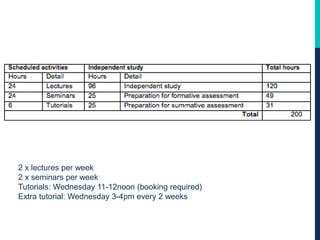
2 x lectures per week
2 x seminars per week
Tutorials: Monday11-12noon
Extra tutorial: Wednesday 3-4pm every 2 weeks
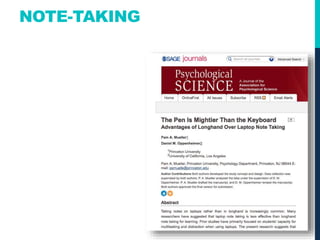
NOTE-TAKING
WEEKLY SCHEDULE
Week 1
Lecture A Introduction to the module
Lecture B History of Computing
Week 2
Lecture A History of the Internet
Lecture B History of Cyberculture
Week 3
Lecture A History of games and gaming
Lecture B History of mobile media
Week 4
Lecture A Digital disruption: music industry
Lecture B Digital disruption: television industry
WEEKLY SCHEDULE
Week 5
Lecture A Digital disruption: newspaper industry
Lecture B Digital disruption: advertising and content funding
Week 6
Lecture A Participatory culture and web 2.0
Lecture B Social networking and surveillance
Week 7
Lecture A Viral media
Lecture B Reputation and risk: trolls, hoaxes and ‘e-bile’
Week 8 – Independent study week
Week 9
Lecture A Media monopolies: searching for Google’s alternatives
Lecture B Media monopolies: the cult of Apple
WEEKLY SCHEDULE
Week 10
Lecture A Games, gaming and representation
Lecture B Games, Narrative and ‘Play’
Week 11
Lecture A Immersion and immersive experiences
Lecture B Gamification
Week 12
Lecture A Free culture, the public domain and code as control
Lecture B Piracy and cybercrime
ASSESSMENT 1
Students are required to produce 2 case studies, one on an
hardware/software invention of their choice and another on a
digital business of their choice. These are to be no longer
than 750 words in length.
Deadlines for assessment 1 (portfolio):
Case study 1 (hard/software) - 27th October 2015
Case study 2 (digital business) – 24th November 2015
ASSESSMENT 1 - TIPS
There are a few guiding points regarding the case studies:
• Case studies are expected to be informative and original pieces of
work.
• They should demonstrate an awareness of historical developments
relevant to the subject.
• It is expected that they will draw on some critical reading (ie
books/journals) and not be wholly reliant on singular web sources
(eg Wikipedia).
• It would be expected that a minimum of three academic sources will
be cited.
• It is expected that they will be written in a third-person perspective.
• Images and diagrams are permitted.
• Case studies should emphasise the importance or significance of
the specific subject matter.
ASSESSMENT 2
Students are expected to write one essay of 2,000 words.
Essays may go 10% either side of the deadline (minimum of
1,800 words; maximum of 2,200 words) without experiencing
a grade penalty. Essays that fail to meet this criteria will be
capped at a maximum grade of 40%.
Deadline for assessment 2 (essay): 5th January 2016
TO DO:
Access Sunspace and download/save/read module guide
Thursday class on computing:
1. What was your first experience of using a computer?
2. What was the first computer you ever bought (if at all), and what
considerations did you have to take on board when making the
purchasing decision?
3. Have you ever physically built or modified a computer?
4. Do you think computer engineering/science should be taught at
school?
5. How important do you think a knowledge of how computers work is
in understanding their potential/limitations?
6. What do you know about the Raspberry Pi/Arduino projects, and
how successful do you think they will be?

Med122 2014 week 1 intro to the module

  • 1.
  • 2.
    MODULE OVERVIEW Module leader:Rob Jewitt • robert.jewitt@sunderland.ac.uk • @rob_jewitt • 0191 515 3431 • MC205 • Office hour: Monday 11-12noon
  • 3.
    CONTENT SYNOPSIS This moduleprovides an introduction to the study of digital media culture (also known as Internet Studies) and historically referred to as the study of cyber culture or ‘new media’. As a theoretical and critical module, participating students will encounter a historical overview of pertinent technological developments ranging from the origins of the internet, the personal computer, video games and mobile media devices. These will be set against a context in which issues of such as interactivity, immersion, participation, digitalisation and remediation are investigated. The module will be supported via the examination of case studies addressing various digital media phenomena drawing upon, but not restricted to, cybercrime, piracy, digital publishing, online gaming and social networking.
  • 4.
    CONTENT SYNOPSIS This moduleprovides an introduction to the study of digital media culture (also known as Internet Studies) and historically referred to as the study of cyber culture or ‘new media’. As a theoretical and critical module, participating students will encounter a historical overview of pertinent technological developments ranging from the origins of the internet, the personal computer, video games and mobile media devices. These will be set against a context in which issues of such as interactivity, immersion, participation, digitalisation and remediation are investigated. The module will be supported via the examination of case studies addressing various digital media phenomena drawing upon, but not restricted to, cybercrime, piracy, digital publishing, online gaming and social networking.
  • 5.
    CONTENT SYNOPSIS This moduleprovides an introduction to the study of digital media culture (also known as Internet Studies) and historically referred to as the study of cyber culture or ‘new media’. As a theoretical and critical module, participating students will encounter a historical overview of pertinent technological developments ranging from the origins of the internet, the personal computer, video games and mobile media devices. These will be set against a context in which issues of such as interactivity, immersion, participation, digitalisation and remediation are investigated. The module will be supported via the examination of case studies addressing various digital media phenomena drawing upon, but not restricted to, cybercrime, piracy, digital publishing, online gaming and social networking.
  • 6.
    CONTENT SYNOPSIS This moduleprovides an introduction to the study of digital media culture (also known as Internet Studies) and historically referred to as the study of cyber culture or ‘new media’. As a theoretical and critical module, participating students will encounter a historical overview of pertinent technological developments ranging from the origins of the internet, the personal computer, video games and mobile media devices. These will be set against a context in which issues of such as interactivity, immersion, participation, digitalisation and remediation are investigated. The module will be supported via the examination of case studies addressing various digital media phenomena drawing upon, but not restricted to, cybercrime, piracy, digital publishing, online gaming and social networking.
  • 7.
    CONTENT SYNOPSIS Module participantswill produce a number of short-form case studies addressing various aspects of digital media cultures before submitting an end of module written essay on a related digital media-based subject.
  • 8.
    2 x lecturesper week 2 x seminars per week Tutorials: Monday11-12noon Extra tutorial: Wednesday 3-4pm every 2 weeks
  • 9.
  • 10.
    WEEKLY SCHEDULE Week 1 LectureA Introduction to the module Lecture B History of Computing Week 2 Lecture A History of the Internet Lecture B History of Cyberculture Week 3 Lecture A History of games and gaming Lecture B History of mobile media Week 4 Lecture A Digital disruption: music industry Lecture B Digital disruption: television industry
  • 11.
    WEEKLY SCHEDULE Week 5 LectureA Digital disruption: newspaper industry Lecture B Digital disruption: advertising and content funding Week 6 Lecture A Participatory culture and web 2.0 Lecture B Social networking and surveillance Week 7 Lecture A Viral media Lecture B Reputation and risk: trolls, hoaxes and ‘e-bile’ Week 8 – Independent study week Week 9 Lecture A Media monopolies: searching for Google’s alternatives Lecture B Media monopolies: the cult of Apple
  • 12.
    WEEKLY SCHEDULE Week 10 LectureA Games, gaming and representation Lecture B Games, Narrative and ‘Play’ Week 11 Lecture A Immersion and immersive experiences Lecture B Gamification Week 12 Lecture A Free culture, the public domain and code as control Lecture B Piracy and cybercrime
  • 13.
    ASSESSMENT 1 Students arerequired to produce 2 case studies, one on an hardware/software invention of their choice and another on a digital business of their choice. These are to be no longer than 750 words in length. Deadlines for assessment 1 (portfolio): Case study 1 (hard/software) - 27th October 2015 Case study 2 (digital business) – 24th November 2015
  • 14.
    ASSESSMENT 1 -TIPS There are a few guiding points regarding the case studies: • Case studies are expected to be informative and original pieces of work. • They should demonstrate an awareness of historical developments relevant to the subject. • It is expected that they will draw on some critical reading (ie books/journals) and not be wholly reliant on singular web sources (eg Wikipedia). • It would be expected that a minimum of three academic sources will be cited. • It is expected that they will be written in a third-person perspective. • Images and diagrams are permitted. • Case studies should emphasise the importance or significance of the specific subject matter.
  • 15.
    ASSESSMENT 2 Students areexpected to write one essay of 2,000 words. Essays may go 10% either side of the deadline (minimum of 1,800 words; maximum of 2,200 words) without experiencing a grade penalty. Essays that fail to meet this criteria will be capped at a maximum grade of 40%. Deadline for assessment 2 (essay): 5th January 2016
  • 16.
    TO DO: Access Sunspaceand download/save/read module guide Thursday class on computing: 1. What was your first experience of using a computer? 2. What was the first computer you ever bought (if at all), and what considerations did you have to take on board when making the purchasing decision? 3. Have you ever physically built or modified a computer? 4. Do you think computer engineering/science should be taught at school? 5. How important do you think a knowledge of how computers work is in understanding their potential/limitations? 6. What do you know about the Raspberry Pi/Arduino projects, and how successful do you think they will be?