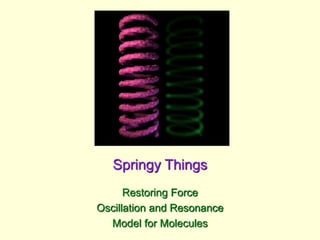
Springy Things
Restoring Force
Oscillation and Resonance
Model for Molecules
Spring 2006
UCSD: Physics 8; 2006
2
Springs: supplying restoring force
• When you pull on (stretch) a
spring, it pulls back (top picture)
• When you push on (compress) a
spring, it pushes back (bottom)
• Thus springs present a restoring
force:
F = kx
– x is the displacement (in meters)
– k is the “spring constant” in
Newtons per meter (N/m)
– the negative sign means opposite
to the direction of displacement
Spring 2006
UCSD: Physics 8; 2006
3
Example
• If the springs in your 1000 kg car compress by 10 cm
(e.g., when lowered off of jacks):
– then the springs must be exerting mg = 10,000 Newtons of
force to support the car
– F = kx = 10,000 N, x = 0.1 m
– so k = 100,000 N/m (stiff spring)
• this is the collective spring constant: they all add to this
• Now if you pile 400 kg into your car, how much will it
sink?
– 4,000 = (100,000)x, so x = 4/100 = 0.04 m = 4 cm
• Could have taken short-cut:
– springs are linear, so 400 additional kg will depress car an
additional 40% (400/1000) of its initial depression
Spring 2006
UCSD: Physics 8; 2006
4
Energy Storage in Spring
• Applied force is kΔx (reaction from spring is kΔx)
– starts at zero when Δx = 0
– slowly ramps up as you push
• Work is force times distance
• Let’s say we want to move spring a total distance of x
– would naively think W = kx2
– but force starts out small (not full kx right away)
– works out that W = ½kx2
Spring 2006
UCSD: Physics 8; 2006
5
Work “Integral”
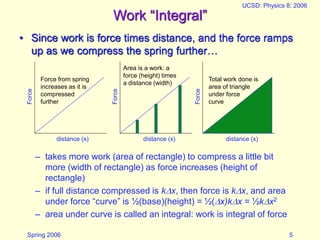
• Since work is force times distance, and the force ramps
up as we compress the spring further…
– takes more work (area of rectangle) to compress a little bit
more (width of rectangle) as force increases (height of
rectangle)
– if full distance compressed is kx, then force is kx, and area
under force “curve” is ½(base)(height) = ½(x)kx = ½kx2
– area under curve is called an integral: work is integral of force
Force
Force
Force
distance (x) distance (x) distance (x)
Area is a work: a
force (height) times
a distance (width)
Force from spring
increases as it is
compressed
further
Total work done is
area of triangle
under force
curve
Spring 2006
UCSD: Physics 8; 2006
6
The Potential Energy Function
• Since the potential energy
varies with the square of
displacement, we can plot this
as a parabola
• Call the low point zero potential
• Think of it like the drawing of a
trough between two hillsides
• A ball would roll back and forth
exchanging gravitational
potential for kinetic energy
• Likewise, a compressed (or
stretched) spring and mass
combination will oscillate
– exchanges kinetic energy for
potential energy of spring
Spring 2006
UCSD: Physics 8; 2006
7
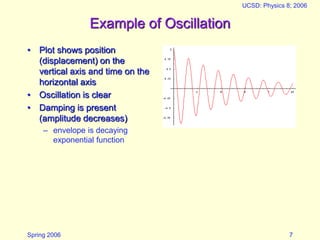
Example of Oscillation
• Plot shows position
(displacement) on the
vertical axis and time on the
horizontal axis
• Oscillation is clear
• Damping is present
(amplitude decreases)
– envelope is decaying
exponential function
Spring 2006
UCSD: Physics 8; 2006
8
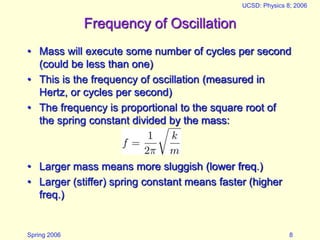
Frequency of Oscillation
• Mass will execute some number of cycles per second
(could be less than one)
• This is the frequency of oscillation (measured in
Hertz, or cycles per second)
• The frequency is proportional to the square root of
the spring constant divided by the mass:
• Larger mass means more sluggish (lower freq.)
• Larger (stiffer) spring constant means faster (higher
freq.)
Spring 2006
UCSD: Physics 8; 2006
9
Natural Frequencies & Damping
• Many physical systems exhibit oscillation
– guitar strings, piano strings, violin strings, air in flute
– lampposts, trees, rulers hung off edge of table
– buildings, bridges, parking structures
• Some are “cleaner” than others
– depends on complexity of system: how many natural
frequencies exist
• a tree has many: many branches of different sizes
– damping: energy loss mechanisms (friction, radiation)
• a tree has a lot of damping from air resistance
• cars have “shocks” (shock absorbers) to absorb oscillation
energy
– elastic is a word used to describe lossless (or nearly so)
systems
• “bouncy” also gets at the right idea
Spring 2006
UCSD: Physics 8; 2006
10
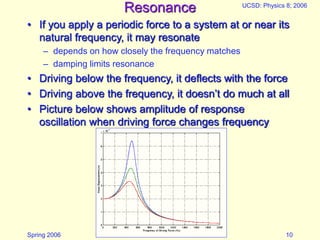
Resonance
• If you apply a periodic force to a system at or near its
natural frequency, it may resonate
– depends on how closely the frequency matches
– damping limits resonance
• Driving below the frequency, it deflects with the force
• Driving above the frequency, it doesn’t do much at all
• Picture below shows amplitude of response
oscillation when driving force changes frequency
Spring 2006
UCSD: Physics 8; 2006
11
Resonance Examples
• Shattering wine glass
– if “pumped” at natural frequency,
amplitude builds up until it shatters
• Swinging on swingset
– you learn to “pump” at natural
frequency of swing
– amplitude of swing builds up
• Tacoma Narrows Bridge
– eddies of wind shedding of top and
bottom of bridge in alternating
fashion “pumped” bridge at natural
oscillation frequency
– totally shattered
– big lesson for today’s bridge
builders: include damping
Spring 2006
UCSD: Physics 8; 2006
12
Wiggling Molecules/Crystals
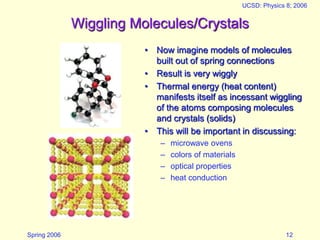
• Now imagine models of molecules
built out of spring connections
• Result is very wiggly
• Thermal energy (heat content)
manifests itself as incessant wiggling
of the atoms composing molecules
and crystals (solids)
• This will be important in discussing:
– microwave ovens
– colors of materials
– optical properties
– heat conduction
Spring 2006
UCSD: Physics 8; 2006
13
A model for crystals/molecules
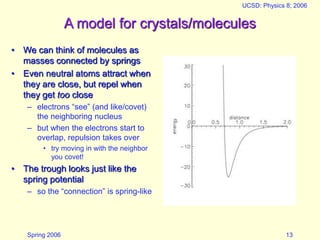
• We can think of molecules as
masses connected by springs
• Even neutral atoms attract when
they are close, but repel when
they get too close
– electrons “see” (and like/covet)
the neighboring nucleus
– but when the electrons start to
overlap, repulsion takes over
• try moving in with the neighbor
you covet!
• The trough looks just like the
spring potential
– so the “connection” is spring-like
Spring 2006
UCSD: Physics 8; 2006
14
Estimation: How fast do they wiggle?
• A 1 kg block of wood takes 1000 J to heat by 1 C
– just a restatement of heat capacity = 1000 J/kg/C
– so from 0 to 300 K, it takes 300,000 J
• If we assign some kinetic energy to each mass
(atom), it must all add up to 300,000 J
• The velocities are randomly oriented, but we can still
say that ½mv2 = 300,000 J
– so v2 = 600,000 (m/s)2
– characteristic v = 800 m/s (very fast!)
• This is in the right ballpark for the velocities of atoms
buzzing about within materials at room temperature
– it’s what we mean by heat
Spring 2006
UCSD: Physics 8; 2006
15
Assignments
• HW1 due today
• First bi-weekly question/observation due tomorrow
(4/14)
– 6PM cutoff is strict; half credit for following week
• Reading: Chapter 10: 302–308, 324–330 for Tuesday
• HW2: 7.E.1, 7.E.4, 7.P.1, 7.P.2, 7.P.3, 3.P.2, 3.P.4,
plus eight additional required problems available on
assignments page

Mechanical Spring Systems for Engineering

  • 1.
    Springy Things Restoring Force Oscillationand Resonance Model for Molecules
  • 2.
    Spring 2006 UCSD: Physics8; 2006 2 Springs: supplying restoring force • When you pull on (stretch) a spring, it pulls back (top picture) • When you push on (compress) a spring, it pushes back (bottom) • Thus springs present a restoring force: F = kx – x is the displacement (in meters) – k is the “spring constant” in Newtons per meter (N/m) – the negative sign means opposite to the direction of displacement
  • 3.
    Spring 2006 UCSD: Physics8; 2006 3 Example • If the springs in your 1000 kg car compress by 10 cm (e.g., when lowered off of jacks): – then the springs must be exerting mg = 10,000 Newtons of force to support the car – F = kx = 10,000 N, x = 0.1 m – so k = 100,000 N/m (stiff spring) • this is the collective spring constant: they all add to this • Now if you pile 400 kg into your car, how much will it sink? – 4,000 = (100,000)x, so x = 4/100 = 0.04 m = 4 cm • Could have taken short-cut: – springs are linear, so 400 additional kg will depress car an additional 40% (400/1000) of its initial depression
  • 4.
    Spring 2006 UCSD: Physics8; 2006 4 Energy Storage in Spring • Applied force is kΔx (reaction from spring is kΔx) – starts at zero when Δx = 0 – slowly ramps up as you push • Work is force times distance • Let’s say we want to move spring a total distance of x – would naively think W = kx2 – but force starts out small (not full kx right away) – works out that W = ½kx2
  • 5.
    Spring 2006 UCSD: Physics8; 2006 5 Work “Integral” • Since work is force times distance, and the force ramps up as we compress the spring further… – takes more work (area of rectangle) to compress a little bit more (width of rectangle) as force increases (height of rectangle) – if full distance compressed is kx, then force is kx, and area under force “curve” is ½(base)(height) = ½(x)kx = ½kx2 – area under curve is called an integral: work is integral of force Force Force Force distance (x) distance (x) distance (x) Area is a work: a force (height) times a distance (width) Force from spring increases as it is compressed further Total work done is area of triangle under force curve
  • 6.
    Spring 2006 UCSD: Physics8; 2006 6 The Potential Energy Function • Since the potential energy varies with the square of displacement, we can plot this as a parabola • Call the low point zero potential • Think of it like the drawing of a trough between two hillsides • A ball would roll back and forth exchanging gravitational potential for kinetic energy • Likewise, a compressed (or stretched) spring and mass combination will oscillate – exchanges kinetic energy for potential energy of spring
  • 7.
    Spring 2006 UCSD: Physics8; 2006 7 Example of Oscillation • Plot shows position (displacement) on the vertical axis and time on the horizontal axis • Oscillation is clear • Damping is present (amplitude decreases) – envelope is decaying exponential function
  • 8.
    Spring 2006 UCSD: Physics8; 2006 8 Frequency of Oscillation • Mass will execute some number of cycles per second (could be less than one) • This is the frequency of oscillation (measured in Hertz, or cycles per second) • The frequency is proportional to the square root of the spring constant divided by the mass: • Larger mass means more sluggish (lower freq.) • Larger (stiffer) spring constant means faster (higher freq.)
  • 9.
    Spring 2006 UCSD: Physics8; 2006 9 Natural Frequencies & Damping • Many physical systems exhibit oscillation – guitar strings, piano strings, violin strings, air in flute – lampposts, trees, rulers hung off edge of table – buildings, bridges, parking structures • Some are “cleaner” than others – depends on complexity of system: how many natural frequencies exist • a tree has many: many branches of different sizes – damping: energy loss mechanisms (friction, radiation) • a tree has a lot of damping from air resistance • cars have “shocks” (shock absorbers) to absorb oscillation energy – elastic is a word used to describe lossless (or nearly so) systems • “bouncy” also gets at the right idea
  • 10.
    Spring 2006 UCSD: Physics8; 2006 10 Resonance • If you apply a periodic force to a system at or near its natural frequency, it may resonate – depends on how closely the frequency matches – damping limits resonance • Driving below the frequency, it deflects with the force • Driving above the frequency, it doesn’t do much at all • Picture below shows amplitude of response oscillation when driving force changes frequency
  • 11.
    Spring 2006 UCSD: Physics8; 2006 11 Resonance Examples • Shattering wine glass – if “pumped” at natural frequency, amplitude builds up until it shatters • Swinging on swingset – you learn to “pump” at natural frequency of swing – amplitude of swing builds up • Tacoma Narrows Bridge – eddies of wind shedding of top and bottom of bridge in alternating fashion “pumped” bridge at natural oscillation frequency – totally shattered – big lesson for today’s bridge builders: include damping
  • 12.
    Spring 2006 UCSD: Physics8; 2006 12 Wiggling Molecules/Crystals • Now imagine models of molecules built out of spring connections • Result is very wiggly • Thermal energy (heat content) manifests itself as incessant wiggling of the atoms composing molecules and crystals (solids) • This will be important in discussing: – microwave ovens – colors of materials – optical properties – heat conduction
  • 13.
    Spring 2006 UCSD: Physics8; 2006 13 A model for crystals/molecules • We can think of molecules as masses connected by springs • Even neutral atoms attract when they are close, but repel when they get too close – electrons “see” (and like/covet) the neighboring nucleus – but when the electrons start to overlap, repulsion takes over • try moving in with the neighbor you covet! • The trough looks just like the spring potential – so the “connection” is spring-like
  • 14.
    Spring 2006 UCSD: Physics8; 2006 14 Estimation: How fast do they wiggle? • A 1 kg block of wood takes 1000 J to heat by 1 C – just a restatement of heat capacity = 1000 J/kg/C – so from 0 to 300 K, it takes 300,000 J • If we assign some kinetic energy to each mass (atom), it must all add up to 300,000 J • The velocities are randomly oriented, but we can still say that ½mv2 = 300,000 J – so v2 = 600,000 (m/s)2 – characteristic v = 800 m/s (very fast!) • This is in the right ballpark for the velocities of atoms buzzing about within materials at room temperature – it’s what we mean by heat
  • 15.
    Spring 2006 UCSD: Physics8; 2006 15 Assignments • HW1 due today • First bi-weekly question/observation due tomorrow (4/14) – 6PM cutoff is strict; half credit for following week • Reading: Chapter 10: 302–308, 324–330 for Tuesday • HW2: 7.E.1, 7.E.4, 7.P.1, 7.P.2, 7.P.3, 3.P.2, 3.P.4, plus eight additional required problems available on assignments page

Editor's Notes