Mechanical Engineering Laboratory
Course Description
This course introduces Mechanical Engineering
students to laboratory applications in the fundamental
fields of mechanical engineering such as thermal,
mechanical, dynamics, control, and fluids.
Course Grading System
Quizzes: 20 %
Reports: 80 %
*Students who fail to meet the 85% attendance requirement in the course fail with an
NA grade; they are not entitled to take the final exam.
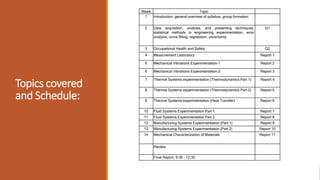
Topics covered
and Schedule:
Week Topic
1 Introduction, general overview of syllabus, group formation
2 Data acquisition, analysis, and presenting techniques,
statistical methods in engineering experimentation, error
analysis, curve fitting, regression, uncertainty
Q1
3 Occupational Health and Safety Q2
4 Measurement Laboratory Report 1
5 Mechanical Vibrations Experimentation-1 Report 2
6 Mechanical Vibrations Experimentation-2 Report 3
7 Thermal Systems experimentation (Thermodynamics Part 1) Report 4
8 Thermal Systems experimentation (Thermodynamics Part 2) Report 5
9 Thermal Systems experimentation (Heat Transfer) Report 6
10 Fluid Systems Experimentation Part 1 Report 7
11 Fluid Systems Experimentation Part 2 Report 8
12 Manufacturing Systems Experimentation (Part 1) Report 9
13 Manufacturing Systems Experimentation (Part 2) Report 10
14 Mechanical Characterization of Materials Report 11
Review
Final Report, 9:30 - 12:30
Laboratories Facilities
Mechanical Systems Laboratory
Thermal Systems Laboratory
Fluidic Systems Laboratory
Vibration and Acoustics Laboratory
Computer Aided Design (CAD) Laboratory
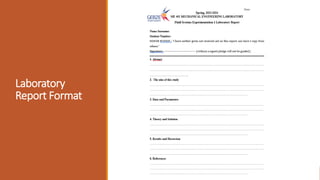
Laboratory
Report Format
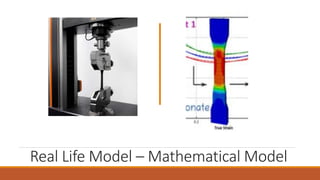
Real Life Model – Mathematical Model

Mechanical engineering laboratory Introduction.pptx

  • 1.
  • 2.
    Course Description This courseintroduces Mechanical Engineering students to laboratory applications in the fundamental fields of mechanical engineering such as thermal, mechanical, dynamics, control, and fluids.
  • 3.
    Course Grading System Quizzes:20 % Reports: 80 % *Students who fail to meet the 85% attendance requirement in the course fail with an NA grade; they are not entitled to take the final exam.
  • 4.
    Topics covered and Schedule: WeekTopic 1 Introduction, general overview of syllabus, group formation 2 Data acquisition, analysis, and presenting techniques, statistical methods in engineering experimentation, error analysis, curve fitting, regression, uncertainty Q1 3 Occupational Health and Safety Q2 4 Measurement Laboratory Report 1 5 Mechanical Vibrations Experimentation-1 Report 2 6 Mechanical Vibrations Experimentation-2 Report 3 7 Thermal Systems experimentation (Thermodynamics Part 1) Report 4 8 Thermal Systems experimentation (Thermodynamics Part 2) Report 5 9 Thermal Systems experimentation (Heat Transfer) Report 6 10 Fluid Systems Experimentation Part 1 Report 7 11 Fluid Systems Experimentation Part 2 Report 8 12 Manufacturing Systems Experimentation (Part 1) Report 9 13 Manufacturing Systems Experimentation (Part 2) Report 10 14 Mechanical Characterization of Materials Report 11 Review Final Report, 9:30 - 12:30
  • 5.
    Laboratories Facilities Mechanical SystemsLaboratory Thermal Systems Laboratory Fluidic Systems Laboratory Vibration and Acoustics Laboratory Computer Aided Design (CAD) Laboratory
  • 6.
  • 7.
    Real Life Model– Mathematical Model
  • 8.
    Real Life Model– Mathematical Model
  • 9.
    Real Life Model– Mathematical Model
  • 10.
    Real Life Model– Mathematical Model
  • 11.
    Real Life Model– Mathematical Model
  • 12.
    Real Life Model– Mathematical Model