



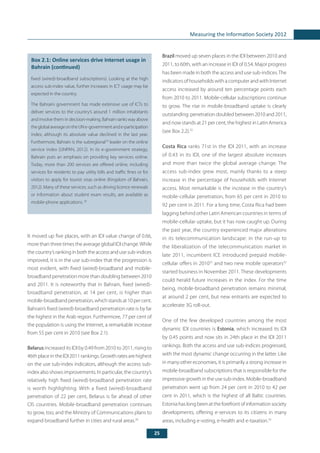
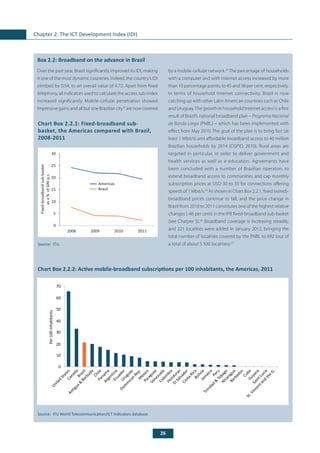
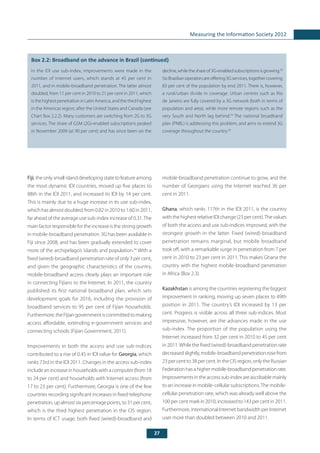
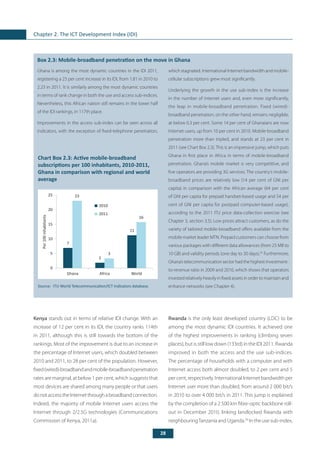
I n t e r n a t i o n a l T e l e c o m m u n i c a t i o n U n i o n
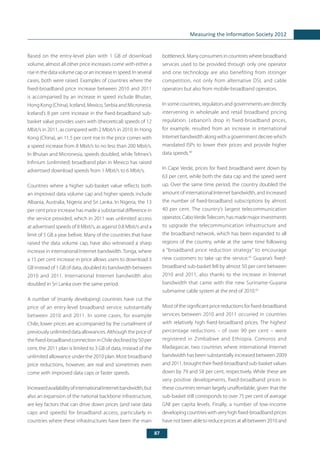
Measuring
the
Information
Society
2012
MeasuringtheInformationSociety		2012
Printed in Switzerland
Geneva, 2012
ISBN 978-92-61-14071-7
Photo credits: Shutterstock
*37354*
I n t e r n a t i o n a l T e l e c o m m u n i c a t i o n U n i o n
Measuring
the
Information
Society
2012
ii
© 2012 ITU
International Telecommunication Union
Place des Nations
CH-1211 Geneva Switzerland
Original language of publication: English.
All rights reserved. No part of this publication may be reproduced, stored in a retrieval system, or transmitted in any form
or by any means, electronic, mechanical, photocopying, recording, or otherwise, without the prior permission of the
International Telecommunication Union.
ISBN 978-92-61-14071-7
iii
Foreword
It is my pleasure to present to you the 2012 edition of Measuring the Information Society.
Now in its fourth year, this annual report draws on innovative and authoritative
benchmarking tools developed by ITU to monitor information-society developments
worldwide as well as to provide valuable information for use in formulating evidence-
based policies and in effective peer learning.
The report presents the ICT Development Index (IDI), which ranks countries’performance
with regard to ICT infrastructure and uptake, and the ICTPriceBasket(IPB), a unique metric
that tracks and compares the cost and affordability of ICT services.This edition also features
new data series and analyses concerning revenue and investment in the ICT sector, and
proposes a new methodology using non-conventional data, to measure the world’s
telecommunication capacity.
The past year has seen continued and almost universal growth in ICT uptake. Much of this enhanced connectivity is due to
the rapid uptake – a 40 per cent rise in 2011 – of mobile-broadband subscriptions, to the point where there are now twice
as many mobile-broadband as fixed-broadband subscriptions. The surge in numbers of mobile-broadband subscriptions
in developing countries has brought the Internet to a multitude of new users.The report nevertheless notes that the prices
for ICT services remain very high in many low-income countries. For mobile broadband to replicate the mobile-cellular
miracle, 3G network coverage has to be extended, and prices have to go down further.
Indeed, the disparities in ICT development between countries remain substantial, with IDI values that are on average twice
as high in developed compared to developing countries.
I trust that the data and analysis contained in this report will be of great value to the ITU membership and others working
towards building an inclusive global information society. I am pleased to note that, overall, considerable strides have been
made since the launch of the 2011 edition.
Brahima Sanou
Director
Telecommunication Development Bureau (BDT)
International Telecommunication Union
v
Acknowledgements
The 2012 edition of Measuring the Information Society was prepared by the ICT Data and Statistics Division within the
TelecommunicationDevelopmentBureauofITU.TheteamincludedSusanTeltscher(HeadofDivision),EsperanzaMagpantay,
Ivan Vallejo, Lisa Kreuzenbeck, Diana Korka, Vanessa Gray and Doris Olaya. Martin Hilbert (consultant to ITU) provided
the initial draft of Chapter 5 of the report. Michael Minges (consultant to ITU) compiled data sets on mobile-broadband
prices and supplemented ITU data on telecommunication sector revenues and investment. Nathalie Delmas and Olivier
Poupaert contributed to the ITU data collection. Helpful comments and suggestions were received from Martin Adolph
(ITUTelecommunication Standardization Bureau).The work was carried out under the overall direction of Cosmas Zavazava,
Chief, Project Support and Knowledge Management Department, Telecommunication Development Bureau.
The report includes data from Eurostat, OECD, IMF, UNCTAD, the UNESCO Institute for Statistics, the United Nations Population
Division and the World Bank, which is greatly acknowledged.
ITU also appreciates the cooperation of countries that have provided data included in the ICT Development Index and ICT
Price Basket.
The report was edited by the ITU English Translation Section, led by Anthony Pitt. The desktop publishing was carried out
by Nathalie Delmas, and the cover was designed by Céline Desthomas and Jie Huang. Administrative support was provided
by Herawasih Yasandikusuma.
vii
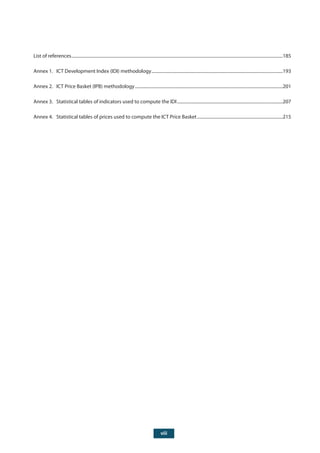
Table of contents
Foreword.................................................................................................................................................................................................................iii
Acknowledgements.............................................................................................................................................................................................v
Table of contents................................................................................................................................................................................................ vii
Chapter 1. Introduction.......................................................................................................................................................................................1
Chapter 2. The ICT Development Index (IDI)............................................................................................................................................15
2.1 Introduction to the IDI......................................................................................................................................................................................................15
2.2 Global IDI analysis................................................................................................................................................................................................................19
2.3 The digital divide and the least connected countries (LCCs)...................................................................................................................32
2.4 IDI breakdown by sub-indices.....................................................................................................................................................................................37
2.5 Regional IDI analysis...........................................................................................................................................................................................................45
Chapter 3. The ICT Price Basket (IPB)...........................................................................................................................................................65
3.1 Introduction............................................................................................................................................................................................................................65
3.2 ICT Price Basket methodology....................................................................................................................................................................................66
3.3 ICT Price Basket and sub-basket results and analysis....................................................................................................................................71
3.4 Regional analysis of the ICT Price Basket and sub-baskets ......................................................................................................................90
3.5 Towards a mobile-broadband price basket: Preliminary findings and analysis......................................................................... 108
Chapter 4. Revenue and investment in telecommunications .........................................................................................................127
4.1 Introduction......................................................................................................................................................................................................................... 127
4.2 Role of the ICT sector in the economy................................................................................................................................................................ 128
4.3 The telecommunication market.............................................................................................................................................................................. 133
4.4 Investment in the telecommunication sector................................................................................................................................................ 144
4.5 Conclusions.......................................................................................................................................................................................................................... 161
Chapter 5. Measuring communication capacity in bits and bytes.................................................................................................167
5.1 Assessing global communication capacity...................................................................................................................................................... 167
5.2 Methodology for measuring communication capacity........................................................................................................................... 168
5.3 Broadcasting and telecommunications: How do they compare in terms of effectively used capacity?.................. 170
5.4 Subscriptions and subscribed capacity in telecommunications........................................................................................................ 172
5.5 Comparative analysis of subscriptions, subscribed capacity, population and gross national income....................... 177
5.6 Conclusions and policy recommendations..................................................................................................................................................... 181
viii
List of references...............................................................................................................................................................................................185
Annex 1. ICT Development Index (IDI) methodology.......................................................................................................................193
Annex 2. ICT Price Basket (IPB) methodology......................................................................................................................................201
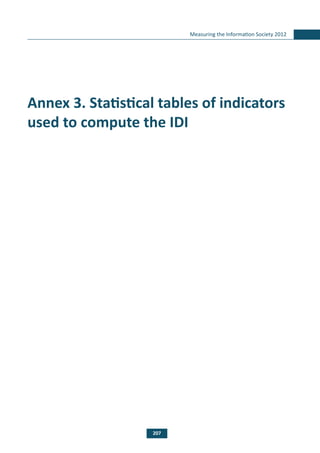
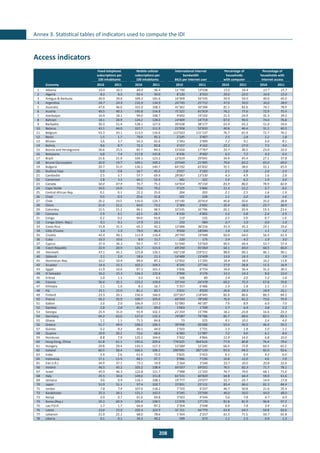
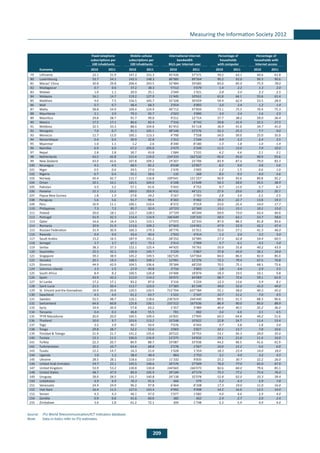
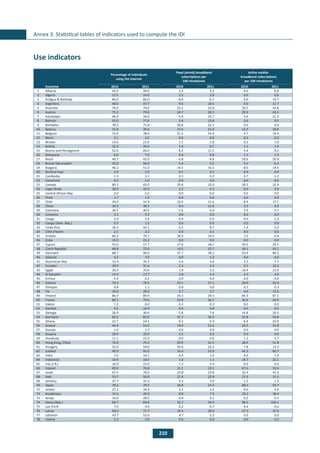
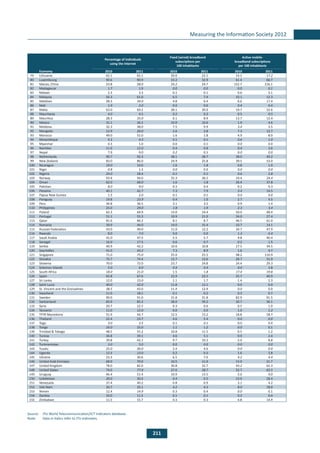
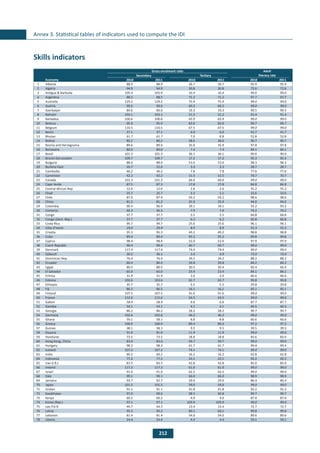
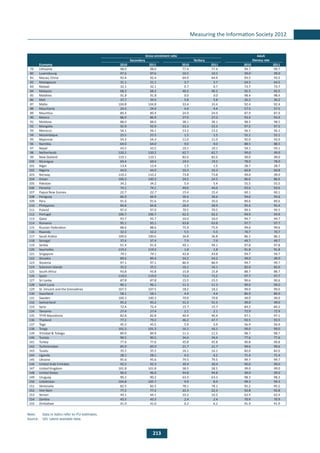
Annex 3. Statistical tables of indicators used to compute the IDI................................................................................................207
Annex 4. Statistical tables of prices used to compute the ICT Price Basket..............................................................................215
ix
List of charts
1.1	 Global ICT developments, 2001-2011............................................................................................................................................................................. 1
1.2	 Global ICT developments, annual change, 2001-2011......................................................................................................................................... 2
1.3	 Mobile-cellular subscriptions, 2001-2011, world and by level of development, penetration (left) and annual
growth (right) ................................................................................................................................................................................................................................ 3
1.4	 Fixed (wired)-broadband subscriptions, 2001-2011, world and by level of development, penetration (left)
and annual growth (right)....................................................................................................................................................................................................... 4
1.5	 Active mobile-broadband subscriptions, 2007-2011, world and by level of development, penetration (left)
and annual growth (right)....................................................................................................................................................................................................... 4
1.6	 Fixed (wired)- and active mobile-broadband subscriptions, by region, 2011........................................................................................ 5
1.7	 Population covered by 2G/3G services, 2011............................................................................................................................................................. 6
1.8	 Percentage of individuals using the Internet, 2001-2011, world and by level of development, penetration (left)
and annual growth (right)....................................................................................................................................................................................................... 6
1.9	 Internet usage by age in developing and developed countries, 2011....................................................................................................... 7
1.10	 Households with Internet access, 2002-2011, world and by level of development, penetration (left) and annual
growth (right)................................................................................................................................................................................................................................. 8
2.1	 IDI by level of development................................................................................................................................................................................................33
2.2	 IDI access sub-index by level of development........................................................................................................................................................33
2.3	 IDI use sub-index by level of development...............................................................................................................................................................33
2.4	 IDI skills sub-index by level of development.............................................................................................................................................................34
2.5	 IDI and IPB, 2011..........................................................................................................................................................................................................................36
2.6	 IDI and GNI per capita, 2011................................................................................................................................................................................................37
2.7	 IDI ranges and averages, by region, 2011....................................................................................................................................................................47
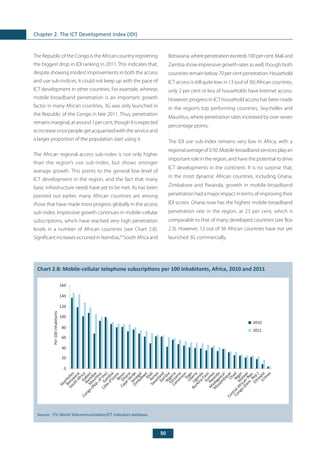
2.8	 Mobile-cellular telephone subscriptions per 100 inhabitants, Africa, 2010 and 2011....................................................................50
2.9	 Active mobile-broadband penetration, Arab States, 2010 and 2011........................................................................................................52
2.10	 Mobile-cellular telephone penetration in the Asia and the Pacific region, 2010 and 2011........................................................54
2.11	 Fixed (wired)-broadband and active mobile-broadband penetration, CIS region, 2011..............................................................56
2.12	 Households with Internet access, Europe, 2010 and 2011...............................................................................................................................58
2.13	 Households with a computer and households with Internet access, Europe and world, 2011...............................................59
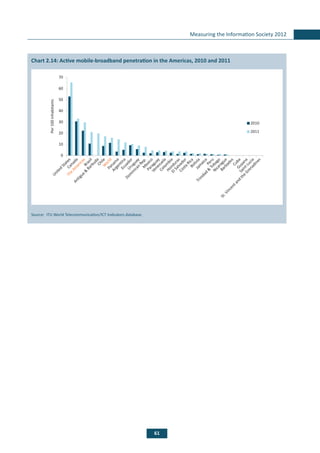
2.14	 Active mobile-broadband penetration in the Americas, 2010 and 2011...............................................................................................61
x
3.1	 ICT Price Basket values, world and by level of development, 2008-2011...............................................................................................71
3.2	 IPB annual change (%), world and by level of development..........................................................................................................................71
3.3	 Fixed-telephone sub-basket (left) and annual change (right), 2008-2011.............................................................................................72
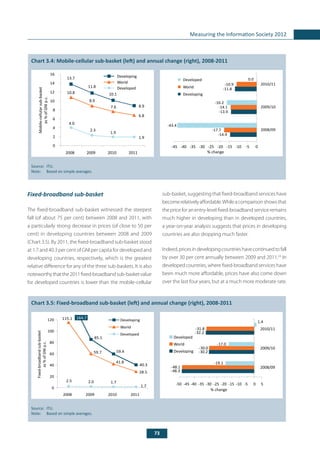
3.4	 Mobile-cellular sub-basket (left) and annual change (right), 2008-2011................................................................................................73
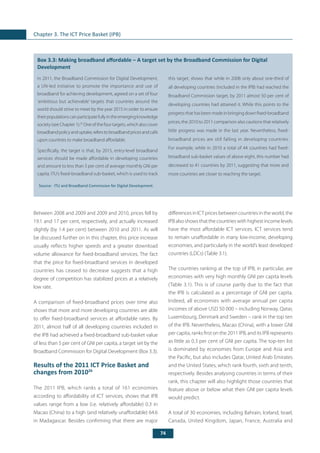
3.5	 Fixed-broadband sub-basket (left) and annual change (right), 2008-2011...........................................................................................73
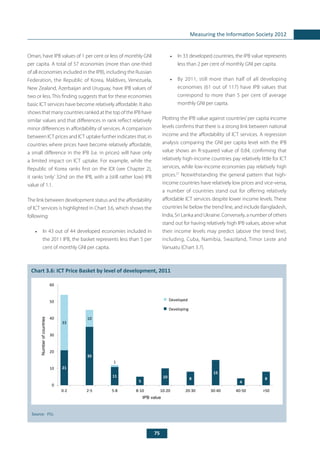
3.6	 ICT Price Basket by level of development, 2011.....................................................................................................................................................75
3.7	 Relationship between the ICT Price Basket values and GNI per capita....................................................................................................78
3.8	 ICT Price Basket by region, 2008-2011..........................................................................................................................................................................90
3.9	 ICT Price Basket annual change (%), by region........................................................................................................................................................91
3.10	 IPB sub-baskets by region, 2008-2011..........................................................................................................................................................................92
3.11	 Purchasing power-adjusted ICT prices in Africa, 2011........................................................................................................................................94
3.12	 Purchasing power-adjusted ICT prices in the Americas, 2011.......................................................................................................................97
3.13	 Purchasing power-adjusted ICT prices in the Arab States, 2011...............................................................................................................100
3.14	 Purchasing power-adjusted ICT prices in the Asia and the Pacific, 2011.............................................................................................102
3.15	 Purchasing power-adjusted ICT prices in the CIS, 2011..................................................................................................................................105
3.16	 Purchasing power-adjusted ICT prices in Europe, 2011..................................................................................................................................107
3.17	 Mobile-broadband prices as a percentage of GNI per capita, 2011, by region and by level of development.............111
3.18	 Mobile-broadband prices in USD, 2011, by region and by level of development.........................................................................112
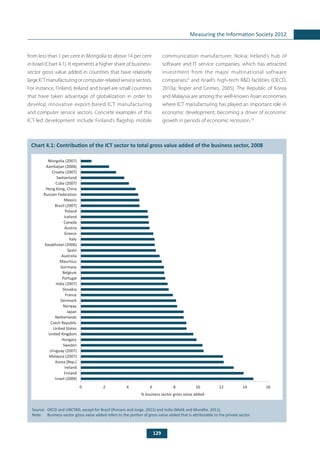
4.1	 Contribution of the ICT sector to total gross value added of the business sector, 2008............................................................129
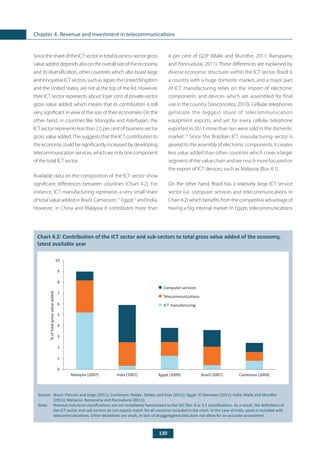
4.2	 Contribution of the ICT sector and sub-sectors to total gross value added of the economy, latest available year........130
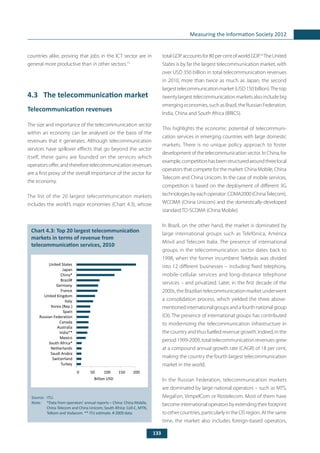
4.3	 Top 20 largest telecommunication markets in terms of revenue from telecommunication services, 2010.................133
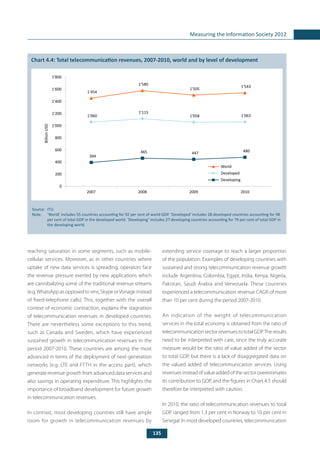
4.4	 Total telecommunication revenues, 2007-2010, world and by level of development................................................................135
4.5	 Top 15 countries with highest ratio of telecommunication revenues to GDP, 2010....................................................................138
4.6	 Revenues from mobile services, 2007-2010, world and by level of development.........................................................................139
4.7	 Share of mobile revenues in total telecommunication revenues, 2010...............................................................................................141
4.8	 Average mobile revenue per subscription, 2010, by level of development......................................................................................142
4.9	 Total telecommunication investment, 2007-2010, world and by level of development...........................................................147
4.10	 Ratio of telecommunication capital expenditure (CAPEX) to total telecommunication revenues, 2010........................150
4.11	 Investment commitments in telecommunication projects with private participation, in low and middle-
income countries, 1990-2010, by regional group (top) and by mode of financing (bottom)................................................155
xi
4.12	 Main trends in FDI inflows in telecommunication services, by level of development, 2007-2010......................................159
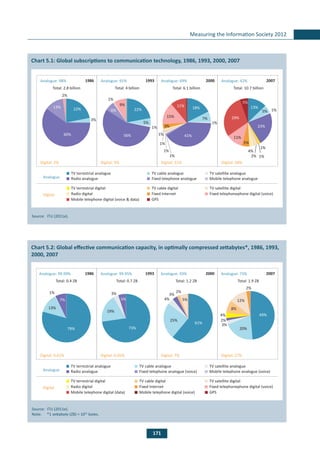
5.1	 Global subscriptions to communication technology, 1986, 1993, 2000, 2007.................................................................................171
5.2	 Global effective communication capacity, in optimally compressed zettabytes, 1986, 1993, 2000, 2007.....................171
5.3	 Global distribution of subscriptions (left), and subscribed capacity (right), for selected telecommunication
technologies, 1986-2010....................................................................................................................................................................................................173
5.4	 Subscribed capacity for downstream and upstream telecommunications, 1986-2007.............................................................173
5.5	 Drivers of global subscribed telecommunication capacity, 1986-2010, annual growth rates................................................175
5.6	 Digital divides based on subscriptions in comparison with subscribed capacity..........................................................................177
5.7	 Global distribution of population (left) and telecommunication subscriptions (right), 2010.................................................178
5.8	 Global distribution of gross national income (left) and subscribed capacity (right), 2010.......................................................178
5.9	 Two dimensions of the digital divide in telecommunications: subscriptions per capita and subscribed
capacity per subscription, 2010.....................................................................................................................................................................................179
5.10	 Measuring the success of countries in expanding subscriptions (x-axis) and improving subscribed
capacity (y-axis), controlling for GNI, 2010...............................................................................................................................................................180
List of figures
2.1	 Three stages in the evolution towards an information society.....................................................................................................................16
2.2	 ICT Development Index: indicators and weights...................................................................................................................................................18
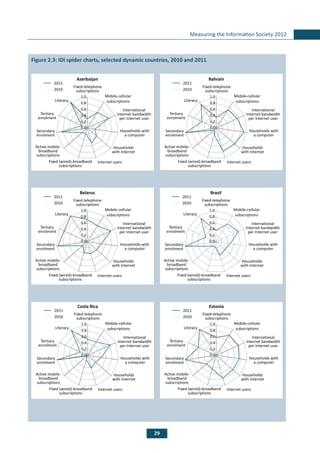
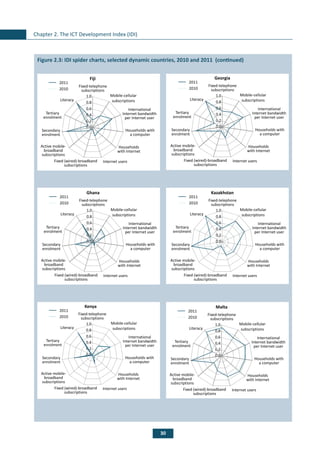
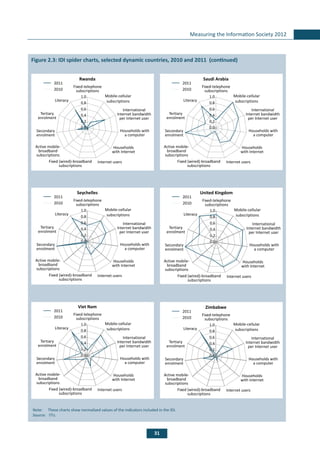
2.3	 IDI spider charts, selected dynamic countries, 2010 and 2011......................................................................................................................29
3.1	 ICT Price Basket methodology...........................................................................................................................................................................................67
List of boxes
1.1	 Broadband Commission for Digital Development: Four ambitious but achievable targets for 2015..................................... 9
2.1	 Online services drive Internet usage in Bahrain......................................................................................................................................................24
2.2	 Broadband on the advance in Brazil..............................................................................................................................................................................26
2.3	 Mobile-broadband penetration on the move in Ghana...................................................................................................................................28
xii
2.4	 The least connected countries (LCCs) – 2011...........................................................................................................................................................36
2.5	 Hong Kong (China): Asia and the Pacific’s high-density, high-speed broadband hub...................................................................39
2.6	 Towards a connected Republic of Lebanon..............................................................................................................................................................41
2.7	 Smartphone revolution in the United Kingdom....................................................................................................................................................44
3.1	 Low-cost provider Free Mobile shakes up the French market.......................................................................................................................69
3.2	 Roaming matters........................................................................................................................................................................................................................70
3.3	 Making broadband affordable – A target set by the Broadband Commission for Digital Development...........................74
3.4	 Mobile number portability (MNP)....................................................................................................................................................................................84
3.5	 Collection of mobile-broadband price data..........................................................................................................................................................110
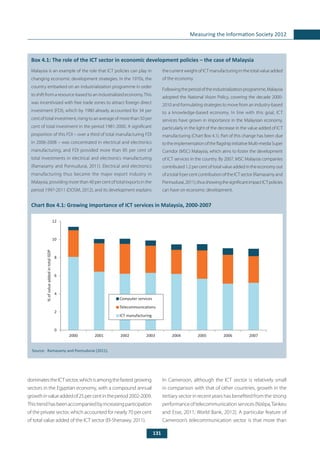
4.1	 The role of the ICT sector in economic development policies – the case of Malaysia................................................................131
4.2	 The challenge of harmonizing revenue indicators – what is included in total telecommunication revenues?.........137
4.3	 Investment in LTE – developing countries are catching up.........................................................................................................................146
4.4	 Competition as a driver of investment – the case of Egypt..........................................................................................................................149
4.5	 Fostering public and private investment in telecommunication – the case of Finland.............................................................149
4.6	 Defining and measuring FDI in telecommunications......................................................................................................................................153
4.7	 Africa and FDI in telecommunications......................................................................................................................................................................157
5.1	 Notes on the methodology..............................................................................................................................................................................................168
5.2	 Comparing fixed Internet subscriptions and subscribed capacity: the case of Japan................................................................174
List of tables
2.1	 IDI changes, 2010-2011..........................................................................................................................................................................................................19
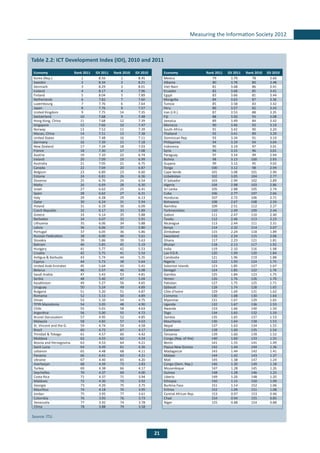
2.2	 ICT Development Index (IDI), 2010 and 2011...........................................................................................................................................................21
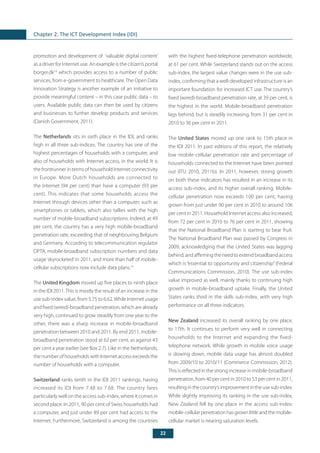
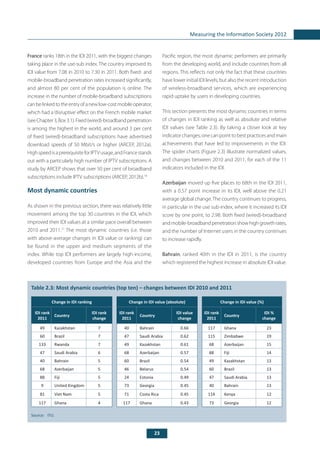
2.3	 Most dynamic countries (top ten) – changes between IDI 2010 and 2011..........................................................................................23
2.4	 IDI changes by level of development, 2010-2011.................................................................................................................................................34
2.5	 IDI by groups, 2011 and 2010.............................................................................................................................................................................................35
2.6	 IDI access sub-index, 2010 and 2011.............................................................................................................................................................................38
2.7	 Top ten economies with greatest 2010-2011 change in the IDI access sub-index, by absolute value change
(left) and rank change (right)..............................................................................................................................................................................................40
xiii
2.8	 IDI use sub-index, 2010 and 2011....................................................................................................................................................................................42
2.9	 Top ten economies with greatest 2010-2011 change in the IDI use sub-index, by absolute value change
(left) and rank change (right)..............................................................................................................................................................................................43
2.10	 IDI skills sub-index, 2010 and 2011.................................................................................................................................................................................46
2.11	 IDI by region, 2010 and 2011..............................................................................................................................................................................................47
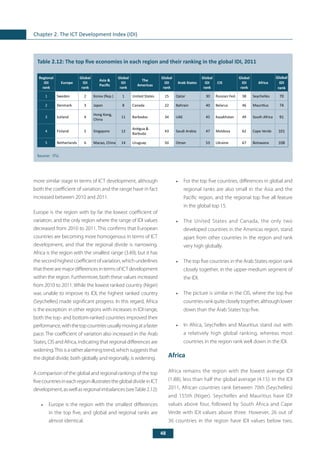
2.12	 The top five economies in each region and their ranking in the global IDI, 2011............................................................................48
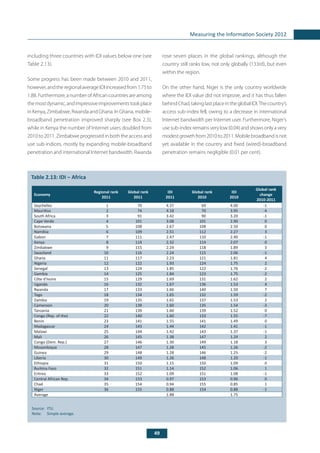
2.13	 IDI – Africa.......................................................................................................................................................................................................................................49
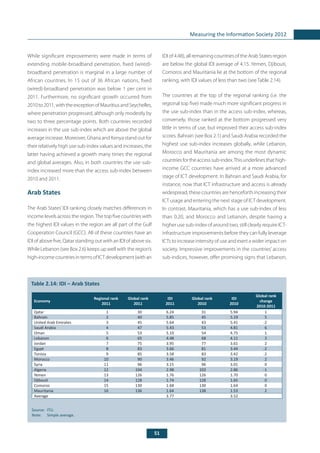
2.14	 IDI – Arab States..........................................................................................................................................................................................................................51
2.15	 IDI – Asia and the Pacific........................................................................................................................................................................................................53
2.16	 IDI – CIS.............................................................................................................................................................................................................................................55
2.17	 IDI – Europe....................................................................................................................................................................................................................................57
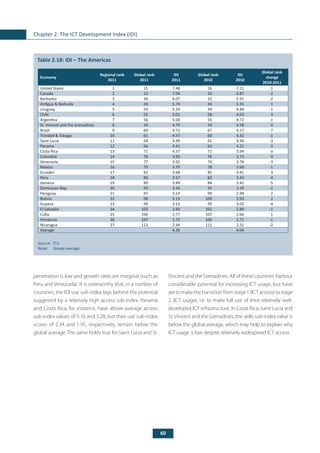
2.18	 IDI – The Americas.....................................................................................................................................................................................................................60
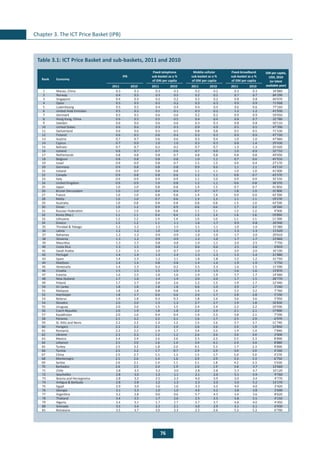
3.1	 ICT Price Basket and sub-baskets, 2011 and 2010.................................................................................................................................................76
3.2	 Fixed-telephone sub-basket, 2011 and 2010............................................................................................................................................................80
3.3	 Mobile-cellular sub-basket, 2011 and 2010...............................................................................................................................................................82
3.4	 Fixed-broadband sub-basket, 2011 and 2010..........................................................................................................................................................88
3.5	 IPB and sub-baskets (USD, PPP$ and as a percentage of GNI per capita), 2011, Africa..................................................................93
3.6	 IPB and sub-baskets (USD, PPP$ and as a percentage of GNI per capita), 2011, the Americas.................................................96
3.7	 IPB and sub-baskets (USD, PPP$ and as a percentage of GNI per capita), 2011, Arab States.....................................................99
3.8	 IIPB and sub-baskets (USD, PPP$ and as a percentage of GNI per capita), 2011, Asia and the Pacific...............................101
3.9	 IPB and sub-baskets (USD, PPP$ and as a percentage of GNI per capita), 2011, CIS.....................................................................104
3.10	 IPB and sub-baskets (USD, PPP$, and as a percentage of GNI per capita), 2011, Europe...........................................................106
3.11	 Number of countries for which mobile-broadband price data were collected, by region......................................................111
3.12	 Comparison of fixed-broadband and postpaid computer-based mobile-broadband plans in selected
countries, 2011..........................................................................................................................................................................................................................114
3.13	 Broadband technologies and maximum speeds................................................................................................................................................114
3.14	 Mobile-broadband prices in USD and as a percentage of GNI per capita, 2011, Europe..........................................................118
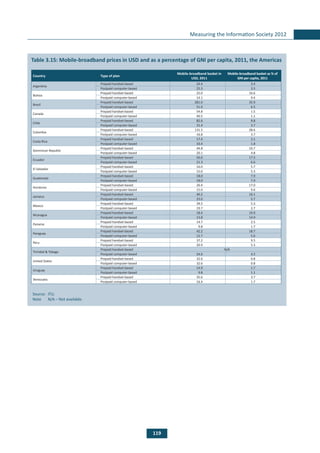
3.15	 Mobile-broadband prices in USD and as a percentage of GNI per capita, 2011, the Americas............................................119
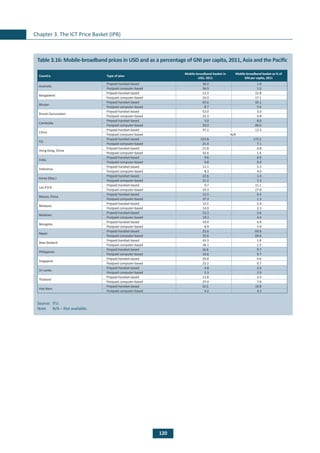
3.16	 Mobile-broadband prices in USD and as a percentage of GNI per capita, 2011, Asia and the Pacific...............................120
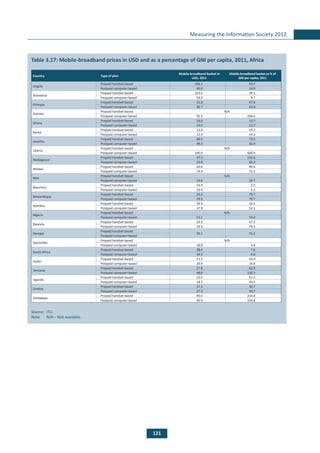
3.17	 Mobile-broadband prices in USD and as a percentage of GNI per capita, 2011, Africa..............................................................121
xiv
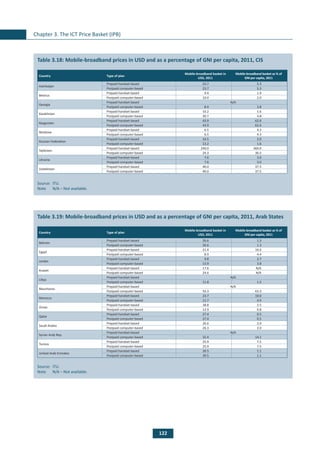
3.18	 Mobile-broadband prices in USD and as a percentage of GNI per capita, 2011, CIS...................................................................122
3.19	 Mobile-broadband prices in USD and as a percentage of GNI per capita, 2011, Arab States.................................................122
4.1	 ICT sector definition (based on ISIC Rev. 4).............................................................................................................................................................128
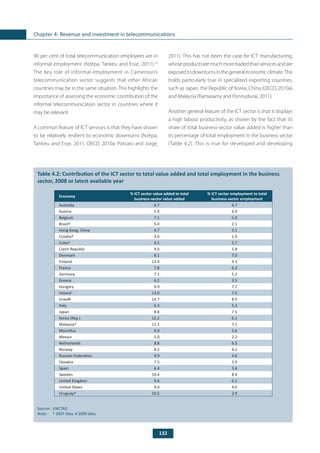
4.2	 Contribution of the ICT sector to total value added and total employment in the business sector, 2008 or
latest available year................................................................................................................................................................................................................132
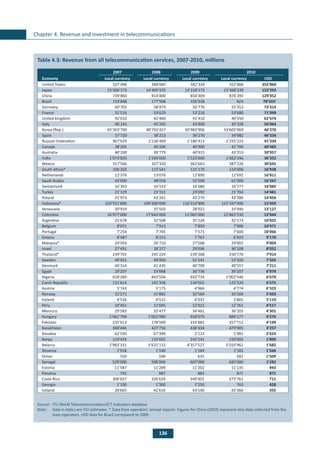
4.3	 Revenue from all telecommunication services, 2007-2010, millions......................................................................................................136
4.4	 Revenue from mobile services, 2007-2010, millions.........................................................................................................................................140
4.5	 Average revenue per mobile-cellular subscription, 2007-2010.................................................................................................................143
4.6	 Investment in telecommunications, 2007-2010, by country, millions...................................................................................................148
4.7	 Annual capital expenditure in telecommunication services as a percentage of total gross fixed capital
formation, 2007-2010...........................................................................................................................................................................................................151
4.8	 Top 20 low-income and middle-income economies, by cumulative value of private-sector investment
commitments in telecommunications, 1990-2010...........................................................................................................................................156
4.9	 Main recipients of FDI inflows in telecommunications in 2010: top 10 economies with available data, by
value of inflows, 2010...........................................................................................................................................................................................................159
4.10	 Main economies by value of outward FDI stocks in telecommunication in 2009: top 20 economies with
available data, by value of stocks, 2009.....................................................................................................................................................................160
4.11	 Main private telecommunication companies, by cumulative value of total project investment and by
region, 1990-2011 (USD million)....................................................................................................................................................................................161
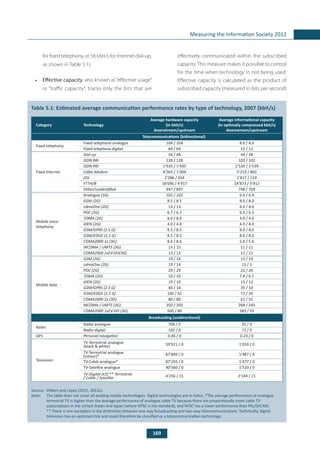
5.1	 Estimated average communication performance rates by type of technology, 2007 (kbit/s)...............................................169
1
Measuring the Information Society 2012
Chapter 1. Introduction
Overview of recent ICT
developments
New information and communication technologies (ICTs)
continue to penetrate countries in all regions of the world, as
more and more people are getting connected. The past year
has seen persistent growth in ICT uptake worldwide, with
an increase in all key indicators except the number of fixed-
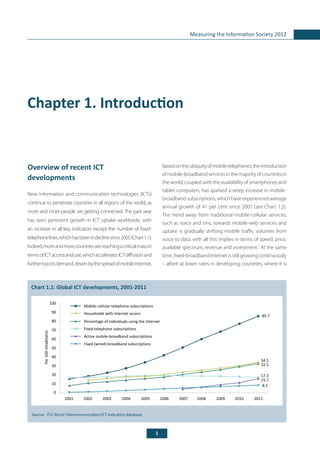
telephonelines,whichhasbeenindeclinesince2005(Chart1.1).
Indeed,moreandmorecountriesarereachingacriticalmassin
termsofICTaccessanduse,whichacceleratesICTdiffusionand
furtherboostsdemand,drivenbythespreadofmobileInternet.
Basedontheubiquityofmobiletelephones,theintroduction
of mobile-broadband services in the majority of countries in
the world, coupled with the availability of smartphones and
tablet computers, has sparked a steep increase in mobile-
broadband subscriptions, which have experienced average
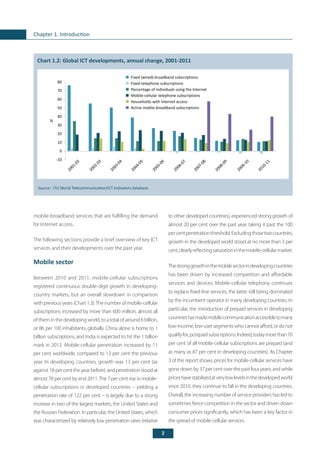
annual growth of 41 per cent since 2007 (see Chart 1.2).
The trend away from traditional mobile-cellular services,
such as voice and sms, towards mobile-web services and
uptake is gradually shifting mobile traffic volumes from
voice to data, with all this implies in terms of speed, price,
available spectrum, revenue and investment.1
At the same
time, fixed-broadband Internet is still growing continuously
– albeit at lower rates in developing countries, where it is
	
Chart 1.1: Global ICT developments, 2001-2011
Source: 	ITU World Telecommunication/ICT Indicators database.
0
10
20
30
40
50
60
70
80
90
100
Mobile-cellular telephone subscriptions
Percentage of individuals using the Internet
Fixed-telephone subscriptions
Active mobile-broadband subscriptions
Fixed (wired)-broadband subscriptions
Households with Internet access
Per100inhabitants
2001 2002 2003 2004 2005 2006 2007 2008 2009 2010 2011
85.7
34.1
32.5
17.3
15.7
8.5
2
Chapter 1. Introduction
to other developed countries), experienced strong growth of
almost 20 per cent over the past year, taking it past the 100
percentpenetrationthreshold.Excludingthosetwocountries,
growth in the developed world stood at no more than 3 per
cent,clearlyreflectingsaturationinthemobile-cellularmarket.
Thestronggrowthinthemobilesectorindevelopingcountries
has been driven by increased competition and affordable
services and devices. Mobile-cellular telephony continues
to replace fixed-line services, the latter still being dominated
by the incumbent operator in many developing countries. In
particular, the introduction of prepaid services in developing
countrieshasmademobilecommunicationaccessibletomany
low-income, low-user segments who cannot afford, or do not
qualifyfor,postpaidsubscriptions.Indeed,todaymorethan70
per cent of all mobile-cellular subscriptions are prepaid (and
as many as 87 per cent in developing countries). As Chapter
3 of this report shows, prices for mobile-cellular services have
gone down by 37 per cent over the past four years; and while
priceshavestabilizedatverylowlevelsinthedevelopedworld
since 2010, they continue to fall in the developing countries.
Overall, the increasing number of service providers has led to
sometimes fierce competition in the sector and driven down
consumer prices significantly, which has been a key factor in
the spread of mobile-cellular services.
mobile-broadband services that are fulfilling the demand
for Internet access.
The following sections provide a brief overview of key ICT
services and their developments over the past year.
Mobile sector
Between 2010 and 2011, mobile-cellular subscriptions
registered continuous double-digit growth in developing-
country markets, but an overall slowdown in comparison
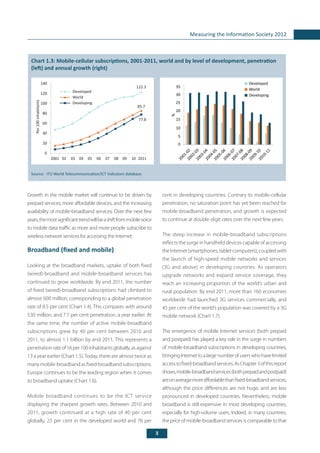
with previous years (Chart 1.3).The number of mobile-cellular
subscriptions increased by more than 600 million, almost all
of them in the developing world, to a total of around 6 billion,
or 86 per 100 inhabitants, globally. China alone is home to 1
billion subscriptions, and India is expected to hit the 1 billion
mark in 2012. Mobile-cellular penetration increased by 11
per cent worldwide, compared to 13 per cent the previous
year. In developing countries, growth was 13 per cent (as
against 18 per cent the year before), and penetration stood at
almost 78 per cent by end 2011.The 7 per cent rise in mobile-
cellular subscriptions in developed countries – yielding a
penetration rate of 122 per cent – is largely due to a strong
increase in two of the largest markets, the United States and
the Russian Federation. In particular, the United States, which
was characterized by relatively low penetration rates (relative
	
Chart 1.2: Global ICT developments, annual change, 2001-2011
Source: 	ITU World Telecommunication/ICT Indicators database.
-10
0
10
20
30
40
50
60
70
80
Fixed (wired)-broadband subscriptions
Fixed-telephone subscriptions
Percentage of individuals using the Internet
Mobile-cellular telephone subscriptions
Households with Internet access
Active mobile-broadband subscriptions
%
2001-02
2002-03
2003-04
2004-05
2005-06
2006-07
2007-08
2008-09
2009-10
2010-11
3
Measuring the Information Society 2012
cent in developing countries. Contrary to mobile-cellular
penetration, no saturation point has yet been reached for
mobile-broadband penetration, and growth is expected
to continue at double-digit rates over the next few years.
The steep increase in mobile-broadband subscriptions
reflects the surge in handheld devices capable of accessing
the Internet (smartphones, tablet computers), coupled with
the launch of high-speed mobile networks and services
(3G and above) in developing countries. As operators
upgrade networks and expand service coverage, they
reach an increasing proportion of the world’s urban and
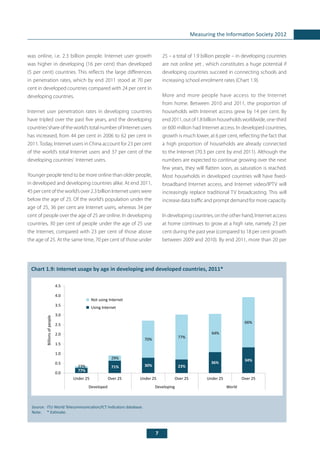
rural population. By end 2011, more than 160 economies
worldwide had launched 3G services commercially, and
45 per cent of the world’s population was covered by a 3G
mobile network (Chart 1.7).
The emergence of mobile Internet services (both prepaid
and postpaid) has played a key role in the surge in numbers
of mobile-broadband subscriptions in developing countries,
bringingInternettoalargenumberofuserswhohavelimited
accesstofixed-broadbandservices.AsChapter3ofthisreport
shows,mobile-broadbandservices(bothprepaidandpostpaid)
areonaveragemoreaffordablethanfixed-broadbandservices,
although the price differences are not huge, and are less
pronounced in developed countries. Nevertheless, mobile
broadband is still expensive in most developing countries,
especially for high-volume users. Indeed, in many countries,
the price of mobile-broadband services is comparable to that
Growth in the mobile market will continue to be driven by
prepaid services, more affordable devices, and the increasing
availability of mobile-broadband services. Over the next few
years,themostsignificanttrendwillbeashiftfrommobilevoice
to mobile data traffic as more and more people subscribe to
wireless-network services for accessing the Internet.
Broadband (fixed and mobile)
Looking at the broadband markets, uptake of both fixed
(wired)-broadband and mobile-broadband services has
continued to grow worldwide. By end 2011, the number
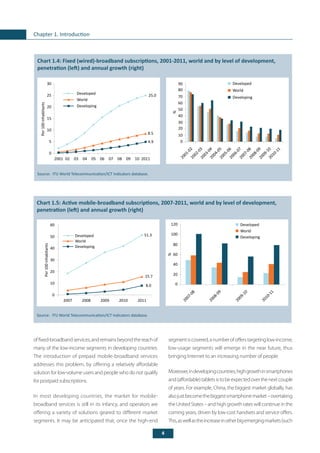
of fixed (wired)-broadband subscriptions had climbed to
almost 600 million, corresponding to a global penetration
rate of 8.5 per cent (Chart 1.4). This compares with around
530 million, and 7.7 per cent penetration, a year earlier. At
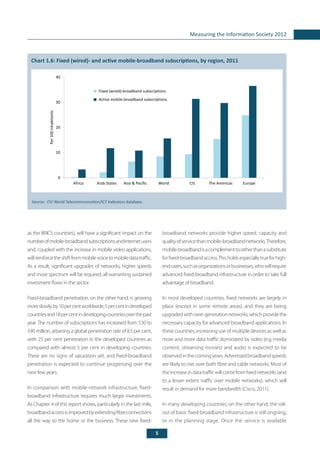
the same time, the number of active mobile-broadband
subscriptions grew by 40 per cent between 2010 and
2011, to almost 1.1 billion by end 2011. This represents a
penetrationrateof16per100inhabitantsglobally,asagainst
13 a year earlier (Chart 1.5).Today, there are almost twice as
many mobile-broadband as fixed-broadband subscriptions.
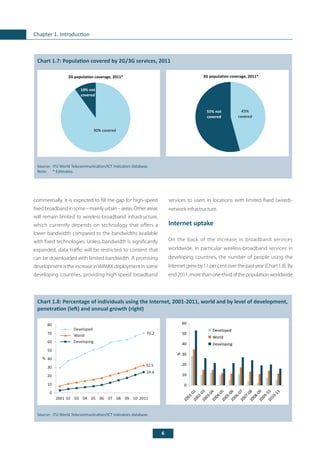
Europe continues to be the leading region when it comes
to broadband uptake (Chart 1.6).
Mobile broadband continues to be the ICT service
displaying the sharpest growth rates. Between 2010 and
2011, growth continued at a high rate of 40 per cent
globally, 23 per cent in the developed world and 76 per
Chart 1.3: Mobile-cellular subscriptions, 2001-2011, world and by level of development, penetration
(left) and annual growth (right)
Source:	 ITU World Telecommunication/ICT Indicators database.
122.3
85.7
77.8
0
20
40
60
80
100
120
140
2001 02 03 04 05 06 07 08 09 10 2011
Developed
World
Developing
Per100inhabitants
0
5
10
15
20
25
30
35
Developed
World
Developing
%
2001-022002-032003-042004-052005-062006-072007-082008-092009-102010-11
4
Chapter 1. Introduction
Chart 1.4: Fixed (wired)-broadband subscriptions, 2001-2011, world and by level of development,
penetration (left) and annual growth (right)
Source:	 ITU World Telecommunication/ICT Indicators database.
25.0
8.5
4.9
0
5
10
15
20
25
30
2001 02 03 04 05 06 07 08 09 10 2011
Developed
World
Developing
Per100inhabitants
offixed-broadbandservices,andremainsbeyondthereachof
many of the low-income segments in developing countries.
The introduction of prepaid mobile-broadband services
addresses this problem, by offering a relatively affordable
solution for low-volume users and people who do not qualify
for postpaid subscriptions.
In most developing countries, the market for mobile-
broadband services is still in its infancy, and operators are
offering a variety of solutions geared to different market
segments. It may be anticipated that, once the high-end
segmentiscovered,anumberofofferstargetinglow-income,
low-usage segments will emerge in the near future, thus
bringing Internet to an increasing number of people.
Moreover,indevelopingcountries,highgrowthinsmartphones
and(affordable)tabletsistobeexpectedoverthenextcouple
of years. For example, China, the biggest market globally, has
alsojustbecomethebiggestsmartphonemarket–overtaking
the United States – and high growth rates will continue in the
coming years, driven by low-cost handsets and service offers.
This,aswellastheincreaseinotherbigemergingmarkets(such
Chart 1.5: Active mobile-broadband subscriptions, 2007-2011, world and by level of development,
penetration (left) and annual growth (right)
Source:	 ITU World Telecommunication/ICT Indicators database.
0
10
20
30
40
50
60
2007 2008 2009 2010 2011
Developed
World
Developing
Per100inhabitants
51.3
15.7
8.0
0
10
20
30
40
50
60
70
80
90 Developed
World
Developing
2001-02
%
2002-032003-042004-052005-062006-072007-082008-092009-102010-11
0
20
40
60
80
100
120
2007-08
2008-09
2009-10
2010-11
Developed
World
Developing
%
5
Measuring the Information Society 2012
broadband networks provide higher speed, capacity and
qualityofservicethanmobile-broadbandnetworks.Therefore,
mobile-broadbandisacomplementtoratherthanasubstitute
forfixed-broadbandaccess.Thisholdsespeciallytrueforhigh-
endusers,suchasorganizationsorbusinesses,whowillrequire
advanced fixed-broadband infrastructure in order to take full
advantage of broadband.
In most developed countries, fixed networks are largely in
place (except in some remote areas), and they are being
upgradedwithnext-generationnetworks,whichprovidethe
necessary capacity for advanced broadband applications. In
these countries, increasing use of multiple devices as well as
more and more data traffic dominated by video (e.g. media
content, streaming movies) and audio is expected to be
observedinthecomingyears.Advertisedbroadbandspeeds
are likely to rise, over both fibre and cable networks. Most of
theincreaseindatatrafficwillcomefromfixednetworks(and
to a lesser extent traffic over mobile networks), which will
result in demand for more bandwidth (Cisco, 2011).
In many developing countries, on the other hand, the roll-
out of basic fixed-broadband infrastructure is still ongoing,
or in the planning stage. Once the service is available
as the BRICS countries), will have a significant impact on the
numberofmobile-broadbandsubscriptionsandInternetusers
and, coupled with the increase in mobile video applications,
willreinforcetheshiftfrommobilevoicetomobiledatatraffic.
As a result, significant upgrades of networks, higher speeds
and more spectrum will be required, all warranting sustained
investment flows in the sector.
Fixed-broadband penetration, on the other hand, is growing
moreslowly,by10percentworldwide,5percentindeveloped
countriesand18percentindevelopingcountriesoverthepast
year. The number of subscriptions has increased from 530 to
590 million, attaining a global penetration rate of 8.5 per cent,
with 25 per cent penetration in the developed countries as
compared with almost 5 per cent in developing countries.
There are no signs of saturation yet, and fixed-broadband
penetration is expected to continue progressing over the
next few years.
In comparison with mobile-network infrastructure, fixed-
broadband infrastructure requires much larger investments.
As Chapter 4 of this report shows, particularly in the last mile,
broadbandaccessisimprovedbyextendingfibreconnections
all the way to the home or the business. These new fixed-
	
Chart 1.6: Fixed (wired)- and active mobile-broadband subscriptions, by region, 2011
Source: 	ITU World Telecommunication/ICT Indicators database.
0
10
20
30
40
Africa Arab States Asia & Pacific World CIS The Americas Europe
Fixed (wired)-broadband subscriptions
Active mobile-broadband subscriptions
Per100inhabitants
6
Chapter 1. Introduction
services to users in locations with limited fixed (wired)-
network infrastructure.
Internet uptake
On the back of the increase in broadband services
worldwide, in particular wireless-broadband services in
developing countries, the number of people using the
Internetgrewby11percentoverthepastyear(Chart1.8).By
end2011,morethanone-thirdofthepopulationworldwide
commercially, it is expected to fill the gap for high-speed
fixedbroadbandinsome–mainlyurban–areas.Otherareas
will remain limited to wireless-broadband infrastructure,
which currently depends on technology that offers a
lower bandwidth compared to the bandwidths available
with fixed technologies. Unless bandwidth is significantly
expanded, data traffic will be restricted to content that
can be downloaded with limited bandwidth. A promising
development is the increase inWiMAX deployment in some
developing countries, providing high-speed broadband
Chart 1.7: Population covered by 2G/3G services, 2011
Source:	 ITU World Telecommunication/ICT Indicators database.
Note:	 * Estimates.
10% not
covered
90% covered
2G population coverage, 2011* 3G population coverage, 2011*
55% not
covered
45%
covered
Chart 1.8: Percentage of individuals using the Internet, 2001-2011, world and by level of development,
penetration (left) and annual growth (right)
Source:	 ITU World Telecommunication/ICT Indicators database.
70.2
32.5
24.4
0
10
20
30
40
50
60
70
80
2001 02 03 04 05 06 07 08 09 10 2011
Developed
World
Developing
%
0
10
20
30
40
50
60
Developed
World
Developing
%
2001-022002-032003-042004-052005-062006-072007-082008-092009-102010-11
7
Measuring the Information Society 2012
25 – a total of 1.9 billion people – in developing countries
are not online yet , which constitutes a huge potential if
developing countries succeed in connecting schools and
increasing school enrolment rates (Chart 1.9).
More and more people have access to the Internet
from home. Between 2010 and 2011, the proportion of
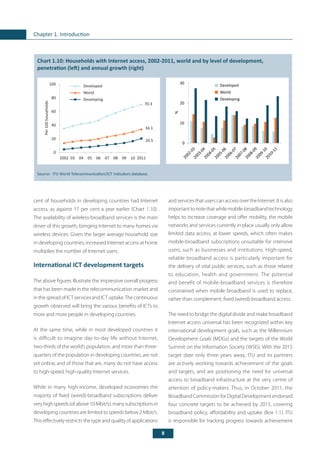
households with Internet access grew by 14 per cent. By
end2011,outof1.8billionhouseholdsworldwide,one-third
or 600 million had Internet access. In developed countries,
growth is much lower, at 6 per cent, reflecting the fact that
a high proportion of households are already connected
to the Internet (70.3 per cent by end 2011). Although the
numbers are expected to continue growing over the next
few years, they will flatten soon, as saturation is reached.
Most households in developed countries will have fixed-
broadband Internet access, and Internet video/IPTV will
increasingly replace traditional TV broadcasting. This will
increase data traffic and prompt demand for more capacity.
In developing countries, on the other hand, Internet access
at home continues to grow at a high rate, namely 23 per
cent during the past year (compared to 18 per cent growth
between 2009 and 2010). By end 2011, more than 20 per
was online, i.e. 2.3 billion people. Internet user growth
was higher in developing (16 per cent) than developed
(5 per cent) countries. This reflects the large differences
in penetration rates, which by end 2011 stood at 70 per
cent in developed countries compared with 24 per cent in
developing countries.
Internet user penetration rates in developing countries
have tripled over the past five years, and the developing
countries’share of the world’s total number of Internet users
has increased, from 44 per cent in 2006 to 62 per cent in
2011.Today, Internet users in China account for 23 per cent
of the world’s total Internet users and 37 per cent of the
developing countries’ Internet users.
Younger people tend to be more online than older people,
in developed and developing countries alike. At end 2011,
45 per cent of the world’s over 2.3 billion Internet users were
below the age of 25. Of the world’s population under the
age of 25, 36 per cent are Internet users, whereas 34 per
cent of people over the age of 25 are online. In developing
countries, 30 per cent of people under the age of 25 use
the Internet, compared with 23 per cent of those above
the age of 25. At the same time, 70 per cent of those under
	
Chart 1.9: Internet usage by age in developing and developed countries, 2011*
Source: 	ITU World Telecommunication/ICT Indicators database.
Note:	 * Estimate.
77%
71% 30% 23%
36%
34%
23%
29%
70%
77%
64%
66%
0.0
0.5
1.0
1.5
2.0
2.5
3.0
3.5
4.0
4.5
Under 25 Over 25 Under 25 Over 25 Under 25 Over 25
Developed Developing World
Not using Internet
Using Internet
Billionsofpeople
8
Chapter 1. Introduction
and services that users can access over the Internet. It is also
importanttonotethatwhilemobile-broadbandtechnology
helps to increase coverage and offer mobility, the mobile
networks and services currently in place usually only allow
limited data access, at lower speeds, which often makes
mobile-broadband subscriptions unsuitable for intensive
users, such as businesses and institutions. High-speed,
reliable broadband access is particularly important for
the delivery of vital public services, such as those related
to education, health and government. The potential
and benefit of mobile-broadband services is therefore
constrained when mobile broadband is used to replace,
rather than complement, fixed (wired)-broadband access.
The need to bridge the digital divide and make broadband
Internet access universal has been recognized within key
international development goals, such as the Millennium
Development Goals (MDGs) and the targets of the World
Summit on the Information Society (WSIS). With the 2015
target date only three years away, ITU and its partners
are actively working towards achievement of the goals
and targets, and are positioning the need for universal
access to broadband infrastructure at the very centre of
attention of policy-makers. Thus, in October 2011, the
Broadband Commission for Digital Development endorsed
four concrete targets to be achieved by 2015, covering
broadband policy, affordability and uptake (Box 1.1). ITU
is responsible for tracking progress towards achievement
cent of households in developing countries had Internet
access, as against 17 per cent a year earlier (Chart 1.10).
The availability of wireless-broadband services is the main
driver of this growth, bringing Internet to many homes via
wireless devices. Given the larger average household size
in developing countries, increased Internet access at home
multiplies the number of Internet users.
International ICT development targets
The above figures illustrate the impressive overall progress
that has been made in the telecommunication market and
in the spread of ICT services and ICT uptake.The continuous
growth observed will bring the various benefits of ICTs to
more and more people in developing countries.
At the same time, while in most developed countries it
is difficult to imagine day-to-day life without Internet,
two-thirds of the world’s population, and more than three-
quarters of the population in developing countries, are not
yet online, and of those that are, many do not have access
to high-speed, high-quality Internet services.
While in many high-income, developed economies the
majority of fixed (wired)-broadband subscriptions deliver
veryhighspeeds(ofabove10Mbit/s),manysubscriptionsin
developing countries are limited to speeds below 2 Mbit/s.
This effectively restricts the type and quality of applications
Chart 1.10: Households with Internet access, 2002-2011, world and by level of development,
penetration (left) and annual growth (right)
Source:	 ITU World Telecommunication/ICT Indicators database.
0
10
20
30
Developed
World
Developing
%
2002-032003-042004-052005-062006-072007-082008-092009-102010-11
70.3
34.1
20.5
0
20
40
60
80
100
2002 03 04 05 06 07 08 09 10 2011
Per100households
Developed
World
Developing
9
Measuring the Information Society 2012
	
Box 1.1: Broadband Commission for Digital Development: Four ambitious but achievable targets
for 2015
The Broadband Commission for Digital Development was
launched in 2010 by ITU and UNESCO. It comprises global
and government leaders from around the world and highest-
level representatives from relevant industries, international
agencies, civil society and organizations concerned with
development, brought together to debate policy guidance
and best practices with regard to the deployment and roll-out
of broadband networks and services.
The objectives of the Broadband Commission include:
•	 Advocating the faster deployment of universal access
to broadband networks in order to accelerate progress
towards the MDGs and to avoid developing countries
being excluded from the global digital economy and
information revolution
•	 Monitoring and measuring global broadband
development
•	 Developing policy guidance, including specific,
targeted training for regulators, involving the private
sector, on how to improve regulation and spectrum
allocation techniques
•	 Using the expertise of its business-oriented
commissioners to search for self-sustaining, viable
business models for lower-end mass markets in
developing countries.
At its fourth meeting in October 2011 in Geneva, the
Broadband Commission endorsed a set of four new“ambitious
but achievable” targets that countries around the world
should strive to meet in order to ensure their populations
participate fully in tomorrow’s emerging knowledge societies.
The targets cover broadband policy, affordability and uptake:
Target 1: Making broadband policy universal. By 2015, all
countries should have a national broadband plan or strategy
or include broadband in their universal access/service (UAS)
definitions.
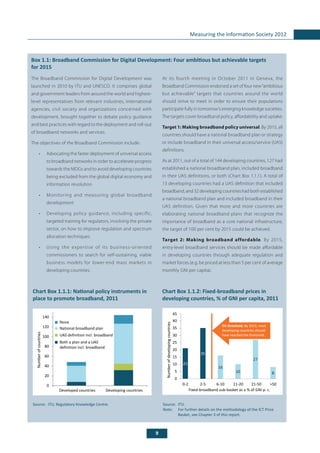
As at 2011, out of a total of 144 developing countries, 127 had
established a national broadband plan, included broadband
in their UAS definitions, or both (Chart Box 1.1.1). A total of
13 developing countries had a UAS definition that included
broadband, and 32 developing countries had both established
a national broadband plan and included broadband in their
UAS definition. Given that more and more countries are
elaborating national broadband plans that recognize the
importance of broadband as a core national infrastructure,
the target of 100 per cent by 2015 could be achieved.
Target 2: Making broadband affordable. By 2015,
entry-level broadband services should be made affordable
in developing countries through adequate regulation and
market forces (e.g. be priced at less than 5 per cent of average
monthly GNI per capita).
Chart Box 1.1.1: National policy instruments in
place to promote broadband, 2011
Source:	 ITU, Regulatory Knowledge Centre.
0
20
40
60
80
100
120
140
Developed countries Developing countries
None
National broadband plan
UAS definition incl. broadband
Both a plan and a UAS
definition incl. broadband
Numberofcountries
Chart Box 1.1.2: Fixed-broadband prices in
developing countries, % of GNI per capita, 2011
Source:	 ITU.
Note: 	 For further details on the methodology of the ICT Price
Basket, see Chapter 3 of this report.
21
35
16
10
27
8
0
5
10
15
20
25
30
35
40
0-2 2-5 6-10 11-20 21-50 >50
Fixed-broadband sub-basket as a % of GNI p. c.
5% threshold. By 2015, most
developing countries should
have reached the threshold.
Numberofdevelopingcountries
45
10
Chapter 1. Introduction
	
Box 1.1: Broadband Commission for Digital Development: Four ambitious but achievable targets
for 2015 (continued)
The price of broadband services plays a critical role in
broadband diffusion. Broadband prices are falling worldwide
(see Chapter 3), in particular in developing countries, but
are still too high, thus making broadband unaffordable for
many people. In 2011, the price of fixed-broadband services
in developing countries corresponded to 40.3 per cent of
GNI per capita on average. A total of 56 developing countries
had achieved the 5 per cent target (Chart Box 1.1.2). By
comparison, in the large majority of developed countries,
the target has already been achieved.
Target 3: Connecting homes to broadband. By 2015, 40
per cent of households in developing countries should have
Internet access.
Having access to broadband Internet at home is the most
inclusive way of bringing people into the information
society. At home, all household members have a chance to
go online, irrespective of whether they have jobs outside, go
to school, are male or female, are children or adults, or are
elderly. OECD research has shown that children with Internet
access at home perform better in school. Moreover, children
who are starting to use the Internet will be under parental
guidance at home, and it is therefore a safer way to bring
Chart Box 1.1.3: Percentage of households with
Internet access, developing countries
Source:	 ITU.
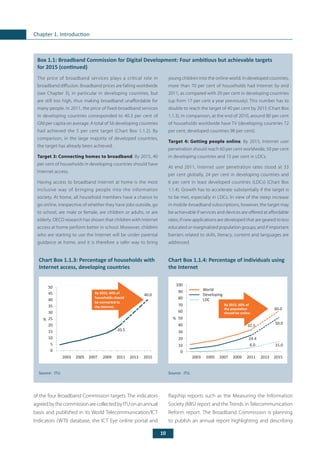
young children into the online world. In developed countries,
more than 70 per cent of households had Internet by end
2011, as compared with 20 per cent in developing countries
(up from 17 per cent a year previously). This number has to
double to reach the target of 40 per cent by 2015 (Chart Box
1.1.3). In comparison, at the end of 2010, around 80 per cent
of households worldwide have TV (developing countries 72
per cent; developed countries 98 per cent).
Target 4: Getting people online. By 2015, Internet user
penetration should reach 60 per cent worldwide, 50 per cent
in developing countries and 15 per cent in LDCs.
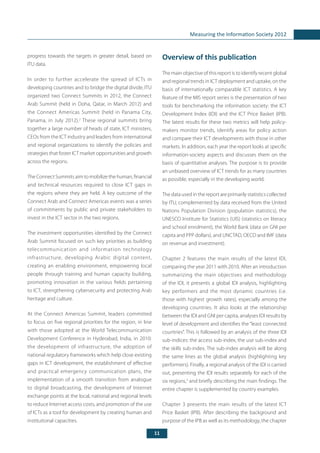
At end 2011, Internet user penetration rates stood at 33
per cent globally, 24 per cent in developing countries and
6 per cent in least developed countries (LDCs) (Chart Box
1.1.4). Growth has to accelerate substantially if the target is
to be met, especially in LDCs. In view of the steep increase
in mobile-broadband subscriptions, however, the target may
be achievable if services and devices are offered at affordable
rates; if new applications are developed that are geared to less
educated or marginalized population groups; and if important
barriers related to skills, literacy, content and languages are
addressed.
Chart Box 1.1.4: Percentage of individuals using
the Internet
Source:	 ITU.
of the four Broadband Commission targets. The indicators
agreedbythecommissionarecollectedbyITUonanannual
basis and published in its World Telecommunication/ICT
Indicators (WTI) database, the ICT Eye online portal and
flagship reports such as the Measuring the Information
Society (MIS) report and the Trends in Telecommunication
Reform report. The Broadband Commission is planning
to publish an annual report highlighting and describing
20.5
40.0
0
5
10
15
20
25
30
35
40
45
%
By 2015, 40% of
households should
be connected to
the Internet.
2003 2005 2007 2009 2011 2013 2015
50
World
Developing
LDC
2015
By 2015, 60% of
the population
should be online.
60.0
24.4
50.0
6.0 15.0
0
10
20
30
40
50
60
70
80
90
100
%
201320112009200720052003
32.5
11
Measuring the Information Society 2012
Overview of this publication
The main objective of this report is to identify recent global
and regional trends in ICT deployment and uptake, on the
basis of internationally comparable ICT statistics. A key
feature of the MIS report series is the presentation of two
tools for benchmarking the information society: the ICT
Development Index (IDI) and the ICT Price Basket (IPB).
The latest results for these two metrics will help policy-
makers monitor trends, identify areas for policy action
and compare their ICT developments with those in other
markets. In addition, each year the report looks at specific
information-society aspects and discusses them on the
basis of quantitative analyses. The purpose is to provide
an unbiased overview of ICT trends for as many countries
as possible, especially in the developing world.
The data used in the report are primarily statistics collected
by ITU, complemented by data received from the United
Nations Population Division (population statistics), the
UNESCO Institute for Statistics (UIS) (statistics on literacy
and school enrolment), the World Bank (data on GNI per
capita and PPP dollars), and UNCTAD, OECD and IMF (data
on revenue and investment).
Chapter 2 features the main results of the latest IDI,
comparing the year 2011 with 2010. After an introduction
summarizing the main objectives and methodology
of the IDI, it presents a global IDI analysis, highlighting
key performers and the most dynamic countries (i.e.
those with highest growth rates), especially among the
developing countries. It also looks at the relationship
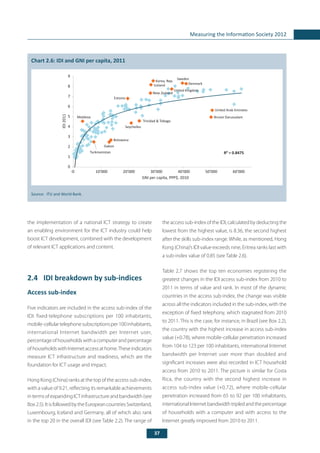
between the IDI and GNI per capita, analyses IDI results by
level of development and identifies the “least connected
countries”. This is followed by an analysis of the three IDI
sub-indices: the access sub-index, the use sub-index and
the skills sub-index. The sub-index analysis will be along
the same lines as the global analysis (highlighting key
performers). Finally, a regional analysis of the IDI is carried
out, presenting the IDI results separately for each of the
six regions,3
and briefly describing the main findings. The
entire chapter is supplemented by country examples.
Chapter 3 presents the main results of the latest ICT
Price Basket (IPB). After describing the background and
purpose of the IPB as well as its methodology, the chapter
progress towards the targets in greater detail, based on
ITU data.
In order to further accelerate the spread of ICTs in
developing countries and to bridge the digital divide, ITU
organized two Connect Summits in 2012, the Connect
Arab Summit (held in Doha, Qatar, in March 2012) and
the Connect Americas Summit (held in Panama City,
Panama, in July 2012).2
These regional summits bring
together a large number of heads of state, ICT ministers,
CEOs from the ICT industry and leaders from international
and regional organizations to identify the policies and
strategies that foster ICT market opportunities and growth
across the regions.
The Connect Summits aim to mobilize the human, financial
and technical resources required to close ICT gaps in
the regions where they are held. A key outcome of the
Connect Arab and Connect Americas events was a series
of commitments by public and private stakeholders to
invest in the ICT sector in the two regions.
The investment opportunities identified by the Connect
Arab Summit focused on such key priorities as building
telecommunication and information technology
infrastructure, developing Arabic digital content,
creating an enabling environment, empowering local
people through training and human capacity building,
promoting innovation in the various fields pertaining
to ICT, strengthening cybersecurity and protecting Arab
heritage and culture.
At the Connect Americas Summit, leaders committed
to focus on five regional priorities for the region, in line
with those adopted at the World Telecommunication
Development Conference in Hyderabad, India, in 2010:
the development of infrastructure, the adoption of
national regulatory frameworks which help close existing
gaps in ICT development, the establishment of effective
and practical emergency communication plans, the
implementation of a smooth transition from analogue
to digital broadcasting, the development of Internet
exchange points at the local, national and regional levels
to reduce Internet access costs, and promotion of the use
of ICTs as a tool for development by creating human and
institutional capacities.
12
Chapter 1. Introduction
terms of revenue, before focusing specially on the mobile
market. It illustrates the weight of the telecom sector in
the economy, identifies recent changes in this regard,
and shows the emerging weight of the mobile sector.
The chapter then goes on to analyse investment trends
in the sector, in respect of both total telecom investment
as well as foreign direct investment. It also shows global
shifts in this regard, and compares revenue and investment
trends.The analysis is supplemented with concrete country
examples, particularly from developing countries.
Chapter 5 presents a new approach, which consists in
measuring the information society by looking at subscribed
and effective telecommunication capacity, to complement
traditional approaches based on subscription data. It shows
that technological advances, such as the improved capacity
of devices to transmit and receive data and enhanced data
compression algorithms, have contributed significantly
to increasing telecommunication capacity. The analysis
is based on 30 telecommunication and 12 broadcasting
technologies, and covers the period of digitization from
1986to2010.Ithighlightsthedifferencesinresultsobtained
whencomparingcapacitywithsubscriptionnumbersatthe
global level, as well as between developed and developing
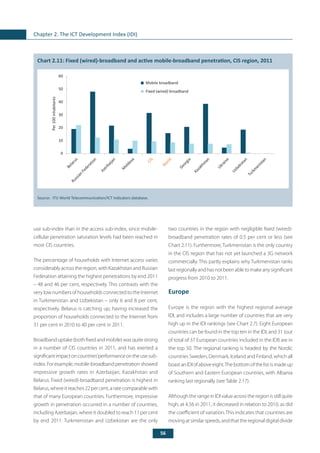
countries,andmakessuggestionsforpolicyconclusionsthat
can be drawn from the analysis.
goes on to present the main aggregate trends in price
developments between 2008 and 2011, highlighting
the major changes globally and in developed and
developing countries. This is followed by an analysis of
the main results of the IPB, comparing 2011 and 2010
data. It includes an analysis of each sub-basket: the fixed-
telephone sub-basket, the mobile-cellular sub-basket and
the fixed-broadband sub-basket.While the IPB is shown as
a percentage of GNI per capita, data for each sub-basket
are also given in USD and PPP dollars. Countries with the
greatest decreases in prices are highlighted, especially
those from the developing world. Each of the six regions
is then analysed in turn, focusing particularly on mobile-
cellular and fixed-broadband prices. Finally, the chapter
provides a new analysis of mobile-broadband prices,
based on the 2011 pilot data-collection exercise for mobile
broadband carried out by ITU.
ICT and telecommunication infrastructure deployment is
the foundation on which the information society is built
and can flourish. Monitoring the ICT industry is therefore
critical to understanding future ICT developments.
Accordingly, Chapter 4 takes a closer look at recent
revenue and investment trends in the ICT sector, and the
telecommunication sector in particular. It first presents
an analysis of the total telecommunication market in
13
Measuring the Information Society 2012
Endnotes
1
	 PWC (2012):“according to industry estimates, 2012 will be the year when household broadband revenues, globally, finally overtake household voice
revenues”.
2
	 Previous ITU Connect Summits were held in Minsk, Belarus, in 2009 (Connect CIS Summit) and in Kigali, Rwanda, in 2007 (Connect Africa Summit).
3
	 The six regions as defined by the ITU Telecommunication Development Bureau (BDT) are: Africa, the Americas, Arab States, Asia and the Pacific,
Commonwealth of Independent States, Europe.
15
Measuring the Information Society 2012
Chapter 2. The ICT Development
Index (IDI)
2.1	 Introduction to the IDI1
The ICT Development Index (IDI) is a composite index
combining 11 indicators into one benchmark measure
that serves to monitor and compare developments in
information and communication technology (ICT) across
countries. The IDI was developed by ITU in 2008 and first
presented in the 2009 edition of Measuring the Information
Society (ITU, 2009a). It was established in response to
ITU Member States’ request to develop an ICT index and
publish it regularly. This section briefly describes the main
objectives, conceptual framework and methodology of
the IDI.
The main objectives of the IDI are to measure:
•	 The level and evolution over time of ICT
developments in countries and relative to other
countries.
•	 Progress in ICT development in both developed
and developing countries: the index should
be global and reflect changes taking place in
countries at different levels of ICT development.
•	 The digital divide, i.e. differences between
countries with different levels of ICT development.
•	 The development potential of ICTs or the extent to
which countries can make use of ICTs to enhance
growth and development, based on available
capabilities and skills.
Conceptual framework
The recognition that ICTs can be a development enabler,
if applied and used appropriately, is critical to countries
that are moving towards information or knowledge-
based societies, and is central to the IDI’s conceptual
framework. The ICT development process, and a country’s
transformation to becoming an information society, can be
depictedusingthefollowingthree-stagemodel(Figure 2.1):
•	 stage 1: ICT readiness (reflecting the level of
networked infrastructure and access to ICTs)
•	 stage 2: ICT intensity (reflecting the level of use of
ICTs in the society)
•	 stage 3: ICTimpact (reflecting the result/outcome of
efficient and effective ICT use).
Advancingthroughthesestagesdependsonacombination
of three factors: the availability of ICT infrastructure and
access, a high level of ICT usage and the capability to use
ICTseffectively.Accordingly,thefirsttwostageslistedabove
correspond to two major components of the IDI: ICT access
and ICT use.
Reaching the final stage, and maximizing the impact of ICTs,
crucially depends on the third component of the IDI: ICT
skills. ICT (and other) skills determine the effective use that is
made of ICTs, and are critical to leveraging the full potential
of ICTs for socio-economic development. Economic growth
and development will remain below potential if economies
are not capable of exploiting new technologies and reaping
16
Chapter 2. The ICT Development Index (IDI)
their benefits. Therefore, the IDI includes a measure of the
capability to use ICTs effectively.
A single indicator cannot track progress in all three
components(access,usageandskills)oftheICTdevelopment
process, thus requiring the construction of a composite
indexsuchastheIDI.TheIDIaimstocapturetheevolutionof
theinformationsocietyasitgoesthroughitsdifferentstages
of development, taking into consideration technology
convergence and the emergence of new technologies.
Based on this conceptual framework, the IDI is divided into
the following three sub-indices:
•	 Access sub-index: This sub-index captures ICT
readiness, and includes five infrastructure and access
indicators (fixed-telephone subscriptions, mobile-
cellular telephone subscriptions, international
Internet bandwidth per Internet user, percentage
of households with a computer, and percentage of
households with Internet access).
•	 Use sub-index: This sub-index captures ICT intensity,
and includes three ICT intensity and usage
indicators (percentage of Internet users, fixed
(wired)-broadbandsubscriptions,andactivemobile-
broadband subscriptions).2
	
Figure 2.1: Three stages in the evolution towards an information society
Source: 	ITU.
ICT
Development
Index
ICT Readiness
(infrastructure,
access)
ICT Impact
(outcomes)
ICT Use
(intensity)
ICT Capability
(skills)
•	 Skillssub-index:Thissub-indexcapturesICTcapability
or skills as indispensable input indicators. It includes
threeproxyindicators(adultliteracy,grosssecondary
enrolment and gross tertiary enrolment), and
therefore is given less weight in the computation of
the IDI compared with the other two sub-indices.3
The choice of indicators included in the sub-indices
reflects the corresponding stage of transformation to
the information society. Therefore, the indicators in each
sub-index may change over time to reflect technological
developments related to ICTs, and as more and better data
become available. For example, what was considered basic
infrastructure in the past – such as fixed-telephone lines
– is fast becoming less relevant in the light of increasing
fixed-mobile substitution. Similarly, broadband is currently
considered an advanced technology, characterizing intense
Internet use, and is therefore included in stage 2 (as an
indicator in the use sub-index). However, in the future it may
become essential and be moved to stage 1 (as an indicator
in the access sub-index), while another, new technology
may appear in stage 2.
Methodology
The IDI includes 11 indicators (Figure 2.2). A detailed
definition of each indicator is provided in Annex 1.
17
Measuring the Information Society 2012
Selection of the indicators was based on:
•	 The relevance of a particular indicator for contributing
to the main objectives and conceptual framework of
the IDI. For example, the selected indicators need
to be relevant to both developed and developing
countries, and should reflect – as much as possible
– the framework’s three components described
above.4
•	 Data availability and quality. Data are required for
a large number of countries, as the IDI is a global
index. There is a relative paucity of ICT-related data,
especially at the household level, in the majority
of developing countries. In particular, the three
indicators included in the skills sub-index should
be considered as proxies until data directly relating
to ICT skills become available for more countries.
•	 Theresultsofvariousstatisticalanalyses.The statistical
associations between various indicators were
examined, and principal components analysis
(PCA) was used to examine the underlying nature
of the data and to explore whether the different
dimensions are statistically well-balanced.
While the basic methodology has remained the same since
the IDI was first published, minor adjustments are being
made each year.
Given the dynamic nature of the ICT sector and related
data availability, the types of indicators to be included in
the IDI and its sub-indices are under regular review in ITU,
in consultation with experts. In 2011, the ITU Expert Group
on Telecommunication/ICT Indicators (EGTI) opened a
discussion item on the IDI on its online forum, and experts
are encouraged to provide suggestions on how to improve
the methodology of the IDI.5
A major consideration is
eventually to replace some of the subscription-based
(supply-side) data with more data based on national
household surveys (demand-side indicators). For example,
in the case of mobile-cellular subscriptions, more than 80
countries included in the IDI have surpassed the 100 per
cent penetration mark.6
Much of this is due to multiple
and inactive SIM card holders – which can vary significantly
across countries – and therefore an indicator reflecting the
actual number of individuals using a mobile phone would
be preferable. It is expected that within a couple of years
such an indicator will become widely available and could
replace mobile-cellular subscriptions.
Another key indicator that is in the throes of major changes
at the moment is wireless-broadband access. In 2010, ITU
revised the definition of wireless-broadband subscriptions
to reflect more accurately actual data connections to
broadband networksratherthanpotentialconnections.The
new indicators include satellite-broadband subscriptions,
terrestrial fixed (wireless)-broadband subscriptions and
active mobile-broadband subscriptions.7
In last year’s
edition of the IDI, the indicator “active mobile-broadband
subscriptions”replacedthepreviouslyusedindicator“mobile-
cellular subscriptions with access to data communications
at broadband speeds”, which measured the potential of
mobile-cellular subscriptions to access, for example, 3G
networks. In the future, once more data become available,
it is foreseen to use an indicator combining all wireless-
broadband subscriptions. This is becoming increasingly
important insofar as a number of countries are deploying
fixed (wireless)-broadband technologies, such as WiMAX,
which are currently not reflected in the IDI.
The IDI was computed using the same methodology as
in the past, applying the following steps (Figure 2.2 and
Annex 1):
•	 Preparationofthecompletedataset.Thisstepincludes
filling in missing values using various statistical
techniques.
•	 Normalization of data. This is necessary in order
to transform the values of the IDI indicators into
the same unit of measurement. The chosen
normalization method was the distance to a
referencemeasure(orgoalpost).Thereferencevalues
were either 100 or obtained through a statistical
procedure.
•	 Rescaling of data. The data were rescaled on a scale
from 0 to 10 in order to compare the values of the
indicators and the sub-indices.
•	 Weightingofindicatorsandsub-indices.The indicator
weights were chosen based on the PCA results.
18
Chapter 2. The ICT Development Index (IDI)
The access and use sub-indices were given equal
weight (40 per cent each). The skills sub-index was
given less weight (20 per cent), since it is based on
proxy indicators.
This chapter presents the IDI results for 2011 in comparison
with 2010. It should be noted that the 2010 IDI values have
changed from those published in the previous edition of
this report as a result of:
•	 Country data revisions. As more accurate data
become available, countries provide ITU with
revised statistics for previous years, which
have been taken into consideration. This also
allows ITU to identify inconsistencies and revise
previous estimates. For this edition, in particular,
	
ICT access Ref. value (%)
1. Fixed-telephone lines per 100 inhabitants
2. Mobile-cellular telephone subscriptions per 100 inhabitants
3. International Internet bandwidth (bit/s) per Internet user
4. Percentage of households with a computer
5. Percentage of households with Internet access
60
180
408’813*
100
100
20
20
20
20
20
ICT use Ref. value (%)
6. Percentage of individuals using the Internet
7. Fixed (wired)-broadband Internet subscriptions per 100 inhab.
8. Active mobile-broadband subscriptions per 100 inhab.
100
60
100
33
33
33
ICT skills Ref. value (%)
9. Adult literacy rate
10. Secondary gross enrolment ratio
11. Tertiary gross enrolment ratio
100
100
100
33
33
33
ICT
Development
Index
40
40
20
Figure 2.2: ICT Development Index: indicators and weights
Source: 	ITU.
Note:	 * This corresponds to a log value of 5.61, which was used in the normalization step.
many countries have updated the 2010 values
for the indicator “active mobile-broadband
subscriptions”.8
•	 Differences among countries included in the IDI. Since
the IDI is a relative measure, the calculation of the IDI
value depends on the values of the other countries
included. In each new edition, some countries
are excluded and others added based on data
availability. Overall, this version of the IDI includes
155 countries/economies as compared with 152 in
last year’s edition.
Theremainderofthechapterisstructuredasfollows.Section
2.2 presents the IDI results at the global level. It highlights
some of the top performers, as well as the most dynamic
19
Measuring the Information Society 2012
countries in terms of changes in IDI value and rank. Section
2.3 analyses the digital divide. It looks at the relationship
between a country’s IDI score and its income level, presents
IDI results by level of development (developed/developing
countries) and by groups of countries with different IDI
levels.
Section 2.4 analyses the three sub-indices (access, use
and skills), providing additional insights into areas of high/
low ICT growth, in order to identify areas requiring further
attention from policy-makers and private stakeholders.
Finally, section 2.5 presents a regional analysis of the IDI. It
shows IDI results for six regions (Africa, the Americas, Arab
States, Asia and the Pacific, Commonwealth of Independent
States (CIS) and Europe), as well as a comparative analysis
of the six regions.
2.2	 Global IDI analysis
Overall results
The computed values of the IDI and its sub-indices are
presented on a scale from 0 to 10, thus making it possible
to compare the performance of the 155 countries included
in this year’s IDI.9
Between 2010 and 2011, almost all
countries improved their IDI values, which testifies to the
continuous growth of ICT uptake worldwide. On average,
the IDI increased by 0.21 points (Table 2.1). Growth was
stronger in the use sub-index (0.31 points) in comparison
with the access sub-index (0.21 points).This reflects the fact
that, overall, countries have already reached a higher level
of performance on the access sub-index, whereas the use
sub-index is at a much lower level, and many countries are
still expanding in terms of ICT use. The skills sub-index did
not show much change over the past year (0.01 points),
sinceliteracyandschoolenrolmentindicatorsusuallydonot
evolve to any great extent within such a short time-frame.
There are huge differences among countries, however, with
IDI 2011 values ranging from 8.56 (highest value) to 0.88
(lowest value). As observed in previous years, the range
has increased slightly between 2010 and 2011, indicating
a widening of the gap between the country at the top and
the country at the bottom of the index. This is the case for
both the access and use sub-indices.The latter displays the
highest coefficient of variation, indicating that it is in ICT
usage that differences among countries are most marked.
Some countries continue to record extremely low values in
the use sub-index (close to 0). In these countries, mobile-
broadband services are not yet commercially available and
Internet usage is almost non-existent. The above results
reflect the three stages of the conceptual framework upon
which the IDI has been built, whereby countries move
from stage 1 (ICT access) to stage 2 (ICT usage) as their
information societies evolve. The low levels of the IDI use
sub-index in some countries show that they are still at stage
1 and have not yet reached stage 2. A closer examination
of the differences among countries in terms of their ICT
developments, and the digital divide, will be presented in
section 2.3.
Table 2.1: IDI changes, 2010-2011
Source:	 ITU.
Note: 	 * Simple averages. SD = Standard Deviation, CV = Coefficient of Variations.
IDI
2010
IDI
2011 Change in
average value
2010-2011Average
value*
Min.-Max. Range SD CV
Average
value*
Min.-Max. Range SD CV
IDI 3.94 0.85-8.45 7.60 2.08 52.60 4.15 0.88-8.56 7.68 2.13 51.31 0.21
Access sub-index 4.45 0.85-9.09 8.24 2.28 51.20 4.66 0.85-9.21 8.36 2.29 49.09 0.21
Use sub-index 2.16 0.01-8.04 8.03 2.09 96.71 2.47 0.04-8.17 8.13 2.21 89.33 0.31
Skills sub-index 6.50 1.45-9.86 8.41 2.13 32.76 6.51 1.45-9.86 8.41 2.13 32.69 0.01
20
Chapter 2. The ICT Development Index (IDI)
Selected top IDI countries
Table2.2showsIDIvaluesandcountryrankingsfor2011and
2010.The large majority of countries in the top ten of the IDI
2011 are from Europe. They include four Nordic countries
(Sweden, Denmark, Iceland and Finland), the Netherlands,
Luxembourg, the United Kingdom and Switzerland. From
the Asia and the Pacific region, the Republic of Korea and
Japanareamongthetopten.TheRepublicofKoreatopsthe
IDI, followed by Sweden, for the second consecutive year.
While the Republic of Korea continues to stand out with an
IDI value of 8.56, the four Nordic countries also achieved IDI
values above eight. Remarkably, the top five countries have
not changed position between 2010 and 2011, and are thus
maintaining the highest ICT levels in the world.
Looking at the top 30, the vast majority (20 countries)
are from Europe, but high-income economies10
from the
Asia and the Pacific region (such as Hong Kong (China),
Singapore, New Zealand and Australia) and the Americas
(United States and Canada) are also to be found there. Qatar
is the only country from the Arab States region at the top
of the index. Like all other countries in the top 30, Qatar is
a high-income country, which underlines the strong link
between income and IDI levels.
The following section highlights selected top performing
countries.
The Republic of Korea tops the IDI in 2011, as it did in 2010.
The country ranks first in the use and skills sub-indices,
and is the only country that exceeds the eight-point mark
in the use sub-index. Both mobile-broadband and fixed
(wired)-broadband penetration rates are very high, and 84
per cent of the population is online. The Republic of Korea
excels on all three indicators used to calculate the skills
sub-index, underlining the importance of education and
literacy in bringing people online. Finally, it has the highest
percentage of households with Internet access worldwide
(97 per cent), with virtually all households connected to
the Internet.11
The country has made ICT development
a policy priority and integrated its use in many aspects
of society. The Korea Communications Commission
continuously works towards transforming the country into
a “smart powerhouse” by effectively regulating a highly
dynamic and competitive telecommunication market and
pushing forward innovations and improvements, such as
the deployment of LTE in 2011 (Korea Communications
Commission, 2012).The country’s excellent results in the IDI
and other ICT-related rankings, such as the United Nations
E-Government Survey, as well as the importance of the ICT
sector for the country’s economy, single it out as a model
for ICT-driven development.
Sweden comes in second place, also unchanged from
2010. The country ranks second in the use sub-index, just
after the Republic of Korea. No fewer than 91 per cent of
the population is using the Internet, and the country’s
broadband infrastructure is highly developed. Mobile
broadband plays a very important role in the country,
and Sweden has by far the highest mobile-broadband
penetration rate in Europe, at 92 per cent, ahead of Finland
and Denmark. A user survey13
conducted by the Swedish
Post and Telecom Agency (PTS) finds that 17 per cent of
households connect to the Internet exclusively through
mobile broadband using USB modems or data cards.
Swedes use many different and complementary devices
to access the web: 30 per cent of respondents use their
handsets and 5 per cent tablet computers, in addition to
the device they generally use at home (such as a computer
or laptop) (Swedish Post and Telecom Agency, 2011a).
Over 90 per cent of Swedish households have a computer
and are connected to the Internet, and the country enjoys
ample international Internet bandwidth per Internet user,
contributing to its equally high rank in the access sub-index.
This is the result of a successful broadband strategy in place
sincethe1990s,whichhasmadesafeandaffordableInternet
access a policy priority. Looking to the future, PTS wants to
ensure that, by 2020, 90 per cent of Swedish households
and businesses have access to broadband services with a
minimum speed of 100 Mbit/s (Swedish Post and Telecom
Agency, 2011b).
DenmarkranksthirdintheIDI2011,alsothesameasin2010.
While it continues to perform well in all three sub-indices
of the IDI, it ranks highest in the use-sub index, where it
improved its value from 7.17 in 2010 to 7.79 in 2011. Mobile-
broadbandpenetrationshowsthemostsignificantincrease,
and stands at 80 per cent in 2011. A total of 90 per cent of
Danes use the Internet, one of the highest rates in the world.
While continuing to upgrade and expand the country’s ICT
infrastructure, the Danish government is focusing on the
21
Measuring the Information Society 2012
Note:	 *The GNI per capita is based on the World Bank’s Atlas Method.
Source: 	 ITU.
Table 2.2: ICT Development Index (IDI), 2010 and 2011
Economy Rank 2011 IDI 2011 Rank 2010 IDI 2010 Economy Rank 2011 IDI 2011 Rank 2010 IDI 2010
Korea (Rep.) 1 8.56 1 8.45 Mexico 79 3.79 78 3.60
Sweden 2 8.34 2 8.21 Albania 80 3.78 80 3.48
Denmark 3 8.29 3 8.01 Viet Nam 81 3.68 86 3.41
Iceland 4 8.17 4 7.96 Ecuador 82 3.68 85 3.41
Finland 5 8.04 5 7.89 Egypt 83 3.66 81 3.44
Netherlands 6 7.82 7 7.60 Mongolia 84 3.63 87 3.36
Luxembourg 7 7.76 6 7.64 Tunisia 85 3.58 83 3.42
Japan 8 7.76 8 7.57 Peru 86 3.57 82 3.43
United Kingdom 9 7.75 14 7.35 Iran (I.R.) 87 3.53 88 3.35
Switzerland 10 7.68 9 7.48 Fiji 88 3.50 93 3.08
Hong Kong, China 11 7.68 12 7.39 Jamaica 89 3.49 84 3.42
Singapore 12 7.66 10 7.47 Morocco 90 3.46 92 3.19
Norway 13 7.52 11 7.39 South Africa 91 3.42 90 3.20
Macao, China 14 7.51 13 7.38 Thailand 92 3.41 89 3.29
United States 15 7.48 16 7.11 Dominican Rep. 93 3.34 91 3.19
Germany 16 7.39 15 7.18 Philippines 94 3.19 94 3.04
New Zealand 17 7.34 18 7.03 Indonesia 95 3.19 97 3.01
France 18 7.30 17 7.08 Syria 96 3.15 96 3.01
Austria 19 7.10 22 6.74 Paraguay 97 3.14 99 2.94
Ireland 20 7.09 19 6.99 Bolivia 98 3.13 100 2.93
Australia 21 7.05 21 6.75 Guyana 99 3.12 95 3.02
Canada 22 7.04 20 6.87 Tonga 100 3.12 98 2.94
Belgium 23 6.89 23 6.60 Cape Verde 101 3.08 101 2.90
Estonia 24 6.81 26 6.36 Uzbekistan 102 3.05 104 2.77
Slovenia 25 6.70 24 6.54 El Salvador 103 2.99 102 2.89
Malta 26 6.69 28 6.30 Algeria 104 2.98 103 2.86
Israel 27 6.62 25 6.41 Sri Lanka 105 2.88 105 2.74
Spain 28 6.62 27 6.31 Cuba 106 2.77 107 2.66
Italy 29 6.28 29 6.13 Honduras 107 2.72 106 2.71
Qatar 30 6.24 31 5.94 Botswana 108 2.67 108 2.50
Poland 31 6.19 30 6.09 Namibia 109 2.51 112 2.27
Czech Republic 32 6.17 33 5.89 Turkmenistan 110 2.49 109 2.44
Greece 33 6.14 35 5.88 Gabon 111 2.47 110 2.40
Barbados 34 6.07 32 5.91 Tuvalu 112 2.46 113 2.23
Lithuania 35 6.06 34 5.88 Nicaragua 113 2.44 111 2.31
Latvia 36 6.06 37 5.80 Kenya 114 2.32 114 2.07
Portugal 37 6.05 36 5.86 Zimbabwe 115 2.24 118 1.89
Russian Federation 38 6.00 40 5.61 Swaziland 116 2.24 115 2.06
Slovakia 39 5.86 39 5.63 Ghana 117 2.23 121 1.81
Bahrain 40 5.85 45 5.19 Bhutan 118 2.13 117 1.92
Hungary 41 5.77 42 5.53 India 119 2.10 116 1.98
Croatia 42 5.75 41 5.54 Lao P.D.R. 120 1.99 120 1.84
Antigua & Barbuda 43 5.74 44 5.35 Cambodia 121 1.96 119 1.88
Cyprus 44 5.73 38 5.64 Nigeria 122 1.93 124 1.75
United Arab Emirates 45 5.64 43 5.41 Solomon Islands 123 1.85 127 1.67
Belarus 46 5.57 46 5.08 Senegal 124 1.85 122 1.76
Saudi Arabia 47 5.43 53 4.81 Gambia 125 1.84 123 1.75
Serbia 48 5.40 47 5.04 Yemen 126 1.76 126 1.70
Kazakhstan 49 5.27 56 4.65 Pakistan 127 1.75 125 1.71
Uruguay 50 5.24 49 4.89 Djibouti 128 1.74 128 1.65
Bulgaria 51 5.20 51 4.87 Côte d'Ivoire 129 1.69 131 1.62
Romania 52 5.13 50 4.89 Comoros 130 1.68 130 1.64
Oman 53 5.10 54 4.75 Myanmar 131 1.67 129 1.65
TFYR Macedonia 54 5.05 48 4.90 Uganda 132 1.67 136 1.53
Chile 55 5.01 58 4.63 Rwanda 133 1.66 140 1.50
Argentina 56 5.00 55 4.72 Togo 134 1.65 132 1.59
Brunei Darussalam 57 4.95 52 4.85 Zambia 135 1.65 137 1.53
Malaysia 58 4.82 57 4.63 Mauritania 136 1.64 138 1.53
St. Vincent and the G. 59 4.74 59 4.58 Nepal 137 1.63 134 1.55
Brazil 60 4.72 67 4.17 Cameroon 138 1.60 135 1.54
Trinidad & Tobago 61 4.57 60 4.42 Tanzania 139 1.60 139 1.52
Moldova 62 4.55 62 4.24 Congo (Rep. of the) 140 1.60 133 1.55
Bosnia and Herzegovina 63 4.53 64 4.21 Benin 141 1.55 141 1.49
Saint Lucia 64 4.49 61 4.36 Papua New Guinea 142 1.44 144 1.36
Lebanon 65 4.48 68 4.11 Madagascar 143 1.44 142 1.41
Panama 66 4.41 63 4.21 Malawi 144 1.42 143 1.37
Ukraine 67 4.40 65 4.20 Mali 145 1.38 147 1.24
Azerbaijan 68 4.39 73 3.83 Congo (Dem. Rep.) 146 1.30 149 1.18
Turkey 69 4.38 66 4.17 Mozambique 147 1.28 145 1.26
Seychelles 70 4.37 69 4.00 Guinea 148 1.28 146 1.25
Costa Rica 71 4.37 71 3.94 Liberia 149 1.26 148 1.20
Maldives 72 4.30 72 3.92 Ethiopia 150 1.15 150 1.09
Georgia 73 4.20 75 3.75 Burkina Faso 151 1.14 152 1.06
Mauritius 74 4.18 70 3.95 Eritrea 152 1.09 151 1.08
Jordan 75 3.95 77 3.61 Central African Rep. 153 0.97 153 0.96
Colombia 76 3.93 76 3.73 Chad 154 0.94 155 0.85
Venezuela 77 3.92 74 3.78 Niger 155 0.88 154 0.88
China 78 3.88 79 3.58
Source: ITU.
22
Chapter 2. The ICT Development Index (IDI)
promotion and development of ‘valuable digital content’
as a driver for Internet use. An example is the citizen’s portal
borger.dk14
which provides access to a number of public
services, from e-government to healthcare.The Open Data
Innovation Strategy is another example of an initiative to
provide meaningful content – in this case public data – to
users. Available public data can then be used by citizens
and businesses to further develop products and services
(Danish Government, 2011).
The Netherlands sits in sixth place in the IDI, and ranks
high in all three sub-indices. The country has one of the
highest percentages of households with a computer, and
also of households with Internet access, in the world. It is
the frontrunner in terms of household Internet connectivity
in Europe. More Dutch households are connected to
the Internet (94 per cent) than have a computer (93 per
cent). This indicates that some households access the
Internet through devices other than a computer, such as
smartphones or tablets, which also tallies with the high
number of mobile-broadband subscriptions. Indeed, at 49
per cent, the country has a very high mobile-broadband
penetration rate, exceeding that of neighbouring Belgium
and Germany. According to telecommunication regulator
OPTA, mobile-broadband subscription numbers and data
usage‘skyrocketed’in 2011, and more than half of mobile-
cellular subscriptions now include data plans.15
The United Kingdom moved up five places to ninth place
in the IDI 2011.This is mostly the result of an increase in the
use sub-index value, from 5.75 to 6.62.While Internet usage
and fixed (wired)-broadband penetration, which are already
very high, continued to grow steadily from one year to the
other, there was a sharp increase in mobile-broadband
penetration between 2010 and 2011. By end 2011, mobile-
broadband penetration stood at 62 per cent, as against 43
per cent a year earlier (see Box 2.7). Like in the Netherlands,
the number of households with Internet access exceeds the
number of households with a computer.
Switzerland ranks tenth in the IDI 2011 rankings, having
increased its IDI from 7.48 to 7.68. The country fares
particularly well on the access sub-index, where it comes in
second place. In 2011, 90 per cent of Swiss households had
a computer, and just under 89 per cent had access to the
Internet. Furthermore, Switzerland is among the countries
with the highest fixed-telephone penetration worldwide,
at 61 per cent. While Switzerland stands out on the access
sub-index, the largest value changes were in the use sub-
index, confirming that a well-developed infrastructure is an
important foundation for increased ICT use. The country’s
fixed (wired)-broadband penetration rate, at 39 per cent, is
the highest in the world. Mobile-broadband penetration
lags behind, but is steadily increasing, from 31 per cent in
2010 to 36 per cent in 2011.
The United States moved up one rank to 15th place in
the IDI 2011. In past editions of this report, the relatively
low mobile-cellular penetration rate and percentage of
households connected to the Internet have been pointed
out (ITU 2010, 2011b). In 2011, however, strong growth
on both these indicators has resulted in an increase in its
access sub-index, and its higher overall ranking. Mobile-
cellular penetration now exceeds 100 per cent, having
grown from just under 90 per cent in 2010 to around 106
per cent in 2011. Household Internet access also increased,
from 72 per cent in 2010 to 76 per cent in 2011, showing
that the National Broadband Plan is starting to bear fruit.
The National Broadband Plan was passed by Congress in
2009, acknowledging that the United States was lagging
behind,andaffirmingtheneedtoextendbroadbandaccess
which is “essential to opportunity and citizenship”(Federal
Communications Commission, 2010). The use sub-index
value improved as well, mainly thanks to continuing high
growth in mobile-broadband uptake. Finally, the United
States ranks third in the skills sub-index, with very high
performance on all three indicators.
New Zealand increased its overall ranking by one place,
to 17th. It continues to perform very well in connecting
households to the Internet and expanding the fixed-
telephone network. While growth in mobile voice usage
is slowing down, mobile data usage has almost doubled
from 2009/10 to 2010/11 (Commerce Commission, 2012).
This is reflected in the strong increase in mobile-broadband
penetration, from 40 per cent in 2010 to 53 per cent in 2011,
resultinginthecountry’simprovementintheusesub-index.
While slightly improving its ranking in the use sub-index,
New Zealand fell by one place in the access sub-index:
mobile-cellularpenetrationhasgrownlittleandthemobile-
cellular market is nearing saturation levels.
23
Measuring the Information Society 2012
France ranks 18th in the IDI 2011, with the biggest changes
taking place in the use-sub index. The country improved its
IDI value from 7.08 in 2010 to 7.30 in 2011. Both fixed- and
mobile-broadband penetration rates increased significantly,
and almost 80 per cent of the population is online. The
increase in the number of mobile-broadband subscriptions
canbelinkedtotheentryofanewlow-costmobileoperator,
which had a‘disruptive’effect on the French mobile market
(seeChapter3,Box3.1).Fixed(wired)-broadbandpenetration
is among the highest in the world, and around 3 per cent
of fixed (wired)-broadband subscriptions have advertised
download speeds of 50 Mbit/s or higher (ARCEP, 2012a).
HighspeedisaprerequisiteforIPTVusage,andFrancestands
out with a particularly high number of IPTV subscriptions. A
study by ARCEP shows that over 50 per cent of broadband
subscriptions include IPTV subscriptions (ARCEP, 2012b).16
Most dynamic countries
As shown in the previous section, there was relatively little
movement among the top 30 countries in the IDI, which
improved their IDI values at a similar pace overall between
2010 and 2011.17
The most dynamic countries (i.e. those
with above-average changes in IDI value or ranking) can
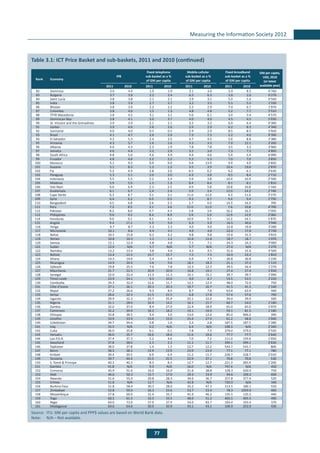
be found in the upper and medium segments of the
index. While top IDI performers are largely high-income,
developed countries from Europe and the Asia and the
Pacific region, the most dynamic performers are primarily
from the developing world, and include countries from all
regions. This reflects not only the fact that these countries
have lower initial IDI levels, but also the recent introduction
of wireless-broadband services, which are experiencing
rapid uptake by users in developing countries.
This section presents the most dynamic countries in terms
of changes in IDI ranking as well as absolute and relative
IDI values (see Table 2.3). By taking a closer look at key
indicator changes, one can point to best practices and main
achievements that have led to improvements in the IDI.
The spider charts (Figure 2.3) illustrate normalized values,
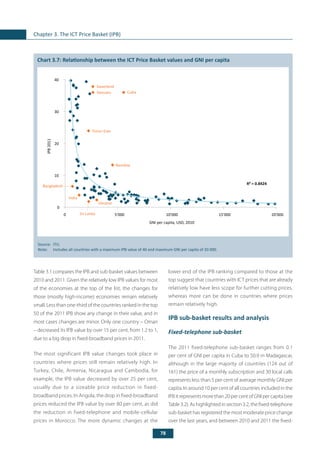
and changes between 2010 and 2011, for each of the 11
indicators included in the IDI.
Azerbaijan moved up five places to 68th in the IDI 2011,
with a 0.57 point increase in its IDI, well above the 0.21
average global change.The country continues to progress,
in particular in the use sub-index, where it increased its IDI
score by one point, to 2.98. Both fixed (wired)-broadband
andmobile-broadbandpenetrationshowhighgrowthrates,
and the number of Internet users in the country continues
to increase rapidly.
Bahrain, ranked 40th in the IDI in 2011, is the country
which registered the highest increase in absolute IDI value.
Table 2.3: Most dynamic countries (top ten) – changes between IDI 2010 and 2011
Source:	 ITU.
Change in IDI ranking Change in IDI value (absolute) Change in IDI value (%)
IDI rank
2011
Country
IDI rank
change
IDI rank
2011
Country
IDI value
change
IDI rank
2011
Country
IDI %
change
49 Kazakhstan 7 40 Bahrain 0.66 117 Ghana 23
60 Brazil 7 47 Saudi Arabia 0.62 115 Zimbabwe 19
133 Rwanda 7 49 Kazakhstan 0.61 68 Azerbaijan 15
47 Saudi Arabia 6 68 Azerbaijan 0.57 88 Fiji 14
40 Bahrain 5 60 Brazil 0.54 49 Kazakhstan 13
68 Azerbaijan 5 46 Belarus 0.54 60 Brazil 13
88 Fiji 5 24 Estonia 0.49 47 Saudi Arabia 13
9 United Kingdom 5 73 Georgia 0.45 40 Bahrain 13
81 Viet Nam 5 71 Costa Rica 0.45 114 Kenya 12
117 Ghana 4 117 Ghana 0.43 73 Georgia 12
24
Chapter 2. The ICT Development Index (IDI)
	
Box 2.1: Online services drive Internet usage in Bahrain
BahrainisamongthemostdynamiccountriesintheIDI2011,with
an increase in absolute IDI value of 0.66, which is three times the
averagechangeof0.21.ThecountryclimbedfiveplacesintheIDI
rankingsandnowsitsin40thposition,makingBahrainthesecond
highest ranked Arab country, after Qatar.
Bahrain records very high scores in the access sub-index. Most
impressive are the country’s household connectivity numbers:
77 per cent of households are connected to the Internet, and 90
per cent have a computer. These numbers are comparable with
orevenexceedICThouseholdaccessdataforthetopperforming
countries in the IDI 2011 (see Chart Box 2.1.1).
The most significant growth occurred in the use sub-index,
which, in line with the three-stage model on which the IDI is
based, is beginning to reap the benefits of progress made in the
access sub-index. Bahrain’s use sub-index increased from 2.25 in
2010 to 3.65 in 2011, which is impressive in comparison with an
average change of 0.31, and represents the biggest progression
of all countries in this sub-index. Massive improvements were
made in all the indicators used to measure the use sub-index.
The number of Internet users in Bahrain climbed to 77 per cent
(2011), up from 55 per cent (2010), which is significantly higher
than the regional and world averages (see Chart Box 2.1.2). Fixed
(wired)-broadband penetration more than doubled, and mobile-
Chart Box 2.1.1: Percentage of households with computers and households with Internet access,
Bahrain in comparison with top ten IDI economies, 2011
Source: 	ITU World Telecommunication/ICT Indicators database.
Percentage of households with a computer Percentage of households with Internet access
%
0
10
20
30
40
50
60
70
80
90
100
Sw
itzerland
Source: 	ITU World Telecommunication/ICT Indicators database.
Chart Box 2.1.2: Percentage of individuals
using the Internet, Bahrain in comparison with
regional and world average, 2010 and 2011
29
25
55
33
29
77
0
10
20
30
40
50
60
70
80
90
100
World Arab States Bahrain
%
2010
2011
broadband penetration almost tripled from 2010 to 2011. There
are more fixed (wired)-broadband than mobile-broadband
subscriptions in Bahrain and more fixed (wired)-broadband
subscriptionsper100inhabitantsthaninanyothercountryinthe
Arab region. In addition, there are a significant number ofWiMAX
subscriptions18
in the country (109 000 compared with 183 000
25
Measuring the Information Society 2012
It moved up five places, with an IDI value change of 0.66,
more than three times the average global IDI change.While
thecountry’srankinginboththeaccessandusesub-indices
improved, it is in the use sub-index that the progression is
most evident, with fixed (wired)-broadband and mobile-
broadband penetration more than doubling between 2010
and 2011. It is noteworthy that in Bahrain, fixed (wired)-
broadband penetration, at 14 per cent, is higher than
mobile-broadbandpenetration,whichstandsat10percent.
Bahrain’s fixed (wired)-broadband penetration rate is by far
the highest in the Arab region. Furthermore, 77 per cent of
the population is using the Internet, a remarkable increase
from 55 per cent in 2010 (see Box 2.1).
Belarus increased its IDI by 0.49 from 2010 to 2011, rising to
46th place in the IDI 2011 rankings. Growth rates are highest
on the use sub-index indicators, although the access sub-
index also shows improvements. In particular, the country’s
relatively high fixed (wired)-broadband penetration rate
is worth highlighting. With a fixed (wired)-broadband
penetration of 22 per cent, Belarus is far ahead of other
CIS countries. Mobile-broadband penetration continues
to grow, too, and the Ministry of Communications plans to
expand broadband further in cities and rural areas.20
Brazil moved up seven places in the IDI between 2010 and
2011, to 60th, with an increase in IDI of 0.54. Major progress
has been made in both the access and use sub-indices.The
indicators of households with a computer and with Internet
access increased by around ten percentage points each
from 2010 to 2011. Mobile-cellular subscriptions continue
to grow. The rise in mobile-broadband uptake is clearly
outstanding: penetration doubled between 2010 and 2011,
and now stands at 21 per cent, the highest in Latin America
(see Box 2.2).22
Costa Rica ranks 71st in the IDI 2011, with an increase
of 0.43 in its IDI, one of the largest absolute increases
and more than twice the global average change. The
access sub-index grew most, mainly thanks to a steep
increase in the percentage of households with Internet
access. Most remarkable is the increase in the country’s
mobile-cellular penetration, from 65 per cent in 2010 to
92 per cent in 2011. For a long time, Costa Rica had been
lagging behind other Latin American countries in terms of
mobile-cellular uptake, but it has now caught up. During
the past year, the country experienced major alterations
in its telecommunication landscape: in the run-up to
the liberalization of the telecommunication market in
late 2011, incumbent ICE introduced prepaid mobile-
cellular offers in 201031
and two new mobile operators32
started business in November 2011. These developments
could herald future increases in the index. For the time
being, mobile-broadband penetration remains minimal,
at around 2 per cent, but new entrants are expected to
accelerate 3G roll-out.
One of the few developed countries among the most
dynamic IDI countries is Estonia, which increased its IDI
by 0.45 points and now sits in 24th place in the IDI 2011
rankings. Both the access and use sub-indices progressed,
with the most dynamic change occurring in the latter. Like
in many other economies, it is primarily a strong increase in
mobile-broadband subscriptions that is responsible for the
impressive growth in the use sub-index. Mobile-broadband
penetration went up from 24 per cent in 2010 to 42 per
cent in 2011, which is the highest of all Baltic countries.
Estonia has long been at the forefront of information society
developments, offering e-services to its citizens in many
areas, including e-voting, e-health and e-taxation.33
	
Box 2.1: Online services drive Internet usage in
Bahrain (continued)
fixed (wired)-broadband subscriptions). Looking at the high
access sub-index value, further increases in ICT usage may be
expected in the country.
The Bahraini government has made extensive use of ICTs to
deliver services to the country’s around 1 million inhabitants
and involve them in decision-making. Bahrain ranks way above
theglobalaverageontheUNe-governmentande-participation
index, although its absolute value declined in the last year.
Furthermore, Bahrain is the subregional19
leader on the online
service index (UNPAN, 2012). In its e-government strategy,
Bahrain puts an emphasis on providing key services online.
Today, more than 200 services are offered online, including
services for residents to pay utility bills and traffic fines or for
visitors to apply for tourist visas online (Kingdom of Bahrain,
2012). Many of these services, such as driving licence renewals
or information about student exam results, are available as
mobile-phone applications. 20
26
Chapter 2. The ICT Development Index (IDI)
	
Box 2.2: Broadband on the advance in Brazil
Over the past year, Brazil significantly improved its IDI, making
it one of the most dynamic countries. Indeed, the country’s IDI
climbed by 0.54, to an overall value of 4.72. Apart from fixed
telephony, all indicators used to calculate the access sub-index
increased significantly. Mobile-cellular penetration showed
impressive gains, and all but one Brazilian city23
are now covered
by a mobile-cellular network.24
The percentage of households
with a computer and with Internet access increased by more
than 10 percentage points, to 45 and 38 per cent, respectively.
In terms of household Internet connectivity, Brazil is now
catching up with other Latin American countries such as Chile
and Uruguay.The growth in household Internet access is a first
result of Brazil’s national broadband plan – Programa Nacional
de Banda Larga (PNBL) – which has been implemented with
effect from May 2010. The goal of the plan is to bring fast (at
least 1 Mbit/s) and affordable broadband access to 40 million
Brazilian households by 2014 (CGPID, 2010). Rural areas are
targeted in particular, in order to deliver government and
health services as well as e-education. Agreements have
been concluded with a number of Brazilian operators to
extend broadband access to communities and cap monthly
subscription prices at USD 30 to 35 for connections offering
speeds of 1 Mbit/s.25
As shown in Chart Box 2.2.1, fixed (wired)-
broadband prices continue to fall, and the price change in
Brazil from 2010 to 2011 constitutes one of the highest relative
changes (-46 per cent) in the IPB fixed-broadband sub-basket
(see Chatper 3).26
Broadband coverage is increasing steadily,
and 221 localities were added in January 2012, bringing the
total number of localities covered by the PNBL to 692 (out of
a total of about 5 500 localities).27
Source: 	ITU.
Chart Box 2.2.1: Fixed-broadband sub-
basket, the Americas compared with Brazil,
2008-2011
Chart Box 2.2.2: Active mobile-broadband subscriptions per 100 inhabitants, the Americas, 2011
Source: 	ITU World Telecommunication/ICT Indicators database.
0
10
20
30
40
50
60
70
Per100inhabitantsUnited
StatesCanada
Brazil
Antigua&
Barbuda
ChilePanam
a
ArgentinaEcuadorUruguay
Dom
inican
Rep.M
exicoParaguay
Venezuela
Colom
bia
Honduras
ElSalvador
CostaRicaBoliviaJam
aica
Peru
Trinidad
&
Tobago
Nicaragua
Barbados
CubaGuyana
SaintLucia
St.Vincentand
the
G.
0
5
10
15
20
25
30
2008 2009 2010 2011
Brazil
Americas
Fixed-broadbandsub-basket
asa%ofGNIp.c.
27
Measuring the Information Society 2012
	
Box 2.2: Broadband on the advance in Brazil (continued)
Fiji, the only small island developing state to feature among
the most dynamic IDI countries, moved up five places to
88th in the IDI 2011, and increased its IDI by 14 per cent.
This is mainly due to a huge increase in its use sub-index,
which has almost doubled, from 0.82 in 2010 to 1.60 in 2011,
far ahead of the average use sub-index increase of 0.31.The
main factor responsible for the increase is the strong growth
in mobile-broadband penetration. 3G has been available in
Fiji since 2008, and has been gradually extended to cover
more of the archipelago’s islands and population.34
With a
fixed (wired)-broadband penetration rate of only 3 per cent,
and given the geographic characteristics of the country,
mobile-broadband access clearly plays an important role
in connecting Fijians to the Internet. In 2011, the country
published its first national broadband plan, which sets
development goals for 2016, including the provision of
broadband services to 95 per cent of Fijian households.
Furthermore,theFijiangovernmentiscommittedtomaking
access affordable, extending e-government services and
connecting schools (Fijian Government, 2011).
Improvements in both the access and use sub-indices
contributed to a rise of 0.45 in IDI value for Georgia, which
ranks 73rd in the IDI 2011. Changes in the access sub-index
include an increase in households with a computer (from 18
to 24 per cent) and households with Internet access (from
17 to 23 per cent). Furthermore, Georgia is one of the few
countries recording significant increases in fixed-telephone
penetration, up almost six percentage points, to 31 per cent,
which is the third highest penetration in the CIS region.
In terms of ICT usage, both fixed (wired)-broadband and
mobile-broadband penetration continue to grow, and the
number of Georgians using the Internet reached 36 per
cent in 2011.
Ghana, which ranks 117th in the IDI 2011, is the country
with the highest relative IDI change (23 per cent).The values
of both the access and use sub-indices improved, with the
strongest growth in the latter. Fixed (wired)-broadband
penetration remains marginal, but mobile broadband
took off, with a remarkable surge in penetration from 7 per
cent in 2010 to 23 per cent in 2011. This makes Ghana the
country with the highest mobile-broadband penetration
in Africa (Box 2.3)
Kazakhstan is among the countries registering the biggest
improvement in ranking, moving up seven places to 49th
position in 2011. The country’s IDI increased by 13 per
cent. Progress is visible across all three sub-indices. Most
impressive, however, are the advances made in the use
sub-index. The proportion of the population using the
Internet increased from 32 per cent in 2010 to 45 per cent
in 2011.While the fixed (wired)-broadband penetration rate
decreasedslightly,mobile-broadbandpenetrationrosefrom
23 per cent to 38 per cent. In the CIS region, only the Russian
Federationhasahighermobile-broadbandpenetrationrate.
Improvementsintheaccesssub-indexareascribablemainly
to an increase in mobile-cellular subscriptions.The mobile-
cellular penetration rate, which was already well above the
100percentmarkin2010,increasedto143percentin2011.
Furthermore, international Internet bandwidth per Internet
user more than doubled between 2010 and 2011.
In the IDI use sub-index, improvements were made in the
number of Internet users, which stands at 45 per cent in
2011, and in mobile-broadband penetration. The latter almost
doubled, from 11 per cent in 2010 to 21 per cent in 2011, which
is the highest penetration in Latin America, and the third highest
in the Americas region, after the United States and Canada (see
Chart Box 2.2.2). Many customers are switching from 2G to 3G
services. The share of GSM (2G)-enabled subscriptions peaked
in November 2009 (at 90 per cent) and has since been on the
decline,whiletheshareof3G-enabledsubscriptionsisgrowing.28
Six Brazilian operators are offering 3G services, together covering
83 per cent of the population by end 2011. There is, however,
a rural/urban divide in coverage. Urban centres such as Rio
de Janeiro are fully covered by a 3G network (both in terms of
population and area), while more remote regions such as the
very South and North lag behind.29
The national broadband
plan (PNBL) is addressing this problem, and aims to extend 3G
coverage throughout the country.30
28
Chapter 2. The ICT Development Index (IDI)
	
Box 2.3: Mobile-broadband penetration on the move in Ghana
Ghana is among the most dynamic countries in the IDI 2011,
registering a 23 per cent increase in its IDI, from 1.81 in 2010 to
2.23 in 2011. It is similarly among the most dynamic countries
in terms of rank change in both the use and access sub-indices.
Nevertheless, this African nation still remains in the lower half
of the IDI rankings, in 117th place.
Improvements in the access sub-index can be seen across all
indicators, with the exception of fixed-telephone penetration,
which stagnated. International Internet bandwidth and mobile-
cellular subscriptions grew most significantly.
Underlying the growth in the use sub-index is the increase
in the number of Internet users and, even more significantly,
the leap in mobile-broadband penetration. Fixed (wired)-
broadband penetration, on the other hand, remains negligible,
at below 0.3 per cent. Some 14 per cent of Ghanaians are now
Internet users, up from 10 per cent in 2010. Mobile-broadband
penetration more than tripled, and stands at 23 per cent in
2011 (see Chart Box 2.3). This is an impressive jump, which puts
Ghana in first place in Africa in terms of mobile-broadband
penetration. Ghana’s mobile market is very competitive, and
five operators are providing 3G services. The country’s mobile-
broadband prices are relatively low (14 per cent of GNI per
capita) in comparison with the African average (64 per cent
of GNI per capita for prepaid handset-based usage and 54 per
cent of GNI per capita for postpaid computer-based usage),
according to the 2011 ITU price data-collection exercise (see
Chapter 3, section 3.5). Low prices attract customers, as do the
variety of tailored mobile-broadband offers available from the
mobile market leader MTN. Prepaid customers can choose from
various packages with different data allowances (from 25 MB to
10 GB) and validity periods (one day to 30 days).35
Furthermore,
Ghana’s telecommunication sector had the highest investment-
to-revenue ratio in 2009 and 2010, which shows that operators
invested relatively heavily in fixed assets in order to maintain and
enhance networks (see Chapter 4).
Kenya stands out in terms of relative IDI change. With an
increase of 12 per cent in its IDI, the country ranks 114th
in 2011, although this is still towards the bottom of the
rankings. Most of the improvement is due to an increase in
the percentage of Internet users, which doubled between
2010 and 2011, to 28 per cent of the population. However,
fixed(wired)-broadbandandmobile-broadbandpenetration
rates are marginal, at below 1 per cent, which suggests that
most devices are shared among many people or that users
donotaccesstheInternetthroughabroadbandconnection.
Indeed, the majority of mobile Internet users access the
Internet through 2/2.5G technologies (Communications
Commission of Kenya, 2011a).
Rwanda is the only least developed country (LDC) to be
among the most dynamic IDI countries. It achieved one
of the highest improvements in ranking (climbing seven
places), but is still low down (133rd) in the IDI 2011. Rwanda
improved in both the access and the use sub-indices.
The percentage of households with a computer and with
Internet access both almost doubled, to 2 per cent and 5
per cent, respectively. International Internet bandwidth per
Internet user more than doubled, from around 2 000 bit/s
in 2010 to over 4 000 bit/s in 2011. This jump is explained
by the completion of a 2 500 km fibre-optic backbone roll-
out in December 2010, linking landlocked Rwanda with
neighbouringTanzania and Uganda.36
In the use sub-index,
Source: 	ITU World Telecommunication/ICT Indicators database.
Chart Box 2.3: Active mobile-broadband
subscriptions per 100 inhabitants, 2010-2011,
Ghana in comparison with regional and world
average
7
2
11
23
3
16
0
5
10
15
20
25
Ghana Africa World
2010
2011
Per100inhabitants
29
Measuring the Information Society 2012
Figure 2.3: IDI spider charts, selected dynamic countries, 2010 and 2011
0.0
0.2
0.4
0.6
0.8
1.0 Mobile-cellular
subscriptions
International
Internet bandwidth
per Internet user
Households with
a computer
Households
with Internet
Fixed-telephone
subscriptions
Internet usersFixed (wired)-broadband
subscriptions
Active mobile-
broadband
subscriptions
Secondary
enrolment
Tertiary
enrolment
Literacy
Azerbaijan
2010
2011
0.0
0.2
0.4
0.6
0.8
1.0 Mobile-cellular
subscriptions
International
Internet bandwidth
per Internet user
Households with
a computer
Households
with Internet
Fixed-telephone
subscriptions
Internet usersFixed (wired)-broadband
subscriptions
Active mobile-
broadband
subscriptions
Secondary
enrolment
Tertiary
enrolment
Literacy
Bahrain
2010
2011
0.0
0.2
0.4
0.6
0.8
1.0 Mobile-cellular
subscriptions
International
Internet bandwidth
per Internet user
Households with
a computer
Households
with Internet
Fixed-telephone
subscriptions
Internet usersFixed (wired)-broadband
subscriptions
Active mobile-
broadband
subscriptions
Secondary
enrolment
Tertiary
enrolment
Literacy
Belarus
2010
2011
0.0
0.2
0.4
0.6
0.8
1.0 Mobile-cellular
subscriptions
International
Internet bandwidth
per Internet user
Households with
a computer
Households
with Internet
Fixed-telephone
subscriptions
Internet usersFixed (wired)-broadband
subscriptions
Active mobile-
broadband
subscriptions
Secondary
enrolment
Tertiary
enrolment
Literacy
Brazil
2010
2011
0.0
0.2
0.4
0.6
0.8
1.0 Mobile-cellular
subscriptions
International
Internet bandwidth
per Internet user
Households with
a computer
Households
with Internet
Fixed-telephone
subscriptions
Internet usersFixed (wired)-broadband
subscriptions
Active mobile-
broadband
subscriptions
Secondary
enrolment
Tertiary
enrolment
Literacy
Costa Rica
2010
2011
0.0
0.2
0.4
0.6
0.8
1.0 Mobile-cellular
subscriptions
International
Internet bandwidth
per Internet user
Households with
a computer
Households
with Internet
Fixed-telephone
subscriptions
Internet usersFixed (wired)-broadband
subscriptions
Active mobile-
broadband
subscriptions
Secondary
enrolment
Tertiary
enrolment
Literacy
Estonia
2010
2011
30
Chapter 2. The ICT Development Index (IDI)
Figure 2.3: IDI spider charts, selected dynamic countries, 2010 and 2011 (continued)
0.0
0.2
0.4
0.6
0.8
1.0 Mobile-cellular
subscriptions
International
Internet bandwidth
per Internet user
Households with
a computer
Households
with Internet
Fixed-telephone
subscriptions
Internet usersFixed (wired)-broadband
subscriptions
Active mobile-
broadband
subscriptions
Secondary
enrolment
Tertiary
enrolment
Literacy
Fiji
2010
2011
0.0
0.2
0.4
0.6
0.8
1.0 Mobile-cellular
subscriptions
International
Internet bandwidth
per Internet user
Households with
a computer
Households
with Internet
Fixed-telephone
subscriptions
Internet usersFixed (wired)-broadband
subscriptions
Active mobile-
broadband
subscriptions
Secondary
enrolment
Tertiary
enrolment
Literacy
Georgia
2010
2011
0.0
0.2
0.4
0.6
0.8
1.0 Mobile-cellular
subscriptions
International
Internet bandwidth
per Internet user
Households with
a computer
Households
with Internet
Fixed-telephone
subscriptions
Internet usersFixed (wired)-broadband
subscriptions
Active mobile-
broadband
subscriptions
Secondary
enrolment
Tertiary
enrolment
Literacy
Ghana
2010
2011
0.0
0.2
0.4
0.6
0.8
1.0 Mobile-cellular
subscriptions
International
Internet bandwidth
per Internet user
Households with
a computer
Households
with Internet
Fixed-telephone
subscriptions
Internet usersFixed (wired)-broadband
subscriptions
Active mobile-
broadband
subscriptions
Secondary
enrolment
Tertiary
enrolment
Literacy
Kazakhstan
2010
2011
0.0
0.2
0.4
0.6
0.8
1.0 Mobile-cellular
subscriptions
International
Internet bandwidth
per Internet user
Households with
a computer
Households
with Internet
Fixed-telephone
subscriptions
Internet usersFixed (wired)-broadband
subscriptions
Active mobile-
broadband
subscriptions
Secondary
enrolment
Tertiary
enrolment
Literacy
Kenya
2010
2011
0.0
0.2
0.4
0.6
0.8
1.0 Mobile-cellular
subscriptions
International
Internet bandwidth
per Internet user
Households with
a computer
Households
with Internet
Fixed-telephone
subscriptions
Internet usersFixed (wired)-broadband
subscriptions
Active mobile-
broadband
subscriptions
Secondary
enrolment
Tertiary
enrolment
Literacy
Malta
2010
2011
31
Measuring the Information Society 2012
Figure 2.3: IDI spider charts, selected dynamic countries, 2010 and 2011 (continued)
Note: 	 These charts show normalized values of the indicators included in the IDI.
Source:	 ITU.
0.0
0.2
0.4
0.6
0.8
1.0 Mobile-cellular
subscriptions
International
Internet bandwidth
per Internet user
Households with
a computer
Households
with Internet
Fixed-telephone
subscriptions
Internet usersFixed (wired)-broadband
subscriptions
Active mobile-
broadband
subscriptions
Secondary
enrolment
Tertiary
enrolment
Literacy
Rwanda
2010
2011
0.0
0.2
0.4
0.6
0.8
1.0 Mobile-cellular
subscriptions
International
Internet bandwidth
per Internet user
Households with
a computer
Households
with Internet
Fixed-telephone
subscriptions
Internet usersFixed (wired)-broadband
subscriptions
Active mobile-
broadband
subscriptions
Secondary
enrolment
Tertiary
enrolment
Literacy
Saudi Arabia
2010
2011
0.0
0.2
0.4
0.6
0.8
1.0 Mobile-cellular
subscriptions
International
Internet bandwidth
per Internet user
Households with
a computer
Households
with Internet
Fixed-telephone
subscriptions
Internet usersFixed (wired)-broadband
subscriptions
Active mobile-
broadband
subscriptions
Secondary
enrolment
Tertiary
enrolment
Literacy
Seychelles
2010
2011
0.0
0.2
0.4
0.6
0.8
1.0 Mobile-cellular
subscriptions
International
Internet bandwidth
per Internet user
Households with
a computer
Households
with Internet
Fixed-telephone
subscriptions
Internet usersFixed (wired)-broadband
subscriptions
Active mobile-
broadband
subscriptions
Secondary
enrolment
Tertiary
enrolment
Literacy
United Kingdom
2010
2011
0.0
0.2
0.4
0.6
0.8
1.0 Mobile-cellular
subscriptions
International
Internet bandwidth
per Internet user
Households with
a computer
Households
with Internet
Fixed-telephone
subscriptions
Internet usersFixed (wired)-broadband
subscriptions
Active mobile-
broadband
subscriptions
Secondary
enrolment
Tertiary
enrolment
Literacy
Viet Nam
2010
2011
0.0
0.2
0.4
0.6
0.8
1.0 Mobile-cellular
subscriptions
International
Internet bandwidth
per Internet user
Households with
a computer
Households
with Internet
Fixed-telephone
subscriptions
Internet usersFixed (wired)-broadband
subscriptions
Active mobile-
broadband
subscriptions
Secondary
enrolment
Tertiary
enrolment
Literacy
Zimbabwe
2010
2011
32
Chapter 2. The ICT Development Index (IDI)
mobile-broadband penetration rose from 1 per cent in 2010
to 6 per cent in 2011.
Among the countries with the largest change in absolute
IDI value is Saudi Arabia. The country improved its IDI
value by 0.62, almost three times the average IDI increase,
and ranks 47th in the IDI in 2011. This progression is
mainly attributable to an increase in the use sub-index
value. Mobile-broadband penetration rose from 10 per
cent in 2010 to 40 per cent in 2011.37
This represents the
second highest mobile-broadband penetration rate in
the Arab States, after Qatar. Furthermore, almost half of
Saudis are online. Saudi regulator CICT attributes this hike
in Internet usage to the competitiveness of the market,
which results in continuously decreasing prices. At the
same time, the availability and quality of Internet services
are also improving. FTTx infrastructure is being extended,
and LTE was launched by all three Saudi operators in the
second half of 2011 (ITU, 2012). Furthermore, services
and applications relevant to Saudi Internet users (such as
banking, commercial and government transactions) are
expanding (CITC, 2011).
Viet Nam moved up five places to 81st in the IDI 2011. Both
the access and use sub-indices showed improvement. In
the access sub-index, mobile-cellular penetration and
international Internet bandwidth stand out with the
strongest growth rates, while fixed-telephone penetration
went down. With a mobile-cellular penetration of 143 per
cent, Viet Nam ranks very high globally on this indicator.
The improvement in the use sub-index can be put down
primarily to the increase in mobile-broadband penetration,
which more than doubled, reaching 18 per cent in 2011.
Zimbabwe shows a 19 per cent increase in its IDI, and
ranks 115th in the IDI 2011. It improved on both the use
and the access sub-indices. The country passed the one-
point mark in the use sub-index, with significant increases
in the number of Internet users and in mobile-broadband
penetration. The latter indicator almost tripled, reaching
15 per cent by end 2011. Fixed (wired)-broadband remains
marginal, as in the majority of African countries. In the
access sub-index, while very little progress has been made
inhouseholdconnectivity,internationalInternetbandwidth
increased between 2010 and 2011. In March 2011, the
Maputo (Mozambique) to Harare (Zimbabwe) backbone
fibre connection was completed following the landing of
the submarine cable EASSy in Mozambique.38
2.3	 The digital divide and the least
connected countries (LCCs)
One of the key – and persistent – questions in the ICT-for-
development debate is whether the global digital divide is
wideningornarrowing.Dependingonthespecificindicator
and methodological framework chosen, the answer can be
one or the other.
For example, looking at mobile telephony by level of
development of countries, the majority of highly developed
countries have reached saturation levels, with little growth
from one year to another. In developing countries, on the
other hand, mobile-cellular subscriptions are still growing at
double-digit rates, which implies that the developing world
is catching up and the divide is narrowing.
At the same time, the digital revolution in the developed
world shows no sign of a slowdown. Many developed
countries are fast becoming broadband-based information
societies characterized by always-on connections to the
Internet and constant mobility. The simultaneous use
of devices and the ownership of multiple – increasingly
“smart” – devices per person and household is becoming
thenorm.39
Furthermore,theInternetisnotonlyconnecting
people, but also things, in what has been called the
Internet of Things,40
thereby extending the reach of smart
networks. According to an OECD study, the spread of
smart networks can be considered as the next stage in the
development and use of the Internet (OECD, 2012a). This is
enabled by service providers offering broadband Internet
at ever higher speeds. Moreover, converged services are
spreading rapidly, and new applications are mushrooming.
In short, ICT developments in developed countries are as
dynamic as ever, and developing countries need to adapt
their development priorities in order to keep up with the
technological progress.
In the developing world, the ubiquitous mobile phone
provides an important foundation for the uptake of mobile-
based Internet. With the majority of countries worldwide
33
Measuring the Information Society 2012
having launched 3G mobile-broadband services, the
prospects are promising. Fixed-broadband infrastructure,
on the other hand, remains limited in most developing
countries, and growth has been slow in this regard (see
Chapter 1).41
Yet fixed-broadband access is important for
building and supporting an Internet-based economy, in
which businesses need reliable, high-speed, always-on
Internet access in order to operate in an increasingly
competitive global market. In recognition of the need
for ICT-driven development, many developing-country
governmentshaveputinplacenationalbroadbandplansor
adopted provisions for universal access to broadband, and
investments in the ICT sector remain high (see Chapter 4).
Some of the barriers developing countries are still facing
when it comes to ICT development include the cost of
devices and connections, the (low) speed and quality of
broadband connections, the limited availability of ICT
services outside major urban areas and, more generally,
inherent development challenges related to poverty and
literacy levels.
Compositeindices–suchastheIDI–areusefulforanalysing
and comparing differences in ICT development across
countries, since they combine key ICT indicators into a
single benchmark value.
The large differences between developed and developing
countries in terms of ICT levels are clearly apparent from
the IDI values, which are on average twice as high in
developed (6.52) than in developing (3.24) countries. The
gap is at its widest in the use sub-index.This tallies with the
IDI conceptual framework, whereby countries go through
different stages as their information societies evolve: having
started later, the developing world is further behind in the
use sub-index than in the access sub-index.
The IDI value changes for developed and developing
countries over the last year (Charts 2.1 – 2.4) reveal that the
highest growth rates are found in developing countries,
not only on the IDI overall, but also on both the access and
use sub-indices. The use sub-index, in particular, grew by
20 per cent from 2010 to 2011 in the developing world, as
against 10 per cent in developed countries. As mentioned
earlier in this chapter, this is partly attributable to the lower
starting values in developing countries, but it also reflects
	
Chart 2.1: IDI by level of development
Source: 	ITU.
Note: 	 Simple averages.
Chart 2.2: IDI access sub-index by level of
development
Chart 2.3: IDI use sub-index by level of
development
IDI
0
1
2
3
4
5
6
7
8
9
World Developed Developing
2010
2011
% change:
+6.2%
% change:
+4.0%
% change:
+5.3%
IDIaccesssub-index
0
1
2
3
4
5
6
7
8
9
World Developed Developing+4.7
% change:
+4.7%
% change:
+6.2%
% change:
+2.8%
2010
2011
2010
2011
% change:
+19.6%
0
1
2
3
4
5
6
7
8
9
World Developed Developing
IDIusesub-index
% change:
+14.2%
% change:
+9.8%
34
Chapter 2. The ICT Development Index (IDI)
the rapid uptake of ICT services such as mobile Internet.The
IDI skills sub-index, on the other hand, has grown little (only
0.1percentagepointsindevelopingcountries).Advanceson
the indicators making up the skills sub-index are much less
dynamic,althoughliteracyskillsandeducationalattainment
are certainly important for stimulating the effective use of
ICTs and their impact on development.
TheIDIresultspresentedintheprevioussectiondemonstrate
that ICT uptake is growing in almost all countries – albeit
at different speeds – and that the most dynamic countries
are primarily from the developing world. Even in some
low-income countries, ICT uptake is growing fast, as people
recognize the benefits ICTs bring to them and seek to use
ICT services.
	
Source: 	ITU.
Note: 	 Simple averages.
Chart 2.4: IDI skills sub-index by level of
development
2010
2011
IDIskillssub-index
0
1
2
3
4
5
6
7
8
9
World Developed Developing
% change:
+0.1%
% change:
+0.1%
% change:
+0.0%
Table 2.4: IDI changes by level of development, 2010-2011
Source:	 ITU.
Note: 	 *Simple averages. SD = Standard Deviation. CV = Coefficient of Variation.
IDI 2010 IDI 2011 Change in
average value
2010-2011
Average
value*
SD CV Min.-Max. Range
Average
value*
SD CV Min.-Max. Range
World 3.94 2.08 52.60 0.85-8.45 7.60 4.15 2.13 51.31 0.88-8.56 7.68 0.21
Developed 6.27 1.17 18.69 3.48-8.21 4.73 6.52 1.15 17.59 3.78-8.34 4.56 0.25
Developing 3.05 1.60 52.35 0.85-8.45 7.60 3.24 2.12 65.54 0.88-8.56 7.68 0.19
TherangeoftheIDIvaluesmeasuresthedifferencebetween
the highest and the lowest country scores, and is thus a
usefulparameterformonitoringtheevolutionofdifferences
in performance between the top and bottom IDI countries.
Over the past year, the IDI range increased slightly, from
7.60 to 7.68 (Table 2.4). In other words, the IDI value of the
top IDI performer increased more than that of the bottom
performer (since no country experienced a decrease in
IDI). Also, developed countries increased their IDI values
more on average than developing countries (by 0.25 as
compared with 0.19). Among the developed countries, the
IDI range and its coefficientofvariation42
decreased between
2010 and 2011, suggesting that the group became more
homogeneous. The IDI range and coefficient of variation
among developing countries, on the other hand, increased,
suggesting that the differences in ICT levels within that
group widened.
The above analysis is limited, to the extent that it compares
only two groups (developed-developing), and the
developing countries group includes top ICT performers,
such as the Republic of Korea, Hong Kong (China) and
Singapore. A more accurate analysis of the evolution of
the digital divide can therefore be obtained by grouping
countries on the basis of their IDI levels and comparing
changesovertime.Table2.5showstheresultsofthisexercise
for four IDI groups (high, upper, medium and low) reflecting
the different levels of IDI. Between 2010 and 2011, the IDI
ranges and coefficients of variation decreased for the high,
upper and medium groups. The largest decrease in range
(-0.29 points) was observed in the high IDI group, which,
coupled with a decrease in the coefficient of variation,
indicates that this group has become more homogeneous
35
Measuring the Information Society 2012
in terms of ICT developments. The upper IDI group is the
groupwheretheaverageIDIincreasedmost(by0.31points).
TheonlygroupwheretheIDIrangeincreasedbetween2010
and 2011 is the low IDI group.The low group comprises the
lowest quartile of the 155 countries included in the 2011 IDI
and can be termed the world’s“least connected countries”
(or LCCs) (see Box 2.4). The increase in IDI range and
coefficient of variation in this group suggests that, contrary
to the trend observed in the other groups, the group has
become more heterogeneous. It is also the group with the
smallest increase in average IDI value between 2010 and
2011, i.e. the one where least progress was made.
The prices end users have to pay for ICT services are a key
factor in explaining the level of ICT uptake. Therefore, the
ICT Price Basket (IPB) is computed as a separate metric (see
Chapter 3). A comparison of IDI and IPB results shows a
strong relationship between the two benchmarking tools,
withanR-squaredvalueof0.85(Chart2.5).Inparticular,since
the IPB is presented as an affordability measure, it illustrates
how the relative cost of ICTs can act as a major barrier to ICT
uptake in low-income countries. The countries that feature
towards the bottom of the IDI are also those where ICT
services are least affordable, and vice versa.
The importance of broadband pricing for driving the
information society has been recognized by the Broadband
Commission for Digital Development, which has chosen a
broadband price threshold of 5 per cent of GNI per capita
as one of four targets to be reached by 2015 (see Chapter 1,
Box 1.1).
As with many development indicators, ICT indicators are
strongly correlated with countries’economic performance,
which can be measured, inter alia, in terms of national
incomelevels.AregressionanalysisofIDIandGNIpercapita,
shown in Chart 2.6, indeed reveals a high R-squared value
(of 0.85), confirming the strong relationship between the
two variables.
One interesting aspect of this analysis is that it serves
to identify those countries that perform contrarily, i.e.
better (or worse) than their income levels would predict.
Such countries will be positioned further away from the
regression curve fitting the data in the chart.Thus, countries
performing better include the Republic of Korea, Iceland,
Sweden, Denmark and Finland towards the top of the IDI,
but also the United Kingdom, Estonia, New Zealand and
Moldova further down. Lower ICT performers in relation
to their income levels include the United Arab Emirates,
Brunei Darussalam, Seychelles and Trinidad and Tobago
in the upper and middle parts of the IDI, and Botswana,
Gabon and Turkmenistan towards the lower end of the IDI.
In these countries, it may be assumed that factors other
than national income levels account for their (high or
low) relative ICT performance. High ICT performance can
be related, for example, to effective government policies
enabling the sector to grow, and an overall strong ICT
industry in the country. In the lower-performing countries,
Table 2.5: IDI by groups, 2011 and 2010
Source:	 ITU.
Note: 	 SD = Standard Deviation. CV = Coefficient of variation.
IDI 2011 IDI 2010
Group
Number
of
countries
Average
value Min. Max. Range SD CV
Average
value Min. Max. Range SD CV
High 38 7.10 6.00 8.56 2.56 0.75 10.61 6.87 5.61 8.45 2.85 0.78 11.33
Upper 39 4.88 3.92 5.86 1.94 0.59 12.07 4.57 3.61 5.64 2.03 0.59 12.81
Medium 39 3.12 2.24 3.88 1.64 0.48 15.32 2.93 1.89 3.60 1.71 0.46 15.79
Low 39 1.57 0.88 2.23 1.35 0.33 20.93 1.48 0.85 1.98 1.12 0.29 19.63
Total 155 4.15 0.88 8.56 7.68 2.13 51.31 3.94 0.85 8.45 7.60 2.08 52.60
36
Chapter 2. The ICT Development Index (IDI)
	
Box 2.4: The least connected countries (LCCs) – 2011
The IDI can be used to group countries on the basis of their ICT
levels.Indevelopmentpolicyandresearch,countriesaremostoften
grouped according to their income levels or other development
criteria.WhilethereisastrongcorrelationbetweenICTdevelopment
and national income (Chart 2.6), there are nevertheless a number
of countries that have achieved superior ICT performance levels to
what their income levels would predict, and vice versa. Therefore,
groupingcountriesaccordingtoICTlevelsprovidesamoreaccurate
basis for analysis, and can help direct and reinforce ICT policies.
In particular, keen attention should be paid to the countries that
havethelowestICT–orIDI–levels,whichcanbetermedthe“least
connected countries”(LCCs). Based on the 2011 IDI results, a list of
the 39 LCCs is provided below. It represents the countries that are
in the lowest quartile of the 155 countries included in the 2011 IDI.
Predictably, the list contains many countries that are also among
the low-income developing countries and the least developed
countries(LDCs).However,italsoincludesnon-LDCs,suchasGhana,
India, Nigeria and Pakistan (see Table Box 2.4). Priority should be
giventothesecountriesbypolicy-makersatboththenationaland
international levels when it comes to ICT-for-development.
Table Box 2.4: Least connected countries (LCCs), 2011
Source: 	ITU.
Country
IDI
2011
Country
IDI
2011
Country
IDI
2011
Country
IDI
2011
Ghana 2.23 Pakistan 1.75 Nepal 1.63 Mozambique 1.28
Bhutan 2.13 Djibouti 1.74 Cameroon 1.60 Guinea 1.28
India 2.10 Côte d'Ivoire 1.69 Tanzania 1.60 Liberia 1.26
Lao P.D.R. 1.99 Comoros 1.68 Congo 1.60 Ethiopia 1.15
Cambodia 1.96 Myanmar 1.67 Benin 1.55 Burkina Faso 1.14
Nigeria 1.93 Uganda 1.67 Papua New Guinea 1.44 Eritrea 1.09
Solomon Islands 1.85 Rwanda 1.66 Madagascar 1.44 Central African Rep. 0.97
Senegal 1.85 Togo 1.65 Malawi 1.42 Chad 0.94
Gambia 1.84 Zambia 1.65 Mali 1.38 Niger 0.88
Yemen 1.76 Mauritania 1.64 Congo (Dem. Rep.) 1.30
	
Chart 2.5: IDI and IPB, 2011
Source:	 ITU.
R² = 0.8547
0
2
4
6
8
10
12
0 10 20 30 40 50 60 70
ICT Price Basket 2011
IDI2011
37
Measuring the Information Society 2012
	
Chart 2.6: IDI and GNI per capita, 2011
Source:	 ITU and World Bank.
the implementation of a national ICT strategy to create
an enabling environment for the ICT industry could help
boost ICT development, combined with the development
of relevant ICT applications and content.
2.4	 IDI breakdown by sub-indices
Access sub-index
Five indicators are included in the access sub-index of the
IDI: fixed-telephone subscriptions per 100 inhabitants,
mobile-cellulartelephonesubscriptionsper100inhabitants,
international Internet bandwidth per Internet user,
percentageofhouseholdswithacomputerandpercentage
ofhouseholdswithInternetaccessathome.Theseindicators
measure ICT infrastructure and readiness, which are the
foundation for ICT usage and impact.
Hong Kong (China) ranks at the top of the access sub-index,
with a value of 9.21, reflecting its remarkable achievements
intermsofexpandingICTinfrastructureandbandwidth(see
Box2.5).ItisfollowedbytheEuropeancountriesSwitzerland,
Luxembourg, Iceland and Germany, all of which also rank
in the top 20 in the overall IDI (see Table 2.2). The range of
the access sub-index of the IDI, calculated by deducting the
lowest from the highest value, is 8.36, the second highest
after the skills sub-index range. While, as mentioned, Hong
Kong (China)’s IDI value exceeds nine, Eritrea ranks last with
a sub-index value of 0.85 (see Table 2.6).
Table 2.7 shows the top ten economies registering the
greatest changes in the IDI access sub-index from 2010 to
2011 in terms of value and rank. In most of the dynamic
countries in the access sub-index, the change was visible
across all the indicators included in the sub-index, with the
exception of fixed telephony, which stagnated from 2010
to 2011. This is the case, for instance, in Brazil (see Box 2.2),
the country with the highest increase in access sub-index
value (+0.78), where mobile-cellular penetration increased
from 104 to 123 per 100 inhabitants, international Internet
bandwidth per Internet user more than doubled and
significant increases were also recorded in ICT household
access from 2010 to 2011. The picture is similar for Costa
Rica, the country with the second highest increase in
access sub-index value (+0.72), where mobile-cellular
penetration increased from 65 to 92 per 100 inhabitants,
internationalInternetbandwidthtripledandthepercentage
of households with a computer and with access to the
Internet greatly improved from 2010 to 2011.
R² = 0.8475
0
1
2
3
4
5
6
7
8
9
-0 10'000 20'000 30'000 40'000 50'000 60'000
GNI per capita, PPP$, 2010
Moldova
Korea, Rep.
Iceland
Sweden
United Kingdom
Estonia
New Zealand
Denmark
Seychelles
Botswana
Gabon
United Arab Emirates
Brunei Darussalam
IDI2011
Trinidad & Tobago
Turkmenistan
38
Chapter 2. The ICT Development Index (IDI)
Note:	 *The GNI per capita is based on the World Bank’s Atlas Method.
Source: 	ITU.
Table 2.6: IDI access sub-index, 2010 and 2011
Economy
Rank
2011
Access
2011
Rank
2010
Access
2010 Economy
Rank
2011
Access
2011
Rank
2010
Access
2010
Hong Kong, China 1 9.21 1 9.09 Egypt 79 4.18 77 4.01
Switzerland 2 8.89 4 8.69 Colombia 80 4.17 80 3.92
Luxembourg 3 8.87 3 8.75 Ecuador 81 4.16 86 3.78
Iceland 4 8.81 2 8.83 China 82 4.12 83 3.83
Germany 5 8.66 5 8.51 Mexico 83 4.08 81 3.90
Sweden 6 8.50 6 8.51 Venezuela 84 4.01 85 3.81
United Kingdom 7 8.47 7 8.33 Viet Nam 85 4.00 84 3.81
Singapore 8 8.38 12 8.12 Jamaica 86 3.96 82 3.87
Denmark 9 8.37 8 8.29 Tunisia 87 3.91 87 3.67
Netherlands 10 8.34 9 8.24 Peru 88 3.87 88 3.61
Korea (Rep.) 11 8.30 11 8.17 Fiji 89 3.85 90 3.58
Norway 12 8.28 10 8.21 South Africa 90 3.79 93 3.45
Macao, China 13 7.96 13 7.81 Thailand 91 3.78 89 3.60
France 14 7.92 14 7.72 Mongolia 92 3.76 92 3.52
Malta 15 7.90 15 7.69 El Salvador 93 3.72 91 3.58
Austria 16 7.88 16 7.68 Albania 94 3.59 96 3.32
Japan 17 7.81 17 7.60 Paraguay 95 3.55 99 3.26
Finland 18 7.74 18 7.56 Algeria 96 3.53 97 3.29
Belgium 19 7.72 19 7.49 Botswana 97 3.50 103 3.11
Australia 20 7.66 20 7.46 Dominican Rep. 98 3.37 95 3.33
Ireland 21 7.64 23 7.39 Indonesia 99 3.37 98 3.28
New Zealand 22 7.61 21 7.42 Gabon 100 3.35 100 3.21
Canada 23 7.54 22 7.40 Philippines 101 3.32 105 3.09
United States 24 7.50 24 7.20 Tonga 102 3.30 101 3.17
Israel 25 7.34 25 7.18 Sri Lanka 103 3.30 102 3.11
Slovenia 26 7.29 26 7.16 Guyana 104 3.23 104 3.10
Estonia 27 7.20 30 6.86 Bolivia 105 3.23 106 2.99
Barbados 28 7.15 29 6.89 Honduras 106 3.21 94 3.42
Spain 29 7.12 28 6.96 Cape Verde 107 3.13 107 2.90
Italy 30 7.11 27 7.03 Namibia 108 3.03 109 2.56
Antigua & Barbuda 31 6.99 33 6.69 Nicaragua 109 2.83 110 2.55
Portugal 32 6.94 32 6.77 Tuvalu 110 2.68 114 2.38
Bahrain 33 6.94 34 6.68 Turkmenistan 111 2.62 108 2.58
Qatar 34 6.90 31 6.82 Côte d'Ivoire 112 2.59 112 2.40
United Arab Emirates 35 6.89 35 6.63 Cambodia 113 2.53 111 2.43
Russian Federation 36 6.69 39 6.42 Uzbekistan 114 2.52 118 2.25
Croatia 37 6.67 36 6.52 Mauritania 115 2.50 121 2.22
Saudi Arabia 38 6.63 43 6.33 India 116 2.48 115 2.33
Lithuania 39 6.60 38 6.43 Swaziland 117 2.47 117 2.28
Greece 40 6.56 37 6.52 Gambia 118 2.47 116 2.31
Czech Republic 41 6.53 40 6.33 Pakistan 119 2.46 113 2.39
Hungary 42 6.48 42 6.33 Lao P.D.R. 120 2.45 124 2.18
Poland 43 6.46 44 6.31 Bhutan 121 2.44 120 2.24
Brunei Darussalam 44 6.46 41 6.33 Senegal 122 2.36 119 2.25
Cyprus 45 6.46 45 6.25 Benin 123 2.36 122 2.21
Serbia 46 6.37 47 6.11 Kenya 124 2.34 123 2.19
Slovakia 47 6.32 46 6.12 Zimbabwe 125 2.25 130 1.85
Uruguay 48 6.15 50 5.70 Mali 126 2.19 129 1.87
Latvia 49 6.13 48 5.98 Togo 127 2.18 126 2.06
Belarus 50 6.13 52 5.62 Djibouti 128 2.14 125 2.09
St. Vincent and the G. 51 6.09 49 5.91 Ghana 129 2.10 134 1.73
Bulgaria 52 5.97 53 5.58 Solomon Islands 130 2.04 133 1.77
Kazakhstan 53 5.97 59 5.40 Congo (Rep. of the) 131 1.93 128 1.88
Malaysia 54 5.85 51 5.66 Yemen 132 1.92 127 1.88
Romania 55 5.75 56 5.48 Uganda 133 1.91 142 1.63
TFYR Macedonia 56 5.73 54 5.53 Rwanda 134 1.90 140 1.64
Saint Lucia 57 5.72 58 5.48 Papua New Guinea 135 1.89 135 1.72
Moldova 58 5.69 61 5.25 Comoros 136 1.88 132 1.80
Argentina 59 5.66 55 5.49 Madagascar 137 1.87 131 1.82
Seychelles 60 5.61 65 4.96 Nepal 138 1.87 136 1.71
Oman 61 5.60 60 5.32 Nigeria 139 1.86 143 1.63
Trinidad & Tobago 62 5.59 57 5.48 Tanzania 140 1.85 137 1.68
Maldives 63 5.53 62 5.20 Burkina Faso 141 1.82 138 1.68
Lebanon 64 5.44 67 4.82 Cameroon 142 1.77 139 1.65
Chile 65 5.42 64 5.12 Zambia 143 1.74 147 1.50
Brazil 66 5.35 70 4.58 Guinea 144 1.71 141 1.63
Costa Rica 67 5.28 71 4.55 Mozambique 145 1.66 144 1.61
Panama 68 5.16 63 5.14 Ethiopia 146 1.64 146 1.51
Turkey 69 5.12 66 4.93 Liberia 147 1.59 149 1.47
Mauritius 70 5.01 68 4.76 Malawi 148 1.55 145 1.55
Ukraine 71 4.86 69 4.66 Myanmar 149 1.52 148 1.49
Bosnia and Herzegovina 72 4.67 72 4.43 Niger 150 1.44 150 1.46
Jordan 73 4.64 75 4.20 Cuba 151 1.43 151 1.38
Azerbaijan 74 4.63 74 4.20 Congo (Dem. Rep.) 152 1.37 153 1.07
Georgia 75 4.61 76 4.10 Chad 153 1.28 154 1.05
Morocco 76 4.49 78 4.00 Central African Rep. 154 1.19 152 1.15
Iran (I.R.) 77 4.47 73 4.26 Eritrea 155 0.85 155 0.85
Syria 78 4.19 79 3.93
Source: ITU.
39
Measuring the Information Society 2012
	
Box 2.5: Hong Kong (China): Asia and the Pacific’s high-density, high-speed broadband hub
For the second year in a row, Hong Kong (China) ranks first
in the access sub-index, with an impressive value of 9.21.
Its international Internet bandwidth per Internet user is
the highest of all economies included in the IDI (see Chart
Box 2.5). Hong Kong (China)’s regulator has made it a policy
priority to attract new submarine cables.46
The city state
already stands out in international comparison and is poised
to hold onto its outstanding position with the landing of a
tenth submarine cable, the Asia Submarine-cable Express
(ASE), by end 2012. According to OFCA, the landing of ACE
“will further strengthen our [Hong Kong (China)’s] position
as the telecommunications and Internet hub in the Asia
Pacific region”.47
Broadband infrastructure does not stop at
the landing stations. According to OFCA, fibre-to-the-home/
building household penetration stood at 45 per cent in
February 2012.48
Even though this already represents one of
the highest rates worldwide, further measures are being taken
to increase penetration. A registration scheme for residential
buildings was started in late 2010 to take stock of buildings
connected, in combination with a promotional campaign to
further increase public awareness of FTTH.49
A highly developed broadband infrastructure, low prices and a
high level of competition (185 ISPs were licensed as of February
2012) resulted in a fixed (wired)-broadband penetration of 32
per cent in 2011, one of the highest rates worldwide. Mobile-
broadband penetration has seen impressive growth, from 39
per cent in 2010 to 52 per cent in 2011. The city state is home
to four 3G operators employing a variety of mobile-broadband
technologies(includingHSDPA,HSPA+andW-CDMA).LTEisbeing
graduallydeployedbythreeoperators,whichwillfurtherincrease
the speed and quality of mobile-broadband services.50
In order
to sustain market growth, OFCA works with mobile-broadband
operators to publish service performance statistics “covering
aspects related to network reliability, service restoration time,
customer hotline performance, customer complaint handling
andtechnicalperformance.”51
Furthermore,theOFCABroadband
Performance Test has been developed, allowing customers to
measurefixed-andmobile-broadbandperformanceandspeeds.52
Chart Box 2.5: International Internet bandwidth
per Internet user, top five economies for this
indicator, 2010 and 2011
Source: 	ITU World Telecommunication/ICT Indicators database.
The most dynamic countries in terms of the access sub-
index are all developing countries (with the exception of
Belarus), many ranked low in the IDI. Most notably, the top
ten most dynamic countries in terms of the access sub-
index include the African LDCs Uganda and Rwanda, as well
as the Arab LDC Mauritania. Whereas top IDI performers
already have a highly developed ICT infrastructure, many
developing countries are building and enhancing ICT
readiness, which will eventually also lead to increases in
ICT use and impact.
The number of mobile-cellular subscriptions continued to
grow at double-digit rates in almost 60 of the economies
included in the IDI. The biggest growth is taking place in
developing countries, with Namibia showing one of the
highest increases, reaching 105 per cent penetration by end
2011.53
Other African countries with high mobile-cellular
growth rates include Botswana and South Africa, where
penetration has passed the 100 per cent mark, and Uganda,
wherepenetrationstandsat48percentin2011.Penetration
rates in developed countries are stagnating, most countries
having reached saturation levels. By end 2011, mobile-
cellular penetration had already moved beyond 100 per
cent in 83 countries (out of 155 included in the IDI), and in
a total of 132 countries it has passed the 50 per cent mark.
International Internet bandwidth per Internet user
continues to increase in most countries. As mentioned
0
200'000
400'000
600'000
800'000
1'000'000
2010
2011
Bit/s/user
HongKong,
ChinaSt.Vincentand
the
Grenadines
Sinpagore
Iceland
Sw
eden
40
Chapter 2. The ICT Development Index (IDI)
Table 2.7: Top ten economies with greatest 2010-2011 change in the IDI access sub-index, by absolute
value change (left) and rank change (right)
Source:	 ITU.
IDI rank
2011
Access
rank
2011
Country
Access
value
change
2010-2011
IDI rank
2011
Access
rank
2011
Country
Access
value
change
2010-2011
60 66 Brazil 0.78 132 133 Uganda 9
71 67 Costa Rica 0.72 49 53 Kazakhstan 6
70 60 Seychelles 0.65 108 97 Botswana 6
65 64 Lebanon 0.62 136 115 Mauritania 6
49 53 Kazakhstan 0.57 133 134 Rwanda 6
46 50 Belarus 0.51 70 60 Seychelles 5
73 75 Georgia 0.51 115 125 Zimbabwe 5
90 76 Morocco 0.49 82 81 Ecuador 5
109 108 Namibia 0.47 117 129 Ghana 5
50 48 Uruguay 0.45 47 38 Saudi Arabia 5
earlier, Hong Kong (China) stands out for having by far
the most bandwidth per Internet user and, together with
Singapore, records the highest absolute gains in bandwidth
per Internet user in 2011 (see Box 2.5). International Internet
bandwidth per Internet user more than doubled in Belarus
and Kazakhstan from 2010 to 2011. Significant increases
werealsoachievedinbothZimbabweandRwanda,albeitat
much lower levels, with the roll-out of a national fibre-optic
backbone connecting these landlocked countries to the
international network.54
In Ecuador, international Internet
bandwidth per Internet user more than tripled, and the
country now has one of the highest bandwidth per Internet
user ratios in the Americas region.
ThereisquiteadivideintermsofICThouseholdpenetration
between high-income countries, on the one hand, and
lower- and middle-income countries, on the other. For
example, while a number of European high-income
countries boast top penetration levels of over 90 per cent
for both households with a computer and households
with Internet access, some African LDCs have household
penetration rates of around just 1 per cent. Growth in
household connectivity is much slower than growth in
mobile-cellular penetration or Internet bandwidth, for
instance. Nevertheless, the percentage of households with
a computer and with Internet access is growing steadily.
Brazil and Lebanon stand out for above-average increases
in the percentage of both households with a computer and
householdswithInternetaccess,improvingtheiraccesssub-
index values by more than three times the average increase
of 0.21. Household connectivity in Brazil rose from relatively
low levels to 45 per cent of households with a computer
and 38 per cent of households with Internet access (see Box
2.2). Lebanon already had a relatively high ICT household
penetration rate, which it managed to increase further, to
72 per cent of households with a computer and 62 per cent
of households with Internet access (see Box 2.6). Whereas
in Lebanon mobile-broadband penetration is marginal,
mobile broadband plays an important role in Brazil, where
it has helped to bring Internet access to many homes. Other
countries with impressive increases in terms of household
ICTaccessincludeUruguay,Morocco,SeychellesandJordan.
Fixed-telephone penetration is by far the least dynamic
indicator in the IDI. In no fewer than 100 of the 155 countries
included in the IDI, penetration fell between 2010 and
2011. Exceptions are Seychelles and Georgia, where fixed-
telephone penetration increased by 7 and 6 percentage
points, respectively, contributing to impressive growth in
the access sub-index for these countries.
41
Measuring the Information Society 2012
	
Lebanon improved its access sub-index by 0.62 (compared
with an average change of 0.21) and the country now sits in
64th position in the sub-index ranking, and 65th in the overall
IDI ranking. All the indicators used to measure the access sub-
index, except for fixed-telephone penetration, show impressive
growth rates from 2010 to 2011. The number of mobile-cellular
subscriptions and the percentages of households with a
computer and households with Internet access all increased by
about 10 per cent. International Internet bandwidth per Internet
user almost doubled, with the India-Middle East-Western Europe
(IMEWE) submarine cable going live in 2011.55
The percentages of Lebanese households with a computer
(72 per cent) and with Internet access (62 per cent) stand
out as being among the highest in the region (see Chart Box
2.6). Only the Arab region’s high-income GCC countries have
greater household connectivity rates. A survey carried out
by the National ICT strategy Office found that the majority of
Chart Box 2.6: Percentage of households with a computer (left) and percentage of households with
Internet (right), Lebanon in comparison with regional average, 2010 and 2011
Source:	 ITU World Telecommunication/ICT Indicators database.
Lebanese Internet users access the Internet at home (84 per
cent), and that most households (84 per cent) access via a fixed
(wired)-broadbandconnection.Mobilebroadbanddoesnotplay
an important role as an access technology, with only 2 per cent
of households connecting via 3G networks (Presidency of the
CouncilofMinisters,2012).ThenationalICTactionplanenvisions
a “connected Republic of Lebanon, connected to its people,
connected to the world”. A priority goal is to bring broadband
Internet to 1 million out of a total of just over 4 million Lebanese,
and to provide high speeds (10 Mbit/s) to private customers in
densely-populated cities by 2015 (Republic of Lebanon, 2012).
While Lebanon’s access sub-index is steadily improving, its use
sub-index values are still low.With a use sub-index value of 2.02,
the country ranks 74th in the sub-index, behind countries such
as Oman and Morocco. The impressive achievements made in
the access sub-index are thus yet to translate into higher ICT
usage rates.
Box 2.6: Towards a connected Republic of Lebanon
61
72
29 31
0
10
20
30
40
50
60
70
80
2010 2011
%
Lebanon
Arab States
Lebanon
Arab States
51
62
24
27
0
10
20
30
40
50
60
70
2010 2011
%
Use sub-index
The use sub-index of the IDI is calculated on the basis of
three indicators: Internet users per 100 inhabitants, fixed
(wired)-broadband subscriptions per 100 inhabitants and
activemobile-broadbandsubscriptionsper100inhabitants.
These indicators have been chosen so as to capture uptake
of ICTs as well as intensity of usage. The choice of fixed
(wired)-broadband and mobile-broadband indicators
underlines the importance accorded to high-speed, high-
capacity access, which is indispensable in order to make full
use of the Internet.
The three countries topping the use sub-index are the same
as for the overall IDI, namely Republic of Korea, Sweden and
Denmark (see Table 2.8). Furthermore, with the exception
42
Chapter 2. The ICT Development Index (IDI)
Note:	 *The GNI per capita is based on the World Bank’s Atlas Method.
Source: 	ITU.
Table 2.8: IDI use sub-index, 2010 and 2011
Economy
Rank
2011
Use
2011
Rank
2010
Use
2010 Economy
Rank
2011
Use
2011
Rank
2010
Use
2010
Korea (Rep.) 1 8.17 1 8.04 Moldova 79 1.93 77 1.61
Sweden 2 7.84 2 7.53 Colombia 80 1.85 76 1.61
Denmark 3 7.79 4 7.17 Tunisia 81 1.67 80 1.51
Finland 4 7.51 3 7.33 Dominican Rep. 82 1.66 85 1.33
Japan 5 7.29 5 7.03 Uzbekistan 83 1.65 89 1.19
Singapore 6 7.24 6 7.02 Ecuador 84 1.62 84 1.35
Luxembourg 7 7.07 7 6.90 Fiji 85 1.60 100 0.82
Iceland 8 7.07 8 6.53 Ukraine 86 1.56 86 1.28
Netherlands 9 6.86 10 6.40 Venezuela 87 1.53 82 1.39
Macao, China 10 6.63 9 6.46 Jordan 88 1.50 91 1.08
United Kingdom 11 6.62 14 5.75 South Africa 89 1.46 87 1.26
United States 12 6.37 13 5.75 Peru 90 1.46 83 1.36
Switzerland 13 6.21 11 5.92 Cape Verde 91 1.41 90 1.18
France 14 6.12 12 5.77 Indonesia 92 1.40 93 1.04
New Zealand 15 6.06 17 5.46 Jamaica 93 1.31 88 1.21
Norway 16 5.97 16 5.71 Tuvalu 94 1.25 96 0.97
Hong Kong, China 17 5.96 18 5.35 Ghana 95 1.25 108 0.56
Ireland 18 5.76 15 5.75 Mongolia 96 1.25 99 0.82
Germany 19 5.73 19 5.35 Guyana 97 1.20 92 1.08
Canada 20 5.64 20 5.34 Philippines 98 1.18 94 1.01
Austria 21 5.57 21 4.85 Bolivia 99 1.10 97 0.83
Estonia 22 5.45 24 4.66 Thailand 100 1.09 95 1.00
Australia 23 5.39 22 4.83 Nigeria 101 1.05 98 0.82
Qatar 24 5.38 23 4.72 Zimbabwe 102 1.03 107 0.56
Belgium 25 5.07 26 4.57 Paraguay 103 1.00 101 0.77
Malta 26 5.06 30 4.32 Kenya 104 0.95 114 0.47
Israel 27 5.02 25 4.64 Tonga 105 0.90 105 0.59
Spain 28 4.92 29 4.32 El Salvador 106 0.89 102 0.76
Latvia 29 4.77 31 4.27 Iran (I.R.) 107 0.83 104 0.60
Slovenia 30 4.75 27 4.46 Bhutan 108 0.83 111 0.53
Czech Republic 31 4.73 32 4.23 Syria 109 0.81 103 0.73
Poland 32 4.57 28 4.46 Cuba 110 0.78 110 0.53
Slovakia 33 4.30 33 3.91 Senegal 111 0.67 106 0.57
Italy 34 4.20 34 3.90 Sri Lanka 112 0.67 112 0.51
Greece 35 4.02 39 3.40 Honduras 113 0.65 118 0.41
Lithuania 36 3.97 36 3.68 Swaziland 114 0.64 120 0.38
Portugal 37 3.92 37 3.61 Algeria 115 0.62 109 0.56
Russian Federation 38 3.90 42 3.20 Namibia 116 0.56 117 0.42
Antigua & Barbuda 39 3.76 44 3.11 Uganda 117 0.54 113 0.48
Cyprus 40 3.73 35 3.72 Yemen 118 0.52 116 0.43
United Arab Emirates 41 3.66 40 3.35 Nicaragua 119 0.49 115 0.45
Croatia 42 3.66 41 3.27 India 120 0.45 124 0.30
Bahrain 43 3.65 57 2.25 Rwanda 121 0.45 123 0.31
Hungary 44 3.63 43 3.17 Tanzania 122 0.44 119 0.40
Oman 45 3.63 46 3.03 Zambia 123 0.40 121 0.35
Barbados 46 3.62 38 3.48 Gambia 124 0.38 122 0.32
Saudi Arabia 47 3.24 61 2.00 Lao P.D.R. 125 0.36 129 0.26
TFYR Macedonia 48 3.24 45 3.04 Solomon Islands 126 0.35 131 0.19
Kazakhstan 49 3.19 55 2.32 Pakistan 127 0.33 125 0.29
Belarus 50 3.17 51 2.44 Botswana 128 0.33 126 0.28
Serbia 51 3.15 49 2.53 Nepal 129 0.32 127 0.28
Bulgaria 52 3.04 47 2.61 Djibouti 130 0.30 128 0.27
Chile 53 3.01 53 2.36 Gabon 131 0.28 130 0.26
Azerbaijan 54 2.98 63 1.98 Congo (Rep. of the) 132 0.23 134 0.17
Bosnia and Herzegovina 55 2.94 52 2.37 Malawi 133 0.22 141 0.10
Malaysia 56 2.85 48 2.57 Eritrea 134 0.21 132 0.18
Romania 57 2.79 50 2.46 Cambodia 135 0.19 143 0.08
Uruguay 58 2.76 54 2.34 Comoros 136 0.18 133 0.17
Brazil 59 2.67 59 2.08 Mozambique 137 0.18 135 0.16
Argentina 60 2.56 60 2.03 Mauritania 138 0.18 136 0.16
Trinidad & Tobago 61 2.52 58 2.23 Turkmenistan 139 0.17 140 0.10
Brunei Darussalam 62 2.38 56 2.25 Cameroon 140 0.17 137 0.14
Panama 63 2.34 67 1.85 Togo 141 0.14 139 0.10
Georgia 64 2.32 72 1.71 Benin 142 0.12 138 0.11
Turkey 65 2.26 64 1.93 Liberia 143 0.11 145 0.08
China 66 2.24 69 1.78 Burkina Faso 144 0.10 142 0.08
Albania 67 2.17 73 1.68 Mali 145 0.08 144 0.08
St. Vincent and the G. 68 2.15 65 1.92 Côte d'Ivoire 146 0.08 146 0.07
Seychelles 69 2.09 68 1.82 Central African Rep. 147 0.07 147 0.07
Mauritius 70 2.07 70 1.74 Papua New Guinea 148 0.07 150 0.05
Saint Lucia 71 2.07 62 1.98 Madagascar 149 0.07 148 0.06
Morocco 72 2.07 66 1.88 Chad 150 0.06 149 0.06
Maldives 73 2.06 81 1.43 Ethiopia 151 0.05 152 0.03
Lebanon 74 2.02 71 1.72 Niger 152 0.04 153 0.03
Egypt 75 2.01 75 1.65 Guinea 153 0.04 151 0.03
Viet Nam 76 2.01 79 1.52 Congo (Dem. Rep.) 154 0.04 154 0.02
Costa Rica 77 1.95 78 1.61 Myanmar 155 0.04 155 0.01
Mexico 78 1.95 74 1.65
Source: ITU.
43
Measuring the Information Society 2012
of Norway, France and Hong Kong (China), all the top 15
economies in the overall IDI are in the top 15 in the use sub-
index (see Table 2.6). This again confirms the fundamental
assumption of the IDI, i.e. that societies go through different
stages and the most advanced will have the highest ICT
usage levels. For societies to reach a high level of ICT usage,
they need a high degree of ICT readiness and infrastructure
(access sub-index) and ICT capabilities (skills sub-index).
The use sub-index has the smallest range of all three IDI
sub-indices.Nonetheless,thefirst-ranked(RepublicofKorea)
and last-ranked (Myanmar) countries are still separated by a
full 8.13 points.While the use sub-index contains the lowest
values of all the sub-indices, it has been the most dynamic
for the period from 2010 to 2011. On average, the use sub-
index increased by 0.31 from 2010 to 2011, as compared
with an increase of 0.21 for the overall IDI. Furthermore, the
majority of countries with the highest increases in overall IDI
also feature in the top ten most dynamic countries in the
use sub-index, most notably Bahrain (see Box 2.1), Fiji and
Saudi Arabia (see Table 2.9). In these countries, changes in
the use sub-index were very impressive, and contributed to
significant improvements in the overall IDI.
Cambodia, Maldives and Malta feature among the most
dynamic countries only in the use sub-index, and not the
overall IDI. In Maldives and Malta, the access sub-index
value was already relatively high, and the use sub-index
value is now beginning to catch up. Maldives, for example,
has an above-average access sub-index value (5.53), while
its use sub-index value (2.06), although dynamic, remains
below the world average. As in most other countries, the
firmestgrowthisfoundinthenumberofmobile-broadband
subscriptions, which went up from 7 per 100 inhabitants in
2010 to 17 per 100 inhabitants in 2011.
The spread of mobile Internet is driving ICT usage, and
the number of active mobile-broadband subscriptions
exceeded 1 billion in 2011. By end 2011, more than 160
economies had launched 3G services commercially, and 45
per cent of the world’s population were covered by a 3G
signal. Looking to the future, mobile broadband is far from
saturation, and is expected to expand further and boost
Internet usage. Mobile-broadband penetration is by far the
mostdynamicindicator,andisinmostcasesthemainreason
for increases in countries’use sub-index values. Penetration
rates have risen significantly in a number of developed and
developing countries alike. The United Kingdom, Estonia
and Austria, where mobile-broadband penetration was
already at quite high levels in 2010, attained penetration
rates of 62, 42 and 43 per cent by end 2011, respectively. In
Table 2.9: Top ten economies with greatest 2010-2011 change in the IDI use sub-index, by absolute
value change (left) and rank change (right)
Source:	 ITU.
IDI rank
2011
Use
rank
2011
Country
Use
value
change
2010-2011
IDI rank
2011
Use
rank
2011
Country
Use
value
change
2010-2011
40 43 Bahrain 1.40 88 85 Fiji 15
47 47 Saudi Arabia 1.25 40 43 Bahrain 14
68 54 Azerbaijan 1.00 47 47 Saudi Arabia 14
49 49 Kazakhstan 0.88 117 95 Ghana 13
10 11 United Kingdom 0.87 114 104 Kenya 10
24 22 Estonia 0.79 68 54 Azerbaijan 9
88 85 Fiji 0.78 72 73 Maldives 8
26 26 Malta 0.74 73 64 Georgia 8
46 50 Belarus 0.73 144 133 Malawi 8
19 21 Austria 0.72 121 135 Cambodia 8
44
Chapter 2. The ICT Development Index (IDI)
	
Box 2.7: Smartphone revolution in the United Kingdom
The United Kingdom is among the most dynamic countries in
the IDI, improving its ranking by five places to ninth position. It
is one of the few developed countries among the most dynamic
performers, and is the highest ranked economy to further
improve its position significantly.
The United Kingdom achieved a very high access sub-index
(8.47), with top results on all its constituent indicators. While
fixed-telephone and mobile-cellular penetration rates are
stagnating, international Internet bandwidth continues to
increase and more and more households are coming online.
Whereastheaccesssub-indexonlyshowsminorgains(0.14value
points), growth in the use sub-index is outstanding.The country
improveditsusesub-indexby0.87,almostthreetimestheglobal
average progression. Fixed (wired)-broadband penetration,
already at very high levels, further increased from 31 per cent
to 33 per cent, while the percentage of Internet users went up
four percentage points to 82 per cent between 2010 and 2011.
Mobile-broadband penetration rose from 43 per cent in 2010
to 62 per cent in 2011, which represents one of the biggest
increases worldwide and places the United Kingdom among the
highest ranked countries for this indicator (see Chart Box 2.7).
This is explained by a remarkable growth in smartphone uptake
in 2011, prompting telecommunication regulator Ofcom to talk
of a “smartphone revolution” in the United Kingdom. No fewer
than 27 per cent of British adults and 47 per cent of teens56
own
a smartphone. The volume of mobile data transferred over the
country’s mobile networks increased fortyfold between 2007
and 2010. The surge in data traffic is however not only due to
an increase in subscription numbers, but also caused by users
downloading increasing amounts of data. In fact, smartphone
owners do not only use more data, but text and call more
frequently than regular mobile-cellular subscribers. It seems
that smartphones, because of their enhanced capabilities and
mobility, take on a different role in users’daily activities and social
and working lives from that which standard mobile-cellular
phones and computers were able to play. Of British adults, 37 per
cent admit to being highly addicted to their smartphones, while
60 per cent of teens subscribe to that statement.The revolution
will continue, since almost half of phones sold in the first quarter
of 2011 were smartphones (Ofcom, 2011a). Furthermore, apart
from providing connectivity on the go, a study by Ofcom shows
that mobile broadband, in some cases, can be a substitute for,
rather than just a complement to, fixed (wired) broadband.
Although numbers are (still) relatively low, in 2011 some 7 per
cent of British households relied solely on a mobile connection
to access the Internet (Ofcom, 2011b).
Chart Box 2.7: Active mobile-broadband
subscriptions per 100 inhabitants, United
Kingdom in comparison with regional and world
average, 2010 and 2011
Source: 	ITU World Telecommunication/ICT Indicators database.
62.27
36.5
15.7
43.19
28.17
11.2
0 20 40 60 80
United
Kingdom
Europe
World
Per 100 inhabitants
2010
2011
developing countries such as Azerbaijan, Ghana and Saudi
Arabia, mobile-broadband penetration was below 10 per
cent in 2010, but took off in 2011, climbing to 22, 23 and 40
percent,respectively.InFiji,mobilebroadbandhasgradually
been extended and massive increases in subscription
numbers have been recorded from 2010 to 2011, reaching
16 per cent penetration. Macao (China) stands out with the
highest mobile-broadband penetration rate worldwide,
followed by Singapore, Republic of Korea and Japan, as
well as a number of Northern European countries (Sweden,
Finland and Denmark).There are, however, several countries
that have not (yet) launched 3G services commercially and
have thus seen their use sub-index rank fall; these include
Saint Lucia, Barbados, Algeria and Guyana.
Fixed(wired)-broadbandpenetrationremainsbehindmobile-
broadbandpenetrationglobally.Therearenowalmosttwice
as many mobile-broadband than fixed (wired)-broadband
45
Measuring the Information Society 2012
subscriptions. In 50 of the countries included in the IDI,
fixed (wired)-broadband penetration is below 1 per cent.
Especially in low-income developing and least developed
countries, fixed (wired)-broadband uptake is marginal. Few
countrieshaveahigherfixed(wired)-broadbandthanmobile-
broadband penetration rate. Notable exceptions include
some of the IDI top performers such as Switzerland and
Norway, which all boast very high fixed (wired)-broadband
penetrationrates,butalsodevelopingcountriessuchasChina,
Mexico and Seychelles. A number of Caribbean countries –
Barbados, St. Vincent and the Grenadines and Saint Lucia –
have not yet launched 3G, but have a considerable number
of fixed (wired)-broadband subscriptions (12 to 22 per cent
penetration).Growthinfixed(wired)-broadbandpenetration
wasobservedinEcuador,wherepenetrationdoubledfrom2
per cent in 2010 to 4 per cent in 2011, as well as in Azerbaijan
andBelarus,wherepenetrationexceeded10and20percent,
respectively, by end 2011.
One of the biggest increases in the percentage of Internet
users can be seen in Bahrain, where 77 per cent of the
population are online, up from 55 per cent in 2010. This
is also reflected in an increase in both fixed (wired)-
broadband and mobile-broadband subscriptions, leading
to an impressive leap in the country’s use sub-index of
1.40, the highest increase worldwide (see Box 2.1). Belarus
is another country where the number of Internet users
went up significantly, albeit at lower levels than in Bahrain.
In many countries, such as Georgia, Malta, Kazakhstan and
Fiji, among others, mobile broadband has been a driver of
Internet usage.
It has to be pointed out that the percentage of Internet
users does not only refer to those that have a (personal)
subscription to an Internet service and access the Internet
through broadband networks, but also includes access
at narrowband speeds or public Internet access centres.
For instance, while in Kenya the number of Internet users
increased by 14 percentage points, this is not due to an
increase in mobile-broadband or fixed (wired)-broadband
penetrationnumbers,whichinfactremainbelow1percent.
As pointed out before, 2/2.5G networks are the most widely
used mobile Internet access method (Communications
Commission of Kenya, 2011a), and most Kenyans access the
Internet from a cybercafé, a community/education centre
or at work (Communications Commission of Kenya, 2011b).
Skills sub-index
The three indicators included in the skills sub-index of the
IDI are: adult literacy rate, gross secondary enrolment ratio
and gross tertiary enrolment ratio.These indicators are used
as proxy indicators to help capture each country’s level of
human capacity and its population’s ability to make use of
ICTs, in the absence of more targeted indicators, such as
ICT literacy. Therefore, the skills sub-index is weighted less
in the calculation of the IDI and makes up 20 per cent of
the overall IDI, as compared with 40 per cent for each of the
two other sub-indices.
Skills sub-index values change only very gradually, in
particular in developed countries where very high levels
of literacy and enrolment have already been achieved.
Furthermore, data are not always available for the latest year.
Thus, 2010 and 2011 sub-index values are identical for most
countries (seeTable 2.10). Nevertheless, the skills sub-index
provides a good indication of the overall level of human
capacity in a country.This is important because, in addition
to ICT infrastructure, education and skills are necessary for
making effective use of ICTs and building a competitive and
inclusive information society.
2.5	 Regional IDI analysis
An analysis of the IDI for each of the six regions57
highlights
differences in ICT development globally and regionally. By
looking at the regional level, important development trends
can be identified and the reasons why some countries are
lagging behind can be pinpointed. European countries
generally rank very high in the IDI, with a regional average of
6.49,whichisclearlyoutstandingininternationalcomparison.
The CIS region has the second highest regional IDI, at 4.43,
closelyfollowedbytheAmericas,withanaverageof4.26.Asia
and the Pacific has a relatively low regional average IDI of 4.02,
which remains below the global average of 4.15. The Arab
States region has the second lowest regional IDI value, at 3.77.
African countries are invariably found in the low ranks of the
IDI, and the regional average is very low at 1.88. (see Chart 2.7)
An analysis of regional IDI ranges – calculated by deducting
the lowest value fromthe highestvalue– andcoefficientsof
46
Chapter 2. The ICT Development Index (IDI)
Note:	 *The GNI per capita is based on the World Bank’s Atlas Method.
Source: 	ITU.
Table 2.10: IDI skills sub-index, 2010 and 2011
Economy
Rank
2011
Skills
2011
Rank
2010
Skills
2010 Economy
Rank
2011
Skills
2011
Rank
2010
Skills
2010
Korea (Rep.) 1 9.86 1 9.86 Jamaica 79 6.93 79 6.93
Finland 2 9.68 2 9.68 Mexico 80 6.91 80 6.91
United States 3 9.65 3 9.65 Luxembourg 81 6.90 81 6.90
Greece 4 9.54 4 9.54 Saint Lucia 82 6.87 82 6.87
Cuba 5 9.47 5 9.47 Turkmenistan 83 6.87 83 6.87
Slovenia 6 9.45 6 9.45 Ecuador 84 6.81 84 6.81
New Zealand 7 9.38 7 9.38 Azerbaijan 85 6.77 85 6.77
Belarus 8 9.28 8 9.28 Tunisia 86 6.74 86 6.74
Lithuania 9 9.16 9 9.16 Mauritius 87 6.73 87 6.73
Australia 10 9.15 10 9.15 Guyana 88 6.72 88 6.72
Ukraine 11 9.15 11 9.15 China 89 6.70 89 6.70
Denmark 12 9.10 12 9.10 Malaysia 90 6.69 90 6.69
Iceland 13 9.09 13 9.09 Trinidad & Tobago 91 6.67 91 6.67
Norway 14 9.08 14 9.08 Dominican Rep. 92 6.62 92 6.62
Spain 15 9.02 15 9.02 Qatar 93 6.61 93 6.61
Sweden 16 8.98 16 8.98 South Africa 94 6.61 94 6.61
Poland 17 8.89 17 8.89 Algeria 95 6.60 95 6.60
Belgium 18 8.87 18 8.87 Paraguay 96 6.60 96 6.60
Canada 19 8.85 19 8.85 Fiji 97 6.59 97 6.59
Barbados 20 8.82 20 8.82 Sri Lanka 98 6.45 98 6.45
Russian Federation 21 8.79 21 8.79 Seychelles 99 6.45 99 6.45
Italy 22 8.79 22 8.79 Indonesia 100 6.41 100 6.41
Estonia 23 8.74 23 8.74 Viet Nam 101 6.40 101 6.40
Netherlands 24 8.71 24 8.71 Maldives 102 6.34 102 6.34
Ireland 25 8.66 25 8.66 Cape Verde 103 6.33 103 6.33
Hungary 26 8.64 26 8.64 Egypt 104 5.90 104 5.90
Austria 27 8.62 27 8.62 Honduras 105 5.86 105 5.86
Japan 28 8.59 28 8.59 El Salvador 106 5.75 106 5.75
United Kingdom 29 8.58 29 8.58 Syria 107 5.74 107 5.74
Argentina 30 8.57 30 8.57 Botswana 108 5.71 108 5.71
Portugal 31 8.56 31 8.56 Nicaragua 109 5.56 109 5.56
Romania 32 8.54 32 8.54 Namibia 110 5.38 110 5.38
Venezuela 33 8.52 33 8.52 Myanmar 111 5.24 111 5.24
Latvia 34 8.49 34 8.49 Gabon 112 5.08 112 5.08
France 35 8.44 35 8.44 Kenya 113 5.04 113 5.04
Israel 36 8.41 36 8.41 Swaziland 114 4.98 114 4.98
Uruguay 37 8.38 37 8.38 India 115 4.63 115 4.63
Macao, China 38 8.35 38 8.35 Zimbabwe 116 4.63 116 4.63
Czech Republic 39 8.33 39 8.33 Solomon Islands 117 4.45 118 4.45
Cyprus 40 8.27 40 8.27 Tuvalu 117 4.45 118 4.45
Switzerland 41 8.18 41 8.18 Ghana 119 4.45 117 4.48
Chile 42 8.18 42 8.18 Cambodia 120 4.38 120 4.38
Germany 43 8.17 43 8.17 Lao P.D.R. 121 4.35 121 4.35
Mongolia 44 8.11 44 8.11 Comoros 122 4.28 122 4.28
Croatia 45 8.10 45 8.10 Morocco 123 4.18 123 4.18
Slovakia 46 8.08 46 8.08 Cameroon 124 4.14 124 4.14
Bahrain 47 8.08 47 8.08 Bhutan 125 4.11 125 4.05
Hong Kong, China 48 8.05 48 8.05 Zambia 126 3.96 126 3.96
Kazakhstan 49 8.00 51 7.83 Yemen 127 3.89 127 3.89
Bulgaria 50 7.97 49 7.97 Nigeria 128 3.83 128 3.83
Serbia 51 7.93 50 7.93 Djibouti 129 3.80 134 3.55
Colombia 52 7.62 52 7.62 Nepal 130 3.76 129 3.76
Brazil 53 7.53 53 7.53 Congo (Dem. Rep.) 131 3.69 130 3.69
Malta 54 7.52 54 7.52 Congo (Rep. of the) 132 3.66 131 3.66
Jordan 55 7.50 55 7.50 Rwanda 133 3.61 132 3.61
Lebanon 56 7.49 56 7.49 Togo 134 3.61 133 3.61
Moldova 57 7.48 57 7.48 Malawi 135 3.55 135 3.55
Bosnia and Herzegovina 58 7.43 58 7.43 Gambia 136 3.49 136 3.49
Saudi Arabia 59 7.42 59 7.42 Uganda 137 3.45 137 3.45
Albania 60 7.38 60 7.38 Tanzania 138 3.41 138 3.41
Costa Rica 61 7.37 61 7.37 Eritrea 139 3.35 139 3.35
Thailand 62 7.34 64 7.22 Madagascar 140 3.31 140 3.31
TFYR Macedonia 63 7.34 62 7.34 Papua New Guinea 141 3.27 141 3.27
St. Vincent and the G. 64 7.23 63 7.23 Pakistan 142 3.17 142 3.17
Peru 65 7.20 65 7.20 Senegal 143 3.16 143 3.16
Antigua & Barbuda 66 7.17 66 7.17 Côte d'Ivoire 144 3.13 144 3.13
Tonga 67 7.17 67 7.17 Liberia 145 2.93 145 2.93
Turkey 68 7.13 68 7.13 Guinea 146 2.90 146 2.90
Georgia 69 7.13 69 7.13 Mauritania 147 2.87 147 2.87
United Arab Emirates 70 7.08 70 7.08 Benin 148 2.82 148 2.82
Singapore 71 7.08 71 7.08 Mozambique 149 2.73 149 2.73
Brunei Darussalam 72 7.08 72 7.08 Mali 150 2.38 152 2.32
Panama 73 7.07 73 7.07 Ethiopia 151 2.36 150 2.36
Iran (I.R.) 74 7.04 74 7.04 Central African Rep. 152 2.34 151 2.34
Oman 75 7.03 75 7.03 Chad 153 2.05 153 2.05
Bolivia 76 6.98 76 6.98 Burkina Faso 154 1.82 154 1.76
Philippines 77 6.96 78 6.96 Niger 155 1.45 155 1.45
Uzbekistan 78 6.93 77 6.97
Source: ITU.
47
Measuring the Information Society 2012
variation58
provide additional insights into differences in ICT
level within each region (see Table 2.11). By far the biggest
range (7.12) can be seen in the Asia and the Pacific region,
which is not only home to the country with the highest IDI
(Republic of Korea), but also countries with some of the
lowest IDI values (e.g. Papua New Guinea). The coefficient
of variation is highest in this region, which reflects the
great diversity within the region and illustrates the regional
	
Chart 2.7: IDI ranges and averages, by region, 2011
Source:	 ITU.
Note:	 Simple averages.
Table 2.11: IDI by region, 2010 and 2011
Source:	 ITU.
Note: 	 * Simple average. SD = Standard deviation; CV = Coefficient of variation.
Region
IDI 2011 IDI 2010 Difference 2010-2011
Max.
Min.
Range
Average
value*
SD
CV
Max.
Min.
Range
Average
value*
SD
CV
Range
Average
value*
CV
Europe 8.34 3.78 4.56 6.49 1.15 17.72 8.21 3.48 4.74 6.26 1.16 18.53 -0.18 0.23 -0.81
CIS 6.00 2.49 3.51 4.43 1.13 25.51 5.61 2.44 3.16 4.06 1.02 25.12 0.34 0.37 0.38
The Americas 7.48 2.44 5.04 4.26 1.28 30.05 7.11 2.31 4.80 4.04 1.22 30.20 0.24 0.22 -0.15
Asia & Pacific 8.56 1.44 7.12 4.02 2.24 55.72 8.45 1.36 7.10 3.83 2.21 57.70 0.02 0.19 -1.98
Arab States 6.24 1.64 4.59 3.77 1.57 41.64 5.94 1.53 4.41 3.52 1.44 40.91 0.18 0.25 0.74
Africa 4.37 0.88 3.49 1.88 0.83 44.15 4.00 0.88 3.12 1.75 0.76 43.43 0.37 0.13 0.72
divide in terms of ICT development. The picture is similar
in the Americas and the Arab States, although the regional
ranges in the Americas (5.04) and the Arab States (4.59) are
somewhat smaller than in the Asia and the Pacific region.
Average regional IDI values are similar in the Americas and
the CIS, while the latter has the smaller range (3.51). The
CIS region has the second lowest coefficient of variation
value (after Europe), which shows that countries are at a
0
1
2
3
4
5
6
7
8
9
Europe CIS Americas Asia &
Pacific
Arab States Africa
Regional average
World average
IDI2011
Range
48
Chapter 2. The ICT Development Index (IDI)
more similar stage in terms of ICT development, although
both the coefficient of variation and the range have in fact
increased between 2010 and 2011.
Europe is the region with by far the lowest coefficient of
variation, and the only region where the range of IDI values
decreased from 2010 to 2011. This confirms that European
countries are becoming more homogenous in terms of ICT
development, and that the regional divide is narrowing.
Africa is the region with the smallest range (3.49), but it has
thesecondhighestcoefficientofvariation,whichunderlines
that there are major differences in terms of ICT development
within the region. Furthermore, both these values increased
from 2010 to 2011. While the lowest ranked country (Niger)
was unable to improve its IDI, the highest ranked country
(Seychelles) made significant progress. In this regard, Africa
is the exception: in other regions with increases in IDI range,
both the top- and bottom-ranked countries improved their
performance,withthetopcountriesusuallymovingatafaster
pace. The coefficient of variation also increased in the Arab
States, CIS and Africa, indicating that regional differences are
widening.Thisisaratheralarmingtrend,whichsuggeststhat
the digital divide, both globally and regionally, is widening.
A comparison of the global and regional rankings of the top
fivecountriesineachregionillustratestheglobaldivideinICT
development,aswellasregionalimbalances(seeTable 2.12):
•	 Europe is the region with the smallest differences
in the top five, and global and regional ranks are
almost identical.
•	 For the top five countries, differences in global and
regional ranks are also small in the Asia and the
Pacific region, and the regional top five all feature
in the global top 15.
•	 The United States and Canada, the only two
developed countries in the Americas region, stand
apart from other countries in the region and rank
very high globally.
•	 The top five countries in the Arab States region rank
closely together, in the upper-medium segment of
the IDI.
•	 The picture is similar in the CIS, where the top five
countriesrankquitecloselytogether,althoughlower
down than the Arab States’top five.
•	 In Africa, Seychelles and Mauritius stand out with
a relatively high global ranking, whereas most
countries in the region rank well down in the IDI.
Africa
Africa remains the region with the lowest average IDI
(1.88), less than half the global average (4.15). In the IDI
2011, African countries rank between 70th (Seychelles)
and 155th (Niger). Seychelles and Mauritius have IDI
values above four, followed by South Africa and Cape
Verde with IDI values above three. However, 26 out of
36 countries in the region have IDI values below two,
Table 2.12: The top five economies in each region and their ranking in the global IDI, 2011
Source: 	ITU.
Regional
IDI
rank
Europe
Global
IDI
rank
Asia &
Pacific
Global
IDI
rank
The
Americas
Global
IDI
rank
Arab States
Global
IDI
rank
CIS
Global
IDI
rank
Africa
Global
IDI
rank
1 Sweden 2 Korea (Rep.) 1 United States 15 Qatar 30 Russian Fed. 38 Seychelles 70
2 Denmark 3 Japan 8 Canada 22 Bahrain 40 Belarus 46 Mauritius 74
3 Iceland 4
Hong Kong,
China
11 Barbados 34 UAE 45 Kazakhstan 49 South Africa 91
4 Finland 5 Singapore 12
Antigua &
Barbuda
43 Saudi Arabia 47 Moldova 62 Cape Verde 101
5 Netherlands 6 Macao, China 14 Uruguay 50 Oman 53 Ukraine 67 Botswana 108
49
Measuring the Information Society 2012
including three countries with IDI values below one (see
Table 2.13).
Some progress has been made between 2010 and 2011,
however,andtheregionalaverageIDIincreasedfrom1.75to
1.88. Furthermore, a number of African countries are among
themostdynamic,andimpressiveimprovementstookplace
in Kenya, Zimbabwe, Rwanda and Ghana. In Ghana, mobile-
broadband penetration improved sharply (see Box 2.3),
while in Kenya the number of Internet users doubled from
2010 to 2011. Zimbabwe progressed in both the access and
use sub-indices, mostly by expanding mobile-broadband
penetration and international Internet bandwidth. Rwanda
rose seven places in the global rankings, although the
country still ranks low, not only globally (133rd), but even
within the region.
On the other hand, Niger is the only country worldwide
where the IDI value did not improve, and it has thus fallen
behindChad,takinglastplaceintheglobalIDI.Thecountry’s
access sub-index fell, owing to a decrease in international
Internet bandwidth per Internet user. Furthermore, Niger’s
use sub-index remains very low (0.04) and shows only a very
modest growth from 2010 to 2011. Mobile broadband is not
yet available in the country and fixed (wired)-broadband
penetration remains negligible (0.01 per cent).
	
Table 2.13: IDI – Africa
Source: 	ITU.
Note:	 Simple average.
Economy
Regional rank
2011
Global rank
2011
IDI
2011
Global rank
2010
IDI
2010
Global rank
change
2010-2011
Seychelles 1 70 4.37 69 4.00 -1
Mauritius 2 74 4.18 70 3.95 -4
South Africa 3 91 3.42 90 3.20 -1
Cape Verde 4 101 3.08 101 2.90 0
Botswana 5 108 2.67 108 2.50 0
Namibia 6 109 2.51 112 2.27 3
Gabon 7 111 2.47 110 2.40 -1
Kenya 8 114 2.32 114 2.07 0
Zimbabwe 9 115 2.24 118 1.89 3
Swaziland 10 116 2.24 115 2.06 -1
Ghana 11 117 2.23 121 1.81 4
Nigeria 12 122 1.93 124 1.75 2
Senegal 13 124 1.85 122 1.76 -2
Gambia 14 125 1.84 123 1.75 -2
Côte d'Ivoire 15 129 1.69 131 1.62 2
Uganda 16 132 1.67 136 1.53 4
Rwanda 17 133 1.66 140 1.50 7
Togo 18 134 1.65 132 1.59 -2
Zambia 19 135 1.65 137 1.53 2
Cameroon 20 138 1.60 135 1.54 -3
Tanzania 21 139 1.60 139 1.52 0
Congo (Rep. of the) 22 140 1.60 133 1.55 -7
Benin 23 141 1.55 141 1.49 0
Madagascar 24 143 1.44 142 1.41 -1
Malawi 25 144 1.42 143 1.37 -1
Mali 26 145 1.38 147 1.24 2
Congo (Dem. Rep.) 27 146 1.30 149 1.18 3
Mozambique 28 147 1.28 145 1.26 -2
Guinea 29 148 1.28 146 1.25 -2
Liberia 30 149 1.26 148 1.20 -1
Ethiopia 31 150 1.15 150 1.09 0
Burkina Faso 32 151 1.14 152 1.06 1
Eritrea 33 152 1.09 151 1.08 -1
Central African Rep. 34 153 0.97 153 0.96 0
Chad 35 154 0.94 155 0.85 1
Niger 36 155 0.88 154 0.88 -1
Average 1.88 1.75
50
Chapter 2. The ICT Development Index (IDI)
The Republic of the Congo is the African country registering
the biggest drop in IDI ranking in 2011. This indicates that,
despite showing modest improvements in both the access
and use sub-indices, it could not keep up with the pace of
ICT development in other countries. For example, whereas
mobile-broadband penetration is an important growth
factor in many African countries, 3G was only launched in
the Republic of the Congo in late 2011. Thus, penetration
remainsmarginal,ataround1percent,thoughitisexpected
toincreaseoncepeoplegetacquaintedwiththeserviceand
a larger proportion of the population start using it.
The African regional access sub-index is not only higher
than the region’s use sub-index, but shows stronger
average growth. This points to the general low level of
ICT development in the region, and the fact that many
basic infrastructure needs have yet to be met. As has been
pointed out earlier, many African countries are among
those that have made most progress globally in the access
sub-index. Impressive growth continues in mobile-cellular
subscriptions, which have reached very high penetration
levels in a number of African countries (see Chart 2.8).
SignificantincreasesoccurredinNamibia,59
SouthAfricaand
Botswana,wherepenetrationexceeds100percent.Maliand
Zambia show impressive growth rates as well, though both
countriesremainbelow70percentpenetration.Household
ICT access is still quite low: in 13 (out of 36) African countries,
only 2 per cent or less of households have Internet access.
However, progress in ICT household access has been made
in the region’s top performing countries, Seychelles and
Mauritius, where penetration rates increased by over seven
percentage points.
The IDI use sub-index remains very low in Africa, with a
regionalaverageof0.50.Mobile-broadbandservices play an
important role in the region, and have the potential to drive
ICT developments in the continent. It is no surprise that,
in the most dynamic African countries, including Ghana,
Zimbabwe and Rwanda, growth in mobile-broadband
penetration had a major impact in terms of improving their
IDI scores. Ghana now has the highest mobile-broadband
penetration rate in the region, at 23 per cent, which is
comparable to that of many developed countries (see Box
2.3). However, 12 out of 36 African countries have not yet
launched 3G commercially.
	
Chart 2.8: Mobile-cellular telephone subscriptions per 100 inhabitants, Africa, 2010 and 2011
Source:	 ITU World Telecommunication/ICT Indicators database.
0
20
40
60
80
100
120
140
160
2010
2011
Per100inhabitants
Seychelles
Botswana
South
AfricaGabon
Nam
ibia
M
auritius
Congo
(Rep.ofthe)
Gam
bia
Côte
d’IvoireBeninGhana
Cape
Verde
Senegal
Zim
babw
eM
aliKenya
Sw
azilandZam
biaNigeria
Tanzania
Cam
eroonTogoLiberiaUganda
BurkinaFasoGuinea
Rwanda
M
adagascar
M
ozam
biqueChadNiger
M
alaw
i
CentralAfrican
Rep.
Congo
(Dem
.Rep.)
EthiopiaEritrea
51
Measuring the Information Society 2012
While significant improvements were made in terms of
extending mobile-broadband penetration, fixed (wired)-
broadband penetration is marginal in a large number of
African countries. In 15 out of 36 African nations, fixed
(wired)-broadband penetration was below 1 per cent in
2011. Furthermore, no significant growth occurred from
2010to2011,withtheexceptionofMauritiusandSeychelles,
where penetration progressed, although only modestly by
two to three percentage points. Both countries recorded
increases in the use sub-index which are above the global
average increase. Moreover, Ghana and Kenya stand out for
their relatively high use sub-index values and increases, the
latter having achieved a growth many times the regional
and global averages. Also, in both countries the use sub-
index increased more than the access sub-index between
2010 and 2011.
Arab States
The Arab States’IDI ranking closely matches differences in
income levels across the region.The top five countries with
the highest IDI values in the region are all part of the Gulf
Cooperation Council (GCC). All of these countries have an
IDI of above five, Qatar standing out with an IDI of above six.
While Lebanon (see Box 2.6) keeps up well with the region’s
high-incomecountriesintermsofICTdevelopment(withan
IDI of 4.48), all remaining countries of the Arab States region
are below the global IDI average of 4.15. Yemen, Djibouti,
Comoros and Mauritania lie at the bottom of the regional
ranking, with IDI values of less than two (see Table 2.14).
The countries at the top of the regional ranking (i.e. the
regional top five) made much more significant progress in
the use sub-index than in the access sub-index, whereas,
conversely, those ranked at the bottom progressed very
little in terms of use, but improved their access sub-index
scores. Bahrain (see Box 2.1) and Saudi Arabia recorded the
highest use sub-index increases globally, while Lebanon,
Morocco and Mauritania are among the most dynamic
countriesfortheaccesssub-index.Thisunderlinesthathigh-
income GCC countries have arrived at a more advanced
stage of ICT development. In Bahrain and Saudi Arabia, for
instance, now that ICT infrastructure and access is already
widespread, these countries are henceforth increasing their
ICT usage and entering the next stage of ICT development.
In contrast, Mauritania, which has a use sub-index of less
than 0.20, and Morocco and Lebanon, despite having a
higher use sub-index of around two, still clearly require ICT-
infrastructure improvements before they can fully leverage
ICTs to increase intensity of use and exert a wider impact on
society. Impressive improvements in the countries’ access
sub-indices, however, offer promising signs that Lebanon,
	
Table 2.14: IDI – Arab States
Source: 	ITU.
Note:	 Simple average.
Economy
Regional rank
2011
Global rank
2011
IDI
2011
Global rank
2010
IDI
2010
Global rank
change
2010-2011
Qatar 1 30 6.24 31 5.94 1
Bahrain 2 40 5.85 45 5.19 5
United Arab Emirates 3 45 5.64 43 5.41 -2
Saudi Arabia 4 47 5.43 53 4.81 6
Oman 5 53 5.10 54 4.75 1
Lebanon 6 65 4.48 68 4.11 3
Jordan 7 75 3.95 77 3.61 2
Egypt 8 83 3.66 81 3.44 -2
Tunisia 9 85 3.58 83 3.42 -2
Morocco 10 90 3.46 92 3.19 2
Syria 11 96 3.15 96 3.01 0
Algeria 12 104 2.98 103 2.86 -1
Yemen 13 126 1.76 126 1.70 0
Djibouti 14 128 1.74 128 1.65 0
Comoros 15 130 1.68 130 1.64 0
Mauritania 16 136 1.64 138 1.53 2
Average 3.77 3.52
52
Chapter 2. The ICT Development Index (IDI)
Morocco and, to a lesser extent Mauritania, are all making
progress towards becoming information societies.
Mobile-cellular telephony is one of the most dynamic ICT
services in the region, its regional average penetration rate
having increased from 88 per cent in 2010 to 97 per cent
in 2011. In 2011, mobile-cellular penetration was over 100
per cent in more than half of Arab countries included in the
IDI. Further advances were made with regard to household
ICT access, foremost in Lebanon where both the number
of households with a computer and households with
Internetaccessincreasedbytenpercentagepoints.Regional
frontrunners Bahrain, Qatar and the United Arab Emirates
also enjoy very high ICT household access rates. In Qatar, for
example, 88 per cent of households have a computer and
84 have access to the Internet, which is more than twice the
global average.
Mobile-broadband penetration has risen significantly in a
number of Arab countries (such as Oman, Saudi Arabia and
Qatar)andiswellabovethedeveloping-countryaverage(see
Chart 2.9). Qatar, the regional number one, stands out with
thehighestmobile-broadbandpenetrationrateintheregion
(61 per cent), comparable with that of top performers in the
IDI.ManynewsubscriptionswereaddedinQatarin2011,and
thisisalsothecaseforOmanandSaudiArabia,wheremobile-
broadband penetration has now climbed to 38 and 40 per
cent, respectively. Lebanon, Jordan and Yemen introduced
3G in 2011 and, with the exceptions of Algeria, Djibouti and
Comoros,allcountriesintheregionhadlaunched3Gby2011.
While mobile broadband is growing in the Arab States
region,fixed(wired)-broadbandpenetrationlagssomewhat
behind, and is lower on average than in the rest of the world
(with the exception of Africa).60
Few Arab countries show
significant increases in fixed (wired)-broadband penetration
from 2010 to 2011. A notable exception is Bahrain, where
fixed (wired)-broadband penetration increased from 5 per
cent in 2010 to 14 per cent in 2011, which even outstrips
the country’s mobile-broadband penetration rate. Bahrain
has the highest fixed (wired)-broadband penetration in the
region, followed by the United Arab Emirates (11 per cent),
Qatar (9 per cent) and Saudi Arabia (6 per cent).
Bahrain also stands out for increases in Internet usage. The
percentage of the Bahraini population using the Internet
	
Chart 2.9: Active mobile-broadband penetration, Arab States, 2010 and 2011
Source:	 ITU World Telecommunication/ICT Indicators database.
Note: 	 * Break in comparability between 2010 and 2011 data.
0
10
20
30
40
50
60
70
2010
2011
Per100inhabitants
Qatar
SaudiArabia*
Om
an
United
Arab
Em
irates
EgyptArab
States
BahrainM
orocco
Developingcountries
Jordan
Tunisia
SyriaM
auritania
Yem
en
Lebanon
AlgeriaCom
oros
Djibouti
53
Measuring the Information Society 2012
increased from 55 per cent in 2010 to 77 per cent in 2011,
the second highest Internet user penetration rate in the
region, only surpassed by Qatar. Other countries recording
impressive progress in the number of Internet users include
Saudi Arabia and Oman, as well as Jordan.
Asia and the Pacific
The Asia and the Pacific region includes some of the world’s
top IDI performers: first and foremost, the Republic of Korea,
followed by Japan and Hong Kong (China) (see Box 2.5).The
top seven in the regional ranking display a similarly high
level of ICT development, with IDI values of over seven, and
are the only countries from the region to rank in the top 50
globally.There is a big gap between Australia (in 7th place),
with an IDI of 7.05, and Brunei Darussalam (in 8th place),
with an IDI of 4.95. Further down the list, the regional divide
becomes even more severe. Out of 30 countries in the Asia
and the Pacific region included in the IDI, 11 have a value
of less than three. Papua New Guinea ranks last regionally
and 142nd globally, with an IDI of just 1.44 (see Table 2.15).
As mentioned before, the Asia and the Pacific region has
the biggest range in IDI values, which confirms the diversity
of countries in this region and their different levels of (ICT)
development.
Viet Nam and Fiji are the countries from the region that
made most progress between 2010 and 2011. Both of them
improved their global IDI ranking by five places, and they
increased their IDI scores by 0.27 and 0.42, respectively
(in comparison with an average increase of 0.21 globally).
Increases in the use sub-index are the main factor in this
	
Table 2.15: IDI – Asia and the Pacific
Source: 	ITU.
Note:	 Simple average.
Economy
Regional rank
2011
Global rank
2011
IDI
2011
Global rank
2010
IDI
2010
Global rank
change
2010-2011
Korea (Rep.) 1 1 8.56 1 8.45 0
Japan 2 8 7.76 8 7.57 0
Hong Kong, China 3 11 7.68 12 7.39 1
Singapore 4 12 7.66 10 7.47 -2
Macao, China 5 14 7.51 13 7.38 -1
New Zealand 6 17 7.34 18 7.03 1
Australia 7 21 7.05 21 6.75 0
Brunei Darussalam 8 57 4.95 52 4.85 -5
Malaysia 9 58 4.82 57 4.63 -1
Maldives 10 72 4.30 72 3.92 0
China 11 78 3.88 79 3.58 1
Viet Nam 12 81 3.68 86 3.41 5
Mongolia 13 84 3.63 87 3.36 3
Iran (I.R.) 14 87 3.53 88 3.35 1
Fiji 15 88 3.50 93 3.08 5
Thailand 16 92 3.41 89 3.29 -3
Philippines 17 94 3.19 94 3.04 0
Indonesia 18 95 3.19 97 3.01 2
Tonga 19 100 3.12 98 2.94 -2
Sri Lanka 20 105 2.88 105 2.74 0
Tuvalu 21 112 2.46 113 2.23 1
Bhutan 22 118 2.13 117 1.92 -1
India 23 119 2.10 116 1.98 -3
Lao P.D.R. 24 120 1.99 120 1.84 0
Cambodia 25 121 1.96 119 1.88 -2
Solomon Islands 26 123 1.85 127 1.67 4
Pakistan 27 127 1.75 125 1.71 -2
Myanmar 28 131 1.67 129 1.65 -2
Nepal 29 137 1.63 134 1.55 -3
Papua New Guinea 30 142 1.44 144 1.36 2
Average 4.02 3.83
54
Chapter 2. The ICT Development Index (IDI)
	
Chart 2.10: Mobile-cellular telephone penetration in the Asia and the Pacific region, 2010 and 2011
Source:	 ITU World Telecommunication/ICT Indicators database.
overall progress, and Fiji is also one of the most dynamic
countries worldwide in terms of the use sub-index, along
with Maldives and Cambodia. In all four countries, mobile-
broadbandpenetrationandthepercentageofInternetusers
grew significantly from 2010 to 2011.
None of the countries from the Asia and the Pacific region
stand out in terms of increases in the access sub-index from
2010 to 2011, despite the fact that, out of the 30 countries in
theregionincludedintheIDI,19haveaccesssub-indexvalues
below the global average of 4.66, and many well below that
number. This indicates that countries from the Asia and the
PacificregionwithalowerIDIvaluearemakinglittleprogress
in developing their ICT infrastructure, and are falling further
behind in regional and international comparison. Myanmar,
for instance, has a very low access sub-index of 1.52, which
increased by a mere 0.03 points between 2010 and 2011.
Likewise, India and Pakistan have very low access sub-index
values of 2.48 and 2.46, respectively, and recorded very little,
below-average, growth from 2010 to 2011. At the same
time, economies ranked at the top are consolidating their
positions in the access sub-index, and a number of them –
NewZealand,Australia,MaldivesandHongKong(China)–are
making impressive strides in the use sub-index.
Mobile-cellular penetration is the most dynamic indicator
in the access sub-index, but penetration rates reflect the
diverse stages of (ICT) development in the region (see Chart
2.10). While Macao (China) and Hong Kong (China) have
the two highest penetration rates worldwide, a number of
countries, including Lao P.D.R., Nepal and the small island
states Solomon Islands and Tuvalu, are far from reaching
saturation levels, despite having improved considerably
from 2010 to 2011.The number of households with Internet
access is highest worldwide in the Republic of Korea, with
an impressive 97 per cent of households connected. In the
region’s LDCs (with the exceptions of Bhutan and Tuvalu),
however, penetration stood at less than 4.5 per cent by end
2011. China and the Philippines show significant growth in
terms of household Internet access, reaching 31 and 15 per
cent penetration, respectively, by end 2011.
In the use sub-index, top performers in the Asia and the
Pacific region excel with some of the most impressive
broadband penetration rates worldwide. In most low- and
middle-income countries in the region, however, fixed
(wired)-broadband penetration remains marginal. China is
a notable exception, with a penetration rate of 12 per cent,
which even outstrips the country’s mobile-broadband
0
50
100
150
200
250
2010
2011
Per100inhabitantsM
acao,China
HongKong,China
M
aldives
Singapore
VietNamM
alaysia
Thailand
New
Zealand
BruneiDarussalam
Korea
(Rep.)
Australia
M
ongoliaJapan
Indonesia
Philippines
Lao
P.D.R.
SriLanka
Fiji
Iran
(I.R.)ChinaIndia
Cam
bodiaBhutanPakistanTonga
Solom
on
IslandsNepal
PapuaNew
GuineaTuvalu
M
yanm
ar
55
Measuring the Information Society 2012
penetration rate. Four economies from the region – Macao
(China), Singapore, Republic of Korea and Japan – enjoy
the highest mobile-broadband penetration rates in the
world. All of these economies also have a high proportion of
Internet users. By contrast, mobile-broadband penetration
rates remain very low in the region’s low- and middle-
income countries. Four countries61
have not yet launched
3G services, and penetration rates still languish at below 2
per cent in several other countries, including India. Those
countries have seen their global rank fall. However, some
countries saw significant increases: mobile-broadband
penetration tripled in China, to 9 per cent, and doubled in
Viet Nam and Maldives, to 18 and 17 per cent, respectively.
In Mongolia, penetration increased from 7 per cent in 2010
to 13 per cent in 2011.
Commonwealth of Independent States
(CIS)
TheRussianFederationliesatthetopoftheregionalranking,
with an IDI of 6.0, followed by Belarus (5.57) and Kazakhstan
(5.27). Uzbekistan and Turkmenistan rank last in the region
and quite low globally (see Table 2.16).
Between 2010 and 2011, the CIS region has generally made
good progress in terms of ICT development, and is the
region with the highest average IDI increases (see Table
2.11). Only two countries (Ukraine and Turkmenistan) fell
slightly in the global IDI ranking. Furthermore, a number of
countries from the region feature among those that made
most progress in the IDI from 2010 to 2011. Kazakhstan,
Azerbaijan, Belarus and Georgia all improved their overall IDI
significantly. Kazakhstan stands out in the region, with the
highestincreaseinIDIof0.61,almostthreetimestheaverage
change of 0.21. While Kazakhstan, Azerbaijan, Belarus
and Georgia all registered impressive and above-average
advances in their access sub-index, the increases in their use
sub-index are remarkable and explain the improvements
they have achieved in the overall IDI.
This progress in ICT usage suggests that Kazakhstan,
Azerbaijan, Belarus and Georgia are moving from the first
stage of ICT development (ICT readiness) to stage two
(ICT intensity). Belarus and Kazakhstan have relatively high
access sub-index values of around six, which is considerably
higher than the global access sub-index average of 4.66.
Azerbaijan and Georgia, however, remain just below the
global average, which underlines that more advances in
ICT infrastructure are needed to foster sustainable ICT
development.HouseholdICTaccessinparticularisrelatively
low in both these countries.
The CIS region boasts the highest average mobile-
cellular penetration globally, at 143 subscriptions per 100
inhabitants, which compares favourably even with Europe,
where the figure is 120 subscriptions per 100 inhabitants.
The Russian Federation, the regional frontrunner, has one
of the highest penetration rates worldwide, at 179 per cent
by end 2011.With the exception of the two bottom-ranked
countries (Turkmenistan and Uzbekistan), all CIS countries
exceeded 100 per cent mobile-cellular penetration by end
2011. This helps to explain why growth was stronger in the
	
Table 2.16: IDI – CIS
Source: 	ITU.
Note:	 Simple average.
Economy
Regional rank
2011
Global rank
2011
IDI
2011
Global rank
2010
IDI
2010
Global rank
change
2010-2011
Russian Federation 1 38 6.00 40 5.61 2
Belarus 2 46 5.57 46 5.08 0
Kazakhstan 3 49 5.27 56 4.65 7
Moldova 4 62 4.55 62 4.24 0
Ukraine 5 67 4.40 65 4.20 -2
Azerbaijan 6 68 4.39 73 3.83 5
Georgia 7 73 4.20 75 3.75 2
Uzbekistan 8 102 3.05 104 2.77 2
Turkmenistan 9 110 2.49 109 2.44 -1
Average 4.43 4.06
56
Chapter 2. The ICT Development Index (IDI)
use sub-index than in the access sub-index, since mobile-
cellular penetration saturation levels had been reached in
most CIS countries.
The percentage of households with Internet access varies
considerablyacrosstheregion,withKazakhstanandRussian
Federation attaining the highest penetrations by end 2011
– 48 and 46 per cent, respectively. This contrasts with the
very low numbers of households connected to the Internet
in Turkmenistan and Uzbekistan – only 6 and 8 per cent,
respectively. Belarus is catching up, having increased the
proportion of households connected to the Internet from
31 per cent in 2010 to 40 per cent in 2011.
Broadband uptake (both fixed and mobile) was quite strong
in a number of CIS countries in 2011, and has exerted a
significantimpactoncountries’performanceontheusesub-
index.Forexample,mobile-broadbandpenetrationshowed
impressive growth rates in Azerbaijan, Kazakhstan and
Belarus. Fixed (wired)-broadband penetration is highest in
Belarus,whereitreaches22percent,aratecomparablewith
that of many European countries. Furthermore, impressive
growth in penetration occurred in a number of countries,
including Azerbaijan, where it doubled to reach 11 per cent
by end 2011. Turkmenistan and Uzbekistan are the only
two countries in the region with negligible fixed (wired)-
broadband penetration rates of 0.5 per cent or less (see
Chart 2.11). Furthermore, Turkmenistan is the only country
in the CIS region that has not yet launched a 3G network
commercially. This partly explains why Turkmenistan ranks
last regionally and has not been able to make any significant
progress from 2010 to 2011.
Europe
Europe is the region with the highest regional average
IDI, and includes a large number of countries that are very
high up in the IDI rankings (see Chart 2.7). Eight European
countries can be found in the top ten in the IDI, and 31 (out
of total of 37 European countries included in the IDI) are in
the top 50. The regional ranking is headed by the Nordic
countries Sweden, Denmark, Iceland and Finland, which all
boastanIDIofaboveeight.Thebottomofthelistismadeup
of Southern and Eastern European countries, with Albania
ranking last regionally (see Table 2.17).
Althoughthe rangein IDIvalue acrossthe regionis stillquite
high, at 4.56 in 2011, it decreased in relation to 2010, as did
the coefficient of variation.This indicates that countries are
moving at similar speeds,and that the regionaldigitaldivide
	
Chart 2.11: Fixed (wired)-broadband and active mobile-broadband penetration, CIS region, 2011
Source:	 ITU World Telecommunication/ICT Indicators database.
0
10
20
30
40
50
60
Mobile broadband
Fixed (wired) broadband
Per100inhabitants
Belarus
Russian
Federation
Azerbaijan
M
oldova
CIS
W
orld
Georgia
Kazakhstan
Ukraine
Uzbekistan
Turkm
enistan
57
Measuring the Information Society 2012
is narrowing. The generally high level of development and
income that is predominant in European countries, as well
as common EU policies for the ICT sector and harmonized
telecommunication regulations, help to explain the
relatively high and similar levels of ICT development within
the region. The EU’s Digital Agenda, part of the Europe
2020 economic development strategy, has set a number
of ambitious goals to be achieved by the Union’s member
states (European Commission, 2010). Emphasis is placed
on high-speed broadband connections (30 Mbit/s and
above) for all Europeans, increasing the number of people
using e-government services, buying products online and
across borders and bringing disadvantaged populations
online.62
The European Commission is currently negotiating
a proposal under the Connecting Europe Facility (CEF)
to facilitate investments in pan-European projects for
broadband infrastructure, a step that could further improve
ICT infrastructure and connectivity across the region
(European Commission, 2011a).
Two EU countries, the United Kingdom (see Box 2.7) and
Estonia, are among the countries that progressed the most
	
Table 2.17: IDI – Europe
Source: 	ITU.
Note:	 Simple average.
Economy
Regional rank
2011
Global rank
2011
IDI
2011
Global rank
2010
IDI
2010
Global rank
change
2010-2011
Sweden 1 2 8.34 2 8.21 0
Denmark 2 3 8.29 3 8.01 0
Iceland 3 4 8.17 4 7.96 0
Finland 4 5 8.04 5 7.89 0
Netherlands 5 6 7.82 7 7.60 1
Luxembourg 6 7 7.76 6 7.64 -1
United Kingdom 7 9 7.75 14 7.35 5
Switzerland 8 10 7.68 9 7.48 -1
Norway 9 13 7.52 11 7.39 -2
Germany 10 16 7.39 15 7.18 -1
France 11 18 7.30 17 7.08 -1
Austria 12 19 7.10 22 6.74 3
Ireland 13 20 7.09 19 6.99 -1
Belgium 14 23 6.89 23 6.60 0
Estonia 15 24 6.81 26 6.36 2
Slovenia 16 25 6.70 24 6.54 -1
Malta 17 26 6.69 28 6.30 2
Israel 18 27 6.62 25 6.41 -2
Spain 19 28 6.62 27 6.31 -1
Italy 20 29 6.28 29 6.13 0
Poland 21 31 6.19 30 6.09 -1
Czech Republic 22 32 6.17 33 5.89 1
Greece 23 33 6.14 35 5.88 2
Lithuania 24 35 6.06 34 5.88 -1
Latvia 25 36 6.06 37 5.80 1
Portugal 26 37 6.05 36 5.86 -1
Slovakia 27 39 5.86 39 5.63 0
Hungary 28 41 5.77 42 5.53 1
Croatia 29 42 5.75 41 5.54 -1
Cyprus 30 44 5.73 38 5.64 -6
Serbia 31 48 5.40 47 5.04 -1
Bulgaria 32 51 5.20 51 4.87 0
Romania 33 52 5.13 50 4.89 -2
TFYR Macedonia 34 54 5.05 48 4.90 -6
Bosnia and Herzegovina 35 63 4.53 64 4.21 1
Turkey 36 69 4.38 66 4.17 -3
Albania 37 80 3.78 80 3.48 0
Average 6.49 6.26
58
Chapter 2. The ICT Development Index (IDI)
in terms of ICT development from 2010 to 2011. Austria
is one of the countries that made most progress in the
use sub-index. All three countries stand out for significant
increases in ICT usage, and in particular mobile-broadband
penetration. In general, there is a clear shift to be seen in the
region from growth in the access sub-index to growth in the
usesub-index.Onlyfourcountries(TFYRMacedonia,Cyprus,
Poland and Ireland) show stronger increases in the access
sub-index than the use sub-index from 2010 to 2011. This
is explained by the generally high level of ICT development
in Europe, and the fact that most countries have already
attained high levels of ICT readiness.
For instance, on average, 75 per cent of European
households have a computer and 72 per cent have access
to the Internet (see Chart 2.12 and Chart 2.13). In seven
European countries, more than 90 per cent of households
have a computer, and in six countries more than 90 per
cent of households have Internet access. Eastern European
countries are catching up and increasing the number of
households with Internet access. Bulgaria, for example,
stands out with a growth in household penetration from
33 per cent in 2010 to 45 per cent in 2011. Great progress
has also been made in Romania and the Czech Republic.
Mobile-cellular penetration has reached saturation levels
in most countries. Only four European countries (Cyprus,
Bosnia and Herzegovina, Turkey and Albania) have not yet
reached the 100 per cent mobile-cellular penetration mark.
As mentioned earlier, most growth is taking place on the
indicators included in the use sub-index, and mobile-
broadband penetration in particular. Nordic countries
Sweden, Finland and Denmark rank highest in Europe on
this indicator, with penetration rates of 92, 80 and 70 per
cent, respectively. Albania, which ranks at the bottom of
the regional IDI, was the last European country to launch
3G commercially, and attained a mobile-broadband
penetration of 9 per cent by end 2011. Europe is the region
with the highest average mobile-broadband penetration,
at 37 per 100 inhabitants in 2011 (compared with 16 per
cent globally), and likewise the world leader in terms of
fixed (wired)-broadband penetration, which reached an
average value of 25 per 100 inhabitants (compared with
9 per cent globally) by end 2011. Many countries display a
very high fixed (wired)-broadband penetration rate, most
notably Switzerland, the Netherlands (both 39 per cent)
and Denmark (38 per cent), which rank highest worldwide
on this indicator. The number of Internet users is generally
very high in the region, too, with seven European countries
at the top on this indicator, recording penetration rates
	
Chart 2.12: Households with Internet access, Europe, 2010 and 2011
Source:	 ITU World Telecommunication/ICT Indicators database.
2011
2010
Per100households
0
10
20
30
40
50
60
70
80
90
100
NetherlandsIceland
NorwaySw
eden
Luxem
bourg
Denm
ark
Sw
itzerland
United
KingdomFinland
Germ
anyIreland
BelgiumFranceAustriaM
alta
SloveniaIsrael
Estonia
SlovakiaPoland
Czech
Republic
HungarySpainLatvia
LithuaniaItalyCroatia
PortugalCyprus
TFYR
M
acedoniaGreece
Rom
ania
BulgariaSerbiaTurkey
Albania
Bosniaand
Herzegovina
59
Measuring the Information Society 2012
of around 90 per cent or more. Nonetheless, a number of
countries, including Albania, Romania, Serbia and Turkey,
have a relatively small proportion of the population online
(less than 50 per cent).
The Americas
The regional IDI ranking is headed by the North American
countries United States and Canada. Both achieved an IDI
of above seven. The IDI scores for all other countries from
the Americas region remain below seven, El Salvador, Cuba,
HondurasandNicaraguarankinglastwithanIDIofbelowthree
(seeTable2.18).Aspointedoutbefore,theAmericasregionhas
the second highest range in IDI values (after the Asia and the
Pacific region). This reflects the diversity of the region which
comprises, at one end of the scale, rich, developed countries
(UnitedStatesandCanada)thatareveryadvancedintermsof
ICT development, and, at the other, a majority of lower- and
upper-middle income developing countries. Nevertheless,
the regional ranking has a strong centre with most countries
attaining IDI values of three or four, and the regional average
IDI of 4.26 is above the global average of 4.15 (see Chart 2.7).
Two countries from the Americas region, Brazil (see Box 2.2)
and Costa Rica, are among those that made most progress
in the IDI from 2010 to 2011. Both countries likewise
feature among the most dynamic countries in terms of the
access sub-index, which also include the Latin American
countries Ecuador and Uruguay. All four made impressive
strides in connecting more households to the Internet,
especially Brazil, where the proportion of households with
Internet access shot up from 27 per cent in 2010 to 38 per
cent in 2011. Mobile-cellular penetration also increased,
in particular in Costa Rica, where the mobile market was
liberalized in 2011. The majority of countries in the region
now exceed 100 per cent mobile-cellular penetration. The
United States was one of the last developed countries to
pass this threshold, penetration having increased to 106 per
cent in 2011. A number of Caribbean island states, which
are small in terms of population and thus total number
of Internet users, have very high international Internet
bandwidth per Internet user. For example, St. Vincent and
the Grenadines boasts the second highest ratio after Hong
Kong (China). Antigua and Barbuda, Barbados and Costa
Rica likewise have very high bandwidth per Internet user.
In the use sub-index of the IDI, by far the largest increases
in the region were in mobile-broadband penetration (see
Chart 2.14). For example, mobile-broadband penetration
more than doubled in Brazil and Chile, to 17 and 21 per
cent, respectively, by end 2011. Following the launch of
3G in Antigua and Barbuda in 2011, the country reached
an impressive 20 per cent penetration by the end of the
year.63
Five countries from the Americas – Cuba, Barbados,
Guyana, St. Vincent and the Grenadines and Saint Lucia –
remain without mobile-broadband services. In the latter
three, however, fixed (wired) broadband is important, and
reaches a relatively high penetration level in Barbados (22
per cent).The United States is one of the countries with the
highestbroadband penetrationlevelsworldwide, recording
a mobile-broadband penetration of 65 per cent and a fixed
(wired)-broadband penetration of 29 per cent. Canada does
equally well in global comparison, with penetration rates of
around 32 per cent for both indicators.
While the United States and Canada are among the highest
ranked countries on all three indicators making up the use
sub-index, most other countries in the region still display
relatively low use sub-index values. A number of countries
have seen their global ranking fall, mostly because of lack
of growth in the use sub-index. In particular, this includes
countries where 3G services have not yet been launched
(such as Guyana and Saint Lucia), as well as countries where
	
Source: 	ITU World Telecommunication/ICT Indicators database.
Chart 2.13: Households with a computer and
households with Internet access, Europe and
world, 2011
0
10
20
30
40
50
60
70
80
90
100
Households with a
computer
Households with Internet
access
Europe
World
Per100households
60
Chapter 2. The ICT Development Index (IDI)
penetration is low and growth rates are marginal (such as
Peru and Venezuela). It is noteworthy that, in a number of
countries, the IDI use sub-index lags behind the potential
suggested by a relatively high access sub-index. Panama
and Costa Rica, for instance, have above-average access
sub-index values of 5.16 and 5.28, but their use sub-index
scores of 2.34 and 1.95, respectively, remain below the
global average. The same holds true for Saint Lucia and St.
Vincent and the Grenadines. All of these countries harbour
considerable potential for increasing ICT usage, but have
yet to make the transition from stage 1 (ICT access) to stage
2 (ICT usage), i.e. to make full use of their relatively well-
developed ICT infrastructure. In Costa Rica, Saint Lucia and
St. Vincent and the Grenadines, the skills sub-index value is
below the global average, which may help to explain why
ICT usage is low despite relatively widespread ICT access.
	
Table 2.18: IDI – The Americas
Source: 	ITU.
Note:	 Simple average.
Economy
Regional rank
2011
Global rank
2011
IDI
2011
Global rank
2010
IDI
2010
Global rank
change
2010-2011
United States 1 15 7.48 16 7.11 1
Canada 2 22 7.04 20 6.87 -2
Barbados 3 34 6.07 32 5.91 -2
Antigua & Barbuda 4 43 5.74 44 5.35 1
Uruguay 5 50 5.24 49 4.89 -1
Chile 6 55 5.01 58 4.63 3
Argentina 7 56 5.00 55 4.72 -1
St. Vincent and the Grenadines 8 59 4.74 59 4.58 0
Brazil 9 60 4.72 67 4.17 7
Trinidad & Tobago 10 61 4.57 60 4.42 -1
Saint Lucia 11 64 4.49 61 4.36 -3
Panama 12 66 4.41 63 4.21 -3
Costa Rica 13 71 4.37 71 3.94 0
Colombia 14 76 3.93 76 3.73 0
Venezuela 15 77 3.92 74 3.78 -3
Mexico 16 79 3.79 78 3.60 -1
Ecuador 17 82 3.68 85 3.41 3
Peru 18 86 3.57 82 3.43 -4
Jamaica 19 89 3.49 84 3.42 -5
Dominican Rep. 20 93 3.34 91 3.19 -2
Paraguay 21 97 3.14 99 2.94 2
Bolivia 22 98 3.13 100 2.93 2
Guyana 23 99 3.12 95 3.02 -4
El Salvador 24 103 2.99 102 2.89 -1
Cuba 25 106 2.77 107 2.66 1
Honduras 26 107 2.72 106 2.71 -1
Nicaragua 27 113 2.44 111 2.31 -2
Average 4.26 4.04
61
Measuring the Information Society 2012
	
Chart 2.14: Active mobile-broadband penetration in the Americas, 2010 and 2011
Source:	 ITU World Telecommunication/ICT Indicators database.
0
10
20
30
40
50
60
70
2010
2011
Per100inhabitantsUnited
StatesCanada
The
Am
ericasBrazil
Antigua&
BarbudaChileW
orldPanam
a
ArgentinaEcuador
Uruguay
Dom
inican
Rep.M
exico
Paraguay
Venezuela
Colom
bia
Honduras
ElSalvador
CostaRicaBoliviaJam
aica
Peru
Trinidad
&
Tobago
Nicaragua
BarbadosCubaGuyana
SaintLucia
St.Vincentand
the
Grenadines
62
Chapter 2. The ICT Development Index (IDI)
Endnotes
1
	 This section is based on the 2011 edition of Measuring the Information Society. The presentation of the conceptual framework and methodology
of the IDI is maintained in each version of the report, to help the reader. The reader is also advised to consult the 2009 edition of Measuring the
Information Society, which provides more information on the development of the IDI concept and methodology. Annex 1 to this report describes
the methodology in more detail.
2
	 The ITU indicator“active mobile-broadband subscriptions”(see ITU, 2011a) is referred to in this publication as“mobile-broadband subscriptions”.
3
	 Data on the indicators included in the skills sub-index are sourced from the UNESCO Institute for Statistics (UIS). See Annex 1 for more details on the
definition of the indicators.
4
	 In this context, the recommendations made by experts in relation to the development of the single index were taken into consideration. Between
2007 and 2008, ITU maintained an online discussion forum with more than 100 participants on the preparation of the single index.
5
	 For more information on the EGTI online forum, see: http://www.itu.int/ITU-D/ict/ExpertGroup/default_group.asp.
6
	 ITU (2010), Chapter 2, Box 2.1, provides more insight on the need to improve data quality through household ICT statistics.
7
	 The revision was part of the overall review of ITU’s infrastructure indicators, and was carried out through its Expert Group on Telecommunication/ICT
Indicators (EGTI). Active mobile-broadband subscriptions include (a) standard mobile subscriptions with use of data communications at broadband
speeds (i.e. mobile-cellular subscriptions with advertised data speeds of 256 kbit/s or greater and which have been used to set up an Internet data
connection) and (b) dedicated mobile data subscriptions at broadband speeds (i.e. subscriptions to dedicated data services over a mobile network
which are purchased separately from voice services, either as a standalone service – e.g. using a data card such as a USB modem/dongle – or as an
add-on data package to voice services requiring an additional subscription). For more information, see ITU (2011a).
8
	 In the previous edition of the report, 2010 data were sourced from Wireless Intelligence.
9
	 While no country has a value of 0, a number of countries have values between 0 and 1, in particular in the use sub-index.
10
	 References to income levels are based on the World Bank classification, see:
http://data.worldbank.org/about/country-classifications/country-and-lending-groups.
11
	 Of these households, according to figures from the Fibre-to-the-Home Council, FTTH/FTTB penetration stands at 55 per cent in mid-2011, which
makes the Republic of Korea the world leader. See
http://www.ftthcouncil.org/sites/ftthcouncil.org/files/2012_global_ranking_ftth_g20_countries.pdf.
12
	 The Republic of Korea ranks first in the UN E-Government Survey, see http://www2.unpan.org/egovkb/global_reports/12report.htm.
13
	 The target group for the survey is the general public in Sweden between the ages of 16 and 75. The survey uses a random sample representing
Sweden and encompassing 4 000 individuals. The data were compiled during August and September 2011.
14
	See https://www.borger.dk/Sider/default.aspx.
15
	See http://www.opta.nl/en/news/all-publications/publication/?id=3590.
16
	See http://www.arcep.fr/uploads/tx_gspublication/etude-Analysy-Mason-usages-THD-fev2012.pdf.
17
	 The exceptions are the United Kingdom (as already featured in the top performers section) and Estonia.
18
	 WiMAX subscriptions are not included in fixed (wired)-broadband subscriptions and thus WiMAX penetration is not reflected in the IDI calculation.
19
	 UNDESA counts Bahrain in the Western Asia subregion for the purpose of the survey.
20
	See http://mobile.bahrain.bh/egov/wap/wml/mobile/common/loadHome.do and http://bit.ly/L0M1Ar.
21
	See http://www.mpt.gov.by/en/content/1928.
22
	 Mobile-broadband subscriptions include GPRS, WCDMA and CDMA2000.
23
	 As of February 2012, only the city of Nazária in the State of Piaui (8 000 inhabitants) is not covered by mobile-cellular operators.
24
	See http://www.teleco.com.br/en/en_cobertura.asp.
25
	See http://www.mc.gov.br/acoes-e-programas/programa-nacional-de-banda-larga-pnbl/252-temas/programa-nacional-de-banda-larga-
pnbl/23723-termos-de-compromisso.
26
	 See also Chapter 3, p. 98 of this report.
27
	See http://www.mc.gov.br/todas-as-noticias/24030-200112-internet-nos-moldes-do-pnbl-chega-a-mais-221-cidades.
28
	See http://www.teleco.com.br/ncel.asp.
29
	See http://www.teleco.com.br/3g_cobertura.asp.
30
	See http://www4.planalto.gov.br/brasilconectado/pnbl/acoes/acoes-de-nivel-iii.
31
	See http://www.telecomsinsight.com/file/92741/costa-rica-telecoms-ready-to-reach-potential.html.
32
	 Claro (AmericaMovil) and Movistar (Telefonica) launched services in the country in 2011, see http://www.telecompaper.com/news/claro-launches-
mobile-operations-in-costa-rica and http://www.americamovil.com/amx/cm/reports/Q/1Q12EN.pdf.
33
	See http://estonia.eu/about-estonia/economy-a-it/e-estonia.html.
63
Measuring the Information Society 2012
34
	See http://wirelessfederation.com/news/13515-vodafone-fiji-rolls-out-3g-network/. The Telecommunications Authority of Fiji was formally
established in March 2011 and started collecting and reporting data on mobile-broadband subscriptions at that time.
35
	See: http://mtn.com.gh/sub.aspx?ID=213&MID=109&ParentID=89&FirstParentID=5&Level=3&FirstIsClosed0=N&SecondIsClosed01=N.89.
36
	See http://www.rdb.rw/departments/information-communication-technology/overview.html and
http://www.telegeography.com/products/commsupdate/articles/2011/01/07/rollout-of-national-fibre-optic-backbone-complete/
37
	 It has to be noted that Saudi Arabia’s mobile-broadband penetration rate has been revised from 58 per cent to 9.8 per cent for 2010. Furthermore,
there is a break in comparability between 2010 and 2011 data.
38
	See http://www.eassy.org/index-2.html and
http://www.techzim.co.zw/2011/03/telone%E2%80%99s-fibre-connection-on-eassy-now-live-total-2-48-gbps-lit/.
39
	 “Smart”can be understood as“an application or service that is able to learn from previous situations and to communicate the results of these
situations to other devices and users”(OECD, 2012a).
40
	 ITU’s Telecommunication Standardization Sector (ITU-T) is leading several standardization initiatives to promote the development of the Internet of
Things. For more information, see http://www.itu.int/en/ITU-T/techwatch/pages/internetofthings.aspx.
41
	 WiMAX access, however, is growing in some developing countries, and can be a valid alternative service for businesses in the absence of fixed
(wired) broadband.
42
	 The coefficient of variation (CV) aims to describe the dispersion of a variable in a way that does not depend on the variable’s measurement unit. The
higher the CV, the greater the dispersion in the variable.
43
	 The 155 economies included in the IDI were grouped into four categories (high, upper, medium, and low) based on the 2011 IDI values using
quartiles to divide the data set into four equal groups.
44
	 The R-squared value provides a measure of how good one variable is at predicting another. It varies from 0 to 1, the latter being the value obtained
by a perfect fit of the data points. In the case of the IDI and IPB, the higher the R-squared value, the stronger the correlation between the IDI and IPB,
following a power function.
45
	 See previous endnote. In the case of the IDI and GNI per capita, the higher the R-squared value, the stronger the correlation between the two
variables, following a logarithmic function.
46
	See http://tel_archives.ofca.gov.hk/en/press_rel/2011/Jan_2011_r1.html and http://tel_archives.ofca.gov.hk/en/submarine/main.html.
47
	See http://tel_archives.ofca.gov.hk/en/press_rel/2011/Jan_2011_r1.html.
48
	See http://www.gov.hk/en/about/abouthk/factsheets/docs/telecommunications.pdf.
49
	See http://www.ofca.gov.hk/filemanager/ofca/en/content_92/majortasks_12-13_e.pdf.
50
	See http://www.gov.hk/en/about/abouthk/factsheets/docs/telecommunications.pdf.
51
	See http://tel_archives.ofca.gov.hk/en/press_rel/2011/Feb_2011_r1.html.
52
	See http://speedtest.ofca.gov.hk/.
53
	 The 2010 mobile-cellular subscription figures only include the operator MTC.
54
	See http://www.eassy.org/index-2.html and
http://www.techzim.co.zw/2011/03/telone%E2%80%99s-fibre-connection-on-eassy-now-live-total-2-48-gbps-lit/.
55
	See http://www.telegeography.com/products/commsupdate/articles/2011/07/06/bandwidth-bonanza-boosts-buoyant-beirut-submarine-link-
finally-on/.
56
	 Teens are defined as being aged 12-15.
57
	 The regions in this chapter refer to the ITU/BDT regions, see: http://www.itu.int/ITU-D/ict/definitions/regions/index.html.
58
	 See endnote 42.
59
	 See endnote 53.
60
	 It should be noted that WiMAX, which has not been included in the IDI calculations, is an important Internet access technology in many of the Arab
States.
61
	 Thailand, Tuvalu, Islamic Republic of Iran and Papua New Guinea had not launched 3G commercially by end 2011.
62
	See http://ec.europa.eu/information_society/digital-agenda/scoreboard/index_en.htm.
63
	 This penetration rate represents at total of 17 651 mobile-broadband subscriptions, in a country with 88 710 inhabitants.
65
Measuring the Information Society 2012
Chapter 3. The ICT Price Basket (IPB)
3.1	 Introduction
The ITU ICT Price Basket (IPB) is a unique global bench-
marking tool that provides insightful information on
the cost and affordability of telecommunication and
information and communication technology (ICT)
services. The IPB is composed of three distinct prices – for
fixed-telephone, mobile-cellular and fixed-broadband
services – and computed as a percentage of countries’
average gross national income (GNI) per capita. This puts
prices into perspective, and makes it possible to monitor
the affordability of ICT services. Prices are also presented
in United States dollars (USD) and in purchasing power
parity (PPP) terms, but countries are ranked on the basis
of the relative cost (or affordability) of ICT services within
the country, i.e. as a percentage of GNI per capita. Besides
comparing absolute and relative prices, the chapter also
provides information on global and regional trends, and
points to the difference in prices between developed and
developing countries. This year, the information relates
to price trends from 2008 to 2011.
The price of ICT services has a significant impact on the
demand for and spread of ICTs. Prices strongly influence
how many people are able and willing to subscribe to a
service. The concept of ‘affordability’ is useful for service
providers, policy-makers and analysts in ascertaining
the potential user base of ICTs and identifying limits on
ICT uptake. A comparison between countries can help
identify realistic price targets, but also best practices,
and highlight bottlenecks and shortcomings. An analysis
of the information society must not only consider and
understand such factors as ICT infrastructure, awareness
or skills, but also take into account the cost and
affordability of services. This makes the IPB an important
policy instrument within the broader context of ICT
developments. The fact that this report includes both
the ICT Price Basket and the ICT Development Index (IDI)
further recognizes that ICT prices and affordability are an
important factor for ICT uptake.1
The choice to consider
mobile-cellular, fixed-telephone and fixed-broadband
prices reflects the importance of these technologies in
delivering access to today’s information society.
As Chapter 1 of this report has shown, the mobile-
cellular market remains one of the fastest growing
telecommunication markets in history. While over the
past year growth was modest in developed countries,
which attained mobile-cellular subscription penetration
levels of over 120 per cent in 2011, developing countries
continue to register double-digit growth in the number of
subscriptions. ITU estimates the number of mobile-cellular
subscriptions at over 6 billion by early 2012, compared to
around 4 billion four years earlier. Over the same period,
the mobile-cellular market has witnessed a strong and
far-reaching liberalization process, accompanied by big
price reductions. This chapter will show that between
2008 and 2011 the mobile component of the ICT Price
Basket fell by around 37 per cent.
Prices for fixed-broadband Internet access are also falling
significantly.2
Between 2010 and 2011 alone, the fixed-
broadband component of the ICT Price Basket dropped
by 32 per cent, while data caps and fixed-broadband
66
Chapter 3. The ICT Price Basket (IPB)
speeds are being raised. At the same time, the number of
fixed-broadband subscriptions continues to grow, to
close to 600 million by end 2011, with more and more
people subscribing to high-speed connections to access
the Internet.
Although the number of fixed-telephone subscriptions
has declined slightly since 2008, the extent of the public
switched telephone network remains important, not
only to deliver basic voice services but also as a basic
infrastructure for the delivery of high-speed fixed-
broadband (DSL) Internet access, which remains the
most commonly deployed fixed-broadband technology
worldwide. The usefulness of including a separate fixed-
telephone sub-basket in the medium to long term is
debatable, particularly in view of the strong growth in
mobile-broadband subscriptions and given that some
countries have very small numbers of fixed-telephone
subscriptions.3
Section 3.5 will highlight the growing
importance of mobile-broadband services and discuss
the importance and challenges of adding a mobile-
broadband sub-basket.
Objectives of the ICT Price Basket
The main objective of the ICT Price Basket is to provide
information on the cost and affordability of ICT services
across countries and regions, and over time. Prices for the
IPB have been collected annually by ITU since 2008, and
in this chapter 2010 and 2011 prices are presented for
all countries included in the price basket. The IPB allows
policy-makers to evaluate the price and affordability of
ICT services in their country and to benchmark them
against those in other countries. It enables them to assess
the impact which specific projects and policies, such as
the licensing of additional operators, the introduction of
mobile number portability (MNP) or the liberalization of
international gateway services, may exert on entry-level
prices. Last but not least, it also offers a starting point
for looking into ways of lowering prices – for example,
by introducing or strengthening competition, or by
reviewing specific pricing policies.4
It is important to note
that the IPB is based on entry-level plans and low-usage
profiles, and therefore does not reflect the affordability
of higher-level offers and usage profiles.
This chapter will first provide an overview of the
methodology of the ICT Price Basket, and present some
of its strengths and weaknesses. Next, it will present the
overall 2008-2011 trend in the IPB. This trend analysis
will highlight global price developments and look
at differences between developed and developing
countries. It will also show trends over the same time
period for each one of the sub-baskets. Then, the
latest (2011) IPB, which is based on 2011 prices, will
be presented for all countries and compared to 2010
prices. Section 3.4 will provide a regional analysis of
price trends over time and highlight major differences
and developments within each of the six ITU regions.
There are many factors influencing the cost and price of
ICT services. They include a market’s size, the level and
degree of privatization and competition, and regulatory
intervention and policies. This chapter focuses on global
and regional price trends, points to differences between
countries and highlights selected economies that have
made progress in making ICT services more affordable.
Although the regional analysis in this chapter will make
reference to national and regional policies and highlight
possible factors influencing ICT prices for some countries,
it will not include a detailed analysis of prices at the
country level.
Finally, the chapter will provide an overview of 2011
mobile-broadband prices in over 120 economies, based
on a pilot data-collection exercise carried out by ITU.
It will discuss some of the key findings and address
methodological issues and challenges faced in collecting
and harmonizing mobile-broadband prices. This
discussion will provide the basis for eventually adding a
mobile-broadband sub-basket to the IPB.
3.2	 ICT Price Basket methodology
The ICT Price Basket is a composite basket that includes
three price sets, referred to as sub-baskets: fixed-
telephone, mobile-cellular and fixed-broadband services.
The IPB is the value calculated from the sum of the price
of each sub-basket (in USD) as a percentage of a country’s
monthly GNI per capita5
divided by three (Figure 3.1). For
this exercise, the cost of each sub-basket as a percentage
67
Measuring the Information Society 2012
of the monthly GNI per capita is limited to a maximum
value of 100, so the final price basket value may vary
between a theoretical ‘zero’ (prices represent ‘zero per
cent of average monthly GNI per capita’, and all three
services are for free), and 100 (the price of all three
sub-baskets is equal to, or exceeds, the monthly GNI
per capita). This means that the IPB gives equal weight
to each of the three ICT service components. Based on
the IPB value, countries are ranked from 1 to 161 (the
total number of countries included in the 2011 ICT Price
Basket).
Data for the three ICT services are collected through
the ITU ICT Price Basket Questionnaire, which is sent out
annually to all ITU Member States/national statistical
contacts.6
For all countries that did not reply to the
questionnaire, prices are gathered directly from national
	
Figure 3.1: ICT Price Basket methodology
Note:	 1) In countries where no mobile prepaid offers are available, or where the number of mobile-prepaid subscriptions represent less than
2 per cent of the total number of mobile-cellular subscriptions, the monthly fixed cost (minus the free minutes included, if applicable)
of a postpaid subscription is added to the basket. In the 2011 IPB this is the case only for Japan and the Republic of Korea, where
prepaid mobile-cellular subscriptions represent less than 2 per cent of total mobile-cellular subscriptions.
	 2) The 30 outgoing mobile calls are equivalent to a total of 50.87 minutes. For more details on the OECD/Teligen methodology, see
Annex Table 2.1.
	 3) For monthly fixed-broadband Internet plans that limit the amount of data transferred by including caps below 1 Gigabyte, the cost
for additional bytes is added.
	 For more information on the IPB methodology, see Annex 2 to this report.
Source: 	ITU.
Mobile
cellular
30 outgoing calls (on-net,
off-net and to a fixed line,
and for peak, off-peak, and
weekend periods) in
predetermined ratios
+
100 SMS messages
(50 on-net + 50 off-net)
National average
monthly GNI
per capita
3
ICT
= Price
Basket
Fixed
telephone
Monthly subscription
+
30 local calls (15 peak
and 15 off-peak calls)
of three minutes
each
National average
monthly GNI
per capita
Fixed
broadband
Monthly
subscription for an
entry-level broadband
plan (based on
1 Gigabyte of download
volume)
National average
monthly GNI
per capita
(Maximum value 100) (Maximum value 100) (Maximum value 100)
+ +
operators’ websites, in local currencies, and converted
into USD.7
The only reason for any of ITU’s 193 Members
States not being included in the ICT Price Basket is
the unavailability of one or more of the prices used to
compute the IPB.
Given the increasing number of countries launching 3G
networks and the growing number of people that access
the Internet over a mobile-cellular network, it is expected
that mobile-broadband prices will eventually be included
in ITU’s ICT Price Basket. While national and international
efforts to track mobile-broadband uptake and usage are
on the rise, the harmonization of data to monitor mobile-
broadband prices is still under discussion. The challenges
of comparing mobile-broadband prices internationally
are further discussed in section 3.5 of this chapter.
68
Chapter 3. The ICT Price Basket (IPB)
Fixed-telephone prices
The fixed-telephone sub-basket represents the cost of local
fixed residential telephone services. It includes the monthly
subscription fee charged for subscribing to the public
switched telephone network (PSTN), plus the cost of 30 local
calls of three minutes each to the same (fixed) network (15
peakand15off-peakcalls).SeeAnnex2formoreinformation
on the fixed-telephone sub-basket methodology.
Mobile-cellular prices
The mobile-cellular telephony sub-basket is largely based
on, but does not entirely follow, the 2009 methodology of
the OECD low-user basket.8
It gives the price of a standard
monthly usage of mobile services, as determined by OECD.
It includes 30 outgoing calls per month (on-net, off-net
and to a fixed line, and for peak and off-peak periods) in
predetermined ratios, plus 100 sms messages.
The mobile-cellular sub-basket used in the IPB is based on
prepaid prices, although postpaid prices may be used for
countries where prepaid subscriptions make up less than 2
per cent of all mobile-cellular subscriptions. Prepaid prices
represent the dominant payment method in the majority
of countries, and are often the only payment method
available to low-income users, who may not qualify for a
postpaid subscription. By end 2011, 72 per cent of all mobile
subscriptionsworldwidewereprepaid.SeeAnnex2formore
informationonthemobile-cellularsub-basketmethodology.
Fixed-broadband Internet prices
The fixed-broadband sub-basket is calculated on the basis
of the price of the monthly subscription to an entry-level
fixed-broadband plan. For comparability reasons, the
fixed-broadband sub-basket is based on a monthly usage
of (a minimum of) 1 Gigabyte (GB). For plans that limit the
monthly amount of data transferred by including caps
below 1 GB, the cost of additional bytes is added to the
sub-basket up to 1 GB. Refer to Annex 2 for more details on
the fixed-broadband sub-basket methodology.
Calculating the three price sub-baskets
The sub-baskets for fixed-telephone, mobile-cellular and
fixed-broadband prices are presented as follows:
•	 InUSD,usingtheaverageannualUNoperationalrate
of exchange, which is based on market exchange
rates.
•	 In international dollars (PPP$), using purchasing
power parity (PPP) conversion factors instead of
market exchange rates. The use of PPP exchange
factors helps to screen out price and exchange-rate
distortions, thus providing a measure of the cost of
a given service taking into account the purchasing
power equivalences between countries.9
•	 As a percentage of countries’monthly GNI per capita
(Atlas method)10
, latest available data, capped at 100
per cent.This implies that the lower the percentage,
the lower the relative cost of the service. The value
of the sub-baskets is capped at 100 per cent for the
purpose of calculating the overall ICT Price Basket so
that a very high relative price of, for example, fixed-
broadband services does not distort the overall IPB.
This means that a sub-basket value could exceed
100 per cent, indicating that the price of the service
in question would exceed the average monthly GNI
per capita. This is the case in some countries for the
fixed-broadband service.
Strengths and weaknesses of the IPB
The main strength of the ICT Price Basket is that it provides a
fair international comparison of absolute and relative prices
for ICT services over time. As a benchmarking tool, it further
raises awareness of the major influence that ICT prices have
on ICT development, and allows governments to identify
and evaluate policies that enhance ICT uptake.
Like any benchmarking tool that covers a large number
of countries and reduces a complex reality into one single
value, the IPB has its shortcomings. Detailed research
on ICT prices has shown that pricing policies and plans
across countries and even operators vary as much as
prices themselves.Therefore, the need to harmonize prices
and make them comparable across countries leads to
some distortions, and prices may not always reflect what
the majority of people are actually paying. Since the IPB
includes a very large number of countries (161), including
the large majority of the world’s developing countries, it is
based on entry-level offers and packages, as this is what
69
Measuring the Information Society 2012
low-income subscribers are most likely to use. It should
be noted, however, that entry-level services tend to be
more expensive (compared to relatively cheaper prices per
minute or per bit/s for high-user packages), since operators
cannot leverage economies of scale and, in the case of
prepaid services, cannot count on a guaranteed amount
of consumption and revenues.
Therefore, the IPB does not necessarily show the cheapest
offers and options available, for example for high-end users.
Moresophisticatedpackagesandoffers,whichincludemore
minutes/bytes/sms, or bundled packages that combine
several services, are also not taken into consideration.
The IPB is based on the dominant market player in terms
of the number of subscriptions within each ICT service.
It does not represent an average of several operators or
packages. Since one of the assumptions in an increasingly
competitive ICT market is that operators are adjusting their
prices to competitors, prices should in theory not differ
substantially between operators, at least over time. While
a recent example from France appears to substantiate
this assumption by showing that in a highly competitive
environment the entry of a new market player can have
a rapid impact on prices (Box 3.1), there are examples of
countries with important price disparities, especially when
operators hold very different market shares.11
Finally, the IPB does not take into account all price-related
issues that are important to users, regulators and operators.
For example, it does not consider roaming charges, or
address other areas where regulators may intervene, such
as price transparency or contract commitments (Box 3.2).
The IPB does not take into account special offers that are
limited to a certain time period, since these are not likely
to be representative over time. In some cases, special (i.e.
time-bound) offers are advertised all-year round, although
the operator reserves the right to cancel the offer at any
given time. Furthermore, the IPB does not necessarily reflect
the type of service or plan to which most users are actually
subscribing in all countries. For example, the mobile-cellular
	
Box 3.1: Low-cost provider Free Mobile shakes up the French market
When Free Mobile, France’s fourth mobile-cellular operator, went
live on 10 January, 2012, it had a truly ‘disruptive’ impact on the
French mobile-cellular market. The operator, which provides
services over its own network and through a national roaming
agreement with Orange, was already providing fixed-broadband
andTV services and made a splash by offering lower and simpler
mobile prices. This has forced competitors to follow suit or, at
least, react.
One of its key deals is the EUR 19.99 unlimited package, which
offers new mobile customers free calls to fixed networks in
France, overseas territories and 40 international destinations in
Europe and the United States, plus free calls to mobile phones
in France, the US and Canada. The package, which has no
contractual tie-in period, further includes unlimited sms/mms
and Internet with VoIP, Wi-Fi and 3G/3G+ up to 3 GB a month.
According to the operator “it is 2.5 times cheaper than the best
price of any competitor”. Free Mobile further offers a EUR 2 per
monthpackagefor60minutesofcallsand60sms,withadditional
smschargedatEUR0.05,aroundhalfthepriceofitscompetitors.12
Based on this latter offer by Free Mobile, the ITU mobile-cellular
sub-basket would amount to no more than EUR 4 (EUR 2 for the
60 free minutes and sms and another EUR 2 for the additional 40
sms), compared with over EUR 30 for the 2011 mobile-cellular
sub-basket, which is calculated on the September 2011 prices on
offer from the country’s operator with the largest market share.
Free’s offers hardly went unnoticed, and competitors reacted
by readjusting their own packages and lowering prices in order
to compete and retain customers.13
One operator not only
announced steep price and revenue cuts, but also stated that
harshcompetitionwouldforceittolayoffupto500employees.14
Besides having a profound impact on its competitors, and
causing a price battle, the market shake-up also led to a sharp
rise in mobile number portability (MNP), from 12 000 requests
a day in 2011 to 40 000 following the first three weeks of the
launch of Free Mobile.15
It also caused some controversy,
including allegations that Free Mobile had become a victim
of its own success, and that its network was insufficient and
congested, charges that the regulator has at least partly proved
to be wrong.16
While it may be too early to assess the feasibility
and long-term impact of these new developments, this example
illustrates the dynamics of highly competitive mobile-cellular
markets.
70
Chapter 3. The ICT Price Basket (IPB)
	
Box 3.2: Roaming matters
Many mobile-cellular users have gone through the painful
experience – often referred to as bill shock – of paying for
unexpectedly high mobile-cellular charges, for example for
roaming. In the wireless market, roaming refers to the ability of
customers to move from their original (geographic) coverage
area (usually the national boundaries of a country) to another
area (i.e. another country) without an interruption in the service
or connectivity and keeping the same telephone number.
Roaming, which applies to all mobile services (voice, sms, data),
is particularly convenient for people who travel a lot.
A key problem with roaming is that its provision is usually not
included in service packages and customers are often unaware
of the charges that apply to roaming. Also, roaming charges are
usually significantly higher (per minute/call) than the regular
charges that customers are billed for national calls. Many
complaints have been made about unreasonably high roaming
charges, which allow operators to make very high profits. To
protect customers, an increasing number of regulators have
reacted by regulating roaming charges through various means.
Some of the earliest and strictest roaming rules were
implemented by the European Commission, which decided to
regulate roaming voice prices across the EU in 2007 (European
Commission, 2007). In the revision of the roaming regulation
carried out in 2009, it was decided that as of mid-2010 operators
in the EU should discontinue users’data roaming services when
a limit of EUR 50 was reached (European Commission, 2009a).
The cut-off limit is adjustable by end users, and operators are
obliged to send users a warning as they hit 80 per cent of their
data-roaming bill limit. Once the limit has been reached, data
roaming services are discontinued unless the user gives explicit
consent to continue using them. Roaming for sms services was
also regulated under the 2009 Roaming Regulation, and voice
roaming maximum prices were further reduced. Currently,
the European Parliament is discussing plans to further reduce
roaming tariffs, and is seriously considering the regulation of
maximum retail data roaming prices (European Commission,
2011b). The long-term aim stated in the EU Digital Agenda is
that“the difference between roaming and national tariffs should
approachzeroby2015”(EuropeanCommission,2010).Following
theEUexample,OECDhasmadeanumberofrecommendations
tocuthighroamingcosts,forexamplebypromoting“transparent
information on roaming prices” or by establishing maximum
prices (OECD, 2009a).
Other examples of regional roaming regulation include the
Gulf Cooperation Council’s (GCC) decision to regulate roaming
charges, which led to the setting of maximum prices for roaming
services within GCC countries in the second half of 2010 (UAE
Telecommunications Regulatory Authority, 2010). Bahrain’s
Telecommunication Regulatory Authority (TRA) took some
additionalstepsinearly2012.Itimposedacutinmobileroaming
charges up to 75 per cent by setting a maximum charge for calls
made by Bahraini mobile users within the GCC.
In the US, the Federal Communications Commission (FCC)
is working on a plan, called the Wireless Consumer Usage
NotificationGuidelines,whichwouldobligethecountry’smobile-
cellular operators to send free warnings to customers incurring
roaming charges (and those exceeding their monthly limits on
voiceanddataallowances).AccordingtoFCC,“oneinsixcellphone
users have experienced bill shock (...), and 23 per cent of those
peoplesawunanticipatedchargesamountingtooverUSD100”.19
Roaming is not the only area where regulators have increasingly
felt the need to intervene in order to protect customers. Other
areas of consumer interest include quality of service, mobile
number portability and transparency and type of contracts,
including limiting operators’ lock-in periods (often from 24 to
12 months) so as to give customers more flexibility in changing
service providers.20
sub-basket is based on prepaid prices even though in some
countries the majority of subscriptions are postpaid. An
exception has been made for countries where less than 2
per cent of the total subscriptions are prepaid subscriptions.
For these countries – namely, for 2011, Republic of Korea
and Japan – postpaid prices were used. In this case, the
monthly subscription fee for postpaid services applies and
any free minutes included in the package are taken into
consideration.21
While these shortcomings need to be taken into
consideration, most of them only apply to a limited number
of countries, and so the overall potential of the IPB as a
powerful benchmarking tool is not jeopardized.22
71
Measuring the Information Society 2012
3.3	 ICT Price Basket and sub-basket
results and analysis
A global trend analysis of IPB values for 2008-2011, based on
the 144 economies for which IPB data are available for 2008,
2009, 2010 and 2011, shows that prices have decreased
	
Chart 3.1: ICT Price Basket values, world and by level of development, 2008-2011
Source: 	ITU.
Note: 	 Based on simple averages.
substantially over the four-year period. ICT services have
becomemoreaffordableinbothdevelopedanddeveloping
countries. Globally, the IPB has decreased from 14.8 to 10.3.
In developing countries, it has dropped from 20.2 in 2008 to
14.2by2011.Overthesametimeperiod,developedcountries
witnessed a fall in the IPB from 2.6 to 1.6 (Chart 3.1).
	
Chart 3.2: IPB annual change (%), world and by
level of development
Source: 	ITU.
Note: 	 Based on simple averages.
A year-by-year comparison shows that the strongest
relative price drops took place in developed economies
between 2008 and 2009, when the IPB value fell by over
30 per cent. A year later, prices fell by 14 per cent, and
they seem to have stabilized since 2010. Developed
countries actually witnessed a slight price increase
between 2010 and 2011, mainly due to small increases
in fixed-telephone but also fixed-broadband prices.
At the same time, prices decreased more gradually in
developing countries, where the IPB value dropped by
12.6 and 13.6 per cent between 2008 and 2009 and 2009
and 2010, respectively. Prices dropped less between 2010
and 2011, with a decrease in the IPB value of around 7
per cent (Chart 3.2).
20.2
17.6
15.2
14.2
14.8
12.8
11.1
10.3
2.6
1.8 1.6
1.6
0
5
10
15
20
25
2008 2009 2010 2011
Developing
World
Developed
IPBvalue
-12.6
-13.6
-7.1
-13.5
-13.6
-6.7
-30.1
-14.0
1.1
-40 -30 -20 -10 0 10
2008/09
2009/10
2010/11
% change
Developed
World
Developing
72
Chapter 3. The ICT Price Basket (IPB)
Trends in fixed-telephone, mobile-cellular
and fixed-broadband prices, 2008-2011
All three sub-baskets show similar trends over the 2008-
2011 period, with a steeper drop in prices between
2008 and 2009 and a more moderate price decrease (or
stabilization) in the most recent years. This trend holds
true for developed and developing countries alike, but
there are – significant – variations between ICT services.
Fixed-telephone sub-basket
The fixed-telephone sub-basket displays the most
moderate changes between 2008 and 2011, with
an average global drop of around 19 per cent over
that period. By 2011, the fixed-telephone sub-basket
value stood at just over 1 per cent of GNI per capita in
developed countries, as against just under 7 per cent in
developing countries.
Price drops were most significant between 2008 and 2009,
when the fixed-telephone sub-basket value decreased by
14.4 per cent in developing countries and 9.7 per cent
in developed countries. A year later, fixed-telephone
prices fell only marginally, particularly in developing
countries. More recently, between 2010 and 2011, the
fixed-telephone sub-basket value actually increased
slightly (by 2.6 per cent) in developed countries, while
falling by 4.6 per cent in developing countries (Chart 3.3).
Chart 3.3: Fixed-telephone sub-basket (left) and annual change (right), 2008-2011
Source:	 ITU.
Note: 	 Based on simple averages.
8.4
7.2 7.1
6.86.2
5.3 5.3
5.1
1.3 1.1 1.1
1.1
0
1
2
3
4
5
6
7
8
9
2008 2009 2010 2011
Developing
World
Developed
Fixed-telephonesub-basket
as%ofGNIp.c.
These developments suggest that fixed-telephone prices
have changed only moderately over the last two years
and are stabilizing.
Mobile-cellular sub-basket
Mobile-cellular prices decreased significantly over the
2008-2011 period, by around 37 per cent globally. The
mobile-cellular sub-basket, which in 2011 stood at
just under 2 per cent of GNI per capita for developed
countries and just under 9 per cent for developing
countries, suggests that the difference in affordability
between developed and developing countries is the least
pronounced for mobile-cellular services.23
While mobile-cellular prices continued to drop globally
by 10.9 per cent between 2010 and 2011, there
are important differences between developed and
developing countries. In developed countries, the
mobile-cellular sub-basket decreased by as much as 43.4
per cent between 2008 and 2009, compared with 14.4 per
cent in developing countries. However, whereas mobile-
cellular prices in developing countries continued to fall
by around 12 to 14 per cent a year over the following two
years, prices in developed countries ceased to decline
by 2010 (Chart 3.4). A high degree of liberalization and
competition in developed countries has stabilized prices
at a relatively low level.
-14.4
-1.3
-4.6
-14.1
-1.5
-4.1
-9.7
-4.2
2.6
-20 -15 -10 -5 0 5
2008/09
2009/10
2010/11
% change
Developed
World
Developing
73
Measuring the Information Society 2012
Chart 3.4: Mobile-cellular sub-basket (left) and annual change (right), 2008-2011
Source:	 ITU.
Note: 	 Based on simple averages.
Fixed-broadband sub-basket
The fixed-broadband sub-basket witnessed the steepest
fall (of about 75 per cent) between 2008 and 2011, with
a particularly strong decrease in prices (of close to 50 per
cent) in developing countries between 2008 and 2009
(Chart 3.5). By 2011, the fixed-broadband sub-basket stood
at 1.7 and 40.3 per cent of GNI per capita for developed and
developing countries, respectively, which is the greatest
relative difference for any of the three sub-baskets. It is also
noteworthythatthe2011fixed-broadbandsub-basketvalue
for developed countries is lower than the mobile-cellular
sub-basket, suggesting that fixed-broadband services have
becomerelativelyaffordable.Whileacomparisonshowsthat
the price for an entry-level fixed-broadband service remains
much higher in developing than in developed countries,
a year-on-year analysis suggests that prices in developing
countries are also dropping much faster.
Indeed,pricesindevelopingcountrieshavecontinuedtofall
by over 30 per cent annually between 2009 and 2011.24
In
developed countries, where fixed-broadband services have
been much more affordable, prices have also come down
over the last four years, but at a much more moderate rate.
13.7
11.8
10.1
8.9
10.8
8.9
7.6
6.8
4.0
2.3
1.9
1.9
0
2
4
6
8
10
12
14
16
2008 2009 2010 2011
Developing
World
Developed
Mobile-cellularsub-basket
as%ofGNIp.c.
Chart 3.5: Fixed-broadband sub-basket (left) and annual change (right), 2008-2011
Source:	 ITU.
Note: 	 Based on simple averages.
85.1
59.4
40.3
115.1
59.7
41.8
28.5
2.5 2.0 1.7
1.70
20
40
60
80
100
120
2008 2009 2010 2011
Developing
World
Developed
164.7
Fixed-broadbandsub-basket
as%ofGNIp.c.
-48.3
-30.2
-32.2
-48.1
-30.0
-31.8
-19.1
-17.0
1.4
-50 -45 -40 -35 -30 -25 -20 -15 -10 -5 0 5
2008/09
2009/10
2010/11
% change
Developed
World
Developing
0.0
-14.4
-13.9
-11.8
-17.7
-14.1
-10.9
-43.4
-16.2
-45 -40 -35 -30 -25 -20 -15 -10 -5 0
2008/09
2009/10
2010/11
% change
Developed
World
Developing
74
Chapter 3. The ICT Price Basket (IPB)
Between 2008 and 2009 and 2009 and 2010, prices fell by
19.1 and 17 per cent, respectively, and actually increased
slightly (by 1.4 per cent) between 2010 and 2011. As will
be discussed further on in this chapter, this price increase
usually reflects higher speeds and a greater download
volume allowance for fixed-broadband services. The fact
that the price for fixed-broadband services in developed
countries has ceased to decrease suggests that a high
degree of competition has stabilized prices at a relatively
low rate.
A comparison of fixed-broadband prices over time also
shows that more and more developing countries are able
to offer fixed-broadband services at affordable rates. By
2011, almost half of all developing countries included in
the IPB had achieved a fixed-broadband sub-basket value
of less than 5 per cent of GNI per capita, a target set by the
Broadband Commission for Digital Development (Box 3.3).
Results of the 2011 ICT Price Basket and
changes from 201026
The 2011 IPB, which ranks a total of 161 economies
according to affordability of ICT services, shows that IPB
values range from a low (i.e. relatively affordable) 0.3 in
Macao (China) to a high (and relatively unaffordable) 64.6
in Madagascar. Besides confirming that there are major
	
Box 3.3: Making broadband affordable – A target set by the Broadband Commission for Digital
Development
In 2011, the Broadband Commission for Digital Development,
a UN-led initiative to promote the importance and use of
broadband for achieving development, agreed on a set of four
‘ambitious but achievable’ targets that countries around the
world should strive to meet by the year 2015 in order to ensure
theirpopulationscanparticipatefullyintheemergingknowledge
society (see Chapter 1).25
One of the four targets, which also cover
broadbandpolicyanduptake,referstobroadbandpricesandcalls
upon countries to make broadband affordable.
Specifically, the target is that, by 2015, entry-level broadband
services should be made affordable in developing countries
and amount to less than 5 per cent of average monthly GNI per
capita. ITU’s fixed-broadband sub-basket, which is used to track
this target, shows that while in 2008 only about one-third of
all developing countries (included in the IPB) had reached the
Broadband Commission target, by 2011 almost 50 per cent of
developing countries had attained it. While this points to the
progress that has been made in bringing down fixed-broadband
prices, the 2010 to 2011 comparison also cautions that relatively
little progress was made in the last year. Nevertheless, fixed-
broadband prices are still falling in developing countries.
For example, while in 2010 a total of 44 countries had fixed-
broadband sub-basket values of above eight, this number had
decreased to 41 countries by 2011, suggesting that more and
more countries are closer to reaching the target.
Source: 	ITU and Broadband Commission for Digital Development.
differences in ICT prices between countries in the world, the
IPB also shows that the countries with highest income levels
have the most affordable ICT services. ICT services tend
to remain unaffordable in many low-income, developing
economies, and particularly in the world’s least developed
countries (LDCs) (Table 3.1).
The countries ranking at the top of IPB, in particular, are
economies with very high monthly GNI per capita levels
(Table 3.1). This is of course partly due to the fact that
the IPB is calculated as a percentage of GNI per capita.
Indeed, all economies with average annual per capita
incomes of above USD 50 000 – including Norway, Qatar,
Luxembourg, Denmark and Sweden – rank in the top ten
of the IPB. Nevertheless, Macao (China), with a lower GNI
per capita, ranks first on the 2011 IPB, and its IPB represents
as little as 0.3 per cent of GNI per capita. The top-ten list
is dominated by economies from Europe and Asia and
the Pacific, but also includes Qatar, United Arab Emirates
and the United States, which rank fourth, sixth and tenth,
respectively. Besides analysing countries in terms of their
rank, this chapter will also highlight those countries that
feature above or below what their GNI per capita levels
would predict.
A total of 30 economies, including Bahrain, Iceland, Israel,
Canada, United Kingdom, Japan, France, Australia and
75
Measuring the Information Society 2012
Oman, have IPB values of 1 per cent or less of monthly GNI
per capita. A total of 57 economies (more than one-third
of all economies included in the IPB), including the Russian
Federation, the Republic of Korea, Maldives, Venezuela,
New Zealand, Azerbaijan and Uruguay, have IPB values of
two or less. This finding suggests that for these economies
basic ICT services have become relatively affordable. It also
shows that many countries ranked at the top of the IPB have
similar values and that differences in rank reflect relatively
minor differences in affordability of services. A comparison
between ICT prices and ICT uptake further indicates that, in
countries where prices have become relatively affordable,
a small difference in the IPB (i.e. in prices) will have only
a limited impact on ICT uptake. For example, while the
Republic of Korea ranks first on the IDI (see Chapter 2),
it ranks ‘only’ 32nd on the IPB, with a (still rather low) IPB
value of 1.1.
The link between development status and the affordability
of ICT services is highlighted in Chart 3.6, which shows the
following:
•	 In 43 out of 44 developed economies included in
the 2011 IPB, the basket represents less than 5 per
cent of monthly GNI per capita.
	
Chart 3.6: ICT Price Basket by level of development, 2011
Source: 	ITU.
•	 In 33 developed countries, the IPB value represents
less than 2 per cent of monthly GNI per capita.
•	 By 2011, still more than half of all developing
economies (61 out of 117) have IPB values that
correspond to more than 5 per cent of average
monthly GNI per capita.
Plotting the IPB value against countries’per capita income
levels confirms that there is a strong link between national
income and the affordability of ICT services. A regression
analysis comparing the GNI per capita level with the IPB
value shows an R-squared value of 0.84, confirming that
relatively high-income countries pay relatively little for ICT
services, while low-income economies pay relatively high
prices.27
Notwithstanding the general pattern that high-
income countries have relatively low prices and vice-versa,
a number of countries stand out for offering relatively
affordable ICT services despite lower income levels. These
countries lie below the trend line, and include Bangladesh,
India, Sri Lanka and Ukraine. Conversely, a number of others
stand out for having relatively high IPB values, above what
their income levels may predict (above the trend line),
including, Cuba, Namibia, Swaziland, Timor Leste and
Vanuatu (Chart 3.7).
21
35
11
5
10 8
15
4
8
33
10
1
0
10
20
30
40
50
60
0-2 2-5 5-8 8-10 10-20 20-30 30-40 40-50 >50
IPB value
Developed
Developing
Numberofcountries
76
Chapter 3. The ICT Price Basket (IPB)
	
Table 3.1: ICT Price Basket and sub-baskets, 2011 and 2010
Rank Economy
IPB
Fixed-telephone
sub-basket as a %
of GNI per capita
Mobile-cellular
sub-basket as a %
of GNI per capita
Fixed-broadband
sub-basket as a %
of GNI per capita
GNI per capita,
USD, 2010
(or latest
available year)2011 2010 2011 2010 2011 2010 2011 2010
1 Macao, China 0.3 0.3 0.3 0.3 0.2 0.2 0.3 0.3 34’880
2 Norway 0.4 0.5 0.3 0.5 0.2 0.2 0.7 0.7 84’290
3 Singapore 0.4 0.4 0.2 0.2 0.2 0.2 0.8 0.8 40’070
4 Qatar 0.5 0.5 0.2 0.2 0.3 0.3 0.9 0.9 71’008
5 Luxembourg 0.5 0.5 0.4 0.4 0.4 0.4 0.6 0.6 77’160
6 United Arab Emirates 0.5 0.5 0.1 0.1 0.3 0.2 1.2 1.2 41’930
7 Denmark 0.5 0.5 0.6 0.6 0.2 0.2 0.9 0.9 59’050
8 Hong Kong, China 0.6 0.5 0.5 0.5 0.4 0.4 0.8 0.7 32’780
9 Sweden 0.6 0.6 0.6 0.6 0.3 0.3 0.8 0.8 50’110
10 United States 0.6 0.6 0.3 0.3 0.9 0.9 0.5 0.5 47’390
11 Switzerland 0.6 0.6 0.5 0.5 0.8 0.8 0.5 0.5 71’530
12 Finland 0.6 0.5 0.6 0.4 0.3 0.3 0.9 0.9 47’720
13 Austria 0.7 0.7 0.6 0.6 0.3 0.4 1.0 1.0 47’060
14 Cyprus 0.7 0.9 1.0 1.0 0.3 0.3 0.8 1.4 29’430
15 Bahrain 0.7 0.7 0.2 0.2 0.7 0.7 1.3 1.3 25’420
16 Iceland 0.8 0.7 0.7 0.6 0.7 0.6 1.0 0.9 32’710
17 Netherlands 0.8 0.8 0.8 0.7 0.8 0.8 0.8 0.8 49’050
18 Belgium 0.8 0.8 0.8 0.8 1.0 1.1 0.7 0.6 45’910
19 Israel 0.9 0.9 0.8 0.7 1.5 1.5 0.4 0.4 27’170
20 Germany 0.9 0.8 0.8 0.8 0.9 0.6 1.1 1.1 43’110
21 Ireland 0.9 0.9 0.8 0.8 1.1 1.1 1.0 1.0 41’000
22 Canada 0.9 0.8 0.8 0.6 1.2 1.1 0.8 0.7 43’270
23 Italy 0.9 0.9 0.9 0.9 1.1 1.0 0.9 0.9 35’150
24 United Kingdom 0.9 0.9 1.0 0.8 1.2 1.1 0.6 0.8 38’370
25 Japan 1.0 1.0 0.8 0.8 1.4 1.5 0.7 0.7 41’850
26 Brunei Darussalam 1.0 1.0 0.4 0.4 0.7 0.7 1.8 1.9 31’800
27 France 1.0 1.0 0.8 0.8 1.4 1.4 0.9 0.9 42’390
28 Malta 1.0 1.0 0.7 0.6 1.3 1.3 1.1 1.1 19’270
29 Australia 1.0 0.8 0.8 0.8 0.8 0.8 1.5 1.0 43’590
30 Oman 1.0 1.2 0.9 0.9 0.6 0.6 1.7 2.2 18’260
31 Russian Federation 1.1 1.0 0.8 0.8 1.1 1.1 1.2 1.2 9’900
32 Korea (Rep.) 1.1 1.1 0.4 0.4 1.3 1.4 1.6 1.6 19’890
33 Lithuania 1.2 1.2 1.4 1.4 1.0 1.0 1.1 1.1 11’390
34 Greece 1.2 1.2 1.1 1.1 1.6 1.7 0.9 0.8 26’940
35 Trinidad & Tobago 1.2 1.2 1.5 1.5 1.1 1.1 1.0 1.0 15’380
36 Latvia 1.2 1.2 1.0 1.0 1.3 1.3 1.3 1.3 11’620
37 Bahamas 1.2 1.3 0.9 0.9 1.0 1.0 1.7 2.0 20’610
38 Slovenia 1.3 1.2 0.9 0.9 1.2 1.0 1.7 1.7 23’860
39 Mauritius 1.3 1.5 0.8 0.8 1.0 1.1 2.0 2.5 7’750
40 Costa Rica 1.3 1.5 0.8 1.2 0.6 0.6 2.5 2.6 6’810
41 Saudi Arabia 1.3 1.3 1.0 0.7 1.0 1.1 2.0 2.0 16’190
42 Portugal 1.4 1.4 1.3 1.4 1.3 1.3 1.5 1.4 21’880
43 Spain 1.4 1.3 1.2 1.1 1.8 1.8 1.2 1.2 31’750
44 Maldives 1.4 1.4 0.8 0.8 1.4 1.4 1.9 1.9 5’750
45 Venezuela 1.4 1.3 0.2 0.2 2.5 2.3 1.6 1.5 11’590
46 Croatia 1.5 1.5 1.5 1.5 1.3 1.5 1.6 1.6 13’870
47 Estonia 1.6 1.5 1.0 1.0 1.9 1.9 1.7 1.7 14’460
48 New Zealand 1.7 1.6 1.4 1.4 2.0 2.0 1.7 1.5 28’770
49 Poland 1.7 1.7 2.0 2.0 1.2 1.5 1.9 1.7 12’440
50 Sri Lanka 1.8 1.8 1.8 1.8 0.6 1.0 2.9 2.7 2’240
51 Malaysia 1.8 1.8 0.8 0.8 1.4 1.4 3.2 3.2 7’760
52 Azerbaijan 1.8 1.7 0.6 0.6 2.0 1.7 2.8 2.8 5’330
53 Belarus 1.9 1.8 0.3 0.3 1.8 1.6 3.6 3.6 5’950
54 Slovakia 2.0 2.0 1.3 1.3 2.7 2.7 1.9 1.8 16’830
55 Uruguay 2.0 2.0 1.5 1.5 2.4 2.4 2.2 2.2 10’590
56 Czech Republic 2.0 1.9 1.8 1.8 2.2 1.9 2.1 2.1 17’890
57 Kazakhstan 2.0 1.6 0.4 0.4 1.9 2.3 3.8 2.1 7’590
58 Panama 2.1 2.2 2.2 2.1 1.6 1.7 2.5 2.9 6’970
59 St. Kitts and Nevis 2.2 2.2 1.3 1.2 1.5 1.6 3.7 3.7 11’740
60 Hungary 2.2 2.2 2.1 2.0 2.6 2.6 2.0 1.9 12’850
61 Romania 2.2 2.2 1.9 1.7 3.4 3.3 1.4 1.4 7’840
62 Ukraine 2.3 2.3 1.2 1.2 2.6 2.6 3.0 3.0 3’000
63 Mexico 2.4 2.4 2.6 2.6 2.3 2.3 2.5 2.3 8’890
64 Lebanon 2.5 3.0 1.6 1.4 3.4 4.1 2.4 3.4 8’880
65 Turkey 2.5 3.2 1.8 2.0 4.1 5.3 1.7 2.3 9’890
66 Tunisia 2.5 2.2 1.7 0.7 2.9 2.9 3.0 3.0 4’160
67 China 2.5 2.7 1.1 1.3 1.5 1.7 5.0 5.0 4’270
68 Montenegro 2.5 2.6 1.4 1.6 2.9 2.9 3.3 3.3 6’750
69 Serbia 2.6 2.1 1.4 1.1 2.1 1.8 4.2 3.3 5’630
70 Barbados 2.6 2.5 2.0 1.9 2.0 1.9 3.8 3.7 12’660
71 Chile 2.8 3.5 3.2 3.0 2.8 2.8 2.3 4.7 10’120
72 Seychelles 2.8 3.0 1.2 1.1 2.1 2.0 5.1 5.9 9’760
73 Bosnia and Herzegovina 2.8 3.2 2.5 2.3 4.0 3.9 2.0 3.4 4’770
74 Antigua & Barbuda 2.8 2.8 1.2 1.3 2.3 2.0 5.0 5.2 13’170
75 Egypt 2.9 3.0 1.6 1.6 3.3 3.5 4.0 4.0 2’420
76 Georgia 3.1 3.3 1.0 1.0 4.6 5.2 3.8 3.8 2’690
77 Argentina 3.2 2.8 0.6 0.6 5.7 4.3 3.4 3.6 8’620
78 Thailand 3.4 3.5 1.7 2.6 2.5 2.5 5.8 5.5 4’150
79 Algeria 3.4 3.1 1.7 1.7 3.7 3.7 4.8 4.0 4’450
80 Grenada 3.5 3.4 2.3 2.1 3.0 2.9 5.1 5.1 6’930
81 Botswana 3.5 3.7 3.0 3.3 2.3 2.6 5.2 5.2 6’790
77
Measuring the Information Society 2012
	
Table 3.1: ICT Price Basket and sub-baskets, 2011 and 2010 (continued)
Rank Economy
IPB
Fixed-telephone
sub-basket as a %
of GNI per capita
Mobile-cellular
sub-basket as a %
of GNI per capita
Fixed-broadband
sub-basket as a %
of GNI per capita
GNI per capita,
USD, 2010
(or latest
available year)2011 2010 2011 2010 2011 2010 2011 2010
82 Dominica 3.6 4.4 1.9 1.9 3.1 3.0 5.9 8.5 6’760
83 Bulgaria 3.7 3.8 2.2 2.4 6.3 6.3 2.6 2.6 6’270
84 Saint Lucia 3.8 3.8 2.1 2.1 3.9 4.1 5.4 5.4 6’560
85 India 3.8 3.9 2.7 2.7 3.2 3.5 5.5 5.5 1’330
86 Bhutan 3.8 3.9 2.2 2.2 2.3 2.9 7.0 6.7 1’870
87 Colombia 3.8 4.6 1.5 1.3 4.8 4.8 5.2 7.7 5’510
88 TFYR Macedonia 3.8 4.2 3.1 3.1 5.0 6.1 3.4 3.4 4’570
89 Dominican Rep. 3.8 4.1 3.0 3.7 4.0 4.0 4.5 4.5 5’030
90 St. Vincent and the Grenadines 3.9 3.9 2.1 2.1 3.2 3.2 6.4 6.4 6’300
91 Jordan 3.9 4.6 2.6 2.6 2.9 2.9 6.2 8.3 4’340
92 Suriname 4.0 4.0 0.5 0.5 2.9 2.9 8.5 8.5 5’920
93 Brazil 4.1 4.7 2.9 2.9 7.3 7.3 2.2 4.0 9’390
94 El Salvador 4.2 5.3 2.4 2.5 4.7 4.5 5.6 8.8 3’380
95 Armenia 4.3 5.7 1.6 1.6 3.3 3.3 7.9 12.1 3’200
96 Albania 4.6 4.3 2.3 1.9 7.8 7.8 3.5 3.3 3’960
97 Jamaica 4.6 4.4 3.2 2.9 3.2 3.0 7.3 7.3 4’800
98 South Africa 4.8 5.0 4.6 4.9 4.4 4.6 5.4 5.4 6’090
99 Ecuador 4.8 4.8 2.2 2.2 5.3 5.3 7.0 7.0 3’850
100 Morocco 5.1 9.3 0.9 9.0 9.4 13.9 4.9 4.9 2’850
101 Guyana 5.1 8.3 1.3 1.3 3.5 3.9 10.4 19.6 2’870
102 Fiji 5.2 4.9 2.8 2.6 6.5 6.2 6.2 6.1 3’630
103 Paraguay 5.3 5.1 3.0 3.0 4.3 3.8 8.5 8.4 2’710
104 Indonesia 5.5 5.5 2.2 2.4 3.9 3.8 10.4 10.4 2’500
105 Moldova 5.9 5.9 1.3 1.3 8.4 8.4 8.1 8.1 1’810
106 Viet Nam 6.0 6.4 2.3 2.5 4.9 5.8 10.8 10.8 1’160
107 Guatemala 6.1 6.7 2.4 2.4 3.9 3.4 12.0 14.2 2’740
108 Cape Verde 6.3 8.7 3.1 3.1 11.6 11.6 4.3 11.6 3’270
109 Syria 6.4 6.2 0.5 0.5 9.3 8.7 9.4 9.4 2’750
110 Bangladesh 6.5 6.8 2.6 2.3 2.7 4.0 14.3 14.3 700
111 Peru 7.2 8.5 3.1 3.6 11.0 11.0 7.6 10.8 4’700
112 Pakistan 8.2 8.0 4.7 4.3 3.8 3.4 16.2 16.2 1’050
113 Philippines 9.0 9.2 8.4 8.9 5.9 5.9 12.9 12.9 2’060
114 Honduras 9.0 9.1 4.1 4.1 10.9 9.1 12.2 14.1 1’870
115 Angola 9.4 17.2 5.3 5.0 6.3 5.9 16.5 40.6 3’940
116 Tonga 9.7 8.7 2.3 2.3 4.0 4.0 22.8 19.8 3’280
117 Micronesia 10.1 8.6 4.4 4.1 4.0 4.0 22.0 17.6 2’730
118 Belize 10.5 15.8 6.2 6.2 9.8 9.8 15.6 31.5 3’810
119 Yemen 10.8 10.3 1.1 1.2 12.6 11.0 18.7 18.7 1’070
120 Samoa 12.1 12.0 4.8 4.8 7.1 7.1 24.3 24.3 3’000
121 Sudan 12.9 N/A 5.7 N/A 5.7 N/A 27.4 N/A 1’270
122 Namibia 13.2 13.4 3.8 4.0 4.3 4.5 31.6 31.6 4’500
123 Bolivia 13.4 15.5 15.7 15.7 7.5 7.5 16.9 23.2 1’810
124 Ghana 14.3 14.6 5.4 5.4 6.9 7.5 30.8 30.8 1’230
125 Nicaragua 14.9 20.4 5.6 5.6 18.1 18.3 21.1 37.2 1’110
126 Djibouti 19.8 25.5 7.6 7.8 12.3 12.3 39.5 56.4 1’270
127 Mauritania 21.7 22.5 20.9 20.9 16.8 19.1 27.4 27.4 1’030
128 Senegal 22.0 22.0 11.3 11.3 15.1 15.1 39.7 39.7 1’090
129 Timor-Leste 23.9 24.1 9.3 10.0 9.0 8.7 53.5 53.5 2’220
130 Cambodia 24.3 32.0 12.6 11.7 12.1 12.4 48.0 72.0 750
131 Côte d'Ivoire 27.1 26.1 20.3 20.3 19.7 16.7 41.5 41.5 1’160
132 Nepal 27.2 26.6 9.3 8.5 8.7 7.8 63.4 63.4 440
133 Kenya 28.6 32.3 21.5 21.5 6.8 17.8 57.4 57.6 790
134 Uganda 29.9 32.3 25.7 25.9 25.1 32.0 39.0 39.0 500
135 Nigeria 31.1 28.0 16.4 14.2 16.1 15.7 60.7 54.0 1’180
136 Zambia 32.0 37.0 8.4 27.0 22.4 18.9 65.0 65.0 1’070
137 Cameroon 32.2 39.9 18.2 18.2 19.1 19.9 59.1 81.5 1’180
138 Ethiopia 33.8 38.5 3.4 3.0 13.0 12.6 85.0 906.0 390
139 Lesotho 33.9 33.9 15.0 15.0 25.4 27.9 61.2 58.8 1’040
140 Uzbekistan 34.7 34.6 0.8 1.0 3.2 2.8 187.5 187.5 1’280
141 Iraq 35.5 N/A 0.2 N/A 6.4 N/A 108.3 N/A 2’340
142 Cuba 36.0 35.8 0.1 0.1 7.8 7.3 379.0 379.0 5’550
143 Vanuatu 36.0 35.7 18.6 18.6 11.6 10.6 77.7 77.7 2’640
144 Lao P.D.R. 37.4 37.3 5.2 4.6 7.0 7.2 111.0 159.6 1’050
145 Swaziland 37.8 38.0 2.3 2.3 11.1 11.7 399.1 399.1 2’630
146 Tajikistan 38.0 37.8 1.4 1.3 12.7 12.2 543.7 543.7 800
147 Benin 38.3 38.3 13.9 13.9 23.9 23.9 77.1 77.1 780
148 Kiribati 39.4 39.5 6.9 6.9 11.2 11.7 228.7 228.7 2’010
149 Tanzania 39.7 44.4 25.5 25.5 22.9 37.1 70.8 70.8 530
150 S. Tomé & Principe 40.3 40.3 8.3 8.3 12.7 12.7 221.3 285.4 1’200
151 Gambia 41.8 N/A 9.3 N/A 16.0 N/A 747.4 N/A 450
152 Comoros 45.9 51.6 16.0 16.0 21.6 38.8 128.3 620.0 750
153 Mali 46.6 50.3 15.7 17.0 29.3 33.9 94.6 100.2 600
154 Rwanda 51.6 55.0 20.8 28.3 34.0 36.7 257.8 377.4 520
155 Eritrea 51.8 N/A 12.7 N/A 42.8 N/A 720.0 N/A 340
156 Burkina Faso 51.8 58.4 30.3 28.0 25.2 47.3 113.5 180.1 550
157 Zimbabwe 52.8 59.0 26.3 23.6 53.7 53.4 78.3 1059.0 460
158 Mozambique 57.8 60.0 31.4 33.7 41.9 46.2 135.5 135.5 440
159 Togo 60.5 61.5 33.5 33.5 48.0 51.2 405.5 405.5 490
160 Niger 64.0 73.9 37.9 37.9 54.0 83.7 193.4 193.4 370
161 Madagascar 64.6 64.6 50.9 50.9 43.1 43.1 106.9 253.0 430
Source: 	ITU. GNI per capita and PPP$ values are based on World Bank data.
Note:	 N/A – Not available.
78
Chapter 3. The ICT Price Basket (IPB)
	
Chart 3.7: Relationship between the ICT Price Basket values and GNI per capita
Source: 	ITU.
Note:	 Includes all countries with a maximum IPB value of 40 and maximum GNI per capita of 20 000.
Table 3.1 compares the IPB and sub-basket values between
2010 and 2011. Given the relatively low IPB values for most
of the economies at the top of the list, the changes for
those (mostly high-income) economies remain relatively
small. Less than one-third of the countries ranked in the top
50 of the 2011 IPB show any change in their value, and in
most cases changes are minor. Only one country – Oman
– decreased its IPB value by over 15 per cent, from 1.2 to 1,
due to a big drop in fixed-broadband prices in 2011.
The most significant IPB value changes took place in
countries where prices still remain relatively high. In
Turkey, Chile, Armenia, Nicaragua and Cambodia, for
example, the IPB value decreased by over 25 per cent,
usually due to a sizeable price reduction in fixed-
broadband prices. In Angola, the drop in fixed-broadband
prices reduced the IPB value by over 80 per cent, as did
the reduction in fixed-telephone and mobile-cellular
prices in Morocco. The more dynamic changes at the
lower end of the IPB ranking compared to those at the
top suggest that countries with ICT prices that are already
relatively low have less scope for further cutting prices,
whereas more can be done in countries where prices
remain relatively high.
IPB sub-basket results and analysis
Fixed-telephone sub-basket
The 2011 fixed-telephone sub-basket ranges from 0.1
per cent of GNI per capita in Cuba to 50.9 in Madagascar,
although in the large majority of countries (124 out of
161) the price of a monthly subscription and 30 local calls
represents less than 5 per cent of average monthly GNI per
capita. In around 10 per cent of all countries included in the
IPBitrepresentsmorethan20percentofGNIpercapita (see
Table 3.2). As highlighted in section 3.2, the fixed-telephone
sub-basket has registered the most moderate price change
over the last years, and between 2010 and 2011 the fixed-
R² = 0.8424
0
10
20
30
40
0 5'000 10'000 15'000 20'000
GNI per capita, USD, 2010
Namibia
Cuba
Sri Lanka
Timor-Este
Vanuatu
Swaziland
Bangladesh
India
Ukraine
IPB2011
79
Measuring the Information Society 2012
telephone sub-basket actually increased in developed
countries, albeit only slightly.
In comparison with the IPB and the other two sub-baskets,
the link between countries’ income levels and their fixed-
telephone sub-basket ranking is weaker, as shown by an
R-squared value of 0.60, which is lower than for the two
other sub-baskets.28
Thelistofcountrieswherefixed-telephoneservicesaremost
affordable is very diverse in terms of development, income
levelsandregion.Thetop-tencountriesincludeCuba,United
Arab Emirates, Venezuela, Bahrain, Singapore and Norway.
At the bottom of the list, the fixed-telephone sub-basket is
not that different from the other sub-baskets, insofar as fixed
telephony is least affordable in some of the world’s poorest
countries, including Niger, Togo, Mozambique and Burkina
Faso (Table 3.2).
For the majority of countries, fixed-telephone prices have
not changed between 2010 and 2011, and where they
have changed one observes both increases and decreases.
In countries where prices have significantly dropped or
increased, this is often because operators have modified
the pricing structure for fixed-telephone services. For
example, in a number of European countries, including
Finland and United Kingdom, the monthly subscription
price as well as the per-minute call prices – which do not
take into account the growing quantity of bundled offers
– have increased. Similarly, in Canada, where the fixed
monthly subscription comes with unlimited local calls,
fixed telephony is more expensive than in the previous year,
since the cheaper offer exists only for customers that add
a bundled offer including other services (TV, Internet, etc.).
In some countries, operators apply different prices to new
customers only. In Saudi Arabia, for example, the monthly
subscription remains the same for all existing customers,
but was substantially increased (by 50 per cent) for all new
customers. In Tunisia, the fixed-telephone billing structure
has been completely reviewed by Tunisie Telecom. While a
distinction was previously made between (relatively cheap)
local calls and (more expensive) national trunk and long-
distance calls, the price is now the same for all national calls,
effectivelymakinglocalcallsmuchmoreexpensive(upfrom
USD 0.02 to 0.10 for a three-minute call) and pushing up the
fixed-telephone sub-basket.
Similarly, price drops often reflect a change in the way
operators offer their services, for example by introducing
new packages. In other cases, they reflect a change in the
operatorthatisused,ifmarketshareshaveshifted.Morocco’s
fixed-telephonesub-basketvaluedecreasedsubstantially in
2011 in relation to previous years.This stems from a change
in the operator and package chosen. In 2011, the large
majority of fixed-telephone customers subscribed to the
Inwi/Wana prepaid package,29
which corresponds to the
exact amount of minutes included in the fixed-telephone
sub-basket. Prior to that, the fixed-telephone sub-basket
for Morocco had been based on Maroc Telecom’s postpaid
service, which had a relatively high monthly subscription
fee, and no free minutes included.
Mobile-cellular sub-basket
The 2011 mobile-cellular sub-basket varies from 0.2 per
cent of GNI per capita in Denmark to 54 per cent in Niger,
highlighting that the affordability of basic mobile-cellular
services varies greatly between countries. Countries with
the relatively cheapest mobile-cellular prices also tend
to have highly competitive markets that have not only
initiated privatization and full liberalization but also taken
liberalization and competition much further, for example
through such regulatory mechanisms as mobile number
portability (MNP) (see Box 3.4) and the introduction of
mobile virtual network operators (MVNO). There is a strong
link between countries’ income levels and the mobile-
cellularsub-basket,andaregressionanalysiscomparingGNI
per capita levels to the mobile-cellular sub-basket indicates
an R-squared value of 0.77.30
The top-ten countries with the most affordable mobile-
cellular sub-baskets are all high-income economies and
include six European countries, including the Nordic
countries of Denmark, Norway and Sweden, but also Macao
(China), Singapore, United Arab Emirates and Qatar. The
countries with the relatively most expensive mobile-cellular
services, on the other hand, are all low-income developing
countries, including Niger, Zimbabwe, Togo, Eritrea, Mali
and Benin. Twenty-four out of 25 countries at the bottom
of the mobile-cellular sub-basket are from Africa (Table 3.3).
As highlighted in section 3.2, mobile-cellular prices have
decreasedsubstantiallyoverthelastfewyears.Whilebetween
80
Chapter 3. The ICT Price Basket (IPB)
	
Table 3.2: Fixed-telephone sub-basket, 2011 and 2010
Rank Economy
Fixed-telephone
sub-basket as %
of GNI per capita
Value
change
Relative change
(%)
Fixed-
telephone
sub-basket,
Fixed-
telephone
sub-basket,
GNI per capita,
USD, 2010
(or latest
available)2011 2010 2010-2011 USD PPP$
1 Cuba 0.1 0.1 0.0 12 0.3 N/A 5’550
2 United Arab Emirates 0.1 0.1 0.0 0 4.1 4.9 41’930
3 Qatar 0.2 0.2 0.0 0 9.1 11.9 71’008
4 Venezuela 0.2 0.2 0.0 1 1.7 2.5 11’590
5 Iraq 0.2 N/A N/A N/A 0.4 0.5 2’340
6 Bahrain 0.2 0.2 0.0 -2 4.7 5.9 25’420
7 Singapore 0.2 0.2 0.0 0 8.2 10.7 40’070
8 Belarus 0.3 0.3 0.0 5 1.3 3.2 5’950
9 Macao, China 0.3 0.3 0.0 0 8.4 10.4 34’880
10 Norway 0.3 0.5 -0.1 -27 23.8 16.1 84’290
11 United States 0.3 0.3 0.0 8 13.8 13.8 47’390
12 Korea (Rep.) 0.4 0.4 0.0 0 5.8 8.2 19’890
13 Luxembourg 0.4 0.4 0.0 0 26.9 22.4 77’160
14 Kazakhstan 0.4 0.4 0.1 17 2.7 3.7 7’590
15 Brunei Darussalam 0.4 0.4 0.0 0 11.7 19.7 31’800
16 Suriname 0.5 0.5 0.0 0 2.5 3.1 5’920
17 Hong Kong, China 0.5 0.5 0.0 0 14.2 20.7 32’780
18 Switzerland 0.5 0.5 0.0 7 31.6 21.7 71’530
19 Syria 0.5 0.5 0.0 0 1.3 2.3 2’750
20 Azerbaijan 0.6 0.6 0.0 0 2.5 4.3 5’330
21 Denmark 0.6 0.6 0.0 4 28.9 20.6 59’050
22 Sweden 0.6 0.6 0.0 0 25.5 20.3 50’110
23 Argentina 0.6 0.6 0.0 0 4.6 8.1 8’620
24 Finland 0.6 0.4 0.2 51 25.5 21.2 47’720
25 Austria 0.6 0.6 0.0 0 25.3 22.6 47’060
26 Malta 0.7 0.6 0.0 1 10.4 14.0 19’270
27 Iceland 0.7 0.6 0.1 15 19.0 16.8 32’710
28 France 0.8 0.8 0.0 0 26.6 22.9 42’390
29 Germany 0.8 0.8 0.0 0 27.2 25.4 43’110
30 Japan 0.8 0.8 0.0 0 26.4 20.8 41’850
31 Canada 0.8 0.6 0.2 25 27.3 23.1 43’270
32 Israel 0.8 0.7 0.1 11 17.4 17.3 27’170
33 Ireland 0.8 0.8 0.0 0 26.3 23.1 41’000
34 Netherlands 0.8 0.7 0.0 6 32.5 29.5 49’050
35 Mauritius 0.8 0.8 0.0 0 5.1 9.2 7’750
36 Malaysia 0.8 0.8 0.0 0 5.1 9.1 7’760
37 Australia 0.8 0.8 0.1 7 29.5 21.1 43’590
38 Costa Rica 0.8 1.2 -0.4 -33 4.6 6.9 6’810
39 Uzbekistan 0.8 1.0 -0.2 -18 0.9 2.0 1’280
40 Belgium 0.8 0.8 0.0 1 31.5 27.7 45’910
41 Maldives 0.8 0.8 0.0 0 4.1 5.8 5’750
42 Russian Federation 0.8 0.8 0.1 13 7.0 13.2 9’900
43 Oman 0.9 0.9 0.0 0 13.1 20.4 18’260
44 Italy 0.9 0.9 0.0 1 25.8 24.2 35’150
45 Slovenia 0.9 0.9 0.0 -1 17.7 21.1 23’860
46 Bahamas 0.9 0.9 0.0 0 16.3 18.8 20’610
47 Morocco 0.9 9.0 -8.0 -89 2.3 3.8 2’850
48 Cyprus 1.0 1.0 0.0 -2 23.4 25.5 29’430
49 Saudi Arabia 1.0 0.7 0.3 43 13.2 18.9 16’190
50 Estonia 1.0 1.0 0.0 4 11.9 N/A 14’460
51 Georgia 1.0 1.0 0.0 0 2.3 4.3 2’690
52 United Kingdom 1.0 0.8 0.3 36 33.1 33.1 38’370
53 Latvia 1.0 1.0 0.0 1 10.1 15.7 11’620
54 Yemen 1.1 1.2 -0.1 -12 0.9 2.3 1’070
55 Greece 1.1 1.1 0.0 0 23.8 25.1 26’940
56 China 1.1 1.3 -0.2 -17 3.9 6.6 4’270
57 Seychelles 1.2 1.1 0.0 3 9.4 19.8 9’760
58 Antigua & Barbuda 1.2 1.3 -0.1 -10 12.8 19.5 13’170
59 Spain 1.2 1.1 0.1 12 31.1 32.9 31’750
60 Ukraine 1.2 1.2 0.0 0 2.9 6.6 3’000
61 Slovakia 1.3 1.3 -0.1 -4 17.9 26.3 16’830
62 St. Kitts and Nevis 1.3 1.2 0.1 9 12.6 16.9 11’740
63 Moldova 1.3 1.3 0.0 0 1.9 3.7 1’810
64 Portugal 1.3 1.4 -0.1 -7 23.6 28.3 21’880
65 Guyana 1.3 1.3 0.0 0 3.1 3.6 2’870
66 Lithuania 1.4 1.4 0.0 -1 12.9 21.7 11’390
67 New Zealand 1.4 1.4 0.0 -3 33.0 30.4 28’770
68 Tajikistan 1.4 1.3 0.1 5 0.9 2.5 800
69 Montenegro 1.4 1.6 -0.2 -14 7.8 15.8 6’750
70 Serbia 1.4 1.1 0.3 22 6.6 14.0 5’630
71 Croatia 1.5 1.5 0.0 0 16.9 23.9 13’870
72 Uruguay 1.5 1.5 0.0 -3 13.0 15.7 10’590
73 Trinidad & Tobago 1.5 1.5 0.0 0 19.5 32.6 15’380
74 Colombia 1.5 1.3 0.2 19 7.1 10.7 5’510
75 Egypt 1.6 1.6 0.0 0 3.1 7.3 2’420
76 Armenia 1.6 1.6 0.0 0 4.2 7.5 3’200
77 Lebanon 1.6 1.4 0.2 14 11.7 17.8 8’880
78 Tunisia 1.7 0.7 0.9 131 5.8 13.1 4’160
79 Algeria 1.7 1.7 0.0 -2 6.3 11.7 4’450
80 Thailand 1.7 2.6 -0.8 -32 6.0 11.1 4’150
81 Turkey 1.8 2.0 -0.3 -13 14.5 22.1 9’890
81
Measuring the Information Society 2012
	
Table 3.2: Fixed-telephone sub-basket, 2011 and 2010 (continued)
Rank Economy
Fixed-telephone
sub-basket as %
of GNI per capita
Value
change
Relative change
(%)
Fixed-
telephone
sub-basket,
Fixed-
telephone
sub-basket,
GNI per capita,
USD, 2010
(or latest
available)2011 2010 2010-2011 USD PPP$
82 Czech Republic 1.8 1.8 0.0 0 26.8 37.4 17’890
83 Sri Lanka 1.8 1.8 0.0 -2 3.4 7.2 2’240
84 Dominica 1.9 1.9 0.0 0 10.7 19.2 6’760
85 Romania 1.9 1.7 0.2 10 12.5 23.6 7’840
86 Barbados 2.0 1.9 0.0 2 20.7 31.0 12’660
87 Poland 2.0 2.0 0.0 2 20.6 33.4 12’440
88 Hungary 2.1 2.0 0.1 5 22.1 34.8 12’850
89 St. Vincent and the Grenadines 2.1 2.1 0.0 -1 10.9 18.6 6’300
90 Saint Lucia 2.1 2.1 0.0 0 11.6 18.3 6’560
91 Bhutan 2.2 2.2 0.0 0 3.4 8.6 1’870
92 Bulgaria 2.2 2.4 -0.2 -10 11.3 24.8 6’270
93 Ecuador 2.2 2.2 0.0 0 6.9 13.9 3’850
94 Panama 2.2 2.1 0.2 7 12.8 23.5 6’970
95 Indonesia 2.2 2.4 -0.2 -8 4.6 6.8 2’500
96 Viet Nam 2.3 2.5 -0.3 -11 2.2 5.9 1’160
97 Swaziland 2.3 2.3 0.0 0 5.0 8.2 2’630
98 Albania 2.3 1.9 0.4 20 7.6 18.0 3’960
99 Grenada 2.3 2.1 0.2 9 13.4 19.1 6’930
100 Tonga 2.3 2.3 0.0 0 6.4 8.2 3’280
101 Guatemala 2.4 2.4 0.0 0 5.6 9.3 2’740
102 El Salvador 2.4 2.5 0.0 -1 6.9 13.4 3’380
103 Bosnia and Herzegovina 2.5 2.3 0.1 6 9.8 19.3 4’770
104 Mexico 2.6 2.6 0.0 0 18.9 30.1 8’890
105 Jordan 2.6 2.6 0.0 -1 9.4 11.9 4’340
106 Bangladesh 2.6 2.3 0.3 15 1.5 3.8 700
107 India 2.7 2.7 0.0 0 2.9 7.2 1’330
108 Fiji 2.8 2.6 0.2 9 8.5 10.6 3’630
109 Brazil 2.9 2.9 0.0 0 23.0 24.1 9’390
110 Dominican Republic 3.0 3.7 -0.7 -19 12.5 22.4 5’030
111 Paraguay 3.0 3.0 0.0 0 6.8 12.5 2’710
112 Botswana 3.0 3.3 -0.3 -8 17.2 31.9 6’790
113 Cape Verde 3.1 3.1 0.0 0 8.3 10.1 3’270
114 Peru 3.1 3.6 -0.6 -15 12.1 21.2 4’700
115 TFYR Macedonia 3.1 3.1 0.0 0 11.9 29.9 4’570
116 Chile 3.2 3.0 0.2 5 26.6 33.5 10’120
117 Jamaica 3.2 2.9 0.3 12 12.9 19.0 4’800
118 Ethiopia 3.4 3.0 0.4 15 1.1 3.6 390
119 Namibia 3.8 4.0 -0.3 -7 14.1 17.0 4’500
120 Honduras 4.1 4.1 0.0 0 6.3 12.3 1’870
121 Micronesia 4.4 4.1 0.3 7 10.0 12.4 2’730
122 South Africa 4.6 4.9 -0.4 -7 23.2 33.4 6’090
123 Pakistan 4.7 4.3 0.4 9 4.1 10.9 1’050
124 Samoa 4.8 4.8 0.0 1 12.0 16.0 3’000
125 Lao P.D.R. 5.2 4.6 0.6 14 4.6 9.9 1’050
126 Angola 5.3 5.0 0.3 5 17.3 23.8 3’940
127 Ghana 5.4 5.4 0.0 0 5.5 7.0 1’230
128 Nicaragua 5.6 5.6 0.0 0 5.2 13.5 1’110
129 Sudan 5.7 N/A N/A N/A 6.0 10.3 1’270
130 Belize 6.2 6.2 0.0 0 19.6 32.3 3’810
131 Kiribati 6.9 6.9 0.0 0 11.5 18.6 2’010
132 Djibouti 7.6 7.8 -0.2 -2 8.1 15.7 1’270
133 S. Tomé & Principe 8.3 8.3 0.0 0 8.3 13.1 1’200
134 Philippines 8.4 8.9 -0.5 -6 14.4 26.7 2’060
135 Zambia 8.4 27.0 -18.6 -69 7.5 9.3 1’070
136 Timor-Leste 9.3 10.0 -0.7 -7 17.2 25.6 2’220
137 Nepal 9.3 8.5 0.8 9 3.4 7.6 440
138 Gambia 9.3 N/A N/A N/A 3.5 11.2 450
139 Senegal 11.3 11.3 0.0 0 10.3 19.3 1’090
140 Cambodia 12.6 11.7 1.0 8 7.9 21.7 750
141 Eritrea 12.7 N/A N/A N/A 3.6 4.7 340
142 Benin 13.9 13.9 0.0 0 9.0 19.2 780
143 Lesotho 15.0 15.0 0.0 0 13.0 20.3 1’040
144 Bolivia 15.7 15.7 0.0 0 23.7 58.0 1’810
145 Mali 15.7 17.0 -1.3 -8 7.9 14.0 600
146 Comoros 16.0 16.0 0.0 0 10.0 15.0 750
147 Nigeria 16.4 14.2 2.2 15 16.1 31.5 1’180
148 Cameroon 18.2 18.2 0.0 0 17.9 36.1 1’180
149 Vanuatu 18.6 18.6 0.0 0 41.0 61.1 2’640
150 Côte d'Ivoire 20.3 20.3 0.0 0 19.6 32.5 1’160
151 Rwanda 20.8 28.3 -7.5 -27 9.0 19.7 520
152 Mauritania 20.9 20.9 0.0 0 18.0 33.5 1’030
153 Kenya 21.5 21.5 0.0 0 14.2 30.0 790
154 Tanzania 25.5 25.5 0.0 0 11.2 31.2 530
155 Uganda 25.7 25.9 -0.2 -1 10.7 28.6 500
156 Zimbabwe 26.3 23.6 2.7 12 10.1 N/A 460
157 Burkina Faso 30.3 28.0 2.3 8 13.9 32.8 550
158 Mozambique 31.4 33.7 -2.3 -7 11.5 26.7 440
159 Togo 33.5 33.5 0.0 0 13.7 26.2 490
160 Niger 37.9 37.9 0.0 0 11.7 24.0 370
161 Madagascar 50.9 50.9 0.0 0 18.2 41.4 430
Source: 	ITU. GNI per capita and PPP$ values are based on World Bank data.
Note: 	 N/A: Not available.
82
Chapter 3. The ICT Price Basket (IPB)
	
Table 3.3: Mobile-cellular sub-basket, 2011 and 2010
Rank Economy
Mobile-cellular
sub-basket as % of
GNI per capita
Value
change
Relative change
(%)
Mobile-
cellular
sub-basket,
Mobile-
cellular
sub-basket,
GNI per capita,
USD, 2010
(or latest
available)2011 2010 2010-2011 USD PPP$
1 Denmark 0.2 0.2 0.0 0 7.9 5.6 59’050
2 Macao, China 0.2 0.2 0.0 0 5.7 7.0 34’880
3 Norway 0.2 0.2 0.0 -15 14.6 9.9 84’290
4 Singapore 0.2 0.2 0.0 0 8.1 10.6 40’070
5 United Arab Emirates 0.3 0.2 0.0 5 9.1 10.8 41’930
6 Qatar 0.3 0.3 0.0 2 18.7 24.6 71’008
7 Cyprus 0.3 0.3 0.0 3 7.9 8.6 29’430
8 Finland 0.3 0.3 0.0 0 13.1 10.9 47’720
9 Austria 0.3 0.4 0.0 -3 13.5 12.0 47’060
10 Sweden 0.3 0.3 0.0 11 14.4 11.5 50’110
11 Hong Kong, China 0.4 0.4 0.0 0 9.8 14.4 32’780
12 Luxembourg 0.4 0.4 0.0 1 26.0 21.6 77’160
13 Oman 0.6 0.6 0.0 -4 8.7 13.5 18’260
14 Sri Lanka 0.6 1.0 -0.4 -43 1.1 2.3 2’240
15 Costa Rica 0.6 0.6 0.0 1 3.4 5.1 6’810
16 Iceland 0.7 0.6 0.0 8 17.9 15.9 32’710
17 Brunei Darussalam 0.7 0.7 0.0 -6 18.3 30.8 31’800
18 Bahrain 0.7 0.7 0.0 0 15.0 18.8 25’420
19 Switzerland 0.8 0.8 0.0 0 45.2 31.2 71’530
20 Australia 0.8 0.8 0.0 0 27.7 19.8 43’590
21 Netherlands 0.8 0.8 0.0 0 33.2 30.1 49’050
22 Germany 0.9 0.6 0.3 41 31.5 29.4 43’110
23 United States 0.9 0.9 0.0 0 35.7 35.7 47’390
24 Belgium 1.0 1.1 -0.1 -7 37.6 33.0 45’910
25 Lithuania 1.0 1.0 0.0 0 9.6 16.1 11’390
26 Bahamas 1.0 1.0 0.0 0 17.5 20.2 20’610
27 Mauritius 1.0 1.1 0.0 -2 6.7 11.9 7’750
28 Saudi Arabia 1.0 1.1 -0.1 -9 14.1 20.3 16’190
29 Italy 1.1 1.0 0.0 4 30.9 29.0 35’150
30 Trinidad & Tobago 1.1 1.1 0.0 0 13.7 23.0 15’380
31 Ireland 1.1 1.1 0.0 0 37.3 32.8 41’000
32 Russian Federation 1.1 1.1 0.0 0 9.2 17.5 9’900
33 United Kingdom 1.2 1.1 0.1 9 38.0 37.9 38’370
34 Slovenia 1.2 1.0 0.2 15 23.9 28.5 23’860
35 Poland 1.2 1.5 -0.3 -20 12.6 20.5 12’440
36 Canada 1.2 1.1 0.2 15 45.0 37.9 43’270
37 Portugal 1.3 1.3 0.0 1 23.2 27.8 21’880
38 Malta 1.3 1.3 0.0 0 20.6 27.6 19’270
39 Latvia 1.3 1.3 0.0 1 12.5 19.3 11’620
40 Korea (Rep.) 1.3 1.4 0.0 -3 21.8 30.7 19’890
41 Croatia 1.3 1.5 -0.1 -9 15.6 22.0 13’870
42 Malaysia 1.4 1.4 0.0 0 8.8 15.5 7’760
43 France 1.4 1.4 0.0 -1 49.2 42.5 42’390
44 Maldives 1.4 1.4 0.0 0 6.8 9.7 5’750
45 Japan 1.4 1.5 -0.1 -5 50.4 39.6 41’850
46 China 1.5 1.7 -0.2 -11 5.3 9.1 4’270
47 Israel 1.5 1.5 0.0 2 34.8 34.6 27’170
48 St. Kitts and Nevis 1.5 1.6 0.0 0 15.1 20.3 11’740
49 Panama 1.6 1.7 -0.1 -7 9.4 17.2 6’970
50 Greece 1.6 1.7 -0.1 -7 36.6 38.5 26’940
51 Belarus 1.8 1.6 0.2 11 8.8 21.4 5’950
52 Spain 1.8 1.8 0.0 0 47.2 49.9 31’750
53 Estonia 1.9 1.9 0.1 4 23.3 N/A 14’460
54 Kazakhstan 1.9 2.3 -0.4 -16 12.2 16.3 7’590
55 New Zealand 2.0 2.0 0.0 0 47.2 43.3 28’770
56 Azerbaijan 2.0 1.7 0.3 20 8.8 15.3 5’330
57 Barbados 2.0 1.9 0.1 6 21.2 31.8 12’660
58 Serbia 2.1 1.8 0.2 13 9.8 20.8 5’630
59 Seychelles 2.1 2.0 0.2 9 17.4 36.5 9’760
60 Czech Republic 2.2 1.9 0.4 19 33.4 46.5 17’890
61 Mexico 2.3 2.3 0.0 -2 17.0 27.0 8’890
62 Antigua & Barbuda 2.3 2.0 0.3 15 25.3 38.6 13’170
63 Bhutan 2.3 2.9 -0.6 -20 3.6 9.2 1’870
64 Botswana 2.3 2.6 -0.3 -10 13.2 24.5 6’790
65 Uruguay 2.4 2.4 0.0 0 21.4 25.8 10’590
66 Thailand 2.5 2.5 0.0 0 8.7 16.2 4’150
67 Venezuela 2.5 2.3 0.2 10 24.6 36.2 11’590
68 Lebanon 2.6 4.1 -1.5 -37 19.0 28.8 8’880
69 Hungary 2.6 2.6 0.0 0 27.6 43.4 12’850
70 Ukraine 2.6 2.6 0.0 0 6.5 14.5 3’000
71 Bangladesh 2.7 4.0 -1.3 -32 1.6 3.9 700
72 Slovakia 2.7 2.7 0.0 1 38.5 56.6 16’830
73 Chile 2.8 2.8 0.0 0 23.7 29.8 10’120
74 Jordan 2.9 2.9 0.0 -1 10.4 13.1 4’340
75 Tunisia 2.9 2.9 0.0 0 10.0 22.6 4’160
76 Suriname 2.9 2.9 0.0 0 14.3 18.1 5’920
77 Montenegro 2.9 2.9 0.0 0 16.5 33.3 6’750
78 Grenada 3.0 2.9 0.1 2 17.1 24.3 6’930
79 Dominica 3.1 3.0 0.2 6 17.7 31.7 6’760
80 India 3.2 3.5 -0.3 -10 3.5 8.6 1’330
81 Uzbekistan 3.2 2.8 0.4 14 3.4 7.7 1’280
83
Measuring the Information Society 2012
	
Table 3.3: Mobile-cellular sub-basket, 2011 and 2010 (continued)
Rank Economy
Mobile-cellular
sub-basket as % of
GNI per capita
Value
change
Relative change
(%)
Mobile-
cellular
sub-basket,
Mobile-
cellular
sub-basket,
GNI per capita,
USD, 2010
(or latest
available)2011 2010 2010-2011 USD PPP$
82 St. Vincent and the G. 3.2 3.2 0.0 0 16.8 28.8 6’300
83 Jamaica 3.2 3.0 0.2 7 12.9 18.9 4’800
84 Egypt 3.3 3.5 -0.2 -6 6.6 15.4 2’420
85 Armenia 3.3 3.3 0.0 0 8.8 15.8 3’200
86 Romania 3.4 3.3 0.1 2 22.2 42.1 7’840
87 Guyana 3.5 3.9 -0.4 -11 8.4 9.7 2’870
88 Algeria 3.7 3.7 0.0 0 13.8 25.8 4’450
89 Pakistan 3.8 3.4 0.4 12 3.3 8.8 1’050
90 Indonesia 3.9 3.8 0.1 3 8.1 11.8 2’500
91 Saint Lucia 3.9 4.1 -0.2 -5 21.2 33.3 6’560
92 Guatemala 3.9 3.4 0.4 13 8.8 14.8 2’740
93 Bosnia and Herzegovina 4.0 3.9 0.1 3 15.9 31.1 4’770
94 Micronesia 4.0 4.0 0.0 0 9.1 11.3 2’730
95 Tonga 4.0 4.0 0.0 0 11.0 14.1 3’280
96 Dominican Rep. 4.0 4.0 0.0 0 16.9 30.3 5’030
97 Turkey 4.1 5.3 -1.2 -23 33.8 51.6 9’890
98 Namibia 4.3 4.5 -0.3 -6 16.0 19.3 4’500
99 Paraguay 4.3 3.8 0.5 13 9.7 17.8 2’710
100 South Africa 4.4 4.6 -0.2 -4 22.3 32.1 6’090
101 Georgia 4.6 5.2 -0.6 -12 10.2 19.8 2’690
102 El Salvador 4.7 4.5 0.2 4 13.1 25.5 3’380
103 Colombia 4.8 4.8 0.0 0 22.2 33.7 5’510
104 Viet Nam 4.9 5.8 -0.8 -15 4.8 12.8 1’160
105 TFYR Macedonia 5.0 6.1 -1.1 -18 19.1 48.0 4’570
106 Ecuador 5.3 5.3 0.0 0 17.1 34.2 3’850
107 Argentina 5.7 4.3 1.4 34 41.1 71.9 8’620
108 Sudan 5.7 N/A N/A N/A 6.1 10.4 1’270
109 Philippines 5.9 5.9 0.0 0 10.1 18.7 2’060
110 Bulgaria 6.3 6.3 0.0 0 32.9 72.2 6’270
111 Angola 6.3 5.9 0.4 8 20.7 28.4 3’940
112 Iraq 6.4 N/A N/A N/A 12.5 17.6 2’340
113 Fiji 6.5 6.2 0.3 6 19.8 24.8 3’630
114 Kenya 6.8 17.8 -11.0 -62 4.5 9.5 790
115 Ghana 6.9 7.5 -0.7 -9 7.0 8.9 1’230
116 Lao P.D.R. 7.0 7.2 -0.2 -2 6.2 13.4 1’050
117 Samoa 7.1 7.1 0.0 0 17.6 23.5 3’000
118 Brazil 7.3 7.3 0.0 0 57.2 59.9 9’390
119 Bolivia 7.5 7.5 0.0 0 11.3 27.6 1’810
120 Albania 7.8 7.8 0.0 0 25.8 60.9 3’960
121 Cuba 7.8 7.3 0.5 7 36.3 N/A 5’550
122 Moldova 8.4 8.4 0.0 0 12.6 24.0 1’810
123 Nepal 8.7 7.8 1.0 13 3.2 7.2 440
124 Timor-Leste 9.0 8.7 0.3 3 16.6 24.7 2’220
125 Syria 9.3 8.7 0.6 7 21.3 38.6 2’750
126 Morocco 9.4 13.9 -4.6 -33 22.2 37.6 2’850
127 Belize 9.8 9.8 0.0 0 31.0 51.3 3’810
128 Honduras 10.9 9.1 1.8 20 17.0 32.9 1’870
129 Peru 11.0 11.0 -0.1 -1 42.9 75.5 4’700
130 Swaziland 11.1 11.7 -0.6 -5 24.3 39.8 2’630
131 Kiribati 11.2 11.7 -0.5 -5 18.7 30.2 2’010
132 Vanuatu 11.6 10.6 1.0 9 25.4 37.9 2’640
133 Cape Verde 11.6 11.6 0.1 1 31.7 38.3 3’270
134 Cambodia 12.1 12.4 -0.3 -2 7.6 20.8 750
135 Djibouti 12.3 12.3 0.0 0 13.0 25.3 1’270
136 Yemen 12.6 11.0 1.7 15 11.3 27.2 1’070
137 Tajikistan 12.7 12.2 0.5 4 8.5 22.5 800
138 S. Tomé & Principe 12.7 12.7 0.0 0 12.7 20.1 1’200
139 Ethiopia 13.0 12.6 0.4 3 4.2 13.8 390
140 Senegal 15.1 15.1 0.0 0 13.7 25.8 1’090
141 Gambia 16.0 N/A N/A N/A 6.0 19.3 450
142 Nigeria 16.1 15.7 0.5 3 15.9 31.0 1’180
143 Mauritania 16.8 19.1 -2.4 -12 14.4 26.8 1’030
144 Nicaragua 18.1 18.3 -0.2 -1 16.7 43.4 1’110
145 Cameroon 19.1 19.9 -0.8 -4 18.8 37.8 1’180
146 Côte d'Ivoire 19.7 16.7 3.0 18 19.0 31.5 1’160
147 Comoros 21.6 38.8 -17.2 -44 13.5 20.2 750
148 Zambia 22.4 18.9 3.5 18 20.0 24.7 1’070
149 Tanzania 22.9 37.1 -14.2 -38 10.1 28.1 530
150 Benin 23.9 23.9 0.0 0 15.5 33.2 780
151 Uganda 25.1 32.0 -6.9 -22 10.5 28.0 500
152 Burkina Faso 25.2 47.3 -22.1 -47 11.6 27.3 550
153 Lesotho 25.4 27.9 -2.4 -9 22.0 34.4 1’040
154 Mali 29.3 33.9 -4.5 -13 14.7 26.1 600
155 Rwanda 34.0 36.7 -2.7 -7 14.7 32.3 520
156 Mozambique 41.9 46.2 -4.3 -9 15.4 35.6 440
157 Eritrea 42.8 N/A N/A N/A 12.1 16.0 340
158 Madagascar 43.1 43.1 0.0 0 15.4 35.1 430
159 Togo 48.0 51.2 -3.2 -6 19.6 37.6 490
160 Zimbabwe 53.7 53.4 0.2 0 20.6 N/A 460
161 Niger 54.0 83.7 -29.8 -36 16.6 34.1 370
Source: 	ITU. GNI per capita and PPP$ values are based on World Bank data.
Note: 	 N/A: Not available.
84
Chapter 3. The ICT Price Basket (IPB)
	
Box 3.4: Mobile number portability (MNP)
Mobile number portability (MNP) allows mobile-cellular
subscribers to keep their telephone numbers when
switching from one operator to another. This option is
offered free of charge in some countries, while in others
subscribers pay a fee for porting. Advocates of MNP consider
it a correctional force in creating a competitive market and
customer choice. It has been argued that“number portability
is a key element of true competition because many users
are reluctant to change operators if that requires changing
numbers.”31
In the absence of MNP, high switching costs
(such as loss of number, updating of contacts, missed calls)
will deter customers from changing operators, and thus
prevent operators from gaining market access. In this case,
incumbent telecommunication operators hold a competitive
advantage with their base of captured customers.
Singapore was the first country to introduce MNP in 1997,
followed by Hong Kong (China), the United Kingdom and
the Netherlands in 1999 (Buehler, 2005). In the European
Union, MNP has been mandatory since July 2003 (European
Commission, 2002). While MNP is required of all mobile
operators within the EU, many countries outside Europe
have not yet implemented MNP. According to ITU data, in
June 2012, MNP was available to customers in 66 countries
(see Chart Box 3.4).
While the implementation of MNP is usually awaited with a
great deal of enthusiasm, results have not always matched
the high expectations. According to ITU data, in 2009 the
number of subscribers who switched operators and ported
their numbers ranges from less than 1 per cent (such as
in Egypt) to over 20 per cent (in the Republic of Korea) of
mobile subscriptions in one year. This suggests that different
factors, which vary across countries, influence the impact
of MNP.
When analysing MNP, one has to look at the porting process
as such, as well as the market conditions. Enhancing
competition in the telecommunication sector has been
the main argument for making MNP mandatory (European
Union, 2009). Indeed, MNP can have a positive effect on
both switching and non-switching subscribers. Switching
subscribers can choose those operators and plans that
are most attractive to them, without the disadvantages
associated with having to change over to a new telephone
number. In the process, both switching as well as non-
switching customers will benefit from MNP when it boosts
competition among operators, which will bring prices
down and improve services. Furthermore, the shifting of
mobile number property rights from provider to customer
increases the intrinsic value of a number, and constitutes
an investment incentive for consumers. This is especially
true for business subscribers, who rely on their mobile
number to stay in contact with customers and might have
heavily advertised their number for that purpose (Buehler,
2005/ Haucap, 2003). However, in a market with high churn
rates and where multi-SIM holding is commonplace prior
to the introduction of MNP, a mobile number may be not
be so highly valued, which diminishes the incentive for
porting. This is true in Kenya and other countries with a high
proportion of prepaid mobile customers, where customers
have to ask themselves: “Why pay 200 shillings to switch
when you can just buy another SIM?”32
How MNP is implemented has a significant impact on how
well it is received.The quality, time-frames and administrative
costs of MNP differ widely between countries offering
the service. Within the EU, for example, communication
legislation (Directive 2002/22/EC) was amended in 2009
to strengthen consumer rights by ensuring minimum
delay – numbers should be activated within one working
day – and prescribing cost-oriented pricing (European
Commission, 2009b). In many countries, there is a fee for the
service, but some operators offer MNP free of charge in an
effort to attract customers. Porting might take between a
couple of hours and a couple of days. The longer the delay,
the less advantageous it becomes for porting subscribers.
Furthermore, customers may also not be well informed
about the porting process, and find it too difficult to port
their numbers. In conclusion, where the costs of MNP – such
as administrative costs for porting, interruption of service
and complexity of the porting process – outweigh the
actual benefits, then the incentive for customers to change
networks diminishes.33
85
Measuring the Information Society 2012
	
Chart Box 3.4: Total number of countries with MNP available to subscribers, world and by region, 2012
Source: 	ITU.
36
11 8 7 4
66
7
29 27
15
39
12
129
0
50
100
150
200
250
Europe Asia & the Pacific The Americas Arab States Africa CIS World
Not available
Available
2008 and 2009 it was developed countries that recorded
the greatest drop in mobile-cellular prices, this trend has
been reversed since, and by 2011 mobile-cellular prices in
developed countries have stabilized. It could also be argued
that given the high level of mobile-cellular penetration
(and saturation) in developed countries and the continuous
increaseinmobiledatasubscriptionsandservices,operators
are venturing into new services and exploiting new revenue
streams. For this reason, entry-level services, as measured by
the mobile-cellular sub-basket, may no longer be the most
dynamicmarketsegment.Pricesindevelopingcountries,on
the other hand, continue to fall at double-digit rates.
For the majority of economies ranked at the top of the
mobile-cellular sub-basket – and for most developed
economies – there has been no, or only a minor, change in
themobile-cellularsub-basketbetween2010and2011.This
is in line with the observation that by 2011 a high degree
of liberalization and competition in developed economies
had stabilized prices at a relatively low level.
One exception is Germany, ranked 22nd globally, which
registers an increase in mobile-cellular prices. This is due
to a change in market shares, with Vodafone overtaking
Deutsche Telekom as the market leader in 2011. While call
tariffs are the same for both operators, Vodafone charges a
higher price for sms, effectively raising the mobile-cellular
sub-basket value. Mobile-cellular prices substantially
increased in Argentina, where Claro, the operator with the
largest market share, as well as other operators, increased
all mobile-cellular prices in 2011.34
Following this increase,
the mobile-cellular sub-basket value climbed from 4.3 in
2010 to 5.7 in 2011, ranking the country 107th globally,
and below other countries with similar GNI per capita levels
(Mexico and Lebanon, for example, which rank 61st and
86th, respectively).
Sri Lanka, a developing nation that stands out among
countries with much higher GNI per capita levels, is another
exception. Home to a highly proactive regulatory authority
and a competitive mobile market with five operators
competing for some 21 million potential customers, the
country ranks 14th globally. It has some of the lowest
mobile-cellular prices in the world, in USD terms as well as in
relativeterms(asapercentageofGNIpercapita),andfurther
cut mobile-cellular prices by over 40 per cent between 2010
and 2011, mainly through a reduction in on-net call prices.
In general, the largest price reductions over the 2010 to
2011 period are found in developing economies, where
86
Chapter 3. The ICT Price Basket (IPB)
prices remain relatively high. A developing economy that
has achieved noteworthy price reductions between 2010
and 2011 is Kenya (ranked 114th), where the mobile-cellular
sub-basket value fell by 62 per cent, from 17.8 to 6.8, within
a year. The country’s mobile market, which is run by four
mobile operators, reacted to lower mobile termination rates
introduced by the Communications Commission of Kenya
and steep price cuts introduced in early 2011 by Airtel, the
second largest operator in terms of market share (close to
10 per cent by end 2010), in an obvious bid to increase its
market share.35
Major price reductions between 2010 and
2011 also occurred in Tanzania, Comoros, Burkina Faso and
Niger. All four countries, however, still have relatively high
mobile-cellular prices, with a mobile-cellular sub-basket
value of above 20 per cent in 2011. In other words, while
in relative terms prices have come down a lot, they remain
relatively unaffordable. Not surprisingly, mobile-cellular
penetration rates in those four countries remain below or
(in the case of Tanzania) just above the 50 per cent mark,
well short of the developing country average of 79 per
cent in 2011.
In Turkey, where the mobile-cellular sub-basket has
dropped from 5.3 to 4.1, ranking the country 97th globally
in 2011, customers have benefited from a high degree of
competition, reinforced through mobile number portability
since 200836
and the lowering of mobile-interconnection
rates by the regulatory authority (ICTA) in mid-2010. Despite
active price competition between the three established
mobile network operators, Turkcell continues to dominate
the market with over 50 per cent of the number of
subscriptions. The further strengthening of competition,
for example through the introduction of MVNOs, which
has been under discussion for several years, could further
bring down prices and increase mobile penetration, which
has been stagnating at around 90 per cent since 2007.37
Fixed-broadband sub-basket
In 2011, the differences in price and affordability of an entry-
levelfixed-broadbandconnectionamongthe161countries
for which prices were available are considerable, and the
fixed-broadband sub-basket ranges from 0.3 per centofGNI
per capita in Macao (China) to 747.4 per cent in Gambia. In
about half of all countries (84 out of 161), the monthly price
of an entry-level fixed-broadband subscription (based on
1 GB of download volume) represents 5 per cent or less of
average monthly GNI per capita. In around one-quarter of
all countries included in the IPB, it represents more than 20
per cent, and in 17 countries the price actually exceeds the
average income (Table 3.4).
There is a strong correlation between GNI per capita
levels and the affordability of fixed-broadband services. A
regression analysis comparing GNI per capita levels to the
fixed-broadband sub-basket value indicates an R-squared
value of 0.77.38
The countries with the most affordable fixed-
broadband sub-basket are all high-income economies,
including Macao (China), United States, Switzerland, United
KingdomandJapan.Asinthecaseofthemobile-cellularsub-
basket,thelistofcountrieswiththerelativelymostexpensive
fixed-broadband services is dominated by low-income
developing countries, including Gambia, Eritrea, Tajikistan,
Togo, Rwanda and Niger. Eighteen out of 25 countries at the
bottom of the fixed-broadband sub-basket are LDCs.
As highlighted in section 3.2, the fixed-broadband sub-
basket has displayed the strongest price fall over the last
years, in particular in developing countries, where prices
continue to fall by over 30 per cent annually. In developed
countries, on the other hand, prices dropped by about
half the rate in developing countries between 2008 and
2010. Between 2010 and 2011, the fixed-broadband sub-
basket actually increased in developed countries, albeit
only slightly. While this implies that prices are increasing,
or at least no longer decreasing, a key explanation is that
entry-level fixed-broadband prices in most developed
countries have reached relatively low levels and in many
cases operators are raising speeds and/or data volume
caps – which determine the amount of data that users can
download every month – instead of further reducing prices.
Thissuggeststhatcustomersoftengetmoreor,rather,faster
services for the money that they are paying.
Inmostofthe30countrieswiththelowestfixed-broadband
sub-basket, relative prices did not change, or changed very
little,between2010and2011.ExceptionsincludetheUnited
Kingdom, where continued competitive pressure, including
Ofcom’sdecisiontocuttheamountthatBritishTelecom(BT)
can charge other providers for access to its network, has
pushed retail broadband prices down and led to a decrease
of 19 per cent in the fixed-broadband sub-basket.39
87
Measuring the Information Society 2012
Based on the entry-level plan with 1 GB of download
volume, almost all other price increases come with either a
riseinthedatavolumecaporanincreaseinspeed.Inseveral
cases, both were raised. Examples of countries where the
fixed-broadband price increase between 2010 and 2011
is accompanied by an increase in speed include Bhutan,
Hong Kong (China), Iceland, Mexico, Serbia and Micronesia.
Iceland’s 8 per cent increase in the fixed-broadband sub-
basket value provides users with (theoretical) speeds of 12
Mbit/s in 2011, as compared with 2 Mbit/s in 2010. In Hong
Kong (China), an 11.5 per cent rise in the price comes with
a speed increase from 8 Mbit/s to no less than 200 Mbit/s.
In Bhutan and Micronesia, speeds doubled, while Telmex’s
Infinium (unlimited) broadband plan in Mexico has raised
advertised download speeds from 1 Mbit/s to 6 Mbit/s.
Countries where a higher sub-basket value reflects both
an improved data volume cap and higher speeds include
Albania, Australia, Nigeria and Sri Lanka. In Nigeria, the 13
per cent price increase has made a substantial difference in
the service provided, which in 2011 was unlimited access
at advertised speeds of 8 Mbit/s, as against 0.8 Mbit/s and a
limit of 5 GB a year before. Many of the countries that have
raised the data volume cap, have also witnessed a sharp
increase in international Internet bandwidth.Tonga, where
a 15 per cent increase in price allows users to download 3
GB instead of 1 GB of data, doubled its bandwidth between
2010 and 2011. International Internet bandwidth also
doubled in Sri Lanka over the same period.
A number of (mainly developing) countries have cut the
price of an entry-level broadband service substantially
between 2010 and 2011. In some cases, for example
Chile, lower prices are accompanied by the curtailment of
previously unlimited data allowances. Although the price of
the fixed-broadband connection in Chile declined by 50 per
cent, the 2011 plan is limited to 3 GB of data, instead of the
unlimited allowance under the 2010 plan. Most broadband
price reductions, however, are real and sometimes even
come with improved data caps or faster speeds.
IncreasedavailabilityofinternationalInternetbandwidth,but
also an expansion of the national backbone infrastructure,
are key factors that can drive down prices (and raise data
caps and speeds) for broadband access, particularly in
countries where these infrastructures have been the main
bottleneck.Manyconsumersincountrieswherebroadband
services used to be provided through only one operator
and one technology are also benefiting from stronger
competition, not only from alternative DSL and cable
operators but also from mobile-broadband operators.
In some countries, regulators and governments are directly
intervening in wholesale and retail broadband pricing
regulation. Lebanon’s drop in fixed-broadband prices,
for example, resulted from an increase in international
Internet bandwidth along with a government decree which
mandated ISPs to lower their prices and provide higher
data speeds.40
In Cape Verde, prices for fixed broadband went down by
63 per cent, while both the data cap and the speed went
up. Over the same time period, the country doubled the
amount of international Internet bandwidth, and increased
the number of fixed-broadband subscriptions by almost
40 per cent. The country’s largest telecommunication
operator, CaboVerdeTelecom, has made major investments
to upgrade the telecommunication infrastructure and
the broadband network, which has been expanded to all
regions of the country, while at the same time following
a “broadband price reduction strategy” to encourage
new customers to take up the service.41
Guyana’s fixed-
broadband sub-basket fell by almost 50 per cent between
2010 and 2011, also thanks to the increase in Internet
bandwidth that came with the new Suriname-Guyana
submarine cable system at the end of 2010.42
Most of the significant price reductions for fixed-broadband
services between 2010 and 2011 occurred in countries
with relatively high fixed-broadband prices. The highest
percentage reductions – of over 90 per cent – were
registered in Zimbabwe and Ethiopia. Comoros and
Madagascar, two countries where international Internet
bandwidth has been substantially increased between 2009
and 2011, brought their fixed-broadband sub-basket values
down by 79 and 58 per cent, respectively. While these are
very positive developments, fixed-broadband prices in
these countries remain largely unaffordable, given that the
sub-basket still corresponds to over 75 per cent of average
GNI per capita levels. Finally, a number of low-income
developingcountrieswithveryhighfixed-broadbandprices
havenotbeenabletoreducepricesatallbetween2010and
88
Chapter 3. The ICT Price Basket (IPB)
	
Table 3.4: Fixed-broadband sub-basket, 2011 and 2010
Rank Economy
Fixed-broadband
sub-basket as % of
GNI per capita
Value
change
Relative
change (%)
Fixed-
broadband
sub-basket,
Fixed-
broadband
sub-basket,
GNI per capita,
USD, 2010
(or latest
available)2011 2010 2010-2011 USD PPP$
1 Macao, China 0.3 0.3 0.0 -6 8.5 10.5 34’880
2 Israel 0.4 0.4 0.0 9 8.8 8.7 27’170
3 United States 0.5 0.5 0.0 0 20.0 20.0 47’390
4 Switzerland 0.5 0.5 0.0 0 32.7 22.5 71’530
5 Luxembourg 0.6 0.6 0.0 0 38.1 31.7 77’160
6 United Kingdom 0.6 0.8 -0.1 -19 20.0 20.0 38’370
7 Belgium 0.7 0.6 0.0 1 25.2 22.1 45’910
8 Japan 0.7 0.7 0.0 5 24.2 19.0 41’850
9 Norway 0.7 0.7 0.0 0 49.1 33.2 84’290
10 Hong Kong, China 0.8 0.7 0.1 11 21.2 31.1 32’780
11 Singapore 0.8 0.8 0.0 -2 26.2 34.2 40’070
12 Sweden 0.8 0.8 0.0 -4 33.1 26.4 50’110
13 Netherlands 0.8 0.8 0.0 0 32.9 29.8 49’050
14 Canada 0.8 0.7 0.1 13 29.5 24.9 43’270
15 Cyprus 0.8 1.4 -0.6 -40 20.7 22.6 29’430
16 Greece 0.9 0.8 0.0 2 19.2 20.2 26’940
17 Finland 0.9 0.9 0.0 0 35.4 29.3 47’720
18 Denmark 0.9 0.9 0.0 0 43.9 31.3 59’050
19 France 0.9 0.9 0.0 5 31.6 27.2 42’390
20 Italy 0.9 0.9 0.0 1 26.5 24.8 35’150
21 Qatar 0.9 0.9 0.0 0 54.9 72.3 71’008
22 Ireland 1.0 1.0 0.0 0 32.9 28.9 41’000
23 Trinidad & Tobago 1.0 1.0 0.0 0 12.5 21.0 15’380
24 Iceland 1.0 0.9 0.1 8 26.8 23.7 32’710
25 Austria 1.0 1.0 0.0 0 39.3 35.0 47’060
26 Lithuania 1.1 1.1 0.0 0 10.3 17.2 11’390
27 Germany 1.1 1.1 0.0 0 39.4 36.8 43’110
28 Malta 1.1 1.1 0.0 0 18.2 24.5 19’270
29 United Arab Emirates 1.2 1.2 0.0 0 40.6 48.3 41’930
30 Spain 1.2 1.2 0.0 0 30.9 32.7 31’750
31 Russian Federation 1.2 1.2 0.0 0 9.9 18.7 9’900
32 Bahrain 1.3 1.3 0.0 0 26.6 33.3 25’420
33 Latvia 1.3 1.3 0.0 1 12.9 20.0 11’620
34 Romania 1.4 1.4 0.0 0 9.1 17.3 7’840
35 Portugal 1.5 1.4 0.1 5 27.6 33.1 21’880
36 Australia 1.5 1.0 0.5 50 55.3 39.6 43’590
37 Korea (Rep.) 1.6 1.6 0.0 0 25.7 36.3 19’890
38 Croatia 1.6 1.6 0.0 0 18.2 25.8 13’870
39 Venezuela 1.6 1.5 0.1 10 15.7 23.0 11’590
40 Turkey 1.7 2.3 -0.7 -28 13.8 21.1 9’890
41 New Zealand 1.7 1.5 0.2 12 40.5 37.2 28’770
42 Oman 1.7 2.2 -0.5 -23 25.9 40.3 18’260
43 Slovenia 1.7 1.7 0.0 0 34.2 40.8 23’860
44 Bahamas 1.7 2.0 -0.3 -14 30.0 34.6 20’610
45 Estonia 1.7 1.7 0.0 0 21.1 N/A 14’460
46 Brunei Darussalam 1.8 1.9 -0.1 -4 48.3 81.5 31’800
47 Slovakia 1.9 1.8 0.0 1 26.1 38.4 16’830
48 Poland 1.9 1.7 0.1 7 19.4 31.5 12’440
49 Maldives 1.9 1.9 0.0 0 9.3 13.2 5’750
50 Saudi Arabia 2.0 2.0 0.0 0 26.6 38.2 16’190
51 Bosnia and Herzegovina 2.0 3.4 -1.4 -41 7.9 15.4 4’770
52 Hungary 2.0 1.9 0.1 5 21.7 34.1 12’850
53 Mauritius 2.0 2.5 -0.5 -20 13.1 23.3 7’750
54 Czech Republic 2.1 2.1 0.0 0 31.2 43.5 17’890
55 Brazil 2.2 4.0 -1.8 -46 16.9 17.7 9’390
56 Uruguay 2.2 2.2 0.0 0 19.3 23.3 10’590
57 Chile 2.3 4.7 -2.3 -50 19.7 24.8 10’120
58 Lebanon 2.4 3.4 -1.0 -30 17.6 26.7 8’880
59 Mexico 2.5 2.3 0.1 5 18.2 28.9 8’890
60 Costa Rica 2.5 2.6 -0.1 -5 13.9 20.7 6’810
61 Panama 2.5 2.9 -0.3 -12 14.7 26.8 6’970
62 Bulgaria 2.6 2.6 0.0 0 13.4 29.5 6’270
63 Azerbaijan 2.8 2.8 0.0 0 12.5 21.6 5’330
64 Sri Lanka 2.9 2.7 0.2 9 5.5 11.6 2’240
65 Tunisia 3.0 3.0 0.0 0 10.5 23.8 4’160
66 Ukraine 3.0 3.0 0.0 0 7.6 16.9 3’000
67 Malaysia 3.2 3.2 0.0 0 20.5 36.0 7’760
68 Montenegro 3.3 3.3 0.0 0 18.4 37.0 6’750
69 TFYR Macedonia 3.4 3.4 0.0 0 12.8 32.2 4’570
70 Argentina 3.4 3.6 -0.2 -5 24.3 42.6 8’620
71 Albania 3.5 3.3 0.3 9 11.7 27.6 3’960
72 Belarus 3.6 3.6 0.0 0 18.1 43.8 5’950
73 St. Kitts and Nevis 3.7 3.7 0.0 0 36.7 49.1 11’740
74 Barbados 3.8 3.7 0.1 2 39.6 59.5 12’660
75 Georgia 3.8 3.8 0.0 0 8.4 16.3 2’690
76 Kazakhstan 3.8 2.1 1.7 81 23.9 31.9 7’590
77 Egypt 4.0 4.0 0.0 0 8.0 18.7 2’420
78 Serbia 4.2 3.3 1.0 30 19.8 42.2 5’630
79 Cape Verde 4.3 11.6 -7.2 -63 11.8 14.2 3’270
80 Dominican Rep. 4.5 4.5 0.0 -1 18.9 33.9 5’030
81 Algeria 4.8 4.0 0.8 21 17.8 33.3 4’450
89
Measuring the Information Society 2012
	
Table 3.4: Fixed-broadband sub-basket, 2011 and 2010 (continued)
Rank Economy
Fixed-broadband
sub-basket as % of
GNI per capita
Value
change
Relative
change (%)
Fixed-
broadband
sub-basket,
Fixed-
broadband
sub-basket,
GNI per capita,
USD, 2010
(or latest
available)2011 2010 2010-2011 USD PPP$
82 Morocco 4.9 4.9 0.0 0 11.7 19.8 2’850
83 Antigua & Barbuda 5.0 5.2 -0.2 -3 54.9 83.6 13’170
84 China 5.0 5.0 0.0 0 17.8 30.4 4’270
85 Grenada 5.1 5.1 0.0 0 29.4 41.8 6’930
86 Seychelles 5.1 5.9 -0.8 -13 41.8 88.1 9’760
87 Colombia 5.2 7.7 -2.5 -33 23.7 36.0 5’510
88 Botswana 5.2 5.2 0.0 0 29.7 55.0 6’790
89 Saint Lucia 5.4 5.4 0.0 0 29.3 46.1 6’560
90 South Africa 5.4 5.4 0.0 0 27.4 39.5 6’090
91 India 5.5 5.5 0.0 0 6.1 14.9 1’330
92 El Salvador 5.6 8.8 -3.2 -36 15.8 30.8 3’380
93 Thailand 5.8 5.5 0.4 7 20.2 37.5 4’150
94 Dominica 5.9 8.5 -2.6 -31 33.0 58.9 6’760
95 Fiji 6.2 6.1 0.1 2 18.7 23.5 3’630
96 Jordan 6.2 8.3 -2.1 -25 22.6 28.6 4’340
97 St. Vincent and the G. 6.4 6.4 0.0 0 33.6 57.6 6’300
98 Bhutan 7.0 6.7 0.3 4 10.9 27.8 1’870
99 Ecuador 7.0 7.0 0.0 0 22.6 45.2 3’850
100 Jamaica 7.3 7.3 0.0 0 29.0 42.7 4’800
101 Peru 7.6 10.8 -3.2 -30 29.6 52.1 4’700
102 Armenia 7.9 12.1 -4.2 -35 21.0 37.6 3’200
103 Moldova 8.1 8.1 0.0 0 12.2 23.1 1’810
104 Paraguay 8.5 8.4 0.1 1 19.2 35.1 2’710
105 Suriname 8.5 8.5 0.0 0 42.1 53.2 5’920
106 Syria 9.4 9.4 0.0 0 21.6 39.1 2’750
107 Indonesia 10.4 10.4 0.0 0 21.6 31.5 2’500
108 Guyana 10.4 19.6 -9.2 -47 24.9 28.6 2’870
109 Viet Nam 10.8 10.8 0.0 0 10.5 28.1 1’160
110 Guatemala 12.0 14.2 -2.3 -16 27.3 45.6 2’740
111 Honduras 12.2 14.1 -1.9 -14 19.0 36.8 1’870
112 Philippines 12.9 12.9 0.0 0 22.1 41.1 2’060
113 Bangladesh 14.3 14.3 0.0 0 8.3 20.4 700
114 Belize 15.6 31.5 -15.9 -50 49.7 82.1 3’810
115 Pakistan 16.2 16.2 0.0 0 14.2 37.7 1’050
116 Angola 16.5 40.6 -24.1 -59 54.3 74.6 3’940
117 Bolivia 16.9 23.2 -6.2 -27 25.5 62.5 1’810
118 Yemen 18.7 18.7 0.0 0 16.7 40.2 1’070
119 Nicaragua 21.1 37.2 -16.1 -43 19.6 50.7 1’110
120 Micronesia 22.0 17.6 4.4 25 50.0 62.2 2’730
121 Tonga 22.8 19.8 3.0 15 62.3 79.9 3’280
122 Samoa 24.3 24.3 0.0 0 60.8 81.1 3’000
123 Sudan 27.4 N/A N/A N/A 29.0 49.6 1’270
124 Mauritania 27.4 27.4 0.0 0 23.5 43.9 1’030
125 Ghana 30.8 30.8 0.0 0 31.5 40.1 1’230
126 Namibia 31.6 31.6 0.0 0 118.7 142.9 4’500
127 Uganda 39.0 39.0 0.0 0 16.3 43.5 500
128 Djibouti 39.5 56.4 -16.9 -30 41.8 80.9 1’270
129 Senegal 39.7 39.7 0.0 0 36.1 67.9 1’090
130 Côte d'Ivoire 41.5 41.5 0.0 0 40.1 66.4 1’160
131 Cambodia 48.0 72.0 -24.0 -33 30.0 82.4 750
132 Timor-Leste 53.5 53.5 0.0 0 99.0 147.3 2’220
133 Kenya 57.4 57.6 -0.2 0 37.8 80.2 790
134 Cameroon 59.1 81.5 -22.4 -28 58.1 116.9 1’180
135 Nigeria 60.7 54.0 6.7 13 59.7 116.6 1’180
136 Lesotho 61.2 58.8 2.4 4 53.0 82.7 1’040
137 Nepal 63.4 63.4 0.0 0 23.3 51.9 440
138 Zambia 65.0 65.0 0.0 0 58.0 71.7 1’070
139 Tanzania 70.8 70.8 0.0 0 31.3 86.8 530
140 Benin 77.1 77.1 0.0 0 50.1 106.9 780
141 Vanuatu 77.7 77.7 0.0 0 171.0 254.8 2’640
142 Zimbabwe 78.3 1059.0 -980.7 -93 30.0 N/A 460
143 Ethiopia 85.0 906.0 -821.0 -91 27.6 90.1 390
144 Mali 94.6 100.2 -5.6 -6 47.3 84.3 600
145 Madagascar 106.9 253.0 -146.1 -58 38.3 87.0 430
146 Iraq 108.3 N/A N/A N/A 211.3 296.7 2’340
147 Lao P.D.R. 111.0 159.6 -48.6 -30 97.2 211.8 1’050
148 Burkina Faso 113.5 180.1 -66.6 -37 52.0 122.9 550
149 Comoros 128.3 620.0 -491.7 -79 80.2 120.3 750
150 Mozambique 135.5 135.5 0.0 0 49.7 115.1 440
151 Uzbekistan 187.5 187.5 0.0 0 200.0 452.8 1’280
152 Niger 193.4 193.4 0.0 0 59.6 122.2 370
153 S. Tomé & Principe 221.3 285.4 -64.1 -22 221.3 349.2 1’200
154 Kiribati 228.7 228.7 0.0 0 383.1 618.9 2’010
155 Rwanda 257.8 377.4 -119.6 -32 111.7 244.4 520
156 Cuba 379.0 379.0 0.0 0 1752.7 N/A 5’550
157 Swaziland 399.1 399.1 0.0 0 874.6 1430.7 2’630
158 Togo 405.5 405.5 0.0 0 165.6 318.2 490
159 Tajikistan 543.7 543.7 0.0 0 362.5 963.5 800
160 Eritrea 720.0 N/A N/A N/A 204.0 269.6 340
161 Gambia 747.4 N/A N/A N/A 280.3 899.8 450
Source: 	ITU. GNI per capita and PPP$ values are based on World Bank data.
Note: 	 N/A: Not available.
90
Chapter 3. The ICT Price Basket (IPB)
2011.These includeTajikistan,Togo, Swaziland, Cuba, Niger
andUzbekistan.Unlessmoreeffortsareundertakentomake
broadband affordable, these countries run the risk of being
excluded from the global information society.
Inalmostalldevelopedanddevelopingcountrieswherethe
fixed-broadband sub-basket value has increased, the higher
price comes with better service. Countries where customers
pay more for the same service remain the exception. One
such instance is Canada, where Bell increased the price
for its entry-level broadband service in 2011 (and again in
early 2012), with customers paying about CAD 3 more for
the same service (speed and cap) per month. Despite this
price increase, the country still offers relatively affordable
broadband services, and is ranked 14th globally.43
Another
example is Kazakhstan, where between 2010 and 2011 the
fixed-broadband sub-basket went up from 2.1 to 3.8, mainly
due to a change in the plan used for the sub-basket. Kazakh
Telecom JSC, the country’s leading telecommunication
operator, altered the data cap for its entry-level broadband
service from an unlimited offer in 2010 to a cap of 0.8 GB a
month. Once customers exceed this allowance, speeds are
throttleddowntonarrowbandspeed,whichmeanstheplan
cannotbeusedtomeasurethefixed-broadbandsub-basket
(whichisbasedona1GBcap).Thenextavailablebroadband
offer is almost twice as expensive, but also includes a 10 GB
data allowance and higher speeds (1 Mbit/s instead of 256
kbit/s in the unlimited 2010 plan).
3.4	 Regional analysis of the ICT
Price Basket and sub-baskets44
Overview
A regional comparison of the IPB between 2008 and 2011
shows that while over this four-year period the price of
ICT services fell in all regions of the world, services remain
much more affordable in some regions than in others.45
In
particular, prices in Africa remain high, with a 2011 IPB value
of 31.4, as compared with 8.8, 8.0 and 5.5 in Asia and the
Pacific, the Arab States and the Americas, respectively. In the
Commonwealth of Independent States (CIS) and Europe,
the IPB value in 2011 had reached 2.9 and 1.5, respectively,
making them the regions with the most affordable ICT
services in the world (Chart 3.8).
	
Chart 3.8: ICT Price Basket by region, 2008-2011
Source: 	ITU.
Note: 	 Simple averages. The regional averages in this chart are based on prices for the 144 countries for which prices are available for 2008,
2009, 2010 and 2011.
0
5
10
15
20
25
30
35
40
45
2008 2009 2010 2011
Africa
Asia & the Pacific
Arab States
The Americas
CIS
Europe
IPBvalue
91
Measuring the Information Society 2012
While in every year since 2008 ICT services have become
more affordable across all regions, the largest decrease
occurred between 2008 and 2009, when all regions showed
double-digit price drops (Chart 3.9). In that year, the largest
IPB value drop of over 50 per cent was registered in the
CIS, followed by Asia and the Pacific (18.1 per cent) and
the Arab States (12.8 per cent). Between 2009 and 2010,
prices continued to fall substantially and the IPB value
decreased by 33.9 and 25.3 per cent in the CIS and the Arab
States, respectively. Only the Americas showed a relatively
moderate price decrease well below 10 per cent. More
recently, between 2010 and 2011, prices in all regions have
declinedatamuchslowerrate.However,theAmericasisthe
only region where prices fell more between 2010 and 2011
than the year before, and the region actually witnessed the
highest IPB value drop of 11.9 per cent, just ahead of the
Arab States (11.6 per cent). IPB values in all other regions fell
by a single digit only, and decreases were most moderate
in Europe (1 per cent) and Asia and the Pacific (2 per cent).
While Europe’s slowdown can be explained by relatively
low IPB values (and affordable ICT services), prices in Asia
and the Pacific remain relatively high, suggesting that more
must be done there to stimulate price cuts.The same is true
for Africa – the region with the most expensive ICT prices
– where price drops have been generally more moderate
than in other regions.46
Over the same four-year period, prices for all sub-baskets
also fell in all regions of the world (Chart 3.10). Africa’s fixed-
broadband sub-basket has become much more affordable
over this period, going from 458.1 in 2008 to 95.9 in 2011.
Prices in Africa also fell steeply for mobile-cellular services,
with the mobile-cellular sub-basket decreasing from 32.4 to
19.6. The fixed-telephone sub-basket decreased from 20.5
to 15.6. Nevertheless, compared with other regions, all of
Africa’s ICT prices remain relatively expensive. In contrast, all
ofEurope’ssub-basketshavebeenrelativelyaffordablesince
2008, not exceeding 3 per cent of GNI per capita. By 2011,
the fixed-telephone, mobile-cellular and fixed-broadband
sub-basket values stood at 1.2, 1.8 and 1.5 per cent of GNI
per capita, respectively.
The Arab States have witnessed a significant drop in the
price for mobile cellular, but most of all for fixed-broadband
services: the fixed-broadband sub-basket was slashed from
83.4 per cent in 2008 to 15.9 per cent in 2011. In the CIS,
	
Chart 3.9: ICT Price Basket annual change (%), by region
Source: 	ITU.
Note: 	 Simple averages. The regional averages in this chart are based on prices for the 144 economies for which IPB values are available for
2008, 2009, 2010 and 2011.
-11.6
-12.8
- 51.3
-10.5
-18.1
-11.1
-6.1
-25.3
-33.9
-10.3
-19.4
-14.2
-11.9
-11.6
-6.8
-6.6
-2.0
-1.0
-60 -50 -40 -30 -20 -10 0
The Americas
Arab States
CIS
Africa
Asia & the Pacific
Europe2010/2011
2009/2010
2008/2009
% change
92
Chapter 3. The ICT Price Basket (IPB)
both the mobile-cellular and the fixed-broadband sub-
basketscamedownfromsimilarlevelsin2008(13.9and13.4,
respectively) to below 5 per cent by 2011. In 2008, both the
Americas and Asia and the Pacific already enjoyed relatively
affordable mobile-cellular prices (with mobile-cellular sub-
baskets of 5.6 and 5.1, respectively) and both regions further
reducedthesevalues,to4.5and3.9percent,respectively,by
2011. By 2011, these two regions also registered very similar
fixed-broadband sub-baskets (at just over 19), although Asia
and the Pacific started off with much higher relative prices
in 2008 (55.6, as against 24.1 in the Americas).
Except in Africa, the price of fixed-telephone services has
been affordable since 2008 (not exceeding 5 per cent of GNI
per capita in any other region). By 2011, all regions had a
fixed-telephonesub-basketbelow3.7percent,ascompared
with 16 per cent in Africa.
It should be noted that the regional IPB values are based on
simple averages and that there are significant differences
between countries within each region. These differences
are highlighted in the following sections, which will look at
ICT prices in the six regions in turn.47
Prices will be viewed
in terms of the affordability of the service (and hence
measured as a percentage of GNI per capita). At the same
time, the regional analyses will highlight country-specific
developments by comparing purchasing power parity
(PPP) prices, which take into account the local buying
power of a national currency and highlight the cost of ICT
services in comparison with other services and products
within a country.48
Given the relatively low level of the fixed-
telephone sub-basket in 2011 for all regions (except for
Africa) and the relatively small changes between 2008 and
2011,thissectionwillfocusonthemobile-cellularandfixed-
broadband sub-baskets, which show greater movement
(between 2008 and 2011) and greater disparities in 2011.
The ICT Price Basket in Africa
Africa, with a regional 2011 IPB value of 31.4, is the region
where ICT services are least affordable.The large majority of
countries in the region are classified as LDCs, with very low
GNI per capita levels. Considering the strong link between
development/income levels and the affordability of ICT
services, it is not surprising that, with the exception of
Zimbabwe, the lowest ranked countries on the IPB scale
	
Chart 3.10: IPB sub-baskets by region, 2008-
2011
Source: 	ITU.
Note: 	 Simple averages.
Fixed-telephonesub-basket
as%ofGNIpercaptia
0
5
10
15
20
25
2008 2009 2010 2011
Africa
Arab States
Asia & the Pacific
The Americas
CIS
Europe
Mobile-cellularsub-basket
as%ofGNIpercapita
0
5
10
15
20
25
30
35
2008 2009 2010 2011
Fixed-broadbandsub-basket
as%ofGNIpercapita
0
50
100
150
200
250
300
350
2008 2009 2010 2011
458
93
Measuring the Information Society 2012
are African LDCs. Madagascar, with an IPB value of 64.6,
ranks lowest.
Within the Africa region, ICT services are most affordable
in the countries with the highest GNI per capita levels.
Mauritius, which ranks 39th globally, tops the African
list, followed by Seychelles, Botswana and South Africa.
These four countries are the only countries where the IPB
represents less than 5 per cent of average monthly GNI per
capita.InCapeVerdeandAngola,anothertwocountriesthat
have relatively high GNI per capita compared with others in
theregion,the2011IPBhasbeenbroughtdowntorelatively
low levels, below 10 per cent, and in both Namibia and
Ghana it represents less than 15 per cent of GNI per capita.
In the remaining 23 African countries covered in the 2011
IPB, ICT services cost more than 20 per cent of GNI per
capita, suggesting that they are thus unaffordable for large
parts of the population. The fixed-broadband sub-basket
in Africa is by far the most expensive. In ten out of 31
countries, including Swaziland, Eritrea, Togo and Rwanda,
the IPB actually exceeds average monthly GNI per capita,
and in the majority of countries monthly fixed-broadband
services cost over 50 per cent of GNI per capita (Table 3.5).
When looking at mobile-cellular and fixed-broadband
prices in terms of PPP$ (Chart 3.11), which expresses the
price of goods in terms of buying power and adjusts
exchange rates to facilitate international comparisons, a
number of important observations can be made. Ghana,
for example, ranks high in both sub-baskets compared
to other lower-middle-income economies49
and even
countries with a higher GNI per capita level. The country
has the cheapest mobile-cellular sub-basket and ranks in
the top five of the fixed-broadband sub-basket in terms
of PPP$. Ghana has a competitive mobile market, with five
mobile operators, and a 2011 mobile-cellular penetration
of 85 per cent.50
Intense competition has prompted
operators to further lower prices ahead of the introduction
of mobile number portability (MNP) in July 2011 and the
	
Table 3.5: IPB and sub-baskets (USD, PPP$ and as a percentage of GNI per capita), 2011, Africa
Global
IPB
rank
Regional
IPB
rank
Country IPB
Fixed-
telephone
sub-
basket
Mobile-
cellular
sub-
basket
Fixed-
broadband
sub-
basket
Fixed-
telephone
sub-
basket
Mobile-
cellular
sub-
basket
Fixed-
broadband
sub-
basket
Fixed-
telephone
sub-
basket
Mobile-
cellular
sub-
basket
Fixed-
broadband
sub-
basket
Average
annual
GNI per
capita,
USD,
2010
USD PPP$ % of GNI per capita
39 1 Mauritius 1.3 5.1 6.7 13.1 9.2 11.9 23.3 0.8 1.0 2.0 7’750
72 2 Seychelles 2.8 9.4 17.4 41.8 19.8 36.5 88.1 1.2 2.1 5.1 9’760
81 3 Botswana 3.5 17.2 13.2 29.7 31.9 24.5 55.0 3.0 2.3 5.2 6’790
98 4 South Africa 4.8 23.2 22.3 27.4 33.4 32.1 39.5 4.6 4.4 5.4 6’090
108 5 Cape Verde 6.3 8.3 31.7 11.8 10.1 38.3 14.2 3.1 11.6 4.3 3’270
115 6 Angola 9.4 17.3 20.7 54.3 23.8 28.4 74.6 5.3 6.3 16.5 3’940
122 7 Namibia 13.2 14.1 16.0 118.7 17.0 19.3 142.9 3.8 4.3 31.6 4’500
124 8 Ghana 14.3 5.5 7.0 31.5 7.0 8.9 40.1 5.4 6.9 30.8 1’230
128 9 Senegal 22.0 10.3 13.7 36.1 19.3 25.8 67.9 11.3 15.1 39.7 1’090
131 10 Côte d'Ivoire 27.1 19.6 19.0 40.1 32.5 31.5 66.4 20.3 19.7 41.5 1’160
133 11 Kenya 28.6 14.2 4.5 37.8 30.0 9.5 80.2 21.5 6.8 57.4 790
134 12 Uganda 29.9 10.7 10.5 16.3 28.6 28.0 43.5 25.7 25.1 39.0 500
135 13 Nigeria 31.1 16.1 15.9 59.7 31.5 31.0 116.6 16.4 16.1 60.7 1’180
136 14 Zambia 32.0 7.5 20.0 58.0 9.3 24.7 71.7 8.4 22.4 65.0 1’070
137 15 Cameroon 32.2 17.9 18.8 58.1 36.1 37.8 116.9 18.2 19.1 59.1 1’180
138 16 Ethiopia 33.8 1.1 4.2 27.6 3.6 13.8 90.1 3.4 13.0 85.0 390
139 17 Lesotho 33.9 13.0 22.0 53.0 20.3 34.4 82.7 15.0 25.4 61.2 1’040
145 18 Swaziland 37.8 5.0 24.3 874.6 8.2 39.8 1430.7 2.3 11.1 399.1 2’630
147 19 Benin 38.3 9.0 15.5 50.1 19.2 33.2 106.9 13.9 23.9 77.1 780
149 20 Tanzania 39.7 11.2 10.1 31.3 31.2 28.1 86.8 25.5 22.9 70.8 530
150 21 S. Tomé & Principe 40.3 8.3 12.7 221.3 13.1 20.1 349.2 8.3 12.7 221.3 1’200
151 22 Gambia 41.8 3.5 6.0 280.3 11.2 19.3 899.8 9.3 16.0 747.4 450
153 23 Mali 46.6 7.9 14.7 47.3 14.0 26.1 84.3 15.7 29.3 94.6 600
154 24 Rwanda 51.6 9.0 14.7 111.7 19.7 32.3 244.4 20.8 34.0 257.8 520
155 25 Eritrea 51.8 3.6 12.1 204.0 4.7 16.0 269.6 12.7 42.8 720.0 340
156 26 Burkina Faso 51.8 13.9 11.6 52.0 32.8 27.3 122.9 30.3 25.2 113.5 550
157 27 Zimbabwe 52.8 10.1 20.6 30.0 N/A N/A N/A 26.3 53.7 78.3 460
158 28 Mozambique 57.8 11.5 15.4 49.7 26.7 35.6 115.1 31.4 41.9 135.5 440
159 29 Togo 60.5 13.7 19.6 165.6 26.2 37.6 318.2 33.5 48.0 405.5 490
160 30 Niger 64.0 11.7 16.6 59.6 24.0 34.1 122.2 37.9 54.0 193.4 370
161 31 Madagascar 64.6 18.2 15.4 38.3 41.4 35.1 87.0 50.9 43.1 106.9 430
Source: 	ITU. GNI and PPP$ values are based on World Bank data.
Note: 	 N/A – Not available.
94
Chapter 3. The ICT Price Basket (IPB)
	
anticipated entry of yet another operator, Globacom.51
The
situation was similar in Kenya in 2011, where a“price war”52
was reinforced by the introduction of MNP and brought
down the mobile-cellular prices offered by the market
leader Safaricom by 62 per cent, the single largest drop in
mobile prices worldwide.
Apart from MNP (see Box 3.4), regulators have other
means of strengthening and deepening competition and
ensuring that larger operators do not take advantage of
their dominant market position. In some cases, this can
actually mean that regulators set minimum prices, or limit
promotional offers. In Uganda, for example, the Uganda
Chart 3.11: Purchasing power-adjusted ICT prices in Africa, 2011
Source: 	ITU. PPP$ values are based on World Bank data.
Note: 	 Zimbabwe is not included, since PPP$ values are not available.
0
5
10
15
20
25
30
35
40
Mobile-cellular sub-basket, PPP$
GhanaKenya
M
auritiusEthiopiaEritreaGam
biaNam
ibia
S.Tom
é
&
Principe
BotswanaZam
biaSenegal
M
ali
BurkinaFasoUgandaTanzaniaAngolaNigeria
Côte
d’Ivoire
South
AfricaRwandaBeninNigerLesotho
M
adagascar
M
ozam
bique
Seychelles
Togo
Cam
eroon
Cape
Verde
Sw
aziland
0
50
100
150
200
250
300
350
Fixed-broadband sub-basket, PPP$
1'430
899
Cape
Verde
M
auritius
South
AfricaGhanaUganda
Botswana
Côte
d’IvoireSenegalZam
biaAngolaKenyaLesotho
M
ali
Tanzania
M
adagascar
SeychellesEthiopiaBenin
M
ozam
biqueNigeria
Cam
eroonNiger
BurkinaFasoNam
ibiaRwandaEritrea
S.Tom
é
&
Principe
Togo
Gam
bia
Sw
aziland
95
Measuring the Information Society 2012
Communications Commission (UCC) intervened in 2011 to
require operators to charge on-net rates of at least 70 per
cent of interconnection rates, and to restrict promotional
offers to a limited time period.53
In regard to the mobile-cellular sub-basket, Kenya and the
LDCs Ethiopia, Eritrea and Gambia all have relatively low
prices in PPP$ terms.The fact that Eritrea does well in terms
of PPP$ has to be understood in relation to its low income
level. The country has the lowest GNI per capita level of all
countries included in the 2011 IPB, and while mobile prices
may seem relatively inexpensive in comparison with other
products and services, they remain unaffordable to large
segments of the population. Indeed, in 2011 the mobile-
cellular sub-basket price in Eritrea represented 42.8 per
cent of average monthly GNI per capita. While countries
like Kenya, Ghana and Gambia boast highly competitive
mobile markets, Eritrea’s and Ethiopia’s mobile prices are
set by the monopoly enterprises EriTel and Ethio Telecom,
respectively.54
In a total of 14 countries in the region, including Swaziland,
CapeVerde,Cameroon,Togo,MozambiqueandMadagascar,
the mobile-cellular sub-basket costs over PPP$ 30. Several
of the countries with relatively high prices have only two
mobile-cellular operators. MTN Swaziland competes with
only one other mobile operator, as do the incumbent
operators in Cameroon, Mozambique and Togo. With the
exceptionofSwaziland,thesecountrieshavemobile-cellular
penetrationratesbelowtheAfricanaverage,suggestingthat
amorecompetitivemarketwithmorethantwooperators(at
least) can bring down prices and increase penetration rates.
Withthreeoperators,Madagascar’smobile-cellularmarketis
morecompetitive,butsuffersfromthecountry’sgeographic
characteristics (World Bank, 2011a). The country has a very
low population density and thus a large mobile-cellular
coverage gap, and its penetration rate, at 38 per cent in
2011, remains well below the African average of 53 per cent.
Although Cape Verde has the cheapest PPP$ fixed-
broadband prices in the region, the price for mobile-cellular
services – which has decreased with the liberalization of
the market and the end of CV Movel’s monopoly – remains
relatively high, the mobile-cellular basket costing PPP$
38.3. CV Movel reduced its on-net prices in order to retain
current customers and encourage on-net traffic, while at
the same time raising off-net rates, thus increasing the price
customers pay when calling other operators.
In terms of the PPP$-adjusted fixed-broadband baskets,
on the other hand, both Gambia and Eritrea, along with
Sao Tomé and Principe and Togo, pay a relatively high
price for high-speed Internet access. As small, least
developed countries, they have in the past been bypassed
by submarine cable projects, and a serious shortage of
bandwidth led in turn to high prices for fixed-broadband
usage.55
This is also the case for a number of landlocked
developing countries (LLDCs), such as Swaziland (which
has the most expensive PPP$-adjusted fixed-broadband
services in the region), Rwanda, Niger and Burkina Faso. Out
of the ten countries with the highest relative PPP$-adjusted
pricesforfixed-broadband,fourareLLDCs.InbothNigerand
Swaziland, where the price for monthly fixed-broadband
prices well exceeds the average monthly GNI per capita
level, international Internet bandwidth remains very low,
at 210 and 512 Mbit/s, respectively.
For several countries, however, the situation is likely to
improve soon. With the anticipated completion of the
Africa Coast to Europe (ACE) submarine cable project in
2012, Gambia and Sao Tomé and Principe will receive their
first landing stations and be connected to an international
cable system, and Gambia will no longer be dependent
on neighbouring Senegal for Internet bandwidth.56
In
Eritrea, Niger and Swaziland, on the other hand, bandwidth
shortages are likely to persist, driving up prices and
hampering Internet usage.57
The importance of the availability of international Internet
bandwidth and its effect on wholesale and retail prices
can also be observed in other countries. In Tanzania, the
submarine cable expansions in 2009/2010 increased
international Internet bandwidth from 300 Mbit/s in 2008
to 5 000 Mbit/s in 2011 and resulted in a drop in prices and
unlimited download allowances for the ISP TTCL. Despite
this price reduction, fixed broadband remains relatively
expensive. Uganda, which has relatively cheap fixed-
broadband prices in terms of PPP$, also benefited from the
deployment of submarine cables on the East African coast.
Overthelastfewyears,internationalbandwidthcapacityhas
morethantripled,helpingtoreducefixed-broadbandprices
by about 50 per cent between 2009 and 2010.58
Rwanda
96
Chapter 3. The ICT Price Basket (IPB)
has also taken advantage of the expansion of international
Internetbandwidthtodeploya2300kmnationalfibre-optic
backbone in 2010.59
Still, the price for Rwandatel’s fixed-
broadband basket remains very high, at PPP$ 244. Rwanda
displays one of the lowest fixed-broadband penetration
rates, at 0.03 per cent.
The 2011 IPB results suggest that fixed-broadband services
in the Africa region remain unaffordable for most people,
and too high in most countries. CapeVerde is an exception.
Despite is geographic location (isolation) and size, Cape
Verde is relatively well connected and stands out with the
cheapest broadband sub-basket in terms of PPP$, which is
even cheaper than the mobile-cellular sub-basket. Prices
in Cape Verde have fallen substantially over the past years
with the opening of the telecommunication market and
the entry of a second ISP, Cabocom, in 2008 (ITU, 2011c).
The incumbent CaboVerde Multimedia has since drastically
reduced prices, particularly in the period 2010 to 2011.
The ICT Price Basket in the Americas
The 2011 ICT Price Basket values in the Americas range from
0.6 in the United States, which ranks tenth globally, to 36 in
Cuba, ranked 142nd out of the 161 economies included in
the IPB. Only the United States and Canada – the region’s
sole developed economies that stand out for their relatively
high GNI per capita levels compared to other countries in
the region – have an IPB value of below 1 per cent. The IPB
represents less than 2 per cent of average monthly GNI per
capita in Trinidad and Tobago, Bahamas, Costa Rica and
Venezuela. In a total of 20 out of 34 countries in the region,
the IPB represents less than 4 per cent of average income
(Table 3.6).
While higher income economies tend to have relatively
lower ICT prices, a number of countries offer relatively
affordable ICT services in relation to what their average
GNI per capita level would predict. Costa Rica, for example,
	
Table 3.6: IPB and sub-baskets (USD, PPP$ and as a percentage of GNI per capita), 2011, the Americas
Source: 	ITU. GNI and PPP$ values are based on World Bank data.
Note: 	 N/A – Not available. * 2009. **2008.
Global
IPB
rank
Regional
IPB
rank
Country IPB
Fixed-
telephone
sub-
basket
Mobile-
cellular
sub-
basket
Fixed-
broadband
sub-
basket
Fixed-
telephone
sub-
basket
Mobile-
cellular
sub-
basket
Fixed-
broadband
sub-
basket
Fixed-
telephone
sub-
basket
Mobile-
cellular
sub-
basket
Fixed-
broadband
sub-
basket
Average
annual
GNI per
capita,
USD,
2010USD PPP$ % of GNI per capita
10 1 United States 0.6 13.8 35.7 20.0 13.8 35.7 20.0 0.3 0.9 0.5 47’390
22 2 Canada 0.9 27.3 45.0 29.5 23.1 37.9 24.9 0.8 1.2 0.8 43’270
35 3 Trinidad & Tobago 1.2 19.5 13.7 12.5 32.6 23.0 21.0 1.5 1.1 1.0 15’380
37 4 Bahamas 1.2 16.3 17.5 30.0 18.8 20.2 34.6 0.9 1.0 1.7 20’610 *
40 5 Costa Rica 1.3 4.6 3.4 13.9 6.9 5.1 20.7 0.8 0.6 2.5 6’810
45 6 Venezuela 1.4 1.7 24.6 15.7 2.5 36.2 23.0 0.2 2.5 1.6 11’590
55 7 Uruguay 2.0 13.0 21.4 19.3 15.7 25.8 23.3 1.5 2.4 2.2 10’590
58 8 Panama 2.1 12.8 9.4 14.7 23.5 17.2 26.8 2.2 1.6 2.5 6’970
59 9 St. Kitts and Nevis 2.2 12.6 15.1 36.7 16.9 20.3 49.1 1.3 1.5 3.7 11’740
63 10 Mexico 2.4 18.9 17.0 18.2 30.1 27.0 28.9 2.6 2.3 2.5 8’890
70 11 Barbados 2.6 20.7 21.2 39.6 31.0 31.8 59.5 2.0 2.0 3.8 12’660 *
71 12 Chile 2.8 26.6 23.7 19.7 33.5 29.8 24.8 3.2 2.8 2.3 10’120
74 13 Antigua & Barbuda 2.8 12.8 25.3 54.9 19.5 38.6 83.6 1.2 2.3 5.0 13’170
77 14 Argentina 3.2 4.6 41.1 24.3 8.1 71.9 42.6 0.6 5.7 3.4 8’620
80 15 Grenada 3.5 13.4 17.1 29.4 19.1 24.3 41.8 2.3 3.0 5.1 6’930
82 16 Dominica 3.6 10.7 17.7 33.0 19.2 31.7 58.9 1.9 3.1 5.9 6’760
84 17 Saint Lucia 3.8 11.6 21.2 29.3 18.3 33.3 46.1 2.1 3.9 5.4 6’560
87 18 Colombia 3.8 7.1 22.2 23.7 10.7 33.7 36.0 1.5 4.8 5.2 5’510
89 19 Dominican Rep. 3.8 12.5 16.9 18.9 22.4 30.3 33.9 3.0 4.0 4.5 5’030
90 20 St. Vincent and the G. 3.9 10.9 16.8 33.6 18.6 28.8 57.6 2.1 3.2 6.4 6’300
92 21 Suriname 4.0 2.5 14.3 42.1 3.1 18.1 53.2 0.5 2.9 8.5 5’920
93 22 Brazil 4.1 23.0 57.2 16.9 24.1 59.9 17.7 2.9 7.3 2.2 9’390
94 23 El Salvador 4.2 6.9 13.1 15.8 13.4 25.5 30.8 2.4 4.7 5.6 3’380
97 24 Jamaica 4.6 12.9 12.9 29.0 19.0 18.9 42.7 3.2 3.2 7.3 4’800
99 25 Ecuador 4.8 6.9 17.1 22.6 13.9 34.2 45.2 2.2 5.3 7.0 3’850
101 26 Guyana 5.1 3.1 8.4 24.9 3.6 9.7 28.6 1.3 3.5 10.4 2’870
103 27 Paraguay 5.3 6.8 9.7 19.2 12.5 17.8 35.1 3.0 4.3 8.5 2’710
107 28 Guatemala 6.1 5.6 8.8 27.3 9.3 14.8 45.6 2.4 3.9 12.0 2’740
111 29 Peru 7.2 12.1 42.9 29.6 21.2 75.5 52.1 3.1 11.0 7.6 4’700
114 30 Honduras 9.0 6.3 17.0 19.0 12.3 32.9 36.8 4.1 10.9 12.2 1’870
118 31 Belize 10.5 19.6 31.0 49.7 32.3 51.3 82.1 6.2 9.8 15.6 3’810
123 32 Bolivia 13.4 23.7 11.3 25.5 58.0 27.6 62.5 15.7 7.5 16.9 1’810
125 33 Nicaragua 14.9 5.2 16.7 19.6 13.5 43.4 50.7 5.6 18.1 21.1 1’110
142 34 Cuba 36.0 0.3 36.3 1752.7 N/A N/A N/A 0.1 7.8 379.0 5’550 **
97
Measuring the Information Society 2012
but also Panama and Mexico, have GNI per capita levels of
below USD 10 000 but rank in the top ten economies with
the most affordable ICT prices in the region.
Chart 3.12 provides a comparison of prices in terms of
purchasing power parity (which takes into account the
national buying power of a local currency), and highlights
differences between countries in terms of their mobile-
cellular and fixed-broadband services.
Within the region, both the United States and Canada,
where ICT prices are very affordable and which rank high
in terms of the overall IPB and the three sub-baskets,
show relatively low PPP-adjusted fixed-broadband
	
Chart 3.12: Purchasing power-adjusted ICT prices in the Americas, 2011
Source: 	ITU. PPP$ values are based on World Bank data.
Note: 	 Cuba is not included, since PPP$ values are not available.
0
10
20
30
40
50
60
70
80
Mobile-cellular sub-basket, PPP$
CostaRicaGuyana
Guatem
alaPanam
a
Paraguay
Surinam
eJam
aica
Baham
as
St.Kittsand
Nevis
Trinidad
&
Tobago
Grenada
ElSalvador
UruguayM
exicoBolivia
St.Vincentand
the
GrenadinesChile
Dom
inican
Rep.
Dom
inica
Barbados
Honduras
SaintLucia
Colom
bia
Ecuador
United
States
VenezuelaCanada
Antigua&
Barbuda
NicaraguaBelizeBrazil
ArgentinaPeru
0
10
20
30
40
50
60
70
80
90
Fixed-broadband sub-basket, PPP$
Brazil
United
States
CostaRica
Trinidad
&
Tobago
Venezuela
UruguayChileCanadaPanam
aGuyanaM
exico
ElSalvador
Dom
inican
Rep.
Baham
as
Paraguay
Colom
bia
Honduras
Grenada
ArgentinaJam
aicaEcuador
Guatem
ala
SaintLucia
St.Kittsand
Nevis
NicaraguaPeru
Surinam
e
St.Vincentand
the
Grenadines
Dom
inica
BarbadosBoliviaBelize
Antigua&
Barbuda
98
Chapter 3. The ICT Price Basket (IPB)
basket values, yet relatively high PPP$ values for the
mobile-cellular sub-basket. One explanation is that
the mobile-cellular sub-basket is likely to overestimate
the cost of mobile-cellular services (and the price per
minute) because in both the United States and Canada
the low-user basket is not representative. Indeed, the
United States Wireless Association (CTIA) has repeatedly
highlighted that on average US-Americans make a much
higher number of calls from mobile phones than other
countries, and that the price per minute of low-user
packages is not representative, and is high, compared
to the packages to which most US citizens subscribe.60
A recent review of OECD mobile-cellular packages
and rankings similarly showed that Canada ranks low
(showing relatively high prices) in low-volume packages,
but high (showing relatively low prices) in high-volume
packages. In the OECD 30-calls basket (which is the one
on which ITU’s mobile-cellular sub-basket is based),
Canada ranks second last, but it comes in at rank five on
the OECD (high-volume) 900-minutes basket (Nordicity,
2011).
A number of countries, including Costa Rica, Panama and
Trinidad and Tobago, have low PPP-adjusted prices for
both mobile-cellular and fixed-broadband services. At
PPP$ 5.1, Costa Rica’s 2011 mobile-cellular sub-basket
was the cheapest in the region, and the country’s PPP$-
adjusted fixed-broadband sub-basket, at PPP$ 20.7, is
also relatively low. Even though until 2011 Costa Rica
had one of the last remaining state telecommunication
monopolies in Latin America (and, indeed, in the world),
prices for ICT services have been relatively reasonable.
Thus, the lack of liberalization does not seem to have
had a negative impact on prices. On the other hand,
penetration rates in Costa Rica have remained below
average. Mobile-cellular penetration, for example, stood
at only 65 per cent in 2010 and 92 per cent in 2011, as
compared with the Latin American average of 95 and
103 per cent in 2010 and 2011, respectively. According
to some analysts, this is due to a low level of network
and customer service, as well as a lack of mobile-cellular
prepaid services, which were only introduced in 2011.61
While the newly introduced competition in the mobile-
cellular market may not necessarily drive down prices, it
could improve quality of service, and increase penetration
rates.
Both Brazil andVenezuela have relatively high PPP$ mobile-
cellular sub-baskets but at the same time offer relatively
cheap fixed-broadband services. A growing number of
countries are paying special attention to the spread and
uptake of broadband networks and services, and have
introduced national broadband plans, which are often
linked to efforts to bring down prices and make broadband
more affordable. Latin America is no exception. In Brazil
and Venezuela, as well as in Costa Rica and Uruguay, there
have been increasing government efforts to develop access
to broadband networks, not only by introducing more
entry-level broadband offers, but also by lowering prices.
GovernmentinitiativesinVenezuela,CostaRicaandUruguay
are carried out through public operators, whereas in Brazil
they are achieved through agreements with the private
sector and targeted government policies, including by
increasing competition in the wholesale market to reduce
end user prices (Galperin 2012, ITU 2011d). More recently,
Brazil has announced very specific regulatory directives
to operators to bring down fixed-telephone and mobile-
cellular call prices and increase uptake.62
Regulatory mechanisms, such as the introduction of mobile
virtual network operators (MVNO) and the reduction of
mobile termination rates (MTR), have been used across
the region to boost competition, reduce some operators’
market dominance and thereby bring down mobile-cellular
prices. In Mexico, Cofetel was able to drastically reduce
mobile termination rates at the end of 2011, which quickly
resulted in lower retail prices and all operators announcing
call price cuts.63
This will exert a further positive impact
on mobile-cellular prices in Mexico, which ranked 61st
globally in the 2011 mobile-cellular sub-basket. Another
market development which has started to spread in the
region is the increasing introduction of MVNOs, an area
where Latin America has traditionally lagged behind other
regions. While in 2010 the Latin American market was
home to about 15 per cent of the world’s mobile-cellular
subscriptions, it represented less than one per cent of the
global MVNO subscriber base.64
In early 2010, Chile was the
only country in the region with an approved MVNO-specific
regulation, although some MVNOs were operating in Brazil,
Colombia,EcuadorandMexico.65
Sincethen,morecountries
have started to regulate MVNOs and are encouraging the
entrance of alternative operators, which is likely to further
enhance competition.66
99
Measuring the Information Society 2012
The ICT Price Basket in the Arab States
The 2011 ICT Price Basket values in the Arab States range
considerably, between 0.5 in Qatar and United Arab
Emirates, which rank fourth and sixth globally, to 45.9 in
Comoros, ranked 152nd out of 161 economies. The large
disparities in IPB values and global rankings reflect the
region’s diversity in terms of income and development
levels, with ICT services relatively more affordable in high-
income economies.
All of the economies in the Arab States region that rank
in the top quarter (i.e. the top 40) of the global IPB (Qatar,
United Arab Emirates, Bahrain, Saudi Arabia, Oman) have
relatively high income levels. Qatar, which ranks fourth
globally, has the most affordable prices in the region,
followed by United Arab Emirates, Bahrain, Oman and Saudi
Arabia, where the IPB represents less than 1.5 per cent of
average monthly GNI per capita. In Lebanon,Tunisia, Egypt,
Algeria and Jordan, the IPB represents less than 4 per cent
of GNI per capita. ICT services remain largely unaffordable
(representing some 20 per cent of GNI per capita, or more)
in Comoros, Iraq, Mauritania and Djibouti (Table 3.7).
A comparison of prices in terms of purchasing power parity
(Chart 3.13), which takes into account the national buying
power of a local currency, highlights some interesting
differences between countries as well as between mobile-
cellular and fixed-broadband services. While United Arab
EmirateshasalowPPP$-adjustedmobile-cellularsub-basket,
thecountry’sfixed-broadbandPPP$pricesarehighcompared
with other countries in the region. Jordan fares well, both in
terms of the PPP$-adjusted mobile-cellular sub-basket and
in terms of fixed-broadband PPP$ prices. The country has
a highly competitive and developed telecommunication
sector,inparticularinthemobile-cellularmarket,wherethree
mobile network operators and one MVNO are competing
for customers. Growing competition in the deployment of
3G and WiMAX is also putting more and more pressure on
operators to offer competitive prices, and Jordan is often
cited as one of the most competitive markets in the region.67
Another country that can be highlighted for its relatively low
mobile-cellularsub-basketisOman,whereintensecompetition
has helped push down prices. Oman was one of the first
countries in the region to introduce MVNO in 2009, and today
countsnofewerthanfiveresellersactiveintherelativelysmall
market of less than 3 million inhabitants.68
As highlighted
earlier in this chapter, Oman has made great strides in cutting
mobile-cellular prices between 2010 and 2011, by when the
country had one of the lowest PPP$-adjusted mobile-cellular
sub-baskets in the region. PPP$-adjusted prices for mobile-
cellular services are also low in Sudan, Egypt, Iraq and Bahrain,
and are highest in Syria, Morocco and Lebanon.
	
Table 3.7: IPB and sub-baskets (USD, PPP$ and as a percentage of GNI per capita), 2011, Arab States
Source: 	ITU. GNI and PPP$ values are based on World Bank data.
Note: 	 * 2009. **2008.
Global
IPB
rank
Regional
IPB
rank
Country IPB
Fixed-
telephone
sub-
basket
Mobile-
cellular
sub-
basket
Fixed-
broadband
sub-
basket
Fixed-
telephone
sub-
basket
Mobile-
cellular
sub-
basket
Fixed-
broadband
sub-
basket
Fixed-
telephone
sub-
basket
Mobile-
cellular
sub-
basket
Fixed-
broadband
sub-
basket
Average
annual
GNI per
capita,
USD,
2010USD PPP$ % of GNI per capita
4 1 Qatar 0.5 9.1 18.7 54.9 11.9 24.6 72.3 0.2 0.3 0.9 71’008 *
6 2 United Arab Emirates 0.5 4.1 9.1 40.6 4.9 10.8 48.3 0.1 0.3 1.2 41’930 *
15 3 Bahrain 0.7 4.7 15.0 26.6 5.9 18.8 33.3 0.2 0.7 1.3 25’420 **
30 4 Oman 1.0 13.1 8.7 25.9 20.4 13.5 40.3 0.9 0.6 1.7 18’260 *
41 5 Saudi Arabia 1.3 13.2 14.1 26.6 18.9 20.3 38.2 1.0 1.0 2.0 16’190 *
64 6 Lebanon 2.5 11.7 25.2 17.6 17.8 38.2 26.7 1.6 3.4 2.4 8’880
66 7 Tunisia 2.5 5.8 10.0 10.5 13.1 22.6 23.8 1.7 2.9 3.0 4’160
75 8 Egypt 2.9 3.1 6.6 8.0 7.3 15.4 18.7 1.6 3.3 4.0 2’420
79 9 Algeria 3.4 6.3 13.8 17.8 11.7 25.8 33.3 1.7 3.7 4.8 4’450
91 10 Jordan 3.9 9.4 10.4 22.6 11.9 13.1 28.6 2.6 2.9 6.2 4’340
100 11 Morocco 5.1 2.3 22.2 11.7 3.8 37.6 19.8 0.9 9.4 4.9 2’850
109 12 Syria 6.4 1.3 21.3 21.6 2.3 38.6 39.1 0.5 9.3 9.4 2’750
119 13 Yemen 10.8 0.9 11.3 16.7 2.3 27.2 40.2 1.1 12.6 18.7 1’070 *
121 14 Sudan 12.9 6.0 6.1 29.0 10.3 10.4 49.6 5.7 5.7 27.4 1’270
126 15 Djibouti 19.8 8.1 13.0 41.8 15.7 25.3 80.9 7.6 12.3 39.5 1’270 *
127 16 Mauritania 21.7 18.0 14.4 23.5 33.5 26.8 43.9 20.9 16.8 27.4 1’030
141 17 Iraq 35.5 0.4 12.5 211.3 0.5 17.6 296.7 0.2 6.4 108.3 2’340
152 18 Comoros 45.9 10.0 13.5 80.2 15.0 20.2 120.3 16.0 21.6 128.3 750
100
Chapter 3. The ICT Price Basket (IPB)
At the same time, both Morocco and Lebanon, but also Egypt
and Tunisia, have low PPP$-adjusted fixed-broadband sub-
baskets in comparison with other countries in the region. In
Lebanon, fixed-broadband prices fell substantially following
an increase in international Internet bandwidth, combined
with a state order mandating price cuts and speed increases
	
Chart 3.13: Purchasing power-adjusted ICT prices in the Arab States, 2011
Source: 	ITU. PPP$ values are based on World Bank data.
in July 2011. Following these regulatory interventions, a study
carried out by the Lebanese Telecommunication Regulatory
Authority(TRA)showedthatthecountrywasabletoofferfixed-
broadband services at prices below the regional average.69
Finally, PPP$-adjusted fixed-broadband prices in both
United Arab Emirates and Qatar remain relatively high,
Mobile-cellular sub-basket, PPP$
0
5
10
15
20
25
30
35
40
Sudan
UAE
Jordan
Om
an
Egypt
Iraq
BahrainCom
oros
SaudiArabia
Tunisia
Qatar
Djibouti
AlgeriaM
auritania
Yem
en
M
orocco
Lebanon
Syria
Fixed-broadband sub-basket, PPP$
296
0
20
40
60
80
100
120
140
EgyptM
orocco
TunisiaLebanon
Jordan
Algeria
BahrainSaudiArabia
Syria
Yem
en
Om
anM
auritania
UAE
Sudan
Qatar
DjiboutiCom
oros
Iraq
101
Measuring the Information Society 2012
above PPP$ 40, but – given the high income levels in
these countries – both countries rank well in terms of the
fixed-broadband sub-basket and hence affordability of
the service. This is not the case for Comoros and Djibouti,
where fixed-broadband services are even more costly
in PPP$-adjusted values, and also expensive in terms of
income levels, and thus affordability. Both countries rank
very low on the fixed-broadband sub-basket.
The ICT Price Basket in Asia and the Pacific
The Asia and the Pacific region is home to some of the
countries ranked at the very top of the global IPB, but
includes countries that rank at the bottom, too. The
regional IPB values range from 0.3 in Macao (China) – which
ranks first not only in the region but also globally – to
39.4 in Kiribati, ranked 148th on the global IPB. With the
exception of Maldives, the economies with the highest
income levels, including Singapore, Japan, Australia,
Republic of Korea and Australia, also occupy the highest
regional IPB ranks.
In all high-income economies in the Asia and the Pacific
region, the IPB represents less than 2 per cent of monthly
GNIpercapita,andanumberofthosecountrieshavealmost
the same IPB values, suggesting not only that services have
become largely affordable but also that differences in the
price and affordability of services between many high-
income economies are small.
The list of countries at the bottom of the IPB is dominated
by low-income and lower-middle-income economies. It
is also noteworthy that small island developing states
(SIDS) tend to have relatively high ICT prices: with the
exception of Fiji, which has an IPB of 5.2, all other SIDS
have IPB values that range from around ten (in Tonga
and Micronesia) to a high of 36 and 39 in Vanuatu and
Kiribati, respectively. Landlocked countries, including Lao
P.D.R. and Nepal, also have very high prices. In Lao P.D.R.
and Kiribati, the fixed-broadband sub-basket exceeds the
average monthly GNI per capita level (Table 3.8). In SIDS
and LLDCs, fixed-broadband services are very limited
and prices often remain largely unaffordable because
	
Table 3.8: IPB and sub-baskets (USD, PPP$ and as a percentage of GNI per capita), 2011, Asia and the Pacific
Source: 	ITU. GNI and PPP$ values are based on World Bank data.
Note: 	 * 2009.
Global
IPB
rank
Regional
IPB
rank
Country IPB
Fixed-
telephone
sub-
basket
Mobile-
cellular
sub-
basket
Fixed-
broadband
sub-
basket
Fixed-
telephone
sub-
basket
Mobile-
cellular
sub-
basket
Fixed-
broadband
sub-
basket
Fixed-
telephone
sub-
basket
Mobile-
cellular
sub-
basket
Fixed-
broadband
sub-
basket
Average
annual
GNI per
capita,
USD,
2010USD PPP$ % of GNI per capita
1 1 Macao, China 0.3 8.4 5.7 8.5 10.4 7.0 10.5 0.3 0.2 0.3 34’880 *
3 2 Singapore 0.4 8.2 8.1 26.2 10.7 10.6 34.2 0.2 0.2 0.8 40’070
8 3 Hong Kong, China 0.6 14.2 9.8 21.2 20.7 14.4 31.1 0.5 0.4 0.8 32’780
25 4 Japan 1.0 26.4 50.4 24.2 20.8 39.6 19.0 0.8 1.4 0.7 41’850
26 5 Brunei Darussalam 1.0 11.7 18.3 48.3 19.7 30.8 81.5 0.4 0.7 1.8 31’800 *
29 6 Australia 1.0 29.5 27.7 55.3 21.1 19.8 39.6 0.8 0.8 1.5 43’590 *
32 7 Korea (Rep.) 1.1 5.8 21.8 25.7 8.2 30.7 36.3 0.4 1.3 1.6 19’890
44 8 Maldives 1.4 4.1 6.8 9.3 5.8 9.7 13.2 0.8 1.4 1.9 5’750
48 9 New Zealand 1.7 33.0 47.2 40.5 30.4 43.3 37.2 1.4 2.0 1.7 28’770 *
50 10 Sri Lanka 1.8 3.4 1.1 5.5 7.2 2.3 11.6 1.8 0.6 2.9 2’240
51 11 Malaysia 1.8 5.1 8.8 20.5 9.1 15.5 36.0 0.8 1.4 3.2 7’760
67 12 China 2.5 3.9 5.3 17.8 6.6 9.1 30.4 1.1 1.5 5.0 4’270
78 13 Thailand 3.4 6.0 8.7 20.2 11.1 16.2 37.5 1.7 2.5 5.8 4’150
85 14 India 3.8 2.9 3.5 6.1 7.2 8.6 14.9 2.7 3.2 5.5 1’330
86 15 Bhutan 3.8 3.4 3.6 10.9 8.6 9.2 27.8 2.2 2.3 7.0 1’870
102 16 Fiji 5.2 8.5 19.8 18.7 10.6 24.8 23.5 2.8 6.5 6.2 3’630
104 17 Indonesia 5.5 4.6 8.1 21.6 6.8 11.8 31.5 2.2 3.9 10.4 2’500
106 18 Viet Nam 6.0 2.2 4.8 10.5 5.9 12.8 28.1 2.3 4.9 10.8 1’160
110 19 Bangladesh 6.5 1.5 1.6 8.3 3.8 3.9 20.4 2.6 2.7 14.3 700
112 20 Pakistan 8.2 4.1 3.3 14.2 10.9 8.8 37.7 4.7 3.8 16.2 1’050
113 21 Philippines 9.0 14.4 10.1 22.1 26.7 18.7 41.1 8.4 5.9 12.9 2’060
116 22 Tonga 9.7 6.4 11.0 62.3 8.2 14.1 79.9 2.3 4.0 22.8 3’280
117 23 Micronesia 10.1 10.0 9.1 50.0 12.4 11.3 62.2 4.4 4.0 22.0 2’730
120 24 Samoa 12.1 12.0 17.6 60.8 16.0 23.5 81.1 4.8 7.1 24.3 3’000
129 25 Timor-Leste 23.9 17.2 16.6 99.0 25.6 24.7 147.3 9.3 9.0 53.5 2’220
130 26 Cambodia 24.3 7.9 7.6 30.0 21.7 20.8 82.4 12.6 12.1 48.0 750
132 27 Nepal 27.2 3.4 3.2 23.3 7.6 7.2 51.9 9.3 8.7 63.4 440 *
143 28 Vanuatu 36.0 41.0 25.4 171.0 61.1 37.9 254.8 18.6 11.6 77.7 2’640
144 29 Lao P.D.R. 37.4 4.6 6.2 97.2 9.9 13.4 211.8 5.2 7.0 111.0 1’050
148 30 Kiribati 39.4 11.5 18.7 383.1 18.6 30.2 618.9 6.9 11.2 228.7 2’010
102
Chapter 3. The ICT Price Basket (IPB)
of limited access to international Internet bandwidth,
among other factors.
The PPP-adjusted prices of mobile-cellular and fixed-
broadband Internet services, which take into account the
national buying power of a local currency, show that a
number of developing countries with relatively low GNI
per capita levels – including Sri Lanka, Bangladesh, Nepal,
India and Pakistan – are offering mobile-cellular services at a
relatively low price (Chart 3.14). In Sri Lanka and Bangladesh,
the mobile-cellular sub-basket costs less than PPP$ 4,
compared with ten times this amount in Japan and New
Zealand.Mobile-cellularpricesinSriLanka’sandBangladesh’s
highly competitive mobile markets continue to drop (by no
	
Chart 3.14: Purchasing power-adjusted ICT prices in the Asia and the Pacific, 2011
Source: 	ITU. PPP$ values are based on World Bank data.
0
5
10
15
20
25
30
35
40
45
Mobile-cellular sub-basket, PPP$
SriLanka
Bangladesh
M
acao,ChinaNepal
IndiaPakistanChinaBhutanM
aldives
Singapore
M
icronesia
Indonesia
VietNam
Lao
P.D.R.
HongKong,China
Tonga
M
alaysiaThailand
Philippines
Cam
bodia
Australia
Sam
oa
Tim
or-Leste
FijiKorea(Rep.)
Kiribati
BruneiDarussalamVanuatuJapan
New
Zealand
0
50
100
150
200
250
300
Fixed-broadband sub-basket, PPP$
618
M
acao,ChinaSriLanka
M
aldives
IndiaJapan
Bangladesh
FijiBhutan
VietNam
China
HongKong,China
Indonesia
SingaporeM
alaysiaNew
Zealand
Korea(Rep.)
ThailandPakistanAustralia
Nepal
PhilippinesM
icronesiaTongaSam
oa
Cam
bodia
BruneiDarussalam
Tim
or-Leste
Lao
P.D.R.
VanuatuKiribati
103
Measuring the Information Society 2012
less than 43 and 32 per cent, respectively, between 2010 and
2011), and in 2011 Sri Lanka ranks 14th in the global mobile-
cellularsub-basket.Bothcountrieshavefivemobileoperators,
with a mix of national and internationally-backed operators,
butonaccountoftoughcompetitionhaverecordedrelatively
small (and decreasing) average revenue per user (ARPU).70
India, where customers are highly price-sensitive and a
large number of operators increasingly compete for low-
income, rural and semi-urban customers, is known to
have some of the lowest ARPU levels in the world.71
The
Telecommunication Regulatory Authority of India (TRAI)
has also been eager to make price plans and packages as
transparent as possible and operators are obliged to publish
plansindifferentformatsandinawaythatallowscustomers
to easily make comparisons.72
InChina,mobile-cellularpricesarealsorelativelylow(inPPP$
terms) since the country, which has a total of three mobile-
cellular operators, can leverage a very large population base
andexploiteconomiesofscale.Inthelargestmobile-cellular
market in the world in terms of subscriptions (the country
reached over 1 billion mobile-cellular subscriptions in early
2012), China Mobile, which is state-owned, accounts for
about two-thirds of mobile-cellular subscriptions and can
leverage the resulting economies of scale.73
In terms of 3G
subscriptions, where China Mobile was granted the least
mature of the (home-grown) 3G standards (TD-SCDMA), its
marketshareismuchlowerandalthoughthishasmeantthat
ithaslostoutonhigh-end(3Gdata)usersthattendtospend
more money, the company is likely to continue pursuing a
strategy of acquiring large numbers of customers, including
in rural and remote areas, inter alia by offering relatively low
prices.74
The countries with the relatively highest PPP$-adjusted
mobile-cellular baskets are New Zealand, Japan and
Vanuatu, where the 2011 mobile-cellular sub-basket cost
between PPP$ 38 and PPP$ 43. In the same way as for other
high-incomedeveloped economies, the ITU mobile-cellular
sub-basket, being a low-user basket, is likely to overestimate
the cost of mobile-cellular services in New Zealand and
Japan, since most users opt for higher-usage packages that
are cheaper on a per-minute basis. The same limitation is
also likely to apply in the case of the Republic of Korea, one
of the world’s most mature mobile-cellular markets.
A number of countries that are offering relatively low
mobile-cellular prices, including Sri Lanka, Maldives, India
and Bangladesh, also rank at the top of the PPP-adjusted
fixed-broadband sub-basket. In Sri Lanka, which ranks just
behind Macao (China), the fixed-broadband sub-basket
costs PPP$ 11.6, compared with PPP$ 14.9 in India and
PPP$ 20.4 in Bangladesh, and much more in most other
developing countries in the region. As in the case of its
mobile market, Sri Lanka has a very dynamic broadband
market, with different fixed and mobile operators providing
broadbandservicesthroughdifferenttechnologies(WiMAX,
ADSL and HSDPA) and via various packages, depending
on users’ needs. The government was able to foster
competition and thus help reduce prices by introducing 3G
mobile-broadband networks early on, but also by regularly
publishing network quality reports and compiling and
comparingfixed-andmobile-broadbandpricesandspeeds.
In addition, Sri Lanka has access to international Internet
bandwidth via a number of international fibre-optic cables,
including SE-ME-WE 3 and 4 and FLAG.75
PPP$-adjusted prices for fixed-broadband services in 2011
are also quite low in Viet Nam and China, where they stood
at PPP$ 28.1 and 30.4, respectively. In Viet Nam, increasing
demandforbroadbandInternetaccesshasledtoeconomies
of scale and lower prices, further driven by a high degree of
competition from 3G operators, which were able to launch
services towards the end of 2009 (Tuan, 2011).
ThecountrieswiththehighestPPP$fixed-broadbandprices
in Asia are Kiribati, Vanuatu and Timor Leste, which are all
SIDS, and Lao P.D.R., which is an LLDC. In these countries, the
fixed-broadband basket exceeds PPP$ 100, making it largely
unaffordable for large parts of the population. Other SIDS
with high prices are Samoa, Tonga and Micronesia. Both
SIDS and LLDCs often face a lack of international Internet
bandwidth, resulting in relatively high fixed-broadband
prices.
The ICT Price Basket in the Commonwealth
of Independent States
The 2011 ICT Price Basket values in the Commonwealth
of Independent States (CIS) vary from 1.1 in the Russian
Federation to 38 inTajikistan.The Russian Federation, ranked
31st globally, is the only country in the region ranking in
the top 50 on the global IPB, and Uzbekistan and Tajikistan
104
Chapter 3. The ICT Price Basket (IPB)
rank low on a global level, in 140th and 146th position,
respectively.The regional ranking is closely linked to income
levels, countries with relatively higher GNI per capita levels
findingthemselvesatthetopandthosewithrelativelylower
GNI per capita levels at the bottom.
In seven out of the ten CIS countries included in the
IPB, their 2011 IPB is below five, suggesting that services
have become relatively affordable in a majority of these
countries. In Moldova, the IPB represented 5.9 per cent of
the country’s average GNI per capita. ICT services remain
largely unaffordable in Uzbekistan and Tajikistan, the only
two countries in the region where the price of the fixed-
broadband sub-basket exceeds the monthly GNI per capital
level (Table 3.9).
A comparison of prices in terms of purchasing power parity
(Chart 3.15), which takes into account the national buying
power of a local currency, highlights that some countries
in the CIS, in particular Ukraine, are doing relatively well
when prices are expressed in PPP$. In some countries,
such as Georgia and Moldova, fixed-broadband prices are
relatively low compared to mobile-cellular services, while
the contrary is true for Uzbekistan, which has low PPP$-
adjusted mobile-cellular prices but high PPP$-adjusted
fixed-broadband prices.
Ukraine has a very competitive mobile-cellular market, with
six mobile network and mobile virtual network operators –
including Ukrtelecom, the state-owned national operator
privatized in 2011 – competing for the country’s 45 million
inhabitants. Broadband competition is also increasing,
with cross-platform competition through DSL, cable and
increasingly fibre as well as mobile-broadband.
In Uzbekistan, which has the lowest PPP$-adjusted prices in
the mobile-cellular sub-basket in the region, competition
is also intense, with five operators – all owned by foreign
investors  – competing for the country’s 28 million
inhabitants. Despite relatively low income levels, this lower-
middle-income country was one of the first in the region to
launch mobile-cellular services in the early 1990s and also
the first in the region to launch a commercial LTE network.76
The price of a monthly fixed-broadband connection, on
the other hand, remains very high in Uzbekistan, at PPP$
452.8, and well above the average monthly GNI per capita,
making it clearly unaffordable for the majority of people.
Consequently, fixed-broadband penetration remains very
low, at 0.5 per cent at end 2011. In the region, onlyTajikistan,
where the entry-level fixed-broadband sub-basket costs
close to PPP$ 1 000 per month (representing more than
five times the average monthly GNI per capita), is more
expensive, and its fixed-broadband penetration (at 0.07 per
cent) is insignificant.
In landlocked Moldova, the limited amount of international
Internet bandwidth used to be a major bottleneck for
broadband access, particularly because until April 2010
international connectivity was under the monopoly of the
state-owned incumbent Moldtelecom. Once the market
was liberalized, a number of other companies, including the
mobile operator Orange, installed cross-border fibre-optic
networks to neighbouring Romania.77
Consequently, the
	
Table 3.9: IPB and sub-baskets (USD, PPP$ and as a percentage of GNI per capita), 2011, CIS
Source: 	ITU. GNI and PPP$ values are based on World Bank data.
Global
IPB
rank
Regional
IPB
rank
Country IPB
Fixed-
telephone
sub-
basket
Mobile-
cellular
sub-
basket
Fixed-
broadband
sub-
basket
Fixed-
telephone
sub-
basket
Mobile-
cellular
sub-
basket
Fixed-
broadband
sub-
basket
Fixed-
telephone
sub-
basket
Mobile-
cellular
sub-
basket
Fixed-
broadband
sub-
basket
Average
annual
GNI per
capita,
USD,
2010USD PPP$ % of GNI per capita
31 1 Russian Federation 1.1 7.0 9.2 9.9 13.2 17.5 18.7 0.8 1.1 1.2 9’900
52 2 Azerbaijan 1.8 2.5 8.8 12.5 4.3 15.3 21.6 0.6 2.0 2.8 5’330
53 3 Belarus 1.9 1.3 8.8 18.1 3.2 21.4 43.8 0.3 1.8 3.6 5’950
57 4 Kazakhstan 2.0 2.7 12.2 23.9 3.7 16.3 31.9 0.4 1.9 3.8 7’590
62 5 Ukraine 2.3 2.9 6.5 7.6 6.6 14.5 16.9 1.2 2.6 3.0 3’000
76 6 Georgia 3.1 2.3 10.2 8.4 4.3 19.8 16.3 1.0 4.6 3.8 2’690
95 7 Armenia 4.3 4.2 8.8 21.0 7.5 15.8 37.6 1.6 3.3 7.9 3’200
105 8 Moldova 5.9 1.9 12.6 12.2 3.7 24.0 23.1 1.3 8.4 8.1 1’810
140 9 Uzbekistan 34.7 0.9 3.4 200.0 2.0 7.7 452.8 0.8 3.2 187.5 1’280
146 10 Tajikistan 38.0 0.9 8.5 362.5 2.5 22.5 963.5 1.4 12.7 543.7 800
105
Measuring the Information Society 2012
Chart 3.15: Purchasing power-adjusted ICT prices in the CIS, 2011
Source: 	ITU. PPP$ values are based on World Bank data.
country’s international Internet bandwidth grew from 24
GB to 123 GB between 2009 and 2011, and this exerted an
immediate and positive impact on the availability, quality
and (wholesale and retail) price of broadband services.78
Similarly, the Russian Federation, by far the largest country
in the region in terms of population and land area, has
increased its international Internet bandwidth significantly,
from 300 GB in 2009 to 2 233 GB in 2011, while bringing
down prices to PPP$ 18.7 in 2011 from PPP$ 27.5 two years
before. The Russian government has made broadband
deployment an important policy priority, and created an
open and competitive regulatory framework which has
helped reduce prices and expand access. At the same
time, the government uses subsidies and public-private
partnerships to connect remote and rural areas such as the
Far East and Siberia – where private operators are unlikely
to offer services – including through the deployment of
satellite and other wireless technologies.79
The ICT Price Basket in Europe
MostoftheEuropeancountriesrankhighinthe2011IPBand
Norway,Luxembourg,DenmarkandSwedenareamongthe
top ten countries globally. A total of 13 European countries
rank in the top 20 of the global IPB. In all the 38 European
countries included in the 2011 IPB, the IPB represents less
than 5 per cent of GNI per capita, and in almost half of all
European countries it represents ≤ 1 per cent of GNI per
capita (Table 3.10).
The regional IPB ranking is headed by Norway, with an IPB
of 0.4, and closed by Albania, with a value of 4.6.The bottom
of the list is made up of Eastern and Southern European
countries, including Turkey. In Europe, the mobile-cellular
sub-basket is the most expensive of the three sub-baskets
(see Chart 3.10), and the only one that in some countries
(Albania, Bulgaria and TFYR Macedonia) exceeds 5 per
cent of GNI per capita. The price of the fixed-broadband
sub-basket as a percentage of GNI per capita is highest in
Serbia, but stays under the 5 per cent threshold. The fixed-
telephone sub-basket is the least expensive sub-basket
in Europe, with a majority of countries having IPB values
of one, or less. All three services are relatively affordable
across Europe, particularly compared with other regions
and countries outside Europe.
In Europe, the range of IPB values is by far the smallest of
all regions, and many countries actually register the same
or very similar IPB values. This confirms that the differences
in affordability between most countries are relatively small,
reflecting homogeneity in the region. The vast majority of
countriesintheregionarehigh-income,developedcountries.
Nevertheless,thelinkbetweenincomelevelsandaffordability
0
5
10
15
20
25
30
Mobile-cellular sub-basket, PPP$
Uzbekistan
UkraineAzerbaijanArm
eniaKazakhstan
Russian
Fed.Georgia
BelarusTajikistanM
oldova
0
20
40
60
80
100
120
140 Fixed-broadband sub-basket, PPP$
963452
Uzbekistan
Ukraine
Russian
Fed.AzerbaijanM
oldovaKazakhstanArm
enia
Belarus
UzbekistanTajikistan
106
Chapter 3. The ICT Price Basket (IPB)
	
Table 3.10: IPB and sub-baskets (USD, PPP$, and as a percentage of GNI per capita), 2011, Europe
Source: 	ITU. GNI and PPP$ values are based on World Bank data.
Note: 	 N/A – Not available.
of ICT services is also evident in this region. Albania, the
country with the lowest GNI per capita, ranks last, while
Norway, which has the highest GNI per capita, ranks first.The
eighteconomiesrankedatthebottomoftheregionalIPBare
all upper-middle-income economies, while all the countries
ranked above, with the exception of Latvia and Lithuania,
are high-income economies. The countries that rank higher
than their GNI per capita would predict include Malta, Israel,
Iceland and Cyprus. The latter two can even be found in the
regional top ten and the global top 20 (Table 3.10).
Europe is also quite homogenous in terms of market
structure.Telecommunication markets are highly liberalized
and competitive (European Commission, 2011c). Only
five countries in the region are not affiliated with the
European Union, the remainder being either member
states or candidate countries. Within the European Union,
ICT policies and regulations are being coordinated so as to
promote competition and deliver affordable access to ICTs.
For example, in 2007, legislation was passed to put a cap
on roaming prices and enhance price transparency when
travelling within the EU. These so-called “Eurotariffs” have
since been extended to data roaming.80
Further regulatory
measures concerning prices include a recommendation
passedin2009tomakecallterminationratessymmetricand
consistent with a cost-oriented approach across the EU by
end 2012 (European Commission, 2009a). Mobile number
portability has been mandatory in the EU since 2003 (see
Box 3.4) (European Commission, 2002).
In most countries in Europe, mobile-cellular and fixed-
broadband prices in PPP$ terms (Chart 3.16) range from
PPP$ 10 to PPP$ 40. Interestingly, the mobile-cellular
sub-basket tends to be more expensive than the fixed-
Global
IPB
rank
Regional
IPB
rank
Country IPB
Fixed-
telephone
sub-
basket
Mobile-
cellular
sub-
basket
Fixed-
broadband
sub-
basket
Fixed-
telephone
sub-
basket
Mobile-
cellular
sub-
basket
Fixed-
broadband
sub-
basket
Fixed-
telephone
sub-
basket
Mobile-
cellular
sub-
basket
Fixed-
broadband
sub-
basket
Average
annual
GNI per
capita,
USD,
2010USD PPP$ % of GNI per capita
2 1 Norway 0.4 23.8 14.6 49.1 16.1 9.9 33.2 0.3 0.2 0.7 84’290
5 2 Luxembourg 0.5 26.9 26.0 38.1 22.4 21.6 31.7 0.4 0.4 0.6 77’160
7 3 Denmark 0.5 28.9 7.9 43.9 20.6 5.6 31.3 0.6 0.2 0.9 59’050
9 4 Sweden 0.6 25.5 14.4 33.1 20.3 11.5 26.4 0.6 0.3 0.8 50’110
11 5 Switzerland 0.6 31.6 45.2 32.7 21.7 31.2 22.5 0.5 0.8 0.5 71’530
12 6 Finland 0.6 25.5 13.1 35.4 21.2 10.9 29.3 0.6 0.3 0.9 47’720
13 7 Austria 0.7 25.3 13.5 39.3 22.6 12.0 35.0 0.6 0.3 1.0 47’060
14 8 Cyprus 0.7 23.4 7.9 20.7 25.5 8.6 22.6 1.0 0.3 0.8 29’430
16 9 Iceland 0.8 19.0 17.9 26.8 16.8 15.9 23.7 0.7 0.7 1.0 32’710
17 10 Netherlands 0.8 32.5 33.2 32.9 29.5 30.1 29.8 0.8 0.8 0.8 49’050
18 11 Belgium 0.8 31.5 37.6 25.2 27.7 33.0 22.1 0.8 1.0 0.7 45’910
19 12 Israel 0.9 17.4 34.8 8.8 17.3 34.6 8.7 0.8 1.5 0.4 27’170
20 13 Germany 0.9 27.2 31.5 39.4 25.4 29.4 36.8 0.8 0.9 1.1 43’110
21 14 Ireland 0.9 26.3 37.3 32.9 23.1 32.8 28.9 0.8 1.1 1.0 41’000
23 15 Italy 0.9 25.8 30.9 26.5 24.2 29.0 24.8 0.9 1.1 0.9 35’150
24 16 United Kingdom 0.9 33.1 38.0 20.0 33.1 37.9 20.0 1.0 1.2 0.6 38’370
27 17 France 1.0 26.6 49.2 31.6 22.9 42.5 27.2 0.8 1.4 0.9 42’390
28 18 Malta 1.0 10.4 20.6 18.2 14.0 27.6 24.5 0.7 1.3 1.1 19’270
33 19 Lithuania 1.2 12.9 9.6 10.3 21.7 16.1 17.2 1.4 1.0 1.1 11’390
34 20 Greece 1.2 23.8 36.6 19.2 25.1 38.5 20.2 1.1 1.6 0.9 26’940
36 21 Latvia 1.2 10.1 12.5 12.9 15.7 19.3 20.0 1.0 1.3 1.3 11’620
38 22 Slovenia 1.3 17.7 23.9 34.2 21.1 28.5 40.8 0.9 1.2 1.7 23’860
42 23 Portugal 1.4 23.6 23.2 27.6 28.3 27.8 33.1 1.3 1.3 1.5 21’880
43 24 Spain 1.4 31.1 47.2 30.9 32.9 49.9 32.7 1.2 1.8 1.2 31’750
46 25 Croatia 1.5 16.9 15.6 18.2 23.9 22.0 25.8 1.5 1.3 1.6 13’870
47 26 Estonia 1.6 11.9 23.3 21.1 N/A N/A N/A 1.0 1.9 1.7 14’460
49 27 Poland 1.7 20.6 12.6 19.4 33.4 20.5 31.5 2.0 1.2 1.9 12’440
54 28 Slovakia 2.0 17.9 38.5 26.1 26.3 56.6 38.4 1.3 2.7 1.9 16’830
56 29 Czech Republic 2.0 26.8 33.4 31.2 37.4 46.5 43.5 1.8 2.2 2.1 17’890
60 30 Hungary 2.2 22.1 27.6 21.7 34.8 43.4 34.1 2.1 2.6 2.0 12’850
61 31 Romania 2.2 12.5 22.2 9.1 23.6 42.1 17.3 1.9 3.4 1.4 7’840
65 32 Turkey 2.5 14.5 33.8 13.8 22.1 51.6 21.1 1.8 4.1 1.7 9’890
68 33 Montenegro 2.5 7.8 16.5 18.4 15.8 33.3 37.0 1.4 2.9 3.3 6’750
69 34 Serbia 2.6 6.6 9.8 19.8 14.0 20.8 42.2 1.4 2.1 4.2 5’630
73 35 Bosnia and Herzegovina 2.8 9.8 15.9 7.9 19.3 31.1 15.4 2.5 4.0 2.0 4’770
83 36 Bulgaria 3.7 11.3 32.9 13.4 24.8 72.2 29.5 2.2 6.3 2.6 6’270
88 37 TFYR Macedonia 3.8 11.9 19.1 12.8 29.9 48.0 32.2 3.1 5.0 3.4 4’570
96 38 Albania 4.6 7.6 25.8 11.7 18.0 60.9 27.6 2.3 7.8 3.5 3’960
107
Measuring the Information Society 2012
broadband sub-basket. It is important to note that, as in the
case of high-income countries in other regions, a low-user
basket (as applied here) is likely to overestimate the per-
minute cost of mobile-cellular services in Europe since most
users subscribe to higher-usage packages that are cheaper
on a per-minute basis.
In some countries – Bulgaria, Albania, Slovakia andTurkey –
the mobile-cellular sub-basket price exceeds PPP$ 50.
In Bulgaria, the price of the mobile-cellular sub-basket
represented more than 5 per cent of GNI per capita in
2011, and the country also has the highest mobile-cellular
pricesinPPP$terms,at72.2.TheBulgarianCommunications
	
Chart 3.16: Purchasing power-adjusted ICT prices in Europe, 2011
Source: 	ITU. PPP$ values are based on World Bank data.
Note: 	 Estonia is not included, since 2011 PPP$ values are not available.
0
10
20
30
40
50
60
70
80
Mobile-cellular sub-basket, PPP$
Denm
arkCyprus
NorwayFinland
Sw
edenAustriaIceland
LithuaniaLatviaPolandSerbia
Luxem
bourgCroatiaM
alta
Portugal
SloveniaItaly
Germ
any
Netherlands
Bosniaand
Herzegovina
Sw
itzerlandIreland
Belgium
M
ontenegroIsrael
United
KingdomGreece
Rom
aniaFrance
Hungary
Czech
Republic
TFYR
M
acedoniaSpainTurkey
SlovakiaAlbania
Bulgaria
0
10
20
30
40
50
Fixed-broadband sub-basket, PPP$
Israel
Bosniaand
Herzegovina
Lithuania
Rom
ania
United
KingdomLatviaGreeceTurkey
Belgium
Sw
itzerlandCyprusIcelandM
altaItalyCroatia
Sw
edenFranceAlbaniaIrelandFinland
Bulgaria
Netherlands
Denm
arkPoland
Luxem
bourg
TFYR
M
acedoniaSpain
Portugal
Norway
HungaryAustria
Germ
any
M
ontenegro
Slovakia
SloveniaSerbia
Czech
Republic
108
Chapter 3. The ICT Price Basket (IPB)
Regulation Commission (CRC) intervened in 2009 and
reduced termination rates to EUR 0.0664 per minute,
which is still high in regional comparison.81
Bulgaria’s high
mobile prices have received quite some attention from
the European Commission, and the country’s Commission
for Protection of Competition (CPC) was looking into a
possible pricing cartel; so far, however, the mobile-cellular
prices offered by the market leader Mobitel have remained
the same for the past few years.82
Turkey’s mobile-cellular
prices remain high, at PPP$ 51.6, although they have fallen
by 23 per cent from 2010 to 2011, the biggest decrease
in Europe. At the same time, the country’s 43 per cent tax
rate on mobile-cellular services is among the highest in
the world and higher than for any other ICT service in the
country. AlthoughTFYR Macedonia’s mobile-cellular prices
have dropped by 18 per cent from 2010 to 2011, following
cuts in interconnection fees and the entry of the first MVNO
in 2010,83
they remain relatively high in comparison with
other countries in the region, at PPP$ 48.
Relatively affordable prices for fixed-broadband services
in Europe reflect a high level of competition and market
maturity. Europe has abundant international Internet
bandwidth, a high degree of competition in the fixed-
broadbandmarket,includingthroughlocalloopunbundling
(mandated in all EU countries) as well as intermodal
competition(cable,fibreandmobile-broadbandoperators).
By 2011, the fixed-broadband sub-basket stood at PPP$
35 or less in over 80 per cent of European countries. Some
of the least expensive fixed-broadband services in PPP$-
adjusted terms in Europe are available in Israel, Bosnia and
Herzegovina, Lithuania and United Kingdom. Bosnia and
Herzegovina, where the sub-basket cost PPP$ 15.4, was
also the country recording the greatest decrease in prices
(of 41 per cent) between 2010 and 2011. Prices lie above
PPP$ 40 only in the Czech Republic, Serbia and Slovenia,
suggesting that fixed-broadband services in Europe have
become largely affordable.
It is also important to note that differences in prices often
reflect considerable differences in the quality and speed
of services that Europeans receive. For most economies
in Europe, minimum broadband speeds are much higher
than the required 256 kbit/s, and data allowances generally
exceed 1 GB, which effectively limits the comparability of
prices. Only six out of the 38 countries in the region offer
plans with a 1 GB data allowance, and a clear majority offer
only unlimited plans, or plans with much higher download
volumes. While Bosnia and Herzegovina and Turkey have a
relativelycheapPPP$fixed-broadbandsub-basketbasedon
1 GB of data, the service offered is different from that offered
in Lithuania and Romania, for example, where customers
get unlimited downloads and faster speeds for just slightly
highersubscriptionscharges.Polandistheonlycountrythat
offeredaplanat256kbit/s,theminimumcriterionasdefined
by the methodology, with most countries advertising four
timesasmuch.Veryhighadvertisedspeedsat50Mbit/sand
20 Mbit/s, respectively, are offered in Romania, one of the
few countries where the market leader uses cable and fibre,
and the United Kingdom. Both still have low PPP$-adjusted
prices for high-speed Internet access. Finally, increases in
fixed-broadband prices most often reflect an increase in the
amount of data included, or the speed. Serbia’s 30 per cent
increase in fixed-broadband prices between 2010 and 2011,
for instance, came with a sixfold increase in the download
speeds advertised by Telekom Serbia.
The IPB results highlight that Europeans have access to
relatively inexpensive fixed-broadband services, that they
farewellininternationalcomparisons,andthatdifferencesin
affordabilityarerelativelysmall.Forhigh-incomeeconomies
with well-developed markets – like those found in Europe –
a finer and more subtle analysis of disparities going beyond
basic prices might take into consideration such factors
as quality of service and speed. Detailed information on
usage patterns, and low-user and high-end user packages,
for example, are collected and published by EC (European
Commission, 2011d) and OECD.84
3.5	 Towards a mobile-broadband
price basket: Preliminary
findings and analysis
Introduction and methodology
Globally, the number of mobile-broadband subscriptions
overtook the number of fixed-broadband subscriptions in
2008. In 2011, fixed-broadband penetration stood at 8.5
per cent, while mobile-broadband penetration was almost
twice as high, at 16 per cent. In a number of countries,
109
Measuring the Information Society 2012
especially from the developing world, mobile-broadband
penetrationclearlytopsfixedbroadband.Bytheendof2011,
mobile-broadband services were offered commercially in
more than 160 countries. Having said that, not all countries
have launched 3G services and, if so, only in urban areas,
and many commercial mobile-broadband services were
only launched in the last few years.
In view of their growth rates and their potential for
connecting more and more people to the Internet, the
price and affordability of mobile-broadband services is
becoming an important issue. The main reason why the
current ICT Price Basket includes only fixed-broadband
pricesisthedifficultyofdefiningamethodologytomeasure
mobile-broadband prices that allows comparisons across
countries. Given the relative novelty of the service, mobile-
broadband pricing structures are changing quite rapidly,
andvarybetweencountries.Withthisinmind,inthesecond
half of 2011 ITU conducted a pilot mobile-broadband price
data-collection exercise, with the aim of understanding the
methodological constraints and difficulties involved and of
gaining insights into the affordability of mobile-broadband
services. The approach adopted took into consideration
the ongoing discussions in the ITU Expert Group on
Telecommunication/ICT Indicators (EGTI), which has been
addressingtheissueofmeasuringmobile-broadbandprices
since early 2011.
Mobile broadband may refer to a subscription to a USB-
modem/dongle, which enables a laptop or other device to
connect to the Internet via a mobile-broadband network;
or it could equally refer to a subscription to the Internet
via a mobile-cellular telephone (handset). Both types of
subscription use the same high-speed mobile network;
but usage, packages and prices differ in each case. Four
possible types of mobile-broadband plans exist: prepaid
mobile-broadband for usage on a computer or a handset,
andpostpaidmobile-broadbandforusageonacomputeror
a handset (see Box 3.5, Figure Box 3.5). In addition, in some
(mostlydeveloped)countriesoperatorshavestartedtooffer
mobile-broadbandplansforuseontabletcomputers.These
were not considered in the data-collection exercise, since
their availability is still very limited.
Some comparisons need to be made and some rules
established before a harmonized mobile-broadband sub-
basketcanbecalculated.Inthisdata-collectionexercise,the
prices collected were those for prepaid mobile-broadband
access using a handset85
and postpaid mobile-broadband
access using a computer.86
A selection had to be made
among the four price sets in order to limit the volume of
the dataset for the pilot exercise. It was decided to choose
both a handset-based and a computer-based option,
because in a number of developing countries, especially
in Africa, operators do not (yet) offer mobile-broadband
services for handsets. Furthermore, mobile broadband
using a computer is more comparable to fixed (wired)-
broadband, since data allowances are typically higher than
for handset-based mobile-broadband plans. Similarly, it was
decided to collect data for both a prepaid and a postpaid
option, because postpaid subscriptions are the norm in
developed economies, while prepaid is the only payment
method low-income users in developing countries can
afford and qualify for.
Mobile-broadband price data from 127 countries were
collected. When a service was not available or information
as advertised on the operator’s website(s) was not clear,
the country was excluded as a whole or just kept for one
service. For the calculation of regional averages, only those
116 countries for which both prepaid handset-based and
postpaid computer-based prices were available, were
included. Table 3.11 shows the number of countries for
which mobile-broadband prices were collected in each
region.
Affordability of mobile-broadband services
The results of this price data-collection exercise for prepaid
handset-based and postpaid computer-based access were
calculated as a percentage of a country’s average monthly
GNIpercapita,inordertoanalysetheaffordabilityofmobile-
broadbandservices.Basedonthemethodologyapplied,the
following conclusions regarding the affordability of mobile
broadband can be drawn. A more detailed discussion on
the constraints of the selected methodology is provided at
the end of the section.
Mobile-broadband services are more affordable in developed
thanindevelopingcountries.Whilemobile-broadbandprices
correspond on average to less than 2 per cent of monthly
GNI per capita in the developed countries, they correspond
110
Chapter 3. The ICT Price Basket (IPB)
	
Box 3.5: Collection of mobile-broadband price data
In the second half of 2011, ITU conducted a pilot data-collection
exercise to gather information on mobile-broadband prices.
Price data were collected directly from operators’ websites.
Since few countries report which operator has the largest
market share in the mobile-broadband market, data were
collected from the mobile-cellular operator with the largest
market share as measured by the number of mobile-cellular
subscriptions. Where the mobile-cellular market leader did
not offer mobile-broadband services, a different operator was
selected. All prices were converted into USD using the average
annual UN operational rate of exchange. To provide insights
into the affordability of mobile-broadband services, prices were
calculated as a percentage of a country’s average monthly GNI
per capita, in line with the methodology applied for the ICT
Price Basket.87
The mobile-broadband basket presented here refers to the price
of a monthly subscription for (a minimum of) one Gigabyte (GB).
For plans that were limited in terms of data allowance (below
one GB), the price per additional byte was added, and for plans
that were limited in terms of time (below one month), the price
per additional day was added.
Non-recurringchargesorchargesforenddeviceswerenottakeninto
account. Figure Box 3.5 illustrates the four different options that are
offered for mobile broadband.Where available, prepaid prices were
collectedforhandset-basedaccess,andpricesforpostpaidplanswere
collectedforcomputer-basedaccess.Wherenopostpaidcomputer-
based services were available, prepaid computer-based prices were
collected instead. Finally, in some countries no handset offers, either
prepaid nor postpaid, were available (yet); for such countries, only
postpaid (or prepaid) computer-based prices are shown.
Prepaid
Postpaid
Prepaid
Postpaid
Postpaid
Handset-
based
Computer-
based
Computer-
based
Mobile
broadband
Fixed
broadband
Broadband
Figure Box 3.5: Fixed- and mobile-broadband service options/packages
Source: 	ITU.
Note: 	 Data were collected for the options in orange.
to more than 30 per cent of monthly GNI per capita in
developing countries. Mobile-broadband prices are most
affordable in Europe, where subscribers pay around 1 per
cent of GNI per capita for both prepaid handset-based and
postpaid computer-based services (see Chart 3.17).
While mobile-broadband services are most affordable in
high-income countries, a number of lower-middle-income
and upper-middle-income countries88
stand out for their
competitive offers.89
In the Asia-Pacific region, Sri Lanka has
prepaid and postpaid offers at prices corresponding to
around 3 per cent of GNI per capita, which is comparable
with high-income countries in the region. Morocco is
a lower-middle-income country with computer-based
postpaid mobile-broadband prices below 5 per cent and
prepaid handset-based prices of less than 10 per cent of
111
Measuring the Information Society 2012
GNI per capita. In the Americas, prices for prepaid handset-
based and postpaid computer-based mobile broadband in
upper-middle-incomecountriessuchasCostaRica,Panama
andVenezuela are below 3 per cent of GNI per capita. In the
CIS region, the lower-middle-income countries Moldova
and Ukraine offer relatively affordable prepaid and postpaid
mobile-broadband services at prices corresponding to
under 5 per cent of GNI per capita.
	
Table 3.11: Number of countries for which mobile-broadband price data were collected, by region
Region Prepaid handset-based Postpaid computer-based
Africa 18 23*
The Americas 21 22
Arab States 11 14
Asia and the Pacific 23 22
Europe 35 35
CIS 9 10**
Total 117 126
Source: 	ITU.
Note:	 * of which four are prepaid. ** of which one is prepaid.
Africa is the continent with the highest, and the widest range
of, mobile-broadband prices. Whereas in the upper-middle-
income countries Mauritius, Namibia, Seychelles and South
Africa 1 GB of postpaid mobile-broadband services costs 10
per cent or less of GNI per capita, it corresponds to more
than 200 per cent of GNI per capita in Zimbabwe and 600
per cent in Liberia, and is thus not affordable for large
segments of the population. The low-income and lower-
	
Chart 3.17: Mobile-broadband prices as a percentage of GNI per capita, 2011, by region and by level of
development
Source: 	ITU.
Note: 	 Simple averages. Kuwait is not included, as GNI per capita was not available. Averages do only include those 116 countries for which
both prepaid handset-based and postpaid computer-based prices were available.
63.6
53.1
17.6
10.9
4.9
1.6
30.7
1.6
20.4
53.9
17.5
12.1
4.9
4.6
1.0
19.5
1.2
13.7
0 10 20 30 40 50 60 70
Africa
CIS
Asia and the Pacific
The Americas
Arab States
Europe
Developing countries
Developed countries
World
% of GNI per capita
Postpaid computer-based prices
Prepaid handset-based prices
112
Chapter 3. The ICT Price Basket (IPB)
middle-income countries Kenya and Ghana stand out with
prices well below the African average for both prepaid and
postpaid, although mobile-broadband prices are still high
there (14-19 per cent of GNI per capita). A number of African
countries have not or have only very recently launched 3G
services. Handset-based mobile-broadband is not (yet)
available in all countries in the region, and in this case only
computer-based access to a mobile-broadband network is
possible. In four African countries, the only offers available
were for prepaid computer-based access (see Table 3.11).
Comparing prepaid handset-based and
postpaid computer-based mobile-broad-
band prices
Prepaid handset-based mobile-broadband access is more
expensive on average than postpaid computer-based mobile-
broadbandsubscriptions.Lookingatthepricesofprepaidand
postpaid mobile broadband in USD globally, for postpaid
computer-based access customers pay USD 23 on average
for a minimum of 1 GB of data volume per month, whereas
prepaid handset customers are charged USD 42. A volume
of 1 GB of prepaid handset-based access is more expensive
than 1 GB of computer-based mobile-broadband access in
USD in every region of the world (see Chart 3.18). In the Arab
States, prepaid handset-based prices are just slightly more
expensive (USD 0.70) on average, whereas in Africa prepaid
handset-based prices are USD 20 more expensive on
average than postpaid computer-based mobile-broadband
prices. In all other regions, postpaid computer-based
mobile-broadband services cost just half or less of prepaid
handset-based offers.
Data allowances tend to be lower for prepaid handset-based
access than for postpaid computer-based subscriptions. On
average, postpaid computer-based plans offer bigger data
allowances than prepaid handset-based packages. Thus, if
the former are more expensive, it is often because of the
different data allowances included in the package. In Italy
and Liechtenstein, for example, the lowest cap for postpaid
computer-based mobile-broadband subscriptions is 10 GB
and 5 GB, respectively, which makes them more expensive
than a 1 GB prepaid package.This, however, is the exception
	
Chart 3.18: Mobile-broadband prices in USD, 2011, by region and by level of development
Source: 	ITU.
Note: 	 Simple averages. Kuwait is not included, as GNI per capita was not available. Averages do only include those 116 countries for which
both prepaid handset-based and postpaid computer-based prices were available.
55.1
50.2
24.4
43.4
44.2
32.9
47.6
30.8
41.5
35.1
20.8
21.7
21.5
22.2
18.8
24.6
19.5
22.7
0 10 20 30 40 50 60
Africa
The Americas
Arab States
Asia and the Pacific
CIS
Europe
Developing countries
Developed countries
World
USD
Postpaid computer-based prices
Prepaid handset-based prices
113
Measuring the Information Society 2012
and postpaid computer-based plans often provide more
volume for the same or even less money.
Comparing mobile-broadband and fixed-
broadband prices
Mobile broadband frequently serves as a supplement to
fixed high-speed Internet. For many people, however,
especially in developing countries and in rural and remote
areas, mobile-broadband connections are the only access
method. In Europe, too, mobile broadband has its place as
a substitute for fixed broadband. In the United Kingdom,
7 per cent of households use mobile broadband as their
only Internet connection. A significant proportion of these
households belong to a lower socio-economic group, and
mobile broadband is favoured by many young people, a
phenomenon which Ofcom ascribes to “a combination
of affordability and higher levels of ‘mobility’” (Ofcom,
2010a). Mobile-broadband subscriptions have registered
an average annual growth of over 40 per cent over the
last four years, and have overtaken fixed-broadband
subscriptions in all regions of the world. Especially where
fixed infrastructure is poorly developed, mobile broadband
is taking the place of fixed broadband and has the potential
toconnectmanyremoteandpreviouslyunservedareasand
populations. Thus, it is important to make a comparison of
the affordability of fixed- and mobile-broadband services,
which will have a decisive impact on further uptake.
While both fixed- and mobile-broadband services are still very
expensiveinmostregionsoftheworld,indevelopingcountries
mobilebroadbandislessexpensive(forlow-volumesubscribers)
than fixed broadband. The fixed-broadband basket is by
far the most expensive sub-basket of the IPB. Although
decreasing, it is still considerably higher in developing than
in developed countries. People in developing countries pay
on average around USD 62 for fixed broadband, as against
USD25indevelopedcountries.Pricesformobilebroadband
in developed countries are largely comparable with fixed-
broadband prices (at USD 31 for prepaid handset-based
and USD 19.5 for postpaid computer-based access), while
indevelopingcountries,onaverage,prepaidhandset-based
mobile broadband costs USD 48 and postpaid computer-
based mobile broadband costs USD 25 per month. Both
postpaid and prepaid mobile broadband are cheaper on
average than fixed broadband in Africa, the Americas and
the Arab States. In Asia and the Pacific, prepaid handset-
based mobile broadband is more expensive than fixed
broadband, while postpaid computer-based mobile
broadband is cheaper on average. The CIS region is the
exception, insofar as fixed broadband is less expensive on
average than mobile broadband.90
At the country level, on the basis of the price for 1 GB of
volume expressed in USD, fixed-broadband services are
cheaperthanmobilebroadbandin34outof121countries.91
In no fewer than 47 countries, however, mobile broadband,
both prepaid handset-based and postpaid computer-
based, is cheaper than fixed broadband. In 28 countries,
prepaid handset-based services are more expensive than
fixed broadband, but postpaid computer-based mobile-
broadband access is cheaper.
Mobile-broadband prices as collected are comparable to
the fixed-broadband sub-basket of the IPB to some degree,
insofar as both include at least 1 GB of download allowance
overaperiodofonemonth(seeTable3.12).Dataallowances,
speeds and subscription type (prepaid or postpaid) differ,
however, as described below.
First,themajorityoffixed-broadbandpackagesareunlimited
(in105out162countries),orusuallyincludedataallowances
well above 1 GB. Only a very small number of countries offer
unlimited postpaid computer-based mobile-broadband
services and, if so, these offers often come with a catch.
Verizon applies its fair-usage policy and caps the speed of its
top5percentdatausersintheUnitedStates.92
MarocTelecom
throttles93
the speed of its postpaid customers to 512 kbit/s
after 5 GB and down to 64 kbit/s after 20 GB of usage.94
Secondly, real mobile-broadband speeds depend on several
factors. They are thus more difficult to predict, mostly lower
than advertised and generally slower than fixed broadband.
HSDPA/HSUPA with theoretical maximum speeds of 7.2
Mbit/s is used in a majority of countries (see Table 3.13).
However, actual mobile-broadband speeds depend on the
geographic location of the user. Speed, network coverage
availability and quality are determined by distance (from the
base station), location (inside a building or outdoors) and
movement (stationary or in motion). The number of people
accessing a network in the same location is also a very
important factor influencing speeds. Many of these factors
114
Chapter 3. The ICT Price Basket (IPB)
	
Table 3.12: Comparison of fixed-broadband and postpaid computer-based mobile-broadband plans in
selected countries, 2011
Country Operator
Data allowance
(GB)
Plan price (USD) Speed (Mbit/s)
Finland Elisa
Mobile
Unlimited
13 (1 Mbit/s), 18.3 (15 Mbit/s) 1 or 15
Fixed 35.4 10
Iceland Siminn
Mobile
1
8.9 5
Fixed 26.8 12
Netherlands KPN
Mobile 2 39.4 7.2
Fixed Unlimited 32.9 8
El Salvador Claro
Mobile 1 15.0 1.5
Fixed Unlimited 15.8 1
Panama C&W
Mobile 1 9.7 2
Fixed Unlimited 14.6 2
Peru Movistar
Mobile 1 20.9 3
Fixed Unlimited 29.6 0.51
Gambia Gamtel
Mobile
Unlimited
92.5 2.1
Fixed 280.3 0.26
Mauritania Mauritel
Mobile
Unlimited
54.3
0.512
Fixed 23.5
Source: 	ITU.
	
Table 3.13: Broadband technologies and maximum speeds
Source: 	ITU.
Note: 	 Fourteen countries use a combination of two technologies. Technologies are unknown for five countries.
Broadband technology Theoretical/maximum speed in Mbit/s
Number of countries included in data collec-
tion
HSDPA/HSUPA 7.2 88
HSPA+ 14.4 12
EV-DO 3.1 5
WCDMA 0.384 2
areoutsidethecontrolofindividualusers,andaredifficultfor
service providers to predetermine (Ofcom 2011c).This is not
thecasewithfixedbroadband,whichismuchlessdependent
on external factors, with the result that fixed-broadband
speeds are easier to predict and guarantee. A study by the
British regulator Ofcom found that in the United Kingdom
“average speed, latency and webpage download times
for mobile broadband perform at levels lower than those
typicallydeliveredbyfixed-broadbandservices.”95
Whereasan
average speed of 1.5 Mbit/s has been determined for mobile
broadband, fixed broadband attains much higher speeds
of 6.2 Mbit/s in the United Kingdom. Therefore, advertised
mobile-broadband speeds are theoretical indications, and
maximum speeds are seldom reached. Legislation is being
proposed to better inform customers, such as for example
in Finland where since 2011 the country’s regulator obliges
operators to inform customers about the true speed range
of mobile-broadband services.96
Finally, the fixed-broadband sub-basket is based on
postpaid prices only, whereas for mobile broadband both
prepaid and postpaid prices have been collected. Longer
commitments are reasonable for fixed-broadband services,
since access to fixed broadband requires the rental of a fixed
115
Measuring the Information Society 2012
line for DSL. Mobile-broadband offers, on the other hand,
are more readily available in areas that are covered by a 3G
network, since prepaid subscribers require nothing more
than a handset or a laptop with a dongle to access the
Internet. Mobile broadband thus offers greater mobility, as
subscribers can access the Internet from anywhere (within
3G coverage). Fixed-broadband (postpaid) prices are more
comparable to postpaid mobile-broadband than prepaid
mobile-broadband prices, because postpaid prices tend to
be lower than prepaid prices: when operators can count on
long-term consumption and hence revenue, they will often
offer lower prices to customers.97
A study by Ofcom concludes that “because mobile
broadbanddoesnotrequirerentalofafixedline,itrepresents
a lower-cost way for some households to get online,
although (…) the typically slower speeds provided and
the lower usage limits do not make it directly comparable
to fixed-line broadband” (Ofcom, 2010a). Furthermore, for
high-volume users, and businesses especially, on account
of its limited data allowances and slower actual speeds
mobile broadband cannot be a direct substitute for fixed
broadband.
Mobile broadband, when affordable, can help connect people
to the Internet in lower-income, developing countries. Where
fixed-broadband infrastructure is poorly developed, rising
mobile-broadband penetration rates bear witness to the
importance of mobile broadband in connecting people to
the Internet. Given that affordability and uptake are strongly
linked, however, mobile broadband can only help to bring
more and more people online where it is affordable. A
good example is Namibia, an African upper-middle-income
country which has mobile-broadband prices, for both
prepaid and postpaid, well below the regional average at
around 10 per cent of GNI per capita, and a considerably
highernumberofmobile-broadbandthanfixed-broadband
subscriptions. Namibian mobile-broadband subscribers,
bothprepaidandpostpaid,payaroundathirdofwhatfixed-
broadband subscribers pay for a basket based on 1 GB.The
majority (79 per cent) of mobile-broadband subscriptions
in the country are prepaid,98
and 1 GB through prepaid
handset-based access is only slightly more expensive than
the same amount through postpaid computer-based
access. Another example is Indonesia, which stands out as
an Asia-Pacific lower-middle-income country with an above
average mobile-broadband penetration rate for the region
of around 22 per cent. Mobile-broadband prices remain
below the regional average, and postpaid computer-based
access is also less expensive for low-volume users than fixed
broadband.
Constraints of the mobile-broadband price
basket
While the analysis of mobile-broadband prices provides
important insights into the affordability of the service,
the data-collection exercise revealed the methodological
constraints and the difficulties of collecting mobile-
broadband prices. In a number of cases, applying the
criteriaadoptedfortheexercise–necessaryforinternational
comparisons – misrepresent prices and results in tariffs that
are higher than what customers would actually pay. This
is particularly true for prepaid offers which, as collected in
this exercise, often do not reflect current usage patterns of
mobile Internet users around the world.
In the case of prepaid mobile broadband, customers are
not charged per byte of usage based on what they actually
consume/download, but rather have to pay in advance for
a given usage volume or time. Where the volume is less
than 1 GB or the period of validity is shorter than 30 days,
(multiple) recharges will have to be added in order to fit the
criteria as defined for this data-collection exercise.Two main
pricing schemes have been identified: a) volume-limited and
b) time-limited pricing.
a) 	 Volume-limited prepaid packages include less than
1 GB of download allowance with a relatively long
period of validity. Prepaid handset-based access that
is volume-restricted does not seem to be intended
for extensive use, but rather occasional, limited usage.
Thus,calculatingvolume-limitedprepaidpackageson
the basis of 1 GB of volume per month makes them
appear extremely expensive. Volume-limited offers
are common in Europe.99
In Greece, for example,
customers would have to purchase 17 “monthly
passes” of 60 MB for USD 3.90 each to reach 1 GB,
since operators do not offer higher-volume monthly
packages. Another example is Chile, where, to reach 1
GB per month, customers would have to buy 14 packs
of 75 MB (with a validity of 30 days each), which makes
prepaidhandsetpricesveryhighforthisvolume.Some
116
Chapter 3. The ICT Price Basket (IPB)
operators throttle speeds before 1 GB of download
volume has been reached. T-Mobile Germany’s
prepaid data plans are limited to 200 MB, after
which bandwidth is reduced to 64 kbit/s. Thus, in
accordance with the criteria adopted for this data-
collection exercise, to obtain 1 GB at broadband
speedscustomerswouldhavetopurchasefive200MB
packages.Vivo Brazil throttles speeds to 32 kbit/s after
prepaid customers have downloaded 25 MB of data;
to maintain broadband speeds for a usage profile of 1
GB per month, customers would have to recharge 40
times, which makes this offer very expensive.
b) 	 Time-limited prepaid packages are only available
for a duration of less than 30 days. These packages
can also be volume-limited, but in this case users are
more likely to be restricted by time than by volume. In
Singapore, for example, prepaid customers purchase
a seven-day pack during which time they can use 1
GB. In Nicaragua, customers can use 1 GB within 15
days.To reach a download allowance of 1 GB over one
month, packages will have to be multiplied, making
prices very high (and resulting in volume allowances
that are effectively higher than the 1 GB cap defined
for the data-collection exercise). Time-limited offers
seem to be targeting customers who want to access
the Internet on an exceptional, rather than regular,
basis, or for particular periods of time.
Pay-as-you-go pricing is not based on the consumption
of a certain amount of volume or over a certain amount
of time.100
Customers are instead charged per byte of
downloaded volume.101
This is often a lot more expensive,
such as in Fiji, where handset customers would have to
pay USD 523.81 to reach 1 GB (as compared with postpaid
customers who pay only USD 40.84 for 1 GB). In Botswana,
pay-as-you-go prepaid handset-based customers are
also charged per MB, at USD 0.22, such that to reach 1 GB
customers would pay USD 223.6.102
In some cases, a restricted plan perfectly fits the ITU criteria
and thus comes out as relatively cheap. In both Malta and
Italy, prepaid cards with a 250 MB data allowance over a
time period of seven days are available. Multiplied by four,
these packages fit the 1 GB per month criterion defined for
the data-collection exercise perfectly, and are thus among
the cheapest offers in Europe. Where operators have few
or no pricing schemes which match the criteria, however,
prepaid handset-based mobile-broadband prices appear
veryhigh.Thesameholdstrueforpostpaidcomputer-based
mobile-broadband prices, which will be comparably higher
when they include very large monthly data allowances, as is
the case in Italy, Liechtenstein and Lao PDR. Ultimately, the
objective is to define pricing schemes and usage patterns
that best reflect reality, which is a challenging proposition
for any global comparison.
Other main challenges for data collection and comparison
are the lack of clear labeling and restrictions often found
in the small print. Some operators apply fair-usage policies
without specifying the terms (e.g. the data allowances
includedinanoffer).Inanumberofcountries,prepaidoffers
are only available to existing customers or in combination
with/as an add-on to voice and sms.103
In Mauritania,
prepaid handset-based access can only be purchased with
voice and sms and is based on hours of consumption (two
hours within five days), so price data for prepaid handset-
based mobile broadband could not be collected. In other
instances, postpaid customers have to commit for a period
of over one year.
The way forward
While mobile-broadband services are less expensive than
fixed-broadband services in a majority of countries, they
still remain unaffordable for a large segment of the world’s
population. For mobile broadband to replicate the mobile-
cellular miracle and bring more people online, 3G coverage
has to be extended and prices have to go down.
The 2011 ITU mobile-broadband price data-collection
exercise has confirmed the challenges which establishing a
mobile-broadband price basket entails and highlighted the
difficulties in measuring mobile-broadband prices that can
becomparedacrosscountries.Thefollowinglessonslearned
and conclusions drawn from this pilot data-collection
exercise should be considered for the development of a
future mobile-broadband basket:
•	 There are important differences between handset-
based and computer-based usage and prices.
A mobile-broadband price basket should thus
consider all four options offered by operators
(see Figure Box 3.5) in order to allow comparisons
117
Measuring the Information Society 2012
between the different services.This will also increase
the number of countries that can be included in the
mobile-broadbandpricebasket,sincenotalloptions
are available in every country.
•	 While the results reveal that postpaid computer-
based offers are cheaper than prepaid handset-
based offers, it remains unclear whether postpaid
offers are more affordable than prepaid offers
in general, irrespective of the end device used.
Collecting prepaid and postpaid prices for both
handset-based and computer-based usage will
enable conclusions to be drawn in this regard.
•	 It might be necessary to define different sets of
criteriaandcollectdataondifferentplans(intermsof
volume)accordingtowhethertheaccessishandset-
based or computer-based. The data-collection
exercise revealed that prepaid handset-based data
allowances were almost invariably smaller than the 1
GB minimum for which the data were collected, and
packages often had to be multiplied, making prices
veryhigh.Computer-basedplans,ontheotherhand,
came with much higher data allowances.
•	 In addition to defining different sets of criteria
for handset-based and computer-based mobile-
broadband usage, the collection of different price
data sets for low-usage and high-usage customers
should also be considered. Mobile-broadband
prices, as confirmed by this price data-collection
exercise, vary considerably between countries, and
many different plans exist targeting different types
of customers.
•	 Future discussions should consider special plans
for mobile-broadband access using other mobile
devices, such as tablets, which are expected to
increase in all countries, including in the developing
world.
The outcome of this research will feed into the discussions
on mobile-broadband prices under way in the ITU Expert
GrouponTelecommunication/ICTIndicators(EGTI),whichwill
continue its work throughout 2012.104
Work on developing a
methodologyforawireless-broadbandbaskethasalsobeen
ongoing in the OECD Working Party on Communication
Infrastructures and Services Policy (CISP).The results of these
variousdiscussionswillleadtoanimprovedmethodologyfor
a future mobile-broadband price basket.
118
Chapter 3. The ICT Price Basket (IPB)
	
Table 3.14: Mobile-broadband prices in USD and as a percentage of GNI per capita, 2011, Europe
Country Type of plan
Mobile-broadband basket in
USD, 2011
Mobile-broadband basket as % of
GNI per capita, 2011
Albania
Prepaid handset-based 14.6 4.4
Postpaid computer-based 16.6 5.0
Austria
Prepaid handset-based 26.3 0.7
Postpaid computer-based 17.8 0.5
Belgium
Prepaid handset-based 65.7 1.7
Postpaid computer-based 26.3 0.7
Bulgaria
Prepaid handset-based 16.7 3.2
Postpaid computer-based 10.7 2.0
Croatia
Prepaid handset-based 13.7 1.2
Postpaid computer-based 13.7 1.2
Cyprus
Prepaid handset-based 65.7 2.7
Postpaid computer-based 21.0 0.9
Czech Republic
Prepaid handset-based 28.3 1.9
Postpaid computer-based 27.1 1.8
Denmark
Prepaid handset-based 8.6 0.2
Postpaid computer-based 17.5 0.4
Estonia
Prepaid handset-based 10.4 0.9
Postpaid computer-based 7.9 0.7
Finland
Prepaid handset-based 26.0 0.7
Postpaid computer-based 13.0 0.3
France
Prepaid handset-based 31.6 0.9
Postpaid computer-based 25.0 0.7
Germany
Prepaid handset-based 13.1 0.4
Postpaid computer-based 39.4 1.1
Greece
Prepaid handset-based 67.1 3.0
Postpaid computer-based 19.7 0.9
Hungary
Prepaid handset-based 19.0 1.8
Postpaid computer-based 9.1 0.8
Iceland
Prepaid handset-based 40.8 1.5
Postpaid computer-based 8.9 0.3
Ireland
Prepaid handset-based 26.3 0.8
Postpaid computer-based 13.1 0.4
Italy
Prepaid handset-based 13.1 0.4
Postpaid computer-based 25.0 0.9
Latvia
Prepaid handset-based 9.3 1.0
Postpaid computer-based 9.3 1.0
Liechtenstein
Prepaid handset-based 7.9 0.1
Postpaid computer-based 30.7 0.3
Lithuania
Prepaid handset-based 7.2 0.8
Postpaid computer-based 4.6 0.5
Luxembourg
Prepaid handset-based 46.0 0.7
Postpaid computer-based 19.6 0.3
Malta
Prepaid handset-based 15.8 1.0
Postpaid computer-based 19.7 1.2
Montenegro
Prepaid handset-based 16.4 2.9
Postpaid computer-based 19.7 2.9
Netherlands
Prepaid handset-based 131.5 3.2
Postpaid computer-based 39.4 1.0
Norway
Prepaid handset-based 32.5 0.5
Postpaid computer-based 16.2 0.2
Poland
Prepaid handset-based 9.8 0.9
Postpaid computer-based 11.5 1.1
Portugal
Prepaid handset-based 41.0 2.2
Postpaid computer-based 13.0 0.7
Romania
Prepaid handset-based 5.7 0.9
Postpaid computer-based 2.5 0.4
Serbia
Prepaid handset-based 9.1 1.9
Postpaid computer-based 5.2 1.1
Slovakia
Prepaid handset-based 9.1 0.7
Postpaid computer-based 8.6 0.6
Slovenia
Prepaid handset-based 78.9 4.0
Postpaid computer-based 25.0 1.3
Spain
Prepaid handset-based 156.5 5.9
Postpaid computer-based 38.8 1.5
Sweden
Prepaid handset-based 34.5 0.8
Postpaid computer-based 13.7 0.3
Switzerland
Prepaid handset-based 37.5 0.6
Postpaid computer-based 56.7 1.0
United Kingdom
Prepaid handset-based 15.4 0.5
Postpaid computer-based 15.7 0.5
Source: 	ITU.
Note	 N/A – Not available.
119
Measuring the Information Society 2012
	
Table 3.15: Mobile-broadband prices in USD and as a percentage of GNI per capita, 2011, the Americas
Country Type of plan
Mobile-broadband basket in
USD, 2011
Mobile-broadband basket as % of
GNI per capita, 2011
Argentina
Prepaid handset-based 24.4 3.4
Postpaid computer-based 25.3 3.5
Bolivia
Prepaid handset-based 25.0 16.6
Postpaid computer-based 14.1 9.4
Brazil
Prepaid handset-based 281.0 35.9
Postpaid computer-based 51.0 6.5
Canada
Prepaid handset-based 54.8 1.5
Postpaid computer-based 40.5 1.1
Chile
Prepaid handset-based 82.6 9.8
Postpaid computer-based 31.4 3.7
Colombia
Prepaid handset-based 131.5 28.6
Postpaid computer-based 16.8 3.7
Costa Rica
Prepaid handset-based 17.4 3.1
Postpaid computer-based 10.4 1.8
Dominican Republic
Prepaid handset-based 44.8 10.7
Postpaid computer-based 20.1 4.8
Ecuador
Prepaid handset-based 56.0 17.5
Postpaid computer-based 21.3 6.6
El Salvador
Prepaid handset-based 16.0 5.7
Postpaid computer-based 15.0 5.3
Guatemala
Prepaid handset-based 18.0 7.9
Postpaid computer-based 18.0 7.9
Honduras
Prepaid handset-based 26.4 17.0
Postpaid computer-based 15.0 9.6
Jamaica
Prepaid handset-based 40.2 10.1
Postpaid computer-based 23.0 5.7
Mexico
Prepaid handset-based 39.5 5.3
Postpaid computer-based 19.7 2.7
Nicaragua
Prepaid handset-based 18.4 19.9
Postpaid computer-based 13.8 14.9
Panama
Prepaid handset-based 14.7 2.5
Postpaid computer-based 9.8 1.7
Paraguay
Prepaid handset-based 42.2 18.7
Postpaid computer-based 12.7 5.6
Peru
Prepaid handset-based 37.2 9.5
Postpaid computer-based 20.9 5.3
Trinidad & Tobago
Prepaid handset-based N/A
Postpaid computer-based 54.6 4.3
United States
Prepaid handset-based 32.6 0.8
Postpaid computer-based 32.6 0.8
Uruguay
Prepaid handset-based 14.9 1.7
Postpaid computer-based 9.8 1.1
Venezuela
Prepaid handset-based 35.6 3.7
Postpaid computer-based 16.4 1.7
Source: 	ITU.
Note	 N/A – Not available.
120
Chapter 3. The ICT Price Basket (IPB)
	
Table 3.16: Mobile-broadband prices in USD and as a percentage of GNI per capita, 2011, Asia and the Pacific
Country Type of plan
Mobile-broadband basket in
USD, 2011
Mobile-broadband basket as % of
GNI per capita, 2011
Australia
Prepaid handset-based 36.0 1.0
Postpaid computer-based 36.9 1.0
Bangladesh
Prepaid handset-based 13.3 22.8
Postpaid computer-based 10.0 17.1
Bhutan
Prepaid handset-based 65.6 42.1
Postpaid computer-based 8.7 5.6
Brunei Darussalam
Prepaid handset-based 52.0 2.0
Postpaid computer-based 22.3 0.8
Cambodia
Prepaid handset-based 5.0 8.0
Postpaid computer-based 50.0 80.0
China
Prepaid handset-based 47.2 13.3
Postpaid computer-based N/A
Fiji
Prepaid handset-based 523.8 173.2
Postpaid computer-based 21.4 7.1
Hong Kong, China
Prepaid handset-based 21.8 0.8
Postpaid computer-based 42.6 1.6
India
Prepaid handset-based 9.8 8.9
Postpaid computer-based 9.8 8.9
Indonesia
Prepaid handset-based 11.1 5.3
Postpaid computer-based 8.3 4.0
Korea (Rep.)
Prepaid handset-based 22.6 1.4
Postpaid computer-based 21.2 1.3
Lao P.D.R.
Prepaid handset-based 9.7 11.1
Postpaid computer-based 24.3 27.8
Macao, China
Prepaid handset-based 12.5 0.4
Postpaid computer-based 37.3 1.3
Malaysia
Prepaid handset-based 15.5 2.4
Postpaid computer-based 14.9 2.3
Maldives
Prepaid handset-based 12.3 2.6
Postpaid computer-based 19.3 4.0
Mongolia
Prepaid handset-based 10.4 6.9
Postpaid computer-based 8.9 5.9
Nepal
Prepaid handset-based 25.6 69.8
Postpaid computer-based 25.6 69.8
New Zealand
Prepaid handset-based 43.3 1.8
Postpaid computer-based 36.1 1.5
Philippines
Prepaid handset-based 16.6 9.7
Postpaid computer-based 16.6 9.7
Singapore
Prepaid handset-based 20.8 0.6
Postpaid computer-based 22.2 0.7
Sri Lanka
Prepaid handset-based 4.8 2.6
Postpaid computer-based 5.3 2.9
Thailand
Prepaid handset-based 11.8 3.4
Postpaid computer-based 27.0 7.8
Viet Nam
Prepaid handset-based 10.5 10.8
Postpaid computer-based 4.2 4.3
Source: 	ITU.
Note	 N/A – Not available.
121
Measuring the Information Society 2012
	
Table 3.17: Mobile-broadband prices in USD and as a percentage of GNI per capita, 2011, Africa
Country Type of plan
Mobile-broadband basket in
USD, 2011
Mobile-broadband basket as % of
GNI per capita, 2011
Angola
Prepaid handset-based 196.1 59.7
Postpaid computer-based 49.0 14.9
Botswana
Prepaid handset-based 223.6 39.5
Postpaid computer-based 54.9 9.7
Ethiopia
Prepaid handset-based 31.8 97.8
Postpaid computer-based 20.7 63.8
Gambia
Prepaid handset-based N/A
Postpaid computer-based 92.5 246.6
Ghana
Prepaid handset-based 14.0 13.7
Postpaid computer-based 14.0 13.7
Kenya
Prepaid handset-based 12.6 19.2
Postpaid computer-based 12.6 19.2
Lesotho
Prepaid handset-based 68.9 79.5
Postpaid computer-based 49.3 56.9
Liberia
Prepaid handset-based N/A
Postpaid computer-based 100.0 600.0
Madagascar
Prepaid handset-based 47.5 132.6
Postpaid computer-based 23.8 66.3
Malawi
Prepaid handset-based 26.6 96.6
Postpaid computer-based 19.9 72.5
Mali
Prepaid handset-based N/A
Postpaid computer-based 19.8 39.7
Mauritius
Prepaid handset-based 16.4 2.5
Postpaid computer-based 16.4 2.5
Mozambique
Prepaid handset-based 29.2 79.7
Postpaid computer-based 29.2 79.7
Namibia
Prepaid handset-based 39.4 10.5
Postpaid computer-based 37.9 10.1
Nigeria
Prepaid handset-based N/A
Postpaid computer-based 53.1 54.0
Rwanda
Prepaid handset-based 29.3 67.5
Postpaid computer-based 34.4 79.5
Senegal
Prepaid handset-based
50.1 55.2
Postpaid computer-based
Seychelles
Prepaid handset-based N/A
Postpaid computer-based 38.8 4.8
South Africa
Prepaid handset-based 38.4 7.6
Postpaid computer-based 34.3 6.8
Sudan
Prepaid handset-based 11.5 10.9
Postpaid computer-based 20.9 19.8
Tanzania
Prepaid handset-based 27.8 62.9
Postpaid computer-based 48.6 110.1
Uganda
Prepaid handset-based 23.0 55.3
Postpaid computer-based 18.5 44.4
Zambia
Prepaid handset-based 27.3 30.7
Postpaid computer-based 27.3 30.7
Zimbabwe
Prepaid handset-based 90.0 234.8
Postpaid computer-based 90.0 234.8
Source: 	ITU.
Note	 N/A – Not available.
122
Chapter 3. The ICT Price Basket (IPB)
	
Table 3.18: Mobile-broadband prices in USD and as a percentage of GNI per capita, 2011, CIS
Country Type of plan
Mobile-broadband basket in
USD, 2011
Mobile-broadband basket as % of
GNI per capita, 2011
Azerbaijan
Prepaid handset-based 23.7 5.3
Postpaid computer-based 23.7 5.3
Belarus
Prepaid handset-based 9.4 1.9
Postpaid computer-based 10.0 2.0
Georgia
Prepaid handset-based N/A
Postpaid computer-based 8.4 3.8
Kazakhstan
Prepaid handset-based 10.2 1.6
Postpaid computer-based 30.7 4.8
Kyrgyzstan
Prepaid handset-based 43.9 62.6
Postpaid computer-based 43.9 62.6
Moldova
Prepaid handset-based 6.5 4.3
Postpaid computer-based 6.5 4.3
Russian Federation
Prepaid handset-based 16.5 2.0
Postpaid computer-based 13.2 1.6
Tajikistan
Prepaid handset-based 240.0 360.0
Postpaid computer-based 24.3 36.5
Ukraine
Prepaid handset-based 7.6 3.0
Postpaid computer-based 7.6 3.0
Uzbekistan
Prepaid handset-based 40.0 37.5
Postpaid computer-based 40.0 37.5
	
Table 3.19: Mobile-broadband prices in USD and as a percentage of GNI per capita, 2011, Arab States	
Country Type of plan
Mobile-broadband basket in
USD, 2011
Mobile-broadband basket as % of
GNI per capita, 2011
Bahrain
Prepaid handset-based 26.6 1.3
Postpaid computer-based 26.6 1.3
Egypt
Prepaid handset-based 21.4 10.6
Postpaid computer-based 8.9 4.4
Jordan
Prepaid handset-based 9.8 2.7
Postpaid computer-based 13.9 3.8
Kuwait
Prepaid handset-based 17.6 N/A
Postpaid computer-based 24.6 N/A
Libya
Prepaid handset-based N/A
Postpaid computer-based 11.8 1.2
Mauritania
Prepaid handset-based N/A
Postpaid computer-based 54.3 63.3
Morocco
Prepaid handset-based 23.7 10.0
Postpaid computer-based 11.7 4.9
Oman
Prepaid handset-based 38.8 2.5
Postpaid computer-based 12.9 0.8
Qatar
Prepaid handset-based 27.4 0.5
Postpaid computer-based 27.4 0.5
Saudi Arabia
Prepaid handset-based 26.6 2.0
Postpaid computer-based 26.3 2.0
Syrian Arab Rep.
Prepaid handset-based N/A
Postpaid computer-based 32.4 14.1
Tunisia
Prepaid handset-based 25.9 7.5
Postpaid computer-based 25.9 7.5
United Arab Emirates
Prepaid handset-based 39.5 1.1
Postpaid computer-based 39.5 1.1
Source: 	ITU.
Note	 N/A – Not available.
Source: 	ITU.
Note	 N/A – Not available.
123
Measuring the Information Society 2012
Endnotes
1
	 The link between the IDI and the IPB (i.e. ICT prices and uptake) was also highlighted in ITU (2011b), Chapter 3, p. 61.
2
	 Fixed-broadband, as per the ITU Handbook for the Collection of Administrative Data on Telecommunications/ICT is defined as subscriptions to high-
speed access to the public Internet (a TCP/IP connection), at downstream speeds equal to, or greater than, 256 kbit/s, see: ITU (2011a).
3
	 In the Central African Republic, the number of fixed-telephone subscriptions has decreased to as few as 2 340 (resulting in a penetration rate of
0.05%), and penetration rates are also very low in such countries as Rep. of the Congo (0.24%), Liberia (0.08%), and Tanzania (0.35%). In Nauru, fixed-
telephone services were discontinued in 2010.
4
	 While the ICT Price Basket is a useful tool to assess the effects of different policies, it is important to bear in mind that not all regulatory changes will
have an immediate impact on prices. Certain policies may take some time before they bring about a concrete change in prices. Others, such as the
revision of interconnection charges, may have a more immediate effect.
5
	 World Bank, current USD, Atlas method.
6
	 The ITU ICT Price Basket Questionnaire has been sent to country statistical contacts once a year, since 2009. Before that, prices were collected as part
of the regular (long) ITU World Telecommunication/ICT Indicators questionnaire.
7
	 For this, the average annual UN operational rate of exchange is used.
8
	 The mobile-cellular sub-basket refers to a 30-call basket, which is the entry-level basket of the 2009 OECD methodology, but with the following
differences: the 2009 OECD methodology is based on the prices of the two largest mobile operators. The ITU mobile-cellular sub-basket uses (only)
the largest mobile operator’s prices. Additionally, the ITU mobile-cellular sub-basket does not take into account calls to voicemail (which in the
OECD basket represent 4 per cent of all calls). For more information, refer to Annex 2.
9
	 For example, if country A and country B have the same price in USD for any given ICT service, but in country A prices of other products are in
general cheaper (in USD), then applying PPP exchange rates to the ICT service price in country A will make this service more expensive. That is
so because, compared to country B, in country A the same amount of USD (exchanged into national currency at market exchange rates) can buy
more products or services. Therefore, the ICT service in country A is more expensive in terms of what could be bought with that amount in each
country. The International Comparison Program (ICP) is the major global initiative to produce internationally comparable price levels. It is overseen
by a Global Office housed in the World Bank and is implemented through the national statistical offices of 107 countries. Together with the OECD/
Eurostat PPP data, it provides a set of 150 benchmark countries and PPP data for all countries in the ICT Price Basket, except for Cuba, Estonia (which
changed its currency to EUR on 1 January, 2011) and Zimbabwe. For more information on PPP methodology and data, see http://go.worldbank.org/
UI22NH9ME0.
10
	 The World Bank’s Atlas method is used for the Bank’s official estimates of the size of economies in terms of GNI converted to current USD. GNI takes
into account all production in the domestic economy (i.e. GDP) plus the net flows of factor income (such as rents, profits and labour income) from
abroad. The Atlas method smooths exchange-rate fluctuations by using a three-year moving average, price-adjusted conversion factor. See:
http://web.worldbank.org/WBSITE/EXTERNAL/DATASTATISTICS/0,,contentMDK:20399244~menuPK:1504474~pagePK:64133150~piPK:64133175~th
eSitePK:239419,00.html.
11
	 Operators with large market shares, for example, may tend to offer very low on-net prices (encouraging customers to remain committed by offering
cheaper calls to the majority of its other customers) but much higher off-net prices, whereas new market entrants may (initially) offer much cheaper
prices to increase their market share. See also Box 3.1 in ITU (2011b).
12
	See http://www.telecompaper.com/news/free-mobile-launches-service.
13
	See http://www.telecompaper.com/news/bouygues-telecom-cuts-price-of-mid-range-mobile-services.
14
	See http://www.rethink-wireless.com/2012/03/09/free-mobile-cost-french-rivals-28-profits.htm.
15
	See http://www.arcep.fr/index.php?id=8571&tx_gsactualite_pi1[uid]=1485&tx_gsactualite_pi1[backID]=1&cHash=4ce87680cd.
16
	See http://www.lefigaro.fr/societes/2012/03/02/20005-20120302ARTFIG00597-le-reseau-free-mobile-fortement-perturbe.php. See also:
http://www.arcep.fr/index.php?id=8571&tx_gsactualite_pi1[uid]=1482&tx_gsactualite_pi1[backID]=1&cHash=526fec2e34.
17
	 See, for example: http://www.fcc.gov/blog/new-fcc-website-help-consumers-beat-%E2%80%98bill-shock%E2%80%99 and also ITU (2011b), p. 89.
18
	See http://www.tra.org.bh/en/pdf/GCCRoamingDecisionPressRelease_en.pdf.
19
	See http://www.wired.com/gadgetlab/2011/10/fcc-ctia-bill-shock-guidelines/.
20
	 See for example regulation in France on mobile phone contracts: http://www.telegeography.com/products/commsupdate/articles/2010/12/01/
arcep-calls-for-shorter-fairer-mobile-contracts/.
21
	 In Japan and Republic of Korea, the number of prepaid subscriptions represents 1 and 2 per cent of the total number of mobile-cellular
subscriptions, respectively.
22
	 For concrete examples of exceptions and concrete country examples, please refer directly to the sub-basket sections.
23
	 In relative terms. In absolute terms, the difference is smaller for the fixed-telephone sub-basket.
24
	 It should be noted that the individual sub-baskets are not capped at 100 per cent (they are only capped for the calculation of the IPB), and so the
value changes in countries with very high fixed-broadband prices are reflected in the percentage change. The fixed-broadband sub-basket is the
only sub-basket where values exceed 100 (i.e. when the price of the fixed-broadband sub-basket is higher than the average monthly GNI per capita
in a country).
124
Chapter 3. The ICT Price Basket (IPB)
25
	 The Broadband Commission for Digital Development was established in 2010 by ITU and UNESCO in response to UN Secretary-General Ban Ki-
Moon’s call to step up UN efforts to meet the Millennium Development Goals (MDGs). The commission aims to boost the importance of broadband
on the international policy agenda and believes that expanding broadband access in every country is key to accelerating progress towards these
goals by the target date of 2015. For more information, see: http://www.broadbandcommission.org/.
26
	 The prices and analysis in this section refer to the 161 countries for which 2011 ICT prices are available.
27
	 The R-squared value provides a measure of how good one variable is at predicting another. It varies from 0 to 1, the latter being the value obtained
by a perfect fit of the data points. In the case of the IPB and GNI per capita, the higher the R-squared value, the stronger the correlation between IPB
and GNI per capita.
28
	 The R-squared value provides a measure of how good one variable is at predicting another. It varies from 0 to 1, the latter being the value obtained
by a perfect fit of the data points. In the case of the IPB and GNI per capita, the higher the R-squared value, the stronger the correlation between IPB
and GNI per capita. The R-squared value of 0.58 for the fixed-telephone sub-basket compares with an R-squared value of 0.77 for both the mobile-
cellular and the fixed-broadband sub-baskets.
29
	 In 2011, 65 per cent of all fixed-telephone subscriptions in Morocco were with Inwi/Wana, which only offers prepaid packages.
30
	 See endnote 27.
31
	 Serbian telecommunication minister Jasna Matic, see
http://www.telegeography.com/products/commsupdate/articles/2010/11/30/mnp-set-for-march-debut/.
32
	 See http://afrinnovator.com/blog/2011/03/31/mobile-number-portability-in-kenya-%E2%80%93-an-april-fool/.
33
	 A study on the effects of MNP by Sean Lyons underlines the importance of the quality of MNP. It was found that when maximum porting time was
less than five days, more customers switch and prices go down, see Lyons (2006).
34
	See http://www.celulia.com/2011/01/nuevos-precios-de-claro-argentina-2011/ and http://www.redusers.com/noticias/la-que-faltaba-personal-
tambien-aumentara-sus-tarifas-en-el-verano/.
35
	See http://allafrica.com/stories/201103211231.html and http://www.cellular-news.com/story/47465.php?s=h.
36
	See http://www.todayszaman.com/newsDetail_getNewsById.action;jsessionid=357326FA2A9FF456BF99442212B75C0D?newsId=205625.
37
	See http://www.eiu.com/index.asp?layout=ib3Article&article_id=2015323586&country_id=1450000145&pubtypeid=1162462501&industry_
id=810001081&category_id=&rf=0 as well as Boynudelik (2011).
38
	 See endnote 27.
39
	See http://media.ofcom.org.uk/2011/07/20/better-value-rural-broadband/.
40
	See http://www.telegeography.com/products/commsupdate/articles/2011/11/07/adsl-prices-now-below-arab-average-for-capped-plans-3g-
prices-above-average/.
41
	See http://www.asemana.publ.cv/spip.php?article63630&ak=1 and http://www.asemana.publ.cv/spip.php?article64037.
42
	See http://guyanachronicleonline.com/site/index.php?option=com_content&view=article&id=38415:telecommunications-infrastructure-a-good-
investment-for-guyana&catid=2:news&Itemid=3 and http://www.guyanachronicleonline.com/site/index.php?option=com_content&view=article&i
d=27549:gtat-reducing-cost-of-256k-dsl-service&catid=2:news&Itemid=2.
43
	See http://www.digitalhome.ca/2011/11/bell-jacking-prices-of-phone-internet-and-tv-in-new-year/.
44
	 While the overview in this section is based on prices and averages only for the 144 countries for which prices are available for 2008, 2009, 2010 and
2011, the analyses for each region (which present and focus solely on the 2011 prices) include all (161) countries for which 2011 prices are available.
45
	 The regions in this chapter refer to the ITU/BDT regions, see: http://www.itu.int/ITU-D/ict/definitions/regions/index.html.
46
	 In Africa, fixed-broadband prices have fallen substantially between 2008 and 2011. However, since for the calculation of the IPB the three sub-basket
values are capped at 100 (to reflect that prices cannot exceed monthly GNI per capita levels), the often very high decrease in fixed-broadband
prices is not always mirrored in the change in IPB.
47
	 See endnote 45.
48
	 PPP$ values are based on World Bank data.
49
	 References to income levels are based on the World Bank classification, see: http://data.worldbank.org/about/country-classifications/country-and-
lending-groups.
50
	See http://www.telegeography.com/products/commsupdate/articles/2011/07/18/ghana-mobile-base-tops-19-19m-in-june-fixed-users-stable/.
51
	See http://wirelessfederation.com/news/27094-zain-ghana-chops-down-call-rates-offers-free-sms/.
52
	See http://www.cellular-news.com/story/47465.php?s=h.
53
	See http://www.telecompaper.com/news/uganda-puts-limits-on-promotional-tariffs.
54
	 Legislation to introduce competition has been passed, but so far EriTel remains the sole mobile operator. Regarding Gambia, see also http://www.
telegeography.com/products/commsupdate/articles/2010/07/27/qcell-toasts-achievements-signs-up-100000-mobile-users-in-first-year/.
55
	See http://www.telegeography.com/products/commsupdate/articles/2012/01/10/lack-of-bandwidth-causes-problems-for-mtn-3g-network/.
56
	See http://www.balancingact-africa.com/news/en/issue-no-403/internet/gambia-gets-bandwidt/en.
125
Measuring the Information Society 2012
57
	See http://www.ace-submarinecable.com/ace/default/EN/all/ace_en/the_project.htm, http://www.submarinecablemap.com/.
58
	See http://www.cellular-news.com/story/45244.php?s=h.
59
	See http://www.rdb.rw/departments/information-communication-technology.html.
60
	 According to the CTIA semi-annual survey, the average US-American citizen makes about 400 minutes of calls per month and sends some 200 sms.
Operators have adapted by offering a large number of high-volume or unlimited packages, based on which the actual cost per minute and per
call is much cheaper than the one on which the IPB is based. For example:“Tracfone offers its“Straight Talk”plan of unlimited minutes and text,
nationwide, any time, for USD 45 a month, and Boost has a USD 50 a month plan that offers users unlimited talk, text, web and walkie-talkie
service”. See http://telecoms.cytalk.com/2011/05/us-canada-and-spain-win-the-battle-for-most-expensive-cellphone-bills/. Similarly, in its 2011
Communications Outlook, OECD confirms that“Users in the United States tended to make far larger average use of mobile telephony than in other
countries, because of the more widespread use of unlimited voice services or large buckets of minutes”, see OECD (2011).
61
	See http://www.ft.com/cms/s/0/74e1a934-0914-11df-ba88-00144feabdc0.html#axzz1sU0BzEbd.
62
	See http://www.anatel.gov.br/Portal/documentos/sala_imprensa/23-3-2012--15h50min36s-Redução-VC.pdf.
63
	 “In March [2011] Cofetel ordered that interconnection fees be reduced from 0.95 pesos ($0.08) to 0.39 pesos, taking Mexico from a relatively
high rate to one of the lowest in the OECD. Retail prices have already fallen: Telcel cut the price of its off-net calls by two-thirds, and Telefónica by
half. Telmex lowered the price of calls to mobiles (thereby probably reducing the national inflation rate). The cuts may not end there: Cofetel is
considering applying“asymmetric regulation”to América Móvil, which could force it to charge less to its rivals than they charge it.”See:
http://www.economist.com/node/21546028. See also: OECD (2012b) and: http://www.totaltele.com/view.aspx?ID=472383.
64
	See http://www.pyramidresearch.com/pr_prlist/PR111610_INSLA2.8.htm.
65
	See http://www.fiercetelecom.com/story/finding-niche-mvnos-latin-america/2010-06-01.
66
	See http://wirelessfederation.com/news/90633-virgin-mobile-to-launch-mvno-services-in-chile-in-2012-latin-america/.
67
	See http://www.commsmea.com/11750-growth-factor/2/ as well as http://www.zawya.com/story.cfm/sidZAWYA20111030050118/Jordans_
mobile_phone_market_booms_expands and http://www.cellular-news.com/story/43648.php?s=h.
68
	See http://www.tra.gov.om/newsite1/NewsDetails.aspx?newsid=56 and http://www.prepaidmvno.com/2011/06/22/oman-telecom-sector-tough-
competition-in-the-mobile-segment-and-growth-potential-for-the-fixed-and-broadband-zawya/.
69
	See http://www.tra.gov.lb/TRA-presentations-2011.
70
	See http://telecomlead.com/inner-page-details.php?id=6741&block=Service%20Provider and http://www.lankabusinessonline.com/fullstory.
php?nid=1532697933.
71
	See http://www.gartner.com/it/page.jsp?id=1963915.
72
	See http://www.trai.gov.in/WriteReadData/PressRealease/Document/Press%20release%201%20er.pdf.
73
	See http://www.wirelessintelligence.com/analysis/2012/01/china-approaches-1-billion-mobile-connections-as-3g-services-gain-traction/.
74
	See http://www.gomonews.com/china-mobile-loses-profit-as-mobile-3g-users-go-elsewhere/ and http://quicktake.morningstar.com/err/abde/chl.
pdf.
75
	 Like other operators in South Asia, those in Sri Lanka have adopted a‘budget telecom model’, a business model which is based on low cost, low
prices and high volume, aimed at being profitable even by serving low-income areas and populations. A key characteristic of this model is the
reduction of network costs by“sharing passive and active infrastructure, by outsourcing key parts of the operation including even the management
of the core network”. On the end-user side, this model takes into account the often limited ability of consumers to pay for a monthly subscription,
and is based on prepaid services. The model may also play an important role in spreading mobile-broadband services. See Galpaya (2011) and
Box 2.2. in Simon (2011).
76
	See http://www.uzdaily.com/articles-id-10951.htm.
77
	See http://broadbandtoolkit.org/7.4.
78
	 While the price of the entry-level fixed-broadband basket has been the same since 2009, speeds have increased substantially, from 1 Mbit/s in 2009
to 6 Mbit/s in 2011.
79
	See http://www.modernrussia.com/content/russias-strategy-competition-broadband-internet-access.
80
	See http://ec.europa.eu/information_society/activities/roaming/regulation/archives/current_rules/index_en.htm.
81
	See http://www.crc.bg/news.php?news_id=14&lang=en and http://www.euractiv.com/infosociety/eu-sanction-bulgaria-inflated-mobile-prices-
news-506874.
82
	See http://www.euractiv.com/infosociety/eu-sanction-bulgaria-inflated-mobile-prices-news-506874 and http://www.cellular-news.com/
story/50420.php.
83
	See http://www.telegeography.com/products/commsupdate/articles/2010/11/12/macedonia-gets-its-first-mvno-in-wti/ and http://www.
telegeography.com/products/commsupdate/articles/2010/09/17/minister-hints-at-plan-to-open-mobile-market-to-mvnos/.
84
	 See the OECD broadband portal, which includes detailed country information on broadband services, uptake, speeds and prices:
http://www.oecd.org/document/54/0,3746,en_2649_34225_38690102_1_1_1_1,00.html.
85
	 Hereinafter referred to as“prepaid handset-based”.
86
	 Hereinafter referred to as“postpaid computer-based”.
126
Chapter 3. The ICT Price Basket (IPB)
87
	 See endnote 10.
88
	 See endnote 49.
89
	 For a discussion on the connection of GNI p.c. levels and affordability of ICT services, see pp. 35-37 of this report.
90
	 It has to be noted that the fixed-broadband sub-basket of the IPB and the results of this mobile-broadband price data-collection exercise are not
strictly comparable, since they are based on different sets of countries.
91
	 121 countries that were included in both the 2011 IPB and the mobile-broadband price data-collection exercise.
92
	 In Ireland, the operator Three monitors the data usage of its customers and reserves the right to limit service after a 15 GB per month threshold has
been reached.
93
	 Throttling is the limitation of data transfer rates to be sent or received by a device.
94
	 Operators in Panama, Slovenia and Thailand throttle speeds as well, but to a bandwidth still considered as broadband (> 256 kbit/s).
95
	 See Ofcom (2011c), p. 7.
96
	See http://www.cellular-news.com/story/51608.php?s=h.
97
	 In Mongolia, for example, a volume of 1 GB of computer-based mobile-broadband access to be consumed within one month will cost prepaid
customers USD 10.4 while postpaid customers pay USD 8.9 monthly. In Botswana, 1 MB costs USD 0.22 for prepaid and USD 0.12 to 0.13 for
postpaid mobile-broadband subscribers. In Bahrain, for USD 26.3 prepaid mobile-broadband customers get 1 GB while postpaid mobile-broadband
customers get a 4 GB data allowance per month, no matter which access device they use.
98
	See http://www.researchictafrica.net/countries.php?cid=15&rd=14.
99
	 Including Belgium, Hungary, Iceland, Netherlands, Poland, Portugal, Romania and Spain, but also non-European countries such as Angola, Bolivia,
Chile, Egypt, Lao PDR, New Zealand and Tanzania.
100
	 This pricing scheme is rare in Europe and the Americas, but can be found for example in Armenia, Bhutan, Malawi, Nepal and Oman.
101
	 Pay-as-you-go mobile-broadband prices are comparable to prepaid mobile-cellular prices, where customers are charged based on actual
consumption (of minutes, sms).
102
	 Generally, the more customers pay up front and the longer they commit, the cheaper the per MB rate gets. For example, for a 24-month contract
Botswanan subscribers are charged at only USD 0.0222 per MB under the 2 GB plan.
103
	 This is the case for example in Australia, Belarus, Belgium, France, Liechtenstein, Ireland, Maldives, Switzerland and United States.
104
	 See overview of the EGTI meeting held during the 2011 World Telecommunication Indicators meeting (WTIM-11), at
http://www.itu.int/ITU-D/ict/wtim11/documents/cont/012-E.pdf .
127
Measuring the Information Society 2012
Chapter 4. Revenue and investment in
telecommunications
4.1	 Introduction
ICTs are not only changing the way people communicate
andshareinformation,butarealsocontributingsignificantly
toeconomicgrowthindevelopedanddevelopingcountries
alike. The impact of ICTs goes well beyond the ICT sector
itself, because of the spillover effects that ICTs have in the
rest of the economy. For this reason, ICTs have been widely
acknowledged to be general purpose technologies (GPTs).1
This means that, just as electricity or the railways did in
the past, ICTs are playing an enabling role and unlocking
economic growth in other sectors.
Unlike with older GPTs, the economic impact of ICTs may
materialize more quickly owing to their rapid evolution
and uptake. For instance, between the time mobile-cellular
services were first introduced in the early nineties and 2009,
mobile-cellular penetration worldwide more than doubled
every four years.Today, there are more than 6 billion mobile-
cellular subscriptions, bringing the benefits of ICT to areas
not previously reached, and spurring the growth of the ICT
sector.
The ICT sector has in itself become a major contributor
to economic development. In 2010, global exports of ICT
goods accounted for 12 per cent of world merchandise
trade, and as much as 20 per cent in developing economies
(UNCTAD, 2012). As regards ICT services, in 2010 the
telecommunication industry incurred capital expenditure
worth more than USD 241 billion, which represents about
2 per cent of the world’s total investment in gross fixed
capital formation.2
In the same year, telecommunication
sector revenues reached USD 1.5 trillion, corresponding
to 2.4 per cent of the world’s GDP.3
Even if the ICT sector
may be relatively small in relation to the overall economy,
its contribution to productivity growth can be significant.
Indeed, investment in ICT capital increases labour
productivity even in sectors that traditionally have not
used ICTs.4
Moreover, evidence shows that the relationship
betweeninvestmentintelecommunicationequipmentand
IThardwareandsoftware,andgrowthinlabourproductivity
is stronger in developing countries (Van Ark, Gupta and
Erumban, 2011). This is because developing countries
(including emerging economies, such as Brazil, China, India
and Mexico) generally have lower levels of ICT capital per
worker than developed countries, and therefore benefit
more from investment in ICT capital. Data show that the
gap between the developed and developing countries is
narrowing, the developing economies’ share in global ICT
investment having more than tripled, from 13 per cent in
1990 to 41 per cent in 2007 (Van Ark, Gupta and Erumban,
2011).5
Despite the progress made, however, there is still
ample room for additional economic growth in developing
countries based on further ICT adoption in all sectors of the
economy, since ICT uptake is still relatively low.6
In the following sections, this chapter first looks at the
available economic data on the ICT sector in order
to provide an overview of its economic weight and
structure. Then, a more comprehensive analysis of the
telecommunication sector is carried out on the basis of
revenue and investment data, providing new insights
into the situation in developing countries. The analysis
128
Chapter 4. Revenue and investment in telecommunications
addresses issues such as the size of telecommunication
markets and their weight in the economy, the capacity
of the telecommunication sector to attract investments
in both developed and developing countries, and the
importance of foreign direct investment (FDI) in ICT
developments. The chapter ends by drawing some
conclusions and providing policy suggestions based on
the data findings.
4.2	 Role of the ICT sector in the
economy
The ICT sector can be divided into two broad industries:
ICT manufacturing and ICT services (Table 4.1).7
The
latter can be in turn divided into two main categories:
telecommunication services and computer-related
services.8
Complete information on ICT markets thus
goes beyond the traditional collection of data from
telecommunication operators – which only represent
a part of the sector – and requires a wider reach, such
as that of national account systems or industrial sector
surveys. Since the ICT sector is made up of diverse
economic activities (e.g. manufacturing of consumer
electronics, operation of web portals, provision of mobile-
cellular services, etc.), harmonization to international
	
Table 4.1: ICT sector definition (based on ISIC Rev. 4)
Source: 	OECD (2009b) and Partnership (2010).
ICT manufacturing industries
- 2610 Manufacture of electronic components and boards
- 2620 Manufacture of computers and peripheral equipment
- 2630 Manufacture of communication equipment
- 2640 Manufacture of consumer electronics
- 2680 Manufacture of magnetic and optical media
ICT trade industries
- 4651 Wholesale of computers, computer peripheral equipment and software
- 4652 Wholesale of electronic and telecommunications equipment and parts
ICT services industries
- 5820 Software publishing
- 61 Telecommunications
- 62 Computer programming, consultancy and related activities
- 631 Data processing, hosting and related activities; web portals
- 951 Repair of computers and communication equipment
classifications is crucial in order to obtain comparable
ICT sector figures.
Data on the broader ICT sector allow a more complete
analysis of the sector’s impact on economic development,
particularly in countries where other ICT activities apart
from telecommunications have a significant weight. For
example, the semiconductor industry, which is a part of the
ICT manufacturing industry, generated more than USD 250
billion in revenues globally in 2011, with about 70 per cent
of the market concentrated in Asia and the Pacific (OECD,
2010a). In Malaysia, it represented by itself 1.3 per cent of
valueaddedoftotalGDP(RamasamyandPonnudurai,2011).
Another example is India’s ICT service industry, which is
broader in scope than just telecommunications, and has
a significant international projection: IT service exports
accounted for nearly 15 per cent of India’s total exports
in 2008 (Malik and Mundhe, 2011). This is a reflection of
the major importance attached to the business process
outsourcing (BPO) industry in the country, which stretches
beyondtheICTsectorandincludestheoutsourcingofother
services. These examples highlight the value of collecting
ICT sector data in order to capture the full picture of the
sector and measure its impact on economic development.
The ICT sector varies significantly across countries in terms
of its contribution to total value added of the private sector,
129
Measuring the Information Society 2012
from less than 1 per cent in Mongolia to above 14 per cent
in Israel (Chart 4.1). It represents a higher share of business-
sector gross value added in countries that have relatively
largeICTmanufacturingorcomputer-relatedservicesectors.
For instance, Finland, Ireland and Israel are small countries
that have taken advantage of globalization in order to
develop innovative export-based ICT manufacturing
and computer service sectors. Concrete examples of this
ICT-led development include Finland’s flagship mobile
	
Chart 4.1: Contribution of the ICT sector to total gross value added of the business sector, 2008
Source:	 OECD and UNCTAD, except for Brazil (Porcaro and Jorge, 2011) and India (Malik and Mundhe, 2011).
Note:	 Business-sector gross value added refers to the portion of gross value added that is attributable to the private sector.
0 2 4 6 8 10 12 14 16
Israel (2009)
Finland
Ireland
Korea (Rep.)
Malaysia (2007)
Uruguay (2007)
Sweden
Hungary
United Kingdom
United States
Czech Republic
Netherlands
Japan
Norway
Denmark
France
Slovakia
India (2007)
Portugal
Belgium
Germany
Mauritius
Australia
Spain
Kazakhstan (2006)
Italy
Greece
Austria
Canada
Iceland
Poland
Brazil (2007)
Mexico
Russian Federation
Hong Kong, China
Cuba (2007)
Switzerland
Croatia (2007)
Azerbaijan (2006)
Mongolia (2007)
% business sector gross value added
communication manufacturer, Nokia; Ireland’s hub of
software and IT service companies, which has attracted
investment from the major multinational software
companies;9
and Israel’s high-tech R&D facilities (OECD,
2010a; Roper and Grimes, 2005). The Republic of Korea
and Malaysia are among the well-known Asian economies
where ICT manufacturing has played an important role in
economic development, becoming a driver of economic
growth in periods of economic recession.10
130
Chapter 4. Revenue and investment in telecommunications
	
Chart 4.2: Contribution of the ICT sector and sub-sectors to total gross value added of the economy,
latest available year
Source: 	Brazil: Porcaro and Jorge (2011); Cameroon: Nzépa, Tankeu and Esse (2011); Egypt: El-Shenawy (2011); India: Malik and Mundhe
(2011); Malaysia: Ramasamy and Ponnudurai (2011).
Note:	 National industrial classifications are not completely harmonized to the ISIC Rev. 4 or 3.1 classifications. As a result, the definitions of
the ICT sector and sub-sectors do not exactly match for all countries included in the chart. In the case of India, posts is included with
telecommunications. Other deviations are small, or lack of disaggregated data does not allow for an accurate assessment.
SincetheshareoftheICTsectorintotalbusiness-sectorgross
valueaddeddependsalsoontheoverallsizeoftheeconomy
and its diversification, other countries which also boast large
andinnovativeICTsectors,suchasJapan,theUnitedKingdom
and the United States, are not at the top of the list. However,
their ICT sector represents about 9 per cent of private-sector
gross value added, which means that its contribution is still
very significant in view of the size of their economies. On the
other hand, in countries like Mongolia and Azerbaijan, the
ICT sector represents less than 2.5 per cent of business-sector
gross value added.This suggests that the ICT contribution to
the economy could be significantly increased by developing
telecommunicationservices,whichareonlyonecomponent
of the total ICT sector.
Available data on the composition of the ICT sector show
significant differences between countries (Chart 4.2). For
instance, ICT manufacturing represents a very small share
of total value added in Brazil, Cameroon,11
Egypt12
and India.
However, in China and Malaysia it contributes more than
4 per cent of GDP (Malik and Mundhe, 2011; Ramasamy
and Ponnudurai, 2011). These differences are explained by
diverse economic structures within the ICT sector. Brazil is
a country with a huge domestic market, and a major part
of ICT manufacturing relies on the import of electronic
components and devices which are assembled for final
use in the country (Vasconcelos, 2010). Cellular telephones
generate the biggest share of telecommunication
equipment exports, and yet for every cellular telephone
exported in 2011 more than ten were sold in the domestic
market.13
Since the Brazilian ICT manufacturing sector is
geared to the assembly of electronic components, it creates
less value added than other countries which cover a larger
segment of the value chain and are much more focused on
the export of ICT devices, such as Malaysia (Box 4.1).
On the other hand, Brazil has a relatively large ICT service
sector (i.e. computer services and telecommunications in
Chart4.2)whichbenefitsfromthecompetitiveadvantageof
having a big internal market. In Egypt, telecommunications
0
1
2
3
4
5
6
7
8
9
10
Malaysia (2007) India (2007) Egypt (2009) Brazil (2007) Cameroon (2009)
Computer services
Telecommunications
ICT manufacturing
%oftotalgrossvalueadded
131
Measuring the Information Society 2012
	
Box 4.1: The role of the ICT sector in economic development policies – the case of Malaysia
Malaysia is an example of the role that ICT policies can play in
changing economic development strategies. In the 1970s, the
country embarked on an industrialization programme in order
to shift from a resource-based to an industrialized economy.This
was incentivized with free trade zones to attract foreign direct
investment (FDI), which by 1980 already accounted for 34 per
cent of total investment, rising to an average of more than 50 per
cent of total investment in the period 1981-2000. A significant
proportion of this FDI – over a third of total manufacturing FDI
in 2006-2008 – was concentrated in electrical and electronics
manufacturing, and FDI provided more than 85 per cent of
total investments in electrical and electronics manufacturing
(Ramasamy and Ponnudurai, 2011). Electrical and electronics
manufacturing thus became the major export industry in
Malaysia, providing more than 40 per cent of total exports in the
period 1997-2011 (DOSM, 2012), and its development explains
the current weight of ICT manufacturing in the total value added
of the economy.
Followingtheperiodoftheindustrializationprogramme,Malaysia
adopted the National Vision Policy, covering the decade 2000-
2010 and formulating strategies to move from an industry-based
to a knowledge-based economy. In line with this goal, ICT
services have grown in importance in the Malaysian economy,
particularly in the light of the decrease in the value added of ICT
manufacturing (Chart Box 4.1). Part of this change has been due
totheimplementationoftheflagshipinitiativeMulti-mediaSuper
Corridor (MSC) Malaysia, which aims to foster the development
of ICT services in the country. By 2007, MSC Malaysia companies
contributed 1.2 per cent of total value added in the economy out
ofatotal9percentcontributionoftheICTsector(Ramasamyand
Ponnudurai,2011),thusshowingthesignificantimpactICTpolicies
can have on economic development.
Chart Box 4.1: Growing importance of ICT services in Malaysia, 2000-2007
Source:	 Ramasamy and Ponnudurai (2011).
dominatestheICTsector,whichisamongthefastestgrowing
sectors in the Egyptian economy, with a compound annual
growthinvalueaddedof25percentintheperiod2002-2009.
Thistrendhasbeenaccompaniedbyincreasingparticipation
of the private sector, which accounted for nearly 70 per cent
of total value added of the ICT sector (El-Shenawy, 2011).
In Cameroon, although the ICT sector is relatively small
in comparison with that of other countries, growth in the
tertiary sector in recent years has benefited from the strong
performanceoftelecommunicationservices(Nzépa,Tankeu
and Esse, 2011; World Bank, 2012). A particular feature of
Cameroon’s telecommunication sector is that more than
0
2
4
6
8
10
12
2000 2001 2002 2003 2004 2005 2006 2007
Computer services
Telecommunications
ICT manufacturing
%ofvalueaddedintotalGDP
132
Chapter 4. Revenue and investment in telecommunications
90 per cent of total telecommunication employees are in
informal employment (Nzépa, Tankeu and Esse, 2011).14
The key role of informal employment in Cameroon’s
telecommunication sector suggests that other African
countries may be in the same situation. This highlights the
importance of assessing the economic contribution of the
informal telecommunication sector in countries where it
may be relevant.
A common feature of ICT services is that they have shown
to be relatively resilient to economic downturns (Nzépa,
Tankeu and Esse, 2011; OECD, 2010a; Porcaro and Jorge,
	
Table 4.2: Contribution of the ICT sector to total value added and total employment in the business
sector, 2008 or latest available year
Economy
% ICT sector value added to total
business-sector value added
% ICT sector employment to total
business-sector employment
Australia 6.7 4.7
Austria 5.9 4.9
Belgium 7.1 5.0
Brazil† 5.0 2.1
Hong Kong, China 4.7 3.1
Croatia† 3.0 1.9
Cuba† 4.1 2.7
Czech Republic 9.0 5.8
Denmark 8.1 7.0
Finland 13.9 9.3
France 7.8 6.3
Germany 7.1 5.2
Greece 6.2 3.5
Hungary 9.9 7.7
Ireland 13.0 7.5
Israel# 14.7 8.5
Italy 6.3 5.3
Japan 8.8 7.5
Korea (Rep.) 12.2 6.1
Malaysia† 12.1 7.1
Mauritius 6.9 5.6
Mexico 5.0 2.2
Netherlands 8.8 6.5
Norway 8.2 6.2
Russian Federation 4.9 4.6
Slovakia 7.5 5.9
Spain 6.4 3.6
Sweden 10.4 8.4
United Kingdom 9.6 6.1
United States 9.0 4.0
Uruguay† 10.5 2.9
Source: 	UNCTAD.
Note: 	 † 2007 data. # 2009 data.
2011). This has not been the case for ICT manufacturing,
whoseproductsaremuchmoretradedthanservicesandare
exposedtodownturnsinthegeneraleconomicclimate.This
holds particularly true in specialized exporting countries,
such as Japan, the Republic of Korea, China (OECD, 2010a)
and Malaysia (Ramasamy and Ponnudurai, 2011).
Another general feature of the ICT sector is that it displays
a high labour productivity, as shown by the fact that its
share of total business-sector value added is higher than
its percentage of total employment in the business sector
(Table 4.2). This is true for developed and developing
133
Measuring the Information Society 2012
countries alike, proving that jobs in the ICT sector are in
general more productive than in other sectors.15
4.3	 The telecommunication market
Telecommunication revenues
The size and importance of the telecommunication sector
within an economy can be analysed on the basis of the
revenues that it generates. Although telecommunication
services have spillover effects that go beyond the sector
itself, these gains are founded on the services which
operators offer, and therefore telecommunication revenues
are a first proxy of the overall importance of the sector for
the economy.
The list of the 20 largest telecommunication markets
includes the world’s major economies (Chart 4.3), whose
	
Chart 4.3: Top 20 largest telecommunication
markets in terms of revenue from
telecommunication services, 2010
Source: 	ITU.
Note: 	 *Data from operators’ annual reports – China: China Mobile,
China Telecom and China Unicom; South Africa: Cell-C, MTN,
Telkom and Vodacom. ** ITU estimate. # 2009 data.
totalGDPaccountsfor80percentofworldGDP.16
TheUnited
States is by far the largest telecommunication market, with
over USD 350 billion in total telecommunication revenues
in 2010, more than twice as much as Japan, the second
largesttelecommunicationmarket(USD150billion).Thetop
twenty largest telecommunication markets also include big
emerging economies, such as Brazil, the Russian Federation,
India, China and South Africa (BRICS).
This highlights the economic potential of telecommuni-
cation services in emerging countries with large domestic
markets. There is no unique policy approach to foster
development of the telecommunication sector. In China, for
example,competitionhasbeenstructuredaroundthreelocal
operators that compete for the market: China Mobile, China
Telecom and China Unicom. In the case of mobile services,
competition is based on the deployment of different 3G
technologiesbyeachoperator:CDMA2000(ChinaTelecom),
WCDMA (China Unicom) and the domestically-developed
standard TD-SCDMA (China Mobile).
In Brazil, on the other hand, the market is dominated by
large international groups such as Telefónica, América
Móvil and Telecom Italia. The presence of international
groups in the telecommunication sector dates back to
1998, when the former incumbent Telebrás was divided
into 12 different businesses – including fixed telephony,
mobile-cellular services and long-distance telephone
services – and privatized. Later, in the first decade of the
2000s, the Brazilian telecommunication market underwent
a consolidation process, which yielded the three above-
mentionedinternationalgroupsandafourthnationalgroup
(Oi). The presence of international groups has contributed
to modernizing the telecommunication infrastructure in
the country and thus fuelled revenue growth. Indeed, in the
period 1999-2009, total telecommunication revenues grew
at a compound annual growth rate (CAGR) of 18 per cent,
making the country the fourth largest telecommunication
market in the world.
In the Russian Federation, telecommunication markets
are dominated by large national operators – such as MTS,
MegaFon, VimpelCom or Rostelecom. Most of them have
becomeinternationaloperatorsbyextendingtheirfootprint
to other countries, particularly in the CIS region. At the same
time, the market also includes foreign-based operators,
0 50 100 150 200
Turkey
Switzerland
Saudi Arabia
Netherlands
South Africa*
Mexico
India**
Australia
Canada
Russian Federation
Spain
Korea (Rep.)
Italy
United Kingdom
France
Germany
Brazil#
China*
Japan
United States
Billion USD
134
Chapter 4. Revenue and investment in telecommunications
either as stakeholders of some of the main groups – as in
the case of Telenor and TeliaSonera – or directly as service
providers – case of Tele2. The Indian telecommunication
market similarly has a mixture of big national operators
– such as Bharti Airtel, Reliance Communications or the
state-owned BSNL – and large foreign-based operators –
e.g. Vodafone and Telenor. These examples highlight the
different structures of telecommunication markets in large
developing countries, which are greatly influenced by the
regulatory policies adopted.
Other countries that stand out in the list of the 20
largest telecommunication markets are Saudi Arabia and
Switzerland.Boththesecountriesarerelativelysmallinterms
ofpopulationandtotalsizeoftheeconomy(i.e.GDP),yetbig
in terms of total telecommunication revenues. In the case
of Switzerland, the country is among the top 15 worldwide
in terms of ICT uptake (see Chapter 2). Moreover, it has one
of the highest levels of GNI per capita, which makes the
high prices of some telecommunication services affordable
in terms of income.17
This explains the high spending on
telecommunication services and therefore the high value
of total telecommunication revenues. Saudi Arabia is not
among the largest markets worldwide, but it is the largest
economy in the Arab States in terms of total GDP. Moreover,
some of the biggest regional telecommunication operators
– Zain, Etisalat and STC – compete in the market, offering
both fixed-broadband and mobile-broadband services.
All three have launched LTE services, and Etisalat (Mobiliy)
and STC are deploying FTTH networks (ITU, 2012). The
deployment of these networks makes it possible to offer
advanced data services and interactive applications, and
it is these that are currently driving expenditure growth in
the country (CITC, 2011).
The global value of telecommunication revenues – based
ontheavailableinformationfrom55countriesthatgenerate
92 per cent of world GDP – shows that the market increased
by a moderate 6 per cent in the period 2007-2010 (Chart
4.4). The growth in telecommunication revenues came
from the developing countries, while in the developed
countries telecommunication revenues stagnated. Indeed,
telecommunication revenues in developing economies
increased by 22 per cent from 2007 to 2010, thus raising
the share of telecommunication revenues from developing
countriesintheworldtotalfrom27percentin2007tomore
than 31 per cent in 2010. Data availability for developing
countries is limited to economies representing 79 per cent
of GDP in the developing world, while data from developed
countries are almost complete and correspond to nearly
100 per cent of GDP in the developed world. Taking this
into account, telecommunication revenues in developing
countries can be estimated to represent about 35 per
cent of total world telecommunication revenues in 2010.
This figure is similar to the developing countries’ share of
total world GDP, i.e. 33 per cent in 2010.18
The growing
importance of developing countries in the global economy
is therefore mirrored by a growing importance of their
telecommunication sectors, which supports the argument
that ICTs are enablers of economic growth.
Chart 4.4 shows that there was an overall decline in
telecommunicationrevenuesfrom2008to2009,coinciding
with the financial crisis. Data in local currency show that, in
the majority of developed countries, telecommunication
revenues decreased from 2008 to 2009, whereas in most
developing countries (23 out of 27) they continued to
increase (Table 4.3).19
The diverging trends in developed
and developing economies persisted in 2009-2010, when
only half of the developed countries included in the analysis
saw an increase in telecommunication revenues, while
most developing countries continued the upward trend.
These findings are consistent with the fact that developing
countries have weathered the financial crisis better than
developed countries. On the basis of the available data, all
the countries that have experienced a continuous year-to-
year decrease in telecommunication revenues in the period
2007-2010 are from the developed world, namely Austria,
Denmark, Estonia, Germany, Greece, Hungary, Ireland, Italy
and Japan.
This can be explained by the impact that the financial crisis
(particularly in Europe) has had on usage and consumer
behaviour in respect of telecommunication services
(Arthur D. Little and Exane BNP Paribas, 2012).The crisis has
most probably led to a contraction in telecommunication
spending. However, since subscriptions (except for fixed
telephony) have continued to increase, this suggests that
consumers have not stopped using telecommunication
services, but have either reduced usage or benefited from
lower prices. Having said that, telecommunication markets
in most developed countries are highly competitive and
135
Measuring the Information Society 2012
	
Chart 4.4: Total telecommunication revenues, 2007-2010, world and by level of development
Source:	 ITU.
Note: 	 ‘World’ includes 55 countries accounting for 92 per cent of world GDP. ‘Developed’ includes 28 developed countries accounting for 98
per cent of total GDP in the developed world. ‘Developing’ includes 27 developing countries accounting for 79 per cent of total GDP in
the developing world.
BillionUSD
1'454
1'580
1'505
1'543
1'060
1'115
1'058 1'063
394
465 447 480
0
200
400
600
800
1'000
1'200
1'400
1'600
1'800
2007 2008 2009 2010
World
Developed
Developing
reaching saturation in some segments, such as mobile-
cellular services. Moreover, as in other countries where
uptake of new data services is spreading, operators face
the revenue pressure exerted by new applications which
are cannibalizing some of the traditional revenue streams
(e.g.WhatsApp as opposed to sms; Skype orVonage instead
of fixed-telephone calls). This, together with the overall
context of economic contraction, explains the stagnation
of telecommunication revenues in developed countries.
There are nevertheless some exceptions to this trend,
such as Canada and Sweden, which have experienced
sustained growth in telecommunication revenues in the
period 2007-2010. These countries are among the most
advanced in terms of the deployment of next-generation
networks (e.g. LTE and FTTH in the access part), which
generate revenue growth from advanced data services and
also savings in operating expenditure. This highlights the
importance of broadband development for future growth
in telecommunication revenues.
In contrast, most developing countries still have ample
room for growth in telecommunication revenues by
extending service coverage to reach a larger proportion
of the population. Examples of developing countries with
sustained and strong telecommunication revenue growth
include Argentina, Colombia, Egypt, India, Kenya, Nigeria,
Pakistan, Saudi Arabia and Venezuela. These countries
experienced a telecommunication revenue CAGR of more
than 10 per cent during the period 2007-2010.
An indication of the weight of telecommunication
services in the total economy is obtained from the ratio of
telecommunicationsectorrevenuestototalGDP.Theresults
need to be interpreted with care, since the truly accurate
measure would be the ratio of value added of the sector
to total GDP, but there is a lack of disaggregated data on
the valued added of telecommunication services. Using
revenues instead of value added of the sector overestimates
its contribution to GDP, and the figures in Chart 4.5 should
therefore be interpreted with caution.
In 2010, the ratio of telecommunication revenues to total
GDP ranged from 1.3 per cent in Norway to 10 per cent in
Senegal. In most developed countries, telecommunication
136
Chapter 4. Revenue and investment in telecommunications
	
Table 4.3: Revenue from all telecommunication services, 2007-2010, millions
2007 2008 2009 2010
Economy Local currency Local currency Local currency Local currency USD
United States 337’496 348’685 342’334 352’860 352’860
Japan 15’306’273 14’405’535 14’218’173 13’368’239 152’293
China 739’860 814’800 854’409 876’393 129’452
Brazil 119’848 177’908 156’928 N/A 78’503’
Germany 60’705 58’874 56’776 55’352 73’314
France 51’516 53’629 53’216 53’680 71’099
United Kingdom 42’010 42’460 41’410 40’550 62’674
Italy 46’142 45’205 43’800 42’328 56’064
Korea (Rep.) 45’303’700 48’703’427 50’983’906 53’605’969 46’370
Spain 37’720 38’213 36’270 34’982 46’334
Russian Federation 967’629 1’136’409 1’180’413 1’255’223 41’334
Canada 38’205 40’200 40’900 41’700 40’485
Australia 40’200 39’779 40’915 43’553 39’957
India 1’073’820 1’294’600 1’523’600 1’662’246 36’352
Mexico 317’566 337’320 362’663 387’226 30’645
South Africa* 106’202 115’541 121’170 124’006 16’938
Netherlands 12’376 13’076 12’890 12’692 16’811
Saudi Arabia 43’000 48’018 52’500 61’000 16’267
Switzerland 16’343 16’533 16’686 16’777 16’085
Turkey 21’129 23’151 24’092 21’764 14’481
Poland 41’973 43’261 43’270 43’586 14’456
Indonesia* 103’551’800 109’300’000 116’314’900 122’347’400 13’459
Venezuela 20’919 25’503 28’022 33’946 13’127
Colombia 16’977’000 17’643’000 21’065’000 22’865’530 12’044
Argentina 25’678 32’508 35’528 42’173 10’825
Belgium 8’071 7’913 7’850 7’906 10’471
Portugal 7’254 7’705 7’571 7’600 10’066
Greece 8’487 8’215 7’767 6’923 9’170
Malaysia* 24’593 26’710 27’568 29’002 9’004
Israel 27’491 28’277 29’036 30’108 8’052
Thailand* 239’701 245’224 239’368 250’770 7’914
Sweden 49’931 49’950 51’241 52’920 7’342
Denmark 44’314 41’435 40’709 40’557 7’211
Egypt 29’207 33’668 36’736 39’207 6’974
Nigeria 659’284 842’504 933’734 1’002’546 6’670
Czech Republic 131’614 141’358 134’052 125’520 6’572
Austria 5’743 5’175 4’966 4’774 6’323
Norway 31’271 31’882 32’564 33’260 5’503
Ireland 4’536 4’515 4’037 3’865 5’119
Peru 10’451 11’695 12’022 12’761 4’517
Morocco 29’583 32’477 34’461 36’203 4’301
Hungary 1’061’709 1’002’090 918’075 889’177 4’276
Pakistan 235’613 278’509 333’882 357’712 4’199
Kazakhstan 368’446 427’756 438’434 479’905 3’257
Slovakia 62’550 67’394 2’123 1’981 2’624
Kenya 110’433 132’655 142’141 150’003 1’893
Belarus 2’983’331 3’625’112 4’357’527 5’010’962 1’682
Slovenia 1’018 1’140 1’164 1’182 1’566
Oman 550 596 635 581 1’509
Senegal 529’000 598’000 607’000 635’000 1’282
Estonia 11’587 11’209 11’202 11’135 943
Panama 742 887 883 871 871
Costa Rica 306’657 326’629 349’401 373’761 711
Georgia 1’100 1’300 1’250 763 428
Iceland 39’665 42’616 43’140 43’366 355
Source: 	ITU World Telecommunication/ICT Indicators database
Note: 	 Data in italics are ITU estimates. * Data from operators’ annual reports. Figures for China (2010) represent also data collected from the
main operators. USD data for Brazil correspond to 2009.
137
Measuring the Information Society 2012
	
Box 4.2: The challenge of harmonizing revenue indicators – what is included in total
telecommunication revenues?
Data on revenues from telecommunication services are usually
collected by ministries and regulators on the basis of the
information reported by the main operators. In other words,
revenuedataareobtainedtogetherwithotheradministrativedata
such as number of subscriptions, network capacity, traffic, etc. In
some countries, telecommunication revenue data are collected
by national statistical offices through national account systems
or industry surveys.
The extent to which revenue data are disseminated varies from
country to country. In some cases only the total aggregate figure
is published, while in other instances disaggregated data by
operator or by service are also made public. The main challenge
in respect of revenue data lies more in lack of harmonization than
lack of data. In many cases it is not clear what a country reports
under a given figure for telecommunication revenues, and in the
cases where it is clear definitions may vary significantly between
countries, making international comparisons difficult.
Figure Box 4.2 provides a breakdown of revenues from
telecommunication services in Spain, as an example to illustrate
how total telecommunication revenues values vary depending
on what is included. For instance, in most OECD countries total
telecommunication revenues are reported as the sum of retail
and wholesale revenues, the latter including interconnection
revenues as the main item. However, Israel, Norway and Sweden
report only retail revenues. In several developing countries it is
unclear whether data reported correspond to retail only or also
include wholesale revenues. In the case of Spain, the inclusion
of wholesale revenues makes a 20 per cent difference in total
telecommunication revenues.This gives an idea of the distortion
that may arise from comparing data from countries that include
wholesale revenues in total telecommunication revenues with
countries that do not.
Another, albeit less serious, source of inaccuracy is whether or
not revenues from the sale and rental of end-user devices are
included, such as the revenues obtained by a mobile operator
from the sale of a smartphone. In Spain, this represents some 6
per cent of total telecommunication revenues, although it may
be more significant in other countries or become so in the future,
in line with the trend in some markets towards bundling sales of
devices with telecommunication subscriptions.
An additional source of distortions is the extent to which some
broadcastingrevenuesareincludedwithinthetelecommunication
sector. Since the frontiers between traditional broadcasting
services and telecommunication services are blurring owing to
the convergence of networks, services and devices, it is to be
expectedthatseparationofbroadcastingandtelecommunication
revenues will become increasingly difficult. A clear example of
this is IPTV, which in many OECD countries is already counted in
telecommunicationservices.AsIPTVcurrentlyaccountsforonlya
small proportion of total retail telecommunication revenues (less
Figure Box 4.2: Breakdown of telecommunication revenues in Spain, 2010, billion EUR
Source: 	CMT Annual Report 2010, available at: http://informeanual.cmt.es.
Note: 	 Retail revenues from the incumbent include both the fixed-line operator (Telefónica) and its mobile arm (Movistar). Total broadcasting
revenues (EUR 4.4 billion) exclude subsidies, which in 2010 amounted to EUR 2.2 billion.
Pay TV + free-to-air
+ wholesale
Sale and rental er devicesus
4.4 b
1.7 b
Pay TV
IPTV
0.2 b
Retail incumbent
16.3 b
Total retail
29.0 b
Total retail + wholesale
35.0 b
1.8 b
Telecommunications TV broadcasting
138
Chapter 4. Revenue and investment in telecommunications
	
Box 4.2: The challenge of harmonizing revenue indicators – what is included in total
telecommunication revenues? (continued)
than 1 per cent in Spain), it remains as a minor source of error,
but it may grow in importance in the future. One factor which
already today represents a significant source of discrepancies in
totaltelecommunicationrevenuesistheinclusionornotofpay-TV
servicesor(evenbroader)thewholeaudiovisualsector,i.e.pay-TV,
free-to-air TV and wholesale TV revenues. In Spain, the inclusion
of pay-TV revenues would make a 6 per cent difference in total
retail telecommunication revenues, and inclusion of the whole
audiovisual sector would result in a 17 per cent variation. Some
OECDcountriessuchastheCzechRepublic,EstoniaandHungary
include audiovisual revenues within total telecommunication
services. Other countries, such as Israel or Portugal, include only
pay-TV revenues. In several developing countries it is unclear to
what extent pay-TV or total audiovisual revenues are included
within data reported for telecommunication revenues.
In conclusion, the challenge that lies ahead is to harmonize
telecommunication revenue data in order to improve their
international comparability. In most cases, rather than collecting
newdata,thiswouldmeanreachinganagreementonacommon
methodology to follow when aggregating the data reported by
operators and submitting them to ITU. Therefore, the ITU Expert
Group on Telecommunication/ICT Indicators (EGTI) is currently
reviewing these indicators with a view to progressing towards
international harmonization of these data.20
revenues correspond to less than 3.5 per cent of total
GDP, while in several developing countries the ratio is
higher. Indeed, the top 15 countries with the highest
ratio of telecommunication revenues to GDP are mainly
developing countries (Chart 4.5). This suggests that the
direct contribution of the telecommunication sector to
economic growth tends to be greater in developing than in
developedcountries.Insomecases,thismaybeasignofless
diversification in the economy, which would explain why
telecommunication revenues carry more weight. Among
the developed countries, the most remarkable exception
is Estonia, where telecommunication revenues account
for nearly 5 per cent of total GDP. This might be explained
by the fact that it is a small country with high ICT uptake,
particularly in respect of mobile services (see Chapter 2 of
this publication and ITU, 2009b, 2010). In addition, revenue
figures from Estonia also include broadcasting revenues
(i.e. pay-TV and free-to-airTV revenues) and therefore cover
a broader scope than data reported by most developed
countries (Box 4.2).
Developing countries like Kenya, Senegal and Viet Nam
stand out for the high proportion of GDP attributable
to telecommunication revenues. This suggests that
the telecommunication sector is already a major direct
contributor to economic growth in these countries. In all
three cases, mobile-cellular services have played a key role
in extending the user base of telecommunication services.
	
Chart 4.5: Top 15 countries with highest ratio of
telecommunication revenues to GDP, 2010
Source: 	ITU.
Note: 	 * Data from operators’ annual reports – Malaysia:
Celcom, DiGi, Maxis and TM; South Africa: Cell-C, MTN,
Telkom and Vodacom. ** ITU estimate. # 2009 data.
0% 5% 10% 15%
Israel
Saudi Arabia
Malaysia*
Ukraine
Colombia
Portugal
Korea (Rep.)
Uganda
South Africa*
Morocco
Estonia
Brazil#
Kenya**
Viet Nam#
Senegal
Viet Nam, for instance, boasts one of the highest mobile-
cellular penetration rates (143 per 100 inhabitants in 2011)
139
Measuring the Information Society 2012
	
Chart 4.6: Revenues from mobile services, 2007-2010, world and by level of development
Source: 	ITU.
Note: 	 ‘World’ includes 55 countries accounting for 90 per cent of world GDP. ‘Developed’ includes 27 developed countries accounting for 95
per cent of total GDP in the developed world. ‘Developing’ includes 28 developing countries accounting for 81 per cent of total GDP in
the developing world.
677
746 731
763
451
481
461 470
225
265 270
293
0
100
200
300
400
500
600
700
800
900
2007 2008 2009 2010
World
Developed
Developing
BillionUSD
of all countries with similar income levels.21
Kenya has been
apioneercountryintermsofinnovativemobileapplications,
such as mobile-banking services, which are now used by
68 per cent of adults in the country, the highest proportion
of mobile-money users in the world (Demirguc-Kunt and
Klapper, 2012). At the same time, Kenya, Senegal and Viet
Nam also stand out among developing countries for having
more than 40 per cent of total telecommunication revenues
thatarenotduetomobile-cellularservices.Thishighlightsthe
importance of other telecommunication revenues, such as
those from fixed-broadband services, in countries where the
telecommunication sector contributes significantly to total
GDP.These findings suggest that developing countries need
to look beyond developments in mobile-cellular services in
order to raise telecommunication revenues to a level where
they have a significant impact in the overall economy.
Mobile revenues
The global value of mobile revenues22
has followed a similar
pattern to total telecommunication revenues. During
the period 2007-2010 there was an overall increase of 13
per cent in mobile-cellular revenues worldwide, mainly
driven by the growth in developing countries, which saw
mobile revenues increase by 30 per cent (Chart 4.6). Mobile
revenues in developed countries only rose by 4 per cent
in the same period, and in fact experienced a contraction
between 2008 and 2009, which explains the decrease in
the global figure in those two years.This decrease coincides
with the financial crisis, and is further explained by the
context of growing competition in mobile-cellular markets
in the developed world and the saturation levels reached
in traditional mobile-cellular services.23
Mobile revenue data in local currency show that revenues
from mobile services increased in almost all developing
countries for which data were available in the period 2007-
2010(Table4.4).24
Developingcountrieswithremarkableand
sustained growth in the period include Egypt, Kazakhstan,
Malaysia, Nigeria, Pakistan, Uzbekistan andVenezuela, all of
which registered a mobile revenue CAGR of more than 15
percent.Inthesecountries,revenuegrowthhasbeendriven
by significant growth in mobile-cellular subscriptions. This
is also the case in Nigeria and Pakistan, which, despite still
having low mobile-cellular penetration rates (below 60 per
140
Chapter 4. Revenue and investment in telecommunications
	
Table 4.4: Revenue from mobile services, 2007-2010, millions
2007 2008 2009 2010
Economy Local currency Local currency Local currency Local currency USD
United States 141’464 152’358 155’976 165’935 165’935
China 422’947 504’795 569’495 596’499 88’109
Japan 7’493’100 6’961’000 6’712’000 6’492’300 73’961
Brazil 54’650 70’016 72’024 N/A 36’030
Germany 25’800 25’500 25’200 25’840 34’225
France 23’127 24’237 24’514 24’605 32’589
United Kingdom 18’271 18’897 18’289 17’714 27’379
Italy 24’354 18’350 17’860 17’510 23’192
Korea (Rep.) 19’694’290 20’923’323 21’984’795 22’854’937 19’770
Russian Federation 456’096 545’116 554’600 593’700 19’550
India† 623’647 740’186 796’093 851’886 18’630
Spain 14’887 15’068 14’457 14’024 18’575
Canada 14’700 16’036 16’900 18’000 17’476
Mexico 159’017 173’315 197’705 220’027 17’413
South Africa* 73’630 81’882 87’324 90’562 12’370
Saudi Arabia 34’000 37’561 39’100 45’110 12’029
Turkey 12’793 12’483 12’973 13’838 9’207
Malaysia 18’700 24’100 26’000 29’000 9’003
Indonesia* 60’460’800 66’907’800 72’654’300 79’071’100 8’698
Netherlands 4’375 6’660 6’606 6’425 8’509
Venezuela 12’320 14’466 17’426 20’183 7’805
Argentina 17’719 19’854 21’634 24’832 6’374
Nigeria 613’808 768’671 891’945 950’400 6’323
Thailand* 182’237 187’838 182’551 193’055 6’093
Greece 4’594 4’498 4’263 4’263 5’646
Belgium 4’100 4’088 4’104 3’961 5’246
United Arab Emirates 13’179 17’319 17’787 18’400 5’010
Colombia 8’169’000 8’628’000 8’477’000 8’985’000 4’733
Switzerland 4’878 5’045 4’630 4’907 4’705
Israel 15’512 15’946 16’290 17’047 4’559
Egypt 16’712 20’897 23’929 25’576 4’549
Austria 3’453 3’269 3’177 3’071 4’068
Czech Republic 75’831 117’421 80’874 74’280 3’889
Sweden 18’652 20’497 22’349 25’110 3’484
Portugal 2’915 2’717 2’721 2’529 3’349
Morocco 21’971 23’628 24’124 25’949 3’083
Algeria 191’700 214’830 222’100 225’606 3’033
Denmark 17’510 16’707 16’540 16’937 3’012
Norway 15’085 15’650 16’398 17’301 2’863
Finland 2’247 2’027 2’100 2’150 2’848
Pakistan 133’132 182’122 212’423 236’047 2’771
Ukraine 25’061 29’630 28’511 28’838 3’634
Ireland 2’051 2’057 1’812 1’694 2’243
Kuwait* 567 609 601 632 2’201
Kazakhstan 123’831 211’048 244’820 260’945 1’771
Slovakia 40’356 44’756 1’354 1’290 1’708
Oman 351 408 413 441 1’145
Uzbekistan* 477’145 890’516 1’115’715 1’381’833 871
Belarus 1’677’182 1’807’947 2’115’473 2’148’296 721
Senegal 282’000 336’000 327’000 346’000 699
Slovenia 470 512 527 512 678
Panama 354 487 502 501 501
Estonia 6’974 6’434 5’860 4’782 405
Georgia 705 831 812 547 307
Iceland 16’250 15’906 15’443 14’865 122
Source: 	ITU World Telecommunication/ICT Indicators database.
Note: 	 Data in italics are ITU estimates. * Data from operators’ annual reports. Figures for China (2010) and Kazakhstan (2008) represent also
data collected from the main operators. USD data for Brazil correspond to 2009. † Data based on ARPU and subscriptions quarterly
figures published by TRAI.
141
Measuring the Information Society 2012
	
Chart 4.7: Share of mobile revenues in total
telecommunication revenues, 2010
Source: 	ITU.
Note: 	 * Data from operators’ annual reports. ** ITU estimate.
# 2009 data. † Data based on ARPU and subscription
quarterly figures published by TRAI.
cent in 2010), added some 36 million and 46 million mobile
subscriptions, respectively, between 2007 and 2010.
On the other hand, the majority of developed countries saw
adecreaseinmobilerevenuesfrom2007to2010,recordinga
lowerfigureinnationalcurrencyin2010thanin2007.Notable
exceptions are Canada, the Netherlands, Sweden and the
United States, where mobile revenues grew at a CAGR of 5
per cent or more during the four years. The mobile revenue
growth in these countries is to a large extent explained by
the increase in revenues from mobile data services. The
NetherlandsandSwedenareparadigmaticcases:notonlyare
theythedevelopedcountrieswhichexperiencedthehighest
mobile revenue growth between 2007 and 2010 (above 10
percentCAGR),butalso,unlikeCanadaandtheUnitedStates
(which were among the few developed countries with less
than 100 per cent mobile-cellular penetration in 2010), they
both had already reached a mobile penetration rate above
100 per cent in 2006. The high revenue growth from 2007
to 2010 is mainly explained by the increase in mobile data
traffic, which accounted for as much as 60 per cent of the
revenue growth in the period in Sweden.25
This highlights
the importance of mobile data revenues, which are already
considered in developed countries as ‘the single most
important growth driver in the sector’ (Arthur D. Little and
ExaneBNPParibas,2012).Developingcountriescanalsotake
advantageofthisgrowingrevenuesourcebyacceleratingthe
transition to 3G and more advanced networks, such as LTE.
The mobile sector has become a prime source of revenues
in developed and developing countries alike. However, the
share it represents in total telecommunication revenues
varies greatly across countries: from more than 90 per
cent in Nigeria to less than 30 per cent in Switzerland
(Chart 4.7). These differences reflect the diverse stages of
development of the mobile sector, as well as differences
in the fixed-network infrastructure – Switzerland had 15
times as many fixed-broadband subscriptions as Nigeria
in 2011, although Nigeria’s population is 20 times bigger.
On average, mobile revenues represented 47 per cent of
total telecommunication revenues in developed countries,
comparedwith62percentindevelopingcountries.26
Indeed,
in many developing countries fixed telecommunication
infrastructure is underdeveloped, whereas mobile networks
have rapidly expanded in the last decade. This is visible in
the weight of mobile revenues in total telecommunication
0% 50% 100%
Switzerland
Portugal
Iceland
Colombia
Italy
Denmark
Korea (Rep.)
Belarus
Estonia
Canada‡
Slovenia
United Kingdom
Ireland
France
Brazil#
Germany‡
United States
Russian Federation
Sweden
Spain
Japan
Belgium
Netherlands
India†
Norway
Kazakhstan
Senegal
Israel
Mexico
Panama
Viet Nam#
Argentina**
Czech Republic
Kenya#
Venezuela
Greece
Turkey
Austria‡
Indonesia*
Slovakia
Egypt
Pakistan
China*
Morocco*
Georgia
South Africa*
Saudi Arabia
Oman
Thailand*
Nigeria
Increase 2007-2010
Decrease 2007-2010
142
Chapter 4. Revenue and investment in telecommunications
revenues. Of all developing countries for which revenue
data are available for 2010, only in Colombia, the Republic of
Korea27
and Brazil28
do mobile revenues account for less than
50percentofthetotal;whereas,inmostdevelopedcountries,
the mobile sector accounts for less than 50 per cent of total
telecommunicationrevenues.Thisisinpartexplainedbythe
high level of development of fixed-broadband markets and
by the increase in bundled services.29
Data for the period 2007-2010 show that, in the majority of
countries, the share of mobile in total telecommunication
revenues increased over four years. This holds true for both
developed and developing countries, and highlights the
growing economic importance of mobile services. Some of
thechallengesthatremainaheadifcountriesaretocontinue
on this growth path include: (i) extending mobile-cellular
services to unserved areas and populations, particularly in
Africa, which by end 2011 still had a total penetration rate
of below 60 per cent; (ii) fostering competition in 3G and
more advanced services, in order to replicate the benefits
competition has brought in traditional mobile-cellular
services; (iii) moving forward with the deployment of
advanced technologies, such as LTE, which will pave the
way for future revenue growth; and (iv) accelerating the
uptake of higher value revenue sources, such as mobile
data, which is already becoming the main driving factor of
revenue growth in developed countries.
Another useful measure of mobile revenues is the average
revenue per subscription, usually referred as average
revenue per user (ARPU). Available data show that average
revenue per mobile subscription varies from some USD 60
per subscription per month in Canada to USD 2 in India and
Pakistan. In general, developed countries have higher ARPU
figures – USD 20 per month and above – while the majority
of developing countries are in the lower range – below
USD 10 per month (Chart 4.8). Kuwait and the United Arab
Emirates are remarkable exceptions, both ranking in the
top ten countries with the highest mobile ARPU (Table 4.5).
ARPU figures may be indicative of general price levels, with
higher prices in USD terms explaining higher revenues per
subscription. To a certain extent, this explains why ARPU
figures are high in countries that have relatively high price
levels in USD, such as for instance Canada, France and
Switzerland,allofwhichareamongtheworld’stoptenmost
	
Chart 4.8: Average mobile revenue per subscription, 2010, by level of development
Source: 	ITU.
Note: 	 Data for Brazil, Kenya and Viet Nam refer to 2009. Data for all other countries included refer to 2010.
0
2
4
6
8
10
12
14
16
18
0-5 5-10 10-20 20-30 30-40 >40
USD per subscription per month
Developing countries
Developed countries
Numberofcountries
143
Measuring the Information Society 2012
	
Table 4.5: Average revenue per mobile-cellular subscription, 2007-2010
USD / subscription/ month
Economy 2007 2008 2009 2010
Canada 56 57 52 61
United States 47 49 47 50
France 48 51 48 43
Norway 43 44 41 42
Israel 35 41 38 42
Kuwait* 60 65 45 42
Switzerland 41 44 38 41
Ireland 47 50 45 40
Greece 43 40 37 38
United Arab Emirates 39 42 38 38
Netherlands 26 39 38 37
Belgium 44 44 40 36
Denmark 42 42 38 36
Korea (Rep.) 40 35 30 32
Spain 35 37 33 30
Iceland 65 45 31 30
Finland 42 36 32 28
United Kingdom 41 38 30 28
Austria 40 37 32 28
Germany 31 29 28 27
Sweden 23 26 23 27
Slovenia 28 31 29 27
Czech Republic 24 42 25 25
Slovakia 22 32 29 24
Venezuela 20 21 24 23
Portugal 25 24 27 23
Malaysia 19 22 20 22
Italy 31 25 23 21
Oman 30 27 22 21
South Africa* 21 18 18 20
Estonia 30 31 28 20
Saudi Arabia 27 23 19 19
Brazil 19 21 17 N/A
Mexico 18 17 15 16
Turkey 13 12 11 12
Poland N/A 14 11 11
Argentina 12 11 9 10
Colombia 10 9 8 9
China 8 9 9 9
Morocco 11 11 10 8
Algeria 8 10 8 8
Kazakhstan 7 10 8 8
Thailand* 8 8 7 7
Senegal 14 12 8 7
Russian Federation 9 9 6 7
Peru N/A 7 6 7
Georgia 14 17 14 6
Panama 10 10 7 6
Nigeria 10 9 7 6
Belarus 9 9 7 6
Egypt 8 8 6 5
Ghana N/A 8 6 5
Kenya 6 5 5 N/A
Ukraine* 6 7 4 4
Philippines* N/A 4 4 4
Uzbekistan* 5 5 4 3
Indonesia* 6 4 4 3
Viet Nam 4 4 3 N/A
Pakistan 3 2 2 2
India† 5 4 3 2
Source: 	ITU.
Note: 	 Data in italics are ITU estimates. * Data from operators’ annual reports. Figures for China (2010) and Kazakhstan (2008) represent also
data collected from the main operators. † Data based on ARPU and subscription quarterly figures published by TRAI.
144
Chapter 4. Revenue and investment in telecommunications
expensive mobile-cellular sub-baskets in USD (see Chapter
3) and which display some of the highest ARPU values.
The relation between ARPU and price levels further
suggests that overall mobile-cellular prices in the world
are decreasing, since in most countries ARPU figures have
gone down between 2007 and 2010. This means that
subscriptions are growing at a faster pace than revenues. In
developing countries, this may be due to the extension of
mobile-cellular services to low-usage customers, who have
lower spending capacity but are very relevant insofar as
they represent a large proportion of the total population in
some countries. For instance, the four countries that added
most mobile-cellular subscriptions in the period 2007-
2010 are India, China, Indonesia and Brazil, and they would
certainly not have seen the same growth if low-end users
had not been targeted. In developed countries, decreasing
ARPU figures are the natural consequence of markets that
are reaching saturation levels in terms of mobile-cellular
subscriptions.Moreover,operatorsarefacinganincreasingly
competitive environment, with the emergence of new
market players such as mobile virtual network operators,
mobile number portability, reduced MTRs, etc.This explains
the pressure on prices and the reduction in ARPU.
ARPU may also be indicative of the type of subscriptions.
For instance, in India each postpaid subscription generates
more than six times as much revenue as a prepaid
subscription (Telecom Regulatory Authority of India, 2012).
This is another factor that explains why ARPU figures are
higher in developed than in developing countries.
ARPU data may also provide information on the type of
services used and the intensity of use. For example, a
subscriptioninvolvingonlyvoiceandsmsserviceswillusually
generate less revenue than a subscription that also includes
data services.This may explain some remarkable exceptions
to the overall downward trend in ARPU. In countries such
as Canada, Sweden, the United Arab Emirates or the
United States, revenue per subscription was maintained
or even increased in 2007-2010. This suggests that in these
countries–whichareamongthemostadvancedintermsof
deployment of new mobile technologies30
– operators have
succeeded in counterbalancing the competitive pressure
on revenues from traditional mobile services with mobile
data revenues.
The findings derived from ARPU figures highlight the
importance of developing mobile services that generate
higher revenues, such as those offered through postpaid
subscriptions and mobile data services, particularly in
a context of increasing saturation of traditional mobile
markets in developed countries. Although developing
countries still have room for revenue growth driven by
traditional mobile-cellular services, the uptake of mobile
services that yield higher revenues is also important (at
least in some urban/high-income areas) if operators are to
find the incentives to invest in the networks that will make
advanced telecommunication services, such as mobile-
broadband access, available to a majority of the population.
4.4	 Investment in the
telecommunication sector
Telecommunications is an infrastructure business and
therefore requires significant capital investments, especially
in comparison with other components of the ICT sector.31
In telecommunication infrastructure, projects tend to be
large-scale and require considerable initial capital outlays,
with expected income flows spread over several years.
They are also characterized by economies of scale and
scope, and show some features of a natural monopoly
– in the sense that the average cost of providing service
declines with additional customers. A distinctive feature of
telecommunications as compared with other infrastructure
businesses is that the technology evolves very fast, and
thereforetelecommunicationnetworksandservicesrequire
a sustained flow of investment in order to keep up with
technological evolution.
Prior to the wave of liberalization of telecommunication
markets that started in the early 1990s, large (mostly
public) investments were necessary for the deployment
of the public switch telephone network, which still today
constitutes the foundation on which most fixed-telephone
services and xDSL access are based. Subsequently, later
in the 1990s and in the early part of the new century,
investment in mobile-cellular networks underpinned
the developments that led to the mobile miracle, with
the private sector playing a significant role in this wave
of investment. In parallel with investment in the access
145
Measuring the Information Society 2012
network (i.e. the last mile that reaches the subscriber), other
investments have been made in order to build and update
the intricate mesh of interconnected networks, including
the backbone infrastructure. The progress seen in recent
years in the uptake of ICT services (see Chapter 1) would
not have been possible without the prior investment in
networks extending their reach to a larger share of the
world’s population.
Today, fixed networks are undergoing an important
transition to next-generation networks (NGN) in order
to meet the requirements of advanced ICT services,
such as bandwidth-hungry applications and convergent
services.32
This calls for substantial investment in fixed
networks in order to keep pace with the innovative ICT
services that drive uptake. At the same time, mobile
networks are also evolving to cater for the growing
demand for mobile-broadband services. This calls
for major investments in order to progress from 3G
technologies to long-term evolution (LTE) and other
advanced wireless-broadband technologies, such as
those based on WiMAX. These investments in wired and
wireless networks are necessary not only to improve the
services currently provided, but also to bring them to
more people. This is particularly true in the developing
world, where the deployment of advanced wireless-
broadband networks, for example, has the potential to
extend broadband access to previously unconnected
populations (Box 4.3).
This section examines investment in telecommunication
services from two complementary perspectives, namely
capital expenditure (CAPEX) and foreign direct investment
(FDI). CAPEX data show investments in fixed assets,
which best reflect the roll-out of new infrastructure.
Capital expenditure (also referred to here as investment
in telecommunications) is aggregated by country,
irrespective of whether the investments originate from
a domestic or an international source, or whether they
come from public or private sources. FDI data serve to
analyse the role of cross-border financing and business
internationalization in the telecommunication industry. FDI
is broader than investment in fixed assets, and therefore
is not directly comparable with CAPEX. For instance, the
privatization of a telecommunication operator would fall
under FDI if a foreign-based company acquires 10 per cent
or more voting power in the privatized entity. However,
this cross-border transaction would not necessarily imply
any new investment in fixed assets, since the privatized
operator might continue with the same infrastructure
and installations as before the foreign acquisition. Both
CAPEX and FDI data provide valuable information on
the current situation and the evolution of investment in
telecommunications.
Capital expenditure in telecommunications
Data on capital expenditure in telecommunications
refer to investments for acquiring or upgrading property
and networks made by all businesses providing public
telecommunication services.40
Not all CAPEX refers to
investment in telecommunication networks. For instance,
the acquisition of a building or computer software by a
telecommunication operator is also considered as capital
expenditure. However, CAPEX is a good measure of the
investment in fixed assets necessary to support the growth
in telecommunication services within a given economy. It
is thus an indication of the intensity of telecommunication
investment irrespective of the source (foreign or domestic;
public or private).
CAPEX data need to be analysed with caution, insofar as the
impact of an investment may extend beyond its particular
year of allocation. For example, the benefits of investing
in a new LTE network will accrue over several years. Even
if deployments are gradual, the uptake of new services in
a given area where they have become available will most
likely happen progressively over time. Therefore, current
CAPEX to a certain extent determines future rather than
current ICT developments.
In the period 2007-2010, telecommunication CAPEX rose
by 20 per cent in developing countries, while in developed
countries it fell by 5 per cent (Chart 4.9). As a result, the
world’s total telecommunication CAPEX grew only by a
moderate 4 per cent in the four-year period.
Capital expenditure increased strongly between 2007
and 2008 in both developed and developing countries,
attaining a total value of USD 276 billion in 2008. The
increase was reversed in the following years, coinciding
with the financial crisis, and CAPEX declined to USD 241
billion in 2010.This is consistent with an economic context
146
Chapter 4. Revenue and investment in telecommunications
	
Box 4.3: Investment in LTE – developing countries are catching up
The current surge in mobile-broadband uptake33
would not
be possible without the prior assignment of spectrum and the
significant investments made worldwide in 3G networks. This
highlights the importance of regulatory decisions, such as the
award of new licences, in unlocking investment and laying the
foundations for future growth.
The first 3G licences were awarded in 2000 in Japan and
the Republic of Korea, with commercial services launched
in 2001.34
Several developed countries soon followed suit,
after the UMTS auctions that took place in 2000 and 2001
in Europe35
and the launch of commercial 3G services in the
United States in 2002.36
In most developing countries, on the
other hand, 3G licences were not granted until much later.37
In
large emerging countries such as China and India, for instance,
3G licences were awarded in 2009 and 2010 respectively,38
i.e.
almost ten years later.
As at mid-2011, ITU estimates the population coverage of 3G
networks to be nearly 80 per cent in developed countries, and
below 40 per cent in developing countries. This difference is
explained to some extent by the late spectrum assignments
and the consequent delay in network investment in several
developing countries.
In the current situation of growing demand for mobile-
broadband services, investments in mobile networks in
developed countries are targeting advanced wireless-
broadband technologies, such as LTE. In the case of developing
countries, part of the investment in mobile networks is still
allocated to extending the coverage of 3G networks, which
remains limited. In Brazil, for example, the population coverage
of 3G networks was increased from 55 to 67 per cent between
2009 and 2010. Brazilian operators are progressively extending
3G coverage to more localities, particularly in sparsely
populated regions, such as the north and the north-east of
the country (See Box 2.2, Chapter 2).39
Unlike in the initial phase of 3G network deployments, however,
investment in LTE networks and commercial launches are
not entirely confined to developed countries. A number of
operators from developing countries are also starting to deploy
LTE networks (Chart Box 4.3). For instance, in the Arab States,
Bahrain, Kuwait, Saudi Arabia and the United Arab Emirates
had commercially active LTE networks by May 2012. In Africa,
Angola and Namibia saw the commercial launch of the first LTE
networks in the region in April and May 2012, albeit with very
limited coverage. In Asia and the Pacific, operators from the
Philippines and India also launched commercial LTE networks,
although here again restricted to a few sites.
Early launch of LTE networks has been possible because in most
cases operators have taken advantage of technology-neutral
licences to deploy LTE, without the need for new spectrum
auctions.
The fact that some operators from developing countries
are already investing in what is poised to be the next major
revolution in mobile networks is a good sign for the future
of mobile broadband in the developing world. Indeed, this
time developing countries are taking part in the early stage of
deployment of new technologies.
Chart Box 4.3: Commercial LTE deployments,
2010-2012, by level of development
Source: 	ITU and LteMaps (ltemaps.org).
Note: 	 The chart reflects the number of countries that have
launched LTE commercially. It does not reflect LTE coverage,
which varies greatly between countries.
Developed
Developing
0
2
4
6
8
10
12
14
16
18
20
2010 2011 May 2012
Numberofcountries
of restricted access to capital markets, which may limit the
capacity of telecommunication operators to raise funds for
new investments.
The decline in telecommunication CAPEX was particularly
apparent in developed countries, which experienced an
18 per cent decrease from 2008 to 2010. In developing
147
Measuring the Information Society 2012
countries, on the other hand, the decrease in the same
periodwasmuchlower(2percent),althoughabsolutelevels
ofinvestmentintelecommunicationsremainedsignificantly
below those of developed countries. Overall, in the period
2007-2010, capital expenditure in telecommunications
followed a similar pattern to total revenues of the sector
(Chart 4.4).
The list of top ten countries in terms of telecommunication
investment closely matches the list of main markets in
terms of telecommunication revenues. Large markets such
as the United States, China, Japan and Brazil concentrate
most telecommunication investment, accounting for half
of the world’s total CAPEX in telecommunications in 2010
(Table 4.6).
India stands out as the country with the fourth highest
investment in telecommunications (USD 13 billion)41
while ranking only 14th in terms of telecommunication
revenues (USD 36 billion). Thus, the country had the
highest investment-to-revenue ratio among the large
telecommunication markets. India experienced enormous
	
Chart 4.9: Total telecommunication investment, 2007-2010, world and by level of development
Source: 	ITU.
Note: 	 Refers to data on capital expenditure (CAPEX). ‘World’ includes 46 countries accounting for 84 per cent of world GDP. ‘Developed’
includes 25 developed countries accounting for 88 per cent of total GDP in the developed world. ‘Developing’ includes 21 developing
countries accounting for 75 per cent of total GDP in the developing world.
World
Developed
Developing
BillionUSD
233
276
244 241
156
181
152 148
77
95 92 93
0
50
100
150
200
250
300
2007 2008 2009 2010
subscription growth in the period 2007-2010, adding
more than 500 million mobile-cellular subscriptions
and nearly 8 million fixed-broadband subscriptions. This
expansion of the subscriber base (which is still far from
reaching saturation levels) was partly possible because
of the investment made by operators to reach rural areas.
Mobile-cellular subscriptions in rural areas increased at
a CAGR of about 70 per cent in 2007-2010, hitting the
250 million landmark in 2010. Moreover, in 2009 the two
government-owned operators BSNL and MTNL launched
3G services, albeit with limited population coverage. Since
private operators received 3G licences in 2010, CAPEX in
these new networks is likely to maintain the investment
flow in the coming years.
Data on telecommunication CAPEX in local currency
show that the majority of developing countries increased
investment in telecommunications from 2007 to 2010.42
Examples of developing countries displaying strong and
sustainedgrowthintelecommunicationinvestmentinclude
Argentina, Egypt (Box 4.4) and Senegal, all with a CAGR
above 10 per cent during this time-frame.
148
Chapter 4. Revenue and investment in telecommunications
	
Table 4.6: Investment in telecommunications, 2007-2010, by country, millions
2007 2008 2009 2010
Economy Local currency Local currency Local currency Local currency USD
United States 61’407 80’651 67’262 70’149 70’149
China* 201’143 230’492 242’294 232’549 34’350
Japan 2’427’065 2’434’018 2’369’423 1’486’634 16’936
India* 542’124 608’347 658’939 606’999 13’275
Brazil 15’139 26’798 21’486 20’196 11’481
France 6’140 6’529 5’965 6’400 8’477
Canada 7’800 12’000 8’000 8’400 8’155
Italy 7’163 6’689 6’222 6’156 8’154
Germany 7’100 7’200 6’000 5’900 7’815
Russian Federation 310’400 234’157 147’893 192’066 6’325
Mexico 35’768 40’604 36’777 71’453 5’655
Korea (Rep.) 6’356’700 6’891’600 6’514’100 6’401’200 5’537
Spain 5’788 4’765 3’954 4’095 5’424
Egypt 12’760 14’871 17’283 19’884 3’537
Colombia* 1’802’744 2’614’706 2’128’651 4’759’431 2’507
Turkey 2’479 3’761 6’383 3’761 2’502
Indonesia* 33’502’500 41’595’600 34’797’100 22’716’800 2’499
Netherlands 1’632 1’976 1’684 1’874 2’482
United Arab Emirates 7’902 8’248 9’544 7’861 2’140
Switzerland 2’762 2’278 2’292 2’178 2’088
South Africa* 13’889 16’217 14’646 13’310 1’818
Argentina* 4’375 5’347 5’953 7’017 1’801
Malaysia 4’270 4’483 5’280 5’585 1’734
Belgium 1’167 1’123 1’155 1’265 1’676
Greece 1’294 1’371 1’347 1’088 1’441
Portugal 1’315 1’000 1’054 1077 1’427
Venezuela 3’621 3’042 3’392 3’683 1’424
Denmark 9’141 9’627 8’333 7’116 1’265
Sweden 10’698 9’689 9’101 7’022 974
Austria 878 713 518 674 893
Finland 436 437 580 630 834
Czech Republic 16’153 14’879 14’546 14’970 784
Peru 2’064 2’573 2’328 2’155 763
Morocco 5’270 7’068 6’590 6’026 716
Hungary 89’746 162’388 192’485 140’616 676
Ireland 458 516 442 443 587
Belarus 1’039’200 1’023’200 1’140’200 1’464’267 492
Slovakia 13’096 405 391 359 476
Oman 67 155 138 171 445
Senegal 99’000 119’000 125’000 162’000 327
Slovenia 325 283 181 150 199
Costa Rica* 42’753 76’585 99’104 98’360 187
Panama* 103 83 94 106 106
Estonia 1’481 1’495 1’025 1’078 91
Iceland 8’483 8’303 4’296 5’264 43
Source: 	ITU World Telecommunication/ICT Indicators database.
Note: 	 Refers to data on capital expenditure (CAPEX). Data in italics are ITU estimates. * Data from operators’ annual reports.
Therelativevalueofinvestmentcanbemeasuredbytheratioof
capitalexpendituretototalrevenuesintelecommunications.A
lowervalueindicatesthatinvestmentrepresentsasmallshare
oftotalrevenues,whileahighvaluesuggeststhatasignificant
proportion of the revenues generated are reinvested.
Theinvestment-to-telecommunicationrevenuesratiovaries
from 65 per cent in Ghana to about 9 per cent in the United
Kingdom (Chart 4.10). Values in developed countries are in
most cases below 20 per cent, while in several developing
countries they are above that level. This suggests that the
149
Measuring the Information Society 2012
	
Box 4.4: Competition as a driver of investment – the case of Egypt
In Egypt, capital expenditure in telecommunications increased
at a rate of 16 per cent annually (CAGR) between 2007 and 2010,
to almost EGP 20 billion.This came about as a result of increased
competition in mobile-cellular telephony, with Etisalat Misr, the
third operator, entering the market in 2007. Similarly, access to
mobile broadband was boosted by competition in 3G services,
with licences awarded and services launched in 2007-2008 by
the three operators: Etisalat Misr, Vodafone Egypt and ECMS
Mobinil (ITU,2012).
By 2010, the total number of active mobile-broadband Internet
subscriptions had already reached 5 155 000,43
in a country
with a total population of 80 million. Etisalat Misr invested
EGP 8 billion (USD 1.4 billion) between 2007 and 2010, and
it plans to sustain the same investment efforts for 2011-2013,
identifying network expansion as a priority.44
To encourage
the roll-out of state-of-the-art communication services, the
National Telecommunications Regulatory Authority (NTRA)
invited bids and issued two triple-pay licences in October
2009.45
In the same year, the monopoly fixed-line incumbent
operator, Telecom Egypt, initiated an important infrastructure
development project to deploy FTTH in selected suburbs of
Cairo for high-speed broadband access, as part of a triple-
play service (voice, data and IPTV) targeting high-income and
business customers.46
Investments are expected to continue, notably following the
implementation of NTRA’s eMisr National Broadband Plan,
launched in November 2011 to support the expansion of
broadband in the country, including to rural areas.47
	
Box 4.5: Fostering public and private investment in telecommunication – the case of Finland
The Finnish government has been very active in promoting
investment in new broadband networks. For instance, the
‘Broadband 2015’ plan was launched in December 2008
with the aim of rolling out superfast broadband networks to
sparsely populated areas of the country. For each project, the
state and municipalities subsidize a part of the roll-out, while
telecommunication companies are responsible for carrying
it out and providing the remaining funding (FICORA, 2011).
Finnish mobile operators have also been investing in the
roll-out of advanced wireless-broadband networks based
on LTE and WiMAX technologies, some of which came into
operation as early as end 2010. These investments in new
telecommunication networks have had a marked effect on
broadband uptake and intensity of use in Finland. For instance,
fixed (wired)-broadband subscriptions had been decreasing
since 2007, but regained growth in the second half of 2010
and continued to increase in 2011. The volume of data traffic
in mobile networks increased exponentially between 2007
and 2011 (Chart Box 4.5). This highlights the importance of
investment in advanced broadband networks for sustaining
future subscription and usage growth.
Chart Box 4.5: Data transferred in mobile
networks, 2007-2011, Finland
Source: 	FICORA.
0
10'000
20'000
30'000
40'000
50'000
60'000
70'000
2007 2008 2009 2010 2011
Tetrabytes
most advanced countries in terms of ICT developments
requirerelativelylowinvestmentsinrelationtotherevenues
generated by telecommunication services, while those
that are at an earlier stage of ICT development need high
150
Chapter 4. Revenue and investment in telecommunications
	
Chart 4.10: Ratio of telecommunication
capital expenditure (CAPEX) to total
telecommunication revenues, 2010
Source: 	ITU.
Note: 	 * Data from operators’ annual reports. ** ITU estimate.
# 2009 data.
investments in relative terms.This may be explained by the
fact that in most developed countries telecommunication
markets have reached maturity in terms of uptake and
use, and therefore also in terms of revenue generation. In
developingcountries,particularlythosethatareatastageof
high growth, the telecommunication market is still relatively
small in terms of revenues, but significant investments are
needed to fuel ICT growth.
To illustrate this, Ghana, Egypt, and India – which are the
countries with the highest investment-to-revenue ratio –
have recently experienced high growth in mobile-cellular
services: between 20 and 30 new subscriptions per 100
inhabitants were added between 2009 and 2011.This called
for relatively high levels of investment to bring mobile-
cellularserviceswithinthereachofalargerproportionofthe
population. On the other hand, the United Kingdom – the
country with the lowest investment-to-revenue ratio – saw
nearly no growth in mobile-cellular subscriptions between
2009 and 2011. Investments were instead targeted at other
areasofferinghighervalueadded,suchasfixed-andmobile-
broadband deployments. Moreover, the United Kingdom is
theseventhbiggesttelecommunicationmarketintheworld
in terms of revenues, nearly twice as large as India, nine
times Egypt and more than 50 times Ghana.Therefore, new
investmentsrepresentamuchlowershareoftotalrevenues.
Comparing telecommunication CAPEX with total capital
expenditure in the economy as a whole (measured by gross
fixedcapitalformation)providesinformationontheintensity
of investment in telecommunication services relative to
investment in other sectors. During the years 2007-2010,
telecommunication CAPEX represented on average only a
modest 2.8 per cent of total GFCF.The ratio varied between
countries, with developing economies generally displaying
a higher share of investment in telecommunications (3.7
per cent on average), particularly in Africa and the Arab
States.Telecommunicationinvestmenthadagreaterweight
(above 8 per cent) in a number of African countries, such
as Ghana, Kenya, Senegal and Uganda, testifying to the
importanceoftelecommunicationsasanareaofinvestment
in these economies (Table 4.7). In European countries,
telecommunications represented the lowest share in gross
fixed capital formation, a generally steady 1.5 per cent.
The share of telecommunication services in investment
exceededthe2.8percentworldaverageintheUnitedStates
United Kingdom
Thailand*
Estonia
Germany
South Africa*
Venezuela
Japan
Ireland
Spain
France
Czech Republic
Korea (Rep.)
Iceland
Panama*
Slovenia
Switzerland
Sweden
Ukraine
Brazil#
Austria
Portugal
Italy
Netherlands
Russian Federation
Greece
Hungary
Belgium
Saudi Arabia
Poland
Argentina*
Morocco
Finland
Peru
Turkey
Denmark
Slovakia
Mexico
Indonesia*
Malaysia **
United States
Canada
Colombia*
Philippines*
Senegal
Costa Rica*
Uganda
China*
Kenya#
Belarus
Oman
UAE
India*
Egypt
Ghana
Increase 2009-2010 Decrease 2009-2010
0% 20% 40% 60% 80%
151
Measuring the Information Society 2012
	
Table 4.7: Annual capital expenditure in telecommunication services as a percentage of total gross
fixed capital formation, 2007-2010
Economy 2007 2008 2009 2010 Average (2007-2010)
Ghana N/A N/A 12.5 12.7 12.6
Kenya 11.9 12.6 8.8 N/A 11.1
Senegal 7.0 7.4 8.8 10.7 8.5
Egypt 8.2 7.4 8.6 N/A 8.1
Uganda N/A 11.5 7.8 5.0 8.1
United Arab Emirates 5.3 N/A N/A N/A 5.3
Ukraine N/A 4.3 5.6 3.0 4.3
Philippines* N/A N/A 4.1 3.0 3.6
Brazil 3.3 4.6 3.7 2.8 3.6
Malaysia 3.1 3.1 3.8 3.6 3.4
India* 3.3 3.3 3.2 2.6 3.1
Portugal 3.5 2.6 3.0 3.2 3.1
Pakistan 4.5 4.2 1.8 1.6 3.0
South Africa* 3.4 3.1 2.8 2.6 3.0
Morocco 2.7 3.1 2.9 N/A 2.9
Saudi Arabia N/A 3.0 2.9 2.8 2.9
United States 2.3 3.1 3.0 3.1 2.9
Hungary 1.6 2.8 3.6 2.9 2.8
Greece 2.4 2.7 3.1 2.9 2.8
Slovakia N/A N/A 3.0 2.5 2.7
Russian Federation 4.4 2.5 1.7 2.0 2.7
Poland N/A 2.6 2.8 2.6 2.7
Canada 2.3 3.3 2.4 2.4 2.6
Belarus 3.4 2.4 2.3 2.3 2.6
Slovenia 3.4 2.6 2.2 2.0 2.5
Denmark 2.5 2.6 2.7 2.4 2.5
Colombia* 1.9 2.4 1.9 4.0 2.5
Peru 2.8 2.6 2.7 2.0 2.5
Venezuela 3.0 2.2 2.2 2.1 2.4
Indonesia* 3.4 3.0 2.0 1.1 2.4
Iceland 2.3 2.3 2.1 2.7 2.3
Turkey 1.4 2.0 4.0 1.8 2.3
Argentina* 2.2 2.2 2.5 2.2 2.3
Costa Rica* 1.4 2.1 2.7 2.7 2.2
United Kingdom N/A 2.4 2.6 1.6 2.2
Korea (Rep.) 2.3 2.3 2.1 1.9 2.1
Switzerland 2.5 2.0 2.1 1.9 2.1
Italy 2.1 2.0 2.1 2.0 2.1
Japan 2.1 2.1 2.4 1.5 2.0
Australia 2.2 1.8 N/A 1.9 2.0
Kazakhstan 2.2 N/A 1.5 N/A 1.8
Oman 1.4 2.3 N/A N/A 1.8
Mexico 1.5 1.5 1.4 2.6 1.8
Panama* 2.3 1.4 1.6 N/A 1.7
Spain 1.8 1.5 1.6 1.7 1.6
China* 1.9 1.8 1.5 1.3 1.6
Ireland 0.9 1.3 1.8 2.5 1.6
France 1.6 1.6 1.6 1.7 1.6
Czech Republic 1.8 1.4 1.6 1.6 1.6
Belgium 1.6 1.5 1.6 1.8 1.6
Netherlands 1.4 1.6 1.5 1.7 1.6
Sweden 1.7 1.5 1.6 1.2 1.5
Germany 1.6 1.6 1.5 1.4 1.5
Finland 1.1 1.1 1.7 1.9 1.5
Austria 1.5 1.2 0.9 1.1 1.2
Norway 0.8 0.7 0.8 N/A 0.8
Source: 	ITU, IMF and OECD.
Note: 	 Data in italics are ITU estimates. * Data from operators’ annual reports. Data for OECD members were provided by OECD.
152
Chapter 4. Revenue and investment in telecommunications
as well as in a number of emerging developing nations such
as South Africa, the Philippines, Brazil, Malaysia and India.
Between2007and2010,thetrendinbothtelecommunication
investment and gross fixed capital formation was generally
positive in the majority of the developing countries for
which data were available.Telecommunication investment
outgrew gross fixed capital formation in several economies,
such as three Latin American countries – Colombia,
Costa Rica and Mexico – as well as Turkey and Senegal.
Conversely, gross capital formation growth exceeded
telecommunication investment growth in Belarus, China,
Peru and Venezuela.
Over the same time period, telecommunication investment
declined in Indonesia and the Russian Federation, in spite
of a positive trend in total gross fixed capital formation in
these countries.
In the economies affected by the 2008 global economic
downturn, investment declined between 2007 and 2010,
but the telecommunication sector was generally more
resilient. In some of the countries with negative gross fixed
capital formation rates, telecommunication investment
was nevertheless sustained, partly as a result of stimulus
measures to support economic growth.50
This was the case
in Finland, Hungary, Ireland and the United States.
Foreign direct investment in
telecommunications
Foreign direct investment (FDI) is a particular category
of cross-border capital movement, motivated by the
establishmentofalong-termstrategicrelationshipbetween
the investor and the enterprise invested in, where the
investor acquires a significant degree of influence in the
management of the enterprise. FDI transactions can result
either in the purchase of existing assets, commonly referred
to as mergers and acquisitions (M&A), or in the creation of
new productive assets, known as greenfield investments.
Direct investment transactions can be financed by equity
(such as the acquisition of shares), debt (such as through
contracting loans) or reinvesting earnings (OECD, 2008 and
IMF, 2009).
Foreign investment statistics are a measure of businesses’
internationalization. They help understand, from a
macroeconomic point of view, the stocks and flows of
financing between resident and non-resident enterprises.
Given that policy-makers are increasingly interested in
both attracting and making the most of international
investments, demand for such statistics is rising.
There are three different statistical accounts related to FDI
(OECD, 2008):
•	 Investment positions (or stocks), which are used to
assessthestructuralcompositionofFDIbyeconomic
activity and origin of funds.51
•	 Direct investment flows, which reflect changes in a
country’s/economic sector’s relative attractiveness
for foreign investors, changes in the extent
of globalization of its markets and its relative
dependence on financing from abroad.
•	 Direct investment income, which is a short-term
measure of earnings from the foreign investment
activity, including dividends, interest and reinvested
earnings.
From a policy perspective, FDI matters as it is an important
source of capital, a possible means of technology transfer
and upgrading, and an influencing factor in developing
domestic labour and financial capital markets (UNCTAD,
2008). In particular, FDI in telecommunications has an
important strategic role, as it can underpin economic
development not only in the sector itself, but also in the
other economic sectors which rely on ICT infrastructure.
In telecommunications, FDI is the principal mode of
providing services abroad, unlike in other ICT industries
where cross-border exports have a more prominent role.
Foreign companies typically establish presence abroad
as a means of gaining access to new customers in foreign
markets. In return, these companies invest to develop
the telecommunication infrastructure and to bring about
the technical upgrades necessary to meet demand.
Large multinational enterprises are dominant players in
telecommunication FDI because they are more able to
secure the long-term capital needed for investment in
infrastructure, by leveraging international capital markets.
Increased price competition, convergence towards
multiple-play and the need for sustained investment capital
153
Measuring the Information Society 2012
have also influenced the emergence of large regional and
international telecommunication operators.
Privatization and stronger competition in telecommunica-
tions bring a host of additional benefits, besides the inflow
of capital.52
They serve to improve reliability and quality of
service, they lead to price reductions and rapid mobile-
cellular phone penetration, and they help to extend
network coverage and access to lower-income consumers
and rural areas. There is evidence that, after privatization,
incumbentsregisteredimprovementsinlabourproductivity,
in delivery costs and times and in quality standards.53
Along
with the benefits also come a series of new challenges. For
example, at times, foreign telecommunication providers
have established strong market positions, challenging
national regulators to revise their competition policies.
Another challenge for economic development strategies
has been how to harness the benefits of investment in
telecommunications, also in the sense of supporting
domestic business development on the back of improved
infrastructure.
In spite of the tremendous success achieved in securing
private and foreign financing for telecommunication
infrastructure, more investment is needed to achieve the
goals of extending ICT access to all. Financing is required
for extending network coverage to underserved rural areas
in particular, and for upgrading networks to support quality
broadband services (see Box 4.3).
Box 4.6 provides a summary of current work on measuring
FDI in telecommunications.
	
Box 4.6: Defining and measuring FDI in telecommunications
ITU collects data from national telecommunication regulatory
authorities or ministries on annual FDI inflows in respect
of telecommunication services, covering fixed and mobile
telephony and Internet services. The definitions and concepts,
as presented in the ITU Handbook for the Collection of
Administrative Data on Telecommunications/ICT (ITU, 2011a),
are based on the general definition and methodology
developed in the OECD Benchmark Definition of Foreign Direct
Investment (OECD, 2008) and the IMF Balance of Payments and
International Investment Position Manual (IMF, 2009). The focus
is on foreign investment in enterprises resident in the reporting
country whose main identified economic activity is to provide
telecommunication services. According to IMF (2009), direct
investment refers to“relationships when the direct investor owns
equity that entitles it to 10 per cent or more of the voting power
in the direct investment enterprise”. This is also the definition
applied by ITU.
There are several difficulties with collecting FDI data, not least
for reasons related to ensuring international comparability
and compliance of the reporting units with international
statistical standards. FDI data collected by national statistical
offices are generally based on enterprise surveys and/
or economic censuses. Business registers, particularly in
developing countries, are often not designed to identify
enterprises in a direct foreign investment relationship (IMF,
2008). In addition, FDI statistics typically undergo revisions
because they are often based on estimates formulated before
enterprises publish their accounts at the end of each financial
year (OECD, 2008). The current investment environment,
in the aftermath of the 2008 global economic crisis, poses
additional challenges for FDI data collection. These include:
the volatility of exchange rates, the increasing sophistication
of FDI-related transactions (e.g. packages that include private,
public and development assistance funds); and the changing
nature of transactions (e.g. investment through exchange of
shares) (UNCTAD, 2011b).
Relatively few developing countries publish FDI data
disaggregated by main sectors of economic activity, and, when
they do, information pertaining to telecommunications may be
lumped together with other sectors, such as transport and posts.
Collecting FDI data on telecommunications should be made
easier by the fact that the number of resident service providers
is small and their identity is known to regulatory authorities.
Challenges arise when operators do not publish financial
information or when they publish regional rather than national
data. In addition, data compilers should follow the criteria
establishedintheFrameworkforDirectInvestmentRelationships
for identifying both immediate direct investment and indirect
154
Chapter 4. Revenue and investment in telecommunications
	
Box 4.6: Defining and measuring FDI in telecommunications (continued)
directinvestment,whichmaytakeplacethroughachainofdirect
investment relationships. This includes “investment between
enterprises that do not control or influence each other, but are
both under the control or influence of the same investor”(IMF,
2009, p.101).
To provide a complete analysis, FDI data should ideally be
available by economic sector (using the International Standard
Industrial Classification, ISIC Rev.4), by partner country, by mode
of investment (M&A or greenfield) and by main type of financing
(equity, debt or reinvested earnings), while identifying separately
flows, stocks and income.
This chapter uses a constructed dataset on FDI in
telecommunications, bringing together data collected through
similar methodologies by UNCTAD, OECD and ITU, for the
period 2007-2010. The dataset captures foreign investment in
a maximum of 76 economies, representing 85 per cent of 2010
global GDP, but there are important data gaps, particularly
for more recent years. For the telecommunication sector,
more countries report data on FDI inflows than outflows. In
comparison with FDI flows, fewer developing countries report
data on foreign investment stocks in telecommunications.
In addition, data from the World Bank Private Participation
in Infrastructure (PPI) database were also used to show
both historical trends in investment commitments in
telecommunication infrastructure54
and the composition of
these commitments by geographical region and by type of
project. PPI data are not directly comparable with either FDI
or CAPEX. PPI data measure private investment commitments
contracted in large telecommunication infrastructure
projects in low- and middle-income countries.55
Data refer
to contractual investment commitments for projects and
thus do not reflect actual annual investments. The projects
covered56
also include, in addition to foreign investment
commitments, domestic private capital participation as well
as public-sector funding (in the case of joint public-private
initiatives) and payments to the government (such as licence
fees). In comparison, FDI can contain additional data elements,
related to cross-border financial transfers but not necessarily
to private investment commitments, such as reinvested
earnings from profits and pure consolidation M&As, where
capital changes ownership.
Given the limited availability of data on FDI in telecommuni-
cations, more work is needed both on the side of international
organizations in terms of harmonizing definitions and on the
sideofnationaldatacollectionagencies,especiallyindeveloping
countries, in terms of collecting comparable data.
Source: Based on ITU (2011a), OECD (2008), IMF (2009) and UNCTAD (2011b).
Two decades of private investment commit-
ments in telecommunication infrastructure
Historically, lack of financing capital significantly hindered
development of the telecommunication sector, especially
in lower-income countries. Limited investment meant that
access to and use of the telecommunication infrastructure
was also limited, especially in markets where both public
and private capital were scarce and the opportunity cost of
investing public money was high.
In the last two decades, private capital has grown to
become a leading contributor (albeit not the only one)
to telecommunication development, underpinning a
rapid improvement in network coverage and subscription
rates. These developments have been achieved through
successive waves of liberalization, beginning in the early
1990s with the first wave of liberalization and opening up of
developing-country telecommunication markets to foreign
investment, particularly in Latin America (Chart 4.11 top). At
the time, many Latin American and African countries were
heavily indebted and were seeking alternatives to public
financing (UNCTAD, 2008). Foreign invested affiliates of
transnational corporations were better able to mobilize
financial resources from international or regional capital
markets. They also brought along their experience and
technological capital.
Aftertheturnofthecentury,investmentcommitmentspicked
up significantly in South Asia and Africa. The years 2005-2007
155
Measuring the Information Society 2012
	
Chart 4.11: Investment commitments in telecommunication projects with private participation, in low-
and middle-income countries, 1990-2010, by regional group (top) and by mode of financing (bottom)
Note: 	 Regional groups are based on the World Bank classification.
Source: 	World Bank PPI database.
markedaperiodofhighgrowthininvestmentcommitmentsin
boththeMiddleEastandNorthAfricaandinEuropeandCentral
Asia.Overthelastdecade,ithasbeentheprivatesectorwhich,
throughinvestment,hasmademuchofthemobilerevolution
possible, bringing about a rapid increase in the number of
mobile-cellularsubscriptions,includinginmanylower-income
countries. In this context, foreign investment has played an
important role in ensuring the roll-out of telecommunication
infrastructureindevelopingcountries(ITU,2009bandUNCTAD,
2008). LDCs in particular have benefited from high levels of
investment commitments in telecommunications during the
last decade, while their efforts to secure private investment in
other infrastructure have often not proven equally successful.
LDCtelecommunicationinvestmentshavebeensponsoredby
0
10
20
30
40
50
60
70
80
90
1990 1991 1992 1993 1994 1995 1996 1997 1998 1999 2000 2001 2002 2003 2004 2005 2006 2007 2008 2009 2010
Latin America and the Caribbean East Asia and Pacific (incl. China) Europe and Central Asia
Middle East and North Africa South Asia (incl. India) Sub-Saharan Africa (incl. South Africa)
BillionUSD
0
10
20
30
40
50
60
70
80
90
1990 1991 1992 1993 1994 1995 1996 1997 1998 1999 2000 2001 2002 2003 2004 2005 2006 2007 2008 2009 2010
Greenfield projects Privatizations Total private investment commitments in telecommunications
BillionUSD
156
Chapter 4. Revenue and investment in telecommunications
capital from both developed and developing countries, with
more than 40 per cent participation from the latter.
Generally, the telecommunication sector stands out among
the various infrastructure sectors in terms of the particularly
high share of private investment commitments dedicated
to the creation of new productive assets (greenfield
investments).57
Overthelasttwodecades,almost60percent
of private investment commitments in telecommunication
infrastructure have been greenfield projects (Chart 4.11
bottom). However, there were considerable differences
between countries, reflecting different policies for attracting
FDI in this field. For example, the proportion of greenfield
projects was very high in India, Nigeria, Thailand and the
Philippines.IncountriessuchasBrazil,ChinaandPeru,onthe
other hand, privatizations accounted for most of the value of
private investment commitments.
Looking at the cumulative value of private investment
commitments in telecommunications over the last 20 years,
the main recipients have been large emerging economies
suchasBrazil,India,MexicoandtheRussianFederation(Table
4.8). These economies typically succeeded in attracting
privateinvestmentnotonlyintelecommunications,butalso
in the other infrastructure sectors, such as transportation
and water and sanitation.
In many other low-income and middle-income economies,
telecommunications consistently accounted for a high
share of total private investment commitments in
infrastructure. More than two-thirds of private projects in
South Africa, Nigeria, Egypt and Venezuela were devoted
to telecommunication infrastructure (Table 4.8).
The role of investment in telecommunications for smaller
economies should not be understated. Even if in absolute
terms the numbers do not capture the imagination,
telecommunications accounted for the majority of total
private infrastructure commitments in several low-income
countries, for example in Africa (Box 4.7).
	
Table 4.8: Top 20 low-income and middle-income economies, by cumulative value of private-sector
investment commitments in telecommunications, 1990-2010
Economy
Cumulative
commitments in
telecommunications,
1990-2010
(million USD)
Share of
greenfield projects in
telecommunications
(%)
Share of
telecommunications
in total private
infrastructure
commitments
(%)
Telecommunication
investment
commitments,
2010
(million USD)
Brazil 127’876 25.8 42.9 8’942
India 81’196 96.0 31.8 20’335
Mexico 61’646 42.6 58.9 3’668
Russian Federation 59’121 71.3 54.4 6’314
Argentina 31’608 37.1 37.6 960
Turkey 29’884 59.5 48.3 1’683
Indonesia 27’913 38.2 55.9 1’108
South Africa 25’855 57.8 79.1 2’101
Nigeria 21’403 96.5 80.5 3’036
Thailand 16’650 100.0 41.5 420
Egypt 16’363 65.0 78.2 2’113
Pakistan 16’258 67.5 57.0 271
Philippines 16’099 94.3 30.2 995
Venezuela 14’942 36.4 96.2 423
China 14’518 0.0 12.7 0
Peru 11’852 23.8 46.6 548
Malaysia 11’791 73.0 22.1 947
Morocco 11’053 32.1 53.2 1’124
Romania 10’981 69.2 58.1 680
Colombia 10’658 83.0 38.0 1’053
Source: 	World Bank PPI database.
157
Measuring the Information Society 2012
	
Box 4.7: Africa and FDI in telecommunications
Africa became the textbook case study to illustrate the benefits
of private investment in telecommunications, following the
liberalization58
of the sector at the end of the 1990s, and
resulting in the rapid expansion of mobile telephony in the
region. Telecommunications accounted for a very high share of
total private investment commitments in infrastructure in the
countries concerned (Table Box 4.7). In a large majority of cases,
commitments involved greenfield investment projects, which
helped build up the mobile-telephone infrastructure. Investment
stemmed to a large extent from developing countries such as
Egypt, Kuwait, South Africa and the United Arab Emirates, with a
more than half contribution from African investors, more familiar
with the particular market conditions (World Bank, 2011a). Most of
the capital invested was financed through debt, by securing loans
from European and North American banks, or by issuing bonds
on local and regional exchange markets. Development finance
institutions have played a role by financing landmark infrastructure
projects, such as submarine cables, with an important knock-on
effect in attracting further foreign and domestic investment in
the sector. France Telecom and Vodafone were the main private
investors from the OECD area. More recently, India emerged as a
new investor in African telecommunications, while China financed
network equipment supplied by the large Chinese manufacturers
(World Bank, 2011a).
Large-scale pan-African mobile operators were major players in
this context, as they were able to use their licences in multiple
countries to interconnect their networks and create borderless
mobile telecommunication markets, eliminating roaming charges,
one example being One Network in East Africa. A project initiated
by Celtel, One Network was developed by Kuwait’s Zain, starting in
2006, in order to offer telecommunication services free of roaming
charges across 15 African countries, and since 2008 extending also
to several Arab States (such as Bahrain, Iraq, Jordan and Sudan).
The business model was born out of the need to cater for local
demand in a market where ethnic groups can be separated by
borders and consumers would find it extremely difficult to pay
for high roaming charges (Sutherland, 2010). One Network was
made possible by the liberalization of international gateways in
several African countries, allowing Zain to obtain licences and
interconnect gateways, effectively internalizing the issue of cross-
border interconnection charges for on-network calls.
Table Box 4.7: Cumulative value of private-sector investment commitments in telecommunications in
15 African economies, 1990-2010
Source:	 World Bank PPI database.
Economy
Cumulative
commitments in
telecommunications,
1990-2010
(million USD)
Share of
greenfield projects in
telecommunications
(%)
Share of
telecommunications
in total private
infrastructure
commitments
(%)
Telecommunication
investment
commitments,
2010
(million USD)
Kenya 5’093 90.7 81.8 492
Tanzania 2’727 93.1 79.7 625
Uganda 2’231 86.7 59.5 257
Congo (Dem. Rep.) 1’575 100.0 100.0 174
Burkina Faso 1’021 44.0 93.7 299
Benin 911 100.0 60.7 394
Malawi 713 100.0 95.2 116
Chad 604 49.8 100.0 354
Rwanda 494 75.7 99.6 63
Madagascar 484 91.1 83.3 132
Guinea 484 73.1 71.2 71
Sierra Leone 205 100.0 61.0 38
Liberia 159 100.0 35.4 15
Burundi 54 100.0 100.0 0
Central African Rep. 32 100.0 100.0 10
158
Chapter 4. Revenue and investment in telecommunications
Recent trends in FDI: ICT sector and telecom-
munication services
Total FDI inflows declined significantly in 2008 and 2009,
and recovered only partially in 2010, given the persistence
of borrowing constraints in the aftermath of the 2008 global
economic downturn. The 2010 recovery occurred mostly
thankstoprofitsregisteredindevelopingcountriesandkept
in the home country as reinvested earnings.The developing
economies’share of FDI continued to grow, 2010 being the
first year when they received slightly more than half of total
FDIinflowsamountingtoUSD1.24trillion(UNCTAD,2011b).
Like total FDI, ICT-related FDI slumped in 2008 and 2009
and only marginally recovered in 2010 (OECD, 2010a). At
the same time, ICT markets continued to grow stronger
in developing countries, where economic prospects were
better.Moreimportantly,severaldevelopingcountries,such
as China, Brazil, India and the Russian Federation, have also
increasingly become attractive consumer markets, with
promising growth prospects, and are recognized more and
more by foreign investors as sources of substantial revenues
(see Section 4.3).
Among the different types of FDI, cross-border M&As
involving enterprises from the ICT sector dropped by half in
2009, as firms seemed to prefer investing at home. Contrary
to this general trend, M&As nonetheless continued in non-
OECD economies, resulting in an increase in their share over
the last decade. In terms of value, 33 per cent of M&As in the
ICT sector targeted enterprises from non-OECD countries
in 2009, mainly Brazil, China, India, Indonesia, Singapore
and South Africa. In turn, non-OECD ICT firms (mainly
from Israel,59
Saudi Arabia, Hong Kong (China), India, Qatar,
Kuwait, United Arab Emirates and the Russian Federation)
initiated acquisitions representing 24 per cent of the
global value of ICT sector M&As. Some 60 per cent of
the value of ICT sector M&As from 1998 to 2009 involved
telecommunication firms (OECD, 2010a).
While there were fewer telecommunication M&As
in the developed countries, where the industry had
already achieved a high degree of consolidation, several
developing economies registered significant M&A
activity in 2010. Several transnational telecommunication
operators pursued acquisitions in developing countries
as a means of establishing a presence in these emerging
markets, or in order to secure a higher share of revenues
through consolidations in a context of declining prices.The
convergence towards integrated triple- or quadruple-play
also triggered consolidations, as operators attempted to
balance low price offerings with the need to earn revenue
to reinvest in infrastructure upgrades.
The developing country M&A activity mentioned
above was also reflected in the trends in FDI inflows in
telecommunications for 2007-2010 (Chart 4.12). In the
countries for which data were available, FDI inflows in
telecommunications declined in 2008 and 2009, picking
up again in 2010. Developing countries performed better
in both 2008 and 2010. In 2010, the main recipients of FDI
in telecommunications were Denmark,60
Brazil, Chile, India,
Morocco61
and Egypt,62
each receiving between USD 1 and
4 billion in foreign capital inflows (Table 4.9). Relative to the
value of total FDI inflows, telecommunications enjoyed
a higher share in Morocco and Egypt, testifying of the
success of these countries in attracting foreign investment
in telecommunications as compared with other sectors of
economic activity.
In Latin America, 2010 was a year of consolidation of fixed
and mobile assets (ECLAC, 2010). It culminated with a
large consolidation deal worth almost USD 23 billion, in
which America Movil (Mexico), the leading regional mobile
operator, acquired majority shares in the Mexican Carso
Global Telecom, the holding company for Telmex, the
Mexican fixed-line incumbent, and inTelmex Internacional,
present in several Latin American countries.64
In the same
year, America Movil’s main competitor in the region,
Telefonica (Spain), consolidated its position in the Brazilian
market by acquiring Portugal Telecom (Portugal)’s 50 per
cent share in Vivo (Brazil) for USD 9.7 billion.65
In Africa, 2010 witnessed a landmark deal between
developing economies, in which Bharti Airtel, the Indian
leading mobile phone provider, acquired the operations of
Kuwait’s Zain in 15 African countries, for a total amount of
USD 8.5 billion. Bharti concluded the deal with the declared
intention to revive the growth of African mobile markets by
competing on price and increasing the number of minutes
of use in several African countries, where prices were
typically higher than in India. The deal was reported as the
159
Measuring the Information Society 2012
	
Chart 4.12: Main trends in FDI inflows in telecommunication services, by level of development, 2007-2010
Source: 	ITU, based on data from UNCTAD, OECD and ITU.
Note: 	 Trends are based on a dataset of 49 economies with complete data series for the entire period and representing almost two-thirds
(63 per cent) of global GDP in 2010. Included were 21 developed economies (accounting for 74 per cent of developed economies’
2010 GDP) and 28 developing economies (accounting for 42 per cent of developing economies’ 2010 GDP). Aggregates were used to
calculate trends rather than to estimate absolute figures.
5
10
15
20
25
30
2007 2008 2009 2010
BillionUSD
World
Developed
Developing
0
	
Table 4.9: Main recipients of FDI inflows in telecommunications in 2010: top 10 economies with available
data, by value of inflows, 201063
Source: 	ITU, based on data from UNCTAD, OECD and ITU.
Note: 	 † Data refer to posts and telecommunications.
FDI inflows in telecommunications
(million USD)
Telecommunications as a percentage of
total FDI inflows
Economy 2007 2008 2009 2010 2007 2008 2009 2010
Denmark - 227 416 - 659 3’793 -1.9 22.8 -16.7 -51.2
Brazil -1’453 387 -1’131 3’037 -4.2 0.9 -4.4 6.3
India 66 2’067 1’852 1’228 0.3 4.9 5.2 5.0
Morocco 377 30 663 1’222 13.4 1.2 34.0 93.7
Chile† 358 1’172 138 1’202 2.9 7.7 1.1 8.0
Egypt 1 999 1’001 997 0.0 10.5 14.9 15.6
Italy 7’943 - 135 96 577 19.8 1.2 0.5 6.3
Austria - 512 357 261 561 -1.6 5.2 2.8 14.6
Czech Republic 495 - 594 -1’054 531 4.7 -9.2 -36.0 7.8
Argentina† 427 827 312 455 6.6 8.5 7.8 7.2
second biggest in India’s history, and is expected to result in
additional investment commitments from Bharti to expand
network capacity and coverage.66
Bharti had already gained
a reputation for its Indian“minute factory model”operated
under a scheme known as “managed capacity”, in which
constructionandoperationofthenetworkwereoutsourced
160
Chapter 4. Revenue and investment in telecommunications
to equipment vendors, allowing the operator to purchase
only the amount of calling capacity actually needed,
thereby effectively lowering operating costs.67
The scheme
also functions on the principle of infrastructure-sharing
between operators, who buy leased tower capacity from
vendors. Following the 2010 deal, Bharti took over Zain’s
African part of One Network, the world’s first borderless
mobile telephone network free of roaming charges. This
moveholdsthepotentialtotakethenetworksharingmodel
a step further.
The accumulation of debt by telecommunication operators
has been another important trend in recent years,
particularly those based in developed countries (OECD,
2010a). Debt was also the preferred mode of financing the
landmark emerging market M&As in 2010. This situation
could affect the capacity of certain telecommunication
carriers to contract additional loans with which to finance
infrastructure investments. China Mobile was the only
developing-country operator included in the OECD top 10
telecommunication firms, ranked by revenue, and the only
one in this group to have positive net cash.
Turning to the origin of FDI, in 2007-2010 developed
countries continued to be the main source of foreign
investment in telecommunications (Table 4.10). At the
same time, several developing economies from East Asia
also contributed significantly to total outward stocks of
investment in telecommunication. In 2009, Singapore,
Malaysia and Hong Kong (China) increased their stocks of
investment abroad in telecommunication, while several
developed countries registered a decline, synonymous
with disinvestments or loan repayments, as in the case
of Spain, Belgium and France. In relative terms, Spain and
the United Kingdom, through their leading operators,
Telefonica and Vodafone, were the developed economies
which dedicated the largest share of their outward foreign
investment stocks to telecommunications. Among the
	
Table 4.10: Main economies by value of outward FDI stocks in telecommunication in 2009: top 20
economies with available data, by value of stocks, 2009
Source: 	UNCTAD and OECD databases.
Note: 	 † Data refer to posts and telecommunications.
Outward FDI stocks in telecommunications
(million USD)
Telecommunications as a percentage of
total outward FDI stocks
Economy 2007 2008 2009 2010 2007 2008 2009 2010
United Kingdom† 189’805 N/A 169’913 N/A 10.3 N/A 10.2 N/A
Spain 71’094 73’635 60’353 N/A 12.2 12.5 9.8 N/A
United States 41’716 42’300 48’092 49’277 0.8 1.4 1.1 1.0
Netherlands 33’022 34’446 35’335 N/A 3.5 3.9 3.7 N/A
Germany 36’084 30’890 33’285 N/A 2.9 2.6 2.6 N/A
Belgium N/A 26’679 23’004 20’215 N/A 3.3 2.6 2.2
Singapore† 10’784 10’225 12’138 N/A 4.9 4.9 5.7 N/A
Japan 2’782 7’390 10’851 21’813 0.5 1.1 1.5 2.6
Norway 11’691 10’872 10’629 7’904 8.0 8.1 6.5 4.2
France 29’498 40’788 10’398 4’129 2.8 4.0 0.9 0.4
Malaysia† N/A 5’930 8’287 N/A N/A 8.9 10.4 N/A
Hong Kong, China† 3’717 3’703 6 ‘666 N/A 0.4 0.5 0.8 N/A
Finland† 5’170 6’078 4’342 4’015 4.4 5.3 3.4 2.9
Austria 2’532 4’044 4’185 4’432 1.7 2.7 2.6 2.6
Greece 6’521 4’202 4’161 N/A 19.2 11.2 9.7 N/A
Italy 1’579 3’441 3’889 2’785 0.4 0.8 0.8 0.6
Denmark 5’675 3’865 3’614 2’287 3.1 2.0 1.7 1.1
Turkey 707 972 1’019 250 5.8 5.4 4.6 1.2
Korea (Rep.) 1’211 609 815 1’493 1.6 0.6 0.7 0.6
Slovenia 290 277 647 535 4.0 3.5 8.2 7.0
161
Measuring the Information Society 2012
	
Table 4.11: Main private telecommunication companies, by cumulative value of total project investment
and by region, 1990-2011 (USD million)
Source: 	World Bank PPI database.
Note: 	 Regional groups are based on the World Bank classification.
Total
telecom-
munication
investment
commitments
East Asia
and the
Pacific
Europe
and
Central
Asia
Latin
America
and the
Caribbean
Middle East
and North
Africa
South Asia
Sub-Saharan
Africa
Telefonica SA (Spain) 81’555 0 0 81’555 0 0 0
America Movil (Mexico) 45’402 0 0 45’172 0 231 0
AT&T (United States) 37’299 0 252 36’429 0 619 0
Vodafone (United Kingdom) 35’289 134 6’947 0 4’839 11’939 11’432
Bharti Airtel Limited (India) 33’525 0 0 0 0 21’155 12’370
Telecom Italia (Italy) 32’226 0 320 31’906 0 0 0
TeliaSonera (Sweden) 28’965 2’601 26’019 0 0 345 0
developing countries, Malaysia, home to Axiata Group
Berhad, had the highest share of telecommunication in
its outward FDI stocks.
Table 4.11 shows the main telecommunication service
providers by value of their cumulative investment
commitments in the sector over the last two decades.
The regional distribution of projects confirms operators’
preference for investing and providing services abroad
in regions with which they have linguistic or cultural
ties, or to which they are linked through the presence
of large diasporas. Knowledge of the market has been
a well-acknowledged competitive-advantage factor in
telecommunications.
Besides telecommunication companies, large investments
in telecommunications also came from banks (such as
the Bank of America, United States) and conglomerates of
developing countries with a current-account surplus, such
as Abu Dhabi Group and Dubai Holding (UNCTAD, 2008).
4.5	Conclusions
The economic importance of the ICT sector reflects the
global increase in uptake and use of ICTs. This chapter has
shown that the structure of the ICT sector varies greatly
between countries. In addition to telecommunication
services, in some cases innovative ICT manufacturing and
computer-related services make a significant contribution
to economic growth. Hence the importance of designing
comprehensive policy measures for the broader ICT sector
withaviewtofosteringitsdevelopmentanditscontribution
to economic development.
The list of the largest telecommunication markets in
terms of revenue generation includes the big emerging
countries (BRICS), highlighting the economic potential
of telecommunication services in the developing
world. Despite the financial crisis that started in 2008,
telecommunication revenue growth has continued at a
steady pace in developing countries, whereas revenues
have stagnated in developed countries. In relative terms,
telecommunicationrevenuesrepresentahigherpercentage
of GDP in developing than in developed countries,
suggesting that telecommunications is a more important
contributor to economic growth in the developing world.
If policy-makers and operators in developing countries
leverage the developments in mobile-cellular services to
promote the uptake and use of other telecommunication
services, such as broadband, an even greater and more
extensive economic impact could be achieved.
The different policy approaches adopted to promote
telecommunication developments in dynamic developing
countries show that there is no one-size-fits-all approach.
However, the growing importance of mobile revenues in
162
Chapter 4. Revenue and investment in telecommunications
total telecommunication revenues points to mobile data
services as the main driver of future revenue growth. This
is confirmed by experience in developed countries, where
mobile-broadband services are already the main source of
revenue growth in the sector. Policy-makers and regulators
can play a major role in accelerating the transition from
traditional mobile-cellular services to mobile-broadband
services. Indeed, investment in 3G and advanced wireless-
broadband networks, such as LTE, will depend on licensing,
on the regulatory environment and on other relevant
policies adopted. In addition to mobile-broadband
developments, developing countries should continue
promoting the extension of mobile-cellular coverage to
areas and populations not yet reached, particularly in Africa.
In an infrastructure business like telecommunications,
investment is an essential factor for growth. Many of the
positive developments documented by ITU over the past
decadeintermsofimprovedaccesstoandhigheraffordability
and increased use of ICTs have been underpinned by large-
scale investments in telecommunication infrastructure.
As this chapter has shown, private investment has played
a leading role, thus ensuring that telecommunications
develops as a sustainable business model, including in
low- and middle-income countries. Foreign investors have
participated actively and effectively in these developments
by leveraging international or regional capital markets,
and by bringing in their technical expertise and the latest
technological know-how.
Inlow-andmiddle-incomecountriesthetelecommunication
sector attracted relatively more investment (including
foreign investment) in comparison with the other sectors
of economic activity. As a large number of countries
liberalized and opened up the sector to foreign investment,
telecommunications achieved a high degree of business
internationalization. The large number and high value of
greenfield projects in telecommunications over the last two
decades testifies of the quantity and value of investment
dedicated to creating new productive assets in this sector.
This chapter has presented recent and historical trends in
investment in telecommunications. A key finding is that
developing countries continue to witness an increase in
their share of global ICT and telecommunication markets,
as the world economy and cross-border financial flows
recover from the 2008 global economic downturn.
Developing countries are increasingly recognized by
investors as attractive destinations for capital outlays in
telecommunications. At the same time, investors from
developing countries are increasingly contributing to
financingtelecommunicationdevelopment,exploitingtheir
acquired experience in managing cost reductions and in
catering for markets with lower purchasing power.
As technologies converge towards the delivery of triple-
or multiple-play services, regulators are confronted with
the challenge of ensuring timely infrastructure upgrades
and maintaining competition. Service providers face the
challenge of having to lower their prices while at the
same securing the capital needed to upgrade and expand
networks in order to support higher volumes of data traffic.
Data on investment in telecommunications, both domestic
and international, are an essential variable for designing
policies in the sector. Many national regulatory authorities,
ministries and other information service providers
acknowledge this fact by collecting and publishing
investment-related information, facts and figures. However,
as highlighted in this chapter, more efforts are needed to
harmonize the collection of transparent and internationally
comparable data on revenues and investment, while also
ensuring that information is timely and reliable. Such data
could help assess the annual value of investment flows in
telecommunications in any given economy, the value of
stocks owned by foreign investors in telecommunications,
the income earned by foreign investors and the extent to
which capital is allocated to investment in fixed assets and
network development.
163
Measuring the Information Society 2012
Endnotes
1
	 The perception of which specific ICTs are to be considered as a general purpose technology has evolved over time. Initial studies identified
semiconductors or microchips as a disruptive GPT (Bresnahan and Trajtenberg, 1995). However, since the invention of the microprocessor in 1971,
technology has greatly evolved and new disruptive ICTs have emerged. As a result, recent studies and policy-makers have shifted the focus of
attention to broadband, which is increasingly being recognized as the current key ICT general purpose technology (FCC, 2010; Katz, 2011; Kelly,
2009; OECD, 2008).
2
	 World value of gross fixed capital formation retrieved from the World Bank database (http://databank.worldbank.org) on 7 May 2012.
3
	 World value of GDP retrieved from the World Bank database (http://databank.worldbank.org) on 7 May 2012. Comparisons between sector revenues
and GDP are only indicative. A more accurate measure in order to avoid double counting would require value-added data for the sector rather than
revenue data.
4
	 For example, this would be the case of a retail shop acquiring a computer and software to manage its accounting, or a kiosk in a rural area using a
mobile-cellular phone to communicate with its suppliers.
5
	 In Van Ark, Gupta and Erumban (2011), economies included in the analysis of global telecom investment are classified into two groups:‘advanced’
or‘emerging’. All‘advanced’economies are developed ones according to the ITU classification, except Hong Kong (China), Israel, Korea (Rep.),
Singapore and Taiwan (Province of China).‘Emerging’countries include mostly developing countries according to the ITU definition, but also some
developed ones: Bulgaria, Czech Republic, Hungary, Poland, Romania, Russian Federation, Slovakia, Slovenia and Ukraine.
6
	 For instance, in 2011 fixed (wired)-broadband penetration was estimated to be below 10 per cent in Africa, the Arab States, Asia and the Pacific and
CIS.
7
	 In an ICT sector classification based on two categories (ICT manufacturing and ICT services), ICT trade industries, as defined in ISIC Rev. 4, would
be counted within ICT services industries. This is the case in ISIC Rev. 3.1 (which is the classification of economic activities still followed in several
countries) and in the ICT sector classification proposed in Partnership (2010).
8
	 This division of ICT services is used throughout the chapter for the purpose of comparing data available from different sources which follow national
industrial classifications that cannot be completely disaggregated to ISIC Rev. 4 divisions. Telecommunication services correspond to division 61
(telecommunications) in ISIC Rev. 4. Computer services include several ISIC Rev. 4 divisions, which may vary slightly depending on the mapping of
the national classification to ISIC divisions, but cover the rest of the ICT service sector.
9
	 Software and IT services are included within computer-related services, i.e. within ICT service industries according to ISIC Rev. 4.
10
	 See, for instance, Ramasamy and Ponnudurai (2011) and KCC’s presentation at the‘ESCAP/DESA Roundtable on ICT Access and e-Government for
Achieving the MDGs’, June 2010, available at: http://www.unescap.org/idd/events/2010_ESCAP_DESA_Roundtable_ITC/3-KCC.pdf.
11
	 Although in Cameroon there are no available data on value added of the ICT manufacturing sector, it is assessed to be close to negligible in
comparison with ICT services. The ICT sector in the country is dominated, in particular, by telecommunication services (Nzépa, Tankeu and Esse,
2011).
12
	 Although there are no data available on value added of the ICT manufacturing sector in Egypt, revenue data show that telecommunications
accounts for about 70 per cent of total revenues in the sector. Accordingly, value added of ICT manufacturing is assessed to correspond to a
relatively small share of total ICT value added (El-Shenawy, 2011).
13
	 Data retrieved from the Telco telecommunications portal (http://www.teleco.com.br/en/en_celprod.asp) on 10 May 2012.
14
	 The majority of this employment corresponds to call boxes (retailers of mobile-cellular services), in most cases single-person businesses established
in public spaces. These microbusinesses depend on traditional mobile-cellular services for their own communications: 94 per cent own a cellphone,
while 30 per cent have a computer, 13 per cent Internet access and only 9 per cent a fixed telephone (Tankeu, 2010).
15
	 See also UNCTAD (2011a).
16
	 GDP data retrieved from the World Bank database (http://databank.worldbank.org) on 22 May 2012.
17
	 In USD terms, Switzerland has the fifth most expensive fixed-telephone sub-basket and the sixth most expensive mobile-cellular sub-basket in the
2011 ICT Price Basket (Chapter 3).
18
	 GDP data retrieved from the World Bank database (http://databank.worldbank.org) on 22 May 2012. The classification of developed and developing
countries corresponds to M49 standard of the United Nations (see http://unstats.un.org/unsd/methods/m49/m49regin.htm).
19
	 Data in local currency are more robust against exchange-rate fluctuations. For instance, Mexico experienced a continuous increase in total
telecommunication revenues in local currency from 2007 to 2010. However, since the Mexican peso underwent a significant depreciation between
2008 and 2009, data in USD show telecommunication revenues as having decreased between those years, even though in local currency they
actually increased.
20
	 See the EGTI online forum: http://www.itu.int/ITU-D/ict/ExpertGroup.
21
	 Viet Nam is classified as a lower-middle-income country according to the World Bank income groups. See http://data.worldbank.org/about/
country-classifications.
22
	 Data in this section refer to revenues from all mobile services, including voice, sms and data.
23
	 In 24 out of the 26 developed countries for which mobile revenue data are available for the period 2007-2010, mobile-cellular penetration had
passed the 100 per cent mark in 2010.
24
	 See endnote 19.
164
Chapter 4. Revenue and investment in telecommunications
25
	 Data retrieved from PTS’s report The Swedish Telecommunication Market 2010, available at http://www.statistik.pts.se/pts2010e.
26
	 Simple averages taken for all countries for which data are available.
27
	 The Republic of Korea is the world leader in fibre-to-the-home penetration, and has a highly developed fixed market. The country’s situation in
terms of telecommunication development corresponds more to that of a developed country than a developing country.
28
	 In Brazil, the three main telecommunication groups are horizontally integrated and cover fixed-telephone, mobile-cellular, fixed-broadband
and pay-TV services, thus diversifying revenue sources. This partly explains the lower weight of mobile revenues in the sector total in Brazil in
comparison with other developing countries.
29
	 For example, by 2010 there were 15 bundled subscriptions per 100 inhabitants in the European Union (including double and triple-play). Source:
European Commission (2011c).
30
	 Sweden and the United States saw the first commercial launches of LTE as early as end 2010. In Canada and the United Arab Emirates, LTE networks
were commercially launched in 2011.
31
	 For example, in Malaysia capital intensity (i.e. fixed assets per employee) in telecommunications is more than ten times higher than in ICT computer
services, and more than seven times higher than in the ICT manufacturing sub-sector (Ramasamy and Ponnudurai, 2011).
32
	 Upgrade of traditional networks to NGN implies enhancements in the core network as well as the deployment of fibre technologies in the last mile
(e.g. FTTH).
33
	 In 2011, 300 million new active mobile-broadband subscriptions were added worldwide, and the total number of active subscriptions reached
1.1 billion.
34
	 See, for instance, Jabbour and Redding (2001); and Yoo, Lyytinen and Yang (2005).
35
	 See, for example, van Damme (2002) and OECD (2001).
36
	 Verizon was the first operator to launch a large 3G network in the United States, see http://news.verizonwireless.com/news/2002/01/pr2002-01-28.
html.
37
	 Some remarkable exceptions are Bahrain and the United Arab Emirates, where 3G services were already launched by end 2003 (ITU, 2012).
38
	 See for instance Xia (2011) and India’s Department of Telecommunication’s press release: http://www.dot.gov.in/as/Auction%20of%20Spectrum%20
for3G%20&%20BWA/Auction%20results/3G_Auction_-_Final_Results.pdf.
39
	 For more information on 3G coverage in Brazil, see the statistics from Teleco at http://www.teleco.com.br/3g_cobertura.asp.
40
	 Entities providing telecommunication services to the public are classified in ISIC Rev. 4, Division 61 (Telecommunications).The ITU definition of
capital expenditure in telecommunications can be found in ITU (2011a), pp. 109-110.
41
	 Investment data for India have been collected on the basis of capital expenditure figures obtained from the annual reports of the following
operators: Bharti Airtel, BSNL, Idea, MTNL, Reliance, Tata (Teleservices)and Vodafone.
42
	 See Endnote 19.
43
	 ITU (2012).
44
	See http://www.cellular-news.com/story/43784.php.
45
	 El-Shenawy (2011).
46
	See http://ir.telecomegypt.com.eg/press%20releases/press%20releases/Telecom%20Egypt%20Announces%20The%20Launch%20of%20Its%20
Fiber%20To%20The%20Home%20Services%20in%20Cairo.pdf.
47
	 http://www.tra.gov.eg/emisr.
48
	 For more information, see 2010 press releases on Datame’s launch of mobile WiMAX (http://www.datame.fi/index.php?id=20#a1), Elisa’s launch
of LTE (http://www.elisa.com/on-elisa/140/130.00/16791/) and TeliaSonera’s launch of LTE (http://www.teliasonera.com/en/newsroom/press-
releases/2010/11/teliasonera-first-to-launch-4g-in-finland/).
49
	 For an example of recent broadband network deployments in the United Kingdom, see BT’s website on the status of fibre roll-out:
http://www.btplc.com/ngb/Rolloutprogress/index.htm.
50
	 See, for example, McKinsey (2009), Inside the US stimulus program: Implications for three industries. Available at:
http://www.mckinseyquarterly.com/Inside_the_US_stimulus_program_Implications_for_three_industries_2383.
51
	 They are influenced by exchange-rate fluctuations and price changes.
52
	 For a summary of the literature on impacts, see UNCTAD (2008).
53
	 See, for example, Andres et al. (2005) and Minges (2008).
54
	 Telecommunication activities in this database include fixed access, mobile access and long-distance, but exclude value-added services, such as data
transmission. Resellers of long-distance services, which usually operate by leasing circuits or capacity from long-distance carriers, are also excluded.
55
	 References to income levels are based on the World Bank classification, see: http://data.worldbank.org/about/country-classifications/country-and-
lending-groups. The low-income and middle-income group includes low-income, lower-middle-income and upper-middle-income economies.
56
	 The World Bank database underestimates telecommunication investments in facilities to the extent that telecommunication operators, particularly
the ones that are not publicly traded, do not release information on investment.
165
Measuring the Information Society 2012
57
	 A distinction can be made between different types of private investment projects, such as those committed to creating new productive assets
(greenfield investment) and those related to the acquisition of existing assets by the private sector (privatizations).
58
	 Comoros, Djibouti, Eritrea and Ethiopia are the only four countries to maintain restrictions on FDI in telecoms.
59
	 Israel became a member of OECD on 7 September 2010. The figure in the text refers to 2009.
60
	 In 2010 TDC, the leading Danish telecommunication operator, issued an initial public offering (IPO) on the Copenhagen Stock Exchange, seeking
capital to expand. This was one of the largest IPOs in European telecommunications since 2004. At the same time, TDC disinvested its share in
Sunrise (Switzerland), transferring capital back home. See: http://files.shareholder.com/downloads/ABEA-4C7P5P/1909343760x0x438793/0969dd29-
a61c-499f-b751-8785c22f7a0e/ER_FY2010_Presentation.pdf.
61
	 In Morocco, recent flows of foreign investment were associated with increased competition, owing to the emergence of Wana, a third mobile
operator, resulting in a booming 3G market and an increase in mobile subscription penetration to 100 per cent in 2010. Wana’s operations were
financed by a joint venture between Zain (Kuwait) and Al Ajial Investment Fund Holding, which committed to buying 31 per cent of Wana’s shares,
worth USD 324 million. See: http://www.itp.net/549560-zain-to-acquire-31-stake-in-wana .
62
	 In Egypt, foreign investment flows in telecommunications coincided with the launch of 3G services in 2008 by three operators with foreign equity
participation: Vodafone Egypt, Etisalat and ECMS Mobinil (partly owned by Orange and Orascom). See: http://www.eiu.com/index.asp?layout=displa
yIssueArticle&issue_id=1817792966&article_id=1977792982.
63
	 Data on FDI flows are presented on a net basis: capital transaction credits less debits between direct investors and their foreign affiliates. Net
decreases in assets or net increases in liabilities are recorded as credits (with a plus sign), while net increases in assets or net decreases in liabilities
are recorded as debits (with a minus sign). Hence, FDI flows with a minus sign indicate reverse investment or disinvestment (UNCTADStat).
64
	See http://www.americamovil.com/amx/en/cm/about/events.html?p=28&s=38 and http://www.telegeography.com/products/commsupdate/
articles/2011/08/02/am-announce-plans-to-buy-remaining-telmex-stake/.
65
	 http://www.reuters.com/article/2010/07/28/us-telefonica-pt-idUSTRE66R0S820100728.
66
	 http://in.reuters.com/article/2010/06/09/idINIndia-49129920100609.
67
	 http://www.economist.com/node/14483880/print.
167
Measuring the Information Society 2012
Chapter 5. Measuring communication
capacity in bits and bytes
5.1	 Assessing global
communication capacity
In view of the growing number of telecommunication
subscriptions worldwide, it is increasingly interesting
to analyse usage, as a complement to information on
penetration rates. It is important to continue measuring
the digital divide in terms of subscriptions per capita;
in addition, however, as the population of connected
individuals expands, in both developed and developing
countries, usage indicators are becoming more and more
relevant.
There are multiple ways and means of measuring ICT
usage.1
Data on telecommunication traffic capture
trends in the use of telecommunication networks. Traffic
data - both domestic and international, over fixed- and
mobile-telephone networks – also serve as the basis for
deriving key performance indicators such as minutes of
use per subscription and average revenue per minute
(ITU, 2011a). Yet while many countries measure voice
traffic few countries currently measure data traffic
over telecommunication networks, and there is a lack
of harmonization in respect of how the latter data are
reported. Efforts are currently under way to revise and
improve the indicators and methodology for measuring
traffic and backbone capacity, through discussions in the
ITU Expert Group on Telecommunication/ICT Indicators
(EGTI).2
This chapter provides an estimate of the global capacity to
transmit and receive data in bits and bytes, with a view to
highlighting the relevance of measuring communication
capacity and traffic.3
The estimate is based on the
methodology developed by Hilbert and López (2011 and
2012a), and builds on a large number of data sources,
including statistics on the number of subscriptions to
different ICTs from the ITU World Telecommunication/ICT
Indicators database.4
It is important to point out that most
of the existing telecommunication/ICT indicators focus on
the number of subscriptions to ICTs and the respective
investments, costs or spending. While these indicators
constitute key inputs for compiling the estimates, they
only provide rough approximations of the amount of bits
and bytes exchanged worldwide through voice and data
traffic over communication networks. There is in fact a
significant and growing difference in trends between the
number of subscriptions and the amount of information
communicated globally. While growth in the number of
subscriptions worldwide has reached a certain degree
of saturation in several countries, as for example in the
case of mobile-cellular services,5
the increase in global
communication capacity shows no signs of abating.
Using the unifying metric of bits per second, employed for
measuring global technological capacity to communicate,
it is possible to compare different communication
technologies. It is also possible to analyse bits per second
per capita, per technology, per country or per any other
relevant socio-economic or demographic parameter.
Communication traffic has already been used as a key
variable in several studies. This approach has provided
interesting new insights, even when focusing only on
168
Chapter 5. Measuring communication capacity in bits and bytes
traffic over a single technology, such as fixed-telephone
traffic6
or Internet traffic.7
Several national public
organizations, sometimes in collaboration with the private
sector, have provided assessments of Internet traffic
and fixed-broadband quality.8
A handful of studies have
estimated the amount of information communicated
over ICT networks, often using different metrics, such as
the number of word equivalents, the number of hours of
consumption or the number of optimally compressed
bits, depending on the focus of the research in question.9
Communication capacity is a relatively new measurement
area, not yet fully consolidated and with methodologies
still maturing, but one which can provide analytically
interesting insights (Hilbert, 2012).
	
Box 5.1: Notes on the methodology
The analysis covers 30 different telecommunication
technologies (e.g. dial-up and DSL Internet; GSM and WCDMA
mobile; etc.) (see Table 5.1), grouped under four different
categories: fixed telephone, mobile-cellular telephone, fixed
Internet and mobile data. Data on broadband speeds are
from NetIndex, Ookla,11
which collects the results of end-user
initiated bandwidth speed tests per country and per day, for
recent years. In addition to telecommunications, three different
groups of broadcasting technologies (unidirectional) were also
considered in the analysis (TV, radio and GPS), corresponding
to 12 different kinds of technologies (e.g. terrestrial over-the-air
TV; and cable TV; etc.) (see Table 5.1).
The calculated communication capacity values (both
subscribed capacity and effective capacity) are based on
estimated average communication performance rates per type
of technology (see Table 5.1). The hardware capacity refers to
the amount of binary digits that can be sent. However, it is also
necessary to take into account the fact that technologies can
transmit data symbols with different levels of compression.
For example, it was estimated that in 2007 on average a fixed-
telephone line had a hardware performance of 64 kbit/s (in
terms of voice transmission), while a mobile-cellular telephone
transmitted less than 10 kbit/s (around 8.5 kbit/s). Without
accounting for compression, the upshot would be that a fixed-
telephone voice transmission has more than seven times the
capacity of a mobile-telephone voice transmission (64/8.5).
This difference is largely due to the fact that voice content is
much more efficiently encoded in mobile telephony than in
fixed telephony (and not to a higher quality of fixed voice as
compared with mobile voice transmissions).12
To make communication capacity comparable across the
different technologies considered, hardware capacity is thus
adjusted for optimal compression rates.13
Normalized for
optimal compression rates, a digital fixed telephone transmits
an average of 12 kbit/s (not 64 kbit/s), while a mobile-cellular
telephone transmits around 8 kbit/s. These values reflect
more closely the amount of information transmitted in binary
digit signals (also referred to as the informational capacity).
Accordingly, a digital fixed telephone transmits roughly 50 per
cent more information than a 2G GSM-AMR mobile-cellular
telephone (12/8) (not seven times more); or, conversely, a
2G mobile-cellular telephone achieves two-thirds of the
information richness of a fixed telephone (8/12).
Similar calculations show that, in 2010, the amount of data
transmitted globally via the fixed Internet, in optimally
compressed bits, was three times the volume of data transferred
over telecommunication networks in 1986, 25 years earlier.
The right-hand column inTable 5.1 shows the communication
capacity in optimally compressed bits (or the informational
capacity) for 2007. The values are based on the methodology
developed in Hilbert and López (2011, 2012c), and are used
as a proxy for estimating the global amount of subscribed
capacity in bits and bytes.
5.2	 Methodology for measuring
communication capacity
Two statistical indicators are used for measuring
communication capacity (Hilbert and López, 2012a and
2012b):
•	 Subscribed capacity, also referred to as“subscribed
bandwidthpotential”,isbasedontheannualnumber
of subscriptions to selected telecommunication
services, multiplied by the communicational
performance of the underlying technology, as
measured by the average bandwidth in bits per
second of a communication device (e.g. 64 kbit/s
169
Measuring the Information Society 2012
for fixed telephony, or 56 kbit/s for Internet dial-up,
as shown in Table 5.1).
•	 Effective capacity, also known as “effective usage”
or “traffic capacity”, tracks only the bits that are
effectively communicated within the subscribed
capacity. This measure makes it possible to control
for the time when technology in not being used.
Effective capacity is calculated as the product of
subscribed capacity (measured in bits per second)
	
Table 5.1: Estimated average communication performance rates by type of technology, 2007 (kbit/s)
Source: 	Hilbert and López (2011, 2012c).
Note: 	 The table does not cover all existing mobile technologies. Digital technologies are in italics. *The average performance of analogue
terrestrial TV is higher than the average performance of analogue cable TV because there are proportionally more cable TV
subscriptions in the United States and Japan (where NTSC is the standard), and NTSC has a lower performance than PAL/SECAM.
** There is one exception in the distinction between one-way broadcasting and two-way telecommunications. Technically, digital
television has an upstream link and could therefore be classified as a telecommunication technology.
Category Technology
Average hardware capacity
(in kbit/s)
downstream/upstream
Average informational capacity
(in optimally compressed kbit/s)
downstream/upstream
Telecommunications (bidirectional)
Fixed telephony
Fixed telephone analogue 104 / 104 8.6 / 8.6
Fixed telephone digital 64 / 64 12 / 12
Fixed Internet
Dial-up 56 / 48 44 / 38
ISDN BRI 128 / 128 102 / 102
ISDN PRI 1’935 / 1’935 1’539 / 1’539
Cable Modem 6’563 / 1’009 5’219 / 802
DSL 2’286 / 654 1’817 / 519
FTTH/B 18’696 / 4’917 14’873 / 3’912
Other/unidentified 947 / 897 748 / 709
Mobile voice
telephony
Analogue (1G) 102 / 102 6.4 / 6.4
GSM (2G) 8.5 / 8.5 8.0 / 8.0
cdmaOne (2G) 13 / 13 4.0 / 4.0
PDC (2G) 6.7 / 6.7 6.5 / 6.5
TDMA (2G) 8.0 / 8.0 4.0 / 4.0
iDEN (2G) 4.0 / 4.0 4.0 / 4.0
GSM/GPRS (2.5 G) 8.5 / 8.5 8.0 / 8.0
GSM/EDGE (2.5 G) 8.5 / 8.5 8.0 / 8.0
CDMA2000 1x (3G) 8.6 / 8.6 5.6 / 5.6
WCDMA / UMTS (3G) 15 / 15 11 / 11
CDMA2000 1xEV-DO(3G) 13 / 13 12 / 12
Mobile data
GSM (2G) 14 / 14 11 / 10
cdmaOne (2G) 19 / 14 15 / 5
PDC (2G) 29 / 29 22 / 20
TDMA (2G) 10 / 10 7.4 / 6.7
iDEN (2G) 19 / 19 15 / 13
GSM/GPRS (2.5 G) 46 / 14 35 / 10
GSM/EDGE (2.5 G) 100 / 42 77 / 29
CDMA2000 1x (3G) 80 / 80 61 / 55
WCDMA / UMTS (3G) 350 / 350 268 / 243
CDMA2000 1xEV-DO (3G) 500 / 80 383 / 55
Broadcasting (unidirectional)
Radio
Radio analogue 706 / 0 35 / 0
Radio digital 192 / 0 71 / 0
GPS Personal navigation 0.46 / 0 0.23 / 0
Television
TV-Terrestrial analogue
(black & white) 59’921 / 0 1’010 / 0
TV-Terrestrial analogue
(colour)* 87’849 / 0 1’487 / 0
TV-Cable analogue* 87’255 / 0 1’477 / 0
TV-Satellite analogue 90’560 / 0 1’533 / 0
TV-Digital (x3):** Terrestrial
/ Cable / Satellite 4’256 / 15 2’144 / 11
170
Chapter 5. Measuring communication capacity in bits and bytes
and the fraction of time during which technology
is being used for communicating information at full
capacity. In practice, this statistic can be obtained
either by measuring data traffic in backbone
networks or at the end user, or from media
consumption studies.10
Box 5.1 provides additional
information on the methodology used.
Therecanbesignificantdifferencesbetweenthesubscribed
capacity and the effective capacity.To estimate the capacity
effectively used, it is necessary to have information on the
times of use of a technology (per day). Hilbert and López
(2011, 2012c) estimate that the average broadcasting
receiver ran for almost three hours a day in 2007.This means
that, for broadcasting, subscribed capacity (bandwidth
potential) was eight times larger than effective capacity
(traffic) (three hours vs 24 potential hours). Similarly, in 2007,
the average Internet subscription effectively transmitted
information only for some nine minutes per day (Hilbert
and López, 2011, 2012c). This is at odds with survey results
which indicate that the average Internet user reported
being online for more than 90 minutes per day (WIP, 2010).
Considered together, these data suggest that the average
modem only transmits information during 10 per cent of
the time during which the user interacts with the device,
while for the rest of the “usage/consumption session” the
screen might be on and the user might be reading, listening
or watching, but no effective telecommunication takes
place through the modem.15
Therefore, for the purpose of
estimating effective capacity, traffic data were preferred to
data on“user-reported consumption”.
5.3	 Broadcasting and
telecommunications: How
do they compare in terms of
effectively used capacity?
This section takes a global look at the effective capacity of
several telecommunication and broadcasting technologies.
Statistics on capacity effectively used are compared with
statistics on the number of subscriptions16
worldwide for
each of the technologies considered, for the years 1986,
1993, 2000 and 2007 (Charts 5.1 and 5.2).
As emerges from Chart 5.1, the total number of
subscriptions to communication technologies taken
together almost tripled over the two decades considered,
from 2.8 billion to 10.7 billion. In 1986, no fewer than 98
per cent of all subscriptions were to analogue technology.
Analogue technologies began to be gradually replaced
as from 2000, and by 2007 the majority of subscriptions to
communication services were digital (58 per cent). Back
in 1986, the dominating communication technology was
radio, representing 60 per cent (or 1.7 billion radio sets).
Thereafter, the share of television and fixed-telephony
subscriptions remained relatively constant (at around 25
and 15 per cent, respectively), while the share of radio
(analogue) declined considerably, to 22 per cent. In 2007,
the largest share of the pie was captured by mobile-
cellular telephones (29 per cent), while fixed Internet
subscriptions represented 5 per cent of the worldwide
stock of subscriptions to telecommunication services.
Chart 5.2 shows the same technologies in terms of
their contribution to effective communication capacity
worldwide. Effective usage times for each technology
were obtained from media consumption studies for
the years 1986, 1993, 2000 and 2007, and interpolated
linearly between those years.17
Over the last two decades,
effective capacity grew by a factor of 4.5, from 432
exabytes (EB) to almost 2 zettabytes (ZB).18
This implies
that, on average, a person communicated 240 MB per
day in 1986 (the equivalent of ten CD-ROMs per month),
350 MB per day in 1993 (15 CD-ROMs per month), 520
MB per day in 2000 (22 CD-ROMs per month) and some
800 MB per day in 2007 (equal to roughly 34 CD-ROMs
per person per month).19
Television broadcasting clearly dominated the global
effective communication capacity, with a share of between
93 and 96 per cent. Analogue over-the-air terrestrial TV
was gradually replaced by cable and satellite technology,
and more recently by digital TV. Some 7 per cent of all the
bits communicated were transmitted by radio in 1986, as
compared with only 2 per cent in 2007.
Fixed Internet contributed less than 3 per cent to the
total amount of optimally compressed bits effectively
communicated in 2007. Mobile voice and data traffic
represented less than 0.1 per cent of the total in 2007.20
As a consequence of the dominance of TV, the global
landscape of effective communication capacity was still
171
Measuring the Information Society 2012
	
Chart 5.1: Global subscriptions to communication technology, 1986, 1993, 2000, 2007
Source: 	ITU (2011e).
	
Chart 5.2: Global effective communication capacity, in optimally compressed zettabytes*, 1986, 1993,
2000, 2007
Source: 	ITU (2011e).
Note: 	 *1 zettabyte (ZB) = 1021
bytes.
22%
3%
60%
13%
2%
1986
Total: 2.8 billion
22%
5%
1%
56%
6%
1%
9%
Analogue: 98%
18%
7%
1%
41%
1%
1%
1%
1%
3%
15%
11% 13%
5% 1%
23%
1%
1%2%
4%
5%
11%
29%
Digital: 2%
1993
Total: 4 billion
Analogue: 91%
Digital: 9%
2000
Total: 6.1 billion
Analogue: 69%
Digital: 31%
2007
Total: 10.7 billion
Analogue: 42%
Digital: 58%
TV terrestrial analogue TV cable analogue TV satellite analogue
Radio analogue Fixed telephone analogue Mobile telephone analogue
TV terrestrial digital TV cable digital TV satellite digital
Radio digital Fixed Internet Fixed telephonephone digital (voice)
Mobile telephone digital (voice & data) GPS
Digital
Analogue
5%
22%
60%
1986
Total: 0.4 ZB
22%
56%
6%
Analogue: 99.99%
18%
41%
11%
Digital: 0.01%
1993
Total: 0.7 ZB
Analogue: 99.95%
Digital: 0.05%
2000
Total: 1.2 ZB
Analogue: 93%
Digital: 7%
2007
Total: 1.9 ZB
Analogue: 73%
Digital: 27%
TV terrestrial analogue TV cable analogue TV satellite analogue
Radio analogue Fixed telephone analogue (voice) Mobile telephone analogue (voice)
TV terrestrial digital TV cable digital TV satellite digital
Radio digital Fixed Internet Fixed telephonephone digital (voice)
Mobile telephone digital (data) GPS
Digital
Analogue
79%
13%
1%
7%
73%
19%
3%
5%
61%
25%
4%
3%
2%
5%
49%
20%
3%
2%
4%
8%
12%
2%
Mobile telephone digital (voice)
172
Chapter 5. Measuring communication capacity in bits and bytes
dominated by analogue technologies (Chart 5.2). It was
estimated that only 27 per cent of globally transmitted
bits were digital in 2007. This contrasts with the situation
in regard to information computation or storage, areas
where digital information had already gained supremacy
(Hilbert and López, 2011). Digital satellite television led
broadcasting technologies into the digital age, as it
represented 44 per cent of all digitally transmitted bits
in 2007, while digital cable TV accounted for 31 per cent
of all digital information flow. Fixed Internet contributed
9 per cent to the digital share.
On the other hand, effective capacity in telecommunica-
tions grew much more strongly than effective capacity in
broadcasting, reaching a compound annual growth rate
(CAGR) of some 28 per cent over the last two decades
(compared with only 7 per cent for broadcasting). This
growth was pushed by ever more advanced digital
telecommunication technology, with higher capacity to
transmit bits per second. While only 20 per cent of the
world’s telecommunicated bits were delivered over digital
networks in 1986 (representing the incipient digitization
of the fixed network), digital technology already mediated
as much as 69 per cent of telecommunication traffic by
1993, 97.7 per cent in 2000 and 99.9 per cent in 2007. It
is estimated that 1990 marked the turning point from
the supremacy of analogue towards a transition to digital
telecommunications.
5.4	 Subscriptions and subscribed
capacity in telecommunications
This section provides a global comparative analysis of
telephony and Internet, fixed and mobile, voice and data,
from1986to2010,bylookingatthe30telecommunication
technologies included in Table 5.1. It focuses on the
subscribed capacity in telecommunications, as opposed
to the effective capacity, because statistics for traffic flow
and/or effective usage in different countries are not easily
available.21
Results for individual countries are given later
in the section.
The global distribution of subscriptions and subscribed
capacity in telecommunications (in optimally compressed
bits), 1986 to 2010, is shown in Chart 5.3. As can be seen
from the graph in Chart 5.3 (left), telecommunication
subscriptions grew from 424 million in 1986 to 641
million in 1993, climbed to 1.8 billion in 2000 and 3.6
billion in 2005, and then surged to 6.9 billion by 2010.
In 1986, more than 99 per cent of telecommunication
subscriptions were to fixed telephone. This did not
change significantly before the mid-1990s (94 per cent in
1993). By 2000, 2G mobile (GSM, cdmaOne, PDC, TDMA,
iDEN) already represented one-third of subscriptions.
Between 2007 and 2010, mobile occupied a stable three-
quarters of global telecommunication subscriptions.
2.5G mobile telephony (capable of transmitting data
with GPRS and EDGE) was the most widespread
mobile technology in 2007, with around half of all
telecommunication subscriptions. Between 2000 and
2010, fixed Internet subscriptions contributed a stable 10
to 15 per cent to the global stock of telecommunication
subscriptions.
The graph in Chart 5.3 (right) depicts the contribution
of different telecommunication technologies to
global subscribed capacity. In 1986, fixed telephony
represented 99.8 per cent of the world’s subscribed
capacity in telecommunications, while the rest was
contributed by analogue mobile phones (1G) and
the incipient fixed Internet (0.001 per cent). Around
2000-2001, fixed telephony, fixed Internet and mobile
telephony each contributed roughly one-third of global
subscribed capacity in telecommunications. Since
then, data communications have taken over. In 2007,
fixed Internet reached its peak in terms of subscribed
capacity, accounting for some 80 per cent. Mobile data
services caught up rapidly, capturing 25 per cent of total
subscribed capacity in 2010. In the same year, digital
subscriber line (DSL), cable modem and fibre-to-the-
home/building (FTTH/B) contributed roughly equally to
the world’s subscribed capacity in telecommunications
(about 20 per cent each).
A comparison between the two graphs in Chart 5.3
highlights the fact that statistics on communication
capacity are an important complement to statistics on
the number of subscriptions. In 2007, fixed telephony
represented 25 per cent of global telecommunication
subscriptions, but only provided 1 per cent of subscribed
173
Measuring the Information Society 2012
Chart 5.3: Global distribution of subscriptions (left), and subscribed capacity (right), for selected
telecommunication technologies, 1986-2010
Source: 	ITU (2011e).
Note: 	 Capacity is measured in optimally compressed kbit/s.
capacity. Mobile phones accounted for two-thirds of
subscriptions, but less than one-fifth of subscribed
capacity. The share of fixed Internet was more than seven
times larger in terms of subscribed capacity than in terms
of subscriptions (80 and 11.5 per cent, respectively).
Previously, when telecommunication networks were
predominantly used for voice communications (and
when most of the current data tracking efforts began),
the number of subscriptions was a good proxy for
subscribed capacity in telecommunications, because
voice required roughly the same amount of bandwidth
capacity per subscription. As data traffic becomes
more prominent, however, statistics on the number of
subscriptions are no longer sufficient for estimating
subscribed capacity.
The shift from voice-based telephony to Internet data
transmission during the decade between 1994 and
2004 changed the traffic data pattern, as shown in Chart
5.4. The increase in Internet data transmission resulted
in a growing imbalance between the upstream and
downstream subscribed capacities, which had been
perfectly balanced when voice traffic dominated the
telecommunication landscape prior to 1997 (because
voice traffic is symmetric). Since the mid-2000s, global
	
Source: 	ITU (2011e).
Note: 	 Capacity is measured in optimally compressed kbit/s.
Chart 5.4: Subscribed capacity for downstream
and upstream telecommunications, 1986-2007
digital data channels have been built so that users can
receive three times more information than they can
send.22
Box 5.2 provides a country example, highlighting the
insights gained from estimating subscribed capacity for
fixed Internet.
DSL
0
10
20
30
40
50
60
70
80
90
100 3G mobile
2.5G mobile
2G mobile
1G mobile
analogue
Other Internet/
unidentified
FTTH/B
Cable modem
Fixed telephone
%oftotalsubscriptions
1986
1989
1992
1995
1998
2001
2004
2007
2010
0
10
20
30
40
50
60
70
80
90
100 3G mobile data
2.5G mobile data
2G mobile data
3G mobile voice
2.5G mobile voice
2 G mobile voice
1G mobile
analogue voice
Other Internet/
unidentified
FTTH/B
DSL
Cable modem
Fixed telephone
%oftotalsubscribedcapacity
1986
1989
1992
1995
1998
2001
2004
2007
2010
0
20
40
60
80
100
Data
up
Data
down
Voice
up
Voice
down
%
1986
1989
1992
1995
1998
2001
2004
2007
2010
174
Chapter 5. Measuring communication capacity in bits and bytes
	
Box 5.2: Comparing fixed Internet subscriptions and subscribed capacity: the case of Japan
Japan is an example of a country which has seen an impressive
transformation of its telecommunication sector in the last two
decades (as shown in Chart Box 5.2). In the late 1980s, in Japan
the Internet was almost exclusively accessed by organizations
such as universities and private companies, which used ISDN BRI
(integrated services digital network basic rate interface, which
is known as INS64 in Japan). During the 1990s, dial-up access
contributed greatly to the spread of access to the Internet in
Japanese households. In 2000, dial-up technology was still the
preferred type of Internet access for 62 per cent of Japanese
subscriptions, accounting for 37 per cent of subscribed Internet
capacity.The situation changed drastically in the next few years.
Contrary to the majority of other countries (compare with
Chart 5.3), Japan pretty much “leapfrogged” the transition to
DSL and cable-modem broadband access, and moved almost
directly from dial-up Internet to fibre optics (FFTH/B). This
development benefited from the e-Japan strategy and policy
programme announced in 2001. Literally inexistent in 2000,
FTTH/B technology represented 30 per cent of Japan’s fixed
Internet subscriptions in 2007, and more than 80 per cent of
the country’s subscribed capacity for fixed Internet. While the
number of fixed Internet subscriptions stabilized between 2002
and 2010 at around 39 million (equivalent to 31 subscriptions
per 100 inhabitants), and does not seem to be growing further,
during the same period subscribed bandwidth capacity grew
from an average of 175 kbit/s per subscription to an impressive
21 Mbit/s per subscription.
In summary, measuring fixed Internet developments in Japan
in terms of number of subscriptions and subscribed capacity
gives two different perspectives on the far-reaching revolution
that has taken place.
Chart Box 5.2: Fixed Internet subscriptions (left), fixed Internet subscribed capacity (right), by
technology, Japan, 1989-2010
Source: ITU (2011e).
Note: 	 Capacity is measured in optimally compressed kbit/s.
Drivers of subscribed telecommunication
capacity
From a supply-side perspective, growth in the world’s
subscribed telecommunication capacity can be driven by
factors such as: more subscriptions (or uptake of services),
improvements in hardware performance and better
compression algorithms (software performance).24
Using
an analogy, the underlying logic can be likened to filling a
certain number of tubes (infrastructure) of different sizes
(hardware) with content of different levels of granularity
(software compression). All of these elements contribute
Dial-up ISDN PRI ISDN BRI DSL Cable modem FTTH/B
0
10
20
30
40
50
60
70
80
90
100
%oftotalsubscriptions
1989
1992
1995
1998
2001
2004
2007
2010
0
10
20
30
40
50
60
70
80
90
100
%oftotalsubscribedcapacity
1989
1992
1995
1998
2001
2004
2007
2010
175
Measuring the Information Society 2012
to determining the total “flow” through the tube. The
first driver refers to growth in the number of connected
devices (as measured by subscriptions).The second driver
comes into play when telecommunication operators
improve the transmission channels (“cables” and use of
“wireless spectra”). The third driver stems from the fact
that engineers find ways to send ever more information
over the same kind of networks, using better compression
algorithms.This section provides an estimate of the relative
contribution of each identified factor to the surge in the
world’s telecommunication capacity.25
Until 2001, the main driver of the world’s subscribed
capacity in telecommunications was expansion in
subscriptions: the world was flooded with additional
devices, connected for example to mobile telephony and
fixed Internet services (see Chart 5.5, upper graph). From
2001, the broadband revolution changed this pattern,
and technological progress took over. Between 2005 and
2007, the introduction of FTTH/B and 3G mobile telephony
resulted in an outstanding technological breakthrough:
the average capacity in bits per subscription increased by
more than 50 per cent. After the introduction of mobile-
broadband technologies, the pace of technological
progress abated somewhat. However, the rate of
technological progress still remained three to four times
higher than the growth in the number of subscriptions.
The middle and lower graphs in Chart 5.5 distinguish
between subscribed capacity for voice and for data.
Growth in the global subscribed capacity to communicate
voice (middle) was mostly pushed by increases in numbers
of subscriptions, while data communications (lower) were
driven by technological change.
The average hardware capacity of voice subscriptions
diminished over the period analysed, because mobile
telephones have a lower average performance than fixed
telephones. Improvements in compression algorithms
contributed a fair share of total capacity growth (some
6 per cent yearly), mainly thanks to the new algorithms
introduced with GSM or CDMA, without which the mobile
revolution would not have been possible.
Growth in subscribed capacity for data was determined by
different trends. At first, subscription numbers (commercial
	
Chart 5.5: Drivers of global subscribed
telecommunication capacity, 1986-2010,
annual growth rates
Source: 	ITU (2011e).
0
10
20
30
40
50
60
70
80
1986 1989 1992 1995 1998 2001 2004 2007 2010
Growth in
the number of
subscriptions
Growth in
average hardware
performance and
optimal compression
rates
%
Voice and data
-15
-10
-5
0
5
10
15
20
25
1986 1989 1992 1995
1998 2001 2004 2007 2010
Growth in the number of subscriptions
Growth in average hardware performance
Growth in average optimal compression rates
%
Voice
-20
0
20
40
60
80
100
120
140
1992
1994 1998
2002 2006 2010
Growth in the number of subscriptions
Growth in average hardware performance
Growth in average optimal compression rates
%
Data
176
Chapter 5. Measuring communication capacity in bits and bytes
fixed Internet subscriptions and 2G sms-enabled mobile
telephones) pushed global data capacity during the late
1990s. In the 2000s, however, growth in subscribed data
capacity was fuelled by more advanced technology, not
by additional subscriptions. Improvements in average
hardware capacity per subscription were attributable to
fixed-broadband Internet (DSL, cable modem and fibre
optics). Therefore, at a time when data traffic is on the
rise, changes in the global subscribed capacity are largely
explained by technological progress (improved average
hardware performance) and less by changes in the number
of subscriptions.
The digital divide in terms of subscribed
capacity in telecommunications
Estimates of subscribed capacity in telecommunications
uncover another dimension of the international digital divide,
otherwise commonly measured in terms of number of
subscriptions.26
Chart5.6providesacomparativeanalysisofthe
digitaldividebetweendevelopedanddevelopingcountries27
in terms of subscriptions and of capacity. The order of
magnitude28
andevolutionofthetwodividesaresignificantly
different: the divide is larger and growing exponentially when
measured in terms of subscribed capacity.
To simplify the analysis, traditional telephony services (voice
and sms) are considered jointly with Internet services.
This approach makes it possible to provide an estimate
of total fixed and total mobile subscribed capacity in
telecommunications, and to draw a comparison with
the total number of subscriptions to fixed and to mobile
telecommunications, respectively. A more comprehensive
analysis of the digital divide in terms of subscriptions
is provided in Chapter 2 of this report, which considers
separatelymobile-cellular,fixed-telephone,fixed-broadband
and mobile-broadband subscriptions. For example, Chapter
2 shows that while the digital divide has narrowed in terms
of mobile-cellular subscriptions, it has widened in terms of
active mobile-broadband subscriptions.
Acomparisonofthedividesinfixed-linetelecommunications
(the upper graphs in Chart 5.6) shows that between 2006
and 2010 developing countries lagged behind developed
countries in terms of both subscriptions and subscribed
capacity. However, while the subscription divide was fairly
constant (a difference of 55 to 57 subscriptions per 100
inhabitants), the gap in subscribed fixed capacity per capita
increased markedly. In 2001, developed-country inhabitants
enjoyedanaveragecapacityof30kbit/spercapita,whereasin
thedevelopingcountriesthefigurewasamuchlower4kbit/s
percapita(adivideofroughly8to1).Inthefirsthalfofthelast
decade,theemergenceoffixedbroadbandexacerbatedthe
telecommunicationcapacitydivide,whilethedivideinterms
ofthesumoffixedtelephoneandfixedInternetsubscriptions
narrowedsomewhat.By2010,developedcountriesattained
an estimated capacity of 3 190 kbit/s per capita, as against
only 260 kbit/s per capita for developing countries (a divide
of roughly 12 to 1). By comparison, the fixed-line divide in
terms of subscriptions appears to have stabilized at a ratio of
approximately4.5to1(upper-leftgraphChart5.6).Inabsolute
terms, the fixed-line capacity gap between developed and
developing countries has grown exponentially, from a
differential of 25 kbit/s per capita to 2 930 kbit/s per capita.
Ontheotherhand,thedividesinmobiletelecommunications
(the lower graphs in Chart 5.6) were less pronounced,
essentially owing to the uptake on an unprecedented scale
of mobile-cellular telephones in developing countries in
the second half of the last decade. For mobile, even though
in absolute terms the difference in subscribed capacity
betweenthedevelopedanddevelopingcountriesincreased
from 15 kbit/s per capita in 2001 to 330 kbit/s per capita in
2010, the developing world caught up in relative terms: by
2010, subscribed mobile capacity per capita in developing
countries was only 2.5 times smaller than in developed
countries, as compared with six times smaller in 2001.
Comparing fixed and mobile subscribed capacities (the right
handupperandlowergraphsinChart5.6)alsoyieldsadditional
insights.In2010,developedcountriesenjoyedafixedcapacity
per capita which was six times bigger than their subscribed
mobile capacity (3 190 kbit/s vs 550 kbit/s, respectively). At
the same time, subscribed mobile capacity per capita nearly
equalled fixed subscribed capacity in developing countries
(220 kbit/s per capita vs 260 kbit/s per capita, respectively).
This means that, in terms of subscribed capacity, the average
inhabitant of the developing world had almost as much
bandwidthcapacityavailableviamobileasviafixednetworks.29
These findings call for a more refined analysis of the digital
divide, one that considers several core variables and
dimensions of the information society, including capacity to
177
Measuring the Information Society 2012
transmitinformationinbitsandbytesovertelecommunication
networks, traffic data and network capacity.
5.5	 Comparative analysis of
subscriptions, subscribed
capacity, population and gross
national income
This section presents country-level estimates for subscribed
capacity in telecommunications, and draws a comparison
with data on total number of telecommunication
subscriptions, number of inhabitants and GNI.
Chart 5.6: Digital divides based on subscriptions in comparison with subscribed capacity
Source: 	ITU (2011e).
Note:	 Capacity is measured in optimally compressed kbit/s.
First, eight selected countries are compared from four
different perspectives: share in global population (Chart 5.7,
left),shareintotalstockoftelecommunicationsubscriptions
(Chart 5.7, right), share in global GNI (Chart 5.8, left) and
share in subscribed capacity in telecommunications
(Chart 5.8, right). The eight selected countries represent
approximatelyhalfoftheworldpopulation.Thecomparison
reveals that, for the selected countries, telecommunication
subscription shares seem to correspond roughly to
population shares. On the other hand, the proportions
in terms of telecommunication capacity appear to follow
the distribution of GNI. This suggests that the magnitude
of the digital divide in subscriptions is smaller, and seems
2001:
Developed/
developing
48%/8%
≈
≈
≈
≈6
40%
0
10
20
30
40
50
60
70
80
2000
2001
2002
2003
2004
2005
2006
2007
2008
2009
2010
Developed Developing
2006:
Developed/
developing
71%/17%
55
≈
≈
≈
≈4.5
%
2010:
Developed/
developing
75%/18%
57
≈
≈
≈
≈4.5
%
Subscriptionspercapita
Fixed telephone and fixed Internet subscriptions
Developed Developing
Mobile-cellular telephone and mobile Internet subscriptions
2001:
Developed/
developing
48%/8%
≈
≈
≈
≈6
40%
2000
2001
2002
2003
2004
2005
2006
2007
2008
2009
2010
2006:
Developed/
developing
91%/28%
63
≈
≈
≈
≈3
%
0
20
40
60
80
100
120
140
Subscriptionspercapita
2010:
Developed/
developing
122%/64%
59
≈
≈
≈
≈2
%
2001:
Developed/
developing
30/4
≈
≈
≈
≈8
25 kbps
2000
2001
2002
2003
2004
2005
2006
2007
2008
2009
2010
2006:
Developed/
developing
540/40
500 kbps
≈
≈
≈
≈13
Kbpspercapita
0
500
1'000
1'500
2'000
2'500
3'000
3'500 Developed
Developing
2010:
Developed/
developing
3´190/260
2´930
≈
≈
≈
≈12
kbps
Fixed telephone and fixed Internet subscribed capacity
2001:
Developed/
developing
18/3
≈
≈
≈
≈6
15 kbps
2000
2001
2002
2003
2004
2005
2006
2007
2008
2009
2010
2006:
Developed/
developing
110/20
90 kbps
≈
≈
≈
≈5
Kbpspercapita
Developed
Developing
2010:
Developed/
developing
550/220
330
≈
≈
≈
≈2.5
kbps
0
100
200
300
400
500
600
Mobile-cellular telephone and mobile Internet subscribed capacity
178
Chapter 5. Measuring communication capacity in bits and bytes
Chart 5.7: Global distribution of population (left) and telecommunication subscriptions (right), 2010
Source: 	ITU (2011e).
Note: 	 Telecommunication subscriptions include fixed and mobile, voice and data subscriptions.
Chart 5.8: Global distribution of gross national income (left) and subscribed capacity (right), 2010
Source: 	ITU (2011e).
Note: 	 Capacity is measured in optimally compressed kbit/s.
United
States
24%
Japan
9%
China
9%
Russian Fed.
2%
Korea (Rep.)
2%
Germany
6%
France
4%
India
2%
Rest of
the world
42%
United
States
14%
Japan
13%
China
11%
Russian Fed.
8%Korea (Rep.)
8%
Germany
6%
France
4%
India
3%
Rest of
the world
33%
United
States
5%
Japan
2%
China
20%
Russian Fed.
2%
Korea (Rep.)
1%
Germany
1%France
1%
India
18%
Rest of
the world
50%
United
States
8%
Japan
3%
China
17%
Russian Fed.
5%
Korea (Rep.)
1%
Germany
3%
France
2%
India
10%
Rest of
the world
51%
to correspond to the distribution of population between
countries; whereas the divide in subscribed capacity is
more pronounced and seems to resemble differences in
terms of GNI.
In addition, subscribed capacity appears to be more
unevenly distributed than income: in 2010, the eight
selected countries (China, France, Germany, India, Japan,
Republic of Korea, Russian Federation and United States)
represented approximately 50 per cent of the world
population and of global telecommunication subscriptions
and 58 per cent of total global GNI, but 67 per cent of global
subscribed capacity in telecommunications. These eight
countries have the subscribed capacity to transmit and
receive two out of every three bits in the world.
Anumberoftheselectedcountriescanbehighlighted.When
considering population and subscriptions, for example, the
United States represents 5 per cent of the world population,
but some 8 per cent of global subscriptions. Conversely,
179
Measuring the Information Society 2012
India represents 18 per cent of the world population, but
only10percentofglobaltelecommunicationsubscriptions.
The picture changes (Chart 5.8), however, when looking at
GNI and subscribed capacity shares: the United States earns
24 per cent of world income, but hosts only 14 per cent of
global subscribed telecommunication capacity. India, on
the other hand, accounts for 2 per cent of world income,
but 3 per cent of global subscribed telecommunication
capacity. Some countries, such as the Russian Federation
and the Republic of Korea, have a much higher subscribed
telecommunication capacity per dollar of GNI. Their share
of global telecommunication capacity is four times larger
than their share of global income.
Adifferentcomparisoncanbedrawn(seeChart5.9)between
economiesonthebasisofsubscriptionspercapita(x-axis)and
average subscribed capacity per subscription (y-axis). Chart
5.9 is revealing in several respects. First, more subscriptions
(towards the right) and more capacity (towards the top)
seem to be related to income (size of the bubbles). Second,
subscription penetration rates and telecommunication
capacity may not be linearly related. There appears to be a
dynamic that follows an inverted L-shape. Economies first
movefromlefttotherightonthegraph(increasingtheirlevel
of penetration), until they reach a certain level of saturation.
Having attained high telecommunication penetration rates,
theythenstarttomoveupwardonthegraph,improvingtheir
averagesubscribedcapacitywithlittlechangeinpenetration
rates. This second part of the inverted L-shaped curve could
be explained by technological change.The fact that in some
countriestherearerelativelyfewnewsubscriptionsdoesnot
implythatthereisnoincreaseintelecommunicationcapacity.
Toillustratethepointmadeabove,Lithuania,OmanandSaudi
Arabia are highlighted in Chart 5.9. Saudi Arabia has more
telecommunication subscriptions per capita than Oman,
while both enjoy roughly the same average subscribed
capacity in telecommunications (approximately 400 kbit/s
per subscription). On the other hand, Lithuania has the same
number of subscriptions per capita as Saudi Arabia (roughly
	
Chart 5.9: Two dimensions of the digital divide in telecommunications: subscriptions per capita and
subscribed capacity per subscription, 2010
Source: 	ITU (2011e).
Note: 	 Differences in blue shades are for illustrative purposes only. The size of the bubbles reflects GNI per capita. Included (in the analyses)
are the 100 economies with the highest subscribed capacity in telecommunications.
Capacitypersubscription(kbit/s/subscription)
Austria
Norway
Japan
Korea (Rep. of)
United States
France
India
United Kingdom
Brazil
Italy
Viet Nam
Sweden
Netherlands
China
Turkey
Mexico
Romania
Poland
Canada
Switzerland
Portugal
Denmark
Nigeria
ArgentinaPakistan
Hungary
Egypt
Finland
Luxembourg
Hong Kong, China
Germany
Ireland
Russian Fed.
Lithuania
Greece
Chile
Israel
Latvia
Slovak Rep.
Croatia
Moldova
Slovenia
Puerto Rico
Estonia
Georgia
D.R. Congo
Nepal
Syria Tunisia
Iceland
Uruguay
Ethiopia
Saudi Arabia
OmanZambia0
1'000
2'000
3'000
4'000
5'000
6'000
0.0 0.5 1.0 1.5 2.0 2.5 3.0
Subscriptions per capita (subscriptions/inhabitant)
180
Chapter 5. Measuring communication capacity in bits and bytes
twosubscriptionsperinhabitantonaverage),butseventimes
moreaveragecapacitypersubscription(over3Mbit/s).Oman
has the highest income per capita of the three economies
(USD17795percapita),followedbySaudiArabia(USD15816
per capita) and Lithuania (USD 11 385 per capita).
The Republic of Korea, which is often singled out as an
illustrationofbestpracticeinbroadbandadoption(Rheeand
Kim, 2004), attained one of the world’s highest subscribed
capacities per capita: some 11.5 optimally compressed
Mbit/s per capita (the global average stood at 1 optimally
compressed Mbit/s per capita, the developed-country
average at 3.7 and the developing-country average at 0.5).
Adifferentcomparisoncanbedrawnbetweenperformances
in terms of penetration rates and subscribed capacity when
controlling for the level of GNI per capita (Chart 5.10).
The number of subscriptions per dollar of GNI (x-axis)
provides a proxy for the proportion of income dedicated
to expanding uptake through subscriptions.The subscribed
capacity per dollar of GNI (y-axis) provides a measure of
the proportion of income dedicated to rolling out more
advancedinfrastructure.Thefurthertotherightaneconomy
is located on the graph, the more subscriptions it has per
dollar of income; and the higher up it is located, the more
telecommunication capacity it has per dollar of income.
Again, some countries stand out in terms of capacity,
such as the Republic of Korea and Lithuania. Moldova
and Viet Nam also stand out, despite having much lower
income levels, in terms of both number of subscriptions
and subscribed capacity per dollar of GNI. Both countries
have started to deploy fibre-optic (FTTH/B) networks,
and Viet Nam boasts a flourishing landscape of shared
access. The chart also reveals that several African countries
achieved remarkably high subscription penetration rates
in relation to their GNI per capita (especially for mobile-
cellular telephones). Examples are Côte d’Ivoire, Democratic
Republic of Congo, Kenya, Uganda and Zimbabwe, which
can be found well towards to the right of the chart.
Similarly, several countries from Eastern Europe and the
CIS have made significant strides towards upgrading their
	
Chart 5.10: Measuring the success of countries in expanding subscriptions (x-axis) and improving
subscribed capacity (y-axis), controlling for GNI, 2010
Source: 	ITU (2011e).
Note: 	 Differences in blue shades are for illustrative purposes only. The size of the bubbles reflects GNI per capita. Included are the 100
economies with the highest subscribed capacity in telecommunications.
Japan
Korea (Rep. of)
France
Germany
India
Russian Fed.
United Kingdom Brazil
Italy
Spain
Indonesia
Viet Nam
Sweden
Canada
Luxembourg
Netherlands
China
Turkey
United States
Mexico
Romania
Taiwan
Ukraine
Poland
Philippines
Australia
Portugal
Denmark
Thailand
Argentina
Pakistan
Hungary
Egypt
Finland
Czech Rep.
Saudi Arabia
Norway
Bulgaria
Bangladesh
Lithuania
Greece Colombia
Chile
Iran
Venezuela
Israel
Latvia
Kenya
Tanzania
Peru
Moldova
Ghana
Slovenia
Sudan
Estonia Uganda
Georgia D.R. Congo
Nepal
Syria
Tunisia
Kuwait
Iceland
Cote d'Ivoire
Ethiopia
Puerto Rico
Zimbabwe
Honduras
Tajikistan
Yemen
Oman
Kyrgyzstan
Zambia
0.02
0.15
1.50
0.00002 0.00020 0.00200
Log of subscriptions per GNI
LogofsubscribedcapacityperGNI
181
Measuring the Information Society 2012
subscribed capacity, such as Bulgaria, Georgia, Kyrgyzstan,
Latvia, Lithuania, Romania, Russian Federation, Tajikistan
and Ukraine (positioned in the upper half of the chart).
Most developed countries appear clustered together in the
lower left-hand corner of the chart. If developed countries
achieved a telecommunication capacity per dollar of GNI
equaltothatofdevelopingcountries,theywouldbelocated
much higher up in the chart. In other words, normalized for
income, several developing countries obtain relatively high
levels of telecommunication capacity, considering their low
GNI per capita.
5.6	 Conclusions and policy
recommendations
This chapter has reviewed a methodology for measuring
the capacity (subscribed and effective) to communicate in
bits and bytes as a proxy for the capacity to communicate
information. This approach provides new insights into the
development of telecommunications, complementing
studies based on number of subscriptions and amount
of investment in infrastructure. Several conclusions can
be drawn, with important consequences for research and
policy.
Television broadcasting continues to dominate in terms
of its share in global capacity to transmit data, accounting
for more than 97 per cent of effectively communicated
bits in 2007. However, the world’s effective capacity in
telecommunications has grown much faster than effective
capacity in broadcasting. It is thus important to keep in
mind the continuing dominance of TV in policies aimed
at expanding network capacity for the provision of new
services, such as digital television.
While the most widespread communication device is
the mobile-cellular telephone, which in 2007 accounted
for 29 per cent of all communication subscriptions
(telecommunication and broadcasting), and 57 per cent
of all telecommunication subscriptions, this chapter has
shown that mobile telephony represents a much smaller,
albeit rapidly growing, proportion of subscribed capacity in
telecommunications,withashareof16percentin2007,and
25 per cent in 2010. Fixed Internet still accounts for the lion’s
share of total subscribed capacity in telecommunications
(74 per cent in 2010).
The chapter has shown that, initially, the digital revolution
was driven by subscription growth, but that in more
recent years technological progress boosting average
communication capacity was the main factor behind the
increase in subscribed telecommunication capacity. Even
though in many countries the growth of subscriptions
per capita has slowed, the amount of subscribed capacity
in telecommunications has grown at breakneck pace,
expanding faster and faster, with a CAGR of 8 per cent
between 1986 and 1993, 25 per cent between 1993 and
2000 and 55 per cent between 2000 and 2007.
In terms of both magnitude and evolution, the digital
divide measured in kbit/s per capita differs from the divide
measured in number of subscriptions. While subscriptions
are more evenly distributed relative to population,
subscribedtelecommunicationcapacityisdistributedalong
thelinesofincomeinequality.Moreover,telecommunication
capacity is even more concentrated than income. In 2010,
eight countries (China, France, Germany, India, Japan,
Republic of Korea, Russian Federation and United States)
accounted for two-thirds of the world’s telecommunication
capacity. In this context, it is important to consider policies
that address the capacity dimension of the digital divide, for
example in national broadband plans.
In addition to measuring subscribed capacity, it would be
desirable to obtain statistics on actual data traffic flows in
order to measure effective capacity. This indicator would
focus on the bits effectively communicated and would
therefore require statistics on data traffic in backbone
networks or direct measurements of data traffic. Some
efforts are currently under way at ITU, through the work
of the Expert Group on Telecommunication/ICT Indicators
(EGTI), to revise the indicators and the methodology
for collecting statistics on data traffic and backbone
capacity.	
The digital divide remains a complex reality. Each of the
different statistical indicators used for measuring ICT help
to shed light on a different aspect of the information
society and a different dimension of the digital divide.
While developing countries are currently registering higher
growthintheuptakeofmobile-cellularsubscriptions,efforts
should also be deployed to improve bandwidth and raise
communication capacity. More and better statistics on
182
Chapter 5. Measuring communication capacity in bits and bytes
data traffic and network capacity can help inform policy-
makers and shed more light on the capacity dimension of
the digital divide.
The advantage of working with communication capacity
is that it can be readily integrated into other studies
on information capacity. The bit becomes a unifying
variable enabling comparisons and aggregations across
different kinds of communication technologies. In this
sense, communication capacity can easily be related to
additional attributes of interest concerning the technology
itself (mobile or fixed; individual or shared; private or
public; always-on or sporadic; etc.), as well as to additional
socio-economic and demographic attributes of its users
(education; income; gender; age; geographic location; etc.).
Each of them will serve as a complementary input for policy
from different perspectives, while at the same time focusing
on the extent to which people are able to benefit from ICTs.
183
Measuring the Information Society 2012
Endnotes
1
	 Usage is measured, for example, in household and population surveys (see ITU, 2011b, Chapter 5).
2
	 The Expert Group on Telecommunication/ICT Indicators (EGTI) was created in May 2009 with the mandate to revise the list of ITU supply-side
indicators (i.e. data collected from operators), as well as to discuss outstanding methodological issues and new indicators. EGTI is open to all ITU
members and experts in the field of ICT statistics and data collection. It works through an online discussion forum (http://www.itu.int/ITU-D/ict/
ExpertGroup/default.asp) and face-to-face meetings. EGTI reports to the World Telecommunication/ICT Indicators meeting (WTIM).
3
	 Communication capacity and traffic are different but related concepts. Capacity determines from a supply-side perspective the amount of traffic per
time unit that can be transmitted.
4
	 The details of all statistical sources (more than 500 different sources for telecommunications and broadcasting) and methodological work are
published in Hilbert and López (2012c), available online at: http://www.martinhilbert.net/LopezHilbertSupportAppendix2012.pdf.
5
	 In 2011, there were 105 developed and developing economies with a mobile-cellular penetration rate of above 100 per cent.
6
	 See Monge and Matei (2004) and Lee et al (2007).
7
	 See Barnett, Chon and Rosen (2001) and Seo and Thorson (2012).
8
	 Examples of assessments of national traffic flows or broadband quality include, among others: Ministry of Internal Affairs and Communications of
Japan (2007), Republic of Korea (2007), New Zealand Commerce Commission (2009), Ofcom (2010b), Federal Communications Commission (2011),
European Commission (2011e).
9
	 Hilbert (2012) provides a comprehensive review of these studies. Influential studies include: Ito (1981), Pool (1983), Lyman, et al (2003), Bohn and
Short (2009), Cisco (2011).
10
	 See, for example, Mediascope Europe 2010, The European Media Landscape Report, available at:
http://www.iabeurope.eu/media/53821/european%20media%20landscape%20report%20summary.pdf.
11
	 Ookla, NetIndex source data, 2011: http://www.netindex.com/source-data/. NetIndex compiles the results of two bandwidth speed tests (Speedtest.
net and Pingtest.net) and thereby estimates the average upstream and downstream speed for countries worldwide since 1 January 2008 (for 2008,
a daily average of 84 671 tests per country for 128 countries; for 2009, a daily average of 129 852 tests per country for 150 countries; for 2010, a daily
average of 179 822 tests per country for 160 countries). These statistics have their limitations, but they are“the best of the currently available data
sources for assessing the speed of ISP’s broadband access service”across many different countries (Bauer, Clark and Lehr, 2010). For more on the
details of our methodology, see the reference in endnote 4.
12
	 The two technologies both sample voice (e.g. GSM-AMR 2G for mobile telephony and Law-A or Law-Mu for fixed), but each converts it into a
different amount of bits. Using another (more efficient) compression algorithm (like Speech Profile of MPEG 4), the same information content of a
fixed telephone can be compressed down to some 12 kbit/s without loss of quality.
13
	 Maintaining voice at an adequate quality (mean opinion score (MOS) quality between 3.6 and 4.1).
14
	 Information based on a research study with data collected from Chile, Colombia, Cyprus, Czech Republic, Italy, Macao (China), Mexico, Portugal,
Sweden and the United States.
15
	 Measuring consumption is difficult, since it depends on the speed and intensity of consumption. For example, people might read at different
speeds and with different levels of attention (comprehension), which implies the need for psychological measures. The assessment here focuses
exclusively on measuring the technological capacity.
16
	 For radio and television, the study uses a combination of statistical indicators such as the number of radio sets per 100 inhabitants, the number of
TV sets per 100 inhabitants and the number of cable, satellite and digital TV subscriptions.
17
	 See endnote 4 above.
18
	 The recent increase in the use of social media over the Internet is not reflected in these calculations.
19
	 For comparisons with other technologies, see: M. Hilbert, That giant sifting sound, The Economist, 2011, at:
https://www.youtube.com/watch?v=iIKPjOuwqHo.
20
	 Up to 2007, most mobile data traffic consisted of sms (short message service) and mms (multimedia messaging service) messages, with some
occasional wireless application protocol (WAP) services, while surfing the Internet on mobile-cellular telephones was still incipient.
21
	 This is equivalent to assuming that all telecommunication technologies are used with the same intensity in the different countries. This assumption
is not too unreasonable when analysing telecommunications by itself (instead of mixing it with broadcasting, which — as seen above — has quite
distinct usage intensities).
22
	 This observation has to be qualified by the inherent differences in the architectures of telephone and Internet networks. In traditional media
networks, the user requires an equal amount of upstream and downstream capacity to get a message equally disseminated (sending a message to
one user at a time). In digital networks, an imbalance between upstream and downstream does not necessarily mean that the message does not
get equally disseminated (uploaded once, the same content can be downloaded by or copied to many different users simultaneously).
23
	 See Prime Minister of Japan and his Cabinet Kantei (2001a), e-Japan Strategy. Government of Japan, 22 January, 2001, at http://www.kantei.go.jp/
foreign/it/network/0122full_e.html, and Prime Minister of Japan and his Cabinet Kantei (2001b), e-Japan Priority Policy Programme. Government of
Japan, 29 March, 2001, at http://www.kantei.go.jp/foreign/it/network/priority-all/index.html.
24
	 From a demand-side perspective, Cisco (2011) suggested that a key growth factor for network capacity is the increasing richness of media content.
184
Chapter 5. Measuring communication capacity in bits and bytes
25
	 The following formula has been used: [Growth factor of global capacity to telecommunicate] = [growth factor of subscriptions] * [growth factor
of technological progress for hardware] * [growth factor of technological progress for compression algorithms]. For an in-depth analysis of the
different drivers, see Hilbert (forthcoming).
26
	 For a discussion of the different definitions of the digital divide and the respective complementary policy goals, see Hilbert (2011). Hilbert, López
and Vasquez (2010) measure the digital divide in terms of hardware capacity.
27
	 Developed and developing countries were classified according to the UN M.49 standard: http://www.itu.int/ITU-D/ict/definitions/regions/.
28
	 In absolute terms.
29
	 These relationships may be expected to be different when considering effective capacity as opposed to subscribed capacity.
30
	 When taking into account the 172 countries and territories for which data were available in 2010, the correlation coefficient between country shares
in global population and country shares in total stock of telecommunication subscriptions was 0.92. The correlation coefficient between country
shares in subscribed capacity in telecommunications and country shares in global GNI was 0.87.
185
Measuring the Information Society 2012
List of references
Andres, L., Foster, V. and Guasch, J. L. (2005), The impact of privatization on firms in the infrastructure sector in Latin American
countries, World Bank, Washington, D.C.
ARCEP (2012a), Observatoire des marchés de détail des communications électroniques (services fixes haut et très haut débit),
March 2012. Available at: http://www.arcep.fr/index.php?id=10295.
ARCEP (2012b), Etude sur le très haut débit: nouveaux services, nouveaux usages et leur effet sur la chaîne de la valeur, February
2012. Available at: http://www.arcep.fr/uploads/tx_gspublication/etude-Analysy-Mason-usages-THD-fev2012.pdf.
Arthur D. Little and Exane BNP Paribas (2012), Telecom operators – Let’s face it, Executive Summary, 11th Annual Joint
Arthur D. Little / Exane BNP Paribas Study. Available at:
http://www.adlittle.com/downloads/tx_adlreports/exane_study_2012.pdf.
Barnett G., Chon, B.-S. and Rosen, D. (2001), The structure of the Internet flows in cyberspace, Networks and Communication
Studies NETCOM, Vol. 15, No. 1–2, pp. 61–80, 2001.
Bauer S., Clark, D. and Lehr, W. (2010), Understanding broadband speed measurements, presented at the 38th Research
Conference on Communication, Information and Internet Policy (TPRC), Arlington, VA, 2010. Available at:
http://mitas.csail.mit.edu/papers/Bauer_Clark_Lehr_Broadband_Speed_Measurements.pdf.
Bohn, R. and Short, J. (2009), How much information? 2009 report on American consumers, Global Information Industry
Center of the University of California, San Diego, CA, 2009.
Boynudelik, U. (2011), Analysis of Turkish mobile communication market and introduction of mobile virtual network operators,
Istanbul Bilgi University, Turkey, 2011. Available at:
http://www.prepaidmvno.com/wp-content/uploads/2011/05/56573698-Analysis-of-Turkish-Mobile-
Communications-Market-and-Introduction-of-Mobile-Virtual-Network-Operators.pdf.
Bresnahan, T. F. and Trajtenberg, M. (1995), General purpose technologies: Engines of growth?, Journal of Econometrics,
January 1995, Vol. 65, Issue 1, pp. 85-108. doi: 10.1016/0304-4076(94)01598-T.
Buehler, S., Dewenter, R. and Haucap, J. (2005), Mobile number portability in Europe, University of the Federal Armed Forces
Hamburg, Department of Economics, Discussion Paper No. 41, August 2005. Available at:
http://www.dtic.mil/cgi-bin/GetTRDoc?AD=ADA445160.
CGPID (2010), Programa nacional de banda larga. Available at: http://www4.planalto.gov.br/brasilconectado.
Cisco (2011), Cisco visual networking index: Forecast and methodology, 2010-2015, White Paper, June 2011.
Commerce Commission New Zealand (2012), Annual telecommunications monitoring report 2011, May 2012. Available at:
http://www.comcom.govt.nz/telecommunications-market-reports/.
Communications Commission of Kenya (2011a), Quarterly sector statistics report. Available at:
http://www.cck.go.ke/resc/statistics/SECTOR_STATISTICS_REPORT_Q2_2010-11_x2x_x3x_x2x.pdf.
Communications Commission of Kenya (2011b), National ICT survey report, June 2011.
186
List of references
Communications and Information Technology Commission of Saudi Arabia (CITC) (2011), ICT indicators 2011. Available
at: http://www.citc.gov.sa/English/Reportsandstudies/Indicators/Indicators%20of%20Communications%20and%20
Information%20Techn/2011_ICT%20Indicators%20_English.pdf.
Danish Government (2011), IT and telecommunications policy report 2011, March 2011. Available at: http://en.fivu.dk/
publications/2011/it-and-telecommunications-policy-report/it-and-telecommunications-policy-report.pdf.
Demirguc-Kunt, A. and Klapper, L. (2012), Measuring financial inclusion: The Global Findex Database, World Bank Policy
Research Working Paper No. 6025. Available at: http://go.worldbank.org/1F2V9ZK8C0.
Department of Statistics Malaysia (DOSM) (2012), The Malaysian economy in brief 2010. Available at:
www.statistics.gov.my.
El-Shenawy, N. (2011), Statistical compilation of the ICT sector and policy analysis in Egypt, Orbicom. Available at:
http://www.orbicom.ca/media/projets/ORBICOM_2011_EGYPT_FINAL_REPORT.pdf.
European Commission (2002), Directive 2002/22/EC of the European Parliament and of the Council of 7 March 2002. Available
at: http://eur-lex.europa.eu/LexUriServ/LexUriServ.do?uri=CELEX:32002L0022:en:NOT.
European Commission (2007), Regulation (EC) No 717/2007 of the European Parliament and of the Council of 27 June 2007
on roaming on public mobile telephone networks within the Community and amending Directive 2002/21/EC, July 2007.
Available at: http://eurlex.europa.eu/LexUriServ/LexUriServ.do?uri=OJ:L:2007:171:0032:0032:EN:PDF.
European Commission (2009a), Regulation (EC) No 544/2009 of the European Parliament and of the Council of 18 June 2009
amending Regulation (EC) No 717/2007 on roaming on public mobile telephone networks within the Community and
Directive 2002/21/EC on a common regulatory framework for electronic communications networks and services, June
2009. Available at: http://eur-lex.europa.eu/LexUriServ/LexUriServ.do?uri=OJ:L:2009:167:0012:0023:EN:PDF.
European Commission (2009b), Directive 2009/136/EC of the European Parliament and of the Council, November 2009.
Available at: http://eur-lex.europa.eu/LexUriServ/LexUriServ.do?uri=OJ:L:2009:337:0011:01:en:HTML.
European Commission (2009c), Commission Recommendation on the regulatory treatment of fixed and mobile termination
rates in the EU, 2009/396/EC, May 2009. Available at:
http://eur-lex.europa.eu/LexUriServ/LexUriServ.do?uri=OJ:L:2009:124:0067:0074:EN:PDF.
European Commission (2010), A digital agenda for Europe, August 2010. Available at:
http://eur-lex.europa.eu/LexUriServ/LexUriServ.do?uri=COM:2010:0245:FIN:EN:PDF.
European Commission (2011a), Proposal for a regulation of the European Parliament and of the Council establishing the
Connecting Europe Facility, October 2011. Available at:
http://eur-lex.europa.eu/LexUriServ/LexUriServ.do?uri=COM:2011:0665:FIN:EN:PDF.
European Commission (2011b), Proposal for a regulation of the European Parliament and of the Council on roaming on public
mobile communications networks within the Union, COM(2011) 402 final, July 2011. Available at:
http://ec.europa.eu/information_society/activities/roaming/docs/roaming_recast11.pdf.
European Commission (2011c), Digital agenda scoreboard 2011. Available at:
http://ec.europa.eu/information_society/digital-agenda/scoreboard/docs/pillar/electronic_communications.pdf.
European Commission (2011d), Broadband access in the EU: Situation at 1 July 2011, Communications Committee, Working
Document. Available at:
http://ec.europa.eu/information_society/digital-agenda/scoreboard/docs/pillar/cocom_broadband_july_2011.pdf.
European Commission (2011e), Measuring broadband performance, ITU 9th World Telecommunication/ICT Indicators
meeting, Mauritius, 2011, Document C/14-E. Available at:
http://www.itu.int/ITU-D/ict/wtim11/documents/cont/014-E.pdf.
Federal Communications Commission (2010), Connecting America: The National Broadband Plan. Available at:
http://www.broadband.gov/download-plan/.
Federal Communications Commission (2011), MeasuringbroadbandAmerica-Areportonconsumerwirelinebroadband
performanceintheU.S., FCC Office of Engineering andTechnology and Consumer and Governmental Affairs Bureau, 2011.
187
Measuring the Information Society 2012
FICORA (2011), Communications markets in Finland - 2010 Annual Report. Available at:
http://www.viestintavirasto.fi/attachments/5ybCca2z0/Communications_markets_in_Finland_2010.pdf.
Fiji Government (2011), National Broadband Policy, October 2011. Available at:
http://www.fiji.gov.fj/index.php?option=com_docman&task=search_result&Itemid=158.
Galpaya, H. (2011), Broadband in Sri Lanka: Glass half full or half empty?, InfoDev/World Bank, Washington, D.C. Available at:
http://www.broadband-toolkit.org/.
Galperin, H. (2012), Broadband tariffs in Latin America and the Caribbean: Benchmarking and trends, Policy Brief, Diálogo
Regional sobre Sociedad de la Información (DIRSI), University of San Andrés, Argentina, 2012. Available at:
http://www.dirsi.net/sites/default/files/Hern%C3%A1n%20Galper%C3%ADn%20-%20policy_brief_english.pdf.
Haucap, J. (2003), Telephone number allocation. A property rights approach, European Journal of Law and Economics,
No. 15, 2003. Available at: http://www.springerlink.com/content/qn8624183g258777/fulltext.pdf.
Hilbert M., López P. and Vasquez C. (2010), Information Societies of “ICT equipment societies”? Measuring the Digital
Information Processing Capacity of a Society in Bits and Bytes, The Information Society, Vol.26, No.3, 2010.
Hilbert, M. (2011), The end justifies the definition: The manifold outlooks on the digital divide and their practical usefulness for
policy-making, Telecommunications Policy, Vol. 35, No. 8, pp. 715–736, Sep. 2011. Available at:
http://www.martinhilbert.net/ManifoldDigitalDivide_Hilbert_AAM.pdf.
Hilbert, M. (2012), How to Measure ‘How Much Information’? Theoretical, Methodological and Statistical Challenges for the
Social Sciences, International Journal of Communications, Vol. 6, pp. 1042-1055, 2012. Available at:
http://ijoc.org/ojs/index.php/ijoc/article/view/1318/746.
Hilbert M. (forthcoming), Information and Communication, or Technology? A Constructive Critique of Measuring
Technologically-Mediated Information and Communication in Society. Available online at:
http://www.martinhilbert.net/WorldInfoCapacity.html.
Hilbert, M. and López, P. (2011), The world’s technological capacity to store, communicate and compute information, Science,
Vol. 332, No. 6025, pp. 60 – 65, April 2011. Available at: http://www.sciencemag.org/content/332/6025/60.
Hilbert, M. and López, P. (2012a), How to measure the world’s technological capacity to communicate, store and compute
information? Part I: Results and scope, International Journal of Communication, Vol. 6, pp. 956–979, 2012. Available at:
http://ijoc.org/ojs/index.php/ijoc/article/view/1562/742.
Hilbert, M. and López, P. (2012b), How to measure the world’s technological capacity to communicate, store and compute
information? Part II: Measurement unit and conclusions, International Journal of Communication, Vol. 6, pp. 936–955,
2012. Available at: http://ijoc.org/ojs/index.php/ijoc/article/view/1563/741.
Hilbert, M. and López, P. (2012c), Methodological and statistical background on the world’s technological capacity to store,
communicate and compute information, online document. Available at:
http://www.martinhilbert.net/LopezHilbertSupportAppendix2012.pdf.
IMF (2008), Implementation plan for the IMF’s 2009 coordinated direct investment survey as discussed by the Task Force on the
Coordinated Direct Investment Survey, at its meeting in Hong Kong SAR, January 22 – 23, 2008. Available at:
http://www.imf.org/external/np/sta/cdis/pdf/012308.pdf.
IMF (2009), Balance of payments and international investment position manual, 6th edition. Available at:
http://www.imf.org/external/pubs/ft/bop/2007/pdf/bpm6.pdf.
Ito, Y. (1981), The Johoka Shakai approach to the study of communication in Japan, Mass Communication Review Yearbook,
Vol. 2, 1981, pp. 671–698.
ITU (2009a), Measuring the Information Society 2009. Available at:
http://www.itu.int/ITU-D/ict/publications/idi/material/2009/MIS2009_w5.pdf.
ITU (2009b), Confronting the crisis: Its impact on the ICT industry, February 2009. Available at:
http://www.itu.int/osg/csd/emerging_trends/crisis/report-low-res.pdf.
188
List of references
ITU (2010), Measuring the Information Society 2010. Available at:
http://www.itu.int/ITU-D/ict/publications/idi/material/2010/MIS_2010_without_annex_4-e.pdf.
ITU (2011a), Handbook for the collection of administrative data on telecommunications/ICT 2011. Available at:
http://www.itu.int/pub/D-IND-ITC_IND_HBK-2011.
ITU (2011b), Measuring the Information Society 2011. Available at:
http://www.itu.int/ITU-D/ict/publications/idi/material/2011/MIS_2011_without_annex_5.pdf.
ITU (2011c), ICT and telecommunications in LDCs - Review of progress made during the decade 2000-2010. Available at:
http://www.itu.int/ITU-D/ldc/turkey/docs/ICT_and_Telecommunications_in_LDCs_Review_of_Progress_made_
during_the_Decade_2000_2010.pdf.
ITU (2011d), GSR 2011 Discussion Paper: Setting national broadband policies, strategies and plans, prepared by
Dr Bob Horton. Available at: http://www.itu.int/ITU-D/treg/broadband/MinicasestudyBBBrazil.pdf.
ITU (2011e), Mapping the dimensions and characteristics of the world’s technological communication capacity during the
period of digitization (1986 - 2007/2010), prepared by M. Hilbert as an information document for the 9th World
Telecommunication/ICT Indicators Meeting, Mauritius, 7-9 December 2011, Document INF/15-E, 2 December 2011.
Available at: http://www.itu.int/ITU-D/ict/wtim11/documents/inf/015INF-E.pdf.
ITU (2012), ICT adoption and prospects in the Arab region 2012. Available at: http://www.itu.int/pub/D-IND-AR-2012.
Jabbour, V. and Redding, M. (2001), Telecommunications: Spectrum disposal: A global overview, Computer Law and Security
Review, Vol. 17, No. 1, January 2001, pp. 41-44. doi: 10.1016/S0267-3649(01)00112-1.
Katz, R. L. (2011), The impact of broadband on the economy: Research to date and policy issues, In Trends in
Telecommunication Reform 2010-11 (2011), ITU, pp. 23-82.
Kelly, T. (2009), Broadband as a platform for economic, social and cultural development: Lessons from Asia, in Chandra, V. et al,
eds (2009), Innovation and growth: Chasing a moving frontier, OECD General Economics and Future Studies, Vol. 2009,
No. 9, November 2009, pp. 220-235 (16). doi: 10.1787/9789264073975-en.
Kingdom of Bahrain (2010), Bahrain’s eGovernment strategy 2007-2010. Available at: http://www.bahrain.bh/pubportal/
wps/wcm/connect/de15f580473c186c9a1d9b9f05dc7af9/eGov07-2010objachv_en.pdf?MOD=AJPERES.
Kingdom of Bahrain (2012), Summary - National eGovernment strategy 2016. Available at:
http://www.bahrain.bh/pubportal/wps/wcm/connect/1f75f0004af9c3b2b84cb978e38c6a11/eGov%2BStrategy_
Brochure_Eng.pdf?MOD=AJPERES.
Korea Communications Commission (2012), Annual Report 2011.
Lee S. et al (2007), The emergence of clusters in the global telecommunications network, Journal of Communication, Vol. 57,
No. 3, pp. 415–434, 2007.
Lyman P. et al (2003), How much information?, University of California, Berkeley, CA, 2003.
Lyons, S. (2006), Measuring the benefits of mobile number portability, Trinity College Dublin, Department of Economics,
Dublin, Ireland, November 2006. Available at: http://www.tcd.ie/Economics/TEP/2006_papers/TEP9.pdf.
Malik, P. and Mundhe, R. (2011), Statistical compilation of the ICT sector and policy analysis in India, Orbicom. Available at:
http://www.orbicom.ca/media/projets/2011_ICT_INDIA_ORBICOM.PDF.
McKinsey (2009), Inside the US stimulus program: Implications for three industries. Available at:
http://www.mckinseyquarterly.com/Inside_the_US_stimulus_program_Implications_for_three_industries_2383.
Minges, M. (2008), Policies related to the involvement of transnational corporations in the telecommunications sector of
developing countries, Background paper prepared for UNCTAD, mimeo.
Ministry of Internal Affairs and Communications (2007), Understanding the total volume of Internet traffic in Japan,
Computer Communication Division, Telecommunication Business Department, Telecommunications Bureau, Japan,
2007.
189
Measuring the Information Society 2012
Monge P. and Matei, S. A. (2004), The role of the global telecommunications network in bridging economic and political
divides, 1989 to 1999, Journal of Communication, Vol. 54, No. 3, pp. 511–531, 2004.
New Zealand Commerce Commission (2009), Report on New Zealand broadband quality, New Zealand Commerce
Commission, 13.3/10611 889620_7, 2009.
Nordicity (2011), International wireless market comparison - Review of the OECD wireless rankings, prepared for Telus, June
2011. Available at:
http://www.nordicity.com/reports/International%20Wireless%20Comparisons%20v%20June%208%20EN.pdf.
Nzépa, O. N., Tankeu, R. and Esse, C. (2011), Statistical compilation of the ICT sector and policy analysis in Cameroon, Orbicom.
Available at: http://www.orbicom.ca/media/projets/ORBICOM_2011_CAMEROON_FINAL_REPORT.pdf.
OECD (2001), Spectrum allocation: Auctions and comparative selection procedures, DSTI/ICCP/TISP(2000)12/FINAL. Available
at: http://www.oecd.org/sti/broadbandandtelecom/27125982.pdf.
OECD (2003), ICT and economic growth: Evidence from OECD countries, industries and firms. Available at:
http://browse.oecdbookshop.org/oecd/pdfs/free/9203031e.pdf.
OECD (2004), The economic impact of ICT: Measurement, evidence and implications. Available at:
http://browse.oecdbookshop.org/oecd/pdfs/free/9204051e.pdf.
OECD (2008), Benchmark definition of foreign direct investment, 4th edition. Available at:
http://www.oecd.org/daf/internationalinvestment/investmentstatisticsandanalysis/40193734.pdf.
OECD (2009a), International mobile roaming charging in the OECD area, OECD Digital Economy Papers, No. 166, OECD
Publishing, December 2009. Available at: http://dx.doi.org/10.1787/5kml8rbpw6tk-en.
OECD (2009b), Guide to measuring the information society. Available at: www.oecd.org/sti/measuring-infoeconomy/guide.
OECD (2010a), OECD information technology outlook 2010. doi: 10.1787/it_outlook-2010-en.
OECD (2010b), Revision of the methodology for constructing telecommunication price baskets, Working Party on
Communication Infrastructure and Services Policy, March 2010. Available at:
http://www.oecd.org/officialdocuments/displaydocumentpdf/?cote=dsti/iccp/cisp(2009)14/final&doclanguage=en.
OECD (2011), Communications outlook 2011. Available at:
http://www.oecd.org/document/44/0,3746,en_2649_34225_43435308_1_1_1_1,00.html.
OECD (2012a), Building blocks for smart networks, paper presented to the meeting of the OECD Working Party on
Communication Infrastructures and Services Policy, 11-12 June 2012, DSTI/ICCP7CISP(2012)3.
OECD (2012b), Review of telecommunication policy and regulation in Mexico. Available at:
http://www.oecd.org/document/18/0,3746,en_2649_34223_49453202_1_1_1_1,00.html.
OECD and European Commission (2008), Handbook on constructing composite indicators: Methodology and user guide,
OECD and EC Joint Research Centre.
Ofcom (2010a), Communications market report: UK, August 2010. Available at:
http://stakeholders.ofcom.org.uk/binaries/research/cmr/753567/CMR_2010_FINAL.pdf.
Ofcom (2010b), UK Broadband Speeds, the performance of fixed-line broadband delivered to UK residential consumers,
May 2010. Available at:
http://stakeholders.ofcom.org.uk/binaries/research/telecoms-research/bbspeeds2010/bbspeeds2010.pdf.
Ofcom (2011a), Communications market report: UK, August 2011. Available at:
http://stakeholders.ofcom.org.uk/binaries/research/cmr/cmr11/UK_CMR_2011_FINAL.pdf.
Ofcom (2011b), Ofcom analyst briefing - The communications market report 2011, August 2011. Available at:
http://media.ofcom.org.uk/files/2011/08/CMR_analyst_briefing_040811.pdf.
190
List of references
Ofcom (2011c), Measuring Mobile Broadband in the UK: performance delivered to PCs via dongles/datacards, September to
December 2010, May 2011. Available at:
http://stakeholders.ofcom.org.uk/binaries/research/telecoms-research/bbspeeds2010/Mobile_BB_performance.pdf.
Partnership on Measuring ICT for Development (Partnership) (2010), Core ICT indicators, Geneva, Switzerland, 2010.
Available at: http://www.itu.int/dms_pub/itu-d/opb/ind/D-IND-ICT_CORE-2010-PDF-E.pdf.
Pool, I. de S. (1983), Tracking the flow of information, Science, Vol. 221, No. 4611, pp. 609–613, 1983.
Porcaro, R. M. and Jorge, M.F. (2011), Statistical compilation of the ICT sector and policy analysis in Brazil, Orbicom. Available
at: http://www.orbicom.ca/media/projets/ORBICOM_2011_ICT_BRAZIL.pdf.
Presidency of the Council of Ministers (2012), ICT indicators for Lebanon, May 2012. Available at:
http://www.ict.pcm.gov.lb/Admin/DynamicFile.aspx?PHName=PDF&PageID=901&published=1.
Prime Minister of Japan and his Cabinet Kantei (2001a), e-Japan Strategy, Government of Japan, January 2001. Available at:
http://www.kantei.go.jp/foreign/it/network/0122full_e.html.
Prime Minister of Japan and his Cabinet Kantei (2001b), e-Japan Priority Policy Program, Government of Japan, March 2001.
Available at: http://www.kantei.go.jp/foreign/it/network/priority-all/index.html.
PWC (2012), Growing telecom revenues - what’s next?’, PWC Communications Review, Vol. 16, No. 3. Available at:
http://www.pwc.com/gx/en/communications/publications/communications-review-growing-telecom-revenues-
whats-next.jhtml.
Ramasamy, R. and Ponnudurai, V. (2011), Statistical compilation of the ICT sector and policy analysis in Malaysia, Orbicom.
Available at: http://www.orbicom.ca/media/projets/2011_ICT_MALAYSIA_ORBICOM.PDF.
Republic of Korea (2007), Further suggestions on the Single ICT Index: Perspectives of Republic of Korea, ITU, Document
INF/018-E, 2007, prepared for the 6th World Telecommunication/ICT Indicators meeting, Geneva, 13-15 December
2007. Available at http://www.itu.int/md/D06-DAP2B.1.3-INF-0018/en.
Republic of Lebanon (2012), National ICT Strategy Action Plan 2011-2012, April 2012. Available at:
http://www.ict.pcm.gov.lb/Admin/DynamicFile.aspx?PHName=PDF&PageID=464&published=1.
Rhee, K. and Kim, W. (2004), The adoption and use of the Internet in South Korea, Journal of Computer-Mediated
Communication, Vol. 9, No. 4. Available at: http://jcmc.indiana.edu/vol9/issue4/rhee.html.
Roper, S. and Grimes, S. (2005), Wireless Valley, Silicon Wadi and Digital Island – Helsinki, Tel Aviv and Dublin and the ICT global
production network, Geoforum, Vol. 36, Issue 3, May 2005, pp. 297-313. doi: 10.1016/j.geoforum.2004.07.003.
Seo, H. and Thorson, S. J. (2012), Networks of networks: Changing patterns in country bandwidth and centrality in global
information infrastructure, 2002–2010, Journal of Communication, Vol. 62, No. 2, pp. 345–358, 2012.
Simon, J.P. (2011), The ICT landscape in BRICS countries: Brazil, India, China, European Commission Joint Research Centre, JRC
Scientific and Technical Reports, 2011. Available at:
http://publications.jrc.ec.europa.eu/repository/bitstream/111111111/22526/1/jrc66110.pdf.
Sutherland, E. (2010), International mobile roaming in Africa, LINK Public Policy Research Paper, No. 10, LINK Centre, March
2010. Available at: http://papers.ssrn.com/sol3/papers.cfm?abstract_id=1550264.
Swedish Post and Telecom Agency (2011a), Svenskarnas användning av telefoni & internet, 2011. Available at:
http://www.pts.se/upload/Rapporter/Tele/2011/Individundersokning2011.pdf.
Swedish Post and Telecom Agency (2011b), Strategisk agenda 2011-2013, January 2011. Available at:
http://www.pts.se/upload/Rapporter/Om-PTS/pts-strategisk-agenda-2011-2013.pdf.
Tankeu, R. (2010), Dynamiques et rôle économique et social du secteur informel des TIC au Cameroun. Dynamiques et rôle
économique et social du secteur informel des TIC en Afrique de l’Ouest et du Centre, cas du Burkina Faso, du Cameroun et du
Sénégal, Research report, RAP R-TIC-INFOR 1.2 CN. Available at: http://idl-bnc.idrc.ca/dspace/handle/10625/45871.
191
Measuring the Information Society 2012
Telecom Regulatory Authority of India (2012), The Indian telecom services performance indicators, October - December 2011,
New Delhi, India. Available at:
http://www.trai.gov.in/WriteReadData/PIRReport/Documents/Indicator%20Report-dec-2011.pdf.
Tuan, T. M. (2011), Broadband in Vietnam: Forging Its own path, InfoDev / World Bank, Washington, D.C. Available at:
http://www.broadband-toolkit.org/.
UAE Telecommunications Regulatory Authority (2010), Directive No. (4) of 2010 on Intra-GCC roaming charges, July 2010.
Available at: http://www.tra.gov.ae/TRA%20Rulings.php.
UNCTAD (2008), World Investment Report 2008. Available at: http://unctad.org/en/docs/wir2008_en.pdf.
UNCTAD (2011a), Information Economy Report 2011. Available at: http://unctad.org/en/PublicationsLibrary/ier2011_en.pdf.
UNCTAD (2011b), World Investment Report 2011. Available at:
http://www.unctad-docs.org/files/UNCTAD-WIR2011-Full-en.pdf.
UNCTAD (2012), UNCTAD statistics show China now the world’s largest exporter and importer of ICT products, UNCTAD press
release, 29 March 2012. Available at:
http://unctad.org/en/pages/PressRelease.aspx?OriginalVersionID=72&Sitemap_x0020_Taxonomy=20.
UNPAN (2012), E-government survey 2012: E-Government for the people. Available at:
http://unpan1.un.org/intradoc/groups/public/documents/un/unpan048065.pdf.
Van Ark, B., Gupta, A. and Erumban, A.A. (2011), Measuring the contribution of ICT to economic growth, in The linked world:
How ICT is transforming societies, cultures and economies, The Conference Board, July 2011.
Van Damme, E. (2002), The European UMTS-auctions, European Economic Review, Vol. 46, No. 4-5, May 2002, pp. 846-858.
doi: 10.1016/S0014-2921(01)00219-7.
Vasconcelos, L. F. (2010), Balança comercial de equipamentos de telecomunicações, in Panorama da Comunicação e das
Telecomunicações no Brasil, Vol. 1, Chap. 7, IPEA, Brasilia, Brazil. Available at: http://www.ipea.gov.br/portal/images/
stories/PDFs/Panorama_da_Comunicao_e_das_Telecomunicaes_no_Brasil_-_Volume_1.pdf.
World Bank (2011a), Africa’s ICT infrastructure - Building on the mobile revolution. Available at: http://siteresources.
worldbank.org/INFORMATIONANDCOMMUNICATIONANDTECHNOLOGIES/Resources/AfricasICTInfrastructure_
Building_on_MobileRevolution_2011.pdf.
World Bank (2011b), Handbook on infrastructure statistics, African Infrastructure Knowledge Programme. Available at:
http://www.afdb.org/en/knowledge/publications/handbook-on-infrastructure-statistics/.
World Bank (2011c), Private participation in infrastructure database: PPI data update note 54, August 2011. Available at:
http://ppi.worldbank.org/features/September-2011/2010-PPI-Telecom-note-08-30-2011-final.pdf.
World Bank (2012), Unlocking the labor force – An economic update of Cameroon, with a focus on employment, Cameroon
Economic Update, Issue 3, January 2012. Available at:
http://siteresources.worldbank.org/INTCAMEROON/Resources/CMR_Economic_update.January.2012.pdf.
World Internet Project (WIP) (2010), World Internet Project Report 2010, University of Southern California, Annenberg School
Center for the Digital Future, Los Angeles, CA. Available at:
http://www.digitalcenter.org/pages/site_content.asp?intGlobalId=42.
Xia, J. (2011), The third-generation-mobile (3G) policy and deployment in China: Current status, challenges and prospects,
Telecommunications Policy, Vol. 35, No. 1, February 2011, pp. 51-63. doi: 10.1016/j.telpol.2010.12.008.
Yoo, Y., Lyytinen, K. and Yang, H. (2005), The role of standards in innovation and diffusion of broadband mobile services: The
case of South Korea, Journal of Strategic Information Systems, Vol. 14, Issue 3, September 2005, pp. 323-353. doi:
10.1016/j.jsis.2005.07.007.
193
Measuring the Information Society 2012
Annex 1. ICT Development Index (IDI)
methodology
This annex outlines the methodology used to compute the
IDI,andprovidesmoredetailsonvariousstepsinvolved,such
as the indicators included in the index and their definition,
the imputation of missing values, the normalization
procedure, the weights applied to the indicators and sub-
indices, and the results of the sensitivity analysis.
1. Indicators included in the IDI
The selection of indicators was based on certain criteria,
includingrelevance for the index objectives,data availability
and the results of various statistical analyses such as the
principal component analysis (PCA).1
The following 11
indicators are included in the IDI (grouped by the three
sub-indices: access, use, and skills).
a) ICT infrastructure and access indicators
Indicatorsincludedinthisgroupprovideanindicationofthe
available ICT infrastructure and individuals’access to basic
ICTs. Data for all of these indicators are collected by ITU.2
1. Fixed-telephone subscriptions per 100 inhabitants
Fixed-telephone subscriptions refers to the sum of active
analogue fixed-telephone lines, voice-over-IP (VoIP)
subscriptions, fixed wireless local loop (WLL) subscriptions,
ISDNvoice-channelequivalentsandfixedpublicpayphones.
It includes all accesses over fixed infrastructure supporting
voice telephony using copper wire, voice services using
InternetProtocol(IP)deliveredoverfixed(wired)-broadband
infrastructure (e.g. DSL, fibre optic), and voice services
provided over coaxial-cable television networks (cable
modem). It also includes fixed wireless local loop (WLL)
connections, which are defined as services provided by
licensed fixed-line telephone operators that provide last-
mile access to the subscriber using radio technology, when
the call is then routed over a fixed-line telephone network
(and not a mobile-cellular network). In the case of VoIP, it
refers to subscriptions that offer the ability to place and
receive calls at any time and do not require a computer.VoIP
is also known as voice-over-broadband (VoB), and includes
subscriptions through fixed-wireless, DSL, cable, fibre-optic
and other fixed-broadband platforms that provide fixed
telephony using IP.
2. Mobile-cellular telephone subscriptions per 100
inhabitants
Mobile-cellular telephone subscriptions refers to the number
of subscriptions to a public mobile-telephone service
which provides access to the public switched telephone
network (PSTN) using cellular technology. It includes both
the number of postpaid subscriptions and the number of
active prepaid accounts (i.e. that have been active during
the past three months). It includes all mobile-cellular
subscriptions that offer voice communications. It excludes
subscriptions via data cards or USB modems, subscriptions
to public mobile data services, private trunked mobile radio,
telepoint, radio paging and telemetry services.
Given the rapid growth in the number of mobile-cellular
subscriptions, it would be useful to distinguish between
the number of mobile subscriptions and the number of
individuals using a mobile phone. Although the latter
194
Annex 1. ICT Development Index (IDI) methodology
indicator would be more appropriate for inclusion in the
IDI, few countries currently collect this information through
household surveys.3
As more data become available, the
number of mobile-phone users should eventually replace
the number of mobile subscriptions in the index.
3. International Internet bandwidth (bit/s) per Internet
user
International Internet bandwidth refers to the total used
capacity of international Internet bandwidth, in megabits
per second (Mbit/s). It is measured as the sum of used
capacity of all Internet exchanges offering international
bandwidth. If capacity is asymmetric, then the incoming
capacity is used. The data compiled by ITU from responses
received from countries through its annual questionnaire
were supplemented with data from ITU research.
4. Percentage of households with a computer
A computer refers to a desktop or a laptop computer. It does
not include equipment with some embedded computing
abilities, such as mobile-cellular phones, personal digital
assistants or TV sets.
There are certain data limits to this indicator, insofar as
estimates have to be calculated for many developing
countries which do not yet collect ICT household statistics
(see below on missing data). Over time, as more data
become available, the quality of the indicator will improve.
5. Percentage of households with Internet access
The Internet is a worldwide public computer network. It
provides access to a number of communication services,
including the World Wide Web, and carries e-mail, news,
entertainment and data files, irrespective of the device used
(not assumed to be only a computer – it may also be mobile
phone, games machine, digitalTV, etc.). Access can be via a
fixed or mobile network.
There are certain data limits to this indicator, insofar as
estimates have to be calculated for many developing
countries which are do yet collect ICT household
statistics (see below on missing data). Over time, as more
data become available, the quality of the indicator will
improve.
b) ICT use indicators
TheindicatorsincludedinthisgroupcaptureICTintensityand
usage. Data for all of these indicators are collected by ITU.4
1. Percentage of individuals using the Internet
The percentage of individuals using the Internet indicator is
based on results from national household surveys. Today,
most developed and larger developing countries collect
data on the number of Internet users through official
household surveys. Data are either provided directly to ITU
by national statistical offices (NSO), or ITU carries out the
necessary research to obtain them, for example from NSO
websites.
For countries that do not include Internet usage questions
innationalhouseholdsurveys,ITUestimatedthepercentage
of individuals using the Internet on the basis of a model
that includes covariate indicators such as fixed-telephone
subscriptions,fixed-broadbandsubscriptions,activemobile-
broadband subscriptions and GNI per capita. As a result, the
actual number of users is usually less accurately measured
in developing economies where data are not available. In
the future, an increasing number of household surveys
will include questions on Internet usage, and this will help
improve the data availability and quality.
2. Fixed (wired)-broadband subscriptions per 100
inhabitants
Fixed (wired)-broadband subscriptions refers to the number
of subscriptions for high-speed access to the public Internet
(a TCP/IP connection). High-speed access is defined as
downstream speeds equal to, or greater than, 256 kbit/s.
Fixed (wired) broadband includes cable modem, DSL,
fibre and other fixed (wired)-broadband technologies
(such as Ethernet LAN, and broadband-over-powerline
(BPL) communications). Subscriptions with access to data
communications(includingtheInternet)viamobile-cellular
networks are excluded.
3. Active mobile-broadband subscriptions per 100
inhabitants
Active mobile-broadband subscriptions refers to the sum of
standard mobile-broadband subscriptions and dedicated
195
Measuring the Information Society 2012
mobile-broadband subscriptions to the public Internet. It
covers actual subscribers, not potential subscribers, even
though the latter may have broadband-enabled handsets.
•	 Standard mobile-broadband subscriptions refers to
active mobile-cellular subscriptions with advertised
data speeds of 256 kbit/s or greater that allow access
to the greater Internet via HTTP and which have
been used to set up an Internet data connection
using Internet Protocol (IP) in the past three months.
Standard sms and mms messaging do not count
as an active Internet data connection, even if the
messages are delivered via IP.
•	 Dedicatedmobile-broadbanddatasubscriptions refers
to subscriptions to dedicated data services (over a
mobile network) that allow access to the greater
Internet and which are purchased separately from
voice services, either as a standalone service (e.g.
using a data card such as a USB modem/dongle) or
as an add-on data package to voice services which
requires an additional subscription. All dedicated
mobile-broadband subscriptions with recurring
subscriptionfeesareincludedregardlessofactualuse.
Prepaid mobile-broadband plans require use if there
is no monthly subscription. This indicator could also
include mobile WiMAX subscriptions.
ITU began gathering data on active mobile-broadband
subscriptions in 2010, and a growing number of countries
are reporting data for this indicator. As more accurate data
become available, countries have provided ITU with revised
2010 values for the“active mobile-broadband subscriptions”
indicator. In the previous edition of this report, data were
sourced from Wireless Intelligence.
c) ICT skills indicators
Data on adult literacy rates and gross secondary and tertiary
enrolment ratios are collected by the UNESCO Institute for
Statistics (UIS).
1. Adult literacy rate
According to UIS, the “Adult literacy rate is defined as the
percentage of population aged 15 years and over who can
both read and write with understanding a short simple
statement on his/her everyday life. Generally, ‘literacy’
also encompasses ‘numeracy’, the ability to make simple
arithmetic calculations. The main purpose of this indicator
is to show the accumulated achievement of primary
education and literacy programmes in imparting basic
literacy skills to the population, thereby enabling them to
apply such skills in daily life and to continue learning and
communicating using the written word. Literacy represents
a potential for further intellectual growth and contribution
to economic-socio-cultural development of society.”5
2. Gross enrolment ratio (secondary and tertiary level)
According to UIS, “The gross enrolment ratio is the total
enrolment in a specific level of education, regardless of age,
expressed as a percentage of the eligible official school-age
population corresponding to the same level of education
in a given school-year.”
2. Imputation of missing data
A critical step in the construction of the index is to create
a complete data set, without missing values. There are
several imputation techniques that can be applied to
estimate missing data.6
Each of the imputation techniques,
like any other method employed in the process, has its
own strengths and weaknesses. The most important
consideration is to ensure that the imputed data will reflect
a country’s actual level of ICT access, usage and skills.
Given that ICT access and usage are both correlated
with national income, hot-deck imputation was chosen
as the method for estimating the missing data. Hot-
deck imputation uses data from countries with “similar”
characteristics. GDP per capita and geographic location
were used as the main criteria in identifying countries
with similar characteristics. For example, missing data for
country A were estimated for a certain indicator by first
identifying the countries that have similar levels of GDP
per capita and that are from the same region. Then, the
indicator that has a known relationship to the indicator to
be estimated was considered. For instance, fixed (wired)-
broadband subscription data of country A was estimated
by using fixed (wired)-broadband subscription data of
country B from the same region with similar level of GDP
per capita and similar level of Internet subscriptions. The
196
Annex 1. ICT Development Index (IDI) methodology
same logic was applied to estimate missing data for all
indicators included in the index.
3. Normalization of data
Normalization of the data is necessary before any
aggregation can be made in order to ensure that the data
set uses the same unit of measurement. For the indicators
selected for the construction of the IDI, it is important to
transform the values to the same unit of measurement,
since some of them are expressed as a percentage of the
population or of households, whereby the maximum value
is 100, while other indicators (although also expressed
as a percentage) can have values exceeding 100, such
as mobile-cellular subscriptions or international Internet
bandwidth.
There are certain particularities that need to be taken into
consideration when selecting the normalization method for
theIDI.Forexample,inordertoidentifythedigitaldivide,itis
important to measure the relative performance of countries
(i.e. divide among countries). Second, the normalization
procedureshouldproduceindexresultsthatallowcountries
to track progress of their evolution towards an information
society over time.
A further important criterion for the selection of the
normalization method was to choose one that can
be replicated by countries. Indeed, some countries
have shown a strong interest in applying the index
methodology at the national or regional level. Therefore,
certain methods cannot be applied, for example those that
rely on the values of other countries, which might not be
available to users.
For the IDI, the distance to a reference measure was used as
the normalization method. The reference measure is the
ideal value that could be reached for each variable (similar
to a goalpost). In all of the indicators chosen, this will be
100, except for four indicators:
•	 International Internet bandwidth per Internet user,
which in 2011 ranges from 89 (bits/s/user) to almost
965 000.To diminish the effect of outliers at the high
endofthevaluescale,thedatawerefirsttransformed
to a logarithmic (log) scale.The ideal value was then
computed by adding two standard deviations to
the mean of the rescaled values, resulting in a log
value of 5.61.
•	 Mobile-cellular subscriptions, which in 2011 range
from 2.6 to 243.5 per 100 inhabitants. The ideal
value was computed using the same methodology
as used for the bandwidth data, by adding two
standard deviations to the mean. The resulting
reference value was 180 subscriptions per 100
inhabitants.
•	 Fixed-telephone subscriptions per 100 inhabitants,
which range from 0.05 to 63 in 2011. The same
methodology was used to compute the reference
value, resulting in a rounded value of 60 per 100
inhabitants.
•	 Fixed (wired)-broadband subscriptions per 100
inhabitants.This is a fairly recent indicator and values
range from zero to 39 per 100 inhabitants in 2011.
In line with fixed-telephone subscriptions, the ideal
value was defined at 60 per 100 inhabitants.
After normalizing the data, the individual series were all
rescaled to identical ranges, from 1 to 10.This was necessary
in order to compare the values of the indicators and the
sub-indices.
4. Weighting and aggregation
The indicators and sub-indices included in the IDI were
weightedbasedonthePCAresultsobtainedwhentheindex
was first computed.7
Annex Box 1.1 presents the weights for
the indicators and sub-indices.
5. Calculating the IDI
Sub-indices were computed by summing the weighted
valuesoftheindicatorsincludedintherespectivesubgroup.
•	 ICT access is measured by fixed-telephone
subscriptions per 100 inhabitants, mobile-cellular
subscriptions per 100 inhabitants, international
Internet bandwidth per Internet user, percentage
of households with a computer and percentage of
households with Internet access.
197
Measuring the Information Society 2012
	
Annex Box 1.1: Weights used for indicators and sub-indices included in the IDI
Source: 	ITU.
Weights (Indicators) Weights (Sub-index)
ICT access
0.40
Fixed-telephone subscriptions per 100 inhabitants 0.20
Mobile-cellular telephone subscriptions per 100 inhabitants 0.20
International Internet bandwidth per Internet user 0.20
Percentage of households with a computer 0.20
Percentage of households with Internet access 0.20
ICT use
0.40
Percentage of individuals using the Internet 0.33
Fixed (wired)-broadband subscriptions per 100 inhabitants 0.33
Active mobile-broadband subscriptions per 100 inhabitants 0.33
ICT skills
0.20
Adult literacy rate 0.33
Secondary gross enrolment ratio 0.33
Tertiary gross enrolment ratio 0.33
•	 ICTuseismeasuredbypercentageofindividualsusing
the Internet, fixed (wired)-broadband subscriptions
per 100 inhabitants and active mobile-broadband
subscriptions per 100 inhabitants.
•	 ICT skills are approximated by adult literacy rate,
secondary gross enrolment ratio and tertiary gross
enrolment ratio.
The values of the sub-indices were calculated first by
normalizing the indicators included in each sub-index in
ordertoobtainthesameunitofmeasurement.Thereference
values applied in the normalization were discussed above.
The sub-index value was calculated by taking the simple
average (using equal weights) of the normalized indicator
values.
For computation of the final index, the ICT access and ICT
usesub-indicesweregiven40percentweighteach,andthe
skills sub-index (because it is based on proxy indicators) 20
percentweight.Thefinalindexvaluewasthencomputedby
summingtheweightedsub-indices.AnnexBox1.1illustrates
the process of computing the IDI for the Republic of Korea
(which tops the IDI 2011).
6. Sensitivity analysis
Sensitivity analysis was carried out to investigate
the robustness of the index results, in terms of the
relative position in the overall ranking, using different
combinations of methods and techniques to compute
the index.
Potentialsourcesofvariationoruncertaintycanbeattributed
to different processes employed in the computation of the
index, including the selection of individual indicators,
the imputation of missing values and the normalization,
weighting and aggregation of the data.
Each of the processes or combination of processes affects
the IDI value. A number of tests were carried out to examine
the robustness of the IDI results (rather than the actual
values). The tests computed the possible index values
and country rankings for different combinations of the
processes mentioned above. Results show that, while the
computed index values change, the message remains the
same.The IDI was found to be extremely robust to different
methodologies – with the exception of some countries,
particularly countries in the“high”group.
198
Annex 1. ICT Development Index (IDI) methodology
	
Annex Box 1.2: Example of how to calculate the IDI value
Source: 	ITU.
Note:	 * The ideal value was computed by adding two standard deviations to the mean value of the indicator.
** To diminish the effect of the large number of outliers at the high end of the value scale, the data were first transformed to a
logarithmic (log) scale. The ideal value of 408’813 bit/s per Internet user is equivalent to 5.61 if transformed to a log scale.
KOREA (REP.)
Indicators Ideal value* 2011
ICT access
a Fixed-telephone subscriptions per 100 inhabitants 60 60.9
b Mobile-cellular telephone subscriptions per 100 inhabitants 180 108.5
c International Internet bandwidth per Internet user** 408’813 17’170
d Percentage of households with a computer 100 81.9
e Percentage of households with Internet access 100 97.2
ICT use
f Percentage of individuals using the Internet 100 83.8
g Fixed (wired)-broadband Internet subscriptions per 100 inhabitants 60 36.9
h Active mobile-broadband subscriptions per 100 inhabitants 100 105.1
ICT skills
i Adult literary rate 100 97.1
j Secondary gross enrolment ratio 100 103.9
k Tertiary gross enrolment ratio 100 99.0
Normalized values
ICT access Formula Weight
z1 Fixed-telephone subscriptions per 100 inhabitants a/60 0.20 1.00
z2 Mobile-cellular telephone subscriptions per 100 inhabitants b/180 0.20 0.60
z3 International Internet bandwidth per Internet user log(c)/5.61 0.20 0.75
z4 Percentage of households with a computer d/100 0.20 0.82
z5 Percentage of households with Internet access e/100 0.20 0.97
ICT use
z6 Percentage of individuals using the Internet f/100 0.33 0.84
z7 Fixed (wired)-broadband subscriptions per 100 inhabitants g/60 0.33 0.62
z8 Active mobile-broadband subscriptions per 100 inhabitants h/100 0.33 1.00
ICT skills
z9 Adult literary rate i/100 0.33 0.97
z10 Secondary gross enrolment ratio j/100 0.33 1.00
z11 Tertiary gross enrolment ratio k/100 0.33 0.99
Sub-indices
IDI access sub-index (L) y1+y2+y3+y4+y5 0.40 0.83
y1 Fixed-telephone subsriptions per 100 inhabitants Z1*.20 0.20
y2 Mobile-cellular telephone subscriptions per 100 inhabitants Z2*.20 0.12
y3 International Internet bandwidth per Internet user Z3*.20 0.15
y4 Percentage of households with a computer Z4*.20 0.16
y5 Percentage of households with Internet access Z5*.20 0.19
IDI use sub-index (M) y6+y7+y8 0.40 0.82
y6 Percentage of individuals using the Internet Z6*.33 0.28
y7 Fixed (wired)-broadband subscriptions per 100 inhabitants Z7*.33 0.21
y8 Active mobile-broadband subscriptions per 100 inhabitants Z8*.33 0.33
IDI skills sub-index (N) y9+y10+y11 0.20 0.98
y9 Adult literary rate Z9*.33 0.32
y10 Secondary gross enrolment ratio Z10*.33 0.33
y11 Tertiary gross enrolment ratio Z11*.33 0.33
IDI ICT Development Index ((L*.40)+(M*.40)+(N*.20))*10 8.56
199
Measuring the Information Society 2012
The relative position of countries included in the “high”
group (see Chapter 2) can change depending on the
methodology used.Therefore, caution should be exercised
when drawing conclusions based on the ranking of these
countries. However, the relative position of countries
included in the “low” group is in no way affected by the
methods or techniques used, and the countries in this
group ranked low in all index computations using different
methodologies. This confirms the results conveyed by
the IDI.
200
Annex 1. ICT Development Index (IDI) methodology
Endnotes
1
	 Principal component analysis was used to examine the underlying nature of the data. A more detailed description of the analysis is available in the
Annex 1 ITU (2009a).
2
	 More information about the indicators is available in the ITU‘Handbook for the collection of administrative data on telecommunications/ICT’2011,
see ITU (2011a).
3
	 In the 2011 ITU data-collection survey, 59 economies reported data for this indicator.
4
	 See endnote 2.
5
	 UIS‘Education Indicators: Technical Guidelines’, see http://www.uis.unesco.org/ev.php?ID=5202_201&ID2=DO_TOPIC.
6
	 See OECD and European Commission (2008).
7
	 For more details, see Annex 1 to ITU (2009a).
201
Measuring the Information Society 2012
Annex 2. ICT Price Basket (IPB)
methodology
Price data collection and sources
The 2011 ICT Price Basket (IPB) is based on prices collected
in the third and fourth quarters of 2011. The data were
collected through the ITU ICT Price Basket questionnaire,
whichwassenttotheadministrationsandstatisticalcontacts
of all ITU Member States in October 2011. Through the
questionnaire,contactswererequestedtoprovide2011data,
and the 2009 and 2010 prices were included for reference.
For those countries that did not reply, prices were collected
directly from operators’ websites and/or through direct
correspondence. Prices were collected from the operator
with the largest market share, as measured by the number
of subscriptions. Insofar as, for many countries, it is not clear
whichInternetserviceprovider(ISP)hasthedominantmarket
share, preference was given to prices offered by the (former)
incumbent telecommunication operator. In some cases,
especially when prices were not clearly advertised or were
describedonlyinthelocallanguage,andwhenoperatorsdid
not respond to queries, alternative operators were chosen.
All priceswereconvertedintoUSDusingtheaverageannual
UN operational rate of exchange and into PPP$ using World
Bank conversion factors. Prices for 2008, 2009 and 2010,
whicharealsoshownandusedinthischapter,werecollected
in previous years (always during the second half of the
respective year), in national currencies, and converted using
the annual UN operational rates of exchange.
The fixed telephone sub-basket
The fixed-telephone sub-basket refers to the monthly price
charged for subscribing to the public switched telephone
network (PSTN), plus the cost of 30 three-minute local
calls to the same (fixed) network (15 peak and 15 off-
peak calls). It is calculated as a percentage of a country’s
average monthly GNI per capita, and also presented in
USD and PPP$.
The fixed-telephone sub-basket does not take into
consideration the one-time connection charge. This
choice has been made in order to improve comparability
with the other sub-baskets, which include only recurring
monthly charges. If the monthly subscription includes free
calls/minutes, then these are taken into consideration and
deducted from the total cost of the fixed-telephone sub-
basket.
The cost of a three-minute local call refers to the cost of
a three-minute call within the same exchange area (local
call) using the subscriber’s equipment (i.e. not from a public
telephone). It thus refers to the amount the subscriber must
pay for a three-minute call, and not the average price for
each three-minute interval. For example, some operators
chargeaone-timeconnectionfeeforeverycall,oradifferent
price for the first minute of a call. In such cases, the actual
amountforthefirstthreeminutesofacalliscalculated.Many
operators indicate whether advertised prices include taxes
or not. If they are not included, taxes are added to the sub-
basket,soastoimprovethecomparabilityofpricesbetween
countries.1
The sub-basket does not take into consideration
the price of a telephone set (see Box Annex 2.1).
The ICT Price Basket includes a sub-basket for fixed
telephony because fixed-telephone access remains an
202
Annex 2. ICT Price Basket (IPB) methodology
	
Box Annex 2.1: Rules applied in collecting fixed-telephone prices
1.	 The prices of the operator with the largest market share (measured by the number of subscriptions) are used.
2.	 Prices include taxes.2
3.	 Prices are reported and collected in national currency and then converted to USD and PPP$.
4.	 Where the operator proposes different commitment periods, the 12-month plan (or the one closest to this commitment period)
is used.
5.	 If prices vary between different regions of the country, prices refer to those applied in the largest city (in terms of population)
or in the capital city.
6.	 The same price plan applies across all the indicators. For example, if a given Plan A is used for the fixed-telephone service, the
elements in Plan A are also used for the monthly subscription and the local-call charges.
7.	 Local calls refer to those made on the same fixed network (on-net) within the same exchange area.
8.	 Prices refer to a regular (non-promotional) plan and exclude promotional offers, limited discounts or options such as special
prices to certain numbers.
9.	 Peak is the busiest time of the day, usually during working hours of weekdays. If there are different peak prices, the most expensive
one during the daytime is used.
10.	 If there are different off-peak prices, then the one that is the cheapest before midnight is used. If the only off-peak period is after
midnight (valid during the night), then this is not used. Instead, the peak rate is used.
11.	 If no distinction is made between peak and off-peak prices, then the same price is used for the peak and off-peak indicators.
12.	 With convergence, operators are increasingly providing multiple (bundled) services, such as voice telephony, Internet access and
television reception, over their networks. They often bundle these offers into a single subscription. This can present a challenge
for data collection, since it may not be possible to isolate the prices for one service. It is preferable to use prices for a specific
service; but if this is not possible, then the additional services that are included in the price are specified in a note.
important access technology in its own right in a large
number of countries. Additionally, the conventional
fixed-telephone line is used not only for dial-up Internet
access, but also as a basis for upgrading to DSL broadband
technology, which in 2011 still accounted for the majority
of all fixed-broadband subscriptions. While more and
more countries are moving away from narrowband/dial-
up Internet access to broadband, dial-up Internet access
still remains the only Internet access available to some
people in developing countries. Since the IPB does not
include dial-up (but only broadband) prices, and since
dial-up Internet access requires users to subscribe to a
fixed-telephone line, the fixed-telephone sub-basket can
be considered as an indication for the price of dial-up
Internet access.
The mobile-cellular sub-basket
The mobile-cellular sub-basket refers to the price of a
standard basket of mobile monthly usage for 30 outgoing
calls per month (on-net, off-net to a fixed line and for peak
and off-peak times) in predetermined ratios, plus 100 sms
messages. It is calculated as a percentage of a country’s
average monthly GNI per capita, and also presented in
USD and PPP$. The mobile-cellular sub-basket is based
on prepaid prices, although postpaid prices are used for
countries where prepaid subscriptions make up less than
2 per cent of all mobile-cellular subscriptions.
The mobile-cellular sub-basket is largely based on, but
does not entirely follow, the 2009 methodology of the
203
Measuring the Information Society 2012
OECD low-user basket, which is the entry-level basket
with the smallest number of calls included (OECD, 2010b).
Unlike the 2009 OECD methodology, which is based on the
prices of the two largest mobile operators, the ITU mobile
sub-basket uses only the largest mobile operator’s prices.
Additionally, the ITU mobile-cellular sub-basket does not
take into account calls to voicemail (which in the OECD
basket represent 4 per cent of all calls), nor non-recurring
charges, such as the one-time charge for a SIM card. The
basket gives the price of a standard basket of mobile
monthly usage in USD determined by the OECD for 30
outgoing calls per month in predetermined ratios plus 100
sms messages.3
The cost of national sms is the charge to
the consumer for sending a single sms text message. Both
on-net and off-net sms prices are taken into account. The
basket considers on-net and off-net calls as well as calls to a
fixed telephone4
and, since the price of calls often depends
on the time of day or week it is made, peak, off-peak and
weekend periods are also taken into consideration. The
call distribution is outlined in Annex Table 2.1.
Prepaid prices were chosen because they are often the
only payment method available to low-income users, who
might not have a regular income and will thus not qualify
for a postpaid subscription. Rather than reflecting the
cheapest option available, the mobile-cellular sub-basket
therefore corresponds to a basic, representative (low-usage)
package available to all customers. In countries where
no prepaid offers are available, the monthly fixed cost
(minus the free minutes of calls included, if applicable) of a
postpaid subscription is added to the basket.To make prices
comparable, a number of rules are applied (Annex Box 2.2).
The fixed-broadband sub-basket
The fixed-broadband sub-basket refers to the price of a
monthly subscription to an entry-level fixed-broadband
plan. It is calculated as a percentage of a country’s average
monthly GNI per capita, and also presented in USD and
PPP$. For comparability reasons, the fixed-broadband sub-
basket is based on a monthly data usage of (a minimum of)
1 Gigabyte (GB). For plans that limit the monthly amount
of data transferred by including data volume caps below 1
GB, the cost for the additional bytes is added to the sub-
basket. The minimum speed of a broadband connection
is 256 kbit/s.
Where several offers are available, preference is given to the
cheapest available connection that offers a speed of at least
256 kbit/s and 1 GB of data volume. If providers set a limit of
less than 1 GB on the amount of data that can be transferred
within a month, then the price per additional byte is added
to the monthly price so as to calculate the cost of 1 GB of
	
Annex Table 2.1: OECD mobile-cellular low-user call distribution (2009 methodology):
Note:	 N/A: Not applicable. ­
Source: 	ITU, based on OECD (2010b).
To fixed On-net Off-net Total
Call
distribution by
time of day (%)
Call distribution (%) 17.0 56.0 26.0 100.0 100.0
Calls 5.2 16.9 7.9 30.0
Peak 2.4 7.8 3.6 13.8 46.0
Off-peak 1.5 4.9 2.3 8.7 29.0
Weekend 1.3 4.2 2.0 7.5 25.0
Duration (minutes per call) 2.0 1.6 1.7
Duration (total minutes of calls) 10.4 27.0 13.4 50.9 N/A
Peak 4.8 12.4 6.2 23.4 46.0
Off-peak 3.0 7.8 3.9 14.8 29.0
Weekend 2.6 6.8 3.4 12.7 25.0
Calls 30 calls per month
sms 100 sms per month (50 on-net, 50 off-net)
204
Annex 2. ICT Price Basket (IPB) methodology
	
Box Annex 2.2: Rules applied in collecting mobile-cellular prices
1.	 The prices of the operator with the largest market share (measured by the number of subscriptions) are used. If prices vary
between different regions of the country, prices refer to those applied in the largest city (in terms of population) or in the capital
city.
2.	 Prices include taxes.5
3.	 Prices are reported and collected in national currency and then converted to USD and PPP$.
4.	 Prices refer to prepaid plans. Where the operator offers different packages with a certain number of calls and/or sms messages
included, the one that comes closest to the 30 calls and 100 sms included is used. In countries where prepaid subscriptions
account for less than 2 per cent of the total subscription base, postpaid prices may be used. In this case, the monthly subscription
fee, plus any free minutes, will be taken into consideration for the calculation of the mobile-cellular sub-basket.
5.	 If per-minute prices are only advertised in internal units rather than in national currency, the price of the top-up/refill charge is
used to convert internal units into national currency. If there are different refill prices, then the “cheapest/smallest“ refill card is
used. If different refill charges exist depending on the validity period, the validity period for 30 days (or closest to 30 days) is used.
6.	 Special offers and plans with limited availability (for example those reserved for a limited number of customers, or with a limited
time period) are not taken into consideration.
7.	 If subscribers can chose“favourite”numbers (for family, friends, etc) with a special price, this special price will not be taken into
consideration, irrespective of the quantity of numbers involved.
8.	 Prices refer to outgoing local calls. If different rates apply for local and national calls, then the local rate is used. If charges apply
to incoming calls, these are not taken into consideration.
9.	 If prices vary between minutes (1st minute = price A, 2nd minute = price B, 3rd minute = price C), the sum of the different prices
is divided by the number of different prices (for example: price per minute = (A+B+C)/3).
10.	 If prices vary beyond three minutes, the average price per minute is calculated based on the first three minutes.
11.	 If there is a connection cost per call, then this is taken into consideration in the formula for the mobile-cellular sub-basket, based
on 30 calls.
12.	 If there are different off-peak prices, then the one that is the cheapest before midnight is used. If the only off-peak period is after
midnight, then this is not used. Instead, the peak price is used.
13.	 If there are different peak prices, the most expensive one during the daytime is used.
14.	 If there are different weekend prices, the price that applies Sundays during the daytime is used (or the equivalent day in countries
where weekends are not on Sundays).
15.	 If there is no weekend price, the average peak and off-peak price that is valid during the week is used.
16.	 If peak and off-peak sms prices exist, the average of both is used for on-net and off-net sms.
17.	 If calls are charged by call or by hour (and not by the minute), the mobile-cellular sub-basket formula will be calculated on the
basis of 30 calls or 50.9 minutes. Similarly, if calls are charged by call or by number of minutes for a specific network/time of the
day, this will be taken into account for that particular network/time of the day.
18.	 Where monthly, recurring charges exist, they are added to the sub-basket.
205
Measuring the Information Society 2012
data per month. Preference should be given to the most
widely used fixed (wired)-broadband technology (DSL,
cable, etc.). The sub-basket does not include installation
charges, modem prices or telephone-line rentals that are
often required for a DSL service. The price represents the
broadbandentryplanintermsoftheminimumspeedof256
	
Box Annex 2.3: Rules applied in collecting fixed-broadband Internet prices
1.	 The prices of the operator with the largest market share (measured by the number of subscriptions) are used.
2.	 Prices include taxes.6
3.	 Prices are reported and collected in national currency and then converted to USD and PPP$.
4.	 Where operators propose different commitment periods, the 12-month plan (or the one closest to this commitment period) is
used.
5.	 If prices vary between different regions of the country, prices refer to those applied in the largest city (in terms of population)
or in the capital city.
6.	 The price for the most widely used fixed (wired)-broadband technology in the country (DSL, cable, etc.) is used.
7.	 The sub-basket does not include installation charges, modem prices or telephone-line rentals that are often required for a DSL
service.
8.	 Prices refer to a regular (non-promotional) plan and exclude promotional offers or limited or restricted discounts.
9.	 With convergence, operators are increasingly providing multiple (bundled) services such as voice telephony, Internet access and
television reception over their networks. They often bundle these offers into a single subscription. This can present a challenge
for price data collection, since it may not be possible to isolate the prices for one service. It is preferable to use prices for a specific
service; but if this is not possible, then the additional services that are included in the price will be specified in a note.
kbit/s, but does not take into account special offers that are
limitedintimeortospecificgeographicareas.Theplandoes
not necessarily represent the fastest or most cost-effective
connection, since often the price for a higher-speed plan is
cheaperinrelativeterms(i.e.intermsofthepriceperMbit/s)
(see Box Annex 2.3).
206
Annex 2. ICT Price Basket (IPB) methodology
Endnotes
1
	 In some cases, it is not clear whether taxes are included or not and it was not possible to obtain this information from country contacts or operators;
in such cases, the advertised price is used.
2
	 See endnote 1.
3
	 OECD (2010b).
4
	 On-net refers to a call made to the same mobile network, while off-net and fixed-line refer to calls made to other (competing) mobile networks and
to a fixed-telephone line, respectively.
5
	 See endnote 1.
6
	 See endnote 1.
207
Measuring the Information Society 2012
Annex 3. Statistical tables of indicators
used to compute the IDI
208
Annex 3. Statistical tables of indicators used to compute the IDI
Fixed-telephone
subscriptions per
100 inhabitants
Mobile-cellular
subscriptions per
100 inhabitants
International Internet
bandwidth
Bit/s per Internet user
Percentage of
households
with computer
Percentage of
households with
Internet access
Economy 2010 2011 2010 2011 2010 2011 2010 2011 2010 2011
1 Albania 10.4 10.5 84.0 96.4 11’790 19’038 15.6 16.4 13.7 15.7
2 Algeria 8.2 8.5 92.4 99.0 8’120 8’933 20.0 22.0 10.0 15.0
3 Antigua & Barbuda 40.9 39.6 189.3 181.6 16’909 56’545 50.9 54.0 40.0 45.0
4 Argentina 24.7 24.9 132.9 134.9 24’745 25’712 47.0 50.0 34.0 38.0
5 Australia 47.6 46.6 101.0 108.3 41’361 50’396 81.1 82.6 74.1 78.9
6 Austria 40.5 40.3 145.8 154.8 71’321 81’919 76.2 77.6 72.9 75.4
7 Azerbaijan 16.4 18.1 99.0 108.7 9’692 19’102 21.5 24.9 35.3 39.5
8 Bahrain 18.1 20.9 124.2 128.0 14’409 14’719 87.0 90.0 74.0 76.8
9 Barbados 50.3 51.4 128.1 127.0 20’638 38’177 61.4 65.3 51.0 54.6
10 Belarus 43.1 44.0 107.7 111.9 21’958 52’833 40.8 46.4 31.2 40.3
11 Belgium 43.3 43.1 113.5 116.6 112’023 131’137 76.7 81.9 72.7 76.5
12 Benin 1.5 1.7 79.9 85.3 2’245 3’407 2.5 2.8 1.2 1.8
13 Bhutan 3.6 3.7 54.3 65.6 3’343 2’999 7.2 9.1 6.0 8.1
14 Bolivia 8.6 8.7 72.3 82.8 4’157 4’162 23.3 27.0 7.5 9.4
15 Bosnia and Herzegovina 26.6 25.5 82.7 84.5 15’650 17’767 33.7 36.5 23.0 32.0
16 Botswana 6.8 7.4 117.8 142.8 6’436 8’442 6.5 7.2 4.3 6.4
17 Brazil 21.6 21.9 104.1 123.2 12’619 29’041 34.9 45.4 27.1 37.8
18 Brunei Darussalam 20.0 19.7 109.1 109.2 23’649 21’995 79.6 83.2 65.0 69.0
19 Bulgaria 29.7 31.0 136.1 140.7 64’192 65’832 35.1 38.0 33.1 45.0
20 Burkina Faso 0.9 0.8 34.7 45.3 2’027 2’183 2.1 2.8 2.0 2.4
21 Cambodia 2.5 3.7 57.7 69.9 28’067 13’530 4.3 4.9 1.6 2.8
22 Cameroon 2.8 3.3 44.1 52.4 382 322 5.4 6.2 1.9 3.0
23 Canada 50.0 47.9 70.7 75.3 54’914 70’150 83.9 86.0 78.9 82.8
24 Cape Verde 14.5 14.9 75.0 79.2 3’125 5’806 11.3 12.2 5.7 8.5
25 Central African Rep. 0.1 0.1 22.2 25.0 204 203 2.1 2.5 1.6 1.9
26 Chad 0.5 0.3 25.6 31.8 101 228 1.1 2.0 0.9 1.6
27 Chile 20.2 19.5 116.0 129.7 19’140 20’414 46.8 50.6 35.0 38.8
28 China 21.9 21.2 64.0 73.2 2’389 2’692 35.4 38.0 23.7 30.9
29 Colombia 15.5 15.2 96.1 98.5 10’245 16’796 26.1 29.9 19.3 23.4
30 Comoros 2.9 3.1 22.5 28.7 4’430 4’003 5.2 5.8 2.4 2.9
31 Congo 0.2 0.2 94.0 93.8 119 155 3.5 3.9 0.7 1.0
32 Congo (Dem. Rep.) 0.1 0.1 17.9 23.1 232 984 0.7 1.0 0.6 1.0
33 Costa Rica 31.8 31.5 65.1 92.2 12’686 36’216 41.3 45.3 24.1 33.6
34 Côte d'Ivoire 1.4 1.3 79.0 86.4 9’650 18’044 1.8 2.0 1.1 1.2
35 Croatia 42.4 40.1 111.9 116.4 20’745 19’948 60.0 64.0 56.5 61.4
36 Cuba 10.3 10.6 8.9 11.7 220 175 3.4 4.2 1.9 3.0
37 Cyprus 37.4 36.3 93.7 97.7 51’640 53’569 60.5 66.4 53.7 57.4
38 Czech Republic 22.9 20.9 121.7 121.6 69’240 91’064 64.1 69.0 60.5 66.6
39 Denmark 47.1 45.1 125.8 126.5 142’158 159’511 88.0 90.3 86.1 90.1
40 Djibouti 2.1 2.0 18.6 21.3 14’489 13’409 13.0 14.3 3.5 3.9
41 Dominican Rep. 10.2 10.4 89.6 87.2 12’832 11’205 16.4 18.9 10.2 11.8
42 Ecuador 14.4 15.1 102.2 104.5 8’245 27’742 27.0 28.8 11.5 16.9
43 Egypt 11.9 10.6 87.1 101.1 5’836 6’754 34.0 36.4 31.2 30.5
44 El Salvador 16.2 15.3 124.3 125.8 2’900 4’176 13.3 14.3 8.0 12.0
45 Eritrea 1.0 1.1 3.5 4.5 106 89 1.4 2.0 1.2 1.6
46 Estonia 36.0 35.1 123.2 139.0 23’144 24’378 69.2 75.3 67.8 70.8
47 Ethiopia 1.1 1.0 8.3 16.7 5’357 6’486 1.4 1.8 1.1 1.5
48 Fiji 15.1 15.0 81.1 83.7 3’631 8’020 26.8 29.3 18.8 22.1
49 Finland 23.3 20.1 156.4 166.0 107’267 118’445 82.0 86.6 80.5 84.2
50 France 56.2 55.9 100.7 105.0 69’593 78’590 76.4 81.2 73.6 75.9
51 Gabon 2.0 2.0 106.9 117.3 52’083 46’187 7.6 8.9 6.0 7.0
52 Gambia 2.8 2.8 85.5 89.0 1’063 1’709 5.7 6.4 3.8 5.2
53 Georgia 25.4 31.0 91.4 102.3 21’354 15’796 18.2 23.8 16.6 23.3
54 Germany 64.2 63.0 127.0 132.3 74’087 74’786 85.7 89.6 82.5 83.3
55 Ghana 1.1 1.1 71.5 84.8 73 225 9.1 10.2 2.6 4.0
56 Greece 51.7 49.9 108.2 106.5 30’998 26’008 53.4 56.9 46.4 50.2
57 Guinea 0.2 0.2 40.1 44.0 1’503 1’731 1.5 1.8 1.0 1.1
58 Guyana 19.9 20.2 73.6 68.6 6’383 11’987 7.2 9.0 6.1 8.0
59 Honduras 8.8 7.9 125.1 104.0 5’932 4’866 12.9 14.0 6.8 10.0
60 Hong Kong, China 61.8 61.1 195.6 209.6 776’625 964’616 77.9 80.8 76.4 79.6
61 Hungary 29.8 29.4 120.3 117.3 12’284 12’245 66.4 71.8 60.5 65.2
62 Iceland 60.5 58.4 106.5 106.1 290’995 287’139 93.0 94.5 92.0 92.6
63 India 2.9 2.6 61.4 72.0 5’825 5’423 6.1 6.9 4.2 6.0
64 Indonesia 17.1 15.9 88.1 97.7 9’986 7’196 10.8 12.0 4.6 7.0
65 Iran (I.R.) 34.9 37.1 73.1 74.9 2’264 3’540 33.7 35.0 20.8 22.0
66 Ireland 46.5 45.2 105.2 108.4 64’057 69’031 76.5 82.3 71.7 78.1
67 Israel 45.9 46.3 122.8 121.7 7’988 11’335 76.7 79.0 68.1 71.0
68 Italy 35.5 34.6 149.6 151.8 61’531 60’820 64.8 66.4 59.0 61.6
69 Jamaica 9.6 9.9 116.1 108.1 19’777 23’077 22.7 25.7 14.0 17.8
70 Japan 51.9 51.1 97.4 102.7 15’831 23’111 83.4 86.0 81.3 84.4
71 Jordan 7.8 7.4 107.0 118.2 7’725 6’337 46.7 50.8 21.6 35.4
72 Kazakhstan 25.3 26.1 121.1 142.5 9’245 23’590 46.0 50.0 44.0 48.0
73 Kenya 0.9 0.7 61.6 64.8 3’563 4’544 5.6 7.8 4.7 6.9
74 Korea (Rep.) 59.2 60.9 105.4 108.5 11’878 17’170 81.8 81.9 96.8 97.2
75 Lao P.D.R. 1.7 1.7 64.6 87.2 2’304 2’048 6.9 7.8 3.4 4.2
76 Latvia 23.6 23.0 102.4 102.9 31’151 44’779 62.8 64.5 59.8 63.6
77 Lebanon 21.0 21.1 68.0 78.6 1’354 2’257 61.5 71.5 50.7 61.8
78 Liberia 0.1 0.1 39.3 49.2 599 573 1.1 1.5 0.9 1.3
Access indicators
209
Measuring the Information Society 2012
Fixed-telephone
subscriptions per
100 inhabitants
Mobile-cellular
subscriptions per
100 inhabitants
International Internet
bandwidth
Bit/s per Internet user
Percentage of
households
with computer
Percentage of
households with
Internet access
Economy 2010 2011 2010 2011 2010 2011 2010 2011 2010 2011
79 Lithuania 22.1 21.9 147.2 151.3 45’426 57’571 59.2 63.1 60.6 61.8
80 Luxembourg 53.7 54.1 143.3 148.3 86’985 89’564 90.2 92.0 90.3 90.6
81 Macao’ China 30.8 29.8 206.4 243.5 32’484 59’685 83.0 85.0 75.9 78.0
82 Madagascar 0.7 0.6 37.2 38.3 5’512 5’679 1.4 2.2 1.3 2.0
83 Malawi 1.0 1.1 20.9 25.1 2’049 1’421 2.8 3.0 2.3 2.5
84 Malaysia 16.1 14.7 119.2 127.0 11’445 10’651 61.8 64.1 55.6 61.4
85 Maldives 9.0 7.5 156.5 165.7 32’328 30’659 54.4 62.9 23.5 28.9
86 Mali 0.7 0.7 48.4 68.3 2’654 4’893 3.0 3.4 1.2 1.4
87 Malta 58.8 54.9 109.4 124.9 40’712 47’850 73.1 75.5 70.4 75.3
88 Mauritania 2.1 2.0 79.3 92.7 2’023 3’890 3.0 3.4 1.6 2.5
89 Mauritius 29.8 28.7 91.7 99.0 9’211 12’714 37.7 38.2 29.0 36.4
90 Mexico 17.5 17.1 80.6 82.4 7’316 8’743 29.8 31.9 22.2 27.5
91 Moldova 32.5 33.3 88.6 104.8 81’453 91’118 36.9 41.6 34.7 41.0
92 Mongolia 7.0 6.7 91.1 105.1 48’348 53’576 22.3 25.2 7.7 9.0
93 Morocco 11.7 11.0 100.1 113.3 4’790 7’558 34.0 39.0 25.0 35.0
94 Mozambique 0.4 0.4 30.9 32.8 1’312 1’244 4.9 5.3 2.4 3.5
95 Myanmar 1.0 1.1 1.2 2.6 8’340 8’180 1.3 1.8 1.0 1.4
96 Namibia 6.9 6.0 67.2 105.0 2’473 2’349 11.5 13.0 7.0 10.0
97 Nepal 2.8 2.8 30.7 43.8 1’684 1’531 4.2 4.6 2.1 3.1
98 Netherlands 43.5 42.8 115.4 119.0 154’333 162’532 92.0 93.0 90.9 93.6
99 New Zealand 43.0 42.6 107.8 109.2 19’307 23’706 83.9 87.4 79.0 83.3
100 Nicaragua 4.5 4.9 68.5 82.2 8’638 12’857 8.2 9.0 3.8 5.6
101 Niger 0.5 0.6 24.5 27.0 1’476 1’005 1.2 1.5 0.6 1.0
102 Nigeria 0.7 0.4 55.1 58.6 132 368 8.0 9.3 4.0 4.6
103 Norway 45.4 42.7 115.7 116.8 109’641 151’257 90.9 93.6 89.8 92.2
104 Oman 10.1 10.1 165.5 169.0 6’108 11’648 54.3 58.0 35.5 38.9
105 Pakistan 3.5 3.2 57.1 61.6 5’443 4’752 9.7 11.0 5.7 6.7
106 Panama 15.3 15.2 189.0 203.9 46’432 44’121 27.9 29.0 20.3 20.7
107 Papua New Guinea 1.8 1.9 27.8 34.2 3’167 5’703 2.8 3.0 2.2 2.5
108 Paraguay 5.6 5.6 91.7 99.4 8’302 9’482 19.3 22.7 13.8 19.3
109 Peru 10.9 11.1 100.1 110.4 8’372 9’319 23.0 25.4 14.0 17.7
110 Philippines 7.3 7.2 85.7 92.0 10’723 12’360 13.1 15.1 10.1 15.0
111 Poland 20.0 18.1 122.7 128.5 37’729 40’244 69.0 73.0 63.4 66.6
112 Portugal 41.9 42.3 114.4 114.9 146’649 135’332 59.5 63.1 53.7 58.0
113 Qatar 16.6 16.4 124.3 123.1 17’072 22’333 87.0 88.3 81.8 83.6
114 Romania 20.9 21.9 113.6 109.2 67’603 114’451 47.9 52.9 42.2 47.4
115 Russian Federation 31.4 30.9 166.3 179.3 30’776 31’911 55.0 57.1 41.3 46.0
116 Rwanda 0.4 0.4 33.4 40.6 1’933 4’414 1.3 2.0 3.2 5.0
117 Saudi Arabia 15.2 16.5 187.9 191.2 28’252 32’985 57.3 62.8 54.4 60.5
118 Senegal 2.7 2.7 67.1 73.3 2’413 2’909 5.7 6.1 4.5 5.0
119 Serbia 38.3 37.3 122.1 125.4 44’425 76’761 50.9 55.8 40.2 43.9
120 Seychelles 25.5 32.1 135.9 145.7 5’229 5’867 37.8 45.0 26.1 34.0
121 Singapore 39.2 38.9 145.2 149.5 182’535 547’064 84.0 86.0 82.0 85.0
122 Slovakia 20.1 19.3 108.5 109.3 12’091 12’276 72.2 79.4 67.5 70.8
123 Slovenia 44.9 42.9 104.5 106.6 70’384 68’250 70.5 75.1 68.1 72.6
124 Solomon Islands 1.5 1.5 27.9 49.8 3’716 3’893 3.8 4.4 2.9 3.5
125 South Africa 8.4 8.2 100.5 126.8 14’406 18’874 18.3 19.5 10.1 9.8
126 Spain 43.9 42.3 112.0 114.2 56’071 64’069 68.7 72.6 59.1 63.9
127 Sri Lanka 17.2 17.1 83.2 87.0 3’316 5’224 12.3 13.6 5.9 8.1
128 Saint Lucia 21.5 20.4 113.7 123.0 57’383 81’149 49.0 52.0 41.0 44.0
129 St. Vincent and the Grenadines 19.9 20.8 120.5 120.5 712’704 637’784 55.1 58.0 40.3 45.0
130 Swaziland 4.5 4.4 61.2 63.7 1’222 2’347 10.7 11.2 7.0 9.5
131 Sweden 52.5 48.7 116.1 118.6 236’919 244’440 89.5 91.5 88.3 90.6
132 Switzerland 64.0 60.8 125.8 130.1 155’512 167’636 86.9 90.0 85.0 88.9
133 Syria 19.9 20.9 57.8 63.2 1’357 3’489 40.4 40.5 35.2 36.0
134 Tanzania 0.4 0.3 46.8 55.5 701 902 3.6 4.0 3.1 4.5
135 TFYR Macedonia 20.0 20.0 104.5 109.4 16’831 17’945 60.3 64.8 49.2 51.6
136 Thailand 10.0 9.7 103.6 113.2 10’248 10’622 22.8 24.7 11.4 13.4
137 Togo 3.5 3.9 40.7 50.4 7’676 6’443 3.7 3.8 1.8 3.0
138 Tonga 29.8 28.7 52.2 52.6 3’003 3’827 10.1 13.7 7.8 10.6
139 Trinidad & Tobago 21.9 21.7 141.2 135.6 20’522 19’753 53.1 56.3 29.0 35.0
140 Tunisia 12.3 11.5 106.0 116.9 13’275 14’832 19.1 21.0 11.4 16.0
141 Turkey 22.3 20.7 84.9 88.7 19’087 33’938 44.2 48.5 41.6 42.9
142 Turkmenistan 10.3 10.7 63.4 68.8 2’578 1’567 10.0 12.2 5.6 6.0
143 Tuvalu 12.2 14.7 16.3 21.6 1’628 1’354 18.3 23.4 14.0 18.0
144 Uganda 1.0 1.3 38.4 48.4 864 1’752 3.1 4.0 3.2 4.5
145 Ukraine 28.5 28.1 118.6 123.0 11’332 9’835 25.2 30.7 22.2 26.0
146 United Arab Emirates 19.7 23.1 145.5 148.6 20’576 27’609 76.0 77.0 65.0 67.0
147 United Kingdom 53.9 53.2 130.8 130.8 144’665 166’073 82.6 84.0 79.6 85.1
148 United States 48.7 47.9 89.9 105.9 39’184 47’174 75.5 77.2 71.6 76.0
149 Uruguay 28.6 28.5 131.7 140.8 24’138 32’078 52.8 62.0 33.3 39.4
150 Uzbekistan 6.9 6.9 76.3 91.6 466 579 5.2 6.3 5.9 7.8
151 Venezuela 24.4 24.9 96.2 97.8 6’464 8’108 17.3 19.0 11.0 16.0
152 Viet Nam 16.4 11.5 127.0 143.4 4’992 9’998 14.2 16.0 12.5 14.0
153 Yemen 4.3 4.3 46.1 47.0 1’077 1’082 4.0 4.6 2.9 4.0
154 Zambia 0.9 0.6 41.6 60.6 382 452 2.4 2.7 2.0 2.4
155 Zimbabwe 3.0 2.8 61.2 72.1 300 1’748 5.3 5.9 4.0 4.0
Source: 	 ITU World Telecommunication/ICT Indicators database.
Note:	 Data in italics refer to ITU estimates.
210
Annex 3. Statistical tables of indicators used to compute the IDI
Percentage of individuals
using the Internet
Fixed (wired)-broadband
subscriptions per
100 inhabitants
Active mobile-
broadband subscriptions
per 100 inhabitants
Economy 2010 2011 2010 2011 2010 2011
1 Albania 45.0 49.0 3.3 4.3 0.0 8.8
2 Algeria 12.5 14.0 2.5 2.8 0.0 0.0
3 Antigua & Barbuda 80.0 82.0 8.0 6.7 0.0 19.7
4 Argentina 40.0 47.7 9.6 10.5 5.0 11.7
5 Australia 76.0 79.0 23.2 23.9 30.5 42.8
6 Austria 75.2 79.8 24.7 26.5 29.3 43.3
7 Azerbaijan 46.0 50.0 5.0 10.7 5.0 21.5
8 Bahrain 55.0 77.0 5.4 13.8 3.6 9.5
9 Barbados 70.2 71.8 20.6 22.1 0.0 0.0
10 Belarus 31.8 39.6 17.4 21.9 12.5 18.9
11 Belgium 75.0 78.0 31.5 33.0 9.7 19.4
12 Benin 3.1 3.5 0.0 0.0 0.0 0.0
13 Bhutan 13.6 21.0 1.2 1.8 0.3 1.0
14 Bolivia 22.4 30.0 1.0 0.7 1.1 1.9
15 Bosnia and Herzegovina 52.0 60.0 8.2 11.5 5.4 9.2
16 Botswana 6.0 7.0 0.6 0.8 1.5 1.5
17 Brazil 40.7 45.0 6.8 8.6 10.6 20.9
18 Brunei Darussalam 53.0 56.0 5.4 5.5 5.5 6.3
19 Bulgaria 46.2 51.0 14.5 15.5 8.0 14.5
20 Burkina Faso 2.4 3.0 0.1 0.1 0.0 0.0
21 Cambodia 1.3 3.1 0.3 0.2 0.7 2.2
22 Cameroon 4.3 5.0 0.0 0.0 0.0 0.0
23 Canada 80.3 83.0 29.8 32.0 30.5 32.9
24 Cape Verde 30.0 32.0 3.2 4.3 0.0 3.0
25 Central African Rep. 2.0 2.2 0.0 0.0 0.0 0.0
26 Chad 1.7 1.9 0.0 0.0 0.0 0.0
27 Chile 45.0 53.9 10.5 11.6 8.4 17.1
28 China 34.3 38.3 9.4 11.6 3.5 9.5
29 Colombia 36.5 40.4 5.6 6.9 2.4 3.7
30 Comoros 5.1 5.5 0.0 0.0 0.0 0.0
31 Congo 5.0 5.6 0.0 0.0 0.0 1.2
32 Congo (Dem. Rep.) 0.7 1.2 0.0 0.0 0.0 0.0
33 Costa Rica 36.5 42.1 6.2 8.7 1.4 2.0
34 Côte d'Ivoire 2.1 2.2 0.0 0.1 0.0 0.0
35 Croatia 60.3 70.7 18.3 19.5 7.5 6.6
36 Cuba 15.9 23.2 0.0 0.0 0.0 0.0
37 Cyprus 53.0 57.7 17.6 18.1 29.5 24.1
38 Czech Republic 68.8 73.0 14.5 15.7 34.1 43.1
39 Denmark 88.7 90.0 37.7 38.2 63.9 80.2
40 Djibouti 6.5 7.0 0.9 1.2 0.0 0.0
41 Dominican Rep. 31.4 35.5 3.6 4.0 2.5 7.7
42 Ecuador 29.0 31.4 1.4 4.2 9.1 10.3
43 Egypt 30.2 35.6 1.8 2.2 16.4 21.0
44 El Salvador 15.9 17.7 2.8 3.3 2.3 3.6
45 Eritrea 5.4 6.2 0.0 0.0 0.0 0.0
46 Estonia 74.1 76.5 25.1 27.1 24.0 42.0
47 Ethiopia 0.8 1.1 0.0 0.0 0.1 0.3
48 Fiji 20.0 28.0 2.7 2.7 0.0 15.5
49 Finland 86.9 89.4 29.3 29.5 84.3 87.1
50 France 80.1 79.6 33.9 36.1 36.6 44.0
51 Gabon 7.2 8.0 0.3 0.3 0.0 0.0
52 Gambia 9.2 10.9 0.0 0.0 0.5 0.5
53 Georgia 26.9 36.6 5.8 7.6 14.8 20.5
54 Germany 82.0 83.0 31.7 32.5 25.8 34.8
55 Ghana 12.7 14.1 0.2 0.3 6.9 23.0
56 Greece 44.4 53.0 19.9 21.6 24.5 31.8
57 Guinea 1.0 1.3 0.0 0.0 0.0 0.0
58 Guyana 29.9 32.0 1.5 2.5 0.0 0.0
59 Honduras 11.1 15.9 0.0 0.0 1.3 3.7
60 Hong Kong, China 72.0 74.5 29.9 31.5 38.9 51.8
61 Hungary 53.0 59.0 20.6 22.2 7.8 13.2
62 Iceland 95.0 95.0 33.4 33.9 45.3 60.7
63 India 7.5 10.1 0.9 1.0 0.0 1.9
64 Indonesia 10.9 18.0 1.0 1.1 18.7 22.2
65 Iran (I.R.) 16.0 21.0 1.3 2.4 0.0 0.0
66 Ireland 69.9 76.8 21.1 22.1 67.6 59.4
67 Israel 67.5 70.0 23.8 23.8 32.4 41.0
68 Italy 53.7 56.8 21.6 22.8 27.6 31.3
69 Jamaica 27.7 31.5 4.3 3.9 1.5 1.5
70 Japan 78.2 79.5 26.9 27.4 88.2 93.7
71 Jordan 27.2 34.9 3.2 3.2 0.0 4.9
72 Kazakhstan 31.6 45.0 8.9 7.5 23.1 38.4
73 Kenya 14.0 28.0 0.0 0.1 0.2 0.3
74 Korea (Rep.) 83.7 83.8 35.7 36.9 98.2 105.1
75 Lao P.D.R. 7.0 9.0 0.2 0.7 0.4 0.6
76 Latvia 68.4 71.7 19.3 20.4 27.5 37.6
77 Lebanon 43.7 52.0 4.7 5.2 0.0 0.0
78 Liberia 2.3 3.0 0.0 0.0 0.0 0.2
Use indicators
211
Measuring the Information Society 2012
Percentage of individuals
using the Internet
Fixed (wired)-broadband
subscriptions per
100 inhabitants
Active mobile-
broadband subscriptions
per 100 inhabitants
Economy 2010 2011 2010 2011 2010 2011
79 Lithuania 62.1 65.1 20.6 22.1 14.2 17.2
80 Luxembourg 90.6 90.9 33.2 32.9 61.4 66.7
81 Macao, China 53.8 58.0 24.2 24.7 152.7 216.1
82 Madagascar 1.7 1.9 0.0 0.0 0.0 0.1
83 Malawi 2.3 3.3 0.1 0.1 0.6 3.1
84 Malaysia 56.3 61.0 6.5 7.4 10.1 12.3
85 Maldives 28.3 34.0 4.8 6.4 6.6 17.4
86 Mali 1.9 2.0 0.0 0.0 0.4 0.4
87 Malta 63.0 69.2 28.1 30.0 19.7 32.6
88 Mauritania 4.0 4.5 0.2 0.2 0.5 0.5
89 Mauritius 28.3 35.0 6.1 8.9 13.7 12.4
90 Mexico 31.1 36.2 10.0 10.6 1.9 4.6
91 Moldova 32.3 38.0 7.5 9.9 3.4 3.5
92 Mongolia 12.9 20.0 2.6 2.8 7.3 12.7
93 Morocco 49.0 51.0 1.6 1.8 4.9 8.0
94 Mozambique 4.2 4.3 0.1 0.1 0.6 1.0
95 Myanmar 0.3 1.0 0.0 0.1 0.0 0.0
96 Namibia 11.6 12.0 0.4 0.8 0.4 3.6
97 Nepal 7.9 9.0 0.2 0.3 0.0 0.0
98 Netherlands 90.7 92.3 38.1 38.7 38.0 49.2
99 New Zealand 83.0 86.0 24.9 25.8 39.5 53.0
100 Nicaragua 10.0 10.6 1.6 1.8 0.8 1.0
101 Niger 0.8 1.3 0.0 0.0 0.0 0.0
102 Nigeria 24.0 28.4 0.1 0.1 0.6 2.8
103 Norway 93.4 94.0 35.3 36.5 19.4 24.4
104 Oman 62.0 68.0 1.6 1.8 26.4 37.8
105 Pakistan 8.0 9.0 0.3 0.4 0.2 0.3
106 Panama 40.1 42.7 7.3 7.9 3.4 14.5
107 Papua New Guinea 1.3 2.0 0.1 0.1 0.0 0.0
108 Paraguay 19.8 23.9 0.4 1.0 2.7 4.5
109 Peru 34.8 36.5 3.1 3.5 0.9 1.4
110 Philippines 25.0 29.0 1.8 1.9 2.3 3.4
111 Poland 62.3 64.9 13.0 14.4 50.0 48.4
112 Portugal 51.1 55.3 19.9 21.0 24.0 27.4
113 Qatar 81.6 86.2 8.1 8.7 46.5 61.0
114 Romania 39.9 44.0 14.0 15.4 10.7 14.1
115 Russian Federation 43.0 49.0 11.0 12.2 34.7 47.9
116 Rwanda 8.0 7.0 0.0 0.0 1.3 6.4
117 Saudi Arabia 41.0 47.5 5.5 5.7 9.8 40.4
118 Senegal 16.0 17.5 0.6 0.7 0.2 1.5
119 Serbia 40.9 42.2 10.6 10.8 17.5 34.5
120 Seychelles 41.0 43.2 7.3 8.9 1.6 4.7
121 Singapore 71.0 75.0 25.0 25.5 98.2 110.9
122 Slovakia 75.7 74.4 12.7 13.6 20.7 31.9
123 Slovenia 70.0 72.0 23.7 24.8 24.4 29.3
124 Solomon Islands 5.0 6.0 0.4 0.4 0.0 3.8
125 South Africa 18.0 21.0 1.5 1.8 17.4 19.8
126 Spain 65.8 67.6 22.9 23.5 25.7 40.9
127 Sri Lanka 12.0 15.0 1.1 1.7 1.4 2.3
128 Saint Lucia 40.0 42.0 11.8 12.1 0.0 0.0
129 St. Vincent and the Grenadines 38.5 43.0 11.4 12.9 0.0 0.0
130 Swaziland 11.0 18.1 0.1 0.2 0.3 0.7
131 Sweden 90.0 91.0 31.8 31.8 82.9 91.5
132 Switzerland 83.9 85.2 38.0 39.2 30.7 36.1
133 Syria 20.7 22.5 0.3 0.6 0.5 1.0
134 Tanzania 11.0 12.0 0.0 0.0 1.0 1.2
135 TFYR Macedonia 51.9 56.7 12.5 13.2 18.8 18.7
136 Thailand 22.4 23.7 4.6 5.4 0.0 0.0
137 Togo 3.0 3.5 0.1 0.1 0.0 0.4
138 Tonga 16.0 25.0 1.1 1.2 0.0 0.1
139 Trinidad & Tobago 48.5 55.2 10.8 11.5 0.5 1.2
140 Tunisia 36.8 39.1 4.6 5.1 0.9 2.4
141 Turkey 39.8 42.1 9.7 10.3 2.0 8.8
142 Turkmenistan 3.0 5.0 0.0 0.0 0.0 0.0
143 Tuvalu 25.0 30.0 2.4 4.6 0.0 0.0
144 Uganda 12.5 13.0 0.2 0.3 1.6 2.8
145 Ukraine 23.3 30.6 6.5 7.0 4.2 4.4
146 United Arab Emirates 68.0 70.0 10.5 11.0 15.0 21.7
147 United Kingdom 78.0 82.0 30.8 32.7 43.2 62.3
148 United States 74.0 77.9 27.6 28.7 52.7 65.5
149 Uruguay 46.4 51.4 10.9 13.5 5.6 9.0
150 Uzbekistan 20.0 30.2 0.4 0.5 15.0 18.4
151 Venezuela 37.4 40.2 0.8 0.9 3.1 4.2
152 Viet Nam 30.7 35.1 4.2 4.3 8.0 18.0
153 Yemen 12.4 14.9 0.3 0.4 0.0 0.1
154 Zambia 10.0 11.5 0.1 0.1 0.3 0.4
155 Zimbabwe 11.5 15.7 0.3 0.3 4.8 14.9
Source: 	 ITU World Telecommunication/ICT Indicators database.
Note:	 Data in italics refer to ITU estimates.
212
Annex 3. Statistical tables of indicators used to compute the IDI
Skills indicators
Gross enrolment ratio Adult
literacy rateSecondary Tertiary
Economy 2010 2011 2010 2011 2010 2011
1 Albania 88.9 88.9 36.7 36.7 95.9 95.9
2 Algeria 94.9 94.9 30.8 30.8 72.6 72.6
3 Antigua & Barbuda 105.4 105.4 16.4 16.4 99.0 99.0
4 Argentina 88.5 88.5 71.2 71.2 97.7 97.7
5 Australia 129.2 129.2 75.9 75.9 99.0 99.0
6 Austria 99.6 99.6 60.2 60.2 99.0 99.0
7 Azerbaijan 84.6 84.6 19.3 19.3 99.5 99.5
8 Bahrain 103.1 103.1 51.2 51.2 91.4 91.4
9 Barbados 100.6 100.6 65.9 65.9 99.0 99.0
10 Belarus 95.9 95.9 83.0 83.0 99.7 99.7
11 Belgium 110.5 110.5 67.5 67.5 99.0 99.0
12 Benin 37.1 37.1 6.0 6.0 41.7 41.7
13 Bhutan 61.7 61.7 7.0 8.8 52.8 52.8
14 Bolivia 80.2 80.2 38.6 38.6 90.7 90.7
15 Bosnia and Herzegovina 89.6 89.6 35.9 35.9 97.8 97.8
16 Botswana 80.0 80.0 7.4 7.4 84.1 84.1
17 Brazil 101.3 101.3 36.1 36.1 90.0 90.0
18 Brunei Darussalam 109.7 109.7 17.2 17.2 95.3 95.3
19 Bulgaria 88.0 88.0 53.0 53.0 98.3 98.3
20 Burkina Faso 20.7 22.6 3.3 3.3 28.7 28.7
21 Cambodia 46.2 46.2 7.8 7.8 77.6 77.6
22 Cameroon 42.2 42.2 11.5 11.5 70.7 70.7
23 Canada 101.3 101.3 66.6 66.6 99.0 99.0
24 Cape Verde 87.5 87.5 17.8 17.8 84.8 84.8
25 Central African Rep. 12.6 12.6 2.6 2.6 55.2 55.2
26 Chad 25.7 25.7 2.2 2.2 33.6 33.6
27 Chile 87.9 87.9 59.2 59.2 98.6 98.6
28 China 81.2 81.2 25.9 25.9 94.0 94.0
29 Colombia 96.4 96.4 39.1 39.1 93.2 93.2
30 Comoros 46.3 46.3 7.9 7.9 74.2 74.2
31 Congo 37.7 37.7 5.5 5.5 66.8 66.8
32 Congo (Dem. Rep.) 37.7 37.7 6.2 6.2 66.8 66.8
33 Costa Rica 99.7 99.7 25.6 25.6 96.1 96.1
34 Côte d'Ivoire 29.9 29.9 8.9 8.9 55.3 55.3
35 Croatia 95.3 95.3 49.2 49.2 98.8 98.8
36 Cuba 89.4 89.4 95.2 95.2 99.8 99.8
37 Cyprus 98.4 98.4 52.0 52.0 97.9 97.9
38 Czech Republic 90.4 90.4 60.7 60.7 99.0 99.0
39 Denmark 117.4 117.4 74.4 74.4 99.0 99.0
40 Djibouti 30.2 36.1 3.4 4.9 73.0 73.0
41 Dominican Rep. 76.4 76.4 34.2 34.2 88.2 88.2
42 Ecuador 80.4 80.4 39.8 39.8 84.2 84.2
43 Egypt 80.5 80.5 30.4 30.4 66.4 66.4
44 El Salvador 65.0 65.0 23.4 23.4 84.1 84.1
45 Eritrea 31.9 31.9 2.0 2.0 66.6 66.6
46 Estonia 103.6 103.6 62.7 62.7 99.8 99.8
47 Ethiopia 35.7 35.7 5.5 5.5 29.8 29.8
48 Fiji 86.5 86.5 16.1 16.1 95.1 95.1
49 Finland 107.5 107.5 91.6 91.6 99.0 99.0
50 France 112.6 112.6 54.5 54.5 99.0 99.0
51 Gabon 58.4 58.4 6.6 6.6 87.7 87.7
52 Gambia 54.1 54.1 4.1 4.1 46.5 46.5
53 Georgia 86.2 86.2 28.2 28.2 99.7 99.7
54 Germany 102.6 102.6 46.2 46.2 99.0 99.0
55 Ghana 59.1 58.1 8.8 8.8 66.6 66.6
56 Greece 100.9 100.9 89.4 89.4 97.2 97.2
57 Guinea 38.1 38.1 9.5 9.5 39.5 39.5
58 Guyana 91.0 91.0 11.9 11.9 99.0 99.0
59 Honduras 73.5 73.5 18.8 18.8 83.6 83.6
60 Hong Kong, China 83.0 83.0 59.7 59.7 99.0 99.0
61 Hungary 98.3 98.3 61.7 61.7 99.4 99.4
62 Iceland 107.2 107.2 74.1 74.1 99.0 99.0
63 India 60.2 60.2 16.2 16.2 62.8 62.8
64 Indonesia 77.2 77.2 23.1 23.1 92.2 92.2
65 Iran (I.R.) 83.5 83.5 42.8 42.8 85.0 85.0
66 Ireland 117.3 117.3 61.0 61.0 99.0 99.0
67 Israel 91.0 91.0 62.5 62.5 99.0 99.0
68 Italy 99.1 99.1 66.0 66.0 98.9 98.9
69 Jamaica 92.7 92.7 29.0 29.0 86.4 86.4
70 Japan 101.5 101.5 59.0 59.0 99.0 99.0
71 Jordan 91.1 91.1 41.8 41.8 92.2 92.2
72 Kazakhstan 97.0 99.6 38.5 40.8 99.7 99.7
73 Kenya 60.2 60.2 4.0 4.0 87.0 87.0
74 Korea (Rep.) 97.1 97.1 103.9 103.9 99.0 99.0
75 Lao P.D.R. 44.7 44.7 13.4 13.4 72.7 72.7
76 Latvia 95.2 95.2 60.1 60.1 99.8 99.8
77 Lebanon 81.4 81.4 54.0 54.0 89.6 89.6
78 Liberia 24.4 24.4 4.4 4.4 59.1 59.1
213
Measuring the Information Society 2012
Gross enrolment ratio Adult
literacy rateSecondary Tertiary
Economy 2010 2011 2010 2011 2010 2011
79 Lithuania 98.0 98.0 77.4 77.4 99.7 99.7
80 Luxembourg 97.6 97.6 10.5 10.5 99.0 99.0
81 Macao, China 92.4 92.4 64.9 64.9 93.5 93.5
82 Madagascar 31.1 31.1 3.7 3.7 64.5 64.5
83 Malawi 32.1 32.1 0.7 0.7 73.7 73.7
84 Malaysia 68.3 68.3 40.2 40.2 92.5 92.5
85 Maldives 91.8 91.8 0.0 0.0 98.4 98.4
86 Mali 37.7 39.4 5.8 5.8 26.2 26.2
87 Malta 104.8 104.8 33.4 33.4 92.4 92.4
88 Mauritania 24.4 24.4 4.4 4.4 57.5 57.5
89 Mauritius 89.4 89.4 24.9 24.9 87.9 87.9
90 Mexico 86.9 86.9 27.0 27.0 93.4 93.4
91 Moldova 88.0 88.0 38.1 38.1 98.5 98.5
92 Mongolia 92.9 92.9 53.3 53.3 97.5 97.5
93 Morocco 56.1 56.1 13.2 13.2 56.1 56.1
94 Mozambique 25.5 25.5 1.5 1.5 55.1 55.1
95 Myanmar 54.3 54.3 11.0 11.0 92.0 92.0
96 Namibia 64.0 64.0 9.0 9.0 88.5 88.5
97 Nepal 43.5 43.5 10.1 10.1 59.1 59.1
98 Netherlands 120.2 120.2 62.7 62.7 99.0 99.0
99 New Zealand 119.1 119.1 82.6 82.6 99.0 99.0
100 Nicaragua 69.4 69.4 19.5 19.5 78.0 78.0
101 Niger 13.4 13.4 1.5 1.5 28.7 28.7
102 Nigeria 44.0 44.0 10.3 10.3 60.8 60.8
103 Norway 110.2 110.2 73.8 73.8 99.0 99.0
104 Oman 100.3 100.3 24.5 24.5 86.6 86.6
105 Pakistan 34.2 34.2 5.4 5.4 55.5 55.5
106 Panama 74.1 74.1 44.6 44.6 93.6 93.6
107 Papua New Guinea 22.7 22.7 15.4 15.4 60.1 60.1
108 Paraguay 66.9 66.9 36.6 36.6 94.6 94.6
109 Peru 91.6 91.6 35.0 35.0 89.6 89.6
110 Philippines 84.8 84.8 28.9 28.9 95.4 95.4
111 Poland 97.0 97.0 70.5 70.5 99.5 99.5
112 Portugal 106.7 106.7 62.2 62.2 94.9 94.9
113 Qatar 93.7 93.7 10.0 10.0 94.7 94.7
114 Romania 95.1 95.1 63.8 63.8 97.7 97.7
115 Russian Federation 88.6 88.6 75.9 75.9 99.6 99.6
116 Rwanda 32.2 32.2 5.5 5.5 70.7 70.7
117 Saudi Arabia 100.6 100.6 36.8 36.8 86.1 86.1
118 Senegal 37.4 37.4 7.9 7.9 49.7 49.7
119 Serbia 91.4 91.4 49.1 49.1 97.8 97.8
120 Seychelles 119.2 119.2 1.8 1.8 91.8 91.8
121 Singapore 74.1 74.1 43.8 43.8 94.7 94.7
122 Slovakia 89.4 89.4 54.2 54.2 99.0 99.0
123 Slovenia 97.1 97.1 86.9 86.9 99.7 99.7
124 Solomon Islands 35.5 35.5 16.1 16.1 82.0 82.0
125 South Africa 93.8 93.8 15.8 15.8 88.7 88.7
126 Spain 119.0 119.0 73.2 73.2 97.7 97.7
127 Sri Lanka 87.8 87.8 15.5 15.5 90.6 90.6
128 Saint Lucia 96.1 96.1 11.3 11.3 99.0 99.0
129 St. Vincent and the Grenadines 107.5 107.5 18.2 18.2 99.0 99.0
130 Swaziland 58.1 58.1 4.4 4.4 86.9 86.9
131 Sweden 100.3 100.3 70.8 70.8 99.0 99.0
132 Switzerland 95.2 95.2 51.5 51.5 99.0 99.0
133 Syria 72.4 72.4 15.7 15.7 84.2 84.2
134 Tanzania 27.4 27.4 2.1 2.1 72.9 72.9
135 TFYR Macedonia 82.8 82.8 40.4 40.4 97.1 97.1
136 Thailand 77.2 79.2 46.2 47.7 93.5 93.5
137 Togo 45.5 45.5 5.9 5.9 56.9 56.9
138 Tonga 101.3 101.3 16.1 16.1 99.0 99.0
139 Trinidad & Tobago 89.9 89.9 11.5 11.5 98.7 98.7
140 Tunisia 90.5 90.5 34.4 34.4 77.6 77.6
141 Turkey 77.6 77.6 45.8 45.8 90.8 90.8
142 Turkmenistan 85.0 85.0 21.7 21.7 99.6 99.6
143 Tuvalu 35.5 35.5 16.1 16.1 82.0 82.0
144 Uganda 28.1 28.1 4.2 4.2 71.4 71.4
145 Ukraine 95.6 95.6 79.5 79.5 99.7 99.7
146 United Arab Emirates 92.3 92.3 30.4 30.4 90.0 90.0
147 United Kingdom 101.8 101.8 58.5 58.5 99.0 99.0
148 United States 96.0 96.0 94.8 94.8 99.0 99.0
149 Uruguay 90.2 90.2 63.3 63.3 98.3 98.3
150 Uzbekistan 104.8 105.7 9.9 8.9 99.3 99.3
151 Venezuela 82.5 82.5 78.1 78.1 95.2 95.2
152 Viet Nam 77.2 77.2 22.3 22.3 92.8 92.8
153 Yemen 44.1 44.1 10.2 10.2 62.4 62.4
154 Zambia 45.5 45.5 2.4 2.4 70.9 70.9
155 Zimbabwe 41.0 41.0 6.2 6.2 91.9 91.9
Note:	 Data in italics refer to ITU estimates.
Source: 	 UIS. Latest available data.
I n t e r n a t i o n a l T e l e c o m m u n i c a t i o n U n i o n
Measuring
the
Information
Society
2012
MeasuringtheInformationSociety		2012
Printed in Switzerland
Geneva, 2012
ISBN 978-92-61-14071-7
Photo credits: Shutterstock
*37354*

Measuring the Information Society. Informe ICT

  • 1.
    I n te r n a t i o n a l T e l e c o m m u n i c a t i o n U n i o n Measuring the Information Society 2012 MeasuringtheInformationSociety 2012 Printed in Switzerland Geneva, 2012 ISBN 978-92-61-14071-7 Photo credits: Shutterstock *37354*
  • 3.
    I n te r n a t i o n a l T e l e c o m m u n i c a t i o n U n i o n Measuring the Information Society 2012
  • 4.
    ii © 2012 ITU InternationalTelecommunication Union Place des Nations CH-1211 Geneva Switzerland Original language of publication: English. All rights reserved. No part of this publication may be reproduced, stored in a retrieval system, or transmitted in any form or by any means, electronic, mechanical, photocopying, recording, or otherwise, without the prior permission of the International Telecommunication Union. ISBN 978-92-61-14071-7
  • 5.
    iii Foreword It is mypleasure to present to you the 2012 edition of Measuring the Information Society. Now in its fourth year, this annual report draws on innovative and authoritative benchmarking tools developed by ITU to monitor information-society developments worldwide as well as to provide valuable information for use in formulating evidence- based policies and in effective peer learning. The report presents the ICT Development Index (IDI), which ranks countries’performance with regard to ICT infrastructure and uptake, and the ICTPriceBasket(IPB), a unique metric that tracks and compares the cost and affordability of ICT services.This edition also features new data series and analyses concerning revenue and investment in the ICT sector, and proposes a new methodology using non-conventional data, to measure the world’s telecommunication capacity. The past year has seen continued and almost universal growth in ICT uptake. Much of this enhanced connectivity is due to the rapid uptake – a 40 per cent rise in 2011 – of mobile-broadband subscriptions, to the point where there are now twice as many mobile-broadband as fixed-broadband subscriptions. The surge in numbers of mobile-broadband subscriptions in developing countries has brought the Internet to a multitude of new users.The report nevertheless notes that the prices for ICT services remain very high in many low-income countries. For mobile broadband to replicate the mobile-cellular miracle, 3G network coverage has to be extended, and prices have to go down further. Indeed, the disparities in ICT development between countries remain substantial, with IDI values that are on average twice as high in developed compared to developing countries. I trust that the data and analysis contained in this report will be of great value to the ITU membership and others working towards building an inclusive global information society. I am pleased to note that, overall, considerable strides have been made since the launch of the 2011 edition. Brahima Sanou Director Telecommunication Development Bureau (BDT) International Telecommunication Union
  • 7.
    v Acknowledgements The 2012 editionof Measuring the Information Society was prepared by the ICT Data and Statistics Division within the TelecommunicationDevelopmentBureauofITU.TheteamincludedSusanTeltscher(HeadofDivision),EsperanzaMagpantay, Ivan Vallejo, Lisa Kreuzenbeck, Diana Korka, Vanessa Gray and Doris Olaya. Martin Hilbert (consultant to ITU) provided the initial draft of Chapter 5 of the report. Michael Minges (consultant to ITU) compiled data sets on mobile-broadband prices and supplemented ITU data on telecommunication sector revenues and investment. Nathalie Delmas and Olivier Poupaert contributed to the ITU data collection. Helpful comments and suggestions were received from Martin Adolph (ITUTelecommunication Standardization Bureau).The work was carried out under the overall direction of Cosmas Zavazava, Chief, Project Support and Knowledge Management Department, Telecommunication Development Bureau. The report includes data from Eurostat, OECD, IMF, UNCTAD, the UNESCO Institute for Statistics, the United Nations Population Division and the World Bank, which is greatly acknowledged. ITU also appreciates the cooperation of countries that have provided data included in the ICT Development Index and ICT Price Basket. The report was edited by the ITU English Translation Section, led by Anthony Pitt. The desktop publishing was carried out by Nathalie Delmas, and the cover was designed by Céline Desthomas and Jie Huang. Administrative support was provided by Herawasih Yasandikusuma.
  • 9.
    vii Table of contents Foreword.................................................................................................................................................................................................................iii Acknowledgements.............................................................................................................................................................................................v Tableof contents................................................................................................................................................................................................ vii Chapter 1. Introduction.......................................................................................................................................................................................1 Chapter 2. The ICT Development Index (IDI)............................................................................................................................................15 2.1 Introduction to the IDI......................................................................................................................................................................................................15 2.2 Global IDI analysis................................................................................................................................................................................................................19 2.3 The digital divide and the least connected countries (LCCs)...................................................................................................................32 2.4 IDI breakdown by sub-indices.....................................................................................................................................................................................37 2.5 Regional IDI analysis...........................................................................................................................................................................................................45 Chapter 3. The ICT Price Basket (IPB)...........................................................................................................................................................65 3.1 Introduction............................................................................................................................................................................................................................65 3.2 ICT Price Basket methodology....................................................................................................................................................................................66 3.3 ICT Price Basket and sub-basket results and analysis....................................................................................................................................71 3.4 Regional analysis of the ICT Price Basket and sub-baskets ......................................................................................................................90 3.5 Towards a mobile-broadband price basket: Preliminary findings and analysis......................................................................... 108 Chapter 4. Revenue and investment in telecommunications .........................................................................................................127 4.1 Introduction......................................................................................................................................................................................................................... 127 4.2 Role of the ICT sector in the economy................................................................................................................................................................ 128 4.3 The telecommunication market.............................................................................................................................................................................. 133 4.4 Investment in the telecommunication sector................................................................................................................................................ 144 4.5 Conclusions.......................................................................................................................................................................................................................... 161 Chapter 5. Measuring communication capacity in bits and bytes.................................................................................................167 5.1 Assessing global communication capacity...................................................................................................................................................... 167 5.2 Methodology for measuring communication capacity........................................................................................................................... 168 5.3 Broadcasting and telecommunications: How do they compare in terms of effectively used capacity?.................. 170 5.4 Subscriptions and subscribed capacity in telecommunications........................................................................................................ 172 5.5 Comparative analysis of subscriptions, subscribed capacity, population and gross national income....................... 177 5.6 Conclusions and policy recommendations..................................................................................................................................................... 181
  • 10.
    viii List of references...............................................................................................................................................................................................185 Annex1. ICT Development Index (IDI) methodology.......................................................................................................................193 Annex 2. ICT Price Basket (IPB) methodology......................................................................................................................................201 Annex 3. Statistical tables of indicators used to compute the IDI................................................................................................207 Annex 4. Statistical tables of prices used to compute the ICT Price Basket..............................................................................215
  • 11.
    ix List of charts 1.1 Global ICT developments, 2001-2011............................................................................................................................................................................. 1 1.2 Global ICT developments, annual change, 2001-2011......................................................................................................................................... 2 1.3 Mobile-cellular subscriptions, 2001-2011, world and by level of development, penetration (left) and annual growth (right) ................................................................................................................................................................................................................................ 3 1.4 Fixed (wired)-broadband subscriptions, 2001-2011, world and by level of development, penetration (left) and annual growth (right)....................................................................................................................................................................................................... 4 1.5 Active mobile-broadband subscriptions, 2007-2011, world and by level of development, penetration (left) and annual growth (right)....................................................................................................................................................................................................... 4 1.6 Fixed (wired)- and active mobile-broadband subscriptions, by region, 2011........................................................................................ 5 1.7 Population covered by 2G/3G services, 2011............................................................................................................................................................. 6 1.8 Percentage of individuals using the Internet, 2001-2011, world and by level of development, penetration (left) and annual growth (right)....................................................................................................................................................................................................... 6 1.9 Internet usage by age in developing and developed countries, 2011....................................................................................................... 7 1.10 Households with Internet access, 2002-2011, world and by level of development, penetration (left) and annual growth (right)................................................................................................................................................................................................................................. 8 2.1 IDI by level of development................................................................................................................................................................................................33 2.2 IDI access sub-index by level of development........................................................................................................................................................33 2.3 IDI use sub-index by level of development...............................................................................................................................................................33 2.4 IDI skills sub-index by level of development.............................................................................................................................................................34 2.5 IDI and IPB, 2011..........................................................................................................................................................................................................................36 2.6 IDI and GNI per capita, 2011................................................................................................................................................................................................37 2.7 IDI ranges and averages, by region, 2011....................................................................................................................................................................47 2.8 Mobile-cellular telephone subscriptions per 100 inhabitants, Africa, 2010 and 2011....................................................................50 2.9 Active mobile-broadband penetration, Arab States, 2010 and 2011........................................................................................................52 2.10 Mobile-cellular telephone penetration in the Asia and the Pacific region, 2010 and 2011........................................................54 2.11 Fixed (wired)-broadband and active mobile-broadband penetration, CIS region, 2011..............................................................56 2.12 Households with Internet access, Europe, 2010 and 2011...............................................................................................................................58 2.13 Households with a computer and households with Internet access, Europe and world, 2011...............................................59 2.14 Active mobile-broadband penetration in the Americas, 2010 and 2011...............................................................................................61
  • 12.
    x 3.1 ICT PriceBasket values, world and by level of development, 2008-2011...............................................................................................71 3.2 IPB annual change (%), world and by level of development..........................................................................................................................71 3.3 Fixed-telephone sub-basket (left) and annual change (right), 2008-2011.............................................................................................72 3.4 Mobile-cellular sub-basket (left) and annual change (right), 2008-2011................................................................................................73 3.5 Fixed-broadband sub-basket (left) and annual change (right), 2008-2011...........................................................................................73 3.6 ICT Price Basket by level of development, 2011.....................................................................................................................................................75 3.7 Relationship between the ICT Price Basket values and GNI per capita....................................................................................................78 3.8 ICT Price Basket by region, 2008-2011..........................................................................................................................................................................90 3.9 ICT Price Basket annual change (%), by region........................................................................................................................................................91 3.10 IPB sub-baskets by region, 2008-2011..........................................................................................................................................................................92 3.11 Purchasing power-adjusted ICT prices in Africa, 2011........................................................................................................................................94 3.12 Purchasing power-adjusted ICT prices in the Americas, 2011.......................................................................................................................97 3.13 Purchasing power-adjusted ICT prices in the Arab States, 2011...............................................................................................................100 3.14 Purchasing power-adjusted ICT prices in the Asia and the Pacific, 2011.............................................................................................102 3.15 Purchasing power-adjusted ICT prices in the CIS, 2011..................................................................................................................................105 3.16 Purchasing power-adjusted ICT prices in Europe, 2011..................................................................................................................................107 3.17 Mobile-broadband prices as a percentage of GNI per capita, 2011, by region and by level of development.............111 3.18 Mobile-broadband prices in USD, 2011, by region and by level of development.........................................................................112 4.1 Contribution of the ICT sector to total gross value added of the business sector, 2008............................................................129 4.2 Contribution of the ICT sector and sub-sectors to total gross value added of the economy, latest available year........130 4.3 Top 20 largest telecommunication markets in terms of revenue from telecommunication services, 2010.................133 4.4 Total telecommunication revenues, 2007-2010, world and by level of development................................................................135 4.5 Top 15 countries with highest ratio of telecommunication revenues to GDP, 2010....................................................................138 4.6 Revenues from mobile services, 2007-2010, world and by level of development.........................................................................139 4.7 Share of mobile revenues in total telecommunication revenues, 2010...............................................................................................141 4.8 Average mobile revenue per subscription, 2010, by level of development......................................................................................142 4.9 Total telecommunication investment, 2007-2010, world and by level of development...........................................................147 4.10 Ratio of telecommunication capital expenditure (CAPEX) to total telecommunication revenues, 2010........................150 4.11 Investment commitments in telecommunication projects with private participation, in low and middle- income countries, 1990-2010, by regional group (top) and by mode of financing (bottom)................................................155
  • 13.
    xi 4.12 Main trendsin FDI inflows in telecommunication services, by level of development, 2007-2010......................................159 5.1 Global subscriptions to communication technology, 1986, 1993, 2000, 2007.................................................................................171 5.2 Global effective communication capacity, in optimally compressed zettabytes, 1986, 1993, 2000, 2007.....................171 5.3 Global distribution of subscriptions (left), and subscribed capacity (right), for selected telecommunication technologies, 1986-2010....................................................................................................................................................................................................173 5.4 Subscribed capacity for downstream and upstream telecommunications, 1986-2007.............................................................173 5.5 Drivers of global subscribed telecommunication capacity, 1986-2010, annual growth rates................................................175 5.6 Digital divides based on subscriptions in comparison with subscribed capacity..........................................................................177 5.7 Global distribution of population (left) and telecommunication subscriptions (right), 2010.................................................178 5.8 Global distribution of gross national income (left) and subscribed capacity (right), 2010.......................................................178 5.9 Two dimensions of the digital divide in telecommunications: subscriptions per capita and subscribed capacity per subscription, 2010.....................................................................................................................................................................................179 5.10 Measuring the success of countries in expanding subscriptions (x-axis) and improving subscribed capacity (y-axis), controlling for GNI, 2010...............................................................................................................................................................180 List of figures 2.1 Three stages in the evolution towards an information society.....................................................................................................................16 2.2 ICT Development Index: indicators and weights...................................................................................................................................................18 2.3 IDI spider charts, selected dynamic countries, 2010 and 2011......................................................................................................................29 3.1 ICT Price Basket methodology...........................................................................................................................................................................................67 List of boxes 1.1 Broadband Commission for Digital Development: Four ambitious but achievable targets for 2015..................................... 9 2.1 Online services drive Internet usage in Bahrain......................................................................................................................................................24 2.2 Broadband on the advance in Brazil..............................................................................................................................................................................26 2.3 Mobile-broadband penetration on the move in Ghana...................................................................................................................................28
  • 14.
    xii 2.4 The leastconnected countries (LCCs) – 2011...........................................................................................................................................................36 2.5 Hong Kong (China): Asia and the Pacific’s high-density, high-speed broadband hub...................................................................39 2.6 Towards a connected Republic of Lebanon..............................................................................................................................................................41 2.7 Smartphone revolution in the United Kingdom....................................................................................................................................................44 3.1 Low-cost provider Free Mobile shakes up the French market.......................................................................................................................69 3.2 Roaming matters........................................................................................................................................................................................................................70 3.3 Making broadband affordable – A target set by the Broadband Commission for Digital Development...........................74 3.4 Mobile number portability (MNP)....................................................................................................................................................................................84 3.5 Collection of mobile-broadband price data..........................................................................................................................................................110 4.1 The role of the ICT sector in economic development policies – the case of Malaysia................................................................131 4.2 The challenge of harmonizing revenue indicators – what is included in total telecommunication revenues?.........137 4.3 Investment in LTE – developing countries are catching up.........................................................................................................................146 4.4 Competition as a driver of investment – the case of Egypt..........................................................................................................................149 4.5 Fostering public and private investment in telecommunication – the case of Finland.............................................................149 4.6 Defining and measuring FDI in telecommunications......................................................................................................................................153 4.7 Africa and FDI in telecommunications......................................................................................................................................................................157 5.1 Notes on the methodology..............................................................................................................................................................................................168 5.2 Comparing fixed Internet subscriptions and subscribed capacity: the case of Japan................................................................174 List of tables 2.1 IDI changes, 2010-2011..........................................................................................................................................................................................................19 2.2 ICT Development Index (IDI), 2010 and 2011...........................................................................................................................................................21 2.3 Most dynamic countries (top ten) – changes between IDI 2010 and 2011..........................................................................................23 2.4 IDI changes by level of development, 2010-2011.................................................................................................................................................34 2.5 IDI by groups, 2011 and 2010.............................................................................................................................................................................................35 2.6 IDI access sub-index, 2010 and 2011.............................................................................................................................................................................38 2.7 Top ten economies with greatest 2010-2011 change in the IDI access sub-index, by absolute value change (left) and rank change (right)..............................................................................................................................................................................................40
  • 15.
    xiii 2.8 IDI usesub-index, 2010 and 2011....................................................................................................................................................................................42 2.9 Top ten economies with greatest 2010-2011 change in the IDI use sub-index, by absolute value change (left) and rank change (right)..............................................................................................................................................................................................43 2.10 IDI skills sub-index, 2010 and 2011.................................................................................................................................................................................46 2.11 IDI by region, 2010 and 2011..............................................................................................................................................................................................47 2.12 The top five economies in each region and their ranking in the global IDI, 2011............................................................................48 2.13 IDI – Africa.......................................................................................................................................................................................................................................49 2.14 IDI – Arab States..........................................................................................................................................................................................................................51 2.15 IDI – Asia and the Pacific........................................................................................................................................................................................................53 2.16 IDI – CIS.............................................................................................................................................................................................................................................55 2.17 IDI – Europe....................................................................................................................................................................................................................................57 2.18 IDI – The Americas.....................................................................................................................................................................................................................60 3.1 ICT Price Basket and sub-baskets, 2011 and 2010.................................................................................................................................................76 3.2 Fixed-telephone sub-basket, 2011 and 2010............................................................................................................................................................80 3.3 Mobile-cellular sub-basket, 2011 and 2010...............................................................................................................................................................82 3.4 Fixed-broadband sub-basket, 2011 and 2010..........................................................................................................................................................88 3.5 IPB and sub-baskets (USD, PPP$ and as a percentage of GNI per capita), 2011, Africa..................................................................93 3.6 IPB and sub-baskets (USD, PPP$ and as a percentage of GNI per capita), 2011, the Americas.................................................96 3.7 IPB and sub-baskets (USD, PPP$ and as a percentage of GNI per capita), 2011, Arab States.....................................................99 3.8 IIPB and sub-baskets (USD, PPP$ and as a percentage of GNI per capita), 2011, Asia and the Pacific...............................101 3.9 IPB and sub-baskets (USD, PPP$ and as a percentage of GNI per capita), 2011, CIS.....................................................................104 3.10 IPB and sub-baskets (USD, PPP$, and as a percentage of GNI per capita), 2011, Europe...........................................................106 3.11 Number of countries for which mobile-broadband price data were collected, by region......................................................111 3.12 Comparison of fixed-broadband and postpaid computer-based mobile-broadband plans in selected countries, 2011..........................................................................................................................................................................................................................114 3.13 Broadband technologies and maximum speeds................................................................................................................................................114 3.14 Mobile-broadband prices in USD and as a percentage of GNI per capita, 2011, Europe..........................................................118 3.15 Mobile-broadband prices in USD and as a percentage of GNI per capita, 2011, the Americas............................................119 3.16 Mobile-broadband prices in USD and as a percentage of GNI per capita, 2011, Asia and the Pacific...............................120 3.17 Mobile-broadband prices in USD and as a percentage of GNI per capita, 2011, Africa..............................................................121
  • 16.
    xiv 3.18 Mobile-broadband pricesin USD and as a percentage of GNI per capita, 2011, CIS...................................................................122 3.19 Mobile-broadband prices in USD and as a percentage of GNI per capita, 2011, Arab States.................................................122 4.1 ICT sector definition (based on ISIC Rev. 4).............................................................................................................................................................128 4.2 Contribution of the ICT sector to total value added and total employment in the business sector, 2008 or latest available year................................................................................................................................................................................................................132 4.3 Revenue from all telecommunication services, 2007-2010, millions......................................................................................................136 4.4 Revenue from mobile services, 2007-2010, millions.........................................................................................................................................140 4.5 Average revenue per mobile-cellular subscription, 2007-2010.................................................................................................................143 4.6 Investment in telecommunications, 2007-2010, by country, millions...................................................................................................148 4.7 Annual capital expenditure in telecommunication services as a percentage of total gross fixed capital formation, 2007-2010...........................................................................................................................................................................................................151 4.8 Top 20 low-income and middle-income economies, by cumulative value of private-sector investment commitments in telecommunications, 1990-2010...........................................................................................................................................156 4.9 Main recipients of FDI inflows in telecommunications in 2010: top 10 economies with available data, by value of inflows, 2010...........................................................................................................................................................................................................159 4.10 Main economies by value of outward FDI stocks in telecommunication in 2009: top 20 economies with available data, by value of stocks, 2009.....................................................................................................................................................................160 4.11 Main private telecommunication companies, by cumulative value of total project investment and by region, 1990-2011 (USD million)....................................................................................................................................................................................161 5.1 Estimated average communication performance rates by type of technology, 2007 (kbit/s)...............................................169
  • 17.
    1 Measuring the InformationSociety 2012 Chapter 1. Introduction Overview of recent ICT developments New information and communication technologies (ICTs) continue to penetrate countries in all regions of the world, as more and more people are getting connected. The past year has seen persistent growth in ICT uptake worldwide, with an increase in all key indicators except the number of fixed- telephonelines,whichhasbeenindeclinesince2005(Chart1.1). Indeed,moreandmorecountriesarereachingacriticalmassin termsofICTaccessanduse,whichacceleratesICTdiffusionand furtherboostsdemand,drivenbythespreadofmobileInternet. Basedontheubiquityofmobiletelephones,theintroduction of mobile-broadband services in the majority of countries in the world, coupled with the availability of smartphones and tablet computers, has sparked a steep increase in mobile- broadband subscriptions, which have experienced average annual growth of 41 per cent since 2007 (see Chart 1.2). The trend away from traditional mobile-cellular services, such as voice and sms, towards mobile-web services and uptake is gradually shifting mobile traffic volumes from voice to data, with all this implies in terms of speed, price, available spectrum, revenue and investment.1 At the same time, fixed-broadband Internet is still growing continuously – albeit at lower rates in developing countries, where it is Chart 1.1: Global ICT developments, 2001-2011 Source: ITU World Telecommunication/ICT Indicators database. 0 10 20 30 40 50 60 70 80 90 100 Mobile-cellular telephone subscriptions Percentage of individuals using the Internet Fixed-telephone subscriptions Active mobile-broadband subscriptions Fixed (wired)-broadband subscriptions Households with Internet access Per100inhabitants 2001 2002 2003 2004 2005 2006 2007 2008 2009 2010 2011 85.7 34.1 32.5 17.3 15.7 8.5
  • 18.
    2 Chapter 1. Introduction toother developed countries), experienced strong growth of almost 20 per cent over the past year, taking it past the 100 percentpenetrationthreshold.Excludingthosetwocountries, growth in the developed world stood at no more than 3 per cent,clearlyreflectingsaturationinthemobile-cellularmarket. Thestronggrowthinthemobilesectorindevelopingcountries has been driven by increased competition and affordable services and devices. Mobile-cellular telephony continues to replace fixed-line services, the latter still being dominated by the incumbent operator in many developing countries. In particular, the introduction of prepaid services in developing countrieshasmademobilecommunicationaccessibletomany low-income, low-user segments who cannot afford, or do not qualifyfor,postpaidsubscriptions.Indeed,todaymorethan70 per cent of all mobile-cellular subscriptions are prepaid (and as many as 87 per cent in developing countries). As Chapter 3 of this report shows, prices for mobile-cellular services have gone down by 37 per cent over the past four years; and while priceshavestabilizedatverylowlevelsinthedevelopedworld since 2010, they continue to fall in the developing countries. Overall, the increasing number of service providers has led to sometimes fierce competition in the sector and driven down consumer prices significantly, which has been a key factor in the spread of mobile-cellular services. mobile-broadband services that are fulfilling the demand for Internet access. The following sections provide a brief overview of key ICT services and their developments over the past year. Mobile sector Between 2010 and 2011, mobile-cellular subscriptions registered continuous double-digit growth in developing- country markets, but an overall slowdown in comparison with previous years (Chart 1.3).The number of mobile-cellular subscriptions increased by more than 600 million, almost all of them in the developing world, to a total of around 6 billion, or 86 per 100 inhabitants, globally. China alone is home to 1 billion subscriptions, and India is expected to hit the 1 billion mark in 2012. Mobile-cellular penetration increased by 11 per cent worldwide, compared to 13 per cent the previous year. In developing countries, growth was 13 per cent (as against 18 per cent the year before), and penetration stood at almost 78 per cent by end 2011.The 7 per cent rise in mobile- cellular subscriptions in developed countries – yielding a penetration rate of 122 per cent – is largely due to a strong increase in two of the largest markets, the United States and the Russian Federation. In particular, the United States, which was characterized by relatively low penetration rates (relative Chart 1.2: Global ICT developments, annual change, 2001-2011 Source: ITU World Telecommunication/ICT Indicators database. -10 0 10 20 30 40 50 60 70 80 Fixed (wired)-broadband subscriptions Fixed-telephone subscriptions Percentage of individuals using the Internet Mobile-cellular telephone subscriptions Households with Internet access Active mobile-broadband subscriptions % 2001-02 2002-03 2003-04 2004-05 2005-06 2006-07 2007-08 2008-09 2009-10 2010-11
  • 19.
    3 Measuring the InformationSociety 2012 cent in developing countries. Contrary to mobile-cellular penetration, no saturation point has yet been reached for mobile-broadband penetration, and growth is expected to continue at double-digit rates over the next few years. The steep increase in mobile-broadband subscriptions reflects the surge in handheld devices capable of accessing the Internet (smartphones, tablet computers), coupled with the launch of high-speed mobile networks and services (3G and above) in developing countries. As operators upgrade networks and expand service coverage, they reach an increasing proportion of the world’s urban and rural population. By end 2011, more than 160 economies worldwide had launched 3G services commercially, and 45 per cent of the world’s population was covered by a 3G mobile network (Chart 1.7). The emergence of mobile Internet services (both prepaid and postpaid) has played a key role in the surge in numbers of mobile-broadband subscriptions in developing countries, bringingInternettoalargenumberofuserswhohavelimited accesstofixed-broadbandservices.AsChapter3ofthisreport shows,mobile-broadbandservices(bothprepaidandpostpaid) areonaveragemoreaffordablethanfixed-broadbandservices, although the price differences are not huge, and are less pronounced in developed countries. Nevertheless, mobile broadband is still expensive in most developing countries, especially for high-volume users. Indeed, in many countries, the price of mobile-broadband services is comparable to that Growth in the mobile market will continue to be driven by prepaid services, more affordable devices, and the increasing availability of mobile-broadband services. Over the next few years,themostsignificanttrendwillbeashiftfrommobilevoice to mobile data traffic as more and more people subscribe to wireless-network services for accessing the Internet. Broadband (fixed and mobile) Looking at the broadband markets, uptake of both fixed (wired)-broadband and mobile-broadband services has continued to grow worldwide. By end 2011, the number of fixed (wired)-broadband subscriptions had climbed to almost 600 million, corresponding to a global penetration rate of 8.5 per cent (Chart 1.4). This compares with around 530 million, and 7.7 per cent penetration, a year earlier. At the same time, the number of active mobile-broadband subscriptions grew by 40 per cent between 2010 and 2011, to almost 1.1 billion by end 2011. This represents a penetrationrateof16per100inhabitantsglobally,asagainst 13 a year earlier (Chart 1.5).Today, there are almost twice as many mobile-broadband as fixed-broadband subscriptions. Europe continues to be the leading region when it comes to broadband uptake (Chart 1.6). Mobile broadband continues to be the ICT service displaying the sharpest growth rates. Between 2010 and 2011, growth continued at a high rate of 40 per cent globally, 23 per cent in the developed world and 76 per Chart 1.3: Mobile-cellular subscriptions, 2001-2011, world and by level of development, penetration (left) and annual growth (right) Source: ITU World Telecommunication/ICT Indicators database. 122.3 85.7 77.8 0 20 40 60 80 100 120 140 2001 02 03 04 05 06 07 08 09 10 2011 Developed World Developing Per100inhabitants 0 5 10 15 20 25 30 35 Developed World Developing % 2001-022002-032003-042004-052005-062006-072007-082008-092009-102010-11
  • 20.
    4 Chapter 1. Introduction Chart1.4: Fixed (wired)-broadband subscriptions, 2001-2011, world and by level of development, penetration (left) and annual growth (right) Source: ITU World Telecommunication/ICT Indicators database. 25.0 8.5 4.9 0 5 10 15 20 25 30 2001 02 03 04 05 06 07 08 09 10 2011 Developed World Developing Per100inhabitants offixed-broadbandservices,andremainsbeyondthereachof many of the low-income segments in developing countries. The introduction of prepaid mobile-broadband services addresses this problem, by offering a relatively affordable solution for low-volume users and people who do not qualify for postpaid subscriptions. In most developing countries, the market for mobile- broadband services is still in its infancy, and operators are offering a variety of solutions geared to different market segments. It may be anticipated that, once the high-end segmentiscovered,anumberofofferstargetinglow-income, low-usage segments will emerge in the near future, thus bringing Internet to an increasing number of people. Moreover,indevelopingcountries,highgrowthinsmartphones and(affordable)tabletsistobeexpectedoverthenextcouple of years. For example, China, the biggest market globally, has alsojustbecomethebiggestsmartphonemarket–overtaking the United States – and high growth rates will continue in the coming years, driven by low-cost handsets and service offers. This,aswellastheincreaseinotherbigemergingmarkets(such Chart 1.5: Active mobile-broadband subscriptions, 2007-2011, world and by level of development, penetration (left) and annual growth (right) Source: ITU World Telecommunication/ICT Indicators database. 0 10 20 30 40 50 60 2007 2008 2009 2010 2011 Developed World Developing Per100inhabitants 51.3 15.7 8.0 0 10 20 30 40 50 60 70 80 90 Developed World Developing 2001-02 % 2002-032003-042004-052005-062006-072007-082008-092009-102010-11 0 20 40 60 80 100 120 2007-08 2008-09 2009-10 2010-11 Developed World Developing %
  • 21.
    5 Measuring the InformationSociety 2012 broadband networks provide higher speed, capacity and qualityofservicethanmobile-broadbandnetworks.Therefore, mobile-broadbandisacomplementtoratherthanasubstitute forfixed-broadbandaccess.Thisholdsespeciallytrueforhigh- endusers,suchasorganizationsorbusinesses,whowillrequire advanced fixed-broadband infrastructure in order to take full advantage of broadband. In most developed countries, fixed networks are largely in place (except in some remote areas), and they are being upgradedwithnext-generationnetworks,whichprovidethe necessary capacity for advanced broadband applications. In these countries, increasing use of multiple devices as well as more and more data traffic dominated by video (e.g. media content, streaming movies) and audio is expected to be observedinthecomingyears.Advertisedbroadbandspeeds are likely to rise, over both fibre and cable networks. Most of theincreaseindatatrafficwillcomefromfixednetworks(and to a lesser extent traffic over mobile networks), which will result in demand for more bandwidth (Cisco, 2011). In many developing countries, on the other hand, the roll- out of basic fixed-broadband infrastructure is still ongoing, or in the planning stage. Once the service is available as the BRICS countries), will have a significant impact on the numberofmobile-broadbandsubscriptionsandInternetusers and, coupled with the increase in mobile video applications, willreinforcetheshiftfrommobilevoicetomobiledatatraffic. As a result, significant upgrades of networks, higher speeds and more spectrum will be required, all warranting sustained investment flows in the sector. Fixed-broadband penetration, on the other hand, is growing moreslowly,by10percentworldwide,5percentindeveloped countriesand18percentindevelopingcountriesoverthepast year. The number of subscriptions has increased from 530 to 590 million, attaining a global penetration rate of 8.5 per cent, with 25 per cent penetration in the developed countries as compared with almost 5 per cent in developing countries. There are no signs of saturation yet, and fixed-broadband penetration is expected to continue progressing over the next few years. In comparison with mobile-network infrastructure, fixed- broadband infrastructure requires much larger investments. As Chapter 4 of this report shows, particularly in the last mile, broadbandaccessisimprovedbyextendingfibreconnections all the way to the home or the business. These new fixed- Chart 1.6: Fixed (wired)- and active mobile-broadband subscriptions, by region, 2011 Source: ITU World Telecommunication/ICT Indicators database. 0 10 20 30 40 Africa Arab States Asia & Pacific World CIS The Americas Europe Fixed (wired)-broadband subscriptions Active mobile-broadband subscriptions Per100inhabitants
  • 22.
    6 Chapter 1. Introduction servicesto users in locations with limited fixed (wired)- network infrastructure. Internet uptake On the back of the increase in broadband services worldwide, in particular wireless-broadband services in developing countries, the number of people using the Internetgrewby11percentoverthepastyear(Chart1.8).By end2011,morethanone-thirdofthepopulationworldwide commercially, it is expected to fill the gap for high-speed fixedbroadbandinsome–mainlyurban–areas.Otherareas will remain limited to wireless-broadband infrastructure, which currently depends on technology that offers a lower bandwidth compared to the bandwidths available with fixed technologies. Unless bandwidth is significantly expanded, data traffic will be restricted to content that can be downloaded with limited bandwidth. A promising development is the increase inWiMAX deployment in some developing countries, providing high-speed broadband Chart 1.7: Population covered by 2G/3G services, 2011 Source: ITU World Telecommunication/ICT Indicators database. Note: * Estimates. 10% not covered 90% covered 2G population coverage, 2011* 3G population coverage, 2011* 55% not covered 45% covered Chart 1.8: Percentage of individuals using the Internet, 2001-2011, world and by level of development, penetration (left) and annual growth (right) Source: ITU World Telecommunication/ICT Indicators database. 70.2 32.5 24.4 0 10 20 30 40 50 60 70 80 2001 02 03 04 05 06 07 08 09 10 2011 Developed World Developing % 0 10 20 30 40 50 60 Developed World Developing % 2001-022002-032003-042004-052005-062006-072007-082008-092009-102010-11
  • 23.
    7 Measuring the InformationSociety 2012 25 – a total of 1.9 billion people – in developing countries are not online yet , which constitutes a huge potential if developing countries succeed in connecting schools and increasing school enrolment rates (Chart 1.9). More and more people have access to the Internet from home. Between 2010 and 2011, the proportion of households with Internet access grew by 14 per cent. By end2011,outof1.8billionhouseholdsworldwide,one-third or 600 million had Internet access. In developed countries, growth is much lower, at 6 per cent, reflecting the fact that a high proportion of households are already connected to the Internet (70.3 per cent by end 2011). Although the numbers are expected to continue growing over the next few years, they will flatten soon, as saturation is reached. Most households in developed countries will have fixed- broadband Internet access, and Internet video/IPTV will increasingly replace traditional TV broadcasting. This will increase data traffic and prompt demand for more capacity. In developing countries, on the other hand, Internet access at home continues to grow at a high rate, namely 23 per cent during the past year (compared to 18 per cent growth between 2009 and 2010). By end 2011, more than 20 per was online, i.e. 2.3 billion people. Internet user growth was higher in developing (16 per cent) than developed (5 per cent) countries. This reflects the large differences in penetration rates, which by end 2011 stood at 70 per cent in developed countries compared with 24 per cent in developing countries. Internet user penetration rates in developing countries have tripled over the past five years, and the developing countries’share of the world’s total number of Internet users has increased, from 44 per cent in 2006 to 62 per cent in 2011.Today, Internet users in China account for 23 per cent of the world’s total Internet users and 37 per cent of the developing countries’ Internet users. Younger people tend to be more online than older people, in developed and developing countries alike. At end 2011, 45 per cent of the world’s over 2.3 billion Internet users were below the age of 25. Of the world’s population under the age of 25, 36 per cent are Internet users, whereas 34 per cent of people over the age of 25 are online. In developing countries, 30 per cent of people under the age of 25 use the Internet, compared with 23 per cent of those above the age of 25. At the same time, 70 per cent of those under Chart 1.9: Internet usage by age in developing and developed countries, 2011* Source: ITU World Telecommunication/ICT Indicators database. Note: * Estimate. 77% 71% 30% 23% 36% 34% 23% 29% 70% 77% 64% 66% 0.0 0.5 1.0 1.5 2.0 2.5 3.0 3.5 4.0 4.5 Under 25 Over 25 Under 25 Over 25 Under 25 Over 25 Developed Developing World Not using Internet Using Internet Billionsofpeople
  • 24.
    8 Chapter 1. Introduction andservices that users can access over the Internet. It is also importanttonotethatwhilemobile-broadbandtechnology helps to increase coverage and offer mobility, the mobile networks and services currently in place usually only allow limited data access, at lower speeds, which often makes mobile-broadband subscriptions unsuitable for intensive users, such as businesses and institutions. High-speed, reliable broadband access is particularly important for the delivery of vital public services, such as those related to education, health and government. The potential and benefit of mobile-broadband services is therefore constrained when mobile broadband is used to replace, rather than complement, fixed (wired)-broadband access. The need to bridge the digital divide and make broadband Internet access universal has been recognized within key international development goals, such as the Millennium Development Goals (MDGs) and the targets of the World Summit on the Information Society (WSIS). With the 2015 target date only three years away, ITU and its partners are actively working towards achievement of the goals and targets, and are positioning the need for universal access to broadband infrastructure at the very centre of attention of policy-makers. Thus, in October 2011, the Broadband Commission for Digital Development endorsed four concrete targets to be achieved by 2015, covering broadband policy, affordability and uptake (Box 1.1). ITU is responsible for tracking progress towards achievement cent of households in developing countries had Internet access, as against 17 per cent a year earlier (Chart 1.10). The availability of wireless-broadband services is the main driver of this growth, bringing Internet to many homes via wireless devices. Given the larger average household size in developing countries, increased Internet access at home multiplies the number of Internet users. International ICT development targets The above figures illustrate the impressive overall progress that has been made in the telecommunication market and in the spread of ICT services and ICT uptake.The continuous growth observed will bring the various benefits of ICTs to more and more people in developing countries. At the same time, while in most developed countries it is difficult to imagine day-to-day life without Internet, two-thirds of the world’s population, and more than three- quarters of the population in developing countries, are not yet online, and of those that are, many do not have access to high-speed, high-quality Internet services. While in many high-income, developed economies the majority of fixed (wired)-broadband subscriptions deliver veryhighspeeds(ofabove10Mbit/s),manysubscriptionsin developing countries are limited to speeds below 2 Mbit/s. This effectively restricts the type and quality of applications Chart 1.10: Households with Internet access, 2002-2011, world and by level of development, penetration (left) and annual growth (right) Source: ITU World Telecommunication/ICT Indicators database. 0 10 20 30 Developed World Developing % 2002-032003-042004-052005-062006-072007-082008-092009-102010-11 70.3 34.1 20.5 0 20 40 60 80 100 2002 03 04 05 06 07 08 09 10 2011 Per100households Developed World Developing
  • 25.
    9 Measuring the InformationSociety 2012 Box 1.1: Broadband Commission for Digital Development: Four ambitious but achievable targets for 2015 The Broadband Commission for Digital Development was launched in 2010 by ITU and UNESCO. It comprises global and government leaders from around the world and highest- level representatives from relevant industries, international agencies, civil society and organizations concerned with development, brought together to debate policy guidance and best practices with regard to the deployment and roll-out of broadband networks and services. The objectives of the Broadband Commission include: • Advocating the faster deployment of universal access to broadband networks in order to accelerate progress towards the MDGs and to avoid developing countries being excluded from the global digital economy and information revolution • Monitoring and measuring global broadband development • Developing policy guidance, including specific, targeted training for regulators, involving the private sector, on how to improve regulation and spectrum allocation techniques • Using the expertise of its business-oriented commissioners to search for self-sustaining, viable business models for lower-end mass markets in developing countries. At its fourth meeting in October 2011 in Geneva, the Broadband Commission endorsed a set of four new“ambitious but achievable” targets that countries around the world should strive to meet in order to ensure their populations participate fully in tomorrow’s emerging knowledge societies. The targets cover broadband policy, affordability and uptake: Target 1: Making broadband policy universal. By 2015, all countries should have a national broadband plan or strategy or include broadband in their universal access/service (UAS) definitions. As at 2011, out of a total of 144 developing countries, 127 had established a national broadband plan, included broadband in their UAS definitions, or both (Chart Box 1.1.1). A total of 13 developing countries had a UAS definition that included broadband, and 32 developing countries had both established a national broadband plan and included broadband in their UAS definition. Given that more and more countries are elaborating national broadband plans that recognize the importance of broadband as a core national infrastructure, the target of 100 per cent by 2015 could be achieved. Target 2: Making broadband affordable. By 2015, entry-level broadband services should be made affordable in developing countries through adequate regulation and market forces (e.g. be priced at less than 5 per cent of average monthly GNI per capita). Chart Box 1.1.1: National policy instruments in place to promote broadband, 2011 Source: ITU, Regulatory Knowledge Centre. 0 20 40 60 80 100 120 140 Developed countries Developing countries None National broadband plan UAS definition incl. broadband Both a plan and a UAS definition incl. broadband Numberofcountries Chart Box 1.1.2: Fixed-broadband prices in developing countries, % of GNI per capita, 2011 Source: ITU. Note: For further details on the methodology of the ICT Price Basket, see Chapter 3 of this report. 21 35 16 10 27 8 0 5 10 15 20 25 30 35 40 0-2 2-5 6-10 11-20 21-50 >50 Fixed-broadband sub-basket as a % of GNI p. c. 5% threshold. By 2015, most developing countries should have reached the threshold. Numberofdevelopingcountries 45
  • 26.
    10 Chapter 1. Introduction Box1.1: Broadband Commission for Digital Development: Four ambitious but achievable targets for 2015 (continued) The price of broadband services plays a critical role in broadband diffusion. Broadband prices are falling worldwide (see Chapter 3), in particular in developing countries, but are still too high, thus making broadband unaffordable for many people. In 2011, the price of fixed-broadband services in developing countries corresponded to 40.3 per cent of GNI per capita on average. A total of 56 developing countries had achieved the 5 per cent target (Chart Box 1.1.2). By comparison, in the large majority of developed countries, the target has already been achieved. Target 3: Connecting homes to broadband. By 2015, 40 per cent of households in developing countries should have Internet access. Having access to broadband Internet at home is the most inclusive way of bringing people into the information society. At home, all household members have a chance to go online, irrespective of whether they have jobs outside, go to school, are male or female, are children or adults, or are elderly. OECD research has shown that children with Internet access at home perform better in school. Moreover, children who are starting to use the Internet will be under parental guidance at home, and it is therefore a safer way to bring Chart Box 1.1.3: Percentage of households with Internet access, developing countries Source: ITU. young children into the online world. In developed countries, more than 70 per cent of households had Internet by end 2011, as compared with 20 per cent in developing countries (up from 17 per cent a year previously). This number has to double to reach the target of 40 per cent by 2015 (Chart Box 1.1.3). In comparison, at the end of 2010, around 80 per cent of households worldwide have TV (developing countries 72 per cent; developed countries 98 per cent). Target 4: Getting people online. By 2015, Internet user penetration should reach 60 per cent worldwide, 50 per cent in developing countries and 15 per cent in LDCs. At end 2011, Internet user penetration rates stood at 33 per cent globally, 24 per cent in developing countries and 6 per cent in least developed countries (LDCs) (Chart Box 1.1.4). Growth has to accelerate substantially if the target is to be met, especially in LDCs. In view of the steep increase in mobile-broadband subscriptions, however, the target may be achievable if services and devices are offered at affordable rates; if new applications are developed that are geared to less educated or marginalized population groups; and if important barriers related to skills, literacy, content and languages are addressed. Chart Box 1.1.4: Percentage of individuals using the Internet Source: ITU. of the four Broadband Commission targets. The indicators agreedbythecommissionarecollectedbyITUonanannual basis and published in its World Telecommunication/ICT Indicators (WTI) database, the ICT Eye online portal and flagship reports such as the Measuring the Information Society (MIS) report and the Trends in Telecommunication Reform report. The Broadband Commission is planning to publish an annual report highlighting and describing 20.5 40.0 0 5 10 15 20 25 30 35 40 45 % By 2015, 40% of households should be connected to the Internet. 2003 2005 2007 2009 2011 2013 2015 50 World Developing LDC 2015 By 2015, 60% of the population should be online. 60.0 24.4 50.0 6.0 15.0 0 10 20 30 40 50 60 70 80 90 100 % 201320112009200720052003 32.5
  • 27.
    11 Measuring the InformationSociety 2012 Overview of this publication The main objective of this report is to identify recent global and regional trends in ICT deployment and uptake, on the basis of internationally comparable ICT statistics. A key feature of the MIS report series is the presentation of two tools for benchmarking the information society: the ICT Development Index (IDI) and the ICT Price Basket (IPB). The latest results for these two metrics will help policy- makers monitor trends, identify areas for policy action and compare their ICT developments with those in other markets. In addition, each year the report looks at specific information-society aspects and discusses them on the basis of quantitative analyses. The purpose is to provide an unbiased overview of ICT trends for as many countries as possible, especially in the developing world. The data used in the report are primarily statistics collected by ITU, complemented by data received from the United Nations Population Division (population statistics), the UNESCO Institute for Statistics (UIS) (statistics on literacy and school enrolment), the World Bank (data on GNI per capita and PPP dollars), and UNCTAD, OECD and IMF (data on revenue and investment). Chapter 2 features the main results of the latest IDI, comparing the year 2011 with 2010. After an introduction summarizing the main objectives and methodology of the IDI, it presents a global IDI analysis, highlighting key performers and the most dynamic countries (i.e. those with highest growth rates), especially among the developing countries. It also looks at the relationship between the IDI and GNI per capita, analyses IDI results by level of development and identifies the “least connected countries”. This is followed by an analysis of the three IDI sub-indices: the access sub-index, the use sub-index and the skills sub-index. The sub-index analysis will be along the same lines as the global analysis (highlighting key performers). Finally, a regional analysis of the IDI is carried out, presenting the IDI results separately for each of the six regions,3 and briefly describing the main findings. The entire chapter is supplemented by country examples. Chapter 3 presents the main results of the latest ICT Price Basket (IPB). After describing the background and purpose of the IPB as well as its methodology, the chapter progress towards the targets in greater detail, based on ITU data. In order to further accelerate the spread of ICTs in developing countries and to bridge the digital divide, ITU organized two Connect Summits in 2012, the Connect Arab Summit (held in Doha, Qatar, in March 2012) and the Connect Americas Summit (held in Panama City, Panama, in July 2012).2 These regional summits bring together a large number of heads of state, ICT ministers, CEOs from the ICT industry and leaders from international and regional organizations to identify the policies and strategies that foster ICT market opportunities and growth across the regions. The Connect Summits aim to mobilize the human, financial and technical resources required to close ICT gaps in the regions where they are held. A key outcome of the Connect Arab and Connect Americas events was a series of commitments by public and private stakeholders to invest in the ICT sector in the two regions. The investment opportunities identified by the Connect Arab Summit focused on such key priorities as building telecommunication and information technology infrastructure, developing Arabic digital content, creating an enabling environment, empowering local people through training and human capacity building, promoting innovation in the various fields pertaining to ICT, strengthening cybersecurity and protecting Arab heritage and culture. At the Connect Americas Summit, leaders committed to focus on five regional priorities for the region, in line with those adopted at the World Telecommunication Development Conference in Hyderabad, India, in 2010: the development of infrastructure, the adoption of national regulatory frameworks which help close existing gaps in ICT development, the establishment of effective and practical emergency communication plans, the implementation of a smooth transition from analogue to digital broadcasting, the development of Internet exchange points at the local, national and regional levels to reduce Internet access costs, and promotion of the use of ICTs as a tool for development by creating human and institutional capacities.
  • 28.
    12 Chapter 1. Introduction termsof revenue, before focusing specially on the mobile market. It illustrates the weight of the telecom sector in the economy, identifies recent changes in this regard, and shows the emerging weight of the mobile sector. The chapter then goes on to analyse investment trends in the sector, in respect of both total telecom investment as well as foreign direct investment. It also shows global shifts in this regard, and compares revenue and investment trends.The analysis is supplemented with concrete country examples, particularly from developing countries. Chapter 5 presents a new approach, which consists in measuring the information society by looking at subscribed and effective telecommunication capacity, to complement traditional approaches based on subscription data. It shows that technological advances, such as the improved capacity of devices to transmit and receive data and enhanced data compression algorithms, have contributed significantly to increasing telecommunication capacity. The analysis is based on 30 telecommunication and 12 broadcasting technologies, and covers the period of digitization from 1986to2010.Ithighlightsthedifferencesinresultsobtained whencomparingcapacitywithsubscriptionnumbersatthe global level, as well as between developed and developing countries,andmakessuggestionsforpolicyconclusionsthat can be drawn from the analysis. goes on to present the main aggregate trends in price developments between 2008 and 2011, highlighting the major changes globally and in developed and developing countries. This is followed by an analysis of the main results of the IPB, comparing 2011 and 2010 data. It includes an analysis of each sub-basket: the fixed- telephone sub-basket, the mobile-cellular sub-basket and the fixed-broadband sub-basket.While the IPB is shown as a percentage of GNI per capita, data for each sub-basket are also given in USD and PPP dollars. Countries with the greatest decreases in prices are highlighted, especially those from the developing world. Each of the six regions is then analysed in turn, focusing particularly on mobile- cellular and fixed-broadband prices. Finally, the chapter provides a new analysis of mobile-broadband prices, based on the 2011 pilot data-collection exercise for mobile broadband carried out by ITU. ICT and telecommunication infrastructure deployment is the foundation on which the information society is built and can flourish. Monitoring the ICT industry is therefore critical to understanding future ICT developments. Accordingly, Chapter 4 takes a closer look at recent revenue and investment trends in the ICT sector, and the telecommunication sector in particular. It first presents an analysis of the total telecommunication market in
  • 29.
    13 Measuring the InformationSociety 2012 Endnotes 1 PWC (2012):“according to industry estimates, 2012 will be the year when household broadband revenues, globally, finally overtake household voice revenues”. 2 Previous ITU Connect Summits were held in Minsk, Belarus, in 2009 (Connect CIS Summit) and in Kigali, Rwanda, in 2007 (Connect Africa Summit). 3 The six regions as defined by the ITU Telecommunication Development Bureau (BDT) are: Africa, the Americas, Arab States, Asia and the Pacific, Commonwealth of Independent States, Europe.
  • 31.
    15 Measuring the InformationSociety 2012 Chapter 2. The ICT Development Index (IDI) 2.1 Introduction to the IDI1 The ICT Development Index (IDI) is a composite index combining 11 indicators into one benchmark measure that serves to monitor and compare developments in information and communication technology (ICT) across countries. The IDI was developed by ITU in 2008 and first presented in the 2009 edition of Measuring the Information Society (ITU, 2009a). It was established in response to ITU Member States’ request to develop an ICT index and publish it regularly. This section briefly describes the main objectives, conceptual framework and methodology of the IDI. The main objectives of the IDI are to measure: • The level and evolution over time of ICT developments in countries and relative to other countries. • Progress in ICT development in both developed and developing countries: the index should be global and reflect changes taking place in countries at different levels of ICT development. • The digital divide, i.e. differences between countries with different levels of ICT development. • The development potential of ICTs or the extent to which countries can make use of ICTs to enhance growth and development, based on available capabilities and skills. Conceptual framework The recognition that ICTs can be a development enabler, if applied and used appropriately, is critical to countries that are moving towards information or knowledge- based societies, and is central to the IDI’s conceptual framework. The ICT development process, and a country’s transformation to becoming an information society, can be depictedusingthefollowingthree-stagemodel(Figure 2.1): • stage 1: ICT readiness (reflecting the level of networked infrastructure and access to ICTs) • stage 2: ICT intensity (reflecting the level of use of ICTs in the society) • stage 3: ICTimpact (reflecting the result/outcome of efficient and effective ICT use). Advancingthroughthesestagesdependsonacombination of three factors: the availability of ICT infrastructure and access, a high level of ICT usage and the capability to use ICTseffectively.Accordingly,thefirsttwostageslistedabove correspond to two major components of the IDI: ICT access and ICT use. Reaching the final stage, and maximizing the impact of ICTs, crucially depends on the third component of the IDI: ICT skills. ICT (and other) skills determine the effective use that is made of ICTs, and are critical to leveraging the full potential of ICTs for socio-economic development. Economic growth and development will remain below potential if economies are not capable of exploiting new technologies and reaping
  • 32.
    16 Chapter 2. TheICT Development Index (IDI) their benefits. Therefore, the IDI includes a measure of the capability to use ICTs effectively. A single indicator cannot track progress in all three components(access,usageandskills)oftheICTdevelopment process, thus requiring the construction of a composite indexsuchastheIDI.TheIDIaimstocapturetheevolutionof theinformationsocietyasitgoesthroughitsdifferentstages of development, taking into consideration technology convergence and the emergence of new technologies. Based on this conceptual framework, the IDI is divided into the following three sub-indices: • Access sub-index: This sub-index captures ICT readiness, and includes five infrastructure and access indicators (fixed-telephone subscriptions, mobile- cellular telephone subscriptions, international Internet bandwidth per Internet user, percentage of households with a computer, and percentage of households with Internet access). • Use sub-index: This sub-index captures ICT intensity, and includes three ICT intensity and usage indicators (percentage of Internet users, fixed (wired)-broadbandsubscriptions,andactivemobile- broadband subscriptions).2 Figure 2.1: Three stages in the evolution towards an information society Source: ITU. ICT Development Index ICT Readiness (infrastructure, access) ICT Impact (outcomes) ICT Use (intensity) ICT Capability (skills) • Skillssub-index:Thissub-indexcapturesICTcapability or skills as indispensable input indicators. It includes threeproxyindicators(adultliteracy,grosssecondary enrolment and gross tertiary enrolment), and therefore is given less weight in the computation of the IDI compared with the other two sub-indices.3 The choice of indicators included in the sub-indices reflects the corresponding stage of transformation to the information society. Therefore, the indicators in each sub-index may change over time to reflect technological developments related to ICTs, and as more and better data become available. For example, what was considered basic infrastructure in the past – such as fixed-telephone lines – is fast becoming less relevant in the light of increasing fixed-mobile substitution. Similarly, broadband is currently considered an advanced technology, characterizing intense Internet use, and is therefore included in stage 2 (as an indicator in the use sub-index). However, in the future it may become essential and be moved to stage 1 (as an indicator in the access sub-index), while another, new technology may appear in stage 2. Methodology The IDI includes 11 indicators (Figure 2.2). A detailed definition of each indicator is provided in Annex 1.
  • 33.
    17 Measuring the InformationSociety 2012 Selection of the indicators was based on: • The relevance of a particular indicator for contributing to the main objectives and conceptual framework of the IDI. For example, the selected indicators need to be relevant to both developed and developing countries, and should reflect – as much as possible – the framework’s three components described above.4 • Data availability and quality. Data are required for a large number of countries, as the IDI is a global index. There is a relative paucity of ICT-related data, especially at the household level, in the majority of developing countries. In particular, the three indicators included in the skills sub-index should be considered as proxies until data directly relating to ICT skills become available for more countries. • Theresultsofvariousstatisticalanalyses.The statistical associations between various indicators were examined, and principal components analysis (PCA) was used to examine the underlying nature of the data and to explore whether the different dimensions are statistically well-balanced. While the basic methodology has remained the same since the IDI was first published, minor adjustments are being made each year. Given the dynamic nature of the ICT sector and related data availability, the types of indicators to be included in the IDI and its sub-indices are under regular review in ITU, in consultation with experts. In 2011, the ITU Expert Group on Telecommunication/ICT Indicators (EGTI) opened a discussion item on the IDI on its online forum, and experts are encouraged to provide suggestions on how to improve the methodology of the IDI.5 A major consideration is eventually to replace some of the subscription-based (supply-side) data with more data based on national household surveys (demand-side indicators). For example, in the case of mobile-cellular subscriptions, more than 80 countries included in the IDI have surpassed the 100 per cent penetration mark.6 Much of this is due to multiple and inactive SIM card holders – which can vary significantly across countries – and therefore an indicator reflecting the actual number of individuals using a mobile phone would be preferable. It is expected that within a couple of years such an indicator will become widely available and could replace mobile-cellular subscriptions. Another key indicator that is in the throes of major changes at the moment is wireless-broadband access. In 2010, ITU revised the definition of wireless-broadband subscriptions to reflect more accurately actual data connections to broadband networksratherthanpotentialconnections.The new indicators include satellite-broadband subscriptions, terrestrial fixed (wireless)-broadband subscriptions and active mobile-broadband subscriptions.7 In last year’s edition of the IDI, the indicator “active mobile-broadband subscriptions”replacedthepreviouslyusedindicator“mobile- cellular subscriptions with access to data communications at broadband speeds”, which measured the potential of mobile-cellular subscriptions to access, for example, 3G networks. In the future, once more data become available, it is foreseen to use an indicator combining all wireless- broadband subscriptions. This is becoming increasingly important insofar as a number of countries are deploying fixed (wireless)-broadband technologies, such as WiMAX, which are currently not reflected in the IDI. The IDI was computed using the same methodology as in the past, applying the following steps (Figure 2.2 and Annex 1): • Preparationofthecompletedataset.Thisstepincludes filling in missing values using various statistical techniques. • Normalization of data. This is necessary in order to transform the values of the IDI indicators into the same unit of measurement. The chosen normalization method was the distance to a referencemeasure(orgoalpost).Thereferencevalues were either 100 or obtained through a statistical procedure. • Rescaling of data. The data were rescaled on a scale from 0 to 10 in order to compare the values of the indicators and the sub-indices. • Weightingofindicatorsandsub-indices.The indicator weights were chosen based on the PCA results.
  • 34.
    18 Chapter 2. TheICT Development Index (IDI) The access and use sub-indices were given equal weight (40 per cent each). The skills sub-index was given less weight (20 per cent), since it is based on proxy indicators. This chapter presents the IDI results for 2011 in comparison with 2010. It should be noted that the 2010 IDI values have changed from those published in the previous edition of this report as a result of: • Country data revisions. As more accurate data become available, countries provide ITU with revised statistics for previous years, which have been taken into consideration. This also allows ITU to identify inconsistencies and revise previous estimates. For this edition, in particular, ICT access Ref. value (%) 1. Fixed-telephone lines per 100 inhabitants 2. Mobile-cellular telephone subscriptions per 100 inhabitants 3. International Internet bandwidth (bit/s) per Internet user 4. Percentage of households with a computer 5. Percentage of households with Internet access 60 180 408’813* 100 100 20 20 20 20 20 ICT use Ref. value (%) 6. Percentage of individuals using the Internet 7. Fixed (wired)-broadband Internet subscriptions per 100 inhab. 8. Active mobile-broadband subscriptions per 100 inhab. 100 60 100 33 33 33 ICT skills Ref. value (%) 9. Adult literacy rate 10. Secondary gross enrolment ratio 11. Tertiary gross enrolment ratio 100 100 100 33 33 33 ICT Development Index 40 40 20 Figure 2.2: ICT Development Index: indicators and weights Source: ITU. Note: * This corresponds to a log value of 5.61, which was used in the normalization step. many countries have updated the 2010 values for the indicator “active mobile-broadband subscriptions”.8 • Differences among countries included in the IDI. Since the IDI is a relative measure, the calculation of the IDI value depends on the values of the other countries included. In each new edition, some countries are excluded and others added based on data availability. Overall, this version of the IDI includes 155 countries/economies as compared with 152 in last year’s edition. Theremainderofthechapterisstructuredasfollows.Section 2.2 presents the IDI results at the global level. It highlights some of the top performers, as well as the most dynamic
  • 35.
    19 Measuring the InformationSociety 2012 countries in terms of changes in IDI value and rank. Section 2.3 analyses the digital divide. It looks at the relationship between a country’s IDI score and its income level, presents IDI results by level of development (developed/developing countries) and by groups of countries with different IDI levels. Section 2.4 analyses the three sub-indices (access, use and skills), providing additional insights into areas of high/ low ICT growth, in order to identify areas requiring further attention from policy-makers and private stakeholders. Finally, section 2.5 presents a regional analysis of the IDI. It shows IDI results for six regions (Africa, the Americas, Arab States, Asia and the Pacific, Commonwealth of Independent States (CIS) and Europe), as well as a comparative analysis of the six regions. 2.2 Global IDI analysis Overall results The computed values of the IDI and its sub-indices are presented on a scale from 0 to 10, thus making it possible to compare the performance of the 155 countries included in this year’s IDI.9 Between 2010 and 2011, almost all countries improved their IDI values, which testifies to the continuous growth of ICT uptake worldwide. On average, the IDI increased by 0.21 points (Table 2.1). Growth was stronger in the use sub-index (0.31 points) in comparison with the access sub-index (0.21 points).This reflects the fact that, overall, countries have already reached a higher level of performance on the access sub-index, whereas the use sub-index is at a much lower level, and many countries are still expanding in terms of ICT use. The skills sub-index did not show much change over the past year (0.01 points), sinceliteracyandschoolenrolmentindicatorsusuallydonot evolve to any great extent within such a short time-frame. There are huge differences among countries, however, with IDI 2011 values ranging from 8.56 (highest value) to 0.88 (lowest value). As observed in previous years, the range has increased slightly between 2010 and 2011, indicating a widening of the gap between the country at the top and the country at the bottom of the index. This is the case for both the access and use sub-indices.The latter displays the highest coefficient of variation, indicating that it is in ICT usage that differences among countries are most marked. Some countries continue to record extremely low values in the use sub-index (close to 0). In these countries, mobile- broadband services are not yet commercially available and Internet usage is almost non-existent. The above results reflect the three stages of the conceptual framework upon which the IDI has been built, whereby countries move from stage 1 (ICT access) to stage 2 (ICT usage) as their information societies evolve. The low levels of the IDI use sub-index in some countries show that they are still at stage 1 and have not yet reached stage 2. A closer examination of the differences among countries in terms of their ICT developments, and the digital divide, will be presented in section 2.3. Table 2.1: IDI changes, 2010-2011 Source: ITU. Note: * Simple averages. SD = Standard Deviation, CV = Coefficient of Variations. IDI 2010 IDI 2011 Change in average value 2010-2011Average value* Min.-Max. Range SD CV Average value* Min.-Max. Range SD CV IDI 3.94 0.85-8.45 7.60 2.08 52.60 4.15 0.88-8.56 7.68 2.13 51.31 0.21 Access sub-index 4.45 0.85-9.09 8.24 2.28 51.20 4.66 0.85-9.21 8.36 2.29 49.09 0.21 Use sub-index 2.16 0.01-8.04 8.03 2.09 96.71 2.47 0.04-8.17 8.13 2.21 89.33 0.31 Skills sub-index 6.50 1.45-9.86 8.41 2.13 32.76 6.51 1.45-9.86 8.41 2.13 32.69 0.01
  • 36.
    20 Chapter 2. TheICT Development Index (IDI) Selected top IDI countries Table2.2showsIDIvaluesandcountryrankingsfor2011and 2010.The large majority of countries in the top ten of the IDI 2011 are from Europe. They include four Nordic countries (Sweden, Denmark, Iceland and Finland), the Netherlands, Luxembourg, the United Kingdom and Switzerland. From the Asia and the Pacific region, the Republic of Korea and Japanareamongthetopten.TheRepublicofKoreatopsthe IDI, followed by Sweden, for the second consecutive year. While the Republic of Korea continues to stand out with an IDI value of 8.56, the four Nordic countries also achieved IDI values above eight. Remarkably, the top five countries have not changed position between 2010 and 2011, and are thus maintaining the highest ICT levels in the world. Looking at the top 30, the vast majority (20 countries) are from Europe, but high-income economies10 from the Asia and the Pacific region (such as Hong Kong (China), Singapore, New Zealand and Australia) and the Americas (United States and Canada) are also to be found there. Qatar is the only country from the Arab States region at the top of the index. Like all other countries in the top 30, Qatar is a high-income country, which underlines the strong link between income and IDI levels. The following section highlights selected top performing countries. The Republic of Korea tops the IDI in 2011, as it did in 2010. The country ranks first in the use and skills sub-indices, and is the only country that exceeds the eight-point mark in the use sub-index. Both mobile-broadband and fixed (wired)-broadband penetration rates are very high, and 84 per cent of the population is online. The Republic of Korea excels on all three indicators used to calculate the skills sub-index, underlining the importance of education and literacy in bringing people online. Finally, it has the highest percentage of households with Internet access worldwide (97 per cent), with virtually all households connected to the Internet.11 The country has made ICT development a policy priority and integrated its use in many aspects of society. The Korea Communications Commission continuously works towards transforming the country into a “smart powerhouse” by effectively regulating a highly dynamic and competitive telecommunication market and pushing forward innovations and improvements, such as the deployment of LTE in 2011 (Korea Communications Commission, 2012).The country’s excellent results in the IDI and other ICT-related rankings, such as the United Nations E-Government Survey, as well as the importance of the ICT sector for the country’s economy, single it out as a model for ICT-driven development. Sweden comes in second place, also unchanged from 2010. The country ranks second in the use sub-index, just after the Republic of Korea. No fewer than 91 per cent of the population is using the Internet, and the country’s broadband infrastructure is highly developed. Mobile broadband plays a very important role in the country, and Sweden has by far the highest mobile-broadband penetration rate in Europe, at 92 per cent, ahead of Finland and Denmark. A user survey13 conducted by the Swedish Post and Telecom Agency (PTS) finds that 17 per cent of households connect to the Internet exclusively through mobile broadband using USB modems or data cards. Swedes use many different and complementary devices to access the web: 30 per cent of respondents use their handsets and 5 per cent tablet computers, in addition to the device they generally use at home (such as a computer or laptop) (Swedish Post and Telecom Agency, 2011a). Over 90 per cent of Swedish households have a computer and are connected to the Internet, and the country enjoys ample international Internet bandwidth per Internet user, contributing to its equally high rank in the access sub-index. This is the result of a successful broadband strategy in place sincethe1990s,whichhasmadesafeandaffordableInternet access a policy priority. Looking to the future, PTS wants to ensure that, by 2020, 90 per cent of Swedish households and businesses have access to broadband services with a minimum speed of 100 Mbit/s (Swedish Post and Telecom Agency, 2011b). DenmarkranksthirdintheIDI2011,alsothesameasin2010. While it continues to perform well in all three sub-indices of the IDI, it ranks highest in the use-sub index, where it improved its value from 7.17 in 2010 to 7.79 in 2011. Mobile- broadbandpenetrationshowsthemostsignificantincrease, and stands at 80 per cent in 2011. A total of 90 per cent of Danes use the Internet, one of the highest rates in the world. While continuing to upgrade and expand the country’s ICT infrastructure, the Danish government is focusing on the
  • 37.
    21 Measuring the InformationSociety 2012 Note: *The GNI per capita is based on the World Bank’s Atlas Method. Source: ITU. Table 2.2: ICT Development Index (IDI), 2010 and 2011 Economy Rank 2011 IDI 2011 Rank 2010 IDI 2010 Economy Rank 2011 IDI 2011 Rank 2010 IDI 2010 Korea (Rep.) 1 8.56 1 8.45 Mexico 79 3.79 78 3.60 Sweden 2 8.34 2 8.21 Albania 80 3.78 80 3.48 Denmark 3 8.29 3 8.01 Viet Nam 81 3.68 86 3.41 Iceland 4 8.17 4 7.96 Ecuador 82 3.68 85 3.41 Finland 5 8.04 5 7.89 Egypt 83 3.66 81 3.44 Netherlands 6 7.82 7 7.60 Mongolia 84 3.63 87 3.36 Luxembourg 7 7.76 6 7.64 Tunisia 85 3.58 83 3.42 Japan 8 7.76 8 7.57 Peru 86 3.57 82 3.43 United Kingdom 9 7.75 14 7.35 Iran (I.R.) 87 3.53 88 3.35 Switzerland 10 7.68 9 7.48 Fiji 88 3.50 93 3.08 Hong Kong, China 11 7.68 12 7.39 Jamaica 89 3.49 84 3.42 Singapore 12 7.66 10 7.47 Morocco 90 3.46 92 3.19 Norway 13 7.52 11 7.39 South Africa 91 3.42 90 3.20 Macao, China 14 7.51 13 7.38 Thailand 92 3.41 89 3.29 United States 15 7.48 16 7.11 Dominican Rep. 93 3.34 91 3.19 Germany 16 7.39 15 7.18 Philippines 94 3.19 94 3.04 New Zealand 17 7.34 18 7.03 Indonesia 95 3.19 97 3.01 France 18 7.30 17 7.08 Syria 96 3.15 96 3.01 Austria 19 7.10 22 6.74 Paraguay 97 3.14 99 2.94 Ireland 20 7.09 19 6.99 Bolivia 98 3.13 100 2.93 Australia 21 7.05 21 6.75 Guyana 99 3.12 95 3.02 Canada 22 7.04 20 6.87 Tonga 100 3.12 98 2.94 Belgium 23 6.89 23 6.60 Cape Verde 101 3.08 101 2.90 Estonia 24 6.81 26 6.36 Uzbekistan 102 3.05 104 2.77 Slovenia 25 6.70 24 6.54 El Salvador 103 2.99 102 2.89 Malta 26 6.69 28 6.30 Algeria 104 2.98 103 2.86 Israel 27 6.62 25 6.41 Sri Lanka 105 2.88 105 2.74 Spain 28 6.62 27 6.31 Cuba 106 2.77 107 2.66 Italy 29 6.28 29 6.13 Honduras 107 2.72 106 2.71 Qatar 30 6.24 31 5.94 Botswana 108 2.67 108 2.50 Poland 31 6.19 30 6.09 Namibia 109 2.51 112 2.27 Czech Republic 32 6.17 33 5.89 Turkmenistan 110 2.49 109 2.44 Greece 33 6.14 35 5.88 Gabon 111 2.47 110 2.40 Barbados 34 6.07 32 5.91 Tuvalu 112 2.46 113 2.23 Lithuania 35 6.06 34 5.88 Nicaragua 113 2.44 111 2.31 Latvia 36 6.06 37 5.80 Kenya 114 2.32 114 2.07 Portugal 37 6.05 36 5.86 Zimbabwe 115 2.24 118 1.89 Russian Federation 38 6.00 40 5.61 Swaziland 116 2.24 115 2.06 Slovakia 39 5.86 39 5.63 Ghana 117 2.23 121 1.81 Bahrain 40 5.85 45 5.19 Bhutan 118 2.13 117 1.92 Hungary 41 5.77 42 5.53 India 119 2.10 116 1.98 Croatia 42 5.75 41 5.54 Lao P.D.R. 120 1.99 120 1.84 Antigua & Barbuda 43 5.74 44 5.35 Cambodia 121 1.96 119 1.88 Cyprus 44 5.73 38 5.64 Nigeria 122 1.93 124 1.75 United Arab Emirates 45 5.64 43 5.41 Solomon Islands 123 1.85 127 1.67 Belarus 46 5.57 46 5.08 Senegal 124 1.85 122 1.76 Saudi Arabia 47 5.43 53 4.81 Gambia 125 1.84 123 1.75 Serbia 48 5.40 47 5.04 Yemen 126 1.76 126 1.70 Kazakhstan 49 5.27 56 4.65 Pakistan 127 1.75 125 1.71 Uruguay 50 5.24 49 4.89 Djibouti 128 1.74 128 1.65 Bulgaria 51 5.20 51 4.87 Côte d'Ivoire 129 1.69 131 1.62 Romania 52 5.13 50 4.89 Comoros 130 1.68 130 1.64 Oman 53 5.10 54 4.75 Myanmar 131 1.67 129 1.65 TFYR Macedonia 54 5.05 48 4.90 Uganda 132 1.67 136 1.53 Chile 55 5.01 58 4.63 Rwanda 133 1.66 140 1.50 Argentina 56 5.00 55 4.72 Togo 134 1.65 132 1.59 Brunei Darussalam 57 4.95 52 4.85 Zambia 135 1.65 137 1.53 Malaysia 58 4.82 57 4.63 Mauritania 136 1.64 138 1.53 St. Vincent and the G. 59 4.74 59 4.58 Nepal 137 1.63 134 1.55 Brazil 60 4.72 67 4.17 Cameroon 138 1.60 135 1.54 Trinidad & Tobago 61 4.57 60 4.42 Tanzania 139 1.60 139 1.52 Moldova 62 4.55 62 4.24 Congo (Rep. of the) 140 1.60 133 1.55 Bosnia and Herzegovina 63 4.53 64 4.21 Benin 141 1.55 141 1.49 Saint Lucia 64 4.49 61 4.36 Papua New Guinea 142 1.44 144 1.36 Lebanon 65 4.48 68 4.11 Madagascar 143 1.44 142 1.41 Panama 66 4.41 63 4.21 Malawi 144 1.42 143 1.37 Ukraine 67 4.40 65 4.20 Mali 145 1.38 147 1.24 Azerbaijan 68 4.39 73 3.83 Congo (Dem. Rep.) 146 1.30 149 1.18 Turkey 69 4.38 66 4.17 Mozambique 147 1.28 145 1.26 Seychelles 70 4.37 69 4.00 Guinea 148 1.28 146 1.25 Costa Rica 71 4.37 71 3.94 Liberia 149 1.26 148 1.20 Maldives 72 4.30 72 3.92 Ethiopia 150 1.15 150 1.09 Georgia 73 4.20 75 3.75 Burkina Faso 151 1.14 152 1.06 Mauritius 74 4.18 70 3.95 Eritrea 152 1.09 151 1.08 Jordan 75 3.95 77 3.61 Central African Rep. 153 0.97 153 0.96 Colombia 76 3.93 76 3.73 Chad 154 0.94 155 0.85 Venezuela 77 3.92 74 3.78 Niger 155 0.88 154 0.88 China 78 3.88 79 3.58 Source: ITU.
  • 38.
    22 Chapter 2. TheICT Development Index (IDI) promotion and development of ‘valuable digital content’ as a driver for Internet use. An example is the citizen’s portal borger.dk14 which provides access to a number of public services, from e-government to healthcare.The Open Data Innovation Strategy is another example of an initiative to provide meaningful content – in this case public data – to users. Available public data can then be used by citizens and businesses to further develop products and services (Danish Government, 2011). The Netherlands sits in sixth place in the IDI, and ranks high in all three sub-indices. The country has one of the highest percentages of households with a computer, and also of households with Internet access, in the world. It is the frontrunner in terms of household Internet connectivity in Europe. More Dutch households are connected to the Internet (94 per cent) than have a computer (93 per cent). This indicates that some households access the Internet through devices other than a computer, such as smartphones or tablets, which also tallies with the high number of mobile-broadband subscriptions. Indeed, at 49 per cent, the country has a very high mobile-broadband penetration rate, exceeding that of neighbouring Belgium and Germany. According to telecommunication regulator OPTA, mobile-broadband subscription numbers and data usage‘skyrocketed’in 2011, and more than half of mobile- cellular subscriptions now include data plans.15 The United Kingdom moved up five places to ninth place in the IDI 2011.This is mostly the result of an increase in the use sub-index value, from 5.75 to 6.62.While Internet usage and fixed (wired)-broadband penetration, which are already very high, continued to grow steadily from one year to the other, there was a sharp increase in mobile-broadband penetration between 2010 and 2011. By end 2011, mobile- broadband penetration stood at 62 per cent, as against 43 per cent a year earlier (see Box 2.7). Like in the Netherlands, the number of households with Internet access exceeds the number of households with a computer. Switzerland ranks tenth in the IDI 2011 rankings, having increased its IDI from 7.48 to 7.68. The country fares particularly well on the access sub-index, where it comes in second place. In 2011, 90 per cent of Swiss households had a computer, and just under 89 per cent had access to the Internet. Furthermore, Switzerland is among the countries with the highest fixed-telephone penetration worldwide, at 61 per cent. While Switzerland stands out on the access sub-index, the largest value changes were in the use sub- index, confirming that a well-developed infrastructure is an important foundation for increased ICT use. The country’s fixed (wired)-broadband penetration rate, at 39 per cent, is the highest in the world. Mobile-broadband penetration lags behind, but is steadily increasing, from 31 per cent in 2010 to 36 per cent in 2011. The United States moved up one rank to 15th place in the IDI 2011. In past editions of this report, the relatively low mobile-cellular penetration rate and percentage of households connected to the Internet have been pointed out (ITU 2010, 2011b). In 2011, however, strong growth on both these indicators has resulted in an increase in its access sub-index, and its higher overall ranking. Mobile- cellular penetration now exceeds 100 per cent, having grown from just under 90 per cent in 2010 to around 106 per cent in 2011. Household Internet access also increased, from 72 per cent in 2010 to 76 per cent in 2011, showing that the National Broadband Plan is starting to bear fruit. The National Broadband Plan was passed by Congress in 2009, acknowledging that the United States was lagging behind,andaffirmingtheneedtoextendbroadbandaccess which is “essential to opportunity and citizenship”(Federal Communications Commission, 2010). The use sub-index value improved as well, mainly thanks to continuing high growth in mobile-broadband uptake. Finally, the United States ranks third in the skills sub-index, with very high performance on all three indicators. New Zealand increased its overall ranking by one place, to 17th. It continues to perform very well in connecting households to the Internet and expanding the fixed- telephone network. While growth in mobile voice usage is slowing down, mobile data usage has almost doubled from 2009/10 to 2010/11 (Commerce Commission, 2012). This is reflected in the strong increase in mobile-broadband penetration, from 40 per cent in 2010 to 53 per cent in 2011, resultinginthecountry’simprovementintheusesub-index. While slightly improving its ranking in the use sub-index, New Zealand fell by one place in the access sub-index: mobile-cellularpenetrationhasgrownlittleandthemobile- cellular market is nearing saturation levels.
  • 39.
    23 Measuring the InformationSociety 2012 France ranks 18th in the IDI 2011, with the biggest changes taking place in the use-sub index. The country improved its IDI value from 7.08 in 2010 to 7.30 in 2011. Both fixed- and mobile-broadband penetration rates increased significantly, and almost 80 per cent of the population is online. The increase in the number of mobile-broadband subscriptions canbelinkedtotheentryofanewlow-costmobileoperator, which had a‘disruptive’effect on the French mobile market (seeChapter3,Box3.1).Fixed(wired)-broadbandpenetration is among the highest in the world, and around 3 per cent of fixed (wired)-broadband subscriptions have advertised download speeds of 50 Mbit/s or higher (ARCEP, 2012a). HighspeedisaprerequisiteforIPTVusage,andFrancestands out with a particularly high number of IPTV subscriptions. A study by ARCEP shows that over 50 per cent of broadband subscriptions include IPTV subscriptions (ARCEP, 2012b).16 Most dynamic countries As shown in the previous section, there was relatively little movement among the top 30 countries in the IDI, which improved their IDI values at a similar pace overall between 2010 and 2011.17 The most dynamic countries (i.e. those with above-average changes in IDI value or ranking) can be found in the upper and medium segments of the index. While top IDI performers are largely high-income, developed countries from Europe and the Asia and the Pacific region, the most dynamic performers are primarily from the developing world, and include countries from all regions. This reflects not only the fact that these countries have lower initial IDI levels, but also the recent introduction of wireless-broadband services, which are experiencing rapid uptake by users in developing countries. This section presents the most dynamic countries in terms of changes in IDI ranking as well as absolute and relative IDI values (see Table 2.3). By taking a closer look at key indicator changes, one can point to best practices and main achievements that have led to improvements in the IDI. The spider charts (Figure 2.3) illustrate normalized values, and changes between 2010 and 2011, for each of the 11 indicators included in the IDI. Azerbaijan moved up five places to 68th in the IDI 2011, with a 0.57 point increase in its IDI, well above the 0.21 average global change.The country continues to progress, in particular in the use sub-index, where it increased its IDI score by one point, to 2.98. Both fixed (wired)-broadband andmobile-broadbandpenetrationshowhighgrowthrates, and the number of Internet users in the country continues to increase rapidly. Bahrain, ranked 40th in the IDI in 2011, is the country which registered the highest increase in absolute IDI value. Table 2.3: Most dynamic countries (top ten) – changes between IDI 2010 and 2011 Source: ITU. Change in IDI ranking Change in IDI value (absolute) Change in IDI value (%) IDI rank 2011 Country IDI rank change IDI rank 2011 Country IDI value change IDI rank 2011 Country IDI % change 49 Kazakhstan 7 40 Bahrain 0.66 117 Ghana 23 60 Brazil 7 47 Saudi Arabia 0.62 115 Zimbabwe 19 133 Rwanda 7 49 Kazakhstan 0.61 68 Azerbaijan 15 47 Saudi Arabia 6 68 Azerbaijan 0.57 88 Fiji 14 40 Bahrain 5 60 Brazil 0.54 49 Kazakhstan 13 68 Azerbaijan 5 46 Belarus 0.54 60 Brazil 13 88 Fiji 5 24 Estonia 0.49 47 Saudi Arabia 13 9 United Kingdom 5 73 Georgia 0.45 40 Bahrain 13 81 Viet Nam 5 71 Costa Rica 0.45 114 Kenya 12 117 Ghana 4 117 Ghana 0.43 73 Georgia 12
  • 40.
    24 Chapter 2. TheICT Development Index (IDI) Box 2.1: Online services drive Internet usage in Bahrain BahrainisamongthemostdynamiccountriesintheIDI2011,with an increase in absolute IDI value of 0.66, which is three times the averagechangeof0.21.ThecountryclimbedfiveplacesintheIDI rankingsandnowsitsin40thposition,makingBahrainthesecond highest ranked Arab country, after Qatar. Bahrain records very high scores in the access sub-index. Most impressive are the country’s household connectivity numbers: 77 per cent of households are connected to the Internet, and 90 per cent have a computer. These numbers are comparable with orevenexceedICThouseholdaccessdataforthetopperforming countries in the IDI 2011 (see Chart Box 2.1.1). The most significant growth occurred in the use sub-index, which, in line with the three-stage model on which the IDI is based, is beginning to reap the benefits of progress made in the access sub-index. Bahrain’s use sub-index increased from 2.25 in 2010 to 3.65 in 2011, which is impressive in comparison with an average change of 0.31, and represents the biggest progression of all countries in this sub-index. Massive improvements were made in all the indicators used to measure the use sub-index. The number of Internet users in Bahrain climbed to 77 per cent (2011), up from 55 per cent (2010), which is significantly higher than the regional and world averages (see Chart Box 2.1.2). Fixed (wired)-broadband penetration more than doubled, and mobile- Chart Box 2.1.1: Percentage of households with computers and households with Internet access, Bahrain in comparison with top ten IDI economies, 2011 Source: ITU World Telecommunication/ICT Indicators database. Percentage of households with a computer Percentage of households with Internet access % 0 10 20 30 40 50 60 70 80 90 100 Sw itzerland Source: ITU World Telecommunication/ICT Indicators database. Chart Box 2.1.2: Percentage of individuals using the Internet, Bahrain in comparison with regional and world average, 2010 and 2011 29 25 55 33 29 77 0 10 20 30 40 50 60 70 80 90 100 World Arab States Bahrain % 2010 2011 broadband penetration almost tripled from 2010 to 2011. There are more fixed (wired)-broadband than mobile-broadband subscriptions in Bahrain and more fixed (wired)-broadband subscriptionsper100inhabitantsthaninanyothercountryinthe Arab region. In addition, there are a significant number ofWiMAX subscriptions18 in the country (109 000 compared with 183 000
  • 41.
    25 Measuring the InformationSociety 2012 It moved up five places, with an IDI value change of 0.66, more than three times the average global IDI change.While thecountry’srankinginboththeaccessandusesub-indices improved, it is in the use sub-index that the progression is most evident, with fixed (wired)-broadband and mobile- broadband penetration more than doubling between 2010 and 2011. It is noteworthy that in Bahrain, fixed (wired)- broadband penetration, at 14 per cent, is higher than mobile-broadbandpenetration,whichstandsat10percent. Bahrain’s fixed (wired)-broadband penetration rate is by far the highest in the Arab region. Furthermore, 77 per cent of the population is using the Internet, a remarkable increase from 55 per cent in 2010 (see Box 2.1). Belarus increased its IDI by 0.49 from 2010 to 2011, rising to 46th place in the IDI 2011 rankings. Growth rates are highest on the use sub-index indicators, although the access sub- index also shows improvements. In particular, the country’s relatively high fixed (wired)-broadband penetration rate is worth highlighting. With a fixed (wired)-broadband penetration of 22 per cent, Belarus is far ahead of other CIS countries. Mobile-broadband penetration continues to grow, too, and the Ministry of Communications plans to expand broadband further in cities and rural areas.20 Brazil moved up seven places in the IDI between 2010 and 2011, to 60th, with an increase in IDI of 0.54. Major progress has been made in both the access and use sub-indices.The indicators of households with a computer and with Internet access increased by around ten percentage points each from 2010 to 2011. Mobile-cellular subscriptions continue to grow. The rise in mobile-broadband uptake is clearly outstanding: penetration doubled between 2010 and 2011, and now stands at 21 per cent, the highest in Latin America (see Box 2.2).22 Costa Rica ranks 71st in the IDI 2011, with an increase of 0.43 in its IDI, one of the largest absolute increases and more than twice the global average change. The access sub-index grew most, mainly thanks to a steep increase in the percentage of households with Internet access. Most remarkable is the increase in the country’s mobile-cellular penetration, from 65 per cent in 2010 to 92 per cent in 2011. For a long time, Costa Rica had been lagging behind other Latin American countries in terms of mobile-cellular uptake, but it has now caught up. During the past year, the country experienced major alterations in its telecommunication landscape: in the run-up to the liberalization of the telecommunication market in late 2011, incumbent ICE introduced prepaid mobile- cellular offers in 201031 and two new mobile operators32 started business in November 2011. These developments could herald future increases in the index. For the time being, mobile-broadband penetration remains minimal, at around 2 per cent, but new entrants are expected to accelerate 3G roll-out. One of the few developed countries among the most dynamic IDI countries is Estonia, which increased its IDI by 0.45 points and now sits in 24th place in the IDI 2011 rankings. Both the access and use sub-indices progressed, with the most dynamic change occurring in the latter. Like in many other economies, it is primarily a strong increase in mobile-broadband subscriptions that is responsible for the impressive growth in the use sub-index. Mobile-broadband penetration went up from 24 per cent in 2010 to 42 per cent in 2011, which is the highest of all Baltic countries. Estonia has long been at the forefront of information society developments, offering e-services to its citizens in many areas, including e-voting, e-health and e-taxation.33 Box 2.1: Online services drive Internet usage in Bahrain (continued) fixed (wired)-broadband subscriptions). Looking at the high access sub-index value, further increases in ICT usage may be expected in the country. The Bahraini government has made extensive use of ICTs to deliver services to the country’s around 1 million inhabitants and involve them in decision-making. Bahrain ranks way above theglobalaverageontheUNe-governmentande-participation index, although its absolute value declined in the last year. Furthermore, Bahrain is the subregional19 leader on the online service index (UNPAN, 2012). In its e-government strategy, Bahrain puts an emphasis on providing key services online. Today, more than 200 services are offered online, including services for residents to pay utility bills and traffic fines or for visitors to apply for tourist visas online (Kingdom of Bahrain, 2012). Many of these services, such as driving licence renewals or information about student exam results, are available as mobile-phone applications. 20
  • 42.
    26 Chapter 2. TheICT Development Index (IDI) Box 2.2: Broadband on the advance in Brazil Over the past year, Brazil significantly improved its IDI, making it one of the most dynamic countries. Indeed, the country’s IDI climbed by 0.54, to an overall value of 4.72. Apart from fixed telephony, all indicators used to calculate the access sub-index increased significantly. Mobile-cellular penetration showed impressive gains, and all but one Brazilian city23 are now covered by a mobile-cellular network.24 The percentage of households with a computer and with Internet access increased by more than 10 percentage points, to 45 and 38 per cent, respectively. In terms of household Internet connectivity, Brazil is now catching up with other Latin American countries such as Chile and Uruguay.The growth in household Internet access is a first result of Brazil’s national broadband plan – Programa Nacional de Banda Larga (PNBL) – which has been implemented with effect from May 2010. The goal of the plan is to bring fast (at least 1 Mbit/s) and affordable broadband access to 40 million Brazilian households by 2014 (CGPID, 2010). Rural areas are targeted in particular, in order to deliver government and health services as well as e-education. Agreements have been concluded with a number of Brazilian operators to extend broadband access to communities and cap monthly subscription prices at USD 30 to 35 for connections offering speeds of 1 Mbit/s.25 As shown in Chart Box 2.2.1, fixed (wired)- broadband prices continue to fall, and the price change in Brazil from 2010 to 2011 constitutes one of the highest relative changes (-46 per cent) in the IPB fixed-broadband sub-basket (see Chatper 3).26 Broadband coverage is increasing steadily, and 221 localities were added in January 2012, bringing the total number of localities covered by the PNBL to 692 (out of a total of about 5 500 localities).27 Source: ITU. Chart Box 2.2.1: Fixed-broadband sub- basket, the Americas compared with Brazil, 2008-2011 Chart Box 2.2.2: Active mobile-broadband subscriptions per 100 inhabitants, the Americas, 2011 Source: ITU World Telecommunication/ICT Indicators database. 0 10 20 30 40 50 60 70 Per100inhabitantsUnited StatesCanada Brazil Antigua& Barbuda ChilePanam a ArgentinaEcuadorUruguay Dom inican Rep.M exicoParaguay Venezuela Colom bia Honduras ElSalvador CostaRicaBoliviaJam aica Peru Trinidad & Tobago Nicaragua Barbados CubaGuyana SaintLucia St.Vincentand the G. 0 5 10 15 20 25 30 2008 2009 2010 2011 Brazil Americas Fixed-broadbandsub-basket asa%ofGNIp.c.
  • 43.
    27 Measuring the InformationSociety 2012 Box 2.2: Broadband on the advance in Brazil (continued) Fiji, the only small island developing state to feature among the most dynamic IDI countries, moved up five places to 88th in the IDI 2011, and increased its IDI by 14 per cent. This is mainly due to a huge increase in its use sub-index, which has almost doubled, from 0.82 in 2010 to 1.60 in 2011, far ahead of the average use sub-index increase of 0.31.The main factor responsible for the increase is the strong growth in mobile-broadband penetration. 3G has been available in Fiji since 2008, and has been gradually extended to cover more of the archipelago’s islands and population.34 With a fixed (wired)-broadband penetration rate of only 3 per cent, and given the geographic characteristics of the country, mobile-broadband access clearly plays an important role in connecting Fijians to the Internet. In 2011, the country published its first national broadband plan, which sets development goals for 2016, including the provision of broadband services to 95 per cent of Fijian households. Furthermore,theFijiangovernmentiscommittedtomaking access affordable, extending e-government services and connecting schools (Fijian Government, 2011). Improvements in both the access and use sub-indices contributed to a rise of 0.45 in IDI value for Georgia, which ranks 73rd in the IDI 2011. Changes in the access sub-index include an increase in households with a computer (from 18 to 24 per cent) and households with Internet access (from 17 to 23 per cent). Furthermore, Georgia is one of the few countries recording significant increases in fixed-telephone penetration, up almost six percentage points, to 31 per cent, which is the third highest penetration in the CIS region. In terms of ICT usage, both fixed (wired)-broadband and mobile-broadband penetration continue to grow, and the number of Georgians using the Internet reached 36 per cent in 2011. Ghana, which ranks 117th in the IDI 2011, is the country with the highest relative IDI change (23 per cent).The values of both the access and use sub-indices improved, with the strongest growth in the latter. Fixed (wired)-broadband penetration remains marginal, but mobile broadband took off, with a remarkable surge in penetration from 7 per cent in 2010 to 23 per cent in 2011. This makes Ghana the country with the highest mobile-broadband penetration in Africa (Box 2.3) Kazakhstan is among the countries registering the biggest improvement in ranking, moving up seven places to 49th position in 2011. The country’s IDI increased by 13 per cent. Progress is visible across all three sub-indices. Most impressive, however, are the advances made in the use sub-index. The proportion of the population using the Internet increased from 32 per cent in 2010 to 45 per cent in 2011.While the fixed (wired)-broadband penetration rate decreasedslightly,mobile-broadbandpenetrationrosefrom 23 per cent to 38 per cent. In the CIS region, only the Russian Federationhasahighermobile-broadbandpenetrationrate. Improvementsintheaccesssub-indexareascribablemainly to an increase in mobile-cellular subscriptions.The mobile- cellular penetration rate, which was already well above the 100percentmarkin2010,increasedto143percentin2011. Furthermore, international Internet bandwidth per Internet user more than doubled between 2010 and 2011. In the IDI use sub-index, improvements were made in the number of Internet users, which stands at 45 per cent in 2011, and in mobile-broadband penetration. The latter almost doubled, from 11 per cent in 2010 to 21 per cent in 2011, which is the highest penetration in Latin America, and the third highest in the Americas region, after the United States and Canada (see Chart Box 2.2.2). Many customers are switching from 2G to 3G services. The share of GSM (2G)-enabled subscriptions peaked in November 2009 (at 90 per cent) and has since been on the decline,whiletheshareof3G-enabledsubscriptionsisgrowing.28 Six Brazilian operators are offering 3G services, together covering 83 per cent of the population by end 2011. There is, however, a rural/urban divide in coverage. Urban centres such as Rio de Janeiro are fully covered by a 3G network (both in terms of population and area), while more remote regions such as the very South and North lag behind.29 The national broadband plan (PNBL) is addressing this problem, and aims to extend 3G coverage throughout the country.30
  • 44.
    28 Chapter 2. TheICT Development Index (IDI) Box 2.3: Mobile-broadband penetration on the move in Ghana Ghana is among the most dynamic countries in the IDI 2011, registering a 23 per cent increase in its IDI, from 1.81 in 2010 to 2.23 in 2011. It is similarly among the most dynamic countries in terms of rank change in both the use and access sub-indices. Nevertheless, this African nation still remains in the lower half of the IDI rankings, in 117th place. Improvements in the access sub-index can be seen across all indicators, with the exception of fixed-telephone penetration, which stagnated. International Internet bandwidth and mobile- cellular subscriptions grew most significantly. Underlying the growth in the use sub-index is the increase in the number of Internet users and, even more significantly, the leap in mobile-broadband penetration. Fixed (wired)- broadband penetration, on the other hand, remains negligible, at below 0.3 per cent. Some 14 per cent of Ghanaians are now Internet users, up from 10 per cent in 2010. Mobile-broadband penetration more than tripled, and stands at 23 per cent in 2011 (see Chart Box 2.3). This is an impressive jump, which puts Ghana in first place in Africa in terms of mobile-broadband penetration. Ghana’s mobile market is very competitive, and five operators are providing 3G services. The country’s mobile- broadband prices are relatively low (14 per cent of GNI per capita) in comparison with the African average (64 per cent of GNI per capita for prepaid handset-based usage and 54 per cent of GNI per capita for postpaid computer-based usage), according to the 2011 ITU price data-collection exercise (see Chapter 3, section 3.5). Low prices attract customers, as do the variety of tailored mobile-broadband offers available from the mobile market leader MTN. Prepaid customers can choose from various packages with different data allowances (from 25 MB to 10 GB) and validity periods (one day to 30 days).35 Furthermore, Ghana’s telecommunication sector had the highest investment- to-revenue ratio in 2009 and 2010, which shows that operators invested relatively heavily in fixed assets in order to maintain and enhance networks (see Chapter 4). Kenya stands out in terms of relative IDI change. With an increase of 12 per cent in its IDI, the country ranks 114th in 2011, although this is still towards the bottom of the rankings. Most of the improvement is due to an increase in the percentage of Internet users, which doubled between 2010 and 2011, to 28 per cent of the population. However, fixed(wired)-broadbandandmobile-broadbandpenetration rates are marginal, at below 1 per cent, which suggests that most devices are shared among many people or that users donotaccesstheInternetthroughabroadbandconnection. Indeed, the majority of mobile Internet users access the Internet through 2/2.5G technologies (Communications Commission of Kenya, 2011a). Rwanda is the only least developed country (LDC) to be among the most dynamic IDI countries. It achieved one of the highest improvements in ranking (climbing seven places), but is still low down (133rd) in the IDI 2011. Rwanda improved in both the access and the use sub-indices. The percentage of households with a computer and with Internet access both almost doubled, to 2 per cent and 5 per cent, respectively. International Internet bandwidth per Internet user more than doubled, from around 2 000 bit/s in 2010 to over 4 000 bit/s in 2011. This jump is explained by the completion of a 2 500 km fibre-optic backbone roll- out in December 2010, linking landlocked Rwanda with neighbouringTanzania and Uganda.36 In the use sub-index, Source: ITU World Telecommunication/ICT Indicators database. Chart Box 2.3: Active mobile-broadband subscriptions per 100 inhabitants, 2010-2011, Ghana in comparison with regional and world average 7 2 11 23 3 16 0 5 10 15 20 25 Ghana Africa World 2010 2011 Per100inhabitants
  • 45.
    29 Measuring the InformationSociety 2012 Figure 2.3: IDI spider charts, selected dynamic countries, 2010 and 2011 0.0 0.2 0.4 0.6 0.8 1.0 Mobile-cellular subscriptions International Internet bandwidth per Internet user Households with a computer Households with Internet Fixed-telephone subscriptions Internet usersFixed (wired)-broadband subscriptions Active mobile- broadband subscriptions Secondary enrolment Tertiary enrolment Literacy Azerbaijan 2010 2011 0.0 0.2 0.4 0.6 0.8 1.0 Mobile-cellular subscriptions International Internet bandwidth per Internet user Households with a computer Households with Internet Fixed-telephone subscriptions Internet usersFixed (wired)-broadband subscriptions Active mobile- broadband subscriptions Secondary enrolment Tertiary enrolment Literacy Bahrain 2010 2011 0.0 0.2 0.4 0.6 0.8 1.0 Mobile-cellular subscriptions International Internet bandwidth per Internet user Households with a computer Households with Internet Fixed-telephone subscriptions Internet usersFixed (wired)-broadband subscriptions Active mobile- broadband subscriptions Secondary enrolment Tertiary enrolment Literacy Belarus 2010 2011 0.0 0.2 0.4 0.6 0.8 1.0 Mobile-cellular subscriptions International Internet bandwidth per Internet user Households with a computer Households with Internet Fixed-telephone subscriptions Internet usersFixed (wired)-broadband subscriptions Active mobile- broadband subscriptions Secondary enrolment Tertiary enrolment Literacy Brazil 2010 2011 0.0 0.2 0.4 0.6 0.8 1.0 Mobile-cellular subscriptions International Internet bandwidth per Internet user Households with a computer Households with Internet Fixed-telephone subscriptions Internet usersFixed (wired)-broadband subscriptions Active mobile- broadband subscriptions Secondary enrolment Tertiary enrolment Literacy Costa Rica 2010 2011 0.0 0.2 0.4 0.6 0.8 1.0 Mobile-cellular subscriptions International Internet bandwidth per Internet user Households with a computer Households with Internet Fixed-telephone subscriptions Internet usersFixed (wired)-broadband subscriptions Active mobile- broadband subscriptions Secondary enrolment Tertiary enrolment Literacy Estonia 2010 2011
  • 46.
    30 Chapter 2. TheICT Development Index (IDI) Figure 2.3: IDI spider charts, selected dynamic countries, 2010 and 2011 (continued) 0.0 0.2 0.4 0.6 0.8 1.0 Mobile-cellular subscriptions International Internet bandwidth per Internet user Households with a computer Households with Internet Fixed-telephone subscriptions Internet usersFixed (wired)-broadband subscriptions Active mobile- broadband subscriptions Secondary enrolment Tertiary enrolment Literacy Fiji 2010 2011 0.0 0.2 0.4 0.6 0.8 1.0 Mobile-cellular subscriptions International Internet bandwidth per Internet user Households with a computer Households with Internet Fixed-telephone subscriptions Internet usersFixed (wired)-broadband subscriptions Active mobile- broadband subscriptions Secondary enrolment Tertiary enrolment Literacy Georgia 2010 2011 0.0 0.2 0.4 0.6 0.8 1.0 Mobile-cellular subscriptions International Internet bandwidth per Internet user Households with a computer Households with Internet Fixed-telephone subscriptions Internet usersFixed (wired)-broadband subscriptions Active mobile- broadband subscriptions Secondary enrolment Tertiary enrolment Literacy Ghana 2010 2011 0.0 0.2 0.4 0.6 0.8 1.0 Mobile-cellular subscriptions International Internet bandwidth per Internet user Households with a computer Households with Internet Fixed-telephone subscriptions Internet usersFixed (wired)-broadband subscriptions Active mobile- broadband subscriptions Secondary enrolment Tertiary enrolment Literacy Kazakhstan 2010 2011 0.0 0.2 0.4 0.6 0.8 1.0 Mobile-cellular subscriptions International Internet bandwidth per Internet user Households with a computer Households with Internet Fixed-telephone subscriptions Internet usersFixed (wired)-broadband subscriptions Active mobile- broadband subscriptions Secondary enrolment Tertiary enrolment Literacy Kenya 2010 2011 0.0 0.2 0.4 0.6 0.8 1.0 Mobile-cellular subscriptions International Internet bandwidth per Internet user Households with a computer Households with Internet Fixed-telephone subscriptions Internet usersFixed (wired)-broadband subscriptions Active mobile- broadband subscriptions Secondary enrolment Tertiary enrolment Literacy Malta 2010 2011
  • 47.
    31 Measuring the InformationSociety 2012 Figure 2.3: IDI spider charts, selected dynamic countries, 2010 and 2011 (continued) Note: These charts show normalized values of the indicators included in the IDI. Source: ITU. 0.0 0.2 0.4 0.6 0.8 1.0 Mobile-cellular subscriptions International Internet bandwidth per Internet user Households with a computer Households with Internet Fixed-telephone subscriptions Internet usersFixed (wired)-broadband subscriptions Active mobile- broadband subscriptions Secondary enrolment Tertiary enrolment Literacy Rwanda 2010 2011 0.0 0.2 0.4 0.6 0.8 1.0 Mobile-cellular subscriptions International Internet bandwidth per Internet user Households with a computer Households with Internet Fixed-telephone subscriptions Internet usersFixed (wired)-broadband subscriptions Active mobile- broadband subscriptions Secondary enrolment Tertiary enrolment Literacy Saudi Arabia 2010 2011 0.0 0.2 0.4 0.6 0.8 1.0 Mobile-cellular subscriptions International Internet bandwidth per Internet user Households with a computer Households with Internet Fixed-telephone subscriptions Internet usersFixed (wired)-broadband subscriptions Active mobile- broadband subscriptions Secondary enrolment Tertiary enrolment Literacy Seychelles 2010 2011 0.0 0.2 0.4 0.6 0.8 1.0 Mobile-cellular subscriptions International Internet bandwidth per Internet user Households with a computer Households with Internet Fixed-telephone subscriptions Internet usersFixed (wired)-broadband subscriptions Active mobile- broadband subscriptions Secondary enrolment Tertiary enrolment Literacy United Kingdom 2010 2011 0.0 0.2 0.4 0.6 0.8 1.0 Mobile-cellular subscriptions International Internet bandwidth per Internet user Households with a computer Households with Internet Fixed-telephone subscriptions Internet usersFixed (wired)-broadband subscriptions Active mobile- broadband subscriptions Secondary enrolment Tertiary enrolment Literacy Viet Nam 2010 2011 0.0 0.2 0.4 0.6 0.8 1.0 Mobile-cellular subscriptions International Internet bandwidth per Internet user Households with a computer Households with Internet Fixed-telephone subscriptions Internet usersFixed (wired)-broadband subscriptions Active mobile- broadband subscriptions Secondary enrolment Tertiary enrolment Literacy Zimbabwe 2010 2011
  • 48.
    32 Chapter 2. TheICT Development Index (IDI) mobile-broadband penetration rose from 1 per cent in 2010 to 6 per cent in 2011. Among the countries with the largest change in absolute IDI value is Saudi Arabia. The country improved its IDI value by 0.62, almost three times the average IDI increase, and ranks 47th in the IDI in 2011. This progression is mainly attributable to an increase in the use sub-index value. Mobile-broadband penetration rose from 10 per cent in 2010 to 40 per cent in 2011.37 This represents the second highest mobile-broadband penetration rate in the Arab States, after Qatar. Furthermore, almost half of Saudis are online. Saudi regulator CICT attributes this hike in Internet usage to the competitiveness of the market, which results in continuously decreasing prices. At the same time, the availability and quality of Internet services are also improving. FTTx infrastructure is being extended, and LTE was launched by all three Saudi operators in the second half of 2011 (ITU, 2012). Furthermore, services and applications relevant to Saudi Internet users (such as banking, commercial and government transactions) are expanding (CITC, 2011). Viet Nam moved up five places to 81st in the IDI 2011. Both the access and use sub-indices showed improvement. In the access sub-index, mobile-cellular penetration and international Internet bandwidth stand out with the strongest growth rates, while fixed-telephone penetration went down. With a mobile-cellular penetration of 143 per cent, Viet Nam ranks very high globally on this indicator. The improvement in the use sub-index can be put down primarily to the increase in mobile-broadband penetration, which more than doubled, reaching 18 per cent in 2011. Zimbabwe shows a 19 per cent increase in its IDI, and ranks 115th in the IDI 2011. It improved on both the use and the access sub-indices. The country passed the one- point mark in the use sub-index, with significant increases in the number of Internet users and in mobile-broadband penetration. The latter indicator almost tripled, reaching 15 per cent by end 2011. Fixed (wired)-broadband remains marginal, as in the majority of African countries. In the access sub-index, while very little progress has been made inhouseholdconnectivity,internationalInternetbandwidth increased between 2010 and 2011. In March 2011, the Maputo (Mozambique) to Harare (Zimbabwe) backbone fibre connection was completed following the landing of the submarine cable EASSy in Mozambique.38 2.3 The digital divide and the least connected countries (LCCs) One of the key – and persistent – questions in the ICT-for- development debate is whether the global digital divide is wideningornarrowing.Dependingonthespecificindicator and methodological framework chosen, the answer can be one or the other. For example, looking at mobile telephony by level of development of countries, the majority of highly developed countries have reached saturation levels, with little growth from one year to another. In developing countries, on the other hand, mobile-cellular subscriptions are still growing at double-digit rates, which implies that the developing world is catching up and the divide is narrowing. At the same time, the digital revolution in the developed world shows no sign of a slowdown. Many developed countries are fast becoming broadband-based information societies characterized by always-on connections to the Internet and constant mobility. The simultaneous use of devices and the ownership of multiple – increasingly “smart” – devices per person and household is becoming thenorm.39 Furthermore,theInternetisnotonlyconnecting people, but also things, in what has been called the Internet of Things,40 thereby extending the reach of smart networks. According to an OECD study, the spread of smart networks can be considered as the next stage in the development and use of the Internet (OECD, 2012a). This is enabled by service providers offering broadband Internet at ever higher speeds. Moreover, converged services are spreading rapidly, and new applications are mushrooming. In short, ICT developments in developed countries are as dynamic as ever, and developing countries need to adapt their development priorities in order to keep up with the technological progress. In the developing world, the ubiquitous mobile phone provides an important foundation for the uptake of mobile- based Internet. With the majority of countries worldwide
  • 49.
    33 Measuring the InformationSociety 2012 having launched 3G mobile-broadband services, the prospects are promising. Fixed-broadband infrastructure, on the other hand, remains limited in most developing countries, and growth has been slow in this regard (see Chapter 1).41 Yet fixed-broadband access is important for building and supporting an Internet-based economy, in which businesses need reliable, high-speed, always-on Internet access in order to operate in an increasingly competitive global market. In recognition of the need for ICT-driven development, many developing-country governmentshaveputinplacenationalbroadbandplansor adopted provisions for universal access to broadband, and investments in the ICT sector remain high (see Chapter 4). Some of the barriers developing countries are still facing when it comes to ICT development include the cost of devices and connections, the (low) speed and quality of broadband connections, the limited availability of ICT services outside major urban areas and, more generally, inherent development challenges related to poverty and literacy levels. Compositeindices–suchastheIDI–areusefulforanalysing and comparing differences in ICT development across countries, since they combine key ICT indicators into a single benchmark value. The large differences between developed and developing countries in terms of ICT levels are clearly apparent from the IDI values, which are on average twice as high in developed (6.52) than in developing (3.24) countries. The gap is at its widest in the use sub-index.This tallies with the IDI conceptual framework, whereby countries go through different stages as their information societies evolve: having started later, the developing world is further behind in the use sub-index than in the access sub-index. The IDI value changes for developed and developing countries over the last year (Charts 2.1 – 2.4) reveal that the highest growth rates are found in developing countries, not only on the IDI overall, but also on both the access and use sub-indices. The use sub-index, in particular, grew by 20 per cent from 2010 to 2011 in the developing world, as against 10 per cent in developed countries. As mentioned earlier in this chapter, this is partly attributable to the lower starting values in developing countries, but it also reflects Chart 2.1: IDI by level of development Source: ITU. Note: Simple averages. Chart 2.2: IDI access sub-index by level of development Chart 2.3: IDI use sub-index by level of development IDI 0 1 2 3 4 5 6 7 8 9 World Developed Developing 2010 2011 % change: +6.2% % change: +4.0% % change: +5.3% IDIaccesssub-index 0 1 2 3 4 5 6 7 8 9 World Developed Developing+4.7 % change: +4.7% % change: +6.2% % change: +2.8% 2010 2011 2010 2011 % change: +19.6% 0 1 2 3 4 5 6 7 8 9 World Developed Developing IDIusesub-index % change: +14.2% % change: +9.8%
  • 50.
    34 Chapter 2. TheICT Development Index (IDI) the rapid uptake of ICT services such as mobile Internet.The IDI skills sub-index, on the other hand, has grown little (only 0.1percentagepointsindevelopingcountries).Advanceson the indicators making up the skills sub-index are much less dynamic,althoughliteracyskillsandeducationalattainment are certainly important for stimulating the effective use of ICTs and their impact on development. TheIDIresultspresentedintheprevioussectiondemonstrate that ICT uptake is growing in almost all countries – albeit at different speeds – and that the most dynamic countries are primarily from the developing world. Even in some low-income countries, ICT uptake is growing fast, as people recognize the benefits ICTs bring to them and seek to use ICT services. Source: ITU. Note: Simple averages. Chart 2.4: IDI skills sub-index by level of development 2010 2011 IDIskillssub-index 0 1 2 3 4 5 6 7 8 9 World Developed Developing % change: +0.1% % change: +0.1% % change: +0.0% Table 2.4: IDI changes by level of development, 2010-2011 Source: ITU. Note: *Simple averages. SD = Standard Deviation. CV = Coefficient of Variation. IDI 2010 IDI 2011 Change in average value 2010-2011 Average value* SD CV Min.-Max. Range Average value* SD CV Min.-Max. Range World 3.94 2.08 52.60 0.85-8.45 7.60 4.15 2.13 51.31 0.88-8.56 7.68 0.21 Developed 6.27 1.17 18.69 3.48-8.21 4.73 6.52 1.15 17.59 3.78-8.34 4.56 0.25 Developing 3.05 1.60 52.35 0.85-8.45 7.60 3.24 2.12 65.54 0.88-8.56 7.68 0.19 TherangeoftheIDIvaluesmeasuresthedifferencebetween the highest and the lowest country scores, and is thus a usefulparameterformonitoringtheevolutionofdifferences in performance between the top and bottom IDI countries. Over the past year, the IDI range increased slightly, from 7.60 to 7.68 (Table 2.4). In other words, the IDI value of the top IDI performer increased more than that of the bottom performer (since no country experienced a decrease in IDI). Also, developed countries increased their IDI values more on average than developing countries (by 0.25 as compared with 0.19). Among the developed countries, the IDI range and its coefficientofvariation42 decreased between 2010 and 2011, suggesting that the group became more homogeneous. The IDI range and coefficient of variation among developing countries, on the other hand, increased, suggesting that the differences in ICT levels within that group widened. The above analysis is limited, to the extent that it compares only two groups (developed-developing), and the developing countries group includes top ICT performers, such as the Republic of Korea, Hong Kong (China) and Singapore. A more accurate analysis of the evolution of the digital divide can therefore be obtained by grouping countries on the basis of their IDI levels and comparing changesovertime.Table2.5showstheresultsofthisexercise for four IDI groups (high, upper, medium and low) reflecting the different levels of IDI. Between 2010 and 2011, the IDI ranges and coefficients of variation decreased for the high, upper and medium groups. The largest decrease in range (-0.29 points) was observed in the high IDI group, which, coupled with a decrease in the coefficient of variation, indicates that this group has become more homogeneous
  • 51.
    35 Measuring the InformationSociety 2012 in terms of ICT developments. The upper IDI group is the groupwheretheaverageIDIincreasedmost(by0.31points). TheonlygroupwheretheIDIrangeincreasedbetween2010 and 2011 is the low IDI group.The low group comprises the lowest quartile of the 155 countries included in the 2011 IDI and can be termed the world’s“least connected countries” (or LCCs) (see Box 2.4). The increase in IDI range and coefficient of variation in this group suggests that, contrary to the trend observed in the other groups, the group has become more heterogeneous. It is also the group with the smallest increase in average IDI value between 2010 and 2011, i.e. the one where least progress was made. The prices end users have to pay for ICT services are a key factor in explaining the level of ICT uptake. Therefore, the ICT Price Basket (IPB) is computed as a separate metric (see Chapter 3). A comparison of IDI and IPB results shows a strong relationship between the two benchmarking tools, withanR-squaredvalueof0.85(Chart2.5).Inparticular,since the IPB is presented as an affordability measure, it illustrates how the relative cost of ICTs can act as a major barrier to ICT uptake in low-income countries. The countries that feature towards the bottom of the IDI are also those where ICT services are least affordable, and vice versa. The importance of broadband pricing for driving the information society has been recognized by the Broadband Commission for Digital Development, which has chosen a broadband price threshold of 5 per cent of GNI per capita as one of four targets to be reached by 2015 (see Chapter 1, Box 1.1). As with many development indicators, ICT indicators are strongly correlated with countries’economic performance, which can be measured, inter alia, in terms of national incomelevels.AregressionanalysisofIDIandGNIpercapita, shown in Chart 2.6, indeed reveals a high R-squared value (of 0.85), confirming the strong relationship between the two variables. One interesting aspect of this analysis is that it serves to identify those countries that perform contrarily, i.e. better (or worse) than their income levels would predict. Such countries will be positioned further away from the regression curve fitting the data in the chart.Thus, countries performing better include the Republic of Korea, Iceland, Sweden, Denmark and Finland towards the top of the IDI, but also the United Kingdom, Estonia, New Zealand and Moldova further down. Lower ICT performers in relation to their income levels include the United Arab Emirates, Brunei Darussalam, Seychelles and Trinidad and Tobago in the upper and middle parts of the IDI, and Botswana, Gabon and Turkmenistan towards the lower end of the IDI. In these countries, it may be assumed that factors other than national income levels account for their (high or low) relative ICT performance. High ICT performance can be related, for example, to effective government policies enabling the sector to grow, and an overall strong ICT industry in the country. In the lower-performing countries, Table 2.5: IDI by groups, 2011 and 2010 Source: ITU. Note: SD = Standard Deviation. CV = Coefficient of variation. IDI 2011 IDI 2010 Group Number of countries Average value Min. Max. Range SD CV Average value Min. Max. Range SD CV High 38 7.10 6.00 8.56 2.56 0.75 10.61 6.87 5.61 8.45 2.85 0.78 11.33 Upper 39 4.88 3.92 5.86 1.94 0.59 12.07 4.57 3.61 5.64 2.03 0.59 12.81 Medium 39 3.12 2.24 3.88 1.64 0.48 15.32 2.93 1.89 3.60 1.71 0.46 15.79 Low 39 1.57 0.88 2.23 1.35 0.33 20.93 1.48 0.85 1.98 1.12 0.29 19.63 Total 155 4.15 0.88 8.56 7.68 2.13 51.31 3.94 0.85 8.45 7.60 2.08 52.60
  • 52.
    36 Chapter 2. TheICT Development Index (IDI) Box 2.4: The least connected countries (LCCs) – 2011 The IDI can be used to group countries on the basis of their ICT levels.Indevelopmentpolicyandresearch,countriesaremostoften grouped according to their income levels or other development criteria.WhilethereisastrongcorrelationbetweenICTdevelopment and national income (Chart 2.6), there are nevertheless a number of countries that have achieved superior ICT performance levels to what their income levels would predict, and vice versa. Therefore, groupingcountriesaccordingtoICTlevelsprovidesamoreaccurate basis for analysis, and can help direct and reinforce ICT policies. In particular, keen attention should be paid to the countries that havethelowestICT–orIDI–levels,whichcanbetermedthe“least connected countries”(LCCs). Based on the 2011 IDI results, a list of the 39 LCCs is provided below. It represents the countries that are in the lowest quartile of the 155 countries included in the 2011 IDI. Predictably, the list contains many countries that are also among the low-income developing countries and the least developed countries(LDCs).However,italsoincludesnon-LDCs,suchasGhana, India, Nigeria and Pakistan (see Table Box 2.4). Priority should be giventothesecountriesbypolicy-makersatboththenationaland international levels when it comes to ICT-for-development. Table Box 2.4: Least connected countries (LCCs), 2011 Source: ITU. Country IDI 2011 Country IDI 2011 Country IDI 2011 Country IDI 2011 Ghana 2.23 Pakistan 1.75 Nepal 1.63 Mozambique 1.28 Bhutan 2.13 Djibouti 1.74 Cameroon 1.60 Guinea 1.28 India 2.10 Côte d'Ivoire 1.69 Tanzania 1.60 Liberia 1.26 Lao P.D.R. 1.99 Comoros 1.68 Congo 1.60 Ethiopia 1.15 Cambodia 1.96 Myanmar 1.67 Benin 1.55 Burkina Faso 1.14 Nigeria 1.93 Uganda 1.67 Papua New Guinea 1.44 Eritrea 1.09 Solomon Islands 1.85 Rwanda 1.66 Madagascar 1.44 Central African Rep. 0.97 Senegal 1.85 Togo 1.65 Malawi 1.42 Chad 0.94 Gambia 1.84 Zambia 1.65 Mali 1.38 Niger 0.88 Yemen 1.76 Mauritania 1.64 Congo (Dem. Rep.) 1.30 Chart 2.5: IDI and IPB, 2011 Source: ITU. R² = 0.8547 0 2 4 6 8 10 12 0 10 20 30 40 50 60 70 ICT Price Basket 2011 IDI2011
  • 53.
    37 Measuring the InformationSociety 2012 Chart 2.6: IDI and GNI per capita, 2011 Source: ITU and World Bank. the implementation of a national ICT strategy to create an enabling environment for the ICT industry could help boost ICT development, combined with the development of relevant ICT applications and content. 2.4 IDI breakdown by sub-indices Access sub-index Five indicators are included in the access sub-index of the IDI: fixed-telephone subscriptions per 100 inhabitants, mobile-cellulartelephonesubscriptionsper100inhabitants, international Internet bandwidth per Internet user, percentageofhouseholdswithacomputerandpercentage ofhouseholdswithInternetaccessathome.Theseindicators measure ICT infrastructure and readiness, which are the foundation for ICT usage and impact. Hong Kong (China) ranks at the top of the access sub-index, with a value of 9.21, reflecting its remarkable achievements intermsofexpandingICTinfrastructureandbandwidth(see Box2.5).ItisfollowedbytheEuropeancountriesSwitzerland, Luxembourg, Iceland and Germany, all of which also rank in the top 20 in the overall IDI (see Table 2.2). The range of the access sub-index of the IDI, calculated by deducting the lowest from the highest value, is 8.36, the second highest after the skills sub-index range. While, as mentioned, Hong Kong (China)’s IDI value exceeds nine, Eritrea ranks last with a sub-index value of 0.85 (see Table 2.6). Table 2.7 shows the top ten economies registering the greatest changes in the IDI access sub-index from 2010 to 2011 in terms of value and rank. In most of the dynamic countries in the access sub-index, the change was visible across all the indicators included in the sub-index, with the exception of fixed telephony, which stagnated from 2010 to 2011. This is the case, for instance, in Brazil (see Box 2.2), the country with the highest increase in access sub-index value (+0.78), where mobile-cellular penetration increased from 104 to 123 per 100 inhabitants, international Internet bandwidth per Internet user more than doubled and significant increases were also recorded in ICT household access from 2010 to 2011. The picture is similar for Costa Rica, the country with the second highest increase in access sub-index value (+0.72), where mobile-cellular penetration increased from 65 to 92 per 100 inhabitants, internationalInternetbandwidthtripledandthepercentage of households with a computer and with access to the Internet greatly improved from 2010 to 2011. R² = 0.8475 0 1 2 3 4 5 6 7 8 9 -0 10'000 20'000 30'000 40'000 50'000 60'000 GNI per capita, PPP$, 2010 Moldova Korea, Rep. Iceland Sweden United Kingdom Estonia New Zealand Denmark Seychelles Botswana Gabon United Arab Emirates Brunei Darussalam IDI2011 Trinidad & Tobago Turkmenistan
  • 54.
    38 Chapter 2. TheICT Development Index (IDI) Note: *The GNI per capita is based on the World Bank’s Atlas Method. Source: ITU. Table 2.6: IDI access sub-index, 2010 and 2011 Economy Rank 2011 Access 2011 Rank 2010 Access 2010 Economy Rank 2011 Access 2011 Rank 2010 Access 2010 Hong Kong, China 1 9.21 1 9.09 Egypt 79 4.18 77 4.01 Switzerland 2 8.89 4 8.69 Colombia 80 4.17 80 3.92 Luxembourg 3 8.87 3 8.75 Ecuador 81 4.16 86 3.78 Iceland 4 8.81 2 8.83 China 82 4.12 83 3.83 Germany 5 8.66 5 8.51 Mexico 83 4.08 81 3.90 Sweden 6 8.50 6 8.51 Venezuela 84 4.01 85 3.81 United Kingdom 7 8.47 7 8.33 Viet Nam 85 4.00 84 3.81 Singapore 8 8.38 12 8.12 Jamaica 86 3.96 82 3.87 Denmark 9 8.37 8 8.29 Tunisia 87 3.91 87 3.67 Netherlands 10 8.34 9 8.24 Peru 88 3.87 88 3.61 Korea (Rep.) 11 8.30 11 8.17 Fiji 89 3.85 90 3.58 Norway 12 8.28 10 8.21 South Africa 90 3.79 93 3.45 Macao, China 13 7.96 13 7.81 Thailand 91 3.78 89 3.60 France 14 7.92 14 7.72 Mongolia 92 3.76 92 3.52 Malta 15 7.90 15 7.69 El Salvador 93 3.72 91 3.58 Austria 16 7.88 16 7.68 Albania 94 3.59 96 3.32 Japan 17 7.81 17 7.60 Paraguay 95 3.55 99 3.26 Finland 18 7.74 18 7.56 Algeria 96 3.53 97 3.29 Belgium 19 7.72 19 7.49 Botswana 97 3.50 103 3.11 Australia 20 7.66 20 7.46 Dominican Rep. 98 3.37 95 3.33 Ireland 21 7.64 23 7.39 Indonesia 99 3.37 98 3.28 New Zealand 22 7.61 21 7.42 Gabon 100 3.35 100 3.21 Canada 23 7.54 22 7.40 Philippines 101 3.32 105 3.09 United States 24 7.50 24 7.20 Tonga 102 3.30 101 3.17 Israel 25 7.34 25 7.18 Sri Lanka 103 3.30 102 3.11 Slovenia 26 7.29 26 7.16 Guyana 104 3.23 104 3.10 Estonia 27 7.20 30 6.86 Bolivia 105 3.23 106 2.99 Barbados 28 7.15 29 6.89 Honduras 106 3.21 94 3.42 Spain 29 7.12 28 6.96 Cape Verde 107 3.13 107 2.90 Italy 30 7.11 27 7.03 Namibia 108 3.03 109 2.56 Antigua & Barbuda 31 6.99 33 6.69 Nicaragua 109 2.83 110 2.55 Portugal 32 6.94 32 6.77 Tuvalu 110 2.68 114 2.38 Bahrain 33 6.94 34 6.68 Turkmenistan 111 2.62 108 2.58 Qatar 34 6.90 31 6.82 Côte d'Ivoire 112 2.59 112 2.40 United Arab Emirates 35 6.89 35 6.63 Cambodia 113 2.53 111 2.43 Russian Federation 36 6.69 39 6.42 Uzbekistan 114 2.52 118 2.25 Croatia 37 6.67 36 6.52 Mauritania 115 2.50 121 2.22 Saudi Arabia 38 6.63 43 6.33 India 116 2.48 115 2.33 Lithuania 39 6.60 38 6.43 Swaziland 117 2.47 117 2.28 Greece 40 6.56 37 6.52 Gambia 118 2.47 116 2.31 Czech Republic 41 6.53 40 6.33 Pakistan 119 2.46 113 2.39 Hungary 42 6.48 42 6.33 Lao P.D.R. 120 2.45 124 2.18 Poland 43 6.46 44 6.31 Bhutan 121 2.44 120 2.24 Brunei Darussalam 44 6.46 41 6.33 Senegal 122 2.36 119 2.25 Cyprus 45 6.46 45 6.25 Benin 123 2.36 122 2.21 Serbia 46 6.37 47 6.11 Kenya 124 2.34 123 2.19 Slovakia 47 6.32 46 6.12 Zimbabwe 125 2.25 130 1.85 Uruguay 48 6.15 50 5.70 Mali 126 2.19 129 1.87 Latvia 49 6.13 48 5.98 Togo 127 2.18 126 2.06 Belarus 50 6.13 52 5.62 Djibouti 128 2.14 125 2.09 St. Vincent and the G. 51 6.09 49 5.91 Ghana 129 2.10 134 1.73 Bulgaria 52 5.97 53 5.58 Solomon Islands 130 2.04 133 1.77 Kazakhstan 53 5.97 59 5.40 Congo (Rep. of the) 131 1.93 128 1.88 Malaysia 54 5.85 51 5.66 Yemen 132 1.92 127 1.88 Romania 55 5.75 56 5.48 Uganda 133 1.91 142 1.63 TFYR Macedonia 56 5.73 54 5.53 Rwanda 134 1.90 140 1.64 Saint Lucia 57 5.72 58 5.48 Papua New Guinea 135 1.89 135 1.72 Moldova 58 5.69 61 5.25 Comoros 136 1.88 132 1.80 Argentina 59 5.66 55 5.49 Madagascar 137 1.87 131 1.82 Seychelles 60 5.61 65 4.96 Nepal 138 1.87 136 1.71 Oman 61 5.60 60 5.32 Nigeria 139 1.86 143 1.63 Trinidad & Tobago 62 5.59 57 5.48 Tanzania 140 1.85 137 1.68 Maldives 63 5.53 62 5.20 Burkina Faso 141 1.82 138 1.68 Lebanon 64 5.44 67 4.82 Cameroon 142 1.77 139 1.65 Chile 65 5.42 64 5.12 Zambia 143 1.74 147 1.50 Brazil 66 5.35 70 4.58 Guinea 144 1.71 141 1.63 Costa Rica 67 5.28 71 4.55 Mozambique 145 1.66 144 1.61 Panama 68 5.16 63 5.14 Ethiopia 146 1.64 146 1.51 Turkey 69 5.12 66 4.93 Liberia 147 1.59 149 1.47 Mauritius 70 5.01 68 4.76 Malawi 148 1.55 145 1.55 Ukraine 71 4.86 69 4.66 Myanmar 149 1.52 148 1.49 Bosnia and Herzegovina 72 4.67 72 4.43 Niger 150 1.44 150 1.46 Jordan 73 4.64 75 4.20 Cuba 151 1.43 151 1.38 Azerbaijan 74 4.63 74 4.20 Congo (Dem. Rep.) 152 1.37 153 1.07 Georgia 75 4.61 76 4.10 Chad 153 1.28 154 1.05 Morocco 76 4.49 78 4.00 Central African Rep. 154 1.19 152 1.15 Iran (I.R.) 77 4.47 73 4.26 Eritrea 155 0.85 155 0.85 Syria 78 4.19 79 3.93 Source: ITU.
  • 55.
    39 Measuring the InformationSociety 2012 Box 2.5: Hong Kong (China): Asia and the Pacific’s high-density, high-speed broadband hub For the second year in a row, Hong Kong (China) ranks first in the access sub-index, with an impressive value of 9.21. Its international Internet bandwidth per Internet user is the highest of all economies included in the IDI (see Chart Box 2.5). Hong Kong (China)’s regulator has made it a policy priority to attract new submarine cables.46 The city state already stands out in international comparison and is poised to hold onto its outstanding position with the landing of a tenth submarine cable, the Asia Submarine-cable Express (ASE), by end 2012. According to OFCA, the landing of ACE “will further strengthen our [Hong Kong (China)’s] position as the telecommunications and Internet hub in the Asia Pacific region”.47 Broadband infrastructure does not stop at the landing stations. According to OFCA, fibre-to-the-home/ building household penetration stood at 45 per cent in February 2012.48 Even though this already represents one of the highest rates worldwide, further measures are being taken to increase penetration. A registration scheme for residential buildings was started in late 2010 to take stock of buildings connected, in combination with a promotional campaign to further increase public awareness of FTTH.49 A highly developed broadband infrastructure, low prices and a high level of competition (185 ISPs were licensed as of February 2012) resulted in a fixed (wired)-broadband penetration of 32 per cent in 2011, one of the highest rates worldwide. Mobile- broadband penetration has seen impressive growth, from 39 per cent in 2010 to 52 per cent in 2011. The city state is home to four 3G operators employing a variety of mobile-broadband technologies(includingHSDPA,HSPA+andW-CDMA).LTEisbeing graduallydeployedbythreeoperators,whichwillfurtherincrease the speed and quality of mobile-broadband services.50 In order to sustain market growth, OFCA works with mobile-broadband operators to publish service performance statistics “covering aspects related to network reliability, service restoration time, customer hotline performance, customer complaint handling andtechnicalperformance.”51 Furthermore,theOFCABroadband Performance Test has been developed, allowing customers to measurefixed-andmobile-broadbandperformanceandspeeds.52 Chart Box 2.5: International Internet bandwidth per Internet user, top five economies for this indicator, 2010 and 2011 Source: ITU World Telecommunication/ICT Indicators database. The most dynamic countries in terms of the access sub- index are all developing countries (with the exception of Belarus), many ranked low in the IDI. Most notably, the top ten most dynamic countries in terms of the access sub- index include the African LDCs Uganda and Rwanda, as well as the Arab LDC Mauritania. Whereas top IDI performers already have a highly developed ICT infrastructure, many developing countries are building and enhancing ICT readiness, which will eventually also lead to increases in ICT use and impact. The number of mobile-cellular subscriptions continued to grow at double-digit rates in almost 60 of the economies included in the IDI. The biggest growth is taking place in developing countries, with Namibia showing one of the highest increases, reaching 105 per cent penetration by end 2011.53 Other African countries with high mobile-cellular growth rates include Botswana and South Africa, where penetration has passed the 100 per cent mark, and Uganda, wherepenetrationstandsat48percentin2011.Penetration rates in developed countries are stagnating, most countries having reached saturation levels. By end 2011, mobile- cellular penetration had already moved beyond 100 per cent in 83 countries (out of 155 included in the IDI), and in a total of 132 countries it has passed the 50 per cent mark. International Internet bandwidth per Internet user continues to increase in most countries. As mentioned 0 200'000 400'000 600'000 800'000 1'000'000 2010 2011 Bit/s/user HongKong, ChinaSt.Vincentand the Grenadines Sinpagore Iceland Sw eden
  • 56.
    40 Chapter 2. TheICT Development Index (IDI) Table 2.7: Top ten economies with greatest 2010-2011 change in the IDI access sub-index, by absolute value change (left) and rank change (right) Source: ITU. IDI rank 2011 Access rank 2011 Country Access value change 2010-2011 IDI rank 2011 Access rank 2011 Country Access value change 2010-2011 60 66 Brazil 0.78 132 133 Uganda 9 71 67 Costa Rica 0.72 49 53 Kazakhstan 6 70 60 Seychelles 0.65 108 97 Botswana 6 65 64 Lebanon 0.62 136 115 Mauritania 6 49 53 Kazakhstan 0.57 133 134 Rwanda 6 46 50 Belarus 0.51 70 60 Seychelles 5 73 75 Georgia 0.51 115 125 Zimbabwe 5 90 76 Morocco 0.49 82 81 Ecuador 5 109 108 Namibia 0.47 117 129 Ghana 5 50 48 Uruguay 0.45 47 38 Saudi Arabia 5 earlier, Hong Kong (China) stands out for having by far the most bandwidth per Internet user and, together with Singapore, records the highest absolute gains in bandwidth per Internet user in 2011 (see Box 2.5). International Internet bandwidth per Internet user more than doubled in Belarus and Kazakhstan from 2010 to 2011. Significant increases werealsoachievedinbothZimbabweandRwanda,albeitat much lower levels, with the roll-out of a national fibre-optic backbone connecting these landlocked countries to the international network.54 In Ecuador, international Internet bandwidth per Internet user more than tripled, and the country now has one of the highest bandwidth per Internet user ratios in the Americas region. ThereisquiteadivideintermsofICThouseholdpenetration between high-income countries, on the one hand, and lower- and middle-income countries, on the other. For example, while a number of European high-income countries boast top penetration levels of over 90 per cent for both households with a computer and households with Internet access, some African LDCs have household penetration rates of around just 1 per cent. Growth in household connectivity is much slower than growth in mobile-cellular penetration or Internet bandwidth, for instance. Nevertheless, the percentage of households with a computer and with Internet access is growing steadily. Brazil and Lebanon stand out for above-average increases in the percentage of both households with a computer and householdswithInternetaccess,improvingtheiraccesssub- index values by more than three times the average increase of 0.21. Household connectivity in Brazil rose from relatively low levels to 45 per cent of households with a computer and 38 per cent of households with Internet access (see Box 2.2). Lebanon already had a relatively high ICT household penetration rate, which it managed to increase further, to 72 per cent of households with a computer and 62 per cent of households with Internet access (see Box 2.6). Whereas in Lebanon mobile-broadband penetration is marginal, mobile broadband plays an important role in Brazil, where it has helped to bring Internet access to many homes. Other countries with impressive increases in terms of household ICTaccessincludeUruguay,Morocco,SeychellesandJordan. Fixed-telephone penetration is by far the least dynamic indicator in the IDI. In no fewer than 100 of the 155 countries included in the IDI, penetration fell between 2010 and 2011. Exceptions are Seychelles and Georgia, where fixed- telephone penetration increased by 7 and 6 percentage points, respectively, contributing to impressive growth in the access sub-index for these countries.
  • 57.
    41 Measuring the InformationSociety 2012 Lebanon improved its access sub-index by 0.62 (compared with an average change of 0.21) and the country now sits in 64th position in the sub-index ranking, and 65th in the overall IDI ranking. All the indicators used to measure the access sub- index, except for fixed-telephone penetration, show impressive growth rates from 2010 to 2011. The number of mobile-cellular subscriptions and the percentages of households with a computer and households with Internet access all increased by about 10 per cent. International Internet bandwidth per Internet user almost doubled, with the India-Middle East-Western Europe (IMEWE) submarine cable going live in 2011.55 The percentages of Lebanese households with a computer (72 per cent) and with Internet access (62 per cent) stand out as being among the highest in the region (see Chart Box 2.6). Only the Arab region’s high-income GCC countries have greater household connectivity rates. A survey carried out by the National ICT strategy Office found that the majority of Chart Box 2.6: Percentage of households with a computer (left) and percentage of households with Internet (right), Lebanon in comparison with regional average, 2010 and 2011 Source: ITU World Telecommunication/ICT Indicators database. Lebanese Internet users access the Internet at home (84 per cent), and that most households (84 per cent) access via a fixed (wired)-broadbandconnection.Mobilebroadbanddoesnotplay an important role as an access technology, with only 2 per cent of households connecting via 3G networks (Presidency of the CouncilofMinisters,2012).ThenationalICTactionplanenvisions a “connected Republic of Lebanon, connected to its people, connected to the world”. A priority goal is to bring broadband Internet to 1 million out of a total of just over 4 million Lebanese, and to provide high speeds (10 Mbit/s) to private customers in densely-populated cities by 2015 (Republic of Lebanon, 2012). While Lebanon’s access sub-index is steadily improving, its use sub-index values are still low.With a use sub-index value of 2.02, the country ranks 74th in the sub-index, behind countries such as Oman and Morocco. The impressive achievements made in the access sub-index are thus yet to translate into higher ICT usage rates. Box 2.6: Towards a connected Republic of Lebanon 61 72 29 31 0 10 20 30 40 50 60 70 80 2010 2011 % Lebanon Arab States Lebanon Arab States 51 62 24 27 0 10 20 30 40 50 60 70 2010 2011 % Use sub-index The use sub-index of the IDI is calculated on the basis of three indicators: Internet users per 100 inhabitants, fixed (wired)-broadband subscriptions per 100 inhabitants and activemobile-broadbandsubscriptionsper100inhabitants. These indicators have been chosen so as to capture uptake of ICTs as well as intensity of usage. The choice of fixed (wired)-broadband and mobile-broadband indicators underlines the importance accorded to high-speed, high- capacity access, which is indispensable in order to make full use of the Internet. The three countries topping the use sub-index are the same as for the overall IDI, namely Republic of Korea, Sweden and Denmark (see Table 2.8). Furthermore, with the exception
  • 58.
    42 Chapter 2. TheICT Development Index (IDI) Note: *The GNI per capita is based on the World Bank’s Atlas Method. Source: ITU. Table 2.8: IDI use sub-index, 2010 and 2011 Economy Rank 2011 Use 2011 Rank 2010 Use 2010 Economy Rank 2011 Use 2011 Rank 2010 Use 2010 Korea (Rep.) 1 8.17 1 8.04 Moldova 79 1.93 77 1.61 Sweden 2 7.84 2 7.53 Colombia 80 1.85 76 1.61 Denmark 3 7.79 4 7.17 Tunisia 81 1.67 80 1.51 Finland 4 7.51 3 7.33 Dominican Rep. 82 1.66 85 1.33 Japan 5 7.29 5 7.03 Uzbekistan 83 1.65 89 1.19 Singapore 6 7.24 6 7.02 Ecuador 84 1.62 84 1.35 Luxembourg 7 7.07 7 6.90 Fiji 85 1.60 100 0.82 Iceland 8 7.07 8 6.53 Ukraine 86 1.56 86 1.28 Netherlands 9 6.86 10 6.40 Venezuela 87 1.53 82 1.39 Macao, China 10 6.63 9 6.46 Jordan 88 1.50 91 1.08 United Kingdom 11 6.62 14 5.75 South Africa 89 1.46 87 1.26 United States 12 6.37 13 5.75 Peru 90 1.46 83 1.36 Switzerland 13 6.21 11 5.92 Cape Verde 91 1.41 90 1.18 France 14 6.12 12 5.77 Indonesia 92 1.40 93 1.04 New Zealand 15 6.06 17 5.46 Jamaica 93 1.31 88 1.21 Norway 16 5.97 16 5.71 Tuvalu 94 1.25 96 0.97 Hong Kong, China 17 5.96 18 5.35 Ghana 95 1.25 108 0.56 Ireland 18 5.76 15 5.75 Mongolia 96 1.25 99 0.82 Germany 19 5.73 19 5.35 Guyana 97 1.20 92 1.08 Canada 20 5.64 20 5.34 Philippines 98 1.18 94 1.01 Austria 21 5.57 21 4.85 Bolivia 99 1.10 97 0.83 Estonia 22 5.45 24 4.66 Thailand 100 1.09 95 1.00 Australia 23 5.39 22 4.83 Nigeria 101 1.05 98 0.82 Qatar 24 5.38 23 4.72 Zimbabwe 102 1.03 107 0.56 Belgium 25 5.07 26 4.57 Paraguay 103 1.00 101 0.77 Malta 26 5.06 30 4.32 Kenya 104 0.95 114 0.47 Israel 27 5.02 25 4.64 Tonga 105 0.90 105 0.59 Spain 28 4.92 29 4.32 El Salvador 106 0.89 102 0.76 Latvia 29 4.77 31 4.27 Iran (I.R.) 107 0.83 104 0.60 Slovenia 30 4.75 27 4.46 Bhutan 108 0.83 111 0.53 Czech Republic 31 4.73 32 4.23 Syria 109 0.81 103 0.73 Poland 32 4.57 28 4.46 Cuba 110 0.78 110 0.53 Slovakia 33 4.30 33 3.91 Senegal 111 0.67 106 0.57 Italy 34 4.20 34 3.90 Sri Lanka 112 0.67 112 0.51 Greece 35 4.02 39 3.40 Honduras 113 0.65 118 0.41 Lithuania 36 3.97 36 3.68 Swaziland 114 0.64 120 0.38 Portugal 37 3.92 37 3.61 Algeria 115 0.62 109 0.56 Russian Federation 38 3.90 42 3.20 Namibia 116 0.56 117 0.42 Antigua & Barbuda 39 3.76 44 3.11 Uganda 117 0.54 113 0.48 Cyprus 40 3.73 35 3.72 Yemen 118 0.52 116 0.43 United Arab Emirates 41 3.66 40 3.35 Nicaragua 119 0.49 115 0.45 Croatia 42 3.66 41 3.27 India 120 0.45 124 0.30 Bahrain 43 3.65 57 2.25 Rwanda 121 0.45 123 0.31 Hungary 44 3.63 43 3.17 Tanzania 122 0.44 119 0.40 Oman 45 3.63 46 3.03 Zambia 123 0.40 121 0.35 Barbados 46 3.62 38 3.48 Gambia 124 0.38 122 0.32 Saudi Arabia 47 3.24 61 2.00 Lao P.D.R. 125 0.36 129 0.26 TFYR Macedonia 48 3.24 45 3.04 Solomon Islands 126 0.35 131 0.19 Kazakhstan 49 3.19 55 2.32 Pakistan 127 0.33 125 0.29 Belarus 50 3.17 51 2.44 Botswana 128 0.33 126 0.28 Serbia 51 3.15 49 2.53 Nepal 129 0.32 127 0.28 Bulgaria 52 3.04 47 2.61 Djibouti 130 0.30 128 0.27 Chile 53 3.01 53 2.36 Gabon 131 0.28 130 0.26 Azerbaijan 54 2.98 63 1.98 Congo (Rep. of the) 132 0.23 134 0.17 Bosnia and Herzegovina 55 2.94 52 2.37 Malawi 133 0.22 141 0.10 Malaysia 56 2.85 48 2.57 Eritrea 134 0.21 132 0.18 Romania 57 2.79 50 2.46 Cambodia 135 0.19 143 0.08 Uruguay 58 2.76 54 2.34 Comoros 136 0.18 133 0.17 Brazil 59 2.67 59 2.08 Mozambique 137 0.18 135 0.16 Argentina 60 2.56 60 2.03 Mauritania 138 0.18 136 0.16 Trinidad & Tobago 61 2.52 58 2.23 Turkmenistan 139 0.17 140 0.10 Brunei Darussalam 62 2.38 56 2.25 Cameroon 140 0.17 137 0.14 Panama 63 2.34 67 1.85 Togo 141 0.14 139 0.10 Georgia 64 2.32 72 1.71 Benin 142 0.12 138 0.11 Turkey 65 2.26 64 1.93 Liberia 143 0.11 145 0.08 China 66 2.24 69 1.78 Burkina Faso 144 0.10 142 0.08 Albania 67 2.17 73 1.68 Mali 145 0.08 144 0.08 St. Vincent and the G. 68 2.15 65 1.92 Côte d'Ivoire 146 0.08 146 0.07 Seychelles 69 2.09 68 1.82 Central African Rep. 147 0.07 147 0.07 Mauritius 70 2.07 70 1.74 Papua New Guinea 148 0.07 150 0.05 Saint Lucia 71 2.07 62 1.98 Madagascar 149 0.07 148 0.06 Morocco 72 2.07 66 1.88 Chad 150 0.06 149 0.06 Maldives 73 2.06 81 1.43 Ethiopia 151 0.05 152 0.03 Lebanon 74 2.02 71 1.72 Niger 152 0.04 153 0.03 Egypt 75 2.01 75 1.65 Guinea 153 0.04 151 0.03 Viet Nam 76 2.01 79 1.52 Congo (Dem. Rep.) 154 0.04 154 0.02 Costa Rica 77 1.95 78 1.61 Myanmar 155 0.04 155 0.01 Mexico 78 1.95 74 1.65 Source: ITU.
  • 59.
    43 Measuring the InformationSociety 2012 of Norway, France and Hong Kong (China), all the top 15 economies in the overall IDI are in the top 15 in the use sub- index (see Table 2.6). This again confirms the fundamental assumption of the IDI, i.e. that societies go through different stages and the most advanced will have the highest ICT usage levels. For societies to reach a high level of ICT usage, they need a high degree of ICT readiness and infrastructure (access sub-index) and ICT capabilities (skills sub-index). The use sub-index has the smallest range of all three IDI sub-indices.Nonetheless,thefirst-ranked(RepublicofKorea) and last-ranked (Myanmar) countries are still separated by a full 8.13 points.While the use sub-index contains the lowest values of all the sub-indices, it has been the most dynamic for the period from 2010 to 2011. On average, the use sub- index increased by 0.31 from 2010 to 2011, as compared with an increase of 0.21 for the overall IDI. Furthermore, the majority of countries with the highest increases in overall IDI also feature in the top ten most dynamic countries in the use sub-index, most notably Bahrain (see Box 2.1), Fiji and Saudi Arabia (see Table 2.9). In these countries, changes in the use sub-index were very impressive, and contributed to significant improvements in the overall IDI. Cambodia, Maldives and Malta feature among the most dynamic countries only in the use sub-index, and not the overall IDI. In Maldives and Malta, the access sub-index value was already relatively high, and the use sub-index value is now beginning to catch up. Maldives, for example, has an above-average access sub-index value (5.53), while its use sub-index value (2.06), although dynamic, remains below the world average. As in most other countries, the firmestgrowthisfoundinthenumberofmobile-broadband subscriptions, which went up from 7 per 100 inhabitants in 2010 to 17 per 100 inhabitants in 2011. The spread of mobile Internet is driving ICT usage, and the number of active mobile-broadband subscriptions exceeded 1 billion in 2011. By end 2011, more than 160 economies had launched 3G services commercially, and 45 per cent of the world’s population were covered by a 3G signal. Looking to the future, mobile broadband is far from saturation, and is expected to expand further and boost Internet usage. Mobile-broadband penetration is by far the mostdynamicindicator,andisinmostcasesthemainreason for increases in countries’use sub-index values. Penetration rates have risen significantly in a number of developed and developing countries alike. The United Kingdom, Estonia and Austria, where mobile-broadband penetration was already at quite high levels in 2010, attained penetration rates of 62, 42 and 43 per cent by end 2011, respectively. In Table 2.9: Top ten economies with greatest 2010-2011 change in the IDI use sub-index, by absolute value change (left) and rank change (right) Source: ITU. IDI rank 2011 Use rank 2011 Country Use value change 2010-2011 IDI rank 2011 Use rank 2011 Country Use value change 2010-2011 40 43 Bahrain 1.40 88 85 Fiji 15 47 47 Saudi Arabia 1.25 40 43 Bahrain 14 68 54 Azerbaijan 1.00 47 47 Saudi Arabia 14 49 49 Kazakhstan 0.88 117 95 Ghana 13 10 11 United Kingdom 0.87 114 104 Kenya 10 24 22 Estonia 0.79 68 54 Azerbaijan 9 88 85 Fiji 0.78 72 73 Maldives 8 26 26 Malta 0.74 73 64 Georgia 8 46 50 Belarus 0.73 144 133 Malawi 8 19 21 Austria 0.72 121 135 Cambodia 8
  • 60.
    44 Chapter 2. TheICT Development Index (IDI) Box 2.7: Smartphone revolution in the United Kingdom The United Kingdom is among the most dynamic countries in the IDI, improving its ranking by five places to ninth position. It is one of the few developed countries among the most dynamic performers, and is the highest ranked economy to further improve its position significantly. The United Kingdom achieved a very high access sub-index (8.47), with top results on all its constituent indicators. While fixed-telephone and mobile-cellular penetration rates are stagnating, international Internet bandwidth continues to increase and more and more households are coming online. Whereastheaccesssub-indexonlyshowsminorgains(0.14value points), growth in the use sub-index is outstanding.The country improveditsusesub-indexby0.87,almostthreetimestheglobal average progression. Fixed (wired)-broadband penetration, already at very high levels, further increased from 31 per cent to 33 per cent, while the percentage of Internet users went up four percentage points to 82 per cent between 2010 and 2011. Mobile-broadband penetration rose from 43 per cent in 2010 to 62 per cent in 2011, which represents one of the biggest increases worldwide and places the United Kingdom among the highest ranked countries for this indicator (see Chart Box 2.7). This is explained by a remarkable growth in smartphone uptake in 2011, prompting telecommunication regulator Ofcom to talk of a “smartphone revolution” in the United Kingdom. No fewer than 27 per cent of British adults and 47 per cent of teens56 own a smartphone. The volume of mobile data transferred over the country’s mobile networks increased fortyfold between 2007 and 2010. The surge in data traffic is however not only due to an increase in subscription numbers, but also caused by users downloading increasing amounts of data. In fact, smartphone owners do not only use more data, but text and call more frequently than regular mobile-cellular subscribers. It seems that smartphones, because of their enhanced capabilities and mobility, take on a different role in users’daily activities and social and working lives from that which standard mobile-cellular phones and computers were able to play. Of British adults, 37 per cent admit to being highly addicted to their smartphones, while 60 per cent of teens subscribe to that statement.The revolution will continue, since almost half of phones sold in the first quarter of 2011 were smartphones (Ofcom, 2011a). Furthermore, apart from providing connectivity on the go, a study by Ofcom shows that mobile broadband, in some cases, can be a substitute for, rather than just a complement to, fixed (wired) broadband. Although numbers are (still) relatively low, in 2011 some 7 per cent of British households relied solely on a mobile connection to access the Internet (Ofcom, 2011b). Chart Box 2.7: Active mobile-broadband subscriptions per 100 inhabitants, United Kingdom in comparison with regional and world average, 2010 and 2011 Source: ITU World Telecommunication/ICT Indicators database. 62.27 36.5 15.7 43.19 28.17 11.2 0 20 40 60 80 United Kingdom Europe World Per 100 inhabitants 2010 2011 developing countries such as Azerbaijan, Ghana and Saudi Arabia, mobile-broadband penetration was below 10 per cent in 2010, but took off in 2011, climbing to 22, 23 and 40 percent,respectively.InFiji,mobilebroadbandhasgradually been extended and massive increases in subscription numbers have been recorded from 2010 to 2011, reaching 16 per cent penetration. Macao (China) stands out with the highest mobile-broadband penetration rate worldwide, followed by Singapore, Republic of Korea and Japan, as well as a number of Northern European countries (Sweden, Finland and Denmark).There are, however, several countries that have not (yet) launched 3G services commercially and have thus seen their use sub-index rank fall; these include Saint Lucia, Barbados, Algeria and Guyana. Fixed(wired)-broadbandpenetrationremainsbehindmobile- broadbandpenetrationglobally.Therearenowalmosttwice as many mobile-broadband than fixed (wired)-broadband
  • 61.
    45 Measuring the InformationSociety 2012 subscriptions. In 50 of the countries included in the IDI, fixed (wired)-broadband penetration is below 1 per cent. Especially in low-income developing and least developed countries, fixed (wired)-broadband uptake is marginal. Few countrieshaveahigherfixed(wired)-broadbandthanmobile- broadband penetration rate. Notable exceptions include some of the IDI top performers such as Switzerland and Norway, which all boast very high fixed (wired)-broadband penetrationrates,butalsodevelopingcountriessuchasChina, Mexico and Seychelles. A number of Caribbean countries – Barbados, St. Vincent and the Grenadines and Saint Lucia – have not yet launched 3G, but have a considerable number of fixed (wired)-broadband subscriptions (12 to 22 per cent penetration).Growthinfixed(wired)-broadbandpenetration wasobservedinEcuador,wherepenetrationdoubledfrom2 per cent in 2010 to 4 per cent in 2011, as well as in Azerbaijan andBelarus,wherepenetrationexceeded10and20percent, respectively, by end 2011. One of the biggest increases in the percentage of Internet users can be seen in Bahrain, where 77 per cent of the population are online, up from 55 per cent in 2010. This is also reflected in an increase in both fixed (wired)- broadband and mobile-broadband subscriptions, leading to an impressive leap in the country’s use sub-index of 1.40, the highest increase worldwide (see Box 2.1). Belarus is another country where the number of Internet users went up significantly, albeit at lower levels than in Bahrain. In many countries, such as Georgia, Malta, Kazakhstan and Fiji, among others, mobile broadband has been a driver of Internet usage. It has to be pointed out that the percentage of Internet users does not only refer to those that have a (personal) subscription to an Internet service and access the Internet through broadband networks, but also includes access at narrowband speeds or public Internet access centres. For instance, while in Kenya the number of Internet users increased by 14 percentage points, this is not due to an increase in mobile-broadband or fixed (wired)-broadband penetrationnumbers,whichinfactremainbelow1percent. As pointed out before, 2/2.5G networks are the most widely used mobile Internet access method (Communications Commission of Kenya, 2011a), and most Kenyans access the Internet from a cybercafé, a community/education centre or at work (Communications Commission of Kenya, 2011b). Skills sub-index The three indicators included in the skills sub-index of the IDI are: adult literacy rate, gross secondary enrolment ratio and gross tertiary enrolment ratio.These indicators are used as proxy indicators to help capture each country’s level of human capacity and its population’s ability to make use of ICTs, in the absence of more targeted indicators, such as ICT literacy. Therefore, the skills sub-index is weighted less in the calculation of the IDI and makes up 20 per cent of the overall IDI, as compared with 40 per cent for each of the two other sub-indices. Skills sub-index values change only very gradually, in particular in developed countries where very high levels of literacy and enrolment have already been achieved. Furthermore, data are not always available for the latest year. Thus, 2010 and 2011 sub-index values are identical for most countries (seeTable 2.10). Nevertheless, the skills sub-index provides a good indication of the overall level of human capacity in a country.This is important because, in addition to ICT infrastructure, education and skills are necessary for making effective use of ICTs and building a competitive and inclusive information society. 2.5 Regional IDI analysis An analysis of the IDI for each of the six regions57 highlights differences in ICT development globally and regionally. By looking at the regional level, important development trends can be identified and the reasons why some countries are lagging behind can be pinpointed. European countries generally rank very high in the IDI, with a regional average of 6.49,whichisclearlyoutstandingininternationalcomparison. The CIS region has the second highest regional IDI, at 4.43, closelyfollowedbytheAmericas,withanaverageof4.26.Asia and the Pacific has a relatively low regional average IDI of 4.02, which remains below the global average of 4.15. The Arab States region has the second lowest regional IDI value, at 3.77. African countries are invariably found in the low ranks of the IDI, and the regional average is very low at 1.88. (see Chart 2.7) An analysis of regional IDI ranges – calculated by deducting the lowest value fromthe highestvalue– andcoefficientsof
  • 62.
    46 Chapter 2. TheICT Development Index (IDI) Note: *The GNI per capita is based on the World Bank’s Atlas Method. Source: ITU. Table 2.10: IDI skills sub-index, 2010 and 2011 Economy Rank 2011 Skills 2011 Rank 2010 Skills 2010 Economy Rank 2011 Skills 2011 Rank 2010 Skills 2010 Korea (Rep.) 1 9.86 1 9.86 Jamaica 79 6.93 79 6.93 Finland 2 9.68 2 9.68 Mexico 80 6.91 80 6.91 United States 3 9.65 3 9.65 Luxembourg 81 6.90 81 6.90 Greece 4 9.54 4 9.54 Saint Lucia 82 6.87 82 6.87 Cuba 5 9.47 5 9.47 Turkmenistan 83 6.87 83 6.87 Slovenia 6 9.45 6 9.45 Ecuador 84 6.81 84 6.81 New Zealand 7 9.38 7 9.38 Azerbaijan 85 6.77 85 6.77 Belarus 8 9.28 8 9.28 Tunisia 86 6.74 86 6.74 Lithuania 9 9.16 9 9.16 Mauritius 87 6.73 87 6.73 Australia 10 9.15 10 9.15 Guyana 88 6.72 88 6.72 Ukraine 11 9.15 11 9.15 China 89 6.70 89 6.70 Denmark 12 9.10 12 9.10 Malaysia 90 6.69 90 6.69 Iceland 13 9.09 13 9.09 Trinidad & Tobago 91 6.67 91 6.67 Norway 14 9.08 14 9.08 Dominican Rep. 92 6.62 92 6.62 Spain 15 9.02 15 9.02 Qatar 93 6.61 93 6.61 Sweden 16 8.98 16 8.98 South Africa 94 6.61 94 6.61 Poland 17 8.89 17 8.89 Algeria 95 6.60 95 6.60 Belgium 18 8.87 18 8.87 Paraguay 96 6.60 96 6.60 Canada 19 8.85 19 8.85 Fiji 97 6.59 97 6.59 Barbados 20 8.82 20 8.82 Sri Lanka 98 6.45 98 6.45 Russian Federation 21 8.79 21 8.79 Seychelles 99 6.45 99 6.45 Italy 22 8.79 22 8.79 Indonesia 100 6.41 100 6.41 Estonia 23 8.74 23 8.74 Viet Nam 101 6.40 101 6.40 Netherlands 24 8.71 24 8.71 Maldives 102 6.34 102 6.34 Ireland 25 8.66 25 8.66 Cape Verde 103 6.33 103 6.33 Hungary 26 8.64 26 8.64 Egypt 104 5.90 104 5.90 Austria 27 8.62 27 8.62 Honduras 105 5.86 105 5.86 Japan 28 8.59 28 8.59 El Salvador 106 5.75 106 5.75 United Kingdom 29 8.58 29 8.58 Syria 107 5.74 107 5.74 Argentina 30 8.57 30 8.57 Botswana 108 5.71 108 5.71 Portugal 31 8.56 31 8.56 Nicaragua 109 5.56 109 5.56 Romania 32 8.54 32 8.54 Namibia 110 5.38 110 5.38 Venezuela 33 8.52 33 8.52 Myanmar 111 5.24 111 5.24 Latvia 34 8.49 34 8.49 Gabon 112 5.08 112 5.08 France 35 8.44 35 8.44 Kenya 113 5.04 113 5.04 Israel 36 8.41 36 8.41 Swaziland 114 4.98 114 4.98 Uruguay 37 8.38 37 8.38 India 115 4.63 115 4.63 Macao, China 38 8.35 38 8.35 Zimbabwe 116 4.63 116 4.63 Czech Republic 39 8.33 39 8.33 Solomon Islands 117 4.45 118 4.45 Cyprus 40 8.27 40 8.27 Tuvalu 117 4.45 118 4.45 Switzerland 41 8.18 41 8.18 Ghana 119 4.45 117 4.48 Chile 42 8.18 42 8.18 Cambodia 120 4.38 120 4.38 Germany 43 8.17 43 8.17 Lao P.D.R. 121 4.35 121 4.35 Mongolia 44 8.11 44 8.11 Comoros 122 4.28 122 4.28 Croatia 45 8.10 45 8.10 Morocco 123 4.18 123 4.18 Slovakia 46 8.08 46 8.08 Cameroon 124 4.14 124 4.14 Bahrain 47 8.08 47 8.08 Bhutan 125 4.11 125 4.05 Hong Kong, China 48 8.05 48 8.05 Zambia 126 3.96 126 3.96 Kazakhstan 49 8.00 51 7.83 Yemen 127 3.89 127 3.89 Bulgaria 50 7.97 49 7.97 Nigeria 128 3.83 128 3.83 Serbia 51 7.93 50 7.93 Djibouti 129 3.80 134 3.55 Colombia 52 7.62 52 7.62 Nepal 130 3.76 129 3.76 Brazil 53 7.53 53 7.53 Congo (Dem. Rep.) 131 3.69 130 3.69 Malta 54 7.52 54 7.52 Congo (Rep. of the) 132 3.66 131 3.66 Jordan 55 7.50 55 7.50 Rwanda 133 3.61 132 3.61 Lebanon 56 7.49 56 7.49 Togo 134 3.61 133 3.61 Moldova 57 7.48 57 7.48 Malawi 135 3.55 135 3.55 Bosnia and Herzegovina 58 7.43 58 7.43 Gambia 136 3.49 136 3.49 Saudi Arabia 59 7.42 59 7.42 Uganda 137 3.45 137 3.45 Albania 60 7.38 60 7.38 Tanzania 138 3.41 138 3.41 Costa Rica 61 7.37 61 7.37 Eritrea 139 3.35 139 3.35 Thailand 62 7.34 64 7.22 Madagascar 140 3.31 140 3.31 TFYR Macedonia 63 7.34 62 7.34 Papua New Guinea 141 3.27 141 3.27 St. Vincent and the G. 64 7.23 63 7.23 Pakistan 142 3.17 142 3.17 Peru 65 7.20 65 7.20 Senegal 143 3.16 143 3.16 Antigua & Barbuda 66 7.17 66 7.17 Côte d'Ivoire 144 3.13 144 3.13 Tonga 67 7.17 67 7.17 Liberia 145 2.93 145 2.93 Turkey 68 7.13 68 7.13 Guinea 146 2.90 146 2.90 Georgia 69 7.13 69 7.13 Mauritania 147 2.87 147 2.87 United Arab Emirates 70 7.08 70 7.08 Benin 148 2.82 148 2.82 Singapore 71 7.08 71 7.08 Mozambique 149 2.73 149 2.73 Brunei Darussalam 72 7.08 72 7.08 Mali 150 2.38 152 2.32 Panama 73 7.07 73 7.07 Ethiopia 151 2.36 150 2.36 Iran (I.R.) 74 7.04 74 7.04 Central African Rep. 152 2.34 151 2.34 Oman 75 7.03 75 7.03 Chad 153 2.05 153 2.05 Bolivia 76 6.98 76 6.98 Burkina Faso 154 1.82 154 1.76 Philippines 77 6.96 78 6.96 Niger 155 1.45 155 1.45 Uzbekistan 78 6.93 77 6.97 Source: ITU.
  • 63.
    47 Measuring the InformationSociety 2012 variation58 provide additional insights into differences in ICT level within each region (see Table 2.11). By far the biggest range (7.12) can be seen in the Asia and the Pacific region, which is not only home to the country with the highest IDI (Republic of Korea), but also countries with some of the lowest IDI values (e.g. Papua New Guinea). The coefficient of variation is highest in this region, which reflects the great diversity within the region and illustrates the regional Chart 2.7: IDI ranges and averages, by region, 2011 Source: ITU. Note: Simple averages. Table 2.11: IDI by region, 2010 and 2011 Source: ITU. Note: * Simple average. SD = Standard deviation; CV = Coefficient of variation. Region IDI 2011 IDI 2010 Difference 2010-2011 Max. Min. Range Average value* SD CV Max. Min. Range Average value* SD CV Range Average value* CV Europe 8.34 3.78 4.56 6.49 1.15 17.72 8.21 3.48 4.74 6.26 1.16 18.53 -0.18 0.23 -0.81 CIS 6.00 2.49 3.51 4.43 1.13 25.51 5.61 2.44 3.16 4.06 1.02 25.12 0.34 0.37 0.38 The Americas 7.48 2.44 5.04 4.26 1.28 30.05 7.11 2.31 4.80 4.04 1.22 30.20 0.24 0.22 -0.15 Asia & Pacific 8.56 1.44 7.12 4.02 2.24 55.72 8.45 1.36 7.10 3.83 2.21 57.70 0.02 0.19 -1.98 Arab States 6.24 1.64 4.59 3.77 1.57 41.64 5.94 1.53 4.41 3.52 1.44 40.91 0.18 0.25 0.74 Africa 4.37 0.88 3.49 1.88 0.83 44.15 4.00 0.88 3.12 1.75 0.76 43.43 0.37 0.13 0.72 divide in terms of ICT development. The picture is similar in the Americas and the Arab States, although the regional ranges in the Americas (5.04) and the Arab States (4.59) are somewhat smaller than in the Asia and the Pacific region. Average regional IDI values are similar in the Americas and the CIS, while the latter has the smaller range (3.51). The CIS region has the second lowest coefficient of variation value (after Europe), which shows that countries are at a 0 1 2 3 4 5 6 7 8 9 Europe CIS Americas Asia & Pacific Arab States Africa Regional average World average IDI2011 Range
  • 64.
    48 Chapter 2. TheICT Development Index (IDI) more similar stage in terms of ICT development, although both the coefficient of variation and the range have in fact increased between 2010 and 2011. Europe is the region with by far the lowest coefficient of variation, and the only region where the range of IDI values decreased from 2010 to 2011. This confirms that European countries are becoming more homogenous in terms of ICT development, and that the regional divide is narrowing. Africa is the region with the smallest range (3.49), but it has thesecondhighestcoefficientofvariation,whichunderlines that there are major differences in terms of ICT development within the region. Furthermore, both these values increased from 2010 to 2011. While the lowest ranked country (Niger) was unable to improve its IDI, the highest ranked country (Seychelles) made significant progress. In this regard, Africa is the exception: in other regions with increases in IDI range, both the top- and bottom-ranked countries improved their performance,withthetopcountriesusuallymovingatafaster pace. The coefficient of variation also increased in the Arab States, CIS and Africa, indicating that regional differences are widening.Thisisaratheralarmingtrend,whichsuggeststhat the digital divide, both globally and regionally, is widening. A comparison of the global and regional rankings of the top fivecountriesineachregionillustratestheglobaldivideinICT development,aswellasregionalimbalances(seeTable 2.12): • Europe is the region with the smallest differences in the top five, and global and regional ranks are almost identical. • For the top five countries, differences in global and regional ranks are also small in the Asia and the Pacific region, and the regional top five all feature in the global top 15. • The United States and Canada, the only two developed countries in the Americas region, stand apart from other countries in the region and rank very high globally. • The top five countries in the Arab States region rank closely together, in the upper-medium segment of the IDI. • The picture is similar in the CIS, where the top five countriesrankquitecloselytogether,althoughlower down than the Arab States’top five. • In Africa, Seychelles and Mauritius stand out with a relatively high global ranking, whereas most countries in the region rank well down in the IDI. Africa Africa remains the region with the lowest average IDI (1.88), less than half the global average (4.15). In the IDI 2011, African countries rank between 70th (Seychelles) and 155th (Niger). Seychelles and Mauritius have IDI values above four, followed by South Africa and Cape Verde with IDI values above three. However, 26 out of 36 countries in the region have IDI values below two, Table 2.12: The top five economies in each region and their ranking in the global IDI, 2011 Source: ITU. Regional IDI rank Europe Global IDI rank Asia & Pacific Global IDI rank The Americas Global IDI rank Arab States Global IDI rank CIS Global IDI rank Africa Global IDI rank 1 Sweden 2 Korea (Rep.) 1 United States 15 Qatar 30 Russian Fed. 38 Seychelles 70 2 Denmark 3 Japan 8 Canada 22 Bahrain 40 Belarus 46 Mauritius 74 3 Iceland 4 Hong Kong, China 11 Barbados 34 UAE 45 Kazakhstan 49 South Africa 91 4 Finland 5 Singapore 12 Antigua & Barbuda 43 Saudi Arabia 47 Moldova 62 Cape Verde 101 5 Netherlands 6 Macao, China 14 Uruguay 50 Oman 53 Ukraine 67 Botswana 108
  • 65.
    49 Measuring the InformationSociety 2012 including three countries with IDI values below one (see Table 2.13). Some progress has been made between 2010 and 2011, however,andtheregionalaverageIDIincreasedfrom1.75to 1.88. Furthermore, a number of African countries are among themostdynamic,andimpressiveimprovementstookplace in Kenya, Zimbabwe, Rwanda and Ghana. In Ghana, mobile- broadband penetration improved sharply (see Box 2.3), while in Kenya the number of Internet users doubled from 2010 to 2011. Zimbabwe progressed in both the access and use sub-indices, mostly by expanding mobile-broadband penetration and international Internet bandwidth. Rwanda rose seven places in the global rankings, although the country still ranks low, not only globally (133rd), but even within the region. On the other hand, Niger is the only country worldwide where the IDI value did not improve, and it has thus fallen behindChad,takinglastplaceintheglobalIDI.Thecountry’s access sub-index fell, owing to a decrease in international Internet bandwidth per Internet user. Furthermore, Niger’s use sub-index remains very low (0.04) and shows only a very modest growth from 2010 to 2011. Mobile broadband is not yet available in the country and fixed (wired)-broadband penetration remains negligible (0.01 per cent). Table 2.13: IDI – Africa Source: ITU. Note: Simple average. Economy Regional rank 2011 Global rank 2011 IDI 2011 Global rank 2010 IDI 2010 Global rank change 2010-2011 Seychelles 1 70 4.37 69 4.00 -1 Mauritius 2 74 4.18 70 3.95 -4 South Africa 3 91 3.42 90 3.20 -1 Cape Verde 4 101 3.08 101 2.90 0 Botswana 5 108 2.67 108 2.50 0 Namibia 6 109 2.51 112 2.27 3 Gabon 7 111 2.47 110 2.40 -1 Kenya 8 114 2.32 114 2.07 0 Zimbabwe 9 115 2.24 118 1.89 3 Swaziland 10 116 2.24 115 2.06 -1 Ghana 11 117 2.23 121 1.81 4 Nigeria 12 122 1.93 124 1.75 2 Senegal 13 124 1.85 122 1.76 -2 Gambia 14 125 1.84 123 1.75 -2 Côte d'Ivoire 15 129 1.69 131 1.62 2 Uganda 16 132 1.67 136 1.53 4 Rwanda 17 133 1.66 140 1.50 7 Togo 18 134 1.65 132 1.59 -2 Zambia 19 135 1.65 137 1.53 2 Cameroon 20 138 1.60 135 1.54 -3 Tanzania 21 139 1.60 139 1.52 0 Congo (Rep. of the) 22 140 1.60 133 1.55 -7 Benin 23 141 1.55 141 1.49 0 Madagascar 24 143 1.44 142 1.41 -1 Malawi 25 144 1.42 143 1.37 -1 Mali 26 145 1.38 147 1.24 2 Congo (Dem. Rep.) 27 146 1.30 149 1.18 3 Mozambique 28 147 1.28 145 1.26 -2 Guinea 29 148 1.28 146 1.25 -2 Liberia 30 149 1.26 148 1.20 -1 Ethiopia 31 150 1.15 150 1.09 0 Burkina Faso 32 151 1.14 152 1.06 1 Eritrea 33 152 1.09 151 1.08 -1 Central African Rep. 34 153 0.97 153 0.96 0 Chad 35 154 0.94 155 0.85 1 Niger 36 155 0.88 154 0.88 -1 Average 1.88 1.75
  • 66.
    50 Chapter 2. TheICT Development Index (IDI) The Republic of the Congo is the African country registering the biggest drop in IDI ranking in 2011. This indicates that, despite showing modest improvements in both the access and use sub-indices, it could not keep up with the pace of ICT development in other countries. For example, whereas mobile-broadband penetration is an important growth factor in many African countries, 3G was only launched in the Republic of the Congo in late 2011. Thus, penetration remainsmarginal,ataround1percent,thoughitisexpected toincreaseoncepeoplegetacquaintedwiththeserviceand a larger proportion of the population start using it. The African regional access sub-index is not only higher than the region’s use sub-index, but shows stronger average growth. This points to the general low level of ICT development in the region, and the fact that many basic infrastructure needs have yet to be met. As has been pointed out earlier, many African countries are among those that have made most progress globally in the access sub-index. Impressive growth continues in mobile-cellular subscriptions, which have reached very high penetration levels in a number of African countries (see Chart 2.8). SignificantincreasesoccurredinNamibia,59 SouthAfricaand Botswana,wherepenetrationexceeds100percent.Maliand Zambia show impressive growth rates as well, though both countriesremainbelow70percentpenetration.Household ICT access is still quite low: in 13 (out of 36) African countries, only 2 per cent or less of households have Internet access. However, progress in ICT household access has been made in the region’s top performing countries, Seychelles and Mauritius, where penetration rates increased by over seven percentage points. The IDI use sub-index remains very low in Africa, with a regionalaverageof0.50.Mobile-broadbandservices play an important role in the region, and have the potential to drive ICT developments in the continent. It is no surprise that, in the most dynamic African countries, including Ghana, Zimbabwe and Rwanda, growth in mobile-broadband penetration had a major impact in terms of improving their IDI scores. Ghana now has the highest mobile-broadband penetration rate in the region, at 23 per cent, which is comparable to that of many developed countries (see Box 2.3). However, 12 out of 36 African countries have not yet launched 3G commercially. Chart 2.8: Mobile-cellular telephone subscriptions per 100 inhabitants, Africa, 2010 and 2011 Source: ITU World Telecommunication/ICT Indicators database. 0 20 40 60 80 100 120 140 160 2010 2011 Per100inhabitants Seychelles Botswana South AfricaGabon Nam ibia M auritius Congo (Rep.ofthe) Gam bia Côte d’IvoireBeninGhana Cape Verde Senegal Zim babw eM aliKenya Sw azilandZam biaNigeria Tanzania Cam eroonTogoLiberiaUganda BurkinaFasoGuinea Rwanda M adagascar M ozam biqueChadNiger M alaw i CentralAfrican Rep. Congo (Dem .Rep.) EthiopiaEritrea
  • 67.
    51 Measuring the InformationSociety 2012 While significant improvements were made in terms of extending mobile-broadband penetration, fixed (wired)- broadband penetration is marginal in a large number of African countries. In 15 out of 36 African nations, fixed (wired)-broadband penetration was below 1 per cent in 2011. Furthermore, no significant growth occurred from 2010to2011,withtheexceptionofMauritiusandSeychelles, where penetration progressed, although only modestly by two to three percentage points. Both countries recorded increases in the use sub-index which are above the global average increase. Moreover, Ghana and Kenya stand out for their relatively high use sub-index values and increases, the latter having achieved a growth many times the regional and global averages. Also, in both countries the use sub- index increased more than the access sub-index between 2010 and 2011. Arab States The Arab States’IDI ranking closely matches differences in income levels across the region.The top five countries with the highest IDI values in the region are all part of the Gulf Cooperation Council (GCC). All of these countries have an IDI of above five, Qatar standing out with an IDI of above six. While Lebanon (see Box 2.6) keeps up well with the region’s high-incomecountriesintermsofICTdevelopment(withan IDI of 4.48), all remaining countries of the Arab States region are below the global IDI average of 4.15. Yemen, Djibouti, Comoros and Mauritania lie at the bottom of the regional ranking, with IDI values of less than two (see Table 2.14). The countries at the top of the regional ranking (i.e. the regional top five) made much more significant progress in the use sub-index than in the access sub-index, whereas, conversely, those ranked at the bottom progressed very little in terms of use, but improved their access sub-index scores. Bahrain (see Box 2.1) and Saudi Arabia recorded the highest use sub-index increases globally, while Lebanon, Morocco and Mauritania are among the most dynamic countriesfortheaccesssub-index.Thisunderlinesthathigh- income GCC countries have arrived at a more advanced stage of ICT development. In Bahrain and Saudi Arabia, for instance, now that ICT infrastructure and access is already widespread, these countries are henceforth increasing their ICT usage and entering the next stage of ICT development. In contrast, Mauritania, which has a use sub-index of less than 0.20, and Morocco and Lebanon, despite having a higher use sub-index of around two, still clearly require ICT- infrastructure improvements before they can fully leverage ICTs to increase intensity of use and exert a wider impact on society. Impressive improvements in the countries’ access sub-indices, however, offer promising signs that Lebanon, Table 2.14: IDI – Arab States Source: ITU. Note: Simple average. Economy Regional rank 2011 Global rank 2011 IDI 2011 Global rank 2010 IDI 2010 Global rank change 2010-2011 Qatar 1 30 6.24 31 5.94 1 Bahrain 2 40 5.85 45 5.19 5 United Arab Emirates 3 45 5.64 43 5.41 -2 Saudi Arabia 4 47 5.43 53 4.81 6 Oman 5 53 5.10 54 4.75 1 Lebanon 6 65 4.48 68 4.11 3 Jordan 7 75 3.95 77 3.61 2 Egypt 8 83 3.66 81 3.44 -2 Tunisia 9 85 3.58 83 3.42 -2 Morocco 10 90 3.46 92 3.19 2 Syria 11 96 3.15 96 3.01 0 Algeria 12 104 2.98 103 2.86 -1 Yemen 13 126 1.76 126 1.70 0 Djibouti 14 128 1.74 128 1.65 0 Comoros 15 130 1.68 130 1.64 0 Mauritania 16 136 1.64 138 1.53 2 Average 3.77 3.52
  • 68.
    52 Chapter 2. TheICT Development Index (IDI) Morocco and, to a lesser extent Mauritania, are all making progress towards becoming information societies. Mobile-cellular telephony is one of the most dynamic ICT services in the region, its regional average penetration rate having increased from 88 per cent in 2010 to 97 per cent in 2011. In 2011, mobile-cellular penetration was over 100 per cent in more than half of Arab countries included in the IDI. Further advances were made with regard to household ICT access, foremost in Lebanon where both the number of households with a computer and households with Internetaccessincreasedbytenpercentagepoints.Regional frontrunners Bahrain, Qatar and the United Arab Emirates also enjoy very high ICT household access rates. In Qatar, for example, 88 per cent of households have a computer and 84 have access to the Internet, which is more than twice the global average. Mobile-broadband penetration has risen significantly in a number of Arab countries (such as Oman, Saudi Arabia and Qatar)andiswellabovethedeveloping-countryaverage(see Chart 2.9). Qatar, the regional number one, stands out with thehighestmobile-broadbandpenetrationrateintheregion (61 per cent), comparable with that of top performers in the IDI.ManynewsubscriptionswereaddedinQatarin2011,and thisisalsothecaseforOmanandSaudiArabia,wheremobile- broadband penetration has now climbed to 38 and 40 per cent, respectively. Lebanon, Jordan and Yemen introduced 3G in 2011 and, with the exceptions of Algeria, Djibouti and Comoros,allcountriesintheregionhadlaunched3Gby2011. While mobile broadband is growing in the Arab States region,fixed(wired)-broadbandpenetrationlagssomewhat behind, and is lower on average than in the rest of the world (with the exception of Africa).60 Few Arab countries show significant increases in fixed (wired)-broadband penetration from 2010 to 2011. A notable exception is Bahrain, where fixed (wired)-broadband penetration increased from 5 per cent in 2010 to 14 per cent in 2011, which even outstrips the country’s mobile-broadband penetration rate. Bahrain has the highest fixed (wired)-broadband penetration in the region, followed by the United Arab Emirates (11 per cent), Qatar (9 per cent) and Saudi Arabia (6 per cent). Bahrain also stands out for increases in Internet usage. The percentage of the Bahraini population using the Internet Chart 2.9: Active mobile-broadband penetration, Arab States, 2010 and 2011 Source: ITU World Telecommunication/ICT Indicators database. Note: * Break in comparability between 2010 and 2011 data. 0 10 20 30 40 50 60 70 2010 2011 Per100inhabitants Qatar SaudiArabia* Om an United Arab Em irates EgyptArab States BahrainM orocco Developingcountries Jordan Tunisia SyriaM auritania Yem en Lebanon AlgeriaCom oros Djibouti
  • 69.
    53 Measuring the InformationSociety 2012 increased from 55 per cent in 2010 to 77 per cent in 2011, the second highest Internet user penetration rate in the region, only surpassed by Qatar. Other countries recording impressive progress in the number of Internet users include Saudi Arabia and Oman, as well as Jordan. Asia and the Pacific The Asia and the Pacific region includes some of the world’s top IDI performers: first and foremost, the Republic of Korea, followed by Japan and Hong Kong (China) (see Box 2.5).The top seven in the regional ranking display a similarly high level of ICT development, with IDI values of over seven, and are the only countries from the region to rank in the top 50 globally.There is a big gap between Australia (in 7th place), with an IDI of 7.05, and Brunei Darussalam (in 8th place), with an IDI of 4.95. Further down the list, the regional divide becomes even more severe. Out of 30 countries in the Asia and the Pacific region included in the IDI, 11 have a value of less than three. Papua New Guinea ranks last regionally and 142nd globally, with an IDI of just 1.44 (see Table 2.15). As mentioned before, the Asia and the Pacific region has the biggest range in IDI values, which confirms the diversity of countries in this region and their different levels of (ICT) development. Viet Nam and Fiji are the countries from the region that made most progress between 2010 and 2011. Both of them improved their global IDI ranking by five places, and they increased their IDI scores by 0.27 and 0.42, respectively (in comparison with an average increase of 0.21 globally). Increases in the use sub-index are the main factor in this Table 2.15: IDI – Asia and the Pacific Source: ITU. Note: Simple average. Economy Regional rank 2011 Global rank 2011 IDI 2011 Global rank 2010 IDI 2010 Global rank change 2010-2011 Korea (Rep.) 1 1 8.56 1 8.45 0 Japan 2 8 7.76 8 7.57 0 Hong Kong, China 3 11 7.68 12 7.39 1 Singapore 4 12 7.66 10 7.47 -2 Macao, China 5 14 7.51 13 7.38 -1 New Zealand 6 17 7.34 18 7.03 1 Australia 7 21 7.05 21 6.75 0 Brunei Darussalam 8 57 4.95 52 4.85 -5 Malaysia 9 58 4.82 57 4.63 -1 Maldives 10 72 4.30 72 3.92 0 China 11 78 3.88 79 3.58 1 Viet Nam 12 81 3.68 86 3.41 5 Mongolia 13 84 3.63 87 3.36 3 Iran (I.R.) 14 87 3.53 88 3.35 1 Fiji 15 88 3.50 93 3.08 5 Thailand 16 92 3.41 89 3.29 -3 Philippines 17 94 3.19 94 3.04 0 Indonesia 18 95 3.19 97 3.01 2 Tonga 19 100 3.12 98 2.94 -2 Sri Lanka 20 105 2.88 105 2.74 0 Tuvalu 21 112 2.46 113 2.23 1 Bhutan 22 118 2.13 117 1.92 -1 India 23 119 2.10 116 1.98 -3 Lao P.D.R. 24 120 1.99 120 1.84 0 Cambodia 25 121 1.96 119 1.88 -2 Solomon Islands 26 123 1.85 127 1.67 4 Pakistan 27 127 1.75 125 1.71 -2 Myanmar 28 131 1.67 129 1.65 -2 Nepal 29 137 1.63 134 1.55 -3 Papua New Guinea 30 142 1.44 144 1.36 2 Average 4.02 3.83
  • 70.
    54 Chapter 2. TheICT Development Index (IDI) Chart 2.10: Mobile-cellular telephone penetration in the Asia and the Pacific region, 2010 and 2011 Source: ITU World Telecommunication/ICT Indicators database. overall progress, and Fiji is also one of the most dynamic countries worldwide in terms of the use sub-index, along with Maldives and Cambodia. In all four countries, mobile- broadbandpenetrationandthepercentageofInternetusers grew significantly from 2010 to 2011. None of the countries from the Asia and the Pacific region stand out in terms of increases in the access sub-index from 2010 to 2011, despite the fact that, out of the 30 countries in theregionincludedintheIDI,19haveaccesssub-indexvalues below the global average of 4.66, and many well below that number. This indicates that countries from the Asia and the PacificregionwithalowerIDIvaluearemakinglittleprogress in developing their ICT infrastructure, and are falling further behind in regional and international comparison. Myanmar, for instance, has a very low access sub-index of 1.52, which increased by a mere 0.03 points between 2010 and 2011. Likewise, India and Pakistan have very low access sub-index values of 2.48 and 2.46, respectively, and recorded very little, below-average, growth from 2010 to 2011. At the same time, economies ranked at the top are consolidating their positions in the access sub-index, and a number of them – NewZealand,Australia,MaldivesandHongKong(China)–are making impressive strides in the use sub-index. Mobile-cellular penetration is the most dynamic indicator in the access sub-index, but penetration rates reflect the diverse stages of (ICT) development in the region (see Chart 2.10). While Macao (China) and Hong Kong (China) have the two highest penetration rates worldwide, a number of countries, including Lao P.D.R., Nepal and the small island states Solomon Islands and Tuvalu, are far from reaching saturation levels, despite having improved considerably from 2010 to 2011.The number of households with Internet access is highest worldwide in the Republic of Korea, with an impressive 97 per cent of households connected. In the region’s LDCs (with the exceptions of Bhutan and Tuvalu), however, penetration stood at less than 4.5 per cent by end 2011. China and the Philippines show significant growth in terms of household Internet access, reaching 31 and 15 per cent penetration, respectively, by end 2011. In the use sub-index, top performers in the Asia and the Pacific region excel with some of the most impressive broadband penetration rates worldwide. In most low- and middle-income countries in the region, however, fixed (wired)-broadband penetration remains marginal. China is a notable exception, with a penetration rate of 12 per cent, which even outstrips the country’s mobile-broadband 0 50 100 150 200 250 2010 2011 Per100inhabitantsM acao,China HongKong,China M aldives Singapore VietNamM alaysia Thailand New Zealand BruneiDarussalam Korea (Rep.) Australia M ongoliaJapan Indonesia Philippines Lao P.D.R. SriLanka Fiji Iran (I.R.)ChinaIndia Cam bodiaBhutanPakistanTonga Solom on IslandsNepal PapuaNew GuineaTuvalu M yanm ar
  • 71.
    55 Measuring the InformationSociety 2012 penetration rate. Four economies from the region – Macao (China), Singapore, Republic of Korea and Japan – enjoy the highest mobile-broadband penetration rates in the world. All of these economies also have a high proportion of Internet users. By contrast, mobile-broadband penetration rates remain very low in the region’s low- and middle- income countries. Four countries61 have not yet launched 3G services, and penetration rates still languish at below 2 per cent in several other countries, including India. Those countries have seen their global rank fall. However, some countries saw significant increases: mobile-broadband penetration tripled in China, to 9 per cent, and doubled in Viet Nam and Maldives, to 18 and 17 per cent, respectively. In Mongolia, penetration increased from 7 per cent in 2010 to 13 per cent in 2011. Commonwealth of Independent States (CIS) TheRussianFederationliesatthetopoftheregionalranking, with an IDI of 6.0, followed by Belarus (5.57) and Kazakhstan (5.27). Uzbekistan and Turkmenistan rank last in the region and quite low globally (see Table 2.16). Between 2010 and 2011, the CIS region has generally made good progress in terms of ICT development, and is the region with the highest average IDI increases (see Table 2.11). Only two countries (Ukraine and Turkmenistan) fell slightly in the global IDI ranking. Furthermore, a number of countries from the region feature among those that made most progress in the IDI from 2010 to 2011. Kazakhstan, Azerbaijan, Belarus and Georgia all improved their overall IDI significantly. Kazakhstan stands out in the region, with the highestincreaseinIDIof0.61,almostthreetimestheaverage change of 0.21. While Kazakhstan, Azerbaijan, Belarus and Georgia all registered impressive and above-average advances in their access sub-index, the increases in their use sub-index are remarkable and explain the improvements they have achieved in the overall IDI. This progress in ICT usage suggests that Kazakhstan, Azerbaijan, Belarus and Georgia are moving from the first stage of ICT development (ICT readiness) to stage two (ICT intensity). Belarus and Kazakhstan have relatively high access sub-index values of around six, which is considerably higher than the global access sub-index average of 4.66. Azerbaijan and Georgia, however, remain just below the global average, which underlines that more advances in ICT infrastructure are needed to foster sustainable ICT development.HouseholdICTaccessinparticularisrelatively low in both these countries. The CIS region boasts the highest average mobile- cellular penetration globally, at 143 subscriptions per 100 inhabitants, which compares favourably even with Europe, where the figure is 120 subscriptions per 100 inhabitants. The Russian Federation, the regional frontrunner, has one of the highest penetration rates worldwide, at 179 per cent by end 2011.With the exception of the two bottom-ranked countries (Turkmenistan and Uzbekistan), all CIS countries exceeded 100 per cent mobile-cellular penetration by end 2011. This helps to explain why growth was stronger in the Table 2.16: IDI – CIS Source: ITU. Note: Simple average. Economy Regional rank 2011 Global rank 2011 IDI 2011 Global rank 2010 IDI 2010 Global rank change 2010-2011 Russian Federation 1 38 6.00 40 5.61 2 Belarus 2 46 5.57 46 5.08 0 Kazakhstan 3 49 5.27 56 4.65 7 Moldova 4 62 4.55 62 4.24 0 Ukraine 5 67 4.40 65 4.20 -2 Azerbaijan 6 68 4.39 73 3.83 5 Georgia 7 73 4.20 75 3.75 2 Uzbekistan 8 102 3.05 104 2.77 2 Turkmenistan 9 110 2.49 109 2.44 -1 Average 4.43 4.06
  • 72.
    56 Chapter 2. TheICT Development Index (IDI) use sub-index than in the access sub-index, since mobile- cellular penetration saturation levels had been reached in most CIS countries. The percentage of households with Internet access varies considerablyacrosstheregion,withKazakhstanandRussian Federation attaining the highest penetrations by end 2011 – 48 and 46 per cent, respectively. This contrasts with the very low numbers of households connected to the Internet in Turkmenistan and Uzbekistan – only 6 and 8 per cent, respectively. Belarus is catching up, having increased the proportion of households connected to the Internet from 31 per cent in 2010 to 40 per cent in 2011. Broadband uptake (both fixed and mobile) was quite strong in a number of CIS countries in 2011, and has exerted a significantimpactoncountries’performanceontheusesub- index.Forexample,mobile-broadbandpenetrationshowed impressive growth rates in Azerbaijan, Kazakhstan and Belarus. Fixed (wired)-broadband penetration is highest in Belarus,whereitreaches22percent,aratecomparablewith that of many European countries. Furthermore, impressive growth in penetration occurred in a number of countries, including Azerbaijan, where it doubled to reach 11 per cent by end 2011. Turkmenistan and Uzbekistan are the only two countries in the region with negligible fixed (wired)- broadband penetration rates of 0.5 per cent or less (see Chart 2.11). Furthermore, Turkmenistan is the only country in the CIS region that has not yet launched a 3G network commercially. This partly explains why Turkmenistan ranks last regionally and has not been able to make any significant progress from 2010 to 2011. Europe Europe is the region with the highest regional average IDI, and includes a large number of countries that are very high up in the IDI rankings (see Chart 2.7). Eight European countries can be found in the top ten in the IDI, and 31 (out of total of 37 European countries included in the IDI) are in the top 50. The regional ranking is headed by the Nordic countries Sweden, Denmark, Iceland and Finland, which all boastanIDIofaboveeight.Thebottomofthelistismadeup of Southern and Eastern European countries, with Albania ranking last regionally (see Table 2.17). Althoughthe rangein IDIvalue acrossthe regionis stillquite high, at 4.56 in 2011, it decreased in relation to 2010, as did the coefficient of variation.This indicates that countries are moving at similar speeds,and that the regionaldigitaldivide Chart 2.11: Fixed (wired)-broadband and active mobile-broadband penetration, CIS region, 2011 Source: ITU World Telecommunication/ICT Indicators database. 0 10 20 30 40 50 60 Mobile broadband Fixed (wired) broadband Per100inhabitants Belarus Russian Federation Azerbaijan M oldova CIS W orld Georgia Kazakhstan Ukraine Uzbekistan Turkm enistan
  • 73.
    57 Measuring the InformationSociety 2012 is narrowing. The generally high level of development and income that is predominant in European countries, as well as common EU policies for the ICT sector and harmonized telecommunication regulations, help to explain the relatively high and similar levels of ICT development within the region. The EU’s Digital Agenda, part of the Europe 2020 economic development strategy, has set a number of ambitious goals to be achieved by the Union’s member states (European Commission, 2010). Emphasis is placed on high-speed broadband connections (30 Mbit/s and above) for all Europeans, increasing the number of people using e-government services, buying products online and across borders and bringing disadvantaged populations online.62 The European Commission is currently negotiating a proposal under the Connecting Europe Facility (CEF) to facilitate investments in pan-European projects for broadband infrastructure, a step that could further improve ICT infrastructure and connectivity across the region (European Commission, 2011a). Two EU countries, the United Kingdom (see Box 2.7) and Estonia, are among the countries that progressed the most Table 2.17: IDI – Europe Source: ITU. Note: Simple average. Economy Regional rank 2011 Global rank 2011 IDI 2011 Global rank 2010 IDI 2010 Global rank change 2010-2011 Sweden 1 2 8.34 2 8.21 0 Denmark 2 3 8.29 3 8.01 0 Iceland 3 4 8.17 4 7.96 0 Finland 4 5 8.04 5 7.89 0 Netherlands 5 6 7.82 7 7.60 1 Luxembourg 6 7 7.76 6 7.64 -1 United Kingdom 7 9 7.75 14 7.35 5 Switzerland 8 10 7.68 9 7.48 -1 Norway 9 13 7.52 11 7.39 -2 Germany 10 16 7.39 15 7.18 -1 France 11 18 7.30 17 7.08 -1 Austria 12 19 7.10 22 6.74 3 Ireland 13 20 7.09 19 6.99 -1 Belgium 14 23 6.89 23 6.60 0 Estonia 15 24 6.81 26 6.36 2 Slovenia 16 25 6.70 24 6.54 -1 Malta 17 26 6.69 28 6.30 2 Israel 18 27 6.62 25 6.41 -2 Spain 19 28 6.62 27 6.31 -1 Italy 20 29 6.28 29 6.13 0 Poland 21 31 6.19 30 6.09 -1 Czech Republic 22 32 6.17 33 5.89 1 Greece 23 33 6.14 35 5.88 2 Lithuania 24 35 6.06 34 5.88 -1 Latvia 25 36 6.06 37 5.80 1 Portugal 26 37 6.05 36 5.86 -1 Slovakia 27 39 5.86 39 5.63 0 Hungary 28 41 5.77 42 5.53 1 Croatia 29 42 5.75 41 5.54 -1 Cyprus 30 44 5.73 38 5.64 -6 Serbia 31 48 5.40 47 5.04 -1 Bulgaria 32 51 5.20 51 4.87 0 Romania 33 52 5.13 50 4.89 -2 TFYR Macedonia 34 54 5.05 48 4.90 -6 Bosnia and Herzegovina 35 63 4.53 64 4.21 1 Turkey 36 69 4.38 66 4.17 -3 Albania 37 80 3.78 80 3.48 0 Average 6.49 6.26
  • 74.
    58 Chapter 2. TheICT Development Index (IDI) in terms of ICT development from 2010 to 2011. Austria is one of the countries that made most progress in the use sub-index. All three countries stand out for significant increases in ICT usage, and in particular mobile-broadband penetration. In general, there is a clear shift to be seen in the region from growth in the access sub-index to growth in the usesub-index.Onlyfourcountries(TFYRMacedonia,Cyprus, Poland and Ireland) show stronger increases in the access sub-index than the use sub-index from 2010 to 2011. This is explained by the generally high level of ICT development in Europe, and the fact that most countries have already attained high levels of ICT readiness. For instance, on average, 75 per cent of European households have a computer and 72 per cent have access to the Internet (see Chart 2.12 and Chart 2.13). In seven European countries, more than 90 per cent of households have a computer, and in six countries more than 90 per cent of households have Internet access. Eastern European countries are catching up and increasing the number of households with Internet access. Bulgaria, for example, stands out with a growth in household penetration from 33 per cent in 2010 to 45 per cent in 2011. Great progress has also been made in Romania and the Czech Republic. Mobile-cellular penetration has reached saturation levels in most countries. Only four European countries (Cyprus, Bosnia and Herzegovina, Turkey and Albania) have not yet reached the 100 per cent mobile-cellular penetration mark. As mentioned earlier, most growth is taking place on the indicators included in the use sub-index, and mobile- broadband penetration in particular. Nordic countries Sweden, Finland and Denmark rank highest in Europe on this indicator, with penetration rates of 92, 80 and 70 per cent, respectively. Albania, which ranks at the bottom of the regional IDI, was the last European country to launch 3G commercially, and attained a mobile-broadband penetration of 9 per cent by end 2011. Europe is the region with the highest average mobile-broadband penetration, at 37 per 100 inhabitants in 2011 (compared with 16 per cent globally), and likewise the world leader in terms of fixed (wired)-broadband penetration, which reached an average value of 25 per 100 inhabitants (compared with 9 per cent globally) by end 2011. Many countries display a very high fixed (wired)-broadband penetration rate, most notably Switzerland, the Netherlands (both 39 per cent) and Denmark (38 per cent), which rank highest worldwide on this indicator. The number of Internet users is generally very high in the region, too, with seven European countries at the top on this indicator, recording penetration rates Chart 2.12: Households with Internet access, Europe, 2010 and 2011 Source: ITU World Telecommunication/ICT Indicators database. 2011 2010 Per100households 0 10 20 30 40 50 60 70 80 90 100 NetherlandsIceland NorwaySw eden Luxem bourg Denm ark Sw itzerland United KingdomFinland Germ anyIreland BelgiumFranceAustriaM alta SloveniaIsrael Estonia SlovakiaPoland Czech Republic HungarySpainLatvia LithuaniaItalyCroatia PortugalCyprus TFYR M acedoniaGreece Rom ania BulgariaSerbiaTurkey Albania Bosniaand Herzegovina
  • 75.
    59 Measuring the InformationSociety 2012 of around 90 per cent or more. Nonetheless, a number of countries, including Albania, Romania, Serbia and Turkey, have a relatively small proportion of the population online (less than 50 per cent). The Americas The regional IDI ranking is headed by the North American countries United States and Canada. Both achieved an IDI of above seven. The IDI scores for all other countries from the Americas region remain below seven, El Salvador, Cuba, HondurasandNicaraguarankinglastwithanIDIofbelowthree (seeTable2.18).Aspointedoutbefore,theAmericasregionhas the second highest range in IDI values (after the Asia and the Pacific region). This reflects the diversity of the region which comprises, at one end of the scale, rich, developed countries (UnitedStatesandCanada)thatareveryadvancedintermsof ICT development, and, at the other, a majority of lower- and upper-middle income developing countries. Nevertheless, the regional ranking has a strong centre with most countries attaining IDI values of three or four, and the regional average IDI of 4.26 is above the global average of 4.15 (see Chart 2.7). Two countries from the Americas region, Brazil (see Box 2.2) and Costa Rica, are among those that made most progress in the IDI from 2010 to 2011. Both countries likewise feature among the most dynamic countries in terms of the access sub-index, which also include the Latin American countries Ecuador and Uruguay. All four made impressive strides in connecting more households to the Internet, especially Brazil, where the proportion of households with Internet access shot up from 27 per cent in 2010 to 38 per cent in 2011. Mobile-cellular penetration also increased, in particular in Costa Rica, where the mobile market was liberalized in 2011. The majority of countries in the region now exceed 100 per cent mobile-cellular penetration. The United States was one of the last developed countries to pass this threshold, penetration having increased to 106 per cent in 2011. A number of Caribbean island states, which are small in terms of population and thus total number of Internet users, have very high international Internet bandwidth per Internet user. For example, St. Vincent and the Grenadines boasts the second highest ratio after Hong Kong (China). Antigua and Barbuda, Barbados and Costa Rica likewise have very high bandwidth per Internet user. In the use sub-index of the IDI, by far the largest increases in the region were in mobile-broadband penetration (see Chart 2.14). For example, mobile-broadband penetration more than doubled in Brazil and Chile, to 17 and 21 per cent, respectively, by end 2011. Following the launch of 3G in Antigua and Barbuda in 2011, the country reached an impressive 20 per cent penetration by the end of the year.63 Five countries from the Americas – Cuba, Barbados, Guyana, St. Vincent and the Grenadines and Saint Lucia – remain without mobile-broadband services. In the latter three, however, fixed (wired) broadband is important, and reaches a relatively high penetration level in Barbados (22 per cent).The United States is one of the countries with the highestbroadband penetrationlevelsworldwide, recording a mobile-broadband penetration of 65 per cent and a fixed (wired)-broadband penetration of 29 per cent. Canada does equally well in global comparison, with penetration rates of around 32 per cent for both indicators. While the United States and Canada are among the highest ranked countries on all three indicators making up the use sub-index, most other countries in the region still display relatively low use sub-index values. A number of countries have seen their global ranking fall, mostly because of lack of growth in the use sub-index. In particular, this includes countries where 3G services have not yet been launched (such as Guyana and Saint Lucia), as well as countries where Source: ITU World Telecommunication/ICT Indicators database. Chart 2.13: Households with a computer and households with Internet access, Europe and world, 2011 0 10 20 30 40 50 60 70 80 90 100 Households with a computer Households with Internet access Europe World Per100households
  • 76.
    60 Chapter 2. TheICT Development Index (IDI) penetration is low and growth rates are marginal (such as Peru and Venezuela). It is noteworthy that, in a number of countries, the IDI use sub-index lags behind the potential suggested by a relatively high access sub-index. Panama and Costa Rica, for instance, have above-average access sub-index values of 5.16 and 5.28, but their use sub-index scores of 2.34 and 1.95, respectively, remain below the global average. The same holds true for Saint Lucia and St. Vincent and the Grenadines. All of these countries harbour considerable potential for increasing ICT usage, but have yet to make the transition from stage 1 (ICT access) to stage 2 (ICT usage), i.e. to make full use of their relatively well- developed ICT infrastructure. In Costa Rica, Saint Lucia and St. Vincent and the Grenadines, the skills sub-index value is below the global average, which may help to explain why ICT usage is low despite relatively widespread ICT access. Table 2.18: IDI – The Americas Source: ITU. Note: Simple average. Economy Regional rank 2011 Global rank 2011 IDI 2011 Global rank 2010 IDI 2010 Global rank change 2010-2011 United States 1 15 7.48 16 7.11 1 Canada 2 22 7.04 20 6.87 -2 Barbados 3 34 6.07 32 5.91 -2 Antigua & Barbuda 4 43 5.74 44 5.35 1 Uruguay 5 50 5.24 49 4.89 -1 Chile 6 55 5.01 58 4.63 3 Argentina 7 56 5.00 55 4.72 -1 St. Vincent and the Grenadines 8 59 4.74 59 4.58 0 Brazil 9 60 4.72 67 4.17 7 Trinidad & Tobago 10 61 4.57 60 4.42 -1 Saint Lucia 11 64 4.49 61 4.36 -3 Panama 12 66 4.41 63 4.21 -3 Costa Rica 13 71 4.37 71 3.94 0 Colombia 14 76 3.93 76 3.73 0 Venezuela 15 77 3.92 74 3.78 -3 Mexico 16 79 3.79 78 3.60 -1 Ecuador 17 82 3.68 85 3.41 3 Peru 18 86 3.57 82 3.43 -4 Jamaica 19 89 3.49 84 3.42 -5 Dominican Rep. 20 93 3.34 91 3.19 -2 Paraguay 21 97 3.14 99 2.94 2 Bolivia 22 98 3.13 100 2.93 2 Guyana 23 99 3.12 95 3.02 -4 El Salvador 24 103 2.99 102 2.89 -1 Cuba 25 106 2.77 107 2.66 1 Honduras 26 107 2.72 106 2.71 -1 Nicaragua 27 113 2.44 111 2.31 -2 Average 4.26 4.04
  • 77.
    61 Measuring the InformationSociety 2012 Chart 2.14: Active mobile-broadband penetration in the Americas, 2010 and 2011 Source: ITU World Telecommunication/ICT Indicators database. 0 10 20 30 40 50 60 70 2010 2011 Per100inhabitantsUnited StatesCanada The Am ericasBrazil Antigua& BarbudaChileW orldPanam a ArgentinaEcuador Uruguay Dom inican Rep.M exico Paraguay Venezuela Colom bia Honduras ElSalvador CostaRicaBoliviaJam aica Peru Trinidad & Tobago Nicaragua BarbadosCubaGuyana SaintLucia St.Vincentand the Grenadines
  • 78.
    62 Chapter 2. TheICT Development Index (IDI) Endnotes 1 This section is based on the 2011 edition of Measuring the Information Society. The presentation of the conceptual framework and methodology of the IDI is maintained in each version of the report, to help the reader. The reader is also advised to consult the 2009 edition of Measuring the Information Society, which provides more information on the development of the IDI concept and methodology. Annex 1 to this report describes the methodology in more detail. 2 The ITU indicator“active mobile-broadband subscriptions”(see ITU, 2011a) is referred to in this publication as“mobile-broadband subscriptions”. 3 Data on the indicators included in the skills sub-index are sourced from the UNESCO Institute for Statistics (UIS). See Annex 1 for more details on the definition of the indicators. 4 In this context, the recommendations made by experts in relation to the development of the single index were taken into consideration. Between 2007 and 2008, ITU maintained an online discussion forum with more than 100 participants on the preparation of the single index. 5 For more information on the EGTI online forum, see: http://www.itu.int/ITU-D/ict/ExpertGroup/default_group.asp. 6 ITU (2010), Chapter 2, Box 2.1, provides more insight on the need to improve data quality through household ICT statistics. 7 The revision was part of the overall review of ITU’s infrastructure indicators, and was carried out through its Expert Group on Telecommunication/ICT Indicators (EGTI). Active mobile-broadband subscriptions include (a) standard mobile subscriptions with use of data communications at broadband speeds (i.e. mobile-cellular subscriptions with advertised data speeds of 256 kbit/s or greater and which have been used to set up an Internet data connection) and (b) dedicated mobile data subscriptions at broadband speeds (i.e. subscriptions to dedicated data services over a mobile network which are purchased separately from voice services, either as a standalone service – e.g. using a data card such as a USB modem/dongle – or as an add-on data package to voice services requiring an additional subscription). For more information, see ITU (2011a). 8 In the previous edition of the report, 2010 data were sourced from Wireless Intelligence. 9 While no country has a value of 0, a number of countries have values between 0 and 1, in particular in the use sub-index. 10 References to income levels are based on the World Bank classification, see: http://data.worldbank.org/about/country-classifications/country-and-lending-groups. 11 Of these households, according to figures from the Fibre-to-the-Home Council, FTTH/FTTB penetration stands at 55 per cent in mid-2011, which makes the Republic of Korea the world leader. See http://www.ftthcouncil.org/sites/ftthcouncil.org/files/2012_global_ranking_ftth_g20_countries.pdf. 12 The Republic of Korea ranks first in the UN E-Government Survey, see http://www2.unpan.org/egovkb/global_reports/12report.htm. 13 The target group for the survey is the general public in Sweden between the ages of 16 and 75. The survey uses a random sample representing Sweden and encompassing 4 000 individuals. The data were compiled during August and September 2011. 14 See https://www.borger.dk/Sider/default.aspx. 15 See http://www.opta.nl/en/news/all-publications/publication/?id=3590. 16 See http://www.arcep.fr/uploads/tx_gspublication/etude-Analysy-Mason-usages-THD-fev2012.pdf. 17 The exceptions are the United Kingdom (as already featured in the top performers section) and Estonia. 18 WiMAX subscriptions are not included in fixed (wired)-broadband subscriptions and thus WiMAX penetration is not reflected in the IDI calculation. 19 UNDESA counts Bahrain in the Western Asia subregion for the purpose of the survey. 20 See http://mobile.bahrain.bh/egov/wap/wml/mobile/common/loadHome.do and http://bit.ly/L0M1Ar. 21 See http://www.mpt.gov.by/en/content/1928. 22 Mobile-broadband subscriptions include GPRS, WCDMA and CDMA2000. 23 As of February 2012, only the city of Nazária in the State of Piaui (8 000 inhabitants) is not covered by mobile-cellular operators. 24 See http://www.teleco.com.br/en/en_cobertura.asp. 25 See http://www.mc.gov.br/acoes-e-programas/programa-nacional-de-banda-larga-pnbl/252-temas/programa-nacional-de-banda-larga- pnbl/23723-termos-de-compromisso. 26 See also Chapter 3, p. 98 of this report. 27 See http://www.mc.gov.br/todas-as-noticias/24030-200112-internet-nos-moldes-do-pnbl-chega-a-mais-221-cidades. 28 See http://www.teleco.com.br/ncel.asp. 29 See http://www.teleco.com.br/3g_cobertura.asp. 30 See http://www4.planalto.gov.br/brasilconectado/pnbl/acoes/acoes-de-nivel-iii. 31 See http://www.telecomsinsight.com/file/92741/costa-rica-telecoms-ready-to-reach-potential.html. 32 Claro (AmericaMovil) and Movistar (Telefonica) launched services in the country in 2011, see http://www.telecompaper.com/news/claro-launches- mobile-operations-in-costa-rica and http://www.americamovil.com/amx/cm/reports/Q/1Q12EN.pdf. 33 See http://estonia.eu/about-estonia/economy-a-it/e-estonia.html.
  • 79.
    63 Measuring the InformationSociety 2012 34 See http://wirelessfederation.com/news/13515-vodafone-fiji-rolls-out-3g-network/. The Telecommunications Authority of Fiji was formally established in March 2011 and started collecting and reporting data on mobile-broadband subscriptions at that time. 35 See: http://mtn.com.gh/sub.aspx?ID=213&MID=109&ParentID=89&FirstParentID=5&Level=3&FirstIsClosed0=N&SecondIsClosed01=N.89. 36 See http://www.rdb.rw/departments/information-communication-technology/overview.html and http://www.telegeography.com/products/commsupdate/articles/2011/01/07/rollout-of-national-fibre-optic-backbone-complete/ 37 It has to be noted that Saudi Arabia’s mobile-broadband penetration rate has been revised from 58 per cent to 9.8 per cent for 2010. Furthermore, there is a break in comparability between 2010 and 2011 data. 38 See http://www.eassy.org/index-2.html and http://www.techzim.co.zw/2011/03/telone%E2%80%99s-fibre-connection-on-eassy-now-live-total-2-48-gbps-lit/. 39 “Smart”can be understood as“an application or service that is able to learn from previous situations and to communicate the results of these situations to other devices and users”(OECD, 2012a). 40 ITU’s Telecommunication Standardization Sector (ITU-T) is leading several standardization initiatives to promote the development of the Internet of Things. For more information, see http://www.itu.int/en/ITU-T/techwatch/pages/internetofthings.aspx. 41 WiMAX access, however, is growing in some developing countries, and can be a valid alternative service for businesses in the absence of fixed (wired) broadband. 42 The coefficient of variation (CV) aims to describe the dispersion of a variable in a way that does not depend on the variable’s measurement unit. The higher the CV, the greater the dispersion in the variable. 43 The 155 economies included in the IDI were grouped into four categories (high, upper, medium, and low) based on the 2011 IDI values using quartiles to divide the data set into four equal groups. 44 The R-squared value provides a measure of how good one variable is at predicting another. It varies from 0 to 1, the latter being the value obtained by a perfect fit of the data points. In the case of the IDI and IPB, the higher the R-squared value, the stronger the correlation between the IDI and IPB, following a power function. 45 See previous endnote. In the case of the IDI and GNI per capita, the higher the R-squared value, the stronger the correlation between the two variables, following a logarithmic function. 46 See http://tel_archives.ofca.gov.hk/en/press_rel/2011/Jan_2011_r1.html and http://tel_archives.ofca.gov.hk/en/submarine/main.html. 47 See http://tel_archives.ofca.gov.hk/en/press_rel/2011/Jan_2011_r1.html. 48 See http://www.gov.hk/en/about/abouthk/factsheets/docs/telecommunications.pdf. 49 See http://www.ofca.gov.hk/filemanager/ofca/en/content_92/majortasks_12-13_e.pdf. 50 See http://www.gov.hk/en/about/abouthk/factsheets/docs/telecommunications.pdf. 51 See http://tel_archives.ofca.gov.hk/en/press_rel/2011/Feb_2011_r1.html. 52 See http://speedtest.ofca.gov.hk/. 53 The 2010 mobile-cellular subscription figures only include the operator MTC. 54 See http://www.eassy.org/index-2.html and http://www.techzim.co.zw/2011/03/telone%E2%80%99s-fibre-connection-on-eassy-now-live-total-2-48-gbps-lit/. 55 See http://www.telegeography.com/products/commsupdate/articles/2011/07/06/bandwidth-bonanza-boosts-buoyant-beirut-submarine-link- finally-on/. 56 Teens are defined as being aged 12-15. 57 The regions in this chapter refer to the ITU/BDT regions, see: http://www.itu.int/ITU-D/ict/definitions/regions/index.html. 58 See endnote 42. 59 See endnote 53. 60 It should be noted that WiMAX, which has not been included in the IDI calculations, is an important Internet access technology in many of the Arab States. 61 Thailand, Tuvalu, Islamic Republic of Iran and Papua New Guinea had not launched 3G commercially by end 2011. 62 See http://ec.europa.eu/information_society/digital-agenda/scoreboard/index_en.htm. 63 This penetration rate represents at total of 17 651 mobile-broadband subscriptions, in a country with 88 710 inhabitants.
  • 81.
    65 Measuring the InformationSociety 2012 Chapter 3. The ICT Price Basket (IPB) 3.1 Introduction The ITU ICT Price Basket (IPB) is a unique global bench- marking tool that provides insightful information on the cost and affordability of telecommunication and information and communication technology (ICT) services. The IPB is composed of three distinct prices – for fixed-telephone, mobile-cellular and fixed-broadband services – and computed as a percentage of countries’ average gross national income (GNI) per capita. This puts prices into perspective, and makes it possible to monitor the affordability of ICT services. Prices are also presented in United States dollars (USD) and in purchasing power parity (PPP) terms, but countries are ranked on the basis of the relative cost (or affordability) of ICT services within the country, i.e. as a percentage of GNI per capita. Besides comparing absolute and relative prices, the chapter also provides information on global and regional trends, and points to the difference in prices between developed and developing countries. This year, the information relates to price trends from 2008 to 2011. The price of ICT services has a significant impact on the demand for and spread of ICTs. Prices strongly influence how many people are able and willing to subscribe to a service. The concept of ‘affordability’ is useful for service providers, policy-makers and analysts in ascertaining the potential user base of ICTs and identifying limits on ICT uptake. A comparison between countries can help identify realistic price targets, but also best practices, and highlight bottlenecks and shortcomings. An analysis of the information society must not only consider and understand such factors as ICT infrastructure, awareness or skills, but also take into account the cost and affordability of services. This makes the IPB an important policy instrument within the broader context of ICT developments. The fact that this report includes both the ICT Price Basket and the ICT Development Index (IDI) further recognizes that ICT prices and affordability are an important factor for ICT uptake.1 The choice to consider mobile-cellular, fixed-telephone and fixed-broadband prices reflects the importance of these technologies in delivering access to today’s information society. As Chapter 1 of this report has shown, the mobile- cellular market remains one of the fastest growing telecommunication markets in history. While over the past year growth was modest in developed countries, which attained mobile-cellular subscription penetration levels of over 120 per cent in 2011, developing countries continue to register double-digit growth in the number of subscriptions. ITU estimates the number of mobile-cellular subscriptions at over 6 billion by early 2012, compared to around 4 billion four years earlier. Over the same period, the mobile-cellular market has witnessed a strong and far-reaching liberalization process, accompanied by big price reductions. This chapter will show that between 2008 and 2011 the mobile component of the ICT Price Basket fell by around 37 per cent. Prices for fixed-broadband Internet access are also falling significantly.2 Between 2010 and 2011 alone, the fixed- broadband component of the ICT Price Basket dropped by 32 per cent, while data caps and fixed-broadband
  • 82.
    66 Chapter 3. TheICT Price Basket (IPB) speeds are being raised. At the same time, the number of fixed-broadband subscriptions continues to grow, to close to 600 million by end 2011, with more and more people subscribing to high-speed connections to access the Internet. Although the number of fixed-telephone subscriptions has declined slightly since 2008, the extent of the public switched telephone network remains important, not only to deliver basic voice services but also as a basic infrastructure for the delivery of high-speed fixed- broadband (DSL) Internet access, which remains the most commonly deployed fixed-broadband technology worldwide. The usefulness of including a separate fixed- telephone sub-basket in the medium to long term is debatable, particularly in view of the strong growth in mobile-broadband subscriptions and given that some countries have very small numbers of fixed-telephone subscriptions.3 Section 3.5 will highlight the growing importance of mobile-broadband services and discuss the importance and challenges of adding a mobile- broadband sub-basket. Objectives of the ICT Price Basket The main objective of the ICT Price Basket is to provide information on the cost and affordability of ICT services across countries and regions, and over time. Prices for the IPB have been collected annually by ITU since 2008, and in this chapter 2010 and 2011 prices are presented for all countries included in the price basket. The IPB allows policy-makers to evaluate the price and affordability of ICT services in their country and to benchmark them against those in other countries. It enables them to assess the impact which specific projects and policies, such as the licensing of additional operators, the introduction of mobile number portability (MNP) or the liberalization of international gateway services, may exert on entry-level prices. Last but not least, it also offers a starting point for looking into ways of lowering prices – for example, by introducing or strengthening competition, or by reviewing specific pricing policies.4 It is important to note that the IPB is based on entry-level plans and low-usage profiles, and therefore does not reflect the affordability of higher-level offers and usage profiles. This chapter will first provide an overview of the methodology of the ICT Price Basket, and present some of its strengths and weaknesses. Next, it will present the overall 2008-2011 trend in the IPB. This trend analysis will highlight global price developments and look at differences between developed and developing countries. It will also show trends over the same time period for each one of the sub-baskets. Then, the latest (2011) IPB, which is based on 2011 prices, will be presented for all countries and compared to 2010 prices. Section 3.4 will provide a regional analysis of price trends over time and highlight major differences and developments within each of the six ITU regions. There are many factors influencing the cost and price of ICT services. They include a market’s size, the level and degree of privatization and competition, and regulatory intervention and policies. This chapter focuses on global and regional price trends, points to differences between countries and highlights selected economies that have made progress in making ICT services more affordable. Although the regional analysis in this chapter will make reference to national and regional policies and highlight possible factors influencing ICT prices for some countries, it will not include a detailed analysis of prices at the country level. Finally, the chapter will provide an overview of 2011 mobile-broadband prices in over 120 economies, based on a pilot data-collection exercise carried out by ITU. It will discuss some of the key findings and address methodological issues and challenges faced in collecting and harmonizing mobile-broadband prices. This discussion will provide the basis for eventually adding a mobile-broadband sub-basket to the IPB. 3.2 ICT Price Basket methodology The ICT Price Basket is a composite basket that includes three price sets, referred to as sub-baskets: fixed- telephone, mobile-cellular and fixed-broadband services. The IPB is the value calculated from the sum of the price of each sub-basket (in USD) as a percentage of a country’s monthly GNI per capita5 divided by three (Figure 3.1). For this exercise, the cost of each sub-basket as a percentage
  • 83.
    67 Measuring the InformationSociety 2012 of the monthly GNI per capita is limited to a maximum value of 100, so the final price basket value may vary between a theoretical ‘zero’ (prices represent ‘zero per cent of average monthly GNI per capita’, and all three services are for free), and 100 (the price of all three sub-baskets is equal to, or exceeds, the monthly GNI per capita). This means that the IPB gives equal weight to each of the three ICT service components. Based on the IPB value, countries are ranked from 1 to 161 (the total number of countries included in the 2011 ICT Price Basket). Data for the three ICT services are collected through the ITU ICT Price Basket Questionnaire, which is sent out annually to all ITU Member States/national statistical contacts.6 For all countries that did not reply to the questionnaire, prices are gathered directly from national Figure 3.1: ICT Price Basket methodology Note: 1) In countries where no mobile prepaid offers are available, or where the number of mobile-prepaid subscriptions represent less than 2 per cent of the total number of mobile-cellular subscriptions, the monthly fixed cost (minus the free minutes included, if applicable) of a postpaid subscription is added to the basket. In the 2011 IPB this is the case only for Japan and the Republic of Korea, where prepaid mobile-cellular subscriptions represent less than 2 per cent of total mobile-cellular subscriptions. 2) The 30 outgoing mobile calls are equivalent to a total of 50.87 minutes. For more details on the OECD/Teligen methodology, see Annex Table 2.1. 3) For monthly fixed-broadband Internet plans that limit the amount of data transferred by including caps below 1 Gigabyte, the cost for additional bytes is added. For more information on the IPB methodology, see Annex 2 to this report. Source: ITU. Mobile cellular 30 outgoing calls (on-net, off-net and to a fixed line, and for peak, off-peak, and weekend periods) in predetermined ratios + 100 SMS messages (50 on-net + 50 off-net) National average monthly GNI per capita 3 ICT = Price Basket Fixed telephone Monthly subscription + 30 local calls (15 peak and 15 off-peak calls) of three minutes each National average monthly GNI per capita Fixed broadband Monthly subscription for an entry-level broadband plan (based on 1 Gigabyte of download volume) National average monthly GNI per capita (Maximum value 100) (Maximum value 100) (Maximum value 100) + + operators’ websites, in local currencies, and converted into USD.7 The only reason for any of ITU’s 193 Members States not being included in the ICT Price Basket is the unavailability of one or more of the prices used to compute the IPB. Given the increasing number of countries launching 3G networks and the growing number of people that access the Internet over a mobile-cellular network, it is expected that mobile-broadband prices will eventually be included in ITU’s ICT Price Basket. While national and international efforts to track mobile-broadband uptake and usage are on the rise, the harmonization of data to monitor mobile- broadband prices is still under discussion. The challenges of comparing mobile-broadband prices internationally are further discussed in section 3.5 of this chapter.
  • 84.
    68 Chapter 3. TheICT Price Basket (IPB) Fixed-telephone prices The fixed-telephone sub-basket represents the cost of local fixed residential telephone services. It includes the monthly subscription fee charged for subscribing to the public switched telephone network (PSTN), plus the cost of 30 local calls of three minutes each to the same (fixed) network (15 peakand15off-peakcalls).SeeAnnex2formoreinformation on the fixed-telephone sub-basket methodology. Mobile-cellular prices The mobile-cellular telephony sub-basket is largely based on, but does not entirely follow, the 2009 methodology of the OECD low-user basket.8 It gives the price of a standard monthly usage of mobile services, as determined by OECD. It includes 30 outgoing calls per month (on-net, off-net and to a fixed line, and for peak and off-peak periods) in predetermined ratios, plus 100 sms messages. The mobile-cellular sub-basket used in the IPB is based on prepaid prices, although postpaid prices may be used for countries where prepaid subscriptions make up less than 2 per cent of all mobile-cellular subscriptions. Prepaid prices represent the dominant payment method in the majority of countries, and are often the only payment method available to low-income users, who may not qualify for a postpaid subscription. By end 2011, 72 per cent of all mobile subscriptionsworldwidewereprepaid.SeeAnnex2formore informationonthemobile-cellularsub-basketmethodology. Fixed-broadband Internet prices The fixed-broadband sub-basket is calculated on the basis of the price of the monthly subscription to an entry-level fixed-broadband plan. For comparability reasons, the fixed-broadband sub-basket is based on a monthly usage of (a minimum of) 1 Gigabyte (GB). For plans that limit the monthly amount of data transferred by including caps below 1 GB, the cost of additional bytes is added to the sub-basket up to 1 GB. Refer to Annex 2 for more details on the fixed-broadband sub-basket methodology. Calculating the three price sub-baskets The sub-baskets for fixed-telephone, mobile-cellular and fixed-broadband prices are presented as follows: • InUSD,usingtheaverageannualUNoperationalrate of exchange, which is based on market exchange rates. • In international dollars (PPP$), using purchasing power parity (PPP) conversion factors instead of market exchange rates. The use of PPP exchange factors helps to screen out price and exchange-rate distortions, thus providing a measure of the cost of a given service taking into account the purchasing power equivalences between countries.9 • As a percentage of countries’monthly GNI per capita (Atlas method)10 , latest available data, capped at 100 per cent.This implies that the lower the percentage, the lower the relative cost of the service. The value of the sub-baskets is capped at 100 per cent for the purpose of calculating the overall ICT Price Basket so that a very high relative price of, for example, fixed- broadband services does not distort the overall IPB. This means that a sub-basket value could exceed 100 per cent, indicating that the price of the service in question would exceed the average monthly GNI per capita. This is the case in some countries for the fixed-broadband service. Strengths and weaknesses of the IPB The main strength of the ICT Price Basket is that it provides a fair international comparison of absolute and relative prices for ICT services over time. As a benchmarking tool, it further raises awareness of the major influence that ICT prices have on ICT development, and allows governments to identify and evaluate policies that enhance ICT uptake. Like any benchmarking tool that covers a large number of countries and reduces a complex reality into one single value, the IPB has its shortcomings. Detailed research on ICT prices has shown that pricing policies and plans across countries and even operators vary as much as prices themselves.Therefore, the need to harmonize prices and make them comparable across countries leads to some distortions, and prices may not always reflect what the majority of people are actually paying. Since the IPB includes a very large number of countries (161), including the large majority of the world’s developing countries, it is based on entry-level offers and packages, as this is what
  • 85.
    69 Measuring the InformationSociety 2012 low-income subscribers are most likely to use. It should be noted, however, that entry-level services tend to be more expensive (compared to relatively cheaper prices per minute or per bit/s for high-user packages), since operators cannot leverage economies of scale and, in the case of prepaid services, cannot count on a guaranteed amount of consumption and revenues. Therefore, the IPB does not necessarily show the cheapest offers and options available, for example for high-end users. Moresophisticatedpackagesandoffers,whichincludemore minutes/bytes/sms, or bundled packages that combine several services, are also not taken into consideration. The IPB is based on the dominant market player in terms of the number of subscriptions within each ICT service. It does not represent an average of several operators or packages. Since one of the assumptions in an increasingly competitive ICT market is that operators are adjusting their prices to competitors, prices should in theory not differ substantially between operators, at least over time. While a recent example from France appears to substantiate this assumption by showing that in a highly competitive environment the entry of a new market player can have a rapid impact on prices (Box 3.1), there are examples of countries with important price disparities, especially when operators hold very different market shares.11 Finally, the IPB does not take into account all price-related issues that are important to users, regulators and operators. For example, it does not consider roaming charges, or address other areas where regulators may intervene, such as price transparency or contract commitments (Box 3.2). The IPB does not take into account special offers that are limited to a certain time period, since these are not likely to be representative over time. In some cases, special (i.e. time-bound) offers are advertised all-year round, although the operator reserves the right to cancel the offer at any given time. Furthermore, the IPB does not necessarily reflect the type of service or plan to which most users are actually subscribing in all countries. For example, the mobile-cellular Box 3.1: Low-cost provider Free Mobile shakes up the French market When Free Mobile, France’s fourth mobile-cellular operator, went live on 10 January, 2012, it had a truly ‘disruptive’ impact on the French mobile-cellular market. The operator, which provides services over its own network and through a national roaming agreement with Orange, was already providing fixed-broadband andTV services and made a splash by offering lower and simpler mobile prices. This has forced competitors to follow suit or, at least, react. One of its key deals is the EUR 19.99 unlimited package, which offers new mobile customers free calls to fixed networks in France, overseas territories and 40 international destinations in Europe and the United States, plus free calls to mobile phones in France, the US and Canada. The package, which has no contractual tie-in period, further includes unlimited sms/mms and Internet with VoIP, Wi-Fi and 3G/3G+ up to 3 GB a month. According to the operator “it is 2.5 times cheaper than the best price of any competitor”. Free Mobile further offers a EUR 2 per monthpackagefor60minutesofcallsand60sms,withadditional smschargedatEUR0.05,aroundhalfthepriceofitscompetitors.12 Based on this latter offer by Free Mobile, the ITU mobile-cellular sub-basket would amount to no more than EUR 4 (EUR 2 for the 60 free minutes and sms and another EUR 2 for the additional 40 sms), compared with over EUR 30 for the 2011 mobile-cellular sub-basket, which is calculated on the September 2011 prices on offer from the country’s operator with the largest market share. Free’s offers hardly went unnoticed, and competitors reacted by readjusting their own packages and lowering prices in order to compete and retain customers.13 One operator not only announced steep price and revenue cuts, but also stated that harshcompetitionwouldforceittolayoffupto500employees.14 Besides having a profound impact on its competitors, and causing a price battle, the market shake-up also led to a sharp rise in mobile number portability (MNP), from 12 000 requests a day in 2011 to 40 000 following the first three weeks of the launch of Free Mobile.15 It also caused some controversy, including allegations that Free Mobile had become a victim of its own success, and that its network was insufficient and congested, charges that the regulator has at least partly proved to be wrong.16 While it may be too early to assess the feasibility and long-term impact of these new developments, this example illustrates the dynamics of highly competitive mobile-cellular markets.
  • 86.
    70 Chapter 3. TheICT Price Basket (IPB) Box 3.2: Roaming matters Many mobile-cellular users have gone through the painful experience – often referred to as bill shock – of paying for unexpectedly high mobile-cellular charges, for example for roaming. In the wireless market, roaming refers to the ability of customers to move from their original (geographic) coverage area (usually the national boundaries of a country) to another area (i.e. another country) without an interruption in the service or connectivity and keeping the same telephone number. Roaming, which applies to all mobile services (voice, sms, data), is particularly convenient for people who travel a lot. A key problem with roaming is that its provision is usually not included in service packages and customers are often unaware of the charges that apply to roaming. Also, roaming charges are usually significantly higher (per minute/call) than the regular charges that customers are billed for national calls. Many complaints have been made about unreasonably high roaming charges, which allow operators to make very high profits. To protect customers, an increasing number of regulators have reacted by regulating roaming charges through various means. Some of the earliest and strictest roaming rules were implemented by the European Commission, which decided to regulate roaming voice prices across the EU in 2007 (European Commission, 2007). In the revision of the roaming regulation carried out in 2009, it was decided that as of mid-2010 operators in the EU should discontinue users’data roaming services when a limit of EUR 50 was reached (European Commission, 2009a). The cut-off limit is adjustable by end users, and operators are obliged to send users a warning as they hit 80 per cent of their data-roaming bill limit. Once the limit has been reached, data roaming services are discontinued unless the user gives explicit consent to continue using them. Roaming for sms services was also regulated under the 2009 Roaming Regulation, and voice roaming maximum prices were further reduced. Currently, the European Parliament is discussing plans to further reduce roaming tariffs, and is seriously considering the regulation of maximum retail data roaming prices (European Commission, 2011b). The long-term aim stated in the EU Digital Agenda is that“the difference between roaming and national tariffs should approachzeroby2015”(EuropeanCommission,2010).Following theEUexample,OECDhasmadeanumberofrecommendations tocuthighroamingcosts,forexamplebypromoting“transparent information on roaming prices” or by establishing maximum prices (OECD, 2009a). Other examples of regional roaming regulation include the Gulf Cooperation Council’s (GCC) decision to regulate roaming charges, which led to the setting of maximum prices for roaming services within GCC countries in the second half of 2010 (UAE Telecommunications Regulatory Authority, 2010). Bahrain’s Telecommunication Regulatory Authority (TRA) took some additionalstepsinearly2012.Itimposedacutinmobileroaming charges up to 75 per cent by setting a maximum charge for calls made by Bahraini mobile users within the GCC. In the US, the Federal Communications Commission (FCC) is working on a plan, called the Wireless Consumer Usage NotificationGuidelines,whichwouldobligethecountry’smobile- cellular operators to send free warnings to customers incurring roaming charges (and those exceeding their monthly limits on voiceanddataallowances).AccordingtoFCC,“oneinsixcellphone users have experienced bill shock (...), and 23 per cent of those peoplesawunanticipatedchargesamountingtooverUSD100”.19 Roaming is not the only area where regulators have increasingly felt the need to intervene in order to protect customers. Other areas of consumer interest include quality of service, mobile number portability and transparency and type of contracts, including limiting operators’ lock-in periods (often from 24 to 12 months) so as to give customers more flexibility in changing service providers.20 sub-basket is based on prepaid prices even though in some countries the majority of subscriptions are postpaid. An exception has been made for countries where less than 2 per cent of the total subscriptions are prepaid subscriptions. For these countries – namely, for 2011, Republic of Korea and Japan – postpaid prices were used. In this case, the monthly subscription fee for postpaid services applies and any free minutes included in the package are taken into consideration.21 While these shortcomings need to be taken into consideration, most of them only apply to a limited number of countries, and so the overall potential of the IPB as a powerful benchmarking tool is not jeopardized.22
  • 87.
    71 Measuring the InformationSociety 2012 3.3 ICT Price Basket and sub-basket results and analysis A global trend analysis of IPB values for 2008-2011, based on the 144 economies for which IPB data are available for 2008, 2009, 2010 and 2011, shows that prices have decreased Chart 3.1: ICT Price Basket values, world and by level of development, 2008-2011 Source: ITU. Note: Based on simple averages. substantially over the four-year period. ICT services have becomemoreaffordableinbothdevelopedanddeveloping countries. Globally, the IPB has decreased from 14.8 to 10.3. In developing countries, it has dropped from 20.2 in 2008 to 14.2by2011.Overthesametimeperiod,developedcountries witnessed a fall in the IPB from 2.6 to 1.6 (Chart 3.1). Chart 3.2: IPB annual change (%), world and by level of development Source: ITU. Note: Based on simple averages. A year-by-year comparison shows that the strongest relative price drops took place in developed economies between 2008 and 2009, when the IPB value fell by over 30 per cent. A year later, prices fell by 14 per cent, and they seem to have stabilized since 2010. Developed countries actually witnessed a slight price increase between 2010 and 2011, mainly due to small increases in fixed-telephone but also fixed-broadband prices. At the same time, prices decreased more gradually in developing countries, where the IPB value dropped by 12.6 and 13.6 per cent between 2008 and 2009 and 2009 and 2010, respectively. Prices dropped less between 2010 and 2011, with a decrease in the IPB value of around 7 per cent (Chart 3.2). 20.2 17.6 15.2 14.2 14.8 12.8 11.1 10.3 2.6 1.8 1.6 1.6 0 5 10 15 20 25 2008 2009 2010 2011 Developing World Developed IPBvalue -12.6 -13.6 -7.1 -13.5 -13.6 -6.7 -30.1 -14.0 1.1 -40 -30 -20 -10 0 10 2008/09 2009/10 2010/11 % change Developed World Developing
  • 88.
    72 Chapter 3. TheICT Price Basket (IPB) Trends in fixed-telephone, mobile-cellular and fixed-broadband prices, 2008-2011 All three sub-baskets show similar trends over the 2008- 2011 period, with a steeper drop in prices between 2008 and 2009 and a more moderate price decrease (or stabilization) in the most recent years. This trend holds true for developed and developing countries alike, but there are – significant – variations between ICT services. Fixed-telephone sub-basket The fixed-telephone sub-basket displays the most moderate changes between 2008 and 2011, with an average global drop of around 19 per cent over that period. By 2011, the fixed-telephone sub-basket value stood at just over 1 per cent of GNI per capita in developed countries, as against just under 7 per cent in developing countries. Price drops were most significant between 2008 and 2009, when the fixed-telephone sub-basket value decreased by 14.4 per cent in developing countries and 9.7 per cent in developed countries. A year later, fixed-telephone prices fell only marginally, particularly in developing countries. More recently, between 2010 and 2011, the fixed-telephone sub-basket value actually increased slightly (by 2.6 per cent) in developed countries, while falling by 4.6 per cent in developing countries (Chart 3.3). Chart 3.3: Fixed-telephone sub-basket (left) and annual change (right), 2008-2011 Source: ITU. Note: Based on simple averages. 8.4 7.2 7.1 6.86.2 5.3 5.3 5.1 1.3 1.1 1.1 1.1 0 1 2 3 4 5 6 7 8 9 2008 2009 2010 2011 Developing World Developed Fixed-telephonesub-basket as%ofGNIp.c. These developments suggest that fixed-telephone prices have changed only moderately over the last two years and are stabilizing. Mobile-cellular sub-basket Mobile-cellular prices decreased significantly over the 2008-2011 period, by around 37 per cent globally. The mobile-cellular sub-basket, which in 2011 stood at just under 2 per cent of GNI per capita for developed countries and just under 9 per cent for developing countries, suggests that the difference in affordability between developed and developing countries is the least pronounced for mobile-cellular services.23 While mobile-cellular prices continued to drop globally by 10.9 per cent between 2010 and 2011, there are important differences between developed and developing countries. In developed countries, the mobile-cellular sub-basket decreased by as much as 43.4 per cent between 2008 and 2009, compared with 14.4 per cent in developing countries. However, whereas mobile- cellular prices in developing countries continued to fall by around 12 to 14 per cent a year over the following two years, prices in developed countries ceased to decline by 2010 (Chart 3.4). A high degree of liberalization and competition in developed countries has stabilized prices at a relatively low level. -14.4 -1.3 -4.6 -14.1 -1.5 -4.1 -9.7 -4.2 2.6 -20 -15 -10 -5 0 5 2008/09 2009/10 2010/11 % change Developed World Developing
  • 89.
    73 Measuring the InformationSociety 2012 Chart 3.4: Mobile-cellular sub-basket (left) and annual change (right), 2008-2011 Source: ITU. Note: Based on simple averages. Fixed-broadband sub-basket The fixed-broadband sub-basket witnessed the steepest fall (of about 75 per cent) between 2008 and 2011, with a particularly strong decrease in prices (of close to 50 per cent) in developing countries between 2008 and 2009 (Chart 3.5). By 2011, the fixed-broadband sub-basket stood at 1.7 and 40.3 per cent of GNI per capita for developed and developing countries, respectively, which is the greatest relative difference for any of the three sub-baskets. It is also noteworthythatthe2011fixed-broadbandsub-basketvalue for developed countries is lower than the mobile-cellular sub-basket, suggesting that fixed-broadband services have becomerelativelyaffordable.Whileacomparisonshowsthat the price for an entry-level fixed-broadband service remains much higher in developing than in developed countries, a year-on-year analysis suggests that prices in developing countries are also dropping much faster. Indeed,pricesindevelopingcountrieshavecontinuedtofall by over 30 per cent annually between 2009 and 2011.24 In developed countries, where fixed-broadband services have been much more affordable, prices have also come down over the last four years, but at a much more moderate rate. 13.7 11.8 10.1 8.9 10.8 8.9 7.6 6.8 4.0 2.3 1.9 1.9 0 2 4 6 8 10 12 14 16 2008 2009 2010 2011 Developing World Developed Mobile-cellularsub-basket as%ofGNIp.c. Chart 3.5: Fixed-broadband sub-basket (left) and annual change (right), 2008-2011 Source: ITU. Note: Based on simple averages. 85.1 59.4 40.3 115.1 59.7 41.8 28.5 2.5 2.0 1.7 1.70 20 40 60 80 100 120 2008 2009 2010 2011 Developing World Developed 164.7 Fixed-broadbandsub-basket as%ofGNIp.c. -48.3 -30.2 -32.2 -48.1 -30.0 -31.8 -19.1 -17.0 1.4 -50 -45 -40 -35 -30 -25 -20 -15 -10 -5 0 5 2008/09 2009/10 2010/11 % change Developed World Developing 0.0 -14.4 -13.9 -11.8 -17.7 -14.1 -10.9 -43.4 -16.2 -45 -40 -35 -30 -25 -20 -15 -10 -5 0 2008/09 2009/10 2010/11 % change Developed World Developing
  • 90.
    74 Chapter 3. TheICT Price Basket (IPB) Between 2008 and 2009 and 2009 and 2010, prices fell by 19.1 and 17 per cent, respectively, and actually increased slightly (by 1.4 per cent) between 2010 and 2011. As will be discussed further on in this chapter, this price increase usually reflects higher speeds and a greater download volume allowance for fixed-broadband services. The fact that the price for fixed-broadband services in developed countries has ceased to decrease suggests that a high degree of competition has stabilized prices at a relatively low rate. A comparison of fixed-broadband prices over time also shows that more and more developing countries are able to offer fixed-broadband services at affordable rates. By 2011, almost half of all developing countries included in the IPB had achieved a fixed-broadband sub-basket value of less than 5 per cent of GNI per capita, a target set by the Broadband Commission for Digital Development (Box 3.3). Results of the 2011 ICT Price Basket and changes from 201026 The 2011 IPB, which ranks a total of 161 economies according to affordability of ICT services, shows that IPB values range from a low (i.e. relatively affordable) 0.3 in Macao (China) to a high (and relatively unaffordable) 64.6 in Madagascar. Besides confirming that there are major Box 3.3: Making broadband affordable – A target set by the Broadband Commission for Digital Development In 2011, the Broadband Commission for Digital Development, a UN-led initiative to promote the importance and use of broadband for achieving development, agreed on a set of four ‘ambitious but achievable’ targets that countries around the world should strive to meet by the year 2015 in order to ensure theirpopulationscanparticipatefullyintheemergingknowledge society (see Chapter 1).25 One of the four targets, which also cover broadbandpolicyanduptake,referstobroadbandpricesandcalls upon countries to make broadband affordable. Specifically, the target is that, by 2015, entry-level broadband services should be made affordable in developing countries and amount to less than 5 per cent of average monthly GNI per capita. ITU’s fixed-broadband sub-basket, which is used to track this target, shows that while in 2008 only about one-third of all developing countries (included in the IPB) had reached the Broadband Commission target, by 2011 almost 50 per cent of developing countries had attained it. While this points to the progress that has been made in bringing down fixed-broadband prices, the 2010 to 2011 comparison also cautions that relatively little progress was made in the last year. Nevertheless, fixed- broadband prices are still falling in developing countries. For example, while in 2010 a total of 44 countries had fixed- broadband sub-basket values of above eight, this number had decreased to 41 countries by 2011, suggesting that more and more countries are closer to reaching the target. Source: ITU and Broadband Commission for Digital Development. differences in ICT prices between countries in the world, the IPB also shows that the countries with highest income levels have the most affordable ICT services. ICT services tend to remain unaffordable in many low-income, developing economies, and particularly in the world’s least developed countries (LDCs) (Table 3.1). The countries ranking at the top of IPB, in particular, are economies with very high monthly GNI per capita levels (Table 3.1). This is of course partly due to the fact that the IPB is calculated as a percentage of GNI per capita. Indeed, all economies with average annual per capita incomes of above USD 50 000 – including Norway, Qatar, Luxembourg, Denmark and Sweden – rank in the top ten of the IPB. Nevertheless, Macao (China), with a lower GNI per capita, ranks first on the 2011 IPB, and its IPB represents as little as 0.3 per cent of GNI per capita. The top-ten list is dominated by economies from Europe and Asia and the Pacific, but also includes Qatar, United Arab Emirates and the United States, which rank fourth, sixth and tenth, respectively. Besides analysing countries in terms of their rank, this chapter will also highlight those countries that feature above or below what their GNI per capita levels would predict. A total of 30 economies, including Bahrain, Iceland, Israel, Canada, United Kingdom, Japan, France, Australia and
  • 91.
    75 Measuring the InformationSociety 2012 Oman, have IPB values of 1 per cent or less of monthly GNI per capita. A total of 57 economies (more than one-third of all economies included in the IPB), including the Russian Federation, the Republic of Korea, Maldives, Venezuela, New Zealand, Azerbaijan and Uruguay, have IPB values of two or less. This finding suggests that for these economies basic ICT services have become relatively affordable. It also shows that many countries ranked at the top of the IPB have similar values and that differences in rank reflect relatively minor differences in affordability of services. A comparison between ICT prices and ICT uptake further indicates that, in countries where prices have become relatively affordable, a small difference in the IPB (i.e. in prices) will have only a limited impact on ICT uptake. For example, while the Republic of Korea ranks first on the IDI (see Chapter 2), it ranks ‘only’ 32nd on the IPB, with a (still rather low) IPB value of 1.1. The link between development status and the affordability of ICT services is highlighted in Chart 3.6, which shows the following: • In 43 out of 44 developed economies included in the 2011 IPB, the basket represents less than 5 per cent of monthly GNI per capita. Chart 3.6: ICT Price Basket by level of development, 2011 Source: ITU. • In 33 developed countries, the IPB value represents less than 2 per cent of monthly GNI per capita. • By 2011, still more than half of all developing economies (61 out of 117) have IPB values that correspond to more than 5 per cent of average monthly GNI per capita. Plotting the IPB value against countries’per capita income levels confirms that there is a strong link between national income and the affordability of ICT services. A regression analysis comparing the GNI per capita level with the IPB value shows an R-squared value of 0.84, confirming that relatively high-income countries pay relatively little for ICT services, while low-income economies pay relatively high prices.27 Notwithstanding the general pattern that high- income countries have relatively low prices and vice-versa, a number of countries stand out for offering relatively affordable ICT services despite lower income levels. These countries lie below the trend line, and include Bangladesh, India, Sri Lanka and Ukraine. Conversely, a number of others stand out for having relatively high IPB values, above what their income levels may predict (above the trend line), including, Cuba, Namibia, Swaziland, Timor Leste and Vanuatu (Chart 3.7). 21 35 11 5 10 8 15 4 8 33 10 1 0 10 20 30 40 50 60 0-2 2-5 5-8 8-10 10-20 20-30 30-40 40-50 >50 IPB value Developed Developing Numberofcountries
  • 92.
    76 Chapter 3. TheICT Price Basket (IPB) Table 3.1: ICT Price Basket and sub-baskets, 2011 and 2010 Rank Economy IPB Fixed-telephone sub-basket as a % of GNI per capita Mobile-cellular sub-basket as a % of GNI per capita Fixed-broadband sub-basket as a % of GNI per capita GNI per capita, USD, 2010 (or latest available year)2011 2010 2011 2010 2011 2010 2011 2010 1 Macao, China 0.3 0.3 0.3 0.3 0.2 0.2 0.3 0.3 34’880 2 Norway 0.4 0.5 0.3 0.5 0.2 0.2 0.7 0.7 84’290 3 Singapore 0.4 0.4 0.2 0.2 0.2 0.2 0.8 0.8 40’070 4 Qatar 0.5 0.5 0.2 0.2 0.3 0.3 0.9 0.9 71’008 5 Luxembourg 0.5 0.5 0.4 0.4 0.4 0.4 0.6 0.6 77’160 6 United Arab Emirates 0.5 0.5 0.1 0.1 0.3 0.2 1.2 1.2 41’930 7 Denmark 0.5 0.5 0.6 0.6 0.2 0.2 0.9 0.9 59’050 8 Hong Kong, China 0.6 0.5 0.5 0.5 0.4 0.4 0.8 0.7 32’780 9 Sweden 0.6 0.6 0.6 0.6 0.3 0.3 0.8 0.8 50’110 10 United States 0.6 0.6 0.3 0.3 0.9 0.9 0.5 0.5 47’390 11 Switzerland 0.6 0.6 0.5 0.5 0.8 0.8 0.5 0.5 71’530 12 Finland 0.6 0.5 0.6 0.4 0.3 0.3 0.9 0.9 47’720 13 Austria 0.7 0.7 0.6 0.6 0.3 0.4 1.0 1.0 47’060 14 Cyprus 0.7 0.9 1.0 1.0 0.3 0.3 0.8 1.4 29’430 15 Bahrain 0.7 0.7 0.2 0.2 0.7 0.7 1.3 1.3 25’420 16 Iceland 0.8 0.7 0.7 0.6 0.7 0.6 1.0 0.9 32’710 17 Netherlands 0.8 0.8 0.8 0.7 0.8 0.8 0.8 0.8 49’050 18 Belgium 0.8 0.8 0.8 0.8 1.0 1.1 0.7 0.6 45’910 19 Israel 0.9 0.9 0.8 0.7 1.5 1.5 0.4 0.4 27’170 20 Germany 0.9 0.8 0.8 0.8 0.9 0.6 1.1 1.1 43’110 21 Ireland 0.9 0.9 0.8 0.8 1.1 1.1 1.0 1.0 41’000 22 Canada 0.9 0.8 0.8 0.6 1.2 1.1 0.8 0.7 43’270 23 Italy 0.9 0.9 0.9 0.9 1.1 1.0 0.9 0.9 35’150 24 United Kingdom 0.9 0.9 1.0 0.8 1.2 1.1 0.6 0.8 38’370 25 Japan 1.0 1.0 0.8 0.8 1.4 1.5 0.7 0.7 41’850 26 Brunei Darussalam 1.0 1.0 0.4 0.4 0.7 0.7 1.8 1.9 31’800 27 France 1.0 1.0 0.8 0.8 1.4 1.4 0.9 0.9 42’390 28 Malta 1.0 1.0 0.7 0.6 1.3 1.3 1.1 1.1 19’270 29 Australia 1.0 0.8 0.8 0.8 0.8 0.8 1.5 1.0 43’590 30 Oman 1.0 1.2 0.9 0.9 0.6 0.6 1.7 2.2 18’260 31 Russian Federation 1.1 1.0 0.8 0.8 1.1 1.1 1.2 1.2 9’900 32 Korea (Rep.) 1.1 1.1 0.4 0.4 1.3 1.4 1.6 1.6 19’890 33 Lithuania 1.2 1.2 1.4 1.4 1.0 1.0 1.1 1.1 11’390 34 Greece 1.2 1.2 1.1 1.1 1.6 1.7 0.9 0.8 26’940 35 Trinidad & Tobago 1.2 1.2 1.5 1.5 1.1 1.1 1.0 1.0 15’380 36 Latvia 1.2 1.2 1.0 1.0 1.3 1.3 1.3 1.3 11’620 37 Bahamas 1.2 1.3 0.9 0.9 1.0 1.0 1.7 2.0 20’610 38 Slovenia 1.3 1.2 0.9 0.9 1.2 1.0 1.7 1.7 23’860 39 Mauritius 1.3 1.5 0.8 0.8 1.0 1.1 2.0 2.5 7’750 40 Costa Rica 1.3 1.5 0.8 1.2 0.6 0.6 2.5 2.6 6’810 41 Saudi Arabia 1.3 1.3 1.0 0.7 1.0 1.1 2.0 2.0 16’190 42 Portugal 1.4 1.4 1.3 1.4 1.3 1.3 1.5 1.4 21’880 43 Spain 1.4 1.3 1.2 1.1 1.8 1.8 1.2 1.2 31’750 44 Maldives 1.4 1.4 0.8 0.8 1.4 1.4 1.9 1.9 5’750 45 Venezuela 1.4 1.3 0.2 0.2 2.5 2.3 1.6 1.5 11’590 46 Croatia 1.5 1.5 1.5 1.5 1.3 1.5 1.6 1.6 13’870 47 Estonia 1.6 1.5 1.0 1.0 1.9 1.9 1.7 1.7 14’460 48 New Zealand 1.7 1.6 1.4 1.4 2.0 2.0 1.7 1.5 28’770 49 Poland 1.7 1.7 2.0 2.0 1.2 1.5 1.9 1.7 12’440 50 Sri Lanka 1.8 1.8 1.8 1.8 0.6 1.0 2.9 2.7 2’240 51 Malaysia 1.8 1.8 0.8 0.8 1.4 1.4 3.2 3.2 7’760 52 Azerbaijan 1.8 1.7 0.6 0.6 2.0 1.7 2.8 2.8 5’330 53 Belarus 1.9 1.8 0.3 0.3 1.8 1.6 3.6 3.6 5’950 54 Slovakia 2.0 2.0 1.3 1.3 2.7 2.7 1.9 1.8 16’830 55 Uruguay 2.0 2.0 1.5 1.5 2.4 2.4 2.2 2.2 10’590 56 Czech Republic 2.0 1.9 1.8 1.8 2.2 1.9 2.1 2.1 17’890 57 Kazakhstan 2.0 1.6 0.4 0.4 1.9 2.3 3.8 2.1 7’590 58 Panama 2.1 2.2 2.2 2.1 1.6 1.7 2.5 2.9 6’970 59 St. Kitts and Nevis 2.2 2.2 1.3 1.2 1.5 1.6 3.7 3.7 11’740 60 Hungary 2.2 2.2 2.1 2.0 2.6 2.6 2.0 1.9 12’850 61 Romania 2.2 2.2 1.9 1.7 3.4 3.3 1.4 1.4 7’840 62 Ukraine 2.3 2.3 1.2 1.2 2.6 2.6 3.0 3.0 3’000 63 Mexico 2.4 2.4 2.6 2.6 2.3 2.3 2.5 2.3 8’890 64 Lebanon 2.5 3.0 1.6 1.4 3.4 4.1 2.4 3.4 8’880 65 Turkey 2.5 3.2 1.8 2.0 4.1 5.3 1.7 2.3 9’890 66 Tunisia 2.5 2.2 1.7 0.7 2.9 2.9 3.0 3.0 4’160 67 China 2.5 2.7 1.1 1.3 1.5 1.7 5.0 5.0 4’270 68 Montenegro 2.5 2.6 1.4 1.6 2.9 2.9 3.3 3.3 6’750 69 Serbia 2.6 2.1 1.4 1.1 2.1 1.8 4.2 3.3 5’630 70 Barbados 2.6 2.5 2.0 1.9 2.0 1.9 3.8 3.7 12’660 71 Chile 2.8 3.5 3.2 3.0 2.8 2.8 2.3 4.7 10’120 72 Seychelles 2.8 3.0 1.2 1.1 2.1 2.0 5.1 5.9 9’760 73 Bosnia and Herzegovina 2.8 3.2 2.5 2.3 4.0 3.9 2.0 3.4 4’770 74 Antigua & Barbuda 2.8 2.8 1.2 1.3 2.3 2.0 5.0 5.2 13’170 75 Egypt 2.9 3.0 1.6 1.6 3.3 3.5 4.0 4.0 2’420 76 Georgia 3.1 3.3 1.0 1.0 4.6 5.2 3.8 3.8 2’690 77 Argentina 3.2 2.8 0.6 0.6 5.7 4.3 3.4 3.6 8’620 78 Thailand 3.4 3.5 1.7 2.6 2.5 2.5 5.8 5.5 4’150 79 Algeria 3.4 3.1 1.7 1.7 3.7 3.7 4.8 4.0 4’450 80 Grenada 3.5 3.4 2.3 2.1 3.0 2.9 5.1 5.1 6’930 81 Botswana 3.5 3.7 3.0 3.3 2.3 2.6 5.2 5.2 6’790
  • 93.
    77 Measuring the InformationSociety 2012 Table 3.1: ICT Price Basket and sub-baskets, 2011 and 2010 (continued) Rank Economy IPB Fixed-telephone sub-basket as a % of GNI per capita Mobile-cellular sub-basket as a % of GNI per capita Fixed-broadband sub-basket as a % of GNI per capita GNI per capita, USD, 2010 (or latest available year)2011 2010 2011 2010 2011 2010 2011 2010 82 Dominica 3.6 4.4 1.9 1.9 3.1 3.0 5.9 8.5 6’760 83 Bulgaria 3.7 3.8 2.2 2.4 6.3 6.3 2.6 2.6 6’270 84 Saint Lucia 3.8 3.8 2.1 2.1 3.9 4.1 5.4 5.4 6’560 85 India 3.8 3.9 2.7 2.7 3.2 3.5 5.5 5.5 1’330 86 Bhutan 3.8 3.9 2.2 2.2 2.3 2.9 7.0 6.7 1’870 87 Colombia 3.8 4.6 1.5 1.3 4.8 4.8 5.2 7.7 5’510 88 TFYR Macedonia 3.8 4.2 3.1 3.1 5.0 6.1 3.4 3.4 4’570 89 Dominican Rep. 3.8 4.1 3.0 3.7 4.0 4.0 4.5 4.5 5’030 90 St. Vincent and the Grenadines 3.9 3.9 2.1 2.1 3.2 3.2 6.4 6.4 6’300 91 Jordan 3.9 4.6 2.6 2.6 2.9 2.9 6.2 8.3 4’340 92 Suriname 4.0 4.0 0.5 0.5 2.9 2.9 8.5 8.5 5’920 93 Brazil 4.1 4.7 2.9 2.9 7.3 7.3 2.2 4.0 9’390 94 El Salvador 4.2 5.3 2.4 2.5 4.7 4.5 5.6 8.8 3’380 95 Armenia 4.3 5.7 1.6 1.6 3.3 3.3 7.9 12.1 3’200 96 Albania 4.6 4.3 2.3 1.9 7.8 7.8 3.5 3.3 3’960 97 Jamaica 4.6 4.4 3.2 2.9 3.2 3.0 7.3 7.3 4’800 98 South Africa 4.8 5.0 4.6 4.9 4.4 4.6 5.4 5.4 6’090 99 Ecuador 4.8 4.8 2.2 2.2 5.3 5.3 7.0 7.0 3’850 100 Morocco 5.1 9.3 0.9 9.0 9.4 13.9 4.9 4.9 2’850 101 Guyana 5.1 8.3 1.3 1.3 3.5 3.9 10.4 19.6 2’870 102 Fiji 5.2 4.9 2.8 2.6 6.5 6.2 6.2 6.1 3’630 103 Paraguay 5.3 5.1 3.0 3.0 4.3 3.8 8.5 8.4 2’710 104 Indonesia 5.5 5.5 2.2 2.4 3.9 3.8 10.4 10.4 2’500 105 Moldova 5.9 5.9 1.3 1.3 8.4 8.4 8.1 8.1 1’810 106 Viet Nam 6.0 6.4 2.3 2.5 4.9 5.8 10.8 10.8 1’160 107 Guatemala 6.1 6.7 2.4 2.4 3.9 3.4 12.0 14.2 2’740 108 Cape Verde 6.3 8.7 3.1 3.1 11.6 11.6 4.3 11.6 3’270 109 Syria 6.4 6.2 0.5 0.5 9.3 8.7 9.4 9.4 2’750 110 Bangladesh 6.5 6.8 2.6 2.3 2.7 4.0 14.3 14.3 700 111 Peru 7.2 8.5 3.1 3.6 11.0 11.0 7.6 10.8 4’700 112 Pakistan 8.2 8.0 4.7 4.3 3.8 3.4 16.2 16.2 1’050 113 Philippines 9.0 9.2 8.4 8.9 5.9 5.9 12.9 12.9 2’060 114 Honduras 9.0 9.1 4.1 4.1 10.9 9.1 12.2 14.1 1’870 115 Angola 9.4 17.2 5.3 5.0 6.3 5.9 16.5 40.6 3’940 116 Tonga 9.7 8.7 2.3 2.3 4.0 4.0 22.8 19.8 3’280 117 Micronesia 10.1 8.6 4.4 4.1 4.0 4.0 22.0 17.6 2’730 118 Belize 10.5 15.8 6.2 6.2 9.8 9.8 15.6 31.5 3’810 119 Yemen 10.8 10.3 1.1 1.2 12.6 11.0 18.7 18.7 1’070 120 Samoa 12.1 12.0 4.8 4.8 7.1 7.1 24.3 24.3 3’000 121 Sudan 12.9 N/A 5.7 N/A 5.7 N/A 27.4 N/A 1’270 122 Namibia 13.2 13.4 3.8 4.0 4.3 4.5 31.6 31.6 4’500 123 Bolivia 13.4 15.5 15.7 15.7 7.5 7.5 16.9 23.2 1’810 124 Ghana 14.3 14.6 5.4 5.4 6.9 7.5 30.8 30.8 1’230 125 Nicaragua 14.9 20.4 5.6 5.6 18.1 18.3 21.1 37.2 1’110 126 Djibouti 19.8 25.5 7.6 7.8 12.3 12.3 39.5 56.4 1’270 127 Mauritania 21.7 22.5 20.9 20.9 16.8 19.1 27.4 27.4 1’030 128 Senegal 22.0 22.0 11.3 11.3 15.1 15.1 39.7 39.7 1’090 129 Timor-Leste 23.9 24.1 9.3 10.0 9.0 8.7 53.5 53.5 2’220 130 Cambodia 24.3 32.0 12.6 11.7 12.1 12.4 48.0 72.0 750 131 Côte d'Ivoire 27.1 26.1 20.3 20.3 19.7 16.7 41.5 41.5 1’160 132 Nepal 27.2 26.6 9.3 8.5 8.7 7.8 63.4 63.4 440 133 Kenya 28.6 32.3 21.5 21.5 6.8 17.8 57.4 57.6 790 134 Uganda 29.9 32.3 25.7 25.9 25.1 32.0 39.0 39.0 500 135 Nigeria 31.1 28.0 16.4 14.2 16.1 15.7 60.7 54.0 1’180 136 Zambia 32.0 37.0 8.4 27.0 22.4 18.9 65.0 65.0 1’070 137 Cameroon 32.2 39.9 18.2 18.2 19.1 19.9 59.1 81.5 1’180 138 Ethiopia 33.8 38.5 3.4 3.0 13.0 12.6 85.0 906.0 390 139 Lesotho 33.9 33.9 15.0 15.0 25.4 27.9 61.2 58.8 1’040 140 Uzbekistan 34.7 34.6 0.8 1.0 3.2 2.8 187.5 187.5 1’280 141 Iraq 35.5 N/A 0.2 N/A 6.4 N/A 108.3 N/A 2’340 142 Cuba 36.0 35.8 0.1 0.1 7.8 7.3 379.0 379.0 5’550 143 Vanuatu 36.0 35.7 18.6 18.6 11.6 10.6 77.7 77.7 2’640 144 Lao P.D.R. 37.4 37.3 5.2 4.6 7.0 7.2 111.0 159.6 1’050 145 Swaziland 37.8 38.0 2.3 2.3 11.1 11.7 399.1 399.1 2’630 146 Tajikistan 38.0 37.8 1.4 1.3 12.7 12.2 543.7 543.7 800 147 Benin 38.3 38.3 13.9 13.9 23.9 23.9 77.1 77.1 780 148 Kiribati 39.4 39.5 6.9 6.9 11.2 11.7 228.7 228.7 2’010 149 Tanzania 39.7 44.4 25.5 25.5 22.9 37.1 70.8 70.8 530 150 S. Tomé & Principe 40.3 40.3 8.3 8.3 12.7 12.7 221.3 285.4 1’200 151 Gambia 41.8 N/A 9.3 N/A 16.0 N/A 747.4 N/A 450 152 Comoros 45.9 51.6 16.0 16.0 21.6 38.8 128.3 620.0 750 153 Mali 46.6 50.3 15.7 17.0 29.3 33.9 94.6 100.2 600 154 Rwanda 51.6 55.0 20.8 28.3 34.0 36.7 257.8 377.4 520 155 Eritrea 51.8 N/A 12.7 N/A 42.8 N/A 720.0 N/A 340 156 Burkina Faso 51.8 58.4 30.3 28.0 25.2 47.3 113.5 180.1 550 157 Zimbabwe 52.8 59.0 26.3 23.6 53.7 53.4 78.3 1059.0 460 158 Mozambique 57.8 60.0 31.4 33.7 41.9 46.2 135.5 135.5 440 159 Togo 60.5 61.5 33.5 33.5 48.0 51.2 405.5 405.5 490 160 Niger 64.0 73.9 37.9 37.9 54.0 83.7 193.4 193.4 370 161 Madagascar 64.6 64.6 50.9 50.9 43.1 43.1 106.9 253.0 430 Source: ITU. GNI per capita and PPP$ values are based on World Bank data. Note: N/A – Not available.
  • 94.
    78 Chapter 3. TheICT Price Basket (IPB) Chart 3.7: Relationship between the ICT Price Basket values and GNI per capita Source: ITU. Note: Includes all countries with a maximum IPB value of 40 and maximum GNI per capita of 20 000. Table 3.1 compares the IPB and sub-basket values between 2010 and 2011. Given the relatively low IPB values for most of the economies at the top of the list, the changes for those (mostly high-income) economies remain relatively small. Less than one-third of the countries ranked in the top 50 of the 2011 IPB show any change in their value, and in most cases changes are minor. Only one country – Oman – decreased its IPB value by over 15 per cent, from 1.2 to 1, due to a big drop in fixed-broadband prices in 2011. The most significant IPB value changes took place in countries where prices still remain relatively high. In Turkey, Chile, Armenia, Nicaragua and Cambodia, for example, the IPB value decreased by over 25 per cent, usually due to a sizeable price reduction in fixed- broadband prices. In Angola, the drop in fixed-broadband prices reduced the IPB value by over 80 per cent, as did the reduction in fixed-telephone and mobile-cellular prices in Morocco. The more dynamic changes at the lower end of the IPB ranking compared to those at the top suggest that countries with ICT prices that are already relatively low have less scope for further cutting prices, whereas more can be done in countries where prices remain relatively high. IPB sub-basket results and analysis Fixed-telephone sub-basket The 2011 fixed-telephone sub-basket ranges from 0.1 per cent of GNI per capita in Cuba to 50.9 in Madagascar, although in the large majority of countries (124 out of 161) the price of a monthly subscription and 30 local calls represents less than 5 per cent of average monthly GNI per capita. In around 10 per cent of all countries included in the IPBitrepresentsmorethan20percentofGNIpercapita (see Table 3.2). As highlighted in section 3.2, the fixed-telephone sub-basket has registered the most moderate price change over the last years, and between 2010 and 2011 the fixed- R² = 0.8424 0 10 20 30 40 0 5'000 10'000 15'000 20'000 GNI per capita, USD, 2010 Namibia Cuba Sri Lanka Timor-Este Vanuatu Swaziland Bangladesh India Ukraine IPB2011
  • 95.
    79 Measuring the InformationSociety 2012 telephone sub-basket actually increased in developed countries, albeit only slightly. In comparison with the IPB and the other two sub-baskets, the link between countries’ income levels and their fixed- telephone sub-basket ranking is weaker, as shown by an R-squared value of 0.60, which is lower than for the two other sub-baskets.28 Thelistofcountrieswherefixed-telephoneservicesaremost affordable is very diverse in terms of development, income levelsandregion.Thetop-tencountriesincludeCuba,United Arab Emirates, Venezuela, Bahrain, Singapore and Norway. At the bottom of the list, the fixed-telephone sub-basket is not that different from the other sub-baskets, insofar as fixed telephony is least affordable in some of the world’s poorest countries, including Niger, Togo, Mozambique and Burkina Faso (Table 3.2). For the majority of countries, fixed-telephone prices have not changed between 2010 and 2011, and where they have changed one observes both increases and decreases. In countries where prices have significantly dropped or increased, this is often because operators have modified the pricing structure for fixed-telephone services. For example, in a number of European countries, including Finland and United Kingdom, the monthly subscription price as well as the per-minute call prices – which do not take into account the growing quantity of bundled offers – have increased. Similarly, in Canada, where the fixed monthly subscription comes with unlimited local calls, fixed telephony is more expensive than in the previous year, since the cheaper offer exists only for customers that add a bundled offer including other services (TV, Internet, etc.). In some countries, operators apply different prices to new customers only. In Saudi Arabia, for example, the monthly subscription remains the same for all existing customers, but was substantially increased (by 50 per cent) for all new customers. In Tunisia, the fixed-telephone billing structure has been completely reviewed by Tunisie Telecom. While a distinction was previously made between (relatively cheap) local calls and (more expensive) national trunk and long- distance calls, the price is now the same for all national calls, effectivelymakinglocalcallsmuchmoreexpensive(upfrom USD 0.02 to 0.10 for a three-minute call) and pushing up the fixed-telephone sub-basket. Similarly, price drops often reflect a change in the way operators offer their services, for example by introducing new packages. In other cases, they reflect a change in the operatorthatisused,ifmarketshareshaveshifted.Morocco’s fixed-telephonesub-basketvaluedecreasedsubstantially in 2011 in relation to previous years.This stems from a change in the operator and package chosen. In 2011, the large majority of fixed-telephone customers subscribed to the Inwi/Wana prepaid package,29 which corresponds to the exact amount of minutes included in the fixed-telephone sub-basket. Prior to that, the fixed-telephone sub-basket for Morocco had been based on Maroc Telecom’s postpaid service, which had a relatively high monthly subscription fee, and no free minutes included. Mobile-cellular sub-basket The 2011 mobile-cellular sub-basket varies from 0.2 per cent of GNI per capita in Denmark to 54 per cent in Niger, highlighting that the affordability of basic mobile-cellular services varies greatly between countries. Countries with the relatively cheapest mobile-cellular prices also tend to have highly competitive markets that have not only initiated privatization and full liberalization but also taken liberalization and competition much further, for example through such regulatory mechanisms as mobile number portability (MNP) (see Box 3.4) and the introduction of mobile virtual network operators (MVNO). There is a strong link between countries’ income levels and the mobile- cellularsub-basket,andaregressionanalysiscomparingGNI per capita levels to the mobile-cellular sub-basket indicates an R-squared value of 0.77.30 The top-ten countries with the most affordable mobile- cellular sub-baskets are all high-income economies and include six European countries, including the Nordic countries of Denmark, Norway and Sweden, but also Macao (China), Singapore, United Arab Emirates and Qatar. The countries with the relatively most expensive mobile-cellular services, on the other hand, are all low-income developing countries, including Niger, Zimbabwe, Togo, Eritrea, Mali and Benin. Twenty-four out of 25 countries at the bottom of the mobile-cellular sub-basket are from Africa (Table 3.3). As highlighted in section 3.2, mobile-cellular prices have decreasedsubstantiallyoverthelastfewyears.Whilebetween
  • 96.
    80 Chapter 3. TheICT Price Basket (IPB) Table 3.2: Fixed-telephone sub-basket, 2011 and 2010 Rank Economy Fixed-telephone sub-basket as % of GNI per capita Value change Relative change (%) Fixed- telephone sub-basket, Fixed- telephone sub-basket, GNI per capita, USD, 2010 (or latest available)2011 2010 2010-2011 USD PPP$ 1 Cuba 0.1 0.1 0.0 12 0.3 N/A 5’550 2 United Arab Emirates 0.1 0.1 0.0 0 4.1 4.9 41’930 3 Qatar 0.2 0.2 0.0 0 9.1 11.9 71’008 4 Venezuela 0.2 0.2 0.0 1 1.7 2.5 11’590 5 Iraq 0.2 N/A N/A N/A 0.4 0.5 2’340 6 Bahrain 0.2 0.2 0.0 -2 4.7 5.9 25’420 7 Singapore 0.2 0.2 0.0 0 8.2 10.7 40’070 8 Belarus 0.3 0.3 0.0 5 1.3 3.2 5’950 9 Macao, China 0.3 0.3 0.0 0 8.4 10.4 34’880 10 Norway 0.3 0.5 -0.1 -27 23.8 16.1 84’290 11 United States 0.3 0.3 0.0 8 13.8 13.8 47’390 12 Korea (Rep.) 0.4 0.4 0.0 0 5.8 8.2 19’890 13 Luxembourg 0.4 0.4 0.0 0 26.9 22.4 77’160 14 Kazakhstan 0.4 0.4 0.1 17 2.7 3.7 7’590 15 Brunei Darussalam 0.4 0.4 0.0 0 11.7 19.7 31’800 16 Suriname 0.5 0.5 0.0 0 2.5 3.1 5’920 17 Hong Kong, China 0.5 0.5 0.0 0 14.2 20.7 32’780 18 Switzerland 0.5 0.5 0.0 7 31.6 21.7 71’530 19 Syria 0.5 0.5 0.0 0 1.3 2.3 2’750 20 Azerbaijan 0.6 0.6 0.0 0 2.5 4.3 5’330 21 Denmark 0.6 0.6 0.0 4 28.9 20.6 59’050 22 Sweden 0.6 0.6 0.0 0 25.5 20.3 50’110 23 Argentina 0.6 0.6 0.0 0 4.6 8.1 8’620 24 Finland 0.6 0.4 0.2 51 25.5 21.2 47’720 25 Austria 0.6 0.6 0.0 0 25.3 22.6 47’060 26 Malta 0.7 0.6 0.0 1 10.4 14.0 19’270 27 Iceland 0.7 0.6 0.1 15 19.0 16.8 32’710 28 France 0.8 0.8 0.0 0 26.6 22.9 42’390 29 Germany 0.8 0.8 0.0 0 27.2 25.4 43’110 30 Japan 0.8 0.8 0.0 0 26.4 20.8 41’850 31 Canada 0.8 0.6 0.2 25 27.3 23.1 43’270 32 Israel 0.8 0.7 0.1 11 17.4 17.3 27’170 33 Ireland 0.8 0.8 0.0 0 26.3 23.1 41’000 34 Netherlands 0.8 0.7 0.0 6 32.5 29.5 49’050 35 Mauritius 0.8 0.8 0.0 0 5.1 9.2 7’750 36 Malaysia 0.8 0.8 0.0 0 5.1 9.1 7’760 37 Australia 0.8 0.8 0.1 7 29.5 21.1 43’590 38 Costa Rica 0.8 1.2 -0.4 -33 4.6 6.9 6’810 39 Uzbekistan 0.8 1.0 -0.2 -18 0.9 2.0 1’280 40 Belgium 0.8 0.8 0.0 1 31.5 27.7 45’910 41 Maldives 0.8 0.8 0.0 0 4.1 5.8 5’750 42 Russian Federation 0.8 0.8 0.1 13 7.0 13.2 9’900 43 Oman 0.9 0.9 0.0 0 13.1 20.4 18’260 44 Italy 0.9 0.9 0.0 1 25.8 24.2 35’150 45 Slovenia 0.9 0.9 0.0 -1 17.7 21.1 23’860 46 Bahamas 0.9 0.9 0.0 0 16.3 18.8 20’610 47 Morocco 0.9 9.0 -8.0 -89 2.3 3.8 2’850 48 Cyprus 1.0 1.0 0.0 -2 23.4 25.5 29’430 49 Saudi Arabia 1.0 0.7 0.3 43 13.2 18.9 16’190 50 Estonia 1.0 1.0 0.0 4 11.9 N/A 14’460 51 Georgia 1.0 1.0 0.0 0 2.3 4.3 2’690 52 United Kingdom 1.0 0.8 0.3 36 33.1 33.1 38’370 53 Latvia 1.0 1.0 0.0 1 10.1 15.7 11’620 54 Yemen 1.1 1.2 -0.1 -12 0.9 2.3 1’070 55 Greece 1.1 1.1 0.0 0 23.8 25.1 26’940 56 China 1.1 1.3 -0.2 -17 3.9 6.6 4’270 57 Seychelles 1.2 1.1 0.0 3 9.4 19.8 9’760 58 Antigua & Barbuda 1.2 1.3 -0.1 -10 12.8 19.5 13’170 59 Spain 1.2 1.1 0.1 12 31.1 32.9 31’750 60 Ukraine 1.2 1.2 0.0 0 2.9 6.6 3’000 61 Slovakia 1.3 1.3 -0.1 -4 17.9 26.3 16’830 62 St. Kitts and Nevis 1.3 1.2 0.1 9 12.6 16.9 11’740 63 Moldova 1.3 1.3 0.0 0 1.9 3.7 1’810 64 Portugal 1.3 1.4 -0.1 -7 23.6 28.3 21’880 65 Guyana 1.3 1.3 0.0 0 3.1 3.6 2’870 66 Lithuania 1.4 1.4 0.0 -1 12.9 21.7 11’390 67 New Zealand 1.4 1.4 0.0 -3 33.0 30.4 28’770 68 Tajikistan 1.4 1.3 0.1 5 0.9 2.5 800 69 Montenegro 1.4 1.6 -0.2 -14 7.8 15.8 6’750 70 Serbia 1.4 1.1 0.3 22 6.6 14.0 5’630 71 Croatia 1.5 1.5 0.0 0 16.9 23.9 13’870 72 Uruguay 1.5 1.5 0.0 -3 13.0 15.7 10’590 73 Trinidad & Tobago 1.5 1.5 0.0 0 19.5 32.6 15’380 74 Colombia 1.5 1.3 0.2 19 7.1 10.7 5’510 75 Egypt 1.6 1.6 0.0 0 3.1 7.3 2’420 76 Armenia 1.6 1.6 0.0 0 4.2 7.5 3’200 77 Lebanon 1.6 1.4 0.2 14 11.7 17.8 8’880 78 Tunisia 1.7 0.7 0.9 131 5.8 13.1 4’160 79 Algeria 1.7 1.7 0.0 -2 6.3 11.7 4’450 80 Thailand 1.7 2.6 -0.8 -32 6.0 11.1 4’150 81 Turkey 1.8 2.0 -0.3 -13 14.5 22.1 9’890
  • 97.
    81 Measuring the InformationSociety 2012 Table 3.2: Fixed-telephone sub-basket, 2011 and 2010 (continued) Rank Economy Fixed-telephone sub-basket as % of GNI per capita Value change Relative change (%) Fixed- telephone sub-basket, Fixed- telephone sub-basket, GNI per capita, USD, 2010 (or latest available)2011 2010 2010-2011 USD PPP$ 82 Czech Republic 1.8 1.8 0.0 0 26.8 37.4 17’890 83 Sri Lanka 1.8 1.8 0.0 -2 3.4 7.2 2’240 84 Dominica 1.9 1.9 0.0 0 10.7 19.2 6’760 85 Romania 1.9 1.7 0.2 10 12.5 23.6 7’840 86 Barbados 2.0 1.9 0.0 2 20.7 31.0 12’660 87 Poland 2.0 2.0 0.0 2 20.6 33.4 12’440 88 Hungary 2.1 2.0 0.1 5 22.1 34.8 12’850 89 St. Vincent and the Grenadines 2.1 2.1 0.0 -1 10.9 18.6 6’300 90 Saint Lucia 2.1 2.1 0.0 0 11.6 18.3 6’560 91 Bhutan 2.2 2.2 0.0 0 3.4 8.6 1’870 92 Bulgaria 2.2 2.4 -0.2 -10 11.3 24.8 6’270 93 Ecuador 2.2 2.2 0.0 0 6.9 13.9 3’850 94 Panama 2.2 2.1 0.2 7 12.8 23.5 6’970 95 Indonesia 2.2 2.4 -0.2 -8 4.6 6.8 2’500 96 Viet Nam 2.3 2.5 -0.3 -11 2.2 5.9 1’160 97 Swaziland 2.3 2.3 0.0 0 5.0 8.2 2’630 98 Albania 2.3 1.9 0.4 20 7.6 18.0 3’960 99 Grenada 2.3 2.1 0.2 9 13.4 19.1 6’930 100 Tonga 2.3 2.3 0.0 0 6.4 8.2 3’280 101 Guatemala 2.4 2.4 0.0 0 5.6 9.3 2’740 102 El Salvador 2.4 2.5 0.0 -1 6.9 13.4 3’380 103 Bosnia and Herzegovina 2.5 2.3 0.1 6 9.8 19.3 4’770 104 Mexico 2.6 2.6 0.0 0 18.9 30.1 8’890 105 Jordan 2.6 2.6 0.0 -1 9.4 11.9 4’340 106 Bangladesh 2.6 2.3 0.3 15 1.5 3.8 700 107 India 2.7 2.7 0.0 0 2.9 7.2 1’330 108 Fiji 2.8 2.6 0.2 9 8.5 10.6 3’630 109 Brazil 2.9 2.9 0.0 0 23.0 24.1 9’390 110 Dominican Republic 3.0 3.7 -0.7 -19 12.5 22.4 5’030 111 Paraguay 3.0 3.0 0.0 0 6.8 12.5 2’710 112 Botswana 3.0 3.3 -0.3 -8 17.2 31.9 6’790 113 Cape Verde 3.1 3.1 0.0 0 8.3 10.1 3’270 114 Peru 3.1 3.6 -0.6 -15 12.1 21.2 4’700 115 TFYR Macedonia 3.1 3.1 0.0 0 11.9 29.9 4’570 116 Chile 3.2 3.0 0.2 5 26.6 33.5 10’120 117 Jamaica 3.2 2.9 0.3 12 12.9 19.0 4’800 118 Ethiopia 3.4 3.0 0.4 15 1.1 3.6 390 119 Namibia 3.8 4.0 -0.3 -7 14.1 17.0 4’500 120 Honduras 4.1 4.1 0.0 0 6.3 12.3 1’870 121 Micronesia 4.4 4.1 0.3 7 10.0 12.4 2’730 122 South Africa 4.6 4.9 -0.4 -7 23.2 33.4 6’090 123 Pakistan 4.7 4.3 0.4 9 4.1 10.9 1’050 124 Samoa 4.8 4.8 0.0 1 12.0 16.0 3’000 125 Lao P.D.R. 5.2 4.6 0.6 14 4.6 9.9 1’050 126 Angola 5.3 5.0 0.3 5 17.3 23.8 3’940 127 Ghana 5.4 5.4 0.0 0 5.5 7.0 1’230 128 Nicaragua 5.6 5.6 0.0 0 5.2 13.5 1’110 129 Sudan 5.7 N/A N/A N/A 6.0 10.3 1’270 130 Belize 6.2 6.2 0.0 0 19.6 32.3 3’810 131 Kiribati 6.9 6.9 0.0 0 11.5 18.6 2’010 132 Djibouti 7.6 7.8 -0.2 -2 8.1 15.7 1’270 133 S. Tomé & Principe 8.3 8.3 0.0 0 8.3 13.1 1’200 134 Philippines 8.4 8.9 -0.5 -6 14.4 26.7 2’060 135 Zambia 8.4 27.0 -18.6 -69 7.5 9.3 1’070 136 Timor-Leste 9.3 10.0 -0.7 -7 17.2 25.6 2’220 137 Nepal 9.3 8.5 0.8 9 3.4 7.6 440 138 Gambia 9.3 N/A N/A N/A 3.5 11.2 450 139 Senegal 11.3 11.3 0.0 0 10.3 19.3 1’090 140 Cambodia 12.6 11.7 1.0 8 7.9 21.7 750 141 Eritrea 12.7 N/A N/A N/A 3.6 4.7 340 142 Benin 13.9 13.9 0.0 0 9.0 19.2 780 143 Lesotho 15.0 15.0 0.0 0 13.0 20.3 1’040 144 Bolivia 15.7 15.7 0.0 0 23.7 58.0 1’810 145 Mali 15.7 17.0 -1.3 -8 7.9 14.0 600 146 Comoros 16.0 16.0 0.0 0 10.0 15.0 750 147 Nigeria 16.4 14.2 2.2 15 16.1 31.5 1’180 148 Cameroon 18.2 18.2 0.0 0 17.9 36.1 1’180 149 Vanuatu 18.6 18.6 0.0 0 41.0 61.1 2’640 150 Côte d'Ivoire 20.3 20.3 0.0 0 19.6 32.5 1’160 151 Rwanda 20.8 28.3 -7.5 -27 9.0 19.7 520 152 Mauritania 20.9 20.9 0.0 0 18.0 33.5 1’030 153 Kenya 21.5 21.5 0.0 0 14.2 30.0 790 154 Tanzania 25.5 25.5 0.0 0 11.2 31.2 530 155 Uganda 25.7 25.9 -0.2 -1 10.7 28.6 500 156 Zimbabwe 26.3 23.6 2.7 12 10.1 N/A 460 157 Burkina Faso 30.3 28.0 2.3 8 13.9 32.8 550 158 Mozambique 31.4 33.7 -2.3 -7 11.5 26.7 440 159 Togo 33.5 33.5 0.0 0 13.7 26.2 490 160 Niger 37.9 37.9 0.0 0 11.7 24.0 370 161 Madagascar 50.9 50.9 0.0 0 18.2 41.4 430 Source: ITU. GNI per capita and PPP$ values are based on World Bank data. Note: N/A: Not available.
  • 98.
    82 Chapter 3. TheICT Price Basket (IPB) Table 3.3: Mobile-cellular sub-basket, 2011 and 2010 Rank Economy Mobile-cellular sub-basket as % of GNI per capita Value change Relative change (%) Mobile- cellular sub-basket, Mobile- cellular sub-basket, GNI per capita, USD, 2010 (or latest available)2011 2010 2010-2011 USD PPP$ 1 Denmark 0.2 0.2 0.0 0 7.9 5.6 59’050 2 Macao, China 0.2 0.2 0.0 0 5.7 7.0 34’880 3 Norway 0.2 0.2 0.0 -15 14.6 9.9 84’290 4 Singapore 0.2 0.2 0.0 0 8.1 10.6 40’070 5 United Arab Emirates 0.3 0.2 0.0 5 9.1 10.8 41’930 6 Qatar 0.3 0.3 0.0 2 18.7 24.6 71’008 7 Cyprus 0.3 0.3 0.0 3 7.9 8.6 29’430 8 Finland 0.3 0.3 0.0 0 13.1 10.9 47’720 9 Austria 0.3 0.4 0.0 -3 13.5 12.0 47’060 10 Sweden 0.3 0.3 0.0 11 14.4 11.5 50’110 11 Hong Kong, China 0.4 0.4 0.0 0 9.8 14.4 32’780 12 Luxembourg 0.4 0.4 0.0 1 26.0 21.6 77’160 13 Oman 0.6 0.6 0.0 -4 8.7 13.5 18’260 14 Sri Lanka 0.6 1.0 -0.4 -43 1.1 2.3 2’240 15 Costa Rica 0.6 0.6 0.0 1 3.4 5.1 6’810 16 Iceland 0.7 0.6 0.0 8 17.9 15.9 32’710 17 Brunei Darussalam 0.7 0.7 0.0 -6 18.3 30.8 31’800 18 Bahrain 0.7 0.7 0.0 0 15.0 18.8 25’420 19 Switzerland 0.8 0.8 0.0 0 45.2 31.2 71’530 20 Australia 0.8 0.8 0.0 0 27.7 19.8 43’590 21 Netherlands 0.8 0.8 0.0 0 33.2 30.1 49’050 22 Germany 0.9 0.6 0.3 41 31.5 29.4 43’110 23 United States 0.9 0.9 0.0 0 35.7 35.7 47’390 24 Belgium 1.0 1.1 -0.1 -7 37.6 33.0 45’910 25 Lithuania 1.0 1.0 0.0 0 9.6 16.1 11’390 26 Bahamas 1.0 1.0 0.0 0 17.5 20.2 20’610 27 Mauritius 1.0 1.1 0.0 -2 6.7 11.9 7’750 28 Saudi Arabia 1.0 1.1 -0.1 -9 14.1 20.3 16’190 29 Italy 1.1 1.0 0.0 4 30.9 29.0 35’150 30 Trinidad & Tobago 1.1 1.1 0.0 0 13.7 23.0 15’380 31 Ireland 1.1 1.1 0.0 0 37.3 32.8 41’000 32 Russian Federation 1.1 1.1 0.0 0 9.2 17.5 9’900 33 United Kingdom 1.2 1.1 0.1 9 38.0 37.9 38’370 34 Slovenia 1.2 1.0 0.2 15 23.9 28.5 23’860 35 Poland 1.2 1.5 -0.3 -20 12.6 20.5 12’440 36 Canada 1.2 1.1 0.2 15 45.0 37.9 43’270 37 Portugal 1.3 1.3 0.0 1 23.2 27.8 21’880 38 Malta 1.3 1.3 0.0 0 20.6 27.6 19’270 39 Latvia 1.3 1.3 0.0 1 12.5 19.3 11’620 40 Korea (Rep.) 1.3 1.4 0.0 -3 21.8 30.7 19’890 41 Croatia 1.3 1.5 -0.1 -9 15.6 22.0 13’870 42 Malaysia 1.4 1.4 0.0 0 8.8 15.5 7’760 43 France 1.4 1.4 0.0 -1 49.2 42.5 42’390 44 Maldives 1.4 1.4 0.0 0 6.8 9.7 5’750 45 Japan 1.4 1.5 -0.1 -5 50.4 39.6 41’850 46 China 1.5 1.7 -0.2 -11 5.3 9.1 4’270 47 Israel 1.5 1.5 0.0 2 34.8 34.6 27’170 48 St. Kitts and Nevis 1.5 1.6 0.0 0 15.1 20.3 11’740 49 Panama 1.6 1.7 -0.1 -7 9.4 17.2 6’970 50 Greece 1.6 1.7 -0.1 -7 36.6 38.5 26’940 51 Belarus 1.8 1.6 0.2 11 8.8 21.4 5’950 52 Spain 1.8 1.8 0.0 0 47.2 49.9 31’750 53 Estonia 1.9 1.9 0.1 4 23.3 N/A 14’460 54 Kazakhstan 1.9 2.3 -0.4 -16 12.2 16.3 7’590 55 New Zealand 2.0 2.0 0.0 0 47.2 43.3 28’770 56 Azerbaijan 2.0 1.7 0.3 20 8.8 15.3 5’330 57 Barbados 2.0 1.9 0.1 6 21.2 31.8 12’660 58 Serbia 2.1 1.8 0.2 13 9.8 20.8 5’630 59 Seychelles 2.1 2.0 0.2 9 17.4 36.5 9’760 60 Czech Republic 2.2 1.9 0.4 19 33.4 46.5 17’890 61 Mexico 2.3 2.3 0.0 -2 17.0 27.0 8’890 62 Antigua & Barbuda 2.3 2.0 0.3 15 25.3 38.6 13’170 63 Bhutan 2.3 2.9 -0.6 -20 3.6 9.2 1’870 64 Botswana 2.3 2.6 -0.3 -10 13.2 24.5 6’790 65 Uruguay 2.4 2.4 0.0 0 21.4 25.8 10’590 66 Thailand 2.5 2.5 0.0 0 8.7 16.2 4’150 67 Venezuela 2.5 2.3 0.2 10 24.6 36.2 11’590 68 Lebanon 2.6 4.1 -1.5 -37 19.0 28.8 8’880 69 Hungary 2.6 2.6 0.0 0 27.6 43.4 12’850 70 Ukraine 2.6 2.6 0.0 0 6.5 14.5 3’000 71 Bangladesh 2.7 4.0 -1.3 -32 1.6 3.9 700 72 Slovakia 2.7 2.7 0.0 1 38.5 56.6 16’830 73 Chile 2.8 2.8 0.0 0 23.7 29.8 10’120 74 Jordan 2.9 2.9 0.0 -1 10.4 13.1 4’340 75 Tunisia 2.9 2.9 0.0 0 10.0 22.6 4’160 76 Suriname 2.9 2.9 0.0 0 14.3 18.1 5’920 77 Montenegro 2.9 2.9 0.0 0 16.5 33.3 6’750 78 Grenada 3.0 2.9 0.1 2 17.1 24.3 6’930 79 Dominica 3.1 3.0 0.2 6 17.7 31.7 6’760 80 India 3.2 3.5 -0.3 -10 3.5 8.6 1’330 81 Uzbekistan 3.2 2.8 0.4 14 3.4 7.7 1’280
  • 99.
    83 Measuring the InformationSociety 2012 Table 3.3: Mobile-cellular sub-basket, 2011 and 2010 (continued) Rank Economy Mobile-cellular sub-basket as % of GNI per capita Value change Relative change (%) Mobile- cellular sub-basket, Mobile- cellular sub-basket, GNI per capita, USD, 2010 (or latest available)2011 2010 2010-2011 USD PPP$ 82 St. Vincent and the G. 3.2 3.2 0.0 0 16.8 28.8 6’300 83 Jamaica 3.2 3.0 0.2 7 12.9 18.9 4’800 84 Egypt 3.3 3.5 -0.2 -6 6.6 15.4 2’420 85 Armenia 3.3 3.3 0.0 0 8.8 15.8 3’200 86 Romania 3.4 3.3 0.1 2 22.2 42.1 7’840 87 Guyana 3.5 3.9 -0.4 -11 8.4 9.7 2’870 88 Algeria 3.7 3.7 0.0 0 13.8 25.8 4’450 89 Pakistan 3.8 3.4 0.4 12 3.3 8.8 1’050 90 Indonesia 3.9 3.8 0.1 3 8.1 11.8 2’500 91 Saint Lucia 3.9 4.1 -0.2 -5 21.2 33.3 6’560 92 Guatemala 3.9 3.4 0.4 13 8.8 14.8 2’740 93 Bosnia and Herzegovina 4.0 3.9 0.1 3 15.9 31.1 4’770 94 Micronesia 4.0 4.0 0.0 0 9.1 11.3 2’730 95 Tonga 4.0 4.0 0.0 0 11.0 14.1 3’280 96 Dominican Rep. 4.0 4.0 0.0 0 16.9 30.3 5’030 97 Turkey 4.1 5.3 -1.2 -23 33.8 51.6 9’890 98 Namibia 4.3 4.5 -0.3 -6 16.0 19.3 4’500 99 Paraguay 4.3 3.8 0.5 13 9.7 17.8 2’710 100 South Africa 4.4 4.6 -0.2 -4 22.3 32.1 6’090 101 Georgia 4.6 5.2 -0.6 -12 10.2 19.8 2’690 102 El Salvador 4.7 4.5 0.2 4 13.1 25.5 3’380 103 Colombia 4.8 4.8 0.0 0 22.2 33.7 5’510 104 Viet Nam 4.9 5.8 -0.8 -15 4.8 12.8 1’160 105 TFYR Macedonia 5.0 6.1 -1.1 -18 19.1 48.0 4’570 106 Ecuador 5.3 5.3 0.0 0 17.1 34.2 3’850 107 Argentina 5.7 4.3 1.4 34 41.1 71.9 8’620 108 Sudan 5.7 N/A N/A N/A 6.1 10.4 1’270 109 Philippines 5.9 5.9 0.0 0 10.1 18.7 2’060 110 Bulgaria 6.3 6.3 0.0 0 32.9 72.2 6’270 111 Angola 6.3 5.9 0.4 8 20.7 28.4 3’940 112 Iraq 6.4 N/A N/A N/A 12.5 17.6 2’340 113 Fiji 6.5 6.2 0.3 6 19.8 24.8 3’630 114 Kenya 6.8 17.8 -11.0 -62 4.5 9.5 790 115 Ghana 6.9 7.5 -0.7 -9 7.0 8.9 1’230 116 Lao P.D.R. 7.0 7.2 -0.2 -2 6.2 13.4 1’050 117 Samoa 7.1 7.1 0.0 0 17.6 23.5 3’000 118 Brazil 7.3 7.3 0.0 0 57.2 59.9 9’390 119 Bolivia 7.5 7.5 0.0 0 11.3 27.6 1’810 120 Albania 7.8 7.8 0.0 0 25.8 60.9 3’960 121 Cuba 7.8 7.3 0.5 7 36.3 N/A 5’550 122 Moldova 8.4 8.4 0.0 0 12.6 24.0 1’810 123 Nepal 8.7 7.8 1.0 13 3.2 7.2 440 124 Timor-Leste 9.0 8.7 0.3 3 16.6 24.7 2’220 125 Syria 9.3 8.7 0.6 7 21.3 38.6 2’750 126 Morocco 9.4 13.9 -4.6 -33 22.2 37.6 2’850 127 Belize 9.8 9.8 0.0 0 31.0 51.3 3’810 128 Honduras 10.9 9.1 1.8 20 17.0 32.9 1’870 129 Peru 11.0 11.0 -0.1 -1 42.9 75.5 4’700 130 Swaziland 11.1 11.7 -0.6 -5 24.3 39.8 2’630 131 Kiribati 11.2 11.7 -0.5 -5 18.7 30.2 2’010 132 Vanuatu 11.6 10.6 1.0 9 25.4 37.9 2’640 133 Cape Verde 11.6 11.6 0.1 1 31.7 38.3 3’270 134 Cambodia 12.1 12.4 -0.3 -2 7.6 20.8 750 135 Djibouti 12.3 12.3 0.0 0 13.0 25.3 1’270 136 Yemen 12.6 11.0 1.7 15 11.3 27.2 1’070 137 Tajikistan 12.7 12.2 0.5 4 8.5 22.5 800 138 S. Tomé & Principe 12.7 12.7 0.0 0 12.7 20.1 1’200 139 Ethiopia 13.0 12.6 0.4 3 4.2 13.8 390 140 Senegal 15.1 15.1 0.0 0 13.7 25.8 1’090 141 Gambia 16.0 N/A N/A N/A 6.0 19.3 450 142 Nigeria 16.1 15.7 0.5 3 15.9 31.0 1’180 143 Mauritania 16.8 19.1 -2.4 -12 14.4 26.8 1’030 144 Nicaragua 18.1 18.3 -0.2 -1 16.7 43.4 1’110 145 Cameroon 19.1 19.9 -0.8 -4 18.8 37.8 1’180 146 Côte d'Ivoire 19.7 16.7 3.0 18 19.0 31.5 1’160 147 Comoros 21.6 38.8 -17.2 -44 13.5 20.2 750 148 Zambia 22.4 18.9 3.5 18 20.0 24.7 1’070 149 Tanzania 22.9 37.1 -14.2 -38 10.1 28.1 530 150 Benin 23.9 23.9 0.0 0 15.5 33.2 780 151 Uganda 25.1 32.0 -6.9 -22 10.5 28.0 500 152 Burkina Faso 25.2 47.3 -22.1 -47 11.6 27.3 550 153 Lesotho 25.4 27.9 -2.4 -9 22.0 34.4 1’040 154 Mali 29.3 33.9 -4.5 -13 14.7 26.1 600 155 Rwanda 34.0 36.7 -2.7 -7 14.7 32.3 520 156 Mozambique 41.9 46.2 -4.3 -9 15.4 35.6 440 157 Eritrea 42.8 N/A N/A N/A 12.1 16.0 340 158 Madagascar 43.1 43.1 0.0 0 15.4 35.1 430 159 Togo 48.0 51.2 -3.2 -6 19.6 37.6 490 160 Zimbabwe 53.7 53.4 0.2 0 20.6 N/A 460 161 Niger 54.0 83.7 -29.8 -36 16.6 34.1 370 Source: ITU. GNI per capita and PPP$ values are based on World Bank data. Note: N/A: Not available.
  • 100.
    84 Chapter 3. TheICT Price Basket (IPB) Box 3.4: Mobile number portability (MNP) Mobile number portability (MNP) allows mobile-cellular subscribers to keep their telephone numbers when switching from one operator to another. This option is offered free of charge in some countries, while in others subscribers pay a fee for porting. Advocates of MNP consider it a correctional force in creating a competitive market and customer choice. It has been argued that“number portability is a key element of true competition because many users are reluctant to change operators if that requires changing numbers.”31 In the absence of MNP, high switching costs (such as loss of number, updating of contacts, missed calls) will deter customers from changing operators, and thus prevent operators from gaining market access. In this case, incumbent telecommunication operators hold a competitive advantage with their base of captured customers. Singapore was the first country to introduce MNP in 1997, followed by Hong Kong (China), the United Kingdom and the Netherlands in 1999 (Buehler, 2005). In the European Union, MNP has been mandatory since July 2003 (European Commission, 2002). While MNP is required of all mobile operators within the EU, many countries outside Europe have not yet implemented MNP. According to ITU data, in June 2012, MNP was available to customers in 66 countries (see Chart Box 3.4). While the implementation of MNP is usually awaited with a great deal of enthusiasm, results have not always matched the high expectations. According to ITU data, in 2009 the number of subscribers who switched operators and ported their numbers ranges from less than 1 per cent (such as in Egypt) to over 20 per cent (in the Republic of Korea) of mobile subscriptions in one year. This suggests that different factors, which vary across countries, influence the impact of MNP. When analysing MNP, one has to look at the porting process as such, as well as the market conditions. Enhancing competition in the telecommunication sector has been the main argument for making MNP mandatory (European Union, 2009). Indeed, MNP can have a positive effect on both switching and non-switching subscribers. Switching subscribers can choose those operators and plans that are most attractive to them, without the disadvantages associated with having to change over to a new telephone number. In the process, both switching as well as non- switching customers will benefit from MNP when it boosts competition among operators, which will bring prices down and improve services. Furthermore, the shifting of mobile number property rights from provider to customer increases the intrinsic value of a number, and constitutes an investment incentive for consumers. This is especially true for business subscribers, who rely on their mobile number to stay in contact with customers and might have heavily advertised their number for that purpose (Buehler, 2005/ Haucap, 2003). However, in a market with high churn rates and where multi-SIM holding is commonplace prior to the introduction of MNP, a mobile number may be not be so highly valued, which diminishes the incentive for porting. This is true in Kenya and other countries with a high proportion of prepaid mobile customers, where customers have to ask themselves: “Why pay 200 shillings to switch when you can just buy another SIM?”32 How MNP is implemented has a significant impact on how well it is received.The quality, time-frames and administrative costs of MNP differ widely between countries offering the service. Within the EU, for example, communication legislation (Directive 2002/22/EC) was amended in 2009 to strengthen consumer rights by ensuring minimum delay – numbers should be activated within one working day – and prescribing cost-oriented pricing (European Commission, 2009b). In many countries, there is a fee for the service, but some operators offer MNP free of charge in an effort to attract customers. Porting might take between a couple of hours and a couple of days. The longer the delay, the less advantageous it becomes for porting subscribers. Furthermore, customers may also not be well informed about the porting process, and find it too difficult to port their numbers. In conclusion, where the costs of MNP – such as administrative costs for porting, interruption of service and complexity of the porting process – outweigh the actual benefits, then the incentive for customers to change networks diminishes.33
  • 101.
    85 Measuring the InformationSociety 2012 Chart Box 3.4: Total number of countries with MNP available to subscribers, world and by region, 2012 Source: ITU. 36 11 8 7 4 66 7 29 27 15 39 12 129 0 50 100 150 200 250 Europe Asia & the Pacific The Americas Arab States Africa CIS World Not available Available 2008 and 2009 it was developed countries that recorded the greatest drop in mobile-cellular prices, this trend has been reversed since, and by 2011 mobile-cellular prices in developed countries have stabilized. It could also be argued that given the high level of mobile-cellular penetration (and saturation) in developed countries and the continuous increaseinmobiledatasubscriptionsandservices,operators are venturing into new services and exploiting new revenue streams. For this reason, entry-level services, as measured by the mobile-cellular sub-basket, may no longer be the most dynamicmarketsegment.Pricesindevelopingcountries,on the other hand, continue to fall at double-digit rates. For the majority of economies ranked at the top of the mobile-cellular sub-basket – and for most developed economies – there has been no, or only a minor, change in themobile-cellularsub-basketbetween2010and2011.This is in line with the observation that by 2011 a high degree of liberalization and competition in developed economies had stabilized prices at a relatively low level. One exception is Germany, ranked 22nd globally, which registers an increase in mobile-cellular prices. This is due to a change in market shares, with Vodafone overtaking Deutsche Telekom as the market leader in 2011. While call tariffs are the same for both operators, Vodafone charges a higher price for sms, effectively raising the mobile-cellular sub-basket value. Mobile-cellular prices substantially increased in Argentina, where Claro, the operator with the largest market share, as well as other operators, increased all mobile-cellular prices in 2011.34 Following this increase, the mobile-cellular sub-basket value climbed from 4.3 in 2010 to 5.7 in 2011, ranking the country 107th globally, and below other countries with similar GNI per capita levels (Mexico and Lebanon, for example, which rank 61st and 86th, respectively). Sri Lanka, a developing nation that stands out among countries with much higher GNI per capita levels, is another exception. Home to a highly proactive regulatory authority and a competitive mobile market with five operators competing for some 21 million potential customers, the country ranks 14th globally. It has some of the lowest mobile-cellular prices in the world, in USD terms as well as in relativeterms(asapercentageofGNIpercapita),andfurther cut mobile-cellular prices by over 40 per cent between 2010 and 2011, mainly through a reduction in on-net call prices. In general, the largest price reductions over the 2010 to 2011 period are found in developing economies, where
  • 102.
    86 Chapter 3. TheICT Price Basket (IPB) prices remain relatively high. A developing economy that has achieved noteworthy price reductions between 2010 and 2011 is Kenya (ranked 114th), where the mobile-cellular sub-basket value fell by 62 per cent, from 17.8 to 6.8, within a year. The country’s mobile market, which is run by four mobile operators, reacted to lower mobile termination rates introduced by the Communications Commission of Kenya and steep price cuts introduced in early 2011 by Airtel, the second largest operator in terms of market share (close to 10 per cent by end 2010), in an obvious bid to increase its market share.35 Major price reductions between 2010 and 2011 also occurred in Tanzania, Comoros, Burkina Faso and Niger. All four countries, however, still have relatively high mobile-cellular prices, with a mobile-cellular sub-basket value of above 20 per cent in 2011. In other words, while in relative terms prices have come down a lot, they remain relatively unaffordable. Not surprisingly, mobile-cellular penetration rates in those four countries remain below or (in the case of Tanzania) just above the 50 per cent mark, well short of the developing country average of 79 per cent in 2011. In Turkey, where the mobile-cellular sub-basket has dropped from 5.3 to 4.1, ranking the country 97th globally in 2011, customers have benefited from a high degree of competition, reinforced through mobile number portability since 200836 and the lowering of mobile-interconnection rates by the regulatory authority (ICTA) in mid-2010. Despite active price competition between the three established mobile network operators, Turkcell continues to dominate the market with over 50 per cent of the number of subscriptions. The further strengthening of competition, for example through the introduction of MVNOs, which has been under discussion for several years, could further bring down prices and increase mobile penetration, which has been stagnating at around 90 per cent since 2007.37 Fixed-broadband sub-basket In 2011, the differences in price and affordability of an entry- levelfixed-broadbandconnectionamongthe161countries for which prices were available are considerable, and the fixed-broadband sub-basket ranges from 0.3 per centofGNI per capita in Macao (China) to 747.4 per cent in Gambia. In about half of all countries (84 out of 161), the monthly price of an entry-level fixed-broadband subscription (based on 1 GB of download volume) represents 5 per cent or less of average monthly GNI per capita. In around one-quarter of all countries included in the IPB, it represents more than 20 per cent, and in 17 countries the price actually exceeds the average income (Table 3.4). There is a strong correlation between GNI per capita levels and the affordability of fixed-broadband services. A regression analysis comparing GNI per capita levels to the fixed-broadband sub-basket value indicates an R-squared value of 0.77.38 The countries with the most affordable fixed- broadband sub-basket are all high-income economies, including Macao (China), United States, Switzerland, United KingdomandJapan.Asinthecaseofthemobile-cellularsub- basket,thelistofcountrieswiththerelativelymostexpensive fixed-broadband services is dominated by low-income developing countries, including Gambia, Eritrea, Tajikistan, Togo, Rwanda and Niger. Eighteen out of 25 countries at the bottom of the fixed-broadband sub-basket are LDCs. As highlighted in section 3.2, the fixed-broadband sub- basket has displayed the strongest price fall over the last years, in particular in developing countries, where prices continue to fall by over 30 per cent annually. In developed countries, on the other hand, prices dropped by about half the rate in developing countries between 2008 and 2010. Between 2010 and 2011, the fixed-broadband sub- basket actually increased in developed countries, albeit only slightly. While this implies that prices are increasing, or at least no longer decreasing, a key explanation is that entry-level fixed-broadband prices in most developed countries have reached relatively low levels and in many cases operators are raising speeds and/or data volume caps – which determine the amount of data that users can download every month – instead of further reducing prices. Thissuggeststhatcustomersoftengetmoreor,rather,faster services for the money that they are paying. Inmostofthe30countrieswiththelowestfixed-broadband sub-basket, relative prices did not change, or changed very little,between2010and2011.ExceptionsincludetheUnited Kingdom, where continued competitive pressure, including Ofcom’sdecisiontocuttheamountthatBritishTelecom(BT) can charge other providers for access to its network, has pushed retail broadband prices down and led to a decrease of 19 per cent in the fixed-broadband sub-basket.39
  • 103.
    87 Measuring the InformationSociety 2012 Based on the entry-level plan with 1 GB of download volume, almost all other price increases come with either a riseinthedatavolumecaporanincreaseinspeed.Inseveral cases, both were raised. Examples of countries where the fixed-broadband price increase between 2010 and 2011 is accompanied by an increase in speed include Bhutan, Hong Kong (China), Iceland, Mexico, Serbia and Micronesia. Iceland’s 8 per cent increase in the fixed-broadband sub- basket value provides users with (theoretical) speeds of 12 Mbit/s in 2011, as compared with 2 Mbit/s in 2010. In Hong Kong (China), an 11.5 per cent rise in the price comes with a speed increase from 8 Mbit/s to no less than 200 Mbit/s. In Bhutan and Micronesia, speeds doubled, while Telmex’s Infinium (unlimited) broadband plan in Mexico has raised advertised download speeds from 1 Mbit/s to 6 Mbit/s. Countries where a higher sub-basket value reflects both an improved data volume cap and higher speeds include Albania, Australia, Nigeria and Sri Lanka. In Nigeria, the 13 per cent price increase has made a substantial difference in the service provided, which in 2011 was unlimited access at advertised speeds of 8 Mbit/s, as against 0.8 Mbit/s and a limit of 5 GB a year before. Many of the countries that have raised the data volume cap, have also witnessed a sharp increase in international Internet bandwidth.Tonga, where a 15 per cent increase in price allows users to download 3 GB instead of 1 GB of data, doubled its bandwidth between 2010 and 2011. International Internet bandwidth also doubled in Sri Lanka over the same period. A number of (mainly developing) countries have cut the price of an entry-level broadband service substantially between 2010 and 2011. In some cases, for example Chile, lower prices are accompanied by the curtailment of previously unlimited data allowances. Although the price of the fixed-broadband connection in Chile declined by 50 per cent, the 2011 plan is limited to 3 GB of data, instead of the unlimited allowance under the 2010 plan. Most broadband price reductions, however, are real and sometimes even come with improved data caps or faster speeds. IncreasedavailabilityofinternationalInternetbandwidth,but also an expansion of the national backbone infrastructure, are key factors that can drive down prices (and raise data caps and speeds) for broadband access, particularly in countries where these infrastructures have been the main bottleneck.Manyconsumersincountrieswherebroadband services used to be provided through only one operator and one technology are also benefiting from stronger competition, not only from alternative DSL and cable operators but also from mobile-broadband operators. In some countries, regulators and governments are directly intervening in wholesale and retail broadband pricing regulation. Lebanon’s drop in fixed-broadband prices, for example, resulted from an increase in international Internet bandwidth along with a government decree which mandated ISPs to lower their prices and provide higher data speeds.40 In Cape Verde, prices for fixed broadband went down by 63 per cent, while both the data cap and the speed went up. Over the same time period, the country doubled the amount of international Internet bandwidth, and increased the number of fixed-broadband subscriptions by almost 40 per cent. The country’s largest telecommunication operator, CaboVerdeTelecom, has made major investments to upgrade the telecommunication infrastructure and the broadband network, which has been expanded to all regions of the country, while at the same time following a “broadband price reduction strategy” to encourage new customers to take up the service.41 Guyana’s fixed- broadband sub-basket fell by almost 50 per cent between 2010 and 2011, also thanks to the increase in Internet bandwidth that came with the new Suriname-Guyana submarine cable system at the end of 2010.42 Most of the significant price reductions for fixed-broadband services between 2010 and 2011 occurred in countries with relatively high fixed-broadband prices. The highest percentage reductions – of over 90 per cent – were registered in Zimbabwe and Ethiopia. Comoros and Madagascar, two countries where international Internet bandwidth has been substantially increased between 2009 and 2011, brought their fixed-broadband sub-basket values down by 79 and 58 per cent, respectively. While these are very positive developments, fixed-broadband prices in these countries remain largely unaffordable, given that the sub-basket still corresponds to over 75 per cent of average GNI per capita levels. Finally, a number of low-income developingcountrieswithveryhighfixed-broadbandprices havenotbeenabletoreducepricesatallbetween2010and
  • 104.
    88 Chapter 3. TheICT Price Basket (IPB) Table 3.4: Fixed-broadband sub-basket, 2011 and 2010 Rank Economy Fixed-broadband sub-basket as % of GNI per capita Value change Relative change (%) Fixed- broadband sub-basket, Fixed- broadband sub-basket, GNI per capita, USD, 2010 (or latest available)2011 2010 2010-2011 USD PPP$ 1 Macao, China 0.3 0.3 0.0 -6 8.5 10.5 34’880 2 Israel 0.4 0.4 0.0 9 8.8 8.7 27’170 3 United States 0.5 0.5 0.0 0 20.0 20.0 47’390 4 Switzerland 0.5 0.5 0.0 0 32.7 22.5 71’530 5 Luxembourg 0.6 0.6 0.0 0 38.1 31.7 77’160 6 United Kingdom 0.6 0.8 -0.1 -19 20.0 20.0 38’370 7 Belgium 0.7 0.6 0.0 1 25.2 22.1 45’910 8 Japan 0.7 0.7 0.0 5 24.2 19.0 41’850 9 Norway 0.7 0.7 0.0 0 49.1 33.2 84’290 10 Hong Kong, China 0.8 0.7 0.1 11 21.2 31.1 32’780 11 Singapore 0.8 0.8 0.0 -2 26.2 34.2 40’070 12 Sweden 0.8 0.8 0.0 -4 33.1 26.4 50’110 13 Netherlands 0.8 0.8 0.0 0 32.9 29.8 49’050 14 Canada 0.8 0.7 0.1 13 29.5 24.9 43’270 15 Cyprus 0.8 1.4 -0.6 -40 20.7 22.6 29’430 16 Greece 0.9 0.8 0.0 2 19.2 20.2 26’940 17 Finland 0.9 0.9 0.0 0 35.4 29.3 47’720 18 Denmark 0.9 0.9 0.0 0 43.9 31.3 59’050 19 France 0.9 0.9 0.0 5 31.6 27.2 42’390 20 Italy 0.9 0.9 0.0 1 26.5 24.8 35’150 21 Qatar 0.9 0.9 0.0 0 54.9 72.3 71’008 22 Ireland 1.0 1.0 0.0 0 32.9 28.9 41’000 23 Trinidad & Tobago 1.0 1.0 0.0 0 12.5 21.0 15’380 24 Iceland 1.0 0.9 0.1 8 26.8 23.7 32’710 25 Austria 1.0 1.0 0.0 0 39.3 35.0 47’060 26 Lithuania 1.1 1.1 0.0 0 10.3 17.2 11’390 27 Germany 1.1 1.1 0.0 0 39.4 36.8 43’110 28 Malta 1.1 1.1 0.0 0 18.2 24.5 19’270 29 United Arab Emirates 1.2 1.2 0.0 0 40.6 48.3 41’930 30 Spain 1.2 1.2 0.0 0 30.9 32.7 31’750 31 Russian Federation 1.2 1.2 0.0 0 9.9 18.7 9’900 32 Bahrain 1.3 1.3 0.0 0 26.6 33.3 25’420 33 Latvia 1.3 1.3 0.0 1 12.9 20.0 11’620 34 Romania 1.4 1.4 0.0 0 9.1 17.3 7’840 35 Portugal 1.5 1.4 0.1 5 27.6 33.1 21’880 36 Australia 1.5 1.0 0.5 50 55.3 39.6 43’590 37 Korea (Rep.) 1.6 1.6 0.0 0 25.7 36.3 19’890 38 Croatia 1.6 1.6 0.0 0 18.2 25.8 13’870 39 Venezuela 1.6 1.5 0.1 10 15.7 23.0 11’590 40 Turkey 1.7 2.3 -0.7 -28 13.8 21.1 9’890 41 New Zealand 1.7 1.5 0.2 12 40.5 37.2 28’770 42 Oman 1.7 2.2 -0.5 -23 25.9 40.3 18’260 43 Slovenia 1.7 1.7 0.0 0 34.2 40.8 23’860 44 Bahamas 1.7 2.0 -0.3 -14 30.0 34.6 20’610 45 Estonia 1.7 1.7 0.0 0 21.1 N/A 14’460 46 Brunei Darussalam 1.8 1.9 -0.1 -4 48.3 81.5 31’800 47 Slovakia 1.9 1.8 0.0 1 26.1 38.4 16’830 48 Poland 1.9 1.7 0.1 7 19.4 31.5 12’440 49 Maldives 1.9 1.9 0.0 0 9.3 13.2 5’750 50 Saudi Arabia 2.0 2.0 0.0 0 26.6 38.2 16’190 51 Bosnia and Herzegovina 2.0 3.4 -1.4 -41 7.9 15.4 4’770 52 Hungary 2.0 1.9 0.1 5 21.7 34.1 12’850 53 Mauritius 2.0 2.5 -0.5 -20 13.1 23.3 7’750 54 Czech Republic 2.1 2.1 0.0 0 31.2 43.5 17’890 55 Brazil 2.2 4.0 -1.8 -46 16.9 17.7 9’390 56 Uruguay 2.2 2.2 0.0 0 19.3 23.3 10’590 57 Chile 2.3 4.7 -2.3 -50 19.7 24.8 10’120 58 Lebanon 2.4 3.4 -1.0 -30 17.6 26.7 8’880 59 Mexico 2.5 2.3 0.1 5 18.2 28.9 8’890 60 Costa Rica 2.5 2.6 -0.1 -5 13.9 20.7 6’810 61 Panama 2.5 2.9 -0.3 -12 14.7 26.8 6’970 62 Bulgaria 2.6 2.6 0.0 0 13.4 29.5 6’270 63 Azerbaijan 2.8 2.8 0.0 0 12.5 21.6 5’330 64 Sri Lanka 2.9 2.7 0.2 9 5.5 11.6 2’240 65 Tunisia 3.0 3.0 0.0 0 10.5 23.8 4’160 66 Ukraine 3.0 3.0 0.0 0 7.6 16.9 3’000 67 Malaysia 3.2 3.2 0.0 0 20.5 36.0 7’760 68 Montenegro 3.3 3.3 0.0 0 18.4 37.0 6’750 69 TFYR Macedonia 3.4 3.4 0.0 0 12.8 32.2 4’570 70 Argentina 3.4 3.6 -0.2 -5 24.3 42.6 8’620 71 Albania 3.5 3.3 0.3 9 11.7 27.6 3’960 72 Belarus 3.6 3.6 0.0 0 18.1 43.8 5’950 73 St. Kitts and Nevis 3.7 3.7 0.0 0 36.7 49.1 11’740 74 Barbados 3.8 3.7 0.1 2 39.6 59.5 12’660 75 Georgia 3.8 3.8 0.0 0 8.4 16.3 2’690 76 Kazakhstan 3.8 2.1 1.7 81 23.9 31.9 7’590 77 Egypt 4.0 4.0 0.0 0 8.0 18.7 2’420 78 Serbia 4.2 3.3 1.0 30 19.8 42.2 5’630 79 Cape Verde 4.3 11.6 -7.2 -63 11.8 14.2 3’270 80 Dominican Rep. 4.5 4.5 0.0 -1 18.9 33.9 5’030 81 Algeria 4.8 4.0 0.8 21 17.8 33.3 4’450
  • 105.
    89 Measuring the InformationSociety 2012 Table 3.4: Fixed-broadband sub-basket, 2011 and 2010 (continued) Rank Economy Fixed-broadband sub-basket as % of GNI per capita Value change Relative change (%) Fixed- broadband sub-basket, Fixed- broadband sub-basket, GNI per capita, USD, 2010 (or latest available)2011 2010 2010-2011 USD PPP$ 82 Morocco 4.9 4.9 0.0 0 11.7 19.8 2’850 83 Antigua & Barbuda 5.0 5.2 -0.2 -3 54.9 83.6 13’170 84 China 5.0 5.0 0.0 0 17.8 30.4 4’270 85 Grenada 5.1 5.1 0.0 0 29.4 41.8 6’930 86 Seychelles 5.1 5.9 -0.8 -13 41.8 88.1 9’760 87 Colombia 5.2 7.7 -2.5 -33 23.7 36.0 5’510 88 Botswana 5.2 5.2 0.0 0 29.7 55.0 6’790 89 Saint Lucia 5.4 5.4 0.0 0 29.3 46.1 6’560 90 South Africa 5.4 5.4 0.0 0 27.4 39.5 6’090 91 India 5.5 5.5 0.0 0 6.1 14.9 1’330 92 El Salvador 5.6 8.8 -3.2 -36 15.8 30.8 3’380 93 Thailand 5.8 5.5 0.4 7 20.2 37.5 4’150 94 Dominica 5.9 8.5 -2.6 -31 33.0 58.9 6’760 95 Fiji 6.2 6.1 0.1 2 18.7 23.5 3’630 96 Jordan 6.2 8.3 -2.1 -25 22.6 28.6 4’340 97 St. Vincent and the G. 6.4 6.4 0.0 0 33.6 57.6 6’300 98 Bhutan 7.0 6.7 0.3 4 10.9 27.8 1’870 99 Ecuador 7.0 7.0 0.0 0 22.6 45.2 3’850 100 Jamaica 7.3 7.3 0.0 0 29.0 42.7 4’800 101 Peru 7.6 10.8 -3.2 -30 29.6 52.1 4’700 102 Armenia 7.9 12.1 -4.2 -35 21.0 37.6 3’200 103 Moldova 8.1 8.1 0.0 0 12.2 23.1 1’810 104 Paraguay 8.5 8.4 0.1 1 19.2 35.1 2’710 105 Suriname 8.5 8.5 0.0 0 42.1 53.2 5’920 106 Syria 9.4 9.4 0.0 0 21.6 39.1 2’750 107 Indonesia 10.4 10.4 0.0 0 21.6 31.5 2’500 108 Guyana 10.4 19.6 -9.2 -47 24.9 28.6 2’870 109 Viet Nam 10.8 10.8 0.0 0 10.5 28.1 1’160 110 Guatemala 12.0 14.2 -2.3 -16 27.3 45.6 2’740 111 Honduras 12.2 14.1 -1.9 -14 19.0 36.8 1’870 112 Philippines 12.9 12.9 0.0 0 22.1 41.1 2’060 113 Bangladesh 14.3 14.3 0.0 0 8.3 20.4 700 114 Belize 15.6 31.5 -15.9 -50 49.7 82.1 3’810 115 Pakistan 16.2 16.2 0.0 0 14.2 37.7 1’050 116 Angola 16.5 40.6 -24.1 -59 54.3 74.6 3’940 117 Bolivia 16.9 23.2 -6.2 -27 25.5 62.5 1’810 118 Yemen 18.7 18.7 0.0 0 16.7 40.2 1’070 119 Nicaragua 21.1 37.2 -16.1 -43 19.6 50.7 1’110 120 Micronesia 22.0 17.6 4.4 25 50.0 62.2 2’730 121 Tonga 22.8 19.8 3.0 15 62.3 79.9 3’280 122 Samoa 24.3 24.3 0.0 0 60.8 81.1 3’000 123 Sudan 27.4 N/A N/A N/A 29.0 49.6 1’270 124 Mauritania 27.4 27.4 0.0 0 23.5 43.9 1’030 125 Ghana 30.8 30.8 0.0 0 31.5 40.1 1’230 126 Namibia 31.6 31.6 0.0 0 118.7 142.9 4’500 127 Uganda 39.0 39.0 0.0 0 16.3 43.5 500 128 Djibouti 39.5 56.4 -16.9 -30 41.8 80.9 1’270 129 Senegal 39.7 39.7 0.0 0 36.1 67.9 1’090 130 Côte d'Ivoire 41.5 41.5 0.0 0 40.1 66.4 1’160 131 Cambodia 48.0 72.0 -24.0 -33 30.0 82.4 750 132 Timor-Leste 53.5 53.5 0.0 0 99.0 147.3 2’220 133 Kenya 57.4 57.6 -0.2 0 37.8 80.2 790 134 Cameroon 59.1 81.5 -22.4 -28 58.1 116.9 1’180 135 Nigeria 60.7 54.0 6.7 13 59.7 116.6 1’180 136 Lesotho 61.2 58.8 2.4 4 53.0 82.7 1’040 137 Nepal 63.4 63.4 0.0 0 23.3 51.9 440 138 Zambia 65.0 65.0 0.0 0 58.0 71.7 1’070 139 Tanzania 70.8 70.8 0.0 0 31.3 86.8 530 140 Benin 77.1 77.1 0.0 0 50.1 106.9 780 141 Vanuatu 77.7 77.7 0.0 0 171.0 254.8 2’640 142 Zimbabwe 78.3 1059.0 -980.7 -93 30.0 N/A 460 143 Ethiopia 85.0 906.0 -821.0 -91 27.6 90.1 390 144 Mali 94.6 100.2 -5.6 -6 47.3 84.3 600 145 Madagascar 106.9 253.0 -146.1 -58 38.3 87.0 430 146 Iraq 108.3 N/A N/A N/A 211.3 296.7 2’340 147 Lao P.D.R. 111.0 159.6 -48.6 -30 97.2 211.8 1’050 148 Burkina Faso 113.5 180.1 -66.6 -37 52.0 122.9 550 149 Comoros 128.3 620.0 -491.7 -79 80.2 120.3 750 150 Mozambique 135.5 135.5 0.0 0 49.7 115.1 440 151 Uzbekistan 187.5 187.5 0.0 0 200.0 452.8 1’280 152 Niger 193.4 193.4 0.0 0 59.6 122.2 370 153 S. Tomé & Principe 221.3 285.4 -64.1 -22 221.3 349.2 1’200 154 Kiribati 228.7 228.7 0.0 0 383.1 618.9 2’010 155 Rwanda 257.8 377.4 -119.6 -32 111.7 244.4 520 156 Cuba 379.0 379.0 0.0 0 1752.7 N/A 5’550 157 Swaziland 399.1 399.1 0.0 0 874.6 1430.7 2’630 158 Togo 405.5 405.5 0.0 0 165.6 318.2 490 159 Tajikistan 543.7 543.7 0.0 0 362.5 963.5 800 160 Eritrea 720.0 N/A N/A N/A 204.0 269.6 340 161 Gambia 747.4 N/A N/A N/A 280.3 899.8 450 Source: ITU. GNI per capita and PPP$ values are based on World Bank data. Note: N/A: Not available.
  • 106.
    90 Chapter 3. TheICT Price Basket (IPB) 2011.These includeTajikistan,Togo, Swaziland, Cuba, Niger andUzbekistan.Unlessmoreeffortsareundertakentomake broadband affordable, these countries run the risk of being excluded from the global information society. Inalmostalldevelopedanddevelopingcountrieswherethe fixed-broadband sub-basket value has increased, the higher price comes with better service. Countries where customers pay more for the same service remain the exception. One such instance is Canada, where Bell increased the price for its entry-level broadband service in 2011 (and again in early 2012), with customers paying about CAD 3 more for the same service (speed and cap) per month. Despite this price increase, the country still offers relatively affordable broadband services, and is ranked 14th globally.43 Another example is Kazakhstan, where between 2010 and 2011 the fixed-broadband sub-basket went up from 2.1 to 3.8, mainly due to a change in the plan used for the sub-basket. Kazakh Telecom JSC, the country’s leading telecommunication operator, altered the data cap for its entry-level broadband service from an unlimited offer in 2010 to a cap of 0.8 GB a month. Once customers exceed this allowance, speeds are throttleddowntonarrowbandspeed,whichmeanstheplan cannotbeusedtomeasurethefixed-broadbandsub-basket (whichisbasedona1GBcap).Thenextavailablebroadband offer is almost twice as expensive, but also includes a 10 GB data allowance and higher speeds (1 Mbit/s instead of 256 kbit/s in the unlimited 2010 plan). 3.4 Regional analysis of the ICT Price Basket and sub-baskets44 Overview A regional comparison of the IPB between 2008 and 2011 shows that while over this four-year period the price of ICT services fell in all regions of the world, services remain much more affordable in some regions than in others.45 In particular, prices in Africa remain high, with a 2011 IPB value of 31.4, as compared with 8.8, 8.0 and 5.5 in Asia and the Pacific, the Arab States and the Americas, respectively. In the Commonwealth of Independent States (CIS) and Europe, the IPB value in 2011 had reached 2.9 and 1.5, respectively, making them the regions with the most affordable ICT services in the world (Chart 3.8). Chart 3.8: ICT Price Basket by region, 2008-2011 Source: ITU. Note: Simple averages. The regional averages in this chart are based on prices for the 144 countries for which prices are available for 2008, 2009, 2010 and 2011. 0 5 10 15 20 25 30 35 40 45 2008 2009 2010 2011 Africa Asia & the Pacific Arab States The Americas CIS Europe IPBvalue
  • 107.
    91 Measuring the InformationSociety 2012 While in every year since 2008 ICT services have become more affordable across all regions, the largest decrease occurred between 2008 and 2009, when all regions showed double-digit price drops (Chart 3.9). In that year, the largest IPB value drop of over 50 per cent was registered in the CIS, followed by Asia and the Pacific (18.1 per cent) and the Arab States (12.8 per cent). Between 2009 and 2010, prices continued to fall substantially and the IPB value decreased by 33.9 and 25.3 per cent in the CIS and the Arab States, respectively. Only the Americas showed a relatively moderate price decrease well below 10 per cent. More recently, between 2010 and 2011, prices in all regions have declinedatamuchslowerrate.However,theAmericasisthe only region where prices fell more between 2010 and 2011 than the year before, and the region actually witnessed the highest IPB value drop of 11.9 per cent, just ahead of the Arab States (11.6 per cent). IPB values in all other regions fell by a single digit only, and decreases were most moderate in Europe (1 per cent) and Asia and the Pacific (2 per cent). While Europe’s slowdown can be explained by relatively low IPB values (and affordable ICT services), prices in Asia and the Pacific remain relatively high, suggesting that more must be done there to stimulate price cuts.The same is true for Africa – the region with the most expensive ICT prices – where price drops have been generally more moderate than in other regions.46 Over the same four-year period, prices for all sub-baskets also fell in all regions of the world (Chart 3.10). Africa’s fixed- broadband sub-basket has become much more affordable over this period, going from 458.1 in 2008 to 95.9 in 2011. Prices in Africa also fell steeply for mobile-cellular services, with the mobile-cellular sub-basket decreasing from 32.4 to 19.6. The fixed-telephone sub-basket decreased from 20.5 to 15.6. Nevertheless, compared with other regions, all of Africa’s ICT prices remain relatively expensive. In contrast, all ofEurope’ssub-basketshavebeenrelativelyaffordablesince 2008, not exceeding 3 per cent of GNI per capita. By 2011, the fixed-telephone, mobile-cellular and fixed-broadband sub-basket values stood at 1.2, 1.8 and 1.5 per cent of GNI per capita, respectively. The Arab States have witnessed a significant drop in the price for mobile cellular, but most of all for fixed-broadband services: the fixed-broadband sub-basket was slashed from 83.4 per cent in 2008 to 15.9 per cent in 2011. In the CIS, Chart 3.9: ICT Price Basket annual change (%), by region Source: ITU. Note: Simple averages. The regional averages in this chart are based on prices for the 144 economies for which IPB values are available for 2008, 2009, 2010 and 2011. -11.6 -12.8 - 51.3 -10.5 -18.1 -11.1 -6.1 -25.3 -33.9 -10.3 -19.4 -14.2 -11.9 -11.6 -6.8 -6.6 -2.0 -1.0 -60 -50 -40 -30 -20 -10 0 The Americas Arab States CIS Africa Asia & the Pacific Europe2010/2011 2009/2010 2008/2009 % change
  • 108.
    92 Chapter 3. TheICT Price Basket (IPB) both the mobile-cellular and the fixed-broadband sub- basketscamedownfromsimilarlevelsin2008(13.9and13.4, respectively) to below 5 per cent by 2011. In 2008, both the Americas and Asia and the Pacific already enjoyed relatively affordable mobile-cellular prices (with mobile-cellular sub- baskets of 5.6 and 5.1, respectively) and both regions further reducedthesevalues,to4.5and3.9percent,respectively,by 2011. By 2011, these two regions also registered very similar fixed-broadband sub-baskets (at just over 19), although Asia and the Pacific started off with much higher relative prices in 2008 (55.6, as against 24.1 in the Americas). Except in Africa, the price of fixed-telephone services has been affordable since 2008 (not exceeding 5 per cent of GNI per capita in any other region). By 2011, all regions had a fixed-telephonesub-basketbelow3.7percent,ascompared with 16 per cent in Africa. It should be noted that the regional IPB values are based on simple averages and that there are significant differences between countries within each region. These differences are highlighted in the following sections, which will look at ICT prices in the six regions in turn.47 Prices will be viewed in terms of the affordability of the service (and hence measured as a percentage of GNI per capita). At the same time, the regional analyses will highlight country-specific developments by comparing purchasing power parity (PPP) prices, which take into account the local buying power of a national currency and highlight the cost of ICT services in comparison with other services and products within a country.48 Given the relatively low level of the fixed- telephone sub-basket in 2011 for all regions (except for Africa) and the relatively small changes between 2008 and 2011,thissectionwillfocusonthemobile-cellularandfixed- broadband sub-baskets, which show greater movement (between 2008 and 2011) and greater disparities in 2011. The ICT Price Basket in Africa Africa, with a regional 2011 IPB value of 31.4, is the region where ICT services are least affordable.The large majority of countries in the region are classified as LDCs, with very low GNI per capita levels. Considering the strong link between development/income levels and the affordability of ICT services, it is not surprising that, with the exception of Zimbabwe, the lowest ranked countries on the IPB scale Chart 3.10: IPB sub-baskets by region, 2008- 2011 Source: ITU. Note: Simple averages. Fixed-telephonesub-basket as%ofGNIpercaptia 0 5 10 15 20 25 2008 2009 2010 2011 Africa Arab States Asia & the Pacific The Americas CIS Europe Mobile-cellularsub-basket as%ofGNIpercapita 0 5 10 15 20 25 30 35 2008 2009 2010 2011 Fixed-broadbandsub-basket as%ofGNIpercapita 0 50 100 150 200 250 300 350 2008 2009 2010 2011 458
  • 109.
    93 Measuring the InformationSociety 2012 are African LDCs. Madagascar, with an IPB value of 64.6, ranks lowest. Within the Africa region, ICT services are most affordable in the countries with the highest GNI per capita levels. Mauritius, which ranks 39th globally, tops the African list, followed by Seychelles, Botswana and South Africa. These four countries are the only countries where the IPB represents less than 5 per cent of average monthly GNI per capita.InCapeVerdeandAngola,anothertwocountriesthat have relatively high GNI per capita compared with others in theregion,the2011IPBhasbeenbroughtdowntorelatively low levels, below 10 per cent, and in both Namibia and Ghana it represents less than 15 per cent of GNI per capita. In the remaining 23 African countries covered in the 2011 IPB, ICT services cost more than 20 per cent of GNI per capita, suggesting that they are thus unaffordable for large parts of the population. The fixed-broadband sub-basket in Africa is by far the most expensive. In ten out of 31 countries, including Swaziland, Eritrea, Togo and Rwanda, the IPB actually exceeds average monthly GNI per capita, and in the majority of countries monthly fixed-broadband services cost over 50 per cent of GNI per capita (Table 3.5). When looking at mobile-cellular and fixed-broadband prices in terms of PPP$ (Chart 3.11), which expresses the price of goods in terms of buying power and adjusts exchange rates to facilitate international comparisons, a number of important observations can be made. Ghana, for example, ranks high in both sub-baskets compared to other lower-middle-income economies49 and even countries with a higher GNI per capita level. The country has the cheapest mobile-cellular sub-basket and ranks in the top five of the fixed-broadband sub-basket in terms of PPP$. Ghana has a competitive mobile market, with five mobile operators, and a 2011 mobile-cellular penetration of 85 per cent.50 Intense competition has prompted operators to further lower prices ahead of the introduction of mobile number portability (MNP) in July 2011 and the Table 3.5: IPB and sub-baskets (USD, PPP$ and as a percentage of GNI per capita), 2011, Africa Global IPB rank Regional IPB rank Country IPB Fixed- telephone sub- basket Mobile- cellular sub- basket Fixed- broadband sub- basket Fixed- telephone sub- basket Mobile- cellular sub- basket Fixed- broadband sub- basket Fixed- telephone sub- basket Mobile- cellular sub- basket Fixed- broadband sub- basket Average annual GNI per capita, USD, 2010 USD PPP$ % of GNI per capita 39 1 Mauritius 1.3 5.1 6.7 13.1 9.2 11.9 23.3 0.8 1.0 2.0 7’750 72 2 Seychelles 2.8 9.4 17.4 41.8 19.8 36.5 88.1 1.2 2.1 5.1 9’760 81 3 Botswana 3.5 17.2 13.2 29.7 31.9 24.5 55.0 3.0 2.3 5.2 6’790 98 4 South Africa 4.8 23.2 22.3 27.4 33.4 32.1 39.5 4.6 4.4 5.4 6’090 108 5 Cape Verde 6.3 8.3 31.7 11.8 10.1 38.3 14.2 3.1 11.6 4.3 3’270 115 6 Angola 9.4 17.3 20.7 54.3 23.8 28.4 74.6 5.3 6.3 16.5 3’940 122 7 Namibia 13.2 14.1 16.0 118.7 17.0 19.3 142.9 3.8 4.3 31.6 4’500 124 8 Ghana 14.3 5.5 7.0 31.5 7.0 8.9 40.1 5.4 6.9 30.8 1’230 128 9 Senegal 22.0 10.3 13.7 36.1 19.3 25.8 67.9 11.3 15.1 39.7 1’090 131 10 Côte d'Ivoire 27.1 19.6 19.0 40.1 32.5 31.5 66.4 20.3 19.7 41.5 1’160 133 11 Kenya 28.6 14.2 4.5 37.8 30.0 9.5 80.2 21.5 6.8 57.4 790 134 12 Uganda 29.9 10.7 10.5 16.3 28.6 28.0 43.5 25.7 25.1 39.0 500 135 13 Nigeria 31.1 16.1 15.9 59.7 31.5 31.0 116.6 16.4 16.1 60.7 1’180 136 14 Zambia 32.0 7.5 20.0 58.0 9.3 24.7 71.7 8.4 22.4 65.0 1’070 137 15 Cameroon 32.2 17.9 18.8 58.1 36.1 37.8 116.9 18.2 19.1 59.1 1’180 138 16 Ethiopia 33.8 1.1 4.2 27.6 3.6 13.8 90.1 3.4 13.0 85.0 390 139 17 Lesotho 33.9 13.0 22.0 53.0 20.3 34.4 82.7 15.0 25.4 61.2 1’040 145 18 Swaziland 37.8 5.0 24.3 874.6 8.2 39.8 1430.7 2.3 11.1 399.1 2’630 147 19 Benin 38.3 9.0 15.5 50.1 19.2 33.2 106.9 13.9 23.9 77.1 780 149 20 Tanzania 39.7 11.2 10.1 31.3 31.2 28.1 86.8 25.5 22.9 70.8 530 150 21 S. Tomé & Principe 40.3 8.3 12.7 221.3 13.1 20.1 349.2 8.3 12.7 221.3 1’200 151 22 Gambia 41.8 3.5 6.0 280.3 11.2 19.3 899.8 9.3 16.0 747.4 450 153 23 Mali 46.6 7.9 14.7 47.3 14.0 26.1 84.3 15.7 29.3 94.6 600 154 24 Rwanda 51.6 9.0 14.7 111.7 19.7 32.3 244.4 20.8 34.0 257.8 520 155 25 Eritrea 51.8 3.6 12.1 204.0 4.7 16.0 269.6 12.7 42.8 720.0 340 156 26 Burkina Faso 51.8 13.9 11.6 52.0 32.8 27.3 122.9 30.3 25.2 113.5 550 157 27 Zimbabwe 52.8 10.1 20.6 30.0 N/A N/A N/A 26.3 53.7 78.3 460 158 28 Mozambique 57.8 11.5 15.4 49.7 26.7 35.6 115.1 31.4 41.9 135.5 440 159 29 Togo 60.5 13.7 19.6 165.6 26.2 37.6 318.2 33.5 48.0 405.5 490 160 30 Niger 64.0 11.7 16.6 59.6 24.0 34.1 122.2 37.9 54.0 193.4 370 161 31 Madagascar 64.6 18.2 15.4 38.3 41.4 35.1 87.0 50.9 43.1 106.9 430 Source: ITU. GNI and PPP$ values are based on World Bank data. Note: N/A – Not available.
  • 110.
    94 Chapter 3. TheICT Price Basket (IPB) anticipated entry of yet another operator, Globacom.51 The situation was similar in Kenya in 2011, where a“price war”52 was reinforced by the introduction of MNP and brought down the mobile-cellular prices offered by the market leader Safaricom by 62 per cent, the single largest drop in mobile prices worldwide. Apart from MNP (see Box 3.4), regulators have other means of strengthening and deepening competition and ensuring that larger operators do not take advantage of their dominant market position. In some cases, this can actually mean that regulators set minimum prices, or limit promotional offers. In Uganda, for example, the Uganda Chart 3.11: Purchasing power-adjusted ICT prices in Africa, 2011 Source: ITU. PPP$ values are based on World Bank data. Note: Zimbabwe is not included, since PPP$ values are not available. 0 5 10 15 20 25 30 35 40 Mobile-cellular sub-basket, PPP$ GhanaKenya M auritiusEthiopiaEritreaGam biaNam ibia S.Tom é & Principe BotswanaZam biaSenegal M ali BurkinaFasoUgandaTanzaniaAngolaNigeria Côte d’Ivoire South AfricaRwandaBeninNigerLesotho M adagascar M ozam bique Seychelles Togo Cam eroon Cape Verde Sw aziland 0 50 100 150 200 250 300 350 Fixed-broadband sub-basket, PPP$ 1'430 899 Cape Verde M auritius South AfricaGhanaUganda Botswana Côte d’IvoireSenegalZam biaAngolaKenyaLesotho M ali Tanzania M adagascar SeychellesEthiopiaBenin M ozam biqueNigeria Cam eroonNiger BurkinaFasoNam ibiaRwandaEritrea S.Tom é & Principe Togo Gam bia Sw aziland
  • 111.
    95 Measuring the InformationSociety 2012 Communications Commission (UCC) intervened in 2011 to require operators to charge on-net rates of at least 70 per cent of interconnection rates, and to restrict promotional offers to a limited time period.53 In regard to the mobile-cellular sub-basket, Kenya and the LDCs Ethiopia, Eritrea and Gambia all have relatively low prices in PPP$ terms.The fact that Eritrea does well in terms of PPP$ has to be understood in relation to its low income level. The country has the lowest GNI per capita level of all countries included in the 2011 IPB, and while mobile prices may seem relatively inexpensive in comparison with other products and services, they remain unaffordable to large segments of the population. Indeed, in 2011 the mobile- cellular sub-basket price in Eritrea represented 42.8 per cent of average monthly GNI per capita. While countries like Kenya, Ghana and Gambia boast highly competitive mobile markets, Eritrea’s and Ethiopia’s mobile prices are set by the monopoly enterprises EriTel and Ethio Telecom, respectively.54 In a total of 14 countries in the region, including Swaziland, CapeVerde,Cameroon,Togo,MozambiqueandMadagascar, the mobile-cellular sub-basket costs over PPP$ 30. Several of the countries with relatively high prices have only two mobile-cellular operators. MTN Swaziland competes with only one other mobile operator, as do the incumbent operators in Cameroon, Mozambique and Togo. With the exceptionofSwaziland,thesecountrieshavemobile-cellular penetrationratesbelowtheAfricanaverage,suggestingthat amorecompetitivemarketwithmorethantwooperators(at least) can bring down prices and increase penetration rates. Withthreeoperators,Madagascar’smobile-cellularmarketis morecompetitive,butsuffersfromthecountry’sgeographic characteristics (World Bank, 2011a). The country has a very low population density and thus a large mobile-cellular coverage gap, and its penetration rate, at 38 per cent in 2011, remains well below the African average of 53 per cent. Although Cape Verde has the cheapest PPP$ fixed- broadband prices in the region, the price for mobile-cellular services – which has decreased with the liberalization of the market and the end of CV Movel’s monopoly – remains relatively high, the mobile-cellular basket costing PPP$ 38.3. CV Movel reduced its on-net prices in order to retain current customers and encourage on-net traffic, while at the same time raising off-net rates, thus increasing the price customers pay when calling other operators. In terms of the PPP$-adjusted fixed-broadband baskets, on the other hand, both Gambia and Eritrea, along with Sao Tomé and Principe and Togo, pay a relatively high price for high-speed Internet access. As small, least developed countries, they have in the past been bypassed by submarine cable projects, and a serious shortage of bandwidth led in turn to high prices for fixed-broadband usage.55 This is also the case for a number of landlocked developing countries (LLDCs), such as Swaziland (which has the most expensive PPP$-adjusted fixed-broadband services in the region), Rwanda, Niger and Burkina Faso. Out of the ten countries with the highest relative PPP$-adjusted pricesforfixed-broadband,fourareLLDCs.InbothNigerand Swaziland, where the price for monthly fixed-broadband prices well exceeds the average monthly GNI per capita level, international Internet bandwidth remains very low, at 210 and 512 Mbit/s, respectively. For several countries, however, the situation is likely to improve soon. With the anticipated completion of the Africa Coast to Europe (ACE) submarine cable project in 2012, Gambia and Sao Tomé and Principe will receive their first landing stations and be connected to an international cable system, and Gambia will no longer be dependent on neighbouring Senegal for Internet bandwidth.56 In Eritrea, Niger and Swaziland, on the other hand, bandwidth shortages are likely to persist, driving up prices and hampering Internet usage.57 The importance of the availability of international Internet bandwidth and its effect on wholesale and retail prices can also be observed in other countries. In Tanzania, the submarine cable expansions in 2009/2010 increased international Internet bandwidth from 300 Mbit/s in 2008 to 5 000 Mbit/s in 2011 and resulted in a drop in prices and unlimited download allowances for the ISP TTCL. Despite this price reduction, fixed broadband remains relatively expensive. Uganda, which has relatively cheap fixed- broadband prices in terms of PPP$, also benefited from the deployment of submarine cables on the East African coast. Overthelastfewyears,internationalbandwidthcapacityhas morethantripled,helpingtoreducefixed-broadbandprices by about 50 per cent between 2009 and 2010.58 Rwanda
  • 112.
    96 Chapter 3. TheICT Price Basket (IPB) has also taken advantage of the expansion of international Internetbandwidthtodeploya2300kmnationalfibre-optic backbone in 2010.59 Still, the price for Rwandatel’s fixed- broadband basket remains very high, at PPP$ 244. Rwanda displays one of the lowest fixed-broadband penetration rates, at 0.03 per cent. The 2011 IPB results suggest that fixed-broadband services in the Africa region remain unaffordable for most people, and too high in most countries. CapeVerde is an exception. Despite is geographic location (isolation) and size, Cape Verde is relatively well connected and stands out with the cheapest broadband sub-basket in terms of PPP$, which is even cheaper than the mobile-cellular sub-basket. Prices in Cape Verde have fallen substantially over the past years with the opening of the telecommunication market and the entry of a second ISP, Cabocom, in 2008 (ITU, 2011c). The incumbent CaboVerde Multimedia has since drastically reduced prices, particularly in the period 2010 to 2011. The ICT Price Basket in the Americas The 2011 ICT Price Basket values in the Americas range from 0.6 in the United States, which ranks tenth globally, to 36 in Cuba, ranked 142nd out of the 161 economies included in the IPB. Only the United States and Canada – the region’s sole developed economies that stand out for their relatively high GNI per capita levels compared to other countries in the region – have an IPB value of below 1 per cent. The IPB represents less than 2 per cent of average monthly GNI per capita in Trinidad and Tobago, Bahamas, Costa Rica and Venezuela. In a total of 20 out of 34 countries in the region, the IPB represents less than 4 per cent of average income (Table 3.6). While higher income economies tend to have relatively lower ICT prices, a number of countries offer relatively affordable ICT services in relation to what their average GNI per capita level would predict. Costa Rica, for example, Table 3.6: IPB and sub-baskets (USD, PPP$ and as a percentage of GNI per capita), 2011, the Americas Source: ITU. GNI and PPP$ values are based on World Bank data. Note: N/A – Not available. * 2009. **2008. Global IPB rank Regional IPB rank Country IPB Fixed- telephone sub- basket Mobile- cellular sub- basket Fixed- broadband sub- basket Fixed- telephone sub- basket Mobile- cellular sub- basket Fixed- broadband sub- basket Fixed- telephone sub- basket Mobile- cellular sub- basket Fixed- broadband sub- basket Average annual GNI per capita, USD, 2010USD PPP$ % of GNI per capita 10 1 United States 0.6 13.8 35.7 20.0 13.8 35.7 20.0 0.3 0.9 0.5 47’390 22 2 Canada 0.9 27.3 45.0 29.5 23.1 37.9 24.9 0.8 1.2 0.8 43’270 35 3 Trinidad & Tobago 1.2 19.5 13.7 12.5 32.6 23.0 21.0 1.5 1.1 1.0 15’380 37 4 Bahamas 1.2 16.3 17.5 30.0 18.8 20.2 34.6 0.9 1.0 1.7 20’610 * 40 5 Costa Rica 1.3 4.6 3.4 13.9 6.9 5.1 20.7 0.8 0.6 2.5 6’810 45 6 Venezuela 1.4 1.7 24.6 15.7 2.5 36.2 23.0 0.2 2.5 1.6 11’590 55 7 Uruguay 2.0 13.0 21.4 19.3 15.7 25.8 23.3 1.5 2.4 2.2 10’590 58 8 Panama 2.1 12.8 9.4 14.7 23.5 17.2 26.8 2.2 1.6 2.5 6’970 59 9 St. Kitts and Nevis 2.2 12.6 15.1 36.7 16.9 20.3 49.1 1.3 1.5 3.7 11’740 63 10 Mexico 2.4 18.9 17.0 18.2 30.1 27.0 28.9 2.6 2.3 2.5 8’890 70 11 Barbados 2.6 20.7 21.2 39.6 31.0 31.8 59.5 2.0 2.0 3.8 12’660 * 71 12 Chile 2.8 26.6 23.7 19.7 33.5 29.8 24.8 3.2 2.8 2.3 10’120 74 13 Antigua & Barbuda 2.8 12.8 25.3 54.9 19.5 38.6 83.6 1.2 2.3 5.0 13’170 77 14 Argentina 3.2 4.6 41.1 24.3 8.1 71.9 42.6 0.6 5.7 3.4 8’620 80 15 Grenada 3.5 13.4 17.1 29.4 19.1 24.3 41.8 2.3 3.0 5.1 6’930 82 16 Dominica 3.6 10.7 17.7 33.0 19.2 31.7 58.9 1.9 3.1 5.9 6’760 84 17 Saint Lucia 3.8 11.6 21.2 29.3 18.3 33.3 46.1 2.1 3.9 5.4 6’560 87 18 Colombia 3.8 7.1 22.2 23.7 10.7 33.7 36.0 1.5 4.8 5.2 5’510 89 19 Dominican Rep. 3.8 12.5 16.9 18.9 22.4 30.3 33.9 3.0 4.0 4.5 5’030 90 20 St. Vincent and the G. 3.9 10.9 16.8 33.6 18.6 28.8 57.6 2.1 3.2 6.4 6’300 92 21 Suriname 4.0 2.5 14.3 42.1 3.1 18.1 53.2 0.5 2.9 8.5 5’920 93 22 Brazil 4.1 23.0 57.2 16.9 24.1 59.9 17.7 2.9 7.3 2.2 9’390 94 23 El Salvador 4.2 6.9 13.1 15.8 13.4 25.5 30.8 2.4 4.7 5.6 3’380 97 24 Jamaica 4.6 12.9 12.9 29.0 19.0 18.9 42.7 3.2 3.2 7.3 4’800 99 25 Ecuador 4.8 6.9 17.1 22.6 13.9 34.2 45.2 2.2 5.3 7.0 3’850 101 26 Guyana 5.1 3.1 8.4 24.9 3.6 9.7 28.6 1.3 3.5 10.4 2’870 103 27 Paraguay 5.3 6.8 9.7 19.2 12.5 17.8 35.1 3.0 4.3 8.5 2’710 107 28 Guatemala 6.1 5.6 8.8 27.3 9.3 14.8 45.6 2.4 3.9 12.0 2’740 111 29 Peru 7.2 12.1 42.9 29.6 21.2 75.5 52.1 3.1 11.0 7.6 4’700 114 30 Honduras 9.0 6.3 17.0 19.0 12.3 32.9 36.8 4.1 10.9 12.2 1’870 118 31 Belize 10.5 19.6 31.0 49.7 32.3 51.3 82.1 6.2 9.8 15.6 3’810 123 32 Bolivia 13.4 23.7 11.3 25.5 58.0 27.6 62.5 15.7 7.5 16.9 1’810 125 33 Nicaragua 14.9 5.2 16.7 19.6 13.5 43.4 50.7 5.6 18.1 21.1 1’110 142 34 Cuba 36.0 0.3 36.3 1752.7 N/A N/A N/A 0.1 7.8 379.0 5’550 **
  • 113.
    97 Measuring the InformationSociety 2012 but also Panama and Mexico, have GNI per capita levels of below USD 10 000 but rank in the top ten economies with the most affordable ICT prices in the region. Chart 3.12 provides a comparison of prices in terms of purchasing power parity (which takes into account the national buying power of a local currency), and highlights differences between countries in terms of their mobile- cellular and fixed-broadband services. Within the region, both the United States and Canada, where ICT prices are very affordable and which rank high in terms of the overall IPB and the three sub-baskets, show relatively low PPP-adjusted fixed-broadband Chart 3.12: Purchasing power-adjusted ICT prices in the Americas, 2011 Source: ITU. PPP$ values are based on World Bank data. Note: Cuba is not included, since PPP$ values are not available. 0 10 20 30 40 50 60 70 80 Mobile-cellular sub-basket, PPP$ CostaRicaGuyana Guatem alaPanam a Paraguay Surinam eJam aica Baham as St.Kittsand Nevis Trinidad & Tobago Grenada ElSalvador UruguayM exicoBolivia St.Vincentand the GrenadinesChile Dom inican Rep. Dom inica Barbados Honduras SaintLucia Colom bia Ecuador United States VenezuelaCanada Antigua& Barbuda NicaraguaBelizeBrazil ArgentinaPeru 0 10 20 30 40 50 60 70 80 90 Fixed-broadband sub-basket, PPP$ Brazil United States CostaRica Trinidad & Tobago Venezuela UruguayChileCanadaPanam aGuyanaM exico ElSalvador Dom inican Rep. Baham as Paraguay Colom bia Honduras Grenada ArgentinaJam aicaEcuador Guatem ala SaintLucia St.Kittsand Nevis NicaraguaPeru Surinam e St.Vincentand the Grenadines Dom inica BarbadosBoliviaBelize Antigua& Barbuda
  • 114.
    98 Chapter 3. TheICT Price Basket (IPB) basket values, yet relatively high PPP$ values for the mobile-cellular sub-basket. One explanation is that the mobile-cellular sub-basket is likely to overestimate the cost of mobile-cellular services (and the price per minute) because in both the United States and Canada the low-user basket is not representative. Indeed, the United States Wireless Association (CTIA) has repeatedly highlighted that on average US-Americans make a much higher number of calls from mobile phones than other countries, and that the price per minute of low-user packages is not representative, and is high, compared to the packages to which most US citizens subscribe.60 A recent review of OECD mobile-cellular packages and rankings similarly showed that Canada ranks low (showing relatively high prices) in low-volume packages, but high (showing relatively low prices) in high-volume packages. In the OECD 30-calls basket (which is the one on which ITU’s mobile-cellular sub-basket is based), Canada ranks second last, but it comes in at rank five on the OECD (high-volume) 900-minutes basket (Nordicity, 2011). A number of countries, including Costa Rica, Panama and Trinidad and Tobago, have low PPP-adjusted prices for both mobile-cellular and fixed-broadband services. At PPP$ 5.1, Costa Rica’s 2011 mobile-cellular sub-basket was the cheapest in the region, and the country’s PPP$- adjusted fixed-broadband sub-basket, at PPP$ 20.7, is also relatively low. Even though until 2011 Costa Rica had one of the last remaining state telecommunication monopolies in Latin America (and, indeed, in the world), prices for ICT services have been relatively reasonable. Thus, the lack of liberalization does not seem to have had a negative impact on prices. On the other hand, penetration rates in Costa Rica have remained below average. Mobile-cellular penetration, for example, stood at only 65 per cent in 2010 and 92 per cent in 2011, as compared with the Latin American average of 95 and 103 per cent in 2010 and 2011, respectively. According to some analysts, this is due to a low level of network and customer service, as well as a lack of mobile-cellular prepaid services, which were only introduced in 2011.61 While the newly introduced competition in the mobile- cellular market may not necessarily drive down prices, it could improve quality of service, and increase penetration rates. Both Brazil andVenezuela have relatively high PPP$ mobile- cellular sub-baskets but at the same time offer relatively cheap fixed-broadband services. A growing number of countries are paying special attention to the spread and uptake of broadband networks and services, and have introduced national broadband plans, which are often linked to efforts to bring down prices and make broadband more affordable. Latin America is no exception. In Brazil and Venezuela, as well as in Costa Rica and Uruguay, there have been increasing government efforts to develop access to broadband networks, not only by introducing more entry-level broadband offers, but also by lowering prices. GovernmentinitiativesinVenezuela,CostaRicaandUruguay are carried out through public operators, whereas in Brazil they are achieved through agreements with the private sector and targeted government policies, including by increasing competition in the wholesale market to reduce end user prices (Galperin 2012, ITU 2011d). More recently, Brazil has announced very specific regulatory directives to operators to bring down fixed-telephone and mobile- cellular call prices and increase uptake.62 Regulatory mechanisms, such as the introduction of mobile virtual network operators (MVNO) and the reduction of mobile termination rates (MTR), have been used across the region to boost competition, reduce some operators’ market dominance and thereby bring down mobile-cellular prices. In Mexico, Cofetel was able to drastically reduce mobile termination rates at the end of 2011, which quickly resulted in lower retail prices and all operators announcing call price cuts.63 This will exert a further positive impact on mobile-cellular prices in Mexico, which ranked 61st globally in the 2011 mobile-cellular sub-basket. Another market development which has started to spread in the region is the increasing introduction of MVNOs, an area where Latin America has traditionally lagged behind other regions. While in 2010 the Latin American market was home to about 15 per cent of the world’s mobile-cellular subscriptions, it represented less than one per cent of the global MVNO subscriber base.64 In early 2010, Chile was the only country in the region with an approved MVNO-specific regulation, although some MVNOs were operating in Brazil, Colombia,EcuadorandMexico.65 Sincethen,morecountries have started to regulate MVNOs and are encouraging the entrance of alternative operators, which is likely to further enhance competition.66
  • 115.
    99 Measuring the InformationSociety 2012 The ICT Price Basket in the Arab States The 2011 ICT Price Basket values in the Arab States range considerably, between 0.5 in Qatar and United Arab Emirates, which rank fourth and sixth globally, to 45.9 in Comoros, ranked 152nd out of 161 economies. The large disparities in IPB values and global rankings reflect the region’s diversity in terms of income and development levels, with ICT services relatively more affordable in high- income economies. All of the economies in the Arab States region that rank in the top quarter (i.e. the top 40) of the global IPB (Qatar, United Arab Emirates, Bahrain, Saudi Arabia, Oman) have relatively high income levels. Qatar, which ranks fourth globally, has the most affordable prices in the region, followed by United Arab Emirates, Bahrain, Oman and Saudi Arabia, where the IPB represents less than 1.5 per cent of average monthly GNI per capita. In Lebanon,Tunisia, Egypt, Algeria and Jordan, the IPB represents less than 4 per cent of GNI per capita. ICT services remain largely unaffordable (representing some 20 per cent of GNI per capita, or more) in Comoros, Iraq, Mauritania and Djibouti (Table 3.7). A comparison of prices in terms of purchasing power parity (Chart 3.13), which takes into account the national buying power of a local currency, highlights some interesting differences between countries as well as between mobile- cellular and fixed-broadband services. While United Arab EmirateshasalowPPP$-adjustedmobile-cellularsub-basket, thecountry’sfixed-broadbandPPP$pricesarehighcompared with other countries in the region. Jordan fares well, both in terms of the PPP$-adjusted mobile-cellular sub-basket and in terms of fixed-broadband PPP$ prices. The country has a highly competitive and developed telecommunication sector,inparticularinthemobile-cellularmarket,wherethree mobile network operators and one MVNO are competing for customers. Growing competition in the deployment of 3G and WiMAX is also putting more and more pressure on operators to offer competitive prices, and Jordan is often cited as one of the most competitive markets in the region.67 Another country that can be highlighted for its relatively low mobile-cellularsub-basketisOman,whereintensecompetition has helped push down prices. Oman was one of the first countries in the region to introduce MVNO in 2009, and today countsnofewerthanfiveresellersactiveintherelativelysmall market of less than 3 million inhabitants.68 As highlighted earlier in this chapter, Oman has made great strides in cutting mobile-cellular prices between 2010 and 2011, by when the country had one of the lowest PPP$-adjusted mobile-cellular sub-baskets in the region. PPP$-adjusted prices for mobile- cellular services are also low in Sudan, Egypt, Iraq and Bahrain, and are highest in Syria, Morocco and Lebanon. Table 3.7: IPB and sub-baskets (USD, PPP$ and as a percentage of GNI per capita), 2011, Arab States Source: ITU. GNI and PPP$ values are based on World Bank data. Note: * 2009. **2008. Global IPB rank Regional IPB rank Country IPB Fixed- telephone sub- basket Mobile- cellular sub- basket Fixed- broadband sub- basket Fixed- telephone sub- basket Mobile- cellular sub- basket Fixed- broadband sub- basket Fixed- telephone sub- basket Mobile- cellular sub- basket Fixed- broadband sub- basket Average annual GNI per capita, USD, 2010USD PPP$ % of GNI per capita 4 1 Qatar 0.5 9.1 18.7 54.9 11.9 24.6 72.3 0.2 0.3 0.9 71’008 * 6 2 United Arab Emirates 0.5 4.1 9.1 40.6 4.9 10.8 48.3 0.1 0.3 1.2 41’930 * 15 3 Bahrain 0.7 4.7 15.0 26.6 5.9 18.8 33.3 0.2 0.7 1.3 25’420 ** 30 4 Oman 1.0 13.1 8.7 25.9 20.4 13.5 40.3 0.9 0.6 1.7 18’260 * 41 5 Saudi Arabia 1.3 13.2 14.1 26.6 18.9 20.3 38.2 1.0 1.0 2.0 16’190 * 64 6 Lebanon 2.5 11.7 25.2 17.6 17.8 38.2 26.7 1.6 3.4 2.4 8’880 66 7 Tunisia 2.5 5.8 10.0 10.5 13.1 22.6 23.8 1.7 2.9 3.0 4’160 75 8 Egypt 2.9 3.1 6.6 8.0 7.3 15.4 18.7 1.6 3.3 4.0 2’420 79 9 Algeria 3.4 6.3 13.8 17.8 11.7 25.8 33.3 1.7 3.7 4.8 4’450 91 10 Jordan 3.9 9.4 10.4 22.6 11.9 13.1 28.6 2.6 2.9 6.2 4’340 100 11 Morocco 5.1 2.3 22.2 11.7 3.8 37.6 19.8 0.9 9.4 4.9 2’850 109 12 Syria 6.4 1.3 21.3 21.6 2.3 38.6 39.1 0.5 9.3 9.4 2’750 119 13 Yemen 10.8 0.9 11.3 16.7 2.3 27.2 40.2 1.1 12.6 18.7 1’070 * 121 14 Sudan 12.9 6.0 6.1 29.0 10.3 10.4 49.6 5.7 5.7 27.4 1’270 126 15 Djibouti 19.8 8.1 13.0 41.8 15.7 25.3 80.9 7.6 12.3 39.5 1’270 * 127 16 Mauritania 21.7 18.0 14.4 23.5 33.5 26.8 43.9 20.9 16.8 27.4 1’030 141 17 Iraq 35.5 0.4 12.5 211.3 0.5 17.6 296.7 0.2 6.4 108.3 2’340 152 18 Comoros 45.9 10.0 13.5 80.2 15.0 20.2 120.3 16.0 21.6 128.3 750
  • 116.
    100 Chapter 3. TheICT Price Basket (IPB) At the same time, both Morocco and Lebanon, but also Egypt and Tunisia, have low PPP$-adjusted fixed-broadband sub- baskets in comparison with other countries in the region. In Lebanon, fixed-broadband prices fell substantially following an increase in international Internet bandwidth, combined with a state order mandating price cuts and speed increases Chart 3.13: Purchasing power-adjusted ICT prices in the Arab States, 2011 Source: ITU. PPP$ values are based on World Bank data. in July 2011. Following these regulatory interventions, a study carried out by the Lebanese Telecommunication Regulatory Authority(TRA)showedthatthecountrywasabletoofferfixed- broadband services at prices below the regional average.69 Finally, PPP$-adjusted fixed-broadband prices in both United Arab Emirates and Qatar remain relatively high, Mobile-cellular sub-basket, PPP$ 0 5 10 15 20 25 30 35 40 Sudan UAE Jordan Om an Egypt Iraq BahrainCom oros SaudiArabia Tunisia Qatar Djibouti AlgeriaM auritania Yem en M orocco Lebanon Syria Fixed-broadband sub-basket, PPP$ 296 0 20 40 60 80 100 120 140 EgyptM orocco TunisiaLebanon Jordan Algeria BahrainSaudiArabia Syria Yem en Om anM auritania UAE Sudan Qatar DjiboutiCom oros Iraq
  • 117.
    101 Measuring the InformationSociety 2012 above PPP$ 40, but – given the high income levels in these countries – both countries rank well in terms of the fixed-broadband sub-basket and hence affordability of the service. This is not the case for Comoros and Djibouti, where fixed-broadband services are even more costly in PPP$-adjusted values, and also expensive in terms of income levels, and thus affordability. Both countries rank very low on the fixed-broadband sub-basket. The ICT Price Basket in Asia and the Pacific The Asia and the Pacific region is home to some of the countries ranked at the very top of the global IPB, but includes countries that rank at the bottom, too. The regional IPB values range from 0.3 in Macao (China) – which ranks first not only in the region but also globally – to 39.4 in Kiribati, ranked 148th on the global IPB. With the exception of Maldives, the economies with the highest income levels, including Singapore, Japan, Australia, Republic of Korea and Australia, also occupy the highest regional IPB ranks. In all high-income economies in the Asia and the Pacific region, the IPB represents less than 2 per cent of monthly GNIpercapita,andanumberofthosecountrieshavealmost the same IPB values, suggesting not only that services have become largely affordable but also that differences in the price and affordability of services between many high- income economies are small. The list of countries at the bottom of the IPB is dominated by low-income and lower-middle-income economies. It is also noteworthy that small island developing states (SIDS) tend to have relatively high ICT prices: with the exception of Fiji, which has an IPB of 5.2, all other SIDS have IPB values that range from around ten (in Tonga and Micronesia) to a high of 36 and 39 in Vanuatu and Kiribati, respectively. Landlocked countries, including Lao P.D.R. and Nepal, also have very high prices. In Lao P.D.R. and Kiribati, the fixed-broadband sub-basket exceeds the average monthly GNI per capita level (Table 3.8). In SIDS and LLDCs, fixed-broadband services are very limited and prices often remain largely unaffordable because Table 3.8: IPB and sub-baskets (USD, PPP$ and as a percentage of GNI per capita), 2011, Asia and the Pacific Source: ITU. GNI and PPP$ values are based on World Bank data. Note: * 2009. Global IPB rank Regional IPB rank Country IPB Fixed- telephone sub- basket Mobile- cellular sub- basket Fixed- broadband sub- basket Fixed- telephone sub- basket Mobile- cellular sub- basket Fixed- broadband sub- basket Fixed- telephone sub- basket Mobile- cellular sub- basket Fixed- broadband sub- basket Average annual GNI per capita, USD, 2010USD PPP$ % of GNI per capita 1 1 Macao, China 0.3 8.4 5.7 8.5 10.4 7.0 10.5 0.3 0.2 0.3 34’880 * 3 2 Singapore 0.4 8.2 8.1 26.2 10.7 10.6 34.2 0.2 0.2 0.8 40’070 8 3 Hong Kong, China 0.6 14.2 9.8 21.2 20.7 14.4 31.1 0.5 0.4 0.8 32’780 25 4 Japan 1.0 26.4 50.4 24.2 20.8 39.6 19.0 0.8 1.4 0.7 41’850 26 5 Brunei Darussalam 1.0 11.7 18.3 48.3 19.7 30.8 81.5 0.4 0.7 1.8 31’800 * 29 6 Australia 1.0 29.5 27.7 55.3 21.1 19.8 39.6 0.8 0.8 1.5 43’590 * 32 7 Korea (Rep.) 1.1 5.8 21.8 25.7 8.2 30.7 36.3 0.4 1.3 1.6 19’890 44 8 Maldives 1.4 4.1 6.8 9.3 5.8 9.7 13.2 0.8 1.4 1.9 5’750 48 9 New Zealand 1.7 33.0 47.2 40.5 30.4 43.3 37.2 1.4 2.0 1.7 28’770 * 50 10 Sri Lanka 1.8 3.4 1.1 5.5 7.2 2.3 11.6 1.8 0.6 2.9 2’240 51 11 Malaysia 1.8 5.1 8.8 20.5 9.1 15.5 36.0 0.8 1.4 3.2 7’760 67 12 China 2.5 3.9 5.3 17.8 6.6 9.1 30.4 1.1 1.5 5.0 4’270 78 13 Thailand 3.4 6.0 8.7 20.2 11.1 16.2 37.5 1.7 2.5 5.8 4’150 85 14 India 3.8 2.9 3.5 6.1 7.2 8.6 14.9 2.7 3.2 5.5 1’330 86 15 Bhutan 3.8 3.4 3.6 10.9 8.6 9.2 27.8 2.2 2.3 7.0 1’870 102 16 Fiji 5.2 8.5 19.8 18.7 10.6 24.8 23.5 2.8 6.5 6.2 3’630 104 17 Indonesia 5.5 4.6 8.1 21.6 6.8 11.8 31.5 2.2 3.9 10.4 2’500 106 18 Viet Nam 6.0 2.2 4.8 10.5 5.9 12.8 28.1 2.3 4.9 10.8 1’160 110 19 Bangladesh 6.5 1.5 1.6 8.3 3.8 3.9 20.4 2.6 2.7 14.3 700 112 20 Pakistan 8.2 4.1 3.3 14.2 10.9 8.8 37.7 4.7 3.8 16.2 1’050 113 21 Philippines 9.0 14.4 10.1 22.1 26.7 18.7 41.1 8.4 5.9 12.9 2’060 116 22 Tonga 9.7 6.4 11.0 62.3 8.2 14.1 79.9 2.3 4.0 22.8 3’280 117 23 Micronesia 10.1 10.0 9.1 50.0 12.4 11.3 62.2 4.4 4.0 22.0 2’730 120 24 Samoa 12.1 12.0 17.6 60.8 16.0 23.5 81.1 4.8 7.1 24.3 3’000 129 25 Timor-Leste 23.9 17.2 16.6 99.0 25.6 24.7 147.3 9.3 9.0 53.5 2’220 130 26 Cambodia 24.3 7.9 7.6 30.0 21.7 20.8 82.4 12.6 12.1 48.0 750 132 27 Nepal 27.2 3.4 3.2 23.3 7.6 7.2 51.9 9.3 8.7 63.4 440 * 143 28 Vanuatu 36.0 41.0 25.4 171.0 61.1 37.9 254.8 18.6 11.6 77.7 2’640 144 29 Lao P.D.R. 37.4 4.6 6.2 97.2 9.9 13.4 211.8 5.2 7.0 111.0 1’050 148 30 Kiribati 39.4 11.5 18.7 383.1 18.6 30.2 618.9 6.9 11.2 228.7 2’010
  • 118.
    102 Chapter 3. TheICT Price Basket (IPB) of limited access to international Internet bandwidth, among other factors. The PPP-adjusted prices of mobile-cellular and fixed- broadband Internet services, which take into account the national buying power of a local currency, show that a number of developing countries with relatively low GNI per capita levels – including Sri Lanka, Bangladesh, Nepal, India and Pakistan – are offering mobile-cellular services at a relatively low price (Chart 3.14). In Sri Lanka and Bangladesh, the mobile-cellular sub-basket costs less than PPP$ 4, compared with ten times this amount in Japan and New Zealand.Mobile-cellularpricesinSriLanka’sandBangladesh’s highly competitive mobile markets continue to drop (by no Chart 3.14: Purchasing power-adjusted ICT prices in the Asia and the Pacific, 2011 Source: ITU. PPP$ values are based on World Bank data. 0 5 10 15 20 25 30 35 40 45 Mobile-cellular sub-basket, PPP$ SriLanka Bangladesh M acao,ChinaNepal IndiaPakistanChinaBhutanM aldives Singapore M icronesia Indonesia VietNam Lao P.D.R. HongKong,China Tonga M alaysiaThailand Philippines Cam bodia Australia Sam oa Tim or-Leste FijiKorea(Rep.) Kiribati BruneiDarussalamVanuatuJapan New Zealand 0 50 100 150 200 250 300 Fixed-broadband sub-basket, PPP$ 618 M acao,ChinaSriLanka M aldives IndiaJapan Bangladesh FijiBhutan VietNam China HongKong,China Indonesia SingaporeM alaysiaNew Zealand Korea(Rep.) ThailandPakistanAustralia Nepal PhilippinesM icronesiaTongaSam oa Cam bodia BruneiDarussalam Tim or-Leste Lao P.D.R. VanuatuKiribati
  • 119.
    103 Measuring the InformationSociety 2012 less than 43 and 32 per cent, respectively, between 2010 and 2011), and in 2011 Sri Lanka ranks 14th in the global mobile- cellularsub-basket.Bothcountrieshavefivemobileoperators, with a mix of national and internationally-backed operators, butonaccountoftoughcompetitionhaverecordedrelatively small (and decreasing) average revenue per user (ARPU).70 India, where customers are highly price-sensitive and a large number of operators increasingly compete for low- income, rural and semi-urban customers, is known to have some of the lowest ARPU levels in the world.71 The Telecommunication Regulatory Authority of India (TRAI) has also been eager to make price plans and packages as transparent as possible and operators are obliged to publish plansindifferentformatsandinawaythatallowscustomers to easily make comparisons.72 InChina,mobile-cellularpricesarealsorelativelylow(inPPP$ terms) since the country, which has a total of three mobile- cellular operators, can leverage a very large population base andexploiteconomiesofscale.Inthelargestmobile-cellular market in the world in terms of subscriptions (the country reached over 1 billion mobile-cellular subscriptions in early 2012), China Mobile, which is state-owned, accounts for about two-thirds of mobile-cellular subscriptions and can leverage the resulting economies of scale.73 In terms of 3G subscriptions, where China Mobile was granted the least mature of the (home-grown) 3G standards (TD-SCDMA), its marketshareismuchlowerandalthoughthishasmeantthat ithaslostoutonhigh-end(3Gdata)usersthattendtospend more money, the company is likely to continue pursuing a strategy of acquiring large numbers of customers, including in rural and remote areas, inter alia by offering relatively low prices.74 The countries with the relatively highest PPP$-adjusted mobile-cellular baskets are New Zealand, Japan and Vanuatu, where the 2011 mobile-cellular sub-basket cost between PPP$ 38 and PPP$ 43. In the same way as for other high-incomedeveloped economies, the ITU mobile-cellular sub-basket, being a low-user basket, is likely to overestimate the cost of mobile-cellular services in New Zealand and Japan, since most users opt for higher-usage packages that are cheaper on a per-minute basis. The same limitation is also likely to apply in the case of the Republic of Korea, one of the world’s most mature mobile-cellular markets. A number of countries that are offering relatively low mobile-cellular prices, including Sri Lanka, Maldives, India and Bangladesh, also rank at the top of the PPP-adjusted fixed-broadband sub-basket. In Sri Lanka, which ranks just behind Macao (China), the fixed-broadband sub-basket costs PPP$ 11.6, compared with PPP$ 14.9 in India and PPP$ 20.4 in Bangladesh, and much more in most other developing countries in the region. As in the case of its mobile market, Sri Lanka has a very dynamic broadband market, with different fixed and mobile operators providing broadbandservicesthroughdifferenttechnologies(WiMAX, ADSL and HSDPA) and via various packages, depending on users’ needs. The government was able to foster competition and thus help reduce prices by introducing 3G mobile-broadband networks early on, but also by regularly publishing network quality reports and compiling and comparingfixed-andmobile-broadbandpricesandspeeds. In addition, Sri Lanka has access to international Internet bandwidth via a number of international fibre-optic cables, including SE-ME-WE 3 and 4 and FLAG.75 PPP$-adjusted prices for fixed-broadband services in 2011 are also quite low in Viet Nam and China, where they stood at PPP$ 28.1 and 30.4, respectively. In Viet Nam, increasing demandforbroadbandInternetaccesshasledtoeconomies of scale and lower prices, further driven by a high degree of competition from 3G operators, which were able to launch services towards the end of 2009 (Tuan, 2011). ThecountrieswiththehighestPPP$fixed-broadbandprices in Asia are Kiribati, Vanuatu and Timor Leste, which are all SIDS, and Lao P.D.R., which is an LLDC. In these countries, the fixed-broadband basket exceeds PPP$ 100, making it largely unaffordable for large parts of the population. Other SIDS with high prices are Samoa, Tonga and Micronesia. Both SIDS and LLDCs often face a lack of international Internet bandwidth, resulting in relatively high fixed-broadband prices. The ICT Price Basket in the Commonwealth of Independent States The 2011 ICT Price Basket values in the Commonwealth of Independent States (CIS) vary from 1.1 in the Russian Federation to 38 inTajikistan.The Russian Federation, ranked 31st globally, is the only country in the region ranking in the top 50 on the global IPB, and Uzbekistan and Tajikistan
  • 120.
    104 Chapter 3. TheICT Price Basket (IPB) rank low on a global level, in 140th and 146th position, respectively.The regional ranking is closely linked to income levels, countries with relatively higher GNI per capita levels findingthemselvesatthetopandthosewithrelativelylower GNI per capita levels at the bottom. In seven out of the ten CIS countries included in the IPB, their 2011 IPB is below five, suggesting that services have become relatively affordable in a majority of these countries. In Moldova, the IPB represented 5.9 per cent of the country’s average GNI per capita. ICT services remain largely unaffordable in Uzbekistan and Tajikistan, the only two countries in the region where the price of the fixed- broadband sub-basket exceeds the monthly GNI per capital level (Table 3.9). A comparison of prices in terms of purchasing power parity (Chart 3.15), which takes into account the national buying power of a local currency, highlights that some countries in the CIS, in particular Ukraine, are doing relatively well when prices are expressed in PPP$. In some countries, such as Georgia and Moldova, fixed-broadband prices are relatively low compared to mobile-cellular services, while the contrary is true for Uzbekistan, which has low PPP$- adjusted mobile-cellular prices but high PPP$-adjusted fixed-broadband prices. Ukraine has a very competitive mobile-cellular market, with six mobile network and mobile virtual network operators – including Ukrtelecom, the state-owned national operator privatized in 2011 – competing for the country’s 45 million inhabitants. Broadband competition is also increasing, with cross-platform competition through DSL, cable and increasingly fibre as well as mobile-broadband. In Uzbekistan, which has the lowest PPP$-adjusted prices in the mobile-cellular sub-basket in the region, competition is also intense, with five operators – all owned by foreign investors  – competing for the country’s 28 million inhabitants. Despite relatively low income levels, this lower- middle-income country was one of the first in the region to launch mobile-cellular services in the early 1990s and also the first in the region to launch a commercial LTE network.76 The price of a monthly fixed-broadband connection, on the other hand, remains very high in Uzbekistan, at PPP$ 452.8, and well above the average monthly GNI per capita, making it clearly unaffordable for the majority of people. Consequently, fixed-broadband penetration remains very low, at 0.5 per cent at end 2011. In the region, onlyTajikistan, where the entry-level fixed-broadband sub-basket costs close to PPP$ 1 000 per month (representing more than five times the average monthly GNI per capita), is more expensive, and its fixed-broadband penetration (at 0.07 per cent) is insignificant. In landlocked Moldova, the limited amount of international Internet bandwidth used to be a major bottleneck for broadband access, particularly because until April 2010 international connectivity was under the monopoly of the state-owned incumbent Moldtelecom. Once the market was liberalized, a number of other companies, including the mobile operator Orange, installed cross-border fibre-optic networks to neighbouring Romania.77 Consequently, the Table 3.9: IPB and sub-baskets (USD, PPP$ and as a percentage of GNI per capita), 2011, CIS Source: ITU. GNI and PPP$ values are based on World Bank data. Global IPB rank Regional IPB rank Country IPB Fixed- telephone sub- basket Mobile- cellular sub- basket Fixed- broadband sub- basket Fixed- telephone sub- basket Mobile- cellular sub- basket Fixed- broadband sub- basket Fixed- telephone sub- basket Mobile- cellular sub- basket Fixed- broadband sub- basket Average annual GNI per capita, USD, 2010USD PPP$ % of GNI per capita 31 1 Russian Federation 1.1 7.0 9.2 9.9 13.2 17.5 18.7 0.8 1.1 1.2 9’900 52 2 Azerbaijan 1.8 2.5 8.8 12.5 4.3 15.3 21.6 0.6 2.0 2.8 5’330 53 3 Belarus 1.9 1.3 8.8 18.1 3.2 21.4 43.8 0.3 1.8 3.6 5’950 57 4 Kazakhstan 2.0 2.7 12.2 23.9 3.7 16.3 31.9 0.4 1.9 3.8 7’590 62 5 Ukraine 2.3 2.9 6.5 7.6 6.6 14.5 16.9 1.2 2.6 3.0 3’000 76 6 Georgia 3.1 2.3 10.2 8.4 4.3 19.8 16.3 1.0 4.6 3.8 2’690 95 7 Armenia 4.3 4.2 8.8 21.0 7.5 15.8 37.6 1.6 3.3 7.9 3’200 105 8 Moldova 5.9 1.9 12.6 12.2 3.7 24.0 23.1 1.3 8.4 8.1 1’810 140 9 Uzbekistan 34.7 0.9 3.4 200.0 2.0 7.7 452.8 0.8 3.2 187.5 1’280 146 10 Tajikistan 38.0 0.9 8.5 362.5 2.5 22.5 963.5 1.4 12.7 543.7 800
  • 121.
    105 Measuring the InformationSociety 2012 Chart 3.15: Purchasing power-adjusted ICT prices in the CIS, 2011 Source: ITU. PPP$ values are based on World Bank data. country’s international Internet bandwidth grew from 24 GB to 123 GB between 2009 and 2011, and this exerted an immediate and positive impact on the availability, quality and (wholesale and retail) price of broadband services.78 Similarly, the Russian Federation, by far the largest country in the region in terms of population and land area, has increased its international Internet bandwidth significantly, from 300 GB in 2009 to 2 233 GB in 2011, while bringing down prices to PPP$ 18.7 in 2011 from PPP$ 27.5 two years before. The Russian government has made broadband deployment an important policy priority, and created an open and competitive regulatory framework which has helped reduce prices and expand access. At the same time, the government uses subsidies and public-private partnerships to connect remote and rural areas such as the Far East and Siberia – where private operators are unlikely to offer services – including through the deployment of satellite and other wireless technologies.79 The ICT Price Basket in Europe MostoftheEuropeancountriesrankhighinthe2011IPBand Norway,Luxembourg,DenmarkandSwedenareamongthe top ten countries globally. A total of 13 European countries rank in the top 20 of the global IPB. In all the 38 European countries included in the 2011 IPB, the IPB represents less than 5 per cent of GNI per capita, and in almost half of all European countries it represents ≤ 1 per cent of GNI per capita (Table 3.10). The regional IPB ranking is headed by Norway, with an IPB of 0.4, and closed by Albania, with a value of 4.6.The bottom of the list is made up of Eastern and Southern European countries, including Turkey. In Europe, the mobile-cellular sub-basket is the most expensive of the three sub-baskets (see Chart 3.10), and the only one that in some countries (Albania, Bulgaria and TFYR Macedonia) exceeds 5 per cent of GNI per capita. The price of the fixed-broadband sub-basket as a percentage of GNI per capita is highest in Serbia, but stays under the 5 per cent threshold. The fixed- telephone sub-basket is the least expensive sub-basket in Europe, with a majority of countries having IPB values of one, or less. All three services are relatively affordable across Europe, particularly compared with other regions and countries outside Europe. In Europe, the range of IPB values is by far the smallest of all regions, and many countries actually register the same or very similar IPB values. This confirms that the differences in affordability between most countries are relatively small, reflecting homogeneity in the region. The vast majority of countriesintheregionarehigh-income,developedcountries. Nevertheless,thelinkbetweenincomelevelsandaffordability 0 5 10 15 20 25 30 Mobile-cellular sub-basket, PPP$ Uzbekistan UkraineAzerbaijanArm eniaKazakhstan Russian Fed.Georgia BelarusTajikistanM oldova 0 20 40 60 80 100 120 140 Fixed-broadband sub-basket, PPP$ 963452 Uzbekistan Ukraine Russian Fed.AzerbaijanM oldovaKazakhstanArm enia Belarus UzbekistanTajikistan
  • 122.
    106 Chapter 3. TheICT Price Basket (IPB) Table 3.10: IPB and sub-baskets (USD, PPP$, and as a percentage of GNI per capita), 2011, Europe Source: ITU. GNI and PPP$ values are based on World Bank data. Note: N/A – Not available. of ICT services is also evident in this region. Albania, the country with the lowest GNI per capita, ranks last, while Norway, which has the highest GNI per capita, ranks first.The eighteconomiesrankedatthebottomoftheregionalIPBare all upper-middle-income economies, while all the countries ranked above, with the exception of Latvia and Lithuania, are high-income economies. The countries that rank higher than their GNI per capita would predict include Malta, Israel, Iceland and Cyprus. The latter two can even be found in the regional top ten and the global top 20 (Table 3.10). Europe is also quite homogenous in terms of market structure.Telecommunication markets are highly liberalized and competitive (European Commission, 2011c). Only five countries in the region are not affiliated with the European Union, the remainder being either member states or candidate countries. Within the European Union, ICT policies and regulations are being coordinated so as to promote competition and deliver affordable access to ICTs. For example, in 2007, legislation was passed to put a cap on roaming prices and enhance price transparency when travelling within the EU. These so-called “Eurotariffs” have since been extended to data roaming.80 Further regulatory measures concerning prices include a recommendation passedin2009tomakecallterminationratessymmetricand consistent with a cost-oriented approach across the EU by end 2012 (European Commission, 2009a). Mobile number portability has been mandatory in the EU since 2003 (see Box 3.4) (European Commission, 2002). In most countries in Europe, mobile-cellular and fixed- broadband prices in PPP$ terms (Chart 3.16) range from PPP$ 10 to PPP$ 40. Interestingly, the mobile-cellular sub-basket tends to be more expensive than the fixed- Global IPB rank Regional IPB rank Country IPB Fixed- telephone sub- basket Mobile- cellular sub- basket Fixed- broadband sub- basket Fixed- telephone sub- basket Mobile- cellular sub- basket Fixed- broadband sub- basket Fixed- telephone sub- basket Mobile- cellular sub- basket Fixed- broadband sub- basket Average annual GNI per capita, USD, 2010USD PPP$ % of GNI per capita 2 1 Norway 0.4 23.8 14.6 49.1 16.1 9.9 33.2 0.3 0.2 0.7 84’290 5 2 Luxembourg 0.5 26.9 26.0 38.1 22.4 21.6 31.7 0.4 0.4 0.6 77’160 7 3 Denmark 0.5 28.9 7.9 43.9 20.6 5.6 31.3 0.6 0.2 0.9 59’050 9 4 Sweden 0.6 25.5 14.4 33.1 20.3 11.5 26.4 0.6 0.3 0.8 50’110 11 5 Switzerland 0.6 31.6 45.2 32.7 21.7 31.2 22.5 0.5 0.8 0.5 71’530 12 6 Finland 0.6 25.5 13.1 35.4 21.2 10.9 29.3 0.6 0.3 0.9 47’720 13 7 Austria 0.7 25.3 13.5 39.3 22.6 12.0 35.0 0.6 0.3 1.0 47’060 14 8 Cyprus 0.7 23.4 7.9 20.7 25.5 8.6 22.6 1.0 0.3 0.8 29’430 16 9 Iceland 0.8 19.0 17.9 26.8 16.8 15.9 23.7 0.7 0.7 1.0 32’710 17 10 Netherlands 0.8 32.5 33.2 32.9 29.5 30.1 29.8 0.8 0.8 0.8 49’050 18 11 Belgium 0.8 31.5 37.6 25.2 27.7 33.0 22.1 0.8 1.0 0.7 45’910 19 12 Israel 0.9 17.4 34.8 8.8 17.3 34.6 8.7 0.8 1.5 0.4 27’170 20 13 Germany 0.9 27.2 31.5 39.4 25.4 29.4 36.8 0.8 0.9 1.1 43’110 21 14 Ireland 0.9 26.3 37.3 32.9 23.1 32.8 28.9 0.8 1.1 1.0 41’000 23 15 Italy 0.9 25.8 30.9 26.5 24.2 29.0 24.8 0.9 1.1 0.9 35’150 24 16 United Kingdom 0.9 33.1 38.0 20.0 33.1 37.9 20.0 1.0 1.2 0.6 38’370 27 17 France 1.0 26.6 49.2 31.6 22.9 42.5 27.2 0.8 1.4 0.9 42’390 28 18 Malta 1.0 10.4 20.6 18.2 14.0 27.6 24.5 0.7 1.3 1.1 19’270 33 19 Lithuania 1.2 12.9 9.6 10.3 21.7 16.1 17.2 1.4 1.0 1.1 11’390 34 20 Greece 1.2 23.8 36.6 19.2 25.1 38.5 20.2 1.1 1.6 0.9 26’940 36 21 Latvia 1.2 10.1 12.5 12.9 15.7 19.3 20.0 1.0 1.3 1.3 11’620 38 22 Slovenia 1.3 17.7 23.9 34.2 21.1 28.5 40.8 0.9 1.2 1.7 23’860 42 23 Portugal 1.4 23.6 23.2 27.6 28.3 27.8 33.1 1.3 1.3 1.5 21’880 43 24 Spain 1.4 31.1 47.2 30.9 32.9 49.9 32.7 1.2 1.8 1.2 31’750 46 25 Croatia 1.5 16.9 15.6 18.2 23.9 22.0 25.8 1.5 1.3 1.6 13’870 47 26 Estonia 1.6 11.9 23.3 21.1 N/A N/A N/A 1.0 1.9 1.7 14’460 49 27 Poland 1.7 20.6 12.6 19.4 33.4 20.5 31.5 2.0 1.2 1.9 12’440 54 28 Slovakia 2.0 17.9 38.5 26.1 26.3 56.6 38.4 1.3 2.7 1.9 16’830 56 29 Czech Republic 2.0 26.8 33.4 31.2 37.4 46.5 43.5 1.8 2.2 2.1 17’890 60 30 Hungary 2.2 22.1 27.6 21.7 34.8 43.4 34.1 2.1 2.6 2.0 12’850 61 31 Romania 2.2 12.5 22.2 9.1 23.6 42.1 17.3 1.9 3.4 1.4 7’840 65 32 Turkey 2.5 14.5 33.8 13.8 22.1 51.6 21.1 1.8 4.1 1.7 9’890 68 33 Montenegro 2.5 7.8 16.5 18.4 15.8 33.3 37.0 1.4 2.9 3.3 6’750 69 34 Serbia 2.6 6.6 9.8 19.8 14.0 20.8 42.2 1.4 2.1 4.2 5’630 73 35 Bosnia and Herzegovina 2.8 9.8 15.9 7.9 19.3 31.1 15.4 2.5 4.0 2.0 4’770 83 36 Bulgaria 3.7 11.3 32.9 13.4 24.8 72.2 29.5 2.2 6.3 2.6 6’270 88 37 TFYR Macedonia 3.8 11.9 19.1 12.8 29.9 48.0 32.2 3.1 5.0 3.4 4’570 96 38 Albania 4.6 7.6 25.8 11.7 18.0 60.9 27.6 2.3 7.8 3.5 3’960
  • 123.
    107 Measuring the InformationSociety 2012 broadband sub-basket. It is important to note that, as in the case of high-income countries in other regions, a low-user basket (as applied here) is likely to overestimate the per- minute cost of mobile-cellular services in Europe since most users subscribe to higher-usage packages that are cheaper on a per-minute basis. In some countries – Bulgaria, Albania, Slovakia andTurkey – the mobile-cellular sub-basket price exceeds PPP$ 50. In Bulgaria, the price of the mobile-cellular sub-basket represented more than 5 per cent of GNI per capita in 2011, and the country also has the highest mobile-cellular pricesinPPP$terms,at72.2.TheBulgarianCommunications Chart 3.16: Purchasing power-adjusted ICT prices in Europe, 2011 Source: ITU. PPP$ values are based on World Bank data. Note: Estonia is not included, since 2011 PPP$ values are not available. 0 10 20 30 40 50 60 70 80 Mobile-cellular sub-basket, PPP$ Denm arkCyprus NorwayFinland Sw edenAustriaIceland LithuaniaLatviaPolandSerbia Luxem bourgCroatiaM alta Portugal SloveniaItaly Germ any Netherlands Bosniaand Herzegovina Sw itzerlandIreland Belgium M ontenegroIsrael United KingdomGreece Rom aniaFrance Hungary Czech Republic TFYR M acedoniaSpainTurkey SlovakiaAlbania Bulgaria 0 10 20 30 40 50 Fixed-broadband sub-basket, PPP$ Israel Bosniaand Herzegovina Lithuania Rom ania United KingdomLatviaGreeceTurkey Belgium Sw itzerlandCyprusIcelandM altaItalyCroatia Sw edenFranceAlbaniaIrelandFinland Bulgaria Netherlands Denm arkPoland Luxem bourg TFYR M acedoniaSpain Portugal Norway HungaryAustria Germ any M ontenegro Slovakia SloveniaSerbia Czech Republic
  • 124.
    108 Chapter 3. TheICT Price Basket (IPB) Regulation Commission (CRC) intervened in 2009 and reduced termination rates to EUR 0.0664 per minute, which is still high in regional comparison.81 Bulgaria’s high mobile prices have received quite some attention from the European Commission, and the country’s Commission for Protection of Competition (CPC) was looking into a possible pricing cartel; so far, however, the mobile-cellular prices offered by the market leader Mobitel have remained the same for the past few years.82 Turkey’s mobile-cellular prices remain high, at PPP$ 51.6, although they have fallen by 23 per cent from 2010 to 2011, the biggest decrease in Europe. At the same time, the country’s 43 per cent tax rate on mobile-cellular services is among the highest in the world and higher than for any other ICT service in the country. AlthoughTFYR Macedonia’s mobile-cellular prices have dropped by 18 per cent from 2010 to 2011, following cuts in interconnection fees and the entry of the first MVNO in 2010,83 they remain relatively high in comparison with other countries in the region, at PPP$ 48. Relatively affordable prices for fixed-broadband services in Europe reflect a high level of competition and market maturity. Europe has abundant international Internet bandwidth, a high degree of competition in the fixed- broadbandmarket,includingthroughlocalloopunbundling (mandated in all EU countries) as well as intermodal competition(cable,fibreandmobile-broadbandoperators). By 2011, the fixed-broadband sub-basket stood at PPP$ 35 or less in over 80 per cent of European countries. Some of the least expensive fixed-broadband services in PPP$- adjusted terms in Europe are available in Israel, Bosnia and Herzegovina, Lithuania and United Kingdom. Bosnia and Herzegovina, where the sub-basket cost PPP$ 15.4, was also the country recording the greatest decrease in prices (of 41 per cent) between 2010 and 2011. Prices lie above PPP$ 40 only in the Czech Republic, Serbia and Slovenia, suggesting that fixed-broadband services in Europe have become largely affordable. It is also important to note that differences in prices often reflect considerable differences in the quality and speed of services that Europeans receive. For most economies in Europe, minimum broadband speeds are much higher than the required 256 kbit/s, and data allowances generally exceed 1 GB, which effectively limits the comparability of prices. Only six out of the 38 countries in the region offer plans with a 1 GB data allowance, and a clear majority offer only unlimited plans, or plans with much higher download volumes. While Bosnia and Herzegovina and Turkey have a relativelycheapPPP$fixed-broadbandsub-basketbasedon 1 GB of data, the service offered is different from that offered in Lithuania and Romania, for example, where customers get unlimited downloads and faster speeds for just slightly highersubscriptionscharges.Polandistheonlycountrythat offeredaplanat256kbit/s,theminimumcriterionasdefined by the methodology, with most countries advertising four timesasmuch.Veryhighadvertisedspeedsat50Mbit/sand 20 Mbit/s, respectively, are offered in Romania, one of the few countries where the market leader uses cable and fibre, and the United Kingdom. Both still have low PPP$-adjusted prices for high-speed Internet access. Finally, increases in fixed-broadband prices most often reflect an increase in the amount of data included, or the speed. Serbia’s 30 per cent increase in fixed-broadband prices between 2010 and 2011, for instance, came with a sixfold increase in the download speeds advertised by Telekom Serbia. The IPB results highlight that Europeans have access to relatively inexpensive fixed-broadband services, that they farewellininternationalcomparisons,andthatdifferencesin affordabilityarerelativelysmall.Forhigh-incomeeconomies with well-developed markets – like those found in Europe – a finer and more subtle analysis of disparities going beyond basic prices might take into consideration such factors as quality of service and speed. Detailed information on usage patterns, and low-user and high-end user packages, for example, are collected and published by EC (European Commission, 2011d) and OECD.84 3.5 Towards a mobile-broadband price basket: Preliminary findings and analysis Introduction and methodology Globally, the number of mobile-broadband subscriptions overtook the number of fixed-broadband subscriptions in 2008. In 2011, fixed-broadband penetration stood at 8.5 per cent, while mobile-broadband penetration was almost twice as high, at 16 per cent. In a number of countries,
  • 125.
    109 Measuring the InformationSociety 2012 especially from the developing world, mobile-broadband penetrationclearlytopsfixedbroadband.Bytheendof2011, mobile-broadband services were offered commercially in more than 160 countries. Having said that, not all countries have launched 3G services and, if so, only in urban areas, and many commercial mobile-broadband services were only launched in the last few years. In view of their growth rates and their potential for connecting more and more people to the Internet, the price and affordability of mobile-broadband services is becoming an important issue. The main reason why the current ICT Price Basket includes only fixed-broadband pricesisthedifficultyofdefiningamethodologytomeasure mobile-broadband prices that allows comparisons across countries. Given the relative novelty of the service, mobile- broadband pricing structures are changing quite rapidly, andvarybetweencountries.Withthisinmind,inthesecond half of 2011 ITU conducted a pilot mobile-broadband price data-collection exercise, with the aim of understanding the methodological constraints and difficulties involved and of gaining insights into the affordability of mobile-broadband services. The approach adopted took into consideration the ongoing discussions in the ITU Expert Group on Telecommunication/ICT Indicators (EGTI), which has been addressingtheissueofmeasuringmobile-broadbandprices since early 2011. Mobile broadband may refer to a subscription to a USB- modem/dongle, which enables a laptop or other device to connect to the Internet via a mobile-broadband network; or it could equally refer to a subscription to the Internet via a mobile-cellular telephone (handset). Both types of subscription use the same high-speed mobile network; but usage, packages and prices differ in each case. Four possible types of mobile-broadband plans exist: prepaid mobile-broadband for usage on a computer or a handset, andpostpaidmobile-broadbandforusageonacomputeror a handset (see Box 3.5, Figure Box 3.5). In addition, in some (mostlydeveloped)countriesoperatorshavestartedtooffer mobile-broadbandplansforuseontabletcomputers.These were not considered in the data-collection exercise, since their availability is still very limited. Some comparisons need to be made and some rules established before a harmonized mobile-broadband sub- basketcanbecalculated.Inthisdata-collectionexercise,the prices collected were those for prepaid mobile-broadband access using a handset85 and postpaid mobile-broadband access using a computer.86 A selection had to be made among the four price sets in order to limit the volume of the dataset for the pilot exercise. It was decided to choose both a handset-based and a computer-based option, because in a number of developing countries, especially in Africa, operators do not (yet) offer mobile-broadband services for handsets. Furthermore, mobile broadband using a computer is more comparable to fixed (wired)- broadband, since data allowances are typically higher than for handset-based mobile-broadband plans. Similarly, it was decided to collect data for both a prepaid and a postpaid option, because postpaid subscriptions are the norm in developed economies, while prepaid is the only payment method low-income users in developing countries can afford and qualify for. Mobile-broadband price data from 127 countries were collected. When a service was not available or information as advertised on the operator’s website(s) was not clear, the country was excluded as a whole or just kept for one service. For the calculation of regional averages, only those 116 countries for which both prepaid handset-based and postpaid computer-based prices were available, were included. Table 3.11 shows the number of countries for which mobile-broadband prices were collected in each region. Affordability of mobile-broadband services The results of this price data-collection exercise for prepaid handset-based and postpaid computer-based access were calculated as a percentage of a country’s average monthly GNIpercapita,inordertoanalysetheaffordabilityofmobile- broadbandservices.Basedonthemethodologyapplied,the following conclusions regarding the affordability of mobile broadband can be drawn. A more detailed discussion on the constraints of the selected methodology is provided at the end of the section. Mobile-broadband services are more affordable in developed thanindevelopingcountries.Whilemobile-broadbandprices correspond on average to less than 2 per cent of monthly GNI per capita in the developed countries, they correspond
  • 126.
    110 Chapter 3. TheICT Price Basket (IPB) Box 3.5: Collection of mobile-broadband price data In the second half of 2011, ITU conducted a pilot data-collection exercise to gather information on mobile-broadband prices. Price data were collected directly from operators’ websites. Since few countries report which operator has the largest market share in the mobile-broadband market, data were collected from the mobile-cellular operator with the largest market share as measured by the number of mobile-cellular subscriptions. Where the mobile-cellular market leader did not offer mobile-broadband services, a different operator was selected. All prices were converted into USD using the average annual UN operational rate of exchange. To provide insights into the affordability of mobile-broadband services, prices were calculated as a percentage of a country’s average monthly GNI per capita, in line with the methodology applied for the ICT Price Basket.87 The mobile-broadband basket presented here refers to the price of a monthly subscription for (a minimum of) one Gigabyte (GB). For plans that were limited in terms of data allowance (below one GB), the price per additional byte was added, and for plans that were limited in terms of time (below one month), the price per additional day was added. Non-recurringchargesorchargesforenddeviceswerenottakeninto account. Figure Box 3.5 illustrates the four different options that are offered for mobile broadband.Where available, prepaid prices were collectedforhandset-basedaccess,andpricesforpostpaidplanswere collectedforcomputer-basedaccess.Wherenopostpaidcomputer- based services were available, prepaid computer-based prices were collected instead. Finally, in some countries no handset offers, either prepaid nor postpaid, were available (yet); for such countries, only postpaid (or prepaid) computer-based prices are shown. Prepaid Postpaid Prepaid Postpaid Postpaid Handset- based Computer- based Computer- based Mobile broadband Fixed broadband Broadband Figure Box 3.5: Fixed- and mobile-broadband service options/packages Source: ITU. Note: Data were collected for the options in orange. to more than 30 per cent of monthly GNI per capita in developing countries. Mobile-broadband prices are most affordable in Europe, where subscribers pay around 1 per cent of GNI per capita for both prepaid handset-based and postpaid computer-based services (see Chart 3.17). While mobile-broadband services are most affordable in high-income countries, a number of lower-middle-income and upper-middle-income countries88 stand out for their competitive offers.89 In the Asia-Pacific region, Sri Lanka has prepaid and postpaid offers at prices corresponding to around 3 per cent of GNI per capita, which is comparable with high-income countries in the region. Morocco is a lower-middle-income country with computer-based postpaid mobile-broadband prices below 5 per cent and prepaid handset-based prices of less than 10 per cent of
  • 127.
    111 Measuring the InformationSociety 2012 GNI per capita. In the Americas, prices for prepaid handset- based and postpaid computer-based mobile broadband in upper-middle-incomecountriessuchasCostaRica,Panama andVenezuela are below 3 per cent of GNI per capita. In the CIS region, the lower-middle-income countries Moldova and Ukraine offer relatively affordable prepaid and postpaid mobile-broadband services at prices corresponding to under 5 per cent of GNI per capita. Table 3.11: Number of countries for which mobile-broadband price data were collected, by region Region Prepaid handset-based Postpaid computer-based Africa 18 23* The Americas 21 22 Arab States 11 14 Asia and the Pacific 23 22 Europe 35 35 CIS 9 10** Total 117 126 Source: ITU. Note: * of which four are prepaid. ** of which one is prepaid. Africa is the continent with the highest, and the widest range of, mobile-broadband prices. Whereas in the upper-middle- income countries Mauritius, Namibia, Seychelles and South Africa 1 GB of postpaid mobile-broadband services costs 10 per cent or less of GNI per capita, it corresponds to more than 200 per cent of GNI per capita in Zimbabwe and 600 per cent in Liberia, and is thus not affordable for large segments of the population. The low-income and lower- Chart 3.17: Mobile-broadband prices as a percentage of GNI per capita, 2011, by region and by level of development Source: ITU. Note: Simple averages. Kuwait is not included, as GNI per capita was not available. Averages do only include those 116 countries for which both prepaid handset-based and postpaid computer-based prices were available. 63.6 53.1 17.6 10.9 4.9 1.6 30.7 1.6 20.4 53.9 17.5 12.1 4.9 4.6 1.0 19.5 1.2 13.7 0 10 20 30 40 50 60 70 Africa CIS Asia and the Pacific The Americas Arab States Europe Developing countries Developed countries World % of GNI per capita Postpaid computer-based prices Prepaid handset-based prices
  • 128.
    112 Chapter 3. TheICT Price Basket (IPB) middle-income countries Kenya and Ghana stand out with prices well below the African average for both prepaid and postpaid, although mobile-broadband prices are still high there (14-19 per cent of GNI per capita). A number of African countries have not or have only very recently launched 3G services. Handset-based mobile-broadband is not (yet) available in all countries in the region, and in this case only computer-based access to a mobile-broadband network is possible. In four African countries, the only offers available were for prepaid computer-based access (see Table 3.11). Comparing prepaid handset-based and postpaid computer-based mobile-broad- band prices Prepaid handset-based mobile-broadband access is more expensive on average than postpaid computer-based mobile- broadbandsubscriptions.Lookingatthepricesofprepaidand postpaid mobile broadband in USD globally, for postpaid computer-based access customers pay USD 23 on average for a minimum of 1 GB of data volume per month, whereas prepaid handset customers are charged USD 42. A volume of 1 GB of prepaid handset-based access is more expensive than 1 GB of computer-based mobile-broadband access in USD in every region of the world (see Chart 3.18). In the Arab States, prepaid handset-based prices are just slightly more expensive (USD 0.70) on average, whereas in Africa prepaid handset-based prices are USD 20 more expensive on average than postpaid computer-based mobile-broadband prices. In all other regions, postpaid computer-based mobile-broadband services cost just half or less of prepaid handset-based offers. Data allowances tend to be lower for prepaid handset-based access than for postpaid computer-based subscriptions. On average, postpaid computer-based plans offer bigger data allowances than prepaid handset-based packages. Thus, if the former are more expensive, it is often because of the different data allowances included in the package. In Italy and Liechtenstein, for example, the lowest cap for postpaid computer-based mobile-broadband subscriptions is 10 GB and 5 GB, respectively, which makes them more expensive than a 1 GB prepaid package.This, however, is the exception Chart 3.18: Mobile-broadband prices in USD, 2011, by region and by level of development Source: ITU. Note: Simple averages. Kuwait is not included, as GNI per capita was not available. Averages do only include those 116 countries for which both prepaid handset-based and postpaid computer-based prices were available. 55.1 50.2 24.4 43.4 44.2 32.9 47.6 30.8 41.5 35.1 20.8 21.7 21.5 22.2 18.8 24.6 19.5 22.7 0 10 20 30 40 50 60 Africa The Americas Arab States Asia and the Pacific CIS Europe Developing countries Developed countries World USD Postpaid computer-based prices Prepaid handset-based prices
  • 129.
    113 Measuring the InformationSociety 2012 and postpaid computer-based plans often provide more volume for the same or even less money. Comparing mobile-broadband and fixed- broadband prices Mobile broadband frequently serves as a supplement to fixed high-speed Internet. For many people, however, especially in developing countries and in rural and remote areas, mobile-broadband connections are the only access method. In Europe, too, mobile broadband has its place as a substitute for fixed broadband. In the United Kingdom, 7 per cent of households use mobile broadband as their only Internet connection. A significant proportion of these households belong to a lower socio-economic group, and mobile broadband is favoured by many young people, a phenomenon which Ofcom ascribes to “a combination of affordability and higher levels of ‘mobility’” (Ofcom, 2010a). Mobile-broadband subscriptions have registered an average annual growth of over 40 per cent over the last four years, and have overtaken fixed-broadband subscriptions in all regions of the world. Especially where fixed infrastructure is poorly developed, mobile broadband is taking the place of fixed broadband and has the potential toconnectmanyremoteandpreviouslyunservedareasand populations. Thus, it is important to make a comparison of the affordability of fixed- and mobile-broadband services, which will have a decisive impact on further uptake. While both fixed- and mobile-broadband services are still very expensiveinmostregionsoftheworld,indevelopingcountries mobilebroadbandislessexpensive(forlow-volumesubscribers) than fixed broadband. The fixed-broadband basket is by far the most expensive sub-basket of the IPB. Although decreasing, it is still considerably higher in developing than in developed countries. People in developing countries pay on average around USD 62 for fixed broadband, as against USD25indevelopedcountries.Pricesformobilebroadband in developed countries are largely comparable with fixed- broadband prices (at USD 31 for prepaid handset-based and USD 19.5 for postpaid computer-based access), while indevelopingcountries,onaverage,prepaidhandset-based mobile broadband costs USD 48 and postpaid computer- based mobile broadband costs USD 25 per month. Both postpaid and prepaid mobile broadband are cheaper on average than fixed broadband in Africa, the Americas and the Arab States. In Asia and the Pacific, prepaid handset- based mobile broadband is more expensive than fixed broadband, while postpaid computer-based mobile broadband is cheaper on average. The CIS region is the exception, insofar as fixed broadband is less expensive on average than mobile broadband.90 At the country level, on the basis of the price for 1 GB of volume expressed in USD, fixed-broadband services are cheaperthanmobilebroadbandin34outof121countries.91 In no fewer than 47 countries, however, mobile broadband, both prepaid handset-based and postpaid computer- based, is cheaper than fixed broadband. In 28 countries, prepaid handset-based services are more expensive than fixed broadband, but postpaid computer-based mobile- broadband access is cheaper. Mobile-broadband prices as collected are comparable to the fixed-broadband sub-basket of the IPB to some degree, insofar as both include at least 1 GB of download allowance overaperiodofonemonth(seeTable3.12).Dataallowances, speeds and subscription type (prepaid or postpaid) differ, however, as described below. First,themajorityoffixed-broadbandpackagesareunlimited (in105out162countries),orusuallyincludedataallowances well above 1 GB. Only a very small number of countries offer unlimited postpaid computer-based mobile-broadband services and, if so, these offers often come with a catch. Verizon applies its fair-usage policy and caps the speed of its top5percentdatausersintheUnitedStates.92 MarocTelecom throttles93 the speed of its postpaid customers to 512 kbit/s after 5 GB and down to 64 kbit/s after 20 GB of usage.94 Secondly, real mobile-broadband speeds depend on several factors. They are thus more difficult to predict, mostly lower than advertised and generally slower than fixed broadband. HSDPA/HSUPA with theoretical maximum speeds of 7.2 Mbit/s is used in a majority of countries (see Table 3.13). However, actual mobile-broadband speeds depend on the geographic location of the user. Speed, network coverage availability and quality are determined by distance (from the base station), location (inside a building or outdoors) and movement (stationary or in motion). The number of people accessing a network in the same location is also a very important factor influencing speeds. Many of these factors
  • 130.
    114 Chapter 3. TheICT Price Basket (IPB) Table 3.12: Comparison of fixed-broadband and postpaid computer-based mobile-broadband plans in selected countries, 2011 Country Operator Data allowance (GB) Plan price (USD) Speed (Mbit/s) Finland Elisa Mobile Unlimited 13 (1 Mbit/s), 18.3 (15 Mbit/s) 1 or 15 Fixed 35.4 10 Iceland Siminn Mobile 1 8.9 5 Fixed 26.8 12 Netherlands KPN Mobile 2 39.4 7.2 Fixed Unlimited 32.9 8 El Salvador Claro Mobile 1 15.0 1.5 Fixed Unlimited 15.8 1 Panama C&W Mobile 1 9.7 2 Fixed Unlimited 14.6 2 Peru Movistar Mobile 1 20.9 3 Fixed Unlimited 29.6 0.51 Gambia Gamtel Mobile Unlimited 92.5 2.1 Fixed 280.3 0.26 Mauritania Mauritel Mobile Unlimited 54.3 0.512 Fixed 23.5 Source: ITU. Table 3.13: Broadband technologies and maximum speeds Source: ITU. Note: Fourteen countries use a combination of two technologies. Technologies are unknown for five countries. Broadband technology Theoretical/maximum speed in Mbit/s Number of countries included in data collec- tion HSDPA/HSUPA 7.2 88 HSPA+ 14.4 12 EV-DO 3.1 5 WCDMA 0.384 2 areoutsidethecontrolofindividualusers,andaredifficultfor service providers to predetermine (Ofcom 2011c).This is not thecasewithfixedbroadband,whichismuchlessdependent on external factors, with the result that fixed-broadband speeds are easier to predict and guarantee. A study by the British regulator Ofcom found that in the United Kingdom “average speed, latency and webpage download times for mobile broadband perform at levels lower than those typicallydeliveredbyfixed-broadbandservices.”95 Whereasan average speed of 1.5 Mbit/s has been determined for mobile broadband, fixed broadband attains much higher speeds of 6.2 Mbit/s in the United Kingdom. Therefore, advertised mobile-broadband speeds are theoretical indications, and maximum speeds are seldom reached. Legislation is being proposed to better inform customers, such as for example in Finland where since 2011 the country’s regulator obliges operators to inform customers about the true speed range of mobile-broadband services.96 Finally, the fixed-broadband sub-basket is based on postpaid prices only, whereas for mobile broadband both prepaid and postpaid prices have been collected. Longer commitments are reasonable for fixed-broadband services, since access to fixed broadband requires the rental of a fixed
  • 131.
    115 Measuring the InformationSociety 2012 line for DSL. Mobile-broadband offers, on the other hand, are more readily available in areas that are covered by a 3G network, since prepaid subscribers require nothing more than a handset or a laptop with a dongle to access the Internet. Mobile broadband thus offers greater mobility, as subscribers can access the Internet from anywhere (within 3G coverage). Fixed-broadband (postpaid) prices are more comparable to postpaid mobile-broadband than prepaid mobile-broadband prices, because postpaid prices tend to be lower than prepaid prices: when operators can count on long-term consumption and hence revenue, they will often offer lower prices to customers.97 A study by Ofcom concludes that “because mobile broadbanddoesnotrequirerentalofafixedline,itrepresents a lower-cost way for some households to get online, although (…) the typically slower speeds provided and the lower usage limits do not make it directly comparable to fixed-line broadband” (Ofcom, 2010a). Furthermore, for high-volume users, and businesses especially, on account of its limited data allowances and slower actual speeds mobile broadband cannot be a direct substitute for fixed broadband. Mobile broadband, when affordable, can help connect people to the Internet in lower-income, developing countries. Where fixed-broadband infrastructure is poorly developed, rising mobile-broadband penetration rates bear witness to the importance of mobile broadband in connecting people to the Internet. Given that affordability and uptake are strongly linked, however, mobile broadband can only help to bring more and more people online where it is affordable. A good example is Namibia, an African upper-middle-income country which has mobile-broadband prices, for both prepaid and postpaid, well below the regional average at around 10 per cent of GNI per capita, and a considerably highernumberofmobile-broadbandthanfixed-broadband subscriptions. Namibian mobile-broadband subscribers, bothprepaidandpostpaid,payaroundathirdofwhatfixed- broadband subscribers pay for a basket based on 1 GB.The majority (79 per cent) of mobile-broadband subscriptions in the country are prepaid,98 and 1 GB through prepaid handset-based access is only slightly more expensive than the same amount through postpaid computer-based access. Another example is Indonesia, which stands out as an Asia-Pacific lower-middle-income country with an above average mobile-broadband penetration rate for the region of around 22 per cent. Mobile-broadband prices remain below the regional average, and postpaid computer-based access is also less expensive for low-volume users than fixed broadband. Constraints of the mobile-broadband price basket While the analysis of mobile-broadband prices provides important insights into the affordability of the service, the data-collection exercise revealed the methodological constraints and the difficulties of collecting mobile- broadband prices. In a number of cases, applying the criteriaadoptedfortheexercise–necessaryforinternational comparisons – misrepresent prices and results in tariffs that are higher than what customers would actually pay. This is particularly true for prepaid offers which, as collected in this exercise, often do not reflect current usage patterns of mobile Internet users around the world. In the case of prepaid mobile broadband, customers are not charged per byte of usage based on what they actually consume/download, but rather have to pay in advance for a given usage volume or time. Where the volume is less than 1 GB or the period of validity is shorter than 30 days, (multiple) recharges will have to be added in order to fit the criteria as defined for this data-collection exercise.Two main pricing schemes have been identified: a) volume-limited and b) time-limited pricing. a) Volume-limited prepaid packages include less than 1 GB of download allowance with a relatively long period of validity. Prepaid handset-based access that is volume-restricted does not seem to be intended for extensive use, but rather occasional, limited usage. Thus,calculatingvolume-limitedprepaidpackageson the basis of 1 GB of volume per month makes them appear extremely expensive. Volume-limited offers are common in Europe.99 In Greece, for example, customers would have to purchase 17 “monthly passes” of 60 MB for USD 3.90 each to reach 1 GB, since operators do not offer higher-volume monthly packages. Another example is Chile, where, to reach 1 GB per month, customers would have to buy 14 packs of 75 MB (with a validity of 30 days each), which makes prepaidhandsetpricesveryhighforthisvolume.Some
  • 132.
    116 Chapter 3. TheICT Price Basket (IPB) operators throttle speeds before 1 GB of download volume has been reached. T-Mobile Germany’s prepaid data plans are limited to 200 MB, after which bandwidth is reduced to 64 kbit/s. Thus, in accordance with the criteria adopted for this data- collection exercise, to obtain 1 GB at broadband speedscustomerswouldhavetopurchasefive200MB packages.Vivo Brazil throttles speeds to 32 kbit/s after prepaid customers have downloaded 25 MB of data; to maintain broadband speeds for a usage profile of 1 GB per month, customers would have to recharge 40 times, which makes this offer very expensive. b) Time-limited prepaid packages are only available for a duration of less than 30 days. These packages can also be volume-limited, but in this case users are more likely to be restricted by time than by volume. In Singapore, for example, prepaid customers purchase a seven-day pack during which time they can use 1 GB. In Nicaragua, customers can use 1 GB within 15 days.To reach a download allowance of 1 GB over one month, packages will have to be multiplied, making prices very high (and resulting in volume allowances that are effectively higher than the 1 GB cap defined for the data-collection exercise). Time-limited offers seem to be targeting customers who want to access the Internet on an exceptional, rather than regular, basis, or for particular periods of time. Pay-as-you-go pricing is not based on the consumption of a certain amount of volume or over a certain amount of time.100 Customers are instead charged per byte of downloaded volume.101 This is often a lot more expensive, such as in Fiji, where handset customers would have to pay USD 523.81 to reach 1 GB (as compared with postpaid customers who pay only USD 40.84 for 1 GB). In Botswana, pay-as-you-go prepaid handset-based customers are also charged per MB, at USD 0.22, such that to reach 1 GB customers would pay USD 223.6.102 In some cases, a restricted plan perfectly fits the ITU criteria and thus comes out as relatively cheap. In both Malta and Italy, prepaid cards with a 250 MB data allowance over a time period of seven days are available. Multiplied by four, these packages fit the 1 GB per month criterion defined for the data-collection exercise perfectly, and are thus among the cheapest offers in Europe. Where operators have few or no pricing schemes which match the criteria, however, prepaid handset-based mobile-broadband prices appear veryhigh.Thesameholdstrueforpostpaidcomputer-based mobile-broadband prices, which will be comparably higher when they include very large monthly data allowances, as is the case in Italy, Liechtenstein and Lao PDR. Ultimately, the objective is to define pricing schemes and usage patterns that best reflect reality, which is a challenging proposition for any global comparison. Other main challenges for data collection and comparison are the lack of clear labeling and restrictions often found in the small print. Some operators apply fair-usage policies without specifying the terms (e.g. the data allowances includedinanoffer).Inanumberofcountries,prepaidoffers are only available to existing customers or in combination with/as an add-on to voice and sms.103 In Mauritania, prepaid handset-based access can only be purchased with voice and sms and is based on hours of consumption (two hours within five days), so price data for prepaid handset- based mobile broadband could not be collected. In other instances, postpaid customers have to commit for a period of over one year. The way forward While mobile-broadband services are less expensive than fixed-broadband services in a majority of countries, they still remain unaffordable for a large segment of the world’s population. For mobile broadband to replicate the mobile- cellular miracle and bring more people online, 3G coverage has to be extended and prices have to go down. The 2011 ITU mobile-broadband price data-collection exercise has confirmed the challenges which establishing a mobile-broadband price basket entails and highlighted the difficulties in measuring mobile-broadband prices that can becomparedacrosscountries.Thefollowinglessonslearned and conclusions drawn from this pilot data-collection exercise should be considered for the development of a future mobile-broadband basket: • There are important differences between handset- based and computer-based usage and prices. A mobile-broadband price basket should thus consider all four options offered by operators (see Figure Box 3.5) in order to allow comparisons
  • 133.
    117 Measuring the InformationSociety 2012 between the different services.This will also increase the number of countries that can be included in the mobile-broadbandpricebasket,sincenotalloptions are available in every country. • While the results reveal that postpaid computer- based offers are cheaper than prepaid handset- based offers, it remains unclear whether postpaid offers are more affordable than prepaid offers in general, irrespective of the end device used. Collecting prepaid and postpaid prices for both handset-based and computer-based usage will enable conclusions to be drawn in this regard. • It might be necessary to define different sets of criteriaandcollectdataondifferentplans(intermsof volume)accordingtowhethertheaccessishandset- based or computer-based. The data-collection exercise revealed that prepaid handset-based data allowances were almost invariably smaller than the 1 GB minimum for which the data were collected, and packages often had to be multiplied, making prices veryhigh.Computer-basedplans,ontheotherhand, came with much higher data allowances. • In addition to defining different sets of criteria for handset-based and computer-based mobile- broadband usage, the collection of different price data sets for low-usage and high-usage customers should also be considered. Mobile-broadband prices, as confirmed by this price data-collection exercise, vary considerably between countries, and many different plans exist targeting different types of customers. • Future discussions should consider special plans for mobile-broadband access using other mobile devices, such as tablets, which are expected to increase in all countries, including in the developing world. The outcome of this research will feed into the discussions on mobile-broadband prices under way in the ITU Expert GrouponTelecommunication/ICTIndicators(EGTI),whichwill continue its work throughout 2012.104 Work on developing a methodologyforawireless-broadbandbaskethasalsobeen ongoing in the OECD Working Party on Communication Infrastructures and Services Policy (CISP).The results of these variousdiscussionswillleadtoanimprovedmethodologyfor a future mobile-broadband price basket.
  • 134.
    118 Chapter 3. TheICT Price Basket (IPB) Table 3.14: Mobile-broadband prices in USD and as a percentage of GNI per capita, 2011, Europe Country Type of plan Mobile-broadband basket in USD, 2011 Mobile-broadband basket as % of GNI per capita, 2011 Albania Prepaid handset-based 14.6 4.4 Postpaid computer-based 16.6 5.0 Austria Prepaid handset-based 26.3 0.7 Postpaid computer-based 17.8 0.5 Belgium Prepaid handset-based 65.7 1.7 Postpaid computer-based 26.3 0.7 Bulgaria Prepaid handset-based 16.7 3.2 Postpaid computer-based 10.7 2.0 Croatia Prepaid handset-based 13.7 1.2 Postpaid computer-based 13.7 1.2 Cyprus Prepaid handset-based 65.7 2.7 Postpaid computer-based 21.0 0.9 Czech Republic Prepaid handset-based 28.3 1.9 Postpaid computer-based 27.1 1.8 Denmark Prepaid handset-based 8.6 0.2 Postpaid computer-based 17.5 0.4 Estonia Prepaid handset-based 10.4 0.9 Postpaid computer-based 7.9 0.7 Finland Prepaid handset-based 26.0 0.7 Postpaid computer-based 13.0 0.3 France Prepaid handset-based 31.6 0.9 Postpaid computer-based 25.0 0.7 Germany Prepaid handset-based 13.1 0.4 Postpaid computer-based 39.4 1.1 Greece Prepaid handset-based 67.1 3.0 Postpaid computer-based 19.7 0.9 Hungary Prepaid handset-based 19.0 1.8 Postpaid computer-based 9.1 0.8 Iceland Prepaid handset-based 40.8 1.5 Postpaid computer-based 8.9 0.3 Ireland Prepaid handset-based 26.3 0.8 Postpaid computer-based 13.1 0.4 Italy Prepaid handset-based 13.1 0.4 Postpaid computer-based 25.0 0.9 Latvia Prepaid handset-based 9.3 1.0 Postpaid computer-based 9.3 1.0 Liechtenstein Prepaid handset-based 7.9 0.1 Postpaid computer-based 30.7 0.3 Lithuania Prepaid handset-based 7.2 0.8 Postpaid computer-based 4.6 0.5 Luxembourg Prepaid handset-based 46.0 0.7 Postpaid computer-based 19.6 0.3 Malta Prepaid handset-based 15.8 1.0 Postpaid computer-based 19.7 1.2 Montenegro Prepaid handset-based 16.4 2.9 Postpaid computer-based 19.7 2.9 Netherlands Prepaid handset-based 131.5 3.2 Postpaid computer-based 39.4 1.0 Norway Prepaid handset-based 32.5 0.5 Postpaid computer-based 16.2 0.2 Poland Prepaid handset-based 9.8 0.9 Postpaid computer-based 11.5 1.1 Portugal Prepaid handset-based 41.0 2.2 Postpaid computer-based 13.0 0.7 Romania Prepaid handset-based 5.7 0.9 Postpaid computer-based 2.5 0.4 Serbia Prepaid handset-based 9.1 1.9 Postpaid computer-based 5.2 1.1 Slovakia Prepaid handset-based 9.1 0.7 Postpaid computer-based 8.6 0.6 Slovenia Prepaid handset-based 78.9 4.0 Postpaid computer-based 25.0 1.3 Spain Prepaid handset-based 156.5 5.9 Postpaid computer-based 38.8 1.5 Sweden Prepaid handset-based 34.5 0.8 Postpaid computer-based 13.7 0.3 Switzerland Prepaid handset-based 37.5 0.6 Postpaid computer-based 56.7 1.0 United Kingdom Prepaid handset-based 15.4 0.5 Postpaid computer-based 15.7 0.5 Source: ITU. Note N/A – Not available.
  • 135.
    119 Measuring the InformationSociety 2012 Table 3.15: Mobile-broadband prices in USD and as a percentage of GNI per capita, 2011, the Americas Country Type of plan Mobile-broadband basket in USD, 2011 Mobile-broadband basket as % of GNI per capita, 2011 Argentina Prepaid handset-based 24.4 3.4 Postpaid computer-based 25.3 3.5 Bolivia Prepaid handset-based 25.0 16.6 Postpaid computer-based 14.1 9.4 Brazil Prepaid handset-based 281.0 35.9 Postpaid computer-based 51.0 6.5 Canada Prepaid handset-based 54.8 1.5 Postpaid computer-based 40.5 1.1 Chile Prepaid handset-based 82.6 9.8 Postpaid computer-based 31.4 3.7 Colombia Prepaid handset-based 131.5 28.6 Postpaid computer-based 16.8 3.7 Costa Rica Prepaid handset-based 17.4 3.1 Postpaid computer-based 10.4 1.8 Dominican Republic Prepaid handset-based 44.8 10.7 Postpaid computer-based 20.1 4.8 Ecuador Prepaid handset-based 56.0 17.5 Postpaid computer-based 21.3 6.6 El Salvador Prepaid handset-based 16.0 5.7 Postpaid computer-based 15.0 5.3 Guatemala Prepaid handset-based 18.0 7.9 Postpaid computer-based 18.0 7.9 Honduras Prepaid handset-based 26.4 17.0 Postpaid computer-based 15.0 9.6 Jamaica Prepaid handset-based 40.2 10.1 Postpaid computer-based 23.0 5.7 Mexico Prepaid handset-based 39.5 5.3 Postpaid computer-based 19.7 2.7 Nicaragua Prepaid handset-based 18.4 19.9 Postpaid computer-based 13.8 14.9 Panama Prepaid handset-based 14.7 2.5 Postpaid computer-based 9.8 1.7 Paraguay Prepaid handset-based 42.2 18.7 Postpaid computer-based 12.7 5.6 Peru Prepaid handset-based 37.2 9.5 Postpaid computer-based 20.9 5.3 Trinidad & Tobago Prepaid handset-based N/A Postpaid computer-based 54.6 4.3 United States Prepaid handset-based 32.6 0.8 Postpaid computer-based 32.6 0.8 Uruguay Prepaid handset-based 14.9 1.7 Postpaid computer-based 9.8 1.1 Venezuela Prepaid handset-based 35.6 3.7 Postpaid computer-based 16.4 1.7 Source: ITU. Note N/A – Not available.
  • 136.
    120 Chapter 3. TheICT Price Basket (IPB) Table 3.16: Mobile-broadband prices in USD and as a percentage of GNI per capita, 2011, Asia and the Pacific Country Type of plan Mobile-broadband basket in USD, 2011 Mobile-broadband basket as % of GNI per capita, 2011 Australia Prepaid handset-based 36.0 1.0 Postpaid computer-based 36.9 1.0 Bangladesh Prepaid handset-based 13.3 22.8 Postpaid computer-based 10.0 17.1 Bhutan Prepaid handset-based 65.6 42.1 Postpaid computer-based 8.7 5.6 Brunei Darussalam Prepaid handset-based 52.0 2.0 Postpaid computer-based 22.3 0.8 Cambodia Prepaid handset-based 5.0 8.0 Postpaid computer-based 50.0 80.0 China Prepaid handset-based 47.2 13.3 Postpaid computer-based N/A Fiji Prepaid handset-based 523.8 173.2 Postpaid computer-based 21.4 7.1 Hong Kong, China Prepaid handset-based 21.8 0.8 Postpaid computer-based 42.6 1.6 India Prepaid handset-based 9.8 8.9 Postpaid computer-based 9.8 8.9 Indonesia Prepaid handset-based 11.1 5.3 Postpaid computer-based 8.3 4.0 Korea (Rep.) Prepaid handset-based 22.6 1.4 Postpaid computer-based 21.2 1.3 Lao P.D.R. Prepaid handset-based 9.7 11.1 Postpaid computer-based 24.3 27.8 Macao, China Prepaid handset-based 12.5 0.4 Postpaid computer-based 37.3 1.3 Malaysia Prepaid handset-based 15.5 2.4 Postpaid computer-based 14.9 2.3 Maldives Prepaid handset-based 12.3 2.6 Postpaid computer-based 19.3 4.0 Mongolia Prepaid handset-based 10.4 6.9 Postpaid computer-based 8.9 5.9 Nepal Prepaid handset-based 25.6 69.8 Postpaid computer-based 25.6 69.8 New Zealand Prepaid handset-based 43.3 1.8 Postpaid computer-based 36.1 1.5 Philippines Prepaid handset-based 16.6 9.7 Postpaid computer-based 16.6 9.7 Singapore Prepaid handset-based 20.8 0.6 Postpaid computer-based 22.2 0.7 Sri Lanka Prepaid handset-based 4.8 2.6 Postpaid computer-based 5.3 2.9 Thailand Prepaid handset-based 11.8 3.4 Postpaid computer-based 27.0 7.8 Viet Nam Prepaid handset-based 10.5 10.8 Postpaid computer-based 4.2 4.3 Source: ITU. Note N/A – Not available.
  • 137.
    121 Measuring the InformationSociety 2012 Table 3.17: Mobile-broadband prices in USD and as a percentage of GNI per capita, 2011, Africa Country Type of plan Mobile-broadband basket in USD, 2011 Mobile-broadband basket as % of GNI per capita, 2011 Angola Prepaid handset-based 196.1 59.7 Postpaid computer-based 49.0 14.9 Botswana Prepaid handset-based 223.6 39.5 Postpaid computer-based 54.9 9.7 Ethiopia Prepaid handset-based 31.8 97.8 Postpaid computer-based 20.7 63.8 Gambia Prepaid handset-based N/A Postpaid computer-based 92.5 246.6 Ghana Prepaid handset-based 14.0 13.7 Postpaid computer-based 14.0 13.7 Kenya Prepaid handset-based 12.6 19.2 Postpaid computer-based 12.6 19.2 Lesotho Prepaid handset-based 68.9 79.5 Postpaid computer-based 49.3 56.9 Liberia Prepaid handset-based N/A Postpaid computer-based 100.0 600.0 Madagascar Prepaid handset-based 47.5 132.6 Postpaid computer-based 23.8 66.3 Malawi Prepaid handset-based 26.6 96.6 Postpaid computer-based 19.9 72.5 Mali Prepaid handset-based N/A Postpaid computer-based 19.8 39.7 Mauritius Prepaid handset-based 16.4 2.5 Postpaid computer-based 16.4 2.5 Mozambique Prepaid handset-based 29.2 79.7 Postpaid computer-based 29.2 79.7 Namibia Prepaid handset-based 39.4 10.5 Postpaid computer-based 37.9 10.1 Nigeria Prepaid handset-based N/A Postpaid computer-based 53.1 54.0 Rwanda Prepaid handset-based 29.3 67.5 Postpaid computer-based 34.4 79.5 Senegal Prepaid handset-based 50.1 55.2 Postpaid computer-based Seychelles Prepaid handset-based N/A Postpaid computer-based 38.8 4.8 South Africa Prepaid handset-based 38.4 7.6 Postpaid computer-based 34.3 6.8 Sudan Prepaid handset-based 11.5 10.9 Postpaid computer-based 20.9 19.8 Tanzania Prepaid handset-based 27.8 62.9 Postpaid computer-based 48.6 110.1 Uganda Prepaid handset-based 23.0 55.3 Postpaid computer-based 18.5 44.4 Zambia Prepaid handset-based 27.3 30.7 Postpaid computer-based 27.3 30.7 Zimbabwe Prepaid handset-based 90.0 234.8 Postpaid computer-based 90.0 234.8 Source: ITU. Note N/A – Not available.
  • 138.
    122 Chapter 3. TheICT Price Basket (IPB) Table 3.18: Mobile-broadband prices in USD and as a percentage of GNI per capita, 2011, CIS Country Type of plan Mobile-broadband basket in USD, 2011 Mobile-broadband basket as % of GNI per capita, 2011 Azerbaijan Prepaid handset-based 23.7 5.3 Postpaid computer-based 23.7 5.3 Belarus Prepaid handset-based 9.4 1.9 Postpaid computer-based 10.0 2.0 Georgia Prepaid handset-based N/A Postpaid computer-based 8.4 3.8 Kazakhstan Prepaid handset-based 10.2 1.6 Postpaid computer-based 30.7 4.8 Kyrgyzstan Prepaid handset-based 43.9 62.6 Postpaid computer-based 43.9 62.6 Moldova Prepaid handset-based 6.5 4.3 Postpaid computer-based 6.5 4.3 Russian Federation Prepaid handset-based 16.5 2.0 Postpaid computer-based 13.2 1.6 Tajikistan Prepaid handset-based 240.0 360.0 Postpaid computer-based 24.3 36.5 Ukraine Prepaid handset-based 7.6 3.0 Postpaid computer-based 7.6 3.0 Uzbekistan Prepaid handset-based 40.0 37.5 Postpaid computer-based 40.0 37.5 Table 3.19: Mobile-broadband prices in USD and as a percentage of GNI per capita, 2011, Arab States Country Type of plan Mobile-broadband basket in USD, 2011 Mobile-broadband basket as % of GNI per capita, 2011 Bahrain Prepaid handset-based 26.6 1.3 Postpaid computer-based 26.6 1.3 Egypt Prepaid handset-based 21.4 10.6 Postpaid computer-based 8.9 4.4 Jordan Prepaid handset-based 9.8 2.7 Postpaid computer-based 13.9 3.8 Kuwait Prepaid handset-based 17.6 N/A Postpaid computer-based 24.6 N/A Libya Prepaid handset-based N/A Postpaid computer-based 11.8 1.2 Mauritania Prepaid handset-based N/A Postpaid computer-based 54.3 63.3 Morocco Prepaid handset-based 23.7 10.0 Postpaid computer-based 11.7 4.9 Oman Prepaid handset-based 38.8 2.5 Postpaid computer-based 12.9 0.8 Qatar Prepaid handset-based 27.4 0.5 Postpaid computer-based 27.4 0.5 Saudi Arabia Prepaid handset-based 26.6 2.0 Postpaid computer-based 26.3 2.0 Syrian Arab Rep. Prepaid handset-based N/A Postpaid computer-based 32.4 14.1 Tunisia Prepaid handset-based 25.9 7.5 Postpaid computer-based 25.9 7.5 United Arab Emirates Prepaid handset-based 39.5 1.1 Postpaid computer-based 39.5 1.1 Source: ITU. Note N/A – Not available. Source: ITU. Note N/A – Not available.
  • 139.
    123 Measuring the InformationSociety 2012 Endnotes 1 The link between the IDI and the IPB (i.e. ICT prices and uptake) was also highlighted in ITU (2011b), Chapter 3, p. 61. 2 Fixed-broadband, as per the ITU Handbook for the Collection of Administrative Data on Telecommunications/ICT is defined as subscriptions to high- speed access to the public Internet (a TCP/IP connection), at downstream speeds equal to, or greater than, 256 kbit/s, see: ITU (2011a). 3 In the Central African Republic, the number of fixed-telephone subscriptions has decreased to as few as 2 340 (resulting in a penetration rate of 0.05%), and penetration rates are also very low in such countries as Rep. of the Congo (0.24%), Liberia (0.08%), and Tanzania (0.35%). In Nauru, fixed- telephone services were discontinued in 2010. 4 While the ICT Price Basket is a useful tool to assess the effects of different policies, it is important to bear in mind that not all regulatory changes will have an immediate impact on prices. Certain policies may take some time before they bring about a concrete change in prices. Others, such as the revision of interconnection charges, may have a more immediate effect. 5 World Bank, current USD, Atlas method. 6 The ITU ICT Price Basket Questionnaire has been sent to country statistical contacts once a year, since 2009. Before that, prices were collected as part of the regular (long) ITU World Telecommunication/ICT Indicators questionnaire. 7 For this, the average annual UN operational rate of exchange is used. 8 The mobile-cellular sub-basket refers to a 30-call basket, which is the entry-level basket of the 2009 OECD methodology, but with the following differences: the 2009 OECD methodology is based on the prices of the two largest mobile operators. The ITU mobile-cellular sub-basket uses (only) the largest mobile operator’s prices. Additionally, the ITU mobile-cellular sub-basket does not take into account calls to voicemail (which in the OECD basket represent 4 per cent of all calls). For more information, refer to Annex 2. 9 For example, if country A and country B have the same price in USD for any given ICT service, but in country A prices of other products are in general cheaper (in USD), then applying PPP exchange rates to the ICT service price in country A will make this service more expensive. That is so because, compared to country B, in country A the same amount of USD (exchanged into national currency at market exchange rates) can buy more products or services. Therefore, the ICT service in country A is more expensive in terms of what could be bought with that amount in each country. The International Comparison Program (ICP) is the major global initiative to produce internationally comparable price levels. It is overseen by a Global Office housed in the World Bank and is implemented through the national statistical offices of 107 countries. Together with the OECD/ Eurostat PPP data, it provides a set of 150 benchmark countries and PPP data for all countries in the ICT Price Basket, except for Cuba, Estonia (which changed its currency to EUR on 1 January, 2011) and Zimbabwe. For more information on PPP methodology and data, see http://go.worldbank.org/ UI22NH9ME0. 10 The World Bank’s Atlas method is used for the Bank’s official estimates of the size of economies in terms of GNI converted to current USD. GNI takes into account all production in the domestic economy (i.e. GDP) plus the net flows of factor income (such as rents, profits and labour income) from abroad. The Atlas method smooths exchange-rate fluctuations by using a three-year moving average, price-adjusted conversion factor. See: http://web.worldbank.org/WBSITE/EXTERNAL/DATASTATISTICS/0,,contentMDK:20399244~menuPK:1504474~pagePK:64133150~piPK:64133175~th eSitePK:239419,00.html. 11 Operators with large market shares, for example, may tend to offer very low on-net prices (encouraging customers to remain committed by offering cheaper calls to the majority of its other customers) but much higher off-net prices, whereas new market entrants may (initially) offer much cheaper prices to increase their market share. See also Box 3.1 in ITU (2011b). 12 See http://www.telecompaper.com/news/free-mobile-launches-service. 13 See http://www.telecompaper.com/news/bouygues-telecom-cuts-price-of-mid-range-mobile-services. 14 See http://www.rethink-wireless.com/2012/03/09/free-mobile-cost-french-rivals-28-profits.htm. 15 See http://www.arcep.fr/index.php?id=8571&tx_gsactualite_pi1[uid]=1485&tx_gsactualite_pi1[backID]=1&cHash=4ce87680cd. 16 See http://www.lefigaro.fr/societes/2012/03/02/20005-20120302ARTFIG00597-le-reseau-free-mobile-fortement-perturbe.php. See also: http://www.arcep.fr/index.php?id=8571&tx_gsactualite_pi1[uid]=1482&tx_gsactualite_pi1[backID]=1&cHash=526fec2e34. 17 See, for example: http://www.fcc.gov/blog/new-fcc-website-help-consumers-beat-%E2%80%98bill-shock%E2%80%99 and also ITU (2011b), p. 89. 18 See http://www.tra.org.bh/en/pdf/GCCRoamingDecisionPressRelease_en.pdf. 19 See http://www.wired.com/gadgetlab/2011/10/fcc-ctia-bill-shock-guidelines/. 20 See for example regulation in France on mobile phone contracts: http://www.telegeography.com/products/commsupdate/articles/2010/12/01/ arcep-calls-for-shorter-fairer-mobile-contracts/. 21 In Japan and Republic of Korea, the number of prepaid subscriptions represents 1 and 2 per cent of the total number of mobile-cellular subscriptions, respectively. 22 For concrete examples of exceptions and concrete country examples, please refer directly to the sub-basket sections. 23 In relative terms. In absolute terms, the difference is smaller for the fixed-telephone sub-basket. 24 It should be noted that the individual sub-baskets are not capped at 100 per cent (they are only capped for the calculation of the IPB), and so the value changes in countries with very high fixed-broadband prices are reflected in the percentage change. The fixed-broadband sub-basket is the only sub-basket where values exceed 100 (i.e. when the price of the fixed-broadband sub-basket is higher than the average monthly GNI per capita in a country).
  • 140.
    124 Chapter 3. TheICT Price Basket (IPB) 25 The Broadband Commission for Digital Development was established in 2010 by ITU and UNESCO in response to UN Secretary-General Ban Ki- Moon’s call to step up UN efforts to meet the Millennium Development Goals (MDGs). The commission aims to boost the importance of broadband on the international policy agenda and believes that expanding broadband access in every country is key to accelerating progress towards these goals by the target date of 2015. For more information, see: http://www.broadbandcommission.org/. 26 The prices and analysis in this section refer to the 161 countries for which 2011 ICT prices are available. 27 The R-squared value provides a measure of how good one variable is at predicting another. It varies from 0 to 1, the latter being the value obtained by a perfect fit of the data points. In the case of the IPB and GNI per capita, the higher the R-squared value, the stronger the correlation between IPB and GNI per capita. 28 The R-squared value provides a measure of how good one variable is at predicting another. It varies from 0 to 1, the latter being the value obtained by a perfect fit of the data points. In the case of the IPB and GNI per capita, the higher the R-squared value, the stronger the correlation between IPB and GNI per capita. The R-squared value of 0.58 for the fixed-telephone sub-basket compares with an R-squared value of 0.77 for both the mobile- cellular and the fixed-broadband sub-baskets. 29 In 2011, 65 per cent of all fixed-telephone subscriptions in Morocco were with Inwi/Wana, which only offers prepaid packages. 30 See endnote 27. 31 Serbian telecommunication minister Jasna Matic, see http://www.telegeography.com/products/commsupdate/articles/2010/11/30/mnp-set-for-march-debut/. 32 See http://afrinnovator.com/blog/2011/03/31/mobile-number-portability-in-kenya-%E2%80%93-an-april-fool/. 33 A study on the effects of MNP by Sean Lyons underlines the importance of the quality of MNP. It was found that when maximum porting time was less than five days, more customers switch and prices go down, see Lyons (2006). 34 See http://www.celulia.com/2011/01/nuevos-precios-de-claro-argentina-2011/ and http://www.redusers.com/noticias/la-que-faltaba-personal- tambien-aumentara-sus-tarifas-en-el-verano/. 35 See http://allafrica.com/stories/201103211231.html and http://www.cellular-news.com/story/47465.php?s=h. 36 See http://www.todayszaman.com/newsDetail_getNewsById.action;jsessionid=357326FA2A9FF456BF99442212B75C0D?newsId=205625. 37 See http://www.eiu.com/index.asp?layout=ib3Article&article_id=2015323586&country_id=1450000145&pubtypeid=1162462501&industry_ id=810001081&category_id=&rf=0 as well as Boynudelik (2011). 38 See endnote 27. 39 See http://media.ofcom.org.uk/2011/07/20/better-value-rural-broadband/. 40 See http://www.telegeography.com/products/commsupdate/articles/2011/11/07/adsl-prices-now-below-arab-average-for-capped-plans-3g- prices-above-average/. 41 See http://www.asemana.publ.cv/spip.php?article63630&ak=1 and http://www.asemana.publ.cv/spip.php?article64037. 42 See http://guyanachronicleonline.com/site/index.php?option=com_content&view=article&id=38415:telecommunications-infrastructure-a-good- investment-for-guyana&catid=2:news&Itemid=3 and http://www.guyanachronicleonline.com/site/index.php?option=com_content&view=article&i d=27549:gtat-reducing-cost-of-256k-dsl-service&catid=2:news&Itemid=2. 43 See http://www.digitalhome.ca/2011/11/bell-jacking-prices-of-phone-internet-and-tv-in-new-year/. 44 While the overview in this section is based on prices and averages only for the 144 countries for which prices are available for 2008, 2009, 2010 and 2011, the analyses for each region (which present and focus solely on the 2011 prices) include all (161) countries for which 2011 prices are available. 45 The regions in this chapter refer to the ITU/BDT regions, see: http://www.itu.int/ITU-D/ict/definitions/regions/index.html. 46 In Africa, fixed-broadband prices have fallen substantially between 2008 and 2011. However, since for the calculation of the IPB the three sub-basket values are capped at 100 (to reflect that prices cannot exceed monthly GNI per capita levels), the often very high decrease in fixed-broadband prices is not always mirrored in the change in IPB. 47 See endnote 45. 48 PPP$ values are based on World Bank data. 49 References to income levels are based on the World Bank classification, see: http://data.worldbank.org/about/country-classifications/country-and- lending-groups. 50 See http://www.telegeography.com/products/commsupdate/articles/2011/07/18/ghana-mobile-base-tops-19-19m-in-june-fixed-users-stable/. 51 See http://wirelessfederation.com/news/27094-zain-ghana-chops-down-call-rates-offers-free-sms/. 52 See http://www.cellular-news.com/story/47465.php?s=h. 53 See http://www.telecompaper.com/news/uganda-puts-limits-on-promotional-tariffs. 54 Legislation to introduce competition has been passed, but so far EriTel remains the sole mobile operator. Regarding Gambia, see also http://www. telegeography.com/products/commsupdate/articles/2010/07/27/qcell-toasts-achievements-signs-up-100000-mobile-users-in-first-year/. 55 See http://www.telegeography.com/products/commsupdate/articles/2012/01/10/lack-of-bandwidth-causes-problems-for-mtn-3g-network/. 56 See http://www.balancingact-africa.com/news/en/issue-no-403/internet/gambia-gets-bandwidt/en.
  • 141.
    125 Measuring the InformationSociety 2012 57 See http://www.ace-submarinecable.com/ace/default/EN/all/ace_en/the_project.htm, http://www.submarinecablemap.com/. 58 See http://www.cellular-news.com/story/45244.php?s=h. 59 See http://www.rdb.rw/departments/information-communication-technology.html. 60 According to the CTIA semi-annual survey, the average US-American citizen makes about 400 minutes of calls per month and sends some 200 sms. Operators have adapted by offering a large number of high-volume or unlimited packages, based on which the actual cost per minute and per call is much cheaper than the one on which the IPB is based. For example:“Tracfone offers its“Straight Talk”plan of unlimited minutes and text, nationwide, any time, for USD 45 a month, and Boost has a USD 50 a month plan that offers users unlimited talk, text, web and walkie-talkie service”. See http://telecoms.cytalk.com/2011/05/us-canada-and-spain-win-the-battle-for-most-expensive-cellphone-bills/. Similarly, in its 2011 Communications Outlook, OECD confirms that“Users in the United States tended to make far larger average use of mobile telephony than in other countries, because of the more widespread use of unlimited voice services or large buckets of minutes”, see OECD (2011). 61 See http://www.ft.com/cms/s/0/74e1a934-0914-11df-ba88-00144feabdc0.html#axzz1sU0BzEbd. 62 See http://www.anatel.gov.br/Portal/documentos/sala_imprensa/23-3-2012--15h50min36s-Redução-VC.pdf. 63 “In March [2011] Cofetel ordered that interconnection fees be reduced from 0.95 pesos ($0.08) to 0.39 pesos, taking Mexico from a relatively high rate to one of the lowest in the OECD. Retail prices have already fallen: Telcel cut the price of its off-net calls by two-thirds, and Telefónica by half. Telmex lowered the price of calls to mobiles (thereby probably reducing the national inflation rate). The cuts may not end there: Cofetel is considering applying“asymmetric regulation”to América Móvil, which could force it to charge less to its rivals than they charge it.”See: http://www.economist.com/node/21546028. See also: OECD (2012b) and: http://www.totaltele.com/view.aspx?ID=472383. 64 See http://www.pyramidresearch.com/pr_prlist/PR111610_INSLA2.8.htm. 65 See http://www.fiercetelecom.com/story/finding-niche-mvnos-latin-america/2010-06-01. 66 See http://wirelessfederation.com/news/90633-virgin-mobile-to-launch-mvno-services-in-chile-in-2012-latin-america/. 67 See http://www.commsmea.com/11750-growth-factor/2/ as well as http://www.zawya.com/story.cfm/sidZAWYA20111030050118/Jordans_ mobile_phone_market_booms_expands and http://www.cellular-news.com/story/43648.php?s=h. 68 See http://www.tra.gov.om/newsite1/NewsDetails.aspx?newsid=56 and http://www.prepaidmvno.com/2011/06/22/oman-telecom-sector-tough- competition-in-the-mobile-segment-and-growth-potential-for-the-fixed-and-broadband-zawya/. 69 See http://www.tra.gov.lb/TRA-presentations-2011. 70 See http://telecomlead.com/inner-page-details.php?id=6741&block=Service%20Provider and http://www.lankabusinessonline.com/fullstory. php?nid=1532697933. 71 See http://www.gartner.com/it/page.jsp?id=1963915. 72 See http://www.trai.gov.in/WriteReadData/PressRealease/Document/Press%20release%201%20er.pdf. 73 See http://www.wirelessintelligence.com/analysis/2012/01/china-approaches-1-billion-mobile-connections-as-3g-services-gain-traction/. 74 See http://www.gomonews.com/china-mobile-loses-profit-as-mobile-3g-users-go-elsewhere/ and http://quicktake.morningstar.com/err/abde/chl. pdf. 75 Like other operators in South Asia, those in Sri Lanka have adopted a‘budget telecom model’, a business model which is based on low cost, low prices and high volume, aimed at being profitable even by serving low-income areas and populations. A key characteristic of this model is the reduction of network costs by“sharing passive and active infrastructure, by outsourcing key parts of the operation including even the management of the core network”. On the end-user side, this model takes into account the often limited ability of consumers to pay for a monthly subscription, and is based on prepaid services. The model may also play an important role in spreading mobile-broadband services. See Galpaya (2011) and Box 2.2. in Simon (2011). 76 See http://www.uzdaily.com/articles-id-10951.htm. 77 See http://broadbandtoolkit.org/7.4. 78 While the price of the entry-level fixed-broadband basket has been the same since 2009, speeds have increased substantially, from 1 Mbit/s in 2009 to 6 Mbit/s in 2011. 79 See http://www.modernrussia.com/content/russias-strategy-competition-broadband-internet-access. 80 See http://ec.europa.eu/information_society/activities/roaming/regulation/archives/current_rules/index_en.htm. 81 See http://www.crc.bg/news.php?news_id=14&lang=en and http://www.euractiv.com/infosociety/eu-sanction-bulgaria-inflated-mobile-prices- news-506874. 82 See http://www.euractiv.com/infosociety/eu-sanction-bulgaria-inflated-mobile-prices-news-506874 and http://www.cellular-news.com/ story/50420.php. 83 See http://www.telegeography.com/products/commsupdate/articles/2010/11/12/macedonia-gets-its-first-mvno-in-wti/ and http://www. telegeography.com/products/commsupdate/articles/2010/09/17/minister-hints-at-plan-to-open-mobile-market-to-mvnos/. 84 See the OECD broadband portal, which includes detailed country information on broadband services, uptake, speeds and prices: http://www.oecd.org/document/54/0,3746,en_2649_34225_38690102_1_1_1_1,00.html. 85 Hereinafter referred to as“prepaid handset-based”. 86 Hereinafter referred to as“postpaid computer-based”.
  • 142.
    126 Chapter 3. TheICT Price Basket (IPB) 87 See endnote 10. 88 See endnote 49. 89 For a discussion on the connection of GNI p.c. levels and affordability of ICT services, see pp. 35-37 of this report. 90 It has to be noted that the fixed-broadband sub-basket of the IPB and the results of this mobile-broadband price data-collection exercise are not strictly comparable, since they are based on different sets of countries. 91 121 countries that were included in both the 2011 IPB and the mobile-broadband price data-collection exercise. 92 In Ireland, the operator Three monitors the data usage of its customers and reserves the right to limit service after a 15 GB per month threshold has been reached. 93 Throttling is the limitation of data transfer rates to be sent or received by a device. 94 Operators in Panama, Slovenia and Thailand throttle speeds as well, but to a bandwidth still considered as broadband (> 256 kbit/s). 95 See Ofcom (2011c), p. 7. 96 See http://www.cellular-news.com/story/51608.php?s=h. 97 In Mongolia, for example, a volume of 1 GB of computer-based mobile-broadband access to be consumed within one month will cost prepaid customers USD 10.4 while postpaid customers pay USD 8.9 monthly. In Botswana, 1 MB costs USD 0.22 for prepaid and USD 0.12 to 0.13 for postpaid mobile-broadband subscribers. In Bahrain, for USD 26.3 prepaid mobile-broadband customers get 1 GB while postpaid mobile-broadband customers get a 4 GB data allowance per month, no matter which access device they use. 98 See http://www.researchictafrica.net/countries.php?cid=15&rd=14. 99 Including Belgium, Hungary, Iceland, Netherlands, Poland, Portugal, Romania and Spain, but also non-European countries such as Angola, Bolivia, Chile, Egypt, Lao PDR, New Zealand and Tanzania. 100 This pricing scheme is rare in Europe and the Americas, but can be found for example in Armenia, Bhutan, Malawi, Nepal and Oman. 101 Pay-as-you-go mobile-broadband prices are comparable to prepaid mobile-cellular prices, where customers are charged based on actual consumption (of minutes, sms). 102 Generally, the more customers pay up front and the longer they commit, the cheaper the per MB rate gets. For example, for a 24-month contract Botswanan subscribers are charged at only USD 0.0222 per MB under the 2 GB plan. 103 This is the case for example in Australia, Belarus, Belgium, France, Liechtenstein, Ireland, Maldives, Switzerland and United States. 104 See overview of the EGTI meeting held during the 2011 World Telecommunication Indicators meeting (WTIM-11), at http://www.itu.int/ITU-D/ict/wtim11/documents/cont/012-E.pdf .
  • 143.
    127 Measuring the InformationSociety 2012 Chapter 4. Revenue and investment in telecommunications 4.1 Introduction ICTs are not only changing the way people communicate andshareinformation,butarealsocontributingsignificantly toeconomicgrowthindevelopedanddevelopingcountries alike. The impact of ICTs goes well beyond the ICT sector itself, because of the spillover effects that ICTs have in the rest of the economy. For this reason, ICTs have been widely acknowledged to be general purpose technologies (GPTs).1 This means that, just as electricity or the railways did in the past, ICTs are playing an enabling role and unlocking economic growth in other sectors. Unlike with older GPTs, the economic impact of ICTs may materialize more quickly owing to their rapid evolution and uptake. For instance, between the time mobile-cellular services were first introduced in the early nineties and 2009, mobile-cellular penetration worldwide more than doubled every four years.Today, there are more than 6 billion mobile- cellular subscriptions, bringing the benefits of ICT to areas not previously reached, and spurring the growth of the ICT sector. The ICT sector has in itself become a major contributor to economic development. In 2010, global exports of ICT goods accounted for 12 per cent of world merchandise trade, and as much as 20 per cent in developing economies (UNCTAD, 2012). As regards ICT services, in 2010 the telecommunication industry incurred capital expenditure worth more than USD 241 billion, which represents about 2 per cent of the world’s total investment in gross fixed capital formation.2 In the same year, telecommunication sector revenues reached USD 1.5 trillion, corresponding to 2.4 per cent of the world’s GDP.3 Even if the ICT sector may be relatively small in relation to the overall economy, its contribution to productivity growth can be significant. Indeed, investment in ICT capital increases labour productivity even in sectors that traditionally have not used ICTs.4 Moreover, evidence shows that the relationship betweeninvestmentintelecommunicationequipmentand IThardwareandsoftware,andgrowthinlabourproductivity is stronger in developing countries (Van Ark, Gupta and Erumban, 2011). This is because developing countries (including emerging economies, such as Brazil, China, India and Mexico) generally have lower levels of ICT capital per worker than developed countries, and therefore benefit more from investment in ICT capital. Data show that the gap between the developed and developing countries is narrowing, the developing economies’ share in global ICT investment having more than tripled, from 13 per cent in 1990 to 41 per cent in 2007 (Van Ark, Gupta and Erumban, 2011).5 Despite the progress made, however, there is still ample room for additional economic growth in developing countries based on further ICT adoption in all sectors of the economy, since ICT uptake is still relatively low.6 In the following sections, this chapter first looks at the available economic data on the ICT sector in order to provide an overview of its economic weight and structure. Then, a more comprehensive analysis of the telecommunication sector is carried out on the basis of revenue and investment data, providing new insights into the situation in developing countries. The analysis
  • 144.
    128 Chapter 4. Revenueand investment in telecommunications addresses issues such as the size of telecommunication markets and their weight in the economy, the capacity of the telecommunication sector to attract investments in both developed and developing countries, and the importance of foreign direct investment (FDI) in ICT developments. The chapter ends by drawing some conclusions and providing policy suggestions based on the data findings. 4.2 Role of the ICT sector in the economy The ICT sector can be divided into two broad industries: ICT manufacturing and ICT services (Table 4.1).7 The latter can be in turn divided into two main categories: telecommunication services and computer-related services.8 Complete information on ICT markets thus goes beyond the traditional collection of data from telecommunication operators – which only represent a part of the sector – and requires a wider reach, such as that of national account systems or industrial sector surveys. Since the ICT sector is made up of diverse economic activities (e.g. manufacturing of consumer electronics, operation of web portals, provision of mobile- cellular services, etc.), harmonization to international Table 4.1: ICT sector definition (based on ISIC Rev. 4) Source: OECD (2009b) and Partnership (2010). ICT manufacturing industries - 2610 Manufacture of electronic components and boards - 2620 Manufacture of computers and peripheral equipment - 2630 Manufacture of communication equipment - 2640 Manufacture of consumer electronics - 2680 Manufacture of magnetic and optical media ICT trade industries - 4651 Wholesale of computers, computer peripheral equipment and software - 4652 Wholesale of electronic and telecommunications equipment and parts ICT services industries - 5820 Software publishing - 61 Telecommunications - 62 Computer programming, consultancy and related activities - 631 Data processing, hosting and related activities; web portals - 951 Repair of computers and communication equipment classifications is crucial in order to obtain comparable ICT sector figures. Data on the broader ICT sector allow a more complete analysis of the sector’s impact on economic development, particularly in countries where other ICT activities apart from telecommunications have a significant weight. For example, the semiconductor industry, which is a part of the ICT manufacturing industry, generated more than USD 250 billion in revenues globally in 2011, with about 70 per cent of the market concentrated in Asia and the Pacific (OECD, 2010a). In Malaysia, it represented by itself 1.3 per cent of valueaddedoftotalGDP(RamasamyandPonnudurai,2011). Another example is India’s ICT service industry, which is broader in scope than just telecommunications, and has a significant international projection: IT service exports accounted for nearly 15 per cent of India’s total exports in 2008 (Malik and Mundhe, 2011). This is a reflection of the major importance attached to the business process outsourcing (BPO) industry in the country, which stretches beyondtheICTsectorandincludestheoutsourcingofother services. These examples highlight the value of collecting ICT sector data in order to capture the full picture of the sector and measure its impact on economic development. The ICT sector varies significantly across countries in terms of its contribution to total value added of the private sector,
  • 145.
    129 Measuring the InformationSociety 2012 from less than 1 per cent in Mongolia to above 14 per cent in Israel (Chart 4.1). It represents a higher share of business- sector gross value added in countries that have relatively largeICTmanufacturingorcomputer-relatedservicesectors. For instance, Finland, Ireland and Israel are small countries that have taken advantage of globalization in order to develop innovative export-based ICT manufacturing and computer service sectors. Concrete examples of this ICT-led development include Finland’s flagship mobile Chart 4.1: Contribution of the ICT sector to total gross value added of the business sector, 2008 Source: OECD and UNCTAD, except for Brazil (Porcaro and Jorge, 2011) and India (Malik and Mundhe, 2011). Note: Business-sector gross value added refers to the portion of gross value added that is attributable to the private sector. 0 2 4 6 8 10 12 14 16 Israel (2009) Finland Ireland Korea (Rep.) Malaysia (2007) Uruguay (2007) Sweden Hungary United Kingdom United States Czech Republic Netherlands Japan Norway Denmark France Slovakia India (2007) Portugal Belgium Germany Mauritius Australia Spain Kazakhstan (2006) Italy Greece Austria Canada Iceland Poland Brazil (2007) Mexico Russian Federation Hong Kong, China Cuba (2007) Switzerland Croatia (2007) Azerbaijan (2006) Mongolia (2007) % business sector gross value added communication manufacturer, Nokia; Ireland’s hub of software and IT service companies, which has attracted investment from the major multinational software companies;9 and Israel’s high-tech R&D facilities (OECD, 2010a; Roper and Grimes, 2005). The Republic of Korea and Malaysia are among the well-known Asian economies where ICT manufacturing has played an important role in economic development, becoming a driver of economic growth in periods of economic recession.10
  • 146.
    130 Chapter 4. Revenueand investment in telecommunications Chart 4.2: Contribution of the ICT sector and sub-sectors to total gross value added of the economy, latest available year Source: Brazil: Porcaro and Jorge (2011); Cameroon: Nzépa, Tankeu and Esse (2011); Egypt: El-Shenawy (2011); India: Malik and Mundhe (2011); Malaysia: Ramasamy and Ponnudurai (2011). Note: National industrial classifications are not completely harmonized to the ISIC Rev. 4 or 3.1 classifications. As a result, the definitions of the ICT sector and sub-sectors do not exactly match for all countries included in the chart. In the case of India, posts is included with telecommunications. Other deviations are small, or lack of disaggregated data does not allow for an accurate assessment. SincetheshareoftheICTsectorintotalbusiness-sectorgross valueaddeddependsalsoontheoverallsizeoftheeconomy and its diversification, other countries which also boast large andinnovativeICTsectors,suchasJapan,theUnitedKingdom and the United States, are not at the top of the list. However, their ICT sector represents about 9 per cent of private-sector gross value added, which means that its contribution is still very significant in view of the size of their economies. On the other hand, in countries like Mongolia and Azerbaijan, the ICT sector represents less than 2.5 per cent of business-sector gross value added.This suggests that the ICT contribution to the economy could be significantly increased by developing telecommunicationservices,whichareonlyonecomponent of the total ICT sector. Available data on the composition of the ICT sector show significant differences between countries (Chart 4.2). For instance, ICT manufacturing represents a very small share of total value added in Brazil, Cameroon,11 Egypt12 and India. However, in China and Malaysia it contributes more than 4 per cent of GDP (Malik and Mundhe, 2011; Ramasamy and Ponnudurai, 2011). These differences are explained by diverse economic structures within the ICT sector. Brazil is a country with a huge domestic market, and a major part of ICT manufacturing relies on the import of electronic components and devices which are assembled for final use in the country (Vasconcelos, 2010). Cellular telephones generate the biggest share of telecommunication equipment exports, and yet for every cellular telephone exported in 2011 more than ten were sold in the domestic market.13 Since the Brazilian ICT manufacturing sector is geared to the assembly of electronic components, it creates less value added than other countries which cover a larger segment of the value chain and are much more focused on the export of ICT devices, such as Malaysia (Box 4.1). On the other hand, Brazil has a relatively large ICT service sector (i.e. computer services and telecommunications in Chart4.2)whichbenefitsfromthecompetitiveadvantageof having a big internal market. In Egypt, telecommunications 0 1 2 3 4 5 6 7 8 9 10 Malaysia (2007) India (2007) Egypt (2009) Brazil (2007) Cameroon (2009) Computer services Telecommunications ICT manufacturing %oftotalgrossvalueadded
  • 147.
    131 Measuring the InformationSociety 2012 Box 4.1: The role of the ICT sector in economic development policies – the case of Malaysia Malaysia is an example of the role that ICT policies can play in changing economic development strategies. In the 1970s, the country embarked on an industrialization programme in order to shift from a resource-based to an industrialized economy.This was incentivized with free trade zones to attract foreign direct investment (FDI), which by 1980 already accounted for 34 per cent of total investment, rising to an average of more than 50 per cent of total investment in the period 1981-2000. A significant proportion of this FDI – over a third of total manufacturing FDI in 2006-2008 – was concentrated in electrical and electronics manufacturing, and FDI provided more than 85 per cent of total investments in electrical and electronics manufacturing (Ramasamy and Ponnudurai, 2011). Electrical and electronics manufacturing thus became the major export industry in Malaysia, providing more than 40 per cent of total exports in the period 1997-2011 (DOSM, 2012), and its development explains the current weight of ICT manufacturing in the total value added of the economy. Followingtheperiodoftheindustrializationprogramme,Malaysia adopted the National Vision Policy, covering the decade 2000- 2010 and formulating strategies to move from an industry-based to a knowledge-based economy. In line with this goal, ICT services have grown in importance in the Malaysian economy, particularly in the light of the decrease in the value added of ICT manufacturing (Chart Box 4.1). Part of this change has been due totheimplementationoftheflagshipinitiativeMulti-mediaSuper Corridor (MSC) Malaysia, which aims to foster the development of ICT services in the country. By 2007, MSC Malaysia companies contributed 1.2 per cent of total value added in the economy out ofatotal9percentcontributionoftheICTsector(Ramasamyand Ponnudurai,2011),thusshowingthesignificantimpactICTpolicies can have on economic development. Chart Box 4.1: Growing importance of ICT services in Malaysia, 2000-2007 Source: Ramasamy and Ponnudurai (2011). dominatestheICTsector,whichisamongthefastestgrowing sectors in the Egyptian economy, with a compound annual growthinvalueaddedof25percentintheperiod2002-2009. Thistrendhasbeenaccompaniedbyincreasingparticipation of the private sector, which accounted for nearly 70 per cent of total value added of the ICT sector (El-Shenawy, 2011). In Cameroon, although the ICT sector is relatively small in comparison with that of other countries, growth in the tertiary sector in recent years has benefited from the strong performanceoftelecommunicationservices(Nzépa,Tankeu and Esse, 2011; World Bank, 2012). A particular feature of Cameroon’s telecommunication sector is that more than 0 2 4 6 8 10 12 2000 2001 2002 2003 2004 2005 2006 2007 Computer services Telecommunications ICT manufacturing %ofvalueaddedintotalGDP
  • 148.
    132 Chapter 4. Revenueand investment in telecommunications 90 per cent of total telecommunication employees are in informal employment (Nzépa, Tankeu and Esse, 2011).14 The key role of informal employment in Cameroon’s telecommunication sector suggests that other African countries may be in the same situation. This highlights the importance of assessing the economic contribution of the informal telecommunication sector in countries where it may be relevant. A common feature of ICT services is that they have shown to be relatively resilient to economic downturns (Nzépa, Tankeu and Esse, 2011; OECD, 2010a; Porcaro and Jorge, Table 4.2: Contribution of the ICT sector to total value added and total employment in the business sector, 2008 or latest available year Economy % ICT sector value added to total business-sector value added % ICT sector employment to total business-sector employment Australia 6.7 4.7 Austria 5.9 4.9 Belgium 7.1 5.0 Brazil† 5.0 2.1 Hong Kong, China 4.7 3.1 Croatia† 3.0 1.9 Cuba† 4.1 2.7 Czech Republic 9.0 5.8 Denmark 8.1 7.0 Finland 13.9 9.3 France 7.8 6.3 Germany 7.1 5.2 Greece 6.2 3.5 Hungary 9.9 7.7 Ireland 13.0 7.5 Israel# 14.7 8.5 Italy 6.3 5.3 Japan 8.8 7.5 Korea (Rep.) 12.2 6.1 Malaysia† 12.1 7.1 Mauritius 6.9 5.6 Mexico 5.0 2.2 Netherlands 8.8 6.5 Norway 8.2 6.2 Russian Federation 4.9 4.6 Slovakia 7.5 5.9 Spain 6.4 3.6 Sweden 10.4 8.4 United Kingdom 9.6 6.1 United States 9.0 4.0 Uruguay† 10.5 2.9 Source: UNCTAD. Note: † 2007 data. # 2009 data. 2011). This has not been the case for ICT manufacturing, whoseproductsaremuchmoretradedthanservicesandare exposedtodownturnsinthegeneraleconomicclimate.This holds particularly true in specialized exporting countries, such as Japan, the Republic of Korea, China (OECD, 2010a) and Malaysia (Ramasamy and Ponnudurai, 2011). Another general feature of the ICT sector is that it displays a high labour productivity, as shown by the fact that its share of total business-sector value added is higher than its percentage of total employment in the business sector (Table 4.2). This is true for developed and developing
  • 149.
    133 Measuring the InformationSociety 2012 countries alike, proving that jobs in the ICT sector are in general more productive than in other sectors.15 4.3 The telecommunication market Telecommunication revenues The size and importance of the telecommunication sector within an economy can be analysed on the basis of the revenues that it generates. Although telecommunication services have spillover effects that go beyond the sector itself, these gains are founded on the services which operators offer, and therefore telecommunication revenues are a first proxy of the overall importance of the sector for the economy. The list of the 20 largest telecommunication markets includes the world’s major economies (Chart 4.3), whose Chart 4.3: Top 20 largest telecommunication markets in terms of revenue from telecommunication services, 2010 Source: ITU. Note: *Data from operators’ annual reports – China: China Mobile, China Telecom and China Unicom; South Africa: Cell-C, MTN, Telkom and Vodacom. ** ITU estimate. # 2009 data. totalGDPaccountsfor80percentofworldGDP.16 TheUnited States is by far the largest telecommunication market, with over USD 350 billion in total telecommunication revenues in 2010, more than twice as much as Japan, the second largesttelecommunicationmarket(USD150billion).Thetop twenty largest telecommunication markets also include big emerging economies, such as Brazil, the Russian Federation, India, China and South Africa (BRICS). This highlights the economic potential of telecommuni- cation services in emerging countries with large domestic markets. There is no unique policy approach to foster development of the telecommunication sector. In China, for example,competitionhasbeenstructuredaroundthreelocal operators that compete for the market: China Mobile, China Telecom and China Unicom. In the case of mobile services, competition is based on the deployment of different 3G technologiesbyeachoperator:CDMA2000(ChinaTelecom), WCDMA (China Unicom) and the domestically-developed standard TD-SCDMA (China Mobile). In Brazil, on the other hand, the market is dominated by large international groups such as Telefónica, América Móvil and Telecom Italia. The presence of international groups in the telecommunication sector dates back to 1998, when the former incumbent Telebrás was divided into 12 different businesses – including fixed telephony, mobile-cellular services and long-distance telephone services – and privatized. Later, in the first decade of the 2000s, the Brazilian telecommunication market underwent a consolidation process, which yielded the three above- mentionedinternationalgroupsandafourthnationalgroup (Oi). The presence of international groups has contributed to modernizing the telecommunication infrastructure in the country and thus fuelled revenue growth. Indeed, in the period 1999-2009, total telecommunication revenues grew at a compound annual growth rate (CAGR) of 18 per cent, making the country the fourth largest telecommunication market in the world. In the Russian Federation, telecommunication markets are dominated by large national operators – such as MTS, MegaFon, VimpelCom or Rostelecom. Most of them have becomeinternationaloperatorsbyextendingtheirfootprint to other countries, particularly in the CIS region. At the same time, the market also includes foreign-based operators, 0 50 100 150 200 Turkey Switzerland Saudi Arabia Netherlands South Africa* Mexico India** Australia Canada Russian Federation Spain Korea (Rep.) Italy United Kingdom France Germany Brazil# China* Japan United States Billion USD
  • 150.
    134 Chapter 4. Revenueand investment in telecommunications either as stakeholders of some of the main groups – as in the case of Telenor and TeliaSonera – or directly as service providers – case of Tele2. The Indian telecommunication market similarly has a mixture of big national operators – such as Bharti Airtel, Reliance Communications or the state-owned BSNL – and large foreign-based operators – e.g. Vodafone and Telenor. These examples highlight the different structures of telecommunication markets in large developing countries, which are greatly influenced by the regulatory policies adopted. Other countries that stand out in the list of the 20 largest telecommunication markets are Saudi Arabia and Switzerland.Boththesecountriesarerelativelysmallinterms ofpopulationandtotalsizeoftheeconomy(i.e.GDP),yetbig in terms of total telecommunication revenues. In the case of Switzerland, the country is among the top 15 worldwide in terms of ICT uptake (see Chapter 2). Moreover, it has one of the highest levels of GNI per capita, which makes the high prices of some telecommunication services affordable in terms of income.17 This explains the high spending on telecommunication services and therefore the high value of total telecommunication revenues. Saudi Arabia is not among the largest markets worldwide, but it is the largest economy in the Arab States in terms of total GDP. Moreover, some of the biggest regional telecommunication operators – Zain, Etisalat and STC – compete in the market, offering both fixed-broadband and mobile-broadband services. All three have launched LTE services, and Etisalat (Mobiliy) and STC are deploying FTTH networks (ITU, 2012). The deployment of these networks makes it possible to offer advanced data services and interactive applications, and it is these that are currently driving expenditure growth in the country (CITC, 2011). The global value of telecommunication revenues – based ontheavailableinformationfrom55countriesthatgenerate 92 per cent of world GDP – shows that the market increased by a moderate 6 per cent in the period 2007-2010 (Chart 4.4). The growth in telecommunication revenues came from the developing countries, while in the developed countries telecommunication revenues stagnated. Indeed, telecommunication revenues in developing economies increased by 22 per cent from 2007 to 2010, thus raising the share of telecommunication revenues from developing countriesintheworldtotalfrom27percentin2007tomore than 31 per cent in 2010. Data availability for developing countries is limited to economies representing 79 per cent of GDP in the developing world, while data from developed countries are almost complete and correspond to nearly 100 per cent of GDP in the developed world. Taking this into account, telecommunication revenues in developing countries can be estimated to represent about 35 per cent of total world telecommunication revenues in 2010. This figure is similar to the developing countries’ share of total world GDP, i.e. 33 per cent in 2010.18 The growing importance of developing countries in the global economy is therefore mirrored by a growing importance of their telecommunication sectors, which supports the argument that ICTs are enablers of economic growth. Chart 4.4 shows that there was an overall decline in telecommunicationrevenuesfrom2008to2009,coinciding with the financial crisis. Data in local currency show that, in the majority of developed countries, telecommunication revenues decreased from 2008 to 2009, whereas in most developing countries (23 out of 27) they continued to increase (Table 4.3).19 The diverging trends in developed and developing economies persisted in 2009-2010, when only half of the developed countries included in the analysis saw an increase in telecommunication revenues, while most developing countries continued the upward trend. These findings are consistent with the fact that developing countries have weathered the financial crisis better than developed countries. On the basis of the available data, all the countries that have experienced a continuous year-to- year decrease in telecommunication revenues in the period 2007-2010 are from the developed world, namely Austria, Denmark, Estonia, Germany, Greece, Hungary, Ireland, Italy and Japan. This can be explained by the impact that the financial crisis (particularly in Europe) has had on usage and consumer behaviour in respect of telecommunication services (Arthur D. Little and Exane BNP Paribas, 2012).The crisis has most probably led to a contraction in telecommunication spending. However, since subscriptions (except for fixed telephony) have continued to increase, this suggests that consumers have not stopped using telecommunication services, but have either reduced usage or benefited from lower prices. Having said that, telecommunication markets in most developed countries are highly competitive and
  • 151.
    135 Measuring the InformationSociety 2012 Chart 4.4: Total telecommunication revenues, 2007-2010, world and by level of development Source: ITU. Note: ‘World’ includes 55 countries accounting for 92 per cent of world GDP. ‘Developed’ includes 28 developed countries accounting for 98 per cent of total GDP in the developed world. ‘Developing’ includes 27 developing countries accounting for 79 per cent of total GDP in the developing world. BillionUSD 1'454 1'580 1'505 1'543 1'060 1'115 1'058 1'063 394 465 447 480 0 200 400 600 800 1'000 1'200 1'400 1'600 1'800 2007 2008 2009 2010 World Developed Developing reaching saturation in some segments, such as mobile- cellular services. Moreover, as in other countries where uptake of new data services is spreading, operators face the revenue pressure exerted by new applications which are cannibalizing some of the traditional revenue streams (e.g.WhatsApp as opposed to sms; Skype orVonage instead of fixed-telephone calls). This, together with the overall context of economic contraction, explains the stagnation of telecommunication revenues in developed countries. There are nevertheless some exceptions to this trend, such as Canada and Sweden, which have experienced sustained growth in telecommunication revenues in the period 2007-2010. These countries are among the most advanced in terms of the deployment of next-generation networks (e.g. LTE and FTTH in the access part), which generate revenue growth from advanced data services and also savings in operating expenditure. This highlights the importance of broadband development for future growth in telecommunication revenues. In contrast, most developing countries still have ample room for growth in telecommunication revenues by extending service coverage to reach a larger proportion of the population. Examples of developing countries with sustained and strong telecommunication revenue growth include Argentina, Colombia, Egypt, India, Kenya, Nigeria, Pakistan, Saudi Arabia and Venezuela. These countries experienced a telecommunication revenue CAGR of more than 10 per cent during the period 2007-2010. An indication of the weight of telecommunication services in the total economy is obtained from the ratio of telecommunicationsectorrevenuestototalGDP.Theresults need to be interpreted with care, since the truly accurate measure would be the ratio of value added of the sector to total GDP, but there is a lack of disaggregated data on the valued added of telecommunication services. Using revenues instead of value added of the sector overestimates its contribution to GDP, and the figures in Chart 4.5 should therefore be interpreted with caution. In 2010, the ratio of telecommunication revenues to total GDP ranged from 1.3 per cent in Norway to 10 per cent in Senegal. In most developed countries, telecommunication
  • 152.
    136 Chapter 4. Revenueand investment in telecommunications Table 4.3: Revenue from all telecommunication services, 2007-2010, millions 2007 2008 2009 2010 Economy Local currency Local currency Local currency Local currency USD United States 337’496 348’685 342’334 352’860 352’860 Japan 15’306’273 14’405’535 14’218’173 13’368’239 152’293 China 739’860 814’800 854’409 876’393 129’452 Brazil 119’848 177’908 156’928 N/A 78’503’ Germany 60’705 58’874 56’776 55’352 73’314 France 51’516 53’629 53’216 53’680 71’099 United Kingdom 42’010 42’460 41’410 40’550 62’674 Italy 46’142 45’205 43’800 42’328 56’064 Korea (Rep.) 45’303’700 48’703’427 50’983’906 53’605’969 46’370 Spain 37’720 38’213 36’270 34’982 46’334 Russian Federation 967’629 1’136’409 1’180’413 1’255’223 41’334 Canada 38’205 40’200 40’900 41’700 40’485 Australia 40’200 39’779 40’915 43’553 39’957 India 1’073’820 1’294’600 1’523’600 1’662’246 36’352 Mexico 317’566 337’320 362’663 387’226 30’645 South Africa* 106’202 115’541 121’170 124’006 16’938 Netherlands 12’376 13’076 12’890 12’692 16’811 Saudi Arabia 43’000 48’018 52’500 61’000 16’267 Switzerland 16’343 16’533 16’686 16’777 16’085 Turkey 21’129 23’151 24’092 21’764 14’481 Poland 41’973 43’261 43’270 43’586 14’456 Indonesia* 103’551’800 109’300’000 116’314’900 122’347’400 13’459 Venezuela 20’919 25’503 28’022 33’946 13’127 Colombia 16’977’000 17’643’000 21’065’000 22’865’530 12’044 Argentina 25’678 32’508 35’528 42’173 10’825 Belgium 8’071 7’913 7’850 7’906 10’471 Portugal 7’254 7’705 7’571 7’600 10’066 Greece 8’487 8’215 7’767 6’923 9’170 Malaysia* 24’593 26’710 27’568 29’002 9’004 Israel 27’491 28’277 29’036 30’108 8’052 Thailand* 239’701 245’224 239’368 250’770 7’914 Sweden 49’931 49’950 51’241 52’920 7’342 Denmark 44’314 41’435 40’709 40’557 7’211 Egypt 29’207 33’668 36’736 39’207 6’974 Nigeria 659’284 842’504 933’734 1’002’546 6’670 Czech Republic 131’614 141’358 134’052 125’520 6’572 Austria 5’743 5’175 4’966 4’774 6’323 Norway 31’271 31’882 32’564 33’260 5’503 Ireland 4’536 4’515 4’037 3’865 5’119 Peru 10’451 11’695 12’022 12’761 4’517 Morocco 29’583 32’477 34’461 36’203 4’301 Hungary 1’061’709 1’002’090 918’075 889’177 4’276 Pakistan 235’613 278’509 333’882 357’712 4’199 Kazakhstan 368’446 427’756 438’434 479’905 3’257 Slovakia 62’550 67’394 2’123 1’981 2’624 Kenya 110’433 132’655 142’141 150’003 1’893 Belarus 2’983’331 3’625’112 4’357’527 5’010’962 1’682 Slovenia 1’018 1’140 1’164 1’182 1’566 Oman 550 596 635 581 1’509 Senegal 529’000 598’000 607’000 635’000 1’282 Estonia 11’587 11’209 11’202 11’135 943 Panama 742 887 883 871 871 Costa Rica 306’657 326’629 349’401 373’761 711 Georgia 1’100 1’300 1’250 763 428 Iceland 39’665 42’616 43’140 43’366 355 Source: ITU World Telecommunication/ICT Indicators database Note: Data in italics are ITU estimates. * Data from operators’ annual reports. Figures for China (2010) represent also data collected from the main operators. USD data for Brazil correspond to 2009.
  • 153.
    137 Measuring the InformationSociety 2012 Box 4.2: The challenge of harmonizing revenue indicators – what is included in total telecommunication revenues? Data on revenues from telecommunication services are usually collected by ministries and regulators on the basis of the information reported by the main operators. In other words, revenuedataareobtainedtogetherwithotheradministrativedata such as number of subscriptions, network capacity, traffic, etc. In some countries, telecommunication revenue data are collected by national statistical offices through national account systems or industry surveys. The extent to which revenue data are disseminated varies from country to country. In some cases only the total aggregate figure is published, while in other instances disaggregated data by operator or by service are also made public. The main challenge in respect of revenue data lies more in lack of harmonization than lack of data. In many cases it is not clear what a country reports under a given figure for telecommunication revenues, and in the cases where it is clear definitions may vary significantly between countries, making international comparisons difficult. Figure Box 4.2 provides a breakdown of revenues from telecommunication services in Spain, as an example to illustrate how total telecommunication revenues values vary depending on what is included. For instance, in most OECD countries total telecommunication revenues are reported as the sum of retail and wholesale revenues, the latter including interconnection revenues as the main item. However, Israel, Norway and Sweden report only retail revenues. In several developing countries it is unclear whether data reported correspond to retail only or also include wholesale revenues. In the case of Spain, the inclusion of wholesale revenues makes a 20 per cent difference in total telecommunication revenues.This gives an idea of the distortion that may arise from comparing data from countries that include wholesale revenues in total telecommunication revenues with countries that do not. Another, albeit less serious, source of inaccuracy is whether or not revenues from the sale and rental of end-user devices are included, such as the revenues obtained by a mobile operator from the sale of a smartphone. In Spain, this represents some 6 per cent of total telecommunication revenues, although it may be more significant in other countries or become so in the future, in line with the trend in some markets towards bundling sales of devices with telecommunication subscriptions. An additional source of distortions is the extent to which some broadcastingrevenuesareincludedwithinthetelecommunication sector. Since the frontiers between traditional broadcasting services and telecommunication services are blurring owing to the convergence of networks, services and devices, it is to be expectedthatseparationofbroadcastingandtelecommunication revenues will become increasingly difficult. A clear example of this is IPTV, which in many OECD countries is already counted in telecommunicationservices.AsIPTVcurrentlyaccountsforonlya small proportion of total retail telecommunication revenues (less Figure Box 4.2: Breakdown of telecommunication revenues in Spain, 2010, billion EUR Source: CMT Annual Report 2010, available at: http://informeanual.cmt.es. Note: Retail revenues from the incumbent include both the fixed-line operator (Telefónica) and its mobile arm (Movistar). Total broadcasting revenues (EUR 4.4 billion) exclude subsidies, which in 2010 amounted to EUR 2.2 billion. Pay TV + free-to-air + wholesale Sale and rental er devicesus 4.4 b 1.7 b Pay TV IPTV 0.2 b Retail incumbent 16.3 b Total retail 29.0 b Total retail + wholesale 35.0 b 1.8 b Telecommunications TV broadcasting
  • 154.
    138 Chapter 4. Revenueand investment in telecommunications Box 4.2: The challenge of harmonizing revenue indicators – what is included in total telecommunication revenues? (continued) than 1 per cent in Spain), it remains as a minor source of error, but it may grow in importance in the future. One factor which already today represents a significant source of discrepancies in totaltelecommunicationrevenuesistheinclusionornotofpay-TV servicesor(evenbroader)thewholeaudiovisualsector,i.e.pay-TV, free-to-air TV and wholesale TV revenues. In Spain, the inclusion of pay-TV revenues would make a 6 per cent difference in total retail telecommunication revenues, and inclusion of the whole audiovisual sector would result in a 17 per cent variation. Some OECDcountriessuchastheCzechRepublic,EstoniaandHungary include audiovisual revenues within total telecommunication services. Other countries, such as Israel or Portugal, include only pay-TV revenues. In several developing countries it is unclear to what extent pay-TV or total audiovisual revenues are included within data reported for telecommunication revenues. In conclusion, the challenge that lies ahead is to harmonize telecommunication revenue data in order to improve their international comparability. In most cases, rather than collecting newdata,thiswouldmeanreachinganagreementonacommon methodology to follow when aggregating the data reported by operators and submitting them to ITU. Therefore, the ITU Expert Group on Telecommunication/ICT Indicators (EGTI) is currently reviewing these indicators with a view to progressing towards international harmonization of these data.20 revenues correspond to less than 3.5 per cent of total GDP, while in several developing countries the ratio is higher. Indeed, the top 15 countries with the highest ratio of telecommunication revenues to GDP are mainly developing countries (Chart 4.5). This suggests that the direct contribution of the telecommunication sector to economic growth tends to be greater in developing than in developedcountries.Insomecases,thismaybeasignofless diversification in the economy, which would explain why telecommunication revenues carry more weight. Among the developed countries, the most remarkable exception is Estonia, where telecommunication revenues account for nearly 5 per cent of total GDP. This might be explained by the fact that it is a small country with high ICT uptake, particularly in respect of mobile services (see Chapter 2 of this publication and ITU, 2009b, 2010). In addition, revenue figures from Estonia also include broadcasting revenues (i.e. pay-TV and free-to-airTV revenues) and therefore cover a broader scope than data reported by most developed countries (Box 4.2). Developing countries like Kenya, Senegal and Viet Nam stand out for the high proportion of GDP attributable to telecommunication revenues. This suggests that the telecommunication sector is already a major direct contributor to economic growth in these countries. In all three cases, mobile-cellular services have played a key role in extending the user base of telecommunication services. Chart 4.5: Top 15 countries with highest ratio of telecommunication revenues to GDP, 2010 Source: ITU. Note: * Data from operators’ annual reports – Malaysia: Celcom, DiGi, Maxis and TM; South Africa: Cell-C, MTN, Telkom and Vodacom. ** ITU estimate. # 2009 data. 0% 5% 10% 15% Israel Saudi Arabia Malaysia* Ukraine Colombia Portugal Korea (Rep.) Uganda South Africa* Morocco Estonia Brazil# Kenya** Viet Nam# Senegal Viet Nam, for instance, boasts one of the highest mobile- cellular penetration rates (143 per 100 inhabitants in 2011)
  • 155.
    139 Measuring the InformationSociety 2012 Chart 4.6: Revenues from mobile services, 2007-2010, world and by level of development Source: ITU. Note: ‘World’ includes 55 countries accounting for 90 per cent of world GDP. ‘Developed’ includes 27 developed countries accounting for 95 per cent of total GDP in the developed world. ‘Developing’ includes 28 developing countries accounting for 81 per cent of total GDP in the developing world. 677 746 731 763 451 481 461 470 225 265 270 293 0 100 200 300 400 500 600 700 800 900 2007 2008 2009 2010 World Developed Developing BillionUSD of all countries with similar income levels.21 Kenya has been apioneercountryintermsofinnovativemobileapplications, such as mobile-banking services, which are now used by 68 per cent of adults in the country, the highest proportion of mobile-money users in the world (Demirguc-Kunt and Klapper, 2012). At the same time, Kenya, Senegal and Viet Nam also stand out among developing countries for having more than 40 per cent of total telecommunication revenues thatarenotduetomobile-cellularservices.Thishighlightsthe importance of other telecommunication revenues, such as those from fixed-broadband services, in countries where the telecommunication sector contributes significantly to total GDP.These findings suggest that developing countries need to look beyond developments in mobile-cellular services in order to raise telecommunication revenues to a level where they have a significant impact in the overall economy. Mobile revenues The global value of mobile revenues22 has followed a similar pattern to total telecommunication revenues. During the period 2007-2010 there was an overall increase of 13 per cent in mobile-cellular revenues worldwide, mainly driven by the growth in developing countries, which saw mobile revenues increase by 30 per cent (Chart 4.6). Mobile revenues in developed countries only rose by 4 per cent in the same period, and in fact experienced a contraction between 2008 and 2009, which explains the decrease in the global figure in those two years.This decrease coincides with the financial crisis, and is further explained by the context of growing competition in mobile-cellular markets in the developed world and the saturation levels reached in traditional mobile-cellular services.23 Mobile revenue data in local currency show that revenues from mobile services increased in almost all developing countries for which data were available in the period 2007- 2010(Table4.4).24 Developingcountrieswithremarkableand sustained growth in the period include Egypt, Kazakhstan, Malaysia, Nigeria, Pakistan, Uzbekistan andVenezuela, all of which registered a mobile revenue CAGR of more than 15 percent.Inthesecountries,revenuegrowthhasbeendriven by significant growth in mobile-cellular subscriptions. This is also the case in Nigeria and Pakistan, which, despite still having low mobile-cellular penetration rates (below 60 per
  • 156.
    140 Chapter 4. Revenueand investment in telecommunications Table 4.4: Revenue from mobile services, 2007-2010, millions 2007 2008 2009 2010 Economy Local currency Local currency Local currency Local currency USD United States 141’464 152’358 155’976 165’935 165’935 China 422’947 504’795 569’495 596’499 88’109 Japan 7’493’100 6’961’000 6’712’000 6’492’300 73’961 Brazil 54’650 70’016 72’024 N/A 36’030 Germany 25’800 25’500 25’200 25’840 34’225 France 23’127 24’237 24’514 24’605 32’589 United Kingdom 18’271 18’897 18’289 17’714 27’379 Italy 24’354 18’350 17’860 17’510 23’192 Korea (Rep.) 19’694’290 20’923’323 21’984’795 22’854’937 19’770 Russian Federation 456’096 545’116 554’600 593’700 19’550 India† 623’647 740’186 796’093 851’886 18’630 Spain 14’887 15’068 14’457 14’024 18’575 Canada 14’700 16’036 16’900 18’000 17’476 Mexico 159’017 173’315 197’705 220’027 17’413 South Africa* 73’630 81’882 87’324 90’562 12’370 Saudi Arabia 34’000 37’561 39’100 45’110 12’029 Turkey 12’793 12’483 12’973 13’838 9’207 Malaysia 18’700 24’100 26’000 29’000 9’003 Indonesia* 60’460’800 66’907’800 72’654’300 79’071’100 8’698 Netherlands 4’375 6’660 6’606 6’425 8’509 Venezuela 12’320 14’466 17’426 20’183 7’805 Argentina 17’719 19’854 21’634 24’832 6’374 Nigeria 613’808 768’671 891’945 950’400 6’323 Thailand* 182’237 187’838 182’551 193’055 6’093 Greece 4’594 4’498 4’263 4’263 5’646 Belgium 4’100 4’088 4’104 3’961 5’246 United Arab Emirates 13’179 17’319 17’787 18’400 5’010 Colombia 8’169’000 8’628’000 8’477’000 8’985’000 4’733 Switzerland 4’878 5’045 4’630 4’907 4’705 Israel 15’512 15’946 16’290 17’047 4’559 Egypt 16’712 20’897 23’929 25’576 4’549 Austria 3’453 3’269 3’177 3’071 4’068 Czech Republic 75’831 117’421 80’874 74’280 3’889 Sweden 18’652 20’497 22’349 25’110 3’484 Portugal 2’915 2’717 2’721 2’529 3’349 Morocco 21’971 23’628 24’124 25’949 3’083 Algeria 191’700 214’830 222’100 225’606 3’033 Denmark 17’510 16’707 16’540 16’937 3’012 Norway 15’085 15’650 16’398 17’301 2’863 Finland 2’247 2’027 2’100 2’150 2’848 Pakistan 133’132 182’122 212’423 236’047 2’771 Ukraine 25’061 29’630 28’511 28’838 3’634 Ireland 2’051 2’057 1’812 1’694 2’243 Kuwait* 567 609 601 632 2’201 Kazakhstan 123’831 211’048 244’820 260’945 1’771 Slovakia 40’356 44’756 1’354 1’290 1’708 Oman 351 408 413 441 1’145 Uzbekistan* 477’145 890’516 1’115’715 1’381’833 871 Belarus 1’677’182 1’807’947 2’115’473 2’148’296 721 Senegal 282’000 336’000 327’000 346’000 699 Slovenia 470 512 527 512 678 Panama 354 487 502 501 501 Estonia 6’974 6’434 5’860 4’782 405 Georgia 705 831 812 547 307 Iceland 16’250 15’906 15’443 14’865 122 Source: ITU World Telecommunication/ICT Indicators database. Note: Data in italics are ITU estimates. * Data from operators’ annual reports. Figures for China (2010) and Kazakhstan (2008) represent also data collected from the main operators. USD data for Brazil correspond to 2009. † Data based on ARPU and subscriptions quarterly figures published by TRAI.
  • 157.
    141 Measuring the InformationSociety 2012 Chart 4.7: Share of mobile revenues in total telecommunication revenues, 2010 Source: ITU. Note: * Data from operators’ annual reports. ** ITU estimate. # 2009 data. † Data based on ARPU and subscription quarterly figures published by TRAI. cent in 2010), added some 36 million and 46 million mobile subscriptions, respectively, between 2007 and 2010. On the other hand, the majority of developed countries saw adecreaseinmobilerevenuesfrom2007to2010,recordinga lowerfigureinnationalcurrencyin2010thanin2007.Notable exceptions are Canada, the Netherlands, Sweden and the United States, where mobile revenues grew at a CAGR of 5 per cent or more during the four years. The mobile revenue growth in these countries is to a large extent explained by the increase in revenues from mobile data services. The NetherlandsandSwedenareparadigmaticcases:notonlyare theythedevelopedcountrieswhichexperiencedthehighest mobile revenue growth between 2007 and 2010 (above 10 percentCAGR),butalso,unlikeCanadaandtheUnitedStates (which were among the few developed countries with less than 100 per cent mobile-cellular penetration in 2010), they both had already reached a mobile penetration rate above 100 per cent in 2006. The high revenue growth from 2007 to 2010 is mainly explained by the increase in mobile data traffic, which accounted for as much as 60 per cent of the revenue growth in the period in Sweden.25 This highlights the importance of mobile data revenues, which are already considered in developed countries as ‘the single most important growth driver in the sector’ (Arthur D. Little and ExaneBNPParibas,2012).Developingcountriescanalsotake advantageofthisgrowingrevenuesourcebyacceleratingthe transition to 3G and more advanced networks, such as LTE. The mobile sector has become a prime source of revenues in developed and developing countries alike. However, the share it represents in total telecommunication revenues varies greatly across countries: from more than 90 per cent in Nigeria to less than 30 per cent in Switzerland (Chart 4.7). These differences reflect the diverse stages of development of the mobile sector, as well as differences in the fixed-network infrastructure – Switzerland had 15 times as many fixed-broadband subscriptions as Nigeria in 2011, although Nigeria’s population is 20 times bigger. On average, mobile revenues represented 47 per cent of total telecommunication revenues in developed countries, comparedwith62percentindevelopingcountries.26 Indeed, in many developing countries fixed telecommunication infrastructure is underdeveloped, whereas mobile networks have rapidly expanded in the last decade. This is visible in the weight of mobile revenues in total telecommunication 0% 50% 100% Switzerland Portugal Iceland Colombia Italy Denmark Korea (Rep.) Belarus Estonia Canada‡ Slovenia United Kingdom Ireland France Brazil# Germany‡ United States Russian Federation Sweden Spain Japan Belgium Netherlands India† Norway Kazakhstan Senegal Israel Mexico Panama Viet Nam# Argentina** Czech Republic Kenya# Venezuela Greece Turkey Austria‡ Indonesia* Slovakia Egypt Pakistan China* Morocco* Georgia South Africa* Saudi Arabia Oman Thailand* Nigeria Increase 2007-2010 Decrease 2007-2010
  • 158.
    142 Chapter 4. Revenueand investment in telecommunications revenues. Of all developing countries for which revenue data are available for 2010, only in Colombia, the Republic of Korea27 and Brazil28 do mobile revenues account for less than 50percentofthetotal;whereas,inmostdevelopedcountries, the mobile sector accounts for less than 50 per cent of total telecommunicationrevenues.Thisisinpartexplainedbythe high level of development of fixed-broadband markets and by the increase in bundled services.29 Data for the period 2007-2010 show that, in the majority of countries, the share of mobile in total telecommunication revenues increased over four years. This holds true for both developed and developing countries, and highlights the growing economic importance of mobile services. Some of thechallengesthatremainaheadifcountriesaretocontinue on this growth path include: (i) extending mobile-cellular services to unserved areas and populations, particularly in Africa, which by end 2011 still had a total penetration rate of below 60 per cent; (ii) fostering competition in 3G and more advanced services, in order to replicate the benefits competition has brought in traditional mobile-cellular services; (iii) moving forward with the deployment of advanced technologies, such as LTE, which will pave the way for future revenue growth; and (iv) accelerating the uptake of higher value revenue sources, such as mobile data, which is already becoming the main driving factor of revenue growth in developed countries. Another useful measure of mobile revenues is the average revenue per subscription, usually referred as average revenue per user (ARPU). Available data show that average revenue per mobile subscription varies from some USD 60 per subscription per month in Canada to USD 2 in India and Pakistan. In general, developed countries have higher ARPU figures – USD 20 per month and above – while the majority of developing countries are in the lower range – below USD 10 per month (Chart 4.8). Kuwait and the United Arab Emirates are remarkable exceptions, both ranking in the top ten countries with the highest mobile ARPU (Table 4.5). ARPU figures may be indicative of general price levels, with higher prices in USD terms explaining higher revenues per subscription. To a certain extent, this explains why ARPU figures are high in countries that have relatively high price levels in USD, such as for instance Canada, France and Switzerland,allofwhichareamongtheworld’stoptenmost Chart 4.8: Average mobile revenue per subscription, 2010, by level of development Source: ITU. Note: Data for Brazil, Kenya and Viet Nam refer to 2009. Data for all other countries included refer to 2010. 0 2 4 6 8 10 12 14 16 18 0-5 5-10 10-20 20-30 30-40 >40 USD per subscription per month Developing countries Developed countries Numberofcountries
  • 159.
    143 Measuring the InformationSociety 2012 Table 4.5: Average revenue per mobile-cellular subscription, 2007-2010 USD / subscription/ month Economy 2007 2008 2009 2010 Canada 56 57 52 61 United States 47 49 47 50 France 48 51 48 43 Norway 43 44 41 42 Israel 35 41 38 42 Kuwait* 60 65 45 42 Switzerland 41 44 38 41 Ireland 47 50 45 40 Greece 43 40 37 38 United Arab Emirates 39 42 38 38 Netherlands 26 39 38 37 Belgium 44 44 40 36 Denmark 42 42 38 36 Korea (Rep.) 40 35 30 32 Spain 35 37 33 30 Iceland 65 45 31 30 Finland 42 36 32 28 United Kingdom 41 38 30 28 Austria 40 37 32 28 Germany 31 29 28 27 Sweden 23 26 23 27 Slovenia 28 31 29 27 Czech Republic 24 42 25 25 Slovakia 22 32 29 24 Venezuela 20 21 24 23 Portugal 25 24 27 23 Malaysia 19 22 20 22 Italy 31 25 23 21 Oman 30 27 22 21 South Africa* 21 18 18 20 Estonia 30 31 28 20 Saudi Arabia 27 23 19 19 Brazil 19 21 17 N/A Mexico 18 17 15 16 Turkey 13 12 11 12 Poland N/A 14 11 11 Argentina 12 11 9 10 Colombia 10 9 8 9 China 8 9 9 9 Morocco 11 11 10 8 Algeria 8 10 8 8 Kazakhstan 7 10 8 8 Thailand* 8 8 7 7 Senegal 14 12 8 7 Russian Federation 9 9 6 7 Peru N/A 7 6 7 Georgia 14 17 14 6 Panama 10 10 7 6 Nigeria 10 9 7 6 Belarus 9 9 7 6 Egypt 8 8 6 5 Ghana N/A 8 6 5 Kenya 6 5 5 N/A Ukraine* 6 7 4 4 Philippines* N/A 4 4 4 Uzbekistan* 5 5 4 3 Indonesia* 6 4 4 3 Viet Nam 4 4 3 N/A Pakistan 3 2 2 2 India† 5 4 3 2 Source: ITU. Note: Data in italics are ITU estimates. * Data from operators’ annual reports. Figures for China (2010) and Kazakhstan (2008) represent also data collected from the main operators. † Data based on ARPU and subscription quarterly figures published by TRAI.
  • 160.
    144 Chapter 4. Revenueand investment in telecommunications expensive mobile-cellular sub-baskets in USD (see Chapter 3) and which display some of the highest ARPU values. The relation between ARPU and price levels further suggests that overall mobile-cellular prices in the world are decreasing, since in most countries ARPU figures have gone down between 2007 and 2010. This means that subscriptions are growing at a faster pace than revenues. In developing countries, this may be due to the extension of mobile-cellular services to low-usage customers, who have lower spending capacity but are very relevant insofar as they represent a large proportion of the total population in some countries. For instance, the four countries that added most mobile-cellular subscriptions in the period 2007- 2010 are India, China, Indonesia and Brazil, and they would certainly not have seen the same growth if low-end users had not been targeted. In developed countries, decreasing ARPU figures are the natural consequence of markets that are reaching saturation levels in terms of mobile-cellular subscriptions.Moreover,operatorsarefacinganincreasingly competitive environment, with the emergence of new market players such as mobile virtual network operators, mobile number portability, reduced MTRs, etc.This explains the pressure on prices and the reduction in ARPU. ARPU may also be indicative of the type of subscriptions. For instance, in India each postpaid subscription generates more than six times as much revenue as a prepaid subscription (Telecom Regulatory Authority of India, 2012). This is another factor that explains why ARPU figures are higher in developed than in developing countries. ARPU data may also provide information on the type of services used and the intensity of use. For example, a subscriptioninvolvingonlyvoiceandsmsserviceswillusually generate less revenue than a subscription that also includes data services.This may explain some remarkable exceptions to the overall downward trend in ARPU. In countries such as Canada, Sweden, the United Arab Emirates or the United States, revenue per subscription was maintained or even increased in 2007-2010. This suggests that in these countries–whichareamongthemostadvancedintermsof deployment of new mobile technologies30 – operators have succeeded in counterbalancing the competitive pressure on revenues from traditional mobile services with mobile data revenues. The findings derived from ARPU figures highlight the importance of developing mobile services that generate higher revenues, such as those offered through postpaid subscriptions and mobile data services, particularly in a context of increasing saturation of traditional mobile markets in developed countries. Although developing countries still have room for revenue growth driven by traditional mobile-cellular services, the uptake of mobile services that yield higher revenues is also important (at least in some urban/high-income areas) if operators are to find the incentives to invest in the networks that will make advanced telecommunication services, such as mobile- broadband access, available to a majority of the population. 4.4 Investment in the telecommunication sector Telecommunications is an infrastructure business and therefore requires significant capital investments, especially in comparison with other components of the ICT sector.31 In telecommunication infrastructure, projects tend to be large-scale and require considerable initial capital outlays, with expected income flows spread over several years. They are also characterized by economies of scale and scope, and show some features of a natural monopoly – in the sense that the average cost of providing service declines with additional customers. A distinctive feature of telecommunications as compared with other infrastructure businesses is that the technology evolves very fast, and thereforetelecommunicationnetworksandservicesrequire a sustained flow of investment in order to keep up with technological evolution. Prior to the wave of liberalization of telecommunication markets that started in the early 1990s, large (mostly public) investments were necessary for the deployment of the public switch telephone network, which still today constitutes the foundation on which most fixed-telephone services and xDSL access are based. Subsequently, later in the 1990s and in the early part of the new century, investment in mobile-cellular networks underpinned the developments that led to the mobile miracle, with the private sector playing a significant role in this wave of investment. In parallel with investment in the access
  • 161.
    145 Measuring the InformationSociety 2012 network (i.e. the last mile that reaches the subscriber), other investments have been made in order to build and update the intricate mesh of interconnected networks, including the backbone infrastructure. The progress seen in recent years in the uptake of ICT services (see Chapter 1) would not have been possible without the prior investment in networks extending their reach to a larger share of the world’s population. Today, fixed networks are undergoing an important transition to next-generation networks (NGN) in order to meet the requirements of advanced ICT services, such as bandwidth-hungry applications and convergent services.32 This calls for substantial investment in fixed networks in order to keep pace with the innovative ICT services that drive uptake. At the same time, mobile networks are also evolving to cater for the growing demand for mobile-broadband services. This calls for major investments in order to progress from 3G technologies to long-term evolution (LTE) and other advanced wireless-broadband technologies, such as those based on WiMAX. These investments in wired and wireless networks are necessary not only to improve the services currently provided, but also to bring them to more people. This is particularly true in the developing world, where the deployment of advanced wireless- broadband networks, for example, has the potential to extend broadband access to previously unconnected populations (Box 4.3). This section examines investment in telecommunication services from two complementary perspectives, namely capital expenditure (CAPEX) and foreign direct investment (FDI). CAPEX data show investments in fixed assets, which best reflect the roll-out of new infrastructure. Capital expenditure (also referred to here as investment in telecommunications) is aggregated by country, irrespective of whether the investments originate from a domestic or an international source, or whether they come from public or private sources. FDI data serve to analyse the role of cross-border financing and business internationalization in the telecommunication industry. FDI is broader than investment in fixed assets, and therefore is not directly comparable with CAPEX. For instance, the privatization of a telecommunication operator would fall under FDI if a foreign-based company acquires 10 per cent or more voting power in the privatized entity. However, this cross-border transaction would not necessarily imply any new investment in fixed assets, since the privatized operator might continue with the same infrastructure and installations as before the foreign acquisition. Both CAPEX and FDI data provide valuable information on the current situation and the evolution of investment in telecommunications. Capital expenditure in telecommunications Data on capital expenditure in telecommunications refer to investments for acquiring or upgrading property and networks made by all businesses providing public telecommunication services.40 Not all CAPEX refers to investment in telecommunication networks. For instance, the acquisition of a building or computer software by a telecommunication operator is also considered as capital expenditure. However, CAPEX is a good measure of the investment in fixed assets necessary to support the growth in telecommunication services within a given economy. It is thus an indication of the intensity of telecommunication investment irrespective of the source (foreign or domestic; public or private). CAPEX data need to be analysed with caution, insofar as the impact of an investment may extend beyond its particular year of allocation. For example, the benefits of investing in a new LTE network will accrue over several years. Even if deployments are gradual, the uptake of new services in a given area where they have become available will most likely happen progressively over time. Therefore, current CAPEX to a certain extent determines future rather than current ICT developments. In the period 2007-2010, telecommunication CAPEX rose by 20 per cent in developing countries, while in developed countries it fell by 5 per cent (Chart 4.9). As a result, the world’s total telecommunication CAPEX grew only by a moderate 4 per cent in the four-year period. Capital expenditure increased strongly between 2007 and 2008 in both developed and developing countries, attaining a total value of USD 276 billion in 2008. The increase was reversed in the following years, coinciding with the financial crisis, and CAPEX declined to USD 241 billion in 2010.This is consistent with an economic context
  • 162.
    146 Chapter 4. Revenueand investment in telecommunications Box 4.3: Investment in LTE – developing countries are catching up The current surge in mobile-broadband uptake33 would not be possible without the prior assignment of spectrum and the significant investments made worldwide in 3G networks. This highlights the importance of regulatory decisions, such as the award of new licences, in unlocking investment and laying the foundations for future growth. The first 3G licences were awarded in 2000 in Japan and the Republic of Korea, with commercial services launched in 2001.34 Several developed countries soon followed suit, after the UMTS auctions that took place in 2000 and 2001 in Europe35 and the launch of commercial 3G services in the United States in 2002.36 In most developing countries, on the other hand, 3G licences were not granted until much later.37 In large emerging countries such as China and India, for instance, 3G licences were awarded in 2009 and 2010 respectively,38 i.e. almost ten years later. As at mid-2011, ITU estimates the population coverage of 3G networks to be nearly 80 per cent in developed countries, and below 40 per cent in developing countries. This difference is explained to some extent by the late spectrum assignments and the consequent delay in network investment in several developing countries. In the current situation of growing demand for mobile- broadband services, investments in mobile networks in developed countries are targeting advanced wireless- broadband technologies, such as LTE. In the case of developing countries, part of the investment in mobile networks is still allocated to extending the coverage of 3G networks, which remains limited. In Brazil, for example, the population coverage of 3G networks was increased from 55 to 67 per cent between 2009 and 2010. Brazilian operators are progressively extending 3G coverage to more localities, particularly in sparsely populated regions, such as the north and the north-east of the country (See Box 2.2, Chapter 2).39 Unlike in the initial phase of 3G network deployments, however, investment in LTE networks and commercial launches are not entirely confined to developed countries. A number of operators from developing countries are also starting to deploy LTE networks (Chart Box 4.3). For instance, in the Arab States, Bahrain, Kuwait, Saudi Arabia and the United Arab Emirates had commercially active LTE networks by May 2012. In Africa, Angola and Namibia saw the commercial launch of the first LTE networks in the region in April and May 2012, albeit with very limited coverage. In Asia and the Pacific, operators from the Philippines and India also launched commercial LTE networks, although here again restricted to a few sites. Early launch of LTE networks has been possible because in most cases operators have taken advantage of technology-neutral licences to deploy LTE, without the need for new spectrum auctions. The fact that some operators from developing countries are already investing in what is poised to be the next major revolution in mobile networks is a good sign for the future of mobile broadband in the developing world. Indeed, this time developing countries are taking part in the early stage of deployment of new technologies. Chart Box 4.3: Commercial LTE deployments, 2010-2012, by level of development Source: ITU and LteMaps (ltemaps.org). Note: The chart reflects the number of countries that have launched LTE commercially. It does not reflect LTE coverage, which varies greatly between countries. Developed Developing 0 2 4 6 8 10 12 14 16 18 20 2010 2011 May 2012 Numberofcountries of restricted access to capital markets, which may limit the capacity of telecommunication operators to raise funds for new investments. The decline in telecommunication CAPEX was particularly apparent in developed countries, which experienced an 18 per cent decrease from 2008 to 2010. In developing
  • 163.
    147 Measuring the InformationSociety 2012 countries, on the other hand, the decrease in the same periodwasmuchlower(2percent),althoughabsolutelevels ofinvestmentintelecommunicationsremainedsignificantly below those of developed countries. Overall, in the period 2007-2010, capital expenditure in telecommunications followed a similar pattern to total revenues of the sector (Chart 4.4). The list of top ten countries in terms of telecommunication investment closely matches the list of main markets in terms of telecommunication revenues. Large markets such as the United States, China, Japan and Brazil concentrate most telecommunication investment, accounting for half of the world’s total CAPEX in telecommunications in 2010 (Table 4.6). India stands out as the country with the fourth highest investment in telecommunications (USD 13 billion)41 while ranking only 14th in terms of telecommunication revenues (USD 36 billion). Thus, the country had the highest investment-to-revenue ratio among the large telecommunication markets. India experienced enormous Chart 4.9: Total telecommunication investment, 2007-2010, world and by level of development Source: ITU. Note: Refers to data on capital expenditure (CAPEX). ‘World’ includes 46 countries accounting for 84 per cent of world GDP. ‘Developed’ includes 25 developed countries accounting for 88 per cent of total GDP in the developed world. ‘Developing’ includes 21 developing countries accounting for 75 per cent of total GDP in the developing world. World Developed Developing BillionUSD 233 276 244 241 156 181 152 148 77 95 92 93 0 50 100 150 200 250 300 2007 2008 2009 2010 subscription growth in the period 2007-2010, adding more than 500 million mobile-cellular subscriptions and nearly 8 million fixed-broadband subscriptions. This expansion of the subscriber base (which is still far from reaching saturation levels) was partly possible because of the investment made by operators to reach rural areas. Mobile-cellular subscriptions in rural areas increased at a CAGR of about 70 per cent in 2007-2010, hitting the 250 million landmark in 2010. Moreover, in 2009 the two government-owned operators BSNL and MTNL launched 3G services, albeit with limited population coverage. Since private operators received 3G licences in 2010, CAPEX in these new networks is likely to maintain the investment flow in the coming years. Data on telecommunication CAPEX in local currency show that the majority of developing countries increased investment in telecommunications from 2007 to 2010.42 Examples of developing countries displaying strong and sustainedgrowthintelecommunicationinvestmentinclude Argentina, Egypt (Box 4.4) and Senegal, all with a CAGR above 10 per cent during this time-frame.
  • 164.
    148 Chapter 4. Revenueand investment in telecommunications Table 4.6: Investment in telecommunications, 2007-2010, by country, millions 2007 2008 2009 2010 Economy Local currency Local currency Local currency Local currency USD United States 61’407 80’651 67’262 70’149 70’149 China* 201’143 230’492 242’294 232’549 34’350 Japan 2’427’065 2’434’018 2’369’423 1’486’634 16’936 India* 542’124 608’347 658’939 606’999 13’275 Brazil 15’139 26’798 21’486 20’196 11’481 France 6’140 6’529 5’965 6’400 8’477 Canada 7’800 12’000 8’000 8’400 8’155 Italy 7’163 6’689 6’222 6’156 8’154 Germany 7’100 7’200 6’000 5’900 7’815 Russian Federation 310’400 234’157 147’893 192’066 6’325 Mexico 35’768 40’604 36’777 71’453 5’655 Korea (Rep.) 6’356’700 6’891’600 6’514’100 6’401’200 5’537 Spain 5’788 4’765 3’954 4’095 5’424 Egypt 12’760 14’871 17’283 19’884 3’537 Colombia* 1’802’744 2’614’706 2’128’651 4’759’431 2’507 Turkey 2’479 3’761 6’383 3’761 2’502 Indonesia* 33’502’500 41’595’600 34’797’100 22’716’800 2’499 Netherlands 1’632 1’976 1’684 1’874 2’482 United Arab Emirates 7’902 8’248 9’544 7’861 2’140 Switzerland 2’762 2’278 2’292 2’178 2’088 South Africa* 13’889 16’217 14’646 13’310 1’818 Argentina* 4’375 5’347 5’953 7’017 1’801 Malaysia 4’270 4’483 5’280 5’585 1’734 Belgium 1’167 1’123 1’155 1’265 1’676 Greece 1’294 1’371 1’347 1’088 1’441 Portugal 1’315 1’000 1’054 1077 1’427 Venezuela 3’621 3’042 3’392 3’683 1’424 Denmark 9’141 9’627 8’333 7’116 1’265 Sweden 10’698 9’689 9’101 7’022 974 Austria 878 713 518 674 893 Finland 436 437 580 630 834 Czech Republic 16’153 14’879 14’546 14’970 784 Peru 2’064 2’573 2’328 2’155 763 Morocco 5’270 7’068 6’590 6’026 716 Hungary 89’746 162’388 192’485 140’616 676 Ireland 458 516 442 443 587 Belarus 1’039’200 1’023’200 1’140’200 1’464’267 492 Slovakia 13’096 405 391 359 476 Oman 67 155 138 171 445 Senegal 99’000 119’000 125’000 162’000 327 Slovenia 325 283 181 150 199 Costa Rica* 42’753 76’585 99’104 98’360 187 Panama* 103 83 94 106 106 Estonia 1’481 1’495 1’025 1’078 91 Iceland 8’483 8’303 4’296 5’264 43 Source: ITU World Telecommunication/ICT Indicators database. Note: Refers to data on capital expenditure (CAPEX). Data in italics are ITU estimates. * Data from operators’ annual reports. Therelativevalueofinvestmentcanbemeasuredbytheratioof capitalexpendituretototalrevenuesintelecommunications.A lowervalueindicatesthatinvestmentrepresentsasmallshare oftotalrevenues,whileahighvaluesuggeststhatasignificant proportion of the revenues generated are reinvested. Theinvestment-to-telecommunicationrevenuesratiovaries from 65 per cent in Ghana to about 9 per cent in the United Kingdom (Chart 4.10). Values in developed countries are in most cases below 20 per cent, while in several developing countries they are above that level. This suggests that the
  • 165.
    149 Measuring the InformationSociety 2012 Box 4.4: Competition as a driver of investment – the case of Egypt In Egypt, capital expenditure in telecommunications increased at a rate of 16 per cent annually (CAGR) between 2007 and 2010, to almost EGP 20 billion.This came about as a result of increased competition in mobile-cellular telephony, with Etisalat Misr, the third operator, entering the market in 2007. Similarly, access to mobile broadband was boosted by competition in 3G services, with licences awarded and services launched in 2007-2008 by the three operators: Etisalat Misr, Vodafone Egypt and ECMS Mobinil (ITU,2012). By 2010, the total number of active mobile-broadband Internet subscriptions had already reached 5 155 000,43 in a country with a total population of 80 million. Etisalat Misr invested EGP 8 billion (USD 1.4 billion) between 2007 and 2010, and it plans to sustain the same investment efforts for 2011-2013, identifying network expansion as a priority.44 To encourage the roll-out of state-of-the-art communication services, the National Telecommunications Regulatory Authority (NTRA) invited bids and issued two triple-pay licences in October 2009.45 In the same year, the monopoly fixed-line incumbent operator, Telecom Egypt, initiated an important infrastructure development project to deploy FTTH in selected suburbs of Cairo for high-speed broadband access, as part of a triple- play service (voice, data and IPTV) targeting high-income and business customers.46 Investments are expected to continue, notably following the implementation of NTRA’s eMisr National Broadband Plan, launched in November 2011 to support the expansion of broadband in the country, including to rural areas.47 Box 4.5: Fostering public and private investment in telecommunication – the case of Finland The Finnish government has been very active in promoting investment in new broadband networks. For instance, the ‘Broadband 2015’ plan was launched in December 2008 with the aim of rolling out superfast broadband networks to sparsely populated areas of the country. For each project, the state and municipalities subsidize a part of the roll-out, while telecommunication companies are responsible for carrying it out and providing the remaining funding (FICORA, 2011). Finnish mobile operators have also been investing in the roll-out of advanced wireless-broadband networks based on LTE and WiMAX technologies, some of which came into operation as early as end 2010. These investments in new telecommunication networks have had a marked effect on broadband uptake and intensity of use in Finland. For instance, fixed (wired)-broadband subscriptions had been decreasing since 2007, but regained growth in the second half of 2010 and continued to increase in 2011. The volume of data traffic in mobile networks increased exponentially between 2007 and 2011 (Chart Box 4.5). This highlights the importance of investment in advanced broadband networks for sustaining future subscription and usage growth. Chart Box 4.5: Data transferred in mobile networks, 2007-2011, Finland Source: FICORA. 0 10'000 20'000 30'000 40'000 50'000 60'000 70'000 2007 2008 2009 2010 2011 Tetrabytes most advanced countries in terms of ICT developments requirerelativelylowinvestmentsinrelationtotherevenues generated by telecommunication services, while those that are at an earlier stage of ICT development need high
  • 166.
    150 Chapter 4. Revenueand investment in telecommunications Chart 4.10: Ratio of telecommunication capital expenditure (CAPEX) to total telecommunication revenues, 2010 Source: ITU. Note: * Data from operators’ annual reports. ** ITU estimate. # 2009 data. investments in relative terms.This may be explained by the fact that in most developed countries telecommunication markets have reached maturity in terms of uptake and use, and therefore also in terms of revenue generation. In developingcountries,particularlythosethatareatastageof high growth, the telecommunication market is still relatively small in terms of revenues, but significant investments are needed to fuel ICT growth. To illustrate this, Ghana, Egypt, and India – which are the countries with the highest investment-to-revenue ratio – have recently experienced high growth in mobile-cellular services: between 20 and 30 new subscriptions per 100 inhabitants were added between 2009 and 2011.This called for relatively high levels of investment to bring mobile- cellularserviceswithinthereachofalargerproportionofthe population. On the other hand, the United Kingdom – the country with the lowest investment-to-revenue ratio – saw nearly no growth in mobile-cellular subscriptions between 2009 and 2011. Investments were instead targeted at other areasofferinghighervalueadded,suchasfixed-andmobile- broadband deployments. Moreover, the United Kingdom is theseventhbiggesttelecommunicationmarketintheworld in terms of revenues, nearly twice as large as India, nine times Egypt and more than 50 times Ghana.Therefore, new investmentsrepresentamuchlowershareoftotalrevenues. Comparing telecommunication CAPEX with total capital expenditure in the economy as a whole (measured by gross fixedcapitalformation)providesinformationontheintensity of investment in telecommunication services relative to investment in other sectors. During the years 2007-2010, telecommunication CAPEX represented on average only a modest 2.8 per cent of total GFCF.The ratio varied between countries, with developing economies generally displaying a higher share of investment in telecommunications (3.7 per cent on average), particularly in Africa and the Arab States.Telecommunicationinvestmenthadagreaterweight (above 8 per cent) in a number of African countries, such as Ghana, Kenya, Senegal and Uganda, testifying to the importanceoftelecommunicationsasanareaofinvestment in these economies (Table 4.7). In European countries, telecommunications represented the lowest share in gross fixed capital formation, a generally steady 1.5 per cent. The share of telecommunication services in investment exceededthe2.8percentworldaverageintheUnitedStates United Kingdom Thailand* Estonia Germany South Africa* Venezuela Japan Ireland Spain France Czech Republic Korea (Rep.) Iceland Panama* Slovenia Switzerland Sweden Ukraine Brazil# Austria Portugal Italy Netherlands Russian Federation Greece Hungary Belgium Saudi Arabia Poland Argentina* Morocco Finland Peru Turkey Denmark Slovakia Mexico Indonesia* Malaysia ** United States Canada Colombia* Philippines* Senegal Costa Rica* Uganda China* Kenya# Belarus Oman UAE India* Egypt Ghana Increase 2009-2010 Decrease 2009-2010 0% 20% 40% 60% 80%
  • 167.
    151 Measuring the InformationSociety 2012 Table 4.7: Annual capital expenditure in telecommunication services as a percentage of total gross fixed capital formation, 2007-2010 Economy 2007 2008 2009 2010 Average (2007-2010) Ghana N/A N/A 12.5 12.7 12.6 Kenya 11.9 12.6 8.8 N/A 11.1 Senegal 7.0 7.4 8.8 10.7 8.5 Egypt 8.2 7.4 8.6 N/A 8.1 Uganda N/A 11.5 7.8 5.0 8.1 United Arab Emirates 5.3 N/A N/A N/A 5.3 Ukraine N/A 4.3 5.6 3.0 4.3 Philippines* N/A N/A 4.1 3.0 3.6 Brazil 3.3 4.6 3.7 2.8 3.6 Malaysia 3.1 3.1 3.8 3.6 3.4 India* 3.3 3.3 3.2 2.6 3.1 Portugal 3.5 2.6 3.0 3.2 3.1 Pakistan 4.5 4.2 1.8 1.6 3.0 South Africa* 3.4 3.1 2.8 2.6 3.0 Morocco 2.7 3.1 2.9 N/A 2.9 Saudi Arabia N/A 3.0 2.9 2.8 2.9 United States 2.3 3.1 3.0 3.1 2.9 Hungary 1.6 2.8 3.6 2.9 2.8 Greece 2.4 2.7 3.1 2.9 2.8 Slovakia N/A N/A 3.0 2.5 2.7 Russian Federation 4.4 2.5 1.7 2.0 2.7 Poland N/A 2.6 2.8 2.6 2.7 Canada 2.3 3.3 2.4 2.4 2.6 Belarus 3.4 2.4 2.3 2.3 2.6 Slovenia 3.4 2.6 2.2 2.0 2.5 Denmark 2.5 2.6 2.7 2.4 2.5 Colombia* 1.9 2.4 1.9 4.0 2.5 Peru 2.8 2.6 2.7 2.0 2.5 Venezuela 3.0 2.2 2.2 2.1 2.4 Indonesia* 3.4 3.0 2.0 1.1 2.4 Iceland 2.3 2.3 2.1 2.7 2.3 Turkey 1.4 2.0 4.0 1.8 2.3 Argentina* 2.2 2.2 2.5 2.2 2.3 Costa Rica* 1.4 2.1 2.7 2.7 2.2 United Kingdom N/A 2.4 2.6 1.6 2.2 Korea (Rep.) 2.3 2.3 2.1 1.9 2.1 Switzerland 2.5 2.0 2.1 1.9 2.1 Italy 2.1 2.0 2.1 2.0 2.1 Japan 2.1 2.1 2.4 1.5 2.0 Australia 2.2 1.8 N/A 1.9 2.0 Kazakhstan 2.2 N/A 1.5 N/A 1.8 Oman 1.4 2.3 N/A N/A 1.8 Mexico 1.5 1.5 1.4 2.6 1.8 Panama* 2.3 1.4 1.6 N/A 1.7 Spain 1.8 1.5 1.6 1.7 1.6 China* 1.9 1.8 1.5 1.3 1.6 Ireland 0.9 1.3 1.8 2.5 1.6 France 1.6 1.6 1.6 1.7 1.6 Czech Republic 1.8 1.4 1.6 1.6 1.6 Belgium 1.6 1.5 1.6 1.8 1.6 Netherlands 1.4 1.6 1.5 1.7 1.6 Sweden 1.7 1.5 1.6 1.2 1.5 Germany 1.6 1.6 1.5 1.4 1.5 Finland 1.1 1.1 1.7 1.9 1.5 Austria 1.5 1.2 0.9 1.1 1.2 Norway 0.8 0.7 0.8 N/A 0.8 Source: ITU, IMF and OECD. Note: Data in italics are ITU estimates. * Data from operators’ annual reports. Data for OECD members were provided by OECD.
  • 168.
    152 Chapter 4. Revenueand investment in telecommunications as well as in a number of emerging developing nations such as South Africa, the Philippines, Brazil, Malaysia and India. Between2007and2010,thetrendinbothtelecommunication investment and gross fixed capital formation was generally positive in the majority of the developing countries for which data were available.Telecommunication investment outgrew gross fixed capital formation in several economies, such as three Latin American countries – Colombia, Costa Rica and Mexico – as well as Turkey and Senegal. Conversely, gross capital formation growth exceeded telecommunication investment growth in Belarus, China, Peru and Venezuela. Over the same time period, telecommunication investment declined in Indonesia and the Russian Federation, in spite of a positive trend in total gross fixed capital formation in these countries. In the economies affected by the 2008 global economic downturn, investment declined between 2007 and 2010, but the telecommunication sector was generally more resilient. In some of the countries with negative gross fixed capital formation rates, telecommunication investment was nevertheless sustained, partly as a result of stimulus measures to support economic growth.50 This was the case in Finland, Hungary, Ireland and the United States. Foreign direct investment in telecommunications Foreign direct investment (FDI) is a particular category of cross-border capital movement, motivated by the establishmentofalong-termstrategicrelationshipbetween the investor and the enterprise invested in, where the investor acquires a significant degree of influence in the management of the enterprise. FDI transactions can result either in the purchase of existing assets, commonly referred to as mergers and acquisitions (M&A), or in the creation of new productive assets, known as greenfield investments. Direct investment transactions can be financed by equity (such as the acquisition of shares), debt (such as through contracting loans) or reinvesting earnings (OECD, 2008 and IMF, 2009). Foreign investment statistics are a measure of businesses’ internationalization. They help understand, from a macroeconomic point of view, the stocks and flows of financing between resident and non-resident enterprises. Given that policy-makers are increasingly interested in both attracting and making the most of international investments, demand for such statistics is rising. There are three different statistical accounts related to FDI (OECD, 2008): • Investment positions (or stocks), which are used to assessthestructuralcompositionofFDIbyeconomic activity and origin of funds.51 • Direct investment flows, which reflect changes in a country’s/economic sector’s relative attractiveness for foreign investors, changes in the extent of globalization of its markets and its relative dependence on financing from abroad. • Direct investment income, which is a short-term measure of earnings from the foreign investment activity, including dividends, interest and reinvested earnings. From a policy perspective, FDI matters as it is an important source of capital, a possible means of technology transfer and upgrading, and an influencing factor in developing domestic labour and financial capital markets (UNCTAD, 2008). In particular, FDI in telecommunications has an important strategic role, as it can underpin economic development not only in the sector itself, but also in the other economic sectors which rely on ICT infrastructure. In telecommunications, FDI is the principal mode of providing services abroad, unlike in other ICT industries where cross-border exports have a more prominent role. Foreign companies typically establish presence abroad as a means of gaining access to new customers in foreign markets. In return, these companies invest to develop the telecommunication infrastructure and to bring about the technical upgrades necessary to meet demand. Large multinational enterprises are dominant players in telecommunication FDI because they are more able to secure the long-term capital needed for investment in infrastructure, by leveraging international capital markets. Increased price competition, convergence towards multiple-play and the need for sustained investment capital
  • 169.
    153 Measuring the InformationSociety 2012 have also influenced the emergence of large regional and international telecommunication operators. Privatization and stronger competition in telecommunica- tions bring a host of additional benefits, besides the inflow of capital.52 They serve to improve reliability and quality of service, they lead to price reductions and rapid mobile- cellular phone penetration, and they help to extend network coverage and access to lower-income consumers and rural areas. There is evidence that, after privatization, incumbentsregisteredimprovementsinlabourproductivity, in delivery costs and times and in quality standards.53 Along with the benefits also come a series of new challenges. For example, at times, foreign telecommunication providers have established strong market positions, challenging national regulators to revise their competition policies. Another challenge for economic development strategies has been how to harness the benefits of investment in telecommunications, also in the sense of supporting domestic business development on the back of improved infrastructure. In spite of the tremendous success achieved in securing private and foreign financing for telecommunication infrastructure, more investment is needed to achieve the goals of extending ICT access to all. Financing is required for extending network coverage to underserved rural areas in particular, and for upgrading networks to support quality broadband services (see Box 4.3). Box 4.6 provides a summary of current work on measuring FDI in telecommunications. Box 4.6: Defining and measuring FDI in telecommunications ITU collects data from national telecommunication regulatory authorities or ministries on annual FDI inflows in respect of telecommunication services, covering fixed and mobile telephony and Internet services. The definitions and concepts, as presented in the ITU Handbook for the Collection of Administrative Data on Telecommunications/ICT (ITU, 2011a), are based on the general definition and methodology developed in the OECD Benchmark Definition of Foreign Direct Investment (OECD, 2008) and the IMF Balance of Payments and International Investment Position Manual (IMF, 2009). The focus is on foreign investment in enterprises resident in the reporting country whose main identified economic activity is to provide telecommunication services. According to IMF (2009), direct investment refers to“relationships when the direct investor owns equity that entitles it to 10 per cent or more of the voting power in the direct investment enterprise”. This is also the definition applied by ITU. There are several difficulties with collecting FDI data, not least for reasons related to ensuring international comparability and compliance of the reporting units with international statistical standards. FDI data collected by national statistical offices are generally based on enterprise surveys and/ or economic censuses. Business registers, particularly in developing countries, are often not designed to identify enterprises in a direct foreign investment relationship (IMF, 2008). In addition, FDI statistics typically undergo revisions because they are often based on estimates formulated before enterprises publish their accounts at the end of each financial year (OECD, 2008). The current investment environment, in the aftermath of the 2008 global economic crisis, poses additional challenges for FDI data collection. These include: the volatility of exchange rates, the increasing sophistication of FDI-related transactions (e.g. packages that include private, public and development assistance funds); and the changing nature of transactions (e.g. investment through exchange of shares) (UNCTAD, 2011b). Relatively few developing countries publish FDI data disaggregated by main sectors of economic activity, and, when they do, information pertaining to telecommunications may be lumped together with other sectors, such as transport and posts. Collecting FDI data on telecommunications should be made easier by the fact that the number of resident service providers is small and their identity is known to regulatory authorities. Challenges arise when operators do not publish financial information or when they publish regional rather than national data. In addition, data compilers should follow the criteria establishedintheFrameworkforDirectInvestmentRelationships for identifying both immediate direct investment and indirect
  • 170.
    154 Chapter 4. Revenueand investment in telecommunications Box 4.6: Defining and measuring FDI in telecommunications (continued) directinvestment,whichmaytakeplacethroughachainofdirect investment relationships. This includes “investment between enterprises that do not control or influence each other, but are both under the control or influence of the same investor”(IMF, 2009, p.101). To provide a complete analysis, FDI data should ideally be available by economic sector (using the International Standard Industrial Classification, ISIC Rev.4), by partner country, by mode of investment (M&A or greenfield) and by main type of financing (equity, debt or reinvested earnings), while identifying separately flows, stocks and income. This chapter uses a constructed dataset on FDI in telecommunications, bringing together data collected through similar methodologies by UNCTAD, OECD and ITU, for the period 2007-2010. The dataset captures foreign investment in a maximum of 76 economies, representing 85 per cent of 2010 global GDP, but there are important data gaps, particularly for more recent years. For the telecommunication sector, more countries report data on FDI inflows than outflows. In comparison with FDI flows, fewer developing countries report data on foreign investment stocks in telecommunications. In addition, data from the World Bank Private Participation in Infrastructure (PPI) database were also used to show both historical trends in investment commitments in telecommunication infrastructure54 and the composition of these commitments by geographical region and by type of project. PPI data are not directly comparable with either FDI or CAPEX. PPI data measure private investment commitments contracted in large telecommunication infrastructure projects in low- and middle-income countries.55 Data refer to contractual investment commitments for projects and thus do not reflect actual annual investments. The projects covered56 also include, in addition to foreign investment commitments, domestic private capital participation as well as public-sector funding (in the case of joint public-private initiatives) and payments to the government (such as licence fees). In comparison, FDI can contain additional data elements, related to cross-border financial transfers but not necessarily to private investment commitments, such as reinvested earnings from profits and pure consolidation M&As, where capital changes ownership. Given the limited availability of data on FDI in telecommuni- cations, more work is needed both on the side of international organizations in terms of harmonizing definitions and on the sideofnationaldatacollectionagencies,especiallyindeveloping countries, in terms of collecting comparable data. Source: Based on ITU (2011a), OECD (2008), IMF (2009) and UNCTAD (2011b). Two decades of private investment commit- ments in telecommunication infrastructure Historically, lack of financing capital significantly hindered development of the telecommunication sector, especially in lower-income countries. Limited investment meant that access to and use of the telecommunication infrastructure was also limited, especially in markets where both public and private capital were scarce and the opportunity cost of investing public money was high. In the last two decades, private capital has grown to become a leading contributor (albeit not the only one) to telecommunication development, underpinning a rapid improvement in network coverage and subscription rates. These developments have been achieved through successive waves of liberalization, beginning in the early 1990s with the first wave of liberalization and opening up of developing-country telecommunication markets to foreign investment, particularly in Latin America (Chart 4.11 top). At the time, many Latin American and African countries were heavily indebted and were seeking alternatives to public financing (UNCTAD, 2008). Foreign invested affiliates of transnational corporations were better able to mobilize financial resources from international or regional capital markets. They also brought along their experience and technological capital. Aftertheturnofthecentury,investmentcommitmentspicked up significantly in South Asia and Africa. The years 2005-2007
  • 171.
    155 Measuring the InformationSociety 2012 Chart 4.11: Investment commitments in telecommunication projects with private participation, in low- and middle-income countries, 1990-2010, by regional group (top) and by mode of financing (bottom) Note: Regional groups are based on the World Bank classification. Source: World Bank PPI database. markedaperiodofhighgrowthininvestmentcommitmentsin boththeMiddleEastandNorthAfricaandinEuropeandCentral Asia.Overthelastdecade,ithasbeentheprivatesectorwhich, throughinvestment,hasmademuchofthemobilerevolution possible, bringing about a rapid increase in the number of mobile-cellularsubscriptions,includinginmanylower-income countries. In this context, foreign investment has played an important role in ensuring the roll-out of telecommunication infrastructureindevelopingcountries(ITU,2009bandUNCTAD, 2008). LDCs in particular have benefited from high levels of investment commitments in telecommunications during the last decade, while their efforts to secure private investment in other infrastructure have often not proven equally successful. LDCtelecommunicationinvestmentshavebeensponsoredby 0 10 20 30 40 50 60 70 80 90 1990 1991 1992 1993 1994 1995 1996 1997 1998 1999 2000 2001 2002 2003 2004 2005 2006 2007 2008 2009 2010 Latin America and the Caribbean East Asia and Pacific (incl. China) Europe and Central Asia Middle East and North Africa South Asia (incl. India) Sub-Saharan Africa (incl. South Africa) BillionUSD 0 10 20 30 40 50 60 70 80 90 1990 1991 1992 1993 1994 1995 1996 1997 1998 1999 2000 2001 2002 2003 2004 2005 2006 2007 2008 2009 2010 Greenfield projects Privatizations Total private investment commitments in telecommunications BillionUSD
  • 172.
    156 Chapter 4. Revenueand investment in telecommunications capital from both developed and developing countries, with more than 40 per cent participation from the latter. Generally, the telecommunication sector stands out among the various infrastructure sectors in terms of the particularly high share of private investment commitments dedicated to the creation of new productive assets (greenfield investments).57 Overthelasttwodecades,almost60percent of private investment commitments in telecommunication infrastructure have been greenfield projects (Chart 4.11 bottom). However, there were considerable differences between countries, reflecting different policies for attracting FDI in this field. For example, the proportion of greenfield projects was very high in India, Nigeria, Thailand and the Philippines.IncountriessuchasBrazil,ChinaandPeru,onthe other hand, privatizations accounted for most of the value of private investment commitments. Looking at the cumulative value of private investment commitments in telecommunications over the last 20 years, the main recipients have been large emerging economies suchasBrazil,India,MexicoandtheRussianFederation(Table 4.8). These economies typically succeeded in attracting privateinvestmentnotonlyintelecommunications,butalso in the other infrastructure sectors, such as transportation and water and sanitation. In many other low-income and middle-income economies, telecommunications consistently accounted for a high share of total private investment commitments in infrastructure. More than two-thirds of private projects in South Africa, Nigeria, Egypt and Venezuela were devoted to telecommunication infrastructure (Table 4.8). The role of investment in telecommunications for smaller economies should not be understated. Even if in absolute terms the numbers do not capture the imagination, telecommunications accounted for the majority of total private infrastructure commitments in several low-income countries, for example in Africa (Box 4.7). Table 4.8: Top 20 low-income and middle-income economies, by cumulative value of private-sector investment commitments in telecommunications, 1990-2010 Economy Cumulative commitments in telecommunications, 1990-2010 (million USD) Share of greenfield projects in telecommunications (%) Share of telecommunications in total private infrastructure commitments (%) Telecommunication investment commitments, 2010 (million USD) Brazil 127’876 25.8 42.9 8’942 India 81’196 96.0 31.8 20’335 Mexico 61’646 42.6 58.9 3’668 Russian Federation 59’121 71.3 54.4 6’314 Argentina 31’608 37.1 37.6 960 Turkey 29’884 59.5 48.3 1’683 Indonesia 27’913 38.2 55.9 1’108 South Africa 25’855 57.8 79.1 2’101 Nigeria 21’403 96.5 80.5 3’036 Thailand 16’650 100.0 41.5 420 Egypt 16’363 65.0 78.2 2’113 Pakistan 16’258 67.5 57.0 271 Philippines 16’099 94.3 30.2 995 Venezuela 14’942 36.4 96.2 423 China 14’518 0.0 12.7 0 Peru 11’852 23.8 46.6 548 Malaysia 11’791 73.0 22.1 947 Morocco 11’053 32.1 53.2 1’124 Romania 10’981 69.2 58.1 680 Colombia 10’658 83.0 38.0 1’053 Source: World Bank PPI database.
  • 173.
    157 Measuring the InformationSociety 2012 Box 4.7: Africa and FDI in telecommunications Africa became the textbook case study to illustrate the benefits of private investment in telecommunications, following the liberalization58 of the sector at the end of the 1990s, and resulting in the rapid expansion of mobile telephony in the region. Telecommunications accounted for a very high share of total private investment commitments in infrastructure in the countries concerned (Table Box 4.7). In a large majority of cases, commitments involved greenfield investment projects, which helped build up the mobile-telephone infrastructure. Investment stemmed to a large extent from developing countries such as Egypt, Kuwait, South Africa and the United Arab Emirates, with a more than half contribution from African investors, more familiar with the particular market conditions (World Bank, 2011a). Most of the capital invested was financed through debt, by securing loans from European and North American banks, or by issuing bonds on local and regional exchange markets. Development finance institutions have played a role by financing landmark infrastructure projects, such as submarine cables, with an important knock-on effect in attracting further foreign and domestic investment in the sector. France Telecom and Vodafone were the main private investors from the OECD area. More recently, India emerged as a new investor in African telecommunications, while China financed network equipment supplied by the large Chinese manufacturers (World Bank, 2011a). Large-scale pan-African mobile operators were major players in this context, as they were able to use their licences in multiple countries to interconnect their networks and create borderless mobile telecommunication markets, eliminating roaming charges, one example being One Network in East Africa. A project initiated by Celtel, One Network was developed by Kuwait’s Zain, starting in 2006, in order to offer telecommunication services free of roaming charges across 15 African countries, and since 2008 extending also to several Arab States (such as Bahrain, Iraq, Jordan and Sudan). The business model was born out of the need to cater for local demand in a market where ethnic groups can be separated by borders and consumers would find it extremely difficult to pay for high roaming charges (Sutherland, 2010). One Network was made possible by the liberalization of international gateways in several African countries, allowing Zain to obtain licences and interconnect gateways, effectively internalizing the issue of cross- border interconnection charges for on-network calls. Table Box 4.7: Cumulative value of private-sector investment commitments in telecommunications in 15 African economies, 1990-2010 Source: World Bank PPI database. Economy Cumulative commitments in telecommunications, 1990-2010 (million USD) Share of greenfield projects in telecommunications (%) Share of telecommunications in total private infrastructure commitments (%) Telecommunication investment commitments, 2010 (million USD) Kenya 5’093 90.7 81.8 492 Tanzania 2’727 93.1 79.7 625 Uganda 2’231 86.7 59.5 257 Congo (Dem. Rep.) 1’575 100.0 100.0 174 Burkina Faso 1’021 44.0 93.7 299 Benin 911 100.0 60.7 394 Malawi 713 100.0 95.2 116 Chad 604 49.8 100.0 354 Rwanda 494 75.7 99.6 63 Madagascar 484 91.1 83.3 132 Guinea 484 73.1 71.2 71 Sierra Leone 205 100.0 61.0 38 Liberia 159 100.0 35.4 15 Burundi 54 100.0 100.0 0 Central African Rep. 32 100.0 100.0 10
  • 174.
    158 Chapter 4. Revenueand investment in telecommunications Recent trends in FDI: ICT sector and telecom- munication services Total FDI inflows declined significantly in 2008 and 2009, and recovered only partially in 2010, given the persistence of borrowing constraints in the aftermath of the 2008 global economic downturn. The 2010 recovery occurred mostly thankstoprofitsregisteredindevelopingcountriesandkept in the home country as reinvested earnings.The developing economies’share of FDI continued to grow, 2010 being the first year when they received slightly more than half of total FDIinflowsamountingtoUSD1.24trillion(UNCTAD,2011b). Like total FDI, ICT-related FDI slumped in 2008 and 2009 and only marginally recovered in 2010 (OECD, 2010a). At the same time, ICT markets continued to grow stronger in developing countries, where economic prospects were better.Moreimportantly,severaldevelopingcountries,such as China, Brazil, India and the Russian Federation, have also increasingly become attractive consumer markets, with promising growth prospects, and are recognized more and more by foreign investors as sources of substantial revenues (see Section 4.3). Among the different types of FDI, cross-border M&As involving enterprises from the ICT sector dropped by half in 2009, as firms seemed to prefer investing at home. Contrary to this general trend, M&As nonetheless continued in non- OECD economies, resulting in an increase in their share over the last decade. In terms of value, 33 per cent of M&As in the ICT sector targeted enterprises from non-OECD countries in 2009, mainly Brazil, China, India, Indonesia, Singapore and South Africa. In turn, non-OECD ICT firms (mainly from Israel,59 Saudi Arabia, Hong Kong (China), India, Qatar, Kuwait, United Arab Emirates and the Russian Federation) initiated acquisitions representing 24 per cent of the global value of ICT sector M&As. Some 60 per cent of the value of ICT sector M&As from 1998 to 2009 involved telecommunication firms (OECD, 2010a). While there were fewer telecommunication M&As in the developed countries, where the industry had already achieved a high degree of consolidation, several developing economies registered significant M&A activity in 2010. Several transnational telecommunication operators pursued acquisitions in developing countries as a means of establishing a presence in these emerging markets, or in order to secure a higher share of revenues through consolidations in a context of declining prices.The convergence towards integrated triple- or quadruple-play also triggered consolidations, as operators attempted to balance low price offerings with the need to earn revenue to reinvest in infrastructure upgrades. The developing country M&A activity mentioned above was also reflected in the trends in FDI inflows in telecommunications for 2007-2010 (Chart 4.12). In the countries for which data were available, FDI inflows in telecommunications declined in 2008 and 2009, picking up again in 2010. Developing countries performed better in both 2008 and 2010. In 2010, the main recipients of FDI in telecommunications were Denmark,60 Brazil, Chile, India, Morocco61 and Egypt,62 each receiving between USD 1 and 4 billion in foreign capital inflows (Table 4.9). Relative to the value of total FDI inflows, telecommunications enjoyed a higher share in Morocco and Egypt, testifying of the success of these countries in attracting foreign investment in telecommunications as compared with other sectors of economic activity. In Latin America, 2010 was a year of consolidation of fixed and mobile assets (ECLAC, 2010). It culminated with a large consolidation deal worth almost USD 23 billion, in which America Movil (Mexico), the leading regional mobile operator, acquired majority shares in the Mexican Carso Global Telecom, the holding company for Telmex, the Mexican fixed-line incumbent, and inTelmex Internacional, present in several Latin American countries.64 In the same year, America Movil’s main competitor in the region, Telefonica (Spain), consolidated its position in the Brazilian market by acquiring Portugal Telecom (Portugal)’s 50 per cent share in Vivo (Brazil) for USD 9.7 billion.65 In Africa, 2010 witnessed a landmark deal between developing economies, in which Bharti Airtel, the Indian leading mobile phone provider, acquired the operations of Kuwait’s Zain in 15 African countries, for a total amount of USD 8.5 billion. Bharti concluded the deal with the declared intention to revive the growth of African mobile markets by competing on price and increasing the number of minutes of use in several African countries, where prices were typically higher than in India. The deal was reported as the
  • 175.
    159 Measuring the InformationSociety 2012 Chart 4.12: Main trends in FDI inflows in telecommunication services, by level of development, 2007-2010 Source: ITU, based on data from UNCTAD, OECD and ITU. Note: Trends are based on a dataset of 49 economies with complete data series for the entire period and representing almost two-thirds (63 per cent) of global GDP in 2010. Included were 21 developed economies (accounting for 74 per cent of developed economies’ 2010 GDP) and 28 developing economies (accounting for 42 per cent of developing economies’ 2010 GDP). Aggregates were used to calculate trends rather than to estimate absolute figures. 5 10 15 20 25 30 2007 2008 2009 2010 BillionUSD World Developed Developing 0 Table 4.9: Main recipients of FDI inflows in telecommunications in 2010: top 10 economies with available data, by value of inflows, 201063 Source: ITU, based on data from UNCTAD, OECD and ITU. Note: † Data refer to posts and telecommunications. FDI inflows in telecommunications (million USD) Telecommunications as a percentage of total FDI inflows Economy 2007 2008 2009 2010 2007 2008 2009 2010 Denmark - 227 416 - 659 3’793 -1.9 22.8 -16.7 -51.2 Brazil -1’453 387 -1’131 3’037 -4.2 0.9 -4.4 6.3 India 66 2’067 1’852 1’228 0.3 4.9 5.2 5.0 Morocco 377 30 663 1’222 13.4 1.2 34.0 93.7 Chile† 358 1’172 138 1’202 2.9 7.7 1.1 8.0 Egypt 1 999 1’001 997 0.0 10.5 14.9 15.6 Italy 7’943 - 135 96 577 19.8 1.2 0.5 6.3 Austria - 512 357 261 561 -1.6 5.2 2.8 14.6 Czech Republic 495 - 594 -1’054 531 4.7 -9.2 -36.0 7.8 Argentina† 427 827 312 455 6.6 8.5 7.8 7.2 second biggest in India’s history, and is expected to result in additional investment commitments from Bharti to expand network capacity and coverage.66 Bharti had already gained a reputation for its Indian“minute factory model”operated under a scheme known as “managed capacity”, in which constructionandoperationofthenetworkwereoutsourced
  • 176.
    160 Chapter 4. Revenueand investment in telecommunications to equipment vendors, allowing the operator to purchase only the amount of calling capacity actually needed, thereby effectively lowering operating costs.67 The scheme also functions on the principle of infrastructure-sharing between operators, who buy leased tower capacity from vendors. Following the 2010 deal, Bharti took over Zain’s African part of One Network, the world’s first borderless mobile telephone network free of roaming charges. This moveholdsthepotentialtotakethenetworksharingmodel a step further. The accumulation of debt by telecommunication operators has been another important trend in recent years, particularly those based in developed countries (OECD, 2010a). Debt was also the preferred mode of financing the landmark emerging market M&As in 2010. This situation could affect the capacity of certain telecommunication carriers to contract additional loans with which to finance infrastructure investments. China Mobile was the only developing-country operator included in the OECD top 10 telecommunication firms, ranked by revenue, and the only one in this group to have positive net cash. Turning to the origin of FDI, in 2007-2010 developed countries continued to be the main source of foreign investment in telecommunications (Table 4.10). At the same time, several developing economies from East Asia also contributed significantly to total outward stocks of investment in telecommunication. In 2009, Singapore, Malaysia and Hong Kong (China) increased their stocks of investment abroad in telecommunication, while several developed countries registered a decline, synonymous with disinvestments or loan repayments, as in the case of Spain, Belgium and France. In relative terms, Spain and the United Kingdom, through their leading operators, Telefonica and Vodafone, were the developed economies which dedicated the largest share of their outward foreign investment stocks to telecommunications. Among the Table 4.10: Main economies by value of outward FDI stocks in telecommunication in 2009: top 20 economies with available data, by value of stocks, 2009 Source: UNCTAD and OECD databases. Note: † Data refer to posts and telecommunications. Outward FDI stocks in telecommunications (million USD) Telecommunications as a percentage of total outward FDI stocks Economy 2007 2008 2009 2010 2007 2008 2009 2010 United Kingdom† 189’805 N/A 169’913 N/A 10.3 N/A 10.2 N/A Spain 71’094 73’635 60’353 N/A 12.2 12.5 9.8 N/A United States 41’716 42’300 48’092 49’277 0.8 1.4 1.1 1.0 Netherlands 33’022 34’446 35’335 N/A 3.5 3.9 3.7 N/A Germany 36’084 30’890 33’285 N/A 2.9 2.6 2.6 N/A Belgium N/A 26’679 23’004 20’215 N/A 3.3 2.6 2.2 Singapore† 10’784 10’225 12’138 N/A 4.9 4.9 5.7 N/A Japan 2’782 7’390 10’851 21’813 0.5 1.1 1.5 2.6 Norway 11’691 10’872 10’629 7’904 8.0 8.1 6.5 4.2 France 29’498 40’788 10’398 4’129 2.8 4.0 0.9 0.4 Malaysia† N/A 5’930 8’287 N/A N/A 8.9 10.4 N/A Hong Kong, China† 3’717 3’703 6 ‘666 N/A 0.4 0.5 0.8 N/A Finland† 5’170 6’078 4’342 4’015 4.4 5.3 3.4 2.9 Austria 2’532 4’044 4’185 4’432 1.7 2.7 2.6 2.6 Greece 6’521 4’202 4’161 N/A 19.2 11.2 9.7 N/A Italy 1’579 3’441 3’889 2’785 0.4 0.8 0.8 0.6 Denmark 5’675 3’865 3’614 2’287 3.1 2.0 1.7 1.1 Turkey 707 972 1’019 250 5.8 5.4 4.6 1.2 Korea (Rep.) 1’211 609 815 1’493 1.6 0.6 0.7 0.6 Slovenia 290 277 647 535 4.0 3.5 8.2 7.0
  • 177.
    161 Measuring the InformationSociety 2012 Table 4.11: Main private telecommunication companies, by cumulative value of total project investment and by region, 1990-2011 (USD million) Source: World Bank PPI database. Note: Regional groups are based on the World Bank classification. Total telecom- munication investment commitments East Asia and the Pacific Europe and Central Asia Latin America and the Caribbean Middle East and North Africa South Asia Sub-Saharan Africa Telefonica SA (Spain) 81’555 0 0 81’555 0 0 0 America Movil (Mexico) 45’402 0 0 45’172 0 231 0 AT&T (United States) 37’299 0 252 36’429 0 619 0 Vodafone (United Kingdom) 35’289 134 6’947 0 4’839 11’939 11’432 Bharti Airtel Limited (India) 33’525 0 0 0 0 21’155 12’370 Telecom Italia (Italy) 32’226 0 320 31’906 0 0 0 TeliaSonera (Sweden) 28’965 2’601 26’019 0 0 345 0 developing countries, Malaysia, home to Axiata Group Berhad, had the highest share of telecommunication in its outward FDI stocks. Table 4.11 shows the main telecommunication service providers by value of their cumulative investment commitments in the sector over the last two decades. The regional distribution of projects confirms operators’ preference for investing and providing services abroad in regions with which they have linguistic or cultural ties, or to which they are linked through the presence of large diasporas. Knowledge of the market has been a well-acknowledged competitive-advantage factor in telecommunications. Besides telecommunication companies, large investments in telecommunications also came from banks (such as the Bank of America, United States) and conglomerates of developing countries with a current-account surplus, such as Abu Dhabi Group and Dubai Holding (UNCTAD, 2008). 4.5 Conclusions The economic importance of the ICT sector reflects the global increase in uptake and use of ICTs. This chapter has shown that the structure of the ICT sector varies greatly between countries. In addition to telecommunication services, in some cases innovative ICT manufacturing and computer-related services make a significant contribution to economic growth. Hence the importance of designing comprehensive policy measures for the broader ICT sector withaviewtofosteringitsdevelopmentanditscontribution to economic development. The list of the largest telecommunication markets in terms of revenue generation includes the big emerging countries (BRICS), highlighting the economic potential of telecommunication services in the developing world. Despite the financial crisis that started in 2008, telecommunication revenue growth has continued at a steady pace in developing countries, whereas revenues have stagnated in developed countries. In relative terms, telecommunicationrevenuesrepresentahigherpercentage of GDP in developing than in developed countries, suggesting that telecommunications is a more important contributor to economic growth in the developing world. If policy-makers and operators in developing countries leverage the developments in mobile-cellular services to promote the uptake and use of other telecommunication services, such as broadband, an even greater and more extensive economic impact could be achieved. The different policy approaches adopted to promote telecommunication developments in dynamic developing countries show that there is no one-size-fits-all approach. However, the growing importance of mobile revenues in
  • 178.
    162 Chapter 4. Revenueand investment in telecommunications total telecommunication revenues points to mobile data services as the main driver of future revenue growth. This is confirmed by experience in developed countries, where mobile-broadband services are already the main source of revenue growth in the sector. Policy-makers and regulators can play a major role in accelerating the transition from traditional mobile-cellular services to mobile-broadband services. Indeed, investment in 3G and advanced wireless- broadband networks, such as LTE, will depend on licensing, on the regulatory environment and on other relevant policies adopted. In addition to mobile-broadband developments, developing countries should continue promoting the extension of mobile-cellular coverage to areas and populations not yet reached, particularly in Africa. In an infrastructure business like telecommunications, investment is an essential factor for growth. Many of the positive developments documented by ITU over the past decadeintermsofimprovedaccesstoandhigheraffordability and increased use of ICTs have been underpinned by large- scale investments in telecommunication infrastructure. As this chapter has shown, private investment has played a leading role, thus ensuring that telecommunications develops as a sustainable business model, including in low- and middle-income countries. Foreign investors have participated actively and effectively in these developments by leveraging international or regional capital markets, and by bringing in their technical expertise and the latest technological know-how. Inlow-andmiddle-incomecountriesthetelecommunication sector attracted relatively more investment (including foreign investment) in comparison with the other sectors of economic activity. As a large number of countries liberalized and opened up the sector to foreign investment, telecommunications achieved a high degree of business internationalization. The large number and high value of greenfield projects in telecommunications over the last two decades testifies of the quantity and value of investment dedicated to creating new productive assets in this sector. This chapter has presented recent and historical trends in investment in telecommunications. A key finding is that developing countries continue to witness an increase in their share of global ICT and telecommunication markets, as the world economy and cross-border financial flows recover from the 2008 global economic downturn. Developing countries are increasingly recognized by investors as attractive destinations for capital outlays in telecommunications. At the same time, investors from developing countries are increasingly contributing to financingtelecommunicationdevelopment,exploitingtheir acquired experience in managing cost reductions and in catering for markets with lower purchasing power. As technologies converge towards the delivery of triple- or multiple-play services, regulators are confronted with the challenge of ensuring timely infrastructure upgrades and maintaining competition. Service providers face the challenge of having to lower their prices while at the same securing the capital needed to upgrade and expand networks in order to support higher volumes of data traffic. Data on investment in telecommunications, both domestic and international, are an essential variable for designing policies in the sector. Many national regulatory authorities, ministries and other information service providers acknowledge this fact by collecting and publishing investment-related information, facts and figures. However, as highlighted in this chapter, more efforts are needed to harmonize the collection of transparent and internationally comparable data on revenues and investment, while also ensuring that information is timely and reliable. Such data could help assess the annual value of investment flows in telecommunications in any given economy, the value of stocks owned by foreign investors in telecommunications, the income earned by foreign investors and the extent to which capital is allocated to investment in fixed assets and network development.
  • 179.
    163 Measuring the InformationSociety 2012 Endnotes 1 The perception of which specific ICTs are to be considered as a general purpose technology has evolved over time. Initial studies identified semiconductors or microchips as a disruptive GPT (Bresnahan and Trajtenberg, 1995). However, since the invention of the microprocessor in 1971, technology has greatly evolved and new disruptive ICTs have emerged. As a result, recent studies and policy-makers have shifted the focus of attention to broadband, which is increasingly being recognized as the current key ICT general purpose technology (FCC, 2010; Katz, 2011; Kelly, 2009; OECD, 2008). 2 World value of gross fixed capital formation retrieved from the World Bank database (http://databank.worldbank.org) on 7 May 2012. 3 World value of GDP retrieved from the World Bank database (http://databank.worldbank.org) on 7 May 2012. Comparisons between sector revenues and GDP are only indicative. A more accurate measure in order to avoid double counting would require value-added data for the sector rather than revenue data. 4 For example, this would be the case of a retail shop acquiring a computer and software to manage its accounting, or a kiosk in a rural area using a mobile-cellular phone to communicate with its suppliers. 5 In Van Ark, Gupta and Erumban (2011), economies included in the analysis of global telecom investment are classified into two groups:‘advanced’ or‘emerging’. All‘advanced’economies are developed ones according to the ITU classification, except Hong Kong (China), Israel, Korea (Rep.), Singapore and Taiwan (Province of China).‘Emerging’countries include mostly developing countries according to the ITU definition, but also some developed ones: Bulgaria, Czech Republic, Hungary, Poland, Romania, Russian Federation, Slovakia, Slovenia and Ukraine. 6 For instance, in 2011 fixed (wired)-broadband penetration was estimated to be below 10 per cent in Africa, the Arab States, Asia and the Pacific and CIS. 7 In an ICT sector classification based on two categories (ICT manufacturing and ICT services), ICT trade industries, as defined in ISIC Rev. 4, would be counted within ICT services industries. This is the case in ISIC Rev. 3.1 (which is the classification of economic activities still followed in several countries) and in the ICT sector classification proposed in Partnership (2010). 8 This division of ICT services is used throughout the chapter for the purpose of comparing data available from different sources which follow national industrial classifications that cannot be completely disaggregated to ISIC Rev. 4 divisions. Telecommunication services correspond to division 61 (telecommunications) in ISIC Rev. 4. Computer services include several ISIC Rev. 4 divisions, which may vary slightly depending on the mapping of the national classification to ISIC divisions, but cover the rest of the ICT service sector. 9 Software and IT services are included within computer-related services, i.e. within ICT service industries according to ISIC Rev. 4. 10 See, for instance, Ramasamy and Ponnudurai (2011) and KCC’s presentation at the‘ESCAP/DESA Roundtable on ICT Access and e-Government for Achieving the MDGs’, June 2010, available at: http://www.unescap.org/idd/events/2010_ESCAP_DESA_Roundtable_ITC/3-KCC.pdf. 11 Although in Cameroon there are no available data on value added of the ICT manufacturing sector, it is assessed to be close to negligible in comparison with ICT services. The ICT sector in the country is dominated, in particular, by telecommunication services (Nzépa, Tankeu and Esse, 2011). 12 Although there are no data available on value added of the ICT manufacturing sector in Egypt, revenue data show that telecommunications accounts for about 70 per cent of total revenues in the sector. Accordingly, value added of ICT manufacturing is assessed to correspond to a relatively small share of total ICT value added (El-Shenawy, 2011). 13 Data retrieved from the Telco telecommunications portal (http://www.teleco.com.br/en/en_celprod.asp) on 10 May 2012. 14 The majority of this employment corresponds to call boxes (retailers of mobile-cellular services), in most cases single-person businesses established in public spaces. These microbusinesses depend on traditional mobile-cellular services for their own communications: 94 per cent own a cellphone, while 30 per cent have a computer, 13 per cent Internet access and only 9 per cent a fixed telephone (Tankeu, 2010). 15 See also UNCTAD (2011a). 16 GDP data retrieved from the World Bank database (http://databank.worldbank.org) on 22 May 2012. 17 In USD terms, Switzerland has the fifth most expensive fixed-telephone sub-basket and the sixth most expensive mobile-cellular sub-basket in the 2011 ICT Price Basket (Chapter 3). 18 GDP data retrieved from the World Bank database (http://databank.worldbank.org) on 22 May 2012. The classification of developed and developing countries corresponds to M49 standard of the United Nations (see http://unstats.un.org/unsd/methods/m49/m49regin.htm). 19 Data in local currency are more robust against exchange-rate fluctuations. For instance, Mexico experienced a continuous increase in total telecommunication revenues in local currency from 2007 to 2010. However, since the Mexican peso underwent a significant depreciation between 2008 and 2009, data in USD show telecommunication revenues as having decreased between those years, even though in local currency they actually increased. 20 See the EGTI online forum: http://www.itu.int/ITU-D/ict/ExpertGroup. 21 Viet Nam is classified as a lower-middle-income country according to the World Bank income groups. See http://data.worldbank.org/about/ country-classifications. 22 Data in this section refer to revenues from all mobile services, including voice, sms and data. 23 In 24 out of the 26 developed countries for which mobile revenue data are available for the period 2007-2010, mobile-cellular penetration had passed the 100 per cent mark in 2010. 24 See endnote 19.
  • 180.
    164 Chapter 4. Revenueand investment in telecommunications 25 Data retrieved from PTS’s report The Swedish Telecommunication Market 2010, available at http://www.statistik.pts.se/pts2010e. 26 Simple averages taken for all countries for which data are available. 27 The Republic of Korea is the world leader in fibre-to-the-home penetration, and has a highly developed fixed market. The country’s situation in terms of telecommunication development corresponds more to that of a developed country than a developing country. 28 In Brazil, the three main telecommunication groups are horizontally integrated and cover fixed-telephone, mobile-cellular, fixed-broadband and pay-TV services, thus diversifying revenue sources. This partly explains the lower weight of mobile revenues in the sector total in Brazil in comparison with other developing countries. 29 For example, by 2010 there were 15 bundled subscriptions per 100 inhabitants in the European Union (including double and triple-play). Source: European Commission (2011c). 30 Sweden and the United States saw the first commercial launches of LTE as early as end 2010. In Canada and the United Arab Emirates, LTE networks were commercially launched in 2011. 31 For example, in Malaysia capital intensity (i.e. fixed assets per employee) in telecommunications is more than ten times higher than in ICT computer services, and more than seven times higher than in the ICT manufacturing sub-sector (Ramasamy and Ponnudurai, 2011). 32 Upgrade of traditional networks to NGN implies enhancements in the core network as well as the deployment of fibre technologies in the last mile (e.g. FTTH). 33 In 2011, 300 million new active mobile-broadband subscriptions were added worldwide, and the total number of active subscriptions reached 1.1 billion. 34 See, for instance, Jabbour and Redding (2001); and Yoo, Lyytinen and Yang (2005). 35 See, for example, van Damme (2002) and OECD (2001). 36 Verizon was the first operator to launch a large 3G network in the United States, see http://news.verizonwireless.com/news/2002/01/pr2002-01-28. html. 37 Some remarkable exceptions are Bahrain and the United Arab Emirates, where 3G services were already launched by end 2003 (ITU, 2012). 38 See for instance Xia (2011) and India’s Department of Telecommunication’s press release: http://www.dot.gov.in/as/Auction%20of%20Spectrum%20 for3G%20&%20BWA/Auction%20results/3G_Auction_-_Final_Results.pdf. 39 For more information on 3G coverage in Brazil, see the statistics from Teleco at http://www.teleco.com.br/3g_cobertura.asp. 40 Entities providing telecommunication services to the public are classified in ISIC Rev. 4, Division 61 (Telecommunications).The ITU definition of capital expenditure in telecommunications can be found in ITU (2011a), pp. 109-110. 41 Investment data for India have been collected on the basis of capital expenditure figures obtained from the annual reports of the following operators: Bharti Airtel, BSNL, Idea, MTNL, Reliance, Tata (Teleservices)and Vodafone. 42 See Endnote 19. 43 ITU (2012). 44 See http://www.cellular-news.com/story/43784.php. 45 El-Shenawy (2011). 46 See http://ir.telecomegypt.com.eg/press%20releases/press%20releases/Telecom%20Egypt%20Announces%20The%20Launch%20of%20Its%20 Fiber%20To%20The%20Home%20Services%20in%20Cairo.pdf. 47 http://www.tra.gov.eg/emisr. 48 For more information, see 2010 press releases on Datame’s launch of mobile WiMAX (http://www.datame.fi/index.php?id=20#a1), Elisa’s launch of LTE (http://www.elisa.com/on-elisa/140/130.00/16791/) and TeliaSonera’s launch of LTE (http://www.teliasonera.com/en/newsroom/press- releases/2010/11/teliasonera-first-to-launch-4g-in-finland/). 49 For an example of recent broadband network deployments in the United Kingdom, see BT’s website on the status of fibre roll-out: http://www.btplc.com/ngb/Rolloutprogress/index.htm. 50 See, for example, McKinsey (2009), Inside the US stimulus program: Implications for three industries. Available at: http://www.mckinseyquarterly.com/Inside_the_US_stimulus_program_Implications_for_three_industries_2383. 51 They are influenced by exchange-rate fluctuations and price changes. 52 For a summary of the literature on impacts, see UNCTAD (2008). 53 See, for example, Andres et al. (2005) and Minges (2008). 54 Telecommunication activities in this database include fixed access, mobile access and long-distance, but exclude value-added services, such as data transmission. Resellers of long-distance services, which usually operate by leasing circuits or capacity from long-distance carriers, are also excluded. 55 References to income levels are based on the World Bank classification, see: http://data.worldbank.org/about/country-classifications/country-and- lending-groups. The low-income and middle-income group includes low-income, lower-middle-income and upper-middle-income economies. 56 The World Bank database underestimates telecommunication investments in facilities to the extent that telecommunication operators, particularly the ones that are not publicly traded, do not release information on investment.
  • 181.
    165 Measuring the InformationSociety 2012 57 A distinction can be made between different types of private investment projects, such as those committed to creating new productive assets (greenfield investment) and those related to the acquisition of existing assets by the private sector (privatizations). 58 Comoros, Djibouti, Eritrea and Ethiopia are the only four countries to maintain restrictions on FDI in telecoms. 59 Israel became a member of OECD on 7 September 2010. The figure in the text refers to 2009. 60 In 2010 TDC, the leading Danish telecommunication operator, issued an initial public offering (IPO) on the Copenhagen Stock Exchange, seeking capital to expand. This was one of the largest IPOs in European telecommunications since 2004. At the same time, TDC disinvested its share in Sunrise (Switzerland), transferring capital back home. See: http://files.shareholder.com/downloads/ABEA-4C7P5P/1909343760x0x438793/0969dd29- a61c-499f-b751-8785c22f7a0e/ER_FY2010_Presentation.pdf. 61 In Morocco, recent flows of foreign investment were associated with increased competition, owing to the emergence of Wana, a third mobile operator, resulting in a booming 3G market and an increase in mobile subscription penetration to 100 per cent in 2010. Wana’s operations were financed by a joint venture between Zain (Kuwait) and Al Ajial Investment Fund Holding, which committed to buying 31 per cent of Wana’s shares, worth USD 324 million. See: http://www.itp.net/549560-zain-to-acquire-31-stake-in-wana . 62 In Egypt, foreign investment flows in telecommunications coincided with the launch of 3G services in 2008 by three operators with foreign equity participation: Vodafone Egypt, Etisalat and ECMS Mobinil (partly owned by Orange and Orascom). See: http://www.eiu.com/index.asp?layout=displa yIssueArticle&issue_id=1817792966&article_id=1977792982. 63 Data on FDI flows are presented on a net basis: capital transaction credits less debits between direct investors and their foreign affiliates. Net decreases in assets or net increases in liabilities are recorded as credits (with a plus sign), while net increases in assets or net decreases in liabilities are recorded as debits (with a minus sign). Hence, FDI flows with a minus sign indicate reverse investment or disinvestment (UNCTADStat). 64 See http://www.americamovil.com/amx/en/cm/about/events.html?p=28&s=38 and http://www.telegeography.com/products/commsupdate/ articles/2011/08/02/am-announce-plans-to-buy-remaining-telmex-stake/. 65 http://www.reuters.com/article/2010/07/28/us-telefonica-pt-idUSTRE66R0S820100728. 66 http://in.reuters.com/article/2010/06/09/idINIndia-49129920100609. 67 http://www.economist.com/node/14483880/print.
  • 183.
    167 Measuring the InformationSociety 2012 Chapter 5. Measuring communication capacity in bits and bytes 5.1 Assessing global communication capacity In view of the growing number of telecommunication subscriptions worldwide, it is increasingly interesting to analyse usage, as a complement to information on penetration rates. It is important to continue measuring the digital divide in terms of subscriptions per capita; in addition, however, as the population of connected individuals expands, in both developed and developing countries, usage indicators are becoming more and more relevant. There are multiple ways and means of measuring ICT usage.1 Data on telecommunication traffic capture trends in the use of telecommunication networks. Traffic data - both domestic and international, over fixed- and mobile-telephone networks – also serve as the basis for deriving key performance indicators such as minutes of use per subscription and average revenue per minute (ITU, 2011a). Yet while many countries measure voice traffic few countries currently measure data traffic over telecommunication networks, and there is a lack of harmonization in respect of how the latter data are reported. Efforts are currently under way to revise and improve the indicators and methodology for measuring traffic and backbone capacity, through discussions in the ITU Expert Group on Telecommunication/ICT Indicators (EGTI).2 This chapter provides an estimate of the global capacity to transmit and receive data in bits and bytes, with a view to highlighting the relevance of measuring communication capacity and traffic.3 The estimate is based on the methodology developed by Hilbert and López (2011 and 2012a), and builds on a large number of data sources, including statistics on the number of subscriptions to different ICTs from the ITU World Telecommunication/ICT Indicators database.4 It is important to point out that most of the existing telecommunication/ICT indicators focus on the number of subscriptions to ICTs and the respective investments, costs or spending. While these indicators constitute key inputs for compiling the estimates, they only provide rough approximations of the amount of bits and bytes exchanged worldwide through voice and data traffic over communication networks. There is in fact a significant and growing difference in trends between the number of subscriptions and the amount of information communicated globally. While growth in the number of subscriptions worldwide has reached a certain degree of saturation in several countries, as for example in the case of mobile-cellular services,5 the increase in global communication capacity shows no signs of abating. Using the unifying metric of bits per second, employed for measuring global technological capacity to communicate, it is possible to compare different communication technologies. It is also possible to analyse bits per second per capita, per technology, per country or per any other relevant socio-economic or demographic parameter. Communication traffic has already been used as a key variable in several studies. This approach has provided interesting new insights, even when focusing only on
  • 184.
    168 Chapter 5. Measuringcommunication capacity in bits and bytes traffic over a single technology, such as fixed-telephone traffic6 or Internet traffic.7 Several national public organizations, sometimes in collaboration with the private sector, have provided assessments of Internet traffic and fixed-broadband quality.8 A handful of studies have estimated the amount of information communicated over ICT networks, often using different metrics, such as the number of word equivalents, the number of hours of consumption or the number of optimally compressed bits, depending on the focus of the research in question.9 Communication capacity is a relatively new measurement area, not yet fully consolidated and with methodologies still maturing, but one which can provide analytically interesting insights (Hilbert, 2012). Box 5.1: Notes on the methodology The analysis covers 30 different telecommunication technologies (e.g. dial-up and DSL Internet; GSM and WCDMA mobile; etc.) (see Table 5.1), grouped under four different categories: fixed telephone, mobile-cellular telephone, fixed Internet and mobile data. Data on broadband speeds are from NetIndex, Ookla,11 which collects the results of end-user initiated bandwidth speed tests per country and per day, for recent years. In addition to telecommunications, three different groups of broadcasting technologies (unidirectional) were also considered in the analysis (TV, radio and GPS), corresponding to 12 different kinds of technologies (e.g. terrestrial over-the-air TV; and cable TV; etc.) (see Table 5.1). The calculated communication capacity values (both subscribed capacity and effective capacity) are based on estimated average communication performance rates per type of technology (see Table 5.1). The hardware capacity refers to the amount of binary digits that can be sent. However, it is also necessary to take into account the fact that technologies can transmit data symbols with different levels of compression. For example, it was estimated that in 2007 on average a fixed- telephone line had a hardware performance of 64 kbit/s (in terms of voice transmission), while a mobile-cellular telephone transmitted less than 10 kbit/s (around 8.5 kbit/s). Without accounting for compression, the upshot would be that a fixed- telephone voice transmission has more than seven times the capacity of a mobile-telephone voice transmission (64/8.5). This difference is largely due to the fact that voice content is much more efficiently encoded in mobile telephony than in fixed telephony (and not to a higher quality of fixed voice as compared with mobile voice transmissions).12 To make communication capacity comparable across the different technologies considered, hardware capacity is thus adjusted for optimal compression rates.13 Normalized for optimal compression rates, a digital fixed telephone transmits an average of 12 kbit/s (not 64 kbit/s), while a mobile-cellular telephone transmits around 8 kbit/s. These values reflect more closely the amount of information transmitted in binary digit signals (also referred to as the informational capacity). Accordingly, a digital fixed telephone transmits roughly 50 per cent more information than a 2G GSM-AMR mobile-cellular telephone (12/8) (not seven times more); or, conversely, a 2G mobile-cellular telephone achieves two-thirds of the information richness of a fixed telephone (8/12). Similar calculations show that, in 2010, the amount of data transmitted globally via the fixed Internet, in optimally compressed bits, was three times the volume of data transferred over telecommunication networks in 1986, 25 years earlier. The right-hand column inTable 5.1 shows the communication capacity in optimally compressed bits (or the informational capacity) for 2007. The values are based on the methodology developed in Hilbert and López (2011, 2012c), and are used as a proxy for estimating the global amount of subscribed capacity in bits and bytes. 5.2 Methodology for measuring communication capacity Two statistical indicators are used for measuring communication capacity (Hilbert and López, 2012a and 2012b): • Subscribed capacity, also referred to as“subscribed bandwidthpotential”,isbasedontheannualnumber of subscriptions to selected telecommunication services, multiplied by the communicational performance of the underlying technology, as measured by the average bandwidth in bits per second of a communication device (e.g. 64 kbit/s
  • 185.
    169 Measuring the InformationSociety 2012 for fixed telephony, or 56 kbit/s for Internet dial-up, as shown in Table 5.1). • Effective capacity, also known as “effective usage” or “traffic capacity”, tracks only the bits that are effectively communicated within the subscribed capacity. This measure makes it possible to control for the time when technology in not being used. Effective capacity is calculated as the product of subscribed capacity (measured in bits per second) Table 5.1: Estimated average communication performance rates by type of technology, 2007 (kbit/s) Source: Hilbert and López (2011, 2012c). Note: The table does not cover all existing mobile technologies. Digital technologies are in italics. *The average performance of analogue terrestrial TV is higher than the average performance of analogue cable TV because there are proportionally more cable TV subscriptions in the United States and Japan (where NTSC is the standard), and NTSC has a lower performance than PAL/SECAM. ** There is one exception in the distinction between one-way broadcasting and two-way telecommunications. Technically, digital television has an upstream link and could therefore be classified as a telecommunication technology. Category Technology Average hardware capacity (in kbit/s) downstream/upstream Average informational capacity (in optimally compressed kbit/s) downstream/upstream Telecommunications (bidirectional) Fixed telephony Fixed telephone analogue 104 / 104 8.6 / 8.6 Fixed telephone digital 64 / 64 12 / 12 Fixed Internet Dial-up 56 / 48 44 / 38 ISDN BRI 128 / 128 102 / 102 ISDN PRI 1’935 / 1’935 1’539 / 1’539 Cable Modem 6’563 / 1’009 5’219 / 802 DSL 2’286 / 654 1’817 / 519 FTTH/B 18’696 / 4’917 14’873 / 3’912 Other/unidentified 947 / 897 748 / 709 Mobile voice telephony Analogue (1G) 102 / 102 6.4 / 6.4 GSM (2G) 8.5 / 8.5 8.0 / 8.0 cdmaOne (2G) 13 / 13 4.0 / 4.0 PDC (2G) 6.7 / 6.7 6.5 / 6.5 TDMA (2G) 8.0 / 8.0 4.0 / 4.0 iDEN (2G) 4.0 / 4.0 4.0 / 4.0 GSM/GPRS (2.5 G) 8.5 / 8.5 8.0 / 8.0 GSM/EDGE (2.5 G) 8.5 / 8.5 8.0 / 8.0 CDMA2000 1x (3G) 8.6 / 8.6 5.6 / 5.6 WCDMA / UMTS (3G) 15 / 15 11 / 11 CDMA2000 1xEV-DO(3G) 13 / 13 12 / 12 Mobile data GSM (2G) 14 / 14 11 / 10 cdmaOne (2G) 19 / 14 15 / 5 PDC (2G) 29 / 29 22 / 20 TDMA (2G) 10 / 10 7.4 / 6.7 iDEN (2G) 19 / 19 15 / 13 GSM/GPRS (2.5 G) 46 / 14 35 / 10 GSM/EDGE (2.5 G) 100 / 42 77 / 29 CDMA2000 1x (3G) 80 / 80 61 / 55 WCDMA / UMTS (3G) 350 / 350 268 / 243 CDMA2000 1xEV-DO (3G) 500 / 80 383 / 55 Broadcasting (unidirectional) Radio Radio analogue 706 / 0 35 / 0 Radio digital 192 / 0 71 / 0 GPS Personal navigation 0.46 / 0 0.23 / 0 Television TV-Terrestrial analogue (black & white) 59’921 / 0 1’010 / 0 TV-Terrestrial analogue (colour)* 87’849 / 0 1’487 / 0 TV-Cable analogue* 87’255 / 0 1’477 / 0 TV-Satellite analogue 90’560 / 0 1’533 / 0 TV-Digital (x3):** Terrestrial / Cable / Satellite 4’256 / 15 2’144 / 11
  • 186.
    170 Chapter 5. Measuringcommunication capacity in bits and bytes and the fraction of time during which technology is being used for communicating information at full capacity. In practice, this statistic can be obtained either by measuring data traffic in backbone networks or at the end user, or from media consumption studies.10 Box 5.1 provides additional information on the methodology used. Therecanbesignificantdifferencesbetweenthesubscribed capacity and the effective capacity.To estimate the capacity effectively used, it is necessary to have information on the times of use of a technology (per day). Hilbert and López (2011, 2012c) estimate that the average broadcasting receiver ran for almost three hours a day in 2007.This means that, for broadcasting, subscribed capacity (bandwidth potential) was eight times larger than effective capacity (traffic) (three hours vs 24 potential hours). Similarly, in 2007, the average Internet subscription effectively transmitted information only for some nine minutes per day (Hilbert and López, 2011, 2012c). This is at odds with survey results which indicate that the average Internet user reported being online for more than 90 minutes per day (WIP, 2010). Considered together, these data suggest that the average modem only transmits information during 10 per cent of the time during which the user interacts with the device, while for the rest of the “usage/consumption session” the screen might be on and the user might be reading, listening or watching, but no effective telecommunication takes place through the modem.15 Therefore, for the purpose of estimating effective capacity, traffic data were preferred to data on“user-reported consumption”. 5.3 Broadcasting and telecommunications: How do they compare in terms of effectively used capacity? This section takes a global look at the effective capacity of several telecommunication and broadcasting technologies. Statistics on capacity effectively used are compared with statistics on the number of subscriptions16 worldwide for each of the technologies considered, for the years 1986, 1993, 2000 and 2007 (Charts 5.1 and 5.2). As emerges from Chart 5.1, the total number of subscriptions to communication technologies taken together almost tripled over the two decades considered, from 2.8 billion to 10.7 billion. In 1986, no fewer than 98 per cent of all subscriptions were to analogue technology. Analogue technologies began to be gradually replaced as from 2000, and by 2007 the majority of subscriptions to communication services were digital (58 per cent). Back in 1986, the dominating communication technology was radio, representing 60 per cent (or 1.7 billion radio sets). Thereafter, the share of television and fixed-telephony subscriptions remained relatively constant (at around 25 and 15 per cent, respectively), while the share of radio (analogue) declined considerably, to 22 per cent. In 2007, the largest share of the pie was captured by mobile- cellular telephones (29 per cent), while fixed Internet subscriptions represented 5 per cent of the worldwide stock of subscriptions to telecommunication services. Chart 5.2 shows the same technologies in terms of their contribution to effective communication capacity worldwide. Effective usage times for each technology were obtained from media consumption studies for the years 1986, 1993, 2000 and 2007, and interpolated linearly between those years.17 Over the last two decades, effective capacity grew by a factor of 4.5, from 432 exabytes (EB) to almost 2 zettabytes (ZB).18 This implies that, on average, a person communicated 240 MB per day in 1986 (the equivalent of ten CD-ROMs per month), 350 MB per day in 1993 (15 CD-ROMs per month), 520 MB per day in 2000 (22 CD-ROMs per month) and some 800 MB per day in 2007 (equal to roughly 34 CD-ROMs per person per month).19 Television broadcasting clearly dominated the global effective communication capacity, with a share of between 93 and 96 per cent. Analogue over-the-air terrestrial TV was gradually replaced by cable and satellite technology, and more recently by digital TV. Some 7 per cent of all the bits communicated were transmitted by radio in 1986, as compared with only 2 per cent in 2007. Fixed Internet contributed less than 3 per cent to the total amount of optimally compressed bits effectively communicated in 2007. Mobile voice and data traffic represented less than 0.1 per cent of the total in 2007.20 As a consequence of the dominance of TV, the global landscape of effective communication capacity was still
  • 187.
    171 Measuring the InformationSociety 2012 Chart 5.1: Global subscriptions to communication technology, 1986, 1993, 2000, 2007 Source: ITU (2011e). Chart 5.2: Global effective communication capacity, in optimally compressed zettabytes*, 1986, 1993, 2000, 2007 Source: ITU (2011e). Note: *1 zettabyte (ZB) = 1021 bytes. 22% 3% 60% 13% 2% 1986 Total: 2.8 billion 22% 5% 1% 56% 6% 1% 9% Analogue: 98% 18% 7% 1% 41% 1% 1% 1% 1% 3% 15% 11% 13% 5% 1% 23% 1% 1%2% 4% 5% 11% 29% Digital: 2% 1993 Total: 4 billion Analogue: 91% Digital: 9% 2000 Total: 6.1 billion Analogue: 69% Digital: 31% 2007 Total: 10.7 billion Analogue: 42% Digital: 58% TV terrestrial analogue TV cable analogue TV satellite analogue Radio analogue Fixed telephone analogue Mobile telephone analogue TV terrestrial digital TV cable digital TV satellite digital Radio digital Fixed Internet Fixed telephonephone digital (voice) Mobile telephone digital (voice & data) GPS Digital Analogue 5% 22% 60% 1986 Total: 0.4 ZB 22% 56% 6% Analogue: 99.99% 18% 41% 11% Digital: 0.01% 1993 Total: 0.7 ZB Analogue: 99.95% Digital: 0.05% 2000 Total: 1.2 ZB Analogue: 93% Digital: 7% 2007 Total: 1.9 ZB Analogue: 73% Digital: 27% TV terrestrial analogue TV cable analogue TV satellite analogue Radio analogue Fixed telephone analogue (voice) Mobile telephone analogue (voice) TV terrestrial digital TV cable digital TV satellite digital Radio digital Fixed Internet Fixed telephonephone digital (voice) Mobile telephone digital (data) GPS Digital Analogue 79% 13% 1% 7% 73% 19% 3% 5% 61% 25% 4% 3% 2% 5% 49% 20% 3% 2% 4% 8% 12% 2% Mobile telephone digital (voice)
  • 188.
    172 Chapter 5. Measuringcommunication capacity in bits and bytes dominated by analogue technologies (Chart 5.2). It was estimated that only 27 per cent of globally transmitted bits were digital in 2007. This contrasts with the situation in regard to information computation or storage, areas where digital information had already gained supremacy (Hilbert and López, 2011). Digital satellite television led broadcasting technologies into the digital age, as it represented 44 per cent of all digitally transmitted bits in 2007, while digital cable TV accounted for 31 per cent of all digital information flow. Fixed Internet contributed 9 per cent to the digital share. On the other hand, effective capacity in telecommunica- tions grew much more strongly than effective capacity in broadcasting, reaching a compound annual growth rate (CAGR) of some 28 per cent over the last two decades (compared with only 7 per cent for broadcasting). This growth was pushed by ever more advanced digital telecommunication technology, with higher capacity to transmit bits per second. While only 20 per cent of the world’s telecommunicated bits were delivered over digital networks in 1986 (representing the incipient digitization of the fixed network), digital technology already mediated as much as 69 per cent of telecommunication traffic by 1993, 97.7 per cent in 2000 and 99.9 per cent in 2007. It is estimated that 1990 marked the turning point from the supremacy of analogue towards a transition to digital telecommunications. 5.4 Subscriptions and subscribed capacity in telecommunications This section provides a global comparative analysis of telephony and Internet, fixed and mobile, voice and data, from1986to2010,bylookingatthe30telecommunication technologies included in Table 5.1. It focuses on the subscribed capacity in telecommunications, as opposed to the effective capacity, because statistics for traffic flow and/or effective usage in different countries are not easily available.21 Results for individual countries are given later in the section. The global distribution of subscriptions and subscribed capacity in telecommunications (in optimally compressed bits), 1986 to 2010, is shown in Chart 5.3. As can be seen from the graph in Chart 5.3 (left), telecommunication subscriptions grew from 424 million in 1986 to 641 million in 1993, climbed to 1.8 billion in 2000 and 3.6 billion in 2005, and then surged to 6.9 billion by 2010. In 1986, more than 99 per cent of telecommunication subscriptions were to fixed telephone. This did not change significantly before the mid-1990s (94 per cent in 1993). By 2000, 2G mobile (GSM, cdmaOne, PDC, TDMA, iDEN) already represented one-third of subscriptions. Between 2007 and 2010, mobile occupied a stable three- quarters of global telecommunication subscriptions. 2.5G mobile telephony (capable of transmitting data with GPRS and EDGE) was the most widespread mobile technology in 2007, with around half of all telecommunication subscriptions. Between 2000 and 2010, fixed Internet subscriptions contributed a stable 10 to 15 per cent to the global stock of telecommunication subscriptions. The graph in Chart 5.3 (right) depicts the contribution of different telecommunication technologies to global subscribed capacity. In 1986, fixed telephony represented 99.8 per cent of the world’s subscribed capacity in telecommunications, while the rest was contributed by analogue mobile phones (1G) and the incipient fixed Internet (0.001 per cent). Around 2000-2001, fixed telephony, fixed Internet and mobile telephony each contributed roughly one-third of global subscribed capacity in telecommunications. Since then, data communications have taken over. In 2007, fixed Internet reached its peak in terms of subscribed capacity, accounting for some 80 per cent. Mobile data services caught up rapidly, capturing 25 per cent of total subscribed capacity in 2010. In the same year, digital subscriber line (DSL), cable modem and fibre-to-the- home/building (FTTH/B) contributed roughly equally to the world’s subscribed capacity in telecommunications (about 20 per cent each). A comparison between the two graphs in Chart 5.3 highlights the fact that statistics on communication capacity are an important complement to statistics on the number of subscriptions. In 2007, fixed telephony represented 25 per cent of global telecommunication subscriptions, but only provided 1 per cent of subscribed
  • 189.
    173 Measuring the InformationSociety 2012 Chart 5.3: Global distribution of subscriptions (left), and subscribed capacity (right), for selected telecommunication technologies, 1986-2010 Source: ITU (2011e). Note: Capacity is measured in optimally compressed kbit/s. capacity. Mobile phones accounted for two-thirds of subscriptions, but less than one-fifth of subscribed capacity. The share of fixed Internet was more than seven times larger in terms of subscribed capacity than in terms of subscriptions (80 and 11.5 per cent, respectively). Previously, when telecommunication networks were predominantly used for voice communications (and when most of the current data tracking efforts began), the number of subscriptions was a good proxy for subscribed capacity in telecommunications, because voice required roughly the same amount of bandwidth capacity per subscription. As data traffic becomes more prominent, however, statistics on the number of subscriptions are no longer sufficient for estimating subscribed capacity. The shift from voice-based telephony to Internet data transmission during the decade between 1994 and 2004 changed the traffic data pattern, as shown in Chart 5.4. The increase in Internet data transmission resulted in a growing imbalance between the upstream and downstream subscribed capacities, which had been perfectly balanced when voice traffic dominated the telecommunication landscape prior to 1997 (because voice traffic is symmetric). Since the mid-2000s, global Source: ITU (2011e). Note: Capacity is measured in optimally compressed kbit/s. Chart 5.4: Subscribed capacity for downstream and upstream telecommunications, 1986-2007 digital data channels have been built so that users can receive three times more information than they can send.22 Box 5.2 provides a country example, highlighting the insights gained from estimating subscribed capacity for fixed Internet. DSL 0 10 20 30 40 50 60 70 80 90 100 3G mobile 2.5G mobile 2G mobile 1G mobile analogue Other Internet/ unidentified FTTH/B Cable modem Fixed telephone %oftotalsubscriptions 1986 1989 1992 1995 1998 2001 2004 2007 2010 0 10 20 30 40 50 60 70 80 90 100 3G mobile data 2.5G mobile data 2G mobile data 3G mobile voice 2.5G mobile voice 2 G mobile voice 1G mobile analogue voice Other Internet/ unidentified FTTH/B DSL Cable modem Fixed telephone %oftotalsubscribedcapacity 1986 1989 1992 1995 1998 2001 2004 2007 2010 0 20 40 60 80 100 Data up Data down Voice up Voice down % 1986 1989 1992 1995 1998 2001 2004 2007 2010
  • 190.
    174 Chapter 5. Measuringcommunication capacity in bits and bytes Box 5.2: Comparing fixed Internet subscriptions and subscribed capacity: the case of Japan Japan is an example of a country which has seen an impressive transformation of its telecommunication sector in the last two decades (as shown in Chart Box 5.2). In the late 1980s, in Japan the Internet was almost exclusively accessed by organizations such as universities and private companies, which used ISDN BRI (integrated services digital network basic rate interface, which is known as INS64 in Japan). During the 1990s, dial-up access contributed greatly to the spread of access to the Internet in Japanese households. In 2000, dial-up technology was still the preferred type of Internet access for 62 per cent of Japanese subscriptions, accounting for 37 per cent of subscribed Internet capacity.The situation changed drastically in the next few years. Contrary to the majority of other countries (compare with Chart 5.3), Japan pretty much “leapfrogged” the transition to DSL and cable-modem broadband access, and moved almost directly from dial-up Internet to fibre optics (FFTH/B). This development benefited from the e-Japan strategy and policy programme announced in 2001. Literally inexistent in 2000, FTTH/B technology represented 30 per cent of Japan’s fixed Internet subscriptions in 2007, and more than 80 per cent of the country’s subscribed capacity for fixed Internet. While the number of fixed Internet subscriptions stabilized between 2002 and 2010 at around 39 million (equivalent to 31 subscriptions per 100 inhabitants), and does not seem to be growing further, during the same period subscribed bandwidth capacity grew from an average of 175 kbit/s per subscription to an impressive 21 Mbit/s per subscription. In summary, measuring fixed Internet developments in Japan in terms of number of subscriptions and subscribed capacity gives two different perspectives on the far-reaching revolution that has taken place. Chart Box 5.2: Fixed Internet subscriptions (left), fixed Internet subscribed capacity (right), by technology, Japan, 1989-2010 Source: ITU (2011e). Note: Capacity is measured in optimally compressed kbit/s. Drivers of subscribed telecommunication capacity From a supply-side perspective, growth in the world’s subscribed telecommunication capacity can be driven by factors such as: more subscriptions (or uptake of services), improvements in hardware performance and better compression algorithms (software performance).24 Using an analogy, the underlying logic can be likened to filling a certain number of tubes (infrastructure) of different sizes (hardware) with content of different levels of granularity (software compression). All of these elements contribute Dial-up ISDN PRI ISDN BRI DSL Cable modem FTTH/B 0 10 20 30 40 50 60 70 80 90 100 %oftotalsubscriptions 1989 1992 1995 1998 2001 2004 2007 2010 0 10 20 30 40 50 60 70 80 90 100 %oftotalsubscribedcapacity 1989 1992 1995 1998 2001 2004 2007 2010
  • 191.
    175 Measuring the InformationSociety 2012 to determining the total “flow” through the tube. The first driver refers to growth in the number of connected devices (as measured by subscriptions).The second driver comes into play when telecommunication operators improve the transmission channels (“cables” and use of “wireless spectra”). The third driver stems from the fact that engineers find ways to send ever more information over the same kind of networks, using better compression algorithms.This section provides an estimate of the relative contribution of each identified factor to the surge in the world’s telecommunication capacity.25 Until 2001, the main driver of the world’s subscribed capacity in telecommunications was expansion in subscriptions: the world was flooded with additional devices, connected for example to mobile telephony and fixed Internet services (see Chart 5.5, upper graph). From 2001, the broadband revolution changed this pattern, and technological progress took over. Between 2005 and 2007, the introduction of FTTH/B and 3G mobile telephony resulted in an outstanding technological breakthrough: the average capacity in bits per subscription increased by more than 50 per cent. After the introduction of mobile- broadband technologies, the pace of technological progress abated somewhat. However, the rate of technological progress still remained three to four times higher than the growth in the number of subscriptions. The middle and lower graphs in Chart 5.5 distinguish between subscribed capacity for voice and for data. Growth in the global subscribed capacity to communicate voice (middle) was mostly pushed by increases in numbers of subscriptions, while data communications (lower) were driven by technological change. The average hardware capacity of voice subscriptions diminished over the period analysed, because mobile telephones have a lower average performance than fixed telephones. Improvements in compression algorithms contributed a fair share of total capacity growth (some 6 per cent yearly), mainly thanks to the new algorithms introduced with GSM or CDMA, without which the mobile revolution would not have been possible. Growth in subscribed capacity for data was determined by different trends. At first, subscription numbers (commercial Chart 5.5: Drivers of global subscribed telecommunication capacity, 1986-2010, annual growth rates Source: ITU (2011e). 0 10 20 30 40 50 60 70 80 1986 1989 1992 1995 1998 2001 2004 2007 2010 Growth in the number of subscriptions Growth in average hardware performance and optimal compression rates % Voice and data -15 -10 -5 0 5 10 15 20 25 1986 1989 1992 1995 1998 2001 2004 2007 2010 Growth in the number of subscriptions Growth in average hardware performance Growth in average optimal compression rates % Voice -20 0 20 40 60 80 100 120 140 1992 1994 1998 2002 2006 2010 Growth in the number of subscriptions Growth in average hardware performance Growth in average optimal compression rates % Data
  • 192.
    176 Chapter 5. Measuringcommunication capacity in bits and bytes fixed Internet subscriptions and 2G sms-enabled mobile telephones) pushed global data capacity during the late 1990s. In the 2000s, however, growth in subscribed data capacity was fuelled by more advanced technology, not by additional subscriptions. Improvements in average hardware capacity per subscription were attributable to fixed-broadband Internet (DSL, cable modem and fibre optics). Therefore, at a time when data traffic is on the rise, changes in the global subscribed capacity are largely explained by technological progress (improved average hardware performance) and less by changes in the number of subscriptions. The digital divide in terms of subscribed capacity in telecommunications Estimates of subscribed capacity in telecommunications uncover another dimension of the international digital divide, otherwise commonly measured in terms of number of subscriptions.26 Chart5.6providesacomparativeanalysisofthe digitaldividebetweendevelopedanddevelopingcountries27 in terms of subscriptions and of capacity. The order of magnitude28 andevolutionofthetwodividesaresignificantly different: the divide is larger and growing exponentially when measured in terms of subscribed capacity. To simplify the analysis, traditional telephony services (voice and sms) are considered jointly with Internet services. This approach makes it possible to provide an estimate of total fixed and total mobile subscribed capacity in telecommunications, and to draw a comparison with the total number of subscriptions to fixed and to mobile telecommunications, respectively. A more comprehensive analysis of the digital divide in terms of subscriptions is provided in Chapter 2 of this report, which considers separatelymobile-cellular,fixed-telephone,fixed-broadband and mobile-broadband subscriptions. For example, Chapter 2 shows that while the digital divide has narrowed in terms of mobile-cellular subscriptions, it has widened in terms of active mobile-broadband subscriptions. Acomparisonofthedividesinfixed-linetelecommunications (the upper graphs in Chart 5.6) shows that between 2006 and 2010 developing countries lagged behind developed countries in terms of both subscriptions and subscribed capacity. However, while the subscription divide was fairly constant (a difference of 55 to 57 subscriptions per 100 inhabitants), the gap in subscribed fixed capacity per capita increased markedly. In 2001, developed-country inhabitants enjoyedanaveragecapacityof30kbit/spercapita,whereasin thedevelopingcountriesthefigurewasamuchlower4kbit/s percapita(adivideofroughly8to1).Inthefirsthalfofthelast decade,theemergenceoffixedbroadbandexacerbatedthe telecommunicationcapacitydivide,whilethedivideinterms ofthesumoffixedtelephoneandfixedInternetsubscriptions narrowedsomewhat.By2010,developedcountriesattained an estimated capacity of 3 190 kbit/s per capita, as against only 260 kbit/s per capita for developing countries (a divide of roughly 12 to 1). By comparison, the fixed-line divide in terms of subscriptions appears to have stabilized at a ratio of approximately4.5to1(upper-leftgraphChart5.6).Inabsolute terms, the fixed-line capacity gap between developed and developing countries has grown exponentially, from a differential of 25 kbit/s per capita to 2 930 kbit/s per capita. Ontheotherhand,thedividesinmobiletelecommunications (the lower graphs in Chart 5.6) were less pronounced, essentially owing to the uptake on an unprecedented scale of mobile-cellular telephones in developing countries in the second half of the last decade. For mobile, even though in absolute terms the difference in subscribed capacity betweenthedevelopedanddevelopingcountriesincreased from 15 kbit/s per capita in 2001 to 330 kbit/s per capita in 2010, the developing world caught up in relative terms: by 2010, subscribed mobile capacity per capita in developing countries was only 2.5 times smaller than in developed countries, as compared with six times smaller in 2001. Comparing fixed and mobile subscribed capacities (the right handupperandlowergraphsinChart5.6)alsoyieldsadditional insights.In2010,developedcountriesenjoyedafixedcapacity per capita which was six times bigger than their subscribed mobile capacity (3 190 kbit/s vs 550 kbit/s, respectively). At the same time, subscribed mobile capacity per capita nearly equalled fixed subscribed capacity in developing countries (220 kbit/s per capita vs 260 kbit/s per capita, respectively). This means that, in terms of subscribed capacity, the average inhabitant of the developing world had almost as much bandwidthcapacityavailableviamobileasviafixednetworks.29 These findings call for a more refined analysis of the digital divide, one that considers several core variables and dimensions of the information society, including capacity to
  • 193.
    177 Measuring the InformationSociety 2012 transmitinformationinbitsandbytesovertelecommunication networks, traffic data and network capacity. 5.5 Comparative analysis of subscriptions, subscribed capacity, population and gross national income This section presents country-level estimates for subscribed capacity in telecommunications, and draws a comparison with data on total number of telecommunication subscriptions, number of inhabitants and GNI. Chart 5.6: Digital divides based on subscriptions in comparison with subscribed capacity Source: ITU (2011e). Note: Capacity is measured in optimally compressed kbit/s. First, eight selected countries are compared from four different perspectives: share in global population (Chart 5.7, left),shareintotalstockoftelecommunicationsubscriptions (Chart 5.7, right), share in global GNI (Chart 5.8, left) and share in subscribed capacity in telecommunications (Chart 5.8, right). The eight selected countries represent approximatelyhalfoftheworldpopulation.Thecomparison reveals that, for the selected countries, telecommunication subscription shares seem to correspond roughly to population shares. On the other hand, the proportions in terms of telecommunication capacity appear to follow the distribution of GNI. This suggests that the magnitude of the digital divide in subscriptions is smaller, and seems 2001: Developed/ developing 48%/8% ≈ ≈ ≈ ≈6 40% 0 10 20 30 40 50 60 70 80 2000 2001 2002 2003 2004 2005 2006 2007 2008 2009 2010 Developed Developing 2006: Developed/ developing 71%/17% 55 ≈ ≈ ≈ ≈4.5 % 2010: Developed/ developing 75%/18% 57 ≈ ≈ ≈ ≈4.5 % Subscriptionspercapita Fixed telephone and fixed Internet subscriptions Developed Developing Mobile-cellular telephone and mobile Internet subscriptions 2001: Developed/ developing 48%/8% ≈ ≈ ≈ ≈6 40% 2000 2001 2002 2003 2004 2005 2006 2007 2008 2009 2010 2006: Developed/ developing 91%/28% 63 ≈ ≈ ≈ ≈3 % 0 20 40 60 80 100 120 140 Subscriptionspercapita 2010: Developed/ developing 122%/64% 59 ≈ ≈ ≈ ≈2 % 2001: Developed/ developing 30/4 ≈ ≈ ≈ ≈8 25 kbps 2000 2001 2002 2003 2004 2005 2006 2007 2008 2009 2010 2006: Developed/ developing 540/40 500 kbps ≈ ≈ ≈ ≈13 Kbpspercapita 0 500 1'000 1'500 2'000 2'500 3'000 3'500 Developed Developing 2010: Developed/ developing 3´190/260 2´930 ≈ ≈ ≈ ≈12 kbps Fixed telephone and fixed Internet subscribed capacity 2001: Developed/ developing 18/3 ≈ ≈ ≈ ≈6 15 kbps 2000 2001 2002 2003 2004 2005 2006 2007 2008 2009 2010 2006: Developed/ developing 110/20 90 kbps ≈ ≈ ≈ ≈5 Kbpspercapita Developed Developing 2010: Developed/ developing 550/220 330 ≈ ≈ ≈ ≈2.5 kbps 0 100 200 300 400 500 600 Mobile-cellular telephone and mobile Internet subscribed capacity
  • 194.
    178 Chapter 5. Measuringcommunication capacity in bits and bytes Chart 5.7: Global distribution of population (left) and telecommunication subscriptions (right), 2010 Source: ITU (2011e). Note: Telecommunication subscriptions include fixed and mobile, voice and data subscriptions. Chart 5.8: Global distribution of gross national income (left) and subscribed capacity (right), 2010 Source: ITU (2011e). Note: Capacity is measured in optimally compressed kbit/s. United States 24% Japan 9% China 9% Russian Fed. 2% Korea (Rep.) 2% Germany 6% France 4% India 2% Rest of the world 42% United States 14% Japan 13% China 11% Russian Fed. 8%Korea (Rep.) 8% Germany 6% France 4% India 3% Rest of the world 33% United States 5% Japan 2% China 20% Russian Fed. 2% Korea (Rep.) 1% Germany 1%France 1% India 18% Rest of the world 50% United States 8% Japan 3% China 17% Russian Fed. 5% Korea (Rep.) 1% Germany 3% France 2% India 10% Rest of the world 51% to correspond to the distribution of population between countries; whereas the divide in subscribed capacity is more pronounced and seems to resemble differences in terms of GNI. In addition, subscribed capacity appears to be more unevenly distributed than income: in 2010, the eight selected countries (China, France, Germany, India, Japan, Republic of Korea, Russian Federation and United States) represented approximately 50 per cent of the world population and of global telecommunication subscriptions and 58 per cent of total global GNI, but 67 per cent of global subscribed capacity in telecommunications. These eight countries have the subscribed capacity to transmit and receive two out of every three bits in the world. Anumberoftheselectedcountriescanbehighlighted.When considering population and subscriptions, for example, the United States represents 5 per cent of the world population, but some 8 per cent of global subscriptions. Conversely,
  • 195.
    179 Measuring the InformationSociety 2012 India represents 18 per cent of the world population, but only10percentofglobaltelecommunicationsubscriptions. The picture changes (Chart 5.8), however, when looking at GNI and subscribed capacity shares: the United States earns 24 per cent of world income, but hosts only 14 per cent of global subscribed telecommunication capacity. India, on the other hand, accounts for 2 per cent of world income, but 3 per cent of global subscribed telecommunication capacity. Some countries, such as the Russian Federation and the Republic of Korea, have a much higher subscribed telecommunication capacity per dollar of GNI. Their share of global telecommunication capacity is four times larger than their share of global income. Adifferentcomparisoncanbedrawn(seeChart5.9)between economiesonthebasisofsubscriptionspercapita(x-axis)and average subscribed capacity per subscription (y-axis). Chart 5.9 is revealing in several respects. First, more subscriptions (towards the right) and more capacity (towards the top) seem to be related to income (size of the bubbles). Second, subscription penetration rates and telecommunication capacity may not be linearly related. There appears to be a dynamic that follows an inverted L-shape. Economies first movefromlefttotherightonthegraph(increasingtheirlevel of penetration), until they reach a certain level of saturation. Having attained high telecommunication penetration rates, theythenstarttomoveupwardonthegraph,improvingtheir averagesubscribedcapacitywithlittlechangeinpenetration rates. This second part of the inverted L-shaped curve could be explained by technological change.The fact that in some countriestherearerelativelyfewnewsubscriptionsdoesnot implythatthereisnoincreaseintelecommunicationcapacity. Toillustratethepointmadeabove,Lithuania,OmanandSaudi Arabia are highlighted in Chart 5.9. Saudi Arabia has more telecommunication subscriptions per capita than Oman, while both enjoy roughly the same average subscribed capacity in telecommunications (approximately 400 kbit/s per subscription). On the other hand, Lithuania has the same number of subscriptions per capita as Saudi Arabia (roughly Chart 5.9: Two dimensions of the digital divide in telecommunications: subscriptions per capita and subscribed capacity per subscription, 2010 Source: ITU (2011e). Note: Differences in blue shades are for illustrative purposes only. The size of the bubbles reflects GNI per capita. Included (in the analyses) are the 100 economies with the highest subscribed capacity in telecommunications. Capacitypersubscription(kbit/s/subscription) Austria Norway Japan Korea (Rep. of) United States France India United Kingdom Brazil Italy Viet Nam Sweden Netherlands China Turkey Mexico Romania Poland Canada Switzerland Portugal Denmark Nigeria ArgentinaPakistan Hungary Egypt Finland Luxembourg Hong Kong, China Germany Ireland Russian Fed. Lithuania Greece Chile Israel Latvia Slovak Rep. Croatia Moldova Slovenia Puerto Rico Estonia Georgia D.R. Congo Nepal Syria Tunisia Iceland Uruguay Ethiopia Saudi Arabia OmanZambia0 1'000 2'000 3'000 4'000 5'000 6'000 0.0 0.5 1.0 1.5 2.0 2.5 3.0 Subscriptions per capita (subscriptions/inhabitant)
  • 196.
    180 Chapter 5. Measuringcommunication capacity in bits and bytes twosubscriptionsperinhabitantonaverage),butseventimes moreaveragecapacitypersubscription(over3Mbit/s).Oman has the highest income per capita of the three economies (USD17795percapita),followedbySaudiArabia(USD15816 per capita) and Lithuania (USD 11 385 per capita). The Republic of Korea, which is often singled out as an illustrationofbestpracticeinbroadbandadoption(Rheeand Kim, 2004), attained one of the world’s highest subscribed capacities per capita: some 11.5 optimally compressed Mbit/s per capita (the global average stood at 1 optimally compressed Mbit/s per capita, the developed-country average at 3.7 and the developing-country average at 0.5). Adifferentcomparisoncanbedrawnbetweenperformances in terms of penetration rates and subscribed capacity when controlling for the level of GNI per capita (Chart 5.10). The number of subscriptions per dollar of GNI (x-axis) provides a proxy for the proportion of income dedicated to expanding uptake through subscriptions.The subscribed capacity per dollar of GNI (y-axis) provides a measure of the proportion of income dedicated to rolling out more advancedinfrastructure.Thefurthertotherightaneconomy is located on the graph, the more subscriptions it has per dollar of income; and the higher up it is located, the more telecommunication capacity it has per dollar of income. Again, some countries stand out in terms of capacity, such as the Republic of Korea and Lithuania. Moldova and Viet Nam also stand out, despite having much lower income levels, in terms of both number of subscriptions and subscribed capacity per dollar of GNI. Both countries have started to deploy fibre-optic (FTTH/B) networks, and Viet Nam boasts a flourishing landscape of shared access. The chart also reveals that several African countries achieved remarkably high subscription penetration rates in relation to their GNI per capita (especially for mobile- cellular telephones). Examples are Côte d’Ivoire, Democratic Republic of Congo, Kenya, Uganda and Zimbabwe, which can be found well towards to the right of the chart. Similarly, several countries from Eastern Europe and the CIS have made significant strides towards upgrading their Chart 5.10: Measuring the success of countries in expanding subscriptions (x-axis) and improving subscribed capacity (y-axis), controlling for GNI, 2010 Source: ITU (2011e). Note: Differences in blue shades are for illustrative purposes only. The size of the bubbles reflects GNI per capita. Included are the 100 economies with the highest subscribed capacity in telecommunications. Japan Korea (Rep. of) France Germany India Russian Fed. United Kingdom Brazil Italy Spain Indonesia Viet Nam Sweden Canada Luxembourg Netherlands China Turkey United States Mexico Romania Taiwan Ukraine Poland Philippines Australia Portugal Denmark Thailand Argentina Pakistan Hungary Egypt Finland Czech Rep. Saudi Arabia Norway Bulgaria Bangladesh Lithuania Greece Colombia Chile Iran Venezuela Israel Latvia Kenya Tanzania Peru Moldova Ghana Slovenia Sudan Estonia Uganda Georgia D.R. Congo Nepal Syria Tunisia Kuwait Iceland Cote d'Ivoire Ethiopia Puerto Rico Zimbabwe Honduras Tajikistan Yemen Oman Kyrgyzstan Zambia 0.02 0.15 1.50 0.00002 0.00020 0.00200 Log of subscriptions per GNI LogofsubscribedcapacityperGNI
  • 197.
    181 Measuring the InformationSociety 2012 subscribed capacity, such as Bulgaria, Georgia, Kyrgyzstan, Latvia, Lithuania, Romania, Russian Federation, Tajikistan and Ukraine (positioned in the upper half of the chart). Most developed countries appear clustered together in the lower left-hand corner of the chart. If developed countries achieved a telecommunication capacity per dollar of GNI equaltothatofdevelopingcountries,theywouldbelocated much higher up in the chart. In other words, normalized for income, several developing countries obtain relatively high levels of telecommunication capacity, considering their low GNI per capita. 5.6 Conclusions and policy recommendations This chapter has reviewed a methodology for measuring the capacity (subscribed and effective) to communicate in bits and bytes as a proxy for the capacity to communicate information. This approach provides new insights into the development of telecommunications, complementing studies based on number of subscriptions and amount of investment in infrastructure. Several conclusions can be drawn, with important consequences for research and policy. Television broadcasting continues to dominate in terms of its share in global capacity to transmit data, accounting for more than 97 per cent of effectively communicated bits in 2007. However, the world’s effective capacity in telecommunications has grown much faster than effective capacity in broadcasting. It is thus important to keep in mind the continuing dominance of TV in policies aimed at expanding network capacity for the provision of new services, such as digital television. While the most widespread communication device is the mobile-cellular telephone, which in 2007 accounted for 29 per cent of all communication subscriptions (telecommunication and broadcasting), and 57 per cent of all telecommunication subscriptions, this chapter has shown that mobile telephony represents a much smaller, albeit rapidly growing, proportion of subscribed capacity in telecommunications,withashareof16percentin2007,and 25 per cent in 2010. Fixed Internet still accounts for the lion’s share of total subscribed capacity in telecommunications (74 per cent in 2010). The chapter has shown that, initially, the digital revolution was driven by subscription growth, but that in more recent years technological progress boosting average communication capacity was the main factor behind the increase in subscribed telecommunication capacity. Even though in many countries the growth of subscriptions per capita has slowed, the amount of subscribed capacity in telecommunications has grown at breakneck pace, expanding faster and faster, with a CAGR of 8 per cent between 1986 and 1993, 25 per cent between 1993 and 2000 and 55 per cent between 2000 and 2007. In terms of both magnitude and evolution, the digital divide measured in kbit/s per capita differs from the divide measured in number of subscriptions. While subscriptions are more evenly distributed relative to population, subscribedtelecommunicationcapacityisdistributedalong thelinesofincomeinequality.Moreover,telecommunication capacity is even more concentrated than income. In 2010, eight countries (China, France, Germany, India, Japan, Republic of Korea, Russian Federation and United States) accounted for two-thirds of the world’s telecommunication capacity. In this context, it is important to consider policies that address the capacity dimension of the digital divide, for example in national broadband plans. In addition to measuring subscribed capacity, it would be desirable to obtain statistics on actual data traffic flows in order to measure effective capacity. This indicator would focus on the bits effectively communicated and would therefore require statistics on data traffic in backbone networks or direct measurements of data traffic. Some efforts are currently under way at ITU, through the work of the Expert Group on Telecommunication/ICT Indicators (EGTI), to revise the indicators and the methodology for collecting statistics on data traffic and backbone capacity. The digital divide remains a complex reality. Each of the different statistical indicators used for measuring ICT help to shed light on a different aspect of the information society and a different dimension of the digital divide. While developing countries are currently registering higher growthintheuptakeofmobile-cellularsubscriptions,efforts should also be deployed to improve bandwidth and raise communication capacity. More and better statistics on
  • 198.
    182 Chapter 5. Measuringcommunication capacity in bits and bytes data traffic and network capacity can help inform policy- makers and shed more light on the capacity dimension of the digital divide. The advantage of working with communication capacity is that it can be readily integrated into other studies on information capacity. The bit becomes a unifying variable enabling comparisons and aggregations across different kinds of communication technologies. In this sense, communication capacity can easily be related to additional attributes of interest concerning the technology itself (mobile or fixed; individual or shared; private or public; always-on or sporadic; etc.), as well as to additional socio-economic and demographic attributes of its users (education; income; gender; age; geographic location; etc.). Each of them will serve as a complementary input for policy from different perspectives, while at the same time focusing on the extent to which people are able to benefit from ICTs.
  • 199.
    183 Measuring the InformationSociety 2012 Endnotes 1 Usage is measured, for example, in household and population surveys (see ITU, 2011b, Chapter 5). 2 The Expert Group on Telecommunication/ICT Indicators (EGTI) was created in May 2009 with the mandate to revise the list of ITU supply-side indicators (i.e. data collected from operators), as well as to discuss outstanding methodological issues and new indicators. EGTI is open to all ITU members and experts in the field of ICT statistics and data collection. It works through an online discussion forum (http://www.itu.int/ITU-D/ict/ ExpertGroup/default.asp) and face-to-face meetings. EGTI reports to the World Telecommunication/ICT Indicators meeting (WTIM). 3 Communication capacity and traffic are different but related concepts. Capacity determines from a supply-side perspective the amount of traffic per time unit that can be transmitted. 4 The details of all statistical sources (more than 500 different sources for telecommunications and broadcasting) and methodological work are published in Hilbert and López (2012c), available online at: http://www.martinhilbert.net/LopezHilbertSupportAppendix2012.pdf. 5 In 2011, there were 105 developed and developing economies with a mobile-cellular penetration rate of above 100 per cent. 6 See Monge and Matei (2004) and Lee et al (2007). 7 See Barnett, Chon and Rosen (2001) and Seo and Thorson (2012). 8 Examples of assessments of national traffic flows or broadband quality include, among others: Ministry of Internal Affairs and Communications of Japan (2007), Republic of Korea (2007), New Zealand Commerce Commission (2009), Ofcom (2010b), Federal Communications Commission (2011), European Commission (2011e). 9 Hilbert (2012) provides a comprehensive review of these studies. Influential studies include: Ito (1981), Pool (1983), Lyman, et al (2003), Bohn and Short (2009), Cisco (2011). 10 See, for example, Mediascope Europe 2010, The European Media Landscape Report, available at: http://www.iabeurope.eu/media/53821/european%20media%20landscape%20report%20summary.pdf. 11 Ookla, NetIndex source data, 2011: http://www.netindex.com/source-data/. NetIndex compiles the results of two bandwidth speed tests (Speedtest. net and Pingtest.net) and thereby estimates the average upstream and downstream speed for countries worldwide since 1 January 2008 (for 2008, a daily average of 84 671 tests per country for 128 countries; for 2009, a daily average of 129 852 tests per country for 150 countries; for 2010, a daily average of 179 822 tests per country for 160 countries). These statistics have their limitations, but they are“the best of the currently available data sources for assessing the speed of ISP’s broadband access service”across many different countries (Bauer, Clark and Lehr, 2010). For more on the details of our methodology, see the reference in endnote 4. 12 The two technologies both sample voice (e.g. GSM-AMR 2G for mobile telephony and Law-A or Law-Mu for fixed), but each converts it into a different amount of bits. Using another (more efficient) compression algorithm (like Speech Profile of MPEG 4), the same information content of a fixed telephone can be compressed down to some 12 kbit/s without loss of quality. 13 Maintaining voice at an adequate quality (mean opinion score (MOS) quality between 3.6 and 4.1). 14 Information based on a research study with data collected from Chile, Colombia, Cyprus, Czech Republic, Italy, Macao (China), Mexico, Portugal, Sweden and the United States. 15 Measuring consumption is difficult, since it depends on the speed and intensity of consumption. For example, people might read at different speeds and with different levels of attention (comprehension), which implies the need for psychological measures. The assessment here focuses exclusively on measuring the technological capacity. 16 For radio and television, the study uses a combination of statistical indicators such as the number of radio sets per 100 inhabitants, the number of TV sets per 100 inhabitants and the number of cable, satellite and digital TV subscriptions. 17 See endnote 4 above. 18 The recent increase in the use of social media over the Internet is not reflected in these calculations. 19 For comparisons with other technologies, see: M. Hilbert, That giant sifting sound, The Economist, 2011, at: https://www.youtube.com/watch?v=iIKPjOuwqHo. 20 Up to 2007, most mobile data traffic consisted of sms (short message service) and mms (multimedia messaging service) messages, with some occasional wireless application protocol (WAP) services, while surfing the Internet on mobile-cellular telephones was still incipient. 21 This is equivalent to assuming that all telecommunication technologies are used with the same intensity in the different countries. This assumption is not too unreasonable when analysing telecommunications by itself (instead of mixing it with broadcasting, which — as seen above — has quite distinct usage intensities). 22 This observation has to be qualified by the inherent differences in the architectures of telephone and Internet networks. In traditional media networks, the user requires an equal amount of upstream and downstream capacity to get a message equally disseminated (sending a message to one user at a time). In digital networks, an imbalance between upstream and downstream does not necessarily mean that the message does not get equally disseminated (uploaded once, the same content can be downloaded by or copied to many different users simultaneously). 23 See Prime Minister of Japan and his Cabinet Kantei (2001a), e-Japan Strategy. Government of Japan, 22 January, 2001, at http://www.kantei.go.jp/ foreign/it/network/0122full_e.html, and Prime Minister of Japan and his Cabinet Kantei (2001b), e-Japan Priority Policy Programme. Government of Japan, 29 March, 2001, at http://www.kantei.go.jp/foreign/it/network/priority-all/index.html. 24 From a demand-side perspective, Cisco (2011) suggested that a key growth factor for network capacity is the increasing richness of media content.
  • 200.
    184 Chapter 5. Measuringcommunication capacity in bits and bytes 25 The following formula has been used: [Growth factor of global capacity to telecommunicate] = [growth factor of subscriptions] * [growth factor of technological progress for hardware] * [growth factor of technological progress for compression algorithms]. For an in-depth analysis of the different drivers, see Hilbert (forthcoming). 26 For a discussion of the different definitions of the digital divide and the respective complementary policy goals, see Hilbert (2011). Hilbert, López and Vasquez (2010) measure the digital divide in terms of hardware capacity. 27 Developed and developing countries were classified according to the UN M.49 standard: http://www.itu.int/ITU-D/ict/definitions/regions/. 28 In absolute terms. 29 These relationships may be expected to be different when considering effective capacity as opposed to subscribed capacity. 30 When taking into account the 172 countries and territories for which data were available in 2010, the correlation coefficient between country shares in global population and country shares in total stock of telecommunication subscriptions was 0.92. The correlation coefficient between country shares in subscribed capacity in telecommunications and country shares in global GNI was 0.87.
  • 201.
    185 Measuring the InformationSociety 2012 List of references Andres, L., Foster, V. and Guasch, J. L. (2005), The impact of privatization on firms in the infrastructure sector in Latin American countries, World Bank, Washington, D.C. ARCEP (2012a), Observatoire des marchés de détail des communications électroniques (services fixes haut et très haut débit), March 2012. Available at: http://www.arcep.fr/index.php?id=10295. ARCEP (2012b), Etude sur le très haut débit: nouveaux services, nouveaux usages et leur effet sur la chaîne de la valeur, February 2012. Available at: http://www.arcep.fr/uploads/tx_gspublication/etude-Analysy-Mason-usages-THD-fev2012.pdf. Arthur D. Little and Exane BNP Paribas (2012), Telecom operators – Let’s face it, Executive Summary, 11th Annual Joint Arthur D. Little / Exane BNP Paribas Study. Available at: http://www.adlittle.com/downloads/tx_adlreports/exane_study_2012.pdf. Barnett G., Chon, B.-S. and Rosen, D. (2001), The structure of the Internet flows in cyberspace, Networks and Communication Studies NETCOM, Vol. 15, No. 1–2, pp. 61–80, 2001. Bauer S., Clark, D. and Lehr, W. (2010), Understanding broadband speed measurements, presented at the 38th Research Conference on Communication, Information and Internet Policy (TPRC), Arlington, VA, 2010. Available at: http://mitas.csail.mit.edu/papers/Bauer_Clark_Lehr_Broadband_Speed_Measurements.pdf. Bohn, R. and Short, J. (2009), How much information? 2009 report on American consumers, Global Information Industry Center of the University of California, San Diego, CA, 2009. Boynudelik, U. (2011), Analysis of Turkish mobile communication market and introduction of mobile virtual network operators, Istanbul Bilgi University, Turkey, 2011. Available at: http://www.prepaidmvno.com/wp-content/uploads/2011/05/56573698-Analysis-of-Turkish-Mobile- Communications-Market-and-Introduction-of-Mobile-Virtual-Network-Operators.pdf. Bresnahan, T. F. and Trajtenberg, M. (1995), General purpose technologies: Engines of growth?, Journal of Econometrics, January 1995, Vol. 65, Issue 1, pp. 85-108. doi: 10.1016/0304-4076(94)01598-T. Buehler, S., Dewenter, R. and Haucap, J. (2005), Mobile number portability in Europe, University of the Federal Armed Forces Hamburg, Department of Economics, Discussion Paper No. 41, August 2005. Available at: http://www.dtic.mil/cgi-bin/GetTRDoc?AD=ADA445160. CGPID (2010), Programa nacional de banda larga. Available at: http://www4.planalto.gov.br/brasilconectado. Cisco (2011), Cisco visual networking index: Forecast and methodology, 2010-2015, White Paper, June 2011. Commerce Commission New Zealand (2012), Annual telecommunications monitoring report 2011, May 2012. Available at: http://www.comcom.govt.nz/telecommunications-market-reports/. Communications Commission of Kenya (2011a), Quarterly sector statistics report. Available at: http://www.cck.go.ke/resc/statistics/SECTOR_STATISTICS_REPORT_Q2_2010-11_x2x_x3x_x2x.pdf. Communications Commission of Kenya (2011b), National ICT survey report, June 2011.
  • 202.
    186 List of references Communicationsand Information Technology Commission of Saudi Arabia (CITC) (2011), ICT indicators 2011. Available at: http://www.citc.gov.sa/English/Reportsandstudies/Indicators/Indicators%20of%20Communications%20and%20 Information%20Techn/2011_ICT%20Indicators%20_English.pdf. Danish Government (2011), IT and telecommunications policy report 2011, March 2011. Available at: http://en.fivu.dk/ publications/2011/it-and-telecommunications-policy-report/it-and-telecommunications-policy-report.pdf. Demirguc-Kunt, A. and Klapper, L. (2012), Measuring financial inclusion: The Global Findex Database, World Bank Policy Research Working Paper No. 6025. Available at: http://go.worldbank.org/1F2V9ZK8C0. Department of Statistics Malaysia (DOSM) (2012), The Malaysian economy in brief 2010. Available at: www.statistics.gov.my. El-Shenawy, N. (2011), Statistical compilation of the ICT sector and policy analysis in Egypt, Orbicom. Available at: http://www.orbicom.ca/media/projets/ORBICOM_2011_EGYPT_FINAL_REPORT.pdf. European Commission (2002), Directive 2002/22/EC of the European Parliament and of the Council of 7 March 2002. Available at: http://eur-lex.europa.eu/LexUriServ/LexUriServ.do?uri=CELEX:32002L0022:en:NOT. European Commission (2007), Regulation (EC) No 717/2007 of the European Parliament and of the Council of 27 June 2007 on roaming on public mobile telephone networks within the Community and amending Directive 2002/21/EC, July 2007. Available at: http://eurlex.europa.eu/LexUriServ/LexUriServ.do?uri=OJ:L:2007:171:0032:0032:EN:PDF. European Commission (2009a), Regulation (EC) No 544/2009 of the European Parliament and of the Council of 18 June 2009 amending Regulation (EC) No 717/2007 on roaming on public mobile telephone networks within the Community and Directive 2002/21/EC on a common regulatory framework for electronic communications networks and services, June 2009. Available at: http://eur-lex.europa.eu/LexUriServ/LexUriServ.do?uri=OJ:L:2009:167:0012:0023:EN:PDF. European Commission (2009b), Directive 2009/136/EC of the European Parliament and of the Council, November 2009. Available at: http://eur-lex.europa.eu/LexUriServ/LexUriServ.do?uri=OJ:L:2009:337:0011:01:en:HTML. European Commission (2009c), Commission Recommendation on the regulatory treatment of fixed and mobile termination rates in the EU, 2009/396/EC, May 2009. Available at: http://eur-lex.europa.eu/LexUriServ/LexUriServ.do?uri=OJ:L:2009:124:0067:0074:EN:PDF. European Commission (2010), A digital agenda for Europe, August 2010. Available at: http://eur-lex.europa.eu/LexUriServ/LexUriServ.do?uri=COM:2010:0245:FIN:EN:PDF. European Commission (2011a), Proposal for a regulation of the European Parliament and of the Council establishing the Connecting Europe Facility, October 2011. Available at: http://eur-lex.europa.eu/LexUriServ/LexUriServ.do?uri=COM:2011:0665:FIN:EN:PDF. European Commission (2011b), Proposal for a regulation of the European Parliament and of the Council on roaming on public mobile communications networks within the Union, COM(2011) 402 final, July 2011. Available at: http://ec.europa.eu/information_society/activities/roaming/docs/roaming_recast11.pdf. European Commission (2011c), Digital agenda scoreboard 2011. Available at: http://ec.europa.eu/information_society/digital-agenda/scoreboard/docs/pillar/electronic_communications.pdf. European Commission (2011d), Broadband access in the EU: Situation at 1 July 2011, Communications Committee, Working Document. Available at: http://ec.europa.eu/information_society/digital-agenda/scoreboard/docs/pillar/cocom_broadband_july_2011.pdf. European Commission (2011e), Measuring broadband performance, ITU 9th World Telecommunication/ICT Indicators meeting, Mauritius, 2011, Document C/14-E. Available at: http://www.itu.int/ITU-D/ict/wtim11/documents/cont/014-E.pdf. Federal Communications Commission (2010), Connecting America: The National Broadband Plan. Available at: http://www.broadband.gov/download-plan/. Federal Communications Commission (2011), MeasuringbroadbandAmerica-Areportonconsumerwirelinebroadband performanceintheU.S., FCC Office of Engineering andTechnology and Consumer and Governmental Affairs Bureau, 2011.
  • 203.
    187 Measuring the InformationSociety 2012 FICORA (2011), Communications markets in Finland - 2010 Annual Report. Available at: http://www.viestintavirasto.fi/attachments/5ybCca2z0/Communications_markets_in_Finland_2010.pdf. Fiji Government (2011), National Broadband Policy, October 2011. Available at: http://www.fiji.gov.fj/index.php?option=com_docman&task=search_result&Itemid=158. Galpaya, H. (2011), Broadband in Sri Lanka: Glass half full or half empty?, InfoDev/World Bank, Washington, D.C. Available at: http://www.broadband-toolkit.org/. Galperin, H. (2012), Broadband tariffs in Latin America and the Caribbean: Benchmarking and trends, Policy Brief, Diálogo Regional sobre Sociedad de la Información (DIRSI), University of San Andrés, Argentina, 2012. Available at: http://www.dirsi.net/sites/default/files/Hern%C3%A1n%20Galper%C3%ADn%20-%20policy_brief_english.pdf. Haucap, J. (2003), Telephone number allocation. A property rights approach, European Journal of Law and Economics, No. 15, 2003. Available at: http://www.springerlink.com/content/qn8624183g258777/fulltext.pdf. Hilbert M., López P. and Vasquez C. (2010), Information Societies of “ICT equipment societies”? Measuring the Digital Information Processing Capacity of a Society in Bits and Bytes, The Information Society, Vol.26, No.3, 2010. Hilbert, M. (2011), The end justifies the definition: The manifold outlooks on the digital divide and their practical usefulness for policy-making, Telecommunications Policy, Vol. 35, No. 8, pp. 715–736, Sep. 2011. Available at: http://www.martinhilbert.net/ManifoldDigitalDivide_Hilbert_AAM.pdf. Hilbert, M. (2012), How to Measure ‘How Much Information’? Theoretical, Methodological and Statistical Challenges for the Social Sciences, International Journal of Communications, Vol. 6, pp. 1042-1055, 2012. Available at: http://ijoc.org/ojs/index.php/ijoc/article/view/1318/746. Hilbert M. (forthcoming), Information and Communication, or Technology? A Constructive Critique of Measuring Technologically-Mediated Information and Communication in Society. Available online at: http://www.martinhilbert.net/WorldInfoCapacity.html. Hilbert, M. and López, P. (2011), The world’s technological capacity to store, communicate and compute information, Science, Vol. 332, No. 6025, pp. 60 – 65, April 2011. Available at: http://www.sciencemag.org/content/332/6025/60. Hilbert, M. and López, P. (2012a), How to measure the world’s technological capacity to communicate, store and compute information? Part I: Results and scope, International Journal of Communication, Vol. 6, pp. 956–979, 2012. Available at: http://ijoc.org/ojs/index.php/ijoc/article/view/1562/742. Hilbert, M. and López, P. (2012b), How to measure the world’s technological capacity to communicate, store and compute information? Part II: Measurement unit and conclusions, International Journal of Communication, Vol. 6, pp. 936–955, 2012. Available at: http://ijoc.org/ojs/index.php/ijoc/article/view/1563/741. Hilbert, M. and López, P. (2012c), Methodological and statistical background on the world’s technological capacity to store, communicate and compute information, online document. Available at: http://www.martinhilbert.net/LopezHilbertSupportAppendix2012.pdf. IMF (2008), Implementation plan for the IMF’s 2009 coordinated direct investment survey as discussed by the Task Force on the Coordinated Direct Investment Survey, at its meeting in Hong Kong SAR, January 22 – 23, 2008. Available at: http://www.imf.org/external/np/sta/cdis/pdf/012308.pdf. IMF (2009), Balance of payments and international investment position manual, 6th edition. Available at: http://www.imf.org/external/pubs/ft/bop/2007/pdf/bpm6.pdf. Ito, Y. (1981), The Johoka Shakai approach to the study of communication in Japan, Mass Communication Review Yearbook, Vol. 2, 1981, pp. 671–698. ITU (2009a), Measuring the Information Society 2009. Available at: http://www.itu.int/ITU-D/ict/publications/idi/material/2009/MIS2009_w5.pdf. ITU (2009b), Confronting the crisis: Its impact on the ICT industry, February 2009. Available at: http://www.itu.int/osg/csd/emerging_trends/crisis/report-low-res.pdf.
  • 204.
    188 List of references ITU(2010), Measuring the Information Society 2010. Available at: http://www.itu.int/ITU-D/ict/publications/idi/material/2010/MIS_2010_without_annex_4-e.pdf. ITU (2011a), Handbook for the collection of administrative data on telecommunications/ICT 2011. Available at: http://www.itu.int/pub/D-IND-ITC_IND_HBK-2011. ITU (2011b), Measuring the Information Society 2011. Available at: http://www.itu.int/ITU-D/ict/publications/idi/material/2011/MIS_2011_without_annex_5.pdf. ITU (2011c), ICT and telecommunications in LDCs - Review of progress made during the decade 2000-2010. Available at: http://www.itu.int/ITU-D/ldc/turkey/docs/ICT_and_Telecommunications_in_LDCs_Review_of_Progress_made_ during_the_Decade_2000_2010.pdf. ITU (2011d), GSR 2011 Discussion Paper: Setting national broadband policies, strategies and plans, prepared by Dr Bob Horton. Available at: http://www.itu.int/ITU-D/treg/broadband/MinicasestudyBBBrazil.pdf. ITU (2011e), Mapping the dimensions and characteristics of the world’s technological communication capacity during the period of digitization (1986 - 2007/2010), prepared by M. Hilbert as an information document for the 9th World Telecommunication/ICT Indicators Meeting, Mauritius, 7-9 December 2011, Document INF/15-E, 2 December 2011. Available at: http://www.itu.int/ITU-D/ict/wtim11/documents/inf/015INF-E.pdf. ITU (2012), ICT adoption and prospects in the Arab region 2012. Available at: http://www.itu.int/pub/D-IND-AR-2012. Jabbour, V. and Redding, M. (2001), Telecommunications: Spectrum disposal: A global overview, Computer Law and Security Review, Vol. 17, No. 1, January 2001, pp. 41-44. doi: 10.1016/S0267-3649(01)00112-1. Katz, R. L. (2011), The impact of broadband on the economy: Research to date and policy issues, In Trends in Telecommunication Reform 2010-11 (2011), ITU, pp. 23-82. Kelly, T. (2009), Broadband as a platform for economic, social and cultural development: Lessons from Asia, in Chandra, V. et al, eds (2009), Innovation and growth: Chasing a moving frontier, OECD General Economics and Future Studies, Vol. 2009, No. 9, November 2009, pp. 220-235 (16). doi: 10.1787/9789264073975-en. Kingdom of Bahrain (2010), Bahrain’s eGovernment strategy 2007-2010. Available at: http://www.bahrain.bh/pubportal/ wps/wcm/connect/de15f580473c186c9a1d9b9f05dc7af9/eGov07-2010objachv_en.pdf?MOD=AJPERES. Kingdom of Bahrain (2012), Summary - National eGovernment strategy 2016. Available at: http://www.bahrain.bh/pubportal/wps/wcm/connect/1f75f0004af9c3b2b84cb978e38c6a11/eGov%2BStrategy_ Brochure_Eng.pdf?MOD=AJPERES. Korea Communications Commission (2012), Annual Report 2011. Lee S. et al (2007), The emergence of clusters in the global telecommunications network, Journal of Communication, Vol. 57, No. 3, pp. 415–434, 2007. Lyman P. et al (2003), How much information?, University of California, Berkeley, CA, 2003. Lyons, S. (2006), Measuring the benefits of mobile number portability, Trinity College Dublin, Department of Economics, Dublin, Ireland, November 2006. Available at: http://www.tcd.ie/Economics/TEP/2006_papers/TEP9.pdf. Malik, P. and Mundhe, R. (2011), Statistical compilation of the ICT sector and policy analysis in India, Orbicom. Available at: http://www.orbicom.ca/media/projets/2011_ICT_INDIA_ORBICOM.PDF. McKinsey (2009), Inside the US stimulus program: Implications for three industries. Available at: http://www.mckinseyquarterly.com/Inside_the_US_stimulus_program_Implications_for_three_industries_2383. Minges, M. (2008), Policies related to the involvement of transnational corporations in the telecommunications sector of developing countries, Background paper prepared for UNCTAD, mimeo. Ministry of Internal Affairs and Communications (2007), Understanding the total volume of Internet traffic in Japan, Computer Communication Division, Telecommunication Business Department, Telecommunications Bureau, Japan, 2007.
  • 205.
    189 Measuring the InformationSociety 2012 Monge P. and Matei, S. A. (2004), The role of the global telecommunications network in bridging economic and political divides, 1989 to 1999, Journal of Communication, Vol. 54, No. 3, pp. 511–531, 2004. New Zealand Commerce Commission (2009), Report on New Zealand broadband quality, New Zealand Commerce Commission, 13.3/10611 889620_7, 2009. Nordicity (2011), International wireless market comparison - Review of the OECD wireless rankings, prepared for Telus, June 2011. Available at: http://www.nordicity.com/reports/International%20Wireless%20Comparisons%20v%20June%208%20EN.pdf. Nzépa, O. N., Tankeu, R. and Esse, C. (2011), Statistical compilation of the ICT sector and policy analysis in Cameroon, Orbicom. Available at: http://www.orbicom.ca/media/projets/ORBICOM_2011_CAMEROON_FINAL_REPORT.pdf. OECD (2001), Spectrum allocation: Auctions and comparative selection procedures, DSTI/ICCP/TISP(2000)12/FINAL. Available at: http://www.oecd.org/sti/broadbandandtelecom/27125982.pdf. OECD (2003), ICT and economic growth: Evidence from OECD countries, industries and firms. Available at: http://browse.oecdbookshop.org/oecd/pdfs/free/9203031e.pdf. OECD (2004), The economic impact of ICT: Measurement, evidence and implications. Available at: http://browse.oecdbookshop.org/oecd/pdfs/free/9204051e.pdf. OECD (2008), Benchmark definition of foreign direct investment, 4th edition. Available at: http://www.oecd.org/daf/internationalinvestment/investmentstatisticsandanalysis/40193734.pdf. OECD (2009a), International mobile roaming charging in the OECD area, OECD Digital Economy Papers, No. 166, OECD Publishing, December 2009. Available at: http://dx.doi.org/10.1787/5kml8rbpw6tk-en. OECD (2009b), Guide to measuring the information society. Available at: www.oecd.org/sti/measuring-infoeconomy/guide. OECD (2010a), OECD information technology outlook 2010. doi: 10.1787/it_outlook-2010-en. OECD (2010b), Revision of the methodology for constructing telecommunication price baskets, Working Party on Communication Infrastructure and Services Policy, March 2010. Available at: http://www.oecd.org/officialdocuments/displaydocumentpdf/?cote=dsti/iccp/cisp(2009)14/final&doclanguage=en. OECD (2011), Communications outlook 2011. Available at: http://www.oecd.org/document/44/0,3746,en_2649_34225_43435308_1_1_1_1,00.html. OECD (2012a), Building blocks for smart networks, paper presented to the meeting of the OECD Working Party on Communication Infrastructures and Services Policy, 11-12 June 2012, DSTI/ICCP7CISP(2012)3. OECD (2012b), Review of telecommunication policy and regulation in Mexico. Available at: http://www.oecd.org/document/18/0,3746,en_2649_34223_49453202_1_1_1_1,00.html. OECD and European Commission (2008), Handbook on constructing composite indicators: Methodology and user guide, OECD and EC Joint Research Centre. Ofcom (2010a), Communications market report: UK, August 2010. Available at: http://stakeholders.ofcom.org.uk/binaries/research/cmr/753567/CMR_2010_FINAL.pdf. Ofcom (2010b), UK Broadband Speeds, the performance of fixed-line broadband delivered to UK residential consumers, May 2010. Available at: http://stakeholders.ofcom.org.uk/binaries/research/telecoms-research/bbspeeds2010/bbspeeds2010.pdf. Ofcom (2011a), Communications market report: UK, August 2011. Available at: http://stakeholders.ofcom.org.uk/binaries/research/cmr/cmr11/UK_CMR_2011_FINAL.pdf. Ofcom (2011b), Ofcom analyst briefing - The communications market report 2011, August 2011. Available at: http://media.ofcom.org.uk/files/2011/08/CMR_analyst_briefing_040811.pdf.
  • 206.
    190 List of references Ofcom(2011c), Measuring Mobile Broadband in the UK: performance delivered to PCs via dongles/datacards, September to December 2010, May 2011. Available at: http://stakeholders.ofcom.org.uk/binaries/research/telecoms-research/bbspeeds2010/Mobile_BB_performance.pdf. Partnership on Measuring ICT for Development (Partnership) (2010), Core ICT indicators, Geneva, Switzerland, 2010. Available at: http://www.itu.int/dms_pub/itu-d/opb/ind/D-IND-ICT_CORE-2010-PDF-E.pdf. Pool, I. de S. (1983), Tracking the flow of information, Science, Vol. 221, No. 4611, pp. 609–613, 1983. Porcaro, R. M. and Jorge, M.F. (2011), Statistical compilation of the ICT sector and policy analysis in Brazil, Orbicom. Available at: http://www.orbicom.ca/media/projets/ORBICOM_2011_ICT_BRAZIL.pdf. Presidency of the Council of Ministers (2012), ICT indicators for Lebanon, May 2012. Available at: http://www.ict.pcm.gov.lb/Admin/DynamicFile.aspx?PHName=PDF&PageID=901&published=1. Prime Minister of Japan and his Cabinet Kantei (2001a), e-Japan Strategy, Government of Japan, January 2001. Available at: http://www.kantei.go.jp/foreign/it/network/0122full_e.html. Prime Minister of Japan and his Cabinet Kantei (2001b), e-Japan Priority Policy Program, Government of Japan, March 2001. Available at: http://www.kantei.go.jp/foreign/it/network/priority-all/index.html. PWC (2012), Growing telecom revenues - what’s next?’, PWC Communications Review, Vol. 16, No. 3. Available at: http://www.pwc.com/gx/en/communications/publications/communications-review-growing-telecom-revenues- whats-next.jhtml. Ramasamy, R. and Ponnudurai, V. (2011), Statistical compilation of the ICT sector and policy analysis in Malaysia, Orbicom. Available at: http://www.orbicom.ca/media/projets/2011_ICT_MALAYSIA_ORBICOM.PDF. Republic of Korea (2007), Further suggestions on the Single ICT Index: Perspectives of Republic of Korea, ITU, Document INF/018-E, 2007, prepared for the 6th World Telecommunication/ICT Indicators meeting, Geneva, 13-15 December 2007. Available at http://www.itu.int/md/D06-DAP2B.1.3-INF-0018/en. Republic of Lebanon (2012), National ICT Strategy Action Plan 2011-2012, April 2012. Available at: http://www.ict.pcm.gov.lb/Admin/DynamicFile.aspx?PHName=PDF&PageID=464&published=1. Rhee, K. and Kim, W. (2004), The adoption and use of the Internet in South Korea, Journal of Computer-Mediated Communication, Vol. 9, No. 4. Available at: http://jcmc.indiana.edu/vol9/issue4/rhee.html. Roper, S. and Grimes, S. (2005), Wireless Valley, Silicon Wadi and Digital Island – Helsinki, Tel Aviv and Dublin and the ICT global production network, Geoforum, Vol. 36, Issue 3, May 2005, pp. 297-313. doi: 10.1016/j.geoforum.2004.07.003. Seo, H. and Thorson, S. J. (2012), Networks of networks: Changing patterns in country bandwidth and centrality in global information infrastructure, 2002–2010, Journal of Communication, Vol. 62, No. 2, pp. 345–358, 2012. Simon, J.P. (2011), The ICT landscape in BRICS countries: Brazil, India, China, European Commission Joint Research Centre, JRC Scientific and Technical Reports, 2011. Available at: http://publications.jrc.ec.europa.eu/repository/bitstream/111111111/22526/1/jrc66110.pdf. Sutherland, E. (2010), International mobile roaming in Africa, LINK Public Policy Research Paper, No. 10, LINK Centre, March 2010. Available at: http://papers.ssrn.com/sol3/papers.cfm?abstract_id=1550264. Swedish Post and Telecom Agency (2011a), Svenskarnas användning av telefoni & internet, 2011. Available at: http://www.pts.se/upload/Rapporter/Tele/2011/Individundersokning2011.pdf. Swedish Post and Telecom Agency (2011b), Strategisk agenda 2011-2013, January 2011. Available at: http://www.pts.se/upload/Rapporter/Om-PTS/pts-strategisk-agenda-2011-2013.pdf. Tankeu, R. (2010), Dynamiques et rôle économique et social du secteur informel des TIC au Cameroun. Dynamiques et rôle économique et social du secteur informel des TIC en Afrique de l’Ouest et du Centre, cas du Burkina Faso, du Cameroun et du Sénégal, Research report, RAP R-TIC-INFOR 1.2 CN. Available at: http://idl-bnc.idrc.ca/dspace/handle/10625/45871.
  • 207.
    191 Measuring the InformationSociety 2012 Telecom Regulatory Authority of India (2012), The Indian telecom services performance indicators, October - December 2011, New Delhi, India. Available at: http://www.trai.gov.in/WriteReadData/PIRReport/Documents/Indicator%20Report-dec-2011.pdf. Tuan, T. M. (2011), Broadband in Vietnam: Forging Its own path, InfoDev / World Bank, Washington, D.C. Available at: http://www.broadband-toolkit.org/. UAE Telecommunications Regulatory Authority (2010), Directive No. (4) of 2010 on Intra-GCC roaming charges, July 2010. Available at: http://www.tra.gov.ae/TRA%20Rulings.php. UNCTAD (2008), World Investment Report 2008. Available at: http://unctad.org/en/docs/wir2008_en.pdf. UNCTAD (2011a), Information Economy Report 2011. Available at: http://unctad.org/en/PublicationsLibrary/ier2011_en.pdf. UNCTAD (2011b), World Investment Report 2011. Available at: http://www.unctad-docs.org/files/UNCTAD-WIR2011-Full-en.pdf. UNCTAD (2012), UNCTAD statistics show China now the world’s largest exporter and importer of ICT products, UNCTAD press release, 29 March 2012. Available at: http://unctad.org/en/pages/PressRelease.aspx?OriginalVersionID=72&Sitemap_x0020_Taxonomy=20. UNPAN (2012), E-government survey 2012: E-Government for the people. Available at: http://unpan1.un.org/intradoc/groups/public/documents/un/unpan048065.pdf. Van Ark, B., Gupta, A. and Erumban, A.A. (2011), Measuring the contribution of ICT to economic growth, in The linked world: How ICT is transforming societies, cultures and economies, The Conference Board, July 2011. Van Damme, E. (2002), The European UMTS-auctions, European Economic Review, Vol. 46, No. 4-5, May 2002, pp. 846-858. doi: 10.1016/S0014-2921(01)00219-7. Vasconcelos, L. F. (2010), Balança comercial de equipamentos de telecomunicações, in Panorama da Comunicação e das Telecomunicações no Brasil, Vol. 1, Chap. 7, IPEA, Brasilia, Brazil. Available at: http://www.ipea.gov.br/portal/images/ stories/PDFs/Panorama_da_Comunicao_e_das_Telecomunicaes_no_Brasil_-_Volume_1.pdf. World Bank (2011a), Africa’s ICT infrastructure - Building on the mobile revolution. Available at: http://siteresources. worldbank.org/INFORMATIONANDCOMMUNICATIONANDTECHNOLOGIES/Resources/AfricasICTInfrastructure_ Building_on_MobileRevolution_2011.pdf. World Bank (2011b), Handbook on infrastructure statistics, African Infrastructure Knowledge Programme. Available at: http://www.afdb.org/en/knowledge/publications/handbook-on-infrastructure-statistics/. World Bank (2011c), Private participation in infrastructure database: PPI data update note 54, August 2011. Available at: http://ppi.worldbank.org/features/September-2011/2010-PPI-Telecom-note-08-30-2011-final.pdf. World Bank (2012), Unlocking the labor force – An economic update of Cameroon, with a focus on employment, Cameroon Economic Update, Issue 3, January 2012. Available at: http://siteresources.worldbank.org/INTCAMEROON/Resources/CMR_Economic_update.January.2012.pdf. World Internet Project (WIP) (2010), World Internet Project Report 2010, University of Southern California, Annenberg School Center for the Digital Future, Los Angeles, CA. Available at: http://www.digitalcenter.org/pages/site_content.asp?intGlobalId=42. Xia, J. (2011), The third-generation-mobile (3G) policy and deployment in China: Current status, challenges and prospects, Telecommunications Policy, Vol. 35, No. 1, February 2011, pp. 51-63. doi: 10.1016/j.telpol.2010.12.008. Yoo, Y., Lyytinen, K. and Yang, H. (2005), The role of standards in innovation and diffusion of broadband mobile services: The case of South Korea, Journal of Strategic Information Systems, Vol. 14, Issue 3, September 2005, pp. 323-353. doi: 10.1016/j.jsis.2005.07.007.
  • 209.
    193 Measuring the InformationSociety 2012 Annex 1. ICT Development Index (IDI) methodology This annex outlines the methodology used to compute the IDI,andprovidesmoredetailsonvariousstepsinvolved,such as the indicators included in the index and their definition, the imputation of missing values, the normalization procedure, the weights applied to the indicators and sub- indices, and the results of the sensitivity analysis. 1. Indicators included in the IDI The selection of indicators was based on certain criteria, includingrelevance for the index objectives,data availability and the results of various statistical analyses such as the principal component analysis (PCA).1 The following 11 indicators are included in the IDI (grouped by the three sub-indices: access, use, and skills). a) ICT infrastructure and access indicators Indicatorsincludedinthisgroupprovideanindicationofthe available ICT infrastructure and individuals’access to basic ICTs. Data for all of these indicators are collected by ITU.2 1. Fixed-telephone subscriptions per 100 inhabitants Fixed-telephone subscriptions refers to the sum of active analogue fixed-telephone lines, voice-over-IP (VoIP) subscriptions, fixed wireless local loop (WLL) subscriptions, ISDNvoice-channelequivalentsandfixedpublicpayphones. It includes all accesses over fixed infrastructure supporting voice telephony using copper wire, voice services using InternetProtocol(IP)deliveredoverfixed(wired)-broadband infrastructure (e.g. DSL, fibre optic), and voice services provided over coaxial-cable television networks (cable modem). It also includes fixed wireless local loop (WLL) connections, which are defined as services provided by licensed fixed-line telephone operators that provide last- mile access to the subscriber using radio technology, when the call is then routed over a fixed-line telephone network (and not a mobile-cellular network). In the case of VoIP, it refers to subscriptions that offer the ability to place and receive calls at any time and do not require a computer.VoIP is also known as voice-over-broadband (VoB), and includes subscriptions through fixed-wireless, DSL, cable, fibre-optic and other fixed-broadband platforms that provide fixed telephony using IP. 2. Mobile-cellular telephone subscriptions per 100 inhabitants Mobile-cellular telephone subscriptions refers to the number of subscriptions to a public mobile-telephone service which provides access to the public switched telephone network (PSTN) using cellular technology. It includes both the number of postpaid subscriptions and the number of active prepaid accounts (i.e. that have been active during the past three months). It includes all mobile-cellular subscriptions that offer voice communications. It excludes subscriptions via data cards or USB modems, subscriptions to public mobile data services, private trunked mobile radio, telepoint, radio paging and telemetry services. Given the rapid growth in the number of mobile-cellular subscriptions, it would be useful to distinguish between the number of mobile subscriptions and the number of individuals using a mobile phone. Although the latter
  • 210.
    194 Annex 1. ICTDevelopment Index (IDI) methodology indicator would be more appropriate for inclusion in the IDI, few countries currently collect this information through household surveys.3 As more data become available, the number of mobile-phone users should eventually replace the number of mobile subscriptions in the index. 3. International Internet bandwidth (bit/s) per Internet user International Internet bandwidth refers to the total used capacity of international Internet bandwidth, in megabits per second (Mbit/s). It is measured as the sum of used capacity of all Internet exchanges offering international bandwidth. If capacity is asymmetric, then the incoming capacity is used. The data compiled by ITU from responses received from countries through its annual questionnaire were supplemented with data from ITU research. 4. Percentage of households with a computer A computer refers to a desktop or a laptop computer. It does not include equipment with some embedded computing abilities, such as mobile-cellular phones, personal digital assistants or TV sets. There are certain data limits to this indicator, insofar as estimates have to be calculated for many developing countries which do not yet collect ICT household statistics (see below on missing data). Over time, as more data become available, the quality of the indicator will improve. 5. Percentage of households with Internet access The Internet is a worldwide public computer network. It provides access to a number of communication services, including the World Wide Web, and carries e-mail, news, entertainment and data files, irrespective of the device used (not assumed to be only a computer – it may also be mobile phone, games machine, digitalTV, etc.). Access can be via a fixed or mobile network. There are certain data limits to this indicator, insofar as estimates have to be calculated for many developing countries which are do yet collect ICT household statistics (see below on missing data). Over time, as more data become available, the quality of the indicator will improve. b) ICT use indicators TheindicatorsincludedinthisgroupcaptureICTintensityand usage. Data for all of these indicators are collected by ITU.4 1. Percentage of individuals using the Internet The percentage of individuals using the Internet indicator is based on results from national household surveys. Today, most developed and larger developing countries collect data on the number of Internet users through official household surveys. Data are either provided directly to ITU by national statistical offices (NSO), or ITU carries out the necessary research to obtain them, for example from NSO websites. For countries that do not include Internet usage questions innationalhouseholdsurveys,ITUestimatedthepercentage of individuals using the Internet on the basis of a model that includes covariate indicators such as fixed-telephone subscriptions,fixed-broadbandsubscriptions,activemobile- broadband subscriptions and GNI per capita. As a result, the actual number of users is usually less accurately measured in developing economies where data are not available. In the future, an increasing number of household surveys will include questions on Internet usage, and this will help improve the data availability and quality. 2. Fixed (wired)-broadband subscriptions per 100 inhabitants Fixed (wired)-broadband subscriptions refers to the number of subscriptions for high-speed access to the public Internet (a TCP/IP connection). High-speed access is defined as downstream speeds equal to, or greater than, 256 kbit/s. Fixed (wired) broadband includes cable modem, DSL, fibre and other fixed (wired)-broadband technologies (such as Ethernet LAN, and broadband-over-powerline (BPL) communications). Subscriptions with access to data communications(includingtheInternet)viamobile-cellular networks are excluded. 3. Active mobile-broadband subscriptions per 100 inhabitants Active mobile-broadband subscriptions refers to the sum of standard mobile-broadband subscriptions and dedicated
  • 211.
    195 Measuring the InformationSociety 2012 mobile-broadband subscriptions to the public Internet. It covers actual subscribers, not potential subscribers, even though the latter may have broadband-enabled handsets. • Standard mobile-broadband subscriptions refers to active mobile-cellular subscriptions with advertised data speeds of 256 kbit/s or greater that allow access to the greater Internet via HTTP and which have been used to set up an Internet data connection using Internet Protocol (IP) in the past three months. Standard sms and mms messaging do not count as an active Internet data connection, even if the messages are delivered via IP. • Dedicatedmobile-broadbanddatasubscriptions refers to subscriptions to dedicated data services (over a mobile network) that allow access to the greater Internet and which are purchased separately from voice services, either as a standalone service (e.g. using a data card such as a USB modem/dongle) or as an add-on data package to voice services which requires an additional subscription. All dedicated mobile-broadband subscriptions with recurring subscriptionfeesareincludedregardlessofactualuse. Prepaid mobile-broadband plans require use if there is no monthly subscription. This indicator could also include mobile WiMAX subscriptions. ITU began gathering data on active mobile-broadband subscriptions in 2010, and a growing number of countries are reporting data for this indicator. As more accurate data become available, countries have provided ITU with revised 2010 values for the“active mobile-broadband subscriptions” indicator. In the previous edition of this report, data were sourced from Wireless Intelligence. c) ICT skills indicators Data on adult literacy rates and gross secondary and tertiary enrolment ratios are collected by the UNESCO Institute for Statistics (UIS). 1. Adult literacy rate According to UIS, the “Adult literacy rate is defined as the percentage of population aged 15 years and over who can both read and write with understanding a short simple statement on his/her everyday life. Generally, ‘literacy’ also encompasses ‘numeracy’, the ability to make simple arithmetic calculations. The main purpose of this indicator is to show the accumulated achievement of primary education and literacy programmes in imparting basic literacy skills to the population, thereby enabling them to apply such skills in daily life and to continue learning and communicating using the written word. Literacy represents a potential for further intellectual growth and contribution to economic-socio-cultural development of society.”5 2. Gross enrolment ratio (secondary and tertiary level) According to UIS, “The gross enrolment ratio is the total enrolment in a specific level of education, regardless of age, expressed as a percentage of the eligible official school-age population corresponding to the same level of education in a given school-year.” 2. Imputation of missing data A critical step in the construction of the index is to create a complete data set, without missing values. There are several imputation techniques that can be applied to estimate missing data.6 Each of the imputation techniques, like any other method employed in the process, has its own strengths and weaknesses. The most important consideration is to ensure that the imputed data will reflect a country’s actual level of ICT access, usage and skills. Given that ICT access and usage are both correlated with national income, hot-deck imputation was chosen as the method for estimating the missing data. Hot- deck imputation uses data from countries with “similar” characteristics. GDP per capita and geographic location were used as the main criteria in identifying countries with similar characteristics. For example, missing data for country A were estimated for a certain indicator by first identifying the countries that have similar levels of GDP per capita and that are from the same region. Then, the indicator that has a known relationship to the indicator to be estimated was considered. For instance, fixed (wired)- broadband subscription data of country A was estimated by using fixed (wired)-broadband subscription data of country B from the same region with similar level of GDP per capita and similar level of Internet subscriptions. The
  • 212.
    196 Annex 1. ICTDevelopment Index (IDI) methodology same logic was applied to estimate missing data for all indicators included in the index. 3. Normalization of data Normalization of the data is necessary before any aggregation can be made in order to ensure that the data set uses the same unit of measurement. For the indicators selected for the construction of the IDI, it is important to transform the values to the same unit of measurement, since some of them are expressed as a percentage of the population or of households, whereby the maximum value is 100, while other indicators (although also expressed as a percentage) can have values exceeding 100, such as mobile-cellular subscriptions or international Internet bandwidth. There are certain particularities that need to be taken into consideration when selecting the normalization method for theIDI.Forexample,inordertoidentifythedigitaldivide,itis important to measure the relative performance of countries (i.e. divide among countries). Second, the normalization procedureshouldproduceindexresultsthatallowcountries to track progress of their evolution towards an information society over time. A further important criterion for the selection of the normalization method was to choose one that can be replicated by countries. Indeed, some countries have shown a strong interest in applying the index methodology at the national or regional level. Therefore, certain methods cannot be applied, for example those that rely on the values of other countries, which might not be available to users. For the IDI, the distance to a reference measure was used as the normalization method. The reference measure is the ideal value that could be reached for each variable (similar to a goalpost). In all of the indicators chosen, this will be 100, except for four indicators: • International Internet bandwidth per Internet user, which in 2011 ranges from 89 (bits/s/user) to almost 965 000.To diminish the effect of outliers at the high endofthevaluescale,thedatawerefirsttransformed to a logarithmic (log) scale.The ideal value was then computed by adding two standard deviations to the mean of the rescaled values, resulting in a log value of 5.61. • Mobile-cellular subscriptions, which in 2011 range from 2.6 to 243.5 per 100 inhabitants. The ideal value was computed using the same methodology as used for the bandwidth data, by adding two standard deviations to the mean. The resulting reference value was 180 subscriptions per 100 inhabitants. • Fixed-telephone subscriptions per 100 inhabitants, which range from 0.05 to 63 in 2011. The same methodology was used to compute the reference value, resulting in a rounded value of 60 per 100 inhabitants. • Fixed (wired)-broadband subscriptions per 100 inhabitants.This is a fairly recent indicator and values range from zero to 39 per 100 inhabitants in 2011. In line with fixed-telephone subscriptions, the ideal value was defined at 60 per 100 inhabitants. After normalizing the data, the individual series were all rescaled to identical ranges, from 1 to 10.This was necessary in order to compare the values of the indicators and the sub-indices. 4. Weighting and aggregation The indicators and sub-indices included in the IDI were weightedbasedonthePCAresultsobtainedwhentheindex was first computed.7 Annex Box 1.1 presents the weights for the indicators and sub-indices. 5. Calculating the IDI Sub-indices were computed by summing the weighted valuesoftheindicatorsincludedintherespectivesubgroup. • ICT access is measured by fixed-telephone subscriptions per 100 inhabitants, mobile-cellular subscriptions per 100 inhabitants, international Internet bandwidth per Internet user, percentage of households with a computer and percentage of households with Internet access.
  • 213.
    197 Measuring the InformationSociety 2012 Annex Box 1.1: Weights used for indicators and sub-indices included in the IDI Source: ITU. Weights (Indicators) Weights (Sub-index) ICT access 0.40 Fixed-telephone subscriptions per 100 inhabitants 0.20 Mobile-cellular telephone subscriptions per 100 inhabitants 0.20 International Internet bandwidth per Internet user 0.20 Percentage of households with a computer 0.20 Percentage of households with Internet access 0.20 ICT use 0.40 Percentage of individuals using the Internet 0.33 Fixed (wired)-broadband subscriptions per 100 inhabitants 0.33 Active mobile-broadband subscriptions per 100 inhabitants 0.33 ICT skills 0.20 Adult literacy rate 0.33 Secondary gross enrolment ratio 0.33 Tertiary gross enrolment ratio 0.33 • ICTuseismeasuredbypercentageofindividualsusing the Internet, fixed (wired)-broadband subscriptions per 100 inhabitants and active mobile-broadband subscriptions per 100 inhabitants. • ICT skills are approximated by adult literacy rate, secondary gross enrolment ratio and tertiary gross enrolment ratio. The values of the sub-indices were calculated first by normalizing the indicators included in each sub-index in ordertoobtainthesameunitofmeasurement.Thereference values applied in the normalization were discussed above. The sub-index value was calculated by taking the simple average (using equal weights) of the normalized indicator values. For computation of the final index, the ICT access and ICT usesub-indicesweregiven40percentweighteach,andthe skills sub-index (because it is based on proxy indicators) 20 percentweight.Thefinalindexvaluewasthencomputedby summingtheweightedsub-indices.AnnexBox1.1illustrates the process of computing the IDI for the Republic of Korea (which tops the IDI 2011). 6. Sensitivity analysis Sensitivity analysis was carried out to investigate the robustness of the index results, in terms of the relative position in the overall ranking, using different combinations of methods and techniques to compute the index. Potentialsourcesofvariationoruncertaintycanbeattributed to different processes employed in the computation of the index, including the selection of individual indicators, the imputation of missing values and the normalization, weighting and aggregation of the data. Each of the processes or combination of processes affects the IDI value. A number of tests were carried out to examine the robustness of the IDI results (rather than the actual values). The tests computed the possible index values and country rankings for different combinations of the processes mentioned above. Results show that, while the computed index values change, the message remains the same.The IDI was found to be extremely robust to different methodologies – with the exception of some countries, particularly countries in the“high”group.
  • 214.
    198 Annex 1. ICTDevelopment Index (IDI) methodology Annex Box 1.2: Example of how to calculate the IDI value Source: ITU. Note: * The ideal value was computed by adding two standard deviations to the mean value of the indicator. ** To diminish the effect of the large number of outliers at the high end of the value scale, the data were first transformed to a logarithmic (log) scale. The ideal value of 408’813 bit/s per Internet user is equivalent to 5.61 if transformed to a log scale. KOREA (REP.) Indicators Ideal value* 2011 ICT access a Fixed-telephone subscriptions per 100 inhabitants 60 60.9 b Mobile-cellular telephone subscriptions per 100 inhabitants 180 108.5 c International Internet bandwidth per Internet user** 408’813 17’170 d Percentage of households with a computer 100 81.9 e Percentage of households with Internet access 100 97.2 ICT use f Percentage of individuals using the Internet 100 83.8 g Fixed (wired)-broadband Internet subscriptions per 100 inhabitants 60 36.9 h Active mobile-broadband subscriptions per 100 inhabitants 100 105.1 ICT skills i Adult literary rate 100 97.1 j Secondary gross enrolment ratio 100 103.9 k Tertiary gross enrolment ratio 100 99.0 Normalized values ICT access Formula Weight z1 Fixed-telephone subscriptions per 100 inhabitants a/60 0.20 1.00 z2 Mobile-cellular telephone subscriptions per 100 inhabitants b/180 0.20 0.60 z3 International Internet bandwidth per Internet user log(c)/5.61 0.20 0.75 z4 Percentage of households with a computer d/100 0.20 0.82 z5 Percentage of households with Internet access e/100 0.20 0.97 ICT use z6 Percentage of individuals using the Internet f/100 0.33 0.84 z7 Fixed (wired)-broadband subscriptions per 100 inhabitants g/60 0.33 0.62 z8 Active mobile-broadband subscriptions per 100 inhabitants h/100 0.33 1.00 ICT skills z9 Adult literary rate i/100 0.33 0.97 z10 Secondary gross enrolment ratio j/100 0.33 1.00 z11 Tertiary gross enrolment ratio k/100 0.33 0.99 Sub-indices IDI access sub-index (L) y1+y2+y3+y4+y5 0.40 0.83 y1 Fixed-telephone subsriptions per 100 inhabitants Z1*.20 0.20 y2 Mobile-cellular telephone subscriptions per 100 inhabitants Z2*.20 0.12 y3 International Internet bandwidth per Internet user Z3*.20 0.15 y4 Percentage of households with a computer Z4*.20 0.16 y5 Percentage of households with Internet access Z5*.20 0.19 IDI use sub-index (M) y6+y7+y8 0.40 0.82 y6 Percentage of individuals using the Internet Z6*.33 0.28 y7 Fixed (wired)-broadband subscriptions per 100 inhabitants Z7*.33 0.21 y8 Active mobile-broadband subscriptions per 100 inhabitants Z8*.33 0.33 IDI skills sub-index (N) y9+y10+y11 0.20 0.98 y9 Adult literary rate Z9*.33 0.32 y10 Secondary gross enrolment ratio Z10*.33 0.33 y11 Tertiary gross enrolment ratio Z11*.33 0.33 IDI ICT Development Index ((L*.40)+(M*.40)+(N*.20))*10 8.56
  • 215.
    199 Measuring the InformationSociety 2012 The relative position of countries included in the “high” group (see Chapter 2) can change depending on the methodology used.Therefore, caution should be exercised when drawing conclusions based on the ranking of these countries. However, the relative position of countries included in the “low” group is in no way affected by the methods or techniques used, and the countries in this group ranked low in all index computations using different methodologies. This confirms the results conveyed by the IDI.
  • 216.
    200 Annex 1. ICTDevelopment Index (IDI) methodology Endnotes 1 Principal component analysis was used to examine the underlying nature of the data. A more detailed description of the analysis is available in the Annex 1 ITU (2009a). 2 More information about the indicators is available in the ITU‘Handbook for the collection of administrative data on telecommunications/ICT’2011, see ITU (2011a). 3 In the 2011 ITU data-collection survey, 59 economies reported data for this indicator. 4 See endnote 2. 5 UIS‘Education Indicators: Technical Guidelines’, see http://www.uis.unesco.org/ev.php?ID=5202_201&ID2=DO_TOPIC. 6 See OECD and European Commission (2008). 7 For more details, see Annex 1 to ITU (2009a).
  • 217.
    201 Measuring the InformationSociety 2012 Annex 2. ICT Price Basket (IPB) methodology Price data collection and sources The 2011 ICT Price Basket (IPB) is based on prices collected in the third and fourth quarters of 2011. The data were collected through the ITU ICT Price Basket questionnaire, whichwassenttotheadministrationsandstatisticalcontacts of all ITU Member States in October 2011. Through the questionnaire,contactswererequestedtoprovide2011data, and the 2009 and 2010 prices were included for reference. For those countries that did not reply, prices were collected directly from operators’ websites and/or through direct correspondence. Prices were collected from the operator with the largest market share, as measured by the number of subscriptions. Insofar as, for many countries, it is not clear whichInternetserviceprovider(ISP)hasthedominantmarket share, preference was given to prices offered by the (former) incumbent telecommunication operator. In some cases, especially when prices were not clearly advertised or were describedonlyinthelocallanguage,andwhenoperatorsdid not respond to queries, alternative operators were chosen. All priceswereconvertedintoUSDusingtheaverageannual UN operational rate of exchange and into PPP$ using World Bank conversion factors. Prices for 2008, 2009 and 2010, whicharealsoshownandusedinthischapter,werecollected in previous years (always during the second half of the respective year), in national currencies, and converted using the annual UN operational rates of exchange. The fixed telephone sub-basket The fixed-telephone sub-basket refers to the monthly price charged for subscribing to the public switched telephone network (PSTN), plus the cost of 30 three-minute local calls to the same (fixed) network (15 peak and 15 off- peak calls). It is calculated as a percentage of a country’s average monthly GNI per capita, and also presented in USD and PPP$. The fixed-telephone sub-basket does not take into consideration the one-time connection charge. This choice has been made in order to improve comparability with the other sub-baskets, which include only recurring monthly charges. If the monthly subscription includes free calls/minutes, then these are taken into consideration and deducted from the total cost of the fixed-telephone sub- basket. The cost of a three-minute local call refers to the cost of a three-minute call within the same exchange area (local call) using the subscriber’s equipment (i.e. not from a public telephone). It thus refers to the amount the subscriber must pay for a three-minute call, and not the average price for each three-minute interval. For example, some operators chargeaone-timeconnectionfeeforeverycall,oradifferent price for the first minute of a call. In such cases, the actual amountforthefirstthreeminutesofacalliscalculated.Many operators indicate whether advertised prices include taxes or not. If they are not included, taxes are added to the sub- basket,soastoimprovethecomparabilityofpricesbetween countries.1 The sub-basket does not take into consideration the price of a telephone set (see Box Annex 2.1). The ICT Price Basket includes a sub-basket for fixed telephony because fixed-telephone access remains an
  • 218.
    202 Annex 2. ICTPrice Basket (IPB) methodology Box Annex 2.1: Rules applied in collecting fixed-telephone prices 1. The prices of the operator with the largest market share (measured by the number of subscriptions) are used. 2. Prices include taxes.2 3. Prices are reported and collected in national currency and then converted to USD and PPP$. 4. Where the operator proposes different commitment periods, the 12-month plan (or the one closest to this commitment period) is used. 5. If prices vary between different regions of the country, prices refer to those applied in the largest city (in terms of population) or in the capital city. 6. The same price plan applies across all the indicators. For example, if a given Plan A is used for the fixed-telephone service, the elements in Plan A are also used for the monthly subscription and the local-call charges. 7. Local calls refer to those made on the same fixed network (on-net) within the same exchange area. 8. Prices refer to a regular (non-promotional) plan and exclude promotional offers, limited discounts or options such as special prices to certain numbers. 9. Peak is the busiest time of the day, usually during working hours of weekdays. If there are different peak prices, the most expensive one during the daytime is used. 10. If there are different off-peak prices, then the one that is the cheapest before midnight is used. If the only off-peak period is after midnight (valid during the night), then this is not used. Instead, the peak rate is used. 11. If no distinction is made between peak and off-peak prices, then the same price is used for the peak and off-peak indicators. 12. With convergence, operators are increasingly providing multiple (bundled) services, such as voice telephony, Internet access and television reception, over their networks. They often bundle these offers into a single subscription. This can present a challenge for data collection, since it may not be possible to isolate the prices for one service. It is preferable to use prices for a specific service; but if this is not possible, then the additional services that are included in the price are specified in a note. important access technology in its own right in a large number of countries. Additionally, the conventional fixed-telephone line is used not only for dial-up Internet access, but also as a basis for upgrading to DSL broadband technology, which in 2011 still accounted for the majority of all fixed-broadband subscriptions. While more and more countries are moving away from narrowband/dial- up Internet access to broadband, dial-up Internet access still remains the only Internet access available to some people in developing countries. Since the IPB does not include dial-up (but only broadband) prices, and since dial-up Internet access requires users to subscribe to a fixed-telephone line, the fixed-telephone sub-basket can be considered as an indication for the price of dial-up Internet access. The mobile-cellular sub-basket The mobile-cellular sub-basket refers to the price of a standard basket of mobile monthly usage for 30 outgoing calls per month (on-net, off-net to a fixed line and for peak and off-peak times) in predetermined ratios, plus 100 sms messages. It is calculated as a percentage of a country’s average monthly GNI per capita, and also presented in USD and PPP$. The mobile-cellular sub-basket is based on prepaid prices, although postpaid prices are used for countries where prepaid subscriptions make up less than 2 per cent of all mobile-cellular subscriptions. The mobile-cellular sub-basket is largely based on, but does not entirely follow, the 2009 methodology of the
  • 219.
    203 Measuring the InformationSociety 2012 OECD low-user basket, which is the entry-level basket with the smallest number of calls included (OECD, 2010b). Unlike the 2009 OECD methodology, which is based on the prices of the two largest mobile operators, the ITU mobile sub-basket uses only the largest mobile operator’s prices. Additionally, the ITU mobile-cellular sub-basket does not take into account calls to voicemail (which in the OECD basket represent 4 per cent of all calls), nor non-recurring charges, such as the one-time charge for a SIM card. The basket gives the price of a standard basket of mobile monthly usage in USD determined by the OECD for 30 outgoing calls per month in predetermined ratios plus 100 sms messages.3 The cost of national sms is the charge to the consumer for sending a single sms text message. Both on-net and off-net sms prices are taken into account. The basket considers on-net and off-net calls as well as calls to a fixed telephone4 and, since the price of calls often depends on the time of day or week it is made, peak, off-peak and weekend periods are also taken into consideration. The call distribution is outlined in Annex Table 2.1. Prepaid prices were chosen because they are often the only payment method available to low-income users, who might not have a regular income and will thus not qualify for a postpaid subscription. Rather than reflecting the cheapest option available, the mobile-cellular sub-basket therefore corresponds to a basic, representative (low-usage) package available to all customers. In countries where no prepaid offers are available, the monthly fixed cost (minus the free minutes of calls included, if applicable) of a postpaid subscription is added to the basket.To make prices comparable, a number of rules are applied (Annex Box 2.2). The fixed-broadband sub-basket The fixed-broadband sub-basket refers to the price of a monthly subscription to an entry-level fixed-broadband plan. It is calculated as a percentage of a country’s average monthly GNI per capita, and also presented in USD and PPP$. For comparability reasons, the fixed-broadband sub- basket is based on a monthly data usage of (a minimum of) 1 Gigabyte (GB). For plans that limit the monthly amount of data transferred by including data volume caps below 1 GB, the cost for the additional bytes is added to the sub- basket. The minimum speed of a broadband connection is 256 kbit/s. Where several offers are available, preference is given to the cheapest available connection that offers a speed of at least 256 kbit/s and 1 GB of data volume. If providers set a limit of less than 1 GB on the amount of data that can be transferred within a month, then the price per additional byte is added to the monthly price so as to calculate the cost of 1 GB of Annex Table 2.1: OECD mobile-cellular low-user call distribution (2009 methodology): Note: N/A: Not applicable. ­ Source: ITU, based on OECD (2010b). To fixed On-net Off-net Total Call distribution by time of day (%) Call distribution (%) 17.0 56.0 26.0 100.0 100.0 Calls 5.2 16.9 7.9 30.0 Peak 2.4 7.8 3.6 13.8 46.0 Off-peak 1.5 4.9 2.3 8.7 29.0 Weekend 1.3 4.2 2.0 7.5 25.0 Duration (minutes per call) 2.0 1.6 1.7 Duration (total minutes of calls) 10.4 27.0 13.4 50.9 N/A Peak 4.8 12.4 6.2 23.4 46.0 Off-peak 3.0 7.8 3.9 14.8 29.0 Weekend 2.6 6.8 3.4 12.7 25.0 Calls 30 calls per month sms 100 sms per month (50 on-net, 50 off-net)
  • 220.
    204 Annex 2. ICTPrice Basket (IPB) methodology Box Annex 2.2: Rules applied in collecting mobile-cellular prices 1. The prices of the operator with the largest market share (measured by the number of subscriptions) are used. If prices vary between different regions of the country, prices refer to those applied in the largest city (in terms of population) or in the capital city. 2. Prices include taxes.5 3. Prices are reported and collected in national currency and then converted to USD and PPP$. 4. Prices refer to prepaid plans. Where the operator offers different packages with a certain number of calls and/or sms messages included, the one that comes closest to the 30 calls and 100 sms included is used. In countries where prepaid subscriptions account for less than 2 per cent of the total subscription base, postpaid prices may be used. In this case, the monthly subscription fee, plus any free minutes, will be taken into consideration for the calculation of the mobile-cellular sub-basket. 5. If per-minute prices are only advertised in internal units rather than in national currency, the price of the top-up/refill charge is used to convert internal units into national currency. If there are different refill prices, then the “cheapest/smallest“ refill card is used. If different refill charges exist depending on the validity period, the validity period for 30 days (or closest to 30 days) is used. 6. Special offers and plans with limited availability (for example those reserved for a limited number of customers, or with a limited time period) are not taken into consideration. 7. If subscribers can chose“favourite”numbers (for family, friends, etc) with a special price, this special price will not be taken into consideration, irrespective of the quantity of numbers involved. 8. Prices refer to outgoing local calls. If different rates apply for local and national calls, then the local rate is used. If charges apply to incoming calls, these are not taken into consideration. 9. If prices vary between minutes (1st minute = price A, 2nd minute = price B, 3rd minute = price C), the sum of the different prices is divided by the number of different prices (for example: price per minute = (A+B+C)/3). 10. If prices vary beyond three minutes, the average price per minute is calculated based on the first three minutes. 11. If there is a connection cost per call, then this is taken into consideration in the formula for the mobile-cellular sub-basket, based on 30 calls. 12. If there are different off-peak prices, then the one that is the cheapest before midnight is used. If the only off-peak period is after midnight, then this is not used. Instead, the peak price is used. 13. If there are different peak prices, the most expensive one during the daytime is used. 14. If there are different weekend prices, the price that applies Sundays during the daytime is used (or the equivalent day in countries where weekends are not on Sundays). 15. If there is no weekend price, the average peak and off-peak price that is valid during the week is used. 16. If peak and off-peak sms prices exist, the average of both is used for on-net and off-net sms. 17. If calls are charged by call or by hour (and not by the minute), the mobile-cellular sub-basket formula will be calculated on the basis of 30 calls or 50.9 minutes. Similarly, if calls are charged by call or by number of minutes for a specific network/time of the day, this will be taken into account for that particular network/time of the day. 18. Where monthly, recurring charges exist, they are added to the sub-basket.
  • 221.
    205 Measuring the InformationSociety 2012 data per month. Preference should be given to the most widely used fixed (wired)-broadband technology (DSL, cable, etc.). The sub-basket does not include installation charges, modem prices or telephone-line rentals that are often required for a DSL service. The price represents the broadbandentryplanintermsoftheminimumspeedof256 Box Annex 2.3: Rules applied in collecting fixed-broadband Internet prices 1. The prices of the operator with the largest market share (measured by the number of subscriptions) are used. 2. Prices include taxes.6 3. Prices are reported and collected in national currency and then converted to USD and PPP$. 4. Where operators propose different commitment periods, the 12-month plan (or the one closest to this commitment period) is used. 5. If prices vary between different regions of the country, prices refer to those applied in the largest city (in terms of population) or in the capital city. 6. The price for the most widely used fixed (wired)-broadband technology in the country (DSL, cable, etc.) is used. 7. The sub-basket does not include installation charges, modem prices or telephone-line rentals that are often required for a DSL service. 8. Prices refer to a regular (non-promotional) plan and exclude promotional offers or limited or restricted discounts. 9. With convergence, operators are increasingly providing multiple (bundled) services such as voice telephony, Internet access and television reception over their networks. They often bundle these offers into a single subscription. This can present a challenge for price data collection, since it may not be possible to isolate the prices for one service. It is preferable to use prices for a specific service; but if this is not possible, then the additional services that are included in the price will be specified in a note. kbit/s, but does not take into account special offers that are limitedintimeortospecificgeographicareas.Theplandoes not necessarily represent the fastest or most cost-effective connection, since often the price for a higher-speed plan is cheaperinrelativeterms(i.e.intermsofthepriceperMbit/s) (see Box Annex 2.3).
  • 222.
    206 Annex 2. ICTPrice Basket (IPB) methodology Endnotes 1 In some cases, it is not clear whether taxes are included or not and it was not possible to obtain this information from country contacts or operators; in such cases, the advertised price is used. 2 See endnote 1. 3 OECD (2010b). 4 On-net refers to a call made to the same mobile network, while off-net and fixed-line refer to calls made to other (competing) mobile networks and to a fixed-telephone line, respectively. 5 See endnote 1. 6 See endnote 1.
  • 223.
    207 Measuring the InformationSociety 2012 Annex 3. Statistical tables of indicators used to compute the IDI
  • 224.
    208 Annex 3. Statisticaltables of indicators used to compute the IDI Fixed-telephone subscriptions per 100 inhabitants Mobile-cellular subscriptions per 100 inhabitants International Internet bandwidth Bit/s per Internet user Percentage of households with computer Percentage of households with Internet access Economy 2010 2011 2010 2011 2010 2011 2010 2011 2010 2011 1 Albania 10.4 10.5 84.0 96.4 11’790 19’038 15.6 16.4 13.7 15.7 2 Algeria 8.2 8.5 92.4 99.0 8’120 8’933 20.0 22.0 10.0 15.0 3 Antigua & Barbuda 40.9 39.6 189.3 181.6 16’909 56’545 50.9 54.0 40.0 45.0 4 Argentina 24.7 24.9 132.9 134.9 24’745 25’712 47.0 50.0 34.0 38.0 5 Australia 47.6 46.6 101.0 108.3 41’361 50’396 81.1 82.6 74.1 78.9 6 Austria 40.5 40.3 145.8 154.8 71’321 81’919 76.2 77.6 72.9 75.4 7 Azerbaijan 16.4 18.1 99.0 108.7 9’692 19’102 21.5 24.9 35.3 39.5 8 Bahrain 18.1 20.9 124.2 128.0 14’409 14’719 87.0 90.0 74.0 76.8 9 Barbados 50.3 51.4 128.1 127.0 20’638 38’177 61.4 65.3 51.0 54.6 10 Belarus 43.1 44.0 107.7 111.9 21’958 52’833 40.8 46.4 31.2 40.3 11 Belgium 43.3 43.1 113.5 116.6 112’023 131’137 76.7 81.9 72.7 76.5 12 Benin 1.5 1.7 79.9 85.3 2’245 3’407 2.5 2.8 1.2 1.8 13 Bhutan 3.6 3.7 54.3 65.6 3’343 2’999 7.2 9.1 6.0 8.1 14 Bolivia 8.6 8.7 72.3 82.8 4’157 4’162 23.3 27.0 7.5 9.4 15 Bosnia and Herzegovina 26.6 25.5 82.7 84.5 15’650 17’767 33.7 36.5 23.0 32.0 16 Botswana 6.8 7.4 117.8 142.8 6’436 8’442 6.5 7.2 4.3 6.4 17 Brazil 21.6 21.9 104.1 123.2 12’619 29’041 34.9 45.4 27.1 37.8 18 Brunei Darussalam 20.0 19.7 109.1 109.2 23’649 21’995 79.6 83.2 65.0 69.0 19 Bulgaria 29.7 31.0 136.1 140.7 64’192 65’832 35.1 38.0 33.1 45.0 20 Burkina Faso 0.9 0.8 34.7 45.3 2’027 2’183 2.1 2.8 2.0 2.4 21 Cambodia 2.5 3.7 57.7 69.9 28’067 13’530 4.3 4.9 1.6 2.8 22 Cameroon 2.8 3.3 44.1 52.4 382 322 5.4 6.2 1.9 3.0 23 Canada 50.0 47.9 70.7 75.3 54’914 70’150 83.9 86.0 78.9 82.8 24 Cape Verde 14.5 14.9 75.0 79.2 3’125 5’806 11.3 12.2 5.7 8.5 25 Central African Rep. 0.1 0.1 22.2 25.0 204 203 2.1 2.5 1.6 1.9 26 Chad 0.5 0.3 25.6 31.8 101 228 1.1 2.0 0.9 1.6 27 Chile 20.2 19.5 116.0 129.7 19’140 20’414 46.8 50.6 35.0 38.8 28 China 21.9 21.2 64.0 73.2 2’389 2’692 35.4 38.0 23.7 30.9 29 Colombia 15.5 15.2 96.1 98.5 10’245 16’796 26.1 29.9 19.3 23.4 30 Comoros 2.9 3.1 22.5 28.7 4’430 4’003 5.2 5.8 2.4 2.9 31 Congo 0.2 0.2 94.0 93.8 119 155 3.5 3.9 0.7 1.0 32 Congo (Dem. Rep.) 0.1 0.1 17.9 23.1 232 984 0.7 1.0 0.6 1.0 33 Costa Rica 31.8 31.5 65.1 92.2 12’686 36’216 41.3 45.3 24.1 33.6 34 Côte d'Ivoire 1.4 1.3 79.0 86.4 9’650 18’044 1.8 2.0 1.1 1.2 35 Croatia 42.4 40.1 111.9 116.4 20’745 19’948 60.0 64.0 56.5 61.4 36 Cuba 10.3 10.6 8.9 11.7 220 175 3.4 4.2 1.9 3.0 37 Cyprus 37.4 36.3 93.7 97.7 51’640 53’569 60.5 66.4 53.7 57.4 38 Czech Republic 22.9 20.9 121.7 121.6 69’240 91’064 64.1 69.0 60.5 66.6 39 Denmark 47.1 45.1 125.8 126.5 142’158 159’511 88.0 90.3 86.1 90.1 40 Djibouti 2.1 2.0 18.6 21.3 14’489 13’409 13.0 14.3 3.5 3.9 41 Dominican Rep. 10.2 10.4 89.6 87.2 12’832 11’205 16.4 18.9 10.2 11.8 42 Ecuador 14.4 15.1 102.2 104.5 8’245 27’742 27.0 28.8 11.5 16.9 43 Egypt 11.9 10.6 87.1 101.1 5’836 6’754 34.0 36.4 31.2 30.5 44 El Salvador 16.2 15.3 124.3 125.8 2’900 4’176 13.3 14.3 8.0 12.0 45 Eritrea 1.0 1.1 3.5 4.5 106 89 1.4 2.0 1.2 1.6 46 Estonia 36.0 35.1 123.2 139.0 23’144 24’378 69.2 75.3 67.8 70.8 47 Ethiopia 1.1 1.0 8.3 16.7 5’357 6’486 1.4 1.8 1.1 1.5 48 Fiji 15.1 15.0 81.1 83.7 3’631 8’020 26.8 29.3 18.8 22.1 49 Finland 23.3 20.1 156.4 166.0 107’267 118’445 82.0 86.6 80.5 84.2 50 France 56.2 55.9 100.7 105.0 69’593 78’590 76.4 81.2 73.6 75.9 51 Gabon 2.0 2.0 106.9 117.3 52’083 46’187 7.6 8.9 6.0 7.0 52 Gambia 2.8 2.8 85.5 89.0 1’063 1’709 5.7 6.4 3.8 5.2 53 Georgia 25.4 31.0 91.4 102.3 21’354 15’796 18.2 23.8 16.6 23.3 54 Germany 64.2 63.0 127.0 132.3 74’087 74’786 85.7 89.6 82.5 83.3 55 Ghana 1.1 1.1 71.5 84.8 73 225 9.1 10.2 2.6 4.0 56 Greece 51.7 49.9 108.2 106.5 30’998 26’008 53.4 56.9 46.4 50.2 57 Guinea 0.2 0.2 40.1 44.0 1’503 1’731 1.5 1.8 1.0 1.1 58 Guyana 19.9 20.2 73.6 68.6 6’383 11’987 7.2 9.0 6.1 8.0 59 Honduras 8.8 7.9 125.1 104.0 5’932 4’866 12.9 14.0 6.8 10.0 60 Hong Kong, China 61.8 61.1 195.6 209.6 776’625 964’616 77.9 80.8 76.4 79.6 61 Hungary 29.8 29.4 120.3 117.3 12’284 12’245 66.4 71.8 60.5 65.2 62 Iceland 60.5 58.4 106.5 106.1 290’995 287’139 93.0 94.5 92.0 92.6 63 India 2.9 2.6 61.4 72.0 5’825 5’423 6.1 6.9 4.2 6.0 64 Indonesia 17.1 15.9 88.1 97.7 9’986 7’196 10.8 12.0 4.6 7.0 65 Iran (I.R.) 34.9 37.1 73.1 74.9 2’264 3’540 33.7 35.0 20.8 22.0 66 Ireland 46.5 45.2 105.2 108.4 64’057 69’031 76.5 82.3 71.7 78.1 67 Israel 45.9 46.3 122.8 121.7 7’988 11’335 76.7 79.0 68.1 71.0 68 Italy 35.5 34.6 149.6 151.8 61’531 60’820 64.8 66.4 59.0 61.6 69 Jamaica 9.6 9.9 116.1 108.1 19’777 23’077 22.7 25.7 14.0 17.8 70 Japan 51.9 51.1 97.4 102.7 15’831 23’111 83.4 86.0 81.3 84.4 71 Jordan 7.8 7.4 107.0 118.2 7’725 6’337 46.7 50.8 21.6 35.4 72 Kazakhstan 25.3 26.1 121.1 142.5 9’245 23’590 46.0 50.0 44.0 48.0 73 Kenya 0.9 0.7 61.6 64.8 3’563 4’544 5.6 7.8 4.7 6.9 74 Korea (Rep.) 59.2 60.9 105.4 108.5 11’878 17’170 81.8 81.9 96.8 97.2 75 Lao P.D.R. 1.7 1.7 64.6 87.2 2’304 2’048 6.9 7.8 3.4 4.2 76 Latvia 23.6 23.0 102.4 102.9 31’151 44’779 62.8 64.5 59.8 63.6 77 Lebanon 21.0 21.1 68.0 78.6 1’354 2’257 61.5 71.5 50.7 61.8 78 Liberia 0.1 0.1 39.3 49.2 599 573 1.1 1.5 0.9 1.3 Access indicators
  • 225.
    209 Measuring the InformationSociety 2012 Fixed-telephone subscriptions per 100 inhabitants Mobile-cellular subscriptions per 100 inhabitants International Internet bandwidth Bit/s per Internet user Percentage of households with computer Percentage of households with Internet access Economy 2010 2011 2010 2011 2010 2011 2010 2011 2010 2011 79 Lithuania 22.1 21.9 147.2 151.3 45’426 57’571 59.2 63.1 60.6 61.8 80 Luxembourg 53.7 54.1 143.3 148.3 86’985 89’564 90.2 92.0 90.3 90.6 81 Macao’ China 30.8 29.8 206.4 243.5 32’484 59’685 83.0 85.0 75.9 78.0 82 Madagascar 0.7 0.6 37.2 38.3 5’512 5’679 1.4 2.2 1.3 2.0 83 Malawi 1.0 1.1 20.9 25.1 2’049 1’421 2.8 3.0 2.3 2.5 84 Malaysia 16.1 14.7 119.2 127.0 11’445 10’651 61.8 64.1 55.6 61.4 85 Maldives 9.0 7.5 156.5 165.7 32’328 30’659 54.4 62.9 23.5 28.9 86 Mali 0.7 0.7 48.4 68.3 2’654 4’893 3.0 3.4 1.2 1.4 87 Malta 58.8 54.9 109.4 124.9 40’712 47’850 73.1 75.5 70.4 75.3 88 Mauritania 2.1 2.0 79.3 92.7 2’023 3’890 3.0 3.4 1.6 2.5 89 Mauritius 29.8 28.7 91.7 99.0 9’211 12’714 37.7 38.2 29.0 36.4 90 Mexico 17.5 17.1 80.6 82.4 7’316 8’743 29.8 31.9 22.2 27.5 91 Moldova 32.5 33.3 88.6 104.8 81’453 91’118 36.9 41.6 34.7 41.0 92 Mongolia 7.0 6.7 91.1 105.1 48’348 53’576 22.3 25.2 7.7 9.0 93 Morocco 11.7 11.0 100.1 113.3 4’790 7’558 34.0 39.0 25.0 35.0 94 Mozambique 0.4 0.4 30.9 32.8 1’312 1’244 4.9 5.3 2.4 3.5 95 Myanmar 1.0 1.1 1.2 2.6 8’340 8’180 1.3 1.8 1.0 1.4 96 Namibia 6.9 6.0 67.2 105.0 2’473 2’349 11.5 13.0 7.0 10.0 97 Nepal 2.8 2.8 30.7 43.8 1’684 1’531 4.2 4.6 2.1 3.1 98 Netherlands 43.5 42.8 115.4 119.0 154’333 162’532 92.0 93.0 90.9 93.6 99 New Zealand 43.0 42.6 107.8 109.2 19’307 23’706 83.9 87.4 79.0 83.3 100 Nicaragua 4.5 4.9 68.5 82.2 8’638 12’857 8.2 9.0 3.8 5.6 101 Niger 0.5 0.6 24.5 27.0 1’476 1’005 1.2 1.5 0.6 1.0 102 Nigeria 0.7 0.4 55.1 58.6 132 368 8.0 9.3 4.0 4.6 103 Norway 45.4 42.7 115.7 116.8 109’641 151’257 90.9 93.6 89.8 92.2 104 Oman 10.1 10.1 165.5 169.0 6’108 11’648 54.3 58.0 35.5 38.9 105 Pakistan 3.5 3.2 57.1 61.6 5’443 4’752 9.7 11.0 5.7 6.7 106 Panama 15.3 15.2 189.0 203.9 46’432 44’121 27.9 29.0 20.3 20.7 107 Papua New Guinea 1.8 1.9 27.8 34.2 3’167 5’703 2.8 3.0 2.2 2.5 108 Paraguay 5.6 5.6 91.7 99.4 8’302 9’482 19.3 22.7 13.8 19.3 109 Peru 10.9 11.1 100.1 110.4 8’372 9’319 23.0 25.4 14.0 17.7 110 Philippines 7.3 7.2 85.7 92.0 10’723 12’360 13.1 15.1 10.1 15.0 111 Poland 20.0 18.1 122.7 128.5 37’729 40’244 69.0 73.0 63.4 66.6 112 Portugal 41.9 42.3 114.4 114.9 146’649 135’332 59.5 63.1 53.7 58.0 113 Qatar 16.6 16.4 124.3 123.1 17’072 22’333 87.0 88.3 81.8 83.6 114 Romania 20.9 21.9 113.6 109.2 67’603 114’451 47.9 52.9 42.2 47.4 115 Russian Federation 31.4 30.9 166.3 179.3 30’776 31’911 55.0 57.1 41.3 46.0 116 Rwanda 0.4 0.4 33.4 40.6 1’933 4’414 1.3 2.0 3.2 5.0 117 Saudi Arabia 15.2 16.5 187.9 191.2 28’252 32’985 57.3 62.8 54.4 60.5 118 Senegal 2.7 2.7 67.1 73.3 2’413 2’909 5.7 6.1 4.5 5.0 119 Serbia 38.3 37.3 122.1 125.4 44’425 76’761 50.9 55.8 40.2 43.9 120 Seychelles 25.5 32.1 135.9 145.7 5’229 5’867 37.8 45.0 26.1 34.0 121 Singapore 39.2 38.9 145.2 149.5 182’535 547’064 84.0 86.0 82.0 85.0 122 Slovakia 20.1 19.3 108.5 109.3 12’091 12’276 72.2 79.4 67.5 70.8 123 Slovenia 44.9 42.9 104.5 106.6 70’384 68’250 70.5 75.1 68.1 72.6 124 Solomon Islands 1.5 1.5 27.9 49.8 3’716 3’893 3.8 4.4 2.9 3.5 125 South Africa 8.4 8.2 100.5 126.8 14’406 18’874 18.3 19.5 10.1 9.8 126 Spain 43.9 42.3 112.0 114.2 56’071 64’069 68.7 72.6 59.1 63.9 127 Sri Lanka 17.2 17.1 83.2 87.0 3’316 5’224 12.3 13.6 5.9 8.1 128 Saint Lucia 21.5 20.4 113.7 123.0 57’383 81’149 49.0 52.0 41.0 44.0 129 St. Vincent and the Grenadines 19.9 20.8 120.5 120.5 712’704 637’784 55.1 58.0 40.3 45.0 130 Swaziland 4.5 4.4 61.2 63.7 1’222 2’347 10.7 11.2 7.0 9.5 131 Sweden 52.5 48.7 116.1 118.6 236’919 244’440 89.5 91.5 88.3 90.6 132 Switzerland 64.0 60.8 125.8 130.1 155’512 167’636 86.9 90.0 85.0 88.9 133 Syria 19.9 20.9 57.8 63.2 1’357 3’489 40.4 40.5 35.2 36.0 134 Tanzania 0.4 0.3 46.8 55.5 701 902 3.6 4.0 3.1 4.5 135 TFYR Macedonia 20.0 20.0 104.5 109.4 16’831 17’945 60.3 64.8 49.2 51.6 136 Thailand 10.0 9.7 103.6 113.2 10’248 10’622 22.8 24.7 11.4 13.4 137 Togo 3.5 3.9 40.7 50.4 7’676 6’443 3.7 3.8 1.8 3.0 138 Tonga 29.8 28.7 52.2 52.6 3’003 3’827 10.1 13.7 7.8 10.6 139 Trinidad & Tobago 21.9 21.7 141.2 135.6 20’522 19’753 53.1 56.3 29.0 35.0 140 Tunisia 12.3 11.5 106.0 116.9 13’275 14’832 19.1 21.0 11.4 16.0 141 Turkey 22.3 20.7 84.9 88.7 19’087 33’938 44.2 48.5 41.6 42.9 142 Turkmenistan 10.3 10.7 63.4 68.8 2’578 1’567 10.0 12.2 5.6 6.0 143 Tuvalu 12.2 14.7 16.3 21.6 1’628 1’354 18.3 23.4 14.0 18.0 144 Uganda 1.0 1.3 38.4 48.4 864 1’752 3.1 4.0 3.2 4.5 145 Ukraine 28.5 28.1 118.6 123.0 11’332 9’835 25.2 30.7 22.2 26.0 146 United Arab Emirates 19.7 23.1 145.5 148.6 20’576 27’609 76.0 77.0 65.0 67.0 147 United Kingdom 53.9 53.2 130.8 130.8 144’665 166’073 82.6 84.0 79.6 85.1 148 United States 48.7 47.9 89.9 105.9 39’184 47’174 75.5 77.2 71.6 76.0 149 Uruguay 28.6 28.5 131.7 140.8 24’138 32’078 52.8 62.0 33.3 39.4 150 Uzbekistan 6.9 6.9 76.3 91.6 466 579 5.2 6.3 5.9 7.8 151 Venezuela 24.4 24.9 96.2 97.8 6’464 8’108 17.3 19.0 11.0 16.0 152 Viet Nam 16.4 11.5 127.0 143.4 4’992 9’998 14.2 16.0 12.5 14.0 153 Yemen 4.3 4.3 46.1 47.0 1’077 1’082 4.0 4.6 2.9 4.0 154 Zambia 0.9 0.6 41.6 60.6 382 452 2.4 2.7 2.0 2.4 155 Zimbabwe 3.0 2.8 61.2 72.1 300 1’748 5.3 5.9 4.0 4.0 Source: ITU World Telecommunication/ICT Indicators database. Note: Data in italics refer to ITU estimates.
  • 226.
    210 Annex 3. Statisticaltables of indicators used to compute the IDI Percentage of individuals using the Internet Fixed (wired)-broadband subscriptions per 100 inhabitants Active mobile- broadband subscriptions per 100 inhabitants Economy 2010 2011 2010 2011 2010 2011 1 Albania 45.0 49.0 3.3 4.3 0.0 8.8 2 Algeria 12.5 14.0 2.5 2.8 0.0 0.0 3 Antigua & Barbuda 80.0 82.0 8.0 6.7 0.0 19.7 4 Argentina 40.0 47.7 9.6 10.5 5.0 11.7 5 Australia 76.0 79.0 23.2 23.9 30.5 42.8 6 Austria 75.2 79.8 24.7 26.5 29.3 43.3 7 Azerbaijan 46.0 50.0 5.0 10.7 5.0 21.5 8 Bahrain 55.0 77.0 5.4 13.8 3.6 9.5 9 Barbados 70.2 71.8 20.6 22.1 0.0 0.0 10 Belarus 31.8 39.6 17.4 21.9 12.5 18.9 11 Belgium 75.0 78.0 31.5 33.0 9.7 19.4 12 Benin 3.1 3.5 0.0 0.0 0.0 0.0 13 Bhutan 13.6 21.0 1.2 1.8 0.3 1.0 14 Bolivia 22.4 30.0 1.0 0.7 1.1 1.9 15 Bosnia and Herzegovina 52.0 60.0 8.2 11.5 5.4 9.2 16 Botswana 6.0 7.0 0.6 0.8 1.5 1.5 17 Brazil 40.7 45.0 6.8 8.6 10.6 20.9 18 Brunei Darussalam 53.0 56.0 5.4 5.5 5.5 6.3 19 Bulgaria 46.2 51.0 14.5 15.5 8.0 14.5 20 Burkina Faso 2.4 3.0 0.1 0.1 0.0 0.0 21 Cambodia 1.3 3.1 0.3 0.2 0.7 2.2 22 Cameroon 4.3 5.0 0.0 0.0 0.0 0.0 23 Canada 80.3 83.0 29.8 32.0 30.5 32.9 24 Cape Verde 30.0 32.0 3.2 4.3 0.0 3.0 25 Central African Rep. 2.0 2.2 0.0 0.0 0.0 0.0 26 Chad 1.7 1.9 0.0 0.0 0.0 0.0 27 Chile 45.0 53.9 10.5 11.6 8.4 17.1 28 China 34.3 38.3 9.4 11.6 3.5 9.5 29 Colombia 36.5 40.4 5.6 6.9 2.4 3.7 30 Comoros 5.1 5.5 0.0 0.0 0.0 0.0 31 Congo 5.0 5.6 0.0 0.0 0.0 1.2 32 Congo (Dem. Rep.) 0.7 1.2 0.0 0.0 0.0 0.0 33 Costa Rica 36.5 42.1 6.2 8.7 1.4 2.0 34 Côte d'Ivoire 2.1 2.2 0.0 0.1 0.0 0.0 35 Croatia 60.3 70.7 18.3 19.5 7.5 6.6 36 Cuba 15.9 23.2 0.0 0.0 0.0 0.0 37 Cyprus 53.0 57.7 17.6 18.1 29.5 24.1 38 Czech Republic 68.8 73.0 14.5 15.7 34.1 43.1 39 Denmark 88.7 90.0 37.7 38.2 63.9 80.2 40 Djibouti 6.5 7.0 0.9 1.2 0.0 0.0 41 Dominican Rep. 31.4 35.5 3.6 4.0 2.5 7.7 42 Ecuador 29.0 31.4 1.4 4.2 9.1 10.3 43 Egypt 30.2 35.6 1.8 2.2 16.4 21.0 44 El Salvador 15.9 17.7 2.8 3.3 2.3 3.6 45 Eritrea 5.4 6.2 0.0 0.0 0.0 0.0 46 Estonia 74.1 76.5 25.1 27.1 24.0 42.0 47 Ethiopia 0.8 1.1 0.0 0.0 0.1 0.3 48 Fiji 20.0 28.0 2.7 2.7 0.0 15.5 49 Finland 86.9 89.4 29.3 29.5 84.3 87.1 50 France 80.1 79.6 33.9 36.1 36.6 44.0 51 Gabon 7.2 8.0 0.3 0.3 0.0 0.0 52 Gambia 9.2 10.9 0.0 0.0 0.5 0.5 53 Georgia 26.9 36.6 5.8 7.6 14.8 20.5 54 Germany 82.0 83.0 31.7 32.5 25.8 34.8 55 Ghana 12.7 14.1 0.2 0.3 6.9 23.0 56 Greece 44.4 53.0 19.9 21.6 24.5 31.8 57 Guinea 1.0 1.3 0.0 0.0 0.0 0.0 58 Guyana 29.9 32.0 1.5 2.5 0.0 0.0 59 Honduras 11.1 15.9 0.0 0.0 1.3 3.7 60 Hong Kong, China 72.0 74.5 29.9 31.5 38.9 51.8 61 Hungary 53.0 59.0 20.6 22.2 7.8 13.2 62 Iceland 95.0 95.0 33.4 33.9 45.3 60.7 63 India 7.5 10.1 0.9 1.0 0.0 1.9 64 Indonesia 10.9 18.0 1.0 1.1 18.7 22.2 65 Iran (I.R.) 16.0 21.0 1.3 2.4 0.0 0.0 66 Ireland 69.9 76.8 21.1 22.1 67.6 59.4 67 Israel 67.5 70.0 23.8 23.8 32.4 41.0 68 Italy 53.7 56.8 21.6 22.8 27.6 31.3 69 Jamaica 27.7 31.5 4.3 3.9 1.5 1.5 70 Japan 78.2 79.5 26.9 27.4 88.2 93.7 71 Jordan 27.2 34.9 3.2 3.2 0.0 4.9 72 Kazakhstan 31.6 45.0 8.9 7.5 23.1 38.4 73 Kenya 14.0 28.0 0.0 0.1 0.2 0.3 74 Korea (Rep.) 83.7 83.8 35.7 36.9 98.2 105.1 75 Lao P.D.R. 7.0 9.0 0.2 0.7 0.4 0.6 76 Latvia 68.4 71.7 19.3 20.4 27.5 37.6 77 Lebanon 43.7 52.0 4.7 5.2 0.0 0.0 78 Liberia 2.3 3.0 0.0 0.0 0.0 0.2 Use indicators
  • 227.
    211 Measuring the InformationSociety 2012 Percentage of individuals using the Internet Fixed (wired)-broadband subscriptions per 100 inhabitants Active mobile- broadband subscriptions per 100 inhabitants Economy 2010 2011 2010 2011 2010 2011 79 Lithuania 62.1 65.1 20.6 22.1 14.2 17.2 80 Luxembourg 90.6 90.9 33.2 32.9 61.4 66.7 81 Macao, China 53.8 58.0 24.2 24.7 152.7 216.1 82 Madagascar 1.7 1.9 0.0 0.0 0.0 0.1 83 Malawi 2.3 3.3 0.1 0.1 0.6 3.1 84 Malaysia 56.3 61.0 6.5 7.4 10.1 12.3 85 Maldives 28.3 34.0 4.8 6.4 6.6 17.4 86 Mali 1.9 2.0 0.0 0.0 0.4 0.4 87 Malta 63.0 69.2 28.1 30.0 19.7 32.6 88 Mauritania 4.0 4.5 0.2 0.2 0.5 0.5 89 Mauritius 28.3 35.0 6.1 8.9 13.7 12.4 90 Mexico 31.1 36.2 10.0 10.6 1.9 4.6 91 Moldova 32.3 38.0 7.5 9.9 3.4 3.5 92 Mongolia 12.9 20.0 2.6 2.8 7.3 12.7 93 Morocco 49.0 51.0 1.6 1.8 4.9 8.0 94 Mozambique 4.2 4.3 0.1 0.1 0.6 1.0 95 Myanmar 0.3 1.0 0.0 0.1 0.0 0.0 96 Namibia 11.6 12.0 0.4 0.8 0.4 3.6 97 Nepal 7.9 9.0 0.2 0.3 0.0 0.0 98 Netherlands 90.7 92.3 38.1 38.7 38.0 49.2 99 New Zealand 83.0 86.0 24.9 25.8 39.5 53.0 100 Nicaragua 10.0 10.6 1.6 1.8 0.8 1.0 101 Niger 0.8 1.3 0.0 0.0 0.0 0.0 102 Nigeria 24.0 28.4 0.1 0.1 0.6 2.8 103 Norway 93.4 94.0 35.3 36.5 19.4 24.4 104 Oman 62.0 68.0 1.6 1.8 26.4 37.8 105 Pakistan 8.0 9.0 0.3 0.4 0.2 0.3 106 Panama 40.1 42.7 7.3 7.9 3.4 14.5 107 Papua New Guinea 1.3 2.0 0.1 0.1 0.0 0.0 108 Paraguay 19.8 23.9 0.4 1.0 2.7 4.5 109 Peru 34.8 36.5 3.1 3.5 0.9 1.4 110 Philippines 25.0 29.0 1.8 1.9 2.3 3.4 111 Poland 62.3 64.9 13.0 14.4 50.0 48.4 112 Portugal 51.1 55.3 19.9 21.0 24.0 27.4 113 Qatar 81.6 86.2 8.1 8.7 46.5 61.0 114 Romania 39.9 44.0 14.0 15.4 10.7 14.1 115 Russian Federation 43.0 49.0 11.0 12.2 34.7 47.9 116 Rwanda 8.0 7.0 0.0 0.0 1.3 6.4 117 Saudi Arabia 41.0 47.5 5.5 5.7 9.8 40.4 118 Senegal 16.0 17.5 0.6 0.7 0.2 1.5 119 Serbia 40.9 42.2 10.6 10.8 17.5 34.5 120 Seychelles 41.0 43.2 7.3 8.9 1.6 4.7 121 Singapore 71.0 75.0 25.0 25.5 98.2 110.9 122 Slovakia 75.7 74.4 12.7 13.6 20.7 31.9 123 Slovenia 70.0 72.0 23.7 24.8 24.4 29.3 124 Solomon Islands 5.0 6.0 0.4 0.4 0.0 3.8 125 South Africa 18.0 21.0 1.5 1.8 17.4 19.8 126 Spain 65.8 67.6 22.9 23.5 25.7 40.9 127 Sri Lanka 12.0 15.0 1.1 1.7 1.4 2.3 128 Saint Lucia 40.0 42.0 11.8 12.1 0.0 0.0 129 St. Vincent and the Grenadines 38.5 43.0 11.4 12.9 0.0 0.0 130 Swaziland 11.0 18.1 0.1 0.2 0.3 0.7 131 Sweden 90.0 91.0 31.8 31.8 82.9 91.5 132 Switzerland 83.9 85.2 38.0 39.2 30.7 36.1 133 Syria 20.7 22.5 0.3 0.6 0.5 1.0 134 Tanzania 11.0 12.0 0.0 0.0 1.0 1.2 135 TFYR Macedonia 51.9 56.7 12.5 13.2 18.8 18.7 136 Thailand 22.4 23.7 4.6 5.4 0.0 0.0 137 Togo 3.0 3.5 0.1 0.1 0.0 0.4 138 Tonga 16.0 25.0 1.1 1.2 0.0 0.1 139 Trinidad & Tobago 48.5 55.2 10.8 11.5 0.5 1.2 140 Tunisia 36.8 39.1 4.6 5.1 0.9 2.4 141 Turkey 39.8 42.1 9.7 10.3 2.0 8.8 142 Turkmenistan 3.0 5.0 0.0 0.0 0.0 0.0 143 Tuvalu 25.0 30.0 2.4 4.6 0.0 0.0 144 Uganda 12.5 13.0 0.2 0.3 1.6 2.8 145 Ukraine 23.3 30.6 6.5 7.0 4.2 4.4 146 United Arab Emirates 68.0 70.0 10.5 11.0 15.0 21.7 147 United Kingdom 78.0 82.0 30.8 32.7 43.2 62.3 148 United States 74.0 77.9 27.6 28.7 52.7 65.5 149 Uruguay 46.4 51.4 10.9 13.5 5.6 9.0 150 Uzbekistan 20.0 30.2 0.4 0.5 15.0 18.4 151 Venezuela 37.4 40.2 0.8 0.9 3.1 4.2 152 Viet Nam 30.7 35.1 4.2 4.3 8.0 18.0 153 Yemen 12.4 14.9 0.3 0.4 0.0 0.1 154 Zambia 10.0 11.5 0.1 0.1 0.3 0.4 155 Zimbabwe 11.5 15.7 0.3 0.3 4.8 14.9 Source: ITU World Telecommunication/ICT Indicators database. Note: Data in italics refer to ITU estimates.
  • 228.
    212 Annex 3. Statisticaltables of indicators used to compute the IDI Skills indicators Gross enrolment ratio Adult literacy rateSecondary Tertiary Economy 2010 2011 2010 2011 2010 2011 1 Albania 88.9 88.9 36.7 36.7 95.9 95.9 2 Algeria 94.9 94.9 30.8 30.8 72.6 72.6 3 Antigua & Barbuda 105.4 105.4 16.4 16.4 99.0 99.0 4 Argentina 88.5 88.5 71.2 71.2 97.7 97.7 5 Australia 129.2 129.2 75.9 75.9 99.0 99.0 6 Austria 99.6 99.6 60.2 60.2 99.0 99.0 7 Azerbaijan 84.6 84.6 19.3 19.3 99.5 99.5 8 Bahrain 103.1 103.1 51.2 51.2 91.4 91.4 9 Barbados 100.6 100.6 65.9 65.9 99.0 99.0 10 Belarus 95.9 95.9 83.0 83.0 99.7 99.7 11 Belgium 110.5 110.5 67.5 67.5 99.0 99.0 12 Benin 37.1 37.1 6.0 6.0 41.7 41.7 13 Bhutan 61.7 61.7 7.0 8.8 52.8 52.8 14 Bolivia 80.2 80.2 38.6 38.6 90.7 90.7 15 Bosnia and Herzegovina 89.6 89.6 35.9 35.9 97.8 97.8 16 Botswana 80.0 80.0 7.4 7.4 84.1 84.1 17 Brazil 101.3 101.3 36.1 36.1 90.0 90.0 18 Brunei Darussalam 109.7 109.7 17.2 17.2 95.3 95.3 19 Bulgaria 88.0 88.0 53.0 53.0 98.3 98.3 20 Burkina Faso 20.7 22.6 3.3 3.3 28.7 28.7 21 Cambodia 46.2 46.2 7.8 7.8 77.6 77.6 22 Cameroon 42.2 42.2 11.5 11.5 70.7 70.7 23 Canada 101.3 101.3 66.6 66.6 99.0 99.0 24 Cape Verde 87.5 87.5 17.8 17.8 84.8 84.8 25 Central African Rep. 12.6 12.6 2.6 2.6 55.2 55.2 26 Chad 25.7 25.7 2.2 2.2 33.6 33.6 27 Chile 87.9 87.9 59.2 59.2 98.6 98.6 28 China 81.2 81.2 25.9 25.9 94.0 94.0 29 Colombia 96.4 96.4 39.1 39.1 93.2 93.2 30 Comoros 46.3 46.3 7.9 7.9 74.2 74.2 31 Congo 37.7 37.7 5.5 5.5 66.8 66.8 32 Congo (Dem. Rep.) 37.7 37.7 6.2 6.2 66.8 66.8 33 Costa Rica 99.7 99.7 25.6 25.6 96.1 96.1 34 Côte d'Ivoire 29.9 29.9 8.9 8.9 55.3 55.3 35 Croatia 95.3 95.3 49.2 49.2 98.8 98.8 36 Cuba 89.4 89.4 95.2 95.2 99.8 99.8 37 Cyprus 98.4 98.4 52.0 52.0 97.9 97.9 38 Czech Republic 90.4 90.4 60.7 60.7 99.0 99.0 39 Denmark 117.4 117.4 74.4 74.4 99.0 99.0 40 Djibouti 30.2 36.1 3.4 4.9 73.0 73.0 41 Dominican Rep. 76.4 76.4 34.2 34.2 88.2 88.2 42 Ecuador 80.4 80.4 39.8 39.8 84.2 84.2 43 Egypt 80.5 80.5 30.4 30.4 66.4 66.4 44 El Salvador 65.0 65.0 23.4 23.4 84.1 84.1 45 Eritrea 31.9 31.9 2.0 2.0 66.6 66.6 46 Estonia 103.6 103.6 62.7 62.7 99.8 99.8 47 Ethiopia 35.7 35.7 5.5 5.5 29.8 29.8 48 Fiji 86.5 86.5 16.1 16.1 95.1 95.1 49 Finland 107.5 107.5 91.6 91.6 99.0 99.0 50 France 112.6 112.6 54.5 54.5 99.0 99.0 51 Gabon 58.4 58.4 6.6 6.6 87.7 87.7 52 Gambia 54.1 54.1 4.1 4.1 46.5 46.5 53 Georgia 86.2 86.2 28.2 28.2 99.7 99.7 54 Germany 102.6 102.6 46.2 46.2 99.0 99.0 55 Ghana 59.1 58.1 8.8 8.8 66.6 66.6 56 Greece 100.9 100.9 89.4 89.4 97.2 97.2 57 Guinea 38.1 38.1 9.5 9.5 39.5 39.5 58 Guyana 91.0 91.0 11.9 11.9 99.0 99.0 59 Honduras 73.5 73.5 18.8 18.8 83.6 83.6 60 Hong Kong, China 83.0 83.0 59.7 59.7 99.0 99.0 61 Hungary 98.3 98.3 61.7 61.7 99.4 99.4 62 Iceland 107.2 107.2 74.1 74.1 99.0 99.0 63 India 60.2 60.2 16.2 16.2 62.8 62.8 64 Indonesia 77.2 77.2 23.1 23.1 92.2 92.2 65 Iran (I.R.) 83.5 83.5 42.8 42.8 85.0 85.0 66 Ireland 117.3 117.3 61.0 61.0 99.0 99.0 67 Israel 91.0 91.0 62.5 62.5 99.0 99.0 68 Italy 99.1 99.1 66.0 66.0 98.9 98.9 69 Jamaica 92.7 92.7 29.0 29.0 86.4 86.4 70 Japan 101.5 101.5 59.0 59.0 99.0 99.0 71 Jordan 91.1 91.1 41.8 41.8 92.2 92.2 72 Kazakhstan 97.0 99.6 38.5 40.8 99.7 99.7 73 Kenya 60.2 60.2 4.0 4.0 87.0 87.0 74 Korea (Rep.) 97.1 97.1 103.9 103.9 99.0 99.0 75 Lao P.D.R. 44.7 44.7 13.4 13.4 72.7 72.7 76 Latvia 95.2 95.2 60.1 60.1 99.8 99.8 77 Lebanon 81.4 81.4 54.0 54.0 89.6 89.6 78 Liberia 24.4 24.4 4.4 4.4 59.1 59.1
  • 229.
    213 Measuring the InformationSociety 2012 Gross enrolment ratio Adult literacy rateSecondary Tertiary Economy 2010 2011 2010 2011 2010 2011 79 Lithuania 98.0 98.0 77.4 77.4 99.7 99.7 80 Luxembourg 97.6 97.6 10.5 10.5 99.0 99.0 81 Macao, China 92.4 92.4 64.9 64.9 93.5 93.5 82 Madagascar 31.1 31.1 3.7 3.7 64.5 64.5 83 Malawi 32.1 32.1 0.7 0.7 73.7 73.7 84 Malaysia 68.3 68.3 40.2 40.2 92.5 92.5 85 Maldives 91.8 91.8 0.0 0.0 98.4 98.4 86 Mali 37.7 39.4 5.8 5.8 26.2 26.2 87 Malta 104.8 104.8 33.4 33.4 92.4 92.4 88 Mauritania 24.4 24.4 4.4 4.4 57.5 57.5 89 Mauritius 89.4 89.4 24.9 24.9 87.9 87.9 90 Mexico 86.9 86.9 27.0 27.0 93.4 93.4 91 Moldova 88.0 88.0 38.1 38.1 98.5 98.5 92 Mongolia 92.9 92.9 53.3 53.3 97.5 97.5 93 Morocco 56.1 56.1 13.2 13.2 56.1 56.1 94 Mozambique 25.5 25.5 1.5 1.5 55.1 55.1 95 Myanmar 54.3 54.3 11.0 11.0 92.0 92.0 96 Namibia 64.0 64.0 9.0 9.0 88.5 88.5 97 Nepal 43.5 43.5 10.1 10.1 59.1 59.1 98 Netherlands 120.2 120.2 62.7 62.7 99.0 99.0 99 New Zealand 119.1 119.1 82.6 82.6 99.0 99.0 100 Nicaragua 69.4 69.4 19.5 19.5 78.0 78.0 101 Niger 13.4 13.4 1.5 1.5 28.7 28.7 102 Nigeria 44.0 44.0 10.3 10.3 60.8 60.8 103 Norway 110.2 110.2 73.8 73.8 99.0 99.0 104 Oman 100.3 100.3 24.5 24.5 86.6 86.6 105 Pakistan 34.2 34.2 5.4 5.4 55.5 55.5 106 Panama 74.1 74.1 44.6 44.6 93.6 93.6 107 Papua New Guinea 22.7 22.7 15.4 15.4 60.1 60.1 108 Paraguay 66.9 66.9 36.6 36.6 94.6 94.6 109 Peru 91.6 91.6 35.0 35.0 89.6 89.6 110 Philippines 84.8 84.8 28.9 28.9 95.4 95.4 111 Poland 97.0 97.0 70.5 70.5 99.5 99.5 112 Portugal 106.7 106.7 62.2 62.2 94.9 94.9 113 Qatar 93.7 93.7 10.0 10.0 94.7 94.7 114 Romania 95.1 95.1 63.8 63.8 97.7 97.7 115 Russian Federation 88.6 88.6 75.9 75.9 99.6 99.6 116 Rwanda 32.2 32.2 5.5 5.5 70.7 70.7 117 Saudi Arabia 100.6 100.6 36.8 36.8 86.1 86.1 118 Senegal 37.4 37.4 7.9 7.9 49.7 49.7 119 Serbia 91.4 91.4 49.1 49.1 97.8 97.8 120 Seychelles 119.2 119.2 1.8 1.8 91.8 91.8 121 Singapore 74.1 74.1 43.8 43.8 94.7 94.7 122 Slovakia 89.4 89.4 54.2 54.2 99.0 99.0 123 Slovenia 97.1 97.1 86.9 86.9 99.7 99.7 124 Solomon Islands 35.5 35.5 16.1 16.1 82.0 82.0 125 South Africa 93.8 93.8 15.8 15.8 88.7 88.7 126 Spain 119.0 119.0 73.2 73.2 97.7 97.7 127 Sri Lanka 87.8 87.8 15.5 15.5 90.6 90.6 128 Saint Lucia 96.1 96.1 11.3 11.3 99.0 99.0 129 St. Vincent and the Grenadines 107.5 107.5 18.2 18.2 99.0 99.0 130 Swaziland 58.1 58.1 4.4 4.4 86.9 86.9 131 Sweden 100.3 100.3 70.8 70.8 99.0 99.0 132 Switzerland 95.2 95.2 51.5 51.5 99.0 99.0 133 Syria 72.4 72.4 15.7 15.7 84.2 84.2 134 Tanzania 27.4 27.4 2.1 2.1 72.9 72.9 135 TFYR Macedonia 82.8 82.8 40.4 40.4 97.1 97.1 136 Thailand 77.2 79.2 46.2 47.7 93.5 93.5 137 Togo 45.5 45.5 5.9 5.9 56.9 56.9 138 Tonga 101.3 101.3 16.1 16.1 99.0 99.0 139 Trinidad & Tobago 89.9 89.9 11.5 11.5 98.7 98.7 140 Tunisia 90.5 90.5 34.4 34.4 77.6 77.6 141 Turkey 77.6 77.6 45.8 45.8 90.8 90.8 142 Turkmenistan 85.0 85.0 21.7 21.7 99.6 99.6 143 Tuvalu 35.5 35.5 16.1 16.1 82.0 82.0 144 Uganda 28.1 28.1 4.2 4.2 71.4 71.4 145 Ukraine 95.6 95.6 79.5 79.5 99.7 99.7 146 United Arab Emirates 92.3 92.3 30.4 30.4 90.0 90.0 147 United Kingdom 101.8 101.8 58.5 58.5 99.0 99.0 148 United States 96.0 96.0 94.8 94.8 99.0 99.0 149 Uruguay 90.2 90.2 63.3 63.3 98.3 98.3 150 Uzbekistan 104.8 105.7 9.9 8.9 99.3 99.3 151 Venezuela 82.5 82.5 78.1 78.1 95.2 95.2 152 Viet Nam 77.2 77.2 22.3 22.3 92.8 92.8 153 Yemen 44.1 44.1 10.2 10.2 62.4 62.4 154 Zambia 45.5 45.5 2.4 2.4 70.9 70.9 155 Zimbabwe 41.0 41.0 6.2 6.2 91.9 91.9 Note: Data in italics refer to ITU estimates. Source: UIS. Latest available data.
  • 230.
    I n te r n a t i o n a l T e l e c o m m u n i c a t i o n U n i o n Measuring the Information Society 2012 MeasuringtheInformationSociety 2012 Printed in Switzerland Geneva, 2012 ISBN 978-92-61-14071-7 Photo credits: Shutterstock *37354*