The Term “Oligopoly” has been derived from two Greek
words.
‘Oligi’ which means few and ‘Polien’ means sellers.
Thus Oligopoly is an abridged version of monopolistic
competition . It is a competition among few big sellers each
one of them selling either homogenous or heterogeneous
products.
Introduction
Oligopoly refers to a market situation where there are a few
sellers in a market, selling homogenous or differentiated
products. Oligopoly is often described as ‘Competition
among few’.
When the products of a few sellers are homogenous it is
known as ‘Pure Oligopoly’ When the products of few
sellers are differentiated , but close substitutes of each other
it is known as “Differentiated Oligopoly” .
Definition Of Oligopoly:
Sources of Oligopoly
Factors that give rise to oligopoly are :
• Huge capital investment
• Economies of scale.
• Patent rights
• Control over certain raw materials
• Merger and takeover.
1. Few Sellers : An oligopoly market is characterized by a few
sellers and their number is limited . Oligopoly is a
special type of imperfect market. It has a large number
of buyers but a few sellers.
2. Homogeneous or Differentiated Product : The Oligopolists
produce either homogenous or differentiated products.
Products may be differentiated by way of design ,
trademark or service
Characteristics Of Oligopoly:
3. Interdependence : The most important feature of the Oligopoly
is the interdependence in decision making of the few firms
which comprise the industry.
The reactions of the rival firms may be difficult to guess. Hence
price is indeterminate under Oligopoly.
4. High Cross Elasticities : The cross elasticity of demand for the
products of oligopoly firms is very high. Hence there is
always the fear of retaliation by rivals.
Each firm is conscious about the possible action and reaction of
competitors while making any change in price or output
5. Importance of Advertising and Selling costs : Oligopolistic
firms have to employ various aggressive and defensive
marketing weapons to gain greater share in the market or to
maintain their share.
Hence, the firms incur a good deal of costs on advertising and
other measures or sales promotion .
Firms in Oligopoly market avoid price cutting and try to compete
on non-price basis. This is because if they start under-cutting
one another, a type of price war will emerge which will drive a
few of them out of the market .
6. Competition : Competition is unique in an oligopoly market. It
is a constant struggle against rivals.
7. Group Behaviour : Each Oligopolist closely watches the
business behavior of other Oligopolists in the industry and
designs his moves on the basis of some assumptions of their
behavior .
8. Uncertainty : The interdependence of other firms for one’s own
decision creates an atmosphere of uncertainty about price and
output
9. Price Rigidity : In an oligopoly market each firm sticks to its
own price to avoid a possible price war. The price remains
rigid because of constant fear of retaliation from rivals.
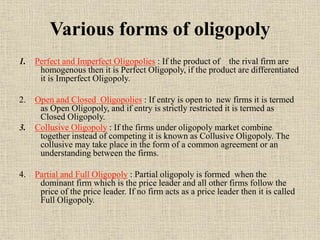
Various forms of oligopoly
1. Perfect and Imperfect Oligopolies : If the product of the rival firm are
homogenous then it is Perfect Oligopoly, if the product are differentiated
it is Imperfect Oligopoly.
2. Open and Closed Oligopolies : If entry is open to new firms it is termed
as Open Oligopoly, and if entry is strictly restricted it is termed as
Closed Oligopoly.
3. Collusive Oligopoly : If the firms under oligopoly market combine
together instead of competing it is known as Collusive Oligopoly. The
collusive may take place in the form of a common agreement or an
understanding between the firms.
4. Partial and Full Oligopoly : Partial oligopoly is formed when the
dominant firm which is the price leader and all other firms follow the
price of the price leader. If no firm acts as a price leader then it is called
Full Oligopoly.
Me 11

Me 11

  • 1.
    The Term “Oligopoly”has been derived from two Greek words. ‘Oligi’ which means few and ‘Polien’ means sellers. Thus Oligopoly is an abridged version of monopolistic competition . It is a competition among few big sellers each one of them selling either homogenous or heterogeneous products. Introduction
  • 2.
    Oligopoly refers toa market situation where there are a few sellers in a market, selling homogenous or differentiated products. Oligopoly is often described as ‘Competition among few’. When the products of a few sellers are homogenous it is known as ‘Pure Oligopoly’ When the products of few sellers are differentiated , but close substitutes of each other it is known as “Differentiated Oligopoly” . Definition Of Oligopoly:
  • 3.
    Sources of Oligopoly Factorsthat give rise to oligopoly are : • Huge capital investment • Economies of scale. • Patent rights • Control over certain raw materials • Merger and takeover.
  • 4.
    1. Few Sellers: An oligopoly market is characterized by a few sellers and their number is limited . Oligopoly is a special type of imperfect market. It has a large number of buyers but a few sellers. 2. Homogeneous or Differentiated Product : The Oligopolists produce either homogenous or differentiated products. Products may be differentiated by way of design , trademark or service Characteristics Of Oligopoly:
  • 5.
    3. Interdependence :The most important feature of the Oligopoly is the interdependence in decision making of the few firms which comprise the industry. The reactions of the rival firms may be difficult to guess. Hence price is indeterminate under Oligopoly. 4. High Cross Elasticities : The cross elasticity of demand for the products of oligopoly firms is very high. Hence there is always the fear of retaliation by rivals. Each firm is conscious about the possible action and reaction of competitors while making any change in price or output
  • 6.
    5. Importance ofAdvertising and Selling costs : Oligopolistic firms have to employ various aggressive and defensive marketing weapons to gain greater share in the market or to maintain their share. Hence, the firms incur a good deal of costs on advertising and other measures or sales promotion . Firms in Oligopoly market avoid price cutting and try to compete on non-price basis. This is because if they start under-cutting one another, a type of price war will emerge which will drive a few of them out of the market . 6. Competition : Competition is unique in an oligopoly market. It is a constant struggle against rivals.
  • 7.
    7. Group Behaviour: Each Oligopolist closely watches the business behavior of other Oligopolists in the industry and designs his moves on the basis of some assumptions of their behavior . 8. Uncertainty : The interdependence of other firms for one’s own decision creates an atmosphere of uncertainty about price and output 9. Price Rigidity : In an oligopoly market each firm sticks to its own price to avoid a possible price war. The price remains rigid because of constant fear of retaliation from rivals.
  • 8.
    Various forms ofoligopoly 1. Perfect and Imperfect Oligopolies : If the product of the rival firm are homogenous then it is Perfect Oligopoly, if the product are differentiated it is Imperfect Oligopoly. 2. Open and Closed Oligopolies : If entry is open to new firms it is termed as Open Oligopoly, and if entry is strictly restricted it is termed as Closed Oligopoly. 3. Collusive Oligopoly : If the firms under oligopoly market combine together instead of competing it is known as Collusive Oligopoly. The collusive may take place in the form of a common agreement or an understanding between the firms. 4. Partial and Full Oligopoly : Partial oligopoly is formed when the dominant firm which is the price leader and all other firms follow the price of the price leader. If no firm acts as a price leader then it is called Full Oligopoly.