Spider Resources Inc.
    Management’s Discussion and Analysis
               Year Ended
           December 31, 2009


Spider Resources Inc.
Management’s Discussion & Analysis
Dated – April 7, 2010                                                     Year Ended December 31, 2009

INTRODUCTION

The following management’s discussion and analysis (“MD&A”) of the financial condition and results of
the operations of Spider Resources Inc. (“Spider” or the “Company”) constitutes management’s review of
the factors that affected the Company’s financial and operating performance for the year ended December
31, 2009. This MD&A was written to comply with the requirements of National Instrument 51-102 –
Continuous Disclosure Obligations. This discussion dated April 7, 2010, should be read in conjunction
with the audited annual financial statements of the Company for the year ended December 31, 2009,
together with the notes thereto, and the audited annual financial statements for the year ended December
31, 2008, together with the notes thereto. Results are reported in Canadian dollars, unless otherwise noted.
The audited annual financial statements have been prepared in accordance with Canadian generally
accepted accounting principles (“Canadian GAAP”). Information contained herein is presented as at April
7, 2010, unless otherwise indicated.

For the purposes of preparing this MD&A, management, in conjunction with the Board of Directors,
considers the materiality of information. Information is considered material if: (i) such information results
in, or would reasonably be expected to result in, a significant change in the market price or value of Spider
common shares; or (ii) there is a substantial likelihood that a reasonable investor would consider it
important in making an investment decision; or (iii) if it would significantly alter the total mix of
information available to investors. Management, in conjunction with the Board of Directors, evaluates
materiality with reference to all relevant circumstances, including potential market sensitivity.

Further information about the Company and its operations is available on Spider’s website at
www.spiderresources.com or on SEDAR at www.sedar.com.

CAUTION REGARDING FORWARD-LOOKING STATEMENTS

The MD&A of the Company contains certain forward-looking information and forward-looking
statements, as defined in applicable securities laws (collectively referred to herein as “forward-looking
statements”). These statements relate to future events or the Company’s future performance. All statements
other than statements of historical fact are forward-looking statements. Often, but not always, forward-
looking statements can be identified by the use of words such as “plans”, “expects”, “is expected”,
“budget”, “scheduled”, “estimates”, “continues”, “forecasts”, “projects”, “predicts”, “intends”,
“anticipates” or “believes”, or variations of, or the negatives of, such words and phrases or state that
certain actions, events or results “may”, “could”, “would”, “should”, “might” or “will” be taken, occur or
be achieved. Forward-looking statements involve known and unknown risks, uncertainties and other
factors that may cause actual results to differ materially from those anticipated in such forward-looking
statements. The forward-looking statements in this MD&A speak only as of the date of this MD&A or as
of the date specified in such statement. Specifically, this MD&A includes forward-looking statements
regarding:

    •   the Company’s goal of creating shareholder value by concentrating on the acquisition and
        development of properties that have the potential to contain valuable mineral deposits;
    •   future plans for property interests held by the Company or that may be acquired;
    •   management’s outlook regarding future trends;
    •   the Company’s ability to fund its operating costs and exploration programs at current operating
        levels for fiscal 2010;
    •   sensitivity analysis on financial instruments may vary from amounts disclosed;


www.spiderresources.com                                                                              Page 2
Spider Resources Inc.
Management’s Discussion & Analysis
Dated – April 7, 2010                                                     Year Ended December 31, 2009

    •   prices and price volatility for minerals;
    •   the Company’s future exploration, capital and operating costs, including the costs and potential
        impact of complying with existing and proposed environmental laws and regulations; and
    •   general business and economic conditions.

Inherent in forward-looking statements are risks, uncertainties and other factors beyond the Company’s
ability to predict or control. These risks, uncertainties and other factors include, but are not limited to,
mineral price volatility, changes in debt and equity markets, the uncertainties involved in interpreting
geological data, increases in costs, environmental compliance and changes in environmental legislation and
regulation, interest rate and exchange rate fluctuations, general economic conditions and other risks
involved in the gold exploration and development industry, as well as those risk factors listed in the “Risk
Factors” section below. Readers are cautioned that the foregoing list of factors is not exhaustive of the
factors that may affect the forward-looking statements. Actual results and developments are likely to differ,
and may differ materially, from those expressed or implied by the forward-looking statements contained in
this MD&A. Such statements are based on a number of assumptions that may prove to be incorrect,
including, but not limited to, assumptions about the following:

    •   the availability of financing for the Company’s exploration and development activities;
    •   operating and exploration and development costs;
    •   the Company’s ability to attract and retain skilled staff;
    •   timing of the receipt of regulatory and governmental approvals for exploration projects and other
        operations;
    •   market competition;
    •   the Company’s ongoing relations with its consultants and employees; and
    •   general business and economic conditions.

Forward-looking statements involve known and unknown risks, uncertainties and other factors that may
cause the Company’s actual results, performance or achievements to be materially different from any of its
future results, performance or achievements expressed or implied by forward-looking statements. This
cautionary statement herein qualifies all forward-looking statements. Accordingly, readers should not place
undue reliance on forward-looking statements. The Company undertakes no obligation to update publicly
or otherwise revise any forward-looking statements whether as a result of new information or future events
or otherwise, except as may be required by law. If the Company does update one or more forward-looking
statement, no inference should be drawn that it will make additional updates with respect to those or other
forward-looking statements.

The Company is a reporting issuer under applicable securities legislation in the provinces of Alberta,
British Columbia, Ontario and Quebec and its outstanding shares are listed on the TSX Venture Exchange
under the symbol “SPQ”.

DESCRIPTION OF BUSINESS

The Company is an exploration enterprise and carries on business in one segment, being the exploration
for valuable minerals, exclusively in Canada. To date, the Company has not earned significant revenues
from its exploration rights and is considered to be in the development stage. As such, the Company has
applied Accounting Guideline 11, "Enterprises in the Development Stage", from January 1, 1995, which is
the date of inception of the development stage.


www.spiderresources.com                                                                              Page 3
Spider Resources Inc.
Management’s Discussion & Analysis
Dated – April 7, 2010                                                     Year Ended December 31, 2009

The recoverability of amounts shown as mining interests is dependent upon a number of factors including
environmental risk, legal and political risk, the discovery of economically recoverable reserves,
confirmation of the Company's interest in the underlying properties, the ability of the Company to obtain
necessary financing to complete the development and future profitable production or proceeds from the
disposition thereof.

Spider's near term goal is to deliver superior returns to shareholders by concentrating on the acquisition of
exploration properties that have the potential to contain valuable mineral deposits. The Company plans to
focus on certain of its properties, as set out below under “Mineral Exploration Properties”.

OVERALL PERFORMANCE

Management is focusing on and developing the “Big Daddy” chromite deposit. The Company's long-term
goal is to continue to explore the economic potential of the deposit and consider developing the deposit
through to commercial production or to sell its interest at a favourable price once an independent valuation
has been determined to ensure fairness in the event of a sale of this strategic asset.

On September 14, 2009, Spider announced that it had amended and restated the December 2005 option
agreement with respect to Freewest Resources Canada Inc.’s McFaulds property located in Ontario. Each
of Spider and KWG Resources Inc. had to that date earned a 25% interest in the Big Daddy chrome
property, which is composed of four 16-unit claims, one 12-unit claim and two additional one-unit claims
(1,248 hectare property), pursuant to an option agreement first entered into with Freewest in December
2005.

During the negotiations, the delivery of a bankable feasibility study by the optionees was removed as a
requirement of the earn-in and consequently the optionees (Spider and KWG) can only vest with 30% each
once each fulfills the conditions of the new option agreement.

Under the amended option agreement, Freewest has granted additional options to KWG and Spider under
which each can earn an additional 5% undivided interest (10% in the aggregate) in the McFaulds joint
venture property by incurring an additional $7.5 million in expenditures ($15 million in the aggregate) by
March 31, 2012. Each of KWG and Spider can acquire: (i) an additional 1.5% interest in the McFaulds
joint venture property by incurring $2.5 million in expenditures by March 31, 2010, which KWG and
Spider have completed; (ii) an additional 1.5% interest in the property by incurring an additional $2.5
million in expenditures by March 31, 2011; and (iii) an additional 2% interest in the property by incurring
an additional $2.5 million in expenditures by March 31, 2012. If either KWG or Spider elects not to
exercise any portion of its option under the amended option agreement, the other has the right to exercise
the option in its place.

Alternatively, if one or more of the optionees incurs at least $5 million in expenditures and delivers a
positive feasibility study to the two other parties on or before March 31, 2012, such optionee or optionees,
as the case may be, will be deemed to have earned the aggregate 10% interest in the McFaulds joint
venture property, notwithstanding that less than $15 million of expenditures were incurred prior to that
date. Any decision to undertake a positive feasibility study must be made by the operator of the McFaulds
joint venture project, which must notify Freewest of any such decision on or before March 31, 2011.

The amended option agreement further provides that Spider and KWG will alternate as operator of the
McFaulds joint venture project for one-year terms, until March 31, 2012, with Spider acting as initial


www.spiderresources.com                                                                              Page 4
Spider Resources Inc.
Management’s Discussion & Analysis
Dated – April 7, 2010                                                    Year Ended December 31, 2009

operator until March 31, 2010. The parties will decide on the operator for the period after March 31, 2012,
by way of majority vote. Pursuant to the option agreement, the operator will receive a 5% operator cost
based on the total invoiced expenditures. As of December 31, 2009, Spider earned a total of $250,943 in
operator cost.

The amended option agreement also provides that upon the earlier of the termination of the option period,
or Spider and KWG acquiring an aggregate 60% interest in the McFaulds joint venture property, a joint
venture agreement among the three parties will automatically come into effect. The joint venture
agreement is a schedule to the amended option agreement.

KWG and Spider have undertaken an exploration program on the Big Daddy chrome property under which
an aggregate of more than $5 million has been spent by March 31, 2010. Such exploration expenditures
were fully incurred in fiscal 2009. Subsequent to year end, Spider notified Freewest that the required
expenditures had been completed by both KWG and Spider.

While general economic conditions continue to improve and stability appears to be returning to financial
and commodity markets, significant uncertainty concerning the short and medium term global economic
outlook persists. Management, in conjunction with the Board of Directors, will continue to monitor these
developments and their effect on Spider’s business.

At the date of this MD&A, the agreement with Renforth Resources Inc. is being reviewed.

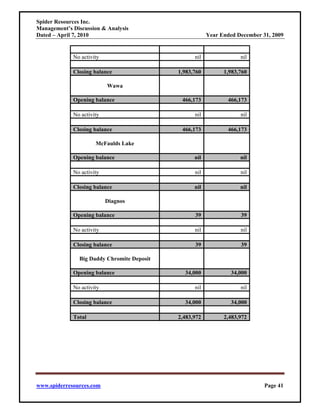
At December 31, 2009, the Company had assets of $25,385,224 and a net equity position of $22,765,854.
This compares with assets of $22,417,191 and a net equity position of $19,413,635 at December 31, 2008.
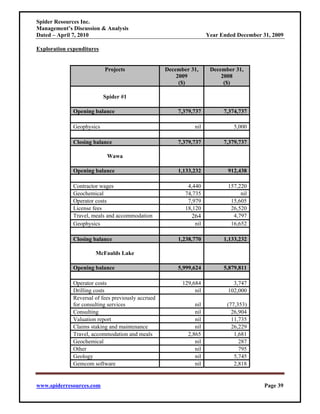
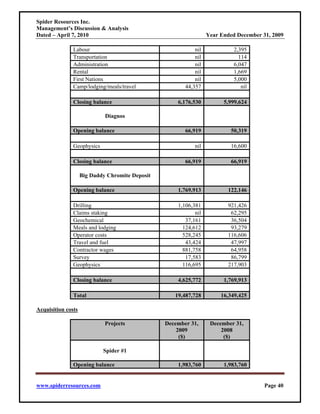
The Company has $334,164 of liabilities and no debt. The Company spent $3,138,303 during the twelve
months ended December 31, 2009, on exploration activities on its mining interests. At December 31, 2009,
the Company had mining interests of $21,971,700, compared to $18,833,397 at December 31, 2008. The
majority of expenditures during the twelve months ended December 31, 2009, were incurred on the Big
Daddy chromite deposit.

At December 31, 2009, the Company had working capital of $3,079,360, compared to $3,417,713 at
December 31, 2008. The Company had cash of $2,716,778 at December 31, 2009, compared to $3,205,855
at December 31, 2008, a decrease of about 15%. The change in cash during the twelve months ended
December 31, 2009, is primarily due to cash expenditures for the Company’s exploration activities
discussed above, which was offset by private placements that closed on July 24, 2009, August 7, 2009,
December 24, 2009, and December 30, 2009, for total gross proceeds of $4,520,400. Refer to “Liquidity
and Capital Resources”, below.

The Company plans to spend approximately $2,909,000 resulting from its remaining flow-through
commitment at December 31, 2009, of approximately $2,320,000 and the flow-through financing
commitment arising from the January 22, 2010, financing of approximately $589,000, on its key projects.

The Company plans to undertake an expanded exploration program on its projects in the McFaulds Lake
area. In particular, KWG and Spider have committed to undertake an exploration program on the Big
Daddy chromite deposit under which an aggregate of at least $5 million (Spider’s share - $2.5 million and
KWG’s share – $2.5 million) will be spent by March 31, 2011. Spider will also engage in a $100,000
diamond drill program on both the Wawa project and Diagnos Initiative property.


www.spiderresources.com                                                                            Page 5
Spider Resources Inc.
Management’s Discussion & Analysis
Dated – April 7, 2010                                                    Year Ended December 31, 2009

The Company has sufficient cash on hand to fund its operating costs and its exploration programs at
current operating levels for fiscal 2010. Refer to “Liquidity and Capital Resources” below.

See “Mineral Exploration Properties” below.

TRENDS

The Company is a mineral exploration company focused on the acquisition, exploration and development
of properties for the mining of viable mineral deposits, more specifically copper, zinc, chromite and
diamonds, in Ontario, Canada, and the acquisition of other mineral exploration properties should such
acquisition be consistent with the objectives and acquisition criteria of the Company. The Company’s
financial success will be dependent upon the extent to which it can make discoveries and on the economic
viability of any such discoveries. The development of such assets may take years to complete and the
resulting income, if any, is difficult to determine with any certainty. The Company lacks mineral resources
and mineral reserves and to date has not produced any revenues. The sales value of any mineralization
discovered by the Company is largely dependent upon factors beyond its control, such as the market value
of the commodities produced.
Although economic conditions in Canada have improved since the beginning of the year, the Company
remains cautious in case the economic factors that impact the mining industry deteriorate. These factors
include uncertainty regarding the prices of minerals, and the availability of equity financing for the
purposes of mineral exploration and development. The prices of minerals have been volatile in recent
periods and financial markets have deteriorated to the point where it has become extremely difficult for
companies, particularly junior exploration companies, to raise new capital, even though there are signs the
situation is improving. The Company’s future performance is largely tied to the development of its current
mining interests and the overall financial markets. Financial markets are likely to be volatile for 2010,
reflecting ongoing concerns about the global economy. Companies worldwide have been affected
negatively by these trends. As a result, the Company may have difficulties raising equity financing for the
purposes of mineral exploration and development, particularly without excessively diluting the interests of
its current shareholders. With continued market volatility expected, the Company’s current strategy is to
continue exploring the Big Daddy chromite deposit, seek out other prospective resource properties to
acquire and explore its Wawa project and Diagnos Initiative property. The Company believes this focused
strategy will enable it to meet the near-term challenges while maintaining the momentum on key
initiatives. These trends may limit the Company’s ability to develop and/or further explore the Big Daddy
chromite deposit and/or other property interests and/or property interests acquired in the future.

Apart from these and the risk factors noted under the heading “Risks and Uncertainties”, management is
not aware of any other trends, commitments, events or uncertainties that would have a material effect on
the Company’s business, financial condition or results of operations.

MINERAL EXPLORATION PROPERTIES

Over the span of 14 years in the Province of Ontario, Spider has been exploring in a vast region of
Northern Ontario, stretching from the coast of James Bay to the western reaches of the James Bay
Lowlands (now referred to as the “Ring of Fire exploration area”), and also to the northeast of Lake
Superior near the town of Wawa, Ontario. The Company is involved in three project areas in Ontario,
known as “Spider #1”, “Spider #3” and “Wawa”. Of these areas, Spider’s main focus remains on the
Spider #3 area, which includes the property optioned by Spider and KWG from Freewest where the


www.spiderresources.com                                                                            Page 6
Spider Resources Inc.
Management’s Discussion & Analysis
Dated – April 7, 2010                                                      Year Ended December 31, 2009

Company can earn up to a 30% interest, the Diagnos property, where the Company has a 50% interest, the
McFaulds Lake property, currently under option to UC Resources Inc., which can earn up to a 55% interest
in this property, leaving the Company with 30% interest, and the Kyle property, optioned to Renforth,
which can earn up to a 55% interest in the property, leaving the Company with 30% interest.

The following table outlines Spider’s projects and level of involvement:

                                                 JV details (potential
       Property       Claims     Hectares             interest)                 Commodity sought

                                              JV with KWG and Freewest
                                              (Spider operator until March
       Freewest
                         7         1,280        31, 2010, then KWG is         Chrome, nickel, PGMs
        Option
                                                       operator)
                                                  Spider to earn 30%


                                                    JV with KWG
       Diagnos                                                                  Diamonds, base and
                         22        3,696           (Spider operator)
       Initiative                                                                 precious metals
                                                Spider to maintain 50%


                                                  UC to earn in from
       McFaulds
                         51        11,200     Spider/KWG (UC operator)             Copper, zinc
      Project (W)
                                               Spider to reduce to 30%

      McFaulds                                  UC to earn in on project
                         73        17,088                                          Copper, zinc
      Project (E)                               Spider to reduce to 30%

      McFaulds                                  UC to earn in on project
                         13        2,688                                           Copper, zinc
      Project (N)                               Spider to reduce to 30%


                                                Renforth to earn in 55%
                                                  from Spider/KWG
     Kyle Project        8         2,048                                            Diamonds
                                                  (Renforth operator)
                                                Spider to reduce to 30%
                                              Renforth option to reduce to
       Renforth
                         15        3,616                 55%                  Diamonds, base metals
        claims
                                               Spider to earn up to 30%


                                                     JV with KWG
     Wawa Project        45        4,500           (Spider operator)                Diamonds
                                                 Spider to earn 66 2/3%


www.spiderresources.com                                                                              Page 7
Spider Resources Inc.
Management’s Discussion & Analysis
Dated – April 7, 2010                                                   Year Ended December 31, 2009


                                                    JV with KWG
      MacFadyen
                         5          672           (KWG operator)                   Diamonds
       Project
                                             Spider to reduce to 33 1/3 %


Spider #3 Project Area (includes McFaulds, Freewest and Diagnos properties)

The Spider #3 project area is geographically located immediately west of the Spider #1 project area. The
project area includes several identified properties, the McFaulds Lake (East and West) VMS (volcanogenic
massive sulphide) properties, the Freewest Option property (chromite and PGEs) and the Diagnos Initiative
property.

Freewest Option Property

This property, located approximately 15 kilometres southwest of the McFaulds Lake VMS property,
includes four 16-unit claims, one 12-unit claim and two additional one-unit mineral claims constituting 78
claim units (1,248 hectare property).
Under the terms of the original agreement with Freewest (see press release December 19, 2005), Spider
and KWG agreed to spend an aggregate of $3 million on exploration over a four-year period to earn an
initial joint 50% interest in the Freewest Option property. Under this agreement Spider and KWG could
earn a cumulative joint 60% interest in the property by delivering a bankable feasibility study on any
mineralization identified, and subsequently a cumulative joint 65% interest by arranging financing on
behalf of Freewest to put the property into commercial production. At present, Spider and KWG have
earned an initial 50% interest in the property by jointly expending a total of $3 million, as announced on
January 16, 2009.

On March 27, 2009, the Company negotiated an amendment to the Freewest Option agreement whereby
the option earn-in calls for a $15 million, three-year commitment. As a result of this amendment, the
Company no longer is required to prepare a bankable feasibility study within 18 months, as had been called
for in the 2005 agreement, upon successful completion of documentation evidencing such amendment and
the receipt of all required approvals.     Under the amendment, Spider would have a $7.5 million
commitment over the next three years, of which $2.5 million is required to be spent before March 31,
2010. Spider announced on September 14, 2009, that it has amended and restated the December 2005
option agreement.

During 2006, Spider announced that it had completed a winter drilling program on the property with KWG
and Freewest, and had discovered a chrome-platinum-palladium bearing peridotite in hole FW-06-03.
Later that year, it was announced that the two high-grade chromitite layers were confirmed yielding assays
of 23.4% chrome (34.5% Cr2O3), 0.19 g/t platinum, 0.21 g/t palladium, 0.32 g/t ruthenium, 0.05 g/t
rhodium and 0.12% nickel over 1.03 metres followed by 18.6% chrome (28.9% Cr2O3), 0.23 g/t platinum,
0.48 g/t palladium, 0.30 g/t ruthenium, 0.05 g/t rhodium and 0.13% nickel over 0.85 metres. The assaying
completed on the entire mineralized zone in the layered peridotite, including the upper and lower
chromitite layers, yielded 4.05% chrome and 0.17% nickel over a core length of 16.85 metres. This new
chrome-nickel-platinum group element discovery was the first of its kind in the McFaulds Lake area of the
Sachigo Greenstone Belt in northern Ontario. In hindsight, this 2006 discovery by Spider’s exploration
team identified what has been recognized as a very prospective peridotite now referred to as the Ring of
Fire intrusion.


www.spiderresources.com                                                                           Page 8
Spider Resources Inc.
Management’s Discussion & Analysis
Dated – April 7, 2010                                                       Year Ended December 31, 2009


Exploration results in August 2007 by Noront Resources Ltd. on its nearby (3.6 kilometres to the
southwest) Eagle One magmatic massive sulphide (MMS) occurrence renewed interest in the nearby
Freewest Option property. A similar geologic unit (as described above for the chrome occurrence) is the
host for the Eagle One occurrence. However, the Noront occurrence also had very significant nickel,
copper, platinum, palladium and gold, while the Company’s occurrence contains appreciable chrome
layers enriched in PGEs (platinum group elements) and nickel, formed in a peridotite magma chamber.
Geological models for this type of occurrence suggest a positional relationship between MMS occurrences
and the chromite layering observed in the Company’s occurrence. Consequently, the Company undertook
an aggressive exploration program that started late in the first quarter of 2008 and continued through the
remainder of 2008. The collective project expenditures cost in the order of $3.4 million to year-end 2008,
of which the Company expended $1.7 million (the cost of this program was shared equally with KWG).
On December 31, 2008, Spider and KWG received notice from Freewest that a 25% interest had been
earned by each of KWG and Spider.

During the fourth quarter of 2008, the Company proceeded with the preparation of a National Instrument
43-101 report on the project that had been dubbed the Big Daddy chrome project. The Company engaged
Micon International Ltd. to prepare this report and to review the project. This report was filed in the first
quarter of 2009 on Sedar. This report contained a “go forward” recommendation for further drilling as
required to confirm continuity of mineralization to the northeast and southwest with the goal of completing
a mineral resource report for chromite on the property.

During most of fiscal 2008, the Company reported that the main exploration focus of the Spider-KWG
joint venture had been on the massive chromite occurrence. This deposit underwent significant drill
testing during the year, as did other nearby deposits. The Big Daddy deposit is located approximately 3.6
kilometres northeast of Noront’s Eagle One Magmatic Massive Sulphide (nickel, copper and PGM), or five
kilometres northeast of Noront’s Blackbird One and Two (chromite) discoveries, and four kilometres
southwest of Freewest’s Black Thor and Black Label chromite discoveries. Over the course of 2008
several drill holes intersected economic grade chromite mineralization, but much more work was needed to
quantify the resource. It was determined that chromite mineralization consists of varying widths of a
variable tenor, in many instances high tenor of chrome, forming a series of stacked beds. Additional
drilling will be required to confirm continuity of the beds from section to section and to the northeast. The
deposit remains open to depth as well as along strike in both directions. In addition, near surface drilling of
the upward extension to surface has not been completed. A number of faults were noted from the drilling,
some of which occur at the contact of the chromite with the surrounding peridotite/dunite. These fault sets
are being modeled, as they affect the interpretation and continuity of the mineralization from section to
section.

During the first quarter of 2009, the main exploration activity of the Spider-KWG joint venture on the Big
Daddy chromite deposit was the completion of gravimetric and magnetic ground geophysical surveys,
designed to outline and delineate the geophysically inferred extent of the chromium-enriched deposit. The
results of the geophysical surveys infer that the 2006 - 2008 drill program, which consisted of 14 drill
holes designed to test the Big Daddy chrome deposit, had only tested the extreme southwest portion of the
deposit over a strike length of 400 metres (drill section 9+00NE to drill section 13+00NE). The gravimetric
survey results, when coupled with the magnetic survey results, infer that the favourable area of
mineralization may extend to drill section 20+00NE and beyond (faulting and/or leveling errors may cause
some displacement at line 20+00NE and points further northeast). The deposit remains open to depth and
is now geophysically inferred to extend to the northeast for a further 700 metres. Drilling commenced in
the third quarter and continued through the fourth quarter and was completed during the first quarter of


www.spiderresources.com                                                                                Page 9
Spider Resources Inc.
Management’s Discussion & Analysis
Dated – April 7, 2010                                                     Year Ended December 31, 2009

2010. A series of press releases were issued during Q3 and Q4 2009 providing details and highlights of the
drill program.

On October 1, 2009, the Company announced the commencement of drilling at Big Daddy, further
advising that the first hole intersected 30.3 metres of chromite mineralization and the second hole
intersected 38.0 metres of chromite mineralization.

On October 14, 2009, the Company provided an update on the Big Daddy project, announcing that 2,073
metres had been completed to date in eight holes. Visual observations of drilling were highlighted by hole
FW-09-29 that had intersected 74.9 metres of massive chromite mineralization. In addition, in the October
14 release, Spider reported preliminary metallurgical test results, concluding that >40% Cr2O3 can be
considered direct-shipping ore with 1.9 Cr:Fe ratio. The early stage metallurgical studies will guide both
ongoing sampling requirements during drilling and subsequent resource modelling and any subsequent
beneficiation studies. The result of conducting gravity separation test on eight selected samples covering a
range from low grade to high-grade chromite mineralization led to the following conclusions;

• Some of the massive chromite mineralized rock has a grade >40% Cr2O3, which can be considered
  direct-shipping ore with 1.9 Cr:Fe ratio;
• medium grade ore, being of grades between 20-40% Cr2O3, can likely be upgraded to saleable
  material; and
• grind size needs to be optimized in future testing to improve recoveries at low and medium grades.

On November 16, 2009, the Company reported progress on drilling at Big Daddy, explaining that the strike
and depth of the Big Daddy chromite prospect was expanding to northeast and beyond 250 metres depth
based upon visual observations. Hole FWR-09-43 reportedly encountered 93 metres of chromite
mineralization, including 76 metres of observed massive chromite.

On December 7, 2009, the Company reported the receipt of analytical results from the first seven holes
from the 2009 drilling program on Big Daddy, highlighted by hole FW-09-29, which encountered 75.2
metres of chromite mineralization averaging 43.41% Cr2O3, followed by 1.8 metres averaging 2.18 g/t
PGE (Pt+Pd). Spider also reported that six of the seven holes reported herein encounter chromite
mineralization in excess of 35% Cr2O3 over significant widths.

On January 7, 2010, the Company reported that diamond drilling on the Big Daddy project had resumed,
with the intent to complete drilling sufficient to complete a NI 43-101 compliant resource estimate during
Q1 2010. In addition, the company reported results of nine holes from the 2009 drilling at Big Daddy,
highlighted by hole FW-09-36, which encountered 86.2 metres of chromite mineralization between 9.8
metres to 96.0 metres downhole. The initial 11.2 metres of chromite mineralization in this hole averaged
40.14% Cr2O3; the last 48.35 metres averages 41.35% Cr2O3. In addition, hole FW-09-33, after passing
through 11.0 metres that averaged 40.29% Cr2O3, entered a narrow nickel sulphide filled fault zone that
averages 2.74% nickel, 0.12% cobalt and 1.04 g/t Pt+Pd over 1.0 metres. A sample selected for
petrographic analysis was determined to contain a low temperature alteration assemblage of minerals
including godlevskite along with veinlets of mackinawite, which infers a possible nearby primary nickel
source. Eight of the nine holes reported on January 7, 2010, encountered chromite mineralization in excess
of 35% Cr2O3 over significant widths.

On January 22, 2010, the Company reported results of the remaining six holes from the 2009 drilling at
Big Daddy, highlighted by hole FW-09-43, which had encountered two zones of massive chromite


www.spiderresources.com                                                                            Page 10
Spider Resources Inc.
Management’s Discussion & Analysis
Dated – April 7, 2010                                                       Year Ended December 31, 2009

mineralization, 24.0 metres averaging 35.75% Cr2O3, as well as 57.0 metres averaging 40.52% Cr2O3,
separated by 11.0 metres of thin, massive beds of chromite averaging 15.47% Cr2O3. All six holes
reported on this date for Big Daddy encountered chromite mineralization in excess of 35% Cr2O3 over
significant widths. Spider also reported that drilling continues, and that it anticipated completion of drilling
by the end of January.

On February 16, 2010, Spider reported that all priority drillholes for the 2010 program had been
completed, and initial analytical results from 2010 drilling were arriving. Hole FW-10-48 encountered two
zones of massive chromite mineralization, 14.85 metres averaging 39.52% Cr2O3, as well as 32.4 metres
averaging 42.51% Cr2O3. In light of a First Nations blockade on neighbouring projects, negotiations were
underway with First Nations communities to resolve a list of issues related to exploration in the general
area. The blockade was subsequently removed in March.

On March 5, 2010, all analytical results were completed and were reported, highlighted by hole FW-09-
50, which had encountered chromite mineralized envelope of 126.3 metres, of which 63.3 metres averaged
41.93% Cr2O3 with Cr:Fe ratio of 1.96. As well, seven of the final eight holes encountered grades in
excess of 35% Cr2O3. A National Instrument 43-101 compliant resource estimate was to commence on the
Big Daddy chromite deposit.

Spider’s expenditure on this project for fiscal 2009 amounted to $2,855,859.

Diagnos Initiative Properties

These properties are prospective for kimberlite and are located in the vicinity of the Kyle properties in the
James Bay Lowlands area of Northern Ontario. The properties were acquired by staking and by a purchase
agreement in 2005. During the first quarter of 2006 the Company completed ground geophysical
surveying on the six properties. This exploration work has been compiled and interpreted as required for
drill positioning, and the Company has presented the results to its joint venture partner for discussion and
planning. The Company intends to continue the review of the geophysical results and make plans for
drilling selected anomalies during fiscal 2010. Consequently, discretionary exploration expenses for 2010
have been allocated to this project.

The cost of this program, if undertaken, will be shared equally with KWG Resources. It is anticipated that
one target will be drill-tested during 2010 on this project at an estimated cost of $200,000. Spider is
responsible for 50% of the cost of this program.

McFaulds Lake VMS Properties

This project covers three properties, the McFaulds (East) property, the McFaulds (West) property and the
McFaulds (North) property (the latter property is located north of McFaulds (East) property). Collectively,
these volcanogenic massive sulphide (VMS) properties cover approximately 31,000 hectares and are
located in the western portion of the James Bay Lowlands. The VMS potential of this diamond exploration
project became apparent in 2002 while the company was exploring in joint venture with De Beers Canada
Exploration Limited. As a result of the discovery of VMS-style mineralization, the Company and its joint
venture partner, KWG, completed several exploration campaigns, including diamond drilling programs,
during the period 2003 to early 2007, outlining several VMS-style occurrences, including two where
definition drilling was completed (McFaulds #1 and #3 VMS occurrences).


www.spiderresources.com                                                                                Page 11
Spider Resources Inc.
Management’s Discussion & Analysis
Dated – April 7, 2010                                                         Year Ended December 31, 2009

On March 7, 2007, the Company announced the signing of a letter of intent with UC Resources Ltd.
(“UC”) regarding a four-year exploration program on the McFaulds Lake project. This LOI outlined the
terms and conditions upon which UC has an option to earn-in up to a 55% undivided interest in the
McFaulds Lake project, leaving 45% to be shared pro rata by the Company and KWG. This agreement
was amended in March 2009. To date, UC has earned a 25% interest in the project and must incur
exploration expenditures of at least an additional $1.25 million on or before the third anniversary date of
the LOI in order to earn an additional 15% vested interest in the property, bringing UC’s interest level to
40%. UC has submitted to the Company audited records of expenditures incurred totaling in excess of
$1.25 million. These are currently being reviewed in conjunction with the technical reports outlining the
program, and once approved UC will be deemed to have earned 40% interest in the project. Upon spending
an additional $1.25 million prior to the fourth anniversary (prior to March 2011), UC can earn the entirety
of its 55% interest. Then the option agreement would be fulfilled and a formal joint venture would be
entered into, with UC holding 55% interest and the Company and KWG holding the remaining 45%
interest. The Company would then start spending during the KWG dilution phase, during which KWG’s
interest can be reduced to 15%, leaving the Company with 30%, after which all parties contribute pro rata
or undergo additional dilution.

During the latter part of 2008, Scott Wilson Roscoe Postle Associates Inc. completed a review of the
historical drilling on the McFaulds #1 and #3 occurrences and provided indicated and inferred resource
estimates for the two occurrences. The estimates were included in a technical report that was
independently prepared and filed on SEDAR in the third quarter of 2008. The following is a summary
only, the reader is referred to the full report, “UPDATED TECHNICAL REPORT ON THE MCFAULDS
LAKE PROJECT PORCUPINE MINING DIVISION JAMES BAY LOWLAND, ONTARIO, CANADA”
which may be viewed on SEDAR at www.sedar.com. The following tables provide details of the resource
estimates:

                                    Spider Resources – McFaulds 3 Deposit


                                          Indicated Resources
                Location
                                          Tonnes               % Cu                 % Zn
                Copper-Zinc Domain        802,000              3.75                 1.1
                Total, Indicated          802,000              3.75                 1.1

Notes:
    1.   CIM definitions were followed for mineral resources.
    2.   Mineral resources are estimated at cutoff grades of 1.5% Cu
    3.   Mineral resources are estimated using an average long-term copper price of US$2.50 per pound.
    4.   A minimum mining width of two metres was used.

                                    Spider Resources – McFaulds 1 Deposit


                                          Inferred Resources
                Location
                                          Tonnes               % Cu                 % Zn


www.spiderresources.com                                                                                  Page 12
Spider Resources Inc.
Management’s Discussion & Analysis
Dated – April 7, 2010                                                         Year Ended December 31, 2009

                Copper Domain             279,000              2.13                 0.58
                Zinc Domain               560,700              0.48                 3.27
                Total, Inferred           839,700              1.03                 2.38

Notes:
    1.   CIM definitions were followed for mineral resources.
    2.   Mineral resources are estimated at cutoff grades of 1.5% Cu and 1% Zn
    3.   Mineral resources are estimated using an average long-term copper price of US$2.50 per pound.
    4.   A minimum mining width of two metres was used.

At present the McFaulds Lake project area is the focus of attention as a result of some very encouraging
news by other explorers in the region; namely Noront and its recent magmatic massive sulphide (“MMS”)
occurrence located 27.4 km to the west-southwest of the two main McFaulds Lake VMS occurrences. The
MMS style mineralization encountered by Noront contains appreciable copper, nickel, platinum, palladium
and gold. The geophysical anomalies associated with this type of occurrence are slightly different than
those of VMS style mineralization. The historical geophysics over the McFaulds Lake projects (E and W)
were reviewed in late 2007 by UC to ascertain whether there are similar-looking MMS anomalies on the
property. Spider’s management assisted in this review and planning process. As a result of the review,
UC agreed to participate in a new regional AeroTEM2 airborne survey with others in the area. This survey
commenced in late 2007 and was completed in early 2008; results were immediately reviewed. Several
anomalous areas were prioritized for ground geophysical follow-up that included line cutting, magnetic
surveying and electromagnetic surveying. Drilling commenced on the western property in October 2008
with UC completing five holes totaling 1,211 metres. The mineralization found in the fourth hole (UC-08-
04) was intriguing, with three mineralized zones intersected. The upper mineralization was a sulphide zone
with massive to semi-massive pyrrhotite that likely gave rise to the magnetic and EM anomalies. This
intersection has potential importance as the VMS deposits discovered further east near McFaulds Lake are
known to have large thickness of massive barren pyrrhotite, pyrite and magnetite that grades into
chalcopyrite-sphalerite-rich sections. The deepest mineralized intersection consisted of erratic, thinly
banded and disseminated sphalerite over about three metres. This is interpreted as being related to nearby
sources of zinc deposited underwater during fumarolic activity that may have created thicker zinc-rich
deposits elsewhere in the area. It was recommended that this mineralization be followed up with more
drilling. UC announced results of the drilling in early 2009, and only anomalous values of copper and zinc
were encountered in the holes.

In late 2008, UC commenced line cutting followed by detailed ground geophysics on targets that were too
wet to access under summer conditions and that had geophysically postulated chrome potential. Reviews
of recent and historical airborne geophysics along a northeast trending magnetic rendered feature
continuation of ultramafic sill from the Big Daddy chrome occurrence, passing through Freewest’s Black
Thor chromite occurrence, inferred prospective chromite targets located in the western portion of the
McFaulds East claim block just west of McFaulds #1 and #3 VMS deposits, near the common boundary
shared with Noront. Intense magnetic anomalies are interpreted to the southwest towards the new chromite
discovery of Freewest, extending into the Freewest option property. The ground geophysical surveys
completed included magnetic and gravimetric surveying. Results were reviewed by the joint venture
partners and were inconclusive. Additional work is currently being considered.

During the latter part of the second quarter of 2009, UC engaged Geotech Ltd. to complete a ZTEM
airborne geophysical survey over selected areas in the East and West properties. Diamond drilling ensued


www.spiderresources.com                                                                                  Page 13
Spider Resources Inc.
Management’s Discussion & Analysis
Dated – April 7, 2010                                                     Year Ended December 31, 2009

during early August 2009 by UC as a follow-up on these surveys. Three holes were drilled totaling 623
metres, one on the western property and two on the eastern property.

The first hole on the western property tested a coincident positive magnetic anomaly and a strong EM
conductor. The hole cut a gradational lapilli tuff to feldspar porphyry contact, intersecting very weakly
disseminated pyrite mineralization between 55.9 metres and 62.5 metres. In addition the hole intersected
very anomalous gold mineralization of 2,620 ppb Au between 31.35 and 31.85 metres, followed by 1,470
ppb between 31.85 and 32.9 metres, with quartz injection and weak, fine-grained pyrite mineralization.

The second and third holes in the summer 2009 drill campaign by UC tested for sulphide mineralization in
the vicinity of McFaulds #6 occurrence, located on the eastern property. The second hole intersected 0.8
metres (148.3 to 149.1 m) of mainly massive magnetite interbedded with 20 cm wide massive pyrrhotite
with chalcopyrite and minor pyrite intervals. The 0.8 metre section averaged 2.4% copper, 0.13% Zn and
3.4g/t Ag. The sulphide mineralization was observed at the contact between volcanic lapilli tuff and
volcanoclastic sediments containing chert and cherty sediments. The third hole failed to intersect any
mineralization of interest.

During Q4 2009, UC completed an additional five holes totalling 697 metres of drilling on the eastern
block of the optioned property. The first two holes were drilled to test an anomaly (near McFaulds #7)
located to the southeast of the Big Daddy chrome project, and southwest of McFaulds Lake VMS deposits.
Only short intercepts of chalcopyrite and sphalerite were encountered. Anomalous values of copper and
zinc were received (UC-09-08 returned 0.613% Cu over 1.5 m between 71.2 and 72.7 metres downhole,
UC-09-09 returned 0.933% Zn over 0.5 m between 51.2 and 51.7 metres downhole). A third hole was
drilled to test an anomaly located on the western portion of the eastern block near the extreme
northwestern border of the property. Hole UC-09-10 failed to intersect any significant mineralization. Two
holes were also drilled on the northern claim group (of the eastern property), testing coincidental magnetic
and electromagnetic anomalies, both of which failed to encounter any significant mineralization.

Because this project is currently funded by UC, Spider has no financial requirements for it during fiscal
2009. Furthermore, information concerning the work done on the property by UC has been provided to
Spider by UC. While management of Spider believes this information to be correct, it has relied on UC in
respect of the information provided.

Spider #1 Project Area (includes Kyle and MacFadyen properties)

The Spider #1 project is a regional reconnaissance project located on the western edge of the James Bay
Lowlands in northern Ontario. The project was initiated in the early 1990s to explore diamond bearing
kimberlite bodies. The project encompasses numerous identified kimberlite occurrences and two distinct
project areas, the Kyle project and the MacFadyen project. The project area (except for the Kyle Lake #1
kimberlite) is subject to an agreement whereby Ashton Mining of Canada may acquire a 25% interest
under certain conditions. The Company maintains an interest in a minimum number of claims that
effectively cover the identified kimberlites. The Kyle properties are currently the subject of an option
agreement with Renforth Resources Inc., (formerly Wycliffe Resources Inc.), whereby Renforth can earn
up to a 55% interest in the Kyle properties.

Kyle Properties

These properties consist of five diamondiferous kimberlites, including Kyle Lake #1 and Kyle #3, both of
which have undergone mini-bulk testing in earlier exploration campaigns by the Company. Kyle 2, 4 and 5


www.spiderresources.com                                                                            Page 14
Spider Resources Inc.
Management’s Discussion & Analysis
Dated – April 7, 2010                                                     Year Ended December 31, 2009

properties require additional exploration work, having been the subject of only preliminary drilling in 1994
and 1995 by the Company.

These properties are currently subject to an option agreement with Renforth whereby Renforth can earn up
to a 55% interest. In order to earn its interest, Renforth was to make an aggregate of $6 million in
exploration expenditures by June 30, 2009, with annual exploration expenditure requirements of $2.0
million. The option agreement was amended in 2007 whereby Renforth advised that it failed to complete
the minimum expenditure due by June 30, 2007, and requested an amendment whereby it could make
payment in lieu of expenditures. Both Spider and KWG agreed to the amendment. Renforth sought and
received a one-year extension on the next work commitment that was due on June 30, 2008. In partial
payment for these concessions, Renforth agreed to pay Spider and KWG shares valued at $1.0 million, to
be shared in a pro rata manner between Spider and KWG, the levels to be reflective of each party’s current
interest. At the date of this MD&A, Spider has not received the Renforth shares, although Renforth has
advised that it intends to deliver the shares shortly.

In addition, Renforth must contribute all of its existing claim holdings (15 claims covering 3,616 hectares)
in the Attawapiskat River area, to be added to the Kyle project area.

Spider/KWG will retain a collective 45% in the Kyle properties once Renforth has earned its 55% interest,
and Renforth will transfer a 45% interest in its own properties in the project area to Spider/KWG. No less
than 75% of the annual $2 million expenditure must be dedicated to the Kyle properties in order for
Renforth to acquire its 55% interest. Renforth agreed to fund the project in its entirety for the first three
years and as such, is the operator during the earn-in option period.

Pursuant to the revision to the Spider/KWG joint venture dated May 12, 2006, KWG agreed to not
contribute further to Spider’s exploration program on the Kyle kimberlite project and as such appointed
Spider as manager. In May 2006, both parties were deemed to have a 50% interest in the Kyle kimberlite
project. Once Renforth has earned its 55% interest in the project, the underlying agreement terms will
apply to Spider and KWG in determination of their respective interests.

During 2008 Renforth proceeded with the procurement of mini-bulk samples for diamond content that
included the testing of each of the remaining Kyle kimberlites, which had not yet undergone a minimum
sampling program of three or four tonnes. The Company and KWG tested Kyle Lake #1 and Kyle #3 by
mini-bulk sampling much earlier with favourable results. Renforth intends on comparing information from
each of the five kimberlites to determine which kimberlite(s) warrant much larger tests. The sampling has
been completed, and samples are now awaiting processing for commercial diamond content, as well as
micro-diamond content, on eight-kilogram samples taken from the feed stream to the commercial size
diamond sampling plant.

As a result of this project being funded by Renforth’s earn-in agreement, Spider expects to only contribute
a minor amount of the spending. Furthermore, information concerning the work done on the property by
Renforth has been provided to Spider by Renforth. While management of Spider believes this information
to be correct, it has relied on Renforth in respect of the information provided.

MacFadyen Property

This property includes three diamond-bearing kimberlites (MacFadyen-1, MacFadyen-2 and Good Friday)
located eight kilometres north of the Victor Diamond Mine project of De Beers Canada Explorations Inc.
that commenced full production in August 2008.


www.spiderresources.com                                                                             Page 15
Spider Resources Inc.
Management’s Discussion & Analysis
Dated – April 7, 2010                                                    Year Ended December 31, 2009


The Company announced in May 2006 that under a revision to the joint venture with KWG, the Company
had permitted its interest level to be diluted to one-third, allowing KWG to expend sufficient funds on its
own to obtain up to two-thirds. An exploration agreement was negotiated with the Attawapiskat First
Nation covering further exploration programs to be undertaken at the property by KWG over the next two
years. Upon its signing, KWG commenced a reconnaissance program in September 2006, and made
preparations for a winter drilling program to sample each of the five kimberlite pipes that constitute the
MacFadyen cluster.

Initial results of the kimberlite processing of a drilling program carried out by KWG were reported on June
21, 2007, when KWG announced that a 0.23 quarter-carat diamond had been recovered from one of its
MacFadyen kimberlite samples. Bulk sample processing and diamond sorting and picking were executed at
the SGS Lakefield Research Laboratory in Lakefield, Ontario.

Further work on the project was planned by KWG to commence in early 2008; however, this project was
curtailed due to the unavailability of sampling equipment at the project site. It is expected that KWG will
resume work subject to availability of sampling equipment sometime in 2010.

As a result of this project being the focus of KWG until Spider is diluted to a one-third interest, Spider
does not expect to expend any funds on it in the near future.

Project #6 Wawa Diamond Property

This project is located 35 km north of Wawa in central Ontario on the northeast shore of Lake Superior
along the Trans-Canada Highway (Hwy 17), encompassing 44.2 square kilometres. On February 20, 2006,
Spider and KWG announced that they recovered 1,337 diamonds from an 8-kg sample at the Wawa
project.

On March 23, 2006, Spider and KWG received a SGS Lakefield Research Ltd. report on encouraging rock
characteristics of the Wawa diamond project. This report described potential beneficiation results based
upon physical properties of the xenolith portion of the rock versus the matrix portion of the rock.
Additional test work concluded that most of the diamonds in the rock are contained within the xenolith;
this was verified by caustic dissolution diamond analysis. Tests were undertaken to better understand the
overall recoverability of diamond from rock, and to determine which process(es) can be used to separate
the diamond-bearing xenolith from the less diamondiferous matrix. Spider initiated plans to follow up with
SGS’s recommendations, including diamond drilling the main diamond occurrence. A technical report was
prepared and filed on SEDAR during the first quarter of 2006 containing recommendations for this drilling
follow-up.

The Company continued to monitor the exploration activity in this area until the fall of 2008. In the last
few days of Q3 2008, a drill rig was mobilized to this project and commenced drilling to test to depth the
main diamond showing in Lalibert Township.

In October 2008, Spider/KWG completed a drill program entailing four short, HQ core holes totaling 307
metres. These holes were designed to undercut a lamprophyre dyke that hosts numerous diamond bearing
xenoliths. This dyke had been previously exposed in 2004/2005 by mechanical stripping over a strike
length in excess of 300 metres. The dyke varies in exposed width from 8 to 22 metres, and dips an
estimated 45 degrees towards the northeast. Diamonds had been recovered from all but two of the 39
surface grab or chip-channel samples collected from the length of the dyke. Diamonds had been previously


www.spiderresources.com                                                                           Page 16
Spider Resources Inc.
Management’s Discussion & Analysis
Dated – April 7, 2010                                                      Year Ended December 31, 2009

determined to be preferentially located in talc-actinolite xenoliths. The most diamonds recovered were
from a 30.11 kilogram sample of talc-actinolite xenoliths (sample # LAL-04-234), which yielded 1,351
diamonds with two dimensions less than 0.5mm, 267 diamonds with two dimensions greater than 0.5mm
and less than 1.0mm and 14 diamonds with two dimensions greater than 1.0mm.

The holes were drilled on lines spaced 100 metres apart with an initial inclination of -45 degrees towards
the southwest to cut the dyke at approximately 40 metres below surface. Samples were normally 1.0 m in
length; each sample weighed approximately 10 kilograms. 42 samples were collected and were submitted
to SGS Lakefield for caustic dissolution diamond analysis. These samples were processed during Q3 2009.

Subsequent to the end of Q3 2009, the Company received microdiamond results pertaining to the four
holes drilled during 2008. Highlights of the caustic dissolution test results included the recovery of a total
of 1,095 diamonds from 336 kilograms of xenolith bearing lamprophyre dyke core selected from four
diamond drill holes. Of these, eight diamonds were retained on a +0.425 mm sieve, 45 were retained on a
+0.300 mm sieve, 140 were retained on a +0.212 mm sieve, 301 were retained on a +0.150 mm sieve and
601 were retained on a +0.106 mm screen. Five of the 8-kilogram samples, in which the number of
xenoliths ranged between 6 and 10 in the sample interval, had a group weight for only those diamonds
retained on +425 mm screen of 0.01339 carats (equating to 0.33 carats per tonne for 40 kilogram of
selected samples). Additional work is being considered to follow up on these encouraging results.

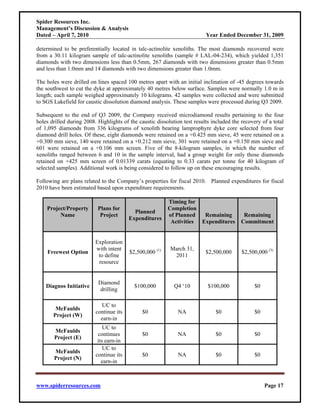
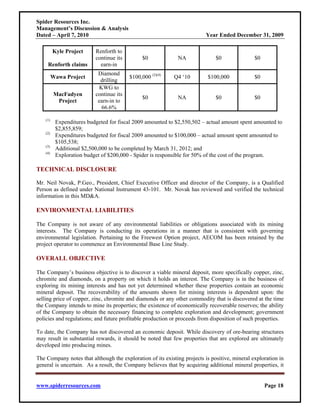
Following are plans related to the Company’s properties for fiscal 2010. Planned expenditures for fiscal
2010 have been estimated based upon expenditure requirements.

                                                          Timing for
    Project/Property       Plans for                      Completion
                                           Planned
         Name               Project                       of Planned   Remaining            Remaining
                                         Expenditures
                                                           Activities Expenditures         Commitment


                          Exploration
                          with intent                      March 31,
    Freewest Option                      $2,500,000 (1)                    $2,500,000      $2,500,000 (3)
                           to define                        2011
                           resource


                           Diamond
    Diagnos Initiative                     $100,000          Q4 ‘10         $100,000             $0
                            drilling

                            UC to
        McFaulds
                          continue its         $0             NA               $0                $0
       Project (W)
                            earn-in
                              UC to
       McFaulds
                           continues           $0             NA               $0                $0
       Project (E)
                           its earn-in
                              UC to
       McFaulds
                          continue its         $0             NA               $0                $0
       Project (N)
                             earn-in


www.spiderresources.com                                                                               Page 17
Spider Resources Inc.
Management’s Discussion & Analysis
Dated – April 7, 2010                                                     Year Ended December 31, 2009

          Kyle Project     Renforth to
                           continue its         $0           NA               $0               $0
     Renforth claims         earn-in
                            Diamond
          Wawa Project                    $100,000 (2)(4)   Q4 ‘10        $100,000             $0
                             drilling
                             KWG to
           MacFadyen       continue its
                                                $0           NA               $0               $0
            Project         earn-in to
                              66.6%

    (1)
           Expenditures budgeted for fiscal 2009 amounted to $2,550,502 – actual amount spent amounted to
           $2,855,859;
    (2)
           Expenditures budgeted for fiscal 2009 amounted to $100,000 – actual amount spent amounted to
           $105,538;
    (3)
           Additional $2,500,000 to be completed by March 31, 2012; and
    (4)
           Exploration budget of $200,000 - Spider is responsible for 50% of the cost of the program.

TECHNICAL DISCLOSURE

Mr. Neil Novak, P.Geo., President, Chief Executive Officer and director of the Company, is a Qualified
Person as defined under National Instrument 43-101. Mr. Novak has reviewed and verified the technical
information in this MD&A.

ENVIRONMENTAL LIABILITIES

The Company is not aware of any environmental liabilities or obligations associated with its mining
interests. The Company is conducting its operations in a manner that is consistent with governing
environmental legislation. Pertaining to the Freewest Option project, AECOM has been retained by the
project operator to commence an Environmental Base Line Study.

OVERALL OBJECTIVE

The Company’s business objective is to discover a viable mineral deposit, more specifically copper, zinc,
chromite and diamonds, on a property on which it holds an interest. The Company is in the business of
exploring its mining interests and has not yet determined whether these properties contain an economic
mineral deposit. The recoverability of the amounts shown for mining interests is dependent upon: the
selling price of copper, zinc, chromite and diamonds or any other commodity that is discovered at the time
the Company intends to mine its properties; the existence of economically recoverable reserves; the ability
of the Company to obtain the necessary financing to complete exploration and development; government
policies and regulations; and future profitable production or proceeds from disposition of such properties.

To date, the Company has not discovered an economic deposit. While discovery of ore-bearing structures
may result in substantial rewards, it should be noted that few properties that are explored are ultimately
developed into producing mines.

The Company notes that although the exploration of its existing projects is positive, mineral exploration in
general is uncertain. As a result, the Company believes that by acquiring additional mineral properties, it


www.spiderresources.com                                                                             Page 18
Spider Resources Inc.
    Management’s Discussion & Analysis
    Dated – April 7, 2010                                                       Year Ended December 31, 2009

    is able to better minimize overall exploration risk. In conducting its search for additional mineral
    properties, the Company may consider acquiring properties that it considers prospective based on criteria
    such as the exploration history of the properties, the location of the properties, or a combination of these
    and other factors. Risk factors to be considered in connection with the Company’s search for and
    acquisition of additional mineral properties include the significant expenses required to locate and establish
    mineral reserves; the fact that expenditures made by the Company may not result in discoveries of
    commercial quantities of minerals; environmental risks; risks associated with land title; the competition
    faced by the Company; and the potential failure of the Company to generate adequate funding for any such
    acquisitions. See “Risks and Uncertainties” below.

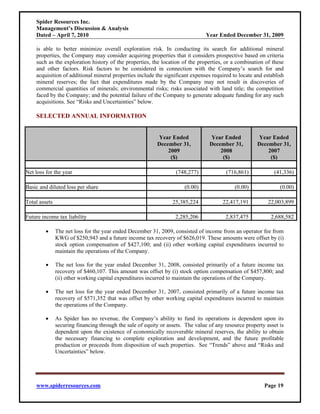
    SELECTED ANNUAL INFORMATION


                                                           Year Ended             Year Ended           Year Ended
                                                           December 31,           December 31,         December 31,
                                                               2009                   2008                 2007
                                                                ($)                    ($)                  ($)

Net loss for the year                                              (748,277)             (716,861)            (41,336)

Basic and diluted loss per share                                       (0.00)                (0.00)              (0.00)

Total assets                                                      25,385,224            22,417,191          22,003,899

Future income tax liability                                        2,285,206             2,837,475           2,688,582

         •     The net loss for the year ended December 31, 2009, consisted of income from an operator fee from
               KWG of $250,943 and a future income tax recovery of $626,019. These amounts were offset by (i)
               stock option compensation of $427,100; and (ii) other working capital expenditures incurred to
               maintain the operations of the Company.

         •     The net loss for the year ended December 31, 2008, consisted primarily of a future income tax
               recovery of $460,107. This amount was offset by (i) stock option compensation of $457,800; and
               (ii) other working capital expenditures incurred to maintain the operations of the Company.

         •     The net loss for the year ended December 31, 2007, consisted primarily of a future income tax
               recovery of $571,352 that was offset by other working capital expenditures incurred to maintain
               the operations of the Company.

         •     As Spider has no revenue, the Company’s ability to fund its operations is dependent upon its
               securing financing through the sale of equity or assets. The value of any resource property asset is
               dependent upon the existence of economically recoverable mineral reserves, the ability to obtain
               the necessary financing to complete exploration and development, and the future profitable
               production or proceeds from disposition of such properties. See “Trends” above and “Risks and
               Uncertainties” below.


    www.spiderresources.com                                                                               Page 19
Spider Resources Inc.
Management’s Discussion & Analysis
Dated – April 7, 2010                                                Year Ended December 31, 2009

   •   Exploration activity is typically higher in the fourth quarter than in second and third
       quarters due to the greater number of activities that can be carried on in the James Bay
       lowlands after freeze-up.

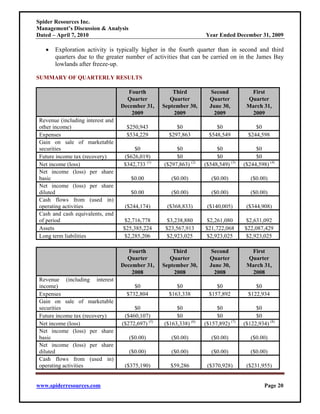
SUMMARY OF QUARTERLY RESULTS

                                      Fourth            Third           Second          First
                                     Quarter           Quarter         Quarter         Quarter
                                   December 31,     September 30,      June 30,        March 31,
                                       2009             2009             2009           2009
 Revenue (including interest and
 other income)                       $250,943            $0               $0               $0
 Expenses                            $534,229         $297,863         $548,549         $244,598
 Gain on sale of marketable
 securities                             $0               $0               $0               $0
 Future income tax (recovery)       ($626,019)           $0               $0               $0
 Net income (loss)                  $342,733 (1)    ($297,863) (2)   ($548,549) (3)   ($244,598) (4)
 Net income (loss) per share
 basic                                 $0.00           ($0.00)          ($0.00)          ($0.00)
 Net income (loss) per share
 diluted                               $0.00           ($0.00)          ($0.00)          ($0.00)
 Cash flows from (used in)
 operating activities               ($244,174)       ($368,833)       ($140,005)       ($344,908)
 Cash and cash equivalents, end
 of period                          $2,716,778        $3,238,880      $2,261,080       $2,631,092
 Assets                            $25,385,224       $23,567,913     $21,722,068      $22,087,429
 Long term liabilities             $2,285,206        $2,923,025      $2,923,025       $2,923,025

                                      Fourth            Third           Second          First
                                     Quarter           Quarter         Quarter         Quarter
                                   December 31,     September 30,      June 30,        March 31,
                                       2008             2008             2008           2008
 Revenue (including interest
 income)                                $0               $0               $0               $0
 Expenses                            $732,804         $163,338         $157,892         $122,934
 Gain on sale of marketable
 securities                             $0               $0               $0               $0
 Future income tax (recovery)       ($460,107)           $0               $0               $0
 Net income (loss)                 ($272,697) (5)   ($163,338) (6)   ($157,892) (7)   ($122,934) (8)
 Net income (loss) per share
 basic                                ($0.00)          ($0.00)          ($0.00)          ($0.00)
 Net income (loss) per share
 diluted                              ($0.00)          ($0.00)          ($0.00)          ($0.00)
 Cash flows from (used in)
 operating activities               ($375,190)         $59,286        ($370,928)       ($231,955)


www.spiderresources.com                                                                        Page 20
Spider Resources Inc.
Management’s Discussion & Analysis
Dated – April 7, 2010                                                    Year Ended December 31, 2009

                                      Fourth              Third             Second          First
                                     Quarter             Quarter           Quarter         Quarter
                                   December 31,       September 30,        June 30,        March 31,
                                       2009               2009               2009           2009
 Cash and cash equivalents, end
 of period                           $3,205,855         $4,102,592        $4,602,542       $4,653,526
 Assets                             $22,417,191        $22,852,916       $22,548,038      $22,136,982
 Long term liabilities              $2,837,475         $3,392,082        $3,392,082       $3,392,082

Notes:
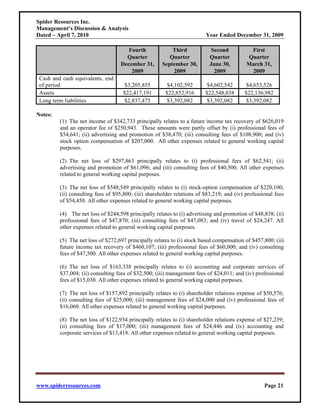
         (1) The net income of $342,733 principally relates to a future income tax recovery of $626,019
         and an operator fee of $250,943. These amounts were partly offset by (i) professional fees of
         $54,641; (ii) advertising and promotion of $38,470; (iii) consulting fees of $108,900; and (iv)
         stock option compensation of $207,000. All other expenses related to general working capital
         purposes.

         (2) The net loss of $297,863 principally relates to (i) professional fees of $62,541; (ii)
         advertising and promotion of $61,096; and (iii) consulting fees of $40,500. All other expenses
         related to general working capital purposes.

         (3) The net loss of $548,549 principally relates to (i) stock-option compensation of $220,100;
         (ii) consulting fees of $95,800; (iii) shareholder relations of $83,219; and (iv) professional fees
         of $54,450. All other expenses related to general working capital purposes.

         (4) The net loss of $244,598 principally relates to (i) advertising and promotion of $48,838; (ii)
         professional fees of $47,870; (iii) consulting fees of $47,083; and (iv) travel of $24,247. All
         other expenses related to general working capital purposes.

         (5) The net loss of $272,697 principally relates to (i) stock based compensation of $457,800; (ii)
         future income tax recovery of $460,107; (iii) professional fees of $60,000; and (iv) consulting
         fees of $47,500. All other expenses related to general working capital purposes.

         (6) The net loss of $163,338 principally relates to (i) accounting and corporate services of
         $37,004; (ii) consulting fees of $32,500; (iii) management fees of $24,011; and (iv) professional
         fees of $15,030. All other expenses related to general working capital purposes.

         (7) The net loss of $157,892 principally relates to (i) shareholder relations expense of $50,576;
         (ii) consulting fees of $25,000; (iii) management fees of $24,000 and (iv) professional fees of
         $16,060. All other expenses related to general working capital purposes.

         (8) The net loss of $122,934 principally relates to (i) shareholder relations expense of $27,239;
         (ii) consulting fees of $17,000; (iii) management fees of $24,446 and (iv) accounting and
         corporate services of $13,418. All other expenses related to general working capital purposes.


www.spiderresources.com                                                                            Page 21
Spider Resources Inc.
Management’s Discussion & Analysis
Dated – April 7, 2010                                                      Year Ended December 31, 2009

RESULTS OF OPERATIONS

Twelve months ended December 31, 2009, compared with twelve months ended December 31, 2008

The net loss from operations for the twelve months ended December 31, 2009, was $748,277 or $0.00 per
share, compared to net loss of $716,861 or $0.00 for the comparative period in 2008. The $31,416
increase in the loss from operations is driven by several variables, including:

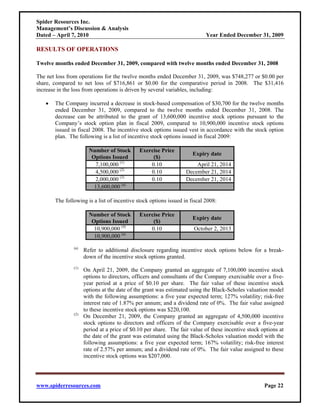
   •   The Company incurred a decrease in stock-based compensation of $30,700 for the twelve months
       ended December 31, 2009, compared to the twelve months ended December 31, 2008. The
       decrease can be attributed to the grant of 13,600,000 incentive stock options pursuant to the
       Company’s stock option plan in fiscal 2009, compared to 10,900,000 incentive stock options
       issued in fiscal 2008. The incentive stock options issued vest in accordance with the stock option
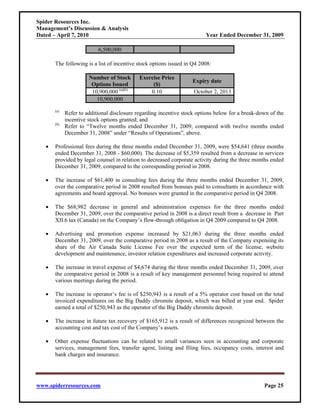
       plan. The following is a list of incentive stock options issued in fiscal 2009:

                       Number of Stock       Exercise Price
                                                                     Expiry date
                        Options Issued            ($)
                         7,100,000 (1)           0.10                 April 21, 2014
                         4,500,000 (2)           0.10             December 21, 2014
                         2,000,000 (3)           0.10             December 21, 2014
                         13,600,000 (a)

       The following is a list of incentive stock options issued in fiscal 2008:

                       Number of Stock       Exercise Price
                                                                     Expiry date
                        Options Issued            ($)
                         10,900,000 (4)          0.10                October 2, 2013
                         10,900,000 (a)
               (a)
                     Refer to additional disclosure regarding incentive stock options below for a break-
                     down of the incentive stock options granted.
               (1)
                     On April 21, 2009, the Company granted an aggregate of 7,100,000 incentive stock
                     options to directors, officers and consultants of the Company exercisable over a five-
                     year period at a price of $0.10 per share. The fair value of these incentive stock
                     options at the date of the grant was estimated using the Black-Scholes valuation model
                     with the following assumptions: a five year expected term; 127% volatility; risk-free
                     interest rate of 1.87% per annum; and a dividend rate of 0%. The fair value assigned
                     to these incentive stock options was $220,100.
               (2)
                     On December 21, 2009, the Company granted an aggregate of 4,500,000 incentive
                     stock options to directors and officers of the Company exercisable over a five-year
                     period at a price of $0.10 per share. The fair value of these incentive stock options at
                     the date of the grant was estimated using the Black-Scholes valuation model with the
                     following assumptions: a five year expected term; 167% volatility; risk-free interest
                     rate of 2.57% per annum; and a dividend rate of 0%. The fair value assigned to these
                     incentive stock options was $207,000.


www.spiderresources.com                                                                             Page 22
Spider Resources Inc.
Management’s Discussion & Analysis
Dated – April 7, 2010                                                     Year Ended December 31, 2009
               (3)
                     On December 21, 2009, the Company granted an aggregate of 2,000,000 incentive
                     stock options to an investor relations consultant exercisable over a five-year period at
                     a price of $0.10 per share. The fair value of these incentive stock options at the date
                     of the grant was estimated using the Black-Scholes valuation model with the following
                     assumptions: a five-year expected term; 167% volatility; risk-free interest rate of
                     2.57% per annum; and a dividend rate of 0%. The fair value assigned to these
                     incentive stock options was $92,000. These incentive stock options will vest quarterly
                     over a period of one year.
               (4)
                     On October 2, 2008, the Company granted an aggregate of 10,900,000 incentive stock
                     options to various directors, officers and consultants of the Company at an exercise
                     price of $0.10 per share for a five-year period. The fair value of these incentive stock
                     options at the date of the grant was estimated using the Black-Scholes valuation model
                     with the following assumptions: dividend yield 0%; expected volatility of 136%; risk-
                     free interest rate of 3.02%; and an expected term of five years. The fair value assigned
                     to these incentive stock options was $457,800.

       Several variables are used when determining the value of incentive stock options using the Black-
       Scholes valuation model:

           o   The expected term: the Company used the expected term of five years, which is the
               maximum term ascribed to these incentive stock options, for the purposes of calculating
               the value of these incentive stock options. The Company chose the maximum term
               because it is difficult to determine with any reasonable degree of accuracy when these
               incentive stock options will be exercised.
           o   Volatility: the Company used historical information on the market price of its common
               shares to determine the degree of volatility at the date the incentive stock options were
               granted. Therefore, depending on when the incentive stock options were granted and the
               period of historical information examined, the degree of volatility can be different when
               calculating the value of different incentive stock options.
           o   Risk-free interest rate: the Company used the interest rate available for government
               securities of an equivalent expected term as at the date of the grant of the incentive stock
               options. The risk-free interest rate would vary depending on the date of the grant of the
               incentive stock options and the expected term of the incentive stock options.
           o   Dividend yield: the Company has not paid dividends in the past because it is in the
               development stage and has not yet earned any significant income. Also, the Company
               does not expect to pay dividends in the foreseeable future because it does not expect to
               bring its mineral properties into production and earn significant revenue any time soon.
               Therefore, a dividend rate of 0% was used for the purposes of the valuation of the
               incentive stock options

       Incentive stock options were issued to attract key personnel to work for the Company.

   •   Professional fees during the twelve months ended December 31, 2009, were $219,502 (twelve
       months ended December 31, 2008 - $99,732). The increase of $119,770 resulted from an increase
       in services provided by legal counsel in relation to increased corporate activity during the twelve
       months ended December 31, 2009, compared to the corresponding period in 2008.


www.spiderresources.com                                                                             Page 23
Spider Resources Inc.
Management’s Discussion & Analysis
Dated – April 7, 2010                                                   Year Ended December 31, 2009

   •   The increase of $170,283 in consulting fees during the twelve months ended December 31, 2009,
       over the comparative period in 2008 resulted from (i) fees paid to the Chief Financial Officer for a
       full year; and (ii) bonuses paid to consultants in accordance with agreements and board approval.
       No bonuses were granted in the comparative period in 2008.

   •   The $6,848 decrease in general and administration expenses for the twelve months ended
       December 31, 2009, over the comparative period in 2008 is a direct result of a decrease in Part
       XII.6 tax (Canada) on the Company’s flow-through obligation in fiscal 2009 compared to fiscal
       2008.

   •   Advertising and promotion expense increased by $114,753 during the twelve months ended
       December 31, 2009, over the comparative period in 2008 as a result of the Company expensing its
       share of the Air Canada Suite License Fee (the “license”) over the expected term of the license,
       website development and maintenance, investor relation expenditures and increased corporate
       activity.

   •   The increase in travel expense of $40,866 during the twelve months ended December 31, 2009,
       over the comparative period in 2008 is a result of key management personnel being required to
       attend various meetings during the period.

   •   The increase in operator’s fee of $250,943 is a result of a 5% operator cost based on the total
       invoiced expenditures on the Big Daddy chromite deposit, which was billed at year end. Spider
       earned a total of $250,943 as the operator of the Big Daddy chromite deposit.

   •   The increase in future tax recovery of $165,912 is a result of differences recognized between the
       accounting cost and tax cost of the Company’s assets.

   •   Other expense fluctuations can be related to small variances seen in accounting and corporate
       services, management fees, transfer agent, listing and filing fees, occupancy costs, interest and
       bank charges and insurance.

Three months ended December 31, 2009, compared with three months ended December 31, 2008

The net income from operations for the three months ended December 31, 2009, was $342,733 or $0.00
per share, compared to net loss of $272,697 or $0.00 for the comparative period in 2008. The $615,430
increase in income from operations was driven by several variables, including:

   •   The Company incurred a decrease in stock-based compensation of $250,800 for the three months
       ended December 31, 2009, compared to the three months ended December 31, 2008. The decrease
       can be attributed to the grant of 6,500,000 incentive stock options in Q4 2009, compared to
       10,900,000 incentive stock options issued in Q4 2008. The incentive stock options issued vest in
       accordance with the stock option plan. The following is a list of incentive stock options issued in
       Q4 2009:

                     Number of Stock       Exercise Price
                                                                   Expiry date
                      Options Issued            ($)
                      4,500,000 (a)(b)         0.10             December 21, 2014
                      2,000,000 (a)(b)         0.10             December 21, 2014


www.spiderresources.com                                                                           Page 24
Spider Resources Inc.
Management’s Discussion & Analysis
Dated – April 7, 2010                                                    Year Ended December 31, 2009

                           6,500,000

       The following is a list of incentive stock options issued in Q4 2008:

                       Number of Stock       Exercise Price
                                                                   Expiry date
                        Options Issued            ($)
                        10,900,000 (a)(b)        0.10               October 2, 2013
                          10,900,000
       (a)
             Refer to additional disclosure regarding incentive stock options below for a break-down of the
             incentive stock options granted; and
       (b)
             Refer to “Twelve months ended December 31, 2009, compared with twelve months ended
             December 31, 2008” under “Results of Operations”, above.

   •   Professional fees during the three months ended December 31, 2009, were $54,641 (three months
       ended December 31, 2008 - $60,000). The decrease of $5,359 resulted from a decrease in services
       provided by legal counsel in relation to decreased corporate activity during the three months ended
       December 31, 2009, compared to the corresponding period in 2008.

   •   The increase of $61,400 in consulting fees during the three months ended December 31, 2009,
       over the comparative period in 2008 resulted from bonuses paid to consultants in accordance with
       agreements and board approval. No bonuses were granted in the comparative period in Q4 2008.

   •   The $68,982 decrease in general and administration expenses for the three months ended
       December 31, 2009, over the comparative period in 2008 is a direct result from a decrease in Part
       XII.6 tax (Canada) on the Company’s flow-through obligation in Q4 2009 compared to Q4 2008.

   •   Advertising and promotion expense increased by $21,063 during the three months ended
       December 31, 2009, over the comparative period in 2008 as a result of the Company expensing its
       share of the Air Canada Suite License Fee over the expected term of the license, website
       development and maintenance, investor relation expenditures and increased corporate activity.

   •   The increase in travel expense of $4,674 during the three months ended December 31, 2009, over
       the comparative period in 2008 is a result of key management personnel being required to attend
       various meetings during the period.

   •   The increase in operator’s fee is of $250,943 is a result of a 5% operator cost based on the total
       invoiced expenditures on the Big Daddy chromite deposit, which was billed at year end. Spider
       earned a total of $250,943 as the operator of the Big Daddy chromite deposit.

   •   The increase in future tax recovery of $165,912 is a result of differences recognized between the
       accounting cost and tax cost of the Company’s assets.

   •   Other expense fluctuations can be related to small variances seen in accounting and corporate
       services, management fees, transfer agent, listing and filing fees, occupancy costs, interest and
       bank charges and insurance.


www.spiderresources.com                                                                           Page 25
Spider Resources Inc.
Management’s Discussion & Analysis
Dated – April 7, 2010                                                     Year Ended December 31, 2009

LIQUIDITY AND CAPITAL RESOURCES

The activities of the Company, principally the acquisition and exploration of properties that have the
potential to contain metals, are financed through the completion of equity transactions such as equity
offerings and the exercise of incentive stock options, agent options and warrants. For the twelve months
ended December 31, 2009, the Company had the following equity transactions:

   •   On July 24, 2009, Spider completed the first tranche of a private placement of 48,333,333 flow-
       through units at a price of $0.03 per unit, for gross proceeds of $1,450,000. The private placement
       is part of a larger offering of up to 73,333,333 flow-through units. Each unit consists of one
       common share (issued on a flow-through basis) and one-half of one common share purchase
       warrant. Each full warrant entitles the holder to acquire one common share (which share shall not
       be issued on a flow-through basis) at a price of $0.05 for a period of one year from the date of
       issue and thereafter at a price of $0.10 for a period of two years from the date of issue. Spider
       engaged IBK Capital Corp. to complete the first tranche of the offering on a best-efforts agency
       basis.

       Spider paid an aggregate cash commission in the amount of $102,375 to IBK and its selling group
       agents and issued 4,550,000 broker warrants entitling IBK and its selling group agents to purchase
       up to 4,550,000 common shares in the capital of Spider at a price of $0.03 for a period of one year
       from the date of issue and thereafter at a price of $0.06 for a period of two years from the date of
       issue. IBK engaged the following sub-agents in connection with the completion of the first tranche
       of the offering: Brant Securities Limited, Octagon Capital Corp., CIBC Wood Gundy, TD
       Waterhouse Canada Inc., MGI Securities Inc., and Dundee Securities Corporation.

   •   On August 7, 2009, Spider completed the second tranche of a private placement with the
       MineralFields Group of 25,000,000 flow-through units at a price of $0.03 per unit, for gross
       proceeds of $750,000. Each unit consisted of one common share (issued on a flow-through basis)
       and one-half of one common share purchase warrant. Each full warrant entitles the holder to
       acquire one common share (which share will not be issued on a flow-through basis) at a price of
       $0.05 for a period of one year from the date of issue and thereafter at a price of $0.10 for a period
       of two years from the date of issue.

       Spider engaged Limited Market Dealer Inc. to complete the second tranche of the offering on a
       best-efforts agency basis. Limited Market Dealer Inc. was paid an aggregate cash commission of
       $37,500 and was issued 2,500,000 broker compensation options ("Agent Options"). Each agent
       option is exercisable for one unit (“option unit”) at a price of $0.03 for a period of one year from
       the date of issue and thereafter at a price of $0.06 for a period of two years from the date of issue.
       Each option unit consists of one common share and one-half of one common share purchase
       warrant. Each full warrant will be exercisable for one common share at a price of $0.05 until
       August 7, 2010, and thereafter at a price of $0.10 until August 7, 2011.

   •   On December 24, 2009, Spider completed the first tranche of a private placement of 22,887,999
       flow-through units at a price of $0.06 per unit, for gross proceeds of $1,373,280. The private
       placement is part of a larger offering of up to 50,000,000 flow-through units at a price of $0.06 per
       unit and up to 40,000,000 non flow-through units at the price of $0.05 per unit. Each flow-through
       unit consists of one common share (issued on a flow-through basis) and one non flow-through
       common share purchase warrant. Each full warrant entitles the holder to acquire one common


www.spiderresources.com                                                                             Page 26
Spider Resources Inc.
Management’s Discussion & Analysis
Dated – April 7, 2010                                                     Year Ended December 31, 2009

        share (which share will not be issued on a flow-through basis) at a price of $0.10 for a period of
        two years from the date of issue.

    •   On December 30, 2009, Spider completed a second tranche of a private placement of 15,785,332
        flow-through units at a price of $0.06 per unit, for gross proceeds of $947,120. Each unit consisted
        of one common share (issued on a flow-through basis) and one common share purchase warrant.
        Each full warrant entitles the holder to acquire one common share (which share will not be issued
        on a flow-through basis) at a price of $0.10 for a period of two years from the date of issue.

        Spider engaged Sandfire Securities Inc. ("SSI") to complete the offering. Spider paid an aggregate
        cash commission in the amount of $132,457 to SSI and its selling group agents and issued
        3,620,163 non-transferable compensation options ("Agents Options") entitling SSI and its selling
        group agents to purchase up to 3,620,163 units at a price of $0.06 per unit for a period of two years
        from the date of issue. Each unit consisted of one common share and one common share purchase
        warrant exercisable to acquire one common share at the price of $0.10 per share for a period of
        two years from the date of issue of the agent options. The Company issued two tranches of agent
        options: (i) 2,083,298 units at a price of $0.06 which expire on December 24, 2011. The attached
        warrants to these agent options also expire on December 24, 2011; and (ii) 1,536,865 units at a
        price of $0.06 that expire on December 30, 2011. The attached warrants to these agent options also
        expire on December 30, 2011.

    •   The Company also raised funds from the exercise of warrants for cash proceeds of $5,100.

There is no assurance that future equity capital will be available to the Company in the amounts or at the
times desired or on terms that are acceptable to the Company, if at all. See “Risks and Uncertainties”
below.

The Company has no operating revenues and therefore must utilize its current cash reserves, funds
obtained from the exercise of warrants, incentive stock options, agent options, and other financing
transactions to maintain its capacity to meet ongoing discretionary and committed exploration and
operating activities.

As of December 31, 2009, the Company had 428,388,431 common shares issued and outstanding,
116,756,658 warrants outstanding which would raise $9,535,733 if exercised in full, and 37,005,181
incentive stock options and agent options outstanding which would raise $3,380,712 if exercised in full.

To date, the cash resources of Spider are held with HSBC Bank Canada. The Company has no debt and its
credit and interest rate risk is minimal. Accounts payable and accrued liabilities are short-term and non-
interest bearing.

The Company’s liquidity risk with financial instruments is minimal as excess cash is invested in
investment grade short-term deposit certificates. As of December 31, 2009, the Company’s funds were in
two non-interest bearing accounts. The Company did not have any investments as of December 31, 2009.

In addition, sundry receivables are composed of sales tax receivable from government authorities in
Canada and deposits held with service providers.


www.spiderresources.com                                                                             Page 27
Spider Resources Inc.
Management’s Discussion & Analysis
Dated – April 7, 2010                                                     Year Ended December 31, 2009

Accounts payable and accrued liabilities increased to $334,164 at December 31, 2009, compared to
$166,081 at December 31, 2008, primarily due to the Company’s activities on the Big Daddy chromite
deposit. The Company’s cash at December 31, 2009, is sufficient to pay these liabilities.

The Company’s use of cash at present occurs, and in the future will occur, principally in two areas,
namely, funding of its general and administrative expenditures and funding of its investment activities.
Those investing activities include the cash components of the cost of acquiring and exploring its mineral
claims. Currently, the Company’s operating expenses are averaging approximately $100,000 per month for
working capital related expenses. The Company also plans to incur exploration expenditures of $2,700,000
on its mining interests. Of this, $2,500,000 relates to the Big Daddy chromite deposit and must be spent by
March 31, 2011; about $200,000 relates to other mining interests, and which the Company anticipates
spending by December 31, 2010. See “Mineral Exploration Properties”, above. The Company’s existing
funds on hand at December 31, 2009, and the private placement of $1,754,900, net of share issue costs,
that closed on January 22, 2010, is anticipated to be adequate for Spider to meet its operating costs for
fiscal 2010 and its exploration programs at current operating levels. This is subject to the Company’s
ability to attract and retain skilled staff and consultants. The Company’s anticipated spending includes its
December 31, 2009, flow-through commitment of approximately $2,320,000 and $380,000 from the
January 22, 2010, flow-through financing, leaving a balance of $209,000 to be spent from the total flow-
through financing of approximately $589,000. The December 31, 2009, flow-through commitment is
required to be spent by December 31, 2010, under the Canadian tax rules regarding flow-through shares.
The Company can elect to spend the January 22, 2010, flow-through financing by December 31, 2011,
under the same tax rules. The decision where to spend the remaining $209,000 flow-through commitment
from the January 22, 2010, flow-through financing will be determined in the coming year.

A summary of the Company’s Big Daddy chromite deposit exploration program is summarized below:

        Details              Actual Costs ($)               Budget ($)               Over (Under) ($)

Other 2009 Programs                       630,315                     630,315                           nil
Administration                             49,613                      35,200                       14,413
Planning                                   67,783                      49,421                       18,362
Camp operations                           219,283                     163,483                       55,800
Drafting                                   28,161                       8,800                       19,361
Fuel MOB                                   91,911                     113,798                     (21,887)
Line Cutting                               55,552                      57,714                      (2,162)
Ground Geophysics                         198,291                     116,161                       82,130
Geology                                 1,253,378                   1,390,338                    (136,960)
Drilling                                2,298,932                   2,361,537                     (62,605)
Survey                                     38,018                     126,908                     (88,890)
Resource Studies                           87,619                      52,250                       35,369
Environmental                                  nil                    143,409                    (143,409)
Total                                   5,018,856                   5,249,334                    (230,478)
Contingency                                    nil                    450,666                    (450,666)


www.spiderresources.com                                                                            Page 28
Spider Resources Inc.
Management’s Discussion & Analysis
Dated – April 7, 2010                                                       Year Ended December 31, 2009

Grand Total                              5,018,856                    5,700,000                     (681,144)
Spider’s share                           2,509,428                    2,850,000                     (340,572)

In mid–September the Company in its capacity as operator of this project commenced drilling on the Big
Daddy chromite deposit. It is anticipated that the drill program will include up to 11,000 metres of core
drilling and will cost between $5 million and $6 million, thus meeting the next level earn-in on the project
from Freewest. The cost of the program will be shared equally between the Company and KWG.

OFF-BALANCE-SHEET ARRANGEMENTS

As of the date of this filing, the Company does not have any off balance sheet arrangements that have, or
are reasonably likely to have, a current or future effect on the results of operations or financial condition of
the Company, including, and without limitation, such considerations as liquidity and capital resources.

PROPOSED TRANSACTIONS

There are no proposed transactions of a material nature being considered by the Company. However, the
Company continues to evaluate properties and corporate entities that it may acquire in the future. See
“Overall Objective” above

TRANSACTIONS WITH RELATED PARTIES

During the year, the Company paid $96,000 (2008 - $96,000) to Nominex Ltd., a company controlled by
Neil Novak, the President and director of the Company, for geological and other services. Included in
accounts payable and accrued liabilities is $8,400 (2008 - $8,400) owing to Nominex for management
services provided.

The Company paid Richard Hamelin, the Vice President of the Company, fees totaling $72,000 for the
year ended December 31, 2009 (2008 - $60,000). In addition, for the year ended December 31, 2009, legal
fees in the amount of $343,540 (2008 - $94,916) were paid to a law firm in which the Corporate Secretary,
Carmen Diges, is a partner. As at December 31, 2009, this law firm was owed $205,496 (2008 - $15,000)
and this amount was included in accounts payable and accrued liabilities.

During the year, the Company paid $30,000 (2008 - $20,000) to Marrelli CFO Outsource Syndicate Inc.
("Marrelli") for the services of the Chief Financial Officer of the Company. The Company's Chief
Financial Officer is the president of Marrelli and Marrelli Support Services Inc., a firm that provides
accounting services to Spider. During the year, Spider expensed $43,608 (2008 - $70,442) for services
rendered by this firm. In addition, as at December 31, 2009, this firm was owed $15,860 (December 31,
2008 - $2,680) and this amount was included in accounts payable and accrued liabilities.

At the year-end, the Company paid consulting fees of $66,582 (December 31, 2008 - $nil) to James G.
Burns, an officer of the Company. As at December 31, 2009, this officer was owed $6,719 (December 31,
2008 - $nil) and this amount was included in accounts payable and accrued liabilities.

During the year, the Company paid consulting fees of $23,600 (December 31, 2008 - $22,016) to Franklin
Geosciences Ltd., a company beneficially owned by Jim Franklin, a director of the Company. As at
December 31, 2009, Franklin Geosciences Ltd. was owed $24,780 (December 31, 2008 - $nil) in


www.spiderresources.com                                                                                Page 29
Spider Resources Inc.
Management’s Discussion & Analysis
Dated – April 7, 2010                                                     Year Ended December 31, 2009

outstanding consulting fees and unreimbursed expenses. This amount was included in accounts payable
and accrued liabilities.

The Company paid bonuses of $119,700 to officers of the Company (Neil Novak $57,600, James G. Burns
$22,500 and Richard Hamelin $39,600) (December 31, 2008 - $nil). In addition, during the year the
Company paid $56,000 (December 31, 2008 - $39,000) as director fees. Director fees include payments to
Earl Coleman - $13,500; Norman Brewster - $12,500; Bryan Wilson $8,500; Jim Franklin $10,000; and
Gregory Roberts - $11,500) (December 31, 2008: Earl Coleman - $9,000; Norman Brewster - $8,500;
Bryan Wilson $7,000; Jim Franklin; $7,500; and Gregory Roberts - $7,000). As at December 31, 2009,
$5,856 (December 31, 2008 - $nil) was owed to Neil Novak as reimbursable expenses and this amount was
included in accounts payable and accrued liabilities.

These transactions are in the normal course of operations and are measured at the exchange amount, which
is the amount of consideration established and agreed to by the related parties.

CRITICAL ACCOUNTING ESTIMATES

The preparation of the Company’s audited financial statements requires management to make certain
estimates that affect the amounts reported in the financial statements. The accounting estimates considered
significant are the valuation of the Company’s mining interests and stock-based compensation.

The policy of capitalizing exploration costs to date does not necessarily relate to the future economic value
of the exploration properties. The valuation of mining interests is dependent entirely upon the discovery of
economic mineral deposits.

The Company uses the Black-Scholes model to determine the fair value of stock options. The main factor
affecting the estimates of stock-based compensation is the stock price volatility used. The Company uses
historical price data and comparables in the estimate of future volatility.

Changes in the accounting estimates in the items discussed above may have a material impact on the
financial position of the Company.

Other items requiring estimates for the year ended December 31, 2009, are accounts payable and accrued
liabilities and asset retirement obligation. Changes in the accounting estimates in these items may have a
material impact on the financial position of the Company.

CHANGES IN ACCOUNTING POLICIES

During the year ended December 31, 2009, the Company adopted the following new accounting policies:

Goodwill and Intangible Assets

In February 2008, the CICA approved Handbook Section 3064, “Goodwill and Intangible Assets”, which
replaces the existing Handbook Sections 3062, “Goodwill and Other Intangible Assets” and 3450
“Research and Development Costs”. This standard is effective for interim and annual financial statements
relating to fiscal years beginning on or after January 1, 2009, with earlier application encouraged. The
standard provides guidance on the recognition, measurement and disclosure requirements for goodwill and


www.spiderresources.com                                                                             Page 30
Spider Resources Inc.
Management’s Discussion & Analysis
Dated – April 7, 2010                                                          Year Ended December 31, 2009

intangible assets. The adoption of this standard had no impact on the Company's operating results or
financial position.

Credit Risk and the Fair Value of Financial Assets and Financial Liabilities

In January 2009, the CICA approved EIC 173 Credit Risk and the Fair Value of Financial Assets and
Financial Liabilities. This guidance clarified that an entity's own credit risk and the credit risk of the
counterparty should be taken into account in determining the fair value of financial assets and financial
liabilities including derivative instruments. This guidance is applicable to fiscal periods ending on or after
January 20, 2009. The Company is continually evaluating the effects of this standard.

Mining exploration costs

On March 27, 2009, the CICA approved EIC 174, “Mining Exploration Costs”. This provides guidance on
capitalization of exploration costs related to mining properties in particular, and on impairment of long-
lived assets in general. The Company has applied this new abstract for the year ended December 31, 2008,
and there was no significant impact on its financial statements as a result.

Categories of financial assets and liabilities

In June 2009, the Canadian Accounting Standards Board issued an amendment to CICA Section 3862,
“Financial Instruments – Disclosures” in an effort to make Section 3862 consistent with International
Financial Reporting Standards Section 7 – Disclosures (“IFRS 7”). The purpose was to establish a
framework for measuring fair value in GAAP and expand disclosures about fair value measurements. To
make the disclosures an entity is to classify fair value measurements using a fair value hierarchy that
reflects the significance of the inputs used in making the measurements. The fair value hierarchy is to have
the following levels: (Level 1) quoted prices (unadjusted) in active markets for identical assets or
liabilities; (Level 2) inputs other than quoted prices included in Level 1 that are observable for the asset or
liability, either directly (i.e., as prices) or indirectly (i.e., derived from prices); and (Level 3) inputs for the
asset or liability that are not based on observable market data (unobservable inputs). These standards
apply to interim and annual consolidated financial statements relating to fiscal years ending after
September 30, 2009.

Fair value measurement of assets and liabilities recognized on the balance sheet are categorized into levels
within a fair value hierarchy based on the nature of valuation inputs. The Company's cash is classified in
Level 1 within the fair value hierarchy as at December 31, 2009.

Future accounting changes

International Financial Reporting Standards (“IFRS”)

The Canadian Accounting Standards Board has confirmed that IFRS will replace current Canadian GAAP
for publicly accountable enterprises, including the Company, effective for fiscal years beginning on or
after January 1, 2011.

Accordingly, the Company will report interim and annual financial statements in accordance with IFRS
beginning with the quarter ended March 31, 2011. The Company's 2011 interim and annual financial
statements will include comparative 2010 financial statements, adjusted to comply with IFRS.


www.spiderresources.com                                                                                   Page 31
Spider Resources Inc.
Management’s Discussion & Analysis
Dated – April 7, 2010                                                   Year Ended December 31, 2009

IFRS Transition Plan

The Company has established a comprehensive IFRS transition plan and engaged third-party advisers to
assist with the planning and implementation of its transition to IFRS. The following summarizes the
Company's progress and expectations with respect to its IFRS transition plan:

       Initial scoping and analysis of key areas
       for which accounting policies may be
       impacted by the transition to IFRS.                          Complete.
       Detailed evaluation of potential changes
       required     to   accounting     policies,
       information systems and business
       processes, including the application of
       IFRS 1 First-time Adoption of
       International    Financial     Reporting                     Complete.
       Standards.
       Final determination of changes to
       accounting policies and choices to be
       made with respect to first-time adoption      In progress, completion expected during
       alternatives.                                                 Q2 2010
       Resolution of the accounting policy
       change implications on information
       technology, business processes and            In progress, completion expected during
       contractual arrangements.                                     Q3 2010
       Quantification of the financial statement
       impact of changes in accounting policies.                Throughout 2010
       Management and employee education and            Throughout the transition process
       training.

Impact of Adopting IFRS on the Company’s Business

As part of its analysis of potential changes to significant accounting policies, the Company is assessing
what changes may be required to its accounting systems and business processes. The Company believes
that the changes identified to date are minimal and the systems and processes can accommodate the
necessary changes.

To date, the Company has not identified any contractual arrangements that may be affected by potential
changes to significant accounting policies.

The Company's staff and advisers involved in the preparation of the financial statements are being trained
on the relevant aspects of IFRS and the anticipated changes to accounting policies. Employees of the
Company who will be affected by a change to business processes as a result of the conversion to IFRS will
also be trained as necessary.


www.spiderresources.com                                                                          Page 32
Spider Resources Inc.
Management’s Discussion & Analysis
Dated – April 7, 2010                                                     Year Ended December 31, 2009

The Board of Directors and the Audit Committee have been regularly updated on the progress of the IFRS
conversion plan, and made aware of the evaluation to date of the key aspects of IFRS affecting the
Company.

First-time adoption of IFRS

The adoption of IFRS requires the application of IFRS 1 First-time Adoption of International Financial
Reporting Standards (“IFRS 1”), which provides guidance for an entity’s initial adoption of IFRS. IFRS 1
generally requires retrospective application of IFRS, effective at the end of its first annual IFRS reporting
period. However, IFRS 1 also provides certain optional exemptions and mandatory exceptions to this
retrospective treatment.

The Company has identified the following optional exemptions that it expects apply in its preparation of an
opening IFRS statement of financial position as at January 1, 2010, its transition date:

    • To apply IFRS 2 Share-based Payments only to equity instruments issued after November 7,
      2002, and that had not vested by the transition date.
    • To apply IFRS 3 Business Combinations prospectively from the transition date, therefore not
      restating business combinations that took place prior to the transition date.
    • To apply the transition provisions of IFRIC 14 Determining whether an Arrangement
      Contains a Lease, therefore determining if arrangements existing at the transition date
      contain a lease based on the circumstances existing at that date.
    • To apply IAS 23 Borrowing Costs prospectively from the transition date. IAS 23 requires
      the capitalization of borrowing costs directly attributable to the acquisition, production or
      construction of certain assets.

Prior to reporting interim financial statements in accordance with IFRS for the quarter ending March 31,
2011, the Company may decide to apply other optional exemptions contained in IFRS 1.

IFRS 1 does not permit changes to estimates that have been made previously. Accordingly, estimates used
in the preparation of the Company’s opening IFRS statement of financial position as at the transition date
will be consistent with those made under current Canadian GAAP. If necessary, estimates will be adjusted
to reflect any difference in accounting policy.

Impact of Adopting IFRS on the Company’s Financial Statements

The adoption of IFRS will result in some changes to the Company's accounting policies that are applied in
the recognition, measurement and disclosure of balances and transactions in its financial statements.

The following provides a summary of the Company's evaluation to date of potential changes to accounting
policies in key areas based on the current standards and guidance within IFRS. This is not intended to be a
complete list of areas where the adoption of IFRS will require a change in accounting policies, but to
highlight the areas the Company has identified as having the most potential for a significant change. The
International Accounting Standards Board has a number of ongoing projects, the outcome of which may
have an effect on the changes required to the Company’s accounting policies on adoption of IFRS. At the
present time, however, the Company is not aware of any significant expected changes prior to its adoption
of IFRS that would affect the summary provided below.


www.spiderresources.com                                                                             Page 33
Spider Resources Inc.
Management’s Discussion & Analysis
Dated – April 7, 2010                                                      Year Ended December 31, 2009

1)   Exploration and Evaluation Expenditures

     Subject to certain conditions, IFRS currently allows an entity to determine an accounting policy that
     specifies the treatment of costs related to the exploration for and evaluation of mineral properties. The
     Company expects to establish an accounting policy to expense, as incurred, all costs relating to
     exploration and evaluation until such time as it has been determined that a property has economically
     recoverable reserves.
     The application of this policy on the adoption of IFRS will have a significant impact on the
     Company’s financial statements. On adoption of IFRS, the carrying value of the mineral resource
     properties will be reduced to zero (as at the transition date), with a corresponding adjustment to
     accumulated deficit. All subsequent exploration and evaluation costs will be expensed as incurred
     until such time as it has been determined that a property has economically recoverable reserves.

2)   Impairment of (Non-financial) Assets

     IFRS requires a write down of assets if the higher of the fair market value and the value in use of a
     group of assets is less than its carrying value. Value in use is determined using discounted estimated
     future cash flows. Current Canadian GAAP requires a write down to estimated fair value only if the
     undiscounted estimated future cash flows of a group of assets are less than its carrying value.

     The Company's accounting policies related to impairment of non-financial assets will be changed to
     reflect these differences. However, the Company does not expect that this change will have an
     immediate impact on the carrying value of its assets. The Company will perform impairment
     assessments in accordance with IFRS at the transition date.

3)   Share-based Payments

     In certain circumstances, IFRS requires a different measurement of stock-based compensation related
     to stock options than current Canadian GAAP.

     The Company does not expect any changes to its accounting policies related to share-based payments
     that would result in a significant change to line items within its financial statements.

4)   Asset Retirement Obligations (Decommissioning Liabilities)

     IFRS requires the recognition of a decommissioning liability for legal or constructive obligations,
     while current Canadian GAAP only requires the recognition of such liabilities for legal obligations. A
     constructive obligation exists when an entity has created reasonable expectations that it will take
     certain actions.

     The Company's accounting policies related to decommissioning liabilities will be changed to reflect
     these differences. However, the Company does not expect this change will have an immediate impact
     on the carrying value of its assets.


www.spiderresources.com                                                                              Page 34
Spider Resources Inc.
Management’s Discussion & Analysis
Dated – April 7, 2010                                                     Year Ended December 31, 2009

5)   Property and Equipment

     IFRS contains different guidance related to recognition and measurement of property and equipment
     than current Canadian GAAP.

     The Company does not expect any changes to its accounting policies related to property and
     equipment that would result in a significant change to line items within its financial statements.

6)   Income Taxes

     In certain circumstances, IFRS contains different requirements related to recognition and
     measurement of future (deferred) income taxes.

     The Company does not expect any changes to its accounting policies related to income taxes that
     would result in a significant change to line items within its financial statements.

Subsequent Disclosures

Further disclosures of the IFRS transition process are expected as follows:

• The Company’s MD&A for the 2010 interim periods and the year ended December 31, 2010, will
  include updates on the progress of the transition plan, and, to the extent known, further information
  regarding the impact of adopting IFRS on key line items in the annual financial statements.
• The Company's first financial statements prepared in accordance with IFRS will be the interim
  financial statements for the three months ending March 31, 2011, which will include notes disclosing
  transitional information and disclosure of new accounting policies under IFRS. The interim financial
  statements for the three months ending March 31, 2011, will also include 2010 financial statements for
  the comparative period adjusted to comply with IFRS, and the Company’s transition date IFRS
  statement of financial position (at January 1, 2010).

Business Combinations, Consolidated Financial Statements and Non-Controlling Interests

The CICA issued three new accounting standards in January 2009: Section 1582, "Business
Combinations", Section 1601, "Consolidated Financial Statements" and Section 1602, "Non-Controlling
interests". These new standards will be effective for fiscal years beginning on or after January 1, 2011.
Section 1582 replaces section 1581 and establishes standards for the accounting for a business
combination. It provides the Canadian equivalent to IFRS 3 - Business Combinations. Sections 1601 and
1602 together replace section 1600, Consolidated Financial Statements. Section 1601 establishes standards
for the preparation of consolidated financial statements. Section 1602 establishes standards for accounting
for a non-controlling interest in a subsidiary in consolidated financial statements subsequent to a business
combination. It is equivalent to the corresponding provisions of IFRS lAS 27 - Consolidated and Separate
Financial Statements. The Company is in the process of evaluating the requirements of the new standards.

MANAGEMENT OF CAPITAL

The Company’s objective when managing capital is to maintain adequate levels of funding to support the
acquisition, exploration and development of mineral properties.


www.spiderresources.com                                                                            Page 35
Spider Resources Inc.
Management’s Discussion & Analysis
Dated – April 7, 2010                                                       Year Ended December 31, 2009

The Company considers its capital to be equity, which comprises share capital, warrants, stock options,
contributed surplus, and deficit, which at December 31, 2009, totaled $22,765,854 (2008 - $19,413,635).

The Company manages its capital structure in a manner that provides sufficient funding for acquisition,
exploration and development of mineral properties. Funds are primarily secured through equity capital
raised by way of private placements. There can be no assurance that the Company will be able to continue
raising equity capital in this manner.

The Board of Directors does not establish quantitative return on capital criteria for management, but rather
relies on the expertise of the Company's management to sustain future development of the business.

Management reviews its capital management approach on an ongoing basis and believes that this
approach, given the relative size of the Company, is reasonable.

There were no changes in the Company's approach to capital management during the year ended December
31, 2009. The Company is not subject to externally imposed capital requirements.

PROPERTY RISK AND FINANCIAL RISK AFFECTING FINANCIAL INSTRUMENTS

(a) Property risk

The Company's mining interests are the only properties that are currently material to it. Unless the
Company acquires or develops additional material properties, the Company will be solely dependent upon
its current mining interests. If the Company acquires no additional mineral properties, any adverse
development affecting its mining interests would have a material adverse effect on its financial condition
and results of operations.

(b) Financial risk

The Company’s activities expose it to a variety of financial risks: credit risk, liquidity risk and market risk
(including interest rate, foreign exchange rate and commodity and equity price risk).

The Company’s management team carries out risk management with guidance from the Audit Committee
under policies approved by the Board of Directors. The Board of Directors also provides regular guidance
for overall risk management.

Credit risk

Credit risk is the risk of loss associated with a counterparty’s inability to fulfill its payment obligations.
The Company's credit risk is primarily attributable to sundry receivables. The Company has no significant
concentration of credit risk arising from operations. Financial instruments included in sundry receivables
consist of sales tax receivable from government authorities in Canada and deposits held with service
providers. Sundry receivables are in good standing as of December 31, 2009. Management believes that
the credit risk concentration with respect to financial instruments is minimal.


www.spiderresources.com                                                                               Page 36
Spider Resources Inc.
Management’s Discussion & Analysis
Dated – April 7, 2010                                                      Year Ended December 31, 2009

Liquidity risk

Liquidity risk refers to the risk that the Company will not be able to meet its financial obligations when
they become due, or can only do so at excessive cost. The Company's approach to managing liquidity risk
is to ensure that it will have sufficient liquidity to meet liabilities when due. As at December 31, 2009, the
Company had a cash balance of $2,716,778 (2008 - $3,205,855) to settle current liabilities of $334,164
(2008 - $166,081). All of the Company's financial liabilities have contractual maturities of less than 30
days and are subject to normal trade terms. The Company is also committed to spending approximately
$2,320,000 in exploration expenditures by December 31, 2010. If the Company does not spend these funds
in compliance with the government of Canada flow-through regulations, it may be subject to litigation
from various counterparties. The Company intends to fulfill all flow-through commitments within the
given time constraints.

Market risk

(i) Interest rate risk

Interest rate risk is the risk that the fair value of a financial instrument will fluctuate due to changes in
market interest rates. The Company has cash balances and no interest-bearing debt. The Company's current
policy is to invest excess cash in investment-grade short-term deposit certificates issued by its banking
institutions. The Company periodically monitors the investments it makes and is satisfied with the
creditworthiness of its banks.

(ii) Foreign currency risk

Foreign exchange risk arises from future commercial transactions and recognized assets and liabilities
denominated in a currency that is not the entity’s functional currency. The risk is measured using cash flow
forecasting. The Company's functional and reporting currency is the Canadian dollar and major purchases
are transacted in Canadian dollars. As a result, the Company's exposure to foreign currency risk is
minimal.

(iii) Price risk

The Company is exposed to price risk with respect to commodity price. Commodity price risk is defined as
the potential adverse impact on earnings and economic value due to commodity price movements and
volatilities. The Company closely monitors commodity prices to determine its appropriate course of action.

Sensitivity analysis

Sundry receivable, which are classified for accounting purposes as loans and receivables, are measured at
amortized cost. Accounts payable and accrued liabilities are classified for accounting purposes as other
financial liabilities, which are measured at amortized cost. Due to the short-term nature of these
instruments, their carrying value approximates fair value.

Fair value represents the amount that would be exchanged in an arm's length transaction between willing
parties and is best evidenced by a quoted market price, if one exists.

Commodity price risk could adversely affect the Company. In particular, the Company’s future
profitability and viability depends upon the world market price of valuable minerals. Commodity prices


www.spiderresources.com                                                                              Page 37
Spider Resources Inc.
Management’s Discussion & Analysis
Dated – April 7, 2010                                                       Year Ended December 31, 2009

have fluctuated significantly in recent years. There is no assurance that, even if commercial quantities of
valuable minerals are produced in the future, a profitable market will exist for them. As of December 31,
2009, the Company was not a producer of valuable minerals. Even so, commodity price risk may affect the
completion of future equity transactions such as equity offerings and the exercise of incentive stock
options and warrants. This may also affect the Company's liquidity and its ability to meet its ongoing
obligations.

DISCLOSURE OF INTERNAL CONTROLS

Management has established processes to provide them sufficient knowledge to support representations
that they have exercised reasonable diligence that (i) the audited financial statements do not contain any
untrue statement of material fact or omit to state a material fact required to be stated or that is necessary to
make a statement not misleading in light of the circumstances under which it is made, as of the date of and
for the periods presented by the audited financial statements; and (ii) the audited financial statements
fairly present in all material respects the financial condition, results of operations and cash flows of the
Company, as of the date of and for the periods presented.

In contrast to the certificate required for non-venture issuers under National Instrument 52-109
Certification of Disclosure in Issuers’ Annual and Interim Filings (NI 52-109), this Venture Issuer Basic
Certificate does not include representations relating to the establishment and maintenance of disclosure
controls and procedures (DC&P) and internal control over financial reporting (ICFR), as defined in NI 52-
109. In particular, the certifying officers filing this certificate are not making any representations relating
to the establishment and maintenance of:

i)    controls and other procedures designed to provide reasonable assurance that information required to
      be disclosed by the issuer in its annual filings, interim filings or other reports filed or submitted
      under securities legislation is recorded, processed, summarized and reported within the time periods
      specified in securities legislation; and

ii)   a process to provide reasonable assurance regarding the reliability of financial reporting and the
      preparation of financial statements for external purposes in accordance with the issuer’s GAAP.

The issuer’s certifying officers are responsible for ensuring that processes are in place to provide them with
sufficient knowledge to support the representations they are making in this certificate. Investors should be
aware that inherent limitations on the ability of certifying officers of a venture issuer to design and
implement on a cost effective basis DC&P and ICFR as defined in NI 52-109 may result in additional risks
to the quality, reliability, transparency and timeliness of interim and annual filings and other reports
provided under securities legislation.

ADDITIONAL DISCLOSURE FOR VENTURE ISSUERS WITHOUT SIGNIFICANT
REVENUE

The following table sets forth a breakdown of material components of mining interests for the years ended
December 31, 2009 and December 31, 2008.


www.spiderresources.com                                                                                Page 38
Spider Resources Inc.
Management’s Discussion & Analysis
Dated – April 7, 2010                                                Year Ended December 31, 2009

Exploration expenditures


                           Projects                 December 31,      December 31,
                                                        2009              2008
                                                         ($)               ($)

                           Spider #1

              Opening balance                           7,379,737          7,374,737

              Geophysics                                       nil             5,000

              Closing balance                           7,379,737          7,379,737

                            Wawa

              Opening balance                           1,133,232           912,438

              Contractor wages                              4,440           157,220
              Geochemical                                  74,735                nil
              Operator costs                                7,979            15,605
              License fees                                 18,120            26,520
              Travel, meals and accommodation                264              4,797
              Geophysics                                       nil           16,652

              Closing balance                           1,238,770          1,133,232

                       McFaulds Lake

              Opening balance                           5,999,624          5,879,811

              Operator costs                              129,684             3,747
              Drilling costs                                   nil          102,000
              Reversal of fees previously accrued
              for consulting services                          nil          (77,353)
              Consulting                                       nil            26,904
              Valuation report                                 nil            11,735
              Claims staking and maintenance                   nil            26,229
              Travel, accommodation and meals               2,865              1,681
              Geochemical                                      nil               287
              Other                                            nil               795
              Geology                                          nil             5,745
              Gemcom software                                  nil             2,818


www.spiderresources.com                                                                   Page 39
Spider Resources Inc.
Management’s Discussion & Analysis
Dated – April 7, 2010                                             Year Ended December 31, 2009

               Labour                                       nil             2,395
               Transportation                               nil               114
               Administration                               nil             6,047
               Rental                                       nil             1,669
               First Nations                                nil             5,000
               Camp/lodging/meals/travel                44,357                 nil

               Closing balance                       6,176,530          5,999,624

                             Diagnos

               Opening balance                          66,919             50,319

               Geophysics                                   nil            16,600

               Closing balance                          66,919             66,919

                    Big Daddy Chromite Deposit

               Opening balance                       1,769,913           122,146

               Drilling                              1,106,381           921,426
               Claims staking                               nil           62,295
               Geochemical                              37,161            36,504
               Meals and lodging                       124,612            93,279
               Operator costs                          528,245           116,606
               Travel and fuel                          43,424            47,997
               Contractor wages                        881,758            64,958
               Survey                                   17,583            86,799
               Geophysics                              116,695           217,903

               Closing balance                       4,625,772          1,769,913

               Total                                19,487,728         16,349,425

Acquisition costs

                             Projects            December 31,      December 31,
                                                     2009              2008
                                                      ($)               ($)

                            Spider #1

               Opening balance                       1,983,760          1,983,760


www.spiderresources.com                                                                Page 40
Spider Resources Inc.
Management’s Discussion & Analysis
Dated – April 7, 2010                                   Year Ended December 31, 2009


             No activity                          nil               nil

             Closing balance                1,983,760         1,983,760

                           Wawa

             Opening balance                 466,173           466,173

             No activity                          nil               nil

             Closing balance                 466,173           466,173

                      McFaulds Lake

             Opening balance                      nil               nil

             No activity                          nil               nil

             Closing balance                      nil               nil

                           Diagnos

             Opening balance                      39                39

             No activity                          nil               nil

             Closing balance                      39                39

               Big Daddy Chromite Deposit

             Opening balance                  34,000             34,000

             No activity                          nil               nil

             Closing balance                  34,000             34,000

             Total                          2,483,972         2,483,972


www.spiderresources.com                                                      Page 41
Spider Resources Inc.
Management’s Discussion & Analysis
Dated – April 7, 2010                                                Year Ended December 31, 2009

The following table sets forth a breakdown of material components of administrative expenses of the
Company for the years ended December 31, 2009 and December 31, 2008.

              Administrative Expenses                            Year Ended
                                                        December 31, December 31,
                                                            2009            2008
                                                             ($)             ($)
              Accounting, tax and corporate services            64,845          80,372
              Shareholder relations                             95,910          83,319
              Professional fees                               219,502           99,732
              Management fees                                   96,000          96,469
              Transfer agent, listing and filing fees           34,469          23,493
              General and administration                      104,527         111,375
              Travel                                            66,833          25,967
              Occupancy costs                                   20,048          13,750
              Interest and bank charges                          2,056             533
              Advertising and promotion                       169,545           54,792
              Consulting fees                                 292,283         122,000
              Insurance                                         32,121          21,510
              Capital tax                                            -        (14,164)
              Totals                                        1,198,139         719,168

DISCLOSURE OF OUTSTANDING SHARE DATA

As of the date of this MD&A, Spider had 471,194,433 common shares issued and outstanding.

As of the date of this MD&A, Spider had the following incentive stock options and agent options
outstanding:

           Number of Options and               Exercise Price             Expiry Date
              Agent Options

                                 5,385,018         $0.10                    February 8, 2011
                                 1,000,000         $0.10                       July 25, 2011
                         (1)
                                 2,500,000      $0.03 -$0.06                  August 7, 2011
                         (2)
                                 2,083,298         $0.06                  December 24, 2011
                         (2)
                                 1,536,865         $0.06                  December 30, 2011
                             (3)
                                   982,334         $0.06                    January 22, 2012
                         (3)
                                 2,331,000         $0.05                    January 22, 2012
                               10,900,000          $0.10                     October 2, 2013
                                 7,100,000         $0.10                      April 21, 2014
                                 4,500,000         $0.10                  December 21, 2014
                                 2,000,000         $0.10                  December 21, 2014
                               40,318,515


www.spiderresources.com                                                                     Page 42
Spider Resources Inc.
Management’s Discussion & Analysis
Dated – April 7, 2010                                                          Year Ended December 31, 2009


   (1)
          Each broker option is exercisable for one unit at a price of $0.03 for a period of one year from the
          date of issue and thereafter at a price of $0.06 for a period of two years from the date of issue.
          Each broker unit consists of one common share and one-half of one common share purchase
          warrant. Each full warrant will be exercisable for one common share at a price of $0.05 until
          August 7, 2010, and thereafter at a price of $0.10 until August 7, 2011.
   (2)
          3,620,163 non-transferable agent options entitling the holders to purchase up to 3,620,163 units at
          a price of $0.06 per unit for a period of two years from the date of issue. Each unit consist of one
          common share and one common share purchase warrant exercisable to acquire one common share
          at the price of $0.10 per share for a period of two years from the date of issue of the agent options.
          The Company issued two tranches of agent options: (i) 2,083,298 units at a price of $0.06 that
          expire on December 24, 2011. The attached warrants to these options also expire on December 24,
          2011; and (ii) 1,536,865 units at a price of $0.06 that expire on December 30, 2011. The attached
          warrants to these agent options also expire on December 30, 2011.
   (3)
          3,313,334 units, of which 982,334 agent units are exercisable at an exercise price of $0.06 per
          agent unit and 2,331,000 agent units are exercisable at an exercise price of $0.05 per agent unit.
          Each agent unit consist of one common share and one common warrant exercisable to acquire one
          common share at an exercise price of $0.10 per share in a period of two years from the date of
          issue.

As of the date of this MD&A, Spider had the following warrants outstanding:

           Number of Warrants                 Exercise Price                      Expiry Date

                    (4)
                           29,555,666              $0.10                              October 11, 2010
                             4,700,000             $0.10                            November 27, 2010
                                470,000            $0.10                            November 27, 2010
                             1,200,000             $0.10                            December 30, 2010
                      (1)
                          18, 554,996          $0.05 - $0.10                             July 24, 2011
                          (2)
                              1,429,999        $0.03 - $0.06                             July 28, 2011
                       (3)
                           12,500,000          $0.05 - $0.10                            August 7, 2011
                           22,887,999              $0.10                            December 24, 2011
                           15,785,332              $0.10                            December 30, 2011
                           33,133,336              $0.10                              January 22, 2012

                          140,217,328
         (1)
               Each full warrant entitles the holder to acquire one common share (which share will not be
               issued on a flow-through basis) at a price of $0.05 for a period of one year from the date of
               issue (July 24, 2010) and thereafter at a price of $0.10 for a period of two years from the date of
               issue (July 24, 2011).
         (2)
               Each broker warrant entitles the holder to acquire one common share (which share will not be
               issued on a flow-through basis) at a price of $0.03 for a period of one year from the date of
               issue (July 28, 2010) and thereafter at a price of $0.06 for a period of two years from the date of
               issue (July 28, 2011).
         (3)
               Each full warrant entitles the holder to acquire one common share (which share will not be
               issued on a flow-through basis) at a price of $0.05 for a period of one year from the date of


www.spiderresources.com                                                                                  Page 43
Spider Resources Inc.
Management’s Discussion & Analysis
Dated – April 7, 2010                                                     Year Ended December 31, 2009

            issue (August 7, 2010) and thereafter at a price of $0.10 for a period of two years from the date
            of issue (August 7, 2011).
      (4)
            The TSX Venture Exchange on October 9, 2009, agreed that Spider could amend the terms of
            the warrants as follows: (i) extend the term of the warrants by one year until October 11, 2010,
            and (ii) reduce the exercise price of the warrants from $0.175 per share to $0.10 per share.

RISKS AND UNCERTAINTIES

An investment in the securities of the Company is highly speculative and involves numerous and
significant risks. Only investors whose financial resources are sufficient to enable them to assume such
risks and who have no need for immediate liquidity in their investment should undertake such investment.
Prospective investors should carefully consider the risk factors described below.

       Additional Funding Requirements
       There is no assurance that sufficient additional financing will be available to the Company on
       acceptable terms or at all. Failure to obtain such additional financing could result in a delay or the
       indefinite postponement of the Company’s projects.

       Mineral Exploration and Exploitation
       Mineral exploration and exploitation involves a high degree of risk. Few properties that are
       explored are ultimately developed into producing mines. Unusual or unexpected formations,
       formation pressures, fires, power outages, labour disruptions, flooding, explosions, tailings
       impoundment failures, cave-ins, landslides and the inability to obtain adequate machinery,
       equipment or labour are some of the risks involved in mineral exploration and exploitation
       activities. The Company has relied on and may continue to rely on consultants and others for
       mineral exploration and exploitation expertise. Substantial expenditures are required to establish
       mineral reserves and resources through drilling, to develop metallurgical processes to extract the
       metal from the ore and, in the case of some properties, to develop the mining and processing
       facilities and infrastructure at any site chosen for mining, or to upgrade existing infrastructure.
       There can be no assurance that the funds required to exploit any mineral reserves and resources
       discovered by the Company will be obtained on a timely basis or at all. The economics of
       exploiting mineral reserves and resources discovered by the Company are affected by many
       factors, some outside the control of the Company, including the cost of operations, variations in
       the grade of ore mined and metals recovered, price fluctuations in the metal markets, costs of
       processing equipment, and other factors such as government regulations, including regulations
       relating to royalties, allowable production, importing and exporting of minerals and environmental
       protection. There can be no assurance that the Company’s mineral exploration and exploitation
       activities will be successful.

       Uninsurable Risks
       Mineral exploration and exploitation activities involve numerous risks, including unexpected or
       unusual geological operating conditions, rock bursts, cave-ins, fires, floods, earthquakes and other
       environmental occurrences and political and social instability. It is not always possible to obtain
       insurance against all such risks and the Company may decide not to insure against certain risks as
       a result of high premiums or for other reasons. Should such liabilities arise, they could negatively
       affect the Company’s profitability and financial position and the value of its common shares. The
       Company does not maintain insurance against environmental risks.


www.spiderresources.com                                                                             Page 44
Spider Resources Inc.
Management’s Discussion & Analysis
Dated – April 7, 2010                                                   Year Ended December 31, 2009

      Environmental Regulation and Liability
      The Company’s activities are subject to laws and regulations controlling not only mineral
      exploration and exploitation activities themselves but also the possible effects of such activities
      upon the environment. Environmental legislation may change and make the exploration for
      mineral resources uneconomic or result in significant environmental or reclamation costs.
      Environmental legislation provides for restrictions and prohibitions on spills, releases or emissions
      of various substances produced in association with certain mineral exploration activities, such as
      seepage fuel spills or seepage that could result in environmental pollution. A breach of
      environmental legislation may result in the imposition of fines and penalties or the suspension or
      closure of operations. In addition, certain types of operations require the submission of
      environmental impact statements and approval thereof by government authorities.

      Regulations and Permits
      The Company’s activities are subject to a wide variety of laws and regulations governing health
      and worker safety, employment standards, waste disposal, protection of the environment,
      protection of historic and archaeological sites, mine development and protection of endangered
      and protected species and other matters. The Company is required to have a wide variety of
      permits from governmental and regulatory authorities to carry out its activities. These permits
      relate to virtually every aspect of the Company’s exploration activities. Changes in these laws and
      regulations or changes in their enforcement or interpretation could result in changes in legal
      requirements or in the terms of the Company’s permits that could have a significant adverse
      impact on its existing or future operations or projects. Obtaining permits can be a complex, time-
      consuming process.

      There can be no assurance that the Company will be able to obtain the necessary permits on
      acceptable terms, in a timely manner or at all. The costs and delays associated with obtaining
      permits and complying with these permits and applicable laws and regulations could stop or
      materially delay or restrict the Company from continuing or proceeding with existing or future
      operations or projects. Any failure to comply with permits and applicable laws and regulations,
      even if inadvertent, could result in the interruption or closure of operations or material fines,
      penalties or other liabilities.

      Dependence on Key Employees
      The Company’s business and operations are dependent on retaining the services of a small number
      of key employees. The success of the Company is, and will continue to be, to a significant extent,
      dependent on the expertise and experience of these employees. The loss of one or more of these
      employees could have a material adverse effect on the Company. The Company does not maintain
      insurance on any of its key employees.

      Potential Dilution
      The issue of common shares of the Company upon the exercise of the options and warrants will
      dilute the ownership interest of the Company’s current shareholders. The Company may also issue
      additional options and warrants or additional common shares from time to time in the future. If it
      does so, the ownership interest of the Company’s then current shareholders could also be diluted.

      Current Global Financial Conditions
      Current global financial conditions have been characterized by increased volatility, and several
      financial institutions have either gone into bankruptcy or have been rescued by governmental
      authorities. Access to public financing has been made difficult by both the rapid decline in value of


www.spiderresources.com                                                                           Page 45
Spider Resources Inc.
Management’s Discussion & Analysis
Dated – April 7, 2010                                                     Year Ended December 31, 2009

        sub-prime mortgages and the liquidity crisis affecting the asset-backed commercial paper market.
        These factors may affect the ability of the Company to obtain equity or debt financing in the future
        on terms favourable to the Company or at all. In addition, general economic indicators, including
        employment levels, corporate earnings, economic growth and consumer confidence, have
        deteriorated. Any or all of these economic factors, as well as other related factors, may cause
        decreases in asset values that are deemed to be other than temporary, which may result in
        impairment losses. If such increased levels of volatility and market turmoil continue, the
        Company’s operations could be hurt and the trading price of its common shares may be adversely
        affected.

        Securities of mining and mineral exploration companies, including the common shares of the
        Company, have experienced substantial volatility in the past, and especially during the fourth
        quarter of 2008 and early 2009, often based on factors unrelated to the financial performance or
        prospects of the companies involved. These factors include macroeconomic developments in
        Canada and globally, and market perceptions of the attractiveness of particular industries. The
        price of the Company’s securities is also significantly affected by short-term changes in
        commodity prices, base and precious metal prices or other mineral prices, currency exchange
        fluctuations and the political environment in the countries in which the Company does business.

SUBSEQUENT EVENTS

On January 22, 2010, the Company completed the final tranche of its private placement in which an
aggregate of 9,823,336 flow-through units, at a price of $0.06 per unit, and 23,310,000 non-flow-through
units at price of $0.05 per unit, were issued to subscribers for aggregate proceeds of $1,754,900. Each
flow-through unit consisted of one common share (issued on a flow-through basis) and one common share
purchase warrant (non-flow-through). Each non-flow-through unit consisted of one common share and one
common share purchase warrant. Each common share purchase warrant entitles the holder to acquire one
common share (which share will not be issued on a flow-through basis) at a price of $0.10 for a period of
two years from date of issue. The final tranche was part of a larger offering of 48,496,667 flow-through
units and 23,310,000 units, pursuant to which Spider raised aggregate gross proceeds of approximately
$4.1 million.

In order to complete the final tranche of the private placement, Spider paid to SSI and its selling group as
agent an aggregate cash commission in the amount of $140,392 and issued non-transferable compensation
options to purchase up to 3,313,334 units for a period of two years from date of issue, of which 982,334
agent units are exercisable at an exercise price of $0.06 per agent unit and 2,331,000 agent units are
exercisable at an exercise price of $0.05 per agent unit. Each agent unit consisted of one common share
and one common share purchase warrant exercisable to acquire one common share at an exercise price of
$0.10 per share for a period of two years from January 22, 2010.

The securities issued under the private placement are subject to a hold period from the date of issuance
until May 23, 2010, in accordance with applicable securities laws and TSX Venture Exchange policies.

On January 12, 2010, a total of 2,500,000 warrants were exercised for 2,500,000 common shares of Spider
at $0.05 per share for gross proceeds of $125,000.


www.spiderresources.com                                                                            Page 46
Spider Resources Inc.
Management’s Discussion & Analysis
Dated – April 7, 2010                                                     Year Ended December 31, 2009

On March 16, 2010, total of 1,111,000 warrants were exercised for 1,111,000 common shares of Spider at
$0.10 per share for gross proceeds of $111,100. In addition, a total of 200,000 warrants were exercised for
200,000 common shares of Spider at $0.05 per share for gross proceeds of $10,000.

On March 17, 2010, a total of 161,666 warrants were exercised for 161,666 common shares of Spider at
$0.05 per share for gross proceeds of $8,083.

On March 18, 2010, a total of 1,500,000 warrants were exercised for 1,500,000 common shares of Spider
at $0.05 per share for gross proceeds of $75,000. In addition, a total of 150,000 warrants were exercised
for 150,000 common shares of Spider at $0.03 per share for gross proceeds of $4,500.

On March 19, 2010, a total of 2,800,001 warrants were exercised for 2,800,001 common shares of Spider
at $0.03 per share for gross proceeds of $84,000. In addition, a total of 416,666 warrants were exercised
for 416,666 common shares of Spider at $0.05 per share for gross proceeds of $20,833.

On March 22, 2010, a total of 833,333 warrants were exercised for 833,333 common shares of Spider at
$0.05 per share for gross proceeds of $41,667.

ADDITIONAL DISCLOSURE REGARDING INCENTIVE STOCK OPTIONS

Fiscal 2009

                 Name of         Position of       No. of      Exercise      Expiry Date
                 Optionee         Optionee        Optioned      Price
                                                   Shares
               Norman E.           Director         750,000      $0.10      April 21, 2014
               Brewster
               Neil D.           Director &       1,000,000      $0.10      April 21, 2014
               Novak              Officer
               Bryan H.            Director         750,000      $0.10      April 21, 2014
               Wilson
               Earl S.             Director         750,000      $0.10      April 21, 2014
               Coleman
               Richard           Director &         750,000      $0.10      April 21, 2014
               Hamelin            Officer
               Carmen              Officer          250,000      $0.10      April 21, 2014
               Diges
               Gregory             Director         750,000      $0.10      April 21, 2014
               Roberts
               James               Director         750,000      $0.10      April 21, 2014
               Franklin
               Carmelo             Officer          250,000      $0.10      April 21, 2014
               Marrelli
               George            Consultant         250,000      $0.10      April 21, 2014


www.spiderresources.com                                                                           Page 47
Spider Resources Inc.
Management’s Discussion & Analysis
Dated – April 7, 2010                                              Year Ended December 31, 2009

              Duguay
              James Burns    Consultant       750,000    $0.10       April 21, 2014
              Kathy Scott    Employee         100,000    $0.10       April 21, 2014
              Total                         7,100,000


                Name of      Position of     No. of     Exercise      Expiry Date
                Optionee      Optionee      Optioned     Price
                                             Shares
              Neil D.        Director &     1,000,000    $0.10       December 21,
              Novak           Officer                                   2014
              Richard        Director &       600,000    $0.10       December 21,
              Hamelin         Officer                                   2014
              Earl S.         Director        400,000    $0.10       December 21,
              Coleman                                                   2014
              Norman E.       Director        400,000    $0.10       December 21,
              Brewster                                                  2014
              Bryan H.        Director        400,000    $0.10       December 21,
              Wilson                                                    2014
              Gregory         Director        400,000    $0.10       December 21,
              Roberts                                                   2014
              James           Director        400,000    $0.10       December 21,
              Franklin                                                  2014
              James Burns    Consultant       300,000    $0.10       December 21,
                                                                        2014
              Carmelo          Officer        200,000    $0.10       December 21,
              Marrelli                                                  2014
              Carmen           Officer        200,000    $0.10       December 21,
              Diges                                                     2014
              George         Consultant       200,000    $0.10       December 21,
              Duguay                                                    2014
              Investor      IR Consultant   2,000,000    $0.10       December 21,
              Cubed Inc.                                                2014
              Total                         6,500,000

Fiscal 2008

                Name of      Position of     No. of     Exercise      Expiry Date
                Optionee      Optionee      Optioned     Price
                                             Shares
              Norman E.       Director      1,000,000      $0.10 October 2, 2013


www.spiderresources.com                                                                 Page 48
Spider Resources Inc.
Management’s Discussion & Analysis
Dated – April 7, 2010                                      Year Ended December 31, 2009

            Brewster
            Neil D.         Director &    2,000,000   $0.10 October 2, 2013
            Novak            Officer
            Bryan H.         Director     1,500,000   $0.10 October 2, 2013
            Wilson
            Earl S.          Director     1,000,000   $0.10 October 2, 2013
            Coleman
            Richard         Director &    1,500,000   $0.10 October 2, 2013
            Hamelin          Officer
            Gregory          Director     1,000,000   $0.10 October 2, 2013
            Roberts
            James            Director     1,000,000   $0.10 October 2, 2013
            Franklin
            Carmen Diges      Officer      200,000    $0.10 October 2, 2013
            Carmelo           Officer      500,000    $0.10 October 2, 2013
            Marrelli
            Kathy Scott      Employee      100,000    $0.10 October 2, 2013
            Scott Hogg      Consultant     100,000    $0.10 October 2, 2013
            Steve Munro     Consultant     100,000    $0.10 October 2, 2013
            James Burns     Consultant     500,000    $0.10 October 2, 2013
            George          Consultant     200,000    $0.10 October 2, 2013
            Duguay
            Billiken        Consultant     200,000    $0.10 October 2, 2013
            Management
            Services Inc.
            Total                        10,900,000


www.spiderresources.com                                                         Page 49

Mda apr-08-2010

  • 1.
    Spider Resources Inc. Management’s Discussion and Analysis Year Ended December 31, 2009    
  • 2.
    Spider Resources Inc. Management’sDiscussion & Analysis Dated – April 7, 2010 Year Ended December 31, 2009 INTRODUCTION The following management’s discussion and analysis (“MD&A”) of the financial condition and results of the operations of Spider Resources Inc. (“Spider” or the “Company”) constitutes management’s review of the factors that affected the Company’s financial and operating performance for the year ended December 31, 2009. This MD&A was written to comply with the requirements of National Instrument 51-102 – Continuous Disclosure Obligations. This discussion dated April 7, 2010, should be read in conjunction with the audited annual financial statements of the Company for the year ended December 31, 2009, together with the notes thereto, and the audited annual financial statements for the year ended December 31, 2008, together with the notes thereto. Results are reported in Canadian dollars, unless otherwise noted. The audited annual financial statements have been prepared in accordance with Canadian generally accepted accounting principles (“Canadian GAAP”). Information contained herein is presented as at April 7, 2010, unless otherwise indicated. For the purposes of preparing this MD&A, management, in conjunction with the Board of Directors, considers the materiality of information. Information is considered material if: (i) such information results in, or would reasonably be expected to result in, a significant change in the market price or value of Spider common shares; or (ii) there is a substantial likelihood that a reasonable investor would consider it important in making an investment decision; or (iii) if it would significantly alter the total mix of information available to investors. Management, in conjunction with the Board of Directors, evaluates materiality with reference to all relevant circumstances, including potential market sensitivity. Further information about the Company and its operations is available on Spider’s website at www.spiderresources.com or on SEDAR at www.sedar.com. CAUTION REGARDING FORWARD-LOOKING STATEMENTS The MD&A of the Company contains certain forward-looking information and forward-looking statements, as defined in applicable securities laws (collectively referred to herein as “forward-looking statements”). These statements relate to future events or the Company’s future performance. All statements other than statements of historical fact are forward-looking statements. Often, but not always, forward- looking statements can be identified by the use of words such as “plans”, “expects”, “is expected”, “budget”, “scheduled”, “estimates”, “continues”, “forecasts”, “projects”, “predicts”, “intends”, “anticipates” or “believes”, or variations of, or the negatives of, such words and phrases or state that certain actions, events or results “may”, “could”, “would”, “should”, “might” or “will” be taken, occur or be achieved. Forward-looking statements involve known and unknown risks, uncertainties and other factors that may cause actual results to differ materially from those anticipated in such forward-looking statements. The forward-looking statements in this MD&A speak only as of the date of this MD&A or as of the date specified in such statement. Specifically, this MD&A includes forward-looking statements regarding: • the Company’s goal of creating shareholder value by concentrating on the acquisition and development of properties that have the potential to contain valuable mineral deposits; • future plans for property interests held by the Company or that may be acquired; • management’s outlook regarding future trends; • the Company’s ability to fund its operating costs and exploration programs at current operating levels for fiscal 2010; • sensitivity analysis on financial instruments may vary from amounts disclosed; www.spiderresources.com Page 2
  • 3.
    Spider Resources Inc. Management’sDiscussion & Analysis Dated – April 7, 2010 Year Ended December 31, 2009 • prices and price volatility for minerals; • the Company’s future exploration, capital and operating costs, including the costs and potential impact of complying with existing and proposed environmental laws and regulations; and • general business and economic conditions. Inherent in forward-looking statements are risks, uncertainties and other factors beyond the Company’s ability to predict or control. These risks, uncertainties and other factors include, but are not limited to, mineral price volatility, changes in debt and equity markets, the uncertainties involved in interpreting geological data, increases in costs, environmental compliance and changes in environmental legislation and regulation, interest rate and exchange rate fluctuations, general economic conditions and other risks involved in the gold exploration and development industry, as well as those risk factors listed in the “Risk Factors” section below. Readers are cautioned that the foregoing list of factors is not exhaustive of the factors that may affect the forward-looking statements. Actual results and developments are likely to differ, and may differ materially, from those expressed or implied by the forward-looking statements contained in this MD&A. Such statements are based on a number of assumptions that may prove to be incorrect, including, but not limited to, assumptions about the following: • the availability of financing for the Company’s exploration and development activities; • operating and exploration and development costs; • the Company’s ability to attract and retain skilled staff; • timing of the receipt of regulatory and governmental approvals for exploration projects and other operations; • market competition; • the Company’s ongoing relations with its consultants and employees; and • general business and economic conditions. Forward-looking statements involve known and unknown risks, uncertainties and other factors that may cause the Company’s actual results, performance or achievements to be materially different from any of its future results, performance or achievements expressed or implied by forward-looking statements. This cautionary statement herein qualifies all forward-looking statements. Accordingly, readers should not place undue reliance on forward-looking statements. The Company undertakes no obligation to update publicly or otherwise revise any forward-looking statements whether as a result of new information or future events or otherwise, except as may be required by law. If the Company does update one or more forward-looking statement, no inference should be drawn that it will make additional updates with respect to those or other forward-looking statements. The Company is a reporting issuer under applicable securities legislation in the provinces of Alberta, British Columbia, Ontario and Quebec and its outstanding shares are listed on the TSX Venture Exchange under the symbol “SPQ”. DESCRIPTION OF BUSINESS The Company is an exploration enterprise and carries on business in one segment, being the exploration for valuable minerals, exclusively in Canada. To date, the Company has not earned significant revenues from its exploration rights and is considered to be in the development stage. As such, the Company has applied Accounting Guideline 11, "Enterprises in the Development Stage", from January 1, 1995, which is the date of inception of the development stage. www.spiderresources.com Page 3
  • 4.
    Spider Resources Inc. Management’sDiscussion & Analysis Dated – April 7, 2010 Year Ended December 31, 2009 The recoverability of amounts shown as mining interests is dependent upon a number of factors including environmental risk, legal and political risk, the discovery of economically recoverable reserves, confirmation of the Company's interest in the underlying properties, the ability of the Company to obtain necessary financing to complete the development and future profitable production or proceeds from the disposition thereof. Spider's near term goal is to deliver superior returns to shareholders by concentrating on the acquisition of exploration properties that have the potential to contain valuable mineral deposits. The Company plans to focus on certain of its properties, as set out below under “Mineral Exploration Properties”. OVERALL PERFORMANCE Management is focusing on and developing the “Big Daddy” chromite deposit. The Company's long-term goal is to continue to explore the economic potential of the deposit and consider developing the deposit through to commercial production or to sell its interest at a favourable price once an independent valuation has been determined to ensure fairness in the event of a sale of this strategic asset. On September 14, 2009, Spider announced that it had amended and restated the December 2005 option agreement with respect to Freewest Resources Canada Inc.’s McFaulds property located in Ontario. Each of Spider and KWG Resources Inc. had to that date earned a 25% interest in the Big Daddy chrome property, which is composed of four 16-unit claims, one 12-unit claim and two additional one-unit claims (1,248 hectare property), pursuant to an option agreement first entered into with Freewest in December 2005. During the negotiations, the delivery of a bankable feasibility study by the optionees was removed as a requirement of the earn-in and consequently the optionees (Spider and KWG) can only vest with 30% each once each fulfills the conditions of the new option agreement. Under the amended option agreement, Freewest has granted additional options to KWG and Spider under which each can earn an additional 5% undivided interest (10% in the aggregate) in the McFaulds joint venture property by incurring an additional $7.5 million in expenditures ($15 million in the aggregate) by March 31, 2012. Each of KWG and Spider can acquire: (i) an additional 1.5% interest in the McFaulds joint venture property by incurring $2.5 million in expenditures by March 31, 2010, which KWG and Spider have completed; (ii) an additional 1.5% interest in the property by incurring an additional $2.5 million in expenditures by March 31, 2011; and (iii) an additional 2% interest in the property by incurring an additional $2.5 million in expenditures by March 31, 2012. If either KWG or Spider elects not to exercise any portion of its option under the amended option agreement, the other has the right to exercise the option in its place. Alternatively, if one or more of the optionees incurs at least $5 million in expenditures and delivers a positive feasibility study to the two other parties on or before March 31, 2012, such optionee or optionees, as the case may be, will be deemed to have earned the aggregate 10% interest in the McFaulds joint venture property, notwithstanding that less than $15 million of expenditures were incurred prior to that date. Any decision to undertake a positive feasibility study must be made by the operator of the McFaulds joint venture project, which must notify Freewest of any such decision on or before March 31, 2011. The amended option agreement further provides that Spider and KWG will alternate as operator of the McFaulds joint venture project for one-year terms, until March 31, 2012, with Spider acting as initial www.spiderresources.com Page 4
  • 5.
    Spider Resources Inc. Management’sDiscussion & Analysis Dated – April 7, 2010 Year Ended December 31, 2009 operator until March 31, 2010. The parties will decide on the operator for the period after March 31, 2012, by way of majority vote. Pursuant to the option agreement, the operator will receive a 5% operator cost based on the total invoiced expenditures. As of December 31, 2009, Spider earned a total of $250,943 in operator cost. The amended option agreement also provides that upon the earlier of the termination of the option period, or Spider and KWG acquiring an aggregate 60% interest in the McFaulds joint venture property, a joint venture agreement among the three parties will automatically come into effect. The joint venture agreement is a schedule to the amended option agreement. KWG and Spider have undertaken an exploration program on the Big Daddy chrome property under which an aggregate of more than $5 million has been spent by March 31, 2010. Such exploration expenditures were fully incurred in fiscal 2009. Subsequent to year end, Spider notified Freewest that the required expenditures had been completed by both KWG and Spider. While general economic conditions continue to improve and stability appears to be returning to financial and commodity markets, significant uncertainty concerning the short and medium term global economic outlook persists. Management, in conjunction with the Board of Directors, will continue to monitor these developments and their effect on Spider’s business. At the date of this MD&A, the agreement with Renforth Resources Inc. is being reviewed. At December 31, 2009, the Company had assets of $25,385,224 and a net equity position of $22,765,854. This compares with assets of $22,417,191 and a net equity position of $19,413,635 at December 31, 2008. The Company has $334,164 of liabilities and no debt. The Company spent $3,138,303 during the twelve months ended December 31, 2009, on exploration activities on its mining interests. At December 31, 2009, the Company had mining interests of $21,971,700, compared to $18,833,397 at December 31, 2008. The majority of expenditures during the twelve months ended December 31, 2009, were incurred on the Big Daddy chromite deposit. At December 31, 2009, the Company had working capital of $3,079,360, compared to $3,417,713 at December 31, 2008. The Company had cash of $2,716,778 at December 31, 2009, compared to $3,205,855 at December 31, 2008, a decrease of about 15%. The change in cash during the twelve months ended December 31, 2009, is primarily due to cash expenditures for the Company’s exploration activities discussed above, which was offset by private placements that closed on July 24, 2009, August 7, 2009, December 24, 2009, and December 30, 2009, for total gross proceeds of $4,520,400. Refer to “Liquidity and Capital Resources”, below. The Company plans to spend approximately $2,909,000 resulting from its remaining flow-through commitment at December 31, 2009, of approximately $2,320,000 and the flow-through financing commitment arising from the January 22, 2010, financing of approximately $589,000, on its key projects. The Company plans to undertake an expanded exploration program on its projects in the McFaulds Lake area. In particular, KWG and Spider have committed to undertake an exploration program on the Big Daddy chromite deposit under which an aggregate of at least $5 million (Spider’s share - $2.5 million and KWG’s share – $2.5 million) will be spent by March 31, 2011. Spider will also engage in a $100,000 diamond drill program on both the Wawa project and Diagnos Initiative property. www.spiderresources.com Page 5
  • 6.
    Spider Resources Inc. Management’sDiscussion & Analysis Dated – April 7, 2010 Year Ended December 31, 2009 The Company has sufficient cash on hand to fund its operating costs and its exploration programs at current operating levels for fiscal 2010. Refer to “Liquidity and Capital Resources” below. See “Mineral Exploration Properties” below. TRENDS The Company is a mineral exploration company focused on the acquisition, exploration and development of properties for the mining of viable mineral deposits, more specifically copper, zinc, chromite and diamonds, in Ontario, Canada, and the acquisition of other mineral exploration properties should such acquisition be consistent with the objectives and acquisition criteria of the Company. The Company’s financial success will be dependent upon the extent to which it can make discoveries and on the economic viability of any such discoveries. The development of such assets may take years to complete and the resulting income, if any, is difficult to determine with any certainty. The Company lacks mineral resources and mineral reserves and to date has not produced any revenues. The sales value of any mineralization discovered by the Company is largely dependent upon factors beyond its control, such as the market value of the commodities produced. Although economic conditions in Canada have improved since the beginning of the year, the Company remains cautious in case the economic factors that impact the mining industry deteriorate. These factors include uncertainty regarding the prices of minerals, and the availability of equity financing for the purposes of mineral exploration and development. The prices of minerals have been volatile in recent periods and financial markets have deteriorated to the point where it has become extremely difficult for companies, particularly junior exploration companies, to raise new capital, even though there are signs the situation is improving. The Company’s future performance is largely tied to the development of its current mining interests and the overall financial markets. Financial markets are likely to be volatile for 2010, reflecting ongoing concerns about the global economy. Companies worldwide have been affected negatively by these trends. As a result, the Company may have difficulties raising equity financing for the purposes of mineral exploration and development, particularly without excessively diluting the interests of its current shareholders. With continued market volatility expected, the Company’s current strategy is to continue exploring the Big Daddy chromite deposit, seek out other prospective resource properties to acquire and explore its Wawa project and Diagnos Initiative property. The Company believes this focused strategy will enable it to meet the near-term challenges while maintaining the momentum on key initiatives. These trends may limit the Company’s ability to develop and/or further explore the Big Daddy chromite deposit and/or other property interests and/or property interests acquired in the future. Apart from these and the risk factors noted under the heading “Risks and Uncertainties”, management is not aware of any other trends, commitments, events or uncertainties that would have a material effect on the Company’s business, financial condition or results of operations. MINERAL EXPLORATION PROPERTIES Over the span of 14 years in the Province of Ontario, Spider has been exploring in a vast region of Northern Ontario, stretching from the coast of James Bay to the western reaches of the James Bay Lowlands (now referred to as the “Ring of Fire exploration area”), and also to the northeast of Lake Superior near the town of Wawa, Ontario. The Company is involved in three project areas in Ontario, known as “Spider #1”, “Spider #3” and “Wawa”. Of these areas, Spider’s main focus remains on the Spider #3 area, which includes the property optioned by Spider and KWG from Freewest where the www.spiderresources.com Page 6
  • 7.
    Spider Resources Inc. Management’sDiscussion & Analysis Dated – April 7, 2010 Year Ended December 31, 2009 Company can earn up to a 30% interest, the Diagnos property, where the Company has a 50% interest, the McFaulds Lake property, currently under option to UC Resources Inc., which can earn up to a 55% interest in this property, leaving the Company with 30% interest, and the Kyle property, optioned to Renforth, which can earn up to a 55% interest in the property, leaving the Company with 30% interest. The following table outlines Spider’s projects and level of involvement: JV details (potential Property Claims Hectares interest) Commodity sought JV with KWG and Freewest (Spider operator until March Freewest 7 1,280 31, 2010, then KWG is Chrome, nickel, PGMs Option operator) Spider to earn 30% JV with KWG Diagnos Diamonds, base and 22 3,696 (Spider operator) Initiative precious metals Spider to maintain 50% UC to earn in from McFaulds 51 11,200 Spider/KWG (UC operator) Copper, zinc Project (W) Spider to reduce to 30% McFaulds UC to earn in on project 73 17,088 Copper, zinc Project (E) Spider to reduce to 30% McFaulds UC to earn in on project 13 2,688 Copper, zinc Project (N) Spider to reduce to 30% Renforth to earn in 55% from Spider/KWG Kyle Project 8 2,048 Diamonds (Renforth operator) Spider to reduce to 30% Renforth option to reduce to Renforth 15 3,616 55% Diamonds, base metals claims Spider to earn up to 30% JV with KWG Wawa Project 45 4,500 (Spider operator) Diamonds Spider to earn 66 2/3% www.spiderresources.com Page 7
  • 8.
    Spider Resources Inc. Management’sDiscussion & Analysis Dated – April 7, 2010 Year Ended December 31, 2009 JV with KWG MacFadyen 5 672 (KWG operator) Diamonds Project Spider to reduce to 33 1/3 % Spider #3 Project Area (includes McFaulds, Freewest and Diagnos properties) The Spider #3 project area is geographically located immediately west of the Spider #1 project area. The project area includes several identified properties, the McFaulds Lake (East and West) VMS (volcanogenic massive sulphide) properties, the Freewest Option property (chromite and PGEs) and the Diagnos Initiative property. Freewest Option Property This property, located approximately 15 kilometres southwest of the McFaulds Lake VMS property, includes four 16-unit claims, one 12-unit claim and two additional one-unit mineral claims constituting 78 claim units (1,248 hectare property). Under the terms of the original agreement with Freewest (see press release December 19, 2005), Spider and KWG agreed to spend an aggregate of $3 million on exploration over a four-year period to earn an initial joint 50% interest in the Freewest Option property. Under this agreement Spider and KWG could earn a cumulative joint 60% interest in the property by delivering a bankable feasibility study on any mineralization identified, and subsequently a cumulative joint 65% interest by arranging financing on behalf of Freewest to put the property into commercial production. At present, Spider and KWG have earned an initial 50% interest in the property by jointly expending a total of $3 million, as announced on January 16, 2009. On March 27, 2009, the Company negotiated an amendment to the Freewest Option agreement whereby the option earn-in calls for a $15 million, three-year commitment. As a result of this amendment, the Company no longer is required to prepare a bankable feasibility study within 18 months, as had been called for in the 2005 agreement, upon successful completion of documentation evidencing such amendment and the receipt of all required approvals. Under the amendment, Spider would have a $7.5 million commitment over the next three years, of which $2.5 million is required to be spent before March 31, 2010. Spider announced on September 14, 2009, that it has amended and restated the December 2005 option agreement. During 2006, Spider announced that it had completed a winter drilling program on the property with KWG and Freewest, and had discovered a chrome-platinum-palladium bearing peridotite in hole FW-06-03. Later that year, it was announced that the two high-grade chromitite layers were confirmed yielding assays of 23.4% chrome (34.5% Cr2O3), 0.19 g/t platinum, 0.21 g/t palladium, 0.32 g/t ruthenium, 0.05 g/t rhodium and 0.12% nickel over 1.03 metres followed by 18.6% chrome (28.9% Cr2O3), 0.23 g/t platinum, 0.48 g/t palladium, 0.30 g/t ruthenium, 0.05 g/t rhodium and 0.13% nickel over 0.85 metres. The assaying completed on the entire mineralized zone in the layered peridotite, including the upper and lower chromitite layers, yielded 4.05% chrome and 0.17% nickel over a core length of 16.85 metres. This new chrome-nickel-platinum group element discovery was the first of its kind in the McFaulds Lake area of the Sachigo Greenstone Belt in northern Ontario. In hindsight, this 2006 discovery by Spider’s exploration team identified what has been recognized as a very prospective peridotite now referred to as the Ring of Fire intrusion. www.spiderresources.com Page 8
  • 9.
    Spider Resources Inc. Management’sDiscussion & Analysis Dated – April 7, 2010 Year Ended December 31, 2009 Exploration results in August 2007 by Noront Resources Ltd. on its nearby (3.6 kilometres to the southwest) Eagle One magmatic massive sulphide (MMS) occurrence renewed interest in the nearby Freewest Option property. A similar geologic unit (as described above for the chrome occurrence) is the host for the Eagle One occurrence. However, the Noront occurrence also had very significant nickel, copper, platinum, palladium and gold, while the Company’s occurrence contains appreciable chrome layers enriched in PGEs (platinum group elements) and nickel, formed in a peridotite magma chamber. Geological models for this type of occurrence suggest a positional relationship between MMS occurrences and the chromite layering observed in the Company’s occurrence. Consequently, the Company undertook an aggressive exploration program that started late in the first quarter of 2008 and continued through the remainder of 2008. The collective project expenditures cost in the order of $3.4 million to year-end 2008, of which the Company expended $1.7 million (the cost of this program was shared equally with KWG). On December 31, 2008, Spider and KWG received notice from Freewest that a 25% interest had been earned by each of KWG and Spider. During the fourth quarter of 2008, the Company proceeded with the preparation of a National Instrument 43-101 report on the project that had been dubbed the Big Daddy chrome project. The Company engaged Micon International Ltd. to prepare this report and to review the project. This report was filed in the first quarter of 2009 on Sedar. This report contained a “go forward” recommendation for further drilling as required to confirm continuity of mineralization to the northeast and southwest with the goal of completing a mineral resource report for chromite on the property. During most of fiscal 2008, the Company reported that the main exploration focus of the Spider-KWG joint venture had been on the massive chromite occurrence. This deposit underwent significant drill testing during the year, as did other nearby deposits. The Big Daddy deposit is located approximately 3.6 kilometres northeast of Noront’s Eagle One Magmatic Massive Sulphide (nickel, copper and PGM), or five kilometres northeast of Noront’s Blackbird One and Two (chromite) discoveries, and four kilometres southwest of Freewest’s Black Thor and Black Label chromite discoveries. Over the course of 2008 several drill holes intersected economic grade chromite mineralization, but much more work was needed to quantify the resource. It was determined that chromite mineralization consists of varying widths of a variable tenor, in many instances high tenor of chrome, forming a series of stacked beds. Additional drilling will be required to confirm continuity of the beds from section to section and to the northeast. The deposit remains open to depth as well as along strike in both directions. In addition, near surface drilling of the upward extension to surface has not been completed. A number of faults were noted from the drilling, some of which occur at the contact of the chromite with the surrounding peridotite/dunite. These fault sets are being modeled, as they affect the interpretation and continuity of the mineralization from section to section. During the first quarter of 2009, the main exploration activity of the Spider-KWG joint venture on the Big Daddy chromite deposit was the completion of gravimetric and magnetic ground geophysical surveys, designed to outline and delineate the geophysically inferred extent of the chromium-enriched deposit. The results of the geophysical surveys infer that the 2006 - 2008 drill program, which consisted of 14 drill holes designed to test the Big Daddy chrome deposit, had only tested the extreme southwest portion of the deposit over a strike length of 400 metres (drill section 9+00NE to drill section 13+00NE). The gravimetric survey results, when coupled with the magnetic survey results, infer that the favourable area of mineralization may extend to drill section 20+00NE and beyond (faulting and/or leveling errors may cause some displacement at line 20+00NE and points further northeast). The deposit remains open to depth and is now geophysically inferred to extend to the northeast for a further 700 metres. Drilling commenced in the third quarter and continued through the fourth quarter and was completed during the first quarter of www.spiderresources.com Page 9
  • 10.
    Spider Resources Inc. Management’sDiscussion & Analysis Dated – April 7, 2010 Year Ended December 31, 2009 2010. A series of press releases were issued during Q3 and Q4 2009 providing details and highlights of the drill program. On October 1, 2009, the Company announced the commencement of drilling at Big Daddy, further advising that the first hole intersected 30.3 metres of chromite mineralization and the second hole intersected 38.0 metres of chromite mineralization. On October 14, 2009, the Company provided an update on the Big Daddy project, announcing that 2,073 metres had been completed to date in eight holes. Visual observations of drilling were highlighted by hole FW-09-29 that had intersected 74.9 metres of massive chromite mineralization. In addition, in the October 14 release, Spider reported preliminary metallurgical test results, concluding that >40% Cr2O3 can be considered direct-shipping ore with 1.9 Cr:Fe ratio. The early stage metallurgical studies will guide both ongoing sampling requirements during drilling and subsequent resource modelling and any subsequent beneficiation studies. The result of conducting gravity separation test on eight selected samples covering a range from low grade to high-grade chromite mineralization led to the following conclusions; • Some of the massive chromite mineralized rock has a grade >40% Cr2O3, which can be considered direct-shipping ore with 1.9 Cr:Fe ratio; • medium grade ore, being of grades between 20-40% Cr2O3, can likely be upgraded to saleable material; and • grind size needs to be optimized in future testing to improve recoveries at low and medium grades. On November 16, 2009, the Company reported progress on drilling at Big Daddy, explaining that the strike and depth of the Big Daddy chromite prospect was expanding to northeast and beyond 250 metres depth based upon visual observations. Hole FWR-09-43 reportedly encountered 93 metres of chromite mineralization, including 76 metres of observed massive chromite. On December 7, 2009, the Company reported the receipt of analytical results from the first seven holes from the 2009 drilling program on Big Daddy, highlighted by hole FW-09-29, which encountered 75.2 metres of chromite mineralization averaging 43.41% Cr2O3, followed by 1.8 metres averaging 2.18 g/t PGE (Pt+Pd). Spider also reported that six of the seven holes reported herein encounter chromite mineralization in excess of 35% Cr2O3 over significant widths. On January 7, 2010, the Company reported that diamond drilling on the Big Daddy project had resumed, with the intent to complete drilling sufficient to complete a NI 43-101 compliant resource estimate during Q1 2010. In addition, the company reported results of nine holes from the 2009 drilling at Big Daddy, highlighted by hole FW-09-36, which encountered 86.2 metres of chromite mineralization between 9.8 metres to 96.0 metres downhole. The initial 11.2 metres of chromite mineralization in this hole averaged 40.14% Cr2O3; the last 48.35 metres averages 41.35% Cr2O3. In addition, hole FW-09-33, after passing through 11.0 metres that averaged 40.29% Cr2O3, entered a narrow nickel sulphide filled fault zone that averages 2.74% nickel, 0.12% cobalt and 1.04 g/t Pt+Pd over 1.0 metres. A sample selected for petrographic analysis was determined to contain a low temperature alteration assemblage of minerals including godlevskite along with veinlets of mackinawite, which infers a possible nearby primary nickel source. Eight of the nine holes reported on January 7, 2010, encountered chromite mineralization in excess of 35% Cr2O3 over significant widths. On January 22, 2010, the Company reported results of the remaining six holes from the 2009 drilling at Big Daddy, highlighted by hole FW-09-43, which had encountered two zones of massive chromite www.spiderresources.com Page 10
  • 11.
    Spider Resources Inc. Management’sDiscussion & Analysis Dated – April 7, 2010 Year Ended December 31, 2009 mineralization, 24.0 metres averaging 35.75% Cr2O3, as well as 57.0 metres averaging 40.52% Cr2O3, separated by 11.0 metres of thin, massive beds of chromite averaging 15.47% Cr2O3. All six holes reported on this date for Big Daddy encountered chromite mineralization in excess of 35% Cr2O3 over significant widths. Spider also reported that drilling continues, and that it anticipated completion of drilling by the end of January. On February 16, 2010, Spider reported that all priority drillholes for the 2010 program had been completed, and initial analytical results from 2010 drilling were arriving. Hole FW-10-48 encountered two zones of massive chromite mineralization, 14.85 metres averaging 39.52% Cr2O3, as well as 32.4 metres averaging 42.51% Cr2O3. In light of a First Nations blockade on neighbouring projects, negotiations were underway with First Nations communities to resolve a list of issues related to exploration in the general area. The blockade was subsequently removed in March. On March 5, 2010, all analytical results were completed and were reported, highlighted by hole FW-09- 50, which had encountered chromite mineralized envelope of 126.3 metres, of which 63.3 metres averaged 41.93% Cr2O3 with Cr:Fe ratio of 1.96. As well, seven of the final eight holes encountered grades in excess of 35% Cr2O3. A National Instrument 43-101 compliant resource estimate was to commence on the Big Daddy chromite deposit. Spider’s expenditure on this project for fiscal 2009 amounted to $2,855,859. Diagnos Initiative Properties These properties are prospective for kimberlite and are located in the vicinity of the Kyle properties in the James Bay Lowlands area of Northern Ontario. The properties were acquired by staking and by a purchase agreement in 2005. During the first quarter of 2006 the Company completed ground geophysical surveying on the six properties. This exploration work has been compiled and interpreted as required for drill positioning, and the Company has presented the results to its joint venture partner for discussion and planning. The Company intends to continue the review of the geophysical results and make plans for drilling selected anomalies during fiscal 2010. Consequently, discretionary exploration expenses for 2010 have been allocated to this project. The cost of this program, if undertaken, will be shared equally with KWG Resources. It is anticipated that one target will be drill-tested during 2010 on this project at an estimated cost of $200,000. Spider is responsible for 50% of the cost of this program. McFaulds Lake VMS Properties This project covers three properties, the McFaulds (East) property, the McFaulds (West) property and the McFaulds (North) property (the latter property is located north of McFaulds (East) property). Collectively, these volcanogenic massive sulphide (VMS) properties cover approximately 31,000 hectares and are located in the western portion of the James Bay Lowlands. The VMS potential of this diamond exploration project became apparent in 2002 while the company was exploring in joint venture with De Beers Canada Exploration Limited. As a result of the discovery of VMS-style mineralization, the Company and its joint venture partner, KWG, completed several exploration campaigns, including diamond drilling programs, during the period 2003 to early 2007, outlining several VMS-style occurrences, including two where definition drilling was completed (McFaulds #1 and #3 VMS occurrences). www.spiderresources.com Page 11
  • 12.
    Spider Resources Inc. Management’sDiscussion & Analysis Dated – April 7, 2010 Year Ended December 31, 2009 On March 7, 2007, the Company announced the signing of a letter of intent with UC Resources Ltd. (“UC”) regarding a four-year exploration program on the McFaulds Lake project. This LOI outlined the terms and conditions upon which UC has an option to earn-in up to a 55% undivided interest in the McFaulds Lake project, leaving 45% to be shared pro rata by the Company and KWG. This agreement was amended in March 2009. To date, UC has earned a 25% interest in the project and must incur exploration expenditures of at least an additional $1.25 million on or before the third anniversary date of the LOI in order to earn an additional 15% vested interest in the property, bringing UC’s interest level to 40%. UC has submitted to the Company audited records of expenditures incurred totaling in excess of $1.25 million. These are currently being reviewed in conjunction with the technical reports outlining the program, and once approved UC will be deemed to have earned 40% interest in the project. Upon spending an additional $1.25 million prior to the fourth anniversary (prior to March 2011), UC can earn the entirety of its 55% interest. Then the option agreement would be fulfilled and a formal joint venture would be entered into, with UC holding 55% interest and the Company and KWG holding the remaining 45% interest. The Company would then start spending during the KWG dilution phase, during which KWG’s interest can be reduced to 15%, leaving the Company with 30%, after which all parties contribute pro rata or undergo additional dilution. During the latter part of 2008, Scott Wilson Roscoe Postle Associates Inc. completed a review of the historical drilling on the McFaulds #1 and #3 occurrences and provided indicated and inferred resource estimates for the two occurrences. The estimates were included in a technical report that was independently prepared and filed on SEDAR in the third quarter of 2008. The following is a summary only, the reader is referred to the full report, “UPDATED TECHNICAL REPORT ON THE MCFAULDS LAKE PROJECT PORCUPINE MINING DIVISION JAMES BAY LOWLAND, ONTARIO, CANADA” which may be viewed on SEDAR at www.sedar.com. The following tables provide details of the resource estimates: Spider Resources – McFaulds 3 Deposit Indicated Resources Location Tonnes % Cu % Zn Copper-Zinc Domain 802,000 3.75 1.1 Total, Indicated 802,000 3.75 1.1 Notes: 1. CIM definitions were followed for mineral resources. 2. Mineral resources are estimated at cutoff grades of 1.5% Cu 3. Mineral resources are estimated using an average long-term copper price of US$2.50 per pound. 4. A minimum mining width of two metres was used. Spider Resources – McFaulds 1 Deposit Inferred Resources Location Tonnes % Cu % Zn www.spiderresources.com Page 12
  • 13.
    Spider Resources Inc. Management’sDiscussion & Analysis Dated – April 7, 2010 Year Ended December 31, 2009 Copper Domain 279,000 2.13 0.58 Zinc Domain 560,700 0.48 3.27 Total, Inferred 839,700 1.03 2.38 Notes: 1. CIM definitions were followed for mineral resources. 2. Mineral resources are estimated at cutoff grades of 1.5% Cu and 1% Zn 3. Mineral resources are estimated using an average long-term copper price of US$2.50 per pound. 4. A minimum mining width of two metres was used. At present the McFaulds Lake project area is the focus of attention as a result of some very encouraging news by other explorers in the region; namely Noront and its recent magmatic massive sulphide (“MMS”) occurrence located 27.4 km to the west-southwest of the two main McFaulds Lake VMS occurrences. The MMS style mineralization encountered by Noront contains appreciable copper, nickel, platinum, palladium and gold. The geophysical anomalies associated with this type of occurrence are slightly different than those of VMS style mineralization. The historical geophysics over the McFaulds Lake projects (E and W) were reviewed in late 2007 by UC to ascertain whether there are similar-looking MMS anomalies on the property. Spider’s management assisted in this review and planning process. As a result of the review, UC agreed to participate in a new regional AeroTEM2 airborne survey with others in the area. This survey commenced in late 2007 and was completed in early 2008; results were immediately reviewed. Several anomalous areas were prioritized for ground geophysical follow-up that included line cutting, magnetic surveying and electromagnetic surveying. Drilling commenced on the western property in October 2008 with UC completing five holes totaling 1,211 metres. The mineralization found in the fourth hole (UC-08- 04) was intriguing, with three mineralized zones intersected. The upper mineralization was a sulphide zone with massive to semi-massive pyrrhotite that likely gave rise to the magnetic and EM anomalies. This intersection has potential importance as the VMS deposits discovered further east near McFaulds Lake are known to have large thickness of massive barren pyrrhotite, pyrite and magnetite that grades into chalcopyrite-sphalerite-rich sections. The deepest mineralized intersection consisted of erratic, thinly banded and disseminated sphalerite over about three metres. This is interpreted as being related to nearby sources of zinc deposited underwater during fumarolic activity that may have created thicker zinc-rich deposits elsewhere in the area. It was recommended that this mineralization be followed up with more drilling. UC announced results of the drilling in early 2009, and only anomalous values of copper and zinc were encountered in the holes. In late 2008, UC commenced line cutting followed by detailed ground geophysics on targets that were too wet to access under summer conditions and that had geophysically postulated chrome potential. Reviews of recent and historical airborne geophysics along a northeast trending magnetic rendered feature continuation of ultramafic sill from the Big Daddy chrome occurrence, passing through Freewest’s Black Thor chromite occurrence, inferred prospective chromite targets located in the western portion of the McFaulds East claim block just west of McFaulds #1 and #3 VMS deposits, near the common boundary shared with Noront. Intense magnetic anomalies are interpreted to the southwest towards the new chromite discovery of Freewest, extending into the Freewest option property. The ground geophysical surveys completed included magnetic and gravimetric surveying. Results were reviewed by the joint venture partners and were inconclusive. Additional work is currently being considered. During the latter part of the second quarter of 2009, UC engaged Geotech Ltd. to complete a ZTEM airborne geophysical survey over selected areas in the East and West properties. Diamond drilling ensued www.spiderresources.com Page 13
  • 14.
    Spider Resources Inc. Management’sDiscussion & Analysis Dated – April 7, 2010 Year Ended December 31, 2009 during early August 2009 by UC as a follow-up on these surveys. Three holes were drilled totaling 623 metres, one on the western property and two on the eastern property. The first hole on the western property tested a coincident positive magnetic anomaly and a strong EM conductor. The hole cut a gradational lapilli tuff to feldspar porphyry contact, intersecting very weakly disseminated pyrite mineralization between 55.9 metres and 62.5 metres. In addition the hole intersected very anomalous gold mineralization of 2,620 ppb Au between 31.35 and 31.85 metres, followed by 1,470 ppb between 31.85 and 32.9 metres, with quartz injection and weak, fine-grained pyrite mineralization. The second and third holes in the summer 2009 drill campaign by UC tested for sulphide mineralization in the vicinity of McFaulds #6 occurrence, located on the eastern property. The second hole intersected 0.8 metres (148.3 to 149.1 m) of mainly massive magnetite interbedded with 20 cm wide massive pyrrhotite with chalcopyrite and minor pyrite intervals. The 0.8 metre section averaged 2.4% copper, 0.13% Zn and 3.4g/t Ag. The sulphide mineralization was observed at the contact between volcanic lapilli tuff and volcanoclastic sediments containing chert and cherty sediments. The third hole failed to intersect any mineralization of interest. During Q4 2009, UC completed an additional five holes totalling 697 metres of drilling on the eastern block of the optioned property. The first two holes were drilled to test an anomaly (near McFaulds #7) located to the southeast of the Big Daddy chrome project, and southwest of McFaulds Lake VMS deposits. Only short intercepts of chalcopyrite and sphalerite were encountered. Anomalous values of copper and zinc were received (UC-09-08 returned 0.613% Cu over 1.5 m between 71.2 and 72.7 metres downhole, UC-09-09 returned 0.933% Zn over 0.5 m between 51.2 and 51.7 metres downhole). A third hole was drilled to test an anomaly located on the western portion of the eastern block near the extreme northwestern border of the property. Hole UC-09-10 failed to intersect any significant mineralization. Two holes were also drilled on the northern claim group (of the eastern property), testing coincidental magnetic and electromagnetic anomalies, both of which failed to encounter any significant mineralization. Because this project is currently funded by UC, Spider has no financial requirements for it during fiscal 2009. Furthermore, information concerning the work done on the property by UC has been provided to Spider by UC. While management of Spider believes this information to be correct, it has relied on UC in respect of the information provided. Spider #1 Project Area (includes Kyle and MacFadyen properties) The Spider #1 project is a regional reconnaissance project located on the western edge of the James Bay Lowlands in northern Ontario. The project was initiated in the early 1990s to explore diamond bearing kimberlite bodies. The project encompasses numerous identified kimberlite occurrences and two distinct project areas, the Kyle project and the MacFadyen project. The project area (except for the Kyle Lake #1 kimberlite) is subject to an agreement whereby Ashton Mining of Canada may acquire a 25% interest under certain conditions. The Company maintains an interest in a minimum number of claims that effectively cover the identified kimberlites. The Kyle properties are currently the subject of an option agreement with Renforth Resources Inc., (formerly Wycliffe Resources Inc.), whereby Renforth can earn up to a 55% interest in the Kyle properties. Kyle Properties These properties consist of five diamondiferous kimberlites, including Kyle Lake #1 and Kyle #3, both of which have undergone mini-bulk testing in earlier exploration campaigns by the Company. Kyle 2, 4 and 5 www.spiderresources.com Page 14
  • 15.
    Spider Resources Inc. Management’sDiscussion & Analysis Dated – April 7, 2010 Year Ended December 31, 2009 properties require additional exploration work, having been the subject of only preliminary drilling in 1994 and 1995 by the Company. These properties are currently subject to an option agreement with Renforth whereby Renforth can earn up to a 55% interest. In order to earn its interest, Renforth was to make an aggregate of $6 million in exploration expenditures by June 30, 2009, with annual exploration expenditure requirements of $2.0 million. The option agreement was amended in 2007 whereby Renforth advised that it failed to complete the minimum expenditure due by June 30, 2007, and requested an amendment whereby it could make payment in lieu of expenditures. Both Spider and KWG agreed to the amendment. Renforth sought and received a one-year extension on the next work commitment that was due on June 30, 2008. In partial payment for these concessions, Renforth agreed to pay Spider and KWG shares valued at $1.0 million, to be shared in a pro rata manner between Spider and KWG, the levels to be reflective of each party’s current interest. At the date of this MD&A, Spider has not received the Renforth shares, although Renforth has advised that it intends to deliver the shares shortly. In addition, Renforth must contribute all of its existing claim holdings (15 claims covering 3,616 hectares) in the Attawapiskat River area, to be added to the Kyle project area. Spider/KWG will retain a collective 45% in the Kyle properties once Renforth has earned its 55% interest, and Renforth will transfer a 45% interest in its own properties in the project area to Spider/KWG. No less than 75% of the annual $2 million expenditure must be dedicated to the Kyle properties in order for Renforth to acquire its 55% interest. Renforth agreed to fund the project in its entirety for the first three years and as such, is the operator during the earn-in option period. Pursuant to the revision to the Spider/KWG joint venture dated May 12, 2006, KWG agreed to not contribute further to Spider’s exploration program on the Kyle kimberlite project and as such appointed Spider as manager. In May 2006, both parties were deemed to have a 50% interest in the Kyle kimberlite project. Once Renforth has earned its 55% interest in the project, the underlying agreement terms will apply to Spider and KWG in determination of their respective interests. During 2008 Renforth proceeded with the procurement of mini-bulk samples for diamond content that included the testing of each of the remaining Kyle kimberlites, which had not yet undergone a minimum sampling program of three or four tonnes. The Company and KWG tested Kyle Lake #1 and Kyle #3 by mini-bulk sampling much earlier with favourable results. Renforth intends on comparing information from each of the five kimberlites to determine which kimberlite(s) warrant much larger tests. The sampling has been completed, and samples are now awaiting processing for commercial diamond content, as well as micro-diamond content, on eight-kilogram samples taken from the feed stream to the commercial size diamond sampling plant. As a result of this project being funded by Renforth’s earn-in agreement, Spider expects to only contribute a minor amount of the spending. Furthermore, information concerning the work done on the property by Renforth has been provided to Spider by Renforth. While management of Spider believes this information to be correct, it has relied on Renforth in respect of the information provided. MacFadyen Property This property includes three diamond-bearing kimberlites (MacFadyen-1, MacFadyen-2 and Good Friday) located eight kilometres north of the Victor Diamond Mine project of De Beers Canada Explorations Inc. that commenced full production in August 2008. www.spiderresources.com Page 15
  • 16.
    Spider Resources Inc. Management’sDiscussion & Analysis Dated – April 7, 2010 Year Ended December 31, 2009 The Company announced in May 2006 that under a revision to the joint venture with KWG, the Company had permitted its interest level to be diluted to one-third, allowing KWG to expend sufficient funds on its own to obtain up to two-thirds. An exploration agreement was negotiated with the Attawapiskat First Nation covering further exploration programs to be undertaken at the property by KWG over the next two years. Upon its signing, KWG commenced a reconnaissance program in September 2006, and made preparations for a winter drilling program to sample each of the five kimberlite pipes that constitute the MacFadyen cluster. Initial results of the kimberlite processing of a drilling program carried out by KWG were reported on June 21, 2007, when KWG announced that a 0.23 quarter-carat diamond had been recovered from one of its MacFadyen kimberlite samples. Bulk sample processing and diamond sorting and picking were executed at the SGS Lakefield Research Laboratory in Lakefield, Ontario. Further work on the project was planned by KWG to commence in early 2008; however, this project was curtailed due to the unavailability of sampling equipment at the project site. It is expected that KWG will resume work subject to availability of sampling equipment sometime in 2010. As a result of this project being the focus of KWG until Spider is diluted to a one-third interest, Spider does not expect to expend any funds on it in the near future. Project #6 Wawa Diamond Property This project is located 35 km north of Wawa in central Ontario on the northeast shore of Lake Superior along the Trans-Canada Highway (Hwy 17), encompassing 44.2 square kilometres. On February 20, 2006, Spider and KWG announced that they recovered 1,337 diamonds from an 8-kg sample at the Wawa project. On March 23, 2006, Spider and KWG received a SGS Lakefield Research Ltd. report on encouraging rock characteristics of the Wawa diamond project. This report described potential beneficiation results based upon physical properties of the xenolith portion of the rock versus the matrix portion of the rock. Additional test work concluded that most of the diamonds in the rock are contained within the xenolith; this was verified by caustic dissolution diamond analysis. Tests were undertaken to better understand the overall recoverability of diamond from rock, and to determine which process(es) can be used to separate the diamond-bearing xenolith from the less diamondiferous matrix. Spider initiated plans to follow up with SGS’s recommendations, including diamond drilling the main diamond occurrence. A technical report was prepared and filed on SEDAR during the first quarter of 2006 containing recommendations for this drilling follow-up. The Company continued to monitor the exploration activity in this area until the fall of 2008. In the last few days of Q3 2008, a drill rig was mobilized to this project and commenced drilling to test to depth the main diamond showing in Lalibert Township. In October 2008, Spider/KWG completed a drill program entailing four short, HQ core holes totaling 307 metres. These holes were designed to undercut a lamprophyre dyke that hosts numerous diamond bearing xenoliths. This dyke had been previously exposed in 2004/2005 by mechanical stripping over a strike length in excess of 300 metres. The dyke varies in exposed width from 8 to 22 metres, and dips an estimated 45 degrees towards the northeast. Diamonds had been recovered from all but two of the 39 surface grab or chip-channel samples collected from the length of the dyke. Diamonds had been previously www.spiderresources.com Page 16
  • 17.
    Spider Resources Inc. Management’sDiscussion & Analysis Dated – April 7, 2010 Year Ended December 31, 2009 determined to be preferentially located in talc-actinolite xenoliths. The most diamonds recovered were from a 30.11 kilogram sample of talc-actinolite xenoliths (sample # LAL-04-234), which yielded 1,351 diamonds with two dimensions less than 0.5mm, 267 diamonds with two dimensions greater than 0.5mm and less than 1.0mm and 14 diamonds with two dimensions greater than 1.0mm. The holes were drilled on lines spaced 100 metres apart with an initial inclination of -45 degrees towards the southwest to cut the dyke at approximately 40 metres below surface. Samples were normally 1.0 m in length; each sample weighed approximately 10 kilograms. 42 samples were collected and were submitted to SGS Lakefield for caustic dissolution diamond analysis. These samples were processed during Q3 2009. Subsequent to the end of Q3 2009, the Company received microdiamond results pertaining to the four holes drilled during 2008. Highlights of the caustic dissolution test results included the recovery of a total of 1,095 diamonds from 336 kilograms of xenolith bearing lamprophyre dyke core selected from four diamond drill holes. Of these, eight diamonds were retained on a +0.425 mm sieve, 45 were retained on a +0.300 mm sieve, 140 were retained on a +0.212 mm sieve, 301 were retained on a +0.150 mm sieve and 601 were retained on a +0.106 mm screen. Five of the 8-kilogram samples, in which the number of xenoliths ranged between 6 and 10 in the sample interval, had a group weight for only those diamonds retained on +425 mm screen of 0.01339 carats (equating to 0.33 carats per tonne for 40 kilogram of selected samples). Additional work is being considered to follow up on these encouraging results. Following are plans related to the Company’s properties for fiscal 2010. Planned expenditures for fiscal 2010 have been estimated based upon expenditure requirements. Timing for Project/Property Plans for Completion Planned Name Project of Planned Remaining Remaining Expenditures Activities Expenditures Commitment Exploration with intent March 31, Freewest Option $2,500,000 (1) $2,500,000 $2,500,000 (3) to define 2011 resource Diamond Diagnos Initiative $100,000 Q4 ‘10 $100,000 $0 drilling UC to McFaulds continue its $0 NA $0 $0 Project (W) earn-in UC to McFaulds continues $0 NA $0 $0 Project (E) its earn-in UC to McFaulds continue its $0 NA $0 $0 Project (N) earn-in www.spiderresources.com Page 17
  • 18.
    Spider Resources Inc. Management’sDiscussion & Analysis Dated – April 7, 2010 Year Ended December 31, 2009 Kyle Project Renforth to continue its $0 NA $0 $0 Renforth claims earn-in Diamond Wawa Project $100,000 (2)(4) Q4 ‘10 $100,000 $0 drilling KWG to MacFadyen continue its $0 NA $0 $0 Project earn-in to 66.6% (1) Expenditures budgeted for fiscal 2009 amounted to $2,550,502 – actual amount spent amounted to $2,855,859; (2) Expenditures budgeted for fiscal 2009 amounted to $100,000 – actual amount spent amounted to $105,538; (3) Additional $2,500,000 to be completed by March 31, 2012; and (4) Exploration budget of $200,000 - Spider is responsible for 50% of the cost of the program. TECHNICAL DISCLOSURE Mr. Neil Novak, P.Geo., President, Chief Executive Officer and director of the Company, is a Qualified Person as defined under National Instrument 43-101. Mr. Novak has reviewed and verified the technical information in this MD&A. ENVIRONMENTAL LIABILITIES The Company is not aware of any environmental liabilities or obligations associated with its mining interests. The Company is conducting its operations in a manner that is consistent with governing environmental legislation. Pertaining to the Freewest Option project, AECOM has been retained by the project operator to commence an Environmental Base Line Study. OVERALL OBJECTIVE The Company’s business objective is to discover a viable mineral deposit, more specifically copper, zinc, chromite and diamonds, on a property on which it holds an interest. The Company is in the business of exploring its mining interests and has not yet determined whether these properties contain an economic mineral deposit. The recoverability of the amounts shown for mining interests is dependent upon: the selling price of copper, zinc, chromite and diamonds or any other commodity that is discovered at the time the Company intends to mine its properties; the existence of economically recoverable reserves; the ability of the Company to obtain the necessary financing to complete exploration and development; government policies and regulations; and future profitable production or proceeds from disposition of such properties. To date, the Company has not discovered an economic deposit. While discovery of ore-bearing structures may result in substantial rewards, it should be noted that few properties that are explored are ultimately developed into producing mines. The Company notes that although the exploration of its existing projects is positive, mineral exploration in general is uncertain. As a result, the Company believes that by acquiring additional mineral properties, it www.spiderresources.com Page 18
  • 19.
    Spider Resources Inc. Management’s Discussion & Analysis Dated – April 7, 2010 Year Ended December 31, 2009 is able to better minimize overall exploration risk. In conducting its search for additional mineral properties, the Company may consider acquiring properties that it considers prospective based on criteria such as the exploration history of the properties, the location of the properties, or a combination of these and other factors. Risk factors to be considered in connection with the Company’s search for and acquisition of additional mineral properties include the significant expenses required to locate and establish mineral reserves; the fact that expenditures made by the Company may not result in discoveries of commercial quantities of minerals; environmental risks; risks associated with land title; the competition faced by the Company; and the potential failure of the Company to generate adequate funding for any such acquisitions. See “Risks and Uncertainties” below. SELECTED ANNUAL INFORMATION Year Ended Year Ended Year Ended December 31, December 31, December 31, 2009 2008 2007 ($) ($) ($) Net loss for the year (748,277) (716,861) (41,336) Basic and diluted loss per share (0.00) (0.00) (0.00) Total assets 25,385,224 22,417,191 22,003,899 Future income tax liability 2,285,206 2,837,475 2,688,582 • The net loss for the year ended December 31, 2009, consisted of income from an operator fee from KWG of $250,943 and a future income tax recovery of $626,019. These amounts were offset by (i) stock option compensation of $427,100; and (ii) other working capital expenditures incurred to maintain the operations of the Company. • The net loss for the year ended December 31, 2008, consisted primarily of a future income tax recovery of $460,107. This amount was offset by (i) stock option compensation of $457,800; and (ii) other working capital expenditures incurred to maintain the operations of the Company. • The net loss for the year ended December 31, 2007, consisted primarily of a future income tax recovery of $571,352 that was offset by other working capital expenditures incurred to maintain the operations of the Company. • As Spider has no revenue, the Company’s ability to fund its operations is dependent upon its securing financing through the sale of equity or assets. The value of any resource property asset is dependent upon the existence of economically recoverable mineral reserves, the ability to obtain the necessary financing to complete exploration and development, and the future profitable production or proceeds from disposition of such properties. See “Trends” above and “Risks and Uncertainties” below. www.spiderresources.com Page 19
  • 20.
    Spider Resources Inc. Management’sDiscussion & Analysis Dated – April 7, 2010 Year Ended December 31, 2009 • Exploration activity is typically higher in the fourth quarter than in second and third quarters due to the greater number of activities that can be carried on in the James Bay lowlands after freeze-up. SUMMARY OF QUARTERLY RESULTS Fourth Third Second First Quarter Quarter Quarter Quarter December 31, September 30, June 30, March 31, 2009 2009 2009 2009 Revenue (including interest and other income) $250,943 $0 $0 $0 Expenses $534,229 $297,863 $548,549 $244,598 Gain on sale of marketable securities $0 $0 $0 $0 Future income tax (recovery) ($626,019) $0 $0 $0 Net income (loss) $342,733 (1) ($297,863) (2) ($548,549) (3) ($244,598) (4) Net income (loss) per share basic $0.00 ($0.00) ($0.00) ($0.00) Net income (loss) per share diluted $0.00 ($0.00) ($0.00) ($0.00) Cash flows from (used in) operating activities ($244,174) ($368,833) ($140,005) ($344,908) Cash and cash equivalents, end of period $2,716,778 $3,238,880 $2,261,080 $2,631,092 Assets $25,385,224 $23,567,913 $21,722,068 $22,087,429 Long term liabilities $2,285,206 $2,923,025 $2,923,025 $2,923,025 Fourth Third Second First Quarter Quarter Quarter Quarter December 31, September 30, June 30, March 31, 2008 2008 2008 2008 Revenue (including interest income) $0 $0 $0 $0 Expenses $732,804 $163,338 $157,892 $122,934 Gain on sale of marketable securities $0 $0 $0 $0 Future income tax (recovery) ($460,107) $0 $0 $0 Net income (loss) ($272,697) (5) ($163,338) (6) ($157,892) (7) ($122,934) (8) Net income (loss) per share basic ($0.00) ($0.00) ($0.00) ($0.00) Net income (loss) per share diluted ($0.00) ($0.00) ($0.00) ($0.00) Cash flows from (used in) operating activities ($375,190) $59,286 ($370,928) ($231,955) www.spiderresources.com Page 20
  • 21.
    Spider Resources Inc. Management’sDiscussion & Analysis Dated – April 7, 2010 Year Ended December 31, 2009 Fourth Third Second First Quarter Quarter Quarter Quarter December 31, September 30, June 30, March 31, 2009 2009 2009 2009 Cash and cash equivalents, end of period $3,205,855 $4,102,592 $4,602,542 $4,653,526 Assets $22,417,191 $22,852,916 $22,548,038 $22,136,982 Long term liabilities $2,837,475 $3,392,082 $3,392,082 $3,392,082 Notes: (1) The net income of $342,733 principally relates to a future income tax recovery of $626,019 and an operator fee of $250,943. These amounts were partly offset by (i) professional fees of $54,641; (ii) advertising and promotion of $38,470; (iii) consulting fees of $108,900; and (iv) stock option compensation of $207,000. All other expenses related to general working capital purposes. (2) The net loss of $297,863 principally relates to (i) professional fees of $62,541; (ii) advertising and promotion of $61,096; and (iii) consulting fees of $40,500. All other expenses related to general working capital purposes. (3) The net loss of $548,549 principally relates to (i) stock-option compensation of $220,100; (ii) consulting fees of $95,800; (iii) shareholder relations of $83,219; and (iv) professional fees of $54,450. All other expenses related to general working capital purposes. (4) The net loss of $244,598 principally relates to (i) advertising and promotion of $48,838; (ii) professional fees of $47,870; (iii) consulting fees of $47,083; and (iv) travel of $24,247. All other expenses related to general working capital purposes. (5) The net loss of $272,697 principally relates to (i) stock based compensation of $457,800; (ii) future income tax recovery of $460,107; (iii) professional fees of $60,000; and (iv) consulting fees of $47,500. All other expenses related to general working capital purposes. (6) The net loss of $163,338 principally relates to (i) accounting and corporate services of $37,004; (ii) consulting fees of $32,500; (iii) management fees of $24,011; and (iv) professional fees of $15,030. All other expenses related to general working capital purposes. (7) The net loss of $157,892 principally relates to (i) shareholder relations expense of $50,576; (ii) consulting fees of $25,000; (iii) management fees of $24,000 and (iv) professional fees of $16,060. All other expenses related to general working capital purposes. (8) The net loss of $122,934 principally relates to (i) shareholder relations expense of $27,239; (ii) consulting fees of $17,000; (iii) management fees of $24,446 and (iv) accounting and corporate services of $13,418. All other expenses related to general working capital purposes. www.spiderresources.com Page 21
  • 22.
    Spider Resources Inc. Management’sDiscussion & Analysis Dated – April 7, 2010 Year Ended December 31, 2009 RESULTS OF OPERATIONS Twelve months ended December 31, 2009, compared with twelve months ended December 31, 2008 The net loss from operations for the twelve months ended December 31, 2009, was $748,277 or $0.00 per share, compared to net loss of $716,861 or $0.00 for the comparative period in 2008. The $31,416 increase in the loss from operations is driven by several variables, including: • The Company incurred a decrease in stock-based compensation of $30,700 for the twelve months ended December 31, 2009, compared to the twelve months ended December 31, 2008. The decrease can be attributed to the grant of 13,600,000 incentive stock options pursuant to the Company’s stock option plan in fiscal 2009, compared to 10,900,000 incentive stock options issued in fiscal 2008. The incentive stock options issued vest in accordance with the stock option plan. The following is a list of incentive stock options issued in fiscal 2009: Number of Stock Exercise Price Expiry date Options Issued ($) 7,100,000 (1) 0.10 April 21, 2014 4,500,000 (2) 0.10 December 21, 2014 2,000,000 (3) 0.10 December 21, 2014 13,600,000 (a) The following is a list of incentive stock options issued in fiscal 2008: Number of Stock Exercise Price Expiry date Options Issued ($) 10,900,000 (4) 0.10 October 2, 2013 10,900,000 (a) (a) Refer to additional disclosure regarding incentive stock options below for a break- down of the incentive stock options granted. (1) On April 21, 2009, the Company granted an aggregate of 7,100,000 incentive stock options to directors, officers and consultants of the Company exercisable over a five- year period at a price of $0.10 per share. The fair value of these incentive stock options at the date of the grant was estimated using the Black-Scholes valuation model with the following assumptions: a five year expected term; 127% volatility; risk-free interest rate of 1.87% per annum; and a dividend rate of 0%. The fair value assigned to these incentive stock options was $220,100. (2) On December 21, 2009, the Company granted an aggregate of 4,500,000 incentive stock options to directors and officers of the Company exercisable over a five-year period at a price of $0.10 per share. The fair value of these incentive stock options at the date of the grant was estimated using the Black-Scholes valuation model with the following assumptions: a five year expected term; 167% volatility; risk-free interest rate of 2.57% per annum; and a dividend rate of 0%. The fair value assigned to these incentive stock options was $207,000. www.spiderresources.com Page 22
  • 23.
    Spider Resources Inc. Management’sDiscussion & Analysis Dated – April 7, 2010 Year Ended December 31, 2009 (3) On December 21, 2009, the Company granted an aggregate of 2,000,000 incentive stock options to an investor relations consultant exercisable over a five-year period at a price of $0.10 per share. The fair value of these incentive stock options at the date of the grant was estimated using the Black-Scholes valuation model with the following assumptions: a five-year expected term; 167% volatility; risk-free interest rate of 2.57% per annum; and a dividend rate of 0%. The fair value assigned to these incentive stock options was $92,000. These incentive stock options will vest quarterly over a period of one year. (4) On October 2, 2008, the Company granted an aggregate of 10,900,000 incentive stock options to various directors, officers and consultants of the Company at an exercise price of $0.10 per share for a five-year period. The fair value of these incentive stock options at the date of the grant was estimated using the Black-Scholes valuation model with the following assumptions: dividend yield 0%; expected volatility of 136%; risk- free interest rate of 3.02%; and an expected term of five years. The fair value assigned to these incentive stock options was $457,800. Several variables are used when determining the value of incentive stock options using the Black- Scholes valuation model: o The expected term: the Company used the expected term of five years, which is the maximum term ascribed to these incentive stock options, for the purposes of calculating the value of these incentive stock options. The Company chose the maximum term because it is difficult to determine with any reasonable degree of accuracy when these incentive stock options will be exercised. o Volatility: the Company used historical information on the market price of its common shares to determine the degree of volatility at the date the incentive stock options were granted. Therefore, depending on when the incentive stock options were granted and the period of historical information examined, the degree of volatility can be different when calculating the value of different incentive stock options. o Risk-free interest rate: the Company used the interest rate available for government securities of an equivalent expected term as at the date of the grant of the incentive stock options. The risk-free interest rate would vary depending on the date of the grant of the incentive stock options and the expected term of the incentive stock options. o Dividend yield: the Company has not paid dividends in the past because it is in the development stage and has not yet earned any significant income. Also, the Company does not expect to pay dividends in the foreseeable future because it does not expect to bring its mineral properties into production and earn significant revenue any time soon. Therefore, a dividend rate of 0% was used for the purposes of the valuation of the incentive stock options Incentive stock options were issued to attract key personnel to work for the Company. • Professional fees during the twelve months ended December 31, 2009, were $219,502 (twelve months ended December 31, 2008 - $99,732). The increase of $119,770 resulted from an increase in services provided by legal counsel in relation to increased corporate activity during the twelve months ended December 31, 2009, compared to the corresponding period in 2008. www.spiderresources.com Page 23
  • 24.
    Spider Resources Inc. Management’sDiscussion & Analysis Dated – April 7, 2010 Year Ended December 31, 2009 • The increase of $170,283 in consulting fees during the twelve months ended December 31, 2009, over the comparative period in 2008 resulted from (i) fees paid to the Chief Financial Officer for a full year; and (ii) bonuses paid to consultants in accordance with agreements and board approval. No bonuses were granted in the comparative period in 2008. • The $6,848 decrease in general and administration expenses for the twelve months ended December 31, 2009, over the comparative period in 2008 is a direct result of a decrease in Part XII.6 tax (Canada) on the Company’s flow-through obligation in fiscal 2009 compared to fiscal 2008. • Advertising and promotion expense increased by $114,753 during the twelve months ended December 31, 2009, over the comparative period in 2008 as a result of the Company expensing its share of the Air Canada Suite License Fee (the “license”) over the expected term of the license, website development and maintenance, investor relation expenditures and increased corporate activity. • The increase in travel expense of $40,866 during the twelve months ended December 31, 2009, over the comparative period in 2008 is a result of key management personnel being required to attend various meetings during the period. • The increase in operator’s fee of $250,943 is a result of a 5% operator cost based on the total invoiced expenditures on the Big Daddy chromite deposit, which was billed at year end. Spider earned a total of $250,943 as the operator of the Big Daddy chromite deposit. • The increase in future tax recovery of $165,912 is a result of differences recognized between the accounting cost and tax cost of the Company’s assets. • Other expense fluctuations can be related to small variances seen in accounting and corporate services, management fees, transfer agent, listing and filing fees, occupancy costs, interest and bank charges and insurance. Three months ended December 31, 2009, compared with three months ended December 31, 2008 The net income from operations for the three months ended December 31, 2009, was $342,733 or $0.00 per share, compared to net loss of $272,697 or $0.00 for the comparative period in 2008. The $615,430 increase in income from operations was driven by several variables, including: • The Company incurred a decrease in stock-based compensation of $250,800 for the three months ended December 31, 2009, compared to the three months ended December 31, 2008. The decrease can be attributed to the grant of 6,500,000 incentive stock options in Q4 2009, compared to 10,900,000 incentive stock options issued in Q4 2008. The incentive stock options issued vest in accordance with the stock option plan. The following is a list of incentive stock options issued in Q4 2009: Number of Stock Exercise Price Expiry date Options Issued ($) 4,500,000 (a)(b) 0.10 December 21, 2014 2,000,000 (a)(b) 0.10 December 21, 2014 www.spiderresources.com Page 24
  • 25.
    Spider Resources Inc. Management’sDiscussion & Analysis Dated – April 7, 2010 Year Ended December 31, 2009 6,500,000 The following is a list of incentive stock options issued in Q4 2008: Number of Stock Exercise Price Expiry date Options Issued ($) 10,900,000 (a)(b) 0.10 October 2, 2013 10,900,000 (a) Refer to additional disclosure regarding incentive stock options below for a break-down of the incentive stock options granted; and (b) Refer to “Twelve months ended December 31, 2009, compared with twelve months ended December 31, 2008” under “Results of Operations”, above. • Professional fees during the three months ended December 31, 2009, were $54,641 (three months ended December 31, 2008 - $60,000). The decrease of $5,359 resulted from a decrease in services provided by legal counsel in relation to decreased corporate activity during the three months ended December 31, 2009, compared to the corresponding period in 2008. • The increase of $61,400 in consulting fees during the three months ended December 31, 2009, over the comparative period in 2008 resulted from bonuses paid to consultants in accordance with agreements and board approval. No bonuses were granted in the comparative period in Q4 2008. • The $68,982 decrease in general and administration expenses for the three months ended December 31, 2009, over the comparative period in 2008 is a direct result from a decrease in Part XII.6 tax (Canada) on the Company’s flow-through obligation in Q4 2009 compared to Q4 2008. • Advertising and promotion expense increased by $21,063 during the three months ended December 31, 2009, over the comparative period in 2008 as a result of the Company expensing its share of the Air Canada Suite License Fee over the expected term of the license, website development and maintenance, investor relation expenditures and increased corporate activity. • The increase in travel expense of $4,674 during the three months ended December 31, 2009, over the comparative period in 2008 is a result of key management personnel being required to attend various meetings during the period. • The increase in operator’s fee is of $250,943 is a result of a 5% operator cost based on the total invoiced expenditures on the Big Daddy chromite deposit, which was billed at year end. Spider earned a total of $250,943 as the operator of the Big Daddy chromite deposit. • The increase in future tax recovery of $165,912 is a result of differences recognized between the accounting cost and tax cost of the Company’s assets. • Other expense fluctuations can be related to small variances seen in accounting and corporate services, management fees, transfer agent, listing and filing fees, occupancy costs, interest and bank charges and insurance. www.spiderresources.com Page 25
  • 26.
    Spider Resources Inc. Management’sDiscussion & Analysis Dated – April 7, 2010 Year Ended December 31, 2009 LIQUIDITY AND CAPITAL RESOURCES The activities of the Company, principally the acquisition and exploration of properties that have the potential to contain metals, are financed through the completion of equity transactions such as equity offerings and the exercise of incentive stock options, agent options and warrants. For the twelve months ended December 31, 2009, the Company had the following equity transactions: • On July 24, 2009, Spider completed the first tranche of a private placement of 48,333,333 flow- through units at a price of $0.03 per unit, for gross proceeds of $1,450,000. The private placement is part of a larger offering of up to 73,333,333 flow-through units. Each unit consists of one common share (issued on a flow-through basis) and one-half of one common share purchase warrant. Each full warrant entitles the holder to acquire one common share (which share shall not be issued on a flow-through basis) at a price of $0.05 for a period of one year from the date of issue and thereafter at a price of $0.10 for a period of two years from the date of issue. Spider engaged IBK Capital Corp. to complete the first tranche of the offering on a best-efforts agency basis. Spider paid an aggregate cash commission in the amount of $102,375 to IBK and its selling group agents and issued 4,550,000 broker warrants entitling IBK and its selling group agents to purchase up to 4,550,000 common shares in the capital of Spider at a price of $0.03 for a period of one year from the date of issue and thereafter at a price of $0.06 for a period of two years from the date of issue. IBK engaged the following sub-agents in connection with the completion of the first tranche of the offering: Brant Securities Limited, Octagon Capital Corp., CIBC Wood Gundy, TD Waterhouse Canada Inc., MGI Securities Inc., and Dundee Securities Corporation. • On August 7, 2009, Spider completed the second tranche of a private placement with the MineralFields Group of 25,000,000 flow-through units at a price of $0.03 per unit, for gross proceeds of $750,000. Each unit consisted of one common share (issued on a flow-through basis) and one-half of one common share purchase warrant. Each full warrant entitles the holder to acquire one common share (which share will not be issued on a flow-through basis) at a price of $0.05 for a period of one year from the date of issue and thereafter at a price of $0.10 for a period of two years from the date of issue. Spider engaged Limited Market Dealer Inc. to complete the second tranche of the offering on a best-efforts agency basis. Limited Market Dealer Inc. was paid an aggregate cash commission of $37,500 and was issued 2,500,000 broker compensation options ("Agent Options"). Each agent option is exercisable for one unit (“option unit”) at a price of $0.03 for a period of one year from the date of issue and thereafter at a price of $0.06 for a period of two years from the date of issue. Each option unit consists of one common share and one-half of one common share purchase warrant. Each full warrant will be exercisable for one common share at a price of $0.05 until August 7, 2010, and thereafter at a price of $0.10 until August 7, 2011. • On December 24, 2009, Spider completed the first tranche of a private placement of 22,887,999 flow-through units at a price of $0.06 per unit, for gross proceeds of $1,373,280. The private placement is part of a larger offering of up to 50,000,000 flow-through units at a price of $0.06 per unit and up to 40,000,000 non flow-through units at the price of $0.05 per unit. Each flow-through unit consists of one common share (issued on a flow-through basis) and one non flow-through common share purchase warrant. Each full warrant entitles the holder to acquire one common www.spiderresources.com Page 26
  • 27.
    Spider Resources Inc. Management’sDiscussion & Analysis Dated – April 7, 2010 Year Ended December 31, 2009 share (which share will not be issued on a flow-through basis) at a price of $0.10 for a period of two years from the date of issue. • On December 30, 2009, Spider completed a second tranche of a private placement of 15,785,332 flow-through units at a price of $0.06 per unit, for gross proceeds of $947,120. Each unit consisted of one common share (issued on a flow-through basis) and one common share purchase warrant. Each full warrant entitles the holder to acquire one common share (which share will not be issued on a flow-through basis) at a price of $0.10 for a period of two years from the date of issue. Spider engaged Sandfire Securities Inc. ("SSI") to complete the offering. Spider paid an aggregate cash commission in the amount of $132,457 to SSI and its selling group agents and issued 3,620,163 non-transferable compensation options ("Agents Options") entitling SSI and its selling group agents to purchase up to 3,620,163 units at a price of $0.06 per unit for a period of two years from the date of issue. Each unit consisted of one common share and one common share purchase warrant exercisable to acquire one common share at the price of $0.10 per share for a period of two years from the date of issue of the agent options. The Company issued two tranches of agent options: (i) 2,083,298 units at a price of $0.06 which expire on December 24, 2011. The attached warrants to these agent options also expire on December 24, 2011; and (ii) 1,536,865 units at a price of $0.06 that expire on December 30, 2011. The attached warrants to these agent options also expire on December 30, 2011. • The Company also raised funds from the exercise of warrants for cash proceeds of $5,100. There is no assurance that future equity capital will be available to the Company in the amounts or at the times desired or on terms that are acceptable to the Company, if at all. See “Risks and Uncertainties” below. The Company has no operating revenues and therefore must utilize its current cash reserves, funds obtained from the exercise of warrants, incentive stock options, agent options, and other financing transactions to maintain its capacity to meet ongoing discretionary and committed exploration and operating activities. As of December 31, 2009, the Company had 428,388,431 common shares issued and outstanding, 116,756,658 warrants outstanding which would raise $9,535,733 if exercised in full, and 37,005,181 incentive stock options and agent options outstanding which would raise $3,380,712 if exercised in full. To date, the cash resources of Spider are held with HSBC Bank Canada. The Company has no debt and its credit and interest rate risk is minimal. Accounts payable and accrued liabilities are short-term and non- interest bearing. The Company’s liquidity risk with financial instruments is minimal as excess cash is invested in investment grade short-term deposit certificates. As of December 31, 2009, the Company’s funds were in two non-interest bearing accounts. The Company did not have any investments as of December 31, 2009. In addition, sundry receivables are composed of sales tax receivable from government authorities in Canada and deposits held with service providers. www.spiderresources.com Page 27
  • 28.
    Spider Resources Inc. Management’sDiscussion & Analysis Dated – April 7, 2010 Year Ended December 31, 2009 Accounts payable and accrued liabilities increased to $334,164 at December 31, 2009, compared to $166,081 at December 31, 2008, primarily due to the Company’s activities on the Big Daddy chromite deposit. The Company’s cash at December 31, 2009, is sufficient to pay these liabilities. The Company’s use of cash at present occurs, and in the future will occur, principally in two areas, namely, funding of its general and administrative expenditures and funding of its investment activities. Those investing activities include the cash components of the cost of acquiring and exploring its mineral claims. Currently, the Company’s operating expenses are averaging approximately $100,000 per month for working capital related expenses. The Company also plans to incur exploration expenditures of $2,700,000 on its mining interests. Of this, $2,500,000 relates to the Big Daddy chromite deposit and must be spent by March 31, 2011; about $200,000 relates to other mining interests, and which the Company anticipates spending by December 31, 2010. See “Mineral Exploration Properties”, above. The Company’s existing funds on hand at December 31, 2009, and the private placement of $1,754,900, net of share issue costs, that closed on January 22, 2010, is anticipated to be adequate for Spider to meet its operating costs for fiscal 2010 and its exploration programs at current operating levels. This is subject to the Company’s ability to attract and retain skilled staff and consultants. The Company’s anticipated spending includes its December 31, 2009, flow-through commitment of approximately $2,320,000 and $380,000 from the January 22, 2010, flow-through financing, leaving a balance of $209,000 to be spent from the total flow- through financing of approximately $589,000. The December 31, 2009, flow-through commitment is required to be spent by December 31, 2010, under the Canadian tax rules regarding flow-through shares. The Company can elect to spend the January 22, 2010, flow-through financing by December 31, 2011, under the same tax rules. The decision where to spend the remaining $209,000 flow-through commitment from the January 22, 2010, flow-through financing will be determined in the coming year. A summary of the Company’s Big Daddy chromite deposit exploration program is summarized below: Details Actual Costs ($) Budget ($) Over (Under) ($) Other 2009 Programs 630,315 630,315 nil Administration 49,613 35,200 14,413 Planning 67,783 49,421 18,362 Camp operations 219,283 163,483 55,800 Drafting 28,161 8,800 19,361 Fuel MOB 91,911 113,798 (21,887) Line Cutting 55,552 57,714 (2,162) Ground Geophysics 198,291 116,161 82,130 Geology 1,253,378 1,390,338 (136,960) Drilling 2,298,932 2,361,537 (62,605) Survey 38,018 126,908 (88,890) Resource Studies 87,619 52,250 35,369 Environmental nil 143,409 (143,409) Total 5,018,856 5,249,334 (230,478) Contingency nil 450,666 (450,666) www.spiderresources.com Page 28
  • 29.
    Spider Resources Inc. Management’sDiscussion & Analysis Dated – April 7, 2010 Year Ended December 31, 2009 Grand Total 5,018,856 5,700,000 (681,144) Spider’s share 2,509,428 2,850,000 (340,572) In mid–September the Company in its capacity as operator of this project commenced drilling on the Big Daddy chromite deposit. It is anticipated that the drill program will include up to 11,000 metres of core drilling and will cost between $5 million and $6 million, thus meeting the next level earn-in on the project from Freewest. The cost of the program will be shared equally between the Company and KWG. OFF-BALANCE-SHEET ARRANGEMENTS As of the date of this filing, the Company does not have any off balance sheet arrangements that have, or are reasonably likely to have, a current or future effect on the results of operations or financial condition of the Company, including, and without limitation, such considerations as liquidity and capital resources. PROPOSED TRANSACTIONS There are no proposed transactions of a material nature being considered by the Company. However, the Company continues to evaluate properties and corporate entities that it may acquire in the future. See “Overall Objective” above TRANSACTIONS WITH RELATED PARTIES During the year, the Company paid $96,000 (2008 - $96,000) to Nominex Ltd., a company controlled by Neil Novak, the President and director of the Company, for geological and other services. Included in accounts payable and accrued liabilities is $8,400 (2008 - $8,400) owing to Nominex for management services provided. The Company paid Richard Hamelin, the Vice President of the Company, fees totaling $72,000 for the year ended December 31, 2009 (2008 - $60,000). In addition, for the year ended December 31, 2009, legal fees in the amount of $343,540 (2008 - $94,916) were paid to a law firm in which the Corporate Secretary, Carmen Diges, is a partner. As at December 31, 2009, this law firm was owed $205,496 (2008 - $15,000) and this amount was included in accounts payable and accrued liabilities. During the year, the Company paid $30,000 (2008 - $20,000) to Marrelli CFO Outsource Syndicate Inc. ("Marrelli") for the services of the Chief Financial Officer of the Company. The Company's Chief Financial Officer is the president of Marrelli and Marrelli Support Services Inc., a firm that provides accounting services to Spider. During the year, Spider expensed $43,608 (2008 - $70,442) for services rendered by this firm. In addition, as at December 31, 2009, this firm was owed $15,860 (December 31, 2008 - $2,680) and this amount was included in accounts payable and accrued liabilities. At the year-end, the Company paid consulting fees of $66,582 (December 31, 2008 - $nil) to James G. Burns, an officer of the Company. As at December 31, 2009, this officer was owed $6,719 (December 31, 2008 - $nil) and this amount was included in accounts payable and accrued liabilities. During the year, the Company paid consulting fees of $23,600 (December 31, 2008 - $22,016) to Franklin Geosciences Ltd., a company beneficially owned by Jim Franklin, a director of the Company. As at December 31, 2009, Franklin Geosciences Ltd. was owed $24,780 (December 31, 2008 - $nil) in www.spiderresources.com Page 29
  • 30.
    Spider Resources Inc. Management’sDiscussion & Analysis Dated – April 7, 2010 Year Ended December 31, 2009 outstanding consulting fees and unreimbursed expenses. This amount was included in accounts payable and accrued liabilities. The Company paid bonuses of $119,700 to officers of the Company (Neil Novak $57,600, James G. Burns $22,500 and Richard Hamelin $39,600) (December 31, 2008 - $nil). In addition, during the year the Company paid $56,000 (December 31, 2008 - $39,000) as director fees. Director fees include payments to Earl Coleman - $13,500; Norman Brewster - $12,500; Bryan Wilson $8,500; Jim Franklin $10,000; and Gregory Roberts - $11,500) (December 31, 2008: Earl Coleman - $9,000; Norman Brewster - $8,500; Bryan Wilson $7,000; Jim Franklin; $7,500; and Gregory Roberts - $7,000). As at December 31, 2009, $5,856 (December 31, 2008 - $nil) was owed to Neil Novak as reimbursable expenses and this amount was included in accounts payable and accrued liabilities. These transactions are in the normal course of operations and are measured at the exchange amount, which is the amount of consideration established and agreed to by the related parties. CRITICAL ACCOUNTING ESTIMATES The preparation of the Company’s audited financial statements requires management to make certain estimates that affect the amounts reported in the financial statements. The accounting estimates considered significant are the valuation of the Company’s mining interests and stock-based compensation. The policy of capitalizing exploration costs to date does not necessarily relate to the future economic value of the exploration properties. The valuation of mining interests is dependent entirely upon the discovery of economic mineral deposits. The Company uses the Black-Scholes model to determine the fair value of stock options. The main factor affecting the estimates of stock-based compensation is the stock price volatility used. The Company uses historical price data and comparables in the estimate of future volatility. Changes in the accounting estimates in the items discussed above may have a material impact on the financial position of the Company. Other items requiring estimates for the year ended December 31, 2009, are accounts payable and accrued liabilities and asset retirement obligation. Changes in the accounting estimates in these items may have a material impact on the financial position of the Company. CHANGES IN ACCOUNTING POLICIES During the year ended December 31, 2009, the Company adopted the following new accounting policies: Goodwill and Intangible Assets In February 2008, the CICA approved Handbook Section 3064, “Goodwill and Intangible Assets”, which replaces the existing Handbook Sections 3062, “Goodwill and Other Intangible Assets” and 3450 “Research and Development Costs”. This standard is effective for interim and annual financial statements relating to fiscal years beginning on or after January 1, 2009, with earlier application encouraged. The standard provides guidance on the recognition, measurement and disclosure requirements for goodwill and www.spiderresources.com Page 30
  • 31.
    Spider Resources Inc. Management’sDiscussion & Analysis Dated – April 7, 2010 Year Ended December 31, 2009 intangible assets. The adoption of this standard had no impact on the Company's operating results or financial position. Credit Risk and the Fair Value of Financial Assets and Financial Liabilities In January 2009, the CICA approved EIC 173 Credit Risk and the Fair Value of Financial Assets and Financial Liabilities. This guidance clarified that an entity's own credit risk and the credit risk of the counterparty should be taken into account in determining the fair value of financial assets and financial liabilities including derivative instruments. This guidance is applicable to fiscal periods ending on or after January 20, 2009. The Company is continually evaluating the effects of this standard. Mining exploration costs On March 27, 2009, the CICA approved EIC 174, “Mining Exploration Costs”. This provides guidance on capitalization of exploration costs related to mining properties in particular, and on impairment of long- lived assets in general. The Company has applied this new abstract for the year ended December 31, 2008, and there was no significant impact on its financial statements as a result. Categories of financial assets and liabilities In June 2009, the Canadian Accounting Standards Board issued an amendment to CICA Section 3862, “Financial Instruments – Disclosures” in an effort to make Section 3862 consistent with International Financial Reporting Standards Section 7 – Disclosures (“IFRS 7”). The purpose was to establish a framework for measuring fair value in GAAP and expand disclosures about fair value measurements. To make the disclosures an entity is to classify fair value measurements using a fair value hierarchy that reflects the significance of the inputs used in making the measurements. The fair value hierarchy is to have the following levels: (Level 1) quoted prices (unadjusted) in active markets for identical assets or liabilities; (Level 2) inputs other than quoted prices included in Level 1 that are observable for the asset or liability, either directly (i.e., as prices) or indirectly (i.e., derived from prices); and (Level 3) inputs for the asset or liability that are not based on observable market data (unobservable inputs). These standards apply to interim and annual consolidated financial statements relating to fiscal years ending after September 30, 2009. Fair value measurement of assets and liabilities recognized on the balance sheet are categorized into levels within a fair value hierarchy based on the nature of valuation inputs. The Company's cash is classified in Level 1 within the fair value hierarchy as at December 31, 2009. Future accounting changes International Financial Reporting Standards (“IFRS”) The Canadian Accounting Standards Board has confirmed that IFRS will replace current Canadian GAAP for publicly accountable enterprises, including the Company, effective for fiscal years beginning on or after January 1, 2011. Accordingly, the Company will report interim and annual financial statements in accordance with IFRS beginning with the quarter ended March 31, 2011. The Company's 2011 interim and annual financial statements will include comparative 2010 financial statements, adjusted to comply with IFRS. www.spiderresources.com Page 31
  • 32.
    Spider Resources Inc. Management’sDiscussion & Analysis Dated – April 7, 2010 Year Ended December 31, 2009 IFRS Transition Plan The Company has established a comprehensive IFRS transition plan and engaged third-party advisers to assist with the planning and implementation of its transition to IFRS. The following summarizes the Company's progress and expectations with respect to its IFRS transition plan: Initial scoping and analysis of key areas for which accounting policies may be impacted by the transition to IFRS. Complete. Detailed evaluation of potential changes required to accounting policies, information systems and business processes, including the application of IFRS 1 First-time Adoption of International Financial Reporting Complete. Standards. Final determination of changes to accounting policies and choices to be made with respect to first-time adoption In progress, completion expected during alternatives. Q2 2010 Resolution of the accounting policy change implications on information technology, business processes and In progress, completion expected during contractual arrangements. Q3 2010 Quantification of the financial statement impact of changes in accounting policies. Throughout 2010 Management and employee education and Throughout the transition process training. Impact of Adopting IFRS on the Company’s Business As part of its analysis of potential changes to significant accounting policies, the Company is assessing what changes may be required to its accounting systems and business processes. The Company believes that the changes identified to date are minimal and the systems and processes can accommodate the necessary changes. To date, the Company has not identified any contractual arrangements that may be affected by potential changes to significant accounting policies. The Company's staff and advisers involved in the preparation of the financial statements are being trained on the relevant aspects of IFRS and the anticipated changes to accounting policies. Employees of the Company who will be affected by a change to business processes as a result of the conversion to IFRS will also be trained as necessary. www.spiderresources.com Page 32
  • 33.
    Spider Resources Inc. Management’sDiscussion & Analysis Dated – April 7, 2010 Year Ended December 31, 2009 The Board of Directors and the Audit Committee have been regularly updated on the progress of the IFRS conversion plan, and made aware of the evaluation to date of the key aspects of IFRS affecting the Company. First-time adoption of IFRS The adoption of IFRS requires the application of IFRS 1 First-time Adoption of International Financial Reporting Standards (“IFRS 1”), which provides guidance for an entity’s initial adoption of IFRS. IFRS 1 generally requires retrospective application of IFRS, effective at the end of its first annual IFRS reporting period. However, IFRS 1 also provides certain optional exemptions and mandatory exceptions to this retrospective treatment. The Company has identified the following optional exemptions that it expects apply in its preparation of an opening IFRS statement of financial position as at January 1, 2010, its transition date: • To apply IFRS 2 Share-based Payments only to equity instruments issued after November 7, 2002, and that had not vested by the transition date. • To apply IFRS 3 Business Combinations prospectively from the transition date, therefore not restating business combinations that took place prior to the transition date. • To apply the transition provisions of IFRIC 14 Determining whether an Arrangement Contains a Lease, therefore determining if arrangements existing at the transition date contain a lease based on the circumstances existing at that date. • To apply IAS 23 Borrowing Costs prospectively from the transition date. IAS 23 requires the capitalization of borrowing costs directly attributable to the acquisition, production or construction of certain assets. Prior to reporting interim financial statements in accordance with IFRS for the quarter ending March 31, 2011, the Company may decide to apply other optional exemptions contained in IFRS 1. IFRS 1 does not permit changes to estimates that have been made previously. Accordingly, estimates used in the preparation of the Company’s opening IFRS statement of financial position as at the transition date will be consistent with those made under current Canadian GAAP. If necessary, estimates will be adjusted to reflect any difference in accounting policy. Impact of Adopting IFRS on the Company’s Financial Statements The adoption of IFRS will result in some changes to the Company's accounting policies that are applied in the recognition, measurement and disclosure of balances and transactions in its financial statements. The following provides a summary of the Company's evaluation to date of potential changes to accounting policies in key areas based on the current standards and guidance within IFRS. This is not intended to be a complete list of areas where the adoption of IFRS will require a change in accounting policies, but to highlight the areas the Company has identified as having the most potential for a significant change. The International Accounting Standards Board has a number of ongoing projects, the outcome of which may have an effect on the changes required to the Company’s accounting policies on adoption of IFRS. At the present time, however, the Company is not aware of any significant expected changes prior to its adoption of IFRS that would affect the summary provided below. www.spiderresources.com Page 33
  • 34.
    Spider Resources Inc. Management’sDiscussion & Analysis Dated – April 7, 2010 Year Ended December 31, 2009 1) Exploration and Evaluation Expenditures Subject to certain conditions, IFRS currently allows an entity to determine an accounting policy that specifies the treatment of costs related to the exploration for and evaluation of mineral properties. The Company expects to establish an accounting policy to expense, as incurred, all costs relating to exploration and evaluation until such time as it has been determined that a property has economically recoverable reserves. The application of this policy on the adoption of IFRS will have a significant impact on the Company’s financial statements. On adoption of IFRS, the carrying value of the mineral resource properties will be reduced to zero (as at the transition date), with a corresponding adjustment to accumulated deficit. All subsequent exploration and evaluation costs will be expensed as incurred until such time as it has been determined that a property has economically recoverable reserves. 2) Impairment of (Non-financial) Assets IFRS requires a write down of assets if the higher of the fair market value and the value in use of a group of assets is less than its carrying value. Value in use is determined using discounted estimated future cash flows. Current Canadian GAAP requires a write down to estimated fair value only if the undiscounted estimated future cash flows of a group of assets are less than its carrying value. The Company's accounting policies related to impairment of non-financial assets will be changed to reflect these differences. However, the Company does not expect that this change will have an immediate impact on the carrying value of its assets. The Company will perform impairment assessments in accordance with IFRS at the transition date. 3) Share-based Payments In certain circumstances, IFRS requires a different measurement of stock-based compensation related to stock options than current Canadian GAAP. The Company does not expect any changes to its accounting policies related to share-based payments that would result in a significant change to line items within its financial statements. 4) Asset Retirement Obligations (Decommissioning Liabilities) IFRS requires the recognition of a decommissioning liability for legal or constructive obligations, while current Canadian GAAP only requires the recognition of such liabilities for legal obligations. A constructive obligation exists when an entity has created reasonable expectations that it will take certain actions. The Company's accounting policies related to decommissioning liabilities will be changed to reflect these differences. However, the Company does not expect this change will have an immediate impact on the carrying value of its assets. www.spiderresources.com Page 34
  • 35.
    Spider Resources Inc. Management’sDiscussion & Analysis Dated – April 7, 2010 Year Ended December 31, 2009 5) Property and Equipment IFRS contains different guidance related to recognition and measurement of property and equipment than current Canadian GAAP. The Company does not expect any changes to its accounting policies related to property and equipment that would result in a significant change to line items within its financial statements. 6) Income Taxes In certain circumstances, IFRS contains different requirements related to recognition and measurement of future (deferred) income taxes. The Company does not expect any changes to its accounting policies related to income taxes that would result in a significant change to line items within its financial statements. Subsequent Disclosures Further disclosures of the IFRS transition process are expected as follows: • The Company’s MD&A for the 2010 interim periods and the year ended December 31, 2010, will include updates on the progress of the transition plan, and, to the extent known, further information regarding the impact of adopting IFRS on key line items in the annual financial statements. • The Company's first financial statements prepared in accordance with IFRS will be the interim financial statements for the three months ending March 31, 2011, which will include notes disclosing transitional information and disclosure of new accounting policies under IFRS. The interim financial statements for the three months ending March 31, 2011, will also include 2010 financial statements for the comparative period adjusted to comply with IFRS, and the Company’s transition date IFRS statement of financial position (at January 1, 2010). Business Combinations, Consolidated Financial Statements and Non-Controlling Interests The CICA issued three new accounting standards in January 2009: Section 1582, "Business Combinations", Section 1601, "Consolidated Financial Statements" and Section 1602, "Non-Controlling interests". These new standards will be effective for fiscal years beginning on or after January 1, 2011. Section 1582 replaces section 1581 and establishes standards for the accounting for a business combination. It provides the Canadian equivalent to IFRS 3 - Business Combinations. Sections 1601 and 1602 together replace section 1600, Consolidated Financial Statements. Section 1601 establishes standards for the preparation of consolidated financial statements. Section 1602 establishes standards for accounting for a non-controlling interest in a subsidiary in consolidated financial statements subsequent to a business combination. It is equivalent to the corresponding provisions of IFRS lAS 27 - Consolidated and Separate Financial Statements. The Company is in the process of evaluating the requirements of the new standards. MANAGEMENT OF CAPITAL The Company’s objective when managing capital is to maintain adequate levels of funding to support the acquisition, exploration and development of mineral properties. www.spiderresources.com Page 35
  • 36.
    Spider Resources Inc. Management’sDiscussion & Analysis Dated – April 7, 2010 Year Ended December 31, 2009 The Company considers its capital to be equity, which comprises share capital, warrants, stock options, contributed surplus, and deficit, which at December 31, 2009, totaled $22,765,854 (2008 - $19,413,635). The Company manages its capital structure in a manner that provides sufficient funding for acquisition, exploration and development of mineral properties. Funds are primarily secured through equity capital raised by way of private placements. There can be no assurance that the Company will be able to continue raising equity capital in this manner. The Board of Directors does not establish quantitative return on capital criteria for management, but rather relies on the expertise of the Company's management to sustain future development of the business. Management reviews its capital management approach on an ongoing basis and believes that this approach, given the relative size of the Company, is reasonable. There were no changes in the Company's approach to capital management during the year ended December 31, 2009. The Company is not subject to externally imposed capital requirements. PROPERTY RISK AND FINANCIAL RISK AFFECTING FINANCIAL INSTRUMENTS (a) Property risk The Company's mining interests are the only properties that are currently material to it. Unless the Company acquires or develops additional material properties, the Company will be solely dependent upon its current mining interests. If the Company acquires no additional mineral properties, any adverse development affecting its mining interests would have a material adverse effect on its financial condition and results of operations. (b) Financial risk The Company’s activities expose it to a variety of financial risks: credit risk, liquidity risk and market risk (including interest rate, foreign exchange rate and commodity and equity price risk). The Company’s management team carries out risk management with guidance from the Audit Committee under policies approved by the Board of Directors. The Board of Directors also provides regular guidance for overall risk management. Credit risk Credit risk is the risk of loss associated with a counterparty’s inability to fulfill its payment obligations. The Company's credit risk is primarily attributable to sundry receivables. The Company has no significant concentration of credit risk arising from operations. Financial instruments included in sundry receivables consist of sales tax receivable from government authorities in Canada and deposits held with service providers. Sundry receivables are in good standing as of December 31, 2009. Management believes that the credit risk concentration with respect to financial instruments is minimal. www.spiderresources.com Page 36
  • 37.
    Spider Resources Inc. Management’sDiscussion & Analysis Dated – April 7, 2010 Year Ended December 31, 2009 Liquidity risk Liquidity risk refers to the risk that the Company will not be able to meet its financial obligations when they become due, or can only do so at excessive cost. The Company's approach to managing liquidity risk is to ensure that it will have sufficient liquidity to meet liabilities when due. As at December 31, 2009, the Company had a cash balance of $2,716,778 (2008 - $3,205,855) to settle current liabilities of $334,164 (2008 - $166,081). All of the Company's financial liabilities have contractual maturities of less than 30 days and are subject to normal trade terms. The Company is also committed to spending approximately $2,320,000 in exploration expenditures by December 31, 2010. If the Company does not spend these funds in compliance with the government of Canada flow-through regulations, it may be subject to litigation from various counterparties. The Company intends to fulfill all flow-through commitments within the given time constraints. Market risk (i) Interest rate risk Interest rate risk is the risk that the fair value of a financial instrument will fluctuate due to changes in market interest rates. The Company has cash balances and no interest-bearing debt. The Company's current policy is to invest excess cash in investment-grade short-term deposit certificates issued by its banking institutions. The Company periodically monitors the investments it makes and is satisfied with the creditworthiness of its banks. (ii) Foreign currency risk Foreign exchange risk arises from future commercial transactions and recognized assets and liabilities denominated in a currency that is not the entity’s functional currency. The risk is measured using cash flow forecasting. The Company's functional and reporting currency is the Canadian dollar and major purchases are transacted in Canadian dollars. As a result, the Company's exposure to foreign currency risk is minimal. (iii) Price risk The Company is exposed to price risk with respect to commodity price. Commodity price risk is defined as the potential adverse impact on earnings and economic value due to commodity price movements and volatilities. The Company closely monitors commodity prices to determine its appropriate course of action. Sensitivity analysis Sundry receivable, which are classified for accounting purposes as loans and receivables, are measured at amortized cost. Accounts payable and accrued liabilities are classified for accounting purposes as other financial liabilities, which are measured at amortized cost. Due to the short-term nature of these instruments, their carrying value approximates fair value. Fair value represents the amount that would be exchanged in an arm's length transaction between willing parties and is best evidenced by a quoted market price, if one exists. Commodity price risk could adversely affect the Company. In particular, the Company’s future profitability and viability depends upon the world market price of valuable minerals. Commodity prices www.spiderresources.com Page 37
  • 38.
    Spider Resources Inc. Management’sDiscussion & Analysis Dated – April 7, 2010 Year Ended December 31, 2009 have fluctuated significantly in recent years. There is no assurance that, even if commercial quantities of valuable minerals are produced in the future, a profitable market will exist for them. As of December 31, 2009, the Company was not a producer of valuable minerals. Even so, commodity price risk may affect the completion of future equity transactions such as equity offerings and the exercise of incentive stock options and warrants. This may also affect the Company's liquidity and its ability to meet its ongoing obligations. DISCLOSURE OF INTERNAL CONTROLS Management has established processes to provide them sufficient knowledge to support representations that they have exercised reasonable diligence that (i) the audited financial statements do not contain any untrue statement of material fact or omit to state a material fact required to be stated or that is necessary to make a statement not misleading in light of the circumstances under which it is made, as of the date of and for the periods presented by the audited financial statements; and (ii) the audited financial statements fairly present in all material respects the financial condition, results of operations and cash flows of the Company, as of the date of and for the periods presented. In contrast to the certificate required for non-venture issuers under National Instrument 52-109 Certification of Disclosure in Issuers’ Annual and Interim Filings (NI 52-109), this Venture Issuer Basic Certificate does not include representations relating to the establishment and maintenance of disclosure controls and procedures (DC&P) and internal control over financial reporting (ICFR), as defined in NI 52- 109. In particular, the certifying officers filing this certificate are not making any representations relating to the establishment and maintenance of: i) controls and other procedures designed to provide reasonable assurance that information required to be disclosed by the issuer in its annual filings, interim filings or other reports filed or submitted under securities legislation is recorded, processed, summarized and reported within the time periods specified in securities legislation; and ii) a process to provide reasonable assurance regarding the reliability of financial reporting and the preparation of financial statements for external purposes in accordance with the issuer’s GAAP. The issuer’s certifying officers are responsible for ensuring that processes are in place to provide them with sufficient knowledge to support the representations they are making in this certificate. Investors should be aware that inherent limitations on the ability of certifying officers of a venture issuer to design and implement on a cost effective basis DC&P and ICFR as defined in NI 52-109 may result in additional risks to the quality, reliability, transparency and timeliness of interim and annual filings and other reports provided under securities legislation. ADDITIONAL DISCLOSURE FOR VENTURE ISSUERS WITHOUT SIGNIFICANT REVENUE The following table sets forth a breakdown of material components of mining interests for the years ended December 31, 2009 and December 31, 2008. www.spiderresources.com Page 38
  • 39.
    Spider Resources Inc. Management’sDiscussion & Analysis Dated – April 7, 2010 Year Ended December 31, 2009 Exploration expenditures Projects December 31, December 31, 2009 2008 ($) ($) Spider #1 Opening balance 7,379,737 7,374,737 Geophysics nil 5,000 Closing balance 7,379,737 7,379,737 Wawa Opening balance 1,133,232 912,438 Contractor wages 4,440 157,220 Geochemical 74,735 nil Operator costs 7,979 15,605 License fees 18,120 26,520 Travel, meals and accommodation 264 4,797 Geophysics nil 16,652 Closing balance 1,238,770 1,133,232 McFaulds Lake Opening balance 5,999,624 5,879,811 Operator costs 129,684 3,747 Drilling costs nil 102,000 Reversal of fees previously accrued for consulting services nil (77,353) Consulting nil 26,904 Valuation report nil 11,735 Claims staking and maintenance nil 26,229 Travel, accommodation and meals 2,865 1,681 Geochemical nil 287 Other nil 795 Geology nil 5,745 Gemcom software nil 2,818 www.spiderresources.com Page 39
  • 40.
    Spider Resources Inc. Management’sDiscussion & Analysis Dated – April 7, 2010 Year Ended December 31, 2009 Labour nil 2,395 Transportation nil 114 Administration nil 6,047 Rental nil 1,669 First Nations nil 5,000 Camp/lodging/meals/travel 44,357 nil Closing balance 6,176,530 5,999,624 Diagnos Opening balance 66,919 50,319 Geophysics nil 16,600 Closing balance 66,919 66,919 Big Daddy Chromite Deposit Opening balance 1,769,913 122,146 Drilling 1,106,381 921,426 Claims staking nil 62,295 Geochemical 37,161 36,504 Meals and lodging 124,612 93,279 Operator costs 528,245 116,606 Travel and fuel 43,424 47,997 Contractor wages 881,758 64,958 Survey 17,583 86,799 Geophysics 116,695 217,903 Closing balance 4,625,772 1,769,913 Total 19,487,728 16,349,425 Acquisition costs Projects December 31, December 31, 2009 2008 ($) ($) Spider #1 Opening balance 1,983,760 1,983,760 www.spiderresources.com Page 40
  • 41.
    Spider Resources Inc. Management’sDiscussion & Analysis Dated – April 7, 2010 Year Ended December 31, 2009 No activity nil nil Closing balance 1,983,760 1,983,760 Wawa Opening balance 466,173 466,173 No activity nil nil Closing balance 466,173 466,173 McFaulds Lake Opening balance nil nil No activity nil nil Closing balance nil nil Diagnos Opening balance 39 39 No activity nil nil Closing balance 39 39 Big Daddy Chromite Deposit Opening balance 34,000 34,000 No activity nil nil Closing balance 34,000 34,000 Total 2,483,972 2,483,972 www.spiderresources.com Page 41
  • 42.
    Spider Resources Inc. Management’sDiscussion & Analysis Dated – April 7, 2010 Year Ended December 31, 2009 The following table sets forth a breakdown of material components of administrative expenses of the Company for the years ended December 31, 2009 and December 31, 2008. Administrative Expenses Year Ended December 31, December 31, 2009 2008 ($) ($) Accounting, tax and corporate services 64,845 80,372 Shareholder relations 95,910 83,319 Professional fees 219,502 99,732 Management fees 96,000 96,469 Transfer agent, listing and filing fees 34,469 23,493 General and administration 104,527 111,375 Travel 66,833 25,967 Occupancy costs 20,048 13,750 Interest and bank charges 2,056 533 Advertising and promotion 169,545 54,792 Consulting fees 292,283 122,000 Insurance 32,121 21,510 Capital tax - (14,164) Totals 1,198,139 719,168 DISCLOSURE OF OUTSTANDING SHARE DATA As of the date of this MD&A, Spider had 471,194,433 common shares issued and outstanding. As of the date of this MD&A, Spider had the following incentive stock options and agent options outstanding: Number of Options and Exercise Price Expiry Date Agent Options 5,385,018 $0.10 February 8, 2011 1,000,000 $0.10 July 25, 2011 (1) 2,500,000 $0.03 -$0.06 August 7, 2011 (2) 2,083,298 $0.06 December 24, 2011 (2) 1,536,865 $0.06 December 30, 2011 (3) 982,334 $0.06 January 22, 2012 (3) 2,331,000 $0.05 January 22, 2012 10,900,000 $0.10 October 2, 2013 7,100,000 $0.10 April 21, 2014 4,500,000 $0.10 December 21, 2014 2,000,000 $0.10 December 21, 2014 40,318,515 www.spiderresources.com Page 42
  • 43.
    Spider Resources Inc. Management’sDiscussion & Analysis Dated – April 7, 2010 Year Ended December 31, 2009 (1) Each broker option is exercisable for one unit at a price of $0.03 for a period of one year from the date of issue and thereafter at a price of $0.06 for a period of two years from the date of issue. Each broker unit consists of one common share and one-half of one common share purchase warrant. Each full warrant will be exercisable for one common share at a price of $0.05 until August 7, 2010, and thereafter at a price of $0.10 until August 7, 2011. (2) 3,620,163 non-transferable agent options entitling the holders to purchase up to 3,620,163 units at a price of $0.06 per unit for a period of two years from the date of issue. Each unit consist of one common share and one common share purchase warrant exercisable to acquire one common share at the price of $0.10 per share for a period of two years from the date of issue of the agent options. The Company issued two tranches of agent options: (i) 2,083,298 units at a price of $0.06 that expire on December 24, 2011. The attached warrants to these options also expire on December 24, 2011; and (ii) 1,536,865 units at a price of $0.06 that expire on December 30, 2011. The attached warrants to these agent options also expire on December 30, 2011. (3) 3,313,334 units, of which 982,334 agent units are exercisable at an exercise price of $0.06 per agent unit and 2,331,000 agent units are exercisable at an exercise price of $0.05 per agent unit. Each agent unit consist of one common share and one common warrant exercisable to acquire one common share at an exercise price of $0.10 per share in a period of two years from the date of issue. As of the date of this MD&A, Spider had the following warrants outstanding: Number of Warrants Exercise Price Expiry Date (4) 29,555,666 $0.10 October 11, 2010 4,700,000 $0.10 November 27, 2010 470,000 $0.10 November 27, 2010 1,200,000 $0.10 December 30, 2010 (1) 18, 554,996 $0.05 - $0.10 July 24, 2011 (2) 1,429,999 $0.03 - $0.06 July 28, 2011 (3) 12,500,000 $0.05 - $0.10 August 7, 2011 22,887,999 $0.10 December 24, 2011 15,785,332 $0.10 December 30, 2011 33,133,336 $0.10 January 22, 2012 140,217,328 (1) Each full warrant entitles the holder to acquire one common share (which share will not be issued on a flow-through basis) at a price of $0.05 for a period of one year from the date of issue (July 24, 2010) and thereafter at a price of $0.10 for a period of two years from the date of issue (July 24, 2011). (2) Each broker warrant entitles the holder to acquire one common share (which share will not be issued on a flow-through basis) at a price of $0.03 for a period of one year from the date of issue (July 28, 2010) and thereafter at a price of $0.06 for a period of two years from the date of issue (July 28, 2011). (3) Each full warrant entitles the holder to acquire one common share (which share will not be issued on a flow-through basis) at a price of $0.05 for a period of one year from the date of www.spiderresources.com Page 43
  • 44.
    Spider Resources Inc. Management’sDiscussion & Analysis Dated – April 7, 2010 Year Ended December 31, 2009 issue (August 7, 2010) and thereafter at a price of $0.10 for a period of two years from the date of issue (August 7, 2011). (4) The TSX Venture Exchange on October 9, 2009, agreed that Spider could amend the terms of the warrants as follows: (i) extend the term of the warrants by one year until October 11, 2010, and (ii) reduce the exercise price of the warrants from $0.175 per share to $0.10 per share. RISKS AND UNCERTAINTIES An investment in the securities of the Company is highly speculative and involves numerous and significant risks. Only investors whose financial resources are sufficient to enable them to assume such risks and who have no need for immediate liquidity in their investment should undertake such investment. Prospective investors should carefully consider the risk factors described below. Additional Funding Requirements There is no assurance that sufficient additional financing will be available to the Company on acceptable terms or at all. Failure to obtain such additional financing could result in a delay or the indefinite postponement of the Company’s projects. Mineral Exploration and Exploitation Mineral exploration and exploitation involves a high degree of risk. Few properties that are explored are ultimately developed into producing mines. Unusual or unexpected formations, formation pressures, fires, power outages, labour disruptions, flooding, explosions, tailings impoundment failures, cave-ins, landslides and the inability to obtain adequate machinery, equipment or labour are some of the risks involved in mineral exploration and exploitation activities. The Company has relied on and may continue to rely on consultants and others for mineral exploration and exploitation expertise. Substantial expenditures are required to establish mineral reserves and resources through drilling, to develop metallurgical processes to extract the metal from the ore and, in the case of some properties, to develop the mining and processing facilities and infrastructure at any site chosen for mining, or to upgrade existing infrastructure. There can be no assurance that the funds required to exploit any mineral reserves and resources discovered by the Company will be obtained on a timely basis or at all. The economics of exploiting mineral reserves and resources discovered by the Company are affected by many factors, some outside the control of the Company, including the cost of operations, variations in the grade of ore mined and metals recovered, price fluctuations in the metal markets, costs of processing equipment, and other factors such as government regulations, including regulations relating to royalties, allowable production, importing and exporting of minerals and environmental protection. There can be no assurance that the Company’s mineral exploration and exploitation activities will be successful. Uninsurable Risks Mineral exploration and exploitation activities involve numerous risks, including unexpected or unusual geological operating conditions, rock bursts, cave-ins, fires, floods, earthquakes and other environmental occurrences and political and social instability. It is not always possible to obtain insurance against all such risks and the Company may decide not to insure against certain risks as a result of high premiums or for other reasons. Should such liabilities arise, they could negatively affect the Company’s profitability and financial position and the value of its common shares. The Company does not maintain insurance against environmental risks. www.spiderresources.com Page 44
  • 45.
    Spider Resources Inc. Management’sDiscussion & Analysis Dated – April 7, 2010 Year Ended December 31, 2009 Environmental Regulation and Liability The Company’s activities are subject to laws and regulations controlling not only mineral exploration and exploitation activities themselves but also the possible effects of such activities upon the environment. Environmental legislation may change and make the exploration for mineral resources uneconomic or result in significant environmental or reclamation costs. Environmental legislation provides for restrictions and prohibitions on spills, releases or emissions of various substances produced in association with certain mineral exploration activities, such as seepage fuel spills or seepage that could result in environmental pollution. A breach of environmental legislation may result in the imposition of fines and penalties or the suspension or closure of operations. In addition, certain types of operations require the submission of environmental impact statements and approval thereof by government authorities. Regulations and Permits The Company’s activities are subject to a wide variety of laws and regulations governing health and worker safety, employment standards, waste disposal, protection of the environment, protection of historic and archaeological sites, mine development and protection of endangered and protected species and other matters. The Company is required to have a wide variety of permits from governmental and regulatory authorities to carry out its activities. These permits relate to virtually every aspect of the Company’s exploration activities. Changes in these laws and regulations or changes in their enforcement or interpretation could result in changes in legal requirements or in the terms of the Company’s permits that could have a significant adverse impact on its existing or future operations or projects. Obtaining permits can be a complex, time- consuming process. There can be no assurance that the Company will be able to obtain the necessary permits on acceptable terms, in a timely manner or at all. The costs and delays associated with obtaining permits and complying with these permits and applicable laws and regulations could stop or materially delay or restrict the Company from continuing or proceeding with existing or future operations or projects. Any failure to comply with permits and applicable laws and regulations, even if inadvertent, could result in the interruption or closure of operations or material fines, penalties or other liabilities. Dependence on Key Employees The Company’s business and operations are dependent on retaining the services of a small number of key employees. The success of the Company is, and will continue to be, to a significant extent, dependent on the expertise and experience of these employees. The loss of one or more of these employees could have a material adverse effect on the Company. The Company does not maintain insurance on any of its key employees. Potential Dilution The issue of common shares of the Company upon the exercise of the options and warrants will dilute the ownership interest of the Company’s current shareholders. The Company may also issue additional options and warrants or additional common shares from time to time in the future. If it does so, the ownership interest of the Company’s then current shareholders could also be diluted. Current Global Financial Conditions Current global financial conditions have been characterized by increased volatility, and several financial institutions have either gone into bankruptcy or have been rescued by governmental authorities. Access to public financing has been made difficult by both the rapid decline in value of www.spiderresources.com Page 45
  • 46.
    Spider Resources Inc. Management’sDiscussion & Analysis Dated – April 7, 2010 Year Ended December 31, 2009 sub-prime mortgages and the liquidity crisis affecting the asset-backed commercial paper market. These factors may affect the ability of the Company to obtain equity or debt financing in the future on terms favourable to the Company or at all. In addition, general economic indicators, including employment levels, corporate earnings, economic growth and consumer confidence, have deteriorated. Any or all of these economic factors, as well as other related factors, may cause decreases in asset values that are deemed to be other than temporary, which may result in impairment losses. If such increased levels of volatility and market turmoil continue, the Company’s operations could be hurt and the trading price of its common shares may be adversely affected. Securities of mining and mineral exploration companies, including the common shares of the Company, have experienced substantial volatility in the past, and especially during the fourth quarter of 2008 and early 2009, often based on factors unrelated to the financial performance or prospects of the companies involved. These factors include macroeconomic developments in Canada and globally, and market perceptions of the attractiveness of particular industries. The price of the Company’s securities is also significantly affected by short-term changes in commodity prices, base and precious metal prices or other mineral prices, currency exchange fluctuations and the political environment in the countries in which the Company does business. SUBSEQUENT EVENTS On January 22, 2010, the Company completed the final tranche of its private placement in which an aggregate of 9,823,336 flow-through units, at a price of $0.06 per unit, and 23,310,000 non-flow-through units at price of $0.05 per unit, were issued to subscribers for aggregate proceeds of $1,754,900. Each flow-through unit consisted of one common share (issued on a flow-through basis) and one common share purchase warrant (non-flow-through). Each non-flow-through unit consisted of one common share and one common share purchase warrant. Each common share purchase warrant entitles the holder to acquire one common share (which share will not be issued on a flow-through basis) at a price of $0.10 for a period of two years from date of issue. The final tranche was part of a larger offering of 48,496,667 flow-through units and 23,310,000 units, pursuant to which Spider raised aggregate gross proceeds of approximately $4.1 million. In order to complete the final tranche of the private placement, Spider paid to SSI and its selling group as agent an aggregate cash commission in the amount of $140,392 and issued non-transferable compensation options to purchase up to 3,313,334 units for a period of two years from date of issue, of which 982,334 agent units are exercisable at an exercise price of $0.06 per agent unit and 2,331,000 agent units are exercisable at an exercise price of $0.05 per agent unit. Each agent unit consisted of one common share and one common share purchase warrant exercisable to acquire one common share at an exercise price of $0.10 per share for a period of two years from January 22, 2010. The securities issued under the private placement are subject to a hold period from the date of issuance until May 23, 2010, in accordance with applicable securities laws and TSX Venture Exchange policies. On January 12, 2010, a total of 2,500,000 warrants were exercised for 2,500,000 common shares of Spider at $0.05 per share for gross proceeds of $125,000. www.spiderresources.com Page 46
  • 47.
    Spider Resources Inc. Management’sDiscussion & Analysis Dated – April 7, 2010 Year Ended December 31, 2009 On March 16, 2010, total of 1,111,000 warrants were exercised for 1,111,000 common shares of Spider at $0.10 per share for gross proceeds of $111,100. In addition, a total of 200,000 warrants were exercised for 200,000 common shares of Spider at $0.05 per share for gross proceeds of $10,000. On March 17, 2010, a total of 161,666 warrants were exercised for 161,666 common shares of Spider at $0.05 per share for gross proceeds of $8,083. On March 18, 2010, a total of 1,500,000 warrants were exercised for 1,500,000 common shares of Spider at $0.05 per share for gross proceeds of $75,000. In addition, a total of 150,000 warrants were exercised for 150,000 common shares of Spider at $0.03 per share for gross proceeds of $4,500. On March 19, 2010, a total of 2,800,001 warrants were exercised for 2,800,001 common shares of Spider at $0.03 per share for gross proceeds of $84,000. In addition, a total of 416,666 warrants were exercised for 416,666 common shares of Spider at $0.05 per share for gross proceeds of $20,833. On March 22, 2010, a total of 833,333 warrants were exercised for 833,333 common shares of Spider at $0.05 per share for gross proceeds of $41,667. ADDITIONAL DISCLOSURE REGARDING INCENTIVE STOCK OPTIONS Fiscal 2009 Name of Position of No. of Exercise Expiry Date Optionee Optionee Optioned Price Shares Norman E. Director 750,000 $0.10 April 21, 2014 Brewster Neil D. Director & 1,000,000 $0.10 April 21, 2014 Novak Officer Bryan H. Director 750,000 $0.10 April 21, 2014 Wilson Earl S. Director 750,000 $0.10 April 21, 2014 Coleman Richard Director & 750,000 $0.10 April 21, 2014 Hamelin Officer Carmen Officer 250,000 $0.10 April 21, 2014 Diges Gregory Director 750,000 $0.10 April 21, 2014 Roberts James Director 750,000 $0.10 April 21, 2014 Franklin Carmelo Officer 250,000 $0.10 April 21, 2014 Marrelli George Consultant 250,000 $0.10 April 21, 2014 www.spiderresources.com Page 47
  • 48.
    Spider Resources Inc. Management’sDiscussion & Analysis Dated – April 7, 2010 Year Ended December 31, 2009 Duguay James Burns Consultant 750,000 $0.10 April 21, 2014 Kathy Scott Employee 100,000 $0.10 April 21, 2014 Total 7,100,000 Name of Position of No. of Exercise Expiry Date Optionee Optionee Optioned Price Shares Neil D. Director & 1,000,000 $0.10 December 21, Novak Officer 2014 Richard Director & 600,000 $0.10 December 21, Hamelin Officer 2014 Earl S. Director 400,000 $0.10 December 21, Coleman 2014 Norman E. Director 400,000 $0.10 December 21, Brewster 2014 Bryan H. Director 400,000 $0.10 December 21, Wilson 2014 Gregory Director 400,000 $0.10 December 21, Roberts 2014 James Director 400,000 $0.10 December 21, Franklin 2014 James Burns Consultant 300,000 $0.10 December 21, 2014 Carmelo Officer 200,000 $0.10 December 21, Marrelli 2014 Carmen Officer 200,000 $0.10 December 21, Diges 2014 George Consultant 200,000 $0.10 December 21, Duguay 2014 Investor IR Consultant 2,000,000 $0.10 December 21, Cubed Inc. 2014 Total 6,500,000 Fiscal 2008 Name of Position of No. of Exercise Expiry Date Optionee Optionee Optioned Price Shares Norman E. Director 1,000,000 $0.10 October 2, 2013 www.spiderresources.com Page 48
  • 49.
    Spider Resources Inc. Management’sDiscussion & Analysis Dated – April 7, 2010 Year Ended December 31, 2009 Brewster Neil D. Director & 2,000,000 $0.10 October 2, 2013 Novak Officer Bryan H. Director 1,500,000 $0.10 October 2, 2013 Wilson Earl S. Director 1,000,000 $0.10 October 2, 2013 Coleman Richard Director & 1,500,000 $0.10 October 2, 2013 Hamelin Officer Gregory Director 1,000,000 $0.10 October 2, 2013 Roberts James Director 1,000,000 $0.10 October 2, 2013 Franklin Carmen Diges Officer 200,000 $0.10 October 2, 2013 Carmelo Officer 500,000 $0.10 October 2, 2013 Marrelli Kathy Scott Employee 100,000 $0.10 October 2, 2013 Scott Hogg Consultant 100,000 $0.10 October 2, 2013 Steve Munro Consultant 100,000 $0.10 October 2, 2013 James Burns Consultant 500,000 $0.10 October 2, 2013 George Consultant 200,000 $0.10 October 2, 2013 Duguay Billiken Consultant 200,000 $0.10 October 2, 2013 Management Services Inc. Total 10,900,000 www.spiderresources.com Page 49