1
Slide
Slides Prepared by Rafia Zafar
QUANTITATIVE
METHODS FOR
BUSINESS 8e
2
Slide
Chapter 5
Introduction
 MCDA
 Core Concepts of MCDA
 MCDA Process
 MCDA Methods with Examples
 Real-World Applications of MCDA
 In-Class Problem Solving Exercise
3
Slide
MCDA
•MCDA is a decision-making framework designed to evaluate multiple
conflicting criteria, essential in situations where trade-offs are required.
•MCDA helps bring structure and clarity to complex decisions, reducing the
influence of biases and focusing on objective analysis.
Importance in Decision-Making:
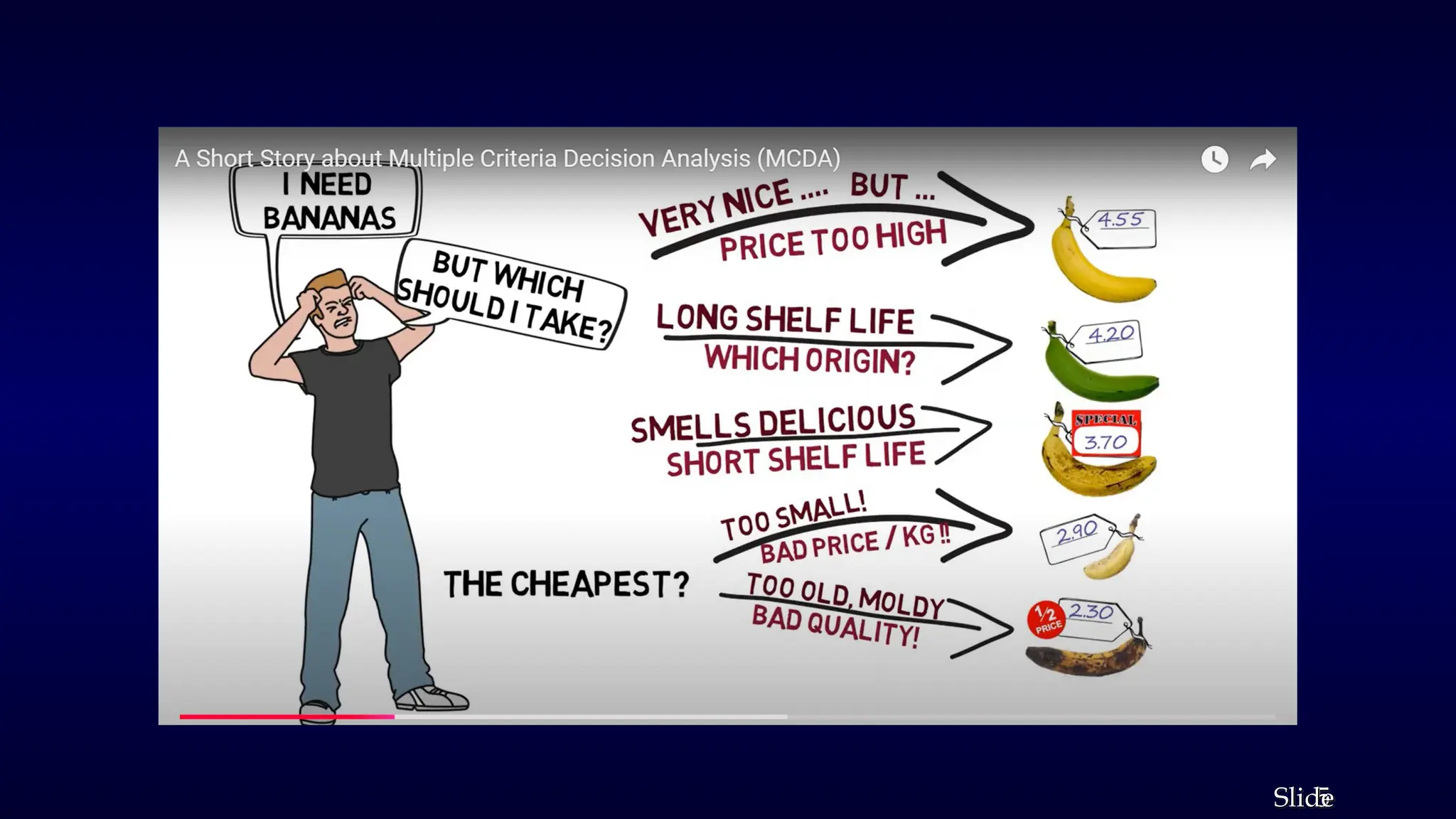
•In real-world scenarios, decisions often involve more than one criterion.
For example, businesses balancing cost, quality, and delivery speed when
selecting suppliers.
•MCDA enables a balanced approach, allowing for data-driven choices that
align with organizational goals.
4
Slide
Core Concepts of MCDA
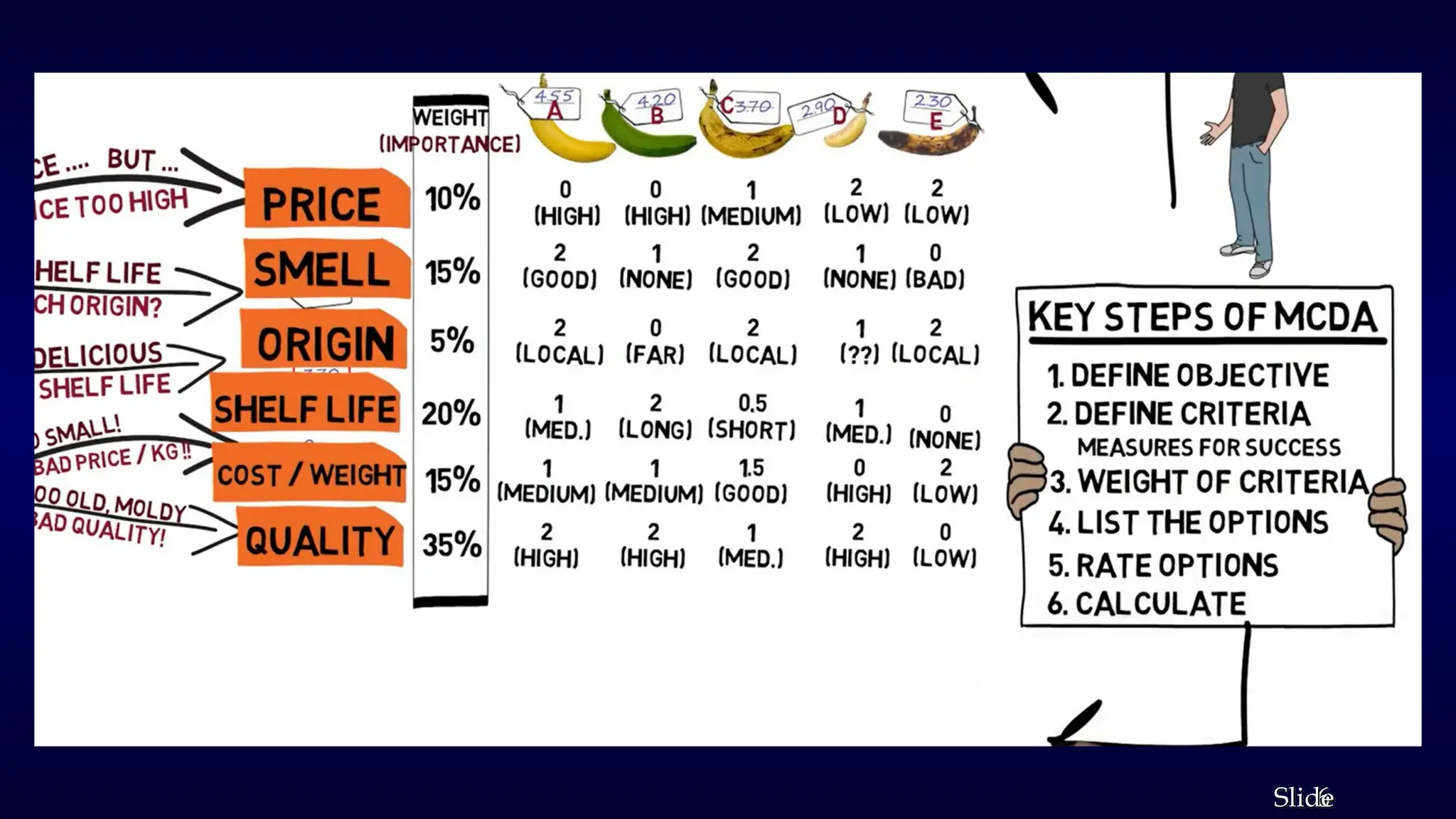
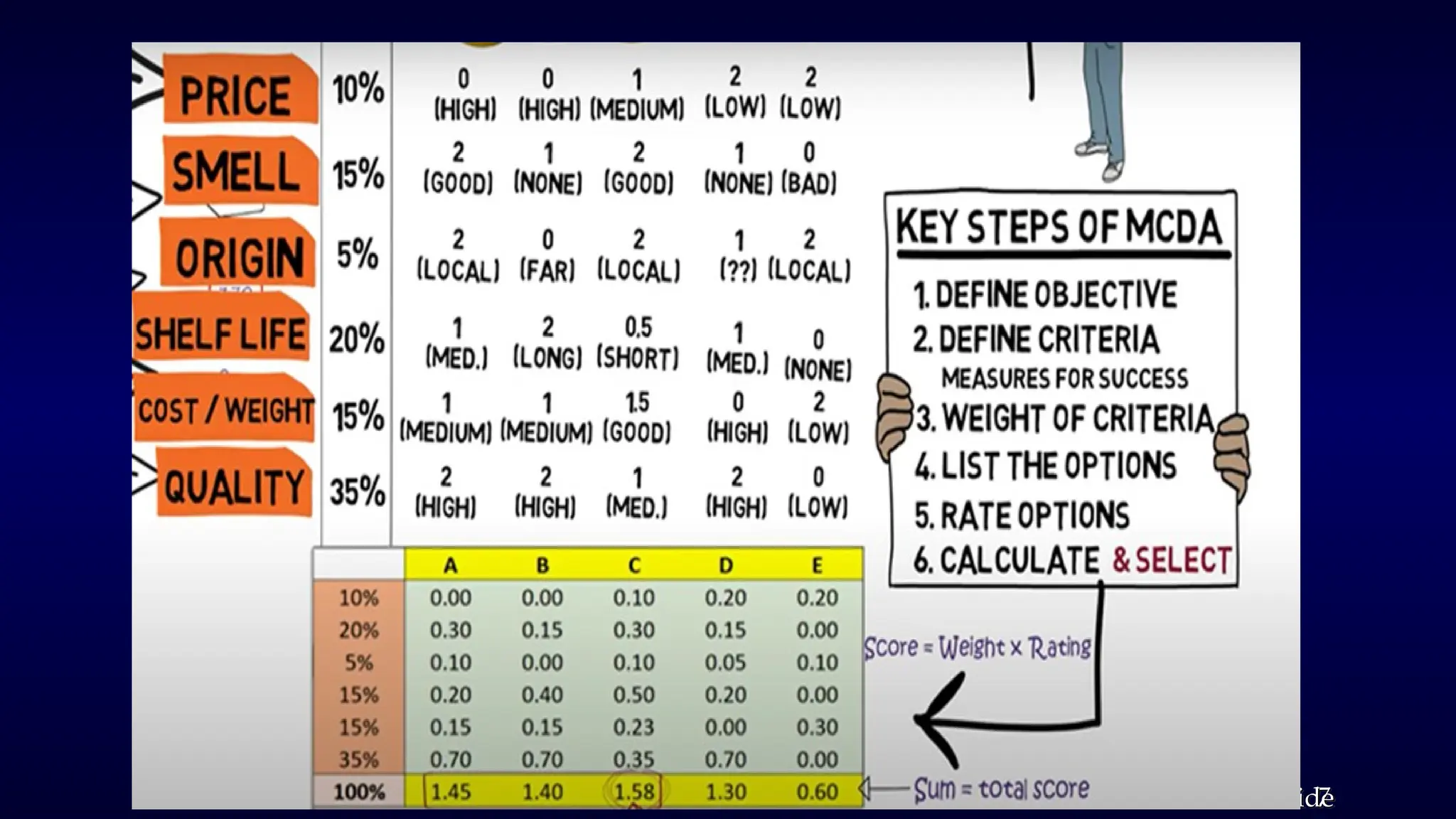
•Alternatives: Different options available to decision-makers
(e.g., potential suppliers or project locations).
•Criteria: Standards by which each alternative is judged (e.g.,
cost, quality, efficiency).
•Weights: Assigned to criteria based on their importance. A
higher weight reflects greater importance.
•Scoring: Each alternative receives a score for each criterion,
reflecting its performance in that area.
5
Slide
6
Slide
7
Slide
8
Slide
MCDA Process
 Choosing a New Office Location for a growing company.
 Step 1: Define the Decision Problem:
• Problem: Find the most suitable office location considering cost, employee
commute time, amenities, and proximity to key clients
 Step 2: Identify Criteria
• Criteria List:Cost: Budget constraints for office rent.
• Commute Time: Average travel time for employees.
• Amenities: Access to restaurants, parking, etc.
• Proximity to Clients: Distance to major clients for convenient visits
9
Slide
MCDA Process
 Step 3: Assign Weights to Criteria:
 Weight Assignment:
 Cost: 40%
 Commute Time: 25%
 Amenities: 15%
 Proximity to Clients: 20%
 Note that these weights total 100%, representing a balanced allocation of
importance based on the company’s priorities
10
Slide
MCDA Process
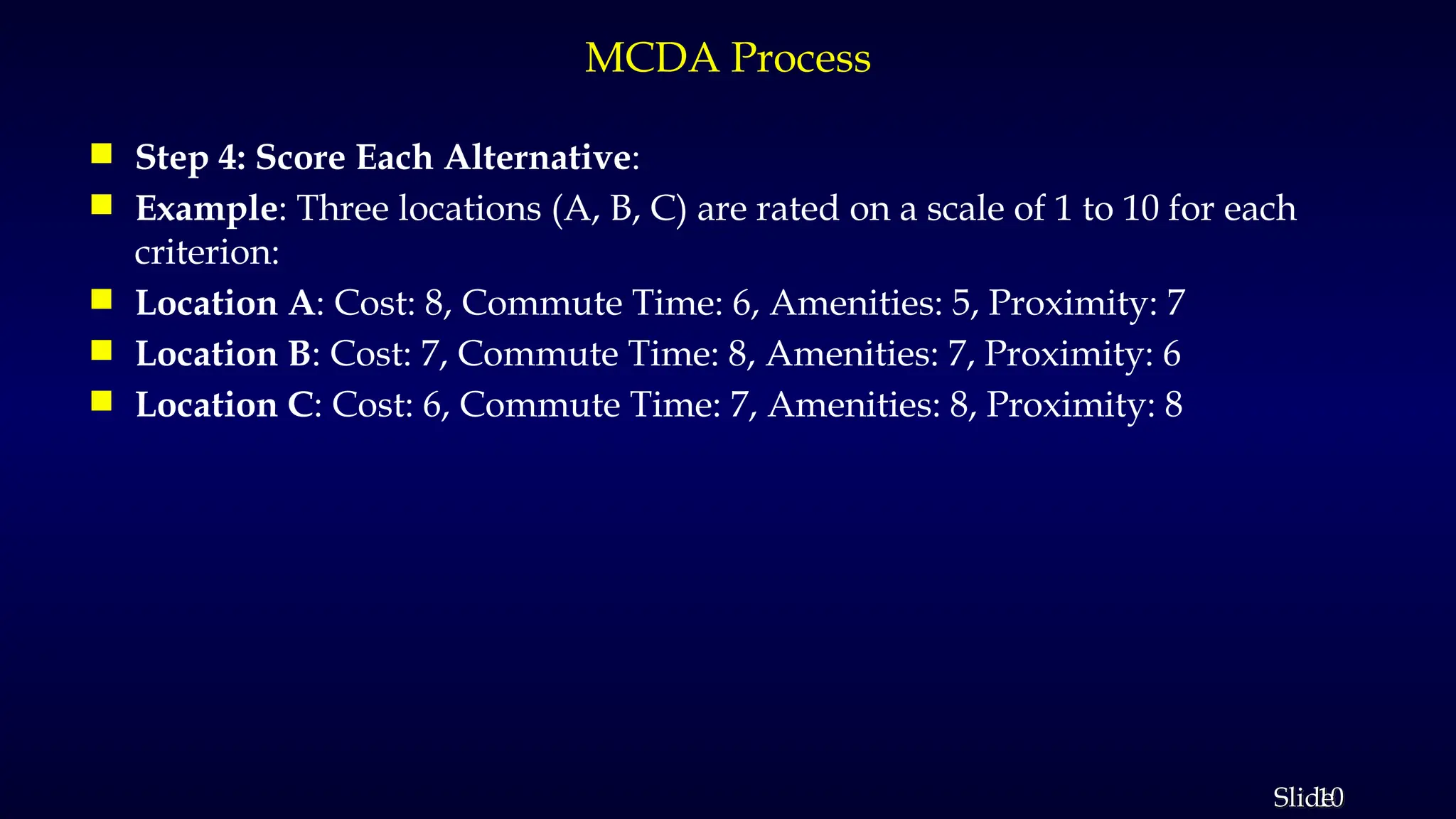
 Step 4: Score Each Alternative:
 Example: Three locations (A, B, C) are rated on a scale of 1 to 10 for each
criterion:
 Location A: Cost: 8, Commute Time: 6, Amenities: 5, Proximity: 7
 Location B: Cost: 7, Commute Time: 8, Amenities: 7, Proximity: 6
 Location C: Cost: 6, Commute Time: 7, Amenities: 8, Proximity: 8
11
Slide
MCDA Process
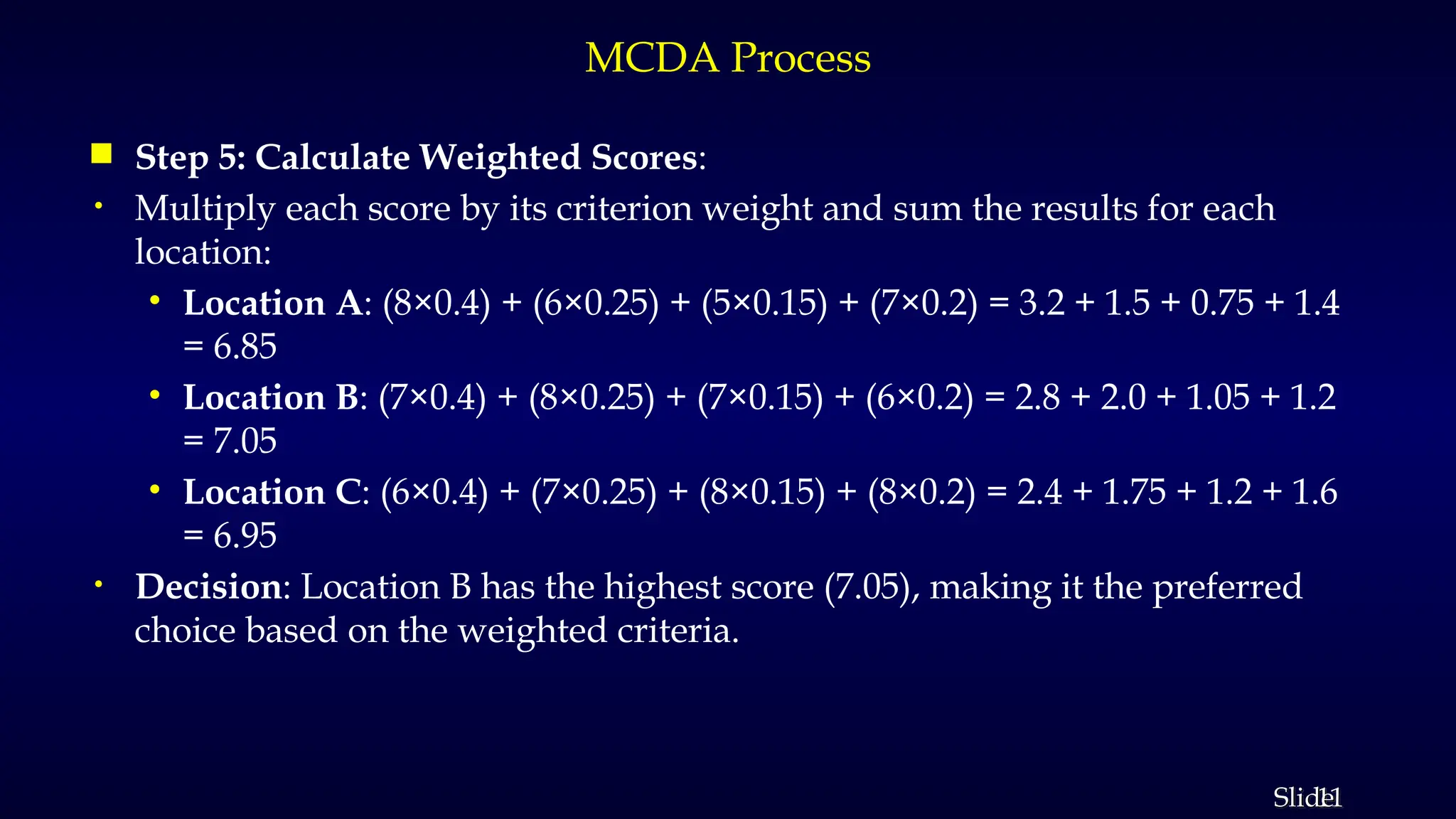
 Step 5: Calculate Weighted Scores:
• Multiply each score by its criterion weight and sum the results for each
location:
• Location A: (8×0.4) + (6×0.25) + (5×0.15) + (7×0.2) = 3.2 + 1.5 + 0.75 + 1.4
= 6.85
• Location B: (7×0.4) + (8×0.25) + (7×0.15) + (6×0.2) = 2.8 + 2.0 + 1.05 + 1.2
= 7.05
• Location C: (6×0.4) + (7×0.25) + (8×0.15) + (8×0.2) = 2.4 + 1.75 + 1.2 + 1.6
= 6.95
• Decision: Location B has the highest score (7.05), making it the preferred
choice based on the weighted criteria.
12
Slide
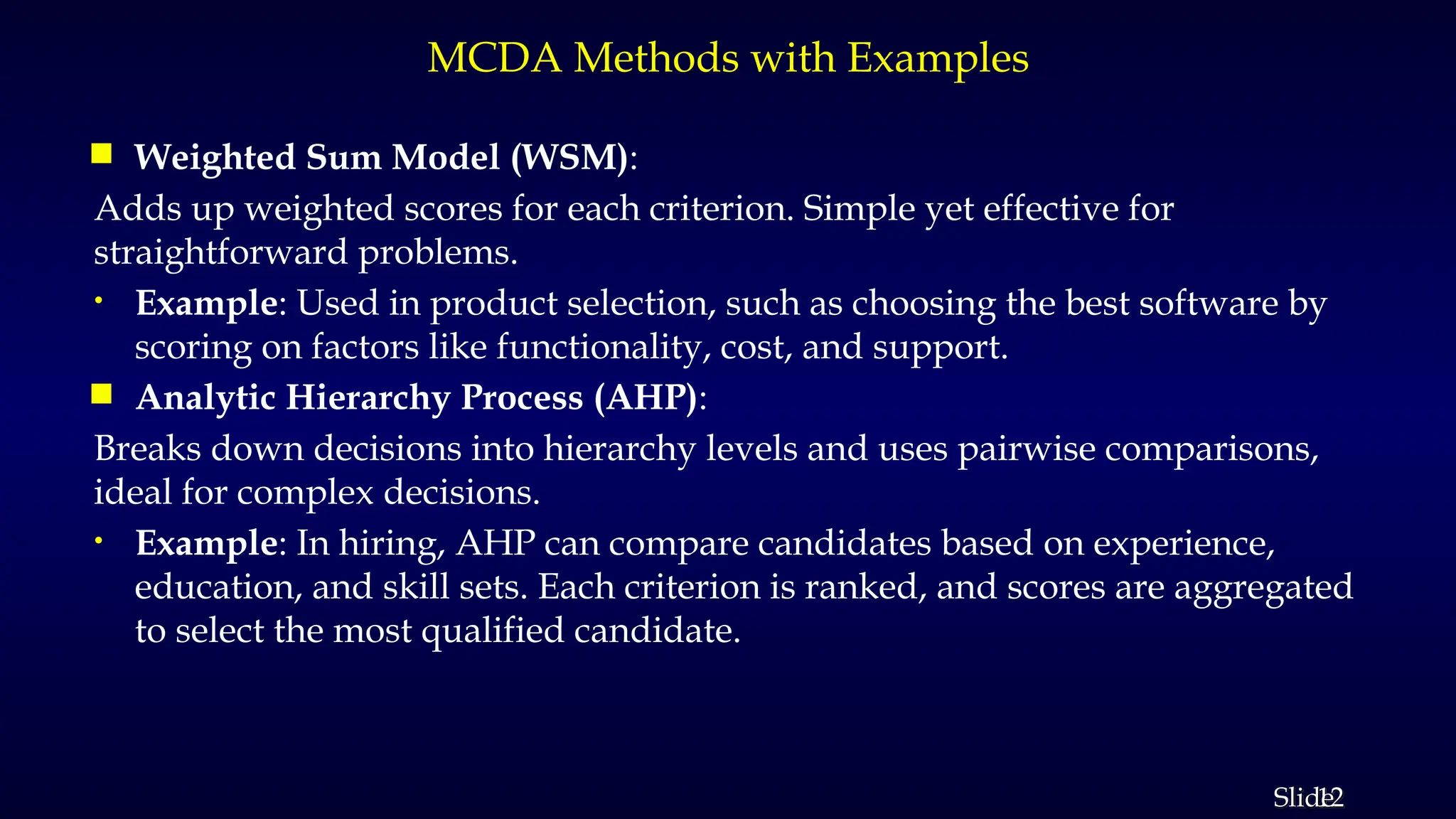
MCDA Methods with Examples
 Weighted Sum Model (WSM):
Adds up weighted scores for each criterion. Simple yet effective for
straightforward problems.
• Example: Used in product selection, such as choosing the best software by
scoring on factors like functionality, cost, and support.
 Analytic Hierarchy Process (AHP):
Breaks down decisions into hierarchy levels and uses pairwise comparisons,
ideal for complex decisions.
• Example: In hiring, AHP can compare candidates based on experience,
education, and skill sets. Each criterion is ranked, and scores are aggregated
to select the most qualified candidate.
13
Slide
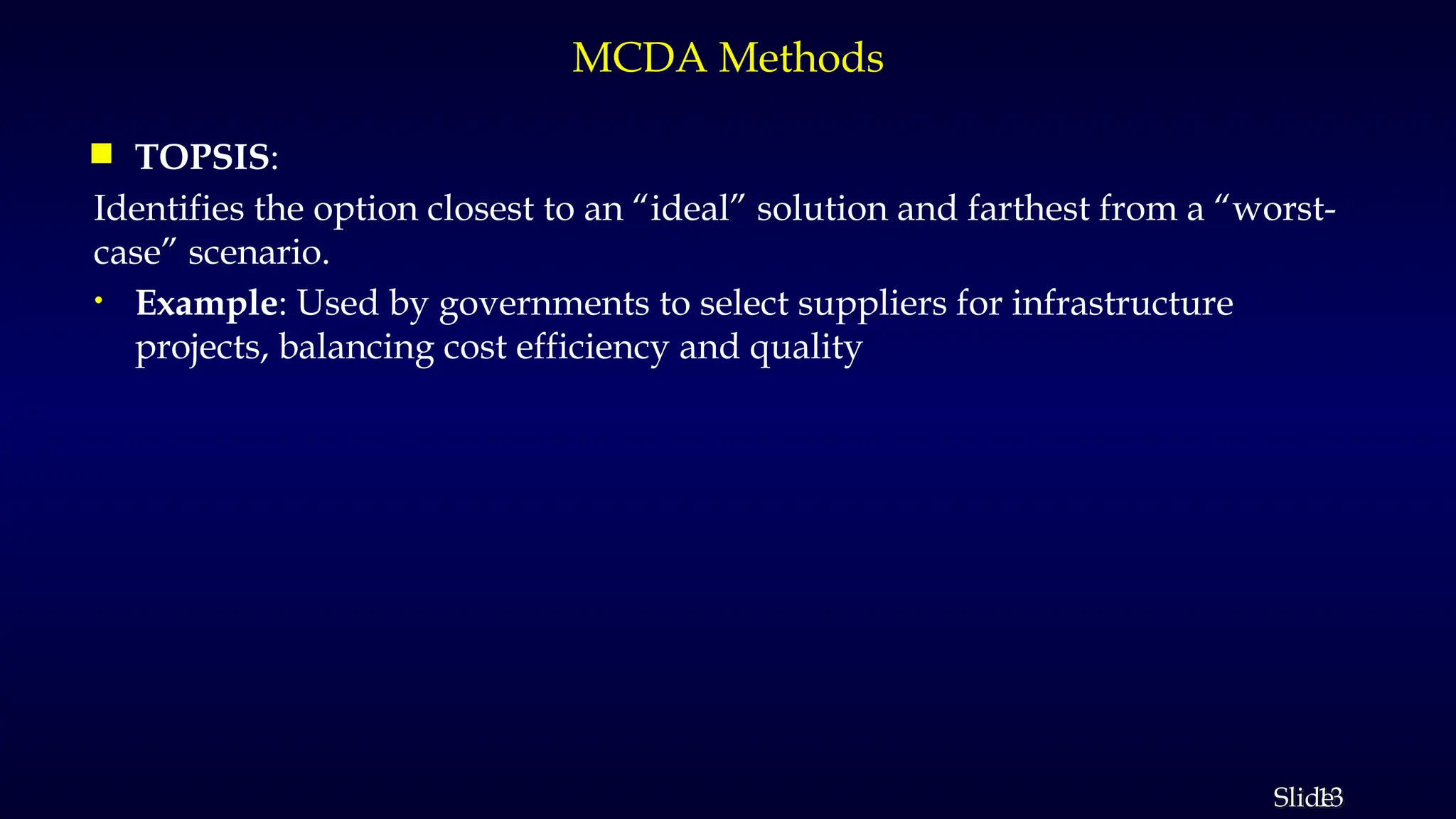
MCDA Methods
 TOPSIS:
Identifies the option closest to an “ideal” solution and farthest from a “worst-
case” scenario.
• Example: Used by governments to select suppliers for infrastructure
projects, balancing cost efficiency and quality
14
Slide
Real-World Applications of MCDA
 Healthcare:
• Resource Allocation: MCDA helps allocate limited resources, such as beds
or vaccines, by balancing factors like patient need, treatment cost, and
urgency.
• Example: During a health crisis, hospitals might use MCDA to prioritize
patient admissions based on factors like age, severity, and recovery
probability
 Environmental Management:
• Project Evaluation: MCDA is often used to assess projects involving
sustainability, balancing environmental impact with economic benefits.
• Example: Evaluating renewable energy projects (solar, wind, hydro) using
criteria like installation cost, environmental impact, and long-term benefits
15
Slide
Real-World Applications of MCDA
 Urban Planning:
• Infrastructure Development: Helps planners prioritize projects by scoring
criteria like cost, public benefit, and environmental impact.
• Example: When selecting locations for new parks, MCDA considers factors
like population density, accessibility, and cost
 Corporate Strategy:
• Product Development: Companies use MCDA to evaluate product
development ideas based on market demand, production cost, and
competitive advantage.
• Example: A company may decide between launching a high-quality or
budget-friendly version of a product by scoring customer demand, profit
potential, and brand alignment
16
Slide
Scenario
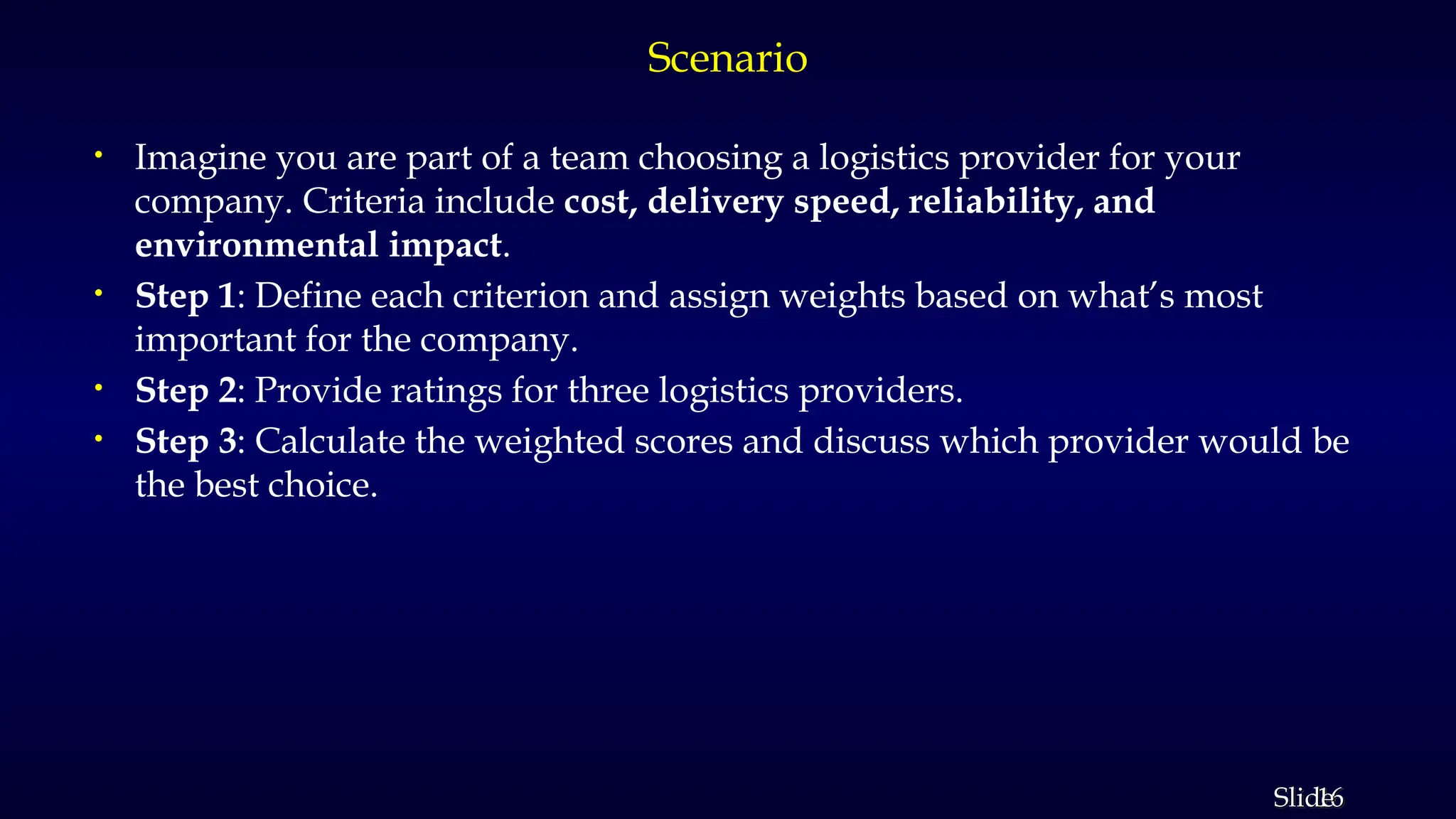
• Imagine you are part of a team choosing a logistics provider for your
company. Criteria include cost, delivery speed, reliability, and
environmental impact.
• Step 1: Define each criterion and assign weights based on what’s most
important for the company.
• Step 2: Provide ratings for three logistics providers.
• Step 3: Calculate the weighted scores and discuss which provider would be
the best choice.
17
Slide
Scenario
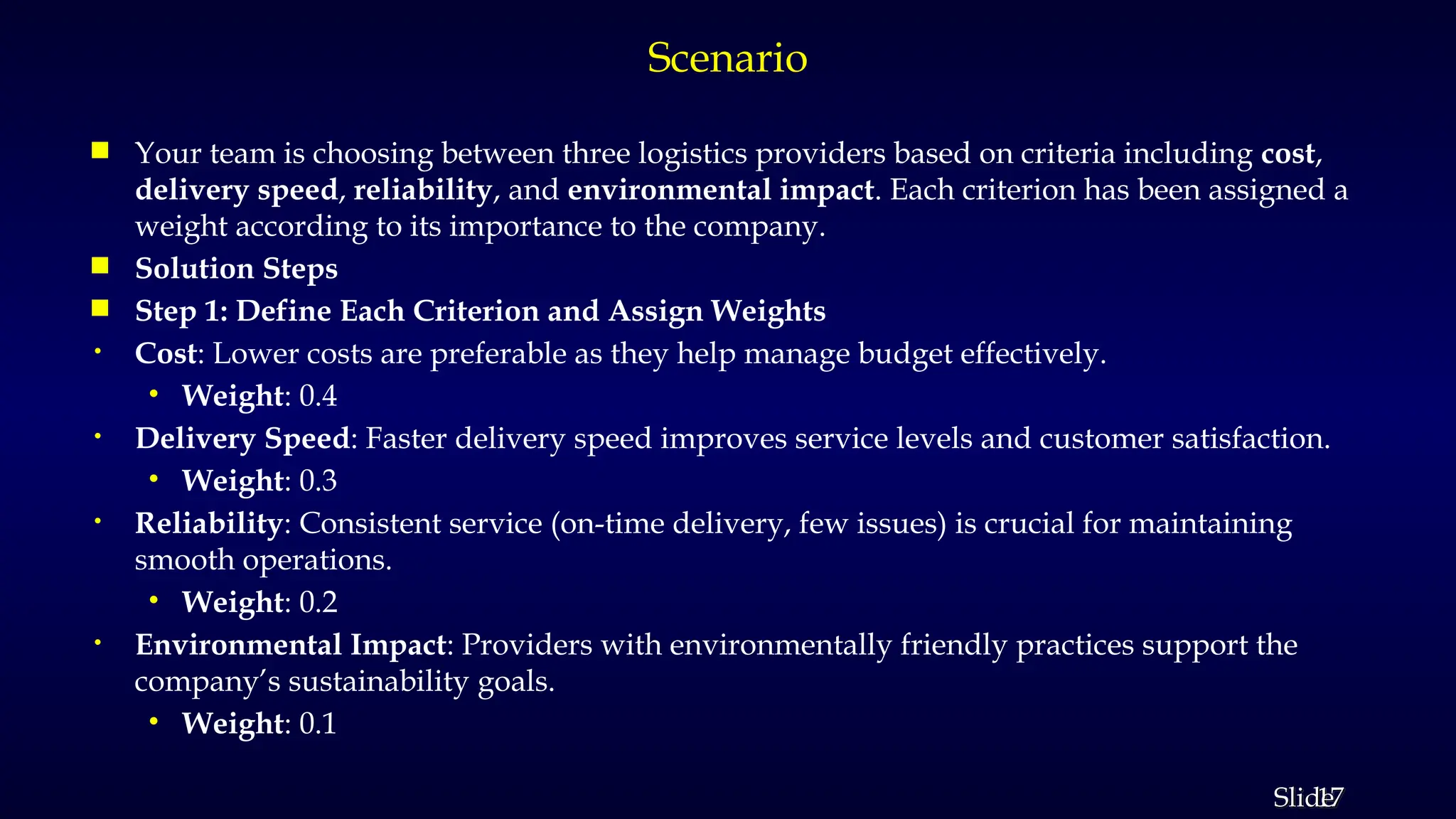
 Your team is choosing between three logistics providers based on criteria including cost,
delivery speed, reliability, and environmental impact. Each criterion has been assigned a
weight according to its importance to the company.
 Solution Steps
 Step 1: Define Each Criterion and Assign Weights
• Cost: Lower costs are preferable as they help manage budget effectively.
• Weight: 0.4
• Delivery Speed: Faster delivery speed improves service levels and customer satisfaction.
• Weight: 0.3
• Reliability: Consistent service (on-time delivery, few issues) is crucial for maintaining
smooth operations.
• Weight: 0.2
• Environmental Impact: Providers with environmentally friendly practices support the
company’s sustainability goals.
• Weight: 0.1
18
Slide
Scenario
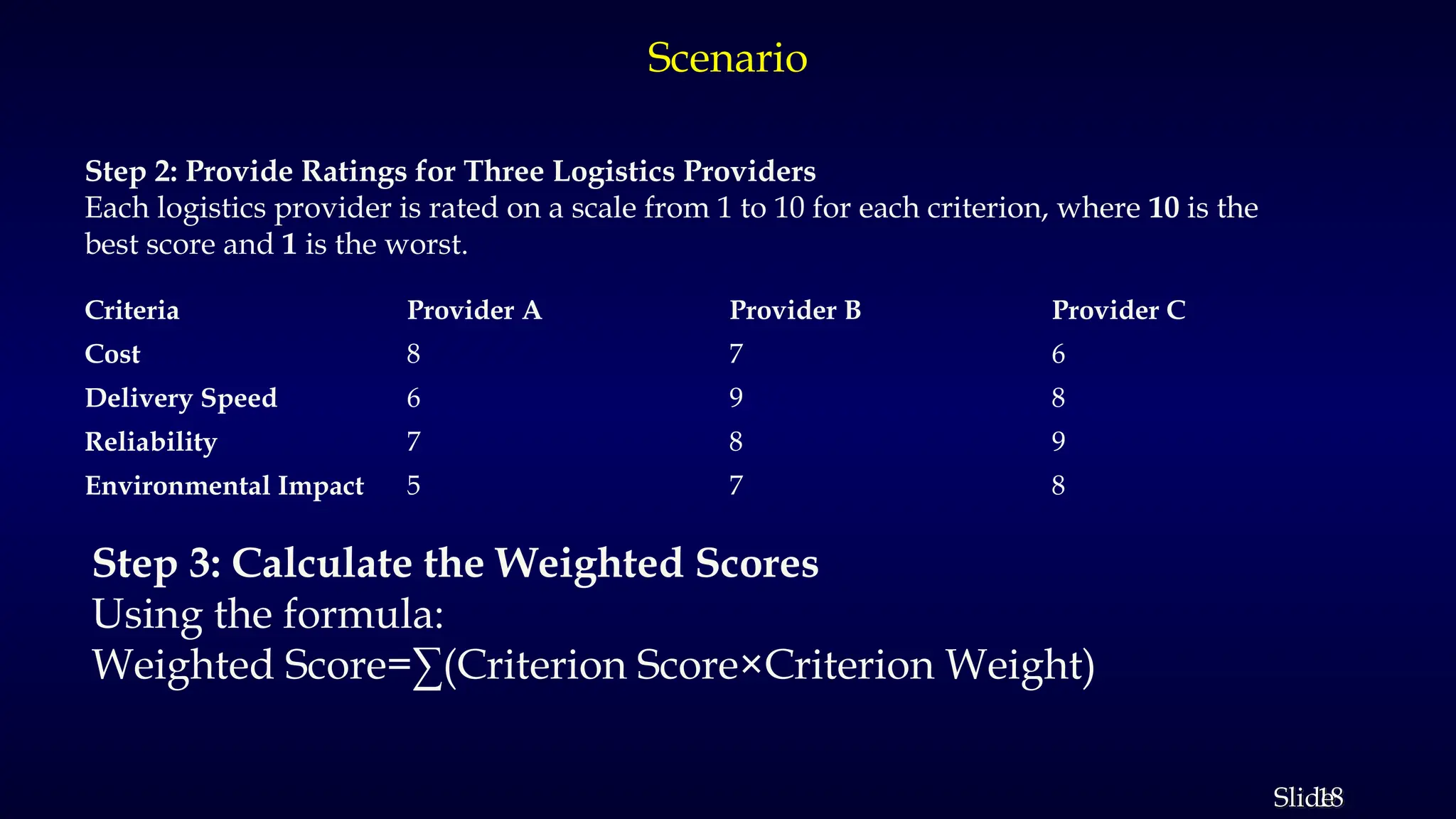
Criteria Provider A Provider B Provider C
Cost 8 7 6
Delivery Speed 6 9 8
Reliability 7 8 9
Environmental Impact 5 7 8
Step 2: Provide Ratings for Three Logistics Providers
Each logistics provider is rated on a scale from 1 to 10 for each criterion, where 10 is the
best score and 1 is the worst.
Step 3: Calculate the Weighted Scores
Using the formula:
Weighted Score=∑(Criterion Score×Criterion Weight)
19
Slide
Scenario
 Calculate the weighted score for each provider:
Provider A:
(8×0.4)+(6×0.3)+(7×0.2)+(5×0.1)
3.2+1.8+1.4+0.5=6.9
Provider B:
(7×0.4)+(9×0.3)+(8×0.2)+(7×0.1)
2.8+2.7+1.6+0.7=7.8
Provider C:
(6×0.4)+(8×0.3)+(9×0.2)+(8×0.1)
2.4+2.4+1.8+0.8=7.4
20
Slide
Scenario
 Step 4: Select the Best Provider
• Final Scores:
• Provider A: 6.9
• Provider B: 7.8
• Provider C: 7.4
Based on the MCDA weighted scores, Provider B is the best choice with the
highest score of 7.8.

MCDA Multi Criteria Decision Analysis.pptx

  • 1.
    1 Slide Slides Prepared byRafia Zafar QUANTITATIVE METHODS FOR BUSINESS 8e
  • 2.
    2 Slide Chapter 5 Introduction  MCDA Core Concepts of MCDA  MCDA Process  MCDA Methods with Examples  Real-World Applications of MCDA  In-Class Problem Solving Exercise
  • 3.
    3 Slide MCDA •MCDA is adecision-making framework designed to evaluate multiple conflicting criteria, essential in situations where trade-offs are required. •MCDA helps bring structure and clarity to complex decisions, reducing the influence of biases and focusing on objective analysis. Importance in Decision-Making: •In real-world scenarios, decisions often involve more than one criterion. For example, businesses balancing cost, quality, and delivery speed when selecting suppliers. •MCDA enables a balanced approach, allowing for data-driven choices that align with organizational goals.
  • 4.
    4 Slide Core Concepts ofMCDA •Alternatives: Different options available to decision-makers (e.g., potential suppliers or project locations). •Criteria: Standards by which each alternative is judged (e.g., cost, quality, efficiency). •Weights: Assigned to criteria based on their importance. A higher weight reflects greater importance. •Scoring: Each alternative receives a score for each criterion, reflecting its performance in that area.
  • 5.
  • 6.
  • 7.
  • 8.
    8 Slide MCDA Process  Choosinga New Office Location for a growing company.  Step 1: Define the Decision Problem: • Problem: Find the most suitable office location considering cost, employee commute time, amenities, and proximity to key clients  Step 2: Identify Criteria • Criteria List:Cost: Budget constraints for office rent. • Commute Time: Average travel time for employees. • Amenities: Access to restaurants, parking, etc. • Proximity to Clients: Distance to major clients for convenient visits
  • 9.
    9 Slide MCDA Process  Step3: Assign Weights to Criteria:  Weight Assignment:  Cost: 40%  Commute Time: 25%  Amenities: 15%  Proximity to Clients: 20%  Note that these weights total 100%, representing a balanced allocation of importance based on the company’s priorities
  • 10.
    10 Slide MCDA Process  Step4: Score Each Alternative:  Example: Three locations (A, B, C) are rated on a scale of 1 to 10 for each criterion:  Location A: Cost: 8, Commute Time: 6, Amenities: 5, Proximity: 7  Location B: Cost: 7, Commute Time: 8, Amenities: 7, Proximity: 6  Location C: Cost: 6, Commute Time: 7, Amenities: 8, Proximity: 8
  • 11.
    11 Slide MCDA Process  Step5: Calculate Weighted Scores: • Multiply each score by its criterion weight and sum the results for each location: • Location A: (8×0.4) + (6×0.25) + (5×0.15) + (7×0.2) = 3.2 + 1.5 + 0.75 + 1.4 = 6.85 • Location B: (7×0.4) + (8×0.25) + (7×0.15) + (6×0.2) = 2.8 + 2.0 + 1.05 + 1.2 = 7.05 • Location C: (6×0.4) + (7×0.25) + (8×0.15) + (8×0.2) = 2.4 + 1.75 + 1.2 + 1.6 = 6.95 • Decision: Location B has the highest score (7.05), making it the preferred choice based on the weighted criteria.
  • 12.
    12 Slide MCDA Methods withExamples  Weighted Sum Model (WSM): Adds up weighted scores for each criterion. Simple yet effective for straightforward problems. • Example: Used in product selection, such as choosing the best software by scoring on factors like functionality, cost, and support.  Analytic Hierarchy Process (AHP): Breaks down decisions into hierarchy levels and uses pairwise comparisons, ideal for complex decisions. • Example: In hiring, AHP can compare candidates based on experience, education, and skill sets. Each criterion is ranked, and scores are aggregated to select the most qualified candidate.
  • 13.
    13 Slide MCDA Methods  TOPSIS: Identifiesthe option closest to an “ideal” solution and farthest from a “worst- case” scenario. • Example: Used by governments to select suppliers for infrastructure projects, balancing cost efficiency and quality
  • 14.
    14 Slide Real-World Applications ofMCDA  Healthcare: • Resource Allocation: MCDA helps allocate limited resources, such as beds or vaccines, by balancing factors like patient need, treatment cost, and urgency. • Example: During a health crisis, hospitals might use MCDA to prioritize patient admissions based on factors like age, severity, and recovery probability  Environmental Management: • Project Evaluation: MCDA is often used to assess projects involving sustainability, balancing environmental impact with economic benefits. • Example: Evaluating renewable energy projects (solar, wind, hydro) using criteria like installation cost, environmental impact, and long-term benefits
  • 15.
    15 Slide Real-World Applications ofMCDA  Urban Planning: • Infrastructure Development: Helps planners prioritize projects by scoring criteria like cost, public benefit, and environmental impact. • Example: When selecting locations for new parks, MCDA considers factors like population density, accessibility, and cost  Corporate Strategy: • Product Development: Companies use MCDA to evaluate product development ideas based on market demand, production cost, and competitive advantage. • Example: A company may decide between launching a high-quality or budget-friendly version of a product by scoring customer demand, profit potential, and brand alignment
  • 16.
    16 Slide Scenario • Imagine youare part of a team choosing a logistics provider for your company. Criteria include cost, delivery speed, reliability, and environmental impact. • Step 1: Define each criterion and assign weights based on what’s most important for the company. • Step 2: Provide ratings for three logistics providers. • Step 3: Calculate the weighted scores and discuss which provider would be the best choice.
  • 17.
    17 Slide Scenario  Your teamis choosing between three logistics providers based on criteria including cost, delivery speed, reliability, and environmental impact. Each criterion has been assigned a weight according to its importance to the company.  Solution Steps  Step 1: Define Each Criterion and Assign Weights • Cost: Lower costs are preferable as they help manage budget effectively. • Weight: 0.4 • Delivery Speed: Faster delivery speed improves service levels and customer satisfaction. • Weight: 0.3 • Reliability: Consistent service (on-time delivery, few issues) is crucial for maintaining smooth operations. • Weight: 0.2 • Environmental Impact: Providers with environmentally friendly practices support the company’s sustainability goals. • Weight: 0.1
  • 18.
    18 Slide Scenario Criteria Provider AProvider B Provider C Cost 8 7 6 Delivery Speed 6 9 8 Reliability 7 8 9 Environmental Impact 5 7 8 Step 2: Provide Ratings for Three Logistics Providers Each logistics provider is rated on a scale from 1 to 10 for each criterion, where 10 is the best score and 1 is the worst. Step 3: Calculate the Weighted Scores Using the formula: Weighted Score=∑(Criterion Score×Criterion Weight)
  • 19.
    19 Slide Scenario  Calculate theweighted score for each provider: Provider A: (8×0.4)+(6×0.3)+(7×0.2)+(5×0.1) 3.2+1.8+1.4+0.5=6.9 Provider B: (7×0.4)+(9×0.3)+(8×0.2)+(7×0.1) 2.8+2.7+1.6+0.7=7.8 Provider C: (6×0.4)+(8×0.3)+(9×0.2)+(8×0.1) 2.4+2.4+1.8+0.8=7.4
  • 20.
    20 Slide Scenario  Step 4:Select the Best Provider • Final Scores: • Provider A: 6.9 • Provider B: 7.8 • Provider C: 7.4 Based on the MCDA weighted scores, Provider B is the best choice with the highest score of 7.8.