Running head: GROUP 5 RESEARCH PAPER: THE GENDER WAGE GAP 1
Group 5 Research Paper: The Gender Wage Gap
Chris Capparelli, Ashly Heavener, Kelly McChuen, and Jared Wojcikowski
Submitted to Dr. Gregory Arburn in partial fulfillment of requirements for
MBA 640-71: Research for Decision Making
Summer, 2016
The University of Findlay
GROUP 5 RESEARCH PAPER: THE GENDER WAGE GAP 2
Table of Contents
Abstract .…………..……………………………………………………………………………... 3
Introduction ……...….…………………………………………………………………………… 5
Theoretical Foundation ...………………....................................................................................... 6
Literature Review ...……………………………............................................................................ 8
Hypothesis Development ...……………………….…………..………………………............... 15
Research Methods .…………………………….……………….................................................. 16
Results and Discussion ...……………………............................................................................. 18
Implications of Research ………................................................................................................. 19
Limitations and Suggestions for Future Research ....................................................................... 19
Conclusion .…………….………................................................................................................. 21
References ………........................................................................................................................ 22
Appendix ..………........................................................................................................................ 25
GROUP 5 RESEARCH PAPER: THE GENDER WAGE GAP 3
Abstract
The objective of this research is to determine the current existence of disparate differences
amongst compensation levels between males and females as a result of disparate treatment
towards women, better known as the gender wage gap. Further, this research will identify the
current status of the gender wage gap. The research will also establish the progress made in
reducing such gaps as a result of government action and social activism. Compensation levels
from around the United States are collected through a survey, and the results are analyzed as a
means to ascertain the existence of a wage gap amongst genders. Participants from the survey are
residents of the United States and members of both genders, for a total of 377 participants that
represent the sample population for this research.
The results of the analysis indicate the existence of a current compensation gap between
males and females, comparable to the current levels measured by previous studies contained
within the literature review. The literature review indicates a decreasing compensation gap
between the female and male genders over the past few decades. However, over the most recent
two decades, research indicates a stagnant amount of progress being made which is supported by
the analysis of the survey responses. Previous assessments over the course of the past few
decades regarding compensation gaps and actions taken by the U.S. government are explicitly
provided. Overall, reductions in the gender wage gap have been achieved through such actions,
however complete elimination of the wage gap is still an outstanding issue requiring further
action due to recent stagnation in progress. Suggestions and directions for future research are
provided along with conclusions.
GROUP 5 RESEARCH PAPER: THE GENDER WAGE GAP 4
Keywords: Gender Wage Gap; Disparate Treatment; U.S. Government Actions Social Activism
GROUP 5 RESEARCH PAPER: THE GENDER WAGE GAP 5
Group 5 Research Paper
Introduction
Many laws have been passed over the course of time to push towards the progress that
formed the society we see today. Movements towards granting women equal rights as compared
to men seem to have occurred so long ago. It can be hard to imagine a time where women were
not allowed to vote, or a time where women did not receive the same pay as men. However, a
wage gap amongst gender still exists, and has remained stagnant over the previous couple of
decades even after social acknowledgment and reform, and continued activism, leaving one to
wonder what is being done by the government or by individual companies to reduce and
eliminate this gap.
The gender pay gap is a fairly well known issue in America, but a lot of people tend to
believe the gap has reduced drastically through time, if not almost completely eliminated. As of
2014, women statistically made only 78.6% of what their male counterparts made as compared to
60.7% in 1960 (National Committee on Pay Equity, 2015). The gap actually grows as one’s age
increases in the workforce, and are even worse amongst women of different ethnicities (Hill,
2016 and Sharp, 2012).
The gender wage gap can be defined as the difference in compensation between men and
women, specifically males earning a significant amount more in overall pay as compared to
females, as a result of the disparate treatment of women through direct and indirect
discrimination in industry and occupation, workforce participation, overwork, and career
interruptions. Even with the progression of the American society resulting in the passage of
multiple laws affecting employment and social norms, the gender wage gap is still very real, and
is a concerning problem from multiple perspectives. The enactment of these laws surrounding
GROUP 5 RESEARCH PAPER: THE GENDER WAGE GAP 6
employment and social expectations by the U.S. government has caused the gender wage gap to
become more widely publicized, forcing society to recognize the existence of a gap in
compensation between males and females, further prompting social activism. Now that the
gender wage gap problem is a prevalent issue, further and continued action can be taken through
continued research, education, training, government action, and changes to company policy and
procedure.
The research is organized as follows: theoretical foundation, a literature review of
previous research focused on the gender wage gap and a timeline of governmental actions in
comparison to a measure of the gender wage gap at certain points in time, hypothesis
development, research methods, results and discussion, implications of research, limitations and
suggestions for future research, and conclusions drawn from the findings of this research.
Theoretical Foundation
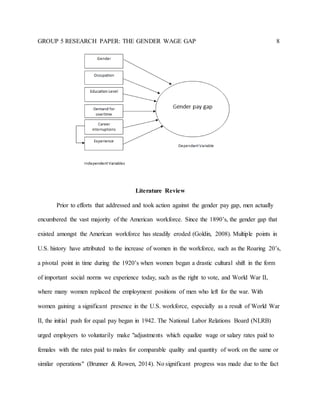
The dependent variable of the gender pay gap is influenced by several independent
variables, which include gender, education level, occupation, experience, career interruptions,
and demand for overtime. Gender is a socially constructed term assigned to males and females.
Each society emphasizes certain roles that each gender should play, and that men and women are
different in regards to behavior, attitude, and emotion. Education level refers to the highest level
of education completed. Occupation refers to one’s profession, whereas experience is the process
of becoming familiar with a specific field of knowledge that is acquired over a period of time,
resulting in a superior understanding of a specific field. Career interruptions are breaks in one’s
current career, and demand for overtime refers to a strong need for employers to have their
employees work more than forty hours in a single workweek.
GROUP 5 RESEARCH PAPER: THE GENDER WAGE GAP 7
The literature review confirms that the gender pay gap still exists, with females making
less money than their male counterparts. The more education one has completed, the greater the
chances for increased salary levels. For example, an employee with a Master’s degree has a
greater opportunity for a higher salary and advancement than a person with less education, such
as a Bachelor’s degree. Historically, men held more Master’s degrees than women, but recently
women have started earning more Master’s degrees than men. Occupation tends to have an effect
on the gender gap, as well. Women tend to choose careers that are nurturing in nature, such as
teachers, registered nurses, and administrative assistants. Men tend to dominate higher-paying
fields such as accounting, politics, medical physicians, and construction. Thus, career choice
plays a pivotal role in the gender gap.
Men tend to work in industries that have a higher demand for overtime. A greater demand
for overtime creates opportunities for men to make more money than women, thus contributing
to the gender pay gap. Whereas men tend to work in industries that require overtime, women are
more inclined to put their careers on hold for others. For example, women, more than men, take a
break from their careers to care for a child or for a sick family member. Career interruptions also
decrease the amount of experience gained in one’s respected field. Career interruptions result in
less experience, which in turn reduces the chances for promotions and salary increases. Thus,
less experience equates to lower salaries. These relationships are outlined in the figure below.
GROUP 5 RESEARCH PAPER: THE GENDER WAGE GAP 8
Literature Review
Prior to efforts that addressed and took action against the gender pay gap, men actually
encumbered the vast majority of the American workforce. Since the 1890’s, the gender gap that
existed amongst the American workforce has steadily eroded (Goldin, 2008). Multiple points in
U.S. history have attributed to the increase of women in the workforce, such as the Roaring 20’s,
a pivotal point in time during the 1920’s when women began a drastic cultural shift in the form
of important social norms we experience today, such as the right to vote, and World War II,
where many women replaced the employment positions of men who left for the war. With
women gaining a significant presence in the U.S. workforce, especially as a result of World War
II, the initial push for equal pay began in 1942. The National Labor Relations Board (NLRB)
urged employers to voluntarily make "adjustments which equalize wage or salary rates paid to
females with the rates paid to males for comparable quality and quantity of work on the same or
similar operations" (Brunner & Rowen, 2014). No significant progress was made due to the fact
GROUP 5 RESEARCH PAPER: THE GENDER WAGE GAP 9
that the NLRB’s push for equality in compensation was only voluntary. Another major push for
equal pay would not occur for almost another two decades.
Through time, the gender pay gap has reduced, but is still far from being eliminated. In
1960, women made 60.7% of the pay that men made (National Committee on Pay Equity, 2015).
Progress began to be made on the State and Federal level through the enactment of laws and
adjustments to payrolls as a means to correct the gender and race biases that existed amongst
compensation (National Committee on Pay Equity, 2015). The Equal Pay Act of 1963 prohibited
sex-based wage discrimination amongst men and women, but did not include any language on
the basis of race or ethnicity (U.S. Equal Employment Opportunity Commission, 2012 a). The
year following the passage of the Equal Pay Act, the Civil Rights Act of 1964 was passed, which
prohibited discrimination on the basis of race, color, religion, sex and national origin (U.S. Equal
Employment Opportunity Commission, 2012 b). Even with the passage of these two laws in
consecutive years, the language still lacked coverage on the basis of disability, genetic
information, pregnancy, and retaliation. However, the passage of these laws seemed to set a
precedence in time that would clear the way for the passage of additional laws as a result of the
U.S. government and the American population noticing a serious problem in wage
discrimination.
In 1967, when the gender wage gap inferred that women made 57.8% of what their male
counterpart made, the Age Discrimination in Employment Act of 1967 was passed in order to
prohibit employment discrimination on the basis of age, specifically for those who were forty
years of age or older (National Committee on Pay Equity, 2015 and U.S. Equal Employment
Opportunity Commission, 2012 d). In 1973, the Rehabilitation Act was passed containing
specific language within Section 505 that prohibited retaliation for claims of discrimination (U.S.
GROUP 5 RESEARCH PAPER: THE GENDER WAGE GAP 10
Equal Employment Opportunity Commission, 2012 f). In 1978, when the gender gap inferred
that women made 59.4% of what their male counterpart made, the Pregnancy Discrimination Act
was passed in order to provide job protection to pregnant employees (National Committee on
Pay Equity, 2015 and U.S. Equal Employment Opportunity Commission, 2012 c). In 1990, when
the gender wage gap inferred that women made 70.6% of what their male counterparts made,
Titles I and V of the Americans with Disabilities Act was passed in order to prohibit employers
with twenty-five or more employees from discriminating against qualified individuals with
disabilities (National Committee on Pay Equity, 2015 and U.S. Equal Employment Opportunity
Commission, 2012 e). In 2008, the Genetic Information Nondiscrimination Act was passed in
order to prohibit discrimination on the basis of genetic information with respect to health
insurance and employment (U.S. Equal Employment Opportunity Commission, 2012 g). In 2008,
the gender pay gap inferred that women made 77.1% of what their male counterpart made
(National Committee on Pay Equity, 2015). This is a drastic improvement since the 1960’s, but
still very far from a total elimination of the gap.
Overall, the convergence between men and women in traditional human capital factors,
such as education and experience, were factors that contributed most towards a reduction of the
gender pay gap (Blau & Kahn, 2016, page 52). The gender wage gap reduced at a faster rate
during the 1980’s, but slowed down during the 1990’s (Blau & Kahn, 2007, page 4). The rates at
which males succeed in certain categories have begun to decline in comparison to rising rates for
women, such as encumbering higher-level positions (Blau & Kahn, 2016, page 4). This
stagnation has become a consistent trend across multiple factors including overall workforce
participation (Blau & Kahn, 2016, page 69).
GROUP 5 RESEARCH PAPER: THE GENDER WAGE GAP 11
As of 2014, the gender pay gap has not improved much over the last decade, with the gap
of salaries between men and women growing with age (Hill, 2016). In 2014, women statistically
made 78.6% of what their male counterparts made (National Committee on Pay Equity, 2015).
The pay gap of between men and women is still significant, and is even more of an issue for
women of ethnicity (Hill, 2016; Bibler, 2015). The educational achievement gap of more men
obtaining college degrees over women has closed so much that women have actually obtained
the majority of undergraduate and graduate degrees during the 1990’s (Goldberg & Hill, 2007,
page 10). According to Pew Research (2015), the gender pay gap has decreased from $0.36 in
the 1980’s to $0.16 in 2012. Women would need to work an additional forty days each year in
order to be equally compensated in comparison to their male counterpart (Patten, 2015). Further,
at the current pace which the gender pay gap is reducing, women will not see equal pay until
2059 (National Committee on Pay Equity, 2015).
Pay gaps are serious issues not only out of fairness, but also to provide sustainable
compensation in order to support families that no longer fit the typical mother-and-father
household. In 2005, one out of every five families did not consist of a male, meaning that a
woman who earns less than her male counterpart would need to work longer hours and be away
from her family more as a result, due to the gender wage gap (Goldberg & Hill, 2007, page 6).
However, another contributing factor to the persistence of the gender pay gap is the increasing
demand for overtime work. A lower proportion of women as compared to men work longer
hours. Women are less likely to enter jobs that require longer hours, and are also less likely to
remain in jobs that require longer hours (Cha & Weeden, 2014, page 3). The willingness of men
to work longer hours could actually contribute to the stagnant state of the gender pay gap
reduction, and its progress towards total elimination (Cha & Weeden, 2014, page 4).
GROUP 5 RESEARCH PAPER: THE GENDER WAGE GAP 12
Occupational gender segregation is contributing less to the gender wage gap than it was
four decades ago due to more females moving into employment roles that were once
predominantly male, however this trend has begun to decline in the past decade (Hallman, 2016,
pages 16 – 17). This type of occupational segregation still contributes to the gender wage gap,
which can further be exacerbated by overwork, or overtime. Overwork is most pronounced in
professional and managerial occupations (Cha & Weeden, 2016, page 17). In combination with
the trend that women statistically do not encumber jobs that require longer working hours as
compared to their male counterpart, or tend to not remain as long in such positions, overwork
also contributes to the gender wage gap.
Statistics indicating that women tend not to encumber positions with longer working
hours, or remain in such positions, can be attributed towards career interruptions as a result of
traditional gender roles and motherhood penalties. When women take on family responsibilities,
such as motherhood and other nonmarket family-related roles, they are more likely to take a
leave of absence or leave a job altogether, which equates to less job experience and the
possibility of increased discriminatory stigmas against women (Blau & Kahn, 2016, pages 23 -
25, 29, 49 – 50).
Some evidence suggests that men have a higher propensity to negotiate than women. In
terms of salary, this can further contribute to the increase of a gender wage gap as age increases.
This difference can be conveyed through the example presented by De Cremer, Zeelenberg, &
Murningan (pages 621 – 622, 2008) where a male and a female are both hired for the same job at
the same time, but the male negotiates a 1% higher annual raise each year. The 1% can add up to
thousands of dollars each year.
GROUP 5 RESEARCH PAPER: THE GENDER WAGE GAP 13
The level of occupation of higher-level management positions by women continues to
increase, which has further contributed to a reduction of the gender wage gap. A study
conducted by Bertrand & Hellock (2001, pages 3 – 7) researched the occupation of these
positions by women between 1992 and 1997 and found that men occupied more executive
leadership positions than women did overall, however women tended to have a more significant
presence within smaller organizations. Further, women tended to occupy these higher-level
positions within certain industries, such as those specializing in health and social services, and in
trade, but less in heavy equipment manufacturing, agriculture, construction, and mining
(Bertrand & Hellock, 2001, page 7). Since then, women have begun to occupy higher-lever
leadership roles within larger companies, further contributing to a reduction in the wage gap.
Bertrand & Hellock (2001, pages 15 – 18) also mentioned the contribution of age and seniority
as a contributing factor of the gender wage gap in addition to gender discrimination, which
further supports a growing gap as age increases.
Evidence from plant closures suggest that women are displaced for longer periods of time
than men, and the results tend to be stronger in male-led organizations (Tate & Yang, 2015). An
important component of female leadership was identified by Tate & Yang (2015) in that female
leaders tend to lessen the compensation gaps between men and women within their organizations
due to the influence of gender personality characteristics. However, women tend to gravitate
towards companies led by females as research suggests they face fewer obstacles than that of a
male-led organization.
Previous literature suggests a relationship between the changes and improvements in
technology as a contributor to changes in the gender wage gap. The results of an empirical study
conducted by Yamaguchi (2013, page 34) indicate “that men have significantly more motor
GROUP 5 RESEARCH PAPER: THE GENDER WAGE GAP 14
skills than women, while only a small difference in cognitive skills between genders exists”.
During periods of technological change, returns to motor skills dropped, which further adds to
the explanation of a convergence of the gender wage gap. During these time periods, women also
made significant gains in cognitive and general skills relative to men (Yamaguchi, 2013, pages 4
and 34).
Pay gaps are not a result of just one factor. There are multiple contributing factors to pay
gaps occurring at differing levels, at different times, such as during interviews, performance
evaluations, etc. (Blau & Kahn, 2007, page 3 – 4). According to Dr. Andrew Chamberlain (2016,
pages 17 – 27), the Chief Economist at Glassdoor, there are two main causes of the gender age
gap: 1) the differences between female and male worker characteristics, such as different ages,
levels of education, experience, industries, occupations, company sizes and locations, and 2)
differences in the way the labor market rewards men and women, which can be considered either
factors that aren’t able to be observed, or workplace biases and discrimination. The persistence
of these unexplained causes suggest that discrimination contributes to the existence of the gender
wage gap (Blau & Kahn, 2016, page 50). Even with the identification of these contributing
factors, none of them can actually explain the stagnant portions of the gap that exists today,
which has seen little to no progress (Blau & Kahn, 2016, page 11). As mentioned above, the
government has taken much action through the passage of laws, but they cannot advance the
progress of reducing the gender pay gap towards complete elimination alone. A renewed activist
movement is also needed in order to get past the stagnant rate of reduction (Tharenou, 2014,
page 205).
GROUP 5 RESEARCH PAPER: THE GENDER WAGE GAP 15
Hypothesis Development
For this research, a wage gap, or pay gap, refers to the difference in employment
compensation between two or more groups of people, specifically difference between male and
females.
Hypothesis 1: There is a large compensation gap between genders eventhough some
progress has been made to reduce such gaps.
Through the research methods used, it has been determined that laws and regulations
have made progress in eliminating the compensation gap between men and women, however a
large gap still exists.
Hypothesis 2: Due to laws, regulations, and corporate governance, complete eliminate of
compensation gaps between genders has been achieved.
Through our research methods we have determined that laws and regulations have
eliminated issues surrounding the compensation gap.
Research Methods
Literature Review
For this research project, secondary data sources such as the internet were utilized to obtain
material for resources. This is a group research project for an online MBA course, so the internet
provided the best ease of use and access to all members involved. The internet was used for
information on history, laws, progress, and introductory information. The data selected for the
research includes different genders, ages, and races from all occupations, education and
employment levels in the U.S.
GROUP 5 RESEARCH PAPER: THE GENDER WAGE GAP 16
Questionnaire Development
This research conducted a survey of U.S. residents through the use of the internet as a means to
reach the intended audience in order to collect the necessary primary data. Responses were
obtained from 377 individuals throughout the United States, asking eight different questions,
which correlated basic demographic information, such as gender, age, education, employment
status, and ethnicity to each respondent’s total compensation. Ordinal scaling was used in the
questionnaire.
Variables
The variables used in this research were gender, age, employment status, education level, salary,
and ethnicity. The dependent variable was salary, while the remaining variables (gender, age,
employment status, education level, and ethnicity) were used as the independent variables upon
which the statistic test was performed. All response data were recoded to reflect numerical
responses according the specific response in which the respondent provided. Additional
independent variables discovered in the literature review process that were not used in the
statistic test, but show tendency to affect the dependent variable are occupation, experience,
overwork/overtime, and career interruption.
Reliability and Validity
The first six questions of the questionnaire were taken from SurveyMonkey.com’s Question
Bank, which contains questions that were created and tested for validity by professional
methodologists (SurveyMonkey, n.d.). However, as with any survey question and/or respondent,
the potential for bias always exists in some form or another. The greatest care has been taken to
ensure the highest validity possible.
GROUP 5 RESEARCH PAPER: THE GENDER WAGE GAP 17
The seventh and final question was created by the research team responsible for performing this
research. This question lacks reliability due to personal opinions provided within the responses
on whether or not the gap exists, as this is subjective based upon the respondents’ opinions,
which was done by design to invoke society’s view of the current state of the gender wage gap.
During analysis of the questionnaire, a lack in construct validity was noted in the results due to
the findings indicating that the independent variables due indeed explain some of the variance in
the dependent variable, although not as exactly theorized. The literature review contains
reliability as the internet sources have been checked, determined to be scholarly, and without
bias. While accumulating different articles and research entries, multiple sources contained
within the literature review supported the statistics found within the questionnaire analysis,
verifying the stability of measures used.
Statistical Analysis
A statistical analysis was performed on the results of survey respondent responses using the 2013
Microsoft Office Excel Regression Data Analysis feature. The confidence level used for the
regression analysis was 95%. The dependent variable (coefficient alpha) used in the regression
analysis was salary, and the five independent variables were gender, age, ethnicity, employment
type, and educational level. The responses from the respondents were recoded into single digit
numerical values in order to perform this regression. The coefficient alpha was calculated for all
responses from the respondents of the survey conducted on the five independent variables. The
factors accounted for 20% of the variance of the total sample. The estimated equation is as
follows:
wages = 1.39 - 1.15gender + 0.39age - 0.28ethnicity + 0.40education - 0.22employment
GROUP 5 RESEARCH PAPER: THE GENDER WAGE GAP 18
Results and Discussion
The survey results showed, on average, females make 74.4% of what their male
counterparts make. The regression analysis results utilizing all independent variables (gender,
age, ethnicity, employment status, and education) indicated an Adjusted R-Squared of 0.2006, or
20%, at a 95% level of confidence. This means that variations in the five independent variables
explain 20% of a variation in the dependent variable (salary). In other words, gender, age,
ethnicity, education, and employment status only account for a fifth of the reasons for the gender
wage gap. The 20% is a fairly low in significance between the dependent variable (salary) and
the independent variables (gender, age, ethnicity, education, and employment status). There is a
6.84% change in wages due to gender alone. The results are supported by the literature review
findings surrounding gender wage gaps being caused by multiple factors that fluctuate at varying
levels at different times: overwork, unobservable workplace bias and discrimination, workplace
interruptions/motherhood penalty, occupation/industry, etc. The regression analysis between just
salary and the independent variable of gender hold an even low significance of an R-Squared of
0.0684, or 6.84% at a 95% level of confidence. Meaning that gender only accounts for
explaining 6.84% of the causes of the gender wage gap. From the literature review, other
independent variables that affect wages are occupation, experience, career interruption, and
demand for overtime.
Implications of Research
The objective of this research was to verify the current existence of the gender wage gap,
and to identify the current value of the gap that existed in compensation between men and
women. This research verifies the existence of the gender wage gap and relatively supports the
current level of the gap measured by previous studies as mentioned within the literature review.
GROUP 5 RESEARCH PAPER: THE GENDER WAGE GAP 19
Over the past few decades, a combination of public awareness and government action
through changes in laws, regulations, and corporate governance have reduced but not eliminated
compensation gaps that exist between genders. Within the last couple of decades, the rate of
reducing the gap has significantly slowed. Due to the stagnation of the reduction in the gender
wage gap, to begin reducing this gap again at a sustainable increased pace, additional continuous
action must be taken through the enactment of more laws, regulations, corporate governance, and
a social activist movement towards educating and promoting equal pay. This research implicates
the need for a renewed form of social activism through public awareness and education due to
58% of the survey respondents not believing in the existence of a gap in compensation.
Limitations and Suggestions for Future Research
The objective of this research was to determine if a salary/compensation gap existed
amongst different genders, ethnicities, and age groups and what employers and government
agencies were doing to eliminate the gap. Due to research time constraints, the research group
decided to alter the problem statement and focus solely on if the salary/conversation gap exists
among gender. The research was limited to the use of prior research and quantitative data from
the electronic questionnaire.
The electronic questionnaire represented a small sample size with females over-
represented as they were 75% of the total respondents. Furthermore, 79% of the total respondents
were currently employed in the same geographical area within the Midwest portion of the United
States. As with any electronic questionnaire, the one used for this research was limited to those
individuals who are familiar with the use of a computer.
GROUP 5 RESEARCH PAPER: THE GENDER WAGE GAP 20
Future research may come from data collection methods that are qualitative in nature,
such as structured interviews with management personnel about the possible reasons for the
gender salary/compensation gap. Open-ended, qualitative responses may help to better describe
the gender salary/compensation gap and help to identify specific problem areas and possible
solutions. Although costly and time-consuming, correlation among the data collected on the
same variables from different sources and through different data collection methods increases the
credibility of future research.
However, results from the last question of the electronic survey indicated that 58% of the
respondents did not believe any sort of compensation gap existed. In order to conduct future
research, it is suggested to provide additional public education and awareness, especially to the
respondents of future data collection methods, in order to verify the existence of the gender wage
as means to collect relevant data. Those respondents that fail to acknowledge the existence of the
wage gap would be excluded from data collection methods.
Conclusion
The gender wage gap is a result of a multitude of factors occurring at varying levels at
different times. The factors include industry and occupational inconsistencies and gender
segregations, stagnant workforce participation convergence, biases within the expectations of
overwork, and career interruption penalties and discrimination. The factors can occur at different
times, contributing to different gender wage gap levels, including selection processes, interview
processes, performance appraisals, and workforce optimization and consolidation initiatives. The
ability of the government to be the sole force in reducing/eliminating the gender wage gap is not
GROUP 5 RESEARCH PAPER: THE GENDER WAGE GAP 21
possible without a renewed social movement of activism aimed at informing and inciting a cause
towards closing the gender wage gap, indefinitely.
The results of the research support the current existence of a gender wage gap, in that
women do not make as much in compensation as their male counterparts. The literature review
found that women make approximately 78.6% of what their male counterparts make, while this
research found that the sample of women make approximately 74.4% of what their male
counterparts make. The 4.2% variation in results could be accounted by the fact that 79% of the
participants who responded to the survey resided somewhere in the Midwest Region of the
United States, thus not accurately representing the entire population of the country or the proven
statics from the literature review. Based on all information collected and a group consensus, the
gender wage gap still exists.
GROUP 5 RESEARCH PAPER: THE GENDER WAGE GAP 22
References
Ashton, D. (2014). Does Race or Gender Matter More to Your Paycheck? Retrieved May 27,
2016, from https://hbr.org/2014/06/does-race-or-gender-matter-more-to-your-paycheck
Bertrand, M., & Hallock, K. F. (2001). The Gender Gap in Top Corporate Jobs. Industrial and
Labor Relations Review, 55(1), 3. doi:10.2307/2696183
Bibler, K. (2015). The Pay Gap Is Even Worse for Black Women, and That's Everyone's
Problem. Retrieved May 15, 2016, from http://www.aauw.org/2015/07/21/black-women-
pay-gap/
Blau, F. D., & Kahn, L. M. (2007). The gender pay gap. The Economists’ Voice, 4(4), .
doi:10.2202/1553-3832.1190
Blau, F. D., & Kahn, L. M. (2016). The Gender Age Gap: Extent, Trends, and Explanations. IZA
Discussion Paper Series, 9656(1).
Hallman, Linda D. (2016). The Simple Truth about the Gender Pay Gap. Retrieved May 15,
2016, from http://www.aauw.org/research/the-simple-truth-about-the-gender-pay-gap/
Capparelli, C., Heavener, A., McChuen, K., Wojcikowski, J., & SurveyMonkey. (2016, May 19).
Compensation Gaps amongst Gender, Ethnicity, and Age Survey. Retrieved May 24,
2016, from https://www.surveymonkey.com/results/SM-RRSTWKMR/
Cha, Y., & Weeden, K. A. (2014). Overwork and the slow Convergence in the gender gap in
wages. American Sociological Review, 79(3), 457–484. doi:10.1177/0003122414528936
Chamberlain, A. (2016). Demystifying the Gender Pay Gap: Evidence from Glassdoor Salary
Data. Retrieved May 15, 2016, from https://www.glassdoor.com/research/studies/gender-
pay-gap/
GROUP 5 RESEARCH PAPER: THE GENDER WAGE GAP 23
De Cremer, D., Zeelenberg, M., & Murninghan, J. K. (2008). Social Psychology and Economics.
Journal of Behavioral Decision Making, 21(5), 621–622. doi:10.1002/bdm.591
Goldberg Dey, J., & Hill, C. (2007). Behind the Pay Gap. Retrieved May 27, 2016, from
http://files.eric.ed.gov/fulltext/ED496176.pdf
Goldin, C. (2008). Gender Gap. Retrieved May 30, 2016, from
http://www.econlib.org/library/Enc/GenderGap.html
Hill, C. (2014). How Does Race Affect the Gender Wage Gap? Retrieved May 27, 2016, from
http://www.aauw.org/2014/04/03/race-and-the-gender-wage-gap/
National Committee on Pay Equity. (2015). The Wage Gap Over Time: In Real Dollars,
Women See a Continuing Gap. Retrieved May 15, 2016, from http://www.pay-
equity.org/info-time.html
Patten, E. (2015). On Equal Pay Day, key facts about the gender pay gap. Retrieved May 15,
2016, from http://www.pewresearch.org/fact-tank/2015/04/14/on-equal-pay-day-
everything-you-need-to-know-about-the-gender-pay-gap/
Sharp, G. (2012). Gender, Race/Ethnicity, and the Pay Gap - Sociological Images. Retrieved
May 27, 2016, from https://thesocietypages.org/socimages/2012/10/04/gender-
raceethnicity-and-the-pay-gap/
SurveyMonkey. (n.d.). Sample Questions by Survey Experts: Question Bank. Retrieved June 22,
2016, from https://www.surveymonkey.com/mp/certified-survey-questions/
Tate, G., & Yang, L. (2015). Female leadership and gender equity: Evidence from plant closure.
Journal of Financial Economics, 117(1), 77–97. doi:10.1016/j.jfineco.2014.01.004
Tharenou, P. (2012). The work of feminists is not yet done: The gender pay Gap—a stubborn
anachronism. Sex Roles, 68(3-4), 198–206. doi:10.1007/s11199-012-0221-8
GROUP 5 RESEARCH PAPER: THE GENDER WAGE GAP 24
Yamaguchi, S. (2013). Changes in returns to task-specific skills and gender wage gap. SSRN
Electronic Journal. doi:10.2139/ssrn.2035833
U.S. Equal Employment Opportunity Commission. (2012 a). Equal Page Act of 1963.
Retrieved May 15, 2016, from https://www.eeoc.gov/eeoc/publications/brochure-
equal_pay_and_ledbetter_act.cfm
U.S. Equal Employment Opportunity Commission. (2012 b). Title VII of the Civil Rights Act of
1964. Retrieved May 30, 2016, from https://www.eeoc.gov/laws/statutes/titlevii.cfm
U.S. Equal Employment Opportunity Commission. (2012 c). The Pregnancy Discrimination Act
of 1978. Retrieved May 30, 2016, from
https://www.eeoc.gov/laws/statutes/pregnancy.cfm
U.S. Equal Employment Opportunity Commission. (2012 d). The Age Discrimination in
Employment Act of 1967. Retrieved May 30, 2016, from
https://www.eeoc.gov/laws/statutes/adea.cfm
U.S. Equal Employment Opportunity Commission. (2012 e). Titles I and V of the Americans
with Disabilities Act of 1990 (ADA). Retrieved May 30, 2016, from
https://www.eeoc.gov/laws/statutes/ada.cfm
U.S. Equal Employment Opportunity Commission. (2012 f). The Rehabilitation Act of 1973.
Retrieved May 30, 2016, from https://www.eeoc.gov/laws/statutes/rehab.cfm
U.S. Equal Employment Opportunity Commission. (2012 g). The Genetic Information
Nondiscrimination Act of 2008. Retrieved May 30, 2016, from
https://www.eeoc.gov/laws/statutes/gina.cfm
GROUP 5 RESEARCH PAPER: THE GENDER WAGE GAP 25
Appendix
Survey Data Set and
Analysis.xls

MBA_640_71_Group_5_Research_Paper_The_Gender_Wage_Gap

  • 1.
    Running head: GROUP5 RESEARCH PAPER: THE GENDER WAGE GAP 1 Group 5 Research Paper: The Gender Wage Gap Chris Capparelli, Ashly Heavener, Kelly McChuen, and Jared Wojcikowski Submitted to Dr. Gregory Arburn in partial fulfillment of requirements for MBA 640-71: Research for Decision Making Summer, 2016 The University of Findlay
  • 2.
    GROUP 5 RESEARCHPAPER: THE GENDER WAGE GAP 2 Table of Contents Abstract .…………..……………………………………………………………………………... 3 Introduction ……...….…………………………………………………………………………… 5 Theoretical Foundation ...………………....................................................................................... 6 Literature Review ...……………………………............................................................................ 8 Hypothesis Development ...……………………….…………..………………………............... 15 Research Methods .…………………………….……………….................................................. 16 Results and Discussion ...……………………............................................................................. 18 Implications of Research ………................................................................................................. 19 Limitations and Suggestions for Future Research ....................................................................... 19 Conclusion .…………….………................................................................................................. 21 References ………........................................................................................................................ 22 Appendix ..………........................................................................................................................ 25
  • 3.
    GROUP 5 RESEARCHPAPER: THE GENDER WAGE GAP 3 Abstract The objective of this research is to determine the current existence of disparate differences amongst compensation levels between males and females as a result of disparate treatment towards women, better known as the gender wage gap. Further, this research will identify the current status of the gender wage gap. The research will also establish the progress made in reducing such gaps as a result of government action and social activism. Compensation levels from around the United States are collected through a survey, and the results are analyzed as a means to ascertain the existence of a wage gap amongst genders. Participants from the survey are residents of the United States and members of both genders, for a total of 377 participants that represent the sample population for this research. The results of the analysis indicate the existence of a current compensation gap between males and females, comparable to the current levels measured by previous studies contained within the literature review. The literature review indicates a decreasing compensation gap between the female and male genders over the past few decades. However, over the most recent two decades, research indicates a stagnant amount of progress being made which is supported by the analysis of the survey responses. Previous assessments over the course of the past few decades regarding compensation gaps and actions taken by the U.S. government are explicitly provided. Overall, reductions in the gender wage gap have been achieved through such actions, however complete elimination of the wage gap is still an outstanding issue requiring further action due to recent stagnation in progress. Suggestions and directions for future research are provided along with conclusions.
  • 4.
    GROUP 5 RESEARCHPAPER: THE GENDER WAGE GAP 4 Keywords: Gender Wage Gap; Disparate Treatment; U.S. Government Actions Social Activism
  • 5.
    GROUP 5 RESEARCHPAPER: THE GENDER WAGE GAP 5 Group 5 Research Paper Introduction Many laws have been passed over the course of time to push towards the progress that formed the society we see today. Movements towards granting women equal rights as compared to men seem to have occurred so long ago. It can be hard to imagine a time where women were not allowed to vote, or a time where women did not receive the same pay as men. However, a wage gap amongst gender still exists, and has remained stagnant over the previous couple of decades even after social acknowledgment and reform, and continued activism, leaving one to wonder what is being done by the government or by individual companies to reduce and eliminate this gap. The gender pay gap is a fairly well known issue in America, but a lot of people tend to believe the gap has reduced drastically through time, if not almost completely eliminated. As of 2014, women statistically made only 78.6% of what their male counterparts made as compared to 60.7% in 1960 (National Committee on Pay Equity, 2015). The gap actually grows as one’s age increases in the workforce, and are even worse amongst women of different ethnicities (Hill, 2016 and Sharp, 2012). The gender wage gap can be defined as the difference in compensation between men and women, specifically males earning a significant amount more in overall pay as compared to females, as a result of the disparate treatment of women through direct and indirect discrimination in industry and occupation, workforce participation, overwork, and career interruptions. Even with the progression of the American society resulting in the passage of multiple laws affecting employment and social norms, the gender wage gap is still very real, and is a concerning problem from multiple perspectives. The enactment of these laws surrounding
  • 6.
    GROUP 5 RESEARCHPAPER: THE GENDER WAGE GAP 6 employment and social expectations by the U.S. government has caused the gender wage gap to become more widely publicized, forcing society to recognize the existence of a gap in compensation between males and females, further prompting social activism. Now that the gender wage gap problem is a prevalent issue, further and continued action can be taken through continued research, education, training, government action, and changes to company policy and procedure. The research is organized as follows: theoretical foundation, a literature review of previous research focused on the gender wage gap and a timeline of governmental actions in comparison to a measure of the gender wage gap at certain points in time, hypothesis development, research methods, results and discussion, implications of research, limitations and suggestions for future research, and conclusions drawn from the findings of this research. Theoretical Foundation The dependent variable of the gender pay gap is influenced by several independent variables, which include gender, education level, occupation, experience, career interruptions, and demand for overtime. Gender is a socially constructed term assigned to males and females. Each society emphasizes certain roles that each gender should play, and that men and women are different in regards to behavior, attitude, and emotion. Education level refers to the highest level of education completed. Occupation refers to one’s profession, whereas experience is the process of becoming familiar with a specific field of knowledge that is acquired over a period of time, resulting in a superior understanding of a specific field. Career interruptions are breaks in one’s current career, and demand for overtime refers to a strong need for employers to have their employees work more than forty hours in a single workweek.
  • 7.
    GROUP 5 RESEARCHPAPER: THE GENDER WAGE GAP 7 The literature review confirms that the gender pay gap still exists, with females making less money than their male counterparts. The more education one has completed, the greater the chances for increased salary levels. For example, an employee with a Master’s degree has a greater opportunity for a higher salary and advancement than a person with less education, such as a Bachelor’s degree. Historically, men held more Master’s degrees than women, but recently women have started earning more Master’s degrees than men. Occupation tends to have an effect on the gender gap, as well. Women tend to choose careers that are nurturing in nature, such as teachers, registered nurses, and administrative assistants. Men tend to dominate higher-paying fields such as accounting, politics, medical physicians, and construction. Thus, career choice plays a pivotal role in the gender gap. Men tend to work in industries that have a higher demand for overtime. A greater demand for overtime creates opportunities for men to make more money than women, thus contributing to the gender pay gap. Whereas men tend to work in industries that require overtime, women are more inclined to put their careers on hold for others. For example, women, more than men, take a break from their careers to care for a child or for a sick family member. Career interruptions also decrease the amount of experience gained in one’s respected field. Career interruptions result in less experience, which in turn reduces the chances for promotions and salary increases. Thus, less experience equates to lower salaries. These relationships are outlined in the figure below.
  • 8.
    GROUP 5 RESEARCHPAPER: THE GENDER WAGE GAP 8 Literature Review Prior to efforts that addressed and took action against the gender pay gap, men actually encumbered the vast majority of the American workforce. Since the 1890’s, the gender gap that existed amongst the American workforce has steadily eroded (Goldin, 2008). Multiple points in U.S. history have attributed to the increase of women in the workforce, such as the Roaring 20’s, a pivotal point in time during the 1920’s when women began a drastic cultural shift in the form of important social norms we experience today, such as the right to vote, and World War II, where many women replaced the employment positions of men who left for the war. With women gaining a significant presence in the U.S. workforce, especially as a result of World War II, the initial push for equal pay began in 1942. The National Labor Relations Board (NLRB) urged employers to voluntarily make "adjustments which equalize wage or salary rates paid to females with the rates paid to males for comparable quality and quantity of work on the same or similar operations" (Brunner & Rowen, 2014). No significant progress was made due to the fact
  • 9.
    GROUP 5 RESEARCHPAPER: THE GENDER WAGE GAP 9 that the NLRB’s push for equality in compensation was only voluntary. Another major push for equal pay would not occur for almost another two decades. Through time, the gender pay gap has reduced, but is still far from being eliminated. In 1960, women made 60.7% of the pay that men made (National Committee on Pay Equity, 2015). Progress began to be made on the State and Federal level through the enactment of laws and adjustments to payrolls as a means to correct the gender and race biases that existed amongst compensation (National Committee on Pay Equity, 2015). The Equal Pay Act of 1963 prohibited sex-based wage discrimination amongst men and women, but did not include any language on the basis of race or ethnicity (U.S. Equal Employment Opportunity Commission, 2012 a). The year following the passage of the Equal Pay Act, the Civil Rights Act of 1964 was passed, which prohibited discrimination on the basis of race, color, religion, sex and national origin (U.S. Equal Employment Opportunity Commission, 2012 b). Even with the passage of these two laws in consecutive years, the language still lacked coverage on the basis of disability, genetic information, pregnancy, and retaliation. However, the passage of these laws seemed to set a precedence in time that would clear the way for the passage of additional laws as a result of the U.S. government and the American population noticing a serious problem in wage discrimination. In 1967, when the gender wage gap inferred that women made 57.8% of what their male counterpart made, the Age Discrimination in Employment Act of 1967 was passed in order to prohibit employment discrimination on the basis of age, specifically for those who were forty years of age or older (National Committee on Pay Equity, 2015 and U.S. Equal Employment Opportunity Commission, 2012 d). In 1973, the Rehabilitation Act was passed containing specific language within Section 505 that prohibited retaliation for claims of discrimination (U.S.
  • 10.
    GROUP 5 RESEARCHPAPER: THE GENDER WAGE GAP 10 Equal Employment Opportunity Commission, 2012 f). In 1978, when the gender gap inferred that women made 59.4% of what their male counterpart made, the Pregnancy Discrimination Act was passed in order to provide job protection to pregnant employees (National Committee on Pay Equity, 2015 and U.S. Equal Employment Opportunity Commission, 2012 c). In 1990, when the gender wage gap inferred that women made 70.6% of what their male counterparts made, Titles I and V of the Americans with Disabilities Act was passed in order to prohibit employers with twenty-five or more employees from discriminating against qualified individuals with disabilities (National Committee on Pay Equity, 2015 and U.S. Equal Employment Opportunity Commission, 2012 e). In 2008, the Genetic Information Nondiscrimination Act was passed in order to prohibit discrimination on the basis of genetic information with respect to health insurance and employment (U.S. Equal Employment Opportunity Commission, 2012 g). In 2008, the gender pay gap inferred that women made 77.1% of what their male counterpart made (National Committee on Pay Equity, 2015). This is a drastic improvement since the 1960’s, but still very far from a total elimination of the gap. Overall, the convergence between men and women in traditional human capital factors, such as education and experience, were factors that contributed most towards a reduction of the gender pay gap (Blau & Kahn, 2016, page 52). The gender wage gap reduced at a faster rate during the 1980’s, but slowed down during the 1990’s (Blau & Kahn, 2007, page 4). The rates at which males succeed in certain categories have begun to decline in comparison to rising rates for women, such as encumbering higher-level positions (Blau & Kahn, 2016, page 4). This stagnation has become a consistent trend across multiple factors including overall workforce participation (Blau & Kahn, 2016, page 69).
  • 11.
    GROUP 5 RESEARCHPAPER: THE GENDER WAGE GAP 11 As of 2014, the gender pay gap has not improved much over the last decade, with the gap of salaries between men and women growing with age (Hill, 2016). In 2014, women statistically made 78.6% of what their male counterparts made (National Committee on Pay Equity, 2015). The pay gap of between men and women is still significant, and is even more of an issue for women of ethnicity (Hill, 2016; Bibler, 2015). The educational achievement gap of more men obtaining college degrees over women has closed so much that women have actually obtained the majority of undergraduate and graduate degrees during the 1990’s (Goldberg & Hill, 2007, page 10). According to Pew Research (2015), the gender pay gap has decreased from $0.36 in the 1980’s to $0.16 in 2012. Women would need to work an additional forty days each year in order to be equally compensated in comparison to their male counterpart (Patten, 2015). Further, at the current pace which the gender pay gap is reducing, women will not see equal pay until 2059 (National Committee on Pay Equity, 2015). Pay gaps are serious issues not only out of fairness, but also to provide sustainable compensation in order to support families that no longer fit the typical mother-and-father household. In 2005, one out of every five families did not consist of a male, meaning that a woman who earns less than her male counterpart would need to work longer hours and be away from her family more as a result, due to the gender wage gap (Goldberg & Hill, 2007, page 6). However, another contributing factor to the persistence of the gender pay gap is the increasing demand for overtime work. A lower proportion of women as compared to men work longer hours. Women are less likely to enter jobs that require longer hours, and are also less likely to remain in jobs that require longer hours (Cha & Weeden, 2014, page 3). The willingness of men to work longer hours could actually contribute to the stagnant state of the gender pay gap reduction, and its progress towards total elimination (Cha & Weeden, 2014, page 4).
  • 12.
    GROUP 5 RESEARCHPAPER: THE GENDER WAGE GAP 12 Occupational gender segregation is contributing less to the gender wage gap than it was four decades ago due to more females moving into employment roles that were once predominantly male, however this trend has begun to decline in the past decade (Hallman, 2016, pages 16 – 17). This type of occupational segregation still contributes to the gender wage gap, which can further be exacerbated by overwork, or overtime. Overwork is most pronounced in professional and managerial occupations (Cha & Weeden, 2016, page 17). In combination with the trend that women statistically do not encumber jobs that require longer working hours as compared to their male counterpart, or tend to not remain as long in such positions, overwork also contributes to the gender wage gap. Statistics indicating that women tend not to encumber positions with longer working hours, or remain in such positions, can be attributed towards career interruptions as a result of traditional gender roles and motherhood penalties. When women take on family responsibilities, such as motherhood and other nonmarket family-related roles, they are more likely to take a leave of absence or leave a job altogether, which equates to less job experience and the possibility of increased discriminatory stigmas against women (Blau & Kahn, 2016, pages 23 - 25, 29, 49 – 50). Some evidence suggests that men have a higher propensity to negotiate than women. In terms of salary, this can further contribute to the increase of a gender wage gap as age increases. This difference can be conveyed through the example presented by De Cremer, Zeelenberg, & Murningan (pages 621 – 622, 2008) where a male and a female are both hired for the same job at the same time, but the male negotiates a 1% higher annual raise each year. The 1% can add up to thousands of dollars each year.
  • 13.
    GROUP 5 RESEARCHPAPER: THE GENDER WAGE GAP 13 The level of occupation of higher-level management positions by women continues to increase, which has further contributed to a reduction of the gender wage gap. A study conducted by Bertrand & Hellock (2001, pages 3 – 7) researched the occupation of these positions by women between 1992 and 1997 and found that men occupied more executive leadership positions than women did overall, however women tended to have a more significant presence within smaller organizations. Further, women tended to occupy these higher-level positions within certain industries, such as those specializing in health and social services, and in trade, but less in heavy equipment manufacturing, agriculture, construction, and mining (Bertrand & Hellock, 2001, page 7). Since then, women have begun to occupy higher-lever leadership roles within larger companies, further contributing to a reduction in the wage gap. Bertrand & Hellock (2001, pages 15 – 18) also mentioned the contribution of age and seniority as a contributing factor of the gender wage gap in addition to gender discrimination, which further supports a growing gap as age increases. Evidence from plant closures suggest that women are displaced for longer periods of time than men, and the results tend to be stronger in male-led organizations (Tate & Yang, 2015). An important component of female leadership was identified by Tate & Yang (2015) in that female leaders tend to lessen the compensation gaps between men and women within their organizations due to the influence of gender personality characteristics. However, women tend to gravitate towards companies led by females as research suggests they face fewer obstacles than that of a male-led organization. Previous literature suggests a relationship between the changes and improvements in technology as a contributor to changes in the gender wage gap. The results of an empirical study conducted by Yamaguchi (2013, page 34) indicate “that men have significantly more motor
  • 14.
    GROUP 5 RESEARCHPAPER: THE GENDER WAGE GAP 14 skills than women, while only a small difference in cognitive skills between genders exists”. During periods of technological change, returns to motor skills dropped, which further adds to the explanation of a convergence of the gender wage gap. During these time periods, women also made significant gains in cognitive and general skills relative to men (Yamaguchi, 2013, pages 4 and 34). Pay gaps are not a result of just one factor. There are multiple contributing factors to pay gaps occurring at differing levels, at different times, such as during interviews, performance evaluations, etc. (Blau & Kahn, 2007, page 3 – 4). According to Dr. Andrew Chamberlain (2016, pages 17 – 27), the Chief Economist at Glassdoor, there are two main causes of the gender age gap: 1) the differences between female and male worker characteristics, such as different ages, levels of education, experience, industries, occupations, company sizes and locations, and 2) differences in the way the labor market rewards men and women, which can be considered either factors that aren’t able to be observed, or workplace biases and discrimination. The persistence of these unexplained causes suggest that discrimination contributes to the existence of the gender wage gap (Blau & Kahn, 2016, page 50). Even with the identification of these contributing factors, none of them can actually explain the stagnant portions of the gap that exists today, which has seen little to no progress (Blau & Kahn, 2016, page 11). As mentioned above, the government has taken much action through the passage of laws, but they cannot advance the progress of reducing the gender pay gap towards complete elimination alone. A renewed activist movement is also needed in order to get past the stagnant rate of reduction (Tharenou, 2014, page 205).
  • 15.
    GROUP 5 RESEARCHPAPER: THE GENDER WAGE GAP 15 Hypothesis Development For this research, a wage gap, or pay gap, refers to the difference in employment compensation between two or more groups of people, specifically difference between male and females. Hypothesis 1: There is a large compensation gap between genders eventhough some progress has been made to reduce such gaps. Through the research methods used, it has been determined that laws and regulations have made progress in eliminating the compensation gap between men and women, however a large gap still exists. Hypothesis 2: Due to laws, regulations, and corporate governance, complete eliminate of compensation gaps between genders has been achieved. Through our research methods we have determined that laws and regulations have eliminated issues surrounding the compensation gap. Research Methods Literature Review For this research project, secondary data sources such as the internet were utilized to obtain material for resources. This is a group research project for an online MBA course, so the internet provided the best ease of use and access to all members involved. The internet was used for information on history, laws, progress, and introductory information. The data selected for the research includes different genders, ages, and races from all occupations, education and employment levels in the U.S.
  • 16.
    GROUP 5 RESEARCHPAPER: THE GENDER WAGE GAP 16 Questionnaire Development This research conducted a survey of U.S. residents through the use of the internet as a means to reach the intended audience in order to collect the necessary primary data. Responses were obtained from 377 individuals throughout the United States, asking eight different questions, which correlated basic demographic information, such as gender, age, education, employment status, and ethnicity to each respondent’s total compensation. Ordinal scaling was used in the questionnaire. Variables The variables used in this research were gender, age, employment status, education level, salary, and ethnicity. The dependent variable was salary, while the remaining variables (gender, age, employment status, education level, and ethnicity) were used as the independent variables upon which the statistic test was performed. All response data were recoded to reflect numerical responses according the specific response in which the respondent provided. Additional independent variables discovered in the literature review process that were not used in the statistic test, but show tendency to affect the dependent variable are occupation, experience, overwork/overtime, and career interruption. Reliability and Validity The first six questions of the questionnaire were taken from SurveyMonkey.com’s Question Bank, which contains questions that were created and tested for validity by professional methodologists (SurveyMonkey, n.d.). However, as with any survey question and/or respondent, the potential for bias always exists in some form or another. The greatest care has been taken to ensure the highest validity possible.
  • 17.
    GROUP 5 RESEARCHPAPER: THE GENDER WAGE GAP 17 The seventh and final question was created by the research team responsible for performing this research. This question lacks reliability due to personal opinions provided within the responses on whether or not the gap exists, as this is subjective based upon the respondents’ opinions, which was done by design to invoke society’s view of the current state of the gender wage gap. During analysis of the questionnaire, a lack in construct validity was noted in the results due to the findings indicating that the independent variables due indeed explain some of the variance in the dependent variable, although not as exactly theorized. The literature review contains reliability as the internet sources have been checked, determined to be scholarly, and without bias. While accumulating different articles and research entries, multiple sources contained within the literature review supported the statistics found within the questionnaire analysis, verifying the stability of measures used. Statistical Analysis A statistical analysis was performed on the results of survey respondent responses using the 2013 Microsoft Office Excel Regression Data Analysis feature. The confidence level used for the regression analysis was 95%. The dependent variable (coefficient alpha) used in the regression analysis was salary, and the five independent variables were gender, age, ethnicity, employment type, and educational level. The responses from the respondents were recoded into single digit numerical values in order to perform this regression. The coefficient alpha was calculated for all responses from the respondents of the survey conducted on the five independent variables. The factors accounted for 20% of the variance of the total sample. The estimated equation is as follows: wages = 1.39 - 1.15gender + 0.39age - 0.28ethnicity + 0.40education - 0.22employment
  • 18.
    GROUP 5 RESEARCHPAPER: THE GENDER WAGE GAP 18 Results and Discussion The survey results showed, on average, females make 74.4% of what their male counterparts make. The regression analysis results utilizing all independent variables (gender, age, ethnicity, employment status, and education) indicated an Adjusted R-Squared of 0.2006, or 20%, at a 95% level of confidence. This means that variations in the five independent variables explain 20% of a variation in the dependent variable (salary). In other words, gender, age, ethnicity, education, and employment status only account for a fifth of the reasons for the gender wage gap. The 20% is a fairly low in significance between the dependent variable (salary) and the independent variables (gender, age, ethnicity, education, and employment status). There is a 6.84% change in wages due to gender alone. The results are supported by the literature review findings surrounding gender wage gaps being caused by multiple factors that fluctuate at varying levels at different times: overwork, unobservable workplace bias and discrimination, workplace interruptions/motherhood penalty, occupation/industry, etc. The regression analysis between just salary and the independent variable of gender hold an even low significance of an R-Squared of 0.0684, or 6.84% at a 95% level of confidence. Meaning that gender only accounts for explaining 6.84% of the causes of the gender wage gap. From the literature review, other independent variables that affect wages are occupation, experience, career interruption, and demand for overtime. Implications of Research The objective of this research was to verify the current existence of the gender wage gap, and to identify the current value of the gap that existed in compensation between men and women. This research verifies the existence of the gender wage gap and relatively supports the current level of the gap measured by previous studies as mentioned within the literature review.
  • 19.
    GROUP 5 RESEARCHPAPER: THE GENDER WAGE GAP 19 Over the past few decades, a combination of public awareness and government action through changes in laws, regulations, and corporate governance have reduced but not eliminated compensation gaps that exist between genders. Within the last couple of decades, the rate of reducing the gap has significantly slowed. Due to the stagnation of the reduction in the gender wage gap, to begin reducing this gap again at a sustainable increased pace, additional continuous action must be taken through the enactment of more laws, regulations, corporate governance, and a social activist movement towards educating and promoting equal pay. This research implicates the need for a renewed form of social activism through public awareness and education due to 58% of the survey respondents not believing in the existence of a gap in compensation. Limitations and Suggestions for Future Research The objective of this research was to determine if a salary/compensation gap existed amongst different genders, ethnicities, and age groups and what employers and government agencies were doing to eliminate the gap. Due to research time constraints, the research group decided to alter the problem statement and focus solely on if the salary/conversation gap exists among gender. The research was limited to the use of prior research and quantitative data from the electronic questionnaire. The electronic questionnaire represented a small sample size with females over- represented as they were 75% of the total respondents. Furthermore, 79% of the total respondents were currently employed in the same geographical area within the Midwest portion of the United States. As with any electronic questionnaire, the one used for this research was limited to those individuals who are familiar with the use of a computer.
  • 20.
    GROUP 5 RESEARCHPAPER: THE GENDER WAGE GAP 20 Future research may come from data collection methods that are qualitative in nature, such as structured interviews with management personnel about the possible reasons for the gender salary/compensation gap. Open-ended, qualitative responses may help to better describe the gender salary/compensation gap and help to identify specific problem areas and possible solutions. Although costly and time-consuming, correlation among the data collected on the same variables from different sources and through different data collection methods increases the credibility of future research. However, results from the last question of the electronic survey indicated that 58% of the respondents did not believe any sort of compensation gap existed. In order to conduct future research, it is suggested to provide additional public education and awareness, especially to the respondents of future data collection methods, in order to verify the existence of the gender wage as means to collect relevant data. Those respondents that fail to acknowledge the existence of the wage gap would be excluded from data collection methods. Conclusion The gender wage gap is a result of a multitude of factors occurring at varying levels at different times. The factors include industry and occupational inconsistencies and gender segregations, stagnant workforce participation convergence, biases within the expectations of overwork, and career interruption penalties and discrimination. The factors can occur at different times, contributing to different gender wage gap levels, including selection processes, interview processes, performance appraisals, and workforce optimization and consolidation initiatives. The ability of the government to be the sole force in reducing/eliminating the gender wage gap is not
  • 21.
    GROUP 5 RESEARCHPAPER: THE GENDER WAGE GAP 21 possible without a renewed social movement of activism aimed at informing and inciting a cause towards closing the gender wage gap, indefinitely. The results of the research support the current existence of a gender wage gap, in that women do not make as much in compensation as their male counterparts. The literature review found that women make approximately 78.6% of what their male counterparts make, while this research found that the sample of women make approximately 74.4% of what their male counterparts make. The 4.2% variation in results could be accounted by the fact that 79% of the participants who responded to the survey resided somewhere in the Midwest Region of the United States, thus not accurately representing the entire population of the country or the proven statics from the literature review. Based on all information collected and a group consensus, the gender wage gap still exists.
  • 22.
    GROUP 5 RESEARCHPAPER: THE GENDER WAGE GAP 22 References Ashton, D. (2014). Does Race or Gender Matter More to Your Paycheck? Retrieved May 27, 2016, from https://hbr.org/2014/06/does-race-or-gender-matter-more-to-your-paycheck Bertrand, M., & Hallock, K. F. (2001). The Gender Gap in Top Corporate Jobs. Industrial and Labor Relations Review, 55(1), 3. doi:10.2307/2696183 Bibler, K. (2015). The Pay Gap Is Even Worse for Black Women, and That's Everyone's Problem. Retrieved May 15, 2016, from http://www.aauw.org/2015/07/21/black-women- pay-gap/ Blau, F. D., & Kahn, L. M. (2007). The gender pay gap. The Economists’ Voice, 4(4), . doi:10.2202/1553-3832.1190 Blau, F. D., & Kahn, L. M. (2016). The Gender Age Gap: Extent, Trends, and Explanations. IZA Discussion Paper Series, 9656(1). Hallman, Linda D. (2016). The Simple Truth about the Gender Pay Gap. Retrieved May 15, 2016, from http://www.aauw.org/research/the-simple-truth-about-the-gender-pay-gap/ Capparelli, C., Heavener, A., McChuen, K., Wojcikowski, J., & SurveyMonkey. (2016, May 19). Compensation Gaps amongst Gender, Ethnicity, and Age Survey. Retrieved May 24, 2016, from https://www.surveymonkey.com/results/SM-RRSTWKMR/ Cha, Y., & Weeden, K. A. (2014). Overwork and the slow Convergence in the gender gap in wages. American Sociological Review, 79(3), 457–484. doi:10.1177/0003122414528936 Chamberlain, A. (2016). Demystifying the Gender Pay Gap: Evidence from Glassdoor Salary Data. Retrieved May 15, 2016, from https://www.glassdoor.com/research/studies/gender- pay-gap/
  • 23.
    GROUP 5 RESEARCHPAPER: THE GENDER WAGE GAP 23 De Cremer, D., Zeelenberg, M., & Murninghan, J. K. (2008). Social Psychology and Economics. Journal of Behavioral Decision Making, 21(5), 621–622. doi:10.1002/bdm.591 Goldberg Dey, J., & Hill, C. (2007). Behind the Pay Gap. Retrieved May 27, 2016, from http://files.eric.ed.gov/fulltext/ED496176.pdf Goldin, C. (2008). Gender Gap. Retrieved May 30, 2016, from http://www.econlib.org/library/Enc/GenderGap.html Hill, C. (2014). How Does Race Affect the Gender Wage Gap? Retrieved May 27, 2016, from http://www.aauw.org/2014/04/03/race-and-the-gender-wage-gap/ National Committee on Pay Equity. (2015). The Wage Gap Over Time: In Real Dollars, Women See a Continuing Gap. Retrieved May 15, 2016, from http://www.pay- equity.org/info-time.html Patten, E. (2015). On Equal Pay Day, key facts about the gender pay gap. Retrieved May 15, 2016, from http://www.pewresearch.org/fact-tank/2015/04/14/on-equal-pay-day- everything-you-need-to-know-about-the-gender-pay-gap/ Sharp, G. (2012). Gender, Race/Ethnicity, and the Pay Gap - Sociological Images. Retrieved May 27, 2016, from https://thesocietypages.org/socimages/2012/10/04/gender- raceethnicity-and-the-pay-gap/ SurveyMonkey. (n.d.). Sample Questions by Survey Experts: Question Bank. Retrieved June 22, 2016, from https://www.surveymonkey.com/mp/certified-survey-questions/ Tate, G., & Yang, L. (2015). Female leadership and gender equity: Evidence from plant closure. Journal of Financial Economics, 117(1), 77–97. doi:10.1016/j.jfineco.2014.01.004 Tharenou, P. (2012). The work of feminists is not yet done: The gender pay Gap—a stubborn anachronism. Sex Roles, 68(3-4), 198–206. doi:10.1007/s11199-012-0221-8
  • 24.
    GROUP 5 RESEARCHPAPER: THE GENDER WAGE GAP 24 Yamaguchi, S. (2013). Changes in returns to task-specific skills and gender wage gap. SSRN Electronic Journal. doi:10.2139/ssrn.2035833 U.S. Equal Employment Opportunity Commission. (2012 a). Equal Page Act of 1963. Retrieved May 15, 2016, from https://www.eeoc.gov/eeoc/publications/brochure- equal_pay_and_ledbetter_act.cfm U.S. Equal Employment Opportunity Commission. (2012 b). Title VII of the Civil Rights Act of 1964. Retrieved May 30, 2016, from https://www.eeoc.gov/laws/statutes/titlevii.cfm U.S. Equal Employment Opportunity Commission. (2012 c). The Pregnancy Discrimination Act of 1978. Retrieved May 30, 2016, from https://www.eeoc.gov/laws/statutes/pregnancy.cfm U.S. Equal Employment Opportunity Commission. (2012 d). The Age Discrimination in Employment Act of 1967. Retrieved May 30, 2016, from https://www.eeoc.gov/laws/statutes/adea.cfm U.S. Equal Employment Opportunity Commission. (2012 e). Titles I and V of the Americans with Disabilities Act of 1990 (ADA). Retrieved May 30, 2016, from https://www.eeoc.gov/laws/statutes/ada.cfm U.S. Equal Employment Opportunity Commission. (2012 f). The Rehabilitation Act of 1973. Retrieved May 30, 2016, from https://www.eeoc.gov/laws/statutes/rehab.cfm U.S. Equal Employment Opportunity Commission. (2012 g). The Genetic Information Nondiscrimination Act of 2008. Retrieved May 30, 2016, from https://www.eeoc.gov/laws/statutes/gina.cfm
  • 25.
    GROUP 5 RESEARCHPAPER: THE GENDER WAGE GAP 25 Appendix Survey Data Set and Analysis.xls