General Description
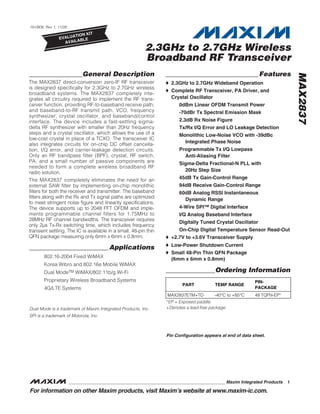
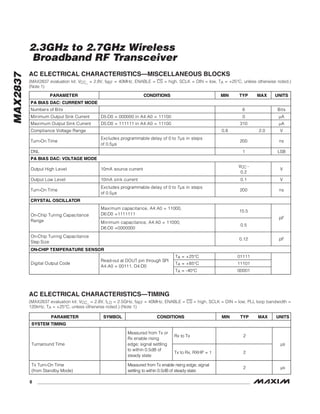
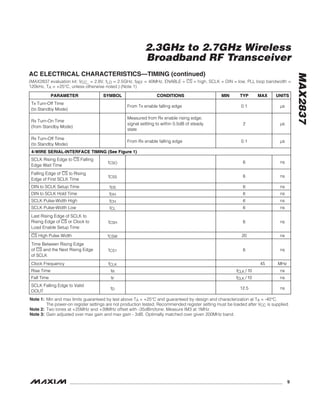
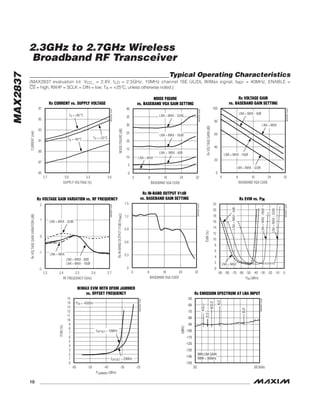
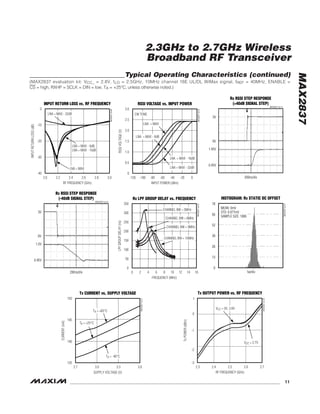
The MAX2837 direct-conversion zero-IF RF transceiver
is designed specifically for 2.3GHz to 2.7GHz wireless
broadband systems. The MAX2837 completely inte-
grates all circuitry required to implement the RF trans-
ceiver function, providing RF-to-baseband receive path;
and baseband-to-RF transmit path, VCO, frequency
synthesizer, crystal oscillator, and baseband/control
interface. The device includes a fast-settling sigma-
delta RF synthesizer with smaller than 20Hz frequency
steps and a crystal oscillator, which allows the use of a
low-cost crystal in place of a TCXO. The transceiver IC
also integrates circuits for on-chip DC offset cancella-
tion, I/Q error, and carrier-leakage detection circuits.
Only an RF bandpass filter (BPF), crystal, RF switch,
PA, and a small number of passive components are
needed to form a complete wireless broadband RF
radio solution.
The MAX2837 completely eliminates the need for an
external SAW filter by implementing on-chip monolithic
filters for both the receiver and transmitter. The baseband
filters along with the Rx and Tx signal paths are optimized
to meet stringent noise figure and linearity specifications.
The device supports up to 2048 FFT OFDM and imple-
ments programmable channel filters for 1.75MHz to
28MHz RF channel bandwidths. The transceiver requires
only 2µs Tx-Rx switching time, which includes frequency
transient settling. The IC is available in a small, 48-pin thin
QFN package measuring only 6mm x 6mm x 0.8mm.
Applications
802.16-2004 Fixed WiMAX
Korea Wibro and 802.16e Mobile WiMAX
Dual ModeTM WiMAX/802.11b/g Wi-Fi
Proprietary Wireless Broadband Systems
4G/LTE Systems
Features
♦ 2.3GHz to 2.7GHz Wideband Operation
♦ Complete RF Transceiver, PA Driver, and
Crystal Oscillator
0dBm Linear OFDM Transmit Power
-70dBr Tx Spectral Emission Mask
2.3dB Rx Noise Figure
Tx/Rx I/Q Error and LO Leakage Detection
Monolithic Low-Noise VCO with -39dBc
Integrated Phase Noise
Programmable Tx I/Q Lowpass
Anti-Aliasing Filter
Sigma-Delta Fractional-N PLL with
20Hz Step Size
45dB Tx Gain-Control Range
94dB Receive Gain-Control Range
60dB Analog RSSI Instantaneous
Dynamic Range
4-Wire SPI™ Digital Interface
I/Q Analog Baseband Interface
Digitally Tuned Crystal Oscillator
On-Chip Digital Temperature Sensor Read-Out
♦ +2.7V to +3.6V Transceiver Supply
♦ Low-Power Shutdown Current
♦ Small 48-Pin Thin QFN Package
(6mm x 6mm x 0.8mm)
MAX2837
2.3GHz to 2.7GHz Wireless
Broadband RF Transceiver
________________________________________________________________ Maxim Integrated Products 1
Ordering Information
19-0806; Rev 1; 11/08
For information on other Maxim products, visit Maxim’s website at www.maxim-ic.com.
EVALUATION KIT
AVAILABLE
PART TEMP RANGE
PIN-
PACKAGE
MAX2837ETM+TD -40°C to +85°C 48 TQFN-EP*
*EP = Exposed paddle.
+Denotes a lead-free package.
Pin Configuration appears at end of data sheet.
Dual Mode is a trademark of Maxim Integrated Products, Inc.
SPI is a trademark of Motorola, Inc.
MAX2837
2.3GHz to 2.7GHz Wireless
Broadband RF Transceiver
2 _______________________________________________________________________________________
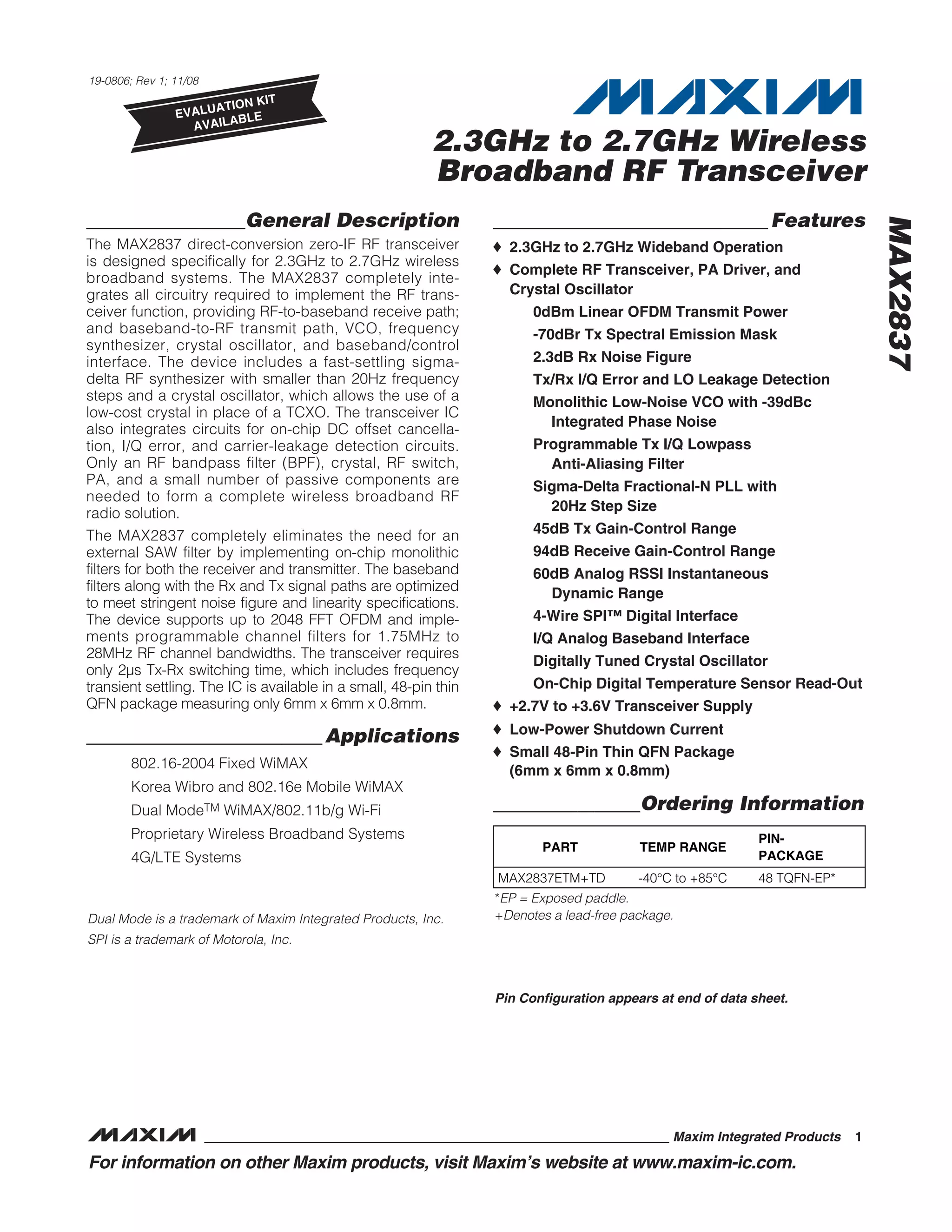
ABSOLUTE MAXIMUM RATINGS
DC ELECTRICAL CHARACTERISTICS
(MAX2837 evaluation kit: VCC_ = 2.7V to 3.6V, Rx set to the maximum gain; CS = high, RXHP = SCLK = DIN = low, RSSI and clock output
buffer are off, no signal at RF inputs, all RF inputs and outputs terminated into 50Ω, receiver baseband outputs are open; 90mVRMS dif-
ferential I and Q signals applied to I, Q baseband inputs of transmitter in transmit mode, fREF = 40MHz, registers set to recommended
settings and corresponding test mode, TA = -40°C to +85°C, unless otherwise noted. Typical values are at VCC = 2.8V, fLO = 2.5GHz,
and TA = +25°C, unless otherwise noted.) (Note 1)
Stresses beyond those listed under “Absolute Maximum Ratings” may cause permanent damage to the device. These are stress ratings only, and functional
operation of the device at these or any other conditions beyond those indicated in the operational sections of the specifications is not implied. Exposure to
absolute maximum rating conditions for extended periods may affect device reliability.
VCCLNA, VCCTXMX, VCCTXPAD, VCCDIG, VCCCP, VCCXTAL,
VCCVCO, VCCRXVGA, VCCRXFL and VCCRXMX to
GND...................................................................-0.3V to +3.9V
B1–B7, TXRF_, CS, SCLK, DIN, DOUT, TXBBI_, TXBBQ_, RXHP,
RXBBI_, RXBBQ_, RSSI, ENABLE, BYPASS, CPOUT_,
CLOCKOUT, XTAL1, XTAL2, RXRF_,RXENABLE, TXENABLE
to GND.......................................-0.3V to (Operating VCC + 0.3V)
RXBBI_, RXBBQ_, RSSI, BYPASS, CPOUT_, DOUT, CLOCKOUT,
PABIAS Short-Circuit Duration............................................10s
RF Input Power...............................................................+10dBm
Continuous Power Dissipation (TA = +70°C)
48-Pin Thin QFN (derates 37mW/°C above +70°C).......2.96W
Operating Temperature Range ...........................-40°C to +85°C
Junction Temperature......................................................+150°C
Storage Temperature Range .............................-65°C to +160°C
Lead Temperature (soldering, 10s) .................................+260°C
PARAMETER CONDITIONS MIN TYP MAX UNITS
Supply Voltage VCC_ 2.7 3.6 V
Shutdown mode, TA = +25°C 10 µA
Standby mode 35 45
Rx mode 91 110
Tx mode, TA = +25°C 145 170
Rx calibration mode 135 160
Supply Current
Tx calibration mode 110 135
mA
D9:D8 = 00 in A4:A0 = 00100 0.85 1.0 1.20
D9:D8 = 01 in A4:A0 = 00100 1.1
D9:D8 = 10 in A4:A0 = 00100 1.2
Rx I/Q Output Common-Mode
Voltage
D9:D8 = 11 in A4:A0 = 00100 1.35
V
Tx Baseband Input Common-
Mode Voltage Operating Range
DC-coupled 0.5 1.2 V
Tx Baseband Input Bias Current Source current 10 20 µA
LOGIC INPUTS: ENABLE, TXENABLE, RXENABLE, SCLK, DIN, CS, B7:B1, RXHP
Digital Input-Voltage High, VIH
VCC -
0.4
V
Digital Input-Voltage Low, VIL 0.4 V
Digital Input-Current High, IIH -1 +1 µA
Digital Input-Current Low, IIL -1 +1 µA
CAUTION! ESD SENSITIVE DEVICE
MAX2837
2.3GHz to 2.7GHz Wireless
Broadband RF Transceiver
_______________________________________________________________________________________ 3
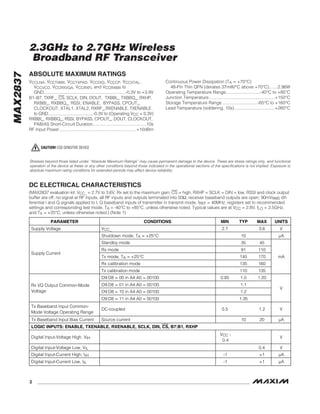
PARAMETER CONDITIONS MIN TYP MAX UNITS
LOGIC OUTPUTS: DOUT
Digital Output-Voltage High, VOH Sourcing 100µA
VCC -
0.4
V
Digital Output-Voltage Low, VOL Sinking 100µA 0.4 V
DC ELECTRICAL CHARACTERISTICS (continued)
(MAX2837 evaluation kit: VCC_ = 2.7V to 3.6V, Rx set to the maximum gain; CS = high, RXHP = SCLK = DIN = low, RSSI and clock output
buffer are off, no signal at RF inputs, all RF inputs and outputs terminated into 50Ω, receiver baseband outputs are open; 90mVRMS dif-
ferential I and Q signals applied to I, Q baseband inputs of transmitter in transmit mode, fREF = 40MHz, registers set to recommended
settings and corresponding test mode, TA = -40°C to +85°C, unless otherwise noted. Typical values are at VCC = 2.8V, fLO = 2.5GHz,
and TA = +25°C, unless otherwise noted.) (Note 1)
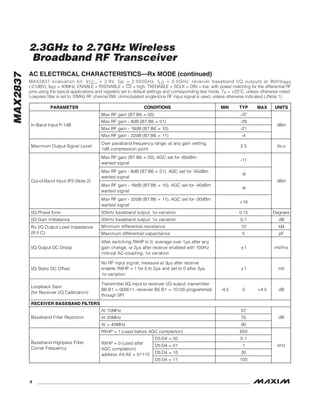
AC ELECTRICAL CHARACTERISTICS—Rx MODE
(MAX2837 evaluation kit: VCC_ = 2.8V, fRF = 2.502GHz, fLO = 2.5GHz; receiver baseband I/Q outputs at 90mVRMS
(-21dBV), fREF = 40MHz, ENABLE = RXENABLE = CS = high, TXENABLE = SCLK = DIN = low, with power matching for the differential RF
pins using the typical applications and registers set to default settings and corresponding test mode, TA = +25°C, unless otherwise noted.
Lowpass filter is set to 10MHz RF channel BW. Unmodulated single-tone RF input signal is used, unless otherwise indicated.) (Note 1)
PARAMETER CONDITIONS MIN TYP MAX UNITS
RECEIVER SECTION: LNA RF INPUT TO BASEBAND I/Q OUTPUTS
RF Input Frequency Range 2.3 2.7 GHz
Peak-to-Peak Gain Variation over
RF Input Frequency Range
Tested at band edges and band center 0.8 dB
RF Input Return Loss All LNA gain settings 13 dB
Maximum gain, B7:B1 = 0000000 90 99
Total Voltage Gain TA = -40°C to +85°C
Minimum gain, B7:B1 = 1111111 5 13
dB
From max RF gain to max RF gain - 8dB 8
From max RF gain to max RF gain - 16dB 16RF Gain Steps
From max RF gain to max RF gain - 32dB 32
dB
Any RF or baseband gain change; gain settling to within
±1dB of steady state; RXHP = 1
0.2
Gain Change Settling Time
Any RF or baseband gain change; gain settling to within
±0.1dB of steady state; RXHP = 1
2
µs
Baseband Gain Range
From maximum baseband gain (B5:B1 = 00000) to
minimum baseband gain (B5:B1 = 11111),
TA = -40°C to +85°C
58 62 66 dB
Baseband Gain Minimum
Step Size
2 dB
Voltage gain ≥ 65dB with max RF gain (B7:B6 = 00) 2.3
Voltage gain = 50dB with max RF gain - 8dB
(B7:B6 = 01)
5.5
Voltage gain = 45dB with max RF gain - 16dB
(B7:B6 = 10)
17
DSB Noise Figure
Voltage gain = 15dB with max RF gain - 32dB
(B7:B6 = 11)
27
dB
MAX2837
2.3GHz to 2.7GHz Wireless
Broadband RF Transceiver
4 _______________________________________________________________________________________
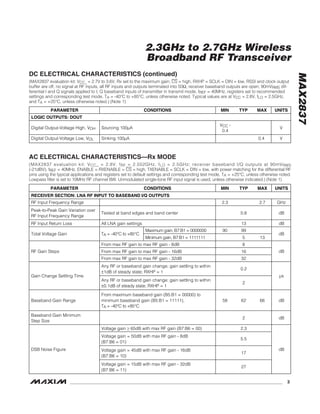
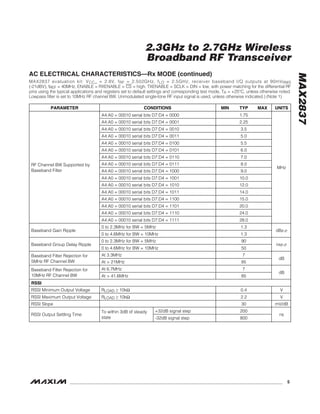
AC ELECTRICAL CHARACTERISTICS—Rx MODE (continued)
MAX2837 evaluation kit: VCC_ = 2.8V, fRF = 2.502GHz, fLO = 2.5GHz; receiver baseband I/Q outputs at 90mVRMS
(-21dBV), fREF = 40MHz, ENABLE = RXENABLE = CS = high, TXENABLE = SCLK = DIN = low, with power matching for the differential RF
pins using the typical applications and registers set to default settings and corresponding test mode, TA = +25°C, unless otherwise noted.
Lowpass filter is set to 10MHz RF channel BW. Unmodulated single-tone RF input signal is used, unless otherwise indicated.) (Note 1)
PARAMETER CONDITIONS MIN TYP MAX UNITS
Max RF gain (B7:B6 = 00) -37
Max RF gain - 8dB (B7:B6 = 01) -29
Max RF gain - 16dB (B7:B6 = 10) -21
In-Band Input P-1dB
Max RF gain - 32dB (B7:B6 = 11) -4
dBm
Maximum Output Signal Level
Over passband frequency range; at any gain setting;
1dB compression point
2.5 VP-P
Max RF gain (B7:B6 = 00), AGC set for -65dBm
wanted signal
-11
Max RF gain - 8dB (B7:B6 = 01), AGC set for -55dBm
wanted signal
-8
Max RF gain - 16dB (B7:B6 = 10), AGC set for -40dBm
wanted signal
-6
Out-of-Band Input IP3 (Note 2)
Max RF gain - 32dB (B7:B6 = 11), AGC set for -30dBm
wanted signal
+16
dBm
I/Q Phase Error 50kHz baseband output; 1 variation 0.15 Degrees
I/Q Gain Imbalance 50kHz baseband output; 1 variation 0.1 dB
Minimum differential resistance 10 kRx I/Q Output Load Impedance
(R || C) Maximum differential capacitance 5 pF
I/Q Output DC Droop
After switching RXHP to 0; average over 1μs after any
gain change, or 2μs after receive enabled with 100Hz
interval AC-coupling, 1 variation
±1 mV/ms
I/Q Static DC Offset
No RF input signal; measure at 3μs after receive
enable; RXHP = 1 for 0 to 2μs and set to 0 after 2μs,
1 variation
±1 mV
Loopback Gain
(for Receiver I/Q Calibration)
Transmitter I/Q input to receiver I/Q output; transmitter
B6:B1 = 000011, receiver B5:B1 = 10100 programmed
through SPI
-4.5 0 +4.5 dB
RECEIVER BASEBAND FILTERS
At 15MHz 57
At 20MHz 75Baseband Filter Rejection
At > 40MHz 90
dB
RXHP = 1 (used before AGC completion) 650
D5:D4 = 00 0.1
D5:D4 = 01 1
D5:D4 = 10 30
Baseband Highpass Filter
Corner Frequency
RXHP = 0 (used after
AGC completion)
address A4:A0 = 01110
D5:D4 = 11 100
kHz
MAX2837
2.3GHz to 2.7GHz Wireless
Broadband RF Transceiver
_______________________________________________________________________________________ 5
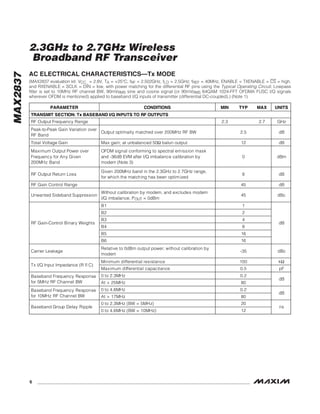
AC ELECTRICAL CHARACTERISTICS—Rx MODE (continued)
MAX2837 evaluation kit: VCC_ = 2.8V, fRF = 2.502GHz, fLO = 2.5GHz; receiver baseband I/Q outputs at 90mVRMS
(-21dBV), fREF = 40MHz, ENABLE = RXENABLE = CS = high, TXENABLE = SCLK = DIN = low, with power matching for the differential RF
pins using the typical applications and registers set to default settings and corresponding test mode, TA = +25°C, unless otherwise noted.
Lowpass filter is set to 10MHz RF channel BW. Unmodulated single-tone RF input signal is used, unless otherwise indicated.) (Note 1)
PARAMETER CONDITIONS MIN TYP MAX UNITS
A4:A0 = 00010 serial bits D7:D4 = 0000 1.75
A4:A0 = 00010 serial bits D7:D4 = 0001 2.25
A4:A0 = 00010 serial bits D7:D4 = 0010 3.5
A4:A0 = 00010 serial bits D7:D4 = 0011 5.0
A4:A0 = 00010 serial bits D7:D4 = 0100 5.5
A4:A0 = 00010 serial bits D7:D4 = 0101 6.0
A4:A0 = 00010 serial bits D7:D4 = 0110 7.0
A4:A0 = 00010 serial bits D7:D4 = 0111 8.0
A4:A0 = 00010 serial bits D7:D4 = 1000 9.0
A4:A0 = 00010 serial bits D7:D4 = 1001 10.0
A4:A0 = 00010 serial bits D7:D4 = 1010 12.0
A4:A0 = 00010 serial bits D7:D4 = 1011 14.0
A4:A0 = 00010 serial bits D7:D4 = 1100 15.0
A4:A0 = 00010 serial bits D7:D4 = 1101 20.0
A4:A0 = 00010 serial bits D7:D4 = 1110 24.0
RF Channel BW Supported by
Baseband Filter
A4:A0 = 00010 serial bits D7:D4 = 1111 28.0
MHz
0 to 2.3MHz for BW = 5MHz 1.3
Baseband Gain Ripple
0 to 4.6MHz for BW = 10MHz 1.3
dBP-P
0 to 2.3MHz for BW = 5MHz 90
Baseband Group Delay Ripple
0 to 4.6MHz for BW = 10MHz 50
nsP-P
At 3.3MHz 7Baseband Filter Rejection for
5MHz RF Channel BW At > 21MHz 85
dB
At 6.7MHz 7Baseband Filter Rejection for
10MHz RF Channel BW At > 41.6MHz 85
dB
RSSI
RSSI Minimum Output Voltage RLOAD ≥ 10kΩ 0.4 V
RSSI Maximum Output Voltage RLOAD ≥ 10kΩ 2.2 V
RSSI Slope 30 mV/dB
+32dB signal step 200
RSSI Output Settling Time
To within 3dB of steady
state -32dB signal step 800
ns
PARAMETER CONDITIONS MIN TYP MAX UNITS
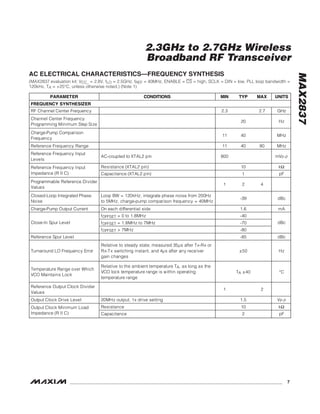
TRANSMIT SECTION: Tx BASEBAND I/Q INPUTS TO RF OUTPUTS
RF Output Frequency Range 2.3 2.7 GHz
Peak-to-Peak Gain Variation over
RF Band
Output optimally matched over 200MHz RF BW 2.5 dB
Total Voltage Gain Max gain; at unbalanced 50 balun output 12 dB
Maximum Output Power over
Frequency for Any Given
200MHz Band
OFDM signal conforming to spectral emission mask
and -36dB EVM after I/Q imbalance calibration by
modem (Note 3)
0 dBm
RF Output Return Loss
Given 200MHz band in the 2.3GHz to 2.7GHz range,
for which the matching has been optimized
8 dB
RF Gain Control Range 45 dB
Unwanted Sideband Suppression
Without calibration by modem, and excludes modem
I/Q imbalance; POUT = 0dBm
45 dBc
B1 1
B2 2
B3 4
B4 8
B5 16
RF Gain-Control Binary Weights
B6 16
dB
Carrier Leakage
Relative to 0dBm output power; without calibration by
modem
-35 dBc
Minimum differential resistance 100 k
Tx I/Q Input Impedance (R || C)
Maximum differential capacitance 0.5 pF
0 to 2.3MHz 0.2Baseband Frequency Response
for 5MHz RF Channel BW At > 25MHz 80
dB
0 to 4.6MHz 0.2Baseband Frequency Response
for 10MHz RF Channel BW At > 17MHz 80
dB
0 to 2.3MHz (BW = 5MHz) 20
Baseband Group Delay Ripple
0 to 4.6MHz (BW = 10MHz) 12
ns
MAX2837
2.3GHz to 2.7GHz Wireless
Broadband RF Transceiver
6 _______________________________________________________________________________________
AC ELECTRICAL CHARACTERISTICS—Tx MODE
(MAX2837 evaluation kit: VCC_ = 2.8V, TA = +25°C, fRF = 2.502GHz, fLO = 2.5GHz; fREF = 40MHz, ENABLE = TXENABLE = CS = high,
and RXENABLE = SCLK = DIN = low, with power matching for the differential RF pins using the Typical Operating Circuit. Lowpass
fitler is set to 10MHz RF channel BW, 90mVRMS sine and cosine signal (or 90mVRMS 64QAM 1024-FFT OFDMA FUSC I/Q signals
wherever OFDM is mentioned) applied to baseband I/Q inputs of transmitter (differential DC-coupled).) (Note 1)
MAX2837
2.3GHz to 2.7GHz Wireless
Broadband RF Transceiver
_______________________________________________________________________________________ 7
AC ELECTRICAL CHARACTERISTICS—FREQUENCY SYNTHESIS
(MAX2837 evaluation kit: VCC_ = 2.8V, fLO = 2.5GHz, fREF = 40MHz, ENABLE = CS = high, SCLK = DIN = low, PLL loop bandwidth =
120kHz, TA = +25°C, unless otherwise noted.) (Note 1)
PARAMETER CONDITIONS MIN TYP MAX UNITS
FREQUENCY SYNTHESIZER
RF Channel Center Frequency 2.3 2.7 GHz
Channel Center Frequency
Programming Minimum Step Size
20 Hz
Charge-Pump Comparison
Frequency
11 40 MHz
Reference Frequency Range 11 40 80 MHz
Reference Frequency Input
Levels
AC-coupled to XTAL2 pin 800 mVP-P
Resistance (XTAL2 pin) 10 kReference Frequency Input
Impedance (R || C) Capacitance (XTAL2 pin) 1 pF
Programmable Reference Divider
Values
1 2 4
Closed-Loop Integrated Phase
Noise
Loop BW = 120kHz; integrate phase noise from 200Hz
to 5MHz, charge-pump comparison frequency = 40MHz
-39 dBc
Charge-Pump Output Current On each differential side 1.6 mA
fOFFSET = 0 to 1.8MHz -40
fOFFSET = 1.8MHz to 7MHz -70Close-In Spur Level
fOFFSET > 7MHz -80
dBc
Reference Spur Level -85 dBc
Turnaround LO Frequency Error
Relative to steady state; measured 35μs after Tx-Rx or
Rx-Tx switching instant, and 4μs after any receiver
gain changes
±50 Hz
Temperature Range over Which
VCO Maintains Lock
Relative to the ambient temperature TA, as long as the
VCO lock temperature range is within operating
temperature range
TA ±40 °C
Reference Output Clock Divider
Values
1 2
Output Clock Drive Level 20MHz output, 1x drive setting 1.5 VP-P
Resistance 10 kOutput Clock Minimum Load
Impedance (R || C) Capacitance 2 pF
MAX2837
2.3GHz to 2.7GHz Wireless
Broadband RF Transceiver
8 _______________________________________________________________________________________
AC ELECTRICAL CHARACTERISTICS—MISCELLANEOUS BLOCKS
(MAX2837 evaluation kit: VCC_ = 2.8V, fREF = 40MHz, ENABLE = CS = high, SCLK = DIN = low, TA = +25°C, unless otherwise noted.)
(Note 1)
PARAMETER CONDITIONS MIN TYP MAX UNITS
PA BIAS DAC: CURRENT MODE
Numbers of Bits 6 Bits
Minimum Output Sink Current D5:D0 = 000000 in A4:A0 = 11100 0 μA
Maximum Output Sink Current D5:D0 = 111111 in A4:A0 = 11100 310 μA
Compliance Voltage Range 0.8 2.0 V
Turn-On Time
Excludes programmable delay of 0 to 7μs in steps
of 0.5μs
200 ns
DNL 1 LSB
PA BIAS DAC: VOLTAGE MODE
Output High Level 10mA source current
VCC -
0.2
V
Output Low Level 10mA sink current 0.1 V
Turn-On Time
Excludes programmable delay of 0 to 7μs in steps
of 0.5μs
200 ns
CRYSTAL OSCILLATOR
Maximum capacitance, A4:A0 = 11000,
D6:D0 =1111111
15.5
On-Chip Tuning Capacitance
Range Minimum capacitance, A4:A0 = 11000,
D6:D0 =0000000
0.5
pF
On-Chip Tuning Capacitance
Step Size
0.12 pF
ON-CHIP TEMPERATURE SENSOR
TA = +25°C 01111
TA = +85°C 11101Digital Output Code
Read-out at DOUT pin through SPI
A4:A0 = 00111, D4:D0
TA = -40°C 00001
AC ELECTRICAL CHARACTERISTICS—TIMING
(MAX2837 evaluation kit: VCC_ = 2.8V, fLO = 2.5GHz, fREF = 40MHz, ENABLE = CS = high, SCLK = DIN = low, PLL loop bandwidth =
120kHz, TA = +25°C, unless otherwise noted.) (Note 1)
PARAMETER SYMBOL CONDITIONS MIN TYP MAX UNITS
SYSTEM TIMING
Rx to Tx 2
Turnaround Time
Measured from Tx or
Rx enable rising
edge; signal settling
to within 0.5dB of
steady state
Tx to Rx, RXHP = 1 2
µs
Tx Turn-On Time
(from Standby Mode)
Measured from Tx enable rising edge; signal
settling to within 0.5dB of steady state
2 µs
MAX2837
2.3GHz to 2.7GHz Wireless
Broadband RF Transceiver
_______________________________________________________________________________________ 9
AC ELECTRICAL CHARACTERISTICS—TIMING (continued)
(MAX2837 evaluation kit: VCC_ = 2.8V, fLO = 2.5GHz, fREF = 40MHz, ENABLE = CS = high, SCLK = DIN = low, PLL loop bandwidth =
120kHz, TA = +25°C, unless otherwise noted.) (Note 1)
PARAMETER SYMBOL CONDITIONS MIN TYP MAX UNITS
Tx Turn-Off Time
(to Standby Mode)
From Tx enable falling edge 0.1 µs
Rx Turn-On Time
(from Standby Mode)
Measured from Rx enable rising edge;
signal settling to within 0.5dB of steady
state
2 µs
Rx Turn-Off Time
(to Standby Mode)
From Rx enable falling edge 0.1 µs
4-WIRE SERIAL-INTERFACE TIMING (See Figure 1)
SCLK Rising Edge to CS Falling
Edge Wait Time
tCSO 6 ns
Falling Edge of CS to Rising
Edge of First SCLK Time
tCSS 6 ns
DIN to SCLK Setup Time tDS 6 ns
DIN to SCLK Hold Time tDH 6 ns
SCLK Pulse-Width High tCH 6 ns
SCLK Pulse-Width Low tCL 6 ns
Last Rising Edge of SCLK to
Rising Edge of CS or Clock to
Load Enable Setup Time
tCSH 6 ns
CS High Pulse Width tCSW 20 ns
Time Between Rising Edge
of CS and the Next Rising Edge
of SCLK
tCS1 6 ns
Clock Frequency fCLK 45 MHz
Rise Time tR fCLK / 10 ns
Fall Time tF fCLK / 10 ns
SCLK Falling Edge to Valid
DOUT
tD 12.5 ns
Note 1: Min and max limits guaranteed by test above TA = +25°C and guaranteed by design and characterization at TA = -40°C.
The power-on register settings are not production tested. Recommended register setting must be loaded after VCC is supplied.
Note 2: Two tones at +25MHz and +39MHz offset with -35dBm/tone. Measure IM3 at 1MHz.
Note 3: Gain adjusted over max gain and max gain - 3dB. Optimally matched over given 200MHz band.
Rx CURRENT vs. SUPPLY VOLTAGE
SUPPLY VOLTAGE (V)
CURRENT(mA)
MAX2837toc01
2.7 3.0 3.3 3.6
85
87
89
91
93
95
97
TA = -40°C
TA = +85°C
TA = +25°C
NOISE FIGURE
vs. BASEBAND VGA GAIN SETTING
BASEBAND VGA CODE
NOISEFIGURE(dB)
MAX2837toc02
0 8 16 24 32
0
5
10
15
20
25
30
35
40
LNA = MAX - 8dB
LNA = MAX
LNA = MAX - 16dB
LNA = MAX - 32dB
Rx VOLTAGE GAIN
vs. BASEBAND GAIN SETTING
BASEBAND VGA CODE
RxVOLTAGEGAIN(dB)
MAX2837toc03
0 8 16 24 32
0
20
40
60
80
100
LNA = MAX
LNA = MAX - 32dB
LNA = MAX - 8dB
LNA = MAX - 16dB
WiMAX EVM WITH OFDM JAMMER
vs. OFFSET FREQUENCY
PJAMMER (dBm)
EVM(%)
MAX2837toc07
-65 -55 -45 -35 -25
0
1
2
3
4
5
6
7
8
9
10
11
12
13
14
15
fOFFSET = 10MHz
fOFFSET = 20MHz
PIN = -60dBm
Rx EMISSION SPECTRUM AT LNA INPUT
MAX2837toc08
(dBm)
DC 26.5GHz
-140
-130
-120
-110
-100
-90
-80
-70
-60
-50
-150
4/3LO
2LO
8/3LO
4LO
8LO
MIN LNA GAIN
RBW = 300kHz
Rx VOLTAGE GAIN VARIATION vs. RF FREQUENCY
RF FREQUENCY (GHz)
RxVOLTAGEGAINVARIATION(dB)
MAX2837toc04
2.3 2.4 2.5 2.6 2.7
-2
-1
0
1
2
LNA = MAX - 32dB
LNA = MAX
LNA = MAX - 8dB
LNA = MAX - 16dB
Rx IN-BAND OUTPUT V1dB
vs. BASEBAND GAIN SETTING
BASEBAND VGA CODE
RxIN-BANDOUTPUTV1dB(VRMS)
MAX2837toc05
0 8 16 24 32
0
0.3
0.6
0.9
1.2
1.5
Rx EVM vs. PIN
PIN (dBm)
EVM(%)
MAX2837toc06
-90 -80 -70 -60 -50 -40 -30 -20 -10 0
0
2
4
6
8
10
12
14
16
18
20
22
LNA = MAX LNA=MAX-16dB
LNA=MAX-32dB
LNA=MAX-8dB
MAX2837
2.3GHz to 2.7GHz Wireless
Broadband RF Transceiver
10 ______________________________________________________________________________________
Typical Operating Characteristics
(MAX2837 evaluation kit: VCC_ = 2.8V, fLO = 2.5GHz, 10MHz channel 16E UL/DL WiMax signal, fREF = 40MHz, ENABLE =
CS = high, RXHP = SCLK = DIN = low, TA = +25°C, unless otherwise noted.)
MAX2837
2.3GHz to 2.7GHz Wireless
Broadband RF Transceiver
______________________________________________________________________________________ 11
INPUT RETURN LOSS vs. RF FREQUENCY
RF FREQUENCY (GHz)
INPUTRETURNLOSS(dB)
MAX2837toc09
2.0 2.2 2.4 2.6 2.8 3.0
-40
-30
-20
-10
0
LNA = MAX - 32dB
LNA = MAX - 8dB,
LNA = MAX - 16dB
LNA = MAX
RSSI VOLTAGE vs. INPUT POWER
INPUT POWER (dBm)
RSSIVOLTAGE(V)
MAX2837toc10
-120 -100 -80 -60 -40 -20 0
0
0.5
1.0
1.5
2.0
2.5
3.0
LNA = MAX - 32dB
LNA = MAX - 16dB
LNA = MAX - 8dB
LNA = MAX
CW TONE
MAX2837 toc11
3V
1.45V
200ns/div
0V
0.45V
Rx RSSI STEP RESPONSE
(+40dB SIGNAL STEP)
Typical Operating Characteristics (continued)
(MAX2837 evaluation kit: VCC_ = 2.8V, fLO = 2.5GHz, 10MHz channel 16E UL/DL WiMax signal, fREF = 40MHz, ENABLE =
CS = high, RXHP = SCLK = DIN = low, TA = +25°C, unless otherwise noted.)
Rx LPF GROUP DELAY vs. FREQUENCY
FREQUENCY (MHz)
LPFGROUPDELAY(ns)
MAX2837toc13
0 2 4 6 8 10 12 14 16
0
50
100
150
200
250
300
350
CHANNEL BW = 5MHz
CHANNEL BW = 8MHz
CHANNEL BW = 10MHz
CHANNEL BW = 9MHz
0
26
13
52
39
65
78
HISTOGRAM: Rx STATIC DC OFFSET
MAX2837toc14
1σ/div
MEAN: 0mV
STD: 0.977mV
SAMPLE SIZE: 1006
MAX2837 toc12
3V
1.5V
200ns/div
0V
0.45V
Rx RSSI STEP RESPONSE
(-40dB SIGNAL STEP)
Tx CURRENT vs. SUPPLY VOLTAGE
SUPPLY VOLTAGE (V)
CURRENT(mA)
MAX2837toc15
2.7 3.0 3.3 3.6
135
140
145
150
TA = -40°C
TA = +85°C
TA = +25°C
Tx OUTPUT POWER vs. RF FREQUENCY
RF FREQUENCY (GHz)
TxPOWER(dBm)
MAX2837toc16
2.3 2.4 2.5 2.6 2.7
-3
-2
-1
1
0
VCC = 2.7V
VCC = 3V, 3.6V
MAX2837
2.3GHz to 2.7GHz Wireless
Broadband RF Transceiver
12 ______________________________________________________________________________________
Tx TRANSMIT SPECTRUM FROM
DC TO 26.5GHz
MAX2837toc20
(dBm)
DC 26.5GHz
-90
-80
-70
-60
-50
-40
-30
-20
-10
0
-100
RBW = 1MHz
2RF
4RF
RF
16/3RF
4/3RF
8/3RF
EVM vs. Tx OUTPUT POWER
OUTPUT POWER (dBm)
EVM(%)
MAX2837toc21
-30 -24 -18 -12 -6 0
1.0
1.2
1.4
1.6
1.8
2.0
PHASE NOISE vs. OFFSET FREQUENCY
OFFSET FREQUENCY (MHz)
PHASENOISE(dBc/Hz)
MAX2837toc22
-150
-140
-130
-120
-110
-100
-90
-80
-70
-60
-50
0.001 0.01 0.1 1 10
2.5kHz
-2.5kHz
500Hz/div
0s 1ms
PLL SETTLING TIME FROM SHUTDOWN
MAX2837toc23
CRYSTAL OFFSET FREQUENCY
vs. CTUNE BITS
CTUNE (DIGITAL BITS)
CRYSTALOFFSETFREQUENCY(Hz)
MAX2837toc24
0 10 20 30 40 50 60 70 80 90 100110120130
-800
-700
-600
-500
-400
-300
-200
-100
0
100
200
300
400
500
600
700
800
KYOCERA
(CX-3225SB)
Typical Operating Characteristics (continued)
(MAX2837 evaluation kit: VCC_ = 2.8V, fLO = 2.5GHz, 10MHz channel 16E UL/DL WiMax signal, fREF = 40MHz, ENABLE =
CS = high, RXHP = SCLK = DIN = low, TA = +25°C, unless otherwise noted.)
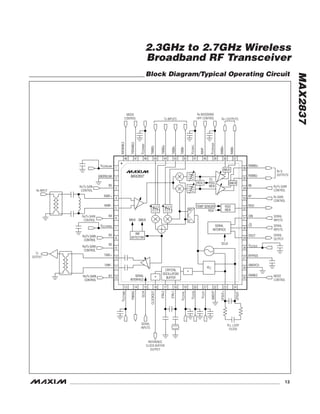
Tx OUTPUT POWER vs. TEMPERATURE
TEMPERATURE (°C)
TxPOWER(dBm)
MAX2837toc17
-40 -15 10 35 60 85
-3.0
-2.5
-2.0
-1.5
-1.0
-0.5
0
Tx VGA SET TO MAX - 3dB
Tx OUTPUT SPECTRUM
MAX2837toc18
5MHz/div
POUT = -3dBm
EVM = 1.35%
fRF = 2.5GHz
10dB/div(dBm)
Tx POUT vs. GAIN SETTING
Tx VGA GAIN CODE
TxPOWER(dBm)
MAX2837toc19
0 8 16 24 32 40 48 56 64
-50
-40
-30
-20
-10
0
10
-40°C
+25°C
-40°C
+85°C
+85°C
+25°C
FORBIDDENCODE
MAX2837
2.3GHz to 2.7GHz Wireless
Broadband RF Transceiver
______________________________________________________________________________________ 13
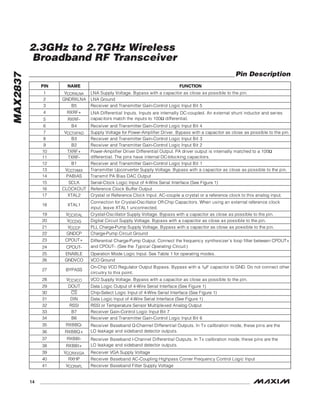
Block Diagram/Typical Operating Circuit
B2
1
2
3
4
5
6
7
8
9
10
11
12
13 14 15 16 17 18 19 20 21 22 23 24
48 47 46 45 44 43 42 41 40 39 38 37
36
35
34
33
32
31
30
29
28
27
26
25
VCCRXLNA
B5
GNDRXLNA
RXRF+
RXRF-
B4
VCCTXPAD
TXRF+
TXRF-
B1 ÷
÷
SERIAL
INTERFACE
SERIAL
INTERFACE
AM
DETECTOR
VCCTXMX
PABIAS
SCLK
CLOCKOUT
XTAL2
XTAL1
VCCXTAL
VCCDIG
VCCCP
GNDCP
CPOUT+
CPOUT-
RXBBQ+
RXBBQ-
Rx Q
OUTPUTS
Rx/Tx GAIN
CONTROL
MODE
CONTROL
SERIAL
INPUTS
SERIAL
INPUTS
SERIAL
OUTPUT
SERIAL
INPUTS
B6
B7
RSSI
DIN
DOUT
CS
VCCVCO
PLL
+
GNDVCO
BYPASS
ENABLE
RXENABLE
TXENABLE
VCCRXMX
TXBBQ-
TXBBQ+
TXBBI+
TXBBI-
VCCRXFL
RXHP
VCCRXVGA
RXBBI+
RXBBI-
MAX2837
MODE
CONTROL
Rx/Tx GAIN
CONTROL
PLL LOOP
FILTER
REFERENCE
CLOCK BUFFER
OUTPUT
B3
Rx GAIN
CONTROL
Rx INPUT
Tx
OUTPUT
Rx/Tx GAIN
CONTROL
Rx/Tx GAIN
CONTROL
Rx/Tx GAIN
CONTROL
Rx/Tx GAIN
CONTROL
Tx INPUTS Rx I OUTPUTS
Rx BASEBAND
HPF CONTROL
0°
90°
RSSI
MUXRSSI
SCLK
TEMP SENSOR
CRYSTAL
OSCILLATOR/
BUFFER
RSSI
TO
RSSI
MUX
QMUX
IMUX QMUX
IMUX
MAX2837
2.3GHz to 2.7GHz Wireless
Broadband RF Transceiver
14 ______________________________________________________________________________________
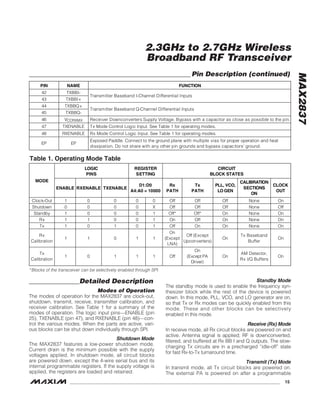
Pin Description
PIN NAME FUNCTION
1 VCCRXLNA LNA Supply Voltage. Bypass with a capacitor as close as possible to the pin.
2 GNDRXLNA LNA Ground
3 B5 Receiver and Transmitter Gain-Control Logic Input Bit 5
4 RXRF+
5 RXRF-
LNA Differential Inputs. Inputs are internally DC-coupled. An external shunt inductor and series
capacitors match the inputs to 100 differential.
6 B4 Receiver and Transmitter Gain-Control Logic Input Bit 4
7 VCCTXPAD Supply Voltage for Power-Amplifier Driver. Bypass with a capacitor as close as possible to the pin.
8 B3 Receiver and Transmitter Gain-Control Logic Input Bit 3
9 B2 Receiver and Transmitter Gain-Control Logic Input Bit 2
10 TXRF+
11 TXRF-
Power-Amplifier Driver Differential Output. PA driver output is internally matched to a 100
differential. The pins have internal DC-blocking capacitors.
12 B1 Receiver and Transmitter Gain-Control Logic Input Bit 1
13 VCCTXMX Transmitter Upconverter Supply Voltage. Bypass with a capacitor as close as possible to the pin.
14 PABIAS Transmit PA Bias DAC Output
15 SCLK Serial-Clock Logic Input of 4-Wire Serial Interface (See Figure 1)
16 CLOCKOUT Reference Clock Buffer Output
17 XTAL2 Crystal or Reference Clock Input. AC-couple a crystal or a reference clock to this analog input.
18 XTAL1
Connection for Crystal-Oscillator Off-Chip Capacitors. When using an external reference clock
input, leave XTAL1 unconnected.
19 VCCXTAL Crystal-Oscillator Supply Voltage. Bypass with a capacitor as close as possible to the pin.
20 VCCDIG Digital Circuit Supply Voltage. Bypass with a capacitor as close as possible to the pin.
21 VCCCP PLL Charge-Pump Supply Voltage. Bypass with a capacitor as close as possible to the pin.
22 GNDCP Charge-Pump Circuit Ground
23 CPOUT+
24 CPOUT-
Differential Charge-Pump Output. Connect the frequency synthesizer’s loop filter between CPOUT+
and CPOUT-. (See the Typical Operating Circuit.)
25 ENABLE Operation Mode Logic Input. See Table 1 for operating modes.
26 GNDVCO VCO Ground
27 BYPASS
On-Chip VCO Regulator Output Bypass. Bypass with a 1μF capacitor to GND. Do not connect other
circuitry to this point.
28 VCCVCO VCO Supply Voltage. Bypass with a capacitor as close as possible to the pin.
29 DOUT Data Logic Output of 4-Wire Serial Interface (See Figure 1)
30 CS Chip-Select Logic Input of 4-Wire Serial Interface (See Figure 1)
31 DIN Data Logic Input of 4-Wire Serial Interface (See Figure 1)
32 RSSI RSSI or Temperature Sensor Multiplexed Analog Output
33 B7 Receiver Gain-Control Logic Input Bit 7
34 B6 Receiver and Transmitter Gain-Control Logic Input Bit 6
35 RXBBQ-
36 RXBBQ+
Receiver Baseband Q-Channel Differential Outputs. In Tx calibration mode, these pins are the
LO leakage and sideband detector outputs.
37 RXBBI-
38 RXBBI+
Receiver Baseband I-Channel Differential Outputs. In Tx calibration mode, these pins are the
LO leakage and sideband detector outputs.
39 VCCRXVGA Receiver VGA Supply Voltage
40 RXHP Receiver Baseband AC-Coupling Highpass Corner Frequency Control Logic Input
41 VCCRXFL Receiver Baseband Filter Supply Voltage
MAX2837
2.3GHz to 2.7GHz Wireless
Broadband RF Transceiver
______________________________________________________________________________________ 15
Detailed Description
Modes of Operation
The modes of operation for the MAX2837 are clock-out,
shutdown, transmit, receive, transmitter calibration, and
receiver calibration. See Table 1 for a summary of the
modes of operation. The logic input pins—ENABLE (pin
25), TXENABLE (pin 47), and RXENABLE (pin 48)—con-
trol the various modes. When the parts are active, vari-
ous blocks can be shut down individually through SPI.
Shutdown Mode
The MAX2837 features a low-power shutdown mode.
Current drain is the minimum possible with the supply
voltages applied. In shutdown mode, all circuit blocks
are powered down, except the 4-wire serial bus and its
internal programmable registers. If the supply voltage is
applied, the registers are loaded and retained.
Standby Mode
The standby mode is used to enable the frequency syn-
thesizer block while the rest of the device is powered
down. In this mode, PLL, VCO, and LO generator are on,
so that Tx or Rx modes can be quickly enabled from this
mode. These and other blocks can be selectively
enabled in this mode.
Receive (Rx) Mode
In receive mode, all Rx circuit blocks are powered on and
active. Antenna signal is applied; RF is downconverted,
filtered, and buffered at Rx BB I and Q outputs. The slow-
charging Tx circuits are in a precharged “idle-off” state
for fast Rx-to-Tx turnaround time.
Transmit (Tx) Mode
In transmit mode, all Tx circuit blocks are powered on.
The external PA is powered on after a programmable
Pin Description (continued)
PIN NAME FUNCTION
42 TXBBI-
43 TXBBI+
Transmitter Baseband I-Channel Differential Inputs
44 TXBBQ+
45 TXBBQ-
Transmitter Baseband Q-Channel Differential Inputs
46 VCCRXMX Receiver Downconverters Supply Voltage. Bypass with a capacitor as close as possible to the pin.
47 TXENABLE Tx Mode Control Logic Input. See Table 1 for operating modes.
48 RXENABLE Rx Mode Control Logic Input. See Table 1 for operating modes.
EP EP
Exposed Paddle. Connect to the ground plane with multiple vias for proper operation and heat
dissipation. Do not share with any other pin grounds and bypass capacitors’ ground.
LOGIC
PINS
REGISTER
SETTING
CIRCUIT
BLOCK STATES
MODE
ENABLE RXENABLE TXENABLE
D1:D0
A4:A0 = 10000
Rx
PATH
Tx
PATH
PLL, VCO,
LO GEN
CALIBRATION
SECTIONS
ON
CLOCK
OUT
Clock-Out 1 0 0 0 0 Off Off Off None On
Shutdown 0 0 0 0 X Off Off Off None Off
Standby 1 0 0 0 1 Off* Off* On None On
Rx 1 1 0 0 1 On Off On None On
Tx 1 0 1 0 1 Off On On None On
Rx
Calibration
1 1 0 1 1
On
(Except
LNA)
Off (Except
Upconverters)
On
Tx Baseband
Buffer
On
Tx
Calibration
1 0 1 1 1 Off
On
(Except PA
Driver)
On
AM Detector,
Rx I/Q Buffers
On
Table 1. Operating Mode Table
*Blocks of the transceiver can be selectively enabled through SPI.
MAX2837
2.3GHz to 2.7GHz Wireless
Broadband RF Transceiver
16 ______________________________________________________________________________________
delay using the on-chip PA bias DAC. The slow-charg-
ing Rx circuits are in a precharged “idle-off” state for
fast Tx-to-Rx turnaround time.
Clock-Out Only
In clock-out mode, the entire transceiver is off except the
divided reference clock output on the CLKOUT pin and
the clock divider, which remains on.
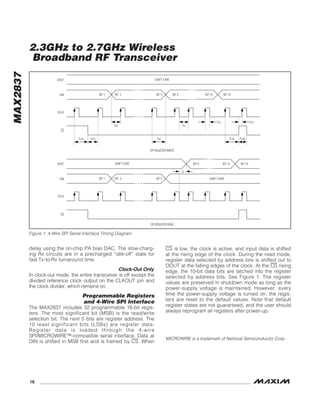
Programmable Registers
and 4-Wire SPI Interface
The MAX2837 includes 32 programmable 16-bit regis-
ters. The most significant bit (MSB) is the read/write
selection bit. The next 5 bits are register address. The
10 least significant bits (LSBs) are register data.
Register data is loaded through the 4-wire
SPI/MICROWIRE™-compatible serial interface. Data at
DIN is shifted in MSB first and is framed by CS. When
CS is low, the clock is active, and input data is shifted
at the rising edge of the clock. During the read mode,
register data selected by address bits is shifted out to
DOUT at the falling edges of the clock. At the CS rising
edge, the 10-bit data bits are latched into the register
selected by address bits. See Figure 1. The register
values are preserved in shutdown mode as long as the
power-supply voltage is maintained. However, every
time the power-supply voltage is turned on, the regis-
ters are reset to the default values. Note that default
register states are not guaranteed, and the user should
always reprogram all registers after power-up.
MICROWIRE is a trademark of National Semiconductor Corp.
BIT 6
SPI REGISTER WRITE
DON'T CARE
BIT 2BIT 1 BIT 14BIT 13BIT 5
tCH
DIN
DOUT
tCSS
SCLK
tCSO
tDS
tDH
tCL
tCSWtCSH
tCS1
CS
SPI REGISTER READ
DON'T CARE
DON'T CAREBIT 2BIT 1 BIT 5DIN
DOUT
SCLK
tD
CS
BIT 6 BIT 14BIT 13
Figure 1. 4-Wire SPI Serial-Interface Timing Diagram
MAX2837
2.3GHz to 2.7GHz Wireless
Broadband RF Transceiver
______________________________________________________________________________________ 17
Chip Information
PROCESS: SiGe BiCMOS
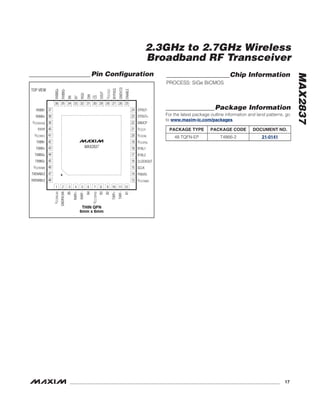
Pin Configuration
TOP VIEW
MAX2837
THIN QFN
6mm x 6mm
13
14
15
16
17
18
19
20
21
22
23
24
ENABLE
GNDVCO
BYPASS
VCCVCO
DOUT
CS
SCLK
DIN
RSSI
B7
B6
RXBBQ-
RXBBQ+
RXBBI-
RXBBI+
VCCRXVGA
RXHP
VCCRXFL
TXBBI-
TXBBI+
TXBBQ+
TXBBQ-
VCCRXMX
TXENABLE
RXENABLE 48
+47
46
45
44
43
42
41
40
39
38
37
1 2 3 4 5 6 7 8 9 10 11 12
B1
TXRF-
TXRF+
B2
B3
VCCTXPAD
B4
RXRF-
RXRF+
B5
GNDRXLNA
VCCRXLNA
VCCTXMX
VCCXTAL
VCCDIG
VCCCP
36 35 34 33 32 31 30 29 28 27 26 25
CLOCKOUT
GNDCP
CPOUT+
CPOUT-
XTAL2
XTAL1
PABIAS
Package Information
For the latest package outline information and land patterns, go
to www.maxim-ic.com/packages.
PACKAGE TYPE PACKAGE CODE DOCUMENT NO.
48 TQFN-EP T4866-2 21-0141
MAX2837
2.3GHz to 2.7GHz Wireless
Broadband RF Transceiver
Maxim cannot assume responsibility for use of any circuitry other than circuitry entirely embodied in a Maxim product. No circuit patent licenses are
implied. Maxim reserves the right to change the circuitry and specifications without notice at any time.
18 ____________________Maxim Integrated Products, 120 San Gabriel Drive, Sunnyvale, CA 94086 408-737-7600
© 2008 Maxim Integrated Products is a registered trademark of Maxim Integrated Products, Inc.
Revision History
REVISION
NUMBER
REVISION
DATE
DESCRIPTION
PAGES
CHANGED
0 5/07 Initial release —
1 11/08
Corrected SPI description in Programmable Registers and 4-Wire SPI-
Interface section
16

Max2837 hackrf

  • 1.
    General Description The MAX2837direct-conversion zero-IF RF transceiver is designed specifically for 2.3GHz to 2.7GHz wireless broadband systems. The MAX2837 completely inte- grates all circuitry required to implement the RF trans- ceiver function, providing RF-to-baseband receive path; and baseband-to-RF transmit path, VCO, frequency synthesizer, crystal oscillator, and baseband/control interface. The device includes a fast-settling sigma- delta RF synthesizer with smaller than 20Hz frequency steps and a crystal oscillator, which allows the use of a low-cost crystal in place of a TCXO. The transceiver IC also integrates circuits for on-chip DC offset cancella- tion, I/Q error, and carrier-leakage detection circuits. Only an RF bandpass filter (BPF), crystal, RF switch, PA, and a small number of passive components are needed to form a complete wireless broadband RF radio solution. The MAX2837 completely eliminates the need for an external SAW filter by implementing on-chip monolithic filters for both the receiver and transmitter. The baseband filters along with the Rx and Tx signal paths are optimized to meet stringent noise figure and linearity specifications. The device supports up to 2048 FFT OFDM and imple- ments programmable channel filters for 1.75MHz to 28MHz RF channel bandwidths. The transceiver requires only 2µs Tx-Rx switching time, which includes frequency transient settling. The IC is available in a small, 48-pin thin QFN package measuring only 6mm x 6mm x 0.8mm. Applications 802.16-2004 Fixed WiMAX Korea Wibro and 802.16e Mobile WiMAX Dual ModeTM WiMAX/802.11b/g Wi-Fi Proprietary Wireless Broadband Systems 4G/LTE Systems Features ♦ 2.3GHz to 2.7GHz Wideband Operation ♦ Complete RF Transceiver, PA Driver, and Crystal Oscillator 0dBm Linear OFDM Transmit Power -70dBr Tx Spectral Emission Mask 2.3dB Rx Noise Figure Tx/Rx I/Q Error and LO Leakage Detection Monolithic Low-Noise VCO with -39dBc Integrated Phase Noise Programmable Tx I/Q Lowpass Anti-Aliasing Filter Sigma-Delta Fractional-N PLL with 20Hz Step Size 45dB Tx Gain-Control Range 94dB Receive Gain-Control Range 60dB Analog RSSI Instantaneous Dynamic Range 4-Wire SPI™ Digital Interface I/Q Analog Baseband Interface Digitally Tuned Crystal Oscillator On-Chip Digital Temperature Sensor Read-Out ♦ +2.7V to +3.6V Transceiver Supply ♦ Low-Power Shutdown Current ♦ Small 48-Pin Thin QFN Package (6mm x 6mm x 0.8mm) MAX2837 2.3GHz to 2.7GHz Wireless Broadband RF Transceiver ________________________________________________________________ Maxim Integrated Products 1 Ordering Information 19-0806; Rev 1; 11/08 For information on other Maxim products, visit Maxim’s website at www.maxim-ic.com. EVALUATION KIT AVAILABLE PART TEMP RANGE PIN- PACKAGE MAX2837ETM+TD -40°C to +85°C 48 TQFN-EP* *EP = Exposed paddle. +Denotes a lead-free package. Pin Configuration appears at end of data sheet. Dual Mode is a trademark of Maxim Integrated Products, Inc. SPI is a trademark of Motorola, Inc.
  • 2.
    MAX2837 2.3GHz to 2.7GHzWireless Broadband RF Transceiver 2 _______________________________________________________________________________________ ABSOLUTE MAXIMUM RATINGS DC ELECTRICAL CHARACTERISTICS (MAX2837 evaluation kit: VCC_ = 2.7V to 3.6V, Rx set to the maximum gain; CS = high, RXHP = SCLK = DIN = low, RSSI and clock output buffer are off, no signal at RF inputs, all RF inputs and outputs terminated into 50Ω, receiver baseband outputs are open; 90mVRMS dif- ferential I and Q signals applied to I, Q baseband inputs of transmitter in transmit mode, fREF = 40MHz, registers set to recommended settings and corresponding test mode, TA = -40°C to +85°C, unless otherwise noted. Typical values are at VCC = 2.8V, fLO = 2.5GHz, and TA = +25°C, unless otherwise noted.) (Note 1) Stresses beyond those listed under “Absolute Maximum Ratings” may cause permanent damage to the device. These are stress ratings only, and functional operation of the device at these or any other conditions beyond those indicated in the operational sections of the specifications is not implied. Exposure to absolute maximum rating conditions for extended periods may affect device reliability. VCCLNA, VCCTXMX, VCCTXPAD, VCCDIG, VCCCP, VCCXTAL, VCCVCO, VCCRXVGA, VCCRXFL and VCCRXMX to GND...................................................................-0.3V to +3.9V B1–B7, TXRF_, CS, SCLK, DIN, DOUT, TXBBI_, TXBBQ_, RXHP, RXBBI_, RXBBQ_, RSSI, ENABLE, BYPASS, CPOUT_, CLOCKOUT, XTAL1, XTAL2, RXRF_,RXENABLE, TXENABLE to GND.......................................-0.3V to (Operating VCC + 0.3V) RXBBI_, RXBBQ_, RSSI, BYPASS, CPOUT_, DOUT, CLOCKOUT, PABIAS Short-Circuit Duration............................................10s RF Input Power...............................................................+10dBm Continuous Power Dissipation (TA = +70°C) 48-Pin Thin QFN (derates 37mW/°C above +70°C).......2.96W Operating Temperature Range ...........................-40°C to +85°C Junction Temperature......................................................+150°C Storage Temperature Range .............................-65°C to +160°C Lead Temperature (soldering, 10s) .................................+260°C PARAMETER CONDITIONS MIN TYP MAX UNITS Supply Voltage VCC_ 2.7 3.6 V Shutdown mode, TA = +25°C 10 µA Standby mode 35 45 Rx mode 91 110 Tx mode, TA = +25°C 145 170 Rx calibration mode 135 160 Supply Current Tx calibration mode 110 135 mA D9:D8 = 00 in A4:A0 = 00100 0.85 1.0 1.20 D9:D8 = 01 in A4:A0 = 00100 1.1 D9:D8 = 10 in A4:A0 = 00100 1.2 Rx I/Q Output Common-Mode Voltage D9:D8 = 11 in A4:A0 = 00100 1.35 V Tx Baseband Input Common- Mode Voltage Operating Range DC-coupled 0.5 1.2 V Tx Baseband Input Bias Current Source current 10 20 µA LOGIC INPUTS: ENABLE, TXENABLE, RXENABLE, SCLK, DIN, CS, B7:B1, RXHP Digital Input-Voltage High, VIH VCC - 0.4 V Digital Input-Voltage Low, VIL 0.4 V Digital Input-Current High, IIH -1 +1 µA Digital Input-Current Low, IIL -1 +1 µA CAUTION! ESD SENSITIVE DEVICE
  • 3.
    MAX2837 2.3GHz to 2.7GHzWireless Broadband RF Transceiver _______________________________________________________________________________________ 3 PARAMETER CONDITIONS MIN TYP MAX UNITS LOGIC OUTPUTS: DOUT Digital Output-Voltage High, VOH Sourcing 100µA VCC - 0.4 V Digital Output-Voltage Low, VOL Sinking 100µA 0.4 V DC ELECTRICAL CHARACTERISTICS (continued) (MAX2837 evaluation kit: VCC_ = 2.7V to 3.6V, Rx set to the maximum gain; CS = high, RXHP = SCLK = DIN = low, RSSI and clock output buffer are off, no signal at RF inputs, all RF inputs and outputs terminated into 50Ω, receiver baseband outputs are open; 90mVRMS dif- ferential I and Q signals applied to I, Q baseband inputs of transmitter in transmit mode, fREF = 40MHz, registers set to recommended settings and corresponding test mode, TA = -40°C to +85°C, unless otherwise noted. Typical values are at VCC = 2.8V, fLO = 2.5GHz, and TA = +25°C, unless otherwise noted.) (Note 1) AC ELECTRICAL CHARACTERISTICS—Rx MODE (MAX2837 evaluation kit: VCC_ = 2.8V, fRF = 2.502GHz, fLO = 2.5GHz; receiver baseband I/Q outputs at 90mVRMS (-21dBV), fREF = 40MHz, ENABLE = RXENABLE = CS = high, TXENABLE = SCLK = DIN = low, with power matching for the differential RF pins using the typical applications and registers set to default settings and corresponding test mode, TA = +25°C, unless otherwise noted. Lowpass filter is set to 10MHz RF channel BW. Unmodulated single-tone RF input signal is used, unless otherwise indicated.) (Note 1) PARAMETER CONDITIONS MIN TYP MAX UNITS RECEIVER SECTION: LNA RF INPUT TO BASEBAND I/Q OUTPUTS RF Input Frequency Range 2.3 2.7 GHz Peak-to-Peak Gain Variation over RF Input Frequency Range Tested at band edges and band center 0.8 dB RF Input Return Loss All LNA gain settings 13 dB Maximum gain, B7:B1 = 0000000 90 99 Total Voltage Gain TA = -40°C to +85°C Minimum gain, B7:B1 = 1111111 5 13 dB From max RF gain to max RF gain - 8dB 8 From max RF gain to max RF gain - 16dB 16RF Gain Steps From max RF gain to max RF gain - 32dB 32 dB Any RF or baseband gain change; gain settling to within ±1dB of steady state; RXHP = 1 0.2 Gain Change Settling Time Any RF or baseband gain change; gain settling to within ±0.1dB of steady state; RXHP = 1 2 µs Baseband Gain Range From maximum baseband gain (B5:B1 = 00000) to minimum baseband gain (B5:B1 = 11111), TA = -40°C to +85°C 58 62 66 dB Baseband Gain Minimum Step Size 2 dB Voltage gain ≥ 65dB with max RF gain (B7:B6 = 00) 2.3 Voltage gain = 50dB with max RF gain - 8dB (B7:B6 = 01) 5.5 Voltage gain = 45dB with max RF gain - 16dB (B7:B6 = 10) 17 DSB Noise Figure Voltage gain = 15dB with max RF gain - 32dB (B7:B6 = 11) 27 dB
  • 4.
    MAX2837 2.3GHz to 2.7GHzWireless Broadband RF Transceiver 4 _______________________________________________________________________________________ AC ELECTRICAL CHARACTERISTICS—Rx MODE (continued) MAX2837 evaluation kit: VCC_ = 2.8V, fRF = 2.502GHz, fLO = 2.5GHz; receiver baseband I/Q outputs at 90mVRMS (-21dBV), fREF = 40MHz, ENABLE = RXENABLE = CS = high, TXENABLE = SCLK = DIN = low, with power matching for the differential RF pins using the typical applications and registers set to default settings and corresponding test mode, TA = +25°C, unless otherwise noted. Lowpass filter is set to 10MHz RF channel BW. Unmodulated single-tone RF input signal is used, unless otherwise indicated.) (Note 1) PARAMETER CONDITIONS MIN TYP MAX UNITS Max RF gain (B7:B6 = 00) -37 Max RF gain - 8dB (B7:B6 = 01) -29 Max RF gain - 16dB (B7:B6 = 10) -21 In-Band Input P-1dB Max RF gain - 32dB (B7:B6 = 11) -4 dBm Maximum Output Signal Level Over passband frequency range; at any gain setting; 1dB compression point 2.5 VP-P Max RF gain (B7:B6 = 00), AGC set for -65dBm wanted signal -11 Max RF gain - 8dB (B7:B6 = 01), AGC set for -55dBm wanted signal -8 Max RF gain - 16dB (B7:B6 = 10), AGC set for -40dBm wanted signal -6 Out-of-Band Input IP3 (Note 2) Max RF gain - 32dB (B7:B6 = 11), AGC set for -30dBm wanted signal +16 dBm I/Q Phase Error 50kHz baseband output; 1 variation 0.15 Degrees I/Q Gain Imbalance 50kHz baseband output; 1 variation 0.1 dB Minimum differential resistance 10 kRx I/Q Output Load Impedance (R || C) Maximum differential capacitance 5 pF I/Q Output DC Droop After switching RXHP to 0; average over 1μs after any gain change, or 2μs after receive enabled with 100Hz interval AC-coupling, 1 variation ±1 mV/ms I/Q Static DC Offset No RF input signal; measure at 3μs after receive enable; RXHP = 1 for 0 to 2μs and set to 0 after 2μs, 1 variation ±1 mV Loopback Gain (for Receiver I/Q Calibration) Transmitter I/Q input to receiver I/Q output; transmitter B6:B1 = 000011, receiver B5:B1 = 10100 programmed through SPI -4.5 0 +4.5 dB RECEIVER BASEBAND FILTERS At 15MHz 57 At 20MHz 75Baseband Filter Rejection At > 40MHz 90 dB RXHP = 1 (used before AGC completion) 650 D5:D4 = 00 0.1 D5:D4 = 01 1 D5:D4 = 10 30 Baseband Highpass Filter Corner Frequency RXHP = 0 (used after AGC completion) address A4:A0 = 01110 D5:D4 = 11 100 kHz
  • 5.
    MAX2837 2.3GHz to 2.7GHzWireless Broadband RF Transceiver _______________________________________________________________________________________ 5 AC ELECTRICAL CHARACTERISTICS—Rx MODE (continued) MAX2837 evaluation kit: VCC_ = 2.8V, fRF = 2.502GHz, fLO = 2.5GHz; receiver baseband I/Q outputs at 90mVRMS (-21dBV), fREF = 40MHz, ENABLE = RXENABLE = CS = high, TXENABLE = SCLK = DIN = low, with power matching for the differential RF pins using the typical applications and registers set to default settings and corresponding test mode, TA = +25°C, unless otherwise noted. Lowpass filter is set to 10MHz RF channel BW. Unmodulated single-tone RF input signal is used, unless otherwise indicated.) (Note 1) PARAMETER CONDITIONS MIN TYP MAX UNITS A4:A0 = 00010 serial bits D7:D4 = 0000 1.75 A4:A0 = 00010 serial bits D7:D4 = 0001 2.25 A4:A0 = 00010 serial bits D7:D4 = 0010 3.5 A4:A0 = 00010 serial bits D7:D4 = 0011 5.0 A4:A0 = 00010 serial bits D7:D4 = 0100 5.5 A4:A0 = 00010 serial bits D7:D4 = 0101 6.0 A4:A0 = 00010 serial bits D7:D4 = 0110 7.0 A4:A0 = 00010 serial bits D7:D4 = 0111 8.0 A4:A0 = 00010 serial bits D7:D4 = 1000 9.0 A4:A0 = 00010 serial bits D7:D4 = 1001 10.0 A4:A0 = 00010 serial bits D7:D4 = 1010 12.0 A4:A0 = 00010 serial bits D7:D4 = 1011 14.0 A4:A0 = 00010 serial bits D7:D4 = 1100 15.0 A4:A0 = 00010 serial bits D7:D4 = 1101 20.0 A4:A0 = 00010 serial bits D7:D4 = 1110 24.0 RF Channel BW Supported by Baseband Filter A4:A0 = 00010 serial bits D7:D4 = 1111 28.0 MHz 0 to 2.3MHz for BW = 5MHz 1.3 Baseband Gain Ripple 0 to 4.6MHz for BW = 10MHz 1.3 dBP-P 0 to 2.3MHz for BW = 5MHz 90 Baseband Group Delay Ripple 0 to 4.6MHz for BW = 10MHz 50 nsP-P At 3.3MHz 7Baseband Filter Rejection for 5MHz RF Channel BW At > 21MHz 85 dB At 6.7MHz 7Baseband Filter Rejection for 10MHz RF Channel BW At > 41.6MHz 85 dB RSSI RSSI Minimum Output Voltage RLOAD ≥ 10kΩ 0.4 V RSSI Maximum Output Voltage RLOAD ≥ 10kΩ 2.2 V RSSI Slope 30 mV/dB +32dB signal step 200 RSSI Output Settling Time To within 3dB of steady state -32dB signal step 800 ns
  • 6.
    PARAMETER CONDITIONS MINTYP MAX UNITS TRANSMIT SECTION: Tx BASEBAND I/Q INPUTS TO RF OUTPUTS RF Output Frequency Range 2.3 2.7 GHz Peak-to-Peak Gain Variation over RF Band Output optimally matched over 200MHz RF BW 2.5 dB Total Voltage Gain Max gain; at unbalanced 50 balun output 12 dB Maximum Output Power over Frequency for Any Given 200MHz Band OFDM signal conforming to spectral emission mask and -36dB EVM after I/Q imbalance calibration by modem (Note 3) 0 dBm RF Output Return Loss Given 200MHz band in the 2.3GHz to 2.7GHz range, for which the matching has been optimized 8 dB RF Gain Control Range 45 dB Unwanted Sideband Suppression Without calibration by modem, and excludes modem I/Q imbalance; POUT = 0dBm 45 dBc B1 1 B2 2 B3 4 B4 8 B5 16 RF Gain-Control Binary Weights B6 16 dB Carrier Leakage Relative to 0dBm output power; without calibration by modem -35 dBc Minimum differential resistance 100 k Tx I/Q Input Impedance (R || C) Maximum differential capacitance 0.5 pF 0 to 2.3MHz 0.2Baseband Frequency Response for 5MHz RF Channel BW At > 25MHz 80 dB 0 to 4.6MHz 0.2Baseband Frequency Response for 10MHz RF Channel BW At > 17MHz 80 dB 0 to 2.3MHz (BW = 5MHz) 20 Baseband Group Delay Ripple 0 to 4.6MHz (BW = 10MHz) 12 ns MAX2837 2.3GHz to 2.7GHz Wireless Broadband RF Transceiver 6 _______________________________________________________________________________________ AC ELECTRICAL CHARACTERISTICS—Tx MODE (MAX2837 evaluation kit: VCC_ = 2.8V, TA = +25°C, fRF = 2.502GHz, fLO = 2.5GHz; fREF = 40MHz, ENABLE = TXENABLE = CS = high, and RXENABLE = SCLK = DIN = low, with power matching for the differential RF pins using the Typical Operating Circuit. Lowpass fitler is set to 10MHz RF channel BW, 90mVRMS sine and cosine signal (or 90mVRMS 64QAM 1024-FFT OFDMA FUSC I/Q signals wherever OFDM is mentioned) applied to baseband I/Q inputs of transmitter (differential DC-coupled).) (Note 1)
  • 7.
    MAX2837 2.3GHz to 2.7GHzWireless Broadband RF Transceiver _______________________________________________________________________________________ 7 AC ELECTRICAL CHARACTERISTICS—FREQUENCY SYNTHESIS (MAX2837 evaluation kit: VCC_ = 2.8V, fLO = 2.5GHz, fREF = 40MHz, ENABLE = CS = high, SCLK = DIN = low, PLL loop bandwidth = 120kHz, TA = +25°C, unless otherwise noted.) (Note 1) PARAMETER CONDITIONS MIN TYP MAX UNITS FREQUENCY SYNTHESIZER RF Channel Center Frequency 2.3 2.7 GHz Channel Center Frequency Programming Minimum Step Size 20 Hz Charge-Pump Comparison Frequency 11 40 MHz Reference Frequency Range 11 40 80 MHz Reference Frequency Input Levels AC-coupled to XTAL2 pin 800 mVP-P Resistance (XTAL2 pin) 10 kReference Frequency Input Impedance (R || C) Capacitance (XTAL2 pin) 1 pF Programmable Reference Divider Values 1 2 4 Closed-Loop Integrated Phase Noise Loop BW = 120kHz; integrate phase noise from 200Hz to 5MHz, charge-pump comparison frequency = 40MHz -39 dBc Charge-Pump Output Current On each differential side 1.6 mA fOFFSET = 0 to 1.8MHz -40 fOFFSET = 1.8MHz to 7MHz -70Close-In Spur Level fOFFSET > 7MHz -80 dBc Reference Spur Level -85 dBc Turnaround LO Frequency Error Relative to steady state; measured 35μs after Tx-Rx or Rx-Tx switching instant, and 4μs after any receiver gain changes ±50 Hz Temperature Range over Which VCO Maintains Lock Relative to the ambient temperature TA, as long as the VCO lock temperature range is within operating temperature range TA ±40 °C Reference Output Clock Divider Values 1 2 Output Clock Drive Level 20MHz output, 1x drive setting 1.5 VP-P Resistance 10 kOutput Clock Minimum Load Impedance (R || C) Capacitance 2 pF
  • 8.
    MAX2837 2.3GHz to 2.7GHzWireless Broadband RF Transceiver 8 _______________________________________________________________________________________ AC ELECTRICAL CHARACTERISTICS—MISCELLANEOUS BLOCKS (MAX2837 evaluation kit: VCC_ = 2.8V, fREF = 40MHz, ENABLE = CS = high, SCLK = DIN = low, TA = +25°C, unless otherwise noted.) (Note 1) PARAMETER CONDITIONS MIN TYP MAX UNITS PA BIAS DAC: CURRENT MODE Numbers of Bits 6 Bits Minimum Output Sink Current D5:D0 = 000000 in A4:A0 = 11100 0 μA Maximum Output Sink Current D5:D0 = 111111 in A4:A0 = 11100 310 μA Compliance Voltage Range 0.8 2.0 V Turn-On Time Excludes programmable delay of 0 to 7μs in steps of 0.5μs 200 ns DNL 1 LSB PA BIAS DAC: VOLTAGE MODE Output High Level 10mA source current VCC - 0.2 V Output Low Level 10mA sink current 0.1 V Turn-On Time Excludes programmable delay of 0 to 7μs in steps of 0.5μs 200 ns CRYSTAL OSCILLATOR Maximum capacitance, A4:A0 = 11000, D6:D0 =1111111 15.5 On-Chip Tuning Capacitance Range Minimum capacitance, A4:A0 = 11000, D6:D0 =0000000 0.5 pF On-Chip Tuning Capacitance Step Size 0.12 pF ON-CHIP TEMPERATURE SENSOR TA = +25°C 01111 TA = +85°C 11101Digital Output Code Read-out at DOUT pin through SPI A4:A0 = 00111, D4:D0 TA = -40°C 00001 AC ELECTRICAL CHARACTERISTICS—TIMING (MAX2837 evaluation kit: VCC_ = 2.8V, fLO = 2.5GHz, fREF = 40MHz, ENABLE = CS = high, SCLK = DIN = low, PLL loop bandwidth = 120kHz, TA = +25°C, unless otherwise noted.) (Note 1) PARAMETER SYMBOL CONDITIONS MIN TYP MAX UNITS SYSTEM TIMING Rx to Tx 2 Turnaround Time Measured from Tx or Rx enable rising edge; signal settling to within 0.5dB of steady state Tx to Rx, RXHP = 1 2 µs Tx Turn-On Time (from Standby Mode) Measured from Tx enable rising edge; signal settling to within 0.5dB of steady state 2 µs
  • 9.
    MAX2837 2.3GHz to 2.7GHzWireless Broadband RF Transceiver _______________________________________________________________________________________ 9 AC ELECTRICAL CHARACTERISTICS—TIMING (continued) (MAX2837 evaluation kit: VCC_ = 2.8V, fLO = 2.5GHz, fREF = 40MHz, ENABLE = CS = high, SCLK = DIN = low, PLL loop bandwidth = 120kHz, TA = +25°C, unless otherwise noted.) (Note 1) PARAMETER SYMBOL CONDITIONS MIN TYP MAX UNITS Tx Turn-Off Time (to Standby Mode) From Tx enable falling edge 0.1 µs Rx Turn-On Time (from Standby Mode) Measured from Rx enable rising edge; signal settling to within 0.5dB of steady state 2 µs Rx Turn-Off Time (to Standby Mode) From Rx enable falling edge 0.1 µs 4-WIRE SERIAL-INTERFACE TIMING (See Figure 1) SCLK Rising Edge to CS Falling Edge Wait Time tCSO 6 ns Falling Edge of CS to Rising Edge of First SCLK Time tCSS 6 ns DIN to SCLK Setup Time tDS 6 ns DIN to SCLK Hold Time tDH 6 ns SCLK Pulse-Width High tCH 6 ns SCLK Pulse-Width Low tCL 6 ns Last Rising Edge of SCLK to Rising Edge of CS or Clock to Load Enable Setup Time tCSH 6 ns CS High Pulse Width tCSW 20 ns Time Between Rising Edge of CS and the Next Rising Edge of SCLK tCS1 6 ns Clock Frequency fCLK 45 MHz Rise Time tR fCLK / 10 ns Fall Time tF fCLK / 10 ns SCLK Falling Edge to Valid DOUT tD 12.5 ns Note 1: Min and max limits guaranteed by test above TA = +25°C and guaranteed by design and characterization at TA = -40°C. The power-on register settings are not production tested. Recommended register setting must be loaded after VCC is supplied. Note 2: Two tones at +25MHz and +39MHz offset with -35dBm/tone. Measure IM3 at 1MHz. Note 3: Gain adjusted over max gain and max gain - 3dB. Optimally matched over given 200MHz band.
  • 10.
    Rx CURRENT vs.SUPPLY VOLTAGE SUPPLY VOLTAGE (V) CURRENT(mA) MAX2837toc01 2.7 3.0 3.3 3.6 85 87 89 91 93 95 97 TA = -40°C TA = +85°C TA = +25°C NOISE FIGURE vs. BASEBAND VGA GAIN SETTING BASEBAND VGA CODE NOISEFIGURE(dB) MAX2837toc02 0 8 16 24 32 0 5 10 15 20 25 30 35 40 LNA = MAX - 8dB LNA = MAX LNA = MAX - 16dB LNA = MAX - 32dB Rx VOLTAGE GAIN vs. BASEBAND GAIN SETTING BASEBAND VGA CODE RxVOLTAGEGAIN(dB) MAX2837toc03 0 8 16 24 32 0 20 40 60 80 100 LNA = MAX LNA = MAX - 32dB LNA = MAX - 8dB LNA = MAX - 16dB WiMAX EVM WITH OFDM JAMMER vs. OFFSET FREQUENCY PJAMMER (dBm) EVM(%) MAX2837toc07 -65 -55 -45 -35 -25 0 1 2 3 4 5 6 7 8 9 10 11 12 13 14 15 fOFFSET = 10MHz fOFFSET = 20MHz PIN = -60dBm Rx EMISSION SPECTRUM AT LNA INPUT MAX2837toc08 (dBm) DC 26.5GHz -140 -130 -120 -110 -100 -90 -80 -70 -60 -50 -150 4/3LO 2LO 8/3LO 4LO 8LO MIN LNA GAIN RBW = 300kHz Rx VOLTAGE GAIN VARIATION vs. RF FREQUENCY RF FREQUENCY (GHz) RxVOLTAGEGAINVARIATION(dB) MAX2837toc04 2.3 2.4 2.5 2.6 2.7 -2 -1 0 1 2 LNA = MAX - 32dB LNA = MAX LNA = MAX - 8dB LNA = MAX - 16dB Rx IN-BAND OUTPUT V1dB vs. BASEBAND GAIN SETTING BASEBAND VGA CODE RxIN-BANDOUTPUTV1dB(VRMS) MAX2837toc05 0 8 16 24 32 0 0.3 0.6 0.9 1.2 1.5 Rx EVM vs. PIN PIN (dBm) EVM(%) MAX2837toc06 -90 -80 -70 -60 -50 -40 -30 -20 -10 0 0 2 4 6 8 10 12 14 16 18 20 22 LNA = MAX LNA=MAX-16dB LNA=MAX-32dB LNA=MAX-8dB MAX2837 2.3GHz to 2.7GHz Wireless Broadband RF Transceiver 10 ______________________________________________________________________________________ Typical Operating Characteristics (MAX2837 evaluation kit: VCC_ = 2.8V, fLO = 2.5GHz, 10MHz channel 16E UL/DL WiMax signal, fREF = 40MHz, ENABLE = CS = high, RXHP = SCLK = DIN = low, TA = +25°C, unless otherwise noted.)
  • 11.
    MAX2837 2.3GHz to 2.7GHzWireless Broadband RF Transceiver ______________________________________________________________________________________ 11 INPUT RETURN LOSS vs. RF FREQUENCY RF FREQUENCY (GHz) INPUTRETURNLOSS(dB) MAX2837toc09 2.0 2.2 2.4 2.6 2.8 3.0 -40 -30 -20 -10 0 LNA = MAX - 32dB LNA = MAX - 8dB, LNA = MAX - 16dB LNA = MAX RSSI VOLTAGE vs. INPUT POWER INPUT POWER (dBm) RSSIVOLTAGE(V) MAX2837toc10 -120 -100 -80 -60 -40 -20 0 0 0.5 1.0 1.5 2.0 2.5 3.0 LNA = MAX - 32dB LNA = MAX - 16dB LNA = MAX - 8dB LNA = MAX CW TONE MAX2837 toc11 3V 1.45V 200ns/div 0V 0.45V Rx RSSI STEP RESPONSE (+40dB SIGNAL STEP) Typical Operating Characteristics (continued) (MAX2837 evaluation kit: VCC_ = 2.8V, fLO = 2.5GHz, 10MHz channel 16E UL/DL WiMax signal, fREF = 40MHz, ENABLE = CS = high, RXHP = SCLK = DIN = low, TA = +25°C, unless otherwise noted.) Rx LPF GROUP DELAY vs. FREQUENCY FREQUENCY (MHz) LPFGROUPDELAY(ns) MAX2837toc13 0 2 4 6 8 10 12 14 16 0 50 100 150 200 250 300 350 CHANNEL BW = 5MHz CHANNEL BW = 8MHz CHANNEL BW = 10MHz CHANNEL BW = 9MHz 0 26 13 52 39 65 78 HISTOGRAM: Rx STATIC DC OFFSET MAX2837toc14 1σ/div MEAN: 0mV STD: 0.977mV SAMPLE SIZE: 1006 MAX2837 toc12 3V 1.5V 200ns/div 0V 0.45V Rx RSSI STEP RESPONSE (-40dB SIGNAL STEP) Tx CURRENT vs. SUPPLY VOLTAGE SUPPLY VOLTAGE (V) CURRENT(mA) MAX2837toc15 2.7 3.0 3.3 3.6 135 140 145 150 TA = -40°C TA = +85°C TA = +25°C Tx OUTPUT POWER vs. RF FREQUENCY RF FREQUENCY (GHz) TxPOWER(dBm) MAX2837toc16 2.3 2.4 2.5 2.6 2.7 -3 -2 -1 1 0 VCC = 2.7V VCC = 3V, 3.6V
  • 12.
    MAX2837 2.3GHz to 2.7GHzWireless Broadband RF Transceiver 12 ______________________________________________________________________________________ Tx TRANSMIT SPECTRUM FROM DC TO 26.5GHz MAX2837toc20 (dBm) DC 26.5GHz -90 -80 -70 -60 -50 -40 -30 -20 -10 0 -100 RBW = 1MHz 2RF 4RF RF 16/3RF 4/3RF 8/3RF EVM vs. Tx OUTPUT POWER OUTPUT POWER (dBm) EVM(%) MAX2837toc21 -30 -24 -18 -12 -6 0 1.0 1.2 1.4 1.6 1.8 2.0 PHASE NOISE vs. OFFSET FREQUENCY OFFSET FREQUENCY (MHz) PHASENOISE(dBc/Hz) MAX2837toc22 -150 -140 -130 -120 -110 -100 -90 -80 -70 -60 -50 0.001 0.01 0.1 1 10 2.5kHz -2.5kHz 500Hz/div 0s 1ms PLL SETTLING TIME FROM SHUTDOWN MAX2837toc23 CRYSTAL OFFSET FREQUENCY vs. CTUNE BITS CTUNE (DIGITAL BITS) CRYSTALOFFSETFREQUENCY(Hz) MAX2837toc24 0 10 20 30 40 50 60 70 80 90 100110120130 -800 -700 -600 -500 -400 -300 -200 -100 0 100 200 300 400 500 600 700 800 KYOCERA (CX-3225SB) Typical Operating Characteristics (continued) (MAX2837 evaluation kit: VCC_ = 2.8V, fLO = 2.5GHz, 10MHz channel 16E UL/DL WiMax signal, fREF = 40MHz, ENABLE = CS = high, RXHP = SCLK = DIN = low, TA = +25°C, unless otherwise noted.) Tx OUTPUT POWER vs. TEMPERATURE TEMPERATURE (°C) TxPOWER(dBm) MAX2837toc17 -40 -15 10 35 60 85 -3.0 -2.5 -2.0 -1.5 -1.0 -0.5 0 Tx VGA SET TO MAX - 3dB Tx OUTPUT SPECTRUM MAX2837toc18 5MHz/div POUT = -3dBm EVM = 1.35% fRF = 2.5GHz 10dB/div(dBm) Tx POUT vs. GAIN SETTING Tx VGA GAIN CODE TxPOWER(dBm) MAX2837toc19 0 8 16 24 32 40 48 56 64 -50 -40 -30 -20 -10 0 10 -40°C +25°C -40°C +85°C +85°C +25°C FORBIDDENCODE
  • 13.
    MAX2837 2.3GHz to 2.7GHzWireless Broadband RF Transceiver ______________________________________________________________________________________ 13 Block Diagram/Typical Operating Circuit B2 1 2 3 4 5 6 7 8 9 10 11 12 13 14 15 16 17 18 19 20 21 22 23 24 48 47 46 45 44 43 42 41 40 39 38 37 36 35 34 33 32 31 30 29 28 27 26 25 VCCRXLNA B5 GNDRXLNA RXRF+ RXRF- B4 VCCTXPAD TXRF+ TXRF- B1 ÷ ÷ SERIAL INTERFACE SERIAL INTERFACE AM DETECTOR VCCTXMX PABIAS SCLK CLOCKOUT XTAL2 XTAL1 VCCXTAL VCCDIG VCCCP GNDCP CPOUT+ CPOUT- RXBBQ+ RXBBQ- Rx Q OUTPUTS Rx/Tx GAIN CONTROL MODE CONTROL SERIAL INPUTS SERIAL INPUTS SERIAL OUTPUT SERIAL INPUTS B6 B7 RSSI DIN DOUT CS VCCVCO PLL + GNDVCO BYPASS ENABLE RXENABLE TXENABLE VCCRXMX TXBBQ- TXBBQ+ TXBBI+ TXBBI- VCCRXFL RXHP VCCRXVGA RXBBI+ RXBBI- MAX2837 MODE CONTROL Rx/Tx GAIN CONTROL PLL LOOP FILTER REFERENCE CLOCK BUFFER OUTPUT B3 Rx GAIN CONTROL Rx INPUT Tx OUTPUT Rx/Tx GAIN CONTROL Rx/Tx GAIN CONTROL Rx/Tx GAIN CONTROL Rx/Tx GAIN CONTROL Tx INPUTS Rx I OUTPUTS Rx BASEBAND HPF CONTROL 0° 90° RSSI MUXRSSI SCLK TEMP SENSOR CRYSTAL OSCILLATOR/ BUFFER RSSI TO RSSI MUX QMUX IMUX QMUX IMUX
  • 14.
    MAX2837 2.3GHz to 2.7GHzWireless Broadband RF Transceiver 14 ______________________________________________________________________________________ Pin Description PIN NAME FUNCTION 1 VCCRXLNA LNA Supply Voltage. Bypass with a capacitor as close as possible to the pin. 2 GNDRXLNA LNA Ground 3 B5 Receiver and Transmitter Gain-Control Logic Input Bit 5 4 RXRF+ 5 RXRF- LNA Differential Inputs. Inputs are internally DC-coupled. An external shunt inductor and series capacitors match the inputs to 100 differential. 6 B4 Receiver and Transmitter Gain-Control Logic Input Bit 4 7 VCCTXPAD Supply Voltage for Power-Amplifier Driver. Bypass with a capacitor as close as possible to the pin. 8 B3 Receiver and Transmitter Gain-Control Logic Input Bit 3 9 B2 Receiver and Transmitter Gain-Control Logic Input Bit 2 10 TXRF+ 11 TXRF- Power-Amplifier Driver Differential Output. PA driver output is internally matched to a 100 differential. The pins have internal DC-blocking capacitors. 12 B1 Receiver and Transmitter Gain-Control Logic Input Bit 1 13 VCCTXMX Transmitter Upconverter Supply Voltage. Bypass with a capacitor as close as possible to the pin. 14 PABIAS Transmit PA Bias DAC Output 15 SCLK Serial-Clock Logic Input of 4-Wire Serial Interface (See Figure 1) 16 CLOCKOUT Reference Clock Buffer Output 17 XTAL2 Crystal or Reference Clock Input. AC-couple a crystal or a reference clock to this analog input. 18 XTAL1 Connection for Crystal-Oscillator Off-Chip Capacitors. When using an external reference clock input, leave XTAL1 unconnected. 19 VCCXTAL Crystal-Oscillator Supply Voltage. Bypass with a capacitor as close as possible to the pin. 20 VCCDIG Digital Circuit Supply Voltage. Bypass with a capacitor as close as possible to the pin. 21 VCCCP PLL Charge-Pump Supply Voltage. Bypass with a capacitor as close as possible to the pin. 22 GNDCP Charge-Pump Circuit Ground 23 CPOUT+ 24 CPOUT- Differential Charge-Pump Output. Connect the frequency synthesizer’s loop filter between CPOUT+ and CPOUT-. (See the Typical Operating Circuit.) 25 ENABLE Operation Mode Logic Input. See Table 1 for operating modes. 26 GNDVCO VCO Ground 27 BYPASS On-Chip VCO Regulator Output Bypass. Bypass with a 1μF capacitor to GND. Do not connect other circuitry to this point. 28 VCCVCO VCO Supply Voltage. Bypass with a capacitor as close as possible to the pin. 29 DOUT Data Logic Output of 4-Wire Serial Interface (See Figure 1) 30 CS Chip-Select Logic Input of 4-Wire Serial Interface (See Figure 1) 31 DIN Data Logic Input of 4-Wire Serial Interface (See Figure 1) 32 RSSI RSSI or Temperature Sensor Multiplexed Analog Output 33 B7 Receiver Gain-Control Logic Input Bit 7 34 B6 Receiver and Transmitter Gain-Control Logic Input Bit 6 35 RXBBQ- 36 RXBBQ+ Receiver Baseband Q-Channel Differential Outputs. In Tx calibration mode, these pins are the LO leakage and sideband detector outputs. 37 RXBBI- 38 RXBBI+ Receiver Baseband I-Channel Differential Outputs. In Tx calibration mode, these pins are the LO leakage and sideband detector outputs. 39 VCCRXVGA Receiver VGA Supply Voltage 40 RXHP Receiver Baseband AC-Coupling Highpass Corner Frequency Control Logic Input 41 VCCRXFL Receiver Baseband Filter Supply Voltage
  • 15.
    MAX2837 2.3GHz to 2.7GHzWireless Broadband RF Transceiver ______________________________________________________________________________________ 15 Detailed Description Modes of Operation The modes of operation for the MAX2837 are clock-out, shutdown, transmit, receive, transmitter calibration, and receiver calibration. See Table 1 for a summary of the modes of operation. The logic input pins—ENABLE (pin 25), TXENABLE (pin 47), and RXENABLE (pin 48)—con- trol the various modes. When the parts are active, vari- ous blocks can be shut down individually through SPI. Shutdown Mode The MAX2837 features a low-power shutdown mode. Current drain is the minimum possible with the supply voltages applied. In shutdown mode, all circuit blocks are powered down, except the 4-wire serial bus and its internal programmable registers. If the supply voltage is applied, the registers are loaded and retained. Standby Mode The standby mode is used to enable the frequency syn- thesizer block while the rest of the device is powered down. In this mode, PLL, VCO, and LO generator are on, so that Tx or Rx modes can be quickly enabled from this mode. These and other blocks can be selectively enabled in this mode. Receive (Rx) Mode In receive mode, all Rx circuit blocks are powered on and active. Antenna signal is applied; RF is downconverted, filtered, and buffered at Rx BB I and Q outputs. The slow- charging Tx circuits are in a precharged “idle-off” state for fast Rx-to-Tx turnaround time. Transmit (Tx) Mode In transmit mode, all Tx circuit blocks are powered on. The external PA is powered on after a programmable Pin Description (continued) PIN NAME FUNCTION 42 TXBBI- 43 TXBBI+ Transmitter Baseband I-Channel Differential Inputs 44 TXBBQ+ 45 TXBBQ- Transmitter Baseband Q-Channel Differential Inputs 46 VCCRXMX Receiver Downconverters Supply Voltage. Bypass with a capacitor as close as possible to the pin. 47 TXENABLE Tx Mode Control Logic Input. See Table 1 for operating modes. 48 RXENABLE Rx Mode Control Logic Input. See Table 1 for operating modes. EP EP Exposed Paddle. Connect to the ground plane with multiple vias for proper operation and heat dissipation. Do not share with any other pin grounds and bypass capacitors’ ground. LOGIC PINS REGISTER SETTING CIRCUIT BLOCK STATES MODE ENABLE RXENABLE TXENABLE D1:D0 A4:A0 = 10000 Rx PATH Tx PATH PLL, VCO, LO GEN CALIBRATION SECTIONS ON CLOCK OUT Clock-Out 1 0 0 0 0 Off Off Off None On Shutdown 0 0 0 0 X Off Off Off None Off Standby 1 0 0 0 1 Off* Off* On None On Rx 1 1 0 0 1 On Off On None On Tx 1 0 1 0 1 Off On On None On Rx Calibration 1 1 0 1 1 On (Except LNA) Off (Except Upconverters) On Tx Baseband Buffer On Tx Calibration 1 0 1 1 1 Off On (Except PA Driver) On AM Detector, Rx I/Q Buffers On Table 1. Operating Mode Table *Blocks of the transceiver can be selectively enabled through SPI.
  • 16.
    MAX2837 2.3GHz to 2.7GHzWireless Broadband RF Transceiver 16 ______________________________________________________________________________________ delay using the on-chip PA bias DAC. The slow-charg- ing Rx circuits are in a precharged “idle-off” state for fast Tx-to-Rx turnaround time. Clock-Out Only In clock-out mode, the entire transceiver is off except the divided reference clock output on the CLKOUT pin and the clock divider, which remains on. Programmable Registers and 4-Wire SPI Interface The MAX2837 includes 32 programmable 16-bit regis- ters. The most significant bit (MSB) is the read/write selection bit. The next 5 bits are register address. The 10 least significant bits (LSBs) are register data. Register data is loaded through the 4-wire SPI/MICROWIRE™-compatible serial interface. Data at DIN is shifted in MSB first and is framed by CS. When CS is low, the clock is active, and input data is shifted at the rising edge of the clock. During the read mode, register data selected by address bits is shifted out to DOUT at the falling edges of the clock. At the CS rising edge, the 10-bit data bits are latched into the register selected by address bits. See Figure 1. The register values are preserved in shutdown mode as long as the power-supply voltage is maintained. However, every time the power-supply voltage is turned on, the regis- ters are reset to the default values. Note that default register states are not guaranteed, and the user should always reprogram all registers after power-up. MICROWIRE is a trademark of National Semiconductor Corp. BIT 6 SPI REGISTER WRITE DON'T CARE BIT 2BIT 1 BIT 14BIT 13BIT 5 tCH DIN DOUT tCSS SCLK tCSO tDS tDH tCL tCSWtCSH tCS1 CS SPI REGISTER READ DON'T CARE DON'T CAREBIT 2BIT 1 BIT 5DIN DOUT SCLK tD CS BIT 6 BIT 14BIT 13 Figure 1. 4-Wire SPI Serial-Interface Timing Diagram
  • 17.
    MAX2837 2.3GHz to 2.7GHzWireless Broadband RF Transceiver ______________________________________________________________________________________ 17 Chip Information PROCESS: SiGe BiCMOS Pin Configuration TOP VIEW MAX2837 THIN QFN 6mm x 6mm 13 14 15 16 17 18 19 20 21 22 23 24 ENABLE GNDVCO BYPASS VCCVCO DOUT CS SCLK DIN RSSI B7 B6 RXBBQ- RXBBQ+ RXBBI- RXBBI+ VCCRXVGA RXHP VCCRXFL TXBBI- TXBBI+ TXBBQ+ TXBBQ- VCCRXMX TXENABLE RXENABLE 48 +47 46 45 44 43 42 41 40 39 38 37 1 2 3 4 5 6 7 8 9 10 11 12 B1 TXRF- TXRF+ B2 B3 VCCTXPAD B4 RXRF- RXRF+ B5 GNDRXLNA VCCRXLNA VCCTXMX VCCXTAL VCCDIG VCCCP 36 35 34 33 32 31 30 29 28 27 26 25 CLOCKOUT GNDCP CPOUT+ CPOUT- XTAL2 XTAL1 PABIAS Package Information For the latest package outline information and land patterns, go to www.maxim-ic.com/packages. PACKAGE TYPE PACKAGE CODE DOCUMENT NO. 48 TQFN-EP T4866-2 21-0141
  • 18.
    MAX2837 2.3GHz to 2.7GHzWireless Broadband RF Transceiver Maxim cannot assume responsibility for use of any circuitry other than circuitry entirely embodied in a Maxim product. No circuit patent licenses are implied. Maxim reserves the right to change the circuitry and specifications without notice at any time. 18 ____________________Maxim Integrated Products, 120 San Gabriel Drive, Sunnyvale, CA 94086 408-737-7600 © 2008 Maxim Integrated Products is a registered trademark of Maxim Integrated Products, Inc. Revision History REVISION NUMBER REVISION DATE DESCRIPTION PAGES CHANGED 0 5/07 Initial release — 1 11/08 Corrected SPI description in Programmable Registers and 4-Wire SPI- Interface section 16