安装和运行Maven
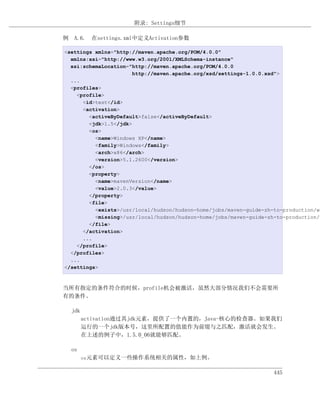
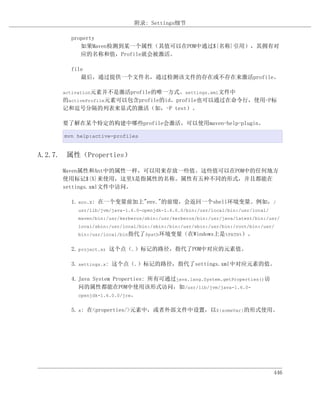
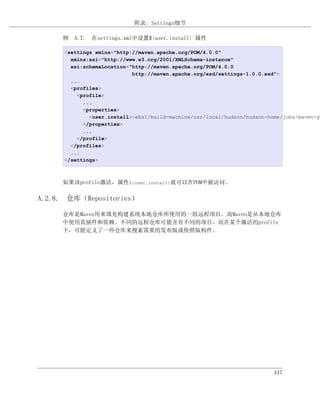
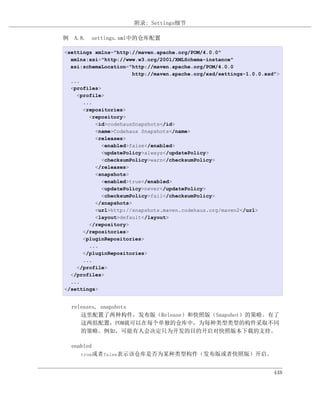
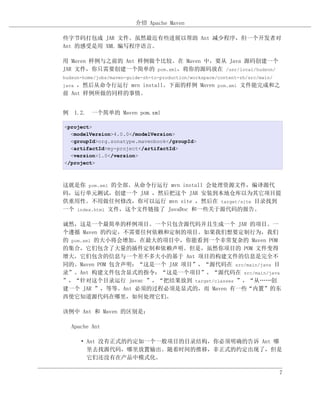
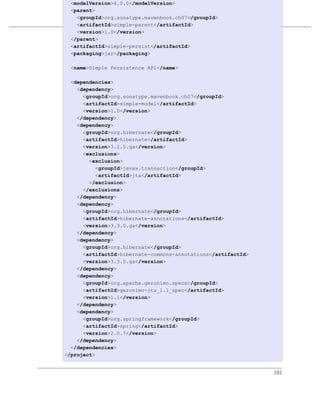
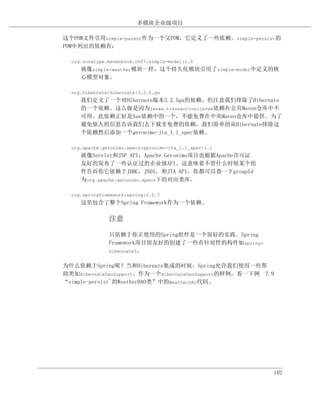
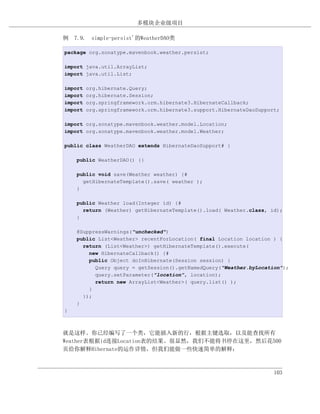
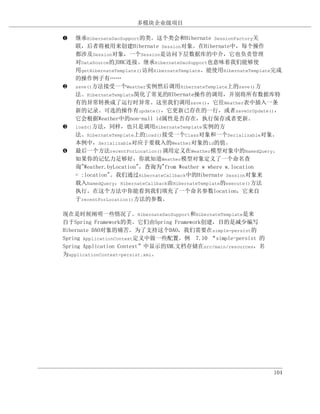
Maven Help 插件有四个目标。前三个目标是—— active-profiles, effective-pom 和
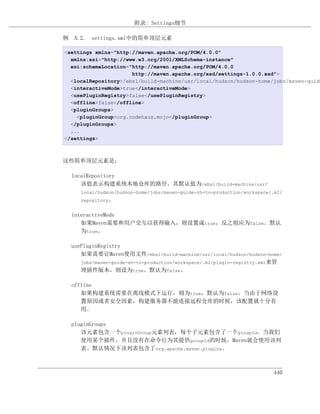
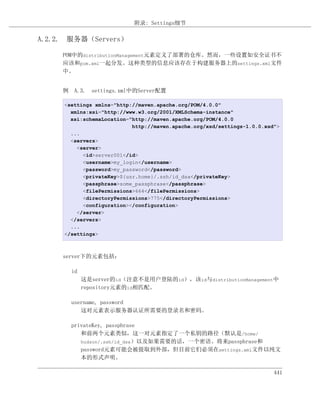
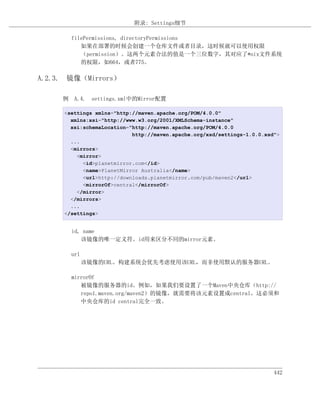
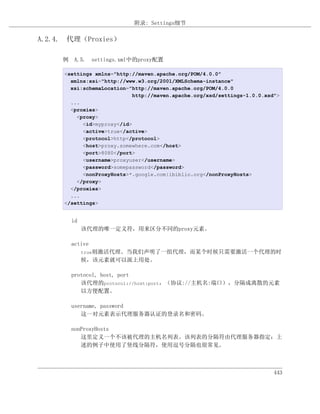
effective-settings —— 描述一个特定的项目,它们必须在项目的目录下运行。 最后
一个目标—— describe ——相对比较复杂,展示某个插件或者插件目标的相关信息。
help:active-profiles
列出当前构建中活动的Profile(项目的,用户的,全局的)。
help:effective-pom
显示当前构建的实际POM,包含活动的Profile。
help:effective-settings
打印出项目的实际settings, 包括从全局的settings和用户级别settings继承的
配置。
help:describe
描述插件的属性。它不需要在项目目录下运行。但是你必须提供你想要描述插件
的 groupId 和 artifactId。
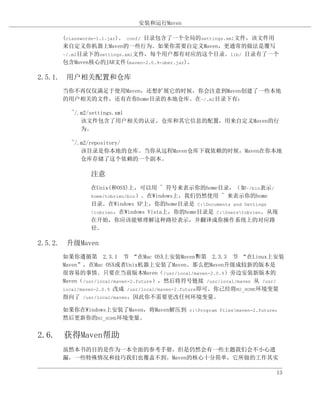
2.7.1. 描述一个Maven插件
一旦你开始使用Maven,你会花很多时间去试图获得Maven插件的信息:插件如何工
作?配置参数是什么?目标是什么? 你会经常使用help:describe 目标来获取这些信
息。通过 plugin 参数你可以指定你想要研究哪个插件,你可以传入插件的前缀(如
help 插件就是 maven-help-plugin),或者可以是 groupId:artifact[:version] ,这
里 version 是可选的。比如, 下面的命令使用 help 插件的 describe 目标来输出
Maven Help 插件的信息。
$ mvn help:describe -Dplugin=help
...
Group Id: org.apache.maven.plugins
Artifact Id: maven-help-plugin
Version: 2.0.1
Goal Prefix: help
Description:
The Maven Help plugin provides goals aimed at helping to make sense out of
the build environment. It includes the ability to view the effective
POM and settings files, after inheritance and active profiles
have been applied, as well as a describe a particular plugin goal to give
usage information.
...
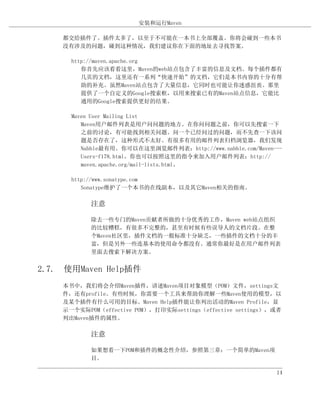
通过设置 plugin 参数来运行 describe 目标,输出为该插件的Maven坐标,目标前
缀,和该插件的一个简要介绍。尽管这些信息非常有帮助,你通常还是需要了解更多
15
32.
安装和运行Maven
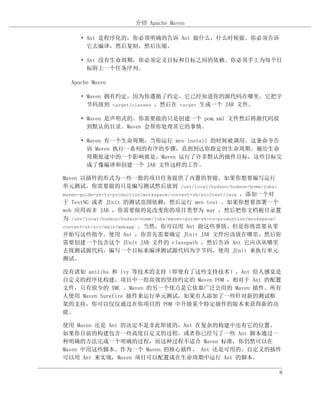
的详情。如果你想要 Help 插件输出完整的带有参数的目标列表,只要运行带有参数
full的 help:describe 目标就可以了,像这样:
$ mvn help:describe -Dplugin=help -Dfull
...
Group Id: org.apache.maven.plugins
Artifact Id: maven-help-plugin
Version: 2.0.1
Goal Prefix: help
Description:
The Maven Help plugin provides goals aimed at helping to make sense out of
the build environment. It includes the ability to view the effective
POM and settings files, after inheritance and active profiles
have been applied, as well as a describe a particular plugin goal to give usage
information.
Mojos:
===============================================
Goal: 'active-profiles'
===============================================
Description:
Lists the profiles which are currently active for this build.
Implementation: org.apache.maven.plugins.help.ActiveProfilesMojo
Language: java
Parameters:
-----------------------------------------------
[0] Name: output
Type: java.io.File
Required: false
Directly editable: true
Description:
This is an optional parameter for a file destination for the output of this mojo...t
listing of active profiles per project.
-----------------------------------------------
[1] Name: projects
Type: java.util.List
Required: true
16
33.
安装和运行Maven
Directly editable: false
Description:
This is the list of projects currently slated to be built by Maven.
-----------------------------------------------
This mojo doesn't have any component requirements.
===============================================
... removed the other goals ...
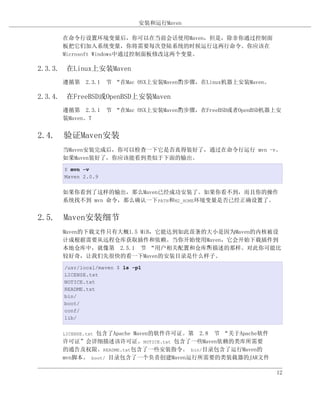
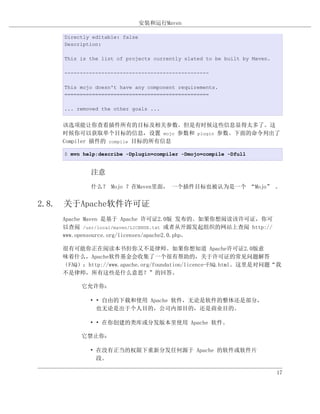
该选项能让你查看插件所有的目标及相关参数。但是有时候这些信息显得太多了。这
时候你可以获取单个目标的信息,设置 mojo 参数和 plugin 参数。下面的命令列出了
Compiler 插件的 compile 目标的所有信息
$ mvn help:describe -Dplugin=compiler -Dmojo=compile -Dfull
注意
什么? Mojo ?在Maven里面, 一个插件目标也被认为是一个 “Mojo” 。
2.8. 关于Apache软件许可证
Apache Maven 是基于 Apache 许可证2.0版 发布的。如果你想阅读该许可证,你可
以查阅 /usr/local/maven/LICENSE.txt 或者从开源发起组织的网站上查阅 http://
www.opensource.org/licenses/apache2.0.php。
很有可能你正在阅读本书但你又不是律师。如果你想知道 Apache许可证2.0版意
味着什么,Apache软件基金会收集了一个很有帮助的,关于许可证的常见问题解答
(FAQ):http://www.apache.org/foundation/licence-FAQ.html。这里是对问题“我
不是律师,所有这些是什么意思?”的回答。
它允许你:
• • 自由的下载和使用 Apache 软件,无论是软件的整体还是部分,
也无论是出于个人目的,公司内部目的,还是商业目的。
• • 在你创建的类库或分发版本里使用 Apache 软件。
它禁止你:
• 在没有正当的权限下重新分发任何源于 Apache 的软件或软件片
段。
17
定制一个Maven项目
例 4.5. Simple Weather 的Main 类
package org.sonatype.mavenbook.weather;
import java.io.InputStream;
import org.apache.log4j.PropertyConfigurator;
public class Main {
public static void main(String[] args) throws Exception {
// Configure Log4J
PropertyConfigurator.configure(Main.class.getClassLoader()
.getResource("log4j.properties"));
// Read the Zip Code from the Command-line (if none supplied, use 60202)
int zipcode = 60202;
try {
zipcode = Integer.parseInt(args[0]);
} catch( Exception e ) {}
// Start the program
new Main(zipcode).start();
}
private int zip;
public Main(int zip) {
this.zip = zip;
}
public void start() throws Exception {
// Retrieve Data
InputStream dataIn = new YahooRetriever().retrieve( zip );
// Parse Data
Weather weather = new YahooParser().parse( dataIn );
// Format (Print) Data
System.out.print( new WeatherFormatter().format( weather ) );
}
}
47
一个简单的Web应用
例 5.6. 匹配 Simple Servlet
<!DOCTYPEweb-app PUBLIC
"-//Sun Microsystems, Inc.//DTD Web Application 2.3//EN"
"http://java.sun.com/dtd/web-app_2_3.dtd" >
<web-app>
<display-name>Archetype Created Web Application</display-name>
<servlet>
<servlet-name>simple</servlet-name>
<servlet-class>org.sonatype.mavenbook.web.SimpleServlet</servlet-class>
</servlet>
<servlet-mapping>
<servlet-name>simple</servlet-name>
<url-pattern>/simple</url-pattern>
</servlet-mapping>
</web-app>
一切文件就绪,准备测试这个 servlet 。 src/main/java 下的类,以及 web.xml 已
经被更新了。在启动 Jetty 插件之前,运行 mvn compile 以编译你的项目:
~/examples$ mvn compile
...
[INFO] [compiler:compile]
[INFO] Compiling 1 source file to ~/examples/ch05/simple-webapp/target/classes
[INFO] ------------------------------------------------------------------------
[ERROR] BUILD FAILURE
[INFO] ------------------------------------------------------------------------
[INFO] Compilation failure
~/ch05/simple-webapp/src/main/java/org/sonatype/mavenbook/web/SimpleServlet.java:[4,
package javax.servlet does not exist
~/ch05/simple-webapp/src/main/java/org/sonatype/mavenbook/web/SimpleServlet.java:[5,
package javax.servlet.http does not exist
~/ch05/simple-webapp/src/main/java/org/sonatype/mavenbook/web/SimpleServlet.java:[7,
cannot find symbol
symbol: class HttpServlet
public class SimpleServlet extends HttpServlet {
~/ch05/simple-webapp/src/main/java/org/sonatype/mavenbook/web/SimpleServlet.java:[8,
cannot find symbol
symbol : class HttpServletRequest
location: class org.sonatype.mavenbook.web.SimpleServlet
71
88.
一个简单的Web应用
~/ch05/simple-webapp/src/main/java/org/sonatype/mavenbook/web/SimpleServlet.java:[9,
cannot find symbol
symbol : class HttpServletResponse
location: class org.sonatype.mavenbook.web.SimpleServlet
~/ch05/simple-webapp/src/main/java/org/sonatype/mavenbook/web/SimpleServlet.java:[10
cannot find symbol
symbol : class ServletException
location: class org.sonatype.mavenbook.web.SimpleServlet
编译失败了,因为你的 Maven 项目没有对 Servlet API 的依赖。 在下一节,我们会
为你项目的 POM 添加 Servlet API 。
5.6. 添加J2EE依赖
为了编写一个 servlet ,我们需要添加 Servlet API 作为项目依赖。 Servlet
规格说明是一个 JAR 文件,它能从 Sun Microsystems 的站点下载到 http://
java.sun.com/products/servlet/download.html 。JAR 文件下载好之后你需要把它
安装到位于 ~/.m2/repository 的 Maven 本地仓库。你必须为所有 Sun Microsystems
维护的 J2EE API 重复同样的过程,包括 JNDI, JDBC, Servlet, JSP, JTA, 以
及其它。 如果你不想这么做因为觉得这样太无聊了,其实不只有你这么认为。 幸
运的是,有一种更简单的方法来下载所有这些类库并安装到本地仓库 —— Apache
Geronimo 的独立的开源实现。
很多年以来,获取 Servlet 规格说明 JAR 文件的唯一方式是从 Sun Microsystems
下载。 你必须到 Sun 的 web 站点,同意并且点击它的许可证协议,这样才能访问
Servlet JAR。这是必须的,因为 Sun 的规格说明 JAR 文件并没有使用一个允许再次
分发的许可证。 很多年来编写一个 Servlet 或者使用 JDBC 之前你必须手工下载 Sun
的构件。 这很乏味并且令人恼火,直到 Apache Geronimo 项目创建了很多通过 Sun
认证的企业级规格说明实现。 这些规格说明 JAR 是按照 Apache 软件许可证版本 2.0
发布的,该许可证允许对源代码和二进制文件进行免费的再次分发。 现在,对你的程
序来说,从 Sun Microsystems 下载的 Servlet API JAR 和从 Apache Geronimo 项目
下载的 JAR 没什么大的差别。 它们同样都通过了 Sun Microsystems 的严格的一个测
试兼容性工具箱(TCK)。
添加像 JSP API 或者 Servlet API 这样的依赖现在很简单明了了,不再需要你从 web
站点手工下载 JAR 文件然后再安装到本地仓库。 关键是你必须知道去哪里找,使用
什么 groupId, artifactId, 和 version 来引用恰当的 Apache Geronimo 实现。给
pom.xml 添加如下的依赖元素以添加对 Servlet 规格说明 API 的依赖。.
72
多模块企业级项目
[INFO] ------------------------------------------------------------------------
[INFO] Building Chapter 7 Simple Command Line Tool
[INFO] task-segment: [assembly:assembly] (aggregator-style)
[INFO] ------------------------------------------------------------------------
[INFO] [resources:resources]
[INFO] Using default encoding to copy filtered resources.
[INFO] [compiler:compile]
[INFO] Nothing to compile - all classes are up to date
[INFO] [resources:testResources]
[INFO] Using default encoding to copy filtered resources.
[INFO] [compiler:testCompile]
[INFO] Nothing to compile - all classes are up to date
[INFO] [surefire:test]
...
[INFO] [jar:jar]
[INFO] Building jar: .../simple-parent/simple-command/target/simple-command.jar
[INFO] [assembly:assembly]
[INFO] Processing DependencySet (output=)
[INFO] Expanding: .../.m2/repository/.../simple-weather-1-SNAPSHOT.jar into
/tmp/archived-file-set.93251
[INFO] Expanding: .../.m2/repository/.../simple-model-1-SNAPSHOT.jar into
/tmp/archived-file-set.20124
[INFO] Expanding: .../.m2/repository/../hibernate-3.2.5.ga.jar into
/tmp/archived-file-set.12965
... skipping 25 lines of dependency unpacking ...
[INFO] Expanding: .../.m2/repository/.../velocity-1.5.jar into /tmp/archived-file-se
[INFO] Expanding: .../.m2/repository/.../commons-lang-2.1.jar into
/tmp/archived-file-set.13292
[INFO] Expanding: .../.m2/repository/.../oro-2.0.8.jar into /tmp/archived-file-set.1
[INFO] Building jar: .../simple-parent/simple-command/target/simple-command-jar-with
构建过程经过了生命周期中编译字节码,运行测试,然后最终为该项目构建一个JAR。
然后assembly:assembly目标创建一个带有依赖的JAR,它将所有依赖解压到一个临时
目录,然后将所有字节码收集到target/目录下一个名为simple-command-jar-with-
dependencies.jar的JAR中。这个“超级的”JAR的体重为15MB。
在你运行这个命令行工具之前,你需要调用Hibernate3插件的hbm2ddl目标来创建
HSQLDB数据库。在simple-command目录运行如下的命令:
$ mvn hibernate3:hbm2ddl
[INFO] Scanning for projects...
[INFO] Searching repository for plugin with prefix: 'hibernate3'.
[INFO] org.codehaus.mojo: checking for updates from central
[INFO] ------------------------------------------------------------------------
[INFO] Building Chapter 7 Simple Command Line Tool
127
144.
多模块企业级项目
[INFO] task-segment: [hibernate3:hbm2ddl]
[INFO] ------------------------------------------------------------------------
[INFO] Preparing hibernate3:hbm2ddl
...
10:24:56,151 INFO org.hibernate.tool.hbm2ddl.SchemaExport - export complete
[INFO] ------------------------------------------------------------------------
[INFO] BUILD SUCCESSFUL
[INFO] ------------------------------------------------------------------------
在此之后,你应该能在simple-command下看到data/目录。该data/目录包含了HSQLDB数
据库。要运行这个命令行天气预报器,在simple-command/项目目录下运行如下命令:
$ java -cp target/simple-command-jar-with-dependencies.jar
org.sonatype.mavenbook.weather.Main 60202
2321 INFO YahooRetriever - Retrieving Weather Data
2489 INFO YahooParser - Creating XML Reader
2581 INFO YahooParser - Parsing XML Response
2875 INFO WeatherFormatter - Formatting Weather Data
****************************************
Current Weather Conditions for:
Evanston,
IL,
US
****************************************
* Temperature: 75
* Condition: Partly Cloudy
* Humidity: 64
* Wind Chill: 75
* Date: Wed Aug 06 09:35:30 CDT 2008
要运行历史查询,运行如下命令:
$ java -cp target/simple-command-jar-with-dependencies.jar
org.sonatype.mavenbook.weather.Main 60202 history
2470 INFO WeatherFormatter - Formatting History Data
Weather History for:
Evanston, IL, US
****************************************
* Temperature: 39
* Condition: Heavy Rain
* Humidity: 93
* Wind Chill: 36
* Date: 2007-12-02 13:45:27.187
****************************************
128
优化和重构POM
[INFO] Chapter 8 Simple Parent Project
[INFO] Chapter 8 Simple Object Model
[INFO] Chapter 8 Simple Weather API
[INFO] Chapter 8 Simple Persistence API
[INFO] Chapter 8 Simple Command Line Tool
[INFO] Chapter 8 Simple Web Application
[INFO] Chapter 8 Parent Project
[INFO] Searching repository for plugin with prefix: 'dependency'.
...
[INFO] ------------------------------------------------------------------------
[INFO] Building Chapter 8 Simple Object Model
[INFO] task-segment: [dependency:analyze]
[INFO] ------------------------------------------------------------------------
[INFO] Preparing dependency:analyze
[INFO] [resources:resources]
[INFO] Using default encoding to copy filtered resources.
[INFO] [compiler:compile]
[INFO] Nothing to compile - all classes are up to date
[INFO] [resources:testResources]
[INFO] Using default encoding to copy filtered resources.
[INFO] [compiler:testCompile]
[INFO] Nothing to compile - all classes are up to date
[INFO] [dependency:analyze]
[WARNING] Used undeclared dependencies found:
[WARNING] javax.persistence:persistence-api:jar:1.0:compile
[WARNING] Unused declared dependencies found:
[WARNING] org.hibernate:hibernate-annotations:jar:3.3.0.ga:compile
[WARNING] org.hibernate:hibernate:jar:3.2.5.ga:compile
[WARNING] junit:junit:jar:3.8.1:test
...
[INFO] ------------------------------------------------------------------------
[INFO] Building Chapter 8 Simple Web Application
[INFO] task-segment: [dependency:analyze]
[INFO] ------------------------------------------------------------------------
[INFO] Preparing dependency:analyze
[INFO] [resources:resources]
[INFO] Using default encoding to copy filtered resources.
[INFO] [compiler:compile]
[INFO] Nothing to compile - all classes are up to date
[INFO] [resources:testResources]
[INFO] Using default encoding to copy filtered resources.
138
站点生成
15.3. 自定义站点描述符
当你为站点添加内容的时候,你会想要修改站点左边的导航菜单。以下的站点描述符定
制了站点左上角的logo。除了站点的顶部,该描述符还为左边的导航菜单添加了一个菜
单小节"Sample Project"。该菜单包含了一个指向概述页面的链接。
例 15.1. 一个初始的站点描述符
<project name="Sample Project">
<bannerLeft>
<name>Sonatype</name>
<src>images/logo.png</src>
<href>http://www.sonatype.com</href>
</bannerLeft>
<body>
<menu name="Sample Project">
<item name="Overview" href="index.html"/>
</menu>
<menu ref="reports"/>
</body>
</project>
该站点描述符引用了一个图片。该图片logo.png应该放在/usr/local/hudson/hudson-
home/jobs/maven-guide-zh-to-production/workspace/content-zh/src/site/resources/
images目录下。除了更改站点描述符,你还会想要在/usr/local/hudson/hudson-home/
jobs/maven-guide-zh-to-production/workspace/content-zh/src/site/apt目录下创建一
个简单的index.apt页面。将以下的内容写入index.apt,它会被转化成index.html,当
用户访问Maven生成的站点时,他们就会看到这第一个页面。
Welcome to the Sample Project, we hope you enjoy your time
on this project site. We've tried to assemble some
great user documentation and developer information, and
we're really excited that you've taken the time to visit
this site.
What is Sample Project
Well, it's easy enough to explain. This sample project is
a sample of a project with a Maven-generated site from
Maven: The Definitive Guide. A dedicated team of volunteers
help maintain this sample site, and so on and so forth.
要预览该站点,运行mvn clean site,接着mvn site:run:
$ mvn clean site
331
站点生成
• FML参考: http://maven.apache.org/doxia/references/fml-format.html
15.5.1. APT样例
例 15.5 “APT文档”展示了一个简单的APT文档,它带有一段介绍文字和一个简单列
表。注意列表通过伪元素“[]”结束。
例 15.5. APT文档
---
Introduction to Sample Project
---
Brian Fox
---
26-Mar-2008
---
Welcome to Sample Project
This is a sample project, welcome! We're excited that you've decided to read the
index page of this Sample Project. We hope you enjoy the simple sample project
we've assembled for you.
Here are some useful links to get you started:
* {{{news.html}News}}
* {{{features.html}Features}}
* {{{faq.html}FAQ}}
[]
如果例 15.5 “APT文档”中的APT文档位于src/site/apt/index.apt,Maven Site插件
就会使用Doxia解析该APT,生成对应于index.html的XHTML文档。
15.5.2. FML样例
很多项目维护一个常见问题(FAQ)页面。例 15.6 “FAQ标记语言文档”展示了一个
FML文档的例子:
336
353.
站点生成
例 15.6. FAQ标记语言文档
<?xml version="1.0" encoding="UTF-8"?>
<faqs title="Frequently Asked Questions">
<part id="General">
<faq id="sample-project-sucks">
<question>Sample project doesn't work. Why does sample project suck?</questio
<answer>
<p>
We resent that question. Sample wasn't designed to work, it was designed
show you how to use Maven. Is you really think this project sucks, then
keep it to yourself. We're not interested in your pestering questions.
</p>
</answer>
</faq>
<faq id="sample-project-source">
<question>I want to put some code in Sample Project, how do I do this?</questi
<answer>
<p>
If you want to add code to this project, just start putting Java source in
src/main/java. If you want to put some source code in this FAQ, use the
source element:
</p>
<source>
for( int i = 0; i < 1234; i++ ) {
// do something brilliant
}
</source>
</answer>
</faq>
</part>
</faqs>
15.6. 部署你的项目web站点
一旦项目文档已经写好,并且你已经创建了一个引以为傲的站点,你会想将其部署
到服务器上。要部署你的站点,你需要使用Maven Site插件,它会使用很多种方法如
FTP,SCP,和DAV,将你的项目站点部署到远程服务器上。要使用DAV部署站点,在POM
中配置distributionManagement小节的site元素,如:
337
使用可选语言编写插件
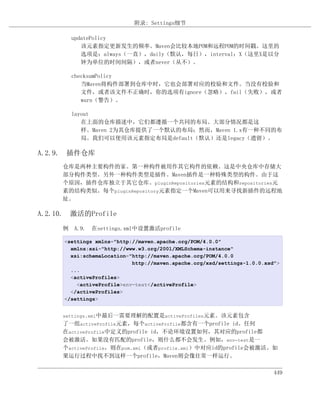
例 18.6. 从Ruby Mojo中引用MavenProject对象
# Thisis a mojo description
# @goal test
# @phase validate
class Test < Mojo
# @parameter type="java.lang.String" default-value="nothing" alias="a_string"
def prop
end
# @parameter type="org.apache.maven.project.MavenProject" expression="${project}"
# @required true
def project
end
def execute
info "The following String was passed to prop: '#{$prop}'"
info "My project artifact is: #{$project.artifactId}"
end
end
run_mojo Test
在前面的例子中,我们可以使用标准的Ruby语法访问Project类的属性。如果你将
test.rb放到firstruby-maven-plugin的src/main/scripts目录,然后install这个插
件,接着运行它,你会看到如下的输出:
$ mvn install
...
[INFO] [plugin:descriptor]
[INFO] Using 3 extractors.
[INFO] Applying extractor for language: java
...
[INFO] Applying extractor for language: jruby
[INFO] Ruby Mojo File: /echo.rb
[INFO] Ruby Mojo File: /test.rb
[INFO] Extractor for language: jruby found 2 mojo descriptors.
...
$ mvn firstruby:test
...
[INFO] [firstruby:test]
[INFO] The following String was passed to prop: 'nothing'
[INFO] My project artifact is: firstruby-maven-plugin
433
450.
使用可选语言编写插件
18.3.3. Ruby Mojo中使用日志
要在Ruby Mojo中使用日志,调用info(), debug(), 和error()方法,并传入日志信息
参数。
# Tests Logging
# @goal logtest
# @phase validate
class LogTest < Mojo
def execute
info "Prints an INFO message"
error "Prints an ERROR message"
debug "Prints to the Console"
end
end
run_mojo LogTest
18.3.4. Raise一个MojoError
如果在一个Ruby Mojo中有一个未发现的错误,你就需要raise一个MojoError。例 18.7
“在Ruby Mojo中raise一个MojoError”展示了如何raise一个MojoError。例子中的
mojo首先打印了一条日志信息,然后raise一个MojoError。
434
451.
使用可选语言编写插件
例 18.7. 在Ruby Mojo中raise一个MojoError
# Prints a Message
# @goal error
# @phase validate
class Error < Mojo
# @parameter type="java.lang.String" default-value="Hello Maven World" expression=
# @required true
# @readonly false
# @deprecated false
def message
end
def execute
info $message
raise MojoError.new( "This Mojo Raised a MojoError" )
end
end
run_mojo Error
运行该Mojo,会产生如下的输出:
$ mvn firstruby:error
...
INFO] [firstruby:error]
[INFO] Hello Maven World
[ERROR] This Mojo Raised a MojoError
18.3.5. 在JRuby中引用Plexus组件
Ruby Mojo可以依赖于一个Plexus组件。为此,你需要使用@parameter注解的
expression参数,在这里为Plexus指定role和hint。下面的例子中,Ruby Mojo依赖于
Archiver组件,Maven会据此从Plexus获取该组件。
435
452.
使用可选语言编写插件
例 18.8. 在Ruby Mojo中依赖于一个Plexus组件
# This mojo tests plexus integration
# @goal testplexus
# @phase validate
class TestPlexus < Mojo
# @parameter type="org.codehaus.plexus.archiver.Archiver"
expression="${component.org.codehaus.plexus.archiver.Archiver#zip}"
def archiver
end
def execute
info $archiver
end
end
run_mojo TestPlexus
请注意Ruby Mojo注解的属性不能跨越多行。如果你要运行该目标,你会看到Maven将根
据role:org.codehaus.plexus.archiver.Archiver和hit:zip尝试从Plexus获取一个
组件。
18.4. 使用Groovy编写插件
Groovy是一个基于Java虚拟机的动态语言,它最终也被编译成Java字节码。Groovy
是Codehaus社区的项目。如果你十分熟悉Java,Groovy就会是一种很自然的脚本语
言。Groovy使用了Java的很多特性,同时进行了略微的裁剪,并加入了一些新特性,
如闭包(closure),鸭子类型判断(duck-typing),和正则表达式。要了解更多的关于
Groovy的信息,可以访问Groovy的站点:http://groovy.codehaus.org。
18.4.1. 创建一个Groovy插件
要使用Groovy创建一个Maven插件,你只需要两个文件:一个pom.xml和一个用Groovy实
现的Mojo。首先,创建一个名为firstgroovy-maven-plugin的项目目录,然后在该目录
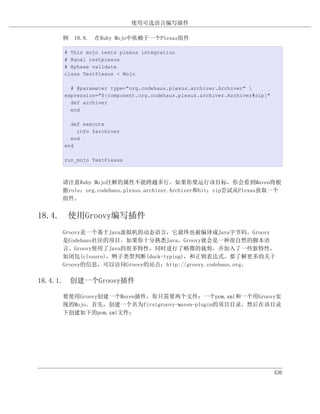
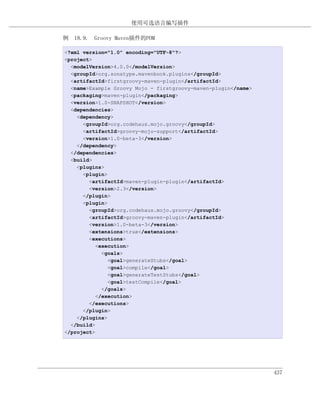
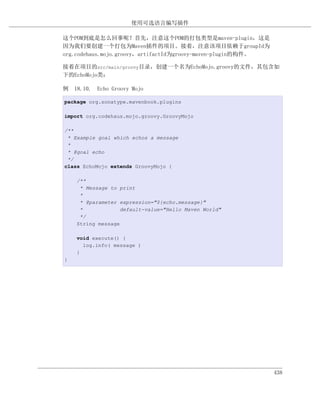
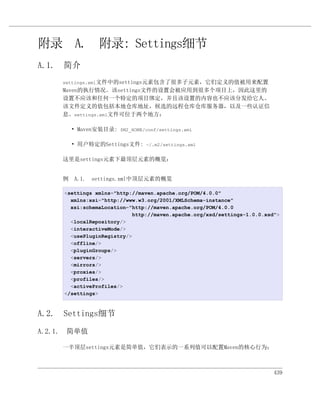
下创建如下的pom.xml文件:
436



![安装和运行Maven
Maven Help 插件有四个目标。前三个目标是—— active-profiles, effective-pom 和
effective-settings —— 描述一个特定的项目,它们必须在项目的目录下运行。 最后
一个目标—— describe ——相对比较复杂,展示某个插件或者插件目标的相关信息。
help:active-profiles
列出当前构建中活动的Profile(项目的,用户的,全局的)。
help:effective-pom
显示当前构建的实际POM,包含活动的Profile。
help:effective-settings
打印出项目的实际settings, 包括从全局的settings和用户级别settings继承的
配置。
help:describe
描述插件的属性。它不需要在项目目录下运行。但是你必须提供你想要描述插件
的 groupId 和 artifactId。
2.7.1. 描述一个Maven插件
一旦你开始使用Maven,你会花很多时间去试图获得Maven插件的信息:插件如何工
作?配置参数是什么?目标是什么? 你会经常使用help:describe 目标来获取这些信
息。通过 plugin 参数你可以指定你想要研究哪个插件,你可以传入插件的前缀(如
help 插件就是 maven-help-plugin),或者可以是 groupId:artifact[:version] ,这
里 version 是可选的。比如, 下面的命令使用 help 插件的 describe 目标来输出
Maven Help 插件的信息。
$ mvn help:describe -Dplugin=help
...
Group Id: org.apache.maven.plugins
Artifact Id: maven-help-plugin
Version: 2.0.1
Goal Prefix: help
Description:
The Maven Help plugin provides goals aimed at helping to make sense out of
the build environment. It includes the ability to view the effective
POM and settings files, after inheritance and active profiles
have been applied, as well as a describe a particular plugin goal to give
usage information.
...
通过设置 plugin 参数来运行 describe 目标,输出为该插件的Maven坐标,目标前
缀,和该插件的一个简要介绍。尽管这些信息非常有帮助,你通常还是需要了解更多
15](https://image.slidesharecdn.com/maven-definitive-guidezh-101013212800-phpapp01/85/Maven-definitive-guide-zh-31-320.jpg)
![安装和运行Maven
的详情。如果你想要 Help 插件输出完整的带有参数的目标列表,只要运行带有参数
full 的 help:describe 目标就可以了,像这样:
$ mvn help:describe -Dplugin=help -Dfull
...
Group Id: org.apache.maven.plugins
Artifact Id: maven-help-plugin
Version: 2.0.1
Goal Prefix: help
Description:
The Maven Help plugin provides goals aimed at helping to make sense out of
the build environment. It includes the ability to view the effective
POM and settings files, after inheritance and active profiles
have been applied, as well as a describe a particular plugin goal to give usage
information.
Mojos:
===============================================
Goal: 'active-profiles'
===============================================
Description:
Lists the profiles which are currently active for this build.
Implementation: org.apache.maven.plugins.help.ActiveProfilesMojo
Language: java
Parameters:
-----------------------------------------------
[0] Name: output
Type: java.io.File
Required: false
Directly editable: true
Description:
This is an optional parameter for a file destination for the output of this mojo...t
listing of active profiles per project.
-----------------------------------------------
[1] Name: projects
Type: java.util.List
Required: true
16](https://image.slidesharecdn.com/maven-definitive-guidezh-101013212800-phpapp01/85/Maven-definitive-guide-zh-32-320.jpg)
![第 3 章 一个简单的Maven项目
3.1. 简介
本章我们介绍一个用Maven Archetype插件从空白开始创建的简单项目。 当你跟着这个
简单项目的开发过程,你会看到这个简单的应用给我们提供了介绍Maven核心概念的机
会。
在你能开始使用Maven做复杂的,多模块的构建之前,我们需要从基础开始。如果
你之前用过Maven,你将会注意到这里很好的照顾到了细节。你的构建倾向于“只要
能工作”,只有当你需要编写插件来自定义默认行为的时候,才需要深入Maven的细
节。另一方面,当你需要深入Maven细节的时候,对Maven核心概念的彻底理解是至
关重要的。本章致力于为你介绍一个尽可能简单的Maven项目,然后介绍一些使Maven
成为一个可靠的构建平台的核心概念。读完本章后,你将会对构建生命周期 (build
lifecycle),Maven仓库 (repositories),依赖管理 (dependency management)和项目
对象模型 (Project Object Model)有一个基本的理解。
3.1.1. 下载本章的例子
本章开发了一个十分简单的例子,它将被用来探究Maven的核心概念。如果你跟着
本章表述的步骤,你应该不需要下载这些例子来重新创建那些Maven已经生成好的
代码。我们将会使用Maven Archetype插件来创建这个简单的项目,本章不会以任何
方式修改这个项目。如果你更喜欢通过最终的例子源代码来阅读本章,本章的例子
项目和这本书的例子代码可以从这里下载到:http://www.sonatype.com/book/mvn-
examples-1.0.zip或者http://www.sonatype.com/book/mvn-examples-1.0.tar.gz。
解压存档文件到任何目录下,然后到ch03/目录。在ch03/目录你将看到一个名字
为simple/的目录,它包含了本章的源代码。如果你希望在Web浏览器里看这些例子代
码,访问http://www.sonatype.com/book/examples-1.0并且点击ch03/目录。
3.2. 创建一个简单的项目
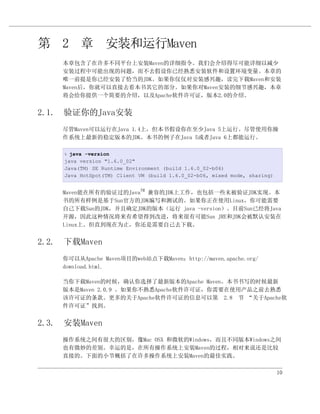
开始一个新的Maven项目,在命令行使用Maven Archetype插件。
$ mvn archetype:create -DgroupId=org.sonatype.mavenbook.ch03
-DartifactId=simple
-DpackageName=org.sonatype.mavenbook
[INFO] Scanning for projects...
[INFO] Searching repository for plugin with prefix: 'archetype'.
[INFO] artifact org.apache.maven.plugins:maven-archetype-plugin: checking for
updates from central
[INFO] -----------------------------------------------------------------------
[INFO] Building Maven Default Project
20](https://image.slidesharecdn.com/maven-definitive-guidezh-101013212800-phpapp01/85/Maven-definitive-guide-zh-36-320.jpg)
![一个简单的Maven项目
[INFO] task-segment: [archetype:create] (aggregator-style)
[INFO] --------------------------------------------------------------------
[INFO] [archetype:create]
[INFO] artifact org.apache.maven.archetypes:maven-archetype-quickstart:
checking for updates from central
[INFO] Parameter: groupId, Value: org.sonatype.mavenbook.ch03
[INFO] Parameter: packageName, Value: org.sonatype.mavenbook
[INFO] Parameter: basedir, Value: /Users/tobrien/svnw/sonatype/examples
[INFO] Parameter: package, Value: org.sonatype.mavenbook
[INFO] Parameter: version, Value: 1.0-SNAPSHOT
[INFO] Parameter: artifactId, Value: simple
[INFO] * End of debug info from resources from generated POM *
[INFO] Archetype created in dir: /Users/tobrien/svnw/sonatype/examples/simple
mvn 是Maven2的命令。archetype:create称为一个Maven目标 (goal)。如果你熟悉
Apache Ant,一个Maven目标类似于一个Ant目标 (target);它们都描述了将会在构建
中完成的工作单元 (unit of work)。而像-Dname=value这样的对是将会被传到目标中
的参数,它们使用-D属性这样的形式1,类似于你通过命令行向Java虚拟机传递系统属
性。archetype:create这个目标的目的通过archetype快速创建一个项目。在这里,一个
archetype被定义为“一个原始的模型或者类型,在它之后其它类似的东西与之匹配;
一个原型(prototype)”。Maven有许多可用的archetype,从生成一个简单的Swing应
用,到一个复杂的Web应用。本章我们用最基本的archetype来创建一个入门项目的骨
架。这个插件的前缀是“archetype”,目标为”create”。1
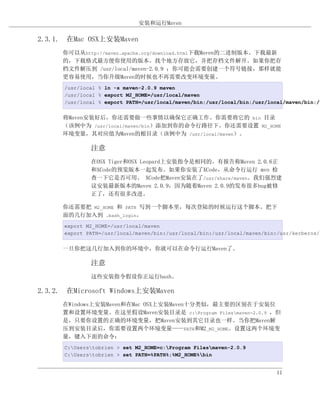
我们已经生成了一个项目,看一下Maven在simple目录下创建的目录结构:
simple/‚
simple/pom.xmlƒ
/src/
/src/main/„
/main/java
/src/test/…
/test/java
这个生成的目录遵循Maven标准目录布局,我们之后会去看更多的细节,但是,现在让
我们只是尝试了解这些基本的目录。
‚ Maven Archtype插件创建了一个与artifactId匹配的目录——simple。这是项目的
基础目录。
ƒ 每个项目在文件pom.xml里有它的项目对象模型 (POM)。这个文件描述了这个项
目,配置了插件,声明了依赖。
1
"-D<name>=<value>"这种格式不是Maven定义的,它其实是Java用来设置系统属性的方式,可以通过“java -help”查看
Java的解释。Maven的bin目录下的脚本文件仅仅是把属性传入Java而已。
21](https://image.slidesharecdn.com/maven-definitive-guidezh-101013212800-phpapp01/85/Maven-definitive-guide-zh-37-320.jpg)
![一个简单的Maven项目
„ 我们项目的源码了资源文件被放在了src/main目录下面。在我们简单Java项目这
样的情况下,这个目录包含了一下java类和一些配置文件。在其它的项目中,它
可能是web应用的文档根目录,或者还放一些应用服务器的配置文件。在一个Java
项目中,Java类放在src/main/java下面,而classpath资源文件放在src/main/
resources下面。
… 我们项目的测试用例放在src/test下。在这个目录下面,src/test/java存放像
使用JUnit或者TestNG这样的Java测试类。目录src/test/resources下存放测试
classpath资源文件。
Maven Archtype插件生成了一个简单的类org.sonatype.mavenbook.App,它是一个仅有
13行代码的Java,所做的只是在main方法中输出一行消息:
package org.sonatype.mavenbook;
/**
* Hello world!
*
*/
public class App
{
public static void main( String[] args )
{
System.out.println( "Hello World!" );
}
}
最简单的Maven archetype生成最简单的Maven项目:一个往标准输出打印“Hello
World”的程序。
3.3. 构建一个简单的项目
一旦你遵循第 3.2 节 “创建一个简单的项目”用Maven Archetype插件创建了一个
使
项目,你会希望构建并打包这个应用。想要构建打包这个应用,在包含pom.xml的目录
下运行mvn install。
$ mvn install
[INFO] Scanning for projects...
[INFO] ----------------------------------------------------------------------------
[INFO] Building simple
[INFO] task-segment: [install]
[INFO] ----------------------------------------------------------------------------
[INFO] [resources:resources]
[INFO] Using default encoding to copy filtered resources.
[INFO] [compiler:compile]
22](https://image.slidesharecdn.com/maven-definitive-guidezh-101013212800-phpapp01/85/Maven-definitive-guide-zh-38-320.jpg)
![一个简单的Maven项目
[INFO] Compiling 1 source file to /simple/target/classes
[INFO] [resources:testResources]
[INFO] Using default encoding to copy filtered resources.
[INFO] [compiler:testCompile]
[INFO] Compiling 1 source file to /simple/target/test-classes
[INFO] [surefire:test]
[INFO] Surefire report directory: /simple/target/surefire-reports
-------------------------------------------------------
T E S T S
-------------------------------------------------------
Running org.sonatype.mavenbook.AppTest
Tests run: 1, Failures: 0, Errors: 0, Skipped: 0, Time elapsed: 0.105 sec
Results :
Tests run: 1, Failures: 0, Errors: 0, Skipped: 0
[INFO] [jar:jar]
[INFO] Building jar: /simple/target/simple-1.0-SNAPSHOT.jar
[INFO] [install:install]
[INFO] Installing /simple/target/simple-1.0-SNAPSHOT.jar to
~/.m2/repository/org/sonatype/mavenbook/ch03/simple/1.0-SNAPSHOT/
simple-1.0-SNAPSHOT.jar
你已经创建了,编译了,测试了,打包了,并且安装了(installed)最简单的Maven项
目。在命令行运行它以向你自己验证这个程序能工作。
$ java -cp target/simple-1.0-SNAPSHOT.jar org.sonatype.mavenbook.App
Hello World!
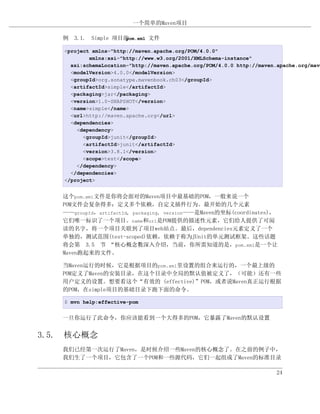
3.4. 简单的项目对象模型 (Project Object Model)
当Maven运行的时候它向项目对象模型(POM)查看关于这个项目的信息。POM回答类似这
样的问题:这个项目是什么类型的?这个项目的名称是什么?这个项目的构建有自定义
么?这里是一个由Maven Archetype插件的create目标创建的默认的pom.xml文件。
23](https://image.slidesharecdn.com/maven-definitive-guidezh-101013212800-phpapp01/85/Maven-definitive-guide-zh-39-320.jpg)
![一个简单的Maven项目
布局。之后你用生命周期阶段(phase)作为参数来运行Maven,这个阶段会提示Maven运
行一系列Maven插件的目标。最后,你把Maven构件(artifact)安装(install)到了你本
地仓库(repository)。等等?什么是生命周期?什么是“本地仓库”?下面的小结阐述
了一些Maven的核心概念。
3.5.1. Maven插件和目标 (Plugins and Goals)
在前面一节中,我们用两种类型的命令行参数运行了Maven。第一条命令是一条单个
的插件目标,Archetype插件的create目标。Maven第二次运行是一个生命周期阶段
–install。为了运行单个的Maven插件目标,我们使用mvn archetype:create这样的语
法,这里archetype是一个插件标识而create是目标标识。当Maven运行一个插件目标,
它向标准输出打印出插件标识和目标标识:
$ mvn archetype:create -DgroupId=org.sonatype.mavenbook.ch03
-DartifactId=simple
-DpackageName=org.sonatype.mavenbook
...
[INFO] [archetype:create]
[INFO] artifact org.apache.maven.archetypes:maven-archetype-quickstart:
checking for updates from central
...
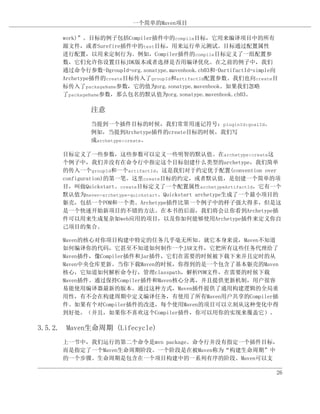
一个Maven插件是一个单个或者多个目标的集合。Maven插件的例子有一些简单但核心的
插件,像Jar插件,它包含了一组创建JAR文件的目标,Compiler插件,它包含了一组编
译源代码和测试代码的目标,或者Surefire插件,它包含一组运行单元测试和生成测试
报告的目标。而其它的,更有专门的插件包括:Hibernate3插件,用来集成流行的持久
化框架Hibernate,JRuby插件,它让你能够让运行ruby称为Maven构建的一部分或者用
Ruby来编写Maven插件。Maven也提供了自定义插件的能力。一个定制的插件可以用Java
编写,或者用一些其它的语言如Ant,Groovy,beanshell和之前提到的Ruby。
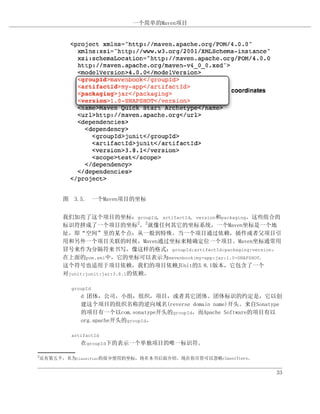
图 3.1. 一个插件包含一些目标
一个目标是一个明确的任务,它可以作为单独的目标运行,或者作为一个大的构
建的一部分和其它目标一起运行。一个目标是Maven中的一个“工作单元(unit of
25](https://image.slidesharecdn.com/maven-definitive-guidezh-101013212800-phpapp01/85/Maven-definitive-guide-zh-41-320.jpg)


![一个简单的Maven项目
插件是在它们被需要的时候从远程的仓库取来的。初始的Maven下载包的大小相当的小
(1.8兆),其中一个原因是事实上这个初始Maven不包括很多插件。它只包含了几近赤
裸的最少值,而在需要的时候再从远程仓库去取。Maven自带了一个用来下载Maven核心
插件和依赖的远程仓库地址(http://repo1.maven.org/maven2)。
你常常会写这样一个项目,这个项目依赖于一些既不免费也不公开的包。在这种情况
下,你需要要么在你组织的网络里安装一个定制的仓库,要么手动的安装这些依赖。默
认的远程仓库可以被替换,或者增加一个你组织维护的自定义Maven仓库的引用。有许
多现成的项目允许组织管理和维护公共Maven仓库的镜像。
是什么让Maven仓库成为一个Maven仓库的呢?Maven仓库是通过结构来定义的,
一个Maven仓库是项目构件的一个集合,这些构件存储在一个目录结构下面,它
们的格式能很容易的被Maven所理解。在一个Maven仓库中,所有的东西存储在
一个与Maven项目坐标十分匹配的目录结构中。你可以打开浏览器,然后浏览中
央Maven仓库http://repo1.maven.org/maven2/ 来看这样的结构。你会看到坐标
为org.apache.commons:commons-email:1.1的构件能在目录/org/apache/commons/
commons-email/1.1/下找到,文件名为commons-email-1.1.jar。Maven仓库的标准是按
照下面的目录格式来存储构件,相对于仓库的根目录:
/<groupId>/<artifactId>/<version>/<artifactId>-<version>.<packaging>
Maven从远程仓库下载构件和插件到你本机上,存储在你的本地Maven仓库里。一旦
Maven已经从远程仓库下载了一个构件,它将永远不需要再下载一次,因为maven会首
先在本地仓库查找插件,然后才是其它地方。在Windows XP上,你的本地仓库很可能
在C:Documents and SettingsUSERNAME.m2repository,在Windows Vista上,会是C:
UsersUSERNAME.m2repository。在Unix系统上,你的本地仓库在~/.m2/repository。
当你创建像前一节创建的简单项目时,install阶段执行一个目标,把你项目的构件安
装到你的本地仓库。
在你的本地仓库,你应该可以看到我们的简单项目创建出来的构件。如果你运行mvn
install命令,Maven会把我们项目的构件安装到本地仓库。试一下。
$ mvn install
...
[INFO] [install:install]
[INFO] Installing .../simple-1.0-SNAPSHOT.jar to
~/.m2/repository/org/sonatype/mavenbook/simple/1.0-SNAPSHOT/
simple-1.0-SNAPSHOT.jar
...
就像你能从这个命令的输出看到的,Maven把我们项目的JAR文件安装到了我们的本地
Maven仓库。Maven在本地项目中通过本地仓库来共享依赖。如果你开发了两个项目——
项目A和项目B——项目B依赖于项目A产生的构件。当构建项目B的时候,Maven会从本地
35](https://image.slidesharecdn.com/maven-definitive-guidezh-101013212800-phpapp01/85/Maven-definitive-guide-zh-51-320.jpg)
![定制一个Maven项目
换句话说,如果你考虑集成该数据源到你的商业 web 站点上,请再仔细考虑考虑,该
数据源可作为个人或其它非商业性用途。 本章我们提倡的使用是个人教育用途。 要
了解更多的 Yahoo! Weather 服务条款,请参考 Yahoo! Weather API 文档: http://
developer.yahoo.com/weather/ 。
4.3. 创建Simple Weather项目
首先,让我们用 Maven Archetype 插件创建这个 simple weather 项目的基本轮廓。
运行下面的命令,创建新项目:
$ mvn archetype:create -DgroupId=org.sonatype.mavenbook.ch04
-DartifactId=simple-weather
-DpackageName=org.sonatype.mavenbook
-Dversion=1.0
[INFO] [archetype:create]
[INFO] artifact org.apache.maven.archetypes:maven-archetype-quickstart:
checking for updates from central
[INFO] ------------------------------------------------------------------
[INFO] Using following parameters for creating Archetype:
maven-archetype-quickstart:RELEASE
[INFO] ------------------------------------------------------------------
[INFO] Parameter: groupId, Value: org.sonatype.mavenbook.ch04
[INFO] Parameter: packageName, Value: org.sonatype.mavenbook
[INFO] Parameter: basedir, Value: ~/examples
[INFO] Parameter: package, Value: org.sonatype.mavenbook
[INFO] Parameter: version, Value: 1.0
[INFO] Parameter: artifactId, Value: simple-weather
[INFO] *** End of debug info from resources from generated POM ***
[INFO] Archetype created in dir: ~/examples/simple-weather
在 Maven Archetype 插件创建好了这个项目之后,进入到 simple-weather 目录,看
一下 pom.xml。你会看到如下的 XML 文档:
40](https://image.slidesharecdn.com/maven-definitive-guidezh-101013212800-phpapp01/85/Maven-definitive-guide-zh-56-320.jpg)
![定制一个Maven项目
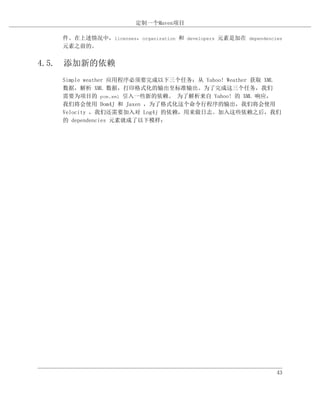
例 4.3. 添加 Dom4J, Jaxen, Velocity 和 Log4J 作为依赖
<project>
[...]
<dependencies>
<dependency>
<groupId>log4j</groupId>
<artifactId>log4j</artifactId>
<version>1.2.14</version>
</dependency>
<dependency>
<groupId>dom4j</groupId>
<artifactId>dom4j</artifactId>
<version>1.6.1</version>
</dependency>
<dependency>
<groupId>jaxen</groupId>
<artifactId>jaxen</artifactId>
<version>1.1.1</version>
</dependency>
<dependency>
<groupId>velocity</groupId>
<artifactId>velocity</artifactId>
<version>1.5</version>
</dependency>
<dependency>
<groupId>junit</groupId>
<artifactId>junit</artifactId>
<version>3.8.1</version>
<scope>test</scope>
</dependency>
</dependencies>
[...]
</project>
################# test # JUnit ############################# pom.xml ###### mvn
install ##### Maven ################### Maven ### ##############“##”### groupId
# artifactId ######## (# Log4J) ############################# groupId # artifactId#
# Velocity# Dom4J # Jaxen ############ http://www.mvnrepository.com ##### #####
### Maven ################### ############ http://www.mvnrepository.com #######
###### Hibernate ## Spring Framework ################### artifactId ### Maven ###
######## ####################################### pom.xml ####### ###############
##### groupId########## mvnrepository.com1 ###################
1
http://www.mvnrepository.com
44](https://image.slidesharecdn.com/maven-definitive-guidezh-101013212800-phpapp01/85/Maven-definitive-guide-zh-60-320.jpg)
![定制一个Maven项目
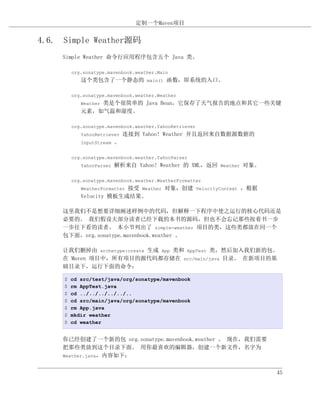
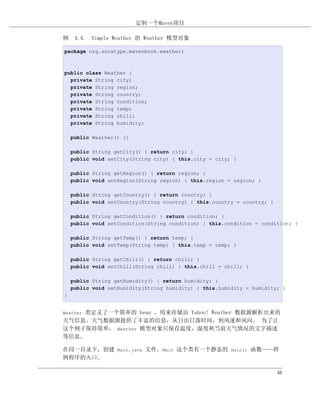
例 4.5. Simple Weather 的 Main 类
package org.sonatype.mavenbook.weather;
import java.io.InputStream;
import org.apache.log4j.PropertyConfigurator;
public class Main {
public static void main(String[] args) throws Exception {
// Configure Log4J
PropertyConfigurator.configure(Main.class.getClassLoader()
.getResource("log4j.properties"));
// Read the Zip Code from the Command-line (if none supplied, use 60202)
int zipcode = 60202;
try {
zipcode = Integer.parseInt(args[0]);
} catch( Exception e ) {}
// Start the program
new Main(zipcode).start();
}
private int zip;
public Main(int zip) {
this.zip = zip;
}
public void start() throws Exception {
// Retrieve Data
InputStream dataIn = new YahooRetriever().retrieve( zip );
// Parse Data
Weather weather = new YahooParser().parse( dataIn );
// Format (Print) Data
System.out.print( new WeatherFormatter().format( weather ) );
}
}
47](https://image.slidesharecdn.com/maven-definitive-guidezh-101013212800-phpapp01/85/Maven-definitive-guide-zh-63-320.jpg)
![定制一个Maven项目
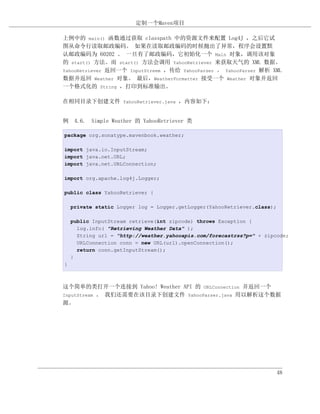
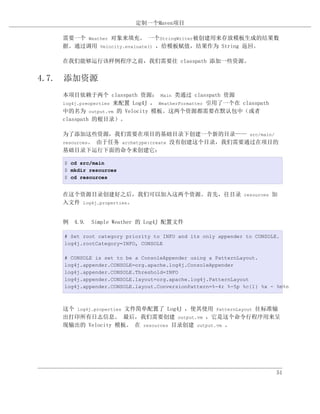
例 4.10. Simple Weather 的 Output Velocity 模板
*********************************
Current Weather Conditions for:
${weather.city}, ${weather.region}, ${weather.country}
Temperature: ${weather.temp}
Condition: ${weather.condition}
Humidity: ${weather.humidity}
Wind Chill: ${weather.chill}
*********************************
这个模板包含了许多对名为 weather 的变量的引用。 这个 weather 变量是传给
WeatherFormatter 的 那个 Weather bean, ${weather.temp} 语法简化的表示获取并
显示 temp 这个bean属性的值。 现在我们已经在正确的地方有了我们项目的所有代
码,我们可以使用 Maven 来运行这个样例。
4.8. 运行Simple Weather项目
使用来自 Codehaus Mojo 项目2 的 Exec 插件,我们可以运行这个程序。在项目的基
础目录下运行以下命令,以运行该程序的 Main 类。
$ mvn install
$ mvn exec:java -Dexec.mainClass=org.sonatype.mavenbook.weather.Main
...
[INFO] [exec:java]
0 INFO YahooRetriever - Retrieving Weather Data
134 INFO YahooParser - Creating XML Reader
333 INFO YahooParser - Parsing XML Response
420 INFO WeatherFormatter - Formatting Weather Data
*********************************
Current Weather Conditions for:
Evanston, IL, US
Temperature: 45
Condition: Cloudy
Humidity: 76
Wind Chill: 38
*********************************
...
我们没有为 Main 类提供命令行参数,因此程序按照默认的邮编执行——60202。 正
如你能看到的,我们已经成功的运行了 SImple Weather 命令行工具,从 Yahoo!
2
http://mojo.codehaus.org
52](https://image.slidesharecdn.com/maven-definitive-guidezh-101013212800-phpapp01/85/Maven-definitive-guide-zh-68-320.jpg)
![定制一个Maven项目
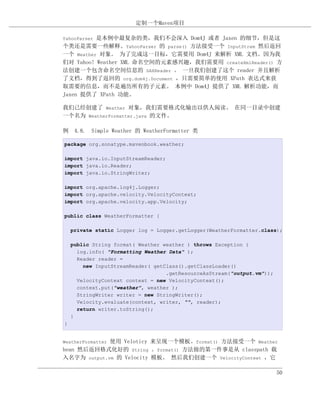
Weather 获取了一些数据,解析了结果,并且通过 Velocity 格式化了结果数据。 我
们仅仅写了项目的源代码,往 pom.xml 添加了一些最少的配置。 注意我们这里没有引
入“构建过程”。 我们不需要定义如何或哪里让 Java 编译器编译我们的源代码,我
们不需要指导构建系统在运行样例程序的时候如何定位二进制文件, 我们所需要做的
是包含一些依赖,用来定位合适的 Maven 坐标。
4.8.1. Maven Exec 插件
Exec 插件允许你运行 Java 类和其它脚本。 它不是 Maven 核心插件,但它可以从
Codehaus3 的 Mojo4 项目得到。想要查看 Exec 插件的完整描述,运行:
$ mvn help:describe -Dplugin=exec -Dfull
这会列出所有 Maven Exec 插件可用的目标。 Help 插件同时也会列出 Exec 插件
的有效参数,如果你想要定制 Exec 插件的行为,传入命令行参数,你应该使用
help:describe 提供的文档作为指南。 虽然 Exec 插件很有用,在开发过程中用来运
行测试之外,你不应该依赖它来运行你的应用程序。 想要更健壮的解决方案,使用
Maven Assembly 插件,它在第 4.13 节 “构建一个打包好的命令行应用程序”被描
中
述。
4.8.2. 浏览你的项目依赖
Exec 插件让我们能够在不往 classpath 载入适当的依赖的情况下,运行这个程
序。 在任何其它的构建系统能够中,我们必须复制所有程序依赖到类似于 lib/ 的目
录,这个目录包含一个 JAR 文件的集合。 那样,我们就必须写一个简单的脚本,在
classpath 中包含我们程序的二进制代码和我们的依赖。 只有那样我们才能运行 java
org.sonatype.mavenbook.weather.Main 。 Exec 能做这样的工作是因为 Maven 已经
知道如何创建和管理你的 classpath 和你的依赖。
了解你项目的 classpath 包含了哪些依赖是很方便也很有用的。这个项目不仅包含
了一些类库如 Dom4J, Log4J, Jaxen, 和 Velocity,它同时也引入了一些传递
性依赖。 如果你需要找出 classpath 中有什么,你可以使用 Maven Dependency 插
件来打印出已解决依赖的列表。 要打印出 Simple Weather 项目的这个列表,运行
dependency:resolve 目标。
$ mvn dependency:resolve
...
[INFO] [dependency:resolve]
[INFO]
[INFO] The following files have been resolved:
[INFO] com.ibm.icu:icu4j:jar:2.6.1 (scope = compile)
[INFO] commons-collections:commons-collections:jar:3.1 (scope = compile)
3
http://www.codehaus.org
4
http://mojo.codehaus.org
53](https://image.slidesharecdn.com/maven-definitive-guidezh-101013212800-phpapp01/85/Maven-definitive-guide-zh-69-320.jpg)
![定制一个Maven项目
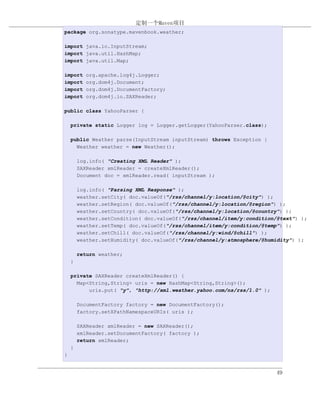
[INFO] commons-lang:commons-lang:jar:2.1 (scope = compile)
[INFO] dom4j:dom4j:jar:1.6.1 (scope = compile)
[INFO] jaxen:jaxen:jar:1.1.1 (scope = compile)
[INFO] jdom:jdom:jar:1.0 (scope = compile)
[INFO] junit:junit:jar:3.8.1 (scope = test)
[INFO] log4j:log4j:jar:1.2.14 (scope = compile)
[INFO] oro:oro:jar:2.0.8 (scope = compile)
[INFO] velocity:velocity:jar:1.5 (scope = compile)
[INFO] xalan:xalan:jar:2.6.0 (scope = compile)
[INFO] xerces:xercesImpl:jar:2.6.2 (scope = compile)
[INFO] xerces:xmlParserAPIs:jar:2.6.2 (scope = compile)
[INFO] xml-apis:xml-apis:jar:1.0.b2 (scope = compile)
[INFO] xom:xom:jar:1.0 (scope = compile)
正如你能看到的,我们项目拥有一个很大的依赖集合。 虽然我们只是为四个类库引入
了直接的依赖,看来我们实际共引入了15个依赖。 Dom4J 依赖于 Xerces 和 XML 解析
器 API ,Jaxen 依赖于 Xalan,后者也就在 classpath 中可用了。 Dependency 插件
将会打印出最终的你项目编译所基于的所有依赖的组合。 如果你想知道你项目的整个
依赖树,你可以运行 dependency:tree 目标。
$ mvn dependency:tree
...
[INFO] [dependency:tree]
[INFO] org.sonatype.mavenbook.ch04:simple-weather:jar:1.0
[INFO] +- log4j:log4j:jar:1.2.14:compile
[INFO] +- dom4j:dom4j:jar:1.6.1:compile
[INFO] | - xml-apis:xml-apis:jar:1.0.b2:compile
[INFO] +- jaxen:jaxen:jar:1.1.1:compile
[INFO] | +- jdom:jdom:jar:1.0:compile
[INFO] | +- xerces:xercesImpl:jar:2.6.2:compile
[INFO] | - xom:xom:jar:1.0:compile
[INFO] | +- xerces:xmlParserAPIs:jar:2.6.2:compile
[INFO] | +- xalan:xalan:jar:2.6.0:compile
[INFO] | - com.ibm.icu:icu4j:jar:2.6.1:compile
[INFO] +- velocity:velocity:jar:1.5:compile
[INFO] | +- commons-collections:commons-collections:jar:3.1:compile
[INFO] | +- commons-lang:commons-lang:jar:2.1:compile
[INFO] | - oro:oro:jar:2.0.8:compile
[INFO] +- org.apache.commons:commons-io:jar:1.3.2:test
[INFO] - junit:junit:jar:3.8.1:test
...
如果你还不满足,或者想要查看完整的依赖踪迹,包含那些因为冲突或者其它原因而被
拒绝引入的构件,打开 Maven 的调试标记运行:
$ mvn install -X
54](https://image.slidesharecdn.com/maven-definitive-guidezh-101013212800-phpapp01/85/Maven-definitive-guide-zh-70-320.jpg)
![定制一个Maven项目
...
[DEBUG] org.sonatype.mavenbook.ch04:simple-weather:jar:1.0 (selected for null)
[DEBUG] log4j:log4j:jar:1.2.14:compile (selected for compile)
[DEBUG] dom4j:dom4j:jar:1.6.1:compile (selected for compile)
[DEBUG] xml-apis:xml-apis:jar:1.0.b2:compile (selected for compile)
[DEBUG] jaxen:jaxen:jar:1.1.1:compile (selected for compile)
[DEBUG] jaxen:jaxen:jar:1.1-beta-6:compile (removed - causes a cycle in the grap
[DEBUG] jaxen:jaxen:jar:1.0-FCS:compile (removed - causes a cycle in the graph)
[DEBUG] jdom:jdom:jar:1.0:compile (selected for compile)
[DEBUG] xml-apis:xml-apis:jar:1.3.02:compile (removed - nearer found: 1.0.b2)
[DEBUG] xerces:xercesImpl:jar:2.6.2:compile (selected for compile)
[DEBUG] xom:xom:jar:1.0:compile (selected for compile)
[DEBUG] xerces:xmlParserAPIs:jar:2.6.2:compile (selected for compile)
[DEBUG] xalan:xalan:jar:2.6.0:compile (selected for compile)
[DEBUG] xml-apis:xml-apis:1.0.b2.
[DEBUG] com.ibm.icu:icu4j:jar:2.6.1:compile (selected for compile)
[DEBUG] velocity:velocity:jar:1.5:compile (selected for compile)
[DEBUG] commons-collections:commons-collections:jar:3.1:compile (selected for co
[DEBUG] commons-lang:commons-lang:jar:2.1:compile (selected for compile)
[DEBUG] oro:oro:jar:2.0.8:compile (selected for compile)
[DEBUG] junit:junit:jar:3.8.1:test (selected for test)
从调试输出我们看到一些依赖管理系统工作的内部信息。 你在这里看到的是项目的
依赖树。 Maven 正打印出你项目的所有的依赖,以及这些依赖的依赖(还有依赖的
依赖的依赖)的完整的 Maven 坐标。 你能看到 simple-weather 依赖于 jaxen ,
jaxen 依赖于 xom , xom 接着依赖于 icu4j 。从该输出你能看到 Maven 正在创建
一个依赖图,排除重复,解决不同版本之间的冲突。 如果你的依赖有问题,通常在
dependency:tree 所生成的列表基础上更深入一点会有帮助;开启调试输出允许你看到
Maven 工作时的依赖机制。
4.9. 编写单元测试
Maven 内建了对单元测试的支持,测试是 Maven 默认生命周期的一部分。让我们
给 Simple Weather 项目添加一些单元测试。 首先,在 src/test/java 下面创建包
org.sonatype.mavenbook.weather。
$ cd src/test/java
$ cd org/sonatype/mavenbook
$ mkdir -p weather/yahoo
$ cd weather/yahoo
目前,我们将会创建两个单元测试。 第一个单元测试会测试 YahooParser ,第二个会
测试 WeatherFormatter。 在 weather 包中,创建一个带有一以下内容的文件,名称为
YahooParserTest.java 。
55](https://image.slidesharecdn.com/maven-definitive-guidezh-101013212800-phpapp01/85/Maven-definitive-guide-zh-71-320.jpg)
![xmlns:geo="http://www.w3.org/2003/01/geo/wgs84_pos#">
<channel>
<title>Yahoo! Weather - New York, NY</title>
定制一个Maven项目
<link>http://us.rd.yahoo.com/dailynews/rss/weather/New_York__NY/</link>
<description>Yahoo! Weather for New York, NY</description>
例 4.15. Simple Weather 的 YahooParserTest XML 输入
<language>en-us</language>
<lastBuildDate>Sat, 10 Nov 2007 8:51 pm EDT</lastBuildDate>
<ttl>60</ttl>
<yweather:location city="New York" region="NY" country="US" />
<yweather:units temperature="F" distance="mi" pressure="in" speed="mph" />
<yweather:wind chill="39" direction="0" speed="0" />
<yweather:atmosphere humidity="67" visibility="1609" pressure="30.18"
rising="1" />
<yweather:astronomy sunrise="6:36 am" sunset="4:43 pm" />
<image>
<title>Yahoo! Weather</title>
<width>142</width>
<height>18</height>
<link>http://weather.yahoo.com/</link>
<url>http://l.yimg.com/us.yimg.com/i/us/nws/th/main_142b.gif</url>
</image>
<item>
<title>Conditions for New York, NY at 8:51 pm EDT</title>
<geo:lat>40.67</geo:lat>
<geo:long>-73.94</geo:long>
<link>http://us.rd.yahoo.com/dailynews/rss/weather/New_York__NY/</link>
<pubDate>Sat, 10 Nov 2007 8:51 pm EDT</pubDate>
<yweather:condition text="Fair" code="33" temp="39"
date="Sat, 10 Nov 2007 8:51 pm EDT" />
<description><![CDATA[
<img src="http://l.yimg.com/us.yimg.com/i/us/we/52/33.gif" /><br />
<b>Current Conditions:</b><br />
Fair, 39 F<BR /><BR />
<b>Forecast:</b><BR />
Sat - Partly Cloudy. High: 45 Low: 32<br />
Sun - Sunny. High: 50 Low: 38<br />
<br />
]]></description>
<yweather:forecast day="Sat" date="10 Nov 2007" low="32" high="45"
text="Partly Cloudy" code="29" />
<yweather:forecast day="Sun" date="11 Nov 2007" low="38" high="50"
text="Sunny" code="32" />
<guid isPermaLink="false">10002_2007_11_10_20_51_EDT</guid>
</item>
</channel>
</rss>
60](https://image.slidesharecdn.com/maven-definitive-guidezh-101013212800-phpapp01/85/Maven-definitive-guide-zh-76-320.jpg)
![定制一个Maven项目
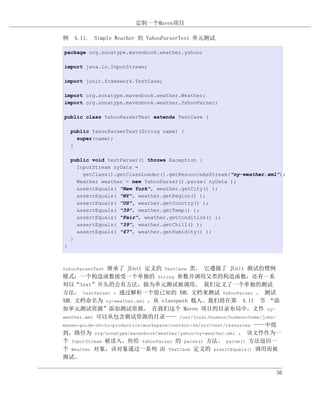
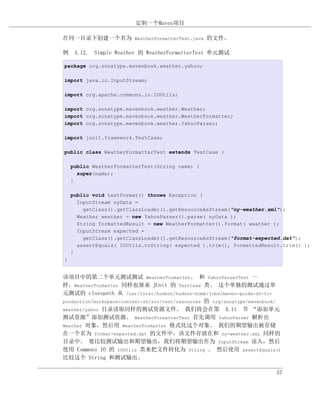
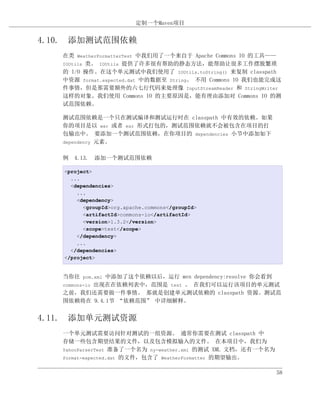
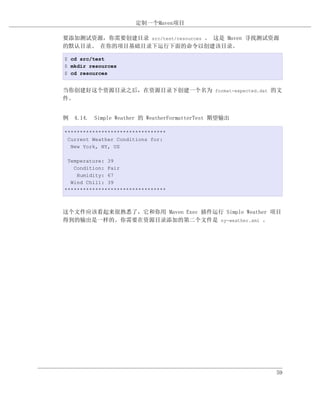
该文件包含了一个给 YahooParserTest 用的 XML 文档。有了这个文件,我们不用从
Yahoo! Weather 获取 XML 响应就能测试 YahooParser 了。
4.12. 执行单元测试
既然你的项目已经有单元测试了,那么让它们运行起来吧。 你不必为了运行单元测试
做什么特殊的事情, test 阶段是 Maven 生命周期中常规的一部分。 当你运行 mvn
package 或者 mvn install 的时候你也运行了测试。 如果你想要运行到 test 阶段为
止的所有生命周期阶段,运行 mvn test 。
$ mvn test
...
[INFO] [surefire:test]
[INFO] Surefire report directory: ~/examples/simple-weather/target/surefire-reports
-------------------------------------------------------
T E S T S
-------------------------------------------------------
Running org.sonatype.mavenbook.weather.yahoo.WeatherFormatterTest
0 INFO YahooParser - Creating XML Reader
177 INFO YahooParser - Parsing XML Response
239 INFO WeatherFormatter - Formatting Weather Data
Tests run: 1, Failures: 0, Errors: 0, Skipped: 0, Time elapsed: 0.547 sec
Running org.sonatype.mavenbook.weather.yahoo.YahooParserTest
475 INFO YahooParser - Creating XML Reader
483 INFO YahooParser - Parsing XML Response
Tests run: 1, Failures: 0, Errors: 0, Skipped: 0, Time elapsed: 0.018 sec
Results :
Tests run: 2, Failures: 0, Errors: 0, Skipped: 0
从命令行运行 mvn test 使 Maven 执行到 test 阶段为止的所有生命周期阶段。
Maven Surefire 插件有一个 test 目标,该目标被绑定在了 test 阶段。 test 目
标执行项目中所有能在 src/test/java 找到的并且文件名与 **/Test*.java, **/
*Test.java 和 **/*TestCase.java 匹配的所有单元测试。 在本例中,你能看到
Surefire 插件的 test 目标执行了 WeatherFormatterTest 和 YahooParserTest 。
在 Maven Surefire 插件执行 JUnit 测试的时候,它同时也在 /usr/local/hudson/
hudson-home/jobs/maven-guide-zh-to-production/workspace/content-zh/target/
目录下生成 XML 和常规文本报告。 如果你的测试失败了,你可以去
surefire-reports
查看这个目录,里面有你单元测试生成的异常堆栈信息和错误信息。
61](https://image.slidesharecdn.com/maven-definitive-guidezh-101013212800-phpapp01/85/Maven-definitive-guide-zh-77-320.jpg)
![定制一个Maven项目
4.12.1. 忽略测试失败
通常,你会开发一个带有很多失败单元测试的系统。 如果你正在实践测试驱动开发
(TDD),你可能会使用测试失败来衡量你离项目完成有多远。 如果你有失败的单元
测试,但你仍然希望产生构建输出,你就必须告诉 Maven 让它忽略测试失败。 当
Maven 遇到一个测试失败,它默认的行为是停止当前的构建。 如果你希望继续构
建项目,即使 Surefire 插件遇到了失败的单元测试,你就需要设置 Surefire 的
testFailureIgnore 这个配置属性为 true。
例 4.16. 忽略单元测试失败
<project>
[...]
<build>
<plugins>
<plugin>
<groupId>org.apache.maven.plugins</groupId>
<artifactId>maven-surefire-plugin</artifactId>
<configuration>
<testFailureIgnore>true</testFailureIgnore>
</configuration>
</plugin>
</plugins>
</build>
[...]
</project>
该插件文档 (http://maven.apache.org/plugins/maven-surefire-plugin/test-
mojo.html) 说明,这个参数声明为一个表达式:
例 4.17. 插件参数表达式
testFailureIgnore Set this to true to ignore a failure during testing. Its u
* Type: boolean
* Required: No
* Expression: ${maven.test.failure.ignore}
这个表达式可以从命令行通过 -D 参数设置。
$ mvn test -Dmaven.test.failure.ignore=true
62](https://image.slidesharecdn.com/maven-definitive-guidezh-101013212800-phpapp01/85/Maven-definitive-guide-zh-78-320.jpg)
![定制一个Maven项目
4.12.2. 跳过单元测试
你可能想要配置 Maven 使其完全跳过单元测试。 可能你有一个很大的系统,单元
测试需要花好多分钟来完成,而你不想在生成最终输出前等单元测试完成。 你可能
正工作在一个遗留系统上面,这个系统有一系列的失败的单元测试,你可能仅仅想要
生成一个 JAR 而不是去修复所有的单元测试。 Maven 提供了跳过单元测试的能力,
只需要使用 Surefire 插件的 skip 参数。 在命令行,只要简单的给任何目标添加
maven.test.skip 属性就能跳过测试:
$ mvn install -Dmaven.test.skip=true
...
[INFO] [compiler:testCompile]
[INFO] Not compiling test sources
[INFO] [surefire:test]
[INFO] Tests are skipped.
...
当 Surefire 插件到达 test 目标的时候,如果 maven.test.skip 设置为 true ,它就
会跳过单元测试。 另一种配置 Maven 跳过单元测试的方法是给你项目的 pom.xml 添
加这个配置。 你需要为你的 build 添加 plugin 元素。
例 4.18. 跳过单元测试
<project>
[...]
<build>
<plugins>
<plugin>
<groupId>org.apache.maven.plugins</groupId>
<artifactId>maven-surefire-plugin</artifactId>
<configuration>
<skip>true</skip>
</configuration>
</plugin>
</plugins>
</build>
[...]
</project>
4.13. 构建一个打包好的命令行应用程序
在 第 4.12 节 “执行单元测试”我们使用 Maven Exec 插件运行了 Simple
,
Weather 应用程序。虽然 Maven Exec 能运行程序并且产生输出,你不能就把 Maven
当成是你程序运行的容器。 如果你把这个命令行程序分发给其他人,你大概就需要
63](https://image.slidesharecdn.com/maven-definitive-guidezh-101013212800-phpapp01/85/Maven-definitive-guide-zh-79-320.jpg)
![定制一个Maven项目
分发一个 JAR 或者一个 ZIP 存档文件或者 TAR 压缩过的 GZIP 文件。下面的小节介
绍了使用 Maven Assembly 插件的预定义装配描述符生成一个可分发的 JAR 文件的过
程,该文件包含了项目的二进制文件和所有的依赖。
Maven Assembly 插件是一个用来创建你应用程序特有分发包的插件。 你可以使
用 Maven Assembly 插件以你希望的任何形式来装配输出,只需定义一个自定义的
装配描述符。 后面的章节我们会说明如何创建一个自定义装配描述符,为 Simple
Weather 应用程序生成一个更复杂的存档文件。 本章我们将会使用预定义的 jar-
with-dependencies 格式。 要配置 Maven Assembly 插件, 我们需要在 pom.xml 中的
build 配置中添加如下的 plugin 配置。
例 4.19. 配置 Maven 装配描述符
<project>
[...]
<build>
<plugins>
<plugin>
<artifactId>maven-assembly-plugin</artifactId>
<configuration>
<descriptorRefs>
<descriptorRef>jar-with-dependencies</descriptorRef>
</descriptorRefs>
</configuration>
</plugin>
</plugins>
</build>
[...]
</project>
添加好这些配置以后,你可以通过运行 mvn assembly:assembly 来构建这个装配。
$ mvn install assembly:assembly
...
[INFO] [jar:jar]
[INFO] Building jar: ~/examples/simple-weather/target/simple-weather-1.0.jar
[INFO] [assembly:assembly]
[INFO] Processing DependencySet (output=)
[INFO] Expanding:
.m2/repository/dom4j/dom4j/1.6.1/dom4j-1.6.1.jar into
/tmp/archived-file-set.1437961776.tmp
[INFO] Expanding: .m2/repository/commons-lang/commons-lang/2.1/commons-lang-2.1.jar
into /tmp/archived-file-set.305257225.tmp
... (Maven Expands all dependencies into a temporary directory) ...
[INFO] Building jar:
64](https://image.slidesharecdn.com/maven-definitive-guidezh-101013212800-phpapp01/85/Maven-definitive-guide-zh-80-320.jpg)
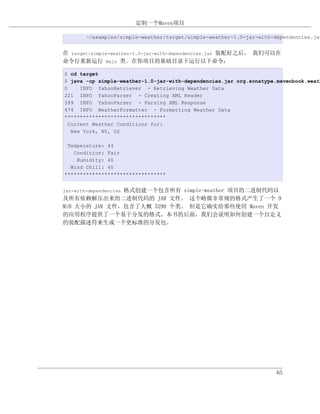
![一个简单的Web应用
[INFO] [archetype:create]
[INFO] ----------------------------------------------------------------------------
[INFO] Using following parameters for creating Archetype: maven-archetype-webapp:REL
[INFO] ----------------------------------------------------------------------------
[INFO] Parameter: groupId, Value: org.sonatype.mavenbook.ch05
[INFO] Parameter: packageName, Value: org.sonatype.mavenbook
[INFO] Parameter: basedir, Value: ~/examples
[INFO] Parameter: package, Value: org.sonatype.mavenbook
[INFO] Parameter: version, Value: 1.0-SNAPSHOT
[INFO] Parameter: artifactId, Value: simple-webapp
[INFO] ********************* End of debug info from resources from generated POM ***
[INFO] Archetype created in dir: ~/examples/simple-webapp
在 Maven Archetype 插件创建好了项目之后,切换目录至 simple-web 后看一下
pom.xml 。 你会看到如下的 XML 文档:
例 5.1. simple-web 项目的初始 POM
<project xmlns="http://maven.apache.org/POM/4.0.0"
xmlns:xsi="http://www.w3.org/2001/XMLSchema-instance"
xsi:schemaLocation="http://maven.apache.org/POM/4.0.0
http://maven.apache.org/maven-v4_0_0.xsd">
<modelVersion>4.0.0</modelVersion>
<groupId>org.sonatype.mavenbook.ch05</groupId>
<artifactId>simple-webapp</artifactId>
<packaging>war</packaging>
<version>1.0-SNAPSHOT</version>
<name>simple-webapp Maven Webapp</name>
<url>http://maven.apache.org</url>
<dependencies>
<dependency>
<groupId>junit</groupId>
<artifactId>junit</artifactId>
<version>3.8.1</version>
<scope>test</scope>
</dependency>
</dependencies>
<build>
<finalName>simple-webapp</finalName>
</build>
</project>
注意 packaging 元素包含的值是 war 。这种打包类型配置让 Maven 以 WAR 文件的形
式生成一个 web 应用。一个打包类型为 war 的项目,将会在 target/ 目录创建一个
67](https://image.slidesharecdn.com/maven-definitive-guidezh-101013212800-phpapp01/85/Maven-definitive-guide-zh-83-320.jpg)
![一个简单的Web应用
WAR 文件,这个文件的默认名称是 content-zh-0.6-SNAPSHOT.war 。对于这个项目,
默认的 WAR 文件是 target/simple-webapp-1.0-SNAPSHOT.war 。在这个 simple-webapp
项目中,我们已经通过在项目的构建配置中加入 finalName 元素来自定义这个生成的
WAR 文件的名称。根据 simple-webapp 的 finalName ,package 阶段生成的 WAR 文件
为 target/simple-webapp.war 。
5.4. 配置Jetty插件
在你已经编译,测试并且打包了你的 web 应用之后,你会想要将它部署到一个
servlet 容器中,然后测试一下由 Maven Archetype 插件创建的 index.jsp 。通常情
况下,你需要下载 Jetty 或者 Apache Tomcat,解压分发包,复制你的应用程序 WAR
文件至 webapps/ 目录,然后启动你的容器。 现在,实现同样的目的,你不再需要做
这些事情。 取而代之的是,你可以使用 Maven Jetty 插件在 Maven 中运行你的 web
应用。为此,你需要在项目的 pom.xml 中配置 Maven Jetty 插件。 在你项目的构建
配置中添加如下插件元素:
例 5.2. 配置 Jetty 插件
<project>
[...]
<build>
<finalName>simple-webapp</finalName>
<plugins>
<plugin>
<groupId>org.mortbay.jetty</groupId>
<artifactId>maven-jetty-plugin</artifactId>
</plugin>
</plugins>
</build>
[...]
</project>
在项目的 pom.xml中 配置好 Maven Jetty 插件之后,你就可以调用 Jetty 插件的
Run 目标在 Jetty Servlet 容器中启动你的 web 应用。如下运行 mvn jetty:run :
~/examples$ mvn jetty:run
...
[INFO] [jetty:run]
[INFO] Configuring Jetty for project: simple-webapp Maven Webapp
[INFO] Webapp source directory =
/Users/tobrien/svnw/sonatype/examples/simple-webapp/src/main/webapp
[INFO] web.xml file =
68](https://image.slidesharecdn.com/maven-definitive-guidezh-101013212800-phpapp01/85/Maven-definitive-guide-zh-84-320.jpg)
![一个简单的Web应用
/Users/tobrien/svnw/sonatype/examples/simple-webapp/src/main/webapp/WEB-INF/w
[INFO] Classes = /Users/tobrien/svnw/sonatype/examples/simple-webapp/target/classes
2007-11-17 22:11:50.532::INFO: Logging to STDERR via org.mortbay.log.StdErrLog
[INFO] Context path = /simple-webapp
[INFO] Tmp directory = determined at runtime
[INFO] Web defaults = org/mortbay/jetty/webapp/webdefault.xml
[INFO] Web overrides = none
[INFO] Webapp directory =
/Users/tobrien/svnw/sonatype/examples/simple-webapp/src/main/webapp
[INFO] Starting jetty 6.1.6rc1 ...
2007-11-17 22:11:50.673::INFO: jetty-6.1.6rc1
2007-11-17 22:11:50.846::INFO: No Transaction manager found - if your webapp requir
please configure one.
2007-11-17 22:11:51.057::INFO: Started SelectChannelConnector@0.0.0.0:8080
[INFO] Started Jetty Server
当 Maven 启动了 Jetty Servlet 容器之后,在浏览器中载入 URL http://
localhost:8080/simple-webapp/ 。 Archetype 生成的简单页面 index.jsp 没什么价
值;它包含了一个文本为“Hello World!”的二级标题。 Maven 认为 web 应用程序的
文档根目录为 src/main/webapp 。这个目录就是存放 index.jsp 的目录 。 index.jsp
的内容为 例 5.3 “src/main/webapp/index.jsp 的内容” :
例 5.3. src/main/webapp/index.jsp 的内容
<html>
<body>
<h2>Hello World!</h2>
</body>
</html>
在 src/main/webapp/WEB-INF 目录中我们会找到可能是最小的 web 应用程序描述符
web.xml。
例 5.4. src/main/webapp/WEB-INF/web.xml 的内容
<!DOCTYPE web-app PUBLIC
"-//Sun Microsystems, Inc.//DTD Web Application 2.3//EN"
"http://java.sun.com/dtd/web-app_2_3.dtd" >
<web-app>
<display-name>Archetype Created Web Application</display-name>
</web-app>
69](https://image.slidesharecdn.com/maven-definitive-guidezh-101013212800-phpapp01/85/Maven-definitive-guide-zh-85-320.jpg)
![一个简单的Web应用
例 5.6. 匹配 Simple Servlet
<!DOCTYPE web-app PUBLIC
"-//Sun Microsystems, Inc.//DTD Web Application 2.3//EN"
"http://java.sun.com/dtd/web-app_2_3.dtd" >
<web-app>
<display-name>Archetype Created Web Application</display-name>
<servlet>
<servlet-name>simple</servlet-name>
<servlet-class>org.sonatype.mavenbook.web.SimpleServlet</servlet-class>
</servlet>
<servlet-mapping>
<servlet-name>simple</servlet-name>
<url-pattern>/simple</url-pattern>
</servlet-mapping>
</web-app>
一切文件就绪,准备测试这个 servlet 。 src/main/java 下的类,以及 web.xml 已
经被更新了。在启动 Jetty 插件之前,运行 mvn compile 以编译你的项目:
~/examples$ mvn compile
...
[INFO] [compiler:compile]
[INFO] Compiling 1 source file to ~/examples/ch05/simple-webapp/target/classes
[INFO] ------------------------------------------------------------------------
[ERROR] BUILD FAILURE
[INFO] ------------------------------------------------------------------------
[INFO] Compilation failure
~/ch05/simple-webapp/src/main/java/org/sonatype/mavenbook/web/SimpleServlet.java:[4,
package javax.servlet does not exist
~/ch05/simple-webapp/src/main/java/org/sonatype/mavenbook/web/SimpleServlet.java:[5,
package javax.servlet.http does not exist
~/ch05/simple-webapp/src/main/java/org/sonatype/mavenbook/web/SimpleServlet.java:[7,
cannot find symbol
symbol: class HttpServlet
public class SimpleServlet extends HttpServlet {
~/ch05/simple-webapp/src/main/java/org/sonatype/mavenbook/web/SimpleServlet.java:[8,
cannot find symbol
symbol : class HttpServletRequest
location: class org.sonatype.mavenbook.web.SimpleServlet
71](https://image.slidesharecdn.com/maven-definitive-guidezh-101013212800-phpapp01/85/Maven-definitive-guide-zh-87-320.jpg)
![一个简单的Web应用
例 5.7. 添加 Servlet 2.4 规格说明作为依赖
<project>
[...]
<dependencies>
[...]
<dependency>
<groupId>org.apache.geronimo.specs</groupId>
<artifactId>geronimo-servlet_2.4_spec</artifactId>
<version>1.1.1</version>
<scope>provided</scope>
</dependency>
</dependencies>
[...]
</project>
所有 Apache Geronimo 规格说明的实现的 groupId 都是
org.apache.geronimo.specs 。这个 artifactId 包含了你熟悉的规格说明的版本号;
例如,如果你要引入 Servlet 2.3 规格说明,你将使用的 artifactId 是 geronimo-
servlet_2.3_spec ,如果你想要引入 Servlet 2.4 规格说明,那么你的 artifactId
将会是 geronimo-servlet_2.4_spec 。你必须看一下 Maven 的公共仓库来决定使用什
么版本。 最好使用某个规格说明实现的最新版本。 如果你在寻找某个特定的 Sun 规
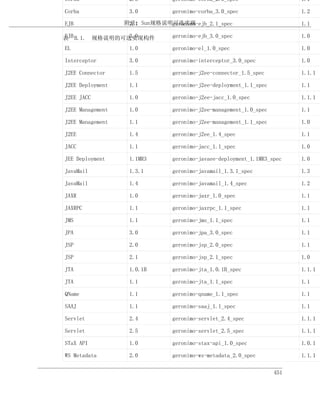
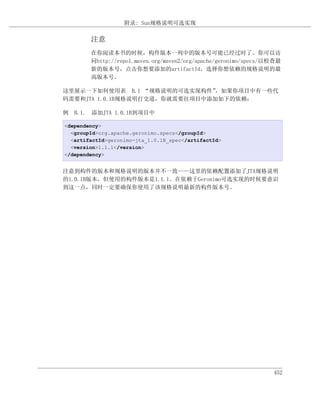
格说明对应的 Apache Geronimo 项目,我们已经在附录归纳了一个可用规格说明的列
表。
这里还有必要指出的是我们的这个依赖使用了 provided 范围。这个范围告诉 Maven
jar 文件已经由容器“提供”了,因此不再需要包含在 war 中。
如果你对在这个简单 web 应用编写自定义 JSP 标签感兴趣,你将需要添加对 JSP 2.0
规格说明的依赖。 使用以下配置来加入这个依赖。
73](https://image.slidesharecdn.com/maven-definitive-guidezh-101013212800-phpapp01/85/Maven-definitive-guide-zh-89-320.jpg)
![一个简单的Web应用
例 5.8. 添加 JSP 2.0 规格说明作为依赖
<project>
[...]
<dependencies>
[...]
<dependency>
<groupId>org.apache.geronimo.specs</groupId>
<artifactId>geronimo-jsp_2.0_spec</artifactId>
<version>1.1</version>
<scope>provided</scope>
</dependency>
</dependencies>
[...]
</project>
在添加好这个 Servlet 规格说明依赖之后,运行 mvn clean install ,然后运行 mvn
jetty:run 。
[tobrien@t1 simple-webapp]$ mvn clean install
...
[tobrien@t1 simple-webapp]$ mvn jetty:run
[INFO] [jetty:run]
...
2007-12-14 16:18:31.305::INFO: jetty-6.1.6rc1
2007-12-14 16:18:31.453::INFO: No Transaction manager found - if your webapp requir
please configure one.
2007-12-14 16:18:32.745::INFO: Started SelectChannelConnector@0.0.0.0:8080
[INFO] Started Jetty Server
到此为止,你应该能够获取 SimpleServlet 的输出。 在命令行,你可以使用 curl 在
标准输出打印 servlet 的输出。
~/examples$ curl http://localhost:8080/simple-webapp/simple
SimpleServlet Executed
5.7. 小结
阅读完本章之后,你应该能够启动一个简单的 web 应用程序。 本章并没有详细描述用
很多不同的方式来创建一个完整的 web 引用,其它章节对那些包含很多流行 web 框架
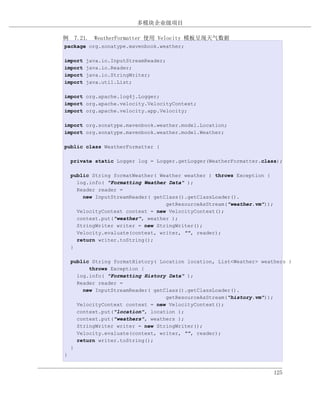
和技术的项目提供了更全面的介绍。
74](https://image.slidesharecdn.com/maven-definitive-guidezh-101013212800-phpapp01/85/Maven-definitive-guide-zh-90-320.jpg)
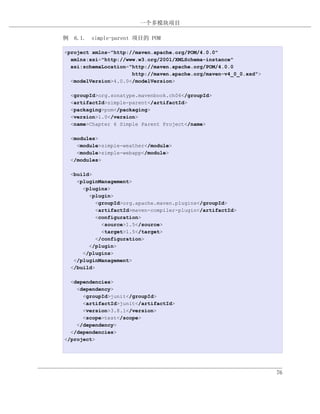
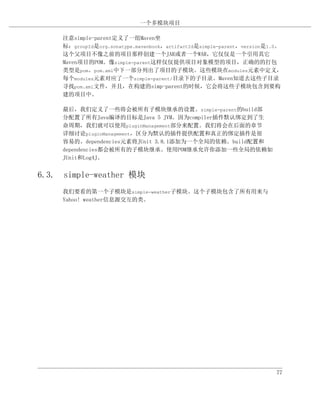
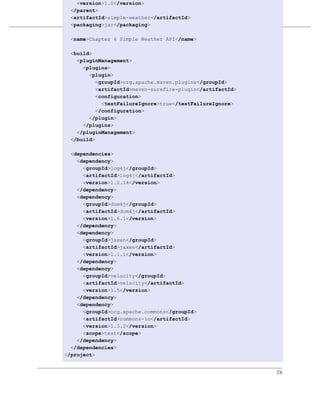
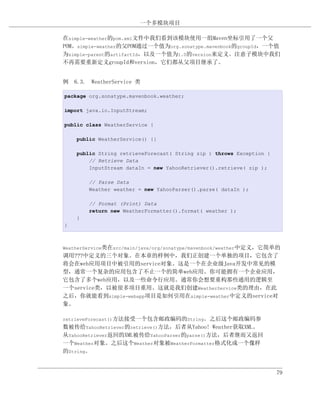
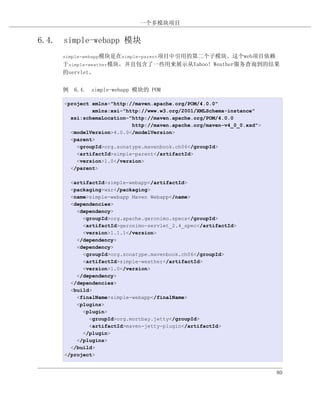
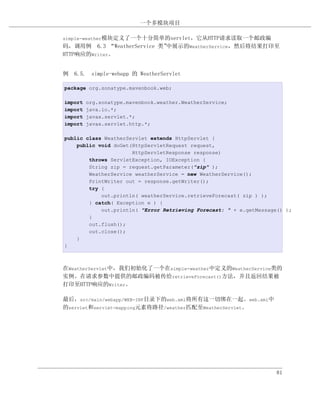
![一个多模块项目
例 6.6. simple-webapp 的 web.xml
<!DOCTYPE web-app PUBLIC
"-//Sun Microsystems, Inc.//DTD Web Application 2.3//EN"
"http://java.sun.com/dtd/web-app_2_3.dtd" >
<web-app>
<display-name>Archetype Created Web Application</display-name>
<servlet>
<servlet-name>simple</servlet-name>
<servlet-class>org.sonatype.mavenbook.web.SimpleServlet</servlet-class>
</servlet>
<servlet>
<servlet-name>weather</servlet-name>
<servlet-class>org.sonatype.mavenbook.web.WeatherServlet</servlet-class>
</servlet>
<servlet-mapping>
<servlet-name>simple</servlet-name>
<url-pattern>/simple</url-pattern>
</servlet-mapping>
<servlet-mapping>
<servlet-name>weather</servlet-name>
<url-pattern>/weather</url-pattern>
</servlet-mapping>
</web-app>
6.5. 构建这个多模块项目
既然simple-weather项目包含了所有与Yahoo! Weather服务交互的代码,以及simple-
webapp项目包含了一个简单的servlet,是时间将这个应用编译并打包成一个WAR文件
了。为此,你会想要以合适的顺序编译并安装这两个项目;以为simple-webapp依赖
于simple-weather,simple-weather的JAR需要在simple-webapp项目被编译之前就被创建
好。为此,你需要从simple-parent项目运行mvn clean install命令。
~/examples/ch06/simple-parent$ mvn clean install
[INFO] Scanning for projects...
[INFO] Reactor build order:
[INFO] Simple Parent Project
[INFO] simple-weather
[INFO] simple-webapp Maven Webapp
[INFO] ----------------------------------------------------------------------
[INFO] Building simple-weather
[INFO] task-segment: [clean, install]
[INFO] ----------------------------------------------------------------------
[...]
82](https://image.slidesharecdn.com/maven-definitive-guidezh-101013212800-phpapp01/85/Maven-definitive-guide-zh-98-320.jpg)
![一个多模块项目
[INFO] [install:install]
[INFO] Installing simple-weather-1.0.jar to simple-weather-1.0.jar
[INFO] ----------------------------------------------------------------------
[INFO] Building simple-webapp Maven Webapp
[INFO] task-segment: [clean, install]
[INFO] ----------------------------------------------------------------------
[...]
[INFO] [install:install]
[INFO] Installing simple-webapp.war to simple-webapp-1.0.war
[INFO]
[INFO] ----------------------------------------------------------------------
[INFO] Reactor Summary:
[INFO] ----------------------------------------------------------------------
[INFO] Simple Parent Project ............................... SUCCESS [3.041s]
[INFO] simple-weather ...................................... SUCCESS [4.802s]
[INFO] simple-webapp Maven Webapp .......................... SUCCESS [3.065s]
[INFO] ----------------------------------------------------------------------
当Maven执行一个带有子模块的项目的时候,Maven首先载入父POM,然后定位所有的子
模块POM。Maven然后将所有这些项目的POM放入到一个称为Maven 反应堆(Reactor)的
东西中,由它负责分析模块之间的依赖关系。这个反应堆处理组件的排序,以确保相互
独立的模块能以适当的顺序被编译和安装。
注意
除非需要做更改,反应堆一直维持定义在POM中的模块的顺序。为此一个有
帮助的思维模型是,那些依赖于兄弟项目的项目在列表中被“向下按”,直
到依赖顺序被满足。在很少的情况下,重新安排你构建的模块顺序可能很方
便——例如你想要一个频繁的不稳定的模块接近构建的开端。
一旦反应堆解决了项目构建的顺序,Maven就会在多模块构建中为每个模块执行特定的
目标。本例中,你能看到Maven在simple-webapp之前构建了simple-weather,为每个子
模块执行了mvn clean install。
注意
当你在命令行运行Maven的时候你经常会在任何其它生命周期阶段前指
定clean生命周期阶段。当你指定clean,你就确认了在编译和打包一个应用
之前,Maven会移除旧的输出。运行clean不是必要的,但这是一个确保你正
执行“干净构建”的十分有用的预防措施。
83](https://image.slidesharecdn.com/maven-definitive-guidezh-101013212800-phpapp01/85/Maven-definitive-guide-zh-99-320.jpg)
![一个多模块项目
6.6. 运行Web应用
一旦这个多模块项目已经通过从父项目simple-project执行mvn clean install行安装
好了,你可以切换目录至simple-webapp项目,然后运行Jetty插件的Run目标。
~/examples/ch06/simple-parent/simple-webapp $ mvn jetty:run
[INFO] ----------------------------------------------------------------------
[INFO] Building simple-webapp Maven Webapp
[INFO] task-segment: [jetty:run]
[INFO] ----------------------------------------------------------------------
[...]
[INFO] [jetty:run]
[INFO] Configuring Jetty for project: simple-webapp Maven Webapp
[...]
[INFO] Webapp directory = ~/examples/ch06/simple-parent/
simple-webapp/src/main/webapp
[INFO] Starting jetty 6.1.6rc1 ...
2007-11-18 1:58:26.980::INFO: jetty-6.1.6rc1
2007-11-18 1:58:26.125::INFO: No Transaction manager found
2007-11-18 1:58:27.633::INFO: Started SelectChannelConnector@0.0.0.0:8080
[INFO] Started Jetty Server
Jetty启动之后,在浏览器载入http://localhost:8080/simple-webapp/weather?
zip=01201,你应该看到格式化的天气输出。
84](https://image.slidesharecdn.com/maven-definitive-guidezh-101013212800-phpapp01/85/Maven-definitive-guide-zh-100-320.jpg)
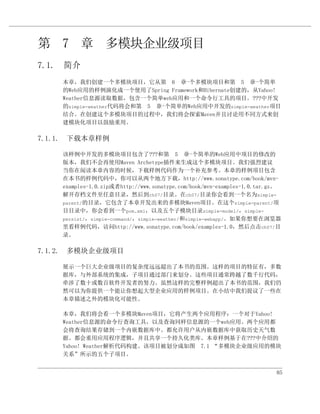
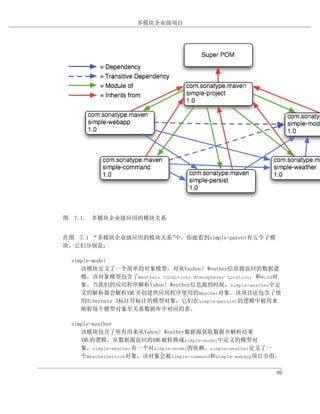


![多模块企业级项目
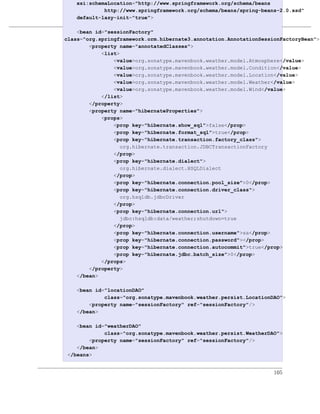
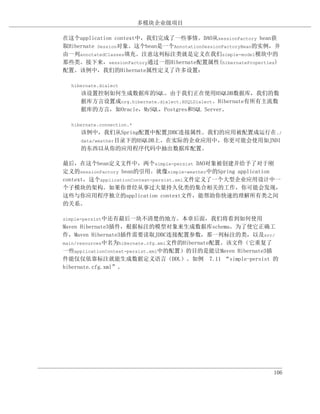
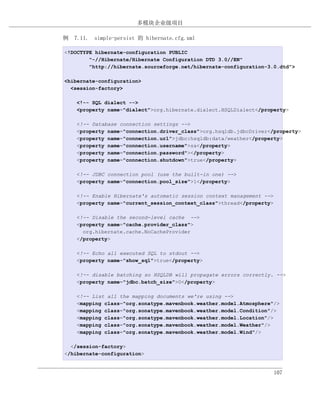
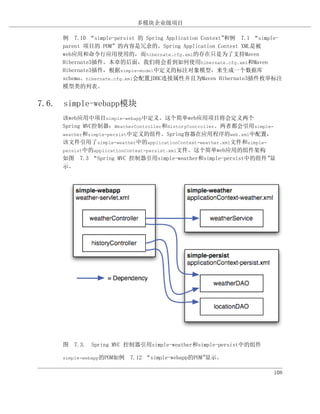
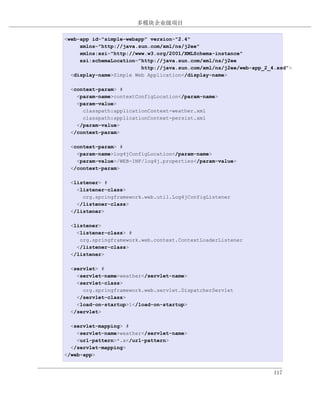
‚ 这里有一些魔法能让我们在项目中重用applicationContext-
weather.xml和applicationContext-
persist.xml。contextConfigLocation由ContextLoaderListener用来创建一
个ApplicationContext。当一个weather servlet被创建的时候,???中的weather-
servlet.xml将由此contextConfigLocation中创建的ApplicationContext赋值。用
这种方式,你可以在另外的项目中定义一组bean,然后可以通过classpath引用这
些bean。由于simple-persist和simple-weather的JAR将会位于WEB-INF/lib,我们
所要做的只是使用classpath:前缀来引用这些文件。(另一种选择是将所有这些文
件拷贝到/WEB-INF,然后用过如/WEB-INF/applicationContext-persist.xml的方式
引用它们)。
ƒ log4jConfigLocation用来告诉Log4JConfigListener哪里去寻找Log4J日志配置。该
例中,我们告诉Log4J在/WEB-INF/log4j.properties中寻找。
„ 这里确保当web应用启动的时候Log4J系统被配置。将Log4JConfigListener放
在ContextLoaderListener前面十分重要;否则你可能丢失那些指向阻止应用启动
问题的重要日志信息。如果你有一个特别大的Spring管理的bean集合,而其中一
个碰巧在应用启动的时候出问题了,应用很可能会不能启动。如果你在Spring启
动之前有了日志,你就有机会看到警告或错误信息。如果你在Spring启动之前没
有配置日志,你就不知道为什么你的应用不能启动了。
… ContextLoaderListener本质上是一个Spring容器。当应用启动的时候,这个监听
器会根据contextConfigLocation参数构造一个ApplicationContext。
† 我们定义一个名为weather的Spring MVC DispatcherServlet。这会让Spring
从/WEB-INF/weather-servlet.xml寻找Spring配置文件。你可以拥有任意多
的DispatcherServlet,一个DispatcherServlet可以包含一个或多个Spring MVC
Controller实现。
‡ 所有以.x结尾的请求都会被路由至weather servlet。注意.x扩展名没有任何特殊
的意义,这是一个随意的选择,你可以使用任意你喜欢的URL模式。
7.7. 运行这个Web应用
为了运行这个web应用,你首先需要使用Hibernate3插件构造数据库。为此,在项
目simple-webapp目录下运行如下命令:
$ mvn hibernate3:hbm2ddl
[INFO] Scanning for projects...
[INFO] Searching repository for plugin with prefix: 'hibernate3'.
[INFO] org.codehaus.mojo: checking for updates from central
[INFO] ------------------------------------------------------------------------
[INFO] Building Chapter 7 Simple Web Application
[INFO] task-segment: [hibernate3:hbm2ddl]
[INFO] ------------------------------------------------------------------------
[INFO] Preparing hibernate3:hbm2ddl
...
118](https://image.slidesharecdn.com/maven-definitive-guidezh-101013212800-phpapp01/85/Maven-definitive-guide-zh-134-320.jpg)
![多模块企业级项目
10:24:56,151 INFO org.hibernate.tool.hbm2ddl.SchemaExport - export complete
[INFO] ------------------------------------------------------------------------
[INFO] BUILD SUCCESSFUL
[INFO] ------------------------------------------------------------------------
在此之后,应该有一个/usr/local/hudson/hudson-home/jobs/maven-guide-zh-to-
production/workspace/content-zh/data目录包含了HSQLDB数据库。你可以使用jetty启
动web应用:
$ mvn jetty:run
[INFO] Scanning for projects...
[INFO] Searching repository for plugin with prefix: 'jetty'.
[INFO] ------------------------------------------------------------------------
[INFO] Building Chapter 7 Simple Web Application
[INFO] task-segment: [jetty:run]
[INFO] ------------------------------------------------------------------------
[INFO] Preparing jetty:run
...
[INFO] [jetty:run]
[INFO] Configuring Jetty for project: Chapter 7 Simple Web Application
...
[INFO] Context path = /simple-webapp
[INFO] Tmp directory = determined at runtime
[INFO] Web defaults = org/mortbay/jetty/webapp/webdefault.xml
[INFO] Web overrides = none
[INFO] Starting jetty 6.1.7 ...
2008-03-25 10:28:03.639::INFO: jetty-6.1.7
...
2147 INFO DispatcherServlet - FrameworkServlet 'weather':
initialization completed in 1654 ms
2008-03-25 10:28:06.341::INFO: Started SelectChannelConnector@0.0.0.0:8080
[INFO] Started Jetty Server
Jetty启动之后,你可以载入http://localhost:8080/simple-webapp/weather.x?
zip=60202,然后就能在你的浏览器中看到Evanston, IL的天气。更改邮编后你就能看
到你自己的天气报告了。
Current Weather Conditions for: Evanston, IL, US
* Temperature: 42
* Condition: Partly Cloudy
* Humidity: 55
* Wind Chill: 34
* Date: Tue Mar 25 10:29:45 CDT 2008
119](https://image.slidesharecdn.com/maven-definitive-guidezh-101013212800-phpapp01/85/Maven-definitive-guide-zh-135-320.jpg)
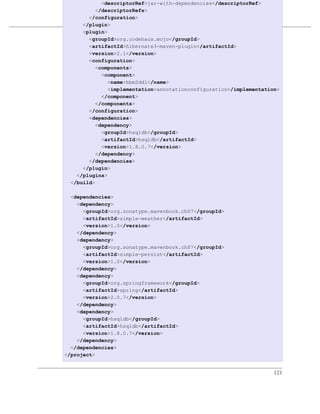

![// Read the Zip Code from the Command-line (if none supplied, use 60202)
String zipcode = "60202";
try { 多模块企业级项目
zipcode = args[0];
例 7.20. simple-command e) {
} catch (Exception 的 Main 类
}
// Read the Operation from the Command-line (if none supplied use weather)
String operation = "weather";
try {
operation = args[1];
} catch (Exception e) {
}
// Start the program
Main main = new Main(zipcode);
ApplicationContext context =
new ClassPathXmlApplicationContext(
new String[] { "classpath:applicationContext-weather.xml",
"classpath:applicationContext-persist.xml" });
main.weatherService = (WeatherService) context.getBean("weatherService");
main.locationDAO = (LocationDAO) context.getBean("locationDAO");
main.weatherDAO = (WeatherDAO) context.getBean("weatherDAO");
if( operation.equals("weather")) {
main.getWeather();
} else {
main.getHistory();
}
}
private String zip;
public Main(String zip) {
this.zip = zip;
}
public void getWeather() throws Exception {
Weather weather = weatherService.retrieveForecast(zip);
weatherDAO.save( weather );
System.out.print(new WeatherFormatter().formatWeather(weather));
}
public void getHistory() throws Exception {
Location location = locationDAO.findByZip(zip);
List<Weather> weathers = weatherDAO.recentForLocation(location);
System.out.print(new WeatherFormatter().formatHistory(location, weathers));
}
}
123](https://image.slidesharecdn.com/maven-definitive-guidezh-101013212800-phpapp01/85/Maven-definitive-guide-zh-139-320.jpg)
![多模块企业级项目
[INFO] ------------------------------------------------------------------------
[INFO] Building Chapter 7 Simple Command Line Tool
[INFO] task-segment: [assembly:assembly] (aggregator-style)
[INFO] ------------------------------------------------------------------------
[INFO] [resources:resources]
[INFO] Using default encoding to copy filtered resources.
[INFO] [compiler:compile]
[INFO] Nothing to compile - all classes are up to date
[INFO] [resources:testResources]
[INFO] Using default encoding to copy filtered resources.
[INFO] [compiler:testCompile]
[INFO] Nothing to compile - all classes are up to date
[INFO] [surefire:test]
...
[INFO] [jar:jar]
[INFO] Building jar: .../simple-parent/simple-command/target/simple-command.jar
[INFO] [assembly:assembly]
[INFO] Processing DependencySet (output=)
[INFO] Expanding: .../.m2/repository/.../simple-weather-1-SNAPSHOT.jar into
/tmp/archived-file-set.93251
[INFO] Expanding: .../.m2/repository/.../simple-model-1-SNAPSHOT.jar into
/tmp/archived-file-set.20124
[INFO] Expanding: .../.m2/repository/../hibernate-3.2.5.ga.jar into
/tmp/archived-file-set.12965
... skipping 25 lines of dependency unpacking ...
[INFO] Expanding: .../.m2/repository/.../velocity-1.5.jar into /tmp/archived-file-se
[INFO] Expanding: .../.m2/repository/.../commons-lang-2.1.jar into
/tmp/archived-file-set.13292
[INFO] Expanding: .../.m2/repository/.../oro-2.0.8.jar into /tmp/archived-file-set.1
[INFO] Building jar: .../simple-parent/simple-command/target/simple-command-jar-with
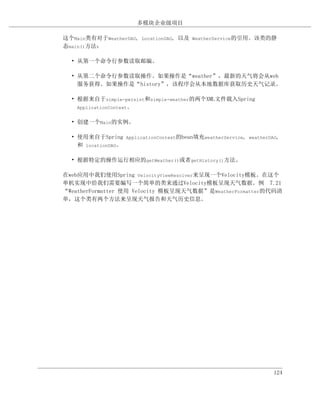
构建过程经过了生命周期中编译字节码,运行测试,然后最终为该项目构建一个JAR。
然后assembly:assembly目标创建一个带有依赖的JAR,它将所有依赖解压到一个临时
目录,然后将所有字节码收集到target/目录下一个名为simple-command-jar-with-
dependencies.jar的JAR中。这个“超级的”JAR的体重为15MB。
在你运行这个命令行工具之前,你需要调用Hibernate3插件的hbm2ddl目标来创建
HSQLDB数据库。在simple-command目录运行如下的命令:
$ mvn hibernate3:hbm2ddl
[INFO] Scanning for projects...
[INFO] Searching repository for plugin with prefix: 'hibernate3'.
[INFO] org.codehaus.mojo: checking for updates from central
[INFO] ------------------------------------------------------------------------
[INFO] Building Chapter 7 Simple Command Line Tool
127](https://image.slidesharecdn.com/maven-definitive-guidezh-101013212800-phpapp01/85/Maven-definitive-guide-zh-143-320.jpg)
![多模块企业级项目
[INFO] task-segment: [hibernate3:hbm2ddl]
[INFO] ------------------------------------------------------------------------
[INFO] Preparing hibernate3:hbm2ddl
...
10:24:56,151 INFO org.hibernate.tool.hbm2ddl.SchemaExport - export complete
[INFO] ------------------------------------------------------------------------
[INFO] BUILD SUCCESSFUL
[INFO] ------------------------------------------------------------------------
在此之后,你应该能在simple-command下看到data/目录。该data/目录包含了HSQLDB数
据库。要运行这个命令行天气预报器,在simple-command/项目目录下运行如下命令:
$ java -cp target/simple-command-jar-with-dependencies.jar
org.sonatype.mavenbook.weather.Main 60202
2321 INFO YahooRetriever - Retrieving Weather Data
2489 INFO YahooParser - Creating XML Reader
2581 INFO YahooParser - Parsing XML Response
2875 INFO WeatherFormatter - Formatting Weather Data
****************************************
Current Weather Conditions for:
Evanston,
IL,
US
****************************************
* Temperature: 75
* Condition: Partly Cloudy
* Humidity: 64
* Wind Chill: 75
* Date: Wed Aug 06 09:35:30 CDT 2008
要运行历史查询,运行如下命令:
$ java -cp target/simple-command-jar-with-dependencies.jar
org.sonatype.mavenbook.weather.Main 60202 history
2470 INFO WeatherFormatter - Formatting History Data
Weather History for:
Evanston, IL, US
****************************************
* Temperature: 39
* Condition: Heavy Rain
* Humidity: 93
* Wind Chill: 36
* Date: 2007-12-02 13:45:27.187
****************************************
128](https://image.slidesharecdn.com/maven-definitive-guidezh-101013212800-phpapp01/85/Maven-definitive-guide-zh-144-320.jpg)
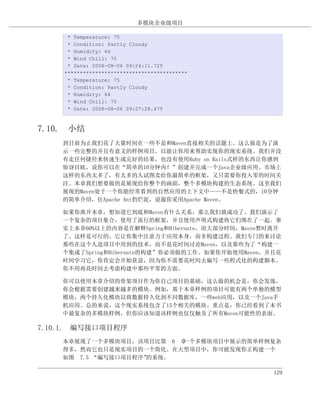
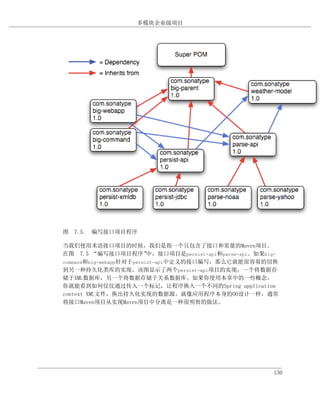
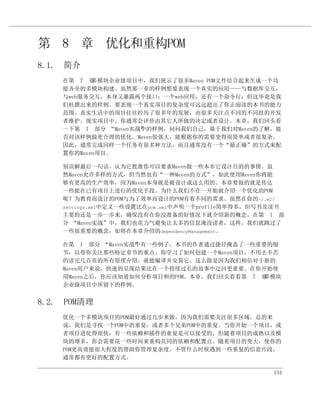
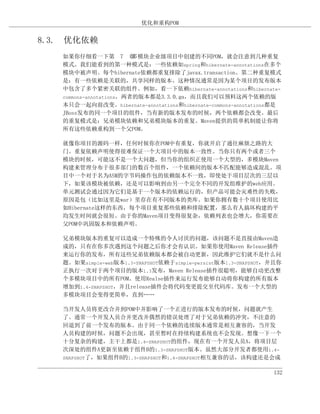
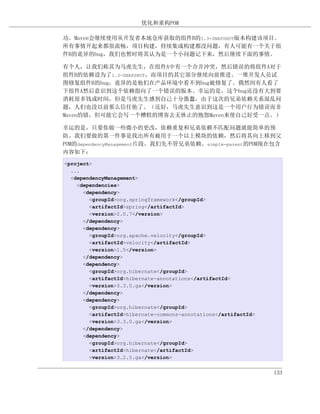
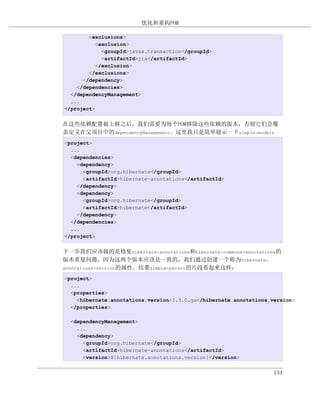
![优化和重构POM
<version>2.1</version>
<configuration>
<components>
<component>
<name>hbm2ddl</name>
<implementation>annotationconfiguration</implementation>
</component>
</components>
</configuration>
<dependencies>
<dependency>
<groupId>hsqldb</groupId>
<artifactId>hsqldb</artifactId>
<version>${hsqldb.version}</version>
</dependency>
</dependencies>
</plugin>
</plugins>
</pluginManagement>
</build>
...
</project>
8.5. 使用Maven Dependency插件进行优化
在大型的项目中,随着依赖数目的增加,一些额外的依赖会悄悄进入项目的POM中。而
当依赖改变的时候,你又常常会留下一些不再被使用的依赖,而又有时候,你会忘记显
示声明你需要的类库依赖。由于Maven 2.x会在编译范围引入传递性依赖,你的项目可
能编译没问题,但在产品阶段不能运行。考虑这种情况,当一个项目使用一些被广泛
使用的类库如Jakarta Commons Beanutils。你没有显式的声明对Beanutils的依赖,
你的项目依赖于一个项目如Hibernate,而后者有对Beanutils的传递性依赖。你的项
目可能编译成功并很好的运行,但当你将Hibernate升级到一个新版本,而它不再依赖
于Beantuils,你就会遇到编译和运行错误了,这种情况直到项目不能编译才能显现。
同时,由于你没有显式的列出依赖的版本,Maven不能帮你解析可能出现的版本冲突问
题。
一个好的经验方法是,总是为你代码引用的类显式声明依赖。如果你要引入Commons
Beanutils类,你应该声明一个对于Commons Beanutils的直接依赖。幸运的是,通过字
节码分析,Maven Dependency插件能够帮助你发现对于依赖的直接引用。使用我们之前
优化过的新的POM,让我们看一下是否会有错误突然出现。
$ mvn dependency:analyze
[INFO] Scanning for projects...
[INFO] Reactor build order:
137](https://image.slidesharecdn.com/maven-definitive-guidezh-101013212800-phpapp01/85/Maven-definitive-guide-zh-153-320.jpg)
![优化和重构POM
[INFO] Chapter 8 Simple Parent Project
[INFO] Chapter 8 Simple Object Model
[INFO] Chapter 8 Simple Weather API
[INFO] Chapter 8 Simple Persistence API
[INFO] Chapter 8 Simple Command Line Tool
[INFO] Chapter 8 Simple Web Application
[INFO] Chapter 8 Parent Project
[INFO] Searching repository for plugin with prefix: 'dependency'.
...
[INFO] ------------------------------------------------------------------------
[INFO] Building Chapter 8 Simple Object Model
[INFO] task-segment: [dependency:analyze]
[INFO] ------------------------------------------------------------------------
[INFO] Preparing dependency:analyze
[INFO] [resources:resources]
[INFO] Using default encoding to copy filtered resources.
[INFO] [compiler:compile]
[INFO] Nothing to compile - all classes are up to date
[INFO] [resources:testResources]
[INFO] Using default encoding to copy filtered resources.
[INFO] [compiler:testCompile]
[INFO] Nothing to compile - all classes are up to date
[INFO] [dependency:analyze]
[WARNING] Used undeclared dependencies found:
[WARNING] javax.persistence:persistence-api:jar:1.0:compile
[WARNING] Unused declared dependencies found:
[WARNING] org.hibernate:hibernate-annotations:jar:3.3.0.ga:compile
[WARNING] org.hibernate:hibernate:jar:3.2.5.ga:compile
[WARNING] junit:junit:jar:3.8.1:test
...
[INFO] ------------------------------------------------------------------------
[INFO] Building Chapter 8 Simple Web Application
[INFO] task-segment: [dependency:analyze]
[INFO] ------------------------------------------------------------------------
[INFO] Preparing dependency:analyze
[INFO] [resources:resources]
[INFO] Using default encoding to copy filtered resources.
[INFO] [compiler:compile]
[INFO] Nothing to compile - all classes are up to date
[INFO] [resources:testResources]
[INFO] Using default encoding to copy filtered resources.
138](https://image.slidesharecdn.com/maven-definitive-guidezh-101013212800-phpapp01/85/Maven-definitive-guide-zh-154-320.jpg)
![优化和重构POM
[INFO] [compiler:testCompile]
[INFO] No sources to compile
[INFO] [dependency:analyze]
[WARNING] Used undeclared dependencies found:
[WARNING] org.sonatype.mavenbook.ch08:simple-model:jar:1.0:compile
[WARNING] Unused declared dependencies found:
[WARNING] org.apache.velocity:velocity:jar:1.5:compile
[WARNING] javax.servlet:jstl:jar:1.1.2:compile
[WARNING] taglibs:standard:jar:1.1.2:compile
[WARNING] junit:junit:jar:3.8.1:test
在上面截取的输出中,我们能看到运行dependency:analyze目标的结果。该目标分析
这个项目,查看是否有直接依赖,或者一些引用了但不是直接声明的依赖。在simple-
model项目中,dependency插件指出有一个对于javax.persistence:persistence-
api的“使用了但为未声明的依赖”。为了进一步调查,到simple-model目录下运
行dependency:tree目标,该目标会列出项目中所有的直接和传递性依赖。
$ mvn dependency:tree
[INFO] Scanning for projects...
[INFO] Searching repository for plugin with prefix: 'dependency'.
[INFO] ------------------------------------------------------------------------
[INFO] Building Chapter 8 Simple Object Model
[INFO] task-segment: [dependency:tree]
[INFO] ------------------------------------------------------------------------
[INFO] [dependency:tree]
[INFO] org.sonatype.mavenbook.ch08:simple-model:jar:1.0
[INFO] +- org.hibernate:hibernate-annotations:jar:3.3.0.ga:compile
[INFO] | - javax.persistence:persistence-api:jar:1.0:compile
[INFO] +- org.hibernate:hibernate:jar:3.2.5.ga:compile
[INFO] | +- net.sf.ehcache:ehcache:jar:1.2.3:compile
[INFO] | +- commons-logging:commons-logging:jar:1.0.4:compile
[INFO] | +- asm:asm-attrs:jar:1.5.3:compile
[INFO] | +- dom4j:dom4j:jar:1.6.1:compile
[INFO] | +- antlr:antlr:jar:2.7.6:compile
[INFO] | +- cglib:cglib:jar:2.1_3:compile
[INFO] | +- asm:asm:jar:1.5.3:compile
[INFO] | - commons-collections:commons-collections:jar:2.1.1:compile
[INFO] - junit:junit:jar:3.8.1:test
[INFO] ------------------------------------------------------------------------
[INFO] BUILD SUCCESSFUL
[INFO] ------------------------------------------------------------------------
从上面的输出我们可以看到persistence-api依赖来自于hibernate。对该模块源码的
粗略扫描会展现很多的javax.persistence的import语句,这让我们确信直接引用了这
个依赖。简单的修复手段是添加对这个依赖的直接引用。该例中,我们将依赖版本放
139](https://image.slidesharecdn.com/maven-definitive-guidezh-101013212800-phpapp01/85/Maven-definitive-guide-zh-155-320.jpg)

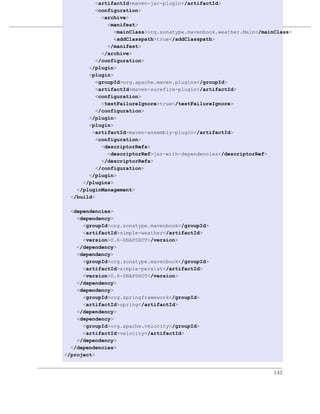
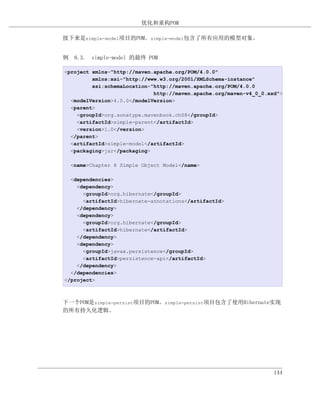
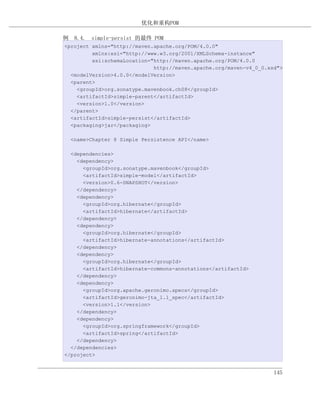

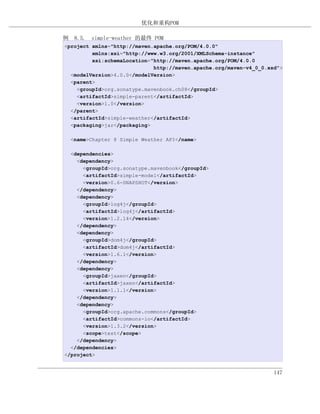



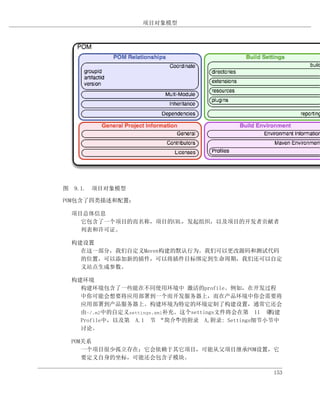

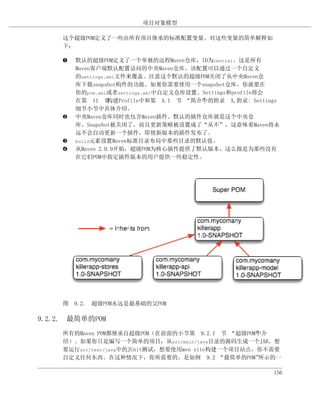
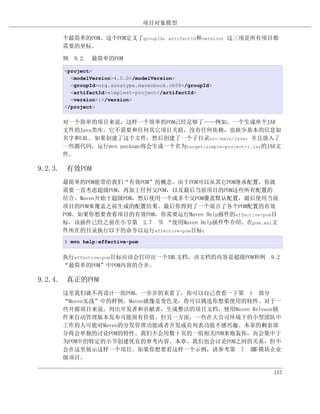
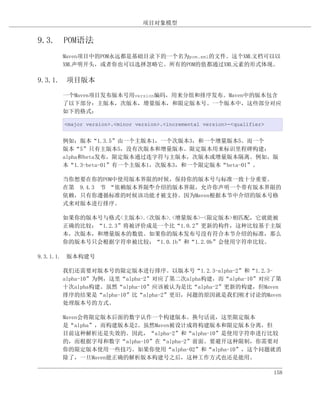
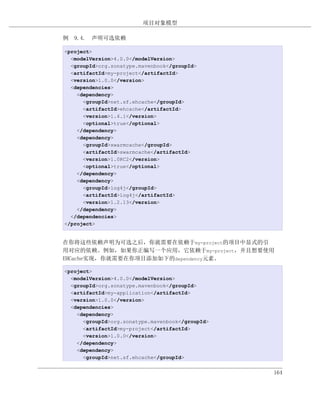
![项目对象模型
<artifactId>swarmcache</artifactId>
<version>1.4.1</version>
</dependency>
</dependencies>
</project>
在理想的世界中,你不需要使用可选依赖。你可以将EHCache相关的代码放到my-
project-ehcache子模块中,将SwarmCache相关的代码放到my-project-swarmcache子模
块中,而非创建一个带有一系列可选依赖的大项目。这样,其它项目就可以只引用特定
实现的项目,发挥传递性依赖的功效,而不用去引用my-project项目,再自己声明特定
的依赖。
9.4.3. 依赖版本界限
你并不是必须为依赖声明某个特定的版本,你可以指定一个满足给定依赖的版本界限。
例如,你可以指定你的项目依赖于JUnit的3.8或以上版本,或者说依赖于JUnit 1.2.10
和1.2.14之间的某个版本。你可以使用如下的字符来围绕一个或多个版本号,来实现版
本界限。
(, )
不包含量词
[, ]
包含量词
例如,如果你想要访问JUnit任意的大于等于3.8但小于4.0的版本,你的依赖可以
如例 9.5 “指定一个依赖界限:JUnit 3.8 - JUnit 4.0”编写:
例 9.5. 指定一个依赖界限:JUnit 3.8 - JUnit 4.0
<dependency>
<groupId>junit</groupId>
<artifactId>junit</artifactId>
<version>[3.8,4.0)</version>
<scope>test</scope>
</dependency>
如果想要依赖JUnit任意的不大于3.8.1的版本,你可以只指定一个上包含边界,
如例 9.6 “指定一个依赖界限:JUnit <= 3.8.1”所示:
165](https://image.slidesharecdn.com/maven-definitive-guidezh-101013212800-phpapp01/85/Maven-definitive-guide-zh-181-320.jpg)
![项目对象模型
例 9.6. 指定一个依赖界限:JUnit <= 3.8.1
<dependency>
<groupId>junit</groupId>
<artifactId>junit</artifactId>
<version>[,3.8.1]</version>ex-de
<scope>test</scope>
</dependency>
在逗号前面或者后面的版本不是必须的,这种空缺意味着正无穷或者负无穷。例
如,“[4.0,)”意思是任何大于等于4.0的版本,“(,2.0)”意思是任意小于2.0的版
本。“[1.2]”意思是只有版本1.2,没有其它。
注意
当声明一个“正常的”版本如JUnit 3.8.2,内部它其实被表述成“允许任
何版本,但最好是3.8.2”。意思是当侦测到版本冲突的时候,Maven会使用
冲突算法来选择最好的版本。如果你指定[3.8.2],它意味只有3.8.2会被使
用,没有其它。如果其它什么地方有一个版本指定了[3.8.1],你会得到一
个构建失败报告,告诉你有版本冲突。我指出这一点是要让你知道有这一选
项,但要保守的使用它,只有在确实需要的时候才使用。更好的做法是通
过dependencyManagement来解决冲突。
9.4.4. 传递性依赖
一个传递性依赖就是对于一个依赖的依赖。如果project-a依赖于project-b,而后
者接着依赖于project-c,那么project-c就被认为是project-a的传递性依赖。如
果project-c依赖于project-d,那么project-d就也被认为是project-a的传递性依
赖。Maven的部分吸引力是由于它能够管理传递性依赖,并且能够帮助开发者屏蔽掉跟
踪所有编译期和运行期依赖的细节。你可以只依赖于一些包如Spring Framework,而不
用担心Spring Framework的所有依赖,Maven帮你自动管理了,你不用自己去详细了解
配置。
Maven是怎样完成这件事情的呢?它建立一个依赖图,并且处理一些可能发生的冲突和
重叠。例如,如果Maven看到有两个项目依赖于同样的groupId和artifactId,它会自动
整理出使用哪个依赖,选择那个最新版本的依赖。虽然这听起来很方便,但在一些边界
情况中,传递性依赖会造成一些配置问题。在这种情况下,你可以使用依赖排除。
9.4.4.1. 传递性依赖和范围
第 9.4.1 节 “依赖范围”提到的每种依赖范围不仅仅影响声明项目中的依赖范围,
中
它也对所传递性依赖起作用。表达该信息最简单的方式是通过一张表来表述,如表 9.1
“范围如何影响传递性依赖”。最顶层一行代表了传递性依赖的范围。最左边的一列代
166](https://image.slidesharecdn.com/maven-definitive-guidezh-101013212800-phpapp01/85/Maven-definitive-guide-zh-182-320.jpg)
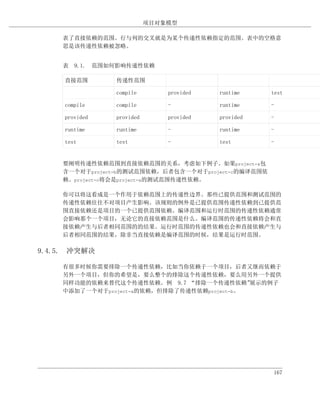
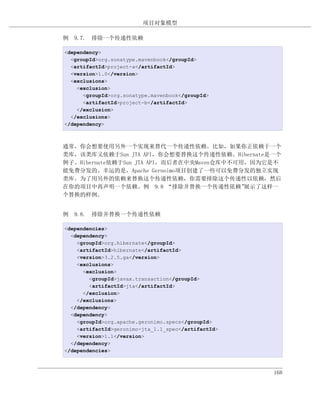
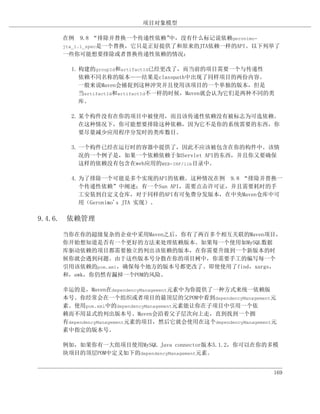
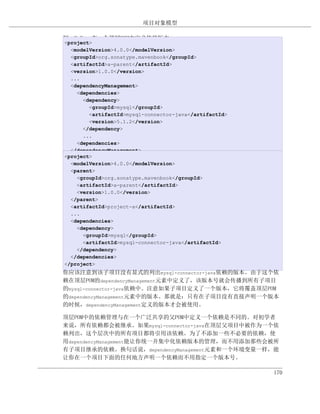
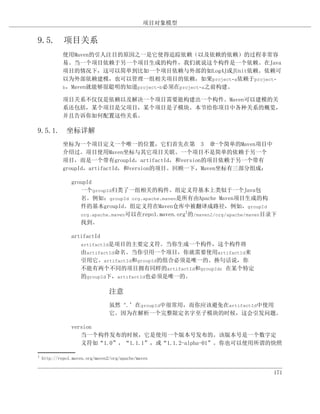
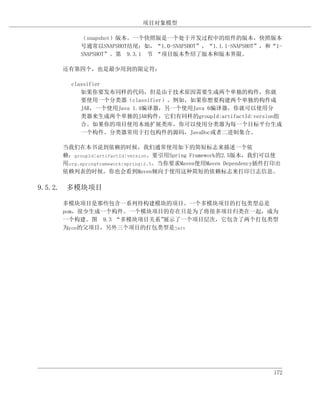
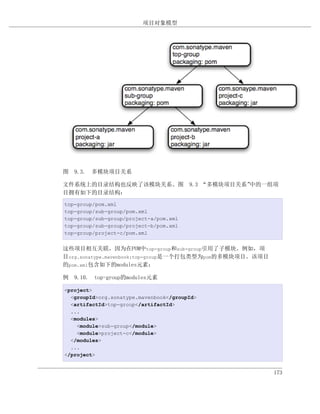
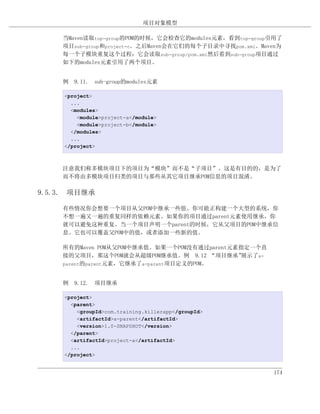
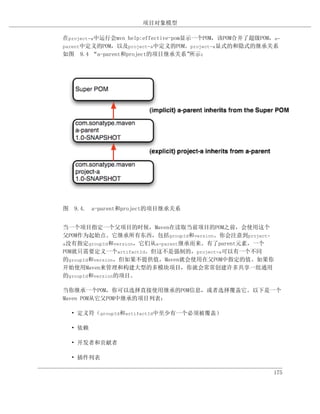
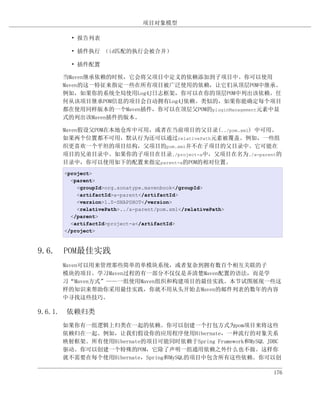
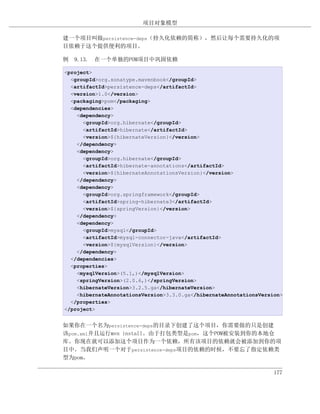
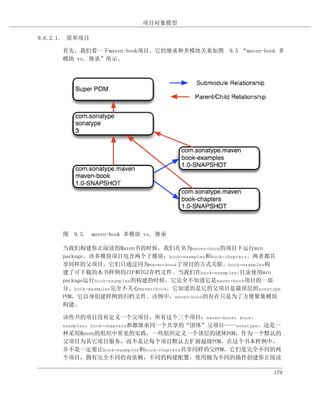
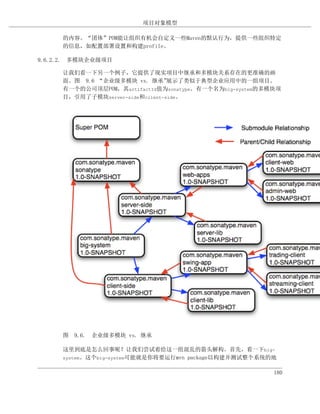
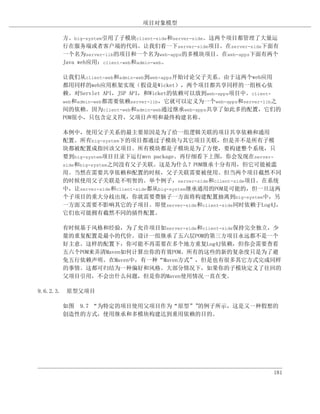
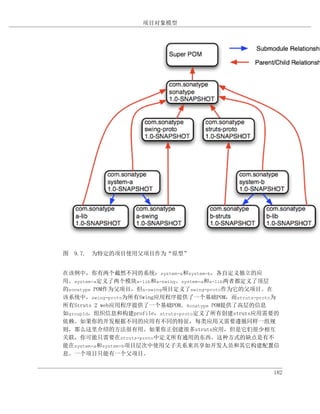

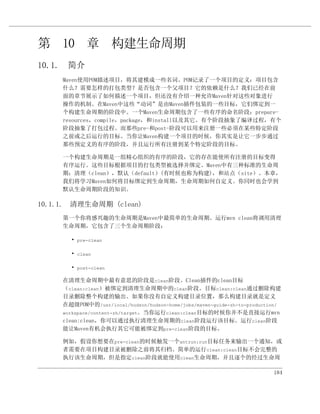

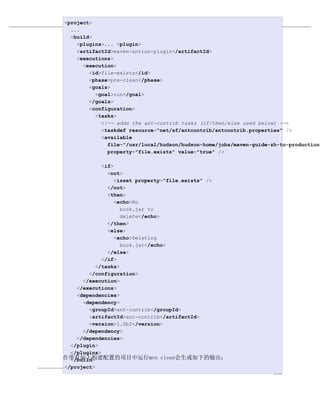
![构建生命周期
[INFO] Scanning for projects...
[INFO] ----------------------------------------------------------------------
[INFO] Building Your Project
[INFO] task-segment: [clean]
[INFO] ----------------------------------------------------------------------
[INFO] [antrun:run {execution: file-exists}]
[INFO] Executing tasks
[echo] Deleting your-project-1.0-SNAPSHOT.jar
[INFO] Executed tasks
[INFO] [clean:clean]
[INFO] Deleting directory ~/corp/your-project/target
[INFO] Deleting directory ~/corp/your-project/target/classes
[INFO] Deleting directory ~/corp/your-project/target/test-classes
[INFO] ------------------------------------------------------------------------
[INFO] BUILD SUCCESSFUL
[INFO] ------------------------------------------------------------------------
[INFO] Total time: 1 second
[INFO] Finished at: Wed Nov 08 11:46:26 CST 2006
[INFO] Final Memory: 2M/5M
[INFO] ------------------------------------------------------------------------
除了在pre-clean阶段配置Maven去运行一个目标,你也可以自定义Clean插件去删除
构建输出目录以外的文件。你可以配置该插件去删除那些在fileSet中指定的文件。
下面的样例配置了Clean插件,使用标准的Ant文件通配符:*和**,删除所有target-
other/目录中的.class文件。
187](https://image.slidesharecdn.com/maven-definitive-guidezh-101013212800-phpapp01/85/Maven-definitive-guide-zh-203-320.jpg)
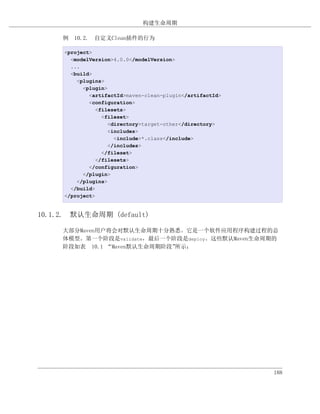
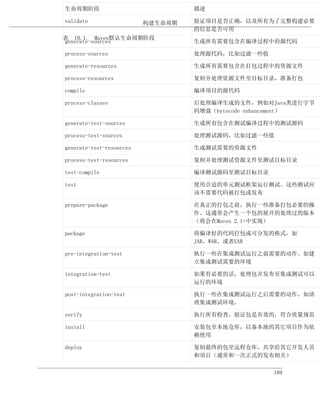
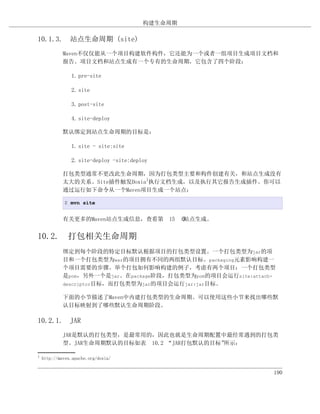
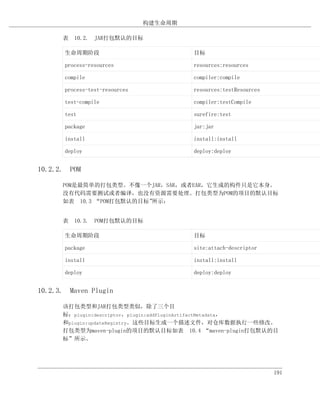
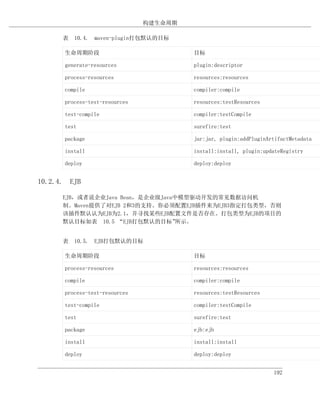
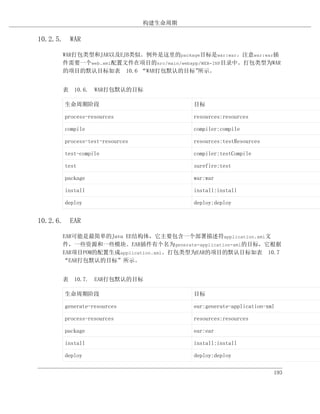
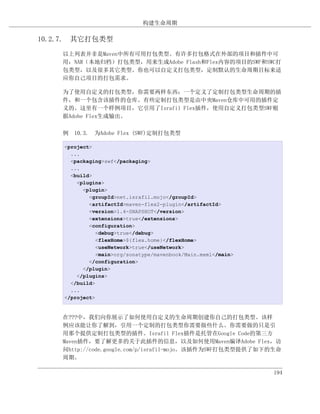
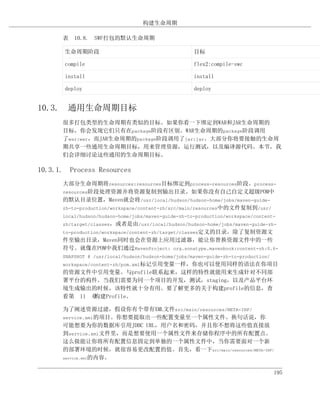
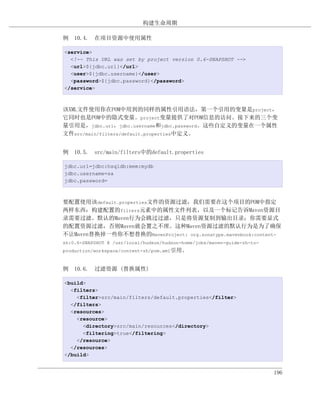
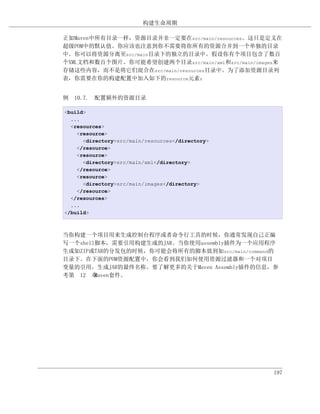
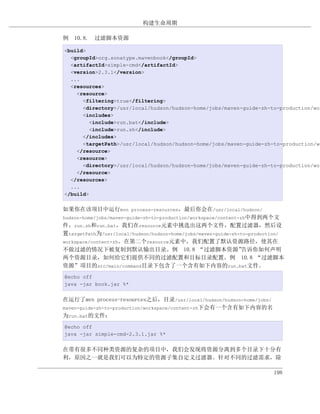
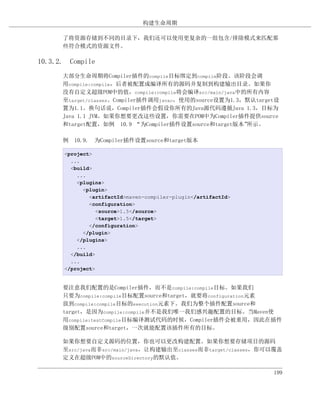
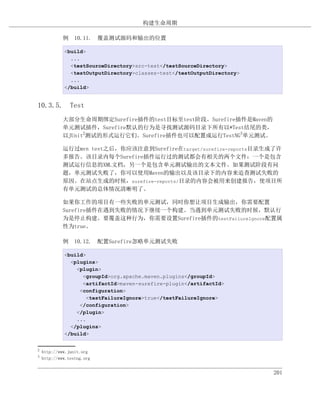
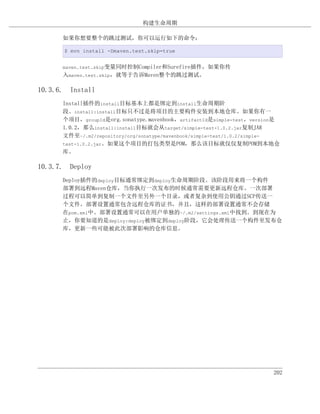
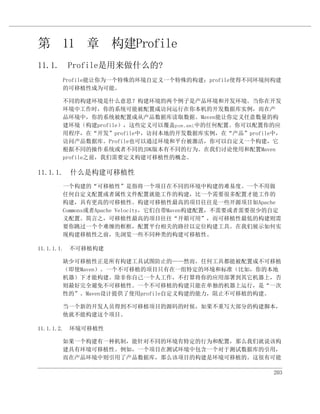
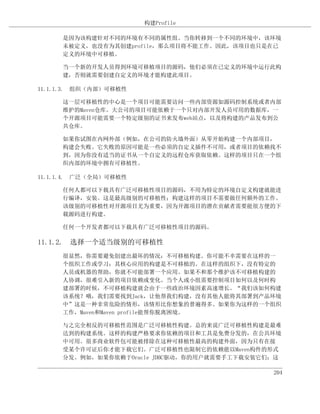
![构建Profile
ƒ 每个profile必须要有一个id元素。这个id元素包含的名字将在命令行调用profile
时被用到。我们可以通过传给Maven一个-P<profile_id>参数来调用profile。
„ 一个profile元素可以包含很多其它元素,只要这些元素可以出现在POM XML文档
的project元素下面。本例中,我们覆盖了Compiler插件的行为,因此必须覆盖插
件配置,该配置通常位于一个build和一个plugins元素下面。
… 我们覆盖了Maven Compiler插件的配置。确保通过production profile产生的字
节码不会包含调试信息,并且字节码会被编译器优化。
要使用production profile来运行mvn install,你需要在命令行传入-Pproduction参
数。要验证production profile覆盖了默认的Compiler插件配置,可以像这样以开启调
试输出(-X) 的方式运行Maven。
~/examples/profile $ mvn clean install -Pproduction -X
... (omitting debugging output) ...
[DEBUG] Configuring mojo 'o.a.m.plugins:maven-compiler-plugin:2.0.2:testCompile'
[DEBUG] (f) basedir = ~examplesprofile
[DEBUG] (f) buildDirectory = ~examplesprofiletarget
...
[DEBUG] (f) compilerId = javac
[DEBUG] (f) debug = false
[DEBUG] (f) failOnError = true
[DEBUG] (f) fork = false
[DEBUG] (f) optimize = true
[DEBUG] (f) outputDirectory =
~svnwsonatypeexamplesprofiletargettest-classes
[DEBUG] (f) outputFileName = simple-1.0-SNAPSHOT
[DEBUG] (f) showDeprecation = false
[DEBUG] (f) showWarnings = false
[DEBUG] (f) staleMillis = 0
[DEBUG] (f) verbose = false
[DEBUG] -- end configuration --
... (omitting debugging output) ...
Maven的调试输出体现了production profile下Compiler插件的配置。可以看
到,debug被设置成false,optimize设置成true。
11.2.1. 覆盖一个项目对象模型
虽然前面的样例展示了如何覆盖一个Maven插件的默认配置属性,你仍然没有确切知
道Maven profile能覆盖什么。简单的回答这个问题,Maven profile可以覆盖几乎所
有pom.xml中的配置。Maven POM包含一个名为profiles的元素,它包含了项目的替代配
置,在这个元素下面,每个profile元素定义了一个单独的profile。每个profile必须
要有一个id,除此之外,它可以包含几乎所有你能在project下看到的元素。以下的XML
文档展示了一个profile允许覆盖的所有的元素。
207](https://image.slidesharecdn.com/maven-definitive-guidezh-101013212800-phpapp01/85/Maven-definitive-guide-zh-223-320.jpg)
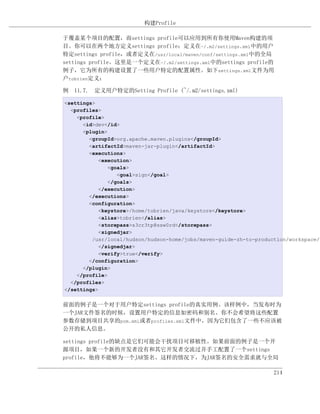
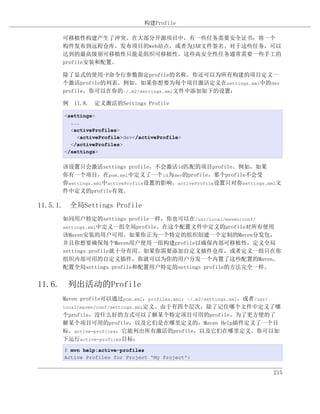
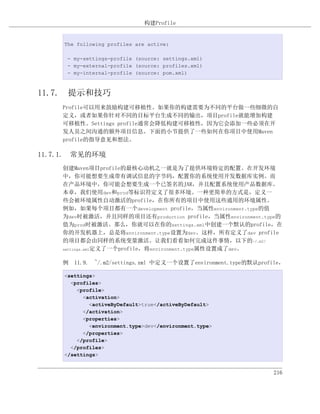
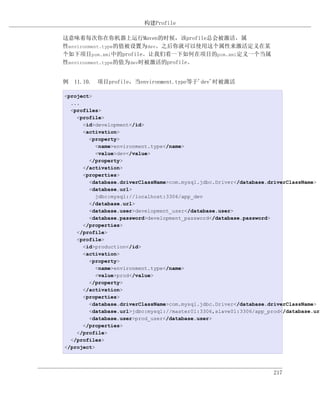
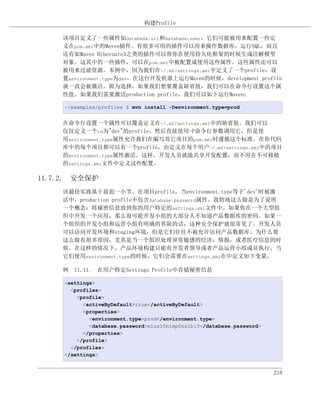

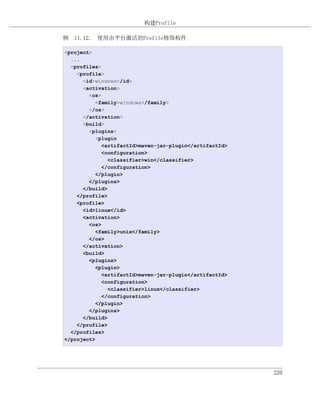
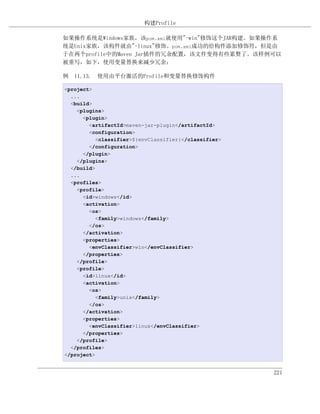
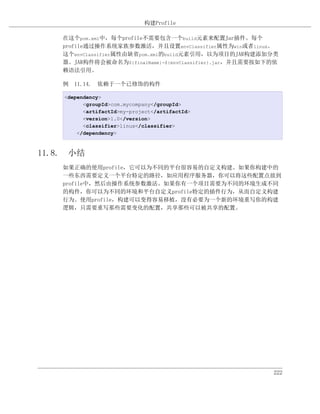
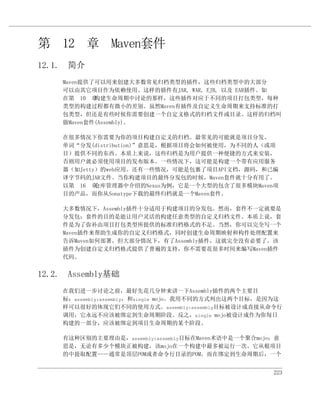
![Maven套件
况下能生成一个可以被Maven构建的归档。然而,由于它假设所有的源文件和资
源文件都位于标准的src目录下,它就可能遗漏那些非标准的目录和文件,而这
些文件往往对构建起着关键作用。
12.2.2. 构建一个套件Building an Assembly
Assembly插件可以以两种方式运行:你可以直接在命令行调用,或者你可以通过绑定到
生命周期阶段将其配置成标准构建过程的一部分。直接调用自有它的用处,主要是为了
那些一次性,不属于你项目核心分发包的套件。大部分情况下,你可能以标准项目构建
过程一部分的形式生成套件。这么做,不管你的项目被安装还是部署,都能包含你自定
义的套件,从而它们也一直是对用户可用的。
作为一个直接调用Assembly插件的例子,考虑你想要将你的项目复制一份给别人让他们
也能从源码构建。你需要同时包含源码,而不仅仅是一个最终的产品。而且你只是偶尔
需要这么做,因此往你的POM中添加配置显得没有必要。你可以使用如下的命令:
$ mvn -DdescriptorId=project assembly:single
...
[INFO] [assembly:single]
[INFO] Building tar : /Users/~/mvn-examples-1.0/assemblies/direct-invocation/
target/direct-invocation-1.0-SNAPSHOT-project.tar.gz
[INFO] Building tar : /Users/~/mvn-examples-1.0/assemblies/direct-invocation/
target/direct-invocation-1.0-SNAPSHOT-project.tar.bz2
[INFO] Building zip: /Users/~/mvn-examples-1.0/assemblies/direct-invocation/
target/direct-invocation-1.0-SNAPSHOT-project.zip
...
假如你想要从你的项目生成一个可运行的JAR。如果你的项目完全是自包含的,没有任
何依赖,那么使用JAR插件的archive配置就能做到。但是,大部分项目都有依赖,而且
这些依赖需要被引入到可运行JAR文件中。这种情况下,每次JAR被安装或部署的时候你
都要确认可运行JAR包含了这些依赖。
假设该项目的main类是org.sonatype.mavenbook.App,如下的POM配置将创建一个可运行
的JAR:
225](https://image.slidesharecdn.com/maven-definitive-guidezh-101013212800-phpapp01/85/Maven-definitive-guide-zh-241-320.jpg)
![Maven套件
以上配置中有两点我们要注意。首先,我们不再像上次那样使用descriptorId参数,
这里我们使用descriptorRefs配置。这样可以允许在同一次Assembly插件执行过程中
使用多个套件类型,同时还能保持不要引入太多额外的配置。第二,configuration下
的archive元素设置最终JAR的Main-Class manifest属性。该配置在所有创建JAR文件的
插件中都很常见,如由默认打包类型使用的JAR插件。
现在,你可以通过执行mvn package生成可运行的JAR文件。之后,我们看一下target目
录的内容,验证一下可运行JAR已经被生成了。最后,为了证明我们真的有可运行JAR
了,那就运行一下吧。
$ mvn package
... (output omitted) ...
[INFO] [jar:jar]
[INFO] Building jar: /Users/~/mvn-examples-1.0/assemblies/executable-jar/target/
executable-jar-1.0-SNAPSHOT.jar
[INFO] [assembly:single {execution: create-executable-jar}]
[INFO] Processing DependencySet (output=)
[INFO] Building jar: /Users/~/mvn-examples-1.0/assemblies/executable-jar/target/
executable-jar-1.0-SNAPSHOT-jar-with-dependencies.jar
... (output omitted) ...
$ ls -1 target
... (output omitted) ...
executable-jar-1.0-SNAPSHOT-jar-with-dependencies.jar
executable-jar-1.0-SNAPSHOT.jar
... (output omitted) ...
$ java -jar
target/executable-jar-1.0-SNAPSHOT-jar-with-dependencies.jar
Hello, World!
从以上的输出你可以看到,标准的项目构建现在生成了一个新的额外的构件。这个新的
构件有一个名为jar-with-dependencies的分类器。最后,我们验证了这个新的JAR是可
运行的,运行这个JAR会产生我们期望的输出“Hello, World!”。
12.2.3. 套件作为依赖
当你将生成套件作为你标准构建过程的一部分的时候,这些套件归档会被附着到你项
目的主构件上。意思是,当它们会随着主构件的安装和部署一起被安装或部署,而且
它们会以差不多相同的方式被解析。每个套件构件会被给予同样的基本坐标(groupId,
artifactId, 和 version)。但是,由于这些构件是附件,在Maven中意思是,它们是基
于主项目构建的某些方面派生出来的。这里是一些例子,source套件包含了项目的原始
输入,jar-with-dependencies套件包含了项目的类及依赖。由于这种派生的性质,附属
构件就能精确的规避一个项目,或一个构件的Maven需求。
227](https://image.slidesharecdn.com/maven-definitive-guidezh-101013212800-phpapp01/85/Maven-definitive-guide-zh-243-320.jpg)
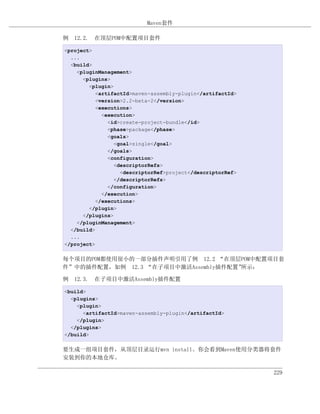
![Maven套件
$ mvn install
...
[INFO] Installing ~/mvn-examples-1.0/assemblies/as-dependencies/project-parent/
second-project/target/second-project-1.0-SNAPSHOT-project.tar.gz t
~/.m2/repository/org/sonatype/mavenbook/assemblies/second-project/1.0-SNAPSHO
second-project-1.0-SNAPSHOT-project.tar.gz
...
[INFO] Installing ~/mvn-examples-1.0/assemblies/as-dependencies/project-parent/
second-project/target/second-project-1.0-SNAPSHOT-project.tar.bz2
~/.m2/repository/org/sonatype/mavenbook/assemblies/second-project/1.0-SNAPSHO
second-project-1.0-SNAPSHOT-project.tar.bz2
...
[INFO] Installing ~/mvn-examples-1.0/assemblies/as-dependencies/project-parent/
second-project/target/second-project-1.0-SNAPSHOT-project.zip to
~/.m2/repository/org/sonatype/mavenbook/assemblies/second-project/1.0-SNAPSHO
second-project-1.0-SNAPSHOT-project.zip
...
当你运行install的时候,Maven会将每个项目的主构件和每个套件复制到你的本地
Maven仓库中。现在本地的所有其它项目都可以使用依赖引用这些构件。如果你最终的
目的是创建一个包含多个多模块项目构件的软件包,你可以创建一个项目,它以依赖的
形式引入其它项目的套件。这个包裹项目(贴切的命名为project-bundle)负责创建一
个最终的包裹套件。这个包裹项目的POM如例 12.4 “套件包裹项目的POM” 所示:
230](https://image.slidesharecdn.com/maven-definitive-guidezh-101013212800-phpapp01/85/Maven-definitive-guide-zh-246-320.jpg)
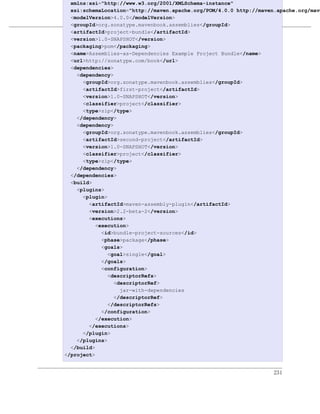
![Maven套件
该包裹项目的POM引用了来自于first-project和second-project的两个套件。这个POM
指定了一个值为project的分类器和一个值为zip的类型,而不是直接引用过了项目的主
构件。这告诉Maven去解析project套件创建的ZIP归档。注意包裹项目生成了一个jar-
with-dependencies套件。jar-with-dependencies并不创建一个非常简洁的套件,而是
简单的创建一个包含所有依赖拆解内容的JAR文件。jar-with-dependencies实际上做的
事情是:告诉Maven拿来所有依赖,将其拆解,然后创建一个包含当前项目所有输出的
归档。在这个项目中,它的效果就是创建一个带有first-project和second-project套件
拆解内容的JAR文件,
该样例展示了如何不用自定义套件描述符就能联合Maven Assembly插件的基本能力。它
实现了创建一个包含多模块项目内容的单独归档这样一个目的。这个时候,jar-with-
dependencies仅仅是一个存储格式,因此我们没必要指定Main-Class的manifest属性。
我们只要正常的构建project-bundle项目就能得到套件。
$ mvn package
...
[INFO] [assembly:single {execution: bundle-project-sources}]
[INFO] Processing DependencySet (output=)
[INFO] Building jar: ~/downloads/mvn-examples-1.0/assemblies/as-dependencies/
project-bundle/target/project-bundle-1.0-SNAPSHOT-jar-with-dependencies.jar
要验证project-bundle套件是否包含了所有依赖套件的拆解内容,运行jar tf:
$ java tf
target/project-bundle-1.0-SNAPSHOT-jar-with-dependencies.jar
...
first-project-1.0-SNAPSHOT/pom.xml
first-project-1.0-SNAPSHOT/src/main/java/org/sonatype/mavenbook/App.java
first-project-1.0-SNAPSHOT/src/test/java/org/sonatype/mavenbook/AppTest.java
...
second-project-1.0-SNAPSHOT/pom.xml
second-project-1.0-SNAPSHOT/src/main/java/org/sonatype/mavenbook/App.java
second-project-1.0-SNAPSHOT/src/test/java/org/sonatype/mavenbook/AppTest.java
阅读本节内容之后,标题应该容易理解了。我们使用了一个包裹项目,它依赖于两个项
目的套件,然后我们再根据这两个项目的套件装配出一个最终的套件。
12.3. 套件描述符概述
当第 12.2 节 “Assembly基础”介绍的标准套件描述符不够的时候,你就需要自定
中
义你自己的套件描述符。套件描述符是一个定义了套件结构和内容的XML文档。
232](https://image.slidesharecdn.com/maven-definitive-guidezh-101013212800-phpapp01/85/Maven-definitive-guide-zh-248-320.jpg)
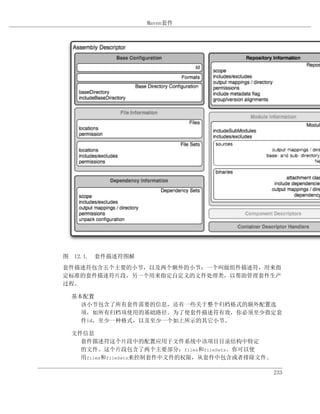
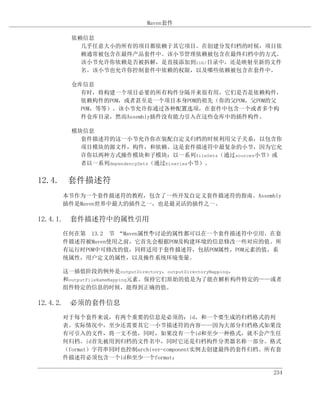
![Maven套件
例 12.8. Plexus Utils中模式排除模式的定义
public static final String[] DEFAULTEXCLUDES = {
// Miscellaneous typical temporary files
"**/*~",
"**/#*#",
"**/.#*",
"**/%*%",
"**/._*",
// CVS
"**/CVS",
"**/CVS/**",
"**/.cvsignore",
// SCCS
"**/SCCS",
"**/SCCS/**",
// Visual SourceSafe
"**/vssver.scc",
// Subversion
"**/.svn",
"**/.svn/**",
// Arch
"**/.arch-ids",
"**/.arch-ids/**",
//Bazaar
"**/.bzr",
"**/.bzr/**",
//SurroundSCM
"**/.MySCMServerInfo",
// Mac
"**/.DS_Store"
};
这个默认的模式数组会排除来自于如GNU Emacs4的编辑器的临时文件,Mac中常见的临
时文件,以及一些常见源码控制系统的元数据文件(虽然Visual SourceSafe得到的更
4
http://www.gnu.org/software/emacs/
240](https://image.slidesharecdn.com/maven-definitive-guidezh-101013212800-phpapp01/85/Maven-definitive-guide-zh-256-320.jpg)
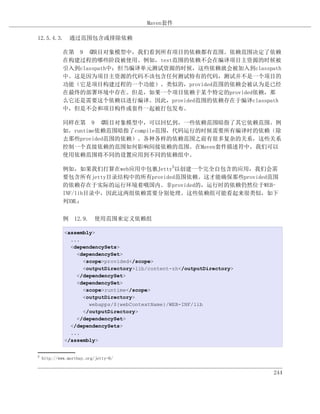
![Maven套件
provided范围的依赖会添加到套件根目录下的lib/目录中,该目录是一个会被包含
到Jetty全局运行classpath中的类库目录。我们使用根据项目artifactId命名的子
目录以方便跟踪某个类库的出处。运行时依赖被添加到web应用的WEB-INF/lib路径
下,这位于标准jetty的webapps/下的一个子目录中,该子目录使用自定义的POM属性
webContextName进行设置。在这个例子中我们完成的事情是,将应用程序特定的依赖与
那些位于Server容器全局classpath中的依赖隔离。
然而,简单的根据范围来分隔依赖可能还不够,尤其是在web应用中。我们可以想象到
某个或者多个运行时依赖可能实际上是供web应用使用的标准化的,非二进制的资源
包裹。例如,考虑有一组web应用程序重用了一组Javascript, CSS, SWF, 和图片资
源。为了是这些资源更容易标准化,通常的做法是将它们包裹成一个归档文件并部署
到Maven仓库中。这样,它们就可以通过标准的Maven依赖被引用——可能依赖的类型是
zip——而这样的依赖通常是runtime范围的。但是,别忘了,它们是资源文件,不是应
用程序代码本身的二进制依赖;因此,盲目的将这些文件放到WEB-INF/lib目录中是错
误的。我们应该把这些资源归档和其它runtime依赖区别对待,将它们放到拆解后放到
web应用的文档根目录中。为了实现这种分离,我们需要使用可以应用到特定依赖坐标
上的包含和排除模式。
换句话说,假如你有三个或者四个web应用,它们重用了同样的资源。你想要创建一个
套件,将provided依赖放到lib/,将runtime依赖放到webapps/<contextName>/WEB-
INF/lib,将某个特定的runtime依赖拆解并放到web应用的文档根目录中。你能完成这
个任务,因为Assembly允许你为某个dependencySet元素定义多个包含和排除模式。阅
读下一节将帮助你了解更多相关内容。
12.5.4.4. 微调:依赖包含和排除
一个资源依赖可能只是简单的某个项目的一组资源(CSS, Javascript, 和图片),该
项目为此创建了一个ZIP归档格式的套件。基于我们web应用的特性,我们也许可以简
单的通过依赖的打包格式来区分资源依赖和其它字节码依赖。大部分web应用以jar的
形式依赖其它项目,因此我们可以简单的决定说有zip依赖为资源依赖。又或者,可能
某些时候资源以jar的格式存储,但我们可以使用一个分类器,如resources。不管哪种
情形,我们都可以为这些资源依赖使用包含模式,同时为其它字节码依赖使用不同的逻
辑。我们会使用dependencySet的includes和excludes子元素来指定这些微调模式。
includes和excludes都包含一子元素,相应的为include和exclude子元素。每个
include或者exclude元素包含一个字符串值,该值可以包含通配符。每个字符串值都可
以通过很多不同方式匹配依赖。总的来说,这里支持三种定义符匹配格式:
- 无版本id
groupId:artifactId
仅仅使用groupId和artifactId来匹配依赖。
- 冲突id
groupId:artifactId:type[:classifier]
该模式能让你指定一个更广的坐标范围,以创建更具体的包含/排除模式。
245](https://image.slidesharecdn.com/maven-definitive-guidezh-101013212800-phpapp01/85/Maven-definitive-guide-zh-261-320.jpg)
![Maven套件
- 完整构件定义符
groupId:artifactId:type[:classifier]:version
如果你需要十分十分的具体,你可以指定所有坐标。
所有这三种模式都支持通配符‘*’,它可以匹配定义符的任何一个子段,但不局限于
一个单独的子段(位于‘:’中间的部分)。同时,注意上述的分类器部分是可选的,
如果需要匹配的依赖没有分类器,就不需要在模式中指定分类器子段。
在前面讲述的例子中,关键的区别在于构件类型zip,并且没有任何依赖拥有分类器,
下列的模式会匹配所有类型为zip的资源依赖:
*:zip
上述的模式使用了第二种依赖定义符:依赖的冲突id。既然我们拥有了区分资源依赖和
其它字节码依赖的模式,我们可以修改依赖集合来区分处理资源归档:
例 12.10. 在dependencySets中使用依赖排除和包含
<assembly>
...
<dependencySets>
<dependencySet>
<scope>provided</scope>
<outputDirectory>lib/content-zh</outputDirectory>
</dependencySet>
<dependencySet>
<scope>runtime</scope>
<outputDirectory>
webapps/${webContextName}/WEB-INF/lib
</outputDirectory>
<excludes>
<exclude>*:zip</exclude>
</excludes>
</dependencySet>
<dependencySet>
<scope>runtime</scope>
<outputDirectory>
webapps/${webContextName}/resources
</outputDirectory>
<includes>
<include>*:zip</include>
</includes>
<unpack>true</unpack>
</dependencySet>
</dependencySets>
...
</assembly>
246](https://image.slidesharecdn.com/maven-definitive-guidezh-101013212800-phpapp01/85/Maven-definitive-guide-zh-262-320.jpg)
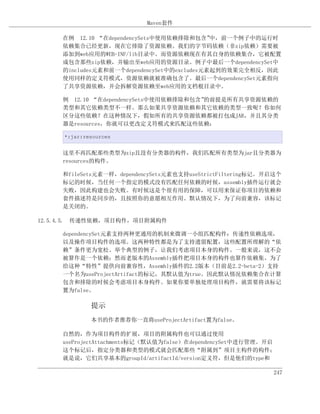
![Maven套件
classifier和主构件不同。当我们需要在套件中包含JavaDoc或者源码文件的时候,就
可以使用这一特性。
除了处理项目自身的构件,我们还能够微调使用两个传递性依赖解析标记来微调依赖集
合。首先,名为useTransitiveDependencies(默认为true)指定依赖集合是否计算传
递性依赖。举个实际的例子,如果你的POM依赖于另外一个套件,这个套件(很可能)
会有一个分类器以区分其主构件并将自身作为一个附属构件。然而,Maven在解析依赖
的时候,就算是解析套件构件,其主构件的传递性依赖信息还是会被解析。如果套件
已经将项目依赖包裹,使用传递性依赖解析就会造成这些依赖的重复。为了避免这一情
况,我们重要简单的将useTransitiveDependencies置为false。
另外一个传递性依赖解析标记就更微妙了。它叫做useTransitiveFiltering,其默认
值为false。要了解这个标记是做什么的,我们首先需要理解在解析过程中哪些信息是
对所有任何构件可用的。当一个构件是依赖的依赖的时候(就是说,需要在你项目本
身的POM再往下至少一层),它有一个被Maven称作“依赖踪迹“的东西,依赖踪迹维
护一个字符串序列,该序列包含一列完整的构件定义符(groupId:artifactId:type:
[classifier:]version),所有你项目的POM和拥有该依赖踪迹的构件的定义符都在其
中。如果你还记得依赖集合模式匹配中可用的三种构件定义符,你会注意到依赖踪迹的
每一项——完整构件定义符——对应了第三种类型。在useTransitiveFiltering为true
的时候,依赖踪迹中的条目就会像主构件一样被包含或排除。
如果你考虑使用传递性依赖过滤(transitive filtering),要小心!某个构件可能会
在传递依赖图中被包含多次,但是自Maven 2.0.9之后,只有第一个包含的踪迹会被认
作该类型的匹配。当聚集你项目的依赖的时候,这可能会造成微妙的问题。
警告
大部分套件实际上不需要对于依赖集合这么深层次的控制;当你真要这么做
的时候,仔细考虑,很可能没有这个必要。
12.5.4.6. 高级拆解选项
正如我们之前讨论的,一些项目依赖需要先被拆解以帮助创建可用的套件归档。在前
面的例子中,是否要拆解很明显。但是,没有考虑哪些部分需要拆解,或者,更重要
的,哪些部分不要拆解。为了更好的控制拆解过程,我们可以配置dependencySet的
unpackOptions元素。使用该元素,我们就可以选择拆解的时候包含或者排除那些文件
模式,并且还可以配置那些被包含的文件是否需要被过滤以使用当前POM信息解析表达
式。事实上,关于拆解依赖集合可用的选项,与包含项目目录结构使用的fileSets可用
的选项十分类似。
我们继续前面的web应用样例,假设一些资源依赖包裹了分发许可证文件。而在我们的
web应用中,我们希望在自己套件的NOTICES文件中集中处理许可证信息,因此我们不希
248](https://image.slidesharecdn.com/maven-definitive-guidezh-101013212800-phpapp01/85/Maven-definitive-guide-zh-264-320.jpg)
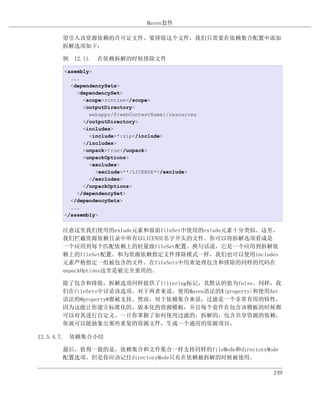
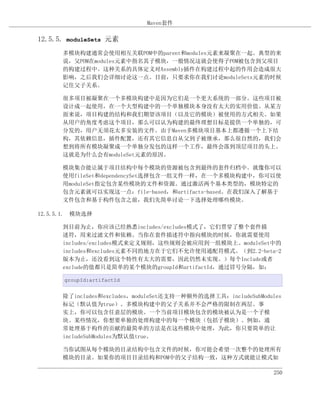
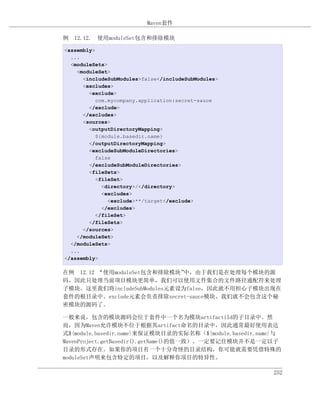
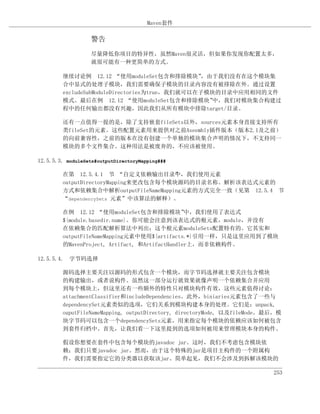
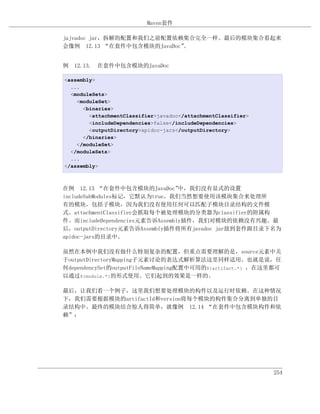
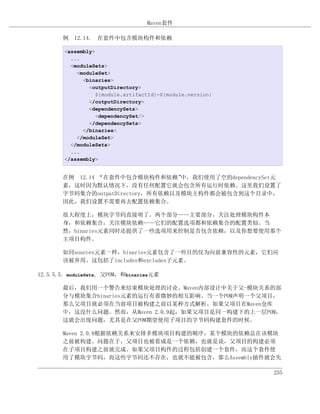
![Maven套件
在一些其它情况,你可能想要保证归档根目录的名称与POM的版本或者其它信息一致。
默认情况下,baseDirectory的值就等于content-zh-0.6-SNAPSHOT。但是,我们可以很
简单的更改这个元素的值,可以是一个字符串字面量,或者是一个根据当前POM进行插
值的表达式,比如org.sonatype.mavenbook-content-zh。对你的文档团队来说,这是个
好消息!(我们都拥有这样的团队,是吧?)
另外一个可用的配置选项是includeSiteDirectory,其默认值是false。如果你项目的
构建同时使用了site生命周期的Site插件目标创建了web站点文档,你就可以通过将该
选项设置成true来包含这些内容。不过,这个特性有一些限制,只有当前POM的文档部
分会被包含(默认情况是target/site),而所有子模块的站点目录不在考虑之中。如
果你想要用,就用吧,不过一个适当配置的fileSet或者moduleSet可以完成同样的任
务,可能还会更好。其实这里又是一个Assembly插件考虑向前兼容性的例子,你最好还
是使用fileSet或者moduleSet元素,而非将includeSiteDirectory设置成true。
12.5.8. componentDescriptors和containerDescriptorHandlers
为了丰满我们关于套件描述符的讨论,我们还应该简单
看一下另外两个元素:containerDescriptorHandlers和
componentDescriptors。containerDescriptorHandlers元素指向一个自定义的组件,
你可以用该组件来扩展Assembly插件的功能。具体来说,这些自定义的组件能让你定义
及处理一些特殊的文件,它们可能需要被从各个成分(constituent)归并到一起以创
建你的套件。举个很好的例子,可能有一个自定义容器描述符处理器,用来从一个成分
war或者war片段文件归并web.xml到你的套件中,这样你就可以在最终的套件中保持一
个单独的web应用描述符,并将其看成一个war文件。
componentDescriptors元素允许你引用外部的套件描述符片段,然后将其包含到当前的
描述符中。组件引用可以是如下任何一种:
1. 相对文件路径: src/main/assembly/component.xml
2. 构件引用: groupId:artifactId:version[:type[:classifier]]
3. Classpath资源: /assemblies/component.xml
4. URL: http://www.sonatype.com/component.xml
顺便说一下,在解析组件描述符的时候,Assembly插件严格的按照上面的顺序采取不同
的策略。第一个成功的策略会被使用。
组件描述符可以包含大多数组件描述符中可用的关于内容的元素,但是moduleSets除
外,这时因为该元素被认为是每个项目特定的,不该被重用。组件描述符中还可以包含
的元素是containerDescriptorHandlers,这个之前已经简要过。组件描述符不能包含
格式,套件ID,或者其它任何与套件归档基础目录相关的配置,所有这些配置都是特定
257](https://image.slidesharecdn.com/maven-definitive-guidezh-101013212800-phpapp01/85/Maven-definitive-guide-zh-273-320.jpg)
![Maven套件
在你的项目中使用它,所有项目的内容就会被打包在一起,然后可以直接解压添加到现
存web应用中(为了添加一个扩展特性)。然而,如果你的团队构建了很多个web片段项
目,那么你就会想要重用该描述符,而非复制它。为了将该描述符以构件的形式部署,
我们就要将其放到一个项目中,位于src/main/resources/assemblies目录。
这个套件描述符构件的项目结构看起来如下:
|-- pom.xml
`-- src
`-- main
`-- resources
`-- assemblies
`-- web-fragment.xml
注意web-fragment.xml文件的位置。默认情况下,Maven会将整个src/main/resources
目录打包到最终的jar中,这里,如果没有额外的配置,套件描述符也就会被打包。同
时注意assemblies/这一路径前缀,Assembly插件需要所有插件classpath中的描述符拥
有这一前缀。将我们的描述符放到恰当的相对路径十分重要,这样Assembly才能够在运
行的时候识别它们。
记住,现在这个项目已经和你实际的web-fragment项目分离了;套件描述符拥有了自己
的构件,自己的版本,甚至有可能的话,自己的发布周期。一旦你使用Maven install
了这一新的项目,你就能够在web-fragment项目中使用它。如果还不清楚,检查构建过
程,看起来应该如下:
$ mvn install
(...)
[INFO] [install:install]
[INFO] Installing (...)/web-fragment-descriptor/target/web-fragment-descriptor-1.0-S
to /Users/~/.m2/repository/org/sonatype/mavenbook/assemblies/
web-fragment-descriptor/1.0-SNAPSHOT/web-fragment-descriptor-1.0-SNAPSHOT.
[INFO] ---------------------------------------------------------------
[INFO] BUILD SUCCESSFUL
[INFO] ---------------------------------------------------------------
[INFO] Total time: 5 seconds
(...)
由于web-fragment-descriptor项目没有源码,得到的jar除了包含web-fragment套件描
述符什么都没有。现在,让我们使用这个新的描述符构件:
<project>
(...)
<artifactId>my-web-fragment</artifactId>
(...)
<build>
259](https://image.slidesharecdn.com/maven-definitive-guidezh-101013212800-phpapp01/85/Maven-definitive-guide-zh-275-320.jpg)
![Maven套件
<moduleSet>
<includes>
<include>*-web</include>
</includes>
<binaries>
<outputDirectory>/</outputDirectory>
<unpack>true</unpack>
<includeDependencies>true</includeDependencies>
<dependencySets>
<dependencySet>
<outputDirectory>/WEB-INF/lib</outputDirectory>
</dependencySet>
</dependencySets>
</binaries>
</moduleSet>
<moduleSet>
<includes>
<include>*-addons</include>
</includes>
<binaries>
<outputDirectory>/WEB-INF/lib</outputDirectory>
<includeDependencies>true</includeDependencies>
<dependencySets>
<dependencySet/>
</dependencySets>
</binaries>
</moduleSet>
</moduleSets>
</assembly>
基于这个父项目——叫做app-parent——它带有三个模块,分别为app-core, app-web,
和app-addons,注意当我们运行这个多模块构建的时候发生了什么:
$ mvn package
[INFO] Reactor build order:
[INFO] app-parent <----- PARENT BUILDS FIRST
[INFO] app-core
[INFO] app-web
[INFO] app-addons
[INFO] ---------------------------------------------------------------
[INFO] Building app-parent
[INFO] task-segment: [package]
[INFO] ---------------------------------------------------------------
[INFO] [site:attach-descriptor]
[INFO] [assembly:single {execution: distro}]
[INFO] Reading assembly descriptor: src/main/assembly/distro.xml
262](https://image.slidesharecdn.com/maven-definitive-guidezh-101013212800-phpapp01/85/Maven-definitive-guide-zh-278-320.jpg)
![Maven套件
[INFO] ---------------------------------------------------------------
[ERROR] BUILD ERROR
[INFO] ---------------------------------------------------------------
[INFO] Failed to create assembly: Artifact:
org.sonatype.mavenbook.assemblies:app-web:jar:1.0-SNAPSHOT (included by module) does
an artifact with a file. Please ensure the package phase is run before the assembl
generated.
...
父项目——app-parent——首先构建。这时因为所有其它项目都将其引用成父项目,从
而使得它必须在所有其它项目之前构建。而app-web模块,套件描述符中第一个要处理
的模块,还没有被构建。因此,它就没有相关的构件,因此整个装配就无法成功。
对于这种情形的一个临时解决办法是从Assembly插件声明中移除executions部分配置,
这部分配置将插件绑定到父POM的package生命周期阶段,保持其它的配置不变。然后,
分别运行两个Maven命令行任务:首先,package,构件整个多模块项目,然后,再运行
assembly:assembly,直接调用Assembly插件,这时能够使用到之前运行输出的构件,
并创建出分发套件。这样一个构建的命令行如下:
$ mvn package assembly:assembly
然而,这种方式有几个缺陷。首先,它使得套件分发过程变成了一个更手动的工作,对
于整个构建过程,很大程度上这增加了复杂度,且会带来一些潜在的错误。此外,这也
意味着如果不使用文件系统引用,那么附属构件——当项目构建运行的时候关联在内存
中——也就无法再次被使用。
除了使用moduleSet来收集多模块构建中的所有构件,通常还有一种更好的的做法:使
用一个专门的分发包项目模块,并利用模块间依赖。在这种方式中,你首先在你的构
建中创建一个专门来出来装配分发包的模块。这个模块的POM包含了对所有其它模块
的依赖,且配置了Assembly插件绑定到其package生命周期阶段。而套件描述符就使用
dependencySets元素来取代moduleSets,以收集所有模块构件并决定它们在套件归档中
的位置。这种方式避开了前面讲述的关于父子关系的陷阱,现在只需要在套件描述符中
使用更简单的配置来完成我们的工作。
为此,我们可以创建一个新的项目结构,它与我们之间模块集合使用的方式类似,只是
需要一个额外的分发项目,我们最终需要五个POM:app-parent, app-core, app-web,
app-addons, 以及app-distribution。新的app-deistribution的POM如下:
<project>
<parent>
<artifactId>app-parent</artifactId>
<groupId>org.sonatype.mavenbook.assemblies</groupId>
<version>1.0-SNAPSHOT</version>
</parent>
263](https://image.slidesharecdn.com/maven-definitive-guidezh-101013212800-phpapp01/85/Maven-definitive-guide-zh-279-320.jpg)
![Maven套件
<modelVersion>4.0.0</modelVersion>
<artifactId>app-distribution</artifactId>
<name>app-distribution</name>
<dependencies>
<dependency>
<artifactId>app-web</artifactId>
<groupId>org.sonatype.mavenbook.assemblies</groupId>
<version>1.0-SNAPSHOT</version>
<type>war</type>
</dependency>
<dependency>
<artifactId>app-addons</artifactId>
<groupId>org.sonatype.mavenbook.assemblies</groupId>
<version>1.0-SNAPSHOT</version>
</dependency>
<!-- Not necessary since it's brought in via app-web.
<dependency> [2]
<artifactId>app-core</artifactId>
<groupId>org.sonatype.mavenbook.assemblies</groupId>
<version>1.0-SNAPSHOT</version>
</dependency>
-->
</dependencies>
</project>
注意由于现在的POM中不再能够使用模块集合,我们必须包含项目结构中对于其它模块
的依赖。还要注意的是,我们这里没有显式的声明对于app-core的依赖,这时由于我们
已经依赖的app-web,app-core已经通过传递性依赖的方式引入。
接着,当我们将distro.xml套件描述符移到app-distribution项目中时,我们需要使用
dependencySets元素对其进行修改,如:
<assembly>
...
<dependencySets>
<dependencySet>
<includes>
<include>*-web</include>
</includes>
<useTransitiveDependencies>false</useTransitiveDependencies>
<outputDirectory>/</outputDirectory>
<unpack>true</unpack>
</dependencySet>
<dependencySet>
<excludes>
264](https://image.slidesharecdn.com/maven-definitive-guidezh-101013212800-phpapp01/85/Maven-definitive-guide-zh-280-320.jpg)
![Maven套件
<exclude>*-web</exclude>
</excludes>
<useProjectArtifact>false</useProjectArtifact>
<outputDirectory>/WEB-INF/lib</outputDirectory>
</dependencySet>
</dependencySets>
...
</assembly>
现在,如果我们从项目顶层运行构建,就能看到更好的结果:
$ mvn package
(...)
[INFO] ---------------------------------------------------------------
[INFO] Reactor Summary:
[INFO] ---------------------------------------------------------------
[INFO] module-set-distro-parent ...............SUCCESS [3.070s]
[INFO] app-core .............................. SUCCESS [2.970s]
[INFO] app-web ............................... SUCCESS [1.424s]
[INFO] app-addons ............................ SUCCESS [0.543s]
[INFO] app-distribution ...................... SUCCESS [2.603s]
[INFO] ---------------------------------------------------------------
[INFO] ---------------------------------------------------------------
[INFO] BUILD SUCCESSFUL
[INFO] ---------------------------------------------------------------
[INFO] Total time: 10 seconds
[INFO] Finished at: Thu May 01 18:00:09 EDT 2008
[INFO] Final Memory: 16M/29M
[INFO] ---------------------------------------------------------------
正如你所看到的,使用依赖集合的方式更可靠,并且在运行构建的时候出错的几率更
低——至少在Maven的内部项目构建排序逻辑还没有赶上Assembly插件的功能之前是这
样。
12.7. 总结
如你在本章所看到的,Maven Assembly插件为创建自定义归档格式提供了很多可能性。
虽然归档格式的细节可以十分复杂,但显然不是所有情况都这样,因此我们提供了一些
内置的套件描述符。即使你的目标是以某种独特的目录结构来包含项目的依赖,选择项
目文件,编写一个定制的套件描述符也不是太费力的事情。
套件对于很多应用都十分有用,但最有用的地方还是各种应用程序分发包。虽然使用
Assembly插件有很多不同的方法,但在创建包含字节码的分发包时,使用标准化的套件
描述符构件,同时避免使用moduleSets,是避免问题的两种很可靠的方法。
265](https://image.slidesharecdn.com/maven-definitive-guidezh-101013212800-phpapp01/85/Maven-definitive-guide-zh-281-320.jpg)
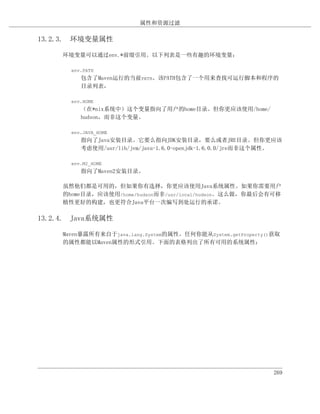
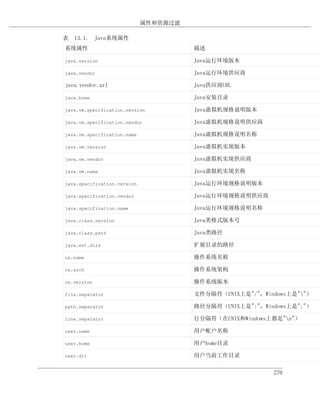
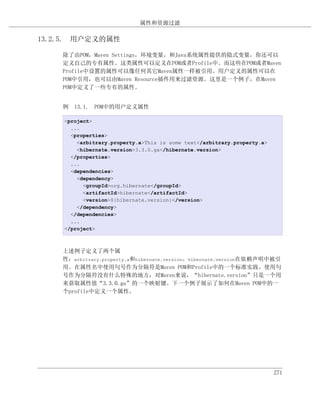
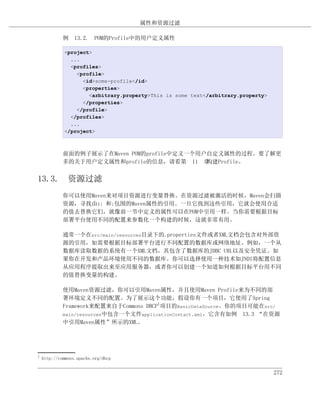
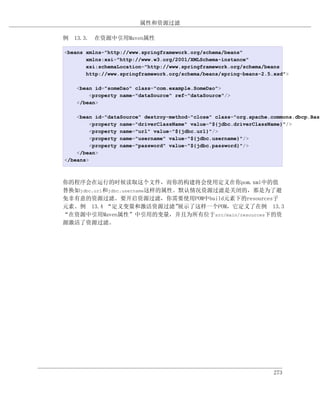
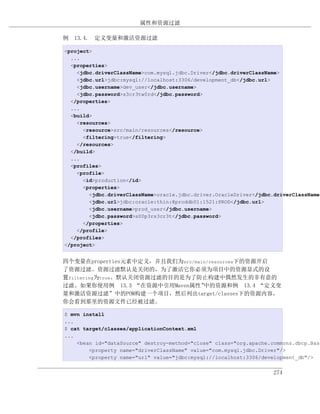
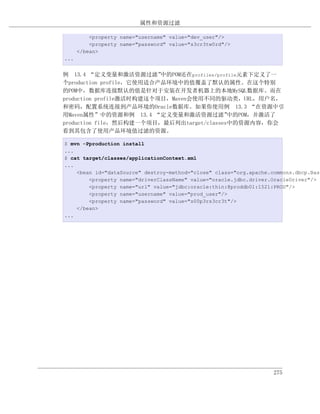
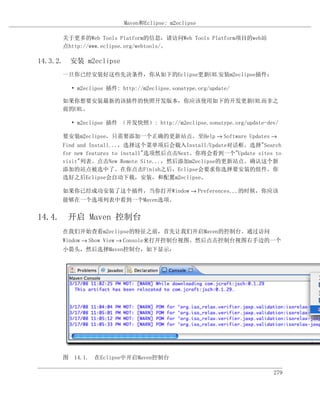

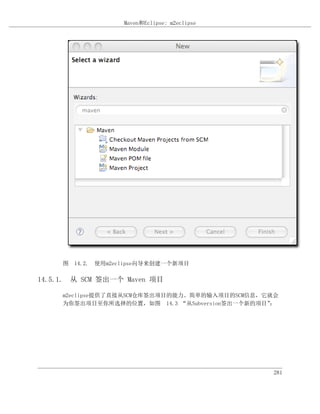
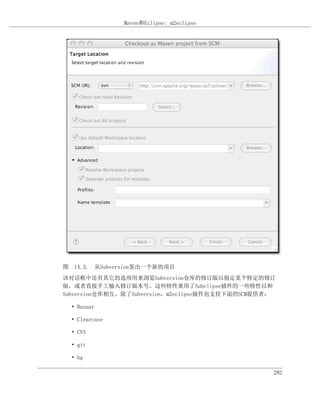
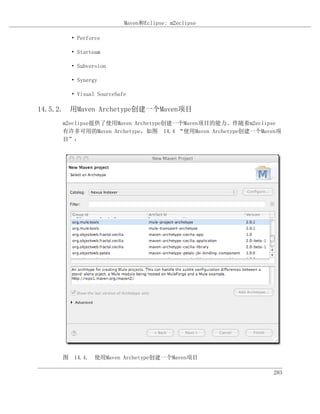
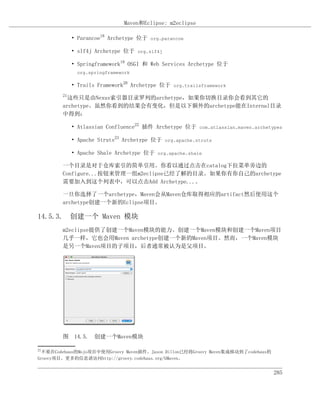
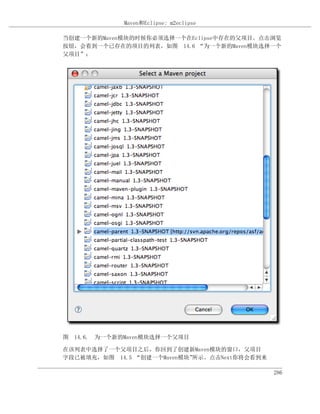
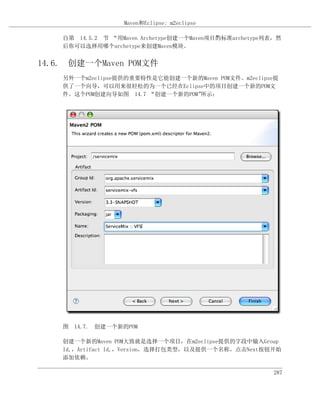
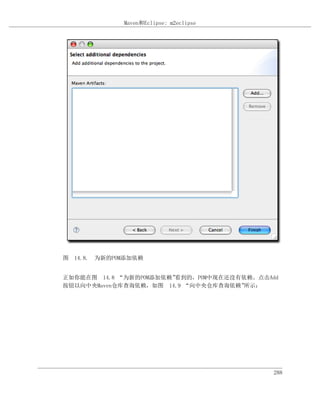
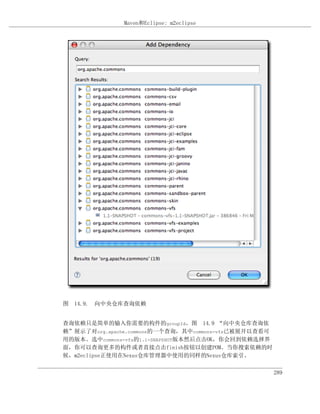

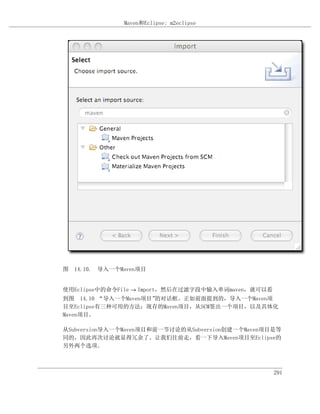
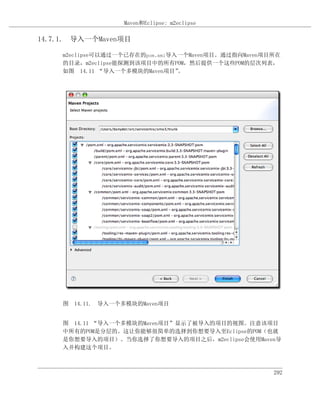
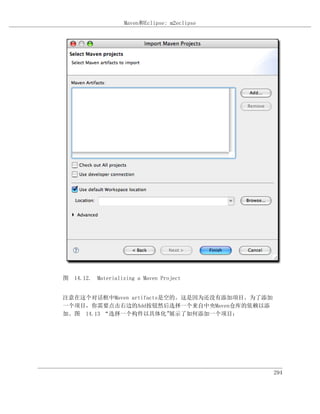
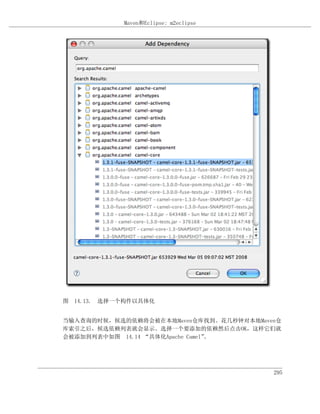
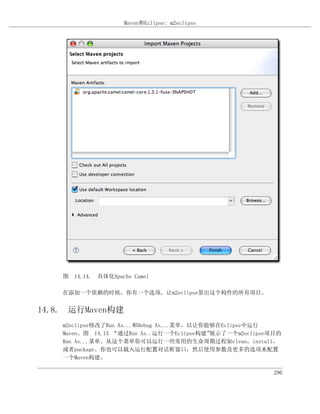
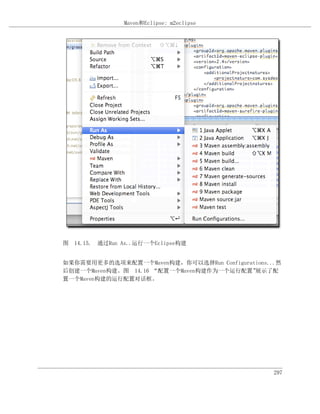
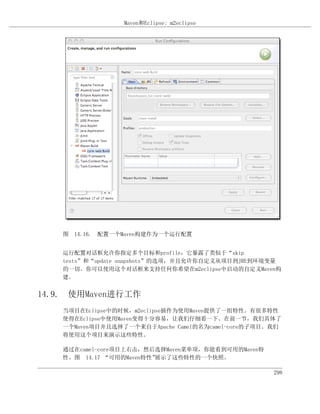
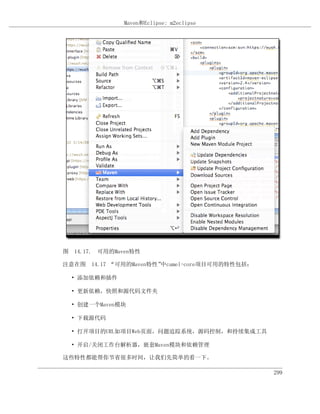
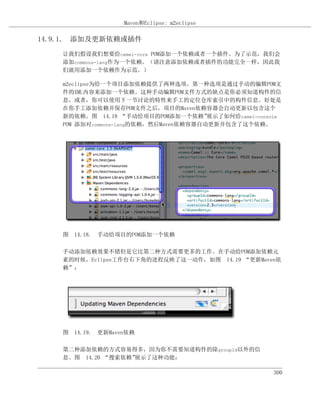
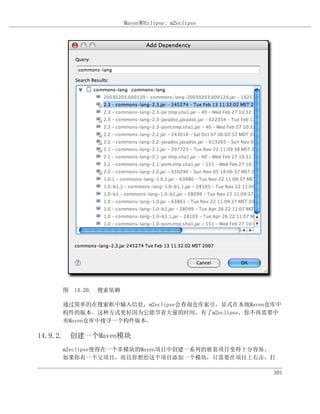
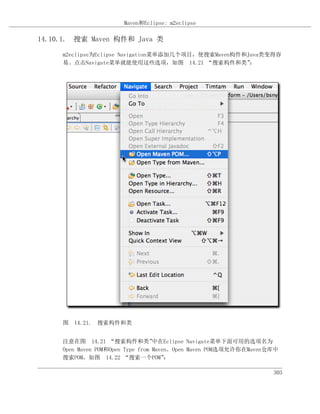
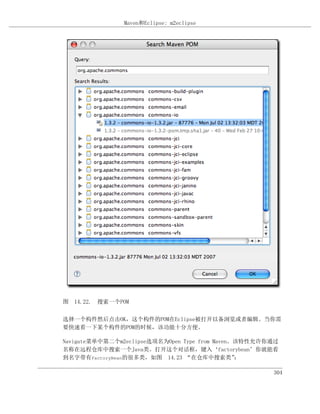
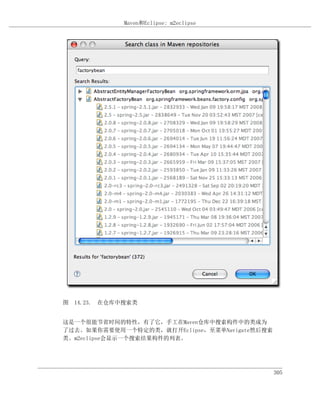
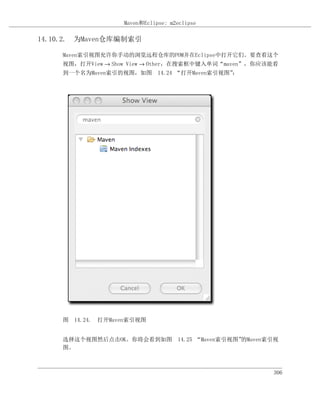
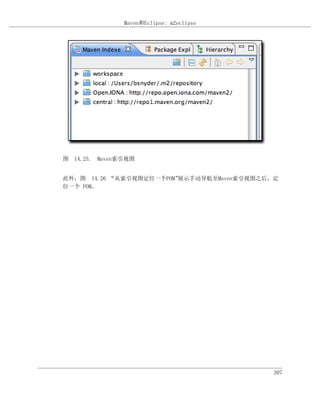
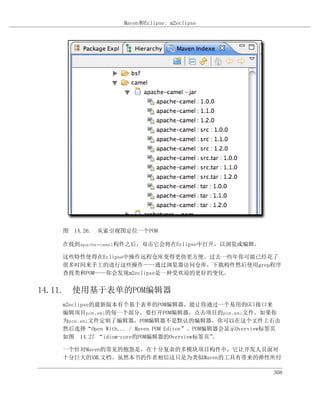

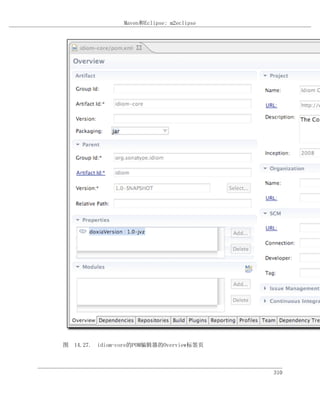

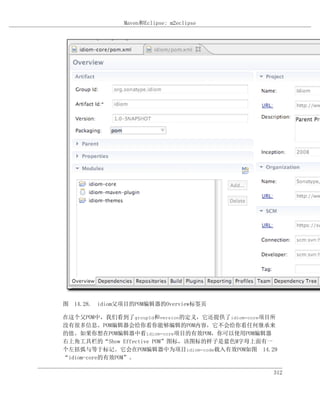
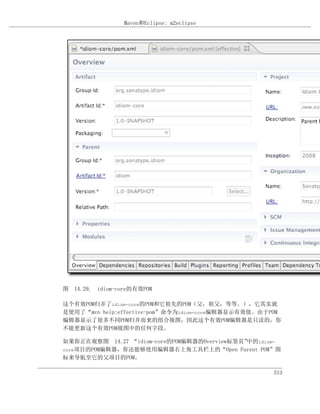
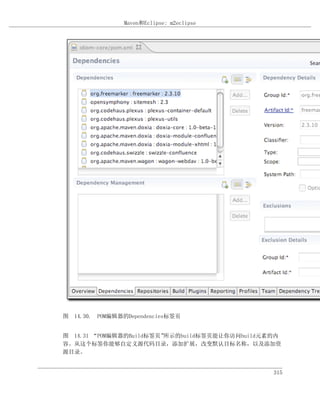
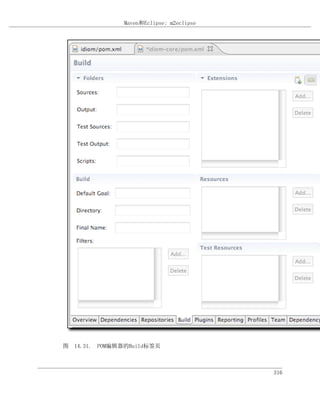
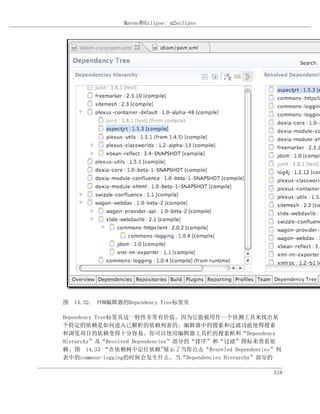
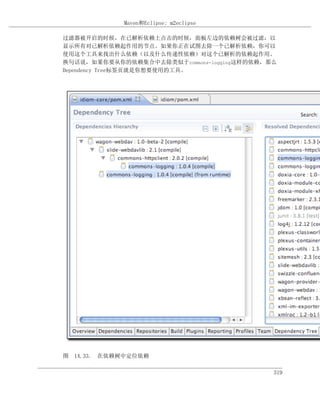
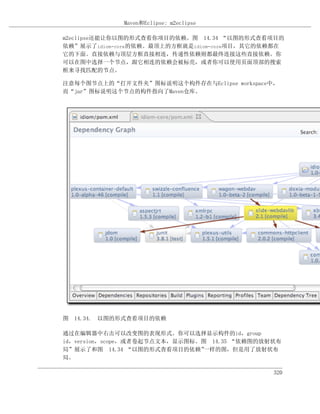
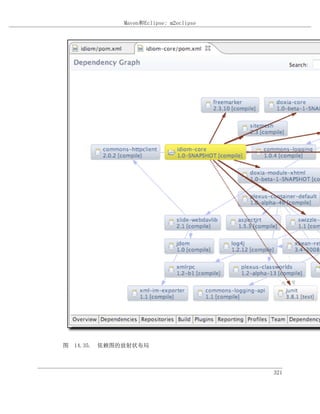
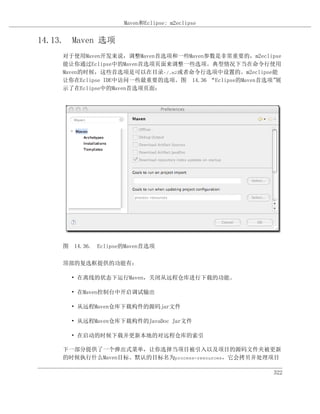
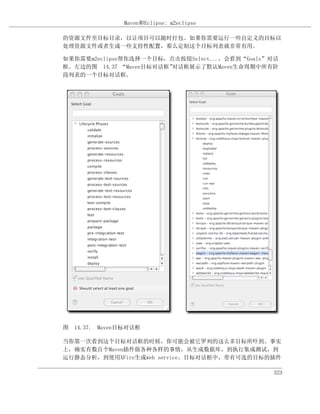
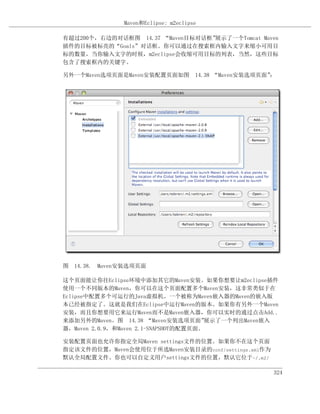
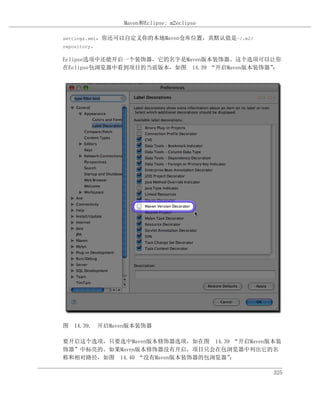
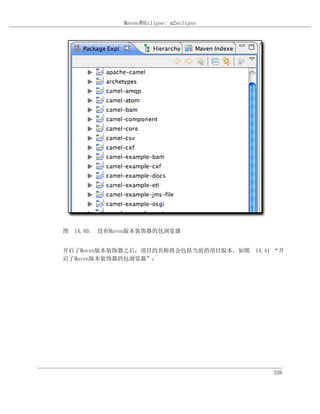
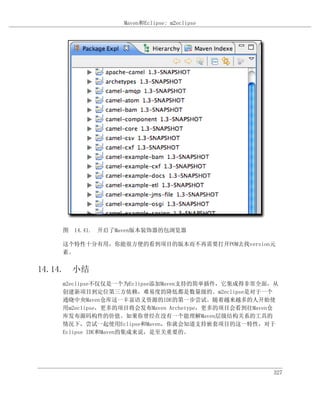
![第 15 章 站点生成
15.1. 简介
成功的软件应用程序很少是由单人团队开发的。在讨论任何一个值得我们写下一笔的软
件的时候,这个软件背后通常有一个协作的开发者团队,它们大小不一,可能只是一个
很少人组成的小型团队,也可能由一个大型分布式环境中数百数千的程序员组成。大部
分开源项目(如Maven)成败的原因之一就是它们是否为广泛分布的潜在用户和开发者
提供了良好的文档。软件开发主要还是一个协作与交互的实践活动,而发布一个Maven
站点是确保你的项目能与最终用户良好沟通的有效手段。
一个开源项目的web站点通常是最终用户和开发人员交流的基础平台。最终用户浏览项
目web站点以获得教程,用户指南,API文档,以及邮件列表存档。而开发者浏览项目的
web站点获得设计文档,代码报告,问题跟踪(issue tracking),以及发布计划。大
型的开源项目可能会和wiki,问题跟踪系统,以及持续集成系统相集成,用那些反映当
前开发状态的材料来帮助增强在线文档。如果一个新的开源项目的web站点内容匮乏,
不能为预期用户覆盖基本信息,那么这通常预示着这个项目有问题,不会被人采用。对
于一个开源项目社区的形成,站点文档和代码本身一样重要。
Maven可被用来创建一个项目web站点,以收集所有与最终用户和开发者相关的信息。
不做任何配置,Maven就能生成项目报告,包括单元测试失败,包耦合度,以及代码
质量报告。Maven也能让你编写简单的web页面,并基于一致的项目模板呈现这些页
面。Maven可以用多种格式发布站点内容,包括XHTML和PDF。Maven可以用来生成API文
档,也可以在你项目的二进制发布包内嵌入Javadoc和源代码。在你使用Maven生成了所
有最终用户和开发者文档之后,你可以使用Maven将站点发布到远程服务器上。
15.2. 使用Maven构建项目站点
为了展示创建项目站点的过程,使用archetype插件创建一个样例Maven项目:
$ mvn archetype:create -DgroupId=org.sonatype.mavenbook -DartifactId=sample-project
该命令创建了一个最简单的Maven项目,只带有一个简单的POM,以及src/main/java目
录下一个Java类。你可以通过简单的运行mvn site构建Maven站点。要在浏览器中预览
结果,你可以运行mvn site:run,Maven会构建站点并启动一个内嵌的Jetty容器。
$ cd sample-project
$ mvn site:run
[INFO] Scanning for projects...
[INFO] Searching repository for plugin with prefix: 'site'.
[INFO] ------------------------------------------------------------------------
328](https://image.slidesharecdn.com/maven-definitive-guidezh-101013212800-phpapp01/85/Maven-definitive-guide-zh-344-320.jpg)
![站点生成
[INFO] Building sample-project
[INFO] task-segment: [site:run] (aggregator-style)
[INFO] ------------------------------------------------------------------------
[INFO] Setting property: classpath.resource.loader.class =>
'org.codehaus.plexus.velocity.ContextClassLoaderResourceLoader'.
[INFO] Setting property: velocimacro.messages.on => 'false'.
[INFO] Setting property: resource.loader => 'classpath'.
[INFO] Setting property: resource.manager.logwhenfound => 'false'.
[INFO] [site:run]
2008-04-26 11:52:26.981::INFO: Logging to STDERR via org.mortbay.log.StdErrLog
[INFO] Starting Jetty on http://localhost:8080/
2008-04-26 11:52:26.046::INFO: jetty-6.1.5
2008-04-26 11:52:26.156::INFO: NO JSP Support for /, did not find
org.apache.jasper.servlet.JspServlet
2008-04-26 11:52:26.244::INFO: Started SelectChannelConnector@0.0.0.0:8080
一旦Jetty启动并开始监听8080端口,你就可以通过在浏览器中输入http://
localhost:8080/查看项目站点了。你可以在图 15.1 “简单生成的Maven站点”中看到
结果。
329](https://image.slidesharecdn.com/maven-definitive-guidezh-101013212800-phpapp01/85/Maven-definitive-guide-zh-345-320.jpg)
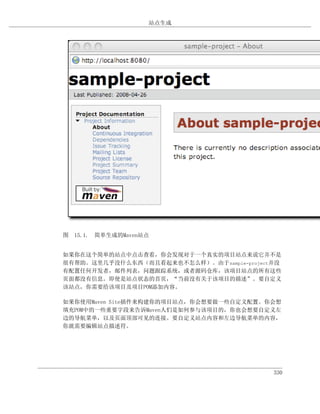
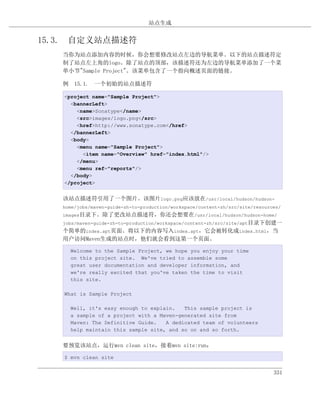
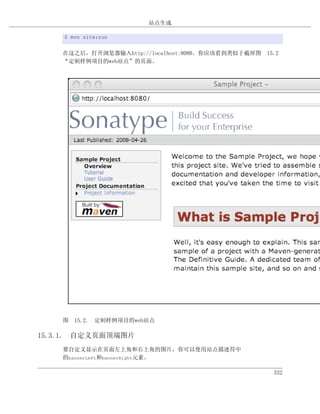
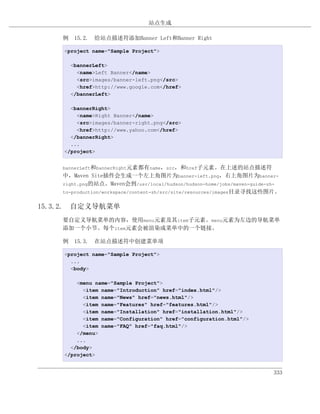
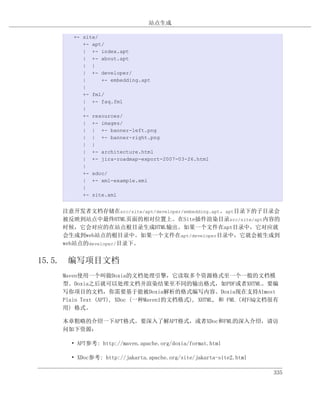
![站点生成
• FML参考: http://maven.apache.org/doxia/references/fml-format.html
15.5.1. APT样例
例 15.5 “APT文档”展示了一个简单的APT文档,它带有一段介绍文字和一个简单列
表。注意列表通过伪元素“[]”结束。
例 15.5. APT文档
---
Introduction to Sample Project
---
Brian Fox
---
26-Mar-2008
---
Welcome to Sample Project
This is a sample project, welcome! We're excited that you've decided to read the
index page of this Sample Project. We hope you enjoy the simple sample project
we've assembled for you.
Here are some useful links to get you started:
* {{{news.html}News}}
* {{{features.html}Features}}
* {{{faq.html}FAQ}}
[]
如果例 15.5 “APT文档”中的APT文档位于src/site/apt/index.apt,Maven Site插件
就会使用Doxia解析该APT,生成对应于index.html的XHTML文档。
15.5.2. FML样例
很多项目维护一个常见问题(FAQ)页面。例 15.6 “FAQ标记语言文档”展示了一个
FML文档的例子:
336](https://image.slidesharecdn.com/maven-definitive-guidezh-101013212800-phpapp01/85/Maven-definitive-guide-zh-352-320.jpg)
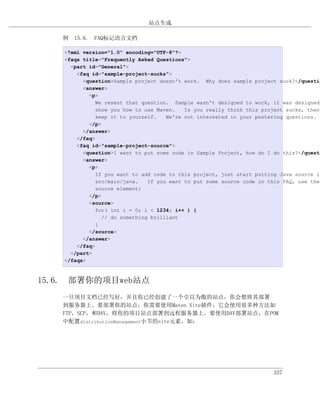
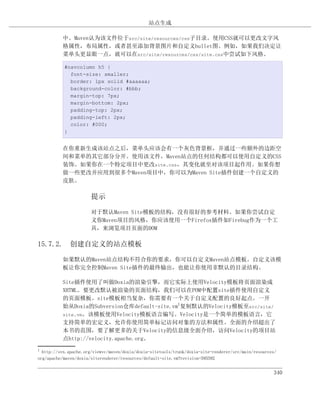
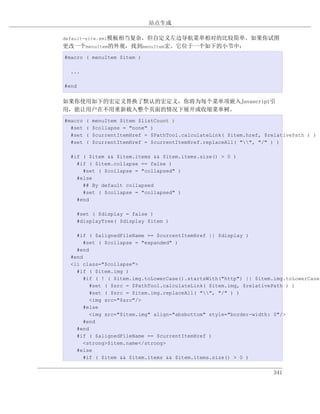
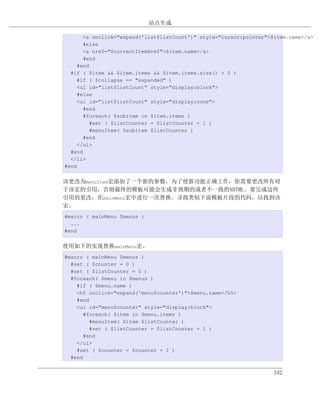
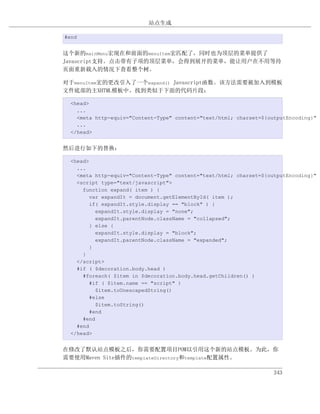
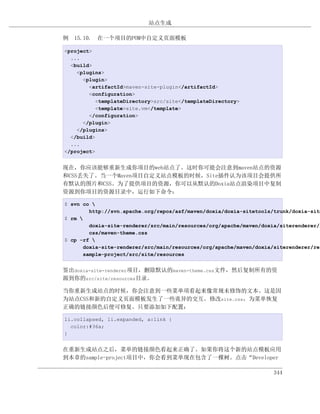
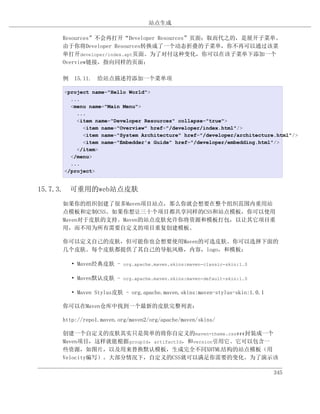
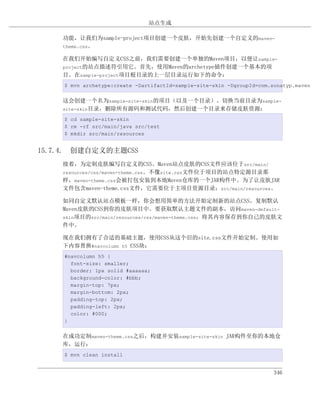
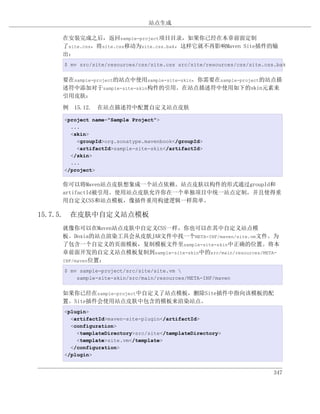
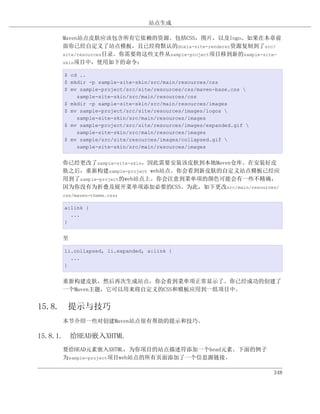
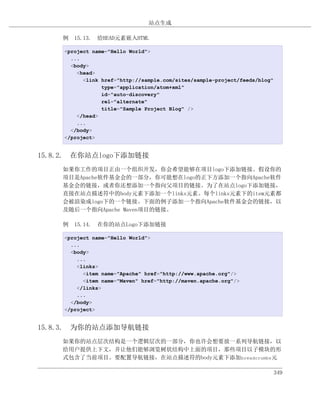
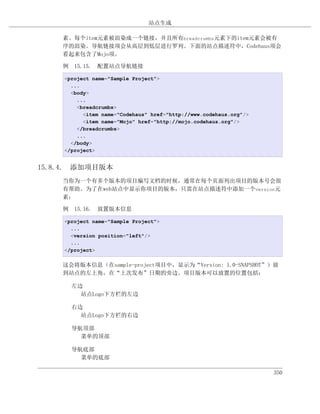
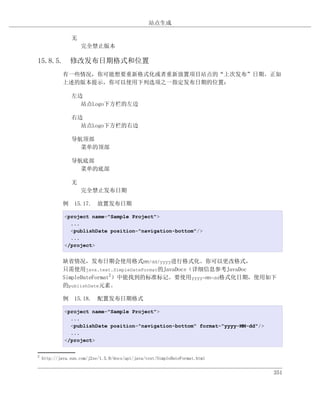
![站点生成
15.8.6. 使用Doxia宏
除了高级的文档渲染特性,Doxia同时也提供了一个宏引擎,它允许每种输入格式触发
动态内容的注入。一个优秀的例子是snippet宏,它能让一个文档从一个HTTP可访问
的源文件抓取代码片段。使用该宏,一小段APT可以被渲染成XHTML。下面的APT代码调
用了snippet宏。请注意该代码应该是单独连续的一行,插入一个反斜杠是为了表示换
行,以让代码更适合页面。
%{snippet|id=modello-model|url=http://svn.apache.org/repos/asf/maven/archetype/trunk
maven-archetype/maven-archetype-model/src/main/mdo/archetype.mdo}
例 15.19. XHTML中Snippet宏的输出
<div class="source"><pre>
<model>
<id>archetype</id>
<name>Archetype</name>
<description><![CDATA[Maven's model for the archetype descriptor.]]></description>
<defaults>
<default>
<key>package</key>
<value>org.apache.maven.archetype.model</value>
</default>
</defaults>
<classes>
<class rootElement="true" xml.tagName="archetype">
<name>ArchetypeModel</name>
<description>Describes the assembly layout and packaging.</description>
<version>1.0.0</version>
<fields>
<field>
<name>id</name>
<version>1.0.0</version>
<required>true</required>
<type>String</type>
</field>
...
</fields>
</class>
</classes>
</model>
</pre></div>
352](https://image.slidesharecdn.com/maven-definitive-guidezh-101013212800-phpapp01/85/Maven-definitive-guide-zh-368-320.jpg)

![仓库管理器
Wrapper1的本地服务包裹器启动。这个服务包裹器可以被配置成以Windows服务或Unix
守护线程的形式运行Nexus。要启动Nexus,你需要为你的平台找到合适的启动脚本。要
查看可用平台的列表,查看${NEXUS_HOME}/bin/jsw目录的内容。
下面的例子展示了使用Mac OSX的脚本启动Nexus。首先我们列出${NEXUS_HOME}/
bin/jsw的内容以查看可用的平台,然后我们用chmod命令使这个bin目录的内容可
执行。Mac OSX包裹器通过调用app start启动,然后我们tail在${NEXUS_HOME}/
container/logs中的wrapper.log。Nexus会初始化自己然后打印出一条信息说明它正在
监听localhost:8081。
$ cd Nexus
$ ls ./bin/jsw/
aix-ppc-32/ linux-ppc-64/ solaris-sparc-32/
aix-ppc-64/ linux-x86-32/ solaris-sparc-64/
hpux-parisc-32/ linux-x86-64/ solaris-x86-32/
hpux-parisc-64/ macosx-universal-32/ windows-x86-32/
$ chmod -R a+x bin
$ ./container/bin/jsw/macosx-universal-32/app start
Nexus Repository Manager...
$ tail -f container/logs/wrapper.log
INFO ... [ServletContainer:default] - Started SelectChannelConnector@0.0.0.0:8081
到目前为止,Nexus已经开始运行并监听端口8081。要使用Nexus,启动一个web浏览器
然后输入URL:http://localhost:8081/nexus。点击web页面右上角的“Log In”链
接,你应该看到如下的登陆对话框。
默认的NEXUS用户名和密码是"admin" 和 "admin123"。
1
http://wrapper.tanukisoftware.org/doc/english/introduction.html
356](https://image.slidesharecdn.com/maven-definitive-guidezh-101013212800-phpapp01/85/Maven-definitive-guide-zh-372-320.jpg)
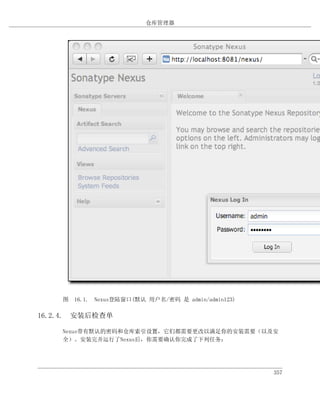
![仓库管理器
$ cd /etc/init.d
$ chkconfig --add nexus
$ chkconfig --levels 345 nexus on
$ service nexus start
Starting Sonatype Nexus...
$ tail -f /usr/local/nexus/logs/wrapper.log
第二个命令添加nexus为一个服务,可以由service命令启动和停止,可以
由chkconfig命令管理。chkconfig管理/etc/rc[0-6].d中的符号链接,当操作系统重启
或者在运行级别中转换时,它们控制服务的启动和停止。第三个命令添加nexus至运行
级别3,4,和5 。service命令启动Nexus,最后的命令追踪wrapper.log以验证Nexus成
功启动。如果Nexus成功启动了你应该看到一个信息告诉你Nexus正在端口8001监听HTTP
连接。
16.2.6. 升级Nexus版本
升级一个已安装的Nexus版本十分容易。每个Nexus版本有两个可用的归档文件可下载。
完整的归档文件包含Nexus应用程序,Nexus启动脚本,以及用来保存仓库索引和远程仓
库本地缓存的工作目录。如果你大量的使用Nexus,这个工作目录会包含数G的构件,你
不会希望在每次升级Nexus的时候必须重新创建这个仓库。升级下载文件被创建成为用
户提供一个方便的形式升级Nexus,它会保存Nexus数据;升级下载文件只包含Nexus应
用程序代码。第一次你安装Nexus的时候,你下载完全的Nexus分发包,当你想要升级你
的Nexus安装,同时保留你的仓库数据的时候,你只要下载升级分发包。
要升级Nexus,只要下载“upgrade”分发包,而非“bundle”分发包。升级分发包的内
容存储在一个包含nexus版本号(如nexus-1.0.0-beta-3)的文件夹中。这个文件夹可以
解开至$NEXUS_HOME/runtime/apps,不用覆盖当前安装版本的内容。
$ cd $NEXUS_HOME/runtime/apps
$ unzip nexus-1.0.0-beta-3-upgrade.zip
如果你下载了GZip归档的TAR文件,运行:
$ cd $NEXUS_HOME/runtime/apps
$ tar xvzf nexus-1.0.0-beta-3-upgrade.tgz
当升级归档文件解压至$NEXUS_HOME/runtime/apps后,你必须从之前的Nexus版本复
制配置文件至新安装的版本。从$NEXUS_HOME/runtime/apps/nexus/conf/nexus.xml复
制nexus.xml至$NEXUS_HOME/runtime/apps/nexus-1.0.0-beta-3/conf。你应该也复制所
有你自定义的日志配置文件log4j.properties和jul-logging.properties。在你从当前
的Nexus版本复制了配置文件至新版本的Nexus后,停止Nexus服务器。
现在,你需要重命名$NEXUS_HOME/runtime/apps/nexus目录为一个反映它旧版本号
的名称。比如,在这个例子中$NEXUS_HOME/runtime/apps/nexus将成为$NEXUS_HOME/
360](https://image.slidesharecdn.com/maven-definitive-guidezh-101013212800-phpapp01/85/Maven-definitive-guide-zh-376-320.jpg)

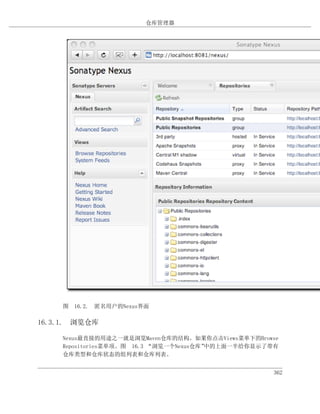
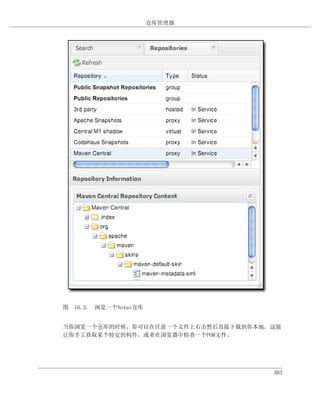

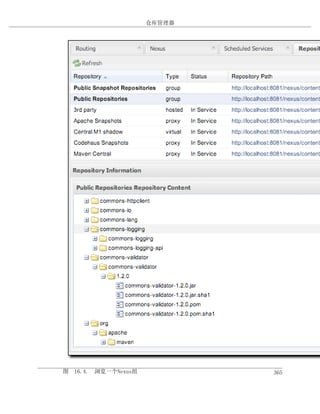
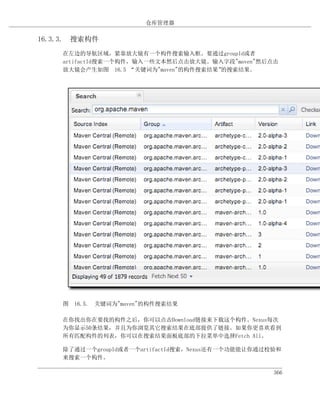

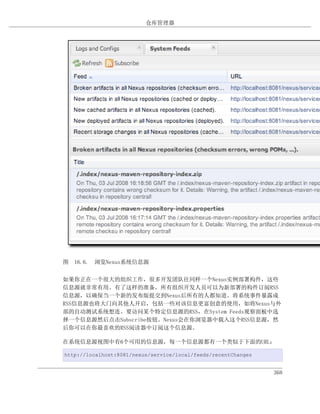
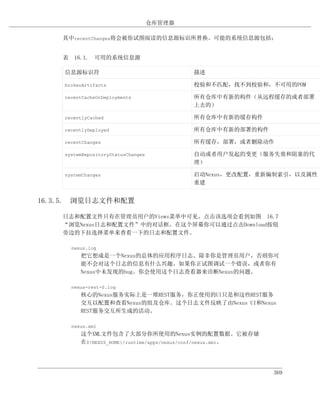
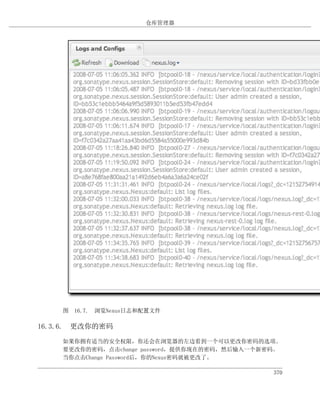
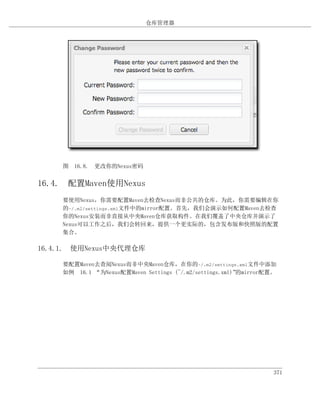
![仓库管理器
16.4.3. 为缺少的依赖添加仓库
如果你已经将你的Maven settings.xml配置成使用Nexus作为所有公共仓库和
所有公共快照仓库的镜像,你可能会遇到一些项目不能够从你的本地Nexus
获取需要的构件。这很常见,因为你经常会构建一些在pom.xml中自定义一
组repositories和snapshotRepositories的项目。如果你正在构建开源项目,或者往你
的配置中添加了自定义的第三方Maven仓库,那么这种情况就会发生。
作为一个例子,让我们试试从我们签出的源代码构件Apache Shindig。什么是Apache
Shindig?对该例来说这不重要;我们需要的是一个能很容易签出和构建的样例项目。如
果你实在很想知道,Shindig是在Apache Incubator中的一个围绕Google的OpenSocial
API的项目。Shindig目标是提供一个允许人们运行OpenSocial小工具的容器。它给我们
提供了一个有趣的样例工程,因为它有一些没有被加入到中央Maven仓库的组件,于是
依赖于一些自定义的Maven仓库,使用Shindig我们可以向你展示当Nexus没有你要的构
件的时候会发生什么,以及你能够使用怎样的步骤来给Nexus添加仓库。
下面的样例假设你已经安装了Subversion,并且你正在命令行运行Subversion。我们使
用Subversion从Apache Incubator签出Apache Shindig然后尝试构建它。为此,执行下
面的命令:
$ svn co http://svn.apache.org/repos/asf/incubator/shindig/trunk shindig
... Subversion will checkout the trunk of Apache Shindig ...
$ cd shindig
$ mvn install
... Maven will build Shindig ...
Downloading: http://localhost:8081/nexus/content/groups/public/caja/caja/r820/caja-r
Downloading: http://localhost:8081/nexus/content/groups/public/caja/caja/r820/caja-r
[INFO] ------------------------------------------------------------------------
[ERROR] BUILD ERROR
[INFO] ------------------------------------------------------------------------
[INFO] Failed to resolve artifact.
Missing:
----------
1) caja:caja:jar:r820
Try downloading the file manually from the project website.
...
----------
1 required artifact is missing.
for artifact:
org.apache.shindig:gadgets:war:1-SNAPSHOT
374](https://image.slidesharecdn.com/maven-definitive-guidezh-101013212800-phpapp01/85/Maven-definitive-guide-zh-390-320.jpg)
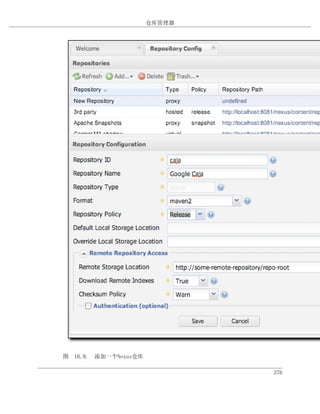
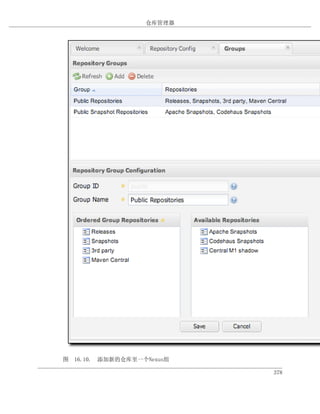
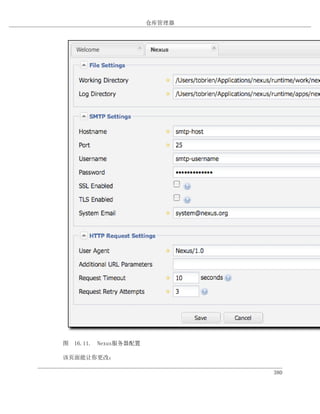
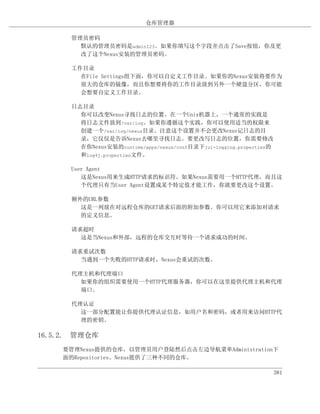
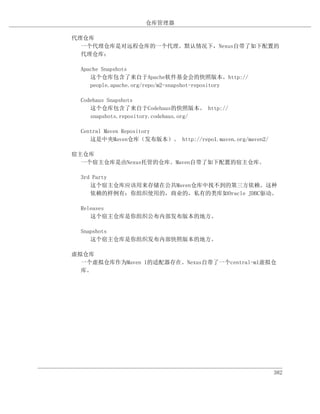
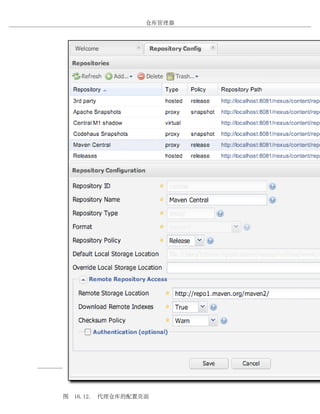
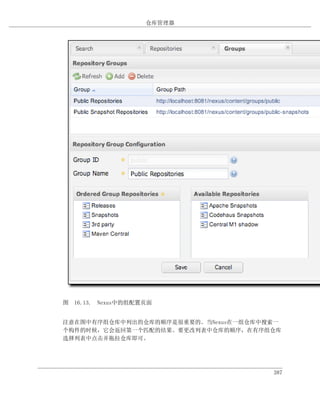

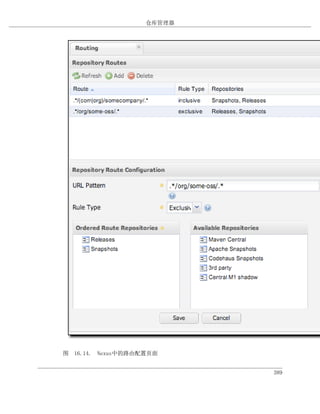
![仓库管理器
16.7.1. 部署发布版
要部署一个发布版构件至Nexus,你需要配置你项目POM中distributionManagement部
分的repository。例 16.4 “为部署配置发布版本仓库”显示了一个发布版部署仓
库的样例,这个发布版本仓库的地址是http://localhost:8081/nexus/content/
repositories/releases。
例 16.4. 为部署配置发布版本仓库
<project>
...
<distributionManagement>
...
<repository>
<id>releases</id>
<name>Internal Releases</name>
<url>http://localhost:8081/nexus/content/repositories/releases</url>
</repository>
...
</distributionManagement>
...
</project>
你可以使用你Nexus安装的主机和端口来替换localhost:8081。你的项目有了这个配置
之后,你就可以通过执行mvn deploy命令部署构件。
$ mvn deploy
[INFO] Scanning for projects...
[INFO] Reactor build order:
[INFO] Sample Project
[INFO] ------------------------------------------------------------------------
[INFO] Building Sample Project
[INFO] task-segment: [deploy]
[INFO] ------------------------------------------------------------------------
[INFO] [site:attach-descriptor]
[INFO] [install:install]
[INFO] Installing ~/svnw/sample/pom.xml to ~/.m2/repository/sample/sample
/1.0/sample-1.0.pom
[INFO] [deploy:deploy]
altDeploymentRepository = null
[INFO] Retrieving previous build number from snapshots
Uploading: http://localhost:8081/nexus/content/repositories/releases/
sample/sample/1.0/sample-1.0.pom
24K uploaded
393](https://image.slidesharecdn.com/maven-definitive-guidezh-101013212800-phpapp01/85/Maven-definitive-guide-zh-409-320.jpg)
![仓库管理器
注意Nexus可以支持多个宿主仓库;你不需要坚持在默认的releases和snapshots仓库
上。你可以为不同的部门创建不同的宿主仓库,然后将多个仓库组合成一个单独的
Nexus组。
16.7.2. 部署快照版
要部署快照版本构件至Nexus,你需要配置你项目POM的distributionManagement部分
的snapshotRepository。例 16.5 “为部署配置快照版本仓库” 显示了快照版本部署
仓库的样例,该snapshots仓库配置的地址是http://localhost:8081/nexus/content/
repositories/snapshots。
例 16.5. 为部署配置快照版本仓库
<project>
...
<distributionManagement>
...
<snapshotRepository>
<id>Snapshots</id>
<name>Internal Snapshots</name>
<url>http://localhost:8081/nexus/content/repositories/snapshots</url>
</snapshotRepository>
...
</distributionManagement>
...
</project>
你可以使用你Nexus安装的主机和端口来替换localhost:8081。你的项目有了这个配置
之后,你就可以通过执行mvn deploy命令部署构件。如果你项目的版本是快照版本(如
1.0-SNAPSHOT)Maven就会将其部署至snapshotRepository:
$ mvn deploy
[INFO] Scanning for projects...
[INFO] Reactor build order:
[INFO] Sample Project
[INFO] ------------------------------------------------------------------------
[INFO] Building Sample Project
[INFO] task-segment: [deploy]
[INFO] ------------------------------------------------------------------------
[INFO] [site:attach-descriptor]
[INFO] [install:install]
[INFO] Installing ~/svnw/sample/pom.xml to ~/.m2/repository/sample/sample
/1.0-SNAPSHOT/sample-1.0-20080402.125302
[INFO] [deploy:deploy]
altDeploymentRepository = null
394](https://image.slidesharecdn.com/maven-definitive-guidezh-101013212800-phpapp01/85/Maven-definitive-guide-zh-410-320.jpg)
![仓库管理器
[INFO] Retrieving previous build number from snapshots
Uploading: http://localhost:8081/nexus/content/repositories/releases/
sample/sample/1.0-SNAPSHOT/sample-1.0-20080402.125302.pom
24K uploaded
16.7.3. 部署第三方构件
你的Maven项目可以依赖于一个构件,这个构件不能从中央Maven仓库或任何其它公开
Maven仓库找到。有很多原因可能导致这种情形发生:这个构件可能是私有数据库的
JDBC驱动如Oracle,或者你依赖于另一个JAR,它既不开源也无法免费获得。在这样
的情况下,你就需要手动拿来这些构件然后发布到你自己的仓库中。Nexus提供宿主
的"third-party"仓库,就是为了这个目的。
为了阐明发布一个构件至第三方仓库的过程,我们使用一个真实的构件:Oracle JDBC
驱动。Oracle发布一个广泛使用的商业数据库产品,该产品带有一个中央Maven仓库没
有的JDBC驱动。虽然中央Maven仓库在http://repo1.maven.org/maven2/com/oracle/
ojdbc14/10.2.0.3.0/维护了一些Oracle JDBC驱动的POM信息,但这些只是指向Oracle
站点的POM。如果你将下列的依赖添加到你的项目。
例 16.6. Oracle JDBC JAR 依赖
<project>
...
<dependencies>
...
<dependency>
<groupId>com.oracle</groupId>
<artifactId>ojdbc14</artifactId>
<version>10.2.0.3.0</version>
</dependency>
...
</dependencies>
...
</project>
用这个依赖运行一个Maven构建,将会产生如下的输出:
$ mvn install
...
[INFO] ------------------------------------------------------------------------
[ERROR] BUILD ERROR
[INFO] ------------------------------------------------------------------------
[INFO] Failed to resolve artifact.
Missing:
395](https://image.slidesharecdn.com/maven-definitive-guidezh-101013212800-phpapp01/85/Maven-definitive-guide-zh-411-320.jpg)
![仓库管理器
----------
1) com.oracle:ojdbc14:jar:10.2.0.3.0
Try downloading the file manually from:
http://www.oracle.com/technology/software/tech/java/sqlj_jdbc/index.html
Then, install it using the command:
mvn install:install-file -DgroupId=com.oracle -DartifactId=ojdbc14
-Dversion=10.2.0.3.0 -Dpackaging=jar -Dfile=/path/to/file
Alternatively, if you host your own repository you can deploy the file there:
mvn deploy:deploy-file -DgroupId=com.oracle -DartifactId=ojdbc14
-Dversion=10.2.0.3.0 -Dpackaging=jar -Dfile=/path/to/file
-Durl=[url] -DrepositoryId=[id]
Path to dependency:
1) sample:sample:jar:1.0-SNAPSHOT
2) com.oracle:ojdbc14:jar:10.2.0.3.0
----------
1 required artifact is missing.
Maven构建失败了因为它不能在Maven仓库中找到Oracle JDBC驱动。要补救这种情况,
你将需要发布Oracle JDBC构件至你的Nexus third-party仓库。为此,从http://
www.oracle.com/technology/software/tech/java/sqlj_jdbc/index.html下载Oracle
JDBC驱动,然后保存至文件ojdbc.jar。使用以下命令发布该文件至Nexus:
$ mvn deploy:deploy-file -DgroupId=com.oracle -DartifactId=ojdbc14
> -Dversion=10.2.0.3.0 -Dpackaging=jar -Dfile=ojdbc.jar
> -Durl=http://localhost:8081/nexus/content/repositories/thirdparty
> -DrepositoryId=thirdparty
...
[INFO] [deploy:deploy-file]
Uploading: http://localhost:8081/nexus/content/repositories/thirdparty/
com/oracle/ojdbc14/10.2.0.3.0/ojdbc14-10.2.0.3.0.jar
330K uploaded
[INFO] Retrieving previous metadata from thirdparty
[INFO] Uploading repository metadata for: 'artifact com.oracle:ojdbc14'
[INFO] Retrieving previous metadata from thirdparty
[INFO] Uploading project information for ojdbc14 10.2.0.3.0
在你运行mvn deploy:deploy-file之后,该构件会被发布至Nexus的third-party仓库。
396](https://image.slidesharecdn.com/maven-definitive-guidezh-101013212800-phpapp01/85/Maven-definitive-guide-zh-412-320.jpg)
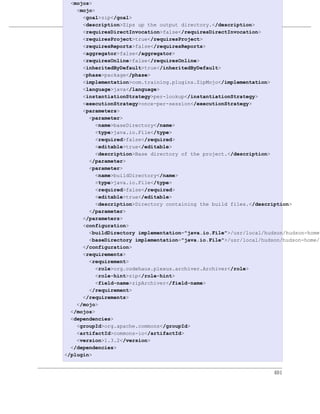
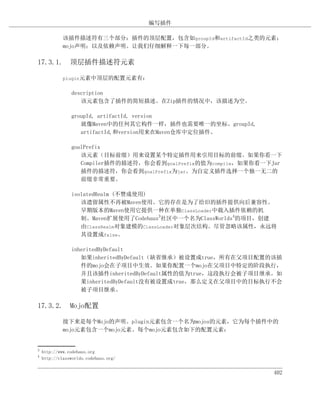
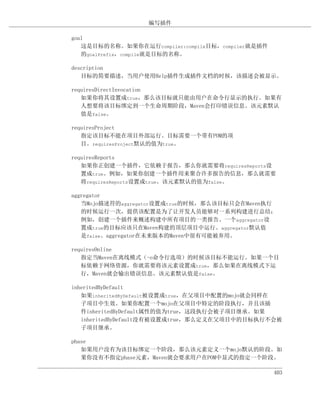
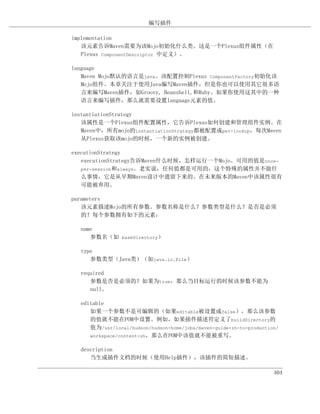
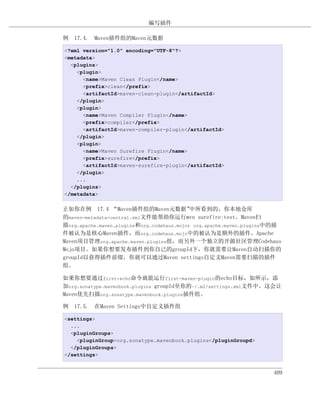
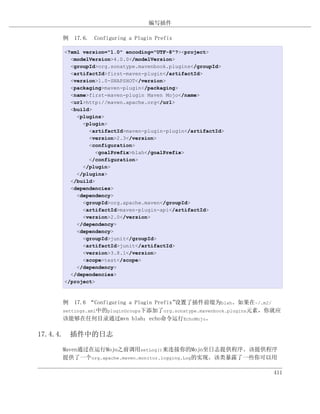
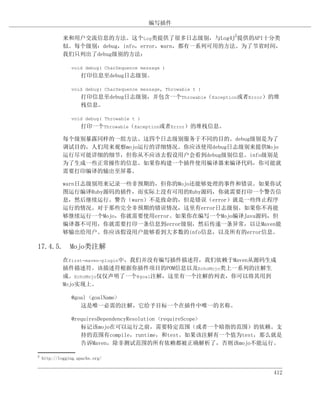
![编写插件
@requiresProject (true|false)
标记该mojo必须在一个项目中运行,默认为true。这一点插件类型和骨架类型
(archetype)相反,后者默认为false。
@requiresReports (true|false)
如果你正创建一个依赖于报告的项目,你就需要将requiresReports设置成
true。该注解默认的值是false。
@aggregator (true|false)
一个aggregator设置成true的Mojo在Maven运行的时候只会被执行一次,有了该
选项,插件开发者就可以汇总一系列构建的输出;例如,创建一个插件用来汇总
一次构建包含的所有项目的报告。aggregator设置成true的目标只针对Maven构
建的顶层项目运行。该注解默认的值是false。
@requiresOnline (true|false)
当该注解的值是true的时候,Maven在脱机模式运行的时候该目标运行就会失
败。Maven会抛出一个错误。默认值:false。
@requiresDirectInvocation
当设置成true的时候,只有当用户显式的从命令行触发的时候,该插件才能得以
执行。如果有人试图将其绑定到一个生命周期阶段,Maven就会抛出一个错误。
默认值是false。
@phase <phaseName>
该注解指定目标默认的生命周期阶段。如果你将该目标的执行配置到了pom.xml
而且没有指定一个阶段。Maven就会使用该注解的值将其绑定到一个默认的阶
段。
@execute [goal=goalName|phase=phaseName [lifecycle=lifecycleId]]
该注解有很多种使用方式。如果提供了一个阶段,Maven就会执行一个平
行的生命周期(直到指定的阶段)。这个单独执行的结果可以通过Maven属
性${executedProperty}供插件使用。
第二种使用该注解的方式是使用prefix:goal标记指定一个显式的目标。当你仅
仅指定一个目标的时候,Maven会在一个平行的环境中执行该目标,不会影响当
前的Maven构建。
第三种使用该注解的方式是,使用一个生命周期定义文件,并指定这个生命周期
的一个阶段。
@execute phase="package" lifecycle="zip"
@execute phase="compile"
@execute goal="zip:zip"
413](https://image.slidesharecdn.com/maven-definitive-guidezh-101013212800-phpapp01/85/Maven-definitive-guide-zh-429-320.jpg)
![/**
* Zips up the output directory.
* @goal zip
* @phase package 编写插件
*/
例 17.7. 一个带有多值参数的插件
public class ZipMojo extends AbstractMojo
{
/**
* The Zip archiver.
* @parameter expression="${component.org.codehaus.plexus.archiver.Archiver#zip}
*/
private ZipArchiver zipArchiver;
/**
* Directory containing the build files.
* @parameter expression="/usr/local/hudson/hudson-home/jobs/maven-guide-zh-to-p
*/
private File buildDirectory;
/**
* Base directory of the project.
* @parameter expression="/usr/local/hudson/hudson-home/jobs/maven-guide-zh-to-p
*/
private File baseDirectory;
/**
* A set of file patterns to include in the zip.
* @parameter alias="includes"
*/
private String[] mIncludes;
/**
* A set of file patterns to exclude from the zip.
* @parameter alias="excludes"
*/
private String[] mExcludes;
public void setExcludes( String[] excludes ) { mExcludes = excludes; }
public void setIncludes( String[] includes ) { mIncludes = includes; }
public void execute()
throws MojoExecutionException
{
try {
zipArchiver.addDirectory( buildDirectory, includes, excludes );
zipArchiver.setDestFile( new File( baseDirectory, "output.zip" ) );
要配置一个多值的Mojo参数,你应该为这类参数使用一组元素。如果这个多值参数的名
zipArchiver.createArchive();
称是includes,你就可以使用一个includes元素,它包含一组include子元素。如果这
} catch( Exception e ) {
个多值参数的名称是excludes,你就应该使用带有exclude子元素的excludes元素。要
throw new MojoExecutionException( "Could not zip", e );
配置ZipMojo使其忽略所有以.txt及波浪号结尾的文件,你可以使用如下的插件配置。
}
}
} 418](https://image.slidesharecdn.com/maven-definitive-guidezh-101013212800-phpapp01/85/Maven-definitive-guide-zh-434-320.jpg)
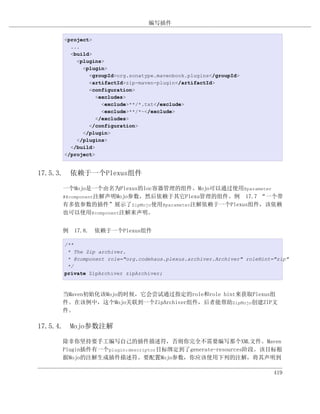
![编写插件
私有成员变量上。你也可以在公有setter方法上使用这些注解,但Maven插件一般的约
定是直接注解私有成员变量。
@parameter [alias="someAlias"] [expression="${someExpression}"] [default-
value="value"]
标记一个私有字段(或者一个setter方法)为一个参数。alias提供该参数
的名称。如果没有alias,Maven会使用变量名为参数名。expression是一
个Maven用来计算并获值的一个表达式。通常这个表达式只是一个属性引用
如${echo.message}。default-value是当表达式不能求得值,POM的插件配置中也
没有显式提供时,Mojo会使用的值。
@required
如果使用了该注解,那么在该Mojo运行前该参数就必须要有一个可用的值。如果
Maven试图运行该Mojo的时候该参数的值为null,Maven就会抛出一个错误。
@readonly
如果使用该注解,用户就不能从POM直接配置这个参数。你就需要parameter注
解的expression属性。例如,如果你想要确保一个特定参数的值永远是POM中
finalName属性的值,你就可以使用表达式book,并添加这个@readOnly注解。这
样,用户就只能通过更改POM中finalName的值来更改这个参数的值。
@component
告诉Maven使用Plexus组件填充该字段。一个正确的@component注解值如下:
@component role="org.codehaus.plexus.archiver.Archiver" roleHint="zip"
该配置的效果是可以从Plexus获得ZipArchiver组件。ZipArchiver是一个对
应role hint为zip的Archiver组件。除了@component注解,你也可以使用
@parameter注解和一个expression属性,如:
@parameter expression="${component.org.codehaus.plexus.archiver.Archiver#zip}"
虽然两种注解的效果一样,但对于配置Plexus组件依赖来说,@component注解是
更推荐的方式。
@deprecated
该参数以过期,不再推荐使用。用户可以继续配置该参数,但会得到一条警告信
息。
17.6. 插件和Maven生命周期
在第 10 章构建生命周期中,你学习了生命周期可以通过打包类型定制。一个插件可
以同时引入一个新的打包类型,并自定义该生命周期。在本节中,我们将会学习如果通
420](https://image.slidesharecdn.com/maven-definitive-guidezh-101013212800-phpapp01/85/Maven-definitive-guide-zh-436-320.jpg)
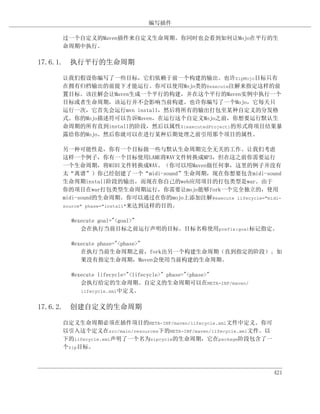
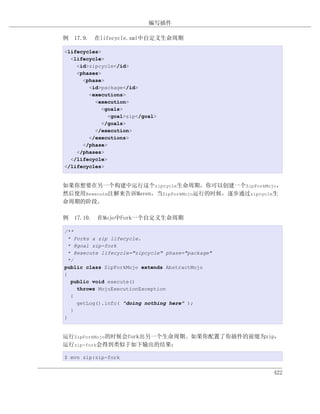
![编写插件
[INFO] Scanning for projects...
[INFO] Searching repository for plugin with prefix: 'zip'.
[INFO] ----------------------------------------------------------------------------
[INFO] Building Maven Zip Forked Lifecycle Test
[INFO] task-segment: [zip:zip-fork]
[INFO] ----------------------------------------------------------------------------
[INFO] Preparing zip:zip-fork
[INFO] [site:attach-descriptor]
[INFO] [zip:zip]
[INFO] Building zip: ~/maven-zip-plugin/src/projects/zip-lifecycle-test/target/outpu
[INFO] [zip:zip-fork]
[INFO] doing nothing here
[INFO] ------------------------------------------------------------------------
[INFO] BUILD SUCCESSFUL
[INFO] ------------------------------------------------------------------------
[INFO] Total time: 1 second
[INFO] Finished at: Sun Apr 29 16:10:06 CDT 2007
[INFO] Final Memory: 3M/7M
[INFO] ------------------------------------------------------------------------
调用zip-fork会衍生出另外一个生命周期,Maven运行zipcycle生命周期,然后
从ZipFormMojo的execute方法打印信息。
17.6.3. 覆盖默认生命周期
你已经创建了自己的生命周期,并能在一个Mojo中将其衍生使用。下一个你可能要问
的问题是,如何覆盖默认的生命周期。如何如何创建定制的生命周期并将其绑定到项
目上?在第 10 章 构建生命周期中,我们看到了项目的打包类型定义了项目的生命周
期。所有打包类型都有差异;war绑定不同的目标到package阶段,自定义的生命周期如
来自Israfil Flex 3的swf绑定不同的目标到compile阶段。在你创建自定义生命周期的
时候,你可以通过为插件提供一些Plexus配置,将生命周期绑定到特定的打包类型。
要为新的生命周期定义新的打包类型,你需要配置Plexus中的LifecycleMapping组
件。在你的插件项目中,在src/main/resources下创建一个META-INF/plexus/
components.xml文件。在这个components.xml中添加如例 17.11 “覆盖默认生命周
期”的内容。在role-hint下设置打包类型的名称,在pheases中设置包含所有需要绑定
目标的坐标(省略version)。多个目标可以用逗号分隔,绑定到同一个阶段。
423](https://image.slidesharecdn.com/maven-definitive-guidezh-101013212800-phpapp01/85/Maven-definitive-guide-zh-439-320.jpg)
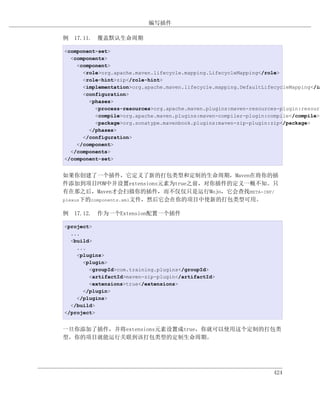
![使用可选语言编写插件
$ mvn install
[INFO] ------------------------------------------------------------------------
[INFO] Building Example Ant Mojo - firstant-maven-plugin
[INFO] task-segment: [install]
[INFO] ------------------------------------------------------------------------
[INFO] [plugin:descriptor]
[INFO] Using 3 extractors.
[INFO] Applying extractor for language: java
[INFO] Extractor for language: java found 0 mojo descriptors.
[INFO] Applying extractor for language: bsh
[INFO] Extractor for language: bsh found 0 mojo descriptors.
[INFO] Applying extractor for language: ant
[INFO] Extractor for language: ant found 1 mojo descriptors.
...
[INFO] ------------------------------------------------------------------------
[INFO] BUILD SUCCESSFUL
[INFO] ------------------------------------------------------------------------
注意plugin:descriptor目标发现了一个Ant Mojo描述符。要运行这个目标,你可以执
行如下的命令:
$ mvn firstant:echo
...
[INFO] [firstant:echo]
echotarget:
[echo] Hello Maven World
[INFO] ------------------------------------------------------------------------
[INFO] BUILD SUCCESSFUL
[INFO] ------------------------------------------------------------------------
echo目标执行后打印了默认的message参数的值。如果你习惯了Apache Ant构建脚本,
你会注意到Ant打印了所执行目标的名称,并且在echo任务的输出上加了一个日志前
缀。
18.3. 使用JRuby编写插件
Ruby是一种面向对象脚本语言,它为元编程(meta-programming)和反射提供了丰
富的基础设施。Ruby对于closure和block的使用造就了一种既紧凑又不失强大的编
程风格。虽然Ruby自1993年就出现了,但大部分人了解到Ruby是在基于Ruby的web框
架,Ruby on Rails流行之后。JRuby是用Java编写的Ruby解析器。要了解更多的关于
Ruby语言的信息,可参考http://www.ruby-lang.org/,而关于JRuby,可参考http://
jruby.codehaus.org/。
428](https://image.slidesharecdn.com/maven-definitive-guidezh-101013212800-phpapp01/85/Maven-definitive-guide-zh-444-320.jpg)
![使用可选语言编写插件
例 18.5. Echo Ruby Mojo
# Prints a message
# @goal "echo"
# @phase "validate"
class Echo < Mojo
# @parameter type="java.lang.String" default-value="Hello Maven World" expression=
def message
end
def execute
info $message
end
end
run_mojo Echo
这个Echo类必须扩展Mojo类,它必须重写execute()方法。在echo.rb文件最后,你将需
要使用"run_mojo Echo"运行这个mojo。要安装该插件,运行mvn install:
$ mvn install
[INFO] Scanning for projects...
[INFO] ------------------------------------------------------------------------
[INFO] Building Example Ruby Mojo - firstruby-maven-plugin
[INFO] task-segment: [install]
[INFO] ------------------------------------------------------------------------
...
[INFO] [plugin:descriptor]
...
[INFO] Applying extractor for language: jruby
[INFO] Ruby Mojo File: /echo.rb
[INFO] Extractor for language: jruby found 1 mojo descriptors.
...
[INFO] ------------------------------------------------------------------------
[INFO] BUILD SUCCESSFUL
[INFO] ------------------------------------------------------------------------
在构建过程中,你会看到Maven Plugin插件的descriptor目标应用了JRuby萃取器
(extractor)创建了一个plugin.xml文件,该文件萃取了所有Echo类的注解。如果你已
经配置你默认的插件组包含了org.sonatype.plugins,你就可以使用如下的命令运行该
目标:
$ mvn firstruby:echo
430](https://image.slidesharecdn.com/maven-definitive-guidezh-101013212800-phpapp01/85/Maven-definitive-guide-zh-446-320.jpg)
![使用可选语言编写插件
...
[INFO] [firstruby:echo]
[INFO] Hello Maven World
...
18.3.2. Ruby Mojo实现
Ruby Mojo在源文件中使用注释进行注解。一个单独的注解如@parameter可以接受很多
属性,而多个属性都必须在同一行中指定。注解属性之间不能有换行符。类和参数都
可以被注解。关于参数可以使用四种注解:@parameter, @required, @readonly, 和
@deprecated。@parameter注解接受如下的属性:
alias
参数的别名。可以同样用来填充该参数的可选的名称。
default-value
如果参数被提供的值或者参数表达式的结果是null,就使用该缺省值。在
echo.rb中,我们指定了缺省值为"Hello Maven World"。
expression
指定一个表达式,可以用来解析Maven属性或者系统属性。
type
该参数的完全限定的Java类型。如果没有指定,默认值为java.lang.String。
除了@parameter注解,参数还可以使用如下的注解:
@required "<true|false>"
标记一个参数是否为必须的。默认值是false。
@readonly "<true|false>"
标记参数为只读。如果为true,你就无法从命令行覆盖默认值或者默认表达式的
值。这里,默认值为false。
@deprecated "<true|false>"
标记该参数是废弃的。默认为false。
将所有这些内容放在一起,一个echo.rb中完全注解的message参数看起来就会成为这个
样子:
# @parameter type="java.lang.String" default-value="Hello Maven World" expression="$
# @readonly true
# @required false
431](https://image.slidesharecdn.com/maven-definitive-guidezh-101013212800-phpapp01/85/Maven-definitive-guide-zh-447-320.jpg)
![使用可选语言编写插件
例 18.6. 从Ruby Mojo中引用MavenProject对象
# This is a mojo description
# @goal test
# @phase validate
class Test < Mojo
# @parameter type="java.lang.String" default-value="nothing" alias="a_string"
def prop
end
# @parameter type="org.apache.maven.project.MavenProject" expression="${project}"
# @required true
def project
end
def execute
info "The following String was passed to prop: '#{$prop}'"
info "My project artifact is: #{$project.artifactId}"
end
end
run_mojo Test
在前面的例子中,我们可以使用标准的Ruby语法访问Project类的属性。如果你将
test.rb放到firstruby-maven-plugin的src/main/scripts目录,然后install这个插
件,接着运行它,你会看到如下的输出:
$ mvn install
...
[INFO] [plugin:descriptor]
[INFO] Using 3 extractors.
[INFO] Applying extractor for language: java
...
[INFO] Applying extractor for language: jruby
[INFO] Ruby Mojo File: /echo.rb
[INFO] Ruby Mojo File: /test.rb
[INFO] Extractor for language: jruby found 2 mojo descriptors.
...
$ mvn firstruby:test
...
[INFO] [firstruby:test]
[INFO] The following String was passed to prop: 'nothing'
[INFO] My project artifact is: firstruby-maven-plugin
433](https://image.slidesharecdn.com/maven-definitive-guidezh-101013212800-phpapp01/85/Maven-definitive-guide-zh-449-320.jpg)
![使用可选语言编写插件
例 18.7. 在Ruby Mojo中raise一个MojoError
# Prints a Message
# @goal error
# @phase validate
class Error < Mojo
# @parameter type="java.lang.String" default-value="Hello Maven World" expression=
# @required true
# @readonly false
# @deprecated false
def message
end
def execute
info $message
raise MojoError.new( "This Mojo Raised a MojoError" )
end
end
run_mojo Error
运行该Mojo,会产生如下的输出:
$ mvn firstruby:error
...
INFO] [firstruby:error]
[INFO] Hello Maven World
[ERROR] This Mojo Raised a MojoError
18.3.5. 在JRuby中引用Plexus组件
Ruby Mojo可以依赖于一个Plexus组件。为此,你需要使用@parameter注解的
expression参数,在这里为Plexus指定role和hint。下面的例子中,Ruby Mojo依赖于
Archiver组件,Maven会据此从Plexus获取该组件。
435](https://image.slidesharecdn.com/maven-definitive-guidezh-101013212800-phpapp01/85/Maven-definitive-guide-zh-451-320.jpg)