Session Outcomes
By theend of the session, the participant should
be able to:
a) Discuss the Basic Education Curriculum
Framework to professionally implement the
curriculum
b) Appreciate the Basic Education Curriculum
Framework for effective implementation of
curriculum
4.
Key Areas tobe covered
Basic Education Curriculum Framework
• Vision and Mission statements
• National Goals of Education
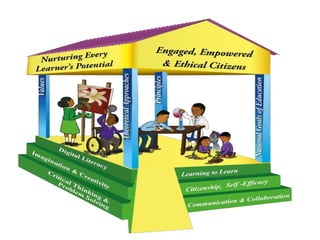
• Pillars of BECF
• Core Competencies
• Organization of Basic Education
• Learning areas for EYE
5.
Suggested Learning Experiences
•Buzz on the Mission and mission statements
• Reflect on the national goals of education
• Brainstorm on the importance of the core
competencies
• Discuss the organization of basic education
• Question and answer
Curriculum Reforms VisionStatement
The vision of the basic education curriculum
reforms is to enable every Kenyan to become an
engaged, empowered and ethical citizen.
This will be achieved by providing every Kenyan
learner with world class standards in the skills
and knowledge that they deserve, and which they
need in order to thrive in the 21st century.
This shall be accomplished through the provision
of excellent teaching, school environments and
resources and a sustainable visionary curriculum
8.
Vision Statement (cont..)
In order to do this, there is need to develop
teachers who are:
• Highly knowledgeable
• Reflective
• Professional
• Possessing additional enhanced skills
• Confident in a range of modern pedagogical
like coaching, facilitating, and mentoring
9.
Vision Statement (cont..)
Therefore the reformed curriculum seeks to
ensure that the next and future generations of
Kenyan citizens shall be :
• Patriotic and global
• Equipped with the skills, knowledge, attitudes
and values to thrive in the modern world
• Confident about their proud and rich cultural
heritage and contributing this heritage to make
the world a better place for everyone.
10.
Curriculum Reforms Mission
Themission of the basic education
curriculum reforms is ‘nurturing
every learner’s potential’.
11.
Curriculum Reforms Mission(cont..)
The curriculum will be designed to ensure that it
provides opportunities to identify the potential
that every learner brings to school and nurture this
potential through the learning pathways and tracks
that will be provided at Senior School.
The mission will ensure that no child is labelled a
failure at the end of basic education.
12.
National Goals ofEducation
The Framework will be anchored on the National
Goals of Education:
Education in Kenya should:
1. Foster nationalism, patriotism, and promote national
unity
• Kenya’s people belong to different communities, races
and religions and should be able to live and interact as
one people.
• Education should enable the learner acquire a sense of
nationhood and patriotism.
• It should also promote peace and harmonious co-
existence.
13.
National Goals ofEducation ( Cont..)
2. Promote social, economic, technological and
industrial needs for national development
Education should prepare the learner to play an effective
and productive role in the nation by:-
• Instilling social and adaptive skills in the learner for
effective participation in the family, community,
national, regional and international development.
• Preparing a learner with requisite competences that
support a modern and independent growing economy
• Developing in the learner necessary competences for
technological and industrial development for the
nation in tandem with global trends
14.
National Goals ofEducation ( Cont..)
3. Promote individual development and self-fulfilment
Education should provide opportunities for the learner to
develop to the fullest potential.
This includes development of one’s interests, talents and
character for positive contribution to the society.
4. Promote sound moral and religious values
Education should promote acquisition of national values
as enshrined in the Kenya Constitution.
It should be geared towards developing a self-disciplined
and ethical citizen with sound moral and religious values
15.
National Goals ofEducation ( Cont..)
5. Promote social equity and responsibility
Education should provide inclusive and equitable
access to quality and differentiated education;
including for learners with special educational
needs and disabilities.
Education should also provide the learner with
opportunities to develop and practice shared
responsibility and accountability through
community service learning.
16.
National Goals ofEducation ( Cont..)
6. Promote respect for and development of
Kenya’s rich and varied cultures
• Education should instill in the learner
appreciation of Kenya’s rich and diverse cultural
heritage.
• The learner should value own and respect other
people’s culture as well as embrace positive
cultural practices in a dynamic society.
17.
National Goals ofEducation ( Cont..)
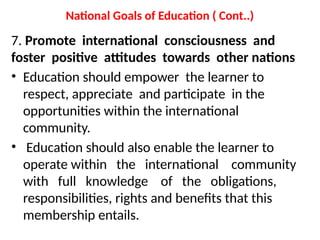
7. Promote international consciousness and
foster positive attitudes towards other nations
• Education should empower the learner to
respect, appreciate and participate in the
opportunities within the international
community.
• Education should also enable the learner to
operate within the international community
with full knowledge of the obligations,
responsibilities, rights and benefits that this
membership entails.
18.
National Goals ofEducation ( Cont..)
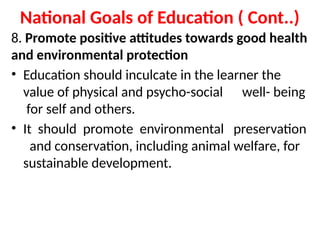
8. Promote positive attitudes towards good health
and environmental protection
• Education should inculcate in the learner the
value of physical and psycho-social well- being
for self and others.
• It should promote environmental preservation
and conservation, including animal welfare, for
sustainable development.
20.
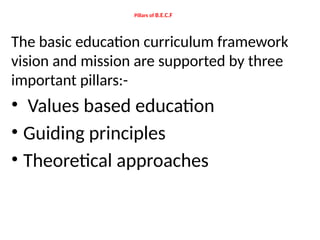
Pillars of B.E.C.F
Thebasic education curriculum framework
vision and mission are supported by three
important pillars:-
• Values based education
• Guiding principles
• Theoretical approaches
21.
1. Values basededucation
Values are defined as standards that guide an
individual on how to respond or behave in a given
circumstance.
In a State of the Nation address, the Kenyan
President directed that values should be taught at
every level of the education system and that the
work of mainstreaming ethics and integrity
awareness in the public and private education
curriculum should be expedited (Nation Reporter,
2015)
22.
Values based education( Cont..)
The values that will be taught in basic education
are:-
• Love
• Respect
• Responsibility
• Unity
• Peace
• Patriotism
• Social justice
• Integrity
23.
2. Guiding principles
TheFramework is based on the following guiding
principles:
• Opportunity
• Excellence
• Diversity and Inclusion
• Differentiated Curriculum and Learning
• Parental Empowerment and Engagement
• Community Service Learning
24.
Opportunity:
Learners will begiven a variety of opportunities to
identify their needs, talents, and potential so that
they can participate in the world of work and the
development of the nation.
The emphasis is on equal access to education for
all, ensuring that learners enjoy learning and find
it relevant.
25.
Excellence
Learners will benurtured to excel in their areas of
greatest aptitude and ability.
The Framework values excellence rather than
competition for examination grades
26.
Diversity and Inclusion
Learnerswill be guided to appreciate Kenya’s diversity in
terms of race, ethnicity, gender, language, culture, and
religion.
It also respects learners’ different needs and abilities,
valuing these within an inclusive learning environment.
All learners will be accommodated, regardless of their
physical, emotional, intellectual, or any other need.
The Framework recognizes the different academic abilities
of learners, considers individuals’ social and cognitive
capabilities, needs and desires, and respects differences in
the way children learn.
The ultimate aim is to guarantee basic education for every
learner according to their abilities and needs.
27.
Differentiated Curriculum andLearning
Building on the principle of diversity and inclusion,
the Framework ensures that curriculum content
and instructional approaches are appropriate for
all.
It provides flexibility for teachers to adapt the
curriculum to suit individuals and does not demand
that every learner should learn the same content, in
the same way, in the same number of hours, and at
the same time.
28.
Parental Empowerment andEngagement
Parents play a very important role in determining
the success of their children’s education.
They have a shared responsibility with schools to
provide an enabling environment that is conducive
to learning and motivates learners to fulfill their
potential.
The Framework provides opportunities for schools
to empower parents to contribute to their children’s
learning outcomes and to be engaged at all levels of
their basic education.
29.
Community Service Learning
•Community Service Learning enables learners to apply their
knowledge and skills while addressing real needs in the
community.
• It integrates meaningful community service with instruction
and reflection to enrich the learning experience, teach civic
responsibility and strengthen communities.
• Learners will work on real problems in order to make their
academic learning relevant, while at the same time enhancing
their social skills, analytical ability, civic and ethical
responsibility, self-efficacy, and career development.
• Teachers will need to help learners to analyse what they have
learned through participating in community service and how
to apply what they have learned to their academic and
personal development.
30.
3. Theoretical approaches
Toground the conceptualization and design of the curriculum on sound education
and curriculum principles, the Framework is guided by several theories, including:
• Vygotsky’s social-cultural development theory, the primary focus of which is
on supporting students through scaffolding the learning experiences.
• Piaget’s cognitive development theory, which will mainly provide the
alignment between the maturational development of the child and how
learning should be organized.
• Bruner’s cognitive development theory, which emphasises the importance
of organizing learning in a meaningful way to build from the known to the
unknown.
• John Hattie’s Visible Learning that emphasises the role of the teacher in terms
of the impact the approaches adopted may have on students’ learning.
• Dewey’s social constructivism that focuses on the need to adopt learner-
centred approaches in curriculum design and delivery.
31.
Core competencies
Based onthe Needs Assessment Study carried out by
KICD, and the vision and mission of the BECF, the
seven core competencies to be achieved by every
learner in basic education are:
• Communication and collaboration
• Critical thinking and problem solving
• Creativity and imagination
• Citizenship
• Self-efficacy
• Digital literacy
• Learning to learn
32.
Communication and collaboration
Communication:
–Exchange of ideas in class (teacher to learners, learner to teacher
and learner to learner)
– Learners answering or asking questions
– Learners discussing in pairs or groups
– Expressing thoughts and ideas
– Learners writing on the blackboard or in their books
– Debates
Collaboration:
– Working together
– Group work
– Team work
– Cooperation
– Partnership
– Sharing
33.
Critical thinking andproblem solving
• An important outcome of quality education is teaching learners
how to think critically. The
• British Council (2015) identifies three types of thinking: reasoning,
making judgment, and problem solving.
• When learners are empowered with critical thinking, they avoid
being subjective, and use logic and evidence to arrive at conclusions.
• Critical thinking also facilitates exploring new ways of doing things
and learner autonomy.
• Learners learn that for every issue there are multiple perspectives
that they can explore, rather than a rigid recall and regurgitation of
information.
• For example, at pre-primary school level learners can be asked to
come up with the best ways of using and keeping their books,
stationery and other personal items safe.
34.
Creativity and imagination
Creativityand imagination refers to the ability to form new
images and sensations in the mind, and to turn them into
reality (British Council, 2016).
Creativity and imagination is characterized by the ability to
perceive the world in new ways, to find hidden patterns, to
make connections between seemingly unrelated
phenomena, and to generate solutions. It is a phenomenon
whereby something new and valuable is formed.
Learners who are imaginative and creative are able to make
life interesting for themselves and others around them.
35.
Citizenship
Good citizenship includes:-
• Doing your best in school making responsible
decision, caring about others ,contributing to society
• Developing social and personal skills such as
reflective problem solving, accepting a variety of
perspectives, setting and attaining goals.
In class, good citizenship may include but not limited to:
i. Communicating with other people with respect for
their opinions and feelings.
ii. Collaborating with others without discrimination.
iii. Contributing to the general progress of others
36.
Self-efficacy
Self-efficacy is theability of a learner to define a
goal, persevere, and see oneself as capable. It is
the belief that you have skills that you can rely on
to help you navigate life and reach your goals
(National Association of School Psychologists,
2010).
37.
Digital literacy
Digital literacyis the set of competencies required for full
participation in a knowledge society. It includes knowledge,
skills, and behaviors involving the effective use of digital devices
such as smartphones, tablets, laptops and desktop PCs for
purposes of communication, expression, collaboration.
• Using an interactive whiteboard in the classroom for lessons
and allowing learners to use the interactive whiteboard on a
daily basis.
• Encouraging learners to use technology to showcase their
learning.
• Using the web ( web sites video, music) to enhance the
learning of your pupils.
• Pupils and teachers creating online content to be utilized both
in and out of the classroom.
38.
Learning to learn
Learningto learn is the ability to organize one’s own
learning including through effective management of
time and information both individually and in groups
(Hoskins & Fredriksson, 2008).
This basically involves applying what has been learnt
to new situations.
In classroom situation, it may involve:
i. Planning time to get information from written
materials, media, peers, and knowledgeable
people and using it.
ii. Discussing ideas with peers
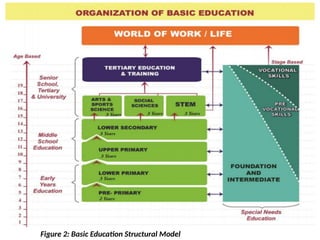
Basic Education willbe organized
into three (3) levels:
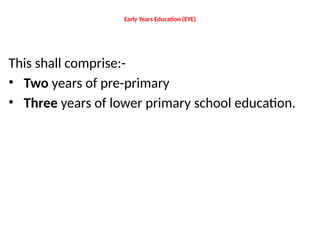
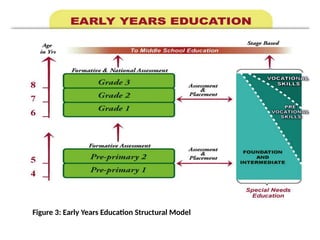
• Early Years Education
• Middle School Education
• Senior School
41.
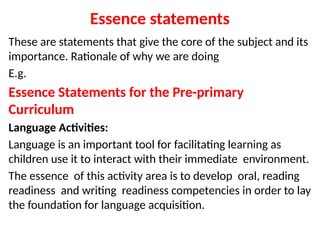
Essence statements
These arestatements that give the core of the subject and its
importance. Rationale of why we are doing
E.g.
Essence Statements for the Pre-primary
Curriculum
Language Activities:
Language is an important tool for facilitating learning as
children use it to interact with their immediate environment.
The essence of this activity area is to develop oral, reading
readiness and writing readiness competencies in order to lay
the foundation for language acquisition.
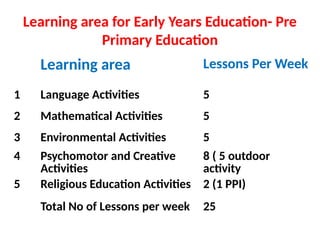
Learning area forEarly Years Education- Pre
Primary Education
Learning area Lessons Per Week
1 Language Activities 5
2 Mathematical Activities 5
3 Environmental Activities 5
4 Psychomotor and Creative
Activities
8 ( 5 outdoor
activity
5 Religious Education Activities 2 (1 PPI)
Total No of Lessons per week 25
46.
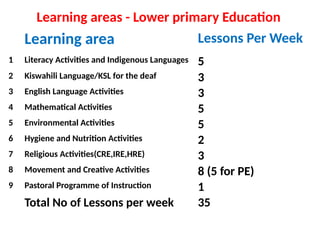
Learning areas -Lower primary Education
Learning area Lessons Per Week
1 Literacy Activities and Indigenous Languages 5
2 Kiswahili Language/KSL for the deaf 3
3 English Language Activities 3
4 Mathematical Activities 5
5 Environmental Activities 5
6 Hygiene and Nutrition Activities 2
7 Religious Activities(CRE,IRE,HRE) 3
8 Movement and Creative Activities 8 (5 for PE)
9 Pastoral Programme of Instruction 1
Total No of Lessons per week 35
47.
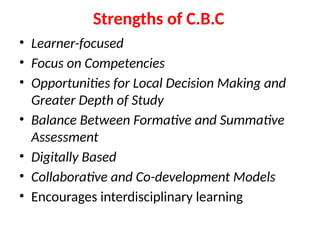
Strengths of C.B.C
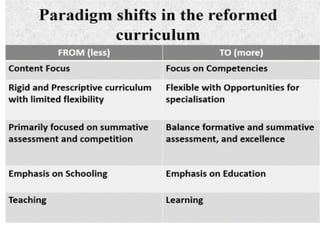
•Learner-focused
• Focus on Competencies
• Opportunities for Local Decision Making and
Greater Depth of Study
• Balance Between Formative and Summative
Assessment
• Digitally Based
• Collaborative and Co-development Models
• Encourages interdisciplinary learning



![History-of-the-Philippines-Lesson-Presentation_(1)[1].pptx](https://cdn.slidesharecdn.com/ss_thumbnails/history-of-the-philippines-lesson-presentation11-250905120505-e4b032b6-thumbnail.jpg?width=640&height=640&fit=bounds)


