.NET PORTFOLIOMatthew Swangermatthewswanger@me.com(720) 319-8354
Table of Contents.NET Framework Project					3Library Phase 1 Project					6Library Phase 2 Project					11Library Phase 3 Project					16
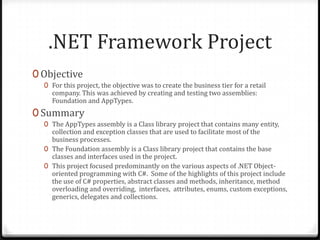
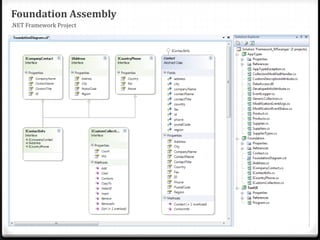
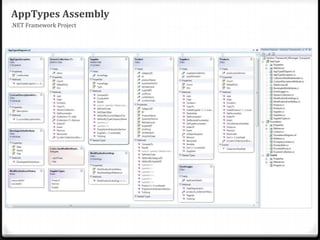
.NET Framework ProjectObjectiveFor this project, the objective was to create the business tier for a retail company. This was achieved by creating and testing two assemblies: Foundation and AppTypes.SummaryThe AppTypes assembly is a Class library project that contains many entity, collection and exception classes that are used to facilitate most of the business processes.The Foundation assembly is a Class library project that contains the base classes and interfaces used in the project. This project focused predominantly on the various aspects of .NET Object-oriented programming with C#.  Some of the highlights of this project include the use of C# properties, abstract classes and methods, inheritance, method overloading and overriding,  interfaces,  attributes, enums, custom exceptions, generics, delegates and collections.
Foundation Assembly.NET Framework Project
AppTypes Assembly.NET Framework Project
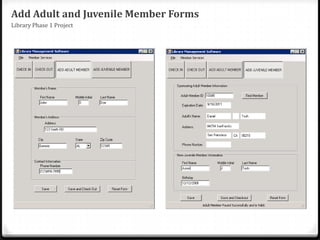
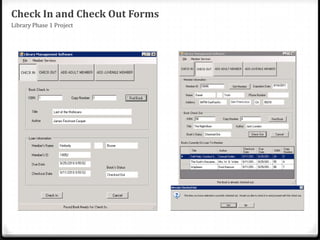
Library Phase 1 ProjectObjectiveFor this project, the objective was to create a Windows Forms-based application that would serve as the user interface tier to the supplied library book management database. This visual interface is responsible for providing a librarian with access to the day-to-day actions preformed in a library.SummaryThe focus of this project was on Windows Forms programming and it was built with an N-tiered approach in mind. The Business layer, The Data Access layer and the database where provided, so I was responsible for creating an effective front-end application to work with what was given. RequirementsDesign and develop a front end application that satisfies the four basic functionalities: Add Adult, Add Juvenile, Check-In a book and Check-Out a book.Develop code that is easily maintainable.Provide validation for all required fields.Provide adequate error handling.Provide a user interface that is intuitive, requiring minimal training for users while minimizing resource utilization.
Add Adult and Juvenile Member FormsLibrary Phase 1 Project
Check In and Check Out FormsLibrary Phase 1 Project
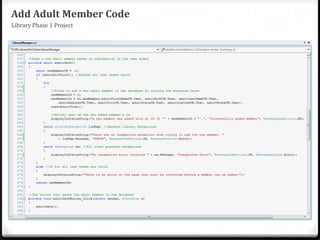
Add Adult Member CodeLibrary Phase 1 Project
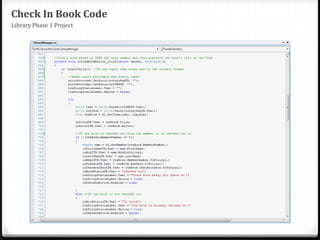
Check In Book CodeLibrary Phase 1 Project
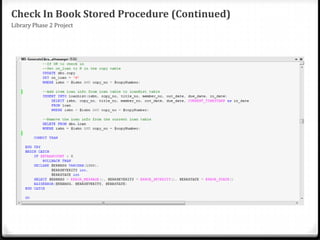
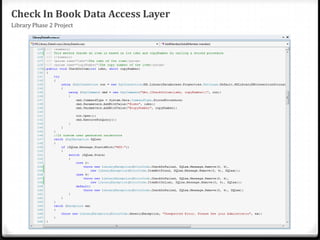
Library Phase 2 ProjectObjectiveFor this project, the objective was to write my own Business and Data Access layers replacing the layers that were provided in Phase 1 while continuing to support the Windows Forms-based front-end application I created in Phase 1.SummaryThe focus of this project was predominantly on ADO.NET and T-SQL programming while keeping to the N-tiered structure used in Phase 1.I created T-SQL Stored Procedures for all the Library Functions (Check In, Check Out, Add Member, etc…) which were then called by the Data Access Layer methods. The Business Layer served to enforce the business logic and also to act as the middleman between the user interface and the Data Access Layer.I used ADO.NET to communicate with the database. Also, I chose to use Strongly Typed DataSets for this project to reduce the amount of coding required and also the likelihood of errors.
Library Phase 2 ProjectRequirementsDesign the Business and Data Access tiers.Develop code that is easily maintainable.Provide adequate error handling.Use database-programming techniques that provide maximum programming flexibility and control while minimizing resource utilization.
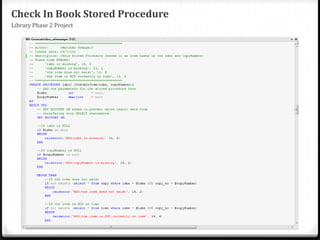
Check In Book Stored ProcedureLibrary Phase 2 Project
Check In Book Stored Procedure (Continued)Library Phase 2 Project
Check In Book Data Access LayerLibrary Phase 2 Project
Library Phase 3 ProjectObjectiveFor this project, the objective was to write a web application that supports all the functionality required in Phase 1 and 2 of the Library project.SummaryThe focus of this project centered around ASP.NET programming and keeping the N-tiered approach used in Phase 1 and Phase 2.The web application created for this project is meant to serve as an alternative user interface,  while leaving the Phase 1 Windows Forms-based application unchanged and fully functional. This project will make use of the Business and Data Access layers I created in Phase 2.Highlights of this ASP.NET project include the use of master pages, membership and role management, forms-based authorization and authentication, data preservation using ViewState and Session State objects, partial page postbacks with Ajax, databindings, exception handling and input validation with validator controls.
Library Phase 3 ProjectAdditional RequirementsWhen displaying an adult’s membership information, the application should detect if the membership is expired and provide the librarian an option to renew the membership. Also, members with expired memberships cannot check out books.When working with juvenile members the application will check to ensure that the member is less then 18 years of age, if the member is older then 18 their membership will be automatically converted to an adult membership.Librarians must be able to enter new books into the database.All Overdue books, shown in the application must be highlighted.The design of the Member Information page must include the use of AJAX controls so that the check in and check out functionality cause only a partial page postback.The application must use hyperlinks to navigate between pages.
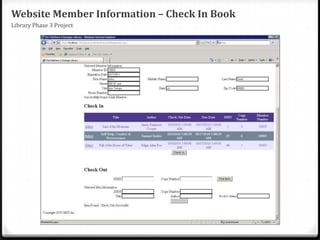
Website Member Information – Check In BookLibrary Phase 3 Project
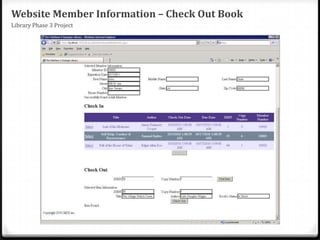
Website Member Information – Check Out BookLibrary Phase 3 Project
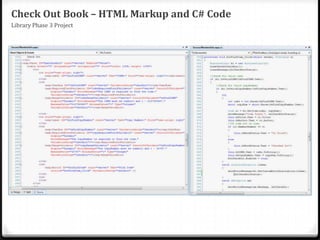
Check Out Book – HTML Markup and C# CodeLibrary Phase 3 Project

Matthew Swanger .NET Portfolio

  • 1.
  • 2.
    Table of Contents.NETFramework Project 3Library Phase 1 Project 6Library Phase 2 Project 11Library Phase 3 Project 16
  • 3.
    .NET Framework ProjectObjectiveForthis project, the objective was to create the business tier for a retail company. This was achieved by creating and testing two assemblies: Foundation and AppTypes.SummaryThe AppTypes assembly is a Class library project that contains many entity, collection and exception classes that are used to facilitate most of the business processes.The Foundation assembly is a Class library project that contains the base classes and interfaces used in the project. This project focused predominantly on the various aspects of .NET Object-oriented programming with C#. Some of the highlights of this project include the use of C# properties, abstract classes and methods, inheritance, method overloading and overriding, interfaces, attributes, enums, custom exceptions, generics, delegates and collections.
  • 4.
  • 5.
  • 6.
    Library Phase 1ProjectObjectiveFor this project, the objective was to create a Windows Forms-based application that would serve as the user interface tier to the supplied library book management database. This visual interface is responsible for providing a librarian with access to the day-to-day actions preformed in a library.SummaryThe focus of this project was on Windows Forms programming and it was built with an N-tiered approach in mind. The Business layer, The Data Access layer and the database where provided, so I was responsible for creating an effective front-end application to work with what was given. RequirementsDesign and develop a front end application that satisfies the four basic functionalities: Add Adult, Add Juvenile, Check-In a book and Check-Out a book.Develop code that is easily maintainable.Provide validation for all required fields.Provide adequate error handling.Provide a user interface that is intuitive, requiring minimal training for users while minimizing resource utilization.
  • 7.
    Add Adult andJuvenile Member FormsLibrary Phase 1 Project
  • 8.
    Check In andCheck Out FormsLibrary Phase 1 Project
  • 9.
    Add Adult MemberCodeLibrary Phase 1 Project
  • 10.
    Check In BookCodeLibrary Phase 1 Project
  • 11.
    Library Phase 2ProjectObjectiveFor this project, the objective was to write my own Business and Data Access layers replacing the layers that were provided in Phase 1 while continuing to support the Windows Forms-based front-end application I created in Phase 1.SummaryThe focus of this project was predominantly on ADO.NET and T-SQL programming while keeping to the N-tiered structure used in Phase 1.I created T-SQL Stored Procedures for all the Library Functions (Check In, Check Out, Add Member, etc…) which were then called by the Data Access Layer methods. The Business Layer served to enforce the business logic and also to act as the middleman between the user interface and the Data Access Layer.I used ADO.NET to communicate with the database. Also, I chose to use Strongly Typed DataSets for this project to reduce the amount of coding required and also the likelihood of errors.
  • 12.
    Library Phase 2ProjectRequirementsDesign the Business and Data Access tiers.Develop code that is easily maintainable.Provide adequate error handling.Use database-programming techniques that provide maximum programming flexibility and control while minimizing resource utilization.
  • 13.
    Check In BookStored ProcedureLibrary Phase 2 Project
  • 14.
    Check In BookStored Procedure (Continued)Library Phase 2 Project
  • 15.
    Check In BookData Access LayerLibrary Phase 2 Project
  • 16.
    Library Phase 3ProjectObjectiveFor this project, the objective was to write a web application that supports all the functionality required in Phase 1 and 2 of the Library project.SummaryThe focus of this project centered around ASP.NET programming and keeping the N-tiered approach used in Phase 1 and Phase 2.The web application created for this project is meant to serve as an alternative user interface, while leaving the Phase 1 Windows Forms-based application unchanged and fully functional. This project will make use of the Business and Data Access layers I created in Phase 2.Highlights of this ASP.NET project include the use of master pages, membership and role management, forms-based authorization and authentication, data preservation using ViewState and Session State objects, partial page postbacks with Ajax, databindings, exception handling and input validation with validator controls.
  • 17.
    Library Phase 3ProjectAdditional RequirementsWhen displaying an adult’s membership information, the application should detect if the membership is expired and provide the librarian an option to renew the membership. Also, members with expired memberships cannot check out books.When working with juvenile members the application will check to ensure that the member is less then 18 years of age, if the member is older then 18 their membership will be automatically converted to an adult membership.Librarians must be able to enter new books into the database.All Overdue books, shown in the application must be highlighted.The design of the Member Information page must include the use of AJAX controls so that the check in and check out functionality cause only a partial page postback.The application must use hyperlinks to navigate between pages.
  • 18.
    Website Member Information– Check In BookLibrary Phase 3 Project
  • 19.
    Website Member Information– Check Out BookLibrary Phase 3 Project
  • 20.
    Check Out Book– HTML Markup and C# CodeLibrary Phase 3 Project