PHYSICS
NEWTON’S SECOND LAW OF
MOTION
---
ACKNOWLEDGEMENT
I would like to express my heartfelt gratitude to all those who
contributed to the successful completion of my investigatory project
titled Firstly, I extend my sincere thanks to miss nandini mam, my
project supervisor, for their invaluable guidance, support, and
encouragement throughout this endeavor. Their insights and feedback
were instrumental in shaping the direction of my research. I would also
like to acknowledge the support of my classmates and friends, who
provided assistance and motivation during the experimental phases of
the project. Their collaboration made the process both enjoyable and
enriching. Lastly, I am grateful to my family for their unwavering
support and encouragement, which inspired me to pursue this project
with dedication. Thank you all for your contributions.
INDEX
 ACKNOWLEDGEMENT
 INTRODUCTION
 OBJECTIVE
 MATERIALS REQUIRED
 THEORY
 PROCEDURE
 OBSERVATIONS
 RESULTS
 PRECAUTIONS
 SOURECE OF ERRORS
 BIBLIOGRAPHY
Newton's Second Law of Motion, F=ma, is a fundamental principle in
physics that describes how the motion of an object is influenced by
external forces. It states that the acceleration of an object is directly
proportional to the net force acting on it and inversely proportional to
its mass. This law allows us to predict how objects will move when
subjected to various forces, which is crucial in fields ranging from
engineering to space exploration. In this experiment, we will explore
this relationship by measuring how different forces affect the
acceleration of a cart with varying masses.
INTRODUCTION
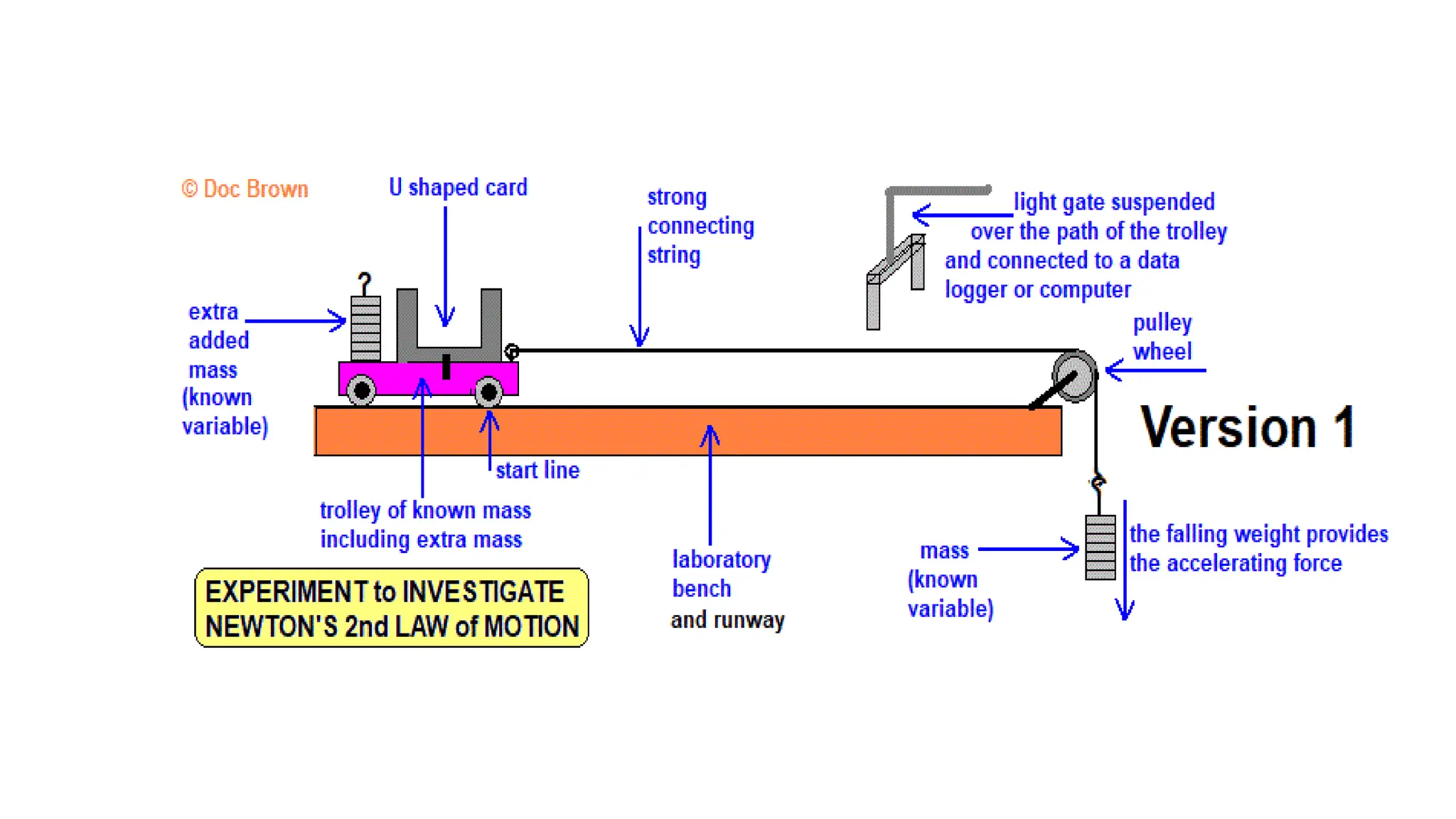
The objective of this experiment is to empirically verify Newton's
Second Law by investigating the relationship between force, mass,
and acceleration. We aim to demonstrate that for a constant mass,
acceleration increases with the increase in applied force, and for a
constant force, acceleration decreases as mass increases
OBJECTIVE
•A cart or small wheeled object (e.g., toy car)
•Set of weights (1 kg, 2 kg, 3 kg, etc.)
•Pulley (optional, for applying force with hanging weights)
•String (to connect weights to the cart)
•Stopwatch (to measure time)
•Meter stick or measuring tape (to measure distance)
•Smooth, flat surface (e.g., table, floor)
•Force sensor (if available, for more precise measurements)
•Calculator (for calculations)
MATERIALS REQUIRED
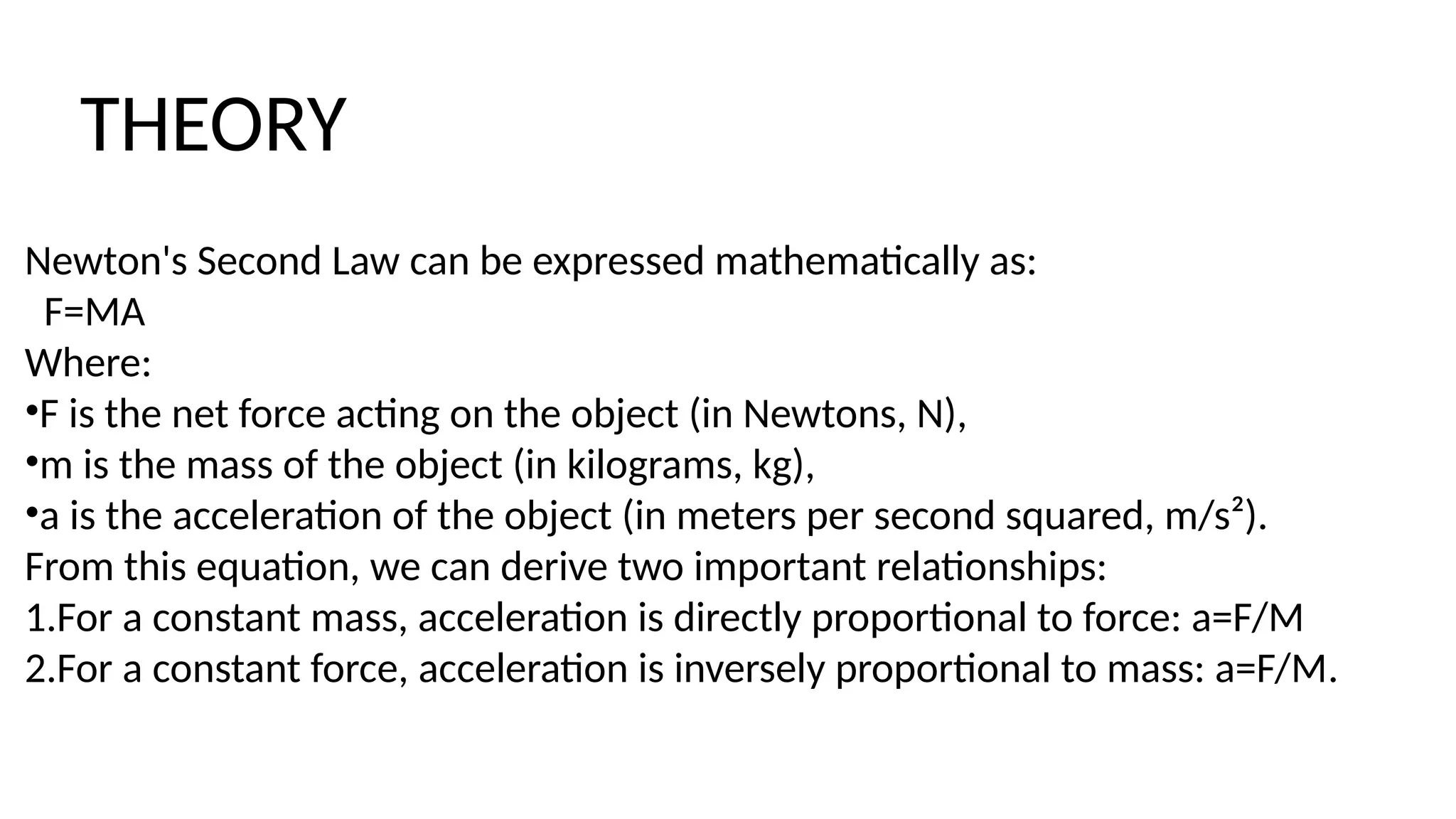
Newton's Second Law can be expressed mathematically as:
F=MA
Where:
•F is the net force acting on the object (in Newtons, N),
•m is the mass of the object (in kilograms, kg),
•a is the acceleration of the object (in meters per second squared, m/s²).
From this equation, we can derive two important relationships:
1.For a constant mass, acceleration is directly proportional to force: a=F​
/M
2.For a constant force, acceleration is inversely proportional to mass: a=F/M​
.
THEORY
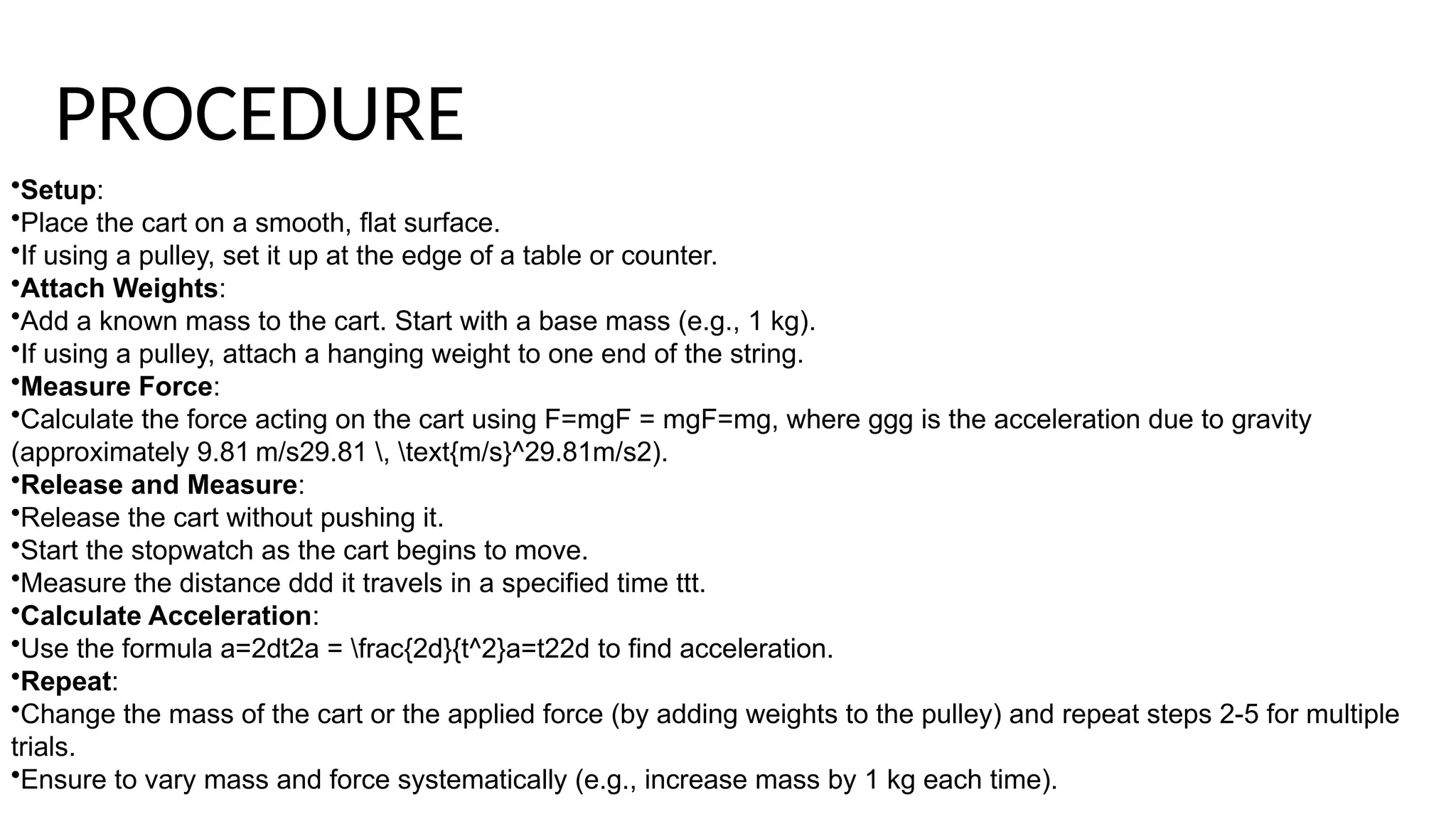
•Setup:
•Place the cart on a smooth, flat surface.
•If using a pulley, set it up at the edge of a table or counter.
•Attach Weights:
•Add a known mass to the cart. Start with a base mass (e.g., 1 kg).
•If using a pulley, attach a hanging weight to one end of the string.
•Measure Force:
•Calculate the force acting on the cart using F=mgF = mgF=mg, where ggg is the acceleration due to gravity
(approximately 9.81 m/s29.81 , text{m/s}^29.81m/s2).
•Release and Measure:
•Release the cart without pushing it.
•Start the stopwatch as the cart begins to move.
•Measure the distance ddd it travels in a specified time ttt.
•Calculate Acceleration:
•Use the formula a=2dt2a = frac{2d}{t^2}a=t22d​to find acceleration.
•Repeat:
•Change the mass of the cart or the applied force (by adding weights to the pulley) and repeat steps 2-5 for multiple
trials.
•Ensure to vary mass and force systematically (e.g., increase mass by 1 kg each time).
PROCEDURE
OBSERVATIONS
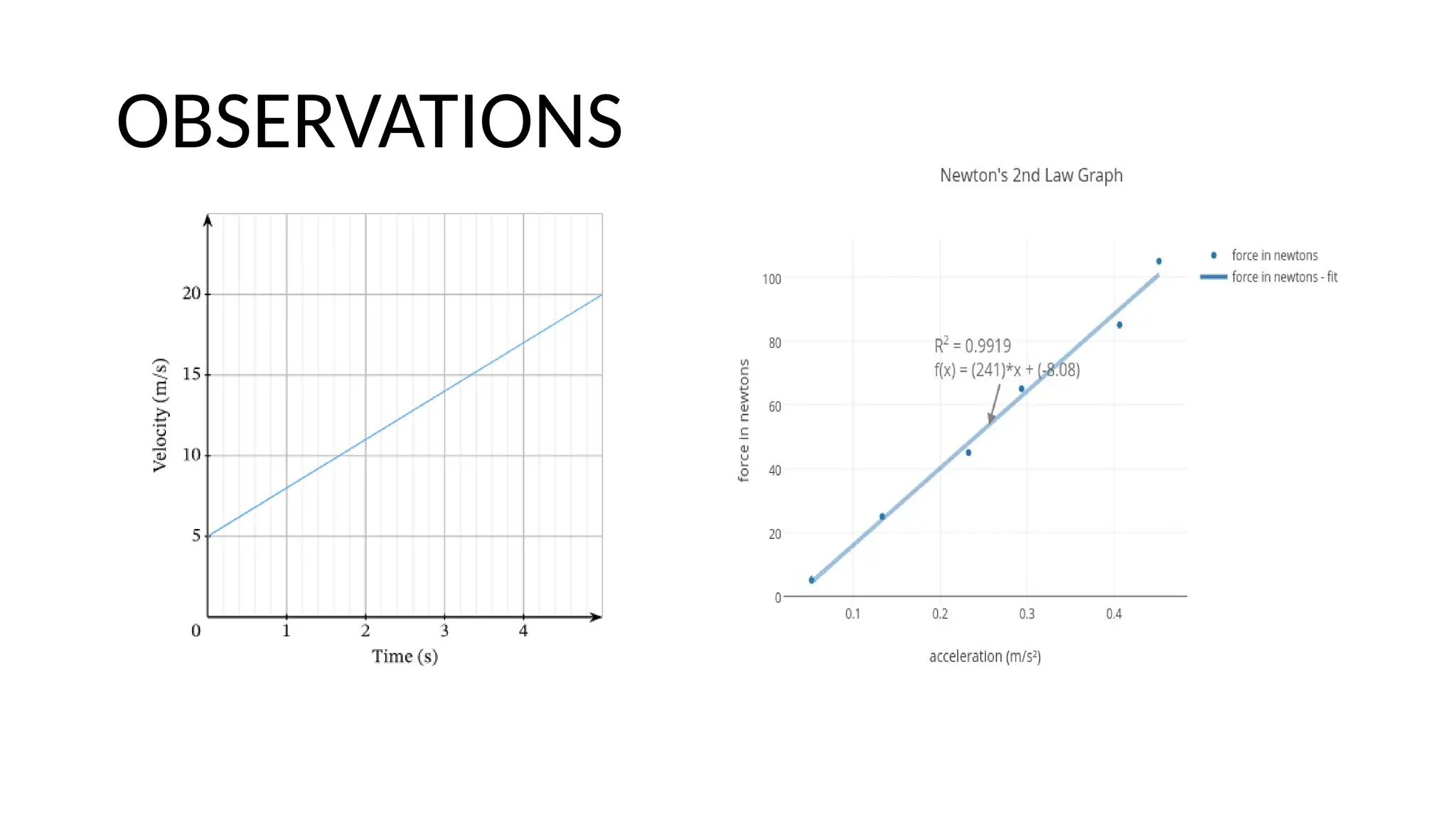
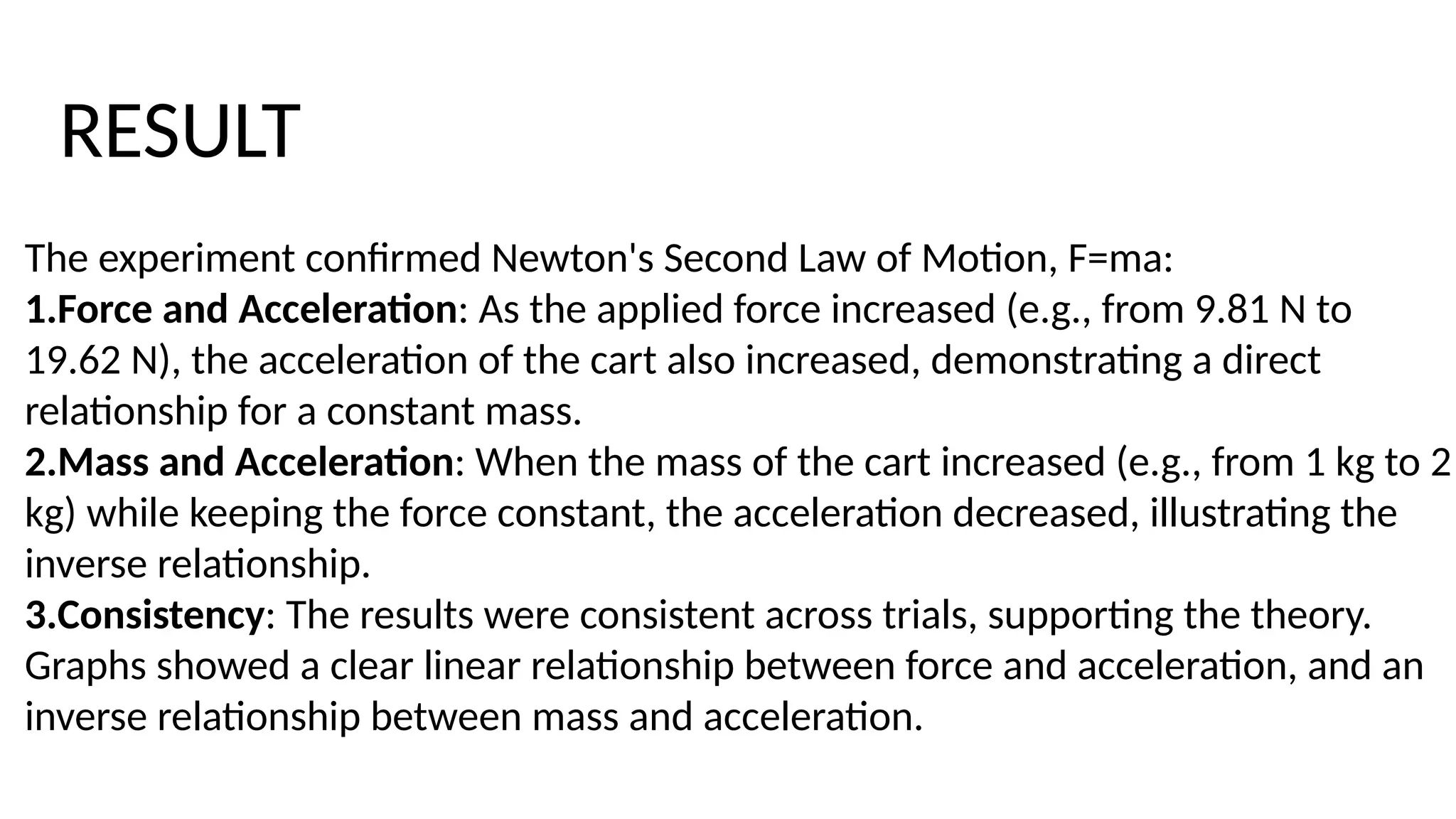
The experiment confirmed Newton's Second Law of Motion, F=ma:
1.Force and Acceleration: As the applied force increased (e.g., from 9.81 N to
19.62 N), the acceleration of the cart also increased, demonstrating a direct
relationship for a constant mass.
2.Mass and Acceleration: When the mass of the cart increased (e.g., from 1 kg to 2
kg) while keeping the force constant, the acceleration decreased, illustrating the
inverse relationship.
3.Consistency: The results were consistent across trials, supporting the theory.
Graphs showed a clear linear relationship between force and acceleration, and an
inverse relationship between mass and acceleration.
RESULT
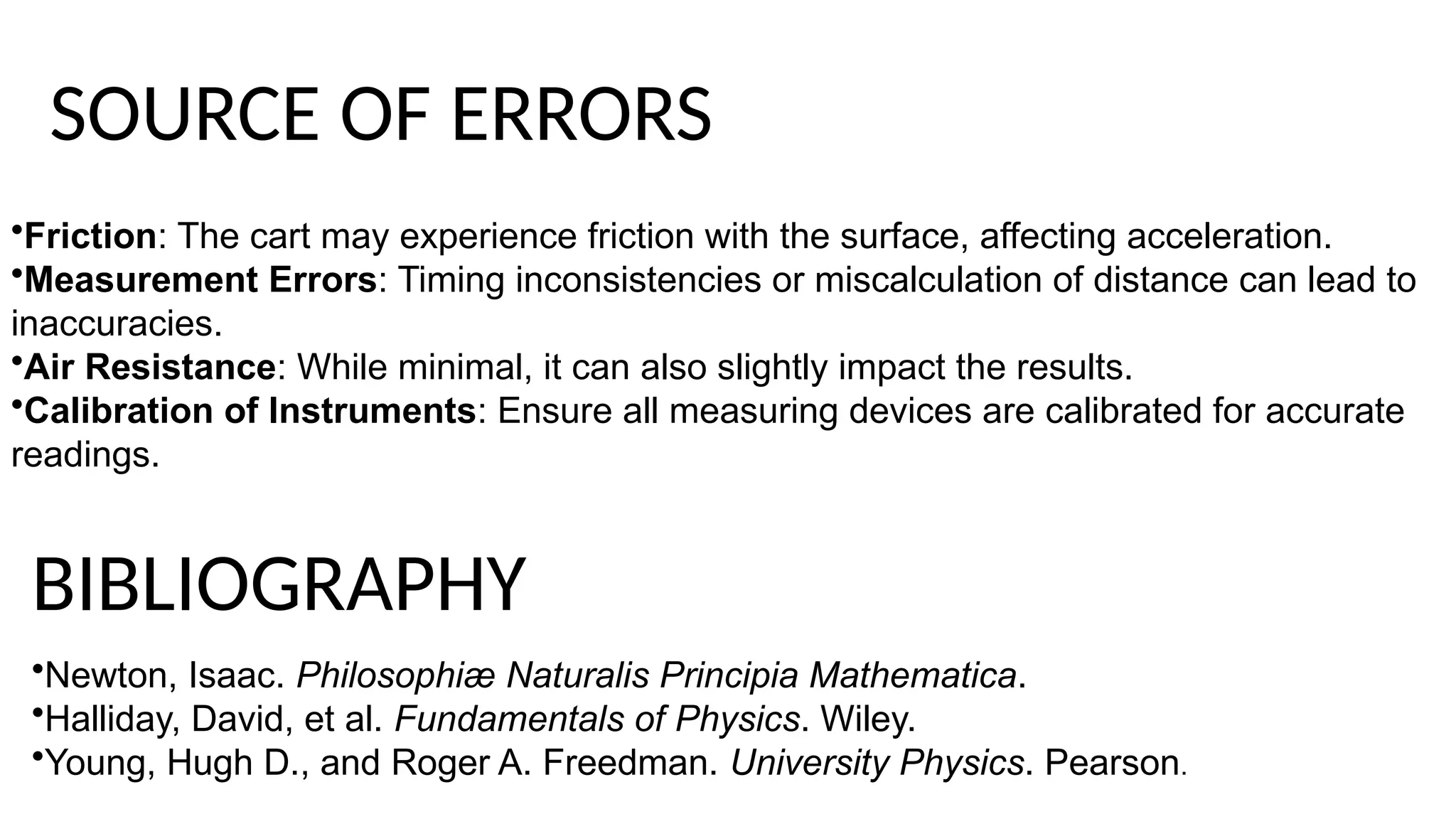
•Friction: The cart may experience friction with the surface, affecting acceleration.
•Measurement Errors: Timing inconsistencies or miscalculation of distance can lead to
inaccuracies.
•Air Resistance: While minimal, it can also slightly impact the results.
•Calibration of Instruments: Ensure all measuring devices are calibrated for accurate
readings.
SOURCE OF ERRORS
•Newton, Isaac. Philosophiæ Naturalis Principia Mathematica.
•Halliday, David, et al. Fundamentals of Physics. Wiley.
•Young, Hugh D., and Roger A. Freedman. University Physics. Pearson.
BIBLIOGRAPHY
THANK YOU
DONE BY
G PRAVIN BALAJI
S SRI NATH

maths project.pptx my school project of the maths subkect

  • 1.
  • 2.
    --- ACKNOWLEDGEMENT I would liketo express my heartfelt gratitude to all those who contributed to the successful completion of my investigatory project titled Firstly, I extend my sincere thanks to miss nandini mam, my project supervisor, for their invaluable guidance, support, and encouragement throughout this endeavor. Their insights and feedback were instrumental in shaping the direction of my research. I would also like to acknowledge the support of my classmates and friends, who provided assistance and motivation during the experimental phases of the project. Their collaboration made the process both enjoyable and enriching. Lastly, I am grateful to my family for their unwavering support and encouragement, which inspired me to pursue this project with dedication. Thank you all for your contributions.
  • 3.
    INDEX  ACKNOWLEDGEMENT  INTRODUCTION OBJECTIVE  MATERIALS REQUIRED  THEORY  PROCEDURE  OBSERVATIONS  RESULTS  PRECAUTIONS  SOURECE OF ERRORS  BIBLIOGRAPHY
  • 4.
    Newton's Second Lawof Motion, F=ma, is a fundamental principle in physics that describes how the motion of an object is influenced by external forces. It states that the acceleration of an object is directly proportional to the net force acting on it and inversely proportional to its mass. This law allows us to predict how objects will move when subjected to various forces, which is crucial in fields ranging from engineering to space exploration. In this experiment, we will explore this relationship by measuring how different forces affect the acceleration of a cart with varying masses. INTRODUCTION
  • 5.
    The objective ofthis experiment is to empirically verify Newton's Second Law by investigating the relationship between force, mass, and acceleration. We aim to demonstrate that for a constant mass, acceleration increases with the increase in applied force, and for a constant force, acceleration decreases as mass increases OBJECTIVE
  • 6.
    •A cart orsmall wheeled object (e.g., toy car) •Set of weights (1 kg, 2 kg, 3 kg, etc.) •Pulley (optional, for applying force with hanging weights) •String (to connect weights to the cart) •Stopwatch (to measure time) •Meter stick or measuring tape (to measure distance) •Smooth, flat surface (e.g., table, floor) •Force sensor (if available, for more precise measurements) •Calculator (for calculations) MATERIALS REQUIRED
  • 8.
    Newton's Second Lawcan be expressed mathematically as: F=MA Where: •F is the net force acting on the object (in Newtons, N), •m is the mass of the object (in kilograms, kg), •a is the acceleration of the object (in meters per second squared, m/s²). From this equation, we can derive two important relationships: 1.For a constant mass, acceleration is directly proportional to force: a=F​ /M 2.For a constant force, acceleration is inversely proportional to mass: a=F/M​ . THEORY
  • 9.
    •Setup: •Place the carton a smooth, flat surface. •If using a pulley, set it up at the edge of a table or counter. •Attach Weights: •Add a known mass to the cart. Start with a base mass (e.g., 1 kg). •If using a pulley, attach a hanging weight to one end of the string. •Measure Force: •Calculate the force acting on the cart using F=mgF = mgF=mg, where ggg is the acceleration due to gravity (approximately 9.81 m/s29.81 , text{m/s}^29.81m/s2). •Release and Measure: •Release the cart without pushing it. •Start the stopwatch as the cart begins to move. •Measure the distance ddd it travels in a specified time ttt. •Calculate Acceleration: •Use the formula a=2dt2a = frac{2d}{t^2}a=t22d​to find acceleration. •Repeat: •Change the mass of the cart or the applied force (by adding weights to the pulley) and repeat steps 2-5 for multiple trials. •Ensure to vary mass and force systematically (e.g., increase mass by 1 kg each time). PROCEDURE
  • 10.
  • 11.
    The experiment confirmedNewton's Second Law of Motion, F=ma: 1.Force and Acceleration: As the applied force increased (e.g., from 9.81 N to 19.62 N), the acceleration of the cart also increased, demonstrating a direct relationship for a constant mass. 2.Mass and Acceleration: When the mass of the cart increased (e.g., from 1 kg to 2 kg) while keeping the force constant, the acceleration decreased, illustrating the inverse relationship. 3.Consistency: The results were consistent across trials, supporting the theory. Graphs showed a clear linear relationship between force and acceleration, and an inverse relationship between mass and acceleration. RESULT
  • 12.
    •Friction: The cartmay experience friction with the surface, affecting acceleration. •Measurement Errors: Timing inconsistencies or miscalculation of distance can lead to inaccuracies. •Air Resistance: While minimal, it can also slightly impact the results. •Calibration of Instruments: Ensure all measuring devices are calibrated for accurate readings. SOURCE OF ERRORS •Newton, Isaac. Philosophiæ Naturalis Principia Mathematica. •Halliday, David, et al. Fundamentals of Physics. Wiley. •Young, Hugh D., and Roger A. Freedman. University Physics. Pearson. BIBLIOGRAPHY
  • 13.
    THANK YOU DONE BY GPRAVIN BALAJI S SRI NATH