MATHEMATICS
FOR MACHINE
LEARNING
Kalybek Aruzhan
WHAT IS
DATA?
Data are separate fragments of
factual information collected
from various sources.
DATA TYPES
The data is divided into two types:
Qualitative/categorical
(nominal and ordinal)
Quantitative/numerical (discrete
and continuous)
QUALITATIVE/CATEGORICAL
 Nominal
 1Nominal provide data without a
measurable value (country, gender,
race, hair color). It's like a true-false
setup
 Ordinal
 Ordinal is categorical data with a
given order or scale (salary range,
movie rating)
QUANTITATIVE/NUMERICAL
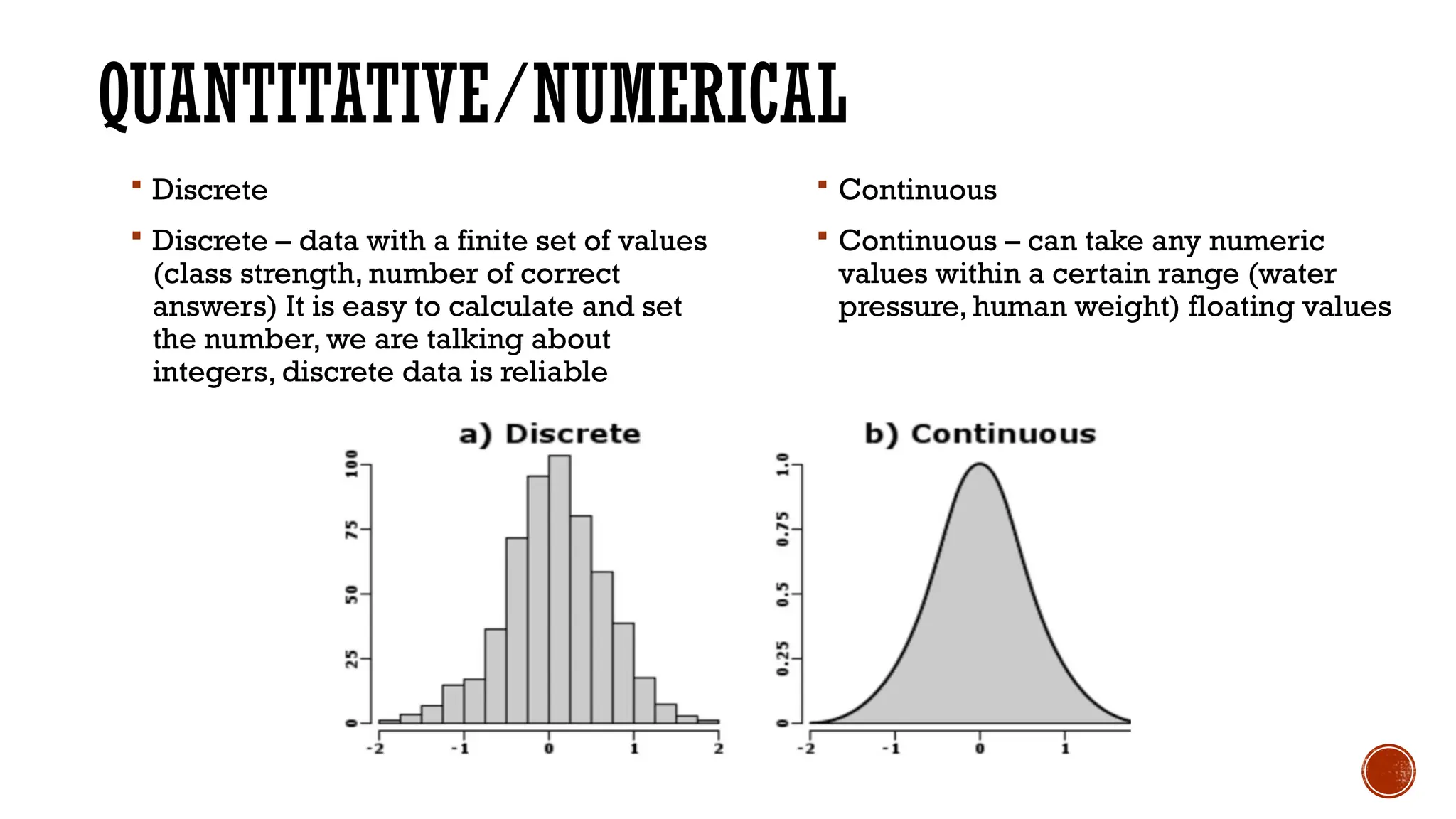
 Discrete
 Discrete – data with a finite set of values
(class strength, number of correct
answers) It is easy to calculate and set
the number, we are talking about
integers, discrete data is reliable
 Continuous
 Continuous – can take any numeric
values within a certain range (water
pressure, human weight) floating values
LINEAR ALGEBRA
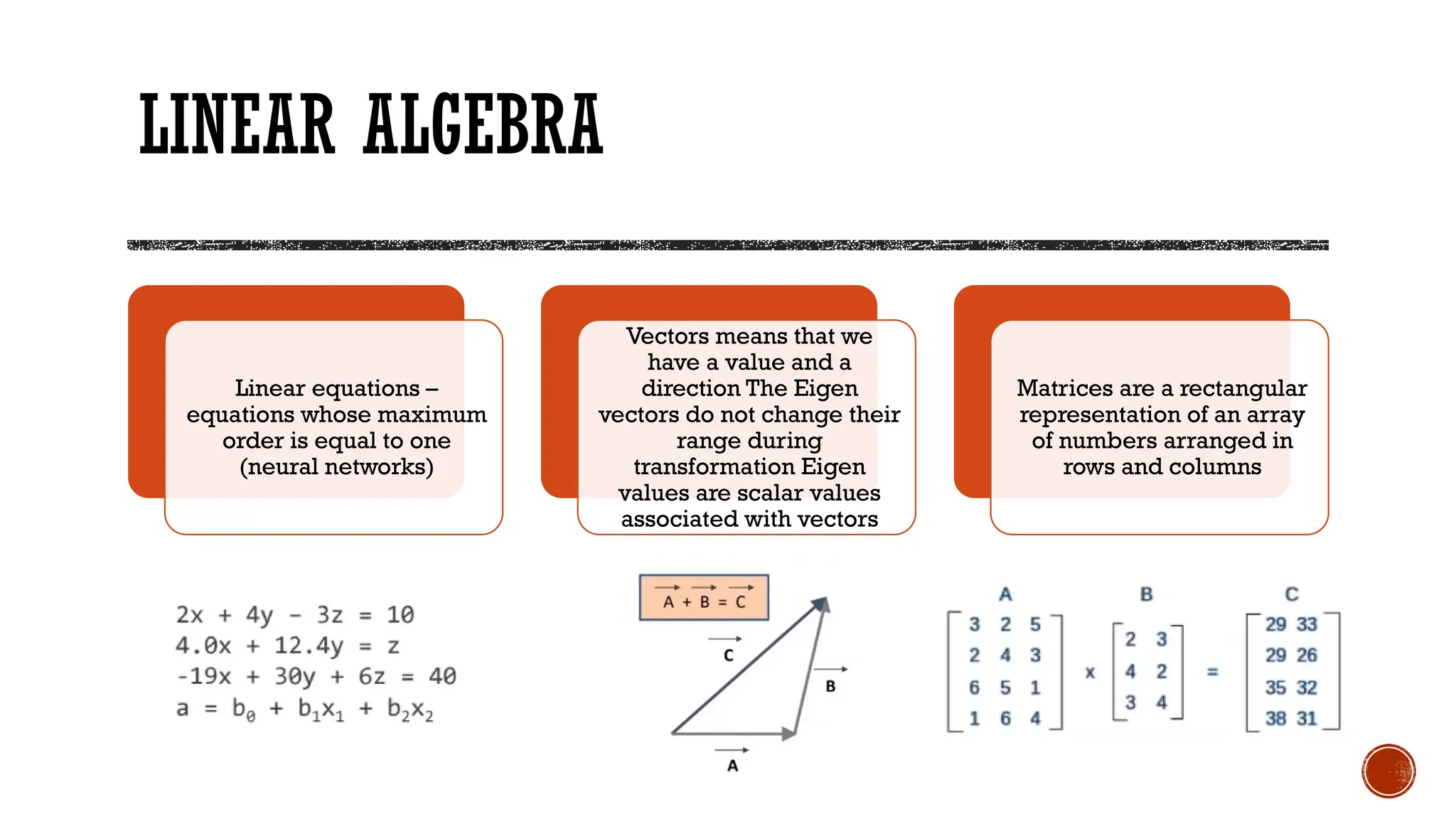
Linear equations –
equations whose maximum
order is equal to one
(neural networks)
Vectors means that we
have a value and a
direction The Eigen
vectors do not change their
range during
transformation Eigen
values are scalar values
associated with vectors
Matrices are a rectangular
representation of an array
of numbers arranged in
rows and columns
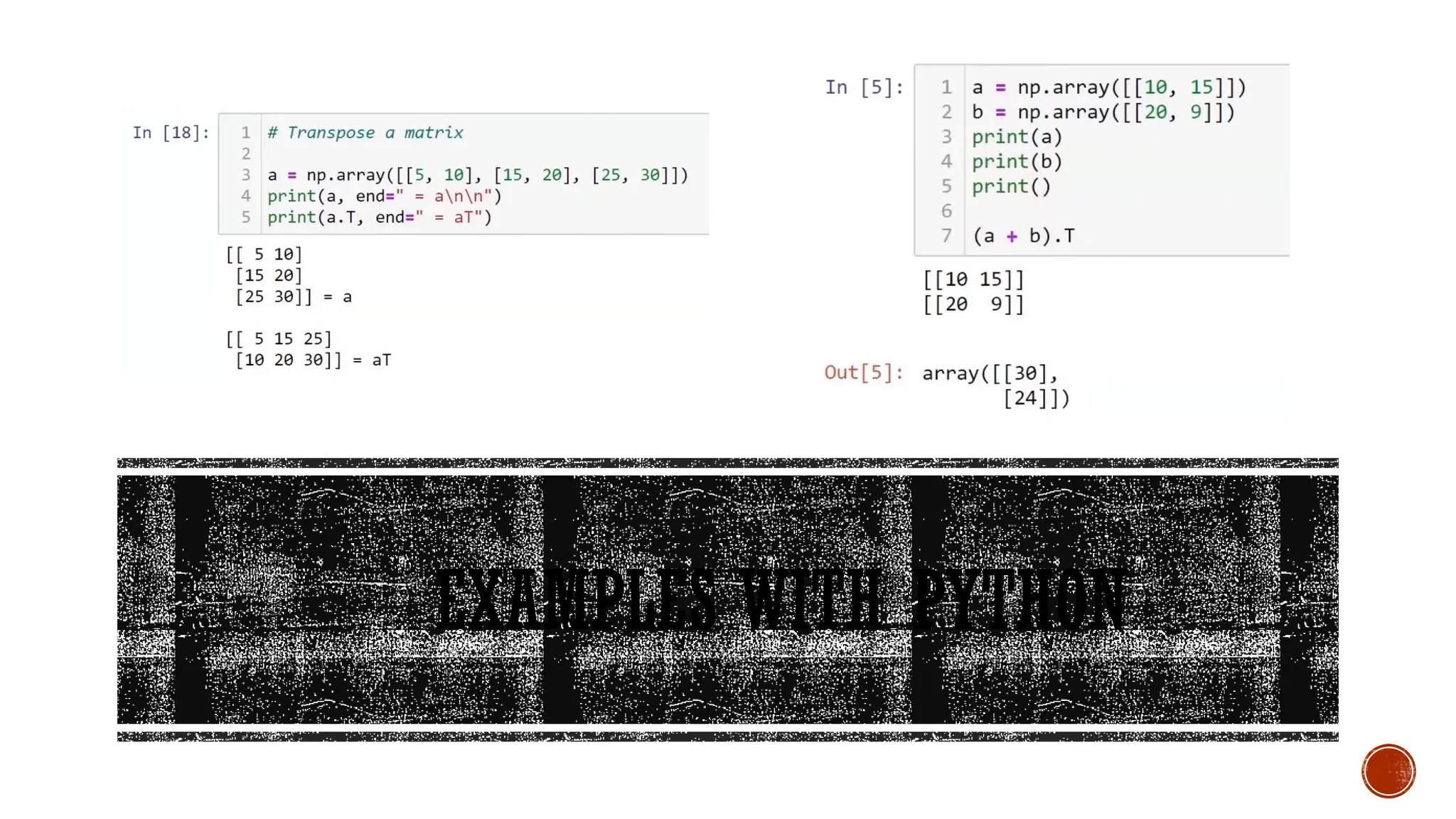
EXAMPLES WITH PYTHON
DIFFERENTIATION
Helps to calculate the spontaneous
rate of change
Suppose we plot a graph of the
speed of a car with respect to time
The rate of change of speed with
respect of time is nothing but
acceleration
The acceleration is the area
between the start point x and end
point delta 4 x
MATHEMATICAL
ANALYSIS
 Divide the time interval into 10 sections and
you can calculate the acceleration for each
time interval, and then make this space smaller
and smaller until the delta x becomes almost
infinitesimal, thus we get the function
 We calculate this slope on smaller and smaller
samples. This is called mathematical analysis.
Matanalysis is an integral. The area under the
slope is the main integration process
INTEGRATION
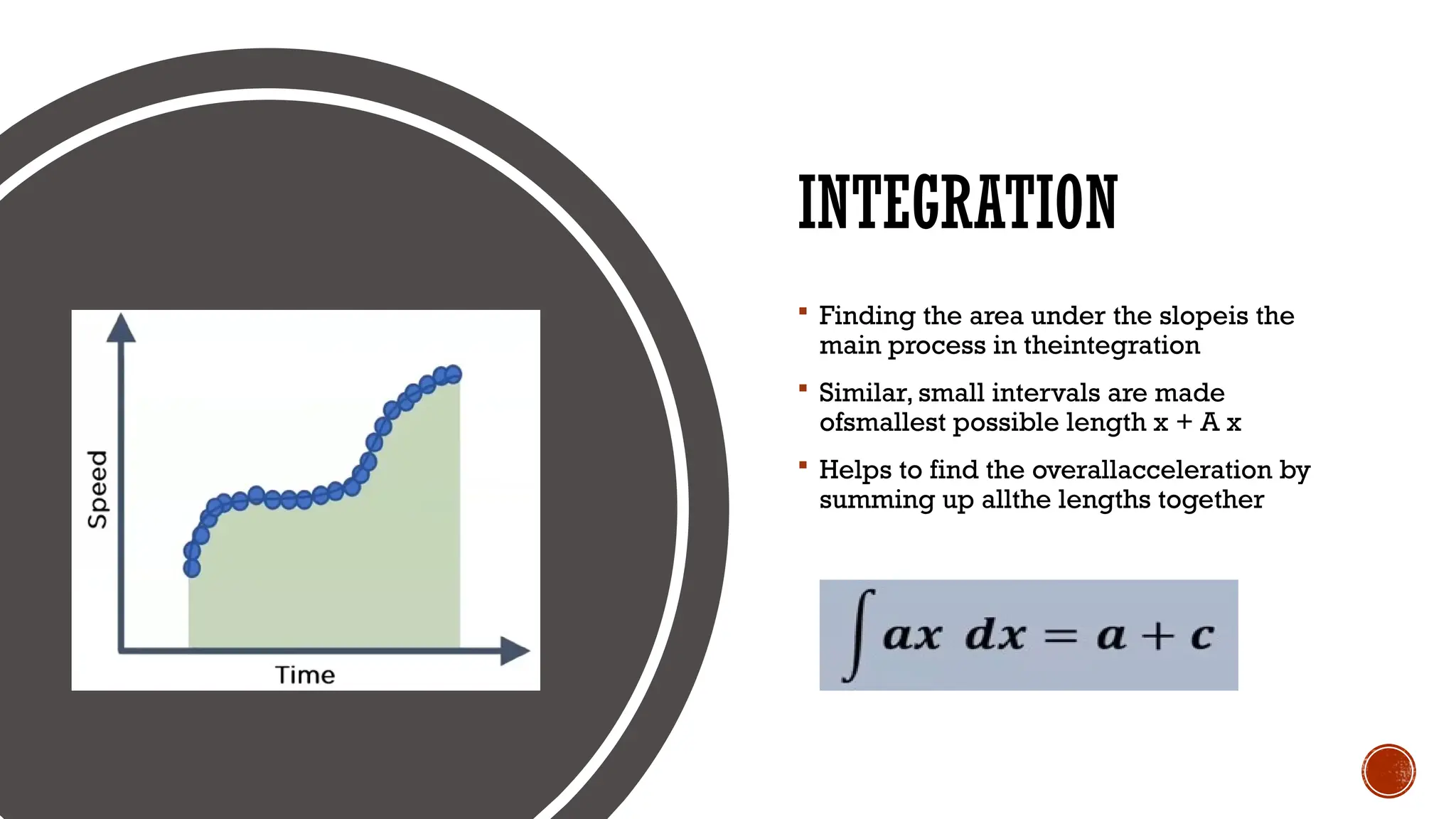
 Finding the area under the slopeis the
main process in theintegration
 Similar, small intervals are made
ofsmallest possible length x + A x
 Helps to find the overallacceleration by
summing up allthe lengths together
STATISTICS
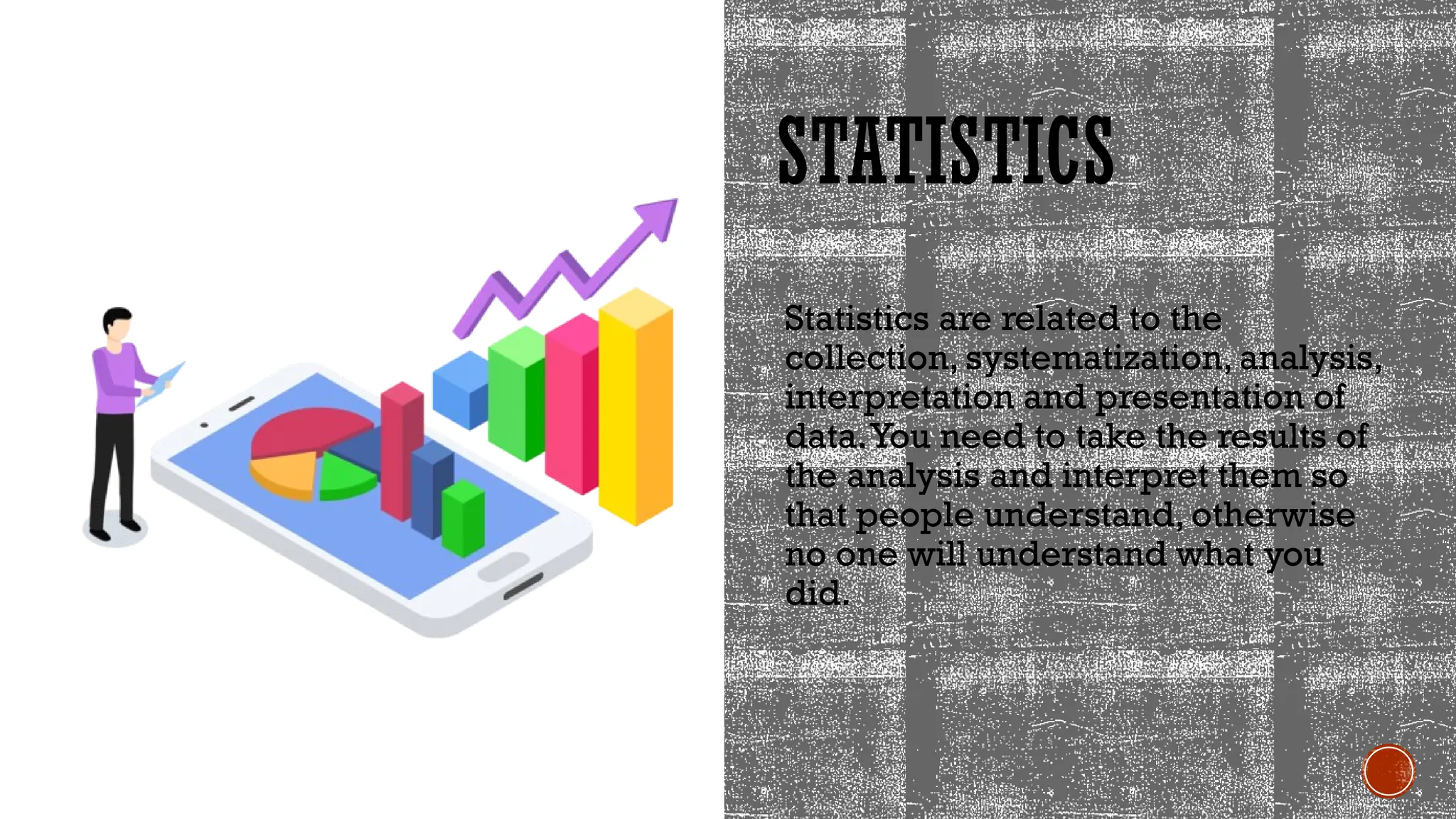
Statistics are related to the
collection, systematization, analysis,
interpretation and presentation of
data.You need to take the results of
the analysis and interpret them so
that people understand, otherwise
no one will understand what you
did.
IMPORTANT TERMINOLOGY
Population – all objects or dimensions whose
properties will be observed
Parameter – an indicator used to represent the
characteristics of the population
The sample is a subset of the studied population
A variable is an indicator of interest in each person or
object in the population
TYPES OF SAMPLING
1. The probabilistic approach is to select samples from a large population using a
method based on probability theory
 Random sampling – we select random-sized samples from a group or category. So
this is as random a sample as possible.
 Systematic sampling – we select random-sized samples from a group or category
with a fixed or periodic interval
 Stratified sampling – selects approximately equal-sized samples from different
groups or categories
2. Non-probabilistic approach – to choose samples based on the subjective
judgment of the investigator and not on random selection (very biased, you need to
be careful)

THANKS FOR
ATTENTION

Mathematics and formulas for Machine Learning .pptx

  • 1.
  • 2.
    WHAT IS DATA? Data areseparate fragments of factual information collected from various sources.
  • 3.
    DATA TYPES The datais divided into two types: Qualitative/categorical (nominal and ordinal) Quantitative/numerical (discrete and continuous)
  • 4.
    QUALITATIVE/CATEGORICAL  Nominal  1Nominalprovide data without a measurable value (country, gender, race, hair color). It's like a true-false setup  Ordinal  Ordinal is categorical data with a given order or scale (salary range, movie rating)
  • 5.
    QUANTITATIVE/NUMERICAL  Discrete  Discrete– data with a finite set of values (class strength, number of correct answers) It is easy to calculate and set the number, we are talking about integers, discrete data is reliable  Continuous  Continuous – can take any numeric values within a certain range (water pressure, human weight) floating values
  • 6.
    LINEAR ALGEBRA Linear equations– equations whose maximum order is equal to one (neural networks) Vectors means that we have a value and a direction The Eigen vectors do not change their range during transformation Eigen values are scalar values associated with vectors Matrices are a rectangular representation of an array of numbers arranged in rows and columns
  • 7.
  • 8.
    DIFFERENTIATION Helps to calculatethe spontaneous rate of change Suppose we plot a graph of the speed of a car with respect to time The rate of change of speed with respect of time is nothing but acceleration The acceleration is the area between the start point x and end point delta 4 x
  • 9.
    MATHEMATICAL ANALYSIS  Divide thetime interval into 10 sections and you can calculate the acceleration for each time interval, and then make this space smaller and smaller until the delta x becomes almost infinitesimal, thus we get the function  We calculate this slope on smaller and smaller samples. This is called mathematical analysis. Matanalysis is an integral. The area under the slope is the main integration process
  • 10.
    INTEGRATION  Finding thearea under the slopeis the main process in theintegration  Similar, small intervals are made ofsmallest possible length x + A x  Helps to find the overallacceleration by summing up allthe lengths together
  • 11.
    STATISTICS Statistics are relatedto the collection, systematization, analysis, interpretation and presentation of data.You need to take the results of the analysis and interpret them so that people understand, otherwise no one will understand what you did.
  • 12.
    IMPORTANT TERMINOLOGY Population –all objects or dimensions whose properties will be observed Parameter – an indicator used to represent the characteristics of the population The sample is a subset of the studied population A variable is an indicator of interest in each person or object in the population
  • 13.
    TYPES OF SAMPLING 1.The probabilistic approach is to select samples from a large population using a method based on probability theory  Random sampling – we select random-sized samples from a group or category. So this is as random a sample as possible.  Systematic sampling – we select random-sized samples from a group or category with a fixed or periodic interval  Stratified sampling – selects approximately equal-sized samples from different groups or categories 2. Non-probabilistic approach – to choose samples based on the subjective judgment of the investigator and not on random selection (very biased, you need to be careful)

  • 14.