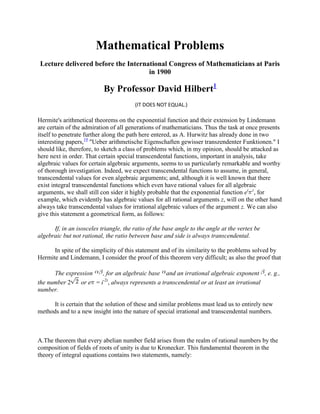
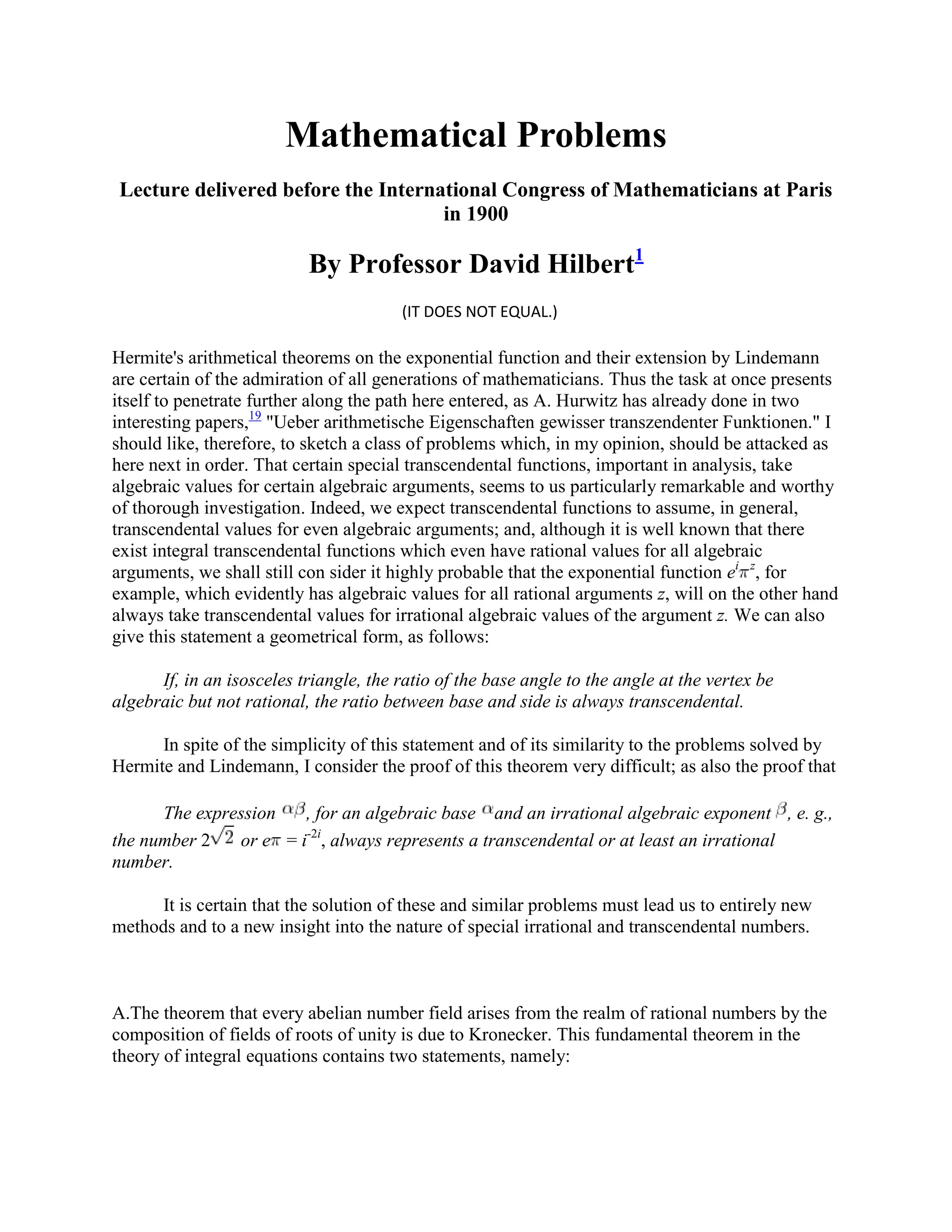
Mathematical Problems
Lecture delivered before the International Congress of Mathematicians at Paris
in 1900
By Professor David Hilbert1
(IT DOES NOT EQUAL.)
Hermite's arithmetical theorems on the exponential function and their extension by Lindemann
are certain of the admiration of all generations of mathematicians. Thus the task at once presents
itself to penetrate further along the path here entered, as A. Hurwitz has already done in two
interesting papers,19
"Ueber arithmetische Eigenschaften gewisser transzendenter Funktionen." I
should like, therefore, to sketch a class of problems which, in my opinion, should be attacked as
here next in order. That certain special transcendental functions, important in analysis, take
algebraic values for certain algebraic arguments, seems to us particularly remarkable and worthy
of thorough investigation. Indeed, we expect transcendental functions to assume, in general,
transcendental values for even algebraic arguments; and, although it is well known that there
exist integral transcendental functions which even have rational values for all algebraic
arguments, we shall still con sider it highly probable that the exponential function ei z
, for
example, which evidently has algebraic values for all rational arguments z, will on the other hand
always take transcendental values for irrational algebraic values of the argument z. We can also
give this statement a geometrical form, as follows:
If, in an isosceles triangle, the ratio of the base angle to the angle at the vertex be
algebraic but not rational, the ratio between base and side is always transcendental.
In spite of the simplicity of this statement and of its similarity to the problems solved by
Hermite and Lindemann, I consider the proof of this theorem very difficult; as also the proof that
The expression , for an algebraic base and an irrational algebraic exponent , e. g.,
the number 2 or e = i-2i
, always represents a transcendental or at least an irrational
number.
It is certain that the solution of these and similar problems must lead us to entirely new
methods and to a new insight into the nature of special irrational and transcendental numbers.
A.The theorem that every abelian number field arises from the realm of rational numbers by the
composition of fields of roots of unity is due to Kronecker. This fundamental theorem in the
theory of integral equations contains two statements, namely:
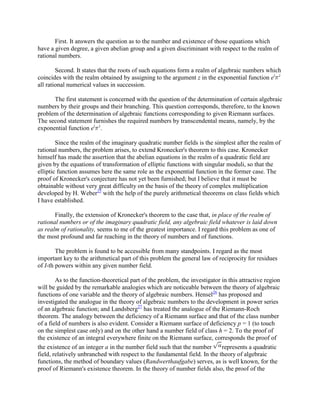
First. It answers the question as to the number and existence of those equations which
have a given degree, a given abelian group and a given discriminant with respect to the realm of
rational numbers.
Second. It states that the roots of such equations form a realm of algebraic numbers which
coincides with the realm obtained by assigning to the argument z in the exponential function ei z
all rational numerical values in succession.
The first statement is concerned with the question of the determination of certain algebraic
numbers by their groups and their branching. This question corresponds, therefore, to the known
problem of the determination of algebraic functions corresponding to given Riemann surfaces.
The second statement furnishes the required numbers by transcendental means, namely, by the
exponential function ei z
.
Since the realm of the imaginary quadratic number fields is the simplest after the realm of
rational numbers, the problem arises, to extend Kronecker's theorem to this case. Kronecker
himself has made the assertion that the abelian equations in the realm of a quadratic field are
given by the equations of transformation of elliptic functions with singular moduli, so that the
elliptic function assumes here the same role as the exponential function in the former case. The
proof of Kronecker's conjecture has not yet been furnished; but I believe that it must be
obtainable without very great difficulty on the basis of the theory of complex multiplication
developed by H. Weber25
with the help of the purely arithmetical theorems on class fields which
I have established.
Finally, the extension of Kronecker's theorem to the case that, in place of the realm of
rational numbers or of the imaginary quadratic field, any algebraic field whatever is laid down
as realm of rationality, seems to me of the greatest importance. I regard this problem as one of
the most profound and far reaching in the theory of numbers and of functions.
The problem is found to be accessible from many standpoints. I regard as the most
important key to the arithmetical part of this problem the general law of reciprocity for residues
of I-th powers within any given number field.
As to the function-theoretical part of the problem, the investigator in this attractive region
will be guided by the remarkable analogies which are noticeable between the theory of algebraic
functions of one variable and the theory of algebraic numbers. Hensel26
has proposed and
investigated the analogue in the theory of algebraic numbers to the development in power series
of an algebraic function; and Landsberg27
has treated the analogue of the Riemann-Roch
theorem. The analogy between the deficiency of a Riemann surface and that of the class number
of a field of numbers is also evident. Consider a Riemann surface of deficiency p = 1 (to touch
on the simplest case only) and on the other hand a number field of class h = 2. To the proof of
the existence of an integral everywhere finite on the Riemann surface, corresponds the proof of
the existence of an integer a in the number field such that the number represents a quadratic
field, relatively unbranched with respect to the fundamental field. In the theory of algebraic
functions, the method of boundary values (Randwerthaufgabe) serves, as is well known, for the
proof of Riemann's existence theorem. In the theory of number fields also, the proof of the
existence of just this number a offers the greatest difficulty. This proof succeeds with
indispensable assistance from the theorem that in the number field there are always prime ideals
corresponding to given residual properties. This latter fact is therefore the analogue in number
theory to the problem of boundary values.
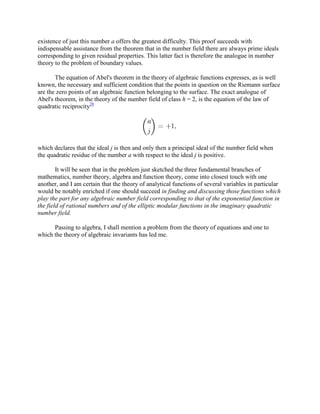
The equation of Abel's theorem in the theory of algebraic functions expresses, as is well
known, the necessary and sufficient condition that the points in question on the Riemann surface
are the zero points of an algebraic function belonging to the surface. The exact analogue of
Abel's theorem, in the theory of the number field of class h = 2, is the equation of the law of
quadratic reciprocity28
which declares that the ideal j is then and only then a principal ideal of the number field when
the quadratic residue of the number a with respect to the ideal j is positive.
It will be seen that in the problem just sketched the three fundamental branches of
mathematics, number theory, algebra and function theory, come into closest touch with one
another, and I am certain that the theory of analytical functions of several variables in particular
would be notably enriched if one should succeed in finding and discussing those functions which
play the part for any algebraic number field corresponding to that of the exponential function in
the field of rational numbers and of the elliptic modular functions in the imaginary quadratic
number field.
Passing to algebra, I shall mention a problem from the theory of equations and one to
which the theory of algebraic invariants has led me.

Mathematical problems

  • 1.
    Mathematical Problems Lecture deliveredbefore the International Congress of Mathematicians at Paris in 1900 By Professor David Hilbert1 (IT DOES NOT EQUAL.) Hermite's arithmetical theorems on the exponential function and their extension by Lindemann are certain of the admiration of all generations of mathematicians. Thus the task at once presents itself to penetrate further along the path here entered, as A. Hurwitz has already done in two interesting papers,19 "Ueber arithmetische Eigenschaften gewisser transzendenter Funktionen." I should like, therefore, to sketch a class of problems which, in my opinion, should be attacked as here next in order. That certain special transcendental functions, important in analysis, take algebraic values for certain algebraic arguments, seems to us particularly remarkable and worthy of thorough investigation. Indeed, we expect transcendental functions to assume, in general, transcendental values for even algebraic arguments; and, although it is well known that there exist integral transcendental functions which even have rational values for all algebraic arguments, we shall still con sider it highly probable that the exponential function ei z , for example, which evidently has algebraic values for all rational arguments z, will on the other hand always take transcendental values for irrational algebraic values of the argument z. We can also give this statement a geometrical form, as follows: If, in an isosceles triangle, the ratio of the base angle to the angle at the vertex be algebraic but not rational, the ratio between base and side is always transcendental. In spite of the simplicity of this statement and of its similarity to the problems solved by Hermite and Lindemann, I consider the proof of this theorem very difficult; as also the proof that The expression , for an algebraic base and an irrational algebraic exponent , e. g., the number 2 or e = i-2i , always represents a transcendental or at least an irrational number. It is certain that the solution of these and similar problems must lead us to entirely new methods and to a new insight into the nature of special irrational and transcendental numbers. A.The theorem that every abelian number field arises from the realm of rational numbers by the composition of fields of roots of unity is due to Kronecker. This fundamental theorem in the theory of integral equations contains two statements, namely:
  • 2.
    First. It answersthe question as to the number and existence of those equations which have a given degree, a given abelian group and a given discriminant with respect to the realm of rational numbers. Second. It states that the roots of such equations form a realm of algebraic numbers which coincides with the realm obtained by assigning to the argument z in the exponential function ei z all rational numerical values in succession. The first statement is concerned with the question of the determination of certain algebraic numbers by their groups and their branching. This question corresponds, therefore, to the known problem of the determination of algebraic functions corresponding to given Riemann surfaces. The second statement furnishes the required numbers by transcendental means, namely, by the exponential function ei z . Since the realm of the imaginary quadratic number fields is the simplest after the realm of rational numbers, the problem arises, to extend Kronecker's theorem to this case. Kronecker himself has made the assertion that the abelian equations in the realm of a quadratic field are given by the equations of transformation of elliptic functions with singular moduli, so that the elliptic function assumes here the same role as the exponential function in the former case. The proof of Kronecker's conjecture has not yet been furnished; but I believe that it must be obtainable without very great difficulty on the basis of the theory of complex multiplication developed by H. Weber25 with the help of the purely arithmetical theorems on class fields which I have established. Finally, the extension of Kronecker's theorem to the case that, in place of the realm of rational numbers or of the imaginary quadratic field, any algebraic field whatever is laid down as realm of rationality, seems to me of the greatest importance. I regard this problem as one of the most profound and far reaching in the theory of numbers and of functions. The problem is found to be accessible from many standpoints. I regard as the most important key to the arithmetical part of this problem the general law of reciprocity for residues of I-th powers within any given number field. As to the function-theoretical part of the problem, the investigator in this attractive region will be guided by the remarkable analogies which are noticeable between the theory of algebraic functions of one variable and the theory of algebraic numbers. Hensel26 has proposed and investigated the analogue in the theory of algebraic numbers to the development in power series of an algebraic function; and Landsberg27 has treated the analogue of the Riemann-Roch theorem. The analogy between the deficiency of a Riemann surface and that of the class number of a field of numbers is also evident. Consider a Riemann surface of deficiency p = 1 (to touch on the simplest case only) and on the other hand a number field of class h = 2. To the proof of the existence of an integral everywhere finite on the Riemann surface, corresponds the proof of the existence of an integer a in the number field such that the number represents a quadratic field, relatively unbranched with respect to the fundamental field. In the theory of algebraic functions, the method of boundary values (Randwerthaufgabe) serves, as is well known, for the proof of Riemann's existence theorem. In the theory of number fields also, the proof of the
  • 3.
    existence of justthis number a offers the greatest difficulty. This proof succeeds with indispensable assistance from the theorem that in the number field there are always prime ideals corresponding to given residual properties. This latter fact is therefore the analogue in number theory to the problem of boundary values. The equation of Abel's theorem in the theory of algebraic functions expresses, as is well known, the necessary and sufficient condition that the points in question on the Riemann surface are the zero points of an algebraic function belonging to the surface. The exact analogue of Abel's theorem, in the theory of the number field of class h = 2, is the equation of the law of quadratic reciprocity28 which declares that the ideal j is then and only then a principal ideal of the number field when the quadratic residue of the number a with respect to the ideal j is positive. It will be seen that in the problem just sketched the three fundamental branches of mathematics, number theory, algebra and function theory, come into closest touch with one another, and I am certain that the theory of analytical functions of several variables in particular would be notably enriched if one should succeed in finding and discussing those functions which play the part for any algebraic number field corresponding to that of the exponential function in the field of rational numbers and of the elliptic modular functions in the imaginary quadratic number field. Passing to algebra, I shall mention a problem from the theory of equations and one to which the theory of algebraic invariants has led me.