qwertyuiopasdfghjklzxcvbnmqw
ertyuiopasdfghjklzxcvbnmqwert
yuiopasdfghjklzxcvbnmqwertyui
opasdfghjklzxcvbnmqwertyuiopa
sdfghjklzxcvbnmqwertyuiopasdf
ghjklzxcvbnmqwertyuiopasdfghj
klzxcvbnmqwertyuiopasdfghjklz
xcvbnmqwertyuiopasdfghjklzxcv
bnmqwertyuiopasdfghjklzxcvbn
mqwertyuiopasdfghjklzxcvbnmq
wertyuiopasdfghjklzxcvbnmqwe
rtyuiopasdfghjklzxcvbnmqwerty
uiopasdfghjklzxcvbnmqwertyuio
pasdfghjklzxcvbnmqwertyuiopas
dfghjklzxcvbnmqwertyuiopasdfg
[Type the document title]
[Type the document subtitle]
[Pick the date]
Atlanta
8. Problems of prime numbers
Essential progress in the theory of the distribution of prime numbers has lately been made by
Hadamard, de la Vallée-Poussin, Von Mangoldt and others. For the complete solution, however,
of the problems set us by Riemann's paper "Ueber die Anzahl der Primzahlen unter einer
gegebenen Grösse," it still remains to prove the correctness of an exceedingly important
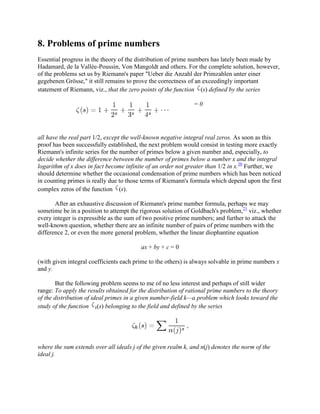
statement of Riemann, viz., that the zero points of the function (s) defined by the series
= 0
all have the real part 1/2, except the well-known negative integral real zeros. As soon as this
proof has been successfully established, the next problem would consist in testing more exactly
Riemann's infinite series for the number of primes below a given number and, especially, to
decide whether the difference between the number of primes below a number x and the integral
logarithm of x does in fact become infinite of an order not greater than 1/2 in x.20
Further, we
should determine whether the occasional condensation of prime numbers which has been noticed
in counting primes is really due to those terms of Riemann's formula which depend upon the first
complex zeros of the function (s).
After an exhaustive discussion of Riemann's prime number formula, perhaps we may
sometime be in a position to attempt the rigorous solution of Goldbach's problem,21
viz., whether
every integer is expressible as the sum of two positive prime numbers; and further to attack the
well-known question, whether there are an infinite number of pairs of prime numbers with the
difference 2, or even the more general problem, whether the linear diophantine equation
ax + by + c = 0
(with given integral coefficients each prime to the others) is always solvable in prime numbers x
and y.
But the following problem seems to me of no less interest and perhaps of still wider
range: To apply the results obtained for the distribution of rational prime numbers to the theory
of the distribution of ideal primes in a given number-field k—a problem which looks toward the
study of the function k(s) belonging to the field and defined by the series
where the sum extends over all ideals j of the given realm k, and n(j) denotes the norm of the
ideal j.
I may mention three more special problems in number theory: one on the laws of
reciprocity, one on diophantine equations, and a third from the realm of quadratic forms.

Type the document title

  • 1.
  • 2.
    8. Problems ofprime numbers Essential progress in the theory of the distribution of prime numbers has lately been made by Hadamard, de la Vallée-Poussin, Von Mangoldt and others. For the complete solution, however, of the problems set us by Riemann's paper "Ueber die Anzahl der Primzahlen unter einer gegebenen Grösse," it still remains to prove the correctness of an exceedingly important statement of Riemann, viz., that the zero points of the function (s) defined by the series = 0 all have the real part 1/2, except the well-known negative integral real zeros. As soon as this proof has been successfully established, the next problem would consist in testing more exactly Riemann's infinite series for the number of primes below a given number and, especially, to decide whether the difference between the number of primes below a number x and the integral logarithm of x does in fact become infinite of an order not greater than 1/2 in x.20 Further, we should determine whether the occasional condensation of prime numbers which has been noticed in counting primes is really due to those terms of Riemann's formula which depend upon the first complex zeros of the function (s). After an exhaustive discussion of Riemann's prime number formula, perhaps we may sometime be in a position to attempt the rigorous solution of Goldbach's problem,21 viz., whether every integer is expressible as the sum of two positive prime numbers; and further to attack the well-known question, whether there are an infinite number of pairs of prime numbers with the difference 2, or even the more general problem, whether the linear diophantine equation ax + by + c = 0 (with given integral coefficients each prime to the others) is always solvable in prime numbers x and y. But the following problem seems to me of no less interest and perhaps of still wider range: To apply the results obtained for the distribution of rational prime numbers to the theory of the distribution of ideal primes in a given number-field k—a problem which looks toward the study of the function k(s) belonging to the field and defined by the series where the sum extends over all ideals j of the given realm k, and n(j) denotes the norm of the ideal j.
  • 3.
    I may mentionthree more special problems in number theory: one on the laws of reciprocity, one on diophantine equations, and a third from the realm of quadratic forms.