1
For More Online Study Materials and Online Test visit-www.polarisedutech.com
CHAPTER – 1
AVERAGE
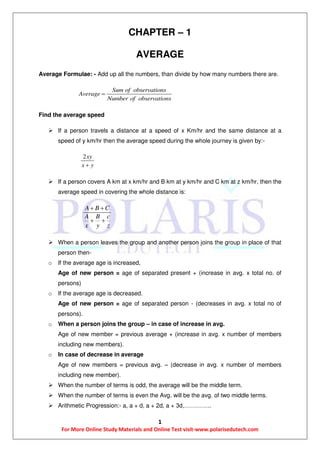
Average Formulae: - Add up all the numbers, than divide by how many numbers there are.
Sum of observations
Average
Number of observations

Find the average speed
 If a person travels a distance at a speed of x Km/hr and the same distance at a
speed of y km/hr then the average speed during the whole journey is given by:-
2xy
x y
 If a person covers A km at x km/hr and B km at y km/hr and C km at z km/hr, then the
average speed in covering the whole distance is:
A B C
A B c
x y z
 
 
 When a person leaves the group and another person joins the group in place of that
person then-
o If the average age is increased,
Age of new person = age of separated present + (increase in avg. x total no. of
persons)
o If the average age is decreased.
Age of new person = age of separated person - (decreases in avg. x total no of
persons).
o When a person joins the group – in case of increase in avg.
Age of new member = previous average + (increase in avg. x number of members
including new members).
o In case of decrease in average
Age of new members = previous avg. – (decrease in avg. x number of members
including new member).
 When the number of terms is odd, the average will be the middle term.
 When the number of terms is even the Avg. will be the avg. of two middle terms.
 Arithmetic Progression:- a, a + d, a + 2d, a + 3d,…………..
2
For More Online Study Materials and Online Test visit-www.polarisedutech.com
First term = a
Difference = d
nth
term =  �� = a +(n-1) x d
 Sum of ‘n’ terms
2
n
Sn  [2a + (n-1) x d]
 Sum of first ‘n’ natural numbers
(1+2+3+--------+n) = ½ n(n+1)
 Sum of ‘n’ odd no.
+ + 5 + ⋯ … … + � − = n2
' 'sum of n even no
(2+4+6+…………+2n) = n (n+1)
= sum of first squares of ‘n’ natural no.
2 2 2 2 1 1
(1 2 3 .........t ) x x ( 1)x(2 1)
6 6
n n n n n      
Sum of first cubic of ‘n’ natural no.
3 3 3 1
(1 2 .........t ) ( 1)}.
2
n n n

   

****##****
3
For More Online Study Materials and Online Test visit-www.polarisedutech.com
CHAPTER-2
COMPOUND INTEREST
Compound Interest:- Where interest is calculated on both the amount borrowed and any
previous interest. Usually calculated one or more times per year.
formulae:-
When The Interest is compounded annually
Amount after ‘n’ years = A = P(1 )
100
nR

Compound interest = 4
(1 ) [(1 ) 1]
100 100
nR R
p p p    
If P = principal
R = rate percent
Time = number of years
C. I = compound interest
A = amount
If the rate of interest differs from year to year i.e. R, in the first year, R2 in the second year,
R3 in the third year, Then,
31 2
(1 )(1 )(1 )
100 100 100
RR R
A    
 When the principal changes every year, we say the interest is compound annually. Then,
(1 )
100
nR
A P 
 When the principal changes as per every six months we say that the interest is
compounded half yearly or semi – annually. Then,
22(1 )
100
n
R
A P 
- Quarterly
44(1 )
100
n
R
A P 
****##****
4
For More Online Study Materials and Online Test visit-www.polarisedutech.com
CHAPTER – 3
SIMPLE INTEREST
SIMPLE INTEREST:- Define:- simple interest is interest paid any the original principal not
on the interest accrued.
Formula:-
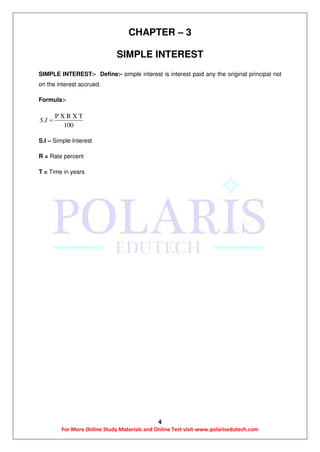
P X R X T
.
100
S I 
S.I – Simple Interest
R = Rate percent
T = Time in years
5
For More Online Study Materials and Online Test visit-www.polarisedutech.com
CHAPTER – 4
BOAT AND STREAM
Boat and Stream
Formulae:-
 If the boat speed is x km/h in downstream y km/h in upstream, then
Speed of boat in still water is
( )
2
x y
speed of stream =
( )
2
x y
 If speed of boat is x km/h and speed of stream is y km/h, then
Boat speed in downstream = x + y km/hr
(both speeds are added)
Boat speed in upstream = x-y km/hr
(y is subtracted from x)
Because boat speed is in opposite direction to speed of stream).
If the speed of boat or person in still water is x and speed of stream is y and the boat has to
cover a distance ‘d’ km Then time taken in down stream 1
tan
( )
( )
d dis ce
T Time
x y speed
  

Time taken in upstream 2
( )
d
T
x y


Total time taken in going down stream and upstream 1 2 [ ]
d d
T T T
x y x y
   
 
***##****
6
For More Online Study Materials and Online Test visit-www.polarisedutech.com
CHAPTER – 5
H.C.F AND L.C.M
H.C.F and L.C.M:- Highest common factor and lowest common factor
Formulae:-
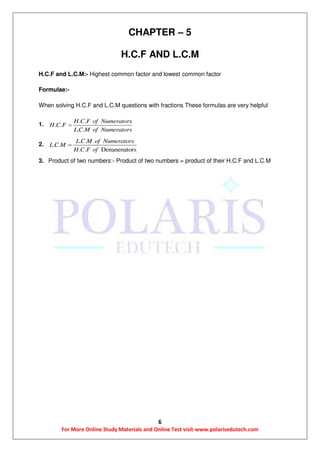
When solving H.C.F and L.C.M questions with fractions These formulas are very helpful
1.
. .
. .
. .
H C F of Numerators
H C F
L C M of Numerators

2.
. .
. .
. . Denanenators
L C M of Numerators
L C M
H C F of

3. Product of two numbers:- Product of two numbers = product of their H.C.F and L.C.M
7
For More Online Study Materials and Online Test visit-www.polarisedutech.com
CHAPTER – 6
TIME AND DISTANCE
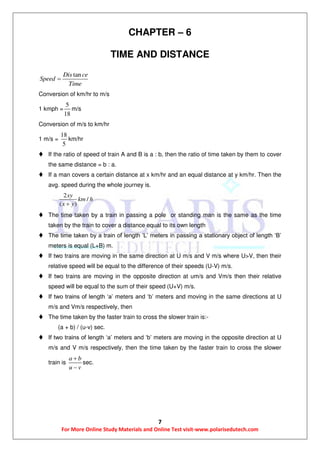
tanDis ce
Speed
Time

Conversion of km/hr to m/s
1 kmph =
5
18
m/s
Conversion of m/s to km/hr
1 m/s =
18
5
km/hr
 If the ratio of speed of train A and B is a : b, then the ratio of time taken by them to cover
the same distance = b : a.
 If a man covers a certain distance at x km/hr and an equal distance at y km/hr. Then the
avg. speed during the whole journey is.
2
/
( )
xy
km h
x y
 The time taken by a train in passing a pole or standing man is the same as the time
taken by the train to cover a distance equal to its own length
 The time taken by a train of length ‘L’ meters in passing a stationary object of length ‘B’
meters is equal (L+B) m.
 If two trains are moving in the same direction at U m/s and V m/s where U>V, then their
relative speed will be equal to the difference of their speeds (U-V) m/s.
 If two trains are moving in the opposite direction at um/s and Vm/s then their relative
speed will be equal to the sum of their speed (U+V) m/s.
 If two trains of length ‘a’ meters and ‘b’ meters and moving in the same directions at U
m/s and Vm/s respectively, then
 The time taken by the faster train to cross the slower train is:-
(a + b) / (u-v) sec.
 If two trains of length ‘a’ meters and ‘b’ meters are moving in the opposite direction at U
m/s and V m/s respectively, then the time taken by the faster train to cross the slower
train is
a b
u v


sec.
8
For More Online Study Materials and Online Test visit-www.polarisedutech.com
CHAPTER – 7
PERMUTATION AND COMBINATION
Formulae:
1. Factorial Notation:-
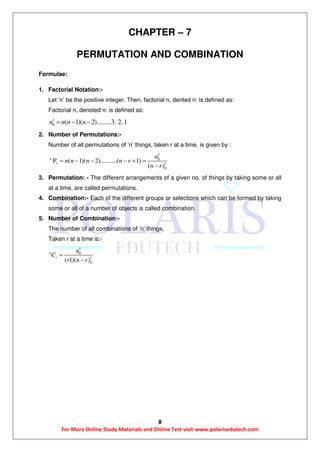
Let ‘n’ be the positive integer. Then, factorial n, dented n: is defined as:
Factorial n, denoted n: is defined as:
1
0 ( 1)( 2).........3. 2. 1n n n n  
2. Number of Permutations:-
Number of all permutations of ‘n’ things, taken r at a time, is given by :
1
0
1
0
P ( 1)( 2)..........( 1)
( )
n
r
n
n n n n r
n r
     

3. Permutation: - The different arrangements of a given no. of things by taking some or all
at a time, are called permutations.
4. Combination:- Each of the different groups or selections which can be formed by taking
some or all of a number of objects is called combination.
5. Number of Combination:-
The number of all combinations of ‘n’ things,
Taken r at a time is:-
1
0
1
0( 1)( )
n
r
n
C
r n r


9
For More Online Study Materials and Online Test visit-www.polarisedutech.com
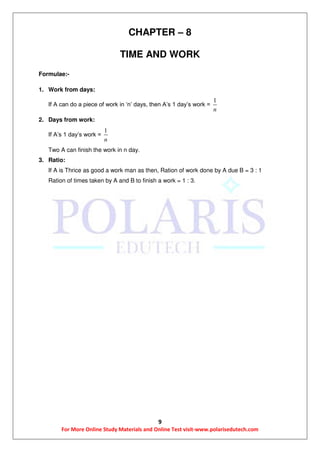
CHAPTER – 8
TIME AND WORK
Formulae:-
1. Work from days:
If A can do a piece of work in ‘n’ days, then A’s 1 day’s work =
1
n
2. Days from work:
If A’s 1 day’s work =
1
n
Two A can finish the work in n day.
3. Ratio:
If A is Thrice as good a work man as then, Ration of work done by A due B = 3 : 1
Ration of times taken by A and B to finish a work = 1 : 3.
10
For More Online Study Materials and Online Test visit-www.polarisedutech.com
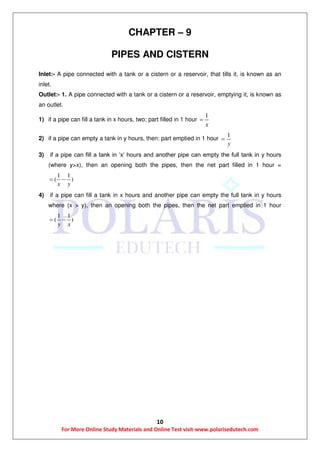
CHAPTER – 9
PIPES AND CISTERN
Inlet:- A pipe connected with a tank or a cistern or a reservoir, that tills it, is known as an
inlet.
Outlet:- 1. A pipe connected with a tank or a cistern or a reservoir, emptying it, is known as
an outlet.
1) if a pipe can fill a tank in x hours, two; part filled in 1 hour
1
x

2) if a pipe can empty a tank in y hours, then: part emptied in 1 hour
1
y

3) if a pipe can fill a tank in ‘x’ hours and another pipe can empty the full tank in y hours
(where y>x), then an opening both the pipes, then the net part filled in 1 hour =
1 1
( )
x y
 
4) if a pipe can fill a tank in x hours and another pipe can empty the full tank in y hours
where (x > y), then an opening both the pipes, then the net part emptied in 1 hour
1 1
( )
y x
 
11
For More Online Study Materials and Online Test visit-www.polarisedutech.com
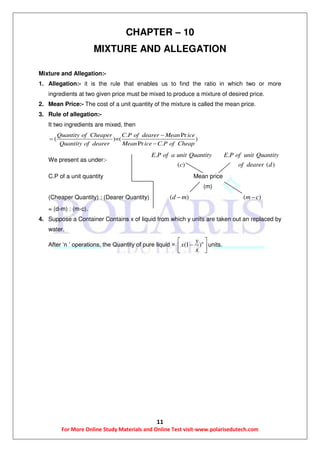
CHAPTER – 10
MIXTURE AND ALLEGATION
Mixture and Allegation:-
1. Allegation:- it is the rule that enables us to find the ratio in which two or more
ingredients at two given price must be mixed to produce a mixture of desired price.
2. Mean Price:- The cost of a unit quantity of the mixture is called the mean price.
3. Rule of allegation:-
It two ingredients are mixed, then
. Pr
( )=( )
Pr .
Quantity of Cheaper C P of dearer Mean ice
Quantity of dearer Mean ice C P of Cheap



We present as under:-
.
( )
E P of a unit Quantity
c
.
( )
E P of unit Quantity
of dearer d
C.P of a unit quantity Mean price
(m)
(Cheaper Quantity) : (Dearer Quantity) ( )d m ( )m c
= (d-m) : (m-c).
4. Suppose a Container Contains x of liquid from which y units are taken out an replaced by
water.
After ‘n ’ operations, the Quantity of pure liquid = (1 )ny
x
x
 
  
units.
12
For More Online Study Materials and Online Test visit-www.polarisedutech.com
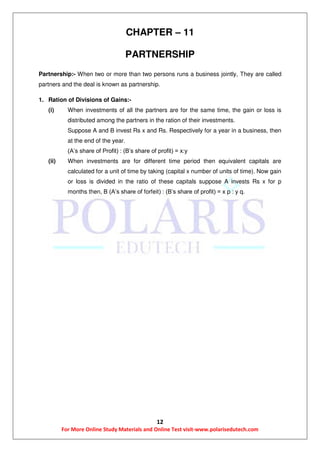
CHAPTER – 11
PARTNERSHIP
Partnership:- When two or more than two persons runs a business jointly, They are called
partners and the deal is known as partnership.
1. Ration of Divisions of Gains:-
(i) When investments of all the partners are for the same time, the gain or loss is
distributed among the partners in the ration of their investments.
Suppose A and B invest Rs x and Rs. Respectively for a year in a business, then
at the end of the year.
(A’s share of Profit) : (B’s share of profit) = x:y
(ii) When investments are for different time period then equivalent capitals are
calculated for a unit of time by taking (capital x number of units of time). Now gain
or loss is divided in the ratio of these capitals suppose A invests Rs x for p
months then, B (A’s share of forfeit) : (B’s share of profit) = x p : y q.
13
For More Online Study Materials and Online Test visit-www.polarisedutech.com
CHAPTER – 12
NUMBER SYSTEM:-
Formulas:-
1. 11,2,3..........O a are called digits.
2. 10, 11, 12,……….are called number.
3. Natural number (N):- Counting numbers are called natural numbers.
Ex:- 1, 2, 3,…………..etc. are all natural numbers, minimum natural number 1 and
maximum ∞.
Whole numbers:- if W is the set of whole numbers, then we write = {0, 1, 2,……….} The
smallest whole number 0.
Integer:- if I is the set of integers, then we write I = {-3, -2, -1, 0, 1, 2, 3………}
Rational No. – Any number which can be expressed in the form of plq. When p and q are
both integers and g o are called rational numbers.
E. g. =
3 7
, ,5, 2
2 9


There exists infinite number of rational number between any two rational numbers.
Irrational numbers:- Non-recurring and non-termination decimals are called irrational
numbers. These number cannot be expressed in the form of
p
q
.
E.g. = 3, 5, 29..........
Real numbers:- Real numbers include both rational and irrational numbers.
In General the number of n digit number are 1
9 10n
X 
 Sum of first ‘n’ natural numbers
1 +2+ 3+ ……..+n
( 1)
2
n n 

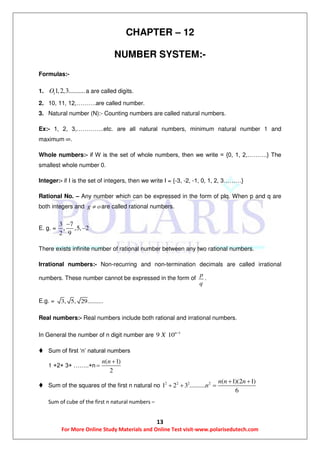
 Sum of the squares of the first n natural no 2 2 2 2 ( 1)(2 1)
1 2 3 ..........
6
n n n
n
 
  
Sum of cube of the first n natural numbers –
14
For More Online Study Materials and Online Test visit-www.polarisedutech.com
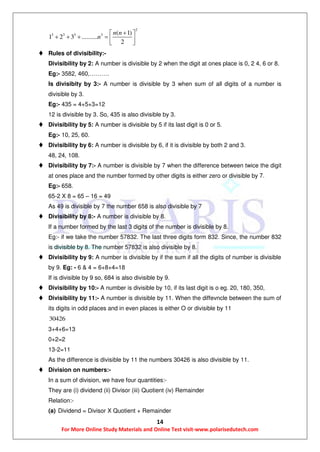
2
3 3 3 3 ( 1)
1 2 3 ..........
2
n n
n
 
      
 Rules of divisibility:-
Divisibility by 2: A number is divisible by 2 when the digit at ones place is 0, 2 4, 6 or 8.
Eg:- 3582, 460,……….
Is divisibity by 3:- A number is divisible by 3 when sum of all digits of a number is
divisible by 3.
Eg:- 435 = 4+5+3=12
12 is divisible by 3. So, 435 is also divisible by 3.
 Divisibility by 5: A number is divisible by 5 if its last digit is 0 or 5.
Eg:- 10, 25, 60.
 Divisibility by 6: A number is divisible by 6, if it is divisible by both 2 and 3.
48, 24, 108.
 Divisibility by 7:- A number is divisible by 7 when the difference between twice the digit
at ones place and the number formed by other digits is either zero or divisible by 7.
Eg:- 658.
65-2 X 8 = 65 – 16 = 49
As 49 is divisible by 7 the number 658 is also divisible by 7
 Divisibility by 8:- A number is divisible by 8.
If a number formed by the last 3 digits of the number is divisible by 8.
Eg:- if we take the number 57832. The last three digits form 832. Since, the number 832
is divisible by 8. The number 57832 is also divisible by 8.
 Divisibility by 9: A number is divisible by if the sum if all the digits of number is divisible
by 9. Eg: - 6 & 4 = 6+8+4=18
If is divisible by 9 so, 684 is also divisible by 9.
 Divisibility by 10:- A number is divisible by 10, if its last digit is o eg. 20, 180, 350,
 Divisibility by 11:- A number is divisible by 11. When the diffevncle between the sum of
its digits in odd places and in even places is either O or divisible by 11
30426
3+4+6=13
0+2=2
13-2=11
As the difference is divisible by 11 the numbers 30426 is also divisible by 11.
 Division on numbers:-
In a sum of division, we have four quantities:-
They are (i) dividend (ii) Divisor (iii) Quotient (iv) Remainder
Relation:-
(a) Dividend = Divisor X Quotient + Remainder
15
For More Online Study Materials and Online Test visit-www.polarisedutech.com
(b) Divisor = (Dividend – Remainder)  Quotient
(c) Quotient = (Dividend – Remainder)  Divisor
16
For More Online Study Materials and Online Test visit-www.polarisedutech.com
CHAPTER – 13
SERIES:
Series:
Arithmetic Sequence:- if a sequence of values follows a pattern of adding a fixed amount
from are term to the next, it is referred to as an aritumatic sequence. The number is added to
each term is constant.
Formula:-
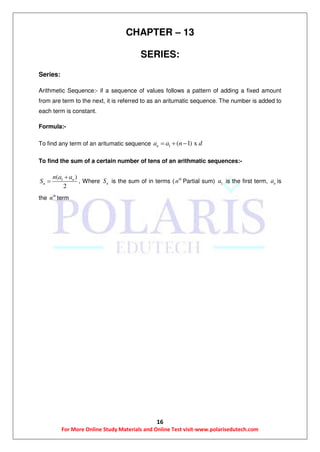
To find any term of an aritumatic sequence 1 ( 1) xna a n d  
To find the sum of a certain number of tens of an arithmatic sequences:-
1( )
2
n
n
n a a
S

 , Where nS is the sum of in terms ( th
n Partial sum) 1a is the first term, na is
the th
n term
17
For More Online Study Materials and Online Test visit-www.polarisedutech.com
CHAPTER – 14
RATIO AND PROPORTION
What is Ratio:- A ratio is a relations ship between two numbers by division of the same
kind. The ration of a or b is written as a : b = a/b, in ratio a : b, we can say that a as the first
term or antecedent and b the second term or consequent
What is Proportion: - The idea of proportions is that two ration are like equal.
If a : b : = c : d, we write a : b : : c : d
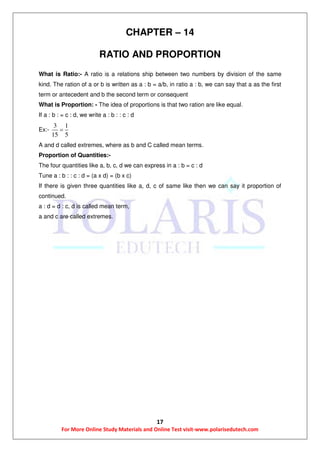
Ex:-
3 1
15 5

A and d called extremes, where as b and C called mean terms.
Proportion of Quantities:-
The four quantities like a, b, c, d we can express in a : b = c : d
Tune a : b : : c : d = (a x d) = (b x c)
If there is given three quantities like a, d, c of same like then we can say it proportion of
continued.
a : d = d : c, d is called mean term,
a and c are called extremes.
18
For More Online Study Materials and Online Test visit-www.polarisedutech.com
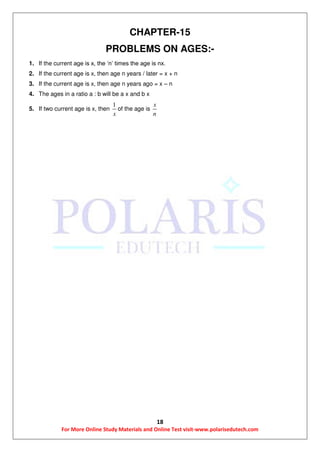
CHAPTER-15
PROBLEMS ON AGES:-
1. If the current age is x, the ‘n’ times the age is nx.
2. If the current age is x, then age n years / later = x + n
3. If the current age is x, then age n years ago = x – n
4. The ages in a ratio a : b will be a x and b x
5. If two current age is x, then
1
x
of the age is
x
n
19
For More Online Study Materials and Online Test visit-www.polarisedutech.com
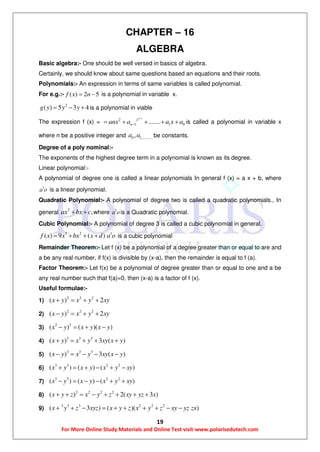
CHAPTER – 16
ALGEBRA
Basic algebra:- One should be well versed in basics of algebra.
Certainly, we should know about same questions based an equations and their roots.
Polynomials:- An expression in terms of same variables is called polynomial.
For e.g.:- ( ) 2 5f x n  is a polynomial in variable x.
2
( ) 5 3 4g y y y   is a polynomial in viable
The expression f (x) =
1
2
1 1 0.......
n
x
nanx a a x a

     is called a polynomial in variable x
where n be a positive integer and 0 1............,a a be constants.
Degree of a poly nominal:-
The exponents of the highest degree term in a polynomial is known as its degree.
Linear polynomial:-
A polynomial of degree one is called a linear polynomials In general f (x) = a x + b, where
1
a o is a linear polynomial.
Quadratic Polynomial:- A polynomial of degree two is called a quadratic polynomials., In
general
2
,ax bx c  where 1
a ois a Quadratic polynomial.
Cubic Polynomial:- A polynomial of degree 3 is called a cubic polynomial in general.
3 2 1
( ) 9 ( )f x x bx x d a o    is a cubic polynomial
Remainder Theorem:- Let f (x) be a polynomial of a degree greater than or equal to are and
a be any real number, if f(x) is divisible by (x-a), then the remainder is equal to f (a).
Factor Theorem:- Let f(x) be a polynomial of degree greater than or equal to one and a be
any real number such that f(a)=0, then (x-a) is a factor of f (x).
Useful formulae:-
1)
2 2 2
( ) 2x y x y xy   
2)
2 2 2
( ) 2x y x y xy   
3)
2 2
( ) ( )( )x y x y x y   
4)
3 3 3
( ) 3 ( )x y x y xy x y    
5)
3 3 3
( ) 3 ( )x y x y xy x y    
6)
3 3 2 2
( ) ( ) ( )x y x y x y xy     
7)
3 3 2 2
( ) ( ) ( )x y x y x y xy     
8)
2 2 2 2
( ) 2( 3 )x y z x y z xy yz x       
9)
3 3 3 2 2 2
( 3 ) ( )( )x y z xyz x y z x y z xy yz zx         
20
For More Online Study Materials and Online Test visit-www.polarisedutech.com
10) If 0,x y z   then
3 3 3
3 ....x y z xyz  
21
For More Online Study Materials and Online Test visit-www.polarisedutech.com
CHAPTER – 17
PROFIT AND LOSS
Cost Price:- The price, at which an article is purchased, is called its cost price, abbreviate
as C.P.
Selling Price:- The price, at which an article is sold, is called its selling Prices, abbreviated
as S.P.
Profit or Gain:
If S.P. is greater than C.P, the seller is said to have a profit or gain.
Loss:- If S.P. is less than C.P, the seller is said to have incurred a loss.
Important formulae:-
1. Gain = (S.P) – (C.P)
2. Loss = (C.P) – (S.P)
3. Loss or gain is always reckoned an C.P
4. Gain% =
x 100
( )
.
Gain
C P
5. Loss%=
x 100
( )
.
Loss
C P
6. Selling Price:-
(100 %)
. [ x . ]
100
Gain
S P C P


7. Selling Price:-
(100 %)
. [ x . ]
100
Loss
S P C P


Cost Price (C.P)
8. Cost Price (C.P)
100
. [ x . ]
(100 %)
C P S P
Gain


9. Cost Price (I.P)
100
. [ x . ]
(100 %)
C P S P
Loss


10. When a person sells two similar items, one at a gain at say x%, and the o three at a loss
of x%, then free seller always incurs a loss given by:
2 2& %
%( ) ( )
10 10
Common Loss and Grain x
Loss 
11. If a trader professor to sell his goods at C.P, but uses false weights, then
% ( x100)%
( ) ( )
Error
Gain
True value error

 
22
For More Online Study Materials and Online Test visit-www.polarisedutech.com
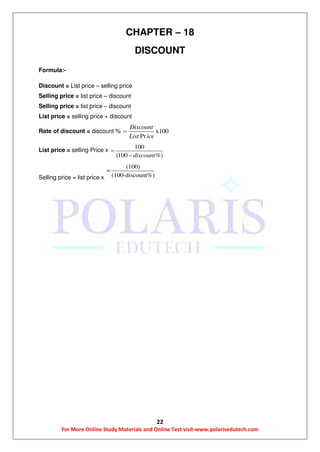
CHAPTER – 18
DISCOUNT
Formula:-
Discount = List price – selling price
Selling price = list price – discount
List price = selling price + discount
Rate of discount = discount % x100
Pr
Discount
List ice

List price = selling Price x
100
(100 %)discount


Selling price = list price x
(100)
=
(100-discount%)
23
For More Online Study Materials and Online Test visit-www.polarisedutech.com
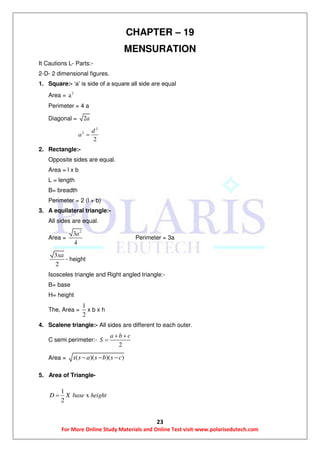
CHAPTER – 19
MENSURATION
It Cautions L- Parts:-
2-D- 2 dimensional figures.
1. Square:- ‘a’ is side of a square all side are equal
Area = 2
a
Perimeter = 4 a
Diagonal = 2a
2
2
2
d
a 
2. Rectangle:-
Opposite sides are equal.
Area = l x b
L = length
B= breadth
Perimeter = 2 (l + b)
3. A equilateral triangle:-
All sides are equal.
Area =
2
3
4
a
Perimeter = 3a
3
2
xa
- height
Isosceles triangle and Right angled triangle:-
B= base
H= height
The, Area =
1
2
x b x h
4. Scalene triangle:- All sides are different to each outer.
C semi perimeter:-
2
a b c
S
 

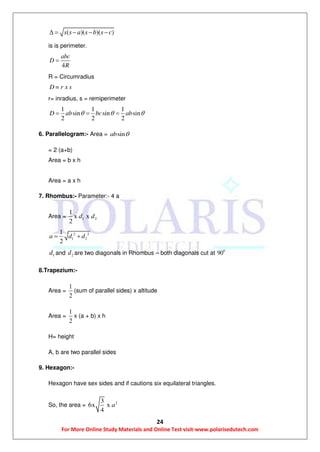
Area = ( )( )( )s s a s b s c  
5. Area of Triangle-
1
x
2
D X base height
24
For More Online Study Materials and Online Test visit-www.polarisedutech.com
( )( )( )s s a s b s c    
is is perimeter.
4
abc
D
R

R = Circumradius
D= r x s
r= inradius, s = remiperimeter
1 1 1
sin sin sin
2 2 2
D ab bc ab    
6. Parallelogram:- Area = sinab 
= 2 (a+b)
Area = b x h
Area = a x h
7. Rhombus:- Parameter:- 4 a
Area = 1 2
1
x x
2
d d
2 2
1 2
1
2
a d d 
1d and 2d are two diagonals in Rhombus – both diagonals cut at 0
90
8.Trapezium:-
Area =
1
2
(sum of parallel sides) x altitude
Area =
1
2
x (a + b) x h
H= height
A, b are two parallel sides
9. Hexagon:-
Hexagon have sex sides and if cautions six equilateral triangles.
So, the area = 23
6x x
4
a
25
For More Online Study Materials and Online Test visit-www.polarisedutech.com
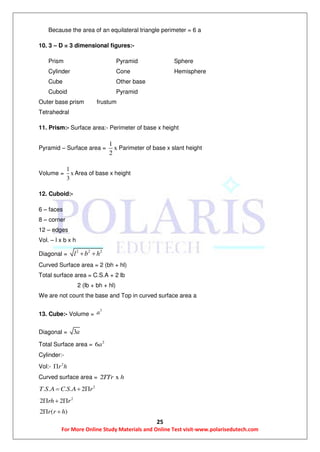
Because the area of an equilateral triangle perimeter = 6 a
10. 3 – D = 3 dimensional figures:-
Prism Pyramid Sphere
Cylinder Cone Hemisphere
Cube Other base
Cuboid Pyramid
Outer base prism frustum
Tetrahedral
11. Prism:- Surface area:- Perimeter of base x height
Pyramid – Surface area =
1
x
2
Parimeter of base x slant height
Volume =
1
x
3
Area of base x height
12. Cuboid:-
6 – faces
8 – corner
12 – edges
Vol. – l x b x h
Diagonal =
2 2 2
l b h 
Curved Surface area = 2 (bh + hl)
Total surface area = C.S.A + 2 lb
2 (lb + bh + hl)
We are not count the base and Top in curved surface area a
13. Cube:- Volume =
3
a
Diagonal = 3a
Total Surface area = 2
6a
Cylinder:-
Vol:- 2
r h
Curved surface area = 2 xTTr h
2
. . . . 2T S A C S A r  
2
2 2rh r  
2 ( )r r h 
26
For More Online Study Materials and Online Test visit-www.polarisedutech.com
14. Cone:-
2 2
l r h 
Slant height.
Vol:- 21
x
3
r h
C.S.A = rl
2
. .T S A rl r  
( )r r l 
15. Sphere:- Vol:-
34
3
r
2
. . 4C S A r 
16. Hemisphere – Vol: -
32
3
r
2
. . 3C S A r 
17. Frustum of a cone:-
Vol:- 2 2
x (R )
3
h
r Rr

 
2 2 2
= h ( )l R r  
Curved Surface area = l (R + r)
Total Surface area:- (area of the base) + (area of the Top) + (curved surface area)
=
2 2
{ ( )}R r l R r   
=
2 2
[ ( )]R r l R r   
18. Probability:- it’s a possibility of any towing.
Probability =
l n .
Number of favourable out comes
Tota o of out comes
If tossed a coin, then we have two possibility either head or tail.
2-possibilities
If we tossed two coins times then Possibility {TH, HT, HH, TT}
****##****

Math Study Material for SSC and Banking Exam

  • 1.
    1 For More OnlineStudy Materials and Online Test visit-www.polarisedutech.com CHAPTER – 1 AVERAGE Average Formulae: - Add up all the numbers, than divide by how many numbers there are. Sum of observations Average Number of observations  Find the average speed  If a person travels a distance at a speed of x Km/hr and the same distance at a speed of y km/hr then the average speed during the whole journey is given by:- 2xy x y  If a person covers A km at x km/hr and B km at y km/hr and C km at z km/hr, then the average speed in covering the whole distance is: A B C A B c x y z      When a person leaves the group and another person joins the group in place of that person then- o If the average age is increased, Age of new person = age of separated present + (increase in avg. x total no. of persons) o If the average age is decreased. Age of new person = age of separated person - (decreases in avg. x total no of persons). o When a person joins the group – in case of increase in avg. Age of new member = previous average + (increase in avg. x number of members including new members). o In case of decrease in average Age of new members = previous avg. – (decrease in avg. x number of members including new member).  When the number of terms is odd, the average will be the middle term.  When the number of terms is even the Avg. will be the avg. of two middle terms.  Arithmetic Progression:- a, a + d, a + 2d, a + 3d,…………..
  • 2.
    2 For More OnlineStudy Materials and Online Test visit-www.polarisedutech.com First term = a Difference = d nth term =  �� = a +(n-1) x d  Sum of ‘n’ terms 2 n Sn  [2a + (n-1) x d]  Sum of first ‘n’ natural numbers (1+2+3+--------+n) = ½ n(n+1)  Sum of ‘n’ odd no. + + 5 + ⋯ … … + � − = n2 ' 'sum of n even no (2+4+6+…………+2n) = n (n+1) = sum of first squares of ‘n’ natural no. 2 2 2 2 1 1 (1 2 3 .........t ) x x ( 1)x(2 1) 6 6 n n n n n       Sum of first cubic of ‘n’ natural no. 3 3 3 1 (1 2 .........t ) ( 1)}. 2 n n n       ****##****
  • 3.
    3 For More OnlineStudy Materials and Online Test visit-www.polarisedutech.com CHAPTER-2 COMPOUND INTEREST Compound Interest:- Where interest is calculated on both the amount borrowed and any previous interest. Usually calculated one or more times per year. formulae:- When The Interest is compounded annually Amount after ‘n’ years = A = P(1 ) 100 nR  Compound interest = 4 (1 ) [(1 ) 1] 100 100 nR R p p p     If P = principal R = rate percent Time = number of years C. I = compound interest A = amount If the rate of interest differs from year to year i.e. R, in the first year, R2 in the second year, R3 in the third year, Then, 31 2 (1 )(1 )(1 ) 100 100 100 RR R A      When the principal changes every year, we say the interest is compound annually. Then, (1 ) 100 nR A P   When the principal changes as per every six months we say that the interest is compounded half yearly or semi – annually. Then, 22(1 ) 100 n R A P  - Quarterly 44(1 ) 100 n R A P  ****##****
  • 4.
    4 For More OnlineStudy Materials and Online Test visit-www.polarisedutech.com CHAPTER – 3 SIMPLE INTEREST SIMPLE INTEREST:- Define:- simple interest is interest paid any the original principal not on the interest accrued. Formula:- P X R X T . 100 S I  S.I – Simple Interest R = Rate percent T = Time in years
  • 5.
    5 For More OnlineStudy Materials and Online Test visit-www.polarisedutech.com CHAPTER – 4 BOAT AND STREAM Boat and Stream Formulae:-  If the boat speed is x km/h in downstream y km/h in upstream, then Speed of boat in still water is ( ) 2 x y speed of stream = ( ) 2 x y  If speed of boat is x km/h and speed of stream is y km/h, then Boat speed in downstream = x + y km/hr (both speeds are added) Boat speed in upstream = x-y km/hr (y is subtracted from x) Because boat speed is in opposite direction to speed of stream). If the speed of boat or person in still water is x and speed of stream is y and the boat has to cover a distance ‘d’ km Then time taken in down stream 1 tan ( ) ( ) d dis ce T Time x y speed     Time taken in upstream 2 ( ) d T x y   Total time taken in going down stream and upstream 1 2 [ ] d d T T T x y x y       ***##****
  • 6.
    6 For More OnlineStudy Materials and Online Test visit-www.polarisedutech.com CHAPTER – 5 H.C.F AND L.C.M H.C.F and L.C.M:- Highest common factor and lowest common factor Formulae:- When solving H.C.F and L.C.M questions with fractions These formulas are very helpful 1. . . . . . . H C F of Numerators H C F L C M of Numerators  2. . . . . . . Denanenators L C M of Numerators L C M H C F of  3. Product of two numbers:- Product of two numbers = product of their H.C.F and L.C.M
  • 7.
    7 For More OnlineStudy Materials and Online Test visit-www.polarisedutech.com CHAPTER – 6 TIME AND DISTANCE tanDis ce Speed Time  Conversion of km/hr to m/s 1 kmph = 5 18 m/s Conversion of m/s to km/hr 1 m/s = 18 5 km/hr  If the ratio of speed of train A and B is a : b, then the ratio of time taken by them to cover the same distance = b : a.  If a man covers a certain distance at x km/hr and an equal distance at y km/hr. Then the avg. speed during the whole journey is. 2 / ( ) xy km h x y  The time taken by a train in passing a pole or standing man is the same as the time taken by the train to cover a distance equal to its own length  The time taken by a train of length ‘L’ meters in passing a stationary object of length ‘B’ meters is equal (L+B) m.  If two trains are moving in the same direction at U m/s and V m/s where U>V, then their relative speed will be equal to the difference of their speeds (U-V) m/s.  If two trains are moving in the opposite direction at um/s and Vm/s then their relative speed will be equal to the sum of their speed (U+V) m/s.  If two trains of length ‘a’ meters and ‘b’ meters and moving in the same directions at U m/s and Vm/s respectively, then  The time taken by the faster train to cross the slower train is:- (a + b) / (u-v) sec.  If two trains of length ‘a’ meters and ‘b’ meters are moving in the opposite direction at U m/s and V m/s respectively, then the time taken by the faster train to cross the slower train is a b u v   sec.
  • 8.
    8 For More OnlineStudy Materials and Online Test visit-www.polarisedutech.com CHAPTER – 7 PERMUTATION AND COMBINATION Formulae: 1. Factorial Notation:- Let ‘n’ be the positive integer. Then, factorial n, dented n: is defined as: Factorial n, denoted n: is defined as: 1 0 ( 1)( 2).........3. 2. 1n n n n   2. Number of Permutations:- Number of all permutations of ‘n’ things, taken r at a time, is given by : 1 0 1 0 P ( 1)( 2)..........( 1) ( ) n r n n n n n r n r        3. Permutation: - The different arrangements of a given no. of things by taking some or all at a time, are called permutations. 4. Combination:- Each of the different groups or selections which can be formed by taking some or all of a number of objects is called combination. 5. Number of Combination:- The number of all combinations of ‘n’ things, Taken r at a time is:- 1 0 1 0( 1)( ) n r n C r n r  
  • 9.
    9 For More OnlineStudy Materials and Online Test visit-www.polarisedutech.com CHAPTER – 8 TIME AND WORK Formulae:- 1. Work from days: If A can do a piece of work in ‘n’ days, then A’s 1 day’s work = 1 n 2. Days from work: If A’s 1 day’s work = 1 n Two A can finish the work in n day. 3. Ratio: If A is Thrice as good a work man as then, Ration of work done by A due B = 3 : 1 Ration of times taken by A and B to finish a work = 1 : 3.
  • 10.
    10 For More OnlineStudy Materials and Online Test visit-www.polarisedutech.com CHAPTER – 9 PIPES AND CISTERN Inlet:- A pipe connected with a tank or a cistern or a reservoir, that tills it, is known as an inlet. Outlet:- 1. A pipe connected with a tank or a cistern or a reservoir, emptying it, is known as an outlet. 1) if a pipe can fill a tank in x hours, two; part filled in 1 hour 1 x  2) if a pipe can empty a tank in y hours, then: part emptied in 1 hour 1 y  3) if a pipe can fill a tank in ‘x’ hours and another pipe can empty the full tank in y hours (where y>x), then an opening both the pipes, then the net part filled in 1 hour = 1 1 ( ) x y   4) if a pipe can fill a tank in x hours and another pipe can empty the full tank in y hours where (x > y), then an opening both the pipes, then the net part emptied in 1 hour 1 1 ( ) y x  
  • 11.
    11 For More OnlineStudy Materials and Online Test visit-www.polarisedutech.com CHAPTER – 10 MIXTURE AND ALLEGATION Mixture and Allegation:- 1. Allegation:- it is the rule that enables us to find the ratio in which two or more ingredients at two given price must be mixed to produce a mixture of desired price. 2. Mean Price:- The cost of a unit quantity of the mixture is called the mean price. 3. Rule of allegation:- It two ingredients are mixed, then . Pr ( )=( ) Pr . Quantity of Cheaper C P of dearer Mean ice Quantity of dearer Mean ice C P of Cheap    We present as under:- . ( ) E P of a unit Quantity c . ( ) E P of unit Quantity of dearer d C.P of a unit quantity Mean price (m) (Cheaper Quantity) : (Dearer Quantity) ( )d m ( )m c = (d-m) : (m-c). 4. Suppose a Container Contains x of liquid from which y units are taken out an replaced by water. After ‘n ’ operations, the Quantity of pure liquid = (1 )ny x x      units.
  • 12.
    12 For More OnlineStudy Materials and Online Test visit-www.polarisedutech.com CHAPTER – 11 PARTNERSHIP Partnership:- When two or more than two persons runs a business jointly, They are called partners and the deal is known as partnership. 1. Ration of Divisions of Gains:- (i) When investments of all the partners are for the same time, the gain or loss is distributed among the partners in the ration of their investments. Suppose A and B invest Rs x and Rs. Respectively for a year in a business, then at the end of the year. (A’s share of Profit) : (B’s share of profit) = x:y (ii) When investments are for different time period then equivalent capitals are calculated for a unit of time by taking (capital x number of units of time). Now gain or loss is divided in the ratio of these capitals suppose A invests Rs x for p months then, B (A’s share of forfeit) : (B’s share of profit) = x p : y q.
  • 13.
    13 For More OnlineStudy Materials and Online Test visit-www.polarisedutech.com CHAPTER – 12 NUMBER SYSTEM:- Formulas:- 1. 11,2,3..........O a are called digits. 2. 10, 11, 12,……….are called number. 3. Natural number (N):- Counting numbers are called natural numbers. Ex:- 1, 2, 3,…………..etc. are all natural numbers, minimum natural number 1 and maximum ∞. Whole numbers:- if W is the set of whole numbers, then we write = {0, 1, 2,……….} The smallest whole number 0. Integer:- if I is the set of integers, then we write I = {-3, -2, -1, 0, 1, 2, 3………} Rational No. – Any number which can be expressed in the form of plq. When p and q are both integers and g o are called rational numbers. E. g. = 3 7 , ,5, 2 2 9   There exists infinite number of rational number between any two rational numbers. Irrational numbers:- Non-recurring and non-termination decimals are called irrational numbers. These number cannot be expressed in the form of p q . E.g. = 3, 5, 29.......... Real numbers:- Real numbers include both rational and irrational numbers. In General the number of n digit number are 1 9 10n X   Sum of first ‘n’ natural numbers 1 +2+ 3+ ……..+n ( 1) 2 n n    Sum of the squares of the first n natural no 2 2 2 2 ( 1)(2 1) 1 2 3 .......... 6 n n n n      Sum of cube of the first n natural numbers –
  • 14.
    14 For More OnlineStudy Materials and Online Test visit-www.polarisedutech.com 2 3 3 3 3 ( 1) 1 2 3 .......... 2 n n n           Rules of divisibility:- Divisibility by 2: A number is divisible by 2 when the digit at ones place is 0, 2 4, 6 or 8. Eg:- 3582, 460,………. Is divisibity by 3:- A number is divisible by 3 when sum of all digits of a number is divisible by 3. Eg:- 435 = 4+5+3=12 12 is divisible by 3. So, 435 is also divisible by 3.  Divisibility by 5: A number is divisible by 5 if its last digit is 0 or 5. Eg:- 10, 25, 60.  Divisibility by 6: A number is divisible by 6, if it is divisible by both 2 and 3. 48, 24, 108.  Divisibility by 7:- A number is divisible by 7 when the difference between twice the digit at ones place and the number formed by other digits is either zero or divisible by 7. Eg:- 658. 65-2 X 8 = 65 – 16 = 49 As 49 is divisible by 7 the number 658 is also divisible by 7  Divisibility by 8:- A number is divisible by 8. If a number formed by the last 3 digits of the number is divisible by 8. Eg:- if we take the number 57832. The last three digits form 832. Since, the number 832 is divisible by 8. The number 57832 is also divisible by 8.  Divisibility by 9: A number is divisible by if the sum if all the digits of number is divisible by 9. Eg: - 6 & 4 = 6+8+4=18 If is divisible by 9 so, 684 is also divisible by 9.  Divisibility by 10:- A number is divisible by 10, if its last digit is o eg. 20, 180, 350,  Divisibility by 11:- A number is divisible by 11. When the diffevncle between the sum of its digits in odd places and in even places is either O or divisible by 11 30426 3+4+6=13 0+2=2 13-2=11 As the difference is divisible by 11 the numbers 30426 is also divisible by 11.  Division on numbers:- In a sum of division, we have four quantities:- They are (i) dividend (ii) Divisor (iii) Quotient (iv) Remainder Relation:- (a) Dividend = Divisor X Quotient + Remainder
  • 15.
    15 For More OnlineStudy Materials and Online Test visit-www.polarisedutech.com (b) Divisor = (Dividend – Remainder)  Quotient (c) Quotient = (Dividend – Remainder)  Divisor
  • 16.
    16 For More OnlineStudy Materials and Online Test visit-www.polarisedutech.com CHAPTER – 13 SERIES: Series: Arithmetic Sequence:- if a sequence of values follows a pattern of adding a fixed amount from are term to the next, it is referred to as an aritumatic sequence. The number is added to each term is constant. Formula:- To find any term of an aritumatic sequence 1 ( 1) xna a n d   To find the sum of a certain number of tens of an arithmatic sequences:- 1( ) 2 n n n a a S   , Where nS is the sum of in terms ( th n Partial sum) 1a is the first term, na is the th n term
  • 17.
    17 For More OnlineStudy Materials and Online Test visit-www.polarisedutech.com CHAPTER – 14 RATIO AND PROPORTION What is Ratio:- A ratio is a relations ship between two numbers by division of the same kind. The ration of a or b is written as a : b = a/b, in ratio a : b, we can say that a as the first term or antecedent and b the second term or consequent What is Proportion: - The idea of proportions is that two ration are like equal. If a : b : = c : d, we write a : b : : c : d Ex:- 3 1 15 5  A and d called extremes, where as b and C called mean terms. Proportion of Quantities:- The four quantities like a, b, c, d we can express in a : b = c : d Tune a : b : : c : d = (a x d) = (b x c) If there is given three quantities like a, d, c of same like then we can say it proportion of continued. a : d = d : c, d is called mean term, a and c are called extremes.
  • 18.
    18 For More OnlineStudy Materials and Online Test visit-www.polarisedutech.com CHAPTER-15 PROBLEMS ON AGES:- 1. If the current age is x, the ‘n’ times the age is nx. 2. If the current age is x, then age n years / later = x + n 3. If the current age is x, then age n years ago = x – n 4. The ages in a ratio a : b will be a x and b x 5. If two current age is x, then 1 x of the age is x n
  • 19.
    19 For More OnlineStudy Materials and Online Test visit-www.polarisedutech.com CHAPTER – 16 ALGEBRA Basic algebra:- One should be well versed in basics of algebra. Certainly, we should know about same questions based an equations and their roots. Polynomials:- An expression in terms of same variables is called polynomial. For e.g.:- ( ) 2 5f x n  is a polynomial in variable x. 2 ( ) 5 3 4g y y y   is a polynomial in viable The expression f (x) = 1 2 1 1 0....... n x nanx a a x a       is called a polynomial in variable x where n be a positive integer and 0 1............,a a be constants. Degree of a poly nominal:- The exponents of the highest degree term in a polynomial is known as its degree. Linear polynomial:- A polynomial of degree one is called a linear polynomials In general f (x) = a x + b, where 1 a o is a linear polynomial. Quadratic Polynomial:- A polynomial of degree two is called a quadratic polynomials., In general 2 ,ax bx c  where 1 a ois a Quadratic polynomial. Cubic Polynomial:- A polynomial of degree 3 is called a cubic polynomial in general. 3 2 1 ( ) 9 ( )f x x bx x d a o    is a cubic polynomial Remainder Theorem:- Let f (x) be a polynomial of a degree greater than or equal to are and a be any real number, if f(x) is divisible by (x-a), then the remainder is equal to f (a). Factor Theorem:- Let f(x) be a polynomial of degree greater than or equal to one and a be any real number such that f(a)=0, then (x-a) is a factor of f (x). Useful formulae:- 1) 2 2 2 ( ) 2x y x y xy    2) 2 2 2 ( ) 2x y x y xy    3) 2 2 ( ) ( )( )x y x y x y    4) 3 3 3 ( ) 3 ( )x y x y xy x y     5) 3 3 3 ( ) 3 ( )x y x y xy x y     6) 3 3 2 2 ( ) ( ) ( )x y x y x y xy      7) 3 3 2 2 ( ) ( ) ( )x y x y x y xy      8) 2 2 2 2 ( ) 2( 3 )x y z x y z xy yz x        9) 3 3 3 2 2 2 ( 3 ) ( )( )x y z xyz x y z x y z xy yz zx         
  • 20.
    20 For More OnlineStudy Materials and Online Test visit-www.polarisedutech.com 10) If 0,x y z   then 3 3 3 3 ....x y z xyz  
  • 21.
    21 For More OnlineStudy Materials and Online Test visit-www.polarisedutech.com CHAPTER – 17 PROFIT AND LOSS Cost Price:- The price, at which an article is purchased, is called its cost price, abbreviate as C.P. Selling Price:- The price, at which an article is sold, is called its selling Prices, abbreviated as S.P. Profit or Gain: If S.P. is greater than C.P, the seller is said to have a profit or gain. Loss:- If S.P. is less than C.P, the seller is said to have incurred a loss. Important formulae:- 1. Gain = (S.P) – (C.P) 2. Loss = (C.P) – (S.P) 3. Loss or gain is always reckoned an C.P 4. Gain% = x 100 ( ) . Gain C P 5. Loss%= x 100 ( ) . Loss C P 6. Selling Price:- (100 %) . [ x . ] 100 Gain S P C P   7. Selling Price:- (100 %) . [ x . ] 100 Loss S P C P   Cost Price (C.P) 8. Cost Price (C.P) 100 . [ x . ] (100 %) C P S P Gain   9. Cost Price (I.P) 100 . [ x . ] (100 %) C P S P Loss   10. When a person sells two similar items, one at a gain at say x%, and the o three at a loss of x%, then free seller always incurs a loss given by: 2 2& % %( ) ( ) 10 10 Common Loss and Grain x Loss  11. If a trader professor to sell his goods at C.P, but uses false weights, then % ( x100)% ( ) ( ) Error Gain True value error   
  • 22.
    22 For More OnlineStudy Materials and Online Test visit-www.polarisedutech.com CHAPTER – 18 DISCOUNT Formula:- Discount = List price – selling price Selling price = list price – discount Selling price = list price – discount List price = selling price + discount Rate of discount = discount % x100 Pr Discount List ice  List price = selling Price x 100 (100 %)discount   Selling price = list price x (100) = (100-discount%)
  • 23.
    23 For More OnlineStudy Materials and Online Test visit-www.polarisedutech.com CHAPTER – 19 MENSURATION It Cautions L- Parts:- 2-D- 2 dimensional figures. 1. Square:- ‘a’ is side of a square all side are equal Area = 2 a Perimeter = 4 a Diagonal = 2a 2 2 2 d a  2. Rectangle:- Opposite sides are equal. Area = l x b L = length B= breadth Perimeter = 2 (l + b) 3. A equilateral triangle:- All sides are equal. Area = 2 3 4 a Perimeter = 3a 3 2 xa - height Isosceles triangle and Right angled triangle:- B= base H= height The, Area = 1 2 x b x h 4. Scalene triangle:- All sides are different to each outer. C semi perimeter:- 2 a b c S    Area = ( )( )( )s s a s b s c   5. Area of Triangle- 1 x 2 D X base height
  • 24.
    24 For More OnlineStudy Materials and Online Test visit-www.polarisedutech.com ( )( )( )s s a s b s c     is is perimeter. 4 abc D R  R = Circumradius D= r x s r= inradius, s = remiperimeter 1 1 1 sin sin sin 2 2 2 D ab bc ab     6. Parallelogram:- Area = sinab  = 2 (a+b) Area = b x h Area = a x h 7. Rhombus:- Parameter:- 4 a Area = 1 2 1 x x 2 d d 2 2 1 2 1 2 a d d  1d and 2d are two diagonals in Rhombus – both diagonals cut at 0 90 8.Trapezium:- Area = 1 2 (sum of parallel sides) x altitude Area = 1 2 x (a + b) x h H= height A, b are two parallel sides 9. Hexagon:- Hexagon have sex sides and if cautions six equilateral triangles. So, the area = 23 6x x 4 a
  • 25.
    25 For More OnlineStudy Materials and Online Test visit-www.polarisedutech.com Because the area of an equilateral triangle perimeter = 6 a 10. 3 – D = 3 dimensional figures:- Prism Pyramid Sphere Cylinder Cone Hemisphere Cube Other base Cuboid Pyramid Outer base prism frustum Tetrahedral 11. Prism:- Surface area:- Perimeter of base x height Pyramid – Surface area = 1 x 2 Parimeter of base x slant height Volume = 1 x 3 Area of base x height 12. Cuboid:- 6 – faces 8 – corner 12 – edges Vol. – l x b x h Diagonal = 2 2 2 l b h  Curved Surface area = 2 (bh + hl) Total surface area = C.S.A + 2 lb 2 (lb + bh + hl) We are not count the base and Top in curved surface area a 13. Cube:- Volume = 3 a Diagonal = 3a Total Surface area = 2 6a Cylinder:- Vol:- 2 r h Curved surface area = 2 xTTr h 2 . . . . 2T S A C S A r   2 2 2rh r   2 ( )r r h 
  • 26.
    26 For More OnlineStudy Materials and Online Test visit-www.polarisedutech.com 14. Cone:- 2 2 l r h  Slant height. Vol:- 21 x 3 r h C.S.A = rl 2 . .T S A rl r   ( )r r l  15. Sphere:- Vol:- 34 3 r 2 . . 4C S A r  16. Hemisphere – Vol: - 32 3 r 2 . . 3C S A r  17. Frustum of a cone:- Vol:- 2 2 x (R ) 3 h r Rr    2 2 2 = h ( )l R r   Curved Surface area = l (R + r) Total Surface area:- (area of the base) + (area of the Top) + (curved surface area) = 2 2 { ( )}R r l R r    = 2 2 [ ( )]R r l R r    18. Probability:- it’s a possibility of any towing. Probability = l n . Number of favourable out comes Tota o of out comes If tossed a coin, then we have two possibility either head or tail. 2-possibilities If we tossed two coins times then Possibility {TH, HT, HH, TT} ****##****