Basic Aptitude Class
3-Hour Session | Fundamentals
& Problem-Solving
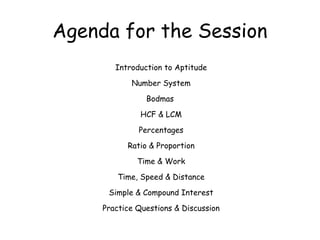
Agenda for the Session
Introduction to Aptitude
Number System
Bodmas
HCF & LCM
Percentages
Ratio & Proportion
Time & Work
Time, Speed & Distance
Simple & Compound Interest
Practice Questions & Discussion
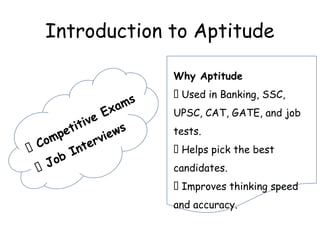
Introduction to Aptitude
✅ Competitive Exams
✅ Job Interviews
Why Aptitude
📌 Used in Banking, SSC,
UPSC, CAT, GATE, and job
tests.
📌 Helps pick the best
candidates.
📌 Improves thinking speed
and accuracy.
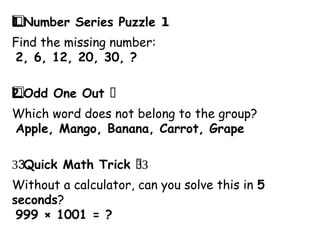
Number Series Puzzle 1️
1️
⃣
Find the missing number:
2, 6, 12, 20, 30, ?
Odd One Out ❌
2️
⃣
Which word does not belong to the group?
Apple, Mango, Banana, Carrot, Grape
Quick Math Trick ➕
3️ 3️
3
️
3
️
3
️
3
️
3
️
3
️
3
️
3
️
3
️
3
️
3
️
3
️
3️
Without a calculator, can you solve this in 5
seconds?
999 × 1001 = ?
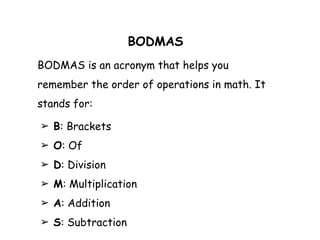
BODMAS
BODMAS is an acronym that helps you
remember the order of operations in math. It
stands for:
➢ B: Brackets
➢ O: Of
➢ D: Division
➢ M: Multiplication
➢ A: Addition
➢ S: Subtraction
BODMAS
1. 45-(28-(37-(15-p))) = 58
2. [(18 – 6) ÷ 4] + [72 – 12 ÷ 3 of 2]
3. 12 + 6 × 27 ÷ 3 + 2 – 16 ÷ 8 × 2
4. 8 ÷ 4 × (6 + 2 of 4) + 32 – 2
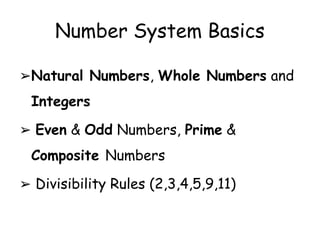
Number System Basics
➢Natural Numbers, Whole Numbers and
Integers
➢ Even & Odd Numbers, Prime &
Composite Numbers
➢ Divisibility Rules (2,3,4,5,9,11)
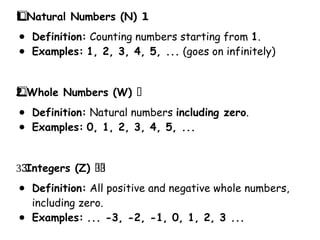
Natural Numbers (N) 1️
1️
⃣
● Definition: Counting numbers starting from 1.
● Examples: 1, 2, 3, 4, 5, ... (goes on infinitely)
Whole Numbers (W) 🔢
2️
⃣
● Definition: Natural numbers including zero.
● Examples: 0, 1, 2, 3, 4, 5, ...
Integers (Z) ➖➕
3️ 3️
3
️
3
️
3
️
3
️
3
️
3
️
3
️
3
️
3
️
3
️
3
️
3
️
3️
● Definition: All positive and negative whole numbers,
including zero.
● Examples: ... -3, -2, -1, 0, 1, 2, 3 ...
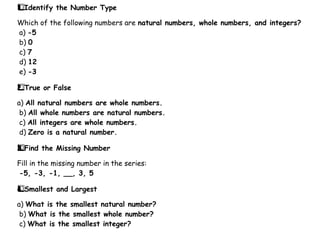
Identify the Number Type
1️
1️
⃣
Which of the following numbers are natural numbers, whole numbers, and integers?
a) -5
b) 0
c) 7
d) 12
e) -3
True or False
2️
⃣
a) All natural numbers are whole numbers.
b) All whole numbers are natural numbers.
c) All integers are whole numbers.
d) Zero is a natural number.
Find the Missing Number
3️
3️
⃣
Fill in the missing number in the series:
-5, -3, -1, __, 3, 5
Smallest and Largest
4️
⃣
a) What is the smallest natural number?
b) What is the smallest whole number?
c) What is the smallest integer?
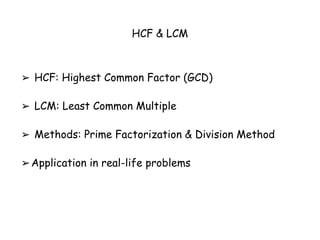
HCF & LCM
➢ HCF: Highest Common Factor (GCD)
➢ LCM: Least Common Multiple
➢ Methods: Prime Factorization & Division Method
➢Application in real-life problems
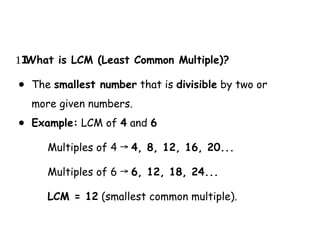
What is LCM (Least Common Multiple)?
1️
1️
1️
1️
1️
1️
1️
1️
1️
1️
1️
1️
1️
1️
1️
● The smallest number that is divisible by two or
more given numbers.
● Example: LCM of 4 and 6
Multiples of 4 → 4, 8, 12, 16, 20...
Multiples of 6 → 6, 12, 18, 24...
LCM = 12 (smallest common multiple).
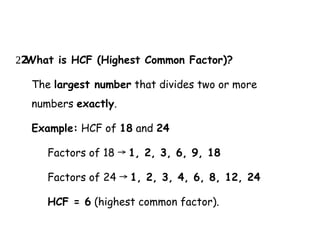
What is HCF (Highest Common Factor)?
2️
2️
2️
2️
2️
2️
2️
2️
2️
2️
2️
2️
2️
2️
2️
The largest number that divides two or more
numbers exactly.
Example: HCF of 18 and 24
Factors of 18 → 1, 2, 3, 6, 9, 18
Factors of 24 → 1, 2, 3, 4, 6, 8, 12, 24
HCF = 6 (highest common factor).
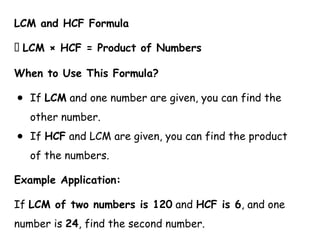
LCM and HCF Formula
📌 LCM × HCF = Product of Numbers
When to Use This Formula?
● If LCM and one number are given, you can find the
other number.
● If HCF and LCM are given, you can find the product
of the numbers.
Example Application:
If LCM of two numbers is 120 and HCF is 6, and one
number is 24, find the second number.
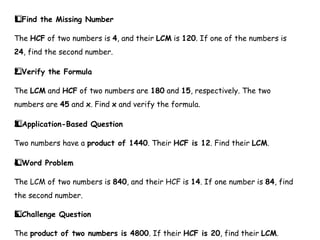
Find the Missing Number
1️
1️
⃣
The HCF of two numbers is 4, and their LCM is 120. If one of the numbers is
24, find the second number.
Verify the Formula
2️
⃣
The LCM and HCF of two numbers are 180 and 15, respectively. The two
numbers are 45 and x. Find x and verify the formula.
Application-Based Question
3️
3️
⃣
Two numbers have a product of 1440. Their HCF is 12. Find their LCM.
Word Problem
4️
⃣
The LCM of two numbers is 840, and their HCF is 14. If one number is 84, find
the second number.
Challenge Question
5️
5️
⃣
The product of two numbers is 4800. If their HCF is 20, find their LCM.
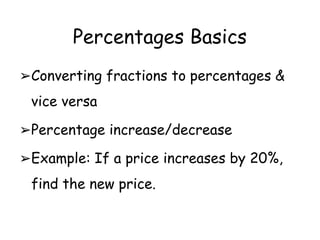
Percentages Basics
➢Converting fractions to percentages &
vice versa
➢Percentage increase/decrease
➢Example: If a price increases by 20%,
find the new price.
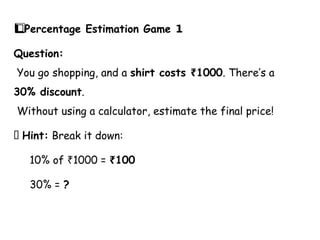
Percentage Estimation Game 1️
1️
⃣
Question:
You go shopping, and a shirt costs 1000
₹ . There’s a
30% discount.
Without using a calculator, estimate the final price!
💡 Hint: Break it down:
10% of 1000 =
₹ 100
₹
30% = ?
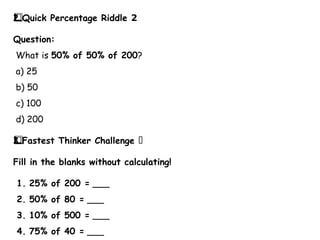
Quick Percentage Riddle 2️
2️
⃣
Question:
What is 50% of 50% of 200?
a) 25
b) 50
c) 100
d) 200
Fastest Thinker Challenge ⏳
3️
⃣
Fill in the blanks without calculating!
1. 25% of 200 = ___
2. 50% of 80 = ___
3. 10% of 500 = ___
4. 75% of 40 = ___
Real-Life Challenge 🏆
4️ 4️
4
️
4
️
4
️
4
️
4
️
4
️
4
️
4
️
4
️
4
️
4
️
4
️
4️
If you scored 80% on a test with 50 questions, how
many did you get right?
Trick Question 🎭
If a number is increased by 25% and then decreased
by 25%, does it return to the original number? 🤔
Where do we use percentages?
➢ Shopping Discounts 🛒
➢ Exam Scores 🎓
➢ Salary Hikes 💰
➢ Population Growth/Decline 📉
Example:
"A shirt originally costs 2000 and has a 20%
₹
discount. What is the final price?"
💡 Solution:
● 20% of 2000 = (20/100) × 2000 = 400
₹ ₹
● Final Price = 2000 - 400 = 1600
₹ ₹ ₹
1 ️
1️⃣What is 25% of 300?
2️⃣A student's marks increased from 40 to 50.
Find the percentage increase.
3 ️
3️⃣A mobile phone was 10,000, but after a
₹
15% discount, what is the new price?
4️⃣A population decreased by 10% from 5000.
What is the new population?
5 ️
5️⃣If a price increases by 50% and then
decreases by 50%, does it return to the
original?
What is a Ratio?
A ratio is a way of comparing two quantities of the
same kind. It tells us how many times one value is
compared to another.
📌 Formula:
Ratio = First Quantity/Second Quantity
a : b
Ratio and Proportion
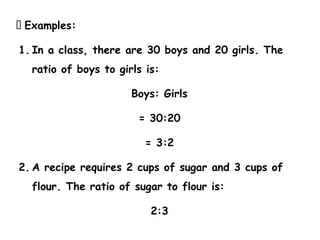
📌 Examples:
1. In a class, there are 30 boys and 20 girls. The
ratio of boys to girls is:
Boys: Girls
= 30:20
= 3:2
2. A recipe requires 2 cups of sugar and 3 cups of
flour. The ratio of sugar to flour is:
2:3
📌 Real-Life Applications of Ratios:
➢ Mixing ingredients in cooking 🍲
➢ Speed (distance:time) in km/hr 🚗
➢ Comparing students’ marks in exams 📚
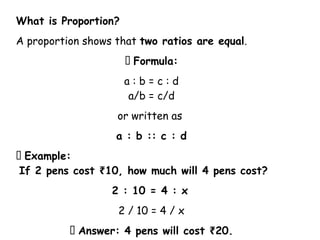
What is Proportion?
A proportion shows that two ratios are equal.
📌 Formula:
a : b = c : d
a/b = c/d
or written as
a : b :: c : d
📌 Example:
If 2 pens cost 10, how much will 4 pens cost?
₹
2 : 10 = 4 : x
2 / 10 = 4 / x
✅ Answer: 4 pens will cost 20.
₹
Time & Work
• Work efficiency concept
• Formula: Work = Efficiency × Time
• Example: A can do a task in 10 days, B in 15 days. How
long together?
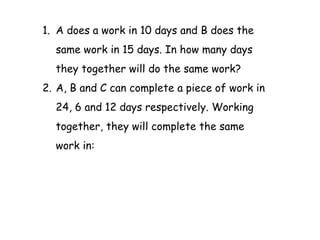
1. A does a work in 10 days and B does the
same work in 15 days. In how many days
they together will do the same work?
2. A, B and C can complete a piece of work in
24, 6 and 12 days respectively. Working
together, they will complete the same
work in:
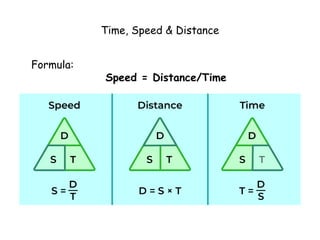
Time, Speed & Distance
Formula:
Speed = Distance/Time
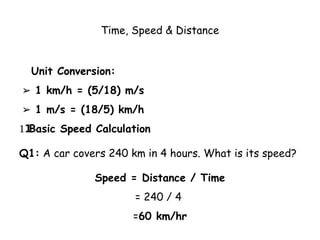
Time, Speed & Distance
Unit Conversion:
➢ 1 km/h = (5/18) m/s
➢ 1 m/s = (18/5) km/h
Basic Speed Calculation
1️
1️
1️
1️
1️
1️
1️
1️
1️
1️
1️
1️
1️
1️
1️
Q1: A car covers 240 km in 4 hours. What is its speed?
Speed = Distance / Time
= 240 / 4
=60 km/hr
Time, Speed & Distance
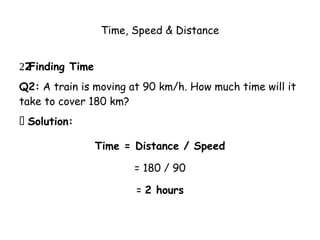
Finding Time
2️
2️
2️
2️
2️
2️
2️
2️
2️
2️
2️
2️
2️
2️
2️
Q2: A train is moving at 90 km/h. How much time will it
take to cover 180 km?
✅ Solution:
Time = Distance / Speed
= 180 / 90
= 2 hours
Time, Speed & Distance
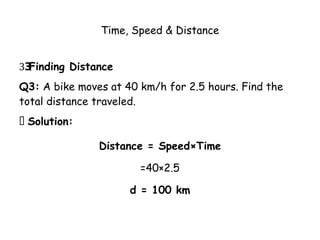
Finding Distance
3️
3️
3️
3️
3️
3️
3️
3️
3️
3️
3️
3️
3️
3️
3️
Q3: A bike moves at 40 km/h for 2.5 hours. Find the
total distance traveled.
✅ Solution:
Distance = Speed×Time
=40×2.5
d = 100 km
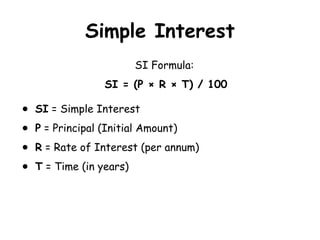
Simple Interest
SI Formula:
SI = (P × R × T) / 100
● SI = Simple Interest
● P = Principal (Initial Amount)
● R = Rate of Interest (per annum)
● T = Time (in years)
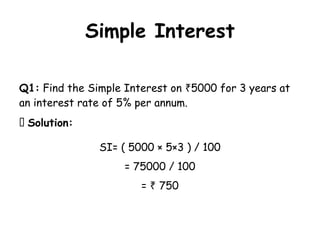
Simple Interest
Q1: Find the Simple Interest on 5000 for 3 years at
₹
an interest rate of 5% per annum.
✅ Solution:
SI= ( 5000 × 5×3 ) / 100
= 75000 / 100
= 750
₹
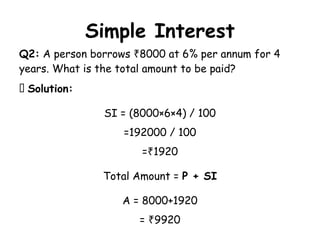
Simple Interest
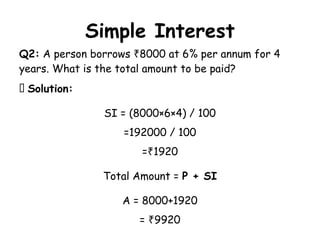
Q2: A person borrows 8000 at 6% per annum for 4
₹
years. What is the total amount to be paid?
✅ Solution:
SI = (8000×6×4) / 100
=192000 / 100
= 1920
₹
Total Amount = P + SI
A = 8000+1920
= 9920
₹
Simple Interest
Q2: A person borrows 8000 at 6% per annum for 4
₹
years. What is the total amount to be paid?
✅ Solution:
SI = (8000×6×4) / 100
=192000 / 100
= 1920
₹
Total Amount = P + SI
A = 8000+1920
= 9920
₹
Simple Interest
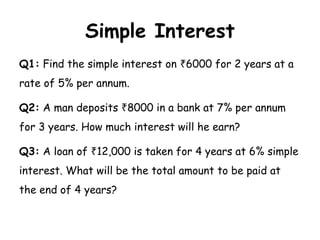
Q1: Find the simple interest on 6000 for 2 years at a
₹
rate of 5% per annum.
Q2: A man deposits 8000 in a bank at 7% per annum
₹
for 3 years. How much interest will he earn?
Q3: A loan of 12,000 is taken for 4 years at 6% simple
₹
interest. What will be the total amount to be paid at
the end of 4 years?
Summary & Conclusion
• - Key Formulas Recap
• - Common Shortcuts
• - Q&A Session
• - Homework Practice Problems
Basic Aptitude Class Quantitative aptitude

  • 1.
    Basic Aptitude Class 3-HourSession | Fundamentals & Problem-Solving
  • 2.
    Agenda for theSession Introduction to Aptitude Number System Bodmas HCF & LCM Percentages Ratio & Proportion Time & Work Time, Speed & Distance Simple & Compound Interest Practice Questions & Discussion
  • 3.
    Introduction to Aptitude ✅Competitive Exams ✅ Job Interviews Why Aptitude 📌 Used in Banking, SSC, UPSC, CAT, GATE, and job tests. 📌 Helps pick the best candidates. 📌 Improves thinking speed and accuracy.
  • 4.
    Number Series Puzzle1️ 1️ ⃣ Find the missing number: 2, 6, 12, 20, 30, ? Odd One Out ❌ 2️ ⃣ Which word does not belong to the group? Apple, Mango, Banana, Carrot, Grape Quick Math Trick ➕ 3️ 3️ 3 ️ 3 ️ 3 ️ 3 ️ 3 ️ 3 ️ 3 ️ 3 ️ 3 ️ 3 ️ 3 ️ 3 ️ 3️ Without a calculator, can you solve this in 5 seconds? 999 × 1001 = ?
  • 5.
    BODMAS BODMAS is anacronym that helps you remember the order of operations in math. It stands for: ➢ B: Brackets ➢ O: Of ➢ D: Division ➢ M: Multiplication ➢ A: Addition ➢ S: Subtraction
  • 6.
    BODMAS 1. 45-(28-(37-(15-p))) =58 2. [(18 – 6) ÷ 4] + [72 – 12 ÷ 3 of 2] 3. 12 + 6 × 27 ÷ 3 + 2 – 16 ÷ 8 × 2 4. 8 ÷ 4 × (6 + 2 of 4) + 32 – 2
  • 7.
    Number System Basics ➢NaturalNumbers, Whole Numbers and Integers ➢ Even & Odd Numbers, Prime & Composite Numbers ➢ Divisibility Rules (2,3,4,5,9,11)
  • 8.
    Natural Numbers (N)1️ 1️ ⃣ ● Definition: Counting numbers starting from 1. ● Examples: 1, 2, 3, 4, 5, ... (goes on infinitely) Whole Numbers (W) 🔢 2️ ⃣ ● Definition: Natural numbers including zero. ● Examples: 0, 1, 2, 3, 4, 5, ... Integers (Z) ➖➕ 3️ 3️ 3 ️ 3 ️ 3 ️ 3 ️ 3 ️ 3 ️ 3 ️ 3 ️ 3 ️ 3 ️ 3 ️ 3 ️ 3️ ● Definition: All positive and negative whole numbers, including zero. ● Examples: ... -3, -2, -1, 0, 1, 2, 3 ...
  • 9.
    Identify the NumberType 1️ 1️ ⃣ Which of the following numbers are natural numbers, whole numbers, and integers? a) -5 b) 0 c) 7 d) 12 e) -3 True or False 2️ ⃣ a) All natural numbers are whole numbers. b) All whole numbers are natural numbers. c) All integers are whole numbers. d) Zero is a natural number. Find the Missing Number 3️ 3️ ⃣ Fill in the missing number in the series: -5, -3, -1, __, 3, 5 Smallest and Largest 4️ ⃣ a) What is the smallest natural number? b) What is the smallest whole number? c) What is the smallest integer?
  • 10.
    HCF & LCM ➢HCF: Highest Common Factor (GCD) ➢ LCM: Least Common Multiple ➢ Methods: Prime Factorization & Division Method ➢Application in real-life problems
  • 11.
    What is LCM(Least Common Multiple)? 1️ 1️ 1️ 1️ 1️ 1️ 1️ 1️ 1️ 1️ 1️ 1️ 1️ 1️ 1️ ● The smallest number that is divisible by two or more given numbers. ● Example: LCM of 4 and 6 Multiples of 4 → 4, 8, 12, 16, 20... Multiples of 6 → 6, 12, 18, 24... LCM = 12 (smallest common multiple).
  • 12.
    What is HCF(Highest Common Factor)? 2️ 2️ 2️ 2️ 2️ 2️ 2️ 2️ 2️ 2️ 2️ 2️ 2️ 2️ 2️ The largest number that divides two or more numbers exactly. Example: HCF of 18 and 24 Factors of 18 → 1, 2, 3, 6, 9, 18 Factors of 24 → 1, 2, 3, 4, 6, 8, 12, 24 HCF = 6 (highest common factor).
  • 13.
    LCM and HCFFormula 📌 LCM × HCF = Product of Numbers When to Use This Formula? ● If LCM and one number are given, you can find the other number. ● If HCF and LCM are given, you can find the product of the numbers. Example Application: If LCM of two numbers is 120 and HCF is 6, and one number is 24, find the second number.
  • 14.
    Find the MissingNumber 1️ 1️ ⃣ The HCF of two numbers is 4, and their LCM is 120. If one of the numbers is 24, find the second number. Verify the Formula 2️ ⃣ The LCM and HCF of two numbers are 180 and 15, respectively. The two numbers are 45 and x. Find x and verify the formula. Application-Based Question 3️ 3️ ⃣ Two numbers have a product of 1440. Their HCF is 12. Find their LCM. Word Problem 4️ ⃣ The LCM of two numbers is 840, and their HCF is 14. If one number is 84, find the second number. Challenge Question 5️ 5️ ⃣ The product of two numbers is 4800. If their HCF is 20, find their LCM.
  • 15.
    Percentages Basics ➢Converting fractionsto percentages & vice versa ➢Percentage increase/decrease ➢Example: If a price increases by 20%, find the new price.
  • 16.
    Percentage Estimation Game1️ 1️ ⃣ Question: You go shopping, and a shirt costs 1000 ₹ . There’s a 30% discount. Without using a calculator, estimate the final price! 💡 Hint: Break it down: 10% of 1000 = ₹ 100 ₹ 30% = ?
  • 17.
    Quick Percentage Riddle2️ 2️ ⃣ Question: What is 50% of 50% of 200? a) 25 b) 50 c) 100 d) 200 Fastest Thinker Challenge ⏳ 3️ ⃣ Fill in the blanks without calculating! 1. 25% of 200 = ___ 2. 50% of 80 = ___ 3. 10% of 500 = ___ 4. 75% of 40 = ___
  • 18.
    Real-Life Challenge 🏆 4️4️ 4 ️ 4 ️ 4 ️ 4 ️ 4 ️ 4 ️ 4 ️ 4 ️ 4 ️ 4 ️ 4 ️ 4 ️ 4️ If you scored 80% on a test with 50 questions, how many did you get right? Trick Question 🎭 If a number is increased by 25% and then decreased by 25%, does it return to the original number? 🤔
  • 19.
    Where do weuse percentages? ➢ Shopping Discounts 🛒 ➢ Exam Scores 🎓 ➢ Salary Hikes 💰 ➢ Population Growth/Decline 📉 Example: "A shirt originally costs 2000 and has a 20% ₹ discount. What is the final price?" 💡 Solution: ● 20% of 2000 = (20/100) × 2000 = 400 ₹ ₹ ● Final Price = 2000 - 400 = 1600 ₹ ₹ ₹
  • 20.
    1 ️ 1️⃣What is25% of 300? 2️⃣A student's marks increased from 40 to 50. Find the percentage increase. 3 ️ 3️⃣A mobile phone was 10,000, but after a ₹ 15% discount, what is the new price? 4️⃣A population decreased by 10% from 5000. What is the new population? 5 ️ 5️⃣If a price increases by 50% and then decreases by 50%, does it return to the original?
  • 21.
    What is aRatio? A ratio is a way of comparing two quantities of the same kind. It tells us how many times one value is compared to another. 📌 Formula: Ratio = First Quantity/Second Quantity a : b Ratio and Proportion
  • 22.
    📌 Examples: 1. Ina class, there are 30 boys and 20 girls. The ratio of boys to girls is: Boys: Girls = 30:20 = 3:2 2. A recipe requires 2 cups of sugar and 3 cups of flour. The ratio of sugar to flour is: 2:3
  • 23.
    📌 Real-Life Applicationsof Ratios: ➢ Mixing ingredients in cooking 🍲 ➢ Speed (distance:time) in km/hr 🚗 ➢ Comparing students’ marks in exams 📚
  • 24.
    What is Proportion? Aproportion shows that two ratios are equal. 📌 Formula: a : b = c : d a/b = c/d or written as a : b :: c : d 📌 Example: If 2 pens cost 10, how much will 4 pens cost? ₹ 2 : 10 = 4 : x 2 / 10 = 4 / x ✅ Answer: 4 pens will cost 20. ₹
  • 25.
    Time & Work •Work efficiency concept • Formula: Work = Efficiency × Time • Example: A can do a task in 10 days, B in 15 days. How long together?
  • 26.
    1. A doesa work in 10 days and B does the same work in 15 days. In how many days they together will do the same work? 2. A, B and C can complete a piece of work in 24, 6 and 12 days respectively. Working together, they will complete the same work in:
  • 27.
    Time, Speed &Distance Formula: Speed = Distance/Time
  • 28.
    Time, Speed &Distance Unit Conversion: ➢ 1 km/h = (5/18) m/s ➢ 1 m/s = (18/5) km/h Basic Speed Calculation 1️ 1️ 1️ 1️ 1️ 1️ 1️ 1️ 1️ 1️ 1️ 1️ 1️ 1️ 1️ Q1: A car covers 240 km in 4 hours. What is its speed? Speed = Distance / Time = 240 / 4 =60 km/hr
  • 29.
    Time, Speed &Distance Finding Time 2️ 2️ 2️ 2️ 2️ 2️ 2️ 2️ 2️ 2️ 2️ 2️ 2️ 2️ 2️ Q2: A train is moving at 90 km/h. How much time will it take to cover 180 km? ✅ Solution: Time = Distance / Speed = 180 / 90 = 2 hours
  • 30.
    Time, Speed &Distance Finding Distance 3️ 3️ 3️ 3️ 3️ 3️ 3️ 3️ 3️ 3️ 3️ 3️ 3️ 3️ 3️ Q3: A bike moves at 40 km/h for 2.5 hours. Find the total distance traveled. ✅ Solution: Distance = Speed×Time =40×2.5 d = 100 km
  • 31.
    Simple Interest SI Formula: SI= (P × R × T) / 100 ● SI = Simple Interest ● P = Principal (Initial Amount) ● R = Rate of Interest (per annum) ● T = Time (in years)
  • 32.
    Simple Interest Q1: Findthe Simple Interest on 5000 for 3 years at ₹ an interest rate of 5% per annum. ✅ Solution: SI= ( 5000 × 5×3 ) / 100 = 75000 / 100 = 750 ₹
  • 33.
    Simple Interest Q2: Aperson borrows 8000 at 6% per annum for 4 ₹ years. What is the total amount to be paid? ✅ Solution: SI = (8000×6×4) / 100 =192000 / 100 = 1920 ₹ Total Amount = P + SI A = 8000+1920 = 9920 ₹
  • 34.
    Simple Interest Q2: Aperson borrows 8000 at 6% per annum for 4 ₹ years. What is the total amount to be paid? ✅ Solution: SI = (8000×6×4) / 100 =192000 / 100 = 1920 ₹ Total Amount = P + SI A = 8000+1920 = 9920 ₹
  • 35.
    Simple Interest Q1: Findthe simple interest on 6000 for 2 years at a ₹ rate of 5% per annum. Q2: A man deposits 8000 in a bank at 7% per annum ₹ for 3 years. How much interest will he earn? Q3: A loan of 12,000 is taken for 4 years at 6% simple ₹ interest. What will be the total amount to be paid at the end of 4 years?
  • 36.
    Summary & Conclusion •- Key Formulas Recap • - Common Shortcuts • - Q&A Session • - Homework Practice Problems