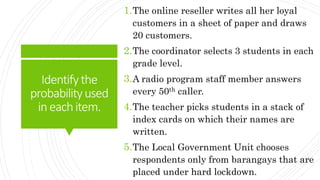
Identifythe
probabilityused
ineachitem.
1.The online reseller writes all her loyal
customers in a sheet of paper and draws
20 customers.
2.The coordinator selects 3 students in each
grade level.
3.A radio program staff member answers
every 50th caller.
4.The teacher picks students in a stack of
index cards on which their names are
written.
5.The Local Government Unit chooses
respondents only from barangays that are
placed under hard lockdown.
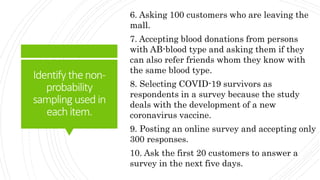
Identify thenon-
probability
sampling used in
eachitem.
6. Asking 100 customers who are leaving the
mall.
7. Accepting blood donations from persons
with AB-blood type and asking them if they
can also refer friends whom they know with
the same blood type.
8. Selecting COVID-19 survivors as
respondents in a survey because the study
deals with the development of a new
coronavirus vaccine.
9. Posting an online survey and accepting only
300 responses.
10. Ask the first 20 customers to answer a
survey in the next five days.
Identifythe
probabilityused
ineachitem.
1.The online reseller writes all her loyal
customers in a sheet of paper and draws 20
customers. - RANDOM
2.The coordinator selects 3 students in each
grade level. - STRATIFIED
3.A radio program staff member answers
every 50th caller. - SYSTEMATIC
4.The teacher picks students in a stack of
index cards on which their names are
written. - RANDOM
5.The Local Government Unit chooses
respondents only from barangays that are
placed under hard lockdown. CLUSTER
Identify thenon-
probability
sampling used in
eachitem.
1.Asking 100 customers who are leaving the
mall. CONVENIENCE
2.Accepting blood donations from persons
with AB-blood type and asking them if
they can also refer friends whom they
know with the same blood type.
SNOWBALL
3.Selecting COVID-19 survivors as
respondents in a survey because the study
deals with the development of a new
coronavirus vaccine. PURPOSIVE
4.Posting an online survey and accepting
only 300 responses. QUOTA
5.Ask the first 20 customers to answer a
survey in the next five days. QUOTA &
CONVENIENCE
METHODS OF DATA
GATHERING
DIRECT
METHOD
Includes
observation and
interview where
you get the
information
firsthand
Indirect
method
Includes ways in
which you can obtain
the needed data
without your actual
presence.
Identify the
method usedin
gathering data.
Write direct or
indirect
1.The researcher sets a particular time
and date to talk with the respondents
in his study.
2.The researcher retrieves journals in
the library.
3.The researcher sends survey forms to
his respondents.
4.The researcher measures the actual
heights of his respondents.
5.The researcher checks the school
records for the average grades of his
respondents.
Identify the
method usedin
gathering data.
Write direct or
indirect
1.The researcher sets a particular time
and date to talk with the respondents
in his study. -DIRECT
2.The researcher retrieves journals in
the library. - INDIRECT
3.The researcher sends survey forms to
his respondents. -INDIRECT
4.The researcher measures the actual
heights of his respondents. DIRECT
5.The researcher checks the school
records for the average grades of his
respondents. INDIRECT

math 7 q4 sampling techniques.pptx

  • 1.
    Identifythe probabilityused ineachitem. 1.The online resellerwrites all her loyal customers in a sheet of paper and draws 20 customers. 2.The coordinator selects 3 students in each grade level. 3.A radio program staff member answers every 50th caller. 4.The teacher picks students in a stack of index cards on which their names are written. 5.The Local Government Unit chooses respondents only from barangays that are placed under hard lockdown.
  • 2.
    Identify thenon- probability sampling usedin eachitem. 6. Asking 100 customers who are leaving the mall. 7. Accepting blood donations from persons with AB-blood type and asking them if they can also refer friends whom they know with the same blood type. 8. Selecting COVID-19 survivors as respondents in a survey because the study deals with the development of a new coronavirus vaccine. 9. Posting an online survey and accepting only 300 responses. 10. Ask the first 20 customers to answer a survey in the next five days.
  • 4.
    Identifythe probabilityused ineachitem. 1.The online resellerwrites all her loyal customers in a sheet of paper and draws 20 customers. - RANDOM 2.The coordinator selects 3 students in each grade level. - STRATIFIED 3.A radio program staff member answers every 50th caller. - SYSTEMATIC 4.The teacher picks students in a stack of index cards on which their names are written. - RANDOM 5.The Local Government Unit chooses respondents only from barangays that are placed under hard lockdown. CLUSTER
  • 5.
    Identify thenon- probability sampling usedin eachitem. 1.Asking 100 customers who are leaving the mall. CONVENIENCE 2.Accepting blood donations from persons with AB-blood type and asking them if they can also refer friends whom they know with the same blood type. SNOWBALL 3.Selecting COVID-19 survivors as respondents in a survey because the study deals with the development of a new coronavirus vaccine. PURPOSIVE 4.Posting an online survey and accepting only 300 responses. QUOTA 5.Ask the first 20 customers to answer a survey in the next five days. QUOTA & CONVENIENCE
  • 6.
  • 7.
  • 8.
    Indirect method Includes ways in whichyou can obtain the needed data without your actual presence.
  • 9.
    Identify the method usedin gatheringdata. Write direct or indirect 1.The researcher sets a particular time and date to talk with the respondents in his study. 2.The researcher retrieves journals in the library. 3.The researcher sends survey forms to his respondents. 4.The researcher measures the actual heights of his respondents. 5.The researcher checks the school records for the average grades of his respondents.
  • 10.
    Identify the method usedin gatheringdata. Write direct or indirect 1.The researcher sets a particular time and date to talk with the respondents in his study. -DIRECT 2.The researcher retrieves journals in the library. - INDIRECT 3.The researcher sends survey forms to his respondents. -INDIRECT 4.The researcher measures the actual heights of his respondents. DIRECT 5.The researcher checks the school records for the average grades of his respondents. INDIRECT