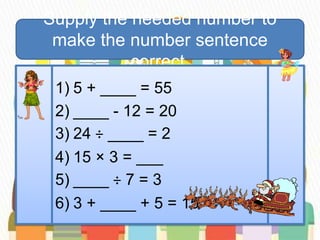
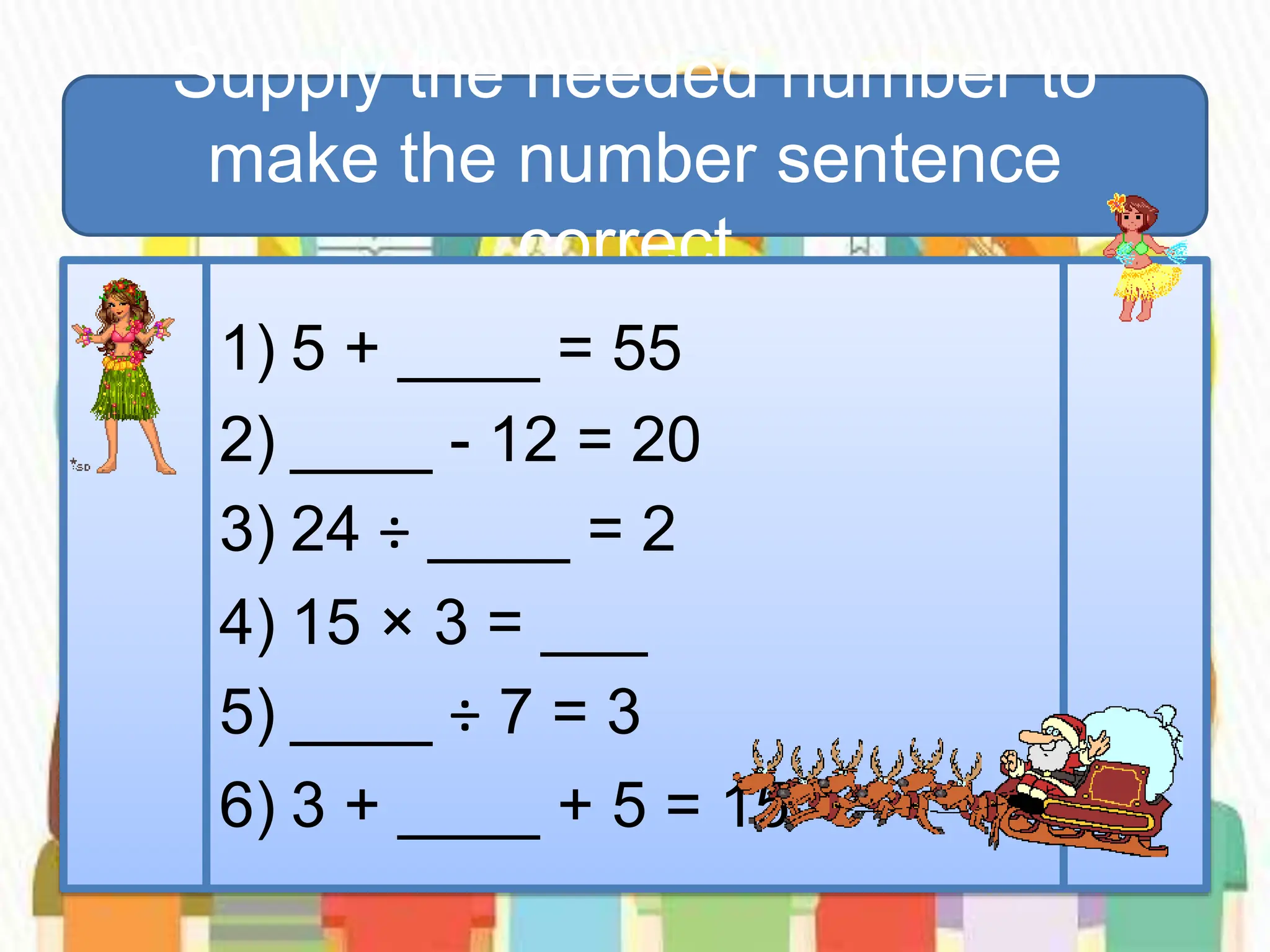
Supply the needed number to
make the number sentence
correct.
1) 5 + ____ = 55
2) ____ - 12 = 20
3) 24 ÷ ____ = 2
4) 15 × 3 = ___
5) ____ ÷ 7 = 3
6) 3 + ____ + 5 = 15
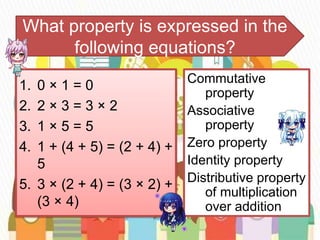
What property is expressed in the
following equations?
1. 0 × 1 = 0
2. 2 × 3 = 3 × 2
3. 1 × 5 = 5
4. 1 + (4 + 5) = (2 + 4) +
5
5. 3 × (2 + 4) = (3 × 2) +
(3 × 4)
Commutative
property
Associative
property
Zero property
Identity property
Distributive property
of multiplication
over addition
• Do you know of a friend or a
classmate having difficulty in
doing his/her homework?
• What will you do if he/she
asks help from you?
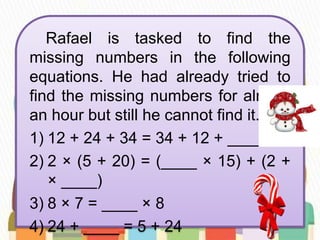
Rafael is tasked to find the
missing numbers in the following
equations. He had already tried to
find the missing numbers for almost
an hour but still he cannot find it.
1) 12 + 24 + 34 = 34 + 12 + _____
2) 2 × (5 + 20) = (____ × 15) + (2 +
× ____)
3) 8 × 7 = ____ × 8
4) 24 + ____ = 5 + 24
• Who is assigned to do the work?
• What is the task of Rafael?
• What can we do so we can help
him?
• Can you give advice to Rafael so
that he can find the numbers
needed to complete the equations?
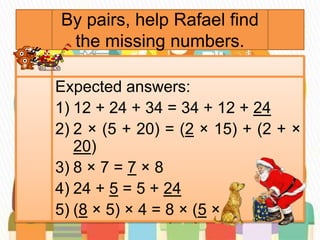
By pairs, help Rafael find
the missing numbers.
Expected answers:
1) 12 + 24 + 34 = 34 + 12 + 24
2) 2 × (5 + 20) = (2 × 15) + (2 + ×
20)
3) 8 × 7 = 7 × 8
4) 24 + 5 = 5 + 24
5) (8 × 5) × 4 = 8 × (5 × 4)
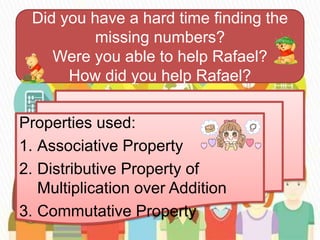
Did you have a hard time finding the
missing numbers?
Were you able to help Rafael?
How did you help Rafael?
Properties used:
1. Associative Property
2. Distributive Property of
Multiplication over Addition
3. Commutative Property
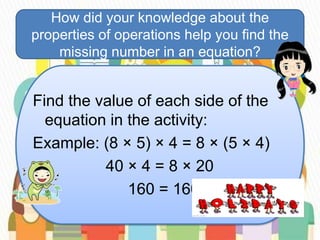
How did your knowledge about the
properties of operations help you find the
missing number in an equation?
Find the value of each side of the
equation in the activity:
Example: (8 × 5) × 4 = 8 × (5 × 4)
40 × 4 = 8 × 20
160 = 160
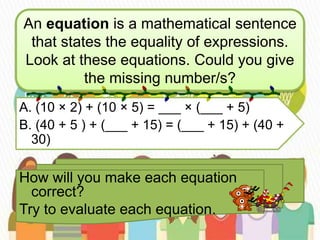
An equation is a mathematical sentence
that states the equality of expressions.
Look at these equations. Could you give
the missing number/s?
A. (10 × 2) + (10 × 5) = ___ × (___ + 5)
B. (40 + 5 ) + (___ + 15) = (___ + 15) + (40 +
30)
How will you make each equation
correct?
Try to evaluate each equation.
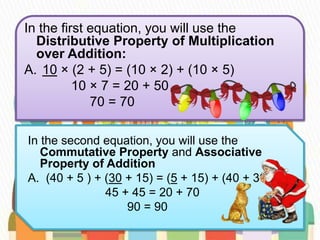
In the first equation, you will use the
Distributive Property of Multiplication
over Addition:
A. 10 × (2 + 5) = (10 × 2) + (10 × 5)
10 × 7 = 20 + 50
70 = 70
In the second equation, you will use the
Commutative Property and Associative
Property of Addition
A. (40 + 5 ) + (30 + 15) = (5 + 15) + (40 + 30)
45 + 45 = 20 + 70
90 = 90
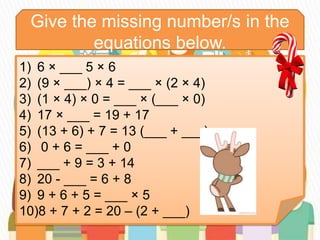
Give the missing number/s in the
equations below.
1) 6 × ___ 5 × 6
2) (9 × ___) × 4 = ___ × (2 × 4)
3) (1 × 4) × 0 = ___ × (___ × 0)
4) 17 × ___ = 19 + 17
5) (13 + 6) + 7 = 13 (___ + ___)
6) 0 + 6 = ___ + 0
7) ___ + 9 = 3 + 14
8) 20 - ___ = 6 + 8
9) 9 + 6 + 5 = ___ × 5
10)8 + 7 + 2 = 20 – (2 + ___)
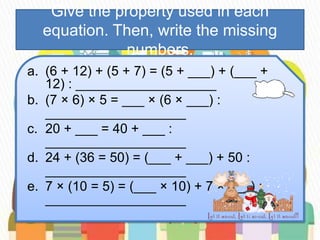
Give the property used in each
equation. Then, write the missing
numbers.
a. (6 + 12) + (5 + 7) = (5 + ___) + (___ +
12) : ___________________
b. (7 × 6) × 5 = ___ × (6 × ___) :
___________________
c. 20 + ___ = 40 + ___ :
___________________
d. 24 + (36 = 50) = (___ + ___) + 50 :
___________________
e. 7 × (10 = 5) = (___ × 10) + 7 × ___) :
___________________
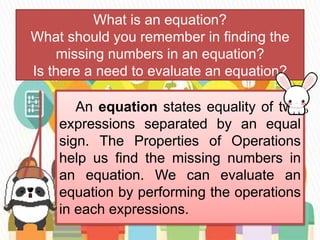
What is an equation?
What should you remember in finding the
missing numbers in an equation?
Is there a need to evaluate an equation?
An equation states equality of two
expressions separated by an equal
sign. The Properties of Operations
help us find the missing numbers in
an equation. We can evaluate an
equation by performing the operations
in each expressions.
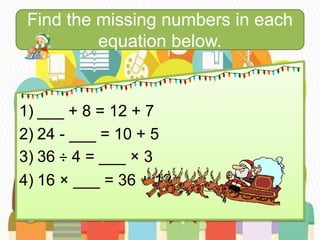
Find the missing numbers in each
equation below.
1) ___ + 8 = 12 + 7
2) 24 - ___ = 10 + 5
3) 36 ÷ 4 = ___ × 3
4) 16 × ___ = 36 + 12
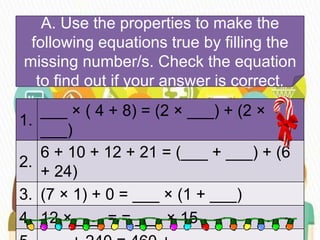
A. Use the properties to make the
following equations true by filling the
missing number/s. Check the equation
to find out if your answer is correct.
1.
___ × ( 4 + 8) = (2 × ___) + (2 ×
___)
2.
6 + 10 + 12 + 21 = (___ + ___) + (6
+ 24)
3. (7 × 1) + 0 = ___ × (1 + ___)
4. 12 × ___ = = ___ × 15
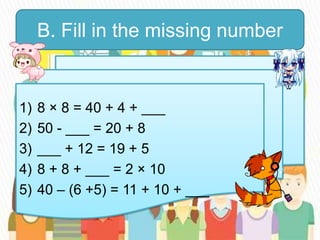
B. Fill in the missing number
1) 8 × 8 = 40 + 4 + ___
2) 50 - ___ = 20 + 8
3) ___ + 12 = 19 + 5
4) 8 + 8 + ___ = 2 × 10
5) 40 – (6 +5) = 11 + 10 + ___
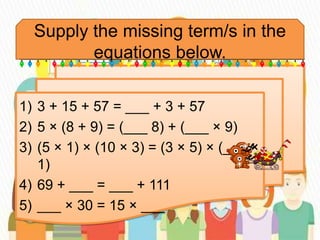
Supply the missing term/s in the
equations below.
1) 3 + 15 + 57 = ___ + 3 + 57
2) 5 × (8 + 9) = (___ 8) + (___ × 9)
3) (5 × 1) × (10 × 3) = (3 × 5) × (___ ×
1)
4) 69 + ___ = ___ + 111
5) ___ × 30 = 15 × ___
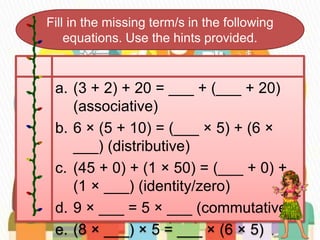
Fill in the missing term/s in the following
equations. Use the hints provided.
a. (3 + 2) + 20 = ___ + (___ + 20)
(associative)
b. 6 × (5 + 10) = (___ × 5) + (6 ×
___) (distributive)
c. (45 + 0) + (1 × 50) = (___ + 0) +
(1 × ___) (identity/zero)
d. 9 × ___ = 5 × ___ (commutative)
e. (8 × ___) × 5 = ___ × (6 × 5)
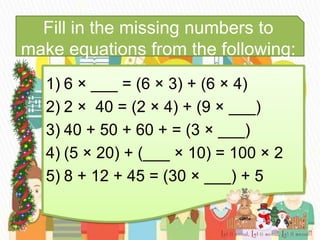
Fill in the missing numbers to
make equations from the following:
1) 6 × ___ = (6 × 3) + (6 × 4)
2) 2 × 40 = (2 × 4) + (9 × ___)
3) 40 + 50 + 60 + = (3 × ___)
4) (5 × 20) + (___ × 10) = 100 × 2
5) 8 + 12 + 45 = (30 × ___) + 5

MATH 4 PPT Q3 W5 - Lesson 54 - Equations.pptx

  • 1.
    Supply the needednumber to make the number sentence correct. 1) 5 + ____ = 55 2) ____ - 12 = 20 3) 24 ÷ ____ = 2 4) 15 × 3 = ___ 5) ____ ÷ 7 = 3 6) 3 + ____ + 5 = 15
  • 2.
    What property isexpressed in the following equations? 1. 0 × 1 = 0 2. 2 × 3 = 3 × 2 3. 1 × 5 = 5 4. 1 + (4 + 5) = (2 + 4) + 5 5. 3 × (2 + 4) = (3 × 2) + (3 × 4) Commutative property Associative property Zero property Identity property Distributive property of multiplication over addition
  • 3.
    • Do youknow of a friend or a classmate having difficulty in doing his/her homework? • What will you do if he/she asks help from you?
  • 4.
    Rafael is taskedto find the missing numbers in the following equations. He had already tried to find the missing numbers for almost an hour but still he cannot find it. 1) 12 + 24 + 34 = 34 + 12 + _____ 2) 2 × (5 + 20) = (____ × 15) + (2 + × ____) 3) 8 × 7 = ____ × 8 4) 24 + ____ = 5 + 24
  • 5.
    • Who isassigned to do the work? • What is the task of Rafael? • What can we do so we can help him? • Can you give advice to Rafael so that he can find the numbers needed to complete the equations?
  • 6.
    By pairs, helpRafael find the missing numbers. Expected answers: 1) 12 + 24 + 34 = 34 + 12 + 24 2) 2 × (5 + 20) = (2 × 15) + (2 + × 20) 3) 8 × 7 = 7 × 8 4) 24 + 5 = 5 + 24 5) (8 × 5) × 4 = 8 × (5 × 4)
  • 7.
    Did you havea hard time finding the missing numbers? Were you able to help Rafael? How did you help Rafael? Properties used: 1. Associative Property 2. Distributive Property of Multiplication over Addition 3. Commutative Property
  • 8.
    How did yourknowledge about the properties of operations help you find the missing number in an equation? Find the value of each side of the equation in the activity: Example: (8 × 5) × 4 = 8 × (5 × 4) 40 × 4 = 8 × 20 160 = 160
  • 9.
    An equation isa mathematical sentence that states the equality of expressions. Look at these equations. Could you give the missing number/s? A. (10 × 2) + (10 × 5) = ___ × (___ + 5) B. (40 + 5 ) + (___ + 15) = (___ + 15) + (40 + 30) How will you make each equation correct? Try to evaluate each equation.
  • 10.
    In the firstequation, you will use the Distributive Property of Multiplication over Addition: A. 10 × (2 + 5) = (10 × 2) + (10 × 5) 10 × 7 = 20 + 50 70 = 70 In the second equation, you will use the Commutative Property and Associative Property of Addition A. (40 + 5 ) + (30 + 15) = (5 + 15) + (40 + 30) 45 + 45 = 20 + 70 90 = 90
  • 11.
    Give the missingnumber/s in the equations below. 1) 6 × ___ 5 × 6 2) (9 × ___) × 4 = ___ × (2 × 4) 3) (1 × 4) × 0 = ___ × (___ × 0) 4) 17 × ___ = 19 + 17 5) (13 + 6) + 7 = 13 (___ + ___) 6) 0 + 6 = ___ + 0 7) ___ + 9 = 3 + 14 8) 20 - ___ = 6 + 8 9) 9 + 6 + 5 = ___ × 5 10)8 + 7 + 2 = 20 – (2 + ___)
  • 12.
    Give the propertyused in each equation. Then, write the missing numbers. a. (6 + 12) + (5 + 7) = (5 + ___) + (___ + 12) : ___________________ b. (7 × 6) × 5 = ___ × (6 × ___) : ___________________ c. 20 + ___ = 40 + ___ : ___________________ d. 24 + (36 = 50) = (___ + ___) + 50 : ___________________ e. 7 × (10 = 5) = (___ × 10) + 7 × ___) : ___________________
  • 13.
    What is anequation? What should you remember in finding the missing numbers in an equation? Is there a need to evaluate an equation? An equation states equality of two expressions separated by an equal sign. The Properties of Operations help us find the missing numbers in an equation. We can evaluate an equation by performing the operations in each expressions.
  • 14.
    Find the missingnumbers in each equation below. 1) ___ + 8 = 12 + 7 2) 24 - ___ = 10 + 5 3) 36 ÷ 4 = ___ × 3 4) 16 × ___ = 36 + 12
  • 15.
    A. Use theproperties to make the following equations true by filling the missing number/s. Check the equation to find out if your answer is correct. 1. ___ × ( 4 + 8) = (2 × ___) + (2 × ___) 2. 6 + 10 + 12 + 21 = (___ + ___) + (6 + 24) 3. (7 × 1) + 0 = ___ × (1 + ___) 4. 12 × ___ = = ___ × 15
  • 16.
    B. Fill inthe missing number 1) 8 × 8 = 40 + 4 + ___ 2) 50 - ___ = 20 + 8 3) ___ + 12 = 19 + 5 4) 8 + 8 + ___ = 2 × 10 5) 40 – (6 +5) = 11 + 10 + ___
  • 17.
    Supply the missingterm/s in the equations below. 1) 3 + 15 + 57 = ___ + 3 + 57 2) 5 × (8 + 9) = (___ 8) + (___ × 9) 3) (5 × 1) × (10 × 3) = (3 × 5) × (___ × 1) 4) 69 + ___ = ___ + 111 5) ___ × 30 = 15 × ___
  • 18.
    Fill in themissing term/s in the following equations. Use the hints provided. a. (3 + 2) + 20 = ___ + (___ + 20) (associative) b. 6 × (5 + 10) = (___ × 5) + (6 × ___) (distributive) c. (45 + 0) + (1 × 50) = (___ + 0) + (1 × ___) (identity/zero) d. 9 × ___ = 5 × ___ (commutative) e. (8 × ___) × 5 = ___ × (6 × 5)
  • 19.
    Fill in themissing numbers to make equations from the following: 1) 6 × ___ = (6 × 3) + (6 × 4) 2) 2 × 40 = (2 × 4) + (9 × ___) 3) 40 + 50 + 60 + = (3 × ___) 4) (5 × 20) + (___ × 10) = 100 × 2 5) 8 + 12 + 45 = (30 × ___) + 5