Materiality In Financial Reporting Bellandi Francesco
Materiality In Financial Reporting Bellandi Francesco
Materiality In Financial Reporting Bellandi Francesco
Materiality In Financial Reporting Bellandi Francesco
Materiality In Financial Reporting Bellandi Francesco
1.
Materiality In FinancialReporting Bellandi
Francesco download
https://ebookbell.com/product/materiality-in-financial-reporting-
bellandi-francesco-7438088
Explore and download more ebooks at ebookbell.com
2.
Here are somerecommended products that we believe you will be
interested in. You can click the link to download.
Materiality In Roman Art And Architecture Aesthetics Semantics And
Function Annette Haug Editor Adrian Hielscher Editor M Taylor
Lauritsen Editor
https://ebookbell.com/product/materiality-in-roman-art-and-
architecture-aesthetics-semantics-and-function-annette-haug-editor-
adrian-hielscher-editor-m-taylor-lauritsen-editor-50378400
Materiality In Institutions Spaces Embodiment And Technology In
Management And Organization 1st Ed Franoisxavier De Vaujany
https://ebookbell.com/product/materiality-in-institutions-spaces-
embodiment-and-technology-in-management-and-organization-1st-ed-
franoisxavier-de-vaujany-9960528
Materiality In Roman Art And Architecture Aesthetics Semantics And
Function Annette Haug
https://ebookbell.com/product/materiality-in-roman-art-and-
architecture-aesthetics-semantics-and-function-annette-haug-49443606
Materiality In Roman Art And Architecture Annette Haug Adrian
Hielscher
https://ebookbell.com/product/materiality-in-roman-art-and-
architecture-annette-haug-adrian-hielscher-232649434
3.
Religious Materiality InThe Early Modern World Suzanna Ivanic Editor
Mary Laven Editor Andrew Morrall Editor
https://ebookbell.com/product/religious-materiality-in-the-early-
modern-world-suzanna-ivanic-editor-mary-laven-editor-andrew-morrall-
editor-51756430
Ma Materiality In Teaching And Learning New Boyd White Pauline
Sameshima
https://ebookbell.com/product/ma-materiality-in-teaching-and-learning-
new-boyd-white-pauline-sameshima-58166966
Inhuman Materiality In Gothic Media Aspasia Stephanou
https://ebookbell.com/product/inhuman-materiality-in-gothic-media-
aspasia-stephanou-23823624
Religious Materiality In The Early Modern World Visual And Material
Culture 13001700 Mary Laven
https://ebookbell.com/product/religious-materiality-in-the-early-
modern-world-visual-and-material-culture-13001700-mary-laven-43220156
Crafting In The World Materiality In The Making 1st Ed Clare Burke
https://ebookbell.com/product/crafting-in-the-world-materiality-in-
the-making-1st-ed-clare-burke-7321884
Emerald Publishing Limited
HowardHouse, Wagon Lane, Bingley BD16 1WA, UK
First edition 2018
Copyright r 2018 Emerald Publishing Limited
Reprints and permissions service
Contact: permissions@emeraldinsight.com
No part of this book may be reproduced, stored in a retrieval system, transmitted
in any form or by any means electronic, mechanical, photocopying, recording or
otherwise without either the prior written permission of the publisher or a licence
permitting restricted copying issued in the UK by The Copyright Licensing Agency
and in the USA by The Copyright Clearance Center. Any opinions expressed in the
chapters are those of the authors. Whilst Emerald makes every effort to ensure the
quality and accuracy of its content, Emerald makes no representation implied or
otherwise, as to the chapters’ suitability and application and disclaims any
warranties, express or implied, to their use.
British Library Cataloguing in Publication Data
A catalogue record for this book is available from the British Library
ISBN: 978 1 78743 737 1 (Print)
ISBN: 978 1 78743 736 4 (Online)
ISBN: 978 1 78743 843 9 (Epub)
Certificate Number 1985
ISO 14001
ISOQAR certified
Management System,
awarded to Emerald
for adherence to
Environmental
standard
ISO 14001:2004.
Contents
List of Figuresxix
About the Author xxv
Preface xxvii
Part I. Introduction and Background 1
Main Focus of Part I 2
1. Why Does Materiality Matter in Financial Statements? 2
2. Powerful and Dangerous 3
3. The Disclosure Framework 4
4. The Disclosure Initiative 5
5. The Disclosure Effectiveness Initiative 6
6. Objectives of the Book 7
Part II. Conceptual Bases of Materiality 9
Main Focus of Part II 10
1. Materiality in the Conceptual Frameworks 10
1.a. The Objective of Materiality 10
1.b. Level of Interaction in the Conceptual Frameworks 10
1.c. A Pervasive Concept or a Qualitative Characteristic? 11
1.d. Is Materiality a Constraint? 15
1.e. Interaction with Qualitative Characteristics of
Accounting Information 16
1.f. Materiality versus Relevance 16
1.g. Entity Specificity 20
1.h. Materiality versus Reliability and Faithful
Representation 22
1.i. Completing the Picture: Materiality versus
Completeness 24
1.j. Materiality versus Understandability 25
vii
10.
1.k. Does Prudenceor Neutrality Affect Materiality? 27
1.l. The Link to Recognition in the Conceptual
Frameworks 28
1.m. Cost/Benefit Constraint versus Materiality 30
1.n. Impracticability versus Materiality 30
1.o. Significance 31
2. Definitions of Materiality 33
2.a. Can a Definition of Materiality Be Given? 33
2.b. Summary of Definitions 39
2.c. US Supreme Court’s Definition 39
2.d. FASB (1985), CON 2 40
2.e. SEC Rules and Regulations 41
2.f. Common Law 43
2.g. IASB Framework 43
2.h. Common Conceptual Framework 43
2.i. The International Financial Reporting Standards 44
2.j. Auditing Standards 45
2.k. COSO Framework 45
2.l. AccountAbility 46
2.m. Integrated Reporting 46
2.n. WRI and WBCSD 46
3. Attributes of Materiality 47
3.a. Subject Matter 47
3.b. What Is an Item? 47
3.c. An Item versus Its Content 48
3.d. Omissions or Misstatements 49
3.e. Material Disclosures of An Item versus Its Required
Disclosures 50
3.f. Materiality Test from Users’ Perspective 50
3.g. Materiality Test Contrasted with the Objective of
General-Purpose Financial Statements 51
3.h. Materiality Test from the Standpoint of Objective
Metrics 52
3.i. Addressees of Test 52
3.j. Reasonable Investor and Reasonable Person 52
3.k. Clusters versus Individuals 53
3.l. Primary versus Intended versus Other Users 53
3.m. Stakeholders versus Users 54
3.n. Assessor 55
3.o. Degree of Likelihood 55
3.p. Understanding Influence versus Influencing 57
3.q. Degree of Magnitude 59
3.r. Context 59
viii Contents
11.
3.s. Degree ofSpecificity 60
3.t. Time Horizon 60
Solutions and Recommendations 61
Conclusion 67
Part III. Actors and Models of Materiality 69
Main Focus of Part III 70
1. Uses and Effects of Materiality 70
1.a. Is Materiality Exclusively a Legal Concept? 70
1.b. Are Legal and Accounting Definitions of Materiality
Incompatible? 71
1.c. Practical Interactions of Legal and Accounting
Concepts of Materiality 73
1.d. The Different Nature of an Accounting Concept of
Materiality 74
1.e. The Quest for an Accounting Definition of Materiality 75
1.f. Materiality in Audit versus in Financial Statements 76
1.g. Other Uses of Materiality by Auditors 77
1.h. Materiality as a Managerial Concept 79
2. Who Decides about Materiality? 79
2.a. Who Allows Materiality? 79
2.b. Who Uses Materiality? 80
2.c. Who Decides Materiality? 80
2.d. Who Assesses Materiality? 81
3. Models of Materiality 82
3.a. Do We Need a Framework of Materiality? 82
3.b. A Positive versus a Negative Concept 82
3.c. A Discrete versus a Continuous Notion 83
3.d. Different Disclosure Regimes 85
3.e. Simulating User Decision Model 86
3.f. Probability/Magnitude Mapping 86
3.g. Severity of Deviancies 90
3.h. Range of Fluctuation 91
3.i. Opportunity Loss 91
3.j. Statistical Use of Information 91
3.k. Doctrine of Differential Disclosure 92
3.l. Expanded Dimensions of Materiality 95
3.m. The Flexibility Zone 97
3.n. Eyes of Management versus Eyes of Investors 98
3.o. The Ownership Triangle 100
3.p. Active versus Passive Role 101
3.q. The Sender Receiver Distortion 102
Contents ix
12.
3.r. U-Materiality 103
3.s.Objective versus Subjective Determination 103
3.t. Materiality as a Planning Tool 104
3.u. Consensus Materiality 104
3.v. Adjustment Method 105
3.w. From Materiality to Materiality Determination Process 106
3.x. Qualitative Factors 106
3.y. Zero Materiality 107
Solutions and Recommendations 107
Conclusion 112
Part IV. Application of Materiality 113
Main Focus of Part IV 114
1. Materiality Applied to Recognition and Measurement 114
1.a. Does Materiality Apply to Recognition and
Measurement? 114
1.b. Inapplicability by Analogy 115
1.c. De Minimis 115
1.d. Significant Accounting Policies 115
1.e. Accounting Policies with Immaterial Effects 117
1.f. Scope of a Change in Accounting Policies 117
1.g. Materiality in Disclosing Voluntary Changes in
Accounting Policies 117
1.h. Materiality in Disclosing Involuntary Changes in
Accounting Policies 118
1.i. The Case of Accounting Errors 119
2. Materiality Applied to Presentation and Disclosure 120
2.a. Does Materiality Apply to Presentation and
Disclosure? 120
2.b. An Item versus Information of An Item 122
2.c. Required Disclosure of Immaterial Information 122
2.d. Allowed Disclosure of Immaterial Information 123
2.e. The Disclosure Overload Debate 124
2.f. Obscuring Material Information 125
2.g. Minimum Set of Required Disclosures 126
2.h. Classification 127
2.i. Interaction of Aggregation and Disaggregation of
Information 128
2.j. Top-down Model of Disaggregation in the Financial
Statements 129
2.k. Bottom-up Model of Aggregation in the Financial
Statements 130
x Contents
13.
2.l. Classes ofAggregation 132
2.m. Alternative Model of Aggregation in the Financial
Statements 133
2.n. General Models of Disaggregation for Disclosure
Purpose 134
2.o. Review Assessment 137
2.p. Quality of Disclosure 138
2.q. Material Items 138
2.r. Disclosure Objectives 139
2.s. Gains and Losses 140
2.t. Effect of Measurement Bases 140
2.u. Third Statement of Financial Position 141
2.v. Rounding 141
2.w. When Required Disclosure Is Not Enough 142
3. Materiality Applied to Management Commentary 143
3.a. Management Commentary versus the Notes 143
3.b. Views of Materiality in Management Commentary 144
3.c. Material Known Trends or Uncertainties in SEC’s
MD&A 145
3.d. Material Changes 149
3.e. Critical Accounting Estimates in MD&A 149
3.f. Immaterial Information in MD&A 150
3.g. Segment Analysis 150
3.h. Layered Disclosure 151
4. Does Materiality Apply to Bookkeeping? 151
4.a. Bookkeeping versus Financial Statements:
A Separate Perspective 151
4.b. Bookkeeping versus Financial Statements:
An Integrated Perspective 152
4.c. The Direct Impact on Financial Statements of
Bookkeeping Errors 153
4.d. The Indirect Impact on Financial Statements of
Bookkeeping Errors 153
4.e. The Delicate Link to Intentional Immaterial Errors 154
4.f. Immaterial Misstatements versus Bookkeeping Errors 155
4.g. Can Immaterial Bookkeeping Errors Be Left
Uncorrected? 155
4.h. Does Materiality Apply to Bookkeeping? 156
4.i. Reasonableness versus Materiality 156
4.j. Legal Implications 157
4.k. Should Accountants Care of Materiality at All? 158
5. Materiality in Auditing 159
5.a. Audit Definition of Materiality 159
Contents xi
14.
5.b. Definition ofMaterial Misstatement 160
5.c. The Risk of Material Misstatements and Assertions 161
5.d. Relationship between Audit Risk and Materiality 162
5.e. Iteration of Materiality and Inherent Risk 165
5.f. Second-Guessing Management’s Determination of
Users’ Needs 166
5.g. Timing of Auditor’s Consideration of Materiality 166
5.h. Undetected, Identified, Uncorrected, and Corrected
Misstatements 168
5.i. How Materiality Affects Auditors’ Responses to
Misstatements 168
5.j. How Materiality Affects Auditors’ Responses to Fraud 169
5.k. How Materiality Affects Auditors’ Responses to Illegal
Acts 170
5.l. Communications with the Management, Internal
Auditors, and Audit Committee 171
6. Materiality Applied to Internal Control Over Financial
Reporting 172
6.a. Internal Control over Financial Reporting versus Audit 172
6.b. Materiality and Technical Classifications of Internal
Control Deficiencies in SOX 173
6.c. Materiality and Internal Control Deficiencies in
COSO Framework 174
6.d. Materiality in PCAOB Audit Standard for ICOFR 175
6.e. Definition of Risk 175
6.f. Risk Tolerance 176
6.g. Risk Appetite 177
6.h. Risk Appetite and Risk Tolerance in the Context of
Corporate Guidance Systems 177
6.i. Interlock of Risk, Risk Appetite, Risk Tolerance, and
Precision of Internal Controls 178
6.j. Relationship between Risk Tolerance and Materiality 180
6.k. Planned Materiality versus Risk Tolerance and
Performance Materiality 181
6.l. Relationship between Risk Tolerance and Precision
of Controls 181
6.m. Inherently Imprecise Controls 183
6.n. Other Drivers of the Precision of Controls 183
6.o. The Importance of Immaterial Misstatements
in ICOFR 184
6.p. Documentation of Determination of Immateriality 185
6.q. Role of Materiality in Testing ICOFR 185
6.r. Management Review Controls 186
xii Contents
15.
Solutions and Recommendations187
Conclusion 197
Part V. Assessing Materiality 199
Main Focus of Part V 200
1. Types of Assessment and Professional Judgment 200
1.a. Quantitative versus Qualitative Criteria 200
1.b. Is Quantitative an Assurance? 202
1.c. Is Magnitude Exclusively a Quantitative Concept? 202
1.d. What Is the Meaning of Qualitative? 203
1.e. When a Qualitative Assessment Is Always Required 204
1.f. When a Fact Is Always Material 204
1.g. Management Discretion 208
1.h. Auditor and Other External Professional Judgment 210
1.i. How Can the Management Judgment Be Professional? 211
1.j. What Is the Scope of Professional Judgment? 212
1.k. Who Is a Professional Judge? 213
1.l. When Is the Judgment Process Professional? 213
1.m. Documentation of Judgment 214
1.n. How to Evaluate Judgment Reasonableness? 214
1.o. Changes in Judgment and Reassessment 216
2. Quantitative Thresholds of Materiality 217
2.a. Thresholds for Whom? 217
2.b. Role of Quantitative Thresholds 217
2.c. The Case of an Absolute Dollar Amount 218
2.d. When a Relatively Small Misstatement May Be
Material 219
2.e. When a Large Misstatement Can Be Immaterial 219
2.f. Performance Materiality 221
2.g. The Adjustment Method 223
2.h. Process Analysis of Materiality 223
2.i. Should the Management Use Materiality
Set by Auditors? 223
3. Levels of Application of Materiality 224
3.a. The Concept of Whole Financial Statements 224
3.b. Periods of Whole Financial Statements 225
3.c. Materiality at Lower Levels 225
3.d. Consolidated versus Entity or Separate Financial
Statements 227
3.e. Component Materiality 227
4. Benchmarks 231
4.a. Common Benchmarks 231
Contents xiii
16.
4.b. Relative versusAbsolute Measures 232
4.c. Rules of Thumbs Used in Practice 232
4.d. Choosing Benchmarks 234
4.e. Normalizing Benchmarks 235
4.f. Deciding Percentages 236
4.g. Volatility 236
4.h. Industry Type 237
4.i. Capital Structure 237
4.j. Company Life Cycle 238
4.k. Pervasiveness 238
4.l. Degree of Aggregation 239
5. Comparative Information 239
5.a. Basic Period in Focus 239
5.b. Materiality in Prior Period 240
5.c. Corresponding Figures versus Comparative Financial
Statements Approach 240
5.d. Third Statement of Financial Position 243
5.e. Materiality in Future Periods 243
5.f. Uncorrected Immaterial Misstatements Adding
Up to Materiality in the Current Period 244
5.g. Effect of Changes of Materiality Benchmarks 250
5.h. Effect of Misstatement of Comparative Information 250
5.i. Counterbalancing and Noncounterbalancing
Misstatements 251
5.j. Structure of the Notes 252
5.k. Effect on Financial and Forensic Analysis 252
6. Estimates 253
6.a. Risk of Material Misstatement of an Accounting
Estimate 253
6.b. Inherent Level of Imprecision of an Accounting
Estimate 254
6.c. The Linkage between Estimation Uncertainty and
Materiality 254
6.d. Judgmental Misstatements 256
6.e. The Linkage between Inherent Imprecision and
Misstatements 257
6.f. Management Bias 258
6.g. Effect of Materiality on Changes in Estimates 259
6.h. Linkage between Materiality and Sources of
Estimation Uncertainty 259
6.i. Critical Accounting Estimates 260
6.j. Effect on Reliability of Materiality of a
Misstatement of Estimate 261
xiv Contents
17.
7. Individual versusCumulative Misstatements 261
7.a. Analysis at Individual Item Level 261
7.b. Analysis at a Cumulative Level 262
7.c. Offsetting Misstatements 262
7.d. Aggregation Technique and Absolute Value 263
7.e. Trends and Ratios 263
8. Verification 264
8.a. Assessing Decisions 264
8.b. Documentation 265
8.c. Approaches to Verify Materiality Ex Post 265
8.d. The Implication in Terms of Accounting Changes 266
8.e. Methods to Assess Estimates 267
9. Immaterial Misstatements 267
9.a. Does GAAP Really Not Apply to Immaterial Items? 267
9.b. Are Misstatements of Immaterial Items Errors? 269
9.c. Intentional Immaterial Misstatements 269
9.d. Does Intention Make a Misstatement Always Material? 270
9.e. How to Judge Intentions? 271
9.f. The Difference between Achieving a Particular
Presentation and Influencing Users 271
9.g. Investigating the Objective Element 272
9.h. A Policy to Ignore Immaterial Misstatements 272
9.i. Are Immaterial Misstatements Relevant to an Audit? 273
9.j. Material Effect of Accumulation of Immaterial Errors 273
9.k. Correction of Immaterial Errors 274
9.l. Tone from the Top 275
9.m. Legal Consequences 275
9.n. Summary of Treatment of Errors 275
10. Assessing Materiality in Interim Reporting 277
10.a. Reference Period of Materiality under IFRS 277
10.b. Reference Period of Materiality under US GAAP 278
10.c. Materiality in Interim Reporting for
Correction of Errors 278
10.d. Materiality in Interim Reporting for Changes in
Estimates and Changes in Accounting Policies 279
10.e. Relationship between Materiality to Interim and
to Annual Financial Statements 280
10.f. Relationship between Estimation Uncertainty and
Materiality in Interim Periods 281
10.g. Materiality for the Condensed Format of Interim
Financial Statements 283
10.h. Audit Considerations 283
10.i. Interim Periods in MD&A 284
Contents xv
18.
11. Assessing Materialityin Segment Reporting 285
Solutions and Recommendations 287
Conclusion 300
Part VI. The Materiality Determination Process 301
Main Focus of Part VI 302
1. Processes and Methods 302
1.a. Linkage to the Judgment Process 302
1.b. Frameworks to Determine Materiality 302
2. Accounting-derived Approaches 303
2.a. The Qualitative Factors 303
2.b. The IASB’s Four-Step Approach 303
3. Audit-derived Approaches 304
3.a. Audit Procedures 304
3.b. Audit Red Alerts 304
3.c. Materiality Benchmark Selection 310
3.d. Analytical Procedures 311
4. Risk-derived Approaches 311
4.a. Risk-Level Graphs 311
4.b. Heat Maps 311
5. Approaches Derived from Larger Frameworks 312
5.a. Materiality Determination in Integrated Reporting 312
5.b. Materiality Determination in AA1000 313
5.c. The Materiality Matrix 314
5.d. Five-Part Materiality Test 315
5.e. Significance/Influence Matrix 315
5.f. The Materiality Map 316
6. Disclosure of the Materiality Process 316
6.a. The Integrated Reporting Disclosures of the Materiality
Process 316
6.b. The GRI Disclosures of the Materiality Process 317
7. Model Disclosures of Material Matters 317
7.a. General Disclosures in Accounting Standards 317
7.b. General Disclosures in Audit Standards 318
7.c. Disclosure of Material Matters in Integrated Reporting 319
7.d. Disclosure of Material Aspects in Sustainability
Reporting 319
7.e. ITAC Principles-based Disclosures 320
Solutions and Recommendations 320
Conclusion 323
xvi Contents
19.
Part VII. WhereStandard Specifically Require Materiality
Judgments 325
Main Focus of Part VII 326
1. Is Materiality Standard-Specific? 326
2. What Standards Say Users Want 326
3. The Notion of Inconsequential or Perfunctory 340
4. Materiality Applied to Specific Unit of Account 341
4.a. Materiality to Assess Performance Obligations 341
4.b. Materiality of a Financing Component 341
4.c. Materiality of a Customer Option 341
5. Related Parties 341
6. Materiality Applied to Specific Items or Circumstances 345
Solutions and Recommendations 345
Conclusion 346
Part VIII. Accounting Materiality in the Real World 347
Main Focus of Part VIII 348
1. The Materiality Paradox 348
2. Improvement of the Effectiveness of Financial Statements:
The Standard-Setters’ View 348
3. Behavioral Issues 349
4. Is There Something Missing? 350
5. Materiality Comments on SEC Staff IFRS Reviews 351
6. Typical Materiality Abuses by Management 354
6.a. Uses and Misuses of Materiality 354
6.b. Failure to Disclose 355
6.c. Below Materiality Threshold 355
6.d. Setting Materiality High 356
6.e. Ignoring Aggregation Risk 357
6.f. Aggregated Benchmarks 357
6.g. Offset 357
6.h. Static versus Dynamic Benchmarks 358
6.i. Income Statement Orientation 358
6.j. The Presentation versus Disclosure Game 359
6.k. The Change in Materiality Game 360
6.l. Undue Cost or Effort or Impracticability 360
6.m. Contra-Asset and Provision Items 360
6.n. Income Shifting 361
6.o. Unbundling Misstatements 361
xvii
20.
6.p. Statements WereAudited 362
6.q. Absolute Amounts 363
6.r. Too Difficult to Understand 364
6.s. Too Far in Time 364
6.t. Agency Conflicts 365
6.u. Management Commentary 365
6.v. Watering Information 366
6.w. Reclassifications and Continuous Restatement 366
6.x. Change in Judgment 367
6.y. Entity’s Circumstances Are Different 368
6.z. Focus on Consolidated Financial Statements 368
6.aa. Delegation to a Service Organization 369
6.bb. Shooting a Moving Target 369
6.cc. Persistent Behaviors 370
6.dd. Manual Adjustments 371
6.ee. Incorrect Bookkeeping 371
Solutions and Recommendations 371
Conclusion 372
References 373
Index 397
xviii Contents
21.
List of Figures
PartII
Figure 1 Qualitative Characteristics under the IASB (1989)
IASB Framework (reframed to compare with the
FASB, 1985, CON 2). . . . . . . . . . . . . . . . . 12
Figure 2 Qualitative Characteristics under the Common
Conceptual Framework (reframed to compare
with the FASB, 1985, CON 2). . . . . . . . . . . . 13
Figure 3 Qualitative Characteristics under the IPSAS
Framework (reframed to compare with the FASB,
1985, CON 2). . . . . . . . . . . . . . . . . . . . . 14
Figure 4 Relevance and Materiality in FASB (1985), CON 2. 17
Figure 5 Relevance and Materiality in the IASB (1989),
IASB Framework. . . . . . . . . . . . . . . . . . . 18
Figure 6 Relevance and Materiality in Integrated
Reporting. . . . . . . . . . . . . . . . . . . . . . . 19
Figure 7 Reliability and Materiality in FASB (1985), CON 2. 22
Figure 8 Reliability and Materiality in the IASB (1989),
IASB Framework. . . . . . . . . . . . . . . . . . . 23
Figure 9 Relationships between Materiality, Relevance,
Completeness, and Reliability in FASB (1985),
CON 2. . . . . . . . . . . . . . . . . . . . . . . . 24
xix
22.
Figure 10 Relationshipsbetween Materiality, Relevance,
Completeness, and Reliability in the IASB, 1989,
IASB Framework. . . . . . . . . . . . . . . . . . . 25
Figure 11 Comparisons of Definitions of Materiality.. . . . . 34
Part III
Figure 12 A Positive versus a Negative Concept of
Materiality. . . . . . . . . . . . . . . . . . . . . . 83
Figure 13 Graduation of Materiality. . . . . . . . . . . . . . 85
Figure 14 Material Information in Users’ Decision Process. . 87
Figure 15 Multiplying Risk-Level Graphs. . . . . . . . . . . 88
Figure 16 Decoupled Effect Risk-Level Graphs.. . . . . . . . 89
Figure 17 Single Effect Risk-Level Graphs. . . . . . . . . . . 89
Figure 18 Recognition versus Disclosure along the
Likelihood Axis.. . . . . . . . . . . . . . . . . . . 90
Figure 19 The Materiality/Disclosure Dilemma. . . . . . . . 94
Figure 20 Possible Dimensions of Materiality. . . . . . . . . 96
Figure 21 The Flexibility Zone. . . . . . . . . . . . . . . . . 97
Figure 22 Eyes of Management versus Eyes of Investors. . . 98
Figure 23 The Ownership Triangle. . . . . . . . . . . . . . . 100
Figure 24 Materiality as a Planning Tool. . . . . . . . . . . . 104
Figure 25 Consensus Materiality. . . . . . . . . . . . . . . . 105
Part IV
Figure 26 IFRS Disaggregation or Aggregation Model for
Presentation and Disclosure. . . . . . . . . . . . . 128
Figure 27 Materiality Dimensions for Disclosure.. . . . . . . 137
Figure 28 Disclosure Based on Disclosure Relevance. . . . . 137
xx List of Figures
About the Author
FrancescoBellandi, US CPA (Certified Public Accountant);
CGMA (Certified Global Management Accountant); Dottore
Commercialista (Italian Chartered Accountant); Diploma in
International Financial Reporting from the ACCA (The
Association of Chartered Certified Accountants, UK); Degree in
Economics (summa cum laude), LUISS University; M.B.A., SDA
Bocconi School of Business, Bocconi University; Diploma in
Private Equity from the A.I.F.I. (Italy’s private equity association).
Francesco Bellandi is a practitioner in US GAAP/IFRSs dual report-
ing. Named by the AICPA as a worldwide IFRS US GAAP Subject
Matter Expert, he is a member of the AICPA, the NYSSCPA (New
York State Society of Certified Public Accountants), the NYSSCPA’s
International Accounting & Auditing Committee where he has chaired
the IFRS and the FASB subcommittees. He has been an Editorial Review
Board Member of The CPA Journal, New York, USA.
Francesco Bellandi is a forensic auditor. He has served as a board
director, chief financial officer, and finance director in several mul-
tinational companies around the globe and contract university
professor in Audit and in IFRS.
He has authored several publications, including two books pub-
lished by Wiley & Sons, 2012: The Handbook to IFRS Transition and
to IFRS U.S. GAAP Dual Reporting and Dual Reporting for Equity
and Other Comprehensive Income under IFRS and U.S. GAAP.
He can be reached at francesco bellandi@yahoo.com or francesco.
bellandi@dualgaap.com.
xxv
27.
Preface
For financial statementneophytes, materiality looks like a philo-
sophical issue, thought to be of little importance to practitioners
and financial statements preparers adept to hard life. Yet, most of
the internal management battles for what to filter through the
internal reporting layers and what and how to disclose it in the
external financial statements run on the verge of materiality.
Experienced financial statements preparers know that much of
the discussion at the top management and board levels is on what
to or not to present and disclose, justified on the grounds of mate-
riality, but often for some other reason indeed. Auditors know
that unless they can prove that a misstatement is material, their
bullet would be smoothed. And if they did uncover something,
they would pray that it was immaterial. Forensic analysts are
aware that when a company says that something is not material,
this alone is a good reason to investigate what this statement is
trying to conceal.
Materiality is a slippery issue. Being so difficult and tricky, the
FASB appears determined not to search for its definition in an
accounting context. Standard-setters must serve a large audience,
from preparers to investors. But preparers, indeed, are also among
their stakeholders. They must find some trade-off: accounting is
not for scientists and cannot be so difficult to be impossible or
excessively costly. So, preparers push for materiality, invoking
users, but really do users invoke materiality? Is this license too
wide? It depends on how sophisticated the glasses of readers are,
and from what angle they are viewing the scene. What could seem
xxvii
28.
a departure fromGAAP may in essence be acceptable as — some-
body heard the auditor saying — it is not material. In a win-win
situation, proving immateriality may give apparent relief to man-
agement for light sins and on the other hands be a useful defense
to auditors. Investors, at least the most sophisticated of them, and
financial analysts would rather have more information, because
they know how to decide what is material to them. Securities
regulators are obviously stricter than standard-setters.
Take it to the limit, somebody may have said after the fact, that
it was too an immaterial issue to be of interest to users, and so this
statement would be used to prove that before the fact there was
an intent of fraud. The Court may have to say the last word.
This book offers an integrated perspective of materiality from
the different angles of accounting standards for annual, interim,
and segment reporting (including IFRS, US GAAP and SEC Rules
and Regulations), auditing standards (including US and inter-
national ones), internal control over financial reporting, manage-
ment commentary, financial analysis and management control,
forensic analysis, sustainability reporting, corporate responsibility,
assurance standards, integrated reporting, and limited legal
considerations.
Part I introduces the background, including the scenario of
the current debate as part of the IASB’s Disclosure Initiative,
the FASB’s Disclosure Framework and the SEC’s Disclosure
Effectiveness Initiative.
Part II contrasts the views of the accounting conceptual frame-
works. It then compares the definition of materiality in different
standards and contexts, to then draw a taxonomy of materiality
and its attributes.
Part III reviews the uses and effects of materiality as an account-
ing, legal, audit, and managerial concept. It counterbalances
the interests and positions of the various stakeholders involved,
such as investors, preparers, standard-setters, auditors, regulators,
financial analysts, and other users of the financial statements. It
then capitalizes on the author’s vast experience in industry to
devise alternative and complementary models of materiality with
their pros and cons.
xxviii Preface
29.
Part IV providesreaders with interlinked guidance in account-
ing and audit about the extant requirements for the application of
materiality to recognition, measurement, presentation and disclo-
sure in the financial statements. It also expands to issues that are
typical of management commentary. It informs about the com-
plexities and subtle differences between financial statements and
bookkeeping on the subject. Two full sections cover the applica-
tion of materiality in auditing and in internal control over financial
reporting, respectively.
Part V of the book goes into the details of how to assess materi-
ality. It draws from a plethora of different disciplines to go to the
essence of the very meaning and application of professional judg-
ment and its multifaced aspects in specific scenarios and decisions.
This section goes into practical guidance that rarely can be found
on a such judgmental topic.
Part VI illustrates different approaches concerning the processes
and methods that an entity can establish to determine materiality.
Given the highly subjective nature of materiality assessments,
proper processes, systems and methodologies are at the forefront
of the recent and future developments in this area.
Part VII tackles specific issues of application of materiality. This
section includes an illustration of SEC Staff comments on material-
ity in the review of Form 20-F of foreign private issuers and a
checklist of specific accounting pronouncements relating to spe-
cific materiality decisions.
Part VIII of the book wraps up the whole content in showing
how an experienced professional can handle discussions with
management to uncover inappropriate schemes, manipulation tac-
tics, if not frauds.
Preface xxix
30.
I
▾
Part
Introduction and
Background
Abstract
Part Iintroduces the background of why materiality matters in
financial statements. One of the main reasons for determining
whether a fact is material is to check whether its misstatement
overtakes the watershed which makes financial statements not
comply with the relative financial reporting framework.
This part also introduces one of the themes of the book: the
interaction of the views of the different subjects involved in
materiality assessment, i.e., users, preparers, auditors, regula-
tors, and the related conflicts of interest. Materiality plays a
different role in this depending on who is looking at it.
The part also comprises an overview of the main projects underly-
ing the current debate about materiality, that is, the International
Accounting Standards Board’s Disclosure Initiative, the Financial
Accounting Standards Board’s Disclosure Framework and the
SEC’s Disclosure Effectiveness Initiative, including a list of their
main steps and documents issued to date.
Keywords: Accounting; Compliance; Disclosure; Effectiveness;
IASB; IFRS; Impracticability; Initiative; Maturity; Override;
SEC; Undue; US GAAP
1
31.
Main Focus ofPart I
1. Why Does Materiality Matter in Financial Statements?
First and foremost, materiality in financial reporting is the focus of
the lens of financial statement users in making their economic
decisions. The Financial Accounting Standards Board (FASB) and
International Accounting Standards Board (IASB) conceptual fra-
meworks contemplate this as the main argument, as discussed in
Paragraph II.1 below.
However, in practice, materiality is so important is for its impli-
cations for preparers of financial statements and auditors. In fact,
International Financial Reporting Standards (IFRS) presumes that
compliance with IFRS results in financial statements achieving fair
presentation of the financial position, financial performance, and
cash flows of an entity. IFRS compliance means that the financial
statements adhere to all the requirements of IFRS. The notes must
state an explicit and unreserved statement to this respect. Any
departure from IFRS requirements would undermine such compli-
ance of the whole financial statements, unless:
1. the management concludes and discloses that in an
extremely rare circumstance compliance with IFRS would be
so misleading to conflict with the objective of the financial
statements specified in the Framework;
2. applying an IFRS requirement has a material effect, but the
IASB has explicitly provided for an impracticability excep-
tion (for its meaning, see Paragraph 1.n below), and the
company is in such an impracticability situation and gives
the specific disclosures as required;
3. applying an IFRS requirement has a material effect, but the
IASB has explicitly provided an exception based on an undue
cost and effort basis (for its meaning, see Paragraph 1.m below);
4. the entity does not provide a specific disclosure required by
the IFRS or does not apply a required accounting policy or
does not correct an error, because such information or the
2 Materiality in Financial Reporting
32.
effects of applyingthe policy or the error is immaterial.
However, the entity cannot use this argument if it does so to
achieve a particular presentation of the financial position,
financial performance, or cash flows (IASB, 2014, IAS 8,
paras. 8, 41, BC24; IASB, 2016, IAS 1, paras. 15, 16, 19, 31,
BC36).
The first situation would be extremely rare. The second and
third situations are strictly defined by the IASB, not by preparers.
Therefore, the management can only resort to a materiality argu-
ment to avoid a departure from Generally Accepted Accounting
Principles (GAAP) having serious consequences. Paragraph V.9.a
below discusses immaterial misstatements.
An entity that describes its financial statements as prepared in
conformity with US generally accepted accounting principles must
also apply all relevant authoritative accounting pronouncements.
This concept is similar to compliance to IFRSs. US GAAP does
not explicitly require a statement of compliance, as compliance is
ordinarily taken for granted. Although it does not mandate an
exact placement, it encourages a separate section before the notes
or as a first note (FASB, 1993, FASB Interpretation no. 40, paras.
Summary, 2, 5, 16; FASB, 2016, FASB ASC 235-10-05-3, 235-10-50-
1, 235-10-50-6). However, US GAAP does not have an overriding
case as described in the first point above. US GAAP also has some
exceptions due to impracticability or undue cost or effort.
Symmetrically, auditors express an opinion on the financial
statements to present fairly the financial position, financial perfor-
mance, and cash flows of the entity, but they attest that this holds
true in all material respects. Drawing a line on what is material per-
mits auditors, on one hand, to assess and respond to financial
statements compliance with GAAP and, on the other hand, defend
themselves against claims concerning their audit work.
2. Powerful and Dangerous
Formally, materiality is assessed from the eyes of the users of
financial statements, yet the management decides it. What lenses
Introduction and Background 3
33.
does the managementuse? If challenged, the management can eas-
ily say that an item is not material and in most occurrences a dif-
ferent opinion would likely be subjective as that of the
management.
Readers of financial statements cannot be aware of something
that is not recognized, not measured, or not presented if this fact
is not disclosed. They cannot be aware of something that is not
disclosed.
In theory, the management would be able to justify virtually
everything based on materiality, also because a fact cannot be
challenged until another party becomes aware of it. If this hap-
pens, the management would be most of the time able to dis-
charge its liability on the grounds of professional judgment.
From all these perspectives, it is evident why a loose concept of
materiality is powerful but dangerous at the same time. It presup-
poses a high level of maturity of management and a strong sense
of business ethics, a solid system of checks and balances in corpo-
rate governance, and an effective regulatory enforcement.
3. The Disclosure Framework
Much of the recent development on materiality takes its origin
from the Disclosure Framework project (FASB, 2012, File no. 2012-
220). The FASB added this project in its agenda in July 2009 and
issued an Invitation to Comment in 2012. It pursued a field study
in 2013.
The FASB and the AICPA’s Center for Audit Quality-sponsored
forums on financial statement disclosure effectiveness at Columbia
University’s Center for Excellence in Accounting and Security
Analysis on October 4, 2012 and at Stanford University Graduate
School of Business on October 8, 2012 (Center for Audit Quality,
2012).
Several organizations have contributed with their independent
analyses and studies, including the EFRAG, the IAASB, the ASB,
the FRC, the ICAEW, the CPA Institute, and others as mentioned
in several sections of this book.
4 Materiality in Financial Reporting
34.
Concurrently, the FASBis carrying out the Simplification
Initiative, which consists in a series of a narrow-scope short-term
project to simplify accounting standards and reduce their cost and
complexity. The current projects include:
Balance Sheet Classification of Debt;
Nonemployee Share-Based Payment Accounting Improvements;
Accounting for Financial Instruments — Hedging;
Liabilities and Equity — Targeted Improvements.
4. The Disclosure Initiative
In the IASB’s world, the Disclosure Initiative is the analog to the
Disclosure Framework. Regarding materiality, the project has pro-
duced certain amendments to IAS 1 and the Practice Statement on
materiality. Further discussion on the definition of materiality is
expected to be part of the Principles of Disclosure project within
the Disclosure Initiative.
Both the FASB’s Disclosure Framework and the IASB’s
Disclosure Initiative projects intent to improve the overall disclo-
sures and the notes to the financial statements through enhanced
effectiveness of information. It can be argued that this is the
underlying motif of every system of information, and in fact virtu-
ally all financial reporting standards and management reporting
systems worldwide deal with sorting out a hierarchy of qualities
of accounting and financial information. Materiality is only one of
several aspects treated in the Disclosure Initiative, centered into
the difficulties in applying materiality in practice which have been
mostly portrayed as a conduit to ineffective disclosure (IASB,
2017, PS 2, para. BC2).
Unlike the position of the FASB, where the impossibility to
arrive to an accounting definition of materiality would likely cut
any further discussion short, the IASB anticipated that this will
not significantly affect the short-term conclusions drawn in the
IASB (2017), PS 2 (IASB, 2017, PS 2, para. BC15).
Introduction and Background 5
35.
5. The DisclosureEffectiveness Initiative
The Disclosure Effectiveness Initiative is a review by the SEC
Staff of disclosure requirements, their presentation and delivery
as required by the Jumpstart Our Business Startups Act. In
December 2013, the SEC issued a Staff Report to Congress
about the review of its disclosure requirements in Regulation
S-X and Regulation S-K to facilitate timely and material disclo-
sures. The Fixing America’s Surface Transportation Act (2015)
required the SEC to carry out a study on the modernization
and simplification of the disclosure requirements in Regulation
S-K.
Several documents have been issued in this context, including:
SEC Staff’s Report on Review of Disclosure Requirements in
Regulation S-K — “S-K Study” (The US Securities and
Exchange Commission [SEC], 2013);
SEC Release no. 33-10064, Business and Financial Disclosure
Required by Regulation S-K, April 13, 2016 (SEC, 2016);
SEC Release no. 33-10110, Proposed Rule, Disclosure Update
and Simplification, July 13, 2016 (SEC, 2016);
Report on Modernization and Simplification of Regulation S-
K, November 23, 2016.
On September 25, 2015, the SEC announced that it is seeking
public comment on the effectiveness of financial disclosure of
Regulation S-X. So far, this has produced the Release no. 33-9929,
Request for Comment on the Effectiveness of Financial Disclosures about
Entities Other than the Registrant, September 25, 2015. The SEC will
also review the differences and possible ways of aligning the dis-
closure requirements under the Securities Act of 1933 and the
Securities Exchange Act of 1934, working with the FASB to
address overlapping requirements in US GAAP and SEC rules,
and improve the delivery and navigability of information through
technology.
6 Materiality in Financial Reporting
36.
Some of otherprior documents on the topic include:
Report of the Task Force on Disclosure Simplification, March
5, 1996;
Report of the Advisory Committee on the Capital Formation
and Regulatory Processes, July 24, 1996;
Final Report of the Advisory Committee on Improvements
to Financial Reporting in the United States Securities and
Exchange Commission, August 1, 2008.
6. Objectives of the Book
The objective of this book is twofold. First, it intends to review the
different angles of the literature of materiality and integrate them
into an overall systemic perspective. Second, the book proposes
new ways of looking at materiality that originate from the above
integration of diverse existing disciplines. This entails the consid-
eration of accounting standards, auditing standards, internal con-
trol over financial reporting, management commentary, financial
analysis and management control, forensic analysis, sustainability
reporting, corporate responsibility, assurance standards, inte-
grated reporting, and limited legal considerations.
To accomplish the first objective, the book deals with both the-
ory and practice. It pursues a theoretical analysis of the conceptual
frameworks and of the definitions of materiality. It compares the
actors involved in materiality decisions and their roles. On the
practice side, it analyzes existing guidance on the application and
assessment of materiality and contrasts it to identify gray areas. It
shows real-world illegitimate uses of materiality to misstate finan-
cial results.
To achieve the second objective, the book first creates a taxon-
omy of the materiality attributes that are embedded in the differ-
ent definitions. Then it elaborates the existing views to materiality
or creates new ones, to show that this subject can be seen from
different angles and applied to different contexts. It proposes
attention to the unstated recognition and measurement problems
Introduction and Background 7
37.
of materiality andthe often-found hidden agenda of management
in manipulating financial results. It shows the leading practice of
zero materiality in bookkeeping and advocates a good faith
approach in genuinely separating the understanding of users’ per-
spective from applying the highest standard of due diligence in
accounting practice. In integrating disciplines that are generally
seen separately, it derives practical suggestions on how to assess
and judge materiality, and explains how the management can
reuse tools that other actors, such as auditors or regulators, adopt
to address materiality issues. Finally, it makes a systematic reorga-
nization of materiality determination processes and leading prac-
tice that are at the forefront of future developments.
8 Materiality in Financial Reporting
38.
II
▾
Part
Conceptual Bases
of Materiality
Abstract
PartII contrasts the views of materiality in the Conceptual
Frameworks of the IASB, FASB, IPSAS, and other framework
such as the Integrated Reporting. In particular, it analyzes at
what level and how differently that concept interacts with the
qualitative characteristics of financial information in each of
those frameworks. It looks at its pervasiveness and entity
specificity, the interlock with the concept of relevance, reliabil-
ity and faithful representation, completeness, understandabil-
ity, neutrality, and drills down to the link to recognition.
This part then compares the definitions of materiality in differ-
ent standards and contexts, to then draw a taxonomy of mate-
riality and its attributes, such as the subject matter, the context
of assessment, the addressees, the assessor, and the materiality
test. A large part of the analysis involves the comparison
between legal definitions of materiality and characterizations
in the accounting, financial, and larger management contexts.
Keywords: AA1000; CDSB; framework; GRI; IPSAS; ISO;
qualitative characteristics; relevance; reliability; significance;
supreme court; understandability; WBCSD
9
39.
Main Focus ofPart II
1. Materiality in the Conceptual Frameworks
1.a. The Objective of Materiality
This section illustrates several points of contact between the concept
of materiality and the qualitative characteristics of useful accounting
or financial information. Indeed, usefulness of information is the pri-
mary objective of financial statements in the common Conceptual
Framework, and the interaction of materiality with the features that
qualify such usefulness is its raison d’etre (International Accounting
Standards Board [IASB], 2010, Conceptual Framework, para. OB2),
(IASB, 2017, PS 2, para. 7), (IASB, 2016, IAS 1, para. 9). However,
the level of interaction varies depending on the framework used.
1.b. Level of Interaction in the Conceptual Frameworks
Different financial reporting frameworks have different levels
at which materiality operates in the hierarchy of qualitative
characteristics.
The superseded IASB Framework had four principal qualitative
characteristics, one of which is relevance, and other characteristics
that make the principal ones possible. In this scheme, materiality
mainly interacted with relevance (IASB, 1989, IASB Framework,
para. 24).
Superseded CON 2 had user-specific qualities (understandabil-
ity and decision-usefulness), primary decision-specific qualities
(relevance and reliability), ingredients of the primary quality of
relevance (timeliness, predictive value, and feedback value), ingre-
dients of the primary quality of reliability (representational faith-
fulness, verifiability, and neutrality) and secondary and interactive
qualities (comparability and consistency). Benefits over costs was
the pervasive constraint. Materiality was none of them, but a
threshold for recognition, which affected all qualitative character-
istics and mainly interacted with relevance and reliability (FASB,
1985, CON 2, paras. 32 33).
The IASB and FASB common Conceptual Framework has two
fundamental characteristics (relevance and faithful representation)
10 Materiality in Financial Reporting
40.
and enhancing characteristics.Materiality is an entity-specific
aspect of relevance (IASB, 2010, Conceptual Framework, paras.
QC5, QC11), (FASB, 2010, CON 8, paras. QC5, QC11), although a
FASB, 2015, File no. 2015-300 would delete this from the US side.
Under the International Public Sector Accounting Standards
(IPSAS) framework, materiality affects not only relevance but also
a number of qualitative characteristics of financial or nonfinancial
information (The International Public Sector Accounting
Standards Board [IPSASB], 2013, paras. 3.3, 3.34, BC3.31).
Figures 1 3 picture the qualitative characteristics of the above-
mentioned frameworks and depict the placement of materiality
within each of them.
1.c. A Pervasive Concept or a Qualitative Characteristic?
Under both FASB (1985), CON 2 and the IASB (1989), IASB
Framework, materiality is not a qualitative characteristics of
accounting information. Under both those frameworks, it is a
cross-cutting feature.
Under FASB (1985), CON 2 materiality is a pervasive concept,
instrumental in nature, hence a threshold or screen to discriminate
other qualitative characteristics of accounting information. It does
not interact with only some characteristics but spans over them all
(i.e., a pervasive phenomenon) (FASB, 1985, CON 2, paras. 124,
126).
The IASB (1989), IASB Framework, discusses the interactions of
materiality with relevance, as a threshold or cutoff point to dis-
criminate information that is useful from that is not so (IASB,
1989, IASB Framework, paras. 29 30, 43 45). Indeed, it must be
pervasive if, in deciding to issue a Practice Statement instead of
incorporating guidance on materiality in IAS 1, the IASB gave
weight to the pervasive nature of the subject (IASB, 2017, PS 2,
para. BC6).
IASB (2015), ED/2015/8, seems to use the term pervasiveness in
a different way, though. It seems to use this term as a magnitude
of how many items a misstatement affects in the complete set of
financial statements (IASB, 2015, ED/2015/8, paras. 11, 71). This
might be intended as if pervasiveness would not really refer to the
Conceptual Bases of Materiality 11
scope and applicationof materiality to all items, but the assess-
ment of the overall impact to the whole financial statements.
The above views of materiality not being one of the qualitative
characteristics would to some extent contrast with Integrated
Reporting, where it is one of the six guiding principles, and with
AccountAbility [AA1000], 2008, where materiality, inclusivity, and
responsiveness are the three foundation principles. AccountAbility
[AA1000 AccountAbility Assurance Standard] (2008), as an
Assurance Standard, considers materiality as one of the qualitative
characteristics of corporate responsibility reporting, together with
completeness and responsiveness (Stakeholder Research
Associates Canada Inc., United Nations Environment Programme,
and AccountAbility, 2005, Vol. 2. p. 128).
1.d. Is Materiality a Constraint?
FASB (1985), CON 2, represents materiality as one of the two per-
vasive constraints. The first, benefit of information being greater
than cost, is a prerequisite to justify providing information. The
second, materiality, is the limit within which each of the qualita-
tive characteristics must exist to fit for purpose. The contempora-
neous presence of the qualitative characteristics above that limit
draws the line as a threshold for recognition (FASB, 1985, CON 2,
paras. Summary, 33). The common Conceptual Framework also
interprets FASB (1985), CON 2, in this way.
Under the IASB (1989), IASB Framework, materiality is not part
of the pervasive constraints, which are benefit over costs, the
tradeoff between timely reporting and reliability, and balance
between the qualitative characteristics.
The common Conceptual Framework specifies that, indeed
pervasive, materiality is not a constraint, as an entity would be
able to report immaterial information (IASB, 2010, Conceptual
Framework, para. BC3.18), (FASB, 2010, CON 8, para. BC3.18). The
IASB Disclosure Initiative and the Practice Statement on material-
ity explain the circumstances under which this is possible. This
reading appears to be symmetrical to the one used in FASB (1985),
CON 2, based on which it is a constraint because information to be
Conceptual Bases of Materiality 15
45.
recognized must reflectthe qualitative characteristics in all mate-
rial respects.
The IPSAS framework pushes materiality further as a pervasive
constraint, as it if affects not only relevance but a number of quali-
tative characteristics of financial or nonfinancial information, such
as faithful representation, understandability, or verifiability
(IPSASB, 2013, paras. 3.3, 3.34, BC3.31).
1.e. Interaction with Qualitative Characteristics of Accounting
Information
The span and points of interactions of materiality with the qualita-
tive characteristics are not the same under FASB (1985), CON 2
and the IASB (1989), IASB Framework.
In fact, under FASB (1985), CON 2 materiality interacts with all
the qualitative characteristics, especially relevance and reliability,
to which it works as a qualifying attribute.
Conversely, the IASB (1989), IASB Framework does not dis-
cuss materiality in relation to qualitative characteristics other
than relevance. However, some implicit interdependencies exist,
as it will be seen in the following paragraphs, as summarized in
Figure 10.
1.f. Materiality versus Relevance
In discussing the two concepts of relevance and materiality, FASB
(1985), CON 2, shows that they are very close to each other, as
they are both defined in terms of the effects on the decision-maker.
Information is not relevant when the decision-maker (e.g., investor)
has no need of it. However, information that would be relevant
may be immaterial if it is too small or nor sensitive enough to
make a difference in a decision. In this sense, materiality qualifies
relevance (FASB, 1985, CON 2, paras. 126 127) (Figure 4).
It is interested to see the interlock of the two concepts in the
FASB’s definition of disclosure relevance as part of the Disclosure
Framework as a characteristic of information to change users’
assessment of prospects for cash flows by a material amount
(FASB, 2012, File no. 2012-220, para. 4.4).
16 Materiality in Financial Reporting
46.
In the IASB(1989), IASB Framework, materiality also affects rel-
evance. However, it does not formulate the way this happens as
clearly as FASB (1985), CON 2 does, that is, as a two-step process
in qualifying relevance.
A second difference is that in the IASB (1989), IASB Framework
information may be relevant for its nature, irrespective of material-
ity (IASB, 1989, IASB Framework, paras. 29 30, 43). The nature of
information is here a factor that acts at the same level as material-
ity. Conversely, FASB (1985), CON 2 — like the Accounting
Standards Board (UK ASB, 1999, para. 3.2) — considers nature as
one of the attributes of materiality.
Unlike the IASB (1989), IASB Framework, IASB (2016), IAS 1,
reintroduces nature, not only size, as an attribute of materiality in
its definition. However, as discussed in Paragraph 2.b below, in
the operating guidance about presentation and disclosure it mainly
uses materiality to mean size (Figure 5).
The common Conceptual Framework confirms materiality as a
feature of relevance because, while relevant information may or
may not be material, immaterial information does not per se make
it irrelevant (IASB, 2010, Conceptual Framework, paras. QC11,
BC3.18), (FASB, 2010, CON 8, paras. QC11, BC3.18).
In the Proposed Accounting Standards Update (ASU) on notes,
the FASB concludes that it can broadly define relevance, not mate-
riality. This is a legal concept and its accounting application is left
Relevance?
No Yes
Materiality?
Would it make
a difference?
The more important
the item, the finer the
materiality screen
Figure 4: Relevance and Materiality in FASB (1985), CON 2.
Conceptual Bases of Materiality 17
47.
to management (FinancialAccounting Standards Board [FASB],
2015, File no. 2015-310, para. BC21) (see Paragraph III.1.a below
for a discussion on the legal vs. accounting concept of materiality).
Finally, the FASB Proposed FASB Concepts Statement would
deny the previous view that materiality is an aspect of relevance
(FASB, 2015, File no. 2015-300, para. BC3.18).
The FASB’s invitation to comment the Disclosure Framework
uses the term relevance, not materiality in deciding which disclosure
to produce. It defines relevance of disclosures as the potential to
make an assessment by investors and creditors of prospects for
future cash flows from an equity dividend, loan or other interest
(FASB, 2012, File no. 2012-220, para. Chapter 4). Some participants
to the Center for Audit Quality (CAQ) forums noted that in such a
context the term materiality would be more familiar to preparers
(CAQ, 2012).
The language used by IASB (2015), IFRS for SMEs seems to
assimilate materiality with relevance, i.e., if information is mate-
rial, it is relevant. It defines relevance as capability of influencing
the economic decisions of users, while materiality what could
influence them (IASB, 2015, IFRS for SMEs, paras. 2.5, 2.6).
The Integrated Reporting Framework notes that relevance is
necessary but is not sufficient for materiality to exist. It assesses
materiality in terms of value creation (The International Integrated
Reporting Council, 2013, para. 3.24). In Integrated Reporting,
material matters are those that substantively affect the organiza-
tion’s ability to create value.
Relevance?
-Size
-Circumstances
Nature
Materiality?
Figure 5: Relevance and Materiality in the IASB (1989), IASB
Framework.
18 Materiality in Financial Reporting
48.
While not explicitlystated, the materiality determination pro-
cess (see Paragraph VI.1 below) drills down from relevance to
materiality. Relevant matters are not necessarily material. After
identifying relevant matters, the organization evaluates and priori-
tize their effects in terms of magnitude and likelihood. Those that
are sufficiently important are the material ones.
Likewise, AA1000 (2008) has a process whereas materiality
results from determining both relevance and significance of an
issue (Figure 6).
Unlike the common Conceptual Framework, in the Framework
of the Climate Disclosure Standards Board, a consortium of
business and environmental organizations advocating reporting
of climate change, materiality is a component of both relevance
and reliability (Climate Disclosure Standards Board [CSDB],
2009, p. 8).
Commission of Sponsoring Organizations of the Treadway
Commission (COSO; 2013a) similarly states that materiality sets
the threshold for relevance. Materiality qualifies relevance insofar
as it defines the level of precision and accuracy required to present
the underlying activities, transactions and events within
acceptable limits (COSO, 2013a, p. 66). It uses the term materiality
for financial reporting, while the level of precision and accuracy
for compliance and operations (COSO, 2013a, p. 68). Materiality as
a qualification in terms of precision is an important point that
anticipates the relationship between risk tolerance and the level of
precision of internal controls (Paragraph IV.6.l below).
Relevant
matters
Material
matters
Magnitude /
likelihood
Figure 6: Relevance and Materiality in Integrated Reporting.
Conceptual Bases of Materiality 19
49.
1.g. Entity Specificity
Afirst connotation of the entity specificity of materiality is that it
would apply differently to each entity, depending on criteria that
can be substantiated on a case-by-case basis, notwithstanding the
general constraint that materiality is a judgment, per se subjective
in nature.
FASB (1985), CON 2, explains that the threshold of materiality
may be higher or lower depending on the degree of relevance and
reliability in relationship to the entity and its circumstances.
Different situations may exist in practice (FASB, 1985, CON 2,
para. 128).
Sometimes, the circumstances surrounding a disclosure make it
sensitive. As the materiality of providing or not such a disclosure
(and how to do it) increases, the materiality threshold decreases.
Other times, a transaction or event being abnormal or unusual
makes it material to disclose it. Also, the materiality of a classifica-
tion on the face of the financial statements may depend on the
with-or-without effect on that or another line item or caption, such
as current versus noncurrent items or held for sale. Finally, the
effect of the recognition, classification, measurement, or disclosure
of an item may change the gray scale of its materiality.
The role that abnormal circumstances may play on materiality
judgments is somehow illustrated by Rule 203 of the AICPA Code
of Conduct, under which a departure from GAAP may become
permissible if under the unusual circumstances the financial state-
ments otherwise would have been misleading.
The common Conceptual Framework identifies materiality as
an entity-specific aspect of relevance. The fact that standard setters
do not consider materiality in developing standards would prove
that this is entity-specific (IASB, 2010, Conceptual Framework,
paras. QC11, BC3.18), (FASB, 2010, CON 8, para. QC11, BC3.18).
The FASB expressed the opinion that it establishes disclosure
requirements based on relevance more than materiality, as the lat-
ter is entity-specific (FASB, 2014, File No. 2014-200, para. D18).
On the contrary, the Proposed Amendments to Statement of
Financial Accounting Concepts would deny the previous view
that materiality is an aspect of relevance. Again, the FASB
20 Materiality in Financial Reporting
50.
considers relevance insetting standards for all entities, not materi-
ality (FASB, 2015, File no. 2015-300, para. BC3.18).
Specificity may concern several aspects, including the entity, its
financial report, and the circumstances of its use (IASB, 2014,
Agenda Paper AP3), (IASB, 2014, Agenda Ref 4D).
The FASB reports comments about its 2013 field study that com-
pared materiality to entity-specific relevance. It notes that the lat-
ter is an interpretation of the former. Although the application of
both criteria in the field study leaded to similar conclusions, mate-
riality was more clearly understood and well established (FASB,
2015, File no. 2015-310, para. BC10).
The Fixing America’s Surface Transportation Act (2015) has
required the Securities and Exchange Commission (SEC) to con-
duct a study on the modernization and simplification of disclosure
in Regulation S-K, including emphasis on a company-by-company
approach for relevant and material information (Pub. L. no. 114-94,
129 Stat. 1312, 2015). Such study (SEC, 2016, Release no. 33-10110)
proposes to omit certain disclosures that may be redundant, dupli-
cated, overlapping, outdated, or superseded, in consideration of
other SEC, US GAAP, or IFRS requirements or of changes in the
information environment. The Center for Audit Quality of the
AICPA has favorably commented.
The SEC study, as it would go in the direction of taking into
accounts disclosures that are material because specific to the entity
(Center for Audit Quality, 2016, pp. 4 5).
According to the IASB (2017), PS 2, materiality applies at entity
level (IASB, 2017, PS 2, para. IN5). The traditional position of the
IASB and the FASB is that full guidance on materiality cannot be
given, because of the impossibility to generalize specific situations.
AccountAbility [AA1000SES], 2011, recognizes that materiality
may be stakeholder-specific, as not all the stakeholders may have
the same priorities and issues (AA1000SES, 2011, p. 14). Note that
this is different from entity-specific.
Some give another reading of entity specificity, that is, each
entity should determine materiality. This is a current motive
underlying the recent trend standards (e.g., IASB, 2014, Disclosure
Initiative Amendments to IAS 1) that would favor a loose
Conceptual Bases of Materiality 21
51.
determination by eachentity of what to disclose or not, even in
relation to disclosures required by accounting standards.
1.h. Materiality versus Reliability and Faithful Representation
FASB (1985), CON 2, places materiality as a qualification of reli-
ability. Whether an amount is material firstly depends on the base
on which it is compared. So, its weight relative to the base will tell
whether a rounding or an omission makes the base unreliable,
hence whether that amount is material. This is a quantitative
concept.
Second, the more sensitive the base to the decision-maker is, the
more important that same relative weight would be, hence more
material. This may be either an indirectly quantitative or a qualita-
tive concept. It may also happen that an immaterial error does not
make information unreliable (FASB, 1985, CON 2, paras. 33, 127)
(Figure 7).
If materiality may qualify reliability, immateriality does not
waive unreliability. Paragraph V.4.b below shows the interaction
of percentage metrics of reliability with absolute value of
materiality.
Paragraph V.6.j below treats the issue of what level of material-
ity a misstatement in estimate must have to mean that the estimate
is unreliable.
Reliability?
Materiality?
Would it make
the base
unreliable?
Yes No
The more sensitive
the base, the finer the
materiality screen
Figure 7: Reliability and Materiality in FASB (1985), CON 2.
22 Materiality in Financial Reporting
52.
The IASB (1989),IASB Framework, only indirectly links materi-
ality and reliability. First, to be reliable, information must be free
from material errors and bias. So, it is the materiality of misstate-
ments that could make information unreliable. Second, omission
can determine unreliability because of a failure of information
to be complete. So, the indirect link is through the effect of
the qualitative characteristic of completeness (IASB, 1989, IASB
Framework, paras. 31, 38). This discussion does not detract from
another connotation of reliability, that is, whether information can
be dependent upon (IASB, 2014, IFRS 2, para. BC300) (Figure 8).
The common Conceptual Framework substitutes reliability with
faithful representation, which requires completeness, neutrality,
and freedom from error (no longer material error) (IASB, 2010,
Conceptual Framework, para. QC12), (FASB, 2010, CON 8, para.
QC12). Paragraphs 1.i below and 1.k below analyze the relation-
ship of materiality with completeness and neutrality, respectively.
Chapter V.6 below goes in depth into freedom from error.
As mentioned, unlike the common Conceptual Framework, in
the Framework of the Climate Disclosure Standards Board,
materiality is a component of both relevance and reliability
(CSDB, 2009, p. 8).
Reliability?
Completeness?
Freedom from material
error and bias
Materiality?
Omission
Figure 8: Reliability and Materiality in the IASB (1989), IASB
Framework.
Conceptual Bases of Materiality 23
53.
1.i. Completing thePicture: Materiality versus Completeness
Under FASB (1985), CON 2, completeness is part of representa-
tional faithfulness, an ingredient of reliability. So, there is a
double-indirect link between completeness and reliability, medi-
ated by materiality and cost feasibility, based on which omitting
an important fact (where importance may be either in size or
nature) would make the overall information unreliable. Here,
completeness does not only mean omission but also unbiased
measurement. This is a relative concept of completeness, in that
information should cover completely what is material, not neces-
sarily be fully completed. An important point is that even if infor-
mation is complete to the point not to undermine reliability,
omission might still affect relevance if that piece of information is
material (FASB, 1985, CON 2, paras. 79 80). Figure 9 illustrates
these relationships, completing the picture of Figures 4 and 7.
Under the IASB (1989), IASB Framework, lack of completeness
affects both relevance and reliability through an indirect link via
materiality. On one hand, omission means incompleteness; when
this makes information false or misleading (i.e., the omission is
material), information becomes unreliable. So, completeness affects
reliability through materiality. On the other hand, relevance
would be deficient (IASB, 1989, IASB Framework, para. 38). In
instructing the management to develop accounting policies in the
Yes
Relevance? Reliability?
No Yes
Materiality?
Would it make
a difference?
Would it make
the base
unreliable?
Yes No
No
The more important
the item, the finer the
materiality screen
The more sensitive
the base, the finer the
materiality screen
Representation
faithfulness
Completeness
Figure 9: Relationships between Materiality, Relevance, Completeness,
and Reliability in FASB (1985), CON 2.
24 Materiality in Financial Reporting
54.
absence of aspecific IFRS dealing with a transaction, IASB, 2014,
IAS 8 requires, inter alia, completeness of information in all mate-
rial respects (IASB, 2014, IAS 8, para. 10). Figure 10 illustrates
these relationships, completing the picture as shown in Figures 5
and 8.
The Integrated Reporting Framework requires the inclusion of
all material information and the consideration of the level of speci-
ficity or preciseness of information (The International Integrated
Reporting Council, 2013, paras. 3.47 3.48).
The Global Reporting Initiative (GRI) has a Principle of
Completeness, intended to make sure that a sustainability report
covers material “Aspects” and their “Boundaries” under the dimen-
sions of scope (the range of Aspects covered), boundary (within or
outside the organization), and time (for the reporting period of
occurrence for their short-term impact as well as the long-term
unavoidable or irreversible consequences). Completeness here
serves the coverage and prioritization of all material Aspects, mak-
ing sure that material information is not omitted (Global Reporting
Initiative, 2013b, pp. 12 13).
1.j. Materiality versus Understandability
Although the common Conceptual Framework does not make a
direct link between these two concepts, at least three connections
can be drawn.
Relevance? Reliability?
Completeness?
-Size
-Circumstances
Nature
Freedom from material
error and bias
Materiality?
Omission
Figure 10: Relationships between Materiality, Relevance, Completeness,
and Reliability in the IASB, 1989, IASB Framework.
Conceptual Bases of Materiality 25
very condescending manner;tried to persuade her to think Donald a
great beauty, and told her how much money the little beast was
worth.
While they were thus employed, Mr. Gage came into the drawing-
room, and advanced leisurely to Margaret. He immediately caught
sight of Harriet and Lord Raymond; but he was far too experienced
to suffer any vexation to be traced in his manner. He made the most
anxious inquiries after Miss Capel's health; regretted very much the
loss their party had sustained on the previous night; abused the ball
as intolerably stupid; and tried to persuade Margaret to allow him to
drive her out after luncheon. He hoped now that she had seen how
quiet his horses were, she would feel disposed to trust herself with
him. He trusted that Miss Harriet Conway had inspired Miss Capel
with a little of her courage.
Harriet, hearing her own name, turned round, and seeing George
Gage, coloured, waved her hand to him by way of good morning,
and then renewed her conversation with Lord Raymond. His
Lordship did not speak very fast; and like many people, the more he
made up his mind to go, the farther he was from going. He had to
say a great many things which he was very earnest in delivering,
and which made Harriet laugh very much; and the bystanders would
hardly have imagined that the substance of his narrative was the
history of some tulip roots which his sister had paid a great deal of
money for, and which, owing to some carelessness on her part, had
never blossomed at all.
Meantime, while Mr. Gage talked to Margaret of the flower-show, he
was watching every movement and look of Harriet's; and his
patience was going by inches, while he appeared much interested in
moss roses and Neapolitan violets. At last he said to Mr. Conway in a
remarkably calm manner, that considering his sister was an invalid, it
occurred to him that it was hardly prudent to stand out in a high
wind without a shawl.
57.
Mr. Conway laughed,said it was true enough; but that Harriet had a
will of her own, and would not thank him if he interrupted her
conversation for the minor consideration of a bonnet and cloak.
What is that you say of me? asked Harriet, running up to the
window, having just parted from Lord Raymond. Here, Hubert,
stand out of the way, you are such giants, you Gage's. Give me my
dog, Charles. Now, Margaret, if you wish to see a beauty—but what
were you saying of me?
Merely remarking that it would have been unpardonable to break in
upon your tête-á-tête to save you from the chance of another
illness. I ventured to think that you were slightly clad for so cold a
wind, said Mr. Gage, drawing his chair to the fire, as if in proof of
the inclement weather.
People have no business to think at all upon my proceedings, said
Harriet, carelessly, Hubert! I wish you would go and get Donald a
little bit of meat on a plate; he ought to have his dinner about this
time of day. My dog is not a dog in the manger, she added; drawing
close to Margaret with Donald in her arms. How frightened you
look. He does not hear me.
He will be worth nothing for sport if you nurse and pet him so, said
her brother, you had much better have a lap-dog.
Now is not that quite a man's idea? said Harriet laughing, if you
can make anything of use to you, well; but you have literally no
notion of companionship. You judge everything by what it would
fetch; and why you ever marry, I cannot think, unless you get some
money by the bargain.
Oh! that is too severe upon my word. Do not you think so? said
Hubert, turning to Margaret.
I hope so, said Margaret, but I have seen too little to judge.
I cannot think that experience will ever make you judge hardly of
others, said Mr. Gage in a soft voice to Margaret.
58.
Experience will tellher that to judge truly, is to judge hardly in five
cases out of ten, said Harriet disdainfully.
Luncheon is ready, exclaimed Hubert, taking Margaret's hand and
hurrying her out of the room, and a good thing too, for our
discussion was growing rather stormy; and I have no objection to
interrupt my courtier of a brother in his pretty speeches.
Margaret laughed as she took her seat at the table, and said she
thought that pretty speeches ran in the family. She felt now perfectly
at her ease with both brothers; feeling convinced that George was
still attached to Harriet Conway, and that Hubert did not know what
it was to be attached to any body.
Oh, by the way! said Hubert, as he drew a chair beside Margaret,
Haveloc would go off after breakfast. He made many inquiries
about you, and was very sorry, as everybody was, last night. Bread!
to be sure, I beg you a thousand pardons. Now don't starve; it is
dreadful to see women eat so little, it reminds me of that story,—did
you ever read the Arabian Nights?
Often, said Margaret, you mean the story of the Ghoul. I do not
mean to be a Ghoul to-day; you may give me some chicken.
That's right, said Hubert. Hallo! here is the Governor with that old
wretch, Casement. How I wish Haveloc was here; he hates the old
fellow so cordially. Don't you?
I am glad he is away, said Margaret, for they always quarrel.
You are an angel of peace, exclaimed Hubert, gazing at her with
admiration.
Pray don't be sentimental at luncheon, said Margaret, laughing, it
is so very inappropriate.
Captain Gage and Mr. Casement now came up to the table. Captain
Gage took a vacant chair on the other side of Margaret; shook
hands, and said a great many kind things to her on her loss of the
59.
ball; hoped itwould not be long before there was another in the
neighbourhood; wondered what people were about that they did not
give as many dances as they used to do, and insisted on her
drinking a glass of wine. Mr. Casement stopped short, and taking out
his glasses, surveyed everybody at table with much deliberation; and
odious as he was, there was something in his manner which showed
that he had been used to a great deal of society, and that he held
himself on a level with everybody he met.
Hallo! said he, you have got a party together. How do you
manage to keep them out of mischief; eh, Captain? There is
something going on at your elbow there, as I'm alive. Eh, little
woman! Shall I go home and tell uncle?
Margaret coloured deeply. Miss Gage shook her head at Mr.
Casement.
Miss Gage, your most devoted, said he, bowing to her. No, I never
touch anything at this time of day—well, for once, give me a bit of
tongue, little woman. Thank you, Master Hubert.
And not being able to express himself fully, under the kind but
commanding eye of Miss Gage, he was obliged to content himself by
making a face at Hubert and Margaret, which was intended to speak
the contents of a whole valentine.
And who is that curly-headed thing yonder? said Mr. Casement
pointing with his glasses to Harriet.
My niece, Harriet, said Captain Gage, who was so used to hear
Harriet call him uncle, that he forgot at the moment that their
relationship was rather more distant.
Niece—by Adam's side, said Mr. Casement. Eh, Captain Gage! it
looks rather suspicious when gentlemen call ladies their nieces—ha!
ha!
Sir! said George Gage, staring in his most arrogant manner at Mr.
Casement.
60.
Eh! you thereMaster George? said Mr. Casement. I thought you
could not get leave; really, when one considers what a farce the
service is now-a-days, one is puzzled to know why you should not
get leave, as you call it, every mother's son of you at once. What are
you doing over in Ireland?
George Gage seemed very little disposed to give Mr. Casement an
answer; but after staring at him haughtily for a moment, he replied
Nothing. And then turning to his sister, he asked her some
questions about her plans for the afternoon.
Do you know, Uncle Gage, said Harriet, that I am going to stay
here a whole week longer?
The longer the better, said Captain Gage. I wish you were all
going to stay. The house will seem deserted when you are gone.
Lady Conway made some polite reply to this speech, and thanked
Miss Gage for taking charge of Harriet, for she knew they were to
have a very gay week at Wardenscourt, and it was important that
Harriet should be quiet.
George Gage on hearing this announcement, directed his merciless
stare to Harriet in some surprise; for Wardenscourt was Lord
Raymond's place, and it seemed but natural that she should have
made an effort to go there.
Harriet cared nothing for his gaze; she was used to be looked at,
and she did not even seem to perceive that his eyes were upon her;
she kept her eyes on her plate, and a suppressed smile played for an
instant on her cheek, as she said, Ah! Wardenscourt; they are sure
to be really gay there. It is the only house almost—but I shall have
the pleasure of being with you Bessy.
Wardenscourt is not far off, fortunately, said George.
Harriet looked up, still smiling.
61.
No, she said.I hope Lord Raymond will come over one morning to
tell me about the pointers his keeper is training for Uncle Singleton.
Take care that you remind him, Lucy.
Lucy laughed and coloured. Margaret felt very much inclined to
laugh too.
It will be worth while for him to come over, said George, if he
occupies you as profitably as he did this morning.
How was that, Mr. Gage? asked Lady Conway.
The fact is this, mamma, said Harriet hastily, Mr. Gage having
forgotten my out of door propensities, was astonished to see me
standing on the lawn for a few minutes without my bonnet.
Oh! pray be careful while we are away, my dear, said Lady Conway.
You must not take cold.
They were rising. Mr. Gage drew back Harriet's chair; and she, in
passing out, fixed her splendid eyes upon him, and muttered in a
distinct manner, 'Tu me lo pagherai.'
He bowed as if to say, he was willing to make payment at any time.
The ladies remained loitering among the beautiful plants in the hall,
and Elizabeth coming up to Margaret, urged her, in a low voice, to
stay with her as long as Harriet remained at Chirke Weston.
It will be more cheerful for both of you, and though I do not
propose her as a model for your imitation; you are safe with her, she
always speaks the truth. And your uncle can better spare you now
Mr. Haveloc is with him.
Margaret accepted with much pleasure, and the visitors having now
all dropped off, she began really to enjoy herself. They walked out,
accompanied by George and Hubert over a beautiful country.
Hubert divided his attentions very much between Margaret and the
Skye terrier.
62.
Harriet took herown course, swinging in her hand a little riding-whip
which had a whistle at the end of it, with which she was used to
summon her dog.
George walked with Elizabeth, being out of humour, and thinking
very properly that his sister was created for the especial purpose of
cheering him under the influence of that complaint.
She succeeded in doing so, for her evenness of temper was
remarkable. She agreed that it was a miserable day—that the wind
was keen—that it was very likely to rain—that the ball had been a
dull one, and that the post came in at Chirke Weston at an
inconvenient time—and then, (for it does not answer to agree too
much with people,) she qualified his censures of Lord Raymond,
defended her father's black cravats, maintained there would be a
great many people at the flower-show, and said she had not at all
pitied him for being obliged to dance with Lady Farquhar, though she
was fat, and five and forty.
George being a little restored by this time, began to grow
confidential. He told Elizabeth that he was very thankful that things
had turned out as they did between Harriet and him. That he was
convinced she had no heart. That she was very well suited to Lord
Raymond, and he had no doubt but that they would be extremely
happy!
He said this in rather an angry tone, and did not look as if he at all
wished that their married life should prove an Elysium; so Elizabeth
changed the subject.
What do you think of my little friend? she asked. You must admire
Margaret.
Yes, he said. She is a lovely little creature, but such a mere child,
and so shy; and it is too much to expect that one can take the
trouble to draw a woman out. I should not be surprised if she was to
grow a little taller, which would be an advantage. She dresses well,
and her hand and arm is really a model. I was struck with it
63.
immediately. And Iam glad to perceive, he said, directing his
glance to Margaret, as she walked on in front with Hubert and
Harriet against a pretty strong breeze. I am glad to see that her
foot and ancle is equally perfect.
Well, said Elizabeth smiling. On the whole, your decision seems to
be favourable.
Yes, decidedly, said Mr. Gage quite seriously. I am very well
pleased; for I have not been used to be ashamed of my sister, and I
should care to be ashamed of my sister-in-law; for that I suppose
will be the end of it, Bessy?
I shall be very glad if it is so, replied Elizabeth.
He might do worse, said Mr. Gage. Sailors are so inconsèquent.
They often marry the most extraordinary persons—people that one
never has heard of. Miss Capel, however, seems highly respectable.
But, he added in a low tone, to put that little doll in competition
with such a woman as Harriet! Hubert need not fear me for a rival.
Very fortunately, said Elizabeth smiling, it would be dreadful if we
were to have the Theban brothers over again.
They fought for a crown, not a woman, said Mr. Gage, being wise
men.
Is Mr. Gage very amusing to you, Bessy? said Harriet, looking back,
that you don't come to join our party?
Elizabeth good-naturedly quickened her steps, and Harriet said aloud
to Margaret, It is a charity to break in upon their tête-á-tête, for Mr.
Gage has grown so dull, I think he must have caught cold on the
race ground.
Margaret looked frightened, and Mr. Gage pretended not to hear
Harriet's speech.
64.
Margaret was veryhappy during her stay at Chirke Weston. Hubert
Gage was always paying her compliments which she laughed at, and
contriving all sorts of schemes for her amusement, for which she
was much obliged.
She became every day more attached to Elizabeth; she admired her
character, and loved her sweetness; and it was delightful to see the
terms upon which she lived with her father and brothers.
George Gage paid Margaret the most devoted attentions whenever
he wished to pique Harriet, and at other times consigned her to the
care of Hubert, as if he had too much delicacy to interfere with his
brother's pretensions. Fortunately, she found amusement in the
society of both brothers, without allowing their courtesies to
penetrate her heart.
65.
CHAPTER XIII.
And shewill die ere she make her love known; and
she will die if he woo her, rather than she will 'bate one
breath of her accustomed coyness.
MUCH ADO ABOUT NOTHING.
It was the last day of Margaret's stay. Harriet was also to leave
Chirke Weston the next morning. She was standing with Margaret in
one of the drawing-room windows after breakfast, making her
promise over and over again that she would come and see her at
her uncle Singleton's, when Lord Raymond drove up to the house in
his dog-cart. He produced out of this vehicle the two pointers which
Harriet had been anxious to see; and, on a signal from her hand, he
brought them up to the window where she was standing.
As soon as she had done admiring and commenting upon these
pointers, Lord Raymond delivered them to his groom to pack up in
their box again, and joined Harriet in the drawing-room. Elizabeth
looked up from her carpet-work, and received Lord Raymond with
her usual graceful calmness; and George Gage who was writing at
the other end of the room, rising from his letters, took a chair by the
side of that distinguished nobleman, and engaged him in
conversation; and as he did this with an air of extreme politeness,
Margaret did not guess that his sole motive was to expose his rival's
deficiency in that useful art.
But Lord Raymond never actually conversed, he only answered
questions. So, when he had told Mr. Gage that John Baldwin was a
connexion of his, but that it was Ferdinand Baldwin who married
Miss Thoresby; that he believed her fortune had been greatly
overrated; that Ferdinand was a first cousin of John's;—that certainly
66.
Miss Thoresby hadbeen engaged to a Colonel Carpenter, who had
thought himself very much ill-used when she broke off the
engagement; that Henry Baldwin was a Roman Catholic, and that
there were a great many of that name in Staffordshire, he had
nothing more to say for himself; and rising to depart, he asked
Harriet whether she had any message to send to her sister at
Wardenscourt.
Tell Lucy, said Harriet looking archly at Lord Raymond, that I
should be disposed to envy her if I were any where but at Chirke
Weston.
As soon as Lord Raymond was gone, Mr. Gage stalked back to his
writing, and Harriet, calling Margaret to her side, began a panegyric
on his Lordship; vaunting his good principles, his kindness of heart,
and above all his even temper.
As all these qualities may exist under a very ordinary exterior,
Margaret had nothing to do but to acquiesce; but when Harriet went
on to say that she thought him unquestionably the most aristocratic
man that she had ever seen, Margaret opened her eyes with a
gesture of astonishment; and Mr. Gage, throwing down his pen, in
something like a passion, said that Miss Conway was known to be
original in her opinions; but that certainly, he imagined, she would
find herself perfectly unique in this idea. That most people would
find it difficult to credit from his appearance that Lord Raymond was
a gentleman—and that, except the late Earl of D——, the peerage
had seldom been disfigured by such a specimen of humanity.
Did I say he was handsome, Squire Sullen? retorted Harriet. I
merely gave my opinion of his deportment, which I consider quite
fascinating.
Unquestionably, Mr. Gage said, resuming his pen with great dignity.
Miss Conway's opinion of Lord Raymond was of more consequence
than any other person's. He merely regretted that he could not in
this instance agree with it.
67.
Harriet merely repliedby one of her most scornful looks. Mr. Gage
took up the newspaper, and Hubert, coming in at the moment,
persuaded Elizabeth and Margaret to go with him to one of the hot-
houses to see some beautiful American plants.
Now on this very morning it chanced that Mrs. Somerton felt it her
duty to call at Chirke Weston.
For, as she said, it was impossible to know what that artful little
creature, Margaret Capel was about with those two brothers, unless
she went to see it with her own eyes; and that it was Blanche's
business to counteract her as much as possible: that if Margaret had
really entangled Hubert, to flirt with him would be a mere waste of
time; but that although George was not an impressible subject, yet
by management, something might be done with him. Even a little
attention from so fastidious a person might be of service to her; for
there were several men in the neighbourhood who took for gospel
all that George Gage chose to say.
Ah! said the amiable Blanche, it is very well that I know how to
manage matters without your help! See what you have done for my
sister. Thank you! I don't wish to follow her example. I shall find a
match for myself!
You are looking very well to day, said Mrs. Somerton, putting up
her glass, if you would but wear your hair a little lower on your
face.
Much obliged, retorted Blanche. I say, look at my sister, as
complete an old maid as ever lived; all owing to your valuable hints.
She has nothing for it now but to go to Missionary meetings, and
pick up a stray Methodist preacher.
There is one thing, said Mrs. Somerton, exasperated by this attack.
I don't believe anybody ever had such ill-disposed ungrateful
children as mine!
Chips of the old block, I suppose, returned Blanche laughing.
68.
Come, come; saidMrs. Somerton, as they reached the entrance to
Chirke Weston, this is not to the purpose; recollect that George is
your object to-day.
While this attack was preparing for the unconscious Mr. Gage, he
was in the drawing-room pretending to read the paper, and
employing himself in watching intently every movement of Harriet
Conway.
As soon as Elizabeth was gone, Harriet took up a book, drew a
footstool close to the fire, and sat down upon it. She wore a
beautiful morning gown of purple Cashemere, worked in floss silk,
and trimmed, and tied with cords and tassels. Her attitude was
striking and graceful, and as she slowly turned the leaves of her
book, the light of the fire sparkled on the costly rings that adorned
her slender fingers.
Although Mr. Gage never removed his eyes from her, she feigned to
be totally absorbed in her book, and unconscious of his presence. At
last he approached her under pretence of mending the fire.
She looked up and nodded to him.
What is that you are reading? said he. A French novel? I thought
ladies never did such things in public.
I thought you knew, Squire—I mean Mr. Gage, that I am never
ashamed of any thing I do, said Harriet. Besides, this is a very
readable one of Eugéne Sue's.
Yes—a certain class of French novels are very harmless, said Mr.
Gage.
Look! said Harriet, turning the book round, and holding it up so
that he might read the title: 'Arthur.'
Now Mr. Gage had never read 'Arthur;' so he said directly, that it was
a very clever work; indeed, in parts, really beautiful. There was
something quite touching in one or two of the scenes.
69.
As this mightbe safely said of any book written by Eugéne Sue, Mr.
Gage was not out of his depth.
Harriet acquiesced, and asked him what he thought of the character
of Hèléne.
Mr. Gage replied without hesitation, that it was very ably depicted,
but that his ideas of female perfection were not exactly formed upon
that model.
Too statuesque, perhaps, for your taste, said Harriet.
Yes, that was the case, Mr. Gage said, catching at the hint. He
thought something a little less unbending more attractive in the
female character.
And do you not think Arthur very interesting, in spite of his faults?
said Harriet.
Undoubtedly, replied Mr. Gage, but whether he would find any
favour with the fair sex, you can determine better than me.
I don't know. I can't quite make out, said Harriet. You see one
would never be prepared for so strange a disposition. But how
beautifully he describes scenery, she continued, turning the leaves.
He makes quite a paradise of this cottage ornèe.
Your taste, said Mr. Gage, in a very pointed manner. Your taste
would lead you to a much less simple style of architecture.
Oh, yes! said Harriet putting up her book to conceal her smiles. I
hate cottages. My idea of perfect felicity is to be found only in a
nobleman's seat.
I trust, said Mr. Gage, looking very grand and injured, that you
will never have reason to acknowledge yourself mistaken.
Why, George, said Harriet, just trusting her laughing eyes over the
top of her book, how long have you been an advocate for living in
70.
cottages? I shouldthink they must be just one degree worse than
barracks.
Heartless! muttered Mr. Gage, turning away, and walking to the
window.
Harriet buried her face in her handkerchief to stifle her laughter. She
was not in the slightest degree afraid that Mr. Gage would transfer
his regard to another, in consequence of her provoking
mystifications. She felt that she had regained her power over him,
and that as long as she remained single, so would he. But she
delighted in mischief, and would not for the world have let him
discover that she cared anything about him. At this instant the bell
rang.
Now don't for Heaven's sake, George, leave me to entertain your
guests, said Harriet, looking up with a very flushed face, it is only
fair to stay and support me.
Pray don't call them my guests, said Mr. Gage, coming back,
however, I should have rather a different visiting list if this house
were in my possession.
Yes, your list would be very extensive if you lived in one of your
favourite cottages, said Harriet, seating herself on the sofa; all the
neighbouring farmers and their wives. How I should like to see you
playing cribbage with Farmer Jenkins!
Mr. Gage leaning against the mantelpiece, regretted that he was
unable to follow all Miss Conway's flights of fancy, and was not
aware that he had said anything that could lead her to suppose he
intended forming an intimacy with Farmer Jenkins.
The door was opened and Mrs. Somerton and her daughter were
announced. Harriet bowed coldly; and Mr. Gage, after a still more
frigid fashion.
Mrs. Somerton, who had seen the world, was not at all put out by
this English reception; and Blanche with a manner full of minauderie,
71.
glanced sideways atMr. Gage, and glided into a chair as near to him
as she conveniently could. Now any person totally unacquainted with
society, and forming their notions of good manners from abstract
principles, would perhaps imagine that Mr. Gage and Harriet would
instantly begin to talk to the visitors, and endeavour to amuse them
until Miss Gage should arrive. Not at all; they had seen enough of
company, to know how much they might leave undone; a code much
more extensively put in practice than that which might teach people
how much to do.
Mr. Gage stared across at Mrs. Somerton. Harriet with her head
drawn up, surveyed Blanche.
At last, Mr. Gage said to Harriet, Have you any idea where Bessy
is?
I suppose, said Harriet, that she is somewhere among the hot-
houses. Hubert said something about the American plants. I dare
say she will be in to luncheon.
It is not half past one yet, said Mr. Gage, pointing to the time-
piece.
That French piece of trumpery is always wrong, said Harriet.
My watch is the same, all but two minutes, said Mr. Gage, taking it
out.
If they happened to meet your father, you know, he would carry
them all over the country, returned Harriet.
Of course he would, said Mr. Gage, whenever I see his straw hat,
I make a point of getting out of the way. I have no idea of being
handed round the farm yard, and introduced to every fresh litter of
pigs.
Have not you? said Harriet mischievously. I thought those humble
pleasures belonged especially to the sphere of life you are so partial
to. Most cottages, I believe in these days, can boast a pig-stye.
72.
Mr. Gage hardlyknew whether to laugh or be angry; at that moment
Elizabeth and Margaret made their appearance together, followed by
Hubert with a splendid bouquet of flowers.
Elizabeth seated herself beside Mrs. Somerton. Hubert delivered the
flowers to Margaret, and drew his chair close to hers.
But what am I to do with all these, Mr. Hubert? said Margaret.
You are to wear all these heaths this evening, you know, he said
selecting the heaths from the nosegay. I will make a wreath for
you.
But how very smart I shall be, said Margaret, hesitatingly.
Oh! you promised—you will not draw back; see this is the way I
shall mix them. All the shades, from white to crimson—no, a cluster
will be prettier than a wreath. You cannot refuse—your last day. Ah!
how beautiful you will look—but that you always do. Come, you will
promise to wear them?
Will you promise to talk something like sense then Mr. Hubert? said
Margaret archly. These striped camellias are for you, Harriet.
Thanks, little one, said Harriet. Tell Hubert to keep them all in
water for us till we go up to dress.
Mr. Gage, by this time, having noticed Blanche's childish, sparkling
face, and pretty figure, condescended to say to her in a haughty
tone, Did you walk here?
To be sure! said Blanche, such a beautiful morning. I would not
have had the carriage out on any account.
There was one slight drawback to her using a carriage, if she wished
it; namely, that she did not possess a vehicle of any description. But
Mr. Gage who was very little at home, and who knew nothing of the
concerns of his neighbours, was easily imposed upon.
73.
Yes, he saidrather less haughtily, It was hardly worth while for a
short distance.
And then I am such a walker! said Blanche, her pretty face kindling
and dimpling with smiles; I am never tired of wandering about this
lovely country. I told mamma positively that I never would pass a
season in town. My sister is there now with our relation, Lady K——,
in the midst of balls and gaieties. But I should think them a very
poor exchange for the Ashdale woods.
Had Mr. Gage possessed more than the usual amount of penetration,
he could not have been expected to guess that Blanche was in a
perpetual ill-humour, because her sister was in town this season
instead of herself; he merely thought it was odd for so pretty a girl
to be contented with retirement, and that there was something
rather attractive in the novelty of it.
I suppose your tastes are quite pastoral, said Mr. Gage, relaxing
still more of his dignity. I dare say, if the truth were told, you have a
pet lamb, which you crown with flowers every morning before
breakfast.
Oh, Mr. Gage! said Blanche shaking her head with a little air of
reproach, the days are gone by when country people were obliged
to depend on such childish amusements. We can have new books
and music now, almost as soon as they appear in town. Indeed, we
can bring everything from London, but its smoky atmosphere.
Harriet who had been watching Hubert arranging the flowers in a
glass, now turned round and beheld Mr. Gage actually talking to
Blanche Somerton,—bending down and smiling at her. She coloured
with anger and contempt.
Mr. Gage, said she, pointing to a work-box close to him, shall I
trouble you to give me that box?
Mr. Gage brought it her; she took out of it what she wanted, and
then returned him the box. He sat down beside her still holding it.
74.
I think youdon't often work, he said. I do not remember to have
seen you.
No. This is not work exactly; this is crochet, said Harriet, holding
up a purse of blue and silver twist. Don't you think it very
handsome?
Yes. Only so stiff; you could not draw it through a ring.
Of course not; it is to have a clasp. See, this will match it very well;
silver and turquoise. Now, wrap it up again in the silver paper. Put it
neatly away. Now who do you think it is for?
Mr. Gage's brow darkened.
Uncle Singleton! When he plays at cards, he always likes to have a
handsome purse. Would you believe it? I think it is only that he may
have the pleasure of saying, 'My niece Harriet made this for me.!'
You are a great favourite there, said Mr. Gage, looking quite
comfortable again.
Can you wonder? said Harriet, looking very like a coquette into his
face.
No indeed, replied Mr. Gage.
It was there I first met Lord Raymond, said Harriet, heaving a
deep sigh.
Mr. Gage put down her work-box, and rose from the sofa; but he did
not return to Blanche, he went to his newspaper.
Too bad! said Blanche to herself, swelling with rage and spite. She
does not want him for herself, and yet she must needs interfere with
me, when I was getting on so nicely. A malicious creature! I should
like to drown her! I don't think anything in this world so mean as to
interrupt another's flirtation when you have no good reason for
doing it.
75.
And Blanche crossedthe room and tried very hard to detach Hubert
from Margaret.
George Gage did not at all recover this last attack before dinner-
time; he was very grand and sullen. Harriet, on the contrary, was in
the wildest spirits. In many respects Margaret thought these two
very well suited to each other. Kind and cordial as Harriet was to her,
nothing could exceed her pride; and she was as haughty and as
distant to people, whom she did not consider on a level with herself,
as Mr. Gage could be. Her manners that morning were merely a
sample of her general style of behaviour. A cold stare, and a
monosyllable were all she vouchsafed to any of the village people
who happened to be on visiting terms at Chirke Weston, and the
only subject on which she and George Gage were sure to
sympathise, was disgust at the intrusion of such persons while they
condescended to honour the house with their presence. At such
times, their eyes would meet with an expression of endurance very
different from the hostile looks they so frequently exchanged.
Harriet came down to dinner looking like an old picture. She wore a
high dress of black satin, ornamented with Spanish buttons of gold
filigree. Her hair was frizzed out round her head like some of Van
Dyck's early pictures, and the striped camellias put in just behind the
ear—she seemed determined to look her best this last evening.
George Gage stared directly. He had a great fancy for seeing women
in fine clothes; and clothes that looked as if they cost a great deal of
money. He took her into dinner, and tried to command his temper,
and keep up a conversation with her.
You drove out after luncheon, did you not?
Yes. Did not you hear Uncle Gage and me planning a secret
expedition together?
No. Might I ask where you went?
76.
We went allthe way to S——. Are you not very anxious to learn our
object?
If it is not a breach of confidence, certainly.
You could not guess, Mr. Gage?
I fear not.
It was to get pack-thread for garden-nets.
A very important mission, said Mr. Gage.
You will think it important when the season comes for fruit; but,
perhaps, you will not be here.
I shall not. I go back to Ireland in about a fortnight.
Still you know, though you will not be here to steal the plums, other
people will be enjoying them; and you can leave word with the
gardener to send your friend, little Blanche Somerton, the first
basket of ripe cherries.
I really do not know any person of that name, said Mr. Gage,
indignantly.
Well, after that! said Harriet lifting up her hands. Hubert, I hope
you saw what was going on this morning.
Oh, yes! I saw plainly enough, said Hubert. She is a great flirt,
that little thing; and rather pretty, I think.
Very pretty! said Harriet magnanimously. I was not blaming Mr.
Gage. I merely suggested a little offering—quite a cottage offering
Mr. Gage.
Oh! the little creature who was here this morning, said Mr. Gage;
rather a nice little creature! Yes, I should not object taking her a
basket of cherries.
You could eat them with her like Napoleon, you know, said Harriet.
77.
Here Hubert burstinto a violent fit of laughter, at the idea of his
brother doing anything like Napoleon.
She is a very pretty girl, said Captain Gage, joining in the
discussion. Did not you dance with her a good deal at the ball,
Hubert?
Yes, Sir, that is, I believe, once or twice. That miserable ball, he
added in a low voice to Margaret.
Oh, Mr. Hubert! said Margaret laughing.
Elizabeth Gage did not say one word either for or against Blanche
Somerton. She knew her to be almost devoid of good qualities; but
she knew that people, men especially, will always form their own
opinion.
You shall sing, little one; said Harriet to Margaret after tea. I will
not let you off any longer.
No. It distresses her, Harriet, said Elizabeth kindly, I never press
her.
I dare say. Is she to have her own way always? I want to hear the
quality of her voice, said Harriet positively.
Indeed, Harriet, I am not a man; you might let me have my way,
said Margaret, shrinking back from the piano.
My dear Harriet, I hope you apply that remark; there is a little bit of
unconscious satire in it, said Elizabeth.
Bah! there is no truth in it. I never tyrannise, said Harriet,
laughing. But as I am not so timid, I will try and sing you
something. Mr. Gage, you like Italian music. Have you ever heard
this?
She sang beautifully. Margaret was entranced.
78.
Mr. Gage cameround to the piano to look at the name of the song.
It was 'Senza pace, senza speme;' and on the top was written, as if
with a coarse lead pencil:—
Harriet Conway,
from Lord Raymond.
Now Margaret had seen Harriet busy writing something on the song
with a pencil, a few minutes before she had sat down to sing, and
she could not help wondering at the perseverance with which she
contrived to teaze Mr. Gage. It need not be said that Lord Raymond
had never given her the song, although from his long intimacy with
her family there would have been no great crime if he had.
Mr. Gage, who had taken the song from the stand, dropped it again
as if it had burnt his fingers.
Is it not a beautiful thing? said Harriet looking up at Mr. Gage. He
has such a taste for music!
Who has, my dear? asked Captain Gage.
Lord Raymond, uncle.
Has he, indeed?—I never knew that before, said Captain Gage.
Why he has never any music at his house, unless there is a very
large party.
He has no wife, you know, Uncle Gage, and he cannot play the
piano himself.
He must marry a good musician, then, said Captain Gage. I don't
know anything that more contributes to the cheerfulness of a family
circle than a little good music.
So Lord Raymond seems to think, said Mr. Gage, in a low voice to
Harriet.
Yes. Nothing so very first-rate though, said Harriet, thinking of
Lucy, who played in a pleasing style, but nothing more, on the harp
79.
and piano.
Oh! youare too modest, said Mr. Gage.
Thank you, said Harriet laughing. Do you think me then such a
very good player?
Can you never be serious? said Mr. Gage, turning away
reproachfully.
Harriet laughed more merrily than before at the tone of this last
remark. Margaret watched them earnestly. Surely, she thought, this
last evening something will be said, something will occur, to bring
about an understanding. Harriet will surely not be able to keep up
this appearance of indifference to the last.
But the tapers were brought in, people wished each other good
night, and Harriet touched Mr. Gage's fingers, and bade him good
bye, as if she should see him to-morrow. And the next day, before
he had left his room, she was on her way to join her friends at
Wardenscourt.
80.
Welcome to ourwebsite – the perfect destination for book lovers and
knowledge seekers. We believe that every book holds a new world,
offering opportunities for learning, discovery, and personal growth.
That’s why we are dedicated to bringing you a diverse collection of
books, ranging from classic literature and specialized publications to
self-development guides and children's books.
More than just a book-buying platform, we strive to be a bridge
connecting you with timeless cultural and intellectual values. With an
elegant, user-friendly interface and a smart search system, you can
quickly find the books that best suit your interests. Additionally,
our special promotions and home delivery services help you save time
and fully enjoy the joy of reading.
Join us on a journey of knowledge exploration, passion nurturing, and
personal growth every day!
ebookbell.com













![5. The Disclosure Effectiveness Initiative
The Disclosure Effectiveness Initiative is a review by the SEC
Staff of disclosure requirements, their presentation and delivery
as required by the Jumpstart Our Business Startups Act. In
December 2013, the SEC issued a Staff Report to Congress
about the review of its disclosure requirements in Regulation
S-X and Regulation S-K to facilitate timely and material disclo-
sures. The Fixing America’s Surface Transportation Act (2015)
required the SEC to carry out a study on the modernization
and simplification of the disclosure requirements in Regulation
S-K.
Several documents have been issued in this context, including:
SEC Staff’s Report on Review of Disclosure Requirements in
Regulation S-K — “S-K Study” (The US Securities and
Exchange Commission [SEC], 2013);
SEC Release no. 33-10064, Business and Financial Disclosure
Required by Regulation S-K, April 13, 2016 (SEC, 2016);
SEC Release no. 33-10110, Proposed Rule, Disclosure Update
and Simplification, July 13, 2016 (SEC, 2016);
Report on Modernization and Simplification of Regulation S-
K, November 23, 2016.
On September 25, 2015, the SEC announced that it is seeking
public comment on the effectiveness of financial disclosure of
Regulation S-X. So far, this has produced the Release no. 33-9929,
Request for Comment on the Effectiveness of Financial Disclosures about
Entities Other than the Registrant, September 25, 2015. The SEC will
also review the differences and possible ways of aligning the dis-
closure requirements under the Securities Act of 1933 and the
Securities Exchange Act of 1934, working with the FASB to
address overlapping requirements in US GAAP and SEC rules,
and improve the delivery and navigability of information through
technology.
6 Materiality in Financial Reporting](https://image.slidesharecdn.com/3719044-250514073103-445a2f5f/75/Materiality-In-Financial-Reporting-Bellandi-Francesco-35-2048.jpg)


![Main Focus of Part II
1. Materiality in the Conceptual Frameworks
1.a. The Objective of Materiality
This section illustrates several points of contact between the concept
of materiality and the qualitative characteristics of useful accounting
or financial information. Indeed, usefulness of information is the pri-
mary objective of financial statements in the common Conceptual
Framework, and the interaction of materiality with the features that
qualify such usefulness is its raison d’etre (International Accounting
Standards Board [IASB], 2010, Conceptual Framework, para. OB2),
(IASB, 2017, PS 2, para. 7), (IASB, 2016, IAS 1, para. 9). However,
the level of interaction varies depending on the framework used.
1.b. Level of Interaction in the Conceptual Frameworks
Different financial reporting frameworks have different levels
at which materiality operates in the hierarchy of qualitative
characteristics.
The superseded IASB Framework had four principal qualitative
characteristics, one of which is relevance, and other characteristics
that make the principal ones possible. In this scheme, materiality
mainly interacted with relevance (IASB, 1989, IASB Framework,
para. 24).
Superseded CON 2 had user-specific qualities (understandabil-
ity and decision-usefulness), primary decision-specific qualities
(relevance and reliability), ingredients of the primary quality of
relevance (timeliness, predictive value, and feedback value), ingre-
dients of the primary quality of reliability (representational faith-
fulness, verifiability, and neutrality) and secondary and interactive
qualities (comparability and consistency). Benefits over costs was
the pervasive constraint. Materiality was none of them, but a
threshold for recognition, which affected all qualitative character-
istics and mainly interacted with relevance and reliability (FASB,
1985, CON 2, paras. 32 33).
The IASB and FASB common Conceptual Framework has two
fundamental characteristics (relevance and faithful representation)
10 Materiality in Financial Reporting](https://image.slidesharecdn.com/3719044-250514073103-445a2f5f/75/Materiality-In-Financial-Reporting-Bellandi-Francesco-39-2048.jpg)
![and enhancing characteristics. Materiality is an entity-specific
aspect of relevance (IASB, 2010, Conceptual Framework, paras.
QC5, QC11), (FASB, 2010, CON 8, paras. QC5, QC11), although a
FASB, 2015, File no. 2015-300 would delete this from the US side.
Under the International Public Sector Accounting Standards
(IPSAS) framework, materiality affects not only relevance but also
a number of qualitative characteristics of financial or nonfinancial
information (The International Public Sector Accounting
Standards Board [IPSASB], 2013, paras. 3.3, 3.34, BC3.31).
Figures 1 3 picture the qualitative characteristics of the above-
mentioned frameworks and depict the placement of materiality
within each of them.
1.c. A Pervasive Concept or a Qualitative Characteristic?
Under both FASB (1985), CON 2 and the IASB (1989), IASB
Framework, materiality is not a qualitative characteristics of
accounting information. Under both those frameworks, it is a
cross-cutting feature.
Under FASB (1985), CON 2 materiality is a pervasive concept,
instrumental in nature, hence a threshold or screen to discriminate
other qualitative characteristics of accounting information. It does
not interact with only some characteristics but spans over them all
(i.e., a pervasive phenomenon) (FASB, 1985, CON 2, paras. 124,
126).
The IASB (1989), IASB Framework, discusses the interactions of
materiality with relevance, as a threshold or cutoff point to dis-
criminate information that is useful from that is not so (IASB,
1989, IASB Framework, paras. 29 30, 43 45). Indeed, it must be
pervasive if, in deciding to issue a Practice Statement instead of
incorporating guidance on materiality in IAS 1, the IASB gave
weight to the pervasive nature of the subject (IASB, 2017, PS 2,
para. BC6).
IASB (2015), ED/2015/8, seems to use the term pervasiveness in
a different way, though. It seems to use this term as a magnitude
of how many items a misstatement affects in the complete set of
financial statements (IASB, 2015, ED/2015/8, paras. 11, 71). This
might be intended as if pervasiveness would not really refer to the
Conceptual Bases of Materiality 11](https://image.slidesharecdn.com/3719044-250514073103-445a2f5f/75/Materiality-In-Financial-Reporting-Bellandi-Francesco-40-2048.jpg)
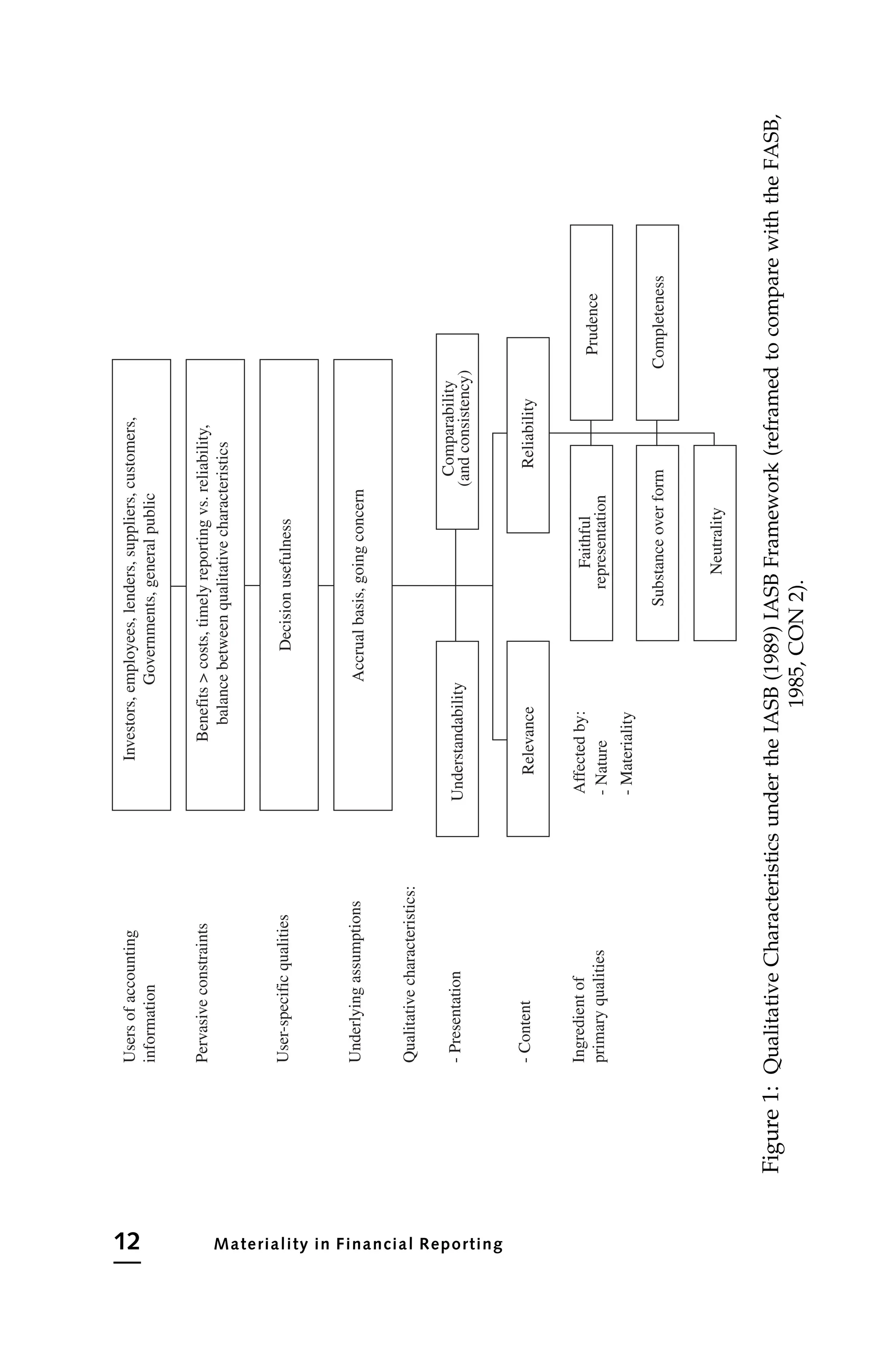


![scope and application of materiality to all items, but the assess-
ment of the overall impact to the whole financial statements.
The above views of materiality not being one of the qualitative
characteristics would to some extent contrast with Integrated
Reporting, where it is one of the six guiding principles, and with
AccountAbility [AA1000], 2008, where materiality, inclusivity, and
responsiveness are the three foundation principles. AccountAbility
[AA1000 AccountAbility Assurance Standard] (2008), as an
Assurance Standard, considers materiality as one of the qualitative
characteristics of corporate responsibility reporting, together with
completeness and responsiveness (Stakeholder Research
Associates Canada Inc., United Nations Environment Programme,
and AccountAbility, 2005, Vol. 2. p. 128).
1.d. Is Materiality a Constraint?
FASB (1985), CON 2, represents materiality as one of the two per-
vasive constraints. The first, benefit of information being greater
than cost, is a prerequisite to justify providing information. The
second, materiality, is the limit within which each of the qualita-
tive characteristics must exist to fit for purpose. The contempora-
neous presence of the qualitative characteristics above that limit
draws the line as a threshold for recognition (FASB, 1985, CON 2,
paras. Summary, 33). The common Conceptual Framework also
interprets FASB (1985), CON 2, in this way.
Under the IASB (1989), IASB Framework, materiality is not part
of the pervasive constraints, which are benefit over costs, the
tradeoff between timely reporting and reliability, and balance
between the qualitative characteristics.
The common Conceptual Framework specifies that, indeed
pervasive, materiality is not a constraint, as an entity would be
able to report immaterial information (IASB, 2010, Conceptual
Framework, para. BC3.18), (FASB, 2010, CON 8, para. BC3.18). The
IASB Disclosure Initiative and the Practice Statement on material-
ity explain the circumstances under which this is possible. This
reading appears to be symmetrical to the one used in FASB (1985),
CON 2, based on which it is a constraint because information to be
Conceptual Bases of Materiality 15](https://image.slidesharecdn.com/3719044-250514073103-445a2f5f/75/Materiality-In-Financial-Reporting-Bellandi-Francesco-44-2048.jpg)


![to management (Financial Accounting Standards Board [FASB],
2015, File no. 2015-310, para. BC21) (see Paragraph III.1.a below
for a discussion on the legal vs. accounting concept of materiality).
Finally, the FASB Proposed FASB Concepts Statement would
deny the previous view that materiality is an aspect of relevance
(FASB, 2015, File no. 2015-300, para. BC3.18).
The FASB’s invitation to comment the Disclosure Framework
uses the term relevance, not materiality in deciding which disclosure
to produce. It defines relevance of disclosures as the potential to
make an assessment by investors and creditors of prospects for
future cash flows from an equity dividend, loan or other interest
(FASB, 2012, File no. 2012-220, para. Chapter 4). Some participants
to the Center for Audit Quality (CAQ) forums noted that in such a
context the term materiality would be more familiar to preparers
(CAQ, 2012).
The language used by IASB (2015), IFRS for SMEs seems to
assimilate materiality with relevance, i.e., if information is mate-
rial, it is relevant. It defines relevance as capability of influencing
the economic decisions of users, while materiality what could
influence them (IASB, 2015, IFRS for SMEs, paras. 2.5, 2.6).
The Integrated Reporting Framework notes that relevance is
necessary but is not sufficient for materiality to exist. It assesses
materiality in terms of value creation (The International Integrated
Reporting Council, 2013, para. 3.24). In Integrated Reporting,
material matters are those that substantively affect the organiza-
tion’s ability to create value.
Relevance?
-Size
-Circumstances
Nature
Materiality?
Figure 5: Relevance and Materiality in the IASB (1989), IASB
Framework.
18 Materiality in Financial Reporting](https://image.slidesharecdn.com/3719044-250514073103-445a2f5f/75/Materiality-In-Financial-Reporting-Bellandi-Francesco-47-2048.jpg)
![While not explicitly stated, the materiality determination pro-
cess (see Paragraph VI.1 below) drills down from relevance to
materiality. Relevant matters are not necessarily material. After
identifying relevant matters, the organization evaluates and priori-
tize their effects in terms of magnitude and likelihood. Those that
are sufficiently important are the material ones.
Likewise, AA1000 (2008) has a process whereas materiality
results from determining both relevance and significance of an
issue (Figure 6).
Unlike the common Conceptual Framework, in the Framework
of the Climate Disclosure Standards Board, a consortium of
business and environmental organizations advocating reporting
of climate change, materiality is a component of both relevance
and reliability (Climate Disclosure Standards Board [CSDB],
2009, p. 8).
Commission of Sponsoring Organizations of the Treadway
Commission (COSO; 2013a) similarly states that materiality sets
the threshold for relevance. Materiality qualifies relevance insofar
as it defines the level of precision and accuracy required to present
the underlying activities, transactions and events within
acceptable limits (COSO, 2013a, p. 66). It uses the term materiality
for financial reporting, while the level of precision and accuracy
for compliance and operations (COSO, 2013a, p. 68). Materiality as
a qualification in terms of precision is an important point that
anticipates the relationship between risk tolerance and the level of
precision of internal controls (Paragraph IV.6.l below).
Relevant
matters
Material
matters
Magnitude /
likelihood
Figure 6: Relevance and Materiality in Integrated Reporting.
Conceptual Bases of Materiality 19](https://image.slidesharecdn.com/3719044-250514073103-445a2f5f/75/Materiality-In-Financial-Reporting-Bellandi-Francesco-48-2048.jpg)
![considers relevance in setting standards for all entities, not materi-
ality (FASB, 2015, File no. 2015-300, para. BC3.18).
Specificity may concern several aspects, including the entity, its
financial report, and the circumstances of its use (IASB, 2014,
Agenda Paper AP3), (IASB, 2014, Agenda Ref 4D).
The FASB reports comments about its 2013 field study that com-
pared materiality to entity-specific relevance. It notes that the lat-
ter is an interpretation of the former. Although the application of
both criteria in the field study leaded to similar conclusions, mate-
riality was more clearly understood and well established (FASB,
2015, File no. 2015-310, para. BC10).
The Fixing America’s Surface Transportation Act (2015) has
required the Securities and Exchange Commission (SEC) to con-
duct a study on the modernization and simplification of disclosure
in Regulation S-K, including emphasis on a company-by-company
approach for relevant and material information (Pub. L. no. 114-94,
129 Stat. 1312, 2015). Such study (SEC, 2016, Release no. 33-10110)
proposes to omit certain disclosures that may be redundant, dupli-
cated, overlapping, outdated, or superseded, in consideration of
other SEC, US GAAP, or IFRS requirements or of changes in the
information environment. The Center for Audit Quality of the
AICPA has favorably commented.
The SEC study, as it would go in the direction of taking into
accounts disclosures that are material because specific to the entity
(Center for Audit Quality, 2016, pp. 4 5).
According to the IASB (2017), PS 2, materiality applies at entity
level (IASB, 2017, PS 2, para. IN5). The traditional position of the
IASB and the FASB is that full guidance on materiality cannot be
given, because of the impossibility to generalize specific situations.
AccountAbility [AA1000SES], 2011, recognizes that materiality
may be stakeholder-specific, as not all the stakeholders may have
the same priorities and issues (AA1000SES, 2011, p. 14). Note that
this is different from entity-specific.
Some give another reading of entity specificity, that is, each
entity should determine materiality. This is a current motive
underlying the recent trend standards (e.g., IASB, 2014, Disclosure
Initiative Amendments to IAS 1) that would favor a loose
Conceptual Bases of Materiality 21](https://image.slidesharecdn.com/3719044-250514073103-445a2f5f/75/Materiality-In-Financial-Reporting-Bellandi-Francesco-50-2048.jpg)

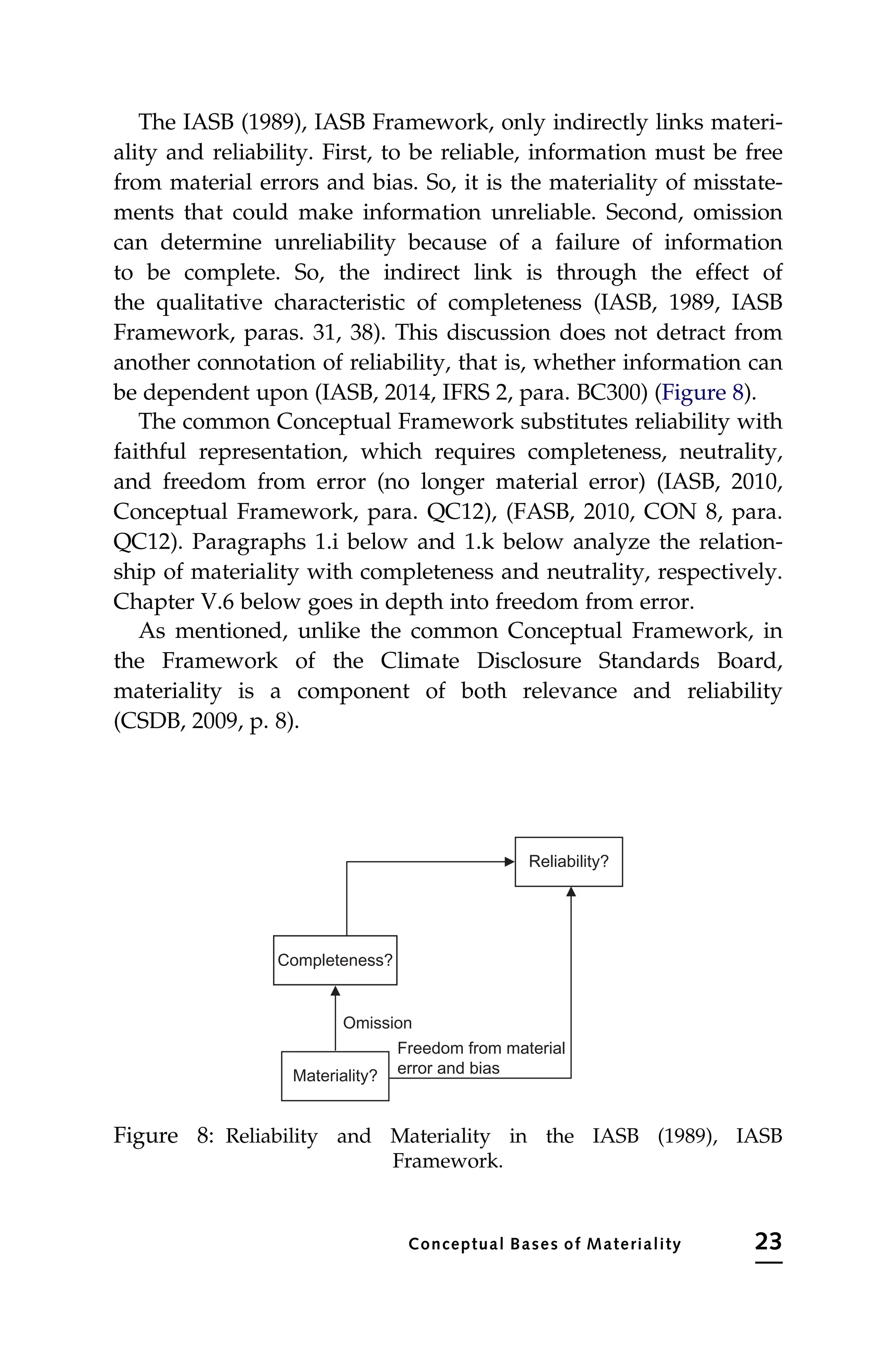











![Brennan, Niamh and Gray, Sidney J. [2005] The Impact of Materiality: Accounti...](https://cdn.slidesharecdn.com/ss_thumbnails/0417brennangraytheimpactofmaterialityaccountingsbestkeptsecret-121116102848-phpapp01-thumbnail.jpg?width=640&height=640&fit=bounds)


