Insights from real-world applications
of ESG materiality assessments
The reality of
materiality
Contents
1 Summary | 3
2 Introduction | 5
3 The purpose of this report | 9
4 Challenges around ESG materiality | 11
5 Materiality assessments in practice | 17
6 Summary of recomendations | 26
The reality of materiality Insights from real-world applications of ESG materiality assessments 2
7 Conclusion | 29
The reality of materiality Insights from real-world applications of ESG materiality assessments 3
Summary
1
The reality of materiality Insights from real-world applications of ESG materiality assessments 3
The reality of materiality Insights from real-world applications of ESG materiality assessments 4
Summary
Urgent action is needed to
accelerate the transformation
by 2050 to a world where
over 9 billion people live well
within planetary boundaries.
This is journey is set out in the
World Business Council for
Sustainable Development´s
(WBCSD) Vision 2050.
A crucial piece of the puzzle
is the move to a form of
capitalism that brings true
value – where environmental,
social and governance (ESG)
issues are part of how success
is defined and enterprise value
determined.
For this shift to occur, capital
markets and shareholders
need robust, comparable and
decision-useful information on
material ESG issues provided
through corporate disclosure.
Materiality and the materiality
assessment process are
considered vital for helping
companies effectively identify,
manage and report on significant
ESG risks and opportunities.
As materiality involves a user-
and purpose-based judgment
about what information is
relevant, there are challenges
in consistently applying an
effective approach based on
today’s guidance, expectations
and practice. This is a pertinent
issue; the various applications
of materiality profoundly affect
corporate disclosures, strategies
and objectives.
The purpose of this report
is to investigate and discuss
the “reality of materiality”, and
materiality assessment, as
it relates to ESG in current
guidance and practice. It builds
on WBCSD´s ESG Disclosure
Handbook that helps companies
improve their ESG reporting
strategy and focus on what really
matters.
The Challenges in materiality
discusses six different
challenges identified through
a review of ~95 white papers,
guidance documents and
thought leadership articles:
1) The multiple perspectives
on materiality; 2) Inconsistent
guidance on materiality methods;
3) Multiple stakeholders,
multiple opinions; 4) Materiality
is dynamic; 5) Materiality and
fiduciary duty; and 6) It’s not
financial information. In addition,
practical considerations for
companies are provided
when making choices about
materiality.
The Materiality assessments
in practice discusses research
findings on current practice
based on an analysis of 551
WBCSD member company
reports and one-to-one
interviews with 20 companies.
The investigation sets out
findings around seven key
steps involved in conducting
a materiality assessment:
1) Purpose of a materiality
assessment; 2) Materiality cycle;
3) Perspective on materiality;
4) Identifying the topics; 5)
Stakeholder involvement; 6)
Calculating the materiality
scores; and 7) Selecting the
material topics.
A central observation from
both the literature and practice
reviews is that there is not
always effective guidance
available to companies when
they make decisions related
1
to ESG materiality and these
decisions can define the final
outcomes. To ensure the
materiality assessment responds
to the company’s goals,
companies should strategically
and consciously apply judgment
and clear decision-making
when planning and applying a
materiality assessment.
Another principal observation
is the broad adoption of the
two different perspectives of
materiality: 1) The business
cases perspective, indicating
that a topic is material when
it has significant (positive or
negative) impact on the financial
performance of the company;
and 2) The societal impact
perspective, indicating that a
topic is material when it matters
to society and the company
significantly impacts this topic.1
The boundaries between these
two perspectives are less clear
in reality than they are in the
theoretical setting of reporting
standards development.
The research also highlights that
materiality can be a broader tool
for the integration of ESG topics
in strategic decision-making,
where the outputs are used to
evaluate current strategies and
inform future priorities. With
this more integrated purpose,
the materiality assessment can
fulfill its objective to enhance
transparency on company
priorities and how the company
arrived at these priorities while
at the same time providing an
opportunity to systematically
integrate feedback from
stakeholders into future priorities
and plans.
The reality of materiality Insights from real-world applications of ESG materiality assessments 5
Introduction
2
The reality of materiality Insights from real-world applications of ESG materiality assessments 5
The reality of materiality Insights from real-world applications of ESG materiality assessments 6
Introduction
2
opportunities. Transparency and
complete corporate disclosures
are key in establishing this
understanding.3
Second, investors are
increasingly asking companies
to understand and manage
their long-term value drivers
including ESG aspects.4
Between
2017 and 2019, sustainable
investments rose 34 % to USD
$30.7 trillion.5
Signatories to the
UN Principles for Responsible
Investment (PRI) more than
doubled in five years reaching
3,000 in 2020.6
For investors to
efficiently and effectively allocate
capital, they need comparable,
robust and decision-useful
information on material ESG
issues.
Third, there is growing
consensus that companies
should respond to the needs of
their shareholders and also serve
a wider set of stakeholders.7,8
This movement towards a
stakeholder-oriented form
of capitalism helps to ensure
businesses mitigate risks and
gain opportunities such as talent
acquisition and
retention, securing
licenses to
operate, reputation
management
and other benefits.
The needs of stakeholders go
beyond the financial output of
a company to include broader
value creation and impact and
dependencies such as ESG
aspects. In answering such
needs, transparent, relevant
and robust communication is
vital. Reporting on ESG allows
companies to show which
stakeholders’ needs they are
responding to and in what
way. It allows the company to
communicate the challenges
in responding to stakeholders’
needs, opening up an honest
conversation about the barriers
to sustainable development.
Responding to expectations,
companies are increasingly
reporting on ESG. However, there
has been a lack of consensus
on materiality and the materiality
assessment process. This has
made it hard for companies to
apply a systematic approach
to materiality and they must
navigate various factors in
determining their materiality and
its reporting.
A key enabler of the
transitions towards a world
where over nine billion people
are living well within planetary
boundaries will be the
fundamental transformation
of our financial system to
one which rewards true value
creation, not value extraction.
This is highlighted in WBCSD’s
recently published Vision
2050.2
The disclosure of
material, decision-useful ESG
information by companies,
and the effective use of this
information by the financial
markets, will be key to this
transition.
The materiality assessment
process is vital to help
companies effectively identify,
manage and report on pertinent
ESG risks and opportunities.
However, as we´ll see in this
document, there are challenges
in its effective application
based on existing guidance,
expectations and practice for
efficient reporting on material
ESG issues.
There is increasing demand for
transparency for good quality
corporate ESG information.
One contributor is the wide-
scale recognition that to
achieve global sustainable
development objectives, such
as the Sustainable Development
Goals (SDGs) and the Paris
Agreement, a significant amount
of capital must be directed
toward solutions for a low carbon
economy and a more equitable
future.2
Directing private finance
towards these objectives will
require businesses and investors
to have a clear understanding of
companies´ material risks and
The reality of materiality Insights from real-world applications of ESG materiality assessments 7
COMPLEXITY OF THE ESG
REPORTING LANDSCAPE
In recent years, the ESG reporting
landscape has changed
dramatically. The Reporting
Exchange, an online tool
developed to help corporates
navigate the landscape of ESG
reporting requirements, highlights
that there are over 2,000 voluntary
reporting frameworks, mandatory
reporting requirements,
methodologies and protocols
across 71 countries for company
measurement and disclosure of
ESG information by companies.9
In a stock take of the ESG topics
discussed in nine voluntary
reporting frameworks, the
Reporting Exchange’s ESG
indicator library identified
1,424 potential indicators that
companies could use to disclose
their ESG performance.9
Not only
is it practically impossible for
companies to report on all these
indicators, not all these topics
are material to each company.
In addition, as highlighted in
WBCSD’s ESG Disclosure
Handbook, companies are
required to make many decisions
on what to include and what to
exclude in their ESG disclosures.7
To make an informed choice, ESG
standard setters recommend
companies conduct a
materiality assessment. How
such assessments should be
conducted remains an area
of ongoing debate. Different
applications of materiality
profoundly affect corporate
disclosures, strategies and
objectives.
The lack of clarity can hinder
users of company disclosures in
interpreting a company’s positive
or negative contributions to
long-term value creation and
sustainable development.
A frequent complaint by users of
ESG information is the significant
variability and divergence in
materiality practices related
to format, measurement
and time frames. Concepts
are misinterpreted or mixed
up – for instance, relevancy
and materiality are often used
interchangeably.10,11,12
Material
ESG topics may also be presented
through multiple channels and
several ESG reporting standards
require companies to include non-
material topics in their general
annual reports.11
ALIGNING IN ESG
REPORTING AND
MATERIALITY
The good news is that discontent
among preparers and users
of ESG disclosures is being
recognized by voluntary standard
setters and major accounting
bodies, spurring them into action.
Several recent events illustrate a
journey towards alignment:
• At the beginning of 2021,
the International Financial
Reporting Standards (IFRS)
announced plans to create
a Sustainability Standards
Board and a working group
to accelerate convergence.13
This move shows financial
reporting standard-setters
are recognizing the materiality
of ESG information and the
need for an international
governing body to coordinate
the development of ESG
reporting standards.14
• The International Organization
of Securities Commissions
(IOSCO) set up a Task Force
on Sustainable Finance in
2020. IOSCO welcomed
the IFRS Foundation´s plan
of action on Sustainability
Standards and announced
a technical expert group to
observe the work. IOSCO
are developing guidance for
principles-based standards to
inform market regulators on
ESG reporting. This guidance
is likely to endorse and
encourage use of standards
developed by the IFRS.15,16
• CDP, the Climate Disclosure
Standards Board (CDSB), the
Global Reporting Initiative
(GRI), the International
Integrated Reporting Council
(IIRC) and the Sustainability
Accounting Standards Board
(SASB) (also referred to as
‘the Five’) announced their
intention to work together
under Impact Management
Project. The project aims to
provide clear, technical input
into regulatory efforts. This
statement and a subsequent
paper on climate-related
financial disclosure provide
a comparison of materiality
definitions as a first step
towards alignment on
materiality practices.17,18
• IIRC and SASB subsequently
have announced their intent
to merge, forming the Value
Creation Foundation. This
is perceived as a major
step towards simplifying
the corporate reporting
landscape.19
• The World Economic Forum
(WEF) released a set of
universal ESG metrics and
disclosures to advance
stakeholder capitalism and
help companies demonstrate
long-term value creation
in mainstream reporting. It
was developed with Bank of
America, the Big Four and
the International Business
Council (IBC) – a community
of over 120 global CEOs –
after a consultation process
following the 2020 Annual
Meeting in Davos.20
The reality of materiality Insights from real-world applications of ESG materiality assessments 8
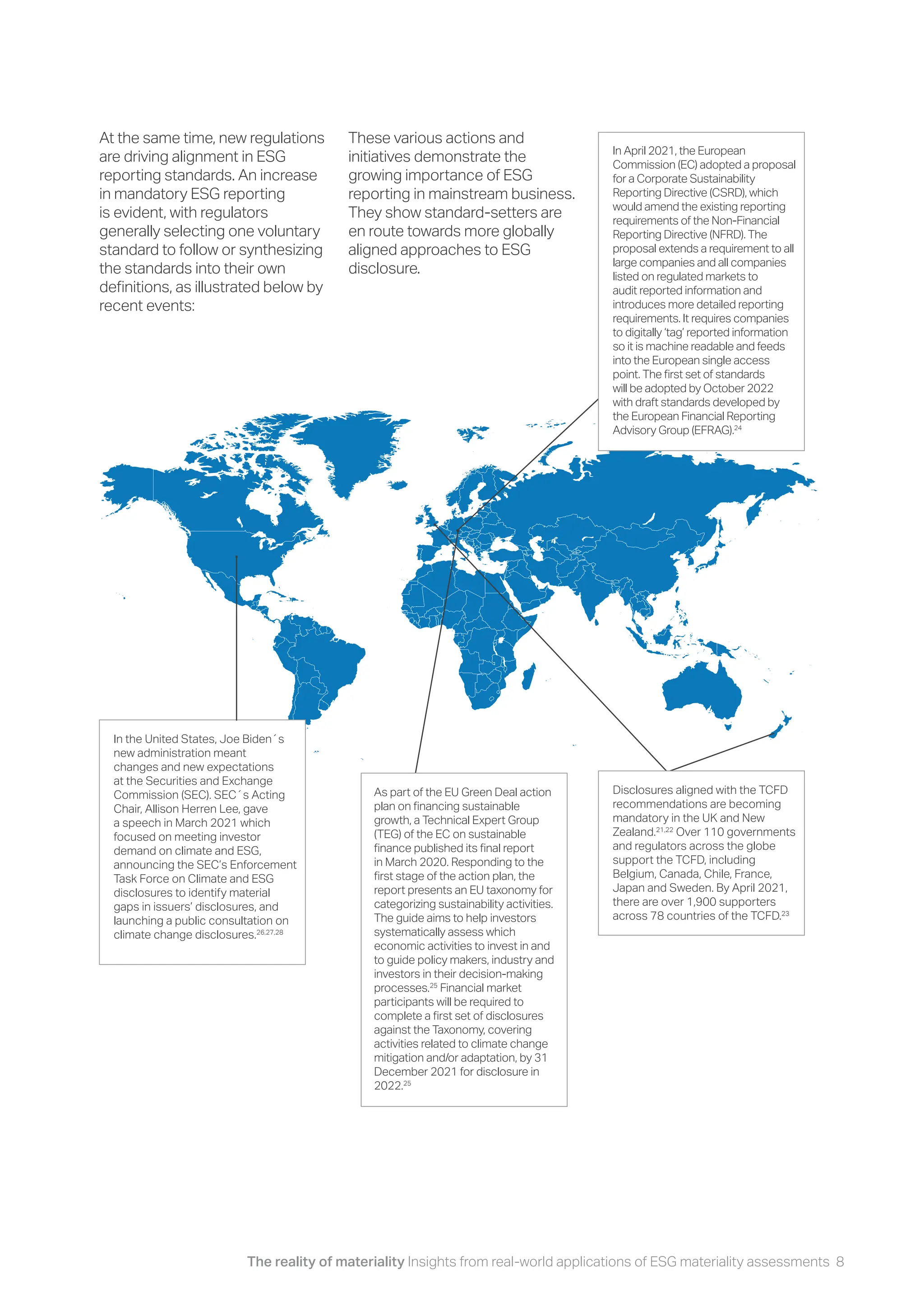
At the same time, new regulations
are driving alignment in ESG
reporting standards. An increase
in mandatory ESG reporting
is evident, with regulators
generally selecting one voluntary
standard to follow or synthesizing
the standards into their own
definitions, as illustrated below by
recent events:
These various actions and
initiatives demonstrate the
growing importance of ESG
reporting in mainstream business.
They show standard-setters are
en route towards more globally
aligned approaches to ESG
disclosure.
In April 2021, the European
Commission (EC) adopted a proposal
for a Corporate Sustainability
Reporting Directive (CSRD), which
would amend the existing reporting
requirements of the Non-Financial
Reporting Directive (NFRD). The
proposal extends a requirement to all
large companies and all companies
listed on regulated markets to
audit reported information and
introduces more detailed reporting
requirements. It requires companies
to digitally ‘tag’ reported information
so it is machine readable and feeds
into the European single access
point. The first set of standards
will be adopted by October 2022
with draft standards developed by
the European Financial Reporting
Advisory Group (EFRAG).24
In the United States, Joe Biden´s
new administration meant
changes and new expectations
at the Securities and Exchange
Commission (SEC). SEC´s Acting
Chair, Allison Herren Lee, gave
a speech in March 2021 which
focused on meeting investor
demand on climate and ESG,
announcing the SEC’s Enforcement
Task Force on Climate and ESG
disclosures to identify material
gaps in issuers’ disclosures, and
launching a public consultation on
climate change disclosures.26,27,28
As part of the EU Green Deal action
plan on financing sustainable
growth, a Technical Expert Group
(TEG) of the EC on sustainable
finance published its final report
in March 2020. Responding to the
first stage of the action plan, the
report presents an EU taxonomy for
categorizing sustainability activities.
The guide aims to help investors
systematically assess which
economic activities to invest in and
to guide policy makers, industry and
investors in their decision-making
processes.25
Financial market
participants will be required to
complete a first set of disclosures
against the Taxonomy, covering
activities related to climate change
mitigation and/or adaptation, by 31
December 2021 for disclosure in
2022.25
Disclosures aligned with the TCFD
recommendations are becoming
mandatory in the UK and New
Zealand.21,22
Over 110 governments
and regulators across the globe
support the TCFD, including
Belgium, Canada, Chile, France,
Japan and Sweden. By April 2021,
there are over 1,900 supporters
across 78 countries of the TCFD.23
The reality of materiality Insights from real-world applications of ESG materiality assessments 9
The purpose of this report
3
The reality of materiality Insights from real-world applications of ESG materiality assessments 9
The reality of materiality Insights from real-world applications of ESG materiality assessments 10
The purpose of this report
2
While waiting for a more
aligned approach to
materiality, companies still
need to make informed
decisions on which ESG topics
to report and in which ESG
topics to invest their time,
energy and resources.
The purpose of this report is
to investigate the “reality of
materiality” on a number of
levels. First, it seeks to show
the diversity of perspectives
of a broad number of actors
– including standard setters,
regulators, consulting
companies, stock exchanges
and other international
institutions – on the topic of
materiality and to observe the
role of these actors in shaping
disclosure at a corporate level.
Second, the report seeks to
build on the ESG Disclosure
Handbook discussion around
materiality by examining the
extent to which companies
appear to be defining a
reporting strategy and
conducting materiality
assessments consistent with the
recommendations set out in the
Handbook.7
Thirdly, by examining the
challenges and tensions
associated with materiality
assessment and how these
manifest in the disclosure
process, the report
provides insight into the
opportunities, good practices
and recommendations for
companies to manage and
overcome these challenges.
This report is intended to
discuss current existing
guidance and practice in ESG
materiality and materiality
assessment practice. It is not
meant to be seen as prescriptive
or complete guidance on ESG
materiality.
WHO IS THIS DOCUMENT
FOR?
The intended audience for this
report is companies who wish
to understand the different
approaches to materiality and
how to further develop their
internal processes and external
disclosure practices.
We also hope it will be helpful
for those engaged in developing
and defining global standards
for ESG disclosure by providing
insights into the challenges
and opportunities for an
aligned approach to assessing,
determining and disclosing
material ESG information in
corporate reports.
The reality of materiality Insights from real-world applications of ESG materiality assessments 11
Challenges around ESG
materiality
4
The reality of materiality Insights from real-world applications of ESG materiality assessments 11
The reality of materiality Insights from real-world applications of ESG materiality assessments 12
Challenges around ESG
materiality
4
Materiality is a widely debated
topic in ESG reporting circles.
Our literature review identified
around ~95 white papers,
guidance documents and
thought leadership articles
that discuss the concept
of ESG materiality and
materiality assessment.
We found an overarching theme
is that the existing materiality
reporting practices may not be
effectively serving the needs
of preparers or users of ESG
disclosures.29
To increase
effectiveness, there needs to be
mainstreaming and consolidation
of materiality approaches –
preferably as soon as possible.
Calls for rapid alignment have
been acknowledged by major
voluntary sustainability reporting
frameworks such as the Fivea
through their Statement
of Intent17
and Statement
of Common Principles of
Materiality.30
Our literature review identified
five broad challenges that can
arise for businesses around
the current concept of ESG
materiality and materiality
assessments. For each, we
provide a summary of actions for
corporates to consider during
the materiality assessment
process.
CHALLENGE 1:
MULTIPLE PERSPECTIVES
ON MATERIALITY
Current perspectives on ESG
materiality across different
frameworks and guidance -
including the Five and TCFD - can
be divided into two perspectives:b
1. The business case
perspective which indicates
that a topic is material when
it has significant (positive
or negative) impact on the
financial performance of the
company;
2. The societal impact
perspective which indicates
a topic is material when it
matters to society and the
company significantly impacts
this topic.31
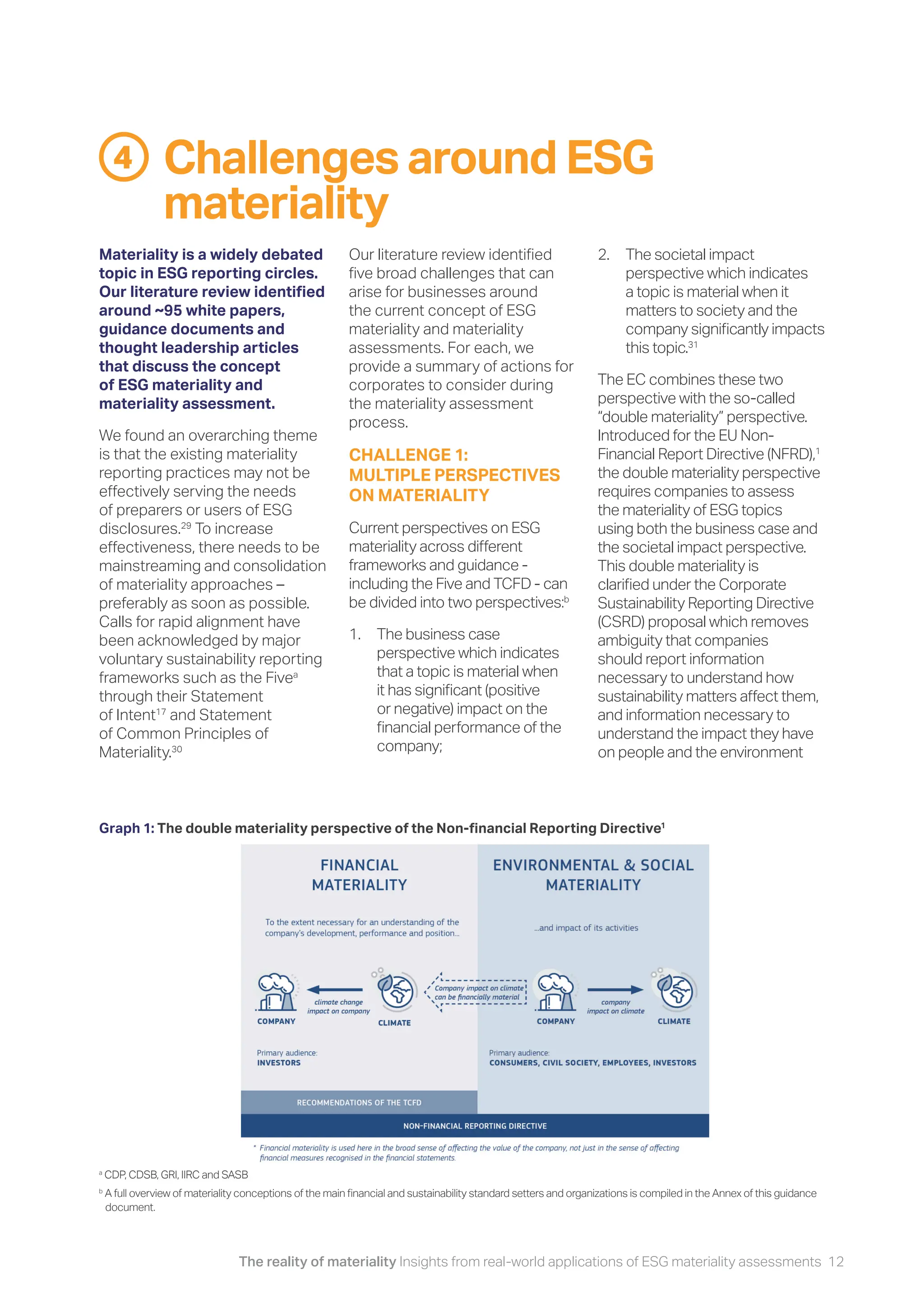
The EC combines these two
perspective with the so-called
“double materiality” perspective.
Introduced for the EU Non-
Financial Report Directive (NFRD),1
the double materiality perspective
requires companies to assess
the materiality of ESG topics
using both the business case and
the societal impact perspective.
This double materiality is
clarified under the Corporate
Sustainability Reporting Directive
(CSRD) proposal which removes
ambiguity that companies
should report information
necessary to understand how
sustainability matters affect them,
and information necessary to
understand the impact they have
on people and the environment
a
CDP, CDSB, GRI, IIRC and SASB
b
A full overview of materiality conceptions of the main financial and sustainability standard setters and organizations is compiled in the Annex of this guidance
document.
Graph 1: The double materiality perspective of the Non-financial Reporting Directive1
The reality of materiality Insights from real-world applications of ESG materiality assessments 13
The SASB materiality map
proposes lists of material ESG
topics by sector.53
This can help
identify material topics but the
topics listed might not precisely
overlap with the company-specific
circumstances. In practice, we
have observed that common
approaches are emerging and
this is discussed in the following
chapter.
Thirdly, some reporting
requirements require certain
ESG topics and indicators to be
reported regardless of whether
the topic is determined to be
material by the reporting entity.
For example, many jurisdictions
require companies to report
on respect for human rights
across their operations such as
prescribed by the EU´s NFRD and
UK´s Modern Slavery Act. Other
actors provide core subjects to be
reported on across all companies
such as the WEF Stakeholder
Capitalism metrics,20
the United
Nations Conference on Trade
and Development´s (UNCTAD´s)
core indicators for the SDGs54
or greenhouse gas emissions
(GHG).55
Companies need to take these
multiple factors into account and
identify the potential implications
when undertaking the materiality
assessment process. This will
help clarify the purpose of the
materiality assessment and
ensure the information disclosed
is specific, concise and decision-
useful for the intended audience.
and aligns the CSRD with the
ambitions of the European Green
Deal and Sustainable Finance
Disclosure Regulation and the
Taxonomy regulation.32,33
Our research highlights a lack
of clarity on these perspectives
of materiality in guidance
documents issued by some
standard setters, regulators and
stock exchanges.10,11,31,34–38
For
example, communications on
materiality perspectives do not
always provide clear definitions
or reference generally accepted
ones. If definitions are provided,
they may vary based on different
concepts of value creation,
time, intended users and scope
and the extent to which these
perspectives converge is context-
dependent.
This variance is significant
because a company’s
interpretation of the materiality
perspective and its application
will have an impact on the issues
deemed as material. The selected
materiality perspective is also
likely to have consequences
on the design and results of
the materiality assessment
process, including the scope and
boundaries, that reflect on the
reported content10,11,35,37,39,40
and
the reporting channel.41-43
Users of
disclosed information also report
that knowing which materiality
perspective has been applied is
as important as which topics are
disclosed as material.44
As a result, companies are
recommended to assess how
they apply the concept of
materiality and clearly articulate
what perspective on materiality
has been applied during the
materiality process.
CHALLENGE 2:
CONFLICTING GUIDANCE
ON MATERIALITY PROCESS
AND TOPICS
As highlighted above, there is
general agreement across the
literature for the need for more
consistent and standardized
methods for determining ESG
materiality.17,30
Our research
highlights three areas where
greater consistency could drive
more aligned practices.
Firstly, although there any many
guidance documents aimed
at supporting companies
undertaking a materiality
assessment process, many
highlight that materiality is
company-specific, leaving
room for interpretation on how
an effective ESG materiality
assessment is conducted.29,61,62
We noted varying degrees of
focus on prioritization, audience,
framing, boundaries, scope,
characteristics of materiality and
limited practical guidance on
the methodologies to collect,
measure and analyze data on
materiality.40,47–51
We also observed that current
guidance offered by standard
setters52
does not provide
extensive details on how to
assess the relative importance of
topics or how to compare them.
For example, how to compare
a broader ESG subject such as
climate change with a specific
one such as serious injury rate.
For more
information on
the definitions of
materiality used by
standard setters
and major actors,
refer to Annex 1.
The reality of materiality Insights from real-world applications of ESG materiality assessments 14
WBCSD’s ESG Disclosure Handbook provides guidance on how to tackle the audience
conundrum through the question “for whom should ESG information be reported?”. It
states that evaluating whether ESG information “satisfies the needs of the intended
audiences” is a fundamental component of the materiality assessment process.7
In addition to defining the intended audience, disclosing which stakeholders were
considered during the materiality assessment will provide further clarity. Helpful
considerations include who are the key stakeholders of company, who should be
consulted for the materiality assessment, what could be the possible biases and who
is the reported information for.7
Supporting strategic approach to materiality and disclosure
ESG Disclosure Handbook
Selecting a specific disclosure
audience will support companies
in determining information
needs but it does not solve the
heterogeneity of viewpoints
challenge. Differences in views
on what is material can exist both
between and within stakeholder
groups. For example, some
investors may be primarily
concerned with information that
is material for determining their
return-on-investment (ROI) but
the information needs of investors
increasingly goes beyond the
materiality conception of US
SEC.58
In addition to investment
timespan differences, the investor
landscape is diversifying and
investors are increasingly seen to
have broader interpretations that
reflect a values-driven or impact
investing orientation.39
Finally, determining and
articulating the appropriate
audience for reported information
has implications of the assurance
of that information, particularly
as jurisdictions move towards
external validation of materiality
analyses and ESG reports.33
When undertaking an assurance
assignment, assurance providers
may consider materiality from
different perspectives at report
level, qualitative information
level and quantitative level. If the
audience for the ESG report is
not defined, determining whether
the information is free from
material misstatement, how to
set thresholds and how to assure
the material assessments come
into question.36
Surprisingly, stock
exchange guidance documents
rarely mention or provide guidance
on internal controls or assurance
practices to ensure the quality of
reported material ESG information
for intended users.59–61
CHALLENGE 3:
MULTIPLE STAKEHOLDERS,
MULTIPLE OPINIONS
There is increasing pressure on
companies to be responsive to
multiple stakeholders.46,56
This
pressure gives rise to one of
the foremost challenges of the
materiality process: who decides
whether a given topic is material?
What may be material from one
stakeholder’s viewpoint may not
be material for another. Taking
the views of all stakeholders
into account risks running into
a “everything is material to
someone” scenario.34,57
In financial reporting, the audience
and parameters are usually
clearly defined and disclosures
are expected to be used by
people who have certain level
of understanding of finance. In
contrast, the audience for ESG
disclosures may more diverse,
making it difficult to define the
audience of ESG reports and their
level of knowledge.12
The reality of materiality Insights from real-world applications of ESG materiality assessments 15
In addressing big picture
sustainability issues which
manifest over decades, time
horizons are longer than traditional
business planning and reporting
cycles. Previous research has
observed a disconnect in the time
horizons for risk assessments
applied to mainstream financial
reports and those applied to
the materiality process.68
This
undermines the effectiveness
of the materiality assessment if
the relevant information is not
used internally to guide decision-
making.
For companies, this means
that effective evaluation of
risks, opportunities, ROIs,
and forecasting may require
consideration of ESG issues that
are not categorized as material
today.
Articulating the time horizons used
and how frequently materiality
topics will be reviewed should be
central to any robust materiality
assessment process. This would
include reviewing the links to
company risks, opportunities
and strategy and assessing how
this connectivity is reflected in
reported information such as key
performance indicators (KPIs),
management discussion and
comparability of information.
Establishing a process or
methodology for assessing future
materiality based on past data,
using techniques such as expert
elicitation and scenario analysis,
could be considered as way to
identify topics that may become
material in the future.34,38,57,66,67
CHALLENGE 4:
MATERIALITY IS DYNAMIC
In a recent paper, the Five
present a conceptual approach
and position to nested and
dynamic materiality.18
This
dynamic concept recognizes that
sustainability topics can move
from being topics of sustainability
interest in the broadest sense to
being likely to influence enterprise
value creation to being directly
recognized in the financial
statements. Other literature
highlights that the materiality
lens can evolve and shift over
time.29,62–65
Although guidance
refer to short-, medium- and
long-term timeframes, specific
timespans aren´t commonly
given. The question of what the
appropriate time horizon is to
remain responsive to a dynamic
environment.
The global risk landscape continues to change. Monitoring and managing ESG-
related risks and opportunities is crucial to business resilience in an economy that
experiences more frequent and severe risk impacts than ever before. Not managing
ESG-related risks can mean missing out on opportunities and suffering detrimental
impacts.
WBCSD research found that only 44% of companies in 2019 showed some
alignment between what they said was material in their sustainability report and
what they disclosed in their legal risk filings. Although not all material issues translate
into risks and vice versa, this disconnect demonstrates that organizations find it
challenging to integrate emerging ESG information into existing mainstream business
processes – including risk management.
Working with member companies, WBCSD engaged KPMG, through its process
known as Dynamic Risk Assessment, to enhance ESG risk management. Application
of the dynamic risk assessment approach has highlighted that the complexities and
connectivity of ESG-related risks mean companies must assess risks not just individually, but as an interconnected,
aggregated and dynamically dependent group. By considering risks as part of an interconnected network, it is
possible to identify the most influential risks and better target and apply risk mitigation techniques to positively
impact key challenges. By extending and introducing new risk dimensions, the analysis illustrated the importance of
considering connected clusters of risks and exploring how the occurrence of one risk may trigger or influence the
timing and occurrence of other connected risks. The analysis highlighted the greater aggregated severity and more
rapid onset of closely connected, clustered risks, compared with traditional approaches that assess the impacts of
individual risks and ignore their interactions.
As materiality assessments are used by companies to support the identification of relevant risks, strengthen risk
assessment can help better understand the interconnectivity between material ESG topics and their dynamic nature
to an enhance risk management and disclosure. Effective risk management – especially with longer time horizons –
also means understanding what ESG subjects are material today and what can are likely to be material in the future.
For more information, see the full report and work at
Connecting the dots - material ESG issues and enhanced risk assessment
https://www.wbcsd.org/fumnc
The reality of materiality Insights from real-world applications of ESG materiality assessments 16
As the Board of Directors of a
company have a fiduciary duty to
ensure its long-term success, it is
essential that boards understand
the material issues of the
business and their impacts and
dependencies on stakeholders to
effectively exercise their fiduciary
duties. Our research highlighted
that the guidance of stock
exchanges frequently refer to the
role of board oversight in ensuring
strategic direction regarding
material ESG issues due to the
link to value creation59,71–78
and
that there has been an increase
in ESG litigation as companies
have mismanaged or misreported
relevant or material ESG issues.79,80
Material ESG issues should be
elevated to the board to ensure
full awareness of important risks
and opportunities effecting value
creation to enable the board to
be able to fulfill its fiduciary duties.
Ultimately, the board should play a
role in scrutinizing the materiality
assessment to ensure robust and
relevant information as it falls to
them to ensure that stakeholder
tensions are resolved.
CHALLENGE 6: IT’S NOT
FINANCIAL INFORMATION
Our final observation relates to
the contrast between finance
and ESG reporting. Reporting
on financial material topics is
rooted in accounting practice
and regulation and supported
by robust underlying data. In
contrast, when deciding if an
ESG topic is material, supporting
infrastructure and underlying
information may not necessarily
exist.49,81
To assess materiality
of ESG issues, companies need
to investigative what could be
material through a materiality
assessment e.g., by soliciting
views of relevant stakeholders.
This can create a situation where
new and emerging ESG material
issues are not currently accounted
for and the company may not
have data collection, control and
management systems in place.
As a result, companies will need to
assess if further work is needed to
integrate respective management
and data systems for the identified
material ESG subjects to support
robust reporting on these issues.
CHALLENGE 5:
MATERIALITY AND
FIDUCIARY DUTY
For investors and asset managers,
the conventional viewpoint is
that fiduciaries are not required
to “account for the sustainability
impact of their investment activity
beyond financial performance”.8
However, there are strong calls
within the literature for clarification
on the role of fiduciaries, including
whether or not they should be
obliged to incorporate both
financially material ESG factors
into investment decision-making
and the sustainability preferences
of clients - whether or not these
preferences are financially material
in the traditional sense.8,63
It has
been suggested that fiduciaries
who do not consider material
ESG topics in their investment
practices may be breaching their
stewardship obligations.69
For companies, the implications of
fiduciaries paying closer attention
to material ESG topics may
result in increased scrutiny of the
materiality assessment process
and requests to integrate context
based, multi-capital assessments,
cumulative impacts and
scalability into future materiality
approaches.70
The reality of materiality Insights from real-world applications of ESG materiality assessments 17
Materiality assessments
in practice
5
The reality of materiality Insights from real-world applications of ESG materiality assessments 17
The reality of materiality Insights from real-world applications of ESG materiality assessments 18
Materiality assessments
in practice
5
In conducting a materiality
assessment, companies
need to navigate the different
perspectives on materiality and
the challenges highlighted in the
previous chapter. To understand
current practice and approaches,
551 reports of members of
WBCSD were analyzed. A total
of 428 reports contained a
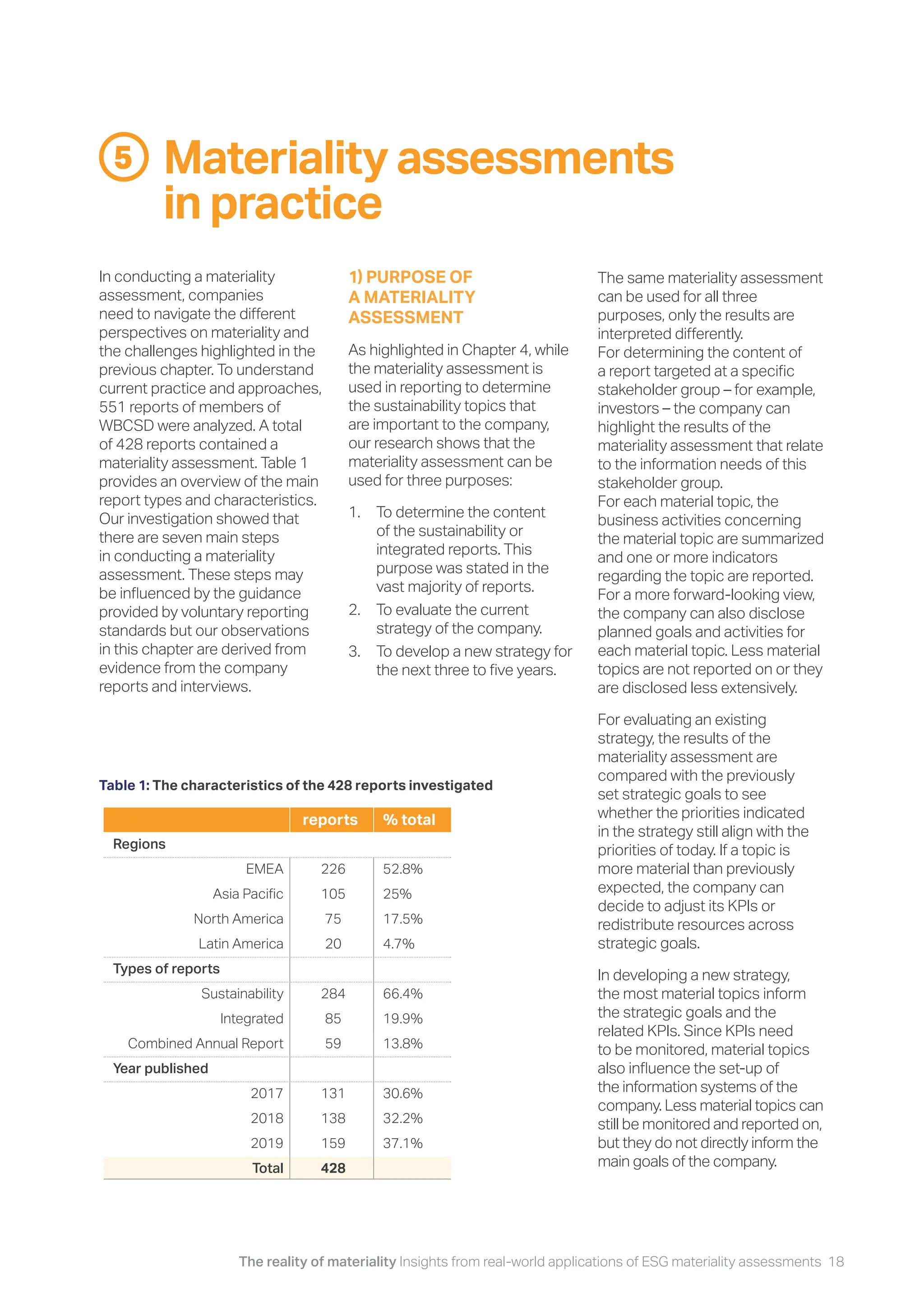
materiality assessment. Table 1
provides an overview of the main
report types and characteristics.
Our investigation showed that
there are seven main steps
in conducting a materiality
assessment. These steps may
be influenced by the guidance
provided by voluntary reporting
standards but our observations
in this chapter are derived from
evidence from the company
reports and interviews.
Table 1: The characteristics of the 428 reports investigated
reports % total
Regions
EMEA 226 52.8%
Asia Pacific 105 25%
North America 75 17.5%
Latin America 20 4.7%
Types of reports
Sustainability 284 66.4%
Integrated 85 19.9%
Combined Annual Report 59 13.8%
Year published
2017 131 30.6%
2018 138 32.2%
2019 159 37.1%
Total 428
1) PURPOSE OF
A MATERIALITY
ASSESSMENT
As highlighted in Chapter 4, while
the materiality assessment is
used in reporting to determine
the sustainability topics that
are important to the company,
our research shows that the
materiality assessment can be
used for three purposes:
1. To determine the content
of the sustainability or
integrated reports. This
purpose was stated in the
vast majority of reports.
2. To evaluate the current
strategy of the company.
3. To develop a new strategy for
the next three to five years.
The same materiality assessment
can be used for all three
purposes, only the results are
interpreted differently.
For determining the content of
a report targeted at a specific
stakeholder group – for example,
investors – the company can
highlight the results of the
materiality assessment that relate
to the information needs of this
stakeholder group.
For each material topic, the
business activities concerning
the material topic are summarized
and one or more indicators
regarding the topic are reported.
For a more forward-looking view,
the company can also disclose
planned goals and activities for
each material topic. Less material
topics are not reported on or they
are disclosed less extensively.
For evaluating an existing
strategy, the results of the
materiality assessment are
compared with the previously
set strategic goals to see
whether the priorities indicated
in the strategy still align with the
priorities of today. If a topic is
more material than previously
expected, the company can
decide to adjust its KPIs or
redistribute resources across
strategic goals.
In developing a new strategy,
the most material topics inform
the strategic goals and the
related KPIs. Since KPIs need
to be monitored, material topics
also influence the set-up of
the information systems of the
company. Less material topics can
still be monitored and reported on,
but they do not directly inform the
main goals of the company.
The reality of materiality Insights from real-world applications of ESG materiality assessments 19
majority of the reports analyzed,
the timeframe for review was not
indicated and it was not always
clear if the materiality assessment
was conducted in the reported
year or whether it concerned
a previously conducted
assessment.
Although companies conduct
the materiality assessment
regularly, that does not mean
that they compare the results
over time and report changes.
According to the interviewees,
the main barrier for conducting
comparisons are changes in
the materiality assessment
process which make the results
of multiple assessments less
comparable. For example,
if one year a company asks
stakeholders to rank topics
and the following year they are
requested to score topics from 1
to 5, the materiality scores are not
measured in the same way and
are difficult to compare. Changes
in topic names and descriptions
also make comparison more
difficult. Whether or not to report
these changes in materiality is
indicated by the interviewees as
being dependent on audience
needs. Although focusing on
dynamics has been expressed
as an improvement in corporate
reporting, companies struggle to
find a clear manner in which to
present changes. Interviewees
highlighted concern that
presenting these changes will
raise more questions from their
audience, for example, about the
causes of changes. The company
may not always have an answer
to these questions or the time or
space to discuss them in depth.
3) PERSPECTIVE ON
MATERIALITY
As indicated in Chapter 4, there
are two main perspectives on
materiality: 1) the business case
perspective; and 2) the societal
impact perspective. These two
perspectives were reflected
in the many but not all of the
analyzed reports and interviews.
In the reports with a materiality
assessment, 35% did not clearly
indicate which perspective on
materiality was used. When the
report did indicate the perspective,
it was most clearly visible in
the figures and tables used to
present the materiality results,
such as the axes of the materiality
matrix. In 61.2% of materiality
assessments companies reported
using multiple perspectives on
materiality.
From the business case
perspective, a sustainability topic
is material when it significantly
influences the financial
2) MATERIALITY CYCLE
Because companies and
the external environment
are constantly changing and
evolving, an effective approach to
materiality needs to be seen as
dynamic. These developments
can lead to a reshuffling of
topic priorities, changes in the
terminology used to describe
topics or appearance of new
topics (see section 4 ‘identifying
topics’).
Our research highlighted the
importance of regularly repeating
the materiality assessment to
support a company in picking up
these changes. Typically, where
the materiality assessment is
considered part of the reporting
cycle, an annual update of the
assessment is common. This
annual assessment may not
be as extensive every year. It is
common practice to conduct
one extensive assessment and
then, in the two to three years
that follow, to conduct smaller
assessments to see whether
there were major changes
until doing another extensive
assessment in the year to follow.
Other companies conduct an
extensive assessment and report
the same materiality results for
2-3 years until conducting the
next extensive update. In the
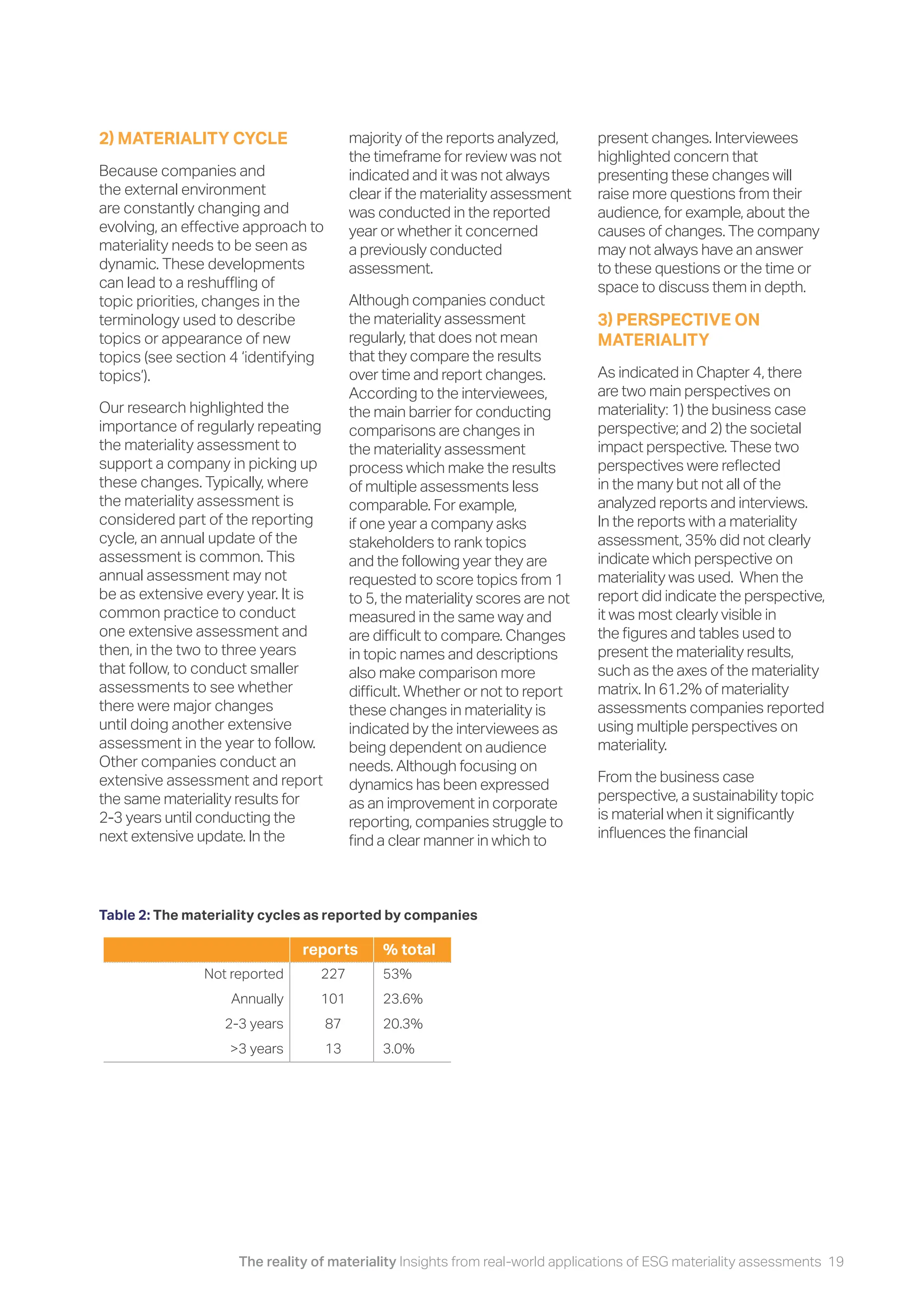
Table 2: The materiality cycles as reported by companies
reports % total
Not reported 227 53%
Annually 101 23.6%
2-3 years 87 20.3%
>3 years 13 3.0%
The reality of materiality Insights from real-world applications of ESG materiality assessments 20
performance of the company. The
business case perspective was
also referred to in the interviews
and reports as ‘materiality in
the traditional sense’, ‘financial
materiality’ and ‘ESG-related
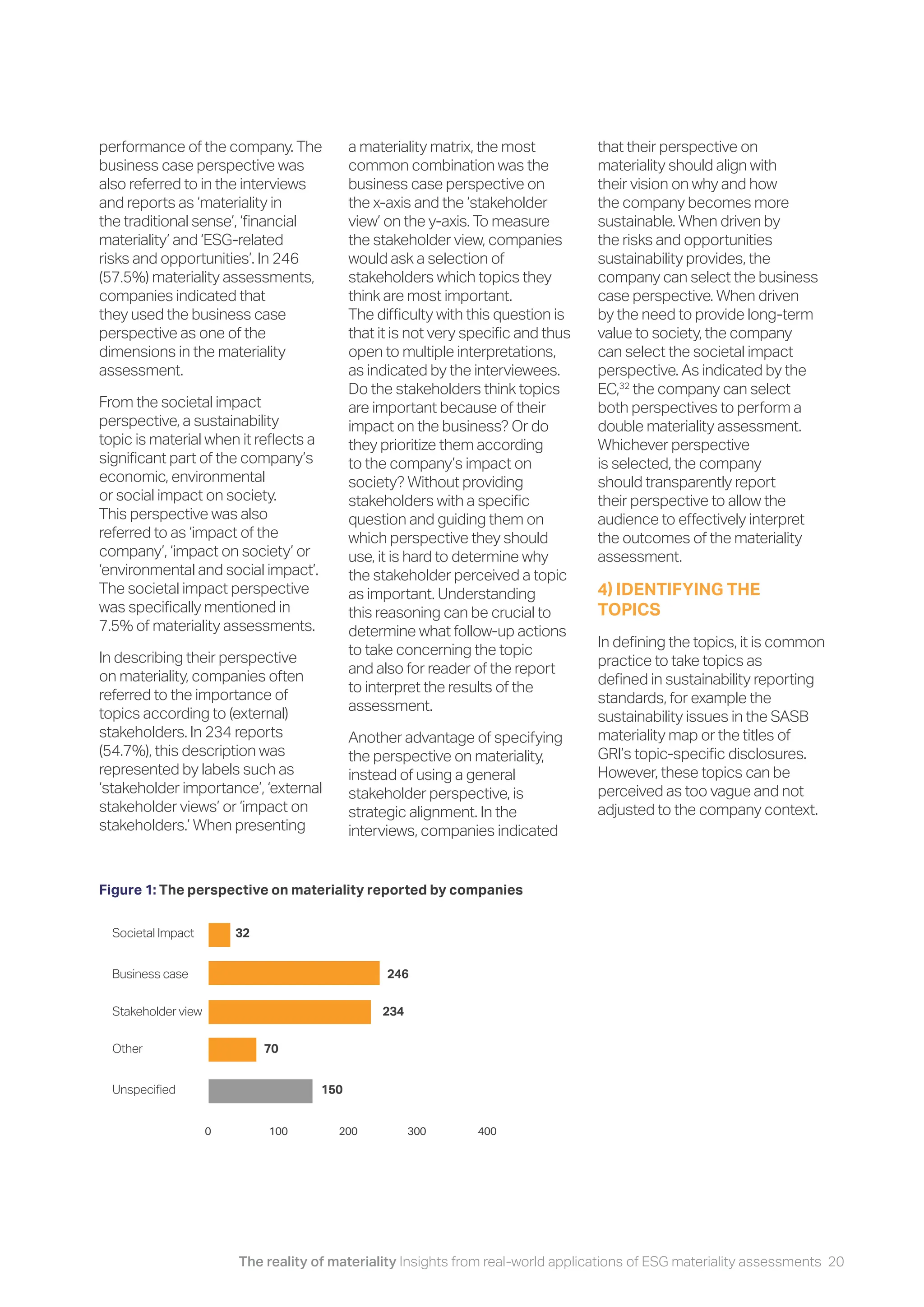
risks and opportunities’. In 246
(57.5%) materiality assessments,
companies indicated that
they used the business case
perspective as one of the
dimensions in the materiality
assessment.
From the societal impact
perspective, a sustainability
topic is material when it reflects a
significant part of the company’s
economic, environmental
or social impact on society.
This perspective was also
referred to as ‘impact of the
company’, ‘impact on society’ or
‘environmental and social impact’.
The societal impact perspective
was specifically mentioned in
7.5% of materiality assessments.
In describing their perspective
on materiality, companies often
referred to the importance of
topics according to (external)
stakeholders. In 234 reports
(54.7%), this description was
represented by labels such as
‘stakeholder importance’, ‘external
stakeholder views’ or ‘impact on
stakeholders.’ When presenting
a materiality matrix, the most
common combination was the
business case perspective on
the x-axis and the ‘stakeholder
view’ on the y-axis. To measure
the stakeholder view, companies
would ask a selection of
stakeholders which topics they
think are most important.
The difficulty with this question is
that it is not very specific and thus
open to multiple interpretations,
as indicated by the interviewees.
Do the stakeholders think topics
are important because of their
impact on the business? Or do
they prioritize them according
to the company’s impact on
society? Without providing
stakeholders with a specific
question and guiding them on
which perspective they should
use, it is hard to determine why
the stakeholder perceived a topic
as important. Understanding
this reasoning can be crucial to
determine what follow-up actions
to take concerning the topic
and also for reader of the report
to interpret the results of the
assessment.
Another advantage of specifying
the perspective on materiality,
instead of using a general
stakeholder perspective, is
strategic alignment. In the
interviews, companies indicated
that their perspective on
materiality should align with
their vision on why and how
the company becomes more
sustainable. When driven by
the risks and opportunities
sustainability provides, the
company can select the business
case perspective. When driven
by the need to provide long-term
value to society, the company
can select the societal impact
perspective. As indicated by the
EC,32
the company can select
both perspectives to perform a
double materiality assessment.
Whichever perspective
is selected, the company
should transparently report
their perspective to allow the
audience to effectively interpret
the outcomes of the materiality
assessment.
4) IDENTIFYING THE
TOPICS
In defining the topics, it is common
practice to take topics as
defined in sustainability reporting
standards, for example the
sustainability issues in the SASB
materiality map or the titles of
GRI’s topic-specific disclosures.
However, these topics can be
perceived as too vague and not
adjusted to the company context.
Figure 1: The perspective on materiality reported by companies
Societal Impact 32
Business case 246
Stakeholder view 234
Other 70
Unspecified 150
0 100 200 300 400
The reality of materiality Insights from real-world applications of ESG materiality assessments 21
Interviewees indicated that topics
are frequently translated into a
more specific term that resonates
better with the company’s
employees and stakeholders.
Another practice is to split the
broader topic into multiple sub-
topics which may result in the list
of topics becoming very long.
To shorten the list, companies are
seen to either exclude topics that
are seen as least material by the
company or to regroup them into
broader ‘bucket’ topics.
In specifying and narrowing down
the topic list, five potential issues
can be observed in reports:
1. Overlap between topics.
In several reports, there was
an overlap between topics.
For example, one assessment
included the topic ‘climate
change’ as well as the topic
‘greenhouse gas emissions.’
Having overlapping topics
in an assessment confuses
participants who are asked
to rank the topics as well as
users of the report.
2. Vague topic labels.
When ‘bucketing’ topics, the
risk is that labels become too
general to interpret, such as:
‘Indirect impact and influence’,
‘Social responsibility’ or
‘Constructing a sustainable
society’. Although providing
detailed descriptions of all
topics within the ‘bucket’
may help with interpretation,
providing one materiality
score for all topics will still be
difficult. For example, what
score to give the general topic
‘social responsibility’ if the
sub-topic ‘supporting local
entrepreneurship’ is material
to the company but the other
sub-topic ‘community safety’
is not?
3. Incomparable framing.
In contextualizing a topic,
companies are seen to
frame topics perceived
as more material as a
business activity (e.g., CO2
management systems) or
direct business output (e.g.,
low carbon operations),
while topics that are seen as
less material are framed as
long-term outcomes (e.g.,
reduction of CO2
emissions)
or abstract societal issues
(e.g., climate change). Using
diverse framings in one
assessment makes topics
less comparable. For example,
how to compare societal
issues like ‘climate change’
with activities like ‘supply
chain management’ or
‘whistleblower procedures’
or outcomes like ‘gender
equality in the workforce’?
4. Hidden excluded topics.
Although excluding less
material topics in the
assessment is common
practice, companies rarely
report which topics were
excluded and participants
in the assessment are not
always informed about
excluded topics. Although
participants are often allowed
to add topics to the list, they
are not provided with a list of
excluded topics
from which
to choose.
Additionally,
added topics
are often not
incorporated
in the ranking
exercise
of other
participants
and thus will not turn up in the
list of material topics, which
questions the purpose of this
option.
Most of these problems are
preventable. By using one
particular framing for all topics
– preferably as specific as
possible – companies can
prevent incomparability and
overlap of topics. Avoiding
‘bucketing’ as much as possible
and using clear descriptions
of topics (referencing the topic
list of reporting standards)
can support participants and
users in interpreting the topics
and their scores. If topics are
excluded before the assessment,
participants can be asked
whether they would like to move
topics from the excluded list to
the included list. When multiple
stakeholders indicate that a topic
should be moved, the company
can include it in their assessment
or report it as a topic to be
included in the next assessment.
The reality of materiality Insights from real-world applications of ESG materiality assessments 22
5) STAKEHOLDERS’
INVOLVEMENT
To determine the materiality
of sustainability topics, most
companies request insights and
opinions from their stakeholders.
Selecting the stakeholders to be
included is an important step in
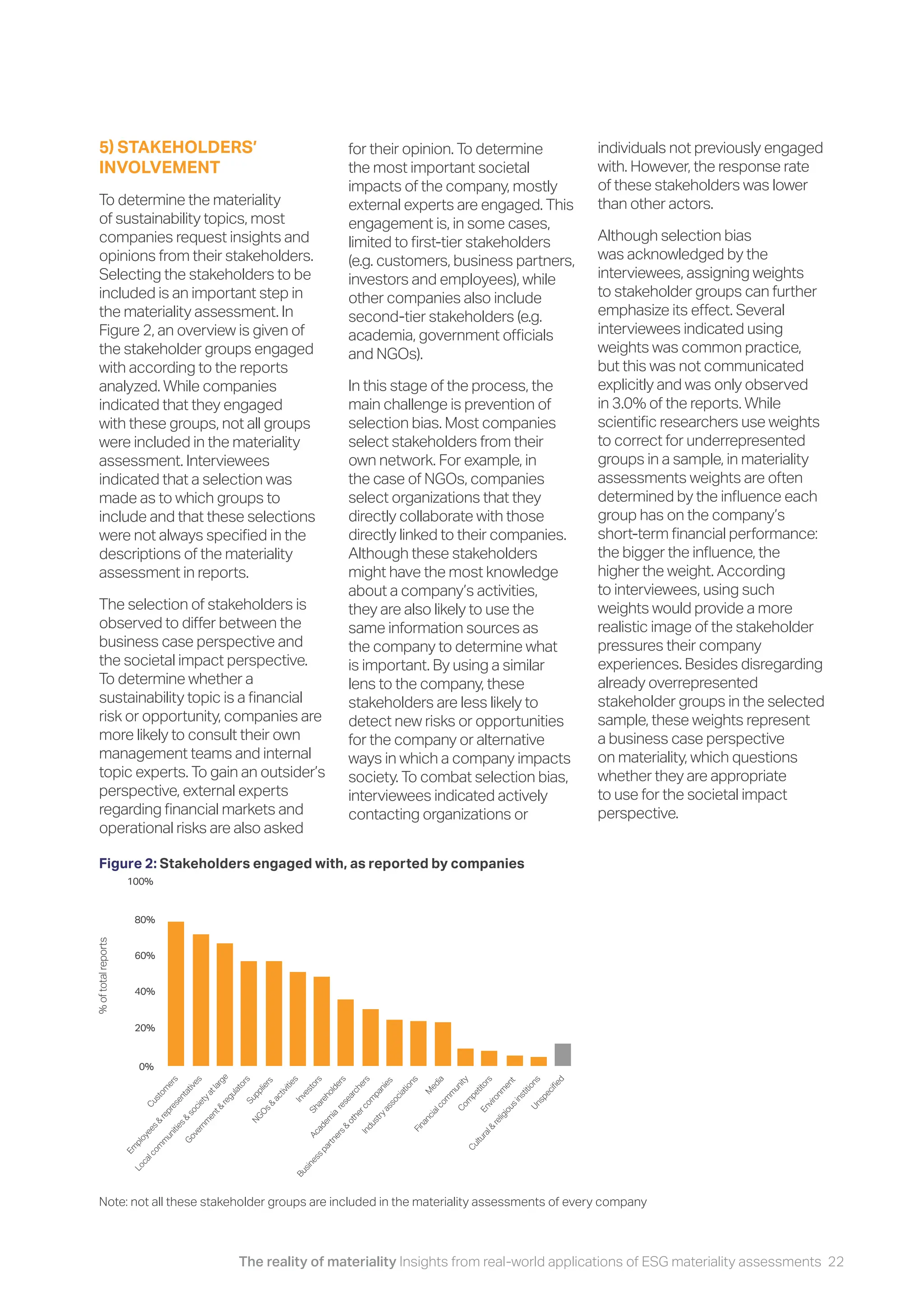
the materiality assessment. In
Figure 2, an overview is given of
the stakeholder groups engaged
with according to the reports
analyzed. While companies
indicated that they engaged
with these groups, not all groups
were included in the materiality
assessment. Interviewees
indicated that a selection was
made as to which groups to
include and that these selections
were not always specified in the
descriptions of the materiality
assessment in reports.
The selection of stakeholders is
observed to differ between the
business case perspective and
the societal impact perspective.
To determine whether a
sustainability topic is a financial
risk or opportunity, companies are
more likely to consult their own
management teams and internal
topic experts. To gain an outsider’s
perspective, external experts
regarding financial markets and
operational risks are also asked
for their opinion. To determine
the most important societal
impacts of the company, mostly
external experts are engaged. This
engagement is, in some cases,
limited to first-tier stakeholders
(e.g. customers, business partners,
investors and employees), while
other companies also include
second-tier stakeholders (e.g.
academia, government officials
and NGOs).
In this stage of the process, the
main challenge is prevention of
selection bias. Most companies
select stakeholders from their
own network. For example, in
the case of NGOs, companies
select organizations that they
directly collaborate with those
directly linked to their companies.
Although these stakeholders
might have the most knowledge
about a company’s activities,
they are also likely to use the
same information sources as
the company to determine what
is important. By using a similar
lens to the company, these
stakeholders are less likely to
detect new risks or opportunities
for the company or alternative
ways in which a company impacts
society. To combat selection bias,
interviewees indicated actively
contacting organizations or
individuals not previously engaged
with. However, the response rate
of these stakeholders was lower
than other actors.
Although selection bias
was acknowledged by the
interviewees, assigning weights
to stakeholder groups can further
emphasize its effect. Several
interviewees indicated using
weights was common practice,
but this was not communicated
explicitly and was only observed
in 3.0% of the reports. While
scientific researchers use weights
to correct for underrepresented
groups in a sample, in materiality
assessments weights are often
determined by the influence each
group has on the company’s
short-term financial performance:
the bigger the influence, the
higher the weight. According
to interviewees, using such
weights would provide a more
realistic image of the stakeholder
pressures their company
experiences. Besides disregarding
already overrepresented
stakeholder groups in the selected
sample, these weights represent
a business case perspective
on materiality, which questions
whether they are appropriate
to use for the societal impact
perspective.
Figure 2: Stakeholders engaged with, as reported by companies
Note: not all these stakeholder groups are included in the materiality assessments of every company
F
i
n
a
n
c
i
a
l
c
o
m
m
u
n
i
t
y
S
h
a
r
e
h
o
l
d
e
r
s
L
o
c
a
l
c
o
m
m
u
n
i
t
i
e
s
&
s
o
c
i
e
t
y
a
t
l
a
r
g
e
C
u
s
t
o
m
e
r
s
C
o
m
p
e
t
i
t
o
r
s
A
c
a
d
e
m
i
a
r
e
s
e
a
r
c
h
e
r
s
G
o
v
e
r
n
m
e
n
t
&
r
e
g
u
l
a
t
o
r
s
E
m
p
l
o
y
e
e
s
&
r
e
p
r
e
s
e
n
t
a
t
i
v
e
s
E
n
v
i
r
o
n
m
e
n
t
B
u
s
i
n
e
s
s
p
a
r
t
n
e
r
s
&
o
t
h
e
r
c
o
m
p
a
n
i
e
s
S
u
p
p
l
i
e
r
s
C
u
l
t
u
r
a
l
&
r
e
l
i
g
i
o
u
s
i
n
s
t
i
t
i
o
n
s
I
n
d
u
s
t
r
y
a
s
s
o
c
i
a
t
i
o
n
s
N
G
O
s
&
a
c
t
i
v
i
t
i
e
s
U
n
s
p
e
c
i
fi
e
d
M
e
d
i
a
I
n
v
e
s
t
o
r
s
%
of
total
reports
0%
20%
40%
60%
80%
100%
The reality of materiality Insights from real-world applications of ESG materiality assessments 23
6) CALCULATING THE
MATERIALITY SCORES
To determine the materiality of
a topic, the company needs to
collect information on a topic and,
based on this information, assess
the priority of the topic. This
information can be a collection
of data measured for other
purposes, also called secondary
data sources. These sources
can include risk calculations,
regulatory updates and market
trend analyses.
Of the investigated reports
published in 2019, 30.9% used
secondary data on stakeholder
behavior and views, often
externally created by traditional
and online media publications.
Additionally, in 20.1% of the
reports, data from stakeholder
meetings organized throughout
the year was re-used to determine
materiality.
Companies can also use
primary data methods which are
specifically designed to collect
data on materiality. This direct
engagement with stakeholders for
the materiality assessment was
done in the 2019 reports through
surveys (30.2%), interviews
(20.9%) and focus groups
(9.4%) in which participants are
asked to indicate the priority of
sustainability topics.
Our observations are that there
also appears to be no consensus
on an appropriate balance
between primary and secondary
data collection. For both types
of data collection, the company
needs to translate materiality into
a measurable construct that is
comparable across topics. This
raises two challenges: a) how to
collect insights on the materiality
of a topic; and b) how to combine
insights into one materiality score.
In interviews and surveys,
materiality is often scored by
asking participants to either rank
topics or give topics a score (1-5
or 1-10) based on how important
they think they are. According to
the interviewees, a complaint from
participants is that the question
is vague and can be interpreted
in many ways. Take, for example,
the question ‘Which topic is most
important to you?’. A stakeholder
can see a topic as more important
for diverse reasons, including:
• it affects the stakeholder’s
wellbeing directly;
• the stakeholder is an expert in
the topic;
• the stakeholder has vested
interests in the topic;
• the topic got a lot of media
attention;
• the stakeholder is
disappointed or not informed
about the company’s actions
on this topic, and
• because the stakeholder
is disappointed about the
industry’s actions on this
topic.
Each of these reasons requires
a different strategy of the
company to act upon the topic.
If the stakeholder is concerned
about its own wellbeing related
to a topic, the company might
investigate how it can minimize
the negative impact on the
stakeholder. If a stakeholder is not
informed about the company’s
actions and performance on a
topic, communication about the
topic needs to be improved. If the
stakeholder is disappointed by
poor performance at the industry
level, the company might invest in
collaborative projects, voluntary
standards or industry targets.
Interviews allow these reasons
to be explored but, for closed
questionnaires, the question
could be made more specific
using the dimensions mentioned.
The reality of materiality Insights from real-world applications of ESG materiality assessments 24
For example, ‘Which topic do you
think has the most impact on
the financial performance of the
company?’ or ‘Which topic do
you think represents the biggest
economic, environmental and
social impact of the company
on society?”. To be even more
specific, the stakeholders can be
asked to score topics on multiple
aspects such as scale, scope or
the irreversibility of the impact,
as suggested by the recent GRI
exposure draft.45
In using secondary data for
the materiality assessment,
interviewees highlighted that
multiple measurements and
sources can be used. For example,
one interviewee provided the
example of the SASB materiality
map, where a committee
consults several data sources
and provides a score between
0-3 on five criteria of materiality
for each topic. When developing
a measurement system using
secondary data, it is important to
reflect upon: a) what is measured;
and b) whose viewpoints do the
selected sources represent.
For example, if an ESG topic
scores high in a media analysis,
does this mean that the topic is
more urgent or that the topic is
considered good clickbait, and
which specific stakeholders
or geographic regions are
represented in the selected media
sources? In compiling the list
of measurements and sources,
companies should consider
whether they are measuring the
‘impact on the business’ or ‘impact
on society’ and whether any
stakeholders’ views are missing
from their sources. For example,
an enterprise risk assessment
concerns the impact of topics
on the company’s financial
performance and could focus
only on short- and medium-term
risks. If the company wants to
also take into account long-term
impact on society, only using data
from such a risk assessment will
not be sufficient to measure the
materiality of topics.
The last challenge is combining
all the data collected to calculate
one overall materiality score per
topic. This calculation is only
possible with quantitative data, as
qualitative data from interviews
don’t allow a comparison between
sources. These materiality scores
are often based on scales of
subjective views on materiality.
Interviewees indicated that the
main reason for using these scales
is that there are currently no
objective measures that capture
financial, social, environmental and
governance-related impact in a
comprehensive and comparable
manner. Additionally, even when a
company decides to only measure
the business case perspective
on materiality, the materiality
scores still require combining
diverse insights gained from
a variety of sources including
multiple stakeholder groups,
geographical contexts, secondary
sources and measurements.
Interviewees indicated struggling
to define a score that provides a
clear indication of which topics
are material while at the same
time being representative of
the diversity of views within and
between stakeholder groups.
7) SELECTING THE
MATERIAL TOPICS
With the materiality scores of each
topic calculated, topics can be
compared and a final selection of
material topics made. The most
common figure used to present
this decision is the materiality
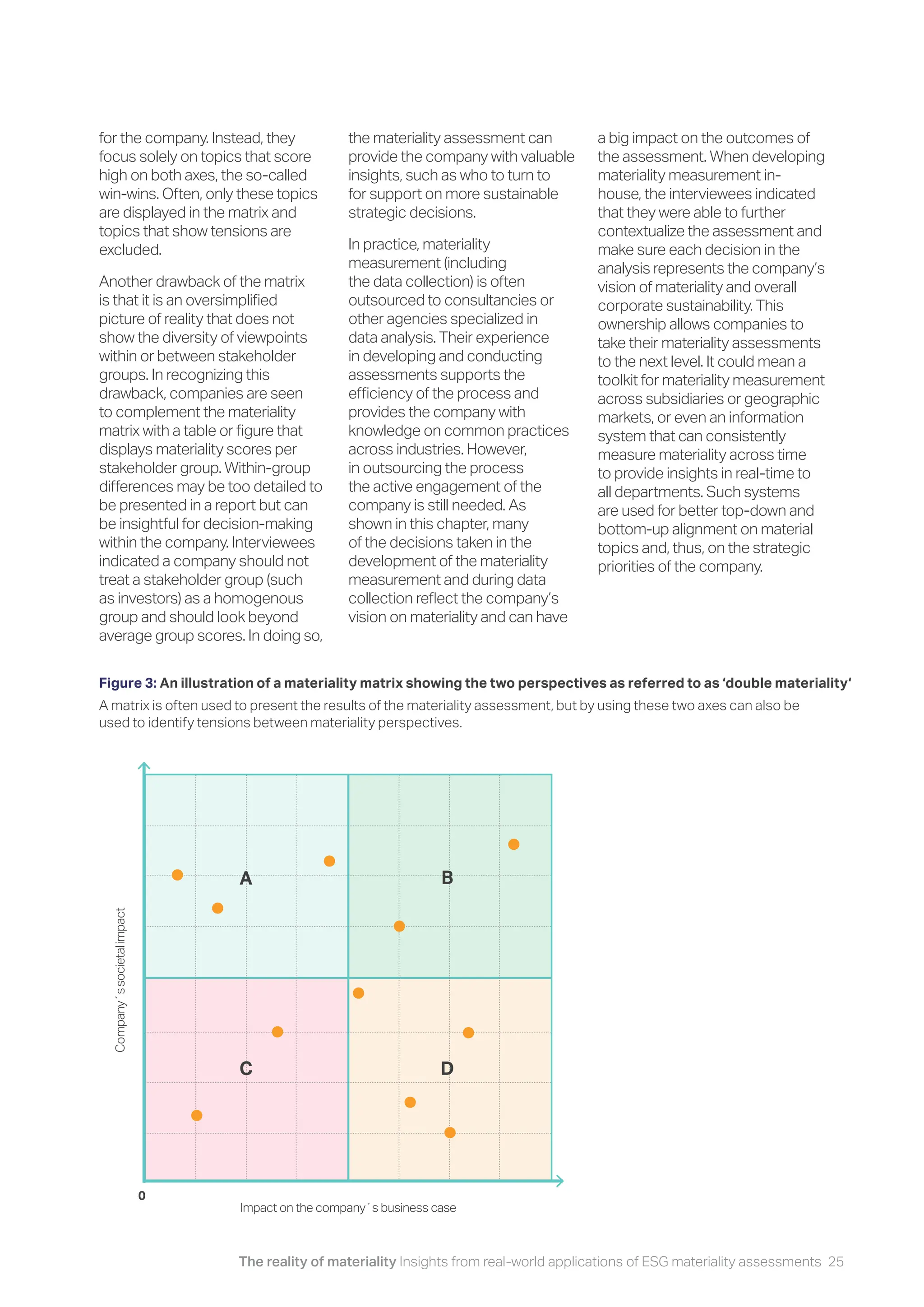
matrix: 56.5% of the reports
contained this matrix. In 21.2% of
reports, the company chose to
present the selection in a table or
a figure different from a matrix. The
matrix was often complemented
with a table (26.0%) or other
graphic (3.0%).
Although commonly used, there
were challenges and drawbacks
indicated by interviewees in the
use and development of the
matrix. The two axes of the matrix
represent different perspectives
on materiality. When these
perspectives are separately
measured with rigorous methods,
the matrix can highlight tensions
between the two materiality
perspectives. For example,
interviewees highlighted that
topics that score high on the
societal impact axis but low on
the business case axis represent
investments that are expected
to improve societal impact but
not directly improve financial
performance. On the other
hand, topics scoring high on the
business case axis and low on the
societal impact perspective are
seen as important for sustaining
financial performance but are of
limited importance to the societal
impact of the company. These
topics are most likely to cause
tensions within the business
model of the company and its
organization. The reports show
that the majority of companies do
not select these topics as material
The reality of materiality Insights from real-world applications of ESG materiality assessments 25
for the company. Instead, they
focus solely on topics that score
high on both axes, the so-called
win-wins. Often, only these topics
are displayed in the matrix and
topics that show tensions are
excluded.
Another drawback of the matrix
is that it is an oversimplified
picture of reality that does not
show the diversity of viewpoints
within or between stakeholder
groups. In recognizing this
drawback, companies are seen
to complement the materiality
matrix with a table or figure that
displays materiality scores per
stakeholder group. Within-group
differences may be too detailed to
be presented in a report but can
be insightful for decision-making
within the company. Interviewees
indicated a company should not
treat a stakeholder group (such
as investors) as a homogenous
group and should look beyond
average group scores. In doing so,
Figure 3: An illustration of a materiality matrix showing the two perspectives as referred to as ‘double materiality‘
the materiality assessment can
provide the company with valuable
insights, such as who to turn to
for support on more sustainable
strategic decisions.
In practice, materiality
measurement (including
the data collection) is often
outsourced to consultancies or
other agencies specialized in
data analysis. Their experience
in developing and conducting
assessments supports the
efficiency of the process and
provides the company with
knowledge on common practices
across industries. However,
in outsourcing the process
the active engagement of the
company is still needed. As
shown in this chapter, many
of the decisions taken in the
development of the materiality
measurement and during data
collection reflect the company’s
vision on materiality and can have
a big impact on the outcomes of
the assessment. When developing
materiality measurement in-
house, the interviewees indicated
that they were able to further
contextualize the assessment and
make sure each decision in the
analysis represents the company’s
vision of materiality and overall
corporate sustainability. This
ownership allows companies to
take their materiality assessments
to the next level. It could mean a
toolkit for materiality measurement
across subsidiaries or geographic
markets, or even an information
system that can consistently
measure materiality across time
to provide insights in real-time to
all departments. Such systems
are used for better top-down and
bottom-up alignment on material
topics and, thus, on the strategic
priorities of the company.
Company´s
societal
impact
Impact on the company´s business case
A
C
B
D
A matrix is often used to present the results of the materiality assessment, but by using these two axes can also be
used to identify tensions between materiality perspectives.
0
The reality of materiality Insights from real-world applications of ESG materiality assessments 26
Summary of recommendations
6
The reality of materiality Insights from real-world applications of ESG materiality assessments 26
The reality of materiality Insights from real-world applications of ESG materiality assessments 27
Summary of recommendations
6
Materiality assessments are
most effective and meaningful
when the company:
METHOD OF MATERIALITY
ASSESSMENT
• Indicates a clear purpose of
the materiality assessment
describing how the results
of the assessment will be
used (for reporting, internal
decision-making, input into
strategy, etc.)
• Articulates time horizons and
how frequently materiality
topics will be reviewed
• Conducts the assessment
regularly and compares
results with previous
assessments to allow
changes in materiality to be
identified and reported
• Articulates which
perspective(s) on materiality
will be used and ensures this
perspective is reflected in
the factors used to identify
and prioritize ESG issues (e.g.
external trends, risks and
opportunities, magnitude and
likelihood of impacts, changes
in materiality)
• Includes a thorough analysis
of key stakeholders of
company to identify which
stakeholders should be
consulted during the
assessment and possible
biases in this selection
• Considers a broad range
of stakeholders including
those typically outside normal
spheres of influence
• Where appropriate, takes
into account divisional and
geographical differences
• Considers that stakeholder
groups (such as investors) are
not a homogenous group
and looks beyond average
group scores
• Asks stakeholders to score
topics on multiple aspects
such as the scale, scope or
the irreversibility of the impact
• Ensures information is of
high-quality and seeks
assurance on material
information, both from internal
and external sources
The reality of materiality Insights from real-world applications of ESG materiality assessments 28
INTERNAL INTERPRETATION
AND VALIDATION
• Communicates the results of
the materiality assessment
to the board to ensure
awareness of important risks
and opportunities effecting
company value creation
• Communicates the process
and results to other
departments, such as risk
management
• Considers how the results of
the materiality assessment
are reflected in the
company’s strategy, targets,
incentives, risk assessments
and business opportunities
EXTERNAL REPORTING
• Considers who the reported
information is for and how
the materiality assessment
reflects their needs for
information
• Clearly describes what
perspective on materiality
has been applied, explaining
any judgments and
assumptions
• Describes specific steps
taken to identify, prioritize
and validate material topics,
including how the views of
the organization and key
stakeholders were taken into
account
• Use clear descriptions of
all topics included in the
assessment (with reference
to topic list of reporting
standards) to support
participants and users in
interpreting topics and their
scores
• Discloses the results of the
assessment through a matrix
or prioritized list of material
issues
• Reports on changes over
time and how often the
materiality assessment is
conducted
• Includes relevant and
material information in
a specific, concise way,
steering away from boiler-
plate language and immaterial
information
• Demonstrates internal
validation and follow-up of
the results of the materiality
assessment
• Explains how third parties
contributed to the
assessment process or
validation of outcomes
The reality of materiality Insights from real-world applications of ESG materiality assessments 29
Conclusion
7
The reality of materiality Insights from real-world applications of ESG materiality assessments 29
The reality of materiality Insights from real-world applications of ESG materiality assessments 30
Conclusion
6
This report seeks to provide
perspectives on the reality of
materiality to support companies
and those involved in defining
global standards on ESG
disclosure. Our analysis of the
literature identified six broad
challenges associated with
the application of materiality
assessments which are frequently
observed in corporate reporting
practices. The results can be
summarized in three key take-
aways.
IT COMES DOWN
TO PERSPECTIVE
A principal observation is
the broad adoption of the
two different perspectives of
materiality. The boundaries
between these perspectives
are less clear in reality than they
are in the theoretical setting of
reporting standards development.
In 150 of the 428 reports reviewed
the materiality perspective
was not clearly explained. This
could suggest that companies
are unaware of the multiple
perspectives of materiality or do
not recognize it as important to
communicate their perspective
on materiality. At the same
time, our analysis found that in
61.2% of the reports multiple
perspectives on materiality are
combined. This would suggest
that the majority of companies in
our sample are aware of multiple
perspectives on materiality and
that these perspectives provide
different but complementary
insights. The double materiality
concept set out by the EU is seen
to follow this line of reasoning.
The complementarity of the
perspectives used in practice
to identify “win-win” scenarios
i.e., the ESG topics that score
high on both enterprise value
creation and societal impact or
stakeholder interest. Interestingly,
a few companies were also
seen to highlight ESG topics
that can create tensions within
the organization. For example,
tensions can arise from ESG
topics that are important for
societal impact but less material
for financial performance. Such
insights can be used to anticipate
topics that may become more
financially material in the future.
TRANSPARENCY ON
DECISION-MAKING =
TRANSPARENCY ON
MATERIALITY
The ESG Disclosure Handbook
sets out that materiality should
be applied to determine how
much information should be
included in corporate reports
to achieve reporting objectives
and make information useful to
audiences, including investors.7
The disclosures reviewed
show that companies could do
more to effectively articulate
their reporting objectives and
approach to materiality. Many of
the decisions made during the
materiality assessment are not
reported, making it difficult for
users of the disclosure to evaluate
whether the company made
the right decisions in selecting
the reported information. For
example, 53% of companies in
our sample do not discuss when
the previous assessment was
conducted and only a relatively
small number of companies
compare the results of a previous
assessment with the new
materiality results. Furthermore,
41.5% of reports did not indicate
which type of engagement was
used with stakeholders during the
materiality assessment process.
This underreporting is not
difficult to resolve and we provide
suggestions on what to report for
each of the seven steps of the
materiality assessment. Ultimately,
the materiality assessment is tool
to internally ensure a systematic
approach for setting priorities and
to transparently communicate
to external stakeholders how the
company decides on its priorities,
and the challenges in doing so.
USING THE MATERIALITY
ASSESSMENT TO ITS FULL
POTENTIAL
If the materiality assessment
becomes a tick-the-box exercise
only for the purpose of fulfilling
the requirements of a reporting
standard, this may limit the value of
the process. Significant resources
may be employed to undertake a
thorough materiality assessment.
Our research highlights that
materiality can be a broader tool
for the integration of ESG topics
in strategic decision-making,
where the outputs are used
to evaluate current strategies
and inform future priorities. The
engagement with stakeholders
during the assessment can
support companies in anticipating
opportunities, tensions and
changes in their environment.
When seen in this way, the
materiality assessment can
fulfill its objective to enhance
transparency on company
priorities and how the company
arrived at these priorities and,
at the same time, provide an
opportunity to systematically
integrate feedback from
stakeholders into future priorities
and plans. Only with this more
integrated purpose can the
materiality assessment be used
to its full potential and ensure
efficient and effective use of
resources.
The reality of materiality Insights from real-world applications of ESG materiality assessments 31
Appendix
Organization Definition of Materiality Source
FASB “Materiality is entity specific. The omission or misstatement of an item in a financial
report is material if, in light of surrounding circumstances, the magnitude of the item
is such that it is probable that the judgment of a reasonable person relying upon the
report would have been changed or influenced by the inclusion or correction of the
item.”
82
FRC “Information is considered to be material if its misstatement or omission individually
or in aggregate could influence the economic decisions of users on the basis of the
financial information provided.”
49; 83
IASB/IFRS “Information is material if omitting, misstating or obscuring it could reasonably be
expected to influence decisions that the primary users of general purpose financial
statements make on the basis of those financial statements, which provide financial
information about a specific reporting entity.”
84
IIRC/IR “A matter is material if it could substantively affect the organization’s ability to create
value in the short, medium or long term.”
85
OECD “Material information can be defined as information whose omission or
misstatement could influence the economic decisions taken by users of
information.”
86
UNCTAD “Defining materiality as an entity-specific aspect may create a conflict with the
criterion of universality. In the context of Goals-related reporting, materiality has a
new dimension. Adoption of the Goals required multi-stakeholder consultations,
and all parties agreed that certain aspects of economic, environmental and social
activities were material to them. “
66
US SEC A matter is “material” if there is a substantial likelihood that a reasonable person
would consider it important.
88
US Supreme
Court
“There must be a substantial likelihood that the disclosure of the omitted fact
would have been viewed by the reasonable investor as having significantly altered
the ‘total mix’ of information available.” Put differently, there must be “a substantial
likelihood that a reasonable shareholder would consider (the omitted information)
important in deciding how to vote.”
89
AccountAbility “Materiality, in the sustainability context, relates to identifying and prioritizing the most
relevant sustainability topics, taking into account the impact each topic has on the
organization and on its stakeholders. Materiality includes the disclosure of risks and
opportunities posed by these issues affecting environmental, social, and governance
(ESG) domains that have impacts on corporate performance and on stakeholders in
the long-term.”
90
CDSB Environmental information is material if:
• The environmental impacts or results it describes are, due to their size and nature,
expected to have a significant positive or negative impact on the organization’s
financial condition and operational results and its ability to execute its strategy;
• Omitting, misstating or obscuring it could reasonably be expected to influence the
decisions that users of mainstream reports make on the basis of that mainstream
report, which provides information about a specific reporting organization.
91
CDP See CDSB. Note: “Relevance of emissions should not be limited to sustainability
topics that have a significant financial impact on your organization, or “materiality”.”
30; 55;
92
The reality of materiality Insights from real-world applications of ESG materiality assessments 32
Organization Definition of Materiality Source
CRD “material information is any information which is reasonably capable of making a
difference to the conclusions reasonable stakeholders may draw when reviewing the
related information.”
30
Capitals coalition “An impact or dependency on natural capital is material if consideration of its value, as
part of the set of information used for decision making, has the potential to alter that
decision.”
93; 94
GRI “‘Material Aspects’ are those that reflect the organization’s significant economic,
environmental and social impacts; or that substantively influence the assessments
and decisions of stakeholders.”
GRI revised its definition of materiality in an 2020 exposure draft to: “the
organization prioritizes reporting on those topics that reflect its most significant
impacts on the economy, environment, and people, including impacts on human
rights”
95; 45
EU “information to the extent necessary for an understanding of the undertaking’s
development, performance, position and impact of its activity, relating to, as a minimum,
environmental, social and employee matters”
“In effect, the Non-Financial Reporting Directive has a double materiality perspective:
- The reference to the company’s “development, performance [and] position” indicates
financial materiality, in the broad sense of affecting the value of the company…
- The reference to “impact of [the company’s] activities” indicates environmental and
social materiality. Climate-related information should be reported if it is necessary for an
understanding of the external impacts of the company.”
1; 96
EFRAG “Identifying sustainability matters that are material in terms of the impacts of the
reporting entity’s own operations and its values chain (impact materiality), based on: (i)
the severity (scale, scope and remediability) and, when appropriate, likelihood of actual
and potential negative impacts on people and the environment; (ii) the scale, scope
and likelihood of actual positive impacts on people and the environment connected
with companies’ operations and value chains; (iii) the urgency derived from social or
environmental public policy goals and planetary boundaries. Financial materiality:
Identifying sustainability matters that are financially material for the reporting entity
based on evidence that such matters are reasonably likely to affect its value beyond
what is already recognised in financial reporting..”
87
ISO [‘materiality’ = ‘significance’] “The identification of relevant issues should be followed
by an assessment of the organization’s impacts. The significance of an impact
should be considered with reference both to the stakeholders concerned and to the
way in which the impact affects sustainable development.”
97
SASB “SASB identifies financially material issues, which are the issues that are reasonably
likely to impact the financial condition or operating performance of a company and
therefore are most important to investors.”
98
TCFD “Importantly, in determining whether information is material, the Task Force
believes organizations should determine materiality for climate-related issues
consistent with how they determine the materiality of other information included
in their financial filings. In addition, the Task Force cautions organizations against
prematurely concluding that climate- related risks and opportunities are not material
based on perceptions of the longer-term nature of some climate-related risks.”
41
WEF “This project uses the term “material” to mean information that is important, relevant
and/or critical to long-term value creation.”
62
The reality of materiality Insights from real-world applications of ESG materiality assessments 33
Relevant resources
• WBCSD (2019). ESG Disclosure
Handbook. Available at: https://
www.wbcsd.org/2mtf7
• WBCSD and CDSB (2018-
2019). The Reporting Exchange
ESG reporting reports and case
studies. Available at: https://
www.wbcsd.org/Programs/
Redefining-Value/External-
Disclosure/The-Reporting-
Exchange/Resources
• WBCSD (2018-2020). Task
Force on Climate-related
Financial Disclosures (TCFD)
Preparer Forums. Available
at: https://www.wbcsd.org/
Programs/Redefining-Value/
External-Disclosure/TCFD
• IAASB with WBCSD (2021)
IAASB guidance helps advance
assurance for non-financial
reporting. Available at: https://
www.iaasb.org/focus-areas/
extended-external-reporting
• WBCSD (2020). Reporting
matters. Available at: https://
www.wbcsd.org/rm2020
• WBCSD (2019). Guidance on
improving the quality of ESG
information for decision-making.
Available at: https://www.wbcsd.
org/2ikw
• Sustainable IR (2020)
All a company needs to
communicate sustainability to
investors. Available at: https://
www.sustainable-ir.com/
• WBCSD (2019). Staying
competitive in a fast-changing
world. Available at https://www.
wbcsd.org/sciafcw
• COSO-WBCSD (2018) Applying
Enterprise Risk Management
to Environmental, Social and
Governance-related Risks.
Available at: https://www.wbcsd.
org/erm
• WBCSD (2020). Board director
resources – Non-financial
reporting. Available at: https://
wbcsdpublications.org/
board-director-resources/non-
financial-reporting/
• WBCSD (2021). Building bridges.
Available at: https://www.wbcsd.
org/Programs/Redefining-Value/
External-Disclosure/Purpose-
driven-disclosure/Building-
Bridges
The reality of materiality Insights from real-world applications of ESG materiality assessments 34
1
European Commission.
Guidelines on reporting climate-
related information. 2019;44.
2
World Business Council for
Sustainable Development.
Vision 2050: Time to Transform
[Internet]. 2021. Available
from: https://www.wbcsd.org/
Overview/About-us/Vision-
2050-Refresh/Resources/Time-
to-Transform
3
OECD, UN Environment,
World Bank Group. Financing
Climate Futures - Rethinking
Infrastructure [Internet]. 2018
[cited 2021 Feb 23]. Available
from: https://www.oecd.org/
environment/cc/climate-futures/
policy-highlights-financing-
climate-futures.pdf
4
Eccles RG, Klimenko S.
Shareholders Are Getting
Serious About Sustainability.
Harvard Business Review
[Internet]. 2019;(May–June
2019). Available from: https://
hbr.org/2019/05/the-investor-
revolution
5
Chasan E. Global Sustainable
Investments Rise 34 Percent
to $30.7 Trillion. Bloomberg
[Internet]. 2019 Apr 1; Available
from: https://www.bloomberg.
com/news/articles/2019-04-01/
global-sustainable-investments-
rise-34-percent-to-30-7-trillion
6
UNPRI. UNPRI Signatories
[Internet]. UNPRI Signatories.
2021. Available from: https://
www.unpri.org/signatories
7
World Business Council for
Sustainable Development.
ESG Disclosure Handbook
[Internet]. 2019 [cited 2020
Aug 31]. Available from: https://
docs.wbcsd.org/2019/04/ESG_
Disclosure_Handbook.pdf
13
IFRS. Sustainability Reporting
[Internet]. Sustainability
Reporting. 2021. Available from:
https://www.ifrs.org/projects/
work-plan/sustainability-
reporting/#current-stage
14
IFRS Foundation. Consultation
Paper on Sustainability
Reporting [Internet]. London;
2020 Sep. Available from:
https://www.ifrs.org/news-
and-events/2020/09/
ifrs-foundation-trustees-
consult-on-global-approach-to-
sustainability-reporting/
15
International Organization of
Securities Commissions. IOSCO
sees an urgent need for globally
consistent, comparable, and
reliable sustainability disclosure
standards and announces
its priorities and vision for a
Sustainability Standards Board
under the IFRS Foundation
[Internet]. Madrid; 2021
Feb. Available from: https://
www.iosco.org/news/pdf/
IOSCONEWS594.pdf
16
International Organization
of Securities Commissions.
Sustainable Finance and the
Role of Securities Regulators
and IOSCO [Internet]. 2020
[cited 2020 Nov 13]. Available
from: https://www.iosco.
org/library/pubdocs/pdf/
IOSCOPD652.pdf
17
CDP, CDSB, GRI, IIRC,
SASB. Statement of Intent
to Work Together Towards
Comprehensive Corporate
Reporting. 2020;(September
2020). Available from: https://
impactmanagementproject.
com/structured-network/
statement-of-intent-to-
work-together-towards-
comprehensive-corporate-
reporting/
8
World Business Council for
Sustainable Development.
Reinventing Capitalism: a
transformation agenda [Internet].
2020. Available from: https://
www.wbcsd.org/Overview/
About-us/Vision-2050-Time-
to-Transform/Resources/
Reinventing-capitalism-a-
transformation-agenda
9
World Business Council for
Sustainable Development,
Climate Disclosure Standards
Board, Ecodesk. The Reporting
Exchange – The global resource
for sustainability reporting
[Internet]. [cited 2021 Feb 23].
Available from: https://www.
reportingexchange.com/
10
de Cambourg P. Ensuring the
relevance and reliability of non-
financial corporate information:
an ambition and a competitive
advantage for a sustainable
Europe [Internet]. Autorité des
Normes Comptables; 2019
[cited 2020 Sep 1]. Available
from: http://www.anc.gouv.
fr/files/live/sites/anc/files/
contributed/ANC/4.%20Qui%20
sommes-nous/Communique_
de_presse/Report-de-
Cambourg_extra-financial-
informations_May2019_EN.pdf
11
Federation of European
Accountants. The Future
of Corporate Reporting –
creating the dynamics for
change [Internet]. 2015.
Available from: https://
www.accountancyeurope.
eu/wp-content/uploads/
FEECogitoPaper_-_
TheFutureofCorporate
Reporting.pdf
12
Deloitte. Thinking allowed
Materiality: judgements around
financial reporting disclosure
[Internet]. 2015 [cited 2020
Aug 28]. Available from: https://
www2.deloitte.com/content/
dam/Deloitte/ch/Documents/
audit/ch-en-audit-thinking-
allowed-materiality.pdf
References
The reality of materiality Insights from real-world applications of ESG materiality assessments 35
18
CDP, CDSB, GRI, IIRC, SASB.
Reporting on enterprise
value: illustrated with a
prototype climate-related
financial disclosure standard
[Internet]. 2020. Available from:
https://29kjwb3armds2g3gi4lq
2sx1-wpengine.netdna-ssl.
com/wp-content/uploads/
Reporting-on-enterprise-value_
climate-prototype_Dec20.pdf
19
IIRC, SASB. IIRC and SASB
announce intent to merge in
major step towards simplifying
the corporate reporting
system [Internet]. 2020
Nov. Available from: https://
integratedreporting.org/news/
iirc-and-sasb-announce-
intent-to-merge-in-major-
step-towards-simplifying-the-
corporate-reporting-system/
20
World Economic Forum.
Measuring Stakeholder
Capitalism Towards Common
Metrics and Consistent
Reporting of Sustainable Value
Creation [Internet]. Geneva;
2020 Sep. Available from: http://
www3.weforum.org/docs/WEF_
IBC_Measuring_Stakeholder_
Capitalism_Report_2020.pdf
21
New Zealand Ministery for
the Environment. Mandatory
climate-related financial
disclosures [Internet]. 2020
Sep. Available from: https://
www.loc.gov/law/foreign-news/
article/new-zealand-mandatory-
climate-related-financial-
disclosures-proposed-for-
financial-sector
22
Financial Conduct Authority
(Great Britain), Energy &
Industrial Strategy Department
for Business. Roadmap
towards mandatory climate-
related disclosures. [Internet].
2020 [cited 2021 Mar 2].
Available from: https://www.
webarchive.org.uk/access/
resolve/20201110001726/
https://assets.publishing.
service.gov.uk/government/
uploads/system/uploads/
attachment_data/file/933783/
FINAL_TCFD_ROADMAP.pdf
23
TCFD. Task Force on Climate-
related Financial Disclosures
2020 Status Report.
2020. Available at: https://
assets.bbhub.io/company/
sites/60/2020/09/2020-TCFD_
Status-Report.pdf
24
European Commission.
Sustainable finance package
[Internet]. Sustainable finance
package. 2021. Available
from: https://ec.europa.eu/
info/publications/210421-
sustainable-finance-
communication_en#csrd
25
European Commission. EU
taxonomy for sustainable
activities [Internet]. 2020.
Available from: https://
ec.europa.eu/info/business-
economy-euro/banking-and-
finance/sustainable-finance/
eu-taxonomy-sustainable-
activities_en
26
Herren A. A Climate for Change:
Meeting Investor Demand for
Climate and ESG Information
at the SEC [Internet]. U.S.
Securities and Exchange
Commission. 2021. Available
from:https://www.sec.gov/news/
speech/lee-climate-change#_
ftnref30
27
Herren A. Public Input
Welcomed on Climate Change
Disclosures [Internet]. U.S.
Securities and Exchange
Commission. 2021. Available
from:https://www.sec.gov/news/
public-statement/lee-climate-
change-disclosures
28
Herren Lee A. Living in a
Material World: Myths and
Misconceptions about
“Materiality.” 2021; Available
from: https://www.sec.gov/
news/speech/lee-living-
material-world-052421?utm_
content=168046616&utm_
medium=social&utm_
source=linkedin&hss_
channel=lcp-2464787
29
IIF. Building a Global ESG
Disclosure Framework: a
Path Forward [Internet].
2020. Available from: https://
www.iif.com/Portals/0/Files/
content/Regulatory/IIF%20
Building%20a%20Global%20
ESG%20Disclosure%20
Framework-a%20Path%20
Forward%20(June%20
2020)%20final.pdf
30
CDP, Climate Disclosure
Standards Board, GRI, IFRS,
IIRC, ISO, et al. Statement
of Common Principles of
Materiality of the Corporate
Reporting Dialogue [Internet].
2016. Available from: https://
corporatereportingdialogue.
com/publication/statement-
of-common-principles-of-
materiality/
31
Eccles B. Crunch Time: Global
Standard Setters Set The
Scene For Comprehensive
Corporate Reporting [Internet].
Forbes. 2020 [cited 2020 Oct
12]. Available from: https://
www.forbes.com/sites/
bobeccles/2020/10/08/
crunch-time-global-standard-
setters-set-the-scene-for-
comprehensive-corporate-
reporting/
32
European Commission. Non-
financial reporting by large
companies (updated rules)
[Internet]. 2020. Available from:
https://ec.europa.eu/info/law/
better-regulation/have-your-
say/initiatives/12129-Revision-
of-Non-Financial-Reporting-
Directive
The reality of materiality Insights from real-world applications of ESG materiality assessments 36
33
European Commission.
Directorate General for Financial
Stability, Financial Services and
Capital Markets Union. Proposal
for a DIRECTIVE OF THE
EUROPEAN PARLIAMENT AND
OF THE COUNCIL amending
Directive 2013/34/EU, Directive
2004/109/EC, Directive
2006/43/EC and Regulation
(EU) No 537/2014, as regards
corporate sustainability
reporting COM/2021/189 final
[Internet]. LU: Publications
Office; 2021 [cited 2021 May
25]. Available from: https://data.
europa.eu/doi/10.2874/229601
34
ACCA. Mapping the
sustainability reporting
landscape - Lost in the
right direction [Internet].
2016. Available from: https://
www.accaglobal.com/in/en/
technical-activities/technical-
resources-search/2016/
may/mapping-sustainability-
reporting-landscape.html
35
Accountancy Europe.
Interconnected standard
setting for corporate
reporting [Internet]. 2019.
Available from: https://www.
accountancyeurope.eu/wp-
content/uploads/191220-
Future-of-Corporate-Reporting.
pdf
36
Accountancy Europe,
World Business Council for
Sustainable Development.
Responding to assurance
needs on non-financial
information [Internet]. 2018.
Available from: https://www.
accountancyeurope.eu/wp-
content/uploads/Responding-
to-assurance-needs-on-non-
financial-information.pdf
37
CDP. CDP Europe’s response to
the public consultation on the
revision of the Non-Financial
Reporting Directive. 2020.
38
CDP, CDSB. Position paper
Materiality and climate-related
financial disclosures [Internet].
2018. Available from: https://
www.cdsb.net/sites/default/files/
materiality_and_tcfd_paper.pdf
39
PRI, ICGN. Investor Agenda
For Corporate ESG Reporting
A Discussion Paper By Global
Investor Organisations On
Corporate ESG Reporting
[Internet]. 2018. Available
from: https://www.unpri.org/
download?ac=6181
40
IFC. Beyond the Balance Sheet:
IFC Toolkit for Disclosure and
Transparency [Internet]. 2018.
Available from: https://www.
ifc.org/wps/wcm/connect/
d4bd76ad-ea04-4583-a54f-
371b1a7e5cd0/Beyond_The_
Balance_Sheet_IFC_Toolkit_
for_Disclosure_Transparency.
41
TCFD. Final Report:
Recommendations of the
Task Force on Climate-related
Financial Disclosures [Internet].
2017. Available from: https://
www.fsb-tcfd.org/wp-content/
uploads/2017/06/FINAL-2017-
TCFD-Report-11052018.pdf
42
SASB. SASB CONCEPTUAL
FRAMEWORK [Internet].
2017. Available from: https://
www.sasb.org/wp-content/
uploads/2019/05/SASB-
Conceptual-Framework.pdf
43
GRI. GRI 101: Foundation
[Internet]. 2016. Available from:
https://www.globalreporting.
org/standards/media/1036/
gri-101-foundation-2016.
pdf#page=%2010
44
KPMG, CLP, HKICS. ESG: A
view from the top [Internet].
2018. Available from: https://
home.kpmg/cn/en/home/
insights/2018/09/esg-a-view-
from-the-top.html
45
GRI. GRI Universal Standards:
GRI 101, GRI 102, and GRI 103 –
Exposure draft [Internet]. 2020.
Available from: https://www.
globalreporting.org/standards/
media/2605/universal-
exposure-draft.pdf
46
Truvalue Labs. ESG Materiality
FactorsSM in the Fourth
Industrial Revolution Measuring
Stakeholder Externalities via
Dynamic Materiality [Internet].
2020. Available from: https://
insights.truvaluelabs.com/
hubfs/White%20Papers/WP_
ESGMaterialityFactors
FourthIndustrialRevolution.pdf
47
Federation of European
Securities Exchanges (FESE).
Introduction and guiding
principles to ESG reporting
[Internet]. 2020. Available
from: https://fese.eu/app/
uploads/2020/11/ESG-
Introduction-and-Guiding-
Principles-2020.pdf
48
Sustainable Stock Exchange
Initiative. Model Guidance on
Reporting ESG Information
to Investors: A Voluntary
Tool For Stock Exchanges
to Guide Issuers [Internet].
2015. Available from: https://
sseinitiative.org/wp-content/
uploads/2015/09/SSE-Model-
Guidance-on-Reporting-ESG.
pdf
49
FRC. A matter of principles the
future of corporate reporting
[Internet]. 2020. Available
from: https://www.frc.org.uk/
getattachment/cf85af97-4bd2-
4780-a1ec-dc03b6b91fbf/
Future-of-Corporate-Reporting-
FINAL.pdf
50
Ecoact. Factsheet: Materiality
matters [Internet]. 2020 [cited
2020 Sep 1].
Available from: https://info.
eco-act.com/hubfs/0%20-%20
Downloads/Materiality%20
matters/Materiality%20
Matters%20factsheet.pdf?utm_
campaign=Download%20
pages&utm_
source=HubSpot&utm_
The reality of materiality Insights from real-world applications of ESG materiality assessments 37
medium=Resource&utm_
content=Materiality%20Matters
51
KPMG. Environmental,
social and governance (ESG)
materiality assessment
[Internet]. 2017 Aug [cited 2020
Aug 28]. Available from: https://
assets.kpmg/content/dam/
kpmg/nz/pdf/September/esg-
materiality-assessment-2017-
kpmg-nz.pdf
52
Lydenberg S, Rogers J,
Wood D. From Transparency
to Performance. Initiative for
Responsible Investment; 2010
p. 101.
53
Sustainability Accounting
Standards Board. SASB
Materiality Map [Internet]. 2020
[cited 2020 Aug 28]. Available
from: https://www.sasb.org/
standards-overview/materiality-
map/
54
UNCTAD. Guidance on
core indicators for entity
reporting on contribution
towards implementation of
the Sustainable Development
Goals [Internet]. 2019.
Available from: https://unctad.
org/en/PublicationsLibrary/
diae2019d1_en.pdf
55
CDP. CDP Climate Change
2020 Reporting Guidance
[Internet]. 2020. Available from:
https://guidance.cdp.net/en/gu
idance?cid=13&ctype=theme
&idtype=ThemeID&incchild=1
&microsite=0&otype=Guidan
ce&tags=TAG-646%2CTAG-
605%2CTAG-600
56
World Economic Forum.
Measuring Stakeholder
Capitalism Towards Common
Metrics and Consistent
Reporting of Sustainable Value
Creation [Internet]. 2020 [cited
2020 Sep 23]. Available from:
http://www3.weforum.org/
docs/WEF_IBC_Measuring_
Stakeholder_Capitalism_
Report_2020.pdf
57
Terrafiniti. Materiality Matters
- What is most important for
sustainable business? 2020.
58
IMA, ACCA. From Share Value
to Shared Value: Exploring
the Role of Accountants
in Developing Integrated
Reporting in Practice [Internet].
2016. Available from: https://
www.imanet.org/insights-and-
trends/external-reporting-and-
disclosure-management/share-
value-to-shared-value?ssopc=1
59
Australian Securities Exchange.
ESG Reporting Guide for
Australian Companies [Internet].
2015. Available from: https://
www.asx.com.au/documents/
asx-compliance/acsi-fsc-esg-
reporting-guide-final-2015.pdf
60
Deutsche Börse.
Communicating sustainability
Seven recommendations
for issuers [Internet].
2013. Available from:
https://www.deutsche-
boerse.com/resource/
blob/153536/72dd53a3
6a171db97becebd2b921f945/
data/communicating-
sustainibility_en.pdf
61
London Stock Exchange.
Revealing the big picture:
Your guide to ESG Reporting
[Internet]. 2017. Available
from: https://sseinitiative.org/
wp-content/uploads/2016/02/
ESG_Guidance_Report_LSEG.
pdf
62
World Economic Forum, IBC.
Toward Common Metrics
and Consistent Reporting of
Sustainable Value Creation
[Internet]. 2019. Available from:
http://www3.weforum.org/
docs/WEF_IBC_ESG_Metrics_
Discussion_Paper.pdf
63
Kuh T, Shepley A, Bala G,
Flowers M. Dynamic Materiality:
Measure What Matters. SSRN
Electronic Journal [Internet].
2020 [cited 2020 Aug 28];
Available from: https://dx.doi.
org/10.2139/ssrn.3521035
64
Blackrock. Commentary
Sustainability Reporting:
Convergence to Accelerate
Progress [Internet]. 2020.
Available from: https://www.
blackrock.com/corporate/
literature/publication/blk-
commentary-sustainability-
reporting-convergence.pdf
65
Truvalue Labs. Dynamic
Materiality: Measuring what
Matters | Truvalue Labs
[Internet]. 2020 Nov [cited 2020
Nov 4]. Available from: https://
insights.truvaluelabs.com/white-
paper/dynamic-materiality-
download
66
UNCTAD. The role of disclosure
in risk assessment and
enhancing the usefulness
of corporate reporting in
decision-making [Internet].
2017. Available from: https://
unctad.org/system/files/official-
document/ciiisard82_en.pdf
67
International Integrated
Reporting Council (IIRC).
Materiality: Background paper
for <IR> [Internet]. 2013 [cited
2020 Aug 28]. Available from:
https://integratedreporting.org/
wp-content/uploads/2013/03/
IR-Background-Paper-
Materiality.pdf
68
World Business Council for
Sustainable Development.
Materiality in corporate
reporting - a White Paper
focusing on the food and
agriculture sector [Internet].
2018 [cited 2020 Sep 4] p. 30.
Available from: https://docs.
wbcsd.org/2017/form/WBCSD_
Materiality_Report.PDF
The reality of materiality Insights from real-world applications of ESG materiality assessments 38
69
Sullivan R, Martindale W,
Feller E, Bordon A, Garcia-
Alba J. Fiduciary Duty in the
21st Century [Internet]. 2015
[cited 2021 Jan 7]. Available
from: http://www.ssrn.com/
abstract=2724866
70
Thurm R. Reporting 3.0’s
Reporting Blueprint: Triggering
a Regenerative, Inclusive and
Open Economy. 2017. Available
from: https://www.r3-0.org/
wp-content/uploads/2019/07/
R3-BP1.pdf
71
Bolsa de Comercio de
Santiago Chile. How to include
ESG factors: design and
construction of sustainability
reports [Internet]. 2017.
Available from: https://
sseinitiative.org/wp-content/
uploads/2014/08/2017-
Design-and-Construction-
of-Sustainability-Reports-
Santiago-Exchange.pdf
72
Bolsa Mexicana de Valores.
Sustainability Guide: Towards
Sustainable Development of
Companies in Mexico [Internet].
2017. Available from: https://
www.bmv.com.mx/docs-pub/
SERVICIOS_EMISORAS/3q2wk
7r8jj6746k46q1n.pdf
73
Canada TMX Group Inc. A
Primer for Environmental &
Social Disclosure [Internet].
2014. Available from: https://
www.tsx.com/resource/en/73
74
Japan Exchange Group.
Practical Handbook for ESG
Disclosure [Internet]. 2020.
Available from: https://www.
jpx.co.jp/english/corporate/
sustainability/esg-investment/
handbook/b5b4pj000003dkeo-
att/handbook.pdf
75
Oslo Børs Norway. Oslo Børs
guidance on the reporting
of corporate responsibility
[Internet]. 2016. Available from:
https://www.oslobors.no/ob_
eng/Oslo-Boers/Regulations/
Circulars-archive/1-2016-
Oslo-Boers-guidance-on-
the-reporting-of-corporate-
responsibility
76
Philippines Stock Exchange.
Sustainability Reporting
Guidelines for Publicly Listed
Companies [Internet]. 2019.
Available from: https://www.
sec.gov.ph/wp-content/
uploads/2019/02/201
9MCNo4-1.pdf
77
World Federation of Exchanges.
WFE ESG Guidance and
Metrics [Internet]. 2018.
Available from: https://www.
world-exchanges.org/storage/
app/media/research/Studies_
Reports/WFE%20ESG%20
Guidance%20June%202018.
pdf
78
Singapore Exchange.
Sustainability Reporting Guide
[Internet]. 2018. Available
from: https://api2.sgx.com/
sites/default/files/2018-07/
Sustainability%20
Reporting%20Guide%20
%28220218%29.pdf
79
Hackett D, Demas R, Sanders
D, Wicha J, Fowler A. Growing
ESG risks: the rise of litigation.
Environmental Law Institute
[Internet]. 2020; Available from:
https://www.bakermckenzie.
com/-/media/files/insight/
publications/2020/10/growing_
esg_risks_the_rise_of_litigation.
pdf
80
Latham and Watkins. ESG
Litigation Roadmap [Internet].
2020. Available from: https://
www.wbcsd.org/Programs/
Redefining-Value/Business-
Decision-Making/Enterprise-
Risk-Management/Resources/
ESG-Litigation-Roadmap
81
World Business Council for
Sustainable Development,
ICAEW. A buyer’s guide
to assurance on non-
financial information
[Internet]. 2019. Available
from: https://www.wbcsd.
org/Programs/Redefining-
Value/External-Disclosure/
Assurance-Internal-Controls/
Resources/A-buyer-s-guide-to-
assurance-on-non-financial-
information
82
Financial Accounting
Standards Board. Qualitative
characteristics of useful
financial information. In:
Conceptual Framework for
Financial Reporting. Norwalk,
CT, USA; 2018.
83
. FRC. Guidance on the
Strategic Report [Internet].
2018. Available from: https://
www.frc.org.uk/getattachment/
fb05dd7b-c76c-424e-9daf-
4293c9fa2d6a/Guidance-on-
the-Strategic-Report-31-7-18.
pdf
84
IASB. IFRS Practice Statement
Making Materiality Judgements
[Internet]. 2017 [cited 2020 Sep
1]. Available from: https://www.
iasplus.com/en/standards/other/
materiality
85
International Federation of
Accountants (IFAC). Materiality
in < IR > Guidance for the
preparation. 2015.
86
OECD. Guidelines for
multinational enterprises
[Internet]. 2011. Available from:
https://www.oecd.org/corporate/
mne/
87
EFRAG. Proposals for a relevant
and dynamic EU sustainability
reporting standard setting.
2021. Available from: https://
ec.europa.eu/info/sites/default/
files/business_economy_
euro/banking_and_finance/
documents/210308-report-
efrag-sustainability-reporting-
standard-setting_en.pdf
The reality of materiality Insights from real-world applications of ESG materiality assessments 39
88
UUS SEC. SEC Staff
Accounting Bulletin: No. 99 –
Materiality. 1999. Available from:
https://www.sec.gov/interps/
account/sab99.htm
89
TSC Industries, Inc. v. Northway,
Inc., 426 U.S. 438 (1976)
[Internet]. 1976. Available from:
https://supreme.justia.com/
cases/federal/us/426/438/
90
AccountAbility. AA1000
Accountability Principles
2018 [Internet]. 2018 [cited
2020 Aug 28]. Available from:
https://www.accountability.org/
static/aa1000_accountability_
principles_2018-6b386394310
5f2a5c4d5fc96affb750d.pdf
91
Climate Disclosure Standards
Board. CDSB Framework for
reporting environmental &
climate change information.
London, UK; 2019.
92
CDP. CDP Water Security 2020
Reporting Guidance [Internet].
2020. Available from: https://
guidance.cdp.net/en/guidance?
cid=15&ctype=theme&idtype=
ThemeID&incchild=1&microsit
e=0&otype=Guidance&tags=T
AG-585%2CTAG-646%2CTAG-
607%2CTAG-600
93
Natural Capital Coalition.
Natural Capital Protocol. 2016.
94
Social & Human Capital
Coalition. Social and human
capital protocol [Internet]. 2019.
Available from: https://docs.
wbcsd.org/2019/02/Social_
and_Human_Capital_Protocol.
pdf
95
Global Reporting Initiative.
Questions about Materiality
and topic Boundary [Internet].
2018 [cited 2019 Nov 21].
Available from: https://www.
globalreporting.org/standards/
questions-and-feedback/
materiality-and-topic-boundary/
96
EU. Directive 2014/95/EU of
the European Parliament and
of the Council [Internet]. 2014.
Available from: https://eur-lex.
europa.eu/legal-content/EN/
TXT/PDF/?uri=CELEX:320
14L0095&from=EN
97
ISO. ISO 26000 Social
responsibility. 2010. Available
from: https://www.iso.org/iso-
26000-social-responsibility.
html
98
Sustainability Accounting
Standards Board. Materiality
Map [Internet]. 2019 [cited 2019
Dec 16]. Available from: https://
www.sasb.org/standards-
overview/materiality-map/
The reality of materiality Insights from real-world applications of ESG materiality assessments 40
ACKNOWLEDGEMENTS
LEAD AUTHORS:
Dr J. Garst, Erasmus School of
Economics, Erasmus University
Rotterdam
A. Beanland, World Business
Council for Sustainable
Development
J. Tähtinen, World Business
Council for Sustainable
Development
IN CONSULTATION WITH:
Prof K. Maas, Impact Centre
Erasmus
Prof J. Suijs, Erasmus School of
Economics
With thanks to all WBCSD
member companies who kindly
participated in the research
interviews.
Abbott Laboratories
Acciona S.A.
APRIL
Aptar Group Inc.
Ayala Corporation
Buhler AG
CEMEX
CLP Group
CRH plc
Dow Inc.
DSM N.V.
Empresas CMPC S.A.
Enel
Hancock Natural Resource Group
Norsk Hydro ASA
Novartis
Solvay S.A.
South Pole
Stora Enso Oyj
Unilever
DISCLAIMER
This publication is released in the
name of WBCSD and Erasmus
School of Economics. Like other
WBCSD publications, it is the
result of a collaborative effort by
members of the secretariat and
senior executives from member
companies. This does not mean,
however, that every member
company agrees with every word.
ABOUT ERASMUS
SCHOOL OF ECONOMICS
Erasmus School of Economics
is a leading center for scientific
research and education. As an
internationally acclaimed institute,
it contributes to future economic
developments and to answering
issues related to government and
business policy.
ABOUT WBCSD
WBCSD is a global, CEO-led
organization of over 200 leading
businesses working together
to accelerate the transition to
a sustainable world. We help
make our member companies
more successful and sustainable
by focusing on the maximum
positive impact for shareholders,
the environment and societies.
Our member companies come
from all business sectors and all
major economies, representing a
combined revenue of more than
USD $8.5 trillion and 19 million
employees. Our global network
of almost 70 national business
councils gives our members
unparalleled reach across the
globe. Since 1995, WBCSD has
been uniquely positioned to
work with member companies
along and across value chains
to deliver impactful business
solutions to the most challenging
sustainability issues.
Together, we are the leading voice
of business for sustainability:
united by our vision of a world
where more than 9 billion people
are all living well and within the
boundaries of our planet, by 2050.
Follow us on Twitter and LinkedIn
www.wbcsd.org
COPYRIGHT
Copyright © WBCSD, June 2021.
World Business Council
for Sustainable Development
Geneva, Beijing, Delhi, London, New York, Singapore
www.wbcsd.org
This publication is funded by the Gordon and Betty Moore Foundation as part of its Conservation
and Markets Initiative. For more information, please see:
https://www.moore.org/initiative-strategy-detail?initiativeId=conservation-and-markets-initiative

WBCSD_Reality of Materiality_Insights from real world applications of ESG materiality.pdf

  • 1.
    Insights from real-worldapplications of ESG materiality assessments The reality of materiality
  • 2.
    Contents 1 Summary |3 2 Introduction | 5 3 The purpose of this report | 9 4 Challenges around ESG materiality | 11 5 Materiality assessments in practice | 17 6 Summary of recomendations | 26 The reality of materiality Insights from real-world applications of ESG materiality assessments 2 7 Conclusion | 29
  • 3.
    The reality ofmateriality Insights from real-world applications of ESG materiality assessments 3 Summary 1 The reality of materiality Insights from real-world applications of ESG materiality assessments 3
  • 4.
    The reality ofmateriality Insights from real-world applications of ESG materiality assessments 4 Summary Urgent action is needed to accelerate the transformation by 2050 to a world where over 9 billion people live well within planetary boundaries. This is journey is set out in the World Business Council for Sustainable Development´s (WBCSD) Vision 2050. A crucial piece of the puzzle is the move to a form of capitalism that brings true value – where environmental, social and governance (ESG) issues are part of how success is defined and enterprise value determined. For this shift to occur, capital markets and shareholders need robust, comparable and decision-useful information on material ESG issues provided through corporate disclosure. Materiality and the materiality assessment process are considered vital for helping companies effectively identify, manage and report on significant ESG risks and opportunities. As materiality involves a user- and purpose-based judgment about what information is relevant, there are challenges in consistently applying an effective approach based on today’s guidance, expectations and practice. This is a pertinent issue; the various applications of materiality profoundly affect corporate disclosures, strategies and objectives. The purpose of this report is to investigate and discuss the “reality of materiality”, and materiality assessment, as it relates to ESG in current guidance and practice. It builds on WBCSD´s ESG Disclosure Handbook that helps companies improve their ESG reporting strategy and focus on what really matters. The Challenges in materiality discusses six different challenges identified through a review of ~95 white papers, guidance documents and thought leadership articles: 1) The multiple perspectives on materiality; 2) Inconsistent guidance on materiality methods; 3) Multiple stakeholders, multiple opinions; 4) Materiality is dynamic; 5) Materiality and fiduciary duty; and 6) It’s not financial information. In addition, practical considerations for companies are provided when making choices about materiality. The Materiality assessments in practice discusses research findings on current practice based on an analysis of 551 WBCSD member company reports and one-to-one interviews with 20 companies. The investigation sets out findings around seven key steps involved in conducting a materiality assessment: 1) Purpose of a materiality assessment; 2) Materiality cycle; 3) Perspective on materiality; 4) Identifying the topics; 5) Stakeholder involvement; 6) Calculating the materiality scores; and 7) Selecting the material topics. A central observation from both the literature and practice reviews is that there is not always effective guidance available to companies when they make decisions related 1 to ESG materiality and these decisions can define the final outcomes. To ensure the materiality assessment responds to the company’s goals, companies should strategically and consciously apply judgment and clear decision-making when planning and applying a materiality assessment. Another principal observation is the broad adoption of the two different perspectives of materiality: 1) The business cases perspective, indicating that a topic is material when it has significant (positive or negative) impact on the financial performance of the company; and 2) The societal impact perspective, indicating that a topic is material when it matters to society and the company significantly impacts this topic.1 The boundaries between these two perspectives are less clear in reality than they are in the theoretical setting of reporting standards development. The research also highlights that materiality can be a broader tool for the integration of ESG topics in strategic decision-making, where the outputs are used to evaluate current strategies and inform future priorities. With this more integrated purpose, the materiality assessment can fulfill its objective to enhance transparency on company priorities and how the company arrived at these priorities while at the same time providing an opportunity to systematically integrate feedback from stakeholders into future priorities and plans.
  • 5.
    The reality ofmateriality Insights from real-world applications of ESG materiality assessments 5 Introduction 2 The reality of materiality Insights from real-world applications of ESG materiality assessments 5
  • 6.
    The reality ofmateriality Insights from real-world applications of ESG materiality assessments 6 Introduction 2 opportunities. Transparency and complete corporate disclosures are key in establishing this understanding.3 Second, investors are increasingly asking companies to understand and manage their long-term value drivers including ESG aspects.4 Between 2017 and 2019, sustainable investments rose 34 % to USD $30.7 trillion.5 Signatories to the UN Principles for Responsible Investment (PRI) more than doubled in five years reaching 3,000 in 2020.6 For investors to efficiently and effectively allocate capital, they need comparable, robust and decision-useful information on material ESG issues. Third, there is growing consensus that companies should respond to the needs of their shareholders and also serve a wider set of stakeholders.7,8 This movement towards a stakeholder-oriented form of capitalism helps to ensure businesses mitigate risks and gain opportunities such as talent acquisition and retention, securing licenses to operate, reputation management and other benefits. The needs of stakeholders go beyond the financial output of a company to include broader value creation and impact and dependencies such as ESG aspects. In answering such needs, transparent, relevant and robust communication is vital. Reporting on ESG allows companies to show which stakeholders’ needs they are responding to and in what way. It allows the company to communicate the challenges in responding to stakeholders’ needs, opening up an honest conversation about the barriers to sustainable development. Responding to expectations, companies are increasingly reporting on ESG. However, there has been a lack of consensus on materiality and the materiality assessment process. This has made it hard for companies to apply a systematic approach to materiality and they must navigate various factors in determining their materiality and its reporting. A key enabler of the transitions towards a world where over nine billion people are living well within planetary boundaries will be the fundamental transformation of our financial system to one which rewards true value creation, not value extraction. This is highlighted in WBCSD’s recently published Vision 2050.2 The disclosure of material, decision-useful ESG information by companies, and the effective use of this information by the financial markets, will be key to this transition. The materiality assessment process is vital to help companies effectively identify, manage and report on pertinent ESG risks and opportunities. However, as we´ll see in this document, there are challenges in its effective application based on existing guidance, expectations and practice for efficient reporting on material ESG issues. There is increasing demand for transparency for good quality corporate ESG information. One contributor is the wide- scale recognition that to achieve global sustainable development objectives, such as the Sustainable Development Goals (SDGs) and the Paris Agreement, a significant amount of capital must be directed toward solutions for a low carbon economy and a more equitable future.2 Directing private finance towards these objectives will require businesses and investors to have a clear understanding of companies´ material risks and
  • 7.
    The reality ofmateriality Insights from real-world applications of ESG materiality assessments 7 COMPLEXITY OF THE ESG REPORTING LANDSCAPE In recent years, the ESG reporting landscape has changed dramatically. The Reporting Exchange, an online tool developed to help corporates navigate the landscape of ESG reporting requirements, highlights that there are over 2,000 voluntary reporting frameworks, mandatory reporting requirements, methodologies and protocols across 71 countries for company measurement and disclosure of ESG information by companies.9 In a stock take of the ESG topics discussed in nine voluntary reporting frameworks, the Reporting Exchange’s ESG indicator library identified 1,424 potential indicators that companies could use to disclose their ESG performance.9 Not only is it practically impossible for companies to report on all these indicators, not all these topics are material to each company. In addition, as highlighted in WBCSD’s ESG Disclosure Handbook, companies are required to make many decisions on what to include and what to exclude in their ESG disclosures.7 To make an informed choice, ESG standard setters recommend companies conduct a materiality assessment. How such assessments should be conducted remains an area of ongoing debate. Different applications of materiality profoundly affect corporate disclosures, strategies and objectives. The lack of clarity can hinder users of company disclosures in interpreting a company’s positive or negative contributions to long-term value creation and sustainable development. A frequent complaint by users of ESG information is the significant variability and divergence in materiality practices related to format, measurement and time frames. Concepts are misinterpreted or mixed up – for instance, relevancy and materiality are often used interchangeably.10,11,12 Material ESG topics may also be presented through multiple channels and several ESG reporting standards require companies to include non- material topics in their general annual reports.11 ALIGNING IN ESG REPORTING AND MATERIALITY The good news is that discontent among preparers and users of ESG disclosures is being recognized by voluntary standard setters and major accounting bodies, spurring them into action. Several recent events illustrate a journey towards alignment: • At the beginning of 2021, the International Financial Reporting Standards (IFRS) announced plans to create a Sustainability Standards Board and a working group to accelerate convergence.13 This move shows financial reporting standard-setters are recognizing the materiality of ESG information and the need for an international governing body to coordinate the development of ESG reporting standards.14 • The International Organization of Securities Commissions (IOSCO) set up a Task Force on Sustainable Finance in 2020. IOSCO welcomed the IFRS Foundation´s plan of action on Sustainability Standards and announced a technical expert group to observe the work. IOSCO are developing guidance for principles-based standards to inform market regulators on ESG reporting. This guidance is likely to endorse and encourage use of standards developed by the IFRS.15,16 • CDP, the Climate Disclosure Standards Board (CDSB), the Global Reporting Initiative (GRI), the International Integrated Reporting Council (IIRC) and the Sustainability Accounting Standards Board (SASB) (also referred to as ‘the Five’) announced their intention to work together under Impact Management Project. The project aims to provide clear, technical input into regulatory efforts. This statement and a subsequent paper on climate-related financial disclosure provide a comparison of materiality definitions as a first step towards alignment on materiality practices.17,18 • IIRC and SASB subsequently have announced their intent to merge, forming the Value Creation Foundation. This is perceived as a major step towards simplifying the corporate reporting landscape.19 • The World Economic Forum (WEF) released a set of universal ESG metrics and disclosures to advance stakeholder capitalism and help companies demonstrate long-term value creation in mainstream reporting. It was developed with Bank of America, the Big Four and the International Business Council (IBC) – a community of over 120 global CEOs – after a consultation process following the 2020 Annual Meeting in Davos.20
  • 8.
    The reality ofmateriality Insights from real-world applications of ESG materiality assessments 8 At the same time, new regulations are driving alignment in ESG reporting standards. An increase in mandatory ESG reporting is evident, with regulators generally selecting one voluntary standard to follow or synthesizing the standards into their own definitions, as illustrated below by recent events: These various actions and initiatives demonstrate the growing importance of ESG reporting in mainstream business. They show standard-setters are en route towards more globally aligned approaches to ESG disclosure. In April 2021, the European Commission (EC) adopted a proposal for a Corporate Sustainability Reporting Directive (CSRD), which would amend the existing reporting requirements of the Non-Financial Reporting Directive (NFRD). The proposal extends a requirement to all large companies and all companies listed on regulated markets to audit reported information and introduces more detailed reporting requirements. It requires companies to digitally ‘tag’ reported information so it is machine readable and feeds into the European single access point. The first set of standards will be adopted by October 2022 with draft standards developed by the European Financial Reporting Advisory Group (EFRAG).24 In the United States, Joe Biden´s new administration meant changes and new expectations at the Securities and Exchange Commission (SEC). SEC´s Acting Chair, Allison Herren Lee, gave a speech in March 2021 which focused on meeting investor demand on climate and ESG, announcing the SEC’s Enforcement Task Force on Climate and ESG disclosures to identify material gaps in issuers’ disclosures, and launching a public consultation on climate change disclosures.26,27,28 As part of the EU Green Deal action plan on financing sustainable growth, a Technical Expert Group (TEG) of the EC on sustainable finance published its final report in March 2020. Responding to the first stage of the action plan, the report presents an EU taxonomy for categorizing sustainability activities. The guide aims to help investors systematically assess which economic activities to invest in and to guide policy makers, industry and investors in their decision-making processes.25 Financial market participants will be required to complete a first set of disclosures against the Taxonomy, covering activities related to climate change mitigation and/or adaptation, by 31 December 2021 for disclosure in 2022.25 Disclosures aligned with the TCFD recommendations are becoming mandatory in the UK and New Zealand.21,22 Over 110 governments and regulators across the globe support the TCFD, including Belgium, Canada, Chile, France, Japan and Sweden. By April 2021, there are over 1,900 supporters across 78 countries of the TCFD.23
  • 9.
    The reality ofmateriality Insights from real-world applications of ESG materiality assessments 9 The purpose of this report 3 The reality of materiality Insights from real-world applications of ESG materiality assessments 9
  • 10.
    The reality ofmateriality Insights from real-world applications of ESG materiality assessments 10 The purpose of this report 2 While waiting for a more aligned approach to materiality, companies still need to make informed decisions on which ESG topics to report and in which ESG topics to invest their time, energy and resources. The purpose of this report is to investigate the “reality of materiality” on a number of levels. First, it seeks to show the diversity of perspectives of a broad number of actors – including standard setters, regulators, consulting companies, stock exchanges and other international institutions – on the topic of materiality and to observe the role of these actors in shaping disclosure at a corporate level. Second, the report seeks to build on the ESG Disclosure Handbook discussion around materiality by examining the extent to which companies appear to be defining a reporting strategy and conducting materiality assessments consistent with the recommendations set out in the Handbook.7 Thirdly, by examining the challenges and tensions associated with materiality assessment and how these manifest in the disclosure process, the report provides insight into the opportunities, good practices and recommendations for companies to manage and overcome these challenges. This report is intended to discuss current existing guidance and practice in ESG materiality and materiality assessment practice. It is not meant to be seen as prescriptive or complete guidance on ESG materiality. WHO IS THIS DOCUMENT FOR? The intended audience for this report is companies who wish to understand the different approaches to materiality and how to further develop their internal processes and external disclosure practices. We also hope it will be helpful for those engaged in developing and defining global standards for ESG disclosure by providing insights into the challenges and opportunities for an aligned approach to assessing, determining and disclosing material ESG information in corporate reports.
  • 11.
    The reality ofmateriality Insights from real-world applications of ESG materiality assessments 11 Challenges around ESG materiality 4 The reality of materiality Insights from real-world applications of ESG materiality assessments 11
  • 12.
    The reality ofmateriality Insights from real-world applications of ESG materiality assessments 12 Challenges around ESG materiality 4 Materiality is a widely debated topic in ESG reporting circles. Our literature review identified around ~95 white papers, guidance documents and thought leadership articles that discuss the concept of ESG materiality and materiality assessment. We found an overarching theme is that the existing materiality reporting practices may not be effectively serving the needs of preparers or users of ESG disclosures.29 To increase effectiveness, there needs to be mainstreaming and consolidation of materiality approaches – preferably as soon as possible. Calls for rapid alignment have been acknowledged by major voluntary sustainability reporting frameworks such as the Fivea through their Statement of Intent17 and Statement of Common Principles of Materiality.30 Our literature review identified five broad challenges that can arise for businesses around the current concept of ESG materiality and materiality assessments. For each, we provide a summary of actions for corporates to consider during the materiality assessment process. CHALLENGE 1: MULTIPLE PERSPECTIVES ON MATERIALITY Current perspectives on ESG materiality across different frameworks and guidance - including the Five and TCFD - can be divided into two perspectives:b 1. The business case perspective which indicates that a topic is material when it has significant (positive or negative) impact on the financial performance of the company; 2. The societal impact perspective which indicates a topic is material when it matters to society and the company significantly impacts this topic.31 The EC combines these two perspective with the so-called “double materiality” perspective. Introduced for the EU Non- Financial Report Directive (NFRD),1 the double materiality perspective requires companies to assess the materiality of ESG topics using both the business case and the societal impact perspective. This double materiality is clarified under the Corporate Sustainability Reporting Directive (CSRD) proposal which removes ambiguity that companies should report information necessary to understand how sustainability matters affect them, and information necessary to understand the impact they have on people and the environment a CDP, CDSB, GRI, IIRC and SASB b A full overview of materiality conceptions of the main financial and sustainability standard setters and organizations is compiled in the Annex of this guidance document. Graph 1: The double materiality perspective of the Non-financial Reporting Directive1
  • 13.
    The reality ofmateriality Insights from real-world applications of ESG materiality assessments 13 The SASB materiality map proposes lists of material ESG topics by sector.53 This can help identify material topics but the topics listed might not precisely overlap with the company-specific circumstances. In practice, we have observed that common approaches are emerging and this is discussed in the following chapter. Thirdly, some reporting requirements require certain ESG topics and indicators to be reported regardless of whether the topic is determined to be material by the reporting entity. For example, many jurisdictions require companies to report on respect for human rights across their operations such as prescribed by the EU´s NFRD and UK´s Modern Slavery Act. Other actors provide core subjects to be reported on across all companies such as the WEF Stakeholder Capitalism metrics,20 the United Nations Conference on Trade and Development´s (UNCTAD´s) core indicators for the SDGs54 or greenhouse gas emissions (GHG).55 Companies need to take these multiple factors into account and identify the potential implications when undertaking the materiality assessment process. This will help clarify the purpose of the materiality assessment and ensure the information disclosed is specific, concise and decision- useful for the intended audience. and aligns the CSRD with the ambitions of the European Green Deal and Sustainable Finance Disclosure Regulation and the Taxonomy regulation.32,33 Our research highlights a lack of clarity on these perspectives of materiality in guidance documents issued by some standard setters, regulators and stock exchanges.10,11,31,34–38 For example, communications on materiality perspectives do not always provide clear definitions or reference generally accepted ones. If definitions are provided, they may vary based on different concepts of value creation, time, intended users and scope and the extent to which these perspectives converge is context- dependent. This variance is significant because a company’s interpretation of the materiality perspective and its application will have an impact on the issues deemed as material. The selected materiality perspective is also likely to have consequences on the design and results of the materiality assessment process, including the scope and boundaries, that reflect on the reported content10,11,35,37,39,40 and the reporting channel.41-43 Users of disclosed information also report that knowing which materiality perspective has been applied is as important as which topics are disclosed as material.44 As a result, companies are recommended to assess how they apply the concept of materiality and clearly articulate what perspective on materiality has been applied during the materiality process. CHALLENGE 2: CONFLICTING GUIDANCE ON MATERIALITY PROCESS AND TOPICS As highlighted above, there is general agreement across the literature for the need for more consistent and standardized methods for determining ESG materiality.17,30 Our research highlights three areas where greater consistency could drive more aligned practices. Firstly, although there any many guidance documents aimed at supporting companies undertaking a materiality assessment process, many highlight that materiality is company-specific, leaving room for interpretation on how an effective ESG materiality assessment is conducted.29,61,62 We noted varying degrees of focus on prioritization, audience, framing, boundaries, scope, characteristics of materiality and limited practical guidance on the methodologies to collect, measure and analyze data on materiality.40,47–51 We also observed that current guidance offered by standard setters52 does not provide extensive details on how to assess the relative importance of topics or how to compare them. For example, how to compare a broader ESG subject such as climate change with a specific one such as serious injury rate. For more information on the definitions of materiality used by standard setters and major actors, refer to Annex 1.
  • 14.
    The reality ofmateriality Insights from real-world applications of ESG materiality assessments 14 WBCSD’s ESG Disclosure Handbook provides guidance on how to tackle the audience conundrum through the question “for whom should ESG information be reported?”. It states that evaluating whether ESG information “satisfies the needs of the intended audiences” is a fundamental component of the materiality assessment process.7 In addition to defining the intended audience, disclosing which stakeholders were considered during the materiality assessment will provide further clarity. Helpful considerations include who are the key stakeholders of company, who should be consulted for the materiality assessment, what could be the possible biases and who is the reported information for.7 Supporting strategic approach to materiality and disclosure ESG Disclosure Handbook Selecting a specific disclosure audience will support companies in determining information needs but it does not solve the heterogeneity of viewpoints challenge. Differences in views on what is material can exist both between and within stakeholder groups. For example, some investors may be primarily concerned with information that is material for determining their return-on-investment (ROI) but the information needs of investors increasingly goes beyond the materiality conception of US SEC.58 In addition to investment timespan differences, the investor landscape is diversifying and investors are increasingly seen to have broader interpretations that reflect a values-driven or impact investing orientation.39 Finally, determining and articulating the appropriate audience for reported information has implications of the assurance of that information, particularly as jurisdictions move towards external validation of materiality analyses and ESG reports.33 When undertaking an assurance assignment, assurance providers may consider materiality from different perspectives at report level, qualitative information level and quantitative level. If the audience for the ESG report is not defined, determining whether the information is free from material misstatement, how to set thresholds and how to assure the material assessments come into question.36 Surprisingly, stock exchange guidance documents rarely mention or provide guidance on internal controls or assurance practices to ensure the quality of reported material ESG information for intended users.59–61 CHALLENGE 3: MULTIPLE STAKEHOLDERS, MULTIPLE OPINIONS There is increasing pressure on companies to be responsive to multiple stakeholders.46,56 This pressure gives rise to one of the foremost challenges of the materiality process: who decides whether a given topic is material? What may be material from one stakeholder’s viewpoint may not be material for another. Taking the views of all stakeholders into account risks running into a “everything is material to someone” scenario.34,57 In financial reporting, the audience and parameters are usually clearly defined and disclosures are expected to be used by people who have certain level of understanding of finance. In contrast, the audience for ESG disclosures may more diverse, making it difficult to define the audience of ESG reports and their level of knowledge.12
  • 15.
    The reality ofmateriality Insights from real-world applications of ESG materiality assessments 15 In addressing big picture sustainability issues which manifest over decades, time horizons are longer than traditional business planning and reporting cycles. Previous research has observed a disconnect in the time horizons for risk assessments applied to mainstream financial reports and those applied to the materiality process.68 This undermines the effectiveness of the materiality assessment if the relevant information is not used internally to guide decision- making. For companies, this means that effective evaluation of risks, opportunities, ROIs, and forecasting may require consideration of ESG issues that are not categorized as material today. Articulating the time horizons used and how frequently materiality topics will be reviewed should be central to any robust materiality assessment process. This would include reviewing the links to company risks, opportunities and strategy and assessing how this connectivity is reflected in reported information such as key performance indicators (KPIs), management discussion and comparability of information. Establishing a process or methodology for assessing future materiality based on past data, using techniques such as expert elicitation and scenario analysis, could be considered as way to identify topics that may become material in the future.34,38,57,66,67 CHALLENGE 4: MATERIALITY IS DYNAMIC In a recent paper, the Five present a conceptual approach and position to nested and dynamic materiality.18 This dynamic concept recognizes that sustainability topics can move from being topics of sustainability interest in the broadest sense to being likely to influence enterprise value creation to being directly recognized in the financial statements. Other literature highlights that the materiality lens can evolve and shift over time.29,62–65 Although guidance refer to short-, medium- and long-term timeframes, specific timespans aren´t commonly given. The question of what the appropriate time horizon is to remain responsive to a dynamic environment. The global risk landscape continues to change. Monitoring and managing ESG- related risks and opportunities is crucial to business resilience in an economy that experiences more frequent and severe risk impacts than ever before. Not managing ESG-related risks can mean missing out on opportunities and suffering detrimental impacts. WBCSD research found that only 44% of companies in 2019 showed some alignment between what they said was material in their sustainability report and what they disclosed in their legal risk filings. Although not all material issues translate into risks and vice versa, this disconnect demonstrates that organizations find it challenging to integrate emerging ESG information into existing mainstream business processes – including risk management. Working with member companies, WBCSD engaged KPMG, through its process known as Dynamic Risk Assessment, to enhance ESG risk management. Application of the dynamic risk assessment approach has highlighted that the complexities and connectivity of ESG-related risks mean companies must assess risks not just individually, but as an interconnected, aggregated and dynamically dependent group. By considering risks as part of an interconnected network, it is possible to identify the most influential risks and better target and apply risk mitigation techniques to positively impact key challenges. By extending and introducing new risk dimensions, the analysis illustrated the importance of considering connected clusters of risks and exploring how the occurrence of one risk may trigger or influence the timing and occurrence of other connected risks. The analysis highlighted the greater aggregated severity and more rapid onset of closely connected, clustered risks, compared with traditional approaches that assess the impacts of individual risks and ignore their interactions. As materiality assessments are used by companies to support the identification of relevant risks, strengthen risk assessment can help better understand the interconnectivity between material ESG topics and their dynamic nature to an enhance risk management and disclosure. Effective risk management – especially with longer time horizons – also means understanding what ESG subjects are material today and what can are likely to be material in the future. For more information, see the full report and work at Connecting the dots - material ESG issues and enhanced risk assessment https://www.wbcsd.org/fumnc
  • 16.
    The reality ofmateriality Insights from real-world applications of ESG materiality assessments 16 As the Board of Directors of a company have a fiduciary duty to ensure its long-term success, it is essential that boards understand the material issues of the business and their impacts and dependencies on stakeholders to effectively exercise their fiduciary duties. Our research highlighted that the guidance of stock exchanges frequently refer to the role of board oversight in ensuring strategic direction regarding material ESG issues due to the link to value creation59,71–78 and that there has been an increase in ESG litigation as companies have mismanaged or misreported relevant or material ESG issues.79,80 Material ESG issues should be elevated to the board to ensure full awareness of important risks and opportunities effecting value creation to enable the board to be able to fulfill its fiduciary duties. Ultimately, the board should play a role in scrutinizing the materiality assessment to ensure robust and relevant information as it falls to them to ensure that stakeholder tensions are resolved. CHALLENGE 6: IT’S NOT FINANCIAL INFORMATION Our final observation relates to the contrast between finance and ESG reporting. Reporting on financial material topics is rooted in accounting practice and regulation and supported by robust underlying data. In contrast, when deciding if an ESG topic is material, supporting infrastructure and underlying information may not necessarily exist.49,81 To assess materiality of ESG issues, companies need to investigative what could be material through a materiality assessment e.g., by soliciting views of relevant stakeholders. This can create a situation where new and emerging ESG material issues are not currently accounted for and the company may not have data collection, control and management systems in place. As a result, companies will need to assess if further work is needed to integrate respective management and data systems for the identified material ESG subjects to support robust reporting on these issues. CHALLENGE 5: MATERIALITY AND FIDUCIARY DUTY For investors and asset managers, the conventional viewpoint is that fiduciaries are not required to “account for the sustainability impact of their investment activity beyond financial performance”.8 However, there are strong calls within the literature for clarification on the role of fiduciaries, including whether or not they should be obliged to incorporate both financially material ESG factors into investment decision-making and the sustainability preferences of clients - whether or not these preferences are financially material in the traditional sense.8,63 It has been suggested that fiduciaries who do not consider material ESG topics in their investment practices may be breaching their stewardship obligations.69 For companies, the implications of fiduciaries paying closer attention to material ESG topics may result in increased scrutiny of the materiality assessment process and requests to integrate context based, multi-capital assessments, cumulative impacts and scalability into future materiality approaches.70
  • 17.
    The reality ofmateriality Insights from real-world applications of ESG materiality assessments 17 Materiality assessments in practice 5 The reality of materiality Insights from real-world applications of ESG materiality assessments 17
  • 18.
    The reality ofmateriality Insights from real-world applications of ESG materiality assessments 18 Materiality assessments in practice 5 In conducting a materiality assessment, companies need to navigate the different perspectives on materiality and the challenges highlighted in the previous chapter. To understand current practice and approaches, 551 reports of members of WBCSD were analyzed. A total of 428 reports contained a materiality assessment. Table 1 provides an overview of the main report types and characteristics. Our investigation showed that there are seven main steps in conducting a materiality assessment. These steps may be influenced by the guidance provided by voluntary reporting standards but our observations in this chapter are derived from evidence from the company reports and interviews. Table 1: The characteristics of the 428 reports investigated reports % total Regions EMEA 226 52.8% Asia Pacific 105 25% North America 75 17.5% Latin America 20 4.7% Types of reports Sustainability 284 66.4% Integrated 85 19.9% Combined Annual Report 59 13.8% Year published 2017 131 30.6% 2018 138 32.2% 2019 159 37.1% Total 428 1) PURPOSE OF A MATERIALITY ASSESSMENT As highlighted in Chapter 4, while the materiality assessment is used in reporting to determine the sustainability topics that are important to the company, our research shows that the materiality assessment can be used for three purposes: 1. To determine the content of the sustainability or integrated reports. This purpose was stated in the vast majority of reports. 2. To evaluate the current strategy of the company. 3. To develop a new strategy for the next three to five years. The same materiality assessment can be used for all three purposes, only the results are interpreted differently. For determining the content of a report targeted at a specific stakeholder group – for example, investors – the company can highlight the results of the materiality assessment that relate to the information needs of this stakeholder group. For each material topic, the business activities concerning the material topic are summarized and one or more indicators regarding the topic are reported. For a more forward-looking view, the company can also disclose planned goals and activities for each material topic. Less material topics are not reported on or they are disclosed less extensively. For evaluating an existing strategy, the results of the materiality assessment are compared with the previously set strategic goals to see whether the priorities indicated in the strategy still align with the priorities of today. If a topic is more material than previously expected, the company can decide to adjust its KPIs or redistribute resources across strategic goals. In developing a new strategy, the most material topics inform the strategic goals and the related KPIs. Since KPIs need to be monitored, material topics also influence the set-up of the information systems of the company. Less material topics can still be monitored and reported on, but they do not directly inform the main goals of the company.
  • 19.
    The reality ofmateriality Insights from real-world applications of ESG materiality assessments 19 majority of the reports analyzed, the timeframe for review was not indicated and it was not always clear if the materiality assessment was conducted in the reported year or whether it concerned a previously conducted assessment. Although companies conduct the materiality assessment regularly, that does not mean that they compare the results over time and report changes. According to the interviewees, the main barrier for conducting comparisons are changes in the materiality assessment process which make the results of multiple assessments less comparable. For example, if one year a company asks stakeholders to rank topics and the following year they are requested to score topics from 1 to 5, the materiality scores are not measured in the same way and are difficult to compare. Changes in topic names and descriptions also make comparison more difficult. Whether or not to report these changes in materiality is indicated by the interviewees as being dependent on audience needs. Although focusing on dynamics has been expressed as an improvement in corporate reporting, companies struggle to find a clear manner in which to present changes. Interviewees highlighted concern that presenting these changes will raise more questions from their audience, for example, about the causes of changes. The company may not always have an answer to these questions or the time or space to discuss them in depth. 3) PERSPECTIVE ON MATERIALITY As indicated in Chapter 4, there are two main perspectives on materiality: 1) the business case perspective; and 2) the societal impact perspective. These two perspectives were reflected in the many but not all of the analyzed reports and interviews. In the reports with a materiality assessment, 35% did not clearly indicate which perspective on materiality was used. When the report did indicate the perspective, it was most clearly visible in the figures and tables used to present the materiality results, such as the axes of the materiality matrix. In 61.2% of materiality assessments companies reported using multiple perspectives on materiality. From the business case perspective, a sustainability topic is material when it significantly influences the financial 2) MATERIALITY CYCLE Because companies and the external environment are constantly changing and evolving, an effective approach to materiality needs to be seen as dynamic. These developments can lead to a reshuffling of topic priorities, changes in the terminology used to describe topics or appearance of new topics (see section 4 ‘identifying topics’). Our research highlighted the importance of regularly repeating the materiality assessment to support a company in picking up these changes. Typically, where the materiality assessment is considered part of the reporting cycle, an annual update of the assessment is common. This annual assessment may not be as extensive every year. It is common practice to conduct one extensive assessment and then, in the two to three years that follow, to conduct smaller assessments to see whether there were major changes until doing another extensive assessment in the year to follow. Other companies conduct an extensive assessment and report the same materiality results for 2-3 years until conducting the next extensive update. In the Table 2: The materiality cycles as reported by companies reports % total Not reported 227 53% Annually 101 23.6% 2-3 years 87 20.3% >3 years 13 3.0%
  • 20.
    The reality ofmateriality Insights from real-world applications of ESG materiality assessments 20 performance of the company. The business case perspective was also referred to in the interviews and reports as ‘materiality in the traditional sense’, ‘financial materiality’ and ‘ESG-related risks and opportunities’. In 246 (57.5%) materiality assessments, companies indicated that they used the business case perspective as one of the dimensions in the materiality assessment. From the societal impact perspective, a sustainability topic is material when it reflects a significant part of the company’s economic, environmental or social impact on society. This perspective was also referred to as ‘impact of the company’, ‘impact on society’ or ‘environmental and social impact’. The societal impact perspective was specifically mentioned in 7.5% of materiality assessments. In describing their perspective on materiality, companies often referred to the importance of topics according to (external) stakeholders. In 234 reports (54.7%), this description was represented by labels such as ‘stakeholder importance’, ‘external stakeholder views’ or ‘impact on stakeholders.’ When presenting a materiality matrix, the most common combination was the business case perspective on the x-axis and the ‘stakeholder view’ on the y-axis. To measure the stakeholder view, companies would ask a selection of stakeholders which topics they think are most important. The difficulty with this question is that it is not very specific and thus open to multiple interpretations, as indicated by the interviewees. Do the stakeholders think topics are important because of their impact on the business? Or do they prioritize them according to the company’s impact on society? Without providing stakeholders with a specific question and guiding them on which perspective they should use, it is hard to determine why the stakeholder perceived a topic as important. Understanding this reasoning can be crucial to determine what follow-up actions to take concerning the topic and also for reader of the report to interpret the results of the assessment. Another advantage of specifying the perspective on materiality, instead of using a general stakeholder perspective, is strategic alignment. In the interviews, companies indicated that their perspective on materiality should align with their vision on why and how the company becomes more sustainable. When driven by the risks and opportunities sustainability provides, the company can select the business case perspective. When driven by the need to provide long-term value to society, the company can select the societal impact perspective. As indicated by the EC,32 the company can select both perspectives to perform a double materiality assessment. Whichever perspective is selected, the company should transparently report their perspective to allow the audience to effectively interpret the outcomes of the materiality assessment. 4) IDENTIFYING THE TOPICS In defining the topics, it is common practice to take topics as defined in sustainability reporting standards, for example the sustainability issues in the SASB materiality map or the titles of GRI’s topic-specific disclosures. However, these topics can be perceived as too vague and not adjusted to the company context. Figure 1: The perspective on materiality reported by companies Societal Impact 32 Business case 246 Stakeholder view 234 Other 70 Unspecified 150 0 100 200 300 400
  • 21.
    The reality ofmateriality Insights from real-world applications of ESG materiality assessments 21 Interviewees indicated that topics are frequently translated into a more specific term that resonates better with the company’s employees and stakeholders. Another practice is to split the broader topic into multiple sub- topics which may result in the list of topics becoming very long. To shorten the list, companies are seen to either exclude topics that are seen as least material by the company or to regroup them into broader ‘bucket’ topics. In specifying and narrowing down the topic list, five potential issues can be observed in reports: 1. Overlap between topics. In several reports, there was an overlap between topics. For example, one assessment included the topic ‘climate change’ as well as the topic ‘greenhouse gas emissions.’ Having overlapping topics in an assessment confuses participants who are asked to rank the topics as well as users of the report. 2. Vague topic labels. When ‘bucketing’ topics, the risk is that labels become too general to interpret, such as: ‘Indirect impact and influence’, ‘Social responsibility’ or ‘Constructing a sustainable society’. Although providing detailed descriptions of all topics within the ‘bucket’ may help with interpretation, providing one materiality score for all topics will still be difficult. For example, what score to give the general topic ‘social responsibility’ if the sub-topic ‘supporting local entrepreneurship’ is material to the company but the other sub-topic ‘community safety’ is not? 3. Incomparable framing. In contextualizing a topic, companies are seen to frame topics perceived as more material as a business activity (e.g., CO2 management systems) or direct business output (e.g., low carbon operations), while topics that are seen as less material are framed as long-term outcomes (e.g., reduction of CO2 emissions) or abstract societal issues (e.g., climate change). Using diverse framings in one assessment makes topics less comparable. For example, how to compare societal issues like ‘climate change’ with activities like ‘supply chain management’ or ‘whistleblower procedures’ or outcomes like ‘gender equality in the workforce’? 4. Hidden excluded topics. Although excluding less material topics in the assessment is common practice, companies rarely report which topics were excluded and participants in the assessment are not always informed about excluded topics. Although participants are often allowed to add topics to the list, they are not provided with a list of excluded topics from which to choose. Additionally, added topics are often not incorporated in the ranking exercise of other participants and thus will not turn up in the list of material topics, which questions the purpose of this option. Most of these problems are preventable. By using one particular framing for all topics – preferably as specific as possible – companies can prevent incomparability and overlap of topics. Avoiding ‘bucketing’ as much as possible and using clear descriptions of topics (referencing the topic list of reporting standards) can support participants and users in interpreting the topics and their scores. If topics are excluded before the assessment, participants can be asked whether they would like to move topics from the excluded list to the included list. When multiple stakeholders indicate that a topic should be moved, the company can include it in their assessment or report it as a topic to be included in the next assessment.
  • 22.
    The reality ofmateriality Insights from real-world applications of ESG materiality assessments 22 5) STAKEHOLDERS’ INVOLVEMENT To determine the materiality of sustainability topics, most companies request insights and opinions from their stakeholders. Selecting the stakeholders to be included is an important step in the materiality assessment. In Figure 2, an overview is given of the stakeholder groups engaged with according to the reports analyzed. While companies indicated that they engaged with these groups, not all groups were included in the materiality assessment. Interviewees indicated that a selection was made as to which groups to include and that these selections were not always specified in the descriptions of the materiality assessment in reports. The selection of stakeholders is observed to differ between the business case perspective and the societal impact perspective. To determine whether a sustainability topic is a financial risk or opportunity, companies are more likely to consult their own management teams and internal topic experts. To gain an outsider’s perspective, external experts regarding financial markets and operational risks are also asked for their opinion. To determine the most important societal impacts of the company, mostly external experts are engaged. This engagement is, in some cases, limited to first-tier stakeholders (e.g. customers, business partners, investors and employees), while other companies also include second-tier stakeholders (e.g. academia, government officials and NGOs). In this stage of the process, the main challenge is prevention of selection bias. Most companies select stakeholders from their own network. For example, in the case of NGOs, companies select organizations that they directly collaborate with those directly linked to their companies. Although these stakeholders might have the most knowledge about a company’s activities, they are also likely to use the same information sources as the company to determine what is important. By using a similar lens to the company, these stakeholders are less likely to detect new risks or opportunities for the company or alternative ways in which a company impacts society. To combat selection bias, interviewees indicated actively contacting organizations or individuals not previously engaged with. However, the response rate of these stakeholders was lower than other actors. Although selection bias was acknowledged by the interviewees, assigning weights to stakeholder groups can further emphasize its effect. Several interviewees indicated using weights was common practice, but this was not communicated explicitly and was only observed in 3.0% of the reports. While scientific researchers use weights to correct for underrepresented groups in a sample, in materiality assessments weights are often determined by the influence each group has on the company’s short-term financial performance: the bigger the influence, the higher the weight. According to interviewees, using such weights would provide a more realistic image of the stakeholder pressures their company experiences. Besides disregarding already overrepresented stakeholder groups in the selected sample, these weights represent a business case perspective on materiality, which questions whether they are appropriate to use for the societal impact perspective. Figure 2: Stakeholders engaged with, as reported by companies Note: not all these stakeholder groups are included in the materiality assessments of every company F i n a n c i a l c o m m u n i t y S h a r e h o l d e r s L o c a l c o m m u n i t i e s & s o c i e t y a t l a r g e C u s t o m e r s C o m p e t i t o r s A c a d e m i a r e s e a r c h e r s G o v e r n m e n t & r e g u l a t o r s E m p l o y e e s & r e p r e s e n t a t i v e s E n v i r o n m e n t B u s i n e s s p a r t n e r s & o t h e r c o m p a n i e s S u p p l i e r s C u l t u r a l & r e l i g i o u s i n s t i t i o n s I n d u s t r y a s s o c i a t i o n s N G O s & a c t i v i t i e s U n s p e c i fi e d M e d i a I n v e s t o r s % of total reports 0% 20% 40% 60% 80% 100%
  • 23.
    The reality ofmateriality Insights from real-world applications of ESG materiality assessments 23 6) CALCULATING THE MATERIALITY SCORES To determine the materiality of a topic, the company needs to collect information on a topic and, based on this information, assess the priority of the topic. This information can be a collection of data measured for other purposes, also called secondary data sources. These sources can include risk calculations, regulatory updates and market trend analyses. Of the investigated reports published in 2019, 30.9% used secondary data on stakeholder behavior and views, often externally created by traditional and online media publications. Additionally, in 20.1% of the reports, data from stakeholder meetings organized throughout the year was re-used to determine materiality. Companies can also use primary data methods which are specifically designed to collect data on materiality. This direct engagement with stakeholders for the materiality assessment was done in the 2019 reports through surveys (30.2%), interviews (20.9%) and focus groups (9.4%) in which participants are asked to indicate the priority of sustainability topics. Our observations are that there also appears to be no consensus on an appropriate balance between primary and secondary data collection. For both types of data collection, the company needs to translate materiality into a measurable construct that is comparable across topics. This raises two challenges: a) how to collect insights on the materiality of a topic; and b) how to combine insights into one materiality score. In interviews and surveys, materiality is often scored by asking participants to either rank topics or give topics a score (1-5 or 1-10) based on how important they think they are. According to the interviewees, a complaint from participants is that the question is vague and can be interpreted in many ways. Take, for example, the question ‘Which topic is most important to you?’. A stakeholder can see a topic as more important for diverse reasons, including: • it affects the stakeholder’s wellbeing directly; • the stakeholder is an expert in the topic; • the stakeholder has vested interests in the topic; • the topic got a lot of media attention; • the stakeholder is disappointed or not informed about the company’s actions on this topic, and • because the stakeholder is disappointed about the industry’s actions on this topic. Each of these reasons requires a different strategy of the company to act upon the topic. If the stakeholder is concerned about its own wellbeing related to a topic, the company might investigate how it can minimize the negative impact on the stakeholder. If a stakeholder is not informed about the company’s actions and performance on a topic, communication about the topic needs to be improved. If the stakeholder is disappointed by poor performance at the industry level, the company might invest in collaborative projects, voluntary standards or industry targets. Interviews allow these reasons to be explored but, for closed questionnaires, the question could be made more specific using the dimensions mentioned.
  • 24.
    The reality ofmateriality Insights from real-world applications of ESG materiality assessments 24 For example, ‘Which topic do you think has the most impact on the financial performance of the company?’ or ‘Which topic do you think represents the biggest economic, environmental and social impact of the company on society?”. To be even more specific, the stakeholders can be asked to score topics on multiple aspects such as scale, scope or the irreversibility of the impact, as suggested by the recent GRI exposure draft.45 In using secondary data for the materiality assessment, interviewees highlighted that multiple measurements and sources can be used. For example, one interviewee provided the example of the SASB materiality map, where a committee consults several data sources and provides a score between 0-3 on five criteria of materiality for each topic. When developing a measurement system using secondary data, it is important to reflect upon: a) what is measured; and b) whose viewpoints do the selected sources represent. For example, if an ESG topic scores high in a media analysis, does this mean that the topic is more urgent or that the topic is considered good clickbait, and which specific stakeholders or geographic regions are represented in the selected media sources? In compiling the list of measurements and sources, companies should consider whether they are measuring the ‘impact on the business’ or ‘impact on society’ and whether any stakeholders’ views are missing from their sources. For example, an enterprise risk assessment concerns the impact of topics on the company’s financial performance and could focus only on short- and medium-term risks. If the company wants to also take into account long-term impact on society, only using data from such a risk assessment will not be sufficient to measure the materiality of topics. The last challenge is combining all the data collected to calculate one overall materiality score per topic. This calculation is only possible with quantitative data, as qualitative data from interviews don’t allow a comparison between sources. These materiality scores are often based on scales of subjective views on materiality. Interviewees indicated that the main reason for using these scales is that there are currently no objective measures that capture financial, social, environmental and governance-related impact in a comprehensive and comparable manner. Additionally, even when a company decides to only measure the business case perspective on materiality, the materiality scores still require combining diverse insights gained from a variety of sources including multiple stakeholder groups, geographical contexts, secondary sources and measurements. Interviewees indicated struggling to define a score that provides a clear indication of which topics are material while at the same time being representative of the diversity of views within and between stakeholder groups. 7) SELECTING THE MATERIAL TOPICS With the materiality scores of each topic calculated, topics can be compared and a final selection of material topics made. The most common figure used to present this decision is the materiality matrix: 56.5% of the reports contained this matrix. In 21.2% of reports, the company chose to present the selection in a table or a figure different from a matrix. The matrix was often complemented with a table (26.0%) or other graphic (3.0%). Although commonly used, there were challenges and drawbacks indicated by interviewees in the use and development of the matrix. The two axes of the matrix represent different perspectives on materiality. When these perspectives are separately measured with rigorous methods, the matrix can highlight tensions between the two materiality perspectives. For example, interviewees highlighted that topics that score high on the societal impact axis but low on the business case axis represent investments that are expected to improve societal impact but not directly improve financial performance. On the other hand, topics scoring high on the business case axis and low on the societal impact perspective are seen as important for sustaining financial performance but are of limited importance to the societal impact of the company. These topics are most likely to cause tensions within the business model of the company and its organization. The reports show that the majority of companies do not select these topics as material
  • 25.
    The reality ofmateriality Insights from real-world applications of ESG materiality assessments 25 for the company. Instead, they focus solely on topics that score high on both axes, the so-called win-wins. Often, only these topics are displayed in the matrix and topics that show tensions are excluded. Another drawback of the matrix is that it is an oversimplified picture of reality that does not show the diversity of viewpoints within or between stakeholder groups. In recognizing this drawback, companies are seen to complement the materiality matrix with a table or figure that displays materiality scores per stakeholder group. Within-group differences may be too detailed to be presented in a report but can be insightful for decision-making within the company. Interviewees indicated a company should not treat a stakeholder group (such as investors) as a homogenous group and should look beyond average group scores. In doing so, Figure 3: An illustration of a materiality matrix showing the two perspectives as referred to as ‘double materiality‘ the materiality assessment can provide the company with valuable insights, such as who to turn to for support on more sustainable strategic decisions. In practice, materiality measurement (including the data collection) is often outsourced to consultancies or other agencies specialized in data analysis. Their experience in developing and conducting assessments supports the efficiency of the process and provides the company with knowledge on common practices across industries. However, in outsourcing the process the active engagement of the company is still needed. As shown in this chapter, many of the decisions taken in the development of the materiality measurement and during data collection reflect the company’s vision on materiality and can have a big impact on the outcomes of the assessment. When developing materiality measurement in- house, the interviewees indicated that they were able to further contextualize the assessment and make sure each decision in the analysis represents the company’s vision of materiality and overall corporate sustainability. This ownership allows companies to take their materiality assessments to the next level. It could mean a toolkit for materiality measurement across subsidiaries or geographic markets, or even an information system that can consistently measure materiality across time to provide insights in real-time to all departments. Such systems are used for better top-down and bottom-up alignment on material topics and, thus, on the strategic priorities of the company. Company´s societal impact Impact on the company´s business case A C B D A matrix is often used to present the results of the materiality assessment, but by using these two axes can also be used to identify tensions between materiality perspectives. 0
  • 26.
    The reality ofmateriality Insights from real-world applications of ESG materiality assessments 26 Summary of recommendations 6 The reality of materiality Insights from real-world applications of ESG materiality assessments 26
  • 27.
    The reality ofmateriality Insights from real-world applications of ESG materiality assessments 27 Summary of recommendations 6 Materiality assessments are most effective and meaningful when the company: METHOD OF MATERIALITY ASSESSMENT • Indicates a clear purpose of the materiality assessment describing how the results of the assessment will be used (for reporting, internal decision-making, input into strategy, etc.) • Articulates time horizons and how frequently materiality topics will be reviewed • Conducts the assessment regularly and compares results with previous assessments to allow changes in materiality to be identified and reported • Articulates which perspective(s) on materiality will be used and ensures this perspective is reflected in the factors used to identify and prioritize ESG issues (e.g. external trends, risks and opportunities, magnitude and likelihood of impacts, changes in materiality) • Includes a thorough analysis of key stakeholders of company to identify which stakeholders should be consulted during the assessment and possible biases in this selection • Considers a broad range of stakeholders including those typically outside normal spheres of influence • Where appropriate, takes into account divisional and geographical differences • Considers that stakeholder groups (such as investors) are not a homogenous group and looks beyond average group scores • Asks stakeholders to score topics on multiple aspects such as the scale, scope or the irreversibility of the impact • Ensures information is of high-quality and seeks assurance on material information, both from internal and external sources
  • 28.
    The reality ofmateriality Insights from real-world applications of ESG materiality assessments 28 INTERNAL INTERPRETATION AND VALIDATION • Communicates the results of the materiality assessment to the board to ensure awareness of important risks and opportunities effecting company value creation • Communicates the process and results to other departments, such as risk management • Considers how the results of the materiality assessment are reflected in the company’s strategy, targets, incentives, risk assessments and business opportunities EXTERNAL REPORTING • Considers who the reported information is for and how the materiality assessment reflects their needs for information • Clearly describes what perspective on materiality has been applied, explaining any judgments and assumptions • Describes specific steps taken to identify, prioritize and validate material topics, including how the views of the organization and key stakeholders were taken into account • Use clear descriptions of all topics included in the assessment (with reference to topic list of reporting standards) to support participants and users in interpreting topics and their scores • Discloses the results of the assessment through a matrix or prioritized list of material issues • Reports on changes over time and how often the materiality assessment is conducted • Includes relevant and material information in a specific, concise way, steering away from boiler- plate language and immaterial information • Demonstrates internal validation and follow-up of the results of the materiality assessment • Explains how third parties contributed to the assessment process or validation of outcomes
  • 29.
    The reality ofmateriality Insights from real-world applications of ESG materiality assessments 29 Conclusion 7 The reality of materiality Insights from real-world applications of ESG materiality assessments 29
  • 30.
    The reality ofmateriality Insights from real-world applications of ESG materiality assessments 30 Conclusion 6 This report seeks to provide perspectives on the reality of materiality to support companies and those involved in defining global standards on ESG disclosure. Our analysis of the literature identified six broad challenges associated with the application of materiality assessments which are frequently observed in corporate reporting practices. The results can be summarized in three key take- aways. IT COMES DOWN TO PERSPECTIVE A principal observation is the broad adoption of the two different perspectives of materiality. The boundaries between these perspectives are less clear in reality than they are in the theoretical setting of reporting standards development. In 150 of the 428 reports reviewed the materiality perspective was not clearly explained. This could suggest that companies are unaware of the multiple perspectives of materiality or do not recognize it as important to communicate their perspective on materiality. At the same time, our analysis found that in 61.2% of the reports multiple perspectives on materiality are combined. This would suggest that the majority of companies in our sample are aware of multiple perspectives on materiality and that these perspectives provide different but complementary insights. The double materiality concept set out by the EU is seen to follow this line of reasoning. The complementarity of the perspectives used in practice to identify “win-win” scenarios i.e., the ESG topics that score high on both enterprise value creation and societal impact or stakeholder interest. Interestingly, a few companies were also seen to highlight ESG topics that can create tensions within the organization. For example, tensions can arise from ESG topics that are important for societal impact but less material for financial performance. Such insights can be used to anticipate topics that may become more financially material in the future. TRANSPARENCY ON DECISION-MAKING = TRANSPARENCY ON MATERIALITY The ESG Disclosure Handbook sets out that materiality should be applied to determine how much information should be included in corporate reports to achieve reporting objectives and make information useful to audiences, including investors.7 The disclosures reviewed show that companies could do more to effectively articulate their reporting objectives and approach to materiality. Many of the decisions made during the materiality assessment are not reported, making it difficult for users of the disclosure to evaluate whether the company made the right decisions in selecting the reported information. For example, 53% of companies in our sample do not discuss when the previous assessment was conducted and only a relatively small number of companies compare the results of a previous assessment with the new materiality results. Furthermore, 41.5% of reports did not indicate which type of engagement was used with stakeholders during the materiality assessment process. This underreporting is not difficult to resolve and we provide suggestions on what to report for each of the seven steps of the materiality assessment. Ultimately, the materiality assessment is tool to internally ensure a systematic approach for setting priorities and to transparently communicate to external stakeholders how the company decides on its priorities, and the challenges in doing so. USING THE MATERIALITY ASSESSMENT TO ITS FULL POTENTIAL If the materiality assessment becomes a tick-the-box exercise only for the purpose of fulfilling the requirements of a reporting standard, this may limit the value of the process. Significant resources may be employed to undertake a thorough materiality assessment. Our research highlights that materiality can be a broader tool for the integration of ESG topics in strategic decision-making, where the outputs are used to evaluate current strategies and inform future priorities. The engagement with stakeholders during the assessment can support companies in anticipating opportunities, tensions and changes in their environment. When seen in this way, the materiality assessment can fulfill its objective to enhance transparency on company priorities and how the company arrived at these priorities and, at the same time, provide an opportunity to systematically integrate feedback from stakeholders into future priorities and plans. Only with this more integrated purpose can the materiality assessment be used to its full potential and ensure efficient and effective use of resources.
  • 31.
    The reality ofmateriality Insights from real-world applications of ESG materiality assessments 31 Appendix Organization Definition of Materiality Source FASB “Materiality is entity specific. The omission or misstatement of an item in a financial report is material if, in light of surrounding circumstances, the magnitude of the item is such that it is probable that the judgment of a reasonable person relying upon the report would have been changed or influenced by the inclusion or correction of the item.” 82 FRC “Information is considered to be material if its misstatement or omission individually or in aggregate could influence the economic decisions of users on the basis of the financial information provided.” 49; 83 IASB/IFRS “Information is material if omitting, misstating or obscuring it could reasonably be expected to influence decisions that the primary users of general purpose financial statements make on the basis of those financial statements, which provide financial information about a specific reporting entity.” 84 IIRC/IR “A matter is material if it could substantively affect the organization’s ability to create value in the short, medium or long term.” 85 OECD “Material information can be defined as information whose omission or misstatement could influence the economic decisions taken by users of information.” 86 UNCTAD “Defining materiality as an entity-specific aspect may create a conflict with the criterion of universality. In the context of Goals-related reporting, materiality has a new dimension. Adoption of the Goals required multi-stakeholder consultations, and all parties agreed that certain aspects of economic, environmental and social activities were material to them. “ 66 US SEC A matter is “material” if there is a substantial likelihood that a reasonable person would consider it important. 88 US Supreme Court “There must be a substantial likelihood that the disclosure of the omitted fact would have been viewed by the reasonable investor as having significantly altered the ‘total mix’ of information available.” Put differently, there must be “a substantial likelihood that a reasonable shareholder would consider (the omitted information) important in deciding how to vote.” 89 AccountAbility “Materiality, in the sustainability context, relates to identifying and prioritizing the most relevant sustainability topics, taking into account the impact each topic has on the organization and on its stakeholders. Materiality includes the disclosure of risks and opportunities posed by these issues affecting environmental, social, and governance (ESG) domains that have impacts on corporate performance and on stakeholders in the long-term.” 90 CDSB Environmental information is material if: • The environmental impacts or results it describes are, due to their size and nature, expected to have a significant positive or negative impact on the organization’s financial condition and operational results and its ability to execute its strategy; • Omitting, misstating or obscuring it could reasonably be expected to influence the decisions that users of mainstream reports make on the basis of that mainstream report, which provides information about a specific reporting organization. 91 CDP See CDSB. Note: “Relevance of emissions should not be limited to sustainability topics that have a significant financial impact on your organization, or “materiality”.” 30; 55; 92
  • 32.
    The reality ofmateriality Insights from real-world applications of ESG materiality assessments 32 Organization Definition of Materiality Source CRD “material information is any information which is reasonably capable of making a difference to the conclusions reasonable stakeholders may draw when reviewing the related information.” 30 Capitals coalition “An impact or dependency on natural capital is material if consideration of its value, as part of the set of information used for decision making, has the potential to alter that decision.” 93; 94 GRI “‘Material Aspects’ are those that reflect the organization’s significant economic, environmental and social impacts; or that substantively influence the assessments and decisions of stakeholders.” GRI revised its definition of materiality in an 2020 exposure draft to: “the organization prioritizes reporting on those topics that reflect its most significant impacts on the economy, environment, and people, including impacts on human rights” 95; 45 EU “information to the extent necessary for an understanding of the undertaking’s development, performance, position and impact of its activity, relating to, as a minimum, environmental, social and employee matters” “In effect, the Non-Financial Reporting Directive has a double materiality perspective: - The reference to the company’s “development, performance [and] position” indicates financial materiality, in the broad sense of affecting the value of the company… - The reference to “impact of [the company’s] activities” indicates environmental and social materiality. Climate-related information should be reported if it is necessary for an understanding of the external impacts of the company.” 1; 96 EFRAG “Identifying sustainability matters that are material in terms of the impacts of the reporting entity’s own operations and its values chain (impact materiality), based on: (i) the severity (scale, scope and remediability) and, when appropriate, likelihood of actual and potential negative impacts on people and the environment; (ii) the scale, scope and likelihood of actual positive impacts on people and the environment connected with companies’ operations and value chains; (iii) the urgency derived from social or environmental public policy goals and planetary boundaries. Financial materiality: Identifying sustainability matters that are financially material for the reporting entity based on evidence that such matters are reasonably likely to affect its value beyond what is already recognised in financial reporting..” 87 ISO [‘materiality’ = ‘significance’] “The identification of relevant issues should be followed by an assessment of the organization’s impacts. The significance of an impact should be considered with reference both to the stakeholders concerned and to the way in which the impact affects sustainable development.” 97 SASB “SASB identifies financially material issues, which are the issues that are reasonably likely to impact the financial condition or operating performance of a company and therefore are most important to investors.” 98 TCFD “Importantly, in determining whether information is material, the Task Force believes organizations should determine materiality for climate-related issues consistent with how they determine the materiality of other information included in their financial filings. In addition, the Task Force cautions organizations against prematurely concluding that climate- related risks and opportunities are not material based on perceptions of the longer-term nature of some climate-related risks.” 41 WEF “This project uses the term “material” to mean information that is important, relevant and/or critical to long-term value creation.” 62
  • 33.
    The reality ofmateriality Insights from real-world applications of ESG materiality assessments 33 Relevant resources • WBCSD (2019). ESG Disclosure Handbook. Available at: https:// www.wbcsd.org/2mtf7 • WBCSD and CDSB (2018- 2019). The Reporting Exchange ESG reporting reports and case studies. Available at: https:// www.wbcsd.org/Programs/ Redefining-Value/External- Disclosure/The-Reporting- Exchange/Resources • WBCSD (2018-2020). Task Force on Climate-related Financial Disclosures (TCFD) Preparer Forums. Available at: https://www.wbcsd.org/ Programs/Redefining-Value/ External-Disclosure/TCFD • IAASB with WBCSD (2021) IAASB guidance helps advance assurance for non-financial reporting. Available at: https:// www.iaasb.org/focus-areas/ extended-external-reporting • WBCSD (2020). Reporting matters. Available at: https:// www.wbcsd.org/rm2020 • WBCSD (2019). Guidance on improving the quality of ESG information for decision-making. Available at: https://www.wbcsd. org/2ikw • Sustainable IR (2020) All a company needs to communicate sustainability to investors. Available at: https:// www.sustainable-ir.com/ • WBCSD (2019). Staying competitive in a fast-changing world. Available at https://www. wbcsd.org/sciafcw • COSO-WBCSD (2018) Applying Enterprise Risk Management to Environmental, Social and Governance-related Risks. Available at: https://www.wbcsd. org/erm • WBCSD (2020). Board director resources – Non-financial reporting. Available at: https:// wbcsdpublications.org/ board-director-resources/non- financial-reporting/ • WBCSD (2021). Building bridges. Available at: https://www.wbcsd. org/Programs/Redefining-Value/ External-Disclosure/Purpose- driven-disclosure/Building- Bridges
  • 34.
    The reality ofmateriality Insights from real-world applications of ESG materiality assessments 34 1 European Commission. Guidelines on reporting climate- related information. 2019;44. 2 World Business Council for Sustainable Development. Vision 2050: Time to Transform [Internet]. 2021. Available from: https://www.wbcsd.org/ Overview/About-us/Vision- 2050-Refresh/Resources/Time- to-Transform 3 OECD, UN Environment, World Bank Group. Financing Climate Futures - Rethinking Infrastructure [Internet]. 2018 [cited 2021 Feb 23]. Available from: https://www.oecd.org/ environment/cc/climate-futures/ policy-highlights-financing- climate-futures.pdf 4 Eccles RG, Klimenko S. Shareholders Are Getting Serious About Sustainability. Harvard Business Review [Internet]. 2019;(May–June 2019). Available from: https:// hbr.org/2019/05/the-investor- revolution 5 Chasan E. Global Sustainable Investments Rise 34 Percent to $30.7 Trillion. Bloomberg [Internet]. 2019 Apr 1; Available from: https://www.bloomberg. com/news/articles/2019-04-01/ global-sustainable-investments- rise-34-percent-to-30-7-trillion 6 UNPRI. UNPRI Signatories [Internet]. UNPRI Signatories. 2021. Available from: https:// www.unpri.org/signatories 7 World Business Council for Sustainable Development. ESG Disclosure Handbook [Internet]. 2019 [cited 2020 Aug 31]. Available from: https:// docs.wbcsd.org/2019/04/ESG_ Disclosure_Handbook.pdf 13 IFRS. Sustainability Reporting [Internet]. Sustainability Reporting. 2021. Available from: https://www.ifrs.org/projects/ work-plan/sustainability- reporting/#current-stage 14 IFRS Foundation. Consultation Paper on Sustainability Reporting [Internet]. London; 2020 Sep. Available from: https://www.ifrs.org/news- and-events/2020/09/ ifrs-foundation-trustees- consult-on-global-approach-to- sustainability-reporting/ 15 International Organization of Securities Commissions. IOSCO sees an urgent need for globally consistent, comparable, and reliable sustainability disclosure standards and announces its priorities and vision for a Sustainability Standards Board under the IFRS Foundation [Internet]. Madrid; 2021 Feb. Available from: https:// www.iosco.org/news/pdf/ IOSCONEWS594.pdf 16 International Organization of Securities Commissions. Sustainable Finance and the Role of Securities Regulators and IOSCO [Internet]. 2020 [cited 2020 Nov 13]. Available from: https://www.iosco. org/library/pubdocs/pdf/ IOSCOPD652.pdf 17 CDP, CDSB, GRI, IIRC, SASB. Statement of Intent to Work Together Towards Comprehensive Corporate Reporting. 2020;(September 2020). Available from: https:// impactmanagementproject. com/structured-network/ statement-of-intent-to- work-together-towards- comprehensive-corporate- reporting/ 8 World Business Council for Sustainable Development. Reinventing Capitalism: a transformation agenda [Internet]. 2020. Available from: https:// www.wbcsd.org/Overview/ About-us/Vision-2050-Time- to-Transform/Resources/ Reinventing-capitalism-a- transformation-agenda 9 World Business Council for Sustainable Development, Climate Disclosure Standards Board, Ecodesk. The Reporting Exchange – The global resource for sustainability reporting [Internet]. [cited 2021 Feb 23]. Available from: https://www. reportingexchange.com/ 10 de Cambourg P. Ensuring the relevance and reliability of non- financial corporate information: an ambition and a competitive advantage for a sustainable Europe [Internet]. Autorité des Normes Comptables; 2019 [cited 2020 Sep 1]. Available from: http://www.anc.gouv. fr/files/live/sites/anc/files/ contributed/ANC/4.%20Qui%20 sommes-nous/Communique_ de_presse/Report-de- Cambourg_extra-financial- informations_May2019_EN.pdf 11 Federation of European Accountants. The Future of Corporate Reporting – creating the dynamics for change [Internet]. 2015. Available from: https:// www.accountancyeurope. eu/wp-content/uploads/ FEECogitoPaper_-_ TheFutureofCorporate Reporting.pdf 12 Deloitte. Thinking allowed Materiality: judgements around financial reporting disclosure [Internet]. 2015 [cited 2020 Aug 28]. Available from: https:// www2.deloitte.com/content/ dam/Deloitte/ch/Documents/ audit/ch-en-audit-thinking- allowed-materiality.pdf References
  • 35.
    The reality ofmateriality Insights from real-world applications of ESG materiality assessments 35 18 CDP, CDSB, GRI, IIRC, SASB. Reporting on enterprise value: illustrated with a prototype climate-related financial disclosure standard [Internet]. 2020. Available from: https://29kjwb3armds2g3gi4lq 2sx1-wpengine.netdna-ssl. com/wp-content/uploads/ Reporting-on-enterprise-value_ climate-prototype_Dec20.pdf 19 IIRC, SASB. IIRC and SASB announce intent to merge in major step towards simplifying the corporate reporting system [Internet]. 2020 Nov. Available from: https:// integratedreporting.org/news/ iirc-and-sasb-announce- intent-to-merge-in-major- step-towards-simplifying-the- corporate-reporting-system/ 20 World Economic Forum. Measuring Stakeholder Capitalism Towards Common Metrics and Consistent Reporting of Sustainable Value Creation [Internet]. Geneva; 2020 Sep. Available from: http:// www3.weforum.org/docs/WEF_ IBC_Measuring_Stakeholder_ Capitalism_Report_2020.pdf 21 New Zealand Ministery for the Environment. Mandatory climate-related financial disclosures [Internet]. 2020 Sep. Available from: https:// www.loc.gov/law/foreign-news/ article/new-zealand-mandatory- climate-related-financial- disclosures-proposed-for- financial-sector 22 Financial Conduct Authority (Great Britain), Energy & Industrial Strategy Department for Business. Roadmap towards mandatory climate- related disclosures. [Internet]. 2020 [cited 2021 Mar 2]. Available from: https://www. webarchive.org.uk/access/ resolve/20201110001726/ https://assets.publishing. service.gov.uk/government/ uploads/system/uploads/ attachment_data/file/933783/ FINAL_TCFD_ROADMAP.pdf 23 TCFD. Task Force on Climate- related Financial Disclosures 2020 Status Report. 2020. Available at: https:// assets.bbhub.io/company/ sites/60/2020/09/2020-TCFD_ Status-Report.pdf 24 European Commission. Sustainable finance package [Internet]. Sustainable finance package. 2021. Available from: https://ec.europa.eu/ info/publications/210421- sustainable-finance- communication_en#csrd 25 European Commission. EU taxonomy for sustainable activities [Internet]. 2020. Available from: https:// ec.europa.eu/info/business- economy-euro/banking-and- finance/sustainable-finance/ eu-taxonomy-sustainable- activities_en 26 Herren A. A Climate for Change: Meeting Investor Demand for Climate and ESG Information at the SEC [Internet]. U.S. Securities and Exchange Commission. 2021. Available from:https://www.sec.gov/news/ speech/lee-climate-change#_ ftnref30 27 Herren A. Public Input Welcomed on Climate Change Disclosures [Internet]. U.S. Securities and Exchange Commission. 2021. Available from:https://www.sec.gov/news/ public-statement/lee-climate- change-disclosures 28 Herren Lee A. Living in a Material World: Myths and Misconceptions about “Materiality.” 2021; Available from: https://www.sec.gov/ news/speech/lee-living- material-world-052421?utm_ content=168046616&utm_ medium=social&utm_ source=linkedin&hss_ channel=lcp-2464787 29 IIF. Building a Global ESG Disclosure Framework: a Path Forward [Internet]. 2020. Available from: https:// www.iif.com/Portals/0/Files/ content/Regulatory/IIF%20 Building%20a%20Global%20 ESG%20Disclosure%20 Framework-a%20Path%20 Forward%20(June%20 2020)%20final.pdf 30 CDP, Climate Disclosure Standards Board, GRI, IFRS, IIRC, ISO, et al. Statement of Common Principles of Materiality of the Corporate Reporting Dialogue [Internet]. 2016. Available from: https:// corporatereportingdialogue. com/publication/statement- of-common-principles-of- materiality/ 31 Eccles B. Crunch Time: Global Standard Setters Set The Scene For Comprehensive Corporate Reporting [Internet]. Forbes. 2020 [cited 2020 Oct 12]. Available from: https:// www.forbes.com/sites/ bobeccles/2020/10/08/ crunch-time-global-standard- setters-set-the-scene-for- comprehensive-corporate- reporting/ 32 European Commission. Non- financial reporting by large companies (updated rules) [Internet]. 2020. Available from: https://ec.europa.eu/info/law/ better-regulation/have-your- say/initiatives/12129-Revision- of-Non-Financial-Reporting- Directive
  • 36.
    The reality ofmateriality Insights from real-world applications of ESG materiality assessments 36 33 European Commission. Directorate General for Financial Stability, Financial Services and Capital Markets Union. Proposal for a DIRECTIVE OF THE EUROPEAN PARLIAMENT AND OF THE COUNCIL amending Directive 2013/34/EU, Directive 2004/109/EC, Directive 2006/43/EC and Regulation (EU) No 537/2014, as regards corporate sustainability reporting COM/2021/189 final [Internet]. LU: Publications Office; 2021 [cited 2021 May 25]. Available from: https://data. europa.eu/doi/10.2874/229601 34 ACCA. Mapping the sustainability reporting landscape - Lost in the right direction [Internet]. 2016. Available from: https:// www.accaglobal.com/in/en/ technical-activities/technical- resources-search/2016/ may/mapping-sustainability- reporting-landscape.html 35 Accountancy Europe. Interconnected standard setting for corporate reporting [Internet]. 2019. Available from: https://www. accountancyeurope.eu/wp- content/uploads/191220- Future-of-Corporate-Reporting. pdf 36 Accountancy Europe, World Business Council for Sustainable Development. Responding to assurance needs on non-financial information [Internet]. 2018. Available from: https://www. accountancyeurope.eu/wp- content/uploads/Responding- to-assurance-needs-on-non- financial-information.pdf 37 CDP. CDP Europe’s response to the public consultation on the revision of the Non-Financial Reporting Directive. 2020. 38 CDP, CDSB. Position paper Materiality and climate-related financial disclosures [Internet]. 2018. Available from: https:// www.cdsb.net/sites/default/files/ materiality_and_tcfd_paper.pdf 39 PRI, ICGN. Investor Agenda For Corporate ESG Reporting A Discussion Paper By Global Investor Organisations On Corporate ESG Reporting [Internet]. 2018. Available from: https://www.unpri.org/ download?ac=6181 40 IFC. Beyond the Balance Sheet: IFC Toolkit for Disclosure and Transparency [Internet]. 2018. Available from: https://www. ifc.org/wps/wcm/connect/ d4bd76ad-ea04-4583-a54f- 371b1a7e5cd0/Beyond_The_ Balance_Sheet_IFC_Toolkit_ for_Disclosure_Transparency. 41 TCFD. Final Report: Recommendations of the Task Force on Climate-related Financial Disclosures [Internet]. 2017. Available from: https:// www.fsb-tcfd.org/wp-content/ uploads/2017/06/FINAL-2017- TCFD-Report-11052018.pdf 42 SASB. SASB CONCEPTUAL FRAMEWORK [Internet]. 2017. Available from: https:// www.sasb.org/wp-content/ uploads/2019/05/SASB- Conceptual-Framework.pdf 43 GRI. GRI 101: Foundation [Internet]. 2016. Available from: https://www.globalreporting. org/standards/media/1036/ gri-101-foundation-2016. pdf#page=%2010 44 KPMG, CLP, HKICS. ESG: A view from the top [Internet]. 2018. Available from: https:// home.kpmg/cn/en/home/ insights/2018/09/esg-a-view- from-the-top.html 45 GRI. GRI Universal Standards: GRI 101, GRI 102, and GRI 103 – Exposure draft [Internet]. 2020. Available from: https://www. globalreporting.org/standards/ media/2605/universal- exposure-draft.pdf 46 Truvalue Labs. ESG Materiality FactorsSM in the Fourth Industrial Revolution Measuring Stakeholder Externalities via Dynamic Materiality [Internet]. 2020. Available from: https:// insights.truvaluelabs.com/ hubfs/White%20Papers/WP_ ESGMaterialityFactors FourthIndustrialRevolution.pdf 47 Federation of European Securities Exchanges (FESE). Introduction and guiding principles to ESG reporting [Internet]. 2020. Available from: https://fese.eu/app/ uploads/2020/11/ESG- Introduction-and-Guiding- Principles-2020.pdf 48 Sustainable Stock Exchange Initiative. Model Guidance on Reporting ESG Information to Investors: A Voluntary Tool For Stock Exchanges to Guide Issuers [Internet]. 2015. Available from: https:// sseinitiative.org/wp-content/ uploads/2015/09/SSE-Model- Guidance-on-Reporting-ESG. pdf 49 FRC. A matter of principles the future of corporate reporting [Internet]. 2020. Available from: https://www.frc.org.uk/ getattachment/cf85af97-4bd2- 4780-a1ec-dc03b6b91fbf/ Future-of-Corporate-Reporting- FINAL.pdf 50 Ecoact. Factsheet: Materiality matters [Internet]. 2020 [cited 2020 Sep 1]. Available from: https://info. eco-act.com/hubfs/0%20-%20 Downloads/Materiality%20 matters/Materiality%20 Matters%20factsheet.pdf?utm_ campaign=Download%20 pages&utm_ source=HubSpot&utm_
  • 37.
    The reality ofmateriality Insights from real-world applications of ESG materiality assessments 37 medium=Resource&utm_ content=Materiality%20Matters 51 KPMG. Environmental, social and governance (ESG) materiality assessment [Internet]. 2017 Aug [cited 2020 Aug 28]. Available from: https:// assets.kpmg/content/dam/ kpmg/nz/pdf/September/esg- materiality-assessment-2017- kpmg-nz.pdf 52 Lydenberg S, Rogers J, Wood D. From Transparency to Performance. Initiative for Responsible Investment; 2010 p. 101. 53 Sustainability Accounting Standards Board. SASB Materiality Map [Internet]. 2020 [cited 2020 Aug 28]. Available from: https://www.sasb.org/ standards-overview/materiality- map/ 54 UNCTAD. Guidance on core indicators for entity reporting on contribution towards implementation of the Sustainable Development Goals [Internet]. 2019. Available from: https://unctad. org/en/PublicationsLibrary/ diae2019d1_en.pdf 55 CDP. CDP Climate Change 2020 Reporting Guidance [Internet]. 2020. Available from: https://guidance.cdp.net/en/gu idance?cid=13&ctype=theme &idtype=ThemeID&incchild=1 &microsite=0&otype=Guidan ce&tags=TAG-646%2CTAG- 605%2CTAG-600 56 World Economic Forum. Measuring Stakeholder Capitalism Towards Common Metrics and Consistent Reporting of Sustainable Value Creation [Internet]. 2020 [cited 2020 Sep 23]. Available from: http://www3.weforum.org/ docs/WEF_IBC_Measuring_ Stakeholder_Capitalism_ Report_2020.pdf 57 Terrafiniti. Materiality Matters - What is most important for sustainable business? 2020. 58 IMA, ACCA. From Share Value to Shared Value: Exploring the Role of Accountants in Developing Integrated Reporting in Practice [Internet]. 2016. Available from: https:// www.imanet.org/insights-and- trends/external-reporting-and- disclosure-management/share- value-to-shared-value?ssopc=1 59 Australian Securities Exchange. ESG Reporting Guide for Australian Companies [Internet]. 2015. Available from: https:// www.asx.com.au/documents/ asx-compliance/acsi-fsc-esg- reporting-guide-final-2015.pdf 60 Deutsche Börse. Communicating sustainability Seven recommendations for issuers [Internet]. 2013. Available from: https://www.deutsche- boerse.com/resource/ blob/153536/72dd53a3 6a171db97becebd2b921f945/ data/communicating- sustainibility_en.pdf 61 London Stock Exchange. Revealing the big picture: Your guide to ESG Reporting [Internet]. 2017. Available from: https://sseinitiative.org/ wp-content/uploads/2016/02/ ESG_Guidance_Report_LSEG. pdf 62 World Economic Forum, IBC. Toward Common Metrics and Consistent Reporting of Sustainable Value Creation [Internet]. 2019. Available from: http://www3.weforum.org/ docs/WEF_IBC_ESG_Metrics_ Discussion_Paper.pdf 63 Kuh T, Shepley A, Bala G, Flowers M. Dynamic Materiality: Measure What Matters. SSRN Electronic Journal [Internet]. 2020 [cited 2020 Aug 28]; Available from: https://dx.doi. org/10.2139/ssrn.3521035 64 Blackrock. Commentary Sustainability Reporting: Convergence to Accelerate Progress [Internet]. 2020. Available from: https://www. blackrock.com/corporate/ literature/publication/blk- commentary-sustainability- reporting-convergence.pdf 65 Truvalue Labs. Dynamic Materiality: Measuring what Matters | Truvalue Labs [Internet]. 2020 Nov [cited 2020 Nov 4]. Available from: https:// insights.truvaluelabs.com/white- paper/dynamic-materiality- download 66 UNCTAD. The role of disclosure in risk assessment and enhancing the usefulness of corporate reporting in decision-making [Internet]. 2017. Available from: https:// unctad.org/system/files/official- document/ciiisard82_en.pdf 67 International Integrated Reporting Council (IIRC). Materiality: Background paper for <IR> [Internet]. 2013 [cited 2020 Aug 28]. Available from: https://integratedreporting.org/ wp-content/uploads/2013/03/ IR-Background-Paper- Materiality.pdf 68 World Business Council for Sustainable Development. Materiality in corporate reporting - a White Paper focusing on the food and agriculture sector [Internet]. 2018 [cited 2020 Sep 4] p. 30. Available from: https://docs. wbcsd.org/2017/form/WBCSD_ Materiality_Report.PDF
  • 38.
    The reality ofmateriality Insights from real-world applications of ESG materiality assessments 38 69 Sullivan R, Martindale W, Feller E, Bordon A, Garcia- Alba J. Fiduciary Duty in the 21st Century [Internet]. 2015 [cited 2021 Jan 7]. Available from: http://www.ssrn.com/ abstract=2724866 70 Thurm R. Reporting 3.0’s Reporting Blueprint: Triggering a Regenerative, Inclusive and Open Economy. 2017. Available from: https://www.r3-0.org/ wp-content/uploads/2019/07/ R3-BP1.pdf 71 Bolsa de Comercio de Santiago Chile. How to include ESG factors: design and construction of sustainability reports [Internet]. 2017. Available from: https:// sseinitiative.org/wp-content/ uploads/2014/08/2017- Design-and-Construction- of-Sustainability-Reports- Santiago-Exchange.pdf 72 Bolsa Mexicana de Valores. Sustainability Guide: Towards Sustainable Development of Companies in Mexico [Internet]. 2017. Available from: https:// www.bmv.com.mx/docs-pub/ SERVICIOS_EMISORAS/3q2wk 7r8jj6746k46q1n.pdf 73 Canada TMX Group Inc. A Primer for Environmental & Social Disclosure [Internet]. 2014. Available from: https:// www.tsx.com/resource/en/73 74 Japan Exchange Group. Practical Handbook for ESG Disclosure [Internet]. 2020. Available from: https://www. jpx.co.jp/english/corporate/ sustainability/esg-investment/ handbook/b5b4pj000003dkeo- att/handbook.pdf 75 Oslo Børs Norway. Oslo Børs guidance on the reporting of corporate responsibility [Internet]. 2016. Available from: https://www.oslobors.no/ob_ eng/Oslo-Boers/Regulations/ Circulars-archive/1-2016- Oslo-Boers-guidance-on- the-reporting-of-corporate- responsibility 76 Philippines Stock Exchange. Sustainability Reporting Guidelines for Publicly Listed Companies [Internet]. 2019. Available from: https://www. sec.gov.ph/wp-content/ uploads/2019/02/201 9MCNo4-1.pdf 77 World Federation of Exchanges. WFE ESG Guidance and Metrics [Internet]. 2018. Available from: https://www. world-exchanges.org/storage/ app/media/research/Studies_ Reports/WFE%20ESG%20 Guidance%20June%202018. pdf 78 Singapore Exchange. Sustainability Reporting Guide [Internet]. 2018. Available from: https://api2.sgx.com/ sites/default/files/2018-07/ Sustainability%20 Reporting%20Guide%20 %28220218%29.pdf 79 Hackett D, Demas R, Sanders D, Wicha J, Fowler A. Growing ESG risks: the rise of litigation. Environmental Law Institute [Internet]. 2020; Available from: https://www.bakermckenzie. com/-/media/files/insight/ publications/2020/10/growing_ esg_risks_the_rise_of_litigation. pdf 80 Latham and Watkins. ESG Litigation Roadmap [Internet]. 2020. Available from: https:// www.wbcsd.org/Programs/ Redefining-Value/Business- Decision-Making/Enterprise- Risk-Management/Resources/ ESG-Litigation-Roadmap 81 World Business Council for Sustainable Development, ICAEW. A buyer’s guide to assurance on non- financial information [Internet]. 2019. Available from: https://www.wbcsd. org/Programs/Redefining- Value/External-Disclosure/ Assurance-Internal-Controls/ Resources/A-buyer-s-guide-to- assurance-on-non-financial- information 82 Financial Accounting Standards Board. Qualitative characteristics of useful financial information. In: Conceptual Framework for Financial Reporting. Norwalk, CT, USA; 2018. 83 . FRC. Guidance on the Strategic Report [Internet]. 2018. Available from: https:// www.frc.org.uk/getattachment/ fb05dd7b-c76c-424e-9daf- 4293c9fa2d6a/Guidance-on- the-Strategic-Report-31-7-18. pdf 84 IASB. IFRS Practice Statement Making Materiality Judgements [Internet]. 2017 [cited 2020 Sep 1]. Available from: https://www. iasplus.com/en/standards/other/ materiality 85 International Federation of Accountants (IFAC). Materiality in < IR > Guidance for the preparation. 2015. 86 OECD. Guidelines for multinational enterprises [Internet]. 2011. Available from: https://www.oecd.org/corporate/ mne/ 87 EFRAG. Proposals for a relevant and dynamic EU sustainability reporting standard setting. 2021. Available from: https:// ec.europa.eu/info/sites/default/ files/business_economy_ euro/banking_and_finance/ documents/210308-report- efrag-sustainability-reporting- standard-setting_en.pdf
  • 39.
    The reality ofmateriality Insights from real-world applications of ESG materiality assessments 39 88 UUS SEC. SEC Staff Accounting Bulletin: No. 99 – Materiality. 1999. Available from: https://www.sec.gov/interps/ account/sab99.htm 89 TSC Industries, Inc. v. Northway, Inc., 426 U.S. 438 (1976) [Internet]. 1976. Available from: https://supreme.justia.com/ cases/federal/us/426/438/ 90 AccountAbility. AA1000 Accountability Principles 2018 [Internet]. 2018 [cited 2020 Aug 28]. Available from: https://www.accountability.org/ static/aa1000_accountability_ principles_2018-6b386394310 5f2a5c4d5fc96affb750d.pdf 91 Climate Disclosure Standards Board. CDSB Framework for reporting environmental & climate change information. London, UK; 2019. 92 CDP. CDP Water Security 2020 Reporting Guidance [Internet]. 2020. Available from: https:// guidance.cdp.net/en/guidance? cid=15&ctype=theme&idtype= ThemeID&incchild=1&microsit e=0&otype=Guidance&tags=T AG-585%2CTAG-646%2CTAG- 607%2CTAG-600 93 Natural Capital Coalition. Natural Capital Protocol. 2016. 94 Social & Human Capital Coalition. Social and human capital protocol [Internet]. 2019. Available from: https://docs. wbcsd.org/2019/02/Social_ and_Human_Capital_Protocol. pdf 95 Global Reporting Initiative. Questions about Materiality and topic Boundary [Internet]. 2018 [cited 2019 Nov 21]. Available from: https://www. globalreporting.org/standards/ questions-and-feedback/ materiality-and-topic-boundary/ 96 EU. Directive 2014/95/EU of the European Parliament and of the Council [Internet]. 2014. Available from: https://eur-lex. europa.eu/legal-content/EN/ TXT/PDF/?uri=CELEX:320 14L0095&from=EN 97 ISO. ISO 26000 Social responsibility. 2010. Available from: https://www.iso.org/iso- 26000-social-responsibility. html 98 Sustainability Accounting Standards Board. Materiality Map [Internet]. 2019 [cited 2019 Dec 16]. Available from: https:// www.sasb.org/standards- overview/materiality-map/
  • 40.
    The reality ofmateriality Insights from real-world applications of ESG materiality assessments 40 ACKNOWLEDGEMENTS LEAD AUTHORS: Dr J. Garst, Erasmus School of Economics, Erasmus University Rotterdam A. Beanland, World Business Council for Sustainable Development J. Tähtinen, World Business Council for Sustainable Development IN CONSULTATION WITH: Prof K. Maas, Impact Centre Erasmus Prof J. Suijs, Erasmus School of Economics With thanks to all WBCSD member companies who kindly participated in the research interviews. Abbott Laboratories Acciona S.A. APRIL Aptar Group Inc. Ayala Corporation Buhler AG CEMEX CLP Group CRH plc Dow Inc. DSM N.V. Empresas CMPC S.A. Enel Hancock Natural Resource Group Norsk Hydro ASA Novartis Solvay S.A. South Pole Stora Enso Oyj Unilever DISCLAIMER This publication is released in the name of WBCSD and Erasmus School of Economics. Like other WBCSD publications, it is the result of a collaborative effort by members of the secretariat and senior executives from member companies. This does not mean, however, that every member company agrees with every word. ABOUT ERASMUS SCHOOL OF ECONOMICS Erasmus School of Economics is a leading center for scientific research and education. As an internationally acclaimed institute, it contributes to future economic developments and to answering issues related to government and business policy. ABOUT WBCSD WBCSD is a global, CEO-led organization of over 200 leading businesses working together to accelerate the transition to a sustainable world. We help make our member companies more successful and sustainable by focusing on the maximum positive impact for shareholders, the environment and societies. Our member companies come from all business sectors and all major economies, representing a combined revenue of more than USD $8.5 trillion and 19 million employees. Our global network of almost 70 national business councils gives our members unparalleled reach across the globe. Since 1995, WBCSD has been uniquely positioned to work with member companies along and across value chains to deliver impactful business solutions to the most challenging sustainability issues. Together, we are the leading voice of business for sustainability: united by our vision of a world where more than 9 billion people are all living well and within the boundaries of our planet, by 2050. Follow us on Twitter and LinkedIn www.wbcsd.org COPYRIGHT Copyright © WBCSD, June 2021.
  • 41.
    World Business Council forSustainable Development Geneva, Beijing, Delhi, London, New York, Singapore www.wbcsd.org This publication is funded by the Gordon and Betty Moore Foundation as part of its Conservation and Markets Initiative. For more information, please see: https://www.moore.org/initiative-strategy-detail?initiativeId=conservation-and-markets-initiative