i
ASSESSMENT OF OVERLAND TRANSPORT ON LOGISTICS CHAIN
PERFORMANCE IN NIGERIA
BY
MAKANJUOLA, ADEWALE
MATRIC NO: EAA: 132688
A PROJECT SUBMITTED TO THE
DEPARTMENT OF TRANSPORT MANAGEMENT,
FACULTY OF MANAGEMENT SCIENCES,
LADOKE AKINTOLA UNIVERSITY OF TECHNOLOGY,
OYO STATE, NIGERIA.
IN PARTIAL FULFILLMENT OF THE REQUIREMENTS FOR THE AWARD OF
THE DEGREE OF MASTERS IN TRANSPORT MANAGEMENT
OCTOBER, 2015.
ii
CERTIFICATION
This project with the title Assessment of Overland Transport on Logistics Chain
Performance in Nigeria submitted by Adewale, Makanjuola with Matric Number EAA:
132688 have satisfied the regulations governing the award of Master’s Degree in Transport
Management of Ladoke Akintola University of Technology, Ogbomosho, Nigeria.
………………………………. .……………………………….
Dr. Olu. Afolayan Date
Supervisor
……………………………….. …………………………………
Dr. C. A. Wojuade Date
Head of Department
iii
DEDICATION
This thesis is dedicated to God almighty who gave me the strength and the resources
needed for this course. I also dedicate it to my wife, children, brothers & sisters for being
there for me. Lastly, I equally dedicate it to my parents, most especially the memory of my
late mother Mrs. J.F Makanjuola who had encouraged me to be educated and to be what I am
today academically.
iv
ACKNOWLEDGEMENT
My special thanks go to my supervisor for his invaluable assistance in the course of
writing this thesis especially for his constructive criticism. My unreserved thanks go to all
my lecturers Dr. Fasina, Prof. Shomuyiwa, Dr. Afolayan, Dr. Wojuade, Mr. Dosunmu, just
to mention a few and to all my course mates who contributed immensely to the success of
this thesis. Once again, thank you all.
v
ABSTRACT
The deregulation and privatization of overland transport has increased competition
through the free entry of private operators into the transport market in Nigeria. This is
supposedly the key mechanism for improving efficiency in the logistics chain, providing
cheaper and more innovative transport services in Nigeria. But this study was carried out
against the backdrop of the deplorable state of overland transport infrastructures, vehicles and
operations and it examines their impact on logistics chain performance in Nigeria. The
primary objectives of the study were to; identify the active modes of overland transport in
Nigeria; examine the relationship between transport and the logistics chain in Nigeria;
examine why overland transport is more predominantly used in Nigeria; determine the factors
accounting for the continued importance of traditional modes of transport in certain localities
in Nigeria; identify the factors responsible for the decline in the performance of railway
transport in Nigeria; examine the problems of road transport in Nigeria; identify the problem
with pipelines in Nigeria; Highlight the major thrusts of transport policy; and examine how
overland transport has impacted on the logistics chain performance in Nigeria.
A total of 185 copies of the questionnaires were distributed among individuals drawn
from the population of the study. The study used sample survey. Chi-square statistical test
and Z-score were used to analyze the data gathered in respect of the hypotheses. The study
recommended that: for the overland transport modes to function optimally in order to
enhance logistical performance, its infrastructure, vehicles and operations must be revamped;
relevant authorities should consider providing rural Nigeria with appropriate infrastructure,
vehicles and operations to enhance logistics performance; an efficient logistics chain entails a
holistic and integrated approach to transportation to facilitate multimodal transport system.
This calls for the all-round development of the entire transport sector.
vi
CONTENT Page
Title Page i
Certification ii
Dedication iii
Acknowledgement iv
Abstract v
Table of Contents vi
List of Tables ix
CHAPTER ONE: INTRODUCTION
1.1 Background to the Study 1
1.2 Statement of the Research Problems 2
1.3 Research Questions 3
1.4 Objectives of the Study 4
1.5 Statement of the Hypothesis 5
1.6 Significance of the Study 5
1.7 Scope of the Study 6
CHAPTER TWO: LITERATURE REVIEW
2.1 Relevance of Transportation 7
2.2 Overland Transport Mode 8
2.3 Overland Transport in Nigeria 10
2.4 The Role of Rail Transportation in Nigeria Transport Sector 12
2.5 Objectives of Nigerian Transport Policy 17
2.6 The Federal Ministry of Transport 18
vii
2.7 Factors Involved in Transport Demand, Provision and Assessment 21
2.8 New Direction in Road Maintenance 24
2.9 Logistics 26
2.9.1 Business Logistics 26
2.9.2 Logistical Activities 28
2.10 The Role of Transport Logistics 29
CHAPTER THREE: RESEARCH METHOD
3.1 Study Area 31
3.2 Research Design 32
3.3 Study Population 33
3.4 Sample Size and Sample Techniques 33
3.5 Validity and Reliability of Instrument 34
3.6 Method of Data Collection 34
CHAPTER FOUR: DATA PRESENTATION AND ANALYSIS OF FINDINGS
4.1 Introduction 35
4.2 Respondents Classification 35
4.3 Test of Hypothesis 37
4.4 Findings and Inference 46
CHAPTERFIVE: SUMMARY, RECOMMENDATION AND CONCLUSION
5.1 Summary 47
5.2 Recommendation 51
5.3 Conclusion 51
REFERENCES 52
viii
APPENDIX 54
ix
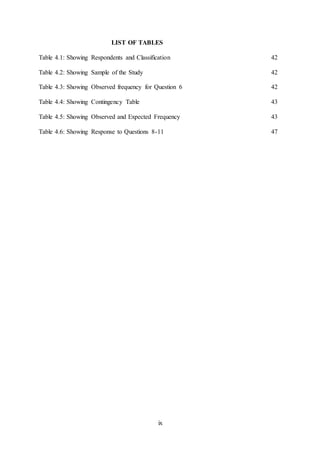
LIST OF TABLES
Table 4.1: Showing Respondents and Classification 42
Table 4.2: Showing Sample of the Study 42
Table 4.3: Showing Observed frequency for Question 6 42
Table 4.4: Showing Contingency Table 43
Table 4.5: Showing Observed and Expected Frequency 43
Table 4.6: Showing Response to Questions 8-11 47

Master's Project Cover page

  • 1.
    i ASSESSMENT OF OVERLANDTRANSPORT ON LOGISTICS CHAIN PERFORMANCE IN NIGERIA BY MAKANJUOLA, ADEWALE MATRIC NO: EAA: 132688 A PROJECT SUBMITTED TO THE DEPARTMENT OF TRANSPORT MANAGEMENT, FACULTY OF MANAGEMENT SCIENCES, LADOKE AKINTOLA UNIVERSITY OF TECHNOLOGY, OYO STATE, NIGERIA. IN PARTIAL FULFILLMENT OF THE REQUIREMENTS FOR THE AWARD OF THE DEGREE OF MASTERS IN TRANSPORT MANAGEMENT OCTOBER, 2015.
  • 2.
    ii CERTIFICATION This project withthe title Assessment of Overland Transport on Logistics Chain Performance in Nigeria submitted by Adewale, Makanjuola with Matric Number EAA: 132688 have satisfied the regulations governing the award of Master’s Degree in Transport Management of Ladoke Akintola University of Technology, Ogbomosho, Nigeria. ………………………………. .………………………………. Dr. Olu. Afolayan Date Supervisor ……………………………….. ………………………………… Dr. C. A. Wojuade Date Head of Department
  • 3.
    iii DEDICATION This thesis isdedicated to God almighty who gave me the strength and the resources needed for this course. I also dedicate it to my wife, children, brothers & sisters for being there for me. Lastly, I equally dedicate it to my parents, most especially the memory of my late mother Mrs. J.F Makanjuola who had encouraged me to be educated and to be what I am today academically.
  • 4.
    iv ACKNOWLEDGEMENT My special thanksgo to my supervisor for his invaluable assistance in the course of writing this thesis especially for his constructive criticism. My unreserved thanks go to all my lecturers Dr. Fasina, Prof. Shomuyiwa, Dr. Afolayan, Dr. Wojuade, Mr. Dosunmu, just to mention a few and to all my course mates who contributed immensely to the success of this thesis. Once again, thank you all.
  • 5.
    v ABSTRACT The deregulation andprivatization of overland transport has increased competition through the free entry of private operators into the transport market in Nigeria. This is supposedly the key mechanism for improving efficiency in the logistics chain, providing cheaper and more innovative transport services in Nigeria. But this study was carried out against the backdrop of the deplorable state of overland transport infrastructures, vehicles and operations and it examines their impact on logistics chain performance in Nigeria. The primary objectives of the study were to; identify the active modes of overland transport in Nigeria; examine the relationship between transport and the logistics chain in Nigeria; examine why overland transport is more predominantly used in Nigeria; determine the factors accounting for the continued importance of traditional modes of transport in certain localities in Nigeria; identify the factors responsible for the decline in the performance of railway transport in Nigeria; examine the problems of road transport in Nigeria; identify the problem with pipelines in Nigeria; Highlight the major thrusts of transport policy; and examine how overland transport has impacted on the logistics chain performance in Nigeria. A total of 185 copies of the questionnaires were distributed among individuals drawn from the population of the study. The study used sample survey. Chi-square statistical test and Z-score were used to analyze the data gathered in respect of the hypotheses. The study recommended that: for the overland transport modes to function optimally in order to enhance logistical performance, its infrastructure, vehicles and operations must be revamped; relevant authorities should consider providing rural Nigeria with appropriate infrastructure, vehicles and operations to enhance logistics performance; an efficient logistics chain entails a holistic and integrated approach to transportation to facilitate multimodal transport system. This calls for the all-round development of the entire transport sector.
  • 6.
    vi CONTENT Page Title Pagei Certification ii Dedication iii Acknowledgement iv Abstract v Table of Contents vi List of Tables ix CHAPTER ONE: INTRODUCTION 1.1 Background to the Study 1 1.2 Statement of the Research Problems 2 1.3 Research Questions 3 1.4 Objectives of the Study 4 1.5 Statement of the Hypothesis 5 1.6 Significance of the Study 5 1.7 Scope of the Study 6 CHAPTER TWO: LITERATURE REVIEW 2.1 Relevance of Transportation 7 2.2 Overland Transport Mode 8 2.3 Overland Transport in Nigeria 10 2.4 The Role of Rail Transportation in Nigeria Transport Sector 12 2.5 Objectives of Nigerian Transport Policy 17 2.6 The Federal Ministry of Transport 18
  • 7.
    vii 2.7 Factors Involvedin Transport Demand, Provision and Assessment 21 2.8 New Direction in Road Maintenance 24 2.9 Logistics 26 2.9.1 Business Logistics 26 2.9.2 Logistical Activities 28 2.10 The Role of Transport Logistics 29 CHAPTER THREE: RESEARCH METHOD 3.1 Study Area 31 3.2 Research Design 32 3.3 Study Population 33 3.4 Sample Size and Sample Techniques 33 3.5 Validity and Reliability of Instrument 34 3.6 Method of Data Collection 34 CHAPTER FOUR: DATA PRESENTATION AND ANALYSIS OF FINDINGS 4.1 Introduction 35 4.2 Respondents Classification 35 4.3 Test of Hypothesis 37 4.4 Findings and Inference 46 CHAPTERFIVE: SUMMARY, RECOMMENDATION AND CONCLUSION 5.1 Summary 47 5.2 Recommendation 51 5.3 Conclusion 51 REFERENCES 52
  • 8.
  • 9.
    ix LIST OF TABLES Table4.1: Showing Respondents and Classification 42 Table 4.2: Showing Sample of the Study 42 Table 4.3: Showing Observed frequency for Question 6 42 Table 4.4: Showing Contingency Table 43 Table 4.5: Showing Observed and Expected Frequency 43 Table 4.6: Showing Response to Questions 8-11 47