Serious Illness Cover Booster 
Even more help coping with the long-term effects 
of some serious illnesses 
For Advisers
2 
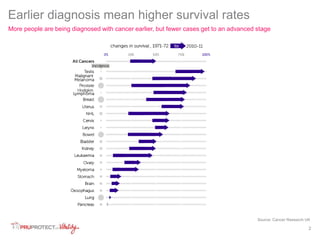
Earlier diagnosis mean higher survival rates 
More people are being diagnosed with cancer earlier, but fewer cases get to an advanced stage 
Source: Cancer Research UK
3 
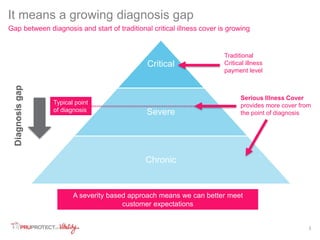
It means a growing diagnosis gap 
Gap between diagnosis and start of traditional critical illness cover is growing 
Critical 
Severe 
Chronic 
A severity based approach means we can better meet 
customer expectations 
Traditional 
Critical illness 
payment level 
Typical point 
of diagnosis 
Serious Illness Cover 
provides more cover from 
the point of diagnosis
4 
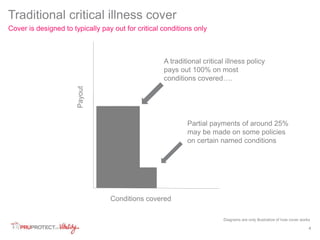
Traditional critical illness cover 
Cover is designed to typically pay out for critical conditions only 
Payout 
A traditional critical illness policy 
pays out 100% on most 
conditions covered…. 
Conditions covered 
Partial payments of around 25% 
may be made on some policies 
on certain named conditions 
Diagrams are only illustrative of how cover works
5 
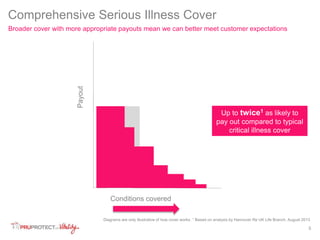
Comprehensive Serious Illness Cover 
Broader cover with more appropriate payouts mean we can better meet customer expectations 
Payout 
Conditions covered 
Up to twice1 as likely to 
pay out compared to typical 
critical illness cover 
Diagrams are only illustrative of how cover works. 1 Based on analysis by Hannover Re UK Life Branch, August 2013
6 
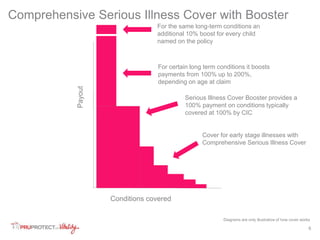
Comprehensive Serious Illness Cover with Booster 
Payout 
For the same long-term conditions an 
additional 10% boost for every child 
named on the policy 
For certain long term conditions it boosts 
payments from 100% up to 200%, 
depending on age at claim 
Conditions covered 
Serious Illness Cover Booster provides a 
100% payment on conditions typically 
covered at 100% by CIC 
Cover for early stage illnesses with 
Comprehensive Serious Illness Cover 
Diagrams are only illustrative of how cover works
7 
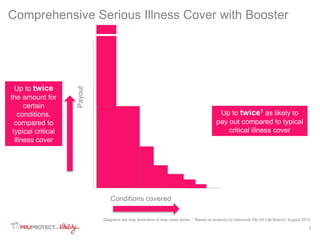
Comprehensive Serious Illness Cover with Booster 
Payout 
Conditions covered 
Up to twice 
the amount for 
certain 
conditions, 
compared to 
typical critical 
illness cover 
Up to twice1 as likely to 
pay out compared to typical 
critical illness cover 
Diagrams are only illustrative of how cover works. 1 Based on analysis by Hannover Re UK Life Branch, August 2013
8 
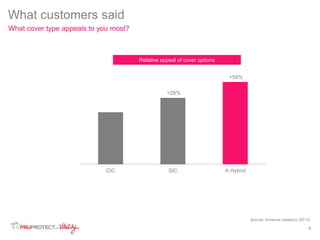
What customers said 
What cover type appeals to you most? 
Relative appeal of cover options 
+28% 
+58% 
CIC SIC A Hybrid 
Source: Immerse research (2013)
9 
The need for extra cover 
Example 
Ben 
– 30 years old 
– Takes out Comprehensive Serious Illness Cover 
– £100,000 sum assured 
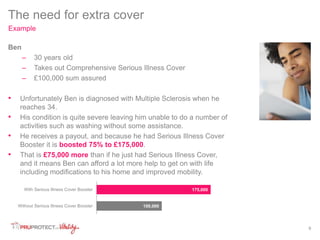
• Unfortunately Ben is diagnosed with Multiple Sclerosis when he 
reaches 34. 
• His condition is quite severe leaving him unable to do a number of 
activities such as washing without some assistance. 
• He receives a payout, and because he had Serious Illness Cover 
Booster it is boosted 75% to £175,000. 
• That is £75,000 more than if he just had Serious Illness Cover, 
and it means Ben can afford a lot more help to get on with life 
including modifications to his home and improved mobility. 
100,000 
175,000 
With Serious Illness Cover Booster 
Without Serious Illness Cover Booster
10 
Why recommend Serious Illness Cover with Booster 
Give your clients more 
• Cover for early stage illnesses 
– Even less severe illnesses have an impact on customers. So Comprehensive Serious 
Illness Cover offers cover for more early stage conditions than a typical critical illness 
policy. In fact your clients may be up to twice1 as likely to get a payout. 
• 100% payment for conditions typically covered by critical illness 
– For some customers having a 100% payout may be important. Serious Illness Cover 
Booster increases the payments made on our Serious Illness Cover, so that you can be 
sure clients will get a 100% payment for the conditions that are paid out at 100% by a 
typical critical illness policy 
• Boosted payments for long-term illnesses 
– Certain conditions can have a bigger long-term financial impact, particularly if they 
happen when your client is younger or if they have a family. Serious Illness Cover 
Booster will increase the payout made for certain conditions from 100% up to 200% 
depending on their age at the point of claim. 
• Additional boost for children 
– If your client receives a boost for a long-term illness, we will also pay an additional 
10% for each child named on the plan (up to £25,000 each), recognising the additional 
costs you client may need to cover. 
1 Based on analysis by Hannover Re UK Life Branch, August 2013
Vitality Optimiser 
A new generation of protection
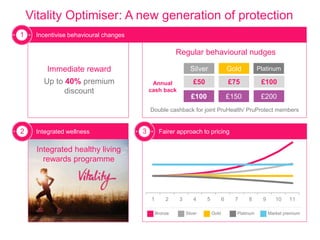
Vitality Optimiser: A new generation of protection 
Regular behavioural nudges 
Annual 
cash back 
Silver Gold Platinum 
£50 £75 £100 
£100 £150 £200 
Double cashback for joint PruHealth/ PruProtect members 
1 2 3 4 5 6 7 8 9 10 11 
1 Incentivise behavioural changes 
Immediate reward 
Up to 40% premium 
discount 
2 Integrated wellness 
Integrated healthy living 
rewards programme 
3 Fairer approach to pricing 
Bronze Silver Gold Platinum Market premium
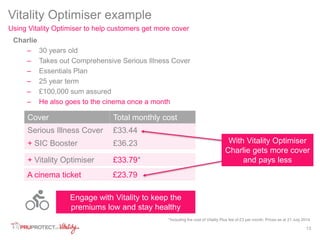
With Vitality Optimiser 
Charlie gets more cover 
13 
Vitality Optimiser example 
Using Vitality Optimiser to help customers get more cover 
Cover Total monthly cost 
Serious Illness Cover £33.44 
+ SIC Booster £36.23 
+ Vitality Optimiser £33.79* 
A cinema ticket £23.79 
Engage with Vitality to keep the 
premiums low and stay healthy 
and pays less 
*Including the cost of Vitality Plus fee of £3 per month. Prices as at 21 July 2014 
Charlie 
– 30 years old 
– Takes out Comprehensive Serious Illness Cover 
– Essentials Plan 
– 25 year term 
– £100,000 sum assured 
– He also goes to the cinema once a month
Serious Illness Cover Booster - Appendix For Advisers
15 
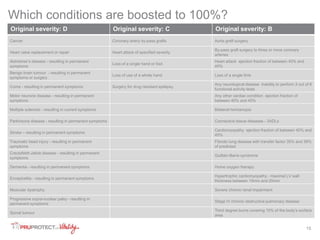
Which conditions are boosted to 100%? 
Original severity: D Original severity: C Original severity: B 
Cancer Coronary artery by-pass grafts Aorta graft surgery 
Heart valve replacement or repair Heart attack of specified severity 
By-pass graft surgery to three or more coronary 
arteries 
Alzheimer’s disease - resulting in permanent 
symptoms 
Loss of a single hand or foot 
Heart attack ejection fraction of between 40% and 
45% 
Benign brain tumour - resulting in permanent 
symptoms or surgery 
Loss of use of a whole hand Loss of a single limb 
Coma - resulting in permanent symptoms Surgery for drug resistant epilepsy 
Any neurological disease inability to perform 3 out of 6 
functional activity tests 
Motor neurone disease - resulting in permanent 
symptoms 
Any other cardiac condition ejection fraction of 
between 40% and 45% 
Multiple sclerosis - resulting in current symptoms Bilateral hemianopia 
Parkinsons disease - resulting in permanent symptoms Connective tissue diseases - 3ADLs 
Stroke – resulting in permanent symptoms 
Cardiomyopathy ejection fraction of between 40% and 
45% 
Traumatic head injury - resulting in permanent 
symptoms 
Fibrotic lung disease with transfer factor 35% and 39% 
of predicted 
Creutzfeldt-Jakob disease - resulting in permanent 
symptoms 
Guillain-Barre syndrome 
Dementia - resulting in permanent symptoms Home oxygen therapy 
Encephalitis - resulting in permanent symptoms 
Hypertrophic cardiomyopathy - maximal LV wall 
thickness between 15mm and 25mm 
Muscular dystrophy Severe chronic renal impairment 
Progressive supra-nuclear palsy - resulting in 
permanent symptoms 
Stage IV chronic obstructive pulmonary disease 
Spinal tumour 
Third degree burns covering 15% of the body’s surface 
area
16 
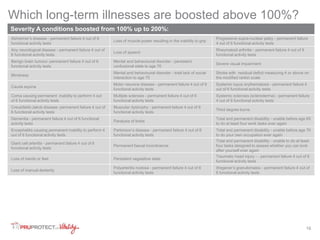
Which long-term illnesses are boosted above 100%? 
Severity A conditions boosted from 100% up to 200%: 
Alzheimer’s disease - permanent failure 4 out of 6 
functional activity tests 
Loss of muscle power resulting in the inability to grip 
Progressive supra-nuclear palsy - permanent failure 
4 out of 6 functional activity tests 
Any neurological disease - permanent failure 4 out of 
6 functional activity tests 
Loss of speech 
Rheumatoid arthritis - permanent failure 4 out of 6 
functional activity tests 
Benign brain tumour- permanent failure 4 out of 6 
functional activity tests 
Mental and behavioural disorder - persistent 
confusional state to age 70 
Severe visual impairment 
Blindness 
Mental and behavioural disorder - total lack of social 
interaction to age 70 
Stroke with residual deficit measuring 4 or above on 
the modified rankin scale 
Cauda equina 
Motor neurone disease - permanent failure 4 out of 6 
functional activity tests 
Systemic lupus erythematosis - permanent failure 4 
out of 6 functional activity tests 
Coma causing permanent inability to perform 4 out 
of 6 functional activity tests 
Multiple sclerosis - permanent failure 4 out of 6 
functional activity tests 
Systemic sclerosis (scleroderma) - permanent failure 
4 out of 6 functional activity tests 
Creutzfeldt-Jakob disease- permanent failure 4 out of 
6 functional activity tests 
Muscular dystrophy - permanent failure 4 out of 6 
functional activity tests 
Third degree burns 
Dementia - permanent failure 4 out of 6 functional 
activity tests 
Paralysis of limbs 
Total and permanent disability - unable before age 65 
to do at least four work tasks ever again 
Encephalitis causing permanent inability to perform 4 
out of 6 functional activity tests 
Parkinson’s disease - permanent failure 4 out of 6 
functional activity tests 
Total and permanent disability - unable before age 70 
to do your own occupation ever again 
Giant cell arteritis - permanent failure 4 out of 6 
functional activity tests 
Permanent faecal incontinence 
Total and permanent disability - unable to do at least 
four tasks designed to assess whether you can look 
after yourself ever again 
Loss of hands or feet Persistent vegetative state 
Traumatic head injury - - permanent failure 4 out of 6 
functional activity tests 
Loss of manual dexterity 
Polyarteritis nodosa - permanent failure 4 out of 6 
functional activity tests 
Wegener’s granulomatos - permanent failure 4 out of 
6 functional activity tests
17 
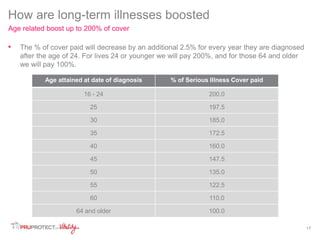
How are long-term illnesses boosted 
Age related boost up to 200% of cover 
• The % of cover paid will decrease by an additional 2.5% for every year they are diagnosed 
after the age of 24. For lives 24 or younger we will pay 200%, and for those 64 and older 
we will pay 100%. 
Age attained at date of diagnosis % of Serious Illness Cover paid 
16 - 24 200.0 
25 197.5 
30 185.0 
35 172.5 
40 160.0 
45 147.5 
50 135.0 
55 122.5 
60 110.0 
64 and older 100.0

Master Class: Serious Illness Cover Booster

  • 1.
    Serious Illness CoverBooster Even more help coping with the long-term effects of some serious illnesses For Advisers
  • 2.
    2 Earlier diagnosismean higher survival rates More people are being diagnosed with cancer earlier, but fewer cases get to an advanced stage Source: Cancer Research UK
  • 3.
    3 It meansa growing diagnosis gap Gap between diagnosis and start of traditional critical illness cover is growing Critical Severe Chronic A severity based approach means we can better meet customer expectations Traditional Critical illness payment level Typical point of diagnosis Serious Illness Cover provides more cover from the point of diagnosis
  • 4.
    4 Traditional criticalillness cover Cover is designed to typically pay out for critical conditions only Payout A traditional critical illness policy pays out 100% on most conditions covered…. Conditions covered Partial payments of around 25% may be made on some policies on certain named conditions Diagrams are only illustrative of how cover works
  • 5.
    5 Comprehensive SeriousIllness Cover Broader cover with more appropriate payouts mean we can better meet customer expectations Payout Conditions covered Up to twice1 as likely to pay out compared to typical critical illness cover Diagrams are only illustrative of how cover works. 1 Based on analysis by Hannover Re UK Life Branch, August 2013
  • 6.
    6 Comprehensive SeriousIllness Cover with Booster Payout For the same long-term conditions an additional 10% boost for every child named on the policy For certain long term conditions it boosts payments from 100% up to 200%, depending on age at claim Conditions covered Serious Illness Cover Booster provides a 100% payment on conditions typically covered at 100% by CIC Cover for early stage illnesses with Comprehensive Serious Illness Cover Diagrams are only illustrative of how cover works
  • 7.
    7 Comprehensive SeriousIllness Cover with Booster Payout Conditions covered Up to twice the amount for certain conditions, compared to typical critical illness cover Up to twice1 as likely to pay out compared to typical critical illness cover Diagrams are only illustrative of how cover works. 1 Based on analysis by Hannover Re UK Life Branch, August 2013
  • 8.
    8 What customerssaid What cover type appeals to you most? Relative appeal of cover options +28% +58% CIC SIC A Hybrid Source: Immerse research (2013)
  • 9.
    9 The needfor extra cover Example Ben – 30 years old – Takes out Comprehensive Serious Illness Cover – £100,000 sum assured • Unfortunately Ben is diagnosed with Multiple Sclerosis when he reaches 34. • His condition is quite severe leaving him unable to do a number of activities such as washing without some assistance. • He receives a payout, and because he had Serious Illness Cover Booster it is boosted 75% to £175,000. • That is £75,000 more than if he just had Serious Illness Cover, and it means Ben can afford a lot more help to get on with life including modifications to his home and improved mobility. 100,000 175,000 With Serious Illness Cover Booster Without Serious Illness Cover Booster
  • 10.
    10 Why recommendSerious Illness Cover with Booster Give your clients more • Cover for early stage illnesses – Even less severe illnesses have an impact on customers. So Comprehensive Serious Illness Cover offers cover for more early stage conditions than a typical critical illness policy. In fact your clients may be up to twice1 as likely to get a payout. • 100% payment for conditions typically covered by critical illness – For some customers having a 100% payout may be important. Serious Illness Cover Booster increases the payments made on our Serious Illness Cover, so that you can be sure clients will get a 100% payment for the conditions that are paid out at 100% by a typical critical illness policy • Boosted payments for long-term illnesses – Certain conditions can have a bigger long-term financial impact, particularly if they happen when your client is younger or if they have a family. Serious Illness Cover Booster will increase the payout made for certain conditions from 100% up to 200% depending on their age at the point of claim. • Additional boost for children – If your client receives a boost for a long-term illness, we will also pay an additional 10% for each child named on the plan (up to £25,000 each), recognising the additional costs you client may need to cover. 1 Based on analysis by Hannover Re UK Life Branch, August 2013
  • 11.
    Vitality Optimiser Anew generation of protection
  • 12.
    Vitality Optimiser: Anew generation of protection Regular behavioural nudges Annual cash back Silver Gold Platinum £50 £75 £100 £100 £150 £200 Double cashback for joint PruHealth/ PruProtect members 1 2 3 4 5 6 7 8 9 10 11 1 Incentivise behavioural changes Immediate reward Up to 40% premium discount 2 Integrated wellness Integrated healthy living rewards programme 3 Fairer approach to pricing Bronze Silver Gold Platinum Market premium
  • 13.
    With Vitality Optimiser Charlie gets more cover 13 Vitality Optimiser example Using Vitality Optimiser to help customers get more cover Cover Total monthly cost Serious Illness Cover £33.44 + SIC Booster £36.23 + Vitality Optimiser £33.79* A cinema ticket £23.79 Engage with Vitality to keep the premiums low and stay healthy and pays less *Including the cost of Vitality Plus fee of £3 per month. Prices as at 21 July 2014 Charlie – 30 years old – Takes out Comprehensive Serious Illness Cover – Essentials Plan – 25 year term – £100,000 sum assured – He also goes to the cinema once a month
  • 14.
    Serious Illness CoverBooster - Appendix For Advisers
  • 15.
    15 Which conditionsare boosted to 100%? Original severity: D Original severity: C Original severity: B Cancer Coronary artery by-pass grafts Aorta graft surgery Heart valve replacement or repair Heart attack of specified severity By-pass graft surgery to three or more coronary arteries Alzheimer’s disease - resulting in permanent symptoms Loss of a single hand or foot Heart attack ejection fraction of between 40% and 45% Benign brain tumour - resulting in permanent symptoms or surgery Loss of use of a whole hand Loss of a single limb Coma - resulting in permanent symptoms Surgery for drug resistant epilepsy Any neurological disease inability to perform 3 out of 6 functional activity tests Motor neurone disease - resulting in permanent symptoms Any other cardiac condition ejection fraction of between 40% and 45% Multiple sclerosis - resulting in current symptoms Bilateral hemianopia Parkinsons disease - resulting in permanent symptoms Connective tissue diseases - 3ADLs Stroke – resulting in permanent symptoms Cardiomyopathy ejection fraction of between 40% and 45% Traumatic head injury - resulting in permanent symptoms Fibrotic lung disease with transfer factor 35% and 39% of predicted Creutzfeldt-Jakob disease - resulting in permanent symptoms Guillain-Barre syndrome Dementia - resulting in permanent symptoms Home oxygen therapy Encephalitis - resulting in permanent symptoms Hypertrophic cardiomyopathy - maximal LV wall thickness between 15mm and 25mm Muscular dystrophy Severe chronic renal impairment Progressive supra-nuclear palsy - resulting in permanent symptoms Stage IV chronic obstructive pulmonary disease Spinal tumour Third degree burns covering 15% of the body’s surface area
  • 16.
    16 Which long-termillnesses are boosted above 100%? Severity A conditions boosted from 100% up to 200%: Alzheimer’s disease - permanent failure 4 out of 6 functional activity tests Loss of muscle power resulting in the inability to grip Progressive supra-nuclear palsy - permanent failure 4 out of 6 functional activity tests Any neurological disease - permanent failure 4 out of 6 functional activity tests Loss of speech Rheumatoid arthritis - permanent failure 4 out of 6 functional activity tests Benign brain tumour- permanent failure 4 out of 6 functional activity tests Mental and behavioural disorder - persistent confusional state to age 70 Severe visual impairment Blindness Mental and behavioural disorder - total lack of social interaction to age 70 Stroke with residual deficit measuring 4 or above on the modified rankin scale Cauda equina Motor neurone disease - permanent failure 4 out of 6 functional activity tests Systemic lupus erythematosis - permanent failure 4 out of 6 functional activity tests Coma causing permanent inability to perform 4 out of 6 functional activity tests Multiple sclerosis - permanent failure 4 out of 6 functional activity tests Systemic sclerosis (scleroderma) - permanent failure 4 out of 6 functional activity tests Creutzfeldt-Jakob disease- permanent failure 4 out of 6 functional activity tests Muscular dystrophy - permanent failure 4 out of 6 functional activity tests Third degree burns Dementia - permanent failure 4 out of 6 functional activity tests Paralysis of limbs Total and permanent disability - unable before age 65 to do at least four work tasks ever again Encephalitis causing permanent inability to perform 4 out of 6 functional activity tests Parkinson’s disease - permanent failure 4 out of 6 functional activity tests Total and permanent disability - unable before age 70 to do your own occupation ever again Giant cell arteritis - permanent failure 4 out of 6 functional activity tests Permanent faecal incontinence Total and permanent disability - unable to do at least four tasks designed to assess whether you can look after yourself ever again Loss of hands or feet Persistent vegetative state Traumatic head injury - - permanent failure 4 out of 6 functional activity tests Loss of manual dexterity Polyarteritis nodosa - permanent failure 4 out of 6 functional activity tests Wegener’s granulomatos - permanent failure 4 out of 6 functional activity tests
  • 17.
    17 How arelong-term illnesses boosted Age related boost up to 200% of cover • The % of cover paid will decrease by an additional 2.5% for every year they are diagnosed after the age of 24. For lives 24 or younger we will pay 200%, and for those 64 and older we will pay 100%. Age attained at date of diagnosis % of Serious Illness Cover paid 16 - 24 200.0 25 197.5 30 185.0 35 172.5 40 160.0 45 147.5 50 135.0 55 122.5 60 110.0 64 and older 100.0

Editor's Notes

  • #3 http://www.cancerresearchuk.org/cancer-info/cancerstats/incidence/all-cancers-combined/ http://www.cancerresearchuk.org/cancer-info/cancerstats/mortality/mortality-projections/