Marxist Theories of International Relations
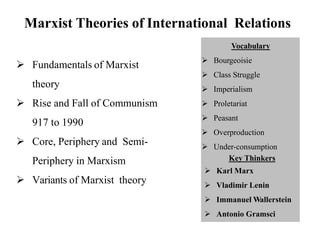
➢ Fundamentals of Marxist
theory
➢ Rise and Fall of Communism
917 to 1990
➢ Core, Periphery and Semi-
Periphery in Marxism
➢ Variants of Marxist theory
Vocabulary
➢ Bourgeoisie
➢ Class Struggle
➢ Imperialism
➢ Proletariat
➢ Peasant
➢ Overproduction
➢ Under-consumption
Key Thinkers
➢ Karl Marx
➢ Vladimir Lenin
➢ Immanuel Wallerstein
➢ Antonio Gramsci
Fundamentals of Marxism
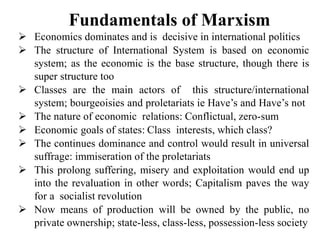
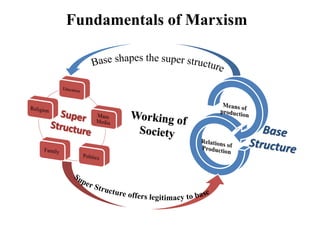
➢ Economics dominates and is decisive in international politics
➢ The structure of International System is based on economic
system; as the economic is the base structure, though there is
super structure too
➢ Classes are the main actors of this structure/international
system; bourgeoisies and proletariats ie Have’s and Have’s not
➢ The nature of economic relations: Conflictual, zero-sum
➢ Economic goals of states: Class interests, which class?
➢ The continues dominance and control would result in universal
suffrage: immiseration of the proletariats
➢ This prolong suffering, misery and exploitation would end up
into the revaluation in other words; Capitalism paves the way
for a socialist revolution
➢ Now means of production will be owned by the public, no
private ownership; state-less, class-less, possession-less society
Fundamentals of Marxism
Classes and Class Struggle
➢ Factors of productions: Land, Capital and
Labor are regulated by the bourgeoisies
➢ Labor is misdealt in aftermath of industrial
revolution, as machine replaced it…
➢ From surplus value to under-consumtion
➢ From mass production to over-production
➢ Surplus value of the labor
➢ Cycle of extortion and exploitation
➢ Frustrated labor overthrowing the system
Mass Production Under-consumtion
Industrial Revolution
Why Revolution did not occur in the West?
➢ Hegemony : Dominance and lead of
ruling class in society that allows their
political, cultural and moral values to
be accepted by subordinate groups
(Labour) as their own.
➢ Means of mass control facilitate the
bourgeoisies to rule the hearts and
minds of proletariats too.
➢ Have you been using
social media?
➢ When you upload your
selfies?
➢ What triggers you?
Variants of Marxist Theory
Dependency Theory
➢ A theory hypothesizing that less
developed countries are exploited
because global capitalism makes
them dependent on the rich countries
that create exploitative rules for trade
and production.
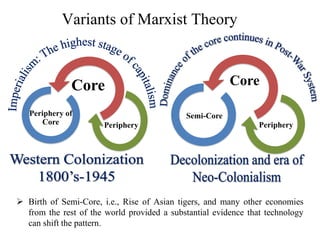
➢ India exploited, plundered and
financially robbed by the Great
Britain for instance. Offering several
time higher development projects
which were suited the colonials not
the colonies.
➢ This additional profits made some
trickle down effect to the proletariats
in core and uplifted their life
standards. (Core to periphery of core)
World System Theory
➢ A body of theory that treats the capitalistic
world economy originating in the sixteenth
century as an interconnected unit of
analysis encompassing the entire globe,
with an international division of labor and
multiple political centers and cultures
whose rules constrain and share the
behavior of all transnational actors.
➢ Peripheral countries are structurally
constrained to experience a kind of
development that reproduces their
subordinate status.
➢ Strong states reinforce and increase the
differential flow of surplus to the core zone
understood as Unequal Exchange, the
systematic transfer of surplus from semi-
proletarian sectors in the periphery to the
high-tech industrialized core.
Variants of Marxist Theory
Periphery
Periphery of
Core
Core
➢ Birth of Semi-Core, i.e., Rise of Asian tigers, and many other economies
from the rest of the world provided a substantial evidence that technology
can shift the pattern.
Periphery
Semi-Core
Core
What was achieved : The USSR
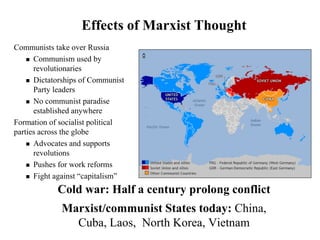
Effects of Marxist Thought
Communists take over Russia
◼ Communism used by
revolutionaries
◼ Dictatorships of Communist
Party leaders
◼ No communist paradise
established anywhere
Formation of socialist political
parties across the globe
◼ Advocates and supports
revolutions
◼ Pushes for work reforms
◼ Fight against “capitalism”
Marxist/communist States today: China,
Cuba, Laos, North Korea, Vietnam
Cold war: Half a century prolong conflict

Marxism.pdf

  • 1.
    Marxist Theories ofInternational Relations ➢ Fundamentals of Marxist theory ➢ Rise and Fall of Communism 917 to 1990 ➢ Core, Periphery and Semi- Periphery in Marxism ➢ Variants of Marxist theory Vocabulary ➢ Bourgeoisie ➢ Class Struggle ➢ Imperialism ➢ Proletariat ➢ Peasant ➢ Overproduction ➢ Under-consumption Key Thinkers ➢ Karl Marx ➢ Vladimir Lenin ➢ Immanuel Wallerstein ➢ Antonio Gramsci
  • 2.
    Fundamentals of Marxism ➢Economics dominates and is decisive in international politics ➢ The structure of International System is based on economic system; as the economic is the base structure, though there is super structure too ➢ Classes are the main actors of this structure/international system; bourgeoisies and proletariats ie Have’s and Have’s not ➢ The nature of economic relations: Conflictual, zero-sum ➢ Economic goals of states: Class interests, which class? ➢ The continues dominance and control would result in universal suffrage: immiseration of the proletariats ➢ This prolong suffering, misery and exploitation would end up into the revaluation in other words; Capitalism paves the way for a socialist revolution ➢ Now means of production will be owned by the public, no private ownership; state-less, class-less, possession-less society
  • 3.
  • 4.
    Classes and ClassStruggle ➢ Factors of productions: Land, Capital and Labor are regulated by the bourgeoisies ➢ Labor is misdealt in aftermath of industrial revolution, as machine replaced it… ➢ From surplus value to under-consumtion ➢ From mass production to over-production ➢ Surplus value of the labor ➢ Cycle of extortion and exploitation ➢ Frustrated labor overthrowing the system Mass Production Under-consumtion Industrial Revolution
  • 5.
    Why Revolution didnot occur in the West? ➢ Hegemony : Dominance and lead of ruling class in society that allows their political, cultural and moral values to be accepted by subordinate groups (Labour) as their own. ➢ Means of mass control facilitate the bourgeoisies to rule the hearts and minds of proletariats too. ➢ Have you been using social media? ➢ When you upload your selfies? ➢ What triggers you?
  • 6.
    Variants of MarxistTheory Dependency Theory ➢ A theory hypothesizing that less developed countries are exploited because global capitalism makes them dependent on the rich countries that create exploitative rules for trade and production. ➢ India exploited, plundered and financially robbed by the Great Britain for instance. Offering several time higher development projects which were suited the colonials not the colonies. ➢ This additional profits made some trickle down effect to the proletariats in core and uplifted their life standards. (Core to periphery of core) World System Theory ➢ A body of theory that treats the capitalistic world economy originating in the sixteenth century as an interconnected unit of analysis encompassing the entire globe, with an international division of labor and multiple political centers and cultures whose rules constrain and share the behavior of all transnational actors. ➢ Peripheral countries are structurally constrained to experience a kind of development that reproduces their subordinate status. ➢ Strong states reinforce and increase the differential flow of surplus to the core zone understood as Unequal Exchange, the systematic transfer of surplus from semi- proletarian sectors in the periphery to the high-tech industrialized core.
  • 7.
    Variants of MarxistTheory Periphery Periphery of Core Core ➢ Birth of Semi-Core, i.e., Rise of Asian tigers, and many other economies from the rest of the world provided a substantial evidence that technology can shift the pattern. Periphery Semi-Core Core
  • 8.
  • 9.
    Effects of MarxistThought Communists take over Russia ◼ Communism used by revolutionaries ◼ Dictatorships of Communist Party leaders ◼ No communist paradise established anywhere Formation of socialist political parties across the globe ◼ Advocates and supports revolutions ◼ Pushes for work reforms ◼ Fight against “capitalism” Marxist/communist States today: China, Cuba, Laos, North Korea, Vietnam Cold war: Half a century prolong conflict