The Oxfam experience
The problem for development NGOs Losing public debate on global social justice Multiple, longitudinal measures Public “uninterested and uninformed” Media, NGOs, companies, government all in same place We can’t get away from statements like: “ nothings changed since Live Aid” “ aid is just wasted on corruption”
Frames Surface  frames: words and meanings e.g. Tax relief Deep frames: worldviews e.g. Moral order
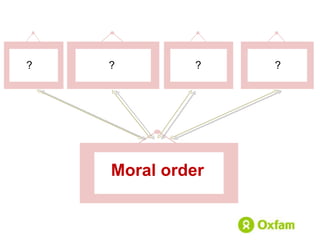
Moral order ? ? ? ?
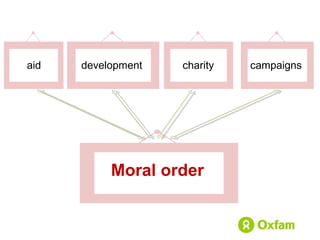
Moral order aid development charity campaigns
Six things we’ve done “ Know thyself” research: personalising the imperative Small: festivals messaging Medium: engagement model + new expertise + training Large: corporate approaches + model of change Supersize: pan and cross-sectoral working
Research conclusion  (2010 Comms) “ Seen through the ‘Frames and Values’ lens, the language of Oxfam communications often promotes frames and values you are trying to move  away  from However, your comms do show – in places – ‘how it can be otherwise’”
Oxfam UK and the Moral Order  Simplification : especially binary oppositions, imperatives, assertions and war metaphors Assumptions:  about supporters, prospective supporters & local partners Agency:   subtle suggestions about who does what, to whom, which disempower supporters and local people
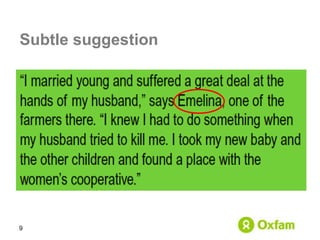
Subtle suggestion
Despite ourselves, NGOs are telling an old, predictable story,  and are pretty comfortable with it   ‘ Old’ charity Starving African babies (usually in black and white) Distance and difference Grandiose hope over reason Government and the media are in the same boat We are blind to some very important unintended consequences Three uncomfortable truths
The four horsemen of belief Mass poverty is inevitable The problem is primarily with  the people who are poor People are poor for ‘natural’ and moral reasons Charity is (good) enough
We assume far more than we know; we are more slave than master of our language We fixate on  what  people think and ignore the  why We don’t know what a credible long term vision for engaging the public looks like We confuse policy prescriptions for campaigns Four bad habits
Five new habits? Take a whole organisation/whole sector perspective. Collaborate.  Study your language. Use experts. Standardise e.g. discourse analysis (looks at  why ) Prioritise credibility  Evolve communications, campaigning & fundraising models  in one direction:   deeper engagement models more conversation  less turnover  Revisit models of change. Together.

Martin Kirk presentation

  • 1.
  • 2.
    The problem fordevelopment NGOs Losing public debate on global social justice Multiple, longitudinal measures Public “uninterested and uninformed” Media, NGOs, companies, government all in same place We can’t get away from statements like: “ nothings changed since Live Aid” “ aid is just wasted on corruption”
  • 3.
    Frames Surface frames: words and meanings e.g. Tax relief Deep frames: worldviews e.g. Moral order
  • 4.
  • 5.
    Moral order aiddevelopment charity campaigns
  • 6.
    Six things we’vedone “ Know thyself” research: personalising the imperative Small: festivals messaging Medium: engagement model + new expertise + training Large: corporate approaches + model of change Supersize: pan and cross-sectoral working
  • 7.
    Research conclusion (2010 Comms) “ Seen through the ‘Frames and Values’ lens, the language of Oxfam communications often promotes frames and values you are trying to move away from However, your comms do show – in places – ‘how it can be otherwise’”
  • 8.
    Oxfam UK andthe Moral Order Simplification : especially binary oppositions, imperatives, assertions and war metaphors Assumptions: about supporters, prospective supporters & local partners Agency: subtle suggestions about who does what, to whom, which disempower supporters and local people
  • 9.
  • 10.
    Despite ourselves, NGOsare telling an old, predictable story, and are pretty comfortable with it ‘ Old’ charity Starving African babies (usually in black and white) Distance and difference Grandiose hope over reason Government and the media are in the same boat We are blind to some very important unintended consequences Three uncomfortable truths
  • 11.
    The four horsemenof belief Mass poverty is inevitable The problem is primarily with the people who are poor People are poor for ‘natural’ and moral reasons Charity is (good) enough
  • 12.
    We assume farmore than we know; we are more slave than master of our language We fixate on what people think and ignore the why We don’t know what a credible long term vision for engaging the public looks like We confuse policy prescriptions for campaigns Four bad habits
  • 13.
    Five new habits?Take a whole organisation/whole sector perspective. Collaborate. Study your language. Use experts. Standardise e.g. discourse analysis (looks at why ) Prioritise credibility Evolve communications, campaigning & fundraising models in one direction: deeper engagement models more conversation less turnover Revisit models of change. Together.

Editor's Notes

  • #9 In all these features, we see evidence of the ‘moral order’ frame in Oxfam comms
  • #10 In all these features, we see evidence of the ‘moral order’ frame in Oxfam comms