©McGraw-Hill Education. All rights reserved. Authorized only for instructor use in the classroom. No reproduction or further distribution permitted without the prior written consent of McGraw-Hill Education.
Chapter 2
The Role of IMC in the
Marketing Process
Source: Citizen Watch Company of America, Inc
©McGraw-Hill Education.
Learning Objectives
1. Describe the role of advertising and promotion in an
organization’s integrated marketing program.
2. Define target marketing.
3. Discuss the role of market segmentation in an IMC
program.
4. Describe positioning and repositioning strategies.
5. Identify the marketing-mix decisions that influence
advertising and promotional strategy.
©McGraw-Hill Education.
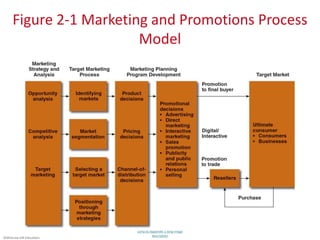
Figure 2-1 Marketing and Promotions Process
Model
Jump to Appendix 1 long image
description
©McGraw-Hill Education.
Marketing Strategy and Analysis
• Strategic marketing plan:
– Guides allocation of organization’s resources
– Guides specific marketing programs and policies
– Evolves from an organization’s overall corporate
strategy
– Allows for an understanding of market opportunities,
competition, and market segments
• Market segments: distinct consumer groups within
a market who have common needs
©McGraw-Hill Education.
Opportunity Analysis
• Market opportunities: Areas where:
– There are favorable demand trends
– Customers’ needs and opportunities are not being
satisfied
– Firm can compete effectively
• Steps to identify market opportunities
– Examine the marketplace
– Observe demand trends and competition in various
market segments
©McGraw-Hill Education.
Competitive Analysis
• Analyzing the competition in the marketplace and
searching for a competitive advantage
– Competitive advantage: Attributes that give a firm
an edge over competitors
• Better quality products
• Superior customer service
• Low production costs and lower prices
• Dominating channels of distribution
• Advertising
©McGraw-Hill Education.
Target Market Selection
• Done after evaluating market opportunities and
doing a competitive analysis
• Has direct implications on a firm’s advertising and
promotional efforts
©McGraw-Hill Education.
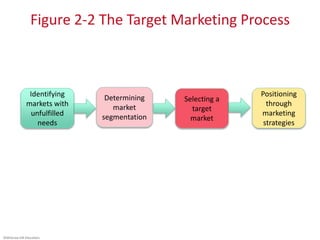
Figure 2-2 The Target Marketing Process
Identifying
markets with
unfulfilled
needs
Determining
market
segmentation
Selecting a
target
market
Positioning
through
marketing
strategies
©McGraw-Hill Education.
Identifying Markets
• Marketer identifies the specific needs of groups of
people (or segments)
• Selects one or more of these segments as a target
• Isolates consumers with similar lifestyles, needs, and the
like
• Increased marketer’s knowledge of consumers’ specific
requirements
©McGraw-Hill Education.
Market Segmentation
 Dividing a market into distinct groups with common
needs, who respond similarly to a marketing situation
 Customer characteristics segmentation criteria
 Geographic: Dividing the market on the basis of region,
city size, metropolitan area, and/or density
 Demographic: Dividing the market on the basis of age, sex,
family size, marital status, etc.
 Socioeconomic: Dividing the market on the basis of
income, education, or occupation
 Psychographic: Dividing the market on the basis of
personality, lifecycles, and/or lifestyles
©McGraw-Hill Education.
Buying Situations
 Markets can also be divided by customer buying
situations
 Buying situations segmentation criteria
 Outlet type
 Benefits sought
 Usage
 Awareness and intentions
 Behavior
©McGraw-Hill Education.
Basis for Market Segmentation
 Behavioristic segmentation
 Dividing consumers into groups according to their
usage, loyalties, or buying responses to a product
 80-20 rule: 20 percent of buyers account for 80
percent of sales volume
 Benefit segmentation
 Grouping of consumers on the basis of attributes
sought in a product
©McGraw-Hill Education.
Selecting Target Market
 Determine how many segments to enter
 Utilizing market coverage alternatives
 Determine which segments offer the most potential
 Selecting the most attractive segment
©McGraw-Hill Education.
Market Coverage Alternatives
• Undifferentiated marketing
• Ignoring segment differences and offering just one
product or service to the entire market
• Differentiated marketing
• Involves marketing in a number of segments,
developing separate marketing strategies for each
• Concentrated marketing
• Selecting a segment and attempting to capture a
large share of this market
©McGraw-Hill Education.
Selecting the Most Attractive Segment
 Sales potential of segment
 Opportunities for growth
 Competition analysis
 Ability to compete
 Ability to market to this group
©McGraw-Hill Education.
Market Positioning
• Positioning: Fitting a product or service to one or more
segments of the broad market to make it unique within
the marketplace
• Approaches
– Focusing on the consumer—Linking the product with
the benefits the consumer will derive
– Focusing on competition—Positions the product by
comparing the benefit it offers versus the
competition
©McGraw-Hill Education.
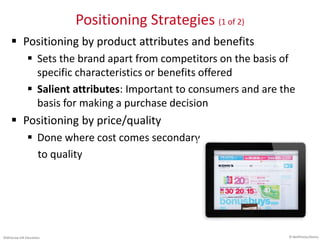
Positioning Strategies (1 of 2)
 Positioning by product attributes and benefits
 Sets the brand apart from competitors on the basis of
specific characteristics or benefits offered
 Salient attributes: Important to consumers and are the
basis for making a purchase decision
 Positioning by price/quality
 Done where cost comes secondary
to quality
© NetPhotos/Alamy
©McGraw-Hill Education.
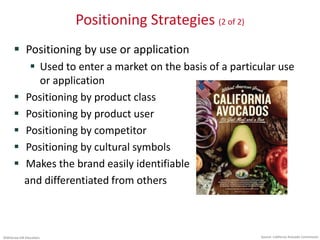
Positioning Strategies (2 of 2)
 Positioning by use or application
 Used to enter a market on the basis of a particular use
or application
 Positioning by product class
 Positioning by product user
 Positioning by competitor
 Positioning by cultural symbols
 Makes the brand easily identifiable
and differentiated from others
Source: California Avocado Commission
©McGraw-Hill Education.
Repositioning
• Altering a product’s or brand’s position due to:
– Declining or stagnant sales
– Anticipated opportunities in other market positions
• Difficult to accomplish because of entrenched
perceptions and attitudes toward the product or
brand
©McGraw-Hill Education.
Product Decisions
 Product symbolism: Refers to:
 What a product or brand means to consumers
 What consumers experience in purchasing and
using a product
 Branding
 Building and maintaining a favorable identity of the
company and its products
 Packaging
 Provides functional benefits such as economy,
protection, and storage
©McGraw-Hill Education.
Branding
 Builds and maintains brand awareness and interest
 Develops and enhances attitudes toward the company
or product
 Builds relationships between the consumer and the
brand
 Brand identity
 Combination of name, logo, symbols, design, packaging,
image, and associations held by consumers
 Brand equity
 Intangible asset of added value
©McGraw-Hill Education.
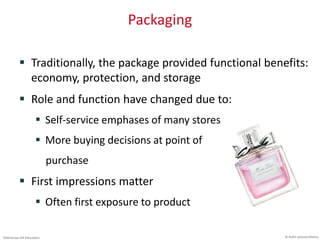
Packaging
 Traditionally, the package provided functional benefits:
economy, protection, and storage
 Role and function have changed due to:
 Self-service emphases of many stores
 More buying decisions at point of
purchase
 First impressions matter
 Often first exposure to product
© Keith Jackson/Alamy
©McGraw-Hill Education.
Price Decisions
 Price variable—Refers to what the consumer has to
give in exchange for a purchase
 Factors that determine price
 Costs
 Demand factors
 Competition
 Perceived value
 Product quality
 Advertising
©McGraw-Hill Education.
Marketing Channels
• Interdependent organizations involved in making a
product or service available for use
• Direct channels: Directly deal with customers
– Driven by direct-response ads, telemarketing, the
Internet
– Used when selling expensive and complex products
• Indirect channels: Network of wholesalers and/or
retailers
©McGraw-Hill Education.
Promotional Push Strategies
• Programs designed to persuade the trade to stock,
merchandise and promote a manufacturer’s products
• Goal
– Push the product through the channels of distribution
by selling and promoting it
• Trade advertising: Used to motivate wholesalers and
retailers to purchase products for resale
©McGraw-Hill Education.
Promotional Pull Strategies
• Spending money on advertising and sales promotion
efforts directed toward the ultimate consumer
• Goals
– Create demand among consumers
– Encourage consumers to request the product from the
retailer

Marketing slide show.pptx

  • 1.
    ©McGraw-Hill Education. Allrights reserved. Authorized only for instructor use in the classroom. No reproduction or further distribution permitted without the prior written consent of McGraw-Hill Education. Chapter 2 The Role of IMC in the Marketing Process Source: Citizen Watch Company of America, Inc
  • 2.
    ©McGraw-Hill Education. Learning Objectives 1.Describe the role of advertising and promotion in an organization’s integrated marketing program. 2. Define target marketing. 3. Discuss the role of market segmentation in an IMC program. 4. Describe positioning and repositioning strategies. 5. Identify the marketing-mix decisions that influence advertising and promotional strategy.
  • 3.
    ©McGraw-Hill Education. Figure 2-1Marketing and Promotions Process Model Jump to Appendix 1 long image description
  • 4.
    ©McGraw-Hill Education. Marketing Strategyand Analysis • Strategic marketing plan: – Guides allocation of organization’s resources – Guides specific marketing programs and policies – Evolves from an organization’s overall corporate strategy – Allows for an understanding of market opportunities, competition, and market segments • Market segments: distinct consumer groups within a market who have common needs
  • 5.
    ©McGraw-Hill Education. Opportunity Analysis •Market opportunities: Areas where: – There are favorable demand trends – Customers’ needs and opportunities are not being satisfied – Firm can compete effectively • Steps to identify market opportunities – Examine the marketplace – Observe demand trends and competition in various market segments
  • 6.
    ©McGraw-Hill Education. Competitive Analysis •Analyzing the competition in the marketplace and searching for a competitive advantage – Competitive advantage: Attributes that give a firm an edge over competitors • Better quality products • Superior customer service • Low production costs and lower prices • Dominating channels of distribution • Advertising
  • 7.
    ©McGraw-Hill Education. Target MarketSelection • Done after evaluating market opportunities and doing a competitive analysis • Has direct implications on a firm’s advertising and promotional efforts
  • 8.
    ©McGraw-Hill Education. Figure 2-2The Target Marketing Process Identifying markets with unfulfilled needs Determining market segmentation Selecting a target market Positioning through marketing strategies
  • 9.
    ©McGraw-Hill Education. Identifying Markets •Marketer identifies the specific needs of groups of people (or segments) • Selects one or more of these segments as a target • Isolates consumers with similar lifestyles, needs, and the like • Increased marketer’s knowledge of consumers’ specific requirements
  • 10.
    ©McGraw-Hill Education. Market Segmentation Dividing a market into distinct groups with common needs, who respond similarly to a marketing situation  Customer characteristics segmentation criteria  Geographic: Dividing the market on the basis of region, city size, metropolitan area, and/or density  Demographic: Dividing the market on the basis of age, sex, family size, marital status, etc.  Socioeconomic: Dividing the market on the basis of income, education, or occupation  Psychographic: Dividing the market on the basis of personality, lifecycles, and/or lifestyles
  • 11.
    ©McGraw-Hill Education. Buying Situations Markets can also be divided by customer buying situations  Buying situations segmentation criteria  Outlet type  Benefits sought  Usage  Awareness and intentions  Behavior
  • 12.
    ©McGraw-Hill Education. Basis forMarket Segmentation  Behavioristic segmentation  Dividing consumers into groups according to their usage, loyalties, or buying responses to a product  80-20 rule: 20 percent of buyers account for 80 percent of sales volume  Benefit segmentation  Grouping of consumers on the basis of attributes sought in a product
  • 13.
    ©McGraw-Hill Education. Selecting TargetMarket  Determine how many segments to enter  Utilizing market coverage alternatives  Determine which segments offer the most potential  Selecting the most attractive segment
  • 14.
    ©McGraw-Hill Education. Market CoverageAlternatives • Undifferentiated marketing • Ignoring segment differences and offering just one product or service to the entire market • Differentiated marketing • Involves marketing in a number of segments, developing separate marketing strategies for each • Concentrated marketing • Selecting a segment and attempting to capture a large share of this market
  • 15.
    ©McGraw-Hill Education. Selecting theMost Attractive Segment  Sales potential of segment  Opportunities for growth  Competition analysis  Ability to compete  Ability to market to this group
  • 16.
    ©McGraw-Hill Education. Market Positioning •Positioning: Fitting a product or service to one or more segments of the broad market to make it unique within the marketplace • Approaches – Focusing on the consumer—Linking the product with the benefits the consumer will derive – Focusing on competition—Positions the product by comparing the benefit it offers versus the competition
  • 17.
    ©McGraw-Hill Education. Positioning Strategies(1 of 2)  Positioning by product attributes and benefits  Sets the brand apart from competitors on the basis of specific characteristics or benefits offered  Salient attributes: Important to consumers and are the basis for making a purchase decision  Positioning by price/quality  Done where cost comes secondary to quality © NetPhotos/Alamy
  • 18.
    ©McGraw-Hill Education. Positioning Strategies(2 of 2)  Positioning by use or application  Used to enter a market on the basis of a particular use or application  Positioning by product class  Positioning by product user  Positioning by competitor  Positioning by cultural symbols  Makes the brand easily identifiable and differentiated from others Source: California Avocado Commission
  • 19.
    ©McGraw-Hill Education. Repositioning • Alteringa product’s or brand’s position due to: – Declining or stagnant sales – Anticipated opportunities in other market positions • Difficult to accomplish because of entrenched perceptions and attitudes toward the product or brand
  • 20.
    ©McGraw-Hill Education. Product Decisions Product symbolism: Refers to:  What a product or brand means to consumers  What consumers experience in purchasing and using a product  Branding  Building and maintaining a favorable identity of the company and its products  Packaging  Provides functional benefits such as economy, protection, and storage
  • 21.
    ©McGraw-Hill Education. Branding  Buildsand maintains brand awareness and interest  Develops and enhances attitudes toward the company or product  Builds relationships between the consumer and the brand  Brand identity  Combination of name, logo, symbols, design, packaging, image, and associations held by consumers  Brand equity  Intangible asset of added value
  • 22.
    ©McGraw-Hill Education. Packaging  Traditionally,the package provided functional benefits: economy, protection, and storage  Role and function have changed due to:  Self-service emphases of many stores  More buying decisions at point of purchase  First impressions matter  Often first exposure to product © Keith Jackson/Alamy
  • 23.
    ©McGraw-Hill Education. Price Decisions Price variable—Refers to what the consumer has to give in exchange for a purchase  Factors that determine price  Costs  Demand factors  Competition  Perceived value  Product quality  Advertising
  • 24.
    ©McGraw-Hill Education. Marketing Channels •Interdependent organizations involved in making a product or service available for use • Direct channels: Directly deal with customers – Driven by direct-response ads, telemarketing, the Internet – Used when selling expensive and complex products • Indirect channels: Network of wholesalers and/or retailers
  • 25.
    ©McGraw-Hill Education. Promotional PushStrategies • Programs designed to persuade the trade to stock, merchandise and promote a manufacturer’s products • Goal – Push the product through the channels of distribution by selling and promoting it • Trade advertising: Used to motivate wholesalers and retailers to purchase products for resale
  • 26.
    ©McGraw-Hill Education. Promotional PullStrategies • Spending money on advertising and sales promotion efforts directed toward the ultimate consumer • Goals – Create demand among consumers – Encourage consumers to request the product from the retailer

Editor's Notes

  • #3 Use of this slide: This slide can be used to present the learning objectives of this chapter. This chapter helps to understand the marketing process and the role of advertising and promotion in an organization’s integrated marketing program, understand the concept of target marketing in an integrated marketing communications program, and recognize the role of market segmentation and its use in an integrated marketing communications program. This chapter further helps to understand the use of positioning and repositioning strategies and to know the various decision areas under each element of the marketing mix and how they influence and interact with advertising and promotional strategy.
  • #4 Summary Overview: This slide provides an overview of a firm’s marketing process and how promotion fits into the program. Use of this slide: This slide can be used to discuss how promotion fits into an organization’s marketing strategy and programs. The model consists of four major components: Marketing strategy and analysis Target marketing process Marketing planning program development Target market The marketing process begins with the development of a marketing strategy and analysis, during which the company decides the product or service areas and particular markets where it wants to compete. The company must then coordinate the various elements of the marketing mix into a cohesive marketing program that will reach the target market effectively. Note that the promotion program is directed to both the ultimate consumer and the trade members or resellers that distribute the company’s products.
  • #5 Summary Overview: This slide discusses about the strategic marketing plan, which every organization that wants to exchange its products or services in the marketplace successfully should have. Use of this slide: This slide can be used to discuss about the strategic marketing plan that must be used by organizations to be guided for the allocation of the organization’s resources and for formulating specific marketing programs and policies. The strategic marketing plan evolves from an organization’s overall corporate strategy.
  • #6 Summary Overview: This slide identifies and presents one of the three steps that are required to develop a strategic marketing plan. Use of this slide: This slide can be used to present opportunity analysis, market opportunities, and the steps to identify market opportunities. Opportunity analysis is the careful analysis of the marketplace that can lead to alternative market opportunities. Market opportunities are areas where there are favorable demand trends, where the company believes customer needs and opportunities are not being satisfied, and where it can compete effectively. Market opportunities can be identified by examining the marketplace and observing the demand trends and competition in various market segments.
  • #7 Summary Overview: This slide identifies and presents one of the three steps that are required to develop a strategic marketing plan. Use of this slide: This slide can be used to present competitive analysis and competitive advantage. This slide can also be used to discuss and identify the competitive advantage of few companies. Competitive analysis refers to analyzing the marketplace and searching for a competitive advantage. Competitive advantage is something special a firm does or has that gives it an edge over competitors.
  • #8 Summary Overview: This slide identifies and presents one of the three steps that are required to develop a strategic marketing plan. Use of this slide: This slide can be used to discuss the target market selection step while developing a strategic marketing plan. Target market selection is done after evaluating market opportunities and doing a competitive analysis. It has direct implications on a firm’s advertising and promotional efforts.
  • #9 Summary Overview: This slide presents the target marketing process and the basic steps involved. The process by which marketers develop different marketing strategies to satisfy different customer needs is called target marketing. Use of this slide: This slide can be used to introduce the target marketing process and provide a brief description of each step: Identifying markets with unfulfilled needs - In this step consumers with similar lifestyles, needs, and wants are isolated and increases the marketers knowledge of their specific requirements. Determining market segmentation - In this step a market is divided into distinct groups that have common needs and will respond similarly to a marketing action. Selecting a market to target - This step determines how many segments to enter, and which segments offer the most potential. Position through marketing strategies - This step determines the art and science of fitting the product or service to one or more segments of the broad market in such a way as to set it apart from the competition. Each of these steps is presented in more detail on the following slides.
  • #10 Summary Overview: This slide identifies and presents the first step of the target marketing process. Use of this slide: This slide can be used to describe the process and purpose of the first step of the targeting marketing process: identifying markets.
  • #11 Summary Overview: This slide presents the definition of market segmentation and some of the bases for segmentation. Use of this slide: This slide can be used to define market segmentation and discuss some of the methods available for segmenting markets. Market segmentation is dividing a market into distinct groups that have common needs and will respond similarly to a marketing action. This slide can be used to have a discussion on geographic segmentation, demographic segmentation, and psychographic segmentation.
  • #12 Summary Overview: This slide presents the definition of market segmentation and some the bases for segmentation as they relate to customer buying situations. Use of this slide: This slide can be used to further define market segmentation and discuss some of the methods available for segmenting markets by the buying situations of customers. This slide can be used to have a discussion on the buying situation criteria of outlet type (in-store, direct), benefits sought (product features, needs), usage (usage rate, user status), awareness and intentions (product knowledge), and behavior (involvement).
  • #13 Summary Overview: This slide presents some of the bases for segmentation—behavioristic segmentation and benefit segmentation. Use of this slide: This slide can be used to have a discussion on behavioristic segmentation and benefit segmentation. This slide can also be used to have a discussion on how the same product can be marketed differently. Dividing consumers into groups according to their usage, loyalties, or buying responses to a product is behavioristic segmentation. The grouping of consumers on the basis of attributes sought in a product is known as benefit segmentation.
  • #14 Summary Overview: This slide presents the two steps that must be performed to select a target market. Use of this slide: This slide can be used to introduce the next phase of the marketing process—determining how many market segments to enter, and which of these segments offer the greatest potential. The following slides get into specifics.
  • #15 Summary Overview: This slide provides an overview of the three market coverage options available to marketers. Use of this slide: This slide can be used to introduce the next phase of the marketing process—determining how many market segments to enter, and which of these segments offer the greatest potential. The following slides get into specifics.
  • #16 Summary Overview: This slide provides an overview of what marketers must do to select the most attractive segment. Use of this slide: This slide can be used to describe the various aspects of a market that marketers must examine: sales potential, growth opportunities, competition currently in that market, a company’s own ability to compete, and its own ability to market to the segment.
  • #17 Summary Overview: This slide presents the definition of market positioning along with the approaches to positioning. Positioning involves fitting the product or service to one or more segments of the broad market in such a way as to set it meaningfully apart from competition. Use of this slide: This slide can be used to discuss the definition of market positioning and present the approaches of positioning. Approach of positioning can be customer focused or competition focused.
  • #18 Summary Overview: This slide presents two of the seven positioning strategies discussed in the text. Use of this slide: This slide can be used to discuss two of the seven positioning strategies available to marketers: Attributes/Benefits - A common approach is setting the brand apart from competitors on the basis of specific characteristics or benefits. Marketers attempt to identify salient attributes, which are important to customers when making purchase decisions. Price/Quality - Price is used as a characteristic of the brand. If a product is positioned as high quality, price may be a secondary consideration. Another option is to focus on product quality or value offered at a competitive price.
  • #19 Summary Overview: This slide presents other positioning strategies discussed in the text. Use of this slide: This slide can be used to discuss the positioning strategies available to marketers: Use/Application - This strategy associates the brand with a specific use. This approach can be an effective way to expand usage of a product. Product Class - This strategy positions the product against a product in another category, rather than against a competitor. For example, positioning frozen orange juice against fresh oranges. Product User - This strategy associates a brand with a type of person or group that uses a product or service. Competitor - This strategy positions a company or brand against a competitor. Often another form of positioning is used to differentiate the brand. Cultural Symbols - This strategy uses a cultural symbol to differentiate a product from competitors (e.g. Keebler elves, the Jolly Green Giant, Tony the Tiger).
  • #20 Summary Overview: This slide presents another positioning strategy—repositioning—discussed in the text. This strategy is difficult to accomplish because of entrenched perceptions and attitudes toward the product or brand. Use of this slide: This slide can be used to discuss another positioning strategy—repositioning. Repositioning involves altering or changing the position of a product or brand. It occurs because of stagnant or declining sales or because of anticipated opportunities in other market positions.
  • #21 Summary Overview: This slide discusses the product decisions—branding and packaging—and product symbolism. Use of this slide: This slide can be used to discuss about product symbolism. Product symbolism refers to what a product or brand means to consumers and what they experience in purchasing and using it. This slide can also be used to introduce branding and packaging. Branding is about building and maintaining a favorable identity and image of the company and/or its products or services in the mind of the consumer. Traditionally, packaging provided functional benefits such as economy, protection, and storage. However, the role and function of the package have changed because of the self-service emphasis of many stores and the fact that more and more buying decisions are made at the point of purchase.
  • #22 Summary Overview: This slide discusses the overall goals of branding and defines brand identity and brand equity. Use of this slide: This slide can be used to discuss the goals of branding and to present the definition of brand identity and brand equity. The goal of branding is to (1) build and maintain brand awareness and interest, (2) develop and enhance attitudes toward the company, product, or service, and (3) build and foster relationships between the consumer and the brand. The brand identity consists of the combination of the name, logo, symbols, design, packaging, and image of associations held by consumers. Brand equity is an intangible asset of added value or goodwill that results from the favorable image, impressions of differentiation, and/or the strength of consumer attachment to a company name, brand name, or trademark.
  • #23 Summary Overview: This slide discusses the purpose and evolution of product packaging. Use of this slide: This slide can be used to discuss the the traditional function of packaging in comparison with how packaging functions today. This slide can also be used to discuss what commercial changes have taken place and how these changes altered the role and function of packaging.
  • #24 Summary Overview: This slide presents the meaning of price variable and lists the variables that must be considered when pricing a product. Use of this slide: This slide be used to give an insight of how a firm must consider a number of factors in determining the price it charges for its product or service, including costs, demand factors, competition, perceived value, product quality, and advertising. It must also consider what the ultimate consumer is willing to give up to purchase the product or service. From an IMC perspective, the price must be consistent with the perceptions of the product, as well as the communications strategy.
  • #25 Summary Overview: This slide presents the definition of marketing channels and types of channels. Use of this slide: This slide be used to introduce the concept of market channels and describe briefly about the types of channels—direct channels and indirect channels. This slide can also be used to discuss the differences between direct and indirect marketing channels.
  • #26 Summary Overview: This slide introduces the concept of promotional push strategy and defines trade advertising. Companies may use trade advertising to interest wholesalers and retailers and motivate them to purchase its products for resale to their customers. Use of this slide: This slide be used to introduce the concept of promotional push strategy. Programs designed to persuade the trade to stock, merchandise, and promote a manufacturer’s products are part of a promotional push strategy. The goal of this strategy is to push the product through the channels of distribution by aggressively selling and promoting the item to the resellers, or trade.
  • #27 Summary Overview: This slide introduces the concept of promotional pull strategy. Use of this slide: This slide be used to introduce the concept of promotional pull strategy, which is spending money on advertising and sales promotion efforts directed toward the ultimate consumer. The goal of a pull strategy is to create demand among consumers and encourage them to request the product from the retailer.