Basis Marketing Sdn Bhd 19 July 2008 Success in Sales & Marketing Introduction and Overview on success in sales and marketing
Congratulations. You are going to die.
Congratulations. You are going to die Every year is a game The objective of game is to build up your “Achievement CV” from Jan 1 to Dec 31.  How much difference can you make to yourself, others, company? How much difference did you make last year? Forget about last year, its past, even if you did very good or very bad This is a New Year. So we have to start with a New Beginning.
Why are you here? You are good.   That is already proven. But being good is not enough.
A. Begin with your Dream,  your Goal
Begin with your Dream, your Goal What do you  really  want? Aim for more. It is better to aim 100 and get 50, than to aim 10 and get 10. No one will give to you your dream. You have to get it yourself! It’s never too late to start. What price are you willing to pay to get your dream? Don’t let anyone look down on you.
B. Begin with your Attitude
Begin with your Attitude It is difficult to list down Good Attitudes. It is easier to list down Bad Attitudes Complaining Openly criticizing Refuse to listen to advice Think you are the best Refuse to improve yourself Always think you are right, everyone else is wrong Thinking that everyone owe you something
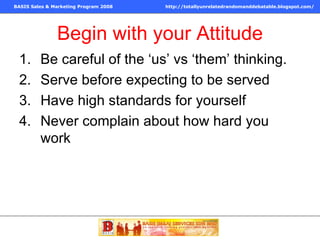
Begin with your Attitude Be careful of the ‘us’ vs ‘them’ thinking. Serve before expecting to be served Have high standards for yourself Never complain about how hard you work
C. Begin with your Habits
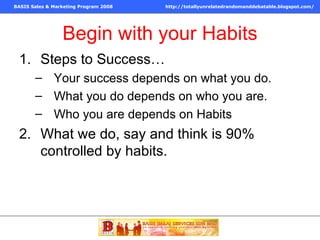
Begin with your Habits Steps to Success… Your success depends on what you do. What you do depends on who you are.  Who you are depends on Habits What we do, say and think is 90% controlled by habits.
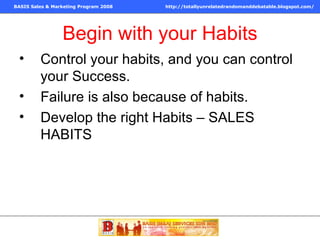
Begin with your Habits Control your habits, and you can control your Success. Failure is also because of habits. Develop the right Habits – SALES HABITS
D. Begin with Relationships
Managing your Relationships Basics of Relationships Why?  Good performance & skill won't get you very far. You need others to succeed Five Rules for Successful Relationships: Be Yourself Be of Value Be Consistent Be Truthful Do What You Say
Managing your Relationships Basics of Relationships You cannot get people to listen to you if they don't like you. And if they don’t listen to you, you won’t accomplish anything! Relationships = Expectations. You must know the expectations and manage those expectations.
Managing your Relationships: People Skills People are interested in themselves, not in you What is the most interesting subject in the world to them? THEMSELVES Take four words out of your vocabulary: “I, me, my, mine” and substitute for the most powerful word: “YOU” Remember that the more important you make people feel, the more they will respond to you. Avoid arguing.
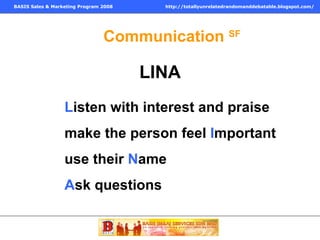
Communication  SF LINA L isten with interest and praise make the person feel  I mportant use their  N ame A sk questions
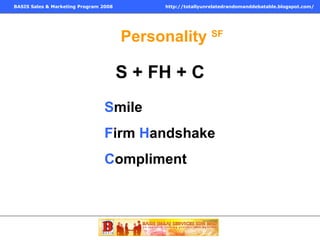
Personality  SF S + FH + C S mile F irm  H andshake C ompliment
E. Begin with your Potential
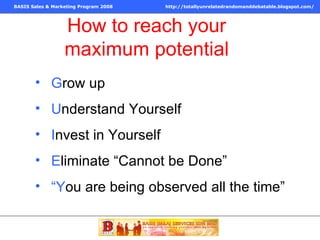
How to reach your maximum potential G row up U nderstand Yourself I nvest in Yourself E liminate “Cannot be Done” “ Y ou are being observed all the time”
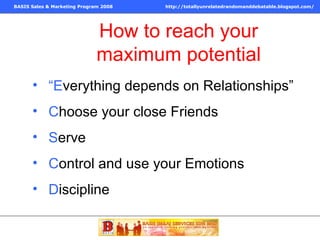
“ E verything depends on Relationships” C hoose your close Friends S erve C ontrol and use your Emotions D iscipline How to reach your maximum potential
“ You will be same person in five years except for the  people  you meet and the  books  you read” Charlie “Tremendous” Jones
Marketing. Why should I buy from you? Next Stop…. The Art and Science of Creating Excuses to Buy
“ Cow don’t drink water, cannot push cow head down” Chinese Proverb
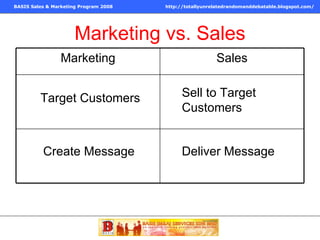
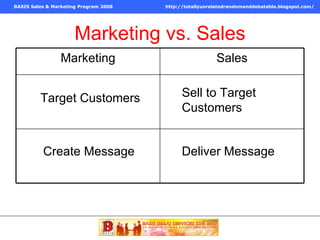
Marketing vs. Sales Target Customers Sell to Target Customers Create Message Deliver Message Sales Marketing
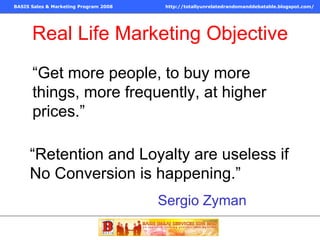
Real Life Marketing Objective “ Get more people, to buy more things, more frequently, at higher prices.” Sergio Zyman “ Retention and Loyalty are useless if No Conversion is happening.”
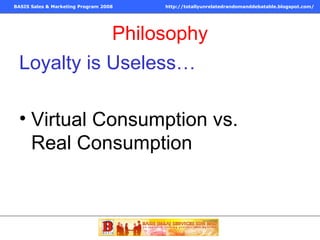
Philosophy Loyalty is Useless… Virtual Consumption vs. Real Consumption
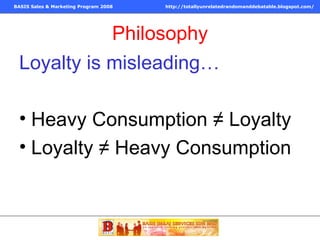
Philosophy Loyalty is misleading… Heavy Consumption  ≠  Loyalty Loyalty  ≠  Heavy Consumption
Philosophy Loyalty = Relationship (something like Dating) Loyalty ≠ Points Loyalty ≠ Redemption Loyalty = Get more people, to buy more, more frequently, at higher prices
Marketing = War Two countries fighting for the same land.  Zero sum game. It’s either theirs or ours. The sub goal is to get customers to: Switch from the competitor to us, OR  to get non-customers to try our products.
Positioning “ Hope is not a strategy” John Maxwell
Positioning For who? –  Segmentation, Targeting Your Offer?  Key Differentiator? www.myCNI.com.my
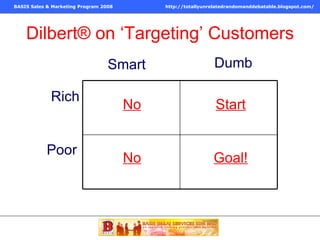
Dilbert ®  on ‘Targeting’ Customers Smart Dumb Rich Poor No Start No Goal!
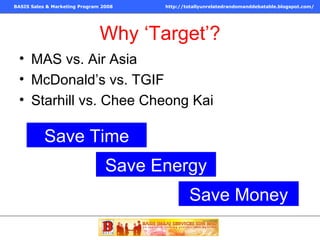
Why ‘Target’? MAS vs. Air Asia McDonald’s vs. TGIF Starhill vs. Chee Cheong Kai Save Time Save Energy Save Money
Typical Targeting Demographic/Industry segmentation Income/Size segmentation
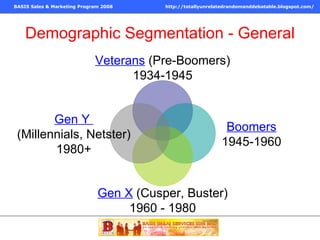
Demographic Segmentation - General Veterans  (Pre-Boomers) 1934-1945 Boomers 1945-1960 Gen X  (Cusper, Buster) 1960 - 1980 Gen Y  (Millennials, Netster) 1980+
Demographic Segmentation - others Women, Working Mothers Youtube generation Working retired Social Activists Work/Life balancers Industry
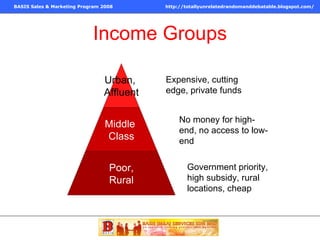
Income Groups Expensive, cutting edge, private funds Government priority, high subsidy, rural locations, cheap No money for high-end, no access to low-end Urban,  Affluent Middle  Class Poor, Rural
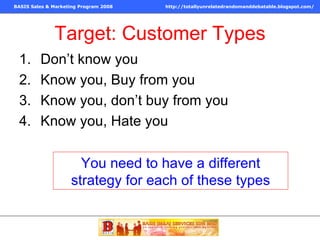
Target: Customer Types Don’t know you Know you, Buy from you Know you, don’t buy from you Know you, Hate you You need to have a different strategy for each of these types
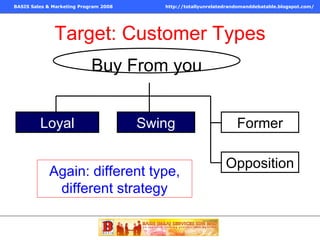
Target: Customer Types Buy From you Loyal Swing Former Opposition Again: different type, different strategy
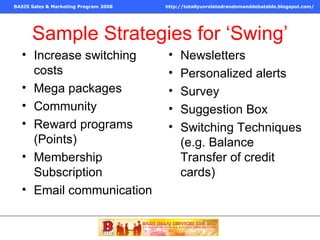
Sample Strategies for ‘Swing’ Increase switching costs Mega packages Community Reward programs (Points) Membership Subscription Email communication Newsletters Personalized alerts Survey Suggestion Box Switching Techniques (e.g. Balance Transfer of credit cards)
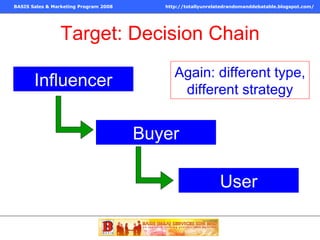
Target: Decision Chain Influencer Buyer User Again: different type, different strategy
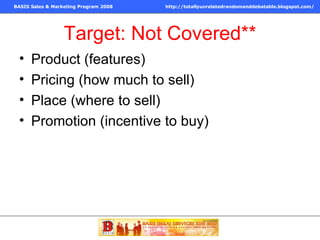
Target: Not Covered** Product (features) Pricing (how much to sell) Place (where to sell) Promotion (incentive to buy)
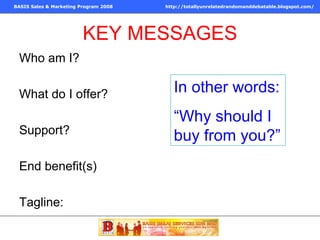
KEY MESSAGES Who am I? What do I offer? Support? End benefit(s) Tagline: In other words: “ Why should I buy from you?”
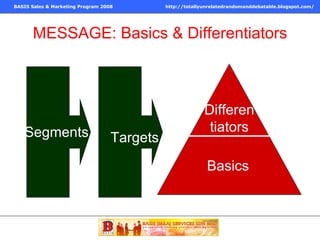
MESSAGE: Basics & Differentiators Segments Targets Targets Basics Differentiators
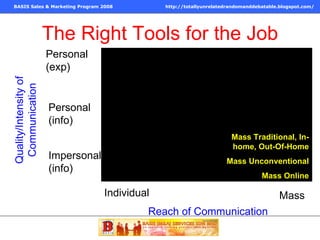
The Right Tools for the Job Reach of Communication Quality/Intensity of Communication Personal (exp) Personal (info) Impersonal (info) Individual Mass Mass Traditional, In-home, Out-Of-Home Mass Unconventional Mass Online
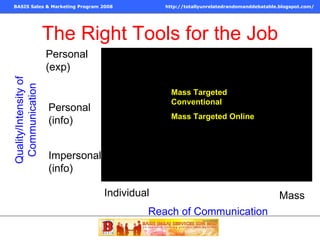
The Right Tools for the Job Reach of Communication Quality/Intensity of Communication Personal (exp) Personal (info) Impersonal (info) Individual Mass Mass Targeted Conventional Mass Targeted Online
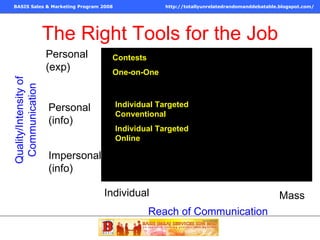
The Right Tools for the Job Reach of Communication Quality/Intensity of Communication Personal (exp) Personal (info) Impersonal (info) Individual Mass Individual Targeted Conventional Individual Targeted Online Contests One-on-One
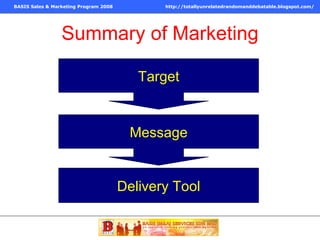
Summary of Marketing Target Message Delivery Tool
Improve Sales. Kill the Competition. Enjoy Life. And now for…. Laws, Tips and Techniques for Boosting Sales Performance
What business are you in? But first… What are you selling?
Marketing vs. Sales Target Customers Sell to Target Customers Create Message Deliver Message Sales Marketing
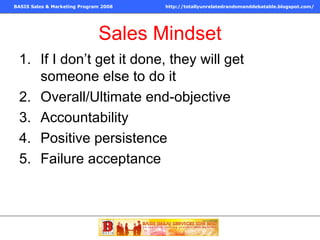
Sales Mindset If I don’t get it done, they will get someone else to do it Overall/Ultimate end-objective Accountability Positive persistence Failure acceptance
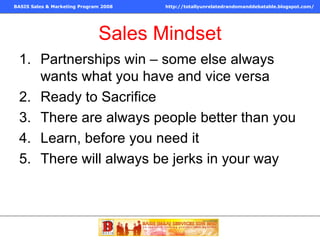
Sales Mindset Partnerships win – some else always wants what you have and vice versa Ready to Sacrifice There are always people better than you Learn, before you need it There will always be jerks in your way
Universal Law Law of the Ping-Pong Ball a.k.a. Law of Cause and Effect
Law of ‘Averages’ Sales has always been a numbers game 20/12/8/3 Go Wide, Dig Deep
Law of Averages in Action 20 contacts = 3 presentations 3 presentations = 1 sale 1 sale = RM120 What is your sales statistic? RM120/sale, RM0/two others? RM6  per contact?
Law of Buy-in People will always buy ‘You’ first, before they buy the product Respect, Credibility, Trust, Love/Hate
Law of Annoyance Things our prospects and customers wish we wouldn’t do that really annoys them: pushy. call too much. disrespectful of their time. keep calling if they say they’re not interested. appear not to understand them,  don’t listen. don’t know about our own products/ services. rude, arrogant, or inattentive. vague or unclear. won’t take no for an answer.
Law of 24/7 In sales, there is no such thing as 9-to-5 job Sales is a 24 hours, 7 days a week ‘life’ You never stop ‘selling’
Law of Q&A No one likes to listen to ‘sales talk’ The more QUESTIONS you ask, the more sales you get
Law of the Panadol Creative solutions for customers will always come from the ‘problems’ Sales is about ‘solving the problem’ not selling the solution Example: We do not sell Panadol. We sell quick headache relief in 30 seconds.
Law of Momentum Never aim for the Big Bang. There is no such thing. Achievement comes from building momentum “Start Small, Grow Fast, Make Money”
Law of Clarity A confused prospect will never buy Avoid ‘jargons’ and ‘features’ and ‘latest this and that…’  Do not assume they understand you.
How  not  to talk to Retail External Parties “ The holder [of a CAB certificate] may continue to serve regularly any point named herein through the airport last regularly used by the holder to serve such point prior to the effective date of the certificate. Upon compliance with such procedures relating thereto as may be prescribed by the Board, the holder may, in addition to the services hereinabove expressly prescribed, regularly serve a point named herein through any airport convenient thereto.” Civil Aeronautics Board, 1977 www.myCNI.com.my www.OOBEY.com
How  not  to talk to Retail External Parties “It has been determined not to be in the public interest that United Airlines continue to provide air transportation services between San Diego and San Antonio” “ I forbid United Airlines to fly between San Diego and San Antonio” www.myCNI.com.my www.OOBEY.com
Law of Powerpoint Two major problems with people who always use slides: Do not know how to use them Talking too much DO NOT talk  to  the slides when presenting.  DO NOT fit many things into one page DO NOT get fancy with slide transitions, builds and other custom animations
Law of the 3-point Plan List (A, B, C) Plan Convert (A, B, C)
Law of No ‘No’ Try not to get the prospect to say ‘No’ ‘Always use the Temperature Test Some Trial Questions: "How does it sound so far?"  "Does that make sense?"  "Is this what you're looking for?"  "What do you think?"  "How close do you feel this comes to meeting your needs?"
Law of Belief Never assume they believe you Tell them only as much as they’ll believe Point out the disadvantages Use precise numbers If you have something to gain, let them know Use the power of the printed word Let them know who else says so
Law of Comparison Comparison .  When Others Are Doing It, You Should, Too. We view a behavior as correct in a given situation to the degree we see others performing it
Law of Authority Authority . When the Source Is An Authority, You Can Believe It. Humans by nature have a deep-seated sense of duty to authority.
Law of Reciprocity Reciprocity . When Someone Gives You Something, You Should Give Something Back. We should try to repay, in kind, what another person has provided for us
Law of Consistency Commitment/Consistency . When You Take A Stand, You Should Be Consistent. Once we make a choice or take a stand  (commitment),  we will encounter personal and interpersonal pressures to behave consistently with that commitment  (consistency). Involvement and Buy-in
Law of Scarcity Scarcity . When It Is Rare, It Is Good Opportunities seem more valuable to us when they are less available. Things that can be scare: time, money, opportunity, physical
Law of Self Perception Self perception . We learn about ourselves by observing our own behavior.  If we observe ourselves doing some thing then we reason that we must like the thing.
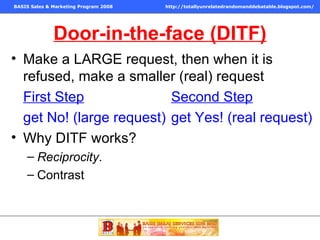
Door-in-the-face (DITF) Make a LARGE request, then when it is refused, make a smaller (real) request First Step   Second Step   get No! (large request)  get Yes! (real request) Why DITF works? Reciprocity . Contrast
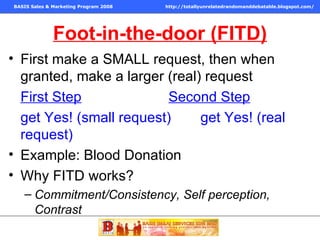
Foot-in-the-door (FITD) First make a SMALL request, then when granted, make a larger (real) request First Step   Second Step   get Yes! (small request)  get Yes! (real request) Example: Blood Donation Why FITD works? Commitment/Consistency, Self perception, Contrast
Influence  SF PASSE P raise and encourage A sk questions allow the person to  S ave Face use  S MART goals E ncourage small improvements
Tele Dynamics What is the objective of a Telephone call? To set up an appointment or another tele call Why? Productivity – do not waste time on ‘no use’ prospects What  NOT  to do in tele calls: long, facts, explain, Q&A, defend, objections What to DO: create interest, next step
Tele Dynamics What are the ‘next steps’ you should aim for? Another Tele-call? Face-to-face? Email & Follow-up? Refer to Next Person? Detect interest?
Some Final Thoughts And now to end…
Who are you  really  working for?
“ What scares me more than death? It is that I lived, and died, and I did not do anything significant with my life.”
Endnote The rest is up to you.
Thank You. soft copy of slides:  www.totallyunrelatedrandomanddebatable.blogspot.com

Basis Sales Slides 2008 Part 1 1219374427739260 8

  • 1.
    Basis Marketing SdnBhd 19 July 2008 Success in Sales & Marketing Introduction and Overview on success in sales and marketing
  • 2.
  • 3.
    Congratulations. You aregoing to die Every year is a game The objective of game is to build up your “Achievement CV” from Jan 1 to Dec 31. How much difference can you make to yourself, others, company? How much difference did you make last year? Forget about last year, its past, even if you did very good or very bad This is a New Year. So we have to start with a New Beginning.
  • 4.
    Why are youhere? You are good. That is already proven. But being good is not enough.
  • 5.
    A. Begin withyour Dream, your Goal
  • 6.
    Begin with yourDream, your Goal What do you really want? Aim for more. It is better to aim 100 and get 50, than to aim 10 and get 10. No one will give to you your dream. You have to get it yourself! It’s never too late to start. What price are you willing to pay to get your dream? Don’t let anyone look down on you.
  • 7.
    B. Begin withyour Attitude
  • 8.
    Begin with yourAttitude It is difficult to list down Good Attitudes. It is easier to list down Bad Attitudes Complaining Openly criticizing Refuse to listen to advice Think you are the best Refuse to improve yourself Always think you are right, everyone else is wrong Thinking that everyone owe you something
  • 9.
    Begin with yourAttitude Be careful of the ‘us’ vs ‘them’ thinking. Serve before expecting to be served Have high standards for yourself Never complain about how hard you work
  • 10.
    C. Begin withyour Habits
  • 11.
    Begin with yourHabits Steps to Success… Your success depends on what you do. What you do depends on who you are. Who you are depends on Habits What we do, say and think is 90% controlled by habits.
  • 12.
    Begin with yourHabits Control your habits, and you can control your Success. Failure is also because of habits. Develop the right Habits – SALES HABITS
  • 13.
    D. Begin withRelationships
  • 14.
    Managing your RelationshipsBasics of Relationships Why? Good performance & skill won't get you very far. You need others to succeed Five Rules for Successful Relationships: Be Yourself Be of Value Be Consistent Be Truthful Do What You Say
  • 15.
    Managing your RelationshipsBasics of Relationships You cannot get people to listen to you if they don't like you. And if they don’t listen to you, you won’t accomplish anything! Relationships = Expectations. You must know the expectations and manage those expectations.
  • 16.
    Managing your Relationships:People Skills People are interested in themselves, not in you What is the most interesting subject in the world to them? THEMSELVES Take four words out of your vocabulary: “I, me, my, mine” and substitute for the most powerful word: “YOU” Remember that the more important you make people feel, the more they will respond to you. Avoid arguing.
  • 17.
    Communication SFLINA L isten with interest and praise make the person feel I mportant use their N ame A sk questions
  • 18.
    Personality SFS + FH + C S mile F irm H andshake C ompliment
  • 19.
    E. Begin withyour Potential
  • 20.
    How to reachyour maximum potential G row up U nderstand Yourself I nvest in Yourself E liminate “Cannot be Done” “ Y ou are being observed all the time”
  • 21.
    “ E verythingdepends on Relationships” C hoose your close Friends S erve C ontrol and use your Emotions D iscipline How to reach your maximum potential
  • 22.
    “ You willbe same person in five years except for the people you meet and the books you read” Charlie “Tremendous” Jones
  • 23.
    Marketing. Why shouldI buy from you? Next Stop…. The Art and Science of Creating Excuses to Buy
  • 24.
    “ Cow don’tdrink water, cannot push cow head down” Chinese Proverb
  • 25.
    Marketing vs. SalesTarget Customers Sell to Target Customers Create Message Deliver Message Sales Marketing
  • 26.
    Real Life MarketingObjective “ Get more people, to buy more things, more frequently, at higher prices.” Sergio Zyman “ Retention and Loyalty are useless if No Conversion is happening.”
  • 27.
    Philosophy Loyalty isUseless… Virtual Consumption vs. Real Consumption
  • 28.
    Philosophy Loyalty ismisleading… Heavy Consumption ≠ Loyalty Loyalty ≠ Heavy Consumption
  • 29.
    Philosophy Loyalty =Relationship (something like Dating) Loyalty ≠ Points Loyalty ≠ Redemption Loyalty = Get more people, to buy more, more frequently, at higher prices
  • 30.
    Marketing = WarTwo countries fighting for the same land. Zero sum game. It’s either theirs or ours. The sub goal is to get customers to: Switch from the competitor to us, OR to get non-customers to try our products.
  • 31.
    Positioning “ Hopeis not a strategy” John Maxwell
  • 32.
    Positioning For who?– Segmentation, Targeting Your Offer? Key Differentiator? www.myCNI.com.my
  • 33.
    Dilbert ® on ‘Targeting’ Customers Smart Dumb Rich Poor No Start No Goal!
  • 34.
    Why ‘Target’? MASvs. Air Asia McDonald’s vs. TGIF Starhill vs. Chee Cheong Kai Save Time Save Energy Save Money
  • 35.
    Typical Targeting Demographic/Industrysegmentation Income/Size segmentation
  • 36.
    Demographic Segmentation -General Veterans (Pre-Boomers) 1934-1945 Boomers 1945-1960 Gen X (Cusper, Buster) 1960 - 1980 Gen Y (Millennials, Netster) 1980+
  • 37.
    Demographic Segmentation -others Women, Working Mothers Youtube generation Working retired Social Activists Work/Life balancers Industry
  • 38.
    Income Groups Expensive,cutting edge, private funds Government priority, high subsidy, rural locations, cheap No money for high-end, no access to low-end Urban, Affluent Middle Class Poor, Rural
  • 39.
    Target: Customer TypesDon’t know you Know you, Buy from you Know you, don’t buy from you Know you, Hate you You need to have a different strategy for each of these types
  • 40.
    Target: Customer TypesBuy From you Loyal Swing Former Opposition Again: different type, different strategy
  • 41.
    Sample Strategies for‘Swing’ Increase switching costs Mega packages Community Reward programs (Points) Membership Subscription Email communication Newsletters Personalized alerts Survey Suggestion Box Switching Techniques (e.g. Balance Transfer of credit cards)
  • 42.
    Target: Decision ChainInfluencer Buyer User Again: different type, different strategy
  • 43.
    Target: Not Covered**Product (features) Pricing (how much to sell) Place (where to sell) Promotion (incentive to buy)
  • 44.
    KEY MESSAGES Whoam I? What do I offer? Support? End benefit(s) Tagline: In other words: “ Why should I buy from you?”
  • 45.
    MESSAGE: Basics &Differentiators Segments Targets Targets Basics Differentiators
  • 46.
    The Right Toolsfor the Job Reach of Communication Quality/Intensity of Communication Personal (exp) Personal (info) Impersonal (info) Individual Mass Mass Traditional, In-home, Out-Of-Home Mass Unconventional Mass Online
  • 47.
    The Right Toolsfor the Job Reach of Communication Quality/Intensity of Communication Personal (exp) Personal (info) Impersonal (info) Individual Mass Mass Targeted Conventional Mass Targeted Online
  • 48.
    The Right Toolsfor the Job Reach of Communication Quality/Intensity of Communication Personal (exp) Personal (info) Impersonal (info) Individual Mass Individual Targeted Conventional Individual Targeted Online Contests One-on-One
  • 49.
    Summary of MarketingTarget Message Delivery Tool
  • 50.
    Improve Sales. Killthe Competition. Enjoy Life. And now for…. Laws, Tips and Techniques for Boosting Sales Performance
  • 51.
    What business areyou in? But first… What are you selling?
  • 52.
    Marketing vs. SalesTarget Customers Sell to Target Customers Create Message Deliver Message Sales Marketing
  • 53.
    Sales Mindset IfI don’t get it done, they will get someone else to do it Overall/Ultimate end-objective Accountability Positive persistence Failure acceptance
  • 54.
    Sales Mindset Partnershipswin – some else always wants what you have and vice versa Ready to Sacrifice There are always people better than you Learn, before you need it There will always be jerks in your way
  • 55.
    Universal Law Lawof the Ping-Pong Ball a.k.a. Law of Cause and Effect
  • 56.
    Law of ‘Averages’Sales has always been a numbers game 20/12/8/3 Go Wide, Dig Deep
  • 57.
    Law of Averagesin Action 20 contacts = 3 presentations 3 presentations = 1 sale 1 sale = RM120 What is your sales statistic? RM120/sale, RM0/two others? RM6 per contact?
  • 58.
    Law of Buy-inPeople will always buy ‘You’ first, before they buy the product Respect, Credibility, Trust, Love/Hate
  • 59.
    Law of AnnoyanceThings our prospects and customers wish we wouldn’t do that really annoys them: pushy. call too much. disrespectful of their time. keep calling if they say they’re not interested. appear not to understand them, don’t listen. don’t know about our own products/ services. rude, arrogant, or inattentive. vague or unclear. won’t take no for an answer.
  • 60.
    Law of 24/7In sales, there is no such thing as 9-to-5 job Sales is a 24 hours, 7 days a week ‘life’ You never stop ‘selling’
  • 61.
    Law of Q&ANo one likes to listen to ‘sales talk’ The more QUESTIONS you ask, the more sales you get
  • 62.
    Law of thePanadol Creative solutions for customers will always come from the ‘problems’ Sales is about ‘solving the problem’ not selling the solution Example: We do not sell Panadol. We sell quick headache relief in 30 seconds.
  • 63.
    Law of MomentumNever aim for the Big Bang. There is no such thing. Achievement comes from building momentum “Start Small, Grow Fast, Make Money”
  • 64.
    Law of ClarityA confused prospect will never buy Avoid ‘jargons’ and ‘features’ and ‘latest this and that…’ Do not assume they understand you.
  • 65.
    How not to talk to Retail External Parties “ The holder [of a CAB certificate] may continue to serve regularly any point named herein through the airport last regularly used by the holder to serve such point prior to the effective date of the certificate. Upon compliance with such procedures relating thereto as may be prescribed by the Board, the holder may, in addition to the services hereinabove expressly prescribed, regularly serve a point named herein through any airport convenient thereto.” Civil Aeronautics Board, 1977 www.myCNI.com.my www.OOBEY.com
  • 66.
    How not to talk to Retail External Parties “It has been determined not to be in the public interest that United Airlines continue to provide air transportation services between San Diego and San Antonio” “ I forbid United Airlines to fly between San Diego and San Antonio” www.myCNI.com.my www.OOBEY.com
  • 67.
    Law of PowerpointTwo major problems with people who always use slides: Do not know how to use them Talking too much DO NOT talk to the slides when presenting. DO NOT fit many things into one page DO NOT get fancy with slide transitions, builds and other custom animations
  • 68.
    Law of the3-point Plan List (A, B, C) Plan Convert (A, B, C)
  • 69.
    Law of No‘No’ Try not to get the prospect to say ‘No’ ‘Always use the Temperature Test Some Trial Questions: "How does it sound so far?" "Does that make sense?" "Is this what you're looking for?" "What do you think?" "How close do you feel this comes to meeting your needs?"
  • 70.
    Law of BeliefNever assume they believe you Tell them only as much as they’ll believe Point out the disadvantages Use precise numbers If you have something to gain, let them know Use the power of the printed word Let them know who else says so
  • 71.
    Law of ComparisonComparison . When Others Are Doing It, You Should, Too. We view a behavior as correct in a given situation to the degree we see others performing it
  • 72.
    Law of AuthorityAuthority . When the Source Is An Authority, You Can Believe It. Humans by nature have a deep-seated sense of duty to authority.
  • 73.
    Law of ReciprocityReciprocity . When Someone Gives You Something, You Should Give Something Back. We should try to repay, in kind, what another person has provided for us
  • 74.
    Law of ConsistencyCommitment/Consistency . When You Take A Stand, You Should Be Consistent. Once we make a choice or take a stand (commitment), we will encounter personal and interpersonal pressures to behave consistently with that commitment (consistency). Involvement and Buy-in
  • 75.
    Law of ScarcityScarcity . When It Is Rare, It Is Good Opportunities seem more valuable to us when they are less available. Things that can be scare: time, money, opportunity, physical
  • 76.
    Law of SelfPerception Self perception . We learn about ourselves by observing our own behavior. If we observe ourselves doing some thing then we reason that we must like the thing.
  • 77.
    Door-in-the-face (DITF) Makea LARGE request, then when it is refused, make a smaller (real) request First Step Second Step get No! (large request) get Yes! (real request) Why DITF works? Reciprocity . Contrast
  • 78.
    Foot-in-the-door (FITD) Firstmake a SMALL request, then when granted, make a larger (real) request First Step Second Step get Yes! (small request) get Yes! (real request) Example: Blood Donation Why FITD works? Commitment/Consistency, Self perception, Contrast
  • 79.
    Influence SFPASSE P raise and encourage A sk questions allow the person to S ave Face use S MART goals E ncourage small improvements
  • 80.
    Tele Dynamics Whatis the objective of a Telephone call? To set up an appointment or another tele call Why? Productivity – do not waste time on ‘no use’ prospects What NOT to do in tele calls: long, facts, explain, Q&A, defend, objections What to DO: create interest, next step
  • 81.
    Tele Dynamics Whatare the ‘next steps’ you should aim for? Another Tele-call? Face-to-face? Email & Follow-up? Refer to Next Person? Detect interest?
  • 82.
    Some Final ThoughtsAnd now to end…
  • 83.
    Who are you really working for?
  • 84.
    “ What scaresme more than death? It is that I lived, and died, and I did not do anything significant with my life.”
  • 85.
    Endnote The restis up to you.
  • 86.
    Thank You. softcopy of slides: www.totallyunrelatedrandomanddebatable.blogspot.com