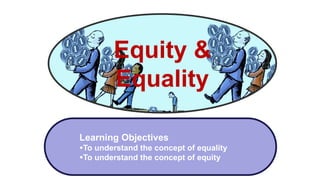
Equity &
Equality
Learning Objectives
To understand the concept of equality
To understand the concept of equity
EQUITY and EFFICIENCY
• By the end of this topic you will be able to
Distinguish between equity and equality
Explain why the free market solution is not always equitable
Identify ways they government can achieve equity for the state
Discuss equity efficiency trade-off
Equality = Equal or the same
• Based on the fact that
– Different people have the same level of economic resources and income
available to them.
• Having absolute equality of income would mean that one persons
income would be exactly the same as another persons income.
Equality = Same
• Incomes (and wealth) are equal or unequal for varying
reasons
• The state can alter the market distribution of income and
wealth to make it more equal if it believes the market
outcome is unfair
• Equality = A measure of how equal people are in terms of income
distribution or opportunities.
Equality – the situation where goods and services
in a society are distributed equally
The benefits of equality:
•Improves social cohesion – less difference
•Improves health – greater access
•Can encourage economic growth – less saving
Issues created by equality:
•Lack of incentive to work harder; what’s the point?
•Profit motive drives the economy
•International competitiveness: in highly re-distributive
economies (high taxes and benefits) may act as an
uncompetitive constraint in the economy
Efficiency and Equity (c)
Andrew Tibbitt 2008
Slide 6
Efficiency and equity
1. Efficiency – is the economy getting the most of out its scarce resources (or are they
being wasted)?
1. Technical efficiency – is production being done at lowest unit cost?
2. Allocative efficiency – are resources being used to make products that people
want?
2. Equity – how fair is the distribution of products between different members of
society?
1. Horizontal equity – no discrimination between people whose economic
characteristics and performance are equal
2. Vertical equity – different treatment of different people in order to reduce the
differences between people
Equity
Equity – the concept of ‘fairness’
Difference between efficiency and equity
Efficiency – increasing the size of the economic pie
Equity – dividing up the economic pie in equal portions
Do competitive markets result in fair distribution?
A fair distribution of income would result in all people in society able to satisfy
their basic needs and wants and enjoy a satisfactory standard of living.
There can be no universal definition of equity:
•What some will consider fair reward for work done, others may consider unfair
•Refers to a “good” distribution of welfare across society
The significance of equity:
•The concept of fairness will be part of the economic policy making process
•Many economic policies will aim to improve equity
Types of Equity
Equity applies in the construction of tax systems:
Vertical Equity - people with a greater ability to pay taxes should pay more (poor v.
rich) (Robin Hood approach)
Examples. Income tax, welfare spending, health care, education, State GST
allocation.
Could possibly impact on peoples incentive to work longer hours or even to work.
Could cause the pie to shrink
What is better - an increasing pie divided into unequal shares,
Or a smaller pie divided into equal shares
Equity and Equality
• Even if there were complete equality of income this would not be considered
equitable because it would not reflect the efforts or abilities of the individual.
• Would it be fair that regardless of how hard you worked or applied yourself
the outcomes were the same?
• Why work hard and stay in school if you are likely to be as well off as a
person who drops out of school at the age of 14?
• Horizontal Equity - people with a similar ability to pay taxes should pay the
same or similar amounts
• Provide people with the same opportunity to succeed
• Example, (equal opportunity legislation) people should be free to choose
their own pathway in life,
• Choose how much education they undertake, choose their own
occupation (as long as its lawful)
• Key provision in market economy is private property rights
• Welfare and income assistance
• Truly equitable tax systems will deliver horizontal and vertical equity.
• E.g. income tax has both horizontal and vertical equity.
Types of Equity
Efficiency and Equity
• When an economy achieves allocative efficiency it may not
represent an equitable outcome for people.
• Some people are on very low incomes whose standard of incomes
are below what is considered fair.
• An equitable situation would be where every Australian has access
to adequate income, health care, education and housing, and a
reasonable standard of living.
Deadweight Loss from Minimum Wage
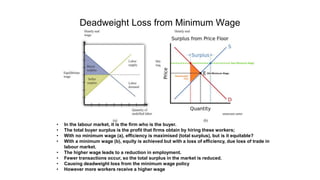
• In the labour market, it is the firm who is the buyer.
• The total buyer surplus is the profit that firms obtain by hiring these workers;
• With no minimum wage (a), efficiency is maximised (total surplus), but is it equitable?
• With a minimum wage (b), equity is achieved but with a loss of efficiency, due loss of trade in
labour market.
• The higher wage leads to a reduction in employment.
• Fewer transactions occur, so the total surplus in the market is reduced.
• Causing deadweight loss from the minimum wage policy
• However more workers receive a higher wage
Equity Vs Efficiency
• A market economic system leads to income inequality.
• Those who own resources that are highly demanded yet
in short supply will be earning very high incomes.
• Those who have very few resources that are demanded
by the market will have very low levels of income.
• Market outcomes are unequal
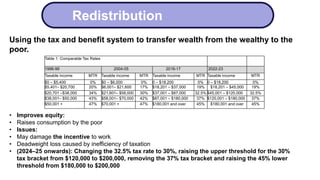
Redistribution
Using the tax and benefit system to transfer wealth from the wealthy to the
poor.
• Improves equity:
• Raises consumption by the poor
• Issues:
• May damage the incentive to work
• Deadweight loss caused by inefficiency of taxation
• (2024–25 onwards): Changing the 32.5% tax rate to 30%, raising the upper threshold for the 30%
tax bracket from $120,000 to $200,000, removing the 37% tax bracket and raising the 45% lower
threshold from $180,000 to $200,000
Table 1: Comparable Tax Rates
1996-99 2004-05 2016-17 2022-23
Taxable income MTR Taxable income MTR Taxable income MTR Taxable income MTR
$0 – $5,400 0% $0 – $6,000 0% 0 – $18,200 0% 0 – $18,200 0%
$5,401– $20,700 20% $6,001– $21,600 17% $18,201 – $37,000 19% $18,201 – $45,000 19%
$20,701 –$38,000 34% $21,601– $58,000 30% $37,001 – $87,000 32.5% $45,001 – $120,000 32.5%
$38,001– $50,000 43% $58,001– $70,000 42% $87,001 – $180,000 37% $120,001 – $180,000 37%
$50,001 + 47% $70,001 + 47% $180,001 and over 45% $180,001 and over 45%
Possible Essay question
Discuss the benefits and constraints of using the tax system to create
a more equitable society.
What else could make society more equitable?
Possible essay question:
Explain the concept of equity. How is it demonstrated in the economy?
(4 marks)
Explain what happens to efficiency when equity is targeted by the government
(6 marks)Jan.
2009)
Learning Objectives
To understand the concept of equality
To understand the concept of equity
Equity &
Equality

Market Equity 2022.ppt

  • 1.
    Equity & Equality Learning Objectives Tounderstand the concept of equality To understand the concept of equity
  • 2.
    EQUITY and EFFICIENCY •By the end of this topic you will be able to Distinguish between equity and equality Explain why the free market solution is not always equitable Identify ways they government can achieve equity for the state Discuss equity efficiency trade-off
  • 3.
    Equality = Equalor the same • Based on the fact that – Different people have the same level of economic resources and income available to them. • Having absolute equality of income would mean that one persons income would be exactly the same as another persons income.
  • 4.
    Equality = Same •Incomes (and wealth) are equal or unequal for varying reasons • The state can alter the market distribution of income and wealth to make it more equal if it believes the market outcome is unfair • Equality = A measure of how equal people are in terms of income distribution or opportunities.
  • 5.
    Equality – thesituation where goods and services in a society are distributed equally The benefits of equality: •Improves social cohesion – less difference •Improves health – greater access •Can encourage economic growth – less saving Issues created by equality: •Lack of incentive to work harder; what’s the point? •Profit motive drives the economy •International competitiveness: in highly re-distributive economies (high taxes and benefits) may act as an uncompetitive constraint in the economy
  • 6.
    Efficiency and Equity(c) Andrew Tibbitt 2008 Slide 6 Efficiency and equity 1. Efficiency – is the economy getting the most of out its scarce resources (or are they being wasted)? 1. Technical efficiency – is production being done at lowest unit cost? 2. Allocative efficiency – are resources being used to make products that people want? 2. Equity – how fair is the distribution of products between different members of society? 1. Horizontal equity – no discrimination between people whose economic characteristics and performance are equal 2. Vertical equity – different treatment of different people in order to reduce the differences between people
  • 7.
    Equity Equity – theconcept of ‘fairness’ Difference between efficiency and equity Efficiency – increasing the size of the economic pie Equity – dividing up the economic pie in equal portions Do competitive markets result in fair distribution? A fair distribution of income would result in all people in society able to satisfy their basic needs and wants and enjoy a satisfactory standard of living. There can be no universal definition of equity: •What some will consider fair reward for work done, others may consider unfair •Refers to a “good” distribution of welfare across society The significance of equity: •The concept of fairness will be part of the economic policy making process •Many economic policies will aim to improve equity
  • 8.
    Types of Equity Equityapplies in the construction of tax systems: Vertical Equity - people with a greater ability to pay taxes should pay more (poor v. rich) (Robin Hood approach) Examples. Income tax, welfare spending, health care, education, State GST allocation. Could possibly impact on peoples incentive to work longer hours or even to work. Could cause the pie to shrink What is better - an increasing pie divided into unequal shares, Or a smaller pie divided into equal shares
  • 9.
    Equity and Equality •Even if there were complete equality of income this would not be considered equitable because it would not reflect the efforts or abilities of the individual. • Would it be fair that regardless of how hard you worked or applied yourself the outcomes were the same? • Why work hard and stay in school if you are likely to be as well off as a person who drops out of school at the age of 14?
  • 10.
    • Horizontal Equity- people with a similar ability to pay taxes should pay the same or similar amounts • Provide people with the same opportunity to succeed • Example, (equal opportunity legislation) people should be free to choose their own pathway in life, • Choose how much education they undertake, choose their own occupation (as long as its lawful) • Key provision in market economy is private property rights • Welfare and income assistance • Truly equitable tax systems will deliver horizontal and vertical equity. • E.g. income tax has both horizontal and vertical equity. Types of Equity
  • 11.
    Efficiency and Equity •When an economy achieves allocative efficiency it may not represent an equitable outcome for people. • Some people are on very low incomes whose standard of incomes are below what is considered fair. • An equitable situation would be where every Australian has access to adequate income, health care, education and housing, and a reasonable standard of living.
  • 12.
    Deadweight Loss fromMinimum Wage • In the labour market, it is the firm who is the buyer. • The total buyer surplus is the profit that firms obtain by hiring these workers; • With no minimum wage (a), efficiency is maximised (total surplus), but is it equitable? • With a minimum wage (b), equity is achieved but with a loss of efficiency, due loss of trade in labour market. • The higher wage leads to a reduction in employment. • Fewer transactions occur, so the total surplus in the market is reduced. • Causing deadweight loss from the minimum wage policy • However more workers receive a higher wage
  • 13.
    Equity Vs Efficiency •A market economic system leads to income inequality. • Those who own resources that are highly demanded yet in short supply will be earning very high incomes. • Those who have very few resources that are demanded by the market will have very low levels of income. • Market outcomes are unequal
  • 14.
    Redistribution Using the taxand benefit system to transfer wealth from the wealthy to the poor. • Improves equity: • Raises consumption by the poor • Issues: • May damage the incentive to work • Deadweight loss caused by inefficiency of taxation • (2024–25 onwards): Changing the 32.5% tax rate to 30%, raising the upper threshold for the 30% tax bracket from $120,000 to $200,000, removing the 37% tax bracket and raising the 45% lower threshold from $180,000 to $200,000 Table 1: Comparable Tax Rates 1996-99 2004-05 2016-17 2022-23 Taxable income MTR Taxable income MTR Taxable income MTR Taxable income MTR $0 – $5,400 0% $0 – $6,000 0% 0 – $18,200 0% 0 – $18,200 0% $5,401– $20,700 20% $6,001– $21,600 17% $18,201 – $37,000 19% $18,201 – $45,000 19% $20,701 –$38,000 34% $21,601– $58,000 30% $37,001 – $87,000 32.5% $45,001 – $120,000 32.5% $38,001– $50,000 43% $58,001– $70,000 42% $87,001 – $180,000 37% $120,001 – $180,000 37% $50,001 + 47% $70,001 + 47% $180,001 and over 45% $180,001 and over 45%
  • 15.
    Possible Essay question Discussthe benefits and constraints of using the tax system to create a more equitable society. What else could make society more equitable? Possible essay question: Explain the concept of equity. How is it demonstrated in the economy? (4 marks) Explain what happens to efficiency when equity is targeted by the government (6 marks)Jan. 2009) Learning Objectives To understand the concept of equality To understand the concept of equity Equity & Equality