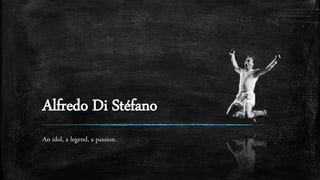
Alfredo Di Stéfano
An idol, a legend, a passion.
INDEX
❾ HIS LIFE
❾ PROFESSIONAL CAREER
❾ STATISTICS
❾ SPORTING SUCCESS
❾ INTERESTING DATA
❾ VIDEO
 Alfredo Stéfano Di Stéfano Laulhé (4 July 1926 – 7 July 2014) was a footballer and coach, who has
been called the best, most complete and influential footballer of all time. He was most associated with
Real Madrid and was instrumental in their domination of the European Champions' Cup during the
1950s.
 Di Stéfano, nicknamed "Saeta rubia" ("Blond Arrow"), was a powerful and quick forward, with great
creativity and vision, who could also play almost anywhere on the pitch. He is currently the sixth
highest scorer in the history of Spain's top division, and Real Madrid's third highest league goalscorer
of all time. He is Madrid's leading goalscorer in the history of El Clásico.
HIS LIFE
HIS LIFE
 Born in Barracas, a neighborhood of Buenos Aires, Di Stéfano was the son of Alfredo Di Stéfano and
Eulalia Laulhé Gilmont.
 Di Stéfano married Sara Freites in 1950, they had six children; Alfredo, Ignacio, Sofia, Silvana, Helena
and Nanette, who died in December 2012. At the time of his death he was dating his Costa Rican
girlfriend Gina González, his former secretary, 50 years his junior.
 Following an heart attack on 5 July 2014, the 88-year-old Di Stéfano was moved to intensive care in
the Gregorio Marañón hospital in Madrid, where he died on 7 July 2014.
 He began his career at Argentina's River Plate aged 17, in 1943. For the 1946 season he was loaned to Club Atlético Huracán,
but he returned to River in 1947. Due to a footballers' strike in Argentina in 1949, Di Stéfano went to play for Millonarios of
Bogotá in the Colombian league. He won six league titles during the first 12 years of his career in Argentina and Colombia.
 Di Stéfano was best known for his time at Real Madrid where he was an integral part of one of the most successful teams of all
time. He scored 216 league goals in 262 games for Real Madrid.
 He was awarded the Ballon d'Or for the European Footballer of the Year in 1957 and 1959. He moved to Espanyol in 1964 and
played there until retiring at the age of 40.
 After retirement, he moved into coaching. He guided the Argentine clubs Boca Juniors and River Plate to league titles, and won
La Liga and the Copa del Rey with Valencia as well as the European Cup Winners' Cup with the side in 1980. He also managed
Sporting in the 1974/75 season and Real Madrid between 1982 and 1984.
PROFESSIONAL CARRER
STATISTICS
0
50
100
150
200
250
300
350
C.A River
Plate
(Argentina)
1945-1949
C.A.
Huracán
(Argentina)
1946
C.D. Los
Millonarios
(Colombia)
1949-1952
Real
Madrid
C.F.
(Spain)
1953-1964
R.C.D.
Español
(Spain)
1964-1966
Goals
Goals
CLUB MATCHES GOALS AVERAGE
GOALSCORING
C.A. River Plate
Argentina
(1945-1949)
90 55 0,61
C.A. Huracán
Argentina
(1946)
27 10 0,37
C.D. Los Millonarios
Colombia
(1949-1952)
111 100 0,90
Real Madrid C.F
Spain
(1953-1964)
396 307 0,76
R.C.D Español
Spain
(1964-1966)
60 14 0,23
TOTAL 684 486 0,71
SPORTING SUCCESS
Distinction Year
Top scorer of Argentina’s soccer league’s first
division
1947
Top scorer of Colombia’s soccer league’s first
division
1951, 1952
Top scorer of South American’s soccer 1947, 1951
Top scorer of Spain’s soccer league’s first
division
1954, 1956, 1957, 1958, 1959
Top scorer of the European Cup 1957, 1958, 1959
Golden Ball 1957, 1959
Silver Ball 1956
Super-Golden ball 1989
Marca legend 1999
FIFA100 2004
Award Year
Honorary president of
Real Madrid
2000-2014
FIFA Order of Merit 1994
UEFA President Award 2008
National Sports Award 2011
Individual distinctions Awards
INTERESTING DATA
On the night of 24 August 1963, the Venezuelan
revolutionary group Armed Forces of National
Liberation (FALN), kidnapped Alfredo Di Stéfano
at gunpoint from the Potomac Hotel in Caracas
while his team, Real Madrid, were on a pre-season
tour of South America. Di Stefano was released
unharmed two days later close to the Spanish
embassy without a ransom being paid, and Di
Stefano stressed that his kidnappers had not
mistreated him. Di Stefano played in a match
against São Paulo FC the day after he was
released and received a standing ovation.
VIDEO
THE END

- MARIO e IKER

  • 1.
    Alfredo Di Stéfano Anidol, a legend, a passion.
  • 2.
    INDEX ❾ HIS LIFE ❾PROFESSIONAL CAREER ❾ STATISTICS ❾ SPORTING SUCCESS ❾ INTERESTING DATA ❾ VIDEO
  • 3.
     Alfredo StéfanoDi Stéfano Laulhé (4 July 1926 – 7 July 2014) was a footballer and coach, who has been called the best, most complete and influential footballer of all time. He was most associated with Real Madrid and was instrumental in their domination of the European Champions' Cup during the 1950s.  Di Stéfano, nicknamed "Saeta rubia" ("Blond Arrow"), was a powerful and quick forward, with great creativity and vision, who could also play almost anywhere on the pitch. He is currently the sixth highest scorer in the history of Spain's top division, and Real Madrid's third highest league goalscorer of all time. He is Madrid's leading goalscorer in the history of El Clásico. HIS LIFE
  • 4.
    HIS LIFE  Bornin Barracas, a neighborhood of Buenos Aires, Di Stéfano was the son of Alfredo Di Stéfano and Eulalia Laulhé Gilmont.  Di Stéfano married Sara Freites in 1950, they had six children; Alfredo, Ignacio, Sofia, Silvana, Helena and Nanette, who died in December 2012. At the time of his death he was dating his Costa Rican girlfriend Gina González, his former secretary, 50 years his junior.  Following an heart attack on 5 July 2014, the 88-year-old Di Stéfano was moved to intensive care in the Gregorio Marañón hospital in Madrid, where he died on 7 July 2014.
  • 5.
     He beganhis career at Argentina's River Plate aged 17, in 1943. For the 1946 season he was loaned to Club Atlético Huracán, but he returned to River in 1947. Due to a footballers' strike in Argentina in 1949, Di Stéfano went to play for Millonarios of Bogotá in the Colombian league. He won six league titles during the first 12 years of his career in Argentina and Colombia.  Di Stéfano was best known for his time at Real Madrid where he was an integral part of one of the most successful teams of all time. He scored 216 league goals in 262 games for Real Madrid.  He was awarded the Ballon d'Or for the European Footballer of the Year in 1957 and 1959. He moved to Espanyol in 1964 and played there until retiring at the age of 40.  After retirement, he moved into coaching. He guided the Argentine clubs Boca Juniors and River Plate to league titles, and won La Liga and the Copa del Rey with Valencia as well as the European Cup Winners' Cup with the side in 1980. He also managed Sporting in the 1974/75 season and Real Madrid between 1982 and 1984. PROFESSIONAL CARRER
  • 6.
    STATISTICS 0 50 100 150 200 250 300 350 C.A River Plate (Argentina) 1945-1949 C.A. Huracán (Argentina) 1946 C.D. Los Millonarios (Colombia) 1949-1952 Real Madrid C.F. (Spain) 1953-1964 R.C.D. Español (Spain) 1964-1966 Goals Goals CLUBMATCHES GOALS AVERAGE GOALSCORING C.A. River Plate Argentina (1945-1949) 90 55 0,61 C.A. Huracán Argentina (1946) 27 10 0,37 C.D. Los Millonarios Colombia (1949-1952) 111 100 0,90 Real Madrid C.F Spain (1953-1964) 396 307 0,76 R.C.D Español Spain (1964-1966) 60 14 0,23 TOTAL 684 486 0,71
  • 7.
    SPORTING SUCCESS Distinction Year Topscorer of Argentina’s soccer league’s first division 1947 Top scorer of Colombia’s soccer league’s first division 1951, 1952 Top scorer of South American’s soccer 1947, 1951 Top scorer of Spain’s soccer league’s first division 1954, 1956, 1957, 1958, 1959 Top scorer of the European Cup 1957, 1958, 1959 Golden Ball 1957, 1959 Silver Ball 1956 Super-Golden ball 1989 Marca legend 1999 FIFA100 2004 Award Year Honorary president of Real Madrid 2000-2014 FIFA Order of Merit 1994 UEFA President Award 2008 National Sports Award 2011 Individual distinctions Awards
  • 8.
    INTERESTING DATA On thenight of 24 August 1963, the Venezuelan revolutionary group Armed Forces of National Liberation (FALN), kidnapped Alfredo Di Stéfano at gunpoint from the Potomac Hotel in Caracas while his team, Real Madrid, were on a pre-season tour of South America. Di Stefano was released unharmed two days later close to the Spanish embassy without a ransom being paid, and Di Stefano stressed that his kidnappers had not mistreated him. Di Stefano played in a match against São Paulo FC the day after he was released and received a standing ovation.
  • 9.
  • 10.