


Marine Toad
Prepared by: Asad ULLAH
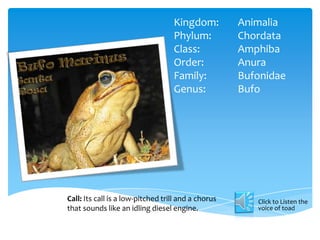
Kingdom: Animalia
Phylum: Chordata
Class: Amphiba
Order: Anura
Family: Bufonidae
Genus: Bufo
Click to Listen the
voice of toad
Call: Its call is a low-pitched trill and a chorus
that sounds like an idling diesel engine.
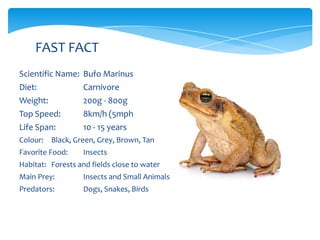
Scientific Name: Bufo Marinus
Diet: Carnivore
Weight: 200g - 800g
Top Speed: 8km/h (5mph
Life Span: 10 - 15 years
Colour: Black, Green, Grey, Brown, Tan
Favorite Food: Insects
Habitat: Forests and fields close to water
Main Prey: Insects and Small Animals
Predators: Dogs, Snakes, Birds
FAST FACT
Common Names:
Marine Toad, Giant Toad, Cane Toad
Species Description:
Largest toad has a stout body and short legs.
The skin is rough and warty.
The tympani (ear membranes) are one-half to two-
thirds the diameter of the eyes
Reproduction: The Marine Toad breeds year-round
in standing water, streams, canals and ditches.
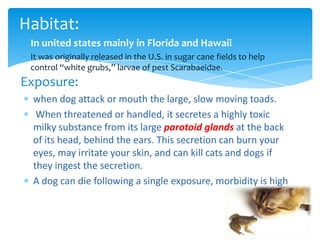
when dog attack or mouth the large, slow moving toads.
When threatened or handled, it secretes a highly toxic
milky substance from its large parotoid glands at the back
of its head, behind the ears. This secretion can burn your
eyes, may irritate your skin, and can kill cats and dogs if
they ingest the secretion.
A dog can die following a single exposure, morbidity is high
Habitat:
Exposure:
In united states mainly in Florida and Hawaii
It was originally released in the U.S. in sugar cane fields to help
control “white grubs,” larvae of pest Scarabaeidae.
Cardioactive glycosides
I. Bufotoxin
II. Bufotenins
have digitalis like and oxytocic (vasopressor) actions.
Other are
Epinephrine
5-Hydroxytryptamine
Principle Toxin:
 in pets include excessive salivation ,drooling, head-
shaking, crying, loss of coordination,
 in more serious cases, convulsions, The dog's (or cat's)
gums often turn red, an indicator used by veterinarians
to distinguish toad poisoning from epilepsy.
Symptoms of poisoning:
MOA of Toxin:
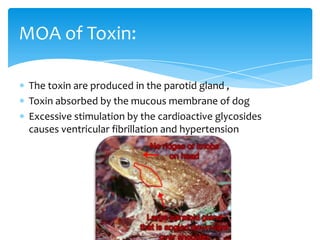
The toxin are produced in the parotid gland ,
Toxin absorbed by the mucous membrane of dog
Excessive stimulation by the cardioactive glycosides
causes ventricular fibrillation and hypertension
 No specific antidote
 Flush the mouth of pet with stream of water
 Detoxification with activated charcoal and osmotic
cathartic.
 cardiac arrhythmias can be controlled by giving
propranolol at 2mg/kg.
 Atropine can also used to control salivation and
brocnhoconstriction
Treatment
:
Laboratory
findings: Hematology changes increase level of PCV,
 Increase level of glucose, BUN,
 Hyperkalemia and hypercalcemia
 Decrease in leukocytes count
 No specific antidote
 Flush the mouth of pet with stream of water
 Detoxification with activated charcoal and osmotic
cathartic.
 cardiac arrhythmias can be controlled by giving
propranolol at 2mg/kg.
 Atropine can also used to control salivation and
brocnhoconstriction
Treatment
:
Laboratory
findings: Hematology changes increase level of PCV,
 Increase level of glucose, BUN,
 Hyperkalemia and hypercalcemia
 Decrease in leukocytes count
http://edistt.ifas.ufl.edu/uw046
Toxicology by oselwer
http://www.columbia.edu/itc/cerc/danoff-
burg/invasion_bio/inv_spp_summ/Bufo_marinus.html
References

Marine toad :Zootoxin

  • 1.
  • 2.
    Kingdom: Animalia Phylum: Chordata Class:Amphiba Order: Anura Family: Bufonidae Genus: Bufo Click to Listen the voice of toad Call: Its call is a low-pitched trill and a chorus that sounds like an idling diesel engine.
  • 3.
    Scientific Name: BufoMarinus Diet: Carnivore Weight: 200g - 800g Top Speed: 8km/h (5mph Life Span: 10 - 15 years Colour: Black, Green, Grey, Brown, Tan Favorite Food: Insects Habitat: Forests and fields close to water Main Prey: Insects and Small Animals Predators: Dogs, Snakes, Birds FAST FACT
  • 4.
    Common Names: Marine Toad,Giant Toad, Cane Toad Species Description: Largest toad has a stout body and short legs. The skin is rough and warty. The tympani (ear membranes) are one-half to two- thirds the diameter of the eyes Reproduction: The Marine Toad breeds year-round in standing water, streams, canals and ditches.
  • 6.
    when dog attackor mouth the large, slow moving toads. When threatened or handled, it secretes a highly toxic milky substance from its large parotoid glands at the back of its head, behind the ears. This secretion can burn your eyes, may irritate your skin, and can kill cats and dogs if they ingest the secretion. A dog can die following a single exposure, morbidity is high Habitat: Exposure: In united states mainly in Florida and Hawaii It was originally released in the U.S. in sugar cane fields to help control “white grubs,” larvae of pest Scarabaeidae.
  • 7.
    Cardioactive glycosides I. Bufotoxin II.Bufotenins have digitalis like and oxytocic (vasopressor) actions. Other are Epinephrine 5-Hydroxytryptamine Principle Toxin:  in pets include excessive salivation ,drooling, head- shaking, crying, loss of coordination,  in more serious cases, convulsions, The dog's (or cat's) gums often turn red, an indicator used by veterinarians to distinguish toad poisoning from epilepsy. Symptoms of poisoning:
  • 8.
    MOA of Toxin: Thetoxin are produced in the parotid gland , Toxin absorbed by the mucous membrane of dog Excessive stimulation by the cardioactive glycosides causes ventricular fibrillation and hypertension
  • 9.
     No specificantidote  Flush the mouth of pet with stream of water  Detoxification with activated charcoal and osmotic cathartic.  cardiac arrhythmias can be controlled by giving propranolol at 2mg/kg.  Atropine can also used to control salivation and brocnhoconstriction Treatment : Laboratory findings: Hematology changes increase level of PCV,  Increase level of glucose, BUN,  Hyperkalemia and hypercalcemia  Decrease in leukocytes count
  • 10.
     No specificantidote  Flush the mouth of pet with stream of water  Detoxification with activated charcoal and osmotic cathartic.  cardiac arrhythmias can be controlled by giving propranolol at 2mg/kg.  Atropine can also used to control salivation and brocnhoconstriction Treatment : Laboratory findings: Hematology changes increase level of PCV,  Increase level of glucose, BUN,  Hyperkalemia and hypercalcemia  Decrease in leukocytes count
  • 12.