Festival in the
Philippines
MAPEH - 7
LESSON OVERVIEW
 Philippines Festivals are often categorized as
religious and secular or (non-religious). Secular
festivals are very much cultural in nature. Each
province is proud of indigenous of one or sets of
products. Townspeople look forward to these since
it’s an opportunity to showcase their livelihood.
LESSON OVERVIEW
Filipinos always find a way to make every fiesta special. They
even borrow money just to cook and serve foods like lechon,
the national dish of the Philippines. Typical, they invite
neighbors to their humble abode to enjoy the feast with them.
In planning and preparing these unique festivals, the local’s
practice camaraderie.
Festivals provide joyful moments and a roller-coaster of
emotions with friends and loved ones. Without these, can
Filipinos foster strong ties and live such a colorful life?
Because of the 333-year reign of Spaniards here,
no wonder these faithful festivities shaped the
Filipino identity. And one of the most spectacular
festivals in the Philippines are the religious
festivals.
LESSON OVERVIEW
Festivals in the Philippines are characterized by;
 Holy Masses,
 Processions,
 Parades,
 Theatrical play and reenactments,
 Religious or cultural rituals,
 Trade fairs,
 Exhibits,
 Concerts,
 Pageants, and
 Various games and contests.
LESSON OVERVIEW
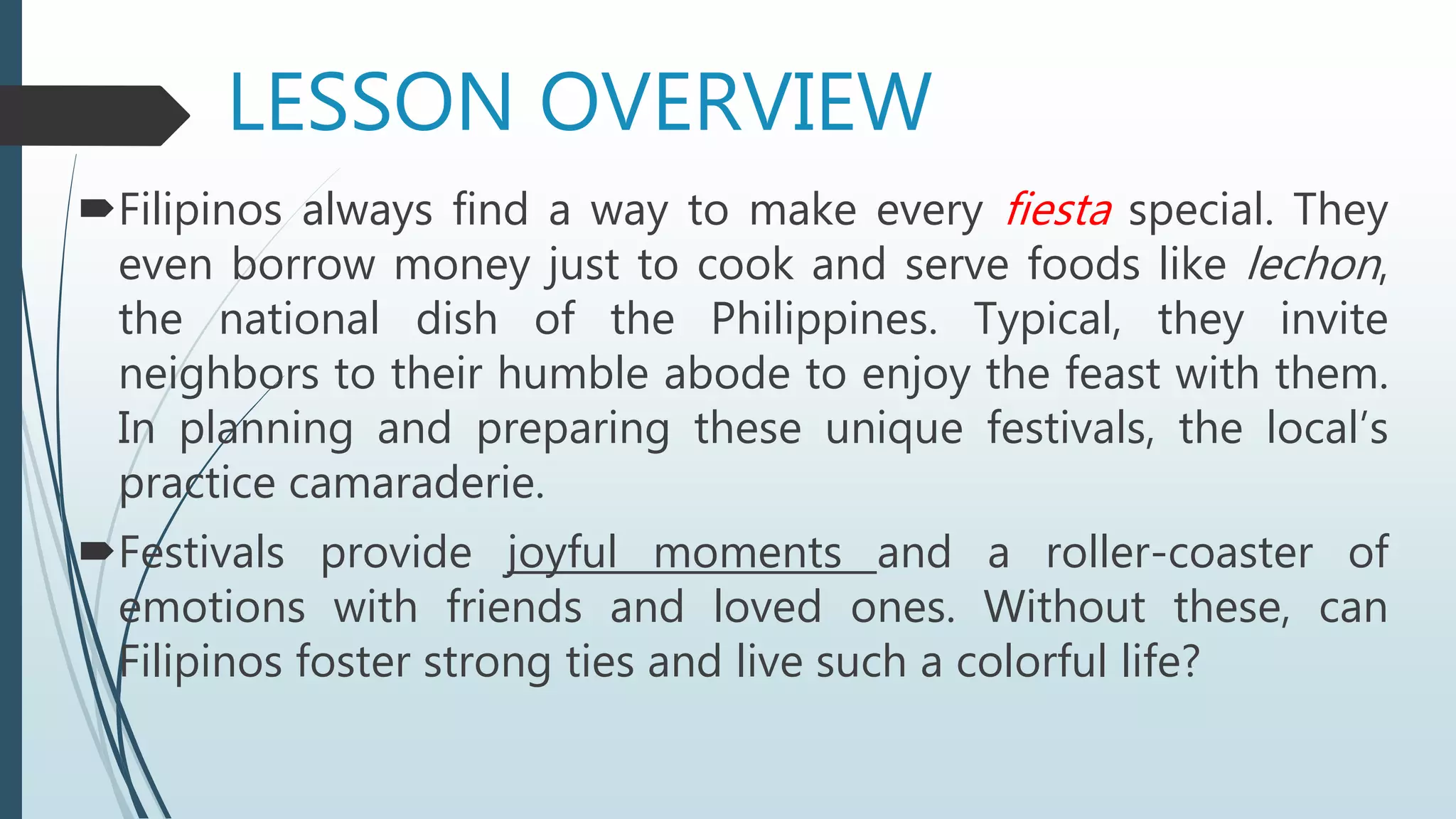
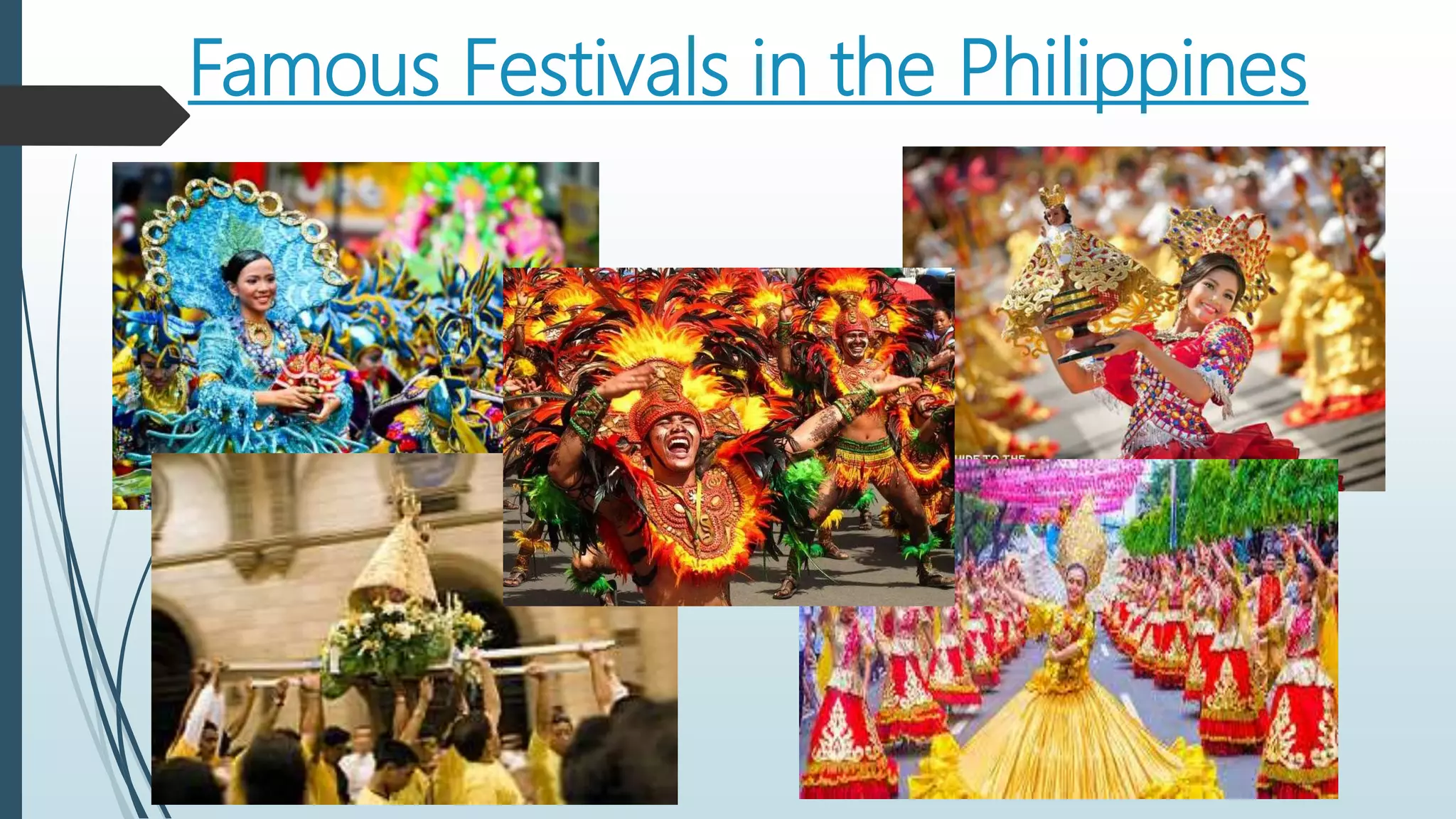
Famous Festivals in the Philippines
RELIGIOUS FESTIVALS
A Religious festivals also known as festival
of faith is an annual celebration of a
province, city or people to honor and give
thanks to their God, Deity or Patron Saints
for blessing the people with abundant
harvest and prosperous lives.
Sinulog Festival
Cebu (Feast of Santo Niño)
SINULOG FESTIVAL (GRACEFUL DANCE)
Performers dressed in bright-colored and intricate
costumes dance to the rhythm of the drums, trumpets,
and native gongs, and parades the sacred relic Santo
Niño. The Sinulog Festival attracts millions of tourists
yearly and dubbed ‘mother of all festivals’ and the
grandest festival in the Philippines.
When: Third week of January
Highlights: Fluvial parade and solemn procession,
Grand Parade, pyro shows (fireworks), street parties
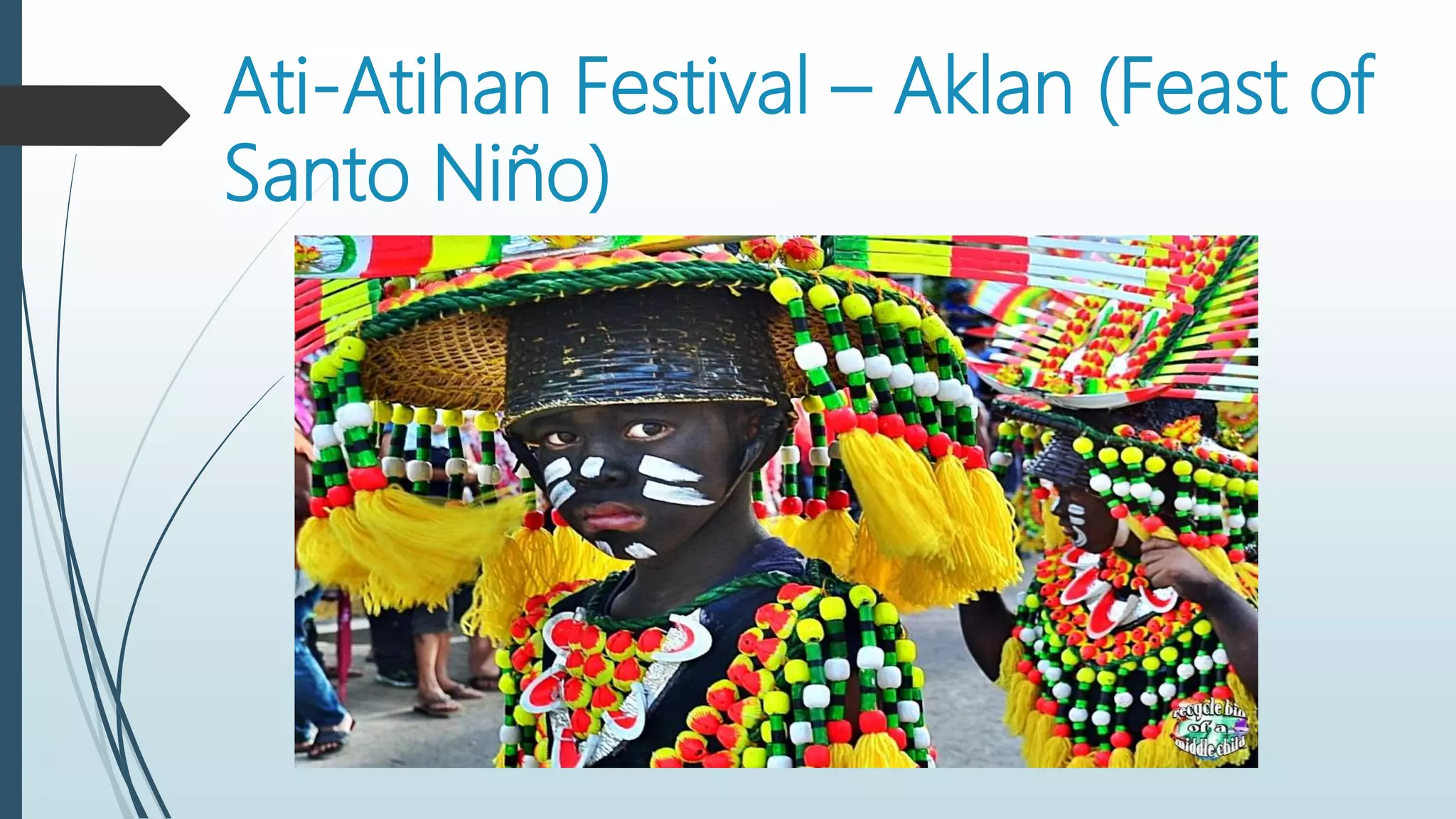
Ati-Atihan Festival – Aklan (Feast of
Santo Niño)
Ati-Atihan Festival – Aklan (Feast of Santo
Niño)
This is known as ‘The Mother of All Philippine
Festivals’ since it’s around 800 years old. Expect
strangers offering you cans of beer and inviting you to
sip from their rum bottle. You’ll be encouraged to
participate too, instead of you being a spectator.
When: Third week of January
Highlights: a parade of tribes and floats, street dancing,
a religious procession, torch street dancing
Dinagyang Festival – Iloilo City
Experience a merry street party with drinks and food
everywhere. There are also art exhibits, music contests,
and pageant. The main attraction here, really, is the
highly competitive dance festival.
When: Fourth Sunday of January
Highlights: Kasadyahan Street Dancing, Float Parade of
Lights, Festive Parage Sponsors Mardi Gras, Dinagyang
360° Tribe Competition
Pahiyas Festival – Lucban, Quezon
(Feast of San Isidro Labrador)
Pahiyas Festival – Lucban, Quezon (Feast of San
Isidro Labrador)
People of Lucban transforms their house into harvest aesthetic. The
festival also features cultural shows, exciting contests, parades, and
exhibits that represents the people, their livelihood, and culture. As
you walk in the procession for San Isidro Labrador, you’ll be
amazed by how creative each house is decorated.
When: May 15
Highlights: Morning Procession for the patron saint of farmers, all
houses are decorated with colorful kiping (leaf-shaped wafer made
of rice and dyed with food coloring) and their harvest, free food for
everyone
Higantes Festival – Angono, Rizal (Feast
of San Clemente)
Higantes Festival – Angono, Rizal (Feast of San
Clemente)
This is yet another display of Filipino creativity. The
Gigantes (lit. giants) became an emblem of the
townspeople’s unyielding spirit and larger-than-life
artistry. The most awaited part here is when cold water
is splashed everywhere during the parade.
When: November 22 to 23
Highlights: Higantes Parade, water splashing tradition
Feast of the Black Nazarene Quiapo,
Manila
Feast of the Black Nazarene – Quiapo, Manila
Witness how deep Filipinos’ faith is! They’ll go to such
lengths as being pushed, hurt, and hit by the huge crowd
(millions).
When: January 9
Highlight: Translation (transfer of the Black Nazarene
sculpture dressed in red robes from Quirino Grandstand in
Luneta to Quiapo, devotees aim to wipe Christ’s face but
the crowd prevents them in doing so)
Flores De Mayo (lit. Flowers of May) – in many cities
Flores De Mayo (lit. Flowers of May) – in many
cities
Dubbed as the “Queen of Philippine Festivals”. You’ll see
children and ladies dressed in white carrying flowers
and basket of petals, and offer the flowers to the
Blessed Virgin Mary. You’ll also be awed in seeing
creative costumes and floral arch.
When: May (depending on the church’s schedule)
Highlights: Santacruzan, participants dressed as queens
and escort, procession
Pintados-Kasadyaan Festival
Tacloban City, Leyte
Pintados-Kasadyaan Festival –
Tacloban City, Leyte
Locals anticipate two prominent festivals, namely,
the Pintado Festival and the Kasadyaan Festival.
Today, they are merged together in one big
celebration to praise and adore Señor Santo
Niño.
When: Around June 29
Highlight: beautiful body paintings that show
braveness
Lechon (Roasted Pig) Festival – Batangas
Indulge yourself in best tasting lechon served across
neighborhoods.
When: June 24 (St. John the Baptist)
Highlights: Lechon Parade, water splashing tradition

MAPEH 7 FESTIVAL.pptx

  • 2.
  • 3.
    LESSON OVERVIEW  PhilippinesFestivals are often categorized as religious and secular or (non-religious). Secular festivals are very much cultural in nature. Each province is proud of indigenous of one or sets of products. Townspeople look forward to these since it’s an opportunity to showcase their livelihood.
  • 4.
    LESSON OVERVIEW Filipinos alwaysfind a way to make every fiesta special. They even borrow money just to cook and serve foods like lechon, the national dish of the Philippines. Typical, they invite neighbors to their humble abode to enjoy the feast with them. In planning and preparing these unique festivals, the local’s practice camaraderie. Festivals provide joyful moments and a roller-coaster of emotions with friends and loved ones. Without these, can Filipinos foster strong ties and live such a colorful life?
  • 5.
    Because of the333-year reign of Spaniards here, no wonder these faithful festivities shaped the Filipino identity. And one of the most spectacular festivals in the Philippines are the religious festivals. LESSON OVERVIEW
  • 6.
    Festivals in thePhilippines are characterized by;  Holy Masses,  Processions,  Parades,  Theatrical play and reenactments,  Religious or cultural rituals,  Trade fairs,  Exhibits,  Concerts,  Pageants, and  Various games and contests. LESSON OVERVIEW
  • 7.
    Famous Festivals inthe Philippines
  • 8.
    RELIGIOUS FESTIVALS A Religiousfestivals also known as festival of faith is an annual celebration of a province, city or people to honor and give thanks to their God, Deity or Patron Saints for blessing the people with abundant harvest and prosperous lives.
  • 9.
  • 10.
    SINULOG FESTIVAL (GRACEFULDANCE) Performers dressed in bright-colored and intricate costumes dance to the rhythm of the drums, trumpets, and native gongs, and parades the sacred relic Santo Niño. The Sinulog Festival attracts millions of tourists yearly and dubbed ‘mother of all festivals’ and the grandest festival in the Philippines. When: Third week of January Highlights: Fluvial parade and solemn procession, Grand Parade, pyro shows (fireworks), street parties
  • 11.
    Ati-Atihan Festival –Aklan (Feast of Santo Niño)
  • 12.
    Ati-Atihan Festival –Aklan (Feast of Santo Niño) This is known as ‘The Mother of All Philippine Festivals’ since it’s around 800 years old. Expect strangers offering you cans of beer and inviting you to sip from their rum bottle. You’ll be encouraged to participate too, instead of you being a spectator. When: Third week of January Highlights: a parade of tribes and floats, street dancing, a religious procession, torch street dancing
  • 13.
  • 14.
    Dinagyang Festival –Iloilo City Experience a merry street party with drinks and food everywhere. There are also art exhibits, music contests, and pageant. The main attraction here, really, is the highly competitive dance festival. When: Fourth Sunday of January Highlights: Kasadyahan Street Dancing, Float Parade of Lights, Festive Parage Sponsors Mardi Gras, Dinagyang 360° Tribe Competition
  • 15.
    Pahiyas Festival –Lucban, Quezon (Feast of San Isidro Labrador)
  • 16.
    Pahiyas Festival –Lucban, Quezon (Feast of San Isidro Labrador) People of Lucban transforms their house into harvest aesthetic. The festival also features cultural shows, exciting contests, parades, and exhibits that represents the people, their livelihood, and culture. As you walk in the procession for San Isidro Labrador, you’ll be amazed by how creative each house is decorated. When: May 15 Highlights: Morning Procession for the patron saint of farmers, all houses are decorated with colorful kiping (leaf-shaped wafer made of rice and dyed with food coloring) and their harvest, free food for everyone
  • 17.
    Higantes Festival –Angono, Rizal (Feast of San Clemente)
  • 18.
    Higantes Festival –Angono, Rizal (Feast of San Clemente) This is yet another display of Filipino creativity. The Gigantes (lit. giants) became an emblem of the townspeople’s unyielding spirit and larger-than-life artistry. The most awaited part here is when cold water is splashed everywhere during the parade. When: November 22 to 23 Highlights: Higantes Parade, water splashing tradition
  • 19.
    Feast of theBlack Nazarene Quiapo, Manila
  • 20.
    Feast of theBlack Nazarene – Quiapo, Manila Witness how deep Filipinos’ faith is! They’ll go to such lengths as being pushed, hurt, and hit by the huge crowd (millions). When: January 9 Highlight: Translation (transfer of the Black Nazarene sculpture dressed in red robes from Quirino Grandstand in Luneta to Quiapo, devotees aim to wipe Christ’s face but the crowd prevents them in doing so)
  • 21.
    Flores De Mayo(lit. Flowers of May) – in many cities
  • 22.
    Flores De Mayo(lit. Flowers of May) – in many cities Dubbed as the “Queen of Philippine Festivals”. You’ll see children and ladies dressed in white carrying flowers and basket of petals, and offer the flowers to the Blessed Virgin Mary. You’ll also be awed in seeing creative costumes and floral arch. When: May (depending on the church’s schedule) Highlights: Santacruzan, participants dressed as queens and escort, procession
  • 23.
  • 24.
    Pintados-Kasadyaan Festival – TaclobanCity, Leyte Locals anticipate two prominent festivals, namely, the Pintado Festival and the Kasadyaan Festival. Today, they are merged together in one big celebration to praise and adore Señor Santo Niño. When: Around June 29 Highlight: beautiful body paintings that show braveness
  • 25.
    Lechon (Roasted Pig)Festival – Batangas
  • 26.
    Lechon (Roasted Pig)Festival – Batangas Indulge yourself in best tasting lechon served across neighborhoods. When: June 24 (St. John the Baptist) Highlights: Lechon Parade, water splashing tradition