ME3102 Manufacturing Science
Four modules:
Foundry-11 hrs
Casting Processes- 11 hrs
Forming- 10 hrs
Joining- 10 hrs
REFERENCES
Prerequisites: NIL
• But, a knowledge about the practical
classes you had during the first year
and
• knowledge of Materials Science
desirable
If not, Revise.
WHAT IS MANUFACTURING?
From Latin word manu factus
(meaning made by hand)
manufacture -first appeared in 1567
manufacturing – in 1683
-MAKING PRODUCTS FROM RAW
MATERIALS BY VARIOUS PROCESSES,
MACHINERY & OPERATIONS FOLLOWING A
WELL ORGANISED PLAN FOR EACH
ACTIVITY REQUIRED
Product- something that is produced.
[Manufacturing Engineering – in U.S.
Production Engineering – in Japan & Europe]
Manufacturing -,a complex activity.
Involves
MATERIALS, CAPITAL, ENERGY, PEOPLE
People, (of various disciplines and skills)
Variety of machinery, equipment
tooling with various levels of automation
(computers etc), Material handling
WE-
• Concerned in converting natural resources to
useful products
• Entire discipline of engineering concerned with
this
• Manufacturing- most important – conversion of
raw to useful form
• Earlier methods- use of empirical relationships,
experience, trial and error methods
• But, fast progress cannot be achieved through
trial and error
• Continuous struggle for cheaper
production with better quality
• Only through optimal utilization of
material, human resources,
development of newer and better
methods
• Manufacturing which was an
art became a Science
• Raw material-
conversion through mining and
metallurgy
Changing the raw material to useful form
through various processes----
Casting; primary and secondary forming;
machining and joining
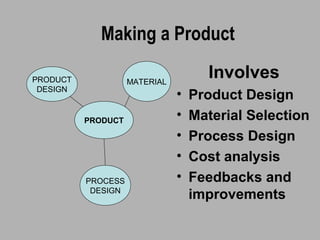
Making a Product
Involves
• Product Design
• Material Selection
• Process Design
• Cost analysis
• Feedbacks and
improvements
PRODUCT
PRODUCT
DESIGN
MATERIAL
PROCESS
DESIGN
MANUFACTURING
• CASTING
• FORMING
• JOINING
• MACHINING
In various
sections of
workshops,
you had basic
training during
the first year.
• Out of this, this course covers the primary
process of casting, and the processes-
forming and joining.
• More about machining will be taught in
subsequent semesters.
Schedule:
Shall be loaded in DSS
Evaluation: 20 + 20 + 10 + 50
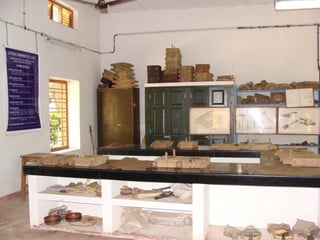
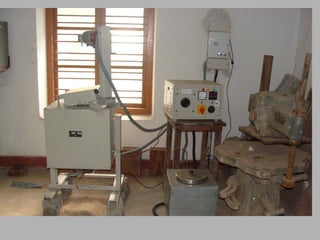
WHAT YOU SAW IN FOUNDRY
SECTION
• FOUNDRY EQUIPMENTFOUNDRY EQUIPMENT
• WOODEN MOULDING BOXESWOODEN MOULDING BOXES
• METALLIC MOULDING BOXESMETALLIC MOULDING BOXES
• PATTERNSPATTERNS
• SHELL MOULDING MACHINESHELL MOULDING MACHINE
• OIL FIRED FURNACEOIL FIRED FURNACE
• INDUCTION FURNACEINDUCTION FURNACE
• MOULD SHAKERMOULD SHAKER
MOULDING BOX
DRAG
COPE
 manufacturing science -NITC
 manufacturing science -NITC
 manufacturing science -NITC
 manufacturing science -NITC
 manufacturing science -NITC
 manufacturing science -NITC
 manufacturing science -NITC
 manufacturing science -NITC
 manufacturing science -NITC
 manufacturing science -NITC
 manufacturing science -NITC

manufacturing science -NITC

  • 1.
    ME3102 Manufacturing Science Fourmodules: Foundry-11 hrs Casting Processes- 11 hrs Forming- 10 hrs Joining- 10 hrs
  • 2.
  • 3.
    Prerequisites: NIL • But,a knowledge about the practical classes you had during the first year and • knowledge of Materials Science desirable If not, Revise.
  • 4.
    WHAT IS MANUFACTURING? FromLatin word manu factus (meaning made by hand) manufacture -first appeared in 1567 manufacturing – in 1683 -MAKING PRODUCTS FROM RAW MATERIALS BY VARIOUS PROCESSES, MACHINERY & OPERATIONS FOLLOWING A WELL ORGANISED PLAN FOR EACH ACTIVITY REQUIRED
  • 5.
    Product- something thatis produced. [Manufacturing Engineering – in U.S. Production Engineering – in Japan & Europe] Manufacturing -,a complex activity. Involves MATERIALS, CAPITAL, ENERGY, PEOPLE People, (of various disciplines and skills) Variety of machinery, equipment tooling with various levels of automation (computers etc), Material handling
  • 6.
    WE- • Concerned inconverting natural resources to useful products • Entire discipline of engineering concerned with this • Manufacturing- most important – conversion of raw to useful form • Earlier methods- use of empirical relationships, experience, trial and error methods • But, fast progress cannot be achieved through trial and error
  • 7.
    • Continuous strugglefor cheaper production with better quality • Only through optimal utilization of material, human resources, development of newer and better methods • Manufacturing which was an art became a Science
  • 8.
    • Raw material- conversionthrough mining and metallurgy Changing the raw material to useful form through various processes---- Casting; primary and secondary forming; machining and joining
  • 9.
    Making a Product Involves •Product Design • Material Selection • Process Design • Cost analysis • Feedbacks and improvements PRODUCT PRODUCT DESIGN MATERIAL PROCESS DESIGN
  • 10.
    MANUFACTURING • CASTING • FORMING •JOINING • MACHINING In various sections of workshops, you had basic training during the first year.
  • 11.
    • Out ofthis, this course covers the primary process of casting, and the processes- forming and joining. • More about machining will be taught in subsequent semesters.
  • 12.
    Schedule: Shall be loadedin DSS Evaluation: 20 + 20 + 10 + 50
  • 13.
    WHAT YOU SAWIN FOUNDRY SECTION • FOUNDRY EQUIPMENTFOUNDRY EQUIPMENT • WOODEN MOULDING BOXESWOODEN MOULDING BOXES • METALLIC MOULDING BOXESMETALLIC MOULDING BOXES • PATTERNSPATTERNS • SHELL MOULDING MACHINESHELL MOULDING MACHINE • OIL FIRED FURNACEOIL FIRED FURNACE • INDUCTION FURNACEINDUCTION FURNACE • MOULD SHAKERMOULD SHAKER
  • 19.