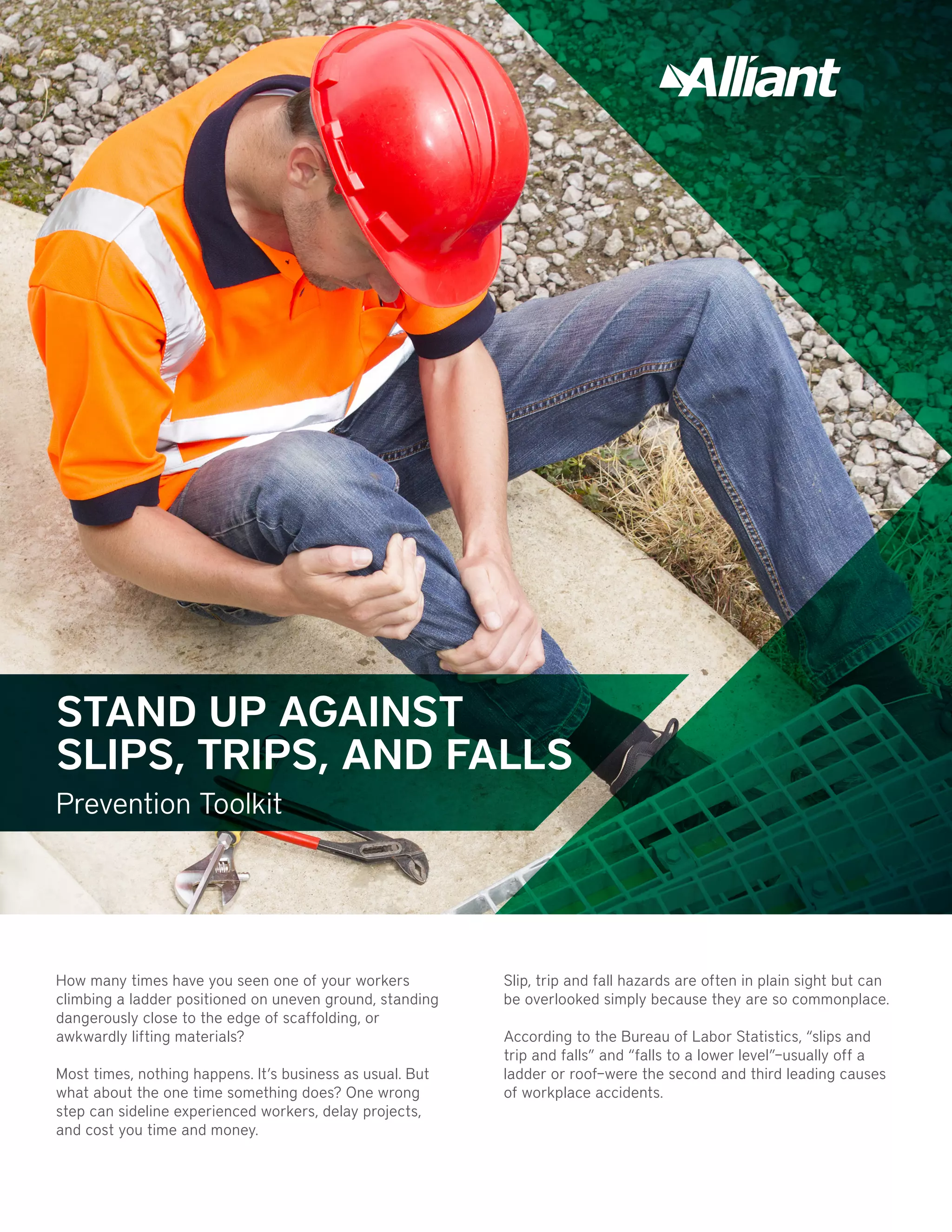
How many times have you seen one of your workers
climbing a ladder positioned on uneven ground, standing
dangerously close to the edge of scaffolding, or
awkwardly lifting materials?
Most times, nothing happens. It’s business as usual. But
what about the one time something does? One wrong
step can sideline experienced workers, delay projects,
and cost you time and money.
Slip, trip and fall hazards are often in plain sight but can
be overlooked simply because they are so commonplace.
According to the Bureau of Labor Statistics, “slips and
trip and falls” and “falls to a lower level”–usually off a
ladder or roof–were the second and third leading causes
of workplace accidents.
STAND UP AGAINST
SLIPS, TRIPS, AND FALLS
Prevention Toolkit
There are a number of prevention strategies you can use to reduce these accidents. For example:
■■ Rushed jobs or understaffing can be avoided with some good pre-planning in estimating the amount of labor needed
for the project and the type of equipment to be used.
■■ Classroom and on-the-job training can ensure employees adopt safe practices.
■■ Be diligent about the use of proper tools and personal protective equipment.
■■ Create a safety culture by training your more experienced installers to mentor and encourage safe practices among
younger, less experienced apprentices.
HAZARD PREVENTION
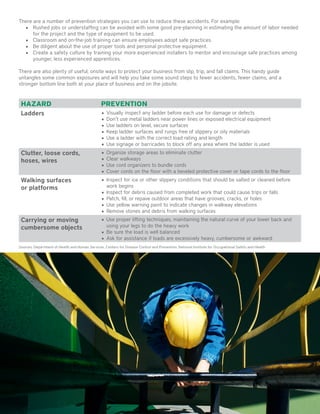
Ladders ■■ Visually inspect any ladder before each use for damage or defects
■■ Don’t use metal ladders near power lines or exposed electrical equipment
■■ Use ladders on level, secure surfaces
■■ Keep ladder surfaces and rungs free of slippery or oily materials
■■ Use a ladder with the correct load rating and length
■■ Use signage or barricades to block off any area where the ladder is used
Clutter, loose cords,
hoses, wires
■■ Organize storage areas to eliminate clutter
■■ Clear walkways
■■ Use cord organizers to bundle cords
■■ Cover cords on the floor with a beveled protective cover or tape cords to the floor
Walking surfaces
or platforms
■■ Inspect for ice or other slippery conditions that should be salted or cleaned before
work begins
■■ Inspect for debris caused from completed work that could cause trips or falls
■■ Patch, fill, or repave outdoor areas that have grooves, cracks, or holes
■■ Use yellow warning paint to indicate changes in walkway elevations
■■ Remove stones and debris from walking surfaces
Carrying or moving
cumbersome objects
■■ Use proper lifting techniques, maintaining the natural curve of your lower back and
using your legs to do the heavy work
■■ Be sure the load is well balanced
■■ Ask for assistance if loads are excessively heavy, cumbersome or awkward
There are also plenty of useful, onsite ways to protect your business from slip, trip, and fall claims. This handy guide
untangles some common exposures and will help you take some sound steps to fewer accidents, fewer claims, and a
stronger bottom line both at your place of business and on the jobsite.
Sources: Department of Health and Human Services, Centers for Disease Control and Prevention, National Institute for Occupational Safety and Health
Time to Test Your Knowledge
How do you score on trip and fall hazards?
Take the OSHA quiz.
1.	 What can improve traction on floors that are
frequently wet?
a.	Strap cleats onto your shoes
b.	Painting gritty coatings on the floor
c.	Using a greasy floor finish
d.	Putting up a sign
2.	 If you carry loads that you can’t see over or around:
a.	Make sure you have good lighting
b.	Stay off the stairs
c.	Take small steps
d.	You could trip and fall; don’t carry such loads
3.	 Loose carpeting, stair treads, and floor tiles:
a.	Are tripping hazards
b.	Should be covered with a rubber mat
c.	Should be reported right away
d.	Both a and c
4.	 What is a safe way to move materials up a ladder?
a.	Hoist them up using a rope after you climb
the ladder
b.	Have someone throw them to you when you
reach the top
c.	Carry them in one arm as you climb
d.	All of the above
5.	 When is it safe to stand on the top step of
a stepladder?
a.	When you can’t get a longer ladder
b.	When you can hold on to a sturdy item above
while you work
c.	When the ladder is less than six feet tall
d.	Never
			 Answers: 1-b, 2-d, 3-d, 4-a, 5-d
		 Source: Occupational Safety and Health Administration
Crunch the Numbers on Slips, Trips,
and Falls
How serious are slips, trips, and falls?
The numbers tell the story:
Sources: Bureau of Labor Statistics, U.S. Centers for Disease Control and Prevention
700,000
29.3
$35,000
About Alliant
Alliant is the nation’s largest specialty insurance
brokerage firm, providing risk management,
insurance, and consulting services that
safeguard the physical and financial
health of thousands of clients
throughout the U.S.
www.alliant.com
CA License No. 0C36861
© 2017 Alliant Insurance Services, Inc. All rights reserved. [2016-3418]
Number of patients
hospitalized each year
Number of accidents
per 10,000 full-time workers
The average hospital cost
27%Percentage of all work injuries
requiring time off attributed to slips, trips, and falls in 2014
CONTACT
Billy Bray
Vice President
D 713 470 4250
C 832 370 8357
Billy.Bray@alliant.com

Essential safety tips

  • 1.
    How many timeshave you seen one of your workers climbing a ladder positioned on uneven ground, standing dangerously close to the edge of scaffolding, or awkwardly lifting materials? Most times, nothing happens. It’s business as usual. But what about the one time something does? One wrong step can sideline experienced workers, delay projects, and cost you time and money. Slip, trip and fall hazards are often in plain sight but can be overlooked simply because they are so commonplace. According to the Bureau of Labor Statistics, “slips and trip and falls” and “falls to a lower level”–usually off a ladder or roof–were the second and third leading causes of workplace accidents. STAND UP AGAINST SLIPS, TRIPS, AND FALLS Prevention Toolkit
  • 2.
    There are anumber of prevention strategies you can use to reduce these accidents. For example: ■■ Rushed jobs or understaffing can be avoided with some good pre-planning in estimating the amount of labor needed for the project and the type of equipment to be used. ■■ Classroom and on-the-job training can ensure employees adopt safe practices. ■■ Be diligent about the use of proper tools and personal protective equipment. ■■ Create a safety culture by training your more experienced installers to mentor and encourage safe practices among younger, less experienced apprentices. HAZARD PREVENTION Ladders ■■ Visually inspect any ladder before each use for damage or defects ■■ Don’t use metal ladders near power lines or exposed electrical equipment ■■ Use ladders on level, secure surfaces ■■ Keep ladder surfaces and rungs free of slippery or oily materials ■■ Use a ladder with the correct load rating and length ■■ Use signage or barricades to block off any area where the ladder is used Clutter, loose cords, hoses, wires ■■ Organize storage areas to eliminate clutter ■■ Clear walkways ■■ Use cord organizers to bundle cords ■■ Cover cords on the floor with a beveled protective cover or tape cords to the floor Walking surfaces or platforms ■■ Inspect for ice or other slippery conditions that should be salted or cleaned before work begins ■■ Inspect for debris caused from completed work that could cause trips or falls ■■ Patch, fill, or repave outdoor areas that have grooves, cracks, or holes ■■ Use yellow warning paint to indicate changes in walkway elevations ■■ Remove stones and debris from walking surfaces Carrying or moving cumbersome objects ■■ Use proper lifting techniques, maintaining the natural curve of your lower back and using your legs to do the heavy work ■■ Be sure the load is well balanced ■■ Ask for assistance if loads are excessively heavy, cumbersome or awkward There are also plenty of useful, onsite ways to protect your business from slip, trip, and fall claims. This handy guide untangles some common exposures and will help you take some sound steps to fewer accidents, fewer claims, and a stronger bottom line both at your place of business and on the jobsite. Sources: Department of Health and Human Services, Centers for Disease Control and Prevention, National Institute for Occupational Safety and Health
  • 3.
    Time to TestYour Knowledge How do you score on trip and fall hazards? Take the OSHA quiz. 1. What can improve traction on floors that are frequently wet? a. Strap cleats onto your shoes b. Painting gritty coatings on the floor c. Using a greasy floor finish d. Putting up a sign 2. If you carry loads that you can’t see over or around: a. Make sure you have good lighting b. Stay off the stairs c. Take small steps d. You could trip and fall; don’t carry such loads 3. Loose carpeting, stair treads, and floor tiles: a. Are tripping hazards b. Should be covered with a rubber mat c. Should be reported right away d. Both a and c 4. What is a safe way to move materials up a ladder? a. Hoist them up using a rope after you climb the ladder b. Have someone throw them to you when you reach the top c. Carry them in one arm as you climb d. All of the above 5. When is it safe to stand on the top step of a stepladder? a. When you can’t get a longer ladder b. When you can hold on to a sturdy item above while you work c. When the ladder is less than six feet tall d. Never Answers: 1-b, 2-d, 3-d, 4-a, 5-d Source: Occupational Safety and Health Administration Crunch the Numbers on Slips, Trips, and Falls How serious are slips, trips, and falls? The numbers tell the story: Sources: Bureau of Labor Statistics, U.S. Centers for Disease Control and Prevention 700,000 29.3 $35,000 About Alliant Alliant is the nation’s largest specialty insurance brokerage firm, providing risk management, insurance, and consulting services that safeguard the physical and financial health of thousands of clients throughout the U.S. www.alliant.com CA License No. 0C36861 © 2017 Alliant Insurance Services, Inc. All rights reserved. [2016-3418] Number of patients hospitalized each year Number of accidents per 10,000 full-time workers The average hospital cost 27%Percentage of all work injuries requiring time off attributed to slips, trips, and falls in 2014 CONTACT Billy Bray Vice President D 713 470 4250 C 832 370 8357 Billy.Bray@alliant.com