Workplace
Manual Handling –Working with
         Batteries
                      Working with Batteries – P Parish
WHY??

• Because Manual Handling required to carry out the task.
• Risk off back damage if not managed.
• The effort required to lift a battery will vary depending on the
  height & weight of the battery relative to your body.
• Before any lifting STOP and consider whether it is to heavy to
  be lifted unaided.

• Seek assistance or use a lifting device.
NOTE:“It is important to take note of the shape and location of lifting points”? as this impacts on
the ability to lift an object. Plus where it is to be lifted from and relocated too. (Deno Accadia)
What is the Hazard

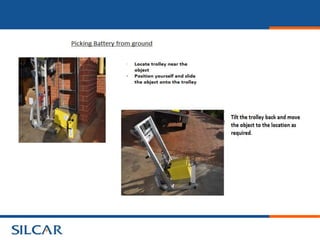
•   The most common lift is when a pallet or box of batteries' arrives at the local depot
    for pick up.
    •   Most SFT’s would leave the Pallet as is from the local depot, and have it placed into a trailer for
        shipping to a location. That is unless it is a small enough shipment to be placed inside the rear canopy,
        the problem with this is the GVM Loading and load movement. A common lift is also unloading from
        Trailer or Vehicle, high possibility of twist/Lift   .-   Deno
    •   The worst case is 2GRIM Battery Pits, or the lower shelf on other Roadside Cabinets. Another problem
        is the loading/unloading of batteries in or out of Battery Racks.- Deno

•   Or when batteries’ are found at a site and are faulty ,cracked , swollen, leaking & and
    require removal.

•   For these situations SEEK HELP.(unpack to create several lighter items or use a
    Lifting device.)
Safe Lifting Sequence

• If you have accessed & still require to lift.
• Step 1:- Size up the load
• Sep 2 :- Position feet apart for good balance.
• Step 3:- Maintain a straight back, position your head & Grip
  proper using palms ,fingers and position arms.
• Step 4 :- Lift with legs & thigh muscles and carry load close to
  your body.
Control

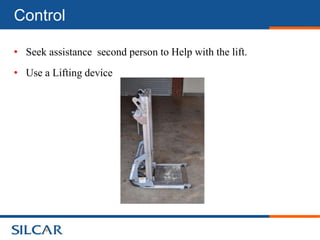
• Seek assistance second person to Help with the lift.
• Use a Lifting device
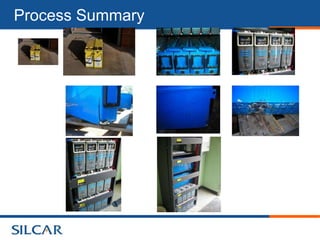
Process Summary
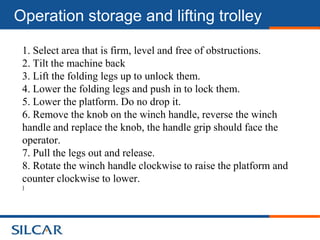
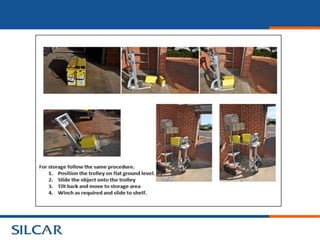
Operation storage and lifting trolley

 1. Select area that is firm, level and free of obstructions.
 2. Tilt the machine back
 3. Lift the folding legs up to unlock them.
 4. Lower the folding legs and push in to lock them.
 5. Lower the platform. Do no drop it.
 6. Remove the knob on the winch handle, reverse the winch
 handle and replace the knob, the handle grip should face the
 operator.
 7. Pull the legs out and release.
 8. Rotate the winch handle clockwise to raise the platform and
 counter clockwise to lower.
 )
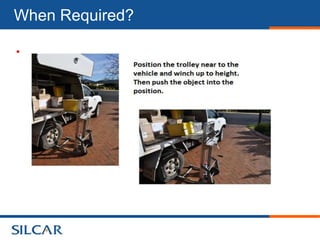
When Required?

• .
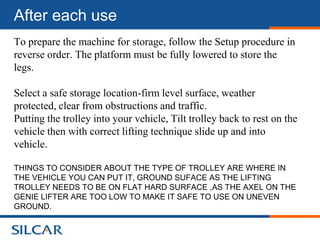
After each use
To prepare the machine for storage, follow the Setup procedure in
reverse order. The platform must be fully lowered to store the
legs.

Select a safe storage location-firm level surface, weather
protected, clear from obstructions and traffic.
Putting the trolley into your vehicle, Tilt trolley back to rest on the
vehicle then with correct lifting technique slide up and into
vehicle.

THINGS TO CONSIDER ABOUT THE TYPE OF TROLLEY ARE WHERE IN
THE VEHICLE YOU CAN PUT IT, GROUND SUFACE AS THE LIFTING
TROLLEY NEEDS TO BE ON FLAT HARD SURFACE ,AS THE AXEL ON THE
GENIE LIFTER ARE TOO LOW TO MAKE IT SAFE TO USE ON UNEVEN
GROUND.
After each use

THINGS TO CONSIDER ABOUT TROLLEY USE:- Deno

• THE TYPE OF TROLLEY AND WHERE IT CAN BE SAFELY LIFTED, PLACED
  OR STORED IN THE VEHICLE OR TRAILER.

• GROUND SUFACE, AS THE LIFTING TROLLEY NEEDS TO BE ON A FLAT
  HARD SURFACE FOR SAFE USE.

• THE AXEL ON THE GENIE LIFTER IS TOO LOW TO MAKE IT SAFE TO USE
  ON UNEVEN GROUND
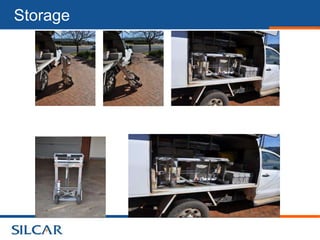
Storage
Discussion


             Tropical
             Cyclone
               Yasi

Manual handling - Battery lifting.

  • 1.
    Workplace Manual Handling –Workingwith Batteries Working with Batteries – P Parish
  • 2.
    WHY?? • Because ManualHandling required to carry out the task. • Risk off back damage if not managed. • The effort required to lift a battery will vary depending on the height & weight of the battery relative to your body. • Before any lifting STOP and consider whether it is to heavy to be lifted unaided. • Seek assistance or use a lifting device. NOTE:“It is important to take note of the shape and location of lifting points”? as this impacts on the ability to lift an object. Plus where it is to be lifted from and relocated too. (Deno Accadia)
  • 3.
    What is theHazard • The most common lift is when a pallet or box of batteries' arrives at the local depot for pick up. • Most SFT’s would leave the Pallet as is from the local depot, and have it placed into a trailer for shipping to a location. That is unless it is a small enough shipment to be placed inside the rear canopy, the problem with this is the GVM Loading and load movement. A common lift is also unloading from Trailer or Vehicle, high possibility of twist/Lift .- Deno • The worst case is 2GRIM Battery Pits, or the lower shelf on other Roadside Cabinets. Another problem is the loading/unloading of batteries in or out of Battery Racks.- Deno • Or when batteries’ are found at a site and are faulty ,cracked , swollen, leaking & and require removal. • For these situations SEEK HELP.(unpack to create several lighter items or use a Lifting device.)
  • 4.
    Safe Lifting Sequence •If you have accessed & still require to lift. • Step 1:- Size up the load • Sep 2 :- Position feet apart for good balance. • Step 3:- Maintain a straight back, position your head & Grip proper using palms ,fingers and position arms. • Step 4 :- Lift with legs & thigh muscles and carry load close to your body.
  • 5.
    Control • Seek assistancesecond person to Help with the lift. • Use a Lifting device
  • 6.
  • 7.
    Operation storage andlifting trolley 1. Select area that is firm, level and free of obstructions. 2. Tilt the machine back 3. Lift the folding legs up to unlock them. 4. Lower the folding legs and push in to lock them. 5. Lower the platform. Do no drop it. 6. Remove the knob on the winch handle, reverse the winch handle and replace the knob, the handle grip should face the operator. 7. Pull the legs out and release. 8. Rotate the winch handle clockwise to raise the platform and counter clockwise to lower. )
  • 9.
  • 11.
    After each use Toprepare the machine for storage, follow the Setup procedure in reverse order. The platform must be fully lowered to store the legs. Select a safe storage location-firm level surface, weather protected, clear from obstructions and traffic. Putting the trolley into your vehicle, Tilt trolley back to rest on the vehicle then with correct lifting technique slide up and into vehicle. THINGS TO CONSIDER ABOUT THE TYPE OF TROLLEY ARE WHERE IN THE VEHICLE YOU CAN PUT IT, GROUND SUFACE AS THE LIFTING TROLLEY NEEDS TO BE ON FLAT HARD SURFACE ,AS THE AXEL ON THE GENIE LIFTER ARE TOO LOW TO MAKE IT SAFE TO USE ON UNEVEN GROUND.
  • 12.
    After each use THINGSTO CONSIDER ABOUT TROLLEY USE:- Deno • THE TYPE OF TROLLEY AND WHERE IT CAN BE SAFELY LIFTED, PLACED OR STORED IN THE VEHICLE OR TRAILER. • GROUND SUFACE, AS THE LIFTING TROLLEY NEEDS TO BE ON A FLAT HARD SURFACE FOR SAFE USE. • THE AXEL ON THE GENIE LIFTER IS TOO LOW TO MAKE IT SAFE TO USE ON UNEVEN GROUND
  • 13.
  • 14.
    Discussion Tropical Cyclone Yasi