Building brand identity in competitive markets:
a conceptual model
Bhimrao M. Ghodeswar
School of Management, Asian Institute of Technology, Klong Luang, Pathumthani, Thailand
Abstract
Purpose – The purpose of this conceptual paper is to identify important elements of brand building based on a literature review and case studies of
successful brands in India.
Design/methodology/approach – This paper is based on a review of the literature and takes a case study approach. The paper suggests the
framework for building brand identity in sequential order, namely, positioning the brand, communicating the brand message, delivering the brand
performance, and leveraging the brand equity.
Findings – Brand-building effort has to be aligned with organizational processes that help deliver the promises to customers through all company
departments, intermediaries, suppliers, etc., as all these play an important role in the experience customers have with the brand.
Originality/value – The paper uses case studies of leading Indian brands to illustrate the importance of action elements in building brands in
competitive markets.
Keywords Brand identity, Brand loyalty, India
Paper type Conceptual paper
An executive summary for managers and executive
readers can be found at the end of this article.
I. Introduction
Building a brand driven culture is a lifelong commitment to a
mindset and a way of life that takes time, planning and
perseverance that produces intangible outputs which include
greater customer satisfaction, reduced price sensitivity, fewer
customer defections, a greater share of customers’ wallets,
more referrals, and a higher percentage of repeat business
(Knapp, 2000). Customers value their relationships with their
branded possessions and with marketing agents and
institutions that own and manage the brand (Alexander
et al., 2002). The brand identity needs to focus on points of
differentiation that offer sustainable competitive advantage to
the firm.
Brand identity is based on a thorough understanding of the
firm’s customers, competitors, and business environment.
The brand identity needs to reflect the business strategy and
the firm’s willingness to invest in the programs needed for the
brand to live up to its promise to customers (Aaker and
Joachimsthaler, 2000). Strong brands enjoy customer loyalty,
the potential to charge premium prices, and considerable
brand power to support new product and service launches.
Companies need to have thorough understanding of customer
beliefs, behaviors, product or service attributes, and
competitors.
This paper presents a conceptual framework in the form of
PCDL model for building brands that is based on literature
review and case studies of very prominent brands in India.
The managerial implications of the concepts emphasized are
explained in the discussion section in the paper.
Brands – meaning and definition
A brand is a distinguishing name and/or symbol (such as logo,
trademark, or package design) intended to identify the goods
or services of either one seller or a group of sellers, and to
differentiate those goods or services from those of
competitors. A brand thus signals to the customer the
source of the product, and protects both the customer and the
producer from competitors who would attempt to provide
products that appear to be identical (Aaker, 1991). Brands
provide the basis upon which consumers can identify and
bond with a product or service or a group of products or
services (Weilbacher, 1995). From the customer’s point of
view, a brand can be defined as the total accumulation of all
his/her experiences, and is built at all points of contact with
the customer (Kapferer, 2004). A successful brand is an
identifiable product, service, person or place, augmented in
such a way that the buyer or user perceives relevant, unique
added values which match their needs most closely
(Chernatony and McDonald, 1998).
According to Keller (2003a), consumer brand-knowledge
can be defined in terms of the personal meaning about a
brand stored in consumer memory, that is, all descriptive and
evaluative brand-related information. Different sources and
levels of knowledge such as awareness, attributes, benefits,
images, thoughts, feelings, attitudes, and experiences get
linked to a brand and its understanding by the consumer. The
brand, in a sense, acts as a credible guarantee for that product
The current issue and full text archive of this journal is available at
www.emeraldinsight.com/1061-0421.htm
Journal of Product & Brand Management
17/1 (2008) 4–12
q Emerald Group Publishing Limited [ISSN 1061-0421]
[DOI 10.1108/10610420810856468]
The author is thankful to the Superbrands India and Indian Consumer
Superbrands Council for permitting him to adapt the stories of the three
brands.
4
or service, allowing the consumer clearly to identify and
specify products which genuinely offer added value (Murphy,
1998). Powerful brands provide long-term security and
growth, higher sustainable profits, and increased asset value
because they achieve competitive differentiation, premium
prices, higher sales volumes, economies of scale and reduced
costs, and greater security of demand (Temporal, 2000). The
Brand “promise” is the essence of the benefits (both
functional and emotional) that customers can expect to
receive from experiencing a brand’s products/services, which
reflects the heart, soul, and spirit of the brand (Knapp, 2000).
Successful brands are those brands which adapt well to the
environment and thus survive and flourish in the long term in-
spite of competition they face.
An important factor influencing the selection of a brand
concept is consumer needs. According to Park et al. (1986),
many brands offer a mixture of symbolic, functional, and
experiential benefits. Functional needs are defined as those
that motivate the search for products that solve consumption-
related problems (e.g. solve a current problem, resolve
conflict, restructure a frustrating situation). A brand with a
functional concept is defined as one designed to solve
externally generated consumption needs. Symbolic needs are
defined as desires for products that fulfill internally generated
needs for self-enhancement, role position, group membership,
or ego identification. A brand with a symbolic concept is one
designed to associate the individual with a desired group, role,
or self-image. Experiential needs are defined as desires for
products that provide sensory pleasure, variety, and/or
cognitive stimulation. A brand with an experiential concept
is designed to fulfill these internally generated needs for
stimulation and/or variety.
A brand essence that is based on emotional and self-
expressive benefits provides a higher-order basis for
relationships which can be less vulnerable to product-related
changes or easily applied to new contexts (Aaker and
Joachimsthaler, 2000). A brand’s value proposition is a
statement of the functional benefits, emotional benefits, and
self expressive benefits delivered by the brand that provide
value to the customers. Functional benefits are the most
common basis for a value proposition, based on a product
attribute that provides functional utility to the customer and
relate directly to the functions performed by the product for
the customers. Emotional benefits are positive feelings the
customer has about the brand and is related to the experience
of owning and using the brand. Most functional benefits have
a corresponding feeling or a set of feelings. Self-Expressive
benefits focus on person’s self- concept, aspirations, and
provide a way for a person to communicate his or her self-
image.
Brands evolve over time. The first level pertains to express
the identity of the producer (i.e. label). The second level is
known as functional superiority (perceived by customer as
differentiation). While the third level is referred to as
emotional touch, fourth level pertains to the Power of self-
expression. At the top of the pyramid, the highest level (i.e.
fifth level) is known as cult.
II. Establishing brand identity
Brand identity is a unique set of brand associations implying a
promise to customers and includes a core and extended
identity. Core identity is the central, timeless essence of the
brand that remains constant as the brand moves to new
markets and new products. Core identity broadly focuses on
product attributes, service, user profile, store ambience and
product performance. Extended identity is woven around
brand identity elements organized into cohesive and
meaningful groups that provide brand texture and
completeness, and focuses on brand personality,
relationship, and strong symbol association.
To be effective, a brand identity needs to resonate with
customers, differentiate the brand from competitors, and
represent what the organization can and will do over time
(Aaker and Joachimsthaler, 2000). To excel, a brand image
must be well planned, nurtured, supported, and vigilantly
guarded (Knapp, 2000). One key to successful brand-building
is to understand how to develop a brand identity – to know
what the brand stands for and to effectively express that
identity (Aaker, 1996). A brand is a distinctive identity that
differentiates a relevant, enduring, and credible promise of
value associated with a product, service, or organization and
indicates the source of that promise (Ward et al., 1999).
Companies that present a cohesive, distinctive, and relevant
brand identity can create a preference in the marketplace, add
value to their products and services, and may command a
price premium (Schmitt and Simonson, 1997).
When brand faces aggressive competition in marketplace,
brand personality and reputation of the brand help it
distinguish from competing offerings. This can result in
gaining customer loyalty and achieve growth. A strong brand
identity that is well understood and experienced by the
customers helps in developing trust which, in turn, results in
differentiating the brand from competition. A company needs
to establish a clear and consistent brand identity by linking
brand attributes with the way they are communicated which
can be easily understood by the customers.
Brand association
A set of brand associations enable a brand to develop a rich
and clear brand identity. While some customers may attach
greater importance to functional benefits, emotional value
helps the brand stand above others. Building brand
associations requires a company to understand its brand as
well as competitors’ brands through customer research.
Customer research should study existing and prospective
customers, former customers, industry experts, and
intermediaries. Brand strengths associated with beliefs and
values are the most powerful and most difficult to imitate.
Brand image is the perception in the mind of the customers
about the brand and its associations.
In contrast to brand image (the brand’s current
associations), a brand identity is inspirational and may
imply that the image needs to be changed or augmented. In a
fundamental sense, the brand identity represents what the
organization wants the brand to stand for (Aaker and
Joachimsthaler, 2000). The “brand as personality” stage
marks an important transition phase since not all brands
evolve into consumer icons, especially if the consumers do not
relate to, or believe in, the communications of the brand, or
they sense some inconsistencies with the brand’s
communications (Wee and Ming, 2003). A brand’s
personality provides a richer source of competitive
advantage than any functional feature can (Sherrington,
2003). Personality attributes help the brand to achieve
sustainable differentiation as they are more difficult to copy
Building brand identity in competitive markets
Bhimrao M. Ghodeswar
Journal of Product & Brand Management
Volume 17 · Number 1 · 2008 · 4–12
5
than functional features of the product and service by the
competition. Another advantage of the personality association
is that it establishes direct relationship with the customers.
III. PCDL Model: a conceptual model for building
brands
Based on the literature review and three case studies of Indian
brands, the conceptual model for brand building in
competitive markets, known as PCDL Model, has been
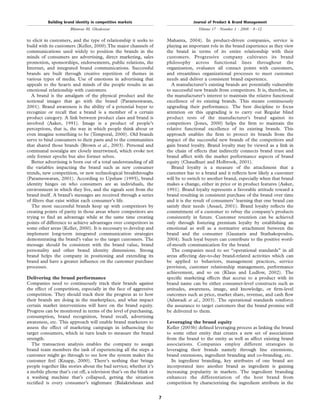
proposed. The four elements of this model, namely,
positioning the brand, communicating the brand message,
delivering the brand performance, and leveraging the brand
equity are discussed below.
Positioning the brand
Positioning is related with creating the perception of a brand
in the customer’s mind and of achieving differentiation that it
stands apart from competitors’ brands/offerings and that it
meets the consumer’s needs/expectations. Brand marketer’s
major objective should be to create the desired perception in
the target consumer’s mind.
A brand position is part of the brand identity and value
proposition that is to be actively communicated to the target
audience and that demonstrates and advantage over
competing brands (Aaker, 1996). A well positioned brand
has a competitively attractive position supported by strong
associations, such as high rating on a desirable attribute like
friendly service, or store’s offering of home delivery (Aaker,
1991). In an increasingly networked economy, understanding
the consumer behavior effects of linking a brand to other
entities such as another person, place, thing, or brand is
crucial (Keller, 2003a). Marketers must be able to understand
how various entities should best be combined, from a
consumer brand-knowledge perspective, to create the optimal
positioning in the minds of consumers (see Figure 1).
According to Temporal (2000), the branding focus should
be on adding psychological value to products, services, and
companies in the form of intangible benefits – the emotional
associations, beliefs, values, and feelings that people relate to
the brand. By strategically positioning it in the minds of the
target audience, the company can build a strong identity or
personality for the brand. Ability to endow a product, service
or corporation with an emotional significance over and above
its functional value is a substantial source of value creation
(Sherrington, 2003). The promise of value must be relevant
to the people or businesses a company wants to have as its
customers (Ward et al., 1999). A successful brand aims to
develop a high-quality relationship, in which customers feel a
sense of commitment and belonging, even to the point almost
of passion (Chernatony and McDonald, 1998).The brand
preference is the outcome of the emotional needs the
customers have. Emotional associations can strongly
distinguish the brand in customer’s mind in comparison to
competitors’ offerings. Branding enables the process of
transforming functional assets into relationship assets.
In strong brands, brand equity is tied both to the actual
quality of the product or service and to various intangible
factors. Those intangibles include “user imagery” (the type of
person who uses the brand); “usage imagery” (the type of
situations in which the brand is used); the type of personality
the brand portrays (sincere, exciting, competent, rugged); the
feeling that the brand tries to elicit in customers (purposeful,
warm); and the type of relationship it seeks to build with its
customers (committed, casual, seasonal). The strongest
brands stay on the leading edge in the product arena and
tweak their intangibles to fit the times (Keller, 2000). Upshaw
(1995) identified eight alternative positioning tools used by
companies as: feature-driven prompts; problem/solution
prompts; target-driven positioning; competition-driven
positioning; emotional/psychological positioning; benefit-
driven positioning; aspirational positioning; and value
positioning. Brands that are well positioned occupy
particular niches in consumers’ minds.
Communicating the brand message
A brand needs to carve a vision of how that brand should be
perceived by its target audience. The brand positioning helps
in prioritizing the focus of the brand identity and resultant
communication themes which enable the company to set forth
the communication objectives such as the type of message,
brand differentiation to be achieved, and themes that appeal
to the target customers. Advertising that is creatively executed
helps the brand to break the clutter and build strong impact in
the target market.
The challenges faced by companies in building brands are:
to be noticed, to be remembered, to change perceptions, to
reinforce attitudes, and to create deep customer relationships
(Aaker and Joachimsthaler, 2000). A differentiated,
“ownable” brand image can build an emotional and rational
bridge from customers to a company, a product, or a service
(Knapp, 2000). The intangible factors used in building brand
equity include “user imagery”, “usage imagery”, the type of
personality the brand portrays, the feeling that the brand tries
Figure 1 PCDL Model
Building brand identity in competitive markets
Bhimrao M. Ghodeswar
Journal of Product & Brand Management
Volume 17 · Number 1 · 2008 · 4–12
6
to elicit in customers, and the type of relationship it seeks to
build with its customers (Keller, 2000).The major channels of
communications used widely to position the brands in the
minds of consumers are advertising, direct marketing, sales
promotion, sponsorships, endorsements, public relations, the
Internet, and integrated brand communications. Successful
brands are built through creative repetition of themes in
various types of media. Use of emotions in advertising that
appeals to the hearts and minds of the people results in an
emotional relationship with customers.
A brand is the amalgam of the physical product and the
notional images that go with the brand (Parameswaran,
2001). Brand awareness is the ability of a potential buyer to
recognize or recall that a brand is a member of a certain
product category. A link between product class and brand is
involved (Aaker, 1991). Image is a product of people’s
perceptions, that is, the way in which people think about or
even imagine something to be (Temporal, 2000). Old brands
serve to bind consumers to their pasts and to the communities
that shared those brands (Brown et al., 2003). Personal and
communal nostalgia are closely intertwined, which evoke not
only former epochs but also former selves.
Better advertising is born out of a total understanding of all
the variables impacting the brand such as new consumer
trends, new competition, or new technological breakthroughs
(Parameswaran, 2001). According to Upshaw (1995), brand
identity hinges on who consumers are as individuals, the
environment in which they live, and the signals sent from the
brand itself. A brand’s messages are received through a series
of filters that exist within each consumer’s life.
The most successful brands keep up with competitors by
creating points of parity in those areas where competitors are
trying to find an advantage while at the same time creating
points of difference to achieve advantages over competitors in
some other areas (Keller, 2000). It is necessary to develop and
implement long-term integrated communication strategies
demonstrating the brand’s value to the target customers. The
message should be consistent with the brand value, brand
personality and other brand identity dimensions. Strong
brand helps the company in positioning and extending its
brand and have a greater influence on the customer purchase
processes.
Delivering the brand performance
Companies need to continuously track their brands against
the effect of competition, especially in the face of aggressive
competition. They should track their the progress as to how
their brands are doing in the marketplace, and what impact
certain market interventions will have on the brand equity.
Progress can be monitored in terms of the level of purchasing,
consumption, brand recognition, brand recall, advertising
awareness, etc. This approach will enable brand marketers to
assess the effect of marketing campaign in influencing the
target consumers, which in turn leads to measure the brand
strength.
The transaction analysis enables the company to assign
brand team members the task of experiencing all the steps a
customer might go through to see how the system makes the
customer feel (Knapp, 2000). There’s nothing that brings
people together like stories about the bad service; whether it’s
a mobile phone that’s cut off, a television that’s on the blink or
a washing machine that’s collapsed, getting the situation
rectified is every consumer’s nightmare (Balakrishnan and
Mahanta, 2004). In product-driven companies, service is
playing an important role in the brand experience as they view
the brand in terms of its entire relationship with their
customers. Progressive company cultivates its brand
philosophy across functional lines throughout the
organization, evaluates all contact points with customers,
and streamlines organizational processes to meet customer
needs and deliver a consistent brand experience.
A manufacturer’s existing brands are potentially vulnerable
to successful new brands from competitors. It is, therefore, in
the manufacturer’s interest to maintain the relative functional
excellence of its existing brands. This means continuously
upgrading their performance. The best discipline to focus
attention on this upgrading is to carry out Regular blind
product tests of the manufacturer’s brand against its
competitors (Jones, 2000) helps the firm to maintain the
relative functional excellence of its existing brands. This
approach enables the firm to protect its brands from the
impact of the successful new brands of the competitors and
gain brand loyalty. Brand loyalty may be viewed as a link in
the chain of effects that indirectly connects brand trust and
brand affect with the market performance aspects of brand
equity (Chaudhuri and Holbrook, 2001).
Brand loyalty is a measure of the attachment that a
customer has to a brand and it reflects how likely a customer
will be to switch to another brand, especially when that brand
makes a change, either in price or in product features (Aaker,
1991). Brand loyalty represents a favorable attitude toward a
brand resulting in consistent purchase of the brand over time
and it is the result of consumers’ learning that one brand can
satisfy their needs (Assael, 2001). Brand loyalty reflects the
commitment of a customer to rebuy the company’s products
consistently in future. Customer retention can be achieved
only through fostering premium loyalty by establishing an
emotional as well as a normative attachment between the
brand and the consumer (Gaunaris and Stathakopoulos,
2004). Such loyal buyers can contribute to the positive word-
of-mouth communication for the brand.
The companies need to set “operational standards” in all
areas affecting day-to-day brand-related activities which can
be applied to behaviors, management practices, service
provision, customer relationship management, performance
achievement, and so on (Klaus and Ludlow, 2002). The
specific marketing effects that accrue to a product with its
brand name can be either consumer-level constructs such as
attitudes, awareness, image, and knowledge, or firm-level
outcomes such as price, market share, revenue, and cash flow
(Ailawadi et al., 2003). The operational standards reinforce
the assurance to target customers that the brand promise will
be delivered to them.
Leveraging the brand equity
Keller (2003b) defined leveraging process as linking the brand
to some other entity that creates a new set of associations
from the brand to the entity as well as affect existing brand
associations. Companies employ different strategies in
leveraging their brands namely through line extensions,
brand extensions, ingredient branding and co-branding, etc.
In ingredient branding, key attributes of one brand are
incorporated into another brand as ingredient is gaining
increasing popularity in markets. The ingredient branding
enhances the differentiation of the host brand from
competition by characterizing the ingredient attribute in the
Building brand identity in competitive markets
Bhimrao M. Ghodeswar
Journal of Product & Brand Management
Volume 17 · Number 1 · 2008 · 4–12
7
host brand more specifically (Desai and Keller, 2002). This
results in establishing brand alliances between number of
firms as they link through their products/services or marketing
activities.
In brand extensions, the parent brand experience appears to
have little impact on long-term repeat purchasing of an
extension across a range of cases in which perceived similarity
between the parent and extension categories varied
considerably (Swaminathan et al., 2001). If the brand
extension fails, it can harm brand equity of the parent
brand by producing negative reciprocal effects. Further, they
stated that parent brand experience has an impact on
extension trial but not on repeat purchase. The advertising
of brand extensions produces significant reciprocal spillover
that favorably affects the choice of parent brand
(Subramanian and Ghose, 2003). Advertising spillover effect
becomes relevant when a brand name is used on two or more
products that are separately advertised.
IV. Case studies
Case studies of three Indian brands were undertaken to
delineate the approach for brand building adopted by them.
The action points suggested through case studies reinforced
the proposed PCDL model for brand building.
Archies
Archies was founded in 1979 as a mail order poster shop, and
introduced its first line of greeting cards in 1980. The
company procured its first ever foreign license from Walt
Disney, USA in 1984 and offered its customers some of the
best loved Disney characters on its greeting cards. As the
Archies brand grew into a household name in India, the
company diversified into gifting items. Strategic tie-ups with
global players, including Portal Publications, Gibson
Greetings and American Greetings Inc. (the world’s largest
publicly held greeting card company) of the US, enabled
Archies to offer its customers a range of special-occasion
cards. Archies’ product portfolio contains all-occasion
greeting cards, gift items such as curios, photo albums,
photo frames, soft toys, mugs, quotations, key chains and a
wide range of stationery (see Table I).
Archies has consistently focused on emotions and feelings,
making evident in its advertising theme: “The most special
way to say you care”. Archies products are available at a
variety of price points. Emotions are at the heart of the
Archies collections and played a significant role in advancing
the social expressions market by creating a special collection
of greeting cards and gifts for different occasions such as
Friendship Day, Valentine’s Day, Mother’s Day and Father’s
Day and everyday cards such as “Thinking of you”, “Hello”,
“Miss you”, “Get well soon”, among others. Archies has
promoted the cause of the elderly by entering into a tie-up
with HelpAge India and with CRY (Child Relief and You) for
the under-privileged children to produce and market these
voluntary organizations’ greeting cards and stationery items.
Archies has established the “Archies Gallery” chain through
organized franchising. Archies kept pace by introducing e-
cards and offering online gifting opportunities through its e-
commerce portal, www.archiesonline.com as the market
environment continued to evolve and internet became an
important aspect of urban life. Promotion for Archies has
been through different communication channels including
press, All India Radio, FM channels, TV commercials, cable
& satellite channels. Archies’ association with Hindi
blockbuster movies and Hollywood productions like Speed
and Mask has earned the brand tremendous mileage amongst
the youth. Advertising highlights the brands’ preoccupation
with sentiments, feelings and emotions.
Boroline
Boroline is firmly entrenched as the undisputed brand leader
in its category in India, as a value-for-money brand to guard
and cure against dry skin problems during the winter months.
The name Boroline is derived from its ingredients – “Boro”
from boric powder, which has antiseptic properties and
“oline” as a variant of the Latin word “oleum” meaning oil.
Boroline is used to cure cuts and bruises, healing of stitches
after operation, protects heels against cracks, lubricates rough
or abraded skin, healing for sun burnt skin, etc. To its users,
Boroline is a trusted friend – a friend in need. Boroline has
recyclable packaging and contributes to ensure environmental
protection as a part of the “Save Trees” campaign. From
across India, numerous economically under-privileged,
terminally ill patients and children requiring heart surgery
have applied to Boroline and received financial assistance for
treatment. In-spite of suffering bad phase for two years during
1990s, Boroline proved its brand goodwill by doubling its
sales after reintroduction.
New users, especially youngsters, discover the truth in their
elders’ belief in Boroline’s quality and become new users.
Boroline’s strong distribution system ensures that loyal
consumers get the tube of their favorite antiseptic skin
cream no matter where they are. To establish the brand
identity, the logo of Boroline is the Elephant known for its
steadiness and synonymous with success. In rural India for
the millions who cannot read, Boroline is still known as the
“hathiwala cream” (cream with the elephant logo). Boroline
explored all possible avenues of brand building including
communications channels like newspaper, magazine, radio
and outdoor promotions, festivals, and associating with
cricket and football matches. In terms of image building
Boroline has kept pace with the times and changing straplines
reflect the course of promotional platforms of Boroline
through the decades.
Boroline extended its brand to hair care products with
Boroline’s Eleen, a premium herbal light hair oil in the second
half of the 1990s. Other products introduced under the brand
name are a detangling shampoo with herbal benefits, a
coconut oil based herbal hair tonic, and pain relieving formula
branded as Boroline’s Penorub, focused on the ultimate goal
of combining modern chemistry with the science of ancient
Indian Ayurveda.
Dabur Vatika
The Vatika brand was launched in 1995. Vatika in Hindi
means “garden”. In Indian society, beauty of a person is
associated with beautiful fair skin and dark, long lustrous hair.
Vatika is a comparatively young brand but is already
acknowledged for the qualitatively influential and pioneering
role that it has played in the evolution of the categories it has
had a presence in. Vatika has a premium image in hair oil
category, distributed through more than one million outlets
across the country. By offering hair oil that combined the
benefits of natural products in a single pack, Vatika created a
niche for itself as the “total hair care” brand.
Building brand identity in competitive markets
Bhimrao M. Ghodeswar
Journal of Product & Brand Management
Volume 17 · Number 1 · 2008 · 4–12
8
Vatika is a product of intense study of consumer needs and
products available in the market to fulfill them resulting in the
launch of Vatika Hair Oil in the traditional coconut hair oil
category. Vatika Hair Oil with its value added proposition –
henna, amla and lemon in a pure coconut oil – proven to be
best option for price sensitive consumers. Also, in comparison
to blue packs as analogous of pure coconut oils, Vatika broke
the trend with its white and green bottle with a mushroom
cap, reflecting the brands’ premium look. Vatika launched
Vatika Henna Cream Conditioning Shampoo in 1997 which
had a premium natural offering that would condition the hair
with the ingredients taken from home recipes – henna, green
almonds and shikakai. This strengthened the trust that the
product does not contain harmful chemicals. Later in 2000, it
also introduced Vatika Anti-Dandruff Shampoo as the first
natural anti-dandruff shampoo in the country. Vatika has
made an entry into skin care products by introducing Vatika
Fairness Face Pack, which like other Vatika products offers
traditional Indian recipes in a modern format. The product
offers the goodness of natural ingredients such as haldi
(turmeric), kesar (saffron) and chandan (sandalwood) which
have traditionally been used for skin care.
In the initial phase of the communication, the marketing
objective was to create conceptual awareness about the new
product – the goodness of coconut oil enriched with natural
herbs. In 1997, the company created a new promotion
campaign which reinforced the idea of using extraordinary
hair oil that offered extra nourishment. Communications
through advertising campaigns featuring modern and young
women celebrities enabled the brand to infuse the values of
youthfulness and natural beauty. In addition, the brand has
undertaken promotional activities ranging from shows and
sponsored events to music awards and a popular TV show.
Discussion
The suggested PCDL model can serve as a guideline to
managers and executives in building identity of their brands in
their target markets. As competition gets more intense,
managers face challenges to adjust their brands with changed
expectations of their customers. Among different alternatives
that are available to managers, positioning their brands on the
attributes that happen to be the customer priorities can help
in building superiority of their brands in the minds of their
customers. Such attribute positioning or benefit positioning
can enable companies to leverage current resources to the
extent possible. If existing product configuration/proposition
becomes obsolete, the brand has to move to higher or
expected levels of performance/benefits to sustain itself in
dynamic markets.
Companies need to position their brands in the minds of
consumers. To achieve desired goals of their communication
strategy, companies have to break the clutter by evolving
innovative ways to attract the attention of the target audience.
Alongside the traditional media channels like newspapers,
magazines, television, hoardings, public relations, etc, new
media vehicles such as Internet, outdoor communications,
sponsoring events, etc. offer opportunities for consumer
involvement. Such innovative approaches can enable
managers to minimize the impact of competition on their
Table I Brand-building characteristics
Brand attributes Archies Boroline Dabur Vatika
Positioning the brand
Positioning Feelings and emotions Value for money Premium quality, pure coconut oil
Brand associations Greeting cards and soft toys
Gift items for youth
Antiseptic skin cream
“Haathiwala cream”
Coconut hair oil
White and green bottle
Communicating the message
Promotion Radio, TV, FM channels, cable and satellite
channels, Hollywood movies, Hindi movies
(Bollywood)
Newspapers, magazines, radio, outdoor
advertising, festivals, sponsorship of
cricket and football matches
Sponsored events and shows, music
awards, TV show
Campaign “The most special way we care”
Focused on sentiments, feelings, and
emotions
“Combining modern chemistry and the
science of ancient Indian Ayurveda”
Trust of generations of consumers
“Values of youthfulness and natural
beauty”
Featuring modern, young, multi-faceted,
confident, and achievement-driven
women celebrities
Social cause Tie-up with NGOs (Help Age India, Child
Relief and You, etc.)
“Save Trees” campaign, financial
assistance to patients requiring heart
surgery
“Vatika Super Model India 2001” and
“Vatika Zee Sangeet Awards” to
recognize the talent in society
Delivering the performance
Product focus Advancing social expressions, and
products at different price points
“Guard and cure against dry skin
problems”
“Benefits of natural products in a single
pack”
Distribution coverage “Archies Gallery” stores, organized
franchising
Availability at retailer level Easy accessibility at retailer level
Leveraging the brand equity
Brand extension Key chains, wide range of stationery, gift
items, etc.
Hair care products, detangling shampoo,
and pain balm
Cream conditioning shampoo, anti-
dandruff shampoo, fairness face pack
Building brand identity in competitive markets
Bhimrao M. Ghodeswar
Journal of Product & Brand Management
Volume 17 · Number 1 · 2008 · 4–12
9
brands. Integrated brand communications and creative
repetition through various types of media is a key to success
in brand communications. Use of emotions in advertising
appeals to the hearts and minds of the consumers. A brand
image should be created to establish an emotional relationship
with the target audience.
The brand managers need to continuously track their
brands against the effect of competition and to track the
progress as to how their brands are doing in the marketplace.
Monitoring the progress of brands in terms of purchasing,
consumption, brand recognition, brand recall, advertising
awareness, etc. helps the managers to adjust their strategies of
marketing to achieve the desired performance of their brands.
This performance audit can also enable the company to
measure its brand strength vis-a`-vis competing brands. The
brand loyalty can reduce the vulnerability of the customer
base to competitive action and can directly translate into
future sales and profits.
Brands that have established desired brand equity in the
marketplace can have potential to leverage its equity through
line extension, brand extension, ingredient branding, co-
branding, brand Alliances, and/or social goodwill. These
approaches enable the companies to leverage the parent brand
associations to new categories of products and chart a new
growth path for their brands.
Conclusion
Paper discusses the PCDL model for building brands based
on the literature review and case studies. Consistency of
integrated communications and message along the brand
identity dimensions targeted towards customers is critical to
the success of brand-building efforts by delivering a
consistent, self-reinforcing brand image. Companies need to
ensure that the brand remains strong even during difficult
times and offers value that is consistent with the brand
promise. The four stages suggested in PCDL model namely,
positioning the brand, communicating the brand message,
delivering the brand performance, and leveraging the brand
equity can enable companies to build strong brands.
References
Aaker, D.A. (1991), Managing Brand Equity, The Free Press,
New York, NY, pp. 7, 39, 61, 110.
Aaker, D.A. (1996), Building Strong Brands, The Free Press,
New York, NY, pp. 35, 71.
Aaker, D.A. and Joachimsthaler, E. (2000), Brand Leadership,
The Free Press, New York, NY, pp. 13, 27, 40, 48.
Ailawadi, K.L., Donald, R.L. and Scott, A.N. (2003),
“Revenue premium as an outcome measure of brand
equity”, Journal of Marketing, Vol. 67, October, pp. 1-17.
Alexander, J.H., Schouten, J.W. and Koenig, H.F. (2002),
“Building brand community”, Journal of Marketing, Vol. 66,
January, pp. 38-54.
Assael, H. (2001), Consumer Behavior and Marketing Action,
6th ed., Thomson Learning, Boston, MA.
Balakrishnan, R. and Mahanta, V. (2004), “Brick in the call,
brand equity”, The Economic Times, August 18, Mumbai.
Brown, S., Kozinets, R.V. and Sherry, J.F. Jr (2003),
“Teaching old brands new tricks: retro branding and the
revival of brand meaning”, Journal of Marketing, Vol. 67,
July, pp. 19-33.
Chaudhuri, A. and Holbrook, M.B. (2001), “The chain of
effects from brand trust and brand affect to brand
performance: the role of brand loyalty”, Journal of
Marketing, Vol. 65, April, pp. 81-93.
Chernatony, L. and McDonald, M. (1998), Creating Powerful
Brands, 2nd ed., Butterworth-Heinemann, Oxford.
Desai, K.K. and Keller, K.L. (2002), “The effects of
ingredient branding strategies on host brand
extendibility”, Journal of Marketing, Vol. 66, January,
pp. 73-93.
Gaunaris, S. and Stathakopoulos, V. (2004), “Antecedents
and consequences of brand loyalty: an empirical study”,
Journal of Brand Management, Vol. 11 No. 4, pp. 283-306.
Jones, J.P. (2000), Behind Powerful Brands, Tata McGraw-Hill,
Noida, p. 286.
Kapferer, J.N. (2004), “Brand NEW world, brand equity”,
The Economic Times, June 30, Mumbai.
Keller, K.L. (2000), “The brand report card”, Harvard
Business Review, January-February, pp. 147-57.
Keller,K.L.(2003a),“Brandsynthesis:themultidimensionality
of brand knowledge”, Journal of Consumer Research, Vol. 29
No. 4.
Keller, K.L. (2003b), Strategic Brand Management: Building,
Measuring, and Managing Brand Equity, 2nd ed., Pearson
Education, Harlow, p. 351.
Klaus, S. and Ludlow, C. (2002), Inclusive Branding, Palgrave
Macmillan, Basingstoke.
Knapp, D.E. (2000), The Brand Mindset, McGraw-Hill, New
York, NY, pp. 33, 36, 103.
Murphy, J. (1998), “What is branding?”, in Hart, S. and
Murphy, J. (Eds), Brands: The New Wealth Creators,
Macmillan Business, Basingstoke, p. 2.
Parameswaran, M.G. (2001), Brand Building Advertising:
Concepts and Cases, Tata McGraw-Hill, Noida, pp. 2-3.
Park, C.W., Jaworski, B.J. and Macinnis, D.J. (1986),
“Strategic brand concept-image management”, Journal of
Marketing, Vol. 50, October, pp. 135-45.
Schmitt, B. and Simonson, A. (1997), Marketing Aesthetics:
The Strategic Management of Brands, Identity, and Image,
The Free Press, New York, NY, p. 56.
Sherrington, M. (2003), Added Value: The Alchemy of Brand-
Led Growth, Palgrave Macmillan, Basingstoke, pp. 21, 49.
Subramanian, B. and Ghose, S. (2003), “Reciprocal spillover
effects: a strategic benefit of brand extensions”, Journal of
Marketing, Vol. 67, pp. 4-13.
Swaminathan, V., Fox, R.J. and Reddy, S.K. (2001),
“The impact of brand extension introduction on choice”,
Journal of Marketing, Vol. 65, October, pp. 1-15.
Temporal, P. (2000), Branding in Asia, John Wiley & Sons,
Singapore, pp. 11, 25-6, 33.
Upshaw, L.B. (1995), Building Brand Identity, John Wiley
& Sons, New York, NY, pp. 13, 134-9.
Ward, S., Larry, L. and Goldstine, J. (1999), “What high-tech
managers need to know about brands”, Harvard Business
Review, July-August, pp. 85-95.
Wee, T.T.T. and Ming, M.C.H. (2003), “Leveraging on
symbolic values and meanings in branding”, Journal of
Brand Management, Vol. 10 No. 3, pp. 208-18.
Weilbacher, W.M. (1995), Brand Marketing, NTC Business
Books, Chicago, IL, p. 4.
Building brand identity in competitive markets
Bhimrao M. Ghodeswar
Journal of Product & Brand Management
Volume 17 · Number 1 · 2008 · 4–12
10
Further reading
Superbrands India Pvt Ltd (2003a), available at: www.
superbrandsindia.com/superbrands2003/archies/index.htm
Superbrands India Pvt Ltd (2003b), available at: www.
superbrandsindia.com/superbrands2003/boroline/index.
htm
Superbrands India Pvt Ltd (2003c), available at: www.
superbrandsindia.com/superbrands2003/dabur-vatika/
index.htm
About the author
Bhimrao M. Ghodeswar is currently working as Visiting
Professor of Marketing in School of Management, Asian
Institute of Technology, Bangkok, and holds the regular
position of Professor of Marketing in the National Institute of
Industrial Engineering, Mumbai, India. Dr Ghodeswar has an
MBA and PhD in Marketing from Osmania University,
Hyderabad, India. He has been teaching courses in the area of
marketing and has expertise in the areas of marketing strategy,
business-to-business marketing, brand management, and
international marketing. Dr Ghodeswar has published
papers in reputed journals including paper presentations in
prestigious international conferences. He is actively engaged
in research in customer relationship management, strategic
marketing, service quality, and brand management.
Executive summary and implications for
managers and executives
This summary has been provided to allow managers and executives
a rapid appreciation of the content of the article. Those with a
particular interest in the topic covered may then read the article in
toto to take advantage of the more comprehensive description of the
research undertaken and its results to get the full benefit of the
material present.
Indian companies’ brand-building model: a four-step
approach with global application
Introduction
The benefits of brand building are manifold, but it is a long
term commitment, some might say a lifetime commitment. It
is complex, but not too complex to be understood, although
this too can be a lifetime commitment.
Using a combination of a literature review and three case
studies of Indian companies, Prof. Bhimrao M. Ghodeswar of
the National Institute of Industrial Engineering in Mumbai,
India has identified his PCDL model. It is one that would
seem to have universal application.
So what is meant by the PCDL model, what benefits does it
bring and how can it be applied?
The PCDL model
Models that help us understand our complex world are always
to be welcomed. They provide a way of seeing things and
gaining understanding. The better ones position decision-
makers to take action, effective action, often in the face of
competition. Developed in an Indian context, the PCDL
model can be outlined as follows:
1 Positioning the brand:
.
features;
. tangible attributes;
.
intangible attributes;
. product functions;
.
benefits; and
.
operational aspects.
2 Communicating the brand message:
.
advertising campaigns;
.
themes;
.
celebrities;
.
events;
.
shows; and
.
consumer interaction.
3 Delivering the brand performance:
.
product performance;
.
service performance;
.
customer care;
.
customer satisfaction; and
.
customer delight.
4 Leveraging the brand equity:
.
line extension;
.
brand extension;
.
ingredient branding;
.
co-branding;
.
brand alliances; and
.
social integration.
Ghodeswar’s model is a holistic one. Every line item sits above
a wealth of experiences and debates. The inclusion of some
items within the brand management mix may not suit
everyone – celebrity endorsement may not suit all for
example, whereas for others it is vital. It is also an evidence-
based one and reflects, in part, the experiences of companies
in India.
Application: Archies, Boroline and Dabur Vatika
The academic world abounds with pet models and theories
but, to coin a phrase, the rubber tends to hit the road when
their application can be seen in practice. Ghodeswar sought to
apply his model to three Indian organizations:
1 Archies – a greetings cards and gifts company, something
of a household name in its own right in India, and offering
foreign brands such as Disney and Gibson Greetings;
2 Boroline – an established brand leading company with a
niche providing cures for skin problems; and
3 Dabur Vatika – a relatively young brand focusing on hair
oil and related products with youth appeal.
Each company is unique, and to be useful models need to
be adapted to unique circumstances. It is illuminating to see
how the PCDL model applies to these three different
businesses:
.
Positioning the brand – Archies majors on feelings and
emotions and is associated with greetings cards and soft
toys and gift items for youth; Boroline is seen as value for
moneyin the area of antisceptic skin cream, particularly
Haathiwala cream; Dabur Vatika is a premium quality
product, pure coconut oil in a distinctive white and green
bottle.
. Communicating the message – all three companies use
different media – newspapers, TV, sponsorship, and so on
Building brand identity in competitive markets
Bhimrao M. Ghodeswar
Journal of Product & Brand Management
Volume 17 · Number 1 · 2008 · 4–12
11
with distinctly different messages: Archies “The most
special way we care”; “Combining modern chemistry and
the science of ancient Indian Ayurveda”; and Dabur
Vatika “Values of youthfulness and natural beauty”. All
focus on social responsibility.
.
Delivering the performance – all have product focuses
appropriate to their products. When it comes to
distribution, Archies has its own gallery stores and an
organized franchising model, Boroline and Dabur Vatika
focus on the position of the products within stores.
.
Leveraging the brand equity – all three companies have
gone in for brand extension, Archies in key chains,
stationary and gift items, Boroline into hair care products
and pain balm, Dabur Vatika into hair care and beauty
products.
From the vantage point of the outside world looking in what
can be gained? Well to begin with a little insight into the
Indian retailing scene, a new frontier for international players.
Many of the concerns Indian businesses face are the same as
others the world over, yet there is some vital differences in the
detail. Context matters, the social concerns within India and
the need to be aligned with good causes is something to
consider carefully. Pepsico have been among those who have
sleepwalked into a consumer backlash.
The detail of how the model has been applied is interesting,
yet brand managers know that what is most interesting is
application to their own business. There is a structure here
and a set of headings that will usefully frame debates at the
next brainstorming session and should help ensure that no key
areas are missed.
Slavishly taking a model and introducing it would spell
difficulty if not disaster. Having a window into the world of
others, and a framework through which to examine ourselves
can only be helpful.
(A pre´cis of the article “Building brand identity in competitive
markets: a conceptual model”. Supplied by Marketing Consultants
for Emerald.)
Building brand identity in competitive markets
Bhimrao M. Ghodeswar
Journal of Product & Brand Management
Volume 17 · Number 1 · 2008 · 4–12
12
To purchase reprints of this article please e-mail: reprints@emeraldinsight.com
Or visit our web site for further details: www.emeraldinsight.com/reprints

Mantri developer reviews - building brand

  • 1.
    Building brand identityin competitive markets: a conceptual model Bhimrao M. Ghodeswar School of Management, Asian Institute of Technology, Klong Luang, Pathumthani, Thailand Abstract Purpose – The purpose of this conceptual paper is to identify important elements of brand building based on a literature review and case studies of successful brands in India. Design/methodology/approach – This paper is based on a review of the literature and takes a case study approach. The paper suggests the framework for building brand identity in sequential order, namely, positioning the brand, communicating the brand message, delivering the brand performance, and leveraging the brand equity. Findings – Brand-building effort has to be aligned with organizational processes that help deliver the promises to customers through all company departments, intermediaries, suppliers, etc., as all these play an important role in the experience customers have with the brand. Originality/value – The paper uses case studies of leading Indian brands to illustrate the importance of action elements in building brands in competitive markets. Keywords Brand identity, Brand loyalty, India Paper type Conceptual paper An executive summary for managers and executive readers can be found at the end of this article. I. Introduction Building a brand driven culture is a lifelong commitment to a mindset and a way of life that takes time, planning and perseverance that produces intangible outputs which include greater customer satisfaction, reduced price sensitivity, fewer customer defections, a greater share of customers’ wallets, more referrals, and a higher percentage of repeat business (Knapp, 2000). Customers value their relationships with their branded possessions and with marketing agents and institutions that own and manage the brand (Alexander et al., 2002). The brand identity needs to focus on points of differentiation that offer sustainable competitive advantage to the firm. Brand identity is based on a thorough understanding of the firm’s customers, competitors, and business environment. The brand identity needs to reflect the business strategy and the firm’s willingness to invest in the programs needed for the brand to live up to its promise to customers (Aaker and Joachimsthaler, 2000). Strong brands enjoy customer loyalty, the potential to charge premium prices, and considerable brand power to support new product and service launches. Companies need to have thorough understanding of customer beliefs, behaviors, product or service attributes, and competitors. This paper presents a conceptual framework in the form of PCDL model for building brands that is based on literature review and case studies of very prominent brands in India. The managerial implications of the concepts emphasized are explained in the discussion section in the paper. Brands – meaning and definition A brand is a distinguishing name and/or symbol (such as logo, trademark, or package design) intended to identify the goods or services of either one seller or a group of sellers, and to differentiate those goods or services from those of competitors. A brand thus signals to the customer the source of the product, and protects both the customer and the producer from competitors who would attempt to provide products that appear to be identical (Aaker, 1991). Brands provide the basis upon which consumers can identify and bond with a product or service or a group of products or services (Weilbacher, 1995). From the customer’s point of view, a brand can be defined as the total accumulation of all his/her experiences, and is built at all points of contact with the customer (Kapferer, 2004). A successful brand is an identifiable product, service, person or place, augmented in such a way that the buyer or user perceives relevant, unique added values which match their needs most closely (Chernatony and McDonald, 1998). According to Keller (2003a), consumer brand-knowledge can be defined in terms of the personal meaning about a brand stored in consumer memory, that is, all descriptive and evaluative brand-related information. Different sources and levels of knowledge such as awareness, attributes, benefits, images, thoughts, feelings, attitudes, and experiences get linked to a brand and its understanding by the consumer. The brand, in a sense, acts as a credible guarantee for that product The current issue and full text archive of this journal is available at www.emeraldinsight.com/1061-0421.htm Journal of Product & Brand Management 17/1 (2008) 4–12 q Emerald Group Publishing Limited [ISSN 1061-0421] [DOI 10.1108/10610420810856468] The author is thankful to the Superbrands India and Indian Consumer Superbrands Council for permitting him to adapt the stories of the three brands. 4
  • 2.
    or service, allowingthe consumer clearly to identify and specify products which genuinely offer added value (Murphy, 1998). Powerful brands provide long-term security and growth, higher sustainable profits, and increased asset value because they achieve competitive differentiation, premium prices, higher sales volumes, economies of scale and reduced costs, and greater security of demand (Temporal, 2000). The Brand “promise” is the essence of the benefits (both functional and emotional) that customers can expect to receive from experiencing a brand’s products/services, which reflects the heart, soul, and spirit of the brand (Knapp, 2000). Successful brands are those brands which adapt well to the environment and thus survive and flourish in the long term in- spite of competition they face. An important factor influencing the selection of a brand concept is consumer needs. According to Park et al. (1986), many brands offer a mixture of symbolic, functional, and experiential benefits. Functional needs are defined as those that motivate the search for products that solve consumption- related problems (e.g. solve a current problem, resolve conflict, restructure a frustrating situation). A brand with a functional concept is defined as one designed to solve externally generated consumption needs. Symbolic needs are defined as desires for products that fulfill internally generated needs for self-enhancement, role position, group membership, or ego identification. A brand with a symbolic concept is one designed to associate the individual with a desired group, role, or self-image. Experiential needs are defined as desires for products that provide sensory pleasure, variety, and/or cognitive stimulation. A brand with an experiential concept is designed to fulfill these internally generated needs for stimulation and/or variety. A brand essence that is based on emotional and self- expressive benefits provides a higher-order basis for relationships which can be less vulnerable to product-related changes or easily applied to new contexts (Aaker and Joachimsthaler, 2000). A brand’s value proposition is a statement of the functional benefits, emotional benefits, and self expressive benefits delivered by the brand that provide value to the customers. Functional benefits are the most common basis for a value proposition, based on a product attribute that provides functional utility to the customer and relate directly to the functions performed by the product for the customers. Emotional benefits are positive feelings the customer has about the brand and is related to the experience of owning and using the brand. Most functional benefits have a corresponding feeling or a set of feelings. Self-Expressive benefits focus on person’s self- concept, aspirations, and provide a way for a person to communicate his or her self- image. Brands evolve over time. The first level pertains to express the identity of the producer (i.e. label). The second level is known as functional superiority (perceived by customer as differentiation). While the third level is referred to as emotional touch, fourth level pertains to the Power of self- expression. At the top of the pyramid, the highest level (i.e. fifth level) is known as cult. II. Establishing brand identity Brand identity is a unique set of brand associations implying a promise to customers and includes a core and extended identity. Core identity is the central, timeless essence of the brand that remains constant as the brand moves to new markets and new products. Core identity broadly focuses on product attributes, service, user profile, store ambience and product performance. Extended identity is woven around brand identity elements organized into cohesive and meaningful groups that provide brand texture and completeness, and focuses on brand personality, relationship, and strong symbol association. To be effective, a brand identity needs to resonate with customers, differentiate the brand from competitors, and represent what the organization can and will do over time (Aaker and Joachimsthaler, 2000). To excel, a brand image must be well planned, nurtured, supported, and vigilantly guarded (Knapp, 2000). One key to successful brand-building is to understand how to develop a brand identity – to know what the brand stands for and to effectively express that identity (Aaker, 1996). A brand is a distinctive identity that differentiates a relevant, enduring, and credible promise of value associated with a product, service, or organization and indicates the source of that promise (Ward et al., 1999). Companies that present a cohesive, distinctive, and relevant brand identity can create a preference in the marketplace, add value to their products and services, and may command a price premium (Schmitt and Simonson, 1997). When brand faces aggressive competition in marketplace, brand personality and reputation of the brand help it distinguish from competing offerings. This can result in gaining customer loyalty and achieve growth. A strong brand identity that is well understood and experienced by the customers helps in developing trust which, in turn, results in differentiating the brand from competition. A company needs to establish a clear and consistent brand identity by linking brand attributes with the way they are communicated which can be easily understood by the customers. Brand association A set of brand associations enable a brand to develop a rich and clear brand identity. While some customers may attach greater importance to functional benefits, emotional value helps the brand stand above others. Building brand associations requires a company to understand its brand as well as competitors’ brands through customer research. Customer research should study existing and prospective customers, former customers, industry experts, and intermediaries. Brand strengths associated with beliefs and values are the most powerful and most difficult to imitate. Brand image is the perception in the mind of the customers about the brand and its associations. In contrast to brand image (the brand’s current associations), a brand identity is inspirational and may imply that the image needs to be changed or augmented. In a fundamental sense, the brand identity represents what the organization wants the brand to stand for (Aaker and Joachimsthaler, 2000). The “brand as personality” stage marks an important transition phase since not all brands evolve into consumer icons, especially if the consumers do not relate to, or believe in, the communications of the brand, or they sense some inconsistencies with the brand’s communications (Wee and Ming, 2003). A brand’s personality provides a richer source of competitive advantage than any functional feature can (Sherrington, 2003). Personality attributes help the brand to achieve sustainable differentiation as they are more difficult to copy Building brand identity in competitive markets Bhimrao M. Ghodeswar Journal of Product & Brand Management Volume 17 · Number 1 · 2008 · 4–12 5
  • 3.
    than functional featuresof the product and service by the competition. Another advantage of the personality association is that it establishes direct relationship with the customers. III. PCDL Model: a conceptual model for building brands Based on the literature review and three case studies of Indian brands, the conceptual model for brand building in competitive markets, known as PCDL Model, has been proposed. The four elements of this model, namely, positioning the brand, communicating the brand message, delivering the brand performance, and leveraging the brand equity are discussed below. Positioning the brand Positioning is related with creating the perception of a brand in the customer’s mind and of achieving differentiation that it stands apart from competitors’ brands/offerings and that it meets the consumer’s needs/expectations. Brand marketer’s major objective should be to create the desired perception in the target consumer’s mind. A brand position is part of the brand identity and value proposition that is to be actively communicated to the target audience and that demonstrates and advantage over competing brands (Aaker, 1996). A well positioned brand has a competitively attractive position supported by strong associations, such as high rating on a desirable attribute like friendly service, or store’s offering of home delivery (Aaker, 1991). In an increasingly networked economy, understanding the consumer behavior effects of linking a brand to other entities such as another person, place, thing, or brand is crucial (Keller, 2003a). Marketers must be able to understand how various entities should best be combined, from a consumer brand-knowledge perspective, to create the optimal positioning in the minds of consumers (see Figure 1). According to Temporal (2000), the branding focus should be on adding psychological value to products, services, and companies in the form of intangible benefits – the emotional associations, beliefs, values, and feelings that people relate to the brand. By strategically positioning it in the minds of the target audience, the company can build a strong identity or personality for the brand. Ability to endow a product, service or corporation with an emotional significance over and above its functional value is a substantial source of value creation (Sherrington, 2003). The promise of value must be relevant to the people or businesses a company wants to have as its customers (Ward et al., 1999). A successful brand aims to develop a high-quality relationship, in which customers feel a sense of commitment and belonging, even to the point almost of passion (Chernatony and McDonald, 1998).The brand preference is the outcome of the emotional needs the customers have. Emotional associations can strongly distinguish the brand in customer’s mind in comparison to competitors’ offerings. Branding enables the process of transforming functional assets into relationship assets. In strong brands, brand equity is tied both to the actual quality of the product or service and to various intangible factors. Those intangibles include “user imagery” (the type of person who uses the brand); “usage imagery” (the type of situations in which the brand is used); the type of personality the brand portrays (sincere, exciting, competent, rugged); the feeling that the brand tries to elicit in customers (purposeful, warm); and the type of relationship it seeks to build with its customers (committed, casual, seasonal). The strongest brands stay on the leading edge in the product arena and tweak their intangibles to fit the times (Keller, 2000). Upshaw (1995) identified eight alternative positioning tools used by companies as: feature-driven prompts; problem/solution prompts; target-driven positioning; competition-driven positioning; emotional/psychological positioning; benefit- driven positioning; aspirational positioning; and value positioning. Brands that are well positioned occupy particular niches in consumers’ minds. Communicating the brand message A brand needs to carve a vision of how that brand should be perceived by its target audience. The brand positioning helps in prioritizing the focus of the brand identity and resultant communication themes which enable the company to set forth the communication objectives such as the type of message, brand differentiation to be achieved, and themes that appeal to the target customers. Advertising that is creatively executed helps the brand to break the clutter and build strong impact in the target market. The challenges faced by companies in building brands are: to be noticed, to be remembered, to change perceptions, to reinforce attitudes, and to create deep customer relationships (Aaker and Joachimsthaler, 2000). A differentiated, “ownable” brand image can build an emotional and rational bridge from customers to a company, a product, or a service (Knapp, 2000). The intangible factors used in building brand equity include “user imagery”, “usage imagery”, the type of personality the brand portrays, the feeling that the brand tries Figure 1 PCDL Model Building brand identity in competitive markets Bhimrao M. Ghodeswar Journal of Product & Brand Management Volume 17 · Number 1 · 2008 · 4–12 6
  • 4.
    to elicit incustomers, and the type of relationship it seeks to build with its customers (Keller, 2000).The major channels of communications used widely to position the brands in the minds of consumers are advertising, direct marketing, sales promotion, sponsorships, endorsements, public relations, the Internet, and integrated brand communications. Successful brands are built through creative repetition of themes in various types of media. Use of emotions in advertising that appeals to the hearts and minds of the people results in an emotional relationship with customers. A brand is the amalgam of the physical product and the notional images that go with the brand (Parameswaran, 2001). Brand awareness is the ability of a potential buyer to recognize or recall that a brand is a member of a certain product category. A link between product class and brand is involved (Aaker, 1991). Image is a product of people’s perceptions, that is, the way in which people think about or even imagine something to be (Temporal, 2000). Old brands serve to bind consumers to their pasts and to the communities that shared those brands (Brown et al., 2003). Personal and communal nostalgia are closely intertwined, which evoke not only former epochs but also former selves. Better advertising is born out of a total understanding of all the variables impacting the brand such as new consumer trends, new competition, or new technological breakthroughs (Parameswaran, 2001). According to Upshaw (1995), brand identity hinges on who consumers are as individuals, the environment in which they live, and the signals sent from the brand itself. A brand’s messages are received through a series of filters that exist within each consumer’s life. The most successful brands keep up with competitors by creating points of parity in those areas where competitors are trying to find an advantage while at the same time creating points of difference to achieve advantages over competitors in some other areas (Keller, 2000). It is necessary to develop and implement long-term integrated communication strategies demonstrating the brand’s value to the target customers. The message should be consistent with the brand value, brand personality and other brand identity dimensions. Strong brand helps the company in positioning and extending its brand and have a greater influence on the customer purchase processes. Delivering the brand performance Companies need to continuously track their brands against the effect of competition, especially in the face of aggressive competition. They should track their the progress as to how their brands are doing in the marketplace, and what impact certain market interventions will have on the brand equity. Progress can be monitored in terms of the level of purchasing, consumption, brand recognition, brand recall, advertising awareness, etc. This approach will enable brand marketers to assess the effect of marketing campaign in influencing the target consumers, which in turn leads to measure the brand strength. The transaction analysis enables the company to assign brand team members the task of experiencing all the steps a customer might go through to see how the system makes the customer feel (Knapp, 2000). There’s nothing that brings people together like stories about the bad service; whether it’s a mobile phone that’s cut off, a television that’s on the blink or a washing machine that’s collapsed, getting the situation rectified is every consumer’s nightmare (Balakrishnan and Mahanta, 2004). In product-driven companies, service is playing an important role in the brand experience as they view the brand in terms of its entire relationship with their customers. Progressive company cultivates its brand philosophy across functional lines throughout the organization, evaluates all contact points with customers, and streamlines organizational processes to meet customer needs and deliver a consistent brand experience. A manufacturer’s existing brands are potentially vulnerable to successful new brands from competitors. It is, therefore, in the manufacturer’s interest to maintain the relative functional excellence of its existing brands. This means continuously upgrading their performance. The best discipline to focus attention on this upgrading is to carry out Regular blind product tests of the manufacturer’s brand against its competitors (Jones, 2000) helps the firm to maintain the relative functional excellence of its existing brands. This approach enables the firm to protect its brands from the impact of the successful new brands of the competitors and gain brand loyalty. Brand loyalty may be viewed as a link in the chain of effects that indirectly connects brand trust and brand affect with the market performance aspects of brand equity (Chaudhuri and Holbrook, 2001). Brand loyalty is a measure of the attachment that a customer has to a brand and it reflects how likely a customer will be to switch to another brand, especially when that brand makes a change, either in price or in product features (Aaker, 1991). Brand loyalty represents a favorable attitude toward a brand resulting in consistent purchase of the brand over time and it is the result of consumers’ learning that one brand can satisfy their needs (Assael, 2001). Brand loyalty reflects the commitment of a customer to rebuy the company’s products consistently in future. Customer retention can be achieved only through fostering premium loyalty by establishing an emotional as well as a normative attachment between the brand and the consumer (Gaunaris and Stathakopoulos, 2004). Such loyal buyers can contribute to the positive word- of-mouth communication for the brand. The companies need to set “operational standards” in all areas affecting day-to-day brand-related activities which can be applied to behaviors, management practices, service provision, customer relationship management, performance achievement, and so on (Klaus and Ludlow, 2002). The specific marketing effects that accrue to a product with its brand name can be either consumer-level constructs such as attitudes, awareness, image, and knowledge, or firm-level outcomes such as price, market share, revenue, and cash flow (Ailawadi et al., 2003). The operational standards reinforce the assurance to target customers that the brand promise will be delivered to them. Leveraging the brand equity Keller (2003b) defined leveraging process as linking the brand to some other entity that creates a new set of associations from the brand to the entity as well as affect existing brand associations. Companies employ different strategies in leveraging their brands namely through line extensions, brand extensions, ingredient branding and co-branding, etc. In ingredient branding, key attributes of one brand are incorporated into another brand as ingredient is gaining increasing popularity in markets. The ingredient branding enhances the differentiation of the host brand from competition by characterizing the ingredient attribute in the Building brand identity in competitive markets Bhimrao M. Ghodeswar Journal of Product & Brand Management Volume 17 · Number 1 · 2008 · 4–12 7
  • 5.
    host brand morespecifically (Desai and Keller, 2002). This results in establishing brand alliances between number of firms as they link through their products/services or marketing activities. In brand extensions, the parent brand experience appears to have little impact on long-term repeat purchasing of an extension across a range of cases in which perceived similarity between the parent and extension categories varied considerably (Swaminathan et al., 2001). If the brand extension fails, it can harm brand equity of the parent brand by producing negative reciprocal effects. Further, they stated that parent brand experience has an impact on extension trial but not on repeat purchase. The advertising of brand extensions produces significant reciprocal spillover that favorably affects the choice of parent brand (Subramanian and Ghose, 2003). Advertising spillover effect becomes relevant when a brand name is used on two or more products that are separately advertised. IV. Case studies Case studies of three Indian brands were undertaken to delineate the approach for brand building adopted by them. The action points suggested through case studies reinforced the proposed PCDL model for brand building. Archies Archies was founded in 1979 as a mail order poster shop, and introduced its first line of greeting cards in 1980. The company procured its first ever foreign license from Walt Disney, USA in 1984 and offered its customers some of the best loved Disney characters on its greeting cards. As the Archies brand grew into a household name in India, the company diversified into gifting items. Strategic tie-ups with global players, including Portal Publications, Gibson Greetings and American Greetings Inc. (the world’s largest publicly held greeting card company) of the US, enabled Archies to offer its customers a range of special-occasion cards. Archies’ product portfolio contains all-occasion greeting cards, gift items such as curios, photo albums, photo frames, soft toys, mugs, quotations, key chains and a wide range of stationery (see Table I). Archies has consistently focused on emotions and feelings, making evident in its advertising theme: “The most special way to say you care”. Archies products are available at a variety of price points. Emotions are at the heart of the Archies collections and played a significant role in advancing the social expressions market by creating a special collection of greeting cards and gifts for different occasions such as Friendship Day, Valentine’s Day, Mother’s Day and Father’s Day and everyday cards such as “Thinking of you”, “Hello”, “Miss you”, “Get well soon”, among others. Archies has promoted the cause of the elderly by entering into a tie-up with HelpAge India and with CRY (Child Relief and You) for the under-privileged children to produce and market these voluntary organizations’ greeting cards and stationery items. Archies has established the “Archies Gallery” chain through organized franchising. Archies kept pace by introducing e- cards and offering online gifting opportunities through its e- commerce portal, www.archiesonline.com as the market environment continued to evolve and internet became an important aspect of urban life. Promotion for Archies has been through different communication channels including press, All India Radio, FM channels, TV commercials, cable & satellite channels. Archies’ association with Hindi blockbuster movies and Hollywood productions like Speed and Mask has earned the brand tremendous mileage amongst the youth. Advertising highlights the brands’ preoccupation with sentiments, feelings and emotions. Boroline Boroline is firmly entrenched as the undisputed brand leader in its category in India, as a value-for-money brand to guard and cure against dry skin problems during the winter months. The name Boroline is derived from its ingredients – “Boro” from boric powder, which has antiseptic properties and “oline” as a variant of the Latin word “oleum” meaning oil. Boroline is used to cure cuts and bruises, healing of stitches after operation, protects heels against cracks, lubricates rough or abraded skin, healing for sun burnt skin, etc. To its users, Boroline is a trusted friend – a friend in need. Boroline has recyclable packaging and contributes to ensure environmental protection as a part of the “Save Trees” campaign. From across India, numerous economically under-privileged, terminally ill patients and children requiring heart surgery have applied to Boroline and received financial assistance for treatment. In-spite of suffering bad phase for two years during 1990s, Boroline proved its brand goodwill by doubling its sales after reintroduction. New users, especially youngsters, discover the truth in their elders’ belief in Boroline’s quality and become new users. Boroline’s strong distribution system ensures that loyal consumers get the tube of their favorite antiseptic skin cream no matter where they are. To establish the brand identity, the logo of Boroline is the Elephant known for its steadiness and synonymous with success. In rural India for the millions who cannot read, Boroline is still known as the “hathiwala cream” (cream with the elephant logo). Boroline explored all possible avenues of brand building including communications channels like newspaper, magazine, radio and outdoor promotions, festivals, and associating with cricket and football matches. In terms of image building Boroline has kept pace with the times and changing straplines reflect the course of promotional platforms of Boroline through the decades. Boroline extended its brand to hair care products with Boroline’s Eleen, a premium herbal light hair oil in the second half of the 1990s. Other products introduced under the brand name are a detangling shampoo with herbal benefits, a coconut oil based herbal hair tonic, and pain relieving formula branded as Boroline’s Penorub, focused on the ultimate goal of combining modern chemistry with the science of ancient Indian Ayurveda. Dabur Vatika The Vatika brand was launched in 1995. Vatika in Hindi means “garden”. In Indian society, beauty of a person is associated with beautiful fair skin and dark, long lustrous hair. Vatika is a comparatively young brand but is already acknowledged for the qualitatively influential and pioneering role that it has played in the evolution of the categories it has had a presence in. Vatika has a premium image in hair oil category, distributed through more than one million outlets across the country. By offering hair oil that combined the benefits of natural products in a single pack, Vatika created a niche for itself as the “total hair care” brand. Building brand identity in competitive markets Bhimrao M. Ghodeswar Journal of Product & Brand Management Volume 17 · Number 1 · 2008 · 4–12 8
  • 6.
    Vatika is aproduct of intense study of consumer needs and products available in the market to fulfill them resulting in the launch of Vatika Hair Oil in the traditional coconut hair oil category. Vatika Hair Oil with its value added proposition – henna, amla and lemon in a pure coconut oil – proven to be best option for price sensitive consumers. Also, in comparison to blue packs as analogous of pure coconut oils, Vatika broke the trend with its white and green bottle with a mushroom cap, reflecting the brands’ premium look. Vatika launched Vatika Henna Cream Conditioning Shampoo in 1997 which had a premium natural offering that would condition the hair with the ingredients taken from home recipes – henna, green almonds and shikakai. This strengthened the trust that the product does not contain harmful chemicals. Later in 2000, it also introduced Vatika Anti-Dandruff Shampoo as the first natural anti-dandruff shampoo in the country. Vatika has made an entry into skin care products by introducing Vatika Fairness Face Pack, which like other Vatika products offers traditional Indian recipes in a modern format. The product offers the goodness of natural ingredients such as haldi (turmeric), kesar (saffron) and chandan (sandalwood) which have traditionally been used for skin care. In the initial phase of the communication, the marketing objective was to create conceptual awareness about the new product – the goodness of coconut oil enriched with natural herbs. In 1997, the company created a new promotion campaign which reinforced the idea of using extraordinary hair oil that offered extra nourishment. Communications through advertising campaigns featuring modern and young women celebrities enabled the brand to infuse the values of youthfulness and natural beauty. In addition, the brand has undertaken promotional activities ranging from shows and sponsored events to music awards and a popular TV show. Discussion The suggested PCDL model can serve as a guideline to managers and executives in building identity of their brands in their target markets. As competition gets more intense, managers face challenges to adjust their brands with changed expectations of their customers. Among different alternatives that are available to managers, positioning their brands on the attributes that happen to be the customer priorities can help in building superiority of their brands in the minds of their customers. Such attribute positioning or benefit positioning can enable companies to leverage current resources to the extent possible. If existing product configuration/proposition becomes obsolete, the brand has to move to higher or expected levels of performance/benefits to sustain itself in dynamic markets. Companies need to position their brands in the minds of consumers. To achieve desired goals of their communication strategy, companies have to break the clutter by evolving innovative ways to attract the attention of the target audience. Alongside the traditional media channels like newspapers, magazines, television, hoardings, public relations, etc, new media vehicles such as Internet, outdoor communications, sponsoring events, etc. offer opportunities for consumer involvement. Such innovative approaches can enable managers to minimize the impact of competition on their Table I Brand-building characteristics Brand attributes Archies Boroline Dabur Vatika Positioning the brand Positioning Feelings and emotions Value for money Premium quality, pure coconut oil Brand associations Greeting cards and soft toys Gift items for youth Antiseptic skin cream “Haathiwala cream” Coconut hair oil White and green bottle Communicating the message Promotion Radio, TV, FM channels, cable and satellite channels, Hollywood movies, Hindi movies (Bollywood) Newspapers, magazines, radio, outdoor advertising, festivals, sponsorship of cricket and football matches Sponsored events and shows, music awards, TV show Campaign “The most special way we care” Focused on sentiments, feelings, and emotions “Combining modern chemistry and the science of ancient Indian Ayurveda” Trust of generations of consumers “Values of youthfulness and natural beauty” Featuring modern, young, multi-faceted, confident, and achievement-driven women celebrities Social cause Tie-up with NGOs (Help Age India, Child Relief and You, etc.) “Save Trees” campaign, financial assistance to patients requiring heart surgery “Vatika Super Model India 2001” and “Vatika Zee Sangeet Awards” to recognize the talent in society Delivering the performance Product focus Advancing social expressions, and products at different price points “Guard and cure against dry skin problems” “Benefits of natural products in a single pack” Distribution coverage “Archies Gallery” stores, organized franchising Availability at retailer level Easy accessibility at retailer level Leveraging the brand equity Brand extension Key chains, wide range of stationery, gift items, etc. Hair care products, detangling shampoo, and pain balm Cream conditioning shampoo, anti- dandruff shampoo, fairness face pack Building brand identity in competitive markets Bhimrao M. Ghodeswar Journal of Product & Brand Management Volume 17 · Number 1 · 2008 · 4–12 9
  • 7.
    brands. Integrated brandcommunications and creative repetition through various types of media is a key to success in brand communications. Use of emotions in advertising appeals to the hearts and minds of the consumers. A brand image should be created to establish an emotional relationship with the target audience. The brand managers need to continuously track their brands against the effect of competition and to track the progress as to how their brands are doing in the marketplace. Monitoring the progress of brands in terms of purchasing, consumption, brand recognition, brand recall, advertising awareness, etc. helps the managers to adjust their strategies of marketing to achieve the desired performance of their brands. This performance audit can also enable the company to measure its brand strength vis-a`-vis competing brands. The brand loyalty can reduce the vulnerability of the customer base to competitive action and can directly translate into future sales and profits. Brands that have established desired brand equity in the marketplace can have potential to leverage its equity through line extension, brand extension, ingredient branding, co- branding, brand Alliances, and/or social goodwill. These approaches enable the companies to leverage the parent brand associations to new categories of products and chart a new growth path for their brands. Conclusion Paper discusses the PCDL model for building brands based on the literature review and case studies. Consistency of integrated communications and message along the brand identity dimensions targeted towards customers is critical to the success of brand-building efforts by delivering a consistent, self-reinforcing brand image. Companies need to ensure that the brand remains strong even during difficult times and offers value that is consistent with the brand promise. The four stages suggested in PCDL model namely, positioning the brand, communicating the brand message, delivering the brand performance, and leveraging the brand equity can enable companies to build strong brands. References Aaker, D.A. (1991), Managing Brand Equity, The Free Press, New York, NY, pp. 7, 39, 61, 110. Aaker, D.A. (1996), Building Strong Brands, The Free Press, New York, NY, pp. 35, 71. Aaker, D.A. and Joachimsthaler, E. (2000), Brand Leadership, The Free Press, New York, NY, pp. 13, 27, 40, 48. Ailawadi, K.L., Donald, R.L. and Scott, A.N. (2003), “Revenue premium as an outcome measure of brand equity”, Journal of Marketing, Vol. 67, October, pp. 1-17. Alexander, J.H., Schouten, J.W. and Koenig, H.F. (2002), “Building brand community”, Journal of Marketing, Vol. 66, January, pp. 38-54. Assael, H. (2001), Consumer Behavior and Marketing Action, 6th ed., Thomson Learning, Boston, MA. Balakrishnan, R. and Mahanta, V. (2004), “Brick in the call, brand equity”, The Economic Times, August 18, Mumbai. Brown, S., Kozinets, R.V. and Sherry, J.F. Jr (2003), “Teaching old brands new tricks: retro branding and the revival of brand meaning”, Journal of Marketing, Vol. 67, July, pp. 19-33. Chaudhuri, A. and Holbrook, M.B. (2001), “The chain of effects from brand trust and brand affect to brand performance: the role of brand loyalty”, Journal of Marketing, Vol. 65, April, pp. 81-93. Chernatony, L. and McDonald, M. (1998), Creating Powerful Brands, 2nd ed., Butterworth-Heinemann, Oxford. Desai, K.K. and Keller, K.L. (2002), “The effects of ingredient branding strategies on host brand extendibility”, Journal of Marketing, Vol. 66, January, pp. 73-93. Gaunaris, S. and Stathakopoulos, V. (2004), “Antecedents and consequences of brand loyalty: an empirical study”, Journal of Brand Management, Vol. 11 No. 4, pp. 283-306. Jones, J.P. (2000), Behind Powerful Brands, Tata McGraw-Hill, Noida, p. 286. Kapferer, J.N. (2004), “Brand NEW world, brand equity”, The Economic Times, June 30, Mumbai. Keller, K.L. (2000), “The brand report card”, Harvard Business Review, January-February, pp. 147-57. Keller,K.L.(2003a),“Brandsynthesis:themultidimensionality of brand knowledge”, Journal of Consumer Research, Vol. 29 No. 4. Keller, K.L. (2003b), Strategic Brand Management: Building, Measuring, and Managing Brand Equity, 2nd ed., Pearson Education, Harlow, p. 351. Klaus, S. and Ludlow, C. (2002), Inclusive Branding, Palgrave Macmillan, Basingstoke. Knapp, D.E. (2000), The Brand Mindset, McGraw-Hill, New York, NY, pp. 33, 36, 103. Murphy, J. (1998), “What is branding?”, in Hart, S. and Murphy, J. (Eds), Brands: The New Wealth Creators, Macmillan Business, Basingstoke, p. 2. Parameswaran, M.G. (2001), Brand Building Advertising: Concepts and Cases, Tata McGraw-Hill, Noida, pp. 2-3. Park, C.W., Jaworski, B.J. and Macinnis, D.J. (1986), “Strategic brand concept-image management”, Journal of Marketing, Vol. 50, October, pp. 135-45. Schmitt, B. and Simonson, A. (1997), Marketing Aesthetics: The Strategic Management of Brands, Identity, and Image, The Free Press, New York, NY, p. 56. Sherrington, M. (2003), Added Value: The Alchemy of Brand- Led Growth, Palgrave Macmillan, Basingstoke, pp. 21, 49. Subramanian, B. and Ghose, S. (2003), “Reciprocal spillover effects: a strategic benefit of brand extensions”, Journal of Marketing, Vol. 67, pp. 4-13. Swaminathan, V., Fox, R.J. and Reddy, S.K. (2001), “The impact of brand extension introduction on choice”, Journal of Marketing, Vol. 65, October, pp. 1-15. Temporal, P. (2000), Branding in Asia, John Wiley & Sons, Singapore, pp. 11, 25-6, 33. Upshaw, L.B. (1995), Building Brand Identity, John Wiley & Sons, New York, NY, pp. 13, 134-9. Ward, S., Larry, L. and Goldstine, J. (1999), “What high-tech managers need to know about brands”, Harvard Business Review, July-August, pp. 85-95. Wee, T.T.T. and Ming, M.C.H. (2003), “Leveraging on symbolic values and meanings in branding”, Journal of Brand Management, Vol. 10 No. 3, pp. 208-18. Weilbacher, W.M. (1995), Brand Marketing, NTC Business Books, Chicago, IL, p. 4. Building brand identity in competitive markets Bhimrao M. Ghodeswar Journal of Product & Brand Management Volume 17 · Number 1 · 2008 · 4–12 10
  • 8.
    Further reading Superbrands IndiaPvt Ltd (2003a), available at: www. superbrandsindia.com/superbrands2003/archies/index.htm Superbrands India Pvt Ltd (2003b), available at: www. superbrandsindia.com/superbrands2003/boroline/index. htm Superbrands India Pvt Ltd (2003c), available at: www. superbrandsindia.com/superbrands2003/dabur-vatika/ index.htm About the author Bhimrao M. Ghodeswar is currently working as Visiting Professor of Marketing in School of Management, Asian Institute of Technology, Bangkok, and holds the regular position of Professor of Marketing in the National Institute of Industrial Engineering, Mumbai, India. Dr Ghodeswar has an MBA and PhD in Marketing from Osmania University, Hyderabad, India. He has been teaching courses in the area of marketing and has expertise in the areas of marketing strategy, business-to-business marketing, brand management, and international marketing. Dr Ghodeswar has published papers in reputed journals including paper presentations in prestigious international conferences. He is actively engaged in research in customer relationship management, strategic marketing, service quality, and brand management. Executive summary and implications for managers and executives This summary has been provided to allow managers and executives a rapid appreciation of the content of the article. Those with a particular interest in the topic covered may then read the article in toto to take advantage of the more comprehensive description of the research undertaken and its results to get the full benefit of the material present. Indian companies’ brand-building model: a four-step approach with global application Introduction The benefits of brand building are manifold, but it is a long term commitment, some might say a lifetime commitment. It is complex, but not too complex to be understood, although this too can be a lifetime commitment. Using a combination of a literature review and three case studies of Indian companies, Prof. Bhimrao M. Ghodeswar of the National Institute of Industrial Engineering in Mumbai, India has identified his PCDL model. It is one that would seem to have universal application. So what is meant by the PCDL model, what benefits does it bring and how can it be applied? The PCDL model Models that help us understand our complex world are always to be welcomed. They provide a way of seeing things and gaining understanding. The better ones position decision- makers to take action, effective action, often in the face of competition. Developed in an Indian context, the PCDL model can be outlined as follows: 1 Positioning the brand: . features; . tangible attributes; . intangible attributes; . product functions; . benefits; and . operational aspects. 2 Communicating the brand message: . advertising campaigns; . themes; . celebrities; . events; . shows; and . consumer interaction. 3 Delivering the brand performance: . product performance; . service performance; . customer care; . customer satisfaction; and . customer delight. 4 Leveraging the brand equity: . line extension; . brand extension; . ingredient branding; . co-branding; . brand alliances; and . social integration. Ghodeswar’s model is a holistic one. Every line item sits above a wealth of experiences and debates. The inclusion of some items within the brand management mix may not suit everyone – celebrity endorsement may not suit all for example, whereas for others it is vital. It is also an evidence- based one and reflects, in part, the experiences of companies in India. Application: Archies, Boroline and Dabur Vatika The academic world abounds with pet models and theories but, to coin a phrase, the rubber tends to hit the road when their application can be seen in practice. Ghodeswar sought to apply his model to three Indian organizations: 1 Archies – a greetings cards and gifts company, something of a household name in its own right in India, and offering foreign brands such as Disney and Gibson Greetings; 2 Boroline – an established brand leading company with a niche providing cures for skin problems; and 3 Dabur Vatika – a relatively young brand focusing on hair oil and related products with youth appeal. Each company is unique, and to be useful models need to be adapted to unique circumstances. It is illuminating to see how the PCDL model applies to these three different businesses: . Positioning the brand – Archies majors on feelings and emotions and is associated with greetings cards and soft toys and gift items for youth; Boroline is seen as value for moneyin the area of antisceptic skin cream, particularly Haathiwala cream; Dabur Vatika is a premium quality product, pure coconut oil in a distinctive white and green bottle. . Communicating the message – all three companies use different media – newspapers, TV, sponsorship, and so on Building brand identity in competitive markets Bhimrao M. Ghodeswar Journal of Product & Brand Management Volume 17 · Number 1 · 2008 · 4–12 11
  • 9.
    with distinctly differentmessages: Archies “The most special way we care”; “Combining modern chemistry and the science of ancient Indian Ayurveda”; and Dabur Vatika “Values of youthfulness and natural beauty”. All focus on social responsibility. . Delivering the performance – all have product focuses appropriate to their products. When it comes to distribution, Archies has its own gallery stores and an organized franchising model, Boroline and Dabur Vatika focus on the position of the products within stores. . Leveraging the brand equity – all three companies have gone in for brand extension, Archies in key chains, stationary and gift items, Boroline into hair care products and pain balm, Dabur Vatika into hair care and beauty products. From the vantage point of the outside world looking in what can be gained? Well to begin with a little insight into the Indian retailing scene, a new frontier for international players. Many of the concerns Indian businesses face are the same as others the world over, yet there is some vital differences in the detail. Context matters, the social concerns within India and the need to be aligned with good causes is something to consider carefully. Pepsico have been among those who have sleepwalked into a consumer backlash. The detail of how the model has been applied is interesting, yet brand managers know that what is most interesting is application to their own business. There is a structure here and a set of headings that will usefully frame debates at the next brainstorming session and should help ensure that no key areas are missed. Slavishly taking a model and introducing it would spell difficulty if not disaster. Having a window into the world of others, and a framework through which to examine ourselves can only be helpful. (A pre´cis of the article “Building brand identity in competitive markets: a conceptual model”. Supplied by Marketing Consultants for Emerald.) Building brand identity in competitive markets Bhimrao M. Ghodeswar Journal of Product & Brand Management Volume 17 · Number 1 · 2008 · 4–12 12 To purchase reprints of this article please e-mail: reprints@emeraldinsight.com Or visit our web site for further details: www.emeraldinsight.com/reprints