Presented by: Manisha Sharma
Rayat Institute of Management , Ropar
3/12/2016 1
 Sun Pharmaceutical Industries Limited,established in 1983 by Mr.
Dilip shanghvi in Vapi, MNC headquartered in Mumbai, Maharashtra
that manufactures and sells pharmaceutical formulations and active
pharmaceutical ingredients (APIs) primarily in India and the United
States. It’s the top pharma company in India & 5th largest specialty
generic company globally.
 The company is engaged in manufacturing of product in the
following therapy areas:
 CNS disorders
 Cardiology
 Diabetes and Metabolic disorders
 Gastroenterology
 Ophthalmology
 Oncology
 Pain
 Allergy, Asthma and Inflammation
 Gynecological
3/12/2016 Sexual Harassment of women at workplace act 2013 2
Company Profile
About Project
 A working woman is likely to have such incident at work - a man is
treating her not as an employee or a co-worker but as a possible lover.
He may often praise how nice she looks, massage her shoulder, put his
arm around her waist, and invite her to lunch or dinner to discuss her
future at the company. It will probably make the woman feel
uncomfortable. Some females may choose to tolerate in order to
survive, but they feel more and more depressed and may eventually
collapse. Some others may fight but without success, and may be
subject to retaliation and forced to resign or be fired. In fact, what
these women have experienced is called “sexual harassment”.
 Then The increasing rate of women participation in workplaces made it
necessary for the Legislature to enact Act focusing on prevention of
Sexual Harassment at workplace as well as Redressal to the same. The
Act is named as, The Sexual Harassment at Workplace (Prevention,
Prohibition and Redressal) Act; 2013.which was finally enacted in the
year 2013 for the prevention of sexual harassment against women at
workplace in the whole of India.
3/12/2016 Sexual Harassment of women at workplace act 2013 3
Objective of Study
 To study the importance or need of safe working
environment for females
 To study those factors that affects them during their
work.
 To study the level of stress while facing sexual
harassment
 To find the solution of problems they are facing.
3/12/2016 Sexual Harassment of women at workplace act 2013 4
Reason for this Act
 Sexual harassment at a workplace is considered violation of
women ‘s right to equality, life and liberty. It creates an
insecure and hostile work environment, which discourage
women’s participation in work, thereby adversely affecting
their social and economic empowerment and the goal of
inclusive growth.
 With more and more women joining the workforce, both in
organised and unorganised sectors ensuring an enabling
working environment for women through legislation is felt
imperative by the Government
3/12/2016 Sexual Harassment of women at workplace act 2013 5
Research Methodology
 Population area: Sun Pharma industries ltd., Toansa
 Population size: Total 15 female emoloyees
 Sampling technique:
As the study based on “prevention of sexual harassment of women at
workplace” and to find out how much women feel safe and open to work at
their workplace so sample is only limited to female candidates. And as the
number of female employees in company is 15 only so whole population has
been taken for survey.
For this purpose questionnaire was prepared with 20 questions and asked to
answer of their choice
 Sources of Data Collection
 Primary Data: Information from survey of the female-employees in the
company. The data has been collected directly from the structural
questionnaire.
 Secondary Data: Secondary data was collected through the past research and
websites.
3/12/2016 Sexual Harassment of women at workplace act 2013 6
DATA ANALYSIS
&
INTERPRETATION
3/12/2016 Sexual Harassment of women at workplace act 2013 7
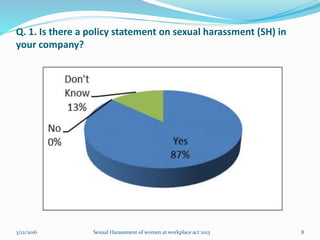
Q. 1. Is there a policy statement on sexual harassment (SH) in
your company?
3/12/2016 Sexual Harassment of women at workplace act 2013 8
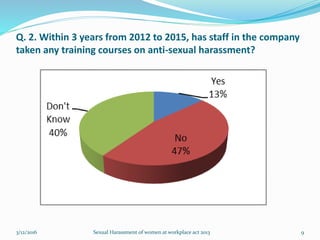
Q. 2. Within 3 years from 2012 to 2015, has staff in the company
taken any training courses on anti-sexual harassment?
3/12/2016 Sexual Harassment of women at workplace act 2013 9
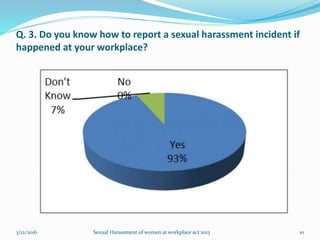
Q. 3. Do you know how to report a sexual harassment incident if
happened at your workplace?
3/12/2016 Sexual Harassment of women at workplace act 2013 10
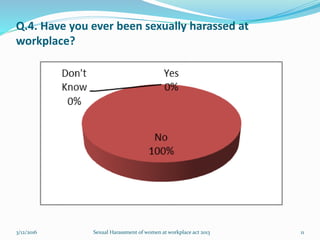
Q.4. Have you ever been sexually harassed at
workplace?
3/12/2016 Sexual Harassment of women at workplace act 2013 11
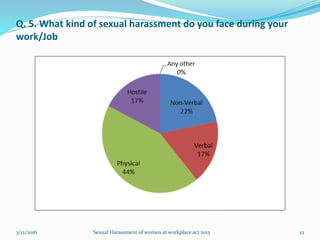
Q. 5. What kind of sexual harassment do you face during your
work/Job
3/12/2016 Sexual Harassment of women at workplace act 2013 12
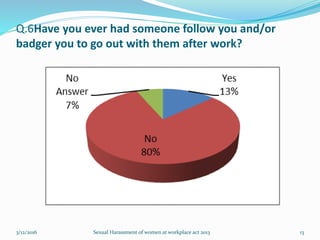
Q.6Have you ever had someone follow you and/or
badger you to go out with them after work?
3/12/2016 Sexual Harassment of women at workplace act 2013 13
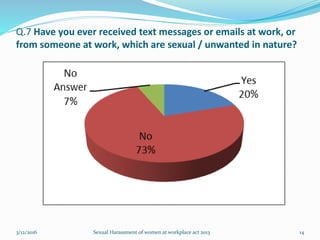
Q.7 Have you ever received text messages or emails at work, or
from someone at work, which are sexual / unwanted in nature?
3/12/2016 Sexual Harassment of women at workplace act 2013 14
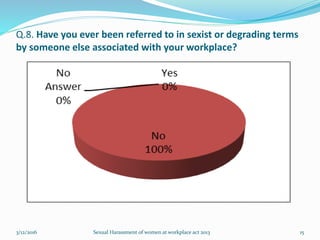
Q.8. Have you ever been referred to in sexist or degrading terms
by someone else associated with your workplace?
3/12/2016 Sexual Harassment of women at workplace act 2013 15
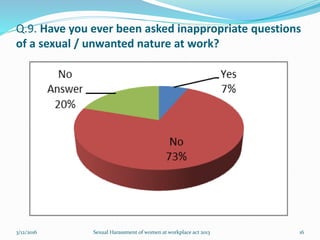
Q.9. Have you ever been asked inappropriate questions
of a sexual / unwanted nature at work?
3/12/2016 Sexual Harassment of women at workplace act 2013 16
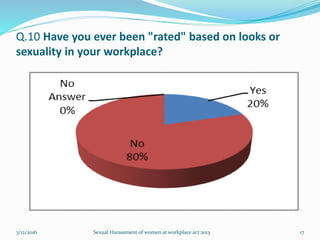
Q.10 Have you ever been "rated" based on looks or
sexuality in your workplace?
3/12/2016 Sexual Harassment of women at workplace act 2013 17
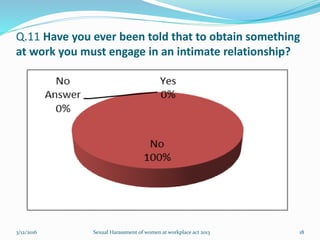
Q.11 Have you ever been told that to obtain something
at work you must engage in an intimate relationship?
3/12/2016 Sexual Harassment of women at workplace act 2013 18
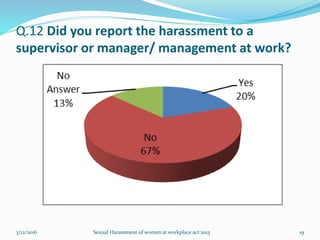
Q.12 Did you report the harassment to a
supervisor or manager/ management at work?
3/12/2016 Sexual Harassment of women at workplace act 2013 19
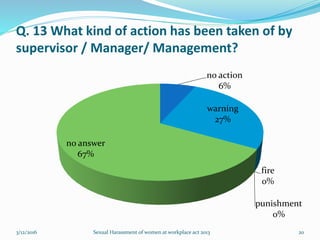
Q. 13 What kind of action has been taken of by
supervisor / Manager/ Management?
3/12/2016 Sexual Harassment of women at workplace act 2013 20
no action
6%
warning
27%
fire
0%
punishment
0%
no answer
67%
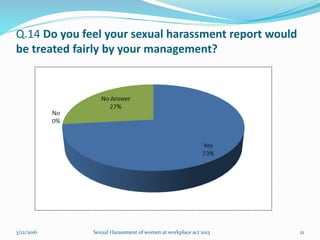
Q.14 Do you feel your sexual harassment report would
be treated fairly by your management?
3/12/2016 Sexual Harassment of women at workplace act 2013 21
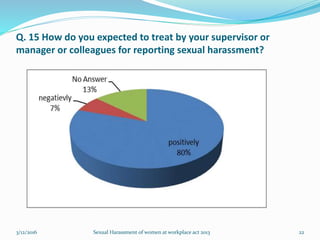
Q. 15 How do you expected to treat by your supervisor or
manager or colleagues for reporting sexual harassment?
3/12/2016 Sexual Harassment of women at workplace act 2013 22
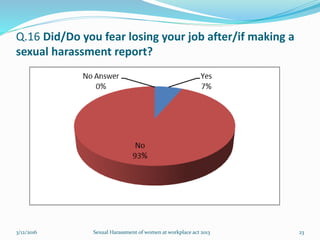
Q.16 Did/Do you fear losing your job after/if making a
sexual harassment report?
3/12/2016 Sexual Harassment of women at workplace act 2013 23
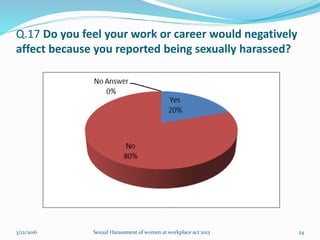
Q.17 Do you feel your work or career would negatively
affect because you reported being sexually harassed?
3/12/2016 Sexual Harassment of women at workplace act 2013 24
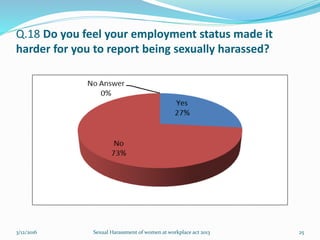
Q.18 Do you feel your employment status made it
harder for you to report being sexually harassed?
3/12/2016 Sexual Harassment of women at workplace act 2013 25
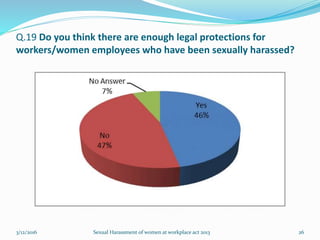
Q.19 Do you think there are enough legal protections for
workers/women employees who have been sexually harassed?
3/12/2016 Sexual Harassment of women at workplace act 2013 26
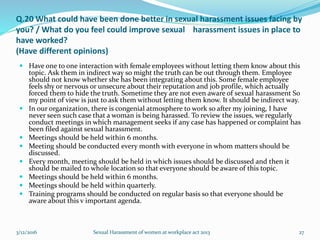
Q.20 What could have been done better in sexual harassment issues facing by
you? / What do you feel could improve sexual harassment issues in place to
have worked?
(Have different opinions)
 Have one to one interaction with female employees without letting them know about this
topic. Ask them in indirect way so might the truth can be out through them. Employee
should not know whether she has been integrating about this. Some female employee
feels shy or nervous or unsecure about their reputation and job profile, which actually
forced them to hide the truth. Sometime they are not even aware of sexual harassment So
my point of view is just to ask them without letting them know. It should be indirect way.
 In our organization, there is congenial atmosphere to work so after my joining, I have
never seen such case that a woman is being harassed. To review the issues, we regularly
conduct meetings in which management seeks if any case has happened or complaint has
been filed against sexual harassment.
 Meetings should be held within 6 months.
 Meeting should be conducted every month with everyone in whom matters should be
discussed.
 Every month, meeting should be held in which issues should be discussed and then it
should be mailed to whole location so that everyone should be aware of this topic.
 Meetings should be held within 6 months.
 Meetings should be held within quarterly.
 Training programs should be conducted on regular basis so that everyone should be
aware about this v important agenda.
3/12/2016 Sexual Harassment of women at workplace act 2013 27
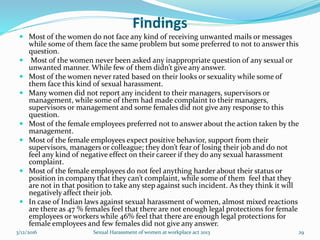
Findings
 Most of the female employees are aware about the sexual harassment policy under which they are
encouraged not to tolerate any unwelcome act.
 Most of the females have not conducted any anti-sexual training in the company.
 Most of the females know how to report any sexual harassment incident but they all are wrong in
their approach as no one exactly know the actually procedure, concerned person whom to complaint.
There is lack of information on taking action on any sexual harassment activity.
 According to responses of question no. 4, No female has ever faced any sexual harassment but if I go
for next statement i.e. Question No. 5, in my survey, I found every woman has faced SH in different
ways such as :
 44% - Physical (e.g. pulling someone’s clothing or inappropriate/accidental touching [e.g. patting,
touching, or pinching])
 22%- Non-verbal sex cues (e.g. looking someone up and down in a sexual way)
 17%- Verbal (e.g. dirty jokes related to sex, comments with sexual innuendoes)
 17%- Hostile environment (e.g. eye-catching sexual messages/ graffiti/ sexually obscene or suggestive
photographs on toilet door, wall, notice board, locker area, computer screen saver and personal
decorations, etc.)
 So it is concluded that females are not aware about the types of sexual harassment which an employer
is largely responsible to tell every employees either male or female clearly about every aspects of
Sexual harassment acts by conducting training programs.
 Most of the women employees never followed or badgered by anyone after work while few of them
have tolerated about this psychological sexual harassment and these thought better to ignore such act
instead of complaining to avoid later harassment in work which could be as per them.
3/12/2016 Sexual Harassment of women at workplace act 2013 28
Findings
 Most of the women do not face any kind of receiving unwanted mails or messages
while some of them face the same problem but some preferred to not to answer this
question.
 Most of the women never been asked any inappropriate question of any sexual or
unwanted manner. While few of them didn’t give any answer.
 Most of the women never rated based on their looks or sexuality while some of
them face this kind of sexual harassment.
 Many women did not report any incident to their managers, supervisors or
management, while some of them had made complaint to their managers,
supervisors or management and some females did not give any response to this
question.
 Most of the female employees preferred not to answer about the action taken by the
management.
 Most of the female employees expect positive behavior, support from their
supervisors, managers or colleague; they don’t fear of losing their job and do not
feel any kind of negative effect on their career if they do any sexual harassment
complaint.
 Most of the female employees do not feel anything harder about their status or
position in company that they can’t complaint, while some of them feel that they
are not in that position to take any step against such incident. As they think it will
negatively affect their job.
 In case of Indian laws against sexual harassment of women, almost mixed reactions
are there as 47 % females feel that there are not enough legal protections for female
employees or workers while 46% feel that there are enough legal protections for
female employees and few females did not give any answer.
3/12/2016 Sexual Harassment of women at workplace act 2013 29
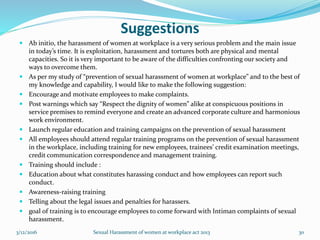
Suggestions
 Ab initio, the harassment of women at workplace is a very serious problem and the main issue
in today’s time. It is exploitation, harassment and tortures both are physical and mental
capacities. So it is very important to be aware of the difficulties confronting our society and
ways to overcome them.
 As per my study of “prevention of sexual harassment of women at workplace” and to the best of
my knowledge and capability, I would like to make the following suggestion:
 Encourage and motivate employees to make complaints.
 Post warnings which say “Respect the dignity of women” alike at conspicuous positions in
service premises to remind everyone and create an advanced corporate culture and harmonious
work environment.
 Launch regular education and training campaigns on the prevention of sexual harassment
 All employees should attend regular training programs on the prevention of sexual harassment
in the workplace, including training for new employees, trainees’ credit examination meetings,
credit communication correspondence and management training.
 Training should include :
 Education about what constitutes harassing conduct and how employees can report such
conduct.
 Awareness-raising training
 Telling about the legal issues and penalties for harassers.
 goal of training is to encourage employees to come forward with Intiman complaints of sexual
harassment.
3/12/2016 Sexual Harassment of women at workplace act 2013 30
Conclusions
 The survey found that there were poor awareness levels among female employees on
workplace sexual harassment and therefore they continued with their ordeal of suffering
due to fear of professional victimization.
 Some women respondents did not complain to supervisors or the management about
their experiences of sexual harassment at work and dealt with it on their own. They did
not report due to fear for further harassment, apprehension of adverse effect on their
employment, lack of confidence in the complaints mechanism, possible defamation or
threats from the perpetrators and other such reasons
 The Sexual Harassment Act has been enacted with the objective of
providing women protection against sexual harassment at the workplace and for the
prevention and Redressal of complaints of sexual harassment. It can be conclusively said
that senior management and human resource departments within the companies have
crucial role to perform when it comes to implementing the organization policies and
service rules provisions on sexual harassment.
 The Company reiterates its commitment to providing its women employees, a workplace
free from harassment/ discrimination and where every employee is treated with dignity
and respect.
 Human resource department in coordination with the legal department should issue a
written policy on sexual harassment and discrimination in general.
 This policy should distinctly mention the definition of sexual harassment giving relevant
examples of inappropriate behavior and outline procedure to be followed by the
organization to redress complaints of sexual harassment.
 Copy of the policy should be provided to every employee and especially to the new ones
at the time of induction training.
3/12/2016 Sexual Harassment of women at workplace act 2013 31
Conclusions
 The policy should be regularly reviewed as per changing times.
 A senior officer from the general administration / legal / human resource department
should be designated to monitor and evaluate implementation of the policy. This officer
can function as the link between management and the sexual harassment complaints
committee of the company.
 Managers and supervisors should be made aware and trained to recognize and prevent
instances of sexual harassment happening around them.
 Women employees need to be encouraged to not tolerate and report if there are incidents
of unwelcome behavior at work.
 The senior management needs to make sure that all allegations of sexual harassment
should be enquired into at the earliest and properly making sure that the rights of the
complainant and respondent are safeguarded.
 Proper and systematic records need to be maintained by the human resource
department / legal / general administration of the enquiries.
 Management should ensure that action is taken on the persons who are found guilty of
committing sexual harassment irrespective of their position in the company.
It is a known fact from studies that sexual harassment is underreported form of
violence against women. In the context of India women will not choose to report
harassment at the first instance because they do not want to be seen as challenging the
authority and creating Disharmony in the organization.
It is better to emphasize on giving education on policies against harassment
rather than pushing the issue under carpet. It is important to remind the male employees
consistently that the organization has zero tolerance to sexual harassment.
3/12/2016 Sexual Harassment of women at workplace act 2013 32
Any Question ?
3/12/2016 33
THANK YOU
HAVE A NICE DAY
Manisha Sharma
MBA/ University No. 1459241
Rayat Institute of Management, Ropar
3/12/2016 34

Manisha sharma

  • 1.
    Presented by: ManishaSharma Rayat Institute of Management , Ropar 3/12/2016 1
  • 2.
     Sun PharmaceuticalIndustries Limited,established in 1983 by Mr. Dilip shanghvi in Vapi, MNC headquartered in Mumbai, Maharashtra that manufactures and sells pharmaceutical formulations and active pharmaceutical ingredients (APIs) primarily in India and the United States. It’s the top pharma company in India & 5th largest specialty generic company globally.  The company is engaged in manufacturing of product in the following therapy areas:  CNS disorders  Cardiology  Diabetes and Metabolic disorders  Gastroenterology  Ophthalmology  Oncology  Pain  Allergy, Asthma and Inflammation  Gynecological 3/12/2016 Sexual Harassment of women at workplace act 2013 2 Company Profile
  • 3.
    About Project  Aworking woman is likely to have such incident at work - a man is treating her not as an employee or a co-worker but as a possible lover. He may often praise how nice she looks, massage her shoulder, put his arm around her waist, and invite her to lunch or dinner to discuss her future at the company. It will probably make the woman feel uncomfortable. Some females may choose to tolerate in order to survive, but they feel more and more depressed and may eventually collapse. Some others may fight but without success, and may be subject to retaliation and forced to resign or be fired. In fact, what these women have experienced is called “sexual harassment”.  Then The increasing rate of women participation in workplaces made it necessary for the Legislature to enact Act focusing on prevention of Sexual Harassment at workplace as well as Redressal to the same. The Act is named as, The Sexual Harassment at Workplace (Prevention, Prohibition and Redressal) Act; 2013.which was finally enacted in the year 2013 for the prevention of sexual harassment against women at workplace in the whole of India. 3/12/2016 Sexual Harassment of women at workplace act 2013 3
  • 4.
    Objective of Study To study the importance or need of safe working environment for females  To study those factors that affects them during their work.  To study the level of stress while facing sexual harassment  To find the solution of problems they are facing. 3/12/2016 Sexual Harassment of women at workplace act 2013 4
  • 5.
    Reason for thisAct  Sexual harassment at a workplace is considered violation of women ‘s right to equality, life and liberty. It creates an insecure and hostile work environment, which discourage women’s participation in work, thereby adversely affecting their social and economic empowerment and the goal of inclusive growth.  With more and more women joining the workforce, both in organised and unorganised sectors ensuring an enabling working environment for women through legislation is felt imperative by the Government 3/12/2016 Sexual Harassment of women at workplace act 2013 5
  • 6.
    Research Methodology  Populationarea: Sun Pharma industries ltd., Toansa  Population size: Total 15 female emoloyees  Sampling technique: As the study based on “prevention of sexual harassment of women at workplace” and to find out how much women feel safe and open to work at their workplace so sample is only limited to female candidates. And as the number of female employees in company is 15 only so whole population has been taken for survey. For this purpose questionnaire was prepared with 20 questions and asked to answer of their choice  Sources of Data Collection  Primary Data: Information from survey of the female-employees in the company. The data has been collected directly from the structural questionnaire.  Secondary Data: Secondary data was collected through the past research and websites. 3/12/2016 Sexual Harassment of women at workplace act 2013 6
  • 7.
    DATA ANALYSIS & INTERPRETATION 3/12/2016 SexualHarassment of women at workplace act 2013 7
  • 8.
    Q. 1. Isthere a policy statement on sexual harassment (SH) in your company? 3/12/2016 Sexual Harassment of women at workplace act 2013 8
  • 9.
    Q. 2. Within3 years from 2012 to 2015, has staff in the company taken any training courses on anti-sexual harassment? 3/12/2016 Sexual Harassment of women at workplace act 2013 9
  • 10.
    Q. 3. Doyou know how to report a sexual harassment incident if happened at your workplace? 3/12/2016 Sexual Harassment of women at workplace act 2013 10
  • 11.
    Q.4. Have youever been sexually harassed at workplace? 3/12/2016 Sexual Harassment of women at workplace act 2013 11
  • 12.
    Q. 5. Whatkind of sexual harassment do you face during your work/Job 3/12/2016 Sexual Harassment of women at workplace act 2013 12
  • 13.
    Q.6Have you everhad someone follow you and/or badger you to go out with them after work? 3/12/2016 Sexual Harassment of women at workplace act 2013 13
  • 14.
    Q.7 Have youever received text messages or emails at work, or from someone at work, which are sexual / unwanted in nature? 3/12/2016 Sexual Harassment of women at workplace act 2013 14
  • 15.
    Q.8. Have youever been referred to in sexist or degrading terms by someone else associated with your workplace? 3/12/2016 Sexual Harassment of women at workplace act 2013 15
  • 16.
    Q.9. Have youever been asked inappropriate questions of a sexual / unwanted nature at work? 3/12/2016 Sexual Harassment of women at workplace act 2013 16
  • 17.
    Q.10 Have youever been "rated" based on looks or sexuality in your workplace? 3/12/2016 Sexual Harassment of women at workplace act 2013 17
  • 18.
    Q.11 Have youever been told that to obtain something at work you must engage in an intimate relationship? 3/12/2016 Sexual Harassment of women at workplace act 2013 18
  • 19.
    Q.12 Did youreport the harassment to a supervisor or manager/ management at work? 3/12/2016 Sexual Harassment of women at workplace act 2013 19
  • 20.
    Q. 13 Whatkind of action has been taken of by supervisor / Manager/ Management? 3/12/2016 Sexual Harassment of women at workplace act 2013 20 no action 6% warning 27% fire 0% punishment 0% no answer 67%
  • 21.
    Q.14 Do youfeel your sexual harassment report would be treated fairly by your management? 3/12/2016 Sexual Harassment of women at workplace act 2013 21
  • 22.
    Q. 15 Howdo you expected to treat by your supervisor or manager or colleagues for reporting sexual harassment? 3/12/2016 Sexual Harassment of women at workplace act 2013 22
  • 23.
    Q.16 Did/Do youfear losing your job after/if making a sexual harassment report? 3/12/2016 Sexual Harassment of women at workplace act 2013 23
  • 24.
    Q.17 Do youfeel your work or career would negatively affect because you reported being sexually harassed? 3/12/2016 Sexual Harassment of women at workplace act 2013 24
  • 25.
    Q.18 Do youfeel your employment status made it harder for you to report being sexually harassed? 3/12/2016 Sexual Harassment of women at workplace act 2013 25
  • 26.
    Q.19 Do youthink there are enough legal protections for workers/women employees who have been sexually harassed? 3/12/2016 Sexual Harassment of women at workplace act 2013 26
  • 27.
    Q.20 What couldhave been done better in sexual harassment issues facing by you? / What do you feel could improve sexual harassment issues in place to have worked? (Have different opinions)  Have one to one interaction with female employees without letting them know about this topic. Ask them in indirect way so might the truth can be out through them. Employee should not know whether she has been integrating about this. Some female employee feels shy or nervous or unsecure about their reputation and job profile, which actually forced them to hide the truth. Sometime they are not even aware of sexual harassment So my point of view is just to ask them without letting them know. It should be indirect way.  In our organization, there is congenial atmosphere to work so after my joining, I have never seen such case that a woman is being harassed. To review the issues, we regularly conduct meetings in which management seeks if any case has happened or complaint has been filed against sexual harassment.  Meetings should be held within 6 months.  Meeting should be conducted every month with everyone in whom matters should be discussed.  Every month, meeting should be held in which issues should be discussed and then it should be mailed to whole location so that everyone should be aware of this topic.  Meetings should be held within 6 months.  Meetings should be held within quarterly.  Training programs should be conducted on regular basis so that everyone should be aware about this v important agenda. 3/12/2016 Sexual Harassment of women at workplace act 2013 27
  • 28.
    Findings  Most ofthe female employees are aware about the sexual harassment policy under which they are encouraged not to tolerate any unwelcome act.  Most of the females have not conducted any anti-sexual training in the company.  Most of the females know how to report any sexual harassment incident but they all are wrong in their approach as no one exactly know the actually procedure, concerned person whom to complaint. There is lack of information on taking action on any sexual harassment activity.  According to responses of question no. 4, No female has ever faced any sexual harassment but if I go for next statement i.e. Question No. 5, in my survey, I found every woman has faced SH in different ways such as :  44% - Physical (e.g. pulling someone’s clothing or inappropriate/accidental touching [e.g. patting, touching, or pinching])  22%- Non-verbal sex cues (e.g. looking someone up and down in a sexual way)  17%- Verbal (e.g. dirty jokes related to sex, comments with sexual innuendoes)  17%- Hostile environment (e.g. eye-catching sexual messages/ graffiti/ sexually obscene or suggestive photographs on toilet door, wall, notice board, locker area, computer screen saver and personal decorations, etc.)  So it is concluded that females are not aware about the types of sexual harassment which an employer is largely responsible to tell every employees either male or female clearly about every aspects of Sexual harassment acts by conducting training programs.  Most of the women employees never followed or badgered by anyone after work while few of them have tolerated about this psychological sexual harassment and these thought better to ignore such act instead of complaining to avoid later harassment in work which could be as per them. 3/12/2016 Sexual Harassment of women at workplace act 2013 28
  • 29.
    Findings  Most ofthe women do not face any kind of receiving unwanted mails or messages while some of them face the same problem but some preferred to not to answer this question.  Most of the women never been asked any inappropriate question of any sexual or unwanted manner. While few of them didn’t give any answer.  Most of the women never rated based on their looks or sexuality while some of them face this kind of sexual harassment.  Many women did not report any incident to their managers, supervisors or management, while some of them had made complaint to their managers, supervisors or management and some females did not give any response to this question.  Most of the female employees preferred not to answer about the action taken by the management.  Most of the female employees expect positive behavior, support from their supervisors, managers or colleague; they don’t fear of losing their job and do not feel any kind of negative effect on their career if they do any sexual harassment complaint.  Most of the female employees do not feel anything harder about their status or position in company that they can’t complaint, while some of them feel that they are not in that position to take any step against such incident. As they think it will negatively affect their job.  In case of Indian laws against sexual harassment of women, almost mixed reactions are there as 47 % females feel that there are not enough legal protections for female employees or workers while 46% feel that there are enough legal protections for female employees and few females did not give any answer. 3/12/2016 Sexual Harassment of women at workplace act 2013 29
  • 30.
    Suggestions  Ab initio,the harassment of women at workplace is a very serious problem and the main issue in today’s time. It is exploitation, harassment and tortures both are physical and mental capacities. So it is very important to be aware of the difficulties confronting our society and ways to overcome them.  As per my study of “prevention of sexual harassment of women at workplace” and to the best of my knowledge and capability, I would like to make the following suggestion:  Encourage and motivate employees to make complaints.  Post warnings which say “Respect the dignity of women” alike at conspicuous positions in service premises to remind everyone and create an advanced corporate culture and harmonious work environment.  Launch regular education and training campaigns on the prevention of sexual harassment  All employees should attend regular training programs on the prevention of sexual harassment in the workplace, including training for new employees, trainees’ credit examination meetings, credit communication correspondence and management training.  Training should include :  Education about what constitutes harassing conduct and how employees can report such conduct.  Awareness-raising training  Telling about the legal issues and penalties for harassers.  goal of training is to encourage employees to come forward with Intiman complaints of sexual harassment. 3/12/2016 Sexual Harassment of women at workplace act 2013 30
  • 31.
    Conclusions  The surveyfound that there were poor awareness levels among female employees on workplace sexual harassment and therefore they continued with their ordeal of suffering due to fear of professional victimization.  Some women respondents did not complain to supervisors or the management about their experiences of sexual harassment at work and dealt with it on their own. They did not report due to fear for further harassment, apprehension of adverse effect on their employment, lack of confidence in the complaints mechanism, possible defamation or threats from the perpetrators and other such reasons  The Sexual Harassment Act has been enacted with the objective of providing women protection against sexual harassment at the workplace and for the prevention and Redressal of complaints of sexual harassment. It can be conclusively said that senior management and human resource departments within the companies have crucial role to perform when it comes to implementing the organization policies and service rules provisions on sexual harassment.  The Company reiterates its commitment to providing its women employees, a workplace free from harassment/ discrimination and where every employee is treated with dignity and respect.  Human resource department in coordination with the legal department should issue a written policy on sexual harassment and discrimination in general.  This policy should distinctly mention the definition of sexual harassment giving relevant examples of inappropriate behavior and outline procedure to be followed by the organization to redress complaints of sexual harassment.  Copy of the policy should be provided to every employee and especially to the new ones at the time of induction training. 3/12/2016 Sexual Harassment of women at workplace act 2013 31
  • 32.
    Conclusions  The policyshould be regularly reviewed as per changing times.  A senior officer from the general administration / legal / human resource department should be designated to monitor and evaluate implementation of the policy. This officer can function as the link between management and the sexual harassment complaints committee of the company.  Managers and supervisors should be made aware and trained to recognize and prevent instances of sexual harassment happening around them.  Women employees need to be encouraged to not tolerate and report if there are incidents of unwelcome behavior at work.  The senior management needs to make sure that all allegations of sexual harassment should be enquired into at the earliest and properly making sure that the rights of the complainant and respondent are safeguarded.  Proper and systematic records need to be maintained by the human resource department / legal / general administration of the enquiries.  Management should ensure that action is taken on the persons who are found guilty of committing sexual harassment irrespective of their position in the company. It is a known fact from studies that sexual harassment is underreported form of violence against women. In the context of India women will not choose to report harassment at the first instance because they do not want to be seen as challenging the authority and creating Disharmony in the organization. It is better to emphasize on giving education on policies against harassment rather than pushing the issue under carpet. It is important to remind the male employees consistently that the organization has zero tolerance to sexual harassment. 3/12/2016 Sexual Harassment of women at workplace act 2013 32
  • 33.
  • 34.
    THANK YOU HAVE ANICE DAY Manisha Sharma MBA/ University No. 1459241 Rayat Institute of Management, Ropar 3/12/2016 34