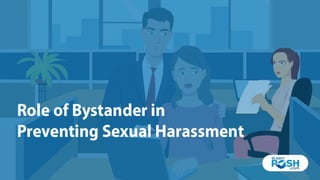
THE SEXUAL HARASSMENT OF WOMEN AT WORKPLACE
(PREVENTION, PROHIBITION AND REDRESSAL) ACT 2013
Objective : Prevention + Prohibition + Redressal
What about me?
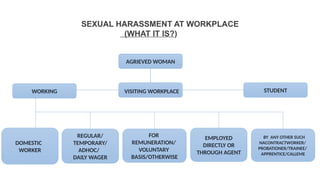
SEXUAL HARASSMENT AT WORKPLACE
(WHAT IT IS?)
AGRIEVED WOMAN
WORKING STUDENT
DOMESTIC
WORKER
REGULAR/
TEMPORARY/
ADHOC/
DAILY WAGER
FOR
REMUNERATION/
VOLUNTARY
BASIS/OTHERWISE
EMPLOYED
DIRECTLY OR
THROUGH AGENT
BY ANY OTHER SUCH
NACONTRACTWORKER/
PROBATIONER/TRAINEE/
APPRENTICE/CALLEME
VISITING WORKPLACE
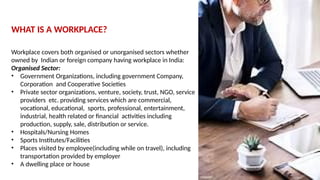
WHAT IS A WORKPLACE?
Workplace covers both organised or unorganised sectors whether
owned by Indian or foreign company having workplace in India:
Organised Sector:
• Government Organizations, including government Company,
Corporation and Cooperative Societies
• Private sector organizations, venture, society, trust, NGO, service
providers etc. providing services which are commercial,
vocational, educational, sports, professional, entertainment,
industrial, health related or financial activities including
production, supply, sale, distribution or service.
• Hospitals/Nursing Homes
• Sports Institutes/Facilities
• Places visited by employee(including while on travel), including
transportation provided by employer
• A dwelling place or house
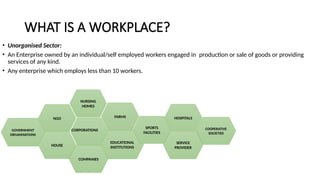
WHAT IS A WORKPLACE?
• Unorganised Sector:
• An Enterprise owned by an individual/self employed workers engaged in production or sale of goods or providing
services of any kind.
• Any enterprise which employs less than 10 workers.
GOVERNMENT
ORGANISATIONS
NGO
HOUSE
NURSING
HOMES
COMPANIES
FARMS
EDUCATIONAL
INSTITUTIONS
SPORTS
FACILITIES
HOSPITALS
SERVICE
PROVIDER
COOPERATIVE
SOCIETIES
CORPORATIONS
WHAT IS SEXUAL HARASSMENT?
Sexual Harassment
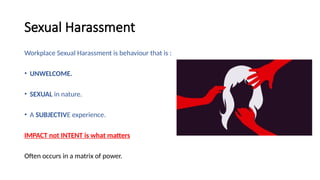
Workplace Sexual Harassment is behaviour that is :
• UNWELCOME.
• SEXUAL in nature.
• A SUBJECTIVE experience.
IMPACT not INTENT is what matters
Often occurs in a matrix of power.
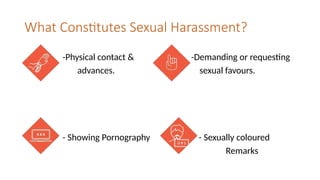
What Constitutes Sexual Harassment?
-Physical contact & -Demanding or requesting
advances. sexual favours.
- Showing Pornography - Sexually coloured
Remarks
Sexual Harassment in the
Workplace can be categorized
into 2 groups:
Quid Pro Quo Hostile Environment
Quid Pro Quo
Quid pro quo’ means ‘this for that’, an exchange of one thing for
another. Quid pro quo sexual harassment takes place if :
• Sexual favours are asked in exchange for any kind of special treatment
on the job.
• An employee threatens an associate if he/she does not consent to
such sexual advances or favours.
The act of ‘asking’ may either be verbal or implied & ‘sexual conduct’ may be verbal or physical .In either case, it must be.
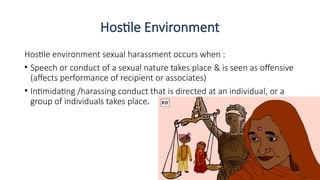
Hostile Environment
Hostile environment sexual harassment occurs when :
• Speech or conduct of a sexual nature takes place & is seen as offensive
(affects performance of recipient or associates)
• Intimidating /harassing conduct that is directed at an individual, or a
group of individuals takes place.
IMPACT vs INTENT
• The Act focuses on the recipient’s perception and the effect of the behavior rather than the
intention behind it.
• In criminal law, intent (or mens rea) is a critical factor. To hold someone criminally liable, it often
must be proven that they intended to commit the wrongful act. However, under the POSH Act,
intent takes a backseat, and the focus shifts to the effect of the behavior on the complainant. This
shift is intentional, rooted in the nature of sexual harassment and its consequences.
• The POSH Act, 2013, is a progressive law that prioritizes the impact of behavior on victims over
the intent of the accused. This approach is critical in addressing the subjective nature of
harassment, empowering women to speak up, and fostering a culture of respect and equality in
the workplace. By focusing on impact, the law shifts the onus onto individuals and organizations to
create environments where dignity is upheld, and unwelcome behaviors are addressed swiftly and
fairly.
• The Act’s provisions, supported by judicial precedents and societal examples, underscore that
sexual harassment is about the lived experiences of victims. For a workplace to truly be safe, it is
the recipient’s perspective and the effect of actions that must take precedence, ensuring that no
woman feels unsafe or unheard in her professional environment.
Is
this
Sexual
Harassment
Or
Not?
Aravind and Suguna are part of a team at an organisation.
Suguna reports to Aravind.
Aravind constantly tells Suguna that they should go out somewhere
after work hours, perhaps for a late night movie or dinner.
Suguna is uncomfortable but smiles and says she is busy most often!
One day, Aravind tells Suguna that if she turns down his request again,
her ratings will go down in her monthly review.
1
IS THIS SEXUAL HARASSMENT OR NOT?
Neha is part of team that reports to Neeraj who is her college Senior.
Neha is very good at her work and is assigned the most prestigious
project in the company instead of Nirav who is the senior in the team
and has a lot more work experience than Neha.
Nirav is very upset and believes that Neha has been assigned the
coveted project because they must be having a relationship. He jokes
about this with other team members and slowly this spreads around in
the company.
2
IS THIS SEXUAL HARASSMENT OR NOT?
Reshma just joined as a fresher and has been undergoing training. One of
the trainers was Rashid, who was handling the New Product development.
Reshma wanted to be part of his team and approached him. On seeing her
enthusiasm and performance Rashid ensured that she would be joining Rashid
team post the training..
Reshma joined Rashid’s team. Rashid asked Reshma out for dinner a few times
and she agreed willingly. Slowly the workload increased and once when Rashid
asked Reshma out to Dinner, she refused. Rashid continued to keep calling her
and sent multitude of emails.
IS THIS SEXUAL HARASSMENT OR NOT?
3
Suman sent across pictures of some scantily clad women to Joe.
Joe requested Suman not to send him such obscene pictures in the
future as he was not comfortable with the same. But Suman continued.
IS THIS AN EXAMPLE OF HOSTILE ENVIRONMENT
SEXUAL HARASSMENT?
4
Abhi was entering the elevator and Aasuthosh came up from behind
tapped on her shoulders and told her She looked hot in the red dress.
Abhi felt uncomfortable and stared at Aasuthosh and told him to keep his hands
off and use discretion in his language. Aasuthosh apologized and it never
happened again.
IS ABHI BEING SEXUALLY HARASSED BY AASUTHOSH?
5
Jayanthi and Ram joined together as trainees. After one year Ram started asking
Jayanthi to go out with him, which she refused. Ram sent a message that I love you
and you are my life. Jayanthi was shocked and was so frightened and took off for
two days from work.
Ram sent out another message Where are you? I miss you. Jayanthi filed a
harassment case against him.
Ram cares for Jayanthi and wants a relationship with her.
IS THIS SEXUAL HARASSMENT OR NOT?
6
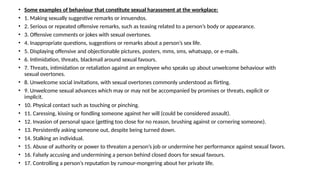
• Some examples of behaviour that constitute sexual harassment at the workplace:
• 1. Making sexually suggestive remarks or innuendos.
• 2. Serious or repeated offensive remarks, such as teasing related to a person’s body or appearance.
• 3. Offensive comments or jokes with sexual overtones.
• 4. Inappropriate questions, suggestions or remarks about a person’s sex life.
• 5. Displaying offensive and objectionable pictures, posters, mms, sms, whatsapp, or e-mails.
• 6. Intimidation, threats, blackmail around sexual favours.
• 7. Threats, intimidation or retaliation against an employee who speaks up about unwelcome behaviour with
sexual overtones.
• 8. Unwelcome social invitations, with sexual overtones commonly understood as flirting.
• 9. Unwelcome sexual advances which may or may not be accompanied by promises or threats, explicit or
implicit.
• 10. Physical contact such as touching or pinching.
• 11. Caressing, kissing or fondling someone against her will (could be considered assault).
• 12. Invasion of personal space (getting too close for no reason, brushing against or cornering someone).
• 13. Persistently asking someone out, despite being turned down.
• 14. Stalking an individual.
• 15. Abuse of authority or power to threaten a person’s job or undermine her performance against sexual favors.
• 16. Falsely accusing and undermining a person behind closed doors for sexual favours.
• 17. Controlling a person’s reputation by rumour-mongering about her private life.
• Following-up on work absences.
• Requiring performance to job standards.
• Reprimands in relation to work/meeting targets or deadlines.
• Work-related stress e.g. meeting deadlines or quality standards.
• Touching/brushing against/pushing without a sexual connotation.
• Constructive feedback about work.
What is NOT Workplace Sexual Harassment?
The POSH Act, 2013, does not limit workplace harassment to physical
offices. The Act states that sexual harassment can occur "in connection
with work," which includes remote work, online interactions, and
virtual meetings.
• If an employee faces unwelcome sexual advances, inappropriate
messages, or verbal harassment via email, chat, or video calls, it still
counts as workplace sexual harassment.
• If an employee is harassed by a colleague, manager, client, or vendor
through digital platforms, they have the right to file a POSH
complaint.
What is Considered Online Sexual Harassment in the Workplace?
Sexual harassment in virtual workplaces can take many forms. The most
common types include:
A. Inappropriate Messages and Emails
• Sending sexually suggestive messages, texts, or emails.
• Making inappropriate comments about someone's appearance or personal
life.
• Sharing double-meaning jokes or sexually explicit content via email or chat.
• Persistently asking personal or sexual questions in work-related chats.
Example: A manager keeps sending personal messages to a female employee
on WhatsApp, asking her to "send a picture" or "meet outside work."
B. Unwelcome Advances on Video Calls
•Making inappropriate sexual comments during Zoom/Teams meetings.
•Staring at someone in a way that makes them uncomfortable.
•Adjusting the camera to show inappropriate gestures or body language.
•Insisting that a colleague turn on their camera unnecessarily to observe them.
•Using virtual backgrounds, filters, or stickers in a sexually suggestive manner.
Example: A male colleague keeps making inappropriate jokes about how a female coworker "looks
great on video" and should "dress up more often for Zoom calls.“
C. Cyberstalking and Unwanted Attention
Monitoring someone's online activity without their consent.
Repeatedly calling, texting, or emailing outside work hours despite clear discomfort.
Adding a coworker to personal social media platforms without consent and sending
inappropriate messages.
Example: A coworker constantly watches when a female employee is "online" on Microsoft
Teams and messages her at odd hours, even when she is not working.
D. Sharing Inappropriate or Explicit Content
• Sending pornographic images, videos, or links to colleagues.
• Displaying sexually explicit wallpapers or desktop backgrounds during screen sharing.
• Sending inappropriate GIFs or memes in workplace group chats.
• Example: During a work meeting, an employee "accidentally" shares an explicit image
or video while screen-sharing, making others uncomfortable.
E. Coercion and Quid Pro Quo Harassment
• "Work favours" in exchange for personal favours (e.g., promotions or salary hikes).
• Threatening to deny work opportunities unless personal requests are fulfilled.
• Using remote work as an excuse to create one-on-one online meetings for
inappropriate discussions.
Example: A manager tells a junior female employee that he will "recommend her for a
promotion" if she agrees to a private video call after work hours.
WELCOME
vs
UNWELCOME BEHAVIOUR
What is meant by “Unwelcome” ?
• Any conduct or behaviour is unwelcome if:
• the recipient does not consent to it.
• regards it as offensive.
• Even if the victim does not complain, it doesn’t necessarily imply that
the conduct is welcome.
Some comments and/or advances are blatant and crude and are
inherently offensive: these will almost always be deemed as
unwelcome.
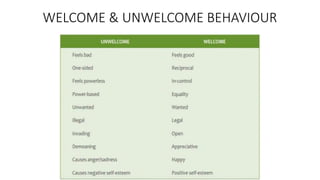
WELCOME & UNWELCOME BEHAVIOUR
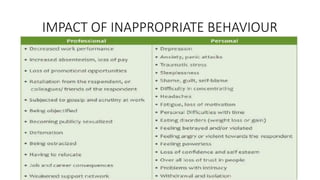
IMPACT OF INAPPROPRIATE BEHAVIOUR
How to File a Complaint
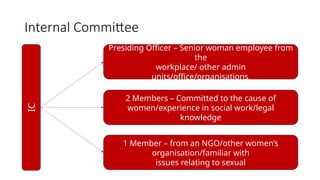
Internal Committee
Presiding Officer – Senior woman employee from
the
workplace/ other admin
units/office/organisations.
2 Members – Committed to the cause of
women/experience in social work/legal
knowledge
1 Member – from an NGO/other women’s
organisation/familiar with
issues relating to sexual
IC
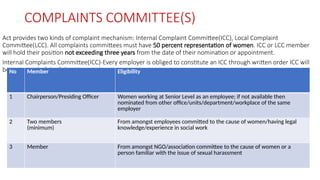
COMPLAINTS COMMITTEE(S)
Act provides two kinds of complaint mechanism: Internal Complaint Committee(ICC), Local Complaint
Committee(LCC). All complaints committees must have 50 percent representation of women. ICC or LCC member
will hold their position not exceeding three years from the date of their nomination or appointment.
Internal Complaints Committee(ICC)-Every employer is obliged to constitute an ICC through written order ICC will
be composed of the following member:
No Member Eligibility
1 Chairperson/Presiding Officer Women working at Senior Level as an employee; if not available then
nominated from other office/units/department/workplace of the same
employer
2 Two members
(minimum)
From amongst employees committed to the cause of women/having legal
knowledge/experience in social work
3 Member From amongst NGO/association committee to the cause of women or a
person familiar with the issue of sexual harassment
COMPLAINTS COMMITTEE(S)
Where office/Administrative units of a workplace are located in different places,
division or sub division, an ICC has to be set up at administrative unit and office.
Local complaints Committee(LCC)- District Officer will constitute an LCC in every
district so as to enable women in the unorganised sector or small establishments to
work in an environment free of sexual harassment. LCC will receive complaints:
1. From women working in an organisation having less than 10 workers
2. When the complaint is against the employer itself
3. From domestic workers up at administrative unit and office.
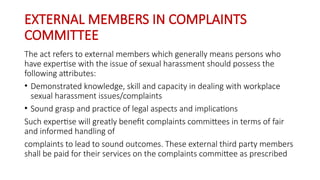
EXTERNAL MEMBERS IN COMPLAINTS
COMMITTEE
The act refers to external members which generally means persons who
have expertise with the issue of sexual harassment should possess the
following attributes:
• Demonstrated knowledge, skill and capacity in dealing with workplace
sexual harassment issues/complaints
• Sound grasp and practice of legal aspects and implications
Such expertise will greatly benefit complaints committees in terms of fair
and informed handling of
complaints to lead to sound outcomes. These external third party members
shall be paid for their services on the complaints committee as prescribed
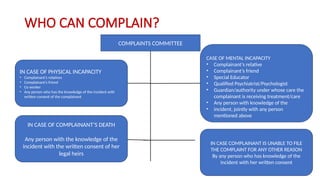
WHO CAN COMPLAIN?
COMPLAINTS COMMITTEE
IN CASE OF PHYSICAL INCAPACITY
• Complainant’s relatives
• Complainant’s friend
• Co worker
• Any person who has the knowledge of the incident with
written consent of the complainant
IN CASE OF COMPLAINANT’S DEATH
Any person with the knowledge of the
incident with the written consent of her
legal heirs
CASE OF MENTAL INCAPACITY
• Complainant’s relative
• Complainant’s friend
• Special Educator
• Qualified Psychiatrist/Psychologist
• Guardian/authority under whose care the
complainant is receiving treatment/care
• Any person with knowledge of the
• incident, jointly with any person
mentioned above
IN CASE COMPLAINANT IS UNABLE TO FILE
THE COMPLAINT FOR ANY OTHER REASON
By any person who has knowledge of the
incident with her written consent
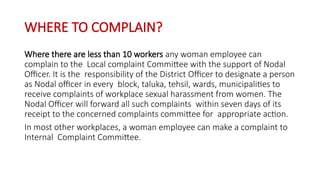
WHERE TO COMPLAIN?
Where there are less than 10 workers any woman employee can
complain to the Local complaint Committee with the support of Nodal
Officer. It is the responsibility of the District Officer to designate a person
as Nodal officer in every block, taluka, tehsil, wards, municipalities to
receive complaints of workplace sexual harassment from women. The
Nodal Officer will forward all such complaints within seven days of its
receipt to the concerned complaints committee for appropriate action.
In most other workplaces, a woman employee can make a complaint to
Internal Complaint Committee.
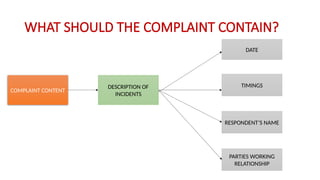
WHAT SHOULD THE COMPLAINT CONTAIN?
COMPLAINT CONTENT
DESCRIPTION OF
INCIDENTS
DATE
TIMINGS
RESPONDENT’S NAME
PARTIES WORKING
RELATIONSHIP
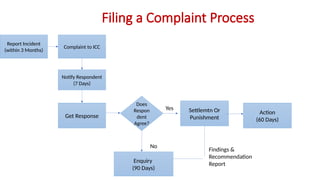
Filing a Complaint Process
Report Incident
(within 3 Months)
Complaint to ICC
Notify Respondent
(7 Days)
Get Response
Settlemtn Or
Punishment
Action
(60 Days)
Enquiry
(90 Days)
Does
Respon
dent
Agree?
Yes
No
Findings &
Recommendation
Report
Indian Law on Sexual Harassment
• The Constitution of India
• The Sexual Harassment of Women at Workplace (Prevention,
Prohibition and Redressal) Act, 2013
• Vishaka Vs. State of Rajasthan
• The Indian Penal Code, 1860
Sexual harassment is a violation of the
constitutionally guaranteed fundamental rights:
• Articles 14 and 15: Right to equality
• Article 21: Right to life - to live with dignity
• Article 19(1)(g) - Right to practice any profession/ trade/ occupation/
business, i.e., a right to a safe environment free from harassment
The Indian Penal Code Provision
• Section 509 - Word, gesture or act intended to insult the modesty of a woman;
• Offence:
• utterance of any word,
• making any sound or gesture
• exhibiting any object
• With an intention to intrude upon the privacy of such woman
• Punishment: Simple imprisonment up to 3 years + fine
• Nature of offence: Cognizable
• Amendment to the Indian Penal Code Provision
• Section 354 A: Sexual harassment and punishment for sexual harassment
SEXUAL HARASSMENT
COMPLAINT PROCESS
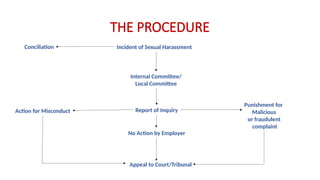
THE PROCEDURE
Incident of Sexual Harassment
Conciliation
Internal Committee/
Local Committee
Report of Inquiry
No Action by Employer
Appeal to Court/Tribunal
Action for Misconduct
Punishment for
Malicious
or fraudulent
complaint
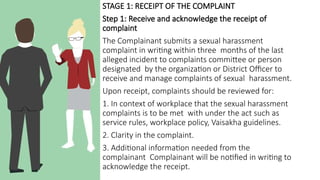
STAGE 1: RECEIPT OF THE COMPLAINT
Step 1: Receive and acknowledge the receipt of
complaint
The Complainant submits a sexual harassment
complaint in writing within three months of the last
alleged incident to complaints committee or person
designated by the organization or District Officer to
receive and manage complaints of sexual harassment.
Upon receipt, complaints should be reviewed for:
1. In context of workplace that the sexual harassment
complaints is to be met with under the act such as
service rules, workplace policy, Vaisakha guidelines.
2. Clarity in the complaint.
3. Additional information needed from the
complainant Complainant will be notified in writing to
acknowledge the receipt.
ELEMENTS OF BEHAVIOUR
Complaint needs to satisfy the following elements of behaviour:
• The respondent displayed a potentially improper and/or offensive
conduct which may come within workplace sexual harassment.
• The behaviour was directed at the complainant.
• The complainant experienced harm..
• The behaviour occurred in the workplace or at any location/any event
related to work.
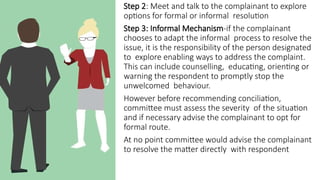
Step 2: Meet and talk to the complainant to explore
options for formal or informal resolution
Step 3: Informal Mechanism-if the complainant
chooses to adapt the informal process to resolve the
issue, it is the responsibility of the person designated
to explore enabling ways to address the complaint.
This can include counselling, educating, orienting or
warning the respondent to promptly stop the
unwelcomed behaviour.
However before recommending conciliation,
committee must assess the severity of the situation
and if necessary advise the complainant to opt for
formal route.
At no point committee would advise the complainant
to resolve the matter directly with respondent
Step 4:Formal Mechanism-
a. If the complainant opts for formal mechanism, or if the
nature of complaint is serious or which calls for formal
redress, then complaint committee responds to the complaint.
b. Complaint committee or members must be free from
conflict of interest with either the concerned parties or with
the outcome.
c. Ensure that the independent third party member has sound
knowledge, skill and experience in dealing with workplace
sexual harassment complaints.
Step 5:Respondent and Response-
a. As per the procedure provided in the service rules or in the
absence of the same
b. Within seven days of receiving a complaint, the complaints
committee will inform the respondent in writing that a
complaint has been received.
c,. The respondent will have an opportunity to respond to the
complaint in writing within ten days thereafter
STAGE 2:PLANNING CAREFULLY
Step 6:Prepare the file
A sound inquiry relies on sound preparation. This
includes taking into account the following steps:
1. Documentation
Create an independent confidential file of the
complaint and all subsequent related
documentation.
2. Review Law & Policy
Have a clear knowledge and understanding of the
act/rules as well as the relevant service rules,
workplace policy, Vaisakha guidelines, existing
practices and related laws.
STAGE 2:PLANNING CAREFULLY
3. Make a list
• Make a list of all the dates and events relating
to the written complaint as well as the names
of witnesses, where applicable.
• It may include the names of people believed to
have witnessed the alleged incidents, or those
who may have been aware of other
information directly related to complaint. The
respondent may also include the names of the
witnesses. In addition, the complaints
committee also has the discretion to call any
person as a witness, who it believes, has
something to contribute in the inquiry process.
STAGE 2:PLANNING CAREFULLY
4. Supporting documents
Obtain and review supporting documents relevant to the
complaint, including those presented by the complainant
and the respondent.
5. Act Quickly
Create a plan. This can be used as an initial checklist to
ensure that all of the critical elements are covered. It
includes:
a) Name of the parties and witnesses to be interviewed
b) Any documentary support that needs to be witnessed.
c) Timeline.
STAGE 2:PLANNING CAREFULLY STEP 7:
CONSIDERATION:
1. Interim Measures-while a complaint is pending inquiry,
complainant can make a written request for her transfer or
transfer of the respondent, or for leave(upto 3
months).She can also request the complaints committee to
restrain the respondent from reporting on work
performance or writing her confidential report or
supervising her academic activities(in case she is in an
educational institute). Even in the absence of such a
request, the complaints committee must take corrective
action. It is essential to take these actions in order to
prevent ongoing sexual harassment.
2. Support-Maintain clear, timely communication with the
parties throughout the process. Provide complainants with
any specific assistance they may require such as
counselling, addressing health related concerns or
sanctioning of leave.
STAGE 3:INTERVIEWS
STEP 8: PREPARE AN INTERVIEW PLAN FOR HEARING:
COMPLAINANT, WITNESS, RESPONDENT
1. Based on the results of the previous steps and before
conducting interviews, the Complaints Committee should
decide which issue need to be pursued for questioning.
2. Interviews are meant to obtain information that is
relevant to the complaint from individual.
3. Interviews should be conducted with each person
separately and in confidence. The Complainant and the
respondent should not be brought face to face with each
other.
INTERVIEWING TIPS
• Proceed with empathy
• Determine beforehand: date, time, place and order of interview, order of questions
• Rely on questions related to who, what, where, when and how; questions ought to be clear and
focussed
• Obtain as much information as possible.
• Do not share information gathered from other sources
• Choose appropriate location to create trust, comfort and openness
• Explain how the interview will be conducted and what is expected
• Take notes and explain the need for a proper record
• The chairperson is responsible for ensuring the interviews are correctly carried out and due process
followed.
• At the conclusion of the interview, have those interviewed, sign and date statements made a recorded
before the complaints committee.
STAGE 3:INTERVIEWS
STEP 9:ASSESS THE COMPLETENESS OF THE
INFORMATION COLLECTED
At this stage, the Complaints Committee should review
the information gathered and
their factual relevance to each aspect of the complaint.
This will help determine whether there is enough
information to make a finding on the complaint.
STAGE 4: REASONING:
STEP 10: Once the information and review is complete, the
complaints committee will make its reasoned findings
which involves having to:
• Identify the substance of each aspect of the complaint
• Determine whether or not, on a balance of probability,
the unwelcomed sexual harassment took place.
• Check that such behaviour/conduct falls within the
sexual harassment set out in the relevant act/rules,
policy/service rules or law
• Comment on any underlying factors that may have
contributed to the incident.
STAGE 4: REASONING:
STEP 11: Create a timeline to help establish the
sequence of events related to the complaint.
STEP 12: Compare Similarities and differences within
each of the statements made by the interviewees.
STAGE 5: FINDING AND RECOMMENDATIONS STEP 14:
RECOMMENDATIONS:
Based on its findings, the complaints committee shall
then make appropriate recommendations, which may
include:
1. Where the complaints committee is unable to uphold
the complaint, it shall recommend no action.
2. Where the complaints committee upholds the
complaint, it may recommend such action as stated
within the relevant policy or service rules, which may
include a warning to terminate.
STAGE 4: REASONING:
STEP 11: Create a timeline to help establish the
sequence of events related to the complaint.
STEP 12: Compare Similarities and differences within
each of the statements made by the interviewees.
STAGE 5: FINDING AND RECOMMENDATIONS
STEP 13: FINDING:
Based on the above the complaints committee must
arrive at a finding of whether the complaint is upheld
or not upheld or inconclusive. Provided where both
the parties are employees, before finalising the
findings, the ICC/LCC shall share its findings with both
the parties and provide them an opportunity to make
representation against it before the committee
STEP 14: RECOMMENDATIONS:
Based on its findings, the complaints committee shall
then make appropriate recommendations, which may
include:
• Where the complaints committee is unable to uphold
the complaint, it shall recommend no action.
• Where the complaints committee upholds the
complaint, it may recommend such action as stated
within the relevant policy or service rules, which may
include a warning to terminate.
In case service rules do not exist, recommended action
may include:
• Disciplinary action, including a written apology,
reprimand, warning, censure
• Withholding promotion/pay raise/increment
• Termination
• Counselling
• Community service
3. The complaints committee may also recommend
financial damages to the complainant, while deciding
the amount they shall take into consideration:
• Mental trauma, suffering, pain and emotional
distress caused
• Medical expenses incurred
• Loss of career opportunity
• Income and financial status of the respondent
If the amount is not paid it can be recovered as an
arrear of land revenue
The complaints committee can also give additional
recommendations to address the underlying factors
contributing to sexual harassment at workplace
STAGE 6: REPORT:
STEP 15: WRITING THE REPORT:
The Complaints Committee will prepare a final
report that contains the following elements:
• A description of the different aspects of the
complaints
• A description of the process followed
• A description of the background information and
documents that support or refute each aspect
of the complaint.
• An analysis of the information obtained
• Findings as stated above
• Recommendations
SEXUAL HARASSMENT COMPLAINT PROCESS
An inquiry must be completed within 90 days and a final report submitted to the
employer or District Officer(as the case may be) within 10 days thereafter. Such
report will also be made available to the concerned parties. The employer of
District Officer is obliged to act on the recommendations within 60 days.
Any person not satisfied with the findings or recommendations of the
complaints committee or non implementation of the recommendations, may
appeal in an appropriate court or tribunal, as prescribed under the service rules
or where no such service rules exist, in such manner as may be prescribed.
SEXUAL HARASSMENT COMPLAINT PROCESS
It is important that complaints by women be treated fairly and not dismissed.
Mere inability to substantiate a complaint or provide adequate proof will not attract
legal action against the complainant.
However, making a false or malicious complaints or producing a forged or
misleading document is an offence.
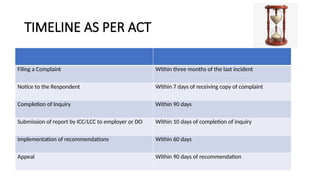
TIMELINE AS PER ACT
Filing a Complaint Within three months of the last incident
Notice to the Respondent Within 7 days of receiving copy of complaint
Completion of Inquiry Within 90 days
Submission of report by ICC/LCC to employer or DO Within 10 days of completion of inquiry
Implementation of recommendations Within 60 days
Appeal Within 90 days of recommendation
The act prohibits the publication or making known the contents of a complaint and inquiry proceedings.
Any breach of confidentiality will result in specific consequences.
The act prohibits the disclosure of:
• Contents of the complaint
• Identity and address of the complainant, respondent and witness, information pertaining to
conciliatory/inquiry proceedings or recommendations of ICC/LCC.
• Action taken by the employer or DO
Accountability- Any person entrusted with the duty to handle or deal with the complaint, inquiry or any
recommendations or action taken under the provision of the act.
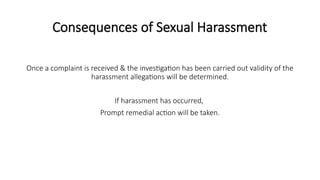
Consequences of Sexual Harassment
Once a complaint is received & the investigation has been carried out validity of the
harassment allegations will be determined.
If harassment has occurred,
Prompt remedial action will be taken.
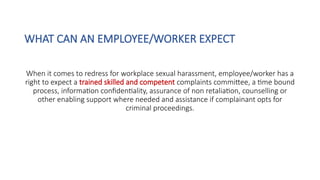
WHAT CAN AN EMPLOYEE/WORKER EXPECT
When it comes to redress for workplace sexual harassment, employee/worker has a
right to expect a trained skilled and competent complaints committee, a time bound
process, information confidentiality, assurance of non retaliation, counselling or
other enabling support where needed and assistance if complainant opts for
criminal proceedings.
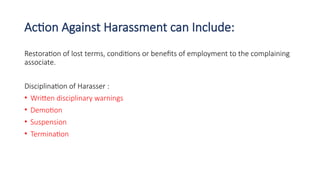
Action Against Harassment can Include:
Restoration of lost terms, conditions or benefits of employment to the complaining
associate.
Disciplination of Harasser :
• Written disciplinary warnings
• Demotion
• Suspension
• Termination
KEY RESPONSIBILITIES OF COMPLAINTS COMMITTEE
• Be thoroughly prepared.
• Know the act, policy or relevant service rules.
• Gather and record all relevant information.
• Determine the main issue in the complaint.
• Prepare relevant interview questions.
• Conduct necessary interviews.
• Ensure parties are made aware of the process and their rights and responsibilities within it.
• Analyze information gathered.
• Prepare the report with findings /recommendations.
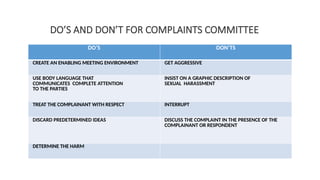
DO’S DON’TS
CREATE AN ENABLING MEETING ENVIRONMENT GET AGGRESSIVE
USE BODY LANGUAGE THAT
COMMUNICATES COMPLETE ATTENTION
TO THE PARTIES
INSIST ON A GRAPHIC DESCRIPTION OF
SEXUAL HARASSMENT
TREAT THE COMPLAINANT WITH RESPECT INTERRUPT
DISCARD PREDETERMINED IDEAS DISCUSS THE COMPLAINT IN THE PRESENCE OF THE
COMPLAINANT OR RESPONDENT
DETERMINE THE HARM
DO’S AND DON’T FOR COMPLAINTS COMMITTEE
RIGHTS OF COMPLAINANT &
RESPONDENT
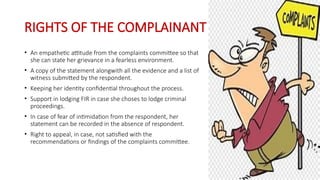
RIGHTS OF THE COMPLAINANT
• An empathetic attitude from the complaints committee so that
she can state her grievance in a fearless environment.
• A copy of the statement alongwith all the evidence and a list of
witness submitted by the respondent.
• Keeping her identity confidential throughout the process.
• Support in lodging FIR in case she choses to lodge criminal
proceedings.
• In case of fear of intimidation from the respondent, her
statement can be recorded in the absence of respondent.
• Right to appeal, in case, not satisfied with the
recommendations or findings of the complaints committee.
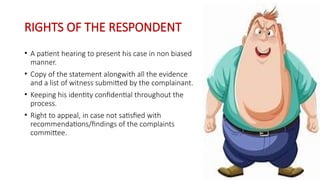
RIGHTS OF THE RESPONDENT
• A patient hearing to present his case in non biased
manner.
• Copy of the statement alongwith all the evidence
and a list of witness submitted by the complainant.
• Keeping his identity confidential throughout the
process.
• Right to appeal, in case not satisfied with
recommendations/findings of the complaints
committee.
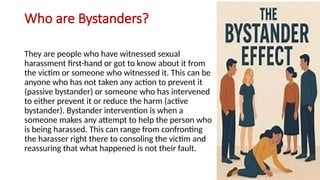
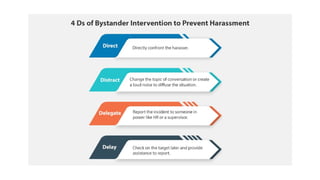
Who are Bystanders?
They are people who have witnessed sexual
harassment first-hand or got to know about it from
the victim or someone who witnessed it. This can be
anyone who has not taken any action to prevent it
(passive bystander) or someone who has intervened
to either prevent it or reduce the harm (active
bystander). Bystander intervention is when a
someone makes any attempt to help the person who
is being harassed. This can range from confronting
the harasser right there to consoling the victim and
reassuring that what happened is not their fault.
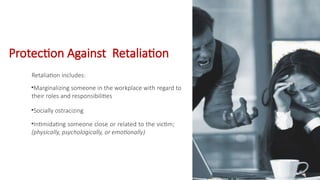
Retaliation includes:
•Marginalizing someone in the workplace with regard to
their roles and responsibilities
•Socially ostracizing
•Intimidating someone close or related to the victim;
(physically, psychologically, or emotionally)
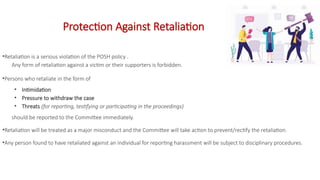
Protection Against Retaliation
Retaliation
Protection Against Retaliation
•Retaliation is a serious violation of the POSH policy .
Any form of retaliation against a victim or their supporters is forbidden.
•Persons who retaliate in the form of
• Intimidation
• Pressure to withdraw the case
• Threats (for reporting, testifying or participating in the proceedings)
should be reported to the Committee immediately.
•Retaliation will be treated as a major misconduct and the Committee will take action to prevent/rectify the retaliation.
•Any person found to have retaliated against an individual for reporting harassment will be subject to disciplinary procedures.
Consensual Relationship
•Consensual relationships are not harassment if they are welcomed by the person involved.
•However, if such behaviour is unwelcome, such behaviour is considered creating a hostile environment.
If a consensual relationship ceases to exist
•Conduct once considered welcome may later be seen as unwelcome.
•Either person may end the relationship, at any point in time, without fear of retaliation at the job.
•Behaviour that was welcome within a consensual relationship becomes unwelcome and it will be treated as sexual
harassment.

Capacity building Training under POSH for training

  • 2.
    THE SEXUAL HARASSMENTOF WOMEN AT WORKPLACE (PREVENTION, PROHIBITION AND REDRESSAL) ACT 2013 Objective : Prevention + Prohibition + Redressal What about me?
  • 3.
    SEXUAL HARASSMENT ATWORKPLACE (WHAT IT IS?) AGRIEVED WOMAN WORKING STUDENT DOMESTIC WORKER REGULAR/ TEMPORARY/ ADHOC/ DAILY WAGER FOR REMUNERATION/ VOLUNTARY BASIS/OTHERWISE EMPLOYED DIRECTLY OR THROUGH AGENT BY ANY OTHER SUCH NACONTRACTWORKER/ PROBATIONER/TRAINEE/ APPRENTICE/CALLEME VISITING WORKPLACE
  • 4.
    WHAT IS AWORKPLACE? Workplace covers both organised or unorganised sectors whether owned by Indian or foreign company having workplace in India: Organised Sector: • Government Organizations, including government Company, Corporation and Cooperative Societies • Private sector organizations, venture, society, trust, NGO, service providers etc. providing services which are commercial, vocational, educational, sports, professional, entertainment, industrial, health related or financial activities including production, supply, sale, distribution or service. • Hospitals/Nursing Homes • Sports Institutes/Facilities • Places visited by employee(including while on travel), including transportation provided by employer • A dwelling place or house
  • 5.
    WHAT IS AWORKPLACE? • Unorganised Sector: • An Enterprise owned by an individual/self employed workers engaged in production or sale of goods or providing services of any kind. • Any enterprise which employs less than 10 workers. GOVERNMENT ORGANISATIONS NGO HOUSE NURSING HOMES COMPANIES FARMS EDUCATIONAL INSTITUTIONS SPORTS FACILITIES HOSPITALS SERVICE PROVIDER COOPERATIVE SOCIETIES CORPORATIONS
  • 7.
    WHAT IS SEXUALHARASSMENT?
  • 8.
    Sexual Harassment Workplace SexualHarassment is behaviour that is : • UNWELCOME. • SEXUAL in nature. • A SUBJECTIVE experience. IMPACT not INTENT is what matters Often occurs in a matrix of power.
  • 9.
    What Constitutes SexualHarassment? -Physical contact & -Demanding or requesting advances. sexual favours. - Showing Pornography - Sexually coloured Remarks
  • 10.
    Sexual Harassment inthe Workplace can be categorized into 2 groups: Quid Pro Quo Hostile Environment
  • 11.
    Quid Pro Quo Quidpro quo’ means ‘this for that’, an exchange of one thing for another. Quid pro quo sexual harassment takes place if : • Sexual favours are asked in exchange for any kind of special treatment on the job. • An employee threatens an associate if he/she does not consent to such sexual advances or favours. The act of ‘asking’ may either be verbal or implied & ‘sexual conduct’ may be verbal or physical .In either case, it must be.
  • 12.
    Hostile Environment Hostile environmentsexual harassment occurs when : • Speech or conduct of a sexual nature takes place & is seen as offensive (affects performance of recipient or associates) • Intimidating /harassing conduct that is directed at an individual, or a group of individuals takes place.
  • 13.
    IMPACT vs INTENT •The Act focuses on the recipient’s perception and the effect of the behavior rather than the intention behind it. • In criminal law, intent (or mens rea) is a critical factor. To hold someone criminally liable, it often must be proven that they intended to commit the wrongful act. However, under the POSH Act, intent takes a backseat, and the focus shifts to the effect of the behavior on the complainant. This shift is intentional, rooted in the nature of sexual harassment and its consequences. • The POSH Act, 2013, is a progressive law that prioritizes the impact of behavior on victims over the intent of the accused. This approach is critical in addressing the subjective nature of harassment, empowering women to speak up, and fostering a culture of respect and equality in the workplace. By focusing on impact, the law shifts the onus onto individuals and organizations to create environments where dignity is upheld, and unwelcome behaviors are addressed swiftly and fairly. • The Act’s provisions, supported by judicial precedents and societal examples, underscore that sexual harassment is about the lived experiences of victims. For a workplace to truly be safe, it is the recipient’s perspective and the effect of actions that must take precedence, ensuring that no woman feels unsafe or unheard in her professional environment.
  • 14.
  • 15.
    Aravind and Sugunaare part of a team at an organisation. Suguna reports to Aravind. Aravind constantly tells Suguna that they should go out somewhere after work hours, perhaps for a late night movie or dinner. Suguna is uncomfortable but smiles and says she is busy most often! One day, Aravind tells Suguna that if she turns down his request again, her ratings will go down in her monthly review. 1 IS THIS SEXUAL HARASSMENT OR NOT?
  • 16.
    Neha is partof team that reports to Neeraj who is her college Senior. Neha is very good at her work and is assigned the most prestigious project in the company instead of Nirav who is the senior in the team and has a lot more work experience than Neha. Nirav is very upset and believes that Neha has been assigned the coveted project because they must be having a relationship. He jokes about this with other team members and slowly this spreads around in the company. 2 IS THIS SEXUAL HARASSMENT OR NOT?
  • 17.
    Reshma just joinedas a fresher and has been undergoing training. One of the trainers was Rashid, who was handling the New Product development. Reshma wanted to be part of his team and approached him. On seeing her enthusiasm and performance Rashid ensured that she would be joining Rashid team post the training.. Reshma joined Rashid’s team. Rashid asked Reshma out for dinner a few times and she agreed willingly. Slowly the workload increased and once when Rashid asked Reshma out to Dinner, she refused. Rashid continued to keep calling her and sent multitude of emails. IS THIS SEXUAL HARASSMENT OR NOT? 3
  • 18.
    Suman sent acrosspictures of some scantily clad women to Joe. Joe requested Suman not to send him such obscene pictures in the future as he was not comfortable with the same. But Suman continued. IS THIS AN EXAMPLE OF HOSTILE ENVIRONMENT SEXUAL HARASSMENT? 4
  • 19.
    Abhi was enteringthe elevator and Aasuthosh came up from behind tapped on her shoulders and told her She looked hot in the red dress. Abhi felt uncomfortable and stared at Aasuthosh and told him to keep his hands off and use discretion in his language. Aasuthosh apologized and it never happened again. IS ABHI BEING SEXUALLY HARASSED BY AASUTHOSH? 5
  • 20.
    Jayanthi and Ramjoined together as trainees. After one year Ram started asking Jayanthi to go out with him, which she refused. Ram sent a message that I love you and you are my life. Jayanthi was shocked and was so frightened and took off for two days from work. Ram sent out another message Where are you? I miss you. Jayanthi filed a harassment case against him. Ram cares for Jayanthi and wants a relationship with her. IS THIS SEXUAL HARASSMENT OR NOT? 6
  • 21.
    • Some examplesof behaviour that constitute sexual harassment at the workplace: • 1. Making sexually suggestive remarks or innuendos. • 2. Serious or repeated offensive remarks, such as teasing related to a person’s body or appearance. • 3. Offensive comments or jokes with sexual overtones. • 4. Inappropriate questions, suggestions or remarks about a person’s sex life. • 5. Displaying offensive and objectionable pictures, posters, mms, sms, whatsapp, or e-mails. • 6. Intimidation, threats, blackmail around sexual favours. • 7. Threats, intimidation or retaliation against an employee who speaks up about unwelcome behaviour with sexual overtones. • 8. Unwelcome social invitations, with sexual overtones commonly understood as flirting. • 9. Unwelcome sexual advances which may or may not be accompanied by promises or threats, explicit or implicit. • 10. Physical contact such as touching or pinching. • 11. Caressing, kissing or fondling someone against her will (could be considered assault). • 12. Invasion of personal space (getting too close for no reason, brushing against or cornering someone). • 13. Persistently asking someone out, despite being turned down. • 14. Stalking an individual. • 15. Abuse of authority or power to threaten a person’s job or undermine her performance against sexual favors. • 16. Falsely accusing and undermining a person behind closed doors for sexual favours. • 17. Controlling a person’s reputation by rumour-mongering about her private life.
  • 22.
    • Following-up onwork absences. • Requiring performance to job standards. • Reprimands in relation to work/meeting targets or deadlines. • Work-related stress e.g. meeting deadlines or quality standards. • Touching/brushing against/pushing without a sexual connotation. • Constructive feedback about work. What is NOT Workplace Sexual Harassment?
  • 24.
    The POSH Act,2013, does not limit workplace harassment to physical offices. The Act states that sexual harassment can occur "in connection with work," which includes remote work, online interactions, and virtual meetings. • If an employee faces unwelcome sexual advances, inappropriate messages, or verbal harassment via email, chat, or video calls, it still counts as workplace sexual harassment. • If an employee is harassed by a colleague, manager, client, or vendor through digital platforms, they have the right to file a POSH complaint.
  • 25.
    What is ConsideredOnline Sexual Harassment in the Workplace? Sexual harassment in virtual workplaces can take many forms. The most common types include: A. Inappropriate Messages and Emails • Sending sexually suggestive messages, texts, or emails. • Making inappropriate comments about someone's appearance or personal life. • Sharing double-meaning jokes or sexually explicit content via email or chat. • Persistently asking personal or sexual questions in work-related chats. Example: A manager keeps sending personal messages to a female employee on WhatsApp, asking her to "send a picture" or "meet outside work."
  • 26.
    B. Unwelcome Advanceson Video Calls •Making inappropriate sexual comments during Zoom/Teams meetings. •Staring at someone in a way that makes them uncomfortable. •Adjusting the camera to show inappropriate gestures or body language. •Insisting that a colleague turn on their camera unnecessarily to observe them. •Using virtual backgrounds, filters, or stickers in a sexually suggestive manner. Example: A male colleague keeps making inappropriate jokes about how a female coworker "looks great on video" and should "dress up more often for Zoom calls.“ C. Cyberstalking and Unwanted Attention Monitoring someone's online activity without their consent. Repeatedly calling, texting, or emailing outside work hours despite clear discomfort. Adding a coworker to personal social media platforms without consent and sending inappropriate messages. Example: A coworker constantly watches when a female employee is "online" on Microsoft Teams and messages her at odd hours, even when she is not working.
  • 27.
    D. Sharing Inappropriateor Explicit Content • Sending pornographic images, videos, or links to colleagues. • Displaying sexually explicit wallpapers or desktop backgrounds during screen sharing. • Sending inappropriate GIFs or memes in workplace group chats. • Example: During a work meeting, an employee "accidentally" shares an explicit image or video while screen-sharing, making others uncomfortable. E. Coercion and Quid Pro Quo Harassment • "Work favours" in exchange for personal favours (e.g., promotions or salary hikes). • Threatening to deny work opportunities unless personal requests are fulfilled. • Using remote work as an excuse to create one-on-one online meetings for inappropriate discussions. Example: A manager tells a junior female employee that he will "recommend her for a promotion" if she agrees to a private video call after work hours.
  • 28.
  • 29.
    What is meantby “Unwelcome” ? • Any conduct or behaviour is unwelcome if: • the recipient does not consent to it. • regards it as offensive. • Even if the victim does not complain, it doesn’t necessarily imply that the conduct is welcome. Some comments and/or advances are blatant and crude and are inherently offensive: these will almost always be deemed as unwelcome.
  • 30.
  • 31.
  • 32.
    How to Filea Complaint
  • 33.
    Internal Committee Presiding Officer– Senior woman employee from the workplace/ other admin units/office/organisations. 2 Members – Committed to the cause of women/experience in social work/legal knowledge 1 Member – from an NGO/other women’s organisation/familiar with issues relating to sexual IC
  • 34.
    COMPLAINTS COMMITTEE(S) Act providestwo kinds of complaint mechanism: Internal Complaint Committee(ICC), Local Complaint Committee(LCC). All complaints committees must have 50 percent representation of women. ICC or LCC member will hold their position not exceeding three years from the date of their nomination or appointment. Internal Complaints Committee(ICC)-Every employer is obliged to constitute an ICC through written order ICC will be composed of the following member: No Member Eligibility 1 Chairperson/Presiding Officer Women working at Senior Level as an employee; if not available then nominated from other office/units/department/workplace of the same employer 2 Two members (minimum) From amongst employees committed to the cause of women/having legal knowledge/experience in social work 3 Member From amongst NGO/association committee to the cause of women or a person familiar with the issue of sexual harassment
  • 35.
    COMPLAINTS COMMITTEE(S) Where office/Administrativeunits of a workplace are located in different places, division or sub division, an ICC has to be set up at administrative unit and office. Local complaints Committee(LCC)- District Officer will constitute an LCC in every district so as to enable women in the unorganised sector or small establishments to work in an environment free of sexual harassment. LCC will receive complaints: 1. From women working in an organisation having less than 10 workers 2. When the complaint is against the employer itself 3. From domestic workers up at administrative unit and office.
  • 36.
    EXTERNAL MEMBERS INCOMPLAINTS COMMITTEE The act refers to external members which generally means persons who have expertise with the issue of sexual harassment should possess the following attributes: • Demonstrated knowledge, skill and capacity in dealing with workplace sexual harassment issues/complaints • Sound grasp and practice of legal aspects and implications Such expertise will greatly benefit complaints committees in terms of fair and informed handling of complaints to lead to sound outcomes. These external third party members shall be paid for their services on the complaints committee as prescribed
  • 37.
    WHO CAN COMPLAIN? COMPLAINTSCOMMITTEE IN CASE OF PHYSICAL INCAPACITY • Complainant’s relatives • Complainant’s friend • Co worker • Any person who has the knowledge of the incident with written consent of the complainant IN CASE OF COMPLAINANT’S DEATH Any person with the knowledge of the incident with the written consent of her legal heirs CASE OF MENTAL INCAPACITY • Complainant’s relative • Complainant’s friend • Special Educator • Qualified Psychiatrist/Psychologist • Guardian/authority under whose care the complainant is receiving treatment/care • Any person with knowledge of the • incident, jointly with any person mentioned above IN CASE COMPLAINANT IS UNABLE TO FILE THE COMPLAINT FOR ANY OTHER REASON By any person who has knowledge of the incident with her written consent
  • 38.
    WHERE TO COMPLAIN? Wherethere are less than 10 workers any woman employee can complain to the Local complaint Committee with the support of Nodal Officer. It is the responsibility of the District Officer to designate a person as Nodal officer in every block, taluka, tehsil, wards, municipalities to receive complaints of workplace sexual harassment from women. The Nodal Officer will forward all such complaints within seven days of its receipt to the concerned complaints committee for appropriate action. In most other workplaces, a woman employee can make a complaint to Internal Complaint Committee.
  • 39.
    WHAT SHOULD THECOMPLAINT CONTAIN? COMPLAINT CONTENT DESCRIPTION OF INCIDENTS DATE TIMINGS RESPONDENT’S NAME PARTIES WORKING RELATIONSHIP
  • 40.
    Filing a ComplaintProcess Report Incident (within 3 Months) Complaint to ICC Notify Respondent (7 Days) Get Response Settlemtn Or Punishment Action (60 Days) Enquiry (90 Days) Does Respon dent Agree? Yes No Findings & Recommendation Report
  • 41.
    Indian Law onSexual Harassment • The Constitution of India • The Sexual Harassment of Women at Workplace (Prevention, Prohibition and Redressal) Act, 2013 • Vishaka Vs. State of Rajasthan • The Indian Penal Code, 1860
  • 42.
    Sexual harassment isa violation of the constitutionally guaranteed fundamental rights: • Articles 14 and 15: Right to equality • Article 21: Right to life - to live with dignity • Article 19(1)(g) - Right to practice any profession/ trade/ occupation/ business, i.e., a right to a safe environment free from harassment
  • 43.
    The Indian PenalCode Provision • Section 509 - Word, gesture or act intended to insult the modesty of a woman; • Offence: • utterance of any word, • making any sound or gesture • exhibiting any object • With an intention to intrude upon the privacy of such woman • Punishment: Simple imprisonment up to 3 years + fine • Nature of offence: Cognizable • Amendment to the Indian Penal Code Provision • Section 354 A: Sexual harassment and punishment for sexual harassment
  • 44.
  • 45.
    THE PROCEDURE Incident ofSexual Harassment Conciliation Internal Committee/ Local Committee Report of Inquiry No Action by Employer Appeal to Court/Tribunal Action for Misconduct Punishment for Malicious or fraudulent complaint
  • 46.
    STAGE 1: RECEIPTOF THE COMPLAINT Step 1: Receive and acknowledge the receipt of complaint The Complainant submits a sexual harassment complaint in writing within three months of the last alleged incident to complaints committee or person designated by the organization or District Officer to receive and manage complaints of sexual harassment. Upon receipt, complaints should be reviewed for: 1. In context of workplace that the sexual harassment complaints is to be met with under the act such as service rules, workplace policy, Vaisakha guidelines. 2. Clarity in the complaint. 3. Additional information needed from the complainant Complainant will be notified in writing to acknowledge the receipt.

  • 47.
    ELEMENTS OF BEHAVIOUR Complaintneeds to satisfy the following elements of behaviour: • The respondent displayed a potentially improper and/or offensive conduct which may come within workplace sexual harassment. • The behaviour was directed at the complainant. • The complainant experienced harm.. • The behaviour occurred in the workplace or at any location/any event related to work.
  • 48.
    Step 2: Meetand talk to the complainant to explore options for formal or informal resolution Step 3: Informal Mechanism-if the complainant chooses to adapt the informal process to resolve the issue, it is the responsibility of the person designated to explore enabling ways to address the complaint. This can include counselling, educating, orienting or warning the respondent to promptly stop the unwelcomed behaviour. However before recommending conciliation, committee must assess the severity of the situation and if necessary advise the complainant to opt for formal route. At no point committee would advise the complainant to resolve the matter directly with respondent
  • 49.
    Step 4:Formal Mechanism- a.If the complainant opts for formal mechanism, or if the nature of complaint is serious or which calls for formal redress, then complaint committee responds to the complaint. b. Complaint committee or members must be free from conflict of interest with either the concerned parties or with the outcome. c. Ensure that the independent third party member has sound knowledge, skill and experience in dealing with workplace sexual harassment complaints. Step 5:Respondent and Response- a. As per the procedure provided in the service rules or in the absence of the same b. Within seven days of receiving a complaint, the complaints committee will inform the respondent in writing that a complaint has been received. c,. The respondent will have an opportunity to respond to the complaint in writing within ten days thereafter
  • 50.
    STAGE 2:PLANNING CAREFULLY Step6:Prepare the file A sound inquiry relies on sound preparation. This includes taking into account the following steps: 1. Documentation Create an independent confidential file of the complaint and all subsequent related documentation. 2. Review Law & Policy Have a clear knowledge and understanding of the act/rules as well as the relevant service rules, workplace policy, Vaisakha guidelines, existing practices and related laws.
  • 51.
    STAGE 2:PLANNING CAREFULLY 3.Make a list • Make a list of all the dates and events relating to the written complaint as well as the names of witnesses, where applicable. • It may include the names of people believed to have witnessed the alleged incidents, or those who may have been aware of other information directly related to complaint. The respondent may also include the names of the witnesses. In addition, the complaints committee also has the discretion to call any person as a witness, who it believes, has something to contribute in the inquiry process.
  • 52.
    STAGE 2:PLANNING CAREFULLY 4.Supporting documents Obtain and review supporting documents relevant to the complaint, including those presented by the complainant and the respondent. 5. Act Quickly Create a plan. This can be used as an initial checklist to ensure that all of the critical elements are covered. It includes: a) Name of the parties and witnesses to be interviewed b) Any documentary support that needs to be witnessed. c) Timeline.
  • 53.
    STAGE 2:PLANNING CAREFULLYSTEP 7: CONSIDERATION: 1. Interim Measures-while a complaint is pending inquiry, complainant can make a written request for her transfer or transfer of the respondent, or for leave(upto 3 months).She can also request the complaints committee to restrain the respondent from reporting on work performance or writing her confidential report or supervising her academic activities(in case she is in an educational institute). Even in the absence of such a request, the complaints committee must take corrective action. It is essential to take these actions in order to prevent ongoing sexual harassment. 2. Support-Maintain clear, timely communication with the parties throughout the process. Provide complainants with any specific assistance they may require such as counselling, addressing health related concerns or sanctioning of leave.
  • 54.
    STAGE 3:INTERVIEWS STEP 8:PREPARE AN INTERVIEW PLAN FOR HEARING: COMPLAINANT, WITNESS, RESPONDENT 1. Based on the results of the previous steps and before conducting interviews, the Complaints Committee should decide which issue need to be pursued for questioning. 2. Interviews are meant to obtain information that is relevant to the complaint from individual. 3. Interviews should be conducted with each person separately and in confidence. The Complainant and the respondent should not be brought face to face with each other.
  • 55.
    INTERVIEWING TIPS • Proceedwith empathy • Determine beforehand: date, time, place and order of interview, order of questions • Rely on questions related to who, what, where, when and how; questions ought to be clear and focussed • Obtain as much information as possible. • Do not share information gathered from other sources • Choose appropriate location to create trust, comfort and openness • Explain how the interview will be conducted and what is expected • Take notes and explain the need for a proper record • The chairperson is responsible for ensuring the interviews are correctly carried out and due process followed. • At the conclusion of the interview, have those interviewed, sign and date statements made a recorded before the complaints committee.
  • 56.
    STAGE 3:INTERVIEWS STEP 9:ASSESSTHE COMPLETENESS OF THE INFORMATION COLLECTED At this stage, the Complaints Committee should review the information gathered and their factual relevance to each aspect of the complaint. This will help determine whether there is enough information to make a finding on the complaint.
  • 57.
    STAGE 4: REASONING: STEP10: Once the information and review is complete, the complaints committee will make its reasoned findings which involves having to: • Identify the substance of each aspect of the complaint • Determine whether or not, on a balance of probability, the unwelcomed sexual harassment took place. • Check that such behaviour/conduct falls within the sexual harassment set out in the relevant act/rules, policy/service rules or law • Comment on any underlying factors that may have contributed to the incident.
  • 58.
    STAGE 4: REASONING: STEP11: Create a timeline to help establish the sequence of events related to the complaint. STEP 12: Compare Similarities and differences within each of the statements made by the interviewees. STAGE 5: FINDING AND RECOMMENDATIONS STEP 14: RECOMMENDATIONS: Based on its findings, the complaints committee shall then make appropriate recommendations, which may include: 1. Where the complaints committee is unable to uphold the complaint, it shall recommend no action. 2. Where the complaints committee upholds the complaint, it may recommend such action as stated within the relevant policy or service rules, which may include a warning to terminate.
  • 59.
    STAGE 4: REASONING: STEP11: Create a timeline to help establish the sequence of events related to the complaint. STEP 12: Compare Similarities and differences within each of the statements made by the interviewees. STAGE 5: FINDING AND RECOMMENDATIONS STEP 13: FINDING: Based on the above the complaints committee must arrive at a finding of whether the complaint is upheld or not upheld or inconclusive. Provided where both the parties are employees, before finalising the findings, the ICC/LCC shall share its findings with both the parties and provide them an opportunity to make representation against it before the committee
  • 60.
    STEP 14: RECOMMENDATIONS: Basedon its findings, the complaints committee shall then make appropriate recommendations, which may include: • Where the complaints committee is unable to uphold the complaint, it shall recommend no action. • Where the complaints committee upholds the complaint, it may recommend such action as stated within the relevant policy or service rules, which may include a warning to terminate. In case service rules do not exist, recommended action may include: • Disciplinary action, including a written apology, reprimand, warning, censure • Withholding promotion/pay raise/increment • Termination • Counselling • Community service
  • 61.
    3. The complaintscommittee may also recommend financial damages to the complainant, while deciding the amount they shall take into consideration: • Mental trauma, suffering, pain and emotional distress caused • Medical expenses incurred • Loss of career opportunity • Income and financial status of the respondent If the amount is not paid it can be recovered as an arrear of land revenue The complaints committee can also give additional recommendations to address the underlying factors contributing to sexual harassment at workplace
  • 62.
    STAGE 6: REPORT: STEP15: WRITING THE REPORT: The Complaints Committee will prepare a final report that contains the following elements: • A description of the different aspects of the complaints • A description of the process followed • A description of the background information and documents that support or refute each aspect of the complaint. • An analysis of the information obtained • Findings as stated above • Recommendations
  • 63.
    SEXUAL HARASSMENT COMPLAINTPROCESS An inquiry must be completed within 90 days and a final report submitted to the employer or District Officer(as the case may be) within 10 days thereafter. Such report will also be made available to the concerned parties. The employer of District Officer is obliged to act on the recommendations within 60 days. Any person not satisfied with the findings or recommendations of the complaints committee or non implementation of the recommendations, may appeal in an appropriate court or tribunal, as prescribed under the service rules or where no such service rules exist, in such manner as may be prescribed.
  • 64.
    SEXUAL HARASSMENT COMPLAINTPROCESS It is important that complaints by women be treated fairly and not dismissed. Mere inability to substantiate a complaint or provide adequate proof will not attract legal action against the complainant. However, making a false or malicious complaints or producing a forged or misleading document is an offence.
  • 65.
    TIMELINE AS PERACT Filing a Complaint Within three months of the last incident Notice to the Respondent Within 7 days of receiving copy of complaint Completion of Inquiry Within 90 days Submission of report by ICC/LCC to employer or DO Within 10 days of completion of inquiry Implementation of recommendations Within 60 days Appeal Within 90 days of recommendation
  • 66.
    The act prohibitsthe publication or making known the contents of a complaint and inquiry proceedings. Any breach of confidentiality will result in specific consequences. The act prohibits the disclosure of: • Contents of the complaint • Identity and address of the complainant, respondent and witness, information pertaining to conciliatory/inquiry proceedings or recommendations of ICC/LCC. • Action taken by the employer or DO Accountability- Any person entrusted with the duty to handle or deal with the complaint, inquiry or any recommendations or action taken under the provision of the act.
  • 67.
    Consequences of SexualHarassment Once a complaint is received & the investigation has been carried out validity of the harassment allegations will be determined. If harassment has occurred, Prompt remedial action will be taken.
  • 68.
    WHAT CAN ANEMPLOYEE/WORKER EXPECT When it comes to redress for workplace sexual harassment, employee/worker has a right to expect a trained skilled and competent complaints committee, a time bound process, information confidentiality, assurance of non retaliation, counselling or other enabling support where needed and assistance if complainant opts for criminal proceedings.
  • 69.
    Action Against Harassmentcan Include: Restoration of lost terms, conditions or benefits of employment to the complaining associate. Disciplination of Harasser : • Written disciplinary warnings • Demotion • Suspension • Termination
  • 70.
    KEY RESPONSIBILITIES OFCOMPLAINTS COMMITTEE • Be thoroughly prepared. • Know the act, policy or relevant service rules. • Gather and record all relevant information. • Determine the main issue in the complaint. • Prepare relevant interview questions. • Conduct necessary interviews. • Ensure parties are made aware of the process and their rights and responsibilities within it. • Analyze information gathered. • Prepare the report with findings /recommendations.
  • 71.
    DO’S DON’TS CREATE ANENABLING MEETING ENVIRONMENT GET AGGRESSIVE USE BODY LANGUAGE THAT COMMUNICATES COMPLETE ATTENTION TO THE PARTIES INSIST ON A GRAPHIC DESCRIPTION OF SEXUAL HARASSMENT TREAT THE COMPLAINANT WITH RESPECT INTERRUPT DISCARD PREDETERMINED IDEAS DISCUSS THE COMPLAINT IN THE PRESENCE OF THE COMPLAINANT OR RESPONDENT DETERMINE THE HARM DO’S AND DON’T FOR COMPLAINTS COMMITTEE
  • 72.
  • 73.
    RIGHTS OF THECOMPLAINANT • An empathetic attitude from the complaints committee so that she can state her grievance in a fearless environment. • A copy of the statement alongwith all the evidence and a list of witness submitted by the respondent. • Keeping her identity confidential throughout the process. • Support in lodging FIR in case she choses to lodge criminal proceedings. • In case of fear of intimidation from the respondent, her statement can be recorded in the absence of respondent. • Right to appeal, in case, not satisfied with the recommendations or findings of the complaints committee.
  • 74.
    RIGHTS OF THERESPONDENT • A patient hearing to present his case in non biased manner. • Copy of the statement alongwith all the evidence and a list of witness submitted by the complainant. • Keeping his identity confidential throughout the process. • Right to appeal, in case not satisfied with recommendations/findings of the complaints committee.
  • 76.
    Who are Bystanders? Theyare people who have witnessed sexual harassment first-hand or got to know about it from the victim or someone who witnessed it. This can be anyone who has not taken any action to prevent it (passive bystander) or someone who has intervened to either prevent it or reduce the harm (active bystander). Bystander intervention is when a someone makes any attempt to help the person who is being harassed. This can range from confronting the harasser right there to consoling the victim and reassuring that what happened is not their fault.
  • 79.
    Retaliation includes: •Marginalizing someonein the workplace with regard to their roles and responsibilities •Socially ostracizing •Intimidating someone close or related to the victim; (physically, psychologically, or emotionally) Protection Against Retaliation Retaliation
  • 80.
    Protection Against Retaliation •Retaliationis a serious violation of the POSH policy . Any form of retaliation against a victim or their supporters is forbidden. •Persons who retaliate in the form of • Intimidation • Pressure to withdraw the case • Threats (for reporting, testifying or participating in the proceedings) should be reported to the Committee immediately. •Retaliation will be treated as a major misconduct and the Committee will take action to prevent/rectify the retaliation. •Any person found to have retaliated against an individual for reporting harassment will be subject to disciplinary procedures.
  • 81.
    Consensual Relationship •Consensual relationshipsare not harassment if they are welcomed by the person involved. •However, if such behaviour is unwelcome, such behaviour is considered creating a hostile environment. If a consensual relationship ceases to exist •Conduct once considered welcome may later be seen as unwelcome. •Either person may end the relationship, at any point in time, without fear of retaliation at the job. •Behaviour that was welcome within a consensual relationship becomes unwelcome and it will be treated as sexual harassment.