Mandelic Marine Complex®
    Skin Conditioning Formulations
                 and
30% & 45% Mandelic Acid Peel Solutions
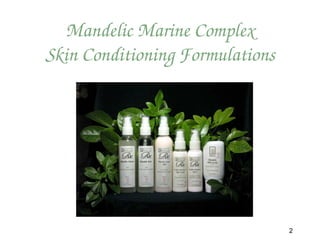
Mandelic Marine Complex
Skin Conditioning Formulations


                                 2
Biochemistry of Mandelic Acid
MANDELIC ACID IS:
     an 8-carbon aromatic* alpha hydroxy acid (AHA), named after the
      German “mandel” and derived from the hydrolysis of an extract of
      bitter almonds

     also known as:
         ALPHA-HYDROXYBENZENEACETIC ACID
         CARBOXYLIC ACID


*a class of organic chemical compounds that contain one or more rings of carbon atoms (phenol ring)
       and undergo chemical reactions that are characteristic of benzene.


                                                                                               3
Biochemistry of Mandelic Acid
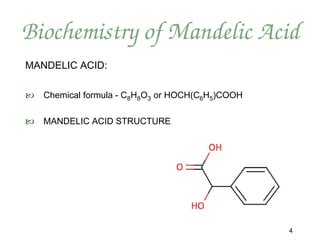
MANDELIC ACID:

   Chemical formula - C8H8O3 or HOCH(C6H5)COOH

   MANDELIC ACID STRUCTURE


                                                  4
Biochemistry of Mandelic Acid
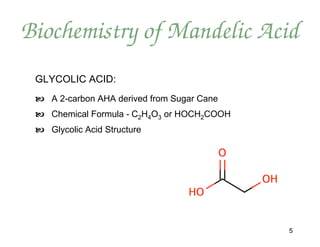
 GLYCOLIC ACID:
  A 2-carbon AHA derived from Sugar Cane
  Chemical Formula - C2H4O3 or HOCH2COOH
  Glycolic Acid Structure


                                            5
Biochemistry of Mandelic Acid
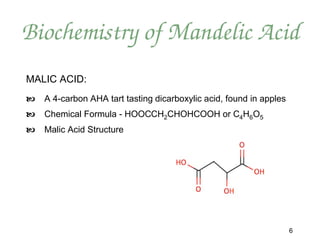
MALIC ACID:
   A 4-carbon AHA tart tasting dicarboxylic acid, found in apples
   Chemical Formula - HOOCCH2CHOHCOOH or C4H6O5
   Malic Acid Structure


                                                                     6
Biochemistry of Mandelic Acid
 Comparison of Mandelic Acid and Glycolic Acid
                  Molecules:
Mandelic Acid:
   is stronger (pK 3.41) than Glycolic acid (pK 3.83) at 25
   is larger (C8) than Glycolic Acid Molecule (C2)
   exhibits anti-microbial properties
   Is absorbed through epidermis at a slower and more even rate
   does NOT disrupt production of melanin pigment
   does NOT cause postinflammatory hyperpigmentation
   significantly improves melasma, postinflammatory hyperpigmentation,
    and lentigenes

                                                                   7
Biochemistry of Mandelic Acid
  Comparison of Mandelic Acid and Glycolic Acid
                   Molecules:
Mandelic Acid:
 does NOT cause irritation or erythema as is seen with 30%-70% glycolic
  acid preparations
 peel preparations do not produce erythema, crusting or blistering
 may be used safely on darkly pigmented skin types compared to glycolic
  acid and tretinoin


                                                                      8
Medical Origins of Mandelic Acid
                          Background
Mandelic Acid
 Has a long history of use in the medical community as an antiseptic,
  most commonly used to to irrigate the bladder for urinary tract
  infections.
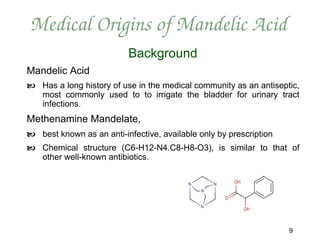
Methenamine Mandelate,
 best known as an anti-infective, available only by prescription
 Chemical structure (C6-H12-N4.C8-H8-O3), is similar to that of
  other well-known antibiotics.


                                                                    9
Medical Origins of Mandelic Acid
                            Background
Methenamine Mandelate
       inhibits
          Staphylcoccus aureus
          Bacillus proteus
          Escherichia coli
          Aerobacter aerogenes

Methenamine (meth-EN-a-meen) is nontoxic.
   After oral ingestion, it is rapidly absorbed and excreted in the urine.
   Through acid hydrolysis, bactericidal levels from methenamine are
     rapidly reached at pH 5.0-5.5.


                                                                       10
Use of Mandelic Acid in Dermatology
  Why the interest in including Mandelic Acid in Skin
                Treatment Formulations?
 Mandelic Acid is one of the strongest A.H.A.s.
      large molecular structure causes even penetration
      helps prevent inflammation and irritation that often occurs with
       use of other AHA’s.

 Mandelic acid (especially the 30% & 45% peel solutions)
      accelerates the cell renewal process,
      stimulates collagen synthesis, and
      improves elastin fibers in the dermis
      revitalizes sensitive skin
      helps improve the appearance of problematic skin.

                                                                    11
Use of Mandelic Acid in Dermatology
Why include Mandelic Acid in Dermatological Procedures?
 Great efficacy with ALL skin types
 Absorbed through epidermis at a slower, even rate
        penetration into melanocytes does NOT occur
        disruption of the production of melanin does NOT occur
        lack of reactive hyper-pigmentation
        notable absence of post inflammatory hyper-pigmentation
 Remarkable difference seen in the treatment of darkly pigmented skin
  types of both Asian, African, and Hispanic origin
 Considered to be the “New Generation Acid Peel for Dark, Sensitive Skin
  Types.
 Lack of any kind of hyper-pigmentation allows for a superior treatment
  outcome for ALL pigmented skin types


                                                                      12
Use of Mandelic Acid in Dermatology
Why include Mandelic Acid in Dermatological Procedures?
 Hyperpigmentation
        most often referred to as Melasma
        occurs most often in women between 20 to 60 years of age
        affects ALL skin types
        exacerbated by exposure to sun, even in darker, pigmented skin types

            Please see APPENDIX A - (slide 21) for more detail


                                                                        13
Use of Mandelic Acid in Dermatology
 Why include Mandelic Acid in Dermatological Procedures?
 Anti-microbial properties helpful in use of acid peels for treatment of acne
  prone skin
 Mandelic Acid peel formulations do not contain any moisture
     lack of moisture and slower absorption allow for use of 30%-50% peels
     may be left on skin for a longer time without adverse side effects
 Due to large aromatic phenol or carbon ring structure, Mandelic Acid:
     is an excellent accelerated exfoliation agent
     dissolves demosomes thus sloughing off necrosed squamous cells
     freshly exposed epidermal layers minimize appearance of wrinkles, age
      spots and hyperpigmentation


                                                                          14
Use of Mandelic Acid in Dermatology
 Mandelic Marine Complex® Skin Conditioning Systems
 and Mandelic Acid Peel Solutions are designed to function
 in a synergistic manner, so that you, the Medical
 Professional, are able to provide a complete skin treatment
 protocol from start to finish for every aspect of your client’s
 dermatological care.


                                                              15
Use of Mandelic Acid in Dermatology
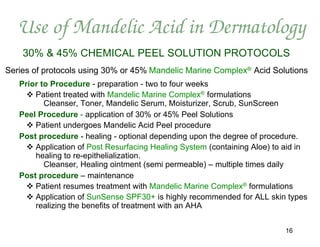
    30% & 45% CHEMICAL PEEL SOLUTION PROTOCOLS
Series of protocols using 30% or 45% Mandelic Marine Complex® Acid Solutions
   Prior to Procedure - preparation - two to four weeks
      Patient treated with Mandelic Marine Complex® formulations
          Cleanser, Toner, Mandelic Serum, Moisturizer, Scrub, SunScreen
   Peel Procedure - application of 30% or 45% Peel Solutions
      Patient undergoes Mandelic Acid Peel procedure
   Post procedure - healing - optional depending upon the degree of procedure.
      Application of Post Resurfacing Healing System (containing Aloe) to aid in
       healing to re-epithelialization.
          Cleanser, Healing ointment (semi permeable) – multiple times daily
   Post procedure – maintenance
      Patient resumes treatment with Mandelic Marine Complex® formulations
      Application of SunSense SPF30+ is highly recommended for ALL skin types
       realizing the benefits of treatment with an AHA


                                                                           16
Use of Mandelic Acid in Dermatology
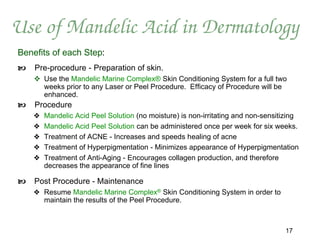
Benefits of each Step:
   Pre-procedure - Preparation of skin.
     Use the Mandelic Marine Complex® Skin Conditioning System for a full two
      weeks prior to any Laser or Peel Procedure. Efficacy of Procedure will be
      enhanced.
   Procedure
    ❖   Mandelic Acid Peel Solution (no moisture) is non-irritating and non-sensitizing
    ❖   Mandelic Acid Peel Solution can be administered once per week for six weeks.
    ❖   Treatment of ACNE - Increases and speeds healing of acne
    ❖   Treatment of Hyperpigmentation - Minimizes appearance of Hyperpigmentation
    ❖   Treatment of Anti-Aging - Encourages collagen production, and therefore
        decreases the appearance of fine lines

   Post Procedure - Maintenance
    ❖ Resume Mandelic Marine Complex® Skin Conditioning System in order to
      maintain the results of the Peel Procedure.


                                                                                  17
Use of Mandelic Acid in Dermatology
 WHY MANDELIC ACID ABOVE ALL OTHER SKIN FORMULATIONS?

 LARGER MOLECULE (C8) than any other AHA slows rate of absorption into
  epidermis, allowing for even penetration
 NON-IRRITATING & NON-SENSITIZING for ALL skin types, especially darker,
  pigmented, and sensitive skin
 HYPERPIGMENTATION - minimizes appearance of hyper-pigmentation, and
  does NOT cause hyper-pigmentation
 ACNE - increases and speeds healing of acne. Acne at grade III or below
  responds most positively
 ROSACEA - minimizes effects of unbalanced skin and resulting inflammation
  which can cause proliferation of demodex mites in the hair follicles of the skin.
 ANTI-AGING - encourages collagen production, and therefore decreases the
  appearance of fine lines
 Mandelic Acid Peel solutions produce less erythema than glycolic peels, and are
  less likely to result in crusting or blistering.
 Mandelic Acid Peel Solutions without moisture can be administered once per
  week before and after treatments for six weeks
                                                                            18
Use of Mandelic Acid in Dermatology
                        Three Features and Benefits Of
                         Mandelic Acid Peel Solutions
 Mandelic Marine Complex® formulations and Mandelic Acid Peel Solutions are a superior
  alternative for all individuals with sensitive skin who cannot tolerate traditional AHA
  formulations, especially Glycolic Acid. Often this can be as much as 25% or more of your
  clientele, thus making NuCèlle® an important addition to any product mix.
 Consistent use of Mandelic Marine Complex® Skin Conditioning Systems and Peel
  Solutions provide a safe, non-surgical, but effective approach to the problems of Hyper-
  pigmentation (including Pregnancy Mask, Melasma), Rosacea, Acne, and the “Butterfly
  Rash” associated with Lupus.
 Mandelic Acid Peel Solutions are a non-sensitizing solution to systematically remove built-up
  layers of sun damaged skin cells without the downtime of more invasive skincare
  procedures.


                                                                                        19
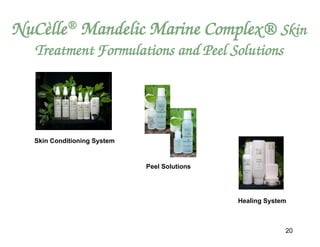
NuCèlle ®       Mandelic Marine Complex® Skin
   Treatment Formulations and Peel Solutions


   Skin Conditioning System


                              Peel Solutions


                                               Healing System


                                                            20
Appendix A - Hyperpigmentation
   Is most often referred to as Melasma.
   occurs most often in women between 20 to 60 years of age
   affects ALL skin types.
   exacerbated by exposure to sun, even in darker, pigmented skin types

    Hormonal changes appear to be a primary cause of increased hyperpigmentation, even
in darker, pigmented skin types, whether it is due to pregnancy, oral contraceptive therapy
or even post-menopausal estrogen replacement therapy.

     The process of melanin formation starts deep in the cell, where a gene makes an
enzyme called tyrosinase. After that, chemical dominoes fall: tyrosinase changes tyrosine
into dopa, which turns into dopaquinone – and dopaquinone forms either black-brown
“eumelanin” or red-yellow” pheomelani”. These two types of melanin are formed as
granules within structures called melanosomes, which are then shipped off to epidermal
cells at the surface of the skin.

    Over time, observation was made that use of the Mandelic acid in the facial care
formulations appeared to even out skin hyperpigmentation, and we began using the
Mandelic acid for the treatment of Melasma. Its mechanism of action in pigment reduction is
not well understood, but we hypothesize that it interferes with tyrosinase function, much like
asorbic acid. With the phenol side-chain, it may also interfere with o-quinones in the
melanin pathway.
                                                                                        21
For further reference, please contact:
     Deborah Fortescue-Merrin
         deb@nucelle.com
        www.nucellerx.com
        1+604-947-2894 Tel
       1+604-947-0294 Fax

                                         22

Mandelic acid skin conditioning formulations

  • 1.
    Mandelic Marine Complex® Skin Conditioning Formulations and 30% & 45% Mandelic Acid Peel Solutions
  • 2.
    Mandelic Marine Complex SkinConditioning Formulations 2
  • 3.
    Biochemistry of MandelicAcid MANDELIC ACID IS:  an 8-carbon aromatic* alpha hydroxy acid (AHA), named after the German “mandel” and derived from the hydrolysis of an extract of bitter almonds  also known as: ALPHA-HYDROXYBENZENEACETIC ACID CARBOXYLIC ACID *a class of organic chemical compounds that contain one or more rings of carbon atoms (phenol ring) and undergo chemical reactions that are characteristic of benzene. 3
  • 4.
    Biochemistry of MandelicAcid MANDELIC ACID:  Chemical formula - C8H8O3 or HOCH(C6H5)COOH  MANDELIC ACID STRUCTURE 4
  • 5.
    Biochemistry of MandelicAcid GLYCOLIC ACID:  A 2-carbon AHA derived from Sugar Cane  Chemical Formula - C2H4O3 or HOCH2COOH  Glycolic Acid Structure 5
  • 6.
    Biochemistry of MandelicAcid MALIC ACID:  A 4-carbon AHA tart tasting dicarboxylic acid, found in apples  Chemical Formula - HOOCCH2CHOHCOOH or C4H6O5  Malic Acid Structure 6
  • 7.
    Biochemistry of MandelicAcid Comparison of Mandelic Acid and Glycolic Acid Molecules: Mandelic Acid:  is stronger (pK 3.41) than Glycolic acid (pK 3.83) at 25  is larger (C8) than Glycolic Acid Molecule (C2)  exhibits anti-microbial properties  Is absorbed through epidermis at a slower and more even rate  does NOT disrupt production of melanin pigment  does NOT cause postinflammatory hyperpigmentation  significantly improves melasma, postinflammatory hyperpigmentation, and lentigenes 7
  • 8.
    Biochemistry of MandelicAcid Comparison of Mandelic Acid and Glycolic Acid Molecules: Mandelic Acid:  does NOT cause irritation or erythema as is seen with 30%-70% glycolic acid preparations  peel preparations do not produce erythema, crusting or blistering  may be used safely on darkly pigmented skin types compared to glycolic acid and tretinoin 8
  • 9.
    Medical Origins ofMandelic Acid Background Mandelic Acid  Has a long history of use in the medical community as an antiseptic, most commonly used to to irrigate the bladder for urinary tract infections. Methenamine Mandelate,  best known as an anti-infective, available only by prescription  Chemical structure (C6-H12-N4.C8-H8-O3), is similar to that of other well-known antibiotics. 9
  • 10.
    Medical Origins ofMandelic Acid Background Methenamine Mandelate  inhibits Staphylcoccus aureus Bacillus proteus Escherichia coli Aerobacter aerogenes Methenamine (meth-EN-a-meen) is nontoxic.  After oral ingestion, it is rapidly absorbed and excreted in the urine.  Through acid hydrolysis, bactericidal levels from methenamine are rapidly reached at pH 5.0-5.5. 10
  • 11.
    Use of MandelicAcid in Dermatology Why the interest in including Mandelic Acid in Skin Treatment Formulations?  Mandelic Acid is one of the strongest A.H.A.s.  large molecular structure causes even penetration  helps prevent inflammation and irritation that often occurs with use of other AHA’s.  Mandelic acid (especially the 30% & 45% peel solutions)  accelerates the cell renewal process,  stimulates collagen synthesis, and  improves elastin fibers in the dermis  revitalizes sensitive skin  helps improve the appearance of problematic skin. 11
  • 12.
    Use of MandelicAcid in Dermatology Why include Mandelic Acid in Dermatological Procedures?  Great efficacy with ALL skin types  Absorbed through epidermis at a slower, even rate  penetration into melanocytes does NOT occur  disruption of the production of melanin does NOT occur  lack of reactive hyper-pigmentation  notable absence of post inflammatory hyper-pigmentation  Remarkable difference seen in the treatment of darkly pigmented skin types of both Asian, African, and Hispanic origin  Considered to be the “New Generation Acid Peel for Dark, Sensitive Skin Types.  Lack of any kind of hyper-pigmentation allows for a superior treatment outcome for ALL pigmented skin types 12
  • 13.
    Use of MandelicAcid in Dermatology Why include Mandelic Acid in Dermatological Procedures?  Hyperpigmentation  most often referred to as Melasma  occurs most often in women between 20 to 60 years of age  affects ALL skin types  exacerbated by exposure to sun, even in darker, pigmented skin types Please see APPENDIX A - (slide 21) for more detail 13
  • 14.
    Use of MandelicAcid in Dermatology Why include Mandelic Acid in Dermatological Procedures?  Anti-microbial properties helpful in use of acid peels for treatment of acne prone skin  Mandelic Acid peel formulations do not contain any moisture  lack of moisture and slower absorption allow for use of 30%-50% peels  may be left on skin for a longer time without adverse side effects  Due to large aromatic phenol or carbon ring structure, Mandelic Acid:  is an excellent accelerated exfoliation agent  dissolves demosomes thus sloughing off necrosed squamous cells  freshly exposed epidermal layers minimize appearance of wrinkles, age spots and hyperpigmentation 14
  • 15.
    Use of MandelicAcid in Dermatology Mandelic Marine Complex® Skin Conditioning Systems and Mandelic Acid Peel Solutions are designed to function in a synergistic manner, so that you, the Medical Professional, are able to provide a complete skin treatment protocol from start to finish for every aspect of your client’s dermatological care. 15
  • 16.
    Use of MandelicAcid in Dermatology 30% & 45% CHEMICAL PEEL SOLUTION PROTOCOLS Series of protocols using 30% or 45% Mandelic Marine Complex® Acid Solutions Prior to Procedure - preparation - two to four weeks  Patient treated with Mandelic Marine Complex® formulations Cleanser, Toner, Mandelic Serum, Moisturizer, Scrub, SunScreen Peel Procedure - application of 30% or 45% Peel Solutions  Patient undergoes Mandelic Acid Peel procedure Post procedure - healing - optional depending upon the degree of procedure.  Application of Post Resurfacing Healing System (containing Aloe) to aid in healing to re-epithelialization. Cleanser, Healing ointment (semi permeable) – multiple times daily Post procedure – maintenance  Patient resumes treatment with Mandelic Marine Complex® formulations  Application of SunSense SPF30+ is highly recommended for ALL skin types realizing the benefits of treatment with an AHA 16
  • 17.
    Use of MandelicAcid in Dermatology Benefits of each Step:  Pre-procedure - Preparation of skin.  Use the Mandelic Marine Complex® Skin Conditioning System for a full two weeks prior to any Laser or Peel Procedure. Efficacy of Procedure will be enhanced.  Procedure ❖ Mandelic Acid Peel Solution (no moisture) is non-irritating and non-sensitizing ❖ Mandelic Acid Peel Solution can be administered once per week for six weeks. ❖ Treatment of ACNE - Increases and speeds healing of acne ❖ Treatment of Hyperpigmentation - Minimizes appearance of Hyperpigmentation ❖ Treatment of Anti-Aging - Encourages collagen production, and therefore decreases the appearance of fine lines  Post Procedure - Maintenance ❖ Resume Mandelic Marine Complex® Skin Conditioning System in order to maintain the results of the Peel Procedure. 17
  • 18.
    Use of MandelicAcid in Dermatology WHY MANDELIC ACID ABOVE ALL OTHER SKIN FORMULATIONS?  LARGER MOLECULE (C8) than any other AHA slows rate of absorption into epidermis, allowing for even penetration  NON-IRRITATING & NON-SENSITIZING for ALL skin types, especially darker, pigmented, and sensitive skin  HYPERPIGMENTATION - minimizes appearance of hyper-pigmentation, and does NOT cause hyper-pigmentation  ACNE - increases and speeds healing of acne. Acne at grade III or below responds most positively  ROSACEA - minimizes effects of unbalanced skin and resulting inflammation which can cause proliferation of demodex mites in the hair follicles of the skin.  ANTI-AGING - encourages collagen production, and therefore decreases the appearance of fine lines  Mandelic Acid Peel solutions produce less erythema than glycolic peels, and are less likely to result in crusting or blistering.  Mandelic Acid Peel Solutions without moisture can be administered once per week before and after treatments for six weeks 18
  • 19.
    Use of MandelicAcid in Dermatology Three Features and Benefits Of Mandelic Acid Peel Solutions  Mandelic Marine Complex® formulations and Mandelic Acid Peel Solutions are a superior alternative for all individuals with sensitive skin who cannot tolerate traditional AHA formulations, especially Glycolic Acid. Often this can be as much as 25% or more of your clientele, thus making NuCèlle® an important addition to any product mix.  Consistent use of Mandelic Marine Complex® Skin Conditioning Systems and Peel Solutions provide a safe, non-surgical, but effective approach to the problems of Hyper- pigmentation (including Pregnancy Mask, Melasma), Rosacea, Acne, and the “Butterfly Rash” associated with Lupus.  Mandelic Acid Peel Solutions are a non-sensitizing solution to systematically remove built-up layers of sun damaged skin cells without the downtime of more invasive skincare procedures. 19
  • 20.
    NuCèlle ® Mandelic Marine Complex® Skin Treatment Formulations and Peel Solutions Skin Conditioning System Peel Solutions Healing System 20
  • 21.
    Appendix A -Hyperpigmentation  Is most often referred to as Melasma.  occurs most often in women between 20 to 60 years of age  affects ALL skin types.  exacerbated by exposure to sun, even in darker, pigmented skin types Hormonal changes appear to be a primary cause of increased hyperpigmentation, even in darker, pigmented skin types, whether it is due to pregnancy, oral contraceptive therapy or even post-menopausal estrogen replacement therapy. The process of melanin formation starts deep in the cell, where a gene makes an enzyme called tyrosinase. After that, chemical dominoes fall: tyrosinase changes tyrosine into dopa, which turns into dopaquinone – and dopaquinone forms either black-brown “eumelanin” or red-yellow” pheomelani”. These two types of melanin are formed as granules within structures called melanosomes, which are then shipped off to epidermal cells at the surface of the skin. Over time, observation was made that use of the Mandelic acid in the facial care formulations appeared to even out skin hyperpigmentation, and we began using the Mandelic acid for the treatment of Melasma. Its mechanism of action in pigment reduction is not well understood, but we hypothesize that it interferes with tyrosinase function, much like asorbic acid. With the phenol side-chain, it may also interfere with o-quinones in the melanin pathway. 21
  • 22.
    For further reference,please contact: Deborah Fortescue-Merrin deb@nucelle.com www.nucellerx.com 1+604-947-2894 Tel 1+604-947-0294 Fax 22