GUIDE FOR YOUR
GUIDE FOR YOUR
GUIDE FOR YOUR
MANDALA
MANDALA
MANDALA
WHAT IS MANDALA?
The word mandala in Sanskrit
means a circle or a Chakra.
pronounced as “mah-ndah-lah,”
“la” and “manda”, mean
container and essence
believed to represent
wholeness, health, connection,
unity, harmony, and the cycle of
life
A mandala is the
psychological
expression of the totality
of the self.
-Carl Jung-
BENEFITS OF MANDALAS
They help with balance.
They bring peace and tranquility.
Looking at them will give you a feeling of calmness.
They help with concentration.
They make it easier to be mindful.
Another thing thing they do is push aside thoughts
and let your creativity flow.
The way all the shapes and designs are laid out
brings a feeling of balance.
These artistic figures help
you interweave yourself
with the strongest
energies within you and
the universe. They do it by
using all the energies that
flow out of each shape
and color.
Symbols, Shapes, and Colours of
Mandalas
Dot: everything is one, symbol of the Un-manifested.
Circle: wholeness, integrity, unity
Horizontal line: Divides up from down, the earth and the sky. Maternal
energy.
Vertical line: connection between worlds, energy. Divides right and left.
Cross: two lines meet and form a center. Recognition.
Triangle with the vertex pointed upwards: aspiration, energies pointing
upwards, in the direction of the spiritual sphere.
Triangle with vertex pointed downwards: aspirations towards the
earthly, material sphere.
Square: Our existence in the material world.
SHAPES
Symbols, Shapes, and Colours of
Mandalas
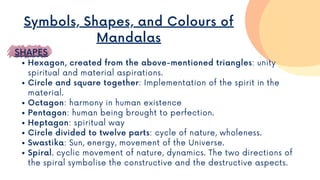
Hexagon, created from the above-mentioned triangles: unity
spiritual and material aspirations.
Circle and square together: Implementation of the spirit in the
material.
Octagon: harmony in human existence
Pentagon: human being brought to perfection.
Heptagon: spiritual way
Circle divided to twelve parts: cycle of nature, wholeness.
Swastika: Sun, energy, movement of the Universe.
Spiral. cyclic movement of nature, dynamics. The two directions of
the spiral symbolise the constructive and the destructive aspects.
SHAPES
Symbols, Shapes, and Colours of
Mandalas
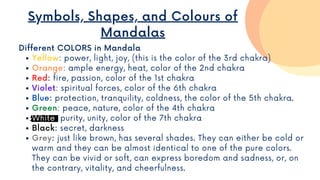
Yellow: power, light, joy, (this is the color of the 3rd chakra)
Orange: ample energy, heat, color of the 2nd chakra
Red: fire, passion, color of the 1st chakra
Violet: spiritual forces, color of the 6th chakra
Blue: protection, tranquility, coldness, the color of the 5th chakra.
Green: peace, nature, color of the 4th chakra
White: purity, unity, color of the 7th chakra
Black: secret, darkness
Grey: just like brown, has several shades. They can either be cold or
warm and they can be almost identical to one of the pure colors.
They can be vivid or soft, can express boredom and sadness, or, on
the contrary, vitality, and cheerfulness.
Different COLORS in Mandala
MANDALA
MANDALA
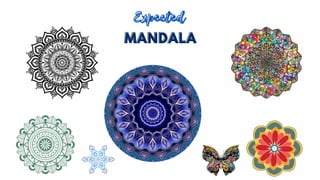
Expected
Expected
Make a Mandala to
illustrate the different
influences and factors that
shape your own self and
identity.
The analysis part will be done
during the TLO.
For your CO1,
Click these references to
understand more the "MANDALA":
Mandala Art Therapy and its Healing Benefits
5 Benefits of Mandala
What is Mandala? History, symbolism, and uses
How to draw a Mandala
Beautiful Mandala Shapes and Colors
Ultimate Guide to Mandala Flower and
Meaning and Symbolism
1.
2.
3.
4.
5.
6.

Mandala Guide.pdf

  • 1.
    GUIDE FOR YOUR GUIDEFOR YOUR GUIDE FOR YOUR MANDALA MANDALA MANDALA
  • 2.
    WHAT IS MANDALA? Theword mandala in Sanskrit means a circle or a Chakra. pronounced as “mah-ndah-lah,” “la” and “manda”, mean container and essence believed to represent wholeness, health, connection, unity, harmony, and the cycle of life
  • 3.
    A mandala isthe psychological expression of the totality of the self. -Carl Jung-
  • 4.
    BENEFITS OF MANDALAS Theyhelp with balance. They bring peace and tranquility. Looking at them will give you a feeling of calmness. They help with concentration. They make it easier to be mindful. Another thing thing they do is push aside thoughts and let your creativity flow. The way all the shapes and designs are laid out brings a feeling of balance.
  • 5.
    These artistic figureshelp you interweave yourself with the strongest energies within you and the universe. They do it by using all the energies that flow out of each shape and color.
  • 6.
    Symbols, Shapes, andColours of Mandalas Dot: everything is one, symbol of the Un-manifested. Circle: wholeness, integrity, unity Horizontal line: Divides up from down, the earth and the sky. Maternal energy. Vertical line: connection between worlds, energy. Divides right and left. Cross: two lines meet and form a center. Recognition. Triangle with the vertex pointed upwards: aspiration, energies pointing upwards, in the direction of the spiritual sphere. Triangle with vertex pointed downwards: aspirations towards the earthly, material sphere. Square: Our existence in the material world. SHAPES
  • 7.
    Symbols, Shapes, andColours of Mandalas Hexagon, created from the above-mentioned triangles: unity spiritual and material aspirations. Circle and square together: Implementation of the spirit in the material. Octagon: harmony in human existence Pentagon: human being brought to perfection. Heptagon: spiritual way Circle divided to twelve parts: cycle of nature, wholeness. Swastika: Sun, energy, movement of the Universe. Spiral. cyclic movement of nature, dynamics. The two directions of the spiral symbolise the constructive and the destructive aspects. SHAPES
  • 8.
    Symbols, Shapes, andColours of Mandalas Yellow: power, light, joy, (this is the color of the 3rd chakra) Orange: ample energy, heat, color of the 2nd chakra Red: fire, passion, color of the 1st chakra Violet: spiritual forces, color of the 6th chakra Blue: protection, tranquility, coldness, the color of the 5th chakra. Green: peace, nature, color of the 4th chakra White: purity, unity, color of the 7th chakra Black: secret, darkness Grey: just like brown, has several shades. They can either be cold or warm and they can be almost identical to one of the pure colors. They can be vivid or soft, can express boredom and sadness, or, on the contrary, vitality, and cheerfulness. Different COLORS in Mandala
  • 9.
  • 10.
    Make a Mandalato illustrate the different influences and factors that shape your own self and identity. The analysis part will be done during the TLO. For your CO1,
  • 11.
    Click these referencesto Click these references to Click these references to understand more the "MANDALA": understand more the "MANDALA": understand more the "MANDALA": Mandala Art Therapy and its Healing Benefits 5 Benefits of Mandala What is Mandala? History, symbolism, and uses How to draw a Mandala Beautiful Mandala Shapes and Colors Ultimate Guide to Mandala Flower and Meaning and Symbolism 1. 2. 3. 4. 5. 6.