Research on ageing, making an impact: working effectively with NGOs and Government  David Sinclair , International Longevity Centre -UK
Summary About ILC-UK The role of science/research How does ILC-UK engage with academics? What does the Government/Voluntary Sector think about academics What does the Government/Voluntary Sector want from academics Making an impact My tips for engagement
About ILC-UK The ILC-UK was established in 2000 to explore and address the new longevity revolution and its impact on the life-course and society.  It provides the visionary approach needed for individual and societal planning to ensure a progressive, economically viable and socially inclusive tomorrow for all.
Some of our publications
Our research/policy team Baroness Greengross (Chief Executive) David Sinclair Researchers (Quantitative/demographer and housing; Public Health; Health and Care; nutrition; Ex Treasury Official)
Who do we engage with? A recent ILC-UK event saw 10 people registered from the Department of Health alone and we typically are attracting about 20% of our audience from Government and Quangos.  We attract about 35% from the voluntary sector and academia and about 35% from the private sector. About 10% of the participants are lay members of the public.
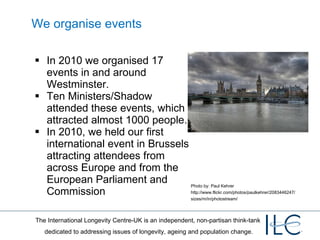
We organise events In 2010 we organised 17 events in and around Westminster.  Ten Ministers/Shadow attended these events, which attracted almost 1000 people. In 2010, we held our first international event in Brussels attracting attendees from across Europe and from the European Parliament and Commission  Photo by: Paul Kehrer http://www.flickr.com/photos/paulkehrer/2083446247/sizes/m/in/photostream/
Events often influence We organised a dinner and debate on dementia in the House of Lords in June 2009 for Pfizer, the dinner was attended by 5 peers, a minister, several MPs and many leading academics.  The event proved to be so informative that it was referenced by the minister, in a debate in the House of Lords a week later.  As a result of this success, we were commissioned to produce the report of the National Dementia Research Summit for the Department of Health and the Medical Research Council.
We use new media We are prolific users of new media to promote our work. In 2010 we published 67 blog posts which drew further attention to our 24 publications during that year. We have over 1150 followers on twitter (and growing). Photo by ivanpw http://www.flickr.com/photos/28288673@N07/4847679257/sizes/m/in/photostream/
And we don’t forget the traditional media We achieve high levels of media coverage. Recent coverage includes:   Ex-Countryfile presenter wins BBC ageism case  (Channel 4);  Let's take the housing fight to wealthy owners with empty spare rooms  (Guardian);  Christmas shopping experience 'puts off over-65s';   Grey pound's £100bn Christmas warning to retailers (Telegraph) Our research standing is supported by our research work being accepted and covered in prestigious academic journals including the journal ‘Health Policy’( http://www.journals.elsevierhealth.com/periodicals/heap/article/PIIS0168851008002534/abstract ).
The World is Ageing
How much further will we age? Aubrey de Grey believes that human life expectancy at birth in 2100 will be 5000 years  “ I think the first person to live to 1,000 might be 60 already”
Or perhaps more realistically? "In ancient times, half our children would have died by the age of 20. Now, in the western world, 98 per cent of them are surviving to the age of 21.  "Our life expectancy is now so good that eliminating all accidents and infectious diseases would only raise it by two years. Natural selection no longer has death as a handy tool."
Any ideas
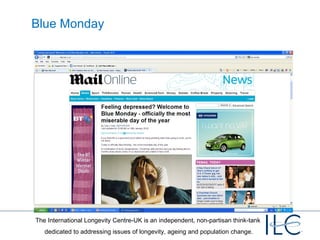
Blue Monday
Where was academia? Blue Monday  is a name given to a date stated, as part of a publicity campaign by Sky Travel, to be the most depressing day of the year. This date was published in a press release under the name of Cliff Arnall, at the time a tutor at the Centre for Lifelong Learning, a Further Education centre attached to Cardiff University. Photo by: Samael  Kreutz  http://www.flickr.com/photos/mein_arkengel/5026764931/sizes/m/in/photostream/
But why are we relying on Ben Goldacre? Guardian  columnist Dr. Ben Goldacre reported that the press release was delivered substantially pre-written to a number of academics by public relations agency Porter Novelli, who offered them money to put their names to it. Photo by psd /Paul Downey http://www.flickr.com/photos/psd/3696638199/sizes/o/in/photostream/
So what is the role for academics “ Good policy needs academic expertise. Academics are no less responsible than politicians for bad policy; just because influencing policy is difficult doesn’t mean academics shouldn’t try.” “ Universities need to demonstrate their public value – natural science does this, but social science struggles. The withdrawal of public money from HE can be directly related to the irrelevance of many academics to public policy debates”. Photo by  ozvoldjj   Jeff Ozvold   http://www.flickr.com/photos/jeffozvold/2253118421/
How do we engage with academics? Commissioning research/ the customer Speakers at events Research partner Translation of research into policy practice  Partnership/ consultation
Some examples – ESRC Quality of Life
Building a relationship with the British Society of Gerontology
Academic advisory group/ILC-UK advisors Professor David Blane Professor Elizabeth Burton (MA Cantab DipArch DipUD PhD) Kate Davidson PhD, BSc(Hons), RHV, RGN Professor Emily Grundy Janet Lewis (AcSS, PhD, MA, Diploma in Social Administration)  Graham Mulley (MB ChB FRCP DM)  Professor Judith Phillips (MSc CQSW PhD)  Professor Chris Phillipson (PhD)  Ceridwen Roberts
Research partnerships
Some Truths? Does Government care about academic research? “ Policy-makers don’t have the time or inclination to read academic journals. If you want to influence policy, there needs to be a middle-man who knows how to reach policy-makers, how to speak their language, and will be able to translate which bits of academic research will be relevant to actual policy development.” Photo by Diylibrarian http://www.flickr.com/photos/diylibrarian/1403798100/sizes/z/in/photostream/
Does the Government care? “ Civil servants don’t (often) even take notice of the research their departments commission – it’s a PR exercise.” “ The image of academia within government departments is very poor (academics are perfectionists, stuck in Ivory Tower, unwilling to get their hands dirty, always over deadline, too expensive, too arrogant).” Photo by jaybergesen http://www.flickr.com/photos/jaybergesen/3357773834/sizes/m/in/photostream/
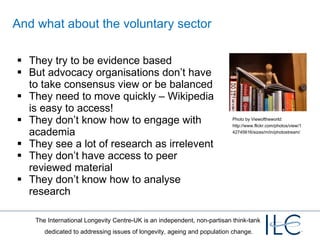
And what about the voluntary sector They try to be evidence based But advocacy organisations don’t have to take consensus view or be balanced They need to move quickly – Wikipedia is easy to access! They don’t know how to engage with academia They see a lot of research as irrelevent They don’t have access to peer reviewed material They don’t know how to analyse research Photo by Viewoftheworld: http://www.flickr.com/photos/view/142745616/sizes/m/in/photostream/
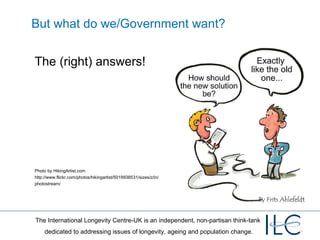
But what do we/Government want? The (right) answers! Photo by HikingArtist.com http://www.flickr.com/photos/hikingartist/5019938531/sizes/z/in/photostream/
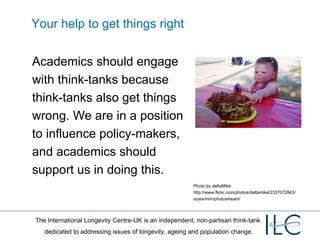
Your help to get things right Academics should engage with think-tanks because think-tanks also get things wrong. We are in a position to influence policy-makers, and academics should support us in doing this. Photo by deltaMike http://www.flickr.com/photos/deltamike/2337072843/sizes/m/in/photostream/
Work across disciplines - Teamwork “ Neither think-tanks nor government care about disciplinary boundaries. Academics must work across disciplines to be effective; too often research outputs are undermined by the function of academic silos.” John Spooner  http://www.flickr.com/photos/johnspooner/2199685678/sizes/m/in/photostream/
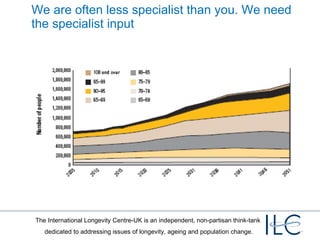
We are often less specialist than you. We need the specialist input
Explain the complex
Challenge lazy assumptions
Present the views of older people. Also debate moral/ethical issues. “ But how much smaller do we want a phone?”. Some/many do but: “I don’t want to live in a smart-home – I’d rather be dead” Moral and ethical debates – cant afford to ignore them Must help older people choose technology when it is right for them (tagging/urine tests)
Be aware of the world outside the University: Google knows!
Deliver solutions I think there’ll be a cure for cancer one day. That we never thought we’d see…and Alzheimer’s. I would wish for a pill to cure everything…
Fill research gaps
And thus help policymakers develop the right policy Italy to keep elderly cool in supermarkets (Independent) “ GOVERNMENT PLANS to herd elderly Italians into supermarkets to protect them from the summer heat sparked controversy yesterday, with critics saying the creation of a public register of those at risk violated their right to privacy.  Girolamo Sirchia, the Health minister, has instructed local authorities to draw up a list of all Italians over the age of 65 whose health might be at risk in the event of a summer heatwave. It has been suggested that they could then easily be moved to supermarkets and other public places with air conditioning. More than 7,500 old people died as a result of the heat in Italy, while as many as 60,000 perished in France in the course of a sweltering July”.
Artificial Intelligence entity passes A level Be timely and Policy Relevant 2010 2020 2030 2040 2050 Artificial Intelligence causes redundancies Computer controlled hunger suppressant Emotion control devices Auto-pilot cars Holographic TV Full voice recognition PCs Thought input mechanisms widespread Viewers can choose film roles Global voting on some issues Tooth regeneration Listing of individual DNA Circuits made with bacteria Bionic Olympics Active skin makeup Disposable phones Digital mirrors Face recognition doors Smart bath Individual pollution credits Human memory enhancement Virtual holidays Hydrogen fuel stations Self drive cars VR windows Prison countries  Invisibility cloak Self clean houses Global ID card Robocops Human memory downloads Nuclear fusion Humanoid robots beat national football team Artificial brain Brain downloads Virtual displays Wave energy =50% in UK
Accessible
We can do much more to be accessible. “ Dr Neylon thinks it would be far better for all the artefacts of the research process, such as videos, samples, data and images, to be made freely available in an open-access format - hosted either by journal websites or alternatives such as university repositories, individual researchers' websites or large commercial providers such as Amazon - Research intelligence - Rip it up and start  again” 16 December 2010 By Paul Jump (From TLS)
And do we need to rethink the status quo? “ The peer review process is irredeemably corrupted”  James Delingpole. Horizon. January 2010
Making an impact? How can you measure Policy Influence (?Discuss?) Media Coverage Downloads Mentions in Parliament Approaches from Government
So why work with us?/Think Tanks “ Not many think tanks are independent”. You can work with political think tanks but take care You arent in London (nor are most Universities) Universities can be bureaucratic in terms of when you want to engage in policy/media/events It is easier for us to run an event for opinion formers in London than you. And we will get better people there!.
Great Expectations report Academy of Social Sciences: said universities should engage better with the public but not necessarily directly
Top tips! “ Write clearly” “ think about who would be interested in your work” – understand the potential audience Make the most of Web 2:0/Social Media  ? blogging/twitter/Youtube Put your lectures online? Disseminate throughout not just at the end.
Tips Make sure your university press office supports you/is accessible/trains you  If you aren’t good at media work don’t do it! You can say no But if you do want to engage with the media be accessible
Accept that think tanks may be better at communicating your research to the right people than you - You are paid to be good academics not media pundits! Make the research process accessible (Wiki publication?) Open access to final product (even we find it difficult to access research)
People at different stages in their carears may want different support – e.g. in identifying who are the relevant organisations who might be interested in your work. It isnt difficult to find out who you need to influence (all on the internet – select committees; who speaks at conferences etc)
Tips Yes: Involve us in advisory groups. But don’t be surprised if the voluntary sector says no. You need to start costing participation into budgets including day rates. Better to involve us as project partners and engage us in doing/supporting dissemination
Tips Work with organisations like ILC-UK to disseminate your messages (ESRC project) Come to us with ideas Be as accessible as possible. ie respond to emails! (ILC-UK blog)
I have said yes to… I’ve just written my PHD in X. Its relevant to the news/policy agenda. I’m keen to get it into the hands of policy makers. Will you let me write it as a think piece for your website I’ve just finished a major piece of research. Can you give me a speaking slot at one of your events  Can we write a joint project on X  Can I write a guest blog for your website
Many thanks David Sinclair Head of Policy and Research International Longevity Centre [email_address] 02073400440 Twitter: @ilcuk and @sinclairda

Manchester

  • 1.
    Research on ageing,making an impact: working effectively with NGOs and Government David Sinclair , International Longevity Centre -UK
  • 2.
    Summary About ILC-UKThe role of science/research How does ILC-UK engage with academics? What does the Government/Voluntary Sector think about academics What does the Government/Voluntary Sector want from academics Making an impact My tips for engagement
  • 3.
    About ILC-UK TheILC-UK was established in 2000 to explore and address the new longevity revolution and its impact on the life-course and society. It provides the visionary approach needed for individual and societal planning to ensure a progressive, economically viable and socially inclusive tomorrow for all.
  • 4.
    Some of ourpublications
  • 5.
    Our research/policy teamBaroness Greengross (Chief Executive) David Sinclair Researchers (Quantitative/demographer and housing; Public Health; Health and Care; nutrition; Ex Treasury Official)
  • 6.
    Who do weengage with? A recent ILC-UK event saw 10 people registered from the Department of Health alone and we typically are attracting about 20% of our audience from Government and Quangos. We attract about 35% from the voluntary sector and academia and about 35% from the private sector. About 10% of the participants are lay members of the public.
  • 7.
    We organise eventsIn 2010 we organised 17 events in and around Westminster. Ten Ministers/Shadow attended these events, which attracted almost 1000 people. In 2010, we held our first international event in Brussels attracting attendees from across Europe and from the European Parliament and Commission Photo by: Paul Kehrer http://www.flickr.com/photos/paulkehrer/2083446247/sizes/m/in/photostream/
  • 8.
    Events often influenceWe organised a dinner and debate on dementia in the House of Lords in June 2009 for Pfizer, the dinner was attended by 5 peers, a minister, several MPs and many leading academics. The event proved to be so informative that it was referenced by the minister, in a debate in the House of Lords a week later.  As a result of this success, we were commissioned to produce the report of the National Dementia Research Summit for the Department of Health and the Medical Research Council.
  • 9.
    We use newmedia We are prolific users of new media to promote our work. In 2010 we published 67 blog posts which drew further attention to our 24 publications during that year. We have over 1150 followers on twitter (and growing). Photo by ivanpw http://www.flickr.com/photos/28288673@N07/4847679257/sizes/m/in/photostream/
  • 10.
    And we don’tforget the traditional media We achieve high levels of media coverage. Recent coverage includes:   Ex-Countryfile presenter wins BBC ageism case (Channel 4); Let's take the housing fight to wealthy owners with empty spare rooms (Guardian); Christmas shopping experience 'puts off over-65s'; Grey pound's £100bn Christmas warning to retailers (Telegraph) Our research standing is supported by our research work being accepted and covered in prestigious academic journals including the journal ‘Health Policy’( http://www.journals.elsevierhealth.com/periodicals/heap/article/PIIS0168851008002534/abstract ).
  • 11.
  • 12.
    How much furtherwill we age? Aubrey de Grey believes that human life expectancy at birth in 2100 will be 5000 years “ I think the first person to live to 1,000 might be 60 already”
  • 13.
    Or perhaps morerealistically? "In ancient times, half our children would have died by the age of 20. Now, in the western world, 98 per cent of them are surviving to the age of 21. "Our life expectancy is now so good that eliminating all accidents and infectious diseases would only raise it by two years. Natural selection no longer has death as a handy tool."
  • 14.
  • 15.
  • 16.
    Where was academia?Blue Monday is a name given to a date stated, as part of a publicity campaign by Sky Travel, to be the most depressing day of the year. This date was published in a press release under the name of Cliff Arnall, at the time a tutor at the Centre for Lifelong Learning, a Further Education centre attached to Cardiff University. Photo by: Samael Kreutz http://www.flickr.com/photos/mein_arkengel/5026764931/sizes/m/in/photostream/
  • 17.
    But why arewe relying on Ben Goldacre? Guardian columnist Dr. Ben Goldacre reported that the press release was delivered substantially pre-written to a number of academics by public relations agency Porter Novelli, who offered them money to put their names to it. Photo by psd /Paul Downey http://www.flickr.com/photos/psd/3696638199/sizes/o/in/photostream/
  • 18.
    So what isthe role for academics “ Good policy needs academic expertise. Academics are no less responsible than politicians for bad policy; just because influencing policy is difficult doesn’t mean academics shouldn’t try.” “ Universities need to demonstrate their public value – natural science does this, but social science struggles. The withdrawal of public money from HE can be directly related to the irrelevance of many academics to public policy debates”. Photo by ozvoldjj Jeff Ozvold http://www.flickr.com/photos/jeffozvold/2253118421/
  • 19.
    How do weengage with academics? Commissioning research/ the customer Speakers at events Research partner Translation of research into policy practice Partnership/ consultation
  • 20.
    Some examples –ESRC Quality of Life
  • 21.
    Building a relationshipwith the British Society of Gerontology
  • 22.
    Academic advisory group/ILC-UKadvisors Professor David Blane Professor Elizabeth Burton (MA Cantab DipArch DipUD PhD) Kate Davidson PhD, BSc(Hons), RHV, RGN Professor Emily Grundy Janet Lewis (AcSS, PhD, MA, Diploma in Social Administration) Graham Mulley (MB ChB FRCP DM) Professor Judith Phillips (MSc CQSW PhD) Professor Chris Phillipson (PhD) Ceridwen Roberts
  • 23.
  • 24.
    Some Truths? DoesGovernment care about academic research? “ Policy-makers don’t have the time or inclination to read academic journals. If you want to influence policy, there needs to be a middle-man who knows how to reach policy-makers, how to speak their language, and will be able to translate which bits of academic research will be relevant to actual policy development.” Photo by Diylibrarian http://www.flickr.com/photos/diylibrarian/1403798100/sizes/z/in/photostream/
  • 25.
    Does the Governmentcare? “ Civil servants don’t (often) even take notice of the research their departments commission – it’s a PR exercise.” “ The image of academia within government departments is very poor (academics are perfectionists, stuck in Ivory Tower, unwilling to get their hands dirty, always over deadline, too expensive, too arrogant).” Photo by jaybergesen http://www.flickr.com/photos/jaybergesen/3357773834/sizes/m/in/photostream/
  • 26.
    And what aboutthe voluntary sector They try to be evidence based But advocacy organisations don’t have to take consensus view or be balanced They need to move quickly – Wikipedia is easy to access! They don’t know how to engage with academia They see a lot of research as irrelevent They don’t have access to peer reviewed material They don’t know how to analyse research Photo by Viewoftheworld: http://www.flickr.com/photos/view/142745616/sizes/m/in/photostream/
  • 27.
    But what dowe/Government want? The (right) answers! Photo by HikingArtist.com http://www.flickr.com/photos/hikingartist/5019938531/sizes/z/in/photostream/
  • 28.
    Your help toget things right Academics should engage with think-tanks because think-tanks also get things wrong. We are in a position to influence policy-makers, and academics should support us in doing this. Photo by deltaMike http://www.flickr.com/photos/deltamike/2337072843/sizes/m/in/photostream/
  • 29.
    Work across disciplines- Teamwork “ Neither think-tanks nor government care about disciplinary boundaries. Academics must work across disciplines to be effective; too often research outputs are undermined by the function of academic silos.” John Spooner http://www.flickr.com/photos/johnspooner/2199685678/sizes/m/in/photostream/
  • 30.
    We are oftenless specialist than you. We need the specialist input
  • 31.
  • 32.
  • 33.
    Present the viewsof older people. Also debate moral/ethical issues. “ But how much smaller do we want a phone?”. Some/many do but: “I don’t want to live in a smart-home – I’d rather be dead” Moral and ethical debates – cant afford to ignore them Must help older people choose technology when it is right for them (tagging/urine tests)
  • 34.
    Be aware ofthe world outside the University: Google knows!
  • 35.
    Deliver solutions Ithink there’ll be a cure for cancer one day. That we never thought we’d see…and Alzheimer’s. I would wish for a pill to cure everything…
  • 36.
  • 37.
    And thus helppolicymakers develop the right policy Italy to keep elderly cool in supermarkets (Independent) “ GOVERNMENT PLANS to herd elderly Italians into supermarkets to protect them from the summer heat sparked controversy yesterday, with critics saying the creation of a public register of those at risk violated their right to privacy. Girolamo Sirchia, the Health minister, has instructed local authorities to draw up a list of all Italians over the age of 65 whose health might be at risk in the event of a summer heatwave. It has been suggested that they could then easily be moved to supermarkets and other public places with air conditioning. More than 7,500 old people died as a result of the heat in Italy, while as many as 60,000 perished in France in the course of a sweltering July”.
  • 38.
    Artificial Intelligence entitypasses A level Be timely and Policy Relevant 2010 2020 2030 2040 2050 Artificial Intelligence causes redundancies Computer controlled hunger suppressant Emotion control devices Auto-pilot cars Holographic TV Full voice recognition PCs Thought input mechanisms widespread Viewers can choose film roles Global voting on some issues Tooth regeneration Listing of individual DNA Circuits made with bacteria Bionic Olympics Active skin makeup Disposable phones Digital mirrors Face recognition doors Smart bath Individual pollution credits Human memory enhancement Virtual holidays Hydrogen fuel stations Self drive cars VR windows Prison countries Invisibility cloak Self clean houses Global ID card Robocops Human memory downloads Nuclear fusion Humanoid robots beat national football team Artificial brain Brain downloads Virtual displays Wave energy =50% in UK
  • 39.
  • 40.
    We can domuch more to be accessible. “ Dr Neylon thinks it would be far better for all the artefacts of the research process, such as videos, samples, data and images, to be made freely available in an open-access format - hosted either by journal websites or alternatives such as university repositories, individual researchers' websites or large commercial providers such as Amazon - Research intelligence - Rip it up and start again” 16 December 2010 By Paul Jump (From TLS)
  • 41.
    And do weneed to rethink the status quo? “ The peer review process is irredeemably corrupted” James Delingpole. Horizon. January 2010
  • 42.
    Making an impact?How can you measure Policy Influence (?Discuss?) Media Coverage Downloads Mentions in Parliament Approaches from Government
  • 43.
    So why workwith us?/Think Tanks “ Not many think tanks are independent”. You can work with political think tanks but take care You arent in London (nor are most Universities) Universities can be bureaucratic in terms of when you want to engage in policy/media/events It is easier for us to run an event for opinion formers in London than you. And we will get better people there!.
  • 44.
    Great Expectations reportAcademy of Social Sciences: said universities should engage better with the public but not necessarily directly
  • 45.
    Top tips! “Write clearly” “ think about who would be interested in your work” – understand the potential audience Make the most of Web 2:0/Social Media ? blogging/twitter/Youtube Put your lectures online? Disseminate throughout not just at the end.
  • 46.
    Tips Make sureyour university press office supports you/is accessible/trains you If you aren’t good at media work don’t do it! You can say no But if you do want to engage with the media be accessible
  • 47.
    Accept that thinktanks may be better at communicating your research to the right people than you - You are paid to be good academics not media pundits! Make the research process accessible (Wiki publication?) Open access to final product (even we find it difficult to access research)
  • 48.
    People at differentstages in their carears may want different support – e.g. in identifying who are the relevant organisations who might be interested in your work. It isnt difficult to find out who you need to influence (all on the internet – select committees; who speaks at conferences etc)
  • 49.
    Tips Yes: Involveus in advisory groups. But don’t be surprised if the voluntary sector says no. You need to start costing participation into budgets including day rates. Better to involve us as project partners and engage us in doing/supporting dissemination
  • 50.
    Tips Work withorganisations like ILC-UK to disseminate your messages (ESRC project) Come to us with ideas Be as accessible as possible. ie respond to emails! (ILC-UK blog)
  • 51.
    I have saidyes to… I’ve just written my PHD in X. Its relevant to the news/policy agenda. I’m keen to get it into the hands of policy makers. Will you let me write it as a think piece for your website I’ve just finished a major piece of research. Can you give me a speaking slot at one of your events Can we write a joint project on X Can I write a guest blog for your website
  • 52.
    Many thanks DavidSinclair Head of Policy and Research International Longevity Centre [email_address] 02073400440 Twitter: @ilcuk and @sinclairda

Editor's Notes

  • #37 Reason 2 Global trends – exponential rise in disasters. Centre for Research of the Epidemiology on Disasters (CRED) 25% world's land mass and nearly 75% of population is at risk. Exacerbated by population growth, increasing levels of vulnerability, poor planning, climate change and corruption. 2/3rds of disasters caused by climate hazards. IPCC 4th assessment report out recently provides strong evidence to show growing links between climate change and disaster risk. (e.g. floods, droughts, windstorms) and expands range of disease vectors, change regional climatic patterns. Frequency & intensity of hydro-meteorological disasters these are projected to increase. Worst effects predicted to kick in about 2020 which mean development NGOs have a challenge to plan beyond our current 5-10yr planning cycles. Communities have to adapt to present and future changes. Africa - increase in droughts, floods & other extreme events would add to stress on water resources, food security, human health and infrastructure. W and S – more droughts leading to greater food insecurity, increasing desertification; Some rivers decreasing run off and water availability which can increase tensions cross borders. Central W, E and Horn will have more run off leading to more flooding less water sinking into the ground – food insecurity. Mozambique – hit with double whammy of more drought and more flooding. Result in migration. Asia e.g. Bangladesh already suffers from floods and cyclones on a regular basis. UK Royal Society 1m sea level rise could flood 17 percent of Bangladesh displacing tens of millions of people and reducing its rice-farming land by 50 percent.    Positive reasons for doing DRR!!! Apart from reducing vulnerability and increasing resilient, there are economic benefits. Results from a range of studies = for every 1US$ invested in DRR = 2 to 4 US$ returned in avoided or reduced disaster impacts. Additional benefits = flood protection structures that can provide irrigation, drinking water and electricity, e.g. A polder system in Peru diverted flood waters into a retention basin, reduced risk of flooding + provided irrigation = +ve spin offs for agriculture and livelihoods. According to International Alert, special report “20 years of peace building”, 2006.= >125 armed wars since 1990, death toll over 7 million, 75% of whom are civilians. Of 34 poor countries farthest from reaching MDGs 22 are emerging from violent conflict = special challenges, in terms of increased vulnerability of the poor, or non-existent, governance structures. OP are already a vulnerable group in disaster situations and if this trend continues then it follows that as world population ages more older people in areas prone to disasters will become more vulnerable to disaster shocks.
  • #39 These technology innovation timelines are designed to make us see what can change, what might come, and how we might use technology to do different things, or do things differently. None of them is definite, but all are potentially possible. The ideas come from two main sources, both on the web: BT Technology timeline and Nowandnext. We have displayed them in different fonts so you can see the original source, no other reason, in case you are interested in looking at more of the ideas. These are only some of the many ideas shown there. Use them to think about some of the ‘inventions’ you might want to see between now and 2025, that might change the lives of older people for the better. . http://nowandnext.com/PDF/TimeLineweb_ver2.pdf http://www.btplc.com/Innovation/News/timeline/