West Indian Manatee
communication
Brett Shrable
Vertebrate Zoology Summer 2017 Lab Report C
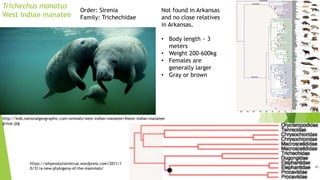
Trichechus manatus
West Indian manatee
http://kids.nationalgeographic.com/animals/west-indian-manatee/#west-indian-manatee-
group.jpg
Order: Sirenia
Family: Trichechidae
https://whyevolutionistrue.wordpress.com/2011/1
0/31/a-new-phylogeny-of-the-mammals/
Not found in Arkansas
and no close relatives
in Arkansas.
• Body length ~ 3
meters
• Weight 200-600kg
• Females are
generally larger
• Gray or brown
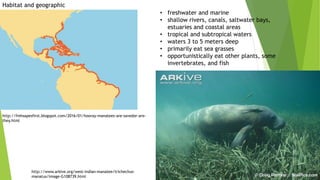
Habitat and geographic
range
http://fmhsapesfirst.blogspot.com/2016/01/hooray-manatees-are-savedor-are-
they.html
• freshwater and marine
• shallow rivers, canals, saltwater bays,
estuaries and coastal areas
• tropical and subtropical waters
• waters 3 to 5 meters deep
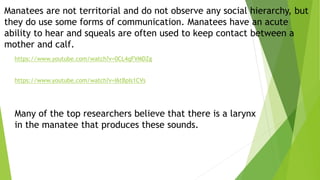
• primarily eat sea grasses
• opportunistically eat other plants, some
invertebrates, and fish
http://www.arkive.org/west-indian-manatee/trichechus-
manatus/image-G108739.html
Manatees are not territorial and do not observe any social hierarchy, but
they do use some forms of communication. Manatees have an acute
ability to hear and squeals are often used to keep contact between a
mother and calf.
https://www.youtube.com/watch?v=0CL4qFVMDZg
https://www.youtube.com/watch?v=I6tBpIs1CVs
Many of the top researchers believe that there is a larynx
in the manatee that produces these sounds.
Observing manatee’s playing with each other as a form of
communication is quite entertaining. They engage in a
variety of movements including barrel rolling and even body
surfing.
http://www.arkive.org/west-indian-manatee/trichechus-manatus/video-la12.html
Manatee mating behavior
 https://www.youtube.com/watch?v=fb4rGGLr758
 *you might want to mute the audio unless you can take a joke*
There is still plenty that is unknown about the communication of manatees. Most
experts agree that more needs to be done in this area of research to help
understand all the different levels that they use to communicate.
References
 http://animaldiversity.org/accounts/Trichechus_manatus/#geographic_range
 http://www.manatee-world.com/manatee-communication/

Manatee communication methods

  • 1.
    West Indian Manatee communication BrettShrable Vertebrate Zoology Summer 2017 Lab Report C
  • 2.
    Trichechus manatus West Indianmanatee http://kids.nationalgeographic.com/animals/west-indian-manatee/#west-indian-manatee- group.jpg Order: Sirenia Family: Trichechidae https://whyevolutionistrue.wordpress.com/2011/1 0/31/a-new-phylogeny-of-the-mammals/ Not found in Arkansas and no close relatives in Arkansas. • Body length ~ 3 meters • Weight 200-600kg • Females are generally larger • Gray or brown
  • 3.
    Habitat and geographic range http://fmhsapesfirst.blogspot.com/2016/01/hooray-manatees-are-savedor-are- they.html •freshwater and marine • shallow rivers, canals, saltwater bays, estuaries and coastal areas • tropical and subtropical waters • waters 3 to 5 meters deep • primarily eat sea grasses • opportunistically eat other plants, some invertebrates, and fish http://www.arkive.org/west-indian-manatee/trichechus- manatus/image-G108739.html
  • 4.
    Manatees are notterritorial and do not observe any social hierarchy, but they do use some forms of communication. Manatees have an acute ability to hear and squeals are often used to keep contact between a mother and calf. https://www.youtube.com/watch?v=0CL4qFVMDZg https://www.youtube.com/watch?v=I6tBpIs1CVs Many of the top researchers believe that there is a larynx in the manatee that produces these sounds.
  • 5.
    Observing manatee’s playingwith each other as a form of communication is quite entertaining. They engage in a variety of movements including barrel rolling and even body surfing. http://www.arkive.org/west-indian-manatee/trichechus-manatus/video-la12.html
  • 6.
    Manatee mating behavior https://www.youtube.com/watch?v=fb4rGGLr758  *you might want to mute the audio unless you can take a joke*
  • 7.
    There is stillplenty that is unknown about the communication of manatees. Most experts agree that more needs to be done in this area of research to help understand all the different levels that they use to communicate.
  • 8.