Introduction
Motivation
Background
Solution
Conclusions
.
.
. ..
.
.
A Lightweight Approach for Managing XML
Documents with MDE Languages
Dimitris Kolovos, Louis Rose, James Williams,
Nicholas Matragkas, and Richard Paige
Department of Computer Science, University of York
{dkolovos,louis,jw,nikos,paige}@cs.york.ac.uk
D. Kolovos et. al. | University of York | ECMFA 2012 MDE with plain XML documents - Slide 1/32
Introduction
Motivation
Background
Solution
Conclusions
.. Introduction
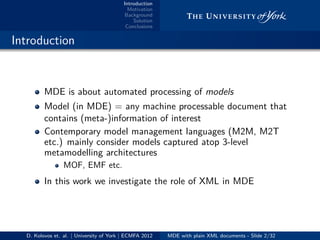
MDE is about automated processing of models
Model (in MDE) = any machine processable document that
contains (meta-)information of interest
Contemporary model management languages (M2M, M2T
etc.) mainly consider models captured atop 3-level
metamodelling architectures
MOF, EMF etc.
In this work we investigate the role of XML in MDE
D. Kolovos et. al. | University of York | ECMFA 2012 MDE with plain XML documents - Slide 2/32
Introduction
Motivation
Background
Solution
Conclusions
.. XML
.
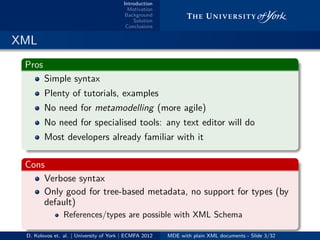
Pros
..
.
. ..
.
.
Simple syntax
Plenty of tutorials, examples
No need for metamodelling (more agile)
No need for specialised tools: any text editor will do
Most developers already familiar with it
.
Cons
..
.
. ..
.
.
Verbose syntax
Only good for tree-based metadata, no support for types (by
default)
References/types are possible with XML Schema
D. Kolovos et. al. | University of York | ECMFA 2012 MDE with plain XML documents - Slide 3/32
Introduction
Motivation
Background
Solution
Conclusions
.. EMF vs. XML
XML is technically inferior to EMF
Plain XML is more agile than EMF
XML is immensely more popular
There is much potentially useful (meta-)information already
stored in XML
D. Kolovos et. al. | University of York | ECMFA 2012 MDE with plain XML documents - Slide 4/32
Introduction
Motivation
Background
Solution
Conclusions
.. Motivation
Enable agile MDE
Bring MDE to XML-literate developers without forcing them
to engage with metamodelling architectures
Lower the entry barrier by introducing one thing at a time
If MDE pays off, transition to a proper metamodelling
architecture should be less of an issue
D. Kolovos et. al. | University of York | ECMFA 2012 MDE with plain XML documents - Slide 5/32
Introduction
Motivation
Background
Solution
Conclusions
.. How?
Enable model management languages to manage schema-less
XML documents (playing the role of models)
To automate tasks such as model transformation, code
generation, model validation etc.
D. Kolovos et. al. | University of York | ECMFA 2012 MDE with plain XML documents - Slide 6/32
Introduction
Motivation
Background
Solution
Conclusions
.. Epsilon - www.eclipse.org/epsilon
A family of modelling technology-agnostic model management
languages for
Code generation (EGL)
Model transformation (ETL)
Model validation (EVL)
Model comparison (ECL)
...
All Epsilon languages reuse a common expression language
(Epsilon Object Language) and as such, they are consistent
and interoperable with each other
D. Kolovos et. al. | University of York | ECMFA 2012 MDE with plain XML documents - Slide 7/32
Introduction
Motivation
Background
Solution
Conclusions
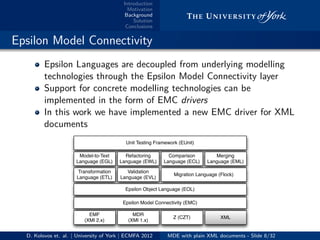
.. Epsilon Model Connectivity
Epsilon Languages are decoupled from underlying modelling
technologies through the Epsilon Model Connectivity layer
Support for concrete modelling technologies can be
implemented in the form of EMC drivers
In this work we have implemented a new EMC driver for XML
documents
Epsilon Object Language (EOL)
Epsilon Model Connectivity (EMC)
EMF
(XMI 2.x)
MDR
(XMI 1.x)
Z (CZT) XML
Transformation
Language (ETL)
Validation
Language (EVL)
Migration Language (Flock)
Model-to-Text
Language (EGL)
Refactoring
Language (EWL)
Comparison
Language (ECL)
Merging
Language (EML)
Unit Testing Framework (EUnit)
D. Kolovos et. al. | University of York | ECMFA 2012 MDE with plain XML documents - Slide 8/32
Introduction
Motivation
Background
Solution
Conclusions
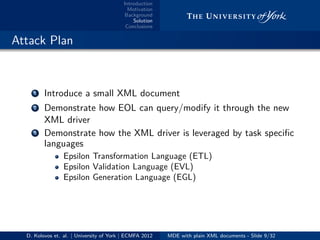
.. Attack Plan
...1 Introduce a small XML document
...2 Demonstrate how EOL can query/modify it through the new
XML driver
...3 Demonstrate how the XML driver is leveraged by task specific
languages
Epsilon Transformation Language (ETL)
Epsilon Validation Language (EVL)
Epsilon Generation Language (EGL)
D. Kolovos et. al. | University of York | ECMFA 2012 MDE with plain XML documents - Slide 9/32
Introduction
Motivation
Background
Solution
Conclusions
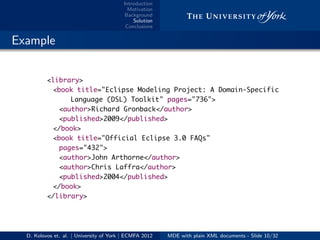
.. Example
<library>
<book title="Eclipse Modeling Project: A Domain-Specific
Language (DSL) Toolkit" pages="736">
<author>Richard Gronback</author>
<published>2009</published>
</book>
<book title="Official Eclipse 3.0 FAQs"
pages="432">
<author>John Arthorne</author>
<author>Chris Laffra</author>
<published>2004</published>
</book>
</library>
D. Kolovos et. al. | University of York | ECMFA 2012 MDE with plain XML documents - Slide 10/32
Introduction
Motivation
Background
Solution
Conclusions
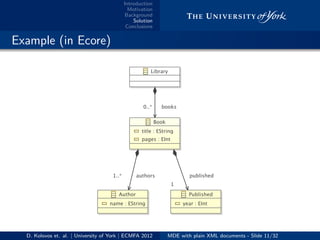
.. Example (in Ecore)
D. Kolovos et. al. | University of York | ECMFA 2012 MDE with plain XML documents - Slide 11/32
Introduction
Motivation
Background
Solution
Conclusions
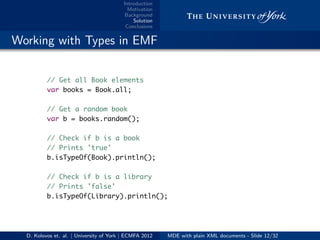
.. Working with Types in EMF
// Get all Book elements
var books = Book.all;
// Get a random book
var b = books.random();
// Check if b is a book
// Prints 'true'
b.isTypeOf(Book).println();
// Check if b is a library
// Prints 'false'
b.isTypeOf(Library).println();
D. Kolovos et. al. | University of York | ECMFA 2012 MDE with plain XML documents - Slide 12/32
Introduction
Motivation
Background
Solution
Conclusions
.. Emulating Types in XML
.
.
. ..
.
.
The t_ prefix before the name of a tag is used to emulate a
type, instances of which are all the elements with that tag.
// Get all <book> elements
var books = t_book.all;
// Get a random book
var b = books.random();
// Check if b is a book
// Prints 'true'
b.isTypeOf(t_book).println();
// Check if b is a library
// Prints 'false'
b.isTypeOf(t_library).println();
D. Kolovos et. al. | University of York | ECMFA 2012 MDE with plain XML documents - Slide 13/32
Introduction
Motivation
Background
Solution
Conclusions
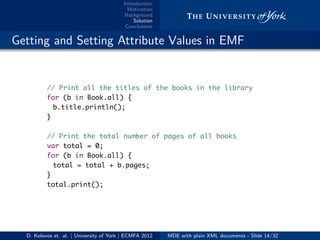
.. Getting and Setting Attribute Values in EMF
// Print all the titles of the books in the library
for (b in Book.all) {
b.title.println();
}
// Print the total number of pages of all books
var total = 0;
for (b in Book.all) {
total = total + b.pages;
}
total.print();
D. Kolovos et. al. | University of York | ECMFA 2012 MDE with plain XML documents - Slide 14/32
Introduction
Motivation
Background
Solution
Conclusions
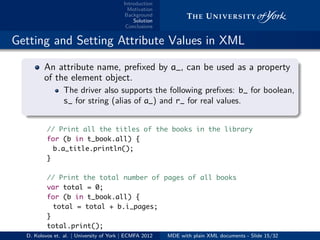
.. Getting and Setting Attribute Values in XML
.
.
. ..
.
.
An attribute name, prefixed by a_, can be used as a property
of the element object.
The driver also supports the following prefixes: b_ for boolean,
s_ for string (alias of a_) and r_ for real values.
// Print all the titles of the books in the library
for (b in t_book.all) {
b.a_title.println();
}
// Print the total number of pages of all books
var total = 0;
for (b in t_book.all) {
total = total + b.i_pages;
}
total.print();
D. Kolovos et. al. | University of York | ECMFA 2012 MDE with plain XML documents - Slide 15/32
Introduction
Motivation
Background
Solution
Conclusions
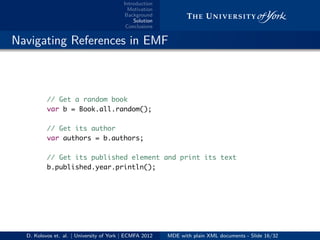
.. Navigating References in EMF
// Get a random book
var b = Book.all.random();
// Get its author
var authors = b.authors;
// Get its published element and print its text
b.published.year.println();
D. Kolovos et. al. | University of York | ECMFA 2012 MDE with plain XML documents - Slide 16/32
Introduction
Motivation
Background
Solution
Conclusions
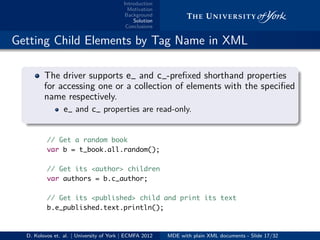
.. Getting Child Elements by Tag Name in XML
.
.
. ..
.
.
The driver supports e_ and c_-prefixed shorthand properties
for accessing one or a collection of elements with the specified
name respectively.
e_ and c_ properties are read-only.
// Get a random book
var b = t_book.all.random();
// Get its <author> children
var authors = b.c_author;
// Get its <published> child and print its text
b.e_published.text.println();
D. Kolovos et. al. | University of York | ECMFA 2012 MDE with plain XML documents - Slide 17/32
Introduction
Motivation
Background
Solution
Conclusions
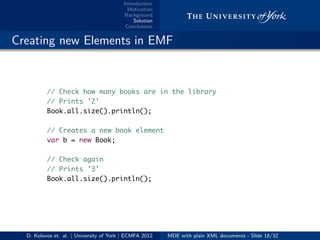
.. Creating new Elements in EMF
// Check how many books are in the library
// Prints '2'
Book.all.size().println();
// Creates a new book element
var b = new Book;
// Check again
// Prints '3'
Book.all.size().println();
D. Kolovos et. al. | University of York | ECMFA 2012 MDE with plain XML documents - Slide 18/32
Introduction
Motivation
Background
Solution
Conclusions
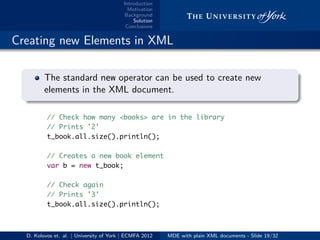
.. Creating new Elements in XML
.
.
. ..
.
.
The standard new operator can be used to create new
elements in the XML document.
// Check how many <books> are in the library
// Prints '2'
t_book.all.size().println();
// Creates a new book element
var b = new t_book;
// Check again
// Prints '3'
t_book.all.size().println();
D. Kolovos et. al. | University of York | ECMFA 2012 MDE with plain XML documents - Slide 19/32
Introduction
Motivation
Background
Solution
Conclusions
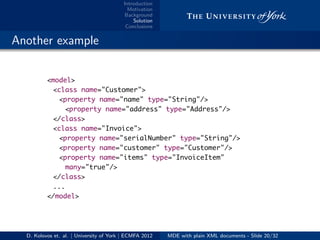
.. Another example
<model>
<class name="Customer">
<property name="name" type="String"/>
<property name="address" type="Address"/>
</class>
<class name="Invoice">
<property name="serialNumber" type="String"/>
<property name="customer" type="Customer"/>
<property name="items" type="InvoiceItem"
many="true"/>
</class>
...
</model>
D. Kolovos et. al. | University of York | ECMFA 2012 MDE with plain XML documents - Slide 20/32
Introduction
Motivation
Background
Solution
Conclusions
.. Validation Constraints with EVL
.
.
. ..
.
.
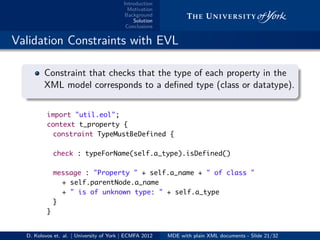
Constraint that checks that the type of each property in the
XML model corresponds to a defined type (class or datatype).
import "util.eol";
context t_property {
constraint TypeMustBeDefined {
check : typeForName(self.a_type).isDefined()
message : "Property " + self.a_name + " of class "
+ self.parentNode.a_name
+ " is of unknown type: " + self.a_type
}
}
D. Kolovos et. al. | University of York | ECMFA 2012 MDE with plain XML documents - Slide 21/32
Introduction
Motivation
Background
Solution
Conclusions
.. typeForName()
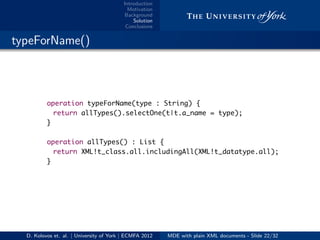
operation typeForName(type : String) {
return allTypes().selectOne(t|t.a_name = type);
}
operation allTypes() : List {
return XML!t_class.all.includingAll(XML!t_datatype.all);
}
D. Kolovos et. al. | University of York | ECMFA 2012 MDE with plain XML documents - Slide 22/32
Introduction
Motivation
Background
Solution
Conclusions
.. Model Transformation with ETL
.
.
. ..
.
.
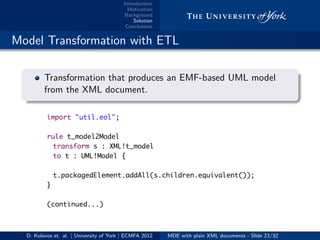
Transformation that produces an EMF-based UML model
from the XML document.
import "util.eol";
rule t_model2Model
transform s : XML!t_model
to t : UML!Model {
t.packagedElement.addAll(s.children.equivalent());
}
(continued...)
D. Kolovos et. al. | University of York | ECMFA 2012 MDE with plain XML documents - Slide 23/32
Introduction
Motivation
Background
Solution
Conclusions
.. Model Transformation with ETL
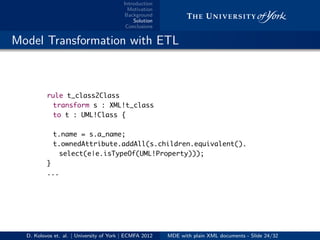
rule t_class2Class
transform s : XML!t_class
to t : UML!Class {
t.name = s.a_name;
t.ownedAttribute.addAll(s.children.equivalent().
select(e|e.isTypeOf(UML!Property)));
}
...
D. Kolovos et. al. | University of York | ECMFA 2012 MDE with plain XML documents - Slide 24/32
Introduction
Motivation
Background
Solution
Conclusions
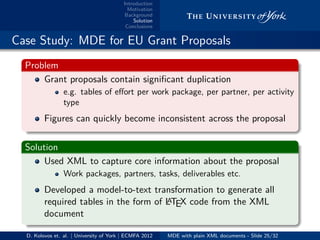
.. Case Study: MDE for EU Grant Proposals
.
Problem
..
.
. ..
.
.
Grant proposals contain significant duplication
e.g. tables of effort per work package, per partner, per activity
type
Figures can quickly become inconsistent across the proposal
.
Solution
..
.
. ..
.
.
Used XML to capture core information about the proposal
Work packages, partners, tasks, deliverables etc.
Developed a model-to-text transformation to generate all
required tables in the form of LATEX code from the XML
document
D. Kolovos et. al. | University of York | ECMFA 2012 MDE with plain XML documents - Slide 25/32
Introduction
Motivation
Background
Solution
Conclusions
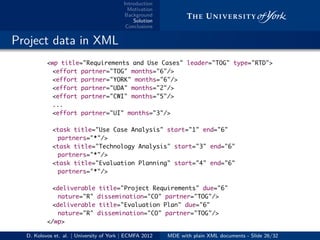
.. Project data in XML
<wp title="Requirements and Use Cases" leader="TOG" type="RTD">
<effort partner="TOG" months="6"/>
<effort partner="YORK" months="6"/>
<effort partner="UDA" months="2"/>
<effort partner="CWI" months="5"/>
...
<effort partner="UI" months="3"/>
<task title="Use Case Analysis" start="1" end="6"
partners="*"/>
<task title="Technology Analysis" start="3" end="6"
partners="*"/>
<task title="Evaluation Planning" start="4" end="6"
partners="*"/>
<deliverable title="Project Requirements" due="6"
nature="R" dissemination="CO" partner="TOG"/>
<deliverable title="Evaluation Plan" due="6"
nature="R" dissemination="CO" partner="TOG"/>
</wp>
D. Kolovos et. al. | University of York | ECMFA 2012 MDE with plain XML documents - Slide 26/32
Introduction
Motivation
Background
Solution
Conclusions
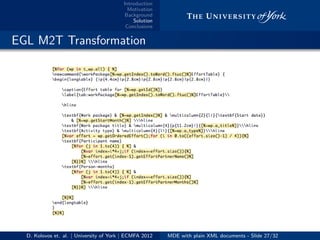
.. EGL M2T Transformation
D. Kolovos et. al. | University of York | ECMFA 2012 MDE with plain XML documents - Slide 27/32
Introduction
Motivation
Background
Solution
Conclusions
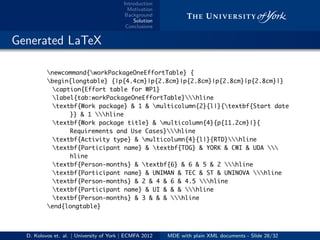
.. Generated LaTeX
newcommand{workPackageOneEffortTable} {
begin{longtable} {|p{4.4cm}|p{2.8cm}|p{2.8cm}|p{2.8cm}|p{2.8cm}|}
caption{Effort table for WP1}
label{tab:workPackageOneEffortTable}hline
textbf{Work package} & 1 & multicolumn{2}{l|}{textbf{Start date
}} & 1 hline
textbf{Work package title} & multicolumn{4}{p{11.2cm}|}{
Requirements and Use Cases}hline
textbf{Activity type} & multicolumn{4}{l|}{RTD}hline
textbf{Participant name} & textbf{TOG} & YORK & CWI & UDA 
hline
textbf{Person-months} & textbf{6} & 6 & 5 & 2 hline
textbf{Participant name} & UNIMAN & TEC & ST & UNINOVA hline
textbf{Person-months} & 2 & 4 & 6 & 4.5 hline
textbf{Participant name} & UI & & & hline
textbf{Person-months} & 3 & & & hline
end{longtable}
D. Kolovos et. al. | University of York | ECMFA 2012 MDE with plain XML documents - Slide 28/32
Introduction
Motivation
Background
Solution
Conclusions
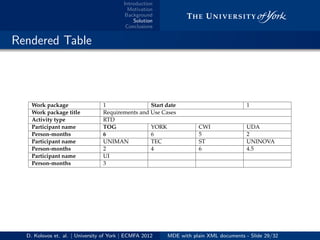
.. Rendered Table318736 OSSMETER
A6. Work Package Descriptions
A6.1. WP1: Requirements and Use Cases
Table 4: E↵ort table for WP1
Work package 1 Start date 1
Work package title Requirements and Use Cases
Activity type RTD
Participant name TOG YORK CWI UDA
Person-months 6 6 5 2
Participant name UNIMAN TEC ST UNINOVA
Person-months 2 4 6 4.5
Participant name UI
Person-months 3
Objectives:
Within this workpackage the requirements will be defined for the new open source analysis tools,
technologies and processes to assist European software developers and decision makers, which are
driven from both an industry and technology perspective.
The use cases provided by the industrial user partners in the project will be analysed and industry
driven requirements for the project will be defined and prioritised. The technology partners will
further detail technical requirements that address the industrial user needs within the use cases and
fulfill the technological breakthroughs targeted by the project. Requirements will be established for
D. Kolovos et. al. | University of York | ECMFA 2012 MDE with plain XML documents - Slide 29/32
Introduction
Motivation
Background
Solution
Conclusions
.. Observations
XML’s agility makes it ideal for quick prototyping
No need to design a metamodel first
Model evolution is easy
Model management code is more verbose with plain XML
models
e_, c_, a_, t_ prefixes
Programmatic not-containment reference resolution
Referential integrity must be validated programmatically
Increasing motivation to move to a proper modelling
framework as the metamodel stabilises and complexity
increases
Migration to EMF is manual (so far) but straightforward
D. Kolovos et. al. | University of York | ECMFA 2012 MDE with plain XML documents - Slide 30/32
Introduction
Motivation
Background
Solution
Conclusions
.. Summary
Presented a new driver for Epsilon that enables plain XML
documents to be managed as models
The proposed approach aims at lowering the MDE entrance
barrier for XML-literate developers, and at enabling agile MDE
Sub-optimal MDE is better than no MDE
D. Kolovos et. al. | University of York | ECMFA 2012 MDE with plain XML documents - Slide 31/32
Introduction
Motivation
Background
Solution
Conclusions
.. Download
Available at http://www.eclipse.org/epsilon/download
D. Kolovos et. al. | University of York | ECMFA 2012 MDE with plain XML documents - Slide 32/32

Managing XML documents with Epsilon

  • 1.
    Introduction Motivation Background Solution Conclusions . . . .. . . A LightweightApproach for Managing XML Documents with MDE Languages Dimitris Kolovos, Louis Rose, James Williams, Nicholas Matragkas, and Richard Paige Department of Computer Science, University of York {dkolovos,louis,jw,nikos,paige}@cs.york.ac.uk D. Kolovos et. al. | University of York | ECMFA 2012 MDE with plain XML documents - Slide 1/32
  • 2.
    Introduction Motivation Background Solution Conclusions .. Introduction MDE isabout automated processing of models Model (in MDE) = any machine processable document that contains (meta-)information of interest Contemporary model management languages (M2M, M2T etc.) mainly consider models captured atop 3-level metamodelling architectures MOF, EMF etc. In this work we investigate the role of XML in MDE D. Kolovos et. al. | University of York | ECMFA 2012 MDE with plain XML documents - Slide 2/32
  • 3.
    Introduction Motivation Background Solution Conclusions .. XML . Pros .. . . .. . . Simplesyntax Plenty of tutorials, examples No need for metamodelling (more agile) No need for specialised tools: any text editor will do Most developers already familiar with it . Cons .. . . .. . . Verbose syntax Only good for tree-based metadata, no support for types (by default) References/types are possible with XML Schema D. Kolovos et. al. | University of York | ECMFA 2012 MDE with plain XML documents - Slide 3/32
  • 4.
    Introduction Motivation Background Solution Conclusions .. EMF vs.XML XML is technically inferior to EMF Plain XML is more agile than EMF XML is immensely more popular There is much potentially useful (meta-)information already stored in XML D. Kolovos et. al. | University of York | ECMFA 2012 MDE with plain XML documents - Slide 4/32
  • 5.
    Introduction Motivation Background Solution Conclusions .. Motivation Enable agileMDE Bring MDE to XML-literate developers without forcing them to engage with metamodelling architectures Lower the entry barrier by introducing one thing at a time If MDE pays off, transition to a proper metamodelling architecture should be less of an issue D. Kolovos et. al. | University of York | ECMFA 2012 MDE with plain XML documents - Slide 5/32
  • 6.
    Introduction Motivation Background Solution Conclusions .. How? Enable modelmanagement languages to manage schema-less XML documents (playing the role of models) To automate tasks such as model transformation, code generation, model validation etc. D. Kolovos et. al. | University of York | ECMFA 2012 MDE with plain XML documents - Slide 6/32
  • 7.
    Introduction Motivation Background Solution Conclusions .. Epsilon -www.eclipse.org/epsilon A family of modelling technology-agnostic model management languages for Code generation (EGL) Model transformation (ETL) Model validation (EVL) Model comparison (ECL) ... All Epsilon languages reuse a common expression language (Epsilon Object Language) and as such, they are consistent and interoperable with each other D. Kolovos et. al. | University of York | ECMFA 2012 MDE with plain XML documents - Slide 7/32
  • 8.
    Introduction Motivation Background Solution Conclusions .. Epsilon ModelConnectivity Epsilon Languages are decoupled from underlying modelling technologies through the Epsilon Model Connectivity layer Support for concrete modelling technologies can be implemented in the form of EMC drivers In this work we have implemented a new EMC driver for XML documents Epsilon Object Language (EOL) Epsilon Model Connectivity (EMC) EMF (XMI 2.x) MDR (XMI 1.x) Z (CZT) XML Transformation Language (ETL) Validation Language (EVL) Migration Language (Flock) Model-to-Text Language (EGL) Refactoring Language (EWL) Comparison Language (ECL) Merging Language (EML) Unit Testing Framework (EUnit) D. Kolovos et. al. | University of York | ECMFA 2012 MDE with plain XML documents - Slide 8/32
  • 9.
    Introduction Motivation Background Solution Conclusions .. Attack Plan ...1Introduce a small XML document ...2 Demonstrate how EOL can query/modify it through the new XML driver ...3 Demonstrate how the XML driver is leveraged by task specific languages Epsilon Transformation Language (ETL) Epsilon Validation Language (EVL) Epsilon Generation Language (EGL) D. Kolovos et. al. | University of York | ECMFA 2012 MDE with plain XML documents - Slide 9/32
  • 10.
    Introduction Motivation Background Solution Conclusions .. Example <library> <book title="EclipseModeling Project: A Domain-Specific Language (DSL) Toolkit" pages="736"> <author>Richard Gronback</author> <published>2009</published> </book> <book title="Official Eclipse 3.0 FAQs" pages="432"> <author>John Arthorne</author> <author>Chris Laffra</author> <published>2004</published> </book> </library> D. Kolovos et. al. | University of York | ECMFA 2012 MDE with plain XML documents - Slide 10/32
  • 11.
    Introduction Motivation Background Solution Conclusions .. Example (inEcore) D. Kolovos et. al. | University of York | ECMFA 2012 MDE with plain XML documents - Slide 11/32
  • 12.
    Introduction Motivation Background Solution Conclusions .. Working withTypes in EMF // Get all Book elements var books = Book.all; // Get a random book var b = books.random(); // Check if b is a book // Prints 'true' b.isTypeOf(Book).println(); // Check if b is a library // Prints 'false' b.isTypeOf(Library).println(); D. Kolovos et. al. | University of York | ECMFA 2012 MDE with plain XML documents - Slide 12/32
  • 13.
    Introduction Motivation Background Solution Conclusions .. Emulating Typesin XML . . . .. . . The t_ prefix before the name of a tag is used to emulate a type, instances of which are all the elements with that tag. // Get all <book> elements var books = t_book.all; // Get a random book var b = books.random(); // Check if b is a book // Prints 'true' b.isTypeOf(t_book).println(); // Check if b is a library // Prints 'false' b.isTypeOf(t_library).println(); D. Kolovos et. al. | University of York | ECMFA 2012 MDE with plain XML documents - Slide 13/32
  • 14.
    Introduction Motivation Background Solution Conclusions .. Getting andSetting Attribute Values in EMF // Print all the titles of the books in the library for (b in Book.all) { b.title.println(); } // Print the total number of pages of all books var total = 0; for (b in Book.all) { total = total + b.pages; } total.print(); D. Kolovos et. al. | University of York | ECMFA 2012 MDE with plain XML documents - Slide 14/32
  • 15.
    Introduction Motivation Background Solution Conclusions .. Getting andSetting Attribute Values in XML . . . .. . . An attribute name, prefixed by a_, can be used as a property of the element object. The driver also supports the following prefixes: b_ for boolean, s_ for string (alias of a_) and r_ for real values. // Print all the titles of the books in the library for (b in t_book.all) { b.a_title.println(); } // Print the total number of pages of all books var total = 0; for (b in t_book.all) { total = total + b.i_pages; } total.print(); D. Kolovos et. al. | University of York | ECMFA 2012 MDE with plain XML documents - Slide 15/32
  • 16.
    Introduction Motivation Background Solution Conclusions .. Navigating Referencesin EMF // Get a random book var b = Book.all.random(); // Get its author var authors = b.authors; // Get its published element and print its text b.published.year.println(); D. Kolovos et. al. | University of York | ECMFA 2012 MDE with plain XML documents - Slide 16/32
  • 17.
    Introduction Motivation Background Solution Conclusions .. Getting ChildElements by Tag Name in XML . . . .. . . The driver supports e_ and c_-prefixed shorthand properties for accessing one or a collection of elements with the specified name respectively. e_ and c_ properties are read-only. // Get a random book var b = t_book.all.random(); // Get its <author> children var authors = b.c_author; // Get its <published> child and print its text b.e_published.text.println(); D. Kolovos et. al. | University of York | ECMFA 2012 MDE with plain XML documents - Slide 17/32
  • 18.
    Introduction Motivation Background Solution Conclusions .. Creating newElements in EMF // Check how many books are in the library // Prints '2' Book.all.size().println(); // Creates a new book element var b = new Book; // Check again // Prints '3' Book.all.size().println(); D. Kolovos et. al. | University of York | ECMFA 2012 MDE with plain XML documents - Slide 18/32
  • 19.
    Introduction Motivation Background Solution Conclusions .. Creating newElements in XML . . . .. . . The standard new operator can be used to create new elements in the XML document. // Check how many <books> are in the library // Prints '2' t_book.all.size().println(); // Creates a new book element var b = new t_book; // Check again // Prints '3' t_book.all.size().println(); D. Kolovos et. al. | University of York | ECMFA 2012 MDE with plain XML documents - Slide 19/32
  • 20.
    Introduction Motivation Background Solution Conclusions .. Another example <model> <classname="Customer"> <property name="name" type="String"/> <property name="address" type="Address"/> </class> <class name="Invoice"> <property name="serialNumber" type="String"/> <property name="customer" type="Customer"/> <property name="items" type="InvoiceItem" many="true"/> </class> ... </model> D. Kolovos et. al. | University of York | ECMFA 2012 MDE with plain XML documents - Slide 20/32
  • 21.
    Introduction Motivation Background Solution Conclusions .. Validation Constraintswith EVL . . . .. . . Constraint that checks that the type of each property in the XML model corresponds to a defined type (class or datatype). import "util.eol"; context t_property { constraint TypeMustBeDefined { check : typeForName(self.a_type).isDefined() message : "Property " + self.a_name + " of class " + self.parentNode.a_name + " is of unknown type: " + self.a_type } } D. Kolovos et. al. | University of York | ECMFA 2012 MDE with plain XML documents - Slide 21/32
  • 22.
    Introduction Motivation Background Solution Conclusions .. typeForName() operation typeForName(type: String) { return allTypes().selectOne(t|t.a_name = type); } operation allTypes() : List { return XML!t_class.all.includingAll(XML!t_datatype.all); } D. Kolovos et. al. | University of York | ECMFA 2012 MDE with plain XML documents - Slide 22/32
  • 23.
    Introduction Motivation Background Solution Conclusions .. Model Transformationwith ETL . . . .. . . Transformation that produces an EMF-based UML model from the XML document. import "util.eol"; rule t_model2Model transform s : XML!t_model to t : UML!Model { t.packagedElement.addAll(s.children.equivalent()); } (continued...) D. Kolovos et. al. | University of York | ECMFA 2012 MDE with plain XML documents - Slide 23/32
  • 24.
    Introduction Motivation Background Solution Conclusions .. Model Transformationwith ETL rule t_class2Class transform s : XML!t_class to t : UML!Class { t.name = s.a_name; t.ownedAttribute.addAll(s.children.equivalent(). select(e|e.isTypeOf(UML!Property))); } ... D. Kolovos et. al. | University of York | ECMFA 2012 MDE with plain XML documents - Slide 24/32
  • 25.
    Introduction Motivation Background Solution Conclusions .. Case Study:MDE for EU Grant Proposals . Problem .. . . .. . . Grant proposals contain significant duplication e.g. tables of effort per work package, per partner, per activity type Figures can quickly become inconsistent across the proposal . Solution .. . . .. . . Used XML to capture core information about the proposal Work packages, partners, tasks, deliverables etc. Developed a model-to-text transformation to generate all required tables in the form of LATEX code from the XML document D. Kolovos et. al. | University of York | ECMFA 2012 MDE with plain XML documents - Slide 25/32
  • 26.
    Introduction Motivation Background Solution Conclusions .. Project datain XML <wp title="Requirements and Use Cases" leader="TOG" type="RTD"> <effort partner="TOG" months="6"/> <effort partner="YORK" months="6"/> <effort partner="UDA" months="2"/> <effort partner="CWI" months="5"/> ... <effort partner="UI" months="3"/> <task title="Use Case Analysis" start="1" end="6" partners="*"/> <task title="Technology Analysis" start="3" end="6" partners="*"/> <task title="Evaluation Planning" start="4" end="6" partners="*"/> <deliverable title="Project Requirements" due="6" nature="R" dissemination="CO" partner="TOG"/> <deliverable title="Evaluation Plan" due="6" nature="R" dissemination="CO" partner="TOG"/> </wp> D. Kolovos et. al. | University of York | ECMFA 2012 MDE with plain XML documents - Slide 26/32
  • 27.
    Introduction Motivation Background Solution Conclusions .. EGL M2TTransformation D. Kolovos et. al. | University of York | ECMFA 2012 MDE with plain XML documents - Slide 27/32
  • 28.
    Introduction Motivation Background Solution Conclusions .. Generated LaTeX newcommand{workPackageOneEffortTable}{ begin{longtable} {|p{4.4cm}|p{2.8cm}|p{2.8cm}|p{2.8cm}|p{2.8cm}|} caption{Effort table for WP1} label{tab:workPackageOneEffortTable}hline textbf{Work package} & 1 & multicolumn{2}{l|}{textbf{Start date }} & 1 hline textbf{Work package title} & multicolumn{4}{p{11.2cm}|}{ Requirements and Use Cases}hline textbf{Activity type} & multicolumn{4}{l|}{RTD}hline textbf{Participant name} & textbf{TOG} & YORK & CWI & UDA hline textbf{Person-months} & textbf{6} & 6 & 5 & 2 hline textbf{Participant name} & UNIMAN & TEC & ST & UNINOVA hline textbf{Person-months} & 2 & 4 & 6 & 4.5 hline textbf{Participant name} & UI & & & hline textbf{Person-months} & 3 & & & hline end{longtable} D. Kolovos et. al. | University of York | ECMFA 2012 MDE with plain XML documents - Slide 28/32
  • 29.
    Introduction Motivation Background Solution Conclusions .. Rendered Table318736OSSMETER A6. Work Package Descriptions A6.1. WP1: Requirements and Use Cases Table 4: E↵ort table for WP1 Work package 1 Start date 1 Work package title Requirements and Use Cases Activity type RTD Participant name TOG YORK CWI UDA Person-months 6 6 5 2 Participant name UNIMAN TEC ST UNINOVA Person-months 2 4 6 4.5 Participant name UI Person-months 3 Objectives: Within this workpackage the requirements will be defined for the new open source analysis tools, technologies and processes to assist European software developers and decision makers, which are driven from both an industry and technology perspective. The use cases provided by the industrial user partners in the project will be analysed and industry driven requirements for the project will be defined and prioritised. The technology partners will further detail technical requirements that address the industrial user needs within the use cases and fulfill the technological breakthroughs targeted by the project. Requirements will be established for D. Kolovos et. al. | University of York | ECMFA 2012 MDE with plain XML documents - Slide 29/32
  • 30.
    Introduction Motivation Background Solution Conclusions .. Observations XML’s agilitymakes it ideal for quick prototyping No need to design a metamodel first Model evolution is easy Model management code is more verbose with plain XML models e_, c_, a_, t_ prefixes Programmatic not-containment reference resolution Referential integrity must be validated programmatically Increasing motivation to move to a proper modelling framework as the metamodel stabilises and complexity increases Migration to EMF is manual (so far) but straightforward D. Kolovos et. al. | University of York | ECMFA 2012 MDE with plain XML documents - Slide 30/32
  • 31.
    Introduction Motivation Background Solution Conclusions .. Summary Presented anew driver for Epsilon that enables plain XML documents to be managed as models The proposed approach aims at lowering the MDE entrance barrier for XML-literate developers, and at enabling agile MDE Sub-optimal MDE is better than no MDE D. Kolovos et. al. | University of York | ECMFA 2012 MDE with plain XML documents - Slide 31/32
  • 32.
    Introduction Motivation Background Solution Conclusions .. Download Available athttp://www.eclipse.org/epsilon/download D. Kolovos et. al. | University of York | ECMFA 2012 MDE with plain XML documents - Slide 32/32