Managing risk in e 
a complex world 
Introduction 
The best risk control lies in being able to see an entire portfolio easily and being able to 
spot deviations from the expected without difficulty. Transparency should therefore be the 
primary method of risk control in most portfolios. 
Over the last few decades, fundamental changes in the investment model have lost sight 
of this. It has almost become an accepted truth that to be a “sophisticated” institutional 
investor in a complex, interactive, tightly coupled and adaptive world, one has to 
adopt a complex, interactive, tightly coupled and opportunistic investment model (and 
organization). This new approach, which emphasizes non-transparent and illiquid vehicles, 
relies on quantitative, detailed models of portfolio characteristics as their primary risk 
control devices. 
However, a complex investment world does not require a complex response, either in the 
nature of the investment organization or the particular investment strategies chosen. 
The cockroach lives in a highly complex environment with one of the best long-term success 
rates of any creature. Yet it has only one defense mechanism – running in the opposite 
direction from a puff of air. The equivalent for the investment world is, at the core, a 
very simple structure founded upon public market diversification with one basic defense 
mechanism: see a volatile movement, react in the opposite direction (i.e. rebalance into it). 
A simple structure and strategy, if adhered to, has one of the best chances of surviving for 
many decades. 
Club 
Views expressed here are those of the 
author, who is solely responsible for any 
errors and omissions. 
Content: 
Introduction 1 
1. How risk management 
changed 2 
2. The test of time 3 
3. Conclusion 7 
Bob Maynard 
Chief Investment Officer at 
The Public Retirement System of Idaho (PERSI)
2 | The 300 Club | Managing risk in a complex world | October 2014 
1. How risk management changed 
Investment life in the early 1990s was easy. The guiding conventional investment 
philosophy was to have a portfolio that was simple, transparent, and focused: simple, in 
relying primarily on the public markets over time and maintaining a consistent presence in 
those markets; transparent, in being relatively easy to understand and explain; and focused, 
in concentrating extra efforts on a relatively small number of special strategies that would 
have material impacts on the portfolio. 
The resulting portfolio’s risk control relied primarily on the transparency of the portfolio 
as a whole, and the clear nature of the relationship and behavior to its parts, and only 
secondarily on extensive quantitative risk models and systems. It avoided investment 
approaches that used significant leverage or non-transparent structures. 
As a result, passive indexing of a diversified asset type was the basic investment vehicle. 
Portfolios could be constructed using mean-variance models under the assumptions of 
proportionate return to risk relationships for major asset types and normal randomness. 
Linear models (with the concepts of “alpha,” “beta,” and a number of related risk ratios) 
could approximate market and portfolio behavior both for purposes of monitoring risk and 
as tools to generally predict portfolio behavior. 
Because the style or portfolio is very clear and transparent, with daily and independently 
priced securities, activity can easily be monitored contemporaneously. Unexpected behavior, 
if it occurs, is instantly clear, and explanations for unexpected behavior can be quickly 
determined. 
This conventional approach came under severe attack in the late 1990s and 2000s because 
of the growing disparity between the long-term views of the capital markets and the shorter-term 
behavior of those markets. 
In the past decade, the conventional approach moved from being in the mainstream of 
multi-billion-dollar investment portfolios to an outlier. The investment world moved on 
to a new model of investing, often described as the “endowment model.” This places much 
less reliance on major public market exposures and, instead, emphasizes intense active 
management, illiquid instruments and vehicles, often embraces leverage, and uses many 
detailed and often opportunistic investment strategies. 
It tears apart the traditional asset-class categories of equity and fixed income in favor of 
supposedly underlying factors, such as “real” returns (commodities, Treasury Inflation- 
Protected Securities [TIPS], timberland, real estate), inflation/deflation investments, 
credit-based returns (high-yield, equity), quality differentiations, and similar categories 
to reorganize the investments in the portfolio. It requires that risk be managed actively 
through extensive quantitative models and risk-control systems.
The 300 Club | Managing risk in a complex world | October 2014 | 3 
2. The test of time 
The events of 2008-2009 showed that both theoretically and practically, the endowment 
model failed its first stress test miserably. Markets are extremely volatile, but there is no 
place to hide. Many of the places where the new model took shelter turned out to be 
stunningly worse. 
In the shorter-term, capital markets are inefficient, but they are even more unpredictable 
than assumed by the standard mathematical investment models, and active management 
faces even higher hurdles than previously imagined. 
Much of the mathematics of the investment world is based on the idea of “normal” 
randomness, where returns and actions are based on identical and independent activities 
(like coin tossing). In the near term, however, the world is not “normal” and models 
based on standard capital market theory, such as linear-regression and mean variance 
based on bell-shaped curves, give a false sense of security and can lead to disaster when 
pushed to extremes. 
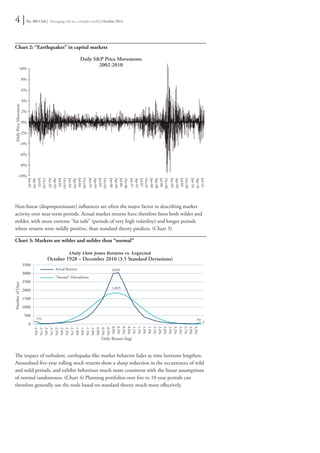
In fact, near term capital market moves are better characterized as being like “earthquakes” 
rather than “normal random” phenomena. (Charts 1 and 2) 
Chart 1: Example seismogram of an earthquake
4 | The 300 Club | Managing risk in a complex world | October 2014 
Chart 2: “Earthquakes” in capital markets 
10% 
Daily Price Movement 
8% 
6% 
4% 
2% 
0% 
-2% 
-4% 
-6% 
-8% 
-10% 
Jan-02 
Apr-02 
Jul-02 
Oct-02 
Jan-03 
Apr-03 
Jul-03 
Oct-03 
Jan-04 
Apr-04 
Daily SP Price Movements 
Jul-04 
Oct-04 
Jan-05 
Apr-05 
2002-2010 
Jul-05 
Oct-05 
Jan-06 
Apr-06 
Jul-06 
Oct-06 
Jan-07 
Apr-07 
Jul-07 
Oct-07 
Jan-08 
Apr-08 
Jul-08 
Oct-08 
Jan-09 
Apr-09 
Jul-09 
Jan-10 
Apr-10 
Jul-10 
Oct-09 
Non-linear (disproportionate) influences are often the major factor in describing market 
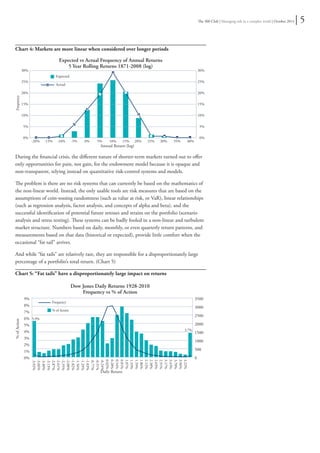
activity over near-term periods. Actual market returns have therefore been both wilder and 
milder, with more extreme “fat tails” (periods of very high volatility) and longer periods 
where returns were mildly positive, than standard theory predicts. (Chart 3) 
Chart 3: Markets are wilder and milder than “normal” 
Number of Days 
Daily Dow Jones Returns vs. Expected 
October 1928 – December 2010 (3.5 Standard Deviations) 
-0.5% 
-0.2% 
3,041 
1,845 
0.0% 
0.3% 
0.5% 
0.8% 
1.1% 
Daily Return (log) 
3500 
3000 
2500 
2000 
1500 
1000 
500 
0 
151 
7 
-3.9% 
-3.7% 
-3.4% 
-3.1% 
Actual Returns 
“Normal” Distrubition 
-2.9% 
-2.6% 
-2.3% 
-2.1% 
-1.8% 
-1.6% 
-1.3% 
-1.0% 
-0.8% 
1.3% 
1.6% 
1.9% 
2.1% 
2.4% 
2.6% 
2.9% 
3.2% 
3.4% 
3.7% 
4.0% 
93 
4.2% 
3 
The impact of turbulent, earthquake-like market behavior fades as time horizons lengthen. 
Annualised five-year rolling stock returns show a sharp reduction in the occurrences of wild 
and mild periods, and exhibit behaviour much more consistent with the linear assumptions 
of normal randomness. (Chart 4) Planning portfolios over five to 10 year periods can 
therefore generally use the tools based on standard theory much more effectively.
The 300 Club | Managing risk in a complex world | October 2014 | 5 
Chart 4: Markets are more linear when considered over longer periods 
Frequency 
Expected vs Actual Frequency of Annual Returns 
5 Year Rolling Returns 1871-2008 (log) 
-20% -15% -10% -5% 0% 5% 10% 15% 20% 25% 30% 35% 40% 
Annual Return (log) 
Expected 
Actual 
30% 
25% 
20% 
15% 
10% 
5% 
0% 
30% 
25% 
20% 
15% 
10% 
5% 
0% 
During the financial crisis, the different nature of shorter-term markets turned out to offer 
only opportunities for pain, not gain, for the endowment model because it is opaque and 
non-transparent, relying instead on quantitative risk-control systems and models. 
The problem is there are no risk systems that can currently be based on the mathematics of 
the non-linear world. Instead, the only usable tools are risk measures that are based on the 
assumptions of coin-tossing randomness (such as value at risk, or VaR), linear relationships 
(such as regression analysis, factor analysis, and concepts of alpha and beta), and the 
successful identification of potential future stresses and strains on the portfolio (scenario 
analysis and stress testing). These systems can be badly fooled in a non-linear and turbulent 
market structure. Numbers based on daily, monthly, or even quarterly return patterns, and 
measurements based on that data (historical or expected), provide little comfort when the 
occasional “fat tail” arrives. 
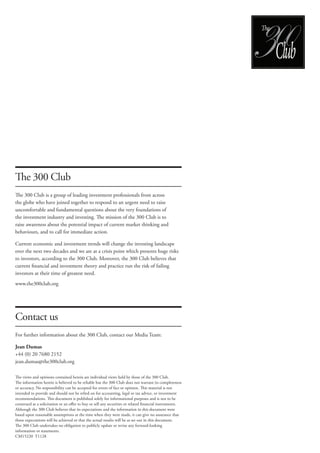
And while “fat tails” are relatively rare, they are responsible for a disproportionately large 
percentage of a portfolio’s total return. (Chart 5) 
Chart 5: “Fat tails” have a disproportionately large impact on returns 
9% 
8% 
7% 
6% 
5% 
4% 
3% 
2% 
1% 
0% 
5.9% 
3.7% 
% of Action 
Dow Jones Daily Returns 1928-2010 
Frequency vs % of Action 
Daily Return 
3500 
3000 
2500 
2000 
1500 
1000 
500 
0 
-3.92% 
-3.66% 
-3.40% 
-3.13% 
-2.87% 
-2.61% 
-2.35% 
-2.08% 
-1.82% 
-1.56% 
-1.29% 
-1.03% 
-0.77% 
-0.51% 
-0.24% 
0.02% 
0.28% 
0.54% 
0.81% 
1.07% 
1.33% 
1.59% 
1.86% 
2.12% 
2.38% 
2.65% 
2.91% 
3.17% 
3.43% 
3.70% 
3.96% 
4.22% 
Frequency 
% of Action
6 | The 300 Club | Managing risk in a complex world | October 2014 
The influence of these unusual events on near-term portfolio risk management simply 
means that linear models and risk systems based on “normal” randomness should be 
rejected as the primary tools for close-to-shore navigation. The markets are complex 
adaptive systems, and at the moment the mathematics of that discipline are at best 
descriptive rather than prescriptive. Like predicting earthquakes, reliable systems for 
navigating future market risk are still an aspiration, not a usable tool for major actions. 
Therefore, the best risk control in a non-linear world still comes from being able to see, 
relatively easily, all the investments in the portfolio, their behaviors, and how they fit 
together. This emphasizes simplicity, transparency, and maintaining sufficient liquidity 
to survive market disruptions of at least three years. 
A conventional approach does not rely on extensive quantitative controls or systems as 
the primary bastion to defend against risk. Instead, conventional portfolios rely on the 
transparency of the portfolio, daily public and independent pricing of public-market 
securities (with the attendant liquidity), managers with clear styles or concentrated 
portfolios, and a reasonable number of active manager relationships that can be easily 
followed and understood, to protect them from unexpected and unforeseen events.
The 300 Club | Managing risk in a complex world | October 2014 | 7 
3. Conclusion 
The best risk control lies in knowing what you have, what it is worth, and how it is 
behaving. The more that detailed quantitative models of portfolio characteristics are needed 
to describe a portfolio and its behavior, the greater risk it will incur. 
A focus on the long-term, as emphasized by the conventional model of investment, also allows 
time to erode the impact of wild and mild periods in markets on portfolios, which increases 
the applicability and effectiveness of the tools based on standard investment theory. 
Quantitative models are better used as supplementary rather than primary risk-control 
devices. As the sign in Einstein’s office supposedly stated: “Not everything that counts can 
be counted, and not everything that can be counted counts.”
The 300 Club 
The 300 Club is a group of leading investment professionals from across 
the globe who have joined together to respond to an urgent need to raise 
uncomfortable and fundamental questions about the very foundations of 
the investment industry and investing. The mission of the 300 Club is to 
raise awareness about the potential impact of current market thinking and 
behaviours, and to call for immediate action. 
Current economic and investment trends will change the investing landscape 
over the next two decades and we are at a crisis point which presents huge risks 
to investors, according to the 300 Club. Moreover, the 300 Club believes that 
current financial and investment theory and practice run the risk of failing 
investors at their time of greatest need. 
www.the300club.org 
Contact us 
For further information about the 300 Club, contact our Media Team: 
Jean Dumas 
+44 (0) 20 7680 2152 
jean.dumas@the300club.org 
The views and opinions contained herein are individual views held by those of the 300 Club. 
The information herein is believed to be reliable but the 300 Club does not warrant its completeness 
or accuracy. No responsibility can be accepted for errors of fact or opinion. This material is not 
intended to provide and should not be relied on for accounting, legal or tax advice, or investment 
recommendations. This document is published solely for informational purposes and is not to be 
construed as a solicitation or an offer to buy or sell any securities or related financial instruments. 
Although the 300 Club believes that its expectations and the information in this document were 
based upon reasonable assumptions at the time when they were made, it can give no assurance that 
those expectations will be achieved or that the actual results will be as set out in this document. 
The 300 Club undertakes no obligation to publicly update or revise any forward-looking 
information or statements. 
CM15220 T1128 
Club 
e

Managing Risk In A Complex World - Bob Maynard

  • 1.
    Managing risk ine a complex world Introduction The best risk control lies in being able to see an entire portfolio easily and being able to spot deviations from the expected without difficulty. Transparency should therefore be the primary method of risk control in most portfolios. Over the last few decades, fundamental changes in the investment model have lost sight of this. It has almost become an accepted truth that to be a “sophisticated” institutional investor in a complex, interactive, tightly coupled and adaptive world, one has to adopt a complex, interactive, tightly coupled and opportunistic investment model (and organization). This new approach, which emphasizes non-transparent and illiquid vehicles, relies on quantitative, detailed models of portfolio characteristics as their primary risk control devices. However, a complex investment world does not require a complex response, either in the nature of the investment organization or the particular investment strategies chosen. The cockroach lives in a highly complex environment with one of the best long-term success rates of any creature. Yet it has only one defense mechanism – running in the opposite direction from a puff of air. The equivalent for the investment world is, at the core, a very simple structure founded upon public market diversification with one basic defense mechanism: see a volatile movement, react in the opposite direction (i.e. rebalance into it). A simple structure and strategy, if adhered to, has one of the best chances of surviving for many decades. Club Views expressed here are those of the author, who is solely responsible for any errors and omissions. Content: Introduction 1 1. How risk management changed 2 2. The test of time 3 3. Conclusion 7 Bob Maynard Chief Investment Officer at The Public Retirement System of Idaho (PERSI)
  • 2.
    2 | The300 Club | Managing risk in a complex world | October 2014 1. How risk management changed Investment life in the early 1990s was easy. The guiding conventional investment philosophy was to have a portfolio that was simple, transparent, and focused: simple, in relying primarily on the public markets over time and maintaining a consistent presence in those markets; transparent, in being relatively easy to understand and explain; and focused, in concentrating extra efforts on a relatively small number of special strategies that would have material impacts on the portfolio. The resulting portfolio’s risk control relied primarily on the transparency of the portfolio as a whole, and the clear nature of the relationship and behavior to its parts, and only secondarily on extensive quantitative risk models and systems. It avoided investment approaches that used significant leverage or non-transparent structures. As a result, passive indexing of a diversified asset type was the basic investment vehicle. Portfolios could be constructed using mean-variance models under the assumptions of proportionate return to risk relationships for major asset types and normal randomness. Linear models (with the concepts of “alpha,” “beta,” and a number of related risk ratios) could approximate market and portfolio behavior both for purposes of monitoring risk and as tools to generally predict portfolio behavior. Because the style or portfolio is very clear and transparent, with daily and independently priced securities, activity can easily be monitored contemporaneously. Unexpected behavior, if it occurs, is instantly clear, and explanations for unexpected behavior can be quickly determined. This conventional approach came under severe attack in the late 1990s and 2000s because of the growing disparity between the long-term views of the capital markets and the shorter-term behavior of those markets. In the past decade, the conventional approach moved from being in the mainstream of multi-billion-dollar investment portfolios to an outlier. The investment world moved on to a new model of investing, often described as the “endowment model.” This places much less reliance on major public market exposures and, instead, emphasizes intense active management, illiquid instruments and vehicles, often embraces leverage, and uses many detailed and often opportunistic investment strategies. It tears apart the traditional asset-class categories of equity and fixed income in favor of supposedly underlying factors, such as “real” returns (commodities, Treasury Inflation- Protected Securities [TIPS], timberland, real estate), inflation/deflation investments, credit-based returns (high-yield, equity), quality differentiations, and similar categories to reorganize the investments in the portfolio. It requires that risk be managed actively through extensive quantitative models and risk-control systems.
  • 3.
    The 300 Club| Managing risk in a complex world | October 2014 | 3 2. The test of time The events of 2008-2009 showed that both theoretically and practically, the endowment model failed its first stress test miserably. Markets are extremely volatile, but there is no place to hide. Many of the places where the new model took shelter turned out to be stunningly worse. In the shorter-term, capital markets are inefficient, but they are even more unpredictable than assumed by the standard mathematical investment models, and active management faces even higher hurdles than previously imagined. Much of the mathematics of the investment world is based on the idea of “normal” randomness, where returns and actions are based on identical and independent activities (like coin tossing). In the near term, however, the world is not “normal” and models based on standard capital market theory, such as linear-regression and mean variance based on bell-shaped curves, give a false sense of security and can lead to disaster when pushed to extremes. In fact, near term capital market moves are better characterized as being like “earthquakes” rather than “normal random” phenomena. (Charts 1 and 2) Chart 1: Example seismogram of an earthquake
  • 4.
    4 | The300 Club | Managing risk in a complex world | October 2014 Chart 2: “Earthquakes” in capital markets 10% Daily Price Movement 8% 6% 4% 2% 0% -2% -4% -6% -8% -10% Jan-02 Apr-02 Jul-02 Oct-02 Jan-03 Apr-03 Jul-03 Oct-03 Jan-04 Apr-04 Daily SP Price Movements Jul-04 Oct-04 Jan-05 Apr-05 2002-2010 Jul-05 Oct-05 Jan-06 Apr-06 Jul-06 Oct-06 Jan-07 Apr-07 Jul-07 Oct-07 Jan-08 Apr-08 Jul-08 Oct-08 Jan-09 Apr-09 Jul-09 Jan-10 Apr-10 Jul-10 Oct-09 Non-linear (disproportionate) influences are often the major factor in describing market activity over near-term periods. Actual market returns have therefore been both wilder and milder, with more extreme “fat tails” (periods of very high volatility) and longer periods where returns were mildly positive, than standard theory predicts. (Chart 3) Chart 3: Markets are wilder and milder than “normal” Number of Days Daily Dow Jones Returns vs. Expected October 1928 – December 2010 (3.5 Standard Deviations) -0.5% -0.2% 3,041 1,845 0.0% 0.3% 0.5% 0.8% 1.1% Daily Return (log) 3500 3000 2500 2000 1500 1000 500 0 151 7 -3.9% -3.7% -3.4% -3.1% Actual Returns “Normal” Distrubition -2.9% -2.6% -2.3% -2.1% -1.8% -1.6% -1.3% -1.0% -0.8% 1.3% 1.6% 1.9% 2.1% 2.4% 2.6% 2.9% 3.2% 3.4% 3.7% 4.0% 93 4.2% 3 The impact of turbulent, earthquake-like market behavior fades as time horizons lengthen. Annualised five-year rolling stock returns show a sharp reduction in the occurrences of wild and mild periods, and exhibit behaviour much more consistent with the linear assumptions of normal randomness. (Chart 4) Planning portfolios over five to 10 year periods can therefore generally use the tools based on standard theory much more effectively.
  • 5.
    The 300 Club| Managing risk in a complex world | October 2014 | 5 Chart 4: Markets are more linear when considered over longer periods Frequency Expected vs Actual Frequency of Annual Returns 5 Year Rolling Returns 1871-2008 (log) -20% -15% -10% -5% 0% 5% 10% 15% 20% 25% 30% 35% 40% Annual Return (log) Expected Actual 30% 25% 20% 15% 10% 5% 0% 30% 25% 20% 15% 10% 5% 0% During the financial crisis, the different nature of shorter-term markets turned out to offer only opportunities for pain, not gain, for the endowment model because it is opaque and non-transparent, relying instead on quantitative risk-control systems and models. The problem is there are no risk systems that can currently be based on the mathematics of the non-linear world. Instead, the only usable tools are risk measures that are based on the assumptions of coin-tossing randomness (such as value at risk, or VaR), linear relationships (such as regression analysis, factor analysis, and concepts of alpha and beta), and the successful identification of potential future stresses and strains on the portfolio (scenario analysis and stress testing). These systems can be badly fooled in a non-linear and turbulent market structure. Numbers based on daily, monthly, or even quarterly return patterns, and measurements based on that data (historical or expected), provide little comfort when the occasional “fat tail” arrives. And while “fat tails” are relatively rare, they are responsible for a disproportionately large percentage of a portfolio’s total return. (Chart 5) Chart 5: “Fat tails” have a disproportionately large impact on returns 9% 8% 7% 6% 5% 4% 3% 2% 1% 0% 5.9% 3.7% % of Action Dow Jones Daily Returns 1928-2010 Frequency vs % of Action Daily Return 3500 3000 2500 2000 1500 1000 500 0 -3.92% -3.66% -3.40% -3.13% -2.87% -2.61% -2.35% -2.08% -1.82% -1.56% -1.29% -1.03% -0.77% -0.51% -0.24% 0.02% 0.28% 0.54% 0.81% 1.07% 1.33% 1.59% 1.86% 2.12% 2.38% 2.65% 2.91% 3.17% 3.43% 3.70% 3.96% 4.22% Frequency % of Action
  • 6.
    6 | The300 Club | Managing risk in a complex world | October 2014 The influence of these unusual events on near-term portfolio risk management simply means that linear models and risk systems based on “normal” randomness should be rejected as the primary tools for close-to-shore navigation. The markets are complex adaptive systems, and at the moment the mathematics of that discipline are at best descriptive rather than prescriptive. Like predicting earthquakes, reliable systems for navigating future market risk are still an aspiration, not a usable tool for major actions. Therefore, the best risk control in a non-linear world still comes from being able to see, relatively easily, all the investments in the portfolio, their behaviors, and how they fit together. This emphasizes simplicity, transparency, and maintaining sufficient liquidity to survive market disruptions of at least three years. A conventional approach does not rely on extensive quantitative controls or systems as the primary bastion to defend against risk. Instead, conventional portfolios rely on the transparency of the portfolio, daily public and independent pricing of public-market securities (with the attendant liquidity), managers with clear styles or concentrated portfolios, and a reasonable number of active manager relationships that can be easily followed and understood, to protect them from unexpected and unforeseen events.
  • 7.
    The 300 Club| Managing risk in a complex world | October 2014 | 7 3. Conclusion The best risk control lies in knowing what you have, what it is worth, and how it is behaving. The more that detailed quantitative models of portfolio characteristics are needed to describe a portfolio and its behavior, the greater risk it will incur. A focus on the long-term, as emphasized by the conventional model of investment, also allows time to erode the impact of wild and mild periods in markets on portfolios, which increases the applicability and effectiveness of the tools based on standard investment theory. Quantitative models are better used as supplementary rather than primary risk-control devices. As the sign in Einstein’s office supposedly stated: “Not everything that counts can be counted, and not everything that can be counted counts.”
  • 8.
    The 300 Club The 300 Club is a group of leading investment professionals from across the globe who have joined together to respond to an urgent need to raise uncomfortable and fundamental questions about the very foundations of the investment industry and investing. The mission of the 300 Club is to raise awareness about the potential impact of current market thinking and behaviours, and to call for immediate action. Current economic and investment trends will change the investing landscape over the next two decades and we are at a crisis point which presents huge risks to investors, according to the 300 Club. Moreover, the 300 Club believes that current financial and investment theory and practice run the risk of failing investors at their time of greatest need. www.the300club.org Contact us For further information about the 300 Club, contact our Media Team: Jean Dumas +44 (0) 20 7680 2152 jean.dumas@the300club.org The views and opinions contained herein are individual views held by those of the 300 Club. The information herein is believed to be reliable but the 300 Club does not warrant its completeness or accuracy. No responsibility can be accepted for errors of fact or opinion. This material is not intended to provide and should not be relied on for accounting, legal or tax advice, or investment recommendations. This document is published solely for informational purposes and is not to be construed as a solicitation or an offer to buy or sell any securities or related financial instruments. Although the 300 Club believes that its expectations and the information in this document were based upon reasonable assumptions at the time when they were made, it can give no assurance that those expectations will be achieved or that the actual results will be as set out in this document. The 300 Club undertakes no obligation to publicly update or revise any forward-looking information or statements. CM15220 T1128 Club e