13 HB 242/AP
H. B. 242
- 1 -
House Bill 242 (AS PASSED HOUSE AND SENATE)
By: Representatives Willard of the 51st
, Coomer of the 14th
, Hatchett of the 150th
, Nimmer
of the 178th
, Oliver of the 82nd
, and others
A BILL TO BE ENTITLED
AN ACT
To amend Title 15 of the Official Code of Georgia Annotated, relating to courts, so as to1
substantially revise, supersede, and modernize provisions relating to juvenile proceedings2
and enact comprehensive juvenile justice reforms recommended by the Governor's Special3
Council on Justice Reform in Georgia; to provide for purpose statements; to provide for4
definitions; to provide for general provisions; to provide for juvenile court administration;5
to provide for dependency proceedings; to provide for venue; to provide for taking children6
into care; to provide for preliminary protective hearings; to provide for petitions alleging7
dependency; to provide for summons and service; to provide for preadjudication procedures;8
to provide for adjudication; to provide for predisposition social study; to provide for family9
reunification determinations; to provide for disposition of dependent children; to provide for10
permanency plan hearings for dependent children; to provide for permanent guardianship;11
to provide for termination of parental rights; to provide for petitions to terminate parental12
rights and summons; to provide for hearings on such petitions; to provide for grounds for13
terminating parental rights; to provide for disposition of children whose parental rights have14
been terminated; to provide for children in need of services; to provide for formal court15
proceedings for children in need of services; to provide for preadjudication custody and16
release of children in need of services; to provide for a petition seeking an adjudication that17
a child is a child in need of services; to provide for adjudication, disposition, and reviews;18
to provide for a permanency plan for children in need of services; to provide for children19
with mental health issues; to provide for delinquency; to provide for custody and release of20
a child including the use of detention assessments; to provide for intake and arraignment; to21
provideforinformaladjustment;toprovideforapetitionallegingdelinquencyandsummons;22
to provide for preadjudication procedures for delinquency proceedings; to provide for23
transfers to superior court; to revise designated felony acts; to provide for adjudication of24
delinquency; to provide for predisposition investigation and risk assessments; to provide for25
disposition hearings for delinquent children; to provide for permanency plans for delinquent26
children; to provide for traffic offenses; to prohibit secure confinement under certain27
circumstances; to provide for competency in delinquency cases; to provide for parental28
13 HB 242/AP
H. B. 242
- 2 -
notification of abortions; to provide for access to hearings and records; to provide for29
emancipation of minors; to provide for the Office of the Child Advocate for the Protection30
of Children; to amend Code Section 42-5-52 of the Official Code of Georgia Annotated,31
relating to classification and separation of inmates generally and the placement of inmates,32
so as to provide for the detention of children in the Department of Corrections under certain33
circumstances; to amend Chapter 4A of Title 49 of the Official Code of Georgia Annotated,34
relating to the Department of Juvenile Justice, so as change provisions relating to the duties35
of the Board of Juvenile Justice; to change provisions relating to the duties of the DJJ; to36
amend the Official Code of Georgia Annotated so as to conform provisions to the new37
Chapter 11 of Title 15 and correct cross-references; to provide for related matters; to provide38
for an effective date and applicability; to repeal conflicting laws; and for other purposes.39
BE IT ENACTED BY THE GENERAL ASSEMBLY OF GEORGIA:40
PART I41
JUVENILE CODE42
SECTION 1-1.43
Title 15 of the Official Code of Georgia Annotated, relating to courts, is amended by revising44
Chapter 11, relating to juvenile proceedings, in its entirety as follows:45
"CHAPTER 1146
ARTICLE 147
15-11-1.48
The purpose of this chapter is to secure for each child who comes within the jurisdiction49
of the juvenile court such care and guidance, preferably in his or her own home, as will50
secure his or her moral, emotional, mental, and physical welfare as well as the safety of51
both the child and community. It is the intent of the General Assembly to promote a52
juvenile justice system that will protect the community, impose accountability for53
violations of law, provide treatment and rehabilitation, and equip juvenile offenders with54
the ability to live responsibly and productively. It is the intent of the General Assembly55
to preserve and strengthen family relationships, countenancing the removal of a child from56
his or her home only when state intervention is essential to protect such child and enable57
him or her to live in security and stability. In every proceeding, this chapter seeks to58
guarantee due process of law, as required by the Constitutions of the United States and the59
State of Georgia, through which every child and his or her parent and all other interested60
13 HB 242/AP
H. B. 242
- 3 -
parties are assured fair hearings at which legal rights are recognized and enforced. Above61
all, this chapter shall be liberally construed to reflect that the paramount child welfare62
policy of this state is to determine and ensure the best interests of its children.63
15-11-2.64
As used in this chapter, the term:65
(1) 'Abandonment' or 'abandoned' means any conduct on the part of a parent, guardian,66
or legal custodian showing an intent to forgo parental duties or relinquish parental claims.67
Intent to forgo parental duties or relinquish parental claims may be evidenced by:68
(A) Failure, for a period of at least six months, to communicate meaningfully with a69
child;70
(B) Failure, for a period of at least six months, to maintain regular visitation with a71
child;72
(C) Leaving a child with another person without provision for his or her support for a73
period of at least six months;74
(D) Failure, for a period of at least six months, to participate in any court ordered plan75
or program designed to reunite a child's parent, guardian, or legal custodian with his or76
her child;77
(E) Leaving a child without affording means of identifying such child or his or her78
parent, guardian, or legal custodian and:79
(i) The identity of such child's parent, guardian, or legal custodian cannot be80
ascertained despite diligent searching; and81
(ii) A parent, guardian, or legal custodian has not come forward to claim such child82
within three months following the finding of such child;83
(F) Being absent from the home of his or her child for a period of time that creates a84
substantial risk of serious harm to a child left in the home;85
(G) Failure to respond, for a period of at least six months, to notice of child protective86
proceedings; or87
(H) Any other conduct indicating an intent to forgo parental duties or relinquish88
parental claims.89
(2) 'Abuse' means:90
(A) Any nonaccidental physical injury or physical injury which is inconsistent with the91
explanation given for it suffered by a child as the result of the acts or omissions of a92
person responsible for the care of a child;93
(B) Emotional abuse;94
(C) Sexual abuse or sexual exploitation;95
(D) Prenatal abuse; or96
13 HB 242/AP
H. B. 242
- 4 -
(E) The commission of an act of family violence as defined in Code Section 19-13-197
in the presence of a child. An act includes a single act, multiple acts, or a continuing98
course of conduct. As used in this subparagraph, the term 'presence' means physically99
present or able to see or hear.100
(3) 'Adult' means any individual who is not a child as defined in paragraph (10) of this101
Code section.102
(4) 'Affiliate court appointed special advocate program' means a locally operated103
program operating with the approval of the local juvenile court which screens, trains, and104
supervises volunteers to advocate for the best interests of an abused or neglected child in105
dependency proceedings.106
(5) 'Aggravated circumstances' means the parent has:107
(A) Abandoned an infant;108
(B) Attempted, conspired to attempt, or has subjected a child or his or her sibling to109
death or great bodily harm;110
(C) Attempted, conspired to attempt, or has subjected a child or his or her sibling to111
torture, chronic abuse, sexual abuse, or sexual exploitation; or112
(D) Committed the murder or voluntary manslaughter of his or her child's other parent113
or has been convicted of aiding or abetting, attempting, or soliciting the murder or114
voluntary manslaughter of his or her child's other parent.115
(6) 'Biological father' means the male who impregnated the biological mother resulting116
in the birth of a child.117
(7) 'Business day' means Mondays through Fridays and shall not include weekends or118
legal holidays.119
(8) 'Caregiver' means any person providing a residence for a child or any person legally120
obligated to provide or secure adequate care for a child, including his or her parent,121
guardian, or legal custodian.122
(9) 'Case plan' means a plan which is designed to ensure that a child receives protection,123
proper care, and case management and may include services for a child, his or her parent,124
guardian, or legal custodian, and other caregivers.125
(10) 'Child' means any individual who is:126
(A) Under the age of 18 years;127
(B) Under the age of 17 years when alleged to have committed a delinquent act;128
(C) Under the age of 22 years and in the care of DFCS;129
(D) Under the age of 23 years and eligible for and receiving independent living130
services through DFCS; or131
13 HB 242/AP
H. B. 242
- 5 -
(E) Under the age of 21 years who committed an act of delinquency before reaching132
the age of 17 years and who has been placed under the supervision of the court or on133
probation to the court for the purpose of enforcing orders of the court.134
(11) 'Child in need of services' means:135
(A) A child adjudicated to be in need of care, guidance, counseling, structure,136
supervision, treatment, or rehabilitation and who is adjudicated to be:137
(i) Subject to compulsory school attendance and who is habitually and without good138
and sufficient cause truant, as such term is defined in Code Section 15-11-381, from139
school;140
(ii) Habitually disobedient of the reasonable and lawful commands of his or her141
parent, guardian, or legal custodian and is ungovernable or places himself or herself142
or others in unsafe circumstances;143
(iii) A runaway, as such term is defined in Code Section 15-11-381;144
(iv) A child who has committed an offense applicable only to a child;145
(v) A child who wanders or loiters about the streets of any city or in or about any146
highway or any public place between the hours of 12:00 Midnight and 5:00 A.M.;147
(vi) A child who disobeys the terms of supervision contained in a court order which148
has been directed to such child who has been adjudicated a child in need of services;149
or150
(vii) A child who patronizes any bar where alcoholic beverages are being sold,151
unaccompanied by his or her parent, guardian, or legal custodian, or who possesses152
alcoholic beverages; or153
(B) A child who has committed a delinquent act and is adjudicated to be in need of154
supervision but not in need of treatment or rehabilitation.155
(12) 'Class A designated felony act' means a delinquent act committed by a child 13156
years of age or older which, if committed by an adult, would be one or more of the157
following crimes:158
(A) Aggravated assault in violation of paragraph (1) or (3) of subsection (a) or159
subsection (c), (d), (e), (i), or (l) of Code Section 16-5-21 or assault with a deadly160
weapon or with any object, device, or instrument which, when used offensively against161
a person, actually does result in serious bodily injury;162
(B) Aggravated battery;163
(C) Armed robbery not involving a firearm;164
(D) Arson in the first degree;165
(E) Attempted murder;166
13 HB 242/AP
H. B. 242
- 6 -
(F) Escape in violation of Code Section 16-10-52, if such child has previously been167
adjudicated to have committed a class A designated felony act or class B designated168
felony act;169
(G) Hijacking a motor vehicle;170
(H) Kidnapping;171
(I) Participating in criminal gang activity, as defined in subparagraphs (A) through (G)172
and (J) of paragraph (1) of Code Section 16-15-3, in violation of Code Section 16-15-4;173
(J) Trafficking of substances in violation of Code Section 16-13-31 or 16-13-31.1;174
(K) Any other act which, if committed by an adult, would be a felony in violation of175
Chapter 5 or 6 of Title 16, if such child has three times previously been adjudicated for176
delinquent acts all of which, if committed by an adult, would have been felonies in177
violation of any chapter of Title 16, provided that the prior adjudications of delinquency178
shall not have arisen out of the same transaction or occurrence or series of events179
related in time and location; or180
(L) Any other act which, if committed by an adult, would be a felony, if such child has181
three times previously been adjudicated for delinquent acts all of which, if committed182
by an adult, would have been felonies in violation of any chapter of Title 16 and one183
of which, if committed by an adult, would have been a felony in violation of Chapter184
5 or 6 of Title 16, provided that the prior adjudications of delinquency shall not have185
arisen out of the same transaction or occurrence or series of events related in time and186
location.187
(13) 'Class B designated felony act' means a delinquent act committed by a child 13188
years of age or older which, if committed by an adult, would be one or more of the189
following crimes:190
(A) Aggravated assault in violation of subsection (f), (g), or (j) of Code Section191
16-5-21 or assault with a deadly weapon or with any object, device, or instrument192
which, when used offensively against a person, would be likely to result in serious193
bodily injury but which did not result in serious bodily injury;194
(B) Arson in the second degree;195
(C) Attempted kidnapping;196
(D) Battery in violation of Code Section 16-5-23.1, if the victim is a teacher or other197
school personnel;198
(E) Racketeering in violation of Code Section 16-14-4;199
(F) Robbery;200
(G) Participating in criminal gang activity, as defined in subparagraph (H) of paragraph201
(1) of Code Section 16-15-3, in violation of Code Section 16-15-4;202
(H) Smash and grab burglary;203
13 HB 242/AP
H. B. 242
- 7 -
(I) Possessing, manufacturing, transporting, distributing, possessing with the intent to204
distribute, or offering to distribute a destructive device in violation of Code Section205
16-7-82;206
(J) Distributing certain materials to persons under the age of 21 in violation of Code207
Section 16-7-84;208
(K) Any subsequent violation of Code Sections 16-8-2 through 16-8-5 or 16-8-5.2209
through 16-8-9, if the property which was the subject of the theft was a motor vehicle210
and such child has had one or more separate, prior adjudications of delinquency based211
upon a violation of Code Sections 16-8-2 through 16-8-5 or 16-8-5.2 through 16-8-9,212
provided that the prior adjudications of delinquency shall not have arisen out of the213
same transaction or occurrence or series of events related in time and location;214
(L) Any subsequent violation of Code Section 16-7-85 or 16-7-87, if such child has215
had one or more separate, prior adjudications of delinquency based upon a violation of216
Code Section 16-7-85 or 16-7-87, provided that the prior adjudications of delinquency217
shall not have arisen out of the same transaction or occurrence or series of events218
related in time and location;219
(M) Any subsequent violation of subsection (b) of Code Section 16-11-132, if such220
child has had one or more separate, prior adjudications of delinquency based upon a221
violation of subsection (b) of Code Section 16-11-132, provided that the prior222
adjudications of delinquency shall not have arisen out of the same transaction or223
occurrence or series of events related in time and location;224
(N) An act which constitutes a second or subsequent adjudication of delinquency based225
on a violation of Code Section 16-11-127.1 or which is a first violation of Code Section226
16-11-127.1 involving:227
(i) A firearm, as defined in paragraph (2) of subsection (a) of Code Section228
16-11-131;229
(ii) A dangerous weapon or machine gun, as defined in Code Section 16-11-121; or230
(iii) Any weapon, as defined in Code Section 16-11-127.1, together with an assault;231
or232
(O) Any other act which, if committed by an adult, would be a felony in violation of233
any chapter of Title 16 other than Chapter 5 or 6 of Title 16, if such child has three234
times previously been adjudicated for delinquent acts, all of which, if committed by an235
adult, would have been felonies in violation of any chapter of Title 16 other than236
Chapter 5 or 6 of Title 16, provided that the prior adjudications of delinquency shall not237
have arisen out of the same transaction or occurrence or series of events related in time238
and location.239
13 HB 242/AP
H. B. 242
- 8 -
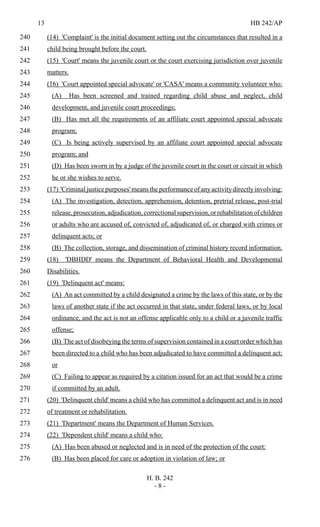
(14) 'Complaint' is the initial document setting out the circumstances that resulted in a240
child being brought before the court.241
(15) 'Court' means the juvenile court or the court exercising jurisdiction over juvenile242
matters.243
(16) 'Court appointed special advocate' or 'CASA' means a community volunteer who:244
(A) Has been screened and trained regarding child abuse and neglect, child245
development, and juvenile court proceedings;246
(B) Has met all the requirements of an affiliate court appointed special advocate247
program;248
(C) Is being actively supervised by an affiliate court appointed special advocate249
program; and250
(D) Has been sworn in by a judge of the juvenile court in the court or circuit in which251
he or she wishes to serve.252
(17) 'Criminaljusticepurposes'meanstheperformanceofanyactivitydirectlyinvolving:253
(A) The investigation, detection, apprehension, detention, pretrial release, post-trial254
release,prosecution,adjudication,correctionalsupervision,orrehabilitationofchildren255
or adults who are accused of, convicted of, adjudicated of, or charged with crimes or256
delinquent acts; or257
(B) The collection, storage, and dissemination of criminal history record information.258
(18) 'DBHDD' means the Department of Behavioral Health and Developmental259
Disabilities.260
(19) 'Delinquent act' means:261
(A) An act committed by a child designated a crime by the laws of this state, or by the262
laws of another state if the act occurred in that state, under federal laws, or by local263
ordinance, and the act is not an offense applicable only to a child or a juvenile traffic264
offense;265
(B) The act of disobeying the terms of supervision contained in a court order which has266
been directed to a child who has been adjudicated to have committed a delinquent act;267
or268
(C) Failing to appear as required by a citation issued for an act that would be a crime269
if committed by an adult.270
(20) 'Delinquent child' means a child who has committed a delinquent act and is in need271
of treatment or rehabilitation.272
(21) 'Department' means the Department of Human Services.273
(22) 'Dependent child' means a child who:274
(A) Has been abused or neglected and is in need of the protection of the court:275
(B) Has been placed for care or adoption in violation of law; or276
13 HB 242/AP
H. B. 242
- 9 -
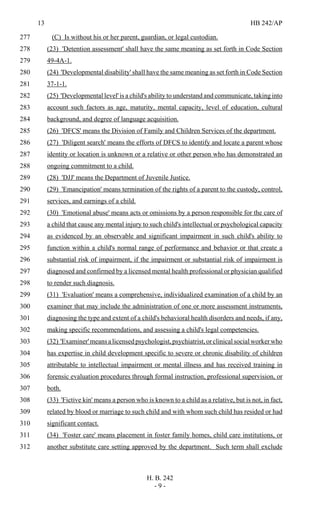
(C) Is without his or her parent, guardian, or legal custodian.277
(23) 'Detention assessment' shall have the same meaning as set forth in Code Section278
49-4A-1.279
(24) 'Developmental disability' shall have the same meaning as set forth in Code Section280
37-1-1.281
(25) 'Developmental level' is a child's ability to understand and communicate, taking into282
account such factors as age, maturity, mental capacity, level of education, cultural283
background, and degree of language acquisition.284
(26) 'DFCS' means the Division of Family and Children Services of the department.285
(27) 'Diligent search' means the efforts of DFCS to identify and locate a parent whose286
identity or location is unknown or a relative or other person who has demonstrated an287
ongoing commitment to a child.288
(28) 'DJJ' means the Department of Juvenile Justice.289
(29) 'Emancipation' means termination of the rights of a parent to the custody, control,290
services, and earnings of a child.291
(30) 'Emotional abuse' means acts or omissions by a person responsible for the care of292
a child that cause any mental injury to such child's intellectual or psychological capacity293
as evidenced by an observable and significant impairment in such child's ability to294
function within a child's normal range of performance and behavior or that create a295
substantial risk of impairment, if the impairment or substantial risk of impairment is296
diagnosed and confirmed by a licensed mental health professional or physician qualified297
to render such diagnosis.298
(31) 'Evaluation' means a comprehensive, individualized examination of a child by an299
examiner that may include the administration of one or more assessment instruments,300
diagnosing the type and extent of a child's behavioral health disorders and needs, if any,301
making specific recommendations, and assessing a child's legal competencies.302
(32) 'Examiner'meansalicensedpsychologist,psychiatrist,orclinicalsocialworkerwho303
has expertise in child development specific to severe or chronic disability of children304
attributable to intellectual impairment or mental illness and has received training in305
forensic evaluation procedures through formal instruction, professional supervision, or306
both.307
(33) 'Fictive kin' means a person who is known to a child as a relative, but is not, in fact,308
related by blood or marriage to such child and with whom such child has resided or had309
significant contact.310
(34) 'Foster care' means placement in foster family homes, child care institutions, or311
another substitute care setting approved by the department. Such term shall exclude312
13 HB 242/AP
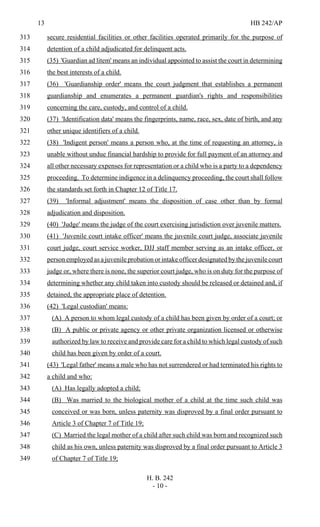
H. B. 242
- 10 -
secure residential facilities or other facilities operated primarily for the purpose of313
detention of a child adjudicated for delinquent acts.314
(35) 'Guardian ad litem' means an individual appointed to assist the court in determining315
the best interests of a child.316
(36) 'Guardianship order' means the court judgment that establishes a permanent317
guardianship and enumerates a permanent guardian's rights and responsibilities318
concerning the care, custody, and control of a child.319
(37) 'Identification data' means the fingerprints, name, race, sex, date of birth, and any320
other unique identifiers of a child.321
(38) 'Indigent person' means a person who, at the time of requesting an attorney, is322
unable without undue financial hardship to provide for full payment of an attorney and323
all other necessary expenses for representation or a child who is a party to a dependency324
proceeding. To determine indigence in a delinquency proceeding, the court shall follow325
the standards set forth in Chapter 12 of Title 17.326
(39) 'Informal adjustment' means the disposition of case other than by formal327
adjudication and disposition.328
(40) 'Judge' means the judge of the court exercising jurisdiction over juvenile matters.329
(41) 'Juvenile court intake officer' means the juvenile court judge, associate juvenile330
court judge, court service worker, DJJ staff member serving as an intake officer, or331
person employed as a juvenile probation or intake officer designated by the juvenile court332
judge or, where there is none, the superior court judge, who is on duty for the purpose of333
determining whether any child taken into custody should be released or detained and, if334
detained, the appropriate place of detention.335
(42) 'Legal custodian' means:336
(A) A person to whom legal custody of a child has been given by order of a court; or337
(B) A public or private agency or other private organization licensed or otherwise338
authorized by law to receive and provide care for a child to which legal custody of such339
child has been given by order of a court.340
(43) 'Legal father' means a male who has not surrendered or had terminated his rights to341
a child and who:342
(A) Has legally adopted a child;343
(B) Was married to the biological mother of a child at the time such child was344
conceived or was born, unless paternity was disproved by a final order pursuant to345
Article 3 of Chapter 7 of Title 19;346
(C) Married the legal mother of a child after such child was born and recognized such347
child as his own, unless paternity was disproved by a final order pursuant to Article 3348
of Chapter 7 of Title 19;349
13 HB 242/AP
H. B. 242
- 11 -
(D) Has been determined to be the father of a child by a final paternity order pursuant350
to Article 3 of Chapter 7 of Title 19;351
(E) Has legitimated a child by a final order pursuant to Code Section 19-7-22; or352
(F) Has legitimated a child pursuant to Code Section 19-7-22.1.353
(44) 'Legal mother' means the female who is the biological or adoptive mother of a child354
and who has not surrendered or had terminated her rights to such child.355
(45) 'Mediation' means the procedure in which a mediator facilitates communication356
between the parties concerning the matters in dispute and explores possible solutions to357
promote reconciliation, understanding, and settlement.358
(46) 'Mediator' means a neutral third party who attempts to focus the attention of the359
parties upon their needs and interests rather than upon their rights and positions and who360
lacks the authority to impose any particular agreement upon the parties or to recommend361
any particular disposition of the case to the court.362
(47) 'Mentally ill' means having a disorder of thought or mood which significantly363
impairs judgment, behavior, capacity to recognize reality, or ability to cope with the364
ordinary demands of life.365
(48) 'Neglect' means:366
(A) The failure to provide proper parental care or control, subsistence, education as367
required by law, or other care or control necessary for a child's physical, mental, or368
emotional health or morals;369
(B) The failure to provide a child with adequate supervision necessary for such child's370
well-being; or371
(C) The abandonment of a child by his or her parent, guardian, or legal custodian.372
(49) 'Nonsecure residential facility' means community residential locations operated by373
or on behalf of DJJ and may include group homes, emergency shelters, wilderness or374
outdoor therapeutic programs, or other facilities that provide 24 hour care in a residential375
setting.376
(50) 'Other persons who have demonstrated an ongoing commitment to a child' includes377
fictive kin and other individuals, including but not limited to neighbors, teachers, scout378
masters, caregivers, or parents of friends of such child and with whom such child has379
resided or had significant contact.380
(51) 'Parent' means either the legal father or the legal mother of a child.381
(52) 'Party' means the state, a child, parent, guardian, legal custodian, or other person382
subject to any judicial proceeding under this chapter; provided, however, that for383
purposes of Article 6 of this chapter, only a child and the state shall be a party.384
(53) 'Permanency plan' means a specific written plan prepared by DFCS designed to385
ensure that a child is reunified with his or her family or ensure that such child quickly386
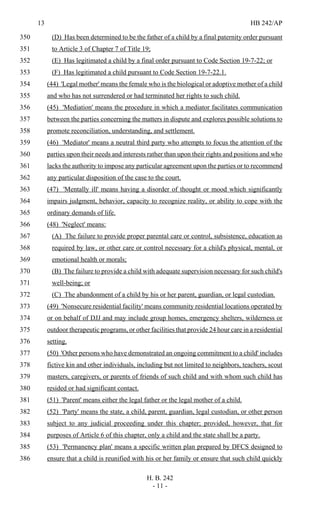
13 HB 242/AP
H. B. 242
- 12 -
attains a substitute long-term home when return to such child's family is not possible or387
is not in such child's best interests.388
(54) 'Permanent placement' means:389
(A) Return of the legal custody of a child to his or her parent;390
(B) Placement of a child with an adoptive parent pursuant to a final order of adoption;391
or392
(C) Placement of a child with a permanent guardian.393
(55) 'Person responsible for the care of a child' means:394
(A) An adult member of a child's household;395
(B) A person exercising supervision over a child for any part of the 24 hour day; or396
(C) Any adult who, based on his or her relationship to the parent, guardian, or legal397
custodian or a member of a child's household, has access to such child.398
(56) 'Prenatal abuse' means exposure to chronic or severe use of alcohol or the unlawful399
use of any controlled substance, as such term is defined in Code Section 16-13-21, which400
results in:401
(A) Symptoms of withdrawal in a newborn or the presence of a controlled substance402
or a metabolite thereof in a newborn's body, blood, urine, or meconium that is not the403
result of medical treatment; or404
(B) Medically diagnosed and harmful effects in a newborn's physical appearance or405
functioning.406
(57) 'Probation and intake officer' means any probation officer and any personnel of a407
juvenile court to whom are delegated the duties of an intake officer under this chapter,408
other than a juvenile court judge, associate juvenile court judge, or court service worker.409
(58) 'Probation officer' means any personnel of a juvenile court or staff of DJJ to whom410
are delegated the duties of a probation officer under this chapter, other than a juvenile411
court judge or associate juvenile court judge.412
(59) 'Prosecuting attorney' means an attorney designated by the district attorney of the413
judicial circuit in which juvenile proceedings are instituted, unless otherwise provided in414
subsection (c) of Code Section 15-18-6.1.415
(60) 'Putative father registry' means the registry established and maintained pursuant to416
subsections (d) and (e) of Code Section 19-11-9.417
(61) 'Reasonable efforts' means due diligence and the provision of appropriate services.418
(62) 'Relative' means a person related to a child by blood, marriage, or adoption,419
including the spouse of any of those persons even if the marriage was terminated by death420
or dissolution.421
13 HB 242/AP
H. B. 242
- 13 -
(63) 'Restitution' means any property, lump sum, or periodic payment ordered to be made422
to any victim. Restitution may also be in the form of services ordered to be performed423
by a child.424
(64) 'Restrictive custody' means in the custody of DJJ for purposes of housing in a secure425
residential facility or nonsecure residential facility.426
(65) 'Risk assessment' shall have the same meaning as set forth in Code Section 49-4A-1.427
(66) 'Screening' means a relatively brief process to identify a child who potentially may428
have mental health or substance abuse needs, through administration of a formal429
screening instrument, to identify a child who may warrant immediate attention or430
intervention or a further, more comprehensive evaluation.431
(67) 'Secure residential facility' means a hardware secure residential institution operated432
by or on behalf of DJJ and shall include a youth development center or a regional youth433
detention center.434
(68) 'Services' means assistance including but not limited to care, guidance, education,435
counseling, supervision, treatment, and rehabilitation or any combination thereof.436
(69) 'Sexual abuse' means a caregiver or other person responsible for the care of a child437
employing, using, persuading, inducing, enticing, or coercing any child to engage in any438
act which involves:439
(A) Sexual intercourse, including genital-genital, oral-genital, anal-genital, or440
oral-anal, whether between persons of the same or opposite sex;441
(B) Bestiality;442
(C) Masturbation;443
(D) Lewd exhibition of the genitals or pubic area of any person;444
(E) Flagellation or torture by or upon a person who is nude;445
(F) The condition of being fettered, bound, or otherwise physically restrained on the446
part of a person who is nude;447
(G) Physical contact in an act of apparent sexual stimulation or gratification with any448
person's clothed or unclothed genitals, pubic area, or buttocks or with a female's clothed449
or unclothed breasts;450
(H) Defecation or urination for the purpose of sexual stimulation; or451
(I) Penetration of the vagina or rectum by any object except when done as part of a452
recognized medical procedure by a licensed health care professional.453
(70) 'Sexual exploitation' means conduct by a caregiver or other person responsible for454
the care of a child who allows, permits, encourages, or requires a child to engage in:455
(A) Prostitution, in violation of Code Section 16-6-9; or456
(B) Sexually explicit conduct for the purpose of producing any visual or print medium457
depicting such conduct, in violation of Code Section 16-12-100.458
13 HB 242/AP
H. B. 242
- 14 -
(71) 'Sibling' means a person with whom a child shares one or both parents in common459
by blood, adoption, or marriage, even if the marriage was terminated by death or460
dissolution.461
(72) 'Staffing' means a meeting held periodically to develop and review progress on462
plans for meeting the identified needs of a child.463
(73) 'Statutory overnight delivery' means delivery of notice as provided in Code Section464
9-10-12.465
(74) 'Unsupervised probation' means a period of probation or community supervision466
prior to the termination of a child's disposition in which:467
(A) All of the conditions and limitations imposed by the court in placing such child on468
probation remain intact;469
(B) Such child may have reduced reporting requirements; and470
(C) A probation officer shall not actively supervise such child.471
(75) 'Visitation' means a period of access to a child by a parent, guardian, legal472
custodian, sibling, other relative, or any other person who has demonstrated an ongoing473
commitment to a child in order to maintain parental and familial involvement in a child's474
life when he or she is not residing with such person.475
(76) 'Weekend' means Saturday or Sunday.476
15-11-3.477
Through direct calendaring, whenever possible, a single judge shall hear all successive478
cases or proceedings involving the same child or family.479
15-11-4.480
Where procedures are not provided in this chapter, the court shall proceed in accordance481
with:482
(1) Title 17 in a delinquency proceeding; and483
(2) Chapter 11 of Title 9 in all other matters.484
15-11-5.485
(a) When a period of time measured in days, weeks, months, years, or other measurements486
of time except hours is prescribed for the exercise of any privilege or the discharge of any487
duty, the first day shall not be counted but the last day shall be counted; and, if the last day488
falls on a weekend, the party having such privilege or duty shall have through the following489
business day to exercise such privilege or discharge such duty.490
(b) When the last day prescribed for the exercise of any privilege or the discharge of any491
duty falls on a public and legal holiday as set forth in Code Section 1-4-1, the party having492
13 HB 242/AP
H. B. 242
- 15 -
such privilege or duty shall have through the next business day to exercise such privilege493
or discharge such duty.494
(c) When the period of time prescribed is less than seven days, intermediate weekends and495
legal holidays shall be excluded in the computation.496
15-11-6.497
(a) Except as provided in subsection (b) of this Code section, a child attains a specified age498
the first second past midnight on the day of the anniversary of such child's birth.499
(b) A child born on February 29 attains a specified age on March 1 of any year that is not500
a leap year.501
15-11-7.502
(a) The juvenile court shall have jurisdiction to act as a court of inquiry with all the powers503
and rights allowed courts of inquiry in this state and to examine or investigate into the504
circumstances or causes of any conduct or acts of any person 17 or more years of age that505
may be in violation of the laws of this state whenever such person is brought before the506
court in the course of any proceeding instituted under this chapter. The court shall cause507
the person to be apprehended and brought before it upon either a writ of summons, a508
warrant duly issued, or by arrest.509
(b) When, after hearing evidence, the court has reasonably ascertained that there is510
probable cause to believe that the person has committed a misdemeanor or felony as511
prescribed under the laws of this state, the court shall commit, bind over to the court of512
proper jurisdiction in this state, or discharge the person. When justice shall require, the513
court shall cause the person to make such bail as the court shall deem proper under the514
circumstances and to cause the person to appear before the court of proper jurisdiction in515
this state to be acted upon as provided by law.516
15-11-8.517
The juvenile court is a court of record having a seal. The judge and the judge's duly518
appointed representatives shall each have power to administer oaths and affirmations.519
15-11-9.520
The juvenile court judge, associate juvenile court judge, and judge pro tempore shall have521
authority to issue a warrant for the arrest of any child for an offense committed against the522
laws of this state, based either on personal knowledge or the information of others given523
under oath.524
13 HB 242/AP
H. B. 242
- 16 -
15-11-10.525
Except as provided in Code Section 15-11-560, the juvenile court shall have exclusive526
original jurisdiction over juvenile matters and shall be the sole court for initiating action:527
(1) Concerning any child who:528
(A) Is alleged to be a delinquent child;529
(B) Is alleged to be a child in need of services;530
(C) Is alleged to be a dependent child;531
(D) Is alleged to be in need of treatment or commitment as a mentally ill or532
developmentally disabled child;533
(E) Is alleged to have committed a juvenile traffic offense as defined in Code Section534
15-11-630;535
(F) Has been placed under the supervision of the court or on probation to the court;536
provided, however, that such jurisdiction shall be for the purpose of completing,537
effectuating, and enforcing such supervision or a probation begun prior to such child's538
seventeenth birthday;539
(G) Has remained in foster care after such child's eighteenth birthday or who is540
receivingindependentlivingservicesfromDFCSaftersuchchild'seighteenthbirthday;541
provided, however, that such jurisdiction shall be for the purpose of reviewing the542
status of such child and the services being provided to such child as a result of such543
child's independent living plan or status as a child in foster care; or544
(H) Requires a comprehensive services plan in accordance with Code Section545
15-11-658; or546
(2) Involving any proceedings:547
(A) For obtaining judicial consent to the marriage, employment, or enlistment in the548
armed services of any child if such consent is required by law;549
(B) For permanent guardianship brought pursuant to the provisions of Article 3 of this550
chapter;551
(C) Under Code Section 39-3-2, the Interstate Compact on Juveniles, or any552
comparable law, enacted or adopted in this state;553
(D) For the termination of the legal parent-child relationship and the rights of the554
biological father who is not the legal father of the child in accordance with Article 2 of555
this chapter; provided, however, that such jurisdiction shall not affect the superior556
court's exclusive jurisdiction to terminate the legal parent-child relationship as set forth557
in Chapters 6 through 9 of Title 19;558
(E) For emancipation brought pursuant to the provisions of Article 10 of this chapter;559
(F) Under Article 8 of this chapter, relating to prior notice to a parent, guardian, or560
legal custodian relative to an unemancipated minor's decision to seek an abortion; or561
13 HB 242/AP
H. B. 242
- 17 -
(G) Brought by a local board of education pursuant to Code Section 20-2-766.1,562
relating to court orders requiring that a parent, guardian, or legal custodian attend a563
conference or participate in programs or treatment to improve a student's behavior.564
15-11-11.565
The juvenile court shall have concurrent jurisdiction to hear:566
(1) Any legitimation petition filed pursuant to Code Section 19-7-22 concerning a child567
alleged to be dependent;568
(2) Any legitimation petition transferred to the court by proper order of the superior569
court;570
(3) The issue of custody and support when the issue is transferred by proper order of the571
superior court; provided, however, that if a demand for a jury trial as to support has been572
properly filed by either parent, then the case shall be transferred to superior court for the573
jury trial; and574
(4) Any petition for the establishment or termination of a temporary guardianship575
transferred to the court by proper order of the probate court.576
15-11-12.577
(a) Nothing in this chapter shall be construed to prevent a child from being adjudicated578
both a dependent child and a delinquent child or both a dependent child and a child in need579
of services if there exists a factual basis for such a finding.580
(b) If a child alleged or adjudicated to be a delinquent child or a child in need of services581
is also alleged or adjudicated to be a dependent child, dependency proceedings may be582
consolidated with delinquency or child in need of services proceedings to the extent583
consistent with due process of law as provided in Articles 3, 6, and 7 of this chapter.584
(c) The time frames and requirements of Article 3 of this chapter shall apply to cases in585
which a child alleged or adjudicated to be a child in need of services or a delinquent child586
is placed in foster care and has also been alleged or adjudicated to be a dependent child.587
15-11-13.588
The court shall have jurisdiction to appoint a guardian of the person of any child in any589
proceeding authorized by this chapter. Any such appointment shall be made pursuant to590
the same requirements of notice and hearing as are provided for appointments of guardians591
of the persons of any child by the probate court. In the event a conservator for a child's592
property needs to be appointed, the court shall refer that matter to the probate court.593
13 HB 242/AP
H. B. 242
- 18 -
15-11-14.594
(a) The court shall hold a hearing within 30 days of receipt of a case transferred from the595
probate court pursuant to subsection (f) of Code Section 29-2-6 or subsection (b) of Code596
Section 29-2-8.597
(b) After notice and hearing, the court may make one of the following orders:598
(1) That the temporary guardianship be established or continued if the court determines599
that the temporary guardianship is in the best interests of a child. The order shall600
thereafter be subject to modification only as provided in Code Section 15-11-32; or601
(2) That the temporary guardianship be terminated if the court determines it is in the best602
interests of a child. A child shall be returned to his or her parent unless the court603
determines that there is probable cause to believe that he or she will be abused, neglected,604
or abandoned in the custody of his or her parent.605
(c) A case shall proceed as a dependency matter pursuant to the provisions of Article 3 of606
this chapter if, after notice and hearing, the court determines:607
(1) That it is in the best interests of a child that the temporary guardianship not be608
established or that the temporary guardianship be terminated but there is probable cause609
to believe that he or she will be abused, neglected, or abandoned if returned to his or her610
parent; or611
(2) That it is in the best interests of a child that the temporary guardianship be continued612
over the parent's objection.613
(d) The court may refer to DFCS for further investigation a case transferred from probate614
court.615
15-11-15.616
(a) In handling divorce, alimony, habeas corpus, or other cases involving the custody of617
a child, a superior court may transfer the question of the determination of custody, support,618
or custody and support to the juvenile court either for investigation and a report back to the619
superior court or for investigation and determination.620
(b) If the referral is for investigation and determination, then the juvenile court shall621
proceed to handle the matter in the same manner as though the action originated under this622
chapter in compliance with the order of the superior court, except that the parties shall not623
be entitled to obtain an appointed attorney through the juvenile court.624
(c) At any time prior to the determination of any such question, the juvenile court may625
transfer the jurisdiction of the question back to the referring superior court.626
15-11-16.627
(a) A proceeding under this chapter may be commenced:628
13 HB 242/AP
H. B. 242
- 19 -
(1) By an order of transfer of a case from another court as provided in Code Section629
15-11-11 or 15-11-567, subsection (f) of Code Section 29-2-6, or subsection (b) of Code630
Section 29-2-8;631
(2) By the summons, notice to appear, or other citation in a proceeding charging a632
juvenile traffic offense or a violation of the laws, rules, and regulations governing the633
Department of Natural Resources Game and Fish Division; or634
(3) By the filing of a petition for legitimation under Code Section 15-11-11, or in other635
cases by the filing of a complaint or a petition as provided in Articles 3, 4, 6, 7, 9, and 11636
of this chapter.637
(b) The petition and all other documents in the proceeding shall be entitled 'In the interest638
of _____, a child,' except upon appeal.639
(c) On appeal, the anonymity of a child, and where appropriate, a victim or witness who640
is under the age of 18 years, shall be preserved by appropriate use of a child's, victim's, or641
witness's initials as appropriate.642
15-11-17.643
(a) All hearings under this chapter shall be conducted by the court without a jury. Any644
hearing may be adjourned from time to time within the discretion of the court.645
(b) Except as otherwise provided, all hearings shall be conducted in accordance with646
Title 24.647
(c) Proceedings shall be recorded by stenographic notes or by electronic, mechanical, or648
other appropriate means capable of accurately capturing a full and complete record of all649
words spoken during the proceedings.650
(d) A juvenile court judge, an associate juvenile court judge, a judge pro tempore of the651
juvenile court, or any person sitting as a juvenile court judge may conduct hearings in652
connection with any proceeding under this chapter in any county within the judicial circuit.653
When a superior court judge sits as a juvenile court judge, hearings in connection with any654
proceeding under this chapter may be heard before such judge in any county within the655
judicial circuit over which the judge presides.656
15-11-18.657
Upon application of a party, the court, or any authorized officer of the court, the clerk of658
the court shall issue subpoenas in accordance with the provisions of Title 24 requiring659
attendance and testimony of witnesses and production of evidence at any hearing under this660
chapter. A delinquency proceeding conducted in this state shall be considered a criminal661
prosecution insofar as the applicability of Article 4 of Chapter 13 of Title 24.662
13 HB 242/AP
H. B. 242
- 20 -
15-11-19.663
(a) A party has the right to be present, to be heard, to present evidence material to the664
proceedings, to cross-examine witnesses, to examine pertinent court files and records, and665
to appeal the orders of the court; provided, however, that the court shall retain the666
discretion to exclude a child from any part or parts of any proceeding under Article 3 of667
this chapter if the court determines that it is not in such child's best interests to be present.668
An attorney for an excluded child shall not be excluded from the proceedings.669
(b) A person afforded rights under this chapter shall be advised of such rights at that670
person's first appearance before the court.671
15-11-20.672
(a) At any time during a proceeding under this chapter, the court may refer a case to673
mediation.674
(b) When referring a case to mediation, the court shall take into consideration the675
guidelines from the Georgia Commission of Dispute Resolution for mediating cases676
involving domestic violence or family violence.677
(c) A referral order shall recite that while the parties shall attend a scheduled mediation678
session and shall attempt to mediate in good faith, such parties shall not be required to679
reach an agreement.680
(d) Victims in a delinquency case referred to mediation may attend and participate in such681
mediation, but shall not be required to do so as a condition of such case being heard by the682
juvenile court.683
15-11-21.684
(a) Once an order referring a case to mediation has been signed, the court shall appoint a685
mediator from a list of court approved mediators who are registered with the Georgia686
Office of Dispute Resolution to mediate juvenile court cases.687
(b) The court shall appoint a qualified mediator within five days of signing the order688
referring the case to mediation.689
15-11-22.690
(a) The parties shall sign and date a written agreement to mediate. The agreement to691
mediate shall identify the controversies between the parties, affirm the parties' intent to692
resolve such controversies through mediation, and specify the circumstances under which693
mediation may continue. The agreement to mediate shall specify the confidentiality694
requirements of mediation and the exceptions to confidentiality in mediation as such are695
13 HB 242/AP
H. B. 242
- 21 -
set forth in the Supreme Court of Georgia Alternative Dispute Resolution Rules and696
appendices.697
(b) A mediator shall not knowingly assist the parties in reaching an agreement which698
would be unenforceable for reasons such as fraud, duress, the absence of bargaining ability,699
unconscionability, or lack of court jurisdiction.700
(c) Prior to the parties signing an agreement to mediate, the mediator shall advise the701
parties that each of them may obtain review by an attorney of any agreement reached as a702
result of the mediation.703
(d) The mediator shall at all times be impartial.704
15-11-23.705
(a) Upon issuing a referral to mediation the court may stay the proceeding.706
(b) Mediation shall occur as soon as practicable and be scheduled within 30 days of the707
order referring the matter to mediation unless the time frame is extended by the court.708
(c) The court may extend the timeline for scheduling a mediation for an additional 30 days.709
15-11-24.710
(a) Either party in a mediation may withdraw from or terminate further participation in711
mediation at any time.712
(b) A mediator shall terminate mediation when:713
(1) The mediator concludes that the participants are unable or unwilling to participate714
meaningfully in the process;715
(2) The mediator concludes that a party lacks the capacity to perceive and assert his or716
her own interests to the degree that a fair agreement cannot be reached;717
(3) The mediator concludes that an agreement is unlikely; or718
(4) The mediator concludes that a party is a danger to himself or herself or others.719
15-11-25.720
(a) All mediation agreements shall be presented to the juvenile court judge for approval.721
(b) The mediation agreement shall be made an order of the court unless, after further722
hearing, the court determines by clear and convincing evidence that the agreement is not723
in the best interests of the child.724
15-11-26.725
Whenever a best interests determination is required, the court shall consider and evaluate726
all of the factors affecting the best interests of the child in the context of such child's age727
and developmental needs. Such factors shall include:728
13 HB 242/AP
H. B. 242
- 22 -
(1) The physical safety and welfare of such child, including food, shelter, health, and729
clothing;730
(2) The love, affection, bonding, and emotional ties existing between such child and each731
parent or person available to care for such child;732
(3) The love, affection, bonding, and emotional ties existing between such child and his733
or her siblings, half siblings, and stepsiblings and the residence of such other children;734
(4) Such child's need for permanence, including such child's need for stability and735
continuity of relationships with his or her parent, siblings, other relatives, and any other736
person who has provided significant care to such child;737
(5) Such child's sense of attachments, including his or her sense of security and738
familiarity, and continuity of affection for such child;739
(6) The capacity and disposition of each parent or person available to care for such child740
to give him or her love, affection, and guidance and to continue the education and rearing741
of such child;742
(7) The home environment of each parent or person available to care for such child743
considering the promotion of such child's nurturance and safety rather than superficial or744
material factors;745
(8) The stability of the family unit and the presence or absence of support systems within746
the community to benefit such child;747
(9) The mental and physical health of all individuals involved;748
(10) The home, school, and community record and history of such child, as well as any749
health or educational special needs of such child;750
(11) Such child's community ties, including church, school, and friends;751
(12) Such child's background and ties, including familial, cultural, and religious;752
(13) The least disruptive placement alternative for such child;753
(14) The uniqueness of every family and child;754
(15) The risks attendant to entering and being in substitute care;755
(16) Such child's wishes and long-term goals;756
(17) The preferences of the persons available to care for such child;757
(18) Any evidence of family violence, substance abuse, criminal history, or sexual,758
mental, or physical child abuse in any current, past, or considered home for such child;759
(19) Any recommendation by a court appointed custody evaluator or guardian ad litem;760
and761
(20) Any other factors considered by the court to be relevant and proper to its762
determination.763
13 HB 242/AP
H. B. 242
- 23 -
15-11-27.764
During the pendency of any proceeding under this chapter, the court may order:765
(1) A child to be examined by outside parties or private providers at a suitable place by766
aphysicianorpsychologist;provided,however,thatorderstoperformanevaluationshall767
not be imposed upon any state agency or county government unless such state agency or768
county government has funds available for such evaluation; and769
(2) Medical or surgical treatment of a child suffering from a serious physical condition770
or illness which, in the opinion of a licensed physician, requires prompt treatment, even771
if the parent, guardian, or legal custodian has not been given notice of a hearing, is not772
available, or without good cause informs the court of his or her refusal to consent to the773
treatment.774
15-11-28.775
(a) No admission, confession, or incriminating information obtained from a child in the776
course of any screening that is undertaken in conjunction with proceedings under this777
chapter, including but not limited to court ordered screenings, shall be admitted into778
evidence in any adjudication hearing in which a child is accused under this chapter. Such779
admission, confession, or incriminating information may be considered by the court at780
disposition.781
(b) No admission, confession, or incriminating information obtained from a child in the782
course of any assessment or evaluation, or any treatment that is undertaken in conjunction783
with proceedings under this chapter, including but not limited to court ordered detention784
or risk assessments and evaluations, shall be admitted into evidence against such child,785
except as rebuttal or impeachment evidence, or used as a basis for such evidence in any786
future adjudication hearing or criminal proceeding in which such child is accused. Such787
admission, confession, or incriminating information may be considered by the court at788
disposition.789
15-11-29.790
(a) In any proceeding under this chapter, either on application of a party or on the court's791
own motion, the court may make an order restraining or otherwise controlling the conduct792
of a person if due notice of the application or motion and the grounds therefor and an793
opportunity to be heard thereon have been given to the person against whom the order is794
directed. Such an order may require any such person:795
(1) To stay away from a person's home or a child;796
(2) To permit a parent to visit his or her child at stated periods;797
13 HB 242/AP
H. B. 242
- 24 -
(3) To abstain from offensive conduct against a child, his or her parent, or any person to798
whom custody of such child is awarded;799
(4) To give proper attention to the care of his or her home;800
(5) To cooperate in good faith with an agency to which custody of a child is entrusted801
by the court or with an agency or association to which a child is referred by the court;802
(6) To refrain from acts of commission or omission that tend to make a home not a803
proper place for a child;804
(7) To ensure that a child attends school pursuant to any valid law relating to compulsory805
attendance;806
(8) To participate with a child in any counseling or treatment deemed necessary after807
consideration of employment and other family needs; and808
(9) To enter into and complete successfully a substance abuse program approved by the809
court.810
(b) After notice and opportunity for hearing afforded to a person subject to a protective811
order, a protective order may be modified or extended for a further specified period, or812
both, or may be terminated if the court finds that the best interests of the child and the813
public will be served thereby.814
(c) Protective orders may be enforced by citation to show cause for contempt of court by815
reason of any violation thereof and, where protection of the welfare of a child so requires,816
by the issuance of a warrant to take the alleged violator into custody and bring him or her817
before the court.818
15-11-30.819
A legal custodian has the right to physical custody of a child, the right to determine the820
nature of the care and treatment of such child, including ordinary medical care, and the821
right and duty to provide for the care, protection, training, and education and the physical,822
mental, and moral welfare of such child, subject to the conditions and limitations of the823
order and to the remaining rights and duties of such child's parent or guardian.824
15-11-31.825
(a) In addition to all other inherent powers of the court to enforce its lawful orders, the826
court may punish an adult for contempt of court by imprisonment for not more than 20827
days or a fine not to exceed $1,000.00 for willfully disobeying an order of the court or for828
obstructing or interfering with the proceedings of the court or the enforcement of its orders.829
(b) The court shall restrict and limit the use of contempt powers with respect to830
commitment of a child to a secure residential facility or nonsecure residential facility and831
13 HB 242/AP
H. B. 242
- 25 -
in no event shall a child solely alleged or adjudicated to be a dependent child be placed in832
a secure residential facility or nonsecure residential facility.833
(c) A child may be placed in a secure residential facility or nonsecure residential facility834
for not more than 72 hours if:835
(1) He or she is found in contempt of court; and836
(2) Less restrictive alternatives have been considered and are unavailable or837
inappropriate or if such child has already been ordered to serve a less restrictive838
alternative sanction but failed to comply with the sanction.839
(d) In addition or as an alternative to the punishment provided in subsection (a) of this840
Code section, after notice and opportunity to be heard, the court may impose any or all of841
the following sanctions when a parent, guardian, or legal custodian other than DJJ or DFCS842
willfully violates any order issued by the court directed to him or her:843
(1) Require a child's parent, guardian, or legal custodian to make restitution as provided844
in Code Section 17-14-5;845
(2) Reimburse the state for the costs of detention, treatment, or rehabilitation of a child;846
(3) Require a child's parent, guardian, or legal custodian to participate in a court847
approved educational or counseling program designed to contribute to the ability to848
provide proper parental care and supervision of such child, including, but not limited to,849
parenting classes; or850
(4) Require a child's parent, guardian, or legal custodian to enter into a contract or plan851
as a part of the disposition of any charges against such child so as to provide for the852
supervision and control of such child by his or her parent, guardian, or legal custodian853
and reunification with such child.854
15-11-32.855
(a) An order of the court shall be set aside if:856
(1) It appears that it was obtained by fraud or mistake sufficient therefor in a civil action;857
(2) The court lacked jurisdiction over a necessary party or the subject matter; or858
(3) Newly discovered evidence so requires.859
(b) An order of the court may also be changed, modified, or vacated on the ground that860
changed circumstances so require in the best interests of a child except an order of861
dismissal following a contested adjudicatory hearing.862
(c) Except as otherwise provided in Code Section 15-11-602, an order committing a child863
to DJJ may only be modified after such child has been transferred to DJJ custody upon864
motion of DJJ.865
13 HB 242/AP
H. B. 242
- 26 -
(d) An order of adjudication of delinquency by a court may be modified or vacated if the866
child was adjudicated for a delinquent act for a sexual crime as defined in Code Section867
16-3-6 and such crime resulted from the child being:868
(1) Trafficked for sexual servitude in violation of Code Section 16-5-46; or869
(2) A victim of sexual exploitation as defined in Code Section 49-5-40.870
(e) Any party to the proceeding, the probation officer, or any other person having871
supervision or legal custody of or an interest in a child may petition the court for the relief872
provided in this Code section. Such petition shall set forth in clear and concise language873
the grounds upon which the relief is requested.874
(f) After a petition seeking relief under this Code section is filed, the court shall fix a time875
for hearing and shall cause notice to be served on the parties to the proceeding or those876
affected by the relief sought. After the hearing, the court shall deny or grant relief as the877
evidence warrants.878
15-11-33.879
(a) Whenever an order of disposition incorporates a reunification plan and the residence880
of the parent is not in the county of the court with jurisdiction or the residence of the parent881
changes to a county other than the county of the court with jurisdiction, the court may882
transfer jurisdiction to the juvenile court of the residence of the parent to whom the883
reunification plan is directed.884
(b) Within 30 days of the filing of the transfer order, the transferring court shall provide885
the receiving court with certified copies of the adjudication order, the order of disposition,886
the order of transfer, the case plan, and any other court documents deemed necessary by887
the transferring court to enable the receiving court to assume jurisdiction over the matter.888
(c) The transferring court shall retain jurisdiction until the receiving court acknowledges889
acceptance of the transfer.890
(d) Compliance with this Code section shall terminate jurisdiction in the transferring court891
and confer jurisdiction in the receiving court.892
15-11-34.893
Except as otherwise provided by Code Section 17-10-14, a child shall not be committed894
to an adult correctional facility or other facility used primarily for the execution of895
sentences of persons convicted of a crime.896
15-11-35.897
In all cases of final judgments of the juvenile court, appeals shall be taken to the Court of898
Appeals or the Supreme Court in the same manner as appeals from the superior court.899
13 HB 242/AP
H. B. 242
- 27 -
However, no such judgment or order shall be superseded except in the discretion of the trial900
court; rather, the judgment or order of the court shall stand until reversed or modified by901
the reviewing court.902
15-11-36.903
(a) The following expenses shall be a charge upon the funds of the county upon904
certification thereof by the court:905
(1) The cost of medical and other examinations and treatment of a child ordered by the906
court;907
(2) The cost of care and support of a child committed by the court to the legal custody908
of an individual or a public or private agency other than DJJ, but the court may order909
supplemental payments, if such are necessary or desirable for services;910
(3) Reasonable compensation for services and related expenses of an attorney appointed911
by the court, when appointed by the court to represent a child and when appointed by the912
court to conduct the proceedings;913
(4) Reasonable compensation for a guardian ad litem;914
(5) The expense of service of summons, notices, and subpoenas; travel expenses of915
witnesses; transportation, subsistence, and detention of a child for juvenile court916
proceedings or superior court proceedings when a child is prosecuted in superior court917
pursuant to Code Section 15-11-560; and other like expenses incurred in the proceedings918
under this chapter; and919
(6) The cost of counseling and counsel and advice required or provided under the920
provisions of Code Section 15-11-212 or 15-11-601.921
(b) The court shall determine whether the expenses shall be a charge upon the funds of the922
county and certify such expenses to the county governing authority within 120 days from923
the date such expenses were submitted to the court for certification. If the court has not924
made such certification within 120 days, the court shall be deemed to have denied925
certification.926
(c) If, after due notice to the parent or other person legally obligated to care for and927
support a child and after affording such person an opportunity to be heard, the court finds928
that such person is financially able to pay all or part of the costs and expenses outlined in929
subsection (a) of this Code section, the court may order such person to pay the same and930
prescribe the manner of payment. In addition, the court may order payment from a child's931
parent or other legally obligated person or entity to reimburse all or part of the costs and932
expenses of the department or DJJ for treatment, care, and support of a child. Unless933
otherwise ordered, payment shall be made to the clerk of the court for remittance to the934
13 HB 242/AP
H. B. 242
- 28 -
person or agency, including the department or DJJ, to whom compensation is due or, if the935
costs and expenses have been paid by the county, to the appropriate officer of the county.936
15-11-37.937
(a) The court may collect supervision fees from those who are placed under the court's938
formal or informal supervision in order that the court may use those fees to expand the939
provision of the following types of ancillary services:940
(1) Housing in nonsecure residential facilities;941
(2) Educational services, tutorial services, or both;942
(3) Counseling and diagnostic testing;943
(4) Mediation;944
(5) Transportation to and from court ordered services;945
(6) Truancy intervention services;946
(7) Restitution programs;947
(8) Job development or work experience programs;948
(9) Community services; and949
(10) Any other additional programs or services needed to meet the best interests,950
development, and rehabilitation of a child.951
(b)(1) The juvenile court may order each delinquent child or child in need of services952
who receives supervision to pay to the clerk of the court:953
(A) An initial court supervision user's fee of not less than $10.00 nor more than954
$200.00; and955
(B) A court supervision user's fee of not less than $2.00 nor more than $30.00 for each956
month that a child receives supervision.957
(2) A child and his or her parent, guardian, or legal custodian may be jointly and958
severally liable for the payment of fees set forth in paragraph (1) of this subsection and959
shall be subject to the enforcement procedure in subsection (c) of Code Section 15-11-36.960
The judge shall provide that any such fees shall be imposed on such terms and conditions961
as shall assure that the funds for the payment are from moneys earned by such child. All962
moneys collected by the clerk under this subsection shall be transferred to the county963
treasurer, or such other county official or employee who performs duties previously964
performed by the treasurer, who shall deposit the moneys into a county supplemental965
juvenile services fund. The governing authority of the county shall appropriate moneys966
from the county supplemental juvenile services fund to the juvenile court for the court's967
discretionary use in providing community services described in subsection (a) of this968
Code section to child offenders. These funds shall be administered by the county and the969
court may draw upon them by submitting invoices to the county. The county970
13 HB 242/AP
H. B. 242
- 29 -
supplemental juvenile services fund may be used only for these services. Any moneys971
remaining in the fund at the end of the county fiscal year shall not revert to any other fund972
but shall continue in the county supplemental juvenile services fund. The county973
supplemental juvenile services fund may not be used to replace other funding of services.974
(c) The clerk of the court shall be responsible for collections of fees as ordered by the975
court.976
(d) For the purpose of this Code section, the term 'legal custodian' shall not be interpreted977
or construed to include the department or DJJ.978
15-11-38.979
(a) Any court may order the establishment of a community based risk reduction program,980
within the geographical jurisdiction of the court, for the purpose of utilizing available981
community resources in assessment and intervention in cases of delinquency, dependency,982
or children in need of services so long as the court determines that sufficient funds are983
available for such programs. Subject to the procedures, requirements, and supervision984
established in the order creating such program, any individual and any public or private985
agency or entity may participate in the program.986
(b) As part of a risk reduction program, a court may implement or adopt an early987
intervention program designed to identify children and families who are at risk of988
becoming involved with the court. Such early intervention program shall be for the989
purposeofdevelopingandimplementinginterventionactionsorplanstodivertthechildren990
and their families from becoming involved in future cases in the court. The court's991
involvement shall be for the limited purpose of facilitating the development of the program992
and for the purpose of protecting the confidentiality of the children and families993
participating in the program.994
(c) As part of an early intervention program, the court may enter into protocol agreements995
with school systems within the court's jurisdiction, the county department of family and996
children services, the county department of health, DJJ, any state or local department or997
agency, any mental health agency or institution, local physicians or health care providers,998
licensed counselors and social workers, and any other social service, charitable, or other999
entity or any other agency or individual providing educational or treatment services to1000
families and children within the jurisdiction of the court. Such protocol agreements shall1001
authorize the exchange of confidential information in the same manner and subject to the1002
same restrictions, conditions, and penalties as provided in Code Section 15-11-40.1003
(d) When any agency or entity participating in a protocol agreement identifies a child who1004
is at risk of becoming a delinquent child, dependent child, or child in need of services, the1005
agency or entity shall refer the case to a multiagency staffing panel. The panel shall1006
13 HB 242/AP
H. B. 242
- 30 -
develop a multiagency intervention plan for such child. Such child or his or her parent, or1007
both, may be present during any review of such child's case by the panel. A child's parent,1008
guardian, or legal custodian shall be notified of the intervention plan by the agency making1009
the referral or by a person or entity designated by the panel to administer the program. The1010
staff of the court, other than the judge, shall work with the other agencies involved to1011
educate a child's parent, guardian, or legal custodian and such child on the importance of1012
following the intervention plan and on the consequences if anyone is referred to the court.1013
If an intervention plan is developed for a child and his or her parent, guardian, or legal1014
custodian consents to such plan, the failure to comply with the plan or any portion thereof1015
may constitute the basis for a referral to DFCS.1016
15-11-39.1017
(a) In any jurisdiction within which a risk reduction program has been established, when1018
a child comes before the court for disposition, the court may order that a risk assessment1019
or risk and needs assessment, as defined in Code Section 49-4A-1, be made of such child1020
and the circumstances resulting in such child being before the court.1021
(b) If the results of a risk assessment or risk and needs assessment, as defined in Code1022
Section 49-4A-1, demonstrates a need for a case plan, the court may order that a case plan1023
be developed by a panel representing community agencies as authorized by the court. A1024
case plan shall contain the proposed actions and alternatives for the proper and efficient use1025
of available community resources to assist a child.1026
(c) A case plan shall be served on a child and his or her parent, guardian, or legal1027
custodian. A case plan shall also include a cover letter which contains the following1028
information:1029
(1) Sources to explain the process, procedures, and penalties for not responding to the1030
court order in the prescribed time frame; and1031
(2) The deadline for responding to the court order and stating objections to the case plan1032
or any portion thereof is ten days from the date of service.1033
(d) If no objection is made or if a child and his or her parent, guardian, or legal custodian1034
consents to the case plan, the case plan shall be incorporated into and made a part of the1035
disposition order entered in the case by entry of a supplemental order. The case plan may1036
be modified by the court at any time such child is under the jurisdiction of the court.1037
(e) If a child or his or her parent, guardian, or legal custodian objects to the case plan, the1038
court shall conduct a hearing. The court may decline to adopt the case plan or may confirm1039
or modify the case plan. In implementing a case plan, the court shall have available all of1040
the protective powers set forth in Code Section 15-11-29, without the necessity of a show1041
cause hearing, unless objection is made to the case plan.1042
13 HB 242/AP
H. B. 242
- 31 -
15-11-40.1043
(a) Notwithstanding any provision contained in this chapter or in any rule or regulation1044
adopted by any department, board, or agency of the state to the contrary, the court and any1045
individual, public or private agency, or other entity participating in a community based risk1046
reduction program may exchange, as necessary, information, medical records, school1047
records, immigration records, records of adjudication, treatment records, and any other1048
records or information which may aid in the assessment of and intervention with the1049
children and families in such program if such exchange of information is ordered by the1050
court or consented to by the parties. Such information shall be used by such individuals1051
and agencies only for the purposes provided in this chapter and as authorized by the court1052
for the purpose of implementing the case plan and for the purposes permitted under each1053
agency's own rules and regulations. Such information shall not be released to any other1054
individual or agency except as may be necessary to effect the appropriate treatment or1055
intervention as provided in the case plan. Such information shall otherwise remain1056
confidential as required by state and federal law and the court may punish any violations1057
of confidentiality as contempt of court.1058
(b) Any person who authorizes or permits any unauthorized person or agency to have1059
access to confidential records or reports of child abuse shall be guilty of a misdemeanor.1060
Any person who knowingly and under false pretenses obtains or attempts to obtain1061
confidential records or reports of child abuse or information contained therein shall be1062
guilty of a misdemeanor.1063
(c) Confidential records or reports of child abuse and information obtained from such1064
records may not be made a part of any record which is open to the public except that a1065
prosecuting attorney may use and make public that record or information in the course of1066
any criminal prosecution for any offense which constitutes or results from child abuse.1067
(d) This Code section shall not abridge the provisions relating to confidentiality of patient1068
or client records and shall not serve to destroy or in any way abridge the confidential or1069
privileged character thereof.1070
15-11-41.1071
(a) Except as otherwise provided in Code Section 15-11-710, entities governed by federal1072
or state privacy laws may require the following before sharing confidential information:1073
(1) For release of child abuse records by the department, a subpoena and subsequent1074
order of the court requiring the release of such information in accordance with Code1075
Section 49-5-41;1076
(2) For release of information relating to diagnosis, prognosis, or treatment of drug and1077
alcohol abuse:1078
13 HB 242/AP
H. B. 242
- 32 -
(A) If the person is 18 or has been emancipated, consent from the person to whom such1079
information relates;1080
(B) If the person is under the age of 18 years and has not been emancipated, valid1081
consent from such person's parent, guardian, or legal custodian or consent by a parent,1082
guardian, or legal custodian to a confidentiality agreement between the health care1083
provider and the unemancipated minor; provided, however, that consent from an1084
unemancipated minor shall be sufficient for the release of such information if the1085
unemancipated minor is allowed by law to consent to the health care service to which1086
the records relate without the consent of a parent, guardian, or legal custodian and has1087
not designated anyone as a personal representative; or1088
(C) A subpoena requiring the release of such information and protective order of the1089
court regarding the release of such information; and1090
(3) For release of confidential health, mental health, or education records:1091
(A) If the person is 18 or has been emancipated, consent from the person to whom such1092
information relates;1093
(B) If the person is under the age of 18 years and has not been emancipated, valid1094
consent from such person's parent, guardian, or legal custodian or consent by a parent,1095
guardian, or legal custodian to a confidentiality agreement between the health care1096
provider and the unemancipated minor; provided, however, that consent from an1097
unemancipated minor shall be sufficient for the release of such information if the1098
unemancipated minor is allowed by law to consent to the health care service to which1099
the records relate without the consent of a parent, guardian, or legal custodian and has1100
not designated anyone as a personal representative;1101
(C) A subpoena requiring the release of such information; or1102
(D) An order of the court requiring the release of such information.1103
(b) In issuing an order for the release of information under this Code section, the court1104
may:1105
(1) Include protections against further disclosure of the information;1106
(2) Limit the purposes for which the information may be used; and1107
(3) Require records to be redacted so that only relevant information is shared.1108
(c) Nothing in this Code section shall be deemed to replace the responsibility of entities1109
governed by federal and state privacy laws to comply with such laws.1110
(d) Nothing in this Code section shall be construed as barring or limiting the release of1111
confidential information referred to in this Code section pursuant to a search warrant.1112
13 HB 242/AP
H. B. 242
- 33 -
ARTICLE 21113
15-11-50.1114
(a) There is created a juvenile court in every county in the state.1115
(b) Except where election is provided by local law, the judge or a majority of the judges1116
of the superior court in each circuit in the state may appoint one or more qualified persons1117
as judge of the juvenile courts of the circuit. Such superior court judge or judges shall1118
establish the total number of circuit-wide juvenile court judges and shall establish whether1119
the judge or judges shall be full time or part time, or a combination of full time and part1120
time. Each circuit-wide judge appointed shall have the authority to act as judge of each1121
juvenile court in each county of the circuit.1122
(c) If no person is appointed as a juvenile court judge for a circuit, then a superior court1123
judge of the circuit shall as part of the duties of the superior court judge assume the duties1124
of the juvenile court judge in all counties in the circuit in which a separate juvenile court1125
judgeship has not been established.1126
(d) All juvenile court judgeships established on or before October 1, 2000, and their1127
methods of compensation, selection, and operation shall continue until such time as one or1128
more circuit-wide juvenile court judges are appointed. However, in any circuit where a1129
superior court judge assumes the duties of the juvenile court judge, such circuit shall not1130
be entitled to the state funds provided for in Code Section 15-11-52.1131
(e) When one or more circuit-wide juvenile court judges are appointed or elected, any1132
juvenile court judge in office at that time shall be authorized to fulfill his or her term of1133
office. The jurisdiction of each judge shall be circuit wide.1134
(f) After the initial appointments and prior to any subsequent appointment or1135
reappointment of any part-time or full-time juvenile court judge, the judge or judges1136
responsible for making the appointment shall publish notice of the vacancy of the juvenile1137
court judgeship once a month for three months prior to such appointment or reappointment.1138
Such notice shall be published in the official legal organ of each of the counties in the1139
circuit where the juvenile court judge has venue. The expense of such publication shall be1140
paid by the county governing authority in the county where such notice is published.1141
(g) In the event that more than one juvenile court judge is appointed, one judge shall be1142
designated presiding judge.1143
(h) In any case in which action under this Code section is to be taken by a superior court1144
judge of the circuit, such action shall be taken as follows:1145
(1) Where there are one or two superior court judges, such action shall be taken by the1146
chief judge of the circuit; and1147
13 HB 242/AP
H. B. 242
- 34 -
(2) Where there are more than two superior court judges, such action shall be taken by1148
a majority vote of the judges of the circuit.1149
15-11-51.1150
(a) No person shall be judge of the juvenile court unless, at the time of his or her1151
appointment, he or she has attained the age of 30 years, has been a citizen of this state for1152
three years, is a member of the State Bar of Georgia, and has practiced law for five years.1153
(b) A juvenile court judge shall be eligible for reappointment or reelection.1154
15-11-52.1155
(a) Each appointed juvenile court judge shall serve for a term of four years.1156
(b) The compensation of the full-time or part-time juvenile court judges shall be set by the1157
superior court with the approval of the governing authority or governing authorities of the1158
county or counties for which the juvenile court judge is appointed.1159
(c) Out of funds appropriated to the judicial branch of government, the state shall1160
contribute toward the salary of the judges on a per circuit basis in the following amounts:1161
(1) Each circuit with one or more juvenile court judges who are not superior court judges1162
assuming the duties of juvenile court judges shall receive a state base grant of1163
$85,000.00;1164
(2) In addition to this base amount, each circuit which has more than four superior court1165
judges shall be eligible for additional state grants. For each superior court judge who1166
exceeds the base of four judges, the circuit shall be eligible for an additional grant in an1167
amount equal to one-fourth of the base amount of the state grant;1168
(3) In circuits where the superior court judges elect to use the state grant for one or more1169
part-time judges, the amount of the state grant shall be as follows:1170
(A) For each part-time judge who works one day weekly . . . . . . . . . . . $17,000.001171
(B) For each part-time judge who works two days weekly . . . . . . . . . . . 34,000.001172
(C) For each part-time judge who works three days weekly . . . . . . . . . . 51,000.001173
(D) For each part-time judge who works four days weekly . . . . . . . . . . . 68,000.00;1174
provided, however, that a grant for one or more part-time judges shall not exceed the1175
amount the circuit is eligible for in accordance with paragraphs (1) and (2) of this1176
subsection; and1177
(4) All state grants provided by this subsection shall be spent solely on salaries for1178
juvenile court judges and shall not be used for any other purposes.1179
13 HB 242/AP
H. B. 242
- 35 -
15-11-53.1180
(a) It shall be unlawful for any full-time juvenile court judge to engage in any practice of1181
law outside his or her role as a juvenile court judge.1182
(b) It shall be unlawful for a part-time judge of any juvenile court to engage directly or1183
indirectly in the practice of law in his or her own name or in the name of another as a1184
partner in any manner in any case, proceeding, or matter of any kind in the court to which1185
he or she is assigned or in any other court in any case, proceeding, or any other matters of1186
which it has pending jurisdiction or has had jurisdiction.1187
(c) It shall be unlawful for any juvenile court judge, full time or part time, to give advice1188
or counsel to any person on any matter of any kind whatsoever which has arisen directly1189
or indirectly in court, except such advice or counsel as a judge is called upon to give while1190
performing the duties of a juvenile court judge.1191
15-11-54.1192
(a) Each juvenile court shall be assigned and attached to the superior court of the county1193
for administrative purposes.1194
(b) The governing authority of the county of residence of each juvenile court judge shall1195
offer the juvenile court judge insurance benefits and any other benefits except retirement1196
or pension benefits equivalent to those offered to employees of the county, with a right to1197
contribution from other counties in the circuit for a pro rata contribution toward the costs1198
of such benefits, based on county population. Counties shall continue to provide1199
membership in retirement plans available to county employees for any juvenile court judge1200
in office before July 1, 1998, who did not become a member of the Georgia Judicial1201
Retirement System provided by Chapter 23 of Title 47.1202
(c) Except for state base grants provided by Code Section 15-11-52, all expenditures of the1203
court are declared to be an expense of the court and payable out of the county treasury with1204
the approval of the governing authority or governing authorities of the county or counties1205
for which the juvenile court judge is appointed.1206
15-11-55.1207
(a) To the extent that the provisions of this article conflict with a local constitutional1208
amendment authorizing the election of a juvenile court judge and with the provisions of a1209
local Act authorized by such local constitutional amendment to provide for the term of1210
office, vacancies in office, qualifications, compensation, and full-time or part-time status1211
of a juvenile court judge or judges, the provisions of such local constitutional amendment1212
and such local Act shall govern.1213
13 HB 242/AP
H. B. 242
- 36 -
(b) The state grants provided by Code Section 15-11-52 shall be provided to any circuit1214
encompassing a juvenile court governed by the provisions of a local constitutional1215
amendment and a local Act in the same manner as other circuits, except that, in any circuit1216
with one or more elected juvenile court judges, the elected juvenile court judge who is1217
senior in duration of service as a juvenile court judge shall establish, subject to other1218
applicable provisions of law, the total number of circuit-wide juvenile court judges,1219
whether the judge or judges shall be full time or part time or a combination of full time and1220
part time, and the compensation of any part-time juvenile court judge or judges.1221
15-11-56.1222
(a) No person who is serving as a full-time juvenile court judge shall at the same time hold1223
the office of judge of any other class of court of this state.1224
(b) No person serving as a juvenile court judge after being elected juvenile court judge1225
pursuant to a local law authorized by a constitutional amendment shall at the same time1226
hold the office of judge of any other class of court of this state.1227
(c) Nothing in this Code section shall prevent any duly appointed or elected juvenile court1228
judge from sitting by designation as a superior court judge pursuant to Code Section1229
15-1-9.1.1230
15-11-57.1231
(a) Whenever a juvenile court judge is appointed it shall be the duty of the clerk of the1232
superior court to forward to the Secretary of State and to the Council of Juvenile Court1233
Judges a certified copy of the order of appointment. The order of appointment shall set out1234
the name of the person appointed, the term of office, the effective date of the appointment,1235
the name of the person being succeeded, if any, and whether the office was vacated by1236
resignation, death, or otherwise. Upon receipt of such order, the Secretary of State shall1237
issue a commission as for superior court judges.1238
(b) Whenever an associate juvenile court judge is appointed to serve in a juvenile court,1239
the clerk of the juvenile court shall forward a certified copy of the order of appointment to1240
the Council of Juvenile Court Judges.1241
15-11-58.1242
(a) All of the judges and associate judges of the courts exercising jurisdiction over children1243
shall constitute a Council of Juvenile Court Judges. The council shall annually elect from1244
among its members a judge to serve as presiding judge and chairperson of the council.1245
(b) The Council of Juvenile Court Judges:1246
(1) Shall meet at stated times to be fixed by it or on call of the chairperson;1247
13 HB 242/AP
H. B. 242
- 37 -
(2) May establish general policies for the conduct of courts exercising jurisdiction over1248
children;1249
(3) May promulgate uniform rules and forms governing procedures and practices of the1250
courts;1251
(4) Shall publish in print or electronically an annual report of the work of the courts1252
exercising jurisdiction over children, which shall include statistical and other data on the1253
courts' work and services, research studies the council may make of the problems of1254
children and families dealt with by the courts, and any recommendations for legislation;1255
and1256
(5) Shall be authorized to inspect and copy records of the courts, law enforcement1257
agencies, the department, and DJJ for the purpose of compiling statistical data on1258
children.1259
(c) Subject to the approval of the Council of Juvenile Court Judges, the presiding judge1260
of the council shall appoint a chief administrative and executive officer for the council who1261
shall have the title of director of the Council of Juvenile Court Judges. Under the general1262
supervision of the presiding judge of the council and within the policies established by the1263
council, the director shall:1264
(1) Provide consultation to the courts regarding the administration of court services and1265
the recruitment and training of personnel;1266
(2) Make recommendations to the council for improvement in court services;1267
(3) With the approval of the presiding judge, appoint consultants and necessary clerical1268
personnel to perform the duties assigned to the council and the director;1269
(4) Collect necessary statistics and prepare an annual report of the work of the courts;1270
(5) Promulgate in cooperation with DJJ standard procedures for coordinating DJJ and1271
county juvenile probation services throughout this state; and1272
(6) Perform such other duties as the presiding judge of the council shall specify.1273
15-11-59.1274
(a) The Council of Juvenile Court Judges, in conjunction with the Institute of Continuing1275
Judicial Education of Georgia, shall establish seminars for all judges and associate juvenile1276
courtjudgesexercisingjuvenilecourtjurisdictionandmaymakeprovisionsrelativetosuch1277
seminars by court rules properly adopted.1278
(b) Seminars shall offer instruction and training in juvenile law and procedure, child1279
development and psychology, sociological theories relative to delinquency and breakdown1280
of the family structure, and such other training and activities as the council may determine1281
would promote the quality of justice in the juvenile court system.1282
13 HB 242/AP
H. B. 242
- 38 -
(c) Expenses of administration of seminar programs and actual expenses incurred by the1283
judges or associate juvenile court judges in attending such seminars shall be paid from state1284
funds appropriated for the council for such purpose, from federal funds available to the1285
council for such purpose, or from other sources. Judges and associate juvenile court judges1286
shall receive the same expense and travel allowances which members of the General1287
Assembly receive for attending meetings of legislative interim committees.1288
(d) Each judge and associate juvenile court judge exercising juvenile jurisdiction shall1289
receive training appropriate to the role and participate in at least 12 hours of continuing1290
legal education or continuing judicial education established or approved by the council1291
each year and meet such rules as established by the council pertaining to such training.1292
Superior court judges may meet this requirement by attending seminars held in conjunction1293
with the seminars for superior court judges provided by the Institute of Continuing Judicial1294
Education of Georgia. Judges and associate juvenile court judges shall not exercise1295
juvenile court jurisdiction unless the council certifies that annual training has been1296
accomplished or unless the judge is in the first year of his or her initial appointment;1297
provided, however, that the council may in hardship cases extend deadlines for compliance1298
with this Code section.1299
15-11-60.1300
(a) A judge may appoint one or more persons to serve as associate juvenile court judges1301
in juvenile matters on a full-time or part-time basis. The associate juvenile court judge1302
shall serve at the pleasure of the judge, and his or her salary shall be fixed by the judge1303
with the approval of the governing authority or governing authorities of the county or1304
counties for which the associate juvenile court judge is appointed. The salary of each1305
associate juvenile court judge shall be paid from county funds.1306
(b) Each associate juvenile court judge shall have the same qualifications as required for1307
a judge of the juvenile court as provided in Code Section 15-11-51; provided, however, that1308
any person serving as an associate juvenile court judge on July 1, 2007, shall be qualified1309
for appointment thereafter to serve as an associate juvenile court judge.1310
15-11-61.1311
(a) The judge may appoint one or more persons to serve at the pleasure of the judge as1312
associate juvenile court traffic judges on a full-time or part-time basis.1313
(b) An associate juvenile court traffic judge shall be a member of the State Bar of Georgia.1314
(c) The compensation of associate juvenile court traffic judges shall be fixed by the judge1315
with the approval of the governing authority of the county and shall be paid in equal1316
monthly installments from county funds, unless otherwise provided by law.1317
13 HB 242/AP
H. B. 242
- 39 -
15-11-62.1318
(a) In the event of the disqualification, illness, or absence of the judge of the juvenile1319
court, the judge of the juvenile court may appoint any member of the State Bar of Georgia1320
who is resident in the judicial circuit in which the court lies and has practiced law for five1321
years, any judge or senior judge of the superior courts, or any duly appointed juvenile court1322
judge to serve as judge pro tempore of the juvenile court. In the event the judge of the1323
juvenile court is absent or unable to make such appointment, the judge of the superior court1324
of that county may so appoint.1325
(b) The person appointed shall have the authority to preside in the stead of the disqualified,1326
ill, or absent judge and shall be paid from the county treasury such emolument as the1327
appointing judge shall prescribe; provided, however, that the emolument shall not exceed1328
the compensation received by the regular juvenile court judge for such services.1329
15-11-63.1330
(a) The judge of the juvenile court shall have the authority to appoint clerks and any other1331
personnel necessary for the execution of the purposes of this chapter.1332
(b) The salary, tenure, compensation, and all other conditions of employment of such1333
employees shall be fixed by the judge, with the approval of the governing authority of the1334
county. The salaries of the employees shall be paid out of county funds.1335
(c) Any employee of the court may be removed for cause by the judge of the court, the1336
reasons therefor to be assigned in writing.1337
15-11-64.1338
Each clerk of the juvenile court shall collect the following information for each child in1339
need of services, delinquent child, and child accused of a class A designated felony act or1340
class B designated felony act and provide such information to DJJ as frequently as1341
requested by DJJ:1342
(1) Name;1343
(2) Date of birth;1344
(3) Sex;1345
(4) Race;1346
(5) Offense charged;1347
(6) Location of the offense, including the name of the school if the offense occurred in1348
a school safety zone, as defined in Code Section 16-11-127.1;1349
(7) The name of the referral source, including the name of the school if the referring1350
source was a school;1351
(8) Disposition of the case; and1352
13 HB 242/AP
H. B. 242
- 40 -
(9) Date of and authority for commitment, if applicable.1353
15-11-65.1354
(a) Any person who is appointed as or is performing the duties of a clerk of the juvenile1355
court shall satisfactorily complete 20 hours of training in the performance of the duties of1356
a clerk of the juvenile court within the first 12 months following such appointment or the1357
first performance of such duties.1358
(b) In each year after the initial appointment, any person who is appointed as or is1359
performing the duties of a clerk of the juvenile court shall satisfactorily complete in that1360
year 12 hours of additional training in the performance of such person's duties as clerk.1361
(c) Training pursuant to this Code section shall be provided by the Institute of Continuing1362
Judicial Education of Georgia. Upon satisfactory completion of such training, a certificate1363
issued by the institute shall be placed into the minutes of the juvenile court record in the1364
county in which such person serves as a clerk of the juvenile court. All reasonable1365
expenses of such training including, but not limited to, any tuition fixed by such institution1366
shall be paid from county funds by the governing authority of the county for which the1367
person serves as a clerk of the juvenile court, unless funding is provided from other1368
sources.1369
(d) A judge of the juvenile court shall appoint a clerk pro tempore for that court in order1370
for the regular clerk to attend required training. Such clerk pro tempore shall not be1371
required to meet the training requirements for performing the clerk's duties.1372
(e) The provisions of this Code section shall not apply to clerks of juvenile courts who also1373
act as clerks of superior courts and who already have mandatory training requirements in1374
such capacity.1375
15-11-66.1376
(a) The judge may appoint one or more probation and intake officers.1377
(b) The salaries of the probation and intake officers shall be fixed by the judge with the1378
approval of the governing authority of the county or counties for which he or she is1379
appointed and shall be payable from county funds.1380
15-11-67.1381
(a) A county juvenile probation officer or DJJ staff member serving as a juvenile probation1382
officer:1383
(1) Shall make investigations, reports, and recommendations to the court as directed by1384
this chapter;1385
13 HB 242/AP
H. B. 242
- 41 -
(2) Shall supervise and assist a child placed on probation or under the protective1386
supervision or care of such probation officer by order of the court or other authority of1387
law;1388
(3) May, unless otherwise ordered by the court, determine if a child should be placed on1389
unsupervised probation and, if so, place a child on unsupervised probation;1390
(4) Shall make appropriate referrals to other private or public agencies of the community1391
if such assistance appears to be needed or desirable;1392
(5) May take into custody and detain a child who is under the supervision or care of such1393
probation officer if the probation officer has reasonable cause to believe that such child's1394
health or safety or that of another is in imminent danger or that such child may abscond1395
or be removed from the jurisdiction of the court, or when so ordered by the court pursuant1396
to this chapter;1397
(6) May not conduct accusatory proceedings against a child who is or may be under such1398
probation officer's care or supervision;1399
(7) Shall perform all other functions designated by this chapter or by order of the court1400
pursuant to this chapter. Any of the functions specified in this Code section may be1401
performed in another state if authorized by the court located in this state and permitted1402
by the laws of the other state; and1403
(8) Other laws to the contrary notwithstanding, no probation officer shall be liable for1404
the acts of a child not detained or taken into custody when, in the judgment of such1405
officer, such detention or custody is not warranted.1406
(b) Notwithstanding subsection (a) of this Code section, DJJ, as the employer, shall1407
maintain sole authority over the duties and responsibilities of all DJJ staff members serving1408
as probation officers.1409
15-11-68.1410
(a) A juvenile court intake officer:1411
(1) Shall receive and examine complaints and charges of delinquency, of dependency,1412
or that a child is a child in need of services for the purpose of considering the1413
commencement of proceedings under this chapter;1414
(2) Shall make appropriate referrals to other private or public agencies of the community1415
if such assistance appears to be needed or desirable;1416
(3) Shall compile on a regular basis the case files or a report on those cases that were1417
informally adjusted for review by the judge;1418
(4) May not conduct accusatory proceedings against a child or draft judicial orders,1419
official charges, or any other document which is required to be drafted by an attorney;1420
13 HB 242/AP
H. B. 242
- 42 -
(5) Shall perform all other functions designated by this chapter or by order of the court1421
pursuant to this chapter; and1422
(6) Except as provided in Article I, Section II, Paragraph IX(d) of the Constitution, no1423
county juvenile court intake officer, or DJJ staff member serving as a juvenile court1424
intake officer, shall be liable for the acts of a child not detained or taken into custody1425
when, in the judgment of such officer, such detention or custody is not warranted.1426
(b) Notwithstanding subsection (a) of this Code section, DJJ, as the employer, shall1427
maintain sole authority over the duties and responsibilities of all DJJ staff members serving1428
as juvenile court intake officers.1429
15-11-69.1430
(a) The probation and intake services of the juvenile court of each county may be1431
transferred to and become a part of the state-wide juvenile and intake services and be fully1432
funded through DJJ. The probation and intake officers of juvenile courts of those counties1433
whose probation and intake services are transferred pursuant to this Code section shall1434
become DJJ employees on the date of such transfer and on and after that date such1435
employees shall be subject to the salary schedules and other DJJ personnel policies, except1436
that the salaries of such employees shall not be reduced as a result of becoming DJJ1437
employees.1438
(b) The probation and intake services of the juvenile court of a county may be transferred1439
to DJJ by a local Act of the General Assembly that approves such transfer.1440
(c) Persons who were probation and intake officers of the juvenile court of a county on1441
June 30, 1996, but who were transferred as probation and intake officers to and became a1442
part of the state-wide juvenile and intake services system fully funded through DJJ before1443
January 1, 1999, shall be covered employees in the classified service as defined in Code1444
Section 45-20-2.1445
ARTICLE 31446
Part 11447
15-11-100.1448
The purpose of this article is:1449
(1) To assist and protect children whose physical or mental health and welfare is1450
substantially at risk of harm from abuse, neglect, or exploitation and who may be further1451
threatened by the conduct of others by providing for the resolution of dependency1452
proceedings in juvenile court;1453
13 HB 242/AP
H. B. 242
- 43 -
(2) To ensure that dependency proceedings are conducted expeditiously to avoid delays1454
in permanency plans for children;1455
(3) To provide the greatest protection as promptly as possible for children; and1456
(4) To ensure that the health, safety, and best interests of a child be the paramount1457
concern in all dependency proceedings.1458
15-11-101.1459
(a) If necessary, the investigator of a report of child abuse and neglect may apply to the1460
court for certain medical examinations and evaluations of a child or other children in the1461
household.1462
(b) Upon a showing of probable cause in an affidavit executed by the applicant, the court1463
may order a physical examination and evaluation of a child or other children in the1464
household by a physician. Such order may be granted ex parte.1465
(c) Upon a showing of probable cause in an affidavit executed by the applicant and after1466
a hearing, the court may order a psychological or psychiatric examination and evaluation1467
of a child or other children in the household by a psychologist, psychiatrist, or other1468
licensed mental health professional.1469
(d) Upon a showing of probable cause in an affidavit executed by the applicant and after1470
a hearing, the court may order a forensic examination and evaluation of a child or other1471
children in the household by a psychologist, psychiatrist, or other licensed mental health1472
professional.1473
(e) Upon a showing of probable cause in an affidavit executed by the applicant and after1474
a hearing, the court may order a physical, psychological, or psychiatric examination of a1475
child's parent, guardian, or legal custodian.1476
15-11-102.1477
(a) A preliminary protective hearing shall be held promptly and no later than 72 hours after1478
a child is placed in foster care, provided that, if the 72 hour time frame expires on a1479
weekend or legal holiday, such hearing shall be held on the next day which is not a1480
weekend or legal holiday.1481
(b) If a child was not taken into protective custody or is released from foster care at a1482
preliminary protective hearing, the following time frames apply:1483
(1) A petition for dependency shall be filed within 30 days of the child's preliminary1484
protective hearing;1485
(2) Summons shall be served at least 72 hours before the dependency adjudication1486
hearing;1487
13 HB 242/AP
H. B. 242
- 44 -
(3) The dependency adjudication hearing shall be held no later than 60 days after the1488
filing of a petition for dependency; and1489
(4) If the child's dispositional hearing is not held in conjunction with the dependency1490
adjudication hearing, it shall be held and completed within 30 days after the conclusion1491
of the dependency adjudication hearing.1492
(c) If a child is not released from foster care at the preliminary protective hearing, the1493
following time frames apply:1494
(1) A petition for dependency shall be filed within five days of the child's preliminary1495
protective hearing;1496
(2) Summons shall be served at least 72 hours before the dependency adjudication1497
hearing;1498
(3) The dependency adjudication hearing shall be held no later than ten days after the1499
filing of a petition for dependency;1500
(4) DFCS shall submit to the court its written report within 30 days of the date a child1501
who is placed in the custody of DFCS is removed from the home and at each subsequent1502
review of the disposition order. If the DFCS report does not contain a plan for1503
reunification services, a nonreunification hearing shall be held no later than 30 days from1504
the time the report is filed; and1505
(5) If a dispositional hearing is not held in conjunction with the dependency adjudication1506
hearing, it shall be held and completed within 30 days after the conclusion of the1507
dependency adjudication hearing.1508
(d) An initial periodic review hearing shall be held within 75 days following a child's1509
removal from his or her home. An additional periodic review shall be held within four1510
months following such initial review.1511
(e) Permanency plan hearings shall be held no later than 30 days after DFCS has submitted1512
a written report to the court which does not provide a plan for reunification services or:1513
(1) For children under seven years of age at the time a petition for dependency is filed,1514
no later than nine months after such child is considered to have entered foster care,1515
whichever comes first. Thereafter a permanency plan hearing shall be held every six1516
months while such child continues in DFCS custody or more frequently as deemed1517
necessary by the court until the court determines that such child's permanency plan and1518
goal have been achieved; or1519
(2) For children seven years of age and older at the time a petition is filed, no later than1520
12 months after such child is considered to have entered foster care, whichever comes1521
first. Thereafter a permanency plan hearing shall be held every six months while such1522
child continues in DFCS custody or more frequently as deemed necessary by the court1523
until the court determines that such child's permanency plan and goal have been achieved.1524
13 HB 242/AP
H. B. 242
- 45 -
(f) A supplemental order of the court adopting a child's permanency plan shall be entered1525
within 30 days after the court has determined that reunification efforts need not be made1526
by DFCS.1527
15-11-103.1528
(a) A child and any other party to a proceeding under this article shall have the right to an1529
attorney at all stages of the proceedings under this article.1530
(b) The court shall appoint an attorney for an alleged dependent child. The appointment1531
shall be made as soon as practicable to ensure adequate representation of such child and,1532
in any event, before the first court hearing that may substantially affect the interests of such1533
child.1534
(c) A child's attorney owes to his or her client the duties imposed by the law of this state1535
in an attorney-client relationship.1536
(d) If an attorney has been appointed to represent a child in a prior proceeding under this1537
chapter, the court, when possible, shall appoint the same attorney to represent such child1538
in any subsequent proceeding.1539
(e) An attorney appointed to represent a child in a dependency proceeding shall continue1540
the representation in any subsequent appeals unless excused by the court.1541
(f) Neither a child nor a representative of a child may waive a child's right to an attorney1542
in a dependency proceeding.1543
(g) A party other than a child shall be informed of his or her right to an attorney prior to1544
any hearing. A party other than a child shall be given an opportunity to:1545
(1) Obtain and employ an attorney of such party's own choice;1546
(2) Obtain a court appointed attorney if the court determines that such party is an1547
indigent person; or1548
(3) Waive the right to an attorney.1549
15-11-104.1550
(a) The court shall appoint a guardian ad litem for an alleged dependent child.1551
(b) An attorney for an alleged dependent child may serve as such child's guardian ad litem1552
unless or until there is conflict of interest between the attorney's duty to such child as such1553
child's attorney and the attorney's considered opinion of such child's best interests as1554
guardian ad litem.1555
(c) A party to the proceeding, the employee or representative of a party to the proceeding,1556
or any other individual with a conflict of interest shall not be appointed as guardian ad1557
litem.1558
13 HB 242/AP
H. B. 242
- 46 -
(d) A court shall appoint a CASA to act as guardian ad litem whenever possible, and a1559
CASA may be appointed in addition to an attorney who is serving as a guardian ad litem.1560
(e) A lay guardian shall not engage in activities which could reasonably be construed as1561
the practice of law.1562
(f) Before the appointment as a guardian ad litem, such person shall have received training1563
appropriate to the role as guardian ad litem which is administered or approved by the1564
Office of the Child Advocate for the Protection of Children. For attorneys, preappointment1565
guardian ad litem training shall be satisfied within the attorney's existing continuing legal1566
education obligations and shall not require the attorney to complete additional training1567
hours in addition to the hours required by the State Bar of Georgia.1568
(g) Any volunteer guardian ad litem authorized and acting in good faith, in the absence of1569
fraud or malice and in accordance with the duties required by this Code section, shall have1570
immunity from any liability, civil or criminal, that might otherwise be incurred or imposed1571
as a result of taking or failing to take any action pursuant to this Code section.1572
(h) The court may remove a guardian ad litem from a case upon finding that the guardian1573
ad litem acted in a manner contrary to a child's best interests, has not appropriately1574
participated in the case, or if the court otherwise deems continued service as inappropriate1575
or unnecessary.1576
(i) A guardian ad litem shall not engage in ex parte contact with the court except as1577
otherwise provided by law.1578
(j) The court, a child, or any other party may compel a guardian ad litem for a child to1579
attend a trial or hearing relating to such child and to testify, if appropriate, as to the proper1580
disposition of a proceeding.1581
(k) The court shall ensure that parties have the ability to challenge recommendations made1582
by the guardian ad litem or the factual basis for the recommendations in accordance with1583
the rules of evidence applicable to the specific proceeding.1584
(l) A guardian ad litem's report shall not be admissible into evidence prior to the1585
disposition hearing except in accordance with the rules of evidence applicable to the1586
specific proceeding.1587
(m) A guardian ad litem who is not also serving as attorney for a child may be called as1588
a witness for the purpose of cross-examination regarding the guardian ad litem's report1589
even if the guardian ad litem is not identified as a witness by a party.1590
15-11-105.1591
(a) A guardian ad litem shall advocate for a child's best interests in the proceeding for1592
which the guardian ad litem has been appointed.1593
13 HB 242/AP
H. B. 242
- 47 -
(b) In determining a child's best interests, a guardian ad litem shall consider and evaluate1594
all of the factors affecting the best interests of a child in the context of a child's age and1595
developmental needs. Such factors shall include:1596
(1) The physical safety and welfare of such child, including food, shelter, health, and1597
clothing;1598
(2) The mental and physical health of all individuals involved;1599
(3) Evidence of domestic violence in any current, past, or considered home for such1600
child;1601
(4) Such child's background and ties, including familial, cultural, and religious;1602
(5) Such child's sense of attachments, including his or her sense of security and1603
familiarity and continuity of affection for the child;1604
(6) The least disruptive placement alternative for such child;1605
(7) The child's wishes and long-term goals;1606
(8) The child's community ties, including church, school, and friends;1607
(9) The child's need for permanence, including his or her need for stability and continuity1608
of relationships with a parent, siblings, and other relatives;1609
(10) The uniqueness of every family and child;1610
(11) The risks attendant to entering and being in substitute care;1611
(12) The preferences of the persons available to care for such child; and1612
(13) Any other factors considered by the guardian ad litem to be relevant and proper to1613
his or her determination.1614
(c) Unless a child's circumstances render the following duties and responsibilities1615
unreasonable, a guardian ad litem shall at a minimum:1616
(1) Maintain regular and sufficient in-person contact with the child and, in a manner1617
appropriate to his or her developmental level, meet with and interview such child prior1618
tocustodyhearings,adjudicationhearings,dispositionhearings,judicialreviews,andany1619
other hearings scheduled in accordance with the provisions of this chapter;1620
(2) In a manner appropriate to such child's developmental level, ascertain such child's1621
needs, circumstances, and views;1622
(3) Conduct an independent assessment to determine the facts and circumstances1623
surrounding the case;1624
(4) Consult with the child's attorney, if appointed separately, regarding the issues in the1625
proceeding;1626
(5) Communicate with health care, mental health care, and other professionals involved1627
with such child's case;1628
(6) Review case study and educational, medical, psychological, and other relevant1629
reports relating to such child and the respondents;1630
13 HB 242/AP
H. B. 242
- 48 -
(7) Review all court related documents;1631
(8) Attend all court hearings and other proceedings to advocate for such child's best1632
interests;1633
(9) Advocate for timely court hearings to obtain permanency for such child;1634
(10) Protect the cultural needs of such child;1635
(11) Contact the child prior to any proposed change in such child's placement;1636
(12) Contact the child after changes in such child's placement;1637
(13) Request a judicial citizen review panel or judicial review of the case;1638
(14) Attend citizen panel review hearings concerning such child and if unable to attend1639
the hearings, forward to the panel a letter setting forth such child's status during the1640
period since the last citizen panel review and include an assessment of the DFCS1641
permanency and treatment plans;1642
(15) Provide written reports to the court and the parties on the child's best interests,1643
including, but not limited to, recommendations regarding placement of such child,1644
updates on such child's adjustment to placement, DFCS's and respondent's compliance1645
with prior court orders and treatment plans, such child's degree of participation during1646
visitations, and any other recommendations based on the best interests of the child;1647
(16) When appropriate, encourage settlement and the use of any alternative forms of1648
dispute resolution and participate in such processes to the extent permitted; and1649
(17) Monitor compliance with the case plan and all court orders.1650
(d)(1) Except as provided in Article 11 of this chapter, a guardian ad litem shall receive1651
notices, pleadings, or other documents required to be provided to or served upon a party1652
and shall be notified of all court hearings, judicial reviews, judicial citizen review panels,1653
and other significant changes of circumstances of a child's case which he or she is1654
appointed to the same extent and in the same manner as the parties to the case are notified1655
of such matters.1656
(2) A guardian ad litem shall be notified of the formulation of any case plan of a child's1657
case which he or she is appointed and may be given the opportunity to be heard by the1658
court about such plans.1659
(e) Upon presentation of an order appointing a guardian ad litem, such guardian ad litem1660
shall have access to all records and information relevant to a child's case to which he or she1661
is appointed when such records and information are not otherwise protected from1662
disclosure pursuant to Code Section 19-7-5. Such records and information shall not1663
include records and information provided under Article 11 of this chapter or provided1664
under Chapter 4A of Title 49.1665
13 HB 242/AP
H. B. 242
- 49 -
(f) All records and information acquired or reviewed by a guardian ad litem during the1666
course of his or her appointment shall be deemed confidential and shall not be disclosed1667
except as ordered by the court.1668
(g) Except as provided in Code Section 49-5-41, regarding access to records, any guardian1669
ad litem who discloses confidential information obtained during the course of his or her1670
appointment, in violation of law, shall be guilty of a misdemeanor. A guardian ad litem1671
shall maintain all information and records regarding mental health, developmental1672
disability, and substance abuse according to the confidentiality requirements contained in1673
Code Section 37-3-166, 37-4-125, or 37-7-166, as applicable.1674
(h) In the event of a change of venue, the original guardian ad litem shall, as soon as1675
possible, communicate with the appointed guardian ad litem in the new venue and shall1676
forward all pertinent information to the new guardian ad litem.1677
15-11-106.1678
(a)(1) Before executing duties as a CASA, and upon completion of all the requirements1679
of an affiliate court appointed special advocate program, a CASA shall be sworn in by1680
a judge of the juvenile court in the court or circuit in which he or she wishes to serve. A1681
CASA shall not be assigned a case prior to being sworn in by a juvenile court judge as1682
set forth in this paragraph.1683
(2) If a juvenile court judge determines that a child involved in a dependency proceeding1684
needs a CASA, the judge shall have the authority to appoint a CASA, and in such1685
circumstance shall sign an order appointing a CASA at the earliest possible stage of the1686
proceedings. Such order shall impose on a CASA all the duties, rights, and1687
responsibilities set forth in this Code section and Code Sections 15-11-104 and1688
15-11-105.1689
(b) The role of a CASA in juvenile court dependency proceedings shall be to advocate for1690
the best interests of the child.1691
(c) In addition to the reasons stated in subsection (h) of Code Section 15-11-104, the court1692
may discharge a CASA upon finding that the CASA has acted in a manner contrary to the1693
mission and purpose of the affiliate court appointed special advocate program.1694
15-11-107.1695
(a) A parent, guardian, or legal custodian's reliance on prayer or other religious1696
nonmedical means for healing in lieu of medical care, in the exercise of religious beliefs,1697
shall not be the sole basis for considering his or her child to be a dependent child; provided,1698
however, that the religious rights of a parent, guardian, or legal custodian shall not limit the1699
13 HB 242/AP
H. B. 242
- 50 -
access of a child to medical care in a life-threatening situation or when the condition will1700
result in serious disability.1701
(b) In order to make a determination as to whether a child is in a life-threatening situation1702
or that a child's condition will result in serious disability, the court may order a medical1703
evaluation of a child.1704
(c) If the court determines, on the basis of any relevant evidence before the court,1705
including the court ordered medical evaluation and the affidavit of the attending physician,1706
that a child is in a life-threatening situation or that a child's condition will result in serious1707
disability, the court may order that medical treatment be provided for such child.1708
(d) A child whose parent, guardian, or legal custodian inhibits or interferes with the1709
provision of medical treatment in accordance with a court order shall be considered to be1710
a dependent child and the court may find the parent, guardian, or legal custodian in1711
contempt and enter any order authorized by and in accordance with the provisions of Code1712
Section 15-11-31.1713
15-11-108.1714
(a) The court shall give to all parties written notice of the date, time, place, and purpose1715
of the following postadjudication hearings or reviews:1716
(1) Nonreunification hearings;1717
(2) Disposition hearings;1718
(3) Periodic review hearings;1719
(4) Periodic reviews by judicial citizen review panel;1720
(5) Permanency plan hearings;1721
(6) Termination of parental rights hearings; and1722
(7) Posttermination of parental rights review hearings.1723
(b) Issuance and service of summons, when appropriate, shall comply with the1724
requirements of Code Sections 15-11-160 and 15-11-161.1725
(c) Unless otherwise provided in this chapter, written notice shall be delivered to the1726
recipient at least 72 hours before the hearing or review by United States mail, e-mail, or1727
hand delivery.1728
15-11-109.1729
(a) In advance of each hearing or review, DFCS shall give written notice of the date, time,1730
place, and purpose of the review or hearing, including the right to be heard, to the caregiver1731
of a child, the foster parent of a child, any preadoptive parent, or any relative providing1732
care for a child. The written notice shall be delivered to the recipient at least 72 hours1733
before the review or hearing, except in the case of preliminary protective hearings or1734
13 HB 242/AP
H. B. 242
- 51 -
emergency hearings when such notice is not possible, by United States mail, e-mail, or1735
hand delivery.1736
(b) Notice of a hearing or review shall not be construed to require a legal custodian, foster1737
parent, preadoptive parent, or relative caring for a child to be made a party to the hearing1738
or review solely on the basis of such notice and opportunity to be heard.1739
15-11-110.1740
(a) Upon request of an attorney for a party, the court may continue any hearing under this1741
article beyond the time limit within which the hearing is otherwise required to be held;1742
provided, however, that no continuance shall be granted that is contrary to the interests of1743
the child. In considering a child's interests, the court shall give substantial weight to a1744
child's need for prompt resolution of his or her custody status, the need to provide a child1745
with a stable environment, and the damage to a child of prolonged temporary placements.1746
(b) Continuances shall be granted only upon a showing of good cause and only for that1747
period of time shown to be necessary by the evidence presented at the hearing on the1748
motion. Whenever any continuance is granted, the facts proved which require the1749
continuance shall be entered in the court record.1750
(c) A stipulation between attorneys or the convenience of the parties shall not constitute1751
good cause. Except as otherwise provided by judicial rules governing attorney conflict1752
resolution, a pending criminal prosecution or family law matter shall not constitute good1753
cause. The need for discovery shall not constitute good cause.1754
(d) In any case in which a child or his or her parent, guardian, or legal custodian is1755
represented by an attorney and no objection is made to an order continuing any such1756
hearing beyond the time limit, the absence of such an objection shall be deemed a consent1757
to the continuance; provided, however, that even with consent, the court shall decide1758
whether to grant the continuance in accordance with subsection (a) of this Code section.1759
15-11-111.1760
(a) At any hearing held with respect to a child, the court in its discretion, and based upon1761
the evidence, may enter an order:1762
(1) Accepting or rejecting any DFCS report;1763
(2) Ordering an additional evaluation; or1764
(3) Undertaking such other review as it deems necessary and appropriate to determine1765
the disposition that is in the child's best interests.1766
(b) The court's order:1767
(1) May incorporate all or part of the DFCS report; and1768
13 HB 242/AP
H. B. 242
- 52 -
(2) Shall include findings of fact which reflect the court's consideration of the oral and1769
written testimony offered by all parties, as well as nonparties, who are required to be1770
provided with notice and a right to be heard in any hearing to be held with respect to a1771
child, and DFCS.1772
15-11-112.1773
(a) When a child is removed from his or her home, the court shall order reasonable1774
visitation that is consistent with the age and developmental needs of a child if the court1775
finds that it is in a child's best interests. The court's order shall specify the frequency,1776
duration, and terms of visitation including whether or not visitation shall be supervised or1777
unsupervised.1778
(b) There shall be a presumption that visitation shall be unsupervised unless the court finds1779
that unsupervised visitation is not in a child's best interests.1780
(c) Within 30 days of the court finding that there is a lack of substantial progress towards1781
completion of a case plan, the court shall review the terms of visitation and determine1782
whether the terms continue to be appropriate for a child or whether the terms need to be1783
modified.1784
15-11-113.1785
When a child is alleged to be a dependent child, the date such child is considered to have1786
entered foster care shall be the date of the first judicial finding that such child has been1787
subjected to child abuse or neglect or the date that is 60 days after the date on which such1788
child is removed from his or her home, whichever is earlier.1789
Part 21790
15-11-125.1791
(a) A proceeding under this article may be commenced:1792
(1) In the county in which a child legally resides; or1793
(2) In the county in which a child is present when the proceeding is commenced if such1794
child is present without his or her parent, guardian, or legal custodian or the acts1795
underlying the dependency allegation are alleged to have occurred in that county.1796
(b) For the convenience of the parties, the court may transfer the proceeding to the county1797
in which a child legally resides. If the proceeding is transferred, certified copies of all legal1798
and social documents and records pertaining to the proceeding on file with the clerk of1799
court shall accompany the transfer.1800
13 HB 242/AP
H. B. 242
- 53 -
Part 31801
15-11-130.1802
(a) Notwithstanding Code Sections 15-11-133 and 15-11-135, DFCS shall be authorized1803
to provide emergency care and supervision to any child without seeking a court order for1804
a period not to exceed seven days when:1805
(1) As a result of an emergency or illness, the person who has physical and legal custody1806
of a child is unable to provide for the care and supervision of such child, and such person1807
or a law enforcement officer, emergency personnel employed by a licensed ambulance1808
provider, fire rescue personnel, or a hospital administrator or his or her designee requests1809
that DFCS exercise such emergency custody; and1810
(2) A child is not at imminent risk of abuse or neglect, other than the risks arising from1811
being without a caretaker.1812
(b) During the period when a child is in the temporary care and supervision of DFCS,1813
DFCS shall endeavor to place such child with a relative of such child's parent, guardian,1814
or legal custodian, in foster care, or in emergency foster care or shall make other1815
appropriate placement arrangements. DFCS shall have the same rights and powers with1816
regard to such child as does his or her parent, guardian, or legal custodian including the1817
right to consent to medical treatment.1818
(c) Immediately upon receiving custody of a child, DFCS shall begin a diligent search for1819
a relative or other designee of a child's parent who can provide for the care and supervision1820
of such child.1821
(d) At any time during such seven-day period, and upon notification to DFCS that a child's1822
parent, guardian, or legal custodian or an expressly authorized relative, or designee thereof,1823
is able to provide care to and exercise control over a child, DFCS shall release such child1824
to the person having custody of such child at the time such child was taken into DFCS1825
custody or to such person's authorized relative or designee.1826
(e) Upon the expiration of such seven-day period, if a child has not been released or if1827
DFCS determines that there is an issue of neglect, abandonment, or abuse, DFCS shall1828
promptly contact a juvenile court intake officer or bring such child before the juvenile1829
court. If, upon making an investigation, the juvenile court intake officer finds that foster1830
care is warranted for such child, then, for purposes of this chapter, such child shall be1831
deemed to have been placed in foster care at the time such finding was made and DFCS1832
may file a dependency petition.1833
(f) DFCS and its successors, agents, assigns, and employees shall be immune from any and1834
all liability for providing care and supervision in accordance with this Code section, for1835
consenting to medical treatment for a child, and for releasing a child.1836
13 HB 242/AP
H. B. 242
- 54 -
15-11-131.1837
(a) Notwithstanding Code Section 15-11-133, a physician licensed to practice medicine1838
in this state who is treating a child may take or retain temporary protective custody of such1839
child, without a court order and without the consent of his or her parent, guardian, or legal1840
custodian, provided that:1841
(1) A physician has reasonable cause to believe that such child is in a circumstance or1842
condition that presents an imminent danger to such child's life or health as a result of1843
suspected abuse or neglect; or1844
(2) There is reasonable cause to believe that such child has been abused or neglected and1845
there is not sufficient time for a court order to be obtained for temporary custody of such1846
child before such child may be removed from the presence of the physician.1847
(b) A physician holding a child in temporary protective custody shall:1848
(1) Make reasonable and diligent efforts to inform the child's parents, guardian, or legal1849
custodian of the whereabouts of such child;1850
(2) As soon as possible, make a report of the suspected abuse or neglect which caused1851
him or her to take temporary custody of the child and inform DFCS that such child has1852
been held in temporary custody; and1853
(3) Not later than 24 hours after such child is held in temporary custody:1854
(A) Contact a juvenile court intake officer, and inform such intake officer that such1855
child is in imminent danger to his or her life or health as a result of suspected abuse or1856
neglect; or1857
(B) Contact a law enforcement officer who shall take such child and promptly bring1858
such child before a juvenile court intake officer.1859
(c) A child who meets the requirements for inpatient admission shall be retained in a1860
hospital or institution until such time as such child is medically ready for discharge. Upon1861
notification by the hospital or institution to DFCS that a child who is not eligible for1862
inpatient admission or who is medically ready for discharge has been taken into custody1863
by a physician and such child has been placed in DFCS custody, DFCS shall take physical1864
custody of such child within six hours of being notified.1865
(d) If a juvenile court intake officer determines that a child is to be placed in foster care1866
and the court orders that such child be placed in DFCS custody, then:1867
(1) If such child remains in the physical care of the physician, DFCS shall take physical1868
possession of such child within six hours of being notified by the physician, unless such1869
child meets the criteria for admission to a hospital or other medical institution or facility;1870
or1871
(2) If such child has been brought before the court by a law enforcement officer, DFCS1872
shall promptly take physical possession of such child.1873
13 HB 242/AP
H. B. 242
- 55 -
(e) If a juvenile court intake officer determines that a child should not be placed in foster1874
care, such child shall be released.1875
(f) If a child is placed in foster care, then the court shall notify such child's parents,1876
guardian, or legal custodian, the physician, and DFCS of the preliminary protective hearing1877
which is to be held within 72 hours.1878
(g) If after the preliminary protective hearing a child is not released, DFCS shall file a1879
petition alleging dependency in accordance with this article, provided that there is a1880
continued belief that such child's life or health is in danger as a result of suspected abuse1881
or neglect.1882
(h) Any hospital or physician authorized and acting in good faith and in accordance with1883
acceptable medical practice in the treatment of a child under this Code section shall have1884
immunity from any liability, civil or criminal, that might otherwise be incurred or imposed1885
as a result of taking or failing to take any action pursuant to this Code section. This Code1886
section shall not be construed as imposing any additional duty not already otherwise1887
imposed by law.1888
15-11-132.1889
(a) The facts supporting the issuance of an order of removal may be relayed orally,1890
including telephonically, to the judge or a designated juvenile court intake officer, and the1891
order directing that a child be taken into custody may be issued orally or electronically.1892
(b) When a child is taken into custody under exceptional circumstances, an affidavit or1893
sworn complaint containing the information previously relayed orally, including1894
telephonically, shall be filed with the clerk of the court the next business day, and a written1895
order shall be issued if not previously issued. The written order shall include the court's1896
findings of fact supporting the necessity for such child's removal from the custody of his1897
or her parent, guardian, or legal custodian in order to safeguard such child's welfare and1898
shall designate a child's legal custodian.1899
(c) The affidavit or sworn complaint filed after a child has been placed shall indicate1900
whether the child was released to such child's parent, guardian, or legal custodian or1901
remains removed.1902
(d) DFCS shall promptly notify the parent, guardian, or legal custodian of the nature of the1903
allegations forming the basis for taking a child into custody and, if such child is not1904
released, of the time and place of the preliminary protective hearing.1905
15-11-133.1906
(a) A child may be removed from his or her home, without the consent of his or her1907
parents, guardian, or legal custodian:1908
13 HB 242/AP
H. B. 242
- 56 -
(1) Pursuant to an order of the court under this article; or1909
(2) By a law enforcement officer or duly authorized officer of the court if a child is in1910
imminent danger of abuse or neglect if he or she remains in the home.1911
(b) Upon removing a child from his or her home, a law enforcement officer or duly1912
authorized officer of the court shall:1913
(1) Immediately deliver such child to a medical facility if such child is believed to suffer1914
from a serious physical condition or illness which requires prompt treatment, and, upon1915
delivery, shall promptly contact DFCS;1916
(2) Bring such child immediately before the juvenile court or promptly contact a juvenile1917
court intake officer; and1918
(3) Promptly give notice to the court and such child's parents, guardian, or legal1919
custodian that such child is in protective custody, together with a statement of the reasons1920
for taking such child into protective custody.1921
(c) The removal of a child from his or her home by a law enforcement officer shall not be1922
deemed an arrest.1923
(d) A law enforcement officer removing a child from his or her home has all the privileges1924
and immunities of a law enforcement officer making an arrest.1925
(e) A law enforcement officer shall promptly contact a juvenile court intake officer for1926
issuance of a court order once such officer has taken a child into protective custody and1927
delivered such child to a medical facility.1928
(f) A juvenile court intake officer shall immediately determine if a child should be1929
released, remain in protective custody, or be brought before the court upon being contacted1930
by a law enforcement officer, duly authorized officer of the court, or DFCS that a child has1931
been taken into protective custody.1932
15-11-134.1933
(a) Any order authorizing the removal of a child from his or her home shall be based on1934
a finding by the court that continuation in his or her home would be contrary to his or her1935
welfare.1936
(b) Any order continuing a child's placement outside of the physical custody of his or her1937
parent, guardian, or legal custodian shall be based on a finding by the court that return of1938
such child to such custody would be contrary to his or her welfare.1939
(c) Findings under this Code section shall be made on an individualized case-by-case basis1940
and shall be documented in the court's written order.1941
13 HB 242/AP
H. B. 242
- 57 -
15-11-135.1942
(a) A child taken into custody shall not be placed in foster care prior to the hearing on a1943
petition for dependency unless:1944
(1) Foster care is required to protect the child;1945
(2) The child has no parent, guardian, or legal custodian or other person able to provide1946
supervision and care and return him or her to the court when required; or1947
(3) An order for the child's foster care has been made by the court.1948
(b) No child alleged to be or adjudicated as a dependent child shall be detained in any jail,1949
adult lockup, or adult detention facility, nor shall a child be detained in a secure residential1950
facility or nonsecure residential facility unless a child is also alleged to have committed a1951
delinquent act or adjudicated to be a delinquent child and the court determines that the1952
requirements for detention under Article 6 of this chapter are met.1953
(c) An alleged dependent child may be placed in foster care only in:1954
(1) A licensed or approved foster home or a home approved by the court which may be1955
a public or private home or the home of the child's noncustodial parent or of a relative;1956
(2) A facility operated by a licensed child welfare agency; or1957
(3) A licensed shelter care facility approved by the court.1958
(d) The actual physical placement of a child pursuant to this Code section shall require the1959
approval of the judge of the juvenile court or his or her designee.1960
(e) In any case in which a child is taken into protective custody of DFCS, such child shall1961
be placed together with his or her siblings who are also in protective custody or DFCS shall1962
include a statement in its report and case plan of continuing efforts to place the siblings1963
together or why such efforts are not appropriate. If siblings are not placed together, DFCS1964
shall provide for frequent visitation or other ongoing interaction between siblings, unless1965
DFCS documents that such frequent visitation or other ongoing interaction would be1966
contrary to the safety or well-being of any of the siblings.1967
Part 41968
15-11-145.1969
(a) If an alleged dependent child is removed from his or her home and is not returned1970
home, the preliminary protective hearing shall be held promptly and not later than 72 hours1971
after such child is placed in foster care; provided, however, that if the 72 hour time frame1972
expires on a weekend or legal holiday, the hearing shall be held on the next day which is1973
not a weekend or legal holiday.1974
13 HB 242/AP
H. B. 242
- 58 -
(b) Reasonable oral or written notice of the preliminary protective hearing, stating the1975
time, place, and purpose of the hearing, shall be given to the child who is a party in such1976
hearing and, if such person can be found, to his or her parent, guardian, or legal custodian.1977
(c) If an alleged dependent child's parent, guardian, or legal custodian has not been notified1978
of the preliminary protective hearing and did not appear or waive appearance at such1979
hearing and thereafter files an affidavit showing such facts, the court shall rehear the matter1980
without unnecessary delay and shall order such child's release unless it appears from such1981
hearing that such child's foster care is warranted or required.1982
(d) The following persons shall have the right to participate in the preliminary protective1983
hearing:1984
(1) A child's parent, guardian, or legal custodian, unless such person cannot be located1985
or fails to appear in response to the notice;1986
(2) A child's attorney and guardian ad litem if a guardian ad litem has been appointed;1987
(3) A child who was removed from his or her home, unless the court finds, after1988
considering evidence of harm to such child that will result from such child's presence at1989
the proceeding, that being present is not in such child's best interests;1990
(4) A parent's attorney if an attorney has been retained or appointed;1991
(5) The assigned DFCS caseworker; and1992
(6) The attorney for DFCS.1993
(e) The court may allow the following parties to be present at the preliminary protective1994
hearing, if the court finds it is in the best interests of the child:1995
(1) Any relative or other persons who have demonstrated an ongoing commitment to a1996
child with whom a child might be placed;1997
(2) DFCS employees involved in the case;1998
(3) An advocate as requested by an alleged dependent child's parent, guardian, or legal1999
custodian; and2000
(4) Other persons who have knowledge of or an interest in the welfare of the child who2001
is alleged to be dependent.2002
(f) At the commencement of a preliminary protective hearing, the court shall inform the2003
parties of:2004
(1) The contents of the complaint in terms understandable to the parties;2005
(2) The nature of the proceedings in terms understandable to the parties; and2006
(3) The parties' due process rights, including the parties' right to an attorney and to an2007
appointed attorney if they are indigent persons, the right to call witnesses and to2008
cross-examine all witnesses, the right to present evidence, and the right to a trial by the2009
court on the allegations in the complaint or petition.2010
13 HB 242/AP
H. B. 242
- 59 -
(g) If a child is not released at the preliminary protective hearing, a petition for2011
dependency shall be made and presented to the court within five days of such hearing.2012
15-11-146.2013
(a) At the preliminary protective hearing, the court shall determine:2014
(1) Whether there is probable cause to believe a child is a dependent child; and2015
(2) Whether protective custody of a child is necessary to prevent abuse or neglect2016
pending the hearing on the dependency petition.2017
(b) The court:2018
(1) On finding that the complainant has not proved either of the required elements2019
prescribed in subsection (a) of this Code section, shall dismiss the case and shall return2020
the child before the court to his or her parent, guardian, or legal custodian;2021
(2) On finding that the complainant has not met the burden of proving that protective2022
custody is necessary, shall return the child before the court to his or her parent, guardian,2023
or legal custodian pending the hearing on the dependency petition; or2024
(3) On finding that the complainant has met the burden prescribed in subsection (a) of2025
this Code section, may place the child before the court in the temporary custody of DFCS2026
pending the hearing on the dependency petition.2027
(c) A court's order removing a child from his or her home shall be based upon a finding2028
that:2029
(1) Continuation in his or her home would be contrary to such child's welfare; and2030
(2) Removal is in such child's best interests.2031
(d) The court shall make written findings as to whether DFCS has made reasonable efforts2032
to prevent or eliminate the need for removal of a child from his or her home and to make2033
it possible for such child to safely return home. If the court finds that no services were2034
provided but that reasonable services would not have eliminated the need for protective2035
custody, the court shall consider DFCS to have made reasonable efforts to prevent or2036
eliminate the need for protective custody. The court shall include in the written findings2037
a brief description of what preventive and reunification efforts were made by DFCS.2038
(e) In determining whether a child shall be removed or continued out of his or her home,2039
the court shall consider whether reasonable efforts can prevent or eliminate the need to2040
separate the family. The court shall make a written finding in every order of removal that2041
describes why it is in the best interests of the child that he or she be removed from his or2042
her home or continued in foster care.2043
(f) To aid the court in making the required written findings, DFCS shall present evidence2044
to the court outlining the reasonable efforts made to prevent taking a child into protective2045
13 HB 242/AP
H. B. 242
- 60 -
custody and to provide services to make it possible for such child to safely return to his or2046
her home and why protective custody is in the best interests of the child.2047
Part 52048
15-11-150.2049
A DFCS employee, a law enforcement officer, or any person who has actual knowledge2050
of the abuse, neglect, or abandonment of a child or is informed of the abuse, neglect, or2051
abandonment of a child that he or she believes to be truthful may make a petition alleging2052
dependency.2053
15-11-151.2054
(a) If a child was removed from his or her home, a petition alleging dependency shall be2055
filed within five days of the preliminary protective hearing.2056
(b) If a child was not removed from his or her home or if a child was removed from his or2057
her home but was released from protective custody at the preliminary protective hearing,2058
a petition alleging dependency shall be filed within 30 days of the preliminary protective2059
hearing.2060
(c) Upon a showing of good cause and notice to all parties, the court may grant a requested2061
extension of time for filing a petition alleging dependency in accordance with the best2062
interests of the child. The court shall issue a written order reciting the facts justifying the2063
extension.2064
(d) If a petition alleging dependency is not filed within the required time frame, the2065
complaint shall be dismissed without prejudice.2066
15-11-152.2067
A petition alleging dependency shall be verified and may rely on information and belief2068
and shall set forth plainly and with particularity:2069
(1) The facts which bring a child within the jurisdiction of the court, with a statement2070
that it is in the best interests of the child and the public that the proceeding be brought;2071
(2) The name, date of birth, and residence address of the child named in the petition;2072
(3) The name and residence address of the parent, guardian, or legal custodian of the2073
child named in the petition; or, if such child's parent, guardian, or legal custodian does2074
not reside or cannot be found within the state or if such place of residence address is2075
unknown, the name of any known adult relative of such child residing within the county2076
or, if there is none, the known adult relative of such child residing nearest to the location2077
of the court;2078
13 HB 242/AP
H. B. 242
- 61 -
(4) Whether the child named in the petition is in protective custody and, if so, the place2079
of his or her foster care and the time such child was taken into protective custody; and2080
(5) Whether any of the information required by this Code section is unknown.2081
15-11-153.2082
(a) The petitioner may amend the petition alleging dependency at any time:2083
(1) To cure defects of form; and2084
(2) Prior to the adjudication hearing, to include new allegations of fact or requests for2085
adjudication.2086
(b) When the petition is amended after the initial service to include new allegations of fact2087
or requests for adjudication, the amended petition shall be served on the parties and2088
provided to the attorneys of record.2089
(c) The court shall grant the parties additional time to prepare only as may be required to2090
ensure a full and fair hearing; provided, however, that when a child is in protective custody2091
or in detention, an adjudication hearing shall not be delayed more than ten days beyond the2092
time originally fixed for the hearing.2093
Part 62094
15-11-160.2095
(a) The court shall direct the issuance of a summons to a child if such child is 14 years of2096
age or older, such child's parent, guardian, or legal custodian, such child's attorney, such2097
child's guardian ad litem, if any, and any other persons who appear to the court to be proper2098
or necessary parties to the proceeding, requiring them to appear before the court at the time2099
fixed to answer the allegations of the petition alleging dependency. A copy of the petition2100
alleging dependency shall accompany the summons unless the summons is served by2101
publication, in which case the published summons shall indicate the general nature of the2102
allegations and where a copy of the petition alleging dependency can be obtained.2103
(b) A summons shall state that a party is entitled to an attorney in the proceedings and that2104
the court will appoint an attorney if the party is an indigent person.2105
(c) The court may endorse upon the summons an order directing a child's parent, guardian,2106
or legal custodian to appear personally at the hearing and directing the person having the2107
physical custody or control of a child to bring such child to the hearing.2108
(d) A party other than a child may waive service of summons by written stipulation or by2109
voluntary appearance at the hearing.2110
13 HB 242/AP
H. B. 242
- 62 -
15-11-161.2111
(a) If a party to be served with a summons is within this state and can be found, the2112
summons shall be served upon him or her personally as soon as possible and at least 722113
hours before the adjudication hearing.2114
(b) If a party to be served is within this state and cannot be found but his or her address is2115
known or can be ascertained with due diligence, the summons shall be served upon such2116
party at least five days before the adjudication hearing by mailing him or her a copy by2117
registered or certified mail or statutory overnight delivery, return receipt requested.2118
(c) If a party to be served is outside this state but his or her address is known or can be2119
ascertained with due diligence, service of the summons shall be made at least five days2120
before the adjudication hearing either by delivering a copy to such party personally or by2121
mailing a copy to him or her by registered or certified mail or statutory overnight delivery,2122
return receipt requested.2123
(d) If, after due diligence, a party to be served with a summons cannot be found and such2124
party's address cannot be ascertained, whether he or she is within or outside this state, the2125
court may order service of the summons upon him or her by publication. The adjudication2126
hearing shall not be earlier than five days after the date of the last publication.2127
(e)(1) Service by publication shall be made once a week for four consecutive weeks in2128
the official organ of the county where the petition alleging dependency has been filed.2129
Service shall be deemed complete upon the date of the last publication.2130
(2) When served by publication, the notice shall contain the names of the parties, except2131
that the anonymity of a child shall be preserved by the use of appropriate initials, and the2132
date the petition alleging dependency was filed. The notice shall indicate the general2133
nature of the allegations and where a copy of the petition alleging dependency can be2134
obtained and require the party to be served by publication to appear before the court at2135
the time fixed to answer the allegations of the petition alleging dependency.2136
(3) Within 15 days after the filing of the order of service by publication, the clerk of2137
court shall mail a copy of the notice, a copy of the order of service by publication, and2138
a copy of the petition alleging dependency to the last known address of the party being2139
served by publication.2140
(f) Service of the summons may be made by any suitable person under the direction of the2141
court.2142
(g) The court may authorize the payment from county funds of the costs of service and of2143
necessary travel expenses incurred by persons summoned or otherwise required to appear2144
at the hearing.2145
13 HB 242/AP
H. B. 242
- 63 -
15-11-162.2146
(a) In the event a parent, guardian, or legal custodian of a child named in a petition2147
alleging dependency is brought willfully fails to appear personally at a hearing after being2148
ordered to so appear or willfully fails to bring such child to a hearing after being so2149
directed, the court may issue an order against the person directing the person to appear2150
before the court to show cause why he or she should not be held in contempt of court.2151
(b) If a parent, guardian, or legal custodian of a child named in a petition alleging2152
dependency is brought fails to appear in response to an order to show cause, the court may2153
issue a bench warrant directing that such parent, guardian, or legal custodian be brought2154
before the court without delay to show cause why he or she should not be held in contempt2155
and the court may enter any order authorized by and in accordance with the provisions of2156
Code Section 15-11-31.2157
15-11-163.2158
(a) If service of summons upon a party is made by publication, the court may conduct a2159
provisional hearing upon the allegations of the petition alleging dependency and enter an2160
interlocutory order of disposition if:2161
(1) The petition alleges dependency of a child;2162
(2) The summons served upon any party:2163
(A) States that prior to the final hearing on such petition a provisional hearing will be2164
held at a specified time and place;2165
(B) Requires the party who is served other than by publication to appear and answer2166
the allegations of the petition alleging dependency at the provisional hearing;2167
(C) States further that findings of fact and orders of disposition made pursuant to the2168
provisional hearing will become final at the final hearing unless the party served by2169
publication appears at the final hearing; and2170
(D) Otherwise conforms to the requirements of Code Section 15-11-160; and2171
(3) A child named in a petition alleging dependency is brought is personally before the2172
court at the provisional hearing.2173
(b) Findings of fact and orders of disposition shall have only interlocutory effect pending2174
final hearing on the petition alleging dependency.2175
(c) If a party served by publication fails to appear at the final hearing on the petition2176
alleging dependency, the findings of fact and interlocutory orders made shall become final2177
without further evidence. If a party appears at the final hearing, the findings and orders2178
shall be vacated and disregarded and the hearing shall proceed upon the allegations of such2179
petition without regard to this Code section.2180
13 HB 242/AP
H. B. 242
- 64 -
Part 72181
15-11-170.2182
(a) In all cases under this article, any party shall, upon written request to the party having2183
actual custody, control, or possession of the material to be produced, have full access to the2184
following for inspection, copying, or photographing:2185
(1) The names and telephone numbers of each witness likely to be called to testify at the2186
hearing by another party;2187
(2) A copy of any formal written statement made by the alleged dependent child or any2188
witness that relates to the subject matter concerning the testimony of the witness that a2189
party intends to call as a witness at the hearing;2190
(3) Except as otherwise provided in subsection (b) of this Code section, any scientific or2191
other report which is intended to be introduced at any hearing or that pertains to physical2192
evidence which is intended to be introduced;2193
(4) Any drug screen concerning the alleged dependent child or his or her parent,2194
guardian, or legal custodian;2195
(5) Any case plan concerning the alleged dependent child or his or her parent, guardian,2196
or legal custodian;2197
(6) Any visitation schedule related to the alleged dependent child;2198
(7) Photographs and any physical evidence which are intended to be introduced at any2199
hearing;2200
(8) Copies of any police incident reports regarding an occurrence which forms part or2201
all of the basis of the petition; and2202
(9) Any other relevant evidence not requiring consent or a court order under2203
subsection (b) of this Code section.2204
(b) Upon presentation of a court order or written consent from the appropriate person or2205
persons permitting access to the party having actual custody, control, or possession of the2206
material to be produced, any party shall have access to the following for inspection,2207
copying, or photographing:2208
(1) Any psychological, developmental, physical, mental or emotional health, or other2209
assessments of the alleged dependent child or his or her family, parent, guardian, or legal2210
custodian;2211
(2) Any school record concerning the alleged dependent child;2212
(3) Any medical record concerning the alleged dependent child;2213
(4) Transcriptions, recordings, and summaries of any oral statement of the alleged2214
dependent child or of any witness, except child abuse reports that are confidential2215
pursuant to Code Section 19-7-5 and work product of counsel;2216
13 HB 242/AP
H. B. 242
- 65 -
(5) Any family team meeting report or multidisciplinary team meeting report concerning2217
the alleged dependent child or his or her parent, guardian, or legal custodian;2218
(6) Supplemental police reports, if any, regarding an occurrence which forms part of all2219
of the basis of the petition; and2220
(7) Immigration records concerning the alleged dependent child.2221
(c) If a party requests disclosure of information pursuant to subsection (a) or (b) of this2222
Code section, it shall be the duty of such party to promptly make the following available2223
for inspection, copying, or photographing to every other party:2224
(1) The names and last known addresses and telephone numbers of each witness to the2225
occurrence which forms the basis of the party's defense or claim;2226
(2) Any scientific or other report which is intended to be introduced at the hearing or that2227
pertains to physical evidence which is intended to be introduced;2228
(3) Photographs and any physical evidence which are intended to be introduced at the2229
hearing; and2230
(4) A copy of any written statement made by any witness that relates to the subject2231
matter concerning the testimony of the witness that the party intends to call as a witness.2232
(d) A request for discovery or reciprocal discovery shall be complied with promptly and2233
not later than five days after the request is received or 72 hours prior to any hearing except2234
when later compliance is made necessary by the timing of such request. If such request for2235
discovery is made fewer than 48 hours prior to an adjudicatory hearing, the discovery2236
response shall be produced in a timely manner. If, subsequent to providing a discovery2237
response in compliance with this Code section, the existence of additional evidence is2238
found, it shall be promptly provided to the party making the discovery request.2239
(e) If a request for discovery or consent for release is refused, application may be made to2240
the court for a written order granting discovery. Motions for discovery shall certify that2241
a request for discovery or consent was made and was unsuccessful despite good faith2242
efforts made by the requesting party. An order granting discovery shall require reciprocal2243
discovery. Notwithstanding the provisions of subsection (a) or (b) of this Code section, the2244
court may deny, in whole or in part, or otherwise limit or set conditions concerning a2245
discovery response upon a sufficient showing by a person or entity to whom a request for2246
discovery is made that disclosure of the information would:2247
(1) Jeopardize the safety of a party, witness, or confidential informant;2248
(2) Create a substantial threat of physical or economic harm to a witness or other person;2249
(3) Endanger the existence of physical evidence;2250
(4) Disclose privileged information; or2251
13 HB 242/AP
H. B. 242
- 66 -
(5) Impede the criminal prosecution of a minor who is being prosecuted as an adult or2252
the prosecution of an adult charged with an offense arising from the same transaction or2253
occurrence.2254
(f) No deposition shall be taken of an alleged dependent child unless the court orders the2255
deposition, under such conditions as the court may order, on the ground that the deposition2256
would further the purposes of this part.2257
(g) If at any time during the course of the proceedings it is brought to the attention of the2258
court that a person or entity has failed to comply with an order issued pursuant to this Code2259
section, the court may grant a continuance, prohibit the party from introducing in evidence2260
the information not disclosed, or enter such other order as the court deems just under the2261
circumstances.2262
(h) Nothing contained in this Code section shall prohibit the court from ordering the2263
disclosure of any information that the court deems necessary for proper adjudication.2264
(i) Any material or information furnished to a party pursuant to this Code section shall2265
remain in the exclusive custody of the party and shall only be used during the pendency of2266
the case and shall be subject to such other terms and conditions as the court may provide.2267
Part 82268
15-11-180.2269
The petitioner shall have the burden of proving the allegations of a dependency petition by2270
clear and convincing evidence.2271
15-11-181.2272
(a) The court shall fix a time for an adjudication hearing. If the alleged dependent child2273
is in foster care, the hearing shall be scheduled for no later than ten days after the filing of2274
the petition alleging dependency. If the alleged dependent child is not in foster care, the2275
adjudication hearing shall be held no later than 60 days after the filing of the petition2276
alleging dependency. If adjudication is not completed within 60 days from the date such2277
child was taken into protective custody, the petition alleging dependency may be dismissed2278
without prejudice.2279
(b) The following persons shall have the right to participate in the adjudication hearing:2280
(1) The parent, guardian, or legal custodian of the alleged dependent child, unless such2281
person cannot be located or fails to appear in response to the notice;2282
(2) The attorney and guardian ad litem of the alleged dependent child;2283
13 HB 242/AP
H. B. 242
- 67 -
(3) The alleged dependent child, unless the court finds, after considering evidence of2284
harm to such child that will result from his or her presence at the proceeding, that being2285
present is not in the child's best interests;2286
(4) The attorneys for the parent, guardian, or legal custodian of the alleged dependent2287
child if attorneys have been retained or appointed;2288
(5) The assigned DFCS caseworker; and2289
(6) The attorney for DFCS.2290
(c) If the court finds it is in the best interests of the alleged dependent child, the court may2291
allow the following to be present at the adjudication hearing:2292
(1) Any relative or other persons who have demonstrated an ongoing commitment to a2293
child alleged to be a dependent child with whom he or she might be placed;2294
(2) DFCS employees involved with the case;2295
(3) An advocate as requested by the parent, guardian, or legal custodian of the alleged2296
dependent child; and2297
(4) Other persons who have knowledge of or an interest in the welfare of such child.2298
(d) Except as provided in this subsection, the adjudication hearing shall be conducted in2299
accordance with Title 24. Testimony or other evidence relevant to the dependency of a2300
child or the cause of such condition may not be excluded on any ground of privilege,2301
except in the case of:2302
(1) Communications between a party and his or her attorney; and2303
(2) Confessions or communications between a priest, rabbi, or duly ordained minister or2304
similar functionary and his or her confidential communicant.2305
(e) After hearing the evidence, the court shall make and file specific written findings as2306
to whether a child is a dependent child.2307
(f) If the court finds that a child is not a dependent child, it shall dismiss the petition2308
alleging dependency and order such child discharged from foster care or other restriction2309
previously ordered.2310
(g) If the court adjudicates a child as a dependent child, the court shall proceed2311
immediately or at a postponed hearing to make a proper disposition of the case.2312
(h) If the court adjudicates a child as a dependent child, the court shall also make and file2313
a finding whether such dependency is the result of substance abuse by such child's parent,2314
guardian, or legal custodian.2315
(i) If the disposition hearing is held on the same day as the adjudication hearing, the court2316
shall schedule the dates and times for the first periodic review hearing and for the2317
permanency plan hearing.2318
13 HB 242/AP
H. B. 242
- 68 -
Part 92319
15-11-190.2320
If the allegations of the petition alleging dependency are admitted or after an adjudication2321
hearing the court has adjudicated a child as a dependent child, the court may direct that a2322
written social study and report be made by a person designated by the court.2323
15-11-191.2324
Each social study shall include, but not be limited to, a factual discussion of each of the2325
following subjects:2326
(1) What plan, if any, for the return of the child adjudicated to be a dependent child to2327
his or her parent and for achieving legal permanency for such child if efforts to reunify2328
fail is recommended to the court;2329
(2) Whether the best interests of the child will be served by granting reasonable visitation2330
rights to his or her other relatives in order to maintain and strengthen the child2331
adjudicated to be a dependent child's family relationships;2332
(3) Whether the child adjudicated to be a dependent child has siblings under the court's2333
jurisdiction, and, if so:2334
(A) The nature of the relationship between such child and his or her siblings;2335
(B) Whether the siblings were raised together in the same home and whether the2336
siblings have shared significant common experiences or have existing close and strong2337
bonds;2338
(C) Whether the child adjudicated to be a dependent child expresses a desire to visit2339
or live with his or her siblings and whether ongoing contact is in such child's best2340
interests;2341
(D) The appropriateness of developing or maintaining sibling relationships;2342
(E) If siblings are not placed together in the same home, why the siblings are not2343
placed together and what efforts are being made to place siblings together or why those2344
efforts are not appropriate;2345
(F) If siblings are not placed together, the frequency and nature of the visits between2346
siblings; and2347
(G) The impact of the sibling relationship on the child adjudicated to be a dependent2348
child's placement and planning for legal permanence;2349
(4) The appropriateness of any placement with a relative of the child adjudicated to be2350
a dependent child; and2351
(5) Whether a caregiver desires and is willing to provide legal permanency for a child2352
adjudicated to be a dependent child if reunification is unsuccessful.2353
13 HB 242/AP
H. B. 242
- 69 -
Part 102354
15-11-200.2355
(a) Within 30 days of the date a child who is placed in DFCS custody is removed from his2356
or her home and at each subsequent review of the disposition order, DFCS shall submit a2357
written report to the court which shall either:2358
(1) Include a case plan for a reunification of the family; or2359
(2) Include a statement of the factual basis for determining that a plan for reunification2360
is not appropriate.2361
(b) The report submitted by DFCS shall become a discrete part of the case record in a2362
format determined by DFCS and shall be made available to a child who is placed in DFCS2363
custody if such child is 14 years of age or older, his or her attorney, his or her guardian ad2364
litem, if any, and the parent, guardian, or legal custodian of such child. The contents of the2365
report shall be determined at a meeting to be held by DFCS in consultation with the parent,2366
guardian, or legal custodian and child who was placed in DFCS custody, when appropriate.2367
The parent, guardian, or legal custodian, the child who was placed in DFCS custody if such2368
child is 14 years of age or older, his or her attorney, and guardian ad litem, if any, shall be2369
given written notice of the meeting at least five days in advance of such meeting and shall2370
be advised that the report will be submitted to the court for consideration as an order of the2371
court. The report submitted to the court shall also contain any dissenting recommendations2372
of the judicial citizen review panel, if applicable, and any recommendations of the parent,2373
guardian, or legal custodian of the child who was placed in DFCS custody, if such are2374
available.2375
(c) If the court adopts a report that contains a case plan for reunification services, it shall2376
be in effect until modification by the court. A case plan shall address each reason requiring2377
removal of a child from his or her home and shall, at a minimum, comply with the2378
requirements of Code Section 15-11-201.2379
(d) If the submitted DFCS report contains a proposed case plan for reunification services:2380
(1) DFCS shall provide the caregiver, the foster parent, and any preadoptive parent or2381
relative providing care for the child who was placed in DFCS custody with a copy of2382
those portions of the court approved case plan that involve the permanency goal and the2383
services to be provided to the child;2384
(2) A copy of the DFCS report and case plan shall be delivered to the parent, guardian,2385
or legal custodian by United States mail, e-mail, or hand delivery at the same time the2386
report and case plan are transmitted to the court, along with written notice that such report2387
will be considered by the court without a hearing unless, within five days from the date2388
the copy of such report and case plan were delivered, the parent, guardian, or legal2389
13 HB 242/AP
H. B. 242
- 70 -
custodian of the child who was placed in DFCS custody requests a hearing before the2390
court to review such report and case plan; and2391
(3) If no hearing is requested, the court shall enter a disposition order or supplemental2392
order incorporating all elements of the case planforreunificationserviceswhichthecourt2393
finds essential to reunification, specifying what shall be accomplished by all parties2394
before reunification of the family can be achieved.2395
(e) When DFCS recommends that reunification services are not appropriate and should not2396
be allowed, the DFCS report shall address each reason requiring removal of a child from2397
his or her home and shall contain at least the following:2398
(1) The purpose for which the child in DFCS custody was placed in foster care, including2399
a statement of the reasons why such child cannot be adequately and safely protected at2400
his or her home and the harm which may occur if such child remains in his or her home2401
and a description of the services offered and the services provided to prevent removal of2402
such child from his or her home;2403
(2) A clear statement describing all of the reasons supporting a finding that reunification2404
of a child with his or her parent will be detrimental to such child and that reunification2405
services therefore need not be provided, including specific findings as to whether any of2406
the grounds for terminating parental rights exist; and2407
(3) The statements, provisions, and requirements found in paragraphs (11) and (12) of2408
subsection (b) of Code Section 15-11-201.2409
15-11-201.2410
(a) A case plan shall be designed to achieve placement in the most appropriate, least2411
restrictive, and most family-like setting available and in close proximity to the alleged2412
dependent child's parent's home, consistent with the best interests and special needs of such2413
child, and shall consider the placement's proximity to the school in which such child is2414
enrolled at the time of placement.2415
(b) A case plan shall be developed by DFCS and the parent, guardian, or legal custodian2416
of the alleged dependent child and, when appropriate, such child. A case plan shall2417
include, but not be limited to, all of the following:2418
(1) A description of the circumstances that resulted in such child being placed under the2419
jurisdiction of the court and in foster care;2420
(2) An assessment of such child's and his or her family's strengths and needs and the type2421
of placement best equipped to meet those needs;2422
(3) A description of the type of home or institution in which such child is to be placed,2423
including a discussion of the safety and appropriateness of the placement;2424
13 HB 242/AP
H. B. 242
- 71 -
(4) Specific time-limited goals and related activities designed to enable the safe return2425
of such child to his or her home, or, in the event that return to his or her home is not2426
possible, activities designed to result in permanent placement or emancipation;2427
(5) Assignment of specific responsibility for accomplishing the planned activities;2428
(6) The projected date of completion of the case plan objectives;2429
(7) The date time-limited services will be terminated;2430
(8) A schedule of visits between such child and his or her siblings and other appropriate2431
family members and an explanation if no visits are scheduled;2432
(9) When placement is made in a foster family home, group home, or other child care2433
institution that is either a substantial distance from the home of such child's parent,2434
guardian, or legal custodian or out of state, the case plan shall specify the reasons why2435
the placement is the most appropriate and is in the best interests of the child;2436
(10) When an out-of-state group home placement is recommended or made, the case plan2437
shall comply with Code Section 39-4-4, the Interstate Compact on the Placement of2438
Children. In addition, documentation of the recommendation of the multidisciplinary2439
team and the rationale for such particular placement shall be included. The case plan2440
shall also address what in-state services or facilities were used or considered and why2441
they were not recommended;2442
(11) If applicable, a statement that reasonable efforts have been made and a requirement2443
that reasonable efforts shall be made for so long as such child remains in the custody of2444
the department:2445
(A) To place siblings removed from their home in the same foster care, kinship care,2446
guardianship, or adoptive placement, unless DFCS documents that such a joint2447
placement would be contrary to the safety or well-being of any of the siblings; and2448
(B) In the case of siblings removed from their home who are not so jointly placed, for2449
frequent visitation or other ongoing interaction between the siblings, unless DFCS2450
documents that such frequent visitation or other ongoing interaction would be contrary2451
to the safety or well-being of any of the siblings;2452
(12) Provisions ensuring the educational stability of such child while in foster care,2453
including:2454
(A) An assurance that the placement of such child in foster care takes into account the2455
appropriateness of the current educational setting and the proximity to the school in2456
which such child is enrolled at the time of placement;2457
(B) An assurance that the state agency has coordinated with appropriate local2458
educational agencies to ensure that such child remains in the school in which such child2459
is enrolled at the time of placement; or2460
13 HB 242/AP
H. B. 242
- 72 -
(C) If remaining in such school is not in the best interests of the child, an assurance by2461
DFCS that DFCS and the local educational agencies have cooperated to assure the2462
immediate and appropriate enrollment in a new school, with all of the educational2463
records of such child provided to such new school;2464
(13) An account of health and education information about such child including school2465
records, immunizations, known medical problems, any known medications he or she may2466
be taking, names and addresses of his or her health and educational providers; such2467
child's grade level performance; assurances that such child's placement in foster care2468
takes into account proximity to the school in which he or she was enrolled at the time of2469
placement; and other relevant health and educational information;2470
(14) A recommendation for a permanency plan for such child. If, after considering2471
reunification, adoptive placement, or permanent guardianship, DFCS recommends2472
placement in another planned permanent living arrangement, the case plan shall include2473
documentation of a compelling reason or reasons why termination of parental rights is2474
not in the child's best interests. For purposes of this paragraph, a 'compelling reason' shall2475
have the same meaning as in paragraph (2) of subsection (b) of Code Section 15-11-233;2476
(15) A statement that the parent, guardian, or legal custodian of such child and the child2477
have had an opportunity to participate in the development of the case plan, to review the2478
case plan, to sign the case plan, and to receive a copy of the plan, or an explanation about2479
why such persons were not able to participate or sign the case plan;2480
(16) A requirement that the DFCS case manager and staff and, as appropriate, other2481
representatives of such child provide him or her with assistance and support in2482
developing a transition plan that is personalized at the direction of such child, including2483
specific options on housing, health insurance, education, local opportunities for mentors2484
and continuing support services, and work force supports and employment services, and2485
is as detailed as such child may elect. The transition plan shall be completed in the 902486
day period:2487
(A) Immediately prior to the date on which such child will attain 18 years of age; or2488
(B) If such child remains in the care of DFCS past his or her eighteenth birthday,2489
before his or her planned exit from DFCS care.2490
(17) For such child in out-of-home care who is 14 years of age or older, a written2491
description of the programs and services which will help him or her prepare for the2492
transition from foster care to independent living; and2493
(18) The identity of the person within DFCS or other agency who is directly responsible2494
for ensuring that the case plan is implemented.2495
13 HB 242/AP
H. B. 242
- 73 -
15-11-202.2496
(a) Except as provided in subsection (a) of Code Section 15-11-203, reasonable efforts2497
shall be made to preserve or reunify families:2498
(1) Prior to the placement of an alleged dependent child in DFCS custody to prevent the2499
need for removing him or her from his or her home; or2500
(2) To eliminate the need for removal and make it possible for a child alleged to be or2501
adjudicated as a dependent child to return safely to his or her home at the earliest possible2502
time.2503
(b) In determining the type of reasonable efforts to be made to a child alleged to be or2504
adjudicated as a dependent child and in making such reasonable efforts, such child's health2505
and safety shall be the paramount concern.2506
(c) Appropriate services to meet the needs of a child alleged to be or adjudicated as a2507
dependent child and his or her family may include those provided by DFCS and other2508
services available in the community.2509
(d) The court shall be required to review the appropriateness of DFCS's reasonable efforts2510
at each stage of the proceedings.2511
(e)(1) At the preliminary protective hearing, DFCS has the burden of demonstrating that:2512
(A) It has made reasonable efforts to prevent placement of an alleged dependent child2513
in foster care;2514
(B) There are no appropriate services or efforts which could allow an alleged2515
dependent child to safely remain in the home given the particular circumstances of such2516
child and his or her family at the time of his or her removal and so the absence of such2517
efforts was justifiable; or2518
(C) Reasonable efforts to prevent placement and to reunify an alleged dependent child2519
with his or her family are not required because of the existence of one or more of the2520
circumstances enumerated in subsection (a) of Code Section 15-11-203.2521
(2) At the adjudication hearing, DFCS has the burden of demonstrating that:2522
(A) It has made reasonable efforts to eliminate the need for removal of an alleged2523
dependent child from his or her home and to reunify such child with his or her family2524
at the earliest possible time; or2525
(B) Reasonable efforts to prevent placement and to reunify an alleged dependent child2526
with his or her family are not required because of the existence of one or more of the2527
circumstances enumerated in subsection (a) of Code Section 15-11-203.2528
(3) At each other hearing, DFCS has the burden of demonstrating that:2529
(A) It has made reasonable efforts to eliminate the need for removal of a child alleged2530
to be or adjudicated as a dependent child from his or her home and to reunify such child2531
with his or her family at the earliest possible time; or2532
13 HB 242/AP
H. B. 242
- 74 -
(B) It has made reasonable efforts to finalize an alternative permanent home for a child2533
alleged to be or adjudicated as a dependent child.2534
(f) When determining whether reasonable efforts have been made, the court shall consider2535
whether services to the child alleged to be or adjudicated as a dependent child and his or2536
her family were:2537
(1) Relevant to the safety and protection of such child;2538
(2) Adequate to meet the needs of such child and his or her family;2539
(3) Culturally and linguistically appropriate;2540
(4) Available and accessible;2541
(5) Consistent and timely; and2542
(6) Realistic under the circumstances.2543
(g) A finding that reasonable efforts have not been made shall not preclude the entry of an2544
order authorizing a child alleged to be or adjudicated as a dependent child's placement2545
when the court finds that placement is necessary for the protection of such child.2546
(h) When efforts to prevent the need for a child alleged to be or adjudicated as a dependent2547
child's placement were precluded by an immediate threat of harm to such child, the court2548
may make a finding that reasonable efforts were made if it finds that the placement of such2549
child in the absence of such efforts was justifiable.2550
(i) Reasonable efforts to place a child adjudicated as a dependent child for adoption or2551
with a guardian or legal custodian may be made concurrently with reasonable efforts to2552
reunify. When DFCS decides to concurrently make reasonable efforts for both2553
reunification and permanent placement away from the parent, guardian, or legal custodian2554
of a child adjudicated as a dependent child, DFCS shall disclose its decision and both plans2555
to all parties and obtain approval from the court. When DFCS proceeds on both plans, the2556
court's review of reasonable efforts shall include efforts under both plans.2557
(j) An order placing or continuing the placement of a child alleged to be or adjudicated as2558
a dependent child in DFCS custody shall contain, but not be limited to, written findings of2559
facts stating:2560
(1) That such child's continuation in or return to his or her home would be contrary to2561
his or her welfare;2562
(2) Whether reasonable efforts have been made to prevent or eliminate the need for2563
placement of such child, unless the court has determined that such efforts are not required2564
or shall cease; and2565
(3) Whether reasonable efforts should continue to be made to prevent or eliminate the2566
need for placement of such child, unless the court has previously determined that such2567
efforts are not required or shall cease.2568
13 HB 242/AP
H. B. 242
- 75 -
15-11-203.2569
(a) The court may direct that reasonable efforts to eliminate the need for placement of an2570
alleged dependent child shall not be required or shall cease if the court determines and2571
makes written findings of fact that a parent of an alleged dependent child:2572
(1) Has subjected his or her child to aggravated circumstances;2573
(2) Has been convicted of the murder of another child of such parent;2574
(3) Has been convicted of the voluntary manslaughter of another child of such parent;2575
(4) Has been convicted of aiding or abetting, attempting, conspiring, or soliciting to2576
commit murder or voluntary manslaughter of another child of such parent;2577
(5) Has been convicted of committing a felony assault that results in serious bodily2578
injury to the child or another child of such parent;2579
(6) Has been convicted of rape, sodomy, aggravated sodomy, child molestation,2580
aggravated child molestation, incest, sexual battery, or aggravated sexual battery of the2581
alleged dependent child or another child of the parent;2582
(7) Is required to register as a sex offender and that preservation of a parent-child2583
relationship is not in the alleged dependent child's best interests; or2584
(8) Has had his or her rights to a sibling of the alleged dependent child terminated2585
involuntarily and the circumstances leading to such termination of parental rights to that2586
sibling have not been resolved.2587
(b) If the court determines that one or more of the circumstances enumerated in2588
subsection (a) of this Code section exist or DFCS has submitted a written report to the2589
court which does not contain a plan for reunification services, then:2590
(1) A permanency plan hearing shall be held for a child adjudicated as a dependent child2591
within 30 days; and2592
(2) Reasonable efforts shall be made to place a child adjudicated as a dependent child in2593
a timely manner in accordance with the permanency plan and to complete whatever steps2594
are necessary to finalize the permanent placement of such child.2595
15-11-204.2596
(a) If the DFCS report does not contain a plan for reunification services, the court shall2597
hold a nonreunification hearing to review the report and the determination that a plan for2598
reunification services is not appropriate.2599
(b) The nonreunification hearing shall be held no later than 30 days from the time the2600
DFCS report is filed. Notice of the nonreunification hearing shall be provided, by2601
summons, to the child adjudicated as a dependent child if he or she is 14 years of age or2602
older, his or her parent, guardian, or legal custodian, attorney, guardian ad litem, if any, and2603
specified nonparties entitled to notice.2604
13 HB 242/AP
H. B. 242
- 76 -
(c) At the nonreunification hearing:2605
(1) DFCS shall notify the court whether and when it intends to proceed with termination2606
of parental rights; and2607
(2) The court shall also hold a permanency plan hearing, at which the court shall2608
consider in-state and out-of-state permanent placement options for the child adjudicated2609
as a dependent child and shall incorporate a permanency plan for such child in its order.2610
(d) DFCS shall have the burden of demonstrating by clear and convincing evidence that2611
a reunification plan is not appropriate considering the health and safety of the child2612
adjudicated as a dependent child and such child's need for permanence. There shall be a2613
presumptionthatreunificationisdetrimentaltoachildadjudicatedasadependentchildand2614
reunification services should not be provided if the court finds by clear and convincing2615
evidence that:2616
(1) Such child's parent has unjustifiably failed to comply with a previously ordered plan2617
designed to reunite the family;2618
(2) An alleged dependent child has been removed from his or her home on at least two2619
previous occasions and reunification services were made available on those occasions;2620
(3) A ground for terminating parental rights exists; or2621
(4) Any of the circumstances set out in subsection (a) of Code Section 15-11-203 exist,2622
making it unnecessary to provide reasonable efforts to reunify.2623
(e) If the court has entered an order finding that reasonable efforts to reunify a child2624
adjudicated as a dependent child with his or her family are not required but the court finds2625
further that referral for termination of parental rights and adoption is not in the best2626
interests of such child, the court may, upon proper petition, place such child in the custody2627
of a permanent guardian pursuant to the provisions of this article.2628
Part 112629
15-11-210.2630
(a) If not held in conjunction with an adjudication hearing, a disposition hearing shall be2631
held and completed within 30 days after the conclusion of an adjudication hearing.2632
(b) The court may consider any evidence, including hearsay evidence, that the court finds2633
to be relevant, reliable, and necessary to determine the needs of a child adjudicated as a2634
dependent child and the most appropriate disposition.2635
(c) Before determining the appropriate disposition, the court shall receive in evidence:2636
(1) The social study report, if applicable, made by DFCS and the child adjudicated as a2637
dependent child's proposed written case plan. The social study report and case plan shall2638
be filed with the court not less than 48 hours before the disposition hearing;2639
13 HB 242/AP
H. B. 242
- 77 -
(2) Any study or evaluation made by a guardian ad litem appointed by the court;2640
(3) Any psychological, medical, developmental, or educational study or evaluation of the2641
child adjudicated as a dependent child; and2642
(4) Other relevant and material evidence as may be offered, including, but not limited2643
to, the willingness of the caregiver to provide legal permanency for the child adjudicated2644
as a dependent child if reunification is unsuccessful.2645
(d) Prior to a disposition hearing, and upon request, the parties and their attorneys shall be2646
afforded an opportunity to examine any written reports received by the court.2647
(e)(1) Portions of written reports received by the court which are not relied on by the2648
court in reaching its decision, which if revealed would be prejudicial to the interests of2649
any party to the proceeding, or which reveal confidential sources, may be withheld in the2650
court's discretion.2651
(2) Parties and their attorneys shall be given the opportunity to controvert written reports2652
received by the court and to cross-examine individuals making such reports.2653
(f) At the conclusion of the disposition hearing, the court shall set the time and date for the2654
first periodic review hearing and the permanency plan hearing.2655
15-11-211.2656
(a) A diligent search shall be initiated at the outset of a case under this article and shall be2657
conducted throughout the duration of a case, when appropriate.2658
(b) A diligent search shall include at a minimum:2659
(1) Interviews with the child's parent during the course of an investigation, while child2660
protective services are provided, and while such child is in care;2661
(2) Interviews with the child;2662
(3) Interviews with identified relatives throughout the case;2663
(4) Interviews with any other person who is likely to have information about the identity2664
or location of the person being sought;2665
(5) Comprehensive searches of data bases available to DFCS including, but not limited2666
to, searches of employment, residence, utilities, vehicle registration, child support2667
enforcement, law enforcement, corrections records, and any other records likely to result2668
in identifying and locating the person being sought;2669
(6) Appropriate inquiry during the course of hearings in the case; and2670
(7) Any other reasonable means that are likely to identify relatives or other persons who2671
have demonstrated an ongoing commitment to the child.2672
(c) A diligent search shall be completed by DFCS before final disposition.2673
13 HB 242/AP
H. B. 242
- 78 -
(d) All adult relatives of the alleged dependent child identified in a diligent search required2674
by this Code section, subject to exceptions due to family or domestic violence, shall be2675
provided with notice:2676
(1) Specifying that an alleged dependent child has been or is being removed from his or2677
her parental custody;2678
(2) Explaining the options a relative has to participate in the care and placement of the2679
alleged dependent child and any options that may be lost by failing to respond to the2680
notice;2681
(3) Describing the process for becoming an approved foster family home and the2682
additional services and supports available for children placed in approved foster homes;2683
and2684
(4) Describing any financial assistance for which a relative may be eligible.2685
(e) The diligent search required by this Code section and the notification required by2686
subsection (d) of this Code section shall be completed, documented in writing, and filed2687
with the court within 30 days from the date on which the alleged dependent child was2688
removed from his or her home.2689
(f) After the completion of the diligent search required by this Code section, DFCS shall2690
have a continuing duty to search for relatives or other persons who have demonstrated an2691
ongoing commitment to a child and with whom it may be appropriate to place the alleged2692
dependent child until such relatives or persons are found or until such child is placed for2693
adoption unless the court excuses DFCS from conducting a diligent search.2694
15-11-212.2695
(a) The court may make any of the following orders of disposition or a combination of2696
those best suited to the protection and physical, emotional, mental, and moral welfare of2697
a child adjudicated as a dependent child:2698
(1) Permit such child to remain with his or her parent, guardian, or legal custodian2699
subject to conditions and limitations as the court prescribes, including supervision as2700
directed by the court for the protection of such child;2701
(2) Grant or transfer temporary legal custody to any of these persons or entities:2702
(A) Any individual, including a biological parent, who, after study by the probation2703
officer or other person or agency designated by the court, is found by the court to be2704
qualified to receive and care for such child;2705
(B) An agency or other private organization licensed or otherwise authorized by law2706
to receive and provide care for such child;2707
13 HB 242/AP
H. B. 242
- 79 -
(C) Any public agency authorized by law to receive and provide care for such child;2708
provided, however, that for the purpose of this Code section, the term 'public agency'2709
shall not include DJJ; or2710
(D) An individual in another state with or without supervision by an appropriate officer2711
pursuant to the requirements of Code Section 39-4-4, the Interstate Compact on the2712
Placement of Children;2713
(3) Transfer jurisdiction over such child in accordance with the requirements of Code2714
Section 39-4-4, the Interstate Compact on the Placement of Children;2715
(4) Order such child and his or her parent, guardian, or legal custodian to participate in2716
counseling or in counsel and advice as determined by the court. Such counseling and2717
counsel and advice may be provided by the court, court personnel, probation officers,2718
professionalcounselorsorsocialworkers,psychologists,physicians,physicianassistants,2719
qualified volunteers, or appropriate public, private, or volunteer agencies as directed by2720
the court and shall be designed to assist in deterring future conditions of dependency or2721
other conduct or conditions which would be harmful to a child or society;2722
(5) Order the parent, guardian, or legal custodian of such child to participate in a court2723
approved educational or counseling program designed to contribute to the ability of such2724
parent, guardian, or legal custodian to provide proper parental care and supervision of2725
such child, including, but not limited to, parenting classes;2726
(6) Order DFCS to implement and such child's parent, guardian, or legal custodian to2727
cooperate with any plan approved by the court; or2728
(7) Order temporary child support for such child to be paid by that person or those2729
persons determined to be legally obligated to support such child. In determining such2730
temporary child support, the court shall apply the child support guidelines provided in2731
Code Section 19-6-15 and the implementation and any review of the order shall be held2732
as provided in Code Section 19-6-15. Where there is an existing order of a superior court2733
or other court of competent jurisdiction, the court may order the child support obligor in2734
the existing order to make payments to such child's caretaker on a temporary basis but2735
shall not otherwise modify the terms of the existing order. A copy of the juvenile court's2736
order shall be filed in the clerk's office of the court that entered the existing order.2737
Temporary child support orders entered pursuant to this paragraph shall be enforceable2738
by the court's contempt powers so long as the court is entitled to exercise jurisdiction over2739
the dependency case.2740
(b) The transfer of temporary legal custody may be subject to conditions and limitations2741
the court may prescribe. Such conditions and limitations shall include a provision that the2742
court shall approve or direct the return of the physical custody of a child adjudicated as a2743
dependent child to his or her parent, guardian, or legal custodian either upon the occurrence2744
13 HB 242/AP
H. B. 242
- 80 -
of specified circumstances or at the direction of the court. The return of physical custody2745
of a child adjudicated as a dependent child to his or her parent, guardian, or legal custodian2746
may be made subject to conditions and limitations the court may prescribe, including, but2747
not limited to, supervision for the protection of such child.2748
(c) A child adjudicated as a dependent child shall not be committed to or confined in an2749
institution or other facility designed or operated for the benefit of delinquent children2750
unless such child is also adjudicated to be a delinquent child and such child's detention is2751
warranted under the requirements of Article 6 of this chapter.2752
(d) After transferring temporary legal custody of a child adjudicated as a dependent child2753
to DFCS, the court may at any time conduct sua sponte a judicial review of the current2754
placement plan being provided to such child. After its review, the court may order DFCS2755
to comply with the current placement plan, order DFCS to devise a new placement plan,2756
or make any other order relative to placement or custody outside DFCS as the court finds2757
to be in the best interests of such child. Placement or a change of custody by the court2758
outside DFCS shall relieve DFCS of further responsibility for such child except for any2759
provision of services ordered by the court to ensure the continuation of reunification2760
services to such child's family when appropriate.2761
(e) A court shall not be required to make an order of disposition regarding a child who is2762
discharged from a facility in which such child was hospitalized or habilitated pursuant to2763
Chapter 3, 4, or 7 of Title 37 unless such child is to be discharged into the physical custody2764
of any person who had such custody when the court made its most recent adjudication that2765
the child was a dependent child.2766
(f) If a child is adjudicated as a dependent child and the dependency is found to have been2767
the result of substance abuse by his or her parent, guardian, or legal custodian and the court2768
orders transfer of temporary legal custody of such child, the court shall be authorized to2769
further order that legal custody of such child may not be transferred back to his or her2770
parent, guardian, or legal custodian unless such parent, guardian, or legal custodian2771
undergoes substance abuse treatment and random substance abuse screenings and those2772
screenings remain negative for a period of no less than six consecutive months.2773
(g) If the court finds that DFCS preventive or reunification efforts have not been2774
reasonable but that further efforts could not permit a child adjudicated as a dependent child2775
to safely remain at home, the court may nevertheless authorize or continue the removal of2776
such child.2777
(h) When the case plan requires a concurrent permanency plan, the court shall review the2778
reasonable efforts of DFCS to recruit, identify, and make a placement in a home in which2779
a relative of a child adjudicated as a dependent child, foster parent, or other persons who2780
13 HB 242/AP
H. B. 242
- 81 -
have demonstrated an ongoing commitment to the child has agreed to provide a legally2781
permanent home for such child in the event reunification efforts are not successful.2782
15-11-213.2783
Any order of disposition shall contain written findings of fact to support the disposition and2784
case plan ordered. Before making an order of disposition, the court shall consider the2785
following:2786
(1) Why the best interests and safety of a child adjudicated as a dependent child are2787
served by the disposition and case plan ordered, including but not limited to:2788
(A) The interaction and interrelationship of such child with his or her parent, siblings,2789
and any other person who may significantly affect the child's best interests;2790
(B) Such child's adjustment to his or her home, school, and community;2791
(C) The mental and physical health of all individuals involved;2792
(D) The wishes of such child as to his or her placement;2793
(E) The wishes of such child's parent, guardian, or legal custodian as to such child's2794
custody;2795
(F) Whether there exists a relative of such child or other individual who, after study by2796
DFCS, is found to be qualified to receive and care for such child; and2797
(G) The ability of a parent, guardian, or legal custodian of a child adjudicated as a2798
dependent child to care for such child in the home so that no harm will result to such2799
child;2800
(2) The availability of services recommended in the case plan;2801
(3) What alternative dispositions or services under the case plan were considered by the2802
court and why such dispositions or services were not appropriate in the instant case;2803
(4) The appropriateness of the particular placement made or to be made by the placing2804
agency; and2805
(5) Whether reasonable efforts were made to prevent or eliminate the necessity of a child2806
adjudicated as a dependent child's removal and to reunify his or her family after removal2807
from the custody of his or her family unless reasonable efforts were not required. The2808
court's findings should include a brief description of what preventive and reunification2809
efforts were made and why further efforts could not have prevented or eliminated the2810
necessity of such removal.2811
15-11-214.2812
(a) An order of disposition in a dependency proceeding shall continue in force until the2813
purposes of the order have been accomplished.2814
13 HB 242/AP
H. B. 242
- 82 -
(b) The court may terminate an order of disposition of a child adjudicated as a dependent2815
child on or without an application of a party if it appears to the court that the purposes of2816
the order have been accomplished.2817
(c) Unless a child remains in DFCS care or continues to receive services from DFCS,2818
when a child adjudicated as a dependent child reaches 18 years of age, all orders affecting2819
him or her then in force terminate and he or she shall be discharged from further obligation2820
or control.2821
15-11-215.2822
(a) Not less than five days in advance of any placement change, DFCS shall notify the2823
court, a child who is 14 years of age or older, the child's parent, guardian, or legal2824
custodian, the person or agency with physical custody of the child, the child's attorney, the2825
child's guardian ad litem, if any, and any other attorney of record of such change in the2826
location of the child's placement while the child is in DFCS custody.2827
(b) If a child's health or welfare may be endangered by any delay in changing his or her2828
placement, the court and all attorneys of record shall be notified of such placement change2829
within 24 hours of such change.2830
(c) A child adjudicated as a dependent child who is 14 years of age or older, his or her2831
parent, guardian, or legal custodian, the person or agency with physical custody of the2832
child, such child's attorney, such child's guardian ad litem, if any, and any attorney of2833
record may request a hearing pertaining to such child's case plan or the permanency plan2834
in order for the court to consider the change in the location of such child's placement and2835
any changes to the case plan or permanency plan resulting from such child's change in2836
placement location. The hearing shall be held within five days of receiving notice of a2837
change in the location of such child's placement and prior to any such placement change,2838
unless such child's health or welfare may be endangered by any delay in changing such2839
child's placement.2840
(d) At the hearing to consider a child adjudicated as a dependent child's case plan and2841
permanency plan, the court shall consider the case plan and permanency plan2842
recommendations made by DFCS, including a recommendation as to the location of the2843
placement of such child, and shall make findings of fact upon which the court relied in2844
determining to reject or accept the case plan or permanency plan and the recommendations2845
made by DFCS, including the location of such child's placement.2846
(e) If the court rejects DFCS recommendations, the court shall demonstrate that DFCS2847
recommendations were considered and explain why it did not follow such2848
recommendations. If the court rejects the DFCS case plan and permanency plan2849
recommendations, including the change in the location of the placement of a child2850
13 HB 242/AP
H. B. 242
- 83 -
adjudicated as a dependent child, the court may order DFCS to devise a new case plan and2851
permanency plan recommendation, including a new recommendation as to the location of2852
such child within the resources of the department, or make any other order relative to2853
placement or custody outside the department as the court finds to be in the best interests2854
of such child and consistent with the policy that children in DFCS custody should have2855
stable placements.2856
(f) Placement or a change of legal custody by the court outside DFCS shall relieve DFCS2857
of further responsibility for a child adjudicated as a dependent child except for any2858
provision of services ordered by the court to ensure the continuation of reunification2859
services to such child's family when appropriate.2860
15-11-216.2861
(a) All cases of children in DFCS custody shall be initially reviewed within 75 days2862
following a child adjudicated as a dependent child's removal from his or her home and shall2863
be conducted by the court. An additional periodic review shall be held within four months2864
following the initial review and shall be conducted by the court or by judicial citizen2865
review panels established by the court, as the court directs, meeting such standards and2866
using such procedures as are established by court rule by the Supreme Court, with the2867
advice and consent of the Council of Juvenile Court Judges. The court shall have the2868
discretion to schedule any subsequent review hearings as necessary.2869
(b) At any periodic review hearing, the paramount concern shall be a child adjudicated as2870
a dependent child's health and safety.2871
(c) At the initial 75 day periodic review, the court shall approve the completion of the2872
relative search, schedule the subsequent four-month review to be conducted by the court2873
or a citizen judicial review panel, and shall determine:2874
(1) Whether a child adjudicated as a dependent child continues to be a dependent child;2875
(2) Whether the existing case plan is still the best case plan for such child and his or her2876
family and whether any changes need to be made to the case plan, including whether a2877
concurrent case plan for nonreunification is appropriate;2878
(3) The extent of compliance with the case plan by all participants;2879
(4) The appropriateness of any recommended changes to such child's placement;2880
(5) Whether appropriate progress is being made on the permanency plan;2881
(6) Whether all legally required services are being provided to a child adjudicated as a2882
dependent child, his or her foster parents if there are foster parents, and his or her parent,2883
guardian, or legal custodian;2884
13 HB 242/AP
H. B. 242
- 84 -
(7) Whether visitation is appropriate and, if so, approve and establish a reasonable2885
visitation schedule consistent with the age and developmental needs of a child2886
adjudicated as a dependent child;2887
(8) Whether, for a child adjudicated as a dependent child who is 14 years of age or older,2888
the services needed to assist such child to make a transition from foster care to2889
independent living are being provided; and2890
(9) Whether reasonable efforts continue to be made to prevent or eliminate the necessity2891
of such child's removal from his or her home and to reunify the family after removal of2892
a child adjudicated as a dependent child, unless reasonable efforts were not required.2893
(d) If at any review subsequent to the initial 75 day review the court finds that there is a2894
lack of substantial progress towards completion of the case plan, the court shall order2895
DFCS to develop a case plan for nonreunification or a concurrent case plan contemplating2896
nonreunification.2897
(e) At the time of each review of a child adjudicated as a dependent child in DFCS2898
custody, DFCS shall notify the court whether and when it intends to proceed with the2899
termination of parental rights.2900
15-11-217.2901
(a) In the event the periodic review of a case is conducted by a judicial citizen review2902
panel, the panel shall transmit its report and that of DFCS, including its findings and2903
recommendations together with DFCS proposed revised plan for reunification or other2904
permanency plan, if necessary, to the court and the parent within five days after the review.2905
(b) DFCS shall provide the caregiver of a child adjudicated as a dependent child, his or her2906
foster parents if there are foster parents, and any preadoptive parents or relatives providing2907
care for such child with a copy of those portions of the report of the judicial citizen review2908
panel that involve the recommended permanency goal and the recommended services to2909
be provided to such child.2910
(c) Any party may request a hearing on the proposed revised plan in writing within five2911
days after receiving a copy of the plan.2912
(d) If no hearing is requested or scheduled by the court on its own motion, the court shall2913
review the proposed revised plan and enter a supplemental order incorporating the revised2914
plan as part of its disposition in the case. In the event that a hearing is held, the court shall,2915
after hearing evidence, enter a supplemental order incorporating all elements that the court2916
finds essential in the proposed revised plan.2917
(e) Notwithstanding subsections (c) and (d) of this Code section, if the judicial citizen2918
review panel finds that there is a lack of substantial progress towards completion of the2919
13 HB 242/AP
H. B. 242
- 85 -
case plan, the court shall schedule a hearing within 30 days of such finding to determine2920
whether a case plan for nonreunification is appropriate.2921
(f) If the judicial citizen review panel determines that a parent of a child adjudicated as a2922
dependent child has unjustifiably failed to complywiththeorderedplandesignedtoreunite2923
such child's family and that such failure is significant enough to warrant consideration of2924
the parent's termination of parental rights, the panel may make a recommendation to DFCS2925
and the attorney for such child that a petition for termination of parental rights should be2926
prepared.2927
15-11-218.2928
(a) At the conclusion of a periodic review hearing, or upon review of a report by a judicial2929
citizen review panel, the court shall issue written findings of fact that include:2930
(1) Why a child adjudicated as a dependent child continues to be a dependent child;2931
(2) Whether the existing case plan is still the best case plan for a child adjudicated as a2932
dependent child and his or her family and whether any changes need to be made to the2933
case plan including whether a concurrent case plan for nonreunification is appropriate;2934
(3) The extent of compliance with the case plan by all participants;2935
(4) The basis for any changes to the placement of a child adjudicated as a dependent2936
child;2937
(5) Whether visitation is or continues to be appropriate;2938
(6) A description of progress being made on the permanency plan;2939
(7) Whether all legally required services are being provided to a child adjudicated as a2940
dependent child, his or her foster parents if there are foster parents, and his or her parent,2941
guardian, or legal custodian;2942
(8) Whether, for a child adjudicated as a dependent child who is 14 years of age or older,2943
the services needed to assist such child to make a transition from foster care to2944
independent living are being provided; and2945
(9) Whether reasonable efforts continue to be made to prevent or eliminate the necessity2946
of the removal of a child adjudicated as a dependent child and to reunify his or her family2947
after removal, unless reasonable efforts were not required.2948
(b) At the conclusion of a periodic review hearing, or upon review of a report by a judicial2949
citizen review panel, the court shall order one of the following dispositions:2950
(1) Return a child adjudicated as a dependent child to his or her parent, guardian, or legal2951
custodian's home with or without court imposed conditions;2952
(2) Allow a child adjudicated as a dependent child to continue in the current custodial2953
placement because the current placement is appropriate for such child's needs;2954
13 HB 242/AP
H. B. 242
- 86 -
(3) Allow a child adjudicated as a dependent child to continue in the current custodial2955
placement although the current placement is no longer appropriate for such child's needs2956
and direct DFCS to devise another plan which shall:2957
(A) Be submitted within ten days for court approval;2958
(B) Be furnished to all parties after court approval of the revised plan; and2959
(C) Be provided to the caregiver of a child adjudicated as a dependent child, his or her2960
foster parents if there are foster parents, and any preadoptive parents or relative2961
providing care for such child with a copy of those portions of the court approved2962
revised plan that involve the permanency goal and the services to be provided to such2963
child; or2964
(4) Make additional orders regarding the treatment plan or placement of a child2965
adjudicated as a dependent child to protect such child's best interests if the court2966
determines DFCS has failed in implementing any material provision of the case plan or2967
abused its discretion in the placement or proposed placement of such child.2968
Part 122969
15-11-230.2970
(a) The court shall hold a permanency plan hearing to determine the future permanent legal2971
status of each child in DFCS custody.2972
(b) A permanency plan hearing, which considers in-state and out-of-state placement2973
options for a child adjudicated as a dependent child, shall be held:2974
(1) No later than 30 days after DFCS has submitted a written report to the court which2975
does not contain a plan for reunification services;2976
(2) For children under seven years of age at the time a petition is filed, no later than nine2977
months after such child has entered foster care;2978
(3) For children seven years of age and older at the time a petition is filed, no later than2979
12 months after such child has entered foster care; or2980
(4) For a child in a sibling group whose members were removed from the home at the2981
same time and in which one member of the sibling group was under seven years of age2982
at the time a petition for dependency was filed, the permanency plan hearing shall be held2983
no later than nine months after such child has entered foster care.2984
(c) After the initial permanency plan hearing has occurred, a permanency plan hearing2985
shall be held not less frequently than every six months during the time a child adjudicated2986
as a dependent child continues in DFCS custody or more frequently as deemed necessary2987
by the court until the court determines that such child's permanency plan and goal have2988
been achieved.2989
13 HB 242/AP
H. B. 242
- 87 -
(d) A child adjudicated as a dependent child, his or her parent, guardian, or legal2990
custodian, attorney, guardian ad litem, if any, foster parents if there are foster parents, any2991
preadoptive parent or relatives providing care for such child, and other parties shall be2992
given written notice of a permanency plan hearing at least five days in advance of such2993
hearing and shall be advised that the permanency plan recommended by DFCS will be2994
submitted to the court for consideration as the order of the court.2995
(e) The court shall consult with the child adjudicated as a dependent child, in an2996
age-appropriate manner, regarding the proposed permanency plan for such child.2997
15-11-231.2998
At least five days prior to the permanency plan hearing, DFCS shall submit for the court's2999
consideration a report recommending a permanency plan for a child adjudicated as a3000
dependent child. The report shall include documentation of the steps to be taken by DFCS3001
to finalize the permanent placement for such child and shall include, but not be limited to:3002
(1) The name, address, and telephone number of such child's parent, guardian, or legal3003
custodian;3004
(2) The date on which such child was removed from his or her home and the date on3005
which such child was placed in foster care;3006
(3) The location and type of home or facility in which such child is currently held or3007
placed and the location and type of home or facility in which such child will be placed;3008
(4) The basis for the decision to hold such child in protective custody or to place such3009
child outside of his or her home;3010
(5) A statement as to the availability of a safe and appropriate placement with a fit and3011
willing relative of such child or other persons who have demonstrated an ongoing3012
commitment to a child or a statement as to why placement with the relative or other3013
person is not safe or appropriate;3014
(6) If as a result of the placement such child has been or will be transferred from the3015
school in which such child is or most recently was enrolled, documentation that a3016
placement that would maintain such child in that school is unavailable, inappropriate, or3017
that such child's transfer to another school would be in such child's best interests;3018
(7) A plan for ensuring the safety and appropriateness of the placement and a description3019
of the services provided to meet the needs of such child and his or her family, including3020
a discussion of services that have been investigated and considered and are not available3021
or likely to become available within a reasonable time to meet the needs of such child or,3022
if available, why such services are not safe or appropriate;3023
(8) The goal of the permanency plan which shall include:3024
(A) Whether and, if applicable, when such child shall be returned to his or her parent;3025
13 HB 242/AP
H. B. 242
- 88 -
(B) Whether and, if applicable, when such child shall be referred for termination of3026
parental rights and adoption;3027
(C) Whether and, if applicable, when such child shall be placed with a permanent3028
guardian; or3029
(D) In the case in which DFCS has documented a compelling reason that none of the3030
foregoing options would be in the best interests of the child, whether, and if applicable,3031
when such child shall be placed in another planned permanent living arrangement;3032
(9) If a child adjudicated as a dependent child is 14 years of age or older, a description3033
of the programs and services that are or will be provided to assist such child in preparing3034
for the transition from foster care to independent living. The description shall include all3035
of the following:3036
(A) The anticipated age at which such child will be discharged from foster care;3037
(B) The anticipated amount of time available in which to prepare such child for the3038
transition from foster care to independent living;3039
(C) The anticipated location and living situation of such child on discharge from foster3040
care;3041
(D) A description of the assessment processes, tools, and methods that have been or3042
will be used to determine the programs and services that are or will be provided to3043
assist such child in preparing for the transition from foster care to independent living;3044
and3045
(E) The rationale for each program or service that is or will be provided to assist such3046
child in preparing for the transition from foster care to independent living, the time3047
frames for delivering such programs or services, and the intended outcome of such3048
programs or services; and3049
(10) When the recommended permanency plan is referral for termination of parental3050
rights and adoption or placement in another home, a description of specific recruitment3051
efforts such as the use of state, regional, and national adoption exchanges, including3052
electronic exchange systems, to facilitate orderly and timely in-state and interstate3053
placements.3054
15-11-232.3055
(a) At the permanency plan hearing, the court shall make written findings of fact that3056
include the following:3057
(1) Whether DFCS has made reasonable efforts to finalize the permanency plan which3058
is in effect at the time of the hearing;3059
(2) The continuing necessity for and the safety and appropriateness of the placement;3060
13 HB 242/AP
H. B. 242
- 89 -
(3) Compliance with the permanency plan by DFCS, parties, and any other service3061
providers;3062
(4) Efforts to involve appropriate service providers in addition to DFCS staff in planning3063
to meet the special needs of a child adjudicated as a dependent child and his or her parent,3064
guardian, or legal custodian;3065
(5) Efforts to eliminate the causes for the placement of a child adjudicated as a dependent3066
child outside of his or her home and toward returning such child safely to his or her home3067
or obtaining a permanent placement for such child;3068
(6) The date by which it is likely that a child adjudicated as a dependent child will be3069
returned to his or her home, placed for adoption, or placed with a permanent guardian or3070
in some other alternative permanent placement;3071
(7) Whether, in the case of a child adjudicated as a dependent child placed out of state,3072
the out-of-state placement continues to be appropriate and in the best interests of such3073
child; and3074
(8) In the case of a child adjudicated as a dependent child who is 14 years of age or3075
older, the services needed to assist such child to make a transition from foster care to3076
independent living.3077
(b) The permanency plan incorporated in the court's order shall include:3078
(1) Whether and, if applicable, when a child adjudicated as a dependent child shall be3079
returned to his or her parent;3080
(2) Whether and, if applicable, when a child adjudicated as a dependent child shall be3081
referred for termination of parental rights and adoption;3082
(3) Whether and, if applicable, when a child adjudicated as a dependent child shall be3083
placed with a permanent guardian; or3084
(4) Whether there is a safe and appropriate placement with a fit and willing relative of3085
a child adjudicated as a dependent child or other persons who have demonstrated an3086
ongoing commitment to a child or a statement as to why placement with such relative or3087
other person is not safe or appropriate.3088
(c) If the court finds that there is a compelling reason that it would not be in a child's best3089
interests to be returned to his or her parent, referred for termination of parental rights and3090
adoption, or placed with a permanent guardian, then the court's order shall document the3091
compelling reason and provide that such child should be placed in another planned3092
permanent living arrangement as defined in the court's order.3093
(d) A supplemental order of the court adopting the permanency plan including all3094
requirements of the permanency plan as provided in Code Section 15-11-231 shall be3095
entered following the permanency hearing and in no case later than 30 days after the court3096
has determined that reunification efforts shall not be made by DFCS. The supplemental3097
13 HB 242/AP
H. B. 242
- 90 -
order shall include a requirement that the DFCS case manager and staff and, as appropriate,3098
other representatives of a child adjudicated as a dependent child provide such child with3099
assistance and support in developing a transition plan that is personalized at the direction3100
of such child; includes specific options on housing, health insurance, education, local3101
opportunities for mentors and continuing support services, and work force supports and3102
employment services; and is as detailed as such child may elect in the 90 day period3103
immediately prior to the date on which he or she will attain 18 years of age.3104
15-11-233.3105
(a) Except as provided in subsection (b) of this Code section, DFCS shall file a petition to3106
terminate the parental rights of a parent of a child adjudicated as a dependent child or, if3107
such a petition has been filed by another party, seek to be joined as a party to the petition,3108
and, concurrently, to identify, recruit, process, and approve a qualified family for an3109
adoption if:3110
(1) A child adjudicated as a dependent child has been in foster care under the3111
responsibility of DFCS for 15 of the most recent 22 months;3112
(2) The court has made a determination that the parent has subjected his or her child to3113
aggravated circumstances; or3114
(3) The court has made a determination that the parent of a child adjudicated as a3115
dependent child has been convicted of:3116
(A) The murder of another child of such parent;3117
(B) Voluntary manslaughter of another child of such parent;3118
(C) Voluntary manslaughter of the other parent of such child;3119
(D) Aiding or abetting, attempting, conspiring, or soliciting to commit murder or3120
voluntary manslaughter of another child of such parent;3121
(E) Aiding or abetting, attempting, conspiring, or soliciting to commit murder or3122
voluntary manslaughter of the other parent of such child; or3123
(F) Committing felony assault that has resulted in serious bodily injury to such child3124
or to another child of such parent.3125
(b) Termination of parental rights may not be in the best interests of a child adjudicated3126
as a dependent child when:3127
(1) Such child is being cared for by his or her relative;3128
(2) The case plan documents a compelling reason for determining that filing such a3129
petition would not be in the best interests of such child. Such compelling reasons may3130
include, but not be limited to:3131
(A) A parent of such child is successfully participating in services that will make it3132
possible for his or her child to safely return home;3133
13 HB 242/AP
H. B. 242
- 91 -
(B) Another permanency plan is better suited to meet the health and safety needs of3134
such child. Documentation that another permanent plan is better suited to meet the3135
health and safety needs of such child may include documentation that:3136
(i) Such child is 14 years of age or older and objects to termination of parental rights.3137
Prior to accepting a child's objection, the court shall personally question such child3138
in chambers to determine whether the objection is a voluntary and knowing choice;3139
(ii) Such child is 16 years of age or older and specifically requests that emancipation3140
be established as his or her permanent plan;3141
(iii) The parent of such child and such child have a significant bond, but such parent3142
is unable to care for such child because of an emotional or physical disability and3143
such child's caregiver has committed to raising such child to the age of majority and3144
facilitating visitation with such disabled parent; or3145
(iv) Such child is in a residential treatment facility that provides services specifically3146
designed to address his or her treatment needs and the court determines that his or her3147
needs could not be served by a less restrictive placement;3148
(C) Such child is living with his or her relative who is unable or unwilling to adopt3149
such child, but who is willing and capable of providing such child with a stable and3150
permanent home environment and the removal of such child from the physical custody3151
of his or her relative would be detrimental to such child's emotional well-being;3152
(D) The court or judicial citizen review panel, in a prior hearing or review, determined3153
that while the case plan was to reunify the family, DFCS did not make reasonable3154
efforts; or3155
(E) Such child is an unaccompanied refugee or there are international legal obligations3156
or foreign policy reasons that would preclude terminating parental rights; or3157
(3) DFCS has not provided to the family of such child services deemed necessary for his3158
or her safe return to his or her home, consistent with the specific time frames for the3159
accomplishment of the case plan goals.3160
(c) The recommendation by DFCS that termination of parental rights is not in the best3161
interests of a child shall be based on the present family circumstances of such child and3162
shall not preclude a different recommendation at a later date if the family circumstances3163
of a child adjudicated as a dependent child change.3164
Part 133165
15-11-240.3166
(a) In addition to the jurisdiction to appoint guardians pursuant to Code Section 15-11-13,3167
the juvenile court shall be vested with jurisdiction to appoint a permanent guardian for a3168
13 HB 242/AP
H. B. 242
- 92 -
child adjudicated as a dependent child in accordance with this article. Prior to the entry of3169
such an order, the court shall:3170
(1) Find that reasonable efforts to reunify such child with his or her parents would be3171
detrimental to such child or find that the living parents of such child have consented to3172
the permanent guardianship;3173
(2) Find that termination of parental rights and adoption is not in the best interests of3174
such child;3175
(3) Find that the proposed permanent guardian can provide a safe and permanent home3176
for such child;3177
(4) Find that the appointment of a permanent guardian for such child is in the best3178
interests of such child and that the individual chosen as such child's permanent guardian3179
is the individual most appropriate to be such child's permanent guardian taking into3180
consideration the best interests of the child; and3181
(5) If such child is 14 years of age or older, find that the appointment of a permanent3182
guardian for such child is in the best interests of such child and that the individual chosen3183
by such child as the child's permanent guardian is the individual most appropriate to be3184
such child's permanent guardian taking into consideration the best interests of the child.3185
(b) The court may enter an order of support on behalf of a child against the parents of such3186
child in accordance with paragraph (7) of subsection (a) of Code Section 15-11-212.3187
15-11-241.3188
The petition for the appointment of a permanent guardian pursuant to this part shall set3189
forth:3190
(1) The facts upon which the court's jurisdiction is based;3191
(2) The name and date of birth of the child adjudicated as a dependent child;3192
(3) The name, address, and county of domicile of the petitioner and the petitioner's3193
relationship to such child, if any, and, if different from the petitioner, the name, address,3194
and county of domicile of the individual nominated by the petitioner to serve as guardian3195
and that individual's relationship to such child, if any;3196
(4) A statement that:3197
(A) Reasonable efforts to reunify such child with his or her parents would be3198
detrimental to such child;3199
(B) Termination of parental rights and adoption is not in the best interests of such3200
child;3201
(C) The proposed guardian can provide a safe and permanent home for such child;3202
(D) The appointment of a permanent guardian for such child is in the best interests of3203
such child and that the individual chosen as such child's guardian is the individual most3204
13 HB 242/AP
H. B. 242
- 93 -
appropriate to be such child's permanent guardian taking into consideration the best3205
interests of the child; and3206
(E) If such child is 14 years of age or older, that the appointment of a permanent3207
guardian for such child is in the best interests of the child and that the individual chosen3208
by such child as the child's permanent guardian is the most appropriate individual to be3209
such child's permanent guardian taking into consideration the best interests of the child;3210
(5) Whether such child was born out of wedlock and, if so, the name and address of the3211
biological father, if known;3212
(6) Whether, to the petitioner's knowledge, there exists any notarized or witnessed3213
document made by a parent of such child that deals with the guardianship of such child3214
and the name and address of any designee named in the document;3215
(7) In addition to the petitioner and the nominated guardian and, if the parent of such3216
child has not consented to the permanent guardianship, the names and addresses of the3217
following relatives of such child whose parents' whereabouts are known:3218
(A) The adult siblings of such child; provided, however, that not more than three adult3219
siblings need to be listed;3220
(B) If there is no adult sibling of such child, the grandparents of such child; provided,3221
however, that not more than three grandparents need to be listed; or3222
(C) If there is no grandparent of such child, any three of the nearest adult relatives of3223
such child determined according to Code Section 53-2-1;3224
(8) Whether a temporary guardian has been appointed for such child or a petition for the3225
appointment of a temporary guardian has been filed or is being filed; and3226
(9) The reason for any omission in the petition for appointment of a permanent guardian3227
for such child in the event full particulars are lacking.3228
15-11-242.3229
(a) Permanent guardianship orders entered pursuant to Code Section 15-11-240 shall:3230
(1) Remain in effect until the child adjudicated as a dependent child reaches the age of3231
18 or becomes emancipated;3232
(2) Not be subject to review by the court except as provided in Code Section 15-11-244;3233
and3234
(3) Establish a reasonable visitation schedule which allows the child adjudicated as a3235
dependent child to maintain meaningful contact with his or her parents through personal3236
visits, telephone calls, letters, or other forms of communication or specifically include3237
any restriction on a parent's right to visitation.3238
13 HB 242/AP
H. B. 242
- 94 -
(b) A permanent guardian shall have the rights and duties of a permanent guardian as3239
provided in Code Sections 29-2-21, 29-2-22, and 29-2-23 and shall take the oath required3240
of a guardian as provided in Code Section 29-2-24.3241
15-11-243.3242
(a) Notice of a guardianship petition pursuant to this part shall be given in accordance with3243
subsection (c) of Code Section 29-2-17 except that, if the parents have consented to the3244
guardianship, notice of the petition shall not be required to be given to:3245
(1) The adult siblings of the child who was adjudicated as a dependent child;3246
(2) The grandparents of the child who was adjudicated as a dependent child; or3247
(3) The nearest adult relatives of the child who was adjudicated as a dependent child as3248
determined in accordance with Code Section 53-2-1.3249
(b) The hearing shall be conducted in accordance with Code Section 29-2-18 to determine3250
the best interests of the child who was adjudicated as a dependent child, and in reaching3251
its determination the court shall consider Code Section 15-11-240.3252
15-11-244.3253
(a) The court shall retain jurisdiction over a guardianship action under this part for the sole3254
purpose of entering an order following the filing of a petition to modify, vacate, or revoke3255
the guardianship and appoint a new guardian.3256
(b) The superior courts shall have concurrent jurisdiction for enforcement or modification3257
of any child support or visitation order entered pursuant to Code Section 15-11-240.3258
(c) The guardianship shall be modified, vacated, or revoked based upon a finding, by clear3259
and convincing evidence, that there has been a material change in the circumstances of the3260
child who was adjudicated as a dependent child or the guardian and that such modification,3261
vacation, or revocation of the guardianship order and the appointment of a new guardian3262
is in the best interests of the child. Appointment of a new guardian shall be subject to the3263
provisions of Code Sections 15-11-240 and 15-11-241.3264
ARTICLE 43265
Part 13266
15-11-260.3267
(a) The purpose of this article is:3268
(1) To protect a child who has been adjudicated as a dependent child from his or her3269
parent who is unwilling or unable to provide safety and care adequate to meet such child's3270
13 HB 242/AP
H. B. 242
- 95 -
physical, emotional, and mental health needs by providing a judicial process for the3271
termination of all parental rights and responsibilities;3272
(2) To eliminate the need for a child who has been adjudicated as a dependent child to3273
wait unreasonable periods of time for his or her parent to correct the conditions which3274
prevent his or her return to the family;3275
(3) To ensure that the continuing needs of a child who has been alleged or adjudged to3276
be a dependent child for proper physical, mental, and emotional growth and development3277
are the decisive considerations in all proceedings;3278
(4) To ensure that the constitutional rights of all parties are recognized and enforced in3279
all proceedings conducted pursuant to this article while ensuring that the fundamental3280
needs of a child are not subjugated to the interests of others; and3281
(5) To encourage stability in the life of a child who has been adjudicated as a dependent3282
child and has been removed from his or her home by ensuring that all proceedings are3283
conducted expeditiously to avoid delays in resolving the status of the parent and in3284
achieving permanency for such child.3285
(b) Nothing in this article shall be construed as affecting the rights of a parent who is not3286
the subject of the proceedings.3287
15-11-261.3288
(a) An order terminating the parental rights of a parent shall be without limit as to duration3289
and shall divest the parent and his or her child of all legal rights, powers, privileges,3290
immunities, duties, and obligations with respect to each other, except:3291
(1) The right of such child to receive child support from his or her parent until a final3292
order of adoption is entered;3293
(2) The right of such child to inherit from and through his or her parent. The right of3294
inheritance of such child shall be terminated only by a final order of adoption; and3295
(3) The right of such child to pursue any civil action against his or her parent.3296
(b) When an order terminating the parent and child relationship has been issued, the parent3297
whose right has been terminated shall not thereafter be entitled to notice of proceedings for3298
the adoption of his or her child by another, nor has the parent any right to object to the3299
adoption or otherwise to participate in such proceedings.3300
(c) The relationship between a child and his or her siblings shall not be severed until that3301
relationship is terminated by final order of adoption.3302
(d) A relative whose relationship to a child is derived through the parent whose parental3303
rights are terminated shall be considered to be a relative of such child for purposes of3304
placement of, and permanency plan for, such child until such relationship is terminated by3305
final order of adoption.3306
13 HB 242/AP
H. B. 242
- 96 -
15-11-262.3307
(a) A child and any other party to a proceeding under this article shall have the right to an3308
attorney at all stages of the proceedings under this article.3309
(b) The court shall appoint an attorney for a child in a termination of parental rights3310
proceeding. The appointment shall be made as soon as practicable to ensure adequate3311
representation of such child and, in any event, before the first court hearing that may3312
substantially affect the interests of such child.3313
(c) A child's attorney owes to a child the duties imposed by the law of this state in an3314
attorney-client relationship.3315
(d) The court may appoint a guardian ad litem for a child in a termination proceeding at3316
the request of such child's attorney or upon the court's own motion if it determines that a3317
guardian ad litem is necessary to assist the court in determining the best interests of such3318
child; provided, however, that such guardian ad litem may be the same person as the child's3319
attorney unless or until there is a conflict of interest between the attorney's duty to such3320
child as such child's attorney and the attorney's considered opinion of such child's best3321
interests as guardian ad litem.3322
(e) The role of a guardian ad litem in a termination of parental rights proceeding shall be3323
the same role as provided for in all dependency proceedings under Article 3 of this chapter.3324
(f) If an attorney has been appointed to represent a child in a prior proceeding under this3325
chapter, the court, when possible, shall appoint the same attorney to represent such child3326
in any subsequent proceeding.3327
(g) An attorney appointed to represent a child in a termination proceeding shall continue3328
the representation in any subsequent appeals unless excused by the court.3329
(h) Unless authorized by the court, neither a child or a representative of a child may waive3330
the right to any attorney in a termination proceeding.3331
(i) A party other than a child shall be informed of his or her right to an attorney prior to3332
the adjudication hearing and prior to any other hearing at which a party could be subjected3333
to the loss of residual parental rights. A party other than a child shall be given an3334
opportunity to:3335
(1) Obtain and employ an attorney of the party's own choice;3336
(2) To obtain a court appointed attorney if the court determines that the party is an3337
indigent person; or3338
(3) Waive the right to an attorney.3339
13 HB 242/AP
H. B. 242
- 97 -
15-11-263.3340
(a) Upon motion of any party or the court, the court may require a physical or mental3341
evaluation of a child adjudicated as a dependent child or his or her parent, stepparent,3342
guardian, or legal custodian.3343
(b) The cost of any ordered evaluation shall be paid by the moving party unless3344
apportioned by the court, in its discretion, to any other party or parties.3345
15-11-264.3346
(a) In all cases under this article, any party shall, upon written request to the party having3347
actual custody, control, or possession of the material to be produced, have full access to the3348
following for inspection, copying, or photographing:3349
(1) The names and telephone numbers of each witness likely to be called to testify at the3350
hearing by another party;3351
(2) A copy of any formal written statement made by the child adjudicated as a dependent3352
child or any witness that relates to the subject matter concerning the testimony of the3353
witness that a party intends to call as a witness at the hearing;3354
(3) Except as otherwise provided in subsection (b) of this Code section, any scientific or3355
other report which is intended to be introduced at any hearing or that pertains to physical3356
evidence which is intended to be introduced;3357
(4) Any drug screen concerning the child adjudicated as a dependent child or his or her3358
parent, guardian, or legal custodian;3359
(5) Any case plan concerning the child adjudicated as a dependent child or his or her3360
parent, guardian, or legal custodian;3361
(6) Any visitation schedule related to the child who is adjudicated as a dependent child;3362
(7) Photographs and any physical evidence which are intended to be introduced at any3363
hearing;3364
(8) Copies of the police incident report regarding an occurrence which forms part or all3365
of the basis of the petition; and3366
(9) Any other relevant evidence not requiring consent or a court order under3367
subsection (b) of this Code section.3368
(b) Upon presentation of a court order or written consent from the appropriate person or3369
persons permitting access to the party having actual custody, control, or possession of the3370
material to be produced, any party shall have access to the following for inspection,3371
copying, or photographing:3372
(1) Any psychological, developmental, physical, mental or emotional health, or other3373
assessments of the child adjudicated as a dependent child or the family, parent, guardian,3374
or legal custodian of such child;3375
13 HB 242/AP
H. B. 242
- 98 -
(2) Any school record concerning the child adjudicated as a dependent child;3376
(3) Any medical record concerning the child adjudicated as a dependent child;3377
(4) Transcriptions, recordings, and summaries of any oral statement of the child3378
adjudicated as a dependent child or of any witness, except child abuse reports that are3379
confidential pursuant to Code Section 19-7-5 and work product of counsel;3380
(5) Any family team meeting report or multidisciplinary team meeting report concerning3381
the child adjudicated as a dependent child or his or her parent, guardian, or legal3382
custodian;3383
(6) Supplemental police reports, if any, regarding an occurrence which forms part of all3384
of the basis of the petition; and3385
(7) Immigration records concerning the child adjudicated as a dependent child.3386
(c) If a party requests disclosure of information pursuant to subsection (a) or (b) of this3387
Code section, it shall be the duty of such party to promptly make the following available3388
for inspection, copying, or photographing to every other party:3389
(1) The names and last known addresses and telephone numbers of each witness to the3390
occurrence which forms the basis of the party's defense or claim;3391
(2) Any scientific or other report which is intended to be introduced at the hearing or that3392
pertains to physical evidence which is intended to be introduced;3393
(3) Photographs and any physical evidence which are intended to be introduced at the3394
hearing; and3395
(4) A copy of any written statement made by any witness that relates to the subject3396
matter concerning the testimony of the witness that the party intends to call as a witness.3397
(d) A request for discovery or reciprocal discovery shall be complied with promptly and3398
not later than five days after the request is received or 72 hours prior to any hearing except3399
when later compliance is made necessary by the timing of the request. If the request for3400
discovery is made fewer than 48 hours prior to an adjudicatory hearing, the discovery3401
response shall be produced in a timely manner. If, subsequent to providing a discovery3402
response in compliance with this Code section, the existence of additional evidence is3403
found, it shall be promptly provided to the party making the discovery request.3404
(e) If a request for discovery or consent for release is refused, application may be made to3405
the court for a written order granting discovery. Motions for discovery shall certify that3406
a request for discovery or consent was made and was unsuccessful despite good faith3407
efforts made by the requesting party. An order granting discovery shall require reciprocal3408
discovery. Notwithstanding the provisions of subsection (a) or (b) of this Code section, the3409
court may deny, in whole or in part, or otherwise limit or set conditions concerning the3410
discovery response upon a sufficient showing by a person or entity to whom a request for3411
discovery is made that disclosure of the information would:3412
13 HB 242/AP
H. B. 242
- 99 -
(1) Jeopardize the safety of a party, witness, or confidential informant;3413
(2) Create a substantial threat of physical or economic harm to a witness or other person;3414
(3) Endanger the existence of physical evidence;3415
(4) Disclose privileged information; or3416
(5) Impede the criminal prosecution of a minor who is being prosecuted as an adult or3417
the prosecution of an adult charged with an offense arising from the same transaction or3418
occurrence.3419
(f) No deposition shall be taken of a child adjudicated as a dependent child unless the court3420
orders the deposition, under such conditions as the court may order, on the ground that the3421
deposition would further the purposes of this part.3422
(g) If at any time during the course of the proceedings it is brought to the attention of the3423
court that a person or entity has failed to comply with an order issued pursuant to this Code3424
section, the court may grant a continuance, prohibit the party from introducing in evidence3425
the information not disclosed, or enter such other order as the court deems just under the3426
circumstances.3427
(h) Nothing contained in this Code section shall prohibit the court from ordering the3428
disclosure of any information that the court deems necessary for proper adjudication.3429
(i) Any material or information furnished to a party pursuant to this Code section shall3430
remain in the exclusive custody of the party and shall only be used during the pendency of3431
the case and shall be subject to such other terms and conditions as the court may provide.3432
15-11-265.3433
Once a petition to terminate parental rights has been filed, the parent of a child adjudicated3434
as a dependent child shall thereafter be without authority to execute an act of surrender or3435
otherwise to affect the custody of his or her child except such parent may:3436
(1) Execute an act of surrender in favor of the department; and3437
(2) Consent to a judgment terminating his or her parental rights.3438
Part 23439
15-11-270.3440
(a) A proceeding under this article shall be commenced in the county that has jurisdiction3441
over the related dependency proceedings.3442
(b) For the convenience of the parties, the court may transfer proceedings to the county in3443
which the parent of a child adjudicated as a dependent child legally resides. If a proceeding3444
is transferred, certified copies of all legal and social documents and records pertaining to3445
the proceeding on file with the clerk of court shall accompany the transfer.3446
13 HB 242/AP
H. B. 242
- 100 -
Part 33447
15-11-280.3448
(a) A petition to terminate parental rights and all subsequent court documents in such3449
proceeding shall be entitled 'In the interest of _____, a child.', except upon appeal, in which3450
event the anonymity of a child shall be preserved by use of appropriate initials. The3451
petition shall be in writing.3452
(b) The petition to terminate parental rights shall be made, verified, and endorsed by the3453
court as provided in Article 3 of this chapter for a petition alleging dependency.3454
(c) A petition to terminate parental rights shall:3455
(1) State clearly that an order for termination of parental rights is requested and that the3456
effect of the order will conform to Code Section 15-11-261;3457
(2) State the statutory ground, as provided in Code Section 15-11-310, on which the3458
petition is based; and3459
(3) Set forth plainly and with particularity:3460
(A) The facts which bring a child within the jurisdiction of the court, with a statement3461
that it is in the best interests of such child and the public that the proceeding be brought;3462
(B) The name, age, date of birth, and residence address of the child named in the3463
petition;3464
(C) The name and residence address of the parent, guardian, or legal custodian of such3465
child; or, if the parent, guardian, or legal custodian of the child named in the petition3466
to terminate parental rights does not reside or cannot be found within the state or if such3467
place of residence address is unknown, the name of any known adult relative of such3468
child residing within the county or, if there is none, the known adult relative of such3469
child residing nearest to the location of the court;3470
(D) Whether the child named in the petition is in protective custody and, if so, the3471
place of his or her foster care and the time such child was taken into protective custody;3472
and3473
(E) Whether any of the information required by this paragraph is unknown.3474
(d) When a petition to terminate parental rights seeks termination of the rights of a3475
biological father who is not the legal father and who has not surrendered his rights to his3476
child, the petition shall include a certificate from the putative father registry disclosing the3477
name, address, and social security number of any registrant acknowledging paternity of the3478
child named in the petition or indicating the possibility of paternity of a child of the child's3479
mother for a period beginning no more than two years immediately preceding such child's3480
date of birth. The certificate shall document a search of the registry on or after the date of3481
13 HB 242/AP
H. B. 242
- 101 -
the filing of the petition and shall include a statement that the registry is current as to filings3482
of registrants as of the date of the petition or as of a date later than the date of the petition.3483
(e) A copy of a voluntary surrender or written consent, if any, previously executed by a3484
parent of the child named in the petition to terminate parental rights shall be attached to the3485
petition.3486
15-11-281.3487
(a) The court shall direct the issuance of a summons to the mother, legal father or3488
biological father, guardian, legal custodian, attorney, and guardian ad litem, if any, of the3489
child named in the petition to terminate parental rights and any other persons who appear3490
to the court to be proper or necessary parties to the proceeding, requiring them to appear3491
before the court at the time fixed to answer the allegations of the petition. A copy of such3492
petition shall accompany the summons unless the summons is served by publication, in3493
which case the published summons shall indicate the general nature of the allegations and3494
where a copy of such petition can be obtained.3495
(b) The court shall direct notice and a copy of the petition be provided to the child named3496
in the petition if the child is 14 years of age or older.3497
(c) The summons shall include the notice of effect of a termination judgment as set forth3498
in Code Section 15-11-284 and shall state that a party is entitled to an attorney in the3499
proceedings and that the court will appoint an attorney if the party is an indigent person.3500
(d) The court may endorse upon the summons an order directing the parent, guardian, or3501
legal custodian of the child named in the petition to appear personally at the hearing or3502
directing the person having the physical custody or control of such child to bring such child3503
to the hearing.3504
(e) A party other than the child named in the petition may waive service of summons by3505
written stipulation or by voluntary appearance at the hearing.3506
15-11-282.3507
(a) If a party to be served with a summons is within this state and can be found, the3508
summons shall be served upon him or her personally as soon as possible and at least 303509
days before the termination of parental rights hearing.3510
(b) If a party to be served is within this state and cannot be found but his or her address is3511
known or can be ascertained with due diligence, the summons shall be served upon such3512
party at least 30 days before the termination of parental rights hearing by mailing him or3513
her a copy by registered or certified mail or statutory overnight delivery, return receipt3514
requested.3515
13 HB 242/AP
H. B. 242
- 102 -
(c) If a party to be served is outside this state but his or her address is known or can be3516
ascertained with due diligence, service of the summons shall be made at least 30 days3517
before the termination of parental rights hearing either by delivering a copy to such party3518
personally or by mailing a copy to him or her by registered or certified mail or statutory3519
overnight delivery, return receipt request.3520
(d) If, after due diligence, a party to be served with a summons cannot be found and such3521
party's address cannot be ascertained, whether he or she is within or outside this state, the3522
court may order service of the summons upon him or her by publication. The termination3523
of parental rights hearing shall not be earlier than 31 days after the date of the last3524
publication.3525
(e)(1) Service by publication shall be made once a week for four consecutive weeks in3526
the legal organ of the county where the petition to terminate parental rights has been filed.3527
Service shall be deemed complete upon the date of the last publication.3528
(2) When served by publication, the notice shall contain the names of the parties, except3529
that the anonymity of a child shall be preserved by the use of appropriate initials, and the3530
date the petition to terminate parental rights was filed. The notice shall indicate the3531
general nature of the allegations and where a copy of the petition to terminate parental3532
rights can be obtained and require the party to be served by publication to appear before3533
the court at the time fixed to answer the allegations of the petition to terminate parental3534
rights.3535
(3) The petition to terminate parental rights shall be available to the parent whose rights3536
are sought to be terminated free of charge from the court during business hours or, upon3537
request, shall be mailed to such parent.3538
(4) Within 15 days after the filing of the order of service by publication, the clerk of3539
court shall mail a copy of the notice, a copy of the order of service by publication, and3540
a copy of the petition to terminate parental rights to the absent parent's last known3541
address.3542
(f) Service of the summons may be made by any suitable person under the direction of the3543
court.3544
(g) The court may authorize the payment from county funds of the costs of service and of3545
necessary travel expenses incurred by persons summoned or otherwise required to appear3546
at the hearing.3547
15-11-283.3548
(a) Unless he has surrendered all parental rights to his child, a summons shall be served3549
on the legal father of a child named in the petition brought pursuant to this article or the3550
biological father:3551
13 HB 242/AP
H. B. 242
- 103 -
(1) Whose paternity has been previously established in a judicial proceeding to which3552
the father was a party;3553
(2) Whose identity is known to the petitioner or the petitioner's attorney;3554
(3) Who is a registrant on the putative father registry and has acknowledged paternity of3555
the child named in the petition brought pursuant to this article;3556
(4) Who is a registrant on the putative father registry who has indicated possible3557
paternity of the child named in the petition brought pursuant to this article that was born3558
to such child's mother during a period beginning no more than two years immediately3559
preceding such child's date of birth; or3560
(5) Who, if the court finds from the evidence including but not limited to the affidavit3561
of the mother of a child named in the petition brought pursuant to this article, has3562
performed any of the following acts:3563
(A) Lived with such child;3564
(B) Contributed to such child's support;3565
(C) Made any attempt to legitimate such child; or3566
(D) Provided support or medical care for such mother either during her pregnancy or3567
during her hospitalization for the birth of such child.3568
(b) Notice shall be given to the biological father or legal father by the following methods:3569
(1) If the biological father or legal father is within this state and can be found, the3570
summons shall be served upon him personally as soon as possible and least 30 days3571
before the termination of parental rights hearing;3572
(2) If the biological father or legal father is outside this state but his address is known or3573
can be ascertained with due diligence, service of summons shall be made at least 30 days3574
before the termination of parental rights hearing either by delivering a copy to him3575
personally or by mailing a copy to him by registered or certified mail or statutory3576
overnight delivery, return receipt requested; or3577
(3) If, after due diligence, the biological father or legal father to be served with summons3578
cannot be found and his address cannot be ascertained, whether he is within or outside3579
this state, the court may order service of summons upon him by publication. The3580
termination of parental rights hearing shall not be earlier than 31 days after the date of the3581
last publication. Service by publication shall be as follows:3582
(A) Service by publication shall be made once a week for four consecutive weeks in3583
the legal organ of the county where the petition to terminate parental rights has been3584
filed and of the county of the biological father's last known address. Service shall be3585
deemed complete upon the date of the last publication;3586
(B) When served by publication, the notice shall contain the names of the parties,3587
except that the anonymity of a child shall be preserved by the use of appropriate initials,3588
13 HB 242/AP
H. B. 242
- 104 -
and the date the petition to terminate parental rights was filed. The notice shall indicate3589
the general nature of the allegations and where a copy of the petition to terminate3590
parental rights can be obtained and require the biological father or legal father to appear3591
before the court at the time fixed to answer the allegations of the petition to terminate3592
parental rights;3593
(C) The petition to terminate parental rights shall be available to the biological father3594
or legal father whose rights are sought to be terminated free of charge from the court3595
during business hours or, upon request, shall be mailed to the biological father or legal3596
father; and3597
(D) Within 15 days after the filing of the order of service by publication, the clerk of3598
court shall mail a copy of the notice, a copy of the order of service by publication, and3599
a copy of the petition to terminate parental rights to the biological father's or legal3600
father's last known address.3601
(c) The notice shall advise the biological father who is not the legal father that he may lose3602
all rights to the child named in a petition brought pursuant to this article and will not be3603
entitled to object to the termination of his rights to such child unless, within 30 days of3604
receipt of notice, he files:3605
(1) A petition to legitimate such child; and3606
(2) Notice of the filing of the petition to legitimate with the court in which the3607
termination of parental rights proceeding is pending.3608
(d) If the identity of the biological father whose rights are sought to be terminated is not3609
known to the petitioner or the petitioner's attorney and the biological father would not be3610
entitled to notice in accordance with subsection (a) of this Code section, then it shall be3611
rebuttably presumed that he is not entitled to notice of the proceedings. The court shall be3612
authorizedtorequirethemothertoexecuteanaffidavitsupportingthepresumptionorshow3613
cause before the court if she refuses. Absent evidence rebutting the presumption, no3614
further inquiry or notice shall be required by the court, and the court may enter an order3615
terminating the rights of the biological father.3616
(e) The court may enter an order terminating all the parental rights of a biological father,3617
including any right to object thereafter to such proceedings:3618
(1) Who fails to file a timely petition to legitimate the child named in a petition brought3619
pursuant to this article and notice in accordance with subsection (c) of this Code section;3620
(2) Whose petition to legitimate is subsequently dismissed for failure to prosecute; or3621
(3) Whose petition to legitimate does not result in a court order finding that he is the3622
legal father of the child named in a petition brought pursuant to this article.3623
13 HB 242/AP
H. B. 242
- 105 -
15-11-284.3624
The notice required to be given to the mother, the biological father, and legal father of the3625
child shall state:3626
'NOTICE OF EFFECT OF TERMINATION JUDGMENT3627
Georgia law provides that you can permanently lose your rights as a parent. A petition3628
to terminate parental rights has been filed requesting the court to terminate your parental3629
rights to your child. A copy of the petition to terminate parental rights is attached to this3630
notice. A court hearing of your case has been scheduled for the _____ day of3631
__________, _____, at (time of day), at the_________Court of _______County.3632
If you fail to appear, the court can terminate your rights in your absence.3633
If the court at the trial finds that the facts set out in the petition to terminate parental3634
rights are true and that termination of your rights will serve the best interests of your3635
child, the court can enter a judgment ending your rights to your child.3636
If the judgment terminates your parental rights, you will no longer have any rights to your3637
child. This means that you will not have the right to visit, contact, or have custody of3638
your child or make any decisions affecting your child or your child's earnings or property.3639
Your child will be legally freed to be adopted by someone else.3640
Even if your parental rights are terminated:3641
(1) You will still be responsible for providing financial support (child support payments)3642
for your child's care unless and until your child is adopted; and3643
(2) Your child can still inherit from you unless and until your child is adopted.3644
This is a very serious matter. You should contact an attorney immediately so that you3645
can be prepared for the court hearing. You have the right to hire an attorney and to have3646
him or her represent you. If you cannot afford to hire an attorney, the court will appoint3647
an attorney if the court finds that you are an indigent person. Whether or not you decide3648
to hire an attorney, you have the right to attend the hearing of your case, to call witnesses3649
on your behalf, and to question those witnesses brought against you.3650
If you have any questions concerning this notice, you may call the telephone number of3651
the clerk's office which is __________.'3652
15-11-285.3653
(a) If any person named in and properly served with a summons shall without reasonable3654
cause fail to appear or, when directed in the summons, to bring the child named in the3655
petition pursuant to this article before the court, then the court may issue a rule nisi against3656
the person, directing the person to appear before the court to show cause why he or she3657
should not be held in contempt of court.3658
13 HB 242/AP
H. B. 242
- 106 -
(b) If a summons cannot be served or if the person to whom the summons is directed fails3659
to obey it, the court may issue an order to take the child named in the petition pursuant to3660
this article into protective custody.3661
Part 43662
15-11-300.3663
(a) In advance of each hearing to terminate parental rights, DFCS shall give written notice3664
of the date, time, place, and purpose of the hearing to the caregiver of the child at issue, the3665
foster parents of such child, if any, any preadoptive parent, or any relative providing care3666
for such child, including the right to be heard. The written notice shall be delivered to the3667
recipient at least 72 hours before the review or hearing by United States mail, e-mail, or3668
hand delivery.3669
(b) This Code section shall not be construed to require a caregiver, foster parent,3670
preadoptive parent, or relative caring for the child at issue to be made a party to the hearing3671
solely on the basis of such notice and right to be heard.3672
15-11-301.3673
(a) If no just cause has been shown for delay, all hearings contemplated by this article shall3674
be conducted within 90 days of the date a petition to terminate parental rights is filed.3675
(b) If no just cause for delay has been shown by written finding of fact by the court, an3676
order of disposition shall be issued by the juvenile court no later than 30 days after the3677
conclusion of the hearing on the petition to terminate parental rights.3678
(c) All hearings contemplated by this article shall be recorded by stenographic notes or by3679
electronic, mechanical, or other appropriate means capable of accurately capturing a full3680
and complete record of all words spoken during the hearings. If no just cause for delay has3681
been shown, the court reporter shall provide a transcript of the hearings no later than 303682
days after a notice of appeal is filed.3683
(d) This Code section shall not affect the right to request a rehearing or the right to appeal3684
the juvenile court's order.3685
(e) Failure to comply with the time requirements of this Code section shall not be grounds3686
to invalidate an otherwise proper order terminating parental rights unless the court3687
determines that such delay resulted in substantial prejudice to a party.3688
15-11-302.3689
The record of the testimony of the parties adduced in any proceeding under this article shall3690
not be admissible in any civil, criminal, or any other cause or proceedings in any court3691
13 HB 242/AP
H. B. 242
- 107 -
against a person named as respondent for any purpose whatsoever, except in subsequent3692
dependency or termination proceedings involving the same child or dependency or3693
termination proceedings involving the same respondent.3694
15-11-303.3695
In all proceedings under this article, the standard of proof to be adduced to terminate3696
parental rights shall be by clear and convincing evidence.3697
Part 53698
15-11-310.3699
(a) In considering the termination of parental rights, the court shall first determine whether3700
one of the following statutory grounds for termination of parental rights has been met:3701
(1) The parent has given written consent to termination which has been acknowledged3702
by the court or has voluntarily surrendered his or her child for adoption;3703
(2) The parent has subjected his or her child to aggravated circumstances;3704
(3) The parent has wantonly and willfully failed to comply for a period of 12 months or3705
longer with a decree to support his or her child that has been entered by a court of3706
competent jurisdiction of this or any other state;3707
(4) A child is abandoned by his or her parent; or3708
(5) A child is a dependent child due to lack of proper parental care or control by his or3709
her parent, reasonable efforts to remedy the circumstances have been unsuccessful or3710
were not required, such cause of dependency is likely to continue or will not likely be3711
remedied, and the continued dependency will cause or is likely to cause serious physical,3712
mental, emotional, or moral harm to such child.3713
(b) If any of the statutory grounds for termination has been met, the court shall then3714
consider whether termination is in a child's best interests after considering the following3715
factors:3716
(1) Such child's sense of attachments, including his or her sense of security and3717
familiarity, and the continuity of affection for such child;3718
(2) Such child's wishes and long-term goals;3719
(3) Such child's need for permanence, including his or her need for stability and3720
continuity of relationships with a parent, siblings, and other relatives; and3721
(4) Any other factors, including the factors set forth in Code Section 15-11-26,3722
considered by the court to be relevant and proper to its determination.3723
(c) If the court determines that a parent has subjected his or her child to aggravated3724
circumstances because such parent has committed the murder of the other parent of such3725
13 HB 242/AP
H. B. 242
- 108 -
child, the court shall presume that termination of parental rights is in the best interests of3726
the child.3727
15-11-311.3728
(a) In determining whether a child is without proper parental care and control, the court3729
shall consider, without being limited to, the following:3730
(1) A medically verified deficiency of such child's parent's physical, mental, or emotional3731
health that is of such duration or nature so as to render such parent unable to provide3732
adequately for his or her child;3733
(2) Excessive use of or history of chronic unrehabilitated substance abuse with the effect3734
of rendering a parent of such child incapable of providing adequately for the physical,3735
mental, emotional, or moral condition and needs of his or her child;3736
(3) A felony conviction and imprisonment of a parent of such child for an offense which3737
has a demonstrably negative effect on the quality of the parent-child relationship3738
including, but not limited to, any of the following:3739
(A) Murder of another child of such parent;3740
(B) Voluntary manslaughter of another child of such parent;3741
(C) Voluntary manslaughter of the other parent of his or her child;3742
(D) Aiding or abetting, attempting, conspiring, or soliciting to commit murder or3743
voluntary manslaughter of another child of such parent;3744
(E) Aiding or abetting, attempting, conspiring, or soliciting to commit murder or3745
voluntary manslaughter of the other parent of his or her child; or3746
(F) Committing felony assault that results in serious bodily injury to his or her child3747
or another child of such parent;3748
(4) Egregious conduct or evidence of past egregious conduct of a physically,3749
emotionally, or sexually cruel or abusive nature by such parent toward his or her child or3750
toward another child of such parent;3751
(5) Physical, mental, or emotional neglect of his or her child or evidence of past physical,3752
mental, or emotional neglect by the parent of such child or another child of such parent;3753
and3754
(6) Serious bodily injury or death of a sibling of his or her child under circumstances3755
which constitute substantial evidence that such injury or death resulted from parental3756
neglect or abuse.3757
(b) In determining whether a child who is not in the custody and care of his or her parent3758
is without proper parental care and control, the court shall also consider, without being3759
limited to, whether such parent, without justifiable cause, has failed significantly for a3760
period of six months prior to the date of the termination hearing:3761
13 HB 242/AP
H. B. 242
- 109 -
(1) To develop and maintain a parental bond with his or her child in a meaningful,3762
supportive manner;3763
(2) To provide for the care and support of his or her child as required by law or judicial3764
decree; and3765
(3) To comply with a court ordered plan designed to reunite such parent with his or her3766
child.3767
(c) A parent's reliance on prayer or other religious nonmedical means for healing in lieu3768
of medical care, in the exercise of religious beliefs, shall not be the sole basis for3769
determining a parent to be unwilling or unable to provide safety and care adequate to meet3770
his or her child's physical, emotional, and mental health needs as provided in paragraph (1)3771
of subsection (a) of this Code section or as depriving such child of proper parental care or3772
control for purposes of this Code section and Code Section 15-11-310.3773
Part 63774
15-11-320.3775
(a) When the court finds that any ground set out in Code Section 15-11-310 is proved by3776
clear and convincing evidence and that termination of parental rights is in a child's best3777
interests, it shall order the termination of the parent's rights.3778
(b) The court's order shall:3779
(1) Contain written findings on which the order is based, including the factual basis for3780
a determination that grounds for termination of parental rights exist and that termination3781
is in the best interests of the child;3782
(2) Be conclusive and binding on all parties from the date of entry;3783
(3) Grant custody of the child at issue in accordance with Code Section 15-11-321; and3784
(4) Inform the parent whose rights have been terminated of his or her right to use the3785
services of the Georgia Adoption Reunion Registry; however, failure to include such3786
information shall not affect the validity of the judgment.3787
(c) If the court does not order the termination of parental rights but the court finds that3788
there is clear and convincing evidence that a child is a dependent child, the court may enter3789
a disposition order in accordance with the provisions of Article 3 of this chapter.3790
(d) The court shall transmit a copy of every final order terminating the parental rights of3791
a parent to the Office of Adoptions of the department within 15 days of the filing of such3792
order.3793
13 HB 242/AP
H. B. 242
- 110 -
15-11-321.3794
(a) When a court enters an order terminating the parental rights of a parent or accepts a3795
parent's voluntary surrender of parental rights, or a petition for termination of parental3796
rights is withdrawn because a parent has executed an act of surrender in favor of the3797
department, a placement may be made only if the court finds that such placement is in the3798
best interests of the child and in accordance with such child's court approved permanency3799
plan created pursuant to Code Sections 15-11-231 and 15-11-232. In determining which3800
placement is in a child's best interests, the court shall enter findings of fact reflecting its3801
consideration of the following:3802
(1) Such child's need for a placement that offers the greatest degree of legal permanence3803
and security;3804
(2) The least disruptive placement for such child;3805
(3) Such child's sense of attachment and need for continuity of relationships;3806
(4) The value of biological and familial connections; and3807
(5) Any other factors the court deems relevant to its determination.3808
(b) A guardian or legal custodian shall submit to the jurisdiction of the court for purposes3809
of placement.3810
(c) A placement effected under the provisions of this Code section shall be conditioned3811
upon the person who is given custody or who is granted an adoption of a child whose3812
parents have had their parental rights terminated or surrendered agreeing to abide by the3813
terms and conditions of the order of the court.3814
(d) In addition to its rights as a legal custodian, the department has the authority to consent3815
to the adoption of a child whose parents have had their parental rights terminated or3816
surrendered.3817
15-11-322.3818
(a) If a petition seeking the adoption of a child whose parents have had their parental rights3819
terminated or surrendered is not filed within six months after the date of the disposition3820
order, the court shall then, and at least every six months thereafter so long as such child3821
remains unadopted, review the circumstances of such child to determine what efforts have3822
been made to assure that such child will be adopted. The court shall:3823
(1) Make written findings regarding whether reasonable efforts have been made to move3824
such child to permanency;3825
(2) Evaluate whether, in light of any change in circumstances, the permanency plan for3826
such child remains appropriate; and3827
(3) Enter such orders as it deems necessary to further adoption or if appropriate, other3828
permanency options, including, but not limited to, another placement.3829
13 HB 242/AP
H. B. 242
- 111 -
(b) In those cases in which a child whose parents have had their parental rights terminated3830
or surrendered was placed with a guardian, within 60 days after such appointment and3831
within 60 days after each anniversary date of such appointment, the guardian shall file with3832
the court a personal status report of such child which shall include:3833
(1) A description of such child's general condition, changes since the last report, and3834
such child's needs;3835
(2) All addresses of such child during the reporting period and the living arrangements3836
of such child for all addresses; and3837
(3) Recommendations for any modification of the guardianship order.3838
15-11-323.3839
(a) A child who has not been adopted after the passage of at least three years from the date3840
the court terminated parental rights or the parent voluntarily surrendered parental rights to3841
DFCS and for whom the court has determined that adoption is no longer the permanent3842
plan may petition the court to reinstate parental rights pursuant to the modification of3843
orders procedure prescribed by Code Section 15-11-32. Such child may file the petition3844
to reinstate parental rights prior to the expiration of such three-year period if the3845
department or licensed child-placing agency that is responsible for the custody and3846
supervision of such child and such child stipulate that such child is no longer likely to be3847
adopted. A child 14 years of age or older shall sign the petition in the absence of a3848
showing of good cause as to why such child could not do so.3849
(b) If it appears that the best interests of a child may be promoted by reinstatement of3850
parental rights, the court shall order that a hearing be held and shall cause notice to be3851
served by United States mail to DFCS, the attorney of record, guardian ad litem, if any, and3852
foster parents, if any, of the child whose parental rights were terminated or surrendered and3853
the child's former parent whose parental rights were terminated or surrendered. The former3854
parent and foster parents, if any, shall have a right to be heard at the hearing to reinstate3855
parental rights but shall not be parties at such hearing, and such hearing may be conducted3856
in their absence. A child's motion shall be dismissed if his or her former parent cannot be3857
located or if such parent objects to the reinstatement.3858
(c) The court shall grant the petition if it finds by clear and convincing evidence that a3859
child is no longer likely to be adopted and that reinstatement of parental rights is in the3860
child's best interests. In determining whether reinstatement is in the child's best interests3861
the court shall consider, but not be limited to, the following:3862
(1) Whether a parent whose rights are to be reinstated is a fit parent and has remedied his3863
or her deficits as provided in the record of the prior termination proceedings and prior3864
termination order;3865
13 HB 242/AP
H. B. 242
- 112 -
(2) The age and maturity of a child and the ability of such child to express his or her3866
preference;3867
(3) Whether the reinstatement of parental rights will present a risk to a child's health,3868
welfare, or safety; and3869
(4) Other material changes in circumstances, if any, that may have occurred which3870
warrant the granting of the petition.3871
(d) If the court grants the petition to reinstate parental rights, a review hearing shall be3872
scheduled within six months. During such period, the court may order that a child be3873
immediately placed in the custody of his or her parent or, if the court determines that a3874
transition period is necessary and such child is in DFCS custody at the time of the order,3875
order DFCS to provide transition services to the family as appropriate.3876
(e) An order granted under this Code section reinstates a parent's rights to his or her child.3877
Such reinstatement shall be a recognition that the situation of the parent and his or her child3878
has changed since the time of the termination of parental rights and reunification is now3879
appropriate.3880
(f) This Code section is intended to be retroactive and applied to any child who is under3881
the jurisdiction of the court at the time of the hearing regardless of the date parental rights3882
were terminated.3883
ARTICLE 53884
Part 13885
15-11-380.3886
The purpose of this article is:3887
(1) To acknowledge that certain behaviors or conditions occurring within a family or3888
school environment indicate that a child is experiencing serious difficulties and is in need3889
of services and corrective action in order to protect such child from the irreversibility of3890
certain choices and to protect the integrity of such child's family;3891
(2) To make family members aware of their contributions to their family's problems and3892
to encourage family members to accept the responsibility to participate in any program3893
of care ordered by the court;3894
(3) To provide a child with a program of treatment, care, guidance, counseling, structure,3895
supervision, and rehabilitation that he or she needs to assist him or her in becoming a3896
responsible and productive member of society; and3897
(4) To ensure the cooperation and coordination of all agencies having responsibility to3898
supply services to any member of a family referred to the court.3899
13 HB 242/AP
H. B. 242
- 113 -
15-11-381.3900
As used in this article, the term:3901
(1) 'Comprehensive services plan' means an interagency treatment, habilitation, support,3902
or supervision plan developed collaboratively by state or local agency representatives,3903
parties, and other interested persons following a court's finding that a child is incompetent3904
to proceed.3905
(2) 'Habilitation' means the process by which a child is helped to acquire and maintain3906
those life skills which will enable him or her to cope more effectively with the demands3907
of his or her own person and of his or her environment and to raise the level of his or her3908
physical, mental, social, and vocational abilities.3909
(3) 'Plan manager' means a person who is under the supervision of the court and is3910
appointed by the court to convene a meeting of all relevant parties for the purpose of3911
developing a comprehensive services plan.3912
(4) 'Runaway' means a child who without just cause and without the consent of his or her3913
parent, guardian, or legal custodian is absent from his or her home or place of abode for3914
at least 24 hours.3915
(5) 'Status offense' means an act prohibited by law which would not be an offense if3916
committed by an adult.3917
(6) 'Truant' means having ten or more days of unexcused absences from school in the3918
current academic year.3919
Part 23920
15-11-390.3921
(a) A complaint alleging a child is a child in need of services may be filed by a parent,3922
guardian, or legal custodian, DFCS, a school official, a law enforcement officer, a guardian3923
ad litem, or an attorney who has knowledge of the facts alleged or is informed and believes3924
that such facts are true.3925
(b) The complaint shall set forth plainly and with particularity:3926
(1) The name, date of birth, and residence address of the child alleged to be a child in3927
need of services;3928
(2) The names and residence addresses of the parent, guardian, or legal custodian, any3929
other family members, or any other individuals living within such child's home;3930
(3) The name of any public institution or agency having the responsibility or ability to3931
supply services alleged to be needed by such child; and3932
(4) Whether any of the matters required by this subsection are unknown.3933
13 HB 242/AP
H. B. 242
- 114 -
(c) When a school official is filing a complaint alleging a child is a child in need of3934
services, information shall be included which shows that:3935
(1) The legally liable school district has sought to resolve the expressed problem through3936
available educational approaches; and3937
(2) The school district has sought to engage the parent, guardian, or legal custodian of3938
such child in solving the problem but such person has been unwilling or unable to do so,3939
that the problem remains, and that court intervention is needed.3940
(d) When a school official is filing a complaint alleging a child is a child in need of3941
services involving a child who is eligible or suspected to be eligible for services under the3942
federal Individuals with Disabilities Education Act or Section 504 of the federal3943
Rehabilitation Act of 1973, information shall be included which demonstrates that the3944
legally liable school district:3945
(1) Has determined that such child is eligible or suspected to be eligible under the federal3946
Individuals with Disabilities Education Act or Section 504 of the federal Rehabilitation3947
Act of 1973; and3948
(2) Has reviewed for appropriateness such child's current Individualized Education3949
Program (IEP) and placement and has made modifications where appropriate.3950
(e) The juvenile court intake officer shall be responsible for receiving complaints alleging3951
that a child is a child in need of services.3952
Part 33953
15-11-400.3954
(a) The continued custody hearing for a child alleged to be a child in need of services shall3955
be held promptly and no later than:3956
(1) Seventy-two hours after such child is taken into temporary custody if he or she is3957
being held in a secure residential facility or nonsecure residential facility; or3958
(2) Five days after such child is placed in foster care, provided that, if the five-day time3959
frame expires on a weekend or legal holiday, the hearing shall be held on the next day3960
which is not a weekend or legal holiday.3961
(b) If a child alleged to be a child in need of services was never taken into temporary3962
custody or is released from temporary custody at the continued custody hearing, the3963
following time frames apply:3964
(1) The petition for a child in need of services shall be filed:3965
(A) Within 30 days of the filing of the complaint with the juvenile court; or3966
(B) Within 30 days of such child's release from temporary custody;3967
(2) Summons shall be served at least 72 hours before the adjudication hearing;3968
13 HB 242/AP
H. B. 242
- 115 -
(3) An adjudication hearing shall be scheduled to be held no later than 60 days after the3969
filing of the petition for a child in need of services; and3970
(4) If not held in conjunction with an adjudication hearing, a disposition hearing shall be3971
held and completed within 30 days after the conclusion of an adjudication hearing.3972
(c) If a child alleged to be a child in need of services is not released from temporary3973
custody at the continued custody hearing, the following time frames apply:3974
(1) The petition for a child in need of services shall be filed within five days of the3975
continued custody hearing;3976
(2) Summons shall be served at least 72 hours before an adjudication hearing;3977
(3) An adjudication hearing shall be scheduled to be held no later than ten days after the3978
filing of the petition for a child in need of services; and3979
(4) If not held in conjunction with an adjudication hearing, a disposition hearing shall be3980
held and completed within 30 days after the conclusion of an adjudication hearing.3981
15-11-401.3982
(a) A proceeding under this article may be commenced in the county in which the act3983
complained of took place or in the county in which the child alleged to be a child in need3984
of services legally resides.3985
(b) If a proceeding is commenced in the county in which the act complained of took place,3986
the court shall transfer the case to the county in which the child alleged to be a child in3987
need of services legally resides for further proceedings.3988
(c) When a proceeding is transferred, certified copies of all legal and social documents and3989
records on file with the clerk of court pertaining to the proceeding shall accompany such3990
transfer.3991
15-11-402.3992
(a) The court shall appoint an attorney for a child alleged to be a child in need of services.3993
(b) The court shall appoint a CASA to act as a guardian ad litem whenever possible, and a3994
CASA may be appointed in addition to an attorney who is serving as a guardian ad litem.3995
(c) The court may appoint a guardian ad litem for a child alleged to be a child in need of3996
services at the request of such child's attorney or upon the court's own motion if it3997
determines that a guardian ad litem is necessary to assist the court in determining the best3998
interests of such child; provided, however, that such guardian ad litem may be the same3999
person as the child's attorney unless or until there is a conflict of interest between the4000
attorney's duty to such child as such child's attorney and the attorney's considered opinion4001
of such child's best interests as guardian ad litem.4002
13 HB 242/AP
H. B. 242
- 116 -
(d) The role of a guardian ad litem in a proceeding for a child in need of services shall be4003
the same role as provided for in all dependency proceedings under Article 3 of this chapter.4004
(e) If an attorney or a guardian ad litem has previously been appointed for a child in a4005
dependency or delinquency proceeding, the court, when possible, shall appoint the same4006
attorney or guardian ad litem for a child alleged to be a child in need of services.4007
(f) An attorney appointed to represent a child in a proceeding for a child in need of4008
services shall continue representation in any subsequent appeals unless excused by the4009
court.4010
(g) A child alleged to be a child in need of services shall be informed of his or her right4011
to an attorney at or prior to the first court proceeding for a child in need of services. A4012
child alleged to be a child in need of services shall be given an opportunity to:4013
(1) Obtain and employ an attorney of his or her own choice; or4014
(2) To obtain a court appointed attorney if the court determines that such child is an4015
indigent person.4016
15-11-403.4017
A continuance shall be granted only upon a showing of good cause and only for that period4018
of time shown to be necessary by the moving party at the hearing on such motion.4019
Whenever any continuance is granted, the facts which require the continuance shall be4020
entered into the court record.4021
15-11-404.4022
If a child is alleged or adjudicated to be a child in need of services and is placed in foster4023
care, the child shall be required to have a case plan. In addition to the case plan4024
requirements of Code Section 15-11-201, a case plan shall include:4025
(1) A description of such child's strengths and needs;4026
(2) A description of such child's specific parental strengths and needs;4027
(3) A description of other personal, family, or environmental problems that may4028
contribute to such child's behaviors;4029
(4) A description of the safety, physical, and mental health needs of such child;4030
(5) Identification of the least restrictive placement to safeguard such child's best interests4031
and protect the community;4032
(6) An assessment of the availability of community resources to address such child's and4033
his or her family's needs;4034
(7) An assessment of the availability of court diversion services; and4035
(8) An assessment of the availability of other preventive measures.4036
13 HB 242/AP
H. B. 242
- 117 -
15-11-405.4037
Any proceeding or other processes or actions alleging for the first time that a child is a4038
runaway shall be terminated or dismissed upon the request of such child's parent, guardian,4039
or legal custodian.4040
Part 44041
15-11-410.4042
(a) A child may be taken into temporary custody under this article:4043
(1) Pursuant to a court order; or4044
(2) By a law enforcement officer when there are reasonable grounds to believe that a4045
child has run away from his or her parent, guardian, or legal custodian or the4046
circumstances are such as to endanger a child's health or welfare unless immediate action4047
is taken.4048
(b) Before entering an order authorizing temporary custody, the court shall consider the4049
results of a detention assessment and determine whether continuation in the home is4050
contrary to a child's welfare and whether there are available services that would prevent the4051
need for custody. The court shall make such determination on a case-by-case basis and4052
shall make written findings of fact referencing any and all evidence relied upon in reaching4053
its decision.4054
(c) A person taking a child into temporary custody shall deliver such child, with all4055
reasonable speed and without first taking such child elsewhere, to a medical facility if he4056
or she is believed to suffer from a serious physical condition or illness which requires4057
prompt treatment and, upon delivery, shall promptly contact a juvenile court intake officer.4058
Immediately upon being notified by the person taking such child into custody, the juvenile4059
court intake officer shall administer a detention assessment and determine if such child4060
should be released, remain in temporary custody, or be brought before the court.4061
15-11-411.4062
(a) A person taking a child into temporary custody pursuant to Code Section 15-11-4104063
shall not exercise custody over such child except for a period of 12 hours.4064
(b) Immediately after a child taken into custody, every effort shall be made to contact such4065
child's parents, guardian, or legal custodian.4066
(c) If a parent, guardian, or legal custodian has not assumed custody of his or her child at4067
the end of the 12 hour period described in subsection (a) of this Code section, the court4068
shall be notified and shall place such child in the least restrictive placement consistent with4069
such child's needs for protection or control in the custody of such child's parents, guardian,4070
13 HB 242/AP
H. B. 242
- 118 -
or legal custodian upon such person's promise to bring such child before the court when4071
requested by the court; provided, however, that if such placement is not available, such4072
child shall be placed in the custody of DFCS which shall promptly arrange for foster care4073
of such child.4074
15-11-412.4075
(a) A child alleged to be a child in need of services may be held in a secure residential4076
facility or nonsecure residential facility until a continued custody hearing is held, provided4077
that a detention assessment has been administered and such child is not held in a secure4078
residential facility or nonsecure residential facility for more than 24 hours and any of the4079
following apply:4080
(1) It is alleged that such child is a runaway;4081
(2) It is alleged that such child is habitually disobedient of the reasonable and lawful4082
commands of his or her parent, guardian, or legal custodian and is ungovernable; or4083
(3) Such child has previously failed to appear at a scheduled hearing.4084
(b) A child alleged to be a child in need of services placed in a secure residential facility4085
or nonsecure residential facility pursuant to subsection (a) of this Code section may be4086
appointed an attorney prior to the continued custody hearing.4087
(c) In no case shall a child alleged to be or adjudicated as a child in need of services in4088
custody be detained in a jail, adult lock-up, or other adult detention facility.4089
15-11-413.4090
(a) If a child alleged to be a child in need of services is being held in a secure residential4091
facility or nonsecure residential facility, a continued custody hearing shall be held within4092
72 hours. If such hearing is not held within the time specified, such child shall be released4093
fromtemporarydetentioninaccordancewithsubsection(c)ofCodeSection15-11-411and4094
with authorization of the detaining authority.4095
(b) If a child alleged to be a child in need of services is not being held in a secure4096
residential facility or nonsecure residential facility and has not been released to the custody4097
of such child's parent, guardian, or legal custodian, a hearing shall be held promptly and4098
not later than five days after such child is placed in foster care, provided that, if the4099
five-day time frame expires on a weekend or legal holiday, the hearing shall be held on the4100
next day which is not a weekend or legal holiday.4101
(c) At the commencement of a continued custody hearing, the court shall inform the4102
parties of:4103
(1) The nature of the allegations;4104
(2) The nature of the proceedings;4105
13 HB 242/AP
H. B. 242
- 119 -
(3) The possible consequences or dispositions that may apply to such child's case4106
following adjudication; and4107
(4) Their due process rights, including the right to an attorney and to an appointed4108
attorney; the privilege against self-incrimination; that he or she may remain silent and4109
that anything said may be used against him or her; the right to confront anyone who4110
testifies against him or her and to cross-examine any persons who appear to testify4111
against him or her; the right to testify and to compel other witnesses to attend and testify4112
in his or her own behalf; the right to a speedy adjudication hearing; and the right to4113
appeal and be provided with a transcript for such purpose.4114
15-11-414.4115
(a) At a continued custody hearing, the court shall determine whether there is probable4116
cause to believe that a child has committed a status offense or is otherwise a child in need4117
of services and that continued custody is necessary.4118
(b) If the court determines there is probable cause to believe that a child has committed a4119
status offense or is otherwise in need of services, the court may order that such child:4120
(1) Be released to the custody of his or her parent, guardian, or legal custodian; or4121
(2) Be placed in the least restrictive placement consistent with such child's need for4122
protection and control as authorized by Code Section 15-11-411 and in accordance with4123
Code Section 15-11-415.4124
(c) If the court determines there is probable cause to believe that such child has committed4125
a status offense or is otherwise in need of services, the court shall:4126
(1) Refer such child and his or her family for a community based risk reduction program;4127
or4128
(2) Order that a petition for a child in need of services be filed and set a date for an4129
adjudication hearing.4130
(d) Following a continued custody hearing, the court may detain a child alleged to be a4131
child in need of services in a secure residential facility or nonsecure residential facility for4132
up to 72 hours, excluding weekends and legal holidays, only for the purpose of providing4133
adequate time to arrange for an appropriate alternative placement pending the adjudication4134
hearing.4135
(e) All orders shall contain written findings as to the form or conditions of a child's release.4136
If a child alleged to be a child in need of services cannot be returned to the custody of his4137
or her parent, guardian, or legal custodian at the continued custody hearing, the court shall4138
state the facts upon which the continued custody is based. The court shall make the4139
following findings of fact referencing any and all evidence relied upon to make its4140
determinations:4141
13 HB 242/AP
H. B. 242
- 120 -
(1) Whether continuation in the home of such child's parent, guardian, or legal custodian4142
is contrary to such child's welfare; and4143
(2) Whether reasonable efforts have been made to safely maintain such child in the home4144
of his or her parent, guardian, or legal custodian and to prevent or eliminate the need for4145
removal from such home. Such finding shall be made at the continued custody hearing4146
if possible but in no case later than 60 days following such child's removal from his or4147
her home.4148
15-11-415.4149
(a) Restraints on the freedom of a child prior to adjudication shall be imposed only when4150
there is probable cause to believe that a child committed the act of which he or she is4151
accused, there is clear and convincing evidence that such child's freedom should be4152
restrained, that no less restrictive alternatives will suffice, and:4153
(1) Such child's detention or care is required to reduce the likelihood that he or she may4154
inflict serious bodily harm on others during the interim period;4155
(2) Such child's detention is necessary to secure his or her presence in court to protect4156
the jurisdiction and processes of the court; or4157
(3) An order for such child's detention has been made by the court.4158
(b) A child alleged to be a child in need of services shall not be detained:4159
(1) To punish, treat, or rehabilitate such child;4160
(2) To allow his or her parent, guardian, or legal custodian to avoid his or her legal4161
responsibilities;4162
(3) To satisfy demands by a victim, law enforcement, or the community;4163
(4) To permit more convenient administrative access to him or her;4164
(5) To facilitate further interrogation or investigation; or4165
(6) Due to a lack of a more appropriate facility.4166
(c) Whenever a child alleged to be a child in need of services cannot be unconditionally4167
released, conditional or supervised release that results in the least necessary interference4168
with the liberty of such child shall be favored over more intrusive alternatives.4169
(d) Whenever the curtailment of the freedom of a child alleged to be a child in need of4170
services is permitted, the exercise of authority shall reflect the following values:4171
(1) Respect for the privacy, dignity, and individuality of such child and his or her family;4172
(2) Protection of the psychological and physical health of such child;4173
(3) Tolerance of the diverse values and preferences among different groups and4174
individuals;4175
(4) Assurance of equality of treatment by race, class, ethnicity, and sex;4176
(5) Avoidance of regimentation and depersonalization of such child;4177
13 HB 242/AP
H. B. 242
- 121 -
(6) Avoidance of stigmatization of such child; and4178
(7) Assurance that such child has been informed of his or her right to consult with an4179
attorney and that, if the child is an indigent person, an attorney will be provided.4180
(e) Before entering an order authorizing detention, the court shall determine whether a4181
child's continuation in his or her home is contrary to his or her welfare and whether there4182
are available services that would prevent or eliminate the need for detention. The court4183
shall make such determination on a case-by-case basis and shall make written findings of4184
fact referencing any and all evidence relied upon in reaching its decision.4185
(f) If a child alleged to be a child in need of services can remain in the custody of his or4186
her parent, guardian, or legal custodian through the provision of services to prevent the4187
need for removal, the court shall order that such services shall be provided.4188
Part 54189
15-11-420.4190
A petition alleging that a child is a child in need of services may be made by any person,4191
including a law enforcement officer, who has knowledge of the facts alleged or is informed4192
and believes that such facts are true. Such petition shall not be filed unless the court or a4193
person authorized by the court has determined and endorsed on the petition that the filing4194
of the petition is in the best interests of the public and such child.4195
15-11-421.4196
(a) If a child alleged to be a child in need of services is not released from temporary4197
custody at a continued custody hearing, a petition seeking an adjudication that such child4198
is a child is in need of services shall be filed within five days of such continued custody4199
hearing.4200
(b) If a child alleged to be a child in need of services was never taken into temporary4201
custody or is released from temporary custody at a continued custody hearing, a petition4202
seeking an adjudication that such child is a child in need of services shall be filed:4203
(1) Within 30 days of the filing of the complaint with the juvenile court intake officer;4204
or4205
(2) Within 30 days of such child's release from temporary custody.4206
(c) Upon a showing of good cause and notice to all parties, the court may grant a requested4207
extension of time for filing a petition seeking an adjudication that a child is a child in need4208
of services in accordance with the best interests of the child. The court shall issue a written4209
order reciting the facts justifying the extension.4210
13 HB 242/AP
H. B. 242
- 122 -
(d) If no petition seeking an adjudication that a child is a child in need of services is filed4211
within the required time frame, the complaint may be dismissed without prejudice.4212
15-11-422.4213
(a) A petition seeking an adjudication that a child is a child in need of services shall be4214
verified and may be on information and belief. It shall set forth plainly and with4215
particularity:4216
(1) The facts which bring a child within the jurisdiction of the court, with a statement4217
that it is in the best interests of the child and the public that the proceeding be brought;4218
(2) The name, date of birth, and residence address of the child alleged to be a child in4219
need of services;4220
(3) The name and residence address of the parent, guardian, or legal custodian of the4221
child named in the petition; or, if such child's parent, guardian, or legal custodian does4222
not reside or cannot be found within the state or if such place of residence address is4223
unknown, the name of any known adult relative of such child residing within the county4224
or, if there is none, the known adult relative of such child residing nearest to the location4225
of the court;4226
(4) The name and age of any other family member of such child living within such4227
child's home;4228
(5) Whether all available and appropriate attempts to encourage voluntary use of4229
community services by such child's family have been exhausted; and4230
(6) Whether any of the information required by this subsection is unknown.4231
(b) If a petition seeking an adjudication that a child is a child in need of services is based4232
on a complaint filed by a school official, such petition shall be dismissed unless it includes4233
information which shows that:4234
(1) The legally liable school district has sought to resolve the expressed problem through4235
available educational approaches; and4236
(2) The school district has sought to engage such child's parent, guardian, or legal4237
custodian in solving the problem but any such individual has been unwilling or unable4238
to do so; that the problem remains; and that court intervention is needed.4239
(c) If a petition seeking an adjudication that a child is a child in need of services is based4240
on a complaint filed by a school official involving a child who is eligible or suspected to4241
be eligible for services under the federal Individuals with Disabilities Education Act or4242
Section 504 of the federal Rehabilitation Act of 1973, such petition shall be dismissed4243
unless it includes information which demonstrates that the legally liable school district:4244
13 HB 242/AP
H. B. 242
- 123 -
(1) Has determined that such child is eligible or suspected to be eligible under the federal4245
Individuals with Disabilities Education Act or Section 504 of the federal Rehabilitation4246
Act of 1973; and4247
(2) Has reviewed for appropriateness such child's current Individualized Education4248
Program (IEP) and placement and has made modifications where appropriate.4249
15-11-423.4250
(a) The court shall direct the issuance of a summons to the child alleged to be a child in4251
need of services, his or her parent, guardian, or legal custodian, DFCS and any other public4252
agencies or institutions providing services, and any other persons who appear to the court4253
to be proper or necessary parties to such child in need of services proceeding requiring4254
them to appear before the court at the time fixed to answer the allegations of the petition4255
seeking an adjudication that a child is in need of services. A copy of such petition shall4256
accompany the summons.4257
(b) The summons shall state that a party is entitled to an attorney in the proceedings and4258
that the court will appoint an attorney if the party is an indigent person.4259
(c) A party other than a child may waive service of summons by written stipulation or by4260
voluntary appearance at the hearing.4261
15-11-424.4262
(a) If a party to be served with a summons pursuant to Code Section 15-11-423 is within4263
this state and can be found, the summons shall be served upon him or her personally as4264
soon as possible and at least 72 hours before the adjudication hearing.4265
(b) If a party to be served is within this state and cannot be found but his or her address is4266
known or can be ascertained with due diligence, the summons shall be served upon such4267
party at least five days before an adjudication hearing by mailing him or her a copy by4268
registered or certified mail or statutory overnight delivery, return receipt requested.4269
(c) If a party to be served is outside this state but his or her address is known or can be4270
ascertained with due diligence, service of the summons shall be made at least five days4271
before an adjudication hearing either by delivering a copy to such party personally or by4272
mailing a copy to him or her by registered or certified mail or statutory overnight delivery,4273
return receipt requested.4274
(d) Service of the summons may be made by any suitable person under the direction of the4275
court.4276
(e) The court may authorize payment from county funds of the costs of service and of4277
necessary travel expenses incurred by persons summoned or otherwise required to appear4278
at the hearing on the petition seeking an adjudication that a child is in need of services.4279
13 HB 242/AP
H. B. 242
- 124 -
15-11-425.4280
(a) In the event a parent, guardian, or legal custodian of a child alleged to be a child in4281
need of services willfully fails to appear personally at a hearing on the petition seeking an4282
adjudication that a child is a child in need of services after being ordered to so appear or4283
such parent, guardian, or legal custodian willfully fails to bring such child to such hearing4284
after being so directed, the court may issue a rule nisi against the person directing the4285
person to appear before the court to show cause why he or she should not be held in4286
contempt of court.4287
(b) If a parent, guardian, or legal custodian of the child alleged to be a child in need of4288
services fails to appear in response to an order to show cause, the court may issue a bench4289
warrant directing that such parent, guardian, or legal custodian be brought before the court4290
without delay to show cause why he or she should not be held in contempt and the court4291
may enter any order authorized by the provisions of Code Section 15-11-31.4292
(c) In the event an agency representative willfully fails to appear at a hearing on the4293
petition seeking an adjudication that a child is a child in need of services after being4294
ordered to so appear, the court may direct the appropriate agency representative to appear4295
before the court to show cause why a contempt order should not be issued.4296
(d) If a child 16 years of age or older fails to appear at a hearing on a petition seeking an4297
adjudication that such child is a child in need of services after being ordered to so appear,4298
the court may issue a bench warrant requiring that such child be brought before the court4299
without delay and the court may enter any order authorized by the provisions of Code4300
Section 15-11-31.4301
(e) If there is sworn testimony that a child 14 years of age but not yet 16 years of age4302
willfully refuses to appear at a hearing on a petition seeking an adjudication that such child4303
is a child in need of services after being ordered to so appear, the court may issue a bench4304
warrant requiring that such child be brought before the court and the court may enter any4305
order authorized by the provisions of Code Section 15-11-31.4306
Part 64307
15-11-440.4308
The petitioner has the burden of proving the allegations of a child in need of services4309
petition by clear and convincing evidence.4310
15-11-441.4311
(a) If a child alleged to be a child in need of services is in continued custody but not in a4312
secure residential facility or nonsecure residential facility, the adjudication hearing shall4313
13 HB 242/AP
H. B. 242
- 125 -
be scheduled to be held no later than ten days after the filing of the petition seeking an4314
adjudication that such child is a child in need of services. If such child is not in continued4315
custody, the adjudication hearing shall be scheduled to be held no later than 60 days after4316
the filing of such petition.4317
(b) At the conclusion of the adjudication hearing, the court shall determine whether such4318
child is a child in need of services.4319
15-11-442.4320
(a) If the court finds that a child is a child in need of services, a final disposition hearing4321
shall be held and completed within 60 days of the conclusion of the adjudication hearing.4322
(b) The court shall order the least restrictive and most appropriate disposition. Such4323
disposition may include:4324
(1) Permitting such child to remain with his or her caregiver without limitations or4325
conditions;4326
(2) Permitting such child to remain with his or her caregiver subject to such limitations4327
and conditions as the court may prescribe;4328
(3) Placing such child on probation or unsupervised probation on such terms and4329
conditions as deemed in the best interests of such child and the public. An order granting4330
probation to a child in need of services may be revoked on the ground that the terms and4331
conditions of the probation have not been observed;4332
(4) Requiring that such child perform community service in a manner prescribed by the4333
court and under the supervision of an individual designated by the court;4334
(5) Requiring that such child make restitution. A restitution order may remain in force4335
and effect simultaneously with another order of the court. Payment of funds shall be4336
made by such child or his or her family or employer directly to the clerk of the juvenile4337
court entering the order or another employee of that court designated by the judge, and4338
such court shall disburse such funds in the manner authorized in the order. While an4339
order requiring restitution is in effect, the court may transfer enforcement of its order to:4340
(A) The juvenile court of the county of such child's residence and its probation staff,4341
if he or she changes his or her place of residence; or4342
(B) A superior court once such child reaches 18 years of age if he or she thereafter4343
comes under the jurisdiction of the superior court;4344
(6) Imposing a fine on such child who has committed an offense which, if committed by4345
an adult, would be a violation under the criminal laws of this state or has violated an4346
ordinance or bylaw of a county, city, town, or consolidated government. Such fine shall4347
not exceed the fine which may be imposed against an adult for the same offense;4348
13 HB 242/AP
H. B. 242
- 126 -
(7) Requiring such child to attend structured after-school or evening programs or other4349
court approved programs as well as requiring supervision of such child during the time4350
of the day in which he or she most often used to perform the acts complained of in the4351
petition alleging that such child is a child in need of services;4352
(8) Any order authorized for the disposition of a dependent child;4353
(9) Any order authorized for the disposition of a delinquent child except that a child in4354
need of services shall not be placed in a secure residential facility or nonsecure residential4355
facility nor shall such facility accept such child; or4356
(10) Any combination of the dispositions set forth in paragraphs (1) through (9) of this4357
subsection as the court deems to be in the best interests of a child and the public.4358
(c) All disposition orders shall include written findings of the basis for the disposition and4359
such conditions as the court imposes and a specific plan of the services to be provided.4360
15-11-443.4361
(a) An order of disposition shall be in effect for the shortest time necessary to accomplish4362
the purposes of the order and for not more than two years. A written disposition order shall4363
state the length of time the order is to be in effect. An order of extension may be made if:4364
(1) A hearing is held prior to the expiration of the order upon motion of DFCS, DJJ, the4365
prosecuting attorney, or on the court's own motion;4366
(2) Reasonable notice of the factual basis of the motion and of the hearing and4367
opportunity to be heard are given to the parties affected;4368
(3) The court finds that the extension is necessary to accomplish the purposes of the4369
order extended; and4370
(4) The extension does not exceed two years from the expiration of the prior order.4371
(b) The court may terminate an order of disposition or an extension of such a disposition4372
order prior to its expiration, on its own motion or an application of a party, if it appears to4373
the court that the purposes of the order have been accomplished.4374
(c) When a child adjudicated as a child in need of services reaches 18 years of age, all4375
orders affecting him or her then in force shall terminate and he or she shall be discharged4376
from further obligation or control.4377
15-11-444.4378
(a) An order granting probation to a child adjudicated to be a child in need of services may4379
be revoked on the ground that the conditions of probation have been violated.4380
(b) Any violation of a condition of probation may be reported to any person authorized to4381
make a petition alleging that a child is in need of services as set forth in Code Section4382
13 HB 242/AP
H. B. 242
- 127 -
15-11-420. A motion for revocation of probation shall contain specific factual allegations4383
constituting each violation of a condition of probation.4384
(c) A motion for revocation of probation shall be served upon the child, his or her attorney,4385
and parent, guardian, or legal custodian in accordance with the provisions of Code Section4386
15-11-424.4387
(d) If a child in need of services is taken into custody because of the alleged violation of4388
probation, the provisions governing the detention of a child under this article shall apply.4389
(e) A revocation hearing shall be scheduled to be held no later than 30 days after the filing4390
of a motion to revoke probation.4391
(f) If the court finds, beyond a reasonable doubt, that a child in need of services violated4392
the terms and conditions of probation, the court may:4393
(1) Extend his or her probation;4394
(2) Impose additional conditions of probation; or4395
(3) Make any disposition that could have been made at the time probation was imposed.4396
15-11-445.4397
The court shall review the disposition of a child in need of services at least once within4398
three months after such disposition and at least every six months thereafter so long as the4399
order of disposition is in effect.4400
Part 74401
15-11-450.4402
(a) After determining, in accordance with the provisions of Article 7 of this chapter, that4403
a child alleged to be a child in need of services in a petition under this article or who has4404
been alleged to have committed a delinquent act is unrestorably incompetent to proceed4405
and the court orders that procedures for a comprehensive services plan be initiated, the4406
court shall appoint a plan manager, if one has not already been appointed, to direct the4407
development of a comprehensive services plan for such child.4408
(b) The plan manager shall convene all relevant parties to develop a comprehensive4409
services plan. A plan manager shall request that the following persons attend such4410
meeting:4411
(1) The parent, guardian, or legal custodian of such child;4412
(2) Such child's attorney;4413
(3) The person who filed the petition alleging that a child is in need of services or4414
committed a delinquent act;4415
(4) Such child's guardian ad litem, if any;4416
13 HB 242/AP
H. B. 242
- 128 -
(5) Mental health or developmental disabilities representatives;4417
(6) Such child's caseworker;4418
(7) A representative from such child's school; and4419
(8) Any family member of such child who has shown an interest and involvement in such4420
child's well-being.4421
(c) A plan manager may request that other relevant persons attend a comprehensive4422
services plan meeting, including but not limited to the following:4423
(1) A representative from the Department of Public Health;4424
(2) A DFCS caseworker;4425
(3) Representatives of the public and private resources to be utilized in the plan; and4426
(4) Other persons who have demonstrated an ongoing commitment to the child.4427
(d) A plan manager shall be responsible for collecting all previous histories of such child,4428
including, but not limited to, previous evaluations, assessments, and school records, and4429
for making such histories available for consideration by the persons at the comprehensive4430
services plan meeting.4431
(e) Unless a time extension is granted by the court, a plan manager shall submit the4432
comprehensive services plan to the court within 30 days of the entry of the court's4433
disposition order for a child adjudicated to be unrestorably incompetent to proceed under4434
Article 7 of this chapter. The plan shall include the following:4435
(1) An outline of the specific provisions for supervision of such child for protection of4436
the community and such child;4437
(2) An outline of a plan designed to provide treatment, habilitation, support, or4438
supervision services for a child in the least restrictive environment;4439
(3) If such child's evaluation recommends inpatient treatment, certification by such plan4440
manager that all other appropriate community based treatment options have been4441
exhausted; and4442
(4) Identification of all parties responsible for each element of the plan, including such4443
child, agency representatives, and other persons.4444
(f) A plan manager shall also be responsible for:4445
(1) Convening a meeting of all parties and representatives of all agencies prior to the4446
comprehensive services plan hearing and review hearings;4447
(2) Identifying to the court any person who should provide testimony at the4448
comprehensive services plan hearing; and4449
(3) Monitoring the comprehensive services plan, presenting to the court amendments to4450
the plan as needed, and presenting evidence to the court for the reapproval of the plan at4451
subsequent review hearings.4452
13 HB 242/AP
H. B. 242
- 129 -
15-11-451.4453
(a) The court shall hold a comprehensive services plan hearing within 30 days after the4454
comprehensive services plan has been submitted to the court for the purpose of approving4455
the plan. Thereafter, the court shall hold a comprehensive services plan hearing every six4456
months for the purpose of reviewing such child's condition and approving the4457
comprehensive services plan.4458
(b) The persons required to be notified of a comprehensive services plan hearing and4459
witnesses identified by a plan manager shall be given at least ten days' prior notice of the4460
hearing and any subsequent hearing to review such child's condition and shall be afforded4461
an opportunity to be heard at any such hearing. The victim, if any, of a child's alleged4462
delinquent act shall also be provided with the same ten days' prior notice and shall be4463
afforded an opportunity to be heard and to present a victim impact form as provided in4464
Code Section 17-10-1.1 to the court at the comprehensive services plan hearing. The judge4465
shall make a determination regarding sequestration of witnesses in order to protect the4466
privileges and confidentiality rights of a child adjudicated to be unrestorably incompetent4467
to proceed under Article 7 of this chapter.4468
(c) At the comprehensive services plan hearing, the court shall enter an order incorporating4469
a comprehensive services plan as part of the disposition of the comprehensive services plan4470
hearing. At the time of the disposition, a child shall be placed in an appropriate treatment4471
setting, as recommended by the examiner, unless such child has already been placed in an4472
appropriate treatment setting pursuant to subsection (d) of Code Section 15-11-656.4473
(d) If, during the comprehensive services plan hearing or any subsequent review hearing,4474
the court determines that a child meets criteria for civil commitment, such child may be4475
committed to an appropriate treatment setting.4476
(e) At any time, in the event of a change in circumstances regarding such child, the court4477
on its own motion or on the motion of the attorney representing such child, any guardian4478
ad litem for such child, the person who filed the petition alleging that a child is in need of4479
services or committed a delinquent act, or the plan manager may set a hearing for review4480
of the comprehensive services plan and any proposed amendments to such plan. The court4481
may issue an appropriate order incorporating an amended plan.4482
(f) If a child is under a comprehensive services plan when he or she reaches the age of 18,4483
the plan manager shall make a referral for appropriate adult services.4484
13 HB 242/AP
H. B. 242
- 130 -
ARTICLE 64485
Part 14486
15-11-470.4487
The purpose of this article is:4488
(1) Consistent with the protection of the public interest, to hold a child committing4489
delinquent acts accountable for his or her actions, taking into account such child's age,4490
education, mental and physical condition, background, and all other relevant factors, but4491
to mitigate the adult consequences of criminal behavior;4492
(2) To accord due process of law to each child who is accused of having committed a4493
delinquent act;4494
(3) To provide for a child committing delinquent acts with supervision, care, and4495
rehabilitation which ensure balanced attention to the protection of the community, the4496
imposition of accountability, and the development of competencies to enable such child4497
to become a responsible and productive member of the community;4498
(4) To promote a continuum of services for a child and his or her family from prevention4499
ofdelinquentactstoaftercare,considering,wheneverpossible,prevention,diversion,and4500
early intervention, including an emphasis on community based alternatives;4501
(5) To provide effective sanctions to acts of juvenile delinquency; and4502
(6) To strengthen families and to successfully reintegrate delinquent children into homes4503
and communities.4504
15-11-471.4505
As used in this article, the term:4506
(1) 'AIDS transmitting crime' shall have the same meaning as set forth in Code Section4507
31-22-9.1.4508
(2) 'Behavioral health evaluation' means a court ordered evaluation completed by a4509
licensed psychologist or psychiatrist of a child alleged to have committed or adjudicated4510
of a delinquent act so as to provide the juvenile court with information and4511
recommendations relevant to the behavioral health status and mental health treatment4512
needs of such child.4513
(3) 'Community rehabilitation center' means a rehabilitation and custodial center4514
established within a county for the purpose of assisting in the rehabilitation of delinquent4515
children and children in need of services in a neighborhood and family environment in4516
cooperation with community educational, medical, and social agencies. Such center4517
shall:4518
13 HB 242/AP
H. B. 242
- 131 -
(A) Be located within any county having a juvenile court presided over by at least one4519
full-time judge exercising jurisdiction exclusively over juvenile matters; and4520
(B) Be operated by a nonprofit corporation organized under Chapter 3 of Title 14, the4521
'GeorgiaNonprofitCorporationCode,'andhaveafull-timechiefexecutiveofficer. The4522
charter, bylaws, and method of selecting the board of directors and chief executive4523
officer of such nonprofit corporation shall be subject to the unanimous approval of the4524
chief judge of the judicial circuit in which the county is located, the judge or judges of4525
the juvenile court, the superintendent of the county school district, and the4526
commissioner of juvenile justice; such approval shall be in writing and shall be4527
appended to the charter and bylaws of the nonprofit organization. Any amendment of4528
the charter or bylaws of the nonprofit corporation shall be subject to the same written4529
approval as the original charter and bylaws.4530
(4) 'Determined to be infected with HIV' means having a confirmed positive human4531
immunodeficiency virus (HIV) test or having been clinically diagnosed as having AIDS.4532
(5) 'Graduated sanctions' means:4533
(A) Verbal and written warnings;4534
(B) Increased restrictions and reporting requirements;4535
(C) Community service;4536
(D) Referral to treatment and counseling programs in the community;4537
(E) Weekend programming;4538
(F) Electronic monitoring, as such term is defined in Code Section 42-8-151;4539
(G) Curfew;4540
(H) An intensive supervision program; or4541
(I) A home confinement program.4542
(6) 'Hearing officer' means a DJJ employee or county juvenile probation office4543
employee, as applicable, who has been selected and appointed by DJJ or the county4544
juvenile probation office, as applicable, to hear cases alleging violations of probation for4545
administrative sanctioning. A hearing officer shall not be a probation officer who has4546
direct supervision over the child who is the subject of the hearing.4547
(7) 'HIV test' means any antibody, antigen, viral particle, viral culture, or other test to4548
indicate the presence of HIV in the human body, and such test has been approved for4549
such purposes by the regulations of the Department of Community Health.4550
(8) 'Intensive supervision' means the monitoring of a child's activities on a more frequent4551
basis than regular aftercare supervision, pursuant to regulations of the commissioner of4552
juvenile justice.4553
(9) 'Low risk' means the lowest risk to recidivate as calculated by a risk assessment.4554
13 HB 242/AP
H. B. 242
- 132 -
(10) 'Moderate risk or high risk' means a calculation by a risk assessment that is not low4555
risk.4556
(11) 'Probation management program' means a special condition of probation that4557
includes graduated sanctions.4558
(12) 'Secure probation sanctions program' means confinement in a secure residential4559
facility or nonsecure residential facility for seven, 14, or 30 days.4560
15-11-472.4561
(a) A detention hearing shall be held promptly and no later than:4562
(1) Two business days after an alleged delinquent child is placed in preadjudication4563
custody if he or she is taken into custody without an arrest warrant; or4564
(2) Five business days after an alleged delinquent child is placed in preadjudication4565
custody if he or she is taken into custody pursuant to an arrest warrant.4566
(b) If an alleged delinquent child is placed in preadjudication custody without an arrest4567
warrant and the detention hearing cannot be held within 48 hours because the expiration4568
of the 48 hours falls on a weekend or legal holiday, the court shall review the detention4569
assessment and the decision to detain such child and make a finding based on probable4570
cause within 48 hours of such child being placed in preadjudication custody.4571
(c) If an alleged delinquent child is released from preadjudication custody at the detention4572
hearing or was never taken into custody, the following time frames shall apply:4573
(1) Any petition alleging delinquency shall be filed within 30 days of the filing of the4574
complaint or within 30 days after such child is released from preadjudication custody.4575
If a complaint was not filed, the complaint shall be filed within the statute of limitations4576
as provided by Chapter 3 of Title 17;4577
(2) Summons shall be served at least 72 hours before the adjudication hearing;4578
(3) The arraignment hearing shall be scheduled no later than 30 days after the filing of4579
the petition alleging delinquency;4580
(4) The adjudication hearing shall be held no later than 60 days from the filing of the4581
petition alleging delinquency unless a continuance is granted as provided in Code Section4582
15-11-478; and4583
(5) The disposition hearing shall be held within 30 days of the adjudication hearing4584
unless the court makes written findings of fact explaining the delay.4585
(d) If an alleged delinquent child is not released from preadjudication custody at the4586
detention hearing, the following time frames shall apply:4587
(1) The petition alleging delinquency shall be filed within 72 hours of the detention4588
hearing;4589
(2) Summons shall be served at least 72 hours before the adjudication hearing;4590
13 HB 242/AP
H. B. 242
- 133 -
(3) The adjudication hearing shall be held no later than ten days after the filing of the4591
petition alleging delinquency unless a continuance is granted as provided in Code Section4592
15-11-478; and4593
(4) The disposition hearing shall be held within 30 days of the adjudication hearing4594
unless the court makes written findings of fact explaining the delay.4595
(e) For purposes of this Code section, preadjudication custody begins when a juvenile4596
court intake officer authorizes the placement of a child in a secure residential facility.4597
(f) A child who is released from detention but subject to conditions of release shall not be4598
considered to be in detention for purposes of calculating time frames set forth in this article4599
or for purposes of calculating time served.4600
15-11-473.4601
(a) A prosecuting attorney shall conduct delinquency proceedings on behalf of the state.4602
(b) Except as provided in Article 9 of this chapter, in any delinquency proceeding, the4603
prosecuting attorney shall be entitled to complete access to all court files, probation files,4604
hearing transcripts, delinquency reports, and any other juvenile court records. It shall be4605
the duty of the clerk, probation and intake officer, probation officers of the juvenile court,4606
and DJJ to assist a prosecuting attorney in obtaining any requested items.4607
15-11-474.4608
(a) An alleged delinquent child and the state shall be parties at all stages of delinquency4609
proceedings.4610
(b) A parent, guardian, or legal custodian of an alleged delinquent child shall have the4611
right to notice, the right to be present in the courtroom, and the opportunity to be heard at4612
all stages of delinquency proceedings.4613
(c) DJJ shall receive notice of the disposition hearing.4614
15-11-475.4615
(a) An alleged delinquent child shall have the right to be represented by an attorney at all4616
proceedings under this article.4617
(b) A parent, guardian, or legal custodian of an alleged delinquent child shall not waive4618
his or her child's right to be represented by an attorney.4619
(c) An alleged delinquent child may waive the right to an attorney under limited4620
circumstances as set forth in subsection (b) of Code Section 15-11-511, but if a child's4621
liberty is in jeopardy, he or she shall be represented by an attorney.4622
(d) Upon a motion by an attorney for an alleged delinquent child, together with written4623
permission of such child, a judge shall issue an order providing that such child's attorney4624
13 HB 242/AP
H. B. 242
- 134 -
shall have access to all dependency, school, hospital, physician, or other health or mental4625
health care records relating for such child.4626
15-11-476.4627
(a) The court shall appoint a CASA to act as a guardian ad litem whenever possible, and4628
a CASA may be appointed in addition to an attorney who is serving as a guardian ad litem.4629
(b) The court shall appoint a separate guardian ad litem whenever:4630
(1) An alleged delinquent child appears before the court without his or her parent,4631
guardian, or legal custodian;4632
(2) It appears to the court that a parent, guardian, or legal custodian of an alleged4633
delinquent child is incapable or unwilling to make decisions in the best interests of such4634
child with respect to proceedings under this article such that there may be a conflict of4635
interest between such child and his or her parent, guardian, or legal custodian; or4636
(3) The court finds that it is otherwise in a child's best interests to do so.4637
(c) The role of a guardian ad litem in a delinquency proceeding shall be the same role as4638
provided for in all dependency proceedings under Article 3 of this chapter.4639
(d) Neither a child's attorney in a delinquency proceeding nor his or her parent, guardian,4640
or legal custodian shall prohibit or impede access to such child by the guardian ad litem.4641
15-11-477.4642
(a) At any time prior to the issuance of a final dispositional order, the court may order a4643
behavioral health evaluation of a child alleged to be or adjudicated as a delinquent child4644
which may be conducted by DBHDD or a private psychologist or psychiatrist.4645
(b) The court shall order and give consideration to the results of a child's behavioral health4646
evaluation before ordering a child adjudicated for a class A designated felony act or class4647
B designated felony act placed in restrictive custody; provided, however, that such order4648
shall not be required if the court has considered the results of a prior behavioral health4649
evaluation of such child that had been completed in the preceding six months.4650
(c) Statements made by a child during a behavioral health evaluation shall only be4651
admissible into evidence as provided in Code Section 15-11-479.4652
15-11-478.4653
A continuance shall be granted only upon a showing of good cause and only for that period4654
of time shown to be necessary by the moving party at the hearing on the motion.4655
Whenever any continuance is granted, the facts which require the continuance shall be4656
entered into the court record.4657
13 HB 242/AP
H. B. 242
- 135 -
15-11-479.4658
Voluntary statements made in the course of intake screening of a child alleged to be or4659
adjudicated as a delinquent child or in the course of his or her treatment, any evaluation,4660
or any other related services shall be inadmissible in any adjudication hearing in which4661
such child is the accused and shall not be considered by the court except such statement4662
shall be admissible as rebuttal or impeachment evidence.4663
15-11-480.4664
(a) When a child enters a denial to a petition alleging his or her delinquency, jeopardy4665
attaches when the first witness is sworn at the adjudication hearing.4666
(b) When a child enters an admission to a petition alleging his or her delinquency,4667
jeopardy attaches when the court accepts the admission.4668
15-11-481.4669
(a) The victim of a child's alleged delinquent act shall be entitled to the same rights,4670
notices, and benefits as the victim of a crime committed by an adult as set forth in Chapters4671
14, 15, 15A, and 17 of Title 17. The rights, notices, and benefits to a victim set forth in this4672
article shall not be construed to deny or diminish the rights, notices, and benefits set forth4673
in Chapters 14, 15, 15A, and 17 of Title 17.4674
(b) In any delinquency proceeding in which a petition has been filed, the prosecuting4675
attorney shall notify any victim of a child's alleged delinquent act that the victim may4676
submit a victim impact form as provided in Code Section 17-10-1.1.4677
(c) The provisions of subsection (e) of Code Section 17-10-1.1 shall apply to the use and4678
disclosure of the victim impact form.4679
(d) Prior to the imposition of a dispositional order for a child adjudicated for a delinquent4680
act, the juvenile court shall permit the victim, the family of the victim, or other witness4681
with personal knowledge of the delinquent act to testify about the impact of the delinquent4682
act on the victim, the victim's family, or the community. Except as provided in subsection4683
(f) of this Code section, such evidence shall be given in the presence of the child4684
adjudicated for a delinquent act and shall be subject to cross-examination.4685
(e) The admissibility of the evidence described in subsection (d) of this Code section shall4686
be in the sole discretion of the judge and in any event shall be permitted only in such a4687
manner and to such a degree as not to unduly prejudice the child adjudicated for a4688
delinquent act. If the judge excludes evidence, the state shall be allowed to make an offer4689
of proof.4690
(f) Upon a finding by the court specific to the case and the witness that the witness would4691
not be able to testify in person without showing undue emotion or that testifying in person4692
13 HB 242/AP
H. B. 242
- 136 -
will cause the witness severe physical or emotional distress or trauma, evidence presented4693
pursuant to subsection (b) of this Code section may be in the form of, but not limited to,4694
a written statement or a prerecorded audio or video statement, provided that such witness4695
is subject to cross-examination. Photographs of the victim may be included with any4696
evidence presented pursuant to subsection (b) of this Code section.4697
(g) In presenting such evidence, the victim, the family of the victim, or other witness4698
having personal knowledge of the impact of the delinquent act on the victim, the victim's4699
family, or the community shall, if applicable:4700
(1) Describe the nature of the delinquent act;4701
(2) Itemize any economic loss suffered by the victim or the family of the victim, if4702
restitution is sought;4703
(3) Identify any physical injury suffered by the victim as a result of the delinquent act4704
along with its seriousness and permanence;4705
(4) Describe any change in the victim's personal welfare or familial relationships as a4706
result of the delinquent act;4707
(5) Identify any request for psychological services initiated by the victim or the victim's4708
family as a result of the delinquent act; and4709
(6) Include any other information related to the impact of the delinquent act upon the4710
victim, the victim's family, or the community that the court inquires of.4711
(h) The court shall allow the child adjudicated for a delinquent act the opportunity to4712
cross-examine and rebut the evidence presented of the victim's personal characteristics and4713
the emotional impact of the delinquent act on the victim, the victim's family, or the4714
community, and such cross-examination and rebuttal evidence shall be subject to the same4715
discretion set forth in subsection (d) of this Code section.4716
(i) No disposition of a child adjudicated as delinquent shall be invalidated because of4717
failure to comply with the provisions of this Code section. This Code section shall not be4718
construed to create any cause of action or any right of appeal on behalf of the victim, the4719
state, or such child; provided, however, that if the court intentionally fails to comply with4720
this Code section, the victim may file a complaint with the Judicial Qualifications4721
Commission.4722
Part 24723
15-11-490.4724
(a) A proceeding under this article may be commenced:4725
(1) In the county in which an allegedly delinquent child legally resides; or4726
(2) In any county in which the alleged delinquent acts occurred.4727
13 HB 242/AP
H. B. 242
- 137 -
(b) If the adjudicating court finds that a nonresident child has committed a delinquent act,4728
the adjudicating court may retain jurisdiction over the disposition of a nonresident child or4729
may transfer the proceeding to the county of such child's residence for disposition. Like4730
transfer may be made if the residence of such child changes pending the proceeding.4731
(c) If the adjudicating court retains jurisdiction, prior to making any order for disposition4732
of a nonresident child, the adjudicating court shall communicate to the court of the county4733
of such child's residence the fact that such child has been adjudicated to have committed4734
a delinquent act. Such communication shall state the date upon which the adjudicating4735
court plans to enter an order for disposition of such nonresident child and shall request any4736
information or recommendations relevant to the disposition of such nonresident child. Any4737
such recommendation shall be considered by but shall not be binding upon the adjudicating4738
court in making its order for disposition.4739
(d) When any case is transferred, certified copies of all documents and records pertaining4740
to the case on file with the clerk of the court shall accompany the transfer order.4741
Compliance with this subsection shall terminate jurisdiction in the transferring court and4742
initiate jurisdiction in the receiving court.4743
Part 34744
15-11-500.4745
If it appears from a filed affidavit or from sworn testimony before the court that the4746
conduct, condition, or surroundings of an alleged delinquent child are endangering such4747
child's health or welfare or those of others or that such child may abscond or be removed4748
from the jurisdiction of the court or will not be brought before the court, notwithstanding4749
the service of the summons, the court may endorse upon the summons an order that a law4750
enforcement officer shall serve the summons and take such child into immediate custody4751
and bring him or her forthwith before the court.4752
15-11-501.4753
(a) An alleged delinquent child may be taken into custody:4754
(1) Pursuant to an order of the court under this article, including an order to a DJJ4755
employee to apprehend:4756
(A) When he or she has escaped from an institution or facility operated by DJJ; or4757
(B) When he or she has been placed under supervision and has violated its conditions;4758
(2) Pursuant to the laws of arrest; or4759
(3) By a law enforcement officer or duly authorized officer of the court if there are4760
reasonable grounds to believe that a child has committed a delinquent act.4761
13 HB 242/AP
H. B. 242
- 138 -
(b) A law enforcement officer taking a child into custody shall promptly give notice4762
together with a statement of the reasons for taking such child into custody to his or her4763
parent, guardian, or legal custodian and to the court.4764
(c) When a child who is taken into custody has committed an act which would constitute4765
a felony if committed by an adult, the juvenile court, within 48 hours after it learns of such4766
child having been taken into custody, shall notify the prosecuting attorney of the judicial4767
circuit in which the juvenile proceedings are to be instituted.4768
15-11-502.4769
(a) A person taking an alleged delinquent child into custody, with all reasonable speed and4770
without first taking such child elsewhere, shall:4771
(1) Immediately release such child, without bond, to his or her parent, guardian, or legal4772
custodian upon such person's promise to bring such child before the court when requested4773
by the court;4774
(2) Immediately deliver such child to a medical facility if such child is believed to suffer4775
from a serious physical condition or illness which requires prompt treatment and, upon4776
delivery, shall promptly contact a juvenile court intake officer. Immediately upon being4777
notified by the person taking such child into custody, the juvenile court intake officer4778
shall determine if such child can be administered a detention assessment and if so, shall4779
conduct such assessment and determine if such child should be released, remain in4780
protective custody, or be brought before the court; or4781
(3) Bring such child immediately before the juvenile court or promptly contact a juvenile4782
court intake officer. The court or juvenile court intake officer shall determine if such4783
child should be released or detained. All determinations and court orders regarding4784
detention shall comply with the requirements of this article and shall be based on an4785
individual detention assessment of such child and his or her circumstances.4786
(b) Notwithstanding subsection (a) of this Code section, a law enforcement officer may4787
detain an alleged delinquent child for a reasonable period of time sufficient to conduct4788
interrogations and perform routine law enforcement procedures including but not limited4789
to fingerprinting, photographing, and the preparation of any necessary records.4790
(c) Prior to a detention hearing, an alleged delinquent child shall be placed in detention,4791
if necessary, only in such places as are authorized by Code Section 15-11-504.4792
15-11-503.4793
(a) Restraints on the freedom of an alleged delinquent child prior to adjudication shall be4794
imposed only when there is probable cause to believe that such child committed the act of4795
13 HB 242/AP
H. B. 242
- 139 -
which he or she is accused, that there is clear and convincing evidence that such child's4796
freedom should be restrained, that no less restrictive alternatives will suffice, and that:4797
(1) Such child's detention or care is required to reduce the likelihood that he or she may4798
inflict serious bodily harm on others during the interim period;4799
(2) Such child has a demonstrated pattern of theft or destruction of property such that4800
detention is required to protect the property of others;4801
(3) Such child's detention is necessary to secure his or her presence in court to protect4802
the jurisdiction and processes of the court; or4803
(4) An order for such child's detention has been made by the court.4804
(b) All children who are detained shall be informed of their right to bail as provided by4805
Code Section 15-11-507.4806
(c) An alleged delinquent child shall not be detained:4807
(1) To punish, treat, or rehabilitate him or her;4808
(2) To allow his or her parent, guardian, or legal custodian to avoid his or her legal4809
responsibilities;4810
(3) To satisfy demands by a victim, law enforcement, or the community;4811
(4) To permit more convenient administrative access to him or her;4812
(5) To facilitate further interrogation or investigation; or4813
(6) Due to a lack of a more appropriate facility.4814
(d) Whenever an alleged delinquent child cannot be unconditionally released, conditional4815
or supervised release that results in the least necessary interference with the liberty of such4816
child shall be favored over more intrusive alternatives.4817
(e) Whenever the curtailment of the freedom of an alleged delinquent child is permitted,4818
the exercise of authority shall reflect the following values:4819
(1) Respect for the privacy, dignity, and individuality of such child and his or her family;4820
(2) Protection of the psychological and physical health of such child;4821
(3) Tolerance of the diverse values and preferences among different groups and4822
individuals;4823
(4) Assurance of equality of treatment by race, class, ethnicity, and sex;4824
(5) Avoidance of regimentation and depersonalization of such child;4825
(6) Avoidance of stigmatization of such child; and4826
(7) Assurance that such child has been informed of his or her right to consult with an4827
attorney and that, if such child is an indigent person, an attorney will be provided.4828
(f) Before entering an order authorizing detention, the court shall determine whether a4829
child's continuation in his or her home is contrary to his or her welfare and whether there4830
are available services that would prevent or eliminate the need for detention. The court4831
13 HB 242/AP
H. B. 242
- 140 -
shall make that determination on a case-by-case basis and shall make written findings of4832
fact referencing any and all evidence relied upon in reaching its decision.4833
(g) If an alleged delinquent child can remain in the custody of his or her parent, guardian,4834
or legal custodian through the provision of services to prevent the need for removal, the4835
court shall order that such services shall be provided.4836
15-11-504.4837
(a) An alleged delinquent child may be detained only in:4838
(1) A licensed foster home;4839
(2) A home approved by the court which may be a public or private home;4840
(3) The home of such child's noncustodial parent or of a relative;4841
(4) A facility operated by a licensed child welfare agency; or4842
(5) A secure residential facility or nonsecure residential facility.4843
(b) Placement shall be made in the least restrictive facility available consistent with the4844
best interests of the child.4845
(c) A child 15 years of age or older and alleged to be a delinquent child may be held in a4846
jail or other facility for the detention of adults for identification or processing procedures4847
or while awaiting transportation only so long as necessary to complete such activities for4848
up to six hours, or for up to 24 hours if the closest secure residential facility is more than4849
70 miles from such facility, if all of the following apply:4850
(1) Such child is detained for the commission of a crime that would constitute a class A4851
designated felony act, class B designated felony act, or a serious violent felony as defined4852
in Code Section 17-10-6.1;4853
(2) Such child is awaiting a detention hearing;4854
(3) Such child's detention hearing is scheduled within 24 hours after being taken into4855
custody, excluding weekends and legal holidays;4856
(4) There is no existing acceptable alternative placement for such child; and4857
(5) The jail or other facility for the detention of adults provides sight and sound4858
separation for children, including:4859
(A) Total separation between children and adult facility spatial areas such that there is4860
no verbal, visual, or physical contact and there could be no haphazard or accidental4861
contact between child and adult residents in the respective facilities;4862
(B) Total separation in all program activities for children and adults within the4863
facilities, including recreation, education, counseling, health care, dining, sleeping, and4864
general living activities;4865
(C) Continuous visual supervision of a child; and4866
13 HB 242/AP
H. B. 242
- 141 -
(D) Separate staff for children and adults, specifically direct care staff such as4867
recreation, education, and counseling, although specialized services staff, such as4868
cooks, bookkeepers, and medical professionals who are not normally in contact with4869
detainees or whose infrequent contacts occur under conditions of separation of children4870
and adults, can serve both.4871
(d) A child shall not be transported with adults who have been charged with or convicted4872
of a crime. DJJ may transport a child with children who have been charged with or4873
convicted of a crime in superior court.4874
(e) The official in charge of a jail or other facility for the detention of adult offenders or4875
persons charged with a crime shall inform the court or the juvenile court intake officer4876
immediately when a child who appears to be under the age of 17 years is received at such4877
facility and shall deliver such child to the court upon request or transfer such child to the4878
facility designated by the juvenile court intake officer or the court.4879
(f) All facilities shall maintain data on each child detained and such data shall be recorded4880
and retained by the facility for three years and shall be made available for inspection during4881
normal business hours by any court exercising juvenile court jurisdiction, by DJJ, by the4882
Governor's Office for Children and Families, and by the Council of Juvenile Court Judges.4883
The required data are each detained child's:4884
(1) Name;4885
(2) Date of birth;4886
(3) Sex;4887
(4) Race;4888
(5) Offense or offenses for which such child is being detained;4889
(6) Date of and authority for confinement;4890
(7) Location of the offense and the name of the school if the offense occurred in a school4891
safety zone, as defined in Code Section 16-11-127.1;4892
(8) The name of the referral source, including the name of the school if the referring4893
source was a school;4894
(9) The score on the detention assessment;4895
(10) The basis for detention if such child's detention assessment score does not in and4896
of itself mandate detention;4897
(11) The reason for detention, which may include, but shall not be limited to,4898
preadjudication detention, detention while awaiting a postdisposition placement, or4899
serving a short-term program disposition;4900
(12) Date of and authority for release or transfer; and4901
(13) Transfer or to whom released.4902
13 HB 242/AP
H. B. 242
- 142 -
15-11-505.4903
If an alleged delinquent child is brought before the court or delivered to a secure residential4904
facility or nonsecure residential facility or foster care facility designated by the court, the4905
juvenile court intake officer shall immediately administer a detention assessment and4906
determine if such child should be detained and release such child unless it appears that his4907
or her detention is warranted.4908
15-11-506.4909
(a) A detention hearing shall be held to determine whether preadjudication custody of an4910
alleged delinquent child is required. If such hearing is not held within the time specified,4911
such child shall be released from detention or foster care.4912
(b) If an alleged delinquent child is detained and is not released from preadjudication4913
custody, a detention hearing shall be held promptly and not later than:4914
(1) Two business days after such child is placed in preadjudication custody if such child4915
is taken into custody without an arrest warrant; or4916
(2) Five business days after such child is placed in preadjudication custody if such child4917
is taken into custody pursuant to an arrest warrant.4918
(c) If the detention hearing cannot be held within two business days in accordance with4919
paragraph (1) of subsection (b) of this Code section because the date for the hearing falls4920
on a weekend or legal holiday, the court shall review the decision to detain such child and4921
make a finding based on probable cause within 48 hours of such child being placed in4922
preadjudication custody.4923
(d) Reasonable oral or written notice of the detention hearing, stating the time, place, and4924
purpose of the hearing, shall be given to an alleged delinquent child and to his or her4925
parent, guardian, or legal custodian, if he or she can be found. In the event such child's4926
parent, guardian, or legal custodian cannot be found, the court shall forthwith appoint a4927
guardian ad litem for such child.4928
(e) If an alleged delinquent child is not released from preadjudication custody and his or4929
her parent, guardian, or legal custodian or guardian ad litem, if any, has not been notified4930
of the hearing and did not appear or waive appearance at such hearing and thereafter files4931
an affidavit showing such facts, the court shall rehear the matter without unnecessary delay4932
and shall order such child's release unless it appears from such hearing that such child's4933
detention or foster care is warranted or required.4934
(f) At the commencement of the detention hearing, the court shall inform an alleged4935
delinquent child of:4936
(1) The contents of the complaint or petition;4937
(2) The nature of the proceedings;4938
13 HB 242/AP
H. B. 242
- 143 -
(3) The right to make an application for bail, as provided by Code Section 15-11-507 and4939
Title 17;4940
(4) The possible consequences or dispositions that may apply to such child's case4941
following adjudication; and4942
(5) His or her due process rights, including the right to an attorney and to an appointed4943
attorney; the privilege against self-incrimination; that he or she may remain silent and4944
that anything said may be used against him or her; the right to confront anyone who4945
testifies against him or her and to cross-examine any persons who appear to testify4946
against him or her; the right to testify and to compel other witnesses to attend and testify4947
in his or her own behalf; the right to a speedy adjudication hearing; and the right to4948
appeal and be provided with a transcript for such purpose.4949
(g) If an alleged delinquent child can be returned to the custody of his or her parent,4950
guardian, or legal custodian through the provision of services to eliminate the need for4951
removal, the court shall release such child to the physical custody of his or her parent,4952
guardian, or legal custodian and order that those services shall be provided.4953
(h) If an alleged delinquent child cannot be returned to the custody of his or her parent,4954
guardian, or legal custodian, a probation officer shall provide referrals for services as soon4955
as possible to enable such child's parent, guardian, or legal custodian to obtain any4956
assistance that may be needed to effectively provide the care and control necessary for such4957
child to return home.4958
(i) For purposes of this Code section, preadjudication custody begins when a juvenile court4959
intake officer authorizes the placement of a child in a secure residential facility.4960
15-11-507.4961
(a) All children alleged to have committed a delinquent act shall have the same right to4962
bail as adults.4963
(b) The judge shall admit to bail all children in the same manner and under the same4964
circumstances and procedures as are applicable to adults accused of the commission of4965
crimes, with the exception that applying for bail, holding a hearing on the application, and4966
granting bail for children alleged to have committed a delinquent act may only occur:4967
(1) At intake in accordance with Code Section 15-11-503; or4968
(2) At the detention hearing in accordance with Code Section 15-11-506.4969
(c) A court shall be authorized to release an alleged delinquent child on bail if the court4970
finds that such child:4971
(1) Poses no significant risk of fleeing from the jurisdiction of the court or failing to4972
appear in court when required;4973
13 HB 242/AP
H. B. 242
- 144 -
(2) Poses no significant threat or danger to any person, to the community, or to any4974
property in the community;4975
(3) Poses no significant risk of committing any felony pending trial; and4976
(4) Poses no significant risk of intimidating witnesses or otherwise obstructing the4977
administration of justice.4978
(d) If a child is accused of committing an act that would be a serious violent felony, as4979
defined in Code Section 17-10-6.1, if committed by an adult and such child has previously4980
been adjudicated for a delinquent act for committing an act that would be a serious violent4981
felony if committed by an adult, there shall be a rebuttable presumption that no condition4982
or combination of conditions will reasonably assure the appearance of such child as4983
required or assure the safety of any other person or the community.4984
(e) Any person having legal custody or an adult blood relative or stepparent of an alleged4985
delinquent child shall be entitled to post bail but shall be required immediately to return4986
such child to the individual or entity having legal custody of such child.4987
(f) For the purposes of this Code section, the term 'bail' shall include the releasing of a4988
child on his or her own recognizance.4989
15-11-508.4990
(a) As used in this Code section, the term:4991
(1) 'Notice' shall have the same meaning as set forth in Code Section 17-17-3.4992
(2) 'Victim' shall have the same meaning as set forth in Code Section 17-17-3.4993
(3) 'Violent delinquent act' means to commit, attempt to commit, conspiracy to commit,4994
or solicitation of another to commit a delinquent act which if committed by an adult4995
would constitute:4996
(A) A serious violent felony as defined by Code Section 17-10-6.1;4997
(B) A class A designated felony act or class B designated felony act;4998
(C) Stalking or aggravated stalking as provided by Article 7 of Chapter 5 of Title 16;4999
or5000
(D) Any attempt to commit, conspiracy to commit, or solicitation of another to commit5001
an offense enumerated in subparagraphs (A) through (C) of this paragraph.5002
(b) If a child accused of a violent delinquent act is detained pending adjudication, a5003
juvenile court intake officer shall provide notice to the victim, whenever practicable, that5004
such child is to be released from detention not less than 24 hours prior to such child's5005
release from detention.5006
(c) Not less than 48 hours prior to a child who has been adjudicated to have committed a5007
violent delinquent act being released from detention or transferred to a nonsecure5008
13 HB 242/AP
H. B. 242
- 145 -
residential facility, a juvenile court intake officer shall, whenever practicable, provide5009
notice to the victim of such pending release or transfer.5010
(d) Victim notification need not be given unless a victim has expressed a desire for such5011
notification and has provided a juvenile court intake officer with a current address and5012
telephone number. It shall be the duty of a juvenile court intake officer to advise the victim5013
of his or her right to notification and of the requirement of the victim to provide a primary5014
and personal telephone number to which such notification shall be directed.5015
Part 45016
15-11-510.5017
(a) If an alleged delinquent child has not been detained after the filing of a complaint, he5018
or she shall be promptly referred to intake or given a date for arraignment.5019
(b) At intake, the court, the juvenile court intake officer, or other officer designated by the5020
court shall inform a child of:5021
(1) The contents of the complaint;5022
(2) The nature of the proceedings;5023
(3) The possible consequences or dispositions that may apply to such child's case5024
following adjudication; and5025
(4) His or her due process rights, including the right to an attorney and to an appointed5026
attorney; the privilege against self-incrimination; that he or she may remain silent and5027
that anything said may be used against him or her; the right to confront anyone who5028
testifies against him or her and to cross-examine any persons who appear to testify5029
against him or her; the right to testify and to compel other witnesses to attend and testify5030
in his or her own behalf; the right to a speedy adjudication hearing; and the right to5031
appeal and be provided with a transcript for such purpose.5032
(c) A juvenile court intake officer may elect to pursue a case through informal adjustment5033
or other nonadjudicatory procedure in accordance with the provisions of Code Section5034
15-11-515.5035
(d) If a case is to be prosecuted further and handled other than by informal adjustment or5036
other nonadjudicatory procedure, a referral shall be made to the prosecuting attorney and5037
a petition for delinquency shall be filed within 30 days of the filing of a complaint.5038
15-11-511.5039
(a) At arraignment, the court shall inform a child of:5040
(1) The contents of the petition alleging delinquency;5041
(2) The nature of the proceedings;5042
13 HB 242/AP
H. B. 242
- 146 -
(3) The possible consequences or dispositions that may apply to such child's case5043
following adjudication; and5044
(4) His or her due process rights, including the right to an attorney and to an appointed5045
attorney; the privilege against self-incrimination; that he or she may remain silent and5046
that anything said may be used against him or her; the right to confront anyone who5047
testifies against him or her and to cross-examine any persons who appear to testify5048
against him or her; the right to testify and to compel other witnesses to attend and testify5049
in his or her own behalf; the right to a speedy adjudication hearing; and the right to5050
appeal and be provided with a transcript for such purpose.5051
(b) The court may accept an admission at arraignment and may proceed immediately to5052
disposition if a child is represented by counsel at arraignment or if a child's liberty is not5053
in jeopardy, he or she may waive the right to counsel at arraignment. A child represented5054
by counsel or whose liberty is not in jeopardy may make a preliminary statement indicating5055
whether he or she plans to admit or deny the allegations of the complaint at the5056
adjudication hearing, but the court shall not accept an admission from a child whose liberty5057
is in jeopardy and who is unrepresented by counsel.5058
(c) The court shall appoint an attorney to represent an alleged delinquent child whose5059
liberty is in jeopardy and who is an indigent person.5060
Part 55061
15-11-515.5062
(a) Before a petition for informal adjustment is filed, a probation officer or other officer5063
designated by the court, subject to the court's direction, may inform the parties of informal5064
adjustment if it appears that:5065
(1) The admitted facts bring the case within the jurisdiction of the court;5066
(2) Counsel and advice without an adjudication would be in the best interests of the5067
public and a child, taking into account at least the following factors:5068
(A) The nature of the alleged offense;5069
(B) The age and individual circumstances of such child;5070
(C) Such child's prior record, if any;5071
(D) Recommendations for informal adjustment made by the complainant or the victim;5072
and5073
(E) Services to meet such child's needs and problems may be unavailable within the5074
formal court system or may be provided more effectively by alternative community5075
programs; and5076
13 HB 242/AP
H. B. 242
- 147 -
(3) A child and his or her parent, guardian, or legal custodian consent with knowledge5077
that consent is not obligatory.5078
(b) The giving of counsel and advice shall not extend beyond three months unless5079
extended by the court for an additional period not to exceed three months and shall not5080
authorize the detention of a child if not otherwise permitted by this article.5081
(c) An incriminating statement made by a participant in an informal adjustment to the5082
person giving counsel or advice and in the discussion or conferences incident thereto shall5083
not be used against the declarant over objection in any hearing except in a hearing on5084
disposition in a juvenile court proceeding or in a criminal proceeding upon conviction for5085
the purpose of a presentence investigation.5086
(d) If a child is alleged to have committed a class A designated felony act or class B5087
designated felony act, the case shall not be subject to informal adjustment, counsel, or5088
advice without the prior consent of the district attorney or his or her authorized5089
representative.5090
Part 65091
15-11-520.5092
A petition alleging delinquency shall be filed by an attorney as set forth in Code Section5093
15-18-6.1.5094
15-11-521.5095
(a) If a child is in detention prior to adjudication, a petition alleging delinquency shall be5096
filed not later than 72 hours after the detention hearing. If no petition alleging delinquency5097
is filed within the applicable time, such child shall be released from detention and the5098
complaint shall be dismissed without prejudice. Such petition may be refiled as provided5099
in subsection (b) of this Code section within the statute of limitations.5100
(b) If a child is not in detention prior to adjudication, a petition alleging delinquency shall5101
be filed within 30 days of the filing of the complaint alleging violation of a criminal law5102
or within 30 days of such child's release pursuant to a determination that detention is not5103
warranted. Upon a showing of good cause and notice to all parties, the court may grant an5104
extension of time for filing a petition alleging delinquency. The court shall issue a written5105
order reciting the facts justifying any extension.5106
15-11-522.5107
A petition alleging delinquency shall be verified and may be on information and belief. It5108
shall set forth plainly and with particularity:5109
13 HB 242/AP
H. B. 242
- 148 -
(1) The facts which bring a child within the jurisdiction of the court, with a statement5110
that it is in the best interests of such child and the public that the proceeding be brought5111
and that such child is in need of supervision, treatment, or rehabilitation, as the case may5112
be;5113
(2) The name, age, and residence address of such child on whose behalf such petition is5114
brought;5115
(3) The name and residence address of such child's parent, guardian, or legal custodian;5116
or, if such child's parent, guardian, or legal custodian does not reside or cannot be found5117
within this state or if such place of residence address is unknown, the name of any of such5118
child's known adult relative residing within the county or, if there is none, such child's5119
known adult relative residing nearest to the location of the court;5120
(4) If a child is in custody, the place of his or her detention and the time such child was5121
taken into custody;5122
(5) If a child is being charged with a class A designated felony act or class B designated5123
felony act; and5124
(6) Whether any of the information required by this Code section is unknown.5125
15-11-523.5126
(a) A prosecuting attorney may amend a petition alleging delinquency at any time prior5127
to the commencement of the adjudication hearing. However, if an amendment is made, a5128
child may request a continuance of his or her adjudication hearing. A continuance may be5129
granted by the court for such period as required in the interest of justice.5130
(b) When a petition alleging delinquency is amended to include material changes to the5131
allegations or new charges of delinquency for adjudication, the petition shall be served in5132
accordance with Code Sections 15-11-530 and 15-11-531.5133
(c) After jeopardy attaches, a petition alleging delinquency shall not be amended to include5134
new charges of delinquency.5135
Part 75136
15-11-530.5137
(a) The court shall direct the issuance of a summons to a child and his or her parent,5138
guardian, or legal custodian requiring them to appear before the court at the time fixed to5139
answer the allegations of a petition alleging delinquency. A copy of the petition shall5140
accompany the summons.5141
(b) The summons shall state that a party shall be entitled to have an attorney in the5142
proceedings and that the court will appoint an attorney if the party is an indigent person.5143
13 HB 242/AP
H. B. 242
- 149 -
15-11-531.5144
(a) If a party to be served with a summons is within this state and can be found, the5145
summons shall be served upon him or her personally as soon as possible and at least 245146
hours before the adjudication hearing.5147
(b) If a party to be served is within this state and cannot be found but his or her address is5148
known or can be ascertained with due diligence, the summons shall be served upon such5149
party at least five days before the adjudication hearing by mailing him or her a copy by5150
registered or certified mail or statutory overnight delivery, return receipt requested.5151
(c) If an individual to be served is outside this state but his or her address is known or can5152
be ascertained with due diligence, notice of the summons shall be made at least five days5153
before the adjudication hearing either by delivering a copy to such party personally or by5154
mailing a copy to him or her by registered or certified mail or statutory overnight delivery,5155
return receipt requested.5156
(d) Service of the summons may be made by any suitable person under the direction of the5157
court.5158
(e) The court may authorize payment from county funds of the costs of service and of5159
necessary travel expenses incurred by persons summoned or otherwise required to appear5160
at the hearing.5161
15-11-532.5162
(a) In the event a child's parent, guardian, or legal custodian willfully fails to appear5163
personally at a hearing on a petition alleging delinquency after being ordered to so appear5164
or a child's parent, guardian, or legal custodian willfully fails to bring such child to a5165
hearing after being so directed, the court may issue a rule nisi against the person directing5166
the person to appear before the court to show cause why he or she should not be held in5167
contempt of court.5168
(b) If a parent, guardian, or legal custodian of the alleged delinquent child fails to appear5169
in response to an order to show cause, the court may issue a bench warrant directing that5170
such parent, guardian, or legal custodian be brought before the court without delay to show5171
cause why he or she should not be held in contempt and the court may enter any order5172
authorized by the provisions of Code Section 15-11-31.5173
(c) If a child 16 years of age or older fails to appear at a hearing on a petition alleging5174
delinquency after being ordered to so appear, the court may issue a bench warrant requiring5175
that such child be brought before the court without delay and the court may enter any order5176
authorized by the provisions of Code Section 15-11-31.5177
(d) If there is sworn testimony that a child 14 years of age but not yet 16 years of age5178
willfully refuses to appear at a hearing on a petition alleging delinquency after being5179
13 HB 242/AP
H. B. 242
- 150 -
ordered to so appear, the court may issue a bench warrant requiring that such child be5180
brought before the court and the court may enter any order authorized by the provisions of5181
Code Section 15-11-31.5182
Part 85183
15-11-540.5184
A delinquency petition shall be dismissed by the court upon the motion of the prosecuting5185
attorney setting forth that there is not sufficient evidence to warrant further proceedings.5186
15-11-541.5187
(a) Except as limited by subsection (d) of Code Section 15-11-542, in all cases in which5188
a child is charged with having committed a delinquent act, such child shall, upon filing a5189
motion for discovery with the court and serving a copy of the motion to the prosecuting5190
attorney, have full access to the following for inspection, copying, or photographing:5191
(1) A copy of the complaint;5192
(2) A copy of the petition for delinquency;5193
(3) The names and last known addresses and telephone numbers of each witness to the5194
occurrence which forms the basis of the charge;5195
(4) A copy of any written statement made by such child or any witness that relates to the5196
testimony of a person whom the prosecuting attorney intends to call as a witness;5197
(5) A copy of any written statement made by any alleged coparticipant which the5198
prosecuting attorney intends to use at a hearing;5199
(6) Transcriptions, recordings, and summaries of any oral statement of such child or of5200
any witness, except attorney work product;5201
(7) Any scientific or other report which is intended to be introduced at the hearing or that5202
pertains to physical evidence which is intended to be introduced;5203
(8) Photographs and any physical evidence which are intended to be introduced at the5204
hearing; and5205
(9) Copies of the police incident report and supplemental report, if any, regarding the5206
occurrence which forms the basis of the charge.5207
(b) The prosecuting attorney shall disclose all evidence, known or that may become known5208
to him or her, favorable to such child and material either to guilt or punishment.5209
(c) If a child requests disclosure of information pursuant to subsection (a) of this Code5210
section, it shall be the duty of such child to promptly make the following available for5211
inspection, copying, or photographing to the prosecuting attorney:5212
13 HB 242/AP
H. B. 242
- 151 -
(1) The names and last known addresses and telephone numbers of each witness to the5213
occurrence which forms the basis of the defense;5214
(2) Any scientific or other report which is intended to be introduced at the hearing or that5215
pertains to physical evidence which is intended to be introduced;5216
(3) Photographs and any physical evidence which he or she intends to introduce at the5217
hearing; and5218
(4) A copy of any written statement made by any witness that relates to the testimony of5219
a person whom the child intends to call as a witness.5220
(d) A request for discovery or reciprocal discovery shall be complied with promptly and5221
not later than 48 hours prior to the adjudication hearing, except when later compliance is5222
made necessary by the timing of the request. If the request for discovery is made fewer5223
than 48 hours prior to the adjudication hearing, the discovery response shall be produced5224
in a timely manner.5225
(e) Any material or information furnished to a child pursuant to a discovery request shall5226
remain in the exclusive custody of such child and shall only be used during the pendency5227
of the case and shall be subject to such other terms and conditions as the court may5228
provide.5229
15-11-542.5230
(a) If a request for discovery is refused, application may be made to the court for a written5231
order granting discovery.5232
(b) Motions to compel discovery shall certify that a request for discovery was made and5233
was refused.5234
(c) An order granting discovery shall require reciprocal discovery.5235
(d) The court may deny, in whole or in part, or otherwise limit or set conditions concerning5236
discovery upon sufficient showing by a person or entity to whom a request for discovery5237
is made that disclosure of the information would:5238
(1) Jeopardize the safety of a party, witness, or confidential informant;5239
(2) Create a substantial threat of physical or economic harm to a witness or other person;5240
(3) Endanger the existence of physical evidence;5241
(4) Disclose privileged information; or5242
(5) Impede the criminal prosecution of a child who is being prosecuted as an adult or the5243
prosecution of an adult charged with an offense arising from the same transaction or5244
occurrence.5245
13 HB 242/AP
H. B. 242
- 152 -
15-11-543.5246
(a) Upon written request by a prosecuting attorney stating the time, date, and place at5247
which the alleged delinquent act was committed, a child shall serve upon the prosecuting5248
attorney a written notice of his or her intention to offer a defense of alibi.5249
(b) A notice to offer an alibi defense shall state the specific place or places at which a child5250
claims to have been at the time of the alleged delinquent act and the names, addresses,5251
dates of birth, and telephone numbers of the witnesses, if known to the child, upon whom5252
such child intends to rely to establish his or her alibi, unless previously supplied.5253
(c) A request for alibi evidence shall be complied with promptly and not later than 485254
hours prior to the adjudication hearing, except when later compliance is made necessary5255
by the timing of the request. If the request for alibi evidence is made fewer than 48 hours5256
prior to the adjudication hearing, the alibi evidence shall be produced in a timely manner.5257
(d) If a child withdraws his or her notice of intention to rely upon an alibi defense, the5258
notice and intention to rely upon an alibi defense shall not be admissible; provided,5259
however, that a prosecuting attorney may offer any other evidence regarding alibi.5260
(e) A prosecuting attorney shall serve upon a child a written notice stating the names,5261
addresses, dates of birth, and telephone numbers of the witnesses, if known to the state,5262
upon whom the state intends to rely to rebut such child's evidence of alibi, unless5263
previously supplied.5264
15-11-544.5265
If, subsequent to providing a discovery response, the existence of additional evidence is5266
found, it shall be promptly provided to the state or child making the discovery request.5267
15-11-545.5268
Nothing contained in the provisions governing discovery procedure under this part shall5269
prohibit the court from ordering the disclosure of any information that the court deems5270
necessary and appropriate for proper adjudication.5271
15-11-546.5272
If at any time during the course of the proceedings it is brought to the attention of the court5273
that a person or entity has failed to comply with a discovery request, the court may order5274
the person or entity to permit the discovery or inspection of evidence, grant a continuance,5275
or upon a showing of prejudice and bad faith, prohibit the party from introducing in5276
evidence the information not disclosed or presenting the witness not disclosed, or enter5277
such other order as the court deems just under the circumstances. The court may specify5278
13 HB 242/AP
H. B. 242
- 153 -
the time, place, and manner of making the discovery, inspection, and interview and may5279
prescribe such terms and conditions as are just.5280
Part 95281
15-11-560.5282
(a) Except as provided in subsection (b) of this Code section, the court shall have5283
concurrent jurisdiction with the superior court over a child who is alleged to have5284
committed a delinquent act which would be considered a crime if tried in a superior court5285
and for which an adult may be punished by loss of life, imprisonment for life without5286
possibility of parole, or confinement for life in a penal institution.5287
(b) The superior court shall have exclusive original jurisdiction over the trial of any child5288
13 to 17 years of age who is alleged to have committed any of the following offenses:5289
(1) Murder;5290
(2) Voluntary manslaughter;5291
(3) Rape;5292
(4) Aggravated sodomy;5293
(5) Aggravated child molestation;5294
(6) Aggravated sexual battery; or5295
(7) Armed robbery if committed with a firearm.5296
(c) The granting of bail or pretrial release of a child charged with an offense enumerated5297
in subsection (b) of this Code section shall be governed by the provisions of Code Section5298
17-6-1.5299
(d) At any time before indictment, the district attorney may, after investigation and for5300
cause, decline prosecution in the superior court of a child 13 to 17 years of age alleged to5301
have committed an offense specified in subsection (b) of this Code section. Upon declining5302
such prosecution in the superior court, the district attorney shall cause a petition to be filed5303
in the appropriate juvenile court for adjudication within 72 hours if the child is in detention5304
or 30 days if the child is not in detention. Except as provided in paragraph (8) of5305
subsection (b) of Code Section 15-11-602, any case transferred by the district attorney to5306
the juvenile court pursuant to this subsection shall be subject to the class A designated5307
felony act provisions of Code Section 15-11-602, and the transfer of the case from superior5308
court to juvenile court shall constitute notice to such child that such case is subject to the5309
class A designated felony act provisions of Code Section 15-11-602.5310
(e) After indictment, the superior court may after investigation and for extraordinary cause5311
transfer to the juvenile court any case involving a child 13 to 17 years of age alleged to5312
havecommittedvoluntarymanslaughter,aggravatedsodomy,aggravatedchildmolestation,5313
13 HB 242/AP
H. B. 242
- 154 -
or aggravated sexual battery. Any such transfer shall be appealable by the State of Georgia5314
pursuant to Code Section 5-7-1. Upon such a transfer by the superior court, jurisdiction5315
shall vest in the juvenile court and jurisdiction of the superior court shall terminate. Except5316
as provided in paragraph (8) of subsection (b) of Code Section 15-11-602, any case5317
transferred by the superior court to the juvenile court pursuant to this subsection shall be5318
subject to the class A designated felony act provisions of Code Section 15-11-602, and the5319
transfer of the case fromsuperior court to juvenile court shall constitute notice to such child5320
that such case is subject to the class A designated felony act provisions of Code Section5321
15-11-602.5322
(f) The superior court may transfer any case involving a child 13 to 17 years of age alleged5323
to have committed any offense enumerated in subsection (b) of this Code section and5324
convicted of a lesser included offense not included in subsection (b) of this Code section5325
to the juvenile court of the county of such child's residence for disposition. Upon such a5326
transfer by the superior court, jurisdiction shall vest in the juvenile court and jurisdiction5327
of the superior court shall terminate.5328
(g) Within 30 days of any proceeding in which a child 13 to 17 years of age is convicted5329
of certain offenses over which the superior court has original jurisdiction as provided in5330
subsection (b) of this Code section or adjudicated as a delinquent child on the basis of5331
conduct which if committed by an adult would constitute such offenses, the superior court5332
shall provide written notice to the school superintendent or his or her designee of the school5333
in which such child is enrolled or, if the information is known, of the school in which such5334
child plans to be enrolled at a future date. Such notice shall include the specific criminal5335
offense that such child committed. The local school system to which such child is assigned5336
may request further information from the court's file.5337
15-11-561.5338
(a) After a petition alleging delinquency has been filed but before the adjudication hearing,5339
on its own motion or on a motion by a prosecuting attorney, the court may convene a5340
hearing to determine whether to transfer the offense to the appropriate superior court for5341
criminal trial if the court determines that:5342
(1) There is probable cause to believe that a child committed the alleged offense;5343
(2) Such child is not committable to an institution for the developmentally disabled or5344
mentally ill; and5345
(3) The petition alleges that such child:5346
(A) Was at least 15 years of age at the time of the commission of the offense and5347
committed an act which would be a felony if committed by an adult; or5348
13 HB 242/AP
H. B. 242
- 155 -
(B) Was 13 or 14 years of age and either committed an act for which the punishment5349
is loss of life or confinement for life in a penal institution or committed aggravated5350
battery resulting in serious bodily injury to a victim.5351
(b) At least three days prior to the scheduled transfer hearing, written notice shall be given5352
to a child and his or her parent, guardian, or legal custodian. The notice shall contain a5353
statement that the purpose of the hearing is to determine whether such child is to be tried5354
in the juvenile court or transferred for trial as an adult in superior court. A child may5355
request and the court shall grant a continuance to prepare for the transfer hearing.5356
(c) After consideration of a probation report, risk assessment, and any other evidence the5357
court deems relevant, including any evidence offered by a child, the court may determine5358
that because of the seriousness of the offense or such child's prior record, the welfare of the5359
community requires that criminal proceedings against such child be instituted.5360
(d) No child, either before or after reaching 17 years of age, shall be prosecuted in superior5361
court for an offense committed before the child turned 17, unless the case has been5362
transferred as provided in this part. In addition, no child shall be subject to criminal5363
prosecution at any time for an offense arising out of a criminal transaction for which the5364
juvenile court retained jurisdiction in its transfer order.5365
15-11-562.5366
(a) The criteria which the court shall consider in determining whether to transfer an alleged5367
delinquent child as set forth in subsection (b) of Code Section 15-11-560 to superior court5368
includes, but shall not be limited to:5369
(1) The age of such child;5370
(2) The seriousness of the alleged offense, especially if personal injury resulted;5371
(3) Whether the protection of the community requires transfer of jurisdiction;5372
(4) Whether the alleged offense involved violence or was committed in an aggressive or5373
premeditated manner;5374
(5) The culpability of such child including such child's level of planning and5375
participation in the alleged offense;5376
(6) Whether the alleged offense is a part of a repetitive pattern of offenses which5377
indicates that such child may be beyond rehabilitation in the juvenile justice system;5378
(7) The record and history of such child, including experience with the juvenile justice5379
system, other courts, supervision, commitments to juvenile institutions, and other5380
placements;5381
(8) The sophistication and maturity of such child as determined by consideration of his5382
or her home and environmental situation, emotional condition, and pattern of living;5383
13 HB 242/AP
H. B. 242
- 156 -
(9) The program and facilities available to the juvenile court in considering disposition;5384
and5385
(10) Whether or not a child can benefit from the treatment or rehabilitative programs5386
available to the juvenile court.5387
(b) A probation officer shall prepare a written report developing fully all available5388
information relevant to the transfer criteria. A probation officer shall submit such report5389
to the parties and the court as soon as practicable but not later than 24 hours before the5390
scheduled hearing. The child subject to transfer and the prosecuting attorney shall have the5391
right to review such report and cross-examine the individual making such report.5392
(c) The court may order a transfer evaluation of a child's clinical status as it may impact5393
the criteria in subsection (a) of this Code section. Statements made by a child in a transfer5394
evaluation shall only be admissible into evidence in an adjudication hearing or in a criminal5395
proceeding as provided by Code Sections 15-11-479 and 15-11-563.5396
15-11-563.5397
Statements made by a child at a transfer hearing shall not be admissible against such child5398
over objection in a criminal proceedings if transfer is ordered except as impeachment or5399
rebuttal evidence.5400
15-11-564.5401
(a) The decision of the court regarding transfer of the case shall only be an interlocutory5402
judgment which either a child or the prosecuting attorney, or both, have the right to have5403
reviewed by the Court of Appeals.5404
(b) The pendency of an interlocutory appeal shall stay criminal proceedings in superior5405
court. A child transferred for trial as an adult in superior court shall be detained only in5406
those places authorized for the preadjudication detention of a child as set forth in Code5407
Section 15-11-504.5408
15-11-565.5409
(a) Prior to the entry of a judgment ordering a child's transfer or during the pendency of5410
an appeal of a judgment ordering a child's transfer, such child shall be detained only in5411
those places authorized for the preadjudication detention of a child as set forth in Code5412
Section 15-11-504.5413
(b) After the entry of a judgment ordering transfer, a child shall be detained only in those5414
places authorized for the detention of a child until such child, as set forth in Code Section5415
15-11-34, reaches 17 years of age.5416
13 HB 242/AP
H. B. 242
- 157 -
15-11-566.5417
(a) If the court decides to transfer a child for trial in superior court, it shall dismiss the5418
juvenile court petition alleging delinquency, set forth the offense or offenses which are5419
being transferred, and make the following findings of fact in its dismissal order:5420
(1) That the court had jurisdiction of the cause and the parties;5421
(2) That the child subject to transfer was represented by an attorney; and5422
(3) That the hearing was held in the presence of the child subject to transfer and his or5423
her attorney.5424
(b) The dismissal order shall also recount the reasons underlying the decision to transfer5425
jurisdiction.5426
(c) A dismissal of the petition alleging delinquency terminates the jurisdiction of the5427
juvenile court over such child as to those offenses which are transferred. If the petition5428
alleging delinquency alleges multiple offenses that constitute a single criminal transaction,5429
the court shall either retain or transfer all offenses relating to a single criminal transaction.5430
(d) Once juvenile court jurisdiction is terminated, the superior court shall retain5431
jurisdiction even though, thereafter, a child pleads guilty to, or is convicted of, a lesser5432
included offense. The plea to, or conviction of, a lesser included offense shall not revest5433
juvenile jurisdiction over such child.5434
(e) A copy of the petition alleging delinquency and order of dismissal shall be sent to the5435
district attorney of the judicial circuit in which the proceeding is taking place.5436
(f) If the court decides not to transfer a child for trial in superior court, it shall set a date5437
for an adjudication hearing in juvenile court on the petition alleging delinquency.5438
15-11-567.5439
(a) Except in those cases in which the superior court has exclusive original jurisdiction or5440
juvenile court jurisdiction has been terminated and the child has been transferred to5441
superior court, if it appears to any court in a criminal proceeding or a quasi-criminal5442
proceeding that the accused is a child, the case shall forthwith be transferred to the juvenile5443
court together with a copy of the indictment, special presentment, accusation, or citation5444
and all other papers, documents, and transcripts of testimony relating to the case.5445
(b) The transferring court shall order that a child be taken forthwith to the juvenile court5446
or to a place of detention designated by the court or shall release him or her to the custody5447
of his or her parent, guardian, legal custodian, or other person legally responsible for him5448
or her to be brought before the juvenile court at a time designated by that court. The5449
indictment, special presentment, accusation, or citation may not serve in lieu of a petition5450
alleging delinquency in the juvenile court except as provided in Part 14 of this article.5451
13 HB 242/AP
H. B. 242
- 158 -
Part 105452
15-11-580.5453
(a) At the commencement of the adjudication hearing, the court shall address the alleged5454
delinquentchild,inlanguageunderstandabletothechild,anddeterminewhethersuchchild5455
is capable of understanding statements about his or her rights under this article.5456
(b) If a child is capable, the court shall inquire how he or she responds to the allegations5457
of the delinquency petition. The child may:5458
(1) Deny the allegations of such petition, in which case the court shall proceed to hear5459
evidence on such petition; or5460
(2) Admit the allegations of such petition, in which case the court shall further inquire5461
to determine whether there is a factual basis for adjudication. If so, the court may then5462
adjudge such child to have committed a delinquent act.5463
(c) If a child stands mute, refuses to answer, or answers evasively, the court shall enter a5464
denial of the allegations.5465
15-11-581.5466
The state shall have the burden of proving the allegations of a delinquency petition beyond5467
a reasonable doubt.5468
15-11-582.5469
(a) The court shall fix a time for the adjudication hearing. If an alleged delinquent child5470
is in detention, the hearing shall be scheduled to be held no later than ten days after the5471
filing of the delinquency petition. If a child is not in detention, the hearing shall be5472
scheduled to be held no later than 60 days after the filing of such petition.5473
(b) Adjudication hearings shall be conducted:5474
(1) By the court without a jury;5475
(2) In accordance with Article 5 and Part 1 of Article 6 of Chapter 7 and Chapter 8 of5476
Title 17, unless otherwise provided in this article;5477
(3) In accordance with the rules of evidence set forth in Title 24; and5478
(4) In language understandable to the child subject to the delinquency petition and5479
participants, to the fullest extent practicable.5480
(c) The court shall determine if the allegations of the petition alleging delinquency are5481
admitted or denied in accordance with the provisions of Code Section 15-11-580.5482
(d) After hearing all of the evidence, the court shall make and record its findings on5483
whether the delinquent acts ascribed to a child were committed by such child. If the court5484
finds that the allegations of delinquency have not been established, it shall dismiss the5485
13 HB 242/AP
H. B. 242
- 159 -
delinquency petition and order such child be released from any detention or legal custody5486
imposed in connection with the proceedings.5487
(e) The court shall make a finding that a child has committed a delinquent act based on a5488
valid admission made in open court of the allegations of the delinquency petition or on the5489
basis of proof beyond a reasonable doubt. If the court finds that a child has committed a5490
delinquent act, the court may proceed immediately or at a postponed hearing to make5491
disposition of the case.5492
Part 115493
15-11-590.5494
(a) After an adjudication that a child has committed a delinquent act, the court may direct5495
that a written predisposition investigation report be prepared by the probation officer or5496
other person designated by the court.5497
(b) A predisposition investigation report shall contain such information about the5498
characteristics, family, environment, and the circumstances affecting the child who is the5499
subject of the report as the court determines may be helpful in its determination of the need5500
for treatment or rehabilitation and a proper disposition of the case, including but not limited5501
to:5502
(1) A summary of the facts of the conduct of such child that led to the adjudication;5503
(2) The sophistication and maturity of such child;5504
(3) A summary of such child's home environment, family relationships, and background;5505
(4) A summary of such child's prior contacts with the juvenile court and law enforcement5506
agencies, including the disposition following each contact and the reasons therefor;5507
(5) A summary of such child's educational status, including, but not limited to, his or her5508
strengths, abilities, and special educational needs. The report shall identify appropriate5509
educational and vocational goals for such child. Examples of appropriate goals include:5510
(A) Attainment of a high school diploma or its equivalent;5511
(B) Successful completion of literacy courses;5512
(C) Successful completion of vocational courses;5513
(D) Successful attendance and completion of such child's current grade if enrolled in5514
school; or5515
(E) Enrollment in an apprenticeship or a similar program;5516
(6) A summary of the results and recommendations of any of such child's significant5517
physical and mental examinations;5518
(7) The seriousness of the offense to the community;5519
(8) The nature of the offense; and5520
13 HB 242/AP
H. B. 242
- 160 -
(9) Whether the offense was against persons or against property.5521
(c) If the court has ordered a child's physical or mental examination to be conducted, the5522
report shall include a copy of the results of the examination.5523
(d) If the court has ordered a risk assessment for a child, that assessment shall be included5524
in the predisposition investigation report.5525
(e) All information shall be presented in a concise and factual manner. The report shall5526
indicate the sources of information in the report.5527
(f) The original report and any other material to be disclosed shall be furnished to the5528
court, and copies shall be furnished to the attorney for the child who is the subject of such5529
report and to the prosecuting attorney at least five days prior to the disposition hearing.5530
Part 125531
15-11-600.5532
(a) After a finding that a child has committed a delinquent act, the court shall hear5533
evidence on whether such child is in need of treatment, rehabilitation, or supervision and5534
shall make and file its findings.5535
(b) The court may proceed immediately to the disposition hearing after the adjudication5536
hearing or conduct the disposition hearing within 30 days of the adjudication hearing. The5537
disposition hearing may occur later than 30 days after the adjudication hearing only if the5538
court makes and files written findings of fact explaining the need for delay.5539
(c) In the absence of evidence to the contrary, evidence sufficient to warrant a finding that5540
felony acts have been committed shall also be sufficient to sustain a finding that the child5541
is in need of treatment or rehabilitation.5542
(d) If the court finds that a child who committed a delinquent act is not in need of5543
treatment, rehabilitation, or supervision, it shall dismiss the proceeding and discharge such5544
child from any detention or other restriction previously ordered.5545
(e) If the court finds that a child who committed a delinquent act is in need of supervision5546
but not of treatment or rehabilitation, it shall find that such child is a child in need of5547
services and enter any disposition authorized by Code Section 15-11-442.5548
(f) The court may consider any evidence, including hearsay evidence, that the court finds5549
to be relevant, reliable, and necessary to determine the needs of a child who committed a5550
delinquent act and the most appropriate disposition.5551
(g)(1) Prior to the disposition hearing, and upon request, the parties and their attorneys5552
shall be afforded an opportunity to examine any written reports received by the court.5553
13 HB 242/AP
H. B. 242
- 161 -
(2) Portions of written reports not relied on by the court in reaching its decision which5554
if revealed would be prejudicial to the interests of any party to the proceeding, or reveal5555
confidential sources, may be withheld in the court's discretion.5556
(3) Parties and their attorneys shall be given the opportunity to controvert written reports5557
received by the court and to cross-examine individuals making such reports.5558
(h) In scheduling investigations and hearings, the court shall give priority to proceedings5559
in which a child is in detention or has otherwise been removed from his or her home.5560
15-11-601.5561
(a) At the conclusion of the disposition hearing, if a child who committed a delinquent act5562
is determined to be in need of treatment or rehabilitation, then after considering the results5563
of such child's risk assessment if the court is contemplating placing such child in restrictive5564
custody, the court shall enter the least restrictive disposition order appropriate in view of5565
the seriousness of the delinquent act, such child's culpability as indicated by the5566
circumstances of the particular case, the age of such child, such child's prior record, and5567
such child's strengths and needs. The court may make any of the following orders of5568
disposition, or combination of them, best suited to such child's treatment, rehabilitation,5569
and welfare:5570
(1) Any order authorized for the disposition of a dependent child other than placement5571
in the temporary custody of DFCS unless such child is also adjudicated as a dependent5572
child;5573
(2) An order requiring such child and his or her parent, guardian, or legal custodian to5574
participate in counseling or in counsel and advice. Such counseling and counsel and5575
advice may be provided by the court, court personnel, probation officers, professional5576
counselors or social workers, psychologists, physicians, physician assistants, qualified5577
volunteers, or appropriate public, private, or volunteer agencies and shall be designed to5578
assist in deterring future delinquent acts or other conduct or conditions which would be5579
harmful to such child or society;5580
(3) An order placing such child on probation under conditions and limitations the court5581
prescribes and which may include the probation management program. The court may5582
place such child on probation under the supervision of:5583
(A) A probation officer of the court or the court of another state;5584
(B) Any public agency authorized by law to receive and provide care for such child;5585
or5586
(C) Any community rehabilitation center if its chief executive officer has5587
acknowledged in writing its willingness to accept the responsibility for the supervision5588
of such child;5589
13 HB 242/AP
H. B. 242
- 162 -
(4) An order placing a child on unsupervised probation under conditions and limitations5590
the court prescribes;5591
(5) In any case in which such child who has not achieved a high school diploma or the5592
equivalent is placed on probation, the court shall consider and may order as a condition5593
of probation that he or she pursue a course of study designed to lead to achieving a high5594
school diploma or the equivalent;5595
(6) An order requiring that such child perform community service in a manner prescribed5596
by the court and under the supervision of an individual designated by the court;5597
(7) An order requiring that such child make restitution. In ordering a child to make5598
restitution, the court shall follow the procedure set forth in Article 1 of Chapter 14 of5599
Title 17. Such order may remain in force and effect simultaneously with another order5600
of the court, including but not limited to an order of commitment to DJJ. However, no5601
order of restitution shall be enforced while such child is at a secure residential facility or5602
nonsecure residential facility unless the commissioner of juvenile justice certifies that a5603
restitution program is available at such facility. Payment of funds shall be made by such5604
child or his or her family or employer directly to the clerk of the juvenile court entering5605
the order or to another employee of such court designated by the judge, and that court5606
shall disburse such funds in the manner authorized in the order. While an order requiring5607
restitution is in effect, the court may transfer enforcement of its order to:5608
(A) DJJ;5609
(B) The juvenile court of the county of such child's residence and its probation staff,5610
if he or she changes his or her place of residence; or5611
(C) The superior court once such child reaches 18 years of age as set forth in Code5612
Section 17-14-5 if he or she thereafter comes under the jurisdiction of such court, and5613
the court shall transfer enforcement of its order to superior court if the terms of such5614
order are not completed when such child reaches 21 years of age;5615
(8) An order requiring such child remit to the general fund of the county a sum not to5616
exceed the maximum fine applicable to an adult for commission of any of the following5617
offenses:5618
(A) Any felony in the commission of which a motor vehicle is used;5619
(B) Driving under the influence of alcohol or drugs;5620
(C) Driving without proof of minimum required motor vehicle insurance;5621
(D) Fraudulent or fictitious use of a driver's license;5622
(E) Hit and run or leaving the scene of an accident;5623
(F) Homicide by vehicle;5624
(G) Manslaughter resulting from the operation of a motor vehicle;5625
(H) Possession of controlled substances or marijuana;5626
13 HB 242/AP
H. B. 242
- 163 -
(I) Racing on highways or streets;5627
(J) Using a motor vehicle in fleeing or attempting to elude an officer; or5628
(K) Any violation of the provisions contained in Title 40 which is properly adjudicated5629
as a delinquent act;5630
(9) An order suspending such child's driver's license for a period not to exceed the date5631
on which he or she reaches 18 years of age or, in the case of a child who does not have5632
a driver's license, an order prohibiting the issuance of a driver's license to such child for5633
a period not to exceed the date on which he or she reaches 18 years of age. The court5634
shall retain the driver's license during such period of suspension and return it to such5635
child at the end of such period. The court shall notify the Department of Driver Services5636
of any actions taken pursuant to this paragraph;5637
(10) An order placing such child in an institution, camp, or other facility for delinquent5638
children operated under the direction of the court or other local public authority only if5639
such child was adjudicated for a delinquent act involving:5640
(A) An offense that would be a felony if committed by an adult; or5641
(B) An offense that would be a misdemeanor if committed by an adult and such child5642
has had at least one prior adjudication for an offense that would be a felony if5643
committed by an adult and at least three other prior adjudications for a delinquent act5644
as defined in subparagraph (A) of paragraph (19) of Code Section 15-11-2; or5645
(11) With the same exceptions as set forth in subparagraphs (A) and (B) of5646
paragraph (10) of this subsection, an order committing such child to DJJ.5647
(b)(1) This subsection shall apply to cases involving:5648
(A) An offense that would be a felony if committed by an adult; or5649
(B) An offense that would be a misdemeanor if committed by an adult and such child5650
has had at least one prior adjudication for an offense that would be a felony if5651
committed by an adult and at least three other prior adjudications for a delinquent act5652
as defined in subparagraph (A) of paragraph (19) of Code Section 15-11-2.5653
(2) In addition to any other treatment or rehabilitation, the court may order such child to5654
serve up to a maximum of 30 days in a secure residential facility or, after a risk5655
assessment and with the court's approval, in a treatment program provided by DJJ or the5656
juvenile court.5657
(c) Any child ordered to a secure residential facility under subsection (b) of this Code5658
section and detained after the adjudication hearing in a secure residential facility or5659
nonsecure residential facility pending placement in a secure residential facility shall be5660
given credit for time served in a secure residential facility or nonsecure residential facility5661
awaiting placement.5662
13 HB 242/AP
H. B. 242
- 164 -
(d) A child shall be given adequate information concerning the obligations and conditions5663
imposed upon him or her by the disposition ordered by the court and the consequences of5664
failure to meet such obligations and conditions. Such information shall be given in terms5665
understandable to a child to enable such child to conform his or her conduct to the5666
requirements of the disposition.5667
15-11-602.5668
(a) When a child is adjudicated to have committed a class A designated felony act or5669
class B designated felony act, the order of disposition shall be made within 20 days of the5670
conclusion of the disposition hearing. The court may make one of the following orders of5671
disposition best suited to provide for the rehabilitation of such child and the protection of5672
the community:5673
(1) Any order authorized by Code Section 15-11-601, if the court finds that placement5674
in restrictive custody is not required; or5675
(2) An order placing such child in restrictive custody.5676
(b) Every order shall include a finding, based on a preponderance of the evidence, of5677
whether such child requires placement in restrictive custody. If placement in restrictive5678
custody is ordered for a child classified as low risk, the court shall make a specific written5679
finding as to why placement in restrictive custody is necessary. In determining whether5680
placement in restrictive custody is required, the court shall consider and make specific5681
written findings of fact as to each of the following factors:5682
(1) The age and maturity of such child;5683
(2) The needs and best interests of such child;5684
(3) The record, background, and risk level of such child as calculated by a risk5685
assessment, including, but not limited to, information disclosed in the probation5686
investigation, diagnostic assessment, school records, and dependency records;5687
(4) The nature and circumstances of the offense, including whether any injury involved5688
was inflicted by such child or another participant, the culpability of such child or another5689
participant in planning and carrying out the offense, and the existence of any aggravating5690
or mitigating factors;5691
(5) The need for protection of the community;5692
(6) The age and physical condition of the victim;5693
(7) If the act was trafficking of substances in violation of Code Section 16-13-31 or5694
16-13-31.1, whether the circumstances involved sale, delivery, or manufacture of the5695
substances, and if such circumstances were not involved, the court shall dispose of the5696
act as a class B designated felony act; and5697
13 HB 242/AP
H. B. 242
- 165 -
(8) If the act was aggravated child molestation and subject to the provisions of5698
paragraph (2) of subsection (d) of Code Section 16-6-4, the court shall adjudicate the act5699
as a delinquent act and impose a disposition in accordance with Code Section 15-11-601.5700
(c) An order for a child adjudicated for a class A designated felony act placing such child5701
in restrictive custody shall provide that:5702
(1) Such child be placed in DJJ custody for an initial period of up to 60 months;5703
(2) Such child be confined for a period set by the order in a secure residential facility,5704
except as provided in subsection (e) of this Code section. All time spent in a secure5705
residential facility or nonsecure residential facility shall be counted toward the period set5706
by the order;5707
(3) After a period of confinement set by the court, such child shall be placed under5708
intensive supervision not to exceed 12 months;5709
(4) Such child shall not be released from intensive supervision unless by court order; and5710
(5) All home visits shall be carefully arranged and monitored by DJJ personnel while5711
such child is placed in a secure residential facility or nonsecure residential facility.5712
(d) An order for a child adjudicated for a class B designated felony act placing such child5713
in restrictive custody shall provide that:5714
(1) Such child be placed in DJJ custody for an initial period of up to 36 months;5715
provided, however, that not more than 18 months of such custodial period shall be spent5716
in restrictive custody;5717
(2) Except as provided in subsection (e) of this Code section, if such child is classified5718
as moderate risk or high risk, he or she shall be confined for a period set by the order in5719
a secure residential facility for half of the period of restrictive custody and the other half5720
of the period of restrictive custody may, at the discretion of DJJ, be spent in a nonsecure5721
residential facility. All time spent in a secure residential facility or nonsecure residential5722
facility shall be counted toward the confinement period set by the order;5723
(3) Except as provided in subsection (e) of this Code section, if such child is classified5724
as low risk, he or she be confined for a period set by the order in a nonsecure residential5725
facility. All time spent in a secure residential facility or nonsecure residential facility5726
subsequent to the date of the disposition hearing and prior to placement in a nonsecure5727
residential facility shall be counted toward the confinement period set by the order;5728
(4) Such child be placed under intensive supervision not to exceed six months either after5729
a period of confinement set by the court or as an initial period of supervision;5730
(5) Such child shall not be released from intensive supervision unless by court order; and5731
(6) All home visits shall be carefully arranged and monitored by DJJ personnel while a5732
child is placed in a secure residential facility or nonsecure residential facility.5733
13 HB 242/AP
H. B. 242
- 166 -
(e)(1) Any child who is ordered to be confined in restrictive custody who is diagnosed5734
with a developmental disability and is not amenable to treatment in a secure residential5735
facility may be transferred by DJJ to a nonsecure residential facility determined to be5736
appropriate for such child by DJJ, provided that the court and prosecuting attorney are5737
notified of such change of placement.5738
(2) Notwithstanding subsection (b) of this Code section, the court shall order placement5739
in restrictive custody in any case where the child is found to have committed a class A5740
designated felony act or class B designated felony act in which such child inflicted5741
serious physical injury upon another person who is 72 years of age or older.5742
(f) During a child's placement order or any extension of the placement in restrictive5743
custody:5744
(1) While in a secure residential facility or nonsecure residential facility, such child shall5745
be permitted to participate in all services and programs and shall be eligible to receive5746
special medical and treatment services, regardless of the time of confinement in such5747
facility. A child adjudicated to have committed a class A designated felony act or class5748
B designated felony act may be eligible to participate in programs sponsored by such5749
facility, including community work programs and sheltered workshops under the general5750
supervision of DJJ staff outside of such facility. In cooperation and coordination with the5751
DJJ, such child shall be allowed to participate in state sponsored programs for evaluation5752
and services under the Georgia Vocational Rehabilitation Agency and the Department of5753
Behavioral Health and Developmental Disabilities;5754
(2)(A) A child adjudicated to have committed a class A designated felony act or5755
class B designated felony act shall not be discharged from placement in a secure5756
residential facility or nonsecure residential facility prior to the period of time provided5757
in the court's order except as provided in paragraph (1) of subsection (e) of this Code5758
section or when a motion to be discharged from placement in a secure residential5759
facility or nonsecure residential facility is granted by the court. After a court order5760
denying a motion to discharge a child from placement in a secure residential facility or5761
nonsecure residential facility, a subsequent such motion shall not be filed until at least5762
six months have elapsed. Notwithstanding Code Section 15-11-32, DJJ or any party5763
may file a motion with the court seeking a child's release from placement in a secure5764
residential facility or nonsecure residential facility, an order modifying the court's order5765
requiring placement in a secure residential facility or nonsecure residential facility, or5766
termination of an order of disposition for a child committed for a class A designated5767
felony act or class B designated felony act.5768
(B) All motions filed under this paragraph shall be accompanied by a written5769
recommendation for release, modification, or termination from a child's DJJ counselor5770
13 HB 242/AP
H. B. 242
- 167 -
or placement supervisor, filed in the court that committed such child to DJJ, and served5771
on the prosecuting attorney for such jurisdiction.5772
(C) At least 14 days prior to the date of the hearing on the motion, the moving party5773
shall serve a copy of the motion, by first-class mail, upon the victim of the class A5774
designated felony act or class B designated felony act, if any, at the victim's last known5775
address, the child's attorney, if any, the child's parents or guardian, and the law5776
enforcement agency that investigated the class A designated felony act or class B5777
designated felony act. In addition to the parties to the motion, the prosecuting attorney5778
and the victim, if any, shall have a right to be heard and to present evidence to the court5779
relative to any motion filed pursuant to this paragraph.5780
(D) A court hearing a motion filed under this paragraph shall determine the disposition5781
of a child based upon a preponderance of the evidence. In determining whether a5782
motion for release from custody, modification of placement in a secure residential5783
facility or nonsecure residential facility, or termination of an order of disposition should5784
be granted or denied due to changed circumstances, the court shall be required to find5785
whether or not such child has been rehabilitated and shall consider and make specific5786
findings of fact as to each of the following factors:5787
(i) The needs and best interests of such child;5788
(ii) The record and background of such child, including the disciplinary history of5789
such child during the period of placement in a secure residential facility or nonsecure5790
residential facility and subsequent offense history;5791
(iii) The academic progress of such child during the period of placement in a secure5792
residential facility or nonsecure residential facility, including, if he or she is receiving5793
services under the federal Individuals with Disabilities Education Act or Section 5045794
of the federal Rehabilitation Act of 1973, a review of his or her Individualized5795
Education Program (IEP) and such child's progress toward IEP goals;5796
(iv) The victim's impact statement submitted for purposes of a hearing conducted5797
pursuant to this paragraph;5798
(v) The safety risk to the community if such child is released; and5799
(vi) Such child's acknowledgment to the court and victim, if any, of his or her5800
conduct being the cause of harm to others; and5801
(3) Unless otherwise specified in the order, DJJ shall report in writing to the court not5802
less than once every six months during the placement on the status, adjustment, and5803
progress of such child.5804
(g) Notwithstanding the initial periods of placement in restrictive custody ordered by the5805
court pursuant to subsection (c) or (d) of this Code section, the period of placement may5806
be extended on motion by DJJ, after a disposition hearing, for two additional periods not5807
13 HB 242/AP
H. B. 242
- 168 -
to exceed 12 months each, provided that no placement or extension of custody may5808
continue beyond a child's twenty-first birthday.5809
(h) The court shall identify the school last attended by a child adjudicated for a class A5810
designated felony act or class B designated felony act and the school which such child5811
intends to attend and shall transmit a copy of the adjudication to the principals of both5812
schools within 15 days of the adjudication. Such information shall be subject to5813
notification, distribution, and other requirements as provided in Code Section 20-2-671.5814
15-11-603.5815
(a) As part of any order of disposition regarding a child adjudged to have committed a5816
delinquent act constituting an AIDS transmitting crime, the court may in its discretion and5817
after conferring with the director of the health district, order that such child submit to an5818
HIV test within 45 days following the adjudication of delinquency. The court shall mail5819
DJJ a copy of the order within three days following its issuance.5820
(b) Within 30 days following receipt of the copy of the order, DJJ shall arrange for the5821
HIV test for such child.5822
(c) Any child placed in the custody and control of DJJ shall be HIV tested in accordance5823
with DJJ's policies and procedures.5824
(d) If a child is determined to be infected with HIV, that determination and the name of5825
the child shall be deemed to be AIDS confidential information and shall only be reported5826
to:5827
(1) DJJ or the Department of Corrections, as the case may be, and the Department of5828
Public Health, which may disclose the name of such child if necessary to provide5829
counseling and which shall provide counseling to each victim of the AIDS transmitting5830
crime or to any parent, guardian, or legal custodian of any victim who is a minor or5831
incompetent person if DJJ or the Department of Corrections believes the crime posed a5832
reasonable risk of transmitting HIV to the victim. Counseling shall include providing the5833
person with information and explanations medically appropriate for such person which5834
may include all or part of the following: accurate information regarding AIDS and HIV;5835
an explanation of behaviors that reduce the risk of transmitting AIDS and HIV; an5836
explanation of the confidentiality of information relating to AIDS diagnoses and HIV5837
tests; an explanation of information regarding both social and medical implications of5838
HIV tests; and disclosure of commonly recognized treatment or treatments for AIDS and5839
HIV;5840
(2) The court which ordered the HIV test; and5841
(3) Those persons in charge of any facility to which such child has been confined by5842
order of the court. In addition to any other restrictions regarding the confinement of a5843
13 HB 242/AP
H. B. 242
- 169 -
child, a child determined to be an HIV infected person may be confined separately from5844
any other children in that facility other than those who have been determined to be5845
infected with HIV if:5846
(A) That child is reasonably believed to be sexually active while confined;5847
(B) That child is reasonably believed to be sexually predatory either during or prior to5848
detention; or5849
(C) The commissioner of juvenile justice reasonably determines that other5850
circumstances or conditions exist which indicate that separate confinement would be5851
warranted.5852
15-11-604.5853
(a) A child adjudicated to have committed a delinquent act shall be given credit for each5854
day spent in a secure residential facility or nonsecure residential facility awaiting5855
adjudication and for each day spent in a secure residential facility or nonsecure residential5856
facility in connection with and resulting from a court order entered in the proceedings for5857
which the disposition was imposed and in any institution or facility for treatment or5858
examination of a physical or mental disability. Such credit shall be applied toward the5859
child's disposition.5860
(b) Subsection (a) of this Code section shall apply to dispositions for all offenses, whether5861
classified as violations, misdemeanors, or felonies.5862
15-11-605.5863
(a) In addition to any other terms or conditions of probation provided for under this article,5864
the court may require that children who receive a disposition of probation:5865
(1) Be ordered to a probation management program; or5866
(2) Be ordered to a secure probation sanctions program by a probation officer or hearing5867
officer.5868
(b) When a child has been ordered to a probation management program or secure5869
probation sanctions program, the court shall retain jurisdiction throughout the period of the5870
probated sentence and may modify or revoke any part of a probated sentence as provided5871
in Code Section 15-11-32.5872
(c)(1) DJJ in jurisdictions where DJJ is authorized to provide probation supervision or5873
the county juvenile probation office in jurisdictions where probation supervision is5874
provided directly by the county, as applicable, shall be authorized to establish rules and5875
regulations for graduated sanctions as an alternative to judicial modifications or5876
revocations for probationers who violate the terms and conditions of a probation5877
management program.5878
13 HB 242/AP
H. B. 242
- 170 -
(2) DJJ or the county juvenile probation office, as applicable, shall not sanction5879
probationers for violations of conditions of probation if the court has expressed an5880
intention in a written order that such violations be heard by the court.5881
(d) DJJ or the county juvenile probation office, as applicable, shall impose only those5882
restrictions equal to or less restrictive than the maximum sanction established by the court.5883
(e) The secure probation sanctions program shall be established by DJJ. Exclusion of a5884
child from a secure probation sanctions program otherwise authorized by this Code section5885
to enter such program shall be mutually agreed upon by the Council of Juvenile Court5886
Judges and DJJ. The secure probation sanctions program shall be available to the juvenile5887
courts to the extent that each secure facility has capacity for such offenders within its5888
facilities. Prior to reaching full capacity, DJJ shall inform the various juvenile courts of5889
its capacity constraints.5890
(f)(1) When requesting the secure probation sanctions program, probation officers5891
supervising a child under a probation management program shall provide an affidavit to5892
the court specifying:5893
(A) The elements of such child's probation program;5894
(B) Such child's failures to respond to graduated sanctions in the community; and5895
(C) Such child's number of violations and the nature of each violation.5896
(2) If a probation officer fails to document the violations and specify how a child has5897
failed to complete a probation management program, such child shall be ineligible to5898
enter the secure probation sanctions program.5899
(3) A child may enter the secure probation sanctions program if ordered by the court and:5900
(A) The probation officer has complied with the provisions of paragraph (1) of this5901
subsection and the criteria set by the department for entrance into such program and5902
such child has had three or more violations of probation; or5903
(B) A child in a probation management program and his or her parent or guardian, or5904
a child in such program and his or her attorney, admit to three or more violations of5905
such program and sign a waiver accepting the sanction proposed by the probation5906
officer.5907
(4) Each new violation of a condition of a probated sentence may result in a child being5908
sentenced to the secure probation sanctions program; provided, however, that if a child5909
is sentenced to the secure probation sanctions program and completes all program5910
components in the seven, 14, and 30 day programs, such child shall be ineligible to attend5911
the secure probation sanctions program for a future violation of a condition of the same5912
probated sentence.5913
(g)(1) When a violation of a condition of probation occurs, a child may have an5914
administrative hearing conducted by a hearing officer. If the hearing officer determines5915
13 HB 242/AP
H. B. 242
- 171 -
by a preponderance of the evidence that such child violated the conditions of probation,5916
the probation officer shall be authorized to impose graduated sanctions. A child's failure5917
to comply with a sanction imposed under this paragraph shall constitute another violation5918
of probation.5919
(2) A hearing officer's decision shall be final unless such child files, within five days of5920
the service of such decision, a written demand with the hearing officer who conducted5921
the administrative hearing for review of such decision. Such demand shall not stay the5922
sanction decision. Such hearing officer shall issue a response to such demand within five5923
days of receiving such demand.5924
(3) If such hearing officer insists on the sanction, his or her decision shall be final unless5925
the child subject to the sanction files an appeal in the court that originally adjudicated5926
such child. Such appeal shall be filed within ten days of the date of the decision of the5927
hearing officer.5928
(4) The appeal shall first be reviewed by the court upon the record. At the court's5929
discretion, a de novo hearing may be held on the decision. The filing of the appeal shall5930
not stay the sanction decision.5931
(5) Where the court does not act on the appeal within 15 days of the date of the filing of5932
the appeal, the sanction decision shall be affirmed by operation of law.5933
15-11-606.5934
An order of disposition or adjudication shall not be a conviction of a crime and shall not5935
impose any civil disability ordinarily resulting from a conviction nor operate to disqualify5936
the child in any civil service application or appointment.5937
15-11-607.5938
(a) Except as otherwise provided in Code Section 15-11-602, an order of disposition5939
committing a child adjudicated for a delinquent act to DJJ shall continue in force for two5940
years or until such child is sooner discharged by DJJ. The court which made the order may5941
extend its duration for a period not to exceed two years subject to like discharge, if:5942
(1) A hearing is held upon DJJ's motion prior to the expiration of the order;5943
(2) Reasonable notice of the factual basis of the motion and of the hearing and an5944
opportunity to be heard are given to such child and his or her parent, guardian, or legal5945
custodian; and5946
(3) The court finds that the extension is necessary for the treatment or rehabilitation of5947
such child.5948
13 HB 242/AP
H. B. 242
- 172 -
(b) Any other order of disposition except an order of restitution as allowed by5949
paragraph (7) or (8) of subsection (a) of Code Section 15-11-601 shall continue in force for5950
not more than two years. An order of extension may be made if:5951
(1) A hearing is held prior to the expiration of the order on the court's own motion or5952
upon motion of DJJ or the prosecuting attorney;5953
(2) Reasonable notice of the factual basis of the motion and of the hearing and5954
opportunity to be heard are given to the parties affected;5955
(3) The court finds that the extension is necessary to accomplish the purposes of the5956
order extended; and5957
(4) The extension does not exceed two years from the expiration of the prior order.5958
(c) The court may terminate an order of disposition or an extension of such a disposition5959
order prior to its expiration, on its own motion or an application of a party, if it appears to5960
the court that the purposes of the order have been accomplished.5961
(d) Except as otherwise provided in paragraph (7) of subsection (a) of Code Section5962
15-11-601 and Code Section 17-14-5, when a child reaches 21 years of age, all orders5963
affecting him or her then in force terminate and he or she is discharged from further5964
obligation or control.5965
15-11-608.5966
(a) An order granting probation to a child adjudicated for a delinquent act may be revoked5967
on the ground that the conditions of probation have been violated.5968
(b) Any violation of a condition of probation may be reported to the prosecuting attorney5969
who may file a motion in the court for revocation of probation. A motion for revocation5970
of probation shall contain specific factual allegations constituting each violation of a5971
condition of probation.5972
(c) The motion for revocation of probation shall be served upon the child serving the5973
probated sentence, his or her attorney, and his or her parent, guardian, or legal custodian5974
in accordance with the provisions of Code Section 15-11-531.5975
(d) If a child serving a probated sentence is taken into custody because of an alleged5976
violation of probation, the provisions governing the detention of a child shall apply.5977
(e) A revocation hearing shall be scheduled to be held no later than 30 days after the filing5978
of such motion or, if a child has been detained as a result of the filing of such motion for5979
revocation, not later than ten days after the filing of the motion.5980
(f) If the court finds, beyond a reasonable doubt, that a child violated the terms and5981
conditions of probation, the court may:5982
(1) Extend probation;5983
(2) Impose additional conditions of probation; or5984
13 HB 242/AP
H. B. 242
- 173 -
(3) Make any disposition that could have been made at the time probation was imposed.5985
(g) In the case of a class A designated felony act or class B designated felony act, if the5986
court finds that a child violated the terms and conditions of probation, the court shall5987
reconsider and make specific findings of fact as to each of the factors in subsection (b) of5988
Code Section 15-11-602 to determine whether placement in restrictive custody.5989
(h) In the case of a class A designated felony act or class B designated felony act, if the5990
court finds, beyond a reasonable doubt, that a child violated the terms and conditions of5991
probation and revokes the order granting probation, the child shall be given credit for time5992
served on probation and time served in preadjudication custody.5993
Part 135994
15-11-620.5995
(a) When a child is alleged to have committed a delinquent act and be a dependent child,5996
the date such child is considered to have entered foster care shall be the date of the first5997
judicial finding that such child has been subjected to child abuse or neglect or the date that5998
is 60 days after the date on which such child is removed from his or her home, whichever5999
is earlier.6000
(b) If a child alleged or adjudicated to have committed a delinquent act is detained in a6001
facility operated primarily for the detention of delinquent children but is later placed in6002
foster care within 60 days of such child's removal from the home, then the date of entry6003
into foster care shall be 60 days after the date of removal.6004
(c) If a child is detained in a facility operated primarily for the detention of delinquent6005
children pending placement in foster care and remains detained for more than 60 days, then6006
the date of entry into foster care shall be the date such child is placed in foster care.6007
15-11-621.6008
The periodic review hearing requirements under Code Sections 15-11-216, 15-11-217, and6009
15-11-218 shall apply to proceedings involving a child alleged or adjudicated to have6010
committed a delinquent act and placed in foster care.6011
15-11-622.6012
(a) The permanency plan requirements under Code Sections 15-11-230, 15-11-231, and6013
15-11-232 shall apply to proceedings involving a child alleged or adjudicated to have6014
committed a delinquent act and placed in foster care.6015
(b) In addition to the compelling reasons set forth in Code Section 15-11-233, a6016
compelling reason for determining that filing a termination of parental rights petition is not6017
13 HB 242/AP
H. B. 242
- 174 -
in the best interests of a child alleged or adjudicated to have committed a delinquent act6018
may include, but not be limited to:6019
(1) A child's developmental needs require continued out-of-home placement for an6020
additional number of months, and his or her parent, guardian, or legal custodian has6021
cooperated with referrals, visitation, and family conferences, as well as therapy;6022
(2) A child is uncooperative with services or referrals; and6023
(3) The length of the delinquency disposition affects the permanency plan.6024
Part 146025
15-11-630.6026
(a) A juvenile traffic offense consists of a violation by a child of:6027
(1) A law or local ordinance governing the operation of a moving motor vehicle upon the6028
streets or highways of this state or upon the waterways within or adjoining this state; or6029
(2) Any other motor vehicle traffic law or local ordinance if a child is taken into custody6030
and detained for its violation or is transferred to the juvenile court by the court hearing6031
the charge.6032
(b) The following offenses shall be acts of delinquency and shall not be handled as6033
juveniletrafficoffenses:aggressivedriving,recklessdriving,afour-pointspeedingoffense,6034
homicide by vehicle, manslaughter resulting from the operation of a vehicle, any felony in6035
the commission of which a motor vehicle is used, racing on highways and streets, using a6036
motor vehicle in fleeing or attempting to elude an officer, fraudulent or fictitious use of a6037
driver's license, hit and run or leaving the scene of an accident, driving under the influence6038
of alcohol or drugs, and any offense committed by an unlicensed driver under 16 years of6039
age.6040
(c) A juvenile traffic offense shall not be an act of delinquency unless the case is6041
transferred to the delinquency calendar.6042
(d) The summons, notice to appear, or other designation of a citation accusing a child of6043
committing a juvenile traffic offense constitutes the commencement of the proceedings in6044
the court of the county in which the alleged violation occurred and serves in place of a6045
summons and petition under this article. These cases shall be filed and heard separately6046
from other proceedings of the court. If a child is taken into custody on the charge, Code6047
Sections 15-11-503 and 15-11-505 shall apply. If a child is, or after commencement of the6048
proceedings becomes, a resident of another county of this state, the court in the county6049
where the alleged traffic offense occurred may retain jurisdiction over the entire case.6050
(e) The court shall fix a time for a hearing and shall give reasonable notice thereof to the6051
child accused of committing a juvenile traffic offense and, if his or her address is known,6052
13 HB 242/AP
H. B. 242
- 175 -
to his or her parent, guardian, or legal custodian. If the accusation made in the summons,6053
notice to appear, or other designation of a citation is denied, a hearing shall be held at6054
which the parties shall have the right to subpoena witnesses, present evidence,6055
cross-examine witnesses, and appear with their attorney. The hearing shall be open to the6056
public.6057
(f) If the court finds on the admission of a child or upon the evidence that a child6058
committed the offense charged, it may make one or more of the following orders:6059
(1) Reprimand, counsel, or warn such child and his or her parent, guardian, or legal6060
custodian; provided, however, that this disposition order shall not be available for any act6061
of delinquency;6062
(2) As a matter of supervised or unsupervised probation, order the Department of Driver6063
Services to suspend such child's privilege to drive under stated conditions and limitations6064
for a period not to exceed 12 months;6065
(3) Require such child to attend a traffic school approved by the Department of Driver6066
Services or a substance abuse clinic or program approved by either DBHDD or the6067
Council of Juvenile Court Judges for a reasonable period of time;6068
(4) Assess a fine and order such child to remit to the general fund of the county a sum6069
not exceeding the maximum applicable to an adult for a like offense. The fine shall be6070
subject to all additions and penalties as specified under this title and Title 47;6071
(5) Require such child to participate in a program of community service as specified by6072
the court;6073
(6) Impose any sanction authorized by Code Section 15-11-442 or 15-11-601; or6074
(7) Place such child on probation subject to the conditions and limitations imposed by6075
Title 40 governing probation granted to adults for like offenses, provided that such6076
probation shall be supervised by the court or shall be unsupervised probation.6077
(g) In lieu of the orders provided by subsection (f) of this Code section, if the evidence6078
warrants, the court may transfer the case to the delinquency calendar of the court and direct6079
the filing and service of a summons and delinquency petition.6080
(h) Upon finding that a child has committed a juvenile traffic offense or an act of6081
delinquency which would be a violation of Title 40 if committed by an adult, the court shall6082
forward, within ten days, a report of the final adjudication and disposition of the charge to6083
the Department of Driver Services; provided, however, that this procedure shall not be6084
applicable to those cases which have been dismissed or in which a child and his or her6085
parent, guardian, or legal custodian have been reprimanded, counseled, or warned by the6086
court. The Department of Driver Services shall record the adjudication and disposition of6087
the offense on such child's permanent record, and such adjudication and disposition shall6088
be deemed a conviction for the purpose of suspending or revoking such child's driver's6089
13 HB 242/AP
H. B. 242
- 176 -
license. Such record shall also be available to law enforcement agencies and courts as are6090
the permanent traffic records of adults.6091
ARTICLE 76092
15-11-650.6093
The purpose of this article is:6094
(1) To set forth procedures for a determination of whether a child is incompetent to6095
proceed; and6096
(2) To provide a mechanism for the development and implementation of competency6097
remediation services, when appropriate, including treatment, habilitation, support, or6098
supervision services.6099
15-11-651.6100
As used in this article, the term:6101
(1) 'Competency remediation services' means outpatient interventions directed only at6102
facilitating the attainment of competence to proceed for a child adjudicated to be6103
incompetent to proceed. Such term may include mental health treatment to reduce6104
interfering symptoms, specialized psychoeducational programming, or a combination of6105
these interventions.6106
(2) 'Comprehensive services plan' shall have the same meaning as set forth in Code6107
Section 15-11-381.6108
(3) 'Incompetent to proceed' means lacking sufficient present ability to understand the6109
nature and object of the proceedings, to comprehend his or her own situation in relation6110
to the proceedings, and to assist his or her attorney in the preparation and presentation of6111
his or her case in all adjudication, disposition, or transfer hearings. Such term shall6112
include consideration of a child's age or immaturity.6113
(4) 'Mental competency proceeding' means a hearing conducted to determine whether6114
a child is incompetent to proceed in adjudication, a disposition hearing, or a transfer6115
proceeding.6116
(5) 'Plan manager' shall have the same meaning as set forth in Code Section 15-11-381.6117
(6) 'Treatment facility' means a facility that receives patients for psychiatric treatment6118
as provided in Code Sections 37-3-80 through 37-3-84 but shall not include a secure6119
residential facility.6120
13 HB 242/AP
H. B. 242
- 177 -
15-11-652.6121
(a) If at any time after the filing of a petition alleging delinquency or that a child is a child6122
in need of services the court has reason to believe that the child named in the petition may6123
be incompetent to proceed, the court on its own motion or on the motion of the attorney6124
representing such child, any guardian ad litem for such child, such child's parent, guardian,6125
or legal custodian, or the prosecuting attorney shall stay all proceedings relating to such6126
petition and, unless the court accepts a stipulation by the parties as to such child's6127
incompetency, shall order a competency evaluation of and report on such child's mental6128
condition.6129
(b) When a delinquency petition is filed alleging a child under the age of 13 has committed6130
a serious violent felony, as defined in Code Section 17-10-6.1, the court shall stay all6131
delinquency proceedings relating to such petition and, unless the court accepts a stipulation6132
by the parties as to such child's incompetency, shall order a competency evaluation and6133
report concerning such child's mental condition.6134
(c) Any motion, notice of hearing, order, or other pleading relating to a child's6135
incompetency to proceed shall be served upon him or her, his or her attorney, his or her6136
guardian ad litem, if any, his or her parent, guardian, or legal custodian, and the6137
prosecuting attorney.6138
(d) Prior to the administration of any evaluation, the court shall appoint an attorney to6139
represent a child if he or she is not yet represented by an attorney.6140
(e) All time limits set forth in Articles 5 and 6 of this chapter for adjudication and6141
disposition of a delinquency or a child in need of services proceeding shall be tolled during6142
the evaluation, adjudication, and disposition phases of the mental competency proceeding6143
and during provision of competency remediation services.6144
15-11-653.6145
(a) The court ordered evaluation and report shall be conducted by an examiner who shall6146
consider whether a child is incompetent to proceed. The court shall provide the examiner6147
withanylawenforcementorcourtrecordsnecessaryforunderstandingthepetitionalleging6148
delinquency. The attorney for the child being examined and the prosecuting attorney shall6149
provide the examiner with any records from any other available sources that are deemed6150
necessary for the competency evaluation.6151
(b) The competency evaluation shall be performed on an outpatient basis; provided,6152
however, that if a child is in an out-of-home placement, the evaluation shall be performed6153
at such child's location.6154
(c) The examiner who conducts the evaluation shall submit a written report to the court6155
within 30 days of receipt of the court order for evaluation. The court may, in its discretion,6156
13 HB 242/AP
H. B. 242
- 178 -
grant the examiner an extension in filing such report. The report shall contain the6157
following:6158
(1) The specific reason for the evaluation, as provided by the court or the party6159
requesting the evaluation;6160
(2) The evaluation procedures used, including any psychometric instruments6161
administered, any records reviewed, and the identity of any persons interviewed;6162
(3) Any available pertinent background information;6163
(4) The results of a mental status exam, including the diagnosis if any and description6164
of any psychiatric symptoms, cognitive deficiency, or both;6165
(5) A description of a child's abilities and deficits in the following mental competency6166
functions:6167
(A) The ability to understand and appreciate the nature and object of the proceedings;6168
(B) The ability to comprehend his or her situation in relation to the proceedings; and6169
(C) The ability to assist his or her attorney in the preparation and presentation of his6170
or her case;6171
(6) An opinion regarding the potential significance of a child's mental competency,6172
strengths, and deficits;6173
(7) An opinion regarding whether or not a child should be considered incompetent to6174
proceed; and6175
(8) A specific statement explaining the reasoning supporting the examiner's final6176
determination.6177
(d) If, in the opinion of the examiner, a child should be considered incompetent to proceed,6178
the report shall also include the following:6179
(1) An opinion on whether the primary cause of incompetency to proceed is immaturity,6180
mental illness, developmental disability, or a combination of mental illness and6181
developmental disability;6182
(2) An opinion on whether there is a substantial probability that the examined child will6183
attain the mental competency necessary to participate in adjudication, a disposition6184
hearing, or a transfer hearing in the foreseeable future;6185
(3) If the examiner believes that the examined child will attain mental competency,6186
recommendations for the general level and type of competency remediation services6187
necessary for significant deficits;6188
(4) A recommendation on the appropriate treatment or services;6189
(5) Whenappropriate,recommendationsformodificationsofcourtprocedurewhichmay6190
help compensate for mental competency weaknesses; and6191
(6) Any relevant medication history.6192
13 HB 242/AP
H. B. 242
- 179 -
(e) If the examiner determines that the examined child is currently competent because of6193
ongoing treatment with medication or other services, the report shall address the necessity6194
of continuing such treatment and shall include a description of any limitation such6195
treatment may have on competency.6196
(f) Copies of the written evaluation report shall be provided by the court to the attorney6197
representing the examined child, the prosecuting attorney or a member of his or her staff,6198
and any guardian ad litem for the examined child no later than five days after receipt of the6199
report by the court.6200
(g) Upon a showing of good cause by any party or upon the court's own motion, the court6201
may order additional evaluations by other licensed psychologists or psychiatrists. In no6202
event shall more than one evaluation be conducted by an examiner employed by DBHDD.6203
15-11-654.6204
(a) If at any time following a finding that a child is incompetent to proceed the court6205
determines that such child is a resident of a county of this state other than the county in6206
which the court sits, the court may transfer the proceeding to the county of such child's6207
residence.6208
(b) When any case is transferred, certified copies of all legal, social history, health, or6209
mental health records pertaining to the case on file with the clerk of the court shall6210
accompany the transfer. Compliance with this subsection shall terminate jurisdiction in the6211
transferring court and initiate jurisdiction in the receiving court.6212
(c) If a court determines that such child's competency is remediated, jurisdiction of the6213
case may be returned to the transferring court for the adjudication hearing and any6214
subsequent proceedings.6215
15-11-655.6216
(a) A hearing to determine if a child is incompetent to proceed shall be conducted within6217
60 days after the initial court order for evaluation. The hearing may be continued by the6218
court for good cause shown.6219
(b) Written notice shall be given to all parties and the victim at least ten days prior to such6220
hearing.6221
(c) The burden of proving that a child is incompetent to proceed shall be on such child.6222
The standard of proof necessary for proving mental competency shall be a preponderance6223
of the evidence.6224
(d) At the hearing to determine incompetency to proceed, a child's attorney and the6225
prosecuting attorney shall have the right to:6226
(1) Present evidence;6227
13 HB 242/AP
H. B. 242
- 180 -
(2) Call and examine witnesses;6228
(3) Cross-examine witnesses; and6229
(4) Present arguments.6230
(e) The examiner appointed by the court shall be considered the court's witness and shall6231
be subject to cross-examination by both a child's attorney and the prosecuting attorney.6232
(f) The court's findings of fact shall be based on any evaluations of a child's mental6233
condition conducted by licensed psychologists or psychiatrists appointed by the court, any6234
evaluations of a child's mental condition conducted by independent licensed psychologists6235
or psychiatrists hired by the parties, and any additional evidence presented.6236
(g) If the court finds that a child is not incompetent to proceed, the proceedings which6237
have been suspended shall be resumed. The time limits under Article 5 or 6 of this chapter6238
for adjudication and disposition of the petition shall begin to run from the date of the order6239
finding such child mentally competent.6240
(h) Copies of the court's findings shall be given to the parties within ten days following the6241
issuance of such findings.6242
15-11-656.6243
(a) If the court finds that a child is incompetent to proceed but such child's incompetence6244
may be remediated, if such child is alleged:6245
(1) To be a child in need of services, the court shall either dismiss the petition without6246
prejudice or order competency remediation services for such child; or6247
(2) To have committed a delinquent act, the court may order competency remediation6248
services for such child.6249
(b) In determining whether to order competency remediation services, the court shall6250
consider:6251
(1) Whether there is probable cause to believe the allegations in the petition are true;6252
(2) The nature of the incompetency;6253
(3) An incompetent child's age; and6254
(4) The nature of the act alleged to have been committed by the incompetent child, in6255
particular whether the act is a serious violent felony as such term is defined in Code6256
Section 17-10-6.1.6257
(c) If a child is determined to be incompetent to proceed, the court has ordered that6258
competency remediation services should be provided, and:6259
(1) Such child is alleged to have committed an act that would be a felony if committed6260
by an adult, the court may retain jurisdiction of such child for up to two years after the6261
date of the order of incompetency, with review hearings at least every six months to6262
13 HB 242/AP
H. B. 242
- 181 -
redetermine competency or proceed as provided in subsection (f) of this Code section;6263
or6264
(2) A child is alleged to have committed an act that would be a misdemeanor if6265
committed by an adult, the court may retain jurisdiction of a child for up to 120 days after6266
the date of the order of incompetency or proceed as provided in subsection (f) of this6267
Code section.6268
(d) All court orders determining incompetency shall include specific written findings by6269
the court as to the nature of the incompetency and the mandated outpatient competency6270
remediation services. If such child is in an out-of-home placement, the court shall specify6271
the type of competency remediation services to be performed at such child's location. A6272
child may be placed in a secure treatment facility or program, not to include DJJ facilities,6273
if the court makes a finding by clear and convincing evidence that:6274
(1) A child is mentally ill or developmentally disabled and meets the requirements for6275
civil commitment pursuant to Chapters 3 and 4 of Title 37; and6276
(2) All available less restrictive alternatives, including treatment in community6277
residential facilities or community settings which would offer an opportunity for6278
improvement of a child's condition, are inappropriate.6279
(e) A child who is incompetent to proceed shall not be subject to transfer to superior court,6280
adjudication, disposition, or modification of disposition so long as the mental6281
incompetency exists.6282
(f) If the court determines that an alleged delinquent child is incompetent to proceed, the6283
court may dismiss the petition without prejudice.6284
(g) If a child is detained in a secure residential facility or nonsecure residential facility and6285
the court determines that such child is incompetent to proceed, within five days of such6286
determination the court shall issue an order to immediately release such child to the6287
appropriate parent, guardian, or legal custodian.6288
15-11-657.6289
(a) All competency remediation service orders issued by the court shall contain:6290
(1) The name of the competency remediation service program provider and the location6291
of the program;6292
(2) A statement of the arrangements for a child's transportation to the program site;6293
(3) The length of the competency remediation service program;6294
(4) A statement of the arrangements for a child's transportation after the program ends;6295
and6296
(5) A direction concerning the frequency of reports required by the court.6297
13 HB 242/AP
H. B. 242
- 182 -
(b) DBHDD or a licensed psychologist or psychiatrist shall file a written report with the6298
court:6299
(1) Not later than six months after the date the court orders that competency remediation6300
be attempted but prior to the first review hearing;6301
(2) Every six months after the first review hearing if a child remains incompetent to6302
proceed and under an order for remediation;6303
(3) At any time DBHDD or a licensed psychologist or psychiatrist opines a child has6304
attained competency; or6305
(4) At shorter intervals designated by the court in its competency remediation order.6306
(c) DBHDD or the licensed psychologist or psychiatrist written report shall include, but6307
not be limited to:6308
(1) Whether a child's competency can be remediated or whether a child is likely to6309
remain incompetent to proceed for the foreseeable future;6310
(2) Whether additional time is needed to remediate a child's competency; and6311
(3) If a child has attained competency, the effect, if any, of any limitations that are6312
imposed by any medication or other treatment used in the effort to remediate competency.6313
15-11-658.6314
(a) If the court initially finds that a child is unrestorably incompetent to proceed, the court6315
shall dismiss the petition, appoint a plan manager, and order that procedures for a6316
comprehensive services plan be initiated under Article5ofthischapter. Whenappropriate,6317
the court may:6318
(1) Order that a child be referred for civil commitment pursuant to Chapters 3 and 4 of6319
Title 37. Such proceedings shall be instituted not less than 60 days prior to the dismissal6320
of the delinquency or a child in need of services petition; or6321
(2) Order that referral be made for appropriate adult services if a child has reached the6322
age of 18 years at the time of the competency determination.6323
(b) If at any time after a child is ordered to undergo competency remediation services6324
DBHDD or a licensed psychologist or psychiatrist opines that a child is likely to remain6325
incompetent to proceed for the foreseeable future, DBHDD or the licensed psychologist6326
or psychiatrist shall submit a report to the court so stating.6327
(c) Upon receipt of the report specified in subsection (b) of this Code section, the court6328
shall make a competency determination and shall dismiss the delinquency petition, appoint6329
a plan manager, and order that procedures for a comprehensive services plan be initiated6330
under Article 5 of this chapter. When appropriate, the court may:6331
13 HB 242/AP
H. B. 242
- 183 -
(1) Order that a child be referred for civil commitment pursuant to Chapters 3 and 4 of6332
Title 37. Such proceedings shall be instituted not less than 60 days prior to the dismissal6333
of the delinquency or child in need of services petition; or6334
(2) Order that referral be made for appropriate adult services if a child has reached the6335
age of 18 years at the time of the competency determination.6336
15-11-659.6337
If at any time after a child is adjudicated to be incompetent to proceed due to age,6338
immaturity, or for any reason other than mental illness or developmental disability and is6339
ordered to undergo competency remediation services and DBHDD determines that such6340
child is likely to remain incompetent to proceed for the foreseeable future, DBHDD shall6341
submit a report and its conclusions to the court. Upon receipt of such report, the court6342
shall:6343
(1) Make a competency determination;6344
(2) Order that the applicable petition be dismissed; and6345
(3) Order that a plan manager be appointed and that the procedures for a comprehensive6346
services plan be initiated under Article 5 of this chapter.6347
15-11-660.6348
(a) The court shall hold a hearing to review a child's progress toward competency:6349
(1) At least every six months;6350
(2) At any time, on its own motion or on the motion of the prosecuting attorney, a child's6351
attorney, or a child's guardian ad litem, if any;6352
(3) On receipt of a report submitted by DBHDD; or6353
(4) Not less than three months before a child's eighteenth birthday.6354
(b) If at a review hearing the court finds that a child has attained competency, the6355
suspended proceedings shall be resumed and the time limits applicable under Article 5 or6356
6 of this chapter shall begin to run from the date of the order finding the child mentally6357
competent.6358
(c) If at a review hearing held following the court's receipt of a DBHDD or licensed6359
psychologist or psychiatrist's report the court finds that a child's incompetency has not been6360
remediated but that such child has made substantial progress toward remediation, the court6361
may extend the competency remediation program period for an additional 60 days if the6362
courtdeterminesbyclearandconvincingevidencethatfurtherparticipationislikelytolead6363
to remediation of competency.6364
(d) If at a review hearing the court finds that a child's competency is not remediated and6365
is not likely to be remediated within the time left before such child's eighteenth birthday,6366
13 HB 242/AP
H. B. 242
- 184 -
the court shall dismiss the petition with prejudice if such child is alleged to be a child in6367
need of services or to have committed a delinquent act which would be a misdemeanor if6368
committed by an adult.6369
(e) At each review hearing, the court shall also consider whether the petition alleging6370
delinquency or that a child is a child in need of services should be withdrawn, maintained,6371
or dismissed, without prejudice, upon grounds other than a child's being incompetent to6372
proceed. If the court dismisses the petition, the prosecuting attorney may seek to refile a6373
petition alleging a delinquent act which would be a felony if committed by an adult if a6374
child is later determined to be mentally competent. The prosecuting attorney may also seek6375
transfer to superior court if a child is later determined to be mentally competent and6376
otherwise meets all the requirements for transfer under Article 6 of this chapter.6377
ARTICLE 86378
15-11-680.6379
This article shall be known and may be cited as the 'Parental Notification Act.'6380
15-11-681.6381
As used in this article, the term:6382
(1) 'Abortion' means the use or prescription of any instrument, medicine, drug, or any6383
other substance or device with the intent to terminate the pregnancy of a female known6384
to be pregnant. The term 'abortion' shall not include the use or prescription of any6385
instrument, medicine, drug, or any other substance or device employed solely to increase6386
the probability of a live birth, to preserve the life or health of the child after live birth, or6387
to remove a dead unborn child who died as a result of a spontaneous abortion. The term6388
'abortion' also shall not include the prescription or use of contraceptives.6389
(2) 'Proper identification' means any document issued by a governmental agency6390
containing a description of the person, the person's photograph, or both, including but not6391
limited to a driver's license, an identification card authorized under Code Sections6392
40-5-100 through 40-5-104 or similar identification card issued by another state, a6393
military identification card, a passport, or an appropriate work authorization issued by the6394
United States Immigration and Customs Enforcement Division of the Department of6395
Homeland Security.6396
(3) 'Unemancipated minor' means any person under the age of 18 who is not or has not6397
been married or who is under the care, custody, and control of such person's parent or6398
parents, guardian, or the juvenile court of competent jurisdiction.6399
13 HB 242/AP
H. B. 242
- 185 -
15-11-682.6400
(a) No physician or other person shall perform an abortion upon an unemancipated minor6401
unless:6402
(1)(A) The unemancipated minor seeking an abortion is accompanied by his or her6403
parent or guardian who shall show proper identification and state that he or she is the6404
lawful parent or guardian of the unemancipated minor and that he or she has been6405
notified that an abortion is to be performed on the unemancipated minor;6406
(B) The physician or the physician's qualified agent gives at least 24 hours' actual6407
notice, in person or by telephone, to the parent or guardian of the unemancipated minor6408
of the pending abortion and the name and address of the place where the abortion is to6409
be performed; provided, however, that, if the person so notified indicates that he or she6410
has been previously informed that the unemancipated minor was seeking an abortion6411
or if the person so notified has not been previously informed and he or she clearly6412
expresses that he or she does not wish to consult with the unemancipated minor, then6413
in either event the abortion may proceed in accordance with Chapter 9A of Title 31; or6414
(C) The physician or a physician's qualified agent gives written notice of the pending6415
abortion and the address of the place where the abortion is to be performed, sent by6416
registered or certified mail or statutory overnight delivery, return receipt requested with6417
delivery confirmation, addressed to a parent or guardian of the unemancipated minor6418
at the usual place of abode of the parent or guardian. Unless proof of delivery is6419
otherwise sooner established, such notice shall be deemed delivered 48 hours after6420
mailing. The time of mailing shall be recorded by the physician or agent in the6421
unemancipated minor's file. The abortion may be performed 24 hours after the delivery6422
of the notice; provided, however, that, if the person so notified certifies in writing that6423
he or she has been previously informed that the unemancipated minor was seeking an6424
abortion or if the person so notified has not been previously informed and he or she6425
certifies in writing that he or she does not wish to consult with the unemancipated6426
minor, then in either event the abortion may proceed in accordance with Chapter 9A of6427
Title 31; and6428
(2) The unemancipated minor signs a consent form stating that she consents, freely and6429
without coercion, to the abortion.6430
(b) If the unemancipated minor or the physician or a physician's qualified agent, as the6431
case may be, elects not to comply with any one of the requirements of subparagraph6432
(a)(1)(A), (a)(1)(B), or (a)(1)(C) of this Code section, or if the parent or legal guardian of6433
the unemancipated minor cannot be located, the unemancipated minor may petition, on his6434
or her own behalf or by next friend, any juvenile court in the state for a waiver of such6435
requirement pursuant to the procedures provided for in Code Section 15-11-684. The6436
13 HB 242/AP
H. B. 242
- 186 -
juvenile court shall assist the unemancipated minor or next friend in preparing the petition6437
and notices required pursuant to this Code section. Venue shall be lawful in any county.6438
(c) No abortion shall be performed unless the requirements of subparagraph (a)(1)(A),6439
(a)(1)(B), or (a)(1)(C) of this Code section have been met or the unemancipated minor has6440
obtained a court order waiving such requirements.6441
15-11-683.6442
Notwithstanding Code Sections 15-11-40, 15-11-150, 15-11-152, 15-11-160, 15-11-281,6443
15-11-424, and 15-11-531, the unemancipated minor or next friend shall be notified of the6444
date, time, and place of the hearing in such proceedings at the time of filing the petition.6445
The hearing shall be held within three days of the date of filing, excluding weekends and6446
legal holidays. The parent, guardian, or legal custodian of the unemancipated minor shall6447
not be served with the petition or with a summons or otherwise notified of the proceeding.6448
If a hearing is not held within the time prescribed in this Code section, the petition shall be6449
deemed granted.6450
15-11-684.6451
(a) An unemancipated minor may participate in proceedings in the court on such minor's6452
own behalf and the court shall advise such minor of the right to court appointed counsel6453
and shall provide such minor with such counsel upon request or if such minor is not already6454
adequately represented.6455
(b) All court proceedings under this Code section shall be conducted in a manner to6456
preserve the complete anonymity of the parties and shall be given such precedence over6457
other pending matters as is necessary to ensure that a decision is reached by the court as6458
expeditiously as is possible under the circumstances of the case. In no event shall the6459
name, address, birth date, or social security number of such minor be disclosed.6460
(c) The requirements of subparagraph (a)(1)(A), (a)(1)(B), or (a)(1)(C) of Code Section6461
15-11-682 shall be waived if the court finds either:6462
(1) That the unemancipated minor is mature enough and well enough informed to make6463
the abortion decision in consultation with her physician, independently of the wishes of6464
such minor's parent or guardian; or6465
(2) That the notice to a parent or, if the unemancipated minor is subject to guardianship,6466
the legal guardian pursuant to Code Section 15-11-682 would not be in the best interests6467
of such minor.6468
(d) A court that conducts proceedings under this Code section shall issue written and6469
specific factual findings and legal conclusions supporting its decision and shall order that6470
a record of the evidence be maintained. The juvenile court shall render its decision within6471
13 HB 242/AP
H. B. 242
- 187 -
24 hours of the conclusion of the hearing and a certified copy of same shall be furnished6472
immediately to the unemancipated minor. If the juvenile court fails to render its decision6473
within 24 hours after the conclusion of the hearing, then the petition shall be deemed6474
granted. All juvenile court records shall be sealed in a manner that will preserve6475
anonymity.6476
(e) An expedited appeal completely preserving the anonymity of the parties shall be6477
available to any unemancipated minor to whom the court denies a waiver of notice. The6478
appellate courts are authorized and requested to issue promptly such rules as are necessary6479
to preserve anonymity and to ensure the expeditious disposition of procedures provided by6480
this Code section. In no event shall the name, address, birth date, or social security number6481
of such minor be disclosed during the expedited appeal or thereafter.6482
(f) No filing fees shall be required of any unemancipated minor who uses the procedures6483
provided by this Code section.6484
15-11-685.6485
The requirements and procedures of this article shall apply to all unemancipated minors6486
within this state whether or not such persons are residents of this state.6487
15-11-686.6488
This article shall not apply when, in the best clinical judgment of the attending physician6489
on the facts of the case before him or her, a medical emergency exists that so complicates6490
the condition of the unemancipated minor as to require an immediate abortion. A person6491
who performs an abortion as a medical emergency under the provisions of this Code6492
section shall certify in writing the medical indications on which this judgment was based6493
when filing such reports as are required by law.6494
15-11-687.6495
Any physician or any person employed or connected with a physician, hospital, or health6496
care facility performing abortions who acts in good faith shall be justified in relying on the6497
representations of the unemancipated minor or of any other person providing the6498
information required under this article. No physician or other person who furnishes6499
professional services related to an act authorized or required by this article and who relies6500
upon the information furnished pursuant to this article shall be held to have violated any6501
criminal law or to be civilly liable for such reliance, provided that the physician or other6502
person acted in good faith.6503
13 HB 242/AP
H. B. 242
- 188 -
15-11-688.6504
Any person who violates the provisions of this article shall be guilty of a misdemeanor and6505
any person who intentionally encourages another to provide false information pursuant to6506
this article shall be guilty of a misdemeanor.6507
ARTICLE 96508
15-11-700.6509
(a) As used in this Code section, the term 'dependency proceeding' means a court6510
proceeding stemming from a petition alleging that a child is a dependent child.6511
(b) The general public shall be admitted to:6512
(1) An adjudicatory hearing involving an allegation of a class A designated felony act6513
or class B designated felony act;6514
(2) An adjudicatory hearing involving an allegation of delinquency brought in the6515
interest of any child who has previously been adjudicated for committing a delinquent6516
act; provided, however, the court shall close any delinquency hearing on an allegation of6517
sexual assault or any delinquency hearing at which any party expects to introduce6518
substantial evidence related to matters of dependency;6519
(3) Any child support hearing;6520
(4) Any hearing in a legitimation action filed pursuant to Code Section 19-7-22;6521
(5) At the court's discretion, any dispositional hearing involving any proceeding under6522
this article; or6523
(6) Any hearing in a dependency proceeding, except as otherwise provided in6524
subsection (c) of this Code section.6525
(c) The court may close the hearing in a dependency proceeding only upon making a6526
finding upon the record and issuing a signed order stating the reason or reasons for closing6527
all or part of a hearing in such proceeding and stating that:6528
(1) The proceeding involves an allegation of an act which, if done by an adult, would6529
constitute a sexual offense under Chapter 6 of Title 16; or6530
(2) It is in the best interests of the child. In making such a determination, the court shall6531
consider such factors as:6532
(A) The age of the child alleged or adjudicated as a dependent child;6533
(B) The nature of the allegations;6534
(C) The effect that an open court proceeding will have on the court's ability to reunite6535
and rehabilitate the family unit; and6536
(D) Whether the closure is necessary to protect the privacy of a child, of a foster parent6537
or other caretaker of a child, or of a victim of domestic violence.6538
13 HB 242/AP
H. B. 242
- 189 -
(d) The court may close a hearing or exclude a person from a hearing in any proceeding6539
on its own motion, by motion of a party to the proceeding, or by motion of the child who6540
is the subject of the proceeding or the child's attorney or guardian ad litem.6541
(e) Only the parties, their counsel, witnesses, persons accompanying a party for his or her6542
assistance, the victim, and any other persons as the court finds have a proper interest in the6543
proceeding or in the work of the court may be admitted by the court to hearings from which6544
thepublicisexcluded;provided,however,thatwhentheconductallegedinthedependency6545
proceeding could give rise to a criminal or delinquent act prosecution, attorneys for the6546
prosecution and the defense shall be admitted.6547
(f) The court may refuse to admit a person to a hearing in any proceeding upon making a6548
finding upon the record and issuing a signed order that the person's presence at the hearing6549
would:6550
(1) Be detrimental to the best interests of the child who is a party to the proceeding;6551
(2) Impair the fact-finding process; or6552
(3) Be otherwise contrary to the interest of justice.6553
(g) The court may temporarily exclude any child from a termination of parental rights6554
hearing except while allegations of his or her delinquency or child in need of services6555
conduct are being heard.6556
(h) Any request for installation and use of electronic recording, transmission, videotaping,6557
or motion picture or still photography of any judicial proceeding shall be made to the court6558
at least two days in advance of the hearing. The request shall be evaluated by the court6559
pursuant to the standards set forth in Code Section 15-1-10.1.6560
(i) The judge may order the media not to release identifying information concerning any6561
child or family members or foster parent or other caretaker of a child involved in hearings6562
open to the public.6563
(j) The general public shall be excluded from proceedings in juvenile court unless such6564
hearing has been specified as one in which the general public shall be admitted to pursuant6565
to this Code section.6566
15-11-701.6567
(a) Upon dismissal of a petition or complaint alleging delinquency or that a child is a child6568
in need of services or completion of the process in a case handled through informal6569
adjustment,mediation,orothernonadjudicatoryprocedure,thecourtshallorderthesealing6570
of the files and records in the case.6571
(b) On application of a person who has been adjudicated for committing a delinquent act6572
or as a child in need of services or on the court's own motion, and after a hearing, the court6573
shall order the sealing of the files and records in the proceeding if the court finds that:6574
13 HB 242/AP
H. B. 242
- 190 -
(1) Two years have elapsed since the final discharge of the person;6575
(2) Since the final discharge of the person he or she has not been convicted of a felony6576
or of a misdemeanor involving moral turpitude or adjudicated for committing a6577
delinquent act or as a child in need of services and no proceeding seeking conviction or6578
adjudication is pending against the person; and6579
(3) The person has been rehabilitated.6580
(c) On application of a person who has been adjudicated for a delinquent act or on the6581
court's own motion, and after a hearing, the court shall order the sealing of the files and6582
records in the proceeding, including those specified in Code Sections 15-11-702 and6583
15-11-708, if the court finds that the child was adjudicated for a delinquent act for a sexual6584
crime as defined in Code Section 16-3-6 and such crime resulted from the child being:6585
(1) Trafficked for sexual servitude in violation of Code Section 16-5-46; or6586
(2) A victim of sexual exploitation as defined in Code Section 49-5-40.6587
(d) Reasonable notice of the hearing required by subsection (b) and (c) of this Code6588
section shall be given to:6589
(1) The prosecuting attorney;6590
(2) DJJ, when appropriate;6591
(3) The authority granting the discharge if the final discharge was from an institution or6592
from parole; and6593
(4) The law enforcement officers or department having custody of the files and records6594
if the files and records specified in Code Sections 15-11-702 and 15-11-708 are included6595
in the application or motion.6596
(e) Upon the entry of the order the proceeding shall be treated as if it had never occurred.6597
All index references shall be deleted and the person, the court, the law enforcement6598
officers, and the departments shall properly reply that no record exists pertaining to the6599
person upon inquiry in any matter. Copies of the order shall be sent to each agency or6600
designated official and shall also be sent to the deputy director of the Georgia Crime6601
Information Center of the Georgia Bureau of Investigation. Inspection of the sealed files6602
and records thereafter may be permitted by an order of the court upon petition by the6603
person who is the subject of the records and otherwise only by those persons named in the6604
order or to criminal justice officials upon petition to the court for official judicial6605
enforcement or criminal justice purposes.6606
(f) The court may seal any record containing information identifying a victim of an act6607
which, if done by an adult, would constitute a sexual offense under Chapter 6 of Title 16.6608
13 HB 242/AP
H. B. 242
- 191 -
15-11-702.6609
(a)(1) Every child charged with an offense that would be a felony if committed by an6610
adult shall be fingerprinted and photographed upon being taken into custody.6611
(2) Fingerprints and photographs of children to be used in investigating the commission6612
of crimes shall be taken and filed separately from those of adults by law enforcement6613
officials and shall be made available as provided in this article and as may be directed by6614
the court.6615
(b) Fingerprint files and photographs of children may be inspected by law enforcement6616
officers when necessary for criminal justice purposes and for the discharge of their official6617
duties. Other inspections may be authorized by the court in individual cases upon a6618
showing that it is necessary in the public interest.6619
(c) If a child has been charged with an offense that if committed by an adult would be a6620
felony or if the case is transferred to another court for prosecution, such child's6621
identificationdata,andotherpertinentinformationshallbeforwardedtotheGeorgiaCrime6622
Information Center of the Georgia Bureau of Investigation. The center shall create a6623
juvenile fingerprint file and enter the data into the computerized criminal history files. The6624
Georgia Bureau of Investigation shall act as the official state repository for juvenile history6625
data and shall be authorized to disseminate such data for the purposes specified in Code6626
Section 15-11-708.6627
(d) Upon application of a child, fingerprints and photographs of such child shall be6628
removed from the file and destroyed if a petition alleging delinquency is not filed or the6629
proceedings are dismissed after either such petition is filed or the case is transferred to the6630
juvenile court or the child is adjudicated not to be a delinquent child. The court shall notify6631
the deputy director of the Georgia Crime Information Center when fingerprints and6632
photographs are destroyed, and the Georgia Bureau of Investigation shall treat such records6633
in the same manner as criminal history record information is restricted pursuant to Code6634
Section 35-3-37.6635
(e) Except as provided in subsection (a) of this Code section, without the consent of the6636
judge, a child shall not be photographed after he or she is taken into custody unless the case6637
is transferred to another court for prosecution.6638
(f) Upon request, the judge or his or her designee shall release the name of any child with6639
regard to whom a petition has been filed alleging a child committed a class A designated6640
felony act or class B designated felony act or alleging a child committed a delinquent act6641
if such child has previously been adjudicated for committing a delinquent act or if such6642
child has previously been before the court on a delinquency charge and adjudication was6643
withheld.6644
13 HB 242/AP
H. B. 242
- 192 -
15-11-703.6645
Except as provided in subsection (d) of Code Section 24-6-609, the disposition of a child6646
and evidence adduced in a hearing in the juvenile court may not be used against such child6647
in any proceeding in any court other than for a proceeding for delinquency or a child in6648
need of services, whether before or after reaching 18 years of age, except in the6649
establishment of conditions of bail, plea negotiations, and sentencing in criminal offenses;6650
and, in such excepted cases, such records of dispositions and evidence shall be available6651
to prosecuting attorneys, superior or state court judges, and the accused and may be used6652
in the same manner as adult records.6653
15-11-704.6654
(a) Except as provided in subsection (b) of this Code section and Code Sections 15-11-7056655
and 15-11-706, all files and records of the court in a proceeding under this chapter shall be6656
open to inspection only upon order of the court.6657
(b) The general public shall be allowed to inspect court files and records for any6658
proceeding that was open to the public pursuant to paragraphs (1) through (5) of subsection6659
(b) of Code Section 15-11-700.6660
(c) A judge may permit authorized representatives of recognized organizations compiling6661
statistics for proper purposes to inspect and make abstracts from official records under6662
whatever conditions upon their use and distribution such judge may deem proper and may6663
punish by contempt any violation of those conditions.6664
(d) A judge shall permit authorized representatives of DJJ, the Governor's Office for6665
Children and Families, and the Council of Juvenile Court Judges to inspect and extract data6666
from any court files and records for the purpose of obtaining statistics on children and to6667
make copies pursuant to the order of the court.6668
(e) Except as otherwise provided in Code Sections 15-11-701 and 15-11-703, the6669
complaint, petition, order of adjudication, and order of disposition in any delinquency case6670
shall be disclosed upon request of the prosecuting attorney or the accused for use6671
preliminarily to or in conjunction with a subsequent juvenile or criminal proceeding in a6672
court of record.6673
15-11-705.6674
(a) Notwithstanding other provisions of this article, the court records of proceedings under6675
Article 5 of this chapter shall be withheld from public inspection but shall be open to6676
inspection by juvenile probation and parole officers, a child who is a party in a proceeding,6677
his or her parent, guardian, or legal custodian, such child's attorney, and others entrusted6678
13 HB 242/AP
H. B. 242
- 193 -
with the supervision of such child. Additional access to court records may be granted by6679
court order.6680
(b) It shall be unlawful for any person to disclose court records, or any part thereof, to6681
persons other than those entitled to access under subsection (a) of this Code section, except6682
by court order. Any person who knowingly violates this subsection shall be guilty of6683
contempt and the court may enter any order authorized by the provisions of Code Section6684
15-11-31.6685
15-11-706.6686
(a) When a decision is made to handle a case through informal adjustment, mediation, or6687
other nonadjudicatory procedure, the juvenile court intake officer shall file with the court6688
in the county in which a child legally resides all of the following information:6689
(1) The name, address, and date of birth of the child subject to informal adjustment,6690
mediation, or other nonadjudicatory procedure;6691
(2) The act or offense for which such child was apprehended;6692
(3) The diversion decision made;6693
(4) The nature of such child's compliance with an informal adjustment agreement; and6694
(5) If an informal adjustment agreement is revoked, the fact of and reasons for the6695
revocation.6696
(b) Notwithstanding subsection (a) of Code Section 15-11-701, the court in the county in6697
which a child resides shall keep a separate record for such child which shall be open to the6698
court, the prosecuting attorney, or an officer designated by the court only for the purpose6699
of deciding whether to handle a subsequent case through informal adjustment, mediation,6700
or other nonadjudicatory procedure or for use in disposition of a subsequent proceeding.6701
Any person who knowingly violates this subsection shall be guilty of contempt and the6702
court may enter any order authorized by the provisions of Code Section 15-11-31.6703
15-11-707.6704
Within 30 days of any proceeding in which a child is adjudicated for committing a6705
delinquent act for a second or subsequent time or is adjudicated for committing a class A6706
designated felony act or class B designated felony act, the court shall provide written notice6707
to the school superintendent of the school in which such child is enrolled or his or her6708
designee or, if the information is known, of the school in which such child plans to be6709
enrolled at a future date. Such notice shall include the specific delinquent act or class A6710
designated felony act or class B designated felony act such child committed.6711
13 HB 242/AP
H. B. 242
- 194 -
15-11-708.6712
(a) Law enforcement records and files concerning a child shall be kept separate from the6713
records and files of arrests of adults.6714
(b) Unless a charge of delinquency is transferred for criminal prosecution, the interest of6715
national security requires, the case is one in which the general public may not be excluded6716
from the hearings, or the court otherwise orders in the best interests of the child, the records6717
and files shall not be open to public inspection nor shall their contents be disclosed to the6718
public.6719
(c) Inspection of the records and files shall be permitted by:6720
(1) A juvenile court having a child before it in any proceeding;6721
(2) The attorney for a party to the proceedings, with the consent of the court;6722
(3) The officers of public institutions or agencies to whom a child is committed;6723
(4) Law enforcement officers and prosecuting attorneys of this state, the United States,6724
or any other jurisdiction when necessary for the discharge of their official duties;6725
(5) A court in which a child is convicted of a criminal offense, for the purpose of a6726
presentence report or other disposition proceeding;6727
(6) Officials of penal institutions and other penal facilities to which a child is committed;6728
or6729
(7) A parole board in considering a child's parole or discharge or in exercising6730
supervision over such child.6731
(d) The court shall allow authorized representatives of DJJ, the Governor's Office for6732
Children and Families, and the Council of Juvenile Court Judges to inspect and copy law6733
enforcement records for the purpose of obtaining statistics on children.6734
(e) Access to fingerprint records submitted to the Georgia Bureau of Investigation shall6735
be limited to the administration of criminal justice purposes.6736
15-11-709.6737
(a) Subject to the earlier sealing of certain records pursuant to Code Section 15-11-701,6738
the juvenile court shall make and keep records of all cases brought before it and shall6739
preserve the records pertaining to a child in accordance with the common records retention6740
schedules for courts approved by the State Records Committee pursuant to Code Section6741
50-18-92.6742
(b) Thereafter, the court may destroy such records, except that the records of cases in6743
which a court terminates the parental rights of a parent and the records of cases involving6744
a petition for legitimation of a child shall be preserved permanently.6745
(c) The juvenile court shall make official minutes consisting of all petitions and orders6746
filed in a case and any other pleadings, certificates, proofs of publication, summonses,6747
13 HB 242/AP
H. B. 242
- 195 -
warrants, and other writs which may be filed and shall make social records consisting of6748
records of investigation and treatment and other confidential information.6749
(d) Identification data shall be maintained and shall be disseminated to criminal justice6750
officials for official judicial enforcement or criminal justice purposes as provided in Code6751
Section 35-3-33.6752
(e) Nothing in this chapter shall restrict or otherwise prohibit a juvenile court clerk from6753
electing to store for computer retrieval any or all records, dockets, indexes, or files; nor6754
shall a juvenile court clerk be prohibited from combining or consolidating any books,6755
dockets, files, or indexes in connection with the filing for record of papers of the kind6756
specified in this chapter or any other law, provided that any automated or computerized6757
record-keepingmethodorsystemshallprovideforthesystematicandsafepreservationand6758
retrieval of all books, dockets, records, or indexes. When the clerk of a juvenile court6759
elects to store for computer retrieval any or all records, the same data elements used in a6760
manual system shall be used, and the same integrity and security shall be maintained.6761
15-11-710.6762
(a) As used in this Code section, the term 'governmental entity' shall mean the court,6763
superiorcourt,DJJ,DBHDD,DFACS,countydepartmentsoffamilyandchildrenservices,6764
or public schools, as such term is defined in Code Section 16-11-35.6765
(b) Governmental entities and state, county, municipal, or consolidated government6766
departments, boards, or agencies shall exchange with each other all information not held6767
as confidential pursuant to federal law and relating to a child which may aid a6768
governmental entity in the assessment, treatment, intervention, or rehabilitation of a child,6769
notwithstanding Code Section 15-1-15, 15-11-40, 15-11-105, 15-11-170, 15-11-264,6770
15-11-541, 15-11-542, 15-11-603, 15-11-708, 15-11-709, 15-11-744, 20-2-751.2,6771
20-14-40, 24-12-10, 24-12-11, 24-12-20, 26-4-5, 26-4-80, 26-5-17, 31-5-5, 31-33-6,6772
37-1-53, 37-2-9.1, 42-5-36, 42-8-40, 42-8-106, 49-5-40, 49-5-41, 49-5-41.1, 49-5-44,6773
49-5-45, 49-5-183, 49-5-184, 49-5-185, or 49-5-186, in order to serve the best interests of6774
such child. Information which is shared pursuant to this subsection shall not be utilized to6775
assist in the prosecution of a child in juvenile, superior, or state court or utilized to the6776
detriment of such child.6777
(c) Information released pursuant to this Code section shall not change or rescind the6778
confidential nature of such information and such information shall not be subject to public6779
disclosure or inspection unless otherwise provided by law.6780
13 HB 242/AP
H. B. 242
- 196 -
ARTICLE 106781
15-11-720.6782
(a) Emancipation may occur by operation of law or pursuant to a petition filed with the6783
court as provided in this article by a child who is at least 16 years of age.6784
(b) An emancipation occurs by operation of law:6785
(1) When a child is validly married;6786
(2) When a child reaches the age of 18 years; or6787
(3) During the period when a child is on active duty with the armed forces of the United6788
States.6789
(c) An emancipation occurs by court order pursuant to a petition filed by a child with the6790
juvenile court.6791
15-11-721.6792
A child seeking emancipation shall file a petition for emancipation in the juvenile court in6793
the county where such child resides. The petition shall be signed and verified by the6794
petitioner, and shall include:6795
(1) The petitioner's full name and birth date and the county and state where the petitioner6796
was born;6797
(2) A certified copy of the petitioner's birth certificate;6798
(3) The name and last known address of the petitioner's parent, guardian, or legal6799
custodian and, if no parent, guardian, or legal custodian can be found, the name and6800
address of the petitioner's nearest living relative residing within this state;6801
(4) The petitioner's present address and length of residency at that address;6802
(5) A declaration by the petitioner demonstrating the ability to manage his or her6803
financial affairs together with any information necessary to support the declaration;6804
(6) A declaration by the petitioner demonstrating the ability to manage his or her6805
personal and social affairs together with any information necessary to support the6806
declaration; and6807
(7) The names of individuals who have personal knowledge of the petitioner's6808
circumstances and believe that under those circumstances emancipation is in the best6809
interests of the petitioner. Such individuals may include any of the following:6810
(A) A licensed physician, physician assistant, or osteopath;6811
(B) A registered professional nurse or licensed practical nurse;6812
(C) A licensed psychologist;6813
(D) A licensed professional counselor, social worker, or marriage and family therapist;6814
(E) A school guidance counselor, school social worker, or school psychologist;6815
13 HB 242/AP
H. B. 242
- 197 -
(F) A school administrator, school principal, or school teacher;6816
(G) A member of the clergy;6817
(H) A law enforcement officer; or6818
(I) An attorney.6819
15-11-722.6820
(a) Upon filing the petition, a copy of the petition for emancipation and a summons to6821
appear at the hearing shall be served on all persons named in the petition and upon any6822
individual who provided an affidavit for the emancipation.6823
(b) A person served with a petition may file an answer in the juvenile court in which the6824
petition was filed within 30 days of being served.6825
15-11-723.6826
(a) After a petition for emancipation is filed, the court may:6827
(1) Appoint a guardian ad litem to investigate the allegations of the petition and to file6828
a report with the court, including a recommendation as to whether it is in the best6829
interests of the petitioner that the petition for emancipation be granted;6830
(2) Appoint an attorney for the petitioner; and6831
(3) Appoint an attorney for the petitioner's parent, guardian, or legal custodian if he or6832
she is an indigent person and if he or she opposes the petition.6833
(b) After a petition for emancipation is filed, the court shall seek an affidavit from each6834
person identified in the petition pursuant to paragraph (7) of Code Section 15-11-721 that6835
describes why that person believes the petitioner should be emancipated.6836
15-11-724.6837
A child who petitions the court for emancipation shall have the burden of showing that6838
emancipation should be ordered by a preponderance of evidence.6839
15-11-725.6840
(a) The court shall issue an emancipation order if, after a hearing, it determines that6841
emancipation is in the best interests of the child and such child has established:6842
(1) That his or her parent, guardian, or legal custodian does not object to the petition; or,6843
if a parent, guardian, or legal custodian objects to the petition, that the best interests of6844
the child are served by allowing the emancipation to occur by court order;6845
(2) That he or she is a resident of this state;6846
(3) That he or she has demonstrated the ability to manage his or her financial affairs,6847
including proof of employment or other means of support. 'Other means of support' shall6848
13 HB 242/AP
H. B. 242
- 198 -
not include general assistance or aid received from means-tested public assistance6849
programs such as Temporary Assistance for Needy Families as provided in Article 9 of6850
Chapter 4 of Title 49 or similar programs under Title IV-A of the federal Social Security6851
Act;6852
(4) That he or she has the ability to manage his or her personal and social affairs,6853
including, but not limited to, proof of housing; and6854
(5) That he or she understands his or her rights and responsibilities under this article as6855
an emancipated child.6856
(b) If the court issues an emancipation order, the court shall retain a copy of the order until6857
the emancipated child becomes 25 years of age.6858
(c) An emancipation obtained by fraud is voidable. Voiding an emancipation order shall6859
not affect an obligation, responsibility, right, or interest that arose during the period of time6860
the order was in effect.6861
(d) A child or his or her parent, guardian, or legal custodian may appeal the court's grant6862
or denial of an emancipation petition.6863
15-11-726.6864
(a) A child emancipated by court order may petition the juvenile court that issued the6865
emancipation order to rescind such order.6866
(b) A copy of the petition for rescission and a summons shall be served on the petitioner's6867
parent, guardian, or legal custodian.6868
(c) The court shall grant the petition and rescind the order of emancipation if it finds:6869
(1) That the petitioner is an indigent person and has no means of support;6870
(2) That the petitioner and the petitioner's parent, guardian, or legal custodian agree that6871
the order should be rescinded; or6872
(3) That there is a resumption of family relations inconsistent with the existing6873
emancipation order.6874
(d) If a petition for rescission is granted, the court shall issue an order rescinding the6875
emancipation order and retain a copy of the order until the petitioner becomes 25 years of6876
age.6877
(e) Rescission of an emancipation order shall not alter any contractual obligations or rights6878
or any property rights or interests that arose during the period of time that the emancipation6879
order was in effect.6880
(f) A child or his or her parent, guardian, or legal custodian may appeal the court's grant6881
or denial of a petition for rescission of an emancipation order. The appeal shall be filed in6882
the Court of Appeals.6883
13 HB 242/AP
H. B. 242
- 199 -
15-11-727.6884
(a) A child emancipated by operation of law or by court order shall be considered to have6885
the rights and responsibilities of an adult, except for those specific constitutional and6886
statutory age requirements regarding voting, use of alcoholic beverages, and other health6887
and safety regulations relevant to a child because of his or her age. The rights of a child6888
to receive any transfer of property or money pursuant to 'The Georgia Transfers to Minors6889
Act' under Article 5 of Chapter 5 of Title 44; under the Uniform Transfers to Minors Act,6890
the Uniform Gift to Minors Act, or other substantially similar act of another state; or6891
pursuant to a trust agreement shall not be affected by a declaration of an emancipation6892
under this article.6893
(b) A child shall be considered emancipated for the purposes of, but not limited to:6894
(1) The right to enter into enforceable contracts, including apartment leases;6895
(2) The right to sue or be sued in his or her own name;6896
(3) The right to retain his or her own earnings;6897
(4) The right to establish a separate domicile;6898
(5) The right to act autonomously, and with the rights and responsibilities of an adult, in6899
allbusinessrelationships,includingbutnotlimitedtopropertytransactionsandobtaining6900
accounts for utilities, except for those estate or property matters that the court determines6901
may require a conservator or guardian ad litem;6902
(6) The right to earn a living, subject only to the health and safety regulations designed6903
to protect those under the age of 18 regardless of their legal status;6904
(7) The right to authorize his or her own preventive health care, medical care, dental6905
care, and mental health care, without parental knowledge or liability;6906
(8) The right to apply for a driver's license or other state licenses for which he or she6907
might be eligible;6908
(9) The right to register for school;6909
(10) The right to apply for medical assistance programs and for other welfare assistance,6910
if needed;6911
(11) The right, if a parent, to make decisions and give authority in caring for his or her6912
own minor child; and6913
(12) The right to make a will.6914
(c) A parent, guardian, or legal custodian of a child emancipated by court order shall not6915
be liable for any debts incurred by his or her child during the period of emancipation.6916
15-11-728.6917
(a) The duty to provide support for a child shall continue until an emancipation order is6918
granted.6919
13 HB 242/AP
H. B. 242
- 200 -
(b) A child emancipated under this article shall not be considered a dependent child.6920
(c) The provisions set forth in Code Section 19-3-2 regarding age limitations to contract6921
for marriage shall apply to a child who has become emancipated under this article.6922
ARTICLE 116923
15-11-740.6924
(a) This article shall be known and may be cited as the 'Georgia Child Advocate for the6925
Protection of Children Act.'6926
(b) In keeping with this article's purpose of assisting, protecting, and restoring the security6927
of children whose well-being is threatened, it is the intent of the General Assembly that the6928
mission of protection of the children of this state should have the greatest legislative and6929
executive priority. Recognizing that the needs of children must be attended to in a timely6930
manner and that more aggressive action should be taken to protect children from abuse and6931
neglect, the General Assembly creates the Office of the Child Advocate for the Protection6932
of Children to provide independent oversight of persons, organizations, and agencies6933
responsible for providing services to or caring for children who are victims of child abuse6934
and neglect or whose domestic situation requires intervention by the state. The Office of6935
the Child Advocate for the Protection of Children will provide children with an avenue6936
through which to seek relief when their rights are violated by state officials and agents6937
entrusted with their protection and care.6938
15-11-741.6939
As used in this article, the term:6940
(1) 'Advocate' or 'child advocate' means the Child Advocate for the Protection of6941
Children established under Code Section 15-11-742.6942
(2) 'Agency' shall have the same meaning and application as provided for in6943
paragraph (1) of subsection (a) of Code Section 50-14-1.6944
(3) 'Child' or 'children' means an individual receiving protective services from DFCS, for6945
whom DFCS has an open case file, or who has been, or whose siblings, parents, or other6946
caretakers have been, the subject of a report to DFCS within the previous five years.6947
15-11-742.6948
(a) There is created the Office of the Child Advocate for the Protection of Children. The6949
Governor, by executive order, shall create a nominating committee which shall consider6950
nominees for the position of the advocate and shall make a recommendation to the6951
Governor. Such person shall have knowledge of the child welfare system, the juvenile6952
13 HB 242/AP
H. B. 242
- 201 -
justice system, and the legal system and shall be qualified by training and experience to6953
perform the duties of the office as set forth in this article.6954
(b) The advocate shall be appointed by the Governor from a list of at least three names6955
submitted by the nominating committee for a term of three years and until his or her6956
successor is appointed and qualified and may be reappointed. The salary of the advocate6957
shall not be less than $60,000.00 per year, shall be fixed by the Governor, and shall come6958
from funds appropriated for the purposes of the advocate.6959
(c) The Office of the Child Advocate for the Protection of Children shall be assigned to6960
the Office of Planning and Budget for administrative purposes only, as described in Code6961
Section 50-4-3.6962
(d) The advocate may appoint such staff as may be deemed necessary to effectively fulfill6963
the purposes of this article, within the limitations of the funds available for the purposes6964
of the advocate. The duties of the staff may include the duties and powers of the advocate6965
if performed under the direction of the advocate. The advocate and his or her staff shall6966
receive such reimbursement for travel and other expenses as is normally allowed to state6967
employees from funds appropriated for the purposes of the advocate.6968
(e) The advocate shall have the authority to contract with experts in fields including but6969
notlimitedtomedicine,psychology,education,childdevelopment,juvenilejustice,mental6970
health, and child welfare as needed to support the work of the advocate, utilizing funds6971
appropriated for the purposes of the advocate.6972
(f) Notwithstanding any other provision of state law, the advocate shall act independently6973
of any state official, department, or agency in the performance of his or her duties.6974
(g) The advocate or his or her designee shall be a member of the Georgia Child Fatality6975
Review Panel.6976
15-11-743.6977
The advocate shall perform the following duties:6978
(1) Identify, receive, investigate, and seek the resolution or referral of complaints made6979
by or on behalf of children concerning any act, omission to act, practice, policy, or6980
procedure of an agency or any contractor or agent thereof that may adversely affect the6981
health, safety, or welfare of the children;6982
(2) Refer complaints involving abused children to appropriate regulatory and law6983
enforcement agencies;6984
(3) Coordinate and supervise the work of the Georgia Child Fatality Review Panel6985
created by Code Section 19-15-4 and provide such staffing and administrative support to6986
the panel as may be necessary to enable the panel to carry out its statutory duties;6987
13 HB 242/AP
H. B. 242
- 202 -
(4) Report the death of any child to the chairperson of the child fatality review6988
subcommittee of the county in which such child resided at the time of death, unless the6989
advocate has knowledge that such death has been reported by the county medical6990
examiner or coroner, pursuant to Code Section 19-15-3, and to provide such6991
subcommittee access to any records of the advocate relating to such child;6992
(5) Provide periodic reports on the work of the Office of the Child Advocate for the6993
Protection of Children, including but not limited to an annual written report for the6994
Governor and the General Assembly and other persons, agencies, and organizations6995
deemed appropriate. Such reports shall include recommendations for changes in policies6996
and procedures to improve the health, safety, and welfare of children and shall be made6997
expeditiously in order to timely influence public policy;6998
(6) Establish policies and procedures necessary for the Office of the Child Advocate for6999
the Protection of Children to accomplish the purposes of this article, including without7000
limitation providing DFCS with a form of notice of availability of the Office of the Child7001
Advocate for the Protection of Children. Such notice shall be posted prominently, by7002
DFCS, in DFCS offices and in facilities receiving public moneys for the care and7003
placement of children and shall include information describing the Office of the Child7004
Advocate for the Protection of Children and procedures for contacting that office; and7005
(7) Convene quarterly meetings with organizations, agencies, and individuals who work7006
in the area of child protection to seek opportunities to collaborate and improve the status7007
of children in Georgia.7008
15-11-744.7009
(a) The advocate shall have the following rights and powers:7010
(1) To communicate privately, by mail or orally, with any child and with each child's7011
parent, guardian, or legal custodian;7012
(2) To have access to all records and files of DFCS concerning or relating to a child, and7013
to have access, including the right to inspect, copy, and subpoena records held by clerks7014
of the various courts, law enforcement agencies, service providers, including medical and7015
mental health, and institutions, public or private, with whom a particular child has been7016
either voluntarily or otherwise placed for care or from whom the child has received7017
treatment within this state. To the extent any such information provides the names and7018
addresses of individuals who are the subject of any confidential proceeding or statutory7019
confidentiality provisions, such names and addresses or related information that has the7020
effect of identifying such individuals shall not be released to the public without the7021
consent of such individuals. The Office of the Child Advocate for the Protection of7022
Children shall be bound by all confidentiality safeguards provided in Code Sections7023
13 HB 242/AP
H. B. 242
- 203 -
49-5-40 and 49-5-44. Anyone wishing to obtain records held by the Office of the Child7024
Advocate shall petition the original agency of record where such records exist;7025
(3) To enter and inspect any and all institutions, facilities, and residences, public and7026
private, where a child has been placed by a court or DFCS and is currently residing.7027
Upon entering such a place, the advocate shall notify the administrator or, in the absence7028
of the administrator, the person in charge of the facility, before speaking to any children.7029
After notifying the administrator or the person in charge of the facility, the advocate may7030
communicate privately and confidentially with children in the facility, individually or in7031
groups, or the advocate may inspect the physical plant. To the extent possible, entry and7032
investigation provided by this Code section shall be conducted in a manner which will7033
not significantly disrupt the provision of services to children;7034
(4) To apply to the Governor to bring legal action in the nature of a writ of mandamus7035
or application for injunction pursuant to Code Section 45-15-18 to require an agency to7036
take or refrain from taking any action required or prohibited by law involving the7037
protection of children;7038
(5) To apply for and accept grants, gifts, and bequests of funds from other states, federal7039
and interstate agencies, independent authorities, private firms, individuals, and7040
foundations for the purpose of carrying out the lawful responsibilities of the Office of the7041
Child Advocate for the Protection of Children;7042
(6) When less formal means of resolution do not achieve appropriate results, to pursue7043
remedies provided by this article on behalf of children for the purpose of effectively7044
carrying out the provisions of this article; and7045
(7) To engage in programs of public education and legislative advocacy concerning the7046
needs of children requiring the intervention, protection, and supervision of courts and7047
state and county agencies.7048
(b)(1) Upon issuance by the advocate of a subpoena in accordance with this article for7049
law enforcement investigative records concerning an ongoing investigation, the7050
subpoenaed party may move a court with appropriate jurisdiction to quash such7051
subpoena.7052
(2) The court shall order a hearing on the motion to quash within five days of the filing7053
of the motion to quash, and the hearing may be continued for good cause shown by any7054
party or by the court on its own motion. Subject to any right to an open hearing in7055
contempt proceedings, such hearing shall be closed to the extent necessary to prevent7056
disclosure of the identity of a confidential source; disclosure of confidential investigative7057
or prosecution material which would endanger the life or physical safety of any person7058
or persons; or disclosure of the existence of confidential surveillance, investigation, or7059
grand jury materials or testimony in an ongoing criminal investigation or prosecution.7060
13 HB 242/AP
H. B. 242
- 204 -
Records, motions, and orders relating to a motion to quash shall be kept sealed by the7061
court to the extent and for the time necessary to prevent public disclosure of such matters,7062
materials, evidence, or testimony.7063
(c) The court shall, at or before the time specified in the subpoena for compliance7064
therewith, enter an order:7065
(1) Enforcing the subpoena as issued;7066
(2) Quashing or modifying the subpoena if it is unreasonable and oppressive; or7067
(3) Conditioning enforcement of the subpoena on the advocate maintaining confidential7068
any evidence, testimony, or other information obtained from law enforcement or7069
prosecution sources pursuant to the subpoena until the time the criminal investigation and7070
prosecution are concluded. Unless otherwise ordered by the court, an investigation or7071
prosecution shall be deemed to be concluded when the information becomes subject to7072
public inspection pursuant to Code Section 50-18-72. The court shall include in its order7073
written findings of fact and conclusions of law.7074
15-11-745.7075
(a) No person shall discriminate or retaliate in any manner against any child, parent,7076
guardian, or legal custodian of a child, employee of a facility, agency, institution or other7077
type of provider, or any other person because of the making of a complaint or providing7078
of information in good faith to the advocate or willfully interfere with the advocate in the7079
performance of his or her official duties.7080
(b) Any person violating subsection (a) of this Code section shall be guilty of a7081
misdemeanor.7082
15-11-746.7083
The advocate shall be authorized to request an investigation by the Georgia Bureau of7084
Investigation of any complaint of criminal misconduct involving a child.7085
15-11-747.7086
(a) There is established a Child Advocate Advisory Committee. The advisory committee7087
shall consist of:7088
(1) One representative of a not for profit children's agency appointed by the Governor;7089
(2) One representative of a for profit children's agency appointed by the Lieutenant7090
Governor;7091
(3) One pediatrician appointed by the Speaker of the House of Representatives;7092
(4) One social worker with experience and knowledge of child protective services who7093
is not employed by the state appointed by the Governor;7094
13 HB 242/AP
H. B. 242
- 205 -
(5) One psychologist appointed by the Lieutenant Governor;7095
(6) One attorney from the Children and the Courts Committee of the State Bar of7096
Georgia appointed by the Speaker of the House of Representatives; and7097
(7) One juvenile court judge appointed by the Chief Justice of the Supreme Court.7098
Each member of the advisory committee shall serve a two-year term and until the7099
appointment and qualification of such member's successor. Appointments to fill vacancies7100
in such offices shall be filled in the same manner as the original appointment.7101
(b) The advisory committee shall meet a minimum of three times a year with the advocate7102
and his or her staff to review and assess the following:7103
(1) Patterns of treatment and service for children;7104
(2) Policy implications; and7105
(3) Necessary systemic improvements.7106
The advisory committee shall also provide for an annual evaluation of the effectiveness of7107
the Office of the Child Advocate for the Protection of Children."7108
PART II7109
PLACEMENT OF JUVENILE OFFENDERS7110
SECTION 2-1.7111
Code Section 42-5-52 of the Official Code of Georgia Annotated, relating to classification7112
and separation of inmates generally and the placement of juvenile offenders, is amended by7113
revising subsection (b), as follows:7114
"(b) The department may establish separate correctional or similar institutions for the7115
separation and care of juvenile offenders. The commissioner may transfer any juvenile7116
under 17 years of age from the penal institution in which he or she is serving to the7117
Department of Juvenile Justice, provided that the transfer is approved thereby. The7118
juvenile may be returned to the custody of the commissioner when the commissioner of7119
juvenile justice determines that the juvenile is unsuited to be dealt with therein. The7120
commissioner may accept a juvenile for transfer into a penal institution upon the request7121
of the commissioner of juvenile justice if such juvenile is 16 years of age or older and has7122
been committed to the Department of Juvenile Justice for a class A designated felony act7123
or class B designated felony act, as defined by Code Section 15-11-2, and such juvenile's7124
behavior presents a substantial danger to any person at or within a Department of Juvenile7125
Justice facility. In the event of such transfer, the department shall have the same authority7126
over and responsibility for such juvenile as the Department of Juvenile Justice has for such7127
juvenile and shall maintain sight and sound separation as set forth in paragraph (5) of7128
subsection (c) of Code Section 15-11-504."7129
13 HB 242/AP
H. B. 242
- 206 -
PART III7130
DEPARTMENT OF JUVENILE JUSTICE AND7131
CHILDREN AND YOUTH SERVICES7132
SECTION 3-1.7133
Title 49 of the Official Code of Georgia Annotated, relating to social services, is amended7134
by revising Code Section 49-4A-1, relating to definitions, as follows:7135
"49-4A-1.7136
As used in this chapter, the term:7137
(1) 'Board' means the Board of Juvenile Justice.7138
(2) 'Child in need of services' means any child so adjudged under Article 5 of Chapter7139
11 of Title 15.7140
(2)(3) 'Commissioner' means the commissioner of juvenile justice.7141
(3)(4) 'Delinquent or unruly child or youth' means any person child so adjudged under7142
Article 1 6 of Chapter 11 of Title 15.7143
(4)(5) 'Department' means the Department of Juvenile Justice.7144
(6) 'Detention assessment' means an actuarial tool, approved by the board and validated7145
on a targeted population, used to make detention decisions and that identifies and7146
calculates specific factors that are likely to indicate a child's risk to public safety pending7147
adjudication and the likelihood that such child will appear for juvenile proceedings for7148
the act causing the detention decision to be made.7149
(7) 'Evidence based programs or practices' means programs, practices, procedures, and7150
policies that scientific research demonstrates a likelihood to prevent or reduce juvenile7151
delinquency or recidivism.7152
(8) 'Juvenile detention facility' means hardware secure residential institutions or7153
community residential locations operated by or on behalf of the department and may7154
include youth development centers, regional youth detention centers, group homes,7155
emergency shelters, wilderness or outdoor therapeutic programs, or other facilities that7156
provide 24 hour care in a residential setting.7157
(9) 'Recidivism' means a conviction or adjudication of delinquency for an offense or7158
crime committed within three years of being placed on probation or being discharged or7159
released from a juvenile detention facility.7160
(10) 'Risk and needs assessment' means an actuarial tool, approved by the board and7161
validated on a targeted population, that identifies and calculates specific factors that7162
predict a child's likelihood of recidivating and identifies criminal risk factors that, when7163
properly addressed, can reduce such child's likelihood of recidivating.7164
13 HB 242/AP
H. B. 242
- 207 -
(11) 'Risk assessment' means an actuarial tool, approved by the board and validated on7165
a targeted population, that identifies and calculates specific factors that predict a child's7166
likelihood of recidivating."7167
SECTION 3-2.7168
Said chapter is further amended by revising subsection (b) of Code Section 49-4A-2, relating7169
to the creation of the Board of Juvenile Justice, as follows:7170
"(b) The board shall:7171
(1) Provide provide leadership in developing programs to successfully rehabilitate7172
juvenile delinquents and unruly children delinquent children committed to the state's7173
custody and to provide;7174
(2) Provide technical assistance to private and public entities for prevention programs7175
for children at risk;7176
(3) Ensure that detention assessment, risk assessment, and risk and needs assessment7177
instruments that are utilized by intake personnel and courts are developed in consultation7178
with the Governor's Office for Children and Families and the Council of Juvenile Court7179
Judges and ensure that such instruments are validated at least every five years;7180
(4) Adopt rules and regulations governing the management and treatment of children7181
committed to the department to ensure that evidence based programs or practices,7182
including the use of a risk and needs assessment and any other method the board deems7183
appropriate, guide decisions related to placing a committed child in a facility or into the7184
community, preparing a child's release into the community, and managing children7185
probationers in the community; and7186
(5) Require the department to collect and analyze data and performance outcomes,7187
including, but not limited to, data collected and maintained pursuant to subsection (n) of7188
Code Section 49-4A-8 and prepare an annual report regarding such information which7189
shall be submitted to the Governor, the Lieutenant Governor, the Speaker of the House7190
of Representatives, and the chairpersons of the House Committee on Judiciary Non-civil7191
and the Senate State Judiciary Committee."7192
SECTION 3-3.7193
Said chapter is further amended by revising Code Section 49-4A-3, relating to the creation7194
of the Department of Juvenile Justice, as follows:7195
"49-4A-3.7196
(a) There is created the Department of Juvenile Justice and the position of commissioner7197
of juvenile justice. The Department of Juvenile Justice shall be the successor entity to the7198
Department of Children and Youth Services and the change is intended to be one of name7199
13 HB 242/AP
H. B. 242
- 208 -
only; and the commissioner of juvenile justice shall be the successor to the commissioner7200
of children and youth services and the change is intended to be one of name only. The7201
commissionershallbethechiefadministrativeofficeroftheDepartmentofJuvenileJustice7202
department and shall be both appointed and removed by the board, subject to the approval7203
of the Governor. The commissioner of human services may shall not also serve as the7204
commissioner of juvenile justice. Subject to the general policy and rules and regulations7205
of the board, the commissioner of juvenile justice shall supervise, direct, account for,7206
organize, plan, administer, and execute the functions of the Department of Juvenile Justice7207
department.7208
(b) The department shall provide for supervision, detention, and rehabilitation of juvenile7209
delinquentsdelinquentchildrencommittedtothestate'scustody. Thedepartmentshallalso7210
be authorized to operate prevention programs and to provide assistance to local public and7211
private entities with prevention programs for juveniles children at risk. In lieu of7212
commitment Additionally, the department will shall be authorized to provide for7213
specialized treatment for juvenile offenders, in lieu of commitment, who have been found7214
to be sex offenders or drug abusers children adjudicated for delinquent acts involving7215
sexual offenses or controlled substances and who may have behavior disorders. The7216
department's organization, operation, and implementation shall be based on the following:7217
(1) Development of a comprehensive continuum of service options using evidence based7218
programs or practices through flexible funding to allow providers to respond to the7219
unique needs and capabilities of individual children and families;7220
(2) Services implemented so that each child and family served can have a personal7221
relationship with staff, providers, and workers, which staff, providers, and workers shall7222
be trained and treated as professionals, have a range of multidisciplinary skills, and have7223
manageable caseloads;7224
(3) Services shall be based on evidence based programs or practices and be community7225
centered and responsive to local needs with state and local and public and private entities7226
forming cooperative partnerships that enhance informal support systems for families;7227
(4) Systems that are accountable, with desired outcomes specified, results measured and7228
evaluated, and cost-efficient options maximized;7229
(5) Intersystem communication and collaboration that are encouraged and facilitated7230
through coordination of systems so that gaps and unnecessary duplications in planning,7231
funding, and providing services are eliminated;7232
(6) Being consumer The department shall be consumer driven and responsive to the7233
changing needs of individual communities; and7234
(7) Encouraging The department shall encourage the central location of various services7235
whenever possible."7236
13 HB 242/AP
H. B. 242
- 209 -
SECTION 3-4.7237
Said chapter is further amended by revising Code Section 49-4A-4, relating to purpose of7238
chapter, as follows:7239
"49-4A-4.7240
It is the purpose of this chapter to establish the department as the agency to administer,7241
supervise, and manage juvenile detention facilities. Except for the purposes of7242
administration,supervision,andmanagementasprovidedinthischapter,juveniledetention7243
facilitiesshallcontinuetobedetentioncarefacilitiesfordelinquentandunrulychildrenand7244
youth for the purposes of Article 1 of Chapter 11 of Title 15, relating to juvenile courts and7245
juvenile proceedings."7246
SECTION 3-5.7247
Said chapter is further amended by revising subsection (a) of Code Section 49-4A-5, relating7248
to transfer of functions and employees of the Division of Youth Services and personnel7249
administration, as follows:7250
"(a) The department shall carry out all functions and exercise all powers relating to the7251
administration, supervision, and management of juvenile detention facilities, including7252
youth development centers, and jurisdiction over said youth development centers and other7253
such juvenile detention facilities is vested in the department."7254
SECTION 3-6.7255
Said chapter is further amended by revising Code Section 49-4A-6, relating to rules and7256
regulations, as follows:7257
"49-4A-6.7258
(a) The board shall adopt rules and regulations for the government, operation,7259
administration,andmaintenanceofyouthdevelopmentcentersandotherjuveniledetention7260
facilities by the department and may also adopt such other rules and regulations for the7261
government and operation of the department as the board may deem necessary consistent7262
with the provisions of this chapter.7263
(b) Rules and regulations adopted by the board under subsection (a) of this Code section7264
shall recognize that a primary purpose of youth development centers and other juvenile7265
detention facilities is to carry out rehabilitative programs using evidence based programs7266
or practices to the end that children and youth housed in said centers shall such facilities7267
develop their self-respect and self-reliance and acquire the necessary knowledge and skills7268
to become good citizens who are qualified for honorable employment."7269
13 HB 242/AP
H. B. 242
- 210 -
SECTION 3-77270
Said chapter is further amended by revising Code Section 49-4A-7, relating to powers and7271
duties of the department, as follows:7272
"49-4A-7.7273
(a) The department shall be authorized to:7274
(1) Accept for detention in a youth development center or other juvenile detention7275
facility any child who is committed to the department under Article 1 6 of Chapter 11 of7276
Title 15;7277
(2) Provide probation and parole and other court services for children and youth pursuant7278
to a request from a court under Article 1 6 of Chapter 11 of Title 15;7279
(3) Provide casework services and care or payment of maintenance costs for children and7280
youths who have run away from their home communities within this state or from their7281
home communities in this state to another state or from their home communities in7282
another state to this state; pay the costs of returning such runaway children and youths7283
to their home communities; and provide such services, care, or costs for runaway children7284
and youths as may be required under Chapter 3 of Title 39;7285
(4) Enter into contracts and cooperative agreements with federal, state, county, and7286
municipal governments and their agencies and departments; enter into contracts with7287
public and private institutions and agencies of this and other states; enter into leases with7288
private vendors selected to operate programs on behalf of the department which leases7289
shall run concurrently with the department's service contracts; provided, however, that7290
any such lease shall provide that if the property which is the subject of the lease is sold7291
and conveyed during the term of the lease, such lease shall expire by operation of law 907292
days after the closing of such sale and conveyance; and enter into contracts with7293
individuals, as may be necessary or desirable in effectuating the purposes of this chapter;7294
and7295
(5) Solicit and accept donations, contributions, and gifts and receive, hold, and use7296
grants, devises, and bequests of real, personal, and mixed property on behalf of the state7297
to enable the department to carry out its functions and purposes.7298
(b) When given legal custody over a child or youth for detention in a youth development7299
center or other juvenile detention facility under court order under Article 1 6 of Chapter 117300
of Title 15, the department shall have:7301
(1) The right of physical possession of the such child or youth;7302
(2) The right and duty to protect, train, and discipline the such child or youth;7303
(3) The responsibility to provide the such child or youth with food, clothing, shelter, and7304
education;7305
13 HB 242/AP
H. B. 242
- 211 -
(4) The right to determine in which facility the such child or youth shall live and to7306
transfer such child as provided in subsection (b) of Code Section 42-5-52; and7307
(5) The right and duty to provide or obtain for a such child or youth medical, hospital,7308
psychiatric, surgical, or dental care or services as may be considered appropriate and7309
necessary by competent medical authority without securing prior consent of parents or7310
legal guardians.7311
(c) The board may authorize the commissioner to enter into contracts and agreements7312
provided for in this Code section subject to the approval of the board or may, through7313
appropriate action of the board, delegate such authority to the commissioner; provided,7314
however, that any contract or agreement that provides services to delinquent children shall7315
be a performance based contract that includes financial incentives or consequences based7316
on the results achieved by the contractor as measured by output, quality, or outcome7317
measures."7318
SECTION 3-8.7319
Said chapter is further amended by revising Code Section 49-4A-8, relating to commitment7320
of delinquent or unruly children, as follows:7321
"49-4A-8.7322
(a) When any child or youth is adjudged to be in a state of delinquency or unruliness under7323
Article 1 of Chapter 11 of Title 15 and the court does not release such a delinquent child7324
or youth unconditionally or place him or her on probation or in a suitable public or private7325
institution or agency, the court may commit him such child to the department as provided7326
in said Article 1 6 of Chapter 11 of Title 15; provided, however, that no delinquent or7327
unruly child or youth shall be committed to the department until the department certifies7328
to the Governor that it has facilities available and personnel ready to assume responsibility7329
for delinquent or unruly children and youths.7330
(b) When the court commits a delinquent or unruly child to the department, it may order7331
the such child conveyed forthwith to any facility designated by the department or direct7332
that the such child be left at liberty until otherwise ordered by the department under such7333
conditions as will ensure his or her availability and submission to any orders of the7334
department. If such delinquent or unruly child is ordered conveyed to the department, the7335
court shall assign an officer or other suitable person to convey such child to any facility7336
designated by the department, provided that the person assigned to convey a girl must be7337
a female. The cost of conveying such child committed to the department to the facility7338
designated by the department shall be paid by the county from which such child is7339
committed, provided that no compensation shall be allowed beyond the actual and7340
necessary expenses of the party conveying and the child conveyed.7341
13 HB 242/AP
H. B. 242
- 212 -
(c) When a court commits a delinquent or unruly child to the department, the court shall7342
at once forward to the department electronically submit a certified copy of the order of7343
commitment to the department, and the court, the probation officer, the prosecuting and7344
police authorities, the school authorities, and other public officials shall make available to7345
the department all pertinent information in their possession with respect pertaining to the7346
case, including, but not limited to, any predisposition investigation report as set forth in7347
Code Section 15-11-590 and any risk assessment. Such reports shall, if the department so7348
requests, be made upon forms furnished by the department or according to an outline7349
provided by the department.7350
(d)(1) When a delinquent or unruly child has been committed to the department, the7351
department shall, under rules and regulations established by the board, forthwith examine7352
and study the such child and investigate all pertinent circumstances of his or her life and7353
behavior. The department shall make periodic reexaminations of all delinquent or unruly7354
such children within its control, except those on release under supervision of the7355
department. Suchreexaminationsmaybemadeasfrequentlyasthedepartmentconsiders7356
desirable, and shall be made with respect to every such child shall be reexamined at7357
intervals not exceeding one year. Failure of the department to examine a delinquent or7358
unruly child such a child committed to it or to reexamine him or her within one year of7359
a previous examination shall not of itself entitle the such child to discharge from control7360
of the department but shall entitle the such child to petition the committing court for an7361
order of discharge; and the court shall discharge him or her unless the department, upon7362
due notice, satisfies the court of the necessity of further control.7363
(2) The department shall keep written records of all examinations and reexaminations,7364
of conclusions based thereon, and of all orders concerning the disposition or treatment7365
of every delinquent or unruly child subject to its control. Records as may be maintained7366
by the department with respect pertaining to a delinquent or unruly child committed to7367
the department shall not be public records but shall be privileged records and may be7368
disclosed by direction of the commissioner pursuant to federal law in regard to regarding7369
disseminating juvenile criminal history records only to those persons having a legitimate7370
interest therein; provided, however, that the commissioner shall permit the Council of7371
Juvenile Court Judges to inspect and copy such records for the purposes of obtaining7372
statistics on juveniles.7373
(e) Except as provided by subsection (e.1) of this Code section and subsection (b) (c) or7374
(d) of Code Section 15-11-70 15-11-602, when a delinquent or unruly child has been7375
committed to the department for detention and a diagnostic study for the purpose of7376
determining the most satisfactory plan for the such child's care and treatment has been7377
completed, the department may:7378
13 HB 242/AP
H. B. 242
- 213 -
(1) Permit the such child liberty under supervision and upon such conditions as the7379
department may believe conducive to acceptable behavior;7380
(2) Order the such child's confinement under such conditions as the department may7381
believe best designed to serve the such child's welfare and as may be in the best interest7382
of the public;7383
(3) Order reconfinement or renewed release as often as conditions indicate to be7384
desirable;7385
(4) Revoke or modify any order of the department affecting the such child, except an7386
order of final discharge, as often as conditions indicate to be desirable; or7387
(5) Discharge the such child from control of the department pursuant to Code Section7388
15-11-32 and subsection (a) (c) of Code Section 15-11-70 15-11-607 when it is satisfied7389
that such discharge will best serve the such child's welfare and the protection of the7390
public.7391
(e.1)(1) When a child who has been adjudicated delinquent for the commission of a class7392
A designated felony act or class B designated felony act as defined in Code Section7393
15-11-63 15-11-2 is released from confinement or custody of the department, it shall be7394
the responsibility of the department to provide notice to any person who was the victim7395
of the such child's delinquent acts that the such child is being released from confinement7396
or custody.7397
(2) As long as a good faith attempt to comply with paragraph (1) of this subsection has7398
been made, the The department and employees of the department shall not be liable for7399
damages incurred by reason of the department's failure to provide the notice required by7400
paragraph (1) of this subsection.7401
(3) When a child convicted of a felony offense in a superior court is released from7402
confinement or custody of the department, the department shall provide written notice,7403
including the delinquent act or class A designated felony act or class B designated felony7404
act committed, to the superintendent of the school system in which such child was7405
enrolled or, if the information is known, the school in which such child was enrolled or7406
plans to be enrolled.7407
(4) As long as a good faith attempt to comply with paragraph (3) of this subsection has7408
been made, the The department and employees of the department shall not be liable for7409
damages incurred by reason of the department's failure to provide notice required by7410
paragraph (3) of this subsection.7411
(f) As a means of correcting the socially harmful tendencies of a delinquent or unruly child7412
committed to it, the department may:7413
(1) Require participation by youth such child in moral, academic, vocational, physical,7414
and correctional training and activities, and provide youth such child the opportunity for7415
13 HB 242/AP
H. B. 242
- 214 -
religious activities where practicable in the institutions under the control and supervision7416
of the department;7417
(2) Require such modes of life and conduct as may seem best adapted to fit and equip7418
him or her for return to full liberty without danger to the public;7419
(3) Provide such medical, psychiatric, or casework treatment as is necessary; or7420
(4) Place him or her, if physically fit, in a park, maintenance camp, or forestry camp or7421
on a ranch owned by the state or by the United States and require any child so housed to7422
perform suitable conservation and maintenance work, provided that the children shall not7423
be exploited and that the dominant purpose of such activities shall be to benefit and7424
rehabilitate the children rather than to make the camps self-sustaining.7425
(g) When funds are available, the department may:7426
(1) Establish and operate places for detention and diagnosis of all delinquent or unruly7427
children committed to it;7428
(2) Establish and operate additional treatment and training facilities, including parks,7429
forestry camps, maintenance camps, ranches, and group residences necessary to classify7430
and handle juvenile delinquents of different ages and habits and different mental and7431
physical conditions, according to their needs; and7432
(3) Establish parole or aftercare supervision to aid children given conditional release to7433
find homes and employment and otherwise to assist them to become reestablished in the7434
community and to lead socially acceptable lives.7435
(h) Whenever the department finds that any delinquent or unruly child committed to the7436
department is mentally ill or mentally retarded has a developmental disability, as defined7437
in Code Section 15-11-2, the department shall have the power to return such delinquent or7438
unruly child to the court of original jurisdiction for appropriate disposition by that court or7439
may, if it so desires, request the court having jurisdiction in the county in which the youth7440
development center or other juvenile detention facility is located to take such action as the7441
condition of the child may require.7442
(i)(1) A child who has been committed to the department as a delinquent or unruly child7443
for detention in a youth development center juvenile detention facility or who has been7444
otherwise taken into custody and who has escaped therefrom or who has been placed7445
under supervision and broken the conditions thereof may be taken into custody without7446
a warrant by a sheriff, deputy sheriff, constable, police officer, probation officer, parole7447
officer, or any other officer of this state authorized to serve criminal process, upon a7448
written request made by an employee of the department having knowledge of the escape7449
or of the violation of conditions of supervision. Before a child may be taken into custody7450
for violation of the conditions of supervision, the such written request mentioned above7451
must shall be reviewed by the commissioner or his or her designee. If the commissioner7452
13 HB 242/AP
H. B. 242
- 215 -
or his or her designee finds that probable cause exists to believe that the such child has7453
violated his or her conditions of supervision, he or she may issue an order directing that7454
the such child be picked up and returned to custody.7455
(2) The commissioner may designate as a peace officer who is authorized to exercise the7456
power of arrest any employee of the department whose full-time duties include the7457
preservation of public order, the protection of life and property, the detection of crime,7458
or the supervision of delinquent and unruly children or children in need of services in its7459
institutions, facilities, or programs, or any employee who is a line supervisor of any such7460
employee. The commissioner also may designate as a peace officer who is authorized7461
to exercise the power of arrest any employee of a person or organization which contracts7462
with the department pertaining to the management, custody, care, and control of7463
delinquent children or children in need of services retained by the person or organization,7464
if that employee's full-time duties include the preservation of public order, the protection7465
of life and property, the detection of crime, or the supervision of delinquent and unruly7466
children in the department's institutions, facilities, or programs, or any employee who is7467
a line supervisor of such employee. The commissioner may designate one or more7468
employeesofthedepartmenttoinvestigateandapprehenddelinquentandunrulychildren7469
who have escaped from an institution or a juvenile detention facility or who have broken7470
the conditions of supervision; provided, however, that the employees so designated shall7471
only be those with primary responsibility for the security functions of youth development7472
centers such facilities or whose primary duty consists of the apprehension of youths who7473
have escaped from such institutions or facilities or who have broken the conditions of7474
supervision. An employee of the department so designated shall have the police power7475
to investigate, to apprehend such children, and to arrest any person physically interfering7476
with the proper apprehension of such children. An employee of the department so7477
designated in the investigative section of the department shall have the power to obtain7478
a search warrant for the purpose of locating and apprehending such children.7479
Additionally, such employee, while on the grounds or in the buildings of the department's7480
institutions or facilities, shall have the same law enforcement powers, including the7481
power of arrest, as a law enforcement officer of the local government with police7482
jurisdiction over such institutions or facilities. Such employee shall be authorized to7483
carry weapons, upon written approval of the commissioner, notwithstanding Code7484
Sections 16-11-126 and 16-11-129. The commissioner shall also be authorized to7485
designate any person or organization with whom the department contracts for services7486
pertaining to the management, custody, care, and control of delinquent and unruly7487
children or children in need of services detained by the person or organization as a law7488
enforcement unit under paragraph (7) of Code Section 35-8-2. Any employee or person7489
13 HB 242/AP
H. B. 242
- 216 -
designated under this subsection shall be considered to be a peace officer within the7490
meaning of Chapter 8 of Title 35 and must shall be certified under that chapter.7491
(3) For the purposes of investigation of delinquent or unruly children who have escaped7492
from institutions or juvenile detention facilities of the department or of delinquent or7493
unruly children who are alleged to have broken the conditions of supervision, the7494
department is empowered and authorized to request and receive from the Georgia Crime7495
Information Center, established by Chapter 3 of Title 35, any information in the files of7496
the Georgia Crime Information Center which will aid in the apprehension of such7497
children.7498
(4) An employee designated pursuant to paragraph (2) of this subsection may take a child7499
into custody without a warrant upon personal knowledge or written request of a person7500
having knowledge of the escape or violation of conditions of supervision, or a child may7501
be taken into custody pursuant to Code Section 15-11-45 15-11-501. When taking a child7502
into custody pursuant to this paragraph, a designated employee of the department shall7503
have the power to use all force reasonably necessary to take the such child into custody.7504
(5) The child shall be kept in custody in a suitable place designated by the department7505
and there detained until such child may be returned to the custody of the department.7506
(6) Such taking into custody shall not be termed an arrest; provided, however, that any7507
person taking a child into custody pursuant to this subsection shall have the same7508
immunity from civil and criminal liability as a peace officer making an arrest pursuant7509
to a valid warrant.7510
(j) The department shall ensure that each delinquent or unruly child it releases under7511
supervision or otherwise has suitable clothing, transportation to his or her home or to the7512
county in which a suitable home or employment has been found for him or her, and such7513
an amount of money as the rules and regulations of the board may authorize. The7514
expenditure for clothing and for transportation and the payment of money to a delinquent7515
or unruly such child released may be made from funds for support and maintenance7516
appropriated by the General Assembly to the department or to the institution from which7517
such child is released or from local funds.7518
(k) Every child committed to the department as delinquent or unruly, if not already7519
discharged, shall be discharged from custody of the department when he or she reaches his7520
or her twenty-first birthday.7521
(l) Commitment of a delinquent or unruly child to the custody of the department shall not7522
operate to disqualify such child in any future examination, appointment, or application for7523
public service under the government either of the state or of any political subdivision7524
thereof.7525
13 HB 242/AP
H. B. 242
- 217 -
(m) A commitment to the department shall not be received in evidence or used in any way7526
in any proceedings in any court, except in subsequent proceedings for delinquency or7527
unruliness being in need of services involving the same child and except in imposing7528
sentence in any criminal proceeding against the same person.7529
(n)(1) The department shall conduct a continuing inquiry into the effectiveness of7530
treatment methods it employs in seeking the rehabilitation of maladjusted children. To7531
this end, the department shall maintain a statistical record of arrests and commitments of7532
its wards subsequent to their discharge fromthe jurisdiction and control of the department7533
and shall tabulate, analyze, and publish in print or electronically annually these data so7534
that they may be used to evaluate the relative merits of methods of treatment. The7535
department shall cooperate and coordinate with courts, juvenile court clerks, the7536
Governor's Office for Children and Families, and public and private agencies in the7537
collection of statistics and information regarding juvenile delinquency; arrests made;7538
complaints, informations, and petitions filed; the disposition made thereof; and other7539
information useful in determining the amount and causes of juvenile delinquency in this7540
state:7541
(A) Juvenile delinquency;7542
(B) Arrests made;7543
(C) Detentions made, the offense for which such detention was authorized, and the7544
reason for each detention;7545
(D) Complaints filed;7546
(E) Informations filed;7547
(F) Petitions filed;7548
(G) The results of complaints, informations, and petitions, including whether such7549
filings were dismissed, diverted, or adjudicated;7550
(H) Commitments to the department, the length of such commitment, and releases from7551
the department;7552
(I) The department's placement decisions for commitments;7553
(J) Placementdecisionstoinstitutions,camps,orotherfacilitiesfordelinquentchildren7554
operated under the direction of courts or other local public authorities;7555
(K) Community programs utilized and completion data for such programs;7556
(L) Recidivism;7557
(M) Data collected by juvenile court clerks pursuant to Code Section 15-11-64; and7558
(N) Other information useful in determining the amount and causes of juvenile7559
delinquency in this state.7560
(2) In order to facilitate the collection of such the information required by paragraph (1)7561
of this subsection, the department shall be authorized to inspect and copy all records of7562
13 HB 242/AP
H. B. 242
- 218 -
the court and law enforcement agencies pertaining to juveniles and collect data from7563
juvenile court clerks.7564
(o) When a child who is committed to the department is under court order to make certain7565
restitution as a part of his or her treatment by the court, the requirement that the restitution7566
be paid in full shall not cease with the order of commitment. The provision of the order7567
requiring restitution shall remain in force and effect during the period of commitment, and7568
the department is empowered to enforce said such restitution requirement and to direct that7569
payment of funds or notification of service completed be made to the clerk of the juvenile7570
court or another employee of that court designated by the judge."7571
SECTION 3-9.7572
Said chapter is further amended by revising subsections (b) and (e) of Code Section 49-4A-9,7573
relating to sentence of youthful offenders, as follows:7574
"(b) Any final order of judgment by the court in the case of any such child shall be subject7575
to such modification from time to time as the court may consider to be for the welfare of7576
such child. No commitment of any child to any institution or other custodial agency shall7577
deprive the court of jurisdiction to change the form of the commitment or transfer the7578
custody of the child to some other institution or agency on such conditions as the court may7579
see fit to impose, the duty being constant upon the court to give to all children subject to7580
its jurisdiction such oversight and control in the premises as will be conducive to the7581
welfare of the child and the best interests of the state; provided, however, that the release7582
or parole of any child committed to the department for detention in any of its institutions7583
under the terms of this chapter during the period of one year from the date of commitment7584
shall be had only with the concurrence and recommendation of the commissioner or the7585
commissioner'sdesignatedrepresentative;provided,further,thatuponreleasingorparoling7586
any child adjudicated for committing a delinquent act for the commission of a class A7587
designated felony act or class B designated felony act as defined in Code Section 15-11-637588
15-11-2 and committed to the department for detention in any of its institutions under the7589
terms of this chapter, the department shall provide notice to any person who was the victim7590
of the child's delinquent acts that the child is being released or paroled. So As long as a7591
good faith attempt to comply with the notice requirement of this subsection has been made,7592
the department and employees of the department shall not be liable for damages incurred7593
by reason of the department's failure to provide the notice required by this subsection."7594
"(e) Any child under 17 years of age who is sentenced in the superior court and committed7595
to the department may be eligible to participate in all youth development center juvenile7596
detention facility programs and services including community work programs, sheltered7597
workshops,specialstatesponsoredprogramsforevaluationandservicesundertheGeorgia7598
13 HB 242/AP
H. B. 242
- 219 -
Vocational Rehabilitation Agency and the Department of Behavioral Health and7599
DevelopmentalDisabilities,andunderthegeneralsupervisionofyouthdevelopmentcenter7600
juvenile detention facility staff at special planned activities outside of the youth7601
development center juvenile detention facility. When such a child sentenced in the7602
superior court is approaching his or her seventeenth birthday, the department shall notify7603
the court that a further disposition of the child is necessary. The department shall provide7604
the court with information concerning the participation and progress of the child in7605
programs described in this subsection. The court shall review the case and determine if the7606
child, upon becoming 17 years of age, should be placed on probation, have his or her7607
sentence reduced, be transferred to the Department of Corrections for the remainder of the7608
original sentence, or be subject to any other determination authorized by law."7609
SECTION 3-10.7610
Said chapter is further amended by revising Code Section 49-4A-10, relating to escape from7611
a youth detention center, petition, and commitment, as follows:7612
"49-4A-10.7613
Whenever any child shall escape from any youth detention center juvenile detention7614
facility, the department shall file a petition in the court having jurisdiction and, upon7615
conviction, he or she shall be committed for an additional 12 months in a youth detention7616
center juvenile detention facility under the jurisdiction of the department or to another7617
institution under the Department of Corrections."7618
SECTION 3-11.7619
Said chapter is further amended by revising Code Section 49-4A-11, relating to aiding or7620
encouraging a child to escape and hindering apprehension of a child, as follows:7621
"49-4A-11.7622
(a) Any person who shall knowingly aid, assist, or encourage any child or youth who has7623
been committed to the department to escape or to attempt to escape its control or custody7624
shall be guilty of a felony and, upon conviction thereof, shall be punished by imprisonment7625
for not less than one nor more than five years.7626
(b) Any person who shall knowingly harbor or shelter any child or youth who has escaped7627
the lawful custody or control of the department shall be guilty of a felony and, upon7628
conviction thereof, shall be punished by imprisonment for not less than one nor more than7629
five years.7630
(c) Any person who shall knowingly hinder the apprehension of any child under the lawful7631
control or custody of the department who has been placed by the department in one of its7632
institutions or facilities and who has escaped therefrom or who has been placed under7633
13 HB 242/AP
H. B. 242
- 220 -
supervision and is alleged to have broken the conditions thereof shall be guilty of a felony7634
and, upon conviction thereof, shall be punished by imprisonment for not less than one nor7635
more than five years."7636
SECTION 3-12.7637
Said chapter is further amended by revising subsection (c) of Code Section 49-4A-16,7638
relating to unlawful crossing or passage of certain items across guard lines and penalty, as7639
follows:7640
"(c) The provisions of this Code section shall not apply when the commissioner or director7641
of the juvenile detention center or youth development center facility has provided7642
authorization for the introduction of the items listed in subsection (b) of this Code section7643
into such center facility."7644
SECTION 3-13.7645
Said chapter is further amended by revising Code Section 49-4A-17, relating to introduction7646
of certain items into a juvenile detention center or youth development center prohibited and7647
commerce with incarcerated youth, as follows:7648
"49-4A-17.7649
(a)(1) Without the knowledge and consent of the commissioner or the director in charge7650
of any juvenile detention center or youth development center facility, it shall be unlawful7651
for any person to take into or cause to be introduced into such center facility any item7652
which such person has been directed not to take into such center:7653
(A) Verbally by a staff member of such center facility;7654
(B) In writing by a staff member of such center facility; or7655
(C) As directed by the rules, regulations, or policies of such center facility.7656
(2) Any item taken into a center facility in violation of this subsection shall be deemed7657
contraband and shall be subject to being confiscated and retained as property of the7658
department.7659
(3) Any person who violates this subsection shall be guilty of a felony and, upon7660
conviction thereof, shall be punished by imprisonment for not less than one year nor more7661
than four years.7662
(b) It shall be unlawful for any person to trade or traffic with, buy from, or sell any article7663
to a youth child assigned to a juvenile detention center or youth development center facility7664
without the knowledge and consent of the commissioner or the director in charge of such7665
center facility. Any person who violates this subsection shall be guilty of a felony and,7666
upon conviction thereof, shall be punished by imprisonment for not less than one year nor7667
more than four years."7668
13 HB 242/AP
H. B. 242
- 221 -
PART IV7669
CROSS REFERENCES7670
SECTION 4-1.7671
Code Section 1-2-8 of the Official Code of Georgia Annotated, relating to rights of minors,7672
is revised as follows:7673
"1-2-8.7674
The law prescribes certain ages at which persons shall be considered of sufficient maturity7675
to discharge certain civil functions, to make contracts, and to dispose of property. Prior to7676
those ages they are minors and are, on account of that disability, unable to exercise these7677
rights as citizens unless such minor becomes emancipated by operation of law or pursuant7678
to Article 6 10 of Chapter 11 of Title 15."7679
SECTION 4-2.7680
Code Section 5-7-1 of the Official Code of Georgia Annotated, relating to orders, decisions,7681
or judgments appealable by the state, is amended by revising paragraph (6) of subsection (a)7682
as follows:7683
"(6) From an order, decision, or judgment of a superior court transferring a case to the7684
juvenile court pursuant to subparagraph (b)(2)(B) of Code Section 15-11-28 15-11-560;"7685
SECTION 4-3.7686
Code Section 13-3-20 of the Official Code of Georgia Annotated, relating to minors and7687
contracts for property or valuable consideration and contracts for necessities, is revised as7688
follows:7689
"13-3-20.7690
(a) Generally the contract of a minor is voidable. If in a contractual transaction a minor7691
receives property or other valuable consideration and, after arrival at the age of 18, retains7692
possession of such property or continues to enjoy the benefit of such other valuable7693
consideration, the minor shall have thereby ratified or affirmed the contract and it shall be7694
binding on him or her. Such contractual transaction shall also be binding upon any minor7695
who becomes emancipated by operation of law or pursuant to Article 6 10 of Chapter 117696
of Title 15.7697
(b) The contract of a minor for necessaries shall be binding on the minor as if the minor7698
were 18 years of age except that the party furnishing them to the minor shall prove that the7699
parent or guardian of such minor had failed or refused to supply sufficient necessaries for7700
the minor, that the minor was emancipated by operation of law, or the minor was7701
emancipated pursuant to Article 6 10 of Chapter 11 of Title 15."7702
13 HB 242/AP
H. B. 242
- 222 -
SECTION 4-4.7703
Title 15 of the Official Code of Georgia Annotated, relating to courts, is amended by adding7704
a new Code section to read as follows:7705
"15-18-6.1.7706
(a) The district attorney shall be responsible for representing the state in any appeal from7707
the juvenile court. Except as provided in subsection (c) of this Code section, the district7708
attorney shall be responsible for representing the state in the prosecution of delinquency7709
cases in the juvenile court. The district attorney may designate assistant district attorneys,7710
investigators, victim and witness assistance personnel, and other employees to assist in7711
juvenile court.7712
(b) In counties with a solicitor-general for the state court, the solicitor-general may, with7713
the approval of the district attorney, represent the state in prosecution of juvenile traffic7714
offenses and in any delinquency case arising out of the operation of a motor vehicle or a7715
watercraft.7716
(c) If as a result of workload, lack of staff, or other cause the district attorney determines7717
that his or her office cannot provide representation for the state in a juvenile court of a7718
county, other than for an appeal, the district attorney shall notify in writing the chief judge7719
of superior court, the judge or judges of the juvenile court, and the chairperson of the7720
county governing authority of such county of such determination. A copy of such notice7721
shall be provided to the Prosecuting Attorneys' Council of the State of Georgia. If the7722
district attorney determines that his or her office may resume representation in juvenile7723
court, he or she shall notify the chief judge of the superior court, the judge or judges of the7724
juvenile court, and the chairperson of the county governing authority in writing.7725
(d) Upon receipt of the notice set forth in subsection (c) of this Code section, the7726
governing authority of such county may appoint one or more attorneys to represent the7727
state in prosecuting delinquency cases in juvenile court. Such attorney shall be7728
compensated in an amount to be fixed by the governing authority of such county. The7729
governing authority shall determine and state in writing whether an attorney shall serve on7730
a full-time or part-time basis. An attorney appointed to serve on a full-time basis shall not7731
engage in the private practice of law. An attorney appointed to serve on a part-time basis7732
may engage in the private practice of law, but shall not represent a child charged with7733
committing a delinquent act in the juvenile court of the county in which he or she serves7734
as part-time prosecutor nor may he or she appear in any matter in which he or she has7735
exercised jurisdiction.7736
(e) An attorney appointed pursuant to subsection (d) of this Code section shall have all of7737
the powers, duties, and authority of the district attorney with regard to delinquency cases7738
and shall be subject to all laws and rules governing the conduct of prosecuting attorneys7739
13 HB 242/AP
H. B. 242
- 223 -
in this state. If such attorney is disqualified from interest or relationship to engage in7740
prosecution, the provisions of Code Section 15-18-5 shall apply."7741
SECTION 4-5.7742
Said title is further amended by revising subsection (e) of Code Section 15-23-7, relating to7743
collection of additional legal costs in civil actions for purposes of providing court-connected7744
or court-referred alternative dispute resolution programs, as follows:7745
"(e) Juvenile court supervision fees collected pursuant to Code Section 15-11-71 15-11-377746
may be used for mediation services provided by court programs pursuant to this chapter."7747
SECTION 4-6.7748
SaidtitleisfurtheramendedbyrevisingCodeSection15-23-10,relatingtothedetermination7749
of need as prerequisite to establishment of program, as follows:7750
"15-23-10.7751
No alternative dispute resolution program shall be established for any court unless the7752
judge or a majority of the judges of such court determine that there is a need for such7753
program in that court. The funding mechanism set forth in this chapter shall be available7754
to any court, including the juvenile court, which, having determined that a court-annexed7755
orcourt-referredalternativedisputeresolutionprogramwouldmakeapositivecontribution7756
to the ends of justice in that court, has developed a program meeting the standards of the7757
Georgia Supreme Court's Uniform Rule for Alternative Dispute Resolution Programs7758
SupremeCourtofGeorgiaAlternativeDisputeResolutionRulesandappendices. Pursuant7759
to the standards set forth in the Georgia Supreme Court's Uniform Rule for Alternative7760
Dispute Resolution Programs Supreme Court of Georgia Alternative Dispute Resolution7761
Rules and appendices, the funding mechanism set forth in this chapter shall be available7762
to court programs in which cases are screened by the judge or by the program director7763
under the supervision of the judge on a case-by-case basis to determine whether:7764
(1) The case is appropriate for the process;7765
(2) The parties are able to compensate the neutral if compensation is required; and7766
(3) A need for emergency relief makes referral inappropriate until the request for relief7767
is heard by the court."7768
SECTION 4-7.7769
Title 16 of the Official Code of Georgia Annotated, relating to crimes and offenses, is7770
amended by revising paragraphs (1) and (3) of subsection (a) of Code Section 16-5-45,7771
relating to interference with custody, as follows:7772
13 HB 242/AP
H. B. 242
- 224 -
"(1) 'Child' means any individual who is under the age of 17 years or any individual who7773
is under the age of 18 years who is alleged to be a deprived dependent child or an unruly7774
child a child in need of services as such terms are defined in Code Section 15-11-2."7775
"(3) 'Lawful custody' means that custody inherent in the natural parents, that custody7776
awarded by proper authority as provided in Code Section 15-11-45 15-11-133, or that7777
custody awarded to a parent, guardian, or other person by a court of competent7778
jurisdiction."7779
SECTION 4-8.7780
Said title is further amended by revising paragraph (3) of subsection (a) of Code Section7781
16-10-52, relating to escape, as follows:7782
"(3) Having been adjudicated of a delinquent or unruly act or a juvenile traffic offense,7783
or as a child in need of services subject to lawful custody or lawful confinement,7784
intentionally escapes from lawful custody or from any place of lawful confinement;"7785
SECTION 4-9.7786
Said title is further amended by revising paragraph (3) of subsection (c) of Code Section7787
16-11-101.1, relating to furnishing a pistol or revolver to a person under the age of 18 years,7788
as follows:7789
"(3) In addition to any other act which violates this subsection, a parent or legal guardian7790
shall be deemed to have violated this subsection if such parent or legal guardian furnishes7791
to or permits possession of a pistol or revolver by any minor who has been convicted of7792
a forcible felony or forcible misdemeanor, as defined in Code Section 16-1-3, or who has7793
been adjudicated for committing a delinquent act under the provisions of Article 1 6 of7794
Chapter 11 of Title 15 for an offense which would constitute a forcible felony or forcible7795
misdemeanor, as defined in Code Section 16-1-3, if such minor were an adult."7796
SECTION 4-107797
Said title is further amended by revising subsection (b) of Code Section 16-11-127.1, relating7798
to carrying weapons within school safety zones, at school functions, or on school property,7799
as follows:7800
"(b)(1) Except as otherwise provided in subsection (c) of this Code section, it shall be7801
unlawful for any person to carry to or to possess or have under such person's control7802
while within a school safety zone or at a school building, school function, or school7803
property or on a bus or other transportation furnished by the school any weapon or7804
explosive compound, other than fireworks the possession of which is regulated by7805
Chapter 10 of Title 25.7806
13 HB 242/AP
H. B. 242
- 225 -
(2) Any license holder who violates this subsection shall be guilty of a misdemeanor.7807
Any person who is not a license holder who violates this subsection shall be guilty of a7808
felony and, upon conviction thereof, be punished by a fine of not more than $10,000.00,7809
by imprisonment for not less than two nor more than ten years, or both.7810
(3) Any person convicted of a violation of this subsection involving a dangerous weapon7811
or machine gun, as such terms are defined in Code Section 16-11-121, shall be punished7812
by a fine of not more than $10,000.00 or by imprisonment for a period of not less than7813
five nor more than ten years, or both.7814
(4) A child who violates this subsection may be subject to the provisions of Code Section7815
15-11-63 15-11-601."7816
SECTION 4-11.7817
Said title is further amended by revising subsection (d) of Code Section 16-11-132, relating7818
to possession of a pistol or revolver by a person under the age of 18 years, as follows:7819
"(d) Subsection (c) of this Code section shall not apply to any person under the age of 187820
years who has been convicted of a forcible felony or forcible misdemeanor, as defined in7821
Code Section 16-1-3, or who has been adjudicated for committing a delinquent act under7822
the provisions of Article 1 6 of Chapter 11 of Title 15 for an offense which would7823
constitute a forcible felony or forcible misdemeanor, as defined in Code Section 16-1-3,7824
if such person were an adult."7825
SECTION 4-12.7826
Said title is further amended by revising paragraph (3) of subsection (a) and subsections (b)7827
and (c) of Code Section 16-12-1, relating to contributing to the delinquency, unruliness, or7828
deprivation of a minor, as follows:7829
"(3) 'Minor' means any individual who is under the age of 17 years who is alleged to have7830
committed a delinquent act or any individual under the age of 18 years who is alleged to7831
be a deprived child or an unruly child as such terms are defined in Code Section 15-11-2."7832
"(b) A person commits the offense of contributing to the delinquency, unruliness, or7833
deprivation dependency of a minor or causing a child to be a child in need of services when7834
such person:7835
(1) Knowingly and willfully encourages, causes, abets, connives, or aids a minor in7836
committing a delinquent act;7837
(2) Knowingly and willfully encourages, causes, abets, connives, or aids a minor in7838
committing an act which would cause such minor to be found to be an unruly a child in7839
need of services as such term is defined in Code Section 15-11-2; provided, however, that7840
this paragraph shall not apply to a service provider that notifies the minor's parent,7841
13 HB 242/AP
H. B. 242
- 226 -
guardian, or legal custodian of the minor's location and general state of well being7842
well-being as soon as possible but not later than 72 hours after the minor's acceptance of7843
services; provided, further, that such notification shall not be required if:7844
(A) The service provider has reasonable cause to believe that the minor has been7845
abused or neglected and makes a child abuse report pursuant to Code Section 19-7-5;7846
(B) The minor will not disclose the name of the minor's parent, guardian, or legal7847
custodian, and the Division of Family and Children Services within the Department of7848
Human Services is notified within 72 hours of the minor's acceptance of services; or7849
(C) The minor's parent, guardian, or legal custodian cannot be reached, and the7850
Division of Family and Children Services within the Department of Human Services7851
is notified within 72 hours of the minor's acceptance of services;7852
(3) Willfully commits an act or acts or willfully fails to act when such act or omission7853
would cause a minor to be found adjudicated to be a deprived dependent child as such7854
term is defined in Code Section 15-11-2;7855
(4) Knowingly and willfully hires, solicits, engages, contracts with, conspires with,7856
encourages, abets, or directs any minor to commit any felony which encompasses force7857
or violence as an element of the offense or delinquent act which would constitute a felony7858
which encompasses force or violence as an element of the offense if committed by an7859
adult;7860
(5) Knowingly and willfully provides to a minor any weapon as defined in paragraph (2)7861
of subsection (a) of Code Section 16-11-127.1 or any weapon as defined in Code Section7862
16-11-121 to commit any felony which encompasses force or violence as an element of7863
the offense or delinquent act which would constitute a felony which encompasses force7864
or violence as an element of the offense if committed by an adult; or7865
(6) Knowingly and willfully hires, solicits, engages, contracts with, conspires with,7866
encourages, abets, or directs any minor to commit any smash and grab burglary which7867
would constitute a felony if committed by an adult.7868
(c) It shall not be a defense to the offense provided for in this Code section that the minor7869
has not been formally adjudged to have committed a delinquent act or has not been found7870
adjudged to be unruly or deprived a dependent child or a child in need of services."7871
SECTION 4-13.7872
Said title is further amended by revising subsections (c), (e), and (g) of Code Section7873
16-12-141.1, relating to disposal of aborted fetuses, as follows:7874
"(c) Within 90 days after May 10, 2005, the Department of Human Resources (now known7875
as the Department of Public Health for these purposes) shall prepare a reporting form for7876
physicians which shall include:7877
13 HB 242/AP
H. B. 242
- 227 -
(1) The number of females whose parent or guardian was provided the notice required7878
in paragraph (1) of subsection (a) of Code Section 15-11-112 15-11-682 by the physician7879
or such physician's agent; of that number, the number of notices provided personally7880
under subparagraphs (a)(1)(A) and (a)(1)(B) of Code Section 15-11-112 15-11-682 and7881
the number of notices provided by mail under subparagraph (a)(1)(C) of Code Section7882
15-11-112 15-11-682; and, of each of those numbers, the number of females who, to the7883
best of the reporting physician's information and belief, went on to obtain the abortion;7884
(2) The number of females upon whom the physician performed an abortion without7885
providing to the parent or guardian of a minor the notice required by subsection (a) of7886
Code Section 15-11-112 15-11-682; and of that number, the number of females for which7887
subsection (b) of Code Section 15-11-112 15-11-682 and Code Section 15-11-1167888
15-11-686 were applicable;7889
(3) The number of abortions performed upon a female by the physician after receiving7890
judicial authorization pursuant to subsection (b) of Code Section 15-11-112 15-11-6827891
and Code Section 15-11-114 15-11-684; and7892
(4) The same information described in paragraphs (1), (2), and (3) of this subsection with7893
respect to females for whom a guardian or conservator has been appointed."7894
"(e) By February 28 of each year following a calendar year in any part of which this7895
subsection was in effect, each physician who provided, or whose agent provided, the notice7896
described in subsection (a) of Code Section 15-11-112 15-11-682 and any physician who7897
knowingly performed an abortion upon a female or upon a female for whom a guardian or7898
conservator had been appointed because of a finding of incompetency during the previous7899
calendar year shall submit to the Department of Public Health a copy of the form described7900
in subsection (c) of this Code section with the requested data entered accurately and7901
completely."7902
"(g) By June 30 of each year, the Department of Public Health shall issue a public report7903
providing statistics for the previous calendar year compiled from all the reports covering7904
that year submitted in accordance with this Code section for each of the items listed in7905
subsection (c) of this Code section. The report shall also include statistics which shall be7906
obtained by the Administrative Office of the Courts giving the total number of petitions or7907
motions filed under subsection (b) of Code Section 15-11-112 15-11-682 and, of that7908
number, the number in which the court appointed a guardian ad litem, the number in which7909
the court appointed counsel, the number in which the judge issued an order authorizing an7910
abortion without notification, the number in which the judge denied such an order, and, of7911
the last, the number of denials from which an appeal was filed, the number of such appeals7912
that resulted in the denials being affirmed, and the number of such appeals that resulted in7913
reversals of such denials. Each report shall also provide the statistics for all previous7914
13 HB 242/AP
H. B. 242
- 228 -
calendar years for which such a public statistical report was required to be issued, adjusted7915
to reflect any additional information from late or corrected reports. The Department of7916
Public Health shall ensure that none of the information included in the public reports could7917
reasonably lead to the identification of any individual female or of any female for whom7918
a guardian or conservator has been appointed."7919
SECTION 4-14.7920
Title 17 of the Official Code of Georgia Annotated, relating to criminal procedure, is7921
amended by revising Code Section 17-4-25.1, relating to the transport of an arrested person7922
to a jurisdiction in which an offense was committed and transport of prisoner outside a7923
county or municipality, as follows:7924
"17-4-25.1.7925
(a) As provided in subsection (e) of this Code section, a sworn law enforcement officer7926
from a county or municipality in which an offense is alleged to have been committed shall7927
be authorized to transport an arrested person, with the warrant under which such person7928
was arrested, from one jurisdiction to the county or municipality in which the offense is7929
alleged to have been committed for examination before any judicial officer of that county7930
or municipality.7931
(b) Unless otherwise provided by contract, the agency transporting requesting the7932
transportation of the arrested person pursuant to subsection (a) of this Code section shall7933
be responsible for all costs associated with the transport. Such officer may hold or7934
imprison the arrested person in a jurisdiction other than where the offense is alleged to have7935
been committed long enough to enable such officer to prepare to take the arrested person7936
to the jurisdiction in which the offense is alleged to have been committed.7937
(c) A sworn law enforcement officer from a county or municipality shall be authorized to7938
transport a prisoner who is lawfully in the custody of such officer to a medical facility,7939
youth development center juvenile detention facility as defined in Code Section 49-4A-1,7940
or court appearance outside such county or municipality or to transport such prisoner to a7941
location outside such county or municipality for any lawfully required or necessary7942
purpose.7943
(d) This Code section shall not be construed to provide any general state-wide police7944
powers or authority for county or municipal law enforcement officers or expand the arrest7945
powers of such officers outside their properly authorized jurisdiction.7946
(e) Sheriffs and, with the approval of its governing authority, municipal or other law7947
enforcement agency heads are authorized to enter into a contract for the purposes of7948
transporting arrested individuals from the jurisdiction of the arrest to an appropriate7949
detention facility where the alleged crime is to have occurred. In the absence of a written7950
13 HB 242/AP
H. B. 242
- 229 -
contract between the sheriff and municipal or other law enforcement agency head, the7951
sheriff or his or her designee has the right of first refusal, as evidenced in writing, of7952
transporting persons arrested on a warrant to an appropriate detention facility where the7953
crime is alleged to have occurred. Any responsibility arising as a result of the7954
transportation of an arrested individual as authorized in this Code section shall be that of7955
the agency whose employee is transporting the arrested individual."7956
SECTION 4-15.7957
Said title is further amended by revising subsection (a) of Code Section 17-7-50.1, relating7958
to time for presentment of child's case to a grand jury, as follows:7959
"(a) Any child who is charged with a crime that is within the jurisdiction of the superior7960
court, as provided in Code Section 15-11-28 15-11-560 or 15-11-30.2 15-11-561, who is7961
detained shall within 180 days of the date of detention be entitled to have the charge7962
against him or her presented to the grand jury. The superior court shall, upon motion for7963
an extension of time and after a hearing and good cause shown, grant one extension to the7964
original 180 day period, not to exceed 90 additional days."7965
SECTION 4-16.7966
Said title is further amended by revising paragraph (1) of subsection (a) of Code Section7967
17-7-130, relating to proceedings upon a plea of mental incompetency to stand trial, as7968
follows:7969
"(1) 'Child' means an accused person under the jurisdiction of the superior court pursuant7970
to Code Section 15-11-28 15-11-560."7971
SECTION 4-17.7972
Said title is further amended by revising subsection (e) of Code Section 17-10-1, relating to7973
fixing of sentence, as follows:7974
"(e) In any case involving a felony in which the defendant previously appeared before a7975
juvenile court, the records of the dispositions of the defendant as well as any evidence used7976
in any juvenile court hearing shall be available to the district attorney, the defendant, and7977
the superior court judge in determining sentencing as provided in Code Section 15-11-79.17978
15-11-703."7979
SECTION 4-18.7980
Said title is further amended by revising Code Section 17-10-14, relating to committal of7981
person under 17 convicted of a felony, as follows:7982
13 HB 242/AP
H. B. 242
- 230 -
"17-10-14.7983
(a) Notwithstanding any other provisions of this article and except as otherwise provided7984
in subsections (b) and (c) subsection (b) of this Code section, in any case where a person7985
under the age of 17 years is convicted of a felony and sentenced as an adult to life7986
imprisonment or to a certain term of imprisonment, such person shall be committed to the7987
Department of Juvenile Justice to serve such sentence in a detention center of such7988
department until such person is 17 years of age at which time such person shall be7989
transferred to the Department of Corrections to serve the remainder of the sentence. This7990
Code section shall apply to any person convicted on or after July 1, 1987, and to any person7991
convicted prior to such date who has not been committed to an institution operated by the7992
Department of Corrections.7993
(b) If a child is transferred to superior court according to subsection (b) of Code Section7994
15-11-30.2 15-11-561 and convicted of aggravated assault as defined in Chapter 5 of Title7995
16, the court may sentence such child to the Department of Corrections. Such child shall7996
be housed in a designated youth confinement unit until such person is 17 years of age, at7997
which time such person may be housed in any other unit designated by the Department of7998
Corrections.7999
(c) In any case where a child 13 to 17 years of age is convicted of a felony provided under8000
subparagraph (b)(2)(A) of Code Section 15-11-28, such child shall be committed to the8001
custody of the Department of Corrections and shall be housed in a designated youth8002
confinement unit until such person is 17 years of age, at which time such person may be8003
housed in any other unit designated by the Department of Corrections."8004
SECTION 4-19.8005
Said title is further amended by revising paragraph (5) of Code Section 17-14-2, relating to8006
definitions regarding restitution, as follows:8007
"(5) 'Parent' means a person who is the legal mother as defined in paragraph (10.2) of8008
Code Section 15-11-2, the legal father as defined in paragraph (10.1) of Code Section8009
15-11-2, or the legal guardian. Such term shall not include a foster parent."8010
SECTION 4-20.8011
Said title is further amended by revising subsection (d) of Code Section 17-15-13, relating8012
to debt to state created, as follows:8013
"(d) When a child is adjudicated for committing a delinquent act in a juvenile court8014
proceeding involving a crime upon which a claim under this chapter can be made, the8015
juvenile court in its discretion may order that the child pay the debt to the state as an adult8016
would have to pay had an adult committed the crime. Any assessments so ordered may be8017
13 HB 242/AP
H. B. 242
- 231 -
made a condition of probation as provided in paragraph (2) of subsection (a) of Code8018
Section 15-11-66 15-11-601."8019
SECTION 4-21.8020
Said title is further amended by revising subsection (c) of Code Section 17-16-2, relating to8021
applicability of rules of discovery, as follows:8022
"(c) This article shall be deemed to have been automatically invoked, without the written8023
notice provided for in subsection (a) of this Code section, when a defendant has sought8024
discovery pursuant to Chapter 11 of Title 9, the 'Georgia Civil Practice Act,' pursuant to8025
Code Section 15-11-75 Part 8 of Article 6 of Chapter 11 of Title 15, or pursuant to the8026
Uniform Rules for the Juvenile Courts of Georgia where such discovery material is the8027
same as the discovery material that may be provided under this article when a written8028
notice is filed pursuant to subsection (a) of this Code section."8029
SECTION 4-22.8030
Title 19 of the Official Code of Georgia Annotated, relating to domestic relations, is8031
amended in subsection (b) of Code Section 19-7-1, relating to in whom parental power lies8032
and how such power is lost, by deleting "or" at the end of paragraph (5), by replacing the8033
period with a semicolon at the end of paragraph (6), and by adding two new paragraphs to8034
read as follows:8035
"(7) A superior court order terminating parental rights in an adoption proceeding in8036
accordance with Chapter 8 of this title; or8037
(8) A superior court order terminating parental rights of the legal father or the biological8038
father who is not the legal father of the child in a petition for legitimation, a petition to8039
establish paternity, a divorce proceeding, or a custody proceeding pursuant to this chapter8040
or Chapter 6, 8, or 9 of this title, provided that such termination is in the best interest of8041
such child; and provided, further, that this paragraph shall not apply to such termination8042
when a child has been adopted or is conceived by artificial insemination as set forth in8043
Code Section 19-7-21 or when an embryo is adopted as set forth in Article 2 of Chapter8044
8 of this title."8045
SECTION 4-23.8046
Said title is further amended by revising paragraph (1) of subsection (b) of Code Section8047
19-7-5, relating to reporting of child abuse, as follows:8048
"(1) 'Abortion' shall have the same meaning as set forth in Code Section 15-11-1118049
15-11-681."8050
13 HB 242/AP
H. B. 242
- 232 -
SECTION 4-24.8051
Said title is further amended by revising subsection (d) of Code Section 19-7-22, relating to8052
petition for legitimation of a child, as follows:8053
"(d) A legitimation petition may be filed, pursuant to paragraph (2) of subsection (e) of8054
Code Section 15-11-28 15-11-11, in the juvenile court of the county in which a deprivation8055
dependency proceeding regarding the child is pending."8056
SECTION 4-25.8057
Said title is further amended by revising paragraph (4) of subsection (a) of Code Section8058
19-8-10, relating to when surrender or termination of parental rights not required, as follows:8059
"(4) Parent has failed to exercise proper parental care or control due to misconduct or8060
inability, as set out in paragraph (2), (3), or (4), or (5) of subsection (b) (a) of Code8061
Section 15-11-94 15-11-310,"8062
SECTION 4-26.8063
Said title is further amended by revising subparagraph (a)(3)(D) of Code Section 19-8-11,8064
relating to petitioning superior court to terminate parental rights, as follows:8065
"(D) Parent has failed to exercise proper parental care or control due to misconduct or8066
inability, as set out in paragraph (2), (3), or (4), or (5) of subsection (b) (a) of Code8067
Section 15-11-94 15-11-310,"8068
SECTION 4-27.8069
Said title is further amended by revising subsection (g) of Code Section 19-8-13, relating to8070
petition for adoption, as follows:8071
"(g) Notwithstanding the provisions of Code Sections 19-8-5 and 19-8-7 and this Code8072
section which require obtaining and attaching a written voluntary surrender and8073
acknowledgment thereof and affidavits of the legal mother and a representative of the8074
petitioner, where when the adoption is sought under subsection (a) of Code Section 19-8-58075
or 19-8-7 following the termination of parental rights and the placement of the child by the8076
juvenile court pursuant to paragraph (1) of subsection (a) of Code Section 15-11-1038077
15-11-321, obtaining and attaching to the petition a certified copy of the order terminating8078
parental rights of the parent shall take the place of obtaining and attaching those otherwise8079
required surrenders, acknowledgments, and affidavits."8080
SECTION 4-28.8081
Said title is further amended by revising Code Section 19-10A-4, relating to no criminal8082
prosecution for leaving a child in the custody of a medical facility, as follows:8083
13 HB 242/AP
H. B. 242
- 233 -
"19-10A-4.8084
A mother shall not be prosecuted for the crimes of cruelty to a child, violating Code8085
Section 16-5-70; contributing to the delinquency, unruliness, or deprivation of a child,8086
Code Section 16-12-1; or abandonment of a dependent child, or Code Section 19-10-1,8087
because of the act of leaving her newborn child in the physical custody of an employee,8088
agent, or member of the staff of a medical facility who is on duty, whether there in a paid8089
or volunteer position, provided that the newborn child is no more than one week old and8090
the mother shows proof of her identity, if available, to the person with whom the newborn8091
is left and provides her name and address."8092
SECTION 4-29.8093
Said title is further amended by revising Code Section 19-10A-6, relating to reimbursement8094
of medical costs, as follows:8095
"19-10A-6.8096
A medical facility which accepts for inpatient admission a child left pursuant to Code8097
Section 19-10A-4 shall be reimbursed by the Department of Human Services for all8098
reasonable medical and other reasonable costs associated with the child prior to the child8099
being placed in the care of the department. A medical facility shall notify the Department8100
of Human Services at such time as the child is left and at the time the child is medically8101
ready for discharge. Upon notification that the child is medically ready for discharge, the8102
Department of Human Services shall take physical custody of the child within six hours.8103
The Department of Human Services upon taking physical custody shall promptly bring the8104
child before the juvenile court as required by Code Section 15-11-47 15-11-145."8105
SECTION 4-30.8106
Said title is further amended by revising Code Section 19-13-20, relating to definitions8107
regarding family violence shelters, as follows:8108
"(5) 'Family violence shelter'means a facility approved by the department for the purpose8109
of receiving, on a temporary basis, persons who are subject to family violence. Family8110
violence shelters are distinguished from shelters operated for detention or placement of8111
children only, as provided in subsection (c) of Code Section 15-11-135 and subsection (a)8112
of Code Section 15-11-48 15-11-504."8113
SECTION 4-31.8114
Title 20 of the Official Code of Georgia Annotated, relating to education, is amended by8115
revising paragraph (3) of Code Section 20-1A-30, relating to definitions for background8116
checks, as follows:8117
13 HB 242/AP
H. B. 242
- 234 -
"(3) 'Crime' means any felony; a violation of Code Section 16-5-23, relating to simple8118
battery, when the victim is a minor; a violation of Code Section 16-12-1, relating to8119
contributing to the delinquency of a minor; a violation of Chapter 6 of Title 16, relating8120
to sexual offenses; a violation of Code Section 16-4-1, relating to criminal attempt when8121
the crime attempted is any of the crimes specified by this paragraph; or any other offenses8122
committed in another jurisdiction which, if committed in this state, would be one of the8123
enumerated crimes listed in this paragraph."8124
SECTION 4-32.8125
Said title is further amended by revising paragraph (1) of subsection (b) of Code Section8126
20-2-133, relating to free public instruction, exceptions, eligibility, custody of child,8127
notification of local unit of administration of child's location, transfer and utilization of8128
records, and funding, as follows:8129
"(b)(1) Any child, except a child in a youth development center secure residential facility8130
as defined in Code Section 15-11-2, as specifically provided in this paragraph, who is in8131
the physical or legal custody of the Department of Juvenile Justice or the Department of8132
Human Services, or; in a placement operated by the Department of Human Services or8133
the Department of Behavioral Health and Developmental Disabilities,; or in a facility or8134
placement paid for by the Department of Juvenile Justice, the Department of Human8135
Services or any of its divisions, or the Department of Behavioral Health and8136
Developmental Disabilities and who is physically present within the geographical area8137
served by a local unit of administration for any length of time is eligible for enrollment8138
in the educational programs of that local unit of administration; provided, however, that8139
the child meets the age eligibility requirements established by this article. The local unit8140
of administration of the school district in which such child is present shall be responsible8141
for the provision of all educational programs, including special education and related8142
services, at no charge as so long as the child is physically present in the school district.8143
A child will shall be considered in the physical or legal custody of the Department of8144
Juvenile Justice or the Department of Human Services or any of its divisions if custody8145
has been awarded either temporarily or permanently by court order or by voluntary8146
agreement, or if the child has been admitted or placed according to an individualized8147
treatment or service plan of the Department of Human Services. A child will shall be8148
considered in a facility or placement paid for or operated by the Department of8149
Behavioral Health and Developmental Disabilities if the child has been admitted or8150
placed according to an individualized treatment or service plan of the Department of8151
Behavioral Health and Developmental Disabilities. No child in a youth development8152
center secure residential facility as defined in Code Section 15-11-2, regardless of his or8153
13 HB 242/AP
H. B. 242
- 235 -
her custody status, shall be eligible for enrollment in the educational programs of the8154
local unit of administration of the school district in which that youth development center8155
such facility is located. No child or youth in the custody of the Department of8156
Corrections or the Department of Juvenile Justice and confined in a facility as a result of8157
a sentence imposed by a court shall be eligible for enrollment in the educational programs8158
of the local unit of administration of the school district where such child or youth is being8159
held."8160
SECTION 4-33.8161
Said title is further amended by revising subsection (b) of Code Section 20-2-670, relating8162
to requirements for transferring students beyond sixth grade, as follows:8163
"(b) In lieu of complying with the provision of subsection (a) of this Code section, a8164
transferring student may be admitted on a conditional basis if he or she and his or her8165
parent or legal guardian executes execute a document providing the name and address of8166
the school last attended and authorizing the release of all academic and disciplinary records8167
to the school administration. The parent or guardian shall be notified of the transfer of such8168
records and shall, upon written request made within ten days of such notice, be entitled to8169
receive a copy of such records. Within five days of the receipt of a copy of such records,8170
the parent or guardian may make a written request for and shall be entitled to a hearing8171
before the principal of the school or his or her designee which is the custodian of such8172
records for the purpose of challenging the content of the records. The student or his or her8173
parent or legal guardian shall also disclose on the same document as the release whether8174
the child has ever been adjudicated guilty of the commission of a class A designated felony8175
act or class B designated felony act, as defined in Code Section 15-11-63 15-11-2 and, if8176
so, the date of such adjudication, the offense committed, the jurisdiction in which such8177
adjudication was made, and the sentence imposed. Any form document to authorize the8178
release of records which is provided by a school to a transferring student or such student's8179
parent or legal guardian shall include a list of class A designated felony acts or class B8180
designated felony acts. The student or his or her parent or legal guardian shall also disclose8181
on the document whether the student is currently serving a suspension or expulsion from8182
another school, the reason for such discipline, and the term of such discipline. If a student8183
so conditionally admitted is found to be ineligible for enrollment pursuant to the provisions8184
of Code Section 20-2-751.2, or is subsequently found to be so ineligible, he or she shall be8185
dismissed from enrollment until such time as he or she becomes so eligible."8186
13 HB 242/AP
H. B. 242
- 236 -
SECTION 4-34.8187
Said title is further amended by revising Code Section 20-2-671, relating to transfer students8188
who have committed felony acts, as follows:8189
"20-2-671.8190
If any school administrator determines from the information obtained pursuant to Code8191
Section 15-11-63 15-11-602 or 20-2-670 or from any other source that a student has8192
committed a class A designated felony act or class B designated felony act, as defined in8193
Code Section 15-11-2, such administrator shall so inform all teachers to whom the student8194
is assigned that they may review the information in the student's file provided pursuant to8195
subsection (b) of Code Section 20-2-670 received from other schools or from the juvenile8196
courts. Such information shall be kept confidential."8197
SECTION 4-35.8198
Said title is further amended by revising paragraphs (5) and (14) of subsection (c) and8199
subsection (g) of Code Section 20-2-690.2, relating to establishment of student attendance8200
protocol committee, membership and protocol, summary of penalties for failure to comply,8201
and reporting, as follows:8202
"(5) The Department of Juvenile Justice, which may include representatives from area8203
youth detention centers or regional youth detention centers juvenile detention facilities8204
as defined in Code Section 49-4A-1;"8205
"(14) The court approved community based risk reduction program established by the8206
juvenile court in accordance with Code Section 15-11-10 15-11-38, if such a program has8207
been established."8208
"(g) The committee shall write the summary of possible consequences and penalties for8209
failing to comply with compulsory attendance under Code Section 20-2-690.1 for children8210
and their parents, guardians, or other persons who have control or charge of children for8211
distribution by schools in accordance with Code Section 20-2-690.1. The summary of8212
possible consequences for children shall include possible dispositions for unruly children8213
in need of services and possible denial or suspension of a driver's license for a child in8214
accordance with Code Section 40-5-22."8215
SECTION 4-36.8216
Said title is further amended by revising Code Section 20-2-699, relating to the disposition8217
of children taken into custody, as follows:8218
"20-2-699.8219
Any person assuming temporary custody of a child pursuant to Code Section 20-2-6988220
shall immediately deliver the child either to the parent, guardian, or other person having8221
13 HB 242/AP
H. B. 242
- 237 -
control or charge of the child or to the school from which the child is absent, or if the child8222
is found to have been adjudged a delinquent or unruly, he child or a child in need of8223
services, the person shall cause the child to be brought before the probation officer of the8224
county having jurisdiction over such child."8225
SECTION 4-37.8226
Said title is further amended by revising subsection (d) of Code Section 20-2-751.2, relating8227
to students subject to disciplinary orders of other school systems, as follows:8228
"(d) If any school administrator determines from the information obtained pursuant to this8229
Code section or from Code Section 15-11-28 or 15-11-80 15-11-599, 15-11-602, or8230
15-11-707 that a student has been convicted of or has been adjudicated to have committed8231
an offense which is a class A designated felony act or class B designated felony act under8232
Code Section 15-11-63 15-11-2, such administrator shall so inform all teachers to whom8233
the student is assigned and other school personnel to whom the student is assigned. Such8234
teachers and other certificated professional personnel as the administrator deems8235
appropriate may review the information in the student's file provided pursuant to this Code8236
section that has been received from other schools or from the juvenile courts or superior8237
courts. Such information shall be kept confidential."8238
SECTION 4-38.8239
Said title is further amended by revising Code Section 20-2-766.1, relating to proceeding8240
against parents for failure to cooperate in educational programs, as follows:8241
"20-2-766.1.8242
The local board of education may, by petition to the juvenile court, proceed against a parent8243
or guardian as provided in this Code section. If the court finds that the parent or guardian8244
has willfully and unreasonably failed to attend a conference requested by a principal8245
pursuant to Code Section 20-2-765 or 20-2-766, the court may order the parent or guardian8246
to attend such a conference, order the parent or guardian to participate in such programs8247
or such treatment as the court deems appropriate to improve the student's behavior, or both.8248
After notice and opportunity for hearing, the court may impose a fine, not to exceed8249
$500.00, on a parent or guardian who willfully disobeys an order of the court entered under8250
this Code section. The court may use its contempt and other powers specified in Code8251
Section 15-11-5 15-11-31 to enforce any order entered under this Code section."8252
SECTION 4-39.8253
Said title is further amended by revising subsection (a) of Code Section 20-2-768, relating8254
to expulsion or suspension of students for felonies, as follows:8255
13 HB 242/AP
H. B. 242
- 238 -
"(a) Each local board of education is authorized to refuse to readmit or enroll any student8256
who has been suspended or expelled for being convicted of, being adjudicated to have8257
committed, being indicted for, or having information filed for the commission of any8258
felony or any delinquent act under Code Section 15-11-28 Sections 15-11-602 and8259
15-11-707 which would be a felony if committed by an adult. If refused readmission or8260
enrollment, the student or the student's parent or legal guardian has the right to request a8261
hearing pursuant to the procedures provided for in Code Section 20-2-754."8262
SECTION 4-40.8263
Said title is further amended by revising subparagraph (B) of paragraph (1) of Code Section8264
20-3-660, relating to program of grants for foster children created, as follows:8265
"(B) The student is currently committed to the Division of Family and Children8266
Services within the Department of Human Services under Code Section 15-11-558267
15-11-212 and placed in a family foster home or is placed in accordance with8268
subparagraph (a)(2)(C) of Code Section 15-11-2 15-11-212;"8269
SECTION 4-41.8270
Title 24 of the Official Code of Georgia Annotated, relating to evidence, is amended by8271
revising subsection (b) of Code Section 24-6-603, relating to oath or affirmation, as follows:8272
"(b) Notwithstanding the provisions of subsection (a) of this Code section, in all8273
proceedings involving deprivation dependency as defined by Code Section 15-11-2 and in8274
all criminal proceedings in which a child was a victim of or witness to any crime, the child8275
shall be competent to testify, and the child's credibility shall be determined as provided in8276
this chapter."8277
SECTION 4-42.8278
Said title is further amended by revising subsection (q) of Code Section 24-12-21, relating8279
to disclosure of AIDS confidential information, as follows:8280
"(q) A public safety agency or prosecuting attorney may obtain the results from an HIV8281
test to which the person named in the request has submitted under Code Section 15-11-66.18282
15-11-603, 17-10-15, 42-5-52.1, or 42-9-42.1, notwithstanding that the results may be8283
contained in a sealed record."8284
SECTION 4-43.8285
Code Section 31-22-9.2 of the Official Code of Georgia Annotated, relating to HIV tests and8286
reports of positive results, is amended by revising subsection (c) as follows:8287
13 HB 242/AP
H. B. 242
- 239 -
"(c) Unless exempted under this Code section, each health care provider who orders an8288
HIV test for any person shall do so only after counseling the person to be tested. Unless8289
exempted under this subsection, the person to be tested shall have the opportunity to refuse8290
the test. The provisions of this subsection shall not be required if the person is required to8291
submit to an HIV test pursuant to Code Section 15-11-66.1 15-11-603, 17-10-15,8292
31-17-4.2, 31-17A-3, 42-5-52.1, or 42-9-42.1. The provisions of this subsection shall not8293
be required if the person is a minor or incompetent and the parent or guardian thereof8294
permits the test after compliance with this subsection. The provisions of this subsection8295
shall not be required if the person is unconscious, temporarily incompetent, or comatose8296
and the next of kin permits the test after compliance with this subsection. The provisions8297
of this subsection shall not apply to emergency or life-threatening situations. The8298
provisions of this subsection shall not apply if the physician ordering the test is of the8299
opinion that the person to be tested is in such a medical or emotional state that disclosure8300
of the test would be injurious to the person's health. The provisions of this subsection shall8301
only be required prior to drawing the body fluids required for the HIV test and shall not be8302
required for each test performed upon that fluid sample."8303
SECTION 4-44.8304
Title 35 of the Official Code of Georgia Annotated, relating to law enforcement officers and8305
agencies, is amended by revising subsection (c) of Code Section 35-3-33, relating to powers8306
and duties of the Georgia Crime Information Center, as follows:8307
"(c) The provisions of this article notwithstanding, information and records of children8308
shallonlybeinspectedanddisclosedasprovidedinCodeSections15-11-8215-11-702and8309
15-11-83 15-11-708. Such records and information shall be sealed or destroyed according8310
to the procedures outlined in Code Sections 15-11-79.2 15-11-701 and 15-11-818311
15-11-709."8312
SECTION 4-45.8313
Said title is further amended by revising subparagraph (B) of paragraph (7) and8314
subparagraphs (B) and (B.1) of paragraph (8) of Code Section 35-8-2, relating to definitions8315
regarding peace officers, as follows:8316
"(B) The Office of Permits and Enforcement of the Department of Transportation, the8317
Department of Juvenile Justice and its institutions and facilities for the purpose of8318
personnel who are authorized to exercise the power of arrest and who are employed or8319
appointed by said such department or institutions, and the office or section in the8320
Department of Juvenile Justice in which persons are assigned who have been8321
designated by the commissioner to investigate and apprehend unruly and delinquent8322
13 HB 242/AP
H. B. 242
- 240 -
children and any child with a pending juvenile court case alleging the child to be a child8323
in need of services; and"8324
"(B) An enforcement officer who is employed by the Department of Transportation in8325
its Office of Permits and Enforcement and any person employed by the Department of8326
Juvenile Justice who is designated by the commissioner to investigate and apprehend8327
unruly and delinquent children and any child with a pending juvenile court case8328
alleging the child to be a child in need of services;8329
(B.1) Personnel who are authorized to exercise the power of arrest, who are employed8330
or appointed by the Department of Juvenile Justice, and whose full-time duties include8331
the preservation of public order, the protection of life and property, the detection of8332
crime, or the supervision of delinquent and unruly children in the department's8333
institutions, facilities, or programs;"8334
SECTION 4-46.8335
Code Section 36-32-10 of the Official Code of Georgia Annotated, relating to jurisdiction8336
in cases of furnishing alcoholic beverages, is amended by revising subsection (e) as follows:8337
"(e) Nothing in this Code section shall affect the original and exclusive jurisdiction of the8338
juvenile court as set forth in Code Section 15-11-28 15-11-10."8339
SECTION 4-47.8340
Title 40 of the Official Code of Georgia Annotated, relating to motor vehicles and traffic, is8341
amended by revising subsection (g) of Code Section 40-5-75, relating to suspension of8342
licenses by operation of law, as follows:8343
"(g) Notwithstanding the provisions of Code Section 15-11-72 15-11-606 and except as8344
provided in subsection (c) of this Code section, an adjudication of a minor child as a8345
delinquent child or an unruly child for any offense listed in subsection (a) of this Code8346
section shall be deemed a conviction for purposes of this Code section."8347
SECTION 4-48.8348
Said title is further amended by revising subsection (l) of Code Section 40-6-391, relating8349
to driving under the influence of alcohol, drugs, or other intoxicating substances, as follows:8350
"(l) A person who violates this Code section while transporting in a motor vehicle a child8351
under the age of 14 years is guilty of the separate offense of endangering a child by driving8352
under the influence of alcohol or drugs. The offense of endangering a child by driving8353
under the influence of alcohol or drugs shall not be merged with the offense of driving8354
under the influence of alcohol or drugs for the purposes of prosecution and sentencing. An8355
offender who is convicted of a violation of this subsection shall be punished in accordance8356
13 HB 242/AP
H. B. 242
- 241 -
with the provisions of subsection (d) of Code Section 16-12-1, relating to the offense of8357
contributing to the delinquency, unruliness, or deprivation of a child."8358
SECTION 4-49.8359
Code Section 44-5-41 of the Official Code of Georgia Annotated, relating to voidance and8360
ratification of conveyance to or by a minor, is revised as follows:8361
"44-5-41.8362
A deed, security deed, bill of sale to secure debt, or any other conveyance of property or8363
interest in property to or by a minor is voidable unless such minor has become emancipated8364
by operation of law or pursuant to Article 6 10 of Chapter 11 of Title 15. If a minor has8365
conveyed property or an interest in property, the minor may void the conveyance upon8366
arrival at the age of 18; and, if the minor makes another conveyance at that time, it will8367
void the first conveyance without reentry or repossession. If property or an interest in8368
property has been conveyed to a minor and, after arrival at the age of 18, the minor retains8369
the possession or benefit of the property or interest in property, the minor shall have8370
thereby ratified or affirmed the conveyance."8371
SECTION 4-50.8372
Title 45 of the Official Code of Georgia Annotated, relating to public officers and employees,8373
is amended by revising paragraph (7) of Code Section 45-9-81, relating to definitions8374
regarding certain indemnification, as follows:8375
"(7) 'Law enforcement officer' means any agent or officer of this state, a political8376
subdivision or municipality of this state, or an authority of this state or a political8377
subdivision of this state who, as a full-time or part-time employee, is vested either8378
expressly by law or by virtue of public employment or service with authority to enforce8379
the criminal or traffic laws with the power of arrest and whose duties include the8380
preservation of public order, the protection of life and property, or the prevention,8381
detection, or investigation of crime. Such term also includes the employees designated8382
by the commissioner of juvenile justice of the Department of Juvenile Justice pursuant8383
to paragraph (2) of subsection (i) of Code Section 49-4A-8, which employees who have8384
the duty to investigate and apprehend delinquent and unruly children and any child with8385
a pending juvenile court case alleging the child to be a child in need of services who have8386
has escaped from a facility under the jurisdiction of the Department of Juvenile Justice8387
or who have has broken the conditions of supervision. Such term also includes members8388
of the Georgia National Guard, the composition of which is set forth in Code Section8389
38-2-3, who have been called into active state service by the Governor."8390
13 HB 242/AP
H. B. 242
- 242 -
SECTION 4-51.8391
Said title is further amended by revising paragraph (7) of Code Section 45-9-101, relating8392
to definitions regarding certain compensation, as follows:8393
"(7) 'Law enforcement officer' means any agent or officer of this state, or a political8394
subdivision or municipality thereof, who, as a full-time or part-time employee, is vested8395
either expressly by law or by virtue of public employment or service with authority to8396
enforce the criminal or traffic laws and whose duties include the preservation of public8397
order, the protection of life and property, or the prevention, detection, or investigation of8398
crime. Such term also includes the employees designated by the commissioner of8399
juvenile justice of the Department of Juvenile Justice pursuant to paragraph (2) of8400
subsection (i) of Code Section 49-4A-8, which employees who have the duty to8401
investigate and apprehend delinquent and unruly children and any child with a pending8402
juvenile court case alleging the child to be a child in need of services who have has8403
escaped from a facility under the jurisdiction of the Department of Juvenile Justice or8404
who have has broken the conditions of supervision. Such term also includes members8405
of the Georgia National Guard, the composition of which is set forth in Code Section8406
38-2-3, who have been called into active state service by the Governor."8407
SECTION 4-52.8408
Said title is further amended by revising subsection (a) of Code Section 45-20-1, relating to8409
purposes and principles of personnel administration, as follows:8410
"(a) It is the purpose of this article to establish in the state a system of personnel8411
administration which will attract, select, and retain the best employees based on merit, free8412
from coercive political influences, with incentives in the form of equal opportunities for8413
all; which will provide technically competent and loyal personnel to render impartial8414
service to the public at all times and to render such service according to the dictates of8415
ethics and morality; and which will remove unnecessary and inefficient employees. It is8416
specifically the intent of the General Assembly to promote this purpose by allowing8417
agencies greater flexibility in personnel management so as to promote the overall8418
effectiveness and efficiency of state government. To this end, and in accordance with Code8419
Sections 45-20-2 and 45-20-6, all positions filled after July 1, 1996, shall be included in8420
the unclassified service as defined in this article, except as provided in Code Section8421
15-11-24.3 15-11-69. It is also specifically the intent of the General Assembly that8422
employees in the classified service prior to July 1, 1996, shall continue to be employees in8423
the classified service so long as they remain in classified positions or as otherwise provided8424
by law. It is further specifically the intent of the General Assembly that state government8425
operate within a framework of consistent core personnel policies and practices across all8426
13 HB 242/AP
H. B. 242
- 243 -
state agencies and entities and that the state's most valued resource, its employees, be8427
managed in a manner to promote work force productivity and sound business practices."8428
SECTION 4-53.8429
Said title is further amended by revising subsection (a) of Code Section 45-20-6, relating to8430
composition of classified and unclassified service, as follows:8431
"(a) Any officer or employee who occupied a classified position under the State Personnel8432
Administration prior to July 1, 1996, or as provided in Code Section 15-11-24.3 15-11-698433
shall remain in the classified service so long as such officer or employee shall remain in8434
a classified position or as otherwise provided by law. Employees in the classified service8435
shall have, upon completing a working test period, appeal rights as provided in Code8436
Sections 45-20-8 and 45-20-9."8437
SECTION 4-54.8438
Title 49 of the Official Code of Georgia Annotated, relating to social services, is amended8439
by revising paragraphs (3), (5), (12), and (16) of Code Section 49-5-3, relating to definitions8440
regarding services for children and youth, as follows:8441
"(3) 'Child welfare and youth services' means duties and functions authorized or required8442
by this article to be provided by the department with respect to:8443
(A) Establishment and enforcement of standards for social services and facilities for8444
children and youths which supplement or substitute for parental care and supervision8445
for the purpose of preventing or remedying or assisting in the solution of problems8446
which may result in neglect, abuse, exploitation, or delinquency of children and youths;8447
(B) Protecting and caring for deprived dependent children and youths;8448
(C) Protecting and promoting the welfare of children of working mothers;8449
(D) Providing social services to children and youths and their parents and care for8450
children and youths born out of wedlock and their mothers;8451
(E) Promotion of coordination and cooperation among organizations, agencies, and8452
citizengroupsincommunityplanning,organization,development,andimplementation8453
of such services; and8454
(F) Otherwise protecting and promoting the welfare of children and youths, including8455
the strengthening of their homes where possible or, where needed, the provision of8456
adequate care of children and youths away from their homes in foster family homes or8457
day-care or other child care facilities."8458
"(5) 'Dependent Deprived child or youth' means any person so adjudged under Chapter8459
11 of Title 15."8460
13 HB 242/AP
H. B. 242
- 244 -
"(12) 'Legal custody' means a legal status created by court order embodying the8461
following rights and responsibilities:8462
(A) The right to have the physical possession of the child;8463
(B) The right and the duty to protect, train, and discipline the child;8464
(C) The responsibility to provide the child with food, clothing, shelter, education, and8465
ordinary medical care; and8466
(D) The right to determine where and with whom the child shall live,8467
provided that these rights and responsibilities shall be exercised subject to the powers,8468
rights, duties, and responsibilities of the guardian of the person of the child and subject8469
to any residual parental rights and responsibilities. These rights shall be subject to8470
judicial oversight and review pursuant to Code Section 15-11-55 15-11-212."8471
"(16) 'Protective supervision' means a legal status created by court order following8472
adjudication in a deprivation dependency case, whereby a child's place of abode is not8473
changed but assistance directed at correcting the deprivation dependency is provided8474
through the court or an agency designated by the court."8475
SECTION 4-55.8476
Said title is further amended by revising paragraphs (1) and (2) of subsection (a) of Code8477
Section 49-5-8, relating to powers and duties of the department, as follows:8478
"(1) Preventive services as follows:8479
(A) Collecting and disseminating information about the problems of children and8480
youths and providing consultative assistance to groups, public and private, interested8481
in developing programs and services for the prevention, control, and treatment of8482
dependency, deprivation, and delinquency among the children of this state; and8483
(B) Research and demonstration projects designed to add to the store of information8484
about the social and emotional problems of children and youths and improve the8485
methods for dealing with these problems;8486
(2) Child welfare services as follows:8487
(A) Casework services for children and youths and for mothers bearing children out8488
of wedlock, whether living in their own homes or elsewhere, to help overcome8489
problems that result in dependency, deprivation, or delinquency;8490
(B) Protective services that will investigate complaints of deprivation, abuse, or8491
abandonment of children and youths by parents, guardians, custodians, or persons8492
serving in loco parentis and, on the basis of the findings of such investigation, offer8493
social services to such parents, guardians, custodians, or persons serving in loco8494
parentis in relation to the problem or bring the situation to the attention of a law8495
enforcement agency, an appropriate court, or another community agency;8496
13 HB 242/AP
H. B. 242
- 245 -
(C) Supervising and providing required services and care involved in the interstate8497
placement of children;8498
(D) Homemaker service, or payment of the cost of such service, when needed due to8499
the absence or incapacity of the mother;8500
(E) Boarding care, or payment of maintenance costs, in foster family homes or in8501
group-care facilities for children and youths who cannot be adequately cared for in their8502
own homes;8503
(F) Boarding care or payment of maintenance costs for mothers bearing children out8504
of wedlock prior to, during, and for a reasonable period after childbirth; and8505
(G) Day-care services for the care and protection of children whose parents are absent8506
from the home or unable for other reasons to provide parental supervision;"8507
SECTION 4-56.8508
Said title is further amended by revising subsection (e) of Code Section 49-5-41, relating to8509
persons and agencies permitted access to records, as follows:8510
"(e) Notwithstanding any other provisions of law, with the exception of medical and8511
mental health records made confidential by other provisions of law, child abuse and8512
deprivation dependency records applicable to a child who at the time of his or her fatality8513
or near fatality was:8514
(1) In the custody of a state department or agency or foster parent;8515
(2) A child as defined in paragraph (3) of Code Section 15-11-171 15-11-741; or8516
(3) The subject of an investigation, report, referral, or complaint under Code Section8517
15-11-173 15-11-7438518
shall not be confidential and shall be subject to Article 4 of Chapter 18 of Title 50, relating8519
to open records; provided, however, that any identifying information, including but not8520
limited to the child or caretaker's name, race, ethnicity, address, or telephone numbers and8521
any other information that is privileged or confidential, shall be redacted to preserve the8522
confidentiality of the child, other children in the household, and the child's parents,8523
guardians, custodians, or caretakers. Upon the release of documents pursuant to this8524
subsection, the department may comment publicly on the case."8525
SECTION 4-57.8526
Said title is further amended by revising paragraph (3) of Code Section 49-5-60, relating to8527
definitions for employee record checks for day-care centers, as follows:8528
"(3) 'Crime' means any felony; a violation of Code Section 16-5-23, relating to simple8529
battery, when the victim is a minor; a violation of Code Section 16-12-1, relating to8530
contributing to the delinquency of a minor; a violation of Chapter 6 of Title 16, relating8531
13 HB 242/AP
H. B. 242
- 246 -
to sexual offenses, excluding the offenses of bigamy or marrying a bigamist; a violation8532
of Code Section 16-4-1, relating to criminal attempt when the crime attempted is any of8533
the crimes specified by this paragraph; or any other offenses committed in another8534
jurisdiction which, if committed in this state, would be one of the enumerated crimes8535
listed in this paragraph."8536
SECTION 4-58.8537
Said title is further amended by revising paragraph (2) of Code Section 49-5-110, relating8538
to definitions for record checks for persons supervising children, as follows:8539
"(2) 'Crime' means a violation of Code Section 16-5-23, relating to simple battery, when8540
the victim is a minor; a violation of Code Section 16-5-24, relating to aggravated battery,8541
when the victim is a minor; a violation of Code Section 16-5-70, relating to cruelty to8542
children; a violation of Code Section 16-12-1, relating to contributing to the delinquency8543
of a minor; a violation of Chapter 6 of Title 16, relating to sexual offenses, excluding the8544
offenses of bigamy or marrying a bigamist; a felony violation of Chapter 13 of Title 16;8545
a violation of Code Section 16-5-1, relating to murder and felony murder; a violation of8546
Code Section 16-4-1, relating to criminal attempt as it concerns attempted murder; or any8547
other offense committed in another jurisdiction which, if committed in this state, would8548
be deemed to be one of the enumerated crimes listed in this paragraph."8549
SECTION 4-59.8550
Said title is further amended by revising paragraph (2) of Code Section 49-5-131, relating8551
to definitions, as follows:8552
"(2) 'Child' means a person under the age of 17 years who is alleged to have committed8553
a delinquent act or a person under the age of 18 years who is alleged to be deprived a8554
dependent child or is alleged to be a status offender child in need of services as those8555
terms are defined by Code Section 15-11-2."8556
SECTION 4-60.8557
Said title is further amended by revising Code Section 49-5-154, relating to the study of8558
youth needs, as follows:8559
"49-5-154.8560
The governing authority of each participating county shall establish a local advisory group8561
whichincludesrepresentationfromeachcomponentofthelocalchildren'sservicessystems8562
and other interested parties. The advisory group shall appraise the council on the needs of8563
children and youth in its community giving particular attention to the need for prevention8564
programs and community based services, residential or nonresidential, which would8565
13 HB 242/AP
H. B. 242
- 247 -
provide an alternative to commitment to or placement or custody in the Department of8566
Juvenile Justice or the Department of Human Services and placement in a youth8567
development center, foster home, or any other institution any juvenile detention facility as8568
defined in Code Section 49-4A-1. Such appraisal shall be made annually and in writing.8569
The governing authority of the county may request technical assistance from the council8570
in conducting such study."8571
SECTION 4-61.8572
Said title is further amended by revising paragraphs (15) and (18) of subsection (a) of Code8573
Section 49-5-281, relating to bill of rights for foster parents, as follows:8574
"(15) The right to participate in the case planning and decision-making process with the8575
Division of Family and Children Services regarding the child as provided in Code Section8576
15-11-58 15-11-201;"8577
"(18) The right to be notified in advance, in writing, by the Division of Family and8578
Children Services or the court of any hearing or review where the case plan or8579
permanency of the child is an issue, including initial and periodic reviews held by the8580
court in accordance with Code Section 15-11-216 or by the Judicial Citizen Review Panel8581
in accordance with Code Section 15-11-217, hearings following revocation of the license8582
of an agency which has permanent custody of a child in accordance with Code Section8583
31-2-6, and permanency plan hearings, and motions to extend custody, in accordance8584
with Code Section 15-11-58 in accordance with Code Section 15-11-230;"8585
SECTION 4-62.8586
Code Section 52-7-12 of the Official Code of Georgia Annotated, relating to operation of8587
watercraft while under the influence of alcohol or drugs, is amended by revising subsection8588
(l) as follows:8589
"(l) A person who violates this Code section while transporting in a moving vessel or8590
personal watercraft or towing on water skis, an aquaplane, a surfboard or similar device a8591
child under the age of 14 years is guilty of the separate offense of endangering a child by8592
operating a moving vessel or personal watercraft under the influence of alcohol or drugs.8593
The offense of endangering a child by operating a moving vessel or personal watercraft8594
under the influence of alcohol or drugs shall not be merged with the offense of operating8595
a vessel under the influence of alcohol or drugs for the purposes of prosecution and8596
sentencing. An offender who is convicted of a violation of this subsection shall be8597
punished in accordance with the provisions of subsection (d) of Code Section 16-12-1,8598
relating to the offense of contributing to the delinquency, unruliness, or deprivation of a8599
child."8600
13 HB 242/AP
H. B. 242
- 248 -
PART V8601
EFFECTIVE DATE, APPLICABILITY, AND REPEALER8602
SECTION 5-1.8603
This Act shall become effective on January 1, 2014, and shall apply to all offenses which8604
occur and juvenile proceedings commenced on and after such date. Any offense occurring8605
before January 1, 2014, shall be governed by the statute in effect at the time of such offense8606
and shall be considered a prior adjudication for the purpose of imposing a disposition that8607
provides for a different penalty for subsequent adjudications, of whatever class, pursuant to8608
this Act. The enactment of this Act shall not affect any prosecutions for acts occurring8609
before January 1, 2014, and shall not act as an abatement of any such prosecutions.8610
SECTION 5-2.8611
All laws and parts of laws in conflict with this Act are repealed.8612

Juvenile code revised ---hb 242

  • 1.
    13 HB 242/AP H.B. 242 - 1 - House Bill 242 (AS PASSED HOUSE AND SENATE) By: Representatives Willard of the 51st , Coomer of the 14th , Hatchett of the 150th , Nimmer of the 178th , Oliver of the 82nd , and others A BILL TO BE ENTITLED AN ACT To amend Title 15 of the Official Code of Georgia Annotated, relating to courts, so as to1 substantially revise, supersede, and modernize provisions relating to juvenile proceedings2 and enact comprehensive juvenile justice reforms recommended by the Governor's Special3 Council on Justice Reform in Georgia; to provide for purpose statements; to provide for4 definitions; to provide for general provisions; to provide for juvenile court administration;5 to provide for dependency proceedings; to provide for venue; to provide for taking children6 into care; to provide for preliminary protective hearings; to provide for petitions alleging7 dependency; to provide for summons and service; to provide for preadjudication procedures;8 to provide for adjudication; to provide for predisposition social study; to provide for family9 reunification determinations; to provide for disposition of dependent children; to provide for10 permanency plan hearings for dependent children; to provide for permanent guardianship;11 to provide for termination of parental rights; to provide for petitions to terminate parental12 rights and summons; to provide for hearings on such petitions; to provide for grounds for13 terminating parental rights; to provide for disposition of children whose parental rights have14 been terminated; to provide for children in need of services; to provide for formal court15 proceedings for children in need of services; to provide for preadjudication custody and16 release of children in need of services; to provide for a petition seeking an adjudication that17 a child is a child in need of services; to provide for adjudication, disposition, and reviews;18 to provide for a permanency plan for children in need of services; to provide for children19 with mental health issues; to provide for delinquency; to provide for custody and release of20 a child including the use of detention assessments; to provide for intake and arraignment; to21 provideforinformaladjustment;toprovideforapetitionallegingdelinquencyandsummons;22 to provide for preadjudication procedures for delinquency proceedings; to provide for23 transfers to superior court; to revise designated felony acts; to provide for adjudication of24 delinquency; to provide for predisposition investigation and risk assessments; to provide for25 disposition hearings for delinquent children; to provide for permanency plans for delinquent26 children; to provide for traffic offenses; to prohibit secure confinement under certain27 circumstances; to provide for competency in delinquency cases; to provide for parental28
  • 2.
    13 HB 242/AP H.B. 242 - 2 - notification of abortions; to provide for access to hearings and records; to provide for29 emancipation of minors; to provide for the Office of the Child Advocate for the Protection30 of Children; to amend Code Section 42-5-52 of the Official Code of Georgia Annotated,31 relating to classification and separation of inmates generally and the placement of inmates,32 so as to provide for the detention of children in the Department of Corrections under certain33 circumstances; to amend Chapter 4A of Title 49 of the Official Code of Georgia Annotated,34 relating to the Department of Juvenile Justice, so as change provisions relating to the duties35 of the Board of Juvenile Justice; to change provisions relating to the duties of the DJJ; to36 amend the Official Code of Georgia Annotated so as to conform provisions to the new37 Chapter 11 of Title 15 and correct cross-references; to provide for related matters; to provide38 for an effective date and applicability; to repeal conflicting laws; and for other purposes.39 BE IT ENACTED BY THE GENERAL ASSEMBLY OF GEORGIA:40 PART I41 JUVENILE CODE42 SECTION 1-1.43 Title 15 of the Official Code of Georgia Annotated, relating to courts, is amended by revising44 Chapter 11, relating to juvenile proceedings, in its entirety as follows:45 "CHAPTER 1146 ARTICLE 147 15-11-1.48 The purpose of this chapter is to secure for each child who comes within the jurisdiction49 of the juvenile court such care and guidance, preferably in his or her own home, as will50 secure his or her moral, emotional, mental, and physical welfare as well as the safety of51 both the child and community. It is the intent of the General Assembly to promote a52 juvenile justice system that will protect the community, impose accountability for53 violations of law, provide treatment and rehabilitation, and equip juvenile offenders with54 the ability to live responsibly and productively. It is the intent of the General Assembly55 to preserve and strengthen family relationships, countenancing the removal of a child from56 his or her home only when state intervention is essential to protect such child and enable57 him or her to live in security and stability. In every proceeding, this chapter seeks to58 guarantee due process of law, as required by the Constitutions of the United States and the59 State of Georgia, through which every child and his or her parent and all other interested60
  • 3.
    13 HB 242/AP H.B. 242 - 3 - parties are assured fair hearings at which legal rights are recognized and enforced. Above61 all, this chapter shall be liberally construed to reflect that the paramount child welfare62 policy of this state is to determine and ensure the best interests of its children.63 15-11-2.64 As used in this chapter, the term:65 (1) 'Abandonment' or 'abandoned' means any conduct on the part of a parent, guardian,66 or legal custodian showing an intent to forgo parental duties or relinquish parental claims.67 Intent to forgo parental duties or relinquish parental claims may be evidenced by:68 (A) Failure, for a period of at least six months, to communicate meaningfully with a69 child;70 (B) Failure, for a period of at least six months, to maintain regular visitation with a71 child;72 (C) Leaving a child with another person without provision for his or her support for a73 period of at least six months;74 (D) Failure, for a period of at least six months, to participate in any court ordered plan75 or program designed to reunite a child's parent, guardian, or legal custodian with his or76 her child;77 (E) Leaving a child without affording means of identifying such child or his or her78 parent, guardian, or legal custodian and:79 (i) The identity of such child's parent, guardian, or legal custodian cannot be80 ascertained despite diligent searching; and81 (ii) A parent, guardian, or legal custodian has not come forward to claim such child82 within three months following the finding of such child;83 (F) Being absent from the home of his or her child for a period of time that creates a84 substantial risk of serious harm to a child left in the home;85 (G) Failure to respond, for a period of at least six months, to notice of child protective86 proceedings; or87 (H) Any other conduct indicating an intent to forgo parental duties or relinquish88 parental claims.89 (2) 'Abuse' means:90 (A) Any nonaccidental physical injury or physical injury which is inconsistent with the91 explanation given for it suffered by a child as the result of the acts or omissions of a92 person responsible for the care of a child;93 (B) Emotional abuse;94 (C) Sexual abuse or sexual exploitation;95 (D) Prenatal abuse; or96
  • 4.
    13 HB 242/AP H.B. 242 - 4 - (E) The commission of an act of family violence as defined in Code Section 19-13-197 in the presence of a child. An act includes a single act, multiple acts, or a continuing98 course of conduct. As used in this subparagraph, the term 'presence' means physically99 present or able to see or hear.100 (3) 'Adult' means any individual who is not a child as defined in paragraph (10) of this101 Code section.102 (4) 'Affiliate court appointed special advocate program' means a locally operated103 program operating with the approval of the local juvenile court which screens, trains, and104 supervises volunteers to advocate for the best interests of an abused or neglected child in105 dependency proceedings.106 (5) 'Aggravated circumstances' means the parent has:107 (A) Abandoned an infant;108 (B) Attempted, conspired to attempt, or has subjected a child or his or her sibling to109 death or great bodily harm;110 (C) Attempted, conspired to attempt, or has subjected a child or his or her sibling to111 torture, chronic abuse, sexual abuse, or sexual exploitation; or112 (D) Committed the murder or voluntary manslaughter of his or her child's other parent113 or has been convicted of aiding or abetting, attempting, or soliciting the murder or114 voluntary manslaughter of his or her child's other parent.115 (6) 'Biological father' means the male who impregnated the biological mother resulting116 in the birth of a child.117 (7) 'Business day' means Mondays through Fridays and shall not include weekends or118 legal holidays.119 (8) 'Caregiver' means any person providing a residence for a child or any person legally120 obligated to provide or secure adequate care for a child, including his or her parent,121 guardian, or legal custodian.122 (9) 'Case plan' means a plan which is designed to ensure that a child receives protection,123 proper care, and case management and may include services for a child, his or her parent,124 guardian, or legal custodian, and other caregivers.125 (10) 'Child' means any individual who is:126 (A) Under the age of 18 years;127 (B) Under the age of 17 years when alleged to have committed a delinquent act;128 (C) Under the age of 22 years and in the care of DFCS;129 (D) Under the age of 23 years and eligible for and receiving independent living130 services through DFCS; or131
  • 5.
    13 HB 242/AP H.B. 242 - 5 - (E) Under the age of 21 years who committed an act of delinquency before reaching132 the age of 17 years and who has been placed under the supervision of the court or on133 probation to the court for the purpose of enforcing orders of the court.134 (11) 'Child in need of services' means:135 (A) A child adjudicated to be in need of care, guidance, counseling, structure,136 supervision, treatment, or rehabilitation and who is adjudicated to be:137 (i) Subject to compulsory school attendance and who is habitually and without good138 and sufficient cause truant, as such term is defined in Code Section 15-11-381, from139 school;140 (ii) Habitually disobedient of the reasonable and lawful commands of his or her141 parent, guardian, or legal custodian and is ungovernable or places himself or herself142 or others in unsafe circumstances;143 (iii) A runaway, as such term is defined in Code Section 15-11-381;144 (iv) A child who has committed an offense applicable only to a child;145 (v) A child who wanders or loiters about the streets of any city or in or about any146 highway or any public place between the hours of 12:00 Midnight and 5:00 A.M.;147 (vi) A child who disobeys the terms of supervision contained in a court order which148 has been directed to such child who has been adjudicated a child in need of services;149 or150 (vii) A child who patronizes any bar where alcoholic beverages are being sold,151 unaccompanied by his or her parent, guardian, or legal custodian, or who possesses152 alcoholic beverages; or153 (B) A child who has committed a delinquent act and is adjudicated to be in need of154 supervision but not in need of treatment or rehabilitation.155 (12) 'Class A designated felony act' means a delinquent act committed by a child 13156 years of age or older which, if committed by an adult, would be one or more of the157 following crimes:158 (A) Aggravated assault in violation of paragraph (1) or (3) of subsection (a) or159 subsection (c), (d), (e), (i), or (l) of Code Section 16-5-21 or assault with a deadly160 weapon or with any object, device, or instrument which, when used offensively against161 a person, actually does result in serious bodily injury;162 (B) Aggravated battery;163 (C) Armed robbery not involving a firearm;164 (D) Arson in the first degree;165 (E) Attempted murder;166
  • 6.
    13 HB 242/AP H.B. 242 - 6 - (F) Escape in violation of Code Section 16-10-52, if such child has previously been167 adjudicated to have committed a class A designated felony act or class B designated168 felony act;169 (G) Hijacking a motor vehicle;170 (H) Kidnapping;171 (I) Participating in criminal gang activity, as defined in subparagraphs (A) through (G)172 and (J) of paragraph (1) of Code Section 16-15-3, in violation of Code Section 16-15-4;173 (J) Trafficking of substances in violation of Code Section 16-13-31 or 16-13-31.1;174 (K) Any other act which, if committed by an adult, would be a felony in violation of175 Chapter 5 or 6 of Title 16, if such child has three times previously been adjudicated for176 delinquent acts all of which, if committed by an adult, would have been felonies in177 violation of any chapter of Title 16, provided that the prior adjudications of delinquency178 shall not have arisen out of the same transaction or occurrence or series of events179 related in time and location; or180 (L) Any other act which, if committed by an adult, would be a felony, if such child has181 three times previously been adjudicated for delinquent acts all of which, if committed182 by an adult, would have been felonies in violation of any chapter of Title 16 and one183 of which, if committed by an adult, would have been a felony in violation of Chapter184 5 or 6 of Title 16, provided that the prior adjudications of delinquency shall not have185 arisen out of the same transaction or occurrence or series of events related in time and186 location.187 (13) 'Class B designated felony act' means a delinquent act committed by a child 13188 years of age or older which, if committed by an adult, would be one or more of the189 following crimes:190 (A) Aggravated assault in violation of subsection (f), (g), or (j) of Code Section191 16-5-21 or assault with a deadly weapon or with any object, device, or instrument192 which, when used offensively against a person, would be likely to result in serious193 bodily injury but which did not result in serious bodily injury;194 (B) Arson in the second degree;195 (C) Attempted kidnapping;196 (D) Battery in violation of Code Section 16-5-23.1, if the victim is a teacher or other197 school personnel;198 (E) Racketeering in violation of Code Section 16-14-4;199 (F) Robbery;200 (G) Participating in criminal gang activity, as defined in subparagraph (H) of paragraph201 (1) of Code Section 16-15-3, in violation of Code Section 16-15-4;202 (H) Smash and grab burglary;203
  • 7.
    13 HB 242/AP H.B. 242 - 7 - (I) Possessing, manufacturing, transporting, distributing, possessing with the intent to204 distribute, or offering to distribute a destructive device in violation of Code Section205 16-7-82;206 (J) Distributing certain materials to persons under the age of 21 in violation of Code207 Section 16-7-84;208 (K) Any subsequent violation of Code Sections 16-8-2 through 16-8-5 or 16-8-5.2209 through 16-8-9, if the property which was the subject of the theft was a motor vehicle210 and such child has had one or more separate, prior adjudications of delinquency based211 upon a violation of Code Sections 16-8-2 through 16-8-5 or 16-8-5.2 through 16-8-9,212 provided that the prior adjudications of delinquency shall not have arisen out of the213 same transaction or occurrence or series of events related in time and location;214 (L) Any subsequent violation of Code Section 16-7-85 or 16-7-87, if such child has215 had one or more separate, prior adjudications of delinquency based upon a violation of216 Code Section 16-7-85 or 16-7-87, provided that the prior adjudications of delinquency217 shall not have arisen out of the same transaction or occurrence or series of events218 related in time and location;219 (M) Any subsequent violation of subsection (b) of Code Section 16-11-132, if such220 child has had one or more separate, prior adjudications of delinquency based upon a221 violation of subsection (b) of Code Section 16-11-132, provided that the prior222 adjudications of delinquency shall not have arisen out of the same transaction or223 occurrence or series of events related in time and location;224 (N) An act which constitutes a second or subsequent adjudication of delinquency based225 on a violation of Code Section 16-11-127.1 or which is a first violation of Code Section226 16-11-127.1 involving:227 (i) A firearm, as defined in paragraph (2) of subsection (a) of Code Section228 16-11-131;229 (ii) A dangerous weapon or machine gun, as defined in Code Section 16-11-121; or230 (iii) Any weapon, as defined in Code Section 16-11-127.1, together with an assault;231 or232 (O) Any other act which, if committed by an adult, would be a felony in violation of233 any chapter of Title 16 other than Chapter 5 or 6 of Title 16, if such child has three234 times previously been adjudicated for delinquent acts, all of which, if committed by an235 adult, would have been felonies in violation of any chapter of Title 16 other than236 Chapter 5 or 6 of Title 16, provided that the prior adjudications of delinquency shall not237 have arisen out of the same transaction or occurrence or series of events related in time238 and location.239
  • 8.
    13 HB 242/AP H.B. 242 - 8 - (14) 'Complaint' is the initial document setting out the circumstances that resulted in a240 child being brought before the court.241 (15) 'Court' means the juvenile court or the court exercising jurisdiction over juvenile242 matters.243 (16) 'Court appointed special advocate' or 'CASA' means a community volunteer who:244 (A) Has been screened and trained regarding child abuse and neglect, child245 development, and juvenile court proceedings;246 (B) Has met all the requirements of an affiliate court appointed special advocate247 program;248 (C) Is being actively supervised by an affiliate court appointed special advocate249 program; and250 (D) Has been sworn in by a judge of the juvenile court in the court or circuit in which251 he or she wishes to serve.252 (17) 'Criminaljusticepurposes'meanstheperformanceofanyactivitydirectlyinvolving:253 (A) The investigation, detection, apprehension, detention, pretrial release, post-trial254 release,prosecution,adjudication,correctionalsupervision,orrehabilitationofchildren255 or adults who are accused of, convicted of, adjudicated of, or charged with crimes or256 delinquent acts; or257 (B) The collection, storage, and dissemination of criminal history record information.258 (18) 'DBHDD' means the Department of Behavioral Health and Developmental259 Disabilities.260 (19) 'Delinquent act' means:261 (A) An act committed by a child designated a crime by the laws of this state, or by the262 laws of another state if the act occurred in that state, under federal laws, or by local263 ordinance, and the act is not an offense applicable only to a child or a juvenile traffic264 offense;265 (B) The act of disobeying the terms of supervision contained in a court order which has266 been directed to a child who has been adjudicated to have committed a delinquent act;267 or268 (C) Failing to appear as required by a citation issued for an act that would be a crime269 if committed by an adult.270 (20) 'Delinquent child' means a child who has committed a delinquent act and is in need271 of treatment or rehabilitation.272 (21) 'Department' means the Department of Human Services.273 (22) 'Dependent child' means a child who:274 (A) Has been abused or neglected and is in need of the protection of the court:275 (B) Has been placed for care or adoption in violation of law; or276
  • 9.
    13 HB 242/AP H.B. 242 - 9 - (C) Is without his or her parent, guardian, or legal custodian.277 (23) 'Detention assessment' shall have the same meaning as set forth in Code Section278 49-4A-1.279 (24) 'Developmental disability' shall have the same meaning as set forth in Code Section280 37-1-1.281 (25) 'Developmental level' is a child's ability to understand and communicate, taking into282 account such factors as age, maturity, mental capacity, level of education, cultural283 background, and degree of language acquisition.284 (26) 'DFCS' means the Division of Family and Children Services of the department.285 (27) 'Diligent search' means the efforts of DFCS to identify and locate a parent whose286 identity or location is unknown or a relative or other person who has demonstrated an287 ongoing commitment to a child.288 (28) 'DJJ' means the Department of Juvenile Justice.289 (29) 'Emancipation' means termination of the rights of a parent to the custody, control,290 services, and earnings of a child.291 (30) 'Emotional abuse' means acts or omissions by a person responsible for the care of292 a child that cause any mental injury to such child's intellectual or psychological capacity293 as evidenced by an observable and significant impairment in such child's ability to294 function within a child's normal range of performance and behavior or that create a295 substantial risk of impairment, if the impairment or substantial risk of impairment is296 diagnosed and confirmed by a licensed mental health professional or physician qualified297 to render such diagnosis.298 (31) 'Evaluation' means a comprehensive, individualized examination of a child by an299 examiner that may include the administration of one or more assessment instruments,300 diagnosing the type and extent of a child's behavioral health disorders and needs, if any,301 making specific recommendations, and assessing a child's legal competencies.302 (32) 'Examiner'meansalicensedpsychologist,psychiatrist,orclinicalsocialworkerwho303 has expertise in child development specific to severe or chronic disability of children304 attributable to intellectual impairment or mental illness and has received training in305 forensic evaluation procedures through formal instruction, professional supervision, or306 both.307 (33) 'Fictive kin' means a person who is known to a child as a relative, but is not, in fact,308 related by blood or marriage to such child and with whom such child has resided or had309 significant contact.310 (34) 'Foster care' means placement in foster family homes, child care institutions, or311 another substitute care setting approved by the department. Such term shall exclude312
  • 10.
    13 HB 242/AP H.B. 242 - 10 - secure residential facilities or other facilities operated primarily for the purpose of313 detention of a child adjudicated for delinquent acts.314 (35) 'Guardian ad litem' means an individual appointed to assist the court in determining315 the best interests of a child.316 (36) 'Guardianship order' means the court judgment that establishes a permanent317 guardianship and enumerates a permanent guardian's rights and responsibilities318 concerning the care, custody, and control of a child.319 (37) 'Identification data' means the fingerprints, name, race, sex, date of birth, and any320 other unique identifiers of a child.321 (38) 'Indigent person' means a person who, at the time of requesting an attorney, is322 unable without undue financial hardship to provide for full payment of an attorney and323 all other necessary expenses for representation or a child who is a party to a dependency324 proceeding. To determine indigence in a delinquency proceeding, the court shall follow325 the standards set forth in Chapter 12 of Title 17.326 (39) 'Informal adjustment' means the disposition of case other than by formal327 adjudication and disposition.328 (40) 'Judge' means the judge of the court exercising jurisdiction over juvenile matters.329 (41) 'Juvenile court intake officer' means the juvenile court judge, associate juvenile330 court judge, court service worker, DJJ staff member serving as an intake officer, or331 person employed as a juvenile probation or intake officer designated by the juvenile court332 judge or, where there is none, the superior court judge, who is on duty for the purpose of333 determining whether any child taken into custody should be released or detained and, if334 detained, the appropriate place of detention.335 (42) 'Legal custodian' means:336 (A) A person to whom legal custody of a child has been given by order of a court; or337 (B) A public or private agency or other private organization licensed or otherwise338 authorized by law to receive and provide care for a child to which legal custody of such339 child has been given by order of a court.340 (43) 'Legal father' means a male who has not surrendered or had terminated his rights to341 a child and who:342 (A) Has legally adopted a child;343 (B) Was married to the biological mother of a child at the time such child was344 conceived or was born, unless paternity was disproved by a final order pursuant to345 Article 3 of Chapter 7 of Title 19;346 (C) Married the legal mother of a child after such child was born and recognized such347 child as his own, unless paternity was disproved by a final order pursuant to Article 3348 of Chapter 7 of Title 19;349
  • 11.
    13 HB 242/AP H.B. 242 - 11 - (D) Has been determined to be the father of a child by a final paternity order pursuant350 to Article 3 of Chapter 7 of Title 19;351 (E) Has legitimated a child by a final order pursuant to Code Section 19-7-22; or352 (F) Has legitimated a child pursuant to Code Section 19-7-22.1.353 (44) 'Legal mother' means the female who is the biological or adoptive mother of a child354 and who has not surrendered or had terminated her rights to such child.355 (45) 'Mediation' means the procedure in which a mediator facilitates communication356 between the parties concerning the matters in dispute and explores possible solutions to357 promote reconciliation, understanding, and settlement.358 (46) 'Mediator' means a neutral third party who attempts to focus the attention of the359 parties upon their needs and interests rather than upon their rights and positions and who360 lacks the authority to impose any particular agreement upon the parties or to recommend361 any particular disposition of the case to the court.362 (47) 'Mentally ill' means having a disorder of thought or mood which significantly363 impairs judgment, behavior, capacity to recognize reality, or ability to cope with the364 ordinary demands of life.365 (48) 'Neglect' means:366 (A) The failure to provide proper parental care or control, subsistence, education as367 required by law, or other care or control necessary for a child's physical, mental, or368 emotional health or morals;369 (B) The failure to provide a child with adequate supervision necessary for such child's370 well-being; or371 (C) The abandonment of a child by his or her parent, guardian, or legal custodian.372 (49) 'Nonsecure residential facility' means community residential locations operated by373 or on behalf of DJJ and may include group homes, emergency shelters, wilderness or374 outdoor therapeutic programs, or other facilities that provide 24 hour care in a residential375 setting.376 (50) 'Other persons who have demonstrated an ongoing commitment to a child' includes377 fictive kin and other individuals, including but not limited to neighbors, teachers, scout378 masters, caregivers, or parents of friends of such child and with whom such child has379 resided or had significant contact.380 (51) 'Parent' means either the legal father or the legal mother of a child.381 (52) 'Party' means the state, a child, parent, guardian, legal custodian, or other person382 subject to any judicial proceeding under this chapter; provided, however, that for383 purposes of Article 6 of this chapter, only a child and the state shall be a party.384 (53) 'Permanency plan' means a specific written plan prepared by DFCS designed to385 ensure that a child is reunified with his or her family or ensure that such child quickly386
  • 12.
    13 HB 242/AP H.B. 242 - 12 - attains a substitute long-term home when return to such child's family is not possible or387 is not in such child's best interests.388 (54) 'Permanent placement' means:389 (A) Return of the legal custody of a child to his or her parent;390 (B) Placement of a child with an adoptive parent pursuant to a final order of adoption;391 or392 (C) Placement of a child with a permanent guardian.393 (55) 'Person responsible for the care of a child' means:394 (A) An adult member of a child's household;395 (B) A person exercising supervision over a child for any part of the 24 hour day; or396 (C) Any adult who, based on his or her relationship to the parent, guardian, or legal397 custodian or a member of a child's household, has access to such child.398 (56) 'Prenatal abuse' means exposure to chronic or severe use of alcohol or the unlawful399 use of any controlled substance, as such term is defined in Code Section 16-13-21, which400 results in:401 (A) Symptoms of withdrawal in a newborn or the presence of a controlled substance402 or a metabolite thereof in a newborn's body, blood, urine, or meconium that is not the403 result of medical treatment; or404 (B) Medically diagnosed and harmful effects in a newborn's physical appearance or405 functioning.406 (57) 'Probation and intake officer' means any probation officer and any personnel of a407 juvenile court to whom are delegated the duties of an intake officer under this chapter,408 other than a juvenile court judge, associate juvenile court judge, or court service worker.409 (58) 'Probation officer' means any personnel of a juvenile court or staff of DJJ to whom410 are delegated the duties of a probation officer under this chapter, other than a juvenile411 court judge or associate juvenile court judge.412 (59) 'Prosecuting attorney' means an attorney designated by the district attorney of the413 judicial circuit in which juvenile proceedings are instituted, unless otherwise provided in414 subsection (c) of Code Section 15-18-6.1.415 (60) 'Putative father registry' means the registry established and maintained pursuant to416 subsections (d) and (e) of Code Section 19-11-9.417 (61) 'Reasonable efforts' means due diligence and the provision of appropriate services.418 (62) 'Relative' means a person related to a child by blood, marriage, or adoption,419 including the spouse of any of those persons even if the marriage was terminated by death420 or dissolution.421
  • 13.
    13 HB 242/AP H.B. 242 - 13 - (63) 'Restitution' means any property, lump sum, or periodic payment ordered to be made422 to any victim. Restitution may also be in the form of services ordered to be performed423 by a child.424 (64) 'Restrictive custody' means in the custody of DJJ for purposes of housing in a secure425 residential facility or nonsecure residential facility.426 (65) 'Risk assessment' shall have the same meaning as set forth in Code Section 49-4A-1.427 (66) 'Screening' means a relatively brief process to identify a child who potentially may428 have mental health or substance abuse needs, through administration of a formal429 screening instrument, to identify a child who may warrant immediate attention or430 intervention or a further, more comprehensive evaluation.431 (67) 'Secure residential facility' means a hardware secure residential institution operated432 by or on behalf of DJJ and shall include a youth development center or a regional youth433 detention center.434 (68) 'Services' means assistance including but not limited to care, guidance, education,435 counseling, supervision, treatment, and rehabilitation or any combination thereof.436 (69) 'Sexual abuse' means a caregiver or other person responsible for the care of a child437 employing, using, persuading, inducing, enticing, or coercing any child to engage in any438 act which involves:439 (A) Sexual intercourse, including genital-genital, oral-genital, anal-genital, or440 oral-anal, whether between persons of the same or opposite sex;441 (B) Bestiality;442 (C) Masturbation;443 (D) Lewd exhibition of the genitals or pubic area of any person;444 (E) Flagellation or torture by or upon a person who is nude;445 (F) The condition of being fettered, bound, or otherwise physically restrained on the446 part of a person who is nude;447 (G) Physical contact in an act of apparent sexual stimulation or gratification with any448 person's clothed or unclothed genitals, pubic area, or buttocks or with a female's clothed449 or unclothed breasts;450 (H) Defecation or urination for the purpose of sexual stimulation; or451 (I) Penetration of the vagina or rectum by any object except when done as part of a452 recognized medical procedure by a licensed health care professional.453 (70) 'Sexual exploitation' means conduct by a caregiver or other person responsible for454 the care of a child who allows, permits, encourages, or requires a child to engage in:455 (A) Prostitution, in violation of Code Section 16-6-9; or456 (B) Sexually explicit conduct for the purpose of producing any visual or print medium457 depicting such conduct, in violation of Code Section 16-12-100.458
  • 14.
    13 HB 242/AP H.B. 242 - 14 - (71) 'Sibling' means a person with whom a child shares one or both parents in common459 by blood, adoption, or marriage, even if the marriage was terminated by death or460 dissolution.461 (72) 'Staffing' means a meeting held periodically to develop and review progress on462 plans for meeting the identified needs of a child.463 (73) 'Statutory overnight delivery' means delivery of notice as provided in Code Section464 9-10-12.465 (74) 'Unsupervised probation' means a period of probation or community supervision466 prior to the termination of a child's disposition in which:467 (A) All of the conditions and limitations imposed by the court in placing such child on468 probation remain intact;469 (B) Such child may have reduced reporting requirements; and470 (C) A probation officer shall not actively supervise such child.471 (75) 'Visitation' means a period of access to a child by a parent, guardian, legal472 custodian, sibling, other relative, or any other person who has demonstrated an ongoing473 commitment to a child in order to maintain parental and familial involvement in a child's474 life when he or she is not residing with such person.475 (76) 'Weekend' means Saturday or Sunday.476 15-11-3.477 Through direct calendaring, whenever possible, a single judge shall hear all successive478 cases or proceedings involving the same child or family.479 15-11-4.480 Where procedures are not provided in this chapter, the court shall proceed in accordance481 with:482 (1) Title 17 in a delinquency proceeding; and483 (2) Chapter 11 of Title 9 in all other matters.484 15-11-5.485 (a) When a period of time measured in days, weeks, months, years, or other measurements486 of time except hours is prescribed for the exercise of any privilege or the discharge of any487 duty, the first day shall not be counted but the last day shall be counted; and, if the last day488 falls on a weekend, the party having such privilege or duty shall have through the following489 business day to exercise such privilege or discharge such duty.490 (b) When the last day prescribed for the exercise of any privilege or the discharge of any491 duty falls on a public and legal holiday as set forth in Code Section 1-4-1, the party having492
  • 15.
    13 HB 242/AP H.B. 242 - 15 - such privilege or duty shall have through the next business day to exercise such privilege493 or discharge such duty.494 (c) When the period of time prescribed is less than seven days, intermediate weekends and495 legal holidays shall be excluded in the computation.496 15-11-6.497 (a) Except as provided in subsection (b) of this Code section, a child attains a specified age498 the first second past midnight on the day of the anniversary of such child's birth.499 (b) A child born on February 29 attains a specified age on March 1 of any year that is not500 a leap year.501 15-11-7.502 (a) The juvenile court shall have jurisdiction to act as a court of inquiry with all the powers503 and rights allowed courts of inquiry in this state and to examine or investigate into the504 circumstances or causes of any conduct or acts of any person 17 or more years of age that505 may be in violation of the laws of this state whenever such person is brought before the506 court in the course of any proceeding instituted under this chapter. The court shall cause507 the person to be apprehended and brought before it upon either a writ of summons, a508 warrant duly issued, or by arrest.509 (b) When, after hearing evidence, the court has reasonably ascertained that there is510 probable cause to believe that the person has committed a misdemeanor or felony as511 prescribed under the laws of this state, the court shall commit, bind over to the court of512 proper jurisdiction in this state, or discharge the person. When justice shall require, the513 court shall cause the person to make such bail as the court shall deem proper under the514 circumstances and to cause the person to appear before the court of proper jurisdiction in515 this state to be acted upon as provided by law.516 15-11-8.517 The juvenile court is a court of record having a seal. The judge and the judge's duly518 appointed representatives shall each have power to administer oaths and affirmations.519 15-11-9.520 The juvenile court judge, associate juvenile court judge, and judge pro tempore shall have521 authority to issue a warrant for the arrest of any child for an offense committed against the522 laws of this state, based either on personal knowledge or the information of others given523 under oath.524
  • 16.
    13 HB 242/AP H.B. 242 - 16 - 15-11-10.525 Except as provided in Code Section 15-11-560, the juvenile court shall have exclusive526 original jurisdiction over juvenile matters and shall be the sole court for initiating action:527 (1) Concerning any child who:528 (A) Is alleged to be a delinquent child;529 (B) Is alleged to be a child in need of services;530 (C) Is alleged to be a dependent child;531 (D) Is alleged to be in need of treatment or commitment as a mentally ill or532 developmentally disabled child;533 (E) Is alleged to have committed a juvenile traffic offense as defined in Code Section534 15-11-630;535 (F) Has been placed under the supervision of the court or on probation to the court;536 provided, however, that such jurisdiction shall be for the purpose of completing,537 effectuating, and enforcing such supervision or a probation begun prior to such child's538 seventeenth birthday;539 (G) Has remained in foster care after such child's eighteenth birthday or who is540 receivingindependentlivingservicesfromDFCSaftersuchchild'seighteenthbirthday;541 provided, however, that such jurisdiction shall be for the purpose of reviewing the542 status of such child and the services being provided to such child as a result of such543 child's independent living plan or status as a child in foster care; or544 (H) Requires a comprehensive services plan in accordance with Code Section545 15-11-658; or546 (2) Involving any proceedings:547 (A) For obtaining judicial consent to the marriage, employment, or enlistment in the548 armed services of any child if such consent is required by law;549 (B) For permanent guardianship brought pursuant to the provisions of Article 3 of this550 chapter;551 (C) Under Code Section 39-3-2, the Interstate Compact on Juveniles, or any552 comparable law, enacted or adopted in this state;553 (D) For the termination of the legal parent-child relationship and the rights of the554 biological father who is not the legal father of the child in accordance with Article 2 of555 this chapter; provided, however, that such jurisdiction shall not affect the superior556 court's exclusive jurisdiction to terminate the legal parent-child relationship as set forth557 in Chapters 6 through 9 of Title 19;558 (E) For emancipation brought pursuant to the provisions of Article 10 of this chapter;559 (F) Under Article 8 of this chapter, relating to prior notice to a parent, guardian, or560 legal custodian relative to an unemancipated minor's decision to seek an abortion; or561
  • 17.
    13 HB 242/AP H.B. 242 - 17 - (G) Brought by a local board of education pursuant to Code Section 20-2-766.1,562 relating to court orders requiring that a parent, guardian, or legal custodian attend a563 conference or participate in programs or treatment to improve a student's behavior.564 15-11-11.565 The juvenile court shall have concurrent jurisdiction to hear:566 (1) Any legitimation petition filed pursuant to Code Section 19-7-22 concerning a child567 alleged to be dependent;568 (2) Any legitimation petition transferred to the court by proper order of the superior569 court;570 (3) The issue of custody and support when the issue is transferred by proper order of the571 superior court; provided, however, that if a demand for a jury trial as to support has been572 properly filed by either parent, then the case shall be transferred to superior court for the573 jury trial; and574 (4) Any petition for the establishment or termination of a temporary guardianship575 transferred to the court by proper order of the probate court.576 15-11-12.577 (a) Nothing in this chapter shall be construed to prevent a child from being adjudicated578 both a dependent child and a delinquent child or both a dependent child and a child in need579 of services if there exists a factual basis for such a finding.580 (b) If a child alleged or adjudicated to be a delinquent child or a child in need of services581 is also alleged or adjudicated to be a dependent child, dependency proceedings may be582 consolidated with delinquency or child in need of services proceedings to the extent583 consistent with due process of law as provided in Articles 3, 6, and 7 of this chapter.584 (c) The time frames and requirements of Article 3 of this chapter shall apply to cases in585 which a child alleged or adjudicated to be a child in need of services or a delinquent child586 is placed in foster care and has also been alleged or adjudicated to be a dependent child.587 15-11-13.588 The court shall have jurisdiction to appoint a guardian of the person of any child in any589 proceeding authorized by this chapter. Any such appointment shall be made pursuant to590 the same requirements of notice and hearing as are provided for appointments of guardians591 of the persons of any child by the probate court. In the event a conservator for a child's592 property needs to be appointed, the court shall refer that matter to the probate court.593
  • 18.
    13 HB 242/AP H.B. 242 - 18 - 15-11-14.594 (a) The court shall hold a hearing within 30 days of receipt of a case transferred from the595 probate court pursuant to subsection (f) of Code Section 29-2-6 or subsection (b) of Code596 Section 29-2-8.597 (b) After notice and hearing, the court may make one of the following orders:598 (1) That the temporary guardianship be established or continued if the court determines599 that the temporary guardianship is in the best interests of a child. The order shall600 thereafter be subject to modification only as provided in Code Section 15-11-32; or601 (2) That the temporary guardianship be terminated if the court determines it is in the best602 interests of a child. A child shall be returned to his or her parent unless the court603 determines that there is probable cause to believe that he or she will be abused, neglected,604 or abandoned in the custody of his or her parent.605 (c) A case shall proceed as a dependency matter pursuant to the provisions of Article 3 of606 this chapter if, after notice and hearing, the court determines:607 (1) That it is in the best interests of a child that the temporary guardianship not be608 established or that the temporary guardianship be terminated but there is probable cause609 to believe that he or she will be abused, neglected, or abandoned if returned to his or her610 parent; or611 (2) That it is in the best interests of a child that the temporary guardianship be continued612 over the parent's objection.613 (d) The court may refer to DFCS for further investigation a case transferred from probate614 court.615 15-11-15.616 (a) In handling divorce, alimony, habeas corpus, or other cases involving the custody of617 a child, a superior court may transfer the question of the determination of custody, support,618 or custody and support to the juvenile court either for investigation and a report back to the619 superior court or for investigation and determination.620 (b) If the referral is for investigation and determination, then the juvenile court shall621 proceed to handle the matter in the same manner as though the action originated under this622 chapter in compliance with the order of the superior court, except that the parties shall not623 be entitled to obtain an appointed attorney through the juvenile court.624 (c) At any time prior to the determination of any such question, the juvenile court may625 transfer the jurisdiction of the question back to the referring superior court.626 15-11-16.627 (a) A proceeding under this chapter may be commenced:628
  • 19.
    13 HB 242/AP H.B. 242 - 19 - (1) By an order of transfer of a case from another court as provided in Code Section629 15-11-11 or 15-11-567, subsection (f) of Code Section 29-2-6, or subsection (b) of Code630 Section 29-2-8;631 (2) By the summons, notice to appear, or other citation in a proceeding charging a632 juvenile traffic offense or a violation of the laws, rules, and regulations governing the633 Department of Natural Resources Game and Fish Division; or634 (3) By the filing of a petition for legitimation under Code Section 15-11-11, or in other635 cases by the filing of a complaint or a petition as provided in Articles 3, 4, 6, 7, 9, and 11636 of this chapter.637 (b) The petition and all other documents in the proceeding shall be entitled 'In the interest638 of _____, a child,' except upon appeal.639 (c) On appeal, the anonymity of a child, and where appropriate, a victim or witness who640 is under the age of 18 years, shall be preserved by appropriate use of a child's, victim's, or641 witness's initials as appropriate.642 15-11-17.643 (a) All hearings under this chapter shall be conducted by the court without a jury. Any644 hearing may be adjourned from time to time within the discretion of the court.645 (b) Except as otherwise provided, all hearings shall be conducted in accordance with646 Title 24.647 (c) Proceedings shall be recorded by stenographic notes or by electronic, mechanical, or648 other appropriate means capable of accurately capturing a full and complete record of all649 words spoken during the proceedings.650 (d) A juvenile court judge, an associate juvenile court judge, a judge pro tempore of the651 juvenile court, or any person sitting as a juvenile court judge may conduct hearings in652 connection with any proceeding under this chapter in any county within the judicial circuit.653 When a superior court judge sits as a juvenile court judge, hearings in connection with any654 proceeding under this chapter may be heard before such judge in any county within the655 judicial circuit over which the judge presides.656 15-11-18.657 Upon application of a party, the court, or any authorized officer of the court, the clerk of658 the court shall issue subpoenas in accordance with the provisions of Title 24 requiring659 attendance and testimony of witnesses and production of evidence at any hearing under this660 chapter. A delinquency proceeding conducted in this state shall be considered a criminal661 prosecution insofar as the applicability of Article 4 of Chapter 13 of Title 24.662
  • 20.
    13 HB 242/AP H.B. 242 - 20 - 15-11-19.663 (a) A party has the right to be present, to be heard, to present evidence material to the664 proceedings, to cross-examine witnesses, to examine pertinent court files and records, and665 to appeal the orders of the court; provided, however, that the court shall retain the666 discretion to exclude a child from any part or parts of any proceeding under Article 3 of667 this chapter if the court determines that it is not in such child's best interests to be present.668 An attorney for an excluded child shall not be excluded from the proceedings.669 (b) A person afforded rights under this chapter shall be advised of such rights at that670 person's first appearance before the court.671 15-11-20.672 (a) At any time during a proceeding under this chapter, the court may refer a case to673 mediation.674 (b) When referring a case to mediation, the court shall take into consideration the675 guidelines from the Georgia Commission of Dispute Resolution for mediating cases676 involving domestic violence or family violence.677 (c) A referral order shall recite that while the parties shall attend a scheduled mediation678 session and shall attempt to mediate in good faith, such parties shall not be required to679 reach an agreement.680 (d) Victims in a delinquency case referred to mediation may attend and participate in such681 mediation, but shall not be required to do so as a condition of such case being heard by the682 juvenile court.683 15-11-21.684 (a) Once an order referring a case to mediation has been signed, the court shall appoint a685 mediator from a list of court approved mediators who are registered with the Georgia686 Office of Dispute Resolution to mediate juvenile court cases.687 (b) The court shall appoint a qualified mediator within five days of signing the order688 referring the case to mediation.689 15-11-22.690 (a) The parties shall sign and date a written agreement to mediate. The agreement to691 mediate shall identify the controversies between the parties, affirm the parties' intent to692 resolve such controversies through mediation, and specify the circumstances under which693 mediation may continue. The agreement to mediate shall specify the confidentiality694 requirements of mediation and the exceptions to confidentiality in mediation as such are695
  • 21.
    13 HB 242/AP H.B. 242 - 21 - set forth in the Supreme Court of Georgia Alternative Dispute Resolution Rules and696 appendices.697 (b) A mediator shall not knowingly assist the parties in reaching an agreement which698 would be unenforceable for reasons such as fraud, duress, the absence of bargaining ability,699 unconscionability, or lack of court jurisdiction.700 (c) Prior to the parties signing an agreement to mediate, the mediator shall advise the701 parties that each of them may obtain review by an attorney of any agreement reached as a702 result of the mediation.703 (d) The mediator shall at all times be impartial.704 15-11-23.705 (a) Upon issuing a referral to mediation the court may stay the proceeding.706 (b) Mediation shall occur as soon as practicable and be scheduled within 30 days of the707 order referring the matter to mediation unless the time frame is extended by the court.708 (c) The court may extend the timeline for scheduling a mediation for an additional 30 days.709 15-11-24.710 (a) Either party in a mediation may withdraw from or terminate further participation in711 mediation at any time.712 (b) A mediator shall terminate mediation when:713 (1) The mediator concludes that the participants are unable or unwilling to participate714 meaningfully in the process;715 (2) The mediator concludes that a party lacks the capacity to perceive and assert his or716 her own interests to the degree that a fair agreement cannot be reached;717 (3) The mediator concludes that an agreement is unlikely; or718 (4) The mediator concludes that a party is a danger to himself or herself or others.719 15-11-25.720 (a) All mediation agreements shall be presented to the juvenile court judge for approval.721 (b) The mediation agreement shall be made an order of the court unless, after further722 hearing, the court determines by clear and convincing evidence that the agreement is not723 in the best interests of the child.724 15-11-26.725 Whenever a best interests determination is required, the court shall consider and evaluate726 all of the factors affecting the best interests of the child in the context of such child's age727 and developmental needs. Such factors shall include:728
  • 22.
    13 HB 242/AP H.B. 242 - 22 - (1) The physical safety and welfare of such child, including food, shelter, health, and729 clothing;730 (2) The love, affection, bonding, and emotional ties existing between such child and each731 parent or person available to care for such child;732 (3) The love, affection, bonding, and emotional ties existing between such child and his733 or her siblings, half siblings, and stepsiblings and the residence of such other children;734 (4) Such child's need for permanence, including such child's need for stability and735 continuity of relationships with his or her parent, siblings, other relatives, and any other736 person who has provided significant care to such child;737 (5) Such child's sense of attachments, including his or her sense of security and738 familiarity, and continuity of affection for such child;739 (6) The capacity and disposition of each parent or person available to care for such child740 to give him or her love, affection, and guidance and to continue the education and rearing741 of such child;742 (7) The home environment of each parent or person available to care for such child743 considering the promotion of such child's nurturance and safety rather than superficial or744 material factors;745 (8) The stability of the family unit and the presence or absence of support systems within746 the community to benefit such child;747 (9) The mental and physical health of all individuals involved;748 (10) The home, school, and community record and history of such child, as well as any749 health or educational special needs of such child;750 (11) Such child's community ties, including church, school, and friends;751 (12) Such child's background and ties, including familial, cultural, and religious;752 (13) The least disruptive placement alternative for such child;753 (14) The uniqueness of every family and child;754 (15) The risks attendant to entering and being in substitute care;755 (16) Such child's wishes and long-term goals;756 (17) The preferences of the persons available to care for such child;757 (18) Any evidence of family violence, substance abuse, criminal history, or sexual,758 mental, or physical child abuse in any current, past, or considered home for such child;759 (19) Any recommendation by a court appointed custody evaluator or guardian ad litem;760 and761 (20) Any other factors considered by the court to be relevant and proper to its762 determination.763
  • 23.
    13 HB 242/AP H.B. 242 - 23 - 15-11-27.764 During the pendency of any proceeding under this chapter, the court may order:765 (1) A child to be examined by outside parties or private providers at a suitable place by766 aphysicianorpsychologist;provided,however,thatorderstoperformanevaluationshall767 not be imposed upon any state agency or county government unless such state agency or768 county government has funds available for such evaluation; and769 (2) Medical or surgical treatment of a child suffering from a serious physical condition770 or illness which, in the opinion of a licensed physician, requires prompt treatment, even771 if the parent, guardian, or legal custodian has not been given notice of a hearing, is not772 available, or without good cause informs the court of his or her refusal to consent to the773 treatment.774 15-11-28.775 (a) No admission, confession, or incriminating information obtained from a child in the776 course of any screening that is undertaken in conjunction with proceedings under this777 chapter, including but not limited to court ordered screenings, shall be admitted into778 evidence in any adjudication hearing in which a child is accused under this chapter. Such779 admission, confession, or incriminating information may be considered by the court at780 disposition.781 (b) No admission, confession, or incriminating information obtained from a child in the782 course of any assessment or evaluation, or any treatment that is undertaken in conjunction783 with proceedings under this chapter, including but not limited to court ordered detention784 or risk assessments and evaluations, shall be admitted into evidence against such child,785 except as rebuttal or impeachment evidence, or used as a basis for such evidence in any786 future adjudication hearing or criminal proceeding in which such child is accused. Such787 admission, confession, or incriminating information may be considered by the court at788 disposition.789 15-11-29.790 (a) In any proceeding under this chapter, either on application of a party or on the court's791 own motion, the court may make an order restraining or otherwise controlling the conduct792 of a person if due notice of the application or motion and the grounds therefor and an793 opportunity to be heard thereon have been given to the person against whom the order is794 directed. Such an order may require any such person:795 (1) To stay away from a person's home or a child;796 (2) To permit a parent to visit his or her child at stated periods;797
  • 24.
    13 HB 242/AP H.B. 242 - 24 - (3) To abstain from offensive conduct against a child, his or her parent, or any person to798 whom custody of such child is awarded;799 (4) To give proper attention to the care of his or her home;800 (5) To cooperate in good faith with an agency to which custody of a child is entrusted801 by the court or with an agency or association to which a child is referred by the court;802 (6) To refrain from acts of commission or omission that tend to make a home not a803 proper place for a child;804 (7) To ensure that a child attends school pursuant to any valid law relating to compulsory805 attendance;806 (8) To participate with a child in any counseling or treatment deemed necessary after807 consideration of employment and other family needs; and808 (9) To enter into and complete successfully a substance abuse program approved by the809 court.810 (b) After notice and opportunity for hearing afforded to a person subject to a protective811 order, a protective order may be modified or extended for a further specified period, or812 both, or may be terminated if the court finds that the best interests of the child and the813 public will be served thereby.814 (c) Protective orders may be enforced by citation to show cause for contempt of court by815 reason of any violation thereof and, where protection of the welfare of a child so requires,816 by the issuance of a warrant to take the alleged violator into custody and bring him or her817 before the court.818 15-11-30.819 A legal custodian has the right to physical custody of a child, the right to determine the820 nature of the care and treatment of such child, including ordinary medical care, and the821 right and duty to provide for the care, protection, training, and education and the physical,822 mental, and moral welfare of such child, subject to the conditions and limitations of the823 order and to the remaining rights and duties of such child's parent or guardian.824 15-11-31.825 (a) In addition to all other inherent powers of the court to enforce its lawful orders, the826 court may punish an adult for contempt of court by imprisonment for not more than 20827 days or a fine not to exceed $1,000.00 for willfully disobeying an order of the court or for828 obstructing or interfering with the proceedings of the court or the enforcement of its orders.829 (b) The court shall restrict and limit the use of contempt powers with respect to830 commitment of a child to a secure residential facility or nonsecure residential facility and831
  • 25.
    13 HB 242/AP H.B. 242 - 25 - in no event shall a child solely alleged or adjudicated to be a dependent child be placed in832 a secure residential facility or nonsecure residential facility.833 (c) A child may be placed in a secure residential facility or nonsecure residential facility834 for not more than 72 hours if:835 (1) He or she is found in contempt of court; and836 (2) Less restrictive alternatives have been considered and are unavailable or837 inappropriate or if such child has already been ordered to serve a less restrictive838 alternative sanction but failed to comply with the sanction.839 (d) In addition or as an alternative to the punishment provided in subsection (a) of this840 Code section, after notice and opportunity to be heard, the court may impose any or all of841 the following sanctions when a parent, guardian, or legal custodian other than DJJ or DFCS842 willfully violates any order issued by the court directed to him or her:843 (1) Require a child's parent, guardian, or legal custodian to make restitution as provided844 in Code Section 17-14-5;845 (2) Reimburse the state for the costs of detention, treatment, or rehabilitation of a child;846 (3) Require a child's parent, guardian, or legal custodian to participate in a court847 approved educational or counseling program designed to contribute to the ability to848 provide proper parental care and supervision of such child, including, but not limited to,849 parenting classes; or850 (4) Require a child's parent, guardian, or legal custodian to enter into a contract or plan851 as a part of the disposition of any charges against such child so as to provide for the852 supervision and control of such child by his or her parent, guardian, or legal custodian853 and reunification with such child.854 15-11-32.855 (a) An order of the court shall be set aside if:856 (1) It appears that it was obtained by fraud or mistake sufficient therefor in a civil action;857 (2) The court lacked jurisdiction over a necessary party or the subject matter; or858 (3) Newly discovered evidence so requires.859 (b) An order of the court may also be changed, modified, or vacated on the ground that860 changed circumstances so require in the best interests of a child except an order of861 dismissal following a contested adjudicatory hearing.862 (c) Except as otherwise provided in Code Section 15-11-602, an order committing a child863 to DJJ may only be modified after such child has been transferred to DJJ custody upon864 motion of DJJ.865
  • 26.
    13 HB 242/AP H.B. 242 - 26 - (d) An order of adjudication of delinquency by a court may be modified or vacated if the866 child was adjudicated for a delinquent act for a sexual crime as defined in Code Section867 16-3-6 and such crime resulted from the child being:868 (1) Trafficked for sexual servitude in violation of Code Section 16-5-46; or869 (2) A victim of sexual exploitation as defined in Code Section 49-5-40.870 (e) Any party to the proceeding, the probation officer, or any other person having871 supervision or legal custody of or an interest in a child may petition the court for the relief872 provided in this Code section. Such petition shall set forth in clear and concise language873 the grounds upon which the relief is requested.874 (f) After a petition seeking relief under this Code section is filed, the court shall fix a time875 for hearing and shall cause notice to be served on the parties to the proceeding or those876 affected by the relief sought. After the hearing, the court shall deny or grant relief as the877 evidence warrants.878 15-11-33.879 (a) Whenever an order of disposition incorporates a reunification plan and the residence880 of the parent is not in the county of the court with jurisdiction or the residence of the parent881 changes to a county other than the county of the court with jurisdiction, the court may882 transfer jurisdiction to the juvenile court of the residence of the parent to whom the883 reunification plan is directed.884 (b) Within 30 days of the filing of the transfer order, the transferring court shall provide885 the receiving court with certified copies of the adjudication order, the order of disposition,886 the order of transfer, the case plan, and any other court documents deemed necessary by887 the transferring court to enable the receiving court to assume jurisdiction over the matter.888 (c) The transferring court shall retain jurisdiction until the receiving court acknowledges889 acceptance of the transfer.890 (d) Compliance with this Code section shall terminate jurisdiction in the transferring court891 and confer jurisdiction in the receiving court.892 15-11-34.893 Except as otherwise provided by Code Section 17-10-14, a child shall not be committed894 to an adult correctional facility or other facility used primarily for the execution of895 sentences of persons convicted of a crime.896 15-11-35.897 In all cases of final judgments of the juvenile court, appeals shall be taken to the Court of898 Appeals or the Supreme Court in the same manner as appeals from the superior court.899
  • 27.
    13 HB 242/AP H.B. 242 - 27 - However, no such judgment or order shall be superseded except in the discretion of the trial900 court; rather, the judgment or order of the court shall stand until reversed or modified by901 the reviewing court.902 15-11-36.903 (a) The following expenses shall be a charge upon the funds of the county upon904 certification thereof by the court:905 (1) The cost of medical and other examinations and treatment of a child ordered by the906 court;907 (2) The cost of care and support of a child committed by the court to the legal custody908 of an individual or a public or private agency other than DJJ, but the court may order909 supplemental payments, if such are necessary or desirable for services;910 (3) Reasonable compensation for services and related expenses of an attorney appointed911 by the court, when appointed by the court to represent a child and when appointed by the912 court to conduct the proceedings;913 (4) Reasonable compensation for a guardian ad litem;914 (5) The expense of service of summons, notices, and subpoenas; travel expenses of915 witnesses; transportation, subsistence, and detention of a child for juvenile court916 proceedings or superior court proceedings when a child is prosecuted in superior court917 pursuant to Code Section 15-11-560; and other like expenses incurred in the proceedings918 under this chapter; and919 (6) The cost of counseling and counsel and advice required or provided under the920 provisions of Code Section 15-11-212 or 15-11-601.921 (b) The court shall determine whether the expenses shall be a charge upon the funds of the922 county and certify such expenses to the county governing authority within 120 days from923 the date such expenses were submitted to the court for certification. If the court has not924 made such certification within 120 days, the court shall be deemed to have denied925 certification.926 (c) If, after due notice to the parent or other person legally obligated to care for and927 support a child and after affording such person an opportunity to be heard, the court finds928 that such person is financially able to pay all or part of the costs and expenses outlined in929 subsection (a) of this Code section, the court may order such person to pay the same and930 prescribe the manner of payment. In addition, the court may order payment from a child's931 parent or other legally obligated person or entity to reimburse all or part of the costs and932 expenses of the department or DJJ for treatment, care, and support of a child. Unless933 otherwise ordered, payment shall be made to the clerk of the court for remittance to the934
  • 28.
    13 HB 242/AP H.B. 242 - 28 - person or agency, including the department or DJJ, to whom compensation is due or, if the935 costs and expenses have been paid by the county, to the appropriate officer of the county.936 15-11-37.937 (a) The court may collect supervision fees from those who are placed under the court's938 formal or informal supervision in order that the court may use those fees to expand the939 provision of the following types of ancillary services:940 (1) Housing in nonsecure residential facilities;941 (2) Educational services, tutorial services, or both;942 (3) Counseling and diagnostic testing;943 (4) Mediation;944 (5) Transportation to and from court ordered services;945 (6) Truancy intervention services;946 (7) Restitution programs;947 (8) Job development or work experience programs;948 (9) Community services; and949 (10) Any other additional programs or services needed to meet the best interests,950 development, and rehabilitation of a child.951 (b)(1) The juvenile court may order each delinquent child or child in need of services952 who receives supervision to pay to the clerk of the court:953 (A) An initial court supervision user's fee of not less than $10.00 nor more than954 $200.00; and955 (B) A court supervision user's fee of not less than $2.00 nor more than $30.00 for each956 month that a child receives supervision.957 (2) A child and his or her parent, guardian, or legal custodian may be jointly and958 severally liable for the payment of fees set forth in paragraph (1) of this subsection and959 shall be subject to the enforcement procedure in subsection (c) of Code Section 15-11-36.960 The judge shall provide that any such fees shall be imposed on such terms and conditions961 as shall assure that the funds for the payment are from moneys earned by such child. All962 moneys collected by the clerk under this subsection shall be transferred to the county963 treasurer, or such other county official or employee who performs duties previously964 performed by the treasurer, who shall deposit the moneys into a county supplemental965 juvenile services fund. The governing authority of the county shall appropriate moneys966 from the county supplemental juvenile services fund to the juvenile court for the court's967 discretionary use in providing community services described in subsection (a) of this968 Code section to child offenders. These funds shall be administered by the county and the969 court may draw upon them by submitting invoices to the county. The county970
  • 29.
    13 HB 242/AP H.B. 242 - 29 - supplemental juvenile services fund may be used only for these services. Any moneys971 remaining in the fund at the end of the county fiscal year shall not revert to any other fund972 but shall continue in the county supplemental juvenile services fund. The county973 supplemental juvenile services fund may not be used to replace other funding of services.974 (c) The clerk of the court shall be responsible for collections of fees as ordered by the975 court.976 (d) For the purpose of this Code section, the term 'legal custodian' shall not be interpreted977 or construed to include the department or DJJ.978 15-11-38.979 (a) Any court may order the establishment of a community based risk reduction program,980 within the geographical jurisdiction of the court, for the purpose of utilizing available981 community resources in assessment and intervention in cases of delinquency, dependency,982 or children in need of services so long as the court determines that sufficient funds are983 available for such programs. Subject to the procedures, requirements, and supervision984 established in the order creating such program, any individual and any public or private985 agency or entity may participate in the program.986 (b) As part of a risk reduction program, a court may implement or adopt an early987 intervention program designed to identify children and families who are at risk of988 becoming involved with the court. Such early intervention program shall be for the989 purposeofdevelopingandimplementinginterventionactionsorplanstodivertthechildren990 and their families from becoming involved in future cases in the court. The court's991 involvement shall be for the limited purpose of facilitating the development of the program992 and for the purpose of protecting the confidentiality of the children and families993 participating in the program.994 (c) As part of an early intervention program, the court may enter into protocol agreements995 with school systems within the court's jurisdiction, the county department of family and996 children services, the county department of health, DJJ, any state or local department or997 agency, any mental health agency or institution, local physicians or health care providers,998 licensed counselors and social workers, and any other social service, charitable, or other999 entity or any other agency or individual providing educational or treatment services to1000 families and children within the jurisdiction of the court. Such protocol agreements shall1001 authorize the exchange of confidential information in the same manner and subject to the1002 same restrictions, conditions, and penalties as provided in Code Section 15-11-40.1003 (d) When any agency or entity participating in a protocol agreement identifies a child who1004 is at risk of becoming a delinquent child, dependent child, or child in need of services, the1005 agency or entity shall refer the case to a multiagency staffing panel. The panel shall1006
  • 30.
    13 HB 242/AP H.B. 242 - 30 - develop a multiagency intervention plan for such child. Such child or his or her parent, or1007 both, may be present during any review of such child's case by the panel. A child's parent,1008 guardian, or legal custodian shall be notified of the intervention plan by the agency making1009 the referral or by a person or entity designated by the panel to administer the program. The1010 staff of the court, other than the judge, shall work with the other agencies involved to1011 educate a child's parent, guardian, or legal custodian and such child on the importance of1012 following the intervention plan and on the consequences if anyone is referred to the court.1013 If an intervention plan is developed for a child and his or her parent, guardian, or legal1014 custodian consents to such plan, the failure to comply with the plan or any portion thereof1015 may constitute the basis for a referral to DFCS.1016 15-11-39.1017 (a) In any jurisdiction within which a risk reduction program has been established, when1018 a child comes before the court for disposition, the court may order that a risk assessment1019 or risk and needs assessment, as defined in Code Section 49-4A-1, be made of such child1020 and the circumstances resulting in such child being before the court.1021 (b) If the results of a risk assessment or risk and needs assessment, as defined in Code1022 Section 49-4A-1, demonstrates a need for a case plan, the court may order that a case plan1023 be developed by a panel representing community agencies as authorized by the court. A1024 case plan shall contain the proposed actions and alternatives for the proper and efficient use1025 of available community resources to assist a child.1026 (c) A case plan shall be served on a child and his or her parent, guardian, or legal1027 custodian. A case plan shall also include a cover letter which contains the following1028 information:1029 (1) Sources to explain the process, procedures, and penalties for not responding to the1030 court order in the prescribed time frame; and1031 (2) The deadline for responding to the court order and stating objections to the case plan1032 or any portion thereof is ten days from the date of service.1033 (d) If no objection is made or if a child and his or her parent, guardian, or legal custodian1034 consents to the case plan, the case plan shall be incorporated into and made a part of the1035 disposition order entered in the case by entry of a supplemental order. The case plan may1036 be modified by the court at any time such child is under the jurisdiction of the court.1037 (e) If a child or his or her parent, guardian, or legal custodian objects to the case plan, the1038 court shall conduct a hearing. The court may decline to adopt the case plan or may confirm1039 or modify the case plan. In implementing a case plan, the court shall have available all of1040 the protective powers set forth in Code Section 15-11-29, without the necessity of a show1041 cause hearing, unless objection is made to the case plan.1042
  • 31.
    13 HB 242/AP H.B. 242 - 31 - 15-11-40.1043 (a) Notwithstanding any provision contained in this chapter or in any rule or regulation1044 adopted by any department, board, or agency of the state to the contrary, the court and any1045 individual, public or private agency, or other entity participating in a community based risk1046 reduction program may exchange, as necessary, information, medical records, school1047 records, immigration records, records of adjudication, treatment records, and any other1048 records or information which may aid in the assessment of and intervention with the1049 children and families in such program if such exchange of information is ordered by the1050 court or consented to by the parties. Such information shall be used by such individuals1051 and agencies only for the purposes provided in this chapter and as authorized by the court1052 for the purpose of implementing the case plan and for the purposes permitted under each1053 agency's own rules and regulations. Such information shall not be released to any other1054 individual or agency except as may be necessary to effect the appropriate treatment or1055 intervention as provided in the case plan. Such information shall otherwise remain1056 confidential as required by state and federal law and the court may punish any violations1057 of confidentiality as contempt of court.1058 (b) Any person who authorizes or permits any unauthorized person or agency to have1059 access to confidential records or reports of child abuse shall be guilty of a misdemeanor.1060 Any person who knowingly and under false pretenses obtains or attempts to obtain1061 confidential records or reports of child abuse or information contained therein shall be1062 guilty of a misdemeanor.1063 (c) Confidential records or reports of child abuse and information obtained from such1064 records may not be made a part of any record which is open to the public except that a1065 prosecuting attorney may use and make public that record or information in the course of1066 any criminal prosecution for any offense which constitutes or results from child abuse.1067 (d) This Code section shall not abridge the provisions relating to confidentiality of patient1068 or client records and shall not serve to destroy or in any way abridge the confidential or1069 privileged character thereof.1070 15-11-41.1071 (a) Except as otherwise provided in Code Section 15-11-710, entities governed by federal1072 or state privacy laws may require the following before sharing confidential information:1073 (1) For release of child abuse records by the department, a subpoena and subsequent1074 order of the court requiring the release of such information in accordance with Code1075 Section 49-5-41;1076 (2) For release of information relating to diagnosis, prognosis, or treatment of drug and1077 alcohol abuse:1078
  • 32.
    13 HB 242/AP H.B. 242 - 32 - (A) If the person is 18 or has been emancipated, consent from the person to whom such1079 information relates;1080 (B) If the person is under the age of 18 years and has not been emancipated, valid1081 consent from such person's parent, guardian, or legal custodian or consent by a parent,1082 guardian, or legal custodian to a confidentiality agreement between the health care1083 provider and the unemancipated minor; provided, however, that consent from an1084 unemancipated minor shall be sufficient for the release of such information if the1085 unemancipated minor is allowed by law to consent to the health care service to which1086 the records relate without the consent of a parent, guardian, or legal custodian and has1087 not designated anyone as a personal representative; or1088 (C) A subpoena requiring the release of such information and protective order of the1089 court regarding the release of such information; and1090 (3) For release of confidential health, mental health, or education records:1091 (A) If the person is 18 or has been emancipated, consent from the person to whom such1092 information relates;1093 (B) If the person is under the age of 18 years and has not been emancipated, valid1094 consent from such person's parent, guardian, or legal custodian or consent by a parent,1095 guardian, or legal custodian to a confidentiality agreement between the health care1096 provider and the unemancipated minor; provided, however, that consent from an1097 unemancipated minor shall be sufficient for the release of such information if the1098 unemancipated minor is allowed by law to consent to the health care service to which1099 the records relate without the consent of a parent, guardian, or legal custodian and has1100 not designated anyone as a personal representative;1101 (C) A subpoena requiring the release of such information; or1102 (D) An order of the court requiring the release of such information.1103 (b) In issuing an order for the release of information under this Code section, the court1104 may:1105 (1) Include protections against further disclosure of the information;1106 (2) Limit the purposes for which the information may be used; and1107 (3) Require records to be redacted so that only relevant information is shared.1108 (c) Nothing in this Code section shall be deemed to replace the responsibility of entities1109 governed by federal and state privacy laws to comply with such laws.1110 (d) Nothing in this Code section shall be construed as barring or limiting the release of1111 confidential information referred to in this Code section pursuant to a search warrant.1112
  • 33.
    13 HB 242/AP H.B. 242 - 33 - ARTICLE 21113 15-11-50.1114 (a) There is created a juvenile court in every county in the state.1115 (b) Except where election is provided by local law, the judge or a majority of the judges1116 of the superior court in each circuit in the state may appoint one or more qualified persons1117 as judge of the juvenile courts of the circuit. Such superior court judge or judges shall1118 establish the total number of circuit-wide juvenile court judges and shall establish whether1119 the judge or judges shall be full time or part time, or a combination of full time and part1120 time. Each circuit-wide judge appointed shall have the authority to act as judge of each1121 juvenile court in each county of the circuit.1122 (c) If no person is appointed as a juvenile court judge for a circuit, then a superior court1123 judge of the circuit shall as part of the duties of the superior court judge assume the duties1124 of the juvenile court judge in all counties in the circuit in which a separate juvenile court1125 judgeship has not been established.1126 (d) All juvenile court judgeships established on or before October 1, 2000, and their1127 methods of compensation, selection, and operation shall continue until such time as one or1128 more circuit-wide juvenile court judges are appointed. However, in any circuit where a1129 superior court judge assumes the duties of the juvenile court judge, such circuit shall not1130 be entitled to the state funds provided for in Code Section 15-11-52.1131 (e) When one or more circuit-wide juvenile court judges are appointed or elected, any1132 juvenile court judge in office at that time shall be authorized to fulfill his or her term of1133 office. The jurisdiction of each judge shall be circuit wide.1134 (f) After the initial appointments and prior to any subsequent appointment or1135 reappointment of any part-time or full-time juvenile court judge, the judge or judges1136 responsible for making the appointment shall publish notice of the vacancy of the juvenile1137 court judgeship once a month for three months prior to such appointment or reappointment.1138 Such notice shall be published in the official legal organ of each of the counties in the1139 circuit where the juvenile court judge has venue. The expense of such publication shall be1140 paid by the county governing authority in the county where such notice is published.1141 (g) In the event that more than one juvenile court judge is appointed, one judge shall be1142 designated presiding judge.1143 (h) In any case in which action under this Code section is to be taken by a superior court1144 judge of the circuit, such action shall be taken as follows:1145 (1) Where there are one or two superior court judges, such action shall be taken by the1146 chief judge of the circuit; and1147
  • 34.
    13 HB 242/AP H.B. 242 - 34 - (2) Where there are more than two superior court judges, such action shall be taken by1148 a majority vote of the judges of the circuit.1149 15-11-51.1150 (a) No person shall be judge of the juvenile court unless, at the time of his or her1151 appointment, he or she has attained the age of 30 years, has been a citizen of this state for1152 three years, is a member of the State Bar of Georgia, and has practiced law for five years.1153 (b) A juvenile court judge shall be eligible for reappointment or reelection.1154 15-11-52.1155 (a) Each appointed juvenile court judge shall serve for a term of four years.1156 (b) The compensation of the full-time or part-time juvenile court judges shall be set by the1157 superior court with the approval of the governing authority or governing authorities of the1158 county or counties for which the juvenile court judge is appointed.1159 (c) Out of funds appropriated to the judicial branch of government, the state shall1160 contribute toward the salary of the judges on a per circuit basis in the following amounts:1161 (1) Each circuit with one or more juvenile court judges who are not superior court judges1162 assuming the duties of juvenile court judges shall receive a state base grant of1163 $85,000.00;1164 (2) In addition to this base amount, each circuit which has more than four superior court1165 judges shall be eligible for additional state grants. For each superior court judge who1166 exceeds the base of four judges, the circuit shall be eligible for an additional grant in an1167 amount equal to one-fourth of the base amount of the state grant;1168 (3) In circuits where the superior court judges elect to use the state grant for one or more1169 part-time judges, the amount of the state grant shall be as follows:1170 (A) For each part-time judge who works one day weekly . . . . . . . . . . . $17,000.001171 (B) For each part-time judge who works two days weekly . . . . . . . . . . . 34,000.001172 (C) For each part-time judge who works three days weekly . . . . . . . . . . 51,000.001173 (D) For each part-time judge who works four days weekly . . . . . . . . . . . 68,000.00;1174 provided, however, that a grant for one or more part-time judges shall not exceed the1175 amount the circuit is eligible for in accordance with paragraphs (1) and (2) of this1176 subsection; and1177 (4) All state grants provided by this subsection shall be spent solely on salaries for1178 juvenile court judges and shall not be used for any other purposes.1179
  • 35.
    13 HB 242/AP H.B. 242 - 35 - 15-11-53.1180 (a) It shall be unlawful for any full-time juvenile court judge to engage in any practice of1181 law outside his or her role as a juvenile court judge.1182 (b) It shall be unlawful for a part-time judge of any juvenile court to engage directly or1183 indirectly in the practice of law in his or her own name or in the name of another as a1184 partner in any manner in any case, proceeding, or matter of any kind in the court to which1185 he or she is assigned or in any other court in any case, proceeding, or any other matters of1186 which it has pending jurisdiction or has had jurisdiction.1187 (c) It shall be unlawful for any juvenile court judge, full time or part time, to give advice1188 or counsel to any person on any matter of any kind whatsoever which has arisen directly1189 or indirectly in court, except such advice or counsel as a judge is called upon to give while1190 performing the duties of a juvenile court judge.1191 15-11-54.1192 (a) Each juvenile court shall be assigned and attached to the superior court of the county1193 for administrative purposes.1194 (b) The governing authority of the county of residence of each juvenile court judge shall1195 offer the juvenile court judge insurance benefits and any other benefits except retirement1196 or pension benefits equivalent to those offered to employees of the county, with a right to1197 contribution from other counties in the circuit for a pro rata contribution toward the costs1198 of such benefits, based on county population. Counties shall continue to provide1199 membership in retirement plans available to county employees for any juvenile court judge1200 in office before July 1, 1998, who did not become a member of the Georgia Judicial1201 Retirement System provided by Chapter 23 of Title 47.1202 (c) Except for state base grants provided by Code Section 15-11-52, all expenditures of the1203 court are declared to be an expense of the court and payable out of the county treasury with1204 the approval of the governing authority or governing authorities of the county or counties1205 for which the juvenile court judge is appointed.1206 15-11-55.1207 (a) To the extent that the provisions of this article conflict with a local constitutional1208 amendment authorizing the election of a juvenile court judge and with the provisions of a1209 local Act authorized by such local constitutional amendment to provide for the term of1210 office, vacancies in office, qualifications, compensation, and full-time or part-time status1211 of a juvenile court judge or judges, the provisions of such local constitutional amendment1212 and such local Act shall govern.1213
  • 36.
    13 HB 242/AP H.B. 242 - 36 - (b) The state grants provided by Code Section 15-11-52 shall be provided to any circuit1214 encompassing a juvenile court governed by the provisions of a local constitutional1215 amendment and a local Act in the same manner as other circuits, except that, in any circuit1216 with one or more elected juvenile court judges, the elected juvenile court judge who is1217 senior in duration of service as a juvenile court judge shall establish, subject to other1218 applicable provisions of law, the total number of circuit-wide juvenile court judges,1219 whether the judge or judges shall be full time or part time or a combination of full time and1220 part time, and the compensation of any part-time juvenile court judge or judges.1221 15-11-56.1222 (a) No person who is serving as a full-time juvenile court judge shall at the same time hold1223 the office of judge of any other class of court of this state.1224 (b) No person serving as a juvenile court judge after being elected juvenile court judge1225 pursuant to a local law authorized by a constitutional amendment shall at the same time1226 hold the office of judge of any other class of court of this state.1227 (c) Nothing in this Code section shall prevent any duly appointed or elected juvenile court1228 judge from sitting by designation as a superior court judge pursuant to Code Section1229 15-1-9.1.1230 15-11-57.1231 (a) Whenever a juvenile court judge is appointed it shall be the duty of the clerk of the1232 superior court to forward to the Secretary of State and to the Council of Juvenile Court1233 Judges a certified copy of the order of appointment. The order of appointment shall set out1234 the name of the person appointed, the term of office, the effective date of the appointment,1235 the name of the person being succeeded, if any, and whether the office was vacated by1236 resignation, death, or otherwise. Upon receipt of such order, the Secretary of State shall1237 issue a commission as for superior court judges.1238 (b) Whenever an associate juvenile court judge is appointed to serve in a juvenile court,1239 the clerk of the juvenile court shall forward a certified copy of the order of appointment to1240 the Council of Juvenile Court Judges.1241 15-11-58.1242 (a) All of the judges and associate judges of the courts exercising jurisdiction over children1243 shall constitute a Council of Juvenile Court Judges. The council shall annually elect from1244 among its members a judge to serve as presiding judge and chairperson of the council.1245 (b) The Council of Juvenile Court Judges:1246 (1) Shall meet at stated times to be fixed by it or on call of the chairperson;1247
  • 37.
    13 HB 242/AP H.B. 242 - 37 - (2) May establish general policies for the conduct of courts exercising jurisdiction over1248 children;1249 (3) May promulgate uniform rules and forms governing procedures and practices of the1250 courts;1251 (4) Shall publish in print or electronically an annual report of the work of the courts1252 exercising jurisdiction over children, which shall include statistical and other data on the1253 courts' work and services, research studies the council may make of the problems of1254 children and families dealt with by the courts, and any recommendations for legislation;1255 and1256 (5) Shall be authorized to inspect and copy records of the courts, law enforcement1257 agencies, the department, and DJJ for the purpose of compiling statistical data on1258 children.1259 (c) Subject to the approval of the Council of Juvenile Court Judges, the presiding judge1260 of the council shall appoint a chief administrative and executive officer for the council who1261 shall have the title of director of the Council of Juvenile Court Judges. Under the general1262 supervision of the presiding judge of the council and within the policies established by the1263 council, the director shall:1264 (1) Provide consultation to the courts regarding the administration of court services and1265 the recruitment and training of personnel;1266 (2) Make recommendations to the council for improvement in court services;1267 (3) With the approval of the presiding judge, appoint consultants and necessary clerical1268 personnel to perform the duties assigned to the council and the director;1269 (4) Collect necessary statistics and prepare an annual report of the work of the courts;1270 (5) Promulgate in cooperation with DJJ standard procedures for coordinating DJJ and1271 county juvenile probation services throughout this state; and1272 (6) Perform such other duties as the presiding judge of the council shall specify.1273 15-11-59.1274 (a) The Council of Juvenile Court Judges, in conjunction with the Institute of Continuing1275 Judicial Education of Georgia, shall establish seminars for all judges and associate juvenile1276 courtjudgesexercisingjuvenilecourtjurisdictionandmaymakeprovisionsrelativetosuch1277 seminars by court rules properly adopted.1278 (b) Seminars shall offer instruction and training in juvenile law and procedure, child1279 development and psychology, sociological theories relative to delinquency and breakdown1280 of the family structure, and such other training and activities as the council may determine1281 would promote the quality of justice in the juvenile court system.1282
  • 38.
    13 HB 242/AP H.B. 242 - 38 - (c) Expenses of administration of seminar programs and actual expenses incurred by the1283 judges or associate juvenile court judges in attending such seminars shall be paid from state1284 funds appropriated for the council for such purpose, from federal funds available to the1285 council for such purpose, or from other sources. Judges and associate juvenile court judges1286 shall receive the same expense and travel allowances which members of the General1287 Assembly receive for attending meetings of legislative interim committees.1288 (d) Each judge and associate juvenile court judge exercising juvenile jurisdiction shall1289 receive training appropriate to the role and participate in at least 12 hours of continuing1290 legal education or continuing judicial education established or approved by the council1291 each year and meet such rules as established by the council pertaining to such training.1292 Superior court judges may meet this requirement by attending seminars held in conjunction1293 with the seminars for superior court judges provided by the Institute of Continuing Judicial1294 Education of Georgia. Judges and associate juvenile court judges shall not exercise1295 juvenile court jurisdiction unless the council certifies that annual training has been1296 accomplished or unless the judge is in the first year of his or her initial appointment;1297 provided, however, that the council may in hardship cases extend deadlines for compliance1298 with this Code section.1299 15-11-60.1300 (a) A judge may appoint one or more persons to serve as associate juvenile court judges1301 in juvenile matters on a full-time or part-time basis. The associate juvenile court judge1302 shall serve at the pleasure of the judge, and his or her salary shall be fixed by the judge1303 with the approval of the governing authority or governing authorities of the county or1304 counties for which the associate juvenile court judge is appointed. The salary of each1305 associate juvenile court judge shall be paid from county funds.1306 (b) Each associate juvenile court judge shall have the same qualifications as required for1307 a judge of the juvenile court as provided in Code Section 15-11-51; provided, however, that1308 any person serving as an associate juvenile court judge on July 1, 2007, shall be qualified1309 for appointment thereafter to serve as an associate juvenile court judge.1310 15-11-61.1311 (a) The judge may appoint one or more persons to serve at the pleasure of the judge as1312 associate juvenile court traffic judges on a full-time or part-time basis.1313 (b) An associate juvenile court traffic judge shall be a member of the State Bar of Georgia.1314 (c) The compensation of associate juvenile court traffic judges shall be fixed by the judge1315 with the approval of the governing authority of the county and shall be paid in equal1316 monthly installments from county funds, unless otherwise provided by law.1317
  • 39.
    13 HB 242/AP H.B. 242 - 39 - 15-11-62.1318 (a) In the event of the disqualification, illness, or absence of the judge of the juvenile1319 court, the judge of the juvenile court may appoint any member of the State Bar of Georgia1320 who is resident in the judicial circuit in which the court lies and has practiced law for five1321 years, any judge or senior judge of the superior courts, or any duly appointed juvenile court1322 judge to serve as judge pro tempore of the juvenile court. In the event the judge of the1323 juvenile court is absent or unable to make such appointment, the judge of the superior court1324 of that county may so appoint.1325 (b) The person appointed shall have the authority to preside in the stead of the disqualified,1326 ill, or absent judge and shall be paid from the county treasury such emolument as the1327 appointing judge shall prescribe; provided, however, that the emolument shall not exceed1328 the compensation received by the regular juvenile court judge for such services.1329 15-11-63.1330 (a) The judge of the juvenile court shall have the authority to appoint clerks and any other1331 personnel necessary for the execution of the purposes of this chapter.1332 (b) The salary, tenure, compensation, and all other conditions of employment of such1333 employees shall be fixed by the judge, with the approval of the governing authority of the1334 county. The salaries of the employees shall be paid out of county funds.1335 (c) Any employee of the court may be removed for cause by the judge of the court, the1336 reasons therefor to be assigned in writing.1337 15-11-64.1338 Each clerk of the juvenile court shall collect the following information for each child in1339 need of services, delinquent child, and child accused of a class A designated felony act or1340 class B designated felony act and provide such information to DJJ as frequently as1341 requested by DJJ:1342 (1) Name;1343 (2) Date of birth;1344 (3) Sex;1345 (4) Race;1346 (5) Offense charged;1347 (6) Location of the offense, including the name of the school if the offense occurred in1348 a school safety zone, as defined in Code Section 16-11-127.1;1349 (7) The name of the referral source, including the name of the school if the referring1350 source was a school;1351 (8) Disposition of the case; and1352
  • 40.
    13 HB 242/AP H.B. 242 - 40 - (9) Date of and authority for commitment, if applicable.1353 15-11-65.1354 (a) Any person who is appointed as or is performing the duties of a clerk of the juvenile1355 court shall satisfactorily complete 20 hours of training in the performance of the duties of1356 a clerk of the juvenile court within the first 12 months following such appointment or the1357 first performance of such duties.1358 (b) In each year after the initial appointment, any person who is appointed as or is1359 performing the duties of a clerk of the juvenile court shall satisfactorily complete in that1360 year 12 hours of additional training in the performance of such person's duties as clerk.1361 (c) Training pursuant to this Code section shall be provided by the Institute of Continuing1362 Judicial Education of Georgia. Upon satisfactory completion of such training, a certificate1363 issued by the institute shall be placed into the minutes of the juvenile court record in the1364 county in which such person serves as a clerk of the juvenile court. All reasonable1365 expenses of such training including, but not limited to, any tuition fixed by such institution1366 shall be paid from county funds by the governing authority of the county for which the1367 person serves as a clerk of the juvenile court, unless funding is provided from other1368 sources.1369 (d) A judge of the juvenile court shall appoint a clerk pro tempore for that court in order1370 for the regular clerk to attend required training. Such clerk pro tempore shall not be1371 required to meet the training requirements for performing the clerk's duties.1372 (e) The provisions of this Code section shall not apply to clerks of juvenile courts who also1373 act as clerks of superior courts and who already have mandatory training requirements in1374 such capacity.1375 15-11-66.1376 (a) The judge may appoint one or more probation and intake officers.1377 (b) The salaries of the probation and intake officers shall be fixed by the judge with the1378 approval of the governing authority of the county or counties for which he or she is1379 appointed and shall be payable from county funds.1380 15-11-67.1381 (a) A county juvenile probation officer or DJJ staff member serving as a juvenile probation1382 officer:1383 (1) Shall make investigations, reports, and recommendations to the court as directed by1384 this chapter;1385
  • 41.
    13 HB 242/AP H.B. 242 - 41 - (2) Shall supervise and assist a child placed on probation or under the protective1386 supervision or care of such probation officer by order of the court or other authority of1387 law;1388 (3) May, unless otherwise ordered by the court, determine if a child should be placed on1389 unsupervised probation and, if so, place a child on unsupervised probation;1390 (4) Shall make appropriate referrals to other private or public agencies of the community1391 if such assistance appears to be needed or desirable;1392 (5) May take into custody and detain a child who is under the supervision or care of such1393 probation officer if the probation officer has reasonable cause to believe that such child's1394 health or safety or that of another is in imminent danger or that such child may abscond1395 or be removed from the jurisdiction of the court, or when so ordered by the court pursuant1396 to this chapter;1397 (6) May not conduct accusatory proceedings against a child who is or may be under such1398 probation officer's care or supervision;1399 (7) Shall perform all other functions designated by this chapter or by order of the court1400 pursuant to this chapter. Any of the functions specified in this Code section may be1401 performed in another state if authorized by the court located in this state and permitted1402 by the laws of the other state; and1403 (8) Other laws to the contrary notwithstanding, no probation officer shall be liable for1404 the acts of a child not detained or taken into custody when, in the judgment of such1405 officer, such detention or custody is not warranted.1406 (b) Notwithstanding subsection (a) of this Code section, DJJ, as the employer, shall1407 maintain sole authority over the duties and responsibilities of all DJJ staff members serving1408 as probation officers.1409 15-11-68.1410 (a) A juvenile court intake officer:1411 (1) Shall receive and examine complaints and charges of delinquency, of dependency,1412 or that a child is a child in need of services for the purpose of considering the1413 commencement of proceedings under this chapter;1414 (2) Shall make appropriate referrals to other private or public agencies of the community1415 if such assistance appears to be needed or desirable;1416 (3) Shall compile on a regular basis the case files or a report on those cases that were1417 informally adjusted for review by the judge;1418 (4) May not conduct accusatory proceedings against a child or draft judicial orders,1419 official charges, or any other document which is required to be drafted by an attorney;1420
  • 42.
    13 HB 242/AP H.B. 242 - 42 - (5) Shall perform all other functions designated by this chapter or by order of the court1421 pursuant to this chapter; and1422 (6) Except as provided in Article I, Section II, Paragraph IX(d) of the Constitution, no1423 county juvenile court intake officer, or DJJ staff member serving as a juvenile court1424 intake officer, shall be liable for the acts of a child not detained or taken into custody1425 when, in the judgment of such officer, such detention or custody is not warranted.1426 (b) Notwithstanding subsection (a) of this Code section, DJJ, as the employer, shall1427 maintain sole authority over the duties and responsibilities of all DJJ staff members serving1428 as juvenile court intake officers.1429 15-11-69.1430 (a) The probation and intake services of the juvenile court of each county may be1431 transferred to and become a part of the state-wide juvenile and intake services and be fully1432 funded through DJJ. The probation and intake officers of juvenile courts of those counties1433 whose probation and intake services are transferred pursuant to this Code section shall1434 become DJJ employees on the date of such transfer and on and after that date such1435 employees shall be subject to the salary schedules and other DJJ personnel policies, except1436 that the salaries of such employees shall not be reduced as a result of becoming DJJ1437 employees.1438 (b) The probation and intake services of the juvenile court of a county may be transferred1439 to DJJ by a local Act of the General Assembly that approves such transfer.1440 (c) Persons who were probation and intake officers of the juvenile court of a county on1441 June 30, 1996, but who were transferred as probation and intake officers to and became a1442 part of the state-wide juvenile and intake services system fully funded through DJJ before1443 January 1, 1999, shall be covered employees in the classified service as defined in Code1444 Section 45-20-2.1445 ARTICLE 31446 Part 11447 15-11-100.1448 The purpose of this article is:1449 (1) To assist and protect children whose physical or mental health and welfare is1450 substantially at risk of harm from abuse, neglect, or exploitation and who may be further1451 threatened by the conduct of others by providing for the resolution of dependency1452 proceedings in juvenile court;1453
  • 43.
    13 HB 242/AP H.B. 242 - 43 - (2) To ensure that dependency proceedings are conducted expeditiously to avoid delays1454 in permanency plans for children;1455 (3) To provide the greatest protection as promptly as possible for children; and1456 (4) To ensure that the health, safety, and best interests of a child be the paramount1457 concern in all dependency proceedings.1458 15-11-101.1459 (a) If necessary, the investigator of a report of child abuse and neglect may apply to the1460 court for certain medical examinations and evaluations of a child or other children in the1461 household.1462 (b) Upon a showing of probable cause in an affidavit executed by the applicant, the court1463 may order a physical examination and evaluation of a child or other children in the1464 household by a physician. Such order may be granted ex parte.1465 (c) Upon a showing of probable cause in an affidavit executed by the applicant and after1466 a hearing, the court may order a psychological or psychiatric examination and evaluation1467 of a child or other children in the household by a psychologist, psychiatrist, or other1468 licensed mental health professional.1469 (d) Upon a showing of probable cause in an affidavit executed by the applicant and after1470 a hearing, the court may order a forensic examination and evaluation of a child or other1471 children in the household by a psychologist, psychiatrist, or other licensed mental health1472 professional.1473 (e) Upon a showing of probable cause in an affidavit executed by the applicant and after1474 a hearing, the court may order a physical, psychological, or psychiatric examination of a1475 child's parent, guardian, or legal custodian.1476 15-11-102.1477 (a) A preliminary protective hearing shall be held promptly and no later than 72 hours after1478 a child is placed in foster care, provided that, if the 72 hour time frame expires on a1479 weekend or legal holiday, such hearing shall be held on the next day which is not a1480 weekend or legal holiday.1481 (b) If a child was not taken into protective custody or is released from foster care at a1482 preliminary protective hearing, the following time frames apply:1483 (1) A petition for dependency shall be filed within 30 days of the child's preliminary1484 protective hearing;1485 (2) Summons shall be served at least 72 hours before the dependency adjudication1486 hearing;1487
  • 44.
    13 HB 242/AP H.B. 242 - 44 - (3) The dependency adjudication hearing shall be held no later than 60 days after the1488 filing of a petition for dependency; and1489 (4) If the child's dispositional hearing is not held in conjunction with the dependency1490 adjudication hearing, it shall be held and completed within 30 days after the conclusion1491 of the dependency adjudication hearing.1492 (c) If a child is not released from foster care at the preliminary protective hearing, the1493 following time frames apply:1494 (1) A petition for dependency shall be filed within five days of the child's preliminary1495 protective hearing;1496 (2) Summons shall be served at least 72 hours before the dependency adjudication1497 hearing;1498 (3) The dependency adjudication hearing shall be held no later than ten days after the1499 filing of a petition for dependency;1500 (4) DFCS shall submit to the court its written report within 30 days of the date a child1501 who is placed in the custody of DFCS is removed from the home and at each subsequent1502 review of the disposition order. If the DFCS report does not contain a plan for1503 reunification services, a nonreunification hearing shall be held no later than 30 days from1504 the time the report is filed; and1505 (5) If a dispositional hearing is not held in conjunction with the dependency adjudication1506 hearing, it shall be held and completed within 30 days after the conclusion of the1507 dependency adjudication hearing.1508 (d) An initial periodic review hearing shall be held within 75 days following a child's1509 removal from his or her home. An additional periodic review shall be held within four1510 months following such initial review.1511 (e) Permanency plan hearings shall be held no later than 30 days after DFCS has submitted1512 a written report to the court which does not provide a plan for reunification services or:1513 (1) For children under seven years of age at the time a petition for dependency is filed,1514 no later than nine months after such child is considered to have entered foster care,1515 whichever comes first. Thereafter a permanency plan hearing shall be held every six1516 months while such child continues in DFCS custody or more frequently as deemed1517 necessary by the court until the court determines that such child's permanency plan and1518 goal have been achieved; or1519 (2) For children seven years of age and older at the time a petition is filed, no later than1520 12 months after such child is considered to have entered foster care, whichever comes1521 first. Thereafter a permanency plan hearing shall be held every six months while such1522 child continues in DFCS custody or more frequently as deemed necessary by the court1523 until the court determines that such child's permanency plan and goal have been achieved.1524
  • 45.
    13 HB 242/AP H.B. 242 - 45 - (f) A supplemental order of the court adopting a child's permanency plan shall be entered1525 within 30 days after the court has determined that reunification efforts need not be made1526 by DFCS.1527 15-11-103.1528 (a) A child and any other party to a proceeding under this article shall have the right to an1529 attorney at all stages of the proceedings under this article.1530 (b) The court shall appoint an attorney for an alleged dependent child. The appointment1531 shall be made as soon as practicable to ensure adequate representation of such child and,1532 in any event, before the first court hearing that may substantially affect the interests of such1533 child.1534 (c) A child's attorney owes to his or her client the duties imposed by the law of this state1535 in an attorney-client relationship.1536 (d) If an attorney has been appointed to represent a child in a prior proceeding under this1537 chapter, the court, when possible, shall appoint the same attorney to represent such child1538 in any subsequent proceeding.1539 (e) An attorney appointed to represent a child in a dependency proceeding shall continue1540 the representation in any subsequent appeals unless excused by the court.1541 (f) Neither a child nor a representative of a child may waive a child's right to an attorney1542 in a dependency proceeding.1543 (g) A party other than a child shall be informed of his or her right to an attorney prior to1544 any hearing. A party other than a child shall be given an opportunity to:1545 (1) Obtain and employ an attorney of such party's own choice;1546 (2) Obtain a court appointed attorney if the court determines that such party is an1547 indigent person; or1548 (3) Waive the right to an attorney.1549 15-11-104.1550 (a) The court shall appoint a guardian ad litem for an alleged dependent child.1551 (b) An attorney for an alleged dependent child may serve as such child's guardian ad litem1552 unless or until there is conflict of interest between the attorney's duty to such child as such1553 child's attorney and the attorney's considered opinion of such child's best interests as1554 guardian ad litem.1555 (c) A party to the proceeding, the employee or representative of a party to the proceeding,1556 or any other individual with a conflict of interest shall not be appointed as guardian ad1557 litem.1558
  • 46.
    13 HB 242/AP H.B. 242 - 46 - (d) A court shall appoint a CASA to act as guardian ad litem whenever possible, and a1559 CASA may be appointed in addition to an attorney who is serving as a guardian ad litem.1560 (e) A lay guardian shall not engage in activities which could reasonably be construed as1561 the practice of law.1562 (f) Before the appointment as a guardian ad litem, such person shall have received training1563 appropriate to the role as guardian ad litem which is administered or approved by the1564 Office of the Child Advocate for the Protection of Children. For attorneys, preappointment1565 guardian ad litem training shall be satisfied within the attorney's existing continuing legal1566 education obligations and shall not require the attorney to complete additional training1567 hours in addition to the hours required by the State Bar of Georgia.1568 (g) Any volunteer guardian ad litem authorized and acting in good faith, in the absence of1569 fraud or malice and in accordance with the duties required by this Code section, shall have1570 immunity from any liability, civil or criminal, that might otherwise be incurred or imposed1571 as a result of taking or failing to take any action pursuant to this Code section.1572 (h) The court may remove a guardian ad litem from a case upon finding that the guardian1573 ad litem acted in a manner contrary to a child's best interests, has not appropriately1574 participated in the case, or if the court otherwise deems continued service as inappropriate1575 or unnecessary.1576 (i) A guardian ad litem shall not engage in ex parte contact with the court except as1577 otherwise provided by law.1578 (j) The court, a child, or any other party may compel a guardian ad litem for a child to1579 attend a trial or hearing relating to such child and to testify, if appropriate, as to the proper1580 disposition of a proceeding.1581 (k) The court shall ensure that parties have the ability to challenge recommendations made1582 by the guardian ad litem or the factual basis for the recommendations in accordance with1583 the rules of evidence applicable to the specific proceeding.1584 (l) A guardian ad litem's report shall not be admissible into evidence prior to the1585 disposition hearing except in accordance with the rules of evidence applicable to the1586 specific proceeding.1587 (m) A guardian ad litem who is not also serving as attorney for a child may be called as1588 a witness for the purpose of cross-examination regarding the guardian ad litem's report1589 even if the guardian ad litem is not identified as a witness by a party.1590 15-11-105.1591 (a) A guardian ad litem shall advocate for a child's best interests in the proceeding for1592 which the guardian ad litem has been appointed.1593
  • 47.
    13 HB 242/AP H.B. 242 - 47 - (b) In determining a child's best interests, a guardian ad litem shall consider and evaluate1594 all of the factors affecting the best interests of a child in the context of a child's age and1595 developmental needs. Such factors shall include:1596 (1) The physical safety and welfare of such child, including food, shelter, health, and1597 clothing;1598 (2) The mental and physical health of all individuals involved;1599 (3) Evidence of domestic violence in any current, past, or considered home for such1600 child;1601 (4) Such child's background and ties, including familial, cultural, and religious;1602 (5) Such child's sense of attachments, including his or her sense of security and1603 familiarity and continuity of affection for the child;1604 (6) The least disruptive placement alternative for such child;1605 (7) The child's wishes and long-term goals;1606 (8) The child's community ties, including church, school, and friends;1607 (9) The child's need for permanence, including his or her need for stability and continuity1608 of relationships with a parent, siblings, and other relatives;1609 (10) The uniqueness of every family and child;1610 (11) The risks attendant to entering and being in substitute care;1611 (12) The preferences of the persons available to care for such child; and1612 (13) Any other factors considered by the guardian ad litem to be relevant and proper to1613 his or her determination.1614 (c) Unless a child's circumstances render the following duties and responsibilities1615 unreasonable, a guardian ad litem shall at a minimum:1616 (1) Maintain regular and sufficient in-person contact with the child and, in a manner1617 appropriate to his or her developmental level, meet with and interview such child prior1618 tocustodyhearings,adjudicationhearings,dispositionhearings,judicialreviews,andany1619 other hearings scheduled in accordance with the provisions of this chapter;1620 (2) In a manner appropriate to such child's developmental level, ascertain such child's1621 needs, circumstances, and views;1622 (3) Conduct an independent assessment to determine the facts and circumstances1623 surrounding the case;1624 (4) Consult with the child's attorney, if appointed separately, regarding the issues in the1625 proceeding;1626 (5) Communicate with health care, mental health care, and other professionals involved1627 with such child's case;1628 (6) Review case study and educational, medical, psychological, and other relevant1629 reports relating to such child and the respondents;1630
  • 48.
    13 HB 242/AP H.B. 242 - 48 - (7) Review all court related documents;1631 (8) Attend all court hearings and other proceedings to advocate for such child's best1632 interests;1633 (9) Advocate for timely court hearings to obtain permanency for such child;1634 (10) Protect the cultural needs of such child;1635 (11) Contact the child prior to any proposed change in such child's placement;1636 (12) Contact the child after changes in such child's placement;1637 (13) Request a judicial citizen review panel or judicial review of the case;1638 (14) Attend citizen panel review hearings concerning such child and if unable to attend1639 the hearings, forward to the panel a letter setting forth such child's status during the1640 period since the last citizen panel review and include an assessment of the DFCS1641 permanency and treatment plans;1642 (15) Provide written reports to the court and the parties on the child's best interests,1643 including, but not limited to, recommendations regarding placement of such child,1644 updates on such child's adjustment to placement, DFCS's and respondent's compliance1645 with prior court orders and treatment plans, such child's degree of participation during1646 visitations, and any other recommendations based on the best interests of the child;1647 (16) When appropriate, encourage settlement and the use of any alternative forms of1648 dispute resolution and participate in such processes to the extent permitted; and1649 (17) Monitor compliance with the case plan and all court orders.1650 (d)(1) Except as provided in Article 11 of this chapter, a guardian ad litem shall receive1651 notices, pleadings, or other documents required to be provided to or served upon a party1652 and shall be notified of all court hearings, judicial reviews, judicial citizen review panels,1653 and other significant changes of circumstances of a child's case which he or she is1654 appointed to the same extent and in the same manner as the parties to the case are notified1655 of such matters.1656 (2) A guardian ad litem shall be notified of the formulation of any case plan of a child's1657 case which he or she is appointed and may be given the opportunity to be heard by the1658 court about such plans.1659 (e) Upon presentation of an order appointing a guardian ad litem, such guardian ad litem1660 shall have access to all records and information relevant to a child's case to which he or she1661 is appointed when such records and information are not otherwise protected from1662 disclosure pursuant to Code Section 19-7-5. Such records and information shall not1663 include records and information provided under Article 11 of this chapter or provided1664 under Chapter 4A of Title 49.1665
  • 49.
    13 HB 242/AP H.B. 242 - 49 - (f) All records and information acquired or reviewed by a guardian ad litem during the1666 course of his or her appointment shall be deemed confidential and shall not be disclosed1667 except as ordered by the court.1668 (g) Except as provided in Code Section 49-5-41, regarding access to records, any guardian1669 ad litem who discloses confidential information obtained during the course of his or her1670 appointment, in violation of law, shall be guilty of a misdemeanor. A guardian ad litem1671 shall maintain all information and records regarding mental health, developmental1672 disability, and substance abuse according to the confidentiality requirements contained in1673 Code Section 37-3-166, 37-4-125, or 37-7-166, as applicable.1674 (h) In the event of a change of venue, the original guardian ad litem shall, as soon as1675 possible, communicate with the appointed guardian ad litem in the new venue and shall1676 forward all pertinent information to the new guardian ad litem.1677 15-11-106.1678 (a)(1) Before executing duties as a CASA, and upon completion of all the requirements1679 of an affiliate court appointed special advocate program, a CASA shall be sworn in by1680 a judge of the juvenile court in the court or circuit in which he or she wishes to serve. A1681 CASA shall not be assigned a case prior to being sworn in by a juvenile court judge as1682 set forth in this paragraph.1683 (2) If a juvenile court judge determines that a child involved in a dependency proceeding1684 needs a CASA, the judge shall have the authority to appoint a CASA, and in such1685 circumstance shall sign an order appointing a CASA at the earliest possible stage of the1686 proceedings. Such order shall impose on a CASA all the duties, rights, and1687 responsibilities set forth in this Code section and Code Sections 15-11-104 and1688 15-11-105.1689 (b) The role of a CASA in juvenile court dependency proceedings shall be to advocate for1690 the best interests of the child.1691 (c) In addition to the reasons stated in subsection (h) of Code Section 15-11-104, the court1692 may discharge a CASA upon finding that the CASA has acted in a manner contrary to the1693 mission and purpose of the affiliate court appointed special advocate program.1694 15-11-107.1695 (a) A parent, guardian, or legal custodian's reliance on prayer or other religious1696 nonmedical means for healing in lieu of medical care, in the exercise of religious beliefs,1697 shall not be the sole basis for considering his or her child to be a dependent child; provided,1698 however, that the religious rights of a parent, guardian, or legal custodian shall not limit the1699
  • 50.
    13 HB 242/AP H.B. 242 - 50 - access of a child to medical care in a life-threatening situation or when the condition will1700 result in serious disability.1701 (b) In order to make a determination as to whether a child is in a life-threatening situation1702 or that a child's condition will result in serious disability, the court may order a medical1703 evaluation of a child.1704 (c) If the court determines, on the basis of any relevant evidence before the court,1705 including the court ordered medical evaluation and the affidavit of the attending physician,1706 that a child is in a life-threatening situation or that a child's condition will result in serious1707 disability, the court may order that medical treatment be provided for such child.1708 (d) A child whose parent, guardian, or legal custodian inhibits or interferes with the1709 provision of medical treatment in accordance with a court order shall be considered to be1710 a dependent child and the court may find the parent, guardian, or legal custodian in1711 contempt and enter any order authorized by and in accordance with the provisions of Code1712 Section 15-11-31.1713 15-11-108.1714 (a) The court shall give to all parties written notice of the date, time, place, and purpose1715 of the following postadjudication hearings or reviews:1716 (1) Nonreunification hearings;1717 (2) Disposition hearings;1718 (3) Periodic review hearings;1719 (4) Periodic reviews by judicial citizen review panel;1720 (5) Permanency plan hearings;1721 (6) Termination of parental rights hearings; and1722 (7) Posttermination of parental rights review hearings.1723 (b) Issuance and service of summons, when appropriate, shall comply with the1724 requirements of Code Sections 15-11-160 and 15-11-161.1725 (c) Unless otherwise provided in this chapter, written notice shall be delivered to the1726 recipient at least 72 hours before the hearing or review by United States mail, e-mail, or1727 hand delivery.1728 15-11-109.1729 (a) In advance of each hearing or review, DFCS shall give written notice of the date, time,1730 place, and purpose of the review or hearing, including the right to be heard, to the caregiver1731 of a child, the foster parent of a child, any preadoptive parent, or any relative providing1732 care for a child. The written notice shall be delivered to the recipient at least 72 hours1733 before the review or hearing, except in the case of preliminary protective hearings or1734
  • 51.
    13 HB 242/AP H.B. 242 - 51 - emergency hearings when such notice is not possible, by United States mail, e-mail, or1735 hand delivery.1736 (b) Notice of a hearing or review shall not be construed to require a legal custodian, foster1737 parent, preadoptive parent, or relative caring for a child to be made a party to the hearing1738 or review solely on the basis of such notice and opportunity to be heard.1739 15-11-110.1740 (a) Upon request of an attorney for a party, the court may continue any hearing under this1741 article beyond the time limit within which the hearing is otherwise required to be held;1742 provided, however, that no continuance shall be granted that is contrary to the interests of1743 the child. In considering a child's interests, the court shall give substantial weight to a1744 child's need for prompt resolution of his or her custody status, the need to provide a child1745 with a stable environment, and the damage to a child of prolonged temporary placements.1746 (b) Continuances shall be granted only upon a showing of good cause and only for that1747 period of time shown to be necessary by the evidence presented at the hearing on the1748 motion. Whenever any continuance is granted, the facts proved which require the1749 continuance shall be entered in the court record.1750 (c) A stipulation between attorneys or the convenience of the parties shall not constitute1751 good cause. Except as otherwise provided by judicial rules governing attorney conflict1752 resolution, a pending criminal prosecution or family law matter shall not constitute good1753 cause. The need for discovery shall not constitute good cause.1754 (d) In any case in which a child or his or her parent, guardian, or legal custodian is1755 represented by an attorney and no objection is made to an order continuing any such1756 hearing beyond the time limit, the absence of such an objection shall be deemed a consent1757 to the continuance; provided, however, that even with consent, the court shall decide1758 whether to grant the continuance in accordance with subsection (a) of this Code section.1759 15-11-111.1760 (a) At any hearing held with respect to a child, the court in its discretion, and based upon1761 the evidence, may enter an order:1762 (1) Accepting or rejecting any DFCS report;1763 (2) Ordering an additional evaluation; or1764 (3) Undertaking such other review as it deems necessary and appropriate to determine1765 the disposition that is in the child's best interests.1766 (b) The court's order:1767 (1) May incorporate all or part of the DFCS report; and1768
  • 52.
    13 HB 242/AP H.B. 242 - 52 - (2) Shall include findings of fact which reflect the court's consideration of the oral and1769 written testimony offered by all parties, as well as nonparties, who are required to be1770 provided with notice and a right to be heard in any hearing to be held with respect to a1771 child, and DFCS.1772 15-11-112.1773 (a) When a child is removed from his or her home, the court shall order reasonable1774 visitation that is consistent with the age and developmental needs of a child if the court1775 finds that it is in a child's best interests. The court's order shall specify the frequency,1776 duration, and terms of visitation including whether or not visitation shall be supervised or1777 unsupervised.1778 (b) There shall be a presumption that visitation shall be unsupervised unless the court finds1779 that unsupervised visitation is not in a child's best interests.1780 (c) Within 30 days of the court finding that there is a lack of substantial progress towards1781 completion of a case plan, the court shall review the terms of visitation and determine1782 whether the terms continue to be appropriate for a child or whether the terms need to be1783 modified.1784 15-11-113.1785 When a child is alleged to be a dependent child, the date such child is considered to have1786 entered foster care shall be the date of the first judicial finding that such child has been1787 subjected to child abuse or neglect or the date that is 60 days after the date on which such1788 child is removed from his or her home, whichever is earlier.1789 Part 21790 15-11-125.1791 (a) A proceeding under this article may be commenced:1792 (1) In the county in which a child legally resides; or1793 (2) In the county in which a child is present when the proceeding is commenced if such1794 child is present without his or her parent, guardian, or legal custodian or the acts1795 underlying the dependency allegation are alleged to have occurred in that county.1796 (b) For the convenience of the parties, the court may transfer the proceeding to the county1797 in which a child legally resides. If the proceeding is transferred, certified copies of all legal1798 and social documents and records pertaining to the proceeding on file with the clerk of1799 court shall accompany the transfer.1800
  • 53.
    13 HB 242/AP H.B. 242 - 53 - Part 31801 15-11-130.1802 (a) Notwithstanding Code Sections 15-11-133 and 15-11-135, DFCS shall be authorized1803 to provide emergency care and supervision to any child without seeking a court order for1804 a period not to exceed seven days when:1805 (1) As a result of an emergency or illness, the person who has physical and legal custody1806 of a child is unable to provide for the care and supervision of such child, and such person1807 or a law enforcement officer, emergency personnel employed by a licensed ambulance1808 provider, fire rescue personnel, or a hospital administrator or his or her designee requests1809 that DFCS exercise such emergency custody; and1810 (2) A child is not at imminent risk of abuse or neglect, other than the risks arising from1811 being without a caretaker.1812 (b) During the period when a child is in the temporary care and supervision of DFCS,1813 DFCS shall endeavor to place such child with a relative of such child's parent, guardian,1814 or legal custodian, in foster care, or in emergency foster care or shall make other1815 appropriate placement arrangements. DFCS shall have the same rights and powers with1816 regard to such child as does his or her parent, guardian, or legal custodian including the1817 right to consent to medical treatment.1818 (c) Immediately upon receiving custody of a child, DFCS shall begin a diligent search for1819 a relative or other designee of a child's parent who can provide for the care and supervision1820 of such child.1821 (d) At any time during such seven-day period, and upon notification to DFCS that a child's1822 parent, guardian, or legal custodian or an expressly authorized relative, or designee thereof,1823 is able to provide care to and exercise control over a child, DFCS shall release such child1824 to the person having custody of such child at the time such child was taken into DFCS1825 custody or to such person's authorized relative or designee.1826 (e) Upon the expiration of such seven-day period, if a child has not been released or if1827 DFCS determines that there is an issue of neglect, abandonment, or abuse, DFCS shall1828 promptly contact a juvenile court intake officer or bring such child before the juvenile1829 court. If, upon making an investigation, the juvenile court intake officer finds that foster1830 care is warranted for such child, then, for purposes of this chapter, such child shall be1831 deemed to have been placed in foster care at the time such finding was made and DFCS1832 may file a dependency petition.1833 (f) DFCS and its successors, agents, assigns, and employees shall be immune from any and1834 all liability for providing care and supervision in accordance with this Code section, for1835 consenting to medical treatment for a child, and for releasing a child.1836
  • 54.
    13 HB 242/AP H.B. 242 - 54 - 15-11-131.1837 (a) Notwithstanding Code Section 15-11-133, a physician licensed to practice medicine1838 in this state who is treating a child may take or retain temporary protective custody of such1839 child, without a court order and without the consent of his or her parent, guardian, or legal1840 custodian, provided that:1841 (1) A physician has reasonable cause to believe that such child is in a circumstance or1842 condition that presents an imminent danger to such child's life or health as a result of1843 suspected abuse or neglect; or1844 (2) There is reasonable cause to believe that such child has been abused or neglected and1845 there is not sufficient time for a court order to be obtained for temporary custody of such1846 child before such child may be removed from the presence of the physician.1847 (b) A physician holding a child in temporary protective custody shall:1848 (1) Make reasonable and diligent efforts to inform the child's parents, guardian, or legal1849 custodian of the whereabouts of such child;1850 (2) As soon as possible, make a report of the suspected abuse or neglect which caused1851 him or her to take temporary custody of the child and inform DFCS that such child has1852 been held in temporary custody; and1853 (3) Not later than 24 hours after such child is held in temporary custody:1854 (A) Contact a juvenile court intake officer, and inform such intake officer that such1855 child is in imminent danger to his or her life or health as a result of suspected abuse or1856 neglect; or1857 (B) Contact a law enforcement officer who shall take such child and promptly bring1858 such child before a juvenile court intake officer.1859 (c) A child who meets the requirements for inpatient admission shall be retained in a1860 hospital or institution until such time as such child is medically ready for discharge. Upon1861 notification by the hospital or institution to DFCS that a child who is not eligible for1862 inpatient admission or who is medically ready for discharge has been taken into custody1863 by a physician and such child has been placed in DFCS custody, DFCS shall take physical1864 custody of such child within six hours of being notified.1865 (d) If a juvenile court intake officer determines that a child is to be placed in foster care1866 and the court orders that such child be placed in DFCS custody, then:1867 (1) If such child remains in the physical care of the physician, DFCS shall take physical1868 possession of such child within six hours of being notified by the physician, unless such1869 child meets the criteria for admission to a hospital or other medical institution or facility;1870 or1871 (2) If such child has been brought before the court by a law enforcement officer, DFCS1872 shall promptly take physical possession of such child.1873
  • 55.
    13 HB 242/AP H.B. 242 - 55 - (e) If a juvenile court intake officer determines that a child should not be placed in foster1874 care, such child shall be released.1875 (f) If a child is placed in foster care, then the court shall notify such child's parents,1876 guardian, or legal custodian, the physician, and DFCS of the preliminary protective hearing1877 which is to be held within 72 hours.1878 (g) If after the preliminary protective hearing a child is not released, DFCS shall file a1879 petition alleging dependency in accordance with this article, provided that there is a1880 continued belief that such child's life or health is in danger as a result of suspected abuse1881 or neglect.1882 (h) Any hospital or physician authorized and acting in good faith and in accordance with1883 acceptable medical practice in the treatment of a child under this Code section shall have1884 immunity from any liability, civil or criminal, that might otherwise be incurred or imposed1885 as a result of taking or failing to take any action pursuant to this Code section. This Code1886 section shall not be construed as imposing any additional duty not already otherwise1887 imposed by law.1888 15-11-132.1889 (a) The facts supporting the issuance of an order of removal may be relayed orally,1890 including telephonically, to the judge or a designated juvenile court intake officer, and the1891 order directing that a child be taken into custody may be issued orally or electronically.1892 (b) When a child is taken into custody under exceptional circumstances, an affidavit or1893 sworn complaint containing the information previously relayed orally, including1894 telephonically, shall be filed with the clerk of the court the next business day, and a written1895 order shall be issued if not previously issued. The written order shall include the court's1896 findings of fact supporting the necessity for such child's removal from the custody of his1897 or her parent, guardian, or legal custodian in order to safeguard such child's welfare and1898 shall designate a child's legal custodian.1899 (c) The affidavit or sworn complaint filed after a child has been placed shall indicate1900 whether the child was released to such child's parent, guardian, or legal custodian or1901 remains removed.1902 (d) DFCS shall promptly notify the parent, guardian, or legal custodian of the nature of the1903 allegations forming the basis for taking a child into custody and, if such child is not1904 released, of the time and place of the preliminary protective hearing.1905 15-11-133.1906 (a) A child may be removed from his or her home, without the consent of his or her1907 parents, guardian, or legal custodian:1908
  • 56.
    13 HB 242/AP H.B. 242 - 56 - (1) Pursuant to an order of the court under this article; or1909 (2) By a law enforcement officer or duly authorized officer of the court if a child is in1910 imminent danger of abuse or neglect if he or she remains in the home.1911 (b) Upon removing a child from his or her home, a law enforcement officer or duly1912 authorized officer of the court shall:1913 (1) Immediately deliver such child to a medical facility if such child is believed to suffer1914 from a serious physical condition or illness which requires prompt treatment, and, upon1915 delivery, shall promptly contact DFCS;1916 (2) Bring such child immediately before the juvenile court or promptly contact a juvenile1917 court intake officer; and1918 (3) Promptly give notice to the court and such child's parents, guardian, or legal1919 custodian that such child is in protective custody, together with a statement of the reasons1920 for taking such child into protective custody.1921 (c) The removal of a child from his or her home by a law enforcement officer shall not be1922 deemed an arrest.1923 (d) A law enforcement officer removing a child from his or her home has all the privileges1924 and immunities of a law enforcement officer making an arrest.1925 (e) A law enforcement officer shall promptly contact a juvenile court intake officer for1926 issuance of a court order once such officer has taken a child into protective custody and1927 delivered such child to a medical facility.1928 (f) A juvenile court intake officer shall immediately determine if a child should be1929 released, remain in protective custody, or be brought before the court upon being contacted1930 by a law enforcement officer, duly authorized officer of the court, or DFCS that a child has1931 been taken into protective custody.1932 15-11-134.1933 (a) Any order authorizing the removal of a child from his or her home shall be based on1934 a finding by the court that continuation in his or her home would be contrary to his or her1935 welfare.1936 (b) Any order continuing a child's placement outside of the physical custody of his or her1937 parent, guardian, or legal custodian shall be based on a finding by the court that return of1938 such child to such custody would be contrary to his or her welfare.1939 (c) Findings under this Code section shall be made on an individualized case-by-case basis1940 and shall be documented in the court's written order.1941
  • 57.
    13 HB 242/AP H.B. 242 - 57 - 15-11-135.1942 (a) A child taken into custody shall not be placed in foster care prior to the hearing on a1943 petition for dependency unless:1944 (1) Foster care is required to protect the child;1945 (2) The child has no parent, guardian, or legal custodian or other person able to provide1946 supervision and care and return him or her to the court when required; or1947 (3) An order for the child's foster care has been made by the court.1948 (b) No child alleged to be or adjudicated as a dependent child shall be detained in any jail,1949 adult lockup, or adult detention facility, nor shall a child be detained in a secure residential1950 facility or nonsecure residential facility unless a child is also alleged to have committed a1951 delinquent act or adjudicated to be a delinquent child and the court determines that the1952 requirements for detention under Article 6 of this chapter are met.1953 (c) An alleged dependent child may be placed in foster care only in:1954 (1) A licensed or approved foster home or a home approved by the court which may be1955 a public or private home or the home of the child's noncustodial parent or of a relative;1956 (2) A facility operated by a licensed child welfare agency; or1957 (3) A licensed shelter care facility approved by the court.1958 (d) The actual physical placement of a child pursuant to this Code section shall require the1959 approval of the judge of the juvenile court or his or her designee.1960 (e) In any case in which a child is taken into protective custody of DFCS, such child shall1961 be placed together with his or her siblings who are also in protective custody or DFCS shall1962 include a statement in its report and case plan of continuing efforts to place the siblings1963 together or why such efforts are not appropriate. If siblings are not placed together, DFCS1964 shall provide for frequent visitation or other ongoing interaction between siblings, unless1965 DFCS documents that such frequent visitation or other ongoing interaction would be1966 contrary to the safety or well-being of any of the siblings.1967 Part 41968 15-11-145.1969 (a) If an alleged dependent child is removed from his or her home and is not returned1970 home, the preliminary protective hearing shall be held promptly and not later than 72 hours1971 after such child is placed in foster care; provided, however, that if the 72 hour time frame1972 expires on a weekend or legal holiday, the hearing shall be held on the next day which is1973 not a weekend or legal holiday.1974
  • 58.
    13 HB 242/AP H.B. 242 - 58 - (b) Reasonable oral or written notice of the preliminary protective hearing, stating the1975 time, place, and purpose of the hearing, shall be given to the child who is a party in such1976 hearing and, if such person can be found, to his or her parent, guardian, or legal custodian.1977 (c) If an alleged dependent child's parent, guardian, or legal custodian has not been notified1978 of the preliminary protective hearing and did not appear or waive appearance at such1979 hearing and thereafter files an affidavit showing such facts, the court shall rehear the matter1980 without unnecessary delay and shall order such child's release unless it appears from such1981 hearing that such child's foster care is warranted or required.1982 (d) The following persons shall have the right to participate in the preliminary protective1983 hearing:1984 (1) A child's parent, guardian, or legal custodian, unless such person cannot be located1985 or fails to appear in response to the notice;1986 (2) A child's attorney and guardian ad litem if a guardian ad litem has been appointed;1987 (3) A child who was removed from his or her home, unless the court finds, after1988 considering evidence of harm to such child that will result from such child's presence at1989 the proceeding, that being present is not in such child's best interests;1990 (4) A parent's attorney if an attorney has been retained or appointed;1991 (5) The assigned DFCS caseworker; and1992 (6) The attorney for DFCS.1993 (e) The court may allow the following parties to be present at the preliminary protective1994 hearing, if the court finds it is in the best interests of the child:1995 (1) Any relative or other persons who have demonstrated an ongoing commitment to a1996 child with whom a child might be placed;1997 (2) DFCS employees involved in the case;1998 (3) An advocate as requested by an alleged dependent child's parent, guardian, or legal1999 custodian; and2000 (4) Other persons who have knowledge of or an interest in the welfare of the child who2001 is alleged to be dependent.2002 (f) At the commencement of a preliminary protective hearing, the court shall inform the2003 parties of:2004 (1) The contents of the complaint in terms understandable to the parties;2005 (2) The nature of the proceedings in terms understandable to the parties; and2006 (3) The parties' due process rights, including the parties' right to an attorney and to an2007 appointed attorney if they are indigent persons, the right to call witnesses and to2008 cross-examine all witnesses, the right to present evidence, and the right to a trial by the2009 court on the allegations in the complaint or petition.2010
  • 59.
    13 HB 242/AP H.B. 242 - 59 - (g) If a child is not released at the preliminary protective hearing, a petition for2011 dependency shall be made and presented to the court within five days of such hearing.2012 15-11-146.2013 (a) At the preliminary protective hearing, the court shall determine:2014 (1) Whether there is probable cause to believe a child is a dependent child; and2015 (2) Whether protective custody of a child is necessary to prevent abuse or neglect2016 pending the hearing on the dependency petition.2017 (b) The court:2018 (1) On finding that the complainant has not proved either of the required elements2019 prescribed in subsection (a) of this Code section, shall dismiss the case and shall return2020 the child before the court to his or her parent, guardian, or legal custodian;2021 (2) On finding that the complainant has not met the burden of proving that protective2022 custody is necessary, shall return the child before the court to his or her parent, guardian,2023 or legal custodian pending the hearing on the dependency petition; or2024 (3) On finding that the complainant has met the burden prescribed in subsection (a) of2025 this Code section, may place the child before the court in the temporary custody of DFCS2026 pending the hearing on the dependency petition.2027 (c) A court's order removing a child from his or her home shall be based upon a finding2028 that:2029 (1) Continuation in his or her home would be contrary to such child's welfare; and2030 (2) Removal is in such child's best interests.2031 (d) The court shall make written findings as to whether DFCS has made reasonable efforts2032 to prevent or eliminate the need for removal of a child from his or her home and to make2033 it possible for such child to safely return home. If the court finds that no services were2034 provided but that reasonable services would not have eliminated the need for protective2035 custody, the court shall consider DFCS to have made reasonable efforts to prevent or2036 eliminate the need for protective custody. The court shall include in the written findings2037 a brief description of what preventive and reunification efforts were made by DFCS.2038 (e) In determining whether a child shall be removed or continued out of his or her home,2039 the court shall consider whether reasonable efforts can prevent or eliminate the need to2040 separate the family. The court shall make a written finding in every order of removal that2041 describes why it is in the best interests of the child that he or she be removed from his or2042 her home or continued in foster care.2043 (f) To aid the court in making the required written findings, DFCS shall present evidence2044 to the court outlining the reasonable efforts made to prevent taking a child into protective2045
  • 60.
    13 HB 242/AP H.B. 242 - 60 - custody and to provide services to make it possible for such child to safely return to his or2046 her home and why protective custody is in the best interests of the child.2047 Part 52048 15-11-150.2049 A DFCS employee, a law enforcement officer, or any person who has actual knowledge2050 of the abuse, neglect, or abandonment of a child or is informed of the abuse, neglect, or2051 abandonment of a child that he or she believes to be truthful may make a petition alleging2052 dependency.2053 15-11-151.2054 (a) If a child was removed from his or her home, a petition alleging dependency shall be2055 filed within five days of the preliminary protective hearing.2056 (b) If a child was not removed from his or her home or if a child was removed from his or2057 her home but was released from protective custody at the preliminary protective hearing,2058 a petition alleging dependency shall be filed within 30 days of the preliminary protective2059 hearing.2060 (c) Upon a showing of good cause and notice to all parties, the court may grant a requested2061 extension of time for filing a petition alleging dependency in accordance with the best2062 interests of the child. The court shall issue a written order reciting the facts justifying the2063 extension.2064 (d) If a petition alleging dependency is not filed within the required time frame, the2065 complaint shall be dismissed without prejudice.2066 15-11-152.2067 A petition alleging dependency shall be verified and may rely on information and belief2068 and shall set forth plainly and with particularity:2069 (1) The facts which bring a child within the jurisdiction of the court, with a statement2070 that it is in the best interests of the child and the public that the proceeding be brought;2071 (2) The name, date of birth, and residence address of the child named in the petition;2072 (3) The name and residence address of the parent, guardian, or legal custodian of the2073 child named in the petition; or, if such child's parent, guardian, or legal custodian does2074 not reside or cannot be found within the state or if such place of residence address is2075 unknown, the name of any known adult relative of such child residing within the county2076 or, if there is none, the known adult relative of such child residing nearest to the location2077 of the court;2078
  • 61.
    13 HB 242/AP H.B. 242 - 61 - (4) Whether the child named in the petition is in protective custody and, if so, the place2079 of his or her foster care and the time such child was taken into protective custody; and2080 (5) Whether any of the information required by this Code section is unknown.2081 15-11-153.2082 (a) The petitioner may amend the petition alleging dependency at any time:2083 (1) To cure defects of form; and2084 (2) Prior to the adjudication hearing, to include new allegations of fact or requests for2085 adjudication.2086 (b) When the petition is amended after the initial service to include new allegations of fact2087 or requests for adjudication, the amended petition shall be served on the parties and2088 provided to the attorneys of record.2089 (c) The court shall grant the parties additional time to prepare only as may be required to2090 ensure a full and fair hearing; provided, however, that when a child is in protective custody2091 or in detention, an adjudication hearing shall not be delayed more than ten days beyond the2092 time originally fixed for the hearing.2093 Part 62094 15-11-160.2095 (a) The court shall direct the issuance of a summons to a child if such child is 14 years of2096 age or older, such child's parent, guardian, or legal custodian, such child's attorney, such2097 child's guardian ad litem, if any, and any other persons who appear to the court to be proper2098 or necessary parties to the proceeding, requiring them to appear before the court at the time2099 fixed to answer the allegations of the petition alleging dependency. A copy of the petition2100 alleging dependency shall accompany the summons unless the summons is served by2101 publication, in which case the published summons shall indicate the general nature of the2102 allegations and where a copy of the petition alleging dependency can be obtained.2103 (b) A summons shall state that a party is entitled to an attorney in the proceedings and that2104 the court will appoint an attorney if the party is an indigent person.2105 (c) The court may endorse upon the summons an order directing a child's parent, guardian,2106 or legal custodian to appear personally at the hearing and directing the person having the2107 physical custody or control of a child to bring such child to the hearing.2108 (d) A party other than a child may waive service of summons by written stipulation or by2109 voluntary appearance at the hearing.2110
  • 62.
    13 HB 242/AP H.B. 242 - 62 - 15-11-161.2111 (a) If a party to be served with a summons is within this state and can be found, the2112 summons shall be served upon him or her personally as soon as possible and at least 722113 hours before the adjudication hearing.2114 (b) If a party to be served is within this state and cannot be found but his or her address is2115 known or can be ascertained with due diligence, the summons shall be served upon such2116 party at least five days before the adjudication hearing by mailing him or her a copy by2117 registered or certified mail or statutory overnight delivery, return receipt requested.2118 (c) If a party to be served is outside this state but his or her address is known or can be2119 ascertained with due diligence, service of the summons shall be made at least five days2120 before the adjudication hearing either by delivering a copy to such party personally or by2121 mailing a copy to him or her by registered or certified mail or statutory overnight delivery,2122 return receipt requested.2123 (d) If, after due diligence, a party to be served with a summons cannot be found and such2124 party's address cannot be ascertained, whether he or she is within or outside this state, the2125 court may order service of the summons upon him or her by publication. The adjudication2126 hearing shall not be earlier than five days after the date of the last publication.2127 (e)(1) Service by publication shall be made once a week for four consecutive weeks in2128 the official organ of the county where the petition alleging dependency has been filed.2129 Service shall be deemed complete upon the date of the last publication.2130 (2) When served by publication, the notice shall contain the names of the parties, except2131 that the anonymity of a child shall be preserved by the use of appropriate initials, and the2132 date the petition alleging dependency was filed. The notice shall indicate the general2133 nature of the allegations and where a copy of the petition alleging dependency can be2134 obtained and require the party to be served by publication to appear before the court at2135 the time fixed to answer the allegations of the petition alleging dependency.2136 (3) Within 15 days after the filing of the order of service by publication, the clerk of2137 court shall mail a copy of the notice, a copy of the order of service by publication, and2138 a copy of the petition alleging dependency to the last known address of the party being2139 served by publication.2140 (f) Service of the summons may be made by any suitable person under the direction of the2141 court.2142 (g) The court may authorize the payment from county funds of the costs of service and of2143 necessary travel expenses incurred by persons summoned or otherwise required to appear2144 at the hearing.2145
  • 63.
    13 HB 242/AP H.B. 242 - 63 - 15-11-162.2146 (a) In the event a parent, guardian, or legal custodian of a child named in a petition2147 alleging dependency is brought willfully fails to appear personally at a hearing after being2148 ordered to so appear or willfully fails to bring such child to a hearing after being so2149 directed, the court may issue an order against the person directing the person to appear2150 before the court to show cause why he or she should not be held in contempt of court.2151 (b) If a parent, guardian, or legal custodian of a child named in a petition alleging2152 dependency is brought fails to appear in response to an order to show cause, the court may2153 issue a bench warrant directing that such parent, guardian, or legal custodian be brought2154 before the court without delay to show cause why he or she should not be held in contempt2155 and the court may enter any order authorized by and in accordance with the provisions of2156 Code Section 15-11-31.2157 15-11-163.2158 (a) If service of summons upon a party is made by publication, the court may conduct a2159 provisional hearing upon the allegations of the petition alleging dependency and enter an2160 interlocutory order of disposition if:2161 (1) The petition alleges dependency of a child;2162 (2) The summons served upon any party:2163 (A) States that prior to the final hearing on such petition a provisional hearing will be2164 held at a specified time and place;2165 (B) Requires the party who is served other than by publication to appear and answer2166 the allegations of the petition alleging dependency at the provisional hearing;2167 (C) States further that findings of fact and orders of disposition made pursuant to the2168 provisional hearing will become final at the final hearing unless the party served by2169 publication appears at the final hearing; and2170 (D) Otherwise conforms to the requirements of Code Section 15-11-160; and2171 (3) A child named in a petition alleging dependency is brought is personally before the2172 court at the provisional hearing.2173 (b) Findings of fact and orders of disposition shall have only interlocutory effect pending2174 final hearing on the petition alleging dependency.2175 (c) If a party served by publication fails to appear at the final hearing on the petition2176 alleging dependency, the findings of fact and interlocutory orders made shall become final2177 without further evidence. If a party appears at the final hearing, the findings and orders2178 shall be vacated and disregarded and the hearing shall proceed upon the allegations of such2179 petition without regard to this Code section.2180
  • 64.
    13 HB 242/AP H.B. 242 - 64 - Part 72181 15-11-170.2182 (a) In all cases under this article, any party shall, upon written request to the party having2183 actual custody, control, or possession of the material to be produced, have full access to the2184 following for inspection, copying, or photographing:2185 (1) The names and telephone numbers of each witness likely to be called to testify at the2186 hearing by another party;2187 (2) A copy of any formal written statement made by the alleged dependent child or any2188 witness that relates to the subject matter concerning the testimony of the witness that a2189 party intends to call as a witness at the hearing;2190 (3) Except as otherwise provided in subsection (b) of this Code section, any scientific or2191 other report which is intended to be introduced at any hearing or that pertains to physical2192 evidence which is intended to be introduced;2193 (4) Any drug screen concerning the alleged dependent child or his or her parent,2194 guardian, or legal custodian;2195 (5) Any case plan concerning the alleged dependent child or his or her parent, guardian,2196 or legal custodian;2197 (6) Any visitation schedule related to the alleged dependent child;2198 (7) Photographs and any physical evidence which are intended to be introduced at any2199 hearing;2200 (8) Copies of any police incident reports regarding an occurrence which forms part or2201 all of the basis of the petition; and2202 (9) Any other relevant evidence not requiring consent or a court order under2203 subsection (b) of this Code section.2204 (b) Upon presentation of a court order or written consent from the appropriate person or2205 persons permitting access to the party having actual custody, control, or possession of the2206 material to be produced, any party shall have access to the following for inspection,2207 copying, or photographing:2208 (1) Any psychological, developmental, physical, mental or emotional health, or other2209 assessments of the alleged dependent child or his or her family, parent, guardian, or legal2210 custodian;2211 (2) Any school record concerning the alleged dependent child;2212 (3) Any medical record concerning the alleged dependent child;2213 (4) Transcriptions, recordings, and summaries of any oral statement of the alleged2214 dependent child or of any witness, except child abuse reports that are confidential2215 pursuant to Code Section 19-7-5 and work product of counsel;2216
  • 65.
    13 HB 242/AP H.B. 242 - 65 - (5) Any family team meeting report or multidisciplinary team meeting report concerning2217 the alleged dependent child or his or her parent, guardian, or legal custodian;2218 (6) Supplemental police reports, if any, regarding an occurrence which forms part of all2219 of the basis of the petition; and2220 (7) Immigration records concerning the alleged dependent child.2221 (c) If a party requests disclosure of information pursuant to subsection (a) or (b) of this2222 Code section, it shall be the duty of such party to promptly make the following available2223 for inspection, copying, or photographing to every other party:2224 (1) The names and last known addresses and telephone numbers of each witness to the2225 occurrence which forms the basis of the party's defense or claim;2226 (2) Any scientific or other report which is intended to be introduced at the hearing or that2227 pertains to physical evidence which is intended to be introduced;2228 (3) Photographs and any physical evidence which are intended to be introduced at the2229 hearing; and2230 (4) A copy of any written statement made by any witness that relates to the subject2231 matter concerning the testimony of the witness that the party intends to call as a witness.2232 (d) A request for discovery or reciprocal discovery shall be complied with promptly and2233 not later than five days after the request is received or 72 hours prior to any hearing except2234 when later compliance is made necessary by the timing of such request. If such request for2235 discovery is made fewer than 48 hours prior to an adjudicatory hearing, the discovery2236 response shall be produced in a timely manner. If, subsequent to providing a discovery2237 response in compliance with this Code section, the existence of additional evidence is2238 found, it shall be promptly provided to the party making the discovery request.2239 (e) If a request for discovery or consent for release is refused, application may be made to2240 the court for a written order granting discovery. Motions for discovery shall certify that2241 a request for discovery or consent was made and was unsuccessful despite good faith2242 efforts made by the requesting party. An order granting discovery shall require reciprocal2243 discovery. Notwithstanding the provisions of subsection (a) or (b) of this Code section, the2244 court may deny, in whole or in part, or otherwise limit or set conditions concerning a2245 discovery response upon a sufficient showing by a person or entity to whom a request for2246 discovery is made that disclosure of the information would:2247 (1) Jeopardize the safety of a party, witness, or confidential informant;2248 (2) Create a substantial threat of physical or economic harm to a witness or other person;2249 (3) Endanger the existence of physical evidence;2250 (4) Disclose privileged information; or2251
  • 66.
    13 HB 242/AP H.B. 242 - 66 - (5) Impede the criminal prosecution of a minor who is being prosecuted as an adult or2252 the prosecution of an adult charged with an offense arising from the same transaction or2253 occurrence.2254 (f) No deposition shall be taken of an alleged dependent child unless the court orders the2255 deposition, under such conditions as the court may order, on the ground that the deposition2256 would further the purposes of this part.2257 (g) If at any time during the course of the proceedings it is brought to the attention of the2258 court that a person or entity has failed to comply with an order issued pursuant to this Code2259 section, the court may grant a continuance, prohibit the party from introducing in evidence2260 the information not disclosed, or enter such other order as the court deems just under the2261 circumstances.2262 (h) Nothing contained in this Code section shall prohibit the court from ordering the2263 disclosure of any information that the court deems necessary for proper adjudication.2264 (i) Any material or information furnished to a party pursuant to this Code section shall2265 remain in the exclusive custody of the party and shall only be used during the pendency of2266 the case and shall be subject to such other terms and conditions as the court may provide.2267 Part 82268 15-11-180.2269 The petitioner shall have the burden of proving the allegations of a dependency petition by2270 clear and convincing evidence.2271 15-11-181.2272 (a) The court shall fix a time for an adjudication hearing. If the alleged dependent child2273 is in foster care, the hearing shall be scheduled for no later than ten days after the filing of2274 the petition alleging dependency. If the alleged dependent child is not in foster care, the2275 adjudication hearing shall be held no later than 60 days after the filing of the petition2276 alleging dependency. If adjudication is not completed within 60 days from the date such2277 child was taken into protective custody, the petition alleging dependency may be dismissed2278 without prejudice.2279 (b) The following persons shall have the right to participate in the adjudication hearing:2280 (1) The parent, guardian, or legal custodian of the alleged dependent child, unless such2281 person cannot be located or fails to appear in response to the notice;2282 (2) The attorney and guardian ad litem of the alleged dependent child;2283
  • 67.
    13 HB 242/AP H.B. 242 - 67 - (3) The alleged dependent child, unless the court finds, after considering evidence of2284 harm to such child that will result from his or her presence at the proceeding, that being2285 present is not in the child's best interests;2286 (4) The attorneys for the parent, guardian, or legal custodian of the alleged dependent2287 child if attorneys have been retained or appointed;2288 (5) The assigned DFCS caseworker; and2289 (6) The attorney for DFCS.2290 (c) If the court finds it is in the best interests of the alleged dependent child, the court may2291 allow the following to be present at the adjudication hearing:2292 (1) Any relative or other persons who have demonstrated an ongoing commitment to a2293 child alleged to be a dependent child with whom he or she might be placed;2294 (2) DFCS employees involved with the case;2295 (3) An advocate as requested by the parent, guardian, or legal custodian of the alleged2296 dependent child; and2297 (4) Other persons who have knowledge of or an interest in the welfare of such child.2298 (d) Except as provided in this subsection, the adjudication hearing shall be conducted in2299 accordance with Title 24. Testimony or other evidence relevant to the dependency of a2300 child or the cause of such condition may not be excluded on any ground of privilege,2301 except in the case of:2302 (1) Communications between a party and his or her attorney; and2303 (2) Confessions or communications between a priest, rabbi, or duly ordained minister or2304 similar functionary and his or her confidential communicant.2305 (e) After hearing the evidence, the court shall make and file specific written findings as2306 to whether a child is a dependent child.2307 (f) If the court finds that a child is not a dependent child, it shall dismiss the petition2308 alleging dependency and order such child discharged from foster care or other restriction2309 previously ordered.2310 (g) If the court adjudicates a child as a dependent child, the court shall proceed2311 immediately or at a postponed hearing to make a proper disposition of the case.2312 (h) If the court adjudicates a child as a dependent child, the court shall also make and file2313 a finding whether such dependency is the result of substance abuse by such child's parent,2314 guardian, or legal custodian.2315 (i) If the disposition hearing is held on the same day as the adjudication hearing, the court2316 shall schedule the dates and times for the first periodic review hearing and for the2317 permanency plan hearing.2318
  • 68.
    13 HB 242/AP H.B. 242 - 68 - Part 92319 15-11-190.2320 If the allegations of the petition alleging dependency are admitted or after an adjudication2321 hearing the court has adjudicated a child as a dependent child, the court may direct that a2322 written social study and report be made by a person designated by the court.2323 15-11-191.2324 Each social study shall include, but not be limited to, a factual discussion of each of the2325 following subjects:2326 (1) What plan, if any, for the return of the child adjudicated to be a dependent child to2327 his or her parent and for achieving legal permanency for such child if efforts to reunify2328 fail is recommended to the court;2329 (2) Whether the best interests of the child will be served by granting reasonable visitation2330 rights to his or her other relatives in order to maintain and strengthen the child2331 adjudicated to be a dependent child's family relationships;2332 (3) Whether the child adjudicated to be a dependent child has siblings under the court's2333 jurisdiction, and, if so:2334 (A) The nature of the relationship between such child and his or her siblings;2335 (B) Whether the siblings were raised together in the same home and whether the2336 siblings have shared significant common experiences or have existing close and strong2337 bonds;2338 (C) Whether the child adjudicated to be a dependent child expresses a desire to visit2339 or live with his or her siblings and whether ongoing contact is in such child's best2340 interests;2341 (D) The appropriateness of developing or maintaining sibling relationships;2342 (E) If siblings are not placed together in the same home, why the siblings are not2343 placed together and what efforts are being made to place siblings together or why those2344 efforts are not appropriate;2345 (F) If siblings are not placed together, the frequency and nature of the visits between2346 siblings; and2347 (G) The impact of the sibling relationship on the child adjudicated to be a dependent2348 child's placement and planning for legal permanence;2349 (4) The appropriateness of any placement with a relative of the child adjudicated to be2350 a dependent child; and2351 (5) Whether a caregiver desires and is willing to provide legal permanency for a child2352 adjudicated to be a dependent child if reunification is unsuccessful.2353
  • 69.
    13 HB 242/AP H.B. 242 - 69 - Part 102354 15-11-200.2355 (a) Within 30 days of the date a child who is placed in DFCS custody is removed from his2356 or her home and at each subsequent review of the disposition order, DFCS shall submit a2357 written report to the court which shall either:2358 (1) Include a case plan for a reunification of the family; or2359 (2) Include a statement of the factual basis for determining that a plan for reunification2360 is not appropriate.2361 (b) The report submitted by DFCS shall become a discrete part of the case record in a2362 format determined by DFCS and shall be made available to a child who is placed in DFCS2363 custody if such child is 14 years of age or older, his or her attorney, his or her guardian ad2364 litem, if any, and the parent, guardian, or legal custodian of such child. The contents of the2365 report shall be determined at a meeting to be held by DFCS in consultation with the parent,2366 guardian, or legal custodian and child who was placed in DFCS custody, when appropriate.2367 The parent, guardian, or legal custodian, the child who was placed in DFCS custody if such2368 child is 14 years of age or older, his or her attorney, and guardian ad litem, if any, shall be2369 given written notice of the meeting at least five days in advance of such meeting and shall2370 be advised that the report will be submitted to the court for consideration as an order of the2371 court. The report submitted to the court shall also contain any dissenting recommendations2372 of the judicial citizen review panel, if applicable, and any recommendations of the parent,2373 guardian, or legal custodian of the child who was placed in DFCS custody, if such are2374 available.2375 (c) If the court adopts a report that contains a case plan for reunification services, it shall2376 be in effect until modification by the court. A case plan shall address each reason requiring2377 removal of a child from his or her home and shall, at a minimum, comply with the2378 requirements of Code Section 15-11-201.2379 (d) If the submitted DFCS report contains a proposed case plan for reunification services:2380 (1) DFCS shall provide the caregiver, the foster parent, and any preadoptive parent or2381 relative providing care for the child who was placed in DFCS custody with a copy of2382 those portions of the court approved case plan that involve the permanency goal and the2383 services to be provided to the child;2384 (2) A copy of the DFCS report and case plan shall be delivered to the parent, guardian,2385 or legal custodian by United States mail, e-mail, or hand delivery at the same time the2386 report and case plan are transmitted to the court, along with written notice that such report2387 will be considered by the court without a hearing unless, within five days from the date2388 the copy of such report and case plan were delivered, the parent, guardian, or legal2389
  • 70.
    13 HB 242/AP H.B. 242 - 70 - custodian of the child who was placed in DFCS custody requests a hearing before the2390 court to review such report and case plan; and2391 (3) If no hearing is requested, the court shall enter a disposition order or supplemental2392 order incorporating all elements of the case planforreunificationserviceswhichthecourt2393 finds essential to reunification, specifying what shall be accomplished by all parties2394 before reunification of the family can be achieved.2395 (e) When DFCS recommends that reunification services are not appropriate and should not2396 be allowed, the DFCS report shall address each reason requiring removal of a child from2397 his or her home and shall contain at least the following:2398 (1) The purpose for which the child in DFCS custody was placed in foster care, including2399 a statement of the reasons why such child cannot be adequately and safely protected at2400 his or her home and the harm which may occur if such child remains in his or her home2401 and a description of the services offered and the services provided to prevent removal of2402 such child from his or her home;2403 (2) A clear statement describing all of the reasons supporting a finding that reunification2404 of a child with his or her parent will be detrimental to such child and that reunification2405 services therefore need not be provided, including specific findings as to whether any of2406 the grounds for terminating parental rights exist; and2407 (3) The statements, provisions, and requirements found in paragraphs (11) and (12) of2408 subsection (b) of Code Section 15-11-201.2409 15-11-201.2410 (a) A case plan shall be designed to achieve placement in the most appropriate, least2411 restrictive, and most family-like setting available and in close proximity to the alleged2412 dependent child's parent's home, consistent with the best interests and special needs of such2413 child, and shall consider the placement's proximity to the school in which such child is2414 enrolled at the time of placement.2415 (b) A case plan shall be developed by DFCS and the parent, guardian, or legal custodian2416 of the alleged dependent child and, when appropriate, such child. A case plan shall2417 include, but not be limited to, all of the following:2418 (1) A description of the circumstances that resulted in such child being placed under the2419 jurisdiction of the court and in foster care;2420 (2) An assessment of such child's and his or her family's strengths and needs and the type2421 of placement best equipped to meet those needs;2422 (3) A description of the type of home or institution in which such child is to be placed,2423 including a discussion of the safety and appropriateness of the placement;2424
  • 71.
    13 HB 242/AP H.B. 242 - 71 - (4) Specific time-limited goals and related activities designed to enable the safe return2425 of such child to his or her home, or, in the event that return to his or her home is not2426 possible, activities designed to result in permanent placement or emancipation;2427 (5) Assignment of specific responsibility for accomplishing the planned activities;2428 (6) The projected date of completion of the case plan objectives;2429 (7) The date time-limited services will be terminated;2430 (8) A schedule of visits between such child and his or her siblings and other appropriate2431 family members and an explanation if no visits are scheduled;2432 (9) When placement is made in a foster family home, group home, or other child care2433 institution that is either a substantial distance from the home of such child's parent,2434 guardian, or legal custodian or out of state, the case plan shall specify the reasons why2435 the placement is the most appropriate and is in the best interests of the child;2436 (10) When an out-of-state group home placement is recommended or made, the case plan2437 shall comply with Code Section 39-4-4, the Interstate Compact on the Placement of2438 Children. In addition, documentation of the recommendation of the multidisciplinary2439 team and the rationale for such particular placement shall be included. The case plan2440 shall also address what in-state services or facilities were used or considered and why2441 they were not recommended;2442 (11) If applicable, a statement that reasonable efforts have been made and a requirement2443 that reasonable efforts shall be made for so long as such child remains in the custody of2444 the department:2445 (A) To place siblings removed from their home in the same foster care, kinship care,2446 guardianship, or adoptive placement, unless DFCS documents that such a joint2447 placement would be contrary to the safety or well-being of any of the siblings; and2448 (B) In the case of siblings removed from their home who are not so jointly placed, for2449 frequent visitation or other ongoing interaction between the siblings, unless DFCS2450 documents that such frequent visitation or other ongoing interaction would be contrary2451 to the safety or well-being of any of the siblings;2452 (12) Provisions ensuring the educational stability of such child while in foster care,2453 including:2454 (A) An assurance that the placement of such child in foster care takes into account the2455 appropriateness of the current educational setting and the proximity to the school in2456 which such child is enrolled at the time of placement;2457 (B) An assurance that the state agency has coordinated with appropriate local2458 educational agencies to ensure that such child remains in the school in which such child2459 is enrolled at the time of placement; or2460
  • 72.
    13 HB 242/AP H.B. 242 - 72 - (C) If remaining in such school is not in the best interests of the child, an assurance by2461 DFCS that DFCS and the local educational agencies have cooperated to assure the2462 immediate and appropriate enrollment in a new school, with all of the educational2463 records of such child provided to such new school;2464 (13) An account of health and education information about such child including school2465 records, immunizations, known medical problems, any known medications he or she may2466 be taking, names and addresses of his or her health and educational providers; such2467 child's grade level performance; assurances that such child's placement in foster care2468 takes into account proximity to the school in which he or she was enrolled at the time of2469 placement; and other relevant health and educational information;2470 (14) A recommendation for a permanency plan for such child. If, after considering2471 reunification, adoptive placement, or permanent guardianship, DFCS recommends2472 placement in another planned permanent living arrangement, the case plan shall include2473 documentation of a compelling reason or reasons why termination of parental rights is2474 not in the child's best interests. For purposes of this paragraph, a 'compelling reason' shall2475 have the same meaning as in paragraph (2) of subsection (b) of Code Section 15-11-233;2476 (15) A statement that the parent, guardian, or legal custodian of such child and the child2477 have had an opportunity to participate in the development of the case plan, to review the2478 case plan, to sign the case plan, and to receive a copy of the plan, or an explanation about2479 why such persons were not able to participate or sign the case plan;2480 (16) A requirement that the DFCS case manager and staff and, as appropriate, other2481 representatives of such child provide him or her with assistance and support in2482 developing a transition plan that is personalized at the direction of such child, including2483 specific options on housing, health insurance, education, local opportunities for mentors2484 and continuing support services, and work force supports and employment services, and2485 is as detailed as such child may elect. The transition plan shall be completed in the 902486 day period:2487 (A) Immediately prior to the date on which such child will attain 18 years of age; or2488 (B) If such child remains in the care of DFCS past his or her eighteenth birthday,2489 before his or her planned exit from DFCS care.2490 (17) For such child in out-of-home care who is 14 years of age or older, a written2491 description of the programs and services which will help him or her prepare for the2492 transition from foster care to independent living; and2493 (18) The identity of the person within DFCS or other agency who is directly responsible2494 for ensuring that the case plan is implemented.2495
  • 73.
    13 HB 242/AP H.B. 242 - 73 - 15-11-202.2496 (a) Except as provided in subsection (a) of Code Section 15-11-203, reasonable efforts2497 shall be made to preserve or reunify families:2498 (1) Prior to the placement of an alleged dependent child in DFCS custody to prevent the2499 need for removing him or her from his or her home; or2500 (2) To eliminate the need for removal and make it possible for a child alleged to be or2501 adjudicated as a dependent child to return safely to his or her home at the earliest possible2502 time.2503 (b) In determining the type of reasonable efforts to be made to a child alleged to be or2504 adjudicated as a dependent child and in making such reasonable efforts, such child's health2505 and safety shall be the paramount concern.2506 (c) Appropriate services to meet the needs of a child alleged to be or adjudicated as a2507 dependent child and his or her family may include those provided by DFCS and other2508 services available in the community.2509 (d) The court shall be required to review the appropriateness of DFCS's reasonable efforts2510 at each stage of the proceedings.2511 (e)(1) At the preliminary protective hearing, DFCS has the burden of demonstrating that:2512 (A) It has made reasonable efforts to prevent placement of an alleged dependent child2513 in foster care;2514 (B) There are no appropriate services or efforts which could allow an alleged2515 dependent child to safely remain in the home given the particular circumstances of such2516 child and his or her family at the time of his or her removal and so the absence of such2517 efforts was justifiable; or2518 (C) Reasonable efforts to prevent placement and to reunify an alleged dependent child2519 with his or her family are not required because of the existence of one or more of the2520 circumstances enumerated in subsection (a) of Code Section 15-11-203.2521 (2) At the adjudication hearing, DFCS has the burden of demonstrating that:2522 (A) It has made reasonable efforts to eliminate the need for removal of an alleged2523 dependent child from his or her home and to reunify such child with his or her family2524 at the earliest possible time; or2525 (B) Reasonable efforts to prevent placement and to reunify an alleged dependent child2526 with his or her family are not required because of the existence of one or more of the2527 circumstances enumerated in subsection (a) of Code Section 15-11-203.2528 (3) At each other hearing, DFCS has the burden of demonstrating that:2529 (A) It has made reasonable efforts to eliminate the need for removal of a child alleged2530 to be or adjudicated as a dependent child from his or her home and to reunify such child2531 with his or her family at the earliest possible time; or2532
  • 74.
    13 HB 242/AP H.B. 242 - 74 - (B) It has made reasonable efforts to finalize an alternative permanent home for a child2533 alleged to be or adjudicated as a dependent child.2534 (f) When determining whether reasonable efforts have been made, the court shall consider2535 whether services to the child alleged to be or adjudicated as a dependent child and his or2536 her family were:2537 (1) Relevant to the safety and protection of such child;2538 (2) Adequate to meet the needs of such child and his or her family;2539 (3) Culturally and linguistically appropriate;2540 (4) Available and accessible;2541 (5) Consistent and timely; and2542 (6) Realistic under the circumstances.2543 (g) A finding that reasonable efforts have not been made shall not preclude the entry of an2544 order authorizing a child alleged to be or adjudicated as a dependent child's placement2545 when the court finds that placement is necessary for the protection of such child.2546 (h) When efforts to prevent the need for a child alleged to be or adjudicated as a dependent2547 child's placement were precluded by an immediate threat of harm to such child, the court2548 may make a finding that reasonable efforts were made if it finds that the placement of such2549 child in the absence of such efforts was justifiable.2550 (i) Reasonable efforts to place a child adjudicated as a dependent child for adoption or2551 with a guardian or legal custodian may be made concurrently with reasonable efforts to2552 reunify. When DFCS decides to concurrently make reasonable efforts for both2553 reunification and permanent placement away from the parent, guardian, or legal custodian2554 of a child adjudicated as a dependent child, DFCS shall disclose its decision and both plans2555 to all parties and obtain approval from the court. When DFCS proceeds on both plans, the2556 court's review of reasonable efforts shall include efforts under both plans.2557 (j) An order placing or continuing the placement of a child alleged to be or adjudicated as2558 a dependent child in DFCS custody shall contain, but not be limited to, written findings of2559 facts stating:2560 (1) That such child's continuation in or return to his or her home would be contrary to2561 his or her welfare;2562 (2) Whether reasonable efforts have been made to prevent or eliminate the need for2563 placement of such child, unless the court has determined that such efforts are not required2564 or shall cease; and2565 (3) Whether reasonable efforts should continue to be made to prevent or eliminate the2566 need for placement of such child, unless the court has previously determined that such2567 efforts are not required or shall cease.2568
  • 75.
    13 HB 242/AP H.B. 242 - 75 - 15-11-203.2569 (a) The court may direct that reasonable efforts to eliminate the need for placement of an2570 alleged dependent child shall not be required or shall cease if the court determines and2571 makes written findings of fact that a parent of an alleged dependent child:2572 (1) Has subjected his or her child to aggravated circumstances;2573 (2) Has been convicted of the murder of another child of such parent;2574 (3) Has been convicted of the voluntary manslaughter of another child of such parent;2575 (4) Has been convicted of aiding or abetting, attempting, conspiring, or soliciting to2576 commit murder or voluntary manslaughter of another child of such parent;2577 (5) Has been convicted of committing a felony assault that results in serious bodily2578 injury to the child or another child of such parent;2579 (6) Has been convicted of rape, sodomy, aggravated sodomy, child molestation,2580 aggravated child molestation, incest, sexual battery, or aggravated sexual battery of the2581 alleged dependent child or another child of the parent;2582 (7) Is required to register as a sex offender and that preservation of a parent-child2583 relationship is not in the alleged dependent child's best interests; or2584 (8) Has had his or her rights to a sibling of the alleged dependent child terminated2585 involuntarily and the circumstances leading to such termination of parental rights to that2586 sibling have not been resolved.2587 (b) If the court determines that one or more of the circumstances enumerated in2588 subsection (a) of this Code section exist or DFCS has submitted a written report to the2589 court which does not contain a plan for reunification services, then:2590 (1) A permanency plan hearing shall be held for a child adjudicated as a dependent child2591 within 30 days; and2592 (2) Reasonable efforts shall be made to place a child adjudicated as a dependent child in2593 a timely manner in accordance with the permanency plan and to complete whatever steps2594 are necessary to finalize the permanent placement of such child.2595 15-11-204.2596 (a) If the DFCS report does not contain a plan for reunification services, the court shall2597 hold a nonreunification hearing to review the report and the determination that a plan for2598 reunification services is not appropriate.2599 (b) The nonreunification hearing shall be held no later than 30 days from the time the2600 DFCS report is filed. Notice of the nonreunification hearing shall be provided, by2601 summons, to the child adjudicated as a dependent child if he or she is 14 years of age or2602 older, his or her parent, guardian, or legal custodian, attorney, guardian ad litem, if any, and2603 specified nonparties entitled to notice.2604
  • 76.
    13 HB 242/AP H.B. 242 - 76 - (c) At the nonreunification hearing:2605 (1) DFCS shall notify the court whether and when it intends to proceed with termination2606 of parental rights; and2607 (2) The court shall also hold a permanency plan hearing, at which the court shall2608 consider in-state and out-of-state permanent placement options for the child adjudicated2609 as a dependent child and shall incorporate a permanency plan for such child in its order.2610 (d) DFCS shall have the burden of demonstrating by clear and convincing evidence that2611 a reunification plan is not appropriate considering the health and safety of the child2612 adjudicated as a dependent child and such child's need for permanence. There shall be a2613 presumptionthatreunificationisdetrimentaltoachildadjudicatedasadependentchildand2614 reunification services should not be provided if the court finds by clear and convincing2615 evidence that:2616 (1) Such child's parent has unjustifiably failed to comply with a previously ordered plan2617 designed to reunite the family;2618 (2) An alleged dependent child has been removed from his or her home on at least two2619 previous occasions and reunification services were made available on those occasions;2620 (3) A ground for terminating parental rights exists; or2621 (4) Any of the circumstances set out in subsection (a) of Code Section 15-11-203 exist,2622 making it unnecessary to provide reasonable efforts to reunify.2623 (e) If the court has entered an order finding that reasonable efforts to reunify a child2624 adjudicated as a dependent child with his or her family are not required but the court finds2625 further that referral for termination of parental rights and adoption is not in the best2626 interests of such child, the court may, upon proper petition, place such child in the custody2627 of a permanent guardian pursuant to the provisions of this article.2628 Part 112629 15-11-210.2630 (a) If not held in conjunction with an adjudication hearing, a disposition hearing shall be2631 held and completed within 30 days after the conclusion of an adjudication hearing.2632 (b) The court may consider any evidence, including hearsay evidence, that the court finds2633 to be relevant, reliable, and necessary to determine the needs of a child adjudicated as a2634 dependent child and the most appropriate disposition.2635 (c) Before determining the appropriate disposition, the court shall receive in evidence:2636 (1) The social study report, if applicable, made by DFCS and the child adjudicated as a2637 dependent child's proposed written case plan. The social study report and case plan shall2638 be filed with the court not less than 48 hours before the disposition hearing;2639
  • 77.
    13 HB 242/AP H.B. 242 - 77 - (2) Any study or evaluation made by a guardian ad litem appointed by the court;2640 (3) Any psychological, medical, developmental, or educational study or evaluation of the2641 child adjudicated as a dependent child; and2642 (4) Other relevant and material evidence as may be offered, including, but not limited2643 to, the willingness of the caregiver to provide legal permanency for the child adjudicated2644 as a dependent child if reunification is unsuccessful.2645 (d) Prior to a disposition hearing, and upon request, the parties and their attorneys shall be2646 afforded an opportunity to examine any written reports received by the court.2647 (e)(1) Portions of written reports received by the court which are not relied on by the2648 court in reaching its decision, which if revealed would be prejudicial to the interests of2649 any party to the proceeding, or which reveal confidential sources, may be withheld in the2650 court's discretion.2651 (2) Parties and their attorneys shall be given the opportunity to controvert written reports2652 received by the court and to cross-examine individuals making such reports.2653 (f) At the conclusion of the disposition hearing, the court shall set the time and date for the2654 first periodic review hearing and the permanency plan hearing.2655 15-11-211.2656 (a) A diligent search shall be initiated at the outset of a case under this article and shall be2657 conducted throughout the duration of a case, when appropriate.2658 (b) A diligent search shall include at a minimum:2659 (1) Interviews with the child's parent during the course of an investigation, while child2660 protective services are provided, and while such child is in care;2661 (2) Interviews with the child;2662 (3) Interviews with identified relatives throughout the case;2663 (4) Interviews with any other person who is likely to have information about the identity2664 or location of the person being sought;2665 (5) Comprehensive searches of data bases available to DFCS including, but not limited2666 to, searches of employment, residence, utilities, vehicle registration, child support2667 enforcement, law enforcement, corrections records, and any other records likely to result2668 in identifying and locating the person being sought;2669 (6) Appropriate inquiry during the course of hearings in the case; and2670 (7) Any other reasonable means that are likely to identify relatives or other persons who2671 have demonstrated an ongoing commitment to the child.2672 (c) A diligent search shall be completed by DFCS before final disposition.2673
  • 78.
    13 HB 242/AP H.B. 242 - 78 - (d) All adult relatives of the alleged dependent child identified in a diligent search required2674 by this Code section, subject to exceptions due to family or domestic violence, shall be2675 provided with notice:2676 (1) Specifying that an alleged dependent child has been or is being removed from his or2677 her parental custody;2678 (2) Explaining the options a relative has to participate in the care and placement of the2679 alleged dependent child and any options that may be lost by failing to respond to the2680 notice;2681 (3) Describing the process for becoming an approved foster family home and the2682 additional services and supports available for children placed in approved foster homes;2683 and2684 (4) Describing any financial assistance for which a relative may be eligible.2685 (e) The diligent search required by this Code section and the notification required by2686 subsection (d) of this Code section shall be completed, documented in writing, and filed2687 with the court within 30 days from the date on which the alleged dependent child was2688 removed from his or her home.2689 (f) After the completion of the diligent search required by this Code section, DFCS shall2690 have a continuing duty to search for relatives or other persons who have demonstrated an2691 ongoing commitment to a child and with whom it may be appropriate to place the alleged2692 dependent child until such relatives or persons are found or until such child is placed for2693 adoption unless the court excuses DFCS from conducting a diligent search.2694 15-11-212.2695 (a) The court may make any of the following orders of disposition or a combination of2696 those best suited to the protection and physical, emotional, mental, and moral welfare of2697 a child adjudicated as a dependent child:2698 (1) Permit such child to remain with his or her parent, guardian, or legal custodian2699 subject to conditions and limitations as the court prescribes, including supervision as2700 directed by the court for the protection of such child;2701 (2) Grant or transfer temporary legal custody to any of these persons or entities:2702 (A) Any individual, including a biological parent, who, after study by the probation2703 officer or other person or agency designated by the court, is found by the court to be2704 qualified to receive and care for such child;2705 (B) An agency or other private organization licensed or otherwise authorized by law2706 to receive and provide care for such child;2707
  • 79.
    13 HB 242/AP H.B. 242 - 79 - (C) Any public agency authorized by law to receive and provide care for such child;2708 provided, however, that for the purpose of this Code section, the term 'public agency'2709 shall not include DJJ; or2710 (D) An individual in another state with or without supervision by an appropriate officer2711 pursuant to the requirements of Code Section 39-4-4, the Interstate Compact on the2712 Placement of Children;2713 (3) Transfer jurisdiction over such child in accordance with the requirements of Code2714 Section 39-4-4, the Interstate Compact on the Placement of Children;2715 (4) Order such child and his or her parent, guardian, or legal custodian to participate in2716 counseling or in counsel and advice as determined by the court. Such counseling and2717 counsel and advice may be provided by the court, court personnel, probation officers,2718 professionalcounselorsorsocialworkers,psychologists,physicians,physicianassistants,2719 qualified volunteers, or appropriate public, private, or volunteer agencies as directed by2720 the court and shall be designed to assist in deterring future conditions of dependency or2721 other conduct or conditions which would be harmful to a child or society;2722 (5) Order the parent, guardian, or legal custodian of such child to participate in a court2723 approved educational or counseling program designed to contribute to the ability of such2724 parent, guardian, or legal custodian to provide proper parental care and supervision of2725 such child, including, but not limited to, parenting classes;2726 (6) Order DFCS to implement and such child's parent, guardian, or legal custodian to2727 cooperate with any plan approved by the court; or2728 (7) Order temporary child support for such child to be paid by that person or those2729 persons determined to be legally obligated to support such child. In determining such2730 temporary child support, the court shall apply the child support guidelines provided in2731 Code Section 19-6-15 and the implementation and any review of the order shall be held2732 as provided in Code Section 19-6-15. Where there is an existing order of a superior court2733 or other court of competent jurisdiction, the court may order the child support obligor in2734 the existing order to make payments to such child's caretaker on a temporary basis but2735 shall not otherwise modify the terms of the existing order. A copy of the juvenile court's2736 order shall be filed in the clerk's office of the court that entered the existing order.2737 Temporary child support orders entered pursuant to this paragraph shall be enforceable2738 by the court's contempt powers so long as the court is entitled to exercise jurisdiction over2739 the dependency case.2740 (b) The transfer of temporary legal custody may be subject to conditions and limitations2741 the court may prescribe. Such conditions and limitations shall include a provision that the2742 court shall approve or direct the return of the physical custody of a child adjudicated as a2743 dependent child to his or her parent, guardian, or legal custodian either upon the occurrence2744
  • 80.
    13 HB 242/AP H.B. 242 - 80 - of specified circumstances or at the direction of the court. The return of physical custody2745 of a child adjudicated as a dependent child to his or her parent, guardian, or legal custodian2746 may be made subject to conditions and limitations the court may prescribe, including, but2747 not limited to, supervision for the protection of such child.2748 (c) A child adjudicated as a dependent child shall not be committed to or confined in an2749 institution or other facility designed or operated for the benefit of delinquent children2750 unless such child is also adjudicated to be a delinquent child and such child's detention is2751 warranted under the requirements of Article 6 of this chapter.2752 (d) After transferring temporary legal custody of a child adjudicated as a dependent child2753 to DFCS, the court may at any time conduct sua sponte a judicial review of the current2754 placement plan being provided to such child. After its review, the court may order DFCS2755 to comply with the current placement plan, order DFCS to devise a new placement plan,2756 or make any other order relative to placement or custody outside DFCS as the court finds2757 to be in the best interests of such child. Placement or a change of custody by the court2758 outside DFCS shall relieve DFCS of further responsibility for such child except for any2759 provision of services ordered by the court to ensure the continuation of reunification2760 services to such child's family when appropriate.2761 (e) A court shall not be required to make an order of disposition regarding a child who is2762 discharged from a facility in which such child was hospitalized or habilitated pursuant to2763 Chapter 3, 4, or 7 of Title 37 unless such child is to be discharged into the physical custody2764 of any person who had such custody when the court made its most recent adjudication that2765 the child was a dependent child.2766 (f) If a child is adjudicated as a dependent child and the dependency is found to have been2767 the result of substance abuse by his or her parent, guardian, or legal custodian and the court2768 orders transfer of temporary legal custody of such child, the court shall be authorized to2769 further order that legal custody of such child may not be transferred back to his or her2770 parent, guardian, or legal custodian unless such parent, guardian, or legal custodian2771 undergoes substance abuse treatment and random substance abuse screenings and those2772 screenings remain negative for a period of no less than six consecutive months.2773 (g) If the court finds that DFCS preventive or reunification efforts have not been2774 reasonable but that further efforts could not permit a child adjudicated as a dependent child2775 to safely remain at home, the court may nevertheless authorize or continue the removal of2776 such child.2777 (h) When the case plan requires a concurrent permanency plan, the court shall review the2778 reasonable efforts of DFCS to recruit, identify, and make a placement in a home in which2779 a relative of a child adjudicated as a dependent child, foster parent, or other persons who2780
  • 81.
    13 HB 242/AP H.B. 242 - 81 - have demonstrated an ongoing commitment to the child has agreed to provide a legally2781 permanent home for such child in the event reunification efforts are not successful.2782 15-11-213.2783 Any order of disposition shall contain written findings of fact to support the disposition and2784 case plan ordered. Before making an order of disposition, the court shall consider the2785 following:2786 (1) Why the best interests and safety of a child adjudicated as a dependent child are2787 served by the disposition and case plan ordered, including but not limited to:2788 (A) The interaction and interrelationship of such child with his or her parent, siblings,2789 and any other person who may significantly affect the child's best interests;2790 (B) Such child's adjustment to his or her home, school, and community;2791 (C) The mental and physical health of all individuals involved;2792 (D) The wishes of such child as to his or her placement;2793 (E) The wishes of such child's parent, guardian, or legal custodian as to such child's2794 custody;2795 (F) Whether there exists a relative of such child or other individual who, after study by2796 DFCS, is found to be qualified to receive and care for such child; and2797 (G) The ability of a parent, guardian, or legal custodian of a child adjudicated as a2798 dependent child to care for such child in the home so that no harm will result to such2799 child;2800 (2) The availability of services recommended in the case plan;2801 (3) What alternative dispositions or services under the case plan were considered by the2802 court and why such dispositions or services were not appropriate in the instant case;2803 (4) The appropriateness of the particular placement made or to be made by the placing2804 agency; and2805 (5) Whether reasonable efforts were made to prevent or eliminate the necessity of a child2806 adjudicated as a dependent child's removal and to reunify his or her family after removal2807 from the custody of his or her family unless reasonable efforts were not required. The2808 court's findings should include a brief description of what preventive and reunification2809 efforts were made and why further efforts could not have prevented or eliminated the2810 necessity of such removal.2811 15-11-214.2812 (a) An order of disposition in a dependency proceeding shall continue in force until the2813 purposes of the order have been accomplished.2814
  • 82.
    13 HB 242/AP H.B. 242 - 82 - (b) The court may terminate an order of disposition of a child adjudicated as a dependent2815 child on or without an application of a party if it appears to the court that the purposes of2816 the order have been accomplished.2817 (c) Unless a child remains in DFCS care or continues to receive services from DFCS,2818 when a child adjudicated as a dependent child reaches 18 years of age, all orders affecting2819 him or her then in force terminate and he or she shall be discharged from further obligation2820 or control.2821 15-11-215.2822 (a) Not less than five days in advance of any placement change, DFCS shall notify the2823 court, a child who is 14 years of age or older, the child's parent, guardian, or legal2824 custodian, the person or agency with physical custody of the child, the child's attorney, the2825 child's guardian ad litem, if any, and any other attorney of record of such change in the2826 location of the child's placement while the child is in DFCS custody.2827 (b) If a child's health or welfare may be endangered by any delay in changing his or her2828 placement, the court and all attorneys of record shall be notified of such placement change2829 within 24 hours of such change.2830 (c) A child adjudicated as a dependent child who is 14 years of age or older, his or her2831 parent, guardian, or legal custodian, the person or agency with physical custody of the2832 child, such child's attorney, such child's guardian ad litem, if any, and any attorney of2833 record may request a hearing pertaining to such child's case plan or the permanency plan2834 in order for the court to consider the change in the location of such child's placement and2835 any changes to the case plan or permanency plan resulting from such child's change in2836 placement location. The hearing shall be held within five days of receiving notice of a2837 change in the location of such child's placement and prior to any such placement change,2838 unless such child's health or welfare may be endangered by any delay in changing such2839 child's placement.2840 (d) At the hearing to consider a child adjudicated as a dependent child's case plan and2841 permanency plan, the court shall consider the case plan and permanency plan2842 recommendations made by DFCS, including a recommendation as to the location of the2843 placement of such child, and shall make findings of fact upon which the court relied in2844 determining to reject or accept the case plan or permanency plan and the recommendations2845 made by DFCS, including the location of such child's placement.2846 (e) If the court rejects DFCS recommendations, the court shall demonstrate that DFCS2847 recommendations were considered and explain why it did not follow such2848 recommendations. If the court rejects the DFCS case plan and permanency plan2849 recommendations, including the change in the location of the placement of a child2850
  • 83.
    13 HB 242/AP H.B. 242 - 83 - adjudicated as a dependent child, the court may order DFCS to devise a new case plan and2851 permanency plan recommendation, including a new recommendation as to the location of2852 such child within the resources of the department, or make any other order relative to2853 placement or custody outside the department as the court finds to be in the best interests2854 of such child and consistent with the policy that children in DFCS custody should have2855 stable placements.2856 (f) Placement or a change of legal custody by the court outside DFCS shall relieve DFCS2857 of further responsibility for a child adjudicated as a dependent child except for any2858 provision of services ordered by the court to ensure the continuation of reunification2859 services to such child's family when appropriate.2860 15-11-216.2861 (a) All cases of children in DFCS custody shall be initially reviewed within 75 days2862 following a child adjudicated as a dependent child's removal from his or her home and shall2863 be conducted by the court. An additional periodic review shall be held within four months2864 following the initial review and shall be conducted by the court or by judicial citizen2865 review panels established by the court, as the court directs, meeting such standards and2866 using such procedures as are established by court rule by the Supreme Court, with the2867 advice and consent of the Council of Juvenile Court Judges. The court shall have the2868 discretion to schedule any subsequent review hearings as necessary.2869 (b) At any periodic review hearing, the paramount concern shall be a child adjudicated as2870 a dependent child's health and safety.2871 (c) At the initial 75 day periodic review, the court shall approve the completion of the2872 relative search, schedule the subsequent four-month review to be conducted by the court2873 or a citizen judicial review panel, and shall determine:2874 (1) Whether a child adjudicated as a dependent child continues to be a dependent child;2875 (2) Whether the existing case plan is still the best case plan for such child and his or her2876 family and whether any changes need to be made to the case plan, including whether a2877 concurrent case plan for nonreunification is appropriate;2878 (3) The extent of compliance with the case plan by all participants;2879 (4) The appropriateness of any recommended changes to such child's placement;2880 (5) Whether appropriate progress is being made on the permanency plan;2881 (6) Whether all legally required services are being provided to a child adjudicated as a2882 dependent child, his or her foster parents if there are foster parents, and his or her parent,2883 guardian, or legal custodian;2884
  • 84.
    13 HB 242/AP H.B. 242 - 84 - (7) Whether visitation is appropriate and, if so, approve and establish a reasonable2885 visitation schedule consistent with the age and developmental needs of a child2886 adjudicated as a dependent child;2887 (8) Whether, for a child adjudicated as a dependent child who is 14 years of age or older,2888 the services needed to assist such child to make a transition from foster care to2889 independent living are being provided; and2890 (9) Whether reasonable efforts continue to be made to prevent or eliminate the necessity2891 of such child's removal from his or her home and to reunify the family after removal of2892 a child adjudicated as a dependent child, unless reasonable efforts were not required.2893 (d) If at any review subsequent to the initial 75 day review the court finds that there is a2894 lack of substantial progress towards completion of the case plan, the court shall order2895 DFCS to develop a case plan for nonreunification or a concurrent case plan contemplating2896 nonreunification.2897 (e) At the time of each review of a child adjudicated as a dependent child in DFCS2898 custody, DFCS shall notify the court whether and when it intends to proceed with the2899 termination of parental rights.2900 15-11-217.2901 (a) In the event the periodic review of a case is conducted by a judicial citizen review2902 panel, the panel shall transmit its report and that of DFCS, including its findings and2903 recommendations together with DFCS proposed revised plan for reunification or other2904 permanency plan, if necessary, to the court and the parent within five days after the review.2905 (b) DFCS shall provide the caregiver of a child adjudicated as a dependent child, his or her2906 foster parents if there are foster parents, and any preadoptive parents or relatives providing2907 care for such child with a copy of those portions of the report of the judicial citizen review2908 panel that involve the recommended permanency goal and the recommended services to2909 be provided to such child.2910 (c) Any party may request a hearing on the proposed revised plan in writing within five2911 days after receiving a copy of the plan.2912 (d) If no hearing is requested or scheduled by the court on its own motion, the court shall2913 review the proposed revised plan and enter a supplemental order incorporating the revised2914 plan as part of its disposition in the case. In the event that a hearing is held, the court shall,2915 after hearing evidence, enter a supplemental order incorporating all elements that the court2916 finds essential in the proposed revised plan.2917 (e) Notwithstanding subsections (c) and (d) of this Code section, if the judicial citizen2918 review panel finds that there is a lack of substantial progress towards completion of the2919
  • 85.
    13 HB 242/AP H.B. 242 - 85 - case plan, the court shall schedule a hearing within 30 days of such finding to determine2920 whether a case plan for nonreunification is appropriate.2921 (f) If the judicial citizen review panel determines that a parent of a child adjudicated as a2922 dependent child has unjustifiably failed to complywiththeorderedplandesignedtoreunite2923 such child's family and that such failure is significant enough to warrant consideration of2924 the parent's termination of parental rights, the panel may make a recommendation to DFCS2925 and the attorney for such child that a petition for termination of parental rights should be2926 prepared.2927 15-11-218.2928 (a) At the conclusion of a periodic review hearing, or upon review of a report by a judicial2929 citizen review panel, the court shall issue written findings of fact that include:2930 (1) Why a child adjudicated as a dependent child continues to be a dependent child;2931 (2) Whether the existing case plan is still the best case plan for a child adjudicated as a2932 dependent child and his or her family and whether any changes need to be made to the2933 case plan including whether a concurrent case plan for nonreunification is appropriate;2934 (3) The extent of compliance with the case plan by all participants;2935 (4) The basis for any changes to the placement of a child adjudicated as a dependent2936 child;2937 (5) Whether visitation is or continues to be appropriate;2938 (6) A description of progress being made on the permanency plan;2939 (7) Whether all legally required services are being provided to a child adjudicated as a2940 dependent child, his or her foster parents if there are foster parents, and his or her parent,2941 guardian, or legal custodian;2942 (8) Whether, for a child adjudicated as a dependent child who is 14 years of age or older,2943 the services needed to assist such child to make a transition from foster care to2944 independent living are being provided; and2945 (9) Whether reasonable efforts continue to be made to prevent or eliminate the necessity2946 of the removal of a child adjudicated as a dependent child and to reunify his or her family2947 after removal, unless reasonable efforts were not required.2948 (b) At the conclusion of a periodic review hearing, or upon review of a report by a judicial2949 citizen review panel, the court shall order one of the following dispositions:2950 (1) Return a child adjudicated as a dependent child to his or her parent, guardian, or legal2951 custodian's home with or without court imposed conditions;2952 (2) Allow a child adjudicated as a dependent child to continue in the current custodial2953 placement because the current placement is appropriate for such child's needs;2954
  • 86.
    13 HB 242/AP H.B. 242 - 86 - (3) Allow a child adjudicated as a dependent child to continue in the current custodial2955 placement although the current placement is no longer appropriate for such child's needs2956 and direct DFCS to devise another plan which shall:2957 (A) Be submitted within ten days for court approval;2958 (B) Be furnished to all parties after court approval of the revised plan; and2959 (C) Be provided to the caregiver of a child adjudicated as a dependent child, his or her2960 foster parents if there are foster parents, and any preadoptive parents or relative2961 providing care for such child with a copy of those portions of the court approved2962 revised plan that involve the permanency goal and the services to be provided to such2963 child; or2964 (4) Make additional orders regarding the treatment plan or placement of a child2965 adjudicated as a dependent child to protect such child's best interests if the court2966 determines DFCS has failed in implementing any material provision of the case plan or2967 abused its discretion in the placement or proposed placement of such child.2968 Part 122969 15-11-230.2970 (a) The court shall hold a permanency plan hearing to determine the future permanent legal2971 status of each child in DFCS custody.2972 (b) A permanency plan hearing, which considers in-state and out-of-state placement2973 options for a child adjudicated as a dependent child, shall be held:2974 (1) No later than 30 days after DFCS has submitted a written report to the court which2975 does not contain a plan for reunification services;2976 (2) For children under seven years of age at the time a petition is filed, no later than nine2977 months after such child has entered foster care;2978 (3) For children seven years of age and older at the time a petition is filed, no later than2979 12 months after such child has entered foster care; or2980 (4) For a child in a sibling group whose members were removed from the home at the2981 same time and in which one member of the sibling group was under seven years of age2982 at the time a petition for dependency was filed, the permanency plan hearing shall be held2983 no later than nine months after such child has entered foster care.2984 (c) After the initial permanency plan hearing has occurred, a permanency plan hearing2985 shall be held not less frequently than every six months during the time a child adjudicated2986 as a dependent child continues in DFCS custody or more frequently as deemed necessary2987 by the court until the court determines that such child's permanency plan and goal have2988 been achieved.2989
  • 87.
    13 HB 242/AP H.B. 242 - 87 - (d) A child adjudicated as a dependent child, his or her parent, guardian, or legal2990 custodian, attorney, guardian ad litem, if any, foster parents if there are foster parents, any2991 preadoptive parent or relatives providing care for such child, and other parties shall be2992 given written notice of a permanency plan hearing at least five days in advance of such2993 hearing and shall be advised that the permanency plan recommended by DFCS will be2994 submitted to the court for consideration as the order of the court.2995 (e) The court shall consult with the child adjudicated as a dependent child, in an2996 age-appropriate manner, regarding the proposed permanency plan for such child.2997 15-11-231.2998 At least five days prior to the permanency plan hearing, DFCS shall submit for the court's2999 consideration a report recommending a permanency plan for a child adjudicated as a3000 dependent child. The report shall include documentation of the steps to be taken by DFCS3001 to finalize the permanent placement for such child and shall include, but not be limited to:3002 (1) The name, address, and telephone number of such child's parent, guardian, or legal3003 custodian;3004 (2) The date on which such child was removed from his or her home and the date on3005 which such child was placed in foster care;3006 (3) The location and type of home or facility in which such child is currently held or3007 placed and the location and type of home or facility in which such child will be placed;3008 (4) The basis for the decision to hold such child in protective custody or to place such3009 child outside of his or her home;3010 (5) A statement as to the availability of a safe and appropriate placement with a fit and3011 willing relative of such child or other persons who have demonstrated an ongoing3012 commitment to a child or a statement as to why placement with the relative or other3013 person is not safe or appropriate;3014 (6) If as a result of the placement such child has been or will be transferred from the3015 school in which such child is or most recently was enrolled, documentation that a3016 placement that would maintain such child in that school is unavailable, inappropriate, or3017 that such child's transfer to another school would be in such child's best interests;3018 (7) A plan for ensuring the safety and appropriateness of the placement and a description3019 of the services provided to meet the needs of such child and his or her family, including3020 a discussion of services that have been investigated and considered and are not available3021 or likely to become available within a reasonable time to meet the needs of such child or,3022 if available, why such services are not safe or appropriate;3023 (8) The goal of the permanency plan which shall include:3024 (A) Whether and, if applicable, when such child shall be returned to his or her parent;3025
  • 88.
    13 HB 242/AP H.B. 242 - 88 - (B) Whether and, if applicable, when such child shall be referred for termination of3026 parental rights and adoption;3027 (C) Whether and, if applicable, when such child shall be placed with a permanent3028 guardian; or3029 (D) In the case in which DFCS has documented a compelling reason that none of the3030 foregoing options would be in the best interests of the child, whether, and if applicable,3031 when such child shall be placed in another planned permanent living arrangement;3032 (9) If a child adjudicated as a dependent child is 14 years of age or older, a description3033 of the programs and services that are or will be provided to assist such child in preparing3034 for the transition from foster care to independent living. The description shall include all3035 of the following:3036 (A) The anticipated age at which such child will be discharged from foster care;3037 (B) The anticipated amount of time available in which to prepare such child for the3038 transition from foster care to independent living;3039 (C) The anticipated location and living situation of such child on discharge from foster3040 care;3041 (D) A description of the assessment processes, tools, and methods that have been or3042 will be used to determine the programs and services that are or will be provided to3043 assist such child in preparing for the transition from foster care to independent living;3044 and3045 (E) The rationale for each program or service that is or will be provided to assist such3046 child in preparing for the transition from foster care to independent living, the time3047 frames for delivering such programs or services, and the intended outcome of such3048 programs or services; and3049 (10) When the recommended permanency plan is referral for termination of parental3050 rights and adoption or placement in another home, a description of specific recruitment3051 efforts such as the use of state, regional, and national adoption exchanges, including3052 electronic exchange systems, to facilitate orderly and timely in-state and interstate3053 placements.3054 15-11-232.3055 (a) At the permanency plan hearing, the court shall make written findings of fact that3056 include the following:3057 (1) Whether DFCS has made reasonable efforts to finalize the permanency plan which3058 is in effect at the time of the hearing;3059 (2) The continuing necessity for and the safety and appropriateness of the placement;3060
  • 89.
    13 HB 242/AP H.B. 242 - 89 - (3) Compliance with the permanency plan by DFCS, parties, and any other service3061 providers;3062 (4) Efforts to involve appropriate service providers in addition to DFCS staff in planning3063 to meet the special needs of a child adjudicated as a dependent child and his or her parent,3064 guardian, or legal custodian;3065 (5) Efforts to eliminate the causes for the placement of a child adjudicated as a dependent3066 child outside of his or her home and toward returning such child safely to his or her home3067 or obtaining a permanent placement for such child;3068 (6) The date by which it is likely that a child adjudicated as a dependent child will be3069 returned to his or her home, placed for adoption, or placed with a permanent guardian or3070 in some other alternative permanent placement;3071 (7) Whether, in the case of a child adjudicated as a dependent child placed out of state,3072 the out-of-state placement continues to be appropriate and in the best interests of such3073 child; and3074 (8) In the case of a child adjudicated as a dependent child who is 14 years of age or3075 older, the services needed to assist such child to make a transition from foster care to3076 independent living.3077 (b) The permanency plan incorporated in the court's order shall include:3078 (1) Whether and, if applicable, when a child adjudicated as a dependent child shall be3079 returned to his or her parent;3080 (2) Whether and, if applicable, when a child adjudicated as a dependent child shall be3081 referred for termination of parental rights and adoption;3082 (3) Whether and, if applicable, when a child adjudicated as a dependent child shall be3083 placed with a permanent guardian; or3084 (4) Whether there is a safe and appropriate placement with a fit and willing relative of3085 a child adjudicated as a dependent child or other persons who have demonstrated an3086 ongoing commitment to a child or a statement as to why placement with such relative or3087 other person is not safe or appropriate.3088 (c) If the court finds that there is a compelling reason that it would not be in a child's best3089 interests to be returned to his or her parent, referred for termination of parental rights and3090 adoption, or placed with a permanent guardian, then the court's order shall document the3091 compelling reason and provide that such child should be placed in another planned3092 permanent living arrangement as defined in the court's order.3093 (d) A supplemental order of the court adopting the permanency plan including all3094 requirements of the permanency plan as provided in Code Section 15-11-231 shall be3095 entered following the permanency hearing and in no case later than 30 days after the court3096 has determined that reunification efforts shall not be made by DFCS. The supplemental3097
  • 90.
    13 HB 242/AP H.B. 242 - 90 - order shall include a requirement that the DFCS case manager and staff and, as appropriate,3098 other representatives of a child adjudicated as a dependent child provide such child with3099 assistance and support in developing a transition plan that is personalized at the direction3100 of such child; includes specific options on housing, health insurance, education, local3101 opportunities for mentors and continuing support services, and work force supports and3102 employment services; and is as detailed as such child may elect in the 90 day period3103 immediately prior to the date on which he or she will attain 18 years of age.3104 15-11-233.3105 (a) Except as provided in subsection (b) of this Code section, DFCS shall file a petition to3106 terminate the parental rights of a parent of a child adjudicated as a dependent child or, if3107 such a petition has been filed by another party, seek to be joined as a party to the petition,3108 and, concurrently, to identify, recruit, process, and approve a qualified family for an3109 adoption if:3110 (1) A child adjudicated as a dependent child has been in foster care under the3111 responsibility of DFCS for 15 of the most recent 22 months;3112 (2) The court has made a determination that the parent has subjected his or her child to3113 aggravated circumstances; or3114 (3) The court has made a determination that the parent of a child adjudicated as a3115 dependent child has been convicted of:3116 (A) The murder of another child of such parent;3117 (B) Voluntary manslaughter of another child of such parent;3118 (C) Voluntary manslaughter of the other parent of such child;3119 (D) Aiding or abetting, attempting, conspiring, or soliciting to commit murder or3120 voluntary manslaughter of another child of such parent;3121 (E) Aiding or abetting, attempting, conspiring, or soliciting to commit murder or3122 voluntary manslaughter of the other parent of such child; or3123 (F) Committing felony assault that has resulted in serious bodily injury to such child3124 or to another child of such parent.3125 (b) Termination of parental rights may not be in the best interests of a child adjudicated3126 as a dependent child when:3127 (1) Such child is being cared for by his or her relative;3128 (2) The case plan documents a compelling reason for determining that filing such a3129 petition would not be in the best interests of such child. Such compelling reasons may3130 include, but not be limited to:3131 (A) A parent of such child is successfully participating in services that will make it3132 possible for his or her child to safely return home;3133
  • 91.
    13 HB 242/AP H.B. 242 - 91 - (B) Another permanency plan is better suited to meet the health and safety needs of3134 such child. Documentation that another permanent plan is better suited to meet the3135 health and safety needs of such child may include documentation that:3136 (i) Such child is 14 years of age or older and objects to termination of parental rights.3137 Prior to accepting a child's objection, the court shall personally question such child3138 in chambers to determine whether the objection is a voluntary and knowing choice;3139 (ii) Such child is 16 years of age or older and specifically requests that emancipation3140 be established as his or her permanent plan;3141 (iii) The parent of such child and such child have a significant bond, but such parent3142 is unable to care for such child because of an emotional or physical disability and3143 such child's caregiver has committed to raising such child to the age of majority and3144 facilitating visitation with such disabled parent; or3145 (iv) Such child is in a residential treatment facility that provides services specifically3146 designed to address his or her treatment needs and the court determines that his or her3147 needs could not be served by a less restrictive placement;3148 (C) Such child is living with his or her relative who is unable or unwilling to adopt3149 such child, but who is willing and capable of providing such child with a stable and3150 permanent home environment and the removal of such child from the physical custody3151 of his or her relative would be detrimental to such child's emotional well-being;3152 (D) The court or judicial citizen review panel, in a prior hearing or review, determined3153 that while the case plan was to reunify the family, DFCS did not make reasonable3154 efforts; or3155 (E) Such child is an unaccompanied refugee or there are international legal obligations3156 or foreign policy reasons that would preclude terminating parental rights; or3157 (3) DFCS has not provided to the family of such child services deemed necessary for his3158 or her safe return to his or her home, consistent with the specific time frames for the3159 accomplishment of the case plan goals.3160 (c) The recommendation by DFCS that termination of parental rights is not in the best3161 interests of a child shall be based on the present family circumstances of such child and3162 shall not preclude a different recommendation at a later date if the family circumstances3163 of a child adjudicated as a dependent child change.3164 Part 133165 15-11-240.3166 (a) In addition to the jurisdiction to appoint guardians pursuant to Code Section 15-11-13,3167 the juvenile court shall be vested with jurisdiction to appoint a permanent guardian for a3168
  • 92.
    13 HB 242/AP H.B. 242 - 92 - child adjudicated as a dependent child in accordance with this article. Prior to the entry of3169 such an order, the court shall:3170 (1) Find that reasonable efforts to reunify such child with his or her parents would be3171 detrimental to such child or find that the living parents of such child have consented to3172 the permanent guardianship;3173 (2) Find that termination of parental rights and adoption is not in the best interests of3174 such child;3175 (3) Find that the proposed permanent guardian can provide a safe and permanent home3176 for such child;3177 (4) Find that the appointment of a permanent guardian for such child is in the best3178 interests of such child and that the individual chosen as such child's permanent guardian3179 is the individual most appropriate to be such child's permanent guardian taking into3180 consideration the best interests of the child; and3181 (5) If such child is 14 years of age or older, find that the appointment of a permanent3182 guardian for such child is in the best interests of such child and that the individual chosen3183 by such child as the child's permanent guardian is the individual most appropriate to be3184 such child's permanent guardian taking into consideration the best interests of the child.3185 (b) The court may enter an order of support on behalf of a child against the parents of such3186 child in accordance with paragraph (7) of subsection (a) of Code Section 15-11-212.3187 15-11-241.3188 The petition for the appointment of a permanent guardian pursuant to this part shall set3189 forth:3190 (1) The facts upon which the court's jurisdiction is based;3191 (2) The name and date of birth of the child adjudicated as a dependent child;3192 (3) The name, address, and county of domicile of the petitioner and the petitioner's3193 relationship to such child, if any, and, if different from the petitioner, the name, address,3194 and county of domicile of the individual nominated by the petitioner to serve as guardian3195 and that individual's relationship to such child, if any;3196 (4) A statement that:3197 (A) Reasonable efforts to reunify such child with his or her parents would be3198 detrimental to such child;3199 (B) Termination of parental rights and adoption is not in the best interests of such3200 child;3201 (C) The proposed guardian can provide a safe and permanent home for such child;3202 (D) The appointment of a permanent guardian for such child is in the best interests of3203 such child and that the individual chosen as such child's guardian is the individual most3204
  • 93.
    13 HB 242/AP H.B. 242 - 93 - appropriate to be such child's permanent guardian taking into consideration the best3205 interests of the child; and3206 (E) If such child is 14 years of age or older, that the appointment of a permanent3207 guardian for such child is in the best interests of the child and that the individual chosen3208 by such child as the child's permanent guardian is the most appropriate individual to be3209 such child's permanent guardian taking into consideration the best interests of the child;3210 (5) Whether such child was born out of wedlock and, if so, the name and address of the3211 biological father, if known;3212 (6) Whether, to the petitioner's knowledge, there exists any notarized or witnessed3213 document made by a parent of such child that deals with the guardianship of such child3214 and the name and address of any designee named in the document;3215 (7) In addition to the petitioner and the nominated guardian and, if the parent of such3216 child has not consented to the permanent guardianship, the names and addresses of the3217 following relatives of such child whose parents' whereabouts are known:3218 (A) The adult siblings of such child; provided, however, that not more than three adult3219 siblings need to be listed;3220 (B) If there is no adult sibling of such child, the grandparents of such child; provided,3221 however, that not more than three grandparents need to be listed; or3222 (C) If there is no grandparent of such child, any three of the nearest adult relatives of3223 such child determined according to Code Section 53-2-1;3224 (8) Whether a temporary guardian has been appointed for such child or a petition for the3225 appointment of a temporary guardian has been filed or is being filed; and3226 (9) The reason for any omission in the petition for appointment of a permanent guardian3227 for such child in the event full particulars are lacking.3228 15-11-242.3229 (a) Permanent guardianship orders entered pursuant to Code Section 15-11-240 shall:3230 (1) Remain in effect until the child adjudicated as a dependent child reaches the age of3231 18 or becomes emancipated;3232 (2) Not be subject to review by the court except as provided in Code Section 15-11-244;3233 and3234 (3) Establish a reasonable visitation schedule which allows the child adjudicated as a3235 dependent child to maintain meaningful contact with his or her parents through personal3236 visits, telephone calls, letters, or other forms of communication or specifically include3237 any restriction on a parent's right to visitation.3238
  • 94.
    13 HB 242/AP H.B. 242 - 94 - (b) A permanent guardian shall have the rights and duties of a permanent guardian as3239 provided in Code Sections 29-2-21, 29-2-22, and 29-2-23 and shall take the oath required3240 of a guardian as provided in Code Section 29-2-24.3241 15-11-243.3242 (a) Notice of a guardianship petition pursuant to this part shall be given in accordance with3243 subsection (c) of Code Section 29-2-17 except that, if the parents have consented to the3244 guardianship, notice of the petition shall not be required to be given to:3245 (1) The adult siblings of the child who was adjudicated as a dependent child;3246 (2) The grandparents of the child who was adjudicated as a dependent child; or3247 (3) The nearest adult relatives of the child who was adjudicated as a dependent child as3248 determined in accordance with Code Section 53-2-1.3249 (b) The hearing shall be conducted in accordance with Code Section 29-2-18 to determine3250 the best interests of the child who was adjudicated as a dependent child, and in reaching3251 its determination the court shall consider Code Section 15-11-240.3252 15-11-244.3253 (a) The court shall retain jurisdiction over a guardianship action under this part for the sole3254 purpose of entering an order following the filing of a petition to modify, vacate, or revoke3255 the guardianship and appoint a new guardian.3256 (b) The superior courts shall have concurrent jurisdiction for enforcement or modification3257 of any child support or visitation order entered pursuant to Code Section 15-11-240.3258 (c) The guardianship shall be modified, vacated, or revoked based upon a finding, by clear3259 and convincing evidence, that there has been a material change in the circumstances of the3260 child who was adjudicated as a dependent child or the guardian and that such modification,3261 vacation, or revocation of the guardianship order and the appointment of a new guardian3262 is in the best interests of the child. Appointment of a new guardian shall be subject to the3263 provisions of Code Sections 15-11-240 and 15-11-241.3264 ARTICLE 43265 Part 13266 15-11-260.3267 (a) The purpose of this article is:3268 (1) To protect a child who has been adjudicated as a dependent child from his or her3269 parent who is unwilling or unable to provide safety and care adequate to meet such child's3270
  • 95.
    13 HB 242/AP H.B. 242 - 95 - physical, emotional, and mental health needs by providing a judicial process for the3271 termination of all parental rights and responsibilities;3272 (2) To eliminate the need for a child who has been adjudicated as a dependent child to3273 wait unreasonable periods of time for his or her parent to correct the conditions which3274 prevent his or her return to the family;3275 (3) To ensure that the continuing needs of a child who has been alleged or adjudged to3276 be a dependent child for proper physical, mental, and emotional growth and development3277 are the decisive considerations in all proceedings;3278 (4) To ensure that the constitutional rights of all parties are recognized and enforced in3279 all proceedings conducted pursuant to this article while ensuring that the fundamental3280 needs of a child are not subjugated to the interests of others; and3281 (5) To encourage stability in the life of a child who has been adjudicated as a dependent3282 child and has been removed from his or her home by ensuring that all proceedings are3283 conducted expeditiously to avoid delays in resolving the status of the parent and in3284 achieving permanency for such child.3285 (b) Nothing in this article shall be construed as affecting the rights of a parent who is not3286 the subject of the proceedings.3287 15-11-261.3288 (a) An order terminating the parental rights of a parent shall be without limit as to duration3289 and shall divest the parent and his or her child of all legal rights, powers, privileges,3290 immunities, duties, and obligations with respect to each other, except:3291 (1) The right of such child to receive child support from his or her parent until a final3292 order of adoption is entered;3293 (2) The right of such child to inherit from and through his or her parent. The right of3294 inheritance of such child shall be terminated only by a final order of adoption; and3295 (3) The right of such child to pursue any civil action against his or her parent.3296 (b) When an order terminating the parent and child relationship has been issued, the parent3297 whose right has been terminated shall not thereafter be entitled to notice of proceedings for3298 the adoption of his or her child by another, nor has the parent any right to object to the3299 adoption or otherwise to participate in such proceedings.3300 (c) The relationship between a child and his or her siblings shall not be severed until that3301 relationship is terminated by final order of adoption.3302 (d) A relative whose relationship to a child is derived through the parent whose parental3303 rights are terminated shall be considered to be a relative of such child for purposes of3304 placement of, and permanency plan for, such child until such relationship is terminated by3305 final order of adoption.3306
  • 96.
    13 HB 242/AP H.B. 242 - 96 - 15-11-262.3307 (a) A child and any other party to a proceeding under this article shall have the right to an3308 attorney at all stages of the proceedings under this article.3309 (b) The court shall appoint an attorney for a child in a termination of parental rights3310 proceeding. The appointment shall be made as soon as practicable to ensure adequate3311 representation of such child and, in any event, before the first court hearing that may3312 substantially affect the interests of such child.3313 (c) A child's attorney owes to a child the duties imposed by the law of this state in an3314 attorney-client relationship.3315 (d) The court may appoint a guardian ad litem for a child in a termination proceeding at3316 the request of such child's attorney or upon the court's own motion if it determines that a3317 guardian ad litem is necessary to assist the court in determining the best interests of such3318 child; provided, however, that such guardian ad litem may be the same person as the child's3319 attorney unless or until there is a conflict of interest between the attorney's duty to such3320 child as such child's attorney and the attorney's considered opinion of such child's best3321 interests as guardian ad litem.3322 (e) The role of a guardian ad litem in a termination of parental rights proceeding shall be3323 the same role as provided for in all dependency proceedings under Article 3 of this chapter.3324 (f) If an attorney has been appointed to represent a child in a prior proceeding under this3325 chapter, the court, when possible, shall appoint the same attorney to represent such child3326 in any subsequent proceeding.3327 (g) An attorney appointed to represent a child in a termination proceeding shall continue3328 the representation in any subsequent appeals unless excused by the court.3329 (h) Unless authorized by the court, neither a child or a representative of a child may waive3330 the right to any attorney in a termination proceeding.3331 (i) A party other than a child shall be informed of his or her right to an attorney prior to3332 the adjudication hearing and prior to any other hearing at which a party could be subjected3333 to the loss of residual parental rights. A party other than a child shall be given an3334 opportunity to:3335 (1) Obtain and employ an attorney of the party's own choice;3336 (2) To obtain a court appointed attorney if the court determines that the party is an3337 indigent person; or3338 (3) Waive the right to an attorney.3339
  • 97.
    13 HB 242/AP H.B. 242 - 97 - 15-11-263.3340 (a) Upon motion of any party or the court, the court may require a physical or mental3341 evaluation of a child adjudicated as a dependent child or his or her parent, stepparent,3342 guardian, or legal custodian.3343 (b) The cost of any ordered evaluation shall be paid by the moving party unless3344 apportioned by the court, in its discretion, to any other party or parties.3345 15-11-264.3346 (a) In all cases under this article, any party shall, upon written request to the party having3347 actual custody, control, or possession of the material to be produced, have full access to the3348 following for inspection, copying, or photographing:3349 (1) The names and telephone numbers of each witness likely to be called to testify at the3350 hearing by another party;3351 (2) A copy of any formal written statement made by the child adjudicated as a dependent3352 child or any witness that relates to the subject matter concerning the testimony of the3353 witness that a party intends to call as a witness at the hearing;3354 (3) Except as otherwise provided in subsection (b) of this Code section, any scientific or3355 other report which is intended to be introduced at any hearing or that pertains to physical3356 evidence which is intended to be introduced;3357 (4) Any drug screen concerning the child adjudicated as a dependent child or his or her3358 parent, guardian, or legal custodian;3359 (5) Any case plan concerning the child adjudicated as a dependent child or his or her3360 parent, guardian, or legal custodian;3361 (6) Any visitation schedule related to the child who is adjudicated as a dependent child;3362 (7) Photographs and any physical evidence which are intended to be introduced at any3363 hearing;3364 (8) Copies of the police incident report regarding an occurrence which forms part or all3365 of the basis of the petition; and3366 (9) Any other relevant evidence not requiring consent or a court order under3367 subsection (b) of this Code section.3368 (b) Upon presentation of a court order or written consent from the appropriate person or3369 persons permitting access to the party having actual custody, control, or possession of the3370 material to be produced, any party shall have access to the following for inspection,3371 copying, or photographing:3372 (1) Any psychological, developmental, physical, mental or emotional health, or other3373 assessments of the child adjudicated as a dependent child or the family, parent, guardian,3374 or legal custodian of such child;3375
  • 98.
    13 HB 242/AP H.B. 242 - 98 - (2) Any school record concerning the child adjudicated as a dependent child;3376 (3) Any medical record concerning the child adjudicated as a dependent child;3377 (4) Transcriptions, recordings, and summaries of any oral statement of the child3378 adjudicated as a dependent child or of any witness, except child abuse reports that are3379 confidential pursuant to Code Section 19-7-5 and work product of counsel;3380 (5) Any family team meeting report or multidisciplinary team meeting report concerning3381 the child adjudicated as a dependent child or his or her parent, guardian, or legal3382 custodian;3383 (6) Supplemental police reports, if any, regarding an occurrence which forms part of all3384 of the basis of the petition; and3385 (7) Immigration records concerning the child adjudicated as a dependent child.3386 (c) If a party requests disclosure of information pursuant to subsection (a) or (b) of this3387 Code section, it shall be the duty of such party to promptly make the following available3388 for inspection, copying, or photographing to every other party:3389 (1) The names and last known addresses and telephone numbers of each witness to the3390 occurrence which forms the basis of the party's defense or claim;3391 (2) Any scientific or other report which is intended to be introduced at the hearing or that3392 pertains to physical evidence which is intended to be introduced;3393 (3) Photographs and any physical evidence which are intended to be introduced at the3394 hearing; and3395 (4) A copy of any written statement made by any witness that relates to the subject3396 matter concerning the testimony of the witness that the party intends to call as a witness.3397 (d) A request for discovery or reciprocal discovery shall be complied with promptly and3398 not later than five days after the request is received or 72 hours prior to any hearing except3399 when later compliance is made necessary by the timing of the request. If the request for3400 discovery is made fewer than 48 hours prior to an adjudicatory hearing, the discovery3401 response shall be produced in a timely manner. If, subsequent to providing a discovery3402 response in compliance with this Code section, the existence of additional evidence is3403 found, it shall be promptly provided to the party making the discovery request.3404 (e) If a request for discovery or consent for release is refused, application may be made to3405 the court for a written order granting discovery. Motions for discovery shall certify that3406 a request for discovery or consent was made and was unsuccessful despite good faith3407 efforts made by the requesting party. An order granting discovery shall require reciprocal3408 discovery. Notwithstanding the provisions of subsection (a) or (b) of this Code section, the3409 court may deny, in whole or in part, or otherwise limit or set conditions concerning the3410 discovery response upon a sufficient showing by a person or entity to whom a request for3411 discovery is made that disclosure of the information would:3412
  • 99.
    13 HB 242/AP H.B. 242 - 99 - (1) Jeopardize the safety of a party, witness, or confidential informant;3413 (2) Create a substantial threat of physical or economic harm to a witness or other person;3414 (3) Endanger the existence of physical evidence;3415 (4) Disclose privileged information; or3416 (5) Impede the criminal prosecution of a minor who is being prosecuted as an adult or3417 the prosecution of an adult charged with an offense arising from the same transaction or3418 occurrence.3419 (f) No deposition shall be taken of a child adjudicated as a dependent child unless the court3420 orders the deposition, under such conditions as the court may order, on the ground that the3421 deposition would further the purposes of this part.3422 (g) If at any time during the course of the proceedings it is brought to the attention of the3423 court that a person or entity has failed to comply with an order issued pursuant to this Code3424 section, the court may grant a continuance, prohibit the party from introducing in evidence3425 the information not disclosed, or enter such other order as the court deems just under the3426 circumstances.3427 (h) Nothing contained in this Code section shall prohibit the court from ordering the3428 disclosure of any information that the court deems necessary for proper adjudication.3429 (i) Any material or information furnished to a party pursuant to this Code section shall3430 remain in the exclusive custody of the party and shall only be used during the pendency of3431 the case and shall be subject to such other terms and conditions as the court may provide.3432 15-11-265.3433 Once a petition to terminate parental rights has been filed, the parent of a child adjudicated3434 as a dependent child shall thereafter be without authority to execute an act of surrender or3435 otherwise to affect the custody of his or her child except such parent may:3436 (1) Execute an act of surrender in favor of the department; and3437 (2) Consent to a judgment terminating his or her parental rights.3438 Part 23439 15-11-270.3440 (a) A proceeding under this article shall be commenced in the county that has jurisdiction3441 over the related dependency proceedings.3442 (b) For the convenience of the parties, the court may transfer proceedings to the county in3443 which the parent of a child adjudicated as a dependent child legally resides. If a proceeding3444 is transferred, certified copies of all legal and social documents and records pertaining to3445 the proceeding on file with the clerk of court shall accompany the transfer.3446
  • 100.
    13 HB 242/AP H.B. 242 - 100 - Part 33447 15-11-280.3448 (a) A petition to terminate parental rights and all subsequent court documents in such3449 proceeding shall be entitled 'In the interest of _____, a child.', except upon appeal, in which3450 event the anonymity of a child shall be preserved by use of appropriate initials. The3451 petition shall be in writing.3452 (b) The petition to terminate parental rights shall be made, verified, and endorsed by the3453 court as provided in Article 3 of this chapter for a petition alleging dependency.3454 (c) A petition to terminate parental rights shall:3455 (1) State clearly that an order for termination of parental rights is requested and that the3456 effect of the order will conform to Code Section 15-11-261;3457 (2) State the statutory ground, as provided in Code Section 15-11-310, on which the3458 petition is based; and3459 (3) Set forth plainly and with particularity:3460 (A) The facts which bring a child within the jurisdiction of the court, with a statement3461 that it is in the best interests of such child and the public that the proceeding be brought;3462 (B) The name, age, date of birth, and residence address of the child named in the3463 petition;3464 (C) The name and residence address of the parent, guardian, or legal custodian of such3465 child; or, if the parent, guardian, or legal custodian of the child named in the petition3466 to terminate parental rights does not reside or cannot be found within the state or if such3467 place of residence address is unknown, the name of any known adult relative of such3468 child residing within the county or, if there is none, the known adult relative of such3469 child residing nearest to the location of the court;3470 (D) Whether the child named in the petition is in protective custody and, if so, the3471 place of his or her foster care and the time such child was taken into protective custody;3472 and3473 (E) Whether any of the information required by this paragraph is unknown.3474 (d) When a petition to terminate parental rights seeks termination of the rights of a3475 biological father who is not the legal father and who has not surrendered his rights to his3476 child, the petition shall include a certificate from the putative father registry disclosing the3477 name, address, and social security number of any registrant acknowledging paternity of the3478 child named in the petition or indicating the possibility of paternity of a child of the child's3479 mother for a period beginning no more than two years immediately preceding such child's3480 date of birth. The certificate shall document a search of the registry on or after the date of3481
  • 101.
    13 HB 242/AP H.B. 242 - 101 - the filing of the petition and shall include a statement that the registry is current as to filings3482 of registrants as of the date of the petition or as of a date later than the date of the petition.3483 (e) A copy of a voluntary surrender or written consent, if any, previously executed by a3484 parent of the child named in the petition to terminate parental rights shall be attached to the3485 petition.3486 15-11-281.3487 (a) The court shall direct the issuance of a summons to the mother, legal father or3488 biological father, guardian, legal custodian, attorney, and guardian ad litem, if any, of the3489 child named in the petition to terminate parental rights and any other persons who appear3490 to the court to be proper or necessary parties to the proceeding, requiring them to appear3491 before the court at the time fixed to answer the allegations of the petition. A copy of such3492 petition shall accompany the summons unless the summons is served by publication, in3493 which case the published summons shall indicate the general nature of the allegations and3494 where a copy of such petition can be obtained.3495 (b) The court shall direct notice and a copy of the petition be provided to the child named3496 in the petition if the child is 14 years of age or older.3497 (c) The summons shall include the notice of effect of a termination judgment as set forth3498 in Code Section 15-11-284 and shall state that a party is entitled to an attorney in the3499 proceedings and that the court will appoint an attorney if the party is an indigent person.3500 (d) The court may endorse upon the summons an order directing the parent, guardian, or3501 legal custodian of the child named in the petition to appear personally at the hearing or3502 directing the person having the physical custody or control of such child to bring such child3503 to the hearing.3504 (e) A party other than the child named in the petition may waive service of summons by3505 written stipulation or by voluntary appearance at the hearing.3506 15-11-282.3507 (a) If a party to be served with a summons is within this state and can be found, the3508 summons shall be served upon him or her personally as soon as possible and at least 303509 days before the termination of parental rights hearing.3510 (b) If a party to be served is within this state and cannot be found but his or her address is3511 known or can be ascertained with due diligence, the summons shall be served upon such3512 party at least 30 days before the termination of parental rights hearing by mailing him or3513 her a copy by registered or certified mail or statutory overnight delivery, return receipt3514 requested.3515
  • 102.
    13 HB 242/AP H.B. 242 - 102 - (c) If a party to be served is outside this state but his or her address is known or can be3516 ascertained with due diligence, service of the summons shall be made at least 30 days3517 before the termination of parental rights hearing either by delivering a copy to such party3518 personally or by mailing a copy to him or her by registered or certified mail or statutory3519 overnight delivery, return receipt request.3520 (d) If, after due diligence, a party to be served with a summons cannot be found and such3521 party's address cannot be ascertained, whether he or she is within or outside this state, the3522 court may order service of the summons upon him or her by publication. The termination3523 of parental rights hearing shall not be earlier than 31 days after the date of the last3524 publication.3525 (e)(1) Service by publication shall be made once a week for four consecutive weeks in3526 the legal organ of the county where the petition to terminate parental rights has been filed.3527 Service shall be deemed complete upon the date of the last publication.3528 (2) When served by publication, the notice shall contain the names of the parties, except3529 that the anonymity of a child shall be preserved by the use of appropriate initials, and the3530 date the petition to terminate parental rights was filed. The notice shall indicate the3531 general nature of the allegations and where a copy of the petition to terminate parental3532 rights can be obtained and require the party to be served by publication to appear before3533 the court at the time fixed to answer the allegations of the petition to terminate parental3534 rights.3535 (3) The petition to terminate parental rights shall be available to the parent whose rights3536 are sought to be terminated free of charge from the court during business hours or, upon3537 request, shall be mailed to such parent.3538 (4) Within 15 days after the filing of the order of service by publication, the clerk of3539 court shall mail a copy of the notice, a copy of the order of service by publication, and3540 a copy of the petition to terminate parental rights to the absent parent's last known3541 address.3542 (f) Service of the summons may be made by any suitable person under the direction of the3543 court.3544 (g) The court may authorize the payment from county funds of the costs of service and of3545 necessary travel expenses incurred by persons summoned or otherwise required to appear3546 at the hearing.3547 15-11-283.3548 (a) Unless he has surrendered all parental rights to his child, a summons shall be served3549 on the legal father of a child named in the petition brought pursuant to this article or the3550 biological father:3551
  • 103.
    13 HB 242/AP H.B. 242 - 103 - (1) Whose paternity has been previously established in a judicial proceeding to which3552 the father was a party;3553 (2) Whose identity is known to the petitioner or the petitioner's attorney;3554 (3) Who is a registrant on the putative father registry and has acknowledged paternity of3555 the child named in the petition brought pursuant to this article;3556 (4) Who is a registrant on the putative father registry who has indicated possible3557 paternity of the child named in the petition brought pursuant to this article that was born3558 to such child's mother during a period beginning no more than two years immediately3559 preceding such child's date of birth; or3560 (5) Who, if the court finds from the evidence including but not limited to the affidavit3561 of the mother of a child named in the petition brought pursuant to this article, has3562 performed any of the following acts:3563 (A) Lived with such child;3564 (B) Contributed to such child's support;3565 (C) Made any attempt to legitimate such child; or3566 (D) Provided support or medical care for such mother either during her pregnancy or3567 during her hospitalization for the birth of such child.3568 (b) Notice shall be given to the biological father or legal father by the following methods:3569 (1) If the biological father or legal father is within this state and can be found, the3570 summons shall be served upon him personally as soon as possible and least 30 days3571 before the termination of parental rights hearing;3572 (2) If the biological father or legal father is outside this state but his address is known or3573 can be ascertained with due diligence, service of summons shall be made at least 30 days3574 before the termination of parental rights hearing either by delivering a copy to him3575 personally or by mailing a copy to him by registered or certified mail or statutory3576 overnight delivery, return receipt requested; or3577 (3) If, after due diligence, the biological father or legal father to be served with summons3578 cannot be found and his address cannot be ascertained, whether he is within or outside3579 this state, the court may order service of summons upon him by publication. The3580 termination of parental rights hearing shall not be earlier than 31 days after the date of the3581 last publication. Service by publication shall be as follows:3582 (A) Service by publication shall be made once a week for four consecutive weeks in3583 the legal organ of the county where the petition to terminate parental rights has been3584 filed and of the county of the biological father's last known address. Service shall be3585 deemed complete upon the date of the last publication;3586 (B) When served by publication, the notice shall contain the names of the parties,3587 except that the anonymity of a child shall be preserved by the use of appropriate initials,3588
  • 104.
    13 HB 242/AP H.B. 242 - 104 - and the date the petition to terminate parental rights was filed. The notice shall indicate3589 the general nature of the allegations and where a copy of the petition to terminate3590 parental rights can be obtained and require the biological father or legal father to appear3591 before the court at the time fixed to answer the allegations of the petition to terminate3592 parental rights;3593 (C) The petition to terminate parental rights shall be available to the biological father3594 or legal father whose rights are sought to be terminated free of charge from the court3595 during business hours or, upon request, shall be mailed to the biological father or legal3596 father; and3597 (D) Within 15 days after the filing of the order of service by publication, the clerk of3598 court shall mail a copy of the notice, a copy of the order of service by publication, and3599 a copy of the petition to terminate parental rights to the biological father's or legal3600 father's last known address.3601 (c) The notice shall advise the biological father who is not the legal father that he may lose3602 all rights to the child named in a petition brought pursuant to this article and will not be3603 entitled to object to the termination of his rights to such child unless, within 30 days of3604 receipt of notice, he files:3605 (1) A petition to legitimate such child; and3606 (2) Notice of the filing of the petition to legitimate with the court in which the3607 termination of parental rights proceeding is pending.3608 (d) If the identity of the biological father whose rights are sought to be terminated is not3609 known to the petitioner or the petitioner's attorney and the biological father would not be3610 entitled to notice in accordance with subsection (a) of this Code section, then it shall be3611 rebuttably presumed that he is not entitled to notice of the proceedings. The court shall be3612 authorizedtorequirethemothertoexecuteanaffidavitsupportingthepresumptionorshow3613 cause before the court if she refuses. Absent evidence rebutting the presumption, no3614 further inquiry or notice shall be required by the court, and the court may enter an order3615 terminating the rights of the biological father.3616 (e) The court may enter an order terminating all the parental rights of a biological father,3617 including any right to object thereafter to such proceedings:3618 (1) Who fails to file a timely petition to legitimate the child named in a petition brought3619 pursuant to this article and notice in accordance with subsection (c) of this Code section;3620 (2) Whose petition to legitimate is subsequently dismissed for failure to prosecute; or3621 (3) Whose petition to legitimate does not result in a court order finding that he is the3622 legal father of the child named in a petition brought pursuant to this article.3623
  • 105.
    13 HB 242/AP H.B. 242 - 105 - 15-11-284.3624 The notice required to be given to the mother, the biological father, and legal father of the3625 child shall state:3626 'NOTICE OF EFFECT OF TERMINATION JUDGMENT3627 Georgia law provides that you can permanently lose your rights as a parent. A petition3628 to terminate parental rights has been filed requesting the court to terminate your parental3629 rights to your child. A copy of the petition to terminate parental rights is attached to this3630 notice. A court hearing of your case has been scheduled for the _____ day of3631 __________, _____, at (time of day), at the_________Court of _______County.3632 If you fail to appear, the court can terminate your rights in your absence.3633 If the court at the trial finds that the facts set out in the petition to terminate parental3634 rights are true and that termination of your rights will serve the best interests of your3635 child, the court can enter a judgment ending your rights to your child.3636 If the judgment terminates your parental rights, you will no longer have any rights to your3637 child. This means that you will not have the right to visit, contact, or have custody of3638 your child or make any decisions affecting your child or your child's earnings or property.3639 Your child will be legally freed to be adopted by someone else.3640 Even if your parental rights are terminated:3641 (1) You will still be responsible for providing financial support (child support payments)3642 for your child's care unless and until your child is adopted; and3643 (2) Your child can still inherit from you unless and until your child is adopted.3644 This is a very serious matter. You should contact an attorney immediately so that you3645 can be prepared for the court hearing. You have the right to hire an attorney and to have3646 him or her represent you. If you cannot afford to hire an attorney, the court will appoint3647 an attorney if the court finds that you are an indigent person. Whether or not you decide3648 to hire an attorney, you have the right to attend the hearing of your case, to call witnesses3649 on your behalf, and to question those witnesses brought against you.3650 If you have any questions concerning this notice, you may call the telephone number of3651 the clerk's office which is __________.'3652 15-11-285.3653 (a) If any person named in and properly served with a summons shall without reasonable3654 cause fail to appear or, when directed in the summons, to bring the child named in the3655 petition pursuant to this article before the court, then the court may issue a rule nisi against3656 the person, directing the person to appear before the court to show cause why he or she3657 should not be held in contempt of court.3658
  • 106.
    13 HB 242/AP H.B. 242 - 106 - (b) If a summons cannot be served or if the person to whom the summons is directed fails3659 to obey it, the court may issue an order to take the child named in the petition pursuant to3660 this article into protective custody.3661 Part 43662 15-11-300.3663 (a) In advance of each hearing to terminate parental rights, DFCS shall give written notice3664 of the date, time, place, and purpose of the hearing to the caregiver of the child at issue, the3665 foster parents of such child, if any, any preadoptive parent, or any relative providing care3666 for such child, including the right to be heard. The written notice shall be delivered to the3667 recipient at least 72 hours before the review or hearing by United States mail, e-mail, or3668 hand delivery.3669 (b) This Code section shall not be construed to require a caregiver, foster parent,3670 preadoptive parent, or relative caring for the child at issue to be made a party to the hearing3671 solely on the basis of such notice and right to be heard.3672 15-11-301.3673 (a) If no just cause has been shown for delay, all hearings contemplated by this article shall3674 be conducted within 90 days of the date a petition to terminate parental rights is filed.3675 (b) If no just cause for delay has been shown by written finding of fact by the court, an3676 order of disposition shall be issued by the juvenile court no later than 30 days after the3677 conclusion of the hearing on the petition to terminate parental rights.3678 (c) All hearings contemplated by this article shall be recorded by stenographic notes or by3679 electronic, mechanical, or other appropriate means capable of accurately capturing a full3680 and complete record of all words spoken during the hearings. If no just cause for delay has3681 been shown, the court reporter shall provide a transcript of the hearings no later than 303682 days after a notice of appeal is filed.3683 (d) This Code section shall not affect the right to request a rehearing or the right to appeal3684 the juvenile court's order.3685 (e) Failure to comply with the time requirements of this Code section shall not be grounds3686 to invalidate an otherwise proper order terminating parental rights unless the court3687 determines that such delay resulted in substantial prejudice to a party.3688 15-11-302.3689 The record of the testimony of the parties adduced in any proceeding under this article shall3690 not be admissible in any civil, criminal, or any other cause or proceedings in any court3691
  • 107.
    13 HB 242/AP H.B. 242 - 107 - against a person named as respondent for any purpose whatsoever, except in subsequent3692 dependency or termination proceedings involving the same child or dependency or3693 termination proceedings involving the same respondent.3694 15-11-303.3695 In all proceedings under this article, the standard of proof to be adduced to terminate3696 parental rights shall be by clear and convincing evidence.3697 Part 53698 15-11-310.3699 (a) In considering the termination of parental rights, the court shall first determine whether3700 one of the following statutory grounds for termination of parental rights has been met:3701 (1) The parent has given written consent to termination which has been acknowledged3702 by the court or has voluntarily surrendered his or her child for adoption;3703 (2) The parent has subjected his or her child to aggravated circumstances;3704 (3) The parent has wantonly and willfully failed to comply for a period of 12 months or3705 longer with a decree to support his or her child that has been entered by a court of3706 competent jurisdiction of this or any other state;3707 (4) A child is abandoned by his or her parent; or3708 (5) A child is a dependent child due to lack of proper parental care or control by his or3709 her parent, reasonable efforts to remedy the circumstances have been unsuccessful or3710 were not required, such cause of dependency is likely to continue or will not likely be3711 remedied, and the continued dependency will cause or is likely to cause serious physical,3712 mental, emotional, or moral harm to such child.3713 (b) If any of the statutory grounds for termination has been met, the court shall then3714 consider whether termination is in a child's best interests after considering the following3715 factors:3716 (1) Such child's sense of attachments, including his or her sense of security and3717 familiarity, and the continuity of affection for such child;3718 (2) Such child's wishes and long-term goals;3719 (3) Such child's need for permanence, including his or her need for stability and3720 continuity of relationships with a parent, siblings, and other relatives; and3721 (4) Any other factors, including the factors set forth in Code Section 15-11-26,3722 considered by the court to be relevant and proper to its determination.3723 (c) If the court determines that a parent has subjected his or her child to aggravated3724 circumstances because such parent has committed the murder of the other parent of such3725
  • 108.
    13 HB 242/AP H.B. 242 - 108 - child, the court shall presume that termination of parental rights is in the best interests of3726 the child.3727 15-11-311.3728 (a) In determining whether a child is without proper parental care and control, the court3729 shall consider, without being limited to, the following:3730 (1) A medically verified deficiency of such child's parent's physical, mental, or emotional3731 health that is of such duration or nature so as to render such parent unable to provide3732 adequately for his or her child;3733 (2) Excessive use of or history of chronic unrehabilitated substance abuse with the effect3734 of rendering a parent of such child incapable of providing adequately for the physical,3735 mental, emotional, or moral condition and needs of his or her child;3736 (3) A felony conviction and imprisonment of a parent of such child for an offense which3737 has a demonstrably negative effect on the quality of the parent-child relationship3738 including, but not limited to, any of the following:3739 (A) Murder of another child of such parent;3740 (B) Voluntary manslaughter of another child of such parent;3741 (C) Voluntary manslaughter of the other parent of his or her child;3742 (D) Aiding or abetting, attempting, conspiring, or soliciting to commit murder or3743 voluntary manslaughter of another child of such parent;3744 (E) Aiding or abetting, attempting, conspiring, or soliciting to commit murder or3745 voluntary manslaughter of the other parent of his or her child; or3746 (F) Committing felony assault that results in serious bodily injury to his or her child3747 or another child of such parent;3748 (4) Egregious conduct or evidence of past egregious conduct of a physically,3749 emotionally, or sexually cruel or abusive nature by such parent toward his or her child or3750 toward another child of such parent;3751 (5) Physical, mental, or emotional neglect of his or her child or evidence of past physical,3752 mental, or emotional neglect by the parent of such child or another child of such parent;3753 and3754 (6) Serious bodily injury or death of a sibling of his or her child under circumstances3755 which constitute substantial evidence that such injury or death resulted from parental3756 neglect or abuse.3757 (b) In determining whether a child who is not in the custody and care of his or her parent3758 is without proper parental care and control, the court shall also consider, without being3759 limited to, whether such parent, without justifiable cause, has failed significantly for a3760 period of six months prior to the date of the termination hearing:3761
  • 109.
    13 HB 242/AP H.B. 242 - 109 - (1) To develop and maintain a parental bond with his or her child in a meaningful,3762 supportive manner;3763 (2) To provide for the care and support of his or her child as required by law or judicial3764 decree; and3765 (3) To comply with a court ordered plan designed to reunite such parent with his or her3766 child.3767 (c) A parent's reliance on prayer or other religious nonmedical means for healing in lieu3768 of medical care, in the exercise of religious beliefs, shall not be the sole basis for3769 determining a parent to be unwilling or unable to provide safety and care adequate to meet3770 his or her child's physical, emotional, and mental health needs as provided in paragraph (1)3771 of subsection (a) of this Code section or as depriving such child of proper parental care or3772 control for purposes of this Code section and Code Section 15-11-310.3773 Part 63774 15-11-320.3775 (a) When the court finds that any ground set out in Code Section 15-11-310 is proved by3776 clear and convincing evidence and that termination of parental rights is in a child's best3777 interests, it shall order the termination of the parent's rights.3778 (b) The court's order shall:3779 (1) Contain written findings on which the order is based, including the factual basis for3780 a determination that grounds for termination of parental rights exist and that termination3781 is in the best interests of the child;3782 (2) Be conclusive and binding on all parties from the date of entry;3783 (3) Grant custody of the child at issue in accordance with Code Section 15-11-321; and3784 (4) Inform the parent whose rights have been terminated of his or her right to use the3785 services of the Georgia Adoption Reunion Registry; however, failure to include such3786 information shall not affect the validity of the judgment.3787 (c) If the court does not order the termination of parental rights but the court finds that3788 there is clear and convincing evidence that a child is a dependent child, the court may enter3789 a disposition order in accordance with the provisions of Article 3 of this chapter.3790 (d) The court shall transmit a copy of every final order terminating the parental rights of3791 a parent to the Office of Adoptions of the department within 15 days of the filing of such3792 order.3793
  • 110.
    13 HB 242/AP H.B. 242 - 110 - 15-11-321.3794 (a) When a court enters an order terminating the parental rights of a parent or accepts a3795 parent's voluntary surrender of parental rights, or a petition for termination of parental3796 rights is withdrawn because a parent has executed an act of surrender in favor of the3797 department, a placement may be made only if the court finds that such placement is in the3798 best interests of the child and in accordance with such child's court approved permanency3799 plan created pursuant to Code Sections 15-11-231 and 15-11-232. In determining which3800 placement is in a child's best interests, the court shall enter findings of fact reflecting its3801 consideration of the following:3802 (1) Such child's need for a placement that offers the greatest degree of legal permanence3803 and security;3804 (2) The least disruptive placement for such child;3805 (3) Such child's sense of attachment and need for continuity of relationships;3806 (4) The value of biological and familial connections; and3807 (5) Any other factors the court deems relevant to its determination.3808 (b) A guardian or legal custodian shall submit to the jurisdiction of the court for purposes3809 of placement.3810 (c) A placement effected under the provisions of this Code section shall be conditioned3811 upon the person who is given custody or who is granted an adoption of a child whose3812 parents have had their parental rights terminated or surrendered agreeing to abide by the3813 terms and conditions of the order of the court.3814 (d) In addition to its rights as a legal custodian, the department has the authority to consent3815 to the adoption of a child whose parents have had their parental rights terminated or3816 surrendered.3817 15-11-322.3818 (a) If a petition seeking the adoption of a child whose parents have had their parental rights3819 terminated or surrendered is not filed within six months after the date of the disposition3820 order, the court shall then, and at least every six months thereafter so long as such child3821 remains unadopted, review the circumstances of such child to determine what efforts have3822 been made to assure that such child will be adopted. The court shall:3823 (1) Make written findings regarding whether reasonable efforts have been made to move3824 such child to permanency;3825 (2) Evaluate whether, in light of any change in circumstances, the permanency plan for3826 such child remains appropriate; and3827 (3) Enter such orders as it deems necessary to further adoption or if appropriate, other3828 permanency options, including, but not limited to, another placement.3829
  • 111.
    13 HB 242/AP H.B. 242 - 111 - (b) In those cases in which a child whose parents have had their parental rights terminated3830 or surrendered was placed with a guardian, within 60 days after such appointment and3831 within 60 days after each anniversary date of such appointment, the guardian shall file with3832 the court a personal status report of such child which shall include:3833 (1) A description of such child's general condition, changes since the last report, and3834 such child's needs;3835 (2) All addresses of such child during the reporting period and the living arrangements3836 of such child for all addresses; and3837 (3) Recommendations for any modification of the guardianship order.3838 15-11-323.3839 (a) A child who has not been adopted after the passage of at least three years from the date3840 the court terminated parental rights or the parent voluntarily surrendered parental rights to3841 DFCS and for whom the court has determined that adoption is no longer the permanent3842 plan may petition the court to reinstate parental rights pursuant to the modification of3843 orders procedure prescribed by Code Section 15-11-32. Such child may file the petition3844 to reinstate parental rights prior to the expiration of such three-year period if the3845 department or licensed child-placing agency that is responsible for the custody and3846 supervision of such child and such child stipulate that such child is no longer likely to be3847 adopted. A child 14 years of age or older shall sign the petition in the absence of a3848 showing of good cause as to why such child could not do so.3849 (b) If it appears that the best interests of a child may be promoted by reinstatement of3850 parental rights, the court shall order that a hearing be held and shall cause notice to be3851 served by United States mail to DFCS, the attorney of record, guardian ad litem, if any, and3852 foster parents, if any, of the child whose parental rights were terminated or surrendered and3853 the child's former parent whose parental rights were terminated or surrendered. The former3854 parent and foster parents, if any, shall have a right to be heard at the hearing to reinstate3855 parental rights but shall not be parties at such hearing, and such hearing may be conducted3856 in their absence. A child's motion shall be dismissed if his or her former parent cannot be3857 located or if such parent objects to the reinstatement.3858 (c) The court shall grant the petition if it finds by clear and convincing evidence that a3859 child is no longer likely to be adopted and that reinstatement of parental rights is in the3860 child's best interests. In determining whether reinstatement is in the child's best interests3861 the court shall consider, but not be limited to, the following:3862 (1) Whether a parent whose rights are to be reinstated is a fit parent and has remedied his3863 or her deficits as provided in the record of the prior termination proceedings and prior3864 termination order;3865
  • 112.
    13 HB 242/AP H.B. 242 - 112 - (2) The age and maturity of a child and the ability of such child to express his or her3866 preference;3867 (3) Whether the reinstatement of parental rights will present a risk to a child's health,3868 welfare, or safety; and3869 (4) Other material changes in circumstances, if any, that may have occurred which3870 warrant the granting of the petition.3871 (d) If the court grants the petition to reinstate parental rights, a review hearing shall be3872 scheduled within six months. During such period, the court may order that a child be3873 immediately placed in the custody of his or her parent or, if the court determines that a3874 transition period is necessary and such child is in DFCS custody at the time of the order,3875 order DFCS to provide transition services to the family as appropriate.3876 (e) An order granted under this Code section reinstates a parent's rights to his or her child.3877 Such reinstatement shall be a recognition that the situation of the parent and his or her child3878 has changed since the time of the termination of parental rights and reunification is now3879 appropriate.3880 (f) This Code section is intended to be retroactive and applied to any child who is under3881 the jurisdiction of the court at the time of the hearing regardless of the date parental rights3882 were terminated.3883 ARTICLE 53884 Part 13885 15-11-380.3886 The purpose of this article is:3887 (1) To acknowledge that certain behaviors or conditions occurring within a family or3888 school environment indicate that a child is experiencing serious difficulties and is in need3889 of services and corrective action in order to protect such child from the irreversibility of3890 certain choices and to protect the integrity of such child's family;3891 (2) To make family members aware of their contributions to their family's problems and3892 to encourage family members to accept the responsibility to participate in any program3893 of care ordered by the court;3894 (3) To provide a child with a program of treatment, care, guidance, counseling, structure,3895 supervision, and rehabilitation that he or she needs to assist him or her in becoming a3896 responsible and productive member of society; and3897 (4) To ensure the cooperation and coordination of all agencies having responsibility to3898 supply services to any member of a family referred to the court.3899
  • 113.
    13 HB 242/AP H.B. 242 - 113 - 15-11-381.3900 As used in this article, the term:3901 (1) 'Comprehensive services plan' means an interagency treatment, habilitation, support,3902 or supervision plan developed collaboratively by state or local agency representatives,3903 parties, and other interested persons following a court's finding that a child is incompetent3904 to proceed.3905 (2) 'Habilitation' means the process by which a child is helped to acquire and maintain3906 those life skills which will enable him or her to cope more effectively with the demands3907 of his or her own person and of his or her environment and to raise the level of his or her3908 physical, mental, social, and vocational abilities.3909 (3) 'Plan manager' means a person who is under the supervision of the court and is3910 appointed by the court to convene a meeting of all relevant parties for the purpose of3911 developing a comprehensive services plan.3912 (4) 'Runaway' means a child who without just cause and without the consent of his or her3913 parent, guardian, or legal custodian is absent from his or her home or place of abode for3914 at least 24 hours.3915 (5) 'Status offense' means an act prohibited by law which would not be an offense if3916 committed by an adult.3917 (6) 'Truant' means having ten or more days of unexcused absences from school in the3918 current academic year.3919 Part 23920 15-11-390.3921 (a) A complaint alleging a child is a child in need of services may be filed by a parent,3922 guardian, or legal custodian, DFCS, a school official, a law enforcement officer, a guardian3923 ad litem, or an attorney who has knowledge of the facts alleged or is informed and believes3924 that such facts are true.3925 (b) The complaint shall set forth plainly and with particularity:3926 (1) The name, date of birth, and residence address of the child alleged to be a child in3927 need of services;3928 (2) The names and residence addresses of the parent, guardian, or legal custodian, any3929 other family members, or any other individuals living within such child's home;3930 (3) The name of any public institution or agency having the responsibility or ability to3931 supply services alleged to be needed by such child; and3932 (4) Whether any of the matters required by this subsection are unknown.3933
  • 114.
    13 HB 242/AP H.B. 242 - 114 - (c) When a school official is filing a complaint alleging a child is a child in need of3934 services, information shall be included which shows that:3935 (1) The legally liable school district has sought to resolve the expressed problem through3936 available educational approaches; and3937 (2) The school district has sought to engage the parent, guardian, or legal custodian of3938 such child in solving the problem but such person has been unwilling or unable to do so,3939 that the problem remains, and that court intervention is needed.3940 (d) When a school official is filing a complaint alleging a child is a child in need of3941 services involving a child who is eligible or suspected to be eligible for services under the3942 federal Individuals with Disabilities Education Act or Section 504 of the federal3943 Rehabilitation Act of 1973, information shall be included which demonstrates that the3944 legally liable school district:3945 (1) Has determined that such child is eligible or suspected to be eligible under the federal3946 Individuals with Disabilities Education Act or Section 504 of the federal Rehabilitation3947 Act of 1973; and3948 (2) Has reviewed for appropriateness such child's current Individualized Education3949 Program (IEP) and placement and has made modifications where appropriate.3950 (e) The juvenile court intake officer shall be responsible for receiving complaints alleging3951 that a child is a child in need of services.3952 Part 33953 15-11-400.3954 (a) The continued custody hearing for a child alleged to be a child in need of services shall3955 be held promptly and no later than:3956 (1) Seventy-two hours after such child is taken into temporary custody if he or she is3957 being held in a secure residential facility or nonsecure residential facility; or3958 (2) Five days after such child is placed in foster care, provided that, if the five-day time3959 frame expires on a weekend or legal holiday, the hearing shall be held on the next day3960 which is not a weekend or legal holiday.3961 (b) If a child alleged to be a child in need of services was never taken into temporary3962 custody or is released from temporary custody at the continued custody hearing, the3963 following time frames apply:3964 (1) The petition for a child in need of services shall be filed:3965 (A) Within 30 days of the filing of the complaint with the juvenile court; or3966 (B) Within 30 days of such child's release from temporary custody;3967 (2) Summons shall be served at least 72 hours before the adjudication hearing;3968
  • 115.
    13 HB 242/AP H.B. 242 - 115 - (3) An adjudication hearing shall be scheduled to be held no later than 60 days after the3969 filing of the petition for a child in need of services; and3970 (4) If not held in conjunction with an adjudication hearing, a disposition hearing shall be3971 held and completed within 30 days after the conclusion of an adjudication hearing.3972 (c) If a child alleged to be a child in need of services is not released from temporary3973 custody at the continued custody hearing, the following time frames apply:3974 (1) The petition for a child in need of services shall be filed within five days of the3975 continued custody hearing;3976 (2) Summons shall be served at least 72 hours before an adjudication hearing;3977 (3) An adjudication hearing shall be scheduled to be held no later than ten days after the3978 filing of the petition for a child in need of services; and3979 (4) If not held in conjunction with an adjudication hearing, a disposition hearing shall be3980 held and completed within 30 days after the conclusion of an adjudication hearing.3981 15-11-401.3982 (a) A proceeding under this article may be commenced in the county in which the act3983 complained of took place or in the county in which the child alleged to be a child in need3984 of services legally resides.3985 (b) If a proceeding is commenced in the county in which the act complained of took place,3986 the court shall transfer the case to the county in which the child alleged to be a child in3987 need of services legally resides for further proceedings.3988 (c) When a proceeding is transferred, certified copies of all legal and social documents and3989 records on file with the clerk of court pertaining to the proceeding shall accompany such3990 transfer.3991 15-11-402.3992 (a) The court shall appoint an attorney for a child alleged to be a child in need of services.3993 (b) The court shall appoint a CASA to act as a guardian ad litem whenever possible, and a3994 CASA may be appointed in addition to an attorney who is serving as a guardian ad litem.3995 (c) The court may appoint a guardian ad litem for a child alleged to be a child in need of3996 services at the request of such child's attorney or upon the court's own motion if it3997 determines that a guardian ad litem is necessary to assist the court in determining the best3998 interests of such child; provided, however, that such guardian ad litem may be the same3999 person as the child's attorney unless or until there is a conflict of interest between the4000 attorney's duty to such child as such child's attorney and the attorney's considered opinion4001 of such child's best interests as guardian ad litem.4002
  • 116.
    13 HB 242/AP H.B. 242 - 116 - (d) The role of a guardian ad litem in a proceeding for a child in need of services shall be4003 the same role as provided for in all dependency proceedings under Article 3 of this chapter.4004 (e) If an attorney or a guardian ad litem has previously been appointed for a child in a4005 dependency or delinquency proceeding, the court, when possible, shall appoint the same4006 attorney or guardian ad litem for a child alleged to be a child in need of services.4007 (f) An attorney appointed to represent a child in a proceeding for a child in need of4008 services shall continue representation in any subsequent appeals unless excused by the4009 court.4010 (g) A child alleged to be a child in need of services shall be informed of his or her right4011 to an attorney at or prior to the first court proceeding for a child in need of services. A4012 child alleged to be a child in need of services shall be given an opportunity to:4013 (1) Obtain and employ an attorney of his or her own choice; or4014 (2) To obtain a court appointed attorney if the court determines that such child is an4015 indigent person.4016 15-11-403.4017 A continuance shall be granted only upon a showing of good cause and only for that period4018 of time shown to be necessary by the moving party at the hearing on such motion.4019 Whenever any continuance is granted, the facts which require the continuance shall be4020 entered into the court record.4021 15-11-404.4022 If a child is alleged or adjudicated to be a child in need of services and is placed in foster4023 care, the child shall be required to have a case plan. In addition to the case plan4024 requirements of Code Section 15-11-201, a case plan shall include:4025 (1) A description of such child's strengths and needs;4026 (2) A description of such child's specific parental strengths and needs;4027 (3) A description of other personal, family, or environmental problems that may4028 contribute to such child's behaviors;4029 (4) A description of the safety, physical, and mental health needs of such child;4030 (5) Identification of the least restrictive placement to safeguard such child's best interests4031 and protect the community;4032 (6) An assessment of the availability of community resources to address such child's and4033 his or her family's needs;4034 (7) An assessment of the availability of court diversion services; and4035 (8) An assessment of the availability of other preventive measures.4036
  • 117.
    13 HB 242/AP H.B. 242 - 117 - 15-11-405.4037 Any proceeding or other processes or actions alleging for the first time that a child is a4038 runaway shall be terminated or dismissed upon the request of such child's parent, guardian,4039 or legal custodian.4040 Part 44041 15-11-410.4042 (a) A child may be taken into temporary custody under this article:4043 (1) Pursuant to a court order; or4044 (2) By a law enforcement officer when there are reasonable grounds to believe that a4045 child has run away from his or her parent, guardian, or legal custodian or the4046 circumstances are such as to endanger a child's health or welfare unless immediate action4047 is taken.4048 (b) Before entering an order authorizing temporary custody, the court shall consider the4049 results of a detention assessment and determine whether continuation in the home is4050 contrary to a child's welfare and whether there are available services that would prevent the4051 need for custody. The court shall make such determination on a case-by-case basis and4052 shall make written findings of fact referencing any and all evidence relied upon in reaching4053 its decision.4054 (c) A person taking a child into temporary custody shall deliver such child, with all4055 reasonable speed and without first taking such child elsewhere, to a medical facility if he4056 or she is believed to suffer from a serious physical condition or illness which requires4057 prompt treatment and, upon delivery, shall promptly contact a juvenile court intake officer.4058 Immediately upon being notified by the person taking such child into custody, the juvenile4059 court intake officer shall administer a detention assessment and determine if such child4060 should be released, remain in temporary custody, or be brought before the court.4061 15-11-411.4062 (a) A person taking a child into temporary custody pursuant to Code Section 15-11-4104063 shall not exercise custody over such child except for a period of 12 hours.4064 (b) Immediately after a child taken into custody, every effort shall be made to contact such4065 child's parents, guardian, or legal custodian.4066 (c) If a parent, guardian, or legal custodian has not assumed custody of his or her child at4067 the end of the 12 hour period described in subsection (a) of this Code section, the court4068 shall be notified and shall place such child in the least restrictive placement consistent with4069 such child's needs for protection or control in the custody of such child's parents, guardian,4070
  • 118.
    13 HB 242/AP H.B. 242 - 118 - or legal custodian upon such person's promise to bring such child before the court when4071 requested by the court; provided, however, that if such placement is not available, such4072 child shall be placed in the custody of DFCS which shall promptly arrange for foster care4073 of such child.4074 15-11-412.4075 (a) A child alleged to be a child in need of services may be held in a secure residential4076 facility or nonsecure residential facility until a continued custody hearing is held, provided4077 that a detention assessment has been administered and such child is not held in a secure4078 residential facility or nonsecure residential facility for more than 24 hours and any of the4079 following apply:4080 (1) It is alleged that such child is a runaway;4081 (2) It is alleged that such child is habitually disobedient of the reasonable and lawful4082 commands of his or her parent, guardian, or legal custodian and is ungovernable; or4083 (3) Such child has previously failed to appear at a scheduled hearing.4084 (b) A child alleged to be a child in need of services placed in a secure residential facility4085 or nonsecure residential facility pursuant to subsection (a) of this Code section may be4086 appointed an attorney prior to the continued custody hearing.4087 (c) In no case shall a child alleged to be or adjudicated as a child in need of services in4088 custody be detained in a jail, adult lock-up, or other adult detention facility.4089 15-11-413.4090 (a) If a child alleged to be a child in need of services is being held in a secure residential4091 facility or nonsecure residential facility, a continued custody hearing shall be held within4092 72 hours. If such hearing is not held within the time specified, such child shall be released4093 fromtemporarydetentioninaccordancewithsubsection(c)ofCodeSection15-11-411and4094 with authorization of the detaining authority.4095 (b) If a child alleged to be a child in need of services is not being held in a secure4096 residential facility or nonsecure residential facility and has not been released to the custody4097 of such child's parent, guardian, or legal custodian, a hearing shall be held promptly and4098 not later than five days after such child is placed in foster care, provided that, if the4099 five-day time frame expires on a weekend or legal holiday, the hearing shall be held on the4100 next day which is not a weekend or legal holiday.4101 (c) At the commencement of a continued custody hearing, the court shall inform the4102 parties of:4103 (1) The nature of the allegations;4104 (2) The nature of the proceedings;4105
  • 119.
    13 HB 242/AP H.B. 242 - 119 - (3) The possible consequences or dispositions that may apply to such child's case4106 following adjudication; and4107 (4) Their due process rights, including the right to an attorney and to an appointed4108 attorney; the privilege against self-incrimination; that he or she may remain silent and4109 that anything said may be used against him or her; the right to confront anyone who4110 testifies against him or her and to cross-examine any persons who appear to testify4111 against him or her; the right to testify and to compel other witnesses to attend and testify4112 in his or her own behalf; the right to a speedy adjudication hearing; and the right to4113 appeal and be provided with a transcript for such purpose.4114 15-11-414.4115 (a) At a continued custody hearing, the court shall determine whether there is probable4116 cause to believe that a child has committed a status offense or is otherwise a child in need4117 of services and that continued custody is necessary.4118 (b) If the court determines there is probable cause to believe that a child has committed a4119 status offense or is otherwise in need of services, the court may order that such child:4120 (1) Be released to the custody of his or her parent, guardian, or legal custodian; or4121 (2) Be placed in the least restrictive placement consistent with such child's need for4122 protection and control as authorized by Code Section 15-11-411 and in accordance with4123 Code Section 15-11-415.4124 (c) If the court determines there is probable cause to believe that such child has committed4125 a status offense or is otherwise in need of services, the court shall:4126 (1) Refer such child and his or her family for a community based risk reduction program;4127 or4128 (2) Order that a petition for a child in need of services be filed and set a date for an4129 adjudication hearing.4130 (d) Following a continued custody hearing, the court may detain a child alleged to be a4131 child in need of services in a secure residential facility or nonsecure residential facility for4132 up to 72 hours, excluding weekends and legal holidays, only for the purpose of providing4133 adequate time to arrange for an appropriate alternative placement pending the adjudication4134 hearing.4135 (e) All orders shall contain written findings as to the form or conditions of a child's release.4136 If a child alleged to be a child in need of services cannot be returned to the custody of his4137 or her parent, guardian, or legal custodian at the continued custody hearing, the court shall4138 state the facts upon which the continued custody is based. The court shall make the4139 following findings of fact referencing any and all evidence relied upon to make its4140 determinations:4141
  • 120.
    13 HB 242/AP H.B. 242 - 120 - (1) Whether continuation in the home of such child's parent, guardian, or legal custodian4142 is contrary to such child's welfare; and4143 (2) Whether reasonable efforts have been made to safely maintain such child in the home4144 of his or her parent, guardian, or legal custodian and to prevent or eliminate the need for4145 removal from such home. Such finding shall be made at the continued custody hearing4146 if possible but in no case later than 60 days following such child's removal from his or4147 her home.4148 15-11-415.4149 (a) Restraints on the freedom of a child prior to adjudication shall be imposed only when4150 there is probable cause to believe that a child committed the act of which he or she is4151 accused, there is clear and convincing evidence that such child's freedom should be4152 restrained, that no less restrictive alternatives will suffice, and:4153 (1) Such child's detention or care is required to reduce the likelihood that he or she may4154 inflict serious bodily harm on others during the interim period;4155 (2) Such child's detention is necessary to secure his or her presence in court to protect4156 the jurisdiction and processes of the court; or4157 (3) An order for such child's detention has been made by the court.4158 (b) A child alleged to be a child in need of services shall not be detained:4159 (1) To punish, treat, or rehabilitate such child;4160 (2) To allow his or her parent, guardian, or legal custodian to avoid his or her legal4161 responsibilities;4162 (3) To satisfy demands by a victim, law enforcement, or the community;4163 (4) To permit more convenient administrative access to him or her;4164 (5) To facilitate further interrogation or investigation; or4165 (6) Due to a lack of a more appropriate facility.4166 (c) Whenever a child alleged to be a child in need of services cannot be unconditionally4167 released, conditional or supervised release that results in the least necessary interference4168 with the liberty of such child shall be favored over more intrusive alternatives.4169 (d) Whenever the curtailment of the freedom of a child alleged to be a child in need of4170 services is permitted, the exercise of authority shall reflect the following values:4171 (1) Respect for the privacy, dignity, and individuality of such child and his or her family;4172 (2) Protection of the psychological and physical health of such child;4173 (3) Tolerance of the diverse values and preferences among different groups and4174 individuals;4175 (4) Assurance of equality of treatment by race, class, ethnicity, and sex;4176 (5) Avoidance of regimentation and depersonalization of such child;4177
  • 121.
    13 HB 242/AP H.B. 242 - 121 - (6) Avoidance of stigmatization of such child; and4178 (7) Assurance that such child has been informed of his or her right to consult with an4179 attorney and that, if the child is an indigent person, an attorney will be provided.4180 (e) Before entering an order authorizing detention, the court shall determine whether a4181 child's continuation in his or her home is contrary to his or her welfare and whether there4182 are available services that would prevent or eliminate the need for detention. The court4183 shall make such determination on a case-by-case basis and shall make written findings of4184 fact referencing any and all evidence relied upon in reaching its decision.4185 (f) If a child alleged to be a child in need of services can remain in the custody of his or4186 her parent, guardian, or legal custodian through the provision of services to prevent the4187 need for removal, the court shall order that such services shall be provided.4188 Part 54189 15-11-420.4190 A petition alleging that a child is a child in need of services may be made by any person,4191 including a law enforcement officer, who has knowledge of the facts alleged or is informed4192 and believes that such facts are true. Such petition shall not be filed unless the court or a4193 person authorized by the court has determined and endorsed on the petition that the filing4194 of the petition is in the best interests of the public and such child.4195 15-11-421.4196 (a) If a child alleged to be a child in need of services is not released from temporary4197 custody at a continued custody hearing, a petition seeking an adjudication that such child4198 is a child is in need of services shall be filed within five days of such continued custody4199 hearing.4200 (b) If a child alleged to be a child in need of services was never taken into temporary4201 custody or is released from temporary custody at a continued custody hearing, a petition4202 seeking an adjudication that such child is a child in need of services shall be filed:4203 (1) Within 30 days of the filing of the complaint with the juvenile court intake officer;4204 or4205 (2) Within 30 days of such child's release from temporary custody.4206 (c) Upon a showing of good cause and notice to all parties, the court may grant a requested4207 extension of time for filing a petition seeking an adjudication that a child is a child in need4208 of services in accordance with the best interests of the child. The court shall issue a written4209 order reciting the facts justifying the extension.4210
  • 122.
    13 HB 242/AP H.B. 242 - 122 - (d) If no petition seeking an adjudication that a child is a child in need of services is filed4211 within the required time frame, the complaint may be dismissed without prejudice.4212 15-11-422.4213 (a) A petition seeking an adjudication that a child is a child in need of services shall be4214 verified and may be on information and belief. It shall set forth plainly and with4215 particularity:4216 (1) The facts which bring a child within the jurisdiction of the court, with a statement4217 that it is in the best interests of the child and the public that the proceeding be brought;4218 (2) The name, date of birth, and residence address of the child alleged to be a child in4219 need of services;4220 (3) The name and residence address of the parent, guardian, or legal custodian of the4221 child named in the petition; or, if such child's parent, guardian, or legal custodian does4222 not reside or cannot be found within the state or if such place of residence address is4223 unknown, the name of any known adult relative of such child residing within the county4224 or, if there is none, the known adult relative of such child residing nearest to the location4225 of the court;4226 (4) The name and age of any other family member of such child living within such4227 child's home;4228 (5) Whether all available and appropriate attempts to encourage voluntary use of4229 community services by such child's family have been exhausted; and4230 (6) Whether any of the information required by this subsection is unknown.4231 (b) If a petition seeking an adjudication that a child is a child in need of services is based4232 on a complaint filed by a school official, such petition shall be dismissed unless it includes4233 information which shows that:4234 (1) The legally liable school district has sought to resolve the expressed problem through4235 available educational approaches; and4236 (2) The school district has sought to engage such child's parent, guardian, or legal4237 custodian in solving the problem but any such individual has been unwilling or unable4238 to do so; that the problem remains; and that court intervention is needed.4239 (c) If a petition seeking an adjudication that a child is a child in need of services is based4240 on a complaint filed by a school official involving a child who is eligible or suspected to4241 be eligible for services under the federal Individuals with Disabilities Education Act or4242 Section 504 of the federal Rehabilitation Act of 1973, such petition shall be dismissed4243 unless it includes information which demonstrates that the legally liable school district:4244
  • 123.
    13 HB 242/AP H.B. 242 - 123 - (1) Has determined that such child is eligible or suspected to be eligible under the federal4245 Individuals with Disabilities Education Act or Section 504 of the federal Rehabilitation4246 Act of 1973; and4247 (2) Has reviewed for appropriateness such child's current Individualized Education4248 Program (IEP) and placement and has made modifications where appropriate.4249 15-11-423.4250 (a) The court shall direct the issuance of a summons to the child alleged to be a child in4251 need of services, his or her parent, guardian, or legal custodian, DFCS and any other public4252 agencies or institutions providing services, and any other persons who appear to the court4253 to be proper or necessary parties to such child in need of services proceeding requiring4254 them to appear before the court at the time fixed to answer the allegations of the petition4255 seeking an adjudication that a child is in need of services. A copy of such petition shall4256 accompany the summons.4257 (b) The summons shall state that a party is entitled to an attorney in the proceedings and4258 that the court will appoint an attorney if the party is an indigent person.4259 (c) A party other than a child may waive service of summons by written stipulation or by4260 voluntary appearance at the hearing.4261 15-11-424.4262 (a) If a party to be served with a summons pursuant to Code Section 15-11-423 is within4263 this state and can be found, the summons shall be served upon him or her personally as4264 soon as possible and at least 72 hours before the adjudication hearing.4265 (b) If a party to be served is within this state and cannot be found but his or her address is4266 known or can be ascertained with due diligence, the summons shall be served upon such4267 party at least five days before an adjudication hearing by mailing him or her a copy by4268 registered or certified mail or statutory overnight delivery, return receipt requested.4269 (c) If a party to be served is outside this state but his or her address is known or can be4270 ascertained with due diligence, service of the summons shall be made at least five days4271 before an adjudication hearing either by delivering a copy to such party personally or by4272 mailing a copy to him or her by registered or certified mail or statutory overnight delivery,4273 return receipt requested.4274 (d) Service of the summons may be made by any suitable person under the direction of the4275 court.4276 (e) The court may authorize payment from county funds of the costs of service and of4277 necessary travel expenses incurred by persons summoned or otherwise required to appear4278 at the hearing on the petition seeking an adjudication that a child is in need of services.4279
  • 124.
    13 HB 242/AP H.B. 242 - 124 - 15-11-425.4280 (a) In the event a parent, guardian, or legal custodian of a child alleged to be a child in4281 need of services willfully fails to appear personally at a hearing on the petition seeking an4282 adjudication that a child is a child in need of services after being ordered to so appear or4283 such parent, guardian, or legal custodian willfully fails to bring such child to such hearing4284 after being so directed, the court may issue a rule nisi against the person directing the4285 person to appear before the court to show cause why he or she should not be held in4286 contempt of court.4287 (b) If a parent, guardian, or legal custodian of the child alleged to be a child in need of4288 services fails to appear in response to an order to show cause, the court may issue a bench4289 warrant directing that such parent, guardian, or legal custodian be brought before the court4290 without delay to show cause why he or she should not be held in contempt and the court4291 may enter any order authorized by the provisions of Code Section 15-11-31.4292 (c) In the event an agency representative willfully fails to appear at a hearing on the4293 petition seeking an adjudication that a child is a child in need of services after being4294 ordered to so appear, the court may direct the appropriate agency representative to appear4295 before the court to show cause why a contempt order should not be issued.4296 (d) If a child 16 years of age or older fails to appear at a hearing on a petition seeking an4297 adjudication that such child is a child in need of services after being ordered to so appear,4298 the court may issue a bench warrant requiring that such child be brought before the court4299 without delay and the court may enter any order authorized by the provisions of Code4300 Section 15-11-31.4301 (e) If there is sworn testimony that a child 14 years of age but not yet 16 years of age4302 willfully refuses to appear at a hearing on a petition seeking an adjudication that such child4303 is a child in need of services after being ordered to so appear, the court may issue a bench4304 warrant requiring that such child be brought before the court and the court may enter any4305 order authorized by the provisions of Code Section 15-11-31.4306 Part 64307 15-11-440.4308 The petitioner has the burden of proving the allegations of a child in need of services4309 petition by clear and convincing evidence.4310 15-11-441.4311 (a) If a child alleged to be a child in need of services is in continued custody but not in a4312 secure residential facility or nonsecure residential facility, the adjudication hearing shall4313
  • 125.
    13 HB 242/AP H.B. 242 - 125 - be scheduled to be held no later than ten days after the filing of the petition seeking an4314 adjudication that such child is a child in need of services. If such child is not in continued4315 custody, the adjudication hearing shall be scheduled to be held no later than 60 days after4316 the filing of such petition.4317 (b) At the conclusion of the adjudication hearing, the court shall determine whether such4318 child is a child in need of services.4319 15-11-442.4320 (a) If the court finds that a child is a child in need of services, a final disposition hearing4321 shall be held and completed within 60 days of the conclusion of the adjudication hearing.4322 (b) The court shall order the least restrictive and most appropriate disposition. Such4323 disposition may include:4324 (1) Permitting such child to remain with his or her caregiver without limitations or4325 conditions;4326 (2) Permitting such child to remain with his or her caregiver subject to such limitations4327 and conditions as the court may prescribe;4328 (3) Placing such child on probation or unsupervised probation on such terms and4329 conditions as deemed in the best interests of such child and the public. An order granting4330 probation to a child in need of services may be revoked on the ground that the terms and4331 conditions of the probation have not been observed;4332 (4) Requiring that such child perform community service in a manner prescribed by the4333 court and under the supervision of an individual designated by the court;4334 (5) Requiring that such child make restitution. A restitution order may remain in force4335 and effect simultaneously with another order of the court. Payment of funds shall be4336 made by such child or his or her family or employer directly to the clerk of the juvenile4337 court entering the order or another employee of that court designated by the judge, and4338 such court shall disburse such funds in the manner authorized in the order. While an4339 order requiring restitution is in effect, the court may transfer enforcement of its order to:4340 (A) The juvenile court of the county of such child's residence and its probation staff,4341 if he or she changes his or her place of residence; or4342 (B) A superior court once such child reaches 18 years of age if he or she thereafter4343 comes under the jurisdiction of the superior court;4344 (6) Imposing a fine on such child who has committed an offense which, if committed by4345 an adult, would be a violation under the criminal laws of this state or has violated an4346 ordinance or bylaw of a county, city, town, or consolidated government. Such fine shall4347 not exceed the fine which may be imposed against an adult for the same offense;4348
  • 126.
    13 HB 242/AP H.B. 242 - 126 - (7) Requiring such child to attend structured after-school or evening programs or other4349 court approved programs as well as requiring supervision of such child during the time4350 of the day in which he or she most often used to perform the acts complained of in the4351 petition alleging that such child is a child in need of services;4352 (8) Any order authorized for the disposition of a dependent child;4353 (9) Any order authorized for the disposition of a delinquent child except that a child in4354 need of services shall not be placed in a secure residential facility or nonsecure residential4355 facility nor shall such facility accept such child; or4356 (10) Any combination of the dispositions set forth in paragraphs (1) through (9) of this4357 subsection as the court deems to be in the best interests of a child and the public.4358 (c) All disposition orders shall include written findings of the basis for the disposition and4359 such conditions as the court imposes and a specific plan of the services to be provided.4360 15-11-443.4361 (a) An order of disposition shall be in effect for the shortest time necessary to accomplish4362 the purposes of the order and for not more than two years. A written disposition order shall4363 state the length of time the order is to be in effect. An order of extension may be made if:4364 (1) A hearing is held prior to the expiration of the order upon motion of DFCS, DJJ, the4365 prosecuting attorney, or on the court's own motion;4366 (2) Reasonable notice of the factual basis of the motion and of the hearing and4367 opportunity to be heard are given to the parties affected;4368 (3) The court finds that the extension is necessary to accomplish the purposes of the4369 order extended; and4370 (4) The extension does not exceed two years from the expiration of the prior order.4371 (b) The court may terminate an order of disposition or an extension of such a disposition4372 order prior to its expiration, on its own motion or an application of a party, if it appears to4373 the court that the purposes of the order have been accomplished.4374 (c) When a child adjudicated as a child in need of services reaches 18 years of age, all4375 orders affecting him or her then in force shall terminate and he or she shall be discharged4376 from further obligation or control.4377 15-11-444.4378 (a) An order granting probation to a child adjudicated to be a child in need of services may4379 be revoked on the ground that the conditions of probation have been violated.4380 (b) Any violation of a condition of probation may be reported to any person authorized to4381 make a petition alleging that a child is in need of services as set forth in Code Section4382
  • 127.
    13 HB 242/AP H.B. 242 - 127 - 15-11-420. A motion for revocation of probation shall contain specific factual allegations4383 constituting each violation of a condition of probation.4384 (c) A motion for revocation of probation shall be served upon the child, his or her attorney,4385 and parent, guardian, or legal custodian in accordance with the provisions of Code Section4386 15-11-424.4387 (d) If a child in need of services is taken into custody because of the alleged violation of4388 probation, the provisions governing the detention of a child under this article shall apply.4389 (e) A revocation hearing shall be scheduled to be held no later than 30 days after the filing4390 of a motion to revoke probation.4391 (f) If the court finds, beyond a reasonable doubt, that a child in need of services violated4392 the terms and conditions of probation, the court may:4393 (1) Extend his or her probation;4394 (2) Impose additional conditions of probation; or4395 (3) Make any disposition that could have been made at the time probation was imposed.4396 15-11-445.4397 The court shall review the disposition of a child in need of services at least once within4398 three months after such disposition and at least every six months thereafter so long as the4399 order of disposition is in effect.4400 Part 74401 15-11-450.4402 (a) After determining, in accordance with the provisions of Article 7 of this chapter, that4403 a child alleged to be a child in need of services in a petition under this article or who has4404 been alleged to have committed a delinquent act is unrestorably incompetent to proceed4405 and the court orders that procedures for a comprehensive services plan be initiated, the4406 court shall appoint a plan manager, if one has not already been appointed, to direct the4407 development of a comprehensive services plan for such child.4408 (b) The plan manager shall convene all relevant parties to develop a comprehensive4409 services plan. A plan manager shall request that the following persons attend such4410 meeting:4411 (1) The parent, guardian, or legal custodian of such child;4412 (2) Such child's attorney;4413 (3) The person who filed the petition alleging that a child is in need of services or4414 committed a delinquent act;4415 (4) Such child's guardian ad litem, if any;4416
  • 128.
    13 HB 242/AP H.B. 242 - 128 - (5) Mental health or developmental disabilities representatives;4417 (6) Such child's caseworker;4418 (7) A representative from such child's school; and4419 (8) Any family member of such child who has shown an interest and involvement in such4420 child's well-being.4421 (c) A plan manager may request that other relevant persons attend a comprehensive4422 services plan meeting, including but not limited to the following:4423 (1) A representative from the Department of Public Health;4424 (2) A DFCS caseworker;4425 (3) Representatives of the public and private resources to be utilized in the plan; and4426 (4) Other persons who have demonstrated an ongoing commitment to the child.4427 (d) A plan manager shall be responsible for collecting all previous histories of such child,4428 including, but not limited to, previous evaluations, assessments, and school records, and4429 for making such histories available for consideration by the persons at the comprehensive4430 services plan meeting.4431 (e) Unless a time extension is granted by the court, a plan manager shall submit the4432 comprehensive services plan to the court within 30 days of the entry of the court's4433 disposition order for a child adjudicated to be unrestorably incompetent to proceed under4434 Article 7 of this chapter. The plan shall include the following:4435 (1) An outline of the specific provisions for supervision of such child for protection of4436 the community and such child;4437 (2) An outline of a plan designed to provide treatment, habilitation, support, or4438 supervision services for a child in the least restrictive environment;4439 (3) If such child's evaluation recommends inpatient treatment, certification by such plan4440 manager that all other appropriate community based treatment options have been4441 exhausted; and4442 (4) Identification of all parties responsible for each element of the plan, including such4443 child, agency representatives, and other persons.4444 (f) A plan manager shall also be responsible for:4445 (1) Convening a meeting of all parties and representatives of all agencies prior to the4446 comprehensive services plan hearing and review hearings;4447 (2) Identifying to the court any person who should provide testimony at the4448 comprehensive services plan hearing; and4449 (3) Monitoring the comprehensive services plan, presenting to the court amendments to4450 the plan as needed, and presenting evidence to the court for the reapproval of the plan at4451 subsequent review hearings.4452
  • 129.
    13 HB 242/AP H.B. 242 - 129 - 15-11-451.4453 (a) The court shall hold a comprehensive services plan hearing within 30 days after the4454 comprehensive services plan has been submitted to the court for the purpose of approving4455 the plan. Thereafter, the court shall hold a comprehensive services plan hearing every six4456 months for the purpose of reviewing such child's condition and approving the4457 comprehensive services plan.4458 (b) The persons required to be notified of a comprehensive services plan hearing and4459 witnesses identified by a plan manager shall be given at least ten days' prior notice of the4460 hearing and any subsequent hearing to review such child's condition and shall be afforded4461 an opportunity to be heard at any such hearing. The victim, if any, of a child's alleged4462 delinquent act shall also be provided with the same ten days' prior notice and shall be4463 afforded an opportunity to be heard and to present a victim impact form as provided in4464 Code Section 17-10-1.1 to the court at the comprehensive services plan hearing. The judge4465 shall make a determination regarding sequestration of witnesses in order to protect the4466 privileges and confidentiality rights of a child adjudicated to be unrestorably incompetent4467 to proceed under Article 7 of this chapter.4468 (c) At the comprehensive services plan hearing, the court shall enter an order incorporating4469 a comprehensive services plan as part of the disposition of the comprehensive services plan4470 hearing. At the time of the disposition, a child shall be placed in an appropriate treatment4471 setting, as recommended by the examiner, unless such child has already been placed in an4472 appropriate treatment setting pursuant to subsection (d) of Code Section 15-11-656.4473 (d) If, during the comprehensive services plan hearing or any subsequent review hearing,4474 the court determines that a child meets criteria for civil commitment, such child may be4475 committed to an appropriate treatment setting.4476 (e) At any time, in the event of a change in circumstances regarding such child, the court4477 on its own motion or on the motion of the attorney representing such child, any guardian4478 ad litem for such child, the person who filed the petition alleging that a child is in need of4479 services or committed a delinquent act, or the plan manager may set a hearing for review4480 of the comprehensive services plan and any proposed amendments to such plan. The court4481 may issue an appropriate order incorporating an amended plan.4482 (f) If a child is under a comprehensive services plan when he or she reaches the age of 18,4483 the plan manager shall make a referral for appropriate adult services.4484
  • 130.
    13 HB 242/AP H.B. 242 - 130 - ARTICLE 64485 Part 14486 15-11-470.4487 The purpose of this article is:4488 (1) Consistent with the protection of the public interest, to hold a child committing4489 delinquent acts accountable for his or her actions, taking into account such child's age,4490 education, mental and physical condition, background, and all other relevant factors, but4491 to mitigate the adult consequences of criminal behavior;4492 (2) To accord due process of law to each child who is accused of having committed a4493 delinquent act;4494 (3) To provide for a child committing delinquent acts with supervision, care, and4495 rehabilitation which ensure balanced attention to the protection of the community, the4496 imposition of accountability, and the development of competencies to enable such child4497 to become a responsible and productive member of the community;4498 (4) To promote a continuum of services for a child and his or her family from prevention4499 ofdelinquentactstoaftercare,considering,wheneverpossible,prevention,diversion,and4500 early intervention, including an emphasis on community based alternatives;4501 (5) To provide effective sanctions to acts of juvenile delinquency; and4502 (6) To strengthen families and to successfully reintegrate delinquent children into homes4503 and communities.4504 15-11-471.4505 As used in this article, the term:4506 (1) 'AIDS transmitting crime' shall have the same meaning as set forth in Code Section4507 31-22-9.1.4508 (2) 'Behavioral health evaluation' means a court ordered evaluation completed by a4509 licensed psychologist or psychiatrist of a child alleged to have committed or adjudicated4510 of a delinquent act so as to provide the juvenile court with information and4511 recommendations relevant to the behavioral health status and mental health treatment4512 needs of such child.4513 (3) 'Community rehabilitation center' means a rehabilitation and custodial center4514 established within a county for the purpose of assisting in the rehabilitation of delinquent4515 children and children in need of services in a neighborhood and family environment in4516 cooperation with community educational, medical, and social agencies. Such center4517 shall:4518
  • 131.
    13 HB 242/AP H.B. 242 - 131 - (A) Be located within any county having a juvenile court presided over by at least one4519 full-time judge exercising jurisdiction exclusively over juvenile matters; and4520 (B) Be operated by a nonprofit corporation organized under Chapter 3 of Title 14, the4521 'GeorgiaNonprofitCorporationCode,'andhaveafull-timechiefexecutiveofficer. The4522 charter, bylaws, and method of selecting the board of directors and chief executive4523 officer of such nonprofit corporation shall be subject to the unanimous approval of the4524 chief judge of the judicial circuit in which the county is located, the judge or judges of4525 the juvenile court, the superintendent of the county school district, and the4526 commissioner of juvenile justice; such approval shall be in writing and shall be4527 appended to the charter and bylaws of the nonprofit organization. Any amendment of4528 the charter or bylaws of the nonprofit corporation shall be subject to the same written4529 approval as the original charter and bylaws.4530 (4) 'Determined to be infected with HIV' means having a confirmed positive human4531 immunodeficiency virus (HIV) test or having been clinically diagnosed as having AIDS.4532 (5) 'Graduated sanctions' means:4533 (A) Verbal and written warnings;4534 (B) Increased restrictions and reporting requirements;4535 (C) Community service;4536 (D) Referral to treatment and counseling programs in the community;4537 (E) Weekend programming;4538 (F) Electronic monitoring, as such term is defined in Code Section 42-8-151;4539 (G) Curfew;4540 (H) An intensive supervision program; or4541 (I) A home confinement program.4542 (6) 'Hearing officer' means a DJJ employee or county juvenile probation office4543 employee, as applicable, who has been selected and appointed by DJJ or the county4544 juvenile probation office, as applicable, to hear cases alleging violations of probation for4545 administrative sanctioning. A hearing officer shall not be a probation officer who has4546 direct supervision over the child who is the subject of the hearing.4547 (7) 'HIV test' means any antibody, antigen, viral particle, viral culture, or other test to4548 indicate the presence of HIV in the human body, and such test has been approved for4549 such purposes by the regulations of the Department of Community Health.4550 (8) 'Intensive supervision' means the monitoring of a child's activities on a more frequent4551 basis than regular aftercare supervision, pursuant to regulations of the commissioner of4552 juvenile justice.4553 (9) 'Low risk' means the lowest risk to recidivate as calculated by a risk assessment.4554
  • 132.
    13 HB 242/AP H.B. 242 - 132 - (10) 'Moderate risk or high risk' means a calculation by a risk assessment that is not low4555 risk.4556 (11) 'Probation management program' means a special condition of probation that4557 includes graduated sanctions.4558 (12) 'Secure probation sanctions program' means confinement in a secure residential4559 facility or nonsecure residential facility for seven, 14, or 30 days.4560 15-11-472.4561 (a) A detention hearing shall be held promptly and no later than:4562 (1) Two business days after an alleged delinquent child is placed in preadjudication4563 custody if he or she is taken into custody without an arrest warrant; or4564 (2) Five business days after an alleged delinquent child is placed in preadjudication4565 custody if he or she is taken into custody pursuant to an arrest warrant.4566 (b) If an alleged delinquent child is placed in preadjudication custody without an arrest4567 warrant and the detention hearing cannot be held within 48 hours because the expiration4568 of the 48 hours falls on a weekend or legal holiday, the court shall review the detention4569 assessment and the decision to detain such child and make a finding based on probable4570 cause within 48 hours of such child being placed in preadjudication custody.4571 (c) If an alleged delinquent child is released from preadjudication custody at the detention4572 hearing or was never taken into custody, the following time frames shall apply:4573 (1) Any petition alleging delinquency shall be filed within 30 days of the filing of the4574 complaint or within 30 days after such child is released from preadjudication custody.4575 If a complaint was not filed, the complaint shall be filed within the statute of limitations4576 as provided by Chapter 3 of Title 17;4577 (2) Summons shall be served at least 72 hours before the adjudication hearing;4578 (3) The arraignment hearing shall be scheduled no later than 30 days after the filing of4579 the petition alleging delinquency;4580 (4) The adjudication hearing shall be held no later than 60 days from the filing of the4581 petition alleging delinquency unless a continuance is granted as provided in Code Section4582 15-11-478; and4583 (5) The disposition hearing shall be held within 30 days of the adjudication hearing4584 unless the court makes written findings of fact explaining the delay.4585 (d) If an alleged delinquent child is not released from preadjudication custody at the4586 detention hearing, the following time frames shall apply:4587 (1) The petition alleging delinquency shall be filed within 72 hours of the detention4588 hearing;4589 (2) Summons shall be served at least 72 hours before the adjudication hearing;4590
  • 133.
    13 HB 242/AP H.B. 242 - 133 - (3) The adjudication hearing shall be held no later than ten days after the filing of the4591 petition alleging delinquency unless a continuance is granted as provided in Code Section4592 15-11-478; and4593 (4) The disposition hearing shall be held within 30 days of the adjudication hearing4594 unless the court makes written findings of fact explaining the delay.4595 (e) For purposes of this Code section, preadjudication custody begins when a juvenile4596 court intake officer authorizes the placement of a child in a secure residential facility.4597 (f) A child who is released from detention but subject to conditions of release shall not be4598 considered to be in detention for purposes of calculating time frames set forth in this article4599 or for purposes of calculating time served.4600 15-11-473.4601 (a) A prosecuting attorney shall conduct delinquency proceedings on behalf of the state.4602 (b) Except as provided in Article 9 of this chapter, in any delinquency proceeding, the4603 prosecuting attorney shall be entitled to complete access to all court files, probation files,4604 hearing transcripts, delinquency reports, and any other juvenile court records. It shall be4605 the duty of the clerk, probation and intake officer, probation officers of the juvenile court,4606 and DJJ to assist a prosecuting attorney in obtaining any requested items.4607 15-11-474.4608 (a) An alleged delinquent child and the state shall be parties at all stages of delinquency4609 proceedings.4610 (b) A parent, guardian, or legal custodian of an alleged delinquent child shall have the4611 right to notice, the right to be present in the courtroom, and the opportunity to be heard at4612 all stages of delinquency proceedings.4613 (c) DJJ shall receive notice of the disposition hearing.4614 15-11-475.4615 (a) An alleged delinquent child shall have the right to be represented by an attorney at all4616 proceedings under this article.4617 (b) A parent, guardian, or legal custodian of an alleged delinquent child shall not waive4618 his or her child's right to be represented by an attorney.4619 (c) An alleged delinquent child may waive the right to an attorney under limited4620 circumstances as set forth in subsection (b) of Code Section 15-11-511, but if a child's4621 liberty is in jeopardy, he or she shall be represented by an attorney.4622 (d) Upon a motion by an attorney for an alleged delinquent child, together with written4623 permission of such child, a judge shall issue an order providing that such child's attorney4624
  • 134.
    13 HB 242/AP H.B. 242 - 134 - shall have access to all dependency, school, hospital, physician, or other health or mental4625 health care records relating for such child.4626 15-11-476.4627 (a) The court shall appoint a CASA to act as a guardian ad litem whenever possible, and4628 a CASA may be appointed in addition to an attorney who is serving as a guardian ad litem.4629 (b) The court shall appoint a separate guardian ad litem whenever:4630 (1) An alleged delinquent child appears before the court without his or her parent,4631 guardian, or legal custodian;4632 (2) It appears to the court that a parent, guardian, or legal custodian of an alleged4633 delinquent child is incapable or unwilling to make decisions in the best interests of such4634 child with respect to proceedings under this article such that there may be a conflict of4635 interest between such child and his or her parent, guardian, or legal custodian; or4636 (3) The court finds that it is otherwise in a child's best interests to do so.4637 (c) The role of a guardian ad litem in a delinquency proceeding shall be the same role as4638 provided for in all dependency proceedings under Article 3 of this chapter.4639 (d) Neither a child's attorney in a delinquency proceeding nor his or her parent, guardian,4640 or legal custodian shall prohibit or impede access to such child by the guardian ad litem.4641 15-11-477.4642 (a) At any time prior to the issuance of a final dispositional order, the court may order a4643 behavioral health evaluation of a child alleged to be or adjudicated as a delinquent child4644 which may be conducted by DBHDD or a private psychologist or psychiatrist.4645 (b) The court shall order and give consideration to the results of a child's behavioral health4646 evaluation before ordering a child adjudicated for a class A designated felony act or class4647 B designated felony act placed in restrictive custody; provided, however, that such order4648 shall not be required if the court has considered the results of a prior behavioral health4649 evaluation of such child that had been completed in the preceding six months.4650 (c) Statements made by a child during a behavioral health evaluation shall only be4651 admissible into evidence as provided in Code Section 15-11-479.4652 15-11-478.4653 A continuance shall be granted only upon a showing of good cause and only for that period4654 of time shown to be necessary by the moving party at the hearing on the motion.4655 Whenever any continuance is granted, the facts which require the continuance shall be4656 entered into the court record.4657
  • 135.
    13 HB 242/AP H.B. 242 - 135 - 15-11-479.4658 Voluntary statements made in the course of intake screening of a child alleged to be or4659 adjudicated as a delinquent child or in the course of his or her treatment, any evaluation,4660 or any other related services shall be inadmissible in any adjudication hearing in which4661 such child is the accused and shall not be considered by the court except such statement4662 shall be admissible as rebuttal or impeachment evidence.4663 15-11-480.4664 (a) When a child enters a denial to a petition alleging his or her delinquency, jeopardy4665 attaches when the first witness is sworn at the adjudication hearing.4666 (b) When a child enters an admission to a petition alleging his or her delinquency,4667 jeopardy attaches when the court accepts the admission.4668 15-11-481.4669 (a) The victim of a child's alleged delinquent act shall be entitled to the same rights,4670 notices, and benefits as the victim of a crime committed by an adult as set forth in Chapters4671 14, 15, 15A, and 17 of Title 17. The rights, notices, and benefits to a victim set forth in this4672 article shall not be construed to deny or diminish the rights, notices, and benefits set forth4673 in Chapters 14, 15, 15A, and 17 of Title 17.4674 (b) In any delinquency proceeding in which a petition has been filed, the prosecuting4675 attorney shall notify any victim of a child's alleged delinquent act that the victim may4676 submit a victim impact form as provided in Code Section 17-10-1.1.4677 (c) The provisions of subsection (e) of Code Section 17-10-1.1 shall apply to the use and4678 disclosure of the victim impact form.4679 (d) Prior to the imposition of a dispositional order for a child adjudicated for a delinquent4680 act, the juvenile court shall permit the victim, the family of the victim, or other witness4681 with personal knowledge of the delinquent act to testify about the impact of the delinquent4682 act on the victim, the victim's family, or the community. Except as provided in subsection4683 (f) of this Code section, such evidence shall be given in the presence of the child4684 adjudicated for a delinquent act and shall be subject to cross-examination.4685 (e) The admissibility of the evidence described in subsection (d) of this Code section shall4686 be in the sole discretion of the judge and in any event shall be permitted only in such a4687 manner and to such a degree as not to unduly prejudice the child adjudicated for a4688 delinquent act. If the judge excludes evidence, the state shall be allowed to make an offer4689 of proof.4690 (f) Upon a finding by the court specific to the case and the witness that the witness would4691 not be able to testify in person without showing undue emotion or that testifying in person4692
  • 136.
    13 HB 242/AP H.B. 242 - 136 - will cause the witness severe physical or emotional distress or trauma, evidence presented4693 pursuant to subsection (b) of this Code section may be in the form of, but not limited to,4694 a written statement or a prerecorded audio or video statement, provided that such witness4695 is subject to cross-examination. Photographs of the victim may be included with any4696 evidence presented pursuant to subsection (b) of this Code section.4697 (g) In presenting such evidence, the victim, the family of the victim, or other witness4698 having personal knowledge of the impact of the delinquent act on the victim, the victim's4699 family, or the community shall, if applicable:4700 (1) Describe the nature of the delinquent act;4701 (2) Itemize any economic loss suffered by the victim or the family of the victim, if4702 restitution is sought;4703 (3) Identify any physical injury suffered by the victim as a result of the delinquent act4704 along with its seriousness and permanence;4705 (4) Describe any change in the victim's personal welfare or familial relationships as a4706 result of the delinquent act;4707 (5) Identify any request for psychological services initiated by the victim or the victim's4708 family as a result of the delinquent act; and4709 (6) Include any other information related to the impact of the delinquent act upon the4710 victim, the victim's family, or the community that the court inquires of.4711 (h) The court shall allow the child adjudicated for a delinquent act the opportunity to4712 cross-examine and rebut the evidence presented of the victim's personal characteristics and4713 the emotional impact of the delinquent act on the victim, the victim's family, or the4714 community, and such cross-examination and rebuttal evidence shall be subject to the same4715 discretion set forth in subsection (d) of this Code section.4716 (i) No disposition of a child adjudicated as delinquent shall be invalidated because of4717 failure to comply with the provisions of this Code section. This Code section shall not be4718 construed to create any cause of action or any right of appeal on behalf of the victim, the4719 state, or such child; provided, however, that if the court intentionally fails to comply with4720 this Code section, the victim may file a complaint with the Judicial Qualifications4721 Commission.4722 Part 24723 15-11-490.4724 (a) A proceeding under this article may be commenced:4725 (1) In the county in which an allegedly delinquent child legally resides; or4726 (2) In any county in which the alleged delinquent acts occurred.4727
  • 137.
    13 HB 242/AP H.B. 242 - 137 - (b) If the adjudicating court finds that a nonresident child has committed a delinquent act,4728 the adjudicating court may retain jurisdiction over the disposition of a nonresident child or4729 may transfer the proceeding to the county of such child's residence for disposition. Like4730 transfer may be made if the residence of such child changes pending the proceeding.4731 (c) If the adjudicating court retains jurisdiction, prior to making any order for disposition4732 of a nonresident child, the adjudicating court shall communicate to the court of the county4733 of such child's residence the fact that such child has been adjudicated to have committed4734 a delinquent act. Such communication shall state the date upon which the adjudicating4735 court plans to enter an order for disposition of such nonresident child and shall request any4736 information or recommendations relevant to the disposition of such nonresident child. Any4737 such recommendation shall be considered by but shall not be binding upon the adjudicating4738 court in making its order for disposition.4739 (d) When any case is transferred, certified copies of all documents and records pertaining4740 to the case on file with the clerk of the court shall accompany the transfer order.4741 Compliance with this subsection shall terminate jurisdiction in the transferring court and4742 initiate jurisdiction in the receiving court.4743 Part 34744 15-11-500.4745 If it appears from a filed affidavit or from sworn testimony before the court that the4746 conduct, condition, or surroundings of an alleged delinquent child are endangering such4747 child's health or welfare or those of others or that such child may abscond or be removed4748 from the jurisdiction of the court or will not be brought before the court, notwithstanding4749 the service of the summons, the court may endorse upon the summons an order that a law4750 enforcement officer shall serve the summons and take such child into immediate custody4751 and bring him or her forthwith before the court.4752 15-11-501.4753 (a) An alleged delinquent child may be taken into custody:4754 (1) Pursuant to an order of the court under this article, including an order to a DJJ4755 employee to apprehend:4756 (A) When he or she has escaped from an institution or facility operated by DJJ; or4757 (B) When he or she has been placed under supervision and has violated its conditions;4758 (2) Pursuant to the laws of arrest; or4759 (3) By a law enforcement officer or duly authorized officer of the court if there are4760 reasonable grounds to believe that a child has committed a delinquent act.4761
  • 138.
    13 HB 242/AP H.B. 242 - 138 - (b) A law enforcement officer taking a child into custody shall promptly give notice4762 together with a statement of the reasons for taking such child into custody to his or her4763 parent, guardian, or legal custodian and to the court.4764 (c) When a child who is taken into custody has committed an act which would constitute4765 a felony if committed by an adult, the juvenile court, within 48 hours after it learns of such4766 child having been taken into custody, shall notify the prosecuting attorney of the judicial4767 circuit in which the juvenile proceedings are to be instituted.4768 15-11-502.4769 (a) A person taking an alleged delinquent child into custody, with all reasonable speed and4770 without first taking such child elsewhere, shall:4771 (1) Immediately release such child, without bond, to his or her parent, guardian, or legal4772 custodian upon such person's promise to bring such child before the court when requested4773 by the court;4774 (2) Immediately deliver such child to a medical facility if such child is believed to suffer4775 from a serious physical condition or illness which requires prompt treatment and, upon4776 delivery, shall promptly contact a juvenile court intake officer. Immediately upon being4777 notified by the person taking such child into custody, the juvenile court intake officer4778 shall determine if such child can be administered a detention assessment and if so, shall4779 conduct such assessment and determine if such child should be released, remain in4780 protective custody, or be brought before the court; or4781 (3) Bring such child immediately before the juvenile court or promptly contact a juvenile4782 court intake officer. The court or juvenile court intake officer shall determine if such4783 child should be released or detained. All determinations and court orders regarding4784 detention shall comply with the requirements of this article and shall be based on an4785 individual detention assessment of such child and his or her circumstances.4786 (b) Notwithstanding subsection (a) of this Code section, a law enforcement officer may4787 detain an alleged delinquent child for a reasonable period of time sufficient to conduct4788 interrogations and perform routine law enforcement procedures including but not limited4789 to fingerprinting, photographing, and the preparation of any necessary records.4790 (c) Prior to a detention hearing, an alleged delinquent child shall be placed in detention,4791 if necessary, only in such places as are authorized by Code Section 15-11-504.4792 15-11-503.4793 (a) Restraints on the freedom of an alleged delinquent child prior to adjudication shall be4794 imposed only when there is probable cause to believe that such child committed the act of4795
  • 139.
    13 HB 242/AP H.B. 242 - 139 - which he or she is accused, that there is clear and convincing evidence that such child's4796 freedom should be restrained, that no less restrictive alternatives will suffice, and that:4797 (1) Such child's detention or care is required to reduce the likelihood that he or she may4798 inflict serious bodily harm on others during the interim period;4799 (2) Such child has a demonstrated pattern of theft or destruction of property such that4800 detention is required to protect the property of others;4801 (3) Such child's detention is necessary to secure his or her presence in court to protect4802 the jurisdiction and processes of the court; or4803 (4) An order for such child's detention has been made by the court.4804 (b) All children who are detained shall be informed of their right to bail as provided by4805 Code Section 15-11-507.4806 (c) An alleged delinquent child shall not be detained:4807 (1) To punish, treat, or rehabilitate him or her;4808 (2) To allow his or her parent, guardian, or legal custodian to avoid his or her legal4809 responsibilities;4810 (3) To satisfy demands by a victim, law enforcement, or the community;4811 (4) To permit more convenient administrative access to him or her;4812 (5) To facilitate further interrogation or investigation; or4813 (6) Due to a lack of a more appropriate facility.4814 (d) Whenever an alleged delinquent child cannot be unconditionally released, conditional4815 or supervised release that results in the least necessary interference with the liberty of such4816 child shall be favored over more intrusive alternatives.4817 (e) Whenever the curtailment of the freedom of an alleged delinquent child is permitted,4818 the exercise of authority shall reflect the following values:4819 (1) Respect for the privacy, dignity, and individuality of such child and his or her family;4820 (2) Protection of the psychological and physical health of such child;4821 (3) Tolerance of the diverse values and preferences among different groups and4822 individuals;4823 (4) Assurance of equality of treatment by race, class, ethnicity, and sex;4824 (5) Avoidance of regimentation and depersonalization of such child;4825 (6) Avoidance of stigmatization of such child; and4826 (7) Assurance that such child has been informed of his or her right to consult with an4827 attorney and that, if such child is an indigent person, an attorney will be provided.4828 (f) Before entering an order authorizing detention, the court shall determine whether a4829 child's continuation in his or her home is contrary to his or her welfare and whether there4830 are available services that would prevent or eliminate the need for detention. The court4831
  • 140.
    13 HB 242/AP H.B. 242 - 140 - shall make that determination on a case-by-case basis and shall make written findings of4832 fact referencing any and all evidence relied upon in reaching its decision.4833 (g) If an alleged delinquent child can remain in the custody of his or her parent, guardian,4834 or legal custodian through the provision of services to prevent the need for removal, the4835 court shall order that such services shall be provided.4836 15-11-504.4837 (a) An alleged delinquent child may be detained only in:4838 (1) A licensed foster home;4839 (2) A home approved by the court which may be a public or private home;4840 (3) The home of such child's noncustodial parent or of a relative;4841 (4) A facility operated by a licensed child welfare agency; or4842 (5) A secure residential facility or nonsecure residential facility.4843 (b) Placement shall be made in the least restrictive facility available consistent with the4844 best interests of the child.4845 (c) A child 15 years of age or older and alleged to be a delinquent child may be held in a4846 jail or other facility for the detention of adults for identification or processing procedures4847 or while awaiting transportation only so long as necessary to complete such activities for4848 up to six hours, or for up to 24 hours if the closest secure residential facility is more than4849 70 miles from such facility, if all of the following apply:4850 (1) Such child is detained for the commission of a crime that would constitute a class A4851 designated felony act, class B designated felony act, or a serious violent felony as defined4852 in Code Section 17-10-6.1;4853 (2) Such child is awaiting a detention hearing;4854 (3) Such child's detention hearing is scheduled within 24 hours after being taken into4855 custody, excluding weekends and legal holidays;4856 (4) There is no existing acceptable alternative placement for such child; and4857 (5) The jail or other facility for the detention of adults provides sight and sound4858 separation for children, including:4859 (A) Total separation between children and adult facility spatial areas such that there is4860 no verbal, visual, or physical contact and there could be no haphazard or accidental4861 contact between child and adult residents in the respective facilities;4862 (B) Total separation in all program activities for children and adults within the4863 facilities, including recreation, education, counseling, health care, dining, sleeping, and4864 general living activities;4865 (C) Continuous visual supervision of a child; and4866
  • 141.
    13 HB 242/AP H.B. 242 - 141 - (D) Separate staff for children and adults, specifically direct care staff such as4867 recreation, education, and counseling, although specialized services staff, such as4868 cooks, bookkeepers, and medical professionals who are not normally in contact with4869 detainees or whose infrequent contacts occur under conditions of separation of children4870 and adults, can serve both.4871 (d) A child shall not be transported with adults who have been charged with or convicted4872 of a crime. DJJ may transport a child with children who have been charged with or4873 convicted of a crime in superior court.4874 (e) The official in charge of a jail or other facility for the detention of adult offenders or4875 persons charged with a crime shall inform the court or the juvenile court intake officer4876 immediately when a child who appears to be under the age of 17 years is received at such4877 facility and shall deliver such child to the court upon request or transfer such child to the4878 facility designated by the juvenile court intake officer or the court.4879 (f) All facilities shall maintain data on each child detained and such data shall be recorded4880 and retained by the facility for three years and shall be made available for inspection during4881 normal business hours by any court exercising juvenile court jurisdiction, by DJJ, by the4882 Governor's Office for Children and Families, and by the Council of Juvenile Court Judges.4883 The required data are each detained child's:4884 (1) Name;4885 (2) Date of birth;4886 (3) Sex;4887 (4) Race;4888 (5) Offense or offenses for which such child is being detained;4889 (6) Date of and authority for confinement;4890 (7) Location of the offense and the name of the school if the offense occurred in a school4891 safety zone, as defined in Code Section 16-11-127.1;4892 (8) The name of the referral source, including the name of the school if the referring4893 source was a school;4894 (9) The score on the detention assessment;4895 (10) The basis for detention if such child's detention assessment score does not in and4896 of itself mandate detention;4897 (11) The reason for detention, which may include, but shall not be limited to,4898 preadjudication detention, detention while awaiting a postdisposition placement, or4899 serving a short-term program disposition;4900 (12) Date of and authority for release or transfer; and4901 (13) Transfer or to whom released.4902
  • 142.
    13 HB 242/AP H.B. 242 - 142 - 15-11-505.4903 If an alleged delinquent child is brought before the court or delivered to a secure residential4904 facility or nonsecure residential facility or foster care facility designated by the court, the4905 juvenile court intake officer shall immediately administer a detention assessment and4906 determine if such child should be detained and release such child unless it appears that his4907 or her detention is warranted.4908 15-11-506.4909 (a) A detention hearing shall be held to determine whether preadjudication custody of an4910 alleged delinquent child is required. If such hearing is not held within the time specified,4911 such child shall be released from detention or foster care.4912 (b) If an alleged delinquent child is detained and is not released from preadjudication4913 custody, a detention hearing shall be held promptly and not later than:4914 (1) Two business days after such child is placed in preadjudication custody if such child4915 is taken into custody without an arrest warrant; or4916 (2) Five business days after such child is placed in preadjudication custody if such child4917 is taken into custody pursuant to an arrest warrant.4918 (c) If the detention hearing cannot be held within two business days in accordance with4919 paragraph (1) of subsection (b) of this Code section because the date for the hearing falls4920 on a weekend or legal holiday, the court shall review the decision to detain such child and4921 make a finding based on probable cause within 48 hours of such child being placed in4922 preadjudication custody.4923 (d) Reasonable oral or written notice of the detention hearing, stating the time, place, and4924 purpose of the hearing, shall be given to an alleged delinquent child and to his or her4925 parent, guardian, or legal custodian, if he or she can be found. In the event such child's4926 parent, guardian, or legal custodian cannot be found, the court shall forthwith appoint a4927 guardian ad litem for such child.4928 (e) If an alleged delinquent child is not released from preadjudication custody and his or4929 her parent, guardian, or legal custodian or guardian ad litem, if any, has not been notified4930 of the hearing and did not appear or waive appearance at such hearing and thereafter files4931 an affidavit showing such facts, the court shall rehear the matter without unnecessary delay4932 and shall order such child's release unless it appears from such hearing that such child's4933 detention or foster care is warranted or required.4934 (f) At the commencement of the detention hearing, the court shall inform an alleged4935 delinquent child of:4936 (1) The contents of the complaint or petition;4937 (2) The nature of the proceedings;4938
  • 143.
    13 HB 242/AP H.B. 242 - 143 - (3) The right to make an application for bail, as provided by Code Section 15-11-507 and4939 Title 17;4940 (4) The possible consequences or dispositions that may apply to such child's case4941 following adjudication; and4942 (5) His or her due process rights, including the right to an attorney and to an appointed4943 attorney; the privilege against self-incrimination; that he or she may remain silent and4944 that anything said may be used against him or her; the right to confront anyone who4945 testifies against him or her and to cross-examine any persons who appear to testify4946 against him or her; the right to testify and to compel other witnesses to attend and testify4947 in his or her own behalf; the right to a speedy adjudication hearing; and the right to4948 appeal and be provided with a transcript for such purpose.4949 (g) If an alleged delinquent child can be returned to the custody of his or her parent,4950 guardian, or legal custodian through the provision of services to eliminate the need for4951 removal, the court shall release such child to the physical custody of his or her parent,4952 guardian, or legal custodian and order that those services shall be provided.4953 (h) If an alleged delinquent child cannot be returned to the custody of his or her parent,4954 guardian, or legal custodian, a probation officer shall provide referrals for services as soon4955 as possible to enable such child's parent, guardian, or legal custodian to obtain any4956 assistance that may be needed to effectively provide the care and control necessary for such4957 child to return home.4958 (i) For purposes of this Code section, preadjudication custody begins when a juvenile court4959 intake officer authorizes the placement of a child in a secure residential facility.4960 15-11-507.4961 (a) All children alleged to have committed a delinquent act shall have the same right to4962 bail as adults.4963 (b) The judge shall admit to bail all children in the same manner and under the same4964 circumstances and procedures as are applicable to adults accused of the commission of4965 crimes, with the exception that applying for bail, holding a hearing on the application, and4966 granting bail for children alleged to have committed a delinquent act may only occur:4967 (1) At intake in accordance with Code Section 15-11-503; or4968 (2) At the detention hearing in accordance with Code Section 15-11-506.4969 (c) A court shall be authorized to release an alleged delinquent child on bail if the court4970 finds that such child:4971 (1) Poses no significant risk of fleeing from the jurisdiction of the court or failing to4972 appear in court when required;4973
  • 144.
    13 HB 242/AP H.B. 242 - 144 - (2) Poses no significant threat or danger to any person, to the community, or to any4974 property in the community;4975 (3) Poses no significant risk of committing any felony pending trial; and4976 (4) Poses no significant risk of intimidating witnesses or otherwise obstructing the4977 administration of justice.4978 (d) If a child is accused of committing an act that would be a serious violent felony, as4979 defined in Code Section 17-10-6.1, if committed by an adult and such child has previously4980 been adjudicated for a delinquent act for committing an act that would be a serious violent4981 felony if committed by an adult, there shall be a rebuttable presumption that no condition4982 or combination of conditions will reasonably assure the appearance of such child as4983 required or assure the safety of any other person or the community.4984 (e) Any person having legal custody or an adult blood relative or stepparent of an alleged4985 delinquent child shall be entitled to post bail but shall be required immediately to return4986 such child to the individual or entity having legal custody of such child.4987 (f) For the purposes of this Code section, the term 'bail' shall include the releasing of a4988 child on his or her own recognizance.4989 15-11-508.4990 (a) As used in this Code section, the term:4991 (1) 'Notice' shall have the same meaning as set forth in Code Section 17-17-3.4992 (2) 'Victim' shall have the same meaning as set forth in Code Section 17-17-3.4993 (3) 'Violent delinquent act' means to commit, attempt to commit, conspiracy to commit,4994 or solicitation of another to commit a delinquent act which if committed by an adult4995 would constitute:4996 (A) A serious violent felony as defined by Code Section 17-10-6.1;4997 (B) A class A designated felony act or class B designated felony act;4998 (C) Stalking or aggravated stalking as provided by Article 7 of Chapter 5 of Title 16;4999 or5000 (D) Any attempt to commit, conspiracy to commit, or solicitation of another to commit5001 an offense enumerated in subparagraphs (A) through (C) of this paragraph.5002 (b) If a child accused of a violent delinquent act is detained pending adjudication, a5003 juvenile court intake officer shall provide notice to the victim, whenever practicable, that5004 such child is to be released from detention not less than 24 hours prior to such child's5005 release from detention.5006 (c) Not less than 48 hours prior to a child who has been adjudicated to have committed a5007 violent delinquent act being released from detention or transferred to a nonsecure5008
  • 145.
    13 HB 242/AP H.B. 242 - 145 - residential facility, a juvenile court intake officer shall, whenever practicable, provide5009 notice to the victim of such pending release or transfer.5010 (d) Victim notification need not be given unless a victim has expressed a desire for such5011 notification and has provided a juvenile court intake officer with a current address and5012 telephone number. It shall be the duty of a juvenile court intake officer to advise the victim5013 of his or her right to notification and of the requirement of the victim to provide a primary5014 and personal telephone number to which such notification shall be directed.5015 Part 45016 15-11-510.5017 (a) If an alleged delinquent child has not been detained after the filing of a complaint, he5018 or she shall be promptly referred to intake or given a date for arraignment.5019 (b) At intake, the court, the juvenile court intake officer, or other officer designated by the5020 court shall inform a child of:5021 (1) The contents of the complaint;5022 (2) The nature of the proceedings;5023 (3) The possible consequences or dispositions that may apply to such child's case5024 following adjudication; and5025 (4) His or her due process rights, including the right to an attorney and to an appointed5026 attorney; the privilege against self-incrimination; that he or she may remain silent and5027 that anything said may be used against him or her; the right to confront anyone who5028 testifies against him or her and to cross-examine any persons who appear to testify5029 against him or her; the right to testify and to compel other witnesses to attend and testify5030 in his or her own behalf; the right to a speedy adjudication hearing; and the right to5031 appeal and be provided with a transcript for such purpose.5032 (c) A juvenile court intake officer may elect to pursue a case through informal adjustment5033 or other nonadjudicatory procedure in accordance with the provisions of Code Section5034 15-11-515.5035 (d) If a case is to be prosecuted further and handled other than by informal adjustment or5036 other nonadjudicatory procedure, a referral shall be made to the prosecuting attorney and5037 a petition for delinquency shall be filed within 30 days of the filing of a complaint.5038 15-11-511.5039 (a) At arraignment, the court shall inform a child of:5040 (1) The contents of the petition alleging delinquency;5041 (2) The nature of the proceedings;5042
  • 146.
    13 HB 242/AP H.B. 242 - 146 - (3) The possible consequences or dispositions that may apply to such child's case5043 following adjudication; and5044 (4) His or her due process rights, including the right to an attorney and to an appointed5045 attorney; the privilege against self-incrimination; that he or she may remain silent and5046 that anything said may be used against him or her; the right to confront anyone who5047 testifies against him or her and to cross-examine any persons who appear to testify5048 against him or her; the right to testify and to compel other witnesses to attend and testify5049 in his or her own behalf; the right to a speedy adjudication hearing; and the right to5050 appeal and be provided with a transcript for such purpose.5051 (b) The court may accept an admission at arraignment and may proceed immediately to5052 disposition if a child is represented by counsel at arraignment or if a child's liberty is not5053 in jeopardy, he or she may waive the right to counsel at arraignment. A child represented5054 by counsel or whose liberty is not in jeopardy may make a preliminary statement indicating5055 whether he or she plans to admit or deny the allegations of the complaint at the5056 adjudication hearing, but the court shall not accept an admission from a child whose liberty5057 is in jeopardy and who is unrepresented by counsel.5058 (c) The court shall appoint an attorney to represent an alleged delinquent child whose5059 liberty is in jeopardy and who is an indigent person.5060 Part 55061 15-11-515.5062 (a) Before a petition for informal adjustment is filed, a probation officer or other officer5063 designated by the court, subject to the court's direction, may inform the parties of informal5064 adjustment if it appears that:5065 (1) The admitted facts bring the case within the jurisdiction of the court;5066 (2) Counsel and advice without an adjudication would be in the best interests of the5067 public and a child, taking into account at least the following factors:5068 (A) The nature of the alleged offense;5069 (B) The age and individual circumstances of such child;5070 (C) Such child's prior record, if any;5071 (D) Recommendations for informal adjustment made by the complainant or the victim;5072 and5073 (E) Services to meet such child's needs and problems may be unavailable within the5074 formal court system or may be provided more effectively by alternative community5075 programs; and5076
  • 147.
    13 HB 242/AP H.B. 242 - 147 - (3) A child and his or her parent, guardian, or legal custodian consent with knowledge5077 that consent is not obligatory.5078 (b) The giving of counsel and advice shall not extend beyond three months unless5079 extended by the court for an additional period not to exceed three months and shall not5080 authorize the detention of a child if not otherwise permitted by this article.5081 (c) An incriminating statement made by a participant in an informal adjustment to the5082 person giving counsel or advice and in the discussion or conferences incident thereto shall5083 not be used against the declarant over objection in any hearing except in a hearing on5084 disposition in a juvenile court proceeding or in a criminal proceeding upon conviction for5085 the purpose of a presentence investigation.5086 (d) If a child is alleged to have committed a class A designated felony act or class B5087 designated felony act, the case shall not be subject to informal adjustment, counsel, or5088 advice without the prior consent of the district attorney or his or her authorized5089 representative.5090 Part 65091 15-11-520.5092 A petition alleging delinquency shall be filed by an attorney as set forth in Code Section5093 15-18-6.1.5094 15-11-521.5095 (a) If a child is in detention prior to adjudication, a petition alleging delinquency shall be5096 filed not later than 72 hours after the detention hearing. If no petition alleging delinquency5097 is filed within the applicable time, such child shall be released from detention and the5098 complaint shall be dismissed without prejudice. Such petition may be refiled as provided5099 in subsection (b) of this Code section within the statute of limitations.5100 (b) If a child is not in detention prior to adjudication, a petition alleging delinquency shall5101 be filed within 30 days of the filing of the complaint alleging violation of a criminal law5102 or within 30 days of such child's release pursuant to a determination that detention is not5103 warranted. Upon a showing of good cause and notice to all parties, the court may grant an5104 extension of time for filing a petition alleging delinquency. The court shall issue a written5105 order reciting the facts justifying any extension.5106 15-11-522.5107 A petition alleging delinquency shall be verified and may be on information and belief. It5108 shall set forth plainly and with particularity:5109
  • 148.
    13 HB 242/AP H.B. 242 - 148 - (1) The facts which bring a child within the jurisdiction of the court, with a statement5110 that it is in the best interests of such child and the public that the proceeding be brought5111 and that such child is in need of supervision, treatment, or rehabilitation, as the case may5112 be;5113 (2) The name, age, and residence address of such child on whose behalf such petition is5114 brought;5115 (3) The name and residence address of such child's parent, guardian, or legal custodian;5116 or, if such child's parent, guardian, or legal custodian does not reside or cannot be found5117 within this state or if such place of residence address is unknown, the name of any of such5118 child's known adult relative residing within the county or, if there is none, such child's5119 known adult relative residing nearest to the location of the court;5120 (4) If a child is in custody, the place of his or her detention and the time such child was5121 taken into custody;5122 (5) If a child is being charged with a class A designated felony act or class B designated5123 felony act; and5124 (6) Whether any of the information required by this Code section is unknown.5125 15-11-523.5126 (a) A prosecuting attorney may amend a petition alleging delinquency at any time prior5127 to the commencement of the adjudication hearing. However, if an amendment is made, a5128 child may request a continuance of his or her adjudication hearing. A continuance may be5129 granted by the court for such period as required in the interest of justice.5130 (b) When a petition alleging delinquency is amended to include material changes to the5131 allegations or new charges of delinquency for adjudication, the petition shall be served in5132 accordance with Code Sections 15-11-530 and 15-11-531.5133 (c) After jeopardy attaches, a petition alleging delinquency shall not be amended to include5134 new charges of delinquency.5135 Part 75136 15-11-530.5137 (a) The court shall direct the issuance of a summons to a child and his or her parent,5138 guardian, or legal custodian requiring them to appear before the court at the time fixed to5139 answer the allegations of a petition alleging delinquency. A copy of the petition shall5140 accompany the summons.5141 (b) The summons shall state that a party shall be entitled to have an attorney in the5142 proceedings and that the court will appoint an attorney if the party is an indigent person.5143
  • 149.
    13 HB 242/AP H.B. 242 - 149 - 15-11-531.5144 (a) If a party to be served with a summons is within this state and can be found, the5145 summons shall be served upon him or her personally as soon as possible and at least 245146 hours before the adjudication hearing.5147 (b) If a party to be served is within this state and cannot be found but his or her address is5148 known or can be ascertained with due diligence, the summons shall be served upon such5149 party at least five days before the adjudication hearing by mailing him or her a copy by5150 registered or certified mail or statutory overnight delivery, return receipt requested.5151 (c) If an individual to be served is outside this state but his or her address is known or can5152 be ascertained with due diligence, notice of the summons shall be made at least five days5153 before the adjudication hearing either by delivering a copy to such party personally or by5154 mailing a copy to him or her by registered or certified mail or statutory overnight delivery,5155 return receipt requested.5156 (d) Service of the summons may be made by any suitable person under the direction of the5157 court.5158 (e) The court may authorize payment from county funds of the costs of service and of5159 necessary travel expenses incurred by persons summoned or otherwise required to appear5160 at the hearing.5161 15-11-532.5162 (a) In the event a child's parent, guardian, or legal custodian willfully fails to appear5163 personally at a hearing on a petition alleging delinquency after being ordered to so appear5164 or a child's parent, guardian, or legal custodian willfully fails to bring such child to a5165 hearing after being so directed, the court may issue a rule nisi against the person directing5166 the person to appear before the court to show cause why he or she should not be held in5167 contempt of court.5168 (b) If a parent, guardian, or legal custodian of the alleged delinquent child fails to appear5169 in response to an order to show cause, the court may issue a bench warrant directing that5170 such parent, guardian, or legal custodian be brought before the court without delay to show5171 cause why he or she should not be held in contempt and the court may enter any order5172 authorized by the provisions of Code Section 15-11-31.5173 (c) If a child 16 years of age or older fails to appear at a hearing on a petition alleging5174 delinquency after being ordered to so appear, the court may issue a bench warrant requiring5175 that such child be brought before the court without delay and the court may enter any order5176 authorized by the provisions of Code Section 15-11-31.5177 (d) If there is sworn testimony that a child 14 years of age but not yet 16 years of age5178 willfully refuses to appear at a hearing on a petition alleging delinquency after being5179
  • 150.
    13 HB 242/AP H.B. 242 - 150 - ordered to so appear, the court may issue a bench warrant requiring that such child be5180 brought before the court and the court may enter any order authorized by the provisions of5181 Code Section 15-11-31.5182 Part 85183 15-11-540.5184 A delinquency petition shall be dismissed by the court upon the motion of the prosecuting5185 attorney setting forth that there is not sufficient evidence to warrant further proceedings.5186 15-11-541.5187 (a) Except as limited by subsection (d) of Code Section 15-11-542, in all cases in which5188 a child is charged with having committed a delinquent act, such child shall, upon filing a5189 motion for discovery with the court and serving a copy of the motion to the prosecuting5190 attorney, have full access to the following for inspection, copying, or photographing:5191 (1) A copy of the complaint;5192 (2) A copy of the petition for delinquency;5193 (3) The names and last known addresses and telephone numbers of each witness to the5194 occurrence which forms the basis of the charge;5195 (4) A copy of any written statement made by such child or any witness that relates to the5196 testimony of a person whom the prosecuting attorney intends to call as a witness;5197 (5) A copy of any written statement made by any alleged coparticipant which the5198 prosecuting attorney intends to use at a hearing;5199 (6) Transcriptions, recordings, and summaries of any oral statement of such child or of5200 any witness, except attorney work product;5201 (7) Any scientific or other report which is intended to be introduced at the hearing or that5202 pertains to physical evidence which is intended to be introduced;5203 (8) Photographs and any physical evidence which are intended to be introduced at the5204 hearing; and5205 (9) Copies of the police incident report and supplemental report, if any, regarding the5206 occurrence which forms the basis of the charge.5207 (b) The prosecuting attorney shall disclose all evidence, known or that may become known5208 to him or her, favorable to such child and material either to guilt or punishment.5209 (c) If a child requests disclosure of information pursuant to subsection (a) of this Code5210 section, it shall be the duty of such child to promptly make the following available for5211 inspection, copying, or photographing to the prosecuting attorney:5212
  • 151.
    13 HB 242/AP H.B. 242 - 151 - (1) The names and last known addresses and telephone numbers of each witness to the5213 occurrence which forms the basis of the defense;5214 (2) Any scientific or other report which is intended to be introduced at the hearing or that5215 pertains to physical evidence which is intended to be introduced;5216 (3) Photographs and any physical evidence which he or she intends to introduce at the5217 hearing; and5218 (4) A copy of any written statement made by any witness that relates to the testimony of5219 a person whom the child intends to call as a witness.5220 (d) A request for discovery or reciprocal discovery shall be complied with promptly and5221 not later than 48 hours prior to the adjudication hearing, except when later compliance is5222 made necessary by the timing of the request. If the request for discovery is made fewer5223 than 48 hours prior to the adjudication hearing, the discovery response shall be produced5224 in a timely manner.5225 (e) Any material or information furnished to a child pursuant to a discovery request shall5226 remain in the exclusive custody of such child and shall only be used during the pendency5227 of the case and shall be subject to such other terms and conditions as the court may5228 provide.5229 15-11-542.5230 (a) If a request for discovery is refused, application may be made to the court for a written5231 order granting discovery.5232 (b) Motions to compel discovery shall certify that a request for discovery was made and5233 was refused.5234 (c) An order granting discovery shall require reciprocal discovery.5235 (d) The court may deny, in whole or in part, or otherwise limit or set conditions concerning5236 discovery upon sufficient showing by a person or entity to whom a request for discovery5237 is made that disclosure of the information would:5238 (1) Jeopardize the safety of a party, witness, or confidential informant;5239 (2) Create a substantial threat of physical or economic harm to a witness or other person;5240 (3) Endanger the existence of physical evidence;5241 (4) Disclose privileged information; or5242 (5) Impede the criminal prosecution of a child who is being prosecuted as an adult or the5243 prosecution of an adult charged with an offense arising from the same transaction or5244 occurrence.5245
  • 152.
    13 HB 242/AP H.B. 242 - 152 - 15-11-543.5246 (a) Upon written request by a prosecuting attorney stating the time, date, and place at5247 which the alleged delinquent act was committed, a child shall serve upon the prosecuting5248 attorney a written notice of his or her intention to offer a defense of alibi.5249 (b) A notice to offer an alibi defense shall state the specific place or places at which a child5250 claims to have been at the time of the alleged delinquent act and the names, addresses,5251 dates of birth, and telephone numbers of the witnesses, if known to the child, upon whom5252 such child intends to rely to establish his or her alibi, unless previously supplied.5253 (c) A request for alibi evidence shall be complied with promptly and not later than 485254 hours prior to the adjudication hearing, except when later compliance is made necessary5255 by the timing of the request. If the request for alibi evidence is made fewer than 48 hours5256 prior to the adjudication hearing, the alibi evidence shall be produced in a timely manner.5257 (d) If a child withdraws his or her notice of intention to rely upon an alibi defense, the5258 notice and intention to rely upon an alibi defense shall not be admissible; provided,5259 however, that a prosecuting attorney may offer any other evidence regarding alibi.5260 (e) A prosecuting attorney shall serve upon a child a written notice stating the names,5261 addresses, dates of birth, and telephone numbers of the witnesses, if known to the state,5262 upon whom the state intends to rely to rebut such child's evidence of alibi, unless5263 previously supplied.5264 15-11-544.5265 If, subsequent to providing a discovery response, the existence of additional evidence is5266 found, it shall be promptly provided to the state or child making the discovery request.5267 15-11-545.5268 Nothing contained in the provisions governing discovery procedure under this part shall5269 prohibit the court from ordering the disclosure of any information that the court deems5270 necessary and appropriate for proper adjudication.5271 15-11-546.5272 If at any time during the course of the proceedings it is brought to the attention of the court5273 that a person or entity has failed to comply with a discovery request, the court may order5274 the person or entity to permit the discovery or inspection of evidence, grant a continuance,5275 or upon a showing of prejudice and bad faith, prohibit the party from introducing in5276 evidence the information not disclosed or presenting the witness not disclosed, or enter5277 such other order as the court deems just under the circumstances. The court may specify5278
  • 153.
    13 HB 242/AP H.B. 242 - 153 - the time, place, and manner of making the discovery, inspection, and interview and may5279 prescribe such terms and conditions as are just.5280 Part 95281 15-11-560.5282 (a) Except as provided in subsection (b) of this Code section, the court shall have5283 concurrent jurisdiction with the superior court over a child who is alleged to have5284 committed a delinquent act which would be considered a crime if tried in a superior court5285 and for which an adult may be punished by loss of life, imprisonment for life without5286 possibility of parole, or confinement for life in a penal institution.5287 (b) The superior court shall have exclusive original jurisdiction over the trial of any child5288 13 to 17 years of age who is alleged to have committed any of the following offenses:5289 (1) Murder;5290 (2) Voluntary manslaughter;5291 (3) Rape;5292 (4) Aggravated sodomy;5293 (5) Aggravated child molestation;5294 (6) Aggravated sexual battery; or5295 (7) Armed robbery if committed with a firearm.5296 (c) The granting of bail or pretrial release of a child charged with an offense enumerated5297 in subsection (b) of this Code section shall be governed by the provisions of Code Section5298 17-6-1.5299 (d) At any time before indictment, the district attorney may, after investigation and for5300 cause, decline prosecution in the superior court of a child 13 to 17 years of age alleged to5301 have committed an offense specified in subsection (b) of this Code section. Upon declining5302 such prosecution in the superior court, the district attorney shall cause a petition to be filed5303 in the appropriate juvenile court for adjudication within 72 hours if the child is in detention5304 or 30 days if the child is not in detention. Except as provided in paragraph (8) of5305 subsection (b) of Code Section 15-11-602, any case transferred by the district attorney to5306 the juvenile court pursuant to this subsection shall be subject to the class A designated5307 felony act provisions of Code Section 15-11-602, and the transfer of the case from superior5308 court to juvenile court shall constitute notice to such child that such case is subject to the5309 class A designated felony act provisions of Code Section 15-11-602.5310 (e) After indictment, the superior court may after investigation and for extraordinary cause5311 transfer to the juvenile court any case involving a child 13 to 17 years of age alleged to5312 havecommittedvoluntarymanslaughter,aggravatedsodomy,aggravatedchildmolestation,5313
  • 154.
    13 HB 242/AP H.B. 242 - 154 - or aggravated sexual battery. Any such transfer shall be appealable by the State of Georgia5314 pursuant to Code Section 5-7-1. Upon such a transfer by the superior court, jurisdiction5315 shall vest in the juvenile court and jurisdiction of the superior court shall terminate. Except5316 as provided in paragraph (8) of subsection (b) of Code Section 15-11-602, any case5317 transferred by the superior court to the juvenile court pursuant to this subsection shall be5318 subject to the class A designated felony act provisions of Code Section 15-11-602, and the5319 transfer of the case fromsuperior court to juvenile court shall constitute notice to such child5320 that such case is subject to the class A designated felony act provisions of Code Section5321 15-11-602.5322 (f) The superior court may transfer any case involving a child 13 to 17 years of age alleged5323 to have committed any offense enumerated in subsection (b) of this Code section and5324 convicted of a lesser included offense not included in subsection (b) of this Code section5325 to the juvenile court of the county of such child's residence for disposition. Upon such a5326 transfer by the superior court, jurisdiction shall vest in the juvenile court and jurisdiction5327 of the superior court shall terminate.5328 (g) Within 30 days of any proceeding in which a child 13 to 17 years of age is convicted5329 of certain offenses over which the superior court has original jurisdiction as provided in5330 subsection (b) of this Code section or adjudicated as a delinquent child on the basis of5331 conduct which if committed by an adult would constitute such offenses, the superior court5332 shall provide written notice to the school superintendent or his or her designee of the school5333 in which such child is enrolled or, if the information is known, of the school in which such5334 child plans to be enrolled at a future date. Such notice shall include the specific criminal5335 offense that such child committed. The local school system to which such child is assigned5336 may request further information from the court's file.5337 15-11-561.5338 (a) After a petition alleging delinquency has been filed but before the adjudication hearing,5339 on its own motion or on a motion by a prosecuting attorney, the court may convene a5340 hearing to determine whether to transfer the offense to the appropriate superior court for5341 criminal trial if the court determines that:5342 (1) There is probable cause to believe that a child committed the alleged offense;5343 (2) Such child is not committable to an institution for the developmentally disabled or5344 mentally ill; and5345 (3) The petition alleges that such child:5346 (A) Was at least 15 years of age at the time of the commission of the offense and5347 committed an act which would be a felony if committed by an adult; or5348
  • 155.
    13 HB 242/AP H.B. 242 - 155 - (B) Was 13 or 14 years of age and either committed an act for which the punishment5349 is loss of life or confinement for life in a penal institution or committed aggravated5350 battery resulting in serious bodily injury to a victim.5351 (b) At least three days prior to the scheduled transfer hearing, written notice shall be given5352 to a child and his or her parent, guardian, or legal custodian. The notice shall contain a5353 statement that the purpose of the hearing is to determine whether such child is to be tried5354 in the juvenile court or transferred for trial as an adult in superior court. A child may5355 request and the court shall grant a continuance to prepare for the transfer hearing.5356 (c) After consideration of a probation report, risk assessment, and any other evidence the5357 court deems relevant, including any evidence offered by a child, the court may determine5358 that because of the seriousness of the offense or such child's prior record, the welfare of the5359 community requires that criminal proceedings against such child be instituted.5360 (d) No child, either before or after reaching 17 years of age, shall be prosecuted in superior5361 court for an offense committed before the child turned 17, unless the case has been5362 transferred as provided in this part. In addition, no child shall be subject to criminal5363 prosecution at any time for an offense arising out of a criminal transaction for which the5364 juvenile court retained jurisdiction in its transfer order.5365 15-11-562.5366 (a) The criteria which the court shall consider in determining whether to transfer an alleged5367 delinquent child as set forth in subsection (b) of Code Section 15-11-560 to superior court5368 includes, but shall not be limited to:5369 (1) The age of such child;5370 (2) The seriousness of the alleged offense, especially if personal injury resulted;5371 (3) Whether the protection of the community requires transfer of jurisdiction;5372 (4) Whether the alleged offense involved violence or was committed in an aggressive or5373 premeditated manner;5374 (5) The culpability of such child including such child's level of planning and5375 participation in the alleged offense;5376 (6) Whether the alleged offense is a part of a repetitive pattern of offenses which5377 indicates that such child may be beyond rehabilitation in the juvenile justice system;5378 (7) The record and history of such child, including experience with the juvenile justice5379 system, other courts, supervision, commitments to juvenile institutions, and other5380 placements;5381 (8) The sophistication and maturity of such child as determined by consideration of his5382 or her home and environmental situation, emotional condition, and pattern of living;5383
  • 156.
    13 HB 242/AP H.B. 242 - 156 - (9) The program and facilities available to the juvenile court in considering disposition;5384 and5385 (10) Whether or not a child can benefit from the treatment or rehabilitative programs5386 available to the juvenile court.5387 (b) A probation officer shall prepare a written report developing fully all available5388 information relevant to the transfer criteria. A probation officer shall submit such report5389 to the parties and the court as soon as practicable but not later than 24 hours before the5390 scheduled hearing. The child subject to transfer and the prosecuting attorney shall have the5391 right to review such report and cross-examine the individual making such report.5392 (c) The court may order a transfer evaluation of a child's clinical status as it may impact5393 the criteria in subsection (a) of this Code section. Statements made by a child in a transfer5394 evaluation shall only be admissible into evidence in an adjudication hearing or in a criminal5395 proceeding as provided by Code Sections 15-11-479 and 15-11-563.5396 15-11-563.5397 Statements made by a child at a transfer hearing shall not be admissible against such child5398 over objection in a criminal proceedings if transfer is ordered except as impeachment or5399 rebuttal evidence.5400 15-11-564.5401 (a) The decision of the court regarding transfer of the case shall only be an interlocutory5402 judgment which either a child or the prosecuting attorney, or both, have the right to have5403 reviewed by the Court of Appeals.5404 (b) The pendency of an interlocutory appeal shall stay criminal proceedings in superior5405 court. A child transferred for trial as an adult in superior court shall be detained only in5406 those places authorized for the preadjudication detention of a child as set forth in Code5407 Section 15-11-504.5408 15-11-565.5409 (a) Prior to the entry of a judgment ordering a child's transfer or during the pendency of5410 an appeal of a judgment ordering a child's transfer, such child shall be detained only in5411 those places authorized for the preadjudication detention of a child as set forth in Code5412 Section 15-11-504.5413 (b) After the entry of a judgment ordering transfer, a child shall be detained only in those5414 places authorized for the detention of a child until such child, as set forth in Code Section5415 15-11-34, reaches 17 years of age.5416
  • 157.
    13 HB 242/AP H.B. 242 - 157 - 15-11-566.5417 (a) If the court decides to transfer a child for trial in superior court, it shall dismiss the5418 juvenile court petition alleging delinquency, set forth the offense or offenses which are5419 being transferred, and make the following findings of fact in its dismissal order:5420 (1) That the court had jurisdiction of the cause and the parties;5421 (2) That the child subject to transfer was represented by an attorney; and5422 (3) That the hearing was held in the presence of the child subject to transfer and his or5423 her attorney.5424 (b) The dismissal order shall also recount the reasons underlying the decision to transfer5425 jurisdiction.5426 (c) A dismissal of the petition alleging delinquency terminates the jurisdiction of the5427 juvenile court over such child as to those offenses which are transferred. If the petition5428 alleging delinquency alleges multiple offenses that constitute a single criminal transaction,5429 the court shall either retain or transfer all offenses relating to a single criminal transaction.5430 (d) Once juvenile court jurisdiction is terminated, the superior court shall retain5431 jurisdiction even though, thereafter, a child pleads guilty to, or is convicted of, a lesser5432 included offense. The plea to, or conviction of, a lesser included offense shall not revest5433 juvenile jurisdiction over such child.5434 (e) A copy of the petition alleging delinquency and order of dismissal shall be sent to the5435 district attorney of the judicial circuit in which the proceeding is taking place.5436 (f) If the court decides not to transfer a child for trial in superior court, it shall set a date5437 for an adjudication hearing in juvenile court on the petition alleging delinquency.5438 15-11-567.5439 (a) Except in those cases in which the superior court has exclusive original jurisdiction or5440 juvenile court jurisdiction has been terminated and the child has been transferred to5441 superior court, if it appears to any court in a criminal proceeding or a quasi-criminal5442 proceeding that the accused is a child, the case shall forthwith be transferred to the juvenile5443 court together with a copy of the indictment, special presentment, accusation, or citation5444 and all other papers, documents, and transcripts of testimony relating to the case.5445 (b) The transferring court shall order that a child be taken forthwith to the juvenile court5446 or to a place of detention designated by the court or shall release him or her to the custody5447 of his or her parent, guardian, legal custodian, or other person legally responsible for him5448 or her to be brought before the juvenile court at a time designated by that court. The5449 indictment, special presentment, accusation, or citation may not serve in lieu of a petition5450 alleging delinquency in the juvenile court except as provided in Part 14 of this article.5451
  • 158.
    13 HB 242/AP H.B. 242 - 158 - Part 105452 15-11-580.5453 (a) At the commencement of the adjudication hearing, the court shall address the alleged5454 delinquentchild,inlanguageunderstandabletothechild,anddeterminewhethersuchchild5455 is capable of understanding statements about his or her rights under this article.5456 (b) If a child is capable, the court shall inquire how he or she responds to the allegations5457 of the delinquency petition. The child may:5458 (1) Deny the allegations of such petition, in which case the court shall proceed to hear5459 evidence on such petition; or5460 (2) Admit the allegations of such petition, in which case the court shall further inquire5461 to determine whether there is a factual basis for adjudication. If so, the court may then5462 adjudge such child to have committed a delinquent act.5463 (c) If a child stands mute, refuses to answer, or answers evasively, the court shall enter a5464 denial of the allegations.5465 15-11-581.5466 The state shall have the burden of proving the allegations of a delinquency petition beyond5467 a reasonable doubt.5468 15-11-582.5469 (a) The court shall fix a time for the adjudication hearing. If an alleged delinquent child5470 is in detention, the hearing shall be scheduled to be held no later than ten days after the5471 filing of the delinquency petition. If a child is not in detention, the hearing shall be5472 scheduled to be held no later than 60 days after the filing of such petition.5473 (b) Adjudication hearings shall be conducted:5474 (1) By the court without a jury;5475 (2) In accordance with Article 5 and Part 1 of Article 6 of Chapter 7 and Chapter 8 of5476 Title 17, unless otherwise provided in this article;5477 (3) In accordance with the rules of evidence set forth in Title 24; and5478 (4) In language understandable to the child subject to the delinquency petition and5479 participants, to the fullest extent practicable.5480 (c) The court shall determine if the allegations of the petition alleging delinquency are5481 admitted or denied in accordance with the provisions of Code Section 15-11-580.5482 (d) After hearing all of the evidence, the court shall make and record its findings on5483 whether the delinquent acts ascribed to a child were committed by such child. If the court5484 finds that the allegations of delinquency have not been established, it shall dismiss the5485
  • 159.
    13 HB 242/AP H.B. 242 - 159 - delinquency petition and order such child be released from any detention or legal custody5486 imposed in connection with the proceedings.5487 (e) The court shall make a finding that a child has committed a delinquent act based on a5488 valid admission made in open court of the allegations of the delinquency petition or on the5489 basis of proof beyond a reasonable doubt. If the court finds that a child has committed a5490 delinquent act, the court may proceed immediately or at a postponed hearing to make5491 disposition of the case.5492 Part 115493 15-11-590.5494 (a) After an adjudication that a child has committed a delinquent act, the court may direct5495 that a written predisposition investigation report be prepared by the probation officer or5496 other person designated by the court.5497 (b) A predisposition investigation report shall contain such information about the5498 characteristics, family, environment, and the circumstances affecting the child who is the5499 subject of the report as the court determines may be helpful in its determination of the need5500 for treatment or rehabilitation and a proper disposition of the case, including but not limited5501 to:5502 (1) A summary of the facts of the conduct of such child that led to the adjudication;5503 (2) The sophistication and maturity of such child;5504 (3) A summary of such child's home environment, family relationships, and background;5505 (4) A summary of such child's prior contacts with the juvenile court and law enforcement5506 agencies, including the disposition following each contact and the reasons therefor;5507 (5) A summary of such child's educational status, including, but not limited to, his or her5508 strengths, abilities, and special educational needs. The report shall identify appropriate5509 educational and vocational goals for such child. Examples of appropriate goals include:5510 (A) Attainment of a high school diploma or its equivalent;5511 (B) Successful completion of literacy courses;5512 (C) Successful completion of vocational courses;5513 (D) Successful attendance and completion of such child's current grade if enrolled in5514 school; or5515 (E) Enrollment in an apprenticeship or a similar program;5516 (6) A summary of the results and recommendations of any of such child's significant5517 physical and mental examinations;5518 (7) The seriousness of the offense to the community;5519 (8) The nature of the offense; and5520
  • 160.
    13 HB 242/AP H.B. 242 - 160 - (9) Whether the offense was against persons or against property.5521 (c) If the court has ordered a child's physical or mental examination to be conducted, the5522 report shall include a copy of the results of the examination.5523 (d) If the court has ordered a risk assessment for a child, that assessment shall be included5524 in the predisposition investigation report.5525 (e) All information shall be presented in a concise and factual manner. The report shall5526 indicate the sources of information in the report.5527 (f) The original report and any other material to be disclosed shall be furnished to the5528 court, and copies shall be furnished to the attorney for the child who is the subject of such5529 report and to the prosecuting attorney at least five days prior to the disposition hearing.5530 Part 125531 15-11-600.5532 (a) After a finding that a child has committed a delinquent act, the court shall hear5533 evidence on whether such child is in need of treatment, rehabilitation, or supervision and5534 shall make and file its findings.5535 (b) The court may proceed immediately to the disposition hearing after the adjudication5536 hearing or conduct the disposition hearing within 30 days of the adjudication hearing. The5537 disposition hearing may occur later than 30 days after the adjudication hearing only if the5538 court makes and files written findings of fact explaining the need for delay.5539 (c) In the absence of evidence to the contrary, evidence sufficient to warrant a finding that5540 felony acts have been committed shall also be sufficient to sustain a finding that the child5541 is in need of treatment or rehabilitation.5542 (d) If the court finds that a child who committed a delinquent act is not in need of5543 treatment, rehabilitation, or supervision, it shall dismiss the proceeding and discharge such5544 child from any detention or other restriction previously ordered.5545 (e) If the court finds that a child who committed a delinquent act is in need of supervision5546 but not of treatment or rehabilitation, it shall find that such child is a child in need of5547 services and enter any disposition authorized by Code Section 15-11-442.5548 (f) The court may consider any evidence, including hearsay evidence, that the court finds5549 to be relevant, reliable, and necessary to determine the needs of a child who committed a5550 delinquent act and the most appropriate disposition.5551 (g)(1) Prior to the disposition hearing, and upon request, the parties and their attorneys5552 shall be afforded an opportunity to examine any written reports received by the court.5553
  • 161.
    13 HB 242/AP H.B. 242 - 161 - (2) Portions of written reports not relied on by the court in reaching its decision which5554 if revealed would be prejudicial to the interests of any party to the proceeding, or reveal5555 confidential sources, may be withheld in the court's discretion.5556 (3) Parties and their attorneys shall be given the opportunity to controvert written reports5557 received by the court and to cross-examine individuals making such reports.5558 (h) In scheduling investigations and hearings, the court shall give priority to proceedings5559 in which a child is in detention or has otherwise been removed from his or her home.5560 15-11-601.5561 (a) At the conclusion of the disposition hearing, if a child who committed a delinquent act5562 is determined to be in need of treatment or rehabilitation, then after considering the results5563 of such child's risk assessment if the court is contemplating placing such child in restrictive5564 custody, the court shall enter the least restrictive disposition order appropriate in view of5565 the seriousness of the delinquent act, such child's culpability as indicated by the5566 circumstances of the particular case, the age of such child, such child's prior record, and5567 such child's strengths and needs. The court may make any of the following orders of5568 disposition, or combination of them, best suited to such child's treatment, rehabilitation,5569 and welfare:5570 (1) Any order authorized for the disposition of a dependent child other than placement5571 in the temporary custody of DFCS unless such child is also adjudicated as a dependent5572 child;5573 (2) An order requiring such child and his or her parent, guardian, or legal custodian to5574 participate in counseling or in counsel and advice. Such counseling and counsel and5575 advice may be provided by the court, court personnel, probation officers, professional5576 counselors or social workers, psychologists, physicians, physician assistants, qualified5577 volunteers, or appropriate public, private, or volunteer agencies and shall be designed to5578 assist in deterring future delinquent acts or other conduct or conditions which would be5579 harmful to such child or society;5580 (3) An order placing such child on probation under conditions and limitations the court5581 prescribes and which may include the probation management program. The court may5582 place such child on probation under the supervision of:5583 (A) A probation officer of the court or the court of another state;5584 (B) Any public agency authorized by law to receive and provide care for such child;5585 or5586 (C) Any community rehabilitation center if its chief executive officer has5587 acknowledged in writing its willingness to accept the responsibility for the supervision5588 of such child;5589
  • 162.
    13 HB 242/AP H.B. 242 - 162 - (4) An order placing a child on unsupervised probation under conditions and limitations5590 the court prescribes;5591 (5) In any case in which such child who has not achieved a high school diploma or the5592 equivalent is placed on probation, the court shall consider and may order as a condition5593 of probation that he or she pursue a course of study designed to lead to achieving a high5594 school diploma or the equivalent;5595 (6) An order requiring that such child perform community service in a manner prescribed5596 by the court and under the supervision of an individual designated by the court;5597 (7) An order requiring that such child make restitution. In ordering a child to make5598 restitution, the court shall follow the procedure set forth in Article 1 of Chapter 14 of5599 Title 17. Such order may remain in force and effect simultaneously with another order5600 of the court, including but not limited to an order of commitment to DJJ. However, no5601 order of restitution shall be enforced while such child is at a secure residential facility or5602 nonsecure residential facility unless the commissioner of juvenile justice certifies that a5603 restitution program is available at such facility. Payment of funds shall be made by such5604 child or his or her family or employer directly to the clerk of the juvenile court entering5605 the order or to another employee of such court designated by the judge, and that court5606 shall disburse such funds in the manner authorized in the order. While an order requiring5607 restitution is in effect, the court may transfer enforcement of its order to:5608 (A) DJJ;5609 (B) The juvenile court of the county of such child's residence and its probation staff,5610 if he or she changes his or her place of residence; or5611 (C) The superior court once such child reaches 18 years of age as set forth in Code5612 Section 17-14-5 if he or she thereafter comes under the jurisdiction of such court, and5613 the court shall transfer enforcement of its order to superior court if the terms of such5614 order are not completed when such child reaches 21 years of age;5615 (8) An order requiring such child remit to the general fund of the county a sum not to5616 exceed the maximum fine applicable to an adult for commission of any of the following5617 offenses:5618 (A) Any felony in the commission of which a motor vehicle is used;5619 (B) Driving under the influence of alcohol or drugs;5620 (C) Driving without proof of minimum required motor vehicle insurance;5621 (D) Fraudulent or fictitious use of a driver's license;5622 (E) Hit and run or leaving the scene of an accident;5623 (F) Homicide by vehicle;5624 (G) Manslaughter resulting from the operation of a motor vehicle;5625 (H) Possession of controlled substances or marijuana;5626
  • 163.
    13 HB 242/AP H.B. 242 - 163 - (I) Racing on highways or streets;5627 (J) Using a motor vehicle in fleeing or attempting to elude an officer; or5628 (K) Any violation of the provisions contained in Title 40 which is properly adjudicated5629 as a delinquent act;5630 (9) An order suspending such child's driver's license for a period not to exceed the date5631 on which he or she reaches 18 years of age or, in the case of a child who does not have5632 a driver's license, an order prohibiting the issuance of a driver's license to such child for5633 a period not to exceed the date on which he or she reaches 18 years of age. The court5634 shall retain the driver's license during such period of suspension and return it to such5635 child at the end of such period. The court shall notify the Department of Driver Services5636 of any actions taken pursuant to this paragraph;5637 (10) An order placing such child in an institution, camp, or other facility for delinquent5638 children operated under the direction of the court or other local public authority only if5639 such child was adjudicated for a delinquent act involving:5640 (A) An offense that would be a felony if committed by an adult; or5641 (B) An offense that would be a misdemeanor if committed by an adult and such child5642 has had at least one prior adjudication for an offense that would be a felony if5643 committed by an adult and at least three other prior adjudications for a delinquent act5644 as defined in subparagraph (A) of paragraph (19) of Code Section 15-11-2; or5645 (11) With the same exceptions as set forth in subparagraphs (A) and (B) of5646 paragraph (10) of this subsection, an order committing such child to DJJ.5647 (b)(1) This subsection shall apply to cases involving:5648 (A) An offense that would be a felony if committed by an adult; or5649 (B) An offense that would be a misdemeanor if committed by an adult and such child5650 has had at least one prior adjudication for an offense that would be a felony if5651 committed by an adult and at least three other prior adjudications for a delinquent act5652 as defined in subparagraph (A) of paragraph (19) of Code Section 15-11-2.5653 (2) In addition to any other treatment or rehabilitation, the court may order such child to5654 serve up to a maximum of 30 days in a secure residential facility or, after a risk5655 assessment and with the court's approval, in a treatment program provided by DJJ or the5656 juvenile court.5657 (c) Any child ordered to a secure residential facility under subsection (b) of this Code5658 section and detained after the adjudication hearing in a secure residential facility or5659 nonsecure residential facility pending placement in a secure residential facility shall be5660 given credit for time served in a secure residential facility or nonsecure residential facility5661 awaiting placement.5662
  • 164.
    13 HB 242/AP H.B. 242 - 164 - (d) A child shall be given adequate information concerning the obligations and conditions5663 imposed upon him or her by the disposition ordered by the court and the consequences of5664 failure to meet such obligations and conditions. Such information shall be given in terms5665 understandable to a child to enable such child to conform his or her conduct to the5666 requirements of the disposition.5667 15-11-602.5668 (a) When a child is adjudicated to have committed a class A designated felony act or5669 class B designated felony act, the order of disposition shall be made within 20 days of the5670 conclusion of the disposition hearing. The court may make one of the following orders of5671 disposition best suited to provide for the rehabilitation of such child and the protection of5672 the community:5673 (1) Any order authorized by Code Section 15-11-601, if the court finds that placement5674 in restrictive custody is not required; or5675 (2) An order placing such child in restrictive custody.5676 (b) Every order shall include a finding, based on a preponderance of the evidence, of5677 whether such child requires placement in restrictive custody. If placement in restrictive5678 custody is ordered for a child classified as low risk, the court shall make a specific written5679 finding as to why placement in restrictive custody is necessary. In determining whether5680 placement in restrictive custody is required, the court shall consider and make specific5681 written findings of fact as to each of the following factors:5682 (1) The age and maturity of such child;5683 (2) The needs and best interests of such child;5684 (3) The record, background, and risk level of such child as calculated by a risk5685 assessment, including, but not limited to, information disclosed in the probation5686 investigation, diagnostic assessment, school records, and dependency records;5687 (4) The nature and circumstances of the offense, including whether any injury involved5688 was inflicted by such child or another participant, the culpability of such child or another5689 participant in planning and carrying out the offense, and the existence of any aggravating5690 or mitigating factors;5691 (5) The need for protection of the community;5692 (6) The age and physical condition of the victim;5693 (7) If the act was trafficking of substances in violation of Code Section 16-13-31 or5694 16-13-31.1, whether the circumstances involved sale, delivery, or manufacture of the5695 substances, and if such circumstances were not involved, the court shall dispose of the5696 act as a class B designated felony act; and5697
  • 165.
    13 HB 242/AP H.B. 242 - 165 - (8) If the act was aggravated child molestation and subject to the provisions of5698 paragraph (2) of subsection (d) of Code Section 16-6-4, the court shall adjudicate the act5699 as a delinquent act and impose a disposition in accordance with Code Section 15-11-601.5700 (c) An order for a child adjudicated for a class A designated felony act placing such child5701 in restrictive custody shall provide that:5702 (1) Such child be placed in DJJ custody for an initial period of up to 60 months;5703 (2) Such child be confined for a period set by the order in a secure residential facility,5704 except as provided in subsection (e) of this Code section. All time spent in a secure5705 residential facility or nonsecure residential facility shall be counted toward the period set5706 by the order;5707 (3) After a period of confinement set by the court, such child shall be placed under5708 intensive supervision not to exceed 12 months;5709 (4) Such child shall not be released from intensive supervision unless by court order; and5710 (5) All home visits shall be carefully arranged and monitored by DJJ personnel while5711 such child is placed in a secure residential facility or nonsecure residential facility.5712 (d) An order for a child adjudicated for a class B designated felony act placing such child5713 in restrictive custody shall provide that:5714 (1) Such child be placed in DJJ custody for an initial period of up to 36 months;5715 provided, however, that not more than 18 months of such custodial period shall be spent5716 in restrictive custody;5717 (2) Except as provided in subsection (e) of this Code section, if such child is classified5718 as moderate risk or high risk, he or she shall be confined for a period set by the order in5719 a secure residential facility for half of the period of restrictive custody and the other half5720 of the period of restrictive custody may, at the discretion of DJJ, be spent in a nonsecure5721 residential facility. All time spent in a secure residential facility or nonsecure residential5722 facility shall be counted toward the confinement period set by the order;5723 (3) Except as provided in subsection (e) of this Code section, if such child is classified5724 as low risk, he or she be confined for a period set by the order in a nonsecure residential5725 facility. All time spent in a secure residential facility or nonsecure residential facility5726 subsequent to the date of the disposition hearing and prior to placement in a nonsecure5727 residential facility shall be counted toward the confinement period set by the order;5728 (4) Such child be placed under intensive supervision not to exceed six months either after5729 a period of confinement set by the court or as an initial period of supervision;5730 (5) Such child shall not be released from intensive supervision unless by court order; and5731 (6) All home visits shall be carefully arranged and monitored by DJJ personnel while a5732 child is placed in a secure residential facility or nonsecure residential facility.5733
  • 166.
    13 HB 242/AP H.B. 242 - 166 - (e)(1) Any child who is ordered to be confined in restrictive custody who is diagnosed5734 with a developmental disability and is not amenable to treatment in a secure residential5735 facility may be transferred by DJJ to a nonsecure residential facility determined to be5736 appropriate for such child by DJJ, provided that the court and prosecuting attorney are5737 notified of such change of placement.5738 (2) Notwithstanding subsection (b) of this Code section, the court shall order placement5739 in restrictive custody in any case where the child is found to have committed a class A5740 designated felony act or class B designated felony act in which such child inflicted5741 serious physical injury upon another person who is 72 years of age or older.5742 (f) During a child's placement order or any extension of the placement in restrictive5743 custody:5744 (1) While in a secure residential facility or nonsecure residential facility, such child shall5745 be permitted to participate in all services and programs and shall be eligible to receive5746 special medical and treatment services, regardless of the time of confinement in such5747 facility. A child adjudicated to have committed a class A designated felony act or class5748 B designated felony act may be eligible to participate in programs sponsored by such5749 facility, including community work programs and sheltered workshops under the general5750 supervision of DJJ staff outside of such facility. In cooperation and coordination with the5751 DJJ, such child shall be allowed to participate in state sponsored programs for evaluation5752 and services under the Georgia Vocational Rehabilitation Agency and the Department of5753 Behavioral Health and Developmental Disabilities;5754 (2)(A) A child adjudicated to have committed a class A designated felony act or5755 class B designated felony act shall not be discharged from placement in a secure5756 residential facility or nonsecure residential facility prior to the period of time provided5757 in the court's order except as provided in paragraph (1) of subsection (e) of this Code5758 section or when a motion to be discharged from placement in a secure residential5759 facility or nonsecure residential facility is granted by the court. After a court order5760 denying a motion to discharge a child from placement in a secure residential facility or5761 nonsecure residential facility, a subsequent such motion shall not be filed until at least5762 six months have elapsed. Notwithstanding Code Section 15-11-32, DJJ or any party5763 may file a motion with the court seeking a child's release from placement in a secure5764 residential facility or nonsecure residential facility, an order modifying the court's order5765 requiring placement in a secure residential facility or nonsecure residential facility, or5766 termination of an order of disposition for a child committed for a class A designated5767 felony act or class B designated felony act.5768 (B) All motions filed under this paragraph shall be accompanied by a written5769 recommendation for release, modification, or termination from a child's DJJ counselor5770
  • 167.
    13 HB 242/AP H.B. 242 - 167 - or placement supervisor, filed in the court that committed such child to DJJ, and served5771 on the prosecuting attorney for such jurisdiction.5772 (C) At least 14 days prior to the date of the hearing on the motion, the moving party5773 shall serve a copy of the motion, by first-class mail, upon the victim of the class A5774 designated felony act or class B designated felony act, if any, at the victim's last known5775 address, the child's attorney, if any, the child's parents or guardian, and the law5776 enforcement agency that investigated the class A designated felony act or class B5777 designated felony act. In addition to the parties to the motion, the prosecuting attorney5778 and the victim, if any, shall have a right to be heard and to present evidence to the court5779 relative to any motion filed pursuant to this paragraph.5780 (D) A court hearing a motion filed under this paragraph shall determine the disposition5781 of a child based upon a preponderance of the evidence. In determining whether a5782 motion for release from custody, modification of placement in a secure residential5783 facility or nonsecure residential facility, or termination of an order of disposition should5784 be granted or denied due to changed circumstances, the court shall be required to find5785 whether or not such child has been rehabilitated and shall consider and make specific5786 findings of fact as to each of the following factors:5787 (i) The needs and best interests of such child;5788 (ii) The record and background of such child, including the disciplinary history of5789 such child during the period of placement in a secure residential facility or nonsecure5790 residential facility and subsequent offense history;5791 (iii) The academic progress of such child during the period of placement in a secure5792 residential facility or nonsecure residential facility, including, if he or she is receiving5793 services under the federal Individuals with Disabilities Education Act or Section 5045794 of the federal Rehabilitation Act of 1973, a review of his or her Individualized5795 Education Program (IEP) and such child's progress toward IEP goals;5796 (iv) The victim's impact statement submitted for purposes of a hearing conducted5797 pursuant to this paragraph;5798 (v) The safety risk to the community if such child is released; and5799 (vi) Such child's acknowledgment to the court and victim, if any, of his or her5800 conduct being the cause of harm to others; and5801 (3) Unless otherwise specified in the order, DJJ shall report in writing to the court not5802 less than once every six months during the placement on the status, adjustment, and5803 progress of such child.5804 (g) Notwithstanding the initial periods of placement in restrictive custody ordered by the5805 court pursuant to subsection (c) or (d) of this Code section, the period of placement may5806 be extended on motion by DJJ, after a disposition hearing, for two additional periods not5807
  • 168.
    13 HB 242/AP H.B. 242 - 168 - to exceed 12 months each, provided that no placement or extension of custody may5808 continue beyond a child's twenty-first birthday.5809 (h) The court shall identify the school last attended by a child adjudicated for a class A5810 designated felony act or class B designated felony act and the school which such child5811 intends to attend and shall transmit a copy of the adjudication to the principals of both5812 schools within 15 days of the adjudication. Such information shall be subject to5813 notification, distribution, and other requirements as provided in Code Section 20-2-671.5814 15-11-603.5815 (a) As part of any order of disposition regarding a child adjudged to have committed a5816 delinquent act constituting an AIDS transmitting crime, the court may in its discretion and5817 after conferring with the director of the health district, order that such child submit to an5818 HIV test within 45 days following the adjudication of delinquency. The court shall mail5819 DJJ a copy of the order within three days following its issuance.5820 (b) Within 30 days following receipt of the copy of the order, DJJ shall arrange for the5821 HIV test for such child.5822 (c) Any child placed in the custody and control of DJJ shall be HIV tested in accordance5823 with DJJ's policies and procedures.5824 (d) If a child is determined to be infected with HIV, that determination and the name of5825 the child shall be deemed to be AIDS confidential information and shall only be reported5826 to:5827 (1) DJJ or the Department of Corrections, as the case may be, and the Department of5828 Public Health, which may disclose the name of such child if necessary to provide5829 counseling and which shall provide counseling to each victim of the AIDS transmitting5830 crime or to any parent, guardian, or legal custodian of any victim who is a minor or5831 incompetent person if DJJ or the Department of Corrections believes the crime posed a5832 reasonable risk of transmitting HIV to the victim. Counseling shall include providing the5833 person with information and explanations medically appropriate for such person which5834 may include all or part of the following: accurate information regarding AIDS and HIV;5835 an explanation of behaviors that reduce the risk of transmitting AIDS and HIV; an5836 explanation of the confidentiality of information relating to AIDS diagnoses and HIV5837 tests; an explanation of information regarding both social and medical implications of5838 HIV tests; and disclosure of commonly recognized treatment or treatments for AIDS and5839 HIV;5840 (2) The court which ordered the HIV test; and5841 (3) Those persons in charge of any facility to which such child has been confined by5842 order of the court. In addition to any other restrictions regarding the confinement of a5843
  • 169.
    13 HB 242/AP H.B. 242 - 169 - child, a child determined to be an HIV infected person may be confined separately from5844 any other children in that facility other than those who have been determined to be5845 infected with HIV if:5846 (A) That child is reasonably believed to be sexually active while confined;5847 (B) That child is reasonably believed to be sexually predatory either during or prior to5848 detention; or5849 (C) The commissioner of juvenile justice reasonably determines that other5850 circumstances or conditions exist which indicate that separate confinement would be5851 warranted.5852 15-11-604.5853 (a) A child adjudicated to have committed a delinquent act shall be given credit for each5854 day spent in a secure residential facility or nonsecure residential facility awaiting5855 adjudication and for each day spent in a secure residential facility or nonsecure residential5856 facility in connection with and resulting from a court order entered in the proceedings for5857 which the disposition was imposed and in any institution or facility for treatment or5858 examination of a physical or mental disability. Such credit shall be applied toward the5859 child's disposition.5860 (b) Subsection (a) of this Code section shall apply to dispositions for all offenses, whether5861 classified as violations, misdemeanors, or felonies.5862 15-11-605.5863 (a) In addition to any other terms or conditions of probation provided for under this article,5864 the court may require that children who receive a disposition of probation:5865 (1) Be ordered to a probation management program; or5866 (2) Be ordered to a secure probation sanctions program by a probation officer or hearing5867 officer.5868 (b) When a child has been ordered to a probation management program or secure5869 probation sanctions program, the court shall retain jurisdiction throughout the period of the5870 probated sentence and may modify or revoke any part of a probated sentence as provided5871 in Code Section 15-11-32.5872 (c)(1) DJJ in jurisdictions where DJJ is authorized to provide probation supervision or5873 the county juvenile probation office in jurisdictions where probation supervision is5874 provided directly by the county, as applicable, shall be authorized to establish rules and5875 regulations for graduated sanctions as an alternative to judicial modifications or5876 revocations for probationers who violate the terms and conditions of a probation5877 management program.5878
  • 170.
    13 HB 242/AP H.B. 242 - 170 - (2) DJJ or the county juvenile probation office, as applicable, shall not sanction5879 probationers for violations of conditions of probation if the court has expressed an5880 intention in a written order that such violations be heard by the court.5881 (d) DJJ or the county juvenile probation office, as applicable, shall impose only those5882 restrictions equal to or less restrictive than the maximum sanction established by the court.5883 (e) The secure probation sanctions program shall be established by DJJ. Exclusion of a5884 child from a secure probation sanctions program otherwise authorized by this Code section5885 to enter such program shall be mutually agreed upon by the Council of Juvenile Court5886 Judges and DJJ. The secure probation sanctions program shall be available to the juvenile5887 courts to the extent that each secure facility has capacity for such offenders within its5888 facilities. Prior to reaching full capacity, DJJ shall inform the various juvenile courts of5889 its capacity constraints.5890 (f)(1) When requesting the secure probation sanctions program, probation officers5891 supervising a child under a probation management program shall provide an affidavit to5892 the court specifying:5893 (A) The elements of such child's probation program;5894 (B) Such child's failures to respond to graduated sanctions in the community; and5895 (C) Such child's number of violations and the nature of each violation.5896 (2) If a probation officer fails to document the violations and specify how a child has5897 failed to complete a probation management program, such child shall be ineligible to5898 enter the secure probation sanctions program.5899 (3) A child may enter the secure probation sanctions program if ordered by the court and:5900 (A) The probation officer has complied with the provisions of paragraph (1) of this5901 subsection and the criteria set by the department for entrance into such program and5902 such child has had three or more violations of probation; or5903 (B) A child in a probation management program and his or her parent or guardian, or5904 a child in such program and his or her attorney, admit to three or more violations of5905 such program and sign a waiver accepting the sanction proposed by the probation5906 officer.5907 (4) Each new violation of a condition of a probated sentence may result in a child being5908 sentenced to the secure probation sanctions program; provided, however, that if a child5909 is sentenced to the secure probation sanctions program and completes all program5910 components in the seven, 14, and 30 day programs, such child shall be ineligible to attend5911 the secure probation sanctions program for a future violation of a condition of the same5912 probated sentence.5913 (g)(1) When a violation of a condition of probation occurs, a child may have an5914 administrative hearing conducted by a hearing officer. If the hearing officer determines5915
  • 171.
    13 HB 242/AP H.B. 242 - 171 - by a preponderance of the evidence that such child violated the conditions of probation,5916 the probation officer shall be authorized to impose graduated sanctions. A child's failure5917 to comply with a sanction imposed under this paragraph shall constitute another violation5918 of probation.5919 (2) A hearing officer's decision shall be final unless such child files, within five days of5920 the service of such decision, a written demand with the hearing officer who conducted5921 the administrative hearing for review of such decision. Such demand shall not stay the5922 sanction decision. Such hearing officer shall issue a response to such demand within five5923 days of receiving such demand.5924 (3) If such hearing officer insists on the sanction, his or her decision shall be final unless5925 the child subject to the sanction files an appeal in the court that originally adjudicated5926 such child. Such appeal shall be filed within ten days of the date of the decision of the5927 hearing officer.5928 (4) The appeal shall first be reviewed by the court upon the record. At the court's5929 discretion, a de novo hearing may be held on the decision. The filing of the appeal shall5930 not stay the sanction decision.5931 (5) Where the court does not act on the appeal within 15 days of the date of the filing of5932 the appeal, the sanction decision shall be affirmed by operation of law.5933 15-11-606.5934 An order of disposition or adjudication shall not be a conviction of a crime and shall not5935 impose any civil disability ordinarily resulting from a conviction nor operate to disqualify5936 the child in any civil service application or appointment.5937 15-11-607.5938 (a) Except as otherwise provided in Code Section 15-11-602, an order of disposition5939 committing a child adjudicated for a delinquent act to DJJ shall continue in force for two5940 years or until such child is sooner discharged by DJJ. The court which made the order may5941 extend its duration for a period not to exceed two years subject to like discharge, if:5942 (1) A hearing is held upon DJJ's motion prior to the expiration of the order;5943 (2) Reasonable notice of the factual basis of the motion and of the hearing and an5944 opportunity to be heard are given to such child and his or her parent, guardian, or legal5945 custodian; and5946 (3) The court finds that the extension is necessary for the treatment or rehabilitation of5947 such child.5948
  • 172.
    13 HB 242/AP H.B. 242 - 172 - (b) Any other order of disposition except an order of restitution as allowed by5949 paragraph (7) or (8) of subsection (a) of Code Section 15-11-601 shall continue in force for5950 not more than two years. An order of extension may be made if:5951 (1) A hearing is held prior to the expiration of the order on the court's own motion or5952 upon motion of DJJ or the prosecuting attorney;5953 (2) Reasonable notice of the factual basis of the motion and of the hearing and5954 opportunity to be heard are given to the parties affected;5955 (3) The court finds that the extension is necessary to accomplish the purposes of the5956 order extended; and5957 (4) The extension does not exceed two years from the expiration of the prior order.5958 (c) The court may terminate an order of disposition or an extension of such a disposition5959 order prior to its expiration, on its own motion or an application of a party, if it appears to5960 the court that the purposes of the order have been accomplished.5961 (d) Except as otherwise provided in paragraph (7) of subsection (a) of Code Section5962 15-11-601 and Code Section 17-14-5, when a child reaches 21 years of age, all orders5963 affecting him or her then in force terminate and he or she is discharged from further5964 obligation or control.5965 15-11-608.5966 (a) An order granting probation to a child adjudicated for a delinquent act may be revoked5967 on the ground that the conditions of probation have been violated.5968 (b) Any violation of a condition of probation may be reported to the prosecuting attorney5969 who may file a motion in the court for revocation of probation. A motion for revocation5970 of probation shall contain specific factual allegations constituting each violation of a5971 condition of probation.5972 (c) The motion for revocation of probation shall be served upon the child serving the5973 probated sentence, his or her attorney, and his or her parent, guardian, or legal custodian5974 in accordance with the provisions of Code Section 15-11-531.5975 (d) If a child serving a probated sentence is taken into custody because of an alleged5976 violation of probation, the provisions governing the detention of a child shall apply.5977 (e) A revocation hearing shall be scheduled to be held no later than 30 days after the filing5978 of such motion or, if a child has been detained as a result of the filing of such motion for5979 revocation, not later than ten days after the filing of the motion.5980 (f) If the court finds, beyond a reasonable doubt, that a child violated the terms and5981 conditions of probation, the court may:5982 (1) Extend probation;5983 (2) Impose additional conditions of probation; or5984
  • 173.
    13 HB 242/AP H.B. 242 - 173 - (3) Make any disposition that could have been made at the time probation was imposed.5985 (g) In the case of a class A designated felony act or class B designated felony act, if the5986 court finds that a child violated the terms and conditions of probation, the court shall5987 reconsider and make specific findings of fact as to each of the factors in subsection (b) of5988 Code Section 15-11-602 to determine whether placement in restrictive custody.5989 (h) In the case of a class A designated felony act or class B designated felony act, if the5990 court finds, beyond a reasonable doubt, that a child violated the terms and conditions of5991 probation and revokes the order granting probation, the child shall be given credit for time5992 served on probation and time served in preadjudication custody.5993 Part 135994 15-11-620.5995 (a) When a child is alleged to have committed a delinquent act and be a dependent child,5996 the date such child is considered to have entered foster care shall be the date of the first5997 judicial finding that such child has been subjected to child abuse or neglect or the date that5998 is 60 days after the date on which such child is removed from his or her home, whichever5999 is earlier.6000 (b) If a child alleged or adjudicated to have committed a delinquent act is detained in a6001 facility operated primarily for the detention of delinquent children but is later placed in6002 foster care within 60 days of such child's removal from the home, then the date of entry6003 into foster care shall be 60 days after the date of removal.6004 (c) If a child is detained in a facility operated primarily for the detention of delinquent6005 children pending placement in foster care and remains detained for more than 60 days, then6006 the date of entry into foster care shall be the date such child is placed in foster care.6007 15-11-621.6008 The periodic review hearing requirements under Code Sections 15-11-216, 15-11-217, and6009 15-11-218 shall apply to proceedings involving a child alleged or adjudicated to have6010 committed a delinquent act and placed in foster care.6011 15-11-622.6012 (a) The permanency plan requirements under Code Sections 15-11-230, 15-11-231, and6013 15-11-232 shall apply to proceedings involving a child alleged or adjudicated to have6014 committed a delinquent act and placed in foster care.6015 (b) In addition to the compelling reasons set forth in Code Section 15-11-233, a6016 compelling reason for determining that filing a termination of parental rights petition is not6017
  • 174.
    13 HB 242/AP H.B. 242 - 174 - in the best interests of a child alleged or adjudicated to have committed a delinquent act6018 may include, but not be limited to:6019 (1) A child's developmental needs require continued out-of-home placement for an6020 additional number of months, and his or her parent, guardian, or legal custodian has6021 cooperated with referrals, visitation, and family conferences, as well as therapy;6022 (2) A child is uncooperative with services or referrals; and6023 (3) The length of the delinquency disposition affects the permanency plan.6024 Part 146025 15-11-630.6026 (a) A juvenile traffic offense consists of a violation by a child of:6027 (1) A law or local ordinance governing the operation of a moving motor vehicle upon the6028 streets or highways of this state or upon the waterways within or adjoining this state; or6029 (2) Any other motor vehicle traffic law or local ordinance if a child is taken into custody6030 and detained for its violation or is transferred to the juvenile court by the court hearing6031 the charge.6032 (b) The following offenses shall be acts of delinquency and shall not be handled as6033 juveniletrafficoffenses:aggressivedriving,recklessdriving,afour-pointspeedingoffense,6034 homicide by vehicle, manslaughter resulting from the operation of a vehicle, any felony in6035 the commission of which a motor vehicle is used, racing on highways and streets, using a6036 motor vehicle in fleeing or attempting to elude an officer, fraudulent or fictitious use of a6037 driver's license, hit and run or leaving the scene of an accident, driving under the influence6038 of alcohol or drugs, and any offense committed by an unlicensed driver under 16 years of6039 age.6040 (c) A juvenile traffic offense shall not be an act of delinquency unless the case is6041 transferred to the delinquency calendar.6042 (d) The summons, notice to appear, or other designation of a citation accusing a child of6043 committing a juvenile traffic offense constitutes the commencement of the proceedings in6044 the court of the county in which the alleged violation occurred and serves in place of a6045 summons and petition under this article. These cases shall be filed and heard separately6046 from other proceedings of the court. If a child is taken into custody on the charge, Code6047 Sections 15-11-503 and 15-11-505 shall apply. If a child is, or after commencement of the6048 proceedings becomes, a resident of another county of this state, the court in the county6049 where the alleged traffic offense occurred may retain jurisdiction over the entire case.6050 (e) The court shall fix a time for a hearing and shall give reasonable notice thereof to the6051 child accused of committing a juvenile traffic offense and, if his or her address is known,6052
  • 175.
    13 HB 242/AP H.B. 242 - 175 - to his or her parent, guardian, or legal custodian. If the accusation made in the summons,6053 notice to appear, or other designation of a citation is denied, a hearing shall be held at6054 which the parties shall have the right to subpoena witnesses, present evidence,6055 cross-examine witnesses, and appear with their attorney. The hearing shall be open to the6056 public.6057 (f) If the court finds on the admission of a child or upon the evidence that a child6058 committed the offense charged, it may make one or more of the following orders:6059 (1) Reprimand, counsel, or warn such child and his or her parent, guardian, or legal6060 custodian; provided, however, that this disposition order shall not be available for any act6061 of delinquency;6062 (2) As a matter of supervised or unsupervised probation, order the Department of Driver6063 Services to suspend such child's privilege to drive under stated conditions and limitations6064 for a period not to exceed 12 months;6065 (3) Require such child to attend a traffic school approved by the Department of Driver6066 Services or a substance abuse clinic or program approved by either DBHDD or the6067 Council of Juvenile Court Judges for a reasonable period of time;6068 (4) Assess a fine and order such child to remit to the general fund of the county a sum6069 not exceeding the maximum applicable to an adult for a like offense. The fine shall be6070 subject to all additions and penalties as specified under this title and Title 47;6071 (5) Require such child to participate in a program of community service as specified by6072 the court;6073 (6) Impose any sanction authorized by Code Section 15-11-442 or 15-11-601; or6074 (7) Place such child on probation subject to the conditions and limitations imposed by6075 Title 40 governing probation granted to adults for like offenses, provided that such6076 probation shall be supervised by the court or shall be unsupervised probation.6077 (g) In lieu of the orders provided by subsection (f) of this Code section, if the evidence6078 warrants, the court may transfer the case to the delinquency calendar of the court and direct6079 the filing and service of a summons and delinquency petition.6080 (h) Upon finding that a child has committed a juvenile traffic offense or an act of6081 delinquency which would be a violation of Title 40 if committed by an adult, the court shall6082 forward, within ten days, a report of the final adjudication and disposition of the charge to6083 the Department of Driver Services; provided, however, that this procedure shall not be6084 applicable to those cases which have been dismissed or in which a child and his or her6085 parent, guardian, or legal custodian have been reprimanded, counseled, or warned by the6086 court. The Department of Driver Services shall record the adjudication and disposition of6087 the offense on such child's permanent record, and such adjudication and disposition shall6088 be deemed a conviction for the purpose of suspending or revoking such child's driver's6089
  • 176.
    13 HB 242/AP H.B. 242 - 176 - license. Such record shall also be available to law enforcement agencies and courts as are6090 the permanent traffic records of adults.6091 ARTICLE 76092 15-11-650.6093 The purpose of this article is:6094 (1) To set forth procedures for a determination of whether a child is incompetent to6095 proceed; and6096 (2) To provide a mechanism for the development and implementation of competency6097 remediation services, when appropriate, including treatment, habilitation, support, or6098 supervision services.6099 15-11-651.6100 As used in this article, the term:6101 (1) 'Competency remediation services' means outpatient interventions directed only at6102 facilitating the attainment of competence to proceed for a child adjudicated to be6103 incompetent to proceed. Such term may include mental health treatment to reduce6104 interfering symptoms, specialized psychoeducational programming, or a combination of6105 these interventions.6106 (2) 'Comprehensive services plan' shall have the same meaning as set forth in Code6107 Section 15-11-381.6108 (3) 'Incompetent to proceed' means lacking sufficient present ability to understand the6109 nature and object of the proceedings, to comprehend his or her own situation in relation6110 to the proceedings, and to assist his or her attorney in the preparation and presentation of6111 his or her case in all adjudication, disposition, or transfer hearings. Such term shall6112 include consideration of a child's age or immaturity.6113 (4) 'Mental competency proceeding' means a hearing conducted to determine whether6114 a child is incompetent to proceed in adjudication, a disposition hearing, or a transfer6115 proceeding.6116 (5) 'Plan manager' shall have the same meaning as set forth in Code Section 15-11-381.6117 (6) 'Treatment facility' means a facility that receives patients for psychiatric treatment6118 as provided in Code Sections 37-3-80 through 37-3-84 but shall not include a secure6119 residential facility.6120
  • 177.
    13 HB 242/AP H.B. 242 - 177 - 15-11-652.6121 (a) If at any time after the filing of a petition alleging delinquency or that a child is a child6122 in need of services the court has reason to believe that the child named in the petition may6123 be incompetent to proceed, the court on its own motion or on the motion of the attorney6124 representing such child, any guardian ad litem for such child, such child's parent, guardian,6125 or legal custodian, or the prosecuting attorney shall stay all proceedings relating to such6126 petition and, unless the court accepts a stipulation by the parties as to such child's6127 incompetency, shall order a competency evaluation of and report on such child's mental6128 condition.6129 (b) When a delinquency petition is filed alleging a child under the age of 13 has committed6130 a serious violent felony, as defined in Code Section 17-10-6.1, the court shall stay all6131 delinquency proceedings relating to such petition and, unless the court accepts a stipulation6132 by the parties as to such child's incompetency, shall order a competency evaluation and6133 report concerning such child's mental condition.6134 (c) Any motion, notice of hearing, order, or other pleading relating to a child's6135 incompetency to proceed shall be served upon him or her, his or her attorney, his or her6136 guardian ad litem, if any, his or her parent, guardian, or legal custodian, and the6137 prosecuting attorney.6138 (d) Prior to the administration of any evaluation, the court shall appoint an attorney to6139 represent a child if he or she is not yet represented by an attorney.6140 (e) All time limits set forth in Articles 5 and 6 of this chapter for adjudication and6141 disposition of a delinquency or a child in need of services proceeding shall be tolled during6142 the evaluation, adjudication, and disposition phases of the mental competency proceeding6143 and during provision of competency remediation services.6144 15-11-653.6145 (a) The court ordered evaluation and report shall be conducted by an examiner who shall6146 consider whether a child is incompetent to proceed. The court shall provide the examiner6147 withanylawenforcementorcourtrecordsnecessaryforunderstandingthepetitionalleging6148 delinquency. The attorney for the child being examined and the prosecuting attorney shall6149 provide the examiner with any records from any other available sources that are deemed6150 necessary for the competency evaluation.6151 (b) The competency evaluation shall be performed on an outpatient basis; provided,6152 however, that if a child is in an out-of-home placement, the evaluation shall be performed6153 at such child's location.6154 (c) The examiner who conducts the evaluation shall submit a written report to the court6155 within 30 days of receipt of the court order for evaluation. The court may, in its discretion,6156
  • 178.
    13 HB 242/AP H.B. 242 - 178 - grant the examiner an extension in filing such report. The report shall contain the6157 following:6158 (1) The specific reason for the evaluation, as provided by the court or the party6159 requesting the evaluation;6160 (2) The evaluation procedures used, including any psychometric instruments6161 administered, any records reviewed, and the identity of any persons interviewed;6162 (3) Any available pertinent background information;6163 (4) The results of a mental status exam, including the diagnosis if any and description6164 of any psychiatric symptoms, cognitive deficiency, or both;6165 (5) A description of a child's abilities and deficits in the following mental competency6166 functions:6167 (A) The ability to understand and appreciate the nature and object of the proceedings;6168 (B) The ability to comprehend his or her situation in relation to the proceedings; and6169 (C) The ability to assist his or her attorney in the preparation and presentation of his6170 or her case;6171 (6) An opinion regarding the potential significance of a child's mental competency,6172 strengths, and deficits;6173 (7) An opinion regarding whether or not a child should be considered incompetent to6174 proceed; and6175 (8) A specific statement explaining the reasoning supporting the examiner's final6176 determination.6177 (d) If, in the opinion of the examiner, a child should be considered incompetent to proceed,6178 the report shall also include the following:6179 (1) An opinion on whether the primary cause of incompetency to proceed is immaturity,6180 mental illness, developmental disability, or a combination of mental illness and6181 developmental disability;6182 (2) An opinion on whether there is a substantial probability that the examined child will6183 attain the mental competency necessary to participate in adjudication, a disposition6184 hearing, or a transfer hearing in the foreseeable future;6185 (3) If the examiner believes that the examined child will attain mental competency,6186 recommendations for the general level and type of competency remediation services6187 necessary for significant deficits;6188 (4) A recommendation on the appropriate treatment or services;6189 (5) Whenappropriate,recommendationsformodificationsofcourtprocedurewhichmay6190 help compensate for mental competency weaknesses; and6191 (6) Any relevant medication history.6192
  • 179.
    13 HB 242/AP H.B. 242 - 179 - (e) If the examiner determines that the examined child is currently competent because of6193 ongoing treatment with medication or other services, the report shall address the necessity6194 of continuing such treatment and shall include a description of any limitation such6195 treatment may have on competency.6196 (f) Copies of the written evaluation report shall be provided by the court to the attorney6197 representing the examined child, the prosecuting attorney or a member of his or her staff,6198 and any guardian ad litem for the examined child no later than five days after receipt of the6199 report by the court.6200 (g) Upon a showing of good cause by any party or upon the court's own motion, the court6201 may order additional evaluations by other licensed psychologists or psychiatrists. In no6202 event shall more than one evaluation be conducted by an examiner employed by DBHDD.6203 15-11-654.6204 (a) If at any time following a finding that a child is incompetent to proceed the court6205 determines that such child is a resident of a county of this state other than the county in6206 which the court sits, the court may transfer the proceeding to the county of such child's6207 residence.6208 (b) When any case is transferred, certified copies of all legal, social history, health, or6209 mental health records pertaining to the case on file with the clerk of the court shall6210 accompany the transfer. Compliance with this subsection shall terminate jurisdiction in the6211 transferring court and initiate jurisdiction in the receiving court.6212 (c) If a court determines that such child's competency is remediated, jurisdiction of the6213 case may be returned to the transferring court for the adjudication hearing and any6214 subsequent proceedings.6215 15-11-655.6216 (a) A hearing to determine if a child is incompetent to proceed shall be conducted within6217 60 days after the initial court order for evaluation. The hearing may be continued by the6218 court for good cause shown.6219 (b) Written notice shall be given to all parties and the victim at least ten days prior to such6220 hearing.6221 (c) The burden of proving that a child is incompetent to proceed shall be on such child.6222 The standard of proof necessary for proving mental competency shall be a preponderance6223 of the evidence.6224 (d) At the hearing to determine incompetency to proceed, a child's attorney and the6225 prosecuting attorney shall have the right to:6226 (1) Present evidence;6227
  • 180.
    13 HB 242/AP H.B. 242 - 180 - (2) Call and examine witnesses;6228 (3) Cross-examine witnesses; and6229 (4) Present arguments.6230 (e) The examiner appointed by the court shall be considered the court's witness and shall6231 be subject to cross-examination by both a child's attorney and the prosecuting attorney.6232 (f) The court's findings of fact shall be based on any evaluations of a child's mental6233 condition conducted by licensed psychologists or psychiatrists appointed by the court, any6234 evaluations of a child's mental condition conducted by independent licensed psychologists6235 or psychiatrists hired by the parties, and any additional evidence presented.6236 (g) If the court finds that a child is not incompetent to proceed, the proceedings which6237 have been suspended shall be resumed. The time limits under Article 5 or 6 of this chapter6238 for adjudication and disposition of the petition shall begin to run from the date of the order6239 finding such child mentally competent.6240 (h) Copies of the court's findings shall be given to the parties within ten days following the6241 issuance of such findings.6242 15-11-656.6243 (a) If the court finds that a child is incompetent to proceed but such child's incompetence6244 may be remediated, if such child is alleged:6245 (1) To be a child in need of services, the court shall either dismiss the petition without6246 prejudice or order competency remediation services for such child; or6247 (2) To have committed a delinquent act, the court may order competency remediation6248 services for such child.6249 (b) In determining whether to order competency remediation services, the court shall6250 consider:6251 (1) Whether there is probable cause to believe the allegations in the petition are true;6252 (2) The nature of the incompetency;6253 (3) An incompetent child's age; and6254 (4) The nature of the act alleged to have been committed by the incompetent child, in6255 particular whether the act is a serious violent felony as such term is defined in Code6256 Section 17-10-6.1.6257 (c) If a child is determined to be incompetent to proceed, the court has ordered that6258 competency remediation services should be provided, and:6259 (1) Such child is alleged to have committed an act that would be a felony if committed6260 by an adult, the court may retain jurisdiction of such child for up to two years after the6261 date of the order of incompetency, with review hearings at least every six months to6262
  • 181.
    13 HB 242/AP H.B. 242 - 181 - redetermine competency or proceed as provided in subsection (f) of this Code section;6263 or6264 (2) A child is alleged to have committed an act that would be a misdemeanor if6265 committed by an adult, the court may retain jurisdiction of a child for up to 120 days after6266 the date of the order of incompetency or proceed as provided in subsection (f) of this6267 Code section.6268 (d) All court orders determining incompetency shall include specific written findings by6269 the court as to the nature of the incompetency and the mandated outpatient competency6270 remediation services. If such child is in an out-of-home placement, the court shall specify6271 the type of competency remediation services to be performed at such child's location. A6272 child may be placed in a secure treatment facility or program, not to include DJJ facilities,6273 if the court makes a finding by clear and convincing evidence that:6274 (1) A child is mentally ill or developmentally disabled and meets the requirements for6275 civil commitment pursuant to Chapters 3 and 4 of Title 37; and6276 (2) All available less restrictive alternatives, including treatment in community6277 residential facilities or community settings which would offer an opportunity for6278 improvement of a child's condition, are inappropriate.6279 (e) A child who is incompetent to proceed shall not be subject to transfer to superior court,6280 adjudication, disposition, or modification of disposition so long as the mental6281 incompetency exists.6282 (f) If the court determines that an alleged delinquent child is incompetent to proceed, the6283 court may dismiss the petition without prejudice.6284 (g) If a child is detained in a secure residential facility or nonsecure residential facility and6285 the court determines that such child is incompetent to proceed, within five days of such6286 determination the court shall issue an order to immediately release such child to the6287 appropriate parent, guardian, or legal custodian.6288 15-11-657.6289 (a) All competency remediation service orders issued by the court shall contain:6290 (1) The name of the competency remediation service program provider and the location6291 of the program;6292 (2) A statement of the arrangements for a child's transportation to the program site;6293 (3) The length of the competency remediation service program;6294 (4) A statement of the arrangements for a child's transportation after the program ends;6295 and6296 (5) A direction concerning the frequency of reports required by the court.6297
  • 182.
    13 HB 242/AP H.B. 242 - 182 - (b) DBHDD or a licensed psychologist or psychiatrist shall file a written report with the6298 court:6299 (1) Not later than six months after the date the court orders that competency remediation6300 be attempted but prior to the first review hearing;6301 (2) Every six months after the first review hearing if a child remains incompetent to6302 proceed and under an order for remediation;6303 (3) At any time DBHDD or a licensed psychologist or psychiatrist opines a child has6304 attained competency; or6305 (4) At shorter intervals designated by the court in its competency remediation order.6306 (c) DBHDD or the licensed psychologist or psychiatrist written report shall include, but6307 not be limited to:6308 (1) Whether a child's competency can be remediated or whether a child is likely to6309 remain incompetent to proceed for the foreseeable future;6310 (2) Whether additional time is needed to remediate a child's competency; and6311 (3) If a child has attained competency, the effect, if any, of any limitations that are6312 imposed by any medication or other treatment used in the effort to remediate competency.6313 15-11-658.6314 (a) If the court initially finds that a child is unrestorably incompetent to proceed, the court6315 shall dismiss the petition, appoint a plan manager, and order that procedures for a6316 comprehensive services plan be initiated under Article5ofthischapter. Whenappropriate,6317 the court may:6318 (1) Order that a child be referred for civil commitment pursuant to Chapters 3 and 4 of6319 Title 37. Such proceedings shall be instituted not less than 60 days prior to the dismissal6320 of the delinquency or a child in need of services petition; or6321 (2) Order that referral be made for appropriate adult services if a child has reached the6322 age of 18 years at the time of the competency determination.6323 (b) If at any time after a child is ordered to undergo competency remediation services6324 DBHDD or a licensed psychologist or psychiatrist opines that a child is likely to remain6325 incompetent to proceed for the foreseeable future, DBHDD or the licensed psychologist6326 or psychiatrist shall submit a report to the court so stating.6327 (c) Upon receipt of the report specified in subsection (b) of this Code section, the court6328 shall make a competency determination and shall dismiss the delinquency petition, appoint6329 a plan manager, and order that procedures for a comprehensive services plan be initiated6330 under Article 5 of this chapter. When appropriate, the court may:6331
  • 183.
    13 HB 242/AP H.B. 242 - 183 - (1) Order that a child be referred for civil commitment pursuant to Chapters 3 and 4 of6332 Title 37. Such proceedings shall be instituted not less than 60 days prior to the dismissal6333 of the delinquency or child in need of services petition; or6334 (2) Order that referral be made for appropriate adult services if a child has reached the6335 age of 18 years at the time of the competency determination.6336 15-11-659.6337 If at any time after a child is adjudicated to be incompetent to proceed due to age,6338 immaturity, or for any reason other than mental illness or developmental disability and is6339 ordered to undergo competency remediation services and DBHDD determines that such6340 child is likely to remain incompetent to proceed for the foreseeable future, DBHDD shall6341 submit a report and its conclusions to the court. Upon receipt of such report, the court6342 shall:6343 (1) Make a competency determination;6344 (2) Order that the applicable petition be dismissed; and6345 (3) Order that a plan manager be appointed and that the procedures for a comprehensive6346 services plan be initiated under Article 5 of this chapter.6347 15-11-660.6348 (a) The court shall hold a hearing to review a child's progress toward competency:6349 (1) At least every six months;6350 (2) At any time, on its own motion or on the motion of the prosecuting attorney, a child's6351 attorney, or a child's guardian ad litem, if any;6352 (3) On receipt of a report submitted by DBHDD; or6353 (4) Not less than three months before a child's eighteenth birthday.6354 (b) If at a review hearing the court finds that a child has attained competency, the6355 suspended proceedings shall be resumed and the time limits applicable under Article 5 or6356 6 of this chapter shall begin to run from the date of the order finding the child mentally6357 competent.6358 (c) If at a review hearing held following the court's receipt of a DBHDD or licensed6359 psychologist or psychiatrist's report the court finds that a child's incompetency has not been6360 remediated but that such child has made substantial progress toward remediation, the court6361 may extend the competency remediation program period for an additional 60 days if the6362 courtdeterminesbyclearandconvincingevidencethatfurtherparticipationislikelytolead6363 to remediation of competency.6364 (d) If at a review hearing the court finds that a child's competency is not remediated and6365 is not likely to be remediated within the time left before such child's eighteenth birthday,6366
  • 184.
    13 HB 242/AP H.B. 242 - 184 - the court shall dismiss the petition with prejudice if such child is alleged to be a child in6367 need of services or to have committed a delinquent act which would be a misdemeanor if6368 committed by an adult.6369 (e) At each review hearing, the court shall also consider whether the petition alleging6370 delinquency or that a child is a child in need of services should be withdrawn, maintained,6371 or dismissed, without prejudice, upon grounds other than a child's being incompetent to6372 proceed. If the court dismisses the petition, the prosecuting attorney may seek to refile a6373 petition alleging a delinquent act which would be a felony if committed by an adult if a6374 child is later determined to be mentally competent. The prosecuting attorney may also seek6375 transfer to superior court if a child is later determined to be mentally competent and6376 otherwise meets all the requirements for transfer under Article 6 of this chapter.6377 ARTICLE 86378 15-11-680.6379 This article shall be known and may be cited as the 'Parental Notification Act.'6380 15-11-681.6381 As used in this article, the term:6382 (1) 'Abortion' means the use or prescription of any instrument, medicine, drug, or any6383 other substance or device with the intent to terminate the pregnancy of a female known6384 to be pregnant. The term 'abortion' shall not include the use or prescription of any6385 instrument, medicine, drug, or any other substance or device employed solely to increase6386 the probability of a live birth, to preserve the life or health of the child after live birth, or6387 to remove a dead unborn child who died as a result of a spontaneous abortion. The term6388 'abortion' also shall not include the prescription or use of contraceptives.6389 (2) 'Proper identification' means any document issued by a governmental agency6390 containing a description of the person, the person's photograph, or both, including but not6391 limited to a driver's license, an identification card authorized under Code Sections6392 40-5-100 through 40-5-104 or similar identification card issued by another state, a6393 military identification card, a passport, or an appropriate work authorization issued by the6394 United States Immigration and Customs Enforcement Division of the Department of6395 Homeland Security.6396 (3) 'Unemancipated minor' means any person under the age of 18 who is not or has not6397 been married or who is under the care, custody, and control of such person's parent or6398 parents, guardian, or the juvenile court of competent jurisdiction.6399
  • 185.
    13 HB 242/AP H.B. 242 - 185 - 15-11-682.6400 (a) No physician or other person shall perform an abortion upon an unemancipated minor6401 unless:6402 (1)(A) The unemancipated minor seeking an abortion is accompanied by his or her6403 parent or guardian who shall show proper identification and state that he or she is the6404 lawful parent or guardian of the unemancipated minor and that he or she has been6405 notified that an abortion is to be performed on the unemancipated minor;6406 (B) The physician or the physician's qualified agent gives at least 24 hours' actual6407 notice, in person or by telephone, to the parent or guardian of the unemancipated minor6408 of the pending abortion and the name and address of the place where the abortion is to6409 be performed; provided, however, that, if the person so notified indicates that he or she6410 has been previously informed that the unemancipated minor was seeking an abortion6411 or if the person so notified has not been previously informed and he or she clearly6412 expresses that he or she does not wish to consult with the unemancipated minor, then6413 in either event the abortion may proceed in accordance with Chapter 9A of Title 31; or6414 (C) The physician or a physician's qualified agent gives written notice of the pending6415 abortion and the address of the place where the abortion is to be performed, sent by6416 registered or certified mail or statutory overnight delivery, return receipt requested with6417 delivery confirmation, addressed to a parent or guardian of the unemancipated minor6418 at the usual place of abode of the parent or guardian. Unless proof of delivery is6419 otherwise sooner established, such notice shall be deemed delivered 48 hours after6420 mailing. The time of mailing shall be recorded by the physician or agent in the6421 unemancipated minor's file. The abortion may be performed 24 hours after the delivery6422 of the notice; provided, however, that, if the person so notified certifies in writing that6423 he or she has been previously informed that the unemancipated minor was seeking an6424 abortion or if the person so notified has not been previously informed and he or she6425 certifies in writing that he or she does not wish to consult with the unemancipated6426 minor, then in either event the abortion may proceed in accordance with Chapter 9A of6427 Title 31; and6428 (2) The unemancipated minor signs a consent form stating that she consents, freely and6429 without coercion, to the abortion.6430 (b) If the unemancipated minor or the physician or a physician's qualified agent, as the6431 case may be, elects not to comply with any one of the requirements of subparagraph6432 (a)(1)(A), (a)(1)(B), or (a)(1)(C) of this Code section, or if the parent or legal guardian of6433 the unemancipated minor cannot be located, the unemancipated minor may petition, on his6434 or her own behalf or by next friend, any juvenile court in the state for a waiver of such6435 requirement pursuant to the procedures provided for in Code Section 15-11-684. The6436
  • 186.
    13 HB 242/AP H.B. 242 - 186 - juvenile court shall assist the unemancipated minor or next friend in preparing the petition6437 and notices required pursuant to this Code section. Venue shall be lawful in any county.6438 (c) No abortion shall be performed unless the requirements of subparagraph (a)(1)(A),6439 (a)(1)(B), or (a)(1)(C) of this Code section have been met or the unemancipated minor has6440 obtained a court order waiving such requirements.6441 15-11-683.6442 Notwithstanding Code Sections 15-11-40, 15-11-150, 15-11-152, 15-11-160, 15-11-281,6443 15-11-424, and 15-11-531, the unemancipated minor or next friend shall be notified of the6444 date, time, and place of the hearing in such proceedings at the time of filing the petition.6445 The hearing shall be held within three days of the date of filing, excluding weekends and6446 legal holidays. The parent, guardian, or legal custodian of the unemancipated minor shall6447 not be served with the petition or with a summons or otherwise notified of the proceeding.6448 If a hearing is not held within the time prescribed in this Code section, the petition shall be6449 deemed granted.6450 15-11-684.6451 (a) An unemancipated minor may participate in proceedings in the court on such minor's6452 own behalf and the court shall advise such minor of the right to court appointed counsel6453 and shall provide such minor with such counsel upon request or if such minor is not already6454 adequately represented.6455 (b) All court proceedings under this Code section shall be conducted in a manner to6456 preserve the complete anonymity of the parties and shall be given such precedence over6457 other pending matters as is necessary to ensure that a decision is reached by the court as6458 expeditiously as is possible under the circumstances of the case. In no event shall the6459 name, address, birth date, or social security number of such minor be disclosed.6460 (c) The requirements of subparagraph (a)(1)(A), (a)(1)(B), or (a)(1)(C) of Code Section6461 15-11-682 shall be waived if the court finds either:6462 (1) That the unemancipated minor is mature enough and well enough informed to make6463 the abortion decision in consultation with her physician, independently of the wishes of6464 such minor's parent or guardian; or6465 (2) That the notice to a parent or, if the unemancipated minor is subject to guardianship,6466 the legal guardian pursuant to Code Section 15-11-682 would not be in the best interests6467 of such minor.6468 (d) A court that conducts proceedings under this Code section shall issue written and6469 specific factual findings and legal conclusions supporting its decision and shall order that6470 a record of the evidence be maintained. The juvenile court shall render its decision within6471
  • 187.
    13 HB 242/AP H.B. 242 - 187 - 24 hours of the conclusion of the hearing and a certified copy of same shall be furnished6472 immediately to the unemancipated minor. If the juvenile court fails to render its decision6473 within 24 hours after the conclusion of the hearing, then the petition shall be deemed6474 granted. All juvenile court records shall be sealed in a manner that will preserve6475 anonymity.6476 (e) An expedited appeal completely preserving the anonymity of the parties shall be6477 available to any unemancipated minor to whom the court denies a waiver of notice. The6478 appellate courts are authorized and requested to issue promptly such rules as are necessary6479 to preserve anonymity and to ensure the expeditious disposition of procedures provided by6480 this Code section. In no event shall the name, address, birth date, or social security number6481 of such minor be disclosed during the expedited appeal or thereafter.6482 (f) No filing fees shall be required of any unemancipated minor who uses the procedures6483 provided by this Code section.6484 15-11-685.6485 The requirements and procedures of this article shall apply to all unemancipated minors6486 within this state whether or not such persons are residents of this state.6487 15-11-686.6488 This article shall not apply when, in the best clinical judgment of the attending physician6489 on the facts of the case before him or her, a medical emergency exists that so complicates6490 the condition of the unemancipated minor as to require an immediate abortion. A person6491 who performs an abortion as a medical emergency under the provisions of this Code6492 section shall certify in writing the medical indications on which this judgment was based6493 when filing such reports as are required by law.6494 15-11-687.6495 Any physician or any person employed or connected with a physician, hospital, or health6496 care facility performing abortions who acts in good faith shall be justified in relying on the6497 representations of the unemancipated minor or of any other person providing the6498 information required under this article. No physician or other person who furnishes6499 professional services related to an act authorized or required by this article and who relies6500 upon the information furnished pursuant to this article shall be held to have violated any6501 criminal law or to be civilly liable for such reliance, provided that the physician or other6502 person acted in good faith.6503
  • 188.
    13 HB 242/AP H.B. 242 - 188 - 15-11-688.6504 Any person who violates the provisions of this article shall be guilty of a misdemeanor and6505 any person who intentionally encourages another to provide false information pursuant to6506 this article shall be guilty of a misdemeanor.6507 ARTICLE 96508 15-11-700.6509 (a) As used in this Code section, the term 'dependency proceeding' means a court6510 proceeding stemming from a petition alleging that a child is a dependent child.6511 (b) The general public shall be admitted to:6512 (1) An adjudicatory hearing involving an allegation of a class A designated felony act6513 or class B designated felony act;6514 (2) An adjudicatory hearing involving an allegation of delinquency brought in the6515 interest of any child who has previously been adjudicated for committing a delinquent6516 act; provided, however, the court shall close any delinquency hearing on an allegation of6517 sexual assault or any delinquency hearing at which any party expects to introduce6518 substantial evidence related to matters of dependency;6519 (3) Any child support hearing;6520 (4) Any hearing in a legitimation action filed pursuant to Code Section 19-7-22;6521 (5) At the court's discretion, any dispositional hearing involving any proceeding under6522 this article; or6523 (6) Any hearing in a dependency proceeding, except as otherwise provided in6524 subsection (c) of this Code section.6525 (c) The court may close the hearing in a dependency proceeding only upon making a6526 finding upon the record and issuing a signed order stating the reason or reasons for closing6527 all or part of a hearing in such proceeding and stating that:6528 (1) The proceeding involves an allegation of an act which, if done by an adult, would6529 constitute a sexual offense under Chapter 6 of Title 16; or6530 (2) It is in the best interests of the child. In making such a determination, the court shall6531 consider such factors as:6532 (A) The age of the child alleged or adjudicated as a dependent child;6533 (B) The nature of the allegations;6534 (C) The effect that an open court proceeding will have on the court's ability to reunite6535 and rehabilitate the family unit; and6536 (D) Whether the closure is necessary to protect the privacy of a child, of a foster parent6537 or other caretaker of a child, or of a victim of domestic violence.6538
  • 189.
    13 HB 242/AP H.B. 242 - 189 - (d) The court may close a hearing or exclude a person from a hearing in any proceeding6539 on its own motion, by motion of a party to the proceeding, or by motion of the child who6540 is the subject of the proceeding or the child's attorney or guardian ad litem.6541 (e) Only the parties, their counsel, witnesses, persons accompanying a party for his or her6542 assistance, the victim, and any other persons as the court finds have a proper interest in the6543 proceeding or in the work of the court may be admitted by the court to hearings from which6544 thepublicisexcluded;provided,however,thatwhentheconductallegedinthedependency6545 proceeding could give rise to a criminal or delinquent act prosecution, attorneys for the6546 prosecution and the defense shall be admitted.6547 (f) The court may refuse to admit a person to a hearing in any proceeding upon making a6548 finding upon the record and issuing a signed order that the person's presence at the hearing6549 would:6550 (1) Be detrimental to the best interests of the child who is a party to the proceeding;6551 (2) Impair the fact-finding process; or6552 (3) Be otherwise contrary to the interest of justice.6553 (g) The court may temporarily exclude any child from a termination of parental rights6554 hearing except while allegations of his or her delinquency or child in need of services6555 conduct are being heard.6556 (h) Any request for installation and use of electronic recording, transmission, videotaping,6557 or motion picture or still photography of any judicial proceeding shall be made to the court6558 at least two days in advance of the hearing. The request shall be evaluated by the court6559 pursuant to the standards set forth in Code Section 15-1-10.1.6560 (i) The judge may order the media not to release identifying information concerning any6561 child or family members or foster parent or other caretaker of a child involved in hearings6562 open to the public.6563 (j) The general public shall be excluded from proceedings in juvenile court unless such6564 hearing has been specified as one in which the general public shall be admitted to pursuant6565 to this Code section.6566 15-11-701.6567 (a) Upon dismissal of a petition or complaint alleging delinquency or that a child is a child6568 in need of services or completion of the process in a case handled through informal6569 adjustment,mediation,orothernonadjudicatoryprocedure,thecourtshallorderthesealing6570 of the files and records in the case.6571 (b) On application of a person who has been adjudicated for committing a delinquent act6572 or as a child in need of services or on the court's own motion, and after a hearing, the court6573 shall order the sealing of the files and records in the proceeding if the court finds that:6574
  • 190.
    13 HB 242/AP H.B. 242 - 190 - (1) Two years have elapsed since the final discharge of the person;6575 (2) Since the final discharge of the person he or she has not been convicted of a felony6576 or of a misdemeanor involving moral turpitude or adjudicated for committing a6577 delinquent act or as a child in need of services and no proceeding seeking conviction or6578 adjudication is pending against the person; and6579 (3) The person has been rehabilitated.6580 (c) On application of a person who has been adjudicated for a delinquent act or on the6581 court's own motion, and after a hearing, the court shall order the sealing of the files and6582 records in the proceeding, including those specified in Code Sections 15-11-702 and6583 15-11-708, if the court finds that the child was adjudicated for a delinquent act for a sexual6584 crime as defined in Code Section 16-3-6 and such crime resulted from the child being:6585 (1) Trafficked for sexual servitude in violation of Code Section 16-5-46; or6586 (2) A victim of sexual exploitation as defined in Code Section 49-5-40.6587 (d) Reasonable notice of the hearing required by subsection (b) and (c) of this Code6588 section shall be given to:6589 (1) The prosecuting attorney;6590 (2) DJJ, when appropriate;6591 (3) The authority granting the discharge if the final discharge was from an institution or6592 from parole; and6593 (4) The law enforcement officers or department having custody of the files and records6594 if the files and records specified in Code Sections 15-11-702 and 15-11-708 are included6595 in the application or motion.6596 (e) Upon the entry of the order the proceeding shall be treated as if it had never occurred.6597 All index references shall be deleted and the person, the court, the law enforcement6598 officers, and the departments shall properly reply that no record exists pertaining to the6599 person upon inquiry in any matter. Copies of the order shall be sent to each agency or6600 designated official and shall also be sent to the deputy director of the Georgia Crime6601 Information Center of the Georgia Bureau of Investigation. Inspection of the sealed files6602 and records thereafter may be permitted by an order of the court upon petition by the6603 person who is the subject of the records and otherwise only by those persons named in the6604 order or to criminal justice officials upon petition to the court for official judicial6605 enforcement or criminal justice purposes.6606 (f) The court may seal any record containing information identifying a victim of an act6607 which, if done by an adult, would constitute a sexual offense under Chapter 6 of Title 16.6608
  • 191.
    13 HB 242/AP H.B. 242 - 191 - 15-11-702.6609 (a)(1) Every child charged with an offense that would be a felony if committed by an6610 adult shall be fingerprinted and photographed upon being taken into custody.6611 (2) Fingerprints and photographs of children to be used in investigating the commission6612 of crimes shall be taken and filed separately from those of adults by law enforcement6613 officials and shall be made available as provided in this article and as may be directed by6614 the court.6615 (b) Fingerprint files and photographs of children may be inspected by law enforcement6616 officers when necessary for criminal justice purposes and for the discharge of their official6617 duties. Other inspections may be authorized by the court in individual cases upon a6618 showing that it is necessary in the public interest.6619 (c) If a child has been charged with an offense that if committed by an adult would be a6620 felony or if the case is transferred to another court for prosecution, such child's6621 identificationdata,andotherpertinentinformationshallbeforwardedtotheGeorgiaCrime6622 Information Center of the Georgia Bureau of Investigation. The center shall create a6623 juvenile fingerprint file and enter the data into the computerized criminal history files. The6624 Georgia Bureau of Investigation shall act as the official state repository for juvenile history6625 data and shall be authorized to disseminate such data for the purposes specified in Code6626 Section 15-11-708.6627 (d) Upon application of a child, fingerprints and photographs of such child shall be6628 removed from the file and destroyed if a petition alleging delinquency is not filed or the6629 proceedings are dismissed after either such petition is filed or the case is transferred to the6630 juvenile court or the child is adjudicated not to be a delinquent child. The court shall notify6631 the deputy director of the Georgia Crime Information Center when fingerprints and6632 photographs are destroyed, and the Georgia Bureau of Investigation shall treat such records6633 in the same manner as criminal history record information is restricted pursuant to Code6634 Section 35-3-37.6635 (e) Except as provided in subsection (a) of this Code section, without the consent of the6636 judge, a child shall not be photographed after he or she is taken into custody unless the case6637 is transferred to another court for prosecution.6638 (f) Upon request, the judge or his or her designee shall release the name of any child with6639 regard to whom a petition has been filed alleging a child committed a class A designated6640 felony act or class B designated felony act or alleging a child committed a delinquent act6641 if such child has previously been adjudicated for committing a delinquent act or if such6642 child has previously been before the court on a delinquency charge and adjudication was6643 withheld.6644
  • 192.
    13 HB 242/AP H.B. 242 - 192 - 15-11-703.6645 Except as provided in subsection (d) of Code Section 24-6-609, the disposition of a child6646 and evidence adduced in a hearing in the juvenile court may not be used against such child6647 in any proceeding in any court other than for a proceeding for delinquency or a child in6648 need of services, whether before or after reaching 18 years of age, except in the6649 establishment of conditions of bail, plea negotiations, and sentencing in criminal offenses;6650 and, in such excepted cases, such records of dispositions and evidence shall be available6651 to prosecuting attorneys, superior or state court judges, and the accused and may be used6652 in the same manner as adult records.6653 15-11-704.6654 (a) Except as provided in subsection (b) of this Code section and Code Sections 15-11-7056655 and 15-11-706, all files and records of the court in a proceeding under this chapter shall be6656 open to inspection only upon order of the court.6657 (b) The general public shall be allowed to inspect court files and records for any6658 proceeding that was open to the public pursuant to paragraphs (1) through (5) of subsection6659 (b) of Code Section 15-11-700.6660 (c) A judge may permit authorized representatives of recognized organizations compiling6661 statistics for proper purposes to inspect and make abstracts from official records under6662 whatever conditions upon their use and distribution such judge may deem proper and may6663 punish by contempt any violation of those conditions.6664 (d) A judge shall permit authorized representatives of DJJ, the Governor's Office for6665 Children and Families, and the Council of Juvenile Court Judges to inspect and extract data6666 from any court files and records for the purpose of obtaining statistics on children and to6667 make copies pursuant to the order of the court.6668 (e) Except as otherwise provided in Code Sections 15-11-701 and 15-11-703, the6669 complaint, petition, order of adjudication, and order of disposition in any delinquency case6670 shall be disclosed upon request of the prosecuting attorney or the accused for use6671 preliminarily to or in conjunction with a subsequent juvenile or criminal proceeding in a6672 court of record.6673 15-11-705.6674 (a) Notwithstanding other provisions of this article, the court records of proceedings under6675 Article 5 of this chapter shall be withheld from public inspection but shall be open to6676 inspection by juvenile probation and parole officers, a child who is a party in a proceeding,6677 his or her parent, guardian, or legal custodian, such child's attorney, and others entrusted6678
  • 193.
    13 HB 242/AP H.B. 242 - 193 - with the supervision of such child. Additional access to court records may be granted by6679 court order.6680 (b) It shall be unlawful for any person to disclose court records, or any part thereof, to6681 persons other than those entitled to access under subsection (a) of this Code section, except6682 by court order. Any person who knowingly violates this subsection shall be guilty of6683 contempt and the court may enter any order authorized by the provisions of Code Section6684 15-11-31.6685 15-11-706.6686 (a) When a decision is made to handle a case through informal adjustment, mediation, or6687 other nonadjudicatory procedure, the juvenile court intake officer shall file with the court6688 in the county in which a child legally resides all of the following information:6689 (1) The name, address, and date of birth of the child subject to informal adjustment,6690 mediation, or other nonadjudicatory procedure;6691 (2) The act or offense for which such child was apprehended;6692 (3) The diversion decision made;6693 (4) The nature of such child's compliance with an informal adjustment agreement; and6694 (5) If an informal adjustment agreement is revoked, the fact of and reasons for the6695 revocation.6696 (b) Notwithstanding subsection (a) of Code Section 15-11-701, the court in the county in6697 which a child resides shall keep a separate record for such child which shall be open to the6698 court, the prosecuting attorney, or an officer designated by the court only for the purpose6699 of deciding whether to handle a subsequent case through informal adjustment, mediation,6700 or other nonadjudicatory procedure or for use in disposition of a subsequent proceeding.6701 Any person who knowingly violates this subsection shall be guilty of contempt and the6702 court may enter any order authorized by the provisions of Code Section 15-11-31.6703 15-11-707.6704 Within 30 days of any proceeding in which a child is adjudicated for committing a6705 delinquent act for a second or subsequent time or is adjudicated for committing a class A6706 designated felony act or class B designated felony act, the court shall provide written notice6707 to the school superintendent of the school in which such child is enrolled or his or her6708 designee or, if the information is known, of the school in which such child plans to be6709 enrolled at a future date. Such notice shall include the specific delinquent act or class A6710 designated felony act or class B designated felony act such child committed.6711
  • 194.
    13 HB 242/AP H.B. 242 - 194 - 15-11-708.6712 (a) Law enforcement records and files concerning a child shall be kept separate from the6713 records and files of arrests of adults.6714 (b) Unless a charge of delinquency is transferred for criminal prosecution, the interest of6715 national security requires, the case is one in which the general public may not be excluded6716 from the hearings, or the court otherwise orders in the best interests of the child, the records6717 and files shall not be open to public inspection nor shall their contents be disclosed to the6718 public.6719 (c) Inspection of the records and files shall be permitted by:6720 (1) A juvenile court having a child before it in any proceeding;6721 (2) The attorney for a party to the proceedings, with the consent of the court;6722 (3) The officers of public institutions or agencies to whom a child is committed;6723 (4) Law enforcement officers and prosecuting attorneys of this state, the United States,6724 or any other jurisdiction when necessary for the discharge of their official duties;6725 (5) A court in which a child is convicted of a criminal offense, for the purpose of a6726 presentence report or other disposition proceeding;6727 (6) Officials of penal institutions and other penal facilities to which a child is committed;6728 or6729 (7) A parole board in considering a child's parole or discharge or in exercising6730 supervision over such child.6731 (d) The court shall allow authorized representatives of DJJ, the Governor's Office for6732 Children and Families, and the Council of Juvenile Court Judges to inspect and copy law6733 enforcement records for the purpose of obtaining statistics on children.6734 (e) Access to fingerprint records submitted to the Georgia Bureau of Investigation shall6735 be limited to the administration of criminal justice purposes.6736 15-11-709.6737 (a) Subject to the earlier sealing of certain records pursuant to Code Section 15-11-701,6738 the juvenile court shall make and keep records of all cases brought before it and shall6739 preserve the records pertaining to a child in accordance with the common records retention6740 schedules for courts approved by the State Records Committee pursuant to Code Section6741 50-18-92.6742 (b) Thereafter, the court may destroy such records, except that the records of cases in6743 which a court terminates the parental rights of a parent and the records of cases involving6744 a petition for legitimation of a child shall be preserved permanently.6745 (c) The juvenile court shall make official minutes consisting of all petitions and orders6746 filed in a case and any other pleadings, certificates, proofs of publication, summonses,6747
  • 195.
    13 HB 242/AP H.B. 242 - 195 - warrants, and other writs which may be filed and shall make social records consisting of6748 records of investigation and treatment and other confidential information.6749 (d) Identification data shall be maintained and shall be disseminated to criminal justice6750 officials for official judicial enforcement or criminal justice purposes as provided in Code6751 Section 35-3-33.6752 (e) Nothing in this chapter shall restrict or otherwise prohibit a juvenile court clerk from6753 electing to store for computer retrieval any or all records, dockets, indexes, or files; nor6754 shall a juvenile court clerk be prohibited from combining or consolidating any books,6755 dockets, files, or indexes in connection with the filing for record of papers of the kind6756 specified in this chapter or any other law, provided that any automated or computerized6757 record-keepingmethodorsystemshallprovideforthesystematicandsafepreservationand6758 retrieval of all books, dockets, records, or indexes. When the clerk of a juvenile court6759 elects to store for computer retrieval any or all records, the same data elements used in a6760 manual system shall be used, and the same integrity and security shall be maintained.6761 15-11-710.6762 (a) As used in this Code section, the term 'governmental entity' shall mean the court,6763 superiorcourt,DJJ,DBHDD,DFACS,countydepartmentsoffamilyandchildrenservices,6764 or public schools, as such term is defined in Code Section 16-11-35.6765 (b) Governmental entities and state, county, municipal, or consolidated government6766 departments, boards, or agencies shall exchange with each other all information not held6767 as confidential pursuant to federal law and relating to a child which may aid a6768 governmental entity in the assessment, treatment, intervention, or rehabilitation of a child,6769 notwithstanding Code Section 15-1-15, 15-11-40, 15-11-105, 15-11-170, 15-11-264,6770 15-11-541, 15-11-542, 15-11-603, 15-11-708, 15-11-709, 15-11-744, 20-2-751.2,6771 20-14-40, 24-12-10, 24-12-11, 24-12-20, 26-4-5, 26-4-80, 26-5-17, 31-5-5, 31-33-6,6772 37-1-53, 37-2-9.1, 42-5-36, 42-8-40, 42-8-106, 49-5-40, 49-5-41, 49-5-41.1, 49-5-44,6773 49-5-45, 49-5-183, 49-5-184, 49-5-185, or 49-5-186, in order to serve the best interests of6774 such child. Information which is shared pursuant to this subsection shall not be utilized to6775 assist in the prosecution of a child in juvenile, superior, or state court or utilized to the6776 detriment of such child.6777 (c) Information released pursuant to this Code section shall not change or rescind the6778 confidential nature of such information and such information shall not be subject to public6779 disclosure or inspection unless otherwise provided by law.6780
  • 196.
    13 HB 242/AP H.B. 242 - 196 - ARTICLE 106781 15-11-720.6782 (a) Emancipation may occur by operation of law or pursuant to a petition filed with the6783 court as provided in this article by a child who is at least 16 years of age.6784 (b) An emancipation occurs by operation of law:6785 (1) When a child is validly married;6786 (2) When a child reaches the age of 18 years; or6787 (3) During the period when a child is on active duty with the armed forces of the United6788 States.6789 (c) An emancipation occurs by court order pursuant to a petition filed by a child with the6790 juvenile court.6791 15-11-721.6792 A child seeking emancipation shall file a petition for emancipation in the juvenile court in6793 the county where such child resides. The petition shall be signed and verified by the6794 petitioner, and shall include:6795 (1) The petitioner's full name and birth date and the county and state where the petitioner6796 was born;6797 (2) A certified copy of the petitioner's birth certificate;6798 (3) The name and last known address of the petitioner's parent, guardian, or legal6799 custodian and, if no parent, guardian, or legal custodian can be found, the name and6800 address of the petitioner's nearest living relative residing within this state;6801 (4) The petitioner's present address and length of residency at that address;6802 (5) A declaration by the petitioner demonstrating the ability to manage his or her6803 financial affairs together with any information necessary to support the declaration;6804 (6) A declaration by the petitioner demonstrating the ability to manage his or her6805 personal and social affairs together with any information necessary to support the6806 declaration; and6807 (7) The names of individuals who have personal knowledge of the petitioner's6808 circumstances and believe that under those circumstances emancipation is in the best6809 interests of the petitioner. Such individuals may include any of the following:6810 (A) A licensed physician, physician assistant, or osteopath;6811 (B) A registered professional nurse or licensed practical nurse;6812 (C) A licensed psychologist;6813 (D) A licensed professional counselor, social worker, or marriage and family therapist;6814 (E) A school guidance counselor, school social worker, or school psychologist;6815
  • 197.
    13 HB 242/AP H.B. 242 - 197 - (F) A school administrator, school principal, or school teacher;6816 (G) A member of the clergy;6817 (H) A law enforcement officer; or6818 (I) An attorney.6819 15-11-722.6820 (a) Upon filing the petition, a copy of the petition for emancipation and a summons to6821 appear at the hearing shall be served on all persons named in the petition and upon any6822 individual who provided an affidavit for the emancipation.6823 (b) A person served with a petition may file an answer in the juvenile court in which the6824 petition was filed within 30 days of being served.6825 15-11-723.6826 (a) After a petition for emancipation is filed, the court may:6827 (1) Appoint a guardian ad litem to investigate the allegations of the petition and to file6828 a report with the court, including a recommendation as to whether it is in the best6829 interests of the petitioner that the petition for emancipation be granted;6830 (2) Appoint an attorney for the petitioner; and6831 (3) Appoint an attorney for the petitioner's parent, guardian, or legal custodian if he or6832 she is an indigent person and if he or she opposes the petition.6833 (b) After a petition for emancipation is filed, the court shall seek an affidavit from each6834 person identified in the petition pursuant to paragraph (7) of Code Section 15-11-721 that6835 describes why that person believes the petitioner should be emancipated.6836 15-11-724.6837 A child who petitions the court for emancipation shall have the burden of showing that6838 emancipation should be ordered by a preponderance of evidence.6839 15-11-725.6840 (a) The court shall issue an emancipation order if, after a hearing, it determines that6841 emancipation is in the best interests of the child and such child has established:6842 (1) That his or her parent, guardian, or legal custodian does not object to the petition; or,6843 if a parent, guardian, or legal custodian objects to the petition, that the best interests of6844 the child are served by allowing the emancipation to occur by court order;6845 (2) That he or she is a resident of this state;6846 (3) That he or she has demonstrated the ability to manage his or her financial affairs,6847 including proof of employment or other means of support. 'Other means of support' shall6848
  • 198.
    13 HB 242/AP H.B. 242 - 198 - not include general assistance or aid received from means-tested public assistance6849 programs such as Temporary Assistance for Needy Families as provided in Article 9 of6850 Chapter 4 of Title 49 or similar programs under Title IV-A of the federal Social Security6851 Act;6852 (4) That he or she has the ability to manage his or her personal and social affairs,6853 including, but not limited to, proof of housing; and6854 (5) That he or she understands his or her rights and responsibilities under this article as6855 an emancipated child.6856 (b) If the court issues an emancipation order, the court shall retain a copy of the order until6857 the emancipated child becomes 25 years of age.6858 (c) An emancipation obtained by fraud is voidable. Voiding an emancipation order shall6859 not affect an obligation, responsibility, right, or interest that arose during the period of time6860 the order was in effect.6861 (d) A child or his or her parent, guardian, or legal custodian may appeal the court's grant6862 or denial of an emancipation petition.6863 15-11-726.6864 (a) A child emancipated by court order may petition the juvenile court that issued the6865 emancipation order to rescind such order.6866 (b) A copy of the petition for rescission and a summons shall be served on the petitioner's6867 parent, guardian, or legal custodian.6868 (c) The court shall grant the petition and rescind the order of emancipation if it finds:6869 (1) That the petitioner is an indigent person and has no means of support;6870 (2) That the petitioner and the petitioner's parent, guardian, or legal custodian agree that6871 the order should be rescinded; or6872 (3) That there is a resumption of family relations inconsistent with the existing6873 emancipation order.6874 (d) If a petition for rescission is granted, the court shall issue an order rescinding the6875 emancipation order and retain a copy of the order until the petitioner becomes 25 years of6876 age.6877 (e) Rescission of an emancipation order shall not alter any contractual obligations or rights6878 or any property rights or interests that arose during the period of time that the emancipation6879 order was in effect.6880 (f) A child or his or her parent, guardian, or legal custodian may appeal the court's grant6881 or denial of a petition for rescission of an emancipation order. The appeal shall be filed in6882 the Court of Appeals.6883
  • 199.
    13 HB 242/AP H.B. 242 - 199 - 15-11-727.6884 (a) A child emancipated by operation of law or by court order shall be considered to have6885 the rights and responsibilities of an adult, except for those specific constitutional and6886 statutory age requirements regarding voting, use of alcoholic beverages, and other health6887 and safety regulations relevant to a child because of his or her age. The rights of a child6888 to receive any transfer of property or money pursuant to 'The Georgia Transfers to Minors6889 Act' under Article 5 of Chapter 5 of Title 44; under the Uniform Transfers to Minors Act,6890 the Uniform Gift to Minors Act, or other substantially similar act of another state; or6891 pursuant to a trust agreement shall not be affected by a declaration of an emancipation6892 under this article.6893 (b) A child shall be considered emancipated for the purposes of, but not limited to:6894 (1) The right to enter into enforceable contracts, including apartment leases;6895 (2) The right to sue or be sued in his or her own name;6896 (3) The right to retain his or her own earnings;6897 (4) The right to establish a separate domicile;6898 (5) The right to act autonomously, and with the rights and responsibilities of an adult, in6899 allbusinessrelationships,includingbutnotlimitedtopropertytransactionsandobtaining6900 accounts for utilities, except for those estate or property matters that the court determines6901 may require a conservator or guardian ad litem;6902 (6) The right to earn a living, subject only to the health and safety regulations designed6903 to protect those under the age of 18 regardless of their legal status;6904 (7) The right to authorize his or her own preventive health care, medical care, dental6905 care, and mental health care, without parental knowledge or liability;6906 (8) The right to apply for a driver's license or other state licenses for which he or she6907 might be eligible;6908 (9) The right to register for school;6909 (10) The right to apply for medical assistance programs and for other welfare assistance,6910 if needed;6911 (11) The right, if a parent, to make decisions and give authority in caring for his or her6912 own minor child; and6913 (12) The right to make a will.6914 (c) A parent, guardian, or legal custodian of a child emancipated by court order shall not6915 be liable for any debts incurred by his or her child during the period of emancipation.6916 15-11-728.6917 (a) The duty to provide support for a child shall continue until an emancipation order is6918 granted.6919
  • 200.
    13 HB 242/AP H.B. 242 - 200 - (b) A child emancipated under this article shall not be considered a dependent child.6920 (c) The provisions set forth in Code Section 19-3-2 regarding age limitations to contract6921 for marriage shall apply to a child who has become emancipated under this article.6922 ARTICLE 116923 15-11-740.6924 (a) This article shall be known and may be cited as the 'Georgia Child Advocate for the6925 Protection of Children Act.'6926 (b) In keeping with this article's purpose of assisting, protecting, and restoring the security6927 of children whose well-being is threatened, it is the intent of the General Assembly that the6928 mission of protection of the children of this state should have the greatest legislative and6929 executive priority. Recognizing that the needs of children must be attended to in a timely6930 manner and that more aggressive action should be taken to protect children from abuse and6931 neglect, the General Assembly creates the Office of the Child Advocate for the Protection6932 of Children to provide independent oversight of persons, organizations, and agencies6933 responsible for providing services to or caring for children who are victims of child abuse6934 and neglect or whose domestic situation requires intervention by the state. The Office of6935 the Child Advocate for the Protection of Children will provide children with an avenue6936 through which to seek relief when their rights are violated by state officials and agents6937 entrusted with their protection and care.6938 15-11-741.6939 As used in this article, the term:6940 (1) 'Advocate' or 'child advocate' means the Child Advocate for the Protection of6941 Children established under Code Section 15-11-742.6942 (2) 'Agency' shall have the same meaning and application as provided for in6943 paragraph (1) of subsection (a) of Code Section 50-14-1.6944 (3) 'Child' or 'children' means an individual receiving protective services from DFCS, for6945 whom DFCS has an open case file, or who has been, or whose siblings, parents, or other6946 caretakers have been, the subject of a report to DFCS within the previous five years.6947 15-11-742.6948 (a) There is created the Office of the Child Advocate for the Protection of Children. The6949 Governor, by executive order, shall create a nominating committee which shall consider6950 nominees for the position of the advocate and shall make a recommendation to the6951 Governor. Such person shall have knowledge of the child welfare system, the juvenile6952
  • 201.
    13 HB 242/AP H.B. 242 - 201 - justice system, and the legal system and shall be qualified by training and experience to6953 perform the duties of the office as set forth in this article.6954 (b) The advocate shall be appointed by the Governor from a list of at least three names6955 submitted by the nominating committee for a term of three years and until his or her6956 successor is appointed and qualified and may be reappointed. The salary of the advocate6957 shall not be less than $60,000.00 per year, shall be fixed by the Governor, and shall come6958 from funds appropriated for the purposes of the advocate.6959 (c) The Office of the Child Advocate for the Protection of Children shall be assigned to6960 the Office of Planning and Budget for administrative purposes only, as described in Code6961 Section 50-4-3.6962 (d) The advocate may appoint such staff as may be deemed necessary to effectively fulfill6963 the purposes of this article, within the limitations of the funds available for the purposes6964 of the advocate. The duties of the staff may include the duties and powers of the advocate6965 if performed under the direction of the advocate. The advocate and his or her staff shall6966 receive such reimbursement for travel and other expenses as is normally allowed to state6967 employees from funds appropriated for the purposes of the advocate.6968 (e) The advocate shall have the authority to contract with experts in fields including but6969 notlimitedtomedicine,psychology,education,childdevelopment,juvenilejustice,mental6970 health, and child welfare as needed to support the work of the advocate, utilizing funds6971 appropriated for the purposes of the advocate.6972 (f) Notwithstanding any other provision of state law, the advocate shall act independently6973 of any state official, department, or agency in the performance of his or her duties.6974 (g) The advocate or his or her designee shall be a member of the Georgia Child Fatality6975 Review Panel.6976 15-11-743.6977 The advocate shall perform the following duties:6978 (1) Identify, receive, investigate, and seek the resolution or referral of complaints made6979 by or on behalf of children concerning any act, omission to act, practice, policy, or6980 procedure of an agency or any contractor or agent thereof that may adversely affect the6981 health, safety, or welfare of the children;6982 (2) Refer complaints involving abused children to appropriate regulatory and law6983 enforcement agencies;6984 (3) Coordinate and supervise the work of the Georgia Child Fatality Review Panel6985 created by Code Section 19-15-4 and provide such staffing and administrative support to6986 the panel as may be necessary to enable the panel to carry out its statutory duties;6987
  • 202.
    13 HB 242/AP H.B. 242 - 202 - (4) Report the death of any child to the chairperson of the child fatality review6988 subcommittee of the county in which such child resided at the time of death, unless the6989 advocate has knowledge that such death has been reported by the county medical6990 examiner or coroner, pursuant to Code Section 19-15-3, and to provide such6991 subcommittee access to any records of the advocate relating to such child;6992 (5) Provide periodic reports on the work of the Office of the Child Advocate for the6993 Protection of Children, including but not limited to an annual written report for the6994 Governor and the General Assembly and other persons, agencies, and organizations6995 deemed appropriate. Such reports shall include recommendations for changes in policies6996 and procedures to improve the health, safety, and welfare of children and shall be made6997 expeditiously in order to timely influence public policy;6998 (6) Establish policies and procedures necessary for the Office of the Child Advocate for6999 the Protection of Children to accomplish the purposes of this article, including without7000 limitation providing DFCS with a form of notice of availability of the Office of the Child7001 Advocate for the Protection of Children. Such notice shall be posted prominently, by7002 DFCS, in DFCS offices and in facilities receiving public moneys for the care and7003 placement of children and shall include information describing the Office of the Child7004 Advocate for the Protection of Children and procedures for contacting that office; and7005 (7) Convene quarterly meetings with organizations, agencies, and individuals who work7006 in the area of child protection to seek opportunities to collaborate and improve the status7007 of children in Georgia.7008 15-11-744.7009 (a) The advocate shall have the following rights and powers:7010 (1) To communicate privately, by mail or orally, with any child and with each child's7011 parent, guardian, or legal custodian;7012 (2) To have access to all records and files of DFCS concerning or relating to a child, and7013 to have access, including the right to inspect, copy, and subpoena records held by clerks7014 of the various courts, law enforcement agencies, service providers, including medical and7015 mental health, and institutions, public or private, with whom a particular child has been7016 either voluntarily or otherwise placed for care or from whom the child has received7017 treatment within this state. To the extent any such information provides the names and7018 addresses of individuals who are the subject of any confidential proceeding or statutory7019 confidentiality provisions, such names and addresses or related information that has the7020 effect of identifying such individuals shall not be released to the public without the7021 consent of such individuals. The Office of the Child Advocate for the Protection of7022 Children shall be bound by all confidentiality safeguards provided in Code Sections7023
  • 203.
    13 HB 242/AP H.B. 242 - 203 - 49-5-40 and 49-5-44. Anyone wishing to obtain records held by the Office of the Child7024 Advocate shall petition the original agency of record where such records exist;7025 (3) To enter and inspect any and all institutions, facilities, and residences, public and7026 private, where a child has been placed by a court or DFCS and is currently residing.7027 Upon entering such a place, the advocate shall notify the administrator or, in the absence7028 of the administrator, the person in charge of the facility, before speaking to any children.7029 After notifying the administrator or the person in charge of the facility, the advocate may7030 communicate privately and confidentially with children in the facility, individually or in7031 groups, or the advocate may inspect the physical plant. To the extent possible, entry and7032 investigation provided by this Code section shall be conducted in a manner which will7033 not significantly disrupt the provision of services to children;7034 (4) To apply to the Governor to bring legal action in the nature of a writ of mandamus7035 or application for injunction pursuant to Code Section 45-15-18 to require an agency to7036 take or refrain from taking any action required or prohibited by law involving the7037 protection of children;7038 (5) To apply for and accept grants, gifts, and bequests of funds from other states, federal7039 and interstate agencies, independent authorities, private firms, individuals, and7040 foundations for the purpose of carrying out the lawful responsibilities of the Office of the7041 Child Advocate for the Protection of Children;7042 (6) When less formal means of resolution do not achieve appropriate results, to pursue7043 remedies provided by this article on behalf of children for the purpose of effectively7044 carrying out the provisions of this article; and7045 (7) To engage in programs of public education and legislative advocacy concerning the7046 needs of children requiring the intervention, protection, and supervision of courts and7047 state and county agencies.7048 (b)(1) Upon issuance by the advocate of a subpoena in accordance with this article for7049 law enforcement investigative records concerning an ongoing investigation, the7050 subpoenaed party may move a court with appropriate jurisdiction to quash such7051 subpoena.7052 (2) The court shall order a hearing on the motion to quash within five days of the filing7053 of the motion to quash, and the hearing may be continued for good cause shown by any7054 party or by the court on its own motion. Subject to any right to an open hearing in7055 contempt proceedings, such hearing shall be closed to the extent necessary to prevent7056 disclosure of the identity of a confidential source; disclosure of confidential investigative7057 or prosecution material which would endanger the life or physical safety of any person7058 or persons; or disclosure of the existence of confidential surveillance, investigation, or7059 grand jury materials or testimony in an ongoing criminal investigation or prosecution.7060
  • 204.
    13 HB 242/AP H.B. 242 - 204 - Records, motions, and orders relating to a motion to quash shall be kept sealed by the7061 court to the extent and for the time necessary to prevent public disclosure of such matters,7062 materials, evidence, or testimony.7063 (c) The court shall, at or before the time specified in the subpoena for compliance7064 therewith, enter an order:7065 (1) Enforcing the subpoena as issued;7066 (2) Quashing or modifying the subpoena if it is unreasonable and oppressive; or7067 (3) Conditioning enforcement of the subpoena on the advocate maintaining confidential7068 any evidence, testimony, or other information obtained from law enforcement or7069 prosecution sources pursuant to the subpoena until the time the criminal investigation and7070 prosecution are concluded. Unless otherwise ordered by the court, an investigation or7071 prosecution shall be deemed to be concluded when the information becomes subject to7072 public inspection pursuant to Code Section 50-18-72. The court shall include in its order7073 written findings of fact and conclusions of law.7074 15-11-745.7075 (a) No person shall discriminate or retaliate in any manner against any child, parent,7076 guardian, or legal custodian of a child, employee of a facility, agency, institution or other7077 type of provider, or any other person because of the making of a complaint or providing7078 of information in good faith to the advocate or willfully interfere with the advocate in the7079 performance of his or her official duties.7080 (b) Any person violating subsection (a) of this Code section shall be guilty of a7081 misdemeanor.7082 15-11-746.7083 The advocate shall be authorized to request an investigation by the Georgia Bureau of7084 Investigation of any complaint of criminal misconduct involving a child.7085 15-11-747.7086 (a) There is established a Child Advocate Advisory Committee. The advisory committee7087 shall consist of:7088 (1) One representative of a not for profit children's agency appointed by the Governor;7089 (2) One representative of a for profit children's agency appointed by the Lieutenant7090 Governor;7091 (3) One pediatrician appointed by the Speaker of the House of Representatives;7092 (4) One social worker with experience and knowledge of child protective services who7093 is not employed by the state appointed by the Governor;7094
  • 205.
    13 HB 242/AP H.B. 242 - 205 - (5) One psychologist appointed by the Lieutenant Governor;7095 (6) One attorney from the Children and the Courts Committee of the State Bar of7096 Georgia appointed by the Speaker of the House of Representatives; and7097 (7) One juvenile court judge appointed by the Chief Justice of the Supreme Court.7098 Each member of the advisory committee shall serve a two-year term and until the7099 appointment and qualification of such member's successor. Appointments to fill vacancies7100 in such offices shall be filled in the same manner as the original appointment.7101 (b) The advisory committee shall meet a minimum of three times a year with the advocate7102 and his or her staff to review and assess the following:7103 (1) Patterns of treatment and service for children;7104 (2) Policy implications; and7105 (3) Necessary systemic improvements.7106 The advisory committee shall also provide for an annual evaluation of the effectiveness of7107 the Office of the Child Advocate for the Protection of Children."7108 PART II7109 PLACEMENT OF JUVENILE OFFENDERS7110 SECTION 2-1.7111 Code Section 42-5-52 of the Official Code of Georgia Annotated, relating to classification7112 and separation of inmates generally and the placement of juvenile offenders, is amended by7113 revising subsection (b), as follows:7114 "(b) The department may establish separate correctional or similar institutions for the7115 separation and care of juvenile offenders. The commissioner may transfer any juvenile7116 under 17 years of age from the penal institution in which he or she is serving to the7117 Department of Juvenile Justice, provided that the transfer is approved thereby. The7118 juvenile may be returned to the custody of the commissioner when the commissioner of7119 juvenile justice determines that the juvenile is unsuited to be dealt with therein. The7120 commissioner may accept a juvenile for transfer into a penal institution upon the request7121 of the commissioner of juvenile justice if such juvenile is 16 years of age or older and has7122 been committed to the Department of Juvenile Justice for a class A designated felony act7123 or class B designated felony act, as defined by Code Section 15-11-2, and such juvenile's7124 behavior presents a substantial danger to any person at or within a Department of Juvenile7125 Justice facility. In the event of such transfer, the department shall have the same authority7126 over and responsibility for such juvenile as the Department of Juvenile Justice has for such7127 juvenile and shall maintain sight and sound separation as set forth in paragraph (5) of7128 subsection (c) of Code Section 15-11-504."7129
  • 206.
    13 HB 242/AP H.B. 242 - 206 - PART III7130 DEPARTMENT OF JUVENILE JUSTICE AND7131 CHILDREN AND YOUTH SERVICES7132 SECTION 3-1.7133 Title 49 of the Official Code of Georgia Annotated, relating to social services, is amended7134 by revising Code Section 49-4A-1, relating to definitions, as follows:7135 "49-4A-1.7136 As used in this chapter, the term:7137 (1) 'Board' means the Board of Juvenile Justice.7138 (2) 'Child in need of services' means any child so adjudged under Article 5 of Chapter7139 11 of Title 15.7140 (2)(3) 'Commissioner' means the commissioner of juvenile justice.7141 (3)(4) 'Delinquent or unruly child or youth' means any person child so adjudged under7142 Article 1 6 of Chapter 11 of Title 15.7143 (4)(5) 'Department' means the Department of Juvenile Justice.7144 (6) 'Detention assessment' means an actuarial tool, approved by the board and validated7145 on a targeted population, used to make detention decisions and that identifies and7146 calculates specific factors that are likely to indicate a child's risk to public safety pending7147 adjudication and the likelihood that such child will appear for juvenile proceedings for7148 the act causing the detention decision to be made.7149 (7) 'Evidence based programs or practices' means programs, practices, procedures, and7150 policies that scientific research demonstrates a likelihood to prevent or reduce juvenile7151 delinquency or recidivism.7152 (8) 'Juvenile detention facility' means hardware secure residential institutions or7153 community residential locations operated by or on behalf of the department and may7154 include youth development centers, regional youth detention centers, group homes,7155 emergency shelters, wilderness or outdoor therapeutic programs, or other facilities that7156 provide 24 hour care in a residential setting.7157 (9) 'Recidivism' means a conviction or adjudication of delinquency for an offense or7158 crime committed within three years of being placed on probation or being discharged or7159 released from a juvenile detention facility.7160 (10) 'Risk and needs assessment' means an actuarial tool, approved by the board and7161 validated on a targeted population, that identifies and calculates specific factors that7162 predict a child's likelihood of recidivating and identifies criminal risk factors that, when7163 properly addressed, can reduce such child's likelihood of recidivating.7164
  • 207.
    13 HB 242/AP H.B. 242 - 207 - (11) 'Risk assessment' means an actuarial tool, approved by the board and validated on7165 a targeted population, that identifies and calculates specific factors that predict a child's7166 likelihood of recidivating."7167 SECTION 3-2.7168 Said chapter is further amended by revising subsection (b) of Code Section 49-4A-2, relating7169 to the creation of the Board of Juvenile Justice, as follows:7170 "(b) The board shall:7171 (1) Provide provide leadership in developing programs to successfully rehabilitate7172 juvenile delinquents and unruly children delinquent children committed to the state's7173 custody and to provide;7174 (2) Provide technical assistance to private and public entities for prevention programs7175 for children at risk;7176 (3) Ensure that detention assessment, risk assessment, and risk and needs assessment7177 instruments that are utilized by intake personnel and courts are developed in consultation7178 with the Governor's Office for Children and Families and the Council of Juvenile Court7179 Judges and ensure that such instruments are validated at least every five years;7180 (4) Adopt rules and regulations governing the management and treatment of children7181 committed to the department to ensure that evidence based programs or practices,7182 including the use of a risk and needs assessment and any other method the board deems7183 appropriate, guide decisions related to placing a committed child in a facility or into the7184 community, preparing a child's release into the community, and managing children7185 probationers in the community; and7186 (5) Require the department to collect and analyze data and performance outcomes,7187 including, but not limited to, data collected and maintained pursuant to subsection (n) of7188 Code Section 49-4A-8 and prepare an annual report regarding such information which7189 shall be submitted to the Governor, the Lieutenant Governor, the Speaker of the House7190 of Representatives, and the chairpersons of the House Committee on Judiciary Non-civil7191 and the Senate State Judiciary Committee."7192 SECTION 3-3.7193 Said chapter is further amended by revising Code Section 49-4A-3, relating to the creation7194 of the Department of Juvenile Justice, as follows:7195 "49-4A-3.7196 (a) There is created the Department of Juvenile Justice and the position of commissioner7197 of juvenile justice. The Department of Juvenile Justice shall be the successor entity to the7198 Department of Children and Youth Services and the change is intended to be one of name7199
  • 208.
    13 HB 242/AP H.B. 242 - 208 - only; and the commissioner of juvenile justice shall be the successor to the commissioner7200 of children and youth services and the change is intended to be one of name only. The7201 commissionershallbethechiefadministrativeofficeroftheDepartmentofJuvenileJustice7202 department and shall be both appointed and removed by the board, subject to the approval7203 of the Governor. The commissioner of human services may shall not also serve as the7204 commissioner of juvenile justice. Subject to the general policy and rules and regulations7205 of the board, the commissioner of juvenile justice shall supervise, direct, account for,7206 organize, plan, administer, and execute the functions of the Department of Juvenile Justice7207 department.7208 (b) The department shall provide for supervision, detention, and rehabilitation of juvenile7209 delinquentsdelinquentchildrencommittedtothestate'scustody. Thedepartmentshallalso7210 be authorized to operate prevention programs and to provide assistance to local public and7211 private entities with prevention programs for juveniles children at risk. In lieu of7212 commitment Additionally, the department will shall be authorized to provide for7213 specialized treatment for juvenile offenders, in lieu of commitment, who have been found7214 to be sex offenders or drug abusers children adjudicated for delinquent acts involving7215 sexual offenses or controlled substances and who may have behavior disorders. The7216 department's organization, operation, and implementation shall be based on the following:7217 (1) Development of a comprehensive continuum of service options using evidence based7218 programs or practices through flexible funding to allow providers to respond to the7219 unique needs and capabilities of individual children and families;7220 (2) Services implemented so that each child and family served can have a personal7221 relationship with staff, providers, and workers, which staff, providers, and workers shall7222 be trained and treated as professionals, have a range of multidisciplinary skills, and have7223 manageable caseloads;7224 (3) Services shall be based on evidence based programs or practices and be community7225 centered and responsive to local needs with state and local and public and private entities7226 forming cooperative partnerships that enhance informal support systems for families;7227 (4) Systems that are accountable, with desired outcomes specified, results measured and7228 evaluated, and cost-efficient options maximized;7229 (5) Intersystem communication and collaboration that are encouraged and facilitated7230 through coordination of systems so that gaps and unnecessary duplications in planning,7231 funding, and providing services are eliminated;7232 (6) Being consumer The department shall be consumer driven and responsive to the7233 changing needs of individual communities; and7234 (7) Encouraging The department shall encourage the central location of various services7235 whenever possible."7236
  • 209.
    13 HB 242/AP H.B. 242 - 209 - SECTION 3-4.7237 Said chapter is further amended by revising Code Section 49-4A-4, relating to purpose of7238 chapter, as follows:7239 "49-4A-4.7240 It is the purpose of this chapter to establish the department as the agency to administer,7241 supervise, and manage juvenile detention facilities. Except for the purposes of7242 administration,supervision,andmanagementasprovidedinthischapter,juveniledetention7243 facilitiesshallcontinuetobedetentioncarefacilitiesfordelinquentandunrulychildrenand7244 youth for the purposes of Article 1 of Chapter 11 of Title 15, relating to juvenile courts and7245 juvenile proceedings."7246 SECTION 3-5.7247 Said chapter is further amended by revising subsection (a) of Code Section 49-4A-5, relating7248 to transfer of functions and employees of the Division of Youth Services and personnel7249 administration, as follows:7250 "(a) The department shall carry out all functions and exercise all powers relating to the7251 administration, supervision, and management of juvenile detention facilities, including7252 youth development centers, and jurisdiction over said youth development centers and other7253 such juvenile detention facilities is vested in the department."7254 SECTION 3-6.7255 Said chapter is further amended by revising Code Section 49-4A-6, relating to rules and7256 regulations, as follows:7257 "49-4A-6.7258 (a) The board shall adopt rules and regulations for the government, operation,7259 administration,andmaintenanceofyouthdevelopmentcentersandotherjuveniledetention7260 facilities by the department and may also adopt such other rules and regulations for the7261 government and operation of the department as the board may deem necessary consistent7262 with the provisions of this chapter.7263 (b) Rules and regulations adopted by the board under subsection (a) of this Code section7264 shall recognize that a primary purpose of youth development centers and other juvenile7265 detention facilities is to carry out rehabilitative programs using evidence based programs7266 or practices to the end that children and youth housed in said centers shall such facilities7267 develop their self-respect and self-reliance and acquire the necessary knowledge and skills7268 to become good citizens who are qualified for honorable employment."7269
  • 210.
    13 HB 242/AP H.B. 242 - 210 - SECTION 3-77270 Said chapter is further amended by revising Code Section 49-4A-7, relating to powers and7271 duties of the department, as follows:7272 "49-4A-7.7273 (a) The department shall be authorized to:7274 (1) Accept for detention in a youth development center or other juvenile detention7275 facility any child who is committed to the department under Article 1 6 of Chapter 11 of7276 Title 15;7277 (2) Provide probation and parole and other court services for children and youth pursuant7278 to a request from a court under Article 1 6 of Chapter 11 of Title 15;7279 (3) Provide casework services and care or payment of maintenance costs for children and7280 youths who have run away from their home communities within this state or from their7281 home communities in this state to another state or from their home communities in7282 another state to this state; pay the costs of returning such runaway children and youths7283 to their home communities; and provide such services, care, or costs for runaway children7284 and youths as may be required under Chapter 3 of Title 39;7285 (4) Enter into contracts and cooperative agreements with federal, state, county, and7286 municipal governments and their agencies and departments; enter into contracts with7287 public and private institutions and agencies of this and other states; enter into leases with7288 private vendors selected to operate programs on behalf of the department which leases7289 shall run concurrently with the department's service contracts; provided, however, that7290 any such lease shall provide that if the property which is the subject of the lease is sold7291 and conveyed during the term of the lease, such lease shall expire by operation of law 907292 days after the closing of such sale and conveyance; and enter into contracts with7293 individuals, as may be necessary or desirable in effectuating the purposes of this chapter;7294 and7295 (5) Solicit and accept donations, contributions, and gifts and receive, hold, and use7296 grants, devises, and bequests of real, personal, and mixed property on behalf of the state7297 to enable the department to carry out its functions and purposes.7298 (b) When given legal custody over a child or youth for detention in a youth development7299 center or other juvenile detention facility under court order under Article 1 6 of Chapter 117300 of Title 15, the department shall have:7301 (1) The right of physical possession of the such child or youth;7302 (2) The right and duty to protect, train, and discipline the such child or youth;7303 (3) The responsibility to provide the such child or youth with food, clothing, shelter, and7304 education;7305
  • 211.
    13 HB 242/AP H.B. 242 - 211 - (4) The right to determine in which facility the such child or youth shall live and to7306 transfer such child as provided in subsection (b) of Code Section 42-5-52; and7307 (5) The right and duty to provide or obtain for a such child or youth medical, hospital,7308 psychiatric, surgical, or dental care or services as may be considered appropriate and7309 necessary by competent medical authority without securing prior consent of parents or7310 legal guardians.7311 (c) The board may authorize the commissioner to enter into contracts and agreements7312 provided for in this Code section subject to the approval of the board or may, through7313 appropriate action of the board, delegate such authority to the commissioner; provided,7314 however, that any contract or agreement that provides services to delinquent children shall7315 be a performance based contract that includes financial incentives or consequences based7316 on the results achieved by the contractor as measured by output, quality, or outcome7317 measures."7318 SECTION 3-8.7319 Said chapter is further amended by revising Code Section 49-4A-8, relating to commitment7320 of delinquent or unruly children, as follows:7321 "49-4A-8.7322 (a) When any child or youth is adjudged to be in a state of delinquency or unruliness under7323 Article 1 of Chapter 11 of Title 15 and the court does not release such a delinquent child7324 or youth unconditionally or place him or her on probation or in a suitable public or private7325 institution or agency, the court may commit him such child to the department as provided7326 in said Article 1 6 of Chapter 11 of Title 15; provided, however, that no delinquent or7327 unruly child or youth shall be committed to the department until the department certifies7328 to the Governor that it has facilities available and personnel ready to assume responsibility7329 for delinquent or unruly children and youths.7330 (b) When the court commits a delinquent or unruly child to the department, it may order7331 the such child conveyed forthwith to any facility designated by the department or direct7332 that the such child be left at liberty until otherwise ordered by the department under such7333 conditions as will ensure his or her availability and submission to any orders of the7334 department. If such delinquent or unruly child is ordered conveyed to the department, the7335 court shall assign an officer or other suitable person to convey such child to any facility7336 designated by the department, provided that the person assigned to convey a girl must be7337 a female. The cost of conveying such child committed to the department to the facility7338 designated by the department shall be paid by the county from which such child is7339 committed, provided that no compensation shall be allowed beyond the actual and7340 necessary expenses of the party conveying and the child conveyed.7341
  • 212.
    13 HB 242/AP H.B. 242 - 212 - (c) When a court commits a delinquent or unruly child to the department, the court shall7342 at once forward to the department electronically submit a certified copy of the order of7343 commitment to the department, and the court, the probation officer, the prosecuting and7344 police authorities, the school authorities, and other public officials shall make available to7345 the department all pertinent information in their possession with respect pertaining to the7346 case, including, but not limited to, any predisposition investigation report as set forth in7347 Code Section 15-11-590 and any risk assessment. Such reports shall, if the department so7348 requests, be made upon forms furnished by the department or according to an outline7349 provided by the department.7350 (d)(1) When a delinquent or unruly child has been committed to the department, the7351 department shall, under rules and regulations established by the board, forthwith examine7352 and study the such child and investigate all pertinent circumstances of his or her life and7353 behavior. The department shall make periodic reexaminations of all delinquent or unruly7354 such children within its control, except those on release under supervision of the7355 department. Suchreexaminationsmaybemadeasfrequentlyasthedepartmentconsiders7356 desirable, and shall be made with respect to every such child shall be reexamined at7357 intervals not exceeding one year. Failure of the department to examine a delinquent or7358 unruly child such a child committed to it or to reexamine him or her within one year of7359 a previous examination shall not of itself entitle the such child to discharge from control7360 of the department but shall entitle the such child to petition the committing court for an7361 order of discharge; and the court shall discharge him or her unless the department, upon7362 due notice, satisfies the court of the necessity of further control.7363 (2) The department shall keep written records of all examinations and reexaminations,7364 of conclusions based thereon, and of all orders concerning the disposition or treatment7365 of every delinquent or unruly child subject to its control. Records as may be maintained7366 by the department with respect pertaining to a delinquent or unruly child committed to7367 the department shall not be public records but shall be privileged records and may be7368 disclosed by direction of the commissioner pursuant to federal law in regard to regarding7369 disseminating juvenile criminal history records only to those persons having a legitimate7370 interest therein; provided, however, that the commissioner shall permit the Council of7371 Juvenile Court Judges to inspect and copy such records for the purposes of obtaining7372 statistics on juveniles.7373 (e) Except as provided by subsection (e.1) of this Code section and subsection (b) (c) or7374 (d) of Code Section 15-11-70 15-11-602, when a delinquent or unruly child has been7375 committed to the department for detention and a diagnostic study for the purpose of7376 determining the most satisfactory plan for the such child's care and treatment has been7377 completed, the department may:7378
  • 213.
    13 HB 242/AP H.B. 242 - 213 - (1) Permit the such child liberty under supervision and upon such conditions as the7379 department may believe conducive to acceptable behavior;7380 (2) Order the such child's confinement under such conditions as the department may7381 believe best designed to serve the such child's welfare and as may be in the best interest7382 of the public;7383 (3) Order reconfinement or renewed release as often as conditions indicate to be7384 desirable;7385 (4) Revoke or modify any order of the department affecting the such child, except an7386 order of final discharge, as often as conditions indicate to be desirable; or7387 (5) Discharge the such child from control of the department pursuant to Code Section7388 15-11-32 and subsection (a) (c) of Code Section 15-11-70 15-11-607 when it is satisfied7389 that such discharge will best serve the such child's welfare and the protection of the7390 public.7391 (e.1)(1) When a child who has been adjudicated delinquent for the commission of a class7392 A designated felony act or class B designated felony act as defined in Code Section7393 15-11-63 15-11-2 is released from confinement or custody of the department, it shall be7394 the responsibility of the department to provide notice to any person who was the victim7395 of the such child's delinquent acts that the such child is being released from confinement7396 or custody.7397 (2) As long as a good faith attempt to comply with paragraph (1) of this subsection has7398 been made, the The department and employees of the department shall not be liable for7399 damages incurred by reason of the department's failure to provide the notice required by7400 paragraph (1) of this subsection.7401 (3) When a child convicted of a felony offense in a superior court is released from7402 confinement or custody of the department, the department shall provide written notice,7403 including the delinquent act or class A designated felony act or class B designated felony7404 act committed, to the superintendent of the school system in which such child was7405 enrolled or, if the information is known, the school in which such child was enrolled or7406 plans to be enrolled.7407 (4) As long as a good faith attempt to comply with paragraph (3) of this subsection has7408 been made, the The department and employees of the department shall not be liable for7409 damages incurred by reason of the department's failure to provide notice required by7410 paragraph (3) of this subsection.7411 (f) As a means of correcting the socially harmful tendencies of a delinquent or unruly child7412 committed to it, the department may:7413 (1) Require participation by youth such child in moral, academic, vocational, physical,7414 and correctional training and activities, and provide youth such child the opportunity for7415
  • 214.
    13 HB 242/AP H.B. 242 - 214 - religious activities where practicable in the institutions under the control and supervision7416 of the department;7417 (2) Require such modes of life and conduct as may seem best adapted to fit and equip7418 him or her for return to full liberty without danger to the public;7419 (3) Provide such medical, psychiatric, or casework treatment as is necessary; or7420 (4) Place him or her, if physically fit, in a park, maintenance camp, or forestry camp or7421 on a ranch owned by the state or by the United States and require any child so housed to7422 perform suitable conservation and maintenance work, provided that the children shall not7423 be exploited and that the dominant purpose of such activities shall be to benefit and7424 rehabilitate the children rather than to make the camps self-sustaining.7425 (g) When funds are available, the department may:7426 (1) Establish and operate places for detention and diagnosis of all delinquent or unruly7427 children committed to it;7428 (2) Establish and operate additional treatment and training facilities, including parks,7429 forestry camps, maintenance camps, ranches, and group residences necessary to classify7430 and handle juvenile delinquents of different ages and habits and different mental and7431 physical conditions, according to their needs; and7432 (3) Establish parole or aftercare supervision to aid children given conditional release to7433 find homes and employment and otherwise to assist them to become reestablished in the7434 community and to lead socially acceptable lives.7435 (h) Whenever the department finds that any delinquent or unruly child committed to the7436 department is mentally ill or mentally retarded has a developmental disability, as defined7437 in Code Section 15-11-2, the department shall have the power to return such delinquent or7438 unruly child to the court of original jurisdiction for appropriate disposition by that court or7439 may, if it so desires, request the court having jurisdiction in the county in which the youth7440 development center or other juvenile detention facility is located to take such action as the7441 condition of the child may require.7442 (i)(1) A child who has been committed to the department as a delinquent or unruly child7443 for detention in a youth development center juvenile detention facility or who has been7444 otherwise taken into custody and who has escaped therefrom or who has been placed7445 under supervision and broken the conditions thereof may be taken into custody without7446 a warrant by a sheriff, deputy sheriff, constable, police officer, probation officer, parole7447 officer, or any other officer of this state authorized to serve criminal process, upon a7448 written request made by an employee of the department having knowledge of the escape7449 or of the violation of conditions of supervision. Before a child may be taken into custody7450 for violation of the conditions of supervision, the such written request mentioned above7451 must shall be reviewed by the commissioner or his or her designee. If the commissioner7452
  • 215.
    13 HB 242/AP H.B. 242 - 215 - or his or her designee finds that probable cause exists to believe that the such child has7453 violated his or her conditions of supervision, he or she may issue an order directing that7454 the such child be picked up and returned to custody.7455 (2) The commissioner may designate as a peace officer who is authorized to exercise the7456 power of arrest any employee of the department whose full-time duties include the7457 preservation of public order, the protection of life and property, the detection of crime,7458 or the supervision of delinquent and unruly children or children in need of services in its7459 institutions, facilities, or programs, or any employee who is a line supervisor of any such7460 employee. The commissioner also may designate as a peace officer who is authorized7461 to exercise the power of arrest any employee of a person or organization which contracts7462 with the department pertaining to the management, custody, care, and control of7463 delinquent children or children in need of services retained by the person or organization,7464 if that employee's full-time duties include the preservation of public order, the protection7465 of life and property, the detection of crime, or the supervision of delinquent and unruly7466 children in the department's institutions, facilities, or programs, or any employee who is7467 a line supervisor of such employee. The commissioner may designate one or more7468 employeesofthedepartmenttoinvestigateandapprehenddelinquentandunrulychildren7469 who have escaped from an institution or a juvenile detention facility or who have broken7470 the conditions of supervision; provided, however, that the employees so designated shall7471 only be those with primary responsibility for the security functions of youth development7472 centers such facilities or whose primary duty consists of the apprehension of youths who7473 have escaped from such institutions or facilities or who have broken the conditions of7474 supervision. An employee of the department so designated shall have the police power7475 to investigate, to apprehend such children, and to arrest any person physically interfering7476 with the proper apprehension of such children. An employee of the department so7477 designated in the investigative section of the department shall have the power to obtain7478 a search warrant for the purpose of locating and apprehending such children.7479 Additionally, such employee, while on the grounds or in the buildings of the department's7480 institutions or facilities, shall have the same law enforcement powers, including the7481 power of arrest, as a law enforcement officer of the local government with police7482 jurisdiction over such institutions or facilities. Such employee shall be authorized to7483 carry weapons, upon written approval of the commissioner, notwithstanding Code7484 Sections 16-11-126 and 16-11-129. The commissioner shall also be authorized to7485 designate any person or organization with whom the department contracts for services7486 pertaining to the management, custody, care, and control of delinquent and unruly7487 children or children in need of services detained by the person or organization as a law7488 enforcement unit under paragraph (7) of Code Section 35-8-2. Any employee or person7489
  • 216.
    13 HB 242/AP H.B. 242 - 216 - designated under this subsection shall be considered to be a peace officer within the7490 meaning of Chapter 8 of Title 35 and must shall be certified under that chapter.7491 (3) For the purposes of investigation of delinquent or unruly children who have escaped7492 from institutions or juvenile detention facilities of the department or of delinquent or7493 unruly children who are alleged to have broken the conditions of supervision, the7494 department is empowered and authorized to request and receive from the Georgia Crime7495 Information Center, established by Chapter 3 of Title 35, any information in the files of7496 the Georgia Crime Information Center which will aid in the apprehension of such7497 children.7498 (4) An employee designated pursuant to paragraph (2) of this subsection may take a child7499 into custody without a warrant upon personal knowledge or written request of a person7500 having knowledge of the escape or violation of conditions of supervision, or a child may7501 be taken into custody pursuant to Code Section 15-11-45 15-11-501. When taking a child7502 into custody pursuant to this paragraph, a designated employee of the department shall7503 have the power to use all force reasonably necessary to take the such child into custody.7504 (5) The child shall be kept in custody in a suitable place designated by the department7505 and there detained until such child may be returned to the custody of the department.7506 (6) Such taking into custody shall not be termed an arrest; provided, however, that any7507 person taking a child into custody pursuant to this subsection shall have the same7508 immunity from civil and criminal liability as a peace officer making an arrest pursuant7509 to a valid warrant.7510 (j) The department shall ensure that each delinquent or unruly child it releases under7511 supervision or otherwise has suitable clothing, transportation to his or her home or to the7512 county in which a suitable home or employment has been found for him or her, and such7513 an amount of money as the rules and regulations of the board may authorize. The7514 expenditure for clothing and for transportation and the payment of money to a delinquent7515 or unruly such child released may be made from funds for support and maintenance7516 appropriated by the General Assembly to the department or to the institution from which7517 such child is released or from local funds.7518 (k) Every child committed to the department as delinquent or unruly, if not already7519 discharged, shall be discharged from custody of the department when he or she reaches his7520 or her twenty-first birthday.7521 (l) Commitment of a delinquent or unruly child to the custody of the department shall not7522 operate to disqualify such child in any future examination, appointment, or application for7523 public service under the government either of the state or of any political subdivision7524 thereof.7525
  • 217.
    13 HB 242/AP H.B. 242 - 217 - (m) A commitment to the department shall not be received in evidence or used in any way7526 in any proceedings in any court, except in subsequent proceedings for delinquency or7527 unruliness being in need of services involving the same child and except in imposing7528 sentence in any criminal proceeding against the same person.7529 (n)(1) The department shall conduct a continuing inquiry into the effectiveness of7530 treatment methods it employs in seeking the rehabilitation of maladjusted children. To7531 this end, the department shall maintain a statistical record of arrests and commitments of7532 its wards subsequent to their discharge fromthe jurisdiction and control of the department7533 and shall tabulate, analyze, and publish in print or electronically annually these data so7534 that they may be used to evaluate the relative merits of methods of treatment. The7535 department shall cooperate and coordinate with courts, juvenile court clerks, the7536 Governor's Office for Children and Families, and public and private agencies in the7537 collection of statistics and information regarding juvenile delinquency; arrests made;7538 complaints, informations, and petitions filed; the disposition made thereof; and other7539 information useful in determining the amount and causes of juvenile delinquency in this7540 state:7541 (A) Juvenile delinquency;7542 (B) Arrests made;7543 (C) Detentions made, the offense for which such detention was authorized, and the7544 reason for each detention;7545 (D) Complaints filed;7546 (E) Informations filed;7547 (F) Petitions filed;7548 (G) The results of complaints, informations, and petitions, including whether such7549 filings were dismissed, diverted, or adjudicated;7550 (H) Commitments to the department, the length of such commitment, and releases from7551 the department;7552 (I) The department's placement decisions for commitments;7553 (J) Placementdecisionstoinstitutions,camps,orotherfacilitiesfordelinquentchildren7554 operated under the direction of courts or other local public authorities;7555 (K) Community programs utilized and completion data for such programs;7556 (L) Recidivism;7557 (M) Data collected by juvenile court clerks pursuant to Code Section 15-11-64; and7558 (N) Other information useful in determining the amount and causes of juvenile7559 delinquency in this state.7560 (2) In order to facilitate the collection of such the information required by paragraph (1)7561 of this subsection, the department shall be authorized to inspect and copy all records of7562
  • 218.
    13 HB 242/AP H.B. 242 - 218 - the court and law enforcement agencies pertaining to juveniles and collect data from7563 juvenile court clerks.7564 (o) When a child who is committed to the department is under court order to make certain7565 restitution as a part of his or her treatment by the court, the requirement that the restitution7566 be paid in full shall not cease with the order of commitment. The provision of the order7567 requiring restitution shall remain in force and effect during the period of commitment, and7568 the department is empowered to enforce said such restitution requirement and to direct that7569 payment of funds or notification of service completed be made to the clerk of the juvenile7570 court or another employee of that court designated by the judge."7571 SECTION 3-9.7572 Said chapter is further amended by revising subsections (b) and (e) of Code Section 49-4A-9,7573 relating to sentence of youthful offenders, as follows:7574 "(b) Any final order of judgment by the court in the case of any such child shall be subject7575 to such modification from time to time as the court may consider to be for the welfare of7576 such child. No commitment of any child to any institution or other custodial agency shall7577 deprive the court of jurisdiction to change the form of the commitment or transfer the7578 custody of the child to some other institution or agency on such conditions as the court may7579 see fit to impose, the duty being constant upon the court to give to all children subject to7580 its jurisdiction such oversight and control in the premises as will be conducive to the7581 welfare of the child and the best interests of the state; provided, however, that the release7582 or parole of any child committed to the department for detention in any of its institutions7583 under the terms of this chapter during the period of one year from the date of commitment7584 shall be had only with the concurrence and recommendation of the commissioner or the7585 commissioner'sdesignatedrepresentative;provided,further,thatuponreleasingorparoling7586 any child adjudicated for committing a delinquent act for the commission of a class A7587 designated felony act or class B designated felony act as defined in Code Section 15-11-637588 15-11-2 and committed to the department for detention in any of its institutions under the7589 terms of this chapter, the department shall provide notice to any person who was the victim7590 of the child's delinquent acts that the child is being released or paroled. So As long as a7591 good faith attempt to comply with the notice requirement of this subsection has been made,7592 the department and employees of the department shall not be liable for damages incurred7593 by reason of the department's failure to provide the notice required by this subsection."7594 "(e) Any child under 17 years of age who is sentenced in the superior court and committed7595 to the department may be eligible to participate in all youth development center juvenile7596 detention facility programs and services including community work programs, sheltered7597 workshops,specialstatesponsoredprogramsforevaluationandservicesundertheGeorgia7598
  • 219.
    13 HB 242/AP H.B. 242 - 219 - Vocational Rehabilitation Agency and the Department of Behavioral Health and7599 DevelopmentalDisabilities,andunderthegeneralsupervisionofyouthdevelopmentcenter7600 juvenile detention facility staff at special planned activities outside of the youth7601 development center juvenile detention facility. When such a child sentenced in the7602 superior court is approaching his or her seventeenth birthday, the department shall notify7603 the court that a further disposition of the child is necessary. The department shall provide7604 the court with information concerning the participation and progress of the child in7605 programs described in this subsection. The court shall review the case and determine if the7606 child, upon becoming 17 years of age, should be placed on probation, have his or her7607 sentence reduced, be transferred to the Department of Corrections for the remainder of the7608 original sentence, or be subject to any other determination authorized by law."7609 SECTION 3-10.7610 Said chapter is further amended by revising Code Section 49-4A-10, relating to escape from7611 a youth detention center, petition, and commitment, as follows:7612 "49-4A-10.7613 Whenever any child shall escape from any youth detention center juvenile detention7614 facility, the department shall file a petition in the court having jurisdiction and, upon7615 conviction, he or she shall be committed for an additional 12 months in a youth detention7616 center juvenile detention facility under the jurisdiction of the department or to another7617 institution under the Department of Corrections."7618 SECTION 3-11.7619 Said chapter is further amended by revising Code Section 49-4A-11, relating to aiding or7620 encouraging a child to escape and hindering apprehension of a child, as follows:7621 "49-4A-11.7622 (a) Any person who shall knowingly aid, assist, or encourage any child or youth who has7623 been committed to the department to escape or to attempt to escape its control or custody7624 shall be guilty of a felony and, upon conviction thereof, shall be punished by imprisonment7625 for not less than one nor more than five years.7626 (b) Any person who shall knowingly harbor or shelter any child or youth who has escaped7627 the lawful custody or control of the department shall be guilty of a felony and, upon7628 conviction thereof, shall be punished by imprisonment for not less than one nor more than7629 five years.7630 (c) Any person who shall knowingly hinder the apprehension of any child under the lawful7631 control or custody of the department who has been placed by the department in one of its7632 institutions or facilities and who has escaped therefrom or who has been placed under7633
  • 220.
    13 HB 242/AP H.B. 242 - 220 - supervision and is alleged to have broken the conditions thereof shall be guilty of a felony7634 and, upon conviction thereof, shall be punished by imprisonment for not less than one nor7635 more than five years."7636 SECTION 3-12.7637 Said chapter is further amended by revising subsection (c) of Code Section 49-4A-16,7638 relating to unlawful crossing or passage of certain items across guard lines and penalty, as7639 follows:7640 "(c) The provisions of this Code section shall not apply when the commissioner or director7641 of the juvenile detention center or youth development center facility has provided7642 authorization for the introduction of the items listed in subsection (b) of this Code section7643 into such center facility."7644 SECTION 3-13.7645 Said chapter is further amended by revising Code Section 49-4A-17, relating to introduction7646 of certain items into a juvenile detention center or youth development center prohibited and7647 commerce with incarcerated youth, as follows:7648 "49-4A-17.7649 (a)(1) Without the knowledge and consent of the commissioner or the director in charge7650 of any juvenile detention center or youth development center facility, it shall be unlawful7651 for any person to take into or cause to be introduced into such center facility any item7652 which such person has been directed not to take into such center:7653 (A) Verbally by a staff member of such center facility;7654 (B) In writing by a staff member of such center facility; or7655 (C) As directed by the rules, regulations, or policies of such center facility.7656 (2) Any item taken into a center facility in violation of this subsection shall be deemed7657 contraband and shall be subject to being confiscated and retained as property of the7658 department.7659 (3) Any person who violates this subsection shall be guilty of a felony and, upon7660 conviction thereof, shall be punished by imprisonment for not less than one year nor more7661 than four years.7662 (b) It shall be unlawful for any person to trade or traffic with, buy from, or sell any article7663 to a youth child assigned to a juvenile detention center or youth development center facility7664 without the knowledge and consent of the commissioner or the director in charge of such7665 center facility. Any person who violates this subsection shall be guilty of a felony and,7666 upon conviction thereof, shall be punished by imprisonment for not less than one year nor7667 more than four years."7668
  • 221.
    13 HB 242/AP H.B. 242 - 221 - PART IV7669 CROSS REFERENCES7670 SECTION 4-1.7671 Code Section 1-2-8 of the Official Code of Georgia Annotated, relating to rights of minors,7672 is revised as follows:7673 "1-2-8.7674 The law prescribes certain ages at which persons shall be considered of sufficient maturity7675 to discharge certain civil functions, to make contracts, and to dispose of property. Prior to7676 those ages they are minors and are, on account of that disability, unable to exercise these7677 rights as citizens unless such minor becomes emancipated by operation of law or pursuant7678 to Article 6 10 of Chapter 11 of Title 15."7679 SECTION 4-2.7680 Code Section 5-7-1 of the Official Code of Georgia Annotated, relating to orders, decisions,7681 or judgments appealable by the state, is amended by revising paragraph (6) of subsection (a)7682 as follows:7683 "(6) From an order, decision, or judgment of a superior court transferring a case to the7684 juvenile court pursuant to subparagraph (b)(2)(B) of Code Section 15-11-28 15-11-560;"7685 SECTION 4-3.7686 Code Section 13-3-20 of the Official Code of Georgia Annotated, relating to minors and7687 contracts for property or valuable consideration and contracts for necessities, is revised as7688 follows:7689 "13-3-20.7690 (a) Generally the contract of a minor is voidable. If in a contractual transaction a minor7691 receives property or other valuable consideration and, after arrival at the age of 18, retains7692 possession of such property or continues to enjoy the benefit of such other valuable7693 consideration, the minor shall have thereby ratified or affirmed the contract and it shall be7694 binding on him or her. Such contractual transaction shall also be binding upon any minor7695 who becomes emancipated by operation of law or pursuant to Article 6 10 of Chapter 117696 of Title 15.7697 (b) The contract of a minor for necessaries shall be binding on the minor as if the minor7698 were 18 years of age except that the party furnishing them to the minor shall prove that the7699 parent or guardian of such minor had failed or refused to supply sufficient necessaries for7700 the minor, that the minor was emancipated by operation of law, or the minor was7701 emancipated pursuant to Article 6 10 of Chapter 11 of Title 15."7702
  • 222.
    13 HB 242/AP H.B. 242 - 222 - SECTION 4-4.7703 Title 15 of the Official Code of Georgia Annotated, relating to courts, is amended by adding7704 a new Code section to read as follows:7705 "15-18-6.1.7706 (a) The district attorney shall be responsible for representing the state in any appeal from7707 the juvenile court. Except as provided in subsection (c) of this Code section, the district7708 attorney shall be responsible for representing the state in the prosecution of delinquency7709 cases in the juvenile court. The district attorney may designate assistant district attorneys,7710 investigators, victim and witness assistance personnel, and other employees to assist in7711 juvenile court.7712 (b) In counties with a solicitor-general for the state court, the solicitor-general may, with7713 the approval of the district attorney, represent the state in prosecution of juvenile traffic7714 offenses and in any delinquency case arising out of the operation of a motor vehicle or a7715 watercraft.7716 (c) If as a result of workload, lack of staff, or other cause the district attorney determines7717 that his or her office cannot provide representation for the state in a juvenile court of a7718 county, other than for an appeal, the district attorney shall notify in writing the chief judge7719 of superior court, the judge or judges of the juvenile court, and the chairperson of the7720 county governing authority of such county of such determination. A copy of such notice7721 shall be provided to the Prosecuting Attorneys' Council of the State of Georgia. If the7722 district attorney determines that his or her office may resume representation in juvenile7723 court, he or she shall notify the chief judge of the superior court, the judge or judges of the7724 juvenile court, and the chairperson of the county governing authority in writing.7725 (d) Upon receipt of the notice set forth in subsection (c) of this Code section, the7726 governing authority of such county may appoint one or more attorneys to represent the7727 state in prosecuting delinquency cases in juvenile court. Such attorney shall be7728 compensated in an amount to be fixed by the governing authority of such county. The7729 governing authority shall determine and state in writing whether an attorney shall serve on7730 a full-time or part-time basis. An attorney appointed to serve on a full-time basis shall not7731 engage in the private practice of law. An attorney appointed to serve on a part-time basis7732 may engage in the private practice of law, but shall not represent a child charged with7733 committing a delinquent act in the juvenile court of the county in which he or she serves7734 as part-time prosecutor nor may he or she appear in any matter in which he or she has7735 exercised jurisdiction.7736 (e) An attorney appointed pursuant to subsection (d) of this Code section shall have all of7737 the powers, duties, and authority of the district attorney with regard to delinquency cases7738 and shall be subject to all laws and rules governing the conduct of prosecuting attorneys7739
  • 223.
    13 HB 242/AP H.B. 242 - 223 - in this state. If such attorney is disqualified from interest or relationship to engage in7740 prosecution, the provisions of Code Section 15-18-5 shall apply."7741 SECTION 4-5.7742 Said title is further amended by revising subsection (e) of Code Section 15-23-7, relating to7743 collection of additional legal costs in civil actions for purposes of providing court-connected7744 or court-referred alternative dispute resolution programs, as follows:7745 "(e) Juvenile court supervision fees collected pursuant to Code Section 15-11-71 15-11-377746 may be used for mediation services provided by court programs pursuant to this chapter."7747 SECTION 4-6.7748 SaidtitleisfurtheramendedbyrevisingCodeSection15-23-10,relatingtothedetermination7749 of need as prerequisite to establishment of program, as follows:7750 "15-23-10.7751 No alternative dispute resolution program shall be established for any court unless the7752 judge or a majority of the judges of such court determine that there is a need for such7753 program in that court. The funding mechanism set forth in this chapter shall be available7754 to any court, including the juvenile court, which, having determined that a court-annexed7755 orcourt-referredalternativedisputeresolutionprogramwouldmakeapositivecontribution7756 to the ends of justice in that court, has developed a program meeting the standards of the7757 Georgia Supreme Court's Uniform Rule for Alternative Dispute Resolution Programs7758 SupremeCourtofGeorgiaAlternativeDisputeResolutionRulesandappendices. Pursuant7759 to the standards set forth in the Georgia Supreme Court's Uniform Rule for Alternative7760 Dispute Resolution Programs Supreme Court of Georgia Alternative Dispute Resolution7761 Rules and appendices, the funding mechanism set forth in this chapter shall be available7762 to court programs in which cases are screened by the judge or by the program director7763 under the supervision of the judge on a case-by-case basis to determine whether:7764 (1) The case is appropriate for the process;7765 (2) The parties are able to compensate the neutral if compensation is required; and7766 (3) A need for emergency relief makes referral inappropriate until the request for relief7767 is heard by the court."7768 SECTION 4-7.7769 Title 16 of the Official Code of Georgia Annotated, relating to crimes and offenses, is7770 amended by revising paragraphs (1) and (3) of subsection (a) of Code Section 16-5-45,7771 relating to interference with custody, as follows:7772
  • 224.
    13 HB 242/AP H.B. 242 - 224 - "(1) 'Child' means any individual who is under the age of 17 years or any individual who7773 is under the age of 18 years who is alleged to be a deprived dependent child or an unruly7774 child a child in need of services as such terms are defined in Code Section 15-11-2."7775 "(3) 'Lawful custody' means that custody inherent in the natural parents, that custody7776 awarded by proper authority as provided in Code Section 15-11-45 15-11-133, or that7777 custody awarded to a parent, guardian, or other person by a court of competent7778 jurisdiction."7779 SECTION 4-8.7780 Said title is further amended by revising paragraph (3) of subsection (a) of Code Section7781 16-10-52, relating to escape, as follows:7782 "(3) Having been adjudicated of a delinquent or unruly act or a juvenile traffic offense,7783 or as a child in need of services subject to lawful custody or lawful confinement,7784 intentionally escapes from lawful custody or from any place of lawful confinement;"7785 SECTION 4-9.7786 Said title is further amended by revising paragraph (3) of subsection (c) of Code Section7787 16-11-101.1, relating to furnishing a pistol or revolver to a person under the age of 18 years,7788 as follows:7789 "(3) In addition to any other act which violates this subsection, a parent or legal guardian7790 shall be deemed to have violated this subsection if such parent or legal guardian furnishes7791 to or permits possession of a pistol or revolver by any minor who has been convicted of7792 a forcible felony or forcible misdemeanor, as defined in Code Section 16-1-3, or who has7793 been adjudicated for committing a delinquent act under the provisions of Article 1 6 of7794 Chapter 11 of Title 15 for an offense which would constitute a forcible felony or forcible7795 misdemeanor, as defined in Code Section 16-1-3, if such minor were an adult."7796 SECTION 4-107797 Said title is further amended by revising subsection (b) of Code Section 16-11-127.1, relating7798 to carrying weapons within school safety zones, at school functions, or on school property,7799 as follows:7800 "(b)(1) Except as otherwise provided in subsection (c) of this Code section, it shall be7801 unlawful for any person to carry to or to possess or have under such person's control7802 while within a school safety zone or at a school building, school function, or school7803 property or on a bus or other transportation furnished by the school any weapon or7804 explosive compound, other than fireworks the possession of which is regulated by7805 Chapter 10 of Title 25.7806
  • 225.
    13 HB 242/AP H.B. 242 - 225 - (2) Any license holder who violates this subsection shall be guilty of a misdemeanor.7807 Any person who is not a license holder who violates this subsection shall be guilty of a7808 felony and, upon conviction thereof, be punished by a fine of not more than $10,000.00,7809 by imprisonment for not less than two nor more than ten years, or both.7810 (3) Any person convicted of a violation of this subsection involving a dangerous weapon7811 or machine gun, as such terms are defined in Code Section 16-11-121, shall be punished7812 by a fine of not more than $10,000.00 or by imprisonment for a period of not less than7813 five nor more than ten years, or both.7814 (4) A child who violates this subsection may be subject to the provisions of Code Section7815 15-11-63 15-11-601."7816 SECTION 4-11.7817 Said title is further amended by revising subsection (d) of Code Section 16-11-132, relating7818 to possession of a pistol or revolver by a person under the age of 18 years, as follows:7819 "(d) Subsection (c) of this Code section shall not apply to any person under the age of 187820 years who has been convicted of a forcible felony or forcible misdemeanor, as defined in7821 Code Section 16-1-3, or who has been adjudicated for committing a delinquent act under7822 the provisions of Article 1 6 of Chapter 11 of Title 15 for an offense which would7823 constitute a forcible felony or forcible misdemeanor, as defined in Code Section 16-1-3,7824 if such person were an adult."7825 SECTION 4-12.7826 Said title is further amended by revising paragraph (3) of subsection (a) and subsections (b)7827 and (c) of Code Section 16-12-1, relating to contributing to the delinquency, unruliness, or7828 deprivation of a minor, as follows:7829 "(3) 'Minor' means any individual who is under the age of 17 years who is alleged to have7830 committed a delinquent act or any individual under the age of 18 years who is alleged to7831 be a deprived child or an unruly child as such terms are defined in Code Section 15-11-2."7832 "(b) A person commits the offense of contributing to the delinquency, unruliness, or7833 deprivation dependency of a minor or causing a child to be a child in need of services when7834 such person:7835 (1) Knowingly and willfully encourages, causes, abets, connives, or aids a minor in7836 committing a delinquent act;7837 (2) Knowingly and willfully encourages, causes, abets, connives, or aids a minor in7838 committing an act which would cause such minor to be found to be an unruly a child in7839 need of services as such term is defined in Code Section 15-11-2; provided, however, that7840 this paragraph shall not apply to a service provider that notifies the minor's parent,7841
  • 226.
    13 HB 242/AP H.B. 242 - 226 - guardian, or legal custodian of the minor's location and general state of well being7842 well-being as soon as possible but not later than 72 hours after the minor's acceptance of7843 services; provided, further, that such notification shall not be required if:7844 (A) The service provider has reasonable cause to believe that the minor has been7845 abused or neglected and makes a child abuse report pursuant to Code Section 19-7-5;7846 (B) The minor will not disclose the name of the minor's parent, guardian, or legal7847 custodian, and the Division of Family and Children Services within the Department of7848 Human Services is notified within 72 hours of the minor's acceptance of services; or7849 (C) The minor's parent, guardian, or legal custodian cannot be reached, and the7850 Division of Family and Children Services within the Department of Human Services7851 is notified within 72 hours of the minor's acceptance of services;7852 (3) Willfully commits an act or acts or willfully fails to act when such act or omission7853 would cause a minor to be found adjudicated to be a deprived dependent child as such7854 term is defined in Code Section 15-11-2;7855 (4) Knowingly and willfully hires, solicits, engages, contracts with, conspires with,7856 encourages, abets, or directs any minor to commit any felony which encompasses force7857 or violence as an element of the offense or delinquent act which would constitute a felony7858 which encompasses force or violence as an element of the offense if committed by an7859 adult;7860 (5) Knowingly and willfully provides to a minor any weapon as defined in paragraph (2)7861 of subsection (a) of Code Section 16-11-127.1 or any weapon as defined in Code Section7862 16-11-121 to commit any felony which encompasses force or violence as an element of7863 the offense or delinquent act which would constitute a felony which encompasses force7864 or violence as an element of the offense if committed by an adult; or7865 (6) Knowingly and willfully hires, solicits, engages, contracts with, conspires with,7866 encourages, abets, or directs any minor to commit any smash and grab burglary which7867 would constitute a felony if committed by an adult.7868 (c) It shall not be a defense to the offense provided for in this Code section that the minor7869 has not been formally adjudged to have committed a delinquent act or has not been found7870 adjudged to be unruly or deprived a dependent child or a child in need of services."7871 SECTION 4-13.7872 Said title is further amended by revising subsections (c), (e), and (g) of Code Section7873 16-12-141.1, relating to disposal of aborted fetuses, as follows:7874 "(c) Within 90 days after May 10, 2005, the Department of Human Resources (now known7875 as the Department of Public Health for these purposes) shall prepare a reporting form for7876 physicians which shall include:7877
  • 227.
    13 HB 242/AP H.B. 242 - 227 - (1) The number of females whose parent or guardian was provided the notice required7878 in paragraph (1) of subsection (a) of Code Section 15-11-112 15-11-682 by the physician7879 or such physician's agent; of that number, the number of notices provided personally7880 under subparagraphs (a)(1)(A) and (a)(1)(B) of Code Section 15-11-112 15-11-682 and7881 the number of notices provided by mail under subparagraph (a)(1)(C) of Code Section7882 15-11-112 15-11-682; and, of each of those numbers, the number of females who, to the7883 best of the reporting physician's information and belief, went on to obtain the abortion;7884 (2) The number of females upon whom the physician performed an abortion without7885 providing to the parent or guardian of a minor the notice required by subsection (a) of7886 Code Section 15-11-112 15-11-682; and of that number, the number of females for which7887 subsection (b) of Code Section 15-11-112 15-11-682 and Code Section 15-11-1167888 15-11-686 were applicable;7889 (3) The number of abortions performed upon a female by the physician after receiving7890 judicial authorization pursuant to subsection (b) of Code Section 15-11-112 15-11-6827891 and Code Section 15-11-114 15-11-684; and7892 (4) The same information described in paragraphs (1), (2), and (3) of this subsection with7893 respect to females for whom a guardian or conservator has been appointed."7894 "(e) By February 28 of each year following a calendar year in any part of which this7895 subsection was in effect, each physician who provided, or whose agent provided, the notice7896 described in subsection (a) of Code Section 15-11-112 15-11-682 and any physician who7897 knowingly performed an abortion upon a female or upon a female for whom a guardian or7898 conservator had been appointed because of a finding of incompetency during the previous7899 calendar year shall submit to the Department of Public Health a copy of the form described7900 in subsection (c) of this Code section with the requested data entered accurately and7901 completely."7902 "(g) By June 30 of each year, the Department of Public Health shall issue a public report7903 providing statistics for the previous calendar year compiled from all the reports covering7904 that year submitted in accordance with this Code section for each of the items listed in7905 subsection (c) of this Code section. The report shall also include statistics which shall be7906 obtained by the Administrative Office of the Courts giving the total number of petitions or7907 motions filed under subsection (b) of Code Section 15-11-112 15-11-682 and, of that7908 number, the number in which the court appointed a guardian ad litem, the number in which7909 the court appointed counsel, the number in which the judge issued an order authorizing an7910 abortion without notification, the number in which the judge denied such an order, and, of7911 the last, the number of denials from which an appeal was filed, the number of such appeals7912 that resulted in the denials being affirmed, and the number of such appeals that resulted in7913 reversals of such denials. Each report shall also provide the statistics for all previous7914
  • 228.
    13 HB 242/AP H.B. 242 - 228 - calendar years for which such a public statistical report was required to be issued, adjusted7915 to reflect any additional information from late or corrected reports. The Department of7916 Public Health shall ensure that none of the information included in the public reports could7917 reasonably lead to the identification of any individual female or of any female for whom7918 a guardian or conservator has been appointed."7919 SECTION 4-14.7920 Title 17 of the Official Code of Georgia Annotated, relating to criminal procedure, is7921 amended by revising Code Section 17-4-25.1, relating to the transport of an arrested person7922 to a jurisdiction in which an offense was committed and transport of prisoner outside a7923 county or municipality, as follows:7924 "17-4-25.1.7925 (a) As provided in subsection (e) of this Code section, a sworn law enforcement officer7926 from a county or municipality in which an offense is alleged to have been committed shall7927 be authorized to transport an arrested person, with the warrant under which such person7928 was arrested, from one jurisdiction to the county or municipality in which the offense is7929 alleged to have been committed for examination before any judicial officer of that county7930 or municipality.7931 (b) Unless otherwise provided by contract, the agency transporting requesting the7932 transportation of the arrested person pursuant to subsection (a) of this Code section shall7933 be responsible for all costs associated with the transport. Such officer may hold or7934 imprison the arrested person in a jurisdiction other than where the offense is alleged to have7935 been committed long enough to enable such officer to prepare to take the arrested person7936 to the jurisdiction in which the offense is alleged to have been committed.7937 (c) A sworn law enforcement officer from a county or municipality shall be authorized to7938 transport a prisoner who is lawfully in the custody of such officer to a medical facility,7939 youth development center juvenile detention facility as defined in Code Section 49-4A-1,7940 or court appearance outside such county or municipality or to transport such prisoner to a7941 location outside such county or municipality for any lawfully required or necessary7942 purpose.7943 (d) This Code section shall not be construed to provide any general state-wide police7944 powers or authority for county or municipal law enforcement officers or expand the arrest7945 powers of such officers outside their properly authorized jurisdiction.7946 (e) Sheriffs and, with the approval of its governing authority, municipal or other law7947 enforcement agency heads are authorized to enter into a contract for the purposes of7948 transporting arrested individuals from the jurisdiction of the arrest to an appropriate7949 detention facility where the alleged crime is to have occurred. In the absence of a written7950
  • 229.
    13 HB 242/AP H.B. 242 - 229 - contract between the sheriff and municipal or other law enforcement agency head, the7951 sheriff or his or her designee has the right of first refusal, as evidenced in writing, of7952 transporting persons arrested on a warrant to an appropriate detention facility where the7953 crime is alleged to have occurred. Any responsibility arising as a result of the7954 transportation of an arrested individual as authorized in this Code section shall be that of7955 the agency whose employee is transporting the arrested individual."7956 SECTION 4-15.7957 Said title is further amended by revising subsection (a) of Code Section 17-7-50.1, relating7958 to time for presentment of child's case to a grand jury, as follows:7959 "(a) Any child who is charged with a crime that is within the jurisdiction of the superior7960 court, as provided in Code Section 15-11-28 15-11-560 or 15-11-30.2 15-11-561, who is7961 detained shall within 180 days of the date of detention be entitled to have the charge7962 against him or her presented to the grand jury. The superior court shall, upon motion for7963 an extension of time and after a hearing and good cause shown, grant one extension to the7964 original 180 day period, not to exceed 90 additional days."7965 SECTION 4-16.7966 Said title is further amended by revising paragraph (1) of subsection (a) of Code Section7967 17-7-130, relating to proceedings upon a plea of mental incompetency to stand trial, as7968 follows:7969 "(1) 'Child' means an accused person under the jurisdiction of the superior court pursuant7970 to Code Section 15-11-28 15-11-560."7971 SECTION 4-17.7972 Said title is further amended by revising subsection (e) of Code Section 17-10-1, relating to7973 fixing of sentence, as follows:7974 "(e) In any case involving a felony in which the defendant previously appeared before a7975 juvenile court, the records of the dispositions of the defendant as well as any evidence used7976 in any juvenile court hearing shall be available to the district attorney, the defendant, and7977 the superior court judge in determining sentencing as provided in Code Section 15-11-79.17978 15-11-703."7979 SECTION 4-18.7980 Said title is further amended by revising Code Section 17-10-14, relating to committal of7981 person under 17 convicted of a felony, as follows:7982
  • 230.
    13 HB 242/AP H.B. 242 - 230 - "17-10-14.7983 (a) Notwithstanding any other provisions of this article and except as otherwise provided7984 in subsections (b) and (c) subsection (b) of this Code section, in any case where a person7985 under the age of 17 years is convicted of a felony and sentenced as an adult to life7986 imprisonment or to a certain term of imprisonment, such person shall be committed to the7987 Department of Juvenile Justice to serve such sentence in a detention center of such7988 department until such person is 17 years of age at which time such person shall be7989 transferred to the Department of Corrections to serve the remainder of the sentence. This7990 Code section shall apply to any person convicted on or after July 1, 1987, and to any person7991 convicted prior to such date who has not been committed to an institution operated by the7992 Department of Corrections.7993 (b) If a child is transferred to superior court according to subsection (b) of Code Section7994 15-11-30.2 15-11-561 and convicted of aggravated assault as defined in Chapter 5 of Title7995 16, the court may sentence such child to the Department of Corrections. Such child shall7996 be housed in a designated youth confinement unit until such person is 17 years of age, at7997 which time such person may be housed in any other unit designated by the Department of7998 Corrections.7999 (c) In any case where a child 13 to 17 years of age is convicted of a felony provided under8000 subparagraph (b)(2)(A) of Code Section 15-11-28, such child shall be committed to the8001 custody of the Department of Corrections and shall be housed in a designated youth8002 confinement unit until such person is 17 years of age, at which time such person may be8003 housed in any other unit designated by the Department of Corrections."8004 SECTION 4-19.8005 Said title is further amended by revising paragraph (5) of Code Section 17-14-2, relating to8006 definitions regarding restitution, as follows:8007 "(5) 'Parent' means a person who is the legal mother as defined in paragraph (10.2) of8008 Code Section 15-11-2, the legal father as defined in paragraph (10.1) of Code Section8009 15-11-2, or the legal guardian. Such term shall not include a foster parent."8010 SECTION 4-20.8011 Said title is further amended by revising subsection (d) of Code Section 17-15-13, relating8012 to debt to state created, as follows:8013 "(d) When a child is adjudicated for committing a delinquent act in a juvenile court8014 proceeding involving a crime upon which a claim under this chapter can be made, the8015 juvenile court in its discretion may order that the child pay the debt to the state as an adult8016 would have to pay had an adult committed the crime. Any assessments so ordered may be8017
  • 231.
    13 HB 242/AP H.B. 242 - 231 - made a condition of probation as provided in paragraph (2) of subsection (a) of Code8018 Section 15-11-66 15-11-601."8019 SECTION 4-21.8020 Said title is further amended by revising subsection (c) of Code Section 17-16-2, relating to8021 applicability of rules of discovery, as follows:8022 "(c) This article shall be deemed to have been automatically invoked, without the written8023 notice provided for in subsection (a) of this Code section, when a defendant has sought8024 discovery pursuant to Chapter 11 of Title 9, the 'Georgia Civil Practice Act,' pursuant to8025 Code Section 15-11-75 Part 8 of Article 6 of Chapter 11 of Title 15, or pursuant to the8026 Uniform Rules for the Juvenile Courts of Georgia where such discovery material is the8027 same as the discovery material that may be provided under this article when a written8028 notice is filed pursuant to subsection (a) of this Code section."8029 SECTION 4-22.8030 Title 19 of the Official Code of Georgia Annotated, relating to domestic relations, is8031 amended in subsection (b) of Code Section 19-7-1, relating to in whom parental power lies8032 and how such power is lost, by deleting "or" at the end of paragraph (5), by replacing the8033 period with a semicolon at the end of paragraph (6), and by adding two new paragraphs to8034 read as follows:8035 "(7) A superior court order terminating parental rights in an adoption proceeding in8036 accordance with Chapter 8 of this title; or8037 (8) A superior court order terminating parental rights of the legal father or the biological8038 father who is not the legal father of the child in a petition for legitimation, a petition to8039 establish paternity, a divorce proceeding, or a custody proceeding pursuant to this chapter8040 or Chapter 6, 8, or 9 of this title, provided that such termination is in the best interest of8041 such child; and provided, further, that this paragraph shall not apply to such termination8042 when a child has been adopted or is conceived by artificial insemination as set forth in8043 Code Section 19-7-21 or when an embryo is adopted as set forth in Article 2 of Chapter8044 8 of this title."8045 SECTION 4-23.8046 Said title is further amended by revising paragraph (1) of subsection (b) of Code Section8047 19-7-5, relating to reporting of child abuse, as follows:8048 "(1) 'Abortion' shall have the same meaning as set forth in Code Section 15-11-1118049 15-11-681."8050
  • 232.
    13 HB 242/AP H.B. 242 - 232 - SECTION 4-24.8051 Said title is further amended by revising subsection (d) of Code Section 19-7-22, relating to8052 petition for legitimation of a child, as follows:8053 "(d) A legitimation petition may be filed, pursuant to paragraph (2) of subsection (e) of8054 Code Section 15-11-28 15-11-11, in the juvenile court of the county in which a deprivation8055 dependency proceeding regarding the child is pending."8056 SECTION 4-25.8057 Said title is further amended by revising paragraph (4) of subsection (a) of Code Section8058 19-8-10, relating to when surrender or termination of parental rights not required, as follows:8059 "(4) Parent has failed to exercise proper parental care or control due to misconduct or8060 inability, as set out in paragraph (2), (3), or (4), or (5) of subsection (b) (a) of Code8061 Section 15-11-94 15-11-310,"8062 SECTION 4-26.8063 Said title is further amended by revising subparagraph (a)(3)(D) of Code Section 19-8-11,8064 relating to petitioning superior court to terminate parental rights, as follows:8065 "(D) Parent has failed to exercise proper parental care or control due to misconduct or8066 inability, as set out in paragraph (2), (3), or (4), or (5) of subsection (b) (a) of Code8067 Section 15-11-94 15-11-310,"8068 SECTION 4-27.8069 Said title is further amended by revising subsection (g) of Code Section 19-8-13, relating to8070 petition for adoption, as follows:8071 "(g) Notwithstanding the provisions of Code Sections 19-8-5 and 19-8-7 and this Code8072 section which require obtaining and attaching a written voluntary surrender and8073 acknowledgment thereof and affidavits of the legal mother and a representative of the8074 petitioner, where when the adoption is sought under subsection (a) of Code Section 19-8-58075 or 19-8-7 following the termination of parental rights and the placement of the child by the8076 juvenile court pursuant to paragraph (1) of subsection (a) of Code Section 15-11-1038077 15-11-321, obtaining and attaching to the petition a certified copy of the order terminating8078 parental rights of the parent shall take the place of obtaining and attaching those otherwise8079 required surrenders, acknowledgments, and affidavits."8080 SECTION 4-28.8081 Said title is further amended by revising Code Section 19-10A-4, relating to no criminal8082 prosecution for leaving a child in the custody of a medical facility, as follows:8083
  • 233.
    13 HB 242/AP H.B. 242 - 233 - "19-10A-4.8084 A mother shall not be prosecuted for the crimes of cruelty to a child, violating Code8085 Section 16-5-70; contributing to the delinquency, unruliness, or deprivation of a child,8086 Code Section 16-12-1; or abandonment of a dependent child, or Code Section 19-10-1,8087 because of the act of leaving her newborn child in the physical custody of an employee,8088 agent, or member of the staff of a medical facility who is on duty, whether there in a paid8089 or volunteer position, provided that the newborn child is no more than one week old and8090 the mother shows proof of her identity, if available, to the person with whom the newborn8091 is left and provides her name and address."8092 SECTION 4-29.8093 Said title is further amended by revising Code Section 19-10A-6, relating to reimbursement8094 of medical costs, as follows:8095 "19-10A-6.8096 A medical facility which accepts for inpatient admission a child left pursuant to Code8097 Section 19-10A-4 shall be reimbursed by the Department of Human Services for all8098 reasonable medical and other reasonable costs associated with the child prior to the child8099 being placed in the care of the department. A medical facility shall notify the Department8100 of Human Services at such time as the child is left and at the time the child is medically8101 ready for discharge. Upon notification that the child is medically ready for discharge, the8102 Department of Human Services shall take physical custody of the child within six hours.8103 The Department of Human Services upon taking physical custody shall promptly bring the8104 child before the juvenile court as required by Code Section 15-11-47 15-11-145."8105 SECTION 4-30.8106 Said title is further amended by revising Code Section 19-13-20, relating to definitions8107 regarding family violence shelters, as follows:8108 "(5) 'Family violence shelter'means a facility approved by the department for the purpose8109 of receiving, on a temporary basis, persons who are subject to family violence. Family8110 violence shelters are distinguished from shelters operated for detention or placement of8111 children only, as provided in subsection (c) of Code Section 15-11-135 and subsection (a)8112 of Code Section 15-11-48 15-11-504."8113 SECTION 4-31.8114 Title 20 of the Official Code of Georgia Annotated, relating to education, is amended by8115 revising paragraph (3) of Code Section 20-1A-30, relating to definitions for background8116 checks, as follows:8117
  • 234.
    13 HB 242/AP H.B. 242 - 234 - "(3) 'Crime' means any felony; a violation of Code Section 16-5-23, relating to simple8118 battery, when the victim is a minor; a violation of Code Section 16-12-1, relating to8119 contributing to the delinquency of a minor; a violation of Chapter 6 of Title 16, relating8120 to sexual offenses; a violation of Code Section 16-4-1, relating to criminal attempt when8121 the crime attempted is any of the crimes specified by this paragraph; or any other offenses8122 committed in another jurisdiction which, if committed in this state, would be one of the8123 enumerated crimes listed in this paragraph."8124 SECTION 4-32.8125 Said title is further amended by revising paragraph (1) of subsection (b) of Code Section8126 20-2-133, relating to free public instruction, exceptions, eligibility, custody of child,8127 notification of local unit of administration of child's location, transfer and utilization of8128 records, and funding, as follows:8129 "(b)(1) Any child, except a child in a youth development center secure residential facility8130 as defined in Code Section 15-11-2, as specifically provided in this paragraph, who is in8131 the physical or legal custody of the Department of Juvenile Justice or the Department of8132 Human Services, or; in a placement operated by the Department of Human Services or8133 the Department of Behavioral Health and Developmental Disabilities,; or in a facility or8134 placement paid for by the Department of Juvenile Justice, the Department of Human8135 Services or any of its divisions, or the Department of Behavioral Health and8136 Developmental Disabilities and who is physically present within the geographical area8137 served by a local unit of administration for any length of time is eligible for enrollment8138 in the educational programs of that local unit of administration; provided, however, that8139 the child meets the age eligibility requirements established by this article. The local unit8140 of administration of the school district in which such child is present shall be responsible8141 for the provision of all educational programs, including special education and related8142 services, at no charge as so long as the child is physically present in the school district.8143 A child will shall be considered in the physical or legal custody of the Department of8144 Juvenile Justice or the Department of Human Services or any of its divisions if custody8145 has been awarded either temporarily or permanently by court order or by voluntary8146 agreement, or if the child has been admitted or placed according to an individualized8147 treatment or service plan of the Department of Human Services. A child will shall be8148 considered in a facility or placement paid for or operated by the Department of8149 Behavioral Health and Developmental Disabilities if the child has been admitted or8150 placed according to an individualized treatment or service plan of the Department of8151 Behavioral Health and Developmental Disabilities. No child in a youth development8152 center secure residential facility as defined in Code Section 15-11-2, regardless of his or8153
  • 235.
    13 HB 242/AP H.B. 242 - 235 - her custody status, shall be eligible for enrollment in the educational programs of the8154 local unit of administration of the school district in which that youth development center8155 such facility is located. No child or youth in the custody of the Department of8156 Corrections or the Department of Juvenile Justice and confined in a facility as a result of8157 a sentence imposed by a court shall be eligible for enrollment in the educational programs8158 of the local unit of administration of the school district where such child or youth is being8159 held."8160 SECTION 4-33.8161 Said title is further amended by revising subsection (b) of Code Section 20-2-670, relating8162 to requirements for transferring students beyond sixth grade, as follows:8163 "(b) In lieu of complying with the provision of subsection (a) of this Code section, a8164 transferring student may be admitted on a conditional basis if he or she and his or her8165 parent or legal guardian executes execute a document providing the name and address of8166 the school last attended and authorizing the release of all academic and disciplinary records8167 to the school administration. The parent or guardian shall be notified of the transfer of such8168 records and shall, upon written request made within ten days of such notice, be entitled to8169 receive a copy of such records. Within five days of the receipt of a copy of such records,8170 the parent or guardian may make a written request for and shall be entitled to a hearing8171 before the principal of the school or his or her designee which is the custodian of such8172 records for the purpose of challenging the content of the records. The student or his or her8173 parent or legal guardian shall also disclose on the same document as the release whether8174 the child has ever been adjudicated guilty of the commission of a class A designated felony8175 act or class B designated felony act, as defined in Code Section 15-11-63 15-11-2 and, if8176 so, the date of such adjudication, the offense committed, the jurisdiction in which such8177 adjudication was made, and the sentence imposed. Any form document to authorize the8178 release of records which is provided by a school to a transferring student or such student's8179 parent or legal guardian shall include a list of class A designated felony acts or class B8180 designated felony acts. The student or his or her parent or legal guardian shall also disclose8181 on the document whether the student is currently serving a suspension or expulsion from8182 another school, the reason for such discipline, and the term of such discipline. If a student8183 so conditionally admitted is found to be ineligible for enrollment pursuant to the provisions8184 of Code Section 20-2-751.2, or is subsequently found to be so ineligible, he or she shall be8185 dismissed from enrollment until such time as he or she becomes so eligible."8186
  • 236.
    13 HB 242/AP H.B. 242 - 236 - SECTION 4-34.8187 Said title is further amended by revising Code Section 20-2-671, relating to transfer students8188 who have committed felony acts, as follows:8189 "20-2-671.8190 If any school administrator determines from the information obtained pursuant to Code8191 Section 15-11-63 15-11-602 or 20-2-670 or from any other source that a student has8192 committed a class A designated felony act or class B designated felony act, as defined in8193 Code Section 15-11-2, such administrator shall so inform all teachers to whom the student8194 is assigned that they may review the information in the student's file provided pursuant to8195 subsection (b) of Code Section 20-2-670 received from other schools or from the juvenile8196 courts. Such information shall be kept confidential."8197 SECTION 4-35.8198 Said title is further amended by revising paragraphs (5) and (14) of subsection (c) and8199 subsection (g) of Code Section 20-2-690.2, relating to establishment of student attendance8200 protocol committee, membership and protocol, summary of penalties for failure to comply,8201 and reporting, as follows:8202 "(5) The Department of Juvenile Justice, which may include representatives from area8203 youth detention centers or regional youth detention centers juvenile detention facilities8204 as defined in Code Section 49-4A-1;"8205 "(14) The court approved community based risk reduction program established by the8206 juvenile court in accordance with Code Section 15-11-10 15-11-38, if such a program has8207 been established."8208 "(g) The committee shall write the summary of possible consequences and penalties for8209 failing to comply with compulsory attendance under Code Section 20-2-690.1 for children8210 and their parents, guardians, or other persons who have control or charge of children for8211 distribution by schools in accordance with Code Section 20-2-690.1. The summary of8212 possible consequences for children shall include possible dispositions for unruly children8213 in need of services and possible denial or suspension of a driver's license for a child in8214 accordance with Code Section 40-5-22."8215 SECTION 4-36.8216 Said title is further amended by revising Code Section 20-2-699, relating to the disposition8217 of children taken into custody, as follows:8218 "20-2-699.8219 Any person assuming temporary custody of a child pursuant to Code Section 20-2-6988220 shall immediately deliver the child either to the parent, guardian, or other person having8221
  • 237.
    13 HB 242/AP H.B. 242 - 237 - control or charge of the child or to the school from which the child is absent, or if the child8222 is found to have been adjudged a delinquent or unruly, he child or a child in need of8223 services, the person shall cause the child to be brought before the probation officer of the8224 county having jurisdiction over such child."8225 SECTION 4-37.8226 Said title is further amended by revising subsection (d) of Code Section 20-2-751.2, relating8227 to students subject to disciplinary orders of other school systems, as follows:8228 "(d) If any school administrator determines from the information obtained pursuant to this8229 Code section or from Code Section 15-11-28 or 15-11-80 15-11-599, 15-11-602, or8230 15-11-707 that a student has been convicted of or has been adjudicated to have committed8231 an offense which is a class A designated felony act or class B designated felony act under8232 Code Section 15-11-63 15-11-2, such administrator shall so inform all teachers to whom8233 the student is assigned and other school personnel to whom the student is assigned. Such8234 teachers and other certificated professional personnel as the administrator deems8235 appropriate may review the information in the student's file provided pursuant to this Code8236 section that has been received from other schools or from the juvenile courts or superior8237 courts. Such information shall be kept confidential."8238 SECTION 4-38.8239 Said title is further amended by revising Code Section 20-2-766.1, relating to proceeding8240 against parents for failure to cooperate in educational programs, as follows:8241 "20-2-766.1.8242 The local board of education may, by petition to the juvenile court, proceed against a parent8243 or guardian as provided in this Code section. If the court finds that the parent or guardian8244 has willfully and unreasonably failed to attend a conference requested by a principal8245 pursuant to Code Section 20-2-765 or 20-2-766, the court may order the parent or guardian8246 to attend such a conference, order the parent or guardian to participate in such programs8247 or such treatment as the court deems appropriate to improve the student's behavior, or both.8248 After notice and opportunity for hearing, the court may impose a fine, not to exceed8249 $500.00, on a parent or guardian who willfully disobeys an order of the court entered under8250 this Code section. The court may use its contempt and other powers specified in Code8251 Section 15-11-5 15-11-31 to enforce any order entered under this Code section."8252 SECTION 4-39.8253 Said title is further amended by revising subsection (a) of Code Section 20-2-768, relating8254 to expulsion or suspension of students for felonies, as follows:8255
  • 238.
    13 HB 242/AP H.B. 242 - 238 - "(a) Each local board of education is authorized to refuse to readmit or enroll any student8256 who has been suspended or expelled for being convicted of, being adjudicated to have8257 committed, being indicted for, or having information filed for the commission of any8258 felony or any delinquent act under Code Section 15-11-28 Sections 15-11-602 and8259 15-11-707 which would be a felony if committed by an adult. If refused readmission or8260 enrollment, the student or the student's parent or legal guardian has the right to request a8261 hearing pursuant to the procedures provided for in Code Section 20-2-754."8262 SECTION 4-40.8263 Said title is further amended by revising subparagraph (B) of paragraph (1) of Code Section8264 20-3-660, relating to program of grants for foster children created, as follows:8265 "(B) The student is currently committed to the Division of Family and Children8266 Services within the Department of Human Services under Code Section 15-11-558267 15-11-212 and placed in a family foster home or is placed in accordance with8268 subparagraph (a)(2)(C) of Code Section 15-11-2 15-11-212;"8269 SECTION 4-41.8270 Title 24 of the Official Code of Georgia Annotated, relating to evidence, is amended by8271 revising subsection (b) of Code Section 24-6-603, relating to oath or affirmation, as follows:8272 "(b) Notwithstanding the provisions of subsection (a) of this Code section, in all8273 proceedings involving deprivation dependency as defined by Code Section 15-11-2 and in8274 all criminal proceedings in which a child was a victim of or witness to any crime, the child8275 shall be competent to testify, and the child's credibility shall be determined as provided in8276 this chapter."8277 SECTION 4-42.8278 Said title is further amended by revising subsection (q) of Code Section 24-12-21, relating8279 to disclosure of AIDS confidential information, as follows:8280 "(q) A public safety agency or prosecuting attorney may obtain the results from an HIV8281 test to which the person named in the request has submitted under Code Section 15-11-66.18282 15-11-603, 17-10-15, 42-5-52.1, or 42-9-42.1, notwithstanding that the results may be8283 contained in a sealed record."8284 SECTION 4-43.8285 Code Section 31-22-9.2 of the Official Code of Georgia Annotated, relating to HIV tests and8286 reports of positive results, is amended by revising subsection (c) as follows:8287
  • 239.
    13 HB 242/AP H.B. 242 - 239 - "(c) Unless exempted under this Code section, each health care provider who orders an8288 HIV test for any person shall do so only after counseling the person to be tested. Unless8289 exempted under this subsection, the person to be tested shall have the opportunity to refuse8290 the test. The provisions of this subsection shall not be required if the person is required to8291 submit to an HIV test pursuant to Code Section 15-11-66.1 15-11-603, 17-10-15,8292 31-17-4.2, 31-17A-3, 42-5-52.1, or 42-9-42.1. The provisions of this subsection shall not8293 be required if the person is a minor or incompetent and the parent or guardian thereof8294 permits the test after compliance with this subsection. The provisions of this subsection8295 shall not be required if the person is unconscious, temporarily incompetent, or comatose8296 and the next of kin permits the test after compliance with this subsection. The provisions8297 of this subsection shall not apply to emergency or life-threatening situations. The8298 provisions of this subsection shall not apply if the physician ordering the test is of the8299 opinion that the person to be tested is in such a medical or emotional state that disclosure8300 of the test would be injurious to the person's health. The provisions of this subsection shall8301 only be required prior to drawing the body fluids required for the HIV test and shall not be8302 required for each test performed upon that fluid sample."8303 SECTION 4-44.8304 Title 35 of the Official Code of Georgia Annotated, relating to law enforcement officers and8305 agencies, is amended by revising subsection (c) of Code Section 35-3-33, relating to powers8306 and duties of the Georgia Crime Information Center, as follows:8307 "(c) The provisions of this article notwithstanding, information and records of children8308 shallonlybeinspectedanddisclosedasprovidedinCodeSections15-11-8215-11-702and8309 15-11-83 15-11-708. Such records and information shall be sealed or destroyed according8310 to the procedures outlined in Code Sections 15-11-79.2 15-11-701 and 15-11-818311 15-11-709."8312 SECTION 4-45.8313 Said title is further amended by revising subparagraph (B) of paragraph (7) and8314 subparagraphs (B) and (B.1) of paragraph (8) of Code Section 35-8-2, relating to definitions8315 regarding peace officers, as follows:8316 "(B) The Office of Permits and Enforcement of the Department of Transportation, the8317 Department of Juvenile Justice and its institutions and facilities for the purpose of8318 personnel who are authorized to exercise the power of arrest and who are employed or8319 appointed by said such department or institutions, and the office or section in the8320 Department of Juvenile Justice in which persons are assigned who have been8321 designated by the commissioner to investigate and apprehend unruly and delinquent8322
  • 240.
    13 HB 242/AP H.B. 242 - 240 - children and any child with a pending juvenile court case alleging the child to be a child8323 in need of services; and"8324 "(B) An enforcement officer who is employed by the Department of Transportation in8325 its Office of Permits and Enforcement and any person employed by the Department of8326 Juvenile Justice who is designated by the commissioner to investigate and apprehend8327 unruly and delinquent children and any child with a pending juvenile court case8328 alleging the child to be a child in need of services;8329 (B.1) Personnel who are authorized to exercise the power of arrest, who are employed8330 or appointed by the Department of Juvenile Justice, and whose full-time duties include8331 the preservation of public order, the protection of life and property, the detection of8332 crime, or the supervision of delinquent and unruly children in the department's8333 institutions, facilities, or programs;"8334 SECTION 4-46.8335 Code Section 36-32-10 of the Official Code of Georgia Annotated, relating to jurisdiction8336 in cases of furnishing alcoholic beverages, is amended by revising subsection (e) as follows:8337 "(e) Nothing in this Code section shall affect the original and exclusive jurisdiction of the8338 juvenile court as set forth in Code Section 15-11-28 15-11-10."8339 SECTION 4-47.8340 Title 40 of the Official Code of Georgia Annotated, relating to motor vehicles and traffic, is8341 amended by revising subsection (g) of Code Section 40-5-75, relating to suspension of8342 licenses by operation of law, as follows:8343 "(g) Notwithstanding the provisions of Code Section 15-11-72 15-11-606 and except as8344 provided in subsection (c) of this Code section, an adjudication of a minor child as a8345 delinquent child or an unruly child for any offense listed in subsection (a) of this Code8346 section shall be deemed a conviction for purposes of this Code section."8347 SECTION 4-48.8348 Said title is further amended by revising subsection (l) of Code Section 40-6-391, relating8349 to driving under the influence of alcohol, drugs, or other intoxicating substances, as follows:8350 "(l) A person who violates this Code section while transporting in a motor vehicle a child8351 under the age of 14 years is guilty of the separate offense of endangering a child by driving8352 under the influence of alcohol or drugs. The offense of endangering a child by driving8353 under the influence of alcohol or drugs shall not be merged with the offense of driving8354 under the influence of alcohol or drugs for the purposes of prosecution and sentencing. An8355 offender who is convicted of a violation of this subsection shall be punished in accordance8356
  • 241.
    13 HB 242/AP H.B. 242 - 241 - with the provisions of subsection (d) of Code Section 16-12-1, relating to the offense of8357 contributing to the delinquency, unruliness, or deprivation of a child."8358 SECTION 4-49.8359 Code Section 44-5-41 of the Official Code of Georgia Annotated, relating to voidance and8360 ratification of conveyance to or by a minor, is revised as follows:8361 "44-5-41.8362 A deed, security deed, bill of sale to secure debt, or any other conveyance of property or8363 interest in property to or by a minor is voidable unless such minor has become emancipated8364 by operation of law or pursuant to Article 6 10 of Chapter 11 of Title 15. If a minor has8365 conveyed property or an interest in property, the minor may void the conveyance upon8366 arrival at the age of 18; and, if the minor makes another conveyance at that time, it will8367 void the first conveyance without reentry or repossession. If property or an interest in8368 property has been conveyed to a minor and, after arrival at the age of 18, the minor retains8369 the possession or benefit of the property or interest in property, the minor shall have8370 thereby ratified or affirmed the conveyance."8371 SECTION 4-50.8372 Title 45 of the Official Code of Georgia Annotated, relating to public officers and employees,8373 is amended by revising paragraph (7) of Code Section 45-9-81, relating to definitions8374 regarding certain indemnification, as follows:8375 "(7) 'Law enforcement officer' means any agent or officer of this state, a political8376 subdivision or municipality of this state, or an authority of this state or a political8377 subdivision of this state who, as a full-time or part-time employee, is vested either8378 expressly by law or by virtue of public employment or service with authority to enforce8379 the criminal or traffic laws with the power of arrest and whose duties include the8380 preservation of public order, the protection of life and property, or the prevention,8381 detection, or investigation of crime. Such term also includes the employees designated8382 by the commissioner of juvenile justice of the Department of Juvenile Justice pursuant8383 to paragraph (2) of subsection (i) of Code Section 49-4A-8, which employees who have8384 the duty to investigate and apprehend delinquent and unruly children and any child with8385 a pending juvenile court case alleging the child to be a child in need of services who have8386 has escaped from a facility under the jurisdiction of the Department of Juvenile Justice8387 or who have has broken the conditions of supervision. Such term also includes members8388 of the Georgia National Guard, the composition of which is set forth in Code Section8389 38-2-3, who have been called into active state service by the Governor."8390
  • 242.
    13 HB 242/AP H.B. 242 - 242 - SECTION 4-51.8391 Said title is further amended by revising paragraph (7) of Code Section 45-9-101, relating8392 to definitions regarding certain compensation, as follows:8393 "(7) 'Law enforcement officer' means any agent or officer of this state, or a political8394 subdivision or municipality thereof, who, as a full-time or part-time employee, is vested8395 either expressly by law or by virtue of public employment or service with authority to8396 enforce the criminal or traffic laws and whose duties include the preservation of public8397 order, the protection of life and property, or the prevention, detection, or investigation of8398 crime. Such term also includes the employees designated by the commissioner of8399 juvenile justice of the Department of Juvenile Justice pursuant to paragraph (2) of8400 subsection (i) of Code Section 49-4A-8, which employees who have the duty to8401 investigate and apprehend delinquent and unruly children and any child with a pending8402 juvenile court case alleging the child to be a child in need of services who have has8403 escaped from a facility under the jurisdiction of the Department of Juvenile Justice or8404 who have has broken the conditions of supervision. Such term also includes members8405 of the Georgia National Guard, the composition of which is set forth in Code Section8406 38-2-3, who have been called into active state service by the Governor."8407 SECTION 4-52.8408 Said title is further amended by revising subsection (a) of Code Section 45-20-1, relating to8409 purposes and principles of personnel administration, as follows:8410 "(a) It is the purpose of this article to establish in the state a system of personnel8411 administration which will attract, select, and retain the best employees based on merit, free8412 from coercive political influences, with incentives in the form of equal opportunities for8413 all; which will provide technically competent and loyal personnel to render impartial8414 service to the public at all times and to render such service according to the dictates of8415 ethics and morality; and which will remove unnecessary and inefficient employees. It is8416 specifically the intent of the General Assembly to promote this purpose by allowing8417 agencies greater flexibility in personnel management so as to promote the overall8418 effectiveness and efficiency of state government. To this end, and in accordance with Code8419 Sections 45-20-2 and 45-20-6, all positions filled after July 1, 1996, shall be included in8420 the unclassified service as defined in this article, except as provided in Code Section8421 15-11-24.3 15-11-69. It is also specifically the intent of the General Assembly that8422 employees in the classified service prior to July 1, 1996, shall continue to be employees in8423 the classified service so long as they remain in classified positions or as otherwise provided8424 by law. It is further specifically the intent of the General Assembly that state government8425 operate within a framework of consistent core personnel policies and practices across all8426
  • 243.
    13 HB 242/AP H.B. 242 - 243 - state agencies and entities and that the state's most valued resource, its employees, be8427 managed in a manner to promote work force productivity and sound business practices."8428 SECTION 4-53.8429 Said title is further amended by revising subsection (a) of Code Section 45-20-6, relating to8430 composition of classified and unclassified service, as follows:8431 "(a) Any officer or employee who occupied a classified position under the State Personnel8432 Administration prior to July 1, 1996, or as provided in Code Section 15-11-24.3 15-11-698433 shall remain in the classified service so long as such officer or employee shall remain in8434 a classified position or as otherwise provided by law. Employees in the classified service8435 shall have, upon completing a working test period, appeal rights as provided in Code8436 Sections 45-20-8 and 45-20-9."8437 SECTION 4-54.8438 Title 49 of the Official Code of Georgia Annotated, relating to social services, is amended8439 by revising paragraphs (3), (5), (12), and (16) of Code Section 49-5-3, relating to definitions8440 regarding services for children and youth, as follows:8441 "(3) 'Child welfare and youth services' means duties and functions authorized or required8442 by this article to be provided by the department with respect to:8443 (A) Establishment and enforcement of standards for social services and facilities for8444 children and youths which supplement or substitute for parental care and supervision8445 for the purpose of preventing or remedying or assisting in the solution of problems8446 which may result in neglect, abuse, exploitation, or delinquency of children and youths;8447 (B) Protecting and caring for deprived dependent children and youths;8448 (C) Protecting and promoting the welfare of children of working mothers;8449 (D) Providing social services to children and youths and their parents and care for8450 children and youths born out of wedlock and their mothers;8451 (E) Promotion of coordination and cooperation among organizations, agencies, and8452 citizengroupsincommunityplanning,organization,development,andimplementation8453 of such services; and8454 (F) Otherwise protecting and promoting the welfare of children and youths, including8455 the strengthening of their homes where possible or, where needed, the provision of8456 adequate care of children and youths away from their homes in foster family homes or8457 day-care or other child care facilities."8458 "(5) 'Dependent Deprived child or youth' means any person so adjudged under Chapter8459 11 of Title 15."8460
  • 244.
    13 HB 242/AP H.B. 242 - 244 - "(12) 'Legal custody' means a legal status created by court order embodying the8461 following rights and responsibilities:8462 (A) The right to have the physical possession of the child;8463 (B) The right and the duty to protect, train, and discipline the child;8464 (C) The responsibility to provide the child with food, clothing, shelter, education, and8465 ordinary medical care; and8466 (D) The right to determine where and with whom the child shall live,8467 provided that these rights and responsibilities shall be exercised subject to the powers,8468 rights, duties, and responsibilities of the guardian of the person of the child and subject8469 to any residual parental rights and responsibilities. These rights shall be subject to8470 judicial oversight and review pursuant to Code Section 15-11-55 15-11-212."8471 "(16) 'Protective supervision' means a legal status created by court order following8472 adjudication in a deprivation dependency case, whereby a child's place of abode is not8473 changed but assistance directed at correcting the deprivation dependency is provided8474 through the court or an agency designated by the court."8475 SECTION 4-55.8476 Said title is further amended by revising paragraphs (1) and (2) of subsection (a) of Code8477 Section 49-5-8, relating to powers and duties of the department, as follows:8478 "(1) Preventive services as follows:8479 (A) Collecting and disseminating information about the problems of children and8480 youths and providing consultative assistance to groups, public and private, interested8481 in developing programs and services for the prevention, control, and treatment of8482 dependency, deprivation, and delinquency among the children of this state; and8483 (B) Research and demonstration projects designed to add to the store of information8484 about the social and emotional problems of children and youths and improve the8485 methods for dealing with these problems;8486 (2) Child welfare services as follows:8487 (A) Casework services for children and youths and for mothers bearing children out8488 of wedlock, whether living in their own homes or elsewhere, to help overcome8489 problems that result in dependency, deprivation, or delinquency;8490 (B) Protective services that will investigate complaints of deprivation, abuse, or8491 abandonment of children and youths by parents, guardians, custodians, or persons8492 serving in loco parentis and, on the basis of the findings of such investigation, offer8493 social services to such parents, guardians, custodians, or persons serving in loco8494 parentis in relation to the problem or bring the situation to the attention of a law8495 enforcement agency, an appropriate court, or another community agency;8496
  • 245.
    13 HB 242/AP H.B. 242 - 245 - (C) Supervising and providing required services and care involved in the interstate8497 placement of children;8498 (D) Homemaker service, or payment of the cost of such service, when needed due to8499 the absence or incapacity of the mother;8500 (E) Boarding care, or payment of maintenance costs, in foster family homes or in8501 group-care facilities for children and youths who cannot be adequately cared for in their8502 own homes;8503 (F) Boarding care or payment of maintenance costs for mothers bearing children out8504 of wedlock prior to, during, and for a reasonable period after childbirth; and8505 (G) Day-care services for the care and protection of children whose parents are absent8506 from the home or unable for other reasons to provide parental supervision;"8507 SECTION 4-56.8508 Said title is further amended by revising subsection (e) of Code Section 49-5-41, relating to8509 persons and agencies permitted access to records, as follows:8510 "(e) Notwithstanding any other provisions of law, with the exception of medical and8511 mental health records made confidential by other provisions of law, child abuse and8512 deprivation dependency records applicable to a child who at the time of his or her fatality8513 or near fatality was:8514 (1) In the custody of a state department or agency or foster parent;8515 (2) A child as defined in paragraph (3) of Code Section 15-11-171 15-11-741; or8516 (3) The subject of an investigation, report, referral, or complaint under Code Section8517 15-11-173 15-11-7438518 shall not be confidential and shall be subject to Article 4 of Chapter 18 of Title 50, relating8519 to open records; provided, however, that any identifying information, including but not8520 limited to the child or caretaker's name, race, ethnicity, address, or telephone numbers and8521 any other information that is privileged or confidential, shall be redacted to preserve the8522 confidentiality of the child, other children in the household, and the child's parents,8523 guardians, custodians, or caretakers. Upon the release of documents pursuant to this8524 subsection, the department may comment publicly on the case."8525 SECTION 4-57.8526 Said title is further amended by revising paragraph (3) of Code Section 49-5-60, relating to8527 definitions for employee record checks for day-care centers, as follows:8528 "(3) 'Crime' means any felony; a violation of Code Section 16-5-23, relating to simple8529 battery, when the victim is a minor; a violation of Code Section 16-12-1, relating to8530 contributing to the delinquency of a minor; a violation of Chapter 6 of Title 16, relating8531
  • 246.
    13 HB 242/AP H.B. 242 - 246 - to sexual offenses, excluding the offenses of bigamy or marrying a bigamist; a violation8532 of Code Section 16-4-1, relating to criminal attempt when the crime attempted is any of8533 the crimes specified by this paragraph; or any other offenses committed in another8534 jurisdiction which, if committed in this state, would be one of the enumerated crimes8535 listed in this paragraph."8536 SECTION 4-58.8537 Said title is further amended by revising paragraph (2) of Code Section 49-5-110, relating8538 to definitions for record checks for persons supervising children, as follows:8539 "(2) 'Crime' means a violation of Code Section 16-5-23, relating to simple battery, when8540 the victim is a minor; a violation of Code Section 16-5-24, relating to aggravated battery,8541 when the victim is a minor; a violation of Code Section 16-5-70, relating to cruelty to8542 children; a violation of Code Section 16-12-1, relating to contributing to the delinquency8543 of a minor; a violation of Chapter 6 of Title 16, relating to sexual offenses, excluding the8544 offenses of bigamy or marrying a bigamist; a felony violation of Chapter 13 of Title 16;8545 a violation of Code Section 16-5-1, relating to murder and felony murder; a violation of8546 Code Section 16-4-1, relating to criminal attempt as it concerns attempted murder; or any8547 other offense committed in another jurisdiction which, if committed in this state, would8548 be deemed to be one of the enumerated crimes listed in this paragraph."8549 SECTION 4-59.8550 Said title is further amended by revising paragraph (2) of Code Section 49-5-131, relating8551 to definitions, as follows:8552 "(2) 'Child' means a person under the age of 17 years who is alleged to have committed8553 a delinquent act or a person under the age of 18 years who is alleged to be deprived a8554 dependent child or is alleged to be a status offender child in need of services as those8555 terms are defined by Code Section 15-11-2."8556 SECTION 4-60.8557 Said title is further amended by revising Code Section 49-5-154, relating to the study of8558 youth needs, as follows:8559 "49-5-154.8560 The governing authority of each participating county shall establish a local advisory group8561 whichincludesrepresentationfromeachcomponentofthelocalchildren'sservicessystems8562 and other interested parties. The advisory group shall appraise the council on the needs of8563 children and youth in its community giving particular attention to the need for prevention8564 programs and community based services, residential or nonresidential, which would8565
  • 247.
    13 HB 242/AP H.B. 242 - 247 - provide an alternative to commitment to or placement or custody in the Department of8566 Juvenile Justice or the Department of Human Services and placement in a youth8567 development center, foster home, or any other institution any juvenile detention facility as8568 defined in Code Section 49-4A-1. Such appraisal shall be made annually and in writing.8569 The governing authority of the county may request technical assistance from the council8570 in conducting such study."8571 SECTION 4-61.8572 Said title is further amended by revising paragraphs (15) and (18) of subsection (a) of Code8573 Section 49-5-281, relating to bill of rights for foster parents, as follows:8574 "(15) The right to participate in the case planning and decision-making process with the8575 Division of Family and Children Services regarding the child as provided in Code Section8576 15-11-58 15-11-201;"8577 "(18) The right to be notified in advance, in writing, by the Division of Family and8578 Children Services or the court of any hearing or review where the case plan or8579 permanency of the child is an issue, including initial and periodic reviews held by the8580 court in accordance with Code Section 15-11-216 or by the Judicial Citizen Review Panel8581 in accordance with Code Section 15-11-217, hearings following revocation of the license8582 of an agency which has permanent custody of a child in accordance with Code Section8583 31-2-6, and permanency plan hearings, and motions to extend custody, in accordance8584 with Code Section 15-11-58 in accordance with Code Section 15-11-230;"8585 SECTION 4-62.8586 Code Section 52-7-12 of the Official Code of Georgia Annotated, relating to operation of8587 watercraft while under the influence of alcohol or drugs, is amended by revising subsection8588 (l) as follows:8589 "(l) A person who violates this Code section while transporting in a moving vessel or8590 personal watercraft or towing on water skis, an aquaplane, a surfboard or similar device a8591 child under the age of 14 years is guilty of the separate offense of endangering a child by8592 operating a moving vessel or personal watercraft under the influence of alcohol or drugs.8593 The offense of endangering a child by operating a moving vessel or personal watercraft8594 under the influence of alcohol or drugs shall not be merged with the offense of operating8595 a vessel under the influence of alcohol or drugs for the purposes of prosecution and8596 sentencing. An offender who is convicted of a violation of this subsection shall be8597 punished in accordance with the provisions of subsection (d) of Code Section 16-12-1,8598 relating to the offense of contributing to the delinquency, unruliness, or deprivation of a8599 child."8600
  • 248.
    13 HB 242/AP H.B. 242 - 248 - PART V8601 EFFECTIVE DATE, APPLICABILITY, AND REPEALER8602 SECTION 5-1.8603 This Act shall become effective on January 1, 2014, and shall apply to all offenses which8604 occur and juvenile proceedings commenced on and after such date. Any offense occurring8605 before January 1, 2014, shall be governed by the statute in effect at the time of such offense8606 and shall be considered a prior adjudication for the purpose of imposing a disposition that8607 provides for a different penalty for subsequent adjudications, of whatever class, pursuant to8608 this Act. The enactment of this Act shall not affect any prosecutions for acts occurring8609 before January 1, 2014, and shall not act as an abatement of any such prosecutions.8610 SECTION 5-2.8611 All laws and parts of laws in conflict with this Act are repealed.8612